RADIO JOURNALISM 
PRODUCTION
Subject: RADIO JOURNALISM PRODUCTION Credits: 4
SYLLABUS
Introduction to Radio Journalism
Gathering; Processing and Production of News for Radio and Television; ENG-Comparison with Practices in
Print Journalism; News and Current Affairs; Broadcasting Code; Broadcasting Policy; Chanda Committee
Report; Varghese Committee Report; Joshi Group on Television Software.
Radio Broadcasting in India
History and Development; All India Radio Services; Vividh Bharati; Radio Genres: E.G. News Bulletins,
Radio, Features/ Documentaries, Talks, Interviews, Disc Jockey Programme, Quiz; Organization and
Management of AIR; Audience Research Units; International Radio Broadcasting: BBC, VOA. etc.; Writing
Radio Reviews.
Radio Interview
Panel Discussions and Features; Planning and Conducting Various Types of Interviews; Factual, Opinions and
Ideas; Emotional Responsibility; Factuality and Credibility; Music; Spoken Word; Talks; Discussions; Radio-
Plays and Features; Specific Audience; Programmes; for Children and Women; External Broadcasts; Radio
Commentary on Events; Vividh Bharati; FM Radio and its Urban Impact.
Elementary Study
Microwave Communication Systems; Satellite Communication and Broadcasting; Digital Methods of
Communication; Computer Communication; Satellite Distribution System; Ground Receiving and Transmission
Systems: Up-linking and Down-linking Systems; Radio Networking and Television Broadcasting Satellite.
Suggested Readings:
1. Broadcast Journalism: Techniques of Radio and Television News, Andrew Boyd, Peter Stewart, Ray
Alexander, Focal Press,
2. Broadcast Journalism, K M Shrivastava, New Dawn Press Group
3. Handbook of Journalism and Mass Communication, Vir Bala Aggarwal, V. S. Gupta, Concept
Publishing Company
4. Radio Production, Robert McLeish, Focal Press
ii
RADIO BROADCASTING JOURNALISM
COURSE OVERVIEW
The module is an introduction to conventional practices in
the audio industry. This unit aims to develop the skills,
which students need in order to produce acceptable news
stories for radio. It will introduce students to definitions of
news and the principles of sourcing news through contacts
and appropriate research. Students will learn news-writing
and presentation techniques as well as script writing for
various radio genres
1
LESSON:1
GATHERING, PROCESSING AND
PRODUCTION OF NEWS
FOR RADIO AND TELEVISION
Objectives:
To reveal the students how to collect information for electronic
media and the process of news meant especially for radio as
compared with newspapers.
SPECIFIC
The students should know-
• Background of Radio and its evolution
• News gathering for audio broadcasting
• Language style for radio broadcasting
• Production techniques of Radio
History of news reporting:
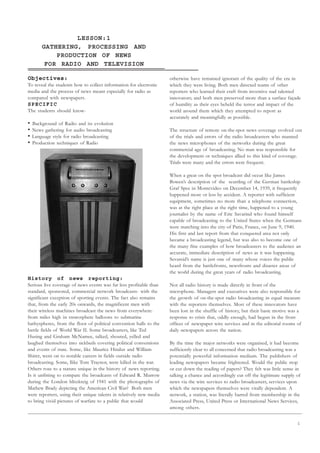
Serious live coverage of news events was far less profitable than
standard, sponsored, commercial network broadcasts- with the
significant exception of sporting events. The fact also remains
that, from the early 20s onwards, the magnificent men with
their wireless machines broadcast the news from everywhere:
from miles high in stratosphere balloons to submarine
bathyspheres, from the floor of political convention halls to the
battle fields of World War II. Some broadcasters, like Ted
Husing and Graham McNamee, talked, shouted, yelled and
laughed themselves into sickbeds covering political conventions
and events of state. Some, like Maurice Hindus and William
Shirer, went on to notable careers in fields outside radio
broadcasting. Some, llike Tom Traynor, were killed in the war.
Others rose to a stature unique in the history of news reporting.
Is it unfitting to compare the broadcasts of Edward R. Murrow
during the London blitzkreig of 1941 with the photographs of
Mathew Brady depicting the American Civil War? Both men
were reporters, using their unique talents in relatively new media
to bring vivid pictures of warfare to a public that would
otherwise have remained ignorant of the quality of the era in
which they were living. Both men directed teams of other
reporters who learned their craft from inventive nad talented
innovators; and both men preserved more than a surface façade
of humility as their eyes beheld the terror and impact of the
world around them which they attempted to report as
accurately and meaningfully as possible.
The structure of remote on-the-spot news coverage evolved out
of the trials and errors of the radio broadcasters who manned
the news microphones of the networks during the great
commercial age of broadcasting. No man was responsible for
the development or techniques allied to this kind of coverage.
Trials were many and the errors were frequent.
When a great on the spot broadcast did occur like James
Bowen’s description of the scuttling of the German battleship
Graf Spee in Montevideo on December 14, 1939, it frequently
happened more or less by accident. A reporter with sufficient
equipment, sometimes no more than a telephone connection,
was at the right place at the right time, happened to a young
journalist by the name of Eric Savarind who found himself
capable of broadcasting to the United States when the Germans
were matching into the city of Paris, France, on June 9, 1940.
His first and last report from that conquered area not only
became a broadcasting legend, but was also to become one of
the many fine examples of how broadcasters to the audience an
accurate, immediate description of news as it was happening.
Sevareid’s name is just one of many whose voices the public
heard from the battlefronts, newsfronts and disaster areas of
the world during the great years of radio broadcasting.
Not all radio history is made directly in front of the
microphone. Managers and executives were also responsible for
the growth of on-the-spot radio broadcasting in equal measure
with the reporters themselves. Most of these innovators have
been lost in the shuffle of history, but their basic motive was a
response to crisis that, oddly enough, had begun in the front
offices of newspaper wire services and in the editorial rooms of
daily newspapers across the nation.
By the time the major networks were organised, it had become
sufficiently clear to all concerned that radio broadcasting was a
potentially powerful information medium. The publishers of
leading newspapers became frightened. Would the public stop
or cut down the reading of papers? They felt was little sense in
talking a chance and accordingly cut off the legitimate supply of
news via the wire services to radio broadcasters, services upon
which the newspapers themselves were vitally dependent. A
network, a station, was literally barred from membership in the
Associated Press, United Press or International News Services,
among others.
UNIT I
RADIO JOURNALISM
2
The managers of the broadcasting outlets had a choice. They
were obviously involved in a war with the press, a war which
had, by the 1930s, reached such bitter dimensions that
newspapers frequently refused to publish the daily list of
entertainment programmes (to say nothing of news
broadcasts) presented on radio stations. Broadcasters, had they
wished, could have acepted defeat and – at first glance, to their
own advantage- gone out of the news business entirely,
concentrating on the more highly profitable producing of
comedy shows, soap operas, musical programs and other forms
of pure entertainment.
But they chose to stand and fight the newspapers for three
reasons. First, since the first broadcasts in the early 1920s by
Pittsburgh’s poineer station KDJA, radio innovators had clearly
demonstrated that they could often news coverage of a type
that printed newspaper could not. Radio was a faster medium
than the printed media, it could spread a news story to
communities or across the nation in seconds while newspapers
took hours. It could also bring the listener to the place where
news was happening; its on the spot broadcasts were a type of
coverage impossible for news papers even picture newspaper to
duplicate. Second, the public had demonstrated that it wanted
news broadcasts. Early news analytic like Lowell Thomas
became figures of renown overnight, and it was obvious that
millions of listeners were literally glued to their radio sets at
political convention time, for major prizefights and baseball
games and to listen to speeches of statesmen and visiting
foreign leaders as well as heroes. Third, the communications Act
of 1934, a law of U.S. Congress setting up a commission for
the control of broadcasting in the United States, clearly stated
that all commercial broadcasters were bound by legislation to act
in the ‘public interest, convenience and necessity’. How could
they accomplish this directive and ignore the news of the day in
their broadcasting?
The broadcasters, however, did not give up the unique news
gathering services they developed in the years that they had been
excluded from the wire services by the newspaper journalists.
What they were forced to do, of course, was to develop new
and effective ways to gather and report news, and they were not
inclined to unlearn the insights they had gained, methods they
had evolved and highly skilled staffs of radio reporters they had
trained. The combined talents of all broadcasters as well as
newspaper journalists and wire service personnel were needed
to cover the far-flung action during World War II.
In the early days of TV, newscaster like John Cameron
Swayze, Douglas Edwards and Drew Pearson as well as familiar
radio figures like Robert Trout and George Hicks attempted to
deliver ‘illustrated lecturers’ concerning the news of the day,
using as many ‘audiovisual aids’ as they could get into a TV
studio. Their programmes were replete with so many graphs,
charts, maps, photographs (projected behind, above and below
them), props, drawings and other paraphernalia that their
newscasts frequently looked like junk shops.
An attempt was also made to provide as much filmed
material as possible to get the camera away from the studio and
on to the focal action of a news story. But where to find
newsfilm? Since the VT broadcasters themselves were not
equipped to shoot and develop their own movies, they were
forces to buy from establish newsreel firms. Their methods of
preparing one or two reels were far too slow and antiquated for
a rapid fire medium like TV, which gobbled up news as quickly
as it was made and hungered for newsclips minutes after (or
during) the march of events.
One answer was the formation of relatively small but fast
and flexible news films like Telenews, whose man asset was
speed. Providing a written script instead of a sound on film
narration, for TV stations, these newsreel firms would ship
their hastily edited films and scripts to TV station before daily
deadlines. The movie clips would give the newscasters
something to narrate which was more dramatic and to the point
than a map or photograph.
Remote TV Relays:
Another solution was the use of remote TV relays, either by
means of coaxial cable or by microwaves (beams). Where this
was possible, it worked wonderfully. The cables that carried TV
signals in the early days were more costly and complex than the
telephone lines, which radio broadcasters so frequently used.
Worse, the microwave relay beam, which carried remote TV
broadcasts, travelled only in straight lines like a beam of light
and thereby could send only to a reception point as far as the
horizon, at which point it had to be re-energized and
retransmitted. Radio short waves, on the other hand, followed
the contours of the earth far beyond the horizon and were easy
to transmit over great distances. Problems of transmission
bothered for long the TV engineeres. The use of space satellites,
to deflect TV signals headed out into space back to earth
(thereby allowing them to travel far beyond the horizon) was
one solution that worked. Satellites were, however, to be located
in exactlyn the right position for effective transmission, and
some engineers claim that even at present they do not appear to
be living up to their previously expected technical potential.
Radio News Today:
Thus if there is any one area which radio must support and
strengthen in order to hold its own in the growing electronic
competition, it is in the field of news. Rock and roll sells the
kids. Carefully programmed music and informational programs
can sell to the adults. A reputation for ethical, carefully written,
thoughtfully presented, balanced news can do more to hold a
quality image than any other one ingredient.
With the advent of the easily portable tape recorder and the
acquisition of ‘beeper’ recording equipment by every radio
station, there was a boom in coverage of news stories by radio
staffs. However, because of the death of true reportorial talent,
not only has the caliber of radio news coverage been dropping
in the past few years, but quantity also.
The program director or station manager should manager
should be able to see the value in a careful, probing interviiiiew
3
of a personage who has something to say, if the news man is
smart enough to bring it out. In order to do so, however, he
has to be a dedicated newsman- not interested in presenting
just a ‘show’, but interested also in stimulating his interviewee
to answer, questions for the purpose of informing his listeners.
News is not, cannot, must not be contrived, distorted, changed
to any degree from its inherent, factual, informational integrity
for the sake of showmanship. It must not, cannot ethically, be
made funny when it is inherently tragic. It cannot be made
“human interest” whatever that may be, if it is general interest.
It cannot be made clean and light and happy if it is dirty, deep
and bitter- if it is. If one tries- with gimmicks, gadgets, and
inflections to make it what it is not, then one is a liar. That one
is despicable and not deserving of the title of newsman. A
competent broadcast newsman has to go to the scene,
interviews expertly, write skilfully, voice fluently all under
pressure, the newspaper reporter has never experienced. And,
because be can instantly identified by his interviewees and his
listeners as the one man in between, he has to take the brunt of
all the criticism which may be stimulated by any worthwhile
story. To a good newsman there can be but one religion it is the
creed of accuracy and unswerving dedication to the ideal of
complete news coverage of every newsworthy person and event
in your city. One thing will drive him away. Meddling in that
creed in the name of ‘show manship’ one of the nastiest words
to a newsman that was ever coined. There is another thing
which can drive him away. That is being pushed constantly to
do more than he can possibly accomplish properly. What does a
good, minimum metropolitan news department need in the
way of manpower and equipment. A news director one with
experience, ambition, consistency and imagination and one man
inside and two outside for each shift covered.
Fancy Equipments for News Coverage:
The need for fancy equipment varies inversely with the ability
and imagination of your news department. There are certain
basic tools, however. A beeper tape recording device for
recording from the telephone and a minimum of three portable
tape recorders for the outside men two going, one in reserve.
This news department must have access without restriction to
full dubbing facilities for editing tapes and preparing them for
broadcast. The department also should be equipped with the
necessary radios for receiving all your local emergency broadcasts-
fire, police, sherifff, state patrol or what have you. No
department should be without at least one mobile unit
equipped with some sort of two way communication with the
newsroom and with a radio tuned to the local police frequently.
Elementary but often overlooked is the need for a private
telephone line direct to the newsroom with an unlisted
number. Both news wires are also a necessity.
Source of Radio News:
There is no place in news format for gimmicks, showmanship
or anything other than factual informative news reporting.
The news we attempting to provide for our audience is
designed to give them something they can get nowhere else or
at least in greater depth and detail than anywhere else. In this
area, we feel we are doing a good job and find that more and
more people look to us for not the first story but the most
knowledgeable story. We like to believe that a great deal of the
respect we have earned is due to our lack of gimmicks and our
concentration on factual, informative reporting. When our
bulletin intro is used, it means something of something of
starling import has happened on the national or international
scene, a matter of wide concern on the regional scene, or a
tragedy on the local scene.
The Telephone and Tape Recorder:
aptly demonstrate the immediacy and impact that is radio
alone. No other medium can provide direct, on the scene report
as quickly, factually and with greater drama than radio.
The telephone and tape recorder are probably the most under
estimated facilities, at the disposal of a station. If news is
people and your news department, is nothing more than one or
two men trying to fill in with news as well as selling,
announcing or whatever else they required to do, what greater
expenditure is required to use the voices of people who make
the news rather than your own?
If a radio station wants to grow, it should learn how to move
and motivate its community not just in getting ratings, but also
in getting action, in becoming a power. It must latch into those
needs and issues, which present themselves, and it should get
cracking.
For further reading
1.Awasthy, G.C, Broadcasting in India, New Delhi, Allied
publishers, 1976.
2.Baruah U.L.This is all India Radio: A handbook of radio
broadcasting in India. New Delhi, Publications Division, 1983
3. Shrivastava, K.M, Radio and T.V.Journalism, New Delhi,
Sterling 1989.
4. Jain,S.P. The art of Broadcasting. New Delhi, Intellectual
Publishers, 1985.
5 Luthra,H.R. Indian Broadcasting. New Delhi, Publications
Division. 1986.
NOTES:
4
Objectives:
To develop in the student the skills, techniques and art of
capturing visual news through sight sound and motion. It is a
“hands-on” course teaching the use of the hand held camera
and the editing equipment used to create the short inserts used
in normal studio news programs.
SPECIFIC
The students should know-
A) the difference and similarities between print and broadcast
journalism
B) Electronic News Gathering (E.N.G.); know it’s definition
and contribution to the televised news program
C) Know how to use remote equipment, especially the
Camcorder
D) Know the technique of one-camera shooting, in-camera-
editing
E) Know the techniques of video tape editing (video  audio),
especially for use in television news.
In May 1977 the Japanese ENG coverage of the London
economic summit was beamed back to Tokyo by satellite, and
BBC used these pictures as part of its domestic output. BBC
opened 12 the month trial of the new system on october
10,1977 with an interview of Margaret Thatcher, then leader of
the Conservation Opposition. This interview was recorded at
the House of Commons and shown on the lunch time news.
The ITN began experimenting with ENG during April-May
1979 with the coverage of the general elections. By 1980 the
switch from film to ENG was going ahead in Europe and
other areas.
In India Doordarshan started colour transmission
and its news services started using ENG from August 15,
1982. Using INSAT-1A Doordarshan news showed ENG
pictures throughout the network on that Independence day. In
the Ninth Asian Games. 1982. Doordarshan made full use of
ENG and OB vans. The then Information and Broadcasting
Minister Vasant Sathe to face strong opposition to the
switchover from black and white to colour, within and outside
Parliament, on the ground that the funds to be used in this
process should go to anti-poverty programmes.
ENG, also known as EJ(Electronic Journalism) or
ECC(Electronic Camera Coverage), has now become an
universally accepted mode of television news gathering. It
consists of a portable camera and a portable video cassette
machine on which picture and sound are recorded. The two
pieces of equipment, usually linked together by a cable are
operated separately by a cameraman and a sound recording.
Advantage of ENG is eliminating of the process
department and possibility of instant replay as well as instant
transmission using microwav e or satellite uplink from a site far
away from the base. This versatility of the ENG is highly
useful in television news work and has become the order of the
day. Further miniaturization of cameras in going on with
further developments in CCD technology and with ½ and ¼-
inch formats of recording tape.
ENG
Electronic News Gathering is the base upon which all electronic
journalists and news directors build their product. The resources
below offer some insight and information as to how we can
build a better product— more safely and under the law.
New Products: ENG corders
Beam Me Up: New Technology and
Safety Features ENG Cameras and
Camcorders Live Shots
Doing More With Less
ENG and SNG systems have become more flexible
Live  Local: What’s new in the ENG and SNG
markets for broadcasters
ENG Accessories: Products that will help keep your live
shots headache-free
TRADE SECRETS
ENG CAMCORDERS
New lineup of high-definition cameras
This spring brought some of the biggest changes in camcorder
technologies since the advent of digital formats several years
ago.
Hand-held HD
Hold on to your 16:9 screen. JVC says it has the world’s first
hand-held high-definition camcorder. Only a few newsrooms
contemplate shooting HD news anytime soon, but this may
change as the prices of digital television sets decline, as
regulators require more DTV sets to be manufactured, and as
cable systems and programmers carry more HD. Here are the
specifics: Priced at less than $5,000, the HY-HD10U has some
economies, including a single, 1/3-inch CCD with 1.18 million
pixels. Its new design, however, is supposed to improve color
sampling and resolution. The camcorder records three
resolution modes: HD at 720 scan lines, 30 frames, progressive;
standard definition (SD) 480/60p; SD 480/60 interlaced. The
progressive scan modes use 16:9 from the CCD with MPEG-2
compression, while SD interlaced is 4:3 with DV compression.
The camcorder records on standard MiniDV videotape. It can
up- or down-convert to-not from-most formats, including
LESSON:2
ENG-COMPARISON WITH PRACTICES IN PRINT JOURNALISM
5
1080i, 480/60p, and 480/60i, so it can play most formats on
any display with component input. The MPEG-2 is compatible
with JVC’s D-VHS. JVC says it has a nonlinear editor for the
MPEG-2 video and that more are on the way. Other features
include an image stabilizer, two XLR adapter audio inputs and
IEEE 1394 interface for D-VHS or a computer.
Optical Pro
Another big development is Sony’s new Optical Disc Recording
System for broadcast use. The system-scheduled for release in
the fall-includes two new camcorders and three decks. It records
high-resolution original material and a lower-resolution, frame-
synchronized proxy version. A technician can quickly transfer the
proxy version to a laptop editor or to a studio at up to 30 times
faster than real time, so writers immediately see the proxy to
write scripts. Based on the scripts, technicians can transfer
selected high-resolution video as a video feed or a data feed over
an IP network. The system offers recording using the DVCAM
codec at 25 Mbs per second or MPEG IMX at up to 50 Mbs.
Transfers of high-resolution video can be four or more times
faster than real time, depending on the bit rate. Optical decks
output a variety of analog and digital signals including Ethernet
and IEEE 1394. Rewritable disks hold 90 minutes of DVCAM
or 45 minutes of MPEG IMX.
What are your experiences with new products?
BEAM ME UP
New technology and safety features are making ENG/SNG vehicles
cheaper, easier to operate and more powerful.
A lot has been happening in the ENG/SNG vehicle market
over the past few years. Increased awareness and a rash of high-
profile accidents have focused more attention on safety
standards and equipment for ENG crews, and new
technologies are allowing cheaper, smaller and better options for
gathering news in the field.
Safety First
Safety has long been an issue with ENG trucks, given the
potential for electrical accidents. In California, safety regulations
are being considered by the Occupational Safety and Health
Standards Board that would require ENG vehicles to have: ·
• Switches that require constant pressure to raise the mast and
allow direct overhead view.
• Level indicators to assist the crew in making sure the vehicle is
on level ground.
• Proper illumination, in the form of spotlights or similar
devices, that can light up the area above and around the
vehicle.
• Audio and visual warning indicators to prevent moving the
vehicle while the mast is raised.
• Warning signs documenting possible dangers.
• A single safety manual documenting safety procedures.
Additionally, the regulations propose annual training for ENG
crews-including anyone who works in or near an ENG truck as
well as those who supervise them-and quarterly safety
inspections. The California commission drafting the guidelines
worked with industry vendors and news managers to estimate
it will cost $1,500 to outfit new vehicles to standard, and $3,000
to retrofit existing vehicles. Another round of meetings and
discussion is slated for mid-July. Vendors, however, already are
gearing up to meet or exceed those requirements. Bob King,
international sales manager for Frontline Communications, says
all of its new vehicles will be compliant. Many of the
recommended features were already standard for new ENG
trucks from most vendors, and the only rapid change was
adjusting the warning signs to size and verbiage specifications.
One minor holdback is the position for the level indicators. The
best method is mounting an indicator to the ENG mast, with a
remote indicator. Will-Burt, the main supplier of telescoping
masts, is currently adapting an expensive leveling indicator used
on its military mast systems to be more cost-effective for ENG
vehicles. King says the new system should be ready before the
California regulations go into effect. Another safety feature
becoming popular is the current detector, that can warn
operators of nearby power lines. These can be mounted on the
ENG mast, and can either provide a warning alarm, or even cut
power to the mast to prevent an electrical accident. Two of the
more popular products come from SIGALARM (www
.sigalarminc.com) and the Will-Burt Company (www.will-
burt.com). Current detectors are not required under the new
regulations, however.
New Methods
Recent technology advancements have drastically altered the
ENG landscape. Most vendors are now offering hybrid ENG/
SNG trucks that dramatically lower the cost of having SNG
capability in the field. Jack Vines Jr., sales manager for Television
Engineering Corporation, says the new hybrid vehicles can give
stations remote uplink capability for less than half the up-front
cost of older, larger satellite trucks, with reduced maintenance
and operating fees to boot. The trucks also provide a smaller
and more mobile solution for stations that have coverage areas
exceeding the limitations of microwave ENG. The smaller,
compact SNG capability has been available since mid-1996, but
in recent years cost has dropped and the technology has been
refined. “This is the first year that we’ve done as many hybrid
proposals as regular ENG-type trucks with mast only,” says
Vines. Another advancement is digital transmission of
microwave signals, called COFDM. This technology allows for
improved signal strength on microwave masts by reducing the
need for line-of-sight. Camera crews can get shots from
locations where microwave alone wouldn’t work, as well as
broadcast more clearly while the truck is moving. Vines say most
6
customers are taking the interim step right now of buying a
vehicle that has a digital-ready transmitter, instead of buying the
full package with a digital encoder. Beyond moving to a digital
transmitter at some later date, a digital-ready vehicle will help
adapt to any spectrum changes for ENG coming down the
pike.
The communication companies offering
services:BAF Communications?
„Manufacturer and integrator of specialty vehicles, including
broadcasting, communications, medical, cellular, banking.
From smallest crew cabs to ENG to SNV to production
trailers and OB vans.
„ Freightliner Sprinter DSNG/ENG combo combines
compact platform with excellent weight capacity and internal
space. The longtime worldwide favorite is now available
domestically.
„ New/Used/Reconditioned
Frontline Communications Corporation
„ Frontline builds ENG, SNG, DSNG and EFP vehicles for
the broadcast world. Our products range from microwave
vans to HDTV expanding-side trailers.
„ Frontline is the leader in safety provisions built into
Broadcast vehicles, most pointedly ENG vans. Frontline
offers, as standard, safety systems that were adopted by
CAL/OSHA requirements for ENG safety. Additionally,
Frontline offers aftermarket power line detector systems at
the choice of customers. Frontline is the benchmark for
ENG safety.
„ New/Used/Reconditioned
„ Cost-effective airborne ENG solutions. We have experience
with a wide range of aircraft and equipment-not just the basic
JetRanger-regardless of your needs.
„ Multisensor gyro stabilized cameras with both infrared and
visual cameras, we also specialize in complete turnkey
solutions, including flight crew, camera crew, and even talent.
We also provide a cost-effective airborne ENG package to be
shared among multiple users (both traditional broadcast and
nontraditional) to significantly reduce cost and increase
utilization.
„ New/Used/Reconditioned
Microwave Radio Communications
„ Leading manufacturer of digital and analog video microwave
systems for portable and fixed broadcast operations: STL,
TSL, ENG, Outside Broadcast, intercity relays, satellite
backhaul, regional networks.
„ CodeRunner: COFDM and 4.2.0/4.2.2 MPEG II with
remote control software in 2RU for ENG applications. Agile
audio sub-carriers and frequency agile functionality for
customized channel plans. News cars and SUVs use a 13dB
directional antenna or a 5dB Omni Antenna. In most cases a
mast is not needed. FCC proof.
„ New
N Systems Inc.
„ NSI anufactures ENG transmit and receive antenna systems,
the MC5 PC-based touchscreen remote control system, and
Cam Pac remote camera systems for weather and site
observation.
„ Auto Link™: an advanced feature of the NSI MC5 remote
control system that closes the loop for microwave antenna
alignment by enabling the operator at the studio to control
both ends of the microwave link. NuPod was selected as the
best new product in the ENG microwave category at B2002.
„ New
Nucomm Inc.
„ Microwave transmitters and receivers for analog/digital
STL/TSL; analog/digital systems (COFDM, QAM, 8VSB).
Portable and ENG/OB, central receivers, antennas, remote
control systems. Miniature transmitters. Digital converter
units.
„ Nucomm Inc. is introducing its new COFDM modulator
and MPEG II Encoder, the NEWSCODER-TX1. It
employs the latest DVB-T COFDM technology. The unit
occupies only one RU of rack space and can be integrated
into existing digital-ready ENG trucks and/or helicopters or
“built in” the 1RU NEWSCASTER VT1 series truck
transmitters.
„ New
Shook Mobile Technology
„ Shook Mobile Technology is fast becoming the industry
leader in live microwave and digital satellite news vehicles.
„ Shook Mobile Technology Roadrunner II series vans have
been completely redesigned to be the most rugged and
reliable on the road. Additionally, we have incorporated the
most sought-after features suggested by more than 30 chief
engineers and directors we interviewed over the past two
years.
„ New/Used/Reconditioned
Television Engineering Corporation
„ Designer and builder of custom ENG and DSNG mobile
solutions for newsgathering as well as the Eagle Eye news
camera system.
„ The TEC MicroSat ENG/DSNG unit represents a new way
of thinking about covering breaking news. Smaller trucks-
utilizing compact digital satellite systems-allow you to get on
the scene faster and with more versatility. Features include an
automatic satellite locating interface, a custom edit suite and
the Eagle Eye camera system.
„ New/Used/Reconditioned
U.S. Helicopters Inc.
„ U.S. Helicopters Inc. is a nationwide provider of turnkey
ENG helicopter programs, operating the Bell 206 JetRanger,
Longranger, and Eurocopter AS350 Astar helicopters.
„U.S. Helicopters Inc. has been operating ENG helicopters for
two decades and is one of the largest providers of ENG
helicopters in the nation.U.S. Helicopters is also the only
national provider of ENG helicopters that is an approved
service facility for both Bell Helicopter Textron and American
Eurocopter Corporation.
„ New/Used/Reconditioned
Winemiller Communications Inc.
„ WCI is the nation’s largest provider of remanufactured
ENG/SNG vehicles, including sales, rentals and
comprehensive repair and rebuilding services for customer-
owned trucks.
7
Much more than just “rebuilding,” WCI’s wheels-to-mast
nufacturing process and mechanical warranties are unequalled
in the industry. WCI’s full-time master mechanics maintain
total control over the process, ensuring the highest quality
standards. WCI’s rental trucks keep customers at full capacity
while their truck is rebuilt, and insurance estimates are free.
„ New/Used/Reconditioned
Wolf Coach Company
„ The leading innovative source for mobile
telecommunications systems, Wolf Coach provides the
design and fabrication of an extensive array of vehicles and
electronics integration for newsgathering use.
„ The new Benchmark 3 DS-ENG hybrid maximizes interior
headroom and creates a quieter working environment by
ducting the air conditioning system and moving the sound-
suppressed generator power to the street side. Normally
configured with an AVL 1.2m digital uplink antenna and a
42' telescoping mast for terrestrial RF transmission.
„ New/Used/Reconditioned
ENG CAMERAS AND CAMCORDERS
An evolution in shooting Will videotape become a thing of the
past? It’s too early to say, but at least one vendor now offers the
option to record quality video on DVD rather than tape.
Meanwhile, another new camcorder is designed as much for
video streaming as traditional broadcast. On the high end, look
for more choice in digital cameras, as well as some advantages
previously found only in film cameras: higher data rates, high-
definition resolution, and even variable frame rates.
DVD Cam
Hitachi is introducing a line of tapeless camcorders. Although
Hitachi has sold one-CCD DVD camcorders for more than a
year, the new professional DVD products include a one-piece,
three-CCD camcorder and a dockable DVD recorder. The
products record MPEG-2 video on a reusable DVD-RAM
cartridge with a capacity of 60 minutes. Hitachi includes
software to edit the media with a laptop PC, or the recorder or
camcorder can edit and transfer to a server for processing.
Hitachi says plug-ins will be available for popular editors such as
Avid Express or Apple Final Cut Pro to handle the video, too.
Especially useful will be the ability to quickly assemble clips and
e-mail them to another location. The recorder can loop, so a
camcorder operator can continuously shoot without running
out of recording media-a feature especially useful for stakeout
assignments. Hitachi says the camcorder creates thumbnail
images of the start of each scene to help index the video on the
disk. Hitachi plans to start shipping the recorder in the fourth
quarter of this year.
Live to the Web
JVC has a new kind of camcorder called Streamcorder.
Although its hand-held style doesn’t resemble your ordinary
ENG camcorder, it seems to be a unique tool for stations with
web pages that emphasize video. JVC describes Streamcorder as
a hand-held broadcast-quality camera with the ability to record
to tape or digital memory or simultaneously stream to the
Internet. The Streamcorder system consists of the GY-DV300
camcorder (list price $3,495) with a 14:1 lens, XLR microphone
inputs and an adjustable zebra pattern. It uses mini-
DVvideotape. Streamcorder has another component-the KA-
DV300 network package ($1,299)-that attaches to the bottom
of the camcorder with a connection for a data communication
card. It communicates with JVC streaming software on a
computer.
50 Megabits
On the high end of field and news production, Sony’s new
MSW-900 MPEG IMX camcorder has a bit rate of 50 megabits
per second. Sony says the camcorder completes its system of
MPEG 50-megabit production equipment from acquisition to
transmission. The camcorder can switch between modes of 60
interlaced and 30 progressive fields per second.
Vary the Frame Rate
Also at the high end is a portable, variable rate camera from
Panasonic, the AK-HC900. The 720-line, progressive-scan
camera can capture film like 24-frame-per-second progressive
high-definition images. It sports a high frame rate of 60 frames
per second for broadcast sports or analysis applications, and has
a range of variable frame rates (6, 12, 18, 24, 30 and 40) for off-
speed acquisition. The camera has an RS-422/RS-232C port for
remote control..
LIVE SHOTS
Counting the cost of ENG/SNG
The ENG/SNG landscape is changing quickly. It has become
more popular to combine local microwave and satellite
transmission on one vehicle, vendors say, and cost
considerations are making refurbished ENG vehicles more
attractive to buyers. Also, more ENG vehicles come with
COFDM (digital microwave) systems, which expand the
reliability and capabilities of liveshots, especially in difficult
terrain or from moving vehicles.
Let’s Get Together
BAF offers a combined ENG digital SNG van. For example, a
van built for KSLA-TV in Shreveport, LA, has an AvL 1.2-
meter antenna with a Tiernan digital package for SNG. For
ENG, it has a 42-foot mast and MRC 2 GHz analog
transmitter. The unit uses the ChainWay system rather than the
typical coil, to manage cables and put less stress on the mast,
BAF says.
All Shook Up
COFDM is available for the new Roadrunner II A-11 DENG
van from Shook Mobile Technology. The company has
redesigned the interior to include a lighter, lower aluminum
floor to reduce weight and increase head clearance. Exterior
improvements include a platform for a satellite dish and a
basket for the cable coil to better distribute the weight.
Watch Your Weight
Wolf Coach says it put a lot of thought in how to keep the
weight well below a legal limit of 9,400 pounds for its new
Hybrid Benchmark 3 DS/ENG van. Wolf says the design also
has heat/air ducts, exceptional rack space and a raised roof.
8
Older But Better
With capital budgets limited these days, the refurbishing option
is growing in popularity. Winemiller Communications says its
used vehicles sell for about half the price of new ones. Its
refurbishing process reinstalls engines and transmissions with
three-year/75,000-mile warranties, as well as renovates interiors
and exteriors. Company president says refurbish orders in 2001
were up 50 percent over 2000. “We see a mix in the budgeting
of new and refurbished trucks,” she says.
DOING MORE WITH LESS
ENG and SNG systems have become more flexible
The Telecast CopperHead multiplexer operates on camcorder
battery power.
ENG and SNG systems are increasingly flexible, especially in
two areas. First, new digital COFDM (coded orthogonal
frequency division multiplexing) ENG systems send signals
from places where no one would dare a few years ago. Second,
many products, especially SNG packs, are now more compact
and portable.
Fiber-Optic Cables Make the Load
Even Lighter
Remember the days of lugging rolls of heavy and expensive
camera cable? A few years ago, Camplex lightened the load by
multiplexing all the necessary ENG signals on one coaxial cable.
Now there’s a system by Telecast Fiber Systems called
CopperHead to multiplex all the necessary signals on a single
fiber-optic cable that weighs a fraction of coax, but relays signals
30 times farther, including two-way program video and audio,
intercom audio, and returns black burst, color, audio, camera,
tally and control data. The 1.5-pound unit that multiplexes all
these signals fits on the back of a camcorder and receives power
from its battery. Single- or multi-mode fiber links the
multiplexer with a rack-mounted base station in the ENG
vehicle. The price is about $10,000. Telecast: 508.754.4858 or
Transmitter Eliminates Cable
Altogether
You won’t have as many return signals, but you can eliminate
camera cables with a new device called Carry Coder from
Broadcast Microwave Services. It’s a COFDM wireless video
transmitter that links an ENG camera with a receiver in a van or
wherever you want to put it. As with most COFDM systems, it
is robust even for mobile operation.
Switchable Antenna Makes Live Shots
Easier
Microwave Radio Communications says its new switchable
sector ENG transmitting antenna, called MRC Quad Sector,
and offers the advantages of both an omni-directional antenna
and a high-gain steerable antenna. It should be especially useful
for quickly establishing a signal at the scene of a breaking story.
At 15 pounds, it’s more appropriate for lighter ENG vehicles
or dual-mode ENG/SNG vehicles.
ENG Link Fits in a Backpack
Expedio, a portable digital ENG link from Moseley, is taking
the flexibility of COFDM another step. It only takes 12 DC
volts to power the unit, and the company says you can even
carry it in a backpack and transport it on a motorcycle. Expedio
can operate in the 1.9-2.7 GHz band at MPEG rates from 4 to
32 Mbps. If you don’t recognize the name Moseley, perhaps
you recognize Microwave Data Systems. Moseley recently
purchased MDS from Adaptive Broadband Corporation.
AvL’s Fly  Drive is one of several new SNG antenna systems
that are easier to move and use.
SNG Systems That Are Simpler and
Lighter
There are many new, simpler and lighter portable, and usually
digital, SNG antenna configurations. Some are fly-aways, small
enough to be handled as airline luggage. Other models are
drive-aways that mount atop a vehicle like a luggage rack. AvL
Technologies has a model that does both, the Fly  Drive, for
$50,000.
All the portable SNG antenna systems are available in a range
of dish sizes, prices, and electronics options:
What’s New in the ENG and SNG
Markets
News managers are focused on electronic and satellite
newsgathering for several reasons. First, there are the safety
issues. At least five people have died in accidents involving
masts in the United States and Canada since the mid-1980s.
California is considering changes in occupational safety
regulations that cover masts. In addition, recent reports of
vehicle rollover accidents, especially of sport-utility vehicles, raise
questions about the likelihood of news vehicle rollovers given
the additional equipment weight. Separately, there’s the
expected reassignment of some frequencies for ENG
microwave transmission. Finally, digital microwave is coming
on the market, especially welcome because it’s lighter, more
compact and transmits better.
Safety Devices
Two manufacturers report a big increase in sales of warning
devices for ENG masts in the last six months. One device,
9
called Sigalarm, detects the electrostatic fields of power lines and
alerts mast operators of hazards with both audible and visual
warnings.
Anticipating more orders, Will-Burt has lowered the price of its
warning system, D-TEC, to $2,850. D-TEC has multiple ways
to detect power lines or other hazards to raising ENG masts,
including power field detection, sonar, tilt sensing and
illumination.
Vehicles
Television Engineering Corporation says its new TEC-14BX
MicroSat, built on an ambulance-style truck, meets the need for
smaller vehicles, reduced costs and easier operation. The truck
seats six, but could be staffed by just a reporter and
photographer.
Television Engineering’s newest ENG truck, called
NewsRunner, is based on a Ford Excursion sport-utility vehicle
with a V-10 engine.
Frontline Communications has introduced an SNG truck, called
NT-5, that is based on a Ford F-550 diesel truck chassis, with a
gross vehicle weight rating of 19,000 pounds. It can house a
digital or analog uplink, a small carbon fiber antenna, or a full
2.4-meter antenna. Frontline Communications: 727.573.0400 or
www.frontlinecom.com
Wolf Coach’s latest product is a digital SNG/ENG hybrid
version of the company’s Benchmark 3 van. Wolf was
concerned about the weight and cost of digital SNG vans. Since
smaller units are less expensive and less regulated, company
engineers improved the design and construction to eliminate
hundreds of pounds from the base weight. Wolf Coach:
508.791.1950 or www.wolfcoach.com
BAF Communications has a smaller SNG/ENG vehicle based
on a Ford E-450 chassis. The gross vehicle weight rating is
14,050 pounds and length is 22 feet.
Shook Electronics has an all-terrain vehicle with a fixed 1.5-
meter antenna for digital SNG. When the ATV is not used, the
versatile system allows the SNG electronics to be removed and
used as a flyaway unit with a portable antenna.
Winemiller Communications specializes in refurbishing ENG/
SNG vehicles to maximize ENG budgets. Its engineers can
design, install and train in the use of ENG or SNG systems,
including help for stations affected when the FCC reallocates use
of the 2 Ghz microwave spectrum.
Digital Connection
CONUS says its new Digital Communications Package for the
first time gives stations total communication capability through
a single satellite connection. This includes telephone, fax, high-
speed Internet and network service. The unit is available only to
CONUS members
Suggested Readings
1. Shrivastava, K.M.Radio and T.V.Journalism, New Delhi,
Sterling 1989.
Keval J kumar: Mass Communication in India, Jaico Publishing
House.
NOTES:
1 0
LESSON:3
NEWAND CURRENT AFFAIRS
Objectives
This lesson is to give an idea on News and Current Affairs
Programmes and their importance on various channels of
Radio.
SPECIFIC
• The students should assess-
• The need for current affairs programmes.
• The importance of the programme
• What is broadcast (the content) in those programmes
News and Current Affairs
It is at once dangerous and necessary to summarise research
findings. Danger resides in the inevitable gloss over
explanations that otherwise come from rich, detailed data. The
necessity is that effective communication of any research requires
simple and general statements about that research. With this in
mind, this chapter seeks to summarise this research and, in
doing so, to minimize reduction and to maximise clarity and
explanation. This chapter will also review the overall research
program reported here and undertaken for Stage Two of the
ABA study on sources of news and current affairs.
The most poignant findings are these:
Half of Australian adults spend at least one hour a day
watching, listening to and reading news and current affairs. Free
to air television remains the most used source for news and
current affairs with nearly 88 per cent of Australians using it
followed by 76 per cent listening to the radio and 76 per cent
reading newspapers. National Nine News is the leader amongst
free to air viewers, ABC Radio News in its various forms is the
most attended by radio listeners, newspapers are predictably
popular within their own city, state or territory.
The ABC 7.30 Report presenter, Kerry O’Brien is the most
preferred journalist, reporter, presenter, columnist; he is
followed by Mike Munro from Channel Nine’s A Current
Affair. Both were named as most credible as well, in the same
order and both of their programs appeared in the top three
most credible programs.Ten per cent watch pay TV and 11.3 per
cent use the Internet for news and current affairs.Australian
audiences believe that the business interests of media
organisations are the greatest source of influence on what they
read, hear or see in news and current affairs.
Australians use their preferred source of news or current affairs
because of the quality of coverage it provides, although many
admit that timing in the exhibition of content and convenience
are the main reasons why they read, listen or watch.
Most Australians believe the news and current affairs media are
credible although many feel they are not as credible as they
should be.The most credible sources are the public broadcasters
while the least credible are the commercial broadcasters with
other media sandwiched between them.Nearly all Australians
believe that their preferred source of news and current
affairs has at least some influence on public opinion and about
half attributed their preferred source with a moderate to high
level of influence.Those Australians who report preferring and
mainly watching commercial free to air television for their news
and current affairs have more conservative social and political
attitudes than those who prefer and most often use public free
to air television. The most conservative attitudes are found
among those who watch A Current Affair and 60 Minutes
whereas the least conservative are found among those who
watch SBS World News. Economic attitudes do not differ in
relation to the sources of news and current affairs used by
Australians.
Of most concern to Australians is sensationalised reporting in
news and current affairs. Intrusive reporting ranks as the second
highest concern followed by biased content and then inaccurate
reporting. Nevertheless, sensationalised reporting is recognised
as an effective tool to draw their attention to particular services.
Three-quarters of Australians believe the media cover local news
and current affairs less adequately than they could and attribute
inadequate coverage of local events and issues to a general lack
of community and media interest in local matters.
It is clear from these results that Australians are avid news and
current affairs consumers. Not surprisingly, both survey and
focus group participants had a lot to say about news and current
affairs in this country. A less than precise, but general
observation about the results presented in this report is that
they resonate with indicators that the tripartite relationship
among audiences, providers and content of news and current
affairs is changing. Not surprisingly, nowhere in the focus group
transcripts or the tabular data of the national survey is the
nature of this transformation explicit. Nevertheless, one might
infer from the totality of findings presented herein that what
both audiences and providers want in news and current affairs
content is not traditional hard news; nor do they find desirable
the recent formulation of questionable current affairs content.
Indeed, both audience and industry are seeking a new formula,
one that will meet the needs of public policy and the public
good; and no doubt, one that will enrich the news and current
affairs organisation that introduces and dominates it. The policy
1 1
challenge will be to assist in the equitable realisation of the new
formula.
The Today programme
This refers to the BBC Today programme, for the NBC Today Show
Today, commonly referred to as The Today programme in
order to avoid ambiguity, is BBC Radio 4’s long-running early
morning news and current affairs programme, which is now
broadcast from 6 a.m. to 9 a.m. from Monday to Friday and
from 7 a.m. to 9 a.m. on Saturdays. It consists of regular news
bulletins, serious political interviews and in-depth reports.
Today was launched on the BBC’s Home Service on October 28,
1957 as a programme of “topical talks” to give listeners a
morning alternative to light music. It was initially broadcast as
two 20-minute editions slotted in around the existing news
bulletins and religious items. In 1963, it became part of the
BBC’s Current Affairs department, and it started to become
more news-oriented. The two editions also became longer, and
by the end of the 1960s, it had become a single two-hour long
programme that enveloped the news bulletins and the religious
talk that had become “Thought For The Day”. It was cut back
to two parts in 1976-1978, but was swiftly returned to its
former position. Jack de Manio became its principal presenter in
1958. He became notorious for on-air gaffes. In 1970 the
programme format was changed so that there were two
presenters each day. De Manio left in 1971, and by 1975 the
team of John Timpson and Brian Redhead was well
established. This arrangement lasted until Timpson’s retirement
in 1986, when John Humphrys and Sue MacGregor joined the
rotating list of presenters. After Redhead’s untimely death in
late 1993, James Naughtie became a member of the team. Sarah
Montague replaced MacGregor in 2002.
The show reached a peak in terms of influence in the 1980s,
when prime minister Margaret Thatcher was a noted listener.
Ministers thus became keen to go on the programme and be
heard by their leader; but the tough, confrontational
interviewing style they encountered led to accusations that the
BBC was biased. Criticism was particularly directed against
Redhead, who was widely seen as being on the left. The style of
the male interviewers was analysed and contrasted with that of
McGregor, who was alleged to be giving subjects an easier time.
The “big 8.10” interview that follows the 8 o’clock news
remains an important institution of British politics to this day.
Today regularly holds an end-of-year poll. For many years this
took the form of write-in votes for the Man and Woman of
the Year. This was stopped after an episode of organised vote-
rigging in 1990, but was soon revived as a telephone vote for a
single Personality of the Year. A futher episode of vote-rigging,
in favour of Tony Blair in 1996, forced the programme makers
to consider more innovative polling questions.Since 1970 the
programme has featured Thought for the Day, in which a
speaker reflects on topical issues from a theological viewpoint.
Notable contributors to the slot include Rabbi Lionel Blue and
Richard Harries, the Bishop of Oxford. Over the years the slot
has featured an increasing number of speakers from religions
other than Christianity, though Christian peakers remain in a
substantial majority.
Today found itself in the midst of controversy again in 2002,
when its editor Rod Liddle wrote a column in The Guardian
that was extremely critical of the Countryside Alliance. He
eventually resigned from his post on Today. Journalist and
historian Peter Hennessy has asserted in two books that one of
the tests that the commander of a British nuclear-missile
submarine must use to determine whether the UK has been the
target of a nuclear attack (in which case he has sealed orders
which may authorise him to fire his nuclear missiles in
retalliation) is to listen for the presence of Today on Radio 4’s
frequencies. If a certain number of days pass without the
programme being broadcast, that is to be taken as evidence that
the envelope may be opened. The true conditions are of course
secret, and Hennessy has never revealed his sources for this
story, leading Paul Donovan, author of a book about Today, to
express some scepticism about it.
NOTES:
1 2
LESSON:4
BROADCASTING CODE-BROADCASTING POLICY
Objectives
This lesson discusses the Broadcasting system in the country
and policy of the governments in implementing the code.
Thisgives a detailed analysis on the broadcasting autonomy case
AIR Code
Broadcast on All India Radio by individuals will not permit:
1. Criticism of friendly countries;
2. Attack on religions or communities;
3. Anything obscene or defamatory;
4. Incitement to violence or anything against maintenance of
law and order;
5. Anything amounting to contempt of court;
6. Aspersions against the integrity of the President, Governors
and the Judiciary.
7. Attack on a political party by name;
8. Hostile criticism of any State or the Center;
9.Anything showing disrespect to the Constitution or
advocating change in the Constitution by violence; but
advocating changes in a constitutional way should not be
debarred.
10. Appeal for funds except for the Prime Minister’s National
Relief Fund, at a time of External Emergency or if the
Country is faced with a natural calamity such a floods,
earthquake or cyclone.
11. Direct publicity for or on behalf of an individual or
organization which is likely to benefit only that individual or
organization.
12. Trade names in broadcasts which amount to advertising
directly (except in Commercial Services).
Note
1. The code applies to criticism in the nature of personal tirade
either of a friendly Government or of political party or of the
Central Government or any State Government. But it does not
debar reference to and/or dispassionate discussion of policies
pursued by any of them.
2. If a Station Director finds that the above Code has not been
respected in any particular by an intending broadcaster he will
draw the latter’s attention to the passage objected to. If the
intending broadcaster refuses to accept the Station Director’s
suggestions and modify his script accordingly, the Station
Director will be justified in refusing his or her broadcast.
3. Cases of unresolved differences of opinion between a
Minister of State Government and the Station Director about
the interpretation of the Code with regard to a talk to be
broadcast by the former will be referred to the Minister of
Information and Broadcasting, Government of India who will
decide finally whether or not any change in the text of the talk is
necessary in order to avoid violation of the Code.
CODE OF CONDUCT FOR TELEVISION/RADIO
BROADCASTS IN CONNECTION WITH ELECTIONS
1. The Election Commission (EC) recognises the significance
of television and radio in the coverage of elections. Their reach
is widespread and impact substantial. On the one hand, the
electronic media can be misused to favour one party or another.
But on the other hand, the EC recognises that electronic media
can, if used properly be an important source of information for
voters across the country. It can provide the widest first hand
education for voters on political parties, their symbols, various
leaders and different issues in the election. This is why electronic
media all over the world is the single biggest source of
information of voters in terms of debates, campaign, coverage
etc.
2. It is essential therefore that a model code of conduct is
established for electronic media both to ensure that it is not
misused as well as to ensure that it be used in the best interest
of democracy and the voter.
3. Listed below are the Dos and Don’ts for election coverage
on electronic media.
a) DONTs
1) There should be no coverage of any election speeches or
other material that incites violence, against one religion,
against one language, against one group etc.
2) In any constituency, only one candidate should not be
projected. While it is not necessary to cover every single
candidate (as some constituencies may have several
candidates), at least the more important candidates should be
covered in any reports from a constituency.
3) The following could be covered in a balanced and fair
manner:-
- Campaigning and excerpts from campaign speeches.
- Symbols, banners, flags and other campaign materials
of parties.
- Results of opinion polls by non-political, professional
organizations with a proven track record.
- Party manifestoes (critical analysis of which is also
perfectly legitimate.)
1 3
- Candidates and their views in different constituencies
across the country.
- The positions taken by the main parties on different
issues important to the electorate.
- Debates between major parties and candidates.
- Analysis of previous voting patterns, victory margins,
swings etc.
4)By ‘balanced and fair’ it is meant that among the major
political parties:-
- No political parties should be given substantially more
coverage than others. The ‘balance’ need not be achieved in
any single day or in a single story, but over a reasonable
period of time, say one week.
- Balance does not mean each party must get exactly the
same air time to the last second, but parties should be given
broadly the same amount of time.
- Balance implies that to no reasonable person should it
appear that one political party is being projected to the
exclusion of others.
5) Procedures:
- All producers must record a copy of their programme
off air for use as reference in case of any disputes.
- The EC shall be the final arbiter in any dispute.
6) The final interpretation of any disputed passage or story
should be with The Election Commission .In Case of
disagreement with the roadcaster, one authority could be
nominated by the Election Commission who could take a
decision immediately when approached.
*Subsequent clarifications-
Opinion/Gallop Polls are not to be published/broadcast
during the period 48hrs before each phase of polling till the
completion of the phase of polling.
Exit poll results are not to be published/broadcast before
the completion of each phase of polling.
Media reform in India: Legitimising
community media
While the direction of media reform in India has often been viewed in
the context of demand and supply, its exclusionary and piece meal
characteristics would appear to have been relegated to the background.
These have significant fall-outs in terms of media democratization in
the country. Even a cursory look at the pace of decentralization would
take cognizance of its selective and reactive characteristics. If the first is
predictable under a ‘market is the mantra’ regime, the latter is worrying
as it raises a larger question: Does the course of the reforms conform to
a larger and cogent media policy, or are they symptomatic of a crisis –
management and reactive culture? While there are no easy answers,
community would appear to have paid the heaviest price in an ambivalent
and unlevelled media playing field.
In a county of daunting socio-economic divides accompanied
by a formidable diversity of languages, dialects and cultures, the
potential for community media should have assumed critical
significance. Unfortunately, the gap between potential and
practices would appear to have widened, judged by the media
trends. Community voices, if at all, struggle at the periphery of
a contrasting and often iniquitous media landscape. In contrast
to the government’s efforts to bridge the digital divide and take
information technology to the masses, the colonial and
fossilised Indian Telegraph Act of 1885 continues to hold sway
over the broadcasting arena. On the one hand, the Supreme
Court Judgement of 1995 has endorsed that ‘airwaves are
public property.’ However, in the practical realm, lines between
public and privately remain conveniently blurred. While Private
Radio has made an entry into the Indian broadcast arena,
community radio remains to find legitimacy by the law of the
land, notwithstanding New Delhi’s recent New Year gift
enabling residential educational institutions to be eligible for
‘campus community radio.’In many ways, the traditions of the
Indian media fall between these two pendulum ends. In his
essay on the Great Indian Media Bazaar, noted journalist and
editor, N Ram has outlined the role of two media traditions in
the country’s democratic process: An older tradition of a
diverse, pluralistic and relatively independent press which has its
roots in the Indian independence movement; a broadcasting
tradition which has been vulnerable to manipulation and which
began with the appearance of radio as a prop of the British
colonial state, The last two decades of the 20th century saw the
flowering of private media – especially in the broadcast and
cyber media arena – under the umbrella of globalisation and
liberalization.Underlying these media traditions has been the
growth of small autonomous media outfits of subaltern
groups and their organizations. These initiatives, while small in
number, demonstrate the transformative power of community
and participatory media. Unfortunately, in many cases, they
remain isolated initiatives struggling to receive legitimacy and
recognition from the State.There is no doubt that in terms of
reach and access, India’s print and broadcast media manifest -
very substantially - the characteristics of mass media. ‘While
newspapers elsewhere struggle to hold readers, Indian daily
circulation has increased by close to 500% in 20 years. Two all-
India readership surveys conducted in 1999-2000, estimate that
the press as a whole reaches between something 200 and 240
million persons. Translated in terms of percentages this means
that about 60% of urban Indians and 25% of rural Indians
read print media regularly. Radio’s reach is even more
comprehensive covering about 96% of the country.But,
notwithstanding this growth in terms of reach, media’s impact
on development and governance remains, at best, tenuous. In
fact there would appear to remain a substantial gap between
potential and experience.
Bridging the development gap
Paradoxically, in terms of need, the role of media in bridging
the development gap is more keenly felt today than ever before.
The 1990s, especially in the socio-economic context, yields a
1 4
disquieting picture. Globalisation’s impact on the poverty map
leaves much to be desired. Even World Bank percentage proved
to be more or less representative in terms of coverage in many
other dailies.’Media’s relationship with governance is equally
tenuous. Media coverage of the recent communal strife in
Gujarat has, in the main, been positive. But disparities do exist.
As Mukul Sharma points out, ‘both media and governance in
India suffer from serious problems, which at times, even feed
into each other. Suspension of civil liberties, excessive
militarisation, communal assertions and omogenising
tendencies have too often spelled doom for Indian democracy.
In this context, it is imperative that media become more
sensitive on issues of democratic governance, people’s struggle
against social injustice, and so on...’This, however, is only part
of the picture. If the media are effectively to mirror society, then
‘the role of people’s organisations, social movements, voluntary
organisations and other civil society formations in monitoring
the functioning of the media and making it more people
centred is critical.’ It is here, that the rub comes.
Community activism needed
Unlike the government or political parties and sections of the
corporate sector who have developed the own press and media
channels, voluntary organisations, social groups and activists,
have not been able to develop their own press and television
channels in a sustained manner. The exceptions that exist are
usually journals/newsletters of development organisations
which cannot in terms of size or scope make a sustained dent at
the macro level. What is required is an active tradition of
community/peoples media. Unfortunately, we do not appear to
be moving in that direction.The promise of media reform
which gathered momentum in the 1980s and 90s unfortunately
did not actualize into performance. The journey from the
Broadcast Bill to the Convergence Bill generated considerable
expectations in the public domain – only to fritter away into
cynicism. While the Broadcast Bill suffered an untimely death,
the Convergence Bill (notwithstanding the hype it initially
evoked) remains to be tabled in the Lok Sabha despite the
passage of three years. Clearly, an overt lesson would indicate a
reluctance, at the policy level, to ‘walk the talk’.This weakness in
political will towards media reform per se becomes more
evident in taking a closer look at broadcast legislation.The Prasar
Bharati Act (1990), which in many ways provides a watershed in
media legislation in the country, demonstrates this substantially.
While the Bill was based on the Verghese Committee Report of
1978 there were significant differences. The Verghese Committee
had favoured the creation of a ‘Trust’ in the service of the
public, as against the Prasar Bharati Bill which proposed a
Corporation which did not have the same statutory dignity and
power. While the objectives of the corporation are virtually the
same as the Verghese Committee’s objectives for the National
Broadcast Trust, they would appear to fall short of the Verghese
Report’s recommendations, which wanted the Ministry of
Information and Broadcasting to shed its responsibility for
broadcasting altogether. The Bill has provisions for a
representative of the MIB as a part time Governor which is at
variance with the ‘full autonomy’ suggested by the Verghese
Committee. The Verghese Committee Report also underlined
the need for a decentralized structure with powers delegated at
regional and local levels. In sharp contrast, the Prasar Bharati bill
says little about the devolution of the powers of the
Government of India and executive boards.Consequently,
despite obtaining ‘autonomous status’ under this Act, the
Prasar Bharati Corporations’s functioning has been described as
‘de facto under the influence of the Government of India’ in
various ways. For instance, the Ministry of Information and
Broadcasting has the ability to intervene and provide inputs to
Prasar Bharati. The Convergence Bill, however, vests powers of
regulation and licensing for communications in a
Communications Commission. In doing so, it would, in effect,
take away those very powers from the Ministry of Information
and Broadcasting. But it would be unrealistic to discuss these
implications, given that the bill has yet to be tabled in
Parliament.In many ways, the radio broadcasting scenario in the
country provides an apt benchmark to view the case for
community media reform. Unlike India’s neighbours, - Sri
Lanka and Nepal – community radio broadcasting remains
outside the pale of legitimacy. Despite advocacy initiatives which
have articulated the need for a three-tiered media structure –
public (government), private and community – the latter
remains to be endorsed by law. After a virtual decade of
lobbying, in early 2003 the Government allowed residential
educational institutions to apply for licenses to operationalise
what it defined as community radio stations. It took nearly a
year before the government upheld one of the licence
applicants. At the end of 2003, community Anna University
was given the green light by the Government of India to
implement the country’s first ‘campus community’ radio
programme. Reportedly, the Indian Institute of Technology,
Kanpur, is likely to closely follow on Anna University’s heels. So
far,so good. But a closer look would indicate that it is far too
early to cheer the new year gift. For instance, New Delhi’s
decision to allow residential educational institutions recognized
by the state and central governments to apply for licenses to
broadcast would appear to have completely overlooked the
proven credentials of community based NGOs and CBOs who
have demonstrated the viability and impact of community
participation in radio. It needs stressing, that in terms of grass
roots experience these NGO and Community based initiatives
are demonstrably ahead of the educational institutions that
have no tradition or practical experience of community
broadcasting. Further, many of these initiatives have applied for
licenses as early as 2000, long before the campus community
initiative was conceptualized.
Community radio initiatives
One of the reasons cited by official quarters for the absence of
community radio legislation is the lack of demand. While it is
true that community radio advocacy needs to go beyond
preaching to the converted, it is not realistic to restrict it to a
clutch of initiatives any longer. Post New Delhi’s campus radio
initiative in early 2003, there have been several universities across
the country which have not only evinced interest, but
introduced community radio as a part of their media pedagogy.
These include Anna University in Tamil Nadu, Indira Gandhi
National Open University, Jamia Millia and the Indian Institute
1 5
of Mass Communications in New Delhi. At the same time,
several development NGOs at the grass roots level have
initiated or facilitated endeavours which demonstrate
community participation in radio. Some of their experiences are
articulated in the following voices:‘We can’t use government
radio. It is used as a tool for propaganda. They will go to a
village and say that they have given so many buffaloes to this
village, we have given so much land to this village… that kind
of radio will not allow poor women to discuss their own
problems and issues...’ (Metalukunta Susilamma – from
Pastapur village in Andhra Pradesh).‘You people often come to
shoot work on the Gene Bank in our village. But there are
seasons when it is impossible to shoot and you are not able to
come. Maybe we can do our own recording and give it to you.’
(Laxmamma).‘We want people outside to know about issues
that concern us.’ (Ipappally Malamm from Pastapur).‘My
experience in Namma Dhwani community audio production is
huge. Because of this we are reaching 22 villages and thousands
of villagers...’ (Balu, from Boodikote village, Karnataka).These
are a few of the many underprivileged voices from rural India
where more than 60% of the country’s population resides. They
also represent communities who notwithstanding their
exclusion from the media mainstream are actively engaged in
building and developing community media of their own.
Initiatives like the Pastapur media centre in Andhra Pradesh and
the Namma Dhwani project in Karnataka demonstrate not only
the relevance, but also viability of community media centres and
their impact of development and governance in the country.
But in the face of exclusion by law, it is worth reflecting how
long they will continue to wait in the wings.Their denial of
legitimacy stands in sharp contrast to the private radio scenario.
While restrictions continue to handicap the pace and viability of
commercial broadcasting in the country, their growth in the
recent past has been impressive. The recent recommendations
of the Radio Broadcast Policy Committee in October 2003 – if
endorsed by New Delhi – could dramatically improve their
fortunes. These could reportedly permit big broadcasters ‘to
own one third of the radio stations in the city or 25% of all
frequencies in the country.’ This apart, the recommendations
have advocated the lifting of restrictions on news and current
affairs with the provision that the AIR code of conduct is
followed. There are provisions which also call for non-
commercial channels and strengthening niche channels through
fiscal incentives. But what these imply for community media –
if at all – remains unclear.Notwithstanding the need for the
recommendations to receive the official stamp of approval, their
provisions palpably demonstrate the contrast between private
and community broadcasting. These, in turn, effectively
mirrorthe overall media climate in the country.
Reviewing concerns
If the writing on the media reform wall is clear, it also needs
reiteration if community voices are to move from the margins
towards the centre: 1. The current media climate needs to be
reviewed in the context of not only strengthening the public
domain, but bringing community into the centre stage. This
calls for a closer and more interactive link between media and
development in the country which in turn warrants an appraisal
not only of processes in the existing media traditions, but also
widening the scope and legitimacy of media democratisation in
the country. If deregulation is the buzzword, we need to ensure
that its vision goes beyond the pale of strategic mergers and
corporatisation. This, in turn, demands a review of the notion
of access. Access without inclusiveness could be akin to
information without communication and handicap the
development and governance process. Inclusion of Community
Media would demonstrate a way forward.2. The two tiers of
public (government) and private media are already a legitimate
part of media processes in the country. However, a third tier –
that of community media – needs to be legitimized. A
community media tradition has, unfortunately, not been firmly
rooted in the Indian landscape. Priority needs to be given in
issuing of community broadcasting licenses to rural areas and
other regions and communities that are least developed in
terms of various socio-economic indicators. This is also based
on the fact that the least developed regions and communities of
the country are also least served by media.3.While the crux of
the problem in several instances might lie with a reluctant state,
civil society needs to get its act together. This, in turn, demands
a review of the demand-supply equation. For instance, the
observation that the demand for community radio is restricted
needs to be questioned and dispelled by effective
documentation, networking, capacity building, strategic alliance
building. Specifically, this could mean: collaborations between
universities and community media advocates/practitioners to
ensure that community media is part of the curriculum and
pedagogy; capacity building awareness programmes to widen
the relevance of community media in the country in general and
the social sector in particular; using traditional and new media to
document and disseminate best practices.4. Synergise the Right
to Information with the Right to Communicate as enshrined in
Article 19 of the Universal Declaration of Human Rights. The
recent endorsement of a freedom of information act by the Lok
Sabha and the increasing popularity of the movement across
the country (five states already have the Right to Information
Act in place) needs to be integrated into community media
advocacy agendas. If the denial of information aggravates the
poverty gap, information without communication could be
dead wood. Producers of information need to be able to
communicate it in a manner they deem appropriate.
The Broadcasting Bill
W h o s e A i r w a v e s ?
The Broadcasting Bill drafted secretly, discussed belatedly in the
Parliamentary consultative committee, has now been cleared by a
Cabinet sub-committee. After objections in the Cabinet,
primarily by the CPIs Chaturanan Mishra, a sub-committee of
the IB Minister C.M. Ibrahim, Finance Minister P.
Chidambaram, Communications Minister Beni Prasad Verma
and Law Minister Ramakant Khalap was set up with a mandate
to report back within three weeks. Since these worthies have
scarcely changed the draft, any careful observer may well wonder
to what extent they applied their minds to this vital subject.
The Bill represents a major deviation from the earlier national
consensus against foreign controlownership of the electronic
media, reflected in the Verghese Committee on TV and Radio
1 6
(1977- 78), the Prasar Bharati Act, 1990, and the National Media
Policy, 1996. Major provisions of the Bill violate the entire spirit
of the Common Minimum Program. Yet this major policy
decision was not discussed in the UF’s Steering Committee
prior to the original discussion in the Cabinet.
The most shocking feature of the Bill is its prohibition of
public ownership of radioTV channels (apart from those
already run by Doordarshan and Akashvani), which is replaced
by that of the private sector.
This is justified on two grounds:
• By claiming that a democratic plurality of views is only
possible through private ownership. Thus: “It is felt that the
public service broadcaster alone may not be able to meet the
aspirations of the people in terms of variety and plurality of
programs demandedrequired in different regions by different
sections of society in this vast country known for its
diversity...Keeping in view our great democratic traditions, it is
imperative that our citizens are well informed and given wider
choice in matters of information, knowledge, entertainment etc.
Such a wider choice and plurality of views can be facilitated only
by promoting private broadcasting in the country...Additionally,
licensing and auction of channels would bring in much needed
revenues required for developing and improving the quality of
public broadcasting”. [para. 4]
• Virtually complete private, including foreign, ownership of
radioTV channels is justified through deliberate
misrepresentation of a Supreme Court judgement on media
autonomy. The Court ruled that, “The broadcasting media
should be under the control of the public as distinct from
Government. This is the command implicit in Article 19(1)(a)”.
[This Article deals with the Fundamental Right to the freedom
of speech and expression]. This is distorted to contend that,
“As a corollary of this principle, Government, local authorities,
political parties, largely publicly funded bodies should not be
eligible for broadcast licenses. Under Prasar Bharati Act, AIR
and DD (Public Service Broadcaster) are proposed to be
converted into an autonomous statutory Corporation with
their own sources of funds. Therefore, they would not fall in
any of the foregoing categories. Even then, it is proposed to
give special status to the Public Service Broadcaster under the
Broadcasting Law by exempting them from licensing
provisions”. [para. 6(i)]
On these flimsy grounds, the Bill debars all publicly funded
bodies including other Union Ministries like the Human
Resource Development Ministry which may like to
telecastbroadcast educational material, State governments,
municipalities, panchayats, cooperatives, universities, or any
agency, from obtaining broadcasting and TV licenses. Public
bodies which are either “(e) Governments or local authorities”
or “3 (a) a body (other than a local authority) which has in its
last financial year received more than half its income from public
funds” are debarred. [Part I, 1(e)  3(a)].
In fact the Supreme Court ruled quite differently. It noted that,
“The airwaves or frequencies are a public property. Their use has
to be controlled and regulated by a public authority in the
interests of the public and to prevent the invasion of their
rights”. The Court unequivocally ruled that, “The question
whether to permit private broadcasting or not is a matter of
policy for the Parliament to decide. If it decides to permit it, it is
for the Parliament to decide, subject to what conditions and
restrictions should it be permitted. Private broadcasting, even if
allowed, should not be left to market forces, in the interest of
ensuring that a wide variety of voices enjoy access to it”. The
Supreme Court even advocated regulation to guard against “the
potential danger flowing from the concentration of the right to
broadcasttelecast in the hands either of a central agency or of a
few affluent broadcasters”.[Part I, 6(ii),(iii)].
The Supreme Court logic is therefore quite contrary to that of
the Bill. The Court has ruled in favor of public control of the
electronic media, against private sector monopolies. Even the
right of the private sector to enter into the electronic media was
left to Parliament to decide.
The Bill’s blanket ban on State Governments and local
authorities having licensed radioTV channels militates against
the federal principle of Statelocal authoritiesUnion
Government sharing public broadcasttelevision facilities. Such
an action is clearly contrary to the CMP and the federal basis of
the UF.
The drafters of the Bill have made no effort to explain the
reversal of policy in allowing foreign equity participation.
Reasons for such a major policy shift should at least have been
explained. In the Schedule dealing with “Restrictions on the
Holding of Licenses” is it laid down that foreign equity not
exceeding 25 per cent “in case of (radio) broadcast services” and
“foreign equity (not) exceeding 49% in case of non-domestic
satellite broadcast services and local delivery services” will be
permitted. The drafters must be aware of the universal practice
of not allowing substantial foreign equity in domestic
radioTV channels. The USA, European Union, Japan and
most countries do not allow such levels of foreign ownership.
France prohibits any foreign participation.
Foreign ownership upto 49 per cent in TV channels, would give
foreign media virtual control, if shareholdings are dispersed, or
if benami shareholdings exist. And if 49% foreign equity is
allowed today, 51% and then 74% may be allowed later, as has
happened in other sectors. In the advanced capitalist countries
there are public broadcastingTV channels, largely autonomous
of Government, which represent the plurality of interest
groups and social interests. This Bill because of its exclusive
reliance on the private sector, both Indian and foreign, would
rule out such public channels, against the earlier national
consensus, and all earlier, publicly debated public policy.
Most strikingly, this Bill is quite contrary to consistent
Government policy on the print media. The ban on foreign
entry in the print media, on which the Cabinet decided as early
as 1955, and which the UF Government and its predecessor
reiterated, now must be open to question. If foreign media can
be permitted into the increasingly influential and lucrative
electronic media, how can it be denied in the print media?
The Supreme Court recognized the particular importance of the
electronic media: “...the electronic media is the most powerful
media both because of its audio visual impact, and its widest
reach covering the section of society where the print media does
not reach. The right to use airwaves and the content of
programs, therefore, needs regulation for balancing it and as
1 7
well as to prevent monopoly of information and views relayed
which is a potential danger..”[Para. 6(ii)].
The proposed Broadcast Authority of India is not the
“independent autonomous public authority representative of
all sections and interests in society to control and regulate the
use of airwaves” directed by the Supreme Court. The Authority
consists of: (i) one whole time Chairman; (ii) four whole time
members; (iii) six part time members; (iv) three ex-officio
members: Secretary, Ministry of Information  Broadcasting;
Secretary, Dept. of Telecommunication;  Secretary, Dept. of
Space. These members will be appointed by the President on
the recommendation of a 3 person selection committee
including the Chairman of the Rajya Sabha, i.e. the Vice
President, who shall chair the committee; the Chairman of the
Press Council; and a nominee of the President of India. So, at
least two of the three selectors will be represent state interests.
The key executive member of the Authority: the Secretary
General shall be a Secretary of the Government of India.
Through these mechanisms of appointment and executive
authority, the Union Government will ensure its control over
this Authority.
While the accounts and report of the Authority will be
submitted to Parliament, the actual accountability of this body
to Parliament or its committees, is not spelt out. In view of the
influence the Union Government will have on the Authority,
the extensive powers that the Authority has been invested with,
the importance of the electronic media, and the extent of
foreign and other private sector control of radioTV, this lack
of accountability is likely to have serious consequences.
The restrictions on cross-media holdings are legally ambiguous.
Part III of the Bill lays down that, “No proprietor of a
newspaper shall be a participant with more than 20% interest in
a body corporate which is a holder of a license” under this Act.
Similarly, no licensee can hold “more than 20% interest in a
body corporate which runs a newspaper”. The proprietor is
defined as a person who must “control a body which is the
proprietor of such a newspaper”. This definition of ‘control’
would permit legal loopholes and exceptions in cases of
multiple ownersproprietors, including benami shareholders
of newspapers.
Though this draft Broadcasting Bill has yet to be placed before
Parliament, it is far too important a matter to be left to the
political class alone. The secretive way it has been drafted, the
systematic misrepresentation of the Supreme Court’s views, the
confidential manner of its scrutiny, and above all the
inexplicable reversal of the earlier publicly debated national
consensus on national ownership of the media, make open
public debate on this issue a national imperative
BROADCASTING
Autonomy in prospect
The Prasar Bharati Act comes into
force,marking a new chapter in
Indian broadcasting.
THE Prasar Bharati Act, possibly the most important legislative
move for the future of Indian broadcasting, came into force on
September 15. With this, a three-person selection committee
formally began the task of choosing the 15-member Prasar
Bharati Board that will transform Doordarshan and All India
Radio (AIR) into constituents of an autonomous Broadcast-
ing Corporation. The committee comprises Vice-President
Krishan Kant, Press Council Chairman P.B. Sawant and a
nominee of the President who was yet to be named. How long
the group was likely to take to complete its task also remained
unclear.
The Mandi House in New Delhi. The Prasar Bharati Board will
transform Doordarshan and All India Radio into constituents
of an autonomous Broadcasting Corporation.
What is clear, however, is that if autonomous public service
broadcasting is to survive in India it is imperative that the
Prasar Bharati Board should have as its members individuals
genuinely committed to providing a democratic alternative to
market-driven private sector television channels.
The coming into force of the Prasar Bharati Act marks the end
of a prolonged struggle that revealed the enormous political
and social importance attached to broadcasting in India. The
issue of autonomy for state-controlled Doordarshan and AIR
was addressed seriously for the first time by the B.G. Verghese
Committee in 1977. The committee, set up in the wake of the
Emergency, addressed issues of how state-owned broadcasters
could be liberated from restrictive governmental control and
censorship. The Verghese Committee’s recommendations led to
the introduction of the Prasar Bharati (Broadcasting
Corporation of India) Bill in the Lok Sabha in May 1979. With
the dissolution of the sixth Lok Sabha and the emergence of a
Congress (I) Government, which made no secret of its hostility
to autonomous broadcasting, the Bill was allowed to lapse.
Experiments during the Rajiv Gandhi Government to give
broadcast television some measure of freedom came to
nothing. The build-up to the 1989 elections saw the medium
exploited by the Congress (I) Government in crudely
propagandistic ways.
V.P. Singh’s coming to power in the wake of that watershed
election saw the revival of the Prasar Bharati Bill in a somewhat
modified form. It was passed by Parliament and received
presidential assent on September 12, 1990. The Act provided
for the creation of an autonomous Broadcasting Corporation
that would manage Doordarshan and AIR, discharging all
powers previously vested in the Information and Broadcasting
Ministry, and through it, the state. The corporation will inherit
the capital assets of Doordarshan and AIR and their
management will be through a 15-member Prasar Bharati Board
including the Directors-General of the two organisations and
two representatives from among the employees. The Chair and
other members of the board would be appointed on the
1 8
recommendations of the selection committee headed by the
Vice-President. A 22-member parliamentary committee would
oversee the functioning of the Prasar Bharati Corporation and a
15-member Broadcasting Council, an ombudsman-like body,
would address public complaints. A complicated procedure
does exist to allow the government to supersede the board but
only with the assent of Parliament.
THE Act of 1990 was not without its critics. The Left, for
example, argued that further parliamentary accountability was
essential if publicly funded television was to serve its raison
d’etre. The experience of the Rajiv Gandhi years underlined
these demands, illustrating how easily state-run television could
in fact be subverted to serve commercial interests. These
arguments, however, had nothing to do with the future
progress, or rather lack of it, made in liberating Indian
broadcasting. During the less-than-illustrious term in office of
K.P. Singh Deo, Minister for Information and Broadcasting for
the first half of Prime Minister P.V. Narasimha Rao’s term,
Prasar Bharati, never notified, was dragged to the market for
slaughter. After founding and then promptly killing the Air
Time Committee of India, an experimental alternative to Prasar
Bharati, the Information and Broadcasting Ministry’s
mandarins insisted the Act had been rendered obsolete by
events. An expanding private sector was used to justify
continued state control over public broadcasting. Private
broadcasters, unsurprisingly, were delighted with this bizarre
argument.
Prasar Bharati was, however, rescued from violent death by
Supreme Court intervention. The Supreme Court order of
February 9, 1995 in Union of India vs Cricket Association of
Bengal held that the air waves were public property, not assets
of the state to be disposed of as it wished. The bench
consisting of Justices P.B. Sawant, S. Mohan and B.P. Jeevan
Reddy had, in Cricket Association of Bengal, interpreted Article
19(1) of the Constitution (which guarantees citizens the right
of freedom of speech) and 19(2) (which guarantees the right to
practice a trade or profession) to mean that all interests and
groups would be given access to the broadcast media. Indeed
this was the principal thrust of Prasar Bharati.
While directing the Government to set up an independent
broadcasting authority that would give access to all interests and
groups, the Judges made clear that indiscriminate privatisation
and euthanising public broadcasting would not be acceptable.
“Private broadcasting, even if allowed,” the court held, “should
not be left to market forces.” This, the Judges said, was because
of the evident “danger flowing from the concentration of the
right to broadcast/telecast in the hands of (either) a central
agency or of a few private affluent broadcasters.”
Information and Broadcasting
Minister
S.Jaipal Reddy.
Prasar Bharati comes into being ahead of the perhaps inevitable
passing of the controversial Broadcasting Bill during the winter
session of Parliament. By the time issues of staff transfers and
the selection of the Board are finalised, more time would have
elapsed. The Broadcasting Bill, tabled by Information and
Broadcasting Minister S. Jaipal Reddy, will enable Indian and
foreign private broadcasters to provide services in India legally.
It will also legalise Direct-To-Home (DTH) satellite
broadcasting, a technology that will give international media
conglomerates, notably Rupert Murdoch’s STAR TV, near-
monopoly control over an emerging area of television
broadcasting. The growing and legally sanctioned presence of
multinationals on the Indian broadcasting landscape will make
Prasar Bharati’s role vital in ensuring broadcasting that addresses
the diverse needs of those millions of viewers who are not on
the agenda of advertising-driven commercial channels.
Yet, as Jaipal Reddy has pointed out, such restrictions by their
nature are unlikely to be widely deployed. A more worrying
issue, perhaps, is what interpretation the Broadcasting
Corporation will give to its public sector commitments. In an
already highly competitive television scene, where several
channels have recently announced cut-backs and retrenchments,
pressure on Doordarshan to retain its profitability could be
intense, leading to a glut of market-driven commercial shows,
and relatively little alternative programming.
Just how successful Prasar Bharati will be in ensuring plurality
and democracy in the broadcast media will obviously be
dependent on the Board to be selected. In the final analysis, the
future of Indian public television will depend on those who
run it. The President’s nominee for the Prasar Bharati selection
committee will be seen as a standard bearer of the
Government’s intentions for Indian public broadcasting as a
whole.
The recent controversy over the defection of top Doordarshan
figures like Ratikant Basu to STAR, and reports that top
production houses connived with bureaucrats to swallow large
sums of public money from state television, illustrates just
how easily and in how many ways the integrity of public
institutions can be eroded.
The real question that may emerge over the first years of Prasar
Bharati may not be its independence from government, but
from private sector and multinational monopolies.
Notes:
1 9
LESSON:5
VARIOUS COMMITTEES COMMITTEES ON MEDIA
Objectives:
After Independence, the Government set up a number of
commissions or high-powered committees to examine the
organisation and management of different aspects of India
society.
When Mrs Indira Gandhi joined the central government for
the first time in 1964, she assumed responsibility for the
Ministry of Information and Broadcasting, with cabinet rank.
Broadcasting had been through a decade and more of rigid
control while B.V.Keshar was at the helm of affairs as Minister
of State, that is, without cabinet rank. Mrs Gandhi felt that
broadcasting needed a breath of fresh air, and it was she who
set up the first Enquiry Committee into All India Radio.
The Chanda Enquiry Committee Report-
1966
This enquiry was headed by A.K.Chanda, a distinguished
administrator and former Auditor-General of India. The
Chanda Committee, as it is popularly known, made three major
recommendations in its report which was published in 1966. It
suggested that AIR be converted into a corporation run by a
Board of Governors on the BBC model, that television be
seperated from radio and given a twenty-year development plan;
and that the Vividh Bharati channel be commercialised and its
profits ploughed back into radio for the improvement of
programmes. After four years, the government rejected the first
recommendation on the grounds that the time was not ripe for
AIR to be converted into a corporation. While Government did
not prepare a long-range plan for the development of
Television, it did agree that the country needed Television and
that it should be expanded within the available resources.
Seperation was effected only a decade late. During the Nehru era,
government had taken the stand that India would do without
TV because it was expensive. The Chanda Committee’s
proposal to commercialise the Vividh Bharati channel was
accepted and brought into effect in 1967, though here also it
took nearly ten years before the profits were actually made
available to AIR.
The Verghese Working Group Report-
1978
It was in this context that the Janata Party proposed,
as a major plank in its election manifesto, to give autonomy to
AIR and Doordarshan. In August 1977, therefore, the
government set up a Working Group under the Chairmanship
of George Verghese, a distinguihes journalist, to work out
proposals giving full autonomy to AIR and Doordarshan,
consistent with accountability to Parliament. The Working
Group was called upon to make recommendations on the form
and structure of the autonomous organisation(s), finance,
staffing and other allied matters. The Working Group
submitted its Report in February 1978 in two volumes, the first
containing the Group’s sixty-five recommendations and the
second the appendices of the extensive data collected during the
course of the enquiry.
The Working Group recommended that AIR and
Doordarshan should function under a single trust to be called
Akash Bharati or the National Broadcast Trust. The autonomy
of the Trust and is independent from Government should be
entrenched in the Constitution itself. The trust should consist
of a Chairman and trustees to be appointed by the President
from a list of names proposed by the Chief Justice of India,
the Chairman of the Union Public Service Commission and the
Lok Pal(Ombudsman). In effect a Lok Pal does not yet exist:
legislation to create the position has yet to be passed by
Parliament. While a single Trust was envisaged for the whole
country, the Working Group recommended a decentralised
structure at the management level to facilitate quick decision-
making and sensitivity to regional and local problems.
The Controller-General of Akash Bharati would be
ex-officio Secretary of the Board of Trustees, and head of the
Central Executive Board which would be responsible for the
management of Akash Bharati. Thus a two-tier system was
proposed with the controller-General of Broadcasting
providing an organic link between the two. The Chairman and
three members of the Board of Trustees would be full-time
workers. The Trust was required to report to Parliament
through its budget and to present an annual report together
with its accounts and the auditor’s comments on them. The
report said that while Members of Parliament have the inherent
right to ask questions, it was hoped that they would refrain
from doing so on day-to-day issues.
Among other things, the report gave the Trust the
powers to licence educational institutions to run what were
described as franchise stations. Such stations would not be
authorised to broadcast news to accept commercial
advertisement. It also recommended the setting up of a
complaints board, a quasi-judicial body which would deal with
complaints from the public provided the right of recourse to
the Courts were waived.
Report of the Joshi Working Group Of
Software-1983
On 6 December 1982, Mrs. Gandhi’s government set
up a Working Group to enquire into and report on the
requirements of software for Doordarshan. The Group was
asked to prepare a software Plan taking into consideration the
main objectives of Television of assisting in the process of
social and economic development of the country and to act as
an effective medium for providing information, education, and
entertainment. The Working Group was headed by
2 0
Dr.P.C.Joshi, Director of the Institute of Economic Growth,
Delhi, and included thirteen members who were drawn from
the fields of journalism, development and rural
communication, education and science, the arts, and those
concerned with women’s and children’s welfare. One member, a
filmmaker, had considerable experience as a Producer in
Doordarshan. The Additional Director General of
Doordarshan, an old AIR hand who had been trained in
television at the BBC, was member-secretary. The Working
Group was asked to report in four months but actually took a
year. Government sat on the report for some eighteen months
and it was placed on the table of the Lok Sabha, the Lower
House of the Indian Parliament on 12 August 1985! Although
it is now a public document and should be widely distributed,
the Government has not done so. Copies of the report are still
not available.
The report is a sociological and economic study of
India as it is today beset with problems of poverty and illiteracy,
especially in the rural area, inspired by a vision of its future as a
socialist democracy with a definite personality of its own
derived from its many-faceted culture. It is in this setting that
the report defines the role which communication, especially
television, can play in the modernising egalitarian process.
In order to restore Doordarshan’s original purpose of
promoting social education and development the report
recommends that each transmitter of the network be equipped
with studios and facilities to produce programmes in the
language or dialect of the local audience which are of relevance
to them.
The Group emphasises the importance of education
through entertainment. It comes down heavily on the bulk of
Doordarshan’s entertainment programmes which are films or
film-based. Most Indian films, which find their way on to the
Television screen, are described as an assault on aesthetic
sensibility, which have a vulgarising and brutalizing effect on
viewers.
The report recommended the reduction of feature
films by one per week at all centres.
The Group have recommended the creation of an
Ombudsman as a constitutional safeguard against misuse of
the government-owned media on the lines of the Press
Council. The Ombudsman would prevent or minimise bias in
programmes and protect Doordarshan’s news personnel from
unfair criticism.
The Group suggests that the Ministry of Information
and Broadcasting should be reorganised on the lines of the
Railway Board and like it, should be manned by officers who
have grown up in Television and not by birds of passage drawn
from the IAS. The Minister should be assisted by a body
designated the National Doordarshan Council. The Minister
would be the Chairman of the Council and the Director-
General, convener.
International scenerio
This is an uncharted and neglected area of research in radio and
the chasm needs to be filled. The political and cultural block on
alternative radio news in the UK from 1922 to 1973 was
unjustifiable and represents a form of economic and political
censorship. Close analysis of Royal Commissions and
Parliamentary committees of enquiry into broadcasting suggest
that competitive motives were responsible for the lack of
progress. The newspaper interests in Britain feared a drain on
the existing scale of advertising. A public sector broadcasting
system funded by tax was a limited threat. The BBC became a
very powerful lobby and its parliamentary influence cannot be
underestimated.
Scientific ignorance also played a part. Politicians were persuaded
that the spectrum for radio broadcasting was finite, although
now it is difficult to understand how BBC engineers could
sustain the argument that BBC transmission waves were so
large that there was no room for anyone else. Ignorance and
prejudice against foreign commercial radio environments played
into the hands of those lobbying against commercial
competition.
This began to be dispelled when the world became smaller
through international communications and jet travel for
business and tourism. The vested interests militating against
commercial radio licensing sustained their hegemony from 1955
to 1973 even when ITV and Independent Television News
successfully developed an international reputation and
challenged BBC TV news in terms of style and audiences. The
BBC was fortunate in that the Labour Party during the 1960s
and 1970s had a political policy opposed to commercial radio.
The BBC was also fortunate that the explosion of pirate radio
during the 1960s, stimulated by the huge blossoming of youth
culture and popular music had been manipulated by
newspapers and political parties into a ‘moral panic’. New
legislation introduced to the House of Commons in 1967 by
Labour Post Master-General Anthony Wedgwood Benn
effectively outlawed pirate broadcasting and the BBC was given
the task of responding to the needs of youth culture by
transforming its broadcasting networks to meet popular
demand. Radio One was the result. Most of the new station’s
disc jockeys had been recruited from the legally harassed and
economically disabled pirate services. Unlike Labour, the
Conservative Party was committed to the idea of a competitive
market in radio and towards the end of the 1960s former
athlete, Christopher Chattaway MP, was at the centre of a
successful campaign to introduce new legislation licensing
independent radio.
There was a deliberate plan to begin with an all news radio
service modelled on the New York radio station WINS. The
Conservative government under Prime Minister Edward Heath
between 1970 and 1974 provided the window of political
opportunity. The London Broadcasting Company started its
service at 6 am on October 8th 1973 with audio birthday cards
from leading politicians including Labour leader Harold Wilson
who reaffirmed his party’s opposition, but welcomed the radio
equivalent of ITN. UK radio had reached the point of no
return and BBC radio journalism had to face up to a force of
competition which would profoundly change its news gathering
and broadcasting culture over the next twenty years.
LBC and UK independent radio’s national and international
news service, IRN, have pioneered developments in both the
technology as well as the style of radio journalism. Many of
these developments have been borrowed from well established
2 1
traditions in America and Australia. The organisations were
sited in the middle of London’s Fleet Street newspaper
community. Their broadcast journalists were a stone’s throw
from pubs, restaurants and meeting places frequented by the
country’s leading national newspaper journalists. This enabled
LBC and IRN to have a much more independent journalistic
culture and news priority agenda. The sequential nature of
commercial broadcasting meant that the station’s schedule was
much more flexible in accommodating news gathering and
broadcasting responses to dramatic and changing events.
The introduction of talkback phone-in radio brought the
journalists in direct communication with listeners who were
allowed to articulate opinions, views and provide direct
information. In the beginning IRN only had one member of
staff, Fred Hunter, who had been recruited from the
government’s information service, the COI. IRN’s
development depended on the further licensing of local
commercial stations who had to pay a subscription fee based on
audience size, turnover and profits. The first major story was
the Yom Kippur war between Israel and its neighbouring Arab
countries. IRN’s first news bulletin was presented by Australian
radio journalist Ken Guy. The first words of the bulletin were
in a popular direct style: ‘The Middle East War’. The writing was
short, simple and concrete. The first report was an ad-libbed
actuality based ‘voicer’ from UPI radio correspondent, Richard C
Groce, in Northern Israel. You could hear the rumble of tanks
driving towards the Golan Heights as he talked into his
microphone:
‘Here comes another one I think. And this one has its gun
facing forwards. Two men staring out the top turret. This main
street actually in more normal times is like a main street
anywhere. Traffic here is tanks, armoured half tracks, command
vehicles and jeeps, the stuff of any army on the move. That’s
because this town is hard by the frontier with the occupied
Golan Heights. Here comes another tank...tank commander
gave a wave. The troops and vehicles have been moving
through this town on the way to the front since Israel first
started mobilizing its troops on the first day of the war. If I
turn around I can see pops of white smoke on the hills on this
side of the heights that face Israel proper. And from there are
dulled explosions that one can hear from time to time. The
soldiers here have been mobilized hastily and some of them are
still wearing dungarees, civilian shirts, or teeshirts and they’re
either going to change into uniform away to the front or else go
fight in their dungarees. Traffic here is heavy, the heaviest it has
been since the last war in 1967. One soldier told me ‘This time
it is going to be the last one’. This is Richard C Groce at a small
town in Northern Israel near the occupied Golan Heights of
Syria’.
LBC and IRN relearned the basics of radio journalism by
changing the outmoded and bureaucratic practices of reporters
who had been recruited from the BBC and importing the skills
of mainly Australian and New Zealand itinerant radio
journalists who were on their ‘world trips’. An influential figure
was John Herbert who had been in the thick of ABC’s battles
with Gough Whitlam’s Australian Labour government in 1972,
had worked at editorial level at the BBC World Service and later
wrote the first book on radio journalism which averred to
practice outside the BBC. There is an apocryphal story that LBC
were at one point so desperate for experienced freelances that an
editor was despatched to the Aldwych which was a traditional
gathering point for international travellers from ‘down under’.
Here travellers sold their camper vans on to compatriots
wishing to take on the world tour via Katmandu. The story
goes that the editor had to move from camper van to camper
van saying ‘Anyone here a radio journalist from Australia or
New Zealand?’
In the next twenty to thirty years IRN/LBC became a
substantial training ground for broadcast journalists who now
figure prominently as international bi-media correspondents
and programming executives. Generations of reporters learned
their trade in reporting London news events and many
journalists in their early twenties found themselves flying
around the world with a battered Marantz cassette recorder,
‘Comrex’ telephone transmission enhancement unit and a
personal credit card which would eventually be reimbursed by
the station’s expenses accountant Tony Darkins. Years later he
would be recruited by News Direct 97.3fm as a producer for
rolling news format programmes. The lively, ambitious and
enthusiastic community of journalists walking in and out of
the basement headquarters in Gough Square changed the face
of UK radio journalism. The most influential editors and
managing directors included former ITN reporter George
Ffitch, former Daily Sketch and Daily Telegraph journalist Peter
Thornton, Keith Belcher, Ron Onions, Linda Gage, Dave
Wilsworth, and John Perkins. There were many others in the
chain of editorial command who determined the style and
content of the news coverage including bulletin editors, intake
editors and network editors such as John Greenwood, Jim
Keltz, Derek Grant, Rick Thomas, Nigel Charters, Colin Parkes,
Robin Malcolm, Charles Morrissey, Vince McGarry, Chris Shaw,
Charlie Rose, Vivienne Fowles, Kevin Murphy, Stephen
Gardiner, John Sutton, and Marie Adams. I can only apologise
for omitting the names of many other journalists who made a
significant contribution during this period.
Up until 1987, IRN’s resources had expanded with the
subscription fees provided by the burgeoning ILR network of
stations and this had been combined with a subsidy from the
sister company LBC. The operation was labour intensive, but
despite fluctuations in funding and the threat of redundancies
in four to five year cycles, LBC was a remarkable success. The
station was protected by a limited radio market. For many years
there were only two commercial stations in London and the
competition was music format in the form of Capital Radio.
UK spending on radio advertising remained stubbornly
restricted to two per cent. The introduction of ‘Newslink’ with
a spectacular presentation on the Orient Express radically
changed IRN’s funding base. Newslink was the UK’s first
national radio network advertising opportunity. The IRN
morning bulletins would include commercials and the revenue
earned from this selling point meant that IRN carriers would
no longer have to pay subscription fees. Soon IRN’s commercial
prowess would result in carrier stations receiving a Newslink
dividend. Previous IRN subscribers became significant
shareholders and IRN was no longer a financial subsidiary of
LBC.
2 2
A former IRN/LBC industrial correspondent and negotiator
for the National Union of Journalists, John Perkins,
successfully steered IRN to commercial success and domination
of the news provider market through the late eighties and
nineties. Many attempts were made to challenge the IRN
hegemony. They included expensive loss-leader news services
from Network News, ITN and Reuters, but these were
unsuccessful. IRN contracted out the service provision to ITN
in 1991 after a major decline in LBC’s fortunes. In 1989 LBC’s
new owners Crown Communications made a series of poor
management decisions which included leaving Gough Square,
changing the identity of the station by launching two new
services on the AM and FM frequencies and failing to match
expenditure with income. By the time the Radio Authority
withdrew the licence in 1993, IRN had found a new home in
the highly resourced multimedia ITN building in Grays Inn
Road. LBC returned to the London radio scene with another
change of ownership in 1996 and the sensible decision to return
to the original branding. It is ironic that the LBC of the present
day is again operating on the same floor as IRN and its sister
FM station News Direct 97.3fm.
Although it is an analysis born of nostalgia, it is quite clear that
maintaining the pre-1987 economies of scale at Gough Square
and a continuity of radio journalism culture would have
preserved LBC’s unique position of qualitative news and
current affairs based broadcasting which had been the envy of
the BBC. From 1987 successive managements failed to
appreciate the value of audience loyalty and brand identity of a
20 year track record in broadcasting, overestimated the threat of
an expanding radio market and underestimated the expansion
in advertising expenditure. Another catastrophic mistake
included relocating to an inaccessible suburb of London in an
expensive leasehold office block which became a white elephant
when property prices in the City collapsed shortly after the
move. LBC/IRN could have remained in Gough Square with a
peppercorn rent and would have been adjacent to powerful
decision making centres of finance, politics and law. The history
serves to show how a vibrant and creative centre of journalism
culture can be undermined by a series of organisational failures
in a liberal democracy and capitalist economy that allows
business takeovers and the buying and selling of media assets.
The ‘regulation’ by the old IBA and succeeding Radio Authority
is open to question. Should the IBA have permitted the
Australian media entrepreneur David Haynes to buy LBC/IRN
from the Canadian conglomerate Selkirk Communications in
1987? Should the unelected Radio Authority have been allowed
to withdraw LBC’s licence in 1993 when the station had
successfully recovered from its earlier losses and had re-
established its share in a more competitive London radio
market? Politics may have been influential in a highly unpopular
decision. The station’s owners Chelverton Investments were
inextricably linked to former Westminster Council leader Dame
Shirley Porter who was being accused by the District Auditor of
selling council homes to buy Conservative votes. The Radio
Authority awarded the franchise to the group led by LBC’s
former Managing Director, Peter Thornton. But Peter
Thornton’s group did not have the necessary financial base to
launch the new services and had to sell out to Reuters which
had been a rival franchise bidder. These events undermined the
credibility of regulation and leave uncomfortable question
marks over whether the politics of broadcasting were more
important than the merit of broadcasting operations. Many of
these questions are difficult to answer because the Radio
Authority conducted its decision making in secret and was not
obliged to provide any reasons for its decisions.
IRN/LBC reporters demonstrated a faster response to news
events from 1973 onwards. Sometimes reporters as a result of
receiving tip-offs from freelances monitoring emergency service
frequencies, or telephone calls from listeners, would be on the
scene of major crimes before the police. There was one
celebrated occasion when an LBC reporter conducted an
interview with the victims of an armed robbery. They had been
locked inside their warehouse. As questions were asked and
answered through the letterbox police sirens could be heard
getting closer and closer. Another reporter conducted a bizarre
interview with an anti-immigration National Front supporter
while he was fighting with an Anti-Nazi League protester.
Interviews with Captain Mark Phillips and Princess Anne prior
to their wedding in 1973 betray sexist cultural values of the
period. Princess Anne is asked if she would make a good
housewife, and would she cook her husband’s breakfast before
he goes off to work? She was also asked if she could sew on a
button. She replied with considerable equanimity that she had
been quite well educated.
The IRA’s mainland terrorist campaign from 1973 onwards
produced dynamic and disturbing actuality reports from
reporters Ed Boyle and Jon Snow. News packages are produced
with ad-libbed links mixed with the actuality sound of
interviews and location recordings. Ed Boyle arrived on the
scene of the pub bombing in Guildford shortly after the fatal
explosion. His language is imagistic and direct: ‘The quaint
shopping streets littered with broken glass, footprints in blood
outside a clothing store, people crying, policemen everywhere,
Guildford has never seen and never wants to see again anything
like it’.
Ed Boyle became IRN/LBC’s political editor by 1975 and on
Monday June 9th of that year commentated on the first
broadcast from the House of Commons. In that year Jon
Snow became the first radio reporter to use a radio car phone to
broadcast the end of a dramatic siege of an IRA active service
unit that had been cornered in a flat in London’s Balcombe
Street. The four men who gave themselves up adamantly
2 3
indicated that they had been responsible for the pub bombings
at Woolwich and Guildford, but the British judicial system
continued to detain eleven people who became known as the
Guildford Four and Maguire Seven for crimes they had plainly
not been responsible for. LBC interrupted its regular schedule
to take this live report from Jon Snow who was well known for
travelling to the scene of London news stories on a racing
bicycle:
‘The four gunmen have come out. The siege here has just
ended one minute ago. There is still a great deal of activity here,
but a blue flashing lighted van has just swept off into the
distance with its siren wailing. Briefly a figure came out onto the
balcony, looked over, went back in again. Another came out,
looked over, went back in again, and then suddenly we saw the
four being led across the street into the police van and away
they’ve been swept. There is still a very heavily armed presence
all round. I am just getting further information. Just one
moment’. ANOTHER JOURNALIST SAYS ‘THAT’S A
GUNMAN WITH A WHITE HANDKERCHIEF’. ‘A
gunman with a white handkerchief has literally just come out.
Really it is so dark up that end now. We are obviously going to
have to wait for the firm confirmation of the police but the
evidence so far is that we are right at the very end of this siege’.
IRN’s parliamentary unit covered the major political events of
these two decades and in particular the rise to power and
triumphant general elections of Mrs Margaret Thatcher. Ed
Boyle was succeeded as political editor by Peter Allen who
successfully drew out of this politician views and opinions
about sound domestic housekeeping which were to become the
cornerstones of ‘economic Thatcherism’. Peter Allen left IRN to
pursue a successful career as a television political specialist and is
now co-presenting the successful breakfast programme on BBC
Radio Five Live which is drawing listeners away from the Radio
Four flagship ‘Today’. He was succeeded as IRN’s political
editor by Peter Murphy who is admired for his wit and ability to
focus on the real news value of political developments.
In 1975, LBC reporter Julian Manyon travelled to Saigon to
witness the fall of the South Vietnamese regime to the
Vietcong and North Vietnamese army. He stayed behind after
the frantic evacuation of the American embassy by Chinook
helicopters. He produced a remarkable five minute long ad-
libbed telephone account of Vietnam’s fusion into one country.
It combined dramatic, concrete description with assured analysis
of the significance of what he had seen. Here is an example:
‘Whatever one’s political views about the rights and wrongs of
the war what is undisputed is that the North Vietnamese and
Vietcong soldiers were far better disciplined, far better controlled
and just basically obeyed orders’.
In 1980 IRN/LBC journalists were broadcasting live on the
dramatic end to the Iranian embassy siege. It was a sunny
Sunday afternoon when the British Home Secretary gave his
permission for the SAS to attack the building. By this time
Iranian separatists had begun to shoot hostages and dump
their bodies on the steps outside. The first to die was the
Iranian press attaché. BBC personnel had been inside the
building when the siege began. Producer Chris Cramer had been
allowed to leave after being taken seriously ill. A duty BBC
television reporter, Kate Adie, was also present with the IRN
reporting team of Malcolm Brabant and Peter Deeley.
The journalists there were clearly shaken and shocked by the
blasts of percussion grenades, the outbreak of firing and an
enveloping fire. Kate Adie has been criticised for screaming
when the firing began, but she has rather pointedly observed
that her friends and colleagues were inside the building as
hostages and she feared that they were being murdered. Her
accomplished live reporting of the event for BBC television
brought her to the notice of editors and in the following years
she became the BBC’s Chief News Correspondent and Britain’s
most popular broadcast journalist. It is a salutary tribute to
radio journalism that she learned her trade as a radio reporter
for seven years in local BBC stations. The young Malcolm
Brabant was challenged by the struggle of having to provide
accurate and live eye witness description to LBC listeners while
being completely unaware that SAS soldiers were entering the
building in a ruthless military operation which would result in
the deaths of all but one of the gunmen. His ability to keep his
head under fire stayed with him through the rest of his career
which has included award-winning reporting of the war in
former Yugoslavia.
Like America in the 1960s, Britain in the 1980s was to witness
severe outbreaks of public disorder caused by decades of
economic deprivation, racial prejudice and aggressive police
tactics in Asian and Afro-Caribbean communities. Youths
attacked police officers with petrol bombs, and business
premises were looted. IRN/LBC, like every other area of the
media, was poorly represented by non white journalists. IRN
reporter Paul Davies witnessed the first petrol bombs being
thrown at poorly protected police officers at Toxteth in his
native Merseyside:
SHOUTING AND BEATING OF BATONS ON SHIELDS.
‘And the noise that you can hear now is the police beating on
their riot shields as they move into a barrier in the centre of the
road. They are coming under fire now. Missiles. There’s a large
crowd of youngsters at the other end of the street. They seem
to have got hold of a civilian car. They’ve turned the person out
of it and they’re pushing it towards the direction of the police
barricade. The police are moving up the street and they’re
coming under heavy fire. They’re now forming what looks
rather like the old Roman system of using their riot shields to
protect not only their sides, but also their heads. And bottles
are coming in. One just landed very near to me and a stone just
there. The police are having to duck for cover beneath their riot
shields. The stones really are flying in. Some of the youths, their
faces hidden by scarves and masks. That car that was just taken
has been crashed into some railings and the police are now
moving in again, beating their riot shields and trying to break
up a crowd of youths who are now sprinting back up the street,
still throwing bottles, and bricks at the police...SHOUTING,
CRIES AND SMASHING GLASS. And there goes the first
petrol bomb that I have seen. It came flying over the ranks of
the policemen. Burst into fire. Nobody seems hurt at this
moment. Policemen putting it out with a fire extinguisher. But
there comes another one. A bottle straight into the ranks of the
2 4
policemen. The crowd screaming as that Molotov cocktail burst
into flames’.
By the early 1980s IRN/LBC had developed a comprehensive
team of staff reporters, correspondents and specialist freelances
who could make a decent living on retainers and piece work
deals with editors. This meant the services could benefit from
the first broadcast legal affairs team covering the Royal Courts
of Justice and Central Criminal Court day by day. After 1983, I
was concentrating on Old Bailey trials and cases heard outside
London. My colleague Tim Knight covered civil hearings and
appeal court cases at the RCJ. The BBC duplicated specialist
resources in legal affairs several years later.
LBC’s local government correspondent Jo Andrews provided
live links from County Hall opposite the House of Commons
on the controversial reign of left wing GLC Labour Leader Ken
Livingstone. Notable freelance specialists included diplomatic
correspondent David Spanier and defence correspondent Paul
Maurice. Andrew Manderstam covered the USA in Washington
DC. IRN staff reporters covering world events during the 1980s
included Barbara Groom, Andrew Simmonds, Margaret
Gilmore, Chris Mann, Mark Mardell, Lindsay Taylor, Michael
O’Neill, David Loyn, Antonia Higgs, John Draper, and a young
journalist recruited from the Birmingham ILR station, BRMB -
Kim Sabido who found himself despatched on a naval task
force to cover the Falklands War in 1982.
The Falklands War demonstrated that LBC/IRN could cover a
national emergency as well as any other news organisation. The
BBC, in particular, became disturbed that in the Greater
London area, listeners turned to LBC because it maintained
sequential news and current affairs programming twenty four
hours a day and would interrupt light programme,
entertainment slots for important developments. BBC Radio
Four found that the structured tradition of block programming
prevented news flashes being broadcast in the middle of pre-
recorded one and a half hour plays. During the Gulf War, the
BBC responded by turning its national FM frequency over to a
concentrated news and current affairs service concentrating on
that war’s coverage.
The Ministry of Defence excluded all foreign journalists from
accompanying the naval Task Force sailing to the Falklands. The
four broadcast specialists, Robert Fox for BBC radio, Brian
Hanrahan for BBC television, Kim Sabido for IRN, and Michael
Nicholson for ITN worked on a pool basis. During the events
all the reporting was radio. Television pictures were not allowed
out until after the islands had been recaptured. The only
woman broadcast journalist covering the war was IRN’s
Antonia Higgs who reported the Argentine side in Buenos
Aires. This tough, resourceful general reporter was also the first
British broadcast journalist to land on the Caribbean island of
Grenada after the US invasion by marines.
Kim Sabido’s journalism during the Falklands War was in the
best tradition of war reporting - honest, vivid, sensitive, and
informative. He decided to join the troops ‘yomping’ through
the marshy peat bogs to do battle in the mountains behind
Port Stanley:
GUNFIRE. ‘You can hear now the bullets whizzing around us.
Ricocheting off the rocks. A heavy salvo of small arms fire,
machine gun fire coming both down the hill and then up the
hill in reply from the British troops ahead of me. GUNFIRE
AND EXPLOSIONS. More incoming gunfire. From Argentine
batteries around Stanley. Keeping everybody’s heads down.
CRIES AND SHOUTING. Somebody’s been hit up front.
LOUD EXPLOSION AND CRACK OF SHRAPNEL
AGAINST ROCK. Good Heavens! Everything now landing far
too close for comfort. I just heard somebody up front about
twenty or thirty feet has received a bullet in the leg or
something.’
In one of the despatches he sent, Kim Sabido made the
poignant observation: ‘I can honestly say that my thirst for
action, if that is what it was, has been fully satisfied. I pray
earnestly I shall never have to face another night like that again.
And I can assure you that there are many more young men here
who share that sentiment’.
IRN’s Andrew Simmonds was recovering from a back operation
during the Falklands War. Although frustrated by missing the
opportunity of reporting such an important news event, he was
to have no shortage of drama as IRN’s reporter in Beirut
during the Israeli invasion of Lebanon. After checking in at his
hotel, he went out with colleagues and returned later to find it
had been reduced to a pile of rubble. The Israeli bombardment
created human suffering on a vast scale. At one point he simply
decided to describe events into the microphone as a mother
wailed with uncontrollable grief:
‘You can hear the screaming of a mother who believes her child
is underneath the huge piece of concrete. I can’t really describe in
any acceptable tone what I can see now. THE SOUND OF
DIGGING WITH SPADES AND THE ENGINE OF
EARTH MOVING MACHINERY. There is the body of a man
underneath the massive slab of concrete - only a leg showing.
There can be no hope for rescuing this man. But the mother
insists she heard the screams of her child underneath all of this
and so the bulldozer moves forward and relief workers crowd
around what really can’t be anything else but a massive hideous
concrete graveyard. SCREAMING VOICE OF BEREAVED
MOTHER. SIREN OF AMBULANCE BLOCKED BY THE
BULLDOZER DRIVING BACKWARDS AND
FORWARDS.
As world news events broke throughout the 80s and 90s, IRN
reporters were present to provide a fresh, popular approach to
radio journalism. Dave Loyn’s reporting of Indira Ghandi’s
assassination won him the Sony Reporter of the Year in 1985.
Lindsay Taylor’s reporting of the Kings Cross fire also earned
him the same accolade in 1988. In one year the Sony judges
refused to make an award because there had been no IRN/LBC
entries and they were not satisfied with the standard offered by
2 5
BBC radio reporters. However, this golden period of
independent radio reporting seems to have passed. The
journalistic infrastructure that served both IRN and LBC was
broken up through aggressive management policies in the early
1990s. Key journalists took voluntary redundancy or found
alternative employment in other broadcast services. The transfer
of IRN personnel to ITN’s managed service saw further
reductions in staffing levels and experience.
Network stations no longer demanded 30- to 40-second voice
reports and wraps which used the medium skilfully. The
demand in the late 90s has been characterised by short cuts of
actuality, and two minute bulletins written in a predominantly
tabloid newspaper style. The editing of the service by its first
woman editor Derval Fitzsimons required a more complex
balance of resources to provide different outlets to a larger and
more demanding market. Access to ITN’s reporters and
international news bureau created a bi-media service which
meant that expensive international connections could be
achieved by interviewing and asking for reports from television
reporters, many of whom used to be IRN reporters. Derval has
shown that she is more than up to the task. IRN recently won
the contract to provide news to British Forces Broadcasting
from the BBC.
There is every sign that IRN continues to be in the front line of
award-winning coverage. In 1996 Andrew Bomford’s
documentary on the trial of serial killer Rosemary West won a
gold medal at the International Radio Festival of New York and
twenty one years after his report on the fall of Saigon, Julian
Manyon’s radio reporting of the Chechen war with Russia was
also recognised at the 1996 Festival. In recent years independent
radio has vied with the BBC in the battle to command the
majority share of radio listening in the UK. IRN continues to
be a powerful competitor, but the BBC has responded with
substantial investment in news and current affairs since 1987.
BBC radio reporters have more outlets and greater capacity for
varied coverage of news events. The all news and sport
network, Radio Five Live, staffed by many former LBC/IRN
journalists, continues to enjoy substantial increases in listening
figures.
The depth of IRN radio news coverage may be limited by the
fact that News Direct 97.3 fm is only a London service and
Classic FM’s Six o’clock ‘Classic Report’ is the only opportunity
for a national platform for independent radio reporting.
The death of Diana, Princess of Wales, on August 31st 1997
and the subsequent funeral demonstrated that LBC, News
Direct, and IRN were more than up to the task of responding
appropriately. LBC, in particular, surpassed all BBC national
networks by abandoning normal programming into a
responsible and sensitive news reaction and analysis service
between 1 am and 6.15 am. As overnight presenter, I used the
World Wide Web, Press Association, IRN and News Direct
sources to guide the growing audiences of London listeners
through a traumatic morning. Internet news groups and other
radio analysts have now acknowledged that LBC was the first
UK radio station to transmit ‘reports of her death’ and became
the first UK broadcaster to confirm her death. The entire
broadcast for five and a half hours was unscripted and is
currently being examined and analysed by a team of sociologists
who wish to explore the subject of broadcast news
communication and public mourning. LBC received a deluge of
letters from listeners who wanted to appreciate that LBC had
found the the right tone and the right approach.
The success of the LBC and News Direct operation owes much
to the professionalism of programme editors Charles Golding
and Chris Mann who arrived at the ITN building within half an
hour of the first report of the serious road traffic accident in
Paris to direct editorial management of the story. News Direct’s
rolling format news coverage throughout that day and the
subsequent week drew plaudits from all sides of the industry
and a special letter of recognition from Janet Lee, the Deputy
Head of Radio Programming at the UK Radio Authority. IRN’s
coverage was equally impressive. The independent broadcasters
seemed to be more in tune with the mood of public opinion
and showed greater flexibility than their BBC counterparts who
found themselves hidebound by programming rules and
bureaucracy.
NOTES:
2 6
LESSON:6
RADIO BROADCASTING IN INDIA
HISTORY AND DEVELOPMENT
Objectives:
Broadcasting was introduced in India by amateur radio clubs in
Calcutta, Bombay, Madras and Lahore. The first of such clubs
was the Madras Presidency Radio Club which was formed on
May 16, 1924. It began broadcasting on 31 July. Financial
difficulties forced the club to close down and to be queath its
transmitter to the Corporation of Madras in October, 1927. A
regular broadcasting service, however, went on the air from
1927, when the Indian Broadcasting Company Ltd., a private
concern, came into being.
It was under the private operators and afterwards placed under
the direct control of the central government and renamed as the
Indian Broadcasting Services. In 1935, the Hyderabad station
under government of the Nizam of Hyderabad started
operation. In 1936, the Indian radio was designated as All India
Radio wad designated as All India Radio (AIR). In 1938 June
16, a programme journal named Vani a Station Publication
from Madras with the declaration of was on 3 September, 1939
it was inevitable that the Broadcasting news from AIR station
acquired added importance from October 1, 1939 coinciding
with about 40% increase in the transmission hours of all
stations, AIR started giving news bulletins, in five Indian
languages Tamil , Telugu , Gujarathi , Marathi and Punjabi in
addition to the usual bulletins in English, Hindusthani and
Bengali. In 1948 Vijayawada station started broadcasting.
Lionel Fielden, India’s first Controller of Broadcasting, tells
the story of the early years of Indian Broadcasting in his
autiobiography.
‘A group of Indian business men, fired by the financial
success of European broadcasting, had floated a company in
1927 with a too-meagre capital, built two weak little stations at
Calcutta and Bombay. In the following three years they had
gathered some 7,000 listeners and lost a great deal of money.
They decided to go into liquidation. The government of India,
which then and later with considerable wisdom-thought
broadcasting a curse was thereupon bullied by the vested
interests of radio dealers to buy up the transmitters. Having
done so, it proceeded, quite naturally, to economise. File-writers
in Delhi could hardly be expected to sanction public expenditure
on music, drama and similar irrelevancies. It seemed obvious
that all such frivolous waste should be avoided. The
programmes accordingly deteriorated even from their former
low standard and Indian Broadcasting would have spiralled
down to complete eclipse had not the BBC, at the critical
moment, started an Empire programme on the short wave.
Europeans in India rushed to buy sets and since the
Government had, by way if strangling broadcasting although,
put an import duty of fifty percent on sets, even the 8000 extra
sets purchased brought quite a deal of money under the
broadcasting head. The dealers cried that broadcasting’s profits
must be used for broadcasting: The Government replied with
the offer of a new station at Delhi and a man-me-from the
BBC. But , however much English residents of India listened
to the BBC and to the radio dealers it did not matter, then,
who listened to what as long as sets were sold-Indian
broadcasting remained what it had always been…
All India Radio
India presents huge challenges to any broadcasting institution
that aspires to serve the whole nation. All India Radio (AIR),
the state-run monopoly, was expected to take these challenges
on and help build a modern nation state with an egalitarian
social democracy. More than a billion people, nearly half of
them living below the poverty line, are spread over a land mass
of 1.27 million square miles. Although urbanization and
industrialization are the hallmarks of postcolonial India, nearly
75 percent of the population still lives in 55,000 villages, eking
out a living from farming. About 10 percent are employed in
industries in urban areas. India’s religious, cultural, and regional
diversity is striking, with 83 percent of the population claiming
Hinduism as their religion and Muslims, Christians, Sikhs,
Buddhists, and Jains accounting for the rest. Fourteen officially
recognized languages and hundreds of dialects coexist with
English. Hindi, the official language of modern India, is slowly
gaining a foothold with the masses. Uneven development
characterizes India; cities such as Bangalore claim a place in the
global computer industry as the “Silicon Valley of India,”
whereas villages have extremely bad roads and lack clean
drinking water, medical facilities, and schools. Significant
advances have been made in literacy rates since independence in
1947, but a mere 52 percent are functionally literate. Social
inequity such as caste, class, and gender inequality can be found
in urban and rural parts of the country. Untouchability is still
practiced against nearly 170 million people who are cast aside in
near-apartheid conditions.
UNIT II
RADIO BROADCASTING IN INDIA
2 7
Origins
Enthusiasts in India’s big cities pioneered radio by organizing
amateur radio clubs in the early 1920s. Their efforts, and the
successful growth of radio in Europe and the United States,
gave impetus to a group of Indian entrepreneurs who
established the Indian Broadcasting Company on 23 July 1927.
Nevertheless, by 1930 their pioneering effort to launch privately
owned radio ran into trouble because of lack of revenues.
Broadcasting from their two stations, located in Bombay and
Calcutta, they catered to the small European community and
Westernized Indians while ignoring the masses. The colonial
government was faced with the rising tide of anti-imperialist
sentiment in the country; being interested in the propaganda
potential of broadcasting, it bought the assets of the Indian
Broadcasting Company and renamed it the Indian State
Broadcasting Service (ISBS).
In 1935 the colonial government took another decisive step by
inviting the BBC to help develop radio; one of the BBC’ssenior
producers, Lionel Fielden, was sent. Fielden is credited with
having the name of the organization changed to All India
Radio and for laying the foundations for public service
broadcasting with the goal of providing information and
education.
He returned to England in 1940. By 1947, the year of India’s
independence, the AIR network had grown to 11 stations with
248,000 radio licenses.
AIR Today
AIR’s growth and reach have been phenomenal in the last 50
years. There are 333 transmitters today, including 146 medium
wave, 54 shortwave, and 133 FM. Some 210 radio stations cover
90 percent of India and reach 98 percent of the population.
AIR claims a listenership of approximately 284 million who
tune in on 111 million radio sets. Although controlled by the
central government, AIR introduced advertising in 1967 and
earns 808 million rupees a year (US$1 = 48 rupees). The
government makes up any deficit in its operating expenses.
AIR broadcasts in 24 languages and 146 dialects for domestic
audiences and in 24 languages for international audiences.
Approximately 303 news bulletins are aired daily, of which 93
are intended for national listeners, whereas regional stations
originate 135 news bulletins daily. In addition, there are special
bulletins on sports, youth, and other major events, such as the
annual Haj to Mecca by Muslims or the Kumbh Mela in
Allahabad. More than 80 stations in the AIR network broadcast
radio dramas in various languages. Forty percent of the
broadcast
time, however, is set aside for classical, light, folk, and film
music. The External Service, set up to act as a cultural
ambassador, airs 65 news bulletins in 16 foreign and eight
Indian languages.
In addition, magazine programs on sports and literature; talk
shows on sociopolitical-economic issues; and classical, folk, and
modern Indian music from different regions of the country are
broadcast. AIR employs well over 16,000 persons.
Approximately 13,000 are regular government servants; the rest
are contract employees. They are transferable every three years,
and so these employees seldom come to know the community
in which they work. Such a huge organization cannot escape a
hierarchical structure and the formal nature of appointments,
promotions, retirements, and codes of conduct. Instead of
demanding commitment to listeners, the organization requires
its employees to adhere to the rules and procedures of a large
government department. Because the employees have very little
functional freedom, creativity and innovation are sacrificed.
Lethargy, apathy, and favoritism unfortunately permeate the
organization.
Regulation and Autonomy
Broadcasting is a regulated monopoly of the central
government. The Indian Telegraph Act of 1885 was later
amended to vest the exclusive right to “establish, maintain and
work” wireless apparatus in the Government of India.
Consequently, AIR has functioned as an arm of the central
government ever since its inception. The Ministry of
Information and Broadcasting is the policy-making body for
the entire broadcasting system. Generalist officers drawn from
the civil service manage the ministry. The director general heads
the AIR and executes policy. The government has held that any
member of the elite Indian Administrative Services can
function as head of AIR with equal disinterest. Hence the
director general is a bureaucrat who may or may not be
interested or qualified in radio. National television grew under
the umbrella of AIR and in 1976 was given a separate structure
called Doordarshan, literally meaning viewing from a distance.
As one would view a deity in a temple, TV audiences regularly
gain a glimpse of the political establishment via Doordarshan’s
newscasts. With a mandate similar to radio’s, television has also
seen remarkable expansion and reach in the country in the last
three decades. With the rise of privately controlled satellite
delivery services, India now has a mixed system of public and
private enterprises in television, whereas radio has clearly
remained a government monopoly.
The credibility of AIR news has always been in question,
however, not only because it is a government department but
also because of well-reported instances of interference by the
prime minister’s office, irrespective of who is in power. There
has been considerable pressure from private and public
institutions as well as from intellectuals in the country to create
an arms-length relationship between the government and the
broadcast institutions ever since the National Emergency in
1975. Suspending certain articles of the constitution, the prime
minister unleashed a reign of terror, which lasted almost 19
months. To silence dissent, the government engaged in mass
arrests of prominent political leaders, trade unionists, human
rights activists, communists, and students. There were
widespread reports of torture and sterilization, especially of the
poor. While the judiciary was not abolished, the ruling party in
the Parliament passed certain amendments to the constitution
to put the prime minister and her party loyalists above the
nation’s laws. The privately controlled press and cinema were
subjected to intense censorship, and journalists at AIR were
instructed to abandon even the pretense of journalistic fairness
and balance in their coverage of events. Prominent journalists
went underground to avoid arrest. The government
restructured the news agencies in the country to “clean out”
anyone who was not favorable to the prime minister and
2 8
denied advertising in newspapers that would not change the
tone of coverage of the regime. A dark moment in the history
of the nation, the national emergency exemplified the extent to
which theexecutive branch of the government could misuse its
power over the media.
The debate on autonomy for broadcasting has finally resulted
in Parliament passing the Prasar Bharati Act of 1990, which
seeks to free radio and television from the direct control of the
government and place it in the hands of an autonomous
corporation that would be managed by a board. That board
would be required under the law to be accountable to a
broadcasting council and in turn to a statutory parliamentary
committee with various powers reserved tothegovernment.The
act has not been implemented, however.
Promises Versus Reality
AIR’s heavily bureaucratic ways have been the major
impediment to innovation and creativity. In a highly pluralistic
society with incredible linguistic, caste, and class differences, AIR
has attempted not to offend any group. Controversial social
and community welfare issues take a back seat while popular
film music dominates. Regional language radio stations beam
programsto the whole state in a formal dialect, which renders it
stiff and official. As a consequence, most people find AIR
boring. Radio, as a mass medium, is particularly suited to
communicate in the local dialect and idiom, thereby establishing
a personal connection between the broadcaster and the listener.
That has not, however, been achieved in India because of the
bureaucratic stranglehold on radio.
The model of a centralized national radio service with many
regional and local stations intended to achieve the vision of
unifying the nation was well intentioned but expensive and
difficult to deliver. For development purposes, more localized
micro radio operations based in community and educational
institutions would have been more cost efficient and credible
with audiences. The distance between the program creators and
listeners would have been reduced, which in turn would have
enhanced radio’s credibility with the rural masses. Perhaps radio
might then have met local needs better. Until recently, the
government has guarded the frequencies as though they were
its property and has only reluctantly allowed private program
producers some space on the government controlled stations.
This may lead to licensing of private FM stations that will, in all
likelihood, be urban-centered. All India Radio’s local outlets
around the country often are criticized for their low levels of
involvement on the part of local groups. Partly in response, the
Indian government began to license private radio stations in
2000, and the first of them came on air in July 2001. As of
2002 a few community radio stations had begun to appear.
AIR’s long-held policy of broadcasting classical music meant
that it should have developed an extensive collection of
recordings by some of India’s greatest performers. Lacking
resources and vision, many station directors simply did not
save such precious recordings. For a few rupees more, the artists
would have let AIR keep the recordings and later release them
in the burgeoning cassette market. Recently, AIR seems to have
realized its folly, and cassette tapes of speeches by leaders such
as Gandhi and Nehru are being released to the public.
Competition to radio has grown steadily from film and
television. Doordarshan, with its national reach and through its
regional stations, and the privately controlled satellite TV
channels have stolen radio audiences. They offer similar
programs of music, talk, and other shows with the power of
visuals.
The enormously popular film music from India’s own gigantic
film industry became widely available on cassettes by the mid
1970s and even penetrated rural areas in the following decade.
Satellite audio services and on-line radio, operated by private
companies, will be the next frontier on which AIR will have to
compete.
AIR needs bold new directions in this age of the internet and
FM broadcasting. What seems to be in store is an added layer of
bureaucracy in the name of autonomy and higher pressure on
AIR to earn more revenues and become self-sufficient.
Those signs do not offer much hope for an institution with the
national purpose of employing the power of the medium for
social change.
Further Reading
Agrawal, B., “The Meaning of Hinglishness: Liberalisation
and Globalisation in Indian Broadcasting,” in
Programming for People: From Cultural Rights to Cultural
Responsibilities, edited by Kevin Robins, United Nations
World Television Forum, 1997
Chatterji, Probhat Chandra, Broadcasting in India, New Delhi
and Newbury Park, California: Sage, 1987; revised edition,
London: Sage, 1991
Government of India, Ministry of Information and
Broadcasting, White Paper on Misuse of Mass Media
during the Internal Emergency, August 1977, Delhi:
Controller of Publications, 1977
Government of India, Ministry of Information and
Broadcasting, Akash Bharati: National Broadcast Trust:
Report of the Working Group on Autonomy for Akashvani
and Doordarshan, 2 volumes, New Delhi: Ministry of
Information and Broadcasting, 1978
Government of India, Ministry of Information and
Broadcasting, India 1998, New Delhi: Publications
Division, 1998
Hartmann, Paul, B.R. Patil, and Anita Dighe, The Mass Media
and Village Life: An Indian Study, New Delhi and London:
Sage, 1988; Newbury Park, California: Sage, 1989
Luthra, H.R., Indian Broadcasting, New Delhi: Ministry of
Information and Broadcasting, 1986
Manuel, Peter Lamarche, Cassette Culture: Popular Music and
Technology in North India, Chicago: University of Chicago
Press, 1993
Masani, Mehra, Broadcasting and the People, New Delhi:
National Book Trust, India, 1976
Pasha, A.R., Community Radio: The Voice of the People,
Bangalore, India: Voices, 1997
Pendakur, M., “Mass Media during the 1975 National
Emergency in India,” Canadian Journal of Communication
13, no. 4 (1988)
2 9
1.Broadcasting started in India in 1927 with two privately-
owned transmitters at Mumbai and Calcutta which were taken
over by the Government in 1930. These were operating under
the name “Indian Broadcasting Service” until 1936 when it was
given the present name “All India Radio (AIR)”. It also came to
be known as “Akashwani” from 1957.2. The Five Year Plans
have given new impetus to the growth of broadcasting
resulting in a Phenomenal expansion from 6 stations at the
dawn of Independence to around 200 stations at the close of
the millenium. Today, AIR’s network provides radio coverage to
97.3% of the population and reaches 90% of the total area.3.
Social responsibility and Public Service broadcasting continue to
be hallmark of AIR. The services provided by AIR on its
primary channel including local radio stations is a vital part of
life in the country. It educates, entertains and provides
information for enrichment of lives of the people and it seeks
to cater to the interests of the few as well as of the many. It
provides:-Information through news and current affairs
programmes. Entertainment through Music –devotional ,
classical (Indian  Western) Folk/ Pop/ Light, Film songs etc.
Education through extension programmes for specific audience
including farmers, women, children, youth, troops, Formal and
non formal education, Adult education, IGNOU, UGC etc. 4.
The AIR network comprises the National Channel,
Regional Stations, Local Radio Stations, Vividh Bharati Centres,
FM Stereo Service, External Services and North-Eastern
Services. 5. With the advancement of technology
and innovation of new trends in interactive broadcasting, it is
now possible for the listeners to receive popular programmes
and music/songs stored in a computer system. AIR has
developed a system for providing ‘Music on Demand’, wherein
listeners will be able to get the music of their choice on request.
All India Radio has started an interactive broadcasting service
for providing News on phone. Through this service, listeners
can access a capsule of the latest news highlights. AIR has
started Live Service on the Internet on a regular 24 Hrs. basis.
With the starting of this service, it has been possible to extend
the coverage of AIR programmes to all parts of the world
including USA  Canada, where signals of AIR External Service
are not received adequately. 6. All India Radio has
launched its first digital satellite radio service on 15th
August,
2000 on ‘Afri Star’ satellite of M/s World Space Corporation,
USA. The service is launched on the east beam of the satellite
and covers West Asia and North  East Africa. The programme
of this service can be received on digital radio receivers, which
are commercially available in the market.
FACTS AT A GLANCE
Sl. No.
Broadcast Facilities
1.Broadcasting Centres (208)
(A) Full fledged Stations
i) Local radio Stations ii) Regional Stations.
(B) Relay Centres
(C) Exclusive VB Centres
(D) Community Radio Stations Total :
(E) Recording Stadios.
(F) Transmitting Centres for External Services.
(G) VB centres excluding exclusive centre.
76
113
——-
189
-----------
11
3 C
5
——-
208
———
2 D
11 E
35
Number of Transmitters (328)
(A) Medium Wave
(B) Short Wave
(C) FM
149
55124
——-
328
——-
IIIBroadcast Coverage
(A) By Area
(B) By Population
89.51%
98.82%
LEGEND
C. Chandigarh, Kanpur and Vadodra
D. Bhubaneshwar and Shantiniketan
E. Dorakhpur,Tuticorin and Panaji
For more information about AIR visit AIR’s home page at
www.allindiaradio.org
Suggested Readings
1. Awasthy, G.C.Broadcasting in India, New Delhi, Allied
publishers, 1976.
2. Baruah U.L.This is all India Radio: A handbook of radio
broadcasting in India. New Delhi, Publications Division,
1983.
3. Chatterji, B.C.Broadcasting in India. New Delhi, Sage,
Revised edition, 1991.
4.‘The History and Development of Independent Radio
Journalism in Britain’ International Radio Journalism,
published by Routledge -by Tim Crook
5. Masani, Mehra. Broadcasting and the people. New Delhi,
National Book Trust. 1976.
3 0
LESSON:7
ALL INDIA RADIO SERVICES-VIVIDH BHARATI
Objectives:
All India Radio Services- Vividh
Bharati
World War II necessitated the growth of a national and an
external service, and the installation of high power transmitters
to expand coverage. Nazi propaganda was coming through
loud and clear, and it needed to be countered. Thus was
established the practice of all news bulletins being broadcast
from one central newsroom . During the War years 27 bulletins
were broadcast each day. The External Service as also a
Monitoring Service were set up as part of the Military
Intelligence Wing, but were delinked when the war ended.
All India Radio Services
The National service
Only the broadcasts to the nation on special occasions
by the president, the Vice-President and the Prime Minister have
to be compulsory relayed by regional stations, also the news
bulletins in the languages of the region and English and Hindu
news bulletins. The origin of this centrally planned National
Service goes back to World War II when news bulletins were
broadcast from Delhi.
The News Services Division plans and presents the
news, newsreels, spotlights, current affairs. The National
programme of music, plays features and talks are planned by
the Director General but produced at regional centres.
The Regional Services
The Regional Services cater to major linguistic and
cultural groups. Each State and Union territory serves the
groups living in the areas covered by it. Except for news and
national programmes of talks and music which are relayed from
Delhi, the order programmes of each regional station director at
different groups such as farmers, workers, children, women,
youth are produced at the regional stations centres. The
National Services Programmes are broadcast over short-Wave
transmitters which makes it possible for regional centres to relay
them.
The Vividh Bharathi Service
The Vividh Bharathi was started on 2 October, 1957 as
a service of ‘light entertainment ‘ to compete with Radio
Ceylon, which had begun directing a commercial service to India
on powerful short-wave transmitters. Earlier, AIR had banned
film music on its programmes, for it was felt that film music
was too cheap and vulgar to be broadcast on AIR and its
regional services Sponsored programmes were introduced in
May 1970.
Initially, a daily five hour programme was put out and
60% of the time was devoted to film music. The rest of the
time was given to devotional music. The rest of the time was
given to devotional music, and short plays, short stories and
poetry recitals.
Today, the service is on the air for 12 hours and 45
minutes every day, with an extra hour and a quarter on Sundays
and holidays. Most of the programmes are produced in
Bombay, except for a few local request programmes, which are
produced at regional stations. The proportion of film music on
Vividh Bharati remains 60%, while classical and light classical
music, constitute around 20% of transmission time. The
channel also carries two news bulletins and some time. The
channel also carries two news bulletins and some “spoken-
word” programmes.
Unfortunately, the service can only be heard on
medium wave in an around cities, where the transmitters are
located and can be picked up in remote areas of the countryside
only on short wave.
The programmes are broadcast on two short-wave transmitters
in Mumbai and Chennai and on 20 low power medium wave
transmitters. AIR does not have a network of transmitters for
Vividh Bharathi, and therefore the 30-odd centres have to be
regularly supplied with tape recordings made many days in
advance at Vividh Bharathi headquaters.
The popularity of this channel has drawn away listeners from
AIR and its many regional centres. However, it has not yet
succeded in drawing away mny listeners from Radio Ceylon.
Masani observes that Vividh Bharathi should have
been planned as an independent service producing its own
news, music, sport review and commentaries and other ‘spoken
–word’ programmes to provide a real alternative to the
listerners who did not care for the National or Regional Service.
The Verghese committee found that the programme content of
Vividh Charati was interesting but pointed out that it has
ceased to be a ‘Variety Programme’ and ‘has become an
essentially repetitive film disc programme.’ Accordingly, it
reccommended a review of Vividh Bharathi, ‘so as to develop a
genuine radio originated light entertainment programme
inclusive of film music which could become a vehicle for much
experimentation and innovation.’
External Service
Broadcasting today is regarded as part of the normal
apparatus of diplomacy. Sho0rt wabve and long wave
broadcasting have made it possible to beam programmes across
frontiers to different parts of the world. We in India, for
exa,ple, are bombarded almost throughout the day with
programmes from Radio Moscow, Radio Peking, the BBC, the
VOA, Radio Deutsche Welle, Kuwaitm Ceylon, the
Netherlands, the Vatican, South Africa and Australia, and on
powerful sets programmes from many other countries besides.
From 1939, when we inaugurated our external services
with a broadcast in Pushtu, we too have joined in the game of
diplomacy on the air.
3 1
The primary objective of the broadcasts is to project
the Indian point of view on world affaris and acquaint overseas
listeners with developments in Inida, along with information
on various facets of Indian life, thought and culture.
A UNESCO report on international broadcasting
takes a similar stand, stating that ideally the purposes of
international broadcasts are (a) to present the best culture and
ideas of the broadcasting country, (b) to present world news
objectively, (c) to explain the broadcasting country’s view point
on important world problems and to promote international
understanding. The shortwave boom began in 1975 in Japan
and a few years later in Europe and the United States.
With more than 80 countries around the worlds
clamouring for the overseas listerners attention in 148 languages
on 4550 short wave frequencies, the voice of India has slight
chances of being heard. The only feed back AIR receives is by
way of listeners letters which number about 31/2
lakhs each year.
Half that number is from listerners in non-target areas. The
main target areas are Pakistan, Bangladesh, Afghanistan, the
Arab States and Western Europe.
School Broadcasts
Programmes for schools are broadcast from Delhi,
Calcutta, Chennai and Mumbai and othe centres, twice or thrice
a week of not more than 30 minutes duration. However, only
around 20,000 out of more than 7,00,000 schools own radio
sets, and not more than 40% of these schools listen more or
less regularity. Few schools provide for the broadcasts on their
time tables.
The BBC radio policy is : “Radio is first and
foremost an extension and enrichment of experience through
the sense of hearing.” AIR school broadcasts are like
Doordarshana’s telecasts for schools, curriculum and classroom
oriented.
Further, the quality of the programme is uneven, as
few excellent teachers make excellent broadcasts. The
responsibility of the broadcasts rests with AIR, not with
educationists. AIR draws up programmes on the advice of
Consultative Panels for School Broadcasts, comprising six
members at each station.
The consultative Panels also have representatives of
the State Education Department , Principals of Schools, and
AIR, Teachers are not on the panels are set up buy AIR and
educationists are invited to serve on them for a fixed period.
University Broadcast
AIR helps out with the correspondence courses of Delhi,
Punjab(Chandigarh) and Punjab(Patiala) Universities.
Responsibility for the courses lies with the respective
universities, but AIR needs UGC funds if it is to meet
expenses, and even think of introducing a separate educational
channel(like NHK of Japan). The range of most AIR stations
is 80km, and so can be of little help to educate students in
remote rural areas.
Popular Radio Genres
Radio programmes may be classified into two broad groups:
1.Spoken word programmes, which include news bulletins,
talks discussions, interviews, educational programmes for
schools and colleges, specific audience programmes directed at
of English and the various regional English and the various
regional languages. The major bulletins are of 15 minutes
duration, while others are of only 5 minutes duration. They
present summaries of news stories in orde of importance and
interest-value. National and international happenings get pride
of place, while regional and local news is read out if time
permits. Human interest stories and sports news generally
round of the major bulletins.
AIR’s news bulletins are much too formal in language,
structure and presentation, suitable more for a lecture than a talk
across the table which news reading really is.
Drama
Radio drama is a story told through sound alone. The sound is
of course that of dialogue and voices of people, backgroung or
mood effects, musical effects, atmospheric effects and the like.
Radio drama, like stage drama is based on conflict, uses
characters and has a beginning, a middle and an end. Movement
and progress, generally to a crisis or climax, must be suggested
in radio drama through sounds. The voices of characters must
be sufficiently distinguishable, one from the other, lest the
listener gets confused. They must sound natural, speak true to
character and above all, be interesting.
Radio listeners would be confused by the presence of more
than three to four characters. In fact, the shorter the drama(the
average duration is 30 to 60 minutes) the fewer should be major
characters. In the early years of Indian broadcasting, the radio
play took on the characteristics of the theatre as it existed on the
stage in a particular region. Radio plays were broadcast then for
three hours at a time. In Mumbai, Parsi, Gujarati and Urdu
plays were frequently put on the air, in Madra, mythological
plays roved very popular. Fielden introduced the present norms
of the 30 minute radio play on AIR.
Talks
Radio talks are not public speeches, they are chats with a friend
who does not see you, but is neverthless close and attentive to
you. Radio talks should give the impression to a listener that
the speaker is addressing him alone in an informal manner.
The words of a radio talk need to be kept simple and
familiar, yet descriptive and powerful, and the sentences short
and without dependent clauses and awkward inversions. Care
should be taken to keep close to the rhythm of ordinary speech
when writing the talk, and also when recording it.
Music Programme
Music programmes enjoy much greater popularity than talk
show, as is evident from the popularity of Vividh Bharati
programmes which are musical through and through. We enjoy
music for its rhythms, melodies and harmonis and above all for
the relaxation it provides.
Like any like show, a music programme must have
unity and form. Disc Jockey programmes of ‘pop’ or ‘disc’
therefore, should not be mixd up with classical music. Variety is
the keynote to any music programme, the different items
should linkd together with interest comments, announcements
and narration.
Movie trailors
Vividh Bharathi’s movie trailors are sponsored programmes
usually of 15-30 minutes duration. They are fastpaced, and
packed with extracts of dialogue and songs from the film being
advertised. The narrator links the elements with dramatic
3 2
appeals and announcements. The names of stars of the
producers, director, announcements. The names of stars of th
producers, director, playback singers and musicians figure
prominently in the trailers.
Quizzes
Easily the most popular quiz programme is Bournvita’s
broadcast every Sunday afternoon. Beginning with the
Bournvita jingle, the programme gets off the ground quickly
and moves at a hectic pace, taking listeners along with it. It’s the
sense of participation and involvement in the quiz questions
that makes the programme very enjoyable family fare.
Suggested Readings
1. Awasthy, G.C.Broadcasting in India, New
Delhi,ALLiedpublishers, 1976.
2. Baruah U.L.This is all India Radio: A handbook of radio
broadcasting in India. New Delhi, Publications Division, 1983.
3.Chatterji, B.C.Broadcasting in India.
New Delhi, Sage, Revised edition, 1991.
4. Shrivastava, K.M.Radio and T.V.Journalism,
New Delhi, Sterling 1989.
NOTES:
3 3
LESSON:8
RADIO GENRES
Objectives:
Popular Radio Genres
Radio programmes may be classified into two broad groups:
(1) Spoken word programmes, which include news
bulletins, talks, discussions, interviews, educational
programmes for schools and colleges, specific audience
programmes directed at women, children, rural and urban
listerners, drama, radio features and documentaries.
(2) Music Programmes which include disc jockey
programmes, musical performances of all types and variety
programmes.
It is obvious that a good number of programmes like drama,
features and documentaries need both the spoken word and
music. This is true in particular of programme broadcast on
Vividh Bharathi.
News Bulletins:News bulletins are put out by AIR
almost every hour of the day in English and the various
regional languages. The major bulletins are of 15 minutes’
duration, while others are of onlu 5 minutes duration. They
present summaries of news stories in order of importance and
interest-value. National and international happenings get pride
of place, while regional and local news is read out if time
permits. Human interest stories and sports news generally
round off the major bulletins.
AIR’s news bulletins are much too formal in language,
structure amd presentation, suitable more for a lectuer than a
talk across the table which news reading really is.
Newsreel: Newsreel, generally of 15 minutes’ duration
present ‘spot’ reports, comments, interviews, and extracts from
speeches. A much more complex and expensive format than the
news bulletin, it calls for skilled tape ending and well-written
link narrations.
Documentaries/Radio features: Documentaries or
radio features are usually factual, informational in character and
sometimes educational in intent. They bring together the
techniques of talks and drama to tell the story of events, past or
present or those likely to happen in the future. They may sketch
the biography of a great leader, or merely offer an interpretation
of the world around us, or teach us about peoples and cultures
unfamiliar to us, or even inquire into social, political, economic
or cultural problems. Indeed, any subject of interest is grist to
the mill of a feature writer.
The use of a narrator interspersed with voices of real
people or/ and actors and of appropriate background effects
and music bring a documentary/feature to throbbing life. In
Fielden’s words, ‘a feature programme is a method of
employing all the available methods and tricks of broadcasting
to convey information or entertainment in a palatable form.”
Drama: Radio drama is a story told through sound
alone. The sound is of course that of dialogue and voices of
people, background or mood effects, musical effects,
atmospheroic effects and the like. Radio drama, like stage drama
is based on conflict, uses characters and has a beginning, a
middle and an end. Movement and progress, generally to a crisis
or climax, must be suggested in radio drama through sounds.
The voices of characters must be sufficiently distinguishable,
one from the other, lest the listener gets confused. They must
sound natural, speak true to character and above all, be
interesting.
Radio listeners would be confused by the presence of
more than three to four characters. In fact, the shorter the
drama(the average duration is 30 to 60 minutes) the fewer
should be the major characters. In the early years of Indian
broadcasting, the radio play took on the characteristics of the
theatre as it existed on the stage in a particular region. Radio
plays were broadcast then for three hours at a time. In mumbai,
Parsi, Gujarati and Urdu plays were frequently put on the air: in
Chennai, mythological plays proved very popular. Fielden
introduced the present norm of the 30-minute radio play on
AIR.
Talks:Radio talks are not public speeches; they are chats
with a friend who does not see you, but is neverthless close and
attentive to you. Radio talks should give the impression to a
listener that the speaker is addressing him alone in an informal
manner.
The words of a radio talk need to be kept simple and
familiar, yet descriptive and powerful, and the sentences short
and without dependent clauses and awkward inversions. Care
should be taken to keep close to the rhythm of ordinary speech
when writing the talk, and also when recording it.
Radio talks have no definite structure. All that the
listener expects from them is that they should be interesting
and informative.
Music Programmes: Music programmes enjoy much
greater popularity that talk shows, as is evident from the
popularity of Vividh Bharathi programmes which are musical
through and through. We enjoy music for its rhytms, melodies
and harmonies and above all for the relaxation it provides.
Like any talk show, a music programme must have unity and
form. Disc jockey programmes of ‘pop’ or ‘disco’, therefore,
3 4
should not be mixed up with classical or light classical music.
Variety is the keynote to any music programme; the different
items should be linked together with interesting comments,
announcements and narration.
Movie Trailers: Vividh Bharati’s movie trailers are
sponsored programmes usually of 15-30 minutes duration.
They are fastpaced, and packed with extracts of dialogue, and
songs from the film being advertised. The narrator links the
elements with dramatic appeals and announcements. The
names of stars, of the producers, director , playback singers and
musicians figure prominently in the trailers.
Quizzes: Easily the most popular quiz programme is
Bournvita’s broadcast every Sunday afternoon. Beginning with
the Bournvita jingle, the programme gets off the ground
quickly and moves at a hectic pace, taking listeners along with it.
It’s the sense of participation and involvement in the quiz
questions that makes the programmes very enjoyable family
fare.
Suggested readings:
1. Awasthy, G.C.Broadcasting in India, New Delhi, Allied
publishers, 1976.
2. Ah U.L.This is all India Radio: A handbook of radio
broadcasting in India. New Delhi, Publications Division, 1983
3. Chatterji, B.C.Broadcasting in India. New Delhi, Sage,
Revised edition, 1991.
4. Luthra,H.R. Indian Broadcasting. New Delhi, Publications
Division. 1986.
5. .Masani, Mehara. All about AIR. Mumbai, Orient, 1975.
NOTES:
3 5
LESSON:9
RADIORGANISATION AND MANAGEMENT OF AIR
Objectives:
While broadcasting services in India are owned and controlled
by the Central government, it is organised as a regional service
serving distinct geo-culture areas. AIR broadcasts mainly in
regional languages and dialects. At the apex is the Ministry of
Information and Broadcasting presided over by the Minister
who is accountable to Parliament in all matters concerning the
electronic media.
PRODUCERS
Programmes, as in other broadcasting organisations, are
planned and executed by Producers who are known by a
number of designations in AIR. There are the Programme
Executives, who form bulk of them and deal with diverse areas
of programming from music and spokenword to drama and
documentaries, industrial and youth programmes, whereas the
Farm Radio Officers are responsible for rural and farm
broadcasting only, and the Extension Officers for broadcasts
relating to family welfare and health educations generally. These
three categories of staff are civil servants, while the ‘Producers’
who also deal with different areas of programming are on
contract; so are the Science Officers who head the Science Cells,
and the Sports Producers , who are expected to head the newly
created Sports cells. All these six categories of staff, who draw
similar salary, are likely to be integrated into one common
category called Producers. For the purpose of this narrative they
would be referred to as Producers, even though a category of
Senior Producers, have been recently created. More about the
integration of staff is dealt with in the chapter on Staff Matters.
ORGANISATION
Programme activities at AIR stations are organised as Units or
sections dealing with specific areas of programming. They are
headed by one or more Producers depending upon the monthly
hours of output. Each unit prepares its own programme
schedules usually on a quarterly basic. The quarterly schedules
dealing with spoken word particularly in the field of education
and extension, are usually prepared in consultation with experts,
academicians and other professional people outside the
organisation followed by internal discussion presided over by
the Station Director or his deputy. The scheduled of Rural 
Farm programmes and Educational Broadcasts are also
discussed in the quarterly meetings of the Advisory
Committees and Consultative Panels. The schedules not only
contain the titles and scope of talks, plays, series or serials but
also names of speakers or writers, except in case of items of a
topical nature, which are planned at short notice. Thus after a
programme schedule or proposal is approved with as many
details as possible, the Producer is free to go ahead with it; he
does not have to seek approval at each step unless there is a
substantial change in the scope or cost of the programme. In
most cases the approval taken by a Producer is of a formal
nature since the fees of the artist are known and the time slots
in which a musician will perform have already been fixed. A
competent Producer who knows his job and is conscious of
his(social)responsibility, can enjoy a considerable autonomy in is
day to day work. Autonomy in an organisation has however to
be matched with a system of internal control, which is exercised
at an AIR station, at the level of Station Directors(SDs) and
Assistant Station Directors(ASDs).
CREATIVE FREEDOM
A regional station of Akashvani is usually eaded by a Station
Director, who is finally responsible for what goes on the air. He
or she (there were ten women in the grade of SDs in a total of
97) is assisted by one or more ASDs, who co-ordinate the work
of Programme units for smooth running of the broadcast
transmission and control the outpt including facilities of
programme production, in addition to helping and guiding the
junior staff. According to norms laid down by the Ministry of
Finance, a radio station is entitled to an ASD if there are five or
more Producers. There could be two if the by number exceeds
fourteen. At one time there was a view that the AIR stations
would funtion more efficiently and creatively if this additional
‘clog in the wheel’ were to be removed. But experience has
shown that with wider variety and sophistication in
programming there has been greater need for consultation and
discussion at different levels. Since what goes on the air cannot
be retrieved, a level of check above that of the Producer is
considered important. Considering the influence the broadcast
media exercises over society, a system of regulation and control
becomes inevitable. The question of creative freedom of the
Producer would therefore remain a difficult one. A comparative
study of the role of television Producers in France, Canada,
Britain and West Germany made for the Annan Committee by
Anthony Smith, a former BBC producer, says : ‘It is
fundamentally the Producer who exercises the freedom which
the broadcasting organisatin has (or has not) secured for itself,
and it is only the individual producer working on an actual
programme who can judge whether the regulating systems,
within which he is operating are helping or hindering; frequently
they do both simultaneously. The students of broadcasting
systems quickly discover that there is no concept more
intractable than creative freedom.” It is however the declarable
policy of the Ministry of Information and Broadcasting which
controls AIR on behalf of the Government of India, that only
the creative freedom of the talented Producer is to be protected
and nurtured, but also that functional freedom should be given
to all category of staff.
FUNCTIONAL AUTONOMY
All India Radio has three distinct kinds of activities viz.
Programme, engineering, and general administration which
3 6
includes houses-keeping and book-keping. Detailed instructins
have been issued clearly bifurcating functions so as to ensure
functional autonomy of the programme and the engineering
wings. While progamme and engineering activities are clearly
distinct, and it is not necessary for engineering staff to work
under a Programme Officer or vice-versa, house-keeping and
book-keeping functions impinge on both. It has, therefore,
been decided by the Director General of Air in consultation of
Ministry of IB, that engineering heads of stations viz.,
Station Engineers and Engineers-in-charge may also be made
Heads of AIR stations at certain places and thus look after
general administrative duties. While station at othe places,
engineering officers are expected to be heads. This has been
done in order to ensure that the engineering officers become
familiar with the general administrative problems of a station,
and thus do not feel left out.
ENGINEERING
The engineering wing of an AIR station, is headed by a Station
Engineer or Engineer-in-charge(being redesignated
Superintending Engineer) depending upon the power of the
transmitter. Stations with transmitter power of 50 kilowatt or
more are headed by an Engineer-in-charge who is a senior
engineer. He is assisted by one or more Assistant Station
Engineers(ASEs) dealing with transmitter and studio
operations. Another engineering officer is the Assistant
Engineer who usually takes shift at high-power transmitters.
The other engineering staff consists of Senior Engineering
Assistants,Engineering Assistants and Technicians. They
operate and maintain transmitter and studio equipment in
shifts. Some stations also generate some amount of power to
run transmitters and other stand-by equipment at the time of
failure of power supply from the grid. In some places like
Mogra (near Calcutta), Rajkot , Aligarh and Khampur (near
Delhi) AIR has independent transmitter complexes headed by
Deputy Chief Engineers. Recently a Service of AIR and
Doordarshan engineers have been consituted in order to bring
it on line with other engineering services of the Government of
India.
DECENTRALIZATION
AIR Stations have to operate within the budget voted by
Parliament. Their accounts are submitted to the Director
General AIR, every month. They are subject to audit by the
controller of Accounts of the Ministry of IB. The stations
have to work within the financial and administrative powers
delegated by the Director General, and conform to all the
general financial rules and producers of the government. Certain
scales of fees have been laid down by the DG for artists and
free-lance broadcasters. Payments to artists beyond a certain
limit require his sanctions. Subject to these and the general and
specific directives issued by the DG from time to time, AIR
stations are fully autonomous to decide as to who should
broadcast and what. All subject of talks, discussions, plays or
documentaries, names of speakers or writers are decided at the
level of the stations and generally reflected in the quaterly
programme schedules. These are finally approved by Station
Directors and sent to Director General for information. It is not
often that the Director of Programmes (DPs) at the
headquarters comment on the shortcomings of the schedules
or can monitor programmes of regional stations. It has long
been felt that the AIR network has become too large to be
controlled effectively from Delhi. Therefore a scheme to divide
the country into five zones has been launched. Each zone is to
be headed by a Deputy Director General with all the powers of
the DG. Such officers with a small staff have been posted in the
West at Bombay, in the East or Calcutta and the North East or
Gauhati. There are plans to have two more DDGs in the South
and in the North and provide adequate staff in all the zonal
offices for effective decentralised control, engineering operations
of AIR are already being controlled by regional offices headed
by Regional Engineerings. They deal with the technical
maintenance and development of the AIR network. These
engineering establishments at Calcutta, Delhi, Mumbai and
Chennai which have been in existence for over two decades have
been mainly responsible for the execution of the AIR and
Doordarshan’s plan schemes.
AIR HEADQUATERS
The AIR headquaters in Akashvani Bhavan in New Delhi is
presided over by the Director General. The engineering
operations are controlled by the Engineering-in-chief, who is
assisted by three Chief Engineers dealing with maintanance and
training, projects and development and the civil constructions
wing. On the programme and the administrative side the DG is
assisted by an Additional Director General and four Deputy
Director Generals at the headquarters, one of which deals with
administrative and financial matters and acts as the Financial
Advisor. Another deals with the security of AIR installations,
which are ‘protected’ places under the Official Secrets Act etc.
The other two deal with the policy director and control of
different areas of programming, development, public relations
including foreign relations. The Director of the News Service
Division has also the status of a DDG. The DDGs at
headquarters are assisted by staff officers, who are called
Directors of Programmes. It is the DPs who keep in touch with
stations about their day to day problems and needs. There are
seven DPs dealing with policy and coordination, music,
spokenword, commercial and external services, development,
planning of ‘software’ and public relations. There are two Joint
Directors and one Director who deal with farm, rural, family
welfarem and health-education broadcasts. There is a separate
DP dealing with the Asian Games project. Recently a post of
Director of Sports has been created to improve sports coverage
by AIR
.
PLANNING  DEVELOPMENT
Among the important activities of the AIR headquarters is
planning and development of the AIR network. The Planning
and Development Unit consists of two Deputy Chief
Engineers, dealing with transmitters and studios, four Planning
Officers and a number of APOs and DAPOs. They draw up
AIR’s development plans and monitor its execution through
the regional engineering offices and Civil Construction Wing.
Formulation and monitoring of special ‘soft ware’ schemes for
3 7
the improvement of programmes are the responsibility of the
Programme Planning and Development Cell, which is headed
by a Director. He along with PO and APOs, keeps liasion with
the engineering wing for overall planning and co-ordination of
AIR’s development plans. Another important engineering
official at the headquarters is the Director of Frequency
Assignment who co-ordinates the use of frequencies allotted to
AIR, with Wireless Advisor in the Ministry of
Communications and the International Telecommunication
Union in Geneva.
TRAINING
An important activity of the Directorate General of All India
Radio is training the different categories of staff. It is divided
into two wings- Programme and Technical.
Both are headed by Directors and assisted by Deputy Directors
and Instructors borne on the staff. A plan for expansion and
strengthening of the Staff Training Institute (Technical) ahs
been sanctioned to be financed out of AIR’s own resources the
Non-lapsable fund. Thus far the STI (I) was running around 10
courses including induction courses for new recruits, covering
about 250 trainess per year. The expansion scheme envisages a
Director an additional Director, 5 Deputy Directors and 5
Assistant Directors. When the scheme is fully implemented, the
STI(T) would be able to run 14 ro 15 courses per year and train
about 350 engineers a year. The STI(P) is able to run four Basic
Courses a year each lasting for a duration of about 4 weeks.
Emphasis is laid on induction courses for new recruits. In
addition reorientation courses, seminars and workshops are
also conducted covering specialised area like Farm and Rural
Broadcasting, Educational Broadcasting, Science Broadcasts,
Drama and Audience research. Every year about 500 people
attend such courses at Delhi and at the Regional training
Centres at Hyderabad and Shillong. While the STI (T) shares the
building of the Research Department of AIR, the STI (P) is
accomodated at the fourth floor of Akashvani Bhawan. A new
building to accommodate the Staff Training Institute including
lecture rooms, studies, and a hostel for trainees are under
construction in the Kingsway Campus of AIR Transmitters.
When ready by the end of 1983, it is expected to fulfil a long felt
need for a home for the Staff Training Institute both for
technical and programme personnel. In case of technical
training stress is being laid on both operation and maintenance,
while programme personnel need something more than were
learning of production techiques and skills. An orientation to
the broad spectrum of India’s cultural heritage is given in every
course along with creation of awareness of the social problems
of the country.
ADMINISTRATION
The Director Administration and Finance, who has the status
of a Deputy Secretary to the Government of India, is another
important official at the AIR headquarters, who along with the
DDG(Administration)deals with most of the administrative
and financial matters. The staff and administration sections of
DG’s office are headed by Directors of Administration, who are
officers of the status of Under Secretary to the Government of
India, and are drawn from the Central Secretariat Service. There
are six staff sections, one of which deals with the staff artists
on long-term contract with AIR. This section is looked after by
an officer of the Programme cadre called DP. There is a small
Works Study Unit which advises the DG on the application of
staff norms and the deployment of staff.
MINISTRY OF I  B
The Director General AIR, has been delegated all the powers of
the Ministry of Information  Broadcasting. He is, however,
subject to all the general restrictions imposed by the
Government about filling in of posts or the creation of new
ones. He has therefore to refer all such matters to the Ministry,
which has to consult the Finance Wing or refer to the Ministry
of Finance. There are matters like posting and transfer of
Station Directors, appointment of members of AIR
committees, foreign travel, which require the approval of the
Minister. The Minister for Information and Broadcasting is
responsible to Parliament in all matters concerning broadcasting.
Except for matters, which have to go to the Cabinet as a whole
as per rules of business of the government, the Minister has
the final responsibilityin all matters of policy and performances
of the broadcast medial. In fact he is responsible for all the acts
of commission and omission of the AIR staff. He receives a
large number of requests and complaints directly from the
members of the public artists, and others interested in
broadcasting. Parliament too has felt free to ask detailed
questins about the activities of the electronic media. Location of
radio and TV stations, treatment of ruling and opposition
parties in news broadcasts, programmes in minority languages,
and staff matters are among the many that form the subject
matter of questions in Parliament. The Consultative
Committee of Members of Parliament attached to the Ministry
of I B is another forum where members raise questions and
elicit information. Like all other activities of government, the
affairs of AIR are subject to full Parliamentary control through
the Minister of I B.
AUTONOMY
While the Ministry is headed by the Secretary, who is the highest
civil servant in government, the director General has the status
of Additional Secretary to the government. The day to day
liasion with the media is maintained by the Joint Secretary
concerned with broadcasting. The present organisatinal set-up
of AIR provides for considerable autonomy to the statins. The
day to-day instructions issued by the DG mostly relate to
coverage of events, support to developmental activities and
campaigns. AIR stations are free to draw up their own
programme pattern, which is contained in their fixed-point
charts. These require the approval to be made in linguistic
proportions, pattern of relays of news bulletins, permanent
extensions or reduction in transmission hours.
ACCOUNTABILITY
While every effort is made by the Director General to see that
not only the Station Directors, but all categories of staff
particularly Producers enjoy creative freedom, they are
accountable not only to the government of the day and
Parliament, but also to the public at large. Accountability to
3 8
Parliament is ensured through the Annual Report, discussions
on demands for grants of the Ministry the Question Hour, and
the Consultative Committee of Members of Parliament. The
electronic media, which in most countries of Asia, Africa and
Europe are publicly owned, have a wider responsibility to the
public at large. The broadcast programmes are essentially a
service to the listeners and viewers who pay for it through
licence fees and excise customs duties on receiving equipment.
The broadcasting authority thus has an obligation to provide
and adequate service, so as not to lose listeners and viewers,
whom it seeks to influence in the interest of the society at large.
While listeners mail, comments in the Press are treated
seriously, the broadcasting organisations have developed the
institution of Programme Advisory Committees. Programme
Advisory Committees are attached to stations as soon as they
come into being or when developed fully.
ADVISORY COMMITTEES
During the last few years there had been delays in the
constitution of Programme Advisory Committees at AIR
stations which has since been remedied. On 1st
January 1982,
Programme Advisory Committees were functioning at 58
stations out of 61,which are expected to have such committees
on the basis of daily 51/2
hours programme origination. The
PACs are expected to meet twice a year. Non-official Members
of these Committees, which number around 15, represent
various interests like music, drama, literature, science and
technology in addition to minorities. The committees are
expected to keep AIR station in touch with public opinion and
advise on the composition of programmes.
Suggested Readings
1. Awasthy, G.C.Broadcasting in India, New Delhi, Allied
publishers, 1976.
2. Baruah U.L.This is all India Radio: A handbook of radio
broadcasting in India. New Delhi, Publications Division, 1983.
3. Chatterji, B.C.Broadcasting in India. New Delhi, Sage,
Revised edition, 1991.
4. Shrivastava, K.M.Radio and T.V.Journalism, New Delhi,
Sterling 1989.
NOTES:
3 9
LESSON:10
AUDIENCE RESEARCH UNITS
Objectives:
A survey of listening to broadcasts relating to small-family
norms of the Hyderabad station of AIR was done in the twin
cities of Hyderabad and Secunderabad and 20 villages in the
Ibrahimpatan Taluka in November 1979. It revealed “quite a
large percentage in the city consider a son and daughter in the
family as the ideal size. In the rural areas, a majority consider
that three children constitute a happy and healthy family.” The
Audience Research Unit of AIR Hyderabad had interviewed 469
respondents in the reproductive age groups in the urban areas
and 200 in rural areas for this survey with the help of a
structured and partly coded questionnaire. A major finding was
: “Both in the urban and rural areas 95 per cent consider that a
son and a daughter are essential in the family.” Another
interesting finding was that a majority of rural people favour
programmes with a direct message while a higher proportion in
the urban areas prefer with a hidden message. Among the
action points suggested to the programme planners are:
There is nees to popularise the small-family norm of
two children and a motivational campaign could be mounted
on a sustained scale.
Programmes stressing the equality of rights, equality
of opportunities etc. for men and women and equal cost of
bringing up both sons and daughters should be mounted.
BIBLIOGRAPHY OF SURVEYS
In fact Audience Research Units operating in different stations
carried out during the seventies 28 studies about the
effectiveness of AIR’s motivational and informational
broadcasts relating to family Planning. A bibliography of
Audience Research studies complied by the AIR Unit of the
DG, AIR utp 31-3-81 reveal the following break-up.
FUNCTIONS
The Functions of the Audience Research Units-20 in AIR
stations and 10 in Doordarshan Kendras, have been
summarised as follows:
To provide quantitative or qualitative feedback for policy
formulations and improvements in programmes.
To find out audience size, reach, coverage etc. of individual
programmes as well as general transmission of a station.
To provide a research base to development broadcasting.
To maintain different types of data for ready reference by the
information makers.
ORGANISATION
The Director of Audience Research (DAR) is head of the
combined organisation for radio and television. He is assisted
by a Deputy Directors one each in Mumbai, Calcutta, Delhi, and
Chennai, are in charge of what are known as Mobile Units.
There is another Deputy Director dealing with commercial
broadcasting in the Central Sales, Unit in Mumbai. Twenty AR
Units headed by an Audience Research Officer are located at the
following stations of AIR.
ANDHRA Hyderabad
ASSAM Gauhati
BIHAR
GUJARAT
HARYANA
HIMACHAL PRADESH
JAMMU  KASHMIR
KARNATAKA
KERALA
MAHARASHTRA
MANIPUR
NAGALAND
ORISSA
PUNJAB
RAJASTHAN
TAMIL NADU
TRIPURA
UNION TERRITORIES
UTTAR PRADESH
WEST BENGAL
Apart from the Mobile Unit, which forms part of the office of
the Station Diretor, there are two other Units in Delhi one
working for the Delhi Station and another for the External
Services Division. The Mobile Units, which came ibto being in
1976, are located in the four zones-north, west, south and east.
They are expected to take on urgent surveys particularly in areas
not covered by the existing units. A typical AR unit consists of
one Audience Research Officer (ARO), assisted by two
Investigators, one Statistical Computer, Tabulator Clerk and
Sorter each. A Mobile Unit, which is headed by a Deputy
Director, has one senior Investigator, Statistical Computer,
Stenographer, Tabulator clerk, Daftry and peon each. While the
AR Units form part of the AIR stations the ARO reports to
the DAR on professional matters. The Director General finally
approves of the schedule of surveys usually drawn up on a
yearly basis by the DAR on the basis of proposals received from
the Units.
OPERATION
The research needs of AIR are initially determined at the level
of station, the Directorate General and the Ministry of
Information and Broadcasting. These are complied and
discussed at the level of Senior Officers of the Directorate
General AIR. Resources, not being unlimited, priorities have to
be determined keeping in view the needs and requirements at
combination of these methods to supplement the information
gathered with the help of one or the other of the methods. In
addition the audience researches also resort to telephone surveys
4 0
(mostly of TV), mail surveys and panel surveys. Functionally
these studies fall in the category of:
General listening surveys to workout popularity ratings,
audience indices, ascertain peal listening time, leisure- time
activities etc.
Studies relating to specific programmes to find out listeners’
views on qualitative aspects.
Feed forward studies undertaken at stations where new stations
are to be set-up, and
Solicited and unsolicited feedback through mail or panel
surveys, or through the analysis of listeners/letters.
Surveys are conducted on the basis on a random sample of
Broadcast Receiver licence holders. Such respondents, who are
contacted by part-time interviewers by visiting each household,
which usually number three to five hundred for each location
depending upon the nature of the survey. For all India surveys
like that of Cricket Commentaries or party election broadcast as
many as ten locations have been chosen keeping in view the
costs involved. Various studies have shown that random
samples usually bring forth a good cross-section of listeners or
viewers which can be taken as representative. Results would bot
substantially vary even if a larger sample is taken.
CHECKS
The AIR Units attached to various AIR stations and TV centres
have to undertake quick surveys if they are related specific
programmes. In order to avoid the chances of what is called
recall lapse i.e., forgetting what had been heard or viewed the
opinion of the respondents have to be sought as early as
possible. Every AR Unit has to rely on part time (casual)
interviewers who are usually students and paid a daily wage or
fixed amount per interview schedule or questionnaire.
Temporary hands have thus to be trained and strict supervision
kept over their fieldwork. Some times interviewers not found
up to the mark has to be eliminated in the course of a survey.
Several methods of quality control are employed by audience
researchers. Sometimes dummy addresses are supplied to the
interviewers and often the supervisor checks the investigators in
the field. Certain questions are deliberately included in the
interview schedules for internal consistency checks. Finally ten
per cent of filled in schedules are selected at random and back
check undertaken by a different set of investigators. The
members of the staff of the AR Units have scrutinised each
and every schedule and certify that it is correctly filled in before
payment in made to the part time investigators.
SPECIAL STUDIES
From time to time AR organization has been called upon to
undertake special surveys in which various methods of surveys
and library research have to be combined. Four such studies
may be mentioned here:
To determine the norms and criterion of revising the tariff of
the commercil broadcasting service.
A consumer oriented survey about the sale of TV sets in
Calcutta and the adjoining areas.
Impact of party election broadcasts on voting behaviour etc.
The most suitable frame for AR studies after the abolition of
licence fee on one and two band sets.
In the CBS study the rise in the cost of living and the
operational cost of the service, comparative rates, reach and
coverage of the other media and finally the comparative cost
effectiveness of the other media and finally the comparative cost
effectiveness of the other media were taken into consideration
along with criteria for determining the commercial importance
of the CBS centre. This survey covering more than 40
townships and 1200 villages, contacted around 65,000
respondents from radio and TV householders. The Calcutta
study revealed that a smaller size TV set was not acceptable to
the people irrespective of the size of the rooms. The poll
broadcast study was simultaneously carried out in 10 selected
centres five in rural and five in urban areas. In the
methodological study for an alternative sampling frame
consequent on abolition of licence fee on one two band sets,
the effectiveness of the alternatives frames viz., electoral rolls,
census blocks, urban sampling frame(USF) of the National
Sampling Organization were judged against the hundred per
cent enumeration carried out in selected areas.
ACTION
Every audience research study is expected to contain action
points or recommendations for the programme markers of a
station. A copy of each report is simultaneously sent to the
concerned Station Director and the DAR. The SD is expected to
react immediately to the findings and the suggestions made or
action points is not acceptable to him. The implementation
report with reference to the action points, is subsequently
reviewed at the level of the Directorate General and finally all
papers are submitted to the Secretary, Ministry of IB. The
entire procedure has been so devised as to ensure
implementation of each report. While it is easy for a Producer
or Supervisory Officer to react to the specific suggestions made
in the report, as to the practicability or desirability of
implementing them, there is often a problem of understanding
the report as a whole. Sometimes the listening figures given in a
report is subject to different interpretation. The listening
percentage given in AR reports are usually that of perceived
listening. Daily listening usually means 5 to 7 times in a week
and frequently 3 to 4 times. AR organisations have devised
common standards to ensure compatibility. The Asian
Broadcasting Union, which reviewed the subject of AR in one
of its sessions in Bali in 1979, expressed the view that there was
considerable scope for improving the format and presentation
of the reports to make them understandable to a busy producer
and the executive, who is the ultimate user of the report. While
the managements throughout the world welcome AR reports
the programme producers often look at them as fault finding. It
is in this context suggestions are made that the audience
research should be outside the broadcasting organisations to
make it really independent. In AIR, while the work of the DAR
is evaluated directly by the DG, in day to day functioning, he
reports to a DDG. For reasons of independence and
impartiality suggestions are often made for greater use of
outside agencies for audience research. While this has been done
4 1
to a limited extent, there is no alternative to expansion of the
AR organisation and giving it a place of pride in both the
electronic media.
COMMUNICATION RESEARCH
Elihu Katz the well-known communication researcher and
teacher told a BBc audience: “The researchers are convinced
rightly I would say, there is no use just studying audience; one
must have access to producers and contents as well.” According
to him, “the broadcasters are interested in their audience is not
as self-evident as it sounds”. It is said professionalisation of
broadcasting have meant increasing importance of peer
judgements rather than approval of clients. Having asked the
audience what is wanted the professionals have discovered that
it always wanted the wrong thing. According to him
communication research is stimulated by:
Competitiveness of broadcasting;
Professional concern with service and with responsibility;
Need for a reliable source of evaluation of performance and
allegations of departure from rule as a preferred method of
accountability.
Desire to cope with challenges to receive professional practice.
Interest in identifying and improving organisational conditions,
which are conducive to creativity.
Communication researches today want to study not only
audiences and content, but also the Producer his working
environment, the values, the tacit assumptions and paradigms
that guide broadcasters in their decisions, along with a
systematic monitoring of content for balance and possible bias.
Simultaneously there is need to refine methods of sociological
research to measure the actual quantum of listening and viewing
and their impact on society.
Suggested Readings
1. Awasthy, G.C.Broadcasting in India, New Delhi, Allied
publishers, 1976.
2. Baruah U.L.This is all India Radio: A handbook of radio
broadcasting in India. New Delhi, Publications Division, 1983.
3. Bhatia, Brajesh. A Manual on Audience Research and
Programme Evaluation. Asia Pacific Institute for Broadcasting
Developmetn, 1988.
Chatterji, B.C.Broadcasting in India. New Delhi, Sage, Revised
edition, 1991.
NOTES:
4 2
LESSON:11
INTERNATIONAL RADIO BROADCASTING
BBC AND VOA
Objectives:
The BBC (British Broadcasting Corporation) and the VOA
(Voice of America) are the world’s most well known
broadcasting stations whose news bulletins are listened to with
fanatical devotion and admiration by millions in all parts of the
globe. Both the stations have acquired a reputation for accuracy
and credibility and it has become a habit with most people in
whichever part of the world they may be to refer to the BBC if
they want to know about anything happening in the world. So
great is the reliance on the truthfulness of the BBC that many
would seek confirmation from it of an event happening in their
ow country rather than accept the veracity of the report of the
radio of their own country. The BBC broadcasts a round-the-
clock news service which embraces every part of the world. Its
broadcasts are in many languages and they cater to the needs of
all kinds of people and climes. It has correspondents and
stringers all over the world who are almost always first with the
news which are flashed over the air with speed and accuracy. The
Voice of America is equally worldwide in its organisation and
appeal and has built up a reputation for speedy transmission of
news and analysis. It is an organisation which confines itself to
broadcasts to the outside world and it has a team of
experienced and veteran correspondents who cover news from
all parts of the VOA is a government-owned broadcasting
station in the United States and works under a charter approved
by the US congress its news broadcasts have been acclaimed as
impartial and objective. The BBC, on the other hand, is an
independent organisation created under a royal charter. It enjoys
autonomy and freedom of action untrammelled by any
government authority. There have been many instances when
the BBC has carried news and views unfavourable to the ruling
party and government in Britain but this has not come in the
way of its functioning or relations with the government. Over
the long years since its birth the BBC has grown into a mighty,
steadfast champion of freedom of news and its dissemination
without fear or favour. The BBC was founded on December 31,
1926. It was the direct successor of the British Broadcasting
Company(1922) and inherited the company’s broadcasting
monopoly, its plant, staff and Managing Director, Sir John
Reith. The British Broadcasting Company was a consortium of
manufacturers of domestic wireless receiving sets. Their
purpose in financing and organising radio broadcasts was to
provide regular transmissions of programmes, which people
who bought domestic receivers from them could listen to. The
BBC became a public corporation in 1927. Sir John Reith, who
took control of the BBC. Was guided by certain key principles in
his approach to broadcasting. These were that it was not to be
governed by the profit motive and that it should produce
material of a high standard in line with the view of what the
public needed rather than what it wanted. Sir John’s conception
of the role of broadcasting implied, in the words of a writer,
‘not simply a monopoly in a business sense but a cultural
dictatorship with the BBC as an arbiter of tastes and definer of
standards. News like broadcasting was seen as part of a service
to the nation and its form and content were substantially
influenced by this.
The BBC news division was set up in 1942 and steps were taken
to organise a team of foreign correspondents. In the words of
a commentator. They quietly became something of a elite,
achieving the highest standards in handling and interpreting
news as well as setting it in perspective. The BBC faced
problems from its inception. The printing media saw it as a
directly competitive medium. It saw to it that restrictions were
imposed on broadcasting news which was limited to between 7
p.m. and 1 a.m., a restriction known as the ‘seven o’clock rule.’
The BBC’s first news bulleting was not produced by its own
staff but sent over the wires but a consortium of news agencies
and formally attributed to them. Until the arrival of radio
broadcasting in the early 1920s the press was the sole medium
of mass communication in public affairs- chief protagonist and
defender of the public right to know in an expanding urbanised
world. The press and radio- which did the people believe more?
The newspaper or broadcasting? World War II
heightened the long-standing rivalry between the press and
radio. A widely held view in the BBC in 1941 was that while
radio was concerned with reporting events as they occurred, the
press was regarded as a medium of news for entertainment. A
Home Service talk in March 1941 said that newspaper stories
might even come ‘from a report from a Mexican correspondent
of a Portuguese journal quoted in an Italian paper. The public
had little idea of the tricks employed by the press in presenting
facts. By the end of World War II people had come to trust
broadcast news more- at least in comparison with other sources
of information. From 1939 the BBC’s news section grew
rapidly gathering material from an increasingly wide range of
sources including foreign broadcast stations. It also ultimately
developed the ‘topical news’ the ‘on the spot’ or ‘outside
broadcast’. By the late 1940 teams of broadcasters were regularly
accompanying British troops both in France and the Far East.
Commentators developed a way of reporting conditions on the
fighting front which related the soldier’s experience more
intimately to their families at home.
News broadcasting was slow to develop in Britain. It
took 15 years and a World War to put out day-round bulletins
by the BBC. The BBC’s credo was expressed in 1939 by
R.T.Clarkm Home Service News Editor thus: ‘The only way to
strengthen the morale of the people, whose morale is worth
4 3
strengthening, is to tell them the truth and nothing but the
truth even if the truth is horrible. After all, what is horrible is a
matter of taste or conviction and depression is caused as often
as not, not by the news itself but by the peculiar conditions,
physical or otherwise, in which the recipient hears it. ‘During
the war security regulations were extended to the premises of
the BBC, which was treated in many ways like a government
department although it retained a great measure of its
independence throughout. During the war news came to be
seen as of central importance in combating German
propaganda, both nationally and internationally, especially in
occupied Europe. The war accelerated the pace of innovation
fostering new forms and techniques many of which were
subsequently incorporated into the news programme of the
post-war period. The changes included collecting information
through war reporters, increasing the range of outside contacts,
introducing recorded inserts into new programmes, associating
comment with fact and above all gaining an advanced sense of
professionalism. The well known voices of news readers and
announcers became symbols of reality in a topsy-turvy world.
From June 1940 newsreaders who had hitherto been
anonymous began to be named. The aim, it was then said, was
not to publicise the announcers but to ensure that listeners get
acquainted with their vioces so that there may be no confusion
in times of emergency. The 1950s where to see a news
explosion which continued into the 1960s. This involved the
invention of a series of technical and creative methods among
which where new styles of interviewing, investigative
journalism, introduction of the 16mm film and new cameras,
new attitudes to film editing and processing, developments in
electronic news gathering and use of satellites. Most of this
news explosion occurred not in the field of news but in that of
current affairs.
Sir John Reith, the first Director-General of the BBC
who functioned form 1927 to 1938, set standards which have
influenced British broadcasting and radio stations in other
countries to a great extent in their insistence on objectivity and
accuracy as far as humanly possible. He believed that, ‘it is bad
to miss a deadline but worse not to have checked the story
properly. The BBC staff have been trained from the beginning
to set aside their personal beliefs and to try to achieve political
and social neutrality. Sir John said: ‘Human feelings are
acceptable in their reports only where joy or sorrow is an
integral part of the event. He reached the top post at the age of
36. He turned a commercial company formed by radio
manufacturers to promote their products into a national
institution constitutionally recognised as such four years later
when it became a corporation under a royal charter and a
government-authorised monopoly. As one commentator
remarked: ‘ it was as a member of an oligarchy of good taste
that Reith fashioned the BBC. He turned it into an ideal
expansion of the best of the public school virtues: a national
headmaster. His thesis was that he knew themselves. Radio
provided the means to cover the entire social spectrum and
cater for every layer of the British social pyramid in a way the
British press was not yet ready to do even in the twenties. The
masses had to wait even longer for a broadcasting service that
would speak to them in their idiom than they did for a
newspaper that would. The oligarchical functioning of the BBC
fitted Reith’s temperament. The BBC embodied the outlook of
the educationists and men of public spirit who even when they
did not trust the people wished to do them good and bring
them along in the right way.
The BBC began broadcasting news bulletins from
November 1922 when Sir John Reith was at its helm. The news
bulletins then were entirely provided by the news agencies. There
was no radio newsroom. For Reith speed was important but
accuracy was even more vital. He did not mind a story being
delayed while facts were checked. Radio slowly became popular
and by 1930 fifty per cent of British slowly became popular and
by 1930 fifty per cent of British homes had a wireless set and
most people listened to the news.
In 1936 Richard Dimbleby, a veteran BBC broadcaster,
wrote to the BBC News Editor making suggestions for better
news bulletins. He said that the BBC should depute its
correspondents to the scene of news just like a newspaper and,
in addition, to writing news reports to get eye witness accouts.
In this way I believe that news by the infusion of the human
element. He realised that newspaper and broadcast journalism
were two entirely separate professions. They required different
skills and approaches. Radio is not some kind of speak9ng
newspaper, he said, it requires a training all its own. A goof
newspaper journalist may not be good in radio journalism.
Dimbleby’s stature in the organisation was such that
when he broadcast on April Fools Day a film on Panorama in
2957 claiming that spaghetti grew on trees, thousands of
viewers believed him. At the height of the Cuban missile crisis
five years later one woman was reported to have telephoned the
BBC to say that she would not send her children to school the
next day unless Mr.Dimbleby can promise me there will be no
war.
Today the BBC transmits over 400 news bulletins a
week on its domestic services: Perhaps the figure is much more
since this was written. To form those bulletins a million words
pour into Broadcasting House every day. The BBC external
services put out 250 programmes a day- round-clock news
bulletins, news summaries, news reels analysis, indepth reports
from correspondents overseas and question and answer
programmes on news stories. These broadcasts, as already
noted, are also made in a variety of languages and directed to
countries of Africa, South and South-east Asia and South
America. News bulletins are usually of 10 minute duration.
About 1,500 words are needed to fill a 10 minute bulletin(this
would fill about two columns in an average newspaper).
Individual stories are considered long if they go much beyond
100 words lasting about 40 seconds. A minute is considered too
long for anything but a comparatively big story on radio.
A popular programme in the early day and which
continues to be popular is the Radio Newsreel which was started
in 1940. It dealt with the news of the day and carried interviews
and the voice and sound of important events and personalities
round the world. The personnel element began to dominate in
its content and presentation and was copied in other countries.
Radio Newsreel was the forerunner of many later developments
in radio news broadcasting. It was described as ‘deliberately
designed to suggest immediacy, seeking radiogenic stories and
4 4
sequences and relying on slick continuity. By the end of World
War II the Radio Newsreel was well established and had an
international reputation for probity.
Another popular programme of the BBC was
Panorama, which was started in 1955. This programme quite
rapidly moved into areas of controversy with its coverage of
political and social stories and of international affairs. The
programme, built up by Richard Dinbleby, who was its
anchorman, allowed its reporters considerable leeway in putting
a personal stamp on their stories.
Before 1939 style had often seemed more important
than comprehensibility. During the war ease of understanding
became paramount. There was a new anxiety about syntax and
vocabulary and scripts were scrutinised for difficult words and
constrictions. The BBC also became more sensitive about the
voices of its newsreaders. The tone of voice also became a more
sensitive matter than before. The tone of an announcement
could establish the public attitude towards the news. One
newsreader wrote of the problem posed, for example, by
announcing the suicide of the commander of the Graf Spee,
the German pocket battle ship, after the shipwas lost. If the
announcer seemed pleased the item would sound gloating
while if sounded sympathetic it would sound fifth column.
The BBC’s solution to this problem was that announcers
should sound ‘official, neutral and as unaffected as possible.
The BBC announcer, it was decided, should sound like a civil
servant.
In the BBC newsroom control is exercised on a day-
to-day basis through the dauily editorial conferences which are
known as the morning meetings. As there are two news
departments(radio and TV) the meetings are an important
means of control at the divisional level since they are linked by
radio circuit over which discussions of mutual problems take
place and news judgements are exchanged. The meetings are
chaired by departmental editors or their deputies. The editors
are the executive and managerial heads of the news department
and have access to policy decisions made at the highest level in
the BBC. They are joined at the meetings by senior editorial
staff from the newsroom, planners of nes coverage and such
special correspondents as are available. A deputy editor said of
the meetings. We take a brief look back and also forward and
ask what should we lead with. We try to plan the coverage for
the day. Sometimes we look back and decide we led with the
wrong story and have a brief discussion. At these meetings
there is much concern with the deployment of reporting
resources. News organisations have a limited manpower and
can only cover those stories they think are the most
newsworthy. These arrangements are especially complex in TV
news where there is permanent concern with ‘logistics’ with the
mechanics of the thing’, getting the stuff in. Because TV has a
more complex technology than radio the morning meetings
bring in people with technical expertise (such as film editors,
graphic assistants and studio directors) as well as journalists.
Comparing the problem of TV coverage with that of radio a
senior executive said: ‘TV at its optimum working method uses
much more obtrusive. The newspaper reporter is
indistinguishable from the general public apart from his
notebook and pencil. The radio reporter is also a single man
with his own equipment but the TV reporter will need a crew
(cameraman, sound recordist, lighting man). To do the job
effectively you need a certain amount of physical movement
over varying distances in order to get the picture on the air.
Compare this with the radio, you can get a totally effective report
through provided you can get to a telephone anywhere in the
world.’
The news diaries contain data of deployments which
have already been made. The central problem is that of ensuring
that reporters are available to meet transmission times. There
are two mechanisms for controlling production at the
newsroom level. The first is the morning meeting which works
out unwritten guidelines for treatment of news on a pragmatic
day-to-day basis and the second is the editorial structure inside
the newsroom. The BBC editorial system vests maximum
responsibility in editorial producers at the level of production.
At the centre of newsroom operations with the overall
responsibility for production of bulletins on any given day is
the editor of the day. In radio news where there is a 24 hour
cycle an editor of the is responsible for each shift(9a.m. to 10
p.m. to 9 a.m the next day/0. Editorial autonomy is stressed in
the BBC’s corporate ideology. However, newsroom decisions
are within constraints set by the diaries which list the bulk of
each day’s likely output. The guiding principle behind the
system is that during each shift one(radio) or two(TV) senior
and trustworthy personnel are given as complete an overview
of newsroom and news –gathering activities as possible with
the intention of securing an output which is reliable in the
BBc’s line of thinking. For reporters out in the field and
editorial staff inside the building the editor of the day is a
legitimate authority figure with a final say on the duration and
content of the news bulletins. Within the news department he
is seen as ‘god of the day’. The gods rotate according to the
mundane dictates of the shift system.
The BBC is forbidden to editorialize, that is, to voice
opinions about controversial issues, take sides, to favour one
interpretation of politically significant events rather than others.
This means that editorial control which does not exist in
broadcasting is exercised almost entirely negatively. It consists
of instructions about what must not be broadcast. It means
also that in attempting to be neutral news broadcast. It means
also that be persuaded that their function is passive, that they
are mere receptors of news items generated by the outside
world, selecting those items to be broadcast in terms of
‘outside world, selecting those items to be broadcast in terms
of ‘ outside criteria’. The people responsible for broadcasting
have inevitable to adopt an uncompromising, unshakable
‘mirror of society’ view in purveying news.
The voice of America began as an anti-German war
propaganda service during World War II. Its first broadcast on
February 4, 1942 was in German. The Germmans were active
with Nazi propaganda on their radio, especially aimed at the
Americans. President Delano Roosevelt was anxious to counter
Nazi lies and let the world know that America stood for and
what Americans believed in .The very first broadcast was made
by William Harlem Hale. He told the Germans: ‘We bring you
4 5
the voice of America.’ It was only later that the radio was given
the official title of Voice of America.
In the beginning the VOA was not used as an
information agency. It was seen as another weapon in the war.
Its task was to counter the wartime propaganda of the enemy
and its programmes were slanted to achieve that goal. The
objective of the VOA was mentioned in its first broadcast:
‘Daily at this time we shall speak to you about America and the
war. The news may Congress passed a law making the VOA a
permanent peacetime overseas information programme agency.
The Act prohibits the VOA from broadcasting in the US so that
it would not compete with the commercial radio stations. The
VOA moved on to Washington in 1954 and a VOA charter was
passed into law in 1976. The principles governing VOA
broadcasts were laid down as follows: ‘VOA shall serve as a
consistently reliable and objective and comprehensive. VOA will
represent America, not any single segment of American society
and will therefore present a balanced and comprehensive
projection of significant American thought and institutions.
VOA will present the policies of the US clearly and effectively
and will also present responsible discussions and opinion on
those policies. ‘Today the VOA has developed into a mighty
worldwide organisation with correspondents in all pars of the
world and with a round the clock news programme. Like the
BBC it also broadcasts in many languages.
Again , like the BBC, the VOA is particular about
verifying its stories before they are broadcast. Even if it is a
scoop it waits until it gets another reliable radio station to
confirm the news before it even mentions it on the air. News
items have to be reported by at least two sources before the
VOA will broadcast them in its news bulletins. This may mean
that the VOA is not the first with the news but it also means
that the news put out by it is true and accurate.
Voa broadcasts tell the outside world of the life of
Americans in the cities and countryside and about their art,
science and literature and music. To make them realistic and
collect stories and features, the VOA uses what is called the
Voyager Van which has a fully equipped broadcast studio in it.
It has a microphone, tapes and everything else a regular studio
has. Programmes can be produced in the Voyager and sent to
Washington to be used immediately or taped for future use.
The VOA staff in Washington will decide where the Voyager
will go next week. Several weeks before the Voyager visits a state
the VOA staff make contact with local tourism bureaus,
chambers of commerce, and the state capital to find the places
the van should visit. Sometimes it ends up in a town the VOA
staff has never even heard before. Stories broadcast by the VOA
give listeners glimpses into the lives of ordinary Americans. It is
difficult to do stories like these if one spends every day in
Washington(DC). So the Voyager van goes from coast to coast
to put the American people on the air so that the rest of the
world can hear what they are like. The Voyager has been
travelling across the US recording programmes about America
since January 18, 1985. It has been said that VOA is the next
best thing to visiting America. Listeners can imagine what the
country is like through the voices of VOA broadcasters.
American society was a commercial society and it was
into this society that American broadcasting was integrated. Its
commercialism was not of deliberate design. The advertising
base that was to become one of the major features of American
broadcasting as compared with the public service licence fee base
of the BBC, was at first opposed both by the them Commerce
Secretary, Herbert Hoover, and the leaders of the new radio
manufacturing industry. At the very first American Radio
Conference in 1922 Mr.Hoover declared it was ‘inconceivable
that we should allow so great a possibility for service to be
drowned in the advertising chatter.’ David Sarnoff, the
Commercial manager of the Radio Corporation of America,
wanted broadcasting to be organized by a public service
broadcasting company. But the American social pattern was too
strong for them. The American ethic demand competition.
Broadcasting became part of the entertainment industry subject
to the same competitive pressures as the entertainers, the same
freedoms but also to the same restrictions, indeed because of
the size of the audience, to greater ones.
By the beginning of May 1922 there were 219
registered radio stations in the US and by the end of 1924 the
number went up to 530. It went on rising till it reached 4,000.
The early stations broadcast news, weather reports, market
bulletins, concerts, sports commentaries, commentaries on local
and national affairs anything that would fill time and hold
attention. Like early newspaper many stations were short-lived.
Although licences had been issued to more than 1,100 by the
end of August 1924, fewer than half found impossible to stay
on the course. As had happened in journalism chains began to
move in. The first network, WEAF, was formed soon to be
followed by Columbia Broadcasting Service(CBS). Networks
and local stations alike went after a mass public. By Sir John
Reith’s standards at the BBC a good deal of the American radio
output was superficial and meretricious. It was the product of
an open society but of one increasingly driven towards
conformity by commercial pressures. But although as time went
on American broadcasting leaned increasingly on advertising for
its moral and social values as well as for money, in its early days
it had a vitality which British broadcasting lacked and was a
good deal more venturesome in exploring the potentialities of
radio as a reporter of current events.
In the history of early American broadcasting the
name of Paul E. White has high place. He was regarded as the
unsung and now almost forgotten hero of broadcast news- the
progenitor of that brilliant band of reporters who, microphone
in hand, were to bring the world to the world. He was in the
CBS and had a consuming passion for news and a remarkable
talent for picking news. He also had a great advantage, once he
managed to be put in charge of CBS news, of being left to get
on with the job since it did not spell the sort of money that
interested radio executives.
With the help of Edward R. Murrow, who lived on
his nerves and too many cigarettes, White built up a thrusting
service of on the spot radio news and interpretation that do
everyone’s surprise soon began to edge out many more costly
entertainment programmes of top ranking. With success and a
bigger budget White extended the CBS news service until he
had at his disposal more full-time foreign correspondents that
any American newspaper except the New York Times, as well as
having on call domestic news reporters from all the CBS
4 6
network stations. His foreign correspondents had deadlines for
regular news bulletins into which voices from half a dozen
centres or more could be fed to produce a composite picture.
They were also instructed to get to microphone without a
moment’ delay if big news broke. So important and so
audience-riverting had White shown news to be that he was
given authority to cut into any CBS network programme if he
thought a news break warranted it. Almost all men he picked
proved superb practitioners of swift and reliable news reports
ideally suited to the new medium. Their lives and style weren
keyed to a competitive rhythm. Their lives and style were keyed
to a competitive rhythm of which the BBC knew nothing, but
they were also encouraged to interpret and comment and to
introduce into their news bulletins after the hard news the sort
of spoken political essay- a man thinking aloud on the meaning
and significance of the events that were his daily life that the
BBC from its established monopoly was in no position to try
or in a mood to risk.
American radio often went to the opposite extreme of
seeking to accentuate differences of opinion so as to give
serious discussions something of the entertainment quality of
a prize fight in way that seemed excessive to those used to the
polite exchange of the BBC. But it moved much more rapidly
than the BBC did in the world of current events, picking up
what it needed to know from journalism as it went along. The
basic weakness of American Radio and TV was the compulsive
search for a mass audience even if it could only be attracted by
ignoring a good deal that mattered.
NOTES:
4 7
LESSON:12
WRITING RADIO REVIEWS
Objectives
Writing for radio
In most cases, however, our choices mean that we must create
new material. Any farm radio broadcaster knows that there are
not many sources for ready-to-broadcast material about
sustainable agriculture, basic nutrition and health, or other
topics of interest to small-scale farmers.
When we write for radio, we follow “The Seven Cs of Effective
Communication.”[1]
These are:
• Command attention.
Everyone loves a story, and we all like to listen in on the lives of
other people. A radio drama can be very effective in
commanding attention. However, we recognize that they can be
time-consuming and expensive to produce, so we provide
scripts in a variety of formats including interviews, group
discussions and narrative storytelling, in addition to radio
dramas. We ask our partners to add local details, names, places,
etc. that will command the attention of their listeners.
•Cater to the heart and head.
We are writing to convey social development messages and to
change people’s behaviour. The messages in our scripts appeal
to people’s intelligence. But to have lasting impact, they must
also strike an emotional chord. We try to avoid technical
language and a “teacher’s tone.” Instead, we try to write in a way
that lets the listener place herself in the story or example.
•Call to action.
We write for radio so that people will listen. But we also write
so that people can take action. We try to present practical
examples (of farming, of community organizing, of
marketing, etc.) that have been beneficial to a farmer, a rural
family, or an entire community, so that others can learn from
their experience and replicate their success.
•Clarify the message.
It is often said that a message must be repeated three times if it
is to be well understood and remembered. In our radio scripts,
we often repeat the main message several times. We also
reinforce the message and clarify techniques through serial radio
scripts. Our scripts are packaged in series, and we encourage our
partners to use them that way, for two main reasons. (1) The
series may continue over many weeks, even months. Key
messages can be introduced gradually and repeated as necessary.
The audience then has a better chance of understanding the
message, even if they must hear it several times before its
relevance to their own lives becomes obvious. (2) The message
can be introduced in different ways. The variety of the scripts in
a series increases the likelihood that people with different
perspectives and positions will have the chance to understand
how the recommended practice or behaviour is relevant to their
own lives. The complexity of the message is a factor in
determining the number of scripts required.
•Communicate a benefit.
When we write a script for social change, we know that the
behaviour we are recommending will benefit the listener. But
simply telling someone that something is good for him or her
is not a very effective way to achieve change. One of the cardinal
rules of good communication is “Show, don’t tell.” We try to
demonstrate benefits by “taking” listeners to farmers elsewhere
who have increased yield, increased income, reduced labour, or
otherwise benefited from a changed behaviour. We write
dramas that show how women empower themselves by
forming cooperatives to market their produce. We encourage
our partners to use the scripts as a basis for field interviews,
visits to agriculture research stations, etc.
•Create trust.
A health worker, a farmer-leader or a local agriculture
extensionist or researcher who is known to the audience is
much more likely to attract the trust of the listeners than is an
official who is known only in a formal setting. We write our
radio scripts so that our partners can easily adapt them to
involve members of the local community. Even when such
local figures are unavailable, scripts can be written in such a way
as to create a familiar character that listeners will come to know
and trust. For example, in a recent series of scripts we
developed a character, Dr. Compost, whom listeners would
recognize from week to week. Listeners are more likely to trust
the message in the script by seeing their favourite characters or
familiar local figures recommend and adopt the new
behaviours.
•Convey a consistent message.
This doesn’t mean that scripts must be repetitious. In fact, we
must constantly write new material that communicates and
reinforces key messages. For example, we write for the small-
scale farmer who is producing for her own family’s
consumption or for local market, and we consistently
recommend behaviours that will benefit her. We ensure that the
practices we recommend are not harmful to human health and
the natural environment. There are thousands of scripts we can
write that convey key messages that support sustainable, small-
scale agriculture. We would confuse our audience if we one day
wrote a script that extolled the benefits of large-scale, chemical-
intensive monocropping! Each of our partners must decide
what their main messages will be. These decisions generally are
based on the radio station’s mandate, particularly in the case of
community or public radio. Then they can decide whether the
scripts we share with them are appropriate for their radio
programs.
Selecting script topics
Now that we have gained some insight into the specific issues,
relevant to our chosen theme, that are important to the people
we want to listen to our programs, we are ready to select script
topics.
4 8
There are several considerations in our selection process.
Our mandate is to develop scripts that will have practical
application in the field. That means that we must select topics
that can be covered on radio in such a way that a listener can take
the lesson and actually go and do something with what they’ve
learned. Our mission is to improve food security - and for us,
that means more than understanding the issues, it means
helping people take action for change. Sometimes, despite a
topic’s importance, we decide that it is not appropriate for us.
When we have a short list of appropriate topics that we want to
address in our script package, we scan our environment. Is
someone else doing this work? For example, perhaps UNICEF
has already produced radio programs about child nutrition.
There are scarce enough resources for development programs -
we don’t want to re-do what’s been done by someone else.
Instead, we will collaborate with that organization to adapt their
product for our Network.
Perhaps a radio partner in the field has already written a
program about growing and preparing leafy dark green
vegetables to increase Vitamin A in the diet. If that is the case,
our role is to share our partner’s work with others in our
Network.
We encourage our partners to share their ideas and their work
with us, so that it can reach an audience far beyond their
broadcast range. And, happily, many of our partners also share
their work directly with each other. For example, the National
Community Radio Forum of South Africa shares scripts
amongst its members. Some of those scripts are shared more
widely with our partners elsewhere in Africa, and on other
continents. In Russia, Developing Countries Farm Radio
Network works with the Foundation for Agrarian
Development Research to manage a national network that
shares scripts and audio files on the internet. For broadcasters
who do not yet use the internet regularly, we continue the script
exchange using regular post, and audio files are shared on CD-
ROM.
Suggested Readings
Shrivastava, K.M.Radio and T.V.Journalism, New Delhi,
Sterling 1989
NOTES:
4 9
LESSON:13
RADIO INTERVIEW,PANEL DISCUS-
SIONS AND FEATURES
Objectives
RADIO INTERVIEWS
Your aim is to record and produce a short radio piece consisting
mainly of an interview with one contributor. You will be
working in pairs for the recording of the interview, one will act
as producer the other as presenter/interviewee.
You will have to research the piece (mainly by telephoning your
contributor); plan and record the interview; then edit your
interview down. If you want to, or find you need to in order to
tell the story, you may write a BRIEF script to introduce and
close your interview. You may also, if you really feel it would
genuinely help, suggest music and/or sound effects.
Why Radio Interviews?
If you are a public speaker, or if you are a professional who has
a strong viewpoint on a particular topic, then you no doubt
have considered interviewing with your local newspaper, radio
or TV outlet so that you can get your viewpoint out, and so
you can generate some sales and/or sales leads for your
business. And while all the different media would certainly be
welcome, you may not have the time or the energy required to
do them all; thus we’d like you to focus on just radio
interviews. Here are the reasons you should consider pursuing
radio only:
INSTANT FEEDBACK:
Only the broadcast media can give you instant phone calls
(either to the studio, or to your own number) or instant traffic
to your site. This makes tracking much easier since you can tell
immediately what show/station is pulling best for you. With
print, you may end up with several pieces circulating at once, so
finding out which one is working (and which one is wasting
your time) can be difficult.
CAN BE DONE ON THE RUN:
Since you probably are a person heavily involved in other areas
besides media, stopping everything you are doing so that you
can go through a one or two hour TV or print interview can be
difficult to say the least. Radio is the only medium that allows
you instant feedback WHILE you are on the run (although, a
cell is not the best for interviews... land lines are best); no
stopping by a TV station, and no meeting with a print reporter.
THE MOST OUTLETS:
In any city or town, there are more radio stations than TV
stations and newspapers combined. This becomes very
important once you have gotten good at doing your interviews,
and you then want to make the best use of the approach you
have developed. Also, once one of the media (say, radio) sees
that you are doing a good job interviewing with them, others in
that same medium will want to follow suit; thus you’ll want to
stick with the medium that has the most outlets. Here are the
rough numbers of radio stations in the U.S. and Canada...
2,400 Country (all styles)
2,070 Oldies (1920’s to 1980’s, all styles)
1,910 Religious (including Christian, Gospel, and
Ministry)
2,000 News/Talk/Sports
1,709 Adult Contemporary (all styles)
830 Rock/Alternative
665 Variety
456 Top 40
300 Urban (all styles)
730 Non-English
228 Classical/Jazz
50 Kids
13,348 Total
These numbers include all possible broadcast stations, whether
the stations are commercial or non-commercial, large or small,
or AM or FM. They do not include any non-broadcast (i.e.,
cable or internet) stations, because of the low listenerships of
these types of stations.
SEVERAL CAN BE DONE IN A ROW:
Since there are so many radio stations, you can make good use
of your time by scheduling as many phone interviews in one
day as possible. Since you are live-on-the-air, stations have a
vested interest in not wasting your time or theirs; you’ll be off
talking to the next station before you know it.
NO MAKEUP IN THE STUDIO:
This applies to men also. Unless your topic or area of interest
requires visuals (like maybe hairloss or juggling,) then you are
going to love being able to do live-in-studio radio interviews
without putting on makeup for the camera.
GOOD PRACTICE FOR YOUR OWN SHOW:
This is one of the best reasons to stick with radio for your
interview medium. Many folks do their interviews with the
long-term goal of starting their own radio program. This is very
feasible in radio; your own TV show, however, is going to be
quite a stretch, and your own magazine or newspaper probably
isn’t going to happen anytime soon. A weekly half-hour radio
show, or even a 2-minute special, is easily done even by
beginners, and learning to syndicate it is a logical next step.
UNIT III
RADIO INTERVIEW
5 0
Preparing For TV  Radio Interviews
• Your media relations campaign has paid off and you’ve been
asked to appear as a guest on a TV or radio program.
Congratulations! The following information should help you
prepare for a TV or radio guest appearance.
• Gather Background Information
• First and foremost, learn all you can about the reporter or
interviewer. What’s her style? Is he or she experienced or
knowledgeable about your field of expertise?
• Secondly, learn all you can about the media program. What is
the program’s reputation? Is the show known for its cutting-
edge reports? What are the demographics of the show’s
audience? What’s the format (talk show, news, variety show,
etc.) of the program? Is the program a call-in show? Is there a
studio audience? Knowing what to expect will go a long way
toward helping you prepare for the interview–and will help
calm your stage fright!
• Ask the producer, reporter or interviewer–whoever is setting
up the interview–the following questions prior to your
appearance:
• What’s the topic of the interview? Why was it chosen? - Most
producers choose timely topics or topics of general interest to
their audience. (A timely topic is something that’s in the news
now or in sync with the season. A topic of general interest may
be interesting at any time, such as cooking tips for those who
are interested in gourmet cooking.) Make relevant suggestions
to the producer, reporter or interviewer to highlight your latest
accomplishment, proposal or plan. For example, if the topic is
entrepreneurs and home-based businesses, let your contact
know about a recent contract you won that you’ll be working on
from home.
• Will the interviewer pull relevant information from other
sources during the interview? - Prep yourself on what the
interviewer will know. Try to “get into his or her shoes” and
determine what types of questions will be asked. Understand
from whom and from where they’ll obtain information. Make
yourself a source of information. Provide the interviewer with
your biography and company information (press kit, brochures,
etc.) well in advance. If possible, include any public relations
information your company has already produced, such as video
tapes or publicity photographs for TV, and audio tapes for
radio. If you’ll be part of a panel, find out who the other
panelists will be and the points they will be making. Keep an eye
on the current events.
• How long will the interview last? - Knowing the length of
the interview will help you better prepare your answers to
anticipated questions. Will you be interviewed for three or 20
minutes? The shorter the interview the more critical it is that
you condense your main messages into sound bites of 10 to 20
seconds.
• Is the interview live? - Live interviews may require more
practice and preparation on your part–there won’t be any
“retakes” if you stutter, misspeak or fail to make your point. If
the interview isn’t live, will the recorded interview be edited? If
it is recorded but not edited, prepare as you would for a live
interview.
• Where will the interview be conducted? - If the interviewer or
reporter is coming to your location, create a visually enhancing
environment to help project a positive image and emphasize
your message. Use props or stage a working environment or
situation to illustrate your professionalism and expertise. For
example, if you own and operate a flower shop, you might
choose to be interviewed in front of your employees arranging
flowers or a beautiful display of your work.
• Prepare Your Message
• While you may know your business, your industry–and
certainly yourself–inside out, your best chance for a successful
interview lies in preparation.
• Prepare and outline the specific points or objectives you wish
to make. Draft concise, to-the-point statements, or sound bites,
that highlight these points.
• Prepare concise and effective opening and closing statements–
they’re often the most remembered statements you’ll make.
• Remember to illustrate and explain your points with
examples. Use analogies, related stories and personal experiences
to help the interviewer and audience understand your point of
view.
• Practice delivering your sound bites and examples in a mock
interview with a colleague or friend or even in front of a mirror.
Your goal is to answer anticipated questions quickly, clearly and
naturally.
• Practice delivering each of your answers in under 20 seconds.
Time your answers.
• Outline your points and examples on note or index cards and
have them close by during the interview.
• Bring extra copies of your biography, company information
(press kit if you have one) and audio or video tapes with you to
the studio. (Remember, you’ve already sent information to the
reporter in preparation for the interview.)
• Arrive at least 30 minutes early for interviews held at a studio.
• Arrange to meet the interviewer or reporter before the
program and ask how you will address each other during the
program. (Speaking to each other on a first name basis is best.)
Do’s and Don’ts For Delivering Your
Message
5 1
Follow Up After the Interview
• As with any media relations campaign or event, follow up is
helpful in developing a solid relationship with reporters. Send a
personal note to the program’s reporter or interviewer and copy
the producer of the program. In your note, include:
• Your gratitude for the opportunity
• A report on reactions from those who saw or heard the
program
• Your offer to serve as a source of information for
futureprograms
• Any ideas you may have for future program topics
• Looking Your Best on Television
• There are a few guidelines that will help you put your best
foot forward and ensure that the viewing audience focuses on
your message and not on your pocket scarf!
• Clothing - What should I wear?
• Bright, solid colors look best on camera. Choose rich colors
such as a royal or deep navy blue, hunter or kelly green, deep
purple, chestnut brown or maroon.
• Choose smart, tailored, business-like attire like suits, dresses
and pantsuits. Be a professional!
• Avoid red, white, ivory and light pastel colors in dresses,
jackets and suits. These colors, however, are fine for blouses
(under a jacket), ties and scarves. Hint: If you have a few days’
notice, watch what female TV news anchors wear.
• Avoid small, busy patterns, such as small plaids, tiny checks,
mini-stripes and paisley patterns.
• Don’t wear any shiny fabrics.
• Don’t wear overpowering scarves or ties.
• Avoid wearing large amounts or large dangling pieces of shiny
jewelry, including necklaces, earrings and pins. (Unless, of
course, you’re the jewelry designer!) Choose dull finished jewelry
or pearls instead.
• Hair and Make Up Tips
• If offered the services of a make-up professional at a studio,
take them up on it. Professionals understand how to make any
skin type look good through a camera’s eye.
• Wear your makeup as you normally would for every day.
Avoid overdoing it!
• Brush on some loose powder to help eliminate shine.
• Choose a long-wearing matte lipstick.
• Even if you normally don’t wear make up, powder and
lipstick will help you avoid looking “washed out” by the bright
lights.
• Consider a hairstyle that emphasizes your face and doesn’t
hide it.
Factual Accuracy in Jazz Interviews
In a recent issue of the British magazine Rubberneck (about
improvised music and contemporary literature) I read the
following editorial statement: “If you find mistakes in this
magazine, please remember that they are there for a purpose.
We try to publish something for everyone, and some people are
always looking for mistakes.”
As a jazz trivia fanatic I plead guilty on the last count, and my
wishes were promptly satisfied by the latest issue of Hennessy
Jazz Notes (Winter 1996). In the “Gimme Five. . . .” section,
editor Michael Bourne asks Benny Golson which five records he
would take along to the proverbial desert island. For Golson,
one album would do: Blue ‘n’ Boogie and Walkin’ by Miles
Davis, with Thelonious Monk playing piano. It was a 10-inch
LP, one track each side. “That was epochal for me. I told my
wife to play that at my funeral.”
In that case, the mourners will wait in vain for a Monk solo. On
the Prestige LP182 - Walkin’ and Blue ‘n’ Boogie by the Miles
Davis sextet, recorded April 29, 1954 - it’s Horace Silver playing
the piano, not Thelonious Monk.
It’s a problem as old as the craft of jazz interviewing: what to
do when a musician is wrong about the facts? From reading
Michael Bourne’s work, I know him as a knowledgeable jazz
journalist. So it’s hard for me to believe that he never realized,
during or after the interview, that Golson must have confused
Walkin’ and Blue ‘n’ Boogie with the Bags Groove session
(Miles, Monk  Milt) that was recorded for Prestige eight
months later. Bourne probably decided to let the authenticity of
his Golson quote stand. As a Dutch jazz journalist who has
done, over the years, interviews with such historical figures as
5 2
Ben Webster, Dexter Gordon, Stan Getz, Gil Evans, Bill Evans,
Charles Mingus and Sun Ra, I still adhere to the puritanical
school: never knowingly publish factual inaccuracies. Otherwise,
you run the risk that they will go on to lead a life of their own.
The jazz literature of the past century contains too much
misinformation already.
Interview Methods
Unstructured Interviews Here the interview is a conversation
with no prepared questions or predetermined line of
investigation. However, the interviewer should explain:
• The purpose of the study is and
• The particular focus of this interview
The roles and the purposes give structure. The interviewer
generally uses a questionning strategy to explore the work the
job holder performs. Listening and taking notes are very
important. These enable follow up questions to be posed. The
questions and responses - with summaries enable the interview
to be controlled. The conversation takes on a structure with
areas being considered, explored, related to each other and
revisited to secure the depth of information required in job
analysis.An unstructured interview involves question and
response and may be free flowing but it becomes structured in
the sense that the interviewer has a purpose and needs skill to
• Establish a relationship
• Ask well-structured questions to generate a conversational
flow in which the interviewee offers information - factual,
opinion, subjective and objective about aspects of the job
To ensure information recieved is heard and understood -
listening, clarifying and reflective summarising
Effective listening requires concentration and this can be
disturbed by interruptions, the interviewer’s own thought
processes and dificulty in remaining neutral about what is being
said. Notes need to be taken without loss of good eye contact.
Cues need to be picked up so that further questions can be
asked to probe issues and areas of interest.Structured
Interviews A structured interview may assume a definite format
involving:
• charting a job-holder’s sequence of activities in performance
• an inventory or questionnaire may be used
Care is needed to set up such interactions. A specialist analyst is
not involved and participants need to know what they are
doing, why and what is expected as a result. They may be
intrained as interviewers and not structure the interview as
recommended. Notes and records may be needed for ubsequent
analysis.
A structured interview may be akin to a staff appraisal or job
evaluation interview carried out by a manager with a
subordinate. The manager is the analyst.
Interview Outcomes
Interviewing is a flexible method for all levels and types of job.
An interview may focus on what a hypothetical job might
involve.
Interviews generate descriptive data and enable job-holders to
interpret their activities. A good interviewer can probe sensitive
areas in more depth. Structured questionnaires cannot easily do
this. Jobholders can give overviews of their work and offer
their perceptions and feelings about their job and the
environment. Rigid questionnaires tend to be less effective
where the more affective aspects of work are concerned.
However information from different interviews can be
• Hard to bring together
• There is potential for interviewer bias
• Certain areas of the work may fail to be picked up
• An interview may stress one area and neglect others.
• There are problems in interpretation and analysis with the
possibility of distorted impressions
• The subjectivity of the data captured needs to be considered
Interviewing as the sole method of job analysis in any particular
project has disadvantages. Interviews are time consuming and
training is needed. Co-counselling may remove the analyst and
enable jobholders to discuss work between themselves.
Through inexperience however they may miss items and there is
the natural problem of people not establishing and
maintaining rapport with each other during an interview.
Research Assignment:
Conducting an Interview
For Research Assignment , you will conduct an interview with
an individual whose skills, knowledge, or experiences seem
pertinent to the argument of your second essay.
Because interviews impinge not only on your own time as a
student but also on the time of an innocent stranger, it is vital
that you prepare yourself adequately in advance. The interviewee
will have his or her own responsibilities, and taking time out of
that busy schedule to help a student is an act of generosity. To
repay that kindly deed, you should prepare your questions in
advance and be punctual and organized. If an individual refuses
to talk with you, do not badger her, but seek a different
respondent for this assignment.
The interview should have a clear purpose, rather than simply
being a “fishing expedition” to see what facts you turn up. The
purpose might gaining the perspective of an expert or insider
within the field, explaining a tricky or technical issue, or
providing the reader with information normally unavailable in
books. You will need to find the interview subject early in the
writing process and set up the time in advance. It is sometimes
more convenient to arrange for the interview to take place over
the phone or via e-mail if that is preferable to both parties. You
might wish to read Carter McNamara’s General Guidelines for
Conducting Interviews before you begin as a supplement to the
guidelines below:
REMEMBER:
Prepare your questions in advance before meeting with the
interviewee.
This interview is for academic purposes, not the Jerry Springer
Show or Hard Ball. Mainstream media of lowbrow taste often
engages in confrontational or aggressive questioning in order to
spark disputes, embarrassment, or scandal. That sort of
tomfoolery is both inadvisable and unnecessary for genuine
research. Often mass-media interviews serve primarily as a
source of “sound bites,” snippets of quotation that sound
neat, but end up water-down or simplifying the debate rather
than engaging in a sincere, nuanced analysis. Collecting sound
5 3
bites is not your purpose here. You are not inflating your paper
with neat-but-empty catch phrases; you are seeking to
understand something better as a part of your argument. You
are seeking to become an expert on the subject at hand.
BEFORE YOU BEGIN:
Think about what sort of person would be a useful candidate
for an interview. A professional who works within the field? An
academic who studies that issue in particular? A published
author who has already written books on that topic? A person
in the local community who has dealt with this issue in his or
her personal life? Identify that person and make arrangements
to contact her. Authors can often be contacted through the
publisher of their books or the editor of their journals (though
this may take a week or two). Scholars can often be contacted
through their respective departments, or through campus
directories. Professionals often have listings in the yellow pages
of the phone book. Other individuals may be harder to track
down. Allow yourself sufficient time to locate them and set
aside a little cash for a high phone bill if you are contacting
someone far away.
WHEN YOU FIRST CONTACT THE INTERVIEWEE
TO SET UP THE INTERVIEW:
1. Explain who you are, why you want to talk to them, and
what you wish to find out. The purpose of that interview
should be made clear to the interviewees before you meet them.
2. The interviewees should know in general what sort of
questions they will be asked, and approximately how long the
interview will last. (Note that when conducting interviews on
the radio or on television, some reporters will often not let the
interviewee know specifically what questions will be asked. The
purpose in this subterfuge is to catch the interviewees off
guard, and perhaps make them slip and reveal more than
intended. It makes for good ratings and a dramatic presentation
during a live-interview, but that sort of trick is not appropriate
for a scholarly interview; our purpose isn’t to impress the
audience with chicanery.)
3. Arrange a time to meet, a time to call them on the phone, or
a date for an e-mail exchange. If you meet face-to-face, pick a
fairly public location, but one with few distractions. Let them
know how long you expect the interview to take. Many
interviewees will feel most comfortable if you interview them at
their offices, i.e., on their “home-turf ” where they are
psychologically at ease.
4. Ask to obtain permission in writing to quote the
respondents, to cut-and-paste e-mail responses they write, or to
use a tape-recorder during the session if you will be doing any
of these activities. You can type up and mail a form for them to
sign, or bring it with you to the interview for their signature. I
include an example below:
Example Form:
I [respondent’s name] hereby give my permission for [student’s
name] to interview me and quote my responses in a scholarly
research paper. I understand that this research paper will be
submitted to a professor at the University of XXXX. I
understand that I waive any claim to copyright to this material
should the student ever publish it in a scholarly journal or in
electronic format online. I understand that the author [will /
will not] maintain my anonymity as a part of this interview. I
hereby give my permission in the form of my signature
below.”Signature______________________
Date___________________________
5. Ask if the interviewee has any questions to ask before you
begin.
NOTES:
5 4
LESSON:14
PLANNING AND CONDUCTING.VARIOUS TYPES OF
INTERVIEWS:FACTUAL,OPINIONS,AND IDEAS
Objectives:
WHEN PREPARING THE INTERVIEW
1. Plan to wear appropriate apparel for the interview. Dress a bit
more formally than normal so the interviewee will treat you
seriously and respectfully, rather than dismiss you as some
punk college student who is barging into her life demanding an
interview.
2. Prepare a list of questions in advance. Decide if you want an
informal, chatty interview (which often puts interviewees at
ease), or a more formal, structured interview (which often is
more time-efficient and covers material more completely).
3. Since relying on one’s memory is haphazard, be prepared to
record responses in some way. Take a notebook for jotting
down answers, or bring along a partner to take notes. Even
better, bring along a tape recorder and ask permission for the
interview to be recorded.
WHEN YOU FIRST MEET THE
INTERVIEWEES:
1. Explain any issues of confidentiality. Explain who will get
access to their answers and how their answers will be analyzed.
Do note that it is often difficult to promise absolute
confidentiality. Court orders may supersede their request for
anonymity if you are interviewing someone who has engaged
in illegal activities (something one should only do with
caution—if at all. Professional reporters are paid good money
interview dangerous individuals, and they have the staff of
their publication to help ensure their safety. College students
aren’t and don’t.)
2. If these comments are to be used as quotes, get written
permission to do so.
3. Explain the format of the interview. Explain the type of
interview you are conducting, its purpose, and its nature.
4. Explain how to get in touch with you later if necessary.
WHEN ASKING QUESTIONS:
1. Ask only one question at a time. Don’t jumble the response
by trying to combine multiple questions at once.
2. Attempt to remain as neutral as possible. Often researchers
suggest that the interviewer should not show any strong
emotional reactions to their responses to avoid altering the
responses. One researcher, Patton, suggests acting as if “you’ve
heard it all before.”
3. Encourage and illicit responses with non-committal body
language, such as nodding, or murmuring “uh huh,” and so
on. Don’t suddenly jump up to take notes, or it may seem that
you are unusually surprised about an answer, which may
influence the subject’s response to the next few questions.
4. Don’t let the respondent stray to another topic, but steer
them back to the topic at hand with your questions.
5. Phrase your questions in such a way as to ensure an open-
ended response. Don’t put words in the interviewees’ mouths,
but let them choose their own vocabulary and phrasing when
responding.
6. Keep questions neutral in tone. Avoid judgmental wording
or evocative language. Asking someone, “what do you think the
effects will be of higher levels of acidity in the Mackenzie” is less
likely to direct a response than, “What do you think the effects
will be of callously leaking industrial waste into a freshwater
river?”
7. Word the questions clearly. Make them concise.
8. Pick pertinent inquiries. Part of this is also becoming familiar
with the vocabulary of that field or topic, so you can ask
intelligent questions.
9. Use caution when asking “why” questions. This type of
question suggests a cause-effect relationship that may not
actually exist. These questions may also invoke a defensive
response, e.g., the interviewees may feel they have to justify their
response, which may inhibit their responses to future
questions.
OTHER TIPS:
1. Begin the interview with simple, factual questions that the
interviewee can easily answer. This will help put the interviewee
at ease, and make her more talkative for later, more complicated
questions.
2. A good way to start is to ask about the interviewee’s
qualifications or knowledge. For example, “How long have you
studied or worked on X?” “What first made you interested in
X?” These questions, called ice-breakers, help establish a rapport
with the subject.
3. After easing into the interview with simple questions, you
can seek information about personal opinions or about more
controversial issues.
4. Ask questions about the present before moving into
questions about past events or future events. People have an
easier time talking about what is taking place currently than they
do recalling the past or speculating about the future.
5. The last question should be an invitation for the interviewee
to add any final points or comments of his own.
6. If you are using a tape-recorder, check to to see that it is
working over the course of the interview.
AFTER YOU ARE DONE:
1. Go over your notes and make sure you can read your writing
while it is still fresh in your memory.
2. It is polite to send a thank-you card or letter expressing your
gratitude to the individuals interviewed, and offer them a copy
of the final paper, if they wish to have one. If your paper is
later published, it is also polite to acknowledge the interviewee’s
5 5
assistance in a section thanking those who helped in the creation
of the paper.
3. Be sure to include an entry for the interview in your Works
Cited or Bibliography page of your final essay.
Congratulations. You have engaged in first-hand research, and
found information that may never have been recorded before in
any publication. You are one step closer to becoming an
authoritative writer on this topic. Other writers may end up
quoting you and your publications on this matter.
Research Assignment :
Turn in to your teacher by Week Eight the following
information:
1. Name of the person interviewed
2. Date scheduled for interview
3. A brief explanation of why the interviewee seems like a
pertinent source (i.e., what qualifications, knowledge, or
experience does he or she have regarding your topic).
4. A list of a dozen questions for the interview.
Doing Radio Interviews
If you’re part of an activist group, talk radio is one of the most
effective ways to reach your audience. The opportunities
afforded are unparalleled.
Equipment needed
A telephone is all the equipment you need. With a simple
phone, you can be interviewed from anywhere — from home,
your office, or even a hotel room. My favorite “studio” is in my
office facing my computer. Additionally, I use a telephone
headset, which I highly recommend. One benefit of a headset is
free hands. With free hands you have the freedom to access
reference materials, your computer, and jot down notes while
you are talking. Before doing a show, I bring up a “radio” file
on my computer. In this file I have all sorts of useful
information for the interview (more on this later). I also use the
computer to type notes to myself. For instance, during the
breaks many ideas come to mind for the next segment. I quickly
write down these ideas. Some hosts have a knack for throwing
their guests off target, so you want to do everything you can to
stay focused. The one other thing I always have on hand is a big
glass of water.
Getting on talk shows
Talk radio hosts are always looking for interesting, informative,
and provocative guests — not necessarily in that order. Actually,
depending upon the size of the station, it’s often the
“producer” who finds and schedules guests. However, you
don’t need to know producers to get on a talk show. Unless
your issues have national impact, you should limit your
exposure to the community in which your group operates. One
advantage to doing local radio shows is that you can be
interviewed in the radio station’s sound studio. Using a studio
mike results in better audio quality than when you use a
telephone. Another advantage is face to face visual cues often
help during an interview.If your group’s interest is national in
scope, you might want to start with talk shows in your city, then
appear on shows in other communities. Nationally syndicated
shows will save you time by hitting many cities at once.
How to start
If your group has a publication, add the names of known talk
show hosts to your mailing list. Also, send them newspaper
clippings about your group, press releases, and brochures. If
you or someone in your organization writes a book related to
the purpose of your group, send book reviews or a sample copy
to the radio station. (Your publisher may assist you in this.) Be
sure to include contact information so producers will know
whom to contact.Simply sending timely material will most likely
get you on the air. If your organization is national in scope,
there’s another cost-effective way to get your spokesperson on
shows all over the U.S. Bradley Communications, of
Lansdowne, Pennsylvania, publishes Radio-TV Interview
Report — The Magazine to Read for Guests  Show Ideas.
Published three times a month, this excellent magazine is sent
to 4,000 hosts and producers. Each issue contains 64 pages of
display ads from experts and opinion makers.When planning
our next media strategy, I always consider advertising in Radio-
TV Interview Report. Because of its frequency and reach,
activists can organize a radio blitz lasting a few weeks, or even
months. I continue to get calls months after my ads run. The
staff at Radio-TV Interview Report will write your ad for you.
All you have to do is supply the information you want talk
show hosts to have about you and your group. This
information might include your group’s newsletter or
magazine, a book, a photo (for TV), or a press release. You’ll
receive a fax of your ad copy for your approval before it runs.
You can run your ad once, three times a month, or once a
month for as long as you like; it’s up to you. Radio-TV
Interview Report has never failed to get me on more shows
than I could handle, easily justifying the cost of the ads. You
might also land some TV talk shows. To contact Radio-TV
Interview Report, write to PO Box 1206, Lansdowne, PA
19050-8206, or call Jack Lewis at 610-259-8206, ext. 408.
When a producer calls
When a producer calls, make sure you learn the name of the
host, the radio station, and its location. You should also ask
about the host’s position on the issues you’ll be discussing.
Although it doesn’t matter what your host’s positions are, it’s
good to know in advance.
For some reason, Christian stations often try to hide that fact
from me; then attempt to ambush me on the air. I still do
those stations, but I like to know in advance if they have a
Christian format. Recently, I’ve begun to look for a station’s call
letters in the National Religious Broadcasters’ Directory of
Religious Media.
Ask how long you’ll be on; don’t assume it’ll be an hour, it
might be less. Many of my appearances have been extended for
an extra hour or so. It all depends on audience response — and
whether another guest is scheduled to follow you. You want to
be sure you have enough material on hand for a longer show.
Most programs are live, and because of callers, are the most
interesting. Occasionally, the host will tape your interview for a
later airing.
Write down the producer’s name and phone number. If you
have to cancel, call as far in advance as you can. When setting the
date and time, be sure you understand what time zone the
5 6
show is in. Don’t forget to write down all this information in
your appointment book. .
What to expect on the air
Here are some of the notes I have in my computer’s “radio”
file. I have a collection of one-liners I’ve successfully used as
retorts, facts and legal cases regarding my issue, talking points,
and even a few interesting quotations.Before each interview I
type in the station’s call letters, city, and the host’s and
producer’s names. Then I add personal notes, such as Relax,
enjoy yourself, use and keep a sense of humor, remember you
don’t have to answer every question, answer questions with
questions when appropriate, promote issue X. While all this
may sound trite, sometimes in the heat of a talk show these
things are easily forgotten. I also prepare a brief opening
statement, and a note to myself about what issues to focus on
during the program.A friendly host will support and guide you
during the show. Even the most hostile host is just doing it for
effect, and, if you know your material, you’ll do fine. Most
callers are polite — but often ill-informed. An experienced host
will keep the unruly ones in line, sometimes by cutting them
off.Don’t “read” any statements, including your opening
remarks. Remember not to say anything that you would not
want to go out over the air. You may think you’re off the air
when you’re not. Keep your remarks short, develop good
sound bites, and have plenty of facts on hand. Never attack the
host or callers. Above all, be yourself. Keep cool and maintain a
sense of humor. It’s extremely helpful to provide contact
information — an 800 number, or a simple address — so
listeners can reach you. It’s also a good idea to make a free offer,
such as a copy of your newsletter. Remember, you’re on the air
to promote the mission of your group, advance a cause, or deal
with specific issues. Stay on target.
On Radio Interviews
I start doing radio interviews again
and why I stopped doing them in the
first place.
I’m at home, sitting at a table (my old kitchen table, as a matter
of fact) in our upstairs “den.” (If we had a family, we might call
it a “family room.” But we don’t, so we don’t. We sometimes
call it a “TV room,” because that’s where the TV lives, but I like
to think that we use the room for more than just being pacified
by the universal pacifier.) During the day, this room’s two 4 x 8
windows have an incredible view of the Weaver and Bradshaw
mountains, but it’s dark now and I can’t see much more than
the lights in a few neighbors’ homes. It’s 7:30 PM on a Friday
night.
I’m waiting for the phone to ring.
I know who’s going to call. It’ll be David Lawrence, host of
“Online Tonight with David Lawrence,” a radio talk show. Or
it’ll be someone who works for him, just making the
connection while David does other stuff in preparation for
interviewing me. That’s why he’s calling, of course, I’m
tonight’s guest on his show.
Oddly enough, this isn’t the first time I’ve been interviewed
today. At about noon, I had to put my day on hold while I was
interviewed by Alan Ashendorf and his partner (whose name I
can’t remember; sorry!). I called at precisely 12 noon, chatted for
about 20 minutes as a sort of dry run for the interview, and
then got asked some of the same questions all over again, along
with a few others. The whole thing took 45 minutes. I think I
did pretty well. I only forgot what I was going to say once and,
hopefully, they’ll edit that out. That’s one of the benefits of
doing a taped interview. If I sound like a moron, they can fix
things up to make me sound better. Of course, if I sound like
a genius, they can also fix things up to make me sound worse.
Whatever.
The interview by David will be live. With listener call-ins. I hate
listener call-ins. Half the time, they expect you to solve some
kind of obscure problem they’re having with their computer.
The kind of problem that they shouldn’t be having in the first
place, so you really don’t know why they’re having it, let alone
how to solve it. But I like David and he supposedly “loves” me
(for reasons I don’t quite understand). And I think he’ll protect
me from the listener from hell. At least I hope so.
As you might have surmised, I don’t seem too enthusiastic
about being interviewed. And you might be wondering why.
Peachpit Press used to line up interviews for me. Some of them
were online chats which, I can safely say, are pretty much a
complete waste of time. You’d check into a “chat room” at a
prearranged time, then spend 50 minutes answering questions
by typing them in. There would be about eight people in the
audience—people who probably didn’t have much else to do
with their time. Of those people, at least two worked for the
organization that was holding the chat and at least one other
was a fake person planted in the chat room to ask questions
when no one else had anything to ask. Call me an idiot, but it
wasn’t until I commented to someone about how one
particular person turned up for all my chats that I was told that
that person didn’t exist. And I thought I had a fan. Instead, I
was wasting 50 minutes of my day typing words of wisdom
for the benefit of five people.
Peachpit also lined up real interviews, though. There was one
that I did in a radio station studio in the Los Angeles area years
and years ago. I can’t remember why I was in LA — I certainly
didn’t go just for the interview — but there I was, sitting at a
table with a mike in front of me. We were live and listeners were
calling in. And my headset didn’t work right so I couldn’t hear a
word anyone was saying. Needless to say, I didn’t make much
of an impression on that show.
There were others, too. Telephone interviews. I remember
doing one while I was up at my property at Howard Mesa.
Mind you, I’m on top of a mesa (a flat-topped mountain for
you east coast folks), 5 miles down a dirt road from pavement
5 7
that was 15 miles away from the nearest town. I did the
interview on my cell phone, plugged into the car’s lighter jack
with the windows rolled up. I don’t even remember what I was
interviewed about or who interviewed me. For all I know, it
might have been Alan Ashendorf and his partner — they
seemed to remember me from another interview today.
The cell phone interview at Howard Mesa was the last straw.
The problem was, Peachpit would line up these interviews
weeks or months in advance. I had to arrange my schedule
around these interviews. And I didn’t like that.
One of the best things about my lifestyle is its flexibility. With a
day or two of planning, I can go places and do things that keep
me far away from telephones and other ties to civilization. (In
the old days, before dogs and horses and parrots and airports,
we didn’t even need those planning days.) But things are a bit
more difficult if I have to be reachable by a talk show host at a
certain day or time.
So I told Peachpit I didn’t want to do any more interviews. Or
chats. They tried once or twice to line something up for me, but
I reminded them that I wasn’t interested. So they stopped.
That was about two years ago.
Last month, I did a project for FileMaker, Inc. It was a very
good project that required me to write a 15-page, illustrated
document about using FileMaker Pro with Excel. The pay was
excellent — heck, I wish I could get work like that all the time.
But the pay included making myself available for — you
guessed it — radio talk show interviews.
Earlier this week, the man in charge of lining up the interviews
told me that he had two for me — both today. And because
FileMaker, Inc. paid me to do them, here I am, waiting for the
phone to ring.
What FileMaker, Inc. probably wouldn’t like is that this
afternoon’s interview centered around my recently released
Word 2003 book. That’s not what they wanted me to talk
about. In fact, they sent a detailed e-mail message to both
interviewers and me, outlining what they expected us to talk
about. But the PR guy also made the fatal error of sending the
interviewers my Word 2003 book. They didn’t care about
FileMaker. Microsoft’s Office 2003 software release interested
them a lot more. After all, there are millions of Word users
throughout the world. What’s FileMaker Pro? I did my best. I
mentioned FileMaker Pro twice in the interview. But neither
interviewer picked up on it. I think Peachpit should pay the PR
guy’s fee for this one.
But in reality, I know it was all a waste of time. My Word for
Windows books never sold very well — they do just well
enough to warrant revisions every two years when new versions
come out — and I don’t expect one radio interview to change
that. There’s too much competition in the Windows world and
Peachpit is a very small player there.
Peachpit did send the books as requested. So the cat’s out of
the bag: they know I’m doing interviews again. I wonder if
they’ll try lining something up for me.
So here it is, now 8:00 PM. According to the PR guy, the show
is at 8 PM mountain time. My time. And I’m wondering why
the phone hasn’t rung yet.
But deep down inside, I know why. The PR guy got it wrong.
The show is at 9 PM Pacific time. That means 10 PM mountain
time. Which means I’ll be staying up late tonight.
I’m wrong! They called. I’m on.
— LATER —
The interview is over and it was a lot of fun. David does a great
job interviewing people.
But guess what? We didn’t talk about FileMaker Pro.
Dealing with radio interviews
NG WITH RADIO INTERVIEWS
Helen Moore, of media agency
Marketiers, on how to make a radio
interview work for you
Talking on radio can be a nerve-wracking experience. Even
though you’re safe in the knowledge that the public can’t see
you, the thought of thousands of people hanging on to your
every word over their breakfast can be terrifying. Helen Moore,
from media agency Marketiers, has helped countless clients go
through the interview experience with flying colours. Here she
explains how to make the best of your air-time.
What’s the first thing you need to
think about?
The first thing to do is to check whether the interview is live or
pre-recorded. It’s as much for your own benefit as anything. In
my experience, if it is live then the adrenaline starts to go and
you tend to get a better interview. But equally, if it’s pre-
recorded then the person being interviewed at least knows that
if they make a mistake, it’s fine and they can do it again.
But that does that mean that you can
be blase and think: Oh well, if I
make a mistake then it doesn’t
matter?
No! Even if it is pre-recorded it’s best to treat it as live because
again, you tend to get that adrenaline pumping and - instead of
resting on your laurels - you put in that 100 per cent.
How do you know if you’re talking
clearly enough?
Most radio stations will test your voice level prior to going on
air. Prepare to hear that old question: ‘And what did you have
for breakfast?’ as they test whether your voice is going out loud
5 8
and clear over the microphone. They’re also checking to see
whether you’re sitting close enough to the microphone and
whether they’ve got any feedback at their end.
When being interviewed is it best to
keep your answers short and sweet?
Try to find out what sort of show or slot the piece will be used
on. If it is going to be for a news-based show - that’s going to
be used every hour on the hour - only a snippet of your voice
will be used. In that case you need to keep your answers brief
and to-the-point.
If it’s going to be a features-based or lifestyle-oriented
interview, it’s going to be a lot more chatty and you’ll have the
opportunity to go into more detail.
Is the key to take your cue from the
person doing the interview?
Definitely you have to be very much led by the presenter.
However, in my experience, if the presenter is quite low key or
doesn’t sound that interested in what’s being said, it’s not that
they’re not interested in the subject. It’s just that they do this,
day in, day out. Even if the presenter is very monotone and
seems a bit dull, it still pays to be as forthcoming as possible in
your answers. At the end of the day, your voice is the one that’s
going to be heard. If the piece is pre-recorded there’s always a
chance that they will edit out a lot of the presenter’s voice
anyway.
What should you do if you mess up
your answers live on air?
If you’re on live and you do feel that you’re heading down a cul-
de-sac, just stop for a a couple of seconds while you gather your
thoughts and try again. But you should always try to keep the
flow going because it is live and they don’t want dead air time.
Any good presenter will try and guide you along, try and give
you the best push and attempt to get you to continue to talk.
What if you stumble over something
or forget what you want to say in a
pre-recorded interview?
Be very forthright with the presenter because obviously, they’re
not going to know what you want to say. If it’s pre-recorded
and you feel as if you’re not saying what you want to say, then
just ask; ‘Can I do it again?’ Ten times out of ten, they are
going to let you - after all they want the best possible interview.
Preparing for radio interviews
H e l e n M o o r e , f r o m m e d i a a g e n c y
M a r k e t i e r s , s h a r e s h e r t i p s o n
d e a l i n g w i t h r a d i o i n t e r v i e w s .
1. Practise
Always try and do a dry run. Get someone to ask you a few of
the kind of questions the radio interviewer is likely to come up
with. It’s a sure way to get your confidence levels up because you
know you’ve practised answering key questions.
2. Use the moments beforehand to
mentally prepare
I think it’s important to never rush straight into an interview -
even if you’re running late! Take a few moments to gather your
thoughts and think about what you want to say.
3. Don’t rely on too many notes
From experience, I’d say that too much information can swamp
you and you’re never going to get through reams of paper
anyway. It’s more important to have a few key bullet points to
remind you of what you want to say and just spark of those.
Also, any rustling of papers is sure to be picked up by the
microphones.
4. Try not to fiddle
It’s good to remember that the microphone really will pick up
any background noise. So try not to tap on a desk, play around
with a pen or tap the base of the microphone for example.
People often fiddle absent-mindedly when they are nervous.
5. Don’t go outside your brief!
If the interviewer asks you a question that you don’t want to
answer, don’t answer it. You’re under no obligation to answer a
question that you feel uncomfortable with. Be forthright. Say:
“I’m not the best-placed person to talk about that at this time.
Obviously what we’re concentrating on today is...”
6. Ask for a glass of water
Keep water on hand because a dry mouth is always bad news.
7. Turn that mobile off
Having a theme tune or the latest chart-hit ringtone go off in
the middle of a live radio interview doesn’t send the right
message.
Getting what you want from the media
Steve Parker, Chair of the Bristol
Heart Children’s Action Group gives
his top tips on making sure you keep
control of the situation
1. Make sure you brief journalists
properly
Help journalists out by providing them with a briefing pack
covering the issue including a printed statement with all the
details they need. This way you know they’ve got the basic facts
and figures in their hands. You’ll find that they are then
immediately more relaxed about their article because they know
that even if they don’t get they quotes they need elsewhere,
they’ve still got something and they can still write a story.
2. Make sure your group has a common
message
Make sure that you’re not all saying slightly different things,
which will then get reported in the press. This happened to us
5 9
once but in fact the people quoted were actually talking about
the same issue but using slightly different words. Make sure
that as a group you use very similar phrases.
We came up with endless soundbites. Journalists love it if you
can come up with a phrase, a few sentences - something
memorable that flows. They like it because it means they don’t
have to edit the text or have to put it in their own words.
Having these stock phrases on two or three things you want to
get across means that as a group you put out a clear message.
3. Value your contribution
We didn’t realise immediately that we had the power to be firm
with the media. For example, there are a lot of things regarding
costs that we didn’t know about. The BBC has a tendency to
say we want you to do an interview in BBC Scotland on such
and such a date. And we’d say: ‘Yes, but we need to put out a
news pack and we haven’t got the money for it. Can you donate
some money towards it?’ They’d then explain that they have a
standard fee for guests. So there are expenses but most people
don’t know how to ask for it.
However, there is a sort of cultural barrier when it comes to
money that campaign groups have to overcome. It’s a sort of
feeling that you’re not actually allowed to ask for money.
4. Correct the facts
It’s amazing how the wrong facts end up in print even if you’ve
provided them to journalists time and time again. Don’t give
up getting your facts out - you have to keep pushing.
5. Don’t talk jargon
Treat every journalist like it’s their first time dealing with the
subject. You can’t assume they know all the background detail.
6. Have a variety of people willing
to be featured in the press
You have to give the media enough that they stay interested.
They want a new story; they don’t want the story they’ve seen in
their rival paper or TV station the day before. They don’t want
to feature the same people time and time again.
NOTES..
6 0
LESSON:15
EMOTIONAL RESPONSIBILITY,FACTUALITY AND CREDIBILITY
Objectives
A Columbia University professor of journalism and sociology
argued Thursday that the media’s primary function is to offer an
emotional connection - not information - to consumers.
Todd Gitlin lectured to an overflowing audience in the John
Bragg Mass Communication Building on the topic of “Media
and the Emotions of War.”
“I want to try to convince you that the media does not primarily
offer us information,” Gitlin said. “What motivates us to
surround ourselves in media is our desire for feeling.”
Gitlin focused his lecture on how emotions and a desire for
feeling are commodities the media can profit from and use
during times of war.
“It is emotions that are the glue that holds us to media,” Gitlin
said, referring to how people overcome the distance between
themselves and what is going on in the world.
“Emotion is the bridge that we cross in order to experience our
commonality as human beings,” Gitlin said, pointing out that
this a large reason why people turn to the media. People go to
the media in order to feel a certain kind of experience of being
human, which puts us in touch with people who are not
ordinarily in our lives, he explained.
“If people are capable of identifying with others, then they are
capable of thinking about the kinds of social arrangements that
will improve life in general,” Gitlin said. “When we read
newspapers or watch television news or listen to radio, we are
looking for a way to remain ourselves but to establish
connection and forms of membership.”
Gitlin said that the commodity for sale in the media industries
is the attention of viewers, from media proprietors to
advertisers.
“Our attention is valuable to advertisers. What media
institutions do is build on the fact that we have this propensity
to feel, and they process this capacity and desire into something
that is useful to advertisers,” he said.
Gitlin also discussed how “infotainment” is necessary for the
media to make a profit. He explained how giving stories,
particularly those related to war, logos and music is another way
to build the hype of the situation. An example, he said, is
“operation shock and awe.”
Helping Kids Cope with Media
Coverage of War and Traumatic Events
Prepared by the Media Awareness Network (MNet)
and Dr. Arlette Lefebvre, Staff Psychiatrist, Hospital for Sick
Children, Toronto
The intense media coverage that accompanies traumatic events,
such as war, acts of terrorism and natural disasters, can be very
disturbing for children and teens. Certain young people are
particularly vulnerable and some can be seriously distressed
simply by watching TV replays of such events.
Parents, educators, health practitioners and others who work
with kids can help to lessen anxieties arising from the coverage
of catastrophic events if they:
• monitor media exposure
• mediate media images and messages and
• mitigate the media’s impact.
Monitor
Don’t assume that children are
unaware of news events.
It’s almost impossible to be unaware of current events in our
information age. Even very young children hear and see more
than we think, so it’s important to question them about what
they have learned and how they’re feeling.
Look for signs of anxiety in
children.
Some children are more susceptible to anxiety about events
reported in the media. Various factors influence children’s
reactions, including age, temperament, a tendency to worry or a
vivid imagination. Children are more likely to dwell on certain
news events if they themselves have been victims of violence,
war or similar tragedies, if they have relatives or friends living in
the affected area, or if they have family in the military or in
emergency-response professions.
Be selective in your media
consumption, particularly with young
children.
6 1
Protect kids from intensely disturbing or frightening TV
images. Don’t leave the TV or radio on as background noise,
don’t watch coverage of traumatic events with young children in
the room, and avoid media “replays” in the days following a
catastrophe.
Mediate
Help children to feel safe.
When traumatic events occur, kids need to have the risks to
themselves and their families put into a realistic context. While
we should be concerned about conflicts in other parts of the
world, children need to be reassured that these events do not
pose a direct threat to them. Explain how governments and
organizations such as the United Nations and UNICEF are
working hard to make the world a safer place for all children.
Make the time to listen to any
concerns children may have.
Be honest when answering questions. With young children,
however, don’t elaborate with long, detailed explanations.
Some children may ignore news coverage of catastrophes in
order to avoid unpleasant feelings. If they don’t want to talk
about the events, tell them that’s fine. It’s okay to just let them
be kids.
Tell them how you’re feeling.
Be aware of the impact that traumatic events may have on your
own emotions and behaviour. Share your feelings with kids. It
helps older kids to know that such events are upsetting to
adults as well. Remember, however, that young children may
become more fearful if they sense anxiety and tension in the
adults around them.
Mitigate
Help older children to analyze media
coverage.
Use this opportunity to educate kids about how the media
work. Watch news coverage with older kids and talk about it.
Explain that news is a business and that the need to attract
audiences can influence editorial decisions on how events are
reported.
Expand your sources of information.
Seek out news coverage from a variety of sources including the
Internet, newspapers, magazines and radio. Access alternative
media as well as mainstream media outlets. If your children are
reading about current events on the Internet, check out the
sources of the information to ensure their credibility. Compare
the coverage by Canadian, American and other international
media. Talk about the differences in how various media
approach the same event.
Emphasize the importance of
tolerance and respect.
Explain that media coverage of world conflicts can trigger
powerful feelings of fear and anger in people, which can turn
into hate directed at certain groups of people. Explain how
negative stereotypes can lead to simplistic and dangerous “good
versus evil,” “bad guys versus good guys” perceptions. Point
out that peaceful solutions to conflict are always preferable to
retaliation and violence.
Emphasize the positive things that
may arise from traumatic events.
Talk about how, after a tragedy, there is usually a shared
outpouring of grief, concern for the victims’ families and
admiration for the heroes. Traumatic events can make us pull
together and talk about the importance of loved ones and the
value of life.
Take action to make a difference.
Gandhi said: “Be the change you want to see in the world.”
Helping people in your community or another part of the
world can help minimize feelings of despair and helplessness.
Let children choose their own course of action. They can
volunteer at a local food bank, make a donation to a refugee
support organization or write a letter expressing their concerns
to the local newspaper.
Journalism in a time of war
Journalism After September 11 reflects the problems and perils
of patriotic journalism, not just in the US but across the world
Reading Journalism After September 11 while watching
journalism during the war on Iraq has been a surreal experience.
The book, a collection of essays and papers analysing different
aspects of media practice in the period after the terrorist attacks
of 9/11, renews hopes for American journalism. Media
coverage of what is variously known as the invasion of Iraq or
the liberation of Iraq, depending on who is talking, revives fears
for journalism everywhere in times of war and terror.
The book, with its detailed and critical examination of media
responses to the events of that historic day and their aftermath,
holds up a mirror to journalists, reflecting in particular the
problems and perils of patriotic journalism. It appears,
however, that not many journalists are looking into that mirror,
judging by the coverage of ‘Showdown: Iraq’, certainly on
mainstream American television.
6 2
Indeed, patriotic journalism seems to have progressed or,
rather, regressed into what is now being described - often in
glowing terms — as ‘embedded journalism’. This new genre of
what passes as journalism is the outcome of recent efforts by
the United States of America’s Department of Defence, a k a.
the Pentagon, to facilitate media coverage of the war by training
journalists, assigning them to different sections of the armed
forces, and enabling them to travel with the troops and report
live from various battle-fronts.
The question of how credible such reports can be, when the
journalists concerned are almost literally in bed with the
soldiers, was the focus of some discussion on the US-based,
hard-hitting alternative radio show, Democracy Now! on March
21, two days into the attacks on Iraq. As one commentator put
it, with such correspondents increasingly being identified by
television anchors in terms of the regiment in which they are
‘embedded’, it is sometimes difficult to determine whether the
person facing the camera is a military spokesperson or a
journalist.
For those in the media interested in learning important
professional lessons from recent history, and for those outside
the media keen to improve their understanding of how the
media shape public opinion and policy, Journalism After
September 11 is a must-read. As Victor Navasky, Publisher and
Editorial Director of The Nation magazine, puts it in his
foreword, “…journalism, the flow of news, information, and
ideas, is the circulation system of our democracy, the way we
find out what’s what. It is based largely on journalism that we
make up our national mind.”
The focus of the book is primarily on the coverage of 9/11 and
subsequent events in the American and, to a lesser extent,
British media, and it offers a predominantly Anglo-American
view of this coverage. Most of the contributors, including the
editors, are academics attached to schools of journalism and
communication or departments of cultural or media studies in
universities, mainly in the USA, although four are based in the
United Kingdom, two in Australia, and one in Canada.
However, the thought-provoking questions raised in many of
the essays can be readily applied to the media elsewhere,
including India. As Navasky says, “Although many of the
examples here are site-specific, the issues raised cross geographic,
cultural and political boundaries.”
For instance, post-9/11 patriotic journalism in the US was and
is different mainly in scale, style and intensity from the
nationalistic journalism witnessed in India after the mystifying
attacks, allegedly by terrorists, on Parliament House in New
Delhi in December 2001 and Akshardham Temple in
Gandhinagar in September 2002, not to mention the infamous
near-war with Pakistan over the peaks of Kargil a few years
earlier. Similarly, issues concerning media ownership,
convergence and consolidation, the resulting market-orientation
of the media, and the effects of these realities on the practice of
journalism are becoming increasingly relevant in India.
In fact, books like Journalism After September 11, and some of
its illustrious predecessors (most of them also relating mainly
to Western media), underscore the urgent need for more
regular, systematic and rigorous analyses of the Indian media,
especially during crises of various kinds, of which there is no
dearth in the country.
Edited by Barbie Zelizer and Stuart Allen, the book covers a
wide range of media issues through essays organised under
four heads: The trauma of September 11, News and its
contexts, The changing boundaries of journalism, and
Reporting trauma tomorrow.
The issue of trauma - as experienced by citizens as well as
journalists — which underlies the essays in the first and fourth
sections, is a new contribution to analyses of journalism and
the media. The rationale for adding this dimension to media
studies is explained by the editors in their introduction: “In
pondering journalism’s imperatives following the events that
rattled the world, the book’s contributors consider the emergent
capacity of those invested with helping to give the events voice.
At the heart of the discussion is a notion not previously
addressed in scholarship on journalism, namely that of
trauma… it is our belief that journalists and news
organisations covering the events of September 11 were
wounded too… To consider (the) impact (of trauma) on the
news media, as engendered by the events of September 11, is
tantamount to glimpsing into journalism’s future. For it may
be that we have entered a new period in which journalism in its
recognisable form has changed, a period in which trauma and its
aftermath will continue to constitute a key factor in shaping the
news.”
While the varied and imaginative approaches through which a
number of essays tackle this issue made them interesting
enough, they did not engage me as much as those in the second
and third sections did. One reason may be the apparently
implicit assumption that this was the first time journalists had
experienced trauma (defined as “a wide range of cognitive-
emotional states caused by suffering and existential pain”) in
the course of doing their jobs. For journalists in many parts of
the world, including India, who have lived through and covered
major natural and man-made disasters, or widespread and
brutal communal (sectarian) and ethnic violence, not to
mention different types of armed conflict, trauma is not a new
phenomenon. Perhaps some acknowledgement of this reality
and a more sensitive, inclusive understanding of diverse
experiences of trauma as experienced by journalists across the
globe would have made the discussion on trauma here appear
less like self-absorbed navel-gazing.
On the other hand, it could be that I found the essays in Part 2
most absorbing because the issues they raised dovetailed with
my own preoccupations vis-a-vis the media: the links between
journalism and the social, cultural, economic and political
contexts in which it functions.
In his essay, ‘American journalism on, before and after
September 11’, James W Carey, CBS Professor of International
Journalism at Columbia University, New York, offers a
fascinating historical overview to explain journalism’s coverage
of 9/11 and the developments thereafter, highlighting the fact
that it had much to do with “the damage done to democratic
political institutions during the 15-year vacation journalists took
from politics, rationality, and the public sphere.” There are many
lessons here for journalists everywhere concerned about the
dumbing down of the media, the rise of celebrity and lifestyle
6 3
journalism at the cost of serious coverage of critical issues, and
related matters.
Robert W McChesney, Professor of Communication at the
University of Illinois, Urbana-Champaign, in his essay titled
‘September 11 and the structural limitations of US Journalism’,
suggests that the American news media’s coverage of the
political crisis following 9/11 was exceptionally problematic
from a democratic perspective. According to him, the basic
reason for the poor coverage was the code of so-called
professional journalism, which tends to give “official sources”
considerable influence over what was covered and how it was
covered. Again, this is an issue that is relevant to journalism
everywhere and needs to be more widely debated by media
professionals across the world.
The third essay in this section, by Karim M Karim, Associate
Professor at the School of Journalism and Communication,
Caleton University, Ottawa, ought to be required reading for
journalists in India and other parts of the world where
‘Muslim’ has virtually come to mean ‘terrorist’. Titled, ‘Making
sense of the “Islamic Peril”: Journalism as cultural practice’, it
argues that reporting on 9/11 and its aftermath fit into the
cultural frames that have long been in place to cover violence,
terrorism and Islam. According to Karim, “Recognising the
fundamentally cultural nature of journalism enables journalists
to uncover and utilise the cultural tools of understanding that
make possible genuine insight into human nature. The rupture
resulting from the events of September 11 presents a longer-
term opportunity for turning towards more authentic coverage
of the world.”
The essays in Part 3 are particularly interesting because they look
at “some of the forms and practices existing at the margins
rather than the centres of journalism.” In his essay, ‘Reweaving
the Internet: Online news of September 11’, Stuart Allan
identifies several issues concerning online reporting of the day’s
tragic events. In ‘Taking it personally: Supermarket tabloids after
September 11’, S Elisabeth Bird examines the newfound
relevance of tabloids in the landscape of post-9/11 journalism.
While she focuses on American tabloids, Michael Bromley and
Stephen Cushion include both broadsheets and tabloids in
their analysis of ‘Media fundamentalism: The immediate
response of the UK national press to September 11’. Simon
Cottle’s ‘Television agora and agoraphobia post-September 11’,
which examines the role of British current affairs programmes
in facilitating and containing public debate and deliberation
surrounding the events of 9/11 and their aftermath, is not only
fascinating in itself but useful for a more informed viewing of
current affairs programming on Indian television, especially
popular shows on satellite news channels.
Conspicuous by its absence even in this section is any
discussion of post-9/11 coverage of minority media in the US
— for instance the African American press. From what I heard
from African Americans I met in early-2002, their community
had quite a different and more complex take on the terrorist
attacks, the patriotic fervour it generated, as well as the hate
crimes against other minority populations that it led to. It
would have been interesting to find out whether these privately
expressed views were reflected in the media reaching out to the
community.
The essay, ‘Journalism, Risk and Patriotism’ by Silvio Waisbord
in Part 4 has an illuminating account of media coverage of the
anthrax scare that followed the September 11 attacks, providing
convincing arguments about why the panic-mongering media
coverage of the early days subsided once it began to appear that
the terrorist, in this case, was home-grown. According to him,
once official sources seemed to lean towards the hypothesis that
domestic perpetrators were behind the attacks, “The media
could no longer render an account that fitted, in Michel
Foucault’s sense, the ‘regime of truth’ in place since September
11. At a time when patriotism was still pervasive, indications
that fellow members of the nation apparently sent anthrax-
laced letters flew in the face of the ‘united we stand’ patriotism
that the media helped to perpetuate.” Could a similar
phenomenon be in operation in the apparent lack of interest in
probing the continuing mystery of the murderous arson in
Godhra last year?
Journalism After September 11 certainly raises many important
questions regarding what journalism can and should look like.
As Phillip Knightley, author of The First Casualty, has put it on
the back cover, “This is not a book just for journalists but for
everyone concerned about democracy, freedom of speech and
our future.”
Radio News Coverage of D-Day
The following is an excerpt from News on the Air by Paul
White of CBS News
In anticipation of “D-Day,” four-network conferences among
the various network news directors . . together with Army
public relations officers . . were weekly and semiweekly
occurrences. Our Army-installed and operated circuit to London
passed through all four network offices. In that way everyone
knew the business of everyone else. It was customary for one
of us in New York to take down and pass along important
messages to our rivals; the same thing happened in London. In
the height of the excitement “pool” broadcasts—those
available to all networks—were the rule rather than the
exception. The teamwork and sportsmanship were, in a word,
magnificent.
All of us knew, of course, that the invasion of continental
Europe from the west was coming. The only question was
when. The preparations were of all types—covering personnel,
technical installations, advice to everyone who might possibly be
concerned. Late in February I sent out a memorandum which
said in part:
Military experts have warned us that a frontal attack on Hitler’s
fortress may cost a record number of casualties. But bad
handling of the news may cost plenty of casualties, too, either
because the workers at home may believe prematurely that the
war has been won and take it easy, or because they worry
unnecessarily and are not able to do their jobs. Accordingly, as
far as Columbia is concerned, let’s stick to these few general
instructions:
1. No matter what the general tenor of the news, keep an
informative, unexcited demeanor at the microphone.
2. Give sources. Be sure to label every report that is not officially
released. Recently there have been at least two instances where
this practice has paid off. One was at the Anzio Beachhead,
where German claims of victory proved to be unfounded. The
6 4
other was at Truk, where the Japanese tried to make the world
believe that American forces had landed. As a rule of thumb, let
us in every case “lead” with the latest Allied communique or
report from one of our own correspondents and then, if there
are contrary reports either from enemy or friendly sources, label
them and subordinate them. It cannot be emphasized too
strongly that accuracy should never be risked for the sake of a
prospective “beat”.
Should the flash come between 2:00 AM and 5:00 AM on
weekdays, call Master Control. Order up the network. A
recorded program of music is set to run for 55 minutes; cut in
and out of it as you wish . .
Call all key personnel. Miss Gauss [my secretary] will check on
arrangements for delivery of coffee to news staff.
Advise the ATT and RCA to set up monitors for us on their
London circuits . . In addition to the London circuits, we will
have an Army Signal Corps circuit from London (handled
through the ATT) and known as “FAX”. This circuit will not
begin to function for us until the invasion has actually begun,
but thereafter we will maintain a constant 24-hour monitor on
it in Studio 9. Most of our coordination messages will be
handled over FAX. But if the West-to-East FAX circuit is tied
up when we want to get a service message to London, we can
send such a message through the War Department Signal
Center in Washington . . 50 words . . address “ARL 470 FOR
RELAY TO MOI.”
In addition, keep a constant monitor on BBC through an
extension from the short-wave listening post. The listening
post is to be fully manned. Attached you will find a list of
foreign expert-consultants in New York, to be called at any
hour.
Less that three weeks before “D-Day,” there appeared on the
wall of Studio 9 a pine cupboard that looked like a medicine
cabinet. It was locked, and there were 11 numbered keys given
to 11 newsmen, at least one of whom was scheduled to be in
the newsroom at any hour, day or night. Inside the cabinet was
a microphone attached to a good deal of wire that would
stretch to a view of any of the 13 automatic printer machines in
the newsroom, or any of 5 other machines linking us with cable
companies in the adjacent network traffic office. There was also a
switch. At any time that switch was depressed a fraction of an
inch, the entire network would be shunted aside and that
microphone would become the main-line express. All
intermediate controls would be abolished and whatever was
said into that “flash mike” would have the complete right of
way.
Representatives of advertising agencies were called in and told
our plans, were asked to have special “D-Day” scripts available
in case their programs weren’t cancelled out.
On June 1, this communication went out to all affiliates:
Confidential and unpublishable. Beginning tonight, June 2nd,
and nightly until further notice, we will operate our full network
until 3:05 AM EWT. The decision to start this overtime
operation is not based upon any military information, but it
will provide additional protection to you in case extraordinary
news does develop.
Monday, June 5, was quiet, and no news of any possible
invasion had leaked. Actually, I went to bed that night with a
pretty fair idea I would have a good night’s sleep. The War
Department had told me that Ed Murrow had been selected as
the radio voice to read General Eisenhower’s proclamation, and
that night at 6:45 PM EST (which was 12:45 AM on D-Day
itself in London) I talked with Murrow on a two-way “cue
channel”. These conversations are not usually heard by the
general public, although at the time all conversations were
listened to carefully by censors in New York and London.
Mindful of this censorship and still trying to get a hint from
Murrow, I said:
“Well I suppose I may be talking with you later tonight.”
“No,” he said, “I’m pretty tired and planning to get to bed
early.”
That was enough for me. I told the staff it was improbable we
would get any action that night, and I went to my hotel room
two blocks away from the studios prepared to do some
sleeping while the sleeping was good.
But the sleep for a good many hours come ended violently at
12:37 AM. The AP machine carried a bulletin that began:
New York, June 6—(AP)—The German transocean news
service has announced that the Allied invasion has begun.
Jesse Zousmer, the editor on duty, dialed extension 694—my
hotel room was on the inter-office communication system in
order to by-pass switchboards and thus save precious
seconds—and told me the news. I said I’d be over within 10
minutes. Then still tieless but otherwise dressed, I called him
back.
“Any confirmation?” I asked.
“Nope” said Zousmer, “but INS is now carrying the German
report, too.”
“Oke,” I said, “put it on the air.”
Ned Calmer, who had finished his own day’s work at the
microphone, but had stayed on to write a script in French for
the Office of War Information, sauntered into the newsroom
just as Zousmer hung up. Calmer said later he had never seen
anybody as frightened as Zousmer. There was no announcer on
hand at the time, and Zousmer was about to make his debut
on the air with one of the most important stories of all time.
“What in the hell is the matter with you?” Calmer asked. “You
look like you’re going to sneeze or die.”
Zousmer held out a trembling hand.
“Here,” he said, “put this on the air.” And these were Calmer’s
first words into the microphone:
We are interrupting this program to bring you a special bulletin.
A bulletin has just been received from the London office of the
Associated Press which quotes the German Transocean News
Agency as asserting that the invasion of Western Europe has
begun.
This report—and we stress it is of enemy origin with absolutely
no confirmation from Allied source—says that American
landings were made this morning on the shores of
northwestern France.
There is as yet no reason to believe that this report is anything
more than a German propaganda move or a fishing expedition
for information. You will recall that Prime Minister Churchill
warned us not long ago that the actual invasion would be
preceded by feints and diversions. Nevertheless, until
confirmation or denial of this German report is forthcoming,
6 5
the CBS World News staff is standing by and will bring you
developments as reported.
Thereafter both Calmer and a hastily summoned announcer,
Ed Darlington, kept putting on news at intervals, carefully
qualifying every German report. I arrived in the office, called
Washington on the 24-hour-a-day private telephone that linked
the New York and Washington offices, and tried to see if there
were any sign of confirmation. No word except that “more
lights than usual are on at the War Department” and that some
public relations officers could not be reached at their homes.
Presumably, they too had been routed out of bed.
Zousmer was still on the telephone, as were others of the
overnight staff, calling in the personnel necessary for the night.
Soon after 1:15, fearful that some of the stations might be
planning to leave the air, I had Darlington tell the public (and
the stations themselves) that we were planning to stay on the air
all might, regardless of whether the news was confirmed. Then
I tried all available circuits to London. I pressed button after
button, hauled over the small microphone on my desk, and
kept up a monotonous chant, “Hello London . . Hello London
. . CBS New York calling London . . Hello London.” No
answer.
Then the short-wave listening station picked up a clue. The
BBC in London, speaking to Europe, was overheard to tell
citizen who lived along the Atlantic coast within 18 miles of the
beach to stay off roads and railways and bridges . . It was still
more bewildering when, from somewhere, came a report that
the invasion was in the vicinity of Cherbourg, and a few
minutes after that the BBC started warning Dutch listeners in
their native language. Some or all of this was certainly a smoke
screen. We simply couldn’t be attacking all the way from
Cherbourg to Holland.
At 3:07 the loud bell rang on the War Department special
phone. This, I thought, was it. I picked up the phone only to
hear an unidentified voice saying the War Department was
making a routine check of the circuit.
“Come in, one at a time, all network,” said the voice.”Give the
name of your company and your own name.” Four frantic
persons in four frantic newsrooms answered the roll-call.
“Thanks,” said the voice. “When are you going to have
anything definite?” I asked. “Get back to you later. Good-bye,”
said the War Department.
The coffee and sandwiches had arrived. One of the first persons
called that night was a caterer. Trout talked on and on. The
minutes were lumbering tortoises hanging with all their weight
to the red second hand of the clock. Then, at 3:27 the War
Department bell clanged a single, long imperative. Once more, a
roll call. Then said the voice:
“Stand by for an important message over the FAX Army Signal
Corps Channel at 3:32:zero. Repeating, stand by for an
important message over the FAX Army Signal Corps Channel
at 3:32:zero. Come in and confirm please.”
We all confirmed. I wigwagged to Trout to give his microphone
to Major Eliot, and let the later talk for a few minutes. Then I
explained to Trout that he was to switch to London at 3:32:00,
but not to say anything about the War Department’s call before
switching. Enemy ears might be listening and if, in fact, there
were no invasion, I didn’t want anyone tipped off ahead of the
announcement.
There was time to tell Jimmy Sirmons of network operations
what was going to happen, and he in turn told the control
room. Someone popped his head in the door and said the
phone company had reported all 143 stations still on the air and
waiting. I nodded and watched that red second hand.
I vaguely heard Trout, who had taken back the microphone
from Major Eliot. Just ahead of 3:32 there came the words,
“And now, for a special announcement, we take you to
London.”
One second. Two. Three. Four. At five seconds after the minute
the senior public relations officer of SHEAF, Col. R. Ernest
Dupuy, began to speak. In 26 words he tells the story:
“Under the Command of General Eisenhower, Allied Naval
Forces, supported by strong Air Forces, began landing Allied
Armies this morning on the northern coast of France.”
NOTES:
6 6
LESSON:16
MUSIC,SPOKEN WORD TALKS,DISCUSSIONS,RADIO-PLAYS AND FEATURES.
Objectives
Programme Composition
News, music and spoken work programmes constitute the
three major pillars of AIR’s programme composition.
Music includes classical, folk, light, devotional, film and western
music programmes.
Talks, discussions, interviews are regularly arranged to provide a
forum for all shades of opinion on outstanding national and
international issues. While some of the programmes are
arranged for being relayed by a number of stations, a much
larger number are presented by individual stations in their
respective languages.
Radio drama is also an important ingredient of AIR’s
programme and figures both in its general programmes as well
as in the programmes for specific groups. Radio features and
documentaries are other formats, which employ the entire range
of audio formats in a single programme, e.g., narration, music,
drama, interviews, poetry, sound effects, etc.
Programmes for rural listeners are broadcast from almost all
AIR Stations in different languages and also in local dialects to
provide educational and informational support to agriculture
and rural development programmes.
Special programmes for women are broadcast from all stations
of AIR. These programmes are directed to housewives and
working women. Though these programmes provide items of
information and of educational nature, as also entertainment.
Programmes on health, family welfare, household chores,
nutrition and problem of working women are broadcast.
The programmes for children are broadcast for tiny tots and
also children up to the age of 14 years.
Educational programmes of AIR cover a wide spectrum,
primary, secondary, tertiary and university levels. Enrichment
programmes are also broadcast for teachers.
Programmes on sports are very popular with the listeners and
these constitute an important feature of AIR’s programmes. All
the important sports events of international, national, regional
and local levels are given due coverage through running
commentaries, despatches and radio reports. Apart from two 5-
minute daily news bulletins, AIR also broadcasts two half-hour
sports magazine programmes.
Yuva Vani caters to the needs and tastes of the youth in the age
group of 15-30 years. These programmes are in different
formats such as talks, discussions, interviews, plays, features,
music etc., and are produced and presented by the youth and for
the youth. Delhi, Calcutta, Hyderabad, Jammu  Srinagar
Stations have separate Yuva Vani Channels.
Programmes for the senior citizens (aged people) are being
broadcast from 17 capital stations for a duration of 30 minutes
every week.
Programmes for industrial workers are being broadcast from
around 40 stations of AIR in regional languages for a duration
ranging from 20 to 30 minutes, two to seven days a week.
Industrial Advisory Committee has also been set up. The
Committee comprises experts in the field of medicine and
health relating to labour class, labour law, etc., which provide
valuable advice and guidance to the industrial workers.
Interactive broadcasts like the Phone-in-Programme, Radio
Bridge and Voice Mail, apart from people’s forum programmes,
are recent innovations in broadcasting. In the Phone-in-
Programme, people telephone to the broadcasting station on a
given telephone number at the time of broadcast and ask
questions and the experts at the broadcasting station reply to
their queries immediately. The entire communication is
simultaneous.
Voice Mail is another service facility, where people can telephone
and record their requests, complaints, suggestions and
appreciation, etc. These messages are later retrieved and played
back in a special Voice Mail programme with suitable replies to
their queries.
‘Radio Bridge’ is a programme on special occasions and is
broadcast live by uplinking AIR stations through satellite. It
presents a live interaction among the participants including
listeners in different parts of the country. Presently 20 AIR
stations have uplinking facility.
Using the satellite facility AIR has made provision for 20 radio
channels for cable distribution. The system became operational
on April 1, 1994 to enable the subscribers to receive the Sky
Radio Channel on their domestic FM receivers.
‘Radio Paging’ - FM Radio broadcast technology has an
advantageous feature. It has got some vacant space in its
allotted frequency band, where it is possible to inject additional
signal in the form of data on sub-carriers. This data can be
conveniently utilised to disseminate value added service like
public utility information and education information, etc., in
addition to the main programme (stereophonic and
monophonic). A major application of the additional data
service injected in the FM broadcast channel known RDS is
radio paging. As the radio paging service would provide alert
6 7
signals, emergency calls, valuable information etc., the service
will be highly useful for medical professionals, business
executives, commercial applications, and emergency services. For
the operating services, All India Radio has appointed licences/
operators at 17 centres, where AIR has FM transmitters.
Vasumathi Has Been Performing Both Music And Dance On
Various Stages And Festivals Throughout India. Vasumathi
Has Toured Widely In Asia Pacific And Europe And Has Given
Several Performances And Lecture-Demonstrations In France,
Austria, Italy, Switzerland, Singapore And Thailand.
Vasumathi Has Also Produced And Presented Several Culture-
Based Features, Talk-Shows, Panel Discussions For The Radio
And Television.
The Famed Cinematheque De La Danse, Paris, Has Filmed
Vasumathi  Her Music As Part Of A Film On Indian
Music.Here Are Some Of My Major Performances Over The
Past Few Years.
List Of Certain Major Performances
—————————————————
National Centre For The Performing Arts, Mumbai
Universite Stendhal, Grenoble, France
Indian Association Of Grenoble, France
Music Triangle, Mumbai
Fine Arts Society, Chembur, Mumbai
Vienna Indian Cultural Association, Austria
“Know Your Notes” - Music Appreciation Programme, All
India Radio, Mumbai
Nagpur Fine Arts, Nagpur
Bharatiya Music  Fine Arts Society, Mumbai
Lions Club, Poona
Bhakti Kala Kshetra, Mumbai - “Leela Gopalam”, A Special
Thematic Dance Presentation On Lord Krishna
Serangoon Music Circle, Singapore
Ganakala, Vashi, Mumbai
Cls World Conference, Phuket, Thailand
Ahobila Mutt Music Festival, Mumbai
India International Centre, New Delh
East Delhi Music Circle, New Delhi
Kartik Fine Arts, Madras
“Saga Of The Raga” - An Illustrated Feature On Raga In Indian
Music, All India Radio
Hamsadwani Annual Music Festival, Madras
Kapali Fine Arts, Madras
International Percussive Arts Centre, Bangalore
Swami Haridas Sammelan Festival, Mumbai
Saraswathi, Madras
The Famed Cinematheque De La Danse, Paris, Has Filmed
Vasumathi  Her Music As Part Of A Film
NOTES:
6 8
LESSON:17
SPECIFIC AUDIENCE PROGRAMMES;FORCHILDREN, WOMEN.
Objectives
Programme for Specific Audiences
Unlike music, plays, news, features, talks and
discussions which are aimed at listeners in general, there are
several programmes which are directed to specific audiences, like
villagers students, women, children, tribal people, industrial
workers and members of the armed forces. In this and the next
two chapters we shall deal briefly with these and also with
subjects like Vividh Bharathi, religious broadcasts and
anniversaries, sports commentaries, election broadcasts, science
programmes and publicity for social welfare projects.
Programme for women and children
For reasons, which are not always clear, but can only be
guessed at, these two programmes have always been talked
about or organised at the stations, together. It could be that
mothers have (or should have) an encouraging hand at home,
getting little boys and girls to listen to the generally varied and
interesting fare put over for them. In the Report on
Broadcasting (1940), there is no mention about either of these
programmes, which indicates that these must have been
introduced in a regular way only after March1939. However,
Awasthy is probably right when he says in his book that the
programme given by the Madras Corporation from its station
from April 1, 1930, for primary class students in Tamil, could
rightly be called the earliest children’s programmes. Most old
AIR hands called the earliest children’s programmes were the
first to be started, and were given on Sunday mornings, and
that there were almost always several kids present in the studio
itself as an audience.
These proved quite popular, and there was a sizable
fan mail with many requests for being allowed to sit in the
studios to watch and listen while the programme was on. These
broadcasts were usually compered by stock characters like
‘bhaiyya’(elder brother), or ‘didi’(sister) who became identified
with the little listeners as part of their families. At North Indian
Stations like Delhi, Lahore, Lucknow and Peshawar these
comperes were also called ‘Khala’(auntie) and ‘mamoon
jan’(maternal uncle).
It was decided in the Station Directors’ conference held
in 1950 that the children’s programme should henceforth be for
two age groups, the other ones of about 8 to 14 years, and the
younger ‘tiny tots’ of around 4 to 8 years, but these limits were
never clearly indicated. P.C.Chatterji has commented in ‘Two
Voice’ on the need to carry out studies to examine how the
content and the style of the presentation of programmes for
the two age groups should differ, and to determine the best
duration for each item (to avoid tiring the children whose
minds are prone to wander off unless the programme is very
interesting) and what element of repetition there should be in
each broadcasting so that clear impressions are left on the young
mind.
In 1959 it was decided, wisely according to this writer,
that such programme need not be presented by children. The
most important thing is that the programmes should be ‘for
children’, and nothing much is to be gained by making these
also ‘by children.’ Experience and personal observation seem to
suggest that children like a ‘father’ or ‘elder brother or sister’
figure to be conducting the programme and holding it together.
Also, if there is advice or guidance to give, the young ones will
take it more readily and naturally from one who is senior to
them, and whose voice carries a measure of authority.
The quality and effectiveness of the programmes for
children has always depended upon the personality, imagination
and the interest taken by the Programme Assistant(Executive)
or the Producer and how successfully he is able to enlist the co-
operating of those writers and speakers who have a flair for
communicating with children, and to encourage them to keep
up a steady flow of fresh ideas and ways of presentation. It
would seem appropriate to close this section with a quotation
from the Verghese Group Report: “We would feel that the
children’s Programme merits the greatest attention and the very
best production talent. This is where cultural tastes can be
influenced and interests awakened in the world around.”
Women’s Programmes
Although the need for special programmes for
women was not felt as spontaneously as those for villages,
school students and children when All India Radio first started
operating, it became evident gradually that these could serve a
useful purpose, especially in the Indian context. In most of our
homes there is only a limited amount of time when, with men
away to work and children away to school, women can be free
for a while from cooking and other domestic chores. Apart
from that, women do have certain areas of special interest which
need catering to although it has been argued sometimes that
forming, as they do, almost half of the population they should
be able listen to and benefit from the general programmes of
entertainment and education, as men do.
At the moment all stations broadcast one or more
such programmes every week, the usual duration being around
30 minutes. Multilingual stations like Mumbai have separate
programmes in Marathi and Gujarati. Delhi puts over five of
these in a week from 12.30 to 1.05p.m., of which
two(Wednesday and Fridays) are directed to women in
neighbourhood villages within the station’s reception range,
and such homes in the city where the families have lately
migrated from villages and small towns, and not yet become
quite urbanised in their ways.
In the programmes, usually compered by one or two
women on the station’s own staff, the emphasis has
6 9
understandably shifted over the years from cooking, sewing,
making of pickles, and beauty hints, to family welfare, including
nutrition, health, child education, family planning, problems of
working women, legal rights and other aspects of social equality
between men and women. At present there are 22 full-fledged
Family Planning Units each consisting of one Extension officer,
one field Reporter and one script writer, and 14 small units at
other AIR stations consisting of one Field Reporter only. The
annual reports of the Ministry of Information and
Broadcasting did for several years talk of women’s listening
clubs, as also similar clubs for groups listening by children, but
it is doubtful if these have made any headway. Listening to
programmes even in villages has increasingly become a personal
and individual activity, especially with the advent of portable
and low cost transistors, and it is best that it remains so. The
time and effort of the Akashvani staff could be more usefully
employed in improving the programmes rather than organising
and sustaining listening clubs, against obvious odds.
Conditions in India are not quite the same as in
England, but it is useful to recall that the Beveridge Committee
report on the BBC described the Women’s Hour as the most
effective piece of mass education in the whole of BBC output.
It has been noticed in U.K. that a very large proportion of
women listen to school broadcasts because they want to keep
up with their children at school, so as not to be treated by the
latter as ignorance. In the field of adult education too, therefore,
women listening at home have a very vital part to play in the
society.
For the Forces
These were first started from the Delhi Station during
World
War II when, for certain periods, entertainment use to be
broadcast for British soldiers serving in this country. For the
American soldiers based on our soil, the U.S.authorities had set
up their own broadcasting studios and transmitters.
The Troops Programme is in Hindi and is broadcast
now from 14 stations, varying in duration from 30 minutes to
2 hours a day. A part from providing light fare which would be
very welcome to those in isolating posts without other means
of entertainment, these programmes are very useful in giving
information sought by officers and men about rules and
regulation, family benefits, careers for their children and help in
planning their post retirement years. An interesting feature of
these broadcasts is the programme presented by various Units
using their own musical talent.
Programmes for Industrial Workers
The Chanda Committee said in its Report that the
Programmes for Industrial Workers broadcast then from18
stations either daily or on three or four days a week, were shown
in the surveys conducted at some of the Centres to have hardly
any listening. In its memorandom AIR says that because of
inadequate listening arrangements the programmes did not
have encouraging response. It is strange that AIR should put
forward this explanation in extenuation. Proper planning
implies that the first step in launching a programme is to ensure
that the complementary steps for creating suitable facilities and
aids for listening have been taken.
The position is no better today after almost two
decades. The number of stations putting over these
programmes has gone up somewhat, the latest addition being
Jaipur with a 30-minute weekly programme inaugurated on
Gandhiji’s birth anniversary on October 2, 1981. The Delhi
station gives only one 15-minute programme there is a
consultative panel to help Akashvani plan these programmes.
Yuva Vani
There could not be many other broadcasting
organisations, in the world which have a separate channel for
programmes for the young people as AIR has. This
programme’Yuva Vani’(The Voice of Youth)started from Delhi
on July 21, 1969 which was also by coincidence the day on which
man first landed on the moon. It was for 6 hours a day, in two
transmissions, in both Hindi and English, on the Delhi D
channel.
Inaugurating it, the Prime Minister, Mrs. Gandhi
said:” Young people everywhere have a feeling of unrest. They
have a feeling that something is wanting. They do not know
what it is. But they are groping for it. I welcome this groping.
Sometimes it takes strange directions, strange forms which we
who are older do not understand. But that does not give us
the right to reject these forms because out of such groping in
earlier we have become, or the world has become, what it is
today……Radio can influence the young people and give them
the feeling that they are not a ‘problem’ but participants in the
country’s decisions”.
The basic philosophy of this new venture was that
young people(over 60% of our population being below 20
years) needed on outlet for self expression. AIR’s annual
reports to the Ministry, in the form of ‘budget brief’ for the
year 1974-75 said: “Yuva Vani caters to the age group 15+ to 30
years. This is a spectrum of several sub-groups 15+ to 17, 18 to
20,21 to 24 and 25 to 29 years. Yuva Vani caters to all these
groups through their involvement and participation in the
programmes.”
The claim about the sub-groups sounds a little too
elaborate and fanciful today, a decade later, but Yuva Vani has
tried to encourage young talent by giving them a somewhat
freer hand to producer programmes and also by making the
audition procedures simplers than in the general service. In the
early years especially quite a number of people showed an
adventurous spirit and initiative , and some of them late joined
AIR staff on the basis of experience thus gained. Programmes
like ‘Firing Line’ were indicative of a promise which
unfortunately was not fulfilled to the degree expected. The
success achieved by ‘Echoes of a Generation’ by Ramu
Damodran, which won the ABU prize in 1977 has yet to be
repeated.
Programmes for Tribals
AIR Broadcasts spoken-word and music programmes
in about 165 dialects from 53 stations. Over 100 of these are
tribal dialects, the rest represent local variations of the main
regional language of the areas, such as Bhojpuri and Magahi
7 0
(from Patna), Maithili (Darbhanga), Kutchi (Bhuj), Bhadravati
(Jammu), Mahal(Calicut)
Rural radio programmes promote
Special Programme activities in
Burkina Faso
Farmers and their families
are both the main actors in FAO’s Special Programme for Food
Security (SPFS) and the key audience for information about its
goals and methods. In Burkina Faso, where the Special
Programme has been in operation for three years, they have also
become the principal actors and audience for an information
campaign using the medium that has the greatest outreach into
remote farming communities - rural radio.
A local radio station - Radio Bobo - has been working with
village residents and SPFS staff to gather information about the
lives, work, and aspirations of rural families and to raise public
awareness of the Special Programme. Eleven half-hour
programmes have been made - including game shows focusing
on SPFS activities, as well as open discussion of problems faced
by farmers. The programmes are being broadcast weekly.
Banzon, west Burkina Faso: a local
language radio producer interviews a
member of the farmers’ cooperative
FAO communication expert Jean-Pierre Ilboudo, who
participated in the programmes, said, “There was tremendous
enthusiasm. At every site, the whole village - youth, women,
men, elders - gathered to participate in the programme.
Everyone wanted to express themselves, to be listened to. It
was a major event for the village - like a feast day.”
Burkina Faso - a landlocked country partly taken up by the
Sahara in the north - is a low-income food-deficit country
(LIFDC). Despite arid conditions and erratic rainfall, agriculture
is the population’s main source of employment, food and
income.The major objective of SPFS activities in Burkina Faso -
at the seven pilot sites - is boosting rice production.
Technological production packages for three distinct types of
rice cultivation - irrigated rice, rainfed rice and lowland rice - have
been developed by SPFS staff in collaboration with farmers’
groups. These packages include seeds for improved varieties,
advice on techniques of cultivation, tools and equipment, video
demonstrations and, where appropriate, fertilizers. Maize is also
being introduced as a new crop under the diversification
component.
Each pilot site has been equipped with a treadle pump so that
farmers can grow irrigated vegetables in the dry season, which
lasts from November to July. Cabbages, tomatoes, onions and
chilli peppers are the main crops and are grown both for family
consumption and marketing.
Programme staff are working with farmers’ cooperatives at the
seven sites, providing training and using participatory
techniques to analyse - and where possible resolve - constraints
faced by farmers in their fight to provide their families with an
adequate diet, increase productivity and boost incomes. The
radio programmes, which were funded by FAO, serve several
purposes - promoting discussion among farmers, gathering
information necessary for effective programme planning and
raising awareness about the Special Programme among radio
listeners across the country.
One major problem that limited rice production was lack of
threshing machines, which made it difficult for farmers to
process and sell their rice. To solve this, the farmers’
cooperatives have organized group savings and approached
private sector suppliers for loans.
Suggested Readings
1. Awasthy, G.C.Broadcasting in India, New Delhi, Allied
publishers, 1976.
2. Baruah U.L.This is all India Radio: A handbook of radio
broadcasting in India. New Delhi, Publications Division, 1983.
3. Bhatia, Brajesh. A Manual on Audience Research and
Programme Evaluation. Asia Pacific Institute for Broadcasting
Developmetn, 1988.Chatterji, B.C.Broadcasting in India. New
Delhi, Sage, Revised edition, 1991.
7 1
LESSON:18
EXTERNAL BROADCASTS,RADIO COMMENTARY ON EVENTS ACASE STUDY OF
VIETNAM
Objectives
VIETNAM: A NEW BROADCASTING ERA
Much of the technical background for this story was gleaned
from a three week trip to Asia in June 2000. The nine-day
Vietnam sector commenced in Ho Chi Minh City, and
concluded in Hanoi, and I travelled by mini-bus, ferry, car, taxi,
cyclo, boat, aircraft, and on foot. The trip was an escorted tour
undertaken with a small group of Australians, during the
hottest period of the year, with daytime maximum
temperatures around 40 degrees C, and evening temperatures
falling only occasionally below 30 degrees. Humidity was
extreme, running between 90 and 95% for most of the journey.
Monitoring was carried out with the small Sangean ATS808A
portable receiver, using 3 metres of antenna, from Ho Chi
Minh City, Hoi An (near Da Nang), Hue, Ha Long Bay, and
Hanoi. Additional monitoring was from Eastern Malaysia
(Kota Kinabalu and Sandakan), and in Peninsular Malaysia
(Langkawi Island, Kuala Lumpur).
HISTORICAL PERSPECTIVE.
The date of April 30, 1975, will long be remembered by many.
It was on that day that Saigon fell, and some of us will recall the
graphic TV images of Russian talks forcing down the gates of
the Presidential Palace, and of the last helicopters leaving from
the roof of the US Embassy. That day marked the demise of
South Vietnam and its government. General Duoung Van
Minh, South Vietnam’s President for just 24 hours, surrendered
to the Northern forces minutes later. In the quarter century
since, Ho Chi Minh City has emerged from the ruins, and
flourishes as the contemporary commercial capital of Vietnam.
The Presidential Palace has been preserved and maintained,
known as the “Reunification Hall”, and is now used mainly for
ceremonial functions. I visited this building, and the basement
contains Nguyen Van Thieu’s (president from 1967-1975) War
Operations Rooms. The rooms have the original floor to ceiling
maps and charts, showing in enormous detail the location of
military assets and population distribution. Adjacent are other
preserved offices, in which there is an astonishing collection of
1975 communications equipment on view: this includes rack-
mounted HF transmitters, receivers, teleprinter facilities,
telecommunications and telephone gear, switchboards, antenna
couplers, and power supplies, just as it was during the regime.
The Socialist Republic of Vietnam is an S-shaped country, with
Ho Chi Minh City at the south, and the capital, Hanoi to the
north. Ho Chi Minh City is bordered by the Saigon River to the
east and a flat plain stretching as far as Phnom Penh in
Cambodia, 245 km to the west. About 100 km to the
southwest is the Mekong Delta, one of the richest rice-growing
areas of the world, where it widens as it enters the South China
Sea. Vietnam’s population is about 75 million, with some 3
million resident in Hanoi.
The country has about 1000 km of coastline, reaching to the
southern border of China. It is only 100 km from Hanoi to the
Chinese border, and a further 1900 km to Nanning, the capital
of Yunnan Province.
Vietnam is extremely ethnically diverse and complex, with the
Vietnamese forming by far the largest group, comprising almost
90% of the population. There are some 54 ethnic groups
throughout Vietnam, as well as the Viet Kieu - Vietnamese
living abroad. It is believed that the Vietnamese peoples
originate from immigrant groups from southern China.
The official language is Vietnamese, part of the Viet-Muoung
subbranch of the mon-Khmere (Austro-Asiatic) language
family. It is a tonal monosyllabic language written with a
Roman script with tonal markings, developed by Jesuit
missionaries.
Vietnam has at various times been influenced by Confucianism,
Taoism,. and Mahayana Buddhism. These have been combined,
“Vietnamised” and added to indigenous animist beliefs to
forma Vietnamese folk religions which is followed across all
sectors of society., traditional animist beliefs are still held by
many tribal peoples.
Vietnam was a French colony from the mid 1880’s, and in the
1940’s , even though France fell to the Germans in WW2, an
agreement with J Japan enabled the French to continue their
administration of Vietnam. In August 1945, Ho Chiu Minh,
the founder of the Vietnamese Communist Party and of the
Viet Minh, declared Vietnam a Democratic Republic. In July
1954, the French and Vietnamese agreed to partition the country
into two states at the 17th parallel. The northern half was
known as the Democratic Republic of Vietnam, in the hands of
Ho Chi Minh, and the southern half was the Republic of
South Vietnam, led by the anti Communist Dinh Diem.
The country was devastated by civil war from 1953, with the US
being drawn into the conflict in 1963. The American presence, in
support of the south, reached a staggering 543,000 in early
1969.
7 2
The last American combat troops left Vietnam in 1973, and in
April 1975, victorious NVA forces arrived in Saigon. In July
1976, the Socialist Republic of Vietnam was founded, and close
to two million people fled Vietnam either by land through
Cambodia or by sea as “the boat people” to escape the new
regime’s economic policies and reprisals.
Some 1 million hectares of land was laid waste by American
bombings, by the use of defoliation agents, concentrated
attacks by B52s, and napalm, in an attempt to eradicate the Viet
Cong guerilla movement, which had set up an enormous
network of tunnels and underground living areas across the
country. Much of Saigon was totally destroyed.
BROADCASTING DEVELOPMENT.
During the 1950’s, HF external broadcasting from Saigon was
via Radio France Asie, The Voice of France in the Far East,
which was widely heard worldwide with programming in
English and several other languages. Its operations were
sanctioned by the Franco-Vietnamese Convention of 1949,
which allowed it to broadcast on Vietnamese Territory. It closed
down on February 27, 1956. From 1956 to 1975, broadcasting
in the Republic of Vietnam was through the state-run VTVN,
which maintained an extensive network of local, regional, and
external broadcasting facilities.
In the same era, broadcasting from the north originated from
Hanoi, which included external, local and provincial services.
BROADCASTING ACTVITY.
The government-operated broadcaster is Dai Tieng Noi Viet
Nam (TNVN - Radio The Voice of Vietnam), part of the
Vietnam Radio and TV Commission, and its origins can be
traced back to August 1945, just before the declaration of
independence in September of that year. Its studios and
administration centre is in downtown Hanoi, at 58 Quan Su
Street, operating from a nondescript building not far from the
French Embassy.
TNVN has a number of MF, VHF, and HF stations, located in
Hanoi and regional centres. The networks originating from
Hanoi are:
Channel 1: Vietnamese, Khmer, H’mong, and Ede - news,
current affairs and music, 18 hours daily, on MF, VHF and HF
Channel 2: Vietnamese, Khmer, H’mong and Ede, economic,
cultural, social, literature, art, and educational programs, 18 hrs
daily, MF and HF
Channel 3: Vietnamese, VHF only
Channel 4: H’mong Network. This service is part of the ethnic
minority service, on HF only
Channel 5: English, French, Russian and Vietnamese, news and
music for foreigners in Vietnam. This operates on 105.5 MHz,
from Ha Noi, Ho Chi Minh City, Hai Phong, and Vung Tau
Channel 6: This is the External Service, designated as the Voice
of Vietnam International
PROVINCIAL STATIONS.
These are located in many centres, using MF, HF and VHF, and
their output includes relays of the National Networks from
Hanoi, or locally produced programming.
LOCAL BROADCASTING ON MF AND VHF.
There is a progressive shift from MF to VHF. A number of
main cities have coverage on MF and VHF of the National
Networks 1 and 2, and some have their own Provincial services.
Some transmitters are dedicated exclusively to either Network 1
or 2, others carry relays at various times, others have a mix of
these networks. Most MF services are clustered towards the
bottom end of the band, generally below 1000 kHz, and this
arrangement was introduced in the 1960’s, when many 50/100
kW MF transmitters were brought on line by the Republic of
Vietnam Government. This was similar to the frequency
distribution matrix which had been introduced for MF stations
in the north.
Operation at the low frequency end of the MF band is no
accident, being intentionally arranged to optimise long distance
coverage during daylight hours. Frequencies used today by many
existing stations are identical to channels in use back in the
1960s, taking into account the slight adjustments made as a
result of Region 3 (Asia/Pacific) moving to 9 kHz channel
separation in the late 1970’s.
The MF and VHF bands are sparsely populated. There are no
“private” or “commercial” stations authorised, and
transmissions are limited to the National Networks 1 and 2,
and Provincial services. In several places, broadcasts from
neighbouring provinces are audible during local daytime on MF,
and even on VHF, due to the relatively short propagation
distances. MF transmissions from China, Laos, Cambodia,
Taiwan, Philippines, and Singapore are also audible during the
day, for propagation distances of up to about 200 km. In
Hanoi, only six VHF stations were audible. In Hoi An (near Da
Bang) only two local MF stations were audible during the day,
carrying the National Networks 1 and 2. In Ho Chi Minh City
and Hanoi, five MF stations were available during the day at
each locality. Vietnamese frequency planning provides for
multiple transmitters on the same MF and VHF channels, at
various towns and cities, carrying the same network.
From late afternoon and continuing throughout the evening,
the MF band becomes a cacophony of sounds, with every
channel occupied by at least one station, from virtually every
country in Asia! As the evening progresses, and the terminator
extends to the west, stations in Siberia, India, the Korean
Peninsular, Pakistan, and the independent Central Asian
republics become audible.
HF RELAYS.
There are five high powered HF transmitters on the air
continuously from 2200-1600, using 5925, 5970, 6020, 7115 and
7210, carrying relays of the National and Provincial Networks.
7 3
These transmitters, and their associated antennas, are believed
to be relatively recent installations, as frequency stability, signal
effectiveness, and modulation quality are assessed as very good.
For many years, transmitters carrying relays of the Domestic
Services had previously operated on a variety of out-of-band,
oddball channels above 10 MHz such as 10044, 10068, 12035,
15012, 10225 and 10020, but those facilities have been diverted
to jamming of the Vietnamese broadcasts emanating from
Radio Free Asia. Frequencies in use for the presumed new
facilities mentioned above are lower than what had been used in
the past, to minimise “shadow” blockage caused by skip effects.
It should be noted that Vietnam is about 1000 km from north
to south, and day and night/day coverage across such relatively
short distances is optimised by the use of frequencies below 10
MHz.
At least two of these transmitters are co-sited - 6020 and 7210,
as low level spurious radiations were noted on 6005/6035, and
7195/7225, corresponding to carrier +/- 15 kHz. The spur on
6035 causes interference to the Vietnamese network of the
Yunnan BS, at Kunming, during morning and evening periods.
Transmitter locations for these five outlets are not known.
Based on monitoring observations from Vietnam and
Malaysia, as well as from my home location in Melbourne,
Australia, I believe that the general sites are as follows:
7210 south, likely near Ho Chi Minh City 7115 north,
likely near Hanoi
6020 south, likely near Ho Chi Minh City 5920 north,
likely near Hanoi
5970 south, likely near Ho Chi Minh city
7115 experiences annoying interference from co-channel Radio
Thailand for the entire broadcast span, and also from the Voice
of America, Iranawila, Sri Lanka, from *0100-0300* with its
English service. That VOA transmission is actually beamed 334
degrees into the Middle East area, and has a very strong back
lobe radiation signal to the south east, across Indonesia, and
Indo-China. 7115 also is disturbed by co-channel All India
Radio, at port Blair, during its afternoon service abound 0700.
All five channels carry the National Network news from Hanoi
at 2300-2315. Between 1200-1230, corresponding to 7pm local
time, there are four separate programs, carrying the following
services:
7210 5970 5925 7115 6020 Network 1 Provincial
NetworkNetwork 2Network 1Regional Network
The schedule for each outlet is complex, as each frequency is not
dedicated permanently to a particular “Network”. Obviously,
there is some sort of overall plan, but I couldn’t determine
what it was, and it appeared to me that the actual network
relayed was almost random, differing from hour to hour and
day to day. It is understood that these five transmitters are
intended for general reception, and also serve as HF in-band
feeders, for providing primary or secondary (back up)
programming for MF and HF broadcasts to the Provincial
stations in remote areas, many of which do not have direct
transmission links to Hanoi.
H’MONG NETWORK.
This originates from Hanoi, and is available only on HF. It uses
two frequencies, 6165 and 5035, signing on at 2200 for the
morning service until 2300 close. There is also a midday service
(0500-0600) and an evening release (1200-1330). H’mong is also
known as Miao, and is spoken by some 4.5 million people in
southern China, Vietnam, northern Laos, and Thailand.
Prior to reunification in 1976, the former Republic of South
Vietnam broadcasting facilities were quite extensive, known as
the Broadcasting System of Vietnam. The Republic actually
extended quite some distance to the North, to at least 17
degrees N, which including the cities of Da Lat, Nha Trang,
Hue, Da Nang, quin Hon, Ban Me Thuot, Can Tjo, and Quang
Ngai. Several high power HF transmitters were sited near Ho
Chi Minh City, of up to 200 kW, and the Voice of America
operated its MF station from Hue, on 760 kHz. MF and VHF
outlets in the South were taken over by the incoming
communist controlled northern government in 1976, known as
“Liberated Radio Ho Chi Minh City”. The HF outlets from Ho
Chi Minh City vanished after 1976, and were believed to have
been destroyed. They formerly operated on such frequencies as
4877 6165 7175 7245 9620 and 9755.
As far as can be determined, the only local HF station operating
from the area which was formerly the Republic of Vietnam is
located in Gia Lai Province, which sits between the 13th and
14th parallels.
EXTERNAL SERVICES.
It is believed that two principal HF sites are in use for External
Broadcasting. The first is at Son Tay (with two 100 kW
transmitters), located about 30 km NW of Hanoi. Son Tay is in
Ha Tay Province, which borders the Hanoi region. The second
site is at Mi Tri, about 5 km SW of Hanoi, with one 50 kW
transmitter. TNVN advises that the total official HF transmitter
deployment is eleven, believed to comprise the three units used
for External Broadcasts, five transmitters for the National
Service relays, and two transmitters carrying the H’Mong
Network, and one “spare”. Only two transmitters are in use
from the Son Tay site at any given time for the External Service
broadcasts.
Available antennas at Son Tay are at 36, 57, 140, 177, 290 and
320 degrees.
In recent years, the number of Vietnamese-based transmitters
used for the External Service has been reduced, and reports
suggest that these have been diverted for jamming of Radio
Free Asia broadcasts. The number and location of these are
unknown.
The Mi Tri site has the transmitter which operates on the single
frequency of 7285, 50 kW, with an antenna azimuth of 216
degrees, and it’s used for the external Service:
Of particular interest is that output on this frequency has
recently been extended, and is now used for relaying National
Network programming from Hanoi, when not engaged for the
regular External Service. This is from 0100-1100 with relays of
Networks 1 or 2. This is to augment national daytime coverage
7 4
into the southern part of the country of the HF relays on 5925,
5970, 6020, 7115 and 7210. 7285 gave excellent reception during
the daytime period throughout Vietnam and all of Malaysia.
However, 7285 is also used by Radio Taipei International from
1200-1400 and by the Voice of Asia (Taiwan) 1000-1100.
The regular External Service outlets on 9730, 9840, 12020 and
13740 are regularly heard worldwide, particularly over darkness,
or partial-darkness transmission paths.
The following frequencies are in use from Son Tay for the
designated External Service transmission blocks, for the
international broadcast Summer Period which concludes on the
English programming is broadcast at:
There is also a high powered MF transmitter operating on 1242
from Hanoi, between 0900 and 1700, and from 2200-0000, for
External Services, carrying programming in Vietnamese,
English, Indonesian, Cambodian, Thai, French, Cantonese,
Mandarin, and Lao, with some of this output in parallel with
the HF External Services.
EXTERNAL SERVICE RELAYS.
The Voice of Vietnam uses relays in Canada (Sackville) and
Russia (Serpukhov and Moscow) for reaching audiences in the
Americas and Europe respectively. Summer frequencies are listed
(with alternate winter frequencies and timings):
REGIONAL TRANSMITTERS.
This is where the story becomes complex! There is a handful of
HF stations located in various provinces, mainly in the
mountainous regions to the west and north of Hanoi, and one
in the south, in Gia Lai Province. These HF outlets present
interesting DX targets, as frequency and operating stability is
not of a high order! Many of them have been in use for a great
many years dating back to the early 1970’s. These antiquated
facilities carry relays of the National Networks, as well as local
and regional programming. They tend to operate for limited
periods of up to two hours, typically in the early mornings
(commencing at 2200), at mid-mornings (from 0300), and early
evening (from about 1000). As well as Vietnamese, languages
heard include Lao, Thai, Khmer, and Korean. Relays of the
National Networks from Hanoi are also broadcast over these
facilities at various times. They do not appear to be official
transmitters operated by TNVN.
Stations known to be on the air are as follows:
Actual locations of these transmitters are not known, but
identification announcements at the start of each broadcast
usually give the name of the Province, and often the town or
city. Accurate identification can be quite difficult, due to the
similarity of some words to our Western ears. Note that many
Provinces take the same name as the main town or city (such as
S’On La, Lai Chau, Lao Cai, Ha Giang). An exception to this is
Gia Lai Province, whose capital city is Play Ku.
Announcements usually are of the form:” Day la dai phat
thanh...(station name)”.
Operating frequencies of most of these transmitters vary from
hour to hour, and from day to day, with fluctuations of up to
50 kHz! Some are not on the air each day, and broadcast times
are subject to constant change.
Reports of Vietnamese HF regional stations located in other
Provinces appear from time to time in the hobby press, but
often turn out to be drifting transmitters of existing stations,
or broadcasters from other parts of Asia. There has never been
any “official” information provided by the Vietnamese
authorities on these HF operations, either pre-, or post-
Reunification. The outlet believed to be in Gia Lai Province was
first reported in the early 1980’s.
It should be noted that not all broadcasts in Vietnamese in the
5 MHz band are from Vietnam! The Yunnan Broadcasting
Station, at Nanning, transmits special external transmissions in
Vietnamese on 6035 and 5035 at 2200-0130 and 1000-1300,
which are often mis-identified as from Vietnam. China Radio
International broadcasts in Vietnamese six times daily, at
various times, using 5260 as a feeder frequency.
QSLs. At present, the Voice of Vietnam responds readily to
correct DX reports for its External Broadcasts, sending a copy
of its latest External Service schedule with the QSL.
FUTURE DEVELOPMENTS.
TNVN is continuing with an expansive plan to upgrade the
state of radio broadcasting technology across the country. There
is improvement to program production and transmission
facilities, adoption of computerisation and digital technologies,
moving towards implementing Digital Audio Broadcasting
(DAB) within ten years.
7 5
In 1999, TNVN was concentrating its expansion plans on its
program-production facilities. The broadcaster signed a contract
with Studer to supply and install a complete radio broadcasting
system for the new TNBVN Broadcasting H House/the new
eight-story facility is located next to the existing broadcast centre
in Hanoi. When complete, the new Broadcasting House will be
fully DAB-ready.
Studer will install more than 200 workstations including 70
audio workstations running Dalet broadcasting software and
120 news terminals running Dalet TeamNews software. It will
also be fitted with more than 10 broadcast consoles and a
complex MADI channel matrix TDM routing system. The
router network will provide a fibre-optic interface between the
new and existing systems.
The new systems will enable TNVN reporters to create more
programming as well as better quality programs. The
digitisation of the Broadcasting House is part of a plan to
make TNVN fully digital by 2010. The broadcaster plans to
initiate a DAB pilot project in 2001.
This is not the first step TNVN has taken towards employing
digital working methods. Already, the broadcaster produces a
daily Web-based on-demand news service at: http://
www.vov.org.vn/ with updates in Vietnamese and English.
Currently, TNVN radio broadcasts reach 87% of the
population, and 69 of the area. Its official transmission
network is advised as consisting of 19 MF, 11 HF, and eight
VHF transmitters. Programming is fed to the transmitters via a
variety of methods, including cable, microwave, relay stations,
and repeaters.
TELEVISION.
Television Vietnam is a separate entity from TNVN. Currently,
it operates three channels - VTV1, 2, and 3. In Hanoi, three
other stations are available: HTV7, HTV9, and MMDS. Satellite
channels include Discovery, ESPN, and Star Movies, and
Australia TV.
Foreign language output may be viewed on these channels:
FUTURE OF EXTERNAL BROADCASTING.
I spoke with the Director of the Voice of Vietnam, who told
me that there is a continuous review being undertaken of the
cost effectiveness of the various leased relays currently in use,
from facilities in Canada and Russia. New relays may be
introduced, and some deleted, particularly for augmenting
coverage into the Americas and Europe. The Internet is
regarded as a prime means of distribution of information and
entertainment to the global community outside of Vietnam,
and is being strongly developed. No plans exist for upgrading
or extending HF broadcasting facilities within Vietnam itself for
external services.
Selection of commentators in Indian
Context
In view of the key role of the radio commentator in
the coverage of any sports, AIR devotes considerable time and
attention to the selection of prospective commentators whether
from the staff or outside. The prospective commentators are to
be given an audition in an actual game situation. Such
commentators, who are recorded on the spot, are heard by a
local audition committee, to which outside experts are
associated. It has to be ensured that the person has adequate
knowledge of the game, is able to name players and posstions,
describe an event as it takes place, and match the sound from
behind. A commentator, who passes the audition test is usually
given trial bookings on three matches or for all the days in a
cricket match. In case of Hindi and English commentaries
suitable chunks of broadcast commentaries are to be recorded
and sent to Delhi for screening by the Central Screening
Committee which has two panels one for cricket and another
for other games. Apart from new entrants, there is a continuous
evaluation for the existing commentators, which take place after
every major event. In order to encourage specialisation, as far as
possible different sets of commentators are used for radio and
TV. Similarly the existing radio commentators have been
advised to confine themselves to three games only. AIR is
making a special effort to train new commentators for covering
the various events of the 9th
Asian Games. AIR is keen on
training as commentators and recruit as Producer for Sports,
former sportsmen and women who led the country in
international sports.
CONCLUSION.
The Vietnamese Government, through TNVN, is strongly
committed to modernising its national radio broadcasting
infrastructure, and its technological development plans are to be
commended. Australia is providing assistance, financial aid, and
support in technology training, particularly for transmission
planning/ installation/ and service operations, and state-of-the-
art studio equipment is being progressively acquired and
commissioned. Terrestrial external broadcasting may not be as
extensive or visible as that of other Asian countries, but
positive efforts are being made to develop, and maintain, a
reasonable, strategic and modest presence globally through the
mix of leased HF relays, Internet-delivered programming, and
direct MF and HF transmissions.
July 26, 2004 Radio Commentary — Democratic National
Convention
7 6
The Democratic Party is having its national convention this
week. You may have seen stories that the plan is to keep things
at the convention positive and upbeat, instead of upsetting
people with a lot of negativity.
Makes a lot of sense. After all, the past year has only seen us
launch the first colonial war since Vietnam, degrade ourselves
past all recognition with the kind of acts that always are
attendant on colonial wars – take your pick, the systematic
torture of innocents, up to and including sodomizing children
of women who were taken hostage to make their husbands
give themselves up, or the killing of roughly 1000 people,
mostly civilians, in order to punish an entire town for the killing
of four mercenaries or, after much chest-beating about our
vaunted system of democratic accountability, to cover up the
torture with the release of an Army report saying that it was just
94 unrelated acts of passion. And along with our seemingly
limitless capacity for evil, our capacity to do good seems to have
been eroded completely – not only can we not fix Iraq’s
electricity nearly as well as Saddam Hussein’s government did in
1991, it turns out that, after all the rhetoric about American
generosity, that as of one month ago of the so-called $18.4
billion we had allocated for Iraq’s reconstruction, only $366
million, 2%, had been spent. We’ve been failing to reconstruct
Iraq and using Iraq’s money to do it, through the odd
mechanism of giving it to the shareholders and executives of
Bechtel and Halliburton with no strings attached. We bomb the
country, then we rob it.
Or perhaps we should be positive because the United States has
now gotten universal international execration for its
obstructionist efforts to use bilateral trade deals to keep other
countries from using their own resources and ingenuity to deal
with the scourge of AIDS.
Or because of our efforts to sabotage the one, small, pitiful
step, the Kyoto protocol, to deal with the other paramount
international problem, global warming?
But surely, you say, in its own upbeat positive way, the
Democratic Party will address all of these issues. Well, with
regard to the convention, I can’t predict the future with more
than 99.8% certainty, but I’ve read the Party platform and here’s
what it says, in a nutshell:
We will do the war on terrorism better, by being more
aggressive.
We will do the occupation of Iraq better, by bringing in more
foreign troops.
We will do job creation better, by supporting private
corporations more.
We think international anti-AIDS efforts should be better.
We think “global climate change” is a problem and we’ll do
better.
This in support of a candidate whose main plank is that he will
do American imperialism better because, unlike his opponent,
he has personally gone overseas to kill America’s enemies.
You may think that, even if the Democrats are no better on Iraq
that they will be on AIDS and global warming. They have,
however, said not one word about how. There is no
condemnation of the use of American economic clout to force
other countries to strengthen intellectual property protections to
the point that it becomes impossible to deal with AIDS
affordably. Not only is there no commitment to restore the
bandaid of the Kyoto protocol, there is no use of the phrase
“global warming.”
Dennis Kucinich kept campaigning until the eleventh hour,
because, he said, he would bring so many candidates to the
convention that the party would have to listen to him. Instead,
his delegates were forced to fold on the question of putting an
anti-war, anti-occupation plank into the platform. What was
obvious in 2000 is obvious now: the Democratic Party will not
be changed from within.
It’s common to decry the Democrats’ lack of vision, but the
problem is worse than that. At a time when our country has
dragged itself through the mud and earned the condemnation
of the world in the clearest terms since the Vietnam War, the
Democratic Party can’t even take off its rose-colored glasses.
NOTES:
7 7
7 8
LESSON:19
VIVIDH BARATI
Objectives
The Radio Club was first set up in 1923-24 in Calcutta and
Bombay. Proper and regular broad casting was started on 23rd
July, 1927 in Bombay and on 26th August, 1927 in Calcutta.
License was obtained from the Government to form the Indian
Broad Casting Co. At first the target audience were villagers and
officers in remote places. Then, the license fee was Rs.10 with
and additional 10% tribute on imported wireless equipments.
Experiments with Radio Broadcasting
over the years :
(1) In 1894, Jagdish Chandra Bose tried to form a broadcasting
section.
(2) In 1925, Dr. Sisir Kumar Mitra experimented with
transmission.
(3) In 1926, BBC took over.
The first Broad Casting Centre of Calcutta was set up near the
Calcutta High Court in the Temple Chamber. At that time, the
only remuneration paid to the performing artistes was the
traveling allowance. In the primary stage, headphone radios
were used, for which no batteries or aerials were required. Radio
programmes were held under a tent in the Maidan. On 26th
August, 1927, the Centre was shifted to 1, Garstin Place, with
two studies. In 1940, the number of studios increased to six.
In 1958, the center was transferred to Eden Gardens. The
organization was then headed by Mr. Nripen Majumdar, Mr.
Raichand Boral, Mr. Jogesh Chandra Bose, Mr. Rajen Sen, Mr.
R.C. Dey, Mr. Pankaj Mallick, etc.Rabindranath Tagore’s songs
were first called “Rabindra Sangeet” by Pankaj Mallick. In 1931,
Smt. Basanteswari Banikumar joined the organization. In 1932,
Raichand conducted the Bengali programme “Mahishasur
Mardini” on the day of “Shashti”, which was extremely
popular.In 1930, the Indian Broad Casting Co. was liquidated.
The Government of India then decided to take over. In 1935,
under the Viceroy ship of Lord Linlithgon, the Indian State
Broad Casting Service became the “All India Radio”. 2 new
stations were set up at Peshwar (N.W. Frontier) and Allahabad
(U.P.), to conduct programmes for the rural audience. In 1937, a
central news organization (News Service Division) was
founded. In 1939, broadcasting was started for foreign
audiences. In the year 1940, Professor A.S. Bokhari became the
controller of Broadcasting and became the D.G. in 1943. In
1947, there were 6 stations in India – Calcutta, Bombay, Madras,
Delhi, Lucknow, Trivendrum; and five principle stations at
Baroda, Mysore, Trivendrum, Hyderabad  Aurangabad.
EXTERNAL SERVICE DIVISION (E.S.D)
In October 1939, during the Second World War, the Far Eastern
Bureau of British Ministry of India and the All India Radio
launched the External Service Division.
T h e r e w e r e t w o c a t e g o r i e s u n d e r
E . S . D
(1) Indian Overseas – with 8 Indian languages like Bengali,
Gujrati, Hindi, Punjabi, Sindhi, Tamil, Telugu, Urdu.
(2) Neighbouring Nations – with 16 languages like Arabic,
Baluchi, Burmese, Chinese, Dari, English, French,
Indonesian, Nepali, Persian, Pust, Russian, Singhalese,
Swahili, Thai, Tibetan.
VIVIDH BHARATI
In the year 1952, film music was regarded cheap by some
prominent people. As a result the film producers association
terminated their contracts with A.I.R. Vividh Bharti was then
commenced by Radio Ceylon in the year 1957 at Bombay and
Madras. It was commercialized in the year 1967.The programme
composition consists of News, Music and Spoken Word. Music
refers to all kinds like Classical, folk, devotional, light, film and
western. Spoken word can take the form of talks and
discussions and includes programmes on sports, drama, radio
features and documentaries as well as special audience
programmes on subjects like Farm  Home, Women, Children,
Education, Health, Industrial Workers, etc. Interactive broadcast
includes phone-ins, radio-bridge, voice mails, apart from
listeners forum.In 1947, AIR had 6 stations in India, 18
transmitters, with an area coverage of 2.5%  population
coverage of 11%.In 1999-2000, there are 198 stations, 310
transmitters, with 90% area coverage and 97.3% population
coverage, in 24 languages and 146 dialects..
F.M.
The F.M. channel was started from April, 1980. In the year 1994,
some private parties were introduced in Calcutta, Bombay, Delhi
and other states for a better broadcasting system by the
Government. In total five private parties were introduced –
(1) HMV F.M.
(2) Radio Network Ltd.
(3) Sahu Jain Services Ltd.
(4) Raghuvar India Ltd.
(5) Bennet Coleman  Co. Ltd.In the beginning, nine hours
were allotted to the private parties. They were to pay the
Government Rs.3000/- for a prime time slot, and Rs.2000/-
for a non-prime time slot. In 1998, the Government called
tender again.On 26th June, 1998, programmes of 3 parties were
discontinued by the Government. Sahu Jain Services was
discontinued from 18th July, 1998 by Calcutta High Court
Order and Radio Network was discontinued from 3rd May,
2000, following withdrawal of a court case by the party.
SPECIALITY :
All live programmes are held in the channel.
VARIOUS PROGRAMMES :
(1) BHORAI 5 A.M. to 6.30 A.M. Spiritual programme for the
elders.
(2) ALAPON 4 P.M. to 6.00 P.M. Programme for youth
audience.
7 9
(3) AAJ RATE 10 P.M.to 12 P.M. Programmes ·
• Health Magazine
• Womens Magazine
• Cinema Magazine
• Sports Magazine
• Literary Magazine
• Talk Show
PROGRAMMES OF SONG  MUSIC
(4) GANER BHELA – 10 A.M. to 12 P.M.  3 P.M. to 4 P.M.
(5) KICHU KATHA KICHU GAN – 7 A.M. to 8 A.M.
(6) CHAYA LOKE – 8 A.M. to 10 A.M.  6 P.M. to 8 P.M.
(7) WESTERN MUSIC – 12 P.M. to 1 P.M.  8 P.M. to 10P.M.
(8) PROGRAMME OF DRAMA – 2 P.M. to 3 P.M.
(9) PROGRAMMES OF VARIOUS SONG – After 12 A.M.
• ·Classical music
• ·Beng.-Hindi Film music
• ·Rabindra sangeet
•·Modern songs etc.
(10) GULDASTA – 1 P.M. to 2 P.M. – Programmes of song 
music like Gazal.
Suggested Readings
1.Awasthy, G.C.Broadcasting in India, New Delhi, Allied
publishers, 1976.
2.Baruah U.L.This is all India Radio: A handbook of radio
broadcasting in India. New Delhi, Publications Division, 1983.
3.Bhatia, Brajesh. A Manual on Audience Research and
Programme Evaluation. Asia Pacific Institute for Broadcasting
Developmetn, 1988.
Chatterji, B.C.Broadcasting in India. New Delhi, Sage, Revised
edition, 1991.
Notes:
8 0
LESSON:20
FM RADIO AND ITS URBAN IMPACT
Objectives:
CHANNELS AND PROGRAMMES
Broadcasting started in India 1927 with two privately owned
transmitters at Bombay and Calcutta. All India Radio came into
existence in 1936 and came to be known as Akashvani from
1957. First News Bulletin was broadcast on January 19, 1936.
PRASAR BHARATI
Prasar Bharati the autonomous Broadcasting Corporation of
India was constituted by the Government of India to fulfill its
commitment to free electronic media from government control.
Akashvani and Doordarshan are being managed by Prasar
Bharati Board appointed in November 1997.
ALL INDIA RADIO
The phenomenal growth achieved by All India Radio through
seven decades had made it to one of the largest media
organisations in the world. At the time of Independence the
nation had only 6 broadcasting stations and 18 transmitters.
Now in the new millennium, it has about 200 stations and 300
transmitters. To serve the communication needs of a plural
society of India the network expanded gradually imbibing new
technology and programme production techniques.
THREE TIER BROADCASTING
To realise its objectives AIR has evolved over the years, a three-
tier system of broadcasting namely national, regional and local.
It caters to the information, education and entertainment needs
of the audience through its stations in this country of
continental dimensions and with plural society. They provide
news, music, spoken word and other programmes in 24
languages and 146 dialects to almost the entire population of
the country, about 103 crores as per 2001 census.
National Channel broadcasts national programmes. The
regional and sub-regional stations provide the second tier of
broadcasting giving programmes in the regional languages and
promoting regional cultural facets.
Local Radio is a more recent concept of broadcasting in India.
Local Radio Stations were mostly set up at District Headquarter
towns. Each of the stations serving a small area provides utility
services and reaches right into the heart of the society. What
distinguishes the Local Radio from the regional network is its
down to earth intimate approach. The programmes of the
Local Radio are area specific. They are flexible and spontaneous
enough to enable the Station to function as the mouthpiece of
the local community. There are also community Radio Centres
at 5 places in the North-Eastern India to serve the local tribal
people, set up recently.
Transmission timings and programme composition by broad
categories of a few AIR Stations are given in the following
pages. Each represents one type of station.
AIR DELHI - FM CHANNELS
PROGRAMME COMPOSITION OF FM-I
CHANNEL
Type of Programme
Duration per day
Percentage
News
24 mts.
1.66
Music
15 hrs. 36 mts.
65.00
Spoken Words
08 hrs.
33.34
Total
24 hrs.
100.00
BREAK UP OF MUSIC
Type of Programme
Duration per day
Percentage
Devotional Music
01 hr.
4.2
Film/Western/pop Music
13 hrs. 36 mts.
56.6
Classical Music
01 hr.
4.2
Total
15 hrs.36 mts.
65.0
8 1
FM-II CHANNEL
FM-II Channel came on air on September 1, 2001 at Delhi as a
niche infotainment channel with 30% of News and Current
Affairs component and 70% of Entertainment programming.
The total hours of transmission of FM-II channel is 18 hours
and 10 minutes.
From November 12, 2001 the programming of FM-II channel
has been refurbished as a part of events marking the celebration
of Public Service Broadcasting Day at Delhi Station.
The thrust of the change is to position FM-II as a channel,
which presents programming of a classic kind. This will be in
its various genres of programmes like music and spoken word.
This channel is trying to provide information inter linked with
entertainment and bring information updated on traffic,
airlines, railways, weather etc.
Similarly, there are two FM Channels at AIR, Chennai, Mumbai
and Kolkata.
F.M.
The F.M. channel was started from April, 1980.
In the year 1994, some private parties were introduced in
Calcutta, Bombay, Delhi and other states for a better
broadcasting system by the Government. In total five private
parties were introduced –
(1) HMV F.M.
(2) Radio Network Ltd.
(3) Sahu Jain Services Ltd.
(4) Raghuvar India Ltd.
(5) Bennet Coleman  Co. Ltd.
In the beginning, nine hours were allotted to the private parties.
They were to pay the Government Rs.3000/- for a prime time
slot, and Rs.2000/- for a non-prime time slot. In 1998, the
Government called tender again.
On 26th June, 1998, programmes of 3 parties were
discontinued by the Government. Sahu Jain Services was
discontinued from 18th July, 1998 by Calcutta High Court
Order and Radio Network was discontinued from 3rd May,
2000, following withdrawal of a court case by the party
SPECIALITY :
All live programmes are held in the
channel.
VARIOUS PROGRAMMES :
(1) BHORAI 5 A.M. to 6.30 A.M. Spiritual programme for the
elders.
(2) ALAPON 4 P.M. to 6.00 P.M. Programme for youth
audience.
(3) AAJ RATE 10 P.M.to 12 P.M. Programmes
• Health Magazine
• Womens Magazine
• Cinema Magazine
• Sports Magazine
• Literary Magazine
• Talk Show
PROGRAMMES OF SONG  MUSIC
(4) GANER BHELA – 10 A.M. to 12 P.M.  3 P.M. to 4 P.M.
(5) KICHU KATHA KICHU GAN – 7 A.M. to 8 A.M.
(6) CHAYA LOKE – 8 A.M. to 10 A.M.  6 P.M. to 8 P.M.
(7) WESTERN MUSIC – 12 P.M. to 1 P.M.  8 P.M. to 10 P.M.
(8) PROGRAMME OF DRAMA – 2 P.M. to 3 P.M.
(9) PROGRAMMES OF VARIOUS SONG – After 12 A.M.
• Classical music
• Beng.-Hindi Film music
• Rabindra sangeet
• Modern songs etc.
(10)GULDASTA – 1 P.M. to 2 P.M. – Programmes of song
 music like Gazal.
8 2
FM radio concept gaining momentum,
says Sushma
DH News Service BELLARY, Aug 10
Inaugurating the AIR’s FM (Frequency Modulation) radio
station here on Sunday, Union Minister for Health and Family
Welfare Sushma Swaraj said that FM radio concept is gaining
momentum in the country in the new century.
She said the works of FM station had been completed on time.
“With this,” she said, “I have kept my word I gave last year that
the FM radio station would be started in a year.”
She hoped that the new station would enhance the awareness
level of the people besides bringing a host of entertainment
programmes to them.
Presiding over the function, Health Minister Kagodu
Thimmappa said that electronic media played an important role
as a catalyst in social change. He thanked Union Minister on
behalf of the State for setting up of a FM station here.
Chief Engineer of the AIR and Doordarshan Mohandas
welcomed the gathering and Director of the Engineering Wing,
Chennai AIR V K N Perumal proposed a vote of thanks.
14TH FM STATION:
Set up on a four acre of specious area on Belagal road, the FM
relay centre would be upgraded to a 10 kv capacity full-fledged
centre by 2005.
This is the 14 FM station in the country. At present, the centre
has a capacity of 1 kv and people living in 15-20 km of radius
area can listen the programmes broadcast through this radio
station.
They are all set to rule the air
waves
The first batch of visually
challenged ‘FM radio programmers’
are brimming with confidence as they
explore a new career option.
Parimala always wanted to host a radio show. Voice modulation
and language skills were the areas she needed to work on. What
egged her on was her belief that “no one really cares if a radio
presenter is able bodied or disabled. What matters is the way a
programme is presented.”
No wonder she benefited from a six-week FM radio
programme course conducted by Mithra Jyothi and Voices - two
Bangalore based NGOs - under the auspices of National
Institute for the Visually Handicapped (NIVH) regional centre.
“Conducting regular research to identify employment prospects
for the visually challenged is a part of our agenda,” explains A
K Mittal, regional director, NIVH. “Producing programmes for
radio is one of ten potential areas where opportunities for the
visually challenged are good. Acting on our proposal, Mitra
Jyothi selected candidates and enlisted the support of Voices in
conducting the course.
The course focused on details of programme production like
identifying a subject of listener interest, deciding a suitable
format, etc. “The programme’s designed to provide both the
technical and theoretical training, enabling participants to be
independent producers,” explains Ashish Sen, director, Voices.
“Our idea was to expose the students to the engineering side of
radio as well. So, we took them to AIR and Gyana Vahini,
allowing them a first hand experience of a studio. We asked
them to produce and present a programme as part of the
course which was broadcasted on Gyana Vahini on August 30,”
he says.
Students were also given an idea of concepts like Public Service
Broadcasting, private and community radios. “Karen McHerj,
who runs a community radio station in Canada and Stuart
Porteus from Britain finetuned our skills, offering advice on
production and presentation skills and analysing our handling
of programmes,” says Fiaz Basha, a participant.
“Students can explore opportunities offered by community
radios. The government is likely to issue licenses for setting up
radios serving specific communities and many of them can set
up their own radios,” points out Ashish Sen.
NIVH says it will consider establishing a permanent training
course in the near future.
The enduring romance of the radio
8 3
Jagadeesh M R harks back to the days
when the radio held the whole house
in thrall.
The radio conjures a kind of romance that other mediums,
especially the TV can never match. Long before the advent of
the TV, FM and even before the transistor revolutionised the
portable radio, valve radio sets ruled the air waves.
These large box-like valve radios had hypnotic ‘magic eyes’
looking at you. The way the magic eyes moved indicated the
signal strength. Many of the valve radio sets sported piano type
buttons so that one could choose between shortwave, medium
wave or longwave.
As stereophonic sound became popular, valve radio sets
decidedly became more hip and included separate dials for bass
and treble reception although the reception was mono. I have
come across some real beauties from Germany and Holland
which had nearly all receivable stations of the world written on
the glass display on the front.
At home we had the Philips stereogram which was a living-
room cabinet integrated with a record (vinyl) player. The two
popular forms of entertainment were cricket and music.
In the seventies, we listened to the historic Port of Spain test
match which India won. A choking Ravi Chaturvedi and Tony
Cozier’s friendly voice layered with static added to the
excitement. Sometimes we would wake up as early as 4 am
simply because India was playing in Australia.
It was rather common to see people glued to the radio set in
those days – my dad would do this: one ear hugged the speaker
while his eyes were closed in intense concentration and his
fingers would try to gingerly to balance the dial to catch the
station. My grandfather owned a staid looking Ekcomake and I
remember listening to Ameen Sayani’s ‘Binaca Geet Mala’.
At night, the whole world would come alive with static and all
genres of music. The BBC Rock Hour and the Australian Top
Ten hosted by Susan Dowling kept me posted on new music.
Remember Dire Straits, the Sultans of Swing? Their music was
aired on the radio for the first time around 1980.
I first listened to Eddie Van Halen’s finger-tapping style on
BBC’s Rock Hour in 1982 from their debut album Van Halen,
much before it was termed as Heavy Metal.
Somewhere along the way I discovered Willis Conover, the
legendary jazz host, on Voice of America. In his deep voice,
Conover spoke of jazz bands, their roots, the history of jazz
and thus began my introduction to jazz music.
A typical radio day would be: Radio Ceylon from 7 am to 9 am,
moving on to Radio Kuwait at 11 am on the 19m band and
2.30 pm till 4 pm in the noontime it would be Radio Australia
with National and International Top Hits. I would bunk college
so that I could be at home to catch Radio Australia at 2.30 pm.
To help improve reception, my friend helped me fashion a
‘parabolic’ antenna – basically two wooden reapers in a cross
form with tiny nails on it and copper wire wound around the
nails. The reception and signals improved tremendously with
this contraption sticking out over my roof.
Weird as it may sound, when we amateur musicians jammed at
home, my classmate and bassist Kenny Beale would plug in his
guitar through the same pick up slot of the radio while I would
plug in through the record player’s amplifier and we’d have a
great time. It was probably the absence of equipment that made
us improvise.
Today with the kind of technological advancements available
you can catch FM radio on your cellphone, a watch or even a
pen. Like the phonograph, the valve radio set has also faded
into obscurity and with it the classic, romantic notion of the
radio may have died as well.
Broadcast course aimed at FM radio
market
With private FM channels slated to mushroom after the second
phase of FM radio licensing, Prasar Bharati and Indira Gandhi
National Open University (IGNOU)’s post-graduate diploma
in radio broadcasting could not have come at a better time for
aspiring radio professionals.
The course, for which Prasar Bharati and IGNOU entered into
an MoU sometime back, will be launched soon and teach
students all aspects of broadcasting, from writing to on-air
presentation, through the 11,000 study centres of IGNOU. The
fee - only Rs 5,000, Prasar Bharati sources said here today.
While IGNOU, with its expertise in academics, is developing
the course content, Prasar Bharati will utilise its vast
infrastructure to supplement the theory part with hands-on
training in All India Radio (AIR) stations and AIR’s Staff
Training Institute.
“In India, there are a number of broadcast journalism
programmes, but none specifically addressing radio
broadcasting. This course will fill that gap, and help aspiring
radio jockeys, disc jockeys, announcers, performers, anchors,
directors, producers, etc., to be professionally equipped to enter
the highly-competitive atmosphere of FM radio stations”, the
sources said.
Once the course gets started, Prasar Bharati could look into
starting similar courses in radio broadcasting for 10th and 12th
standard students also, according to Prasar Bharati CEO K S
Sarma. “A graduate’s qualification for such skills is not required,
and diplomas, say in programme production, could be given to
even undergraduates. We will be exploring such possibilities”,
he says.
8 4
As an extension to the tie-up, Prasar Bharati is also exploring
the possibilities of using the IGNOU infrastructure to start a
distance education programme to upgrade the skills of its own
technical and engineering staff posted in far-flung areas, they
added.
Voice with a winning edge
Prakash Paul conducts workshops on voice modulation for
youngsters interested in improving their flexibility, tone, pitch
and pronunciation. Michael Patrao talks to the presenter on
All India Radio about putting one’s voice to good use for
commercial gain
With the mushrooming of television channels, FM radio
channels, voice-enabled internet, corporate events and
entertainment shows, there are opportunities galore for people
with a good voice. But Prakash Paul, with his rich resonant
voice, did not know how to exploit his natural talent. It was
only by trial and error that he learnt he could put his voice to
good use. Paul now uses his experience to conduct workshops
on voice modulation.
He has been a presenter at FM Rainbow of the All India Radio
for the past one year. Earlier he was a staff announcer at
Technology Media Group (TMG) Television.
At St Joseph’s Indian High School he was active in sports and
was the captain of Loyola House. His impressive voice was
discovered when he was acting in a skit at Christ College. The
college secretary approached him and asked him if he could do
the announcements for the college festival. He served as the
backstage announcer for the annual spring festival which was
then known as Resonance.
After college, Paul did a course in print and television
journalism at Media Centre. As a part of the project the
students had to make a documentary called ‘Against all odds’
for a school with specially abled children. The narration of the
documentary was done by Paul.
When Ms Indu Ramesh, former director of All India Radio,
Bangalore heard the narration, she was impressed by the voice
and compared it to that of Melville D’Mello, the legendary
news-reader and sports commentator on radio. She wanted to
meet the person behind the voice at the radio station, but alas
as Paul puts it, “I didn’t know the scope of a good voice.” Only
much later did he realise that he could use his voice for
commercial gain.
He was into garment and mineral water business before he
finally got a job in TMG Television on the strength of his voice.
At TMG he was assistant programmer and producer of ‘IT
Hour’ — compiling IT-related news, reports and interviews and
generating a segment called Brand IT.
Paul now does a Kannada-English mix programme of
Kannada and Hindi songs laced with one-liners, utility
information like railway and air flight timing from 6.30 am to
10 am every Thursday in a show called ‘Thursday Turns’ on FM
Rainbow.
He has done voice-over for promotional videos of Vogue
Institute of Fashion, Habitat for India, an NGO and Campus
Crusade for Christ College. He has done voice-over for multi-
media presentation of Mico and BPL and radio spots for BSNL
and Sun Ceramics.
Paul discovered that the voice-over industry was not organised
and a lot of people with good voices were directionless. He
therefore pioneered the voice training and communication
workshop - a six weekend programme comprising 12 sessions.
He is into training the third batch of students now.
He defines a good voice as one with a lot of character,
personality and attitude. His training comprises voice training
for flexibility, tone, pitch; refresher on English pronunciation
and phonetics. The faculty comprises public speakers and
professionals from radio, TV and theatre. A yoga instructor
dwells on the importance of breathing and expanding lung
power for a strong voice. Paul facilitates placements and has a
voice bank and voice casting agency.
The workshop in voice training and communication is held at
St Joseph’s Boys High School. Prakash Paul can be contacted on
9845470896.
Exciting cocoons in FM stations
Welcome to the bold, brash and exciting world of Radio
Jockeys. Ruling the airwaves with pomp, these folks have
spawned a new entertainment platform that attracts all age
groups across social divides of the urban population. From the
restricted studio space of the FM stations, the RJs with their
innate skills in voice modulation and programme compering
have created a new culture among the youth.
A broadside view of this nascent profession, which now
has only two private players Times of India’s Radio Mirchi (98.3
FM) and Suryan FM (93.5 FM), part of Sun Network, breathing
down each other’s neck is that the RJs may do better in shifting
away from film-based musicals to more utility oriented shows
and concepts.But Suchitra, the lead RJ at Radio Mirchi, does not
agree. ‘No, if you listen to my shows, Hello Chennai, in the
morning hours there will be a wealth of information roughout.
I keep updating myself on news and current affairs to inform
and entertain the public,’ she says.Basically an entertainment
station, Radio Mirchi revolves around the culture of exactly
what you listen to a mix of entertainment plus talks shows in-
between film songs. Most of the RJs enjoy what they do and
try to innovate to sustain listener interest. There’s always the
feedback.
8 5
(From L to R) Senthil Kumar, Shiva
Deva (front), Ajay and Suchitra at
Radio MirchiPhoto : A R Jayakumar
‘I get comments and inputs from both listeners and colleagues.
Inputs are necessary to keep your shows on popularity charts,’
says Deva, an RJ at Radio Mirchi. But she feels no RJ can change
his or her voice and personality completely and can only be
selective in ‘paying heed’ to the inputs.
A full-time RJ, Deva says contrary to popular beliefs, ‘there
are lots of formalities and procedures for us, but they do not
hamper our creativity’. As long as people listen to her Oarampo
(5-9 pm), there are any number of ways she can imagine to keep
the ‘job different and interesting to all’.
RJs of Suryan FM echo similar sentiments. ‘I will be RJing
as long as FM listeners do not get bored with my voice. To keep
my shows exciting, I modulate my voice, handle innovative
subjects and air good songs without repetitions,’ says Shankar.
He says RJs have to make the job exciting for themselves first,
before attempting to entertain others. Overwhelmed from
public response and direct callers, Chikki keeps exploring to raise
the standards of her performance. ‘This is my dream job for
since childhood I nurtured a wish to talk over mike,’ she says,
and enjoys RJing Mixture Masala and Kadhal Kadhal at prime
time in Suryan FM.
She’s semma hot mirchi! Her cheerful disposition is
infectious to the core. Her voice is bubbly and delivery crisp and
amusing. That’s Suchitra, says a Radio Mirchi addict and an avid
listener of Hello Chennai show. Others would only second it.
Suchitra
What makes Suchitra Ramadurai stand apart from other RJs is
her natural presentation in a spirited voice that explores all
octave ranges with gimmicks, comedy and sarcasm. ‘I am always
natural in my presentation. I don’t like mincing words,’ the
MBA holder from PSG College, Coimbatore, says.
Her becoming an RJ was by sheer chance. She applied for a
script writer post in Radio Mirchi, but, to her amazement
passed the audition test, discovering a new personality in her as
an RJ. Hailing from Kerala, Suchitra, who was there till her
graduation, had a brief stint in advertising and internet
business as editor of Sify.
She also came up with ad films and commercials and rendered
her voice in films songs composed by leading composers like
Harris Jayaraj, Yuvan Shankar Raja, Bharadwaj, Karthik Raja and
Vidyasagar.
But it is in Radio Mirchi that she says she rediscovered her true
self. ‘In Radio Mirchi I have found my calling. The very fact that
I still get that blood-rush in my head every time I switch on the
mike to speak, shows that the job still excites me as much as it
did on day one,’ she declares. Besides RJing, she likes cooking,
watching movies, music and reading for she aspires to be a
‘multidimensional personality who achieves many more things
in life’.
On Radio Mirchi, Suchitra is candid. ‘We are very open people,
have freedom to speak our mind, no red tape and have built a
culture of own, though it is a year old’. She advocates
expansion of the FM concept to rest of the country, and says,
Radio Mirchi will enjoy the ‘first mover advantage’ vis-a-vis
listeners’ space when competition hots up in FM airwaves.
Sounds good.
Theatre activist Shiva, who describes radio as a ‘theatre of
mind’, is ebullient on RJing at Radio Mirchi. ‘Playing music to
satisfy others gives an outstanding feeling, difficult to express,’
he says. He sees listeners as friends ‘whom you have to cultivate
for a long rapport’. Quite popular with Kadhala Kadhala,
Mirchi Talkies and other shows, Shiva declares there is no limit
to versatility in RJing.
Everyday is new and challenging for the RJ. ‘We are also
supposed to do other back-up work like celebs interviews,
concept creations, lending voice to ads and jingles, promos and
so on. As private FMs grow in number, RJs will carve a niche in
the mind space of the public,’ says Senthil Kumar, Radio
Mirchi. Holder of a masters degree in Finance and Control
(MFC) , Senthil who earlier worked as research analyst says ‘I am
happy to have made the switch to RJing as there is no hierarchy,
but only the responsibility to deliver’.
How are the FM channels of All India Radio coping with
the competition? AIR officials say its Rainbow (107.1 FM) and
Gold (105 FM) stations have nothing to fear from the private
stations. ‘We don’t feel that they are competitors for our motto
is public service with a content that is utility oriented
interspersed with entertainment mix,’ says R Balasubramanian,
Deputy Director, Programme, AIR. While Rainbow caters to
youth with infotainment varieties that include film songs, all
genres of music and topical news items, Gold is restricted to
airing classical music, relay news from Delhi, current affairs and
sports commentaries.
8 6
AIR FM programmes are compered by part-time RJs from
different professions, ‘There is a range of variety in our content
and sometimes programme executives conduct the shows,
assisted by part-time RJs,’ he says. Niladri Bose, who worked in
Radio Mirchi before joining Rainbow FM, puts things in
perspective: ‘programming is versatile in AIR FMs as they cater
to diverse people in this cosmo city. Plus, the amount of
exposure they give to the RJs, though part-time, is really worth
it’, he says.
‘Radio is something like a buffet. It should offer a whole
range of variety in different languages. There is nothing wrong
in AIR having part-time RJs as this is in vogue even in Western
countries,’ Bose says. Hansraj Saxena, vice-president,
Programming, Sun Network, says RJs by lending their voice to
ads, commercials and films have become popular. ‘But people
of varied professional backgrounds can render RJing, now
lucrative too, as part-time if they have quality voice and social
awareness, are witty and have the presence of mind,’ he avers.
But all said and done, RJs of Chennai are just a year old.
One has to see how they sustain themselves in the long,
gruelling innings ahead.
Notes:
8 7
LESSON:21
ELEMENTARY
STUDY:MICROWAVECOMMUNICATION
SYSTEMS
UNIT IV
ELEMENTARY STUDY
Objectives:
Microwave Signals
In general the term ‘microwave’ refers to current signals with
frequencies between 300 MHz and 300 GHz. The use of high
frequencies and small wavelengths adds difficulties in the
analysis of the fields and design of the components since at
this frequencies the components size is comparable to the
wavelength. But the high frequencies and small wavelengths
provide unique advantages as greater antenna gain, more
bandwidth and several more advantages regarding their
application in radar, communication links, medical diagnostics
and treatment and remote sensing.
Microwave Communication Systems
Microwave communication systems can be grouped in two
types: guided wave systems where the propagation is over a
cable or a wave-guide, and radio links where the signals
propagate through space. An essential part of a radio link is the
receiver which will be the subject of this design.
Basic Circuit Theory and
Transmission Line Theory
The key difference between circuit theory and transmission line
theory is electrical size. Circuit analysis assumes that the physical
dimensions of a network are much smaller than the electrical
wavelength, while transmission lines may be a considerable
fraction of a wavelength, or many wavelengths, in size. If the
frequency is low enough or the circuit size is small enough,
actual lumped elements capacitors and inductors can be used.
This may be feasible for frequencies up to 1 GHz or so,
although modern microwave integrated circuits may be small
enough so that lumped elements can be used at higher
frequencies as well. The receiver of this report will operate at
radio frequencies, about 900 MHz and therefore, lumped
elements will be used for this design.
Radio Transmission
In a basic communication link is shown , where is the
transmitter power, and are the transmit and receive antenna
gains, and R is the distance between the antennas. It is desired
to find , the power received at the receiver antenna.
Assuming that the main beams of the two
antennas(transmitting and receiving) are aligned with each
other, the power density S (watts per square meter) at distance
R from the transmitter antenna is:
The power intercepted by the receiver antenna is equal to the
power density multiplied by the effective area of the antenna.
and the effective area of the antenna is given by:
Combining the formulas above, the received power is given by:
which is the Friis power transmission equation.
The above result does not include impedance mismatch effects,
polarization mismatch and propagation losses. The loss
between isotropic radiators is called the basic transmission loss
and for free space is given by:
TELEGRAPH CARRIER MEDIA
The electrical impulses that make up telegraph messages may
be carried through wire circuits or may be broadcast as radio
waves.
When Morse invented the telegraph, the only way that a
message could be carried from one point to another was by
wires strung directly from the transmitting device to the
receiver, regardless of the distance. The wire could carry only
one message at a time, and reamplification and signal correction
devices had to be set up at regular points along the line. By
utilizing carrier currents, which are alternating currents of a
number of different frequencies, a single pair of wires can
simultaneously transmit hundreds of messages, for each
frequency represents a transmission channel (see Carrier Wave;
Frequency). The various channels are combined at the sending
station into the carrier current transmitted by the telegraph
wires. At the receiving end the carrier current is passed through
electrical filters, each of which transmits only a particular
frequency to an appropriate receiving device. Thus, a great
number of individual channels may be obtained with only one
electrical circuit.
V .MICROWAVE TRANSMISSION
The use of microwave radio transmission for long-distance
telegraphic communication all over the world grew to be of
major importance after World War II ended in 1945 (see
Radar). The first commercial microwave radio link in telegraphy
began operation between Philadelphia and New York City in
1947. It was followed in 1948 by a three-way network linking
New York City, Washington, D.C., and Pittsburgh. The system
then spread rapidly across the United States through the use of
microwave relay antenna towers.
Microwave telegraphy is capable of carrying vocal, printed,
graphic, photographic, and video communication almost
instantaneously and in large quantities. It operates in the 4000-
megahertz range of the commercial communications band. In
this range, 40 voice bands are available in either direction,
providing about 800 telegraph channels. The radio signals
8 8
originating at the broadcast source are relayed to their
destination by a series of parabolic reflector antennas mounted
at the top of tall masts. In order to overcome weakening of the
signal by distance and the curvature of the earth, these
microwave relay antennas are placed at line-of-sight intervals
about 48 km (about 30 mi) apart. This microwave transmission
service was established in the U.S. by the Western Union
Telegraph Company. For intercontinental communication,
artificial geosynchronous satellites are used as relay antennas for
voice, data, graphic, and video signals between ground-based
stations.
V MODERN
I TELEGRAPH SERVICES
In the 1950s and 1960s a variety of public and private
telegraphic services became available from various carriers.
A Tele
x
In 1958 a system of direct-dial teleprinter exchange, called Telex,
was introduced, and within ten years it had more than 25,000
subscribers. The Telex system enabled subscribers to send
messages and data directly to other subscribers in North
America and, through the facilities of international carriers, in
many other parts of the world. In some areas, Telex subscribers
could also send messages to nonsubscribers by dialing special
communications centers that delivered the messages as
telegrams.
This service, introduced in 1964, provided subscribers with a
choice of high-quality radio channels for the rapid transmission
of data in various forms, for facsimile and other record
communications, and for voice communication. Improvements
to the system made it possible to achieve high-speed
transmission—up to 5000 characters per second—between
computers and business machines.
C Private Wire
Systems
These services, used for high-speed exchange of data, are leased
by businesses or government agencies that have branches in
many parts of the world. They operate through digital
computer centers by means of punched cards, perforated tape,
and magnetic tape. The largest and most advanced of these
systems is the Automatic Digital Data Network (AUTODIN),
which serves the U.S. Department of Defense. The Advanced
Record System (ARS) serves the General Services
Administration of the federal government. Other private wire
systems serve large brokerage firms and banks.
D Computer
Centers
In response to the needs of subscribers for a variety of
communication and information services, “computer-library”
centers have been established to provide exchange of data and
collection of information of every possible type. The computer
centers are available to subscribers through the Telex system and
through normal telephone lines.
Microwave Tower
High-frequency microwave transmissions are beamed from
point to point using tall antennas. The antennas must be
within sight of each other, since the microwave signals travel in
straight, narrow paths.
Communications Satellite
The Syncom 4 communications satellite was launched from the
space shuttle Discovery. Modern communications satellites
receive, amplify, and retransmit information back to earth,
providing television, telefax, telephone, radio, and digital data
links around the world. Syncom 4 follows a geosynchronous
orbit—that is, it orbits at the same speed as the earth spins,
keeping the satellite in a fixed position above earth. This type of
orbit enables uninterrupted communication links between
ground stations.
Microwave Transmissiom
Microwave communication can take two forms: terrestrial
(ground) links and satellite links. The frequencies and
technologies employed by these two forms are similar, but as
you’ll see, distinct differences exist between them.
Terrestrial Microwave
Terrestrial microwave communication employs Earth-based
transmitters and receivers. The frequencies used are in the low-
gigahertz range, which limits all communications to line-of-
sight. Microwave transmissions typically use a parabolic antenna
that produces a narrow, highly directional signal. A similar
antenna at the receiving site is sensitive to signals only within a
narrow focus. Because the transmitter and receiver are highly
focused, they must be adjusted carefully so that the transmitted
signal is aligned with the receiver. A microwave link frequently is
used to transmit signals in instances in which it would be
impractical to run cables. If you need to connect two networks
separated by a public road, for example, you might find that
regulations restrict you from running cables above or below the
road. In such a case, a microwave link is an ideal solution.
Some LANs operate at microwave frequencies at low power and
use nondirectional transmitters and receivers. Network hubs can
be placed strategically throughout an organization, and
workstations can be mobile or fixed. This approach is one way
to enable mobile workstations in an office setting.
8 9
Microwave systems are highly susceptible to atmospheric
interference and also can be vulnerable to electronic
eavesdropping. For this reason, signals transmitted through
microwave are frequently encrypted.
Satellite Microwave
Satellite microwave systems relay transmissions through
communication satellites that operate in geosynchronous
orbits 22,300 miles above the earth. Satellites orbiting at this
distance remain located above a fixed point on earth. Earth
stations use parabolic antennas (satellite dishes) to
communicate with satellites. These satellites then can
retransmit signals in broad or narrow beams, depending on
the locations set to receive the signals. When the destination is
on the opposite side of the earth, for example, the first
satellite cannot transmit directly to the receiver and thus must
relay the signal through another satellite. Because no cables are
required, satellite microwave communication is possible with
most remote sites and with mobile devices, which enables
transmission with ships at sea and motor vehicles.
Hubs
Hubs, also called wiring concentrators, provide a central
attachment point for network cabling .Coaxial cable Ethernet
is the only LAN standard that doesn’t use hubs.
Hubs come in three types:
Passive Hubs
Passive hubs do not contain any electronic components and
do not process the data signal in any way. The only purpose of
a passive hub is to combine the signals from several network
cable segments. All devices attached to a passive hub receive all
the packets that pass through the hub. Because the hub
doesn’t clean up or amplify the signals (in fact, the hub
absorbs a small part of the signal), the distance between a
computer and the hub can be no more than half the
maximum permissible distance between two computers on
the network. For example, if the network design limits the
distance between two computers to 200 meters, the maximum
distance between a computer and the hub is 100 meters. As you
might guess, the limited functionality of passive hubs makes
them inexpensive and easy to configure. That limited
functionality, however, is also the biggest disadvantage of
passive hubs. ARCnet networks commonly use passive hubs.
Token Ring networks also can use passive hubs, although the
industry trend is to utilize active hubs to obtain the advantages
cited in the following section.
Active Hubs
Active hubs incorporate electronic components that can amplify
and clean up the electronic signals that flow between devices on
the network. This process of cleaning up the signals is called
signal regeneration.
Signal regeneration has the following benefits:
The network is more robust (less sensitive to errors)
Distances between devices can be increased.
These advantages generally outweigh the fact that active hubs cost
considerably more than passive hubs.
Active hubs function in part as repeaters, they occasionally are
called multiport repeaters.
Intelligent
Intelligent hubs are enhanced active hubs. Several functions can
add intelligence to a hub:
Hub management.
Hubs now support network management protocols that enable
the hub to send packets to a central network console. These
protocols also enable the console to control the hub; for
example, a network administrator can order the hub to shut
down a connection that is generating network errors. .
Switching hubs.
The latest development in hubs is the switching hub, which
includes circuitry that very quickly routes signals between ports on
the hub. Instead of repeating a packet to all ports on the hub, a
switching hub repeats a packet only to the port that connects to
the destination computer for the packet. Many switching hubs
have the capability of switching packets to the fastest of several
alternative paths. Switching hubs are replacing bridges and
routers on many networks.
Switches
A switch can be thought of as a bridge with many ports and low
latency. The reasoning behind switches is one of “divide and
conquer”. We divide the network into many small networks,
thus conquering a congestion problem. It is also worth noting
that each of the new sub-networks each have the full Repeater
Count available to it. Switches are thus useful in segmenting
networks that exceed the maximum number of repeaters
allowed.
In a “traditional” Ethernet network, there is 10 Mbps of
bandwidth available. This bandwidth is shared among all of the
9 0
users of the network who wish to transmit or receive
information at any one time. In a large network, there is a very
high probability that several users will make a demand on the
network at the same time, and if these demands occur faster
than the network can handle them, eventually the network
seems to slow to a crawl for all users.
Switches allow us to create a “dedicated path” between
individual users (or small groups of users) and their
destination (usually a file server). The way they work is by
providing many individual ports, each running at 10 Mbps
interconnected through a high speed backplane. Each frame, or
piece of information, arriving on any port has a Destination
Address field which identifies where it is going to. The switch
examines each frame’s Destination Address field and forwards it
only to the port which is attached to the destination device. It
does not send it anywhere else. Several of these conversations
can go through the switch at one time, effectively multiplying
the network’s bandwidth by the number of conversations
happening at any particular moment.
Types Of Switches
There are three basic types of switches on the market at this
time. They all perform the same basic function of dividing a
large network into smaller subnetworks, however the manner in
which they work internally is different. The types are known as
Store and Forward, Cut Through, and Hybrid. A description of
each type is shown below:
Store and Forward
A Store and Forward switch operates much as its name implies;
first it stores each incoming frame in a buffer, checks it for
errors, and if the frame is good it then forwards it to its
destination port. The advantage of this type of switch is that it
prevents wasting bandwidth on the destination network by
invalid or damaged frames. The disadvantage is that it increases
the latency of the switch slightly. In a network with few errors,
this results in lower overall throughput through the switch.
Store and Forward is most useful in networks which may
experience high error rates.
Cut Through
A Cut Through switch operates differently than a Store and
Forward type. In a Cut Through switch, the switch begins
forwarding the frame immediately upon receiving the
Destination Address. This results in a very low latency and is
somewhat faster than a Store and Forward switch, as each frame
is in the switch for less time. However, this scheme can
propagate errors from one subnetwork to another, which can
result in bandwidth being wasted in the forwarding of invalid
or damaged frames. Cut Through switches work best in
networks which experience few errors.
Hybrid
A Hybrid switch is an attempt to get the best of both Store and
Forward switches and Cut Through switches. A Hybrid switch
normally operates in Cut Through mode, but constantly
monitors the rate at which invalid or damaged frames are
forwarded. If these errors occur at a frequency higher than a
certain threshold value, the switch then stops operating as a Cut
Through switch and begins operating like a Store and Forward
unit. If the error rate drops back below the threshold, then the
switch will again go into a Cut Through mode. This gives the
performance advantage of Cut Through switches when error
rates are low and the error trapping of Store and Forward
switches when error rates are high. Please note that the above
three switch types only apply when the source and destination
ports are running at the same speed. If the switch has to
perform a speed conversion, as is usually the case when using a
High Speed Backbone, then the switch must operate in a Store
and Forward mode, and the difference between the switch types
becomes a non-issue.
Repeaters
All media attenuate the signals they carry. Each media type,
therefore, has a maximum range that it can reliably carry data.
The purpose of a repeater is to extend the maximum range for
the network cabling. A repeater is a network device that repeats a
signal from one port onto the other ports to which it is
connected. Repeaters operate at the OSI Physical layer.
A repeater does not filter or interpret—it merely repeats
(regenerates) a signal, passing all network traffic in all
directions.A repeater doesn’t require any addressing information
from the data frame because a repeater merely repeats bits of
data. This means that if data is corrupt, a repeater will repeat it
anyway. A repeater will even repeat a broadcast storm caused by
a malfunctioning adapter.
The advantages of repeaters are that they are inexpensive and
simple. Also, although they cannot connect networks with
dissimilar data frames (such as a Token Ring network and an
Ethernet network), some repeaters can connect segments with
similar frame types but dissimilar cabling. Some repeaters
simply amplify signals. Although this increases the strength of
the data signal, it also amplifies any noise on the network. In
addition, if the original signal has been distorted in any way, an
amplifying repeater cannot clean up the distortion. Certainly, it
would be nice if repeaters could be used to extend networks
indefinitely, but all network designs limit the size of the
network. The most important reason for this limitation is
signal propagation. Networks must work with reasonable
expectations about the maximum time a signal might be in
transit. This is known as propagation delay—the time it takes
for a signal to reach the farthest point on the network. If this
maximum propagation delay interval expires and no signals are
encountered, a network error condition is assumed. Given the
maximum propagation delay allowed, it is possible to calculate
the maximum permissible cable length for the network. Even
though repeaters enable signals to travel farther, the maximum
9 1
propagation delay still sets a limit to the maximum size of the
network.
Bridges
Bridges can extend the maximum size of a network. Bridges
operate at the MAC sublayer of the OSI Data Link layer .A
repeater passes on all signals that it receives. A bridge, on the
other hand, is more selective and passes only those signals
targeted for a computer on the other side. A bridge can make
this determination because each device on the network is
identified by a unique address. Each packet that is transmitted
bears the address of the device to which it should be delivered.
The process works as follows:
1. The bridge receives every packet on LAN A and LAN B.
2. The bridge learns from the packets which device addresses are
located on LAN A and which are on LAN B. The bridge then
builds a table with this information.
3. Packets on LAN A that are addressed to devices on LAN A
are discarded, as are packets on LAN B that are addressed to
devices on LAN B. These packets can be delivered without the
help of the bridge.
4. Packets on LAN A addressed to devices on LAN B are re-
transmitted to LAN B for delivery. Similarly, the appropriate
packets on LAN B are retransmitted to LAN A.
On older bridges, the network administrator had to manually
configure the address tables. Newer bridges are called learning
bridges. Learning bridges function as described in step 2,
automatically updating their address tables as devices are added
to or re-moved from the network.
Bridges accomplish several things. First, they divide busy
networks into smaller segments. If the network is designed so
that most packets can be delivered without crossing a bridge,
traffic on the individual network segments can be reduced.
Bridges also can extend the physical size of a network.
Although the individual segments still are restricted by the
maximum sizeimposed by the network design limits, bridges
enable network designers to stretch the distances between
segments and extend the overall size of the network.
Bridges, however, cannot join dissimilar types of LANs. This is
because bridges depend on the physical addresses of devices.
Physical device addresses are functions of the Data Link layer,
and different Data Link layer protocols are used for each type of
net-work. A bridge, therefore, cannot be used to join an
Ethernet segment to a Token Ring segment.
Bridges sometimes are also used to link a LAN segment
through a synchronous modem connection to another LAN
segment at a remote location. A so-called remote bridge
minimizes modem traffic by filtering signals that won’t need to
cross the modem line
Routers
Routers organize a large network in terms of logical network
segments. Each network segment is assigned an address so that
every packet has both a destination network address and a
destination device address. Recall that an internetwork consists
of two or more logically separate but physically connected
networks. By this definition, any network segmented with
routers is an internetwork. Routers are more “intelligent” than
bridges. Not only do routers build tables of network locations,
but they also use algorithms to determine the most efficient
path for sending a packet to any given network. Even if a
particular network segment isn’t directly attached to the router,
the router knows the best way to send a packet to a device on
that network. One consequence of all the processing a router
performs on a packet is that routers generally are slower than
bridges. You can use routers to divide large, busy LANs into
smaller segments, much as you can use bridges.
Routers also can connect different network types. The protocols
used to send data through a router must be specifically designed
to support routing functions. IP, IPX, and DDP (the AppleTalk
Network-layer protocol) are routable protocols. NetBEUI is a
nonroutable protocol. Because routers can determine route
efficiencies, they usually are employed to connect a LAN to a
wide area network (WAN). WANs frequently are designed with
multiple paths, and routers can ensure that the various paths are
used most efficiently.
The Network layer functions independently of the physical
cabling system and the cabling system protocols, independently
that is, of the Physical and Data Link layers. This is the reason
that routers easily can translate packets between different cabling
systems. Bridges, on the other hand, cannot translate packets in
this way because they function at the Data Link layer, which is
closely tied to physical specifications.
Routers come in two types: .
Static Routers.
These routers do not determine paths. Instead, you must
configure the routing table, specifying potential routes for
packets.
Dynamic Routers.
These routers have the capability to determine routes (and to
find the optimum path among redundant routes) based on
packet information and information obtained from other
routers.To determine the best path for a packet, routers employ
some form of routing algorithm.
Routing Algorithms
Routing refers to the process of forwarding messages through
switching networks. In some cases, routing information is
programmed into the switching devices. However,
preprogrammed switches cannot adjust to changing network
conditions. Most routing devices, therefore, are dynamic, which
means that they have the capability of discovering routes
through the internetwork and then storing the route
information in route tables. Route tables do not store only path
information. They also store estimates of the time taken to
send a message through a given route. This time estimate is
known as the cost of a particular path.
9 2
Some of the methods of estimating routing costs are as
follows: .
Hop count— This method describes the number of routers
that a message might cross before it reaches its destination. If
all hops are assumed to take the same amount of time, the
optimum path is the path with the smallest hop count
Tic count.— This method provides an actual time estimate,
where a tic is a time unit as defined by the routing
implementation.
Relative expense— This method calculates any defined measure
of the cost (including the monetary cost) to use a given link.
After costs are established, routers can select routes, either
statically or dynamically, as follows: .
Static route selection.
This selection method uses routes that have been programmed
by the network administrator.
Dynamic route selection.
Under this selection method, routing cost information is used
to select the most cost-effective route for a given packet. As
network conditions change and are reflected in routing tables,
the router can select different paths to maintain low costs.
Two common methods of discovering routes are distance
vector routing and link-state routing.
Distance Vector Routing
Distance vector routers advertise their presence to other routers
on the network. Periodically, each router on the network broad-
casts the information in its routing table. Other routers can use
this information to update their own router tables. Distance
vector routing is an effective algorithm, but it can be fairly
inefficient. Because changes must ripple through the network
from router to router, it might take a while for a change to
become known to all routers on the network. In addition, the
frequent broadcasts of routing information produce high levels
of network traffic that can hurt performance on larger networks.
Link-State Routing
Link-state routing reduces the network traffic required to update
routing tables. Routers that are newly attached to the network
can request routing information from a nearby router. After
routers have exchanged routing information about the network,
routers broadcast messages only when something changes.
Bouters
A brouter is a router that also can act as a bridge. A brouter
attempts to deliver packets based on network protocol
information, but if a particular Network layer protocol isn’t
supported, the brouter bridges the packet using device
addresses.
Gateways
The term “gateway” originally was used in the Internet protocol
suite to refer to a router. Today, the term “gateway” more
commonly refers to a system functioning at the top levels of
the OSI model that enables communication between dissimilar
protocol systems. A gateway generally is dedicated to a specific
conversion, and the exact functioning of the gateway depends
on the protocol translations it must perform. Gateways
commonly function at the OSI Application layer.
Gateways connect dissimilar environments by removing the
layered protocol information of incoming packets and replacing
it with the packet information necessary for the dissimilar
environment Gateways convert packet protocol information to
connect dissimilar environments. Gateways can be implemented
as software, hardware, or a combination of both.
Modems
Standard telephone lines can transmit only analog signals.
Computers, however, store and transmit data digitally. Modems
can transmit digital computer signals over telephone lines by
converting them to analog form. Converting one signal form to
another (digital to analog in this case) is called modulation.
Recovering the original signal is called demodulation. The word
“modem” derives from the terms modulation/ demodulation.
Modems can be used to connect computer devices or entire
networks that are at distant locations. (Before digital telephone
lines existed, modems were about the only way to link distant
devices.) Some modems operate constantly over dedicated
phone lines. Others use standard public switched-telephone
network (PSTN) dial-up lines and make a connection only when
one is required.
Modems enable networks to exchange e-mail and to perform
limited data transfers, but the connectivity made possible is
extremely limited. By themselves, modems don’t enable remote
networks to connect to each other and directly exchange data. In
other words, a modem is not an internetwork device.
Nevertheless, modems can be used in conjunction with an
internetwork device, such as a router, to connect remote
networks through the PSTN or through an analog service, such
as a 56 KB line.
Until recently, modem manufacturers used a parameter called
baud rate to gauge modem performance. The baud rate is the
oscillation speed of the sound wave transmitted or received by
the modem. Although baud rate is still an important
parameter, recent advances in compression technology have
made it less mean-ingful. Some modems now provide a data
transfer rate (in bits per second—a more meaningful measure
of network performance) that exceeds the baud rate. In other
words, you can no longer assume the baud rate and the data
transfer rate are equal. Modems are classified according to the
transmission method they use for sending and receiving data.
9 3
The two basic types of modems are as follows: . Asynchronous
modems . Synchronous modems
Overview
Communication between distant points is expensive. The faster
the communication channel and the higher the bandwidth the
more expensive it becomes. Few organisations can afford
dedicated WAN links so a number of commercial options have
been developed to enable affordable access to most people and
organisations.
These services are grouped into two main categories:
The Public Switched Telephone Network( PSTN)
Digital subsciber lines( leased lines)
The following pages decsribe the various services associated
PSTN
Dial-up services.
The customer pays on a per-use basis. Subscribers don’t have
exclusive access to a particular data path. The PSTN maintains
large numbers of paths but not nearly enough to service all
customers simultaneously. When a customer requests service, a
path is switched in to service the customer’s needs. When the
customer hangs up, the path is reused for other customers. In
situations in which the customer doesn’t need full-time
network access, switched service is extremely cost-effective.
An obvious example is the way many home user’s access the
Internet via a modem and dial into their ISP.
Newer technologies designed to use the existing telephone
wiring are collectively known as xDSL and they offer a dial-up
service at greatly improved connection speeds.
Two very important network protocols that haven’t been
mentioned yet are the Point to Point Protocol( PPP) and the
Serial Line Internet Protocol( SLIP). They were designed to
support dial-up access to networks based on the Internet
protocols. SLIP is a simple protocol that functions at the
Physical layer, whereas PPP is a considerably enhanced protocol
that provides Physical layer and Data Link layer functionality.
Leased Line Types
When organisations require full-time access to a communication
path, a dedicated, leased line serves as one option. Several levels
of digital lines are available, including those detailed in the
following list:
Packet Routed Services
Many organizations must communicate among several points.
Leasing a line between each pair of points can prove too costly.
Many services now are available that route packets between
different sites. Some of the packet-routing services discussed in
this chapter are as follows
NOTES:
9 4
LESSON:22
SATELLITE COMMUNICATION AND BROADCASTING,
Objectives:
Satellite Communications
Contents
Introduction; History and Development; Geosynchronous
Orbit; Commercial Communications Satellites; Services; Recent
Technical Advances.Introduction
Communications Satellite,
any earth-orbiting spacecraft that provides communication over
long distances by reflecting or relaying radio-frequency signals.
I HISTORY AND
I DEVELOPMENT
Some of the first communications satellites were designed to
operate in a passive mode. Instead of actively transmitting radio
signals, they served merely to reflect signals that were beamed
up to them by transmitting stations on the ground. Signals
were reflected in all directions, so they could be picked up by
receiving stations around the world. Echo 1, launched by the
United States in 1960, consisted of an aluminized plastic
balloon 30 m (100 ft) in diameter. Launched in 1964, Echo 2
was 41 m (135 ft) in diameter. The capacity of such systems was
severely limited by the need for powerful transmitters and large
ground antennas.
Satellite communications currently make exclusive use of active
systems, in which each satellite carries it own equipment for
reception and transmission. Score, launched by the United
States in 1958, was the first active communications satellite. It
was equipped with a tape recorder that stored messages received
while passing over a transmitting ground station. These
messages were retransmitted when the satellite passed over a
receiving station. Telstar 1, launched by American Telephone
and Telegraph Company in 1962, provided direct television
transmission between the United States, Europe, and Japan
and could also relay several hundred voice channels. Launched
into an elliptical orbit inclined 45° to the equatorial plane, Telstar
could only relay signals between two ground stations for a short
period during each revolution, when both stations were in its
line of sight.
Hundreds of active communications satellites are now in orbit.
They receive signals from one ground station, amplify them,
and then retransmit them at a different frequency to another
station. Satellites use ranges of different frequencies, measured
in hertz (Hz) or cycles per second, for receiving and transmitting
signals. Many satellites use a band of frequencies of about 6
billion hertz, or 6 gigahertz (GHz) for upward, or uplink,
transmission and 4 GHZ for downward, or downlink,
transmission. Another band at 14 GHZ (uplink) and 11 or 12
GHZ (downlink) is also much in use, mostly with fixed
(nonmobile) ground stations. A band at about 1.5 GHZ (for
both uplink and downlink) is used with small, mobile ground
stations (ships, land vehicles, and aircraft). Solar energy cells
mounted on large panels attached to the satellite provide power
for reception and transmission.
II GEOSYNCHRONOUS
I ORBIT
A satellite in a geosynchronous orbit follows a circular orbit over
the equator at an altitude of 35,800 km (22,300 mi), completing
one orbit every 24 hours, in the time that it takes the earth to
rotate once. Moving in the same direction as the earth’s rotation,
the satellite remains in a fixed position over a point on the
equator, thereby providing uninterrupted contact between
ground stations in its line of sight. The first communications
satellite to be placed in this type of orbit was Syncom 2,
launched by the National Aeronautics and Space Administration
(NASA) in 1963. Most communications satellites that followed
were also placed in geosynchronous orbit.
I COMMERCIAL CUMMUNICATIONS
V SATELLITES
Deployment and operation of communications satellites on a
commercial basis began with the founding of the
Communications Satellite Corporation (COMSAT) in 1963.
When the International Telecommunications Satellite
Organization (INTELSAT) was formed in 1964, COMSAT
became the U.S. member. Based in Washington, D.C.,
INTELSAT is owned by more than 120 nations. Intelsat 1,
known as Early Bird, launched in 1965, provided either 240
voice circuits or one two-way television channel between the
United States and Europe. During the 1960s and 1970s,
message capacity and transmission power of the Intelsat 2, 3,
and 4 generations were progressively increased. The first of the
Intelsat 4s, launched in 1971, provided 4,000 voice circuits. With
the Intelsat 5 series (1980), innovations in signal focusing
resulted in additional increases in capacity. A satellite’s power
could now be concentrated on small regions of the earth,
making possible smaller-aperture, lower-cost ground stations.
9 5
An Intelsat 5 satellite can typically carry 12,000 voice circits. The
Intelsat 6 satellites, which entered service in 1989, can carry
24,000 circuits and feature dynamic on-board switching of
telephone capacity among six beams, using a technique called
SS-TDMA (satellite-switched time division multiple access). In
the early 2000s, INTELSAT had 21 satellites in orbit, providing
the world’s most extensive telecommunications system. Other
systems also provide international service in competition with
INTELSAT. The growth of international systems has been
paralleled by domestic and regional systems, such as the U.S.
Telstar, Galaxy, and Spacenet programs and Europe’s Eutelsat
and Telecom.
V SERVICES
Commercial satellites provide a wide range of communications
services. Television programs are relayed internationally, giving
rise to the phenomenon known as the “global village.” Satellites
also relay programs to cable television systems as well as to
homes equipped with dish antennas. In addition, very small
aperture terminals (VSATs) relay digital data for a multitude of
business services. Intelsat satellites now carry over 100,000
telephone circuits, with growing use of digital transmission.
Digital source coding methods (see Telecommunications) have
resulted in a ten-fold reduction in the transmission rate needed
to carry a voice channel, thus enhancing the capacity of existing
facilities and reducing the size of ground stations that provide
telephone service.
The International Mobile Satellite Organization (INMARSAT),
founded in 1979 as the International Maritime Satellite
Organization, is a mobile telecommunications network,
providing digital data links, telephone, and facsimile
transmission, or fax, service between ships, offshore facilities,
and shore-based stations throughout the world. It is also now
extending satellite links for voice and fax transmission to aircraft
on international routes.
VI RECENT TECHNICAL ADVANCES
Communications satellite systems have entered a period of
transition from point-to-point high-capacity trunk
communications between large, costly ground terminals to
multipoint-to-multipoint communications between small, low-
cost stations. The development of multiple access methods has
both hastened and facilitated this transition. With TDMA, each
ground station is assigned a time slot on the same channel for
use in transmitting its communications; all other stations
monitor these slots and select the communications directed to
them. By amplifying a single carrier frequency in each satellite
repeater, TDMA ensures the most efficient use of the satellite’s
onboard power supply.
A technique called frequency reuse allows satellites to
communicate with a number of ground stations using the
same frequency by transmitting in narrow beams pointed
toward each of the stations. Beam widths can be adjusted to
cover areas as large as the entire United States or as small as a
state like Maryland. Two stations far enough apart can receive
different messages transmitted on the same frequency. Satellite
antennas have been designed to transmit several beams in
different directions, using the same reflector.
A method for interconnecting many ground stations spread
over great distances was demonstrated in 1993 with the launch
of NASA’s ACTS (Advanced Communications Technology
Satellite). The satellite uses what is known as the hopping spot
beam technique to combine the advantages of frequency reuse,
spot beams, and TDMA. By concentrating the energy of the
satellite’s transmitted signal, ACTS can use ground stations that
have smaller antennas and reduced power requirements.
The concept of multiple spot beam communications was
successfully demonstrated in 1991 with the launch of Italsat,
developed by the Italian Research Council. With six spot beams
operating at 30 GHZ (uplink) and 20 GHZ (downlink), the
satellite interconnects TDMA transmissions between ground
stations in all the major economic centers of Italy. It does this
by demodulating uplink signals, routing them between up- and
downlink beams, and combining and remodulating them for
downlink transmission.
Laser beams can also be used to transmit signals between a
satellite and the earth, but the rate of transmission is limited
because of absorption and scattering by the atmosphere. Lasers
operating in the blue-green wavelength, which penetrates water,
have been used for communication between satellites and
submarines.
The latest development in satellites is the use of networks of
small satellites in low earth orbit (2,000 km (1,200 mi) or less)
to provide global telephone communication. The Iridium
system uses 66 satellites in low earth orbit, while other groups
have or are developing similar systems. Special telephones that
communicate with these satellites allow users to access the
regular telephone network and place calls from anywhere on the
globe. Anticipated customers of these systems include
international business travelers and people living or working in
remote areas.
Satellite communication and
broadasting
Satellite news gathering (SNG) is the use of mobile
communications equipment for the purpose of worldwide
newscasting. Mobile units are usually vans equipped with
advanced, two-way audio and video transmitters and receivers,
using dish antennas that can be aimed at geostationary satellites.
The earliest SNG equipment used analog modulation, similar
to conventional television and radio. The technology first
demonstrated its capability during the war between England
and Argentina over the Falkland Islands in 1982. Analog SNG
was used extensively during the Desert Shield and Desert Storm
operations in the Persian Gulf. During the 1990s, digital
modulation supplanted analog modulation, giving rise to the
newer technology of digital satellite news gathering (DSNG).
A modern DSNG van is a sophisticated affair, capable of
deployment practically anywhere in the civilized world. Signals
are beamed between a geostationary satellite and the van, and
between the satellite and a control room run by a broadcast
station or network. In the most advanced systems, Internet
Protocol (IP) is used. Broadcast engineers are currently working
on designs for remotely controlled, robotic DSNG vehicles that
can be teleoperated in hostile environments such as battle
zones, deep space missions, and undersea explorations without
endangering the lives of human operators.
9 6
LESSON:23
DIGITAL METHODS OF COMMUNICATION,COMPUTER COMMUNICATION,
SATELLITE DISTRIBUTION SYSTEM
Objectives:
Digital Communications
Once there is a digital link between two sites, there is still the
question of how to transfer data between them. Different
practices are used for voice, digital and video communications.
These document explains some of the methods used, as well as
explains terms in digital multiplexing.
Analog to Digital conversion
The human voice is a continues signal in the range 0-4 KHz.
Digital communication on the other hand, is based on discrete
bits (0 and 1). Therefore, there is a need for converting the
human voice into a stream of bits and vice versa.
The analog to digital conversion is done by sampling the sound
wave and denoting the level of the wave by a number which is
transmitted over the digital link. The reverse process is done by
creating a wave according to the received numbers. According to
Nyquist law, the minimum number of such wave samples
needed for complete reconstruction of the wave is twice the
number of the maximum frequency of that wave.
This yields: 2*4K = 8K Samples per second.
The most common method for denoting the level of the wave
is called PCM. These method divides the level into 256 levels (8
bits).
Thus, if sampling 8K times a second, each sample in the range
of 0-255 we need 8K * 8 = 64K bits per second per voice line.
Multiplexing and Synchronization
There are two problems that we need to solve:
1. We would like to be able to transmit more than just
64Kb/s
2. The receiving end should know where in the bit stream is the
beginning of a new 8 bit number.
These two problems are addressed by multiplexing and the
use of synchronization bits.
What is multiplexing ?
Clearly there is a need to transfer much more than a single
channel between two sites. However, stretching a separate line
for every channel is clearly not a good solution.
Multiplexing is a way of sending several (indeed - many)
channels over a single line. This is done by using TDM - Time
Division Multiplexing. Suppose we have 32 channels, each
with a rate of 64Kbs, that we wish to transfer to the other end.
The multiplexer takes from each of the 32 lines a single byte
and sends them one after the other. After doing so, it takes the
next byte from every channel, and so on.
Clearly, if we don’t want bytes to get lost, the multiplexer must
be able to send all the 32*8 bits from the 32 channels without
the second byte of the first channel getting lost.
This implies that the output rate of the multiplexer should be
at least 32*64Kbs or 2048 Kbs. This method is called Time
Division Multiplexing (TDM) because the multiplexer took the
1/8000 sec needed for transferring a single byte of a single
channel, and divided it between the 32 channels by increasing
the rate so that each byte of a channel will take 1/(8000 * 32) sec
to send.
Here is an example of multiplexing 3 channels of 64Kbs each:
This method could be further used for increasing the number
of channels yet again from 32 channels to 4*32 channels and so
on. Each increase is of course accompanied by a suitable increase
in the bit rate of the line.
Well, we succeeded in sending 32 channels over a single line, but
how will the receiving end (the demultiplexer) know which bit
belongs to which channel ?
Synchronization
Special bits in the bit stream are used for synchronization. These
bits tell the demultiplexer where a new 32 byte group starts so it
will know how to divide the following bits between the
channels. No synchronization is needed for distinguishing
between each of the 32 channels.
If we multiplex several 32 channels together, more
synchronization bits are added for distinguishing between the
different groups.
9 7
Digital data and Video
The upside for transmitting digital data or video is that no
analog to digital conversion is needed. Instead, the bit stream in
directly inserted into the multiplexer. Video, which needs a
much higher bit rate than 64Kbs is usually inserted directly into
the second level multiplexer, thus allowing a bit rate of 1.5-2
Mbs.
Standards
Obviously, standards have to be made if we would like
equipment from different manufacturers to work with each
other. Alas, there are more than one standard.
The most important ones are CEPT/E1 which is used mainly
in Europe and T1 which is used mainly in the US. and some
far-eastern countries.
Although both standard start with a single channel rate being
64Kbs those channels are still incompatible because of the
different ways by which the voice was digitized.
CEPT/E1
The first hierarchy of E1 is composed of 32 channels totaling
32*64Kbs = 2048 Kbs. Two of the channels are not used for
transmitting data but for frame synchronization and signaling.
The hierarchies are presented in the following table:
T1
The first hierarchy of T1 is composed of 24 64Kbs channels
plus 8 Kbs used for signaling totaling 24*64 + 8 = 1544 Kbs.
The hierarchies are presented in the following table:
1. What is Computer-Mediated Communication?
Computer-mediated communication is the exchange of
information between persons by way of computer networks,
this can be all kinds of information, for example text, images,
audio, and video. The exchange of information can be real
time communication or synchronous, this means that people
are communicating with each other at the same time. An other
form of communication is asynchronous, this means that
people are communicating at different times. They can send
and receive their messages at any time they want.
2.Systems for Computer-Mediated Communication
Now that CMC is defined an overview is given of systems
that can be used for computer-mediated communication:
E-mail.
The user produces, sends and receives mail at a computer. The
messages will be stored on a server and the user can get his mail
when he wants to. Usually the message will contain only text,
but it’s also possible to attach files to the messages with images,
audio etc. although this feature isn’t supported by all e-mail
software. Examples are Netscape mail and Pegasus mail.
World Wide Web (WWW)
is the part of the Internet that brings together all of the
different kinds of online resources available (e.g. file archives,
remotely accessible databases, newsgroup discussions) via
wordprocessor-like documents. Web documents, which can
integrate text, graphics, sound, and motion, usually contain
links to other Internet resources (Harris, 1995). On the WWW
some communication facilities are available, for instance it is
possible to put your comments on a web-page in a
synchronous or asynchronous manner and other people can
add their comments. For example l’ Hotel Chat.
Newsgroups or bulletin board systems
are public discussions on more than 10,000 different topics on
the Internet. Single copies of articles are stored in a publicly
accessible place. With a newsreader program users can read what
others have written, respond publicly or privately to the article’s
author, and post new ideas, questions or requests to the
newsgroup (Harris, 1995). An example is Netscape news.
Computer conferencing
allows a group of people to hold a discussion by computer.
Members of the group can use the system to post messages to
the whole group, and discussions can thus take place over a
period of time. These systems have also possibilities for real
time interaction. The members of the group are in a separate
network (Winnips, 1996) this in addition to newsgroups. An
example is First class.
Audio conferencing
is the simultaneous connection of many different telephone
lines (Walters, 1995). In this way a group of people can
communicate with each other by way of the telephone. This
system is mentioned here because nowadays it is also available
on the Internet. In the continuation of this paper only the latter
possibility is considered. This is possible with Microsoft
Netmeeting.
Video conferencing
is real time video and audio communication between people in
different locations. A videocamera, a monitor and some features
9 8
to control them are needed to send and receive the information.
This system is also available on the Internet and this possibility
is only considered in this paper. A system for videoconferencing
is CU-SeeMee.
Voice mail systems
Are electronic mail systems for spoken messages (Palme, 1995).
The telephone can also be used to send messages en receive
them so a computer is not necessary. An example of this is
IPhone.
IRC
Is a mode of interaction on the Internet in which people are
able to communicate synchronistically on different ‘channels’
from disparate locations (Baym, 1995). This communication is
text-based, but it is possible to send images as an attachment.
Examples are Microsoft Netmeeting and mIRC.
MUD/MOO
means Multi User Dungeons/MUD Object Oriented. It is a
synchronous system in which users can interact in real time by
typing text. It is virtual reality because it describes (in text)
objects like rooms or buildings and users that are in the same
place that you are. You are a character in this environment that
can take actions by typing commands like walk, whisper, kick etc.
(Winnips, 1996). For example MUD.
Whiteboard environments
Are virtual meetings where each participant can use the mouse
to draw sketches on the whiteboard. As each user is drawing,
every other user connected to the server sees the updates almost
immediately. Most whiteboard programs also have a chat
window where participants can type messages to each other
(Tang, 1995). This is possible with Microsoft Netmeeting.
Work flow applications
Have intrinsic and interactive rules that embody the business
process. So the work flow management rules underlie the
movement of data from person to machine, control the
manner in which the data is processed, and control the way data
is stored (Walters, 1995). A work flow application can for
instance make sure that some actions are taken by certain people.
This in addition to computer conferencing software which has
no direct control over the process a group of people is involved
in. An example of this application is Lotus Notes.
For all of these CMC systems you will need a common
computer, a network connection and special software. If you
want to use audio conferencing or voice mail you also need a
microphone and a soundcard. And for video conferencing you
will need besides all former mentioned equipment a special
videocamera. Now that an overview is given of CMC systems
and some characteristics of these systems are mentioned, the
use of CMC systems in a learning context will be discussed.
2.1 Media supported by computer-mediated communication
These different CMC systems support different kinds of media.
Five kinds of media will be distinguished here: text, graphics,
images, audio and video (Walters, 1995, Agnew  Kellerman,
1996):
(a) text consists of letters, numbers, punctuation, special
characters, and controls,
(b) graphics are lines, circles, boxes, shading, fill colors etc.,
(c) images are still pictures, expressed as the colors of many
small individual picture elements (pixels), this can be
photographs or paintings,
(d)audio consists of sound, including voice, music, and special
effects, and
(e) video consists of successive pictures presented sufficiently
rapidly to give the appearance of smooth motion.
The kind of media that the CMC system supports is very
important for the learning process, because it defines which
information can be communicated. If graphics or diagrams
are very important in the learning content, then it is
necessary that they can be communicated between
students and teachers, in that case the CMC system
needs to support graphics. Another possibility is that
the teacher wants to communicate some attitude to
the students, in that case it is important that the CMC
system supports video. Table 1 gives an overview of
the kinds of media that can be transmitted by each
system.
Table 1 Overview of CMC systems and the kind of media they
support
a
As an attachment and not available in all software. b
Not
available in all software.
2.2 Synchronous and Asynchronous Communication
The synchronity or asynchronity of the communication is also
an important factor in the learning process. They both have
some positive and negative influences on this process. In
synchronous communication the student is heavily dependent
on understanding the presentation and discussions as they
happen, and on taking good notes, or on a good memory. At
the same time the contributions of both teacher and student
are spontaneous (Bates, 1995; Mason, 1994). In asynchronous
communication on the other hand the learner has more time to
think about his contribution, but their is less pressure to
respond. Which form of communication is most suitable
depends on which activities it will be used for. For example
asynchronous communication is best suitable for exercises,
9 9
synchronous communication is very useful for socializing and
for discussion both can be used.
Table 2 CMC systems and synchronous and asynchronous
communication
3. Interaction in Distance Education
3.1 Three Ways of Interaction in Distance Education
In Chapter 1 is already mentioned that CMC is very important
in distance education. It can facilitate the interaction between
spatially separated learners (Jonassen, 1995). Within the learning
context different ways of interaction can be distinguished:
student-content, student-student and student-teacher
interaction (Moore, 1989). Here only the last two will be
considered, student-content interaction will be discussed in the
next section.
This interaction between students and between students and
teachers can take place in different ways: the students can ask
questions either to other students or the teacher, they can
answer questions from students or teachers, they can work on
assignments alone or with other students and they can discuss
certain subjects with other students or the teacher. Teachers can
answer questions of students, they can ask the students
questions or give them assignments, they can give feedback on
their answers and they can discuss with the students (Jonassen
et al., 1995).
3.2 Computer-Mediated Communication and Computer-Based
Learning
CMC is not a technology that suits all types of learning, courses
or learners. It is usually best used in conjunction with other
technologies, particularly when there is a need for information
transmission as well as discussion (Bates, 1995). For this
information transmission another technology should be used,
such as courseware, books or television, although some of the
systems such as video conferencing can be used. In this section
courseware or computer-based learning will be considered as a
tool for presenting the content.
There are two quite different forms of teaching by way of a
computer: pre-programmed computer-based learning or CBL
and computer-mediated communications. With CBL the
student works through pre-designed material, interacting by
answering questions embedded within the materials and
choosing options or routes through the learning material. The
computer program is also capable of using students responses
to questions to control routes through the material, and/or to
provide feedback on learner responses to questions. CBL
programs can also be designed to assess students, and keep
records of progress. These records can be assessed by a tutor or
instructor. Within these CBL programs different kinds of
media can be used such as audio and video. A major drawback
of CBL is that by restricting interaction between humans, and
limiting the learners’ ability to responding within pre-
determined boundaries, it constrains the capacity of the
individual to personalize the learning, or to create constructions
of knowledge that are unanticipated in the design of the
teaching material (Bates, 1995). By using CMC in combination
with CBL this problem can be solved, because the students has
the possibility then to interact with other students and the
teacher.
4. Advantages and Disadvantages of
CMC Systems
From the previous text it appeared that CMC is very important
in distance education. The question is which CMC systems are
useful in a certain learning context. They all have some
advantages and disadvantages. These will be discussed for each
CMC system:
E-mail.
This system has some advantages according to Tang (1995): e-
mail can be sent at your convenience, it is a fast and worldwide
communication tool, e-mail can be sent as easily to one person,
to several or to many, e-mail can be sent with an attached file,
messages can be retained as reminders and it is an inexpensive
communication tool. Another advantage according to Palme
(1995) is that the equality between people increases, more
people are allowed to have their say, there is less risk of one
single person dominating. Mason (1994) mentions as a
disadvantage, that this asynchronous communication has no
pressure to respond. Palme (1995) mentions that it can be
difficult to reach consensus, because of the lack of body
language, voice inflections and facial expressions.
WWW.
Winnips (1996) mentions as a disadvantage that it is difficult to
put graphics on the pages. On the WWW synchronous and
asynchronous communication can be used. A disadvantage of
synchronous communication is that readers need good typing
skills (Winnips, 1996). A disadvantage of asynchronous
communication is that it has no pressure to respond (Mason,
1994).
Computer conferencing.
Mason (1994) mentions some advantages of computer
conferencing: interactivity, it develops written communication
skills, it facilitates collaborative discussions and peer activities, it
develops the independence and self-directed approach of the
learner, learners can benefit from the expertise of other learners,
it is motivating for the learners, it has a democratic and
equalizing tendency and it facilitates interaction among people
from different cultural backgrounds, because it is easier to write
in a second language then to speak the language. Walters (1995)
mentions as an advantage that participants can enter and leave
the conference as they wish and automatically have access to a
record of all past interchanges. Some disadvantages according to
Mason (1994) are that there is no pressure to respond, it can
lead to chaos and an overwhelming number of messages, it’s
1 0 0
time-consuming, only a small number of students dominate
the interaction, it is not good for decision-making processes or
group consensus, there is a chance for online rows, usually
arising from misunderstandings and because of the costs it is
not available to everyone
.
Audio conferencing.
An advantage of this system is that it supports spoken text.
This can be very helpful for students who have a problem with
writing. A disadvantage of this system is according to Walters
(1995) that it is difficult to manage, it can be difficult to ascertain
who is talking when there are more than two persons involved.
Palme (1995) mentions as a disadvantage that everyone has to
participate at the same time.
Video conferencing.
Advantages of video conferencing are according to Mason
(1994): it allows visual communication and in this way creates
social presence and a comfortable environment for learning,
students can interact in a very natural and spontaneous way and
it gives the opportunity for lectures of people living abroad. He
also mentions some disadvantages: the costs of equipment and
usage and it demands a lot of concentration, because of the lack
of complete lip synchronization.
Newsgroups.
Tang (1995) mentions as an advantage of newsgroups that the
messages do not take space on your computer unless you save
them. Because newsgroups are about the same as computer
conferences the same advantages and disadvantages can be
mentioned here.
Voice mail.
An advantage of this system is that spoken text is used. This
can be helpful for students who are not good writers. Other
advantages are that voice mail can be sent at your convenience,
voice mail can be sent as easily to one person, to several or to
many, voice mail can be sent with an attached file and messages
can be retained as reminders. Mason (1994) mentions as a
disadvantage, that this asynchronous communication has no
pressure to respond. Another disadvantage is that special
equipment is needed, such as a microphone and soundcard.
IRC.
Advantages of IRC are that students get direct feedback on their
remarks and their is some pressure to react because of the
synchronous nature. Other advantages are that communication
is possible with a group of people and with one person, files
can be send in real time, it is an inexpensive tool and it can be
motivating for the students, because they have a sense of real
communication. Disadvantages of the synchronous nature are
that the students should have good typing skills and the
students and teachers must be on IRC at the same time.
MUD/MOO.
This can be very motivational for students, because it simulates
an environment where students are free to explore new
knowledge and meet new people, but it will take a lot of
programming to set up a MUD. Another disadvantage can be
that the students should have good typing skills, because it is a
synchronous system (Winnips, 1996). And because of the
synchronous nature of the system students and teachers should
be behind their computers at the same time.
Whiteboard environments.
An advantage of whiteboard systems is that it is possible to
draw pictures and give an explanation at the same time. In this
way it is easy to explain certain kind of things. Because of it’s
synchronous nature, there is some pressure to respond. This
synchronous nature also has some disadvantages: the
participants should have good typing and drawing skills and
they should be behind their computers at the same time.
Work flow applications.
Walters (1995) mentions as an advantage of this system that it
is not passive. The system makes sure that messages will be
answered and actions are completed.
5. The Selection of a CMC System
From the overview in Chapter 1 it appears that not every system
is useful in all learning situations. In this chapter some
questions will be discussed for the selection of a CMC system
in a certain learning situation (Bates, 1995; Heeren, 1996; Reiser
and Gagné, 1983). These questions are divided into three
groups: Users, learning, and equipment:
Users.
Are the users good readers? Are the users good writers? How
do the users of the CMC system think of new technologies?
Learning.
What kind of media are necessary? What kind of
communication is needed? What is the role of CMC in the
course? How much control is allowed to the students?
Equipment.
Which CMC systems are already in use in the institution and can
also be used in this situation? Do the users have access to the
necessary equipment? How much money is available for the
equipment? How much time is available for the development?
5.1 Users
It is very important to consider if the students are good writers
or readers, because for some CMC systems this is very essential,
e.g. e-mail and IRC. If the students are not good readers and/
or writers then audio or video conferencing should be used. It
is also important to know how people think of new
technologies. New technologies can motivate certain people, but
can also provoke strong negative reactions from others (Bates,
1995).
5.2 Learning
What kind of media are necessary depends on the activities the
CMC system will be used for, this was mentioned in section
2.1. When the necessary media are established, Table 1 can be
used to select the matching CMC system or systems. What kind
of communication is needed, synchronous or asynchronous,
also depends on the activities, as mentioned in section 2.2.
Table 2 can be used to select the matching CMC system or
1 0 1
systems. The role of CMC in the course is connected to the
former two questions. When the role of CMC is to put
questions to the teacher and receive answers, the necessary media
and kind of communication can be established. How much
control is allowed to the students? For example, are students
allowed to set up their own conference and are their time limits
for them being online? Some CMC systems can limit access or
extent of use for any individual account. In general institutions
should avoid exercising control over the content of conferences,
especially if the students are adults (Bates, 1995).
5.3 Equipment
Are their already systems in use that can be used in this
situation? It is always useful to look at CMC systems that are
already in use in the institution. If it is possible to use these
systems, it will save a lot of time and money. Another
important question is whether the students have access to the
necessary equipment. For instance they need a good telephone
line, a computer and modem and for video conferencing even
more equipment is needed. If the learners don’t have access to
this equipment then the question is whether it is possible,
mostly financial, to provide them with this equipment. So the
costs of the CMC systems are also an important factor. It is
necessary to look at an early stage how much money is available
for equipment, software and telephone charges. Some software
can be freely downloaded from the Internet other software such
as work flow applications can be very expensive. Asynchronous
systems account for small telephone charges, while synchronous
communication can lead to very high telephone charges.
In this chapter some questions were given to help select the
appropriate CMC system in a certain learning context. The
emphasis is on help, because there are too many factors that
influence this decision and so it is impossible to give some rules
that will always lead to a good solution.
Satellite Distribution System
(SADIS)
(Meteorological
TelecommunicationHome )
SADIS is an operational system dedicated to primarily to
aeronautical meteorological information in line with ICAO
(International Civil Aviation Organisation) worldwide
provision. It provides a point to multipoint service on a 24-hrs.
basis via satellite. The SADIS uplink is situated at the Mercury
Communications at Whitehill Earthstation in UK. The
meteorological data and products are provided from WAFC
London and are uplinked from the hub at Whitehill to the
INTELSAT satellite 604 located at the Indian Ocean at 60° E.
The data is downlinked via a global beam to user anywhere in
the AFI  MID regions and in the Asia and EVR regions as far
eastwards as 140° E. The receiving system consists of a 2.4 m
diameter-receiving antenna at the receiving unit mounted
indoors. A processing displayed system connected to the
receiver for generating/viewing/printing the SADIS products.
The products received by SADIS are 1. Upper air wind /
temperature, tropopause and maximum wind forecast in GRIB
code. 2. Coded digital facsimile charts for upper wind/
temperature at selected flight level and SIGWX forecasts. 3.
OPMET (operational meteorological) information like
METER, TAFS, SIGMET, AIREPs, Volcanic ash and tropical
cyclone advisory messages.
NOTES:
1 0 2
LESSON:24
GROUND RECEIVING AND TRANSMISSION SYSTEMS
(UPLINKING AND DOWNLINKING SYSTEMS)
Objectives:
GUIDELINES FOR UPLINKING FROM INDIA
The Union Government has taken a decision on 25th
July, 2000
to further liberalise its Uplinking Policy and permit the Indian
private companies to set up uplinking hub/teleports for
licensing/hiring out to other broadcasters. The new policy also
permits uplinking of any television channel from India. It also
allows the Indian news agencies to have their own uplinking
facilities for purposes of newsgathering and its further
distribution. The salient features of eligibility criteria, basic
conditions/obligations and procedure for obtaining the
necessary permission for these services are briefly described
below. For details, reference should be made to the relevant
terms and conditions of Licences/Permission/Approval.
1.LICENCE FOR SETTING UP OF UPLINK
HUB/TELEPORTS:
(i) ELIGIBILITY CRITERIA:
1.Company to be incorporated in India
2.Foreign equity holding including NRI/OCB/PIO not to
exceed 49%
1.PERIOD OF LICENCE:
1.10 years.
2.BASIC CONDITIONS/OBLIGATIONS:
1.To uplink only those TV channels which are specifically
approved or permitted by the Ministry of IB for uplinking
from India.
2.To stop uplinking of TV channels whenever permission/
approval to such a channel is withdrawn by the Ministry of
IB.
3.Can uplink both to Indian as well as foreign satellites.
However, proposals envisaging use of Indian satellite will be
accorded preferential treatment.
4.To keep record of materials uplinked for a period of 90 days
and to produce the same before any agency of the
Government as and when required.
5.To permit the Government agencies to inspect the facilities as
and when required.
6.To furnish such information as may be required by the
Ministry of IB from time to time.
7.To provide the necessary monitoring facility at its own cost
for monitoring of programme or content by the
representative of the Ministry of IB or any other
Government agency as and when required.
8.To comply with the terms and conditions of the licensing
Ag reement to be signed between the Applicant and the
Ministry of IB.
9.To comply with the terms and conditions of the Wireless
Operational licence to be issued by WPC.
10.To uplink in C-Band only.
11.The satellite to which uplinking is proposed should have
been co-ordinated with Insat system.
1. Failure to comply with the terms and conditions of above
licences would result in termination/cancellation of the
licences.
iv) PROCEDURE:
1.To apply to the Secretary, Ministry of IB, in triplicate, in the
prescribed proforma (Form 1).
2.On the basis of information furnished in the application
form, if the applicant is found eligible for setting up
uplinking hub/teleport, its application will be sent for security
clearance to the Ministry of Home Affairs and for clearance of
satellite use to the Department of Space (wherever proposal is
made for use of satellite).
3.As soon as these clearances are obtained, the applicant would
be required to sign a licensing agreement with the Ministry of
IB as per prescribed proforma (Form-1 A).
4.After signing the licensing agreement with the Ministry of
IB, the applicant can approach to the Wireless Planning 
Coordination (WPC) Wing of the Ministry of
Communications for seeking operating licence for
establishment, maintenance and operation of uplinking
facility.
5.The applicant will pay the licence fee and royalty, as prescribed
by WPC Wing from time to time, annually, for the total
amount of spectrum assigned to Hub/Teleport station, as
per norms  rules of the WPC Wing.
6.The Hub/Teleport station owner will inform WPC Wing the
full technical and operations details of TV channels proposed
to be uplinked through his/her Hub/Teleport in prescribed
format.
2.PERMISSION/APPROVALFOR UPLINKING
A TV CHANNEL FROM INDIA
(In case a TV channel proposes to set up its own uplinking
facility/earth station, it has to apply separately for the same after
following the procedure as in case of ‘1’ above.)
i) ELIGIBILITY CRITERIA
1.Any TV channel irrespective of its ownership, equity structure
or management control which is aimed at Indian viewership.
ii) PERIOD OF APPROVAL/PERMISSION
2.10 years.
iii) BASIC CONDITIONS/BLIGATIONS:
1 0 3
12.To undertake to comply with the Broadcasting (Programme
 Advertising) Codes laid down by Ministry of Information
 Broadcasting.
13.To keep record of materials uplinked for a period of 90 days
and to produce the same before any agency of the
Government as and when required.
14.To furnish such information as may be required by the
Ministry of IB from time to time.
15.To provide the necessary monitoring facility at its own cost
for monitoring of programme or content by the
representative of the Ministry of IB or any other
Government agency as and when required.
16.If the applicant hires its own transponder on a satellite, the
same should be in C-Band and should have been co-
ordinated with INSAT system.
17. To comply with the terms and condtions of the
permission/approval of the Ministry of IB.
8.Failure to comply with the terms and conditions of the
permission/approval would result in withdrawal of such
permission approval.
iv) PROCEDURE:
7.To apply to the Secretary, Ministry of Information 
Broadcasting in triplicate in the prescribed proforma (Form-2)
along with an affidavit in Form 2 A.
8.After receiving the application and the affidavit as provided
above, if the applicant is found eligible, the same will be sent
for security clearance to the Ministry of Home Affairs and for
clearance of satellite use to the Department of Space (Only in
respect of those case where the applicant proposes use of a
particular satellite instead of leasing it out from the uplink
service provider).
9.As soon as these clearances are obtained, the applicant would
be permitted to uplink its channel(s) through a hub/teleport
as requested.
10.After receiving the permission for uplinking from India, the
applicant can approach to the uplinking hub(teleports)
owner for providing the necessary uplinking facility for their
channel(s).
3.LICENCE FOR UPLINKING TO INDIAN
NEWS AGENCIES:
i) ELIGIBILITY CRITERIA
1. The Company/Agency to be incorporated in India
2 .Accredited by Press Information Bureau (PIB).
3. 100% owned by Indian with Indian Management Control.
ii) PERIOD OF LICIENCE
1. As per WPC licence.
iii) BASIC CONDITIONS/
OBLIGATIONS:
19.To use uplinking for news-gathering and its further
distribution to other news agencies/broadcasters only.
20.Not to uplink TV programmes/channels for direct reception
by public.
21.To keep record of materials uplinked for a period of 90 days
and to produce the same before any agency of the
Government as and when required.
22.To furnish such information as may be required by the
Ministry of IB from time to time.
23.To provide the necessary monitoring facility at its own cost
for monitoring of programme or content by the
representative of the Ministry of IB or any other
Government agency as and when required.
24.Conformity with the provisions of inter-system
coordination agreement between INSAT  the satellite to be
used.
25.To comply with the terms and conditions of the ‘No
Objection Certificate’ to be issued by the Ministry of
Information  Broadcasting.
26.To comply with the terms and conditions of Wireless
Operational Licence to be issued by the WPC.
27.Failure to comply with the terms and conditions of the ‘No
Objection Certificate’ or the Wireless Operational Licence
would result in withdrawal or cancellation of such certificate
or licence.
iv) PROCEDURE:
11. To apply to the Secretary, Ministry of Information 
Broadcasting in triplicate in the prescribed proforma (Form-3).
12. On the basis of information furnished in the application
form, if the applicant is found eligible for setting up
uplinking facility, its application will be sent for security
clearance to the Ministry of Home Affairs and for clearance of
satellite use to the Department of Space.
13. As soon as these clearances are obtained, the applicant
would be issued No Objection Certificate for uplinking by
Ministry of Information  Broadcasting.
14. After issue of No Objection Certificate by Ministry of
Information  Broadcasting, the applicant can approach the
Wireless Planning  Coordination (WPC) Wing of the
Ministry of Communications for seeking operating licence for
establishment, maintenance and operation of its own
uplinking facility or approach another licensee of uplinking for
hiring or leasing the hub/teleport facility.
15. The applicant will pay the licence fee and royalty as
prescribed by WPC Wing from time to time, annually, for use
of spectrum, as per norms and rules of the WPC (in case of
its own facility).
The Secretary
Ministry of Information  Broadcasting
‘A’ Wing, Shastri Bhawan
New Delhi-110 001
1 0 4
1.
i) Name of Applicant Company
ii) Particulars of the Directors
Sl.No.
Name
Nationality
Address
2.
i) Address (Office)
1.Head Office
2.Regional Office
ii) Telephone Number (s)
iii)Registration details (enclose certificate of incorporation/
registration)
3.Structure of Equity Capital
1.Authorised share capital
2.Paid up share capital
4.Share-Holding pattern: (Enclose details as per Annexure)
1.Direct investment
1.Indian_______%
2.Foreign______%
Break-up of Foreign Direct Investment
Individual………….%
Company…………..%
NRI………………..%
OCB……………….%
PIO………………..%
2.@ Portfolio Investments
1.Indian…………%
2.Foreign………..%
Break-up of Foreign portfolio Investment
FIIs
NRIs
OCBs
PIOs
5.Present field of activity
6.Details of teleport
i) Location of teleport
3. Capacity of teleport (Proposed)
(a) No. of channels:
(b) No. of satellites:
(c ) No. of proposed earth stations constituting teleport
(d) Approximate date for commissioning the teleport
(e) Antenna size of the teleport, EIRP
7.If the company proposes to lease satellites/transponders also
for providing to the broadcasters, give details as under:
Name of satellites proposed to be hired
Orbital location
Type and No. of transponders with band-width
Signal strength in primary zone over India
Name of the Company from which the satellite/transponder is
to be leased
(Enclose Lease Agreement and footprint of each satellite
proposed to be hired)
I/We, __________________________________the
applicant(s) do hereby declare that the above facts are correct in
all respects.
Place :
(Signature of Applicant)
Date :
Name
Office Address:
Enclosures:
S.No.
Category of Shareholders.
Share Holding
Direct Investment
Portfolio Investment
No. of Shares
% of total paid up shares
No. of Shares
% of total paid up shares
1.
2.
3.
4.
5.
6.
7.
8.
9.
Indian individual
Indian company
Foreign individual
Foreign company
NRI
OCB
FII
PIO
Any other
S.No.
Category of Shareholders.
Share Holding
Direct Investment
Portfolio Investment
No. of Shares
% of total paid up shares
No. of Shares
% of total paid up shares
1 0 5
1.
2 .
3.
4.
5.
6.
7.
8.
9.
Indian individual
Indian company
Foreign individual
Foreign company
NRI
OCB
FII
PIO
Any other
ii) - Do -
iii) - Do -
Note: Repeat same information about each Indian company
holding share in the applicant company
NOW THIS AGREEMENT WITNESSETH AS
UNDER:
1.Unless otherwise mentioned in the subject or context
appearing hereinafter, the Schedule annexed hereto
including the guidelines issued/or to be issued from time to
time by the Ministry of Information and Broadcasting and
the terms and conditions of the Wireless Operational Licence
to be issued by the Wireless Planning  Coordination Wing
in the Ministry of Communications, Government of India
shall form part and parcel of this Licence Agreement.
Provided, however, in case of conflict or variance or an issue
relating to the same, the terms set out in the main body of
this Agreement read with all the Schedules annexed hereto
shall prevail.
2. The Licence shall be governed by the provisions of the
Indian Telegraph Act, 1885 and Indian Wireless Telegraphy
Act, 1933 as modified from time to time and any other Act
which may come in to force.
3.The Licensee shall use its teleport facility for uplinking only
such TV channels, which have been specifically approved/
permitted by the licensor for uplinking by the licensee and
shall stop uplinking their TV channels forthwith in respect of
which the permission/approval have been withdrawn by the
Lincensor.
4.The Licensee shall abide by all the terms and conditions
required for issuance of operational licence by the WPC.
5.The Licensee shall furnish such information and returns as
required by the Licensor from time to time.
IN WITNESSTH WHEREOF
the parties hereto have caused this Agreement to be executed
through their respective authorised representatives, the day,
month and year as mentioned above.
Signed Executed and Delivered on behalf
of President of India
by __________________
Signed Executed  Delivered on behalf
of ________________________ by its
holder of General Power of Attorney
dated _______ executed in accordance
with Board Resolution dated _______
by ________________________.
1.1 The licensee shall be a company registered in India under the
Indian Companies Act, 1956. Not more than 49% of the
equity shares in the company shall be held by foreign entities
including NRI/OCB/PIO. The licensee shall continue to
comply with these conditions during the currency of the licence.
NATIONAL SECURITY AND OTHER
CONDITIONS
6.4 All foreign personnel likely to be deployed by way of
appointment, contract, consultancy, etc. by the Licensee for
installation, maintenance and operation of the Licensee’s
services shall be required to obtain security clearance from the
Government of India prior to their deployment.
6.5 Licensee should make available detailed information about
the equipment  its location as and when required by the
licensor or its authorized representatives including authorized
officers of Ministry of Home Affairs.
ARTICLE-7
8.1 The Licensee shall provide the necessary facility for
continuous monitoring of the broadcasting service at its own
cost and preserve the recordings of broadcast material for a
period of three months from the date of broadcast and
produce the same to the Licensor or its authorised
representative, as and when required.
8.2 The Licensee shall furnish any such information at periodic
intervals as may be required by the Licensor concerning
Channels being uplinked, Technical Parameters etc. relating to
the uplinked channels in the format as may be prescribed by the
Licensor from time to time.
ARTICLE-9
INSPECTION BY THE GOVERNMENT
9.1 The Licensor or its authorised representative shall have the
right to inspect the uplinking facilities. The Licensor shall, in
particular but not limited to, have the right to access to the
uplinking infrastructure namely teleport  monitoring facilities
 records. No prior permission/intimation shall be required to
exercise the right of Licensor to carry out the inspection. The
1 0 6
Licensee will, if required by the Licensor or its authorised
representative, provide necessary facilities for continuous
monitoring for any particular aspect of the Licensee’s activities
and operations.
9.2 The Licensor will ordinarily carry out the inspection after
reasonable notice except in circumstances where giving such a
notice will defeat the very purpose of the inspection.
ARTICLE-11
REQUIREMENT TO FURNISH INFORMATION
TO THE LICENSOR
11. The Licensee shall furnish to the Licensor, such
information at periodic intervals or at such times as the
Licensor may require, including, but, not limited to, documents,
reports, accounts, estimates, returns or other information such
as change in board of Directors, equity holding pattern etc.
ARTICLE-16
MISCELLANEOUS
16.1 Notwithstanding any clause anywhere else in the Licence,
the Licence will be subject to the condition that as and when any
regulatory authority to regulate and monitor the Broadcast
Services in the country is constituted, the Licensee’s will have to
adhere to the norms, rules and regulations prescribed by such
authority.
16.2 The Licensee shall abide by all the conditions required for
the issuance of the Wireless Operational Licence by the WPC
and has to also conform with the Technical Parameters as laid
down in this Agreement. The Licensee should also have all the
environmental clearances. The Licensee has to also comply with
the Electricity Act, Factories Act and other allied Acts. In case of
non-compliance of any of the aforesaid requirement, the
Licensor shall have the right to revoke the Licence of the
Licensee.
ARTICLE 17
CONFORMITY TO PROVISIONS OF
INTERSYSTEM CO-ORDINATION AGREEMENT
17 The licensee shall ensure that the uplinking hub (teleports)
operation will conform to the provisions of inter-system co-
ordination agreement between INSAT and the satellite being
used by the licensee.
ARTICLE 18
WPC WING’S LICENCE
18.1 A separate specific licence shall be required from the WPC
Wing of Ministry of Communications for operation of
teleport/uplink hub under usual terms and conditions of the
licence. Grant of licence will be governed by normal rules,
procedures and guidelines and will be subject to completion of
all formalities.
18.2 For this purpose, an application shall be made to the
“Wireless Advisor to the Government of India, WPC Wing,
Ministry of Communications, Dak Bhavan, Parliament Street,
New Delhi-110001” in a prescribed application form available
from WPC Wing.
18.3 The Licence fee and royalty, as prescribed by WPC from
time to time, shall have to be paid by Licensee, annually for the
total amount of spectrum assigned to Hub/Teleport station.
18.4 The Licensee shall not cause harmful interference to other
authorised users of radio spectrum. WPC Wing will have the
sole discretion to take practicable and necessary steps for
elimination of harmful interference, if any, to other licensed
users.
18.5 The Wireless Planning and Coordination Wing shall have
the right to inspect from time to time the installation from
technical angles to check conformity with WPC Wing’s licence.
18.6 The Licensee shall inform WPC Wing the full technical and
operational details of TV channels proposed to be uplinked
through his/her Hub/Teleport in the prescribed format.
1. The proposed set up for uplinking earth station (Hub/
Teleport) shall not be used for any telecom service/
application without prior approval and/or license from
TelecomAuthority.
Application Form for permission to uplink a TV Channel from
India
The Secretary
Ministry of Information  Broadcasting
‘A’ Wing, Shastri Bhawan
New Delhi-110 001
Application for permission to uplink
a TV Channel from India through
VSNL/Teleport Station
1. i) Name of Applicant Company
ii) Particulars of Directors
Sl.No.
Name
Nationality
Address
2. i) Address (Office)
(a) Head Office
(b) Regional Office
ii) Telephone Number (s)
iii) Registration details (enclose certificate of incorporation/
registration)
3.Present field of activity
4.Details of transponder(s) for uplinking and downlinking:
1 0 7
(Only in case the applicant arranges its own satellite/
transponders.)
Name of satellites proposed to be hired
Orbital location
Type and No. of transponders with band-width
Signal strength in primary zone over India
Name of the Company from which the satellite/transponder
is to be leased
Uplink  downlink frequencies.
(Enclose lease Agreement  footprint of each satellite
proposed to be hired)
5. Details of uplinking hub (Teleport)
a) Name and address of the company providing the Teleport
for uplinking.
b) Location of proposed teleport
c) Antenna size of teleport, EIRP
6. Number  name of channel(s) to be uplinked indicating the
proposed date of commencement of uplinking from
proposed hub/teleports.
Sl.No.
Name of the Channel
Language
Digital or Analog
Free to Air or Encrypted
Proposed date of commencement of uplinking
7. Whether declaration in form 2 (A) enclosed
Yes/No
I/We, __________________________________the
applicant(s) do hereby declare that the above facts are correct in
all respects.
Place :
(Signature of Applicant)
Date :
Name
Office Address:
******
FORM-2 A
AFFIDAVIT/UNDERTAKING
WHEREAS I, Shri ………………… in the capacity of
…………..have applied to the Ministry of Information 
Broadcasting on behalf of M/s……………………….for
approval/permission for uplinking of my TV channel
………………. From ……………….. (place).
WHEREAS as condition precedent to above
approval/permission, I am required to abide by the
Broadcasting (Programme  Advertising) Codes laid down by
Ministry of Information  Broadcasting.
WHEREAS I undertake that the permission/approval
so granted can be withdrawn, if I fail to abide by the said
Programme  Advertising Codes.
WHEREAS I have read the Broadcasting (Programme
 Advertising) Codes laid down by Ministry of Information 
Broadcasting.
Now, therefore, I hereby undertake as follows:
1.I undertake to abide by the Programme  Advertising Codes
laid down by the Ministry of Information  Broadcasting,
Government of Iindia from time to time.
2.I undertake to furnish a periodic information relating to public
complaints, programme contents and any other information in
respect of above mentioned TV channels as may be laid down
by the Ministry of Information  Broadcasting from time to
time.
3.I undertake to provide the necessary equipment and facility for
continuous monitoring of the broadcaster service at my own
cost and preserve the recordings of broadcasting materials for a
period of 3 months from the date of broadcast and produce
the same to Ministry of Information  Broadcasting or to its
authorized representative as and when required.
nature
Name
Designation
Seal of Company
Place :
Date :
The Secretary
Ministry of Information  Broadcasting
‘A’ Wing, Shastri Bhawan
New Delhi-110 001
Application for permission to uplink newsgathering material 
its distribution
1. i) Name of Applicant Company (News agency)
ii) Particulars of Directors
1 0 8
Sl.No.
Name
Nationality
Address
2. i)Address (Office)
(a) Head Office
(b) Regional Office
ii) Telephone Number (s)
iii) Registration details (enclose certificate of incorporation/
registration)
3.If, accredited by Press Information Bureau (PIB) ?
(Enclose certificate of accreditation)
4.Is the news agency 100% owned by Indians, if so, enclose
shareholding pattern with details as per Annexure.
Contd…./-
// 2 //
5.Give details of equipment for (i) SNG, (ii)
DSNG, (iii)Permanent Earth Station
distribution of news material
6.Give details of the equipment to be used (i) SNG, (ii)
DSNG
for collecting news material
7.Location(s) at which news gathering/distribution equipment
to be installed.
8.Details of transponder/satellite(s) proposed to be leased
Name of satellites proposed to be hired
Orbital location
Type and No. of transponder(s) with band-width
Signal strength in primary zone over India
Name of the Company from which the satellite/transponder is
to be leased
Uplink  downlink frequencies
(Enclose lease Agreement  footprint of each satellite proposed
to be hired)
9.Whether information on shareholding pattern in enclosed
proformas as per Table-1  Table-2 enclosed?
I/We ………………………… the applicant(s) do hereby
declare that the above facts are correct in all respect.
Enclosers:
Signature of Applicant
Name
Office Address
Place :
Date :
The Union Government has taken a decision on 25th
July, 2000 to further liberalise its Uplinking Policy and permit
the Indian private companies to set up uplinking hub/teleports
for licensing/hiring out to other broadcasters. The new policy
also permits uplinking of any television channel from India. It
also allows the Indian news agencies to have their own
uplinking facilities for purposes of newsgathering and its
further distribution. The salient features of eligibility criteria,
basic conditions/obligations and procedure for obtaining the
necessary permission for these services are briefly described
below. For details, reference should be made to the relevant
terms and conditions of Licences/Permission/Approval.
1.LICENCE FOR SETTING UP OF UPLINK
HUB/TELEPORTS:
(i) ELIGIBILITY CRITERIA:
1. Company to be incorporated in India
2. Foreign equity holding including NRI/OCB/PIO not
to exceed 49%
1. PERIOD OF LICENCE:
1. 10 years.
2. BASIC CONDITIONS/OBLIGATIONS:
1. To uplink only those TV channels which are specifically
approved or permitted by the Ministry of IB for uplinking
from India.
2. To stop uplinking of TV channels whenever permission/
approval to such a channel is withdrawn by the Ministry of
IB.
3. Can uplink both to Indian as well as foreign satellites.
However, proposals envisaging use of Indian satellite will be
accorded preferential treatment.
4.To keep record of materials uplinked for a period of 90 days
and to produce the same before any agency of the
Government as and when required.
5.To permit the Government agencies to inspect the facilities as
and when required.
6. To furnish such information as may be required by the
Ministry of IB from time to time.
1 0 9
7.To provide the necessary monitoring facility at its own cost for
monitoring of programme or content by the representative of
the Ministry of IB or any other Government agency as and
when required.
8.To comply with the terms and conditions of the licensing
Agreement to be signed between the Applicant and the
Ministry of IB.
9.To comply with the terms and conditions of the Wireless
Operational licence to be issued by WPC.
10To uplink in C-Band only.
11.The satellite to which uplinking is proposed should have
been co-ordinated with Insat system.
1.Failure to comply with the terms and conditions of above
licences would result in termination/cancellation of the
licences.
(iv) PROCEDURE:
1 .To apply to the Secretary, Ministry of IB, in triplicate, in the
prescribed proforma (Form 1).
2 .On the basis of information furnished in the application
form, if the applicant is found eligible for setting up
uplinking hub/teleport, its application will be sent for security
clearance to the Ministry of Home Affairs and for clearance of
satellite use to the Department of Space (wherever proposal is
made for use of satellite).
3 .As soon as these clearances are obtained, the applicant would
be required to sign a licensing agreement with the Ministry of
IB as per prescribed proforma (Form-1 A).
4. After signing the licensing agreement with the Ministry of
IB, the applicant can approach to the Wireless Planning 
Coordination (WPC) Wing of the Ministry of
Communications for seeking operating licence for
establishment, maintenance and operation of uplinking
facility.
5. The applicant will pay the licence fee and royalty, as prescribed
by WPC Wing from time to time, annually, for the total
amount of spectrum assigned to Hub/Teleport station, as
per norms  rules of the WPC Wing.
6. The Hub/Teleport station owner will inform WPC Wing the
full technical and operations details of TV channels proposed
to be uplinked through his/her Hub/Teleport in prescribed
format.
2. PERMISSION/APPROVAL FOR UPLINKING
A TV CHANNEL FROM INDIA
(In case a TV channel proposes to set up its own uplinking
facility/earth station, it has to apply separately for the same after
following the procedure as in case of ‘1’ above.)
i)ELIGIBILITY CRITERIA
1.Any TV channel irrespective of its ownership, equity structure
or management control which is aimed at Indian viewership.
ii) PERIOD OF APPROVAL/PERMISSION
2. 10 years.
iii) BASIC CONDITIONS/OBLIGATIONS:
12. To undertake to comply with the Broadcasting (Programme
 Advertising) Codes laid down by Ministry of Information
 Broadcasting.
13. To keep record of materials uplinked for a period of 90 days
and to produce the same before any agency of the
Government as and when required.
14. To furnish such information as may be required by the
Ministry of IB from time to time.
15. To provide the necessary monitoring facility at its own cost
for monitoring of programme or content by the
representative of the Ministry of IB or any other
Government agency as and when required.
16. If the applicant hires its own transponder on a satellite, the
same should be in C-Band and should have been co-
ordinated with INSAT system.
17. To comply with the terms and condtions of the
permission/approval of the Ministry of IB.
18. Failure to comply with the terms and conditions of the
permission/approval would result in withdrawal of such
permission approval.
(iv) PROCEDURE:
7. To apply to the Secretary, Ministry of Information 
Broadcasting in triplicate in the prescribed proforma (Form-2)
along with an affidavit in Form 2 A.
8. After receiving the application and the affidavit as provided
above, if the applicant is found eligible, the same will be sent
for security clearance to the Ministry of Home Affairs and for
clearance of satellite use to the Department of Space (Only in
respect of those case where the applicant proposes use of a
particular satellite instead of leasing it out from the uplink
service provider).
9. As soon as these clearances are obtained, the applicant would
be permitted to uplink its channel(s) through a hub/teleport
as requested.
10.After receiving the permission for uplinking from India, the
applicant can approach to the uplinking hub(teleports)
owner for providing the necessary uplinking facility for their
channel(s).
3.LICENCE FOR UPLINKING TO INDIAN
NEWS AGENCIES:
i) ELIGIBILITY CRITERIA
1. The Company/Agency to be incorporated in India
2. Accredited by Press Information Bureau (PIB).
3. 100% owned by Indian with Indian Management Control.
(ii) PERIOD OF LICIENCE
1. As per WPC licence.
(iii) BASIC CONDITIONS/BLIGATIONS:
19. To use uplinking for news-gathering and its further
distribution to other news agencies/broadcasters only.
1 1 0
20. Not to uplink TV programmes/channels for direct reception
by public.
21. To keep record of materials uplinked for a period of 90 days
and to produce the same before any agency of the
Government as and when required.
22. To furnish such information as may be required by the
Ministry of IB from time to time.
23. To provide the necessary monitoring facility at its own cost
for monitoring of programme or content by the representative
of the Ministry of IB or any other Government agency as
and when required.
24. Conformity with the provisions of inter-system
coordination agreement between INSAT  the satellite to be
used.
25. To comply with the terms and conditions of the ‘No
Objection Certificate’ to be issued by the Ministry of
Information  Broadcasting.
26. To comply with the terms and conditions of Wireless
Operational Licence to be issued by the WPC.
27. Failure to comply with the terms and conditions of the ‘No
Objection Certificate’ or the Wireless Operational Licence
would result in withdrawal or cancellation of such certificate or
licence.
(iv) PROCEDURE:
11. To apply to the Secretary, Ministry of Information 
Broadcasting in triplicate in the prescribed proforma (Form-3).
12. On the basis of information furnished in the application
form, if the applicant is found eligible for setting up uplinking
facility, its application will be sent for security clearance to the
Ministry of Home Affairs and for clearance of satellite use to
the Department of Space.
13. As soon as these clearances are obtained, the applicant would
be issued No Objection Certificate for uplinking by Ministry
of Information  Broadcasting.
14. After issue of No Objection Certificate by Ministry of
Information  Broadcasting, the applicant can approach the
Wireless Planning  Coordination (WPC) Wing of the
Ministry of Communications for seeking operating licence for
establishment, maintenance and operation of its own
uplinking facility or approach another licensee of uplinking for
hiring or leasing the hub/teleport facility.
15. The applicant will pay the licence fee and royalty as prescribed
by WPC Wing from time to time, annually, for use of
spectrum, as per norms and rules of the WPC (in case of its
own facility).
The Secretary
Ministry of Information  Broadcasting
‘A’ Wing, Shastri Bhawan
New Delhi-110 001
1. i) Name of Applicant Company
ii)Particulars of the Directors
Sl.No.
Name
Nationality
Address
2. i) Address (Office)
1. Head Office
2. Regional Office
ii) Telephone Number (s)
iii) Registration details (enclose certificate of incorporation/
registration)
3. Structure of Equity Capital
1. Authorised share capital
2. Paid up share capital
4. Share-Holding pattern: (Enclose details as per Annexure)
1. Direct investment
1. Indian_______%
2. Foreign______%
Break-up of Foreign Direct Investment
Individual………….%
Company…………..%
NRI………………..%
OCB……………….%
PIO………………..%
2. @ Portfolio Investments
1. Indian…………%
2. Foreign………..%
Break-up of Foreign portfolio Investment
FIIs
NRIs
OCBs
PIOs
5. Present field of activity
6. Details of teleport
i) Location of teleport
3. Capacity of teleport (Proposed)
(a) No. of channels:
(b) No. of satellites:
1 1 1
(c ) No. of proposed earth stations constituting teleport
(d) Approximate date for commissioning the teleport
(e) Antenna size of the teleport, EIRP
7. If the company proposes to lease satellites/transponders also
for providing to the broadcasters, give details as under:
Name of satellites proposed to be hired
Orbital location
Type and No. of transponders with band-width
Signal strength in primary zone over India
Name of the Company from which the satellite/transponder is
to be leased
(Enclose Lease Agreement and footprint of each satellite
proposed to be hired)
I/We, __________________________________the
applicant(s) do hereby declare that the above facts are correct in
all respects.
Place :
(Signature of Applicant)
Date :
Name
Office Address:
Enclosures:
S.No.
Category of Shareholders.
Share Holding
Direct Investment
Portfolio Investment
No. of Shares
% of total paid up shares
No. of Shares
.% of total paid up shares
1.
2.
3.
4.
5.
6.
7.
8.
9.
Indian individual
Indian company
Foreign individual
Foreign company
NRI
OCB
FII
PIO
Any other
S.No.
Category of Shareholders.
Share Holding
Direct Investment
Portfolio Investment
No. of Shares
% of total paid up shares
No. of Shares
% of total paid up shares
1.
2.
3.
4.
5.
6.
7.
8.
9.
Indian individual
Indian company
Foreign individual
Foreign company
NRI
OCB
FII
PIO
Any other
ii) - Do -
iii) - Do -
Note: Repeat same information about each Indian company
holding share in the applicant company
NOW THIS AGREEMENT WITNESSETH AS UNDER:
1. Unless otherwise mentioned in the subject or context
appearing hereinafter, the Schedule annexed hereto
including the guidelines issued/or to be issued from time to
time by the Ministry of Information and Broadcasting and the
terms and conditions of the Wireless Operational Licence to
be issued by the Wireless Planning  Coordination Wing in
1 1 2
the Ministry of Communications, Government of India shall
form part and parcel of this Licence Agreement. Provided,
however, in case of conflict or variance or an issue relating to the
same, the terms set out in the main body of this Agreement
read with all the Schedules annexed hereto shall prevail.
2. The Licence shall be governed by the provisions of the
Indian Telegraph Act, 1885 and Indian Wireless Telegraphy Act,
1933 as modified from time to time and any other Act which
may come in to force.
3. The Licensee shall use its teleport facility for uplinking only
such TV channels, which have been specifically approved/
permitted by the licensor for uplinking by the licensee and shall
stop uplinking their TV channels forthwith in respect of which
the permission/approval have been withdrawn by the
Lincensor.
4. The Licensee shall abide by all the terms and conditions
required for issuance of operational licence by the WPC.
representatives, the day, month and year as mentioned above.
Signed Executed and Delivered on behalf
of President of India
by __________________
Signed Executed  Delivered on behalf
of ________________________ by its
holder of General Power of Attorney
dated _______ executed in accordance
with Board Resolution dated _______
by ________________________.
1.1 The licensee shall be a company registered in India under the
Indian Companies Act, 1956. Not more than 49% of the
equity shares in the company shall be held by foreign entities
including NRI/OCB/PIO. The licensee shall continue to
comply with these conditions during the currency of the licence.
NATIONAL SECURITY AND OTHER
CONDITIONS
used by them for technical scrutiny and detailed inspection.
6.4 All foreign personnel likely to be deployed by way of
appointment, contract, consultancy, etc. by the Licensee for
installation, maintenance and operation of the Licensee’s
services shall be required to obtain security clearance from the
Government of India prior to their deployment.
6.5 Licensee should make available detailed information about
the equipment  its location as and when required by the
licensor or its authorized representatives including authorized
officers of Ministry of Home Affairs.
ARTICLE-7
8.1 The Licensee shall provide the necessary facility for
continuous monitoring of the broadcasting service at its own
cost and preserve the recordings of broadcast material for a
period of three months from the date of broadcast and
produce the same to the Licensor or its authorised
representative, as and when required.
8.2 The Licensee shall furnish any such information at periodic
intervals as may be required by the Licensor concerning
Channels being uplinked, Technical Parameters etc. relating to
the uplinked channels in the format as may be prescribed by the
Licensor from time to time.
ARTICLE-9
INSPECTION BY THE GOVERNMENT
9.1 The Licensor or its authorised representative shall have the
right to inspect the uplinking facilities. The Licensor shall, in
particular but not limited to, have the right to access to the
uplinking infrastructure namely teleport  monitoring facilities
 records. No prior permission/intimation shall be required to
exercise the right of Licensor to carry out the inspection. The
Licensee will, if required by the Licensor or its authorised
representative, provide necessary facilities for continuous
monitoring for any particular aspect of the Licensee’s activities
and operations.
9.2 The Licensor will ordinarily carry out the inspection after
reasonable notice except in circumstances where giving such a
notice will defeat the very purpose of the inspection.
ARTICLE-11
REQUIREMENT TO FURNISH INFORMATION
TO THE LICENSOR
11. The Licensee shall furnish to the Licensor, such
information at periodic intervals or at such times as the
Licensor may require, including, but, not limited to, documents,
reports, accounts, estimates, returns or other information such
as change in board of Directors, equity holding pattern etc.
ARTICLE-16
MISCELLANEOUS
16.1 Notwithstanding any clause anywhere else in the Licence,
the Licence will be subject to the condition that as and when any
regulatory authority to regulate and monitor the Broadcast
Services in the country is constituted, the Licensee’s will have to
adhere to the norms, rules and regulations prescribed by such
authority.
16.2 The Licensee shall abide by all the conditions required for
the issuance of the Wireless Operational Licence by the WPC
and has to also conform with the Technical Parameters as laid
down in this Agreement. The Licensee should also have all the
environmental clearances. The Licensee has to also comply with
the Electricity Act, Factories Act and other allied Acts. In case of
non-compliance of any of the aforesaid requirement, the
Licensor shall have the right to revoke the Licence of the
Licensee.
ARTICLE 17
CONFORMITY TO PROVISIONS OF
INTERSYSTEM CO-ORDINATION AGREEMENT
1 1 3
17 The licensee shall ensure that the uplinking hub (teleports)
operation will conform to the provisions of inter-system co-
ordination agreement between INSAT and the satellite being
used by the licensee.
ARTICLE 18
WPC WING’S LICENCE
18.1 A separate specific licence shall be required from the WPC
Wing of Ministry of Communications for operation of
teleport/uplink hub under usual terms and conditions of the
licence. Grant of licence will be governed by normal rules,
procedures and guidelines and will be subject to completion of
all formalities.
18.2 For this purpose, an application shall be made to the
“Wireless Advisor to the Government of India, WPC Wing,
Ministry of Communications, Dak Bhavan, Parliament Street,
New Delhi-110001” in a prescribed application form available
from WPC Wing.
18.3 The Licence fee and royalty, as prescribed by WPC from
time to time, shall have to be paid by Licensee, annually for the
total amount of spectrum assigned to Hub/Teleport station.
18.4 The Licensee shall not cause harmful interference to other
authorised users of radio spectrum. WPC Wing will have the
sole discretion to take practicable and necessary steps for
elimination of harmful interference, if any, to other licensed
users.
18.5 The Wireless Planning and Coordination Wing shall have
the right to inspect from time to time the installation from
technical angles to check conformity with WPC Wing’s licence.
18.6 The Licensee shall inform WPC Wing the full technical and
operational details of TV channels proposed to be uplinked
through his/her Hub/Teleport in the prescribed format.
1.The proposed set up for uplinking earth station (Hub/
Teleport) shall not be used for any telecom service/application
without prior approval and/or license from Telecom Authority.
Application Form for permission to uplink a TV Channel from
India
The Secretary
Ministry of Information  Broadcasting
‘A’ Wing, Shastri Bhawan
New Delhi-110 001
Application for permission to uplink a TV Channel from India
through VSNL/Teleport Station
1.
i) Name of Applicant Company
ii) Particulars of Directors
Sl.No.
Name
Nationality
Address
2. i) Address (Office)
(a) Head Office
(b) Regional Office
ii) Telephone Number (s)
iii) Registration details (enclose certificate of incorporation/
registration)
3. Present field of activity
4. Details of transponder(s) for uplinking and downlinking:
(Only in case the applicant arranges its own satellite/
transponders.)
Name of satellites proposed to be hired
Orbital location
Type and No. of transponders with band-width
Signal strength in primary zone over India
Name of the Company from which the satellite/transponder is
to be leased
Uplink  downlink frequencies.
(Enclose lease Agreement  footprint of each satellite proposed
to be hired)
5. Details of uplinking hub (Teleport)
a) Name and address of the company providing the Teleport
for uplinking.
b) Location of proposed teleport
c) Antenna size of teleport, EIRP
6. Number  name of channel(s) to be uplinked indicating the
proposed date of commencement of uplinking from
proposed hub/teleports.
Sl.No.
Name of the Channel
Language
Digital or Analog
Free to Air or Encrypted
Proposed date of commencement of uplinking
7. Whether declaration in form 2 (A) enclosed
Yes/No
I/We, __________________________________the
applicant(s) do hereby declare that the above facts are correct in
all respects.
Place :
(Signature of Applicant)
Date :
Name
Office Address:
1 1 4
FORM-2 A
AFFIDAVIT/UNDERTAKING
WHEREAS I, Shri ………………… in the capacity of
…………..have applied to the Ministry of Information 
Broadcasting on behalf of M/s……………………….for
approval/permission for uplinking of my TV channel
………………. From ……………….. (place).
WHEREAS as condition precedent to above
approval/permission, I am required to abide by the
Broadcasting (Programme  Advertising) Codes laid down by
Ministry of Information  Broadcasting.
WHEREAS I undertake that the permission/
approval so granted can be withdrawn, if I fail to abide by the
said Programme  Advertising Codes.
WHEREAS I have read the Broadcasting (Programme
 Advertising) Codes laid down by Ministry of Information 
Broadcasting.
Now, therefore, I hereby undertake as follows:
1. I undertake to abide by the Programme  Advertising Codes
laid down by the Ministry of Information  Broadcasting,
Government of Iindia from time to time.
2. I undertake to furnish a periodic information relating to
public complaints, programme contents and any other
information in respect of above mentioned TV channels as
may be laid down by the Ministry of Information 
Broadcasting from time to time.
3. I undertake to provide the necessary equipment and facility
for continuous monitoring of the broadcaster service at my
own cost and preserve the recordings of broadcasting
materials for a period of 3 months from the date of
broadcast and produce the same to Ministry of Information
 Broadcasting or to its authorized representative as and
when required.
Signature
Name
Designation
Seal of Company
Place :
Date :
The Secretary
Ministry of Information  Broadcasting
‘A’ Wing, Shastri Bhawan
New Delhi-110 001
Application for permission to uplink newsgathering material 
its distribution
1. i) Name of Applicant Company (News agency)
ii) Particulars of Directors
Sl.No.
Name
Nationality
Address
2. i) Address (Office)
(a) Head Office
(b) Regional Office
ii) Telephone Number (s)
iii) Registration details (enclose certificate of incorporation/
registration)
3. If, accredited by Press Information Bureau (PIB) ?
(Enclose certificate of accreditation)
4. Is the news agency 100% owned by Indians, if so, enclose
shareholding pattern with details as per Annexure.
Contd…./-
// 2 //
5. Give details of equipment for (i) SNG, (ii)
DSNG, (iii)Permanent Earth Station
distribution of news material
6. Give details of the equipment to be used (i) SNG, (ii)
DSNG
for collecting news material
7. Location(s) at which news gathering/distribution equipment
to be installed.
8. Details of transponder/satellite(s) proposed to be leased
Name of satellites proposed to be hired
Orbital location
Type and No. of transponder(s) with band-width
Signal strength in primary zone over India
Name of the Company from which the satellite/transponder is
to be leased
Uplink  downlink frequencies
(Enclose lease Agreement  footprint of each satellite proposed
to be hired)
1 1 5
9. Whether information on shareholding pattern in enclosed
proformas as per Table-1  Table-2 enclosed?
I/We ………………………… the applicant(s) do hereby
declare that the above facts are correct in all respect.
Enclosers:
Signature of Applicant
Name
Office Address
Place :
Date :
NOTES:
1 1 6
LESSON:25
RADIO NETWORKING AND TELEVISION BROADCASTING SATELLITE
Objectives:
Radio Networking
When Dean and Karen Wang sold their calves this fall they had
specific instructions written into the contract. The Baker, MT,
ranchers wanted to be sure the buyer, an Iowa farmer-feeder,
would leave the radio frequency identification (RFID) tags in the
calves’ ears and cooperate in returning performance data.
In fact, the calves will be followed all the way through slaughter
— and the Wangs hope to capitalize on the information flow
that began when they tagged the calves on the ranch.
Like a few dozen other Montana ranchers, the Wangs are using
the services of the Montana Beef Network (MBN), a program
designed to help the state’s cattle producers receive added value
for their calves. This will be Wang’s sixth year in the program —
plus two years in his own individual ID program.
A major MBN component involves identifying cattle that meet
specific beef quality and consistency targets. The foundation of
the network is data collection and information exchange based
on the use of RFID tags.
Not A Perfect World
This is the fourth year the Wangs have specified they want data
back on their calves as a condition of sale. They’ve included
similar wording in direct sales to a large commercial feeder, while
selling on the Internet and through an agreement with an order
buyer.
Dean Wang admits that MBN’s individual ID system hasn’t
worked perfectly, and he realizes “mistakes happen.” Yet, he’s
been able to get data back on his calves in all but two of the
eight years he’s kept close tabs on his calf crops.
“One year, someone at the feedlot decided to cut all the tags out
of the calves’ ears when they received them,” he says. He still
got pen performance data back. But what he was really looking
for — individual performance data — was a wash-out.
Still, Dean and Karen have stayed with the MBN.
“When we bought into this program we felt that if it was going
to do us any good, we had to be consistent about getting
performance data back year after year,” he says. “That’s why we
decided to write the contract the way we did this year. I thought
I’d run into resistance, but the buyers were more than happy to
work with us. They’ll obviously benefit, too.”
The Wangs recently finished tagging all of their 700+ cows with
RFID. Come next spring, his crew, led by Darin Buerkle, will tag
each calf with an RFID tag at branding. That tag will correspond
to the cow’s eartag.
“We’ve gone through some ups and downs in getting
information back from feeders and packers,” says Buerkle. “But,
it looks like we’re getting to the point where we have the kinks
worked out of the system.”
Linking With BQA
Producers who become certified through the Montana Beef
Quality Assurance (BQA) program are eligible to become
involved in the MBN Feeder Cattle Certification program.
Although not all producers who become BQA certified take this
next step, it’s an important component of the “systems
approach” utilized by the MBN. So far this year, the MBN has
about 16,000 head of cattle carrying RFID tags.
A set of specific records are entered into a database when
animals are tagged with MBN tags, says Lisa Duffey of
Bozeman, MT, the MBN project coordinator. She’s also a
graduate student in agricultural education at Montana State
University-Bozeman (MSU).
These private records include detailed vaccination records and
dates of weaning and shipping. Duffey’s job is to follow the
animals through the production chain, and enter and compile
the data collected by feeders and packers.
“Prior to shipping, we need detailed feedlot contact information
in order to track the animals through the remaining production
segments,” says Duffey. “If we don’t have the complete
information we can’t follow up on the animals.”
Big-Time Tagging Guys
Brian Rainey and Travis Standley, MSU graduate students in
animal science, provide the main field labor force for MBN. In
the past two years, they’ve tagged nearly 12,000 head of
1 1 7
ranchers’ calves with Allflex Electronic Identification Ultra Tags.
They also supply scanned tags to producers in a do-it-yourself
operation.
“If we can’t get to a ranch because of our class commitments,
we can scan the tags into the computer and send the producer a
worksheet,” Standley says. “Then the producer can fill it out and
send the form back to us after he works his calves. We’ll record
the data in the computer system for him.”
Rainey says the MBN advisory committee has recently hooked
up with eMerge Interactive of Sebastian, FL, to crunch their
data. eMerge’s CattleLog individual animal data collection and
reporting system is used for data analysis and information
exchange.
“The compatibility among tags and scanning systems is critical
to the success of any data tracking/management program,” says
Rainey.
“The durability of the tags has improved a lot over the past
year,” he adds. “I haven’t had a mis-scan yet — and the
retention rate is great. As long as the tags are put in correctly, we
haven’t seen them come out.”
Growing Pains Paying Off
The Montana Stockgrowers Association (MSGA) and MSU
have collaborated on the MBN from its inception. The program
is supported through a federal grant.
“Our members clearly endorse this kind of effort,” says MSGA
president John Swanz, Judith Gap. “We’ve already seen benefits
in terms of better markets from network cattle.”
“Now, rather than me making the calls to a feedlot or packing
plant and requesting data,” he says. “I have the support and
name recognition of the Montana Beef Network.”
National Radio Networking Research
Testbed (NRNRT)
Description
The radio frequency (RF) spectrum is a significant national,
natural, and renewable resource. Recently, a number of themes
have converged to cause significant reconsideration of how
radio frequency spectrum is managed in the United States and
elsewhere. The important themes are: advances in radio system
engineering; end-user interest in mobile access to information;
requirements of national defense and homeland security;
recognition that spectrum is woefully under-utilized; and
proposals to dramatically change the modes and mechanisms
for using radio frequency.
For many decades building radios has been relegated to radio
engineers. However, new ways to communicate while on the
move and new mobile services are emerging. Building mobile
networking devices and services requires integrating multiple
disciplines including: electromagnetics, circuit design, signal
processing, network protocols, and service development. The
emergence of multiple mobile communication devices and the
urge to always be connected is driving research and investment
in new communication services and devices.
We propose to establish a National Radio Network Research
Testbed (NTNRT) to support research and development of
new radio devices, services, and architectures and to provide a
facility for researchers to test and evaluate their systems. The
NRNRT consists of
(1) a field deployed measurement and evaluation system for
long-term radio frequency data collection, and experimental
facility for testing and evaluating new radios,
(2) an accurate emulation/simulation system incorporating
long-term field measurement for evaluating new wireless
network architectures, policies, and network protocols, and
(3) experiments with innovative wireless
networks that integrate analysis, emulation/simulation, and
field measurements.
NOTES:
9, Km Milestone, NH-65, Kaithal - 136027, Haryana
Website: www.niilmuniversity.in
“The lesson content has been compiled from various sources in public domain including but not limited to the
internet for the convenience of the users.The university has no proprietary right on the same.”

RADIO JOURNALISM & PRODUCTION.pdf

  • 1.
  • 2.
    Subject: RADIO JOURNALISMPRODUCTION Credits: 4 SYLLABUS Introduction to Radio Journalism Gathering; Processing and Production of News for Radio and Television; ENG-Comparison with Practices in Print Journalism; News and Current Affairs; Broadcasting Code; Broadcasting Policy; Chanda Committee Report; Varghese Committee Report; Joshi Group on Television Software. Radio Broadcasting in India History and Development; All India Radio Services; Vividh Bharati; Radio Genres: E.G. News Bulletins, Radio, Features/ Documentaries, Talks, Interviews, Disc Jockey Programme, Quiz; Organization and Management of AIR; Audience Research Units; International Radio Broadcasting: BBC, VOA. etc.; Writing Radio Reviews. Radio Interview Panel Discussions and Features; Planning and Conducting Various Types of Interviews; Factual, Opinions and Ideas; Emotional Responsibility; Factuality and Credibility; Music; Spoken Word; Talks; Discussions; Radio- Plays and Features; Specific Audience; Programmes; for Children and Women; External Broadcasts; Radio Commentary on Events; Vividh Bharati; FM Radio and its Urban Impact. Elementary Study Microwave Communication Systems; Satellite Communication and Broadcasting; Digital Methods of Communication; Computer Communication; Satellite Distribution System; Ground Receiving and Transmission Systems: Up-linking and Down-linking Systems; Radio Networking and Television Broadcasting Satellite. Suggested Readings: 1. Broadcast Journalism: Techniques of Radio and Television News, Andrew Boyd, Peter Stewart, Ray Alexander, Focal Press, 2. Broadcast Journalism, K M Shrivastava, New Dawn Press Group 3. Handbook of Journalism and Mass Communication, Vir Bala Aggarwal, V. S. Gupta, Concept Publishing Company 4. Radio Production, Robert McLeish, Focal Press
  • 3.
    ii RADIO BROADCASTING JOURNALISM COURSEOVERVIEW The module is an introduction to conventional practices in the audio industry. This unit aims to develop the skills, which students need in order to produce acceptable news stories for radio. It will introduce students to definitions of news and the principles of sourcing news through contacts and appropriate research. Students will learn news-writing and presentation techniques as well as script writing for various radio genres
  • 4.
    1 LESSON:1 GATHERING, PROCESSING AND PRODUCTIONOF NEWS FOR RADIO AND TELEVISION Objectives: To reveal the students how to collect information for electronic media and the process of news meant especially for radio as compared with newspapers. SPECIFIC The students should know- • Background of Radio and its evolution • News gathering for audio broadcasting • Language style for radio broadcasting • Production techniques of Radio History of news reporting: Serious live coverage of news events was far less profitable than standard, sponsored, commercial network broadcasts- with the significant exception of sporting events. The fact also remains that, from the early 20s onwards, the magnificent men with their wireless machines broadcast the news from everywhere: from miles high in stratosphere balloons to submarine bathyspheres, from the floor of political convention halls to the battle fields of World War II. Some broadcasters, like Ted Husing and Graham McNamee, talked, shouted, yelled and laughed themselves into sickbeds covering political conventions and events of state. Some, like Maurice Hindus and William Shirer, went on to notable careers in fields outside radio broadcasting. Some, llike Tom Traynor, were killed in the war. Others rose to a stature unique in the history of news reporting. Is it unfitting to compare the broadcasts of Edward R. Murrow during the London blitzkreig of 1941 with the photographs of Mathew Brady depicting the American Civil War? Both men were reporters, using their unique talents in relatively new media to bring vivid pictures of warfare to a public that would otherwise have remained ignorant of the quality of the era in which they were living. Both men directed teams of other reporters who learned their craft from inventive nad talented innovators; and both men preserved more than a surface façade of humility as their eyes beheld the terror and impact of the world around them which they attempted to report as accurately and meaningfully as possible. The structure of remote on-the-spot news coverage evolved out of the trials and errors of the radio broadcasters who manned the news microphones of the networks during the great commercial age of broadcasting. No man was responsible for the development or techniques allied to this kind of coverage. Trials were many and the errors were frequent. When a great on the spot broadcast did occur like James Bowen’s description of the scuttling of the German battleship Graf Spee in Montevideo on December 14, 1939, it frequently happened more or less by accident. A reporter with sufficient equipment, sometimes no more than a telephone connection, was at the right place at the right time, happened to a young journalist by the name of Eric Savarind who found himself capable of broadcasting to the United States when the Germans were matching into the city of Paris, France, on June 9, 1940. His first and last report from that conquered area not only became a broadcasting legend, but was also to become one of the many fine examples of how broadcasters to the audience an accurate, immediate description of news as it was happening. Sevareid’s name is just one of many whose voices the public heard from the battlefronts, newsfronts and disaster areas of the world during the great years of radio broadcasting. Not all radio history is made directly in front of the microphone. Managers and executives were also responsible for the growth of on-the-spot radio broadcasting in equal measure with the reporters themselves. Most of these innovators have been lost in the shuffle of history, but their basic motive was a response to crisis that, oddly enough, had begun in the front offices of newspaper wire services and in the editorial rooms of daily newspapers across the nation. By the time the major networks were organised, it had become sufficiently clear to all concerned that radio broadcasting was a potentially powerful information medium. The publishers of leading newspapers became frightened. Would the public stop or cut down the reading of papers? They felt was little sense in talking a chance and accordingly cut off the legitimate supply of news via the wire services to radio broadcasters, services upon which the newspapers themselves were vitally dependent. A network, a station, was literally barred from membership in the Associated Press, United Press or International News Services, among others. UNIT I RADIO JOURNALISM
  • 5.
    2 The managers ofthe broadcasting outlets had a choice. They were obviously involved in a war with the press, a war which had, by the 1930s, reached such bitter dimensions that newspapers frequently refused to publish the daily list of entertainment programmes (to say nothing of news broadcasts) presented on radio stations. Broadcasters, had they wished, could have acepted defeat and – at first glance, to their own advantage- gone out of the news business entirely, concentrating on the more highly profitable producing of comedy shows, soap operas, musical programs and other forms of pure entertainment. But they chose to stand and fight the newspapers for three reasons. First, since the first broadcasts in the early 1920s by Pittsburgh’s poineer station KDJA, radio innovators had clearly demonstrated that they could often news coverage of a type that printed newspaper could not. Radio was a faster medium than the printed media, it could spread a news story to communities or across the nation in seconds while newspapers took hours. It could also bring the listener to the place where news was happening; its on the spot broadcasts were a type of coverage impossible for news papers even picture newspaper to duplicate. Second, the public had demonstrated that it wanted news broadcasts. Early news analytic like Lowell Thomas became figures of renown overnight, and it was obvious that millions of listeners were literally glued to their radio sets at political convention time, for major prizefights and baseball games and to listen to speeches of statesmen and visiting foreign leaders as well as heroes. Third, the communications Act of 1934, a law of U.S. Congress setting up a commission for the control of broadcasting in the United States, clearly stated that all commercial broadcasters were bound by legislation to act in the ‘public interest, convenience and necessity’. How could they accomplish this directive and ignore the news of the day in their broadcasting? The broadcasters, however, did not give up the unique news gathering services they developed in the years that they had been excluded from the wire services by the newspaper journalists. What they were forced to do, of course, was to develop new and effective ways to gather and report news, and they were not inclined to unlearn the insights they had gained, methods they had evolved and highly skilled staffs of radio reporters they had trained. The combined talents of all broadcasters as well as newspaper journalists and wire service personnel were needed to cover the far-flung action during World War II. In the early days of TV, newscaster like John Cameron Swayze, Douglas Edwards and Drew Pearson as well as familiar radio figures like Robert Trout and George Hicks attempted to deliver ‘illustrated lecturers’ concerning the news of the day, using as many ‘audiovisual aids’ as they could get into a TV studio. Their programmes were replete with so many graphs, charts, maps, photographs (projected behind, above and below them), props, drawings and other paraphernalia that their newscasts frequently looked like junk shops. An attempt was also made to provide as much filmed material as possible to get the camera away from the studio and on to the focal action of a news story. But where to find newsfilm? Since the VT broadcasters themselves were not equipped to shoot and develop their own movies, they were forces to buy from establish newsreel firms. Their methods of preparing one or two reels were far too slow and antiquated for a rapid fire medium like TV, which gobbled up news as quickly as it was made and hungered for newsclips minutes after (or during) the march of events. One answer was the formation of relatively small but fast and flexible news films like Telenews, whose man asset was speed. Providing a written script instead of a sound on film narration, for TV stations, these newsreel firms would ship their hastily edited films and scripts to TV station before daily deadlines. The movie clips would give the newscasters something to narrate which was more dramatic and to the point than a map or photograph. Remote TV Relays: Another solution was the use of remote TV relays, either by means of coaxial cable or by microwaves (beams). Where this was possible, it worked wonderfully. The cables that carried TV signals in the early days were more costly and complex than the telephone lines, which radio broadcasters so frequently used. Worse, the microwave relay beam, which carried remote TV broadcasts, travelled only in straight lines like a beam of light and thereby could send only to a reception point as far as the horizon, at which point it had to be re-energized and retransmitted. Radio short waves, on the other hand, followed the contours of the earth far beyond the horizon and were easy to transmit over great distances. Problems of transmission bothered for long the TV engineeres. The use of space satellites, to deflect TV signals headed out into space back to earth (thereby allowing them to travel far beyond the horizon) was one solution that worked. Satellites were, however, to be located in exactlyn the right position for effective transmission, and some engineers claim that even at present they do not appear to be living up to their previously expected technical potential. Radio News Today: Thus if there is any one area which radio must support and strengthen in order to hold its own in the growing electronic competition, it is in the field of news. Rock and roll sells the kids. Carefully programmed music and informational programs can sell to the adults. A reputation for ethical, carefully written, thoughtfully presented, balanced news can do more to hold a quality image than any other one ingredient. With the advent of the easily portable tape recorder and the acquisition of ‘beeper’ recording equipment by every radio station, there was a boom in coverage of news stories by radio staffs. However, because of the death of true reportorial talent, not only has the caliber of radio news coverage been dropping in the past few years, but quantity also. The program director or station manager should manager should be able to see the value in a careful, probing interviiiiew
  • 6.
    3 of a personagewho has something to say, if the news man is smart enough to bring it out. In order to do so, however, he has to be a dedicated newsman- not interested in presenting just a ‘show’, but interested also in stimulating his interviewee to answer, questions for the purpose of informing his listeners. News is not, cannot, must not be contrived, distorted, changed to any degree from its inherent, factual, informational integrity for the sake of showmanship. It must not, cannot ethically, be made funny when it is inherently tragic. It cannot be made “human interest” whatever that may be, if it is general interest. It cannot be made clean and light and happy if it is dirty, deep and bitter- if it is. If one tries- with gimmicks, gadgets, and inflections to make it what it is not, then one is a liar. That one is despicable and not deserving of the title of newsman. A competent broadcast newsman has to go to the scene, interviews expertly, write skilfully, voice fluently all under pressure, the newspaper reporter has never experienced. And, because be can instantly identified by his interviewees and his listeners as the one man in between, he has to take the brunt of all the criticism which may be stimulated by any worthwhile story. To a good newsman there can be but one religion it is the creed of accuracy and unswerving dedication to the ideal of complete news coverage of every newsworthy person and event in your city. One thing will drive him away. Meddling in that creed in the name of ‘show manship’ one of the nastiest words to a newsman that was ever coined. There is another thing which can drive him away. That is being pushed constantly to do more than he can possibly accomplish properly. What does a good, minimum metropolitan news department need in the way of manpower and equipment. A news director one with experience, ambition, consistency and imagination and one man inside and two outside for each shift covered. Fancy Equipments for News Coverage: The need for fancy equipment varies inversely with the ability and imagination of your news department. There are certain basic tools, however. A beeper tape recording device for recording from the telephone and a minimum of three portable tape recorders for the outside men two going, one in reserve. This news department must have access without restriction to full dubbing facilities for editing tapes and preparing them for broadcast. The department also should be equipped with the necessary radios for receiving all your local emergency broadcasts- fire, police, sherifff, state patrol or what have you. No department should be without at least one mobile unit equipped with some sort of two way communication with the newsroom and with a radio tuned to the local police frequently. Elementary but often overlooked is the need for a private telephone line direct to the newsroom with an unlisted number. Both news wires are also a necessity. Source of Radio News: There is no place in news format for gimmicks, showmanship or anything other than factual informative news reporting. The news we attempting to provide for our audience is designed to give them something they can get nowhere else or at least in greater depth and detail than anywhere else. In this area, we feel we are doing a good job and find that more and more people look to us for not the first story but the most knowledgeable story. We like to believe that a great deal of the respect we have earned is due to our lack of gimmicks and our concentration on factual, informative reporting. When our bulletin intro is used, it means something of something of starling import has happened on the national or international scene, a matter of wide concern on the regional scene, or a tragedy on the local scene. The Telephone and Tape Recorder: aptly demonstrate the immediacy and impact that is radio alone. No other medium can provide direct, on the scene report as quickly, factually and with greater drama than radio. The telephone and tape recorder are probably the most under estimated facilities, at the disposal of a station. If news is people and your news department, is nothing more than one or two men trying to fill in with news as well as selling, announcing or whatever else they required to do, what greater expenditure is required to use the voices of people who make the news rather than your own? If a radio station wants to grow, it should learn how to move and motivate its community not just in getting ratings, but also in getting action, in becoming a power. It must latch into those needs and issues, which present themselves, and it should get cracking. For further reading 1.Awasthy, G.C, Broadcasting in India, New Delhi, Allied publishers, 1976. 2.Baruah U.L.This is all India Radio: A handbook of radio broadcasting in India. New Delhi, Publications Division, 1983 3. Shrivastava, K.M, Radio and T.V.Journalism, New Delhi, Sterling 1989. 4. Jain,S.P. The art of Broadcasting. New Delhi, Intellectual Publishers, 1985. 5 Luthra,H.R. Indian Broadcasting. New Delhi, Publications Division. 1986. NOTES:
  • 7.
    4 Objectives: To develop inthe student the skills, techniques and art of capturing visual news through sight sound and motion. It is a “hands-on” course teaching the use of the hand held camera and the editing equipment used to create the short inserts used in normal studio news programs. SPECIFIC The students should know- A) the difference and similarities between print and broadcast journalism B) Electronic News Gathering (E.N.G.); know it’s definition and contribution to the televised news program C) Know how to use remote equipment, especially the Camcorder D) Know the technique of one-camera shooting, in-camera- editing E) Know the techniques of video tape editing (video audio), especially for use in television news. In May 1977 the Japanese ENG coverage of the London economic summit was beamed back to Tokyo by satellite, and BBC used these pictures as part of its domestic output. BBC opened 12 the month trial of the new system on october 10,1977 with an interview of Margaret Thatcher, then leader of the Conservation Opposition. This interview was recorded at the House of Commons and shown on the lunch time news. The ITN began experimenting with ENG during April-May 1979 with the coverage of the general elections. By 1980 the switch from film to ENG was going ahead in Europe and other areas. In India Doordarshan started colour transmission and its news services started using ENG from August 15, 1982. Using INSAT-1A Doordarshan news showed ENG pictures throughout the network on that Independence day. In the Ninth Asian Games. 1982. Doordarshan made full use of ENG and OB vans. The then Information and Broadcasting Minister Vasant Sathe to face strong opposition to the switchover from black and white to colour, within and outside Parliament, on the ground that the funds to be used in this process should go to anti-poverty programmes. ENG, also known as EJ(Electronic Journalism) or ECC(Electronic Camera Coverage), has now become an universally accepted mode of television news gathering. It consists of a portable camera and a portable video cassette machine on which picture and sound are recorded. The two pieces of equipment, usually linked together by a cable are operated separately by a cameraman and a sound recording. Advantage of ENG is eliminating of the process department and possibility of instant replay as well as instant transmission using microwav e or satellite uplink from a site far away from the base. This versatility of the ENG is highly useful in television news work and has become the order of the day. Further miniaturization of cameras in going on with further developments in CCD technology and with ½ and ¼- inch formats of recording tape. ENG Electronic News Gathering is the base upon which all electronic journalists and news directors build their product. The resources below offer some insight and information as to how we can build a better product— more safely and under the law. New Products: ENG corders Beam Me Up: New Technology and Safety Features ENG Cameras and Camcorders Live Shots Doing More With Less ENG and SNG systems have become more flexible Live Local: What’s new in the ENG and SNG markets for broadcasters ENG Accessories: Products that will help keep your live shots headache-free TRADE SECRETS ENG CAMCORDERS New lineup of high-definition cameras This spring brought some of the biggest changes in camcorder technologies since the advent of digital formats several years ago. Hand-held HD Hold on to your 16:9 screen. JVC says it has the world’s first hand-held high-definition camcorder. Only a few newsrooms contemplate shooting HD news anytime soon, but this may change as the prices of digital television sets decline, as regulators require more DTV sets to be manufactured, and as cable systems and programmers carry more HD. Here are the specifics: Priced at less than $5,000, the HY-HD10U has some economies, including a single, 1/3-inch CCD with 1.18 million pixels. Its new design, however, is supposed to improve color sampling and resolution. The camcorder records three resolution modes: HD at 720 scan lines, 30 frames, progressive; standard definition (SD) 480/60p; SD 480/60 interlaced. The progressive scan modes use 16:9 from the CCD with MPEG-2 compression, while SD interlaced is 4:3 with DV compression. The camcorder records on standard MiniDV videotape. It can up- or down-convert to-not from-most formats, including LESSON:2 ENG-COMPARISON WITH PRACTICES IN PRINT JOURNALISM
  • 8.
    5 1080i, 480/60p, and480/60i, so it can play most formats on any display with component input. The MPEG-2 is compatible with JVC’s D-VHS. JVC says it has a nonlinear editor for the MPEG-2 video and that more are on the way. Other features include an image stabilizer, two XLR adapter audio inputs and IEEE 1394 interface for D-VHS or a computer. Optical Pro Another big development is Sony’s new Optical Disc Recording System for broadcast use. The system-scheduled for release in the fall-includes two new camcorders and three decks. It records high-resolution original material and a lower-resolution, frame- synchronized proxy version. A technician can quickly transfer the proxy version to a laptop editor or to a studio at up to 30 times faster than real time, so writers immediately see the proxy to write scripts. Based on the scripts, technicians can transfer selected high-resolution video as a video feed or a data feed over an IP network. The system offers recording using the DVCAM codec at 25 Mbs per second or MPEG IMX at up to 50 Mbs. Transfers of high-resolution video can be four or more times faster than real time, depending on the bit rate. Optical decks output a variety of analog and digital signals including Ethernet and IEEE 1394. Rewritable disks hold 90 minutes of DVCAM or 45 minutes of MPEG IMX. What are your experiences with new products? BEAM ME UP New technology and safety features are making ENG/SNG vehicles cheaper, easier to operate and more powerful. A lot has been happening in the ENG/SNG vehicle market over the past few years. Increased awareness and a rash of high- profile accidents have focused more attention on safety standards and equipment for ENG crews, and new technologies are allowing cheaper, smaller and better options for gathering news in the field. Safety First Safety has long been an issue with ENG trucks, given the potential for electrical accidents. In California, safety regulations are being considered by the Occupational Safety and Health Standards Board that would require ENG vehicles to have: · • Switches that require constant pressure to raise the mast and allow direct overhead view. • Level indicators to assist the crew in making sure the vehicle is on level ground. • Proper illumination, in the form of spotlights or similar devices, that can light up the area above and around the vehicle. • Audio and visual warning indicators to prevent moving the vehicle while the mast is raised. • Warning signs documenting possible dangers. • A single safety manual documenting safety procedures. Additionally, the regulations propose annual training for ENG crews-including anyone who works in or near an ENG truck as well as those who supervise them-and quarterly safety inspections. The California commission drafting the guidelines worked with industry vendors and news managers to estimate it will cost $1,500 to outfit new vehicles to standard, and $3,000 to retrofit existing vehicles. Another round of meetings and discussion is slated for mid-July. Vendors, however, already are gearing up to meet or exceed those requirements. Bob King, international sales manager for Frontline Communications, says all of its new vehicles will be compliant. Many of the recommended features were already standard for new ENG trucks from most vendors, and the only rapid change was adjusting the warning signs to size and verbiage specifications. One minor holdback is the position for the level indicators. The best method is mounting an indicator to the ENG mast, with a remote indicator. Will-Burt, the main supplier of telescoping masts, is currently adapting an expensive leveling indicator used on its military mast systems to be more cost-effective for ENG vehicles. King says the new system should be ready before the California regulations go into effect. Another safety feature becoming popular is the current detector, that can warn operators of nearby power lines. These can be mounted on the ENG mast, and can either provide a warning alarm, or even cut power to the mast to prevent an electrical accident. Two of the more popular products come from SIGALARM (www .sigalarminc.com) and the Will-Burt Company (www.will- burt.com). Current detectors are not required under the new regulations, however. New Methods Recent technology advancements have drastically altered the ENG landscape. Most vendors are now offering hybrid ENG/ SNG trucks that dramatically lower the cost of having SNG capability in the field. Jack Vines Jr., sales manager for Television Engineering Corporation, says the new hybrid vehicles can give stations remote uplink capability for less than half the up-front cost of older, larger satellite trucks, with reduced maintenance and operating fees to boot. The trucks also provide a smaller and more mobile solution for stations that have coverage areas exceeding the limitations of microwave ENG. The smaller, compact SNG capability has been available since mid-1996, but in recent years cost has dropped and the technology has been refined. “This is the first year that we’ve done as many hybrid proposals as regular ENG-type trucks with mast only,” says Vines. Another advancement is digital transmission of microwave signals, called COFDM. This technology allows for improved signal strength on microwave masts by reducing the need for line-of-sight. Camera crews can get shots from locations where microwave alone wouldn’t work, as well as broadcast more clearly while the truck is moving. Vines say most
  • 9.
    6 customers are takingthe interim step right now of buying a vehicle that has a digital-ready transmitter, instead of buying the full package with a digital encoder. Beyond moving to a digital transmitter at some later date, a digital-ready vehicle will help adapt to any spectrum changes for ENG coming down the pike. The communication companies offering services:BAF Communications? „Manufacturer and integrator of specialty vehicles, including broadcasting, communications, medical, cellular, banking. From smallest crew cabs to ENG to SNV to production trailers and OB vans. „ Freightliner Sprinter DSNG/ENG combo combines compact platform with excellent weight capacity and internal space. The longtime worldwide favorite is now available domestically. „ New/Used/Reconditioned Frontline Communications Corporation „ Frontline builds ENG, SNG, DSNG and EFP vehicles for the broadcast world. Our products range from microwave vans to HDTV expanding-side trailers. „ Frontline is the leader in safety provisions built into Broadcast vehicles, most pointedly ENG vans. Frontline offers, as standard, safety systems that were adopted by CAL/OSHA requirements for ENG safety. Additionally, Frontline offers aftermarket power line detector systems at the choice of customers. Frontline is the benchmark for ENG safety. „ New/Used/Reconditioned „ Cost-effective airborne ENG solutions. We have experience with a wide range of aircraft and equipment-not just the basic JetRanger-regardless of your needs. „ Multisensor gyro stabilized cameras with both infrared and visual cameras, we also specialize in complete turnkey solutions, including flight crew, camera crew, and even talent. We also provide a cost-effective airborne ENG package to be shared among multiple users (both traditional broadcast and nontraditional) to significantly reduce cost and increase utilization. „ New/Used/Reconditioned Microwave Radio Communications „ Leading manufacturer of digital and analog video microwave systems for portable and fixed broadcast operations: STL, TSL, ENG, Outside Broadcast, intercity relays, satellite backhaul, regional networks. „ CodeRunner: COFDM and 4.2.0/4.2.2 MPEG II with remote control software in 2RU for ENG applications. Agile audio sub-carriers and frequency agile functionality for customized channel plans. News cars and SUVs use a 13dB directional antenna or a 5dB Omni Antenna. In most cases a mast is not needed. FCC proof. „ New N Systems Inc. „ NSI anufactures ENG transmit and receive antenna systems, the MC5 PC-based touchscreen remote control system, and Cam Pac remote camera systems for weather and site observation. „ Auto Link™: an advanced feature of the NSI MC5 remote control system that closes the loop for microwave antenna alignment by enabling the operator at the studio to control both ends of the microwave link. NuPod was selected as the best new product in the ENG microwave category at B2002. „ New Nucomm Inc. „ Microwave transmitters and receivers for analog/digital STL/TSL; analog/digital systems (COFDM, QAM, 8VSB). Portable and ENG/OB, central receivers, antennas, remote control systems. Miniature transmitters. Digital converter units. „ Nucomm Inc. is introducing its new COFDM modulator and MPEG II Encoder, the NEWSCODER-TX1. It employs the latest DVB-T COFDM technology. The unit occupies only one RU of rack space and can be integrated into existing digital-ready ENG trucks and/or helicopters or “built in” the 1RU NEWSCASTER VT1 series truck transmitters. „ New Shook Mobile Technology „ Shook Mobile Technology is fast becoming the industry leader in live microwave and digital satellite news vehicles. „ Shook Mobile Technology Roadrunner II series vans have been completely redesigned to be the most rugged and reliable on the road. Additionally, we have incorporated the most sought-after features suggested by more than 30 chief engineers and directors we interviewed over the past two years. „ New/Used/Reconditioned Television Engineering Corporation „ Designer and builder of custom ENG and DSNG mobile solutions for newsgathering as well as the Eagle Eye news camera system. „ The TEC MicroSat ENG/DSNG unit represents a new way of thinking about covering breaking news. Smaller trucks- utilizing compact digital satellite systems-allow you to get on the scene faster and with more versatility. Features include an automatic satellite locating interface, a custom edit suite and the Eagle Eye camera system. „ New/Used/Reconditioned U.S. Helicopters Inc. „ U.S. Helicopters Inc. is a nationwide provider of turnkey ENG helicopter programs, operating the Bell 206 JetRanger, Longranger, and Eurocopter AS350 Astar helicopters. „U.S. Helicopters Inc. has been operating ENG helicopters for two decades and is one of the largest providers of ENG helicopters in the nation.U.S. Helicopters is also the only national provider of ENG helicopters that is an approved service facility for both Bell Helicopter Textron and American Eurocopter Corporation. „ New/Used/Reconditioned Winemiller Communications Inc. „ WCI is the nation’s largest provider of remanufactured ENG/SNG vehicles, including sales, rentals and comprehensive repair and rebuilding services for customer- owned trucks.
  • 10.
    7 Much more thanjust “rebuilding,” WCI’s wheels-to-mast nufacturing process and mechanical warranties are unequalled in the industry. WCI’s full-time master mechanics maintain total control over the process, ensuring the highest quality standards. WCI’s rental trucks keep customers at full capacity while their truck is rebuilt, and insurance estimates are free. „ New/Used/Reconditioned Wolf Coach Company „ The leading innovative source for mobile telecommunications systems, Wolf Coach provides the design and fabrication of an extensive array of vehicles and electronics integration for newsgathering use. „ The new Benchmark 3 DS-ENG hybrid maximizes interior headroom and creates a quieter working environment by ducting the air conditioning system and moving the sound- suppressed generator power to the street side. Normally configured with an AVL 1.2m digital uplink antenna and a 42' telescoping mast for terrestrial RF transmission. „ New/Used/Reconditioned ENG CAMERAS AND CAMCORDERS An evolution in shooting Will videotape become a thing of the past? It’s too early to say, but at least one vendor now offers the option to record quality video on DVD rather than tape. Meanwhile, another new camcorder is designed as much for video streaming as traditional broadcast. On the high end, look for more choice in digital cameras, as well as some advantages previously found only in film cameras: higher data rates, high- definition resolution, and even variable frame rates. DVD Cam Hitachi is introducing a line of tapeless camcorders. Although Hitachi has sold one-CCD DVD camcorders for more than a year, the new professional DVD products include a one-piece, three-CCD camcorder and a dockable DVD recorder. The products record MPEG-2 video on a reusable DVD-RAM cartridge with a capacity of 60 minutes. Hitachi includes software to edit the media with a laptop PC, or the recorder or camcorder can edit and transfer to a server for processing. Hitachi says plug-ins will be available for popular editors such as Avid Express or Apple Final Cut Pro to handle the video, too. Especially useful will be the ability to quickly assemble clips and e-mail them to another location. The recorder can loop, so a camcorder operator can continuously shoot without running out of recording media-a feature especially useful for stakeout assignments. Hitachi says the camcorder creates thumbnail images of the start of each scene to help index the video on the disk. Hitachi plans to start shipping the recorder in the fourth quarter of this year. Live to the Web JVC has a new kind of camcorder called Streamcorder. Although its hand-held style doesn’t resemble your ordinary ENG camcorder, it seems to be a unique tool for stations with web pages that emphasize video. JVC describes Streamcorder as a hand-held broadcast-quality camera with the ability to record to tape or digital memory or simultaneously stream to the Internet. The Streamcorder system consists of the GY-DV300 camcorder (list price $3,495) with a 14:1 lens, XLR microphone inputs and an adjustable zebra pattern. It uses mini- DVvideotape. Streamcorder has another component-the KA- DV300 network package ($1,299)-that attaches to the bottom of the camcorder with a connection for a data communication card. It communicates with JVC streaming software on a computer. 50 Megabits On the high end of field and news production, Sony’s new MSW-900 MPEG IMX camcorder has a bit rate of 50 megabits per second. Sony says the camcorder completes its system of MPEG 50-megabit production equipment from acquisition to transmission. The camcorder can switch between modes of 60 interlaced and 30 progressive fields per second. Vary the Frame Rate Also at the high end is a portable, variable rate camera from Panasonic, the AK-HC900. The 720-line, progressive-scan camera can capture film like 24-frame-per-second progressive high-definition images. It sports a high frame rate of 60 frames per second for broadcast sports or analysis applications, and has a range of variable frame rates (6, 12, 18, 24, 30 and 40) for off- speed acquisition. The camera has an RS-422/RS-232C port for remote control.. LIVE SHOTS Counting the cost of ENG/SNG The ENG/SNG landscape is changing quickly. It has become more popular to combine local microwave and satellite transmission on one vehicle, vendors say, and cost considerations are making refurbished ENG vehicles more attractive to buyers. Also, more ENG vehicles come with COFDM (digital microwave) systems, which expand the reliability and capabilities of liveshots, especially in difficult terrain or from moving vehicles. Let’s Get Together BAF offers a combined ENG digital SNG van. For example, a van built for KSLA-TV in Shreveport, LA, has an AvL 1.2- meter antenna with a Tiernan digital package for SNG. For ENG, it has a 42-foot mast and MRC 2 GHz analog transmitter. The unit uses the ChainWay system rather than the typical coil, to manage cables and put less stress on the mast, BAF says. All Shook Up COFDM is available for the new Roadrunner II A-11 DENG van from Shook Mobile Technology. The company has redesigned the interior to include a lighter, lower aluminum floor to reduce weight and increase head clearance. Exterior improvements include a platform for a satellite dish and a basket for the cable coil to better distribute the weight. Watch Your Weight Wolf Coach says it put a lot of thought in how to keep the weight well below a legal limit of 9,400 pounds for its new Hybrid Benchmark 3 DS/ENG van. Wolf says the design also has heat/air ducts, exceptional rack space and a raised roof.
  • 11.
    8 Older But Better Withcapital budgets limited these days, the refurbishing option is growing in popularity. Winemiller Communications says its used vehicles sell for about half the price of new ones. Its refurbishing process reinstalls engines and transmissions with three-year/75,000-mile warranties, as well as renovates interiors and exteriors. Company president says refurbish orders in 2001 were up 50 percent over 2000. “We see a mix in the budgeting of new and refurbished trucks,” she says. DOING MORE WITH LESS ENG and SNG systems have become more flexible The Telecast CopperHead multiplexer operates on camcorder battery power. ENG and SNG systems are increasingly flexible, especially in two areas. First, new digital COFDM (coded orthogonal frequency division multiplexing) ENG systems send signals from places where no one would dare a few years ago. Second, many products, especially SNG packs, are now more compact and portable. Fiber-Optic Cables Make the Load Even Lighter Remember the days of lugging rolls of heavy and expensive camera cable? A few years ago, Camplex lightened the load by multiplexing all the necessary ENG signals on one coaxial cable. Now there’s a system by Telecast Fiber Systems called CopperHead to multiplex all the necessary signals on a single fiber-optic cable that weighs a fraction of coax, but relays signals 30 times farther, including two-way program video and audio, intercom audio, and returns black burst, color, audio, camera, tally and control data. The 1.5-pound unit that multiplexes all these signals fits on the back of a camcorder and receives power from its battery. Single- or multi-mode fiber links the multiplexer with a rack-mounted base station in the ENG vehicle. The price is about $10,000. Telecast: 508.754.4858 or Transmitter Eliminates Cable Altogether You won’t have as many return signals, but you can eliminate camera cables with a new device called Carry Coder from Broadcast Microwave Services. It’s a COFDM wireless video transmitter that links an ENG camera with a receiver in a van or wherever you want to put it. As with most COFDM systems, it is robust even for mobile operation. Switchable Antenna Makes Live Shots Easier Microwave Radio Communications says its new switchable sector ENG transmitting antenna, called MRC Quad Sector, and offers the advantages of both an omni-directional antenna and a high-gain steerable antenna. It should be especially useful for quickly establishing a signal at the scene of a breaking story. At 15 pounds, it’s more appropriate for lighter ENG vehicles or dual-mode ENG/SNG vehicles. ENG Link Fits in a Backpack Expedio, a portable digital ENG link from Moseley, is taking the flexibility of COFDM another step. It only takes 12 DC volts to power the unit, and the company says you can even carry it in a backpack and transport it on a motorcycle. Expedio can operate in the 1.9-2.7 GHz band at MPEG rates from 4 to 32 Mbps. If you don’t recognize the name Moseley, perhaps you recognize Microwave Data Systems. Moseley recently purchased MDS from Adaptive Broadband Corporation. AvL’s Fly Drive is one of several new SNG antenna systems that are easier to move and use. SNG Systems That Are Simpler and Lighter There are many new, simpler and lighter portable, and usually digital, SNG antenna configurations. Some are fly-aways, small enough to be handled as airline luggage. Other models are drive-aways that mount atop a vehicle like a luggage rack. AvL Technologies has a model that does both, the Fly Drive, for $50,000. All the portable SNG antenna systems are available in a range of dish sizes, prices, and electronics options: What’s New in the ENG and SNG Markets News managers are focused on electronic and satellite newsgathering for several reasons. First, there are the safety issues. At least five people have died in accidents involving masts in the United States and Canada since the mid-1980s. California is considering changes in occupational safety regulations that cover masts. In addition, recent reports of vehicle rollover accidents, especially of sport-utility vehicles, raise questions about the likelihood of news vehicle rollovers given the additional equipment weight. Separately, there’s the expected reassignment of some frequencies for ENG microwave transmission. Finally, digital microwave is coming on the market, especially welcome because it’s lighter, more compact and transmits better. Safety Devices Two manufacturers report a big increase in sales of warning devices for ENG masts in the last six months. One device,
  • 12.
    9 called Sigalarm, detectsthe electrostatic fields of power lines and alerts mast operators of hazards with both audible and visual warnings. Anticipating more orders, Will-Burt has lowered the price of its warning system, D-TEC, to $2,850. D-TEC has multiple ways to detect power lines or other hazards to raising ENG masts, including power field detection, sonar, tilt sensing and illumination. Vehicles Television Engineering Corporation says its new TEC-14BX MicroSat, built on an ambulance-style truck, meets the need for smaller vehicles, reduced costs and easier operation. The truck seats six, but could be staffed by just a reporter and photographer. Television Engineering’s newest ENG truck, called NewsRunner, is based on a Ford Excursion sport-utility vehicle with a V-10 engine. Frontline Communications has introduced an SNG truck, called NT-5, that is based on a Ford F-550 diesel truck chassis, with a gross vehicle weight rating of 19,000 pounds. It can house a digital or analog uplink, a small carbon fiber antenna, or a full 2.4-meter antenna. Frontline Communications: 727.573.0400 or www.frontlinecom.com Wolf Coach’s latest product is a digital SNG/ENG hybrid version of the company’s Benchmark 3 van. Wolf was concerned about the weight and cost of digital SNG vans. Since smaller units are less expensive and less regulated, company engineers improved the design and construction to eliminate hundreds of pounds from the base weight. Wolf Coach: 508.791.1950 or www.wolfcoach.com BAF Communications has a smaller SNG/ENG vehicle based on a Ford E-450 chassis. The gross vehicle weight rating is 14,050 pounds and length is 22 feet. Shook Electronics has an all-terrain vehicle with a fixed 1.5- meter antenna for digital SNG. When the ATV is not used, the versatile system allows the SNG electronics to be removed and used as a flyaway unit with a portable antenna. Winemiller Communications specializes in refurbishing ENG/ SNG vehicles to maximize ENG budgets. Its engineers can design, install and train in the use of ENG or SNG systems, including help for stations affected when the FCC reallocates use of the 2 Ghz microwave spectrum. Digital Connection CONUS says its new Digital Communications Package for the first time gives stations total communication capability through a single satellite connection. This includes telephone, fax, high- speed Internet and network service. The unit is available only to CONUS members Suggested Readings 1. Shrivastava, K.M.Radio and T.V.Journalism, New Delhi, Sterling 1989. Keval J kumar: Mass Communication in India, Jaico Publishing House. NOTES:
  • 13.
    1 0 LESSON:3 NEWAND CURRENTAFFAIRS Objectives This lesson is to give an idea on News and Current Affairs Programmes and their importance on various channels of Radio. SPECIFIC • The students should assess- • The need for current affairs programmes. • The importance of the programme • What is broadcast (the content) in those programmes News and Current Affairs It is at once dangerous and necessary to summarise research findings. Danger resides in the inevitable gloss over explanations that otherwise come from rich, detailed data. The necessity is that effective communication of any research requires simple and general statements about that research. With this in mind, this chapter seeks to summarise this research and, in doing so, to minimize reduction and to maximise clarity and explanation. This chapter will also review the overall research program reported here and undertaken for Stage Two of the ABA study on sources of news and current affairs. The most poignant findings are these: Half of Australian adults spend at least one hour a day watching, listening to and reading news and current affairs. Free to air television remains the most used source for news and current affairs with nearly 88 per cent of Australians using it followed by 76 per cent listening to the radio and 76 per cent reading newspapers. National Nine News is the leader amongst free to air viewers, ABC Radio News in its various forms is the most attended by radio listeners, newspapers are predictably popular within their own city, state or territory. The ABC 7.30 Report presenter, Kerry O’Brien is the most preferred journalist, reporter, presenter, columnist; he is followed by Mike Munro from Channel Nine’s A Current Affair. Both were named as most credible as well, in the same order and both of their programs appeared in the top three most credible programs.Ten per cent watch pay TV and 11.3 per cent use the Internet for news and current affairs.Australian audiences believe that the business interests of media organisations are the greatest source of influence on what they read, hear or see in news and current affairs. Australians use their preferred source of news or current affairs because of the quality of coverage it provides, although many admit that timing in the exhibition of content and convenience are the main reasons why they read, listen or watch. Most Australians believe the news and current affairs media are credible although many feel they are not as credible as they should be.The most credible sources are the public broadcasters while the least credible are the commercial broadcasters with other media sandwiched between them.Nearly all Australians believe that their preferred source of news and current affairs has at least some influence on public opinion and about half attributed their preferred source with a moderate to high level of influence.Those Australians who report preferring and mainly watching commercial free to air television for their news and current affairs have more conservative social and political attitudes than those who prefer and most often use public free to air television. The most conservative attitudes are found among those who watch A Current Affair and 60 Minutes whereas the least conservative are found among those who watch SBS World News. Economic attitudes do not differ in relation to the sources of news and current affairs used by Australians. Of most concern to Australians is sensationalised reporting in news and current affairs. Intrusive reporting ranks as the second highest concern followed by biased content and then inaccurate reporting. Nevertheless, sensationalised reporting is recognised as an effective tool to draw their attention to particular services. Three-quarters of Australians believe the media cover local news and current affairs less adequately than they could and attribute inadequate coverage of local events and issues to a general lack of community and media interest in local matters. It is clear from these results that Australians are avid news and current affairs consumers. Not surprisingly, both survey and focus group participants had a lot to say about news and current affairs in this country. A less than precise, but general observation about the results presented in this report is that they resonate with indicators that the tripartite relationship among audiences, providers and content of news and current affairs is changing. Not surprisingly, nowhere in the focus group transcripts or the tabular data of the national survey is the nature of this transformation explicit. Nevertheless, one might infer from the totality of findings presented herein that what both audiences and providers want in news and current affairs content is not traditional hard news; nor do they find desirable the recent formulation of questionable current affairs content. Indeed, both audience and industry are seeking a new formula, one that will meet the needs of public policy and the public good; and no doubt, one that will enrich the news and current affairs organisation that introduces and dominates it. The policy
  • 14.
    1 1 challenge willbe to assist in the equitable realisation of the new formula. The Today programme This refers to the BBC Today programme, for the NBC Today Show Today, commonly referred to as The Today programme in order to avoid ambiguity, is BBC Radio 4’s long-running early morning news and current affairs programme, which is now broadcast from 6 a.m. to 9 a.m. from Monday to Friday and from 7 a.m. to 9 a.m. on Saturdays. It consists of regular news bulletins, serious political interviews and in-depth reports. Today was launched on the BBC’s Home Service on October 28, 1957 as a programme of “topical talks” to give listeners a morning alternative to light music. It was initially broadcast as two 20-minute editions slotted in around the existing news bulletins and religious items. In 1963, it became part of the BBC’s Current Affairs department, and it started to become more news-oriented. The two editions also became longer, and by the end of the 1960s, it had become a single two-hour long programme that enveloped the news bulletins and the religious talk that had become “Thought For The Day”. It was cut back to two parts in 1976-1978, but was swiftly returned to its former position. Jack de Manio became its principal presenter in 1958. He became notorious for on-air gaffes. In 1970 the programme format was changed so that there were two presenters each day. De Manio left in 1971, and by 1975 the team of John Timpson and Brian Redhead was well established. This arrangement lasted until Timpson’s retirement in 1986, when John Humphrys and Sue MacGregor joined the rotating list of presenters. After Redhead’s untimely death in late 1993, James Naughtie became a member of the team. Sarah Montague replaced MacGregor in 2002. The show reached a peak in terms of influence in the 1980s, when prime minister Margaret Thatcher was a noted listener. Ministers thus became keen to go on the programme and be heard by their leader; but the tough, confrontational interviewing style they encountered led to accusations that the BBC was biased. Criticism was particularly directed against Redhead, who was widely seen as being on the left. The style of the male interviewers was analysed and contrasted with that of McGregor, who was alleged to be giving subjects an easier time. The “big 8.10” interview that follows the 8 o’clock news remains an important institution of British politics to this day. Today regularly holds an end-of-year poll. For many years this took the form of write-in votes for the Man and Woman of the Year. This was stopped after an episode of organised vote- rigging in 1990, but was soon revived as a telephone vote for a single Personality of the Year. A futher episode of vote-rigging, in favour of Tony Blair in 1996, forced the programme makers to consider more innovative polling questions.Since 1970 the programme has featured Thought for the Day, in which a speaker reflects on topical issues from a theological viewpoint. Notable contributors to the slot include Rabbi Lionel Blue and Richard Harries, the Bishop of Oxford. Over the years the slot has featured an increasing number of speakers from religions other than Christianity, though Christian peakers remain in a substantial majority. Today found itself in the midst of controversy again in 2002, when its editor Rod Liddle wrote a column in The Guardian that was extremely critical of the Countryside Alliance. He eventually resigned from his post on Today. Journalist and historian Peter Hennessy has asserted in two books that one of the tests that the commander of a British nuclear-missile submarine must use to determine whether the UK has been the target of a nuclear attack (in which case he has sealed orders which may authorise him to fire his nuclear missiles in retalliation) is to listen for the presence of Today on Radio 4’s frequencies. If a certain number of days pass without the programme being broadcast, that is to be taken as evidence that the envelope may be opened. The true conditions are of course secret, and Hennessy has never revealed his sources for this story, leading Paul Donovan, author of a book about Today, to express some scepticism about it. NOTES:
  • 15.
    1 2 LESSON:4 BROADCASTING CODE-BROADCASTINGPOLICY Objectives This lesson discusses the Broadcasting system in the country and policy of the governments in implementing the code. Thisgives a detailed analysis on the broadcasting autonomy case AIR Code Broadcast on All India Radio by individuals will not permit: 1. Criticism of friendly countries; 2. Attack on religions or communities; 3. Anything obscene or defamatory; 4. Incitement to violence or anything against maintenance of law and order; 5. Anything amounting to contempt of court; 6. Aspersions against the integrity of the President, Governors and the Judiciary. 7. Attack on a political party by name; 8. Hostile criticism of any State or the Center; 9.Anything showing disrespect to the Constitution or advocating change in the Constitution by violence; but advocating changes in a constitutional way should not be debarred. 10. Appeal for funds except for the Prime Minister’s National Relief Fund, at a time of External Emergency or if the Country is faced with a natural calamity such a floods, earthquake or cyclone. 11. Direct publicity for or on behalf of an individual or organization which is likely to benefit only that individual or organization. 12. Trade names in broadcasts which amount to advertising directly (except in Commercial Services). Note 1. The code applies to criticism in the nature of personal tirade either of a friendly Government or of political party or of the Central Government or any State Government. But it does not debar reference to and/or dispassionate discussion of policies pursued by any of them. 2. If a Station Director finds that the above Code has not been respected in any particular by an intending broadcaster he will draw the latter’s attention to the passage objected to. If the intending broadcaster refuses to accept the Station Director’s suggestions and modify his script accordingly, the Station Director will be justified in refusing his or her broadcast. 3. Cases of unresolved differences of opinion between a Minister of State Government and the Station Director about the interpretation of the Code with regard to a talk to be broadcast by the former will be referred to the Minister of Information and Broadcasting, Government of India who will decide finally whether or not any change in the text of the talk is necessary in order to avoid violation of the Code. CODE OF CONDUCT FOR TELEVISION/RADIO BROADCASTS IN CONNECTION WITH ELECTIONS 1. The Election Commission (EC) recognises the significance of television and radio in the coverage of elections. Their reach is widespread and impact substantial. On the one hand, the electronic media can be misused to favour one party or another. But on the other hand, the EC recognises that electronic media can, if used properly be an important source of information for voters across the country. It can provide the widest first hand education for voters on political parties, their symbols, various leaders and different issues in the election. This is why electronic media all over the world is the single biggest source of information of voters in terms of debates, campaign, coverage etc. 2. It is essential therefore that a model code of conduct is established for electronic media both to ensure that it is not misused as well as to ensure that it be used in the best interest of democracy and the voter. 3. Listed below are the Dos and Don’ts for election coverage on electronic media. a) DONTs 1) There should be no coverage of any election speeches or other material that incites violence, against one religion, against one language, against one group etc. 2) In any constituency, only one candidate should not be projected. While it is not necessary to cover every single candidate (as some constituencies may have several candidates), at least the more important candidates should be covered in any reports from a constituency. 3) The following could be covered in a balanced and fair manner:- - Campaigning and excerpts from campaign speeches. - Symbols, banners, flags and other campaign materials of parties. - Results of opinion polls by non-political, professional organizations with a proven track record. - Party manifestoes (critical analysis of which is also perfectly legitimate.)
  • 16.
    1 3 - Candidatesand their views in different constituencies across the country. - The positions taken by the main parties on different issues important to the electorate. - Debates between major parties and candidates. - Analysis of previous voting patterns, victory margins, swings etc. 4)By ‘balanced and fair’ it is meant that among the major political parties:- - No political parties should be given substantially more coverage than others. The ‘balance’ need not be achieved in any single day or in a single story, but over a reasonable period of time, say one week. - Balance does not mean each party must get exactly the same air time to the last second, but parties should be given broadly the same amount of time. - Balance implies that to no reasonable person should it appear that one political party is being projected to the exclusion of others. 5) Procedures: - All producers must record a copy of their programme off air for use as reference in case of any disputes. - The EC shall be the final arbiter in any dispute. 6) The final interpretation of any disputed passage or story should be with The Election Commission .In Case of disagreement with the roadcaster, one authority could be nominated by the Election Commission who could take a decision immediately when approached. *Subsequent clarifications- Opinion/Gallop Polls are not to be published/broadcast during the period 48hrs before each phase of polling till the completion of the phase of polling. Exit poll results are not to be published/broadcast before the completion of each phase of polling. Media reform in India: Legitimising community media While the direction of media reform in India has often been viewed in the context of demand and supply, its exclusionary and piece meal characteristics would appear to have been relegated to the background. These have significant fall-outs in terms of media democratization in the country. Even a cursory look at the pace of decentralization would take cognizance of its selective and reactive characteristics. If the first is predictable under a ‘market is the mantra’ regime, the latter is worrying as it raises a larger question: Does the course of the reforms conform to a larger and cogent media policy, or are they symptomatic of a crisis – management and reactive culture? While there are no easy answers, community would appear to have paid the heaviest price in an ambivalent and unlevelled media playing field. In a county of daunting socio-economic divides accompanied by a formidable diversity of languages, dialects and cultures, the potential for community media should have assumed critical significance. Unfortunately, the gap between potential and practices would appear to have widened, judged by the media trends. Community voices, if at all, struggle at the periphery of a contrasting and often iniquitous media landscape. In contrast to the government’s efforts to bridge the digital divide and take information technology to the masses, the colonial and fossilised Indian Telegraph Act of 1885 continues to hold sway over the broadcasting arena. On the one hand, the Supreme Court Judgement of 1995 has endorsed that ‘airwaves are public property.’ However, in the practical realm, lines between public and privately remain conveniently blurred. While Private Radio has made an entry into the Indian broadcast arena, community radio remains to find legitimacy by the law of the land, notwithstanding New Delhi’s recent New Year gift enabling residential educational institutions to be eligible for ‘campus community radio.’In many ways, the traditions of the Indian media fall between these two pendulum ends. In his essay on the Great Indian Media Bazaar, noted journalist and editor, N Ram has outlined the role of two media traditions in the country’s democratic process: An older tradition of a diverse, pluralistic and relatively independent press which has its roots in the Indian independence movement; a broadcasting tradition which has been vulnerable to manipulation and which began with the appearance of radio as a prop of the British colonial state, The last two decades of the 20th century saw the flowering of private media – especially in the broadcast and cyber media arena – under the umbrella of globalisation and liberalization.Underlying these media traditions has been the growth of small autonomous media outfits of subaltern groups and their organizations. These initiatives, while small in number, demonstrate the transformative power of community and participatory media. Unfortunately, in many cases, they remain isolated initiatives struggling to receive legitimacy and recognition from the State.There is no doubt that in terms of reach and access, India’s print and broadcast media manifest - very substantially - the characteristics of mass media. ‘While newspapers elsewhere struggle to hold readers, Indian daily circulation has increased by close to 500% in 20 years. Two all- India readership surveys conducted in 1999-2000, estimate that the press as a whole reaches between something 200 and 240 million persons. Translated in terms of percentages this means that about 60% of urban Indians and 25% of rural Indians read print media regularly. Radio’s reach is even more comprehensive covering about 96% of the country.But, notwithstanding this growth in terms of reach, media’s impact on development and governance remains, at best, tenuous. In fact there would appear to remain a substantial gap between potential and experience. Bridging the development gap Paradoxically, in terms of need, the role of media in bridging the development gap is more keenly felt today than ever before. The 1990s, especially in the socio-economic context, yields a
  • 17.
    1 4 disquieting picture.Globalisation’s impact on the poverty map leaves much to be desired. Even World Bank percentage proved to be more or less representative in terms of coverage in many other dailies.’Media’s relationship with governance is equally tenuous. Media coverage of the recent communal strife in Gujarat has, in the main, been positive. But disparities do exist. As Mukul Sharma points out, ‘both media and governance in India suffer from serious problems, which at times, even feed into each other. Suspension of civil liberties, excessive militarisation, communal assertions and omogenising tendencies have too often spelled doom for Indian democracy. In this context, it is imperative that media become more sensitive on issues of democratic governance, people’s struggle against social injustice, and so on...’This, however, is only part of the picture. If the media are effectively to mirror society, then ‘the role of people’s organisations, social movements, voluntary organisations and other civil society formations in monitoring the functioning of the media and making it more people centred is critical.’ It is here, that the rub comes. Community activism needed Unlike the government or political parties and sections of the corporate sector who have developed the own press and media channels, voluntary organisations, social groups and activists, have not been able to develop their own press and television channels in a sustained manner. The exceptions that exist are usually journals/newsletters of development organisations which cannot in terms of size or scope make a sustained dent at the macro level. What is required is an active tradition of community/peoples media. Unfortunately, we do not appear to be moving in that direction.The promise of media reform which gathered momentum in the 1980s and 90s unfortunately did not actualize into performance. The journey from the Broadcast Bill to the Convergence Bill generated considerable expectations in the public domain – only to fritter away into cynicism. While the Broadcast Bill suffered an untimely death, the Convergence Bill (notwithstanding the hype it initially evoked) remains to be tabled in the Lok Sabha despite the passage of three years. Clearly, an overt lesson would indicate a reluctance, at the policy level, to ‘walk the talk’.This weakness in political will towards media reform per se becomes more evident in taking a closer look at broadcast legislation.The Prasar Bharati Act (1990), which in many ways provides a watershed in media legislation in the country, demonstrates this substantially. While the Bill was based on the Verghese Committee Report of 1978 there were significant differences. The Verghese Committee had favoured the creation of a ‘Trust’ in the service of the public, as against the Prasar Bharati Bill which proposed a Corporation which did not have the same statutory dignity and power. While the objectives of the corporation are virtually the same as the Verghese Committee’s objectives for the National Broadcast Trust, they would appear to fall short of the Verghese Report’s recommendations, which wanted the Ministry of Information and Broadcasting to shed its responsibility for broadcasting altogether. The Bill has provisions for a representative of the MIB as a part time Governor which is at variance with the ‘full autonomy’ suggested by the Verghese Committee. The Verghese Committee Report also underlined the need for a decentralized structure with powers delegated at regional and local levels. In sharp contrast, the Prasar Bharati bill says little about the devolution of the powers of the Government of India and executive boards.Consequently, despite obtaining ‘autonomous status’ under this Act, the Prasar Bharati Corporations’s functioning has been described as ‘de facto under the influence of the Government of India’ in various ways. For instance, the Ministry of Information and Broadcasting has the ability to intervene and provide inputs to Prasar Bharati. The Convergence Bill, however, vests powers of regulation and licensing for communications in a Communications Commission. In doing so, it would, in effect, take away those very powers from the Ministry of Information and Broadcasting. But it would be unrealistic to discuss these implications, given that the bill has yet to be tabled in Parliament.In many ways, the radio broadcasting scenario in the country provides an apt benchmark to view the case for community media reform. Unlike India’s neighbours, - Sri Lanka and Nepal – community radio broadcasting remains outside the pale of legitimacy. Despite advocacy initiatives which have articulated the need for a three-tiered media structure – public (government), private and community – the latter remains to be endorsed by law. After a virtual decade of lobbying, in early 2003 the Government allowed residential educational institutions to apply for licenses to operationalise what it defined as community radio stations. It took nearly a year before the government upheld one of the licence applicants. At the end of 2003, community Anna University was given the green light by the Government of India to implement the country’s first ‘campus community’ radio programme. Reportedly, the Indian Institute of Technology, Kanpur, is likely to closely follow on Anna University’s heels. So far,so good. But a closer look would indicate that it is far too early to cheer the new year gift. For instance, New Delhi’s decision to allow residential educational institutions recognized by the state and central governments to apply for licenses to broadcast would appear to have completely overlooked the proven credentials of community based NGOs and CBOs who have demonstrated the viability and impact of community participation in radio. It needs stressing, that in terms of grass roots experience these NGO and Community based initiatives are demonstrably ahead of the educational institutions that have no tradition or practical experience of community broadcasting. Further, many of these initiatives have applied for licenses as early as 2000, long before the campus community initiative was conceptualized. Community radio initiatives One of the reasons cited by official quarters for the absence of community radio legislation is the lack of demand. While it is true that community radio advocacy needs to go beyond preaching to the converted, it is not realistic to restrict it to a clutch of initiatives any longer. Post New Delhi’s campus radio initiative in early 2003, there have been several universities across the country which have not only evinced interest, but introduced community radio as a part of their media pedagogy. These include Anna University in Tamil Nadu, Indira Gandhi National Open University, Jamia Millia and the Indian Institute
  • 18.
    1 5 of MassCommunications in New Delhi. At the same time, several development NGOs at the grass roots level have initiated or facilitated endeavours which demonstrate community participation in radio. Some of their experiences are articulated in the following voices:‘We can’t use government radio. It is used as a tool for propaganda. They will go to a village and say that they have given so many buffaloes to this village, we have given so much land to this village… that kind of radio will not allow poor women to discuss their own problems and issues...’ (Metalukunta Susilamma – from Pastapur village in Andhra Pradesh).‘You people often come to shoot work on the Gene Bank in our village. But there are seasons when it is impossible to shoot and you are not able to come. Maybe we can do our own recording and give it to you.’ (Laxmamma).‘We want people outside to know about issues that concern us.’ (Ipappally Malamm from Pastapur).‘My experience in Namma Dhwani community audio production is huge. Because of this we are reaching 22 villages and thousands of villagers...’ (Balu, from Boodikote village, Karnataka).These are a few of the many underprivileged voices from rural India where more than 60% of the country’s population resides. They also represent communities who notwithstanding their exclusion from the media mainstream are actively engaged in building and developing community media of their own. Initiatives like the Pastapur media centre in Andhra Pradesh and the Namma Dhwani project in Karnataka demonstrate not only the relevance, but also viability of community media centres and their impact of development and governance in the country. But in the face of exclusion by law, it is worth reflecting how long they will continue to wait in the wings.Their denial of legitimacy stands in sharp contrast to the private radio scenario. While restrictions continue to handicap the pace and viability of commercial broadcasting in the country, their growth in the recent past has been impressive. The recent recommendations of the Radio Broadcast Policy Committee in October 2003 – if endorsed by New Delhi – could dramatically improve their fortunes. These could reportedly permit big broadcasters ‘to own one third of the radio stations in the city or 25% of all frequencies in the country.’ This apart, the recommendations have advocated the lifting of restrictions on news and current affairs with the provision that the AIR code of conduct is followed. There are provisions which also call for non- commercial channels and strengthening niche channels through fiscal incentives. But what these imply for community media – if at all – remains unclear.Notwithstanding the need for the recommendations to receive the official stamp of approval, their provisions palpably demonstrate the contrast between private and community broadcasting. These, in turn, effectively mirrorthe overall media climate in the country. Reviewing concerns If the writing on the media reform wall is clear, it also needs reiteration if community voices are to move from the margins towards the centre: 1. The current media climate needs to be reviewed in the context of not only strengthening the public domain, but bringing community into the centre stage. This calls for a closer and more interactive link between media and development in the country which in turn warrants an appraisal not only of processes in the existing media traditions, but also widening the scope and legitimacy of media democratisation in the country. If deregulation is the buzzword, we need to ensure that its vision goes beyond the pale of strategic mergers and corporatisation. This, in turn, demands a review of the notion of access. Access without inclusiveness could be akin to information without communication and handicap the development and governance process. Inclusion of Community Media would demonstrate a way forward.2. The two tiers of public (government) and private media are already a legitimate part of media processes in the country. However, a third tier – that of community media – needs to be legitimized. A community media tradition has, unfortunately, not been firmly rooted in the Indian landscape. Priority needs to be given in issuing of community broadcasting licenses to rural areas and other regions and communities that are least developed in terms of various socio-economic indicators. This is also based on the fact that the least developed regions and communities of the country are also least served by media.3.While the crux of the problem in several instances might lie with a reluctant state, civil society needs to get its act together. This, in turn, demands a review of the demand-supply equation. For instance, the observation that the demand for community radio is restricted needs to be questioned and dispelled by effective documentation, networking, capacity building, strategic alliance building. Specifically, this could mean: collaborations between universities and community media advocates/practitioners to ensure that community media is part of the curriculum and pedagogy; capacity building awareness programmes to widen the relevance of community media in the country in general and the social sector in particular; using traditional and new media to document and disseminate best practices.4. Synergise the Right to Information with the Right to Communicate as enshrined in Article 19 of the Universal Declaration of Human Rights. The recent endorsement of a freedom of information act by the Lok Sabha and the increasing popularity of the movement across the country (five states already have the Right to Information Act in place) needs to be integrated into community media advocacy agendas. If the denial of information aggravates the poverty gap, information without communication could be dead wood. Producers of information need to be able to communicate it in a manner they deem appropriate. The Broadcasting Bill W h o s e A i r w a v e s ? The Broadcasting Bill drafted secretly, discussed belatedly in the Parliamentary consultative committee, has now been cleared by a Cabinet sub-committee. After objections in the Cabinet, primarily by the CPIs Chaturanan Mishra, a sub-committee of the IB Minister C.M. Ibrahim, Finance Minister P. Chidambaram, Communications Minister Beni Prasad Verma and Law Minister Ramakant Khalap was set up with a mandate to report back within three weeks. Since these worthies have scarcely changed the draft, any careful observer may well wonder to what extent they applied their minds to this vital subject. The Bill represents a major deviation from the earlier national consensus against foreign controlownership of the electronic media, reflected in the Verghese Committee on TV and Radio
  • 19.
    1 6 (1977- 78),the Prasar Bharati Act, 1990, and the National Media Policy, 1996. Major provisions of the Bill violate the entire spirit of the Common Minimum Program. Yet this major policy decision was not discussed in the UF’s Steering Committee prior to the original discussion in the Cabinet. The most shocking feature of the Bill is its prohibition of public ownership of radioTV channels (apart from those already run by Doordarshan and Akashvani), which is replaced by that of the private sector. This is justified on two grounds: • By claiming that a democratic plurality of views is only possible through private ownership. Thus: “It is felt that the public service broadcaster alone may not be able to meet the aspirations of the people in terms of variety and plurality of programs demandedrequired in different regions by different sections of society in this vast country known for its diversity...Keeping in view our great democratic traditions, it is imperative that our citizens are well informed and given wider choice in matters of information, knowledge, entertainment etc. Such a wider choice and plurality of views can be facilitated only by promoting private broadcasting in the country...Additionally, licensing and auction of channels would bring in much needed revenues required for developing and improving the quality of public broadcasting”. [para. 4] • Virtually complete private, including foreign, ownership of radioTV channels is justified through deliberate misrepresentation of a Supreme Court judgement on media autonomy. The Court ruled that, “The broadcasting media should be under the control of the public as distinct from Government. This is the command implicit in Article 19(1)(a)”. [This Article deals with the Fundamental Right to the freedom of speech and expression]. This is distorted to contend that, “As a corollary of this principle, Government, local authorities, political parties, largely publicly funded bodies should not be eligible for broadcast licenses. Under Prasar Bharati Act, AIR and DD (Public Service Broadcaster) are proposed to be converted into an autonomous statutory Corporation with their own sources of funds. Therefore, they would not fall in any of the foregoing categories. Even then, it is proposed to give special status to the Public Service Broadcaster under the Broadcasting Law by exempting them from licensing provisions”. [para. 6(i)] On these flimsy grounds, the Bill debars all publicly funded bodies including other Union Ministries like the Human Resource Development Ministry which may like to telecastbroadcast educational material, State governments, municipalities, panchayats, cooperatives, universities, or any agency, from obtaining broadcasting and TV licenses. Public bodies which are either “(e) Governments or local authorities” or “3 (a) a body (other than a local authority) which has in its last financial year received more than half its income from public funds” are debarred. [Part I, 1(e) 3(a)]. In fact the Supreme Court ruled quite differently. It noted that, “The airwaves or frequencies are a public property. Their use has to be controlled and regulated by a public authority in the interests of the public and to prevent the invasion of their rights”. The Court unequivocally ruled that, “The question whether to permit private broadcasting or not is a matter of policy for the Parliament to decide. If it decides to permit it, it is for the Parliament to decide, subject to what conditions and restrictions should it be permitted. Private broadcasting, even if allowed, should not be left to market forces, in the interest of ensuring that a wide variety of voices enjoy access to it”. The Supreme Court even advocated regulation to guard against “the potential danger flowing from the concentration of the right to broadcasttelecast in the hands either of a central agency or of a few affluent broadcasters”.[Part I, 6(ii),(iii)]. The Supreme Court logic is therefore quite contrary to that of the Bill. The Court has ruled in favor of public control of the electronic media, against private sector monopolies. Even the right of the private sector to enter into the electronic media was left to Parliament to decide. The Bill’s blanket ban on State Governments and local authorities having licensed radioTV channels militates against the federal principle of Statelocal authoritiesUnion Government sharing public broadcasttelevision facilities. Such an action is clearly contrary to the CMP and the federal basis of the UF. The drafters of the Bill have made no effort to explain the reversal of policy in allowing foreign equity participation. Reasons for such a major policy shift should at least have been explained. In the Schedule dealing with “Restrictions on the Holding of Licenses” is it laid down that foreign equity not exceeding 25 per cent “in case of (radio) broadcast services” and “foreign equity (not) exceeding 49% in case of non-domestic satellite broadcast services and local delivery services” will be permitted. The drafters must be aware of the universal practice of not allowing substantial foreign equity in domestic radioTV channels. The USA, European Union, Japan and most countries do not allow such levels of foreign ownership. France prohibits any foreign participation. Foreign ownership upto 49 per cent in TV channels, would give foreign media virtual control, if shareholdings are dispersed, or if benami shareholdings exist. And if 49% foreign equity is allowed today, 51% and then 74% may be allowed later, as has happened in other sectors. In the advanced capitalist countries there are public broadcastingTV channels, largely autonomous of Government, which represent the plurality of interest groups and social interests. This Bill because of its exclusive reliance on the private sector, both Indian and foreign, would rule out such public channels, against the earlier national consensus, and all earlier, publicly debated public policy. Most strikingly, this Bill is quite contrary to consistent Government policy on the print media. The ban on foreign entry in the print media, on which the Cabinet decided as early as 1955, and which the UF Government and its predecessor reiterated, now must be open to question. If foreign media can be permitted into the increasingly influential and lucrative electronic media, how can it be denied in the print media? The Supreme Court recognized the particular importance of the electronic media: “...the electronic media is the most powerful media both because of its audio visual impact, and its widest reach covering the section of society where the print media does not reach. The right to use airwaves and the content of programs, therefore, needs regulation for balancing it and as
  • 20.
    1 7 well asto prevent monopoly of information and views relayed which is a potential danger..”[Para. 6(ii)]. The proposed Broadcast Authority of India is not the “independent autonomous public authority representative of all sections and interests in society to control and regulate the use of airwaves” directed by the Supreme Court. The Authority consists of: (i) one whole time Chairman; (ii) four whole time members; (iii) six part time members; (iv) three ex-officio members: Secretary, Ministry of Information Broadcasting; Secretary, Dept. of Telecommunication; Secretary, Dept. of Space. These members will be appointed by the President on the recommendation of a 3 person selection committee including the Chairman of the Rajya Sabha, i.e. the Vice President, who shall chair the committee; the Chairman of the Press Council; and a nominee of the President of India. So, at least two of the three selectors will be represent state interests. The key executive member of the Authority: the Secretary General shall be a Secretary of the Government of India. Through these mechanisms of appointment and executive authority, the Union Government will ensure its control over this Authority. While the accounts and report of the Authority will be submitted to Parliament, the actual accountability of this body to Parliament or its committees, is not spelt out. In view of the influence the Union Government will have on the Authority, the extensive powers that the Authority has been invested with, the importance of the electronic media, and the extent of foreign and other private sector control of radioTV, this lack of accountability is likely to have serious consequences. The restrictions on cross-media holdings are legally ambiguous. Part III of the Bill lays down that, “No proprietor of a newspaper shall be a participant with more than 20% interest in a body corporate which is a holder of a license” under this Act. Similarly, no licensee can hold “more than 20% interest in a body corporate which runs a newspaper”. The proprietor is defined as a person who must “control a body which is the proprietor of such a newspaper”. This definition of ‘control’ would permit legal loopholes and exceptions in cases of multiple ownersproprietors, including benami shareholders of newspapers. Though this draft Broadcasting Bill has yet to be placed before Parliament, it is far too important a matter to be left to the political class alone. The secretive way it has been drafted, the systematic misrepresentation of the Supreme Court’s views, the confidential manner of its scrutiny, and above all the inexplicable reversal of the earlier publicly debated national consensus on national ownership of the media, make open public debate on this issue a national imperative BROADCASTING Autonomy in prospect The Prasar Bharati Act comes into force,marking a new chapter in Indian broadcasting. THE Prasar Bharati Act, possibly the most important legislative move for the future of Indian broadcasting, came into force on September 15. With this, a three-person selection committee formally began the task of choosing the 15-member Prasar Bharati Board that will transform Doordarshan and All India Radio (AIR) into constituents of an autonomous Broadcast- ing Corporation. The committee comprises Vice-President Krishan Kant, Press Council Chairman P.B. Sawant and a nominee of the President who was yet to be named. How long the group was likely to take to complete its task also remained unclear. The Mandi House in New Delhi. The Prasar Bharati Board will transform Doordarshan and All India Radio into constituents of an autonomous Broadcasting Corporation. What is clear, however, is that if autonomous public service broadcasting is to survive in India it is imperative that the Prasar Bharati Board should have as its members individuals genuinely committed to providing a democratic alternative to market-driven private sector television channels. The coming into force of the Prasar Bharati Act marks the end of a prolonged struggle that revealed the enormous political and social importance attached to broadcasting in India. The issue of autonomy for state-controlled Doordarshan and AIR was addressed seriously for the first time by the B.G. Verghese Committee in 1977. The committee, set up in the wake of the Emergency, addressed issues of how state-owned broadcasters could be liberated from restrictive governmental control and censorship. The Verghese Committee’s recommendations led to the introduction of the Prasar Bharati (Broadcasting Corporation of India) Bill in the Lok Sabha in May 1979. With the dissolution of the sixth Lok Sabha and the emergence of a Congress (I) Government, which made no secret of its hostility to autonomous broadcasting, the Bill was allowed to lapse. Experiments during the Rajiv Gandhi Government to give broadcast television some measure of freedom came to nothing. The build-up to the 1989 elections saw the medium exploited by the Congress (I) Government in crudely propagandistic ways. V.P. Singh’s coming to power in the wake of that watershed election saw the revival of the Prasar Bharati Bill in a somewhat modified form. It was passed by Parliament and received presidential assent on September 12, 1990. The Act provided for the creation of an autonomous Broadcasting Corporation that would manage Doordarshan and AIR, discharging all powers previously vested in the Information and Broadcasting Ministry, and through it, the state. The corporation will inherit the capital assets of Doordarshan and AIR and their management will be through a 15-member Prasar Bharati Board including the Directors-General of the two organisations and two representatives from among the employees. The Chair and other members of the board would be appointed on the
  • 21.
    1 8 recommendations ofthe selection committee headed by the Vice-President. A 22-member parliamentary committee would oversee the functioning of the Prasar Bharati Corporation and a 15-member Broadcasting Council, an ombudsman-like body, would address public complaints. A complicated procedure does exist to allow the government to supersede the board but only with the assent of Parliament. THE Act of 1990 was not without its critics. The Left, for example, argued that further parliamentary accountability was essential if publicly funded television was to serve its raison d’etre. The experience of the Rajiv Gandhi years underlined these demands, illustrating how easily state-run television could in fact be subverted to serve commercial interests. These arguments, however, had nothing to do with the future progress, or rather lack of it, made in liberating Indian broadcasting. During the less-than-illustrious term in office of K.P. Singh Deo, Minister for Information and Broadcasting for the first half of Prime Minister P.V. Narasimha Rao’s term, Prasar Bharati, never notified, was dragged to the market for slaughter. After founding and then promptly killing the Air Time Committee of India, an experimental alternative to Prasar Bharati, the Information and Broadcasting Ministry’s mandarins insisted the Act had been rendered obsolete by events. An expanding private sector was used to justify continued state control over public broadcasting. Private broadcasters, unsurprisingly, were delighted with this bizarre argument. Prasar Bharati was, however, rescued from violent death by Supreme Court intervention. The Supreme Court order of February 9, 1995 in Union of India vs Cricket Association of Bengal held that the air waves were public property, not assets of the state to be disposed of as it wished. The bench consisting of Justices P.B. Sawant, S. Mohan and B.P. Jeevan Reddy had, in Cricket Association of Bengal, interpreted Article 19(1) of the Constitution (which guarantees citizens the right of freedom of speech) and 19(2) (which guarantees the right to practice a trade or profession) to mean that all interests and groups would be given access to the broadcast media. Indeed this was the principal thrust of Prasar Bharati. While directing the Government to set up an independent broadcasting authority that would give access to all interests and groups, the Judges made clear that indiscriminate privatisation and euthanising public broadcasting would not be acceptable. “Private broadcasting, even if allowed,” the court held, “should not be left to market forces.” This, the Judges said, was because of the evident “danger flowing from the concentration of the right to broadcast/telecast in the hands of (either) a central agency or of a few private affluent broadcasters.” Information and Broadcasting Minister S.Jaipal Reddy. Prasar Bharati comes into being ahead of the perhaps inevitable passing of the controversial Broadcasting Bill during the winter session of Parliament. By the time issues of staff transfers and the selection of the Board are finalised, more time would have elapsed. The Broadcasting Bill, tabled by Information and Broadcasting Minister S. Jaipal Reddy, will enable Indian and foreign private broadcasters to provide services in India legally. It will also legalise Direct-To-Home (DTH) satellite broadcasting, a technology that will give international media conglomerates, notably Rupert Murdoch’s STAR TV, near- monopoly control over an emerging area of television broadcasting. The growing and legally sanctioned presence of multinationals on the Indian broadcasting landscape will make Prasar Bharati’s role vital in ensuring broadcasting that addresses the diverse needs of those millions of viewers who are not on the agenda of advertising-driven commercial channels. Yet, as Jaipal Reddy has pointed out, such restrictions by their nature are unlikely to be widely deployed. A more worrying issue, perhaps, is what interpretation the Broadcasting Corporation will give to its public sector commitments. In an already highly competitive television scene, where several channels have recently announced cut-backs and retrenchments, pressure on Doordarshan to retain its profitability could be intense, leading to a glut of market-driven commercial shows, and relatively little alternative programming. Just how successful Prasar Bharati will be in ensuring plurality and democracy in the broadcast media will obviously be dependent on the Board to be selected. In the final analysis, the future of Indian public television will depend on those who run it. The President’s nominee for the Prasar Bharati selection committee will be seen as a standard bearer of the Government’s intentions for Indian public broadcasting as a whole. The recent controversy over the defection of top Doordarshan figures like Ratikant Basu to STAR, and reports that top production houses connived with bureaucrats to swallow large sums of public money from state television, illustrates just how easily and in how many ways the integrity of public institutions can be eroded. The real question that may emerge over the first years of Prasar Bharati may not be its independence from government, but from private sector and multinational monopolies. Notes:
  • 22.
    1 9 LESSON:5 VARIOUS COMMITTEESCOMMITTEES ON MEDIA Objectives: After Independence, the Government set up a number of commissions or high-powered committees to examine the organisation and management of different aspects of India society. When Mrs Indira Gandhi joined the central government for the first time in 1964, she assumed responsibility for the Ministry of Information and Broadcasting, with cabinet rank. Broadcasting had been through a decade and more of rigid control while B.V.Keshar was at the helm of affairs as Minister of State, that is, without cabinet rank. Mrs Gandhi felt that broadcasting needed a breath of fresh air, and it was she who set up the first Enquiry Committee into All India Radio. The Chanda Enquiry Committee Report- 1966 This enquiry was headed by A.K.Chanda, a distinguished administrator and former Auditor-General of India. The Chanda Committee, as it is popularly known, made three major recommendations in its report which was published in 1966. It suggested that AIR be converted into a corporation run by a Board of Governors on the BBC model, that television be seperated from radio and given a twenty-year development plan; and that the Vividh Bharati channel be commercialised and its profits ploughed back into radio for the improvement of programmes. After four years, the government rejected the first recommendation on the grounds that the time was not ripe for AIR to be converted into a corporation. While Government did not prepare a long-range plan for the development of Television, it did agree that the country needed Television and that it should be expanded within the available resources. Seperation was effected only a decade late. During the Nehru era, government had taken the stand that India would do without TV because it was expensive. The Chanda Committee’s proposal to commercialise the Vividh Bharati channel was accepted and brought into effect in 1967, though here also it took nearly ten years before the profits were actually made available to AIR. The Verghese Working Group Report- 1978 It was in this context that the Janata Party proposed, as a major plank in its election manifesto, to give autonomy to AIR and Doordarshan. In August 1977, therefore, the government set up a Working Group under the Chairmanship of George Verghese, a distinguihes journalist, to work out proposals giving full autonomy to AIR and Doordarshan, consistent with accountability to Parliament. The Working Group was called upon to make recommendations on the form and structure of the autonomous organisation(s), finance, staffing and other allied matters. The Working Group submitted its Report in February 1978 in two volumes, the first containing the Group’s sixty-five recommendations and the second the appendices of the extensive data collected during the course of the enquiry. The Working Group recommended that AIR and Doordarshan should function under a single trust to be called Akash Bharati or the National Broadcast Trust. The autonomy of the Trust and is independent from Government should be entrenched in the Constitution itself. The trust should consist of a Chairman and trustees to be appointed by the President from a list of names proposed by the Chief Justice of India, the Chairman of the Union Public Service Commission and the Lok Pal(Ombudsman). In effect a Lok Pal does not yet exist: legislation to create the position has yet to be passed by Parliament. While a single Trust was envisaged for the whole country, the Working Group recommended a decentralised structure at the management level to facilitate quick decision- making and sensitivity to regional and local problems. The Controller-General of Akash Bharati would be ex-officio Secretary of the Board of Trustees, and head of the Central Executive Board which would be responsible for the management of Akash Bharati. Thus a two-tier system was proposed with the controller-General of Broadcasting providing an organic link between the two. The Chairman and three members of the Board of Trustees would be full-time workers. The Trust was required to report to Parliament through its budget and to present an annual report together with its accounts and the auditor’s comments on them. The report said that while Members of Parliament have the inherent right to ask questions, it was hoped that they would refrain from doing so on day-to-day issues. Among other things, the report gave the Trust the powers to licence educational institutions to run what were described as franchise stations. Such stations would not be authorised to broadcast news to accept commercial advertisement. It also recommended the setting up of a complaints board, a quasi-judicial body which would deal with complaints from the public provided the right of recourse to the Courts were waived. Report of the Joshi Working Group Of Software-1983 On 6 December 1982, Mrs. Gandhi’s government set up a Working Group to enquire into and report on the requirements of software for Doordarshan. The Group was asked to prepare a software Plan taking into consideration the main objectives of Television of assisting in the process of social and economic development of the country and to act as an effective medium for providing information, education, and entertainment. The Working Group was headed by
  • 23.
    2 0 Dr.P.C.Joshi, Directorof the Institute of Economic Growth, Delhi, and included thirteen members who were drawn from the fields of journalism, development and rural communication, education and science, the arts, and those concerned with women’s and children’s welfare. One member, a filmmaker, had considerable experience as a Producer in Doordarshan. The Additional Director General of Doordarshan, an old AIR hand who had been trained in television at the BBC, was member-secretary. The Working Group was asked to report in four months but actually took a year. Government sat on the report for some eighteen months and it was placed on the table of the Lok Sabha, the Lower House of the Indian Parliament on 12 August 1985! Although it is now a public document and should be widely distributed, the Government has not done so. Copies of the report are still not available. The report is a sociological and economic study of India as it is today beset with problems of poverty and illiteracy, especially in the rural area, inspired by a vision of its future as a socialist democracy with a definite personality of its own derived from its many-faceted culture. It is in this setting that the report defines the role which communication, especially television, can play in the modernising egalitarian process. In order to restore Doordarshan’s original purpose of promoting social education and development the report recommends that each transmitter of the network be equipped with studios and facilities to produce programmes in the language or dialect of the local audience which are of relevance to them. The Group emphasises the importance of education through entertainment. It comes down heavily on the bulk of Doordarshan’s entertainment programmes which are films or film-based. Most Indian films, which find their way on to the Television screen, are described as an assault on aesthetic sensibility, which have a vulgarising and brutalizing effect on viewers. The report recommended the reduction of feature films by one per week at all centres. The Group have recommended the creation of an Ombudsman as a constitutional safeguard against misuse of the government-owned media on the lines of the Press Council. The Ombudsman would prevent or minimise bias in programmes and protect Doordarshan’s news personnel from unfair criticism. The Group suggests that the Ministry of Information and Broadcasting should be reorganised on the lines of the Railway Board and like it, should be manned by officers who have grown up in Television and not by birds of passage drawn from the IAS. The Minister should be assisted by a body designated the National Doordarshan Council. The Minister would be the Chairman of the Council and the Director- General, convener. International scenerio This is an uncharted and neglected area of research in radio and the chasm needs to be filled. The political and cultural block on alternative radio news in the UK from 1922 to 1973 was unjustifiable and represents a form of economic and political censorship. Close analysis of Royal Commissions and Parliamentary committees of enquiry into broadcasting suggest that competitive motives were responsible for the lack of progress. The newspaper interests in Britain feared a drain on the existing scale of advertising. A public sector broadcasting system funded by tax was a limited threat. The BBC became a very powerful lobby and its parliamentary influence cannot be underestimated. Scientific ignorance also played a part. Politicians were persuaded that the spectrum for radio broadcasting was finite, although now it is difficult to understand how BBC engineers could sustain the argument that BBC transmission waves were so large that there was no room for anyone else. Ignorance and prejudice against foreign commercial radio environments played into the hands of those lobbying against commercial competition. This began to be dispelled when the world became smaller through international communications and jet travel for business and tourism. The vested interests militating against commercial radio licensing sustained their hegemony from 1955 to 1973 even when ITV and Independent Television News successfully developed an international reputation and challenged BBC TV news in terms of style and audiences. The BBC was fortunate in that the Labour Party during the 1960s and 1970s had a political policy opposed to commercial radio. The BBC was also fortunate that the explosion of pirate radio during the 1960s, stimulated by the huge blossoming of youth culture and popular music had been manipulated by newspapers and political parties into a ‘moral panic’. New legislation introduced to the House of Commons in 1967 by Labour Post Master-General Anthony Wedgwood Benn effectively outlawed pirate broadcasting and the BBC was given the task of responding to the needs of youth culture by transforming its broadcasting networks to meet popular demand. Radio One was the result. Most of the new station’s disc jockeys had been recruited from the legally harassed and economically disabled pirate services. Unlike Labour, the Conservative Party was committed to the idea of a competitive market in radio and towards the end of the 1960s former athlete, Christopher Chattaway MP, was at the centre of a successful campaign to introduce new legislation licensing independent radio. There was a deliberate plan to begin with an all news radio service modelled on the New York radio station WINS. The Conservative government under Prime Minister Edward Heath between 1970 and 1974 provided the window of political opportunity. The London Broadcasting Company started its service at 6 am on October 8th 1973 with audio birthday cards from leading politicians including Labour leader Harold Wilson who reaffirmed his party’s opposition, but welcomed the radio equivalent of ITN. UK radio had reached the point of no return and BBC radio journalism had to face up to a force of competition which would profoundly change its news gathering and broadcasting culture over the next twenty years. LBC and UK independent radio’s national and international news service, IRN, have pioneered developments in both the technology as well as the style of radio journalism. Many of these developments have been borrowed from well established
  • 24.
    2 1 traditions inAmerica and Australia. The organisations were sited in the middle of London’s Fleet Street newspaper community. Their broadcast journalists were a stone’s throw from pubs, restaurants and meeting places frequented by the country’s leading national newspaper journalists. This enabled LBC and IRN to have a much more independent journalistic culture and news priority agenda. The sequential nature of commercial broadcasting meant that the station’s schedule was much more flexible in accommodating news gathering and broadcasting responses to dramatic and changing events. The introduction of talkback phone-in radio brought the journalists in direct communication with listeners who were allowed to articulate opinions, views and provide direct information. In the beginning IRN only had one member of staff, Fred Hunter, who had been recruited from the government’s information service, the COI. IRN’s development depended on the further licensing of local commercial stations who had to pay a subscription fee based on audience size, turnover and profits. The first major story was the Yom Kippur war between Israel and its neighbouring Arab countries. IRN’s first news bulletin was presented by Australian radio journalist Ken Guy. The first words of the bulletin were in a popular direct style: ‘The Middle East War’. The writing was short, simple and concrete. The first report was an ad-libbed actuality based ‘voicer’ from UPI radio correspondent, Richard C Groce, in Northern Israel. You could hear the rumble of tanks driving towards the Golan Heights as he talked into his microphone: ‘Here comes another one I think. And this one has its gun facing forwards. Two men staring out the top turret. This main street actually in more normal times is like a main street anywhere. Traffic here is tanks, armoured half tracks, command vehicles and jeeps, the stuff of any army on the move. That’s because this town is hard by the frontier with the occupied Golan Heights. Here comes another tank...tank commander gave a wave. The troops and vehicles have been moving through this town on the way to the front since Israel first started mobilizing its troops on the first day of the war. If I turn around I can see pops of white smoke on the hills on this side of the heights that face Israel proper. And from there are dulled explosions that one can hear from time to time. The soldiers here have been mobilized hastily and some of them are still wearing dungarees, civilian shirts, or teeshirts and they’re either going to change into uniform away to the front or else go fight in their dungarees. Traffic here is heavy, the heaviest it has been since the last war in 1967. One soldier told me ‘This time it is going to be the last one’. This is Richard C Groce at a small town in Northern Israel near the occupied Golan Heights of Syria’. LBC and IRN relearned the basics of radio journalism by changing the outmoded and bureaucratic practices of reporters who had been recruited from the BBC and importing the skills of mainly Australian and New Zealand itinerant radio journalists who were on their ‘world trips’. An influential figure was John Herbert who had been in the thick of ABC’s battles with Gough Whitlam’s Australian Labour government in 1972, had worked at editorial level at the BBC World Service and later wrote the first book on radio journalism which averred to practice outside the BBC. There is an apocryphal story that LBC were at one point so desperate for experienced freelances that an editor was despatched to the Aldwych which was a traditional gathering point for international travellers from ‘down under’. Here travellers sold their camper vans on to compatriots wishing to take on the world tour via Katmandu. The story goes that the editor had to move from camper van to camper van saying ‘Anyone here a radio journalist from Australia or New Zealand?’ In the next twenty to thirty years IRN/LBC became a substantial training ground for broadcast journalists who now figure prominently as international bi-media correspondents and programming executives. Generations of reporters learned their trade in reporting London news events and many journalists in their early twenties found themselves flying around the world with a battered Marantz cassette recorder, ‘Comrex’ telephone transmission enhancement unit and a personal credit card which would eventually be reimbursed by the station’s expenses accountant Tony Darkins. Years later he would be recruited by News Direct 97.3fm as a producer for rolling news format programmes. The lively, ambitious and enthusiastic community of journalists walking in and out of the basement headquarters in Gough Square changed the face of UK radio journalism. The most influential editors and managing directors included former ITN reporter George Ffitch, former Daily Sketch and Daily Telegraph journalist Peter Thornton, Keith Belcher, Ron Onions, Linda Gage, Dave Wilsworth, and John Perkins. There were many others in the chain of editorial command who determined the style and content of the news coverage including bulletin editors, intake editors and network editors such as John Greenwood, Jim Keltz, Derek Grant, Rick Thomas, Nigel Charters, Colin Parkes, Robin Malcolm, Charles Morrissey, Vince McGarry, Chris Shaw, Charlie Rose, Vivienne Fowles, Kevin Murphy, Stephen Gardiner, John Sutton, and Marie Adams. I can only apologise for omitting the names of many other journalists who made a significant contribution during this period. Up until 1987, IRN’s resources had expanded with the subscription fees provided by the burgeoning ILR network of stations and this had been combined with a subsidy from the sister company LBC. The operation was labour intensive, but despite fluctuations in funding and the threat of redundancies in four to five year cycles, LBC was a remarkable success. The station was protected by a limited radio market. For many years there were only two commercial stations in London and the competition was music format in the form of Capital Radio. UK spending on radio advertising remained stubbornly restricted to two per cent. The introduction of ‘Newslink’ with a spectacular presentation on the Orient Express radically changed IRN’s funding base. Newslink was the UK’s first national radio network advertising opportunity. The IRN morning bulletins would include commercials and the revenue earned from this selling point meant that IRN carriers would no longer have to pay subscription fees. Soon IRN’s commercial prowess would result in carrier stations receiving a Newslink dividend. Previous IRN subscribers became significant shareholders and IRN was no longer a financial subsidiary of LBC.
  • 25.
    2 2 A formerIRN/LBC industrial correspondent and negotiator for the National Union of Journalists, John Perkins, successfully steered IRN to commercial success and domination of the news provider market through the late eighties and nineties. Many attempts were made to challenge the IRN hegemony. They included expensive loss-leader news services from Network News, ITN and Reuters, but these were unsuccessful. IRN contracted out the service provision to ITN in 1991 after a major decline in LBC’s fortunes. In 1989 LBC’s new owners Crown Communications made a series of poor management decisions which included leaving Gough Square, changing the identity of the station by launching two new services on the AM and FM frequencies and failing to match expenditure with income. By the time the Radio Authority withdrew the licence in 1993, IRN had found a new home in the highly resourced multimedia ITN building in Grays Inn Road. LBC returned to the London radio scene with another change of ownership in 1996 and the sensible decision to return to the original branding. It is ironic that the LBC of the present day is again operating on the same floor as IRN and its sister FM station News Direct 97.3fm. Although it is an analysis born of nostalgia, it is quite clear that maintaining the pre-1987 economies of scale at Gough Square and a continuity of radio journalism culture would have preserved LBC’s unique position of qualitative news and current affairs based broadcasting which had been the envy of the BBC. From 1987 successive managements failed to appreciate the value of audience loyalty and brand identity of a 20 year track record in broadcasting, overestimated the threat of an expanding radio market and underestimated the expansion in advertising expenditure. Another catastrophic mistake included relocating to an inaccessible suburb of London in an expensive leasehold office block which became a white elephant when property prices in the City collapsed shortly after the move. LBC/IRN could have remained in Gough Square with a peppercorn rent and would have been adjacent to powerful decision making centres of finance, politics and law. The history serves to show how a vibrant and creative centre of journalism culture can be undermined by a series of organisational failures in a liberal democracy and capitalist economy that allows business takeovers and the buying and selling of media assets. The ‘regulation’ by the old IBA and succeeding Radio Authority is open to question. Should the IBA have permitted the Australian media entrepreneur David Haynes to buy LBC/IRN from the Canadian conglomerate Selkirk Communications in 1987? Should the unelected Radio Authority have been allowed to withdraw LBC’s licence in 1993 when the station had successfully recovered from its earlier losses and had re- established its share in a more competitive London radio market? Politics may have been influential in a highly unpopular decision. The station’s owners Chelverton Investments were inextricably linked to former Westminster Council leader Dame Shirley Porter who was being accused by the District Auditor of selling council homes to buy Conservative votes. The Radio Authority awarded the franchise to the group led by LBC’s former Managing Director, Peter Thornton. But Peter Thornton’s group did not have the necessary financial base to launch the new services and had to sell out to Reuters which had been a rival franchise bidder. These events undermined the credibility of regulation and leave uncomfortable question marks over whether the politics of broadcasting were more important than the merit of broadcasting operations. Many of these questions are difficult to answer because the Radio Authority conducted its decision making in secret and was not obliged to provide any reasons for its decisions. IRN/LBC reporters demonstrated a faster response to news events from 1973 onwards. Sometimes reporters as a result of receiving tip-offs from freelances monitoring emergency service frequencies, or telephone calls from listeners, would be on the scene of major crimes before the police. There was one celebrated occasion when an LBC reporter conducted an interview with the victims of an armed robbery. They had been locked inside their warehouse. As questions were asked and answered through the letterbox police sirens could be heard getting closer and closer. Another reporter conducted a bizarre interview with an anti-immigration National Front supporter while he was fighting with an Anti-Nazi League protester. Interviews with Captain Mark Phillips and Princess Anne prior to their wedding in 1973 betray sexist cultural values of the period. Princess Anne is asked if she would make a good housewife, and would she cook her husband’s breakfast before he goes off to work? She was also asked if she could sew on a button. She replied with considerable equanimity that she had been quite well educated. The IRA’s mainland terrorist campaign from 1973 onwards produced dynamic and disturbing actuality reports from reporters Ed Boyle and Jon Snow. News packages are produced with ad-libbed links mixed with the actuality sound of interviews and location recordings. Ed Boyle arrived on the scene of the pub bombing in Guildford shortly after the fatal explosion. His language is imagistic and direct: ‘The quaint shopping streets littered with broken glass, footprints in blood outside a clothing store, people crying, policemen everywhere, Guildford has never seen and never wants to see again anything like it’. Ed Boyle became IRN/LBC’s political editor by 1975 and on Monday June 9th of that year commentated on the first broadcast from the House of Commons. In that year Jon Snow became the first radio reporter to use a radio car phone to broadcast the end of a dramatic siege of an IRA active service unit that had been cornered in a flat in London’s Balcombe Street. The four men who gave themselves up adamantly
  • 26.
    2 3 indicated thatthey had been responsible for the pub bombings at Woolwich and Guildford, but the British judicial system continued to detain eleven people who became known as the Guildford Four and Maguire Seven for crimes they had plainly not been responsible for. LBC interrupted its regular schedule to take this live report from Jon Snow who was well known for travelling to the scene of London news stories on a racing bicycle: ‘The four gunmen have come out. The siege here has just ended one minute ago. There is still a great deal of activity here, but a blue flashing lighted van has just swept off into the distance with its siren wailing. Briefly a figure came out onto the balcony, looked over, went back in again. Another came out, looked over, went back in again, and then suddenly we saw the four being led across the street into the police van and away they’ve been swept. There is still a very heavily armed presence all round. I am just getting further information. Just one moment’. ANOTHER JOURNALIST SAYS ‘THAT’S A GUNMAN WITH A WHITE HANDKERCHIEF’. ‘A gunman with a white handkerchief has literally just come out. Really it is so dark up that end now. We are obviously going to have to wait for the firm confirmation of the police but the evidence so far is that we are right at the very end of this siege’. IRN’s parliamentary unit covered the major political events of these two decades and in particular the rise to power and triumphant general elections of Mrs Margaret Thatcher. Ed Boyle was succeeded as political editor by Peter Allen who successfully drew out of this politician views and opinions about sound domestic housekeeping which were to become the cornerstones of ‘economic Thatcherism’. Peter Allen left IRN to pursue a successful career as a television political specialist and is now co-presenting the successful breakfast programme on BBC Radio Five Live which is drawing listeners away from the Radio Four flagship ‘Today’. He was succeeded as IRN’s political editor by Peter Murphy who is admired for his wit and ability to focus on the real news value of political developments. In 1975, LBC reporter Julian Manyon travelled to Saigon to witness the fall of the South Vietnamese regime to the Vietcong and North Vietnamese army. He stayed behind after the frantic evacuation of the American embassy by Chinook helicopters. He produced a remarkable five minute long ad- libbed telephone account of Vietnam’s fusion into one country. It combined dramatic, concrete description with assured analysis of the significance of what he had seen. Here is an example: ‘Whatever one’s political views about the rights and wrongs of the war what is undisputed is that the North Vietnamese and Vietcong soldiers were far better disciplined, far better controlled and just basically obeyed orders’. In 1980 IRN/LBC journalists were broadcasting live on the dramatic end to the Iranian embassy siege. It was a sunny Sunday afternoon when the British Home Secretary gave his permission for the SAS to attack the building. By this time Iranian separatists had begun to shoot hostages and dump their bodies on the steps outside. The first to die was the Iranian press attaché. BBC personnel had been inside the building when the siege began. Producer Chris Cramer had been allowed to leave after being taken seriously ill. A duty BBC television reporter, Kate Adie, was also present with the IRN reporting team of Malcolm Brabant and Peter Deeley. The journalists there were clearly shaken and shocked by the blasts of percussion grenades, the outbreak of firing and an enveloping fire. Kate Adie has been criticised for screaming when the firing began, but she has rather pointedly observed that her friends and colleagues were inside the building as hostages and she feared that they were being murdered. Her accomplished live reporting of the event for BBC television brought her to the notice of editors and in the following years she became the BBC’s Chief News Correspondent and Britain’s most popular broadcast journalist. It is a salutary tribute to radio journalism that she learned her trade as a radio reporter for seven years in local BBC stations. The young Malcolm Brabant was challenged by the struggle of having to provide accurate and live eye witness description to LBC listeners while being completely unaware that SAS soldiers were entering the building in a ruthless military operation which would result in the deaths of all but one of the gunmen. His ability to keep his head under fire stayed with him through the rest of his career which has included award-winning reporting of the war in former Yugoslavia. Like America in the 1960s, Britain in the 1980s was to witness severe outbreaks of public disorder caused by decades of economic deprivation, racial prejudice and aggressive police tactics in Asian and Afro-Caribbean communities. Youths attacked police officers with petrol bombs, and business premises were looted. IRN/LBC, like every other area of the media, was poorly represented by non white journalists. IRN reporter Paul Davies witnessed the first petrol bombs being thrown at poorly protected police officers at Toxteth in his native Merseyside: SHOUTING AND BEATING OF BATONS ON SHIELDS. ‘And the noise that you can hear now is the police beating on their riot shields as they move into a barrier in the centre of the road. They are coming under fire now. Missiles. There’s a large crowd of youngsters at the other end of the street. They seem to have got hold of a civilian car. They’ve turned the person out of it and they’re pushing it towards the direction of the police barricade. The police are moving up the street and they’re coming under heavy fire. They’re now forming what looks rather like the old Roman system of using their riot shields to protect not only their sides, but also their heads. And bottles are coming in. One just landed very near to me and a stone just there. The police are having to duck for cover beneath their riot shields. The stones really are flying in. Some of the youths, their faces hidden by scarves and masks. That car that was just taken has been crashed into some railings and the police are now moving in again, beating their riot shields and trying to break up a crowd of youths who are now sprinting back up the street, still throwing bottles, and bricks at the police...SHOUTING, CRIES AND SMASHING GLASS. And there goes the first petrol bomb that I have seen. It came flying over the ranks of the policemen. Burst into fire. Nobody seems hurt at this moment. Policemen putting it out with a fire extinguisher. But there comes another one. A bottle straight into the ranks of the
  • 27.
    2 4 policemen. Thecrowd screaming as that Molotov cocktail burst into flames’. By the early 1980s IRN/LBC had developed a comprehensive team of staff reporters, correspondents and specialist freelances who could make a decent living on retainers and piece work deals with editors. This meant the services could benefit from the first broadcast legal affairs team covering the Royal Courts of Justice and Central Criminal Court day by day. After 1983, I was concentrating on Old Bailey trials and cases heard outside London. My colleague Tim Knight covered civil hearings and appeal court cases at the RCJ. The BBC duplicated specialist resources in legal affairs several years later. LBC’s local government correspondent Jo Andrews provided live links from County Hall opposite the House of Commons on the controversial reign of left wing GLC Labour Leader Ken Livingstone. Notable freelance specialists included diplomatic correspondent David Spanier and defence correspondent Paul Maurice. Andrew Manderstam covered the USA in Washington DC. IRN staff reporters covering world events during the 1980s included Barbara Groom, Andrew Simmonds, Margaret Gilmore, Chris Mann, Mark Mardell, Lindsay Taylor, Michael O’Neill, David Loyn, Antonia Higgs, John Draper, and a young journalist recruited from the Birmingham ILR station, BRMB - Kim Sabido who found himself despatched on a naval task force to cover the Falklands War in 1982. The Falklands War demonstrated that LBC/IRN could cover a national emergency as well as any other news organisation. The BBC, in particular, became disturbed that in the Greater London area, listeners turned to LBC because it maintained sequential news and current affairs programming twenty four hours a day and would interrupt light programme, entertainment slots for important developments. BBC Radio Four found that the structured tradition of block programming prevented news flashes being broadcast in the middle of pre- recorded one and a half hour plays. During the Gulf War, the BBC responded by turning its national FM frequency over to a concentrated news and current affairs service concentrating on that war’s coverage. The Ministry of Defence excluded all foreign journalists from accompanying the naval Task Force sailing to the Falklands. The four broadcast specialists, Robert Fox for BBC radio, Brian Hanrahan for BBC television, Kim Sabido for IRN, and Michael Nicholson for ITN worked on a pool basis. During the events all the reporting was radio. Television pictures were not allowed out until after the islands had been recaptured. The only woman broadcast journalist covering the war was IRN’s Antonia Higgs who reported the Argentine side in Buenos Aires. This tough, resourceful general reporter was also the first British broadcast journalist to land on the Caribbean island of Grenada after the US invasion by marines. Kim Sabido’s journalism during the Falklands War was in the best tradition of war reporting - honest, vivid, sensitive, and informative. He decided to join the troops ‘yomping’ through the marshy peat bogs to do battle in the mountains behind Port Stanley: GUNFIRE. ‘You can hear now the bullets whizzing around us. Ricocheting off the rocks. A heavy salvo of small arms fire, machine gun fire coming both down the hill and then up the hill in reply from the British troops ahead of me. GUNFIRE AND EXPLOSIONS. More incoming gunfire. From Argentine batteries around Stanley. Keeping everybody’s heads down. CRIES AND SHOUTING. Somebody’s been hit up front. LOUD EXPLOSION AND CRACK OF SHRAPNEL AGAINST ROCK. Good Heavens! Everything now landing far too close for comfort. I just heard somebody up front about twenty or thirty feet has received a bullet in the leg or something.’ In one of the despatches he sent, Kim Sabido made the poignant observation: ‘I can honestly say that my thirst for action, if that is what it was, has been fully satisfied. I pray earnestly I shall never have to face another night like that again. And I can assure you that there are many more young men here who share that sentiment’. IRN’s Andrew Simmonds was recovering from a back operation during the Falklands War. Although frustrated by missing the opportunity of reporting such an important news event, he was to have no shortage of drama as IRN’s reporter in Beirut during the Israeli invasion of Lebanon. After checking in at his hotel, he went out with colleagues and returned later to find it had been reduced to a pile of rubble. The Israeli bombardment created human suffering on a vast scale. At one point he simply decided to describe events into the microphone as a mother wailed with uncontrollable grief: ‘You can hear the screaming of a mother who believes her child is underneath the huge piece of concrete. I can’t really describe in any acceptable tone what I can see now. THE SOUND OF DIGGING WITH SPADES AND THE ENGINE OF EARTH MOVING MACHINERY. There is the body of a man underneath the massive slab of concrete - only a leg showing. There can be no hope for rescuing this man. But the mother insists she heard the screams of her child underneath all of this and so the bulldozer moves forward and relief workers crowd around what really can’t be anything else but a massive hideous concrete graveyard. SCREAMING VOICE OF BEREAVED MOTHER. SIREN OF AMBULANCE BLOCKED BY THE BULLDOZER DRIVING BACKWARDS AND FORWARDS. As world news events broke throughout the 80s and 90s, IRN reporters were present to provide a fresh, popular approach to radio journalism. Dave Loyn’s reporting of Indira Ghandi’s assassination won him the Sony Reporter of the Year in 1985. Lindsay Taylor’s reporting of the Kings Cross fire also earned him the same accolade in 1988. In one year the Sony judges refused to make an award because there had been no IRN/LBC entries and they were not satisfied with the standard offered by
  • 28.
    2 5 BBC radioreporters. However, this golden period of independent radio reporting seems to have passed. The journalistic infrastructure that served both IRN and LBC was broken up through aggressive management policies in the early 1990s. Key journalists took voluntary redundancy or found alternative employment in other broadcast services. The transfer of IRN personnel to ITN’s managed service saw further reductions in staffing levels and experience. Network stations no longer demanded 30- to 40-second voice reports and wraps which used the medium skilfully. The demand in the late 90s has been characterised by short cuts of actuality, and two minute bulletins written in a predominantly tabloid newspaper style. The editing of the service by its first woman editor Derval Fitzsimons required a more complex balance of resources to provide different outlets to a larger and more demanding market. Access to ITN’s reporters and international news bureau created a bi-media service which meant that expensive international connections could be achieved by interviewing and asking for reports from television reporters, many of whom used to be IRN reporters. Derval has shown that she is more than up to the task. IRN recently won the contract to provide news to British Forces Broadcasting from the BBC. There is every sign that IRN continues to be in the front line of award-winning coverage. In 1996 Andrew Bomford’s documentary on the trial of serial killer Rosemary West won a gold medal at the International Radio Festival of New York and twenty one years after his report on the fall of Saigon, Julian Manyon’s radio reporting of the Chechen war with Russia was also recognised at the 1996 Festival. In recent years independent radio has vied with the BBC in the battle to command the majority share of radio listening in the UK. IRN continues to be a powerful competitor, but the BBC has responded with substantial investment in news and current affairs since 1987. BBC radio reporters have more outlets and greater capacity for varied coverage of news events. The all news and sport network, Radio Five Live, staffed by many former LBC/IRN journalists, continues to enjoy substantial increases in listening figures. The depth of IRN radio news coverage may be limited by the fact that News Direct 97.3 fm is only a London service and Classic FM’s Six o’clock ‘Classic Report’ is the only opportunity for a national platform for independent radio reporting. The death of Diana, Princess of Wales, on August 31st 1997 and the subsequent funeral demonstrated that LBC, News Direct, and IRN were more than up to the task of responding appropriately. LBC, in particular, surpassed all BBC national networks by abandoning normal programming into a responsible and sensitive news reaction and analysis service between 1 am and 6.15 am. As overnight presenter, I used the World Wide Web, Press Association, IRN and News Direct sources to guide the growing audiences of London listeners through a traumatic morning. Internet news groups and other radio analysts have now acknowledged that LBC was the first UK radio station to transmit ‘reports of her death’ and became the first UK broadcaster to confirm her death. The entire broadcast for five and a half hours was unscripted and is currently being examined and analysed by a team of sociologists who wish to explore the subject of broadcast news communication and public mourning. LBC received a deluge of letters from listeners who wanted to appreciate that LBC had found the the right tone and the right approach. The success of the LBC and News Direct operation owes much to the professionalism of programme editors Charles Golding and Chris Mann who arrived at the ITN building within half an hour of the first report of the serious road traffic accident in Paris to direct editorial management of the story. News Direct’s rolling format news coverage throughout that day and the subsequent week drew plaudits from all sides of the industry and a special letter of recognition from Janet Lee, the Deputy Head of Radio Programming at the UK Radio Authority. IRN’s coverage was equally impressive. The independent broadcasters seemed to be more in tune with the mood of public opinion and showed greater flexibility than their BBC counterparts who found themselves hidebound by programming rules and bureaucracy. NOTES:
  • 29.
    2 6 LESSON:6 RADIO BROADCASTINGIN INDIA HISTORY AND DEVELOPMENT Objectives: Broadcasting was introduced in India by amateur radio clubs in Calcutta, Bombay, Madras and Lahore. The first of such clubs was the Madras Presidency Radio Club which was formed on May 16, 1924. It began broadcasting on 31 July. Financial difficulties forced the club to close down and to be queath its transmitter to the Corporation of Madras in October, 1927. A regular broadcasting service, however, went on the air from 1927, when the Indian Broadcasting Company Ltd., a private concern, came into being. It was under the private operators and afterwards placed under the direct control of the central government and renamed as the Indian Broadcasting Services. In 1935, the Hyderabad station under government of the Nizam of Hyderabad started operation. In 1936, the Indian radio was designated as All India Radio wad designated as All India Radio (AIR). In 1938 June 16, a programme journal named Vani a Station Publication from Madras with the declaration of was on 3 September, 1939 it was inevitable that the Broadcasting news from AIR station acquired added importance from October 1, 1939 coinciding with about 40% increase in the transmission hours of all stations, AIR started giving news bulletins, in five Indian languages Tamil , Telugu , Gujarathi , Marathi and Punjabi in addition to the usual bulletins in English, Hindusthani and Bengali. In 1948 Vijayawada station started broadcasting. Lionel Fielden, India’s first Controller of Broadcasting, tells the story of the early years of Indian Broadcasting in his autiobiography. ‘A group of Indian business men, fired by the financial success of European broadcasting, had floated a company in 1927 with a too-meagre capital, built two weak little stations at Calcutta and Bombay. In the following three years they had gathered some 7,000 listeners and lost a great deal of money. They decided to go into liquidation. The government of India, which then and later with considerable wisdom-thought broadcasting a curse was thereupon bullied by the vested interests of radio dealers to buy up the transmitters. Having done so, it proceeded, quite naturally, to economise. File-writers in Delhi could hardly be expected to sanction public expenditure on music, drama and similar irrelevancies. It seemed obvious that all such frivolous waste should be avoided. The programmes accordingly deteriorated even from their former low standard and Indian Broadcasting would have spiralled down to complete eclipse had not the BBC, at the critical moment, started an Empire programme on the short wave. Europeans in India rushed to buy sets and since the Government had, by way if strangling broadcasting although, put an import duty of fifty percent on sets, even the 8000 extra sets purchased brought quite a deal of money under the broadcasting head. The dealers cried that broadcasting’s profits must be used for broadcasting: The Government replied with the offer of a new station at Delhi and a man-me-from the BBC. But , however much English residents of India listened to the BBC and to the radio dealers it did not matter, then, who listened to what as long as sets were sold-Indian broadcasting remained what it had always been… All India Radio India presents huge challenges to any broadcasting institution that aspires to serve the whole nation. All India Radio (AIR), the state-run monopoly, was expected to take these challenges on and help build a modern nation state with an egalitarian social democracy. More than a billion people, nearly half of them living below the poverty line, are spread over a land mass of 1.27 million square miles. Although urbanization and industrialization are the hallmarks of postcolonial India, nearly 75 percent of the population still lives in 55,000 villages, eking out a living from farming. About 10 percent are employed in industries in urban areas. India’s religious, cultural, and regional diversity is striking, with 83 percent of the population claiming Hinduism as their religion and Muslims, Christians, Sikhs, Buddhists, and Jains accounting for the rest. Fourteen officially recognized languages and hundreds of dialects coexist with English. Hindi, the official language of modern India, is slowly gaining a foothold with the masses. Uneven development characterizes India; cities such as Bangalore claim a place in the global computer industry as the “Silicon Valley of India,” whereas villages have extremely bad roads and lack clean drinking water, medical facilities, and schools. Significant advances have been made in literacy rates since independence in 1947, but a mere 52 percent are functionally literate. Social inequity such as caste, class, and gender inequality can be found in urban and rural parts of the country. Untouchability is still practiced against nearly 170 million people who are cast aside in near-apartheid conditions. UNIT II RADIO BROADCASTING IN INDIA
  • 30.
    2 7 Origins Enthusiasts inIndia’s big cities pioneered radio by organizing amateur radio clubs in the early 1920s. Their efforts, and the successful growth of radio in Europe and the United States, gave impetus to a group of Indian entrepreneurs who established the Indian Broadcasting Company on 23 July 1927. Nevertheless, by 1930 their pioneering effort to launch privately owned radio ran into trouble because of lack of revenues. Broadcasting from their two stations, located in Bombay and Calcutta, they catered to the small European community and Westernized Indians while ignoring the masses. The colonial government was faced with the rising tide of anti-imperialist sentiment in the country; being interested in the propaganda potential of broadcasting, it bought the assets of the Indian Broadcasting Company and renamed it the Indian State Broadcasting Service (ISBS). In 1935 the colonial government took another decisive step by inviting the BBC to help develop radio; one of the BBC’ssenior producers, Lionel Fielden, was sent. Fielden is credited with having the name of the organization changed to All India Radio and for laying the foundations for public service broadcasting with the goal of providing information and education. He returned to England in 1940. By 1947, the year of India’s independence, the AIR network had grown to 11 stations with 248,000 radio licenses. AIR Today AIR’s growth and reach have been phenomenal in the last 50 years. There are 333 transmitters today, including 146 medium wave, 54 shortwave, and 133 FM. Some 210 radio stations cover 90 percent of India and reach 98 percent of the population. AIR claims a listenership of approximately 284 million who tune in on 111 million radio sets. Although controlled by the central government, AIR introduced advertising in 1967 and earns 808 million rupees a year (US$1 = 48 rupees). The government makes up any deficit in its operating expenses. AIR broadcasts in 24 languages and 146 dialects for domestic audiences and in 24 languages for international audiences. Approximately 303 news bulletins are aired daily, of which 93 are intended for national listeners, whereas regional stations originate 135 news bulletins daily. In addition, there are special bulletins on sports, youth, and other major events, such as the annual Haj to Mecca by Muslims or the Kumbh Mela in Allahabad. More than 80 stations in the AIR network broadcast radio dramas in various languages. Forty percent of the broadcast time, however, is set aside for classical, light, folk, and film music. The External Service, set up to act as a cultural ambassador, airs 65 news bulletins in 16 foreign and eight Indian languages. In addition, magazine programs on sports and literature; talk shows on sociopolitical-economic issues; and classical, folk, and modern Indian music from different regions of the country are broadcast. AIR employs well over 16,000 persons. Approximately 13,000 are regular government servants; the rest are contract employees. They are transferable every three years, and so these employees seldom come to know the community in which they work. Such a huge organization cannot escape a hierarchical structure and the formal nature of appointments, promotions, retirements, and codes of conduct. Instead of demanding commitment to listeners, the organization requires its employees to adhere to the rules and procedures of a large government department. Because the employees have very little functional freedom, creativity and innovation are sacrificed. Lethargy, apathy, and favoritism unfortunately permeate the organization. Regulation and Autonomy Broadcasting is a regulated monopoly of the central government. The Indian Telegraph Act of 1885 was later amended to vest the exclusive right to “establish, maintain and work” wireless apparatus in the Government of India. Consequently, AIR has functioned as an arm of the central government ever since its inception. The Ministry of Information and Broadcasting is the policy-making body for the entire broadcasting system. Generalist officers drawn from the civil service manage the ministry. The director general heads the AIR and executes policy. The government has held that any member of the elite Indian Administrative Services can function as head of AIR with equal disinterest. Hence the director general is a bureaucrat who may or may not be interested or qualified in radio. National television grew under the umbrella of AIR and in 1976 was given a separate structure called Doordarshan, literally meaning viewing from a distance. As one would view a deity in a temple, TV audiences regularly gain a glimpse of the political establishment via Doordarshan’s newscasts. With a mandate similar to radio’s, television has also seen remarkable expansion and reach in the country in the last three decades. With the rise of privately controlled satellite delivery services, India now has a mixed system of public and private enterprises in television, whereas radio has clearly remained a government monopoly. The credibility of AIR news has always been in question, however, not only because it is a government department but also because of well-reported instances of interference by the prime minister’s office, irrespective of who is in power. There has been considerable pressure from private and public institutions as well as from intellectuals in the country to create an arms-length relationship between the government and the broadcast institutions ever since the National Emergency in 1975. Suspending certain articles of the constitution, the prime minister unleashed a reign of terror, which lasted almost 19 months. To silence dissent, the government engaged in mass arrests of prominent political leaders, trade unionists, human rights activists, communists, and students. There were widespread reports of torture and sterilization, especially of the poor. While the judiciary was not abolished, the ruling party in the Parliament passed certain amendments to the constitution to put the prime minister and her party loyalists above the nation’s laws. The privately controlled press and cinema were subjected to intense censorship, and journalists at AIR were instructed to abandon even the pretense of journalistic fairness and balance in their coverage of events. Prominent journalists went underground to avoid arrest. The government restructured the news agencies in the country to “clean out” anyone who was not favorable to the prime minister and
  • 31.
    2 8 denied advertisingin newspapers that would not change the tone of coverage of the regime. A dark moment in the history of the nation, the national emergency exemplified the extent to which theexecutive branch of the government could misuse its power over the media. The debate on autonomy for broadcasting has finally resulted in Parliament passing the Prasar Bharati Act of 1990, which seeks to free radio and television from the direct control of the government and place it in the hands of an autonomous corporation that would be managed by a board. That board would be required under the law to be accountable to a broadcasting council and in turn to a statutory parliamentary committee with various powers reserved tothegovernment.The act has not been implemented, however. Promises Versus Reality AIR’s heavily bureaucratic ways have been the major impediment to innovation and creativity. In a highly pluralistic society with incredible linguistic, caste, and class differences, AIR has attempted not to offend any group. Controversial social and community welfare issues take a back seat while popular film music dominates. Regional language radio stations beam programsto the whole state in a formal dialect, which renders it stiff and official. As a consequence, most people find AIR boring. Radio, as a mass medium, is particularly suited to communicate in the local dialect and idiom, thereby establishing a personal connection between the broadcaster and the listener. That has not, however, been achieved in India because of the bureaucratic stranglehold on radio. The model of a centralized national radio service with many regional and local stations intended to achieve the vision of unifying the nation was well intentioned but expensive and difficult to deliver. For development purposes, more localized micro radio operations based in community and educational institutions would have been more cost efficient and credible with audiences. The distance between the program creators and listeners would have been reduced, which in turn would have enhanced radio’s credibility with the rural masses. Perhaps radio might then have met local needs better. Until recently, the government has guarded the frequencies as though they were its property and has only reluctantly allowed private program producers some space on the government controlled stations. This may lead to licensing of private FM stations that will, in all likelihood, be urban-centered. All India Radio’s local outlets around the country often are criticized for their low levels of involvement on the part of local groups. Partly in response, the Indian government began to license private radio stations in 2000, and the first of them came on air in July 2001. As of 2002 a few community radio stations had begun to appear. AIR’s long-held policy of broadcasting classical music meant that it should have developed an extensive collection of recordings by some of India’s greatest performers. Lacking resources and vision, many station directors simply did not save such precious recordings. For a few rupees more, the artists would have let AIR keep the recordings and later release them in the burgeoning cassette market. Recently, AIR seems to have realized its folly, and cassette tapes of speeches by leaders such as Gandhi and Nehru are being released to the public. Competition to radio has grown steadily from film and television. Doordarshan, with its national reach and through its regional stations, and the privately controlled satellite TV channels have stolen radio audiences. They offer similar programs of music, talk, and other shows with the power of visuals. The enormously popular film music from India’s own gigantic film industry became widely available on cassettes by the mid 1970s and even penetrated rural areas in the following decade. Satellite audio services and on-line radio, operated by private companies, will be the next frontier on which AIR will have to compete. AIR needs bold new directions in this age of the internet and FM broadcasting. What seems to be in store is an added layer of bureaucracy in the name of autonomy and higher pressure on AIR to earn more revenues and become self-sufficient. Those signs do not offer much hope for an institution with the national purpose of employing the power of the medium for social change. Further Reading Agrawal, B., “The Meaning of Hinglishness: Liberalisation and Globalisation in Indian Broadcasting,” in Programming for People: From Cultural Rights to Cultural Responsibilities, edited by Kevin Robins, United Nations World Television Forum, 1997 Chatterji, Probhat Chandra, Broadcasting in India, New Delhi and Newbury Park, California: Sage, 1987; revised edition, London: Sage, 1991 Government of India, Ministry of Information and Broadcasting, White Paper on Misuse of Mass Media during the Internal Emergency, August 1977, Delhi: Controller of Publications, 1977 Government of India, Ministry of Information and Broadcasting, Akash Bharati: National Broadcast Trust: Report of the Working Group on Autonomy for Akashvani and Doordarshan, 2 volumes, New Delhi: Ministry of Information and Broadcasting, 1978 Government of India, Ministry of Information and Broadcasting, India 1998, New Delhi: Publications Division, 1998 Hartmann, Paul, B.R. Patil, and Anita Dighe, The Mass Media and Village Life: An Indian Study, New Delhi and London: Sage, 1988; Newbury Park, California: Sage, 1989 Luthra, H.R., Indian Broadcasting, New Delhi: Ministry of Information and Broadcasting, 1986 Manuel, Peter Lamarche, Cassette Culture: Popular Music and Technology in North India, Chicago: University of Chicago Press, 1993 Masani, Mehra, Broadcasting and the People, New Delhi: National Book Trust, India, 1976 Pasha, A.R., Community Radio: The Voice of the People, Bangalore, India: Voices, 1997 Pendakur, M., “Mass Media during the 1975 National Emergency in India,” Canadian Journal of Communication 13, no. 4 (1988)
  • 32.
    2 9 1.Broadcasting startedin India in 1927 with two privately- owned transmitters at Mumbai and Calcutta which were taken over by the Government in 1930. These were operating under the name “Indian Broadcasting Service” until 1936 when it was given the present name “All India Radio (AIR)”. It also came to be known as “Akashwani” from 1957.2. The Five Year Plans have given new impetus to the growth of broadcasting resulting in a Phenomenal expansion from 6 stations at the dawn of Independence to around 200 stations at the close of the millenium. Today, AIR’s network provides radio coverage to 97.3% of the population and reaches 90% of the total area.3. Social responsibility and Public Service broadcasting continue to be hallmark of AIR. The services provided by AIR on its primary channel including local radio stations is a vital part of life in the country. It educates, entertains and provides information for enrichment of lives of the people and it seeks to cater to the interests of the few as well as of the many. It provides:-Information through news and current affairs programmes. Entertainment through Music –devotional , classical (Indian Western) Folk/ Pop/ Light, Film songs etc. Education through extension programmes for specific audience including farmers, women, children, youth, troops, Formal and non formal education, Adult education, IGNOU, UGC etc. 4. The AIR network comprises the National Channel, Regional Stations, Local Radio Stations, Vividh Bharati Centres, FM Stereo Service, External Services and North-Eastern Services. 5. With the advancement of technology and innovation of new trends in interactive broadcasting, it is now possible for the listeners to receive popular programmes and music/songs stored in a computer system. AIR has developed a system for providing ‘Music on Demand’, wherein listeners will be able to get the music of their choice on request. All India Radio has started an interactive broadcasting service for providing News on phone. Through this service, listeners can access a capsule of the latest news highlights. AIR has started Live Service on the Internet on a regular 24 Hrs. basis. With the starting of this service, it has been possible to extend the coverage of AIR programmes to all parts of the world including USA Canada, where signals of AIR External Service are not received adequately. 6. All India Radio has launched its first digital satellite radio service on 15th August, 2000 on ‘Afri Star’ satellite of M/s World Space Corporation, USA. The service is launched on the east beam of the satellite and covers West Asia and North East Africa. The programme of this service can be received on digital radio receivers, which are commercially available in the market. FACTS AT A GLANCE Sl. No. Broadcast Facilities 1.Broadcasting Centres (208) (A) Full fledged Stations i) Local radio Stations ii) Regional Stations. (B) Relay Centres (C) Exclusive VB Centres (D) Community Radio Stations Total : (E) Recording Stadios. (F) Transmitting Centres for External Services. (G) VB centres excluding exclusive centre. 76 113 ——- 189 ----------- 11 3 C 5 ——- 208 ——— 2 D 11 E 35 Number of Transmitters (328) (A) Medium Wave (B) Short Wave (C) FM 149 55124 ——- 328 ——- IIIBroadcast Coverage (A) By Area (B) By Population 89.51% 98.82% LEGEND C. Chandigarh, Kanpur and Vadodra D. Bhubaneshwar and Shantiniketan E. Dorakhpur,Tuticorin and Panaji For more information about AIR visit AIR’s home page at www.allindiaradio.org Suggested Readings 1. Awasthy, G.C.Broadcasting in India, New Delhi, Allied publishers, 1976. 2. Baruah U.L.This is all India Radio: A handbook of radio broadcasting in India. New Delhi, Publications Division, 1983. 3. Chatterji, B.C.Broadcasting in India. New Delhi, Sage, Revised edition, 1991. 4.‘The History and Development of Independent Radio Journalism in Britain’ International Radio Journalism, published by Routledge -by Tim Crook 5. Masani, Mehra. Broadcasting and the people. New Delhi, National Book Trust. 1976.
  • 33.
    3 0 LESSON:7 ALL INDIARADIO SERVICES-VIVIDH BHARATI Objectives: All India Radio Services- Vividh Bharati World War II necessitated the growth of a national and an external service, and the installation of high power transmitters to expand coverage. Nazi propaganda was coming through loud and clear, and it needed to be countered. Thus was established the practice of all news bulletins being broadcast from one central newsroom . During the War years 27 bulletins were broadcast each day. The External Service as also a Monitoring Service were set up as part of the Military Intelligence Wing, but were delinked when the war ended. All India Radio Services The National service Only the broadcasts to the nation on special occasions by the president, the Vice-President and the Prime Minister have to be compulsory relayed by regional stations, also the news bulletins in the languages of the region and English and Hindu news bulletins. The origin of this centrally planned National Service goes back to World War II when news bulletins were broadcast from Delhi. The News Services Division plans and presents the news, newsreels, spotlights, current affairs. The National programme of music, plays features and talks are planned by the Director General but produced at regional centres. The Regional Services The Regional Services cater to major linguistic and cultural groups. Each State and Union territory serves the groups living in the areas covered by it. Except for news and national programmes of talks and music which are relayed from Delhi, the order programmes of each regional station director at different groups such as farmers, workers, children, women, youth are produced at the regional stations centres. The National Services Programmes are broadcast over short-Wave transmitters which makes it possible for regional centres to relay them. The Vividh Bharathi Service The Vividh Bharathi was started on 2 October, 1957 as a service of ‘light entertainment ‘ to compete with Radio Ceylon, which had begun directing a commercial service to India on powerful short-wave transmitters. Earlier, AIR had banned film music on its programmes, for it was felt that film music was too cheap and vulgar to be broadcast on AIR and its regional services Sponsored programmes were introduced in May 1970. Initially, a daily five hour programme was put out and 60% of the time was devoted to film music. The rest of the time was given to devotional music. The rest of the time was given to devotional music, and short plays, short stories and poetry recitals. Today, the service is on the air for 12 hours and 45 minutes every day, with an extra hour and a quarter on Sundays and holidays. Most of the programmes are produced in Bombay, except for a few local request programmes, which are produced at regional stations. The proportion of film music on Vividh Bharati remains 60%, while classical and light classical music, constitute around 20% of transmission time. The channel also carries two news bulletins and some time. The channel also carries two news bulletins and some “spoken- word” programmes. Unfortunately, the service can only be heard on medium wave in an around cities, where the transmitters are located and can be picked up in remote areas of the countryside only on short wave. The programmes are broadcast on two short-wave transmitters in Mumbai and Chennai and on 20 low power medium wave transmitters. AIR does not have a network of transmitters for Vividh Bharathi, and therefore the 30-odd centres have to be regularly supplied with tape recordings made many days in advance at Vividh Bharathi headquaters. The popularity of this channel has drawn away listeners from AIR and its many regional centres. However, it has not yet succeded in drawing away mny listeners from Radio Ceylon. Masani observes that Vividh Bharathi should have been planned as an independent service producing its own news, music, sport review and commentaries and other ‘spoken –word’ programmes to provide a real alternative to the listerners who did not care for the National or Regional Service. The Verghese committee found that the programme content of Vividh Charati was interesting but pointed out that it has ceased to be a ‘Variety Programme’ and ‘has become an essentially repetitive film disc programme.’ Accordingly, it reccommended a review of Vividh Bharathi, ‘so as to develop a genuine radio originated light entertainment programme inclusive of film music which could become a vehicle for much experimentation and innovation.’ External Service Broadcasting today is regarded as part of the normal apparatus of diplomacy. Sho0rt wabve and long wave broadcasting have made it possible to beam programmes across frontiers to different parts of the world. We in India, for exa,ple, are bombarded almost throughout the day with programmes from Radio Moscow, Radio Peking, the BBC, the VOA, Radio Deutsche Welle, Kuwaitm Ceylon, the Netherlands, the Vatican, South Africa and Australia, and on powerful sets programmes from many other countries besides. From 1939, when we inaugurated our external services with a broadcast in Pushtu, we too have joined in the game of diplomacy on the air.
  • 34.
    3 1 The primaryobjective of the broadcasts is to project the Indian point of view on world affaris and acquaint overseas listeners with developments in Inida, along with information on various facets of Indian life, thought and culture. A UNESCO report on international broadcasting takes a similar stand, stating that ideally the purposes of international broadcasts are (a) to present the best culture and ideas of the broadcasting country, (b) to present world news objectively, (c) to explain the broadcasting country’s view point on important world problems and to promote international understanding. The shortwave boom began in 1975 in Japan and a few years later in Europe and the United States. With more than 80 countries around the worlds clamouring for the overseas listerners attention in 148 languages on 4550 short wave frequencies, the voice of India has slight chances of being heard. The only feed back AIR receives is by way of listeners letters which number about 31/2 lakhs each year. Half that number is from listerners in non-target areas. The main target areas are Pakistan, Bangladesh, Afghanistan, the Arab States and Western Europe. School Broadcasts Programmes for schools are broadcast from Delhi, Calcutta, Chennai and Mumbai and othe centres, twice or thrice a week of not more than 30 minutes duration. However, only around 20,000 out of more than 7,00,000 schools own radio sets, and not more than 40% of these schools listen more or less regularity. Few schools provide for the broadcasts on their time tables. The BBC radio policy is : “Radio is first and foremost an extension and enrichment of experience through the sense of hearing.” AIR school broadcasts are like Doordarshana’s telecasts for schools, curriculum and classroom oriented. Further, the quality of the programme is uneven, as few excellent teachers make excellent broadcasts. The responsibility of the broadcasts rests with AIR, not with educationists. AIR draws up programmes on the advice of Consultative Panels for School Broadcasts, comprising six members at each station. The consultative Panels also have representatives of the State Education Department , Principals of Schools, and AIR, Teachers are not on the panels are set up buy AIR and educationists are invited to serve on them for a fixed period. University Broadcast AIR helps out with the correspondence courses of Delhi, Punjab(Chandigarh) and Punjab(Patiala) Universities. Responsibility for the courses lies with the respective universities, but AIR needs UGC funds if it is to meet expenses, and even think of introducing a separate educational channel(like NHK of Japan). The range of most AIR stations is 80km, and so can be of little help to educate students in remote rural areas. Popular Radio Genres Radio programmes may be classified into two broad groups: 1.Spoken word programmes, which include news bulletins, talks discussions, interviews, educational programmes for schools and colleges, specific audience programmes directed at of English and the various regional English and the various regional languages. The major bulletins are of 15 minutes duration, while others are of only 5 minutes duration. They present summaries of news stories in orde of importance and interest-value. National and international happenings get pride of place, while regional and local news is read out if time permits. Human interest stories and sports news generally round of the major bulletins. AIR’s news bulletins are much too formal in language, structure and presentation, suitable more for a lecture than a talk across the table which news reading really is. Drama Radio drama is a story told through sound alone. The sound is of course that of dialogue and voices of people, backgroung or mood effects, musical effects, atmospheric effects and the like. Radio drama, like stage drama is based on conflict, uses characters and has a beginning, a middle and an end. Movement and progress, generally to a crisis or climax, must be suggested in radio drama through sounds. The voices of characters must be sufficiently distinguishable, one from the other, lest the listener gets confused. They must sound natural, speak true to character and above all, be interesting. Radio listeners would be confused by the presence of more than three to four characters. In fact, the shorter the drama(the average duration is 30 to 60 minutes) the fewer should be major characters. In the early years of Indian broadcasting, the radio play took on the characteristics of the theatre as it existed on the stage in a particular region. Radio plays were broadcast then for three hours at a time. In Mumbai, Parsi, Gujarati and Urdu plays were frequently put on the air, in Madra, mythological plays roved very popular. Fielden introduced the present norms of the 30 minute radio play on AIR. Talks Radio talks are not public speeches, they are chats with a friend who does not see you, but is neverthless close and attentive to you. Radio talks should give the impression to a listener that the speaker is addressing him alone in an informal manner. The words of a radio talk need to be kept simple and familiar, yet descriptive and powerful, and the sentences short and without dependent clauses and awkward inversions. Care should be taken to keep close to the rhythm of ordinary speech when writing the talk, and also when recording it. Music Programme Music programmes enjoy much greater popularity than talk show, as is evident from the popularity of Vividh Bharati programmes which are musical through and through. We enjoy music for its rhythms, melodies and harmonis and above all for the relaxation it provides. Like any like show, a music programme must have unity and form. Disc Jockey programmes of ‘pop’ or ‘disc’ therefore, should not be mixd up with classical music. Variety is the keynote to any music programme, the different items should linkd together with interest comments, announcements and narration. Movie trailors Vividh Bharathi’s movie trailors are sponsored programmes usually of 15-30 minutes duration. They are fastpaced, and packed with extracts of dialogue and songs from the film being advertised. The narrator links the elements with dramatic
  • 35.
    3 2 appeals andannouncements. The names of stars of the producers, director, announcements. The names of stars of th producers, director, playback singers and musicians figure prominently in the trailers. Quizzes Easily the most popular quiz programme is Bournvita’s broadcast every Sunday afternoon. Beginning with the Bournvita jingle, the programme gets off the ground quickly and moves at a hectic pace, taking listeners along with it. It’s the sense of participation and involvement in the quiz questions that makes the programme very enjoyable family fare. Suggested Readings 1. Awasthy, G.C.Broadcasting in India, New Delhi,ALLiedpublishers, 1976. 2. Baruah U.L.This is all India Radio: A handbook of radio broadcasting in India. New Delhi, Publications Division, 1983. 3.Chatterji, B.C.Broadcasting in India. New Delhi, Sage, Revised edition, 1991. 4. Shrivastava, K.M.Radio and T.V.Journalism, New Delhi, Sterling 1989. NOTES:
  • 36.
    3 3 LESSON:8 RADIO GENRES Objectives: PopularRadio Genres Radio programmes may be classified into two broad groups: (1) Spoken word programmes, which include news bulletins, talks, discussions, interviews, educational programmes for schools and colleges, specific audience programmes directed at women, children, rural and urban listerners, drama, radio features and documentaries. (2) Music Programmes which include disc jockey programmes, musical performances of all types and variety programmes. It is obvious that a good number of programmes like drama, features and documentaries need both the spoken word and music. This is true in particular of programme broadcast on Vividh Bharathi. News Bulletins:News bulletins are put out by AIR almost every hour of the day in English and the various regional languages. The major bulletins are of 15 minutes’ duration, while others are of onlu 5 minutes duration. They present summaries of news stories in order of importance and interest-value. National and international happenings get pride of place, while regional and local news is read out if time permits. Human interest stories and sports news generally round off the major bulletins. AIR’s news bulletins are much too formal in language, structure amd presentation, suitable more for a lectuer than a talk across the table which news reading really is. Newsreel: Newsreel, generally of 15 minutes’ duration present ‘spot’ reports, comments, interviews, and extracts from speeches. A much more complex and expensive format than the news bulletin, it calls for skilled tape ending and well-written link narrations. Documentaries/Radio features: Documentaries or radio features are usually factual, informational in character and sometimes educational in intent. They bring together the techniques of talks and drama to tell the story of events, past or present or those likely to happen in the future. They may sketch the biography of a great leader, or merely offer an interpretation of the world around us, or teach us about peoples and cultures unfamiliar to us, or even inquire into social, political, economic or cultural problems. Indeed, any subject of interest is grist to the mill of a feature writer. The use of a narrator interspersed with voices of real people or/ and actors and of appropriate background effects and music bring a documentary/feature to throbbing life. In Fielden’s words, ‘a feature programme is a method of employing all the available methods and tricks of broadcasting to convey information or entertainment in a palatable form.” Drama: Radio drama is a story told through sound alone. The sound is of course that of dialogue and voices of people, background or mood effects, musical effects, atmospheroic effects and the like. Radio drama, like stage drama is based on conflict, uses characters and has a beginning, a middle and an end. Movement and progress, generally to a crisis or climax, must be suggested in radio drama through sounds. The voices of characters must be sufficiently distinguishable, one from the other, lest the listener gets confused. They must sound natural, speak true to character and above all, be interesting. Radio listeners would be confused by the presence of more than three to four characters. In fact, the shorter the drama(the average duration is 30 to 60 minutes) the fewer should be the major characters. In the early years of Indian broadcasting, the radio play took on the characteristics of the theatre as it existed on the stage in a particular region. Radio plays were broadcast then for three hours at a time. In mumbai, Parsi, Gujarati and Urdu plays were frequently put on the air: in Chennai, mythological plays proved very popular. Fielden introduced the present norm of the 30-minute radio play on AIR. Talks:Radio talks are not public speeches; they are chats with a friend who does not see you, but is neverthless close and attentive to you. Radio talks should give the impression to a listener that the speaker is addressing him alone in an informal manner. The words of a radio talk need to be kept simple and familiar, yet descriptive and powerful, and the sentences short and without dependent clauses and awkward inversions. Care should be taken to keep close to the rhythm of ordinary speech when writing the talk, and also when recording it. Radio talks have no definite structure. All that the listener expects from them is that they should be interesting and informative. Music Programmes: Music programmes enjoy much greater popularity that talk shows, as is evident from the popularity of Vividh Bharathi programmes which are musical through and through. We enjoy music for its rhytms, melodies and harmonies and above all for the relaxation it provides. Like any talk show, a music programme must have unity and form. Disc jockey programmes of ‘pop’ or ‘disco’, therefore,
  • 37.
    3 4 should notbe mixed up with classical or light classical music. Variety is the keynote to any music programme; the different items should be linked together with interesting comments, announcements and narration. Movie Trailers: Vividh Bharati’s movie trailers are sponsored programmes usually of 15-30 minutes duration. They are fastpaced, and packed with extracts of dialogue, and songs from the film being advertised. The narrator links the elements with dramatic appeals and announcements. The names of stars, of the producers, director , playback singers and musicians figure prominently in the trailers. Quizzes: Easily the most popular quiz programme is Bournvita’s broadcast every Sunday afternoon. Beginning with the Bournvita jingle, the programme gets off the ground quickly and moves at a hectic pace, taking listeners along with it. It’s the sense of participation and involvement in the quiz questions that makes the programmes very enjoyable family fare. Suggested readings: 1. Awasthy, G.C.Broadcasting in India, New Delhi, Allied publishers, 1976. 2. Ah U.L.This is all India Radio: A handbook of radio broadcasting in India. New Delhi, Publications Division, 1983 3. Chatterji, B.C.Broadcasting in India. New Delhi, Sage, Revised edition, 1991. 4. Luthra,H.R. Indian Broadcasting. New Delhi, Publications Division. 1986. 5. .Masani, Mehara. All about AIR. Mumbai, Orient, 1975. NOTES:
  • 38.
    3 5 LESSON:9 RADIORGANISATION ANDMANAGEMENT OF AIR Objectives: While broadcasting services in India are owned and controlled by the Central government, it is organised as a regional service serving distinct geo-culture areas. AIR broadcasts mainly in regional languages and dialects. At the apex is the Ministry of Information and Broadcasting presided over by the Minister who is accountable to Parliament in all matters concerning the electronic media. PRODUCERS Programmes, as in other broadcasting organisations, are planned and executed by Producers who are known by a number of designations in AIR. There are the Programme Executives, who form bulk of them and deal with diverse areas of programming from music and spokenword to drama and documentaries, industrial and youth programmes, whereas the Farm Radio Officers are responsible for rural and farm broadcasting only, and the Extension Officers for broadcasts relating to family welfare and health educations generally. These three categories of staff are civil servants, while the ‘Producers’ who also deal with different areas of programming are on contract; so are the Science Officers who head the Science Cells, and the Sports Producers , who are expected to head the newly created Sports cells. All these six categories of staff, who draw similar salary, are likely to be integrated into one common category called Producers. For the purpose of this narrative they would be referred to as Producers, even though a category of Senior Producers, have been recently created. More about the integration of staff is dealt with in the chapter on Staff Matters. ORGANISATION Programme activities at AIR stations are organised as Units or sections dealing with specific areas of programming. They are headed by one or more Producers depending upon the monthly hours of output. Each unit prepares its own programme schedules usually on a quarterly basic. The quarterly schedules dealing with spoken word particularly in the field of education and extension, are usually prepared in consultation with experts, academicians and other professional people outside the organisation followed by internal discussion presided over by the Station Director or his deputy. The scheduled of Rural Farm programmes and Educational Broadcasts are also discussed in the quarterly meetings of the Advisory Committees and Consultative Panels. The schedules not only contain the titles and scope of talks, plays, series or serials but also names of speakers or writers, except in case of items of a topical nature, which are planned at short notice. Thus after a programme schedule or proposal is approved with as many details as possible, the Producer is free to go ahead with it; he does not have to seek approval at each step unless there is a substantial change in the scope or cost of the programme. In most cases the approval taken by a Producer is of a formal nature since the fees of the artist are known and the time slots in which a musician will perform have already been fixed. A competent Producer who knows his job and is conscious of his(social)responsibility, can enjoy a considerable autonomy in is day to day work. Autonomy in an organisation has however to be matched with a system of internal control, which is exercised at an AIR station, at the level of Station Directors(SDs) and Assistant Station Directors(ASDs). CREATIVE FREEDOM A regional station of Akashvani is usually eaded by a Station Director, who is finally responsible for what goes on the air. He or she (there were ten women in the grade of SDs in a total of 97) is assisted by one or more ASDs, who co-ordinate the work of Programme units for smooth running of the broadcast transmission and control the outpt including facilities of programme production, in addition to helping and guiding the junior staff. According to norms laid down by the Ministry of Finance, a radio station is entitled to an ASD if there are five or more Producers. There could be two if the by number exceeds fourteen. At one time there was a view that the AIR stations would funtion more efficiently and creatively if this additional ‘clog in the wheel’ were to be removed. But experience has shown that with wider variety and sophistication in programming there has been greater need for consultation and discussion at different levels. Since what goes on the air cannot be retrieved, a level of check above that of the Producer is considered important. Considering the influence the broadcast media exercises over society, a system of regulation and control becomes inevitable. The question of creative freedom of the Producer would therefore remain a difficult one. A comparative study of the role of television Producers in France, Canada, Britain and West Germany made for the Annan Committee by Anthony Smith, a former BBC producer, says : ‘It is fundamentally the Producer who exercises the freedom which the broadcasting organisatin has (or has not) secured for itself, and it is only the individual producer working on an actual programme who can judge whether the regulating systems, within which he is operating are helping or hindering; frequently they do both simultaneously. The students of broadcasting systems quickly discover that there is no concept more intractable than creative freedom.” It is however the declarable policy of the Ministry of Information and Broadcasting which controls AIR on behalf of the Government of India, that only the creative freedom of the talented Producer is to be protected and nurtured, but also that functional freedom should be given to all category of staff. FUNCTIONAL AUTONOMY All India Radio has three distinct kinds of activities viz. Programme, engineering, and general administration which
  • 39.
    3 6 includes houses-keepingand book-keping. Detailed instructins have been issued clearly bifurcating functions so as to ensure functional autonomy of the programme and the engineering wings. While progamme and engineering activities are clearly distinct, and it is not necessary for engineering staff to work under a Programme Officer or vice-versa, house-keeping and book-keeping functions impinge on both. It has, therefore, been decided by the Director General of Air in consultation of Ministry of IB, that engineering heads of stations viz., Station Engineers and Engineers-in-charge may also be made Heads of AIR stations at certain places and thus look after general administrative duties. While station at othe places, engineering officers are expected to be heads. This has been done in order to ensure that the engineering officers become familiar with the general administrative problems of a station, and thus do not feel left out. ENGINEERING The engineering wing of an AIR station, is headed by a Station Engineer or Engineer-in-charge(being redesignated Superintending Engineer) depending upon the power of the transmitter. Stations with transmitter power of 50 kilowatt or more are headed by an Engineer-in-charge who is a senior engineer. He is assisted by one or more Assistant Station Engineers(ASEs) dealing with transmitter and studio operations. Another engineering officer is the Assistant Engineer who usually takes shift at high-power transmitters. The other engineering staff consists of Senior Engineering Assistants,Engineering Assistants and Technicians. They operate and maintain transmitter and studio equipment in shifts. Some stations also generate some amount of power to run transmitters and other stand-by equipment at the time of failure of power supply from the grid. In some places like Mogra (near Calcutta), Rajkot , Aligarh and Khampur (near Delhi) AIR has independent transmitter complexes headed by Deputy Chief Engineers. Recently a Service of AIR and Doordarshan engineers have been consituted in order to bring it on line with other engineering services of the Government of India. DECENTRALIZATION AIR Stations have to operate within the budget voted by Parliament. Their accounts are submitted to the Director General AIR, every month. They are subject to audit by the controller of Accounts of the Ministry of IB. The stations have to work within the financial and administrative powers delegated by the Director General, and conform to all the general financial rules and producers of the government. Certain scales of fees have been laid down by the DG for artists and free-lance broadcasters. Payments to artists beyond a certain limit require his sanctions. Subject to these and the general and specific directives issued by the DG from time to time, AIR stations are fully autonomous to decide as to who should broadcast and what. All subject of talks, discussions, plays or documentaries, names of speakers or writers are decided at the level of the stations and generally reflected in the quaterly programme schedules. These are finally approved by Station Directors and sent to Director General for information. It is not often that the Director of Programmes (DPs) at the headquarters comment on the shortcomings of the schedules or can monitor programmes of regional stations. It has long been felt that the AIR network has become too large to be controlled effectively from Delhi. Therefore a scheme to divide the country into five zones has been launched. Each zone is to be headed by a Deputy Director General with all the powers of the DG. Such officers with a small staff have been posted in the West at Bombay, in the East or Calcutta and the North East or Gauhati. There are plans to have two more DDGs in the South and in the North and provide adequate staff in all the zonal offices for effective decentralised control, engineering operations of AIR are already being controlled by regional offices headed by Regional Engineerings. They deal with the technical maintenance and development of the AIR network. These engineering establishments at Calcutta, Delhi, Mumbai and Chennai which have been in existence for over two decades have been mainly responsible for the execution of the AIR and Doordarshan’s plan schemes. AIR HEADQUATERS The AIR headquaters in Akashvani Bhavan in New Delhi is presided over by the Director General. The engineering operations are controlled by the Engineering-in-chief, who is assisted by three Chief Engineers dealing with maintanance and training, projects and development and the civil constructions wing. On the programme and the administrative side the DG is assisted by an Additional Director General and four Deputy Director Generals at the headquarters, one of which deals with administrative and financial matters and acts as the Financial Advisor. Another deals with the security of AIR installations, which are ‘protected’ places under the Official Secrets Act etc. The other two deal with the policy director and control of different areas of programming, development, public relations including foreign relations. The Director of the News Service Division has also the status of a DDG. The DDGs at headquarters are assisted by staff officers, who are called Directors of Programmes. It is the DPs who keep in touch with stations about their day to day problems and needs. There are seven DPs dealing with policy and coordination, music, spokenword, commercial and external services, development, planning of ‘software’ and public relations. There are two Joint Directors and one Director who deal with farm, rural, family welfarem and health-education broadcasts. There is a separate DP dealing with the Asian Games project. Recently a post of Director of Sports has been created to improve sports coverage by AIR . PLANNING DEVELOPMENT Among the important activities of the AIR headquarters is planning and development of the AIR network. The Planning and Development Unit consists of two Deputy Chief Engineers, dealing with transmitters and studios, four Planning Officers and a number of APOs and DAPOs. They draw up AIR’s development plans and monitor its execution through the regional engineering offices and Civil Construction Wing. Formulation and monitoring of special ‘soft ware’ schemes for
  • 40.
    3 7 the improvementof programmes are the responsibility of the Programme Planning and Development Cell, which is headed by a Director. He along with PO and APOs, keeps liasion with the engineering wing for overall planning and co-ordination of AIR’s development plans. Another important engineering official at the headquarters is the Director of Frequency Assignment who co-ordinates the use of frequencies allotted to AIR, with Wireless Advisor in the Ministry of Communications and the International Telecommunication Union in Geneva. TRAINING An important activity of the Directorate General of All India Radio is training the different categories of staff. It is divided into two wings- Programme and Technical. Both are headed by Directors and assisted by Deputy Directors and Instructors borne on the staff. A plan for expansion and strengthening of the Staff Training Institute (Technical) ahs been sanctioned to be financed out of AIR’s own resources the Non-lapsable fund. Thus far the STI (I) was running around 10 courses including induction courses for new recruits, covering about 250 trainess per year. The expansion scheme envisages a Director an additional Director, 5 Deputy Directors and 5 Assistant Directors. When the scheme is fully implemented, the STI(T) would be able to run 14 ro 15 courses per year and train about 350 engineers a year. The STI(P) is able to run four Basic Courses a year each lasting for a duration of about 4 weeks. Emphasis is laid on induction courses for new recruits. In addition reorientation courses, seminars and workshops are also conducted covering specialised area like Farm and Rural Broadcasting, Educational Broadcasting, Science Broadcasts, Drama and Audience research. Every year about 500 people attend such courses at Delhi and at the Regional training Centres at Hyderabad and Shillong. While the STI (T) shares the building of the Research Department of AIR, the STI (P) is accomodated at the fourth floor of Akashvani Bhawan. A new building to accommodate the Staff Training Institute including lecture rooms, studies, and a hostel for trainees are under construction in the Kingsway Campus of AIR Transmitters. When ready by the end of 1983, it is expected to fulfil a long felt need for a home for the Staff Training Institute both for technical and programme personnel. In case of technical training stress is being laid on both operation and maintenance, while programme personnel need something more than were learning of production techiques and skills. An orientation to the broad spectrum of India’s cultural heritage is given in every course along with creation of awareness of the social problems of the country. ADMINISTRATION The Director Administration and Finance, who has the status of a Deputy Secretary to the Government of India, is another important official at the AIR headquarters, who along with the DDG(Administration)deals with most of the administrative and financial matters. The staff and administration sections of DG’s office are headed by Directors of Administration, who are officers of the status of Under Secretary to the Government of India, and are drawn from the Central Secretariat Service. There are six staff sections, one of which deals with the staff artists on long-term contract with AIR. This section is looked after by an officer of the Programme cadre called DP. There is a small Works Study Unit which advises the DG on the application of staff norms and the deployment of staff. MINISTRY OF I B The Director General AIR, has been delegated all the powers of the Ministry of Information Broadcasting. He is, however, subject to all the general restrictions imposed by the Government about filling in of posts or the creation of new ones. He has therefore to refer all such matters to the Ministry, which has to consult the Finance Wing or refer to the Ministry of Finance. There are matters like posting and transfer of Station Directors, appointment of members of AIR committees, foreign travel, which require the approval of the Minister. The Minister for Information and Broadcasting is responsible to Parliament in all matters concerning broadcasting. Except for matters, which have to go to the Cabinet as a whole as per rules of business of the government, the Minister has the final responsibilityin all matters of policy and performances of the broadcast medial. In fact he is responsible for all the acts of commission and omission of the AIR staff. He receives a large number of requests and complaints directly from the members of the public artists, and others interested in broadcasting. Parliament too has felt free to ask detailed questins about the activities of the electronic media. Location of radio and TV stations, treatment of ruling and opposition parties in news broadcasts, programmes in minority languages, and staff matters are among the many that form the subject matter of questions in Parliament. The Consultative Committee of Members of Parliament attached to the Ministry of I B is another forum where members raise questions and elicit information. Like all other activities of government, the affairs of AIR are subject to full Parliamentary control through the Minister of I B. AUTONOMY While the Ministry is headed by the Secretary, who is the highest civil servant in government, the director General has the status of Additional Secretary to the government. The day to day liasion with the media is maintained by the Joint Secretary concerned with broadcasting. The present organisatinal set-up of AIR provides for considerable autonomy to the statins. The day to-day instructions issued by the DG mostly relate to coverage of events, support to developmental activities and campaigns. AIR stations are free to draw up their own programme pattern, which is contained in their fixed-point charts. These require the approval to be made in linguistic proportions, pattern of relays of news bulletins, permanent extensions or reduction in transmission hours. ACCOUNTABILITY While every effort is made by the Director General to see that not only the Station Directors, but all categories of staff particularly Producers enjoy creative freedom, they are accountable not only to the government of the day and Parliament, but also to the public at large. Accountability to
  • 41.
    3 8 Parliament isensured through the Annual Report, discussions on demands for grants of the Ministry the Question Hour, and the Consultative Committee of Members of Parliament. The electronic media, which in most countries of Asia, Africa and Europe are publicly owned, have a wider responsibility to the public at large. The broadcast programmes are essentially a service to the listeners and viewers who pay for it through licence fees and excise customs duties on receiving equipment. The broadcasting authority thus has an obligation to provide and adequate service, so as not to lose listeners and viewers, whom it seeks to influence in the interest of the society at large. While listeners mail, comments in the Press are treated seriously, the broadcasting organisations have developed the institution of Programme Advisory Committees. Programme Advisory Committees are attached to stations as soon as they come into being or when developed fully. ADVISORY COMMITTEES During the last few years there had been delays in the constitution of Programme Advisory Committees at AIR stations which has since been remedied. On 1st January 1982, Programme Advisory Committees were functioning at 58 stations out of 61,which are expected to have such committees on the basis of daily 51/2 hours programme origination. The PACs are expected to meet twice a year. Non-official Members of these Committees, which number around 15, represent various interests like music, drama, literature, science and technology in addition to minorities. The committees are expected to keep AIR station in touch with public opinion and advise on the composition of programmes. Suggested Readings 1. Awasthy, G.C.Broadcasting in India, New Delhi, Allied publishers, 1976. 2. Baruah U.L.This is all India Radio: A handbook of radio broadcasting in India. New Delhi, Publications Division, 1983. 3. Chatterji, B.C.Broadcasting in India. New Delhi, Sage, Revised edition, 1991. 4. Shrivastava, K.M.Radio and T.V.Journalism, New Delhi, Sterling 1989. NOTES:
  • 42.
    3 9 LESSON:10 AUDIENCE RESEARCHUNITS Objectives: A survey of listening to broadcasts relating to small-family norms of the Hyderabad station of AIR was done in the twin cities of Hyderabad and Secunderabad and 20 villages in the Ibrahimpatan Taluka in November 1979. It revealed “quite a large percentage in the city consider a son and daughter in the family as the ideal size. In the rural areas, a majority consider that three children constitute a happy and healthy family.” The Audience Research Unit of AIR Hyderabad had interviewed 469 respondents in the reproductive age groups in the urban areas and 200 in rural areas for this survey with the help of a structured and partly coded questionnaire. A major finding was : “Both in the urban and rural areas 95 per cent consider that a son and a daughter are essential in the family.” Another interesting finding was that a majority of rural people favour programmes with a direct message while a higher proportion in the urban areas prefer with a hidden message. Among the action points suggested to the programme planners are: There is nees to popularise the small-family norm of two children and a motivational campaign could be mounted on a sustained scale. Programmes stressing the equality of rights, equality of opportunities etc. for men and women and equal cost of bringing up both sons and daughters should be mounted. BIBLIOGRAPHY OF SURVEYS In fact Audience Research Units operating in different stations carried out during the seventies 28 studies about the effectiveness of AIR’s motivational and informational broadcasts relating to family Planning. A bibliography of Audience Research studies complied by the AIR Unit of the DG, AIR utp 31-3-81 reveal the following break-up. FUNCTIONS The Functions of the Audience Research Units-20 in AIR stations and 10 in Doordarshan Kendras, have been summarised as follows: To provide quantitative or qualitative feedback for policy formulations and improvements in programmes. To find out audience size, reach, coverage etc. of individual programmes as well as general transmission of a station. To provide a research base to development broadcasting. To maintain different types of data for ready reference by the information makers. ORGANISATION The Director of Audience Research (DAR) is head of the combined organisation for radio and television. He is assisted by a Deputy Directors one each in Mumbai, Calcutta, Delhi, and Chennai, are in charge of what are known as Mobile Units. There is another Deputy Director dealing with commercial broadcasting in the Central Sales, Unit in Mumbai. Twenty AR Units headed by an Audience Research Officer are located at the following stations of AIR. ANDHRA Hyderabad ASSAM Gauhati BIHAR GUJARAT HARYANA HIMACHAL PRADESH JAMMU KASHMIR KARNATAKA KERALA MAHARASHTRA MANIPUR NAGALAND ORISSA PUNJAB RAJASTHAN TAMIL NADU TRIPURA UNION TERRITORIES UTTAR PRADESH WEST BENGAL Apart from the Mobile Unit, which forms part of the office of the Station Diretor, there are two other Units in Delhi one working for the Delhi Station and another for the External Services Division. The Mobile Units, which came ibto being in 1976, are located in the four zones-north, west, south and east. They are expected to take on urgent surveys particularly in areas not covered by the existing units. A typical AR unit consists of one Audience Research Officer (ARO), assisted by two Investigators, one Statistical Computer, Tabulator Clerk and Sorter each. A Mobile Unit, which is headed by a Deputy Director, has one senior Investigator, Statistical Computer, Stenographer, Tabulator clerk, Daftry and peon each. While the AR Units form part of the AIR stations the ARO reports to the DAR on professional matters. The Director General finally approves of the schedule of surveys usually drawn up on a yearly basis by the DAR on the basis of proposals received from the Units. OPERATION The research needs of AIR are initially determined at the level of station, the Directorate General and the Ministry of Information and Broadcasting. These are complied and discussed at the level of Senior Officers of the Directorate General AIR. Resources, not being unlimited, priorities have to be determined keeping in view the needs and requirements at combination of these methods to supplement the information gathered with the help of one or the other of the methods. In addition the audience researches also resort to telephone surveys
  • 43.
    4 0 (mostly ofTV), mail surveys and panel surveys. Functionally these studies fall in the category of: General listening surveys to workout popularity ratings, audience indices, ascertain peal listening time, leisure- time activities etc. Studies relating to specific programmes to find out listeners’ views on qualitative aspects. Feed forward studies undertaken at stations where new stations are to be set-up, and Solicited and unsolicited feedback through mail or panel surveys, or through the analysis of listeners/letters. Surveys are conducted on the basis on a random sample of Broadcast Receiver licence holders. Such respondents, who are contacted by part-time interviewers by visiting each household, which usually number three to five hundred for each location depending upon the nature of the survey. For all India surveys like that of Cricket Commentaries or party election broadcast as many as ten locations have been chosen keeping in view the costs involved. Various studies have shown that random samples usually bring forth a good cross-section of listeners or viewers which can be taken as representative. Results would bot substantially vary even if a larger sample is taken. CHECKS The AIR Units attached to various AIR stations and TV centres have to undertake quick surveys if they are related specific programmes. In order to avoid the chances of what is called recall lapse i.e., forgetting what had been heard or viewed the opinion of the respondents have to be sought as early as possible. Every AR Unit has to rely on part time (casual) interviewers who are usually students and paid a daily wage or fixed amount per interview schedule or questionnaire. Temporary hands have thus to be trained and strict supervision kept over their fieldwork. Some times interviewers not found up to the mark has to be eliminated in the course of a survey. Several methods of quality control are employed by audience researchers. Sometimes dummy addresses are supplied to the interviewers and often the supervisor checks the investigators in the field. Certain questions are deliberately included in the interview schedules for internal consistency checks. Finally ten per cent of filled in schedules are selected at random and back check undertaken by a different set of investigators. The members of the staff of the AR Units have scrutinised each and every schedule and certify that it is correctly filled in before payment in made to the part time investigators. SPECIAL STUDIES From time to time AR organization has been called upon to undertake special surveys in which various methods of surveys and library research have to be combined. Four such studies may be mentioned here: To determine the norms and criterion of revising the tariff of the commercil broadcasting service. A consumer oriented survey about the sale of TV sets in Calcutta and the adjoining areas. Impact of party election broadcasts on voting behaviour etc. The most suitable frame for AR studies after the abolition of licence fee on one and two band sets. In the CBS study the rise in the cost of living and the operational cost of the service, comparative rates, reach and coverage of the other media and finally the comparative cost effectiveness of the other media and finally the comparative cost effectiveness of the other media and finally the comparative cost effectiveness of the other media were taken into consideration along with criteria for determining the commercial importance of the CBS centre. This survey covering more than 40 townships and 1200 villages, contacted around 65,000 respondents from radio and TV householders. The Calcutta study revealed that a smaller size TV set was not acceptable to the people irrespective of the size of the rooms. The poll broadcast study was simultaneously carried out in 10 selected centres five in rural and five in urban areas. In the methodological study for an alternative sampling frame consequent on abolition of licence fee on one two band sets, the effectiveness of the alternatives frames viz., electoral rolls, census blocks, urban sampling frame(USF) of the National Sampling Organization were judged against the hundred per cent enumeration carried out in selected areas. ACTION Every audience research study is expected to contain action points or recommendations for the programme markers of a station. A copy of each report is simultaneously sent to the concerned Station Director and the DAR. The SD is expected to react immediately to the findings and the suggestions made or action points is not acceptable to him. The implementation report with reference to the action points, is subsequently reviewed at the level of the Directorate General and finally all papers are submitted to the Secretary, Ministry of IB. The entire procedure has been so devised as to ensure implementation of each report. While it is easy for a Producer or Supervisory Officer to react to the specific suggestions made in the report, as to the practicability or desirability of implementing them, there is often a problem of understanding the report as a whole. Sometimes the listening figures given in a report is subject to different interpretation. The listening percentage given in AR reports are usually that of perceived listening. Daily listening usually means 5 to 7 times in a week and frequently 3 to 4 times. AR organisations have devised common standards to ensure compatibility. The Asian Broadcasting Union, which reviewed the subject of AR in one of its sessions in Bali in 1979, expressed the view that there was considerable scope for improving the format and presentation of the reports to make them understandable to a busy producer and the executive, who is the ultimate user of the report. While the managements throughout the world welcome AR reports the programme producers often look at them as fault finding. It is in this context suggestions are made that the audience research should be outside the broadcasting organisations to make it really independent. In AIR, while the work of the DAR is evaluated directly by the DG, in day to day functioning, he reports to a DDG. For reasons of independence and impartiality suggestions are often made for greater use of outside agencies for audience research. While this has been done
  • 44.
    4 1 to alimited extent, there is no alternative to expansion of the AR organisation and giving it a place of pride in both the electronic media. COMMUNICATION RESEARCH Elihu Katz the well-known communication researcher and teacher told a BBc audience: “The researchers are convinced rightly I would say, there is no use just studying audience; one must have access to producers and contents as well.” According to him, “the broadcasters are interested in their audience is not as self-evident as it sounds”. It is said professionalisation of broadcasting have meant increasing importance of peer judgements rather than approval of clients. Having asked the audience what is wanted the professionals have discovered that it always wanted the wrong thing. According to him communication research is stimulated by: Competitiveness of broadcasting; Professional concern with service and with responsibility; Need for a reliable source of evaluation of performance and allegations of departure from rule as a preferred method of accountability. Desire to cope with challenges to receive professional practice. Interest in identifying and improving organisational conditions, which are conducive to creativity. Communication researches today want to study not only audiences and content, but also the Producer his working environment, the values, the tacit assumptions and paradigms that guide broadcasters in their decisions, along with a systematic monitoring of content for balance and possible bias. Simultaneously there is need to refine methods of sociological research to measure the actual quantum of listening and viewing and their impact on society. Suggested Readings 1. Awasthy, G.C.Broadcasting in India, New Delhi, Allied publishers, 1976. 2. Baruah U.L.This is all India Radio: A handbook of radio broadcasting in India. New Delhi, Publications Division, 1983. 3. Bhatia, Brajesh. A Manual on Audience Research and Programme Evaluation. Asia Pacific Institute for Broadcasting Developmetn, 1988. Chatterji, B.C.Broadcasting in India. New Delhi, Sage, Revised edition, 1991. NOTES:
  • 45.
    4 2 LESSON:11 INTERNATIONAL RADIOBROADCASTING BBC AND VOA Objectives: The BBC (British Broadcasting Corporation) and the VOA (Voice of America) are the world’s most well known broadcasting stations whose news bulletins are listened to with fanatical devotion and admiration by millions in all parts of the globe. Both the stations have acquired a reputation for accuracy and credibility and it has become a habit with most people in whichever part of the world they may be to refer to the BBC if they want to know about anything happening in the world. So great is the reliance on the truthfulness of the BBC that many would seek confirmation from it of an event happening in their ow country rather than accept the veracity of the report of the radio of their own country. The BBC broadcasts a round-the- clock news service which embraces every part of the world. Its broadcasts are in many languages and they cater to the needs of all kinds of people and climes. It has correspondents and stringers all over the world who are almost always first with the news which are flashed over the air with speed and accuracy. The Voice of America is equally worldwide in its organisation and appeal and has built up a reputation for speedy transmission of news and analysis. It is an organisation which confines itself to broadcasts to the outside world and it has a team of experienced and veteran correspondents who cover news from all parts of the VOA is a government-owned broadcasting station in the United States and works under a charter approved by the US congress its news broadcasts have been acclaimed as impartial and objective. The BBC, on the other hand, is an independent organisation created under a royal charter. It enjoys autonomy and freedom of action untrammelled by any government authority. There have been many instances when the BBC has carried news and views unfavourable to the ruling party and government in Britain but this has not come in the way of its functioning or relations with the government. Over the long years since its birth the BBC has grown into a mighty, steadfast champion of freedom of news and its dissemination without fear or favour. The BBC was founded on December 31, 1926. It was the direct successor of the British Broadcasting Company(1922) and inherited the company’s broadcasting monopoly, its plant, staff and Managing Director, Sir John Reith. The British Broadcasting Company was a consortium of manufacturers of domestic wireless receiving sets. Their purpose in financing and organising radio broadcasts was to provide regular transmissions of programmes, which people who bought domestic receivers from them could listen to. The BBC became a public corporation in 1927. Sir John Reith, who took control of the BBC. Was guided by certain key principles in his approach to broadcasting. These were that it was not to be governed by the profit motive and that it should produce material of a high standard in line with the view of what the public needed rather than what it wanted. Sir John’s conception of the role of broadcasting implied, in the words of a writer, ‘not simply a monopoly in a business sense but a cultural dictatorship with the BBC as an arbiter of tastes and definer of standards. News like broadcasting was seen as part of a service to the nation and its form and content were substantially influenced by this. The BBC news division was set up in 1942 and steps were taken to organise a team of foreign correspondents. In the words of a commentator. They quietly became something of a elite, achieving the highest standards in handling and interpreting news as well as setting it in perspective. The BBC faced problems from its inception. The printing media saw it as a directly competitive medium. It saw to it that restrictions were imposed on broadcasting news which was limited to between 7 p.m. and 1 a.m., a restriction known as the ‘seven o’clock rule.’ The BBC’s first news bulleting was not produced by its own staff but sent over the wires but a consortium of news agencies and formally attributed to them. Until the arrival of radio broadcasting in the early 1920s the press was the sole medium of mass communication in public affairs- chief protagonist and defender of the public right to know in an expanding urbanised world. The press and radio- which did the people believe more? The newspaper or broadcasting? World War II heightened the long-standing rivalry between the press and radio. A widely held view in the BBC in 1941 was that while radio was concerned with reporting events as they occurred, the press was regarded as a medium of news for entertainment. A Home Service talk in March 1941 said that newspaper stories might even come ‘from a report from a Mexican correspondent of a Portuguese journal quoted in an Italian paper. The public had little idea of the tricks employed by the press in presenting facts. By the end of World War II people had come to trust broadcast news more- at least in comparison with other sources of information. From 1939 the BBC’s news section grew rapidly gathering material from an increasingly wide range of sources including foreign broadcast stations. It also ultimately developed the ‘topical news’ the ‘on the spot’ or ‘outside broadcast’. By the late 1940 teams of broadcasters were regularly accompanying British troops both in France and the Far East. Commentators developed a way of reporting conditions on the fighting front which related the soldier’s experience more intimately to their families at home. News broadcasting was slow to develop in Britain. It took 15 years and a World War to put out day-round bulletins by the BBC. The BBC’s credo was expressed in 1939 by R.T.Clarkm Home Service News Editor thus: ‘The only way to strengthen the morale of the people, whose morale is worth
  • 46.
    4 3 strengthening, isto tell them the truth and nothing but the truth even if the truth is horrible. After all, what is horrible is a matter of taste or conviction and depression is caused as often as not, not by the news itself but by the peculiar conditions, physical or otherwise, in which the recipient hears it. ‘During the war security regulations were extended to the premises of the BBC, which was treated in many ways like a government department although it retained a great measure of its independence throughout. During the war news came to be seen as of central importance in combating German propaganda, both nationally and internationally, especially in occupied Europe. The war accelerated the pace of innovation fostering new forms and techniques many of which were subsequently incorporated into the news programme of the post-war period. The changes included collecting information through war reporters, increasing the range of outside contacts, introducing recorded inserts into new programmes, associating comment with fact and above all gaining an advanced sense of professionalism. The well known voices of news readers and announcers became symbols of reality in a topsy-turvy world. From June 1940 newsreaders who had hitherto been anonymous began to be named. The aim, it was then said, was not to publicise the announcers but to ensure that listeners get acquainted with their vioces so that there may be no confusion in times of emergency. The 1950s where to see a news explosion which continued into the 1960s. This involved the invention of a series of technical and creative methods among which where new styles of interviewing, investigative journalism, introduction of the 16mm film and new cameras, new attitudes to film editing and processing, developments in electronic news gathering and use of satellites. Most of this news explosion occurred not in the field of news but in that of current affairs. Sir John Reith, the first Director-General of the BBC who functioned form 1927 to 1938, set standards which have influenced British broadcasting and radio stations in other countries to a great extent in their insistence on objectivity and accuracy as far as humanly possible. He believed that, ‘it is bad to miss a deadline but worse not to have checked the story properly. The BBC staff have been trained from the beginning to set aside their personal beliefs and to try to achieve political and social neutrality. Sir John said: ‘Human feelings are acceptable in their reports only where joy or sorrow is an integral part of the event. He reached the top post at the age of 36. He turned a commercial company formed by radio manufacturers to promote their products into a national institution constitutionally recognised as such four years later when it became a corporation under a royal charter and a government-authorised monopoly. As one commentator remarked: ‘ it was as a member of an oligarchy of good taste that Reith fashioned the BBC. He turned it into an ideal expansion of the best of the public school virtues: a national headmaster. His thesis was that he knew themselves. Radio provided the means to cover the entire social spectrum and cater for every layer of the British social pyramid in a way the British press was not yet ready to do even in the twenties. The masses had to wait even longer for a broadcasting service that would speak to them in their idiom than they did for a newspaper that would. The oligarchical functioning of the BBC fitted Reith’s temperament. The BBC embodied the outlook of the educationists and men of public spirit who even when they did not trust the people wished to do them good and bring them along in the right way. The BBC began broadcasting news bulletins from November 1922 when Sir John Reith was at its helm. The news bulletins then were entirely provided by the news agencies. There was no radio newsroom. For Reith speed was important but accuracy was even more vital. He did not mind a story being delayed while facts were checked. Radio slowly became popular and by 1930 fifty per cent of British slowly became popular and by 1930 fifty per cent of British homes had a wireless set and most people listened to the news. In 1936 Richard Dimbleby, a veteran BBC broadcaster, wrote to the BBC News Editor making suggestions for better news bulletins. He said that the BBC should depute its correspondents to the scene of news just like a newspaper and, in addition, to writing news reports to get eye witness accouts. In this way I believe that news by the infusion of the human element. He realised that newspaper and broadcast journalism were two entirely separate professions. They required different skills and approaches. Radio is not some kind of speak9ng newspaper, he said, it requires a training all its own. A goof newspaper journalist may not be good in radio journalism. Dimbleby’s stature in the organisation was such that when he broadcast on April Fools Day a film on Panorama in 2957 claiming that spaghetti grew on trees, thousands of viewers believed him. At the height of the Cuban missile crisis five years later one woman was reported to have telephoned the BBC to say that she would not send her children to school the next day unless Mr.Dimbleby can promise me there will be no war. Today the BBC transmits over 400 news bulletins a week on its domestic services: Perhaps the figure is much more since this was written. To form those bulletins a million words pour into Broadcasting House every day. The BBC external services put out 250 programmes a day- round-clock news bulletins, news summaries, news reels analysis, indepth reports from correspondents overseas and question and answer programmes on news stories. These broadcasts, as already noted, are also made in a variety of languages and directed to countries of Africa, South and South-east Asia and South America. News bulletins are usually of 10 minute duration. About 1,500 words are needed to fill a 10 minute bulletin(this would fill about two columns in an average newspaper). Individual stories are considered long if they go much beyond 100 words lasting about 40 seconds. A minute is considered too long for anything but a comparatively big story on radio. A popular programme in the early day and which continues to be popular is the Radio Newsreel which was started in 1940. It dealt with the news of the day and carried interviews and the voice and sound of important events and personalities round the world. The personnel element began to dominate in its content and presentation and was copied in other countries. Radio Newsreel was the forerunner of many later developments in radio news broadcasting. It was described as ‘deliberately designed to suggest immediacy, seeking radiogenic stories and
  • 47.
    4 4 sequences andrelying on slick continuity. By the end of World War II the Radio Newsreel was well established and had an international reputation for probity. Another popular programme of the BBC was Panorama, which was started in 1955. This programme quite rapidly moved into areas of controversy with its coverage of political and social stories and of international affairs. The programme, built up by Richard Dinbleby, who was its anchorman, allowed its reporters considerable leeway in putting a personal stamp on their stories. Before 1939 style had often seemed more important than comprehensibility. During the war ease of understanding became paramount. There was a new anxiety about syntax and vocabulary and scripts were scrutinised for difficult words and constrictions. The BBC also became more sensitive about the voices of its newsreaders. The tone of voice also became a more sensitive matter than before. The tone of an announcement could establish the public attitude towards the news. One newsreader wrote of the problem posed, for example, by announcing the suicide of the commander of the Graf Spee, the German pocket battle ship, after the shipwas lost. If the announcer seemed pleased the item would sound gloating while if sounded sympathetic it would sound fifth column. The BBC’s solution to this problem was that announcers should sound ‘official, neutral and as unaffected as possible. The BBC announcer, it was decided, should sound like a civil servant. In the BBC newsroom control is exercised on a day- to-day basis through the dauily editorial conferences which are known as the morning meetings. As there are two news departments(radio and TV) the meetings are an important means of control at the divisional level since they are linked by radio circuit over which discussions of mutual problems take place and news judgements are exchanged. The meetings are chaired by departmental editors or their deputies. The editors are the executive and managerial heads of the news department and have access to policy decisions made at the highest level in the BBC. They are joined at the meetings by senior editorial staff from the newsroom, planners of nes coverage and such special correspondents as are available. A deputy editor said of the meetings. We take a brief look back and also forward and ask what should we lead with. We try to plan the coverage for the day. Sometimes we look back and decide we led with the wrong story and have a brief discussion. At these meetings there is much concern with the deployment of reporting resources. News organisations have a limited manpower and can only cover those stories they think are the most newsworthy. These arrangements are especially complex in TV news where there is permanent concern with ‘logistics’ with the mechanics of the thing’, getting the stuff in. Because TV has a more complex technology than radio the morning meetings bring in people with technical expertise (such as film editors, graphic assistants and studio directors) as well as journalists. Comparing the problem of TV coverage with that of radio a senior executive said: ‘TV at its optimum working method uses much more obtrusive. The newspaper reporter is indistinguishable from the general public apart from his notebook and pencil. The radio reporter is also a single man with his own equipment but the TV reporter will need a crew (cameraman, sound recordist, lighting man). To do the job effectively you need a certain amount of physical movement over varying distances in order to get the picture on the air. Compare this with the radio, you can get a totally effective report through provided you can get to a telephone anywhere in the world.’ The news diaries contain data of deployments which have already been made. The central problem is that of ensuring that reporters are available to meet transmission times. There are two mechanisms for controlling production at the newsroom level. The first is the morning meeting which works out unwritten guidelines for treatment of news on a pragmatic day-to-day basis and the second is the editorial structure inside the newsroom. The BBC editorial system vests maximum responsibility in editorial producers at the level of production. At the centre of newsroom operations with the overall responsibility for production of bulletins on any given day is the editor of the day. In radio news where there is a 24 hour cycle an editor of the is responsible for each shift(9a.m. to 10 p.m. to 9 a.m the next day/0. Editorial autonomy is stressed in the BBC’s corporate ideology. However, newsroom decisions are within constraints set by the diaries which list the bulk of each day’s likely output. The guiding principle behind the system is that during each shift one(radio) or two(TV) senior and trustworthy personnel are given as complete an overview of newsroom and news –gathering activities as possible with the intention of securing an output which is reliable in the BBc’s line of thinking. For reporters out in the field and editorial staff inside the building the editor of the day is a legitimate authority figure with a final say on the duration and content of the news bulletins. Within the news department he is seen as ‘god of the day’. The gods rotate according to the mundane dictates of the shift system. The BBC is forbidden to editorialize, that is, to voice opinions about controversial issues, take sides, to favour one interpretation of politically significant events rather than others. This means that editorial control which does not exist in broadcasting is exercised almost entirely negatively. It consists of instructions about what must not be broadcast. It means also that in attempting to be neutral news broadcast. It means also that be persuaded that their function is passive, that they are mere receptors of news items generated by the outside world, selecting those items to be broadcast in terms of ‘outside world, selecting those items to be broadcast in terms of ‘ outside criteria’. The people responsible for broadcasting have inevitable to adopt an uncompromising, unshakable ‘mirror of society’ view in purveying news. The voice of America began as an anti-German war propaganda service during World War II. Its first broadcast on February 4, 1942 was in German. The Germmans were active with Nazi propaganda on their radio, especially aimed at the Americans. President Delano Roosevelt was anxious to counter Nazi lies and let the world know that America stood for and what Americans believed in .The very first broadcast was made by William Harlem Hale. He told the Germans: ‘We bring you
  • 48.
    4 5 the voiceof America.’ It was only later that the radio was given the official title of Voice of America. In the beginning the VOA was not used as an information agency. It was seen as another weapon in the war. Its task was to counter the wartime propaganda of the enemy and its programmes were slanted to achieve that goal. The objective of the VOA was mentioned in its first broadcast: ‘Daily at this time we shall speak to you about America and the war. The news may Congress passed a law making the VOA a permanent peacetime overseas information programme agency. The Act prohibits the VOA from broadcasting in the US so that it would not compete with the commercial radio stations. The VOA moved on to Washington in 1954 and a VOA charter was passed into law in 1976. The principles governing VOA broadcasts were laid down as follows: ‘VOA shall serve as a consistently reliable and objective and comprehensive. VOA will represent America, not any single segment of American society and will therefore present a balanced and comprehensive projection of significant American thought and institutions. VOA will present the policies of the US clearly and effectively and will also present responsible discussions and opinion on those policies. ‘Today the VOA has developed into a mighty worldwide organisation with correspondents in all pars of the world and with a round the clock news programme. Like the BBC it also broadcasts in many languages. Again , like the BBC, the VOA is particular about verifying its stories before they are broadcast. Even if it is a scoop it waits until it gets another reliable radio station to confirm the news before it even mentions it on the air. News items have to be reported by at least two sources before the VOA will broadcast them in its news bulletins. This may mean that the VOA is not the first with the news but it also means that the news put out by it is true and accurate. Voa broadcasts tell the outside world of the life of Americans in the cities and countryside and about their art, science and literature and music. To make them realistic and collect stories and features, the VOA uses what is called the Voyager Van which has a fully equipped broadcast studio in it. It has a microphone, tapes and everything else a regular studio has. Programmes can be produced in the Voyager and sent to Washington to be used immediately or taped for future use. The VOA staff in Washington will decide where the Voyager will go next week. Several weeks before the Voyager visits a state the VOA staff make contact with local tourism bureaus, chambers of commerce, and the state capital to find the places the van should visit. Sometimes it ends up in a town the VOA staff has never even heard before. Stories broadcast by the VOA give listeners glimpses into the lives of ordinary Americans. It is difficult to do stories like these if one spends every day in Washington(DC). So the Voyager van goes from coast to coast to put the American people on the air so that the rest of the world can hear what they are like. The Voyager has been travelling across the US recording programmes about America since January 18, 1985. It has been said that VOA is the next best thing to visiting America. Listeners can imagine what the country is like through the voices of VOA broadcasters. American society was a commercial society and it was into this society that American broadcasting was integrated. Its commercialism was not of deliberate design. The advertising base that was to become one of the major features of American broadcasting as compared with the public service licence fee base of the BBC, was at first opposed both by the them Commerce Secretary, Herbert Hoover, and the leaders of the new radio manufacturing industry. At the very first American Radio Conference in 1922 Mr.Hoover declared it was ‘inconceivable that we should allow so great a possibility for service to be drowned in the advertising chatter.’ David Sarnoff, the Commercial manager of the Radio Corporation of America, wanted broadcasting to be organized by a public service broadcasting company. But the American social pattern was too strong for them. The American ethic demand competition. Broadcasting became part of the entertainment industry subject to the same competitive pressures as the entertainers, the same freedoms but also to the same restrictions, indeed because of the size of the audience, to greater ones. By the beginning of May 1922 there were 219 registered radio stations in the US and by the end of 1924 the number went up to 530. It went on rising till it reached 4,000. The early stations broadcast news, weather reports, market bulletins, concerts, sports commentaries, commentaries on local and national affairs anything that would fill time and hold attention. Like early newspaper many stations were short-lived. Although licences had been issued to more than 1,100 by the end of August 1924, fewer than half found impossible to stay on the course. As had happened in journalism chains began to move in. The first network, WEAF, was formed soon to be followed by Columbia Broadcasting Service(CBS). Networks and local stations alike went after a mass public. By Sir John Reith’s standards at the BBC a good deal of the American radio output was superficial and meretricious. It was the product of an open society but of one increasingly driven towards conformity by commercial pressures. But although as time went on American broadcasting leaned increasingly on advertising for its moral and social values as well as for money, in its early days it had a vitality which British broadcasting lacked and was a good deal more venturesome in exploring the potentialities of radio as a reporter of current events. In the history of early American broadcasting the name of Paul E. White has high place. He was regarded as the unsung and now almost forgotten hero of broadcast news- the progenitor of that brilliant band of reporters who, microphone in hand, were to bring the world to the world. He was in the CBS and had a consuming passion for news and a remarkable talent for picking news. He also had a great advantage, once he managed to be put in charge of CBS news, of being left to get on with the job since it did not spell the sort of money that interested radio executives. With the help of Edward R. Murrow, who lived on his nerves and too many cigarettes, White built up a thrusting service of on the spot radio news and interpretation that do everyone’s surprise soon began to edge out many more costly entertainment programmes of top ranking. With success and a bigger budget White extended the CBS news service until he had at his disposal more full-time foreign correspondents that any American newspaper except the New York Times, as well as having on call domestic news reporters from all the CBS
  • 49.
    4 6 network stations.His foreign correspondents had deadlines for regular news bulletins into which voices from half a dozen centres or more could be fed to produce a composite picture. They were also instructed to get to microphone without a moment’ delay if big news broke. So important and so audience-riverting had White shown news to be that he was given authority to cut into any CBS network programme if he thought a news break warranted it. Almost all men he picked proved superb practitioners of swift and reliable news reports ideally suited to the new medium. Their lives and style weren keyed to a competitive rhythm. Their lives and style were keyed to a competitive rhythm of which the BBC knew nothing, but they were also encouraged to interpret and comment and to introduce into their news bulletins after the hard news the sort of spoken political essay- a man thinking aloud on the meaning and significance of the events that were his daily life that the BBC from its established monopoly was in no position to try or in a mood to risk. American radio often went to the opposite extreme of seeking to accentuate differences of opinion so as to give serious discussions something of the entertainment quality of a prize fight in way that seemed excessive to those used to the polite exchange of the BBC. But it moved much more rapidly than the BBC did in the world of current events, picking up what it needed to know from journalism as it went along. The basic weakness of American Radio and TV was the compulsive search for a mass audience even if it could only be attracted by ignoring a good deal that mattered. NOTES:
  • 50.
    4 7 LESSON:12 WRITING RADIOREVIEWS Objectives Writing for radio In most cases, however, our choices mean that we must create new material. Any farm radio broadcaster knows that there are not many sources for ready-to-broadcast material about sustainable agriculture, basic nutrition and health, or other topics of interest to small-scale farmers. When we write for radio, we follow “The Seven Cs of Effective Communication.”[1] These are: • Command attention. Everyone loves a story, and we all like to listen in on the lives of other people. A radio drama can be very effective in commanding attention. However, we recognize that they can be time-consuming and expensive to produce, so we provide scripts in a variety of formats including interviews, group discussions and narrative storytelling, in addition to radio dramas. We ask our partners to add local details, names, places, etc. that will command the attention of their listeners. •Cater to the heart and head. We are writing to convey social development messages and to change people’s behaviour. The messages in our scripts appeal to people’s intelligence. But to have lasting impact, they must also strike an emotional chord. We try to avoid technical language and a “teacher’s tone.” Instead, we try to write in a way that lets the listener place herself in the story or example. •Call to action. We write for radio so that people will listen. But we also write so that people can take action. We try to present practical examples (of farming, of community organizing, of marketing, etc.) that have been beneficial to a farmer, a rural family, or an entire community, so that others can learn from their experience and replicate their success. •Clarify the message. It is often said that a message must be repeated three times if it is to be well understood and remembered. In our radio scripts, we often repeat the main message several times. We also reinforce the message and clarify techniques through serial radio scripts. Our scripts are packaged in series, and we encourage our partners to use them that way, for two main reasons. (1) The series may continue over many weeks, even months. Key messages can be introduced gradually and repeated as necessary. The audience then has a better chance of understanding the message, even if they must hear it several times before its relevance to their own lives becomes obvious. (2) The message can be introduced in different ways. The variety of the scripts in a series increases the likelihood that people with different perspectives and positions will have the chance to understand how the recommended practice or behaviour is relevant to their own lives. The complexity of the message is a factor in determining the number of scripts required. •Communicate a benefit. When we write a script for social change, we know that the behaviour we are recommending will benefit the listener. But simply telling someone that something is good for him or her is not a very effective way to achieve change. One of the cardinal rules of good communication is “Show, don’t tell.” We try to demonstrate benefits by “taking” listeners to farmers elsewhere who have increased yield, increased income, reduced labour, or otherwise benefited from a changed behaviour. We write dramas that show how women empower themselves by forming cooperatives to market their produce. We encourage our partners to use the scripts as a basis for field interviews, visits to agriculture research stations, etc. •Create trust. A health worker, a farmer-leader or a local agriculture extensionist or researcher who is known to the audience is much more likely to attract the trust of the listeners than is an official who is known only in a formal setting. We write our radio scripts so that our partners can easily adapt them to involve members of the local community. Even when such local figures are unavailable, scripts can be written in such a way as to create a familiar character that listeners will come to know and trust. For example, in a recent series of scripts we developed a character, Dr. Compost, whom listeners would recognize from week to week. Listeners are more likely to trust the message in the script by seeing their favourite characters or familiar local figures recommend and adopt the new behaviours. •Convey a consistent message. This doesn’t mean that scripts must be repetitious. In fact, we must constantly write new material that communicates and reinforces key messages. For example, we write for the small- scale farmer who is producing for her own family’s consumption or for local market, and we consistently recommend behaviours that will benefit her. We ensure that the practices we recommend are not harmful to human health and the natural environment. There are thousands of scripts we can write that convey key messages that support sustainable, small- scale agriculture. We would confuse our audience if we one day wrote a script that extolled the benefits of large-scale, chemical- intensive monocropping! Each of our partners must decide what their main messages will be. These decisions generally are based on the radio station’s mandate, particularly in the case of community or public radio. Then they can decide whether the scripts we share with them are appropriate for their radio programs. Selecting script topics Now that we have gained some insight into the specific issues, relevant to our chosen theme, that are important to the people we want to listen to our programs, we are ready to select script topics.
  • 51.
    4 8 There areseveral considerations in our selection process. Our mandate is to develop scripts that will have practical application in the field. That means that we must select topics that can be covered on radio in such a way that a listener can take the lesson and actually go and do something with what they’ve learned. Our mission is to improve food security - and for us, that means more than understanding the issues, it means helping people take action for change. Sometimes, despite a topic’s importance, we decide that it is not appropriate for us. When we have a short list of appropriate topics that we want to address in our script package, we scan our environment. Is someone else doing this work? For example, perhaps UNICEF has already produced radio programs about child nutrition. There are scarce enough resources for development programs - we don’t want to re-do what’s been done by someone else. Instead, we will collaborate with that organization to adapt their product for our Network. Perhaps a radio partner in the field has already written a program about growing and preparing leafy dark green vegetables to increase Vitamin A in the diet. If that is the case, our role is to share our partner’s work with others in our Network. We encourage our partners to share their ideas and their work with us, so that it can reach an audience far beyond their broadcast range. And, happily, many of our partners also share their work directly with each other. For example, the National Community Radio Forum of South Africa shares scripts amongst its members. Some of those scripts are shared more widely with our partners elsewhere in Africa, and on other continents. In Russia, Developing Countries Farm Radio Network works with the Foundation for Agrarian Development Research to manage a national network that shares scripts and audio files on the internet. For broadcasters who do not yet use the internet regularly, we continue the script exchange using regular post, and audio files are shared on CD- ROM. Suggested Readings Shrivastava, K.M.Radio and T.V.Journalism, New Delhi, Sterling 1989 NOTES:
  • 52.
    4 9 LESSON:13 RADIO INTERVIEW,PANELDISCUS- SIONS AND FEATURES Objectives RADIO INTERVIEWS Your aim is to record and produce a short radio piece consisting mainly of an interview with one contributor. You will be working in pairs for the recording of the interview, one will act as producer the other as presenter/interviewee. You will have to research the piece (mainly by telephoning your contributor); plan and record the interview; then edit your interview down. If you want to, or find you need to in order to tell the story, you may write a BRIEF script to introduce and close your interview. You may also, if you really feel it would genuinely help, suggest music and/or sound effects. Why Radio Interviews? If you are a public speaker, or if you are a professional who has a strong viewpoint on a particular topic, then you no doubt have considered interviewing with your local newspaper, radio or TV outlet so that you can get your viewpoint out, and so you can generate some sales and/or sales leads for your business. And while all the different media would certainly be welcome, you may not have the time or the energy required to do them all; thus we’d like you to focus on just radio interviews. Here are the reasons you should consider pursuing radio only: INSTANT FEEDBACK: Only the broadcast media can give you instant phone calls (either to the studio, or to your own number) or instant traffic to your site. This makes tracking much easier since you can tell immediately what show/station is pulling best for you. With print, you may end up with several pieces circulating at once, so finding out which one is working (and which one is wasting your time) can be difficult. CAN BE DONE ON THE RUN: Since you probably are a person heavily involved in other areas besides media, stopping everything you are doing so that you can go through a one or two hour TV or print interview can be difficult to say the least. Radio is the only medium that allows you instant feedback WHILE you are on the run (although, a cell is not the best for interviews... land lines are best); no stopping by a TV station, and no meeting with a print reporter. THE MOST OUTLETS: In any city or town, there are more radio stations than TV stations and newspapers combined. This becomes very important once you have gotten good at doing your interviews, and you then want to make the best use of the approach you have developed. Also, once one of the media (say, radio) sees that you are doing a good job interviewing with them, others in that same medium will want to follow suit; thus you’ll want to stick with the medium that has the most outlets. Here are the rough numbers of radio stations in the U.S. and Canada... 2,400 Country (all styles) 2,070 Oldies (1920’s to 1980’s, all styles) 1,910 Religious (including Christian, Gospel, and Ministry) 2,000 News/Talk/Sports 1,709 Adult Contemporary (all styles) 830 Rock/Alternative 665 Variety 456 Top 40 300 Urban (all styles) 730 Non-English 228 Classical/Jazz 50 Kids 13,348 Total These numbers include all possible broadcast stations, whether the stations are commercial or non-commercial, large or small, or AM or FM. They do not include any non-broadcast (i.e., cable or internet) stations, because of the low listenerships of these types of stations. SEVERAL CAN BE DONE IN A ROW: Since there are so many radio stations, you can make good use of your time by scheduling as many phone interviews in one day as possible. Since you are live-on-the-air, stations have a vested interest in not wasting your time or theirs; you’ll be off talking to the next station before you know it. NO MAKEUP IN THE STUDIO: This applies to men also. Unless your topic or area of interest requires visuals (like maybe hairloss or juggling,) then you are going to love being able to do live-in-studio radio interviews without putting on makeup for the camera. GOOD PRACTICE FOR YOUR OWN SHOW: This is one of the best reasons to stick with radio for your interview medium. Many folks do their interviews with the long-term goal of starting their own radio program. This is very feasible in radio; your own TV show, however, is going to be quite a stretch, and your own magazine or newspaper probably isn’t going to happen anytime soon. A weekly half-hour radio show, or even a 2-minute special, is easily done even by beginners, and learning to syndicate it is a logical next step. UNIT III RADIO INTERVIEW
  • 53.
    5 0 Preparing ForTV Radio Interviews • Your media relations campaign has paid off and you’ve been asked to appear as a guest on a TV or radio program. Congratulations! The following information should help you prepare for a TV or radio guest appearance. • Gather Background Information • First and foremost, learn all you can about the reporter or interviewer. What’s her style? Is he or she experienced or knowledgeable about your field of expertise? • Secondly, learn all you can about the media program. What is the program’s reputation? Is the show known for its cutting- edge reports? What are the demographics of the show’s audience? What’s the format (talk show, news, variety show, etc.) of the program? Is the program a call-in show? Is there a studio audience? Knowing what to expect will go a long way toward helping you prepare for the interview–and will help calm your stage fright! • Ask the producer, reporter or interviewer–whoever is setting up the interview–the following questions prior to your appearance: • What’s the topic of the interview? Why was it chosen? - Most producers choose timely topics or topics of general interest to their audience. (A timely topic is something that’s in the news now or in sync with the season. A topic of general interest may be interesting at any time, such as cooking tips for those who are interested in gourmet cooking.) Make relevant suggestions to the producer, reporter or interviewer to highlight your latest accomplishment, proposal or plan. For example, if the topic is entrepreneurs and home-based businesses, let your contact know about a recent contract you won that you’ll be working on from home. • Will the interviewer pull relevant information from other sources during the interview? - Prep yourself on what the interviewer will know. Try to “get into his or her shoes” and determine what types of questions will be asked. Understand from whom and from where they’ll obtain information. Make yourself a source of information. Provide the interviewer with your biography and company information (press kit, brochures, etc.) well in advance. If possible, include any public relations information your company has already produced, such as video tapes or publicity photographs for TV, and audio tapes for radio. If you’ll be part of a panel, find out who the other panelists will be and the points they will be making. Keep an eye on the current events. • How long will the interview last? - Knowing the length of the interview will help you better prepare your answers to anticipated questions. Will you be interviewed for three or 20 minutes? The shorter the interview the more critical it is that you condense your main messages into sound bites of 10 to 20 seconds. • Is the interview live? - Live interviews may require more practice and preparation on your part–there won’t be any “retakes” if you stutter, misspeak or fail to make your point. If the interview isn’t live, will the recorded interview be edited? If it is recorded but not edited, prepare as you would for a live interview. • Where will the interview be conducted? - If the interviewer or reporter is coming to your location, create a visually enhancing environment to help project a positive image and emphasize your message. Use props or stage a working environment or situation to illustrate your professionalism and expertise. For example, if you own and operate a flower shop, you might choose to be interviewed in front of your employees arranging flowers or a beautiful display of your work. • Prepare Your Message • While you may know your business, your industry–and certainly yourself–inside out, your best chance for a successful interview lies in preparation. • Prepare and outline the specific points or objectives you wish to make. Draft concise, to-the-point statements, or sound bites, that highlight these points. • Prepare concise and effective opening and closing statements– they’re often the most remembered statements you’ll make. • Remember to illustrate and explain your points with examples. Use analogies, related stories and personal experiences to help the interviewer and audience understand your point of view. • Practice delivering your sound bites and examples in a mock interview with a colleague or friend or even in front of a mirror. Your goal is to answer anticipated questions quickly, clearly and naturally. • Practice delivering each of your answers in under 20 seconds. Time your answers. • Outline your points and examples on note or index cards and have them close by during the interview. • Bring extra copies of your biography, company information (press kit if you have one) and audio or video tapes with you to the studio. (Remember, you’ve already sent information to the reporter in preparation for the interview.) • Arrive at least 30 minutes early for interviews held at a studio. • Arrange to meet the interviewer or reporter before the program and ask how you will address each other during the program. (Speaking to each other on a first name basis is best.) Do’s and Don’ts For Delivering Your Message
  • 54.
    5 1 Follow UpAfter the Interview • As with any media relations campaign or event, follow up is helpful in developing a solid relationship with reporters. Send a personal note to the program’s reporter or interviewer and copy the producer of the program. In your note, include: • Your gratitude for the opportunity • A report on reactions from those who saw or heard the program • Your offer to serve as a source of information for futureprograms • Any ideas you may have for future program topics • Looking Your Best on Television • There are a few guidelines that will help you put your best foot forward and ensure that the viewing audience focuses on your message and not on your pocket scarf! • Clothing - What should I wear? • Bright, solid colors look best on camera. Choose rich colors such as a royal or deep navy blue, hunter or kelly green, deep purple, chestnut brown or maroon. • Choose smart, tailored, business-like attire like suits, dresses and pantsuits. Be a professional! • Avoid red, white, ivory and light pastel colors in dresses, jackets and suits. These colors, however, are fine for blouses (under a jacket), ties and scarves. Hint: If you have a few days’ notice, watch what female TV news anchors wear. • Avoid small, busy patterns, such as small plaids, tiny checks, mini-stripes and paisley patterns. • Don’t wear any shiny fabrics. • Don’t wear overpowering scarves or ties. • Avoid wearing large amounts or large dangling pieces of shiny jewelry, including necklaces, earrings and pins. (Unless, of course, you’re the jewelry designer!) Choose dull finished jewelry or pearls instead. • Hair and Make Up Tips • If offered the services of a make-up professional at a studio, take them up on it. Professionals understand how to make any skin type look good through a camera’s eye. • Wear your makeup as you normally would for every day. Avoid overdoing it! • Brush on some loose powder to help eliminate shine. • Choose a long-wearing matte lipstick. • Even if you normally don’t wear make up, powder and lipstick will help you avoid looking “washed out” by the bright lights. • Consider a hairstyle that emphasizes your face and doesn’t hide it. Factual Accuracy in Jazz Interviews In a recent issue of the British magazine Rubberneck (about improvised music and contemporary literature) I read the following editorial statement: “If you find mistakes in this magazine, please remember that they are there for a purpose. We try to publish something for everyone, and some people are always looking for mistakes.” As a jazz trivia fanatic I plead guilty on the last count, and my wishes were promptly satisfied by the latest issue of Hennessy Jazz Notes (Winter 1996). In the “Gimme Five. . . .” section, editor Michael Bourne asks Benny Golson which five records he would take along to the proverbial desert island. For Golson, one album would do: Blue ‘n’ Boogie and Walkin’ by Miles Davis, with Thelonious Monk playing piano. It was a 10-inch LP, one track each side. “That was epochal for me. I told my wife to play that at my funeral.” In that case, the mourners will wait in vain for a Monk solo. On the Prestige LP182 - Walkin’ and Blue ‘n’ Boogie by the Miles Davis sextet, recorded April 29, 1954 - it’s Horace Silver playing the piano, not Thelonious Monk. It’s a problem as old as the craft of jazz interviewing: what to do when a musician is wrong about the facts? From reading Michael Bourne’s work, I know him as a knowledgeable jazz journalist. So it’s hard for me to believe that he never realized, during or after the interview, that Golson must have confused Walkin’ and Blue ‘n’ Boogie with the Bags Groove session (Miles, Monk Milt) that was recorded for Prestige eight months later. Bourne probably decided to let the authenticity of his Golson quote stand. As a Dutch jazz journalist who has done, over the years, interviews with such historical figures as
  • 55.
    5 2 Ben Webster,Dexter Gordon, Stan Getz, Gil Evans, Bill Evans, Charles Mingus and Sun Ra, I still adhere to the puritanical school: never knowingly publish factual inaccuracies. Otherwise, you run the risk that they will go on to lead a life of their own. The jazz literature of the past century contains too much misinformation already. Interview Methods Unstructured Interviews Here the interview is a conversation with no prepared questions or predetermined line of investigation. However, the interviewer should explain: • The purpose of the study is and • The particular focus of this interview The roles and the purposes give structure. The interviewer generally uses a questionning strategy to explore the work the job holder performs. Listening and taking notes are very important. These enable follow up questions to be posed. The questions and responses - with summaries enable the interview to be controlled. The conversation takes on a structure with areas being considered, explored, related to each other and revisited to secure the depth of information required in job analysis.An unstructured interview involves question and response and may be free flowing but it becomes structured in the sense that the interviewer has a purpose and needs skill to • Establish a relationship • Ask well-structured questions to generate a conversational flow in which the interviewee offers information - factual, opinion, subjective and objective about aspects of the job To ensure information recieved is heard and understood - listening, clarifying and reflective summarising Effective listening requires concentration and this can be disturbed by interruptions, the interviewer’s own thought processes and dificulty in remaining neutral about what is being said. Notes need to be taken without loss of good eye contact. Cues need to be picked up so that further questions can be asked to probe issues and areas of interest.Structured Interviews A structured interview may assume a definite format involving: • charting a job-holder’s sequence of activities in performance • an inventory or questionnaire may be used Care is needed to set up such interactions. A specialist analyst is not involved and participants need to know what they are doing, why and what is expected as a result. They may be intrained as interviewers and not structure the interview as recommended. Notes and records may be needed for ubsequent analysis. A structured interview may be akin to a staff appraisal or job evaluation interview carried out by a manager with a subordinate. The manager is the analyst. Interview Outcomes Interviewing is a flexible method for all levels and types of job. An interview may focus on what a hypothetical job might involve. Interviews generate descriptive data and enable job-holders to interpret their activities. A good interviewer can probe sensitive areas in more depth. Structured questionnaires cannot easily do this. Jobholders can give overviews of their work and offer their perceptions and feelings about their job and the environment. Rigid questionnaires tend to be less effective where the more affective aspects of work are concerned. However information from different interviews can be • Hard to bring together • There is potential for interviewer bias • Certain areas of the work may fail to be picked up • An interview may stress one area and neglect others. • There are problems in interpretation and analysis with the possibility of distorted impressions • The subjectivity of the data captured needs to be considered Interviewing as the sole method of job analysis in any particular project has disadvantages. Interviews are time consuming and training is needed. Co-counselling may remove the analyst and enable jobholders to discuss work between themselves. Through inexperience however they may miss items and there is the natural problem of people not establishing and maintaining rapport with each other during an interview. Research Assignment: Conducting an Interview For Research Assignment , you will conduct an interview with an individual whose skills, knowledge, or experiences seem pertinent to the argument of your second essay. Because interviews impinge not only on your own time as a student but also on the time of an innocent stranger, it is vital that you prepare yourself adequately in advance. The interviewee will have his or her own responsibilities, and taking time out of that busy schedule to help a student is an act of generosity. To repay that kindly deed, you should prepare your questions in advance and be punctual and organized. If an individual refuses to talk with you, do not badger her, but seek a different respondent for this assignment. The interview should have a clear purpose, rather than simply being a “fishing expedition” to see what facts you turn up. The purpose might gaining the perspective of an expert or insider within the field, explaining a tricky or technical issue, or providing the reader with information normally unavailable in books. You will need to find the interview subject early in the writing process and set up the time in advance. It is sometimes more convenient to arrange for the interview to take place over the phone or via e-mail if that is preferable to both parties. You might wish to read Carter McNamara’s General Guidelines for Conducting Interviews before you begin as a supplement to the guidelines below: REMEMBER: Prepare your questions in advance before meeting with the interviewee. This interview is for academic purposes, not the Jerry Springer Show or Hard Ball. Mainstream media of lowbrow taste often engages in confrontational or aggressive questioning in order to spark disputes, embarrassment, or scandal. That sort of tomfoolery is both inadvisable and unnecessary for genuine research. Often mass-media interviews serve primarily as a source of “sound bites,” snippets of quotation that sound neat, but end up water-down or simplifying the debate rather than engaging in a sincere, nuanced analysis. Collecting sound
  • 56.
    5 3 bites isnot your purpose here. You are not inflating your paper with neat-but-empty catch phrases; you are seeking to understand something better as a part of your argument. You are seeking to become an expert on the subject at hand. BEFORE YOU BEGIN: Think about what sort of person would be a useful candidate for an interview. A professional who works within the field? An academic who studies that issue in particular? A published author who has already written books on that topic? A person in the local community who has dealt with this issue in his or her personal life? Identify that person and make arrangements to contact her. Authors can often be contacted through the publisher of their books or the editor of their journals (though this may take a week or two). Scholars can often be contacted through their respective departments, or through campus directories. Professionals often have listings in the yellow pages of the phone book. Other individuals may be harder to track down. Allow yourself sufficient time to locate them and set aside a little cash for a high phone bill if you are contacting someone far away. WHEN YOU FIRST CONTACT THE INTERVIEWEE TO SET UP THE INTERVIEW: 1. Explain who you are, why you want to talk to them, and what you wish to find out. The purpose of that interview should be made clear to the interviewees before you meet them. 2. The interviewees should know in general what sort of questions they will be asked, and approximately how long the interview will last. (Note that when conducting interviews on the radio or on television, some reporters will often not let the interviewee know specifically what questions will be asked. The purpose in this subterfuge is to catch the interviewees off guard, and perhaps make them slip and reveal more than intended. It makes for good ratings and a dramatic presentation during a live-interview, but that sort of trick is not appropriate for a scholarly interview; our purpose isn’t to impress the audience with chicanery.) 3. Arrange a time to meet, a time to call them on the phone, or a date for an e-mail exchange. If you meet face-to-face, pick a fairly public location, but one with few distractions. Let them know how long you expect the interview to take. Many interviewees will feel most comfortable if you interview them at their offices, i.e., on their “home-turf ” where they are psychologically at ease. 4. Ask to obtain permission in writing to quote the respondents, to cut-and-paste e-mail responses they write, or to use a tape-recorder during the session if you will be doing any of these activities. You can type up and mail a form for them to sign, or bring it with you to the interview for their signature. I include an example below: Example Form: I [respondent’s name] hereby give my permission for [student’s name] to interview me and quote my responses in a scholarly research paper. I understand that this research paper will be submitted to a professor at the University of XXXX. I understand that I waive any claim to copyright to this material should the student ever publish it in a scholarly journal or in electronic format online. I understand that the author [will / will not] maintain my anonymity as a part of this interview. I hereby give my permission in the form of my signature below.”Signature______________________ Date___________________________ 5. Ask if the interviewee has any questions to ask before you begin. NOTES:
  • 57.
    5 4 LESSON:14 PLANNING ANDCONDUCTING.VARIOUS TYPES OF INTERVIEWS:FACTUAL,OPINIONS,AND IDEAS Objectives: WHEN PREPARING THE INTERVIEW 1. Plan to wear appropriate apparel for the interview. Dress a bit more formally than normal so the interviewee will treat you seriously and respectfully, rather than dismiss you as some punk college student who is barging into her life demanding an interview. 2. Prepare a list of questions in advance. Decide if you want an informal, chatty interview (which often puts interviewees at ease), or a more formal, structured interview (which often is more time-efficient and covers material more completely). 3. Since relying on one’s memory is haphazard, be prepared to record responses in some way. Take a notebook for jotting down answers, or bring along a partner to take notes. Even better, bring along a tape recorder and ask permission for the interview to be recorded. WHEN YOU FIRST MEET THE INTERVIEWEES: 1. Explain any issues of confidentiality. Explain who will get access to their answers and how their answers will be analyzed. Do note that it is often difficult to promise absolute confidentiality. Court orders may supersede their request for anonymity if you are interviewing someone who has engaged in illegal activities (something one should only do with caution—if at all. Professional reporters are paid good money interview dangerous individuals, and they have the staff of their publication to help ensure their safety. College students aren’t and don’t.) 2. If these comments are to be used as quotes, get written permission to do so. 3. Explain the format of the interview. Explain the type of interview you are conducting, its purpose, and its nature. 4. Explain how to get in touch with you later if necessary. WHEN ASKING QUESTIONS: 1. Ask only one question at a time. Don’t jumble the response by trying to combine multiple questions at once. 2. Attempt to remain as neutral as possible. Often researchers suggest that the interviewer should not show any strong emotional reactions to their responses to avoid altering the responses. One researcher, Patton, suggests acting as if “you’ve heard it all before.” 3. Encourage and illicit responses with non-committal body language, such as nodding, or murmuring “uh huh,” and so on. Don’t suddenly jump up to take notes, or it may seem that you are unusually surprised about an answer, which may influence the subject’s response to the next few questions. 4. Don’t let the respondent stray to another topic, but steer them back to the topic at hand with your questions. 5. Phrase your questions in such a way as to ensure an open- ended response. Don’t put words in the interviewees’ mouths, but let them choose their own vocabulary and phrasing when responding. 6. Keep questions neutral in tone. Avoid judgmental wording or evocative language. Asking someone, “what do you think the effects will be of higher levels of acidity in the Mackenzie” is less likely to direct a response than, “What do you think the effects will be of callously leaking industrial waste into a freshwater river?” 7. Word the questions clearly. Make them concise. 8. Pick pertinent inquiries. Part of this is also becoming familiar with the vocabulary of that field or topic, so you can ask intelligent questions. 9. Use caution when asking “why” questions. This type of question suggests a cause-effect relationship that may not actually exist. These questions may also invoke a defensive response, e.g., the interviewees may feel they have to justify their response, which may inhibit their responses to future questions. OTHER TIPS: 1. Begin the interview with simple, factual questions that the interviewee can easily answer. This will help put the interviewee at ease, and make her more talkative for later, more complicated questions. 2. A good way to start is to ask about the interviewee’s qualifications or knowledge. For example, “How long have you studied or worked on X?” “What first made you interested in X?” These questions, called ice-breakers, help establish a rapport with the subject. 3. After easing into the interview with simple questions, you can seek information about personal opinions or about more controversial issues. 4. Ask questions about the present before moving into questions about past events or future events. People have an easier time talking about what is taking place currently than they do recalling the past or speculating about the future. 5. The last question should be an invitation for the interviewee to add any final points or comments of his own. 6. If you are using a tape-recorder, check to to see that it is working over the course of the interview. AFTER YOU ARE DONE: 1. Go over your notes and make sure you can read your writing while it is still fresh in your memory. 2. It is polite to send a thank-you card or letter expressing your gratitude to the individuals interviewed, and offer them a copy of the final paper, if they wish to have one. If your paper is later published, it is also polite to acknowledge the interviewee’s
  • 58.
    5 5 assistance ina section thanking those who helped in the creation of the paper. 3. Be sure to include an entry for the interview in your Works Cited or Bibliography page of your final essay. Congratulations. You have engaged in first-hand research, and found information that may never have been recorded before in any publication. You are one step closer to becoming an authoritative writer on this topic. Other writers may end up quoting you and your publications on this matter. Research Assignment : Turn in to your teacher by Week Eight the following information: 1. Name of the person interviewed 2. Date scheduled for interview 3. A brief explanation of why the interviewee seems like a pertinent source (i.e., what qualifications, knowledge, or experience does he or she have regarding your topic). 4. A list of a dozen questions for the interview. Doing Radio Interviews If you’re part of an activist group, talk radio is one of the most effective ways to reach your audience. The opportunities afforded are unparalleled. Equipment needed A telephone is all the equipment you need. With a simple phone, you can be interviewed from anywhere — from home, your office, or even a hotel room. My favorite “studio” is in my office facing my computer. Additionally, I use a telephone headset, which I highly recommend. One benefit of a headset is free hands. With free hands you have the freedom to access reference materials, your computer, and jot down notes while you are talking. Before doing a show, I bring up a “radio” file on my computer. In this file I have all sorts of useful information for the interview (more on this later). I also use the computer to type notes to myself. For instance, during the breaks many ideas come to mind for the next segment. I quickly write down these ideas. Some hosts have a knack for throwing their guests off target, so you want to do everything you can to stay focused. The one other thing I always have on hand is a big glass of water. Getting on talk shows Talk radio hosts are always looking for interesting, informative, and provocative guests — not necessarily in that order. Actually, depending upon the size of the station, it’s often the “producer” who finds and schedules guests. However, you don’t need to know producers to get on a talk show. Unless your issues have national impact, you should limit your exposure to the community in which your group operates. One advantage to doing local radio shows is that you can be interviewed in the radio station’s sound studio. Using a studio mike results in better audio quality than when you use a telephone. Another advantage is face to face visual cues often help during an interview.If your group’s interest is national in scope, you might want to start with talk shows in your city, then appear on shows in other communities. Nationally syndicated shows will save you time by hitting many cities at once. How to start If your group has a publication, add the names of known talk show hosts to your mailing list. Also, send them newspaper clippings about your group, press releases, and brochures. If you or someone in your organization writes a book related to the purpose of your group, send book reviews or a sample copy to the radio station. (Your publisher may assist you in this.) Be sure to include contact information so producers will know whom to contact.Simply sending timely material will most likely get you on the air. If your organization is national in scope, there’s another cost-effective way to get your spokesperson on shows all over the U.S. Bradley Communications, of Lansdowne, Pennsylvania, publishes Radio-TV Interview Report — The Magazine to Read for Guests Show Ideas. Published three times a month, this excellent magazine is sent to 4,000 hosts and producers. Each issue contains 64 pages of display ads from experts and opinion makers.When planning our next media strategy, I always consider advertising in Radio- TV Interview Report. Because of its frequency and reach, activists can organize a radio blitz lasting a few weeks, or even months. I continue to get calls months after my ads run. The staff at Radio-TV Interview Report will write your ad for you. All you have to do is supply the information you want talk show hosts to have about you and your group. This information might include your group’s newsletter or magazine, a book, a photo (for TV), or a press release. You’ll receive a fax of your ad copy for your approval before it runs. You can run your ad once, three times a month, or once a month for as long as you like; it’s up to you. Radio-TV Interview Report has never failed to get me on more shows than I could handle, easily justifying the cost of the ads. You might also land some TV talk shows. To contact Radio-TV Interview Report, write to PO Box 1206, Lansdowne, PA 19050-8206, or call Jack Lewis at 610-259-8206, ext. 408. When a producer calls When a producer calls, make sure you learn the name of the host, the radio station, and its location. You should also ask about the host’s position on the issues you’ll be discussing. Although it doesn’t matter what your host’s positions are, it’s good to know in advance. For some reason, Christian stations often try to hide that fact from me; then attempt to ambush me on the air. I still do those stations, but I like to know in advance if they have a Christian format. Recently, I’ve begun to look for a station’s call letters in the National Religious Broadcasters’ Directory of Religious Media. Ask how long you’ll be on; don’t assume it’ll be an hour, it might be less. Many of my appearances have been extended for an extra hour or so. It all depends on audience response — and whether another guest is scheduled to follow you. You want to be sure you have enough material on hand for a longer show. Most programs are live, and because of callers, are the most interesting. Occasionally, the host will tape your interview for a later airing. Write down the producer’s name and phone number. If you have to cancel, call as far in advance as you can. When setting the date and time, be sure you understand what time zone the
  • 59.
    5 6 show isin. Don’t forget to write down all this information in your appointment book. . What to expect on the air Here are some of the notes I have in my computer’s “radio” file. I have a collection of one-liners I’ve successfully used as retorts, facts and legal cases regarding my issue, talking points, and even a few interesting quotations.Before each interview I type in the station’s call letters, city, and the host’s and producer’s names. Then I add personal notes, such as Relax, enjoy yourself, use and keep a sense of humor, remember you don’t have to answer every question, answer questions with questions when appropriate, promote issue X. While all this may sound trite, sometimes in the heat of a talk show these things are easily forgotten. I also prepare a brief opening statement, and a note to myself about what issues to focus on during the program.A friendly host will support and guide you during the show. Even the most hostile host is just doing it for effect, and, if you know your material, you’ll do fine. Most callers are polite — but often ill-informed. An experienced host will keep the unruly ones in line, sometimes by cutting them off.Don’t “read” any statements, including your opening remarks. Remember not to say anything that you would not want to go out over the air. You may think you’re off the air when you’re not. Keep your remarks short, develop good sound bites, and have plenty of facts on hand. Never attack the host or callers. Above all, be yourself. Keep cool and maintain a sense of humor. It’s extremely helpful to provide contact information — an 800 number, or a simple address — so listeners can reach you. It’s also a good idea to make a free offer, such as a copy of your newsletter. Remember, you’re on the air to promote the mission of your group, advance a cause, or deal with specific issues. Stay on target. On Radio Interviews I start doing radio interviews again and why I stopped doing them in the first place. I’m at home, sitting at a table (my old kitchen table, as a matter of fact) in our upstairs “den.” (If we had a family, we might call it a “family room.” But we don’t, so we don’t. We sometimes call it a “TV room,” because that’s where the TV lives, but I like to think that we use the room for more than just being pacified by the universal pacifier.) During the day, this room’s two 4 x 8 windows have an incredible view of the Weaver and Bradshaw mountains, but it’s dark now and I can’t see much more than the lights in a few neighbors’ homes. It’s 7:30 PM on a Friday night. I’m waiting for the phone to ring. I know who’s going to call. It’ll be David Lawrence, host of “Online Tonight with David Lawrence,” a radio talk show. Or it’ll be someone who works for him, just making the connection while David does other stuff in preparation for interviewing me. That’s why he’s calling, of course, I’m tonight’s guest on his show. Oddly enough, this isn’t the first time I’ve been interviewed today. At about noon, I had to put my day on hold while I was interviewed by Alan Ashendorf and his partner (whose name I can’t remember; sorry!). I called at precisely 12 noon, chatted for about 20 minutes as a sort of dry run for the interview, and then got asked some of the same questions all over again, along with a few others. The whole thing took 45 minutes. I think I did pretty well. I only forgot what I was going to say once and, hopefully, they’ll edit that out. That’s one of the benefits of doing a taped interview. If I sound like a moron, they can fix things up to make me sound better. Of course, if I sound like a genius, they can also fix things up to make me sound worse. Whatever. The interview by David will be live. With listener call-ins. I hate listener call-ins. Half the time, they expect you to solve some kind of obscure problem they’re having with their computer. The kind of problem that they shouldn’t be having in the first place, so you really don’t know why they’re having it, let alone how to solve it. But I like David and he supposedly “loves” me (for reasons I don’t quite understand). And I think he’ll protect me from the listener from hell. At least I hope so. As you might have surmised, I don’t seem too enthusiastic about being interviewed. And you might be wondering why. Peachpit Press used to line up interviews for me. Some of them were online chats which, I can safely say, are pretty much a complete waste of time. You’d check into a “chat room” at a prearranged time, then spend 50 minutes answering questions by typing them in. There would be about eight people in the audience—people who probably didn’t have much else to do with their time. Of those people, at least two worked for the organization that was holding the chat and at least one other was a fake person planted in the chat room to ask questions when no one else had anything to ask. Call me an idiot, but it wasn’t until I commented to someone about how one particular person turned up for all my chats that I was told that that person didn’t exist. And I thought I had a fan. Instead, I was wasting 50 minutes of my day typing words of wisdom for the benefit of five people. Peachpit also lined up real interviews, though. There was one that I did in a radio station studio in the Los Angeles area years and years ago. I can’t remember why I was in LA — I certainly didn’t go just for the interview — but there I was, sitting at a table with a mike in front of me. We were live and listeners were calling in. And my headset didn’t work right so I couldn’t hear a word anyone was saying. Needless to say, I didn’t make much of an impression on that show. There were others, too. Telephone interviews. I remember doing one while I was up at my property at Howard Mesa. Mind you, I’m on top of a mesa (a flat-topped mountain for you east coast folks), 5 miles down a dirt road from pavement
  • 60.
    5 7 that was15 miles away from the nearest town. I did the interview on my cell phone, plugged into the car’s lighter jack with the windows rolled up. I don’t even remember what I was interviewed about or who interviewed me. For all I know, it might have been Alan Ashendorf and his partner — they seemed to remember me from another interview today. The cell phone interview at Howard Mesa was the last straw. The problem was, Peachpit would line up these interviews weeks or months in advance. I had to arrange my schedule around these interviews. And I didn’t like that. One of the best things about my lifestyle is its flexibility. With a day or two of planning, I can go places and do things that keep me far away from telephones and other ties to civilization. (In the old days, before dogs and horses and parrots and airports, we didn’t even need those planning days.) But things are a bit more difficult if I have to be reachable by a talk show host at a certain day or time. So I told Peachpit I didn’t want to do any more interviews. Or chats. They tried once or twice to line something up for me, but I reminded them that I wasn’t interested. So they stopped. That was about two years ago. Last month, I did a project for FileMaker, Inc. It was a very good project that required me to write a 15-page, illustrated document about using FileMaker Pro with Excel. The pay was excellent — heck, I wish I could get work like that all the time. But the pay included making myself available for — you guessed it — radio talk show interviews. Earlier this week, the man in charge of lining up the interviews told me that he had two for me — both today. And because FileMaker, Inc. paid me to do them, here I am, waiting for the phone to ring. What FileMaker, Inc. probably wouldn’t like is that this afternoon’s interview centered around my recently released Word 2003 book. That’s not what they wanted me to talk about. In fact, they sent a detailed e-mail message to both interviewers and me, outlining what they expected us to talk about. But the PR guy also made the fatal error of sending the interviewers my Word 2003 book. They didn’t care about FileMaker. Microsoft’s Office 2003 software release interested them a lot more. After all, there are millions of Word users throughout the world. What’s FileMaker Pro? I did my best. I mentioned FileMaker Pro twice in the interview. But neither interviewer picked up on it. I think Peachpit should pay the PR guy’s fee for this one. But in reality, I know it was all a waste of time. My Word for Windows books never sold very well — they do just well enough to warrant revisions every two years when new versions come out — and I don’t expect one radio interview to change that. There’s too much competition in the Windows world and Peachpit is a very small player there. Peachpit did send the books as requested. So the cat’s out of the bag: they know I’m doing interviews again. I wonder if they’ll try lining something up for me. So here it is, now 8:00 PM. According to the PR guy, the show is at 8 PM mountain time. My time. And I’m wondering why the phone hasn’t rung yet. But deep down inside, I know why. The PR guy got it wrong. The show is at 9 PM Pacific time. That means 10 PM mountain time. Which means I’ll be staying up late tonight. I’m wrong! They called. I’m on. — LATER — The interview is over and it was a lot of fun. David does a great job interviewing people. But guess what? We didn’t talk about FileMaker Pro. Dealing with radio interviews NG WITH RADIO INTERVIEWS Helen Moore, of media agency Marketiers, on how to make a radio interview work for you Talking on radio can be a nerve-wracking experience. Even though you’re safe in the knowledge that the public can’t see you, the thought of thousands of people hanging on to your every word over their breakfast can be terrifying. Helen Moore, from media agency Marketiers, has helped countless clients go through the interview experience with flying colours. Here she explains how to make the best of your air-time. What’s the first thing you need to think about? The first thing to do is to check whether the interview is live or pre-recorded. It’s as much for your own benefit as anything. In my experience, if it is live then the adrenaline starts to go and you tend to get a better interview. But equally, if it’s pre- recorded then the person being interviewed at least knows that if they make a mistake, it’s fine and they can do it again. But that does that mean that you can be blase and think: Oh well, if I make a mistake then it doesn’t matter? No! Even if it is pre-recorded it’s best to treat it as live because again, you tend to get that adrenaline pumping and - instead of resting on your laurels - you put in that 100 per cent. How do you know if you’re talking clearly enough? Most radio stations will test your voice level prior to going on air. Prepare to hear that old question: ‘And what did you have for breakfast?’ as they test whether your voice is going out loud
  • 61.
    5 8 and clearover the microphone. They’re also checking to see whether you’re sitting close enough to the microphone and whether they’ve got any feedback at their end. When being interviewed is it best to keep your answers short and sweet? Try to find out what sort of show or slot the piece will be used on. If it is going to be for a news-based show - that’s going to be used every hour on the hour - only a snippet of your voice will be used. In that case you need to keep your answers brief and to-the-point. If it’s going to be a features-based or lifestyle-oriented interview, it’s going to be a lot more chatty and you’ll have the opportunity to go into more detail. Is the key to take your cue from the person doing the interview? Definitely you have to be very much led by the presenter. However, in my experience, if the presenter is quite low key or doesn’t sound that interested in what’s being said, it’s not that they’re not interested in the subject. It’s just that they do this, day in, day out. Even if the presenter is very monotone and seems a bit dull, it still pays to be as forthcoming as possible in your answers. At the end of the day, your voice is the one that’s going to be heard. If the piece is pre-recorded there’s always a chance that they will edit out a lot of the presenter’s voice anyway. What should you do if you mess up your answers live on air? If you’re on live and you do feel that you’re heading down a cul- de-sac, just stop for a a couple of seconds while you gather your thoughts and try again. But you should always try to keep the flow going because it is live and they don’t want dead air time. Any good presenter will try and guide you along, try and give you the best push and attempt to get you to continue to talk. What if you stumble over something or forget what you want to say in a pre-recorded interview? Be very forthright with the presenter because obviously, they’re not going to know what you want to say. If it’s pre-recorded and you feel as if you’re not saying what you want to say, then just ask; ‘Can I do it again?’ Ten times out of ten, they are going to let you - after all they want the best possible interview. Preparing for radio interviews H e l e n M o o r e , f r o m m e d i a a g e n c y M a r k e t i e r s , s h a r e s h e r t i p s o n d e a l i n g w i t h r a d i o i n t e r v i e w s . 1. Practise Always try and do a dry run. Get someone to ask you a few of the kind of questions the radio interviewer is likely to come up with. It’s a sure way to get your confidence levels up because you know you’ve practised answering key questions. 2. Use the moments beforehand to mentally prepare I think it’s important to never rush straight into an interview - even if you’re running late! Take a few moments to gather your thoughts and think about what you want to say. 3. Don’t rely on too many notes From experience, I’d say that too much information can swamp you and you’re never going to get through reams of paper anyway. It’s more important to have a few key bullet points to remind you of what you want to say and just spark of those. Also, any rustling of papers is sure to be picked up by the microphones. 4. Try not to fiddle It’s good to remember that the microphone really will pick up any background noise. So try not to tap on a desk, play around with a pen or tap the base of the microphone for example. People often fiddle absent-mindedly when they are nervous. 5. Don’t go outside your brief! If the interviewer asks you a question that you don’t want to answer, don’t answer it. You’re under no obligation to answer a question that you feel uncomfortable with. Be forthright. Say: “I’m not the best-placed person to talk about that at this time. Obviously what we’re concentrating on today is...” 6. Ask for a glass of water Keep water on hand because a dry mouth is always bad news. 7. Turn that mobile off Having a theme tune or the latest chart-hit ringtone go off in the middle of a live radio interview doesn’t send the right message. Getting what you want from the media Steve Parker, Chair of the Bristol Heart Children’s Action Group gives his top tips on making sure you keep control of the situation 1. Make sure you brief journalists properly Help journalists out by providing them with a briefing pack covering the issue including a printed statement with all the details they need. This way you know they’ve got the basic facts and figures in their hands. You’ll find that they are then immediately more relaxed about their article because they know that even if they don’t get they quotes they need elsewhere, they’ve still got something and they can still write a story. 2. Make sure your group has a common message Make sure that you’re not all saying slightly different things, which will then get reported in the press. This happened to us
  • 62.
    5 9 once butin fact the people quoted were actually talking about the same issue but using slightly different words. Make sure that as a group you use very similar phrases. We came up with endless soundbites. Journalists love it if you can come up with a phrase, a few sentences - something memorable that flows. They like it because it means they don’t have to edit the text or have to put it in their own words. Having these stock phrases on two or three things you want to get across means that as a group you put out a clear message. 3. Value your contribution We didn’t realise immediately that we had the power to be firm with the media. For example, there are a lot of things regarding costs that we didn’t know about. The BBC has a tendency to say we want you to do an interview in BBC Scotland on such and such a date. And we’d say: ‘Yes, but we need to put out a news pack and we haven’t got the money for it. Can you donate some money towards it?’ They’d then explain that they have a standard fee for guests. So there are expenses but most people don’t know how to ask for it. However, there is a sort of cultural barrier when it comes to money that campaign groups have to overcome. It’s a sort of feeling that you’re not actually allowed to ask for money. 4. Correct the facts It’s amazing how the wrong facts end up in print even if you’ve provided them to journalists time and time again. Don’t give up getting your facts out - you have to keep pushing. 5. Don’t talk jargon Treat every journalist like it’s their first time dealing with the subject. You can’t assume they know all the background detail. 6. Have a variety of people willing to be featured in the press You have to give the media enough that they stay interested. They want a new story; they don’t want the story they’ve seen in their rival paper or TV station the day before. They don’t want to feature the same people time and time again. NOTES..
  • 63.
    6 0 LESSON:15 EMOTIONAL RESPONSIBILITY,FACTUALITYAND CREDIBILITY Objectives A Columbia University professor of journalism and sociology argued Thursday that the media’s primary function is to offer an emotional connection - not information - to consumers. Todd Gitlin lectured to an overflowing audience in the John Bragg Mass Communication Building on the topic of “Media and the Emotions of War.” “I want to try to convince you that the media does not primarily offer us information,” Gitlin said. “What motivates us to surround ourselves in media is our desire for feeling.” Gitlin focused his lecture on how emotions and a desire for feeling are commodities the media can profit from and use during times of war. “It is emotions that are the glue that holds us to media,” Gitlin said, referring to how people overcome the distance between themselves and what is going on in the world. “Emotion is the bridge that we cross in order to experience our commonality as human beings,” Gitlin said, pointing out that this a large reason why people turn to the media. People go to the media in order to feel a certain kind of experience of being human, which puts us in touch with people who are not ordinarily in our lives, he explained. “If people are capable of identifying with others, then they are capable of thinking about the kinds of social arrangements that will improve life in general,” Gitlin said. “When we read newspapers or watch television news or listen to radio, we are looking for a way to remain ourselves but to establish connection and forms of membership.” Gitlin said that the commodity for sale in the media industries is the attention of viewers, from media proprietors to advertisers. “Our attention is valuable to advertisers. What media institutions do is build on the fact that we have this propensity to feel, and they process this capacity and desire into something that is useful to advertisers,” he said. Gitlin also discussed how “infotainment” is necessary for the media to make a profit. He explained how giving stories, particularly those related to war, logos and music is another way to build the hype of the situation. An example, he said, is “operation shock and awe.” Helping Kids Cope with Media Coverage of War and Traumatic Events Prepared by the Media Awareness Network (MNet) and Dr. Arlette Lefebvre, Staff Psychiatrist, Hospital for Sick Children, Toronto The intense media coverage that accompanies traumatic events, such as war, acts of terrorism and natural disasters, can be very disturbing for children and teens. Certain young people are particularly vulnerable and some can be seriously distressed simply by watching TV replays of such events. Parents, educators, health practitioners and others who work with kids can help to lessen anxieties arising from the coverage of catastrophic events if they: • monitor media exposure • mediate media images and messages and • mitigate the media’s impact. Monitor Don’t assume that children are unaware of news events. It’s almost impossible to be unaware of current events in our information age. Even very young children hear and see more than we think, so it’s important to question them about what they have learned and how they’re feeling. Look for signs of anxiety in children. Some children are more susceptible to anxiety about events reported in the media. Various factors influence children’s reactions, including age, temperament, a tendency to worry or a vivid imagination. Children are more likely to dwell on certain news events if they themselves have been victims of violence, war or similar tragedies, if they have relatives or friends living in the affected area, or if they have family in the military or in emergency-response professions. Be selective in your media consumption, particularly with young children.
  • 64.
    6 1 Protect kidsfrom intensely disturbing or frightening TV images. Don’t leave the TV or radio on as background noise, don’t watch coverage of traumatic events with young children in the room, and avoid media “replays” in the days following a catastrophe. Mediate Help children to feel safe. When traumatic events occur, kids need to have the risks to themselves and their families put into a realistic context. While we should be concerned about conflicts in other parts of the world, children need to be reassured that these events do not pose a direct threat to them. Explain how governments and organizations such as the United Nations and UNICEF are working hard to make the world a safer place for all children. Make the time to listen to any concerns children may have. Be honest when answering questions. With young children, however, don’t elaborate with long, detailed explanations. Some children may ignore news coverage of catastrophes in order to avoid unpleasant feelings. If they don’t want to talk about the events, tell them that’s fine. It’s okay to just let them be kids. Tell them how you’re feeling. Be aware of the impact that traumatic events may have on your own emotions and behaviour. Share your feelings with kids. It helps older kids to know that such events are upsetting to adults as well. Remember, however, that young children may become more fearful if they sense anxiety and tension in the adults around them. Mitigate Help older children to analyze media coverage. Use this opportunity to educate kids about how the media work. Watch news coverage with older kids and talk about it. Explain that news is a business and that the need to attract audiences can influence editorial decisions on how events are reported. Expand your sources of information. Seek out news coverage from a variety of sources including the Internet, newspapers, magazines and radio. Access alternative media as well as mainstream media outlets. If your children are reading about current events on the Internet, check out the sources of the information to ensure their credibility. Compare the coverage by Canadian, American and other international media. Talk about the differences in how various media approach the same event. Emphasize the importance of tolerance and respect. Explain that media coverage of world conflicts can trigger powerful feelings of fear and anger in people, which can turn into hate directed at certain groups of people. Explain how negative stereotypes can lead to simplistic and dangerous “good versus evil,” “bad guys versus good guys” perceptions. Point out that peaceful solutions to conflict are always preferable to retaliation and violence. Emphasize the positive things that may arise from traumatic events. Talk about how, after a tragedy, there is usually a shared outpouring of grief, concern for the victims’ families and admiration for the heroes. Traumatic events can make us pull together and talk about the importance of loved ones and the value of life. Take action to make a difference. Gandhi said: “Be the change you want to see in the world.” Helping people in your community or another part of the world can help minimize feelings of despair and helplessness. Let children choose their own course of action. They can volunteer at a local food bank, make a donation to a refugee support organization or write a letter expressing their concerns to the local newspaper. Journalism in a time of war Journalism After September 11 reflects the problems and perils of patriotic journalism, not just in the US but across the world Reading Journalism After September 11 while watching journalism during the war on Iraq has been a surreal experience. The book, a collection of essays and papers analysing different aspects of media practice in the period after the terrorist attacks of 9/11, renews hopes for American journalism. Media coverage of what is variously known as the invasion of Iraq or the liberation of Iraq, depending on who is talking, revives fears for journalism everywhere in times of war and terror. The book, with its detailed and critical examination of media responses to the events of that historic day and their aftermath, holds up a mirror to journalists, reflecting in particular the problems and perils of patriotic journalism. It appears, however, that not many journalists are looking into that mirror, judging by the coverage of ‘Showdown: Iraq’, certainly on mainstream American television.
  • 65.
    6 2 Indeed, patrioticjournalism seems to have progressed or, rather, regressed into what is now being described - often in glowing terms — as ‘embedded journalism’. This new genre of what passes as journalism is the outcome of recent efforts by the United States of America’s Department of Defence, a k a. the Pentagon, to facilitate media coverage of the war by training journalists, assigning them to different sections of the armed forces, and enabling them to travel with the troops and report live from various battle-fronts. The question of how credible such reports can be, when the journalists concerned are almost literally in bed with the soldiers, was the focus of some discussion on the US-based, hard-hitting alternative radio show, Democracy Now! on March 21, two days into the attacks on Iraq. As one commentator put it, with such correspondents increasingly being identified by television anchors in terms of the regiment in which they are ‘embedded’, it is sometimes difficult to determine whether the person facing the camera is a military spokesperson or a journalist. For those in the media interested in learning important professional lessons from recent history, and for those outside the media keen to improve their understanding of how the media shape public opinion and policy, Journalism After September 11 is a must-read. As Victor Navasky, Publisher and Editorial Director of The Nation magazine, puts it in his foreword, “…journalism, the flow of news, information, and ideas, is the circulation system of our democracy, the way we find out what’s what. It is based largely on journalism that we make up our national mind.” The focus of the book is primarily on the coverage of 9/11 and subsequent events in the American and, to a lesser extent, British media, and it offers a predominantly Anglo-American view of this coverage. Most of the contributors, including the editors, are academics attached to schools of journalism and communication or departments of cultural or media studies in universities, mainly in the USA, although four are based in the United Kingdom, two in Australia, and one in Canada. However, the thought-provoking questions raised in many of the essays can be readily applied to the media elsewhere, including India. As Navasky says, “Although many of the examples here are site-specific, the issues raised cross geographic, cultural and political boundaries.” For instance, post-9/11 patriotic journalism in the US was and is different mainly in scale, style and intensity from the nationalistic journalism witnessed in India after the mystifying attacks, allegedly by terrorists, on Parliament House in New Delhi in December 2001 and Akshardham Temple in Gandhinagar in September 2002, not to mention the infamous near-war with Pakistan over the peaks of Kargil a few years earlier. Similarly, issues concerning media ownership, convergence and consolidation, the resulting market-orientation of the media, and the effects of these realities on the practice of journalism are becoming increasingly relevant in India. In fact, books like Journalism After September 11, and some of its illustrious predecessors (most of them also relating mainly to Western media), underscore the urgent need for more regular, systematic and rigorous analyses of the Indian media, especially during crises of various kinds, of which there is no dearth in the country. Edited by Barbie Zelizer and Stuart Allen, the book covers a wide range of media issues through essays organised under four heads: The trauma of September 11, News and its contexts, The changing boundaries of journalism, and Reporting trauma tomorrow. The issue of trauma - as experienced by citizens as well as journalists — which underlies the essays in the first and fourth sections, is a new contribution to analyses of journalism and the media. The rationale for adding this dimension to media studies is explained by the editors in their introduction: “In pondering journalism’s imperatives following the events that rattled the world, the book’s contributors consider the emergent capacity of those invested with helping to give the events voice. At the heart of the discussion is a notion not previously addressed in scholarship on journalism, namely that of trauma… it is our belief that journalists and news organisations covering the events of September 11 were wounded too… To consider (the) impact (of trauma) on the news media, as engendered by the events of September 11, is tantamount to glimpsing into journalism’s future. For it may be that we have entered a new period in which journalism in its recognisable form has changed, a period in which trauma and its aftermath will continue to constitute a key factor in shaping the news.” While the varied and imaginative approaches through which a number of essays tackle this issue made them interesting enough, they did not engage me as much as those in the second and third sections did. One reason may be the apparently implicit assumption that this was the first time journalists had experienced trauma (defined as “a wide range of cognitive- emotional states caused by suffering and existential pain”) in the course of doing their jobs. For journalists in many parts of the world, including India, who have lived through and covered major natural and man-made disasters, or widespread and brutal communal (sectarian) and ethnic violence, not to mention different types of armed conflict, trauma is not a new phenomenon. Perhaps some acknowledgement of this reality and a more sensitive, inclusive understanding of diverse experiences of trauma as experienced by journalists across the globe would have made the discussion on trauma here appear less like self-absorbed navel-gazing. On the other hand, it could be that I found the essays in Part 2 most absorbing because the issues they raised dovetailed with my own preoccupations vis-a-vis the media: the links between journalism and the social, cultural, economic and political contexts in which it functions. In his essay, ‘American journalism on, before and after September 11’, James W Carey, CBS Professor of International Journalism at Columbia University, New York, offers a fascinating historical overview to explain journalism’s coverage of 9/11 and the developments thereafter, highlighting the fact that it had much to do with “the damage done to democratic political institutions during the 15-year vacation journalists took from politics, rationality, and the public sphere.” There are many lessons here for journalists everywhere concerned about the dumbing down of the media, the rise of celebrity and lifestyle
  • 66.
    6 3 journalism atthe cost of serious coverage of critical issues, and related matters. Robert W McChesney, Professor of Communication at the University of Illinois, Urbana-Champaign, in his essay titled ‘September 11 and the structural limitations of US Journalism’, suggests that the American news media’s coverage of the political crisis following 9/11 was exceptionally problematic from a democratic perspective. According to him, the basic reason for the poor coverage was the code of so-called professional journalism, which tends to give “official sources” considerable influence over what was covered and how it was covered. Again, this is an issue that is relevant to journalism everywhere and needs to be more widely debated by media professionals across the world. The third essay in this section, by Karim M Karim, Associate Professor at the School of Journalism and Communication, Caleton University, Ottawa, ought to be required reading for journalists in India and other parts of the world where ‘Muslim’ has virtually come to mean ‘terrorist’. Titled, ‘Making sense of the “Islamic Peril”: Journalism as cultural practice’, it argues that reporting on 9/11 and its aftermath fit into the cultural frames that have long been in place to cover violence, terrorism and Islam. According to Karim, “Recognising the fundamentally cultural nature of journalism enables journalists to uncover and utilise the cultural tools of understanding that make possible genuine insight into human nature. The rupture resulting from the events of September 11 presents a longer- term opportunity for turning towards more authentic coverage of the world.” The essays in Part 3 are particularly interesting because they look at “some of the forms and practices existing at the margins rather than the centres of journalism.” In his essay, ‘Reweaving the Internet: Online news of September 11’, Stuart Allan identifies several issues concerning online reporting of the day’s tragic events. In ‘Taking it personally: Supermarket tabloids after September 11’, S Elisabeth Bird examines the newfound relevance of tabloids in the landscape of post-9/11 journalism. While she focuses on American tabloids, Michael Bromley and Stephen Cushion include both broadsheets and tabloids in their analysis of ‘Media fundamentalism: The immediate response of the UK national press to September 11’. Simon Cottle’s ‘Television agora and agoraphobia post-September 11’, which examines the role of British current affairs programmes in facilitating and containing public debate and deliberation surrounding the events of 9/11 and their aftermath, is not only fascinating in itself but useful for a more informed viewing of current affairs programming on Indian television, especially popular shows on satellite news channels. Conspicuous by its absence even in this section is any discussion of post-9/11 coverage of minority media in the US — for instance the African American press. From what I heard from African Americans I met in early-2002, their community had quite a different and more complex take on the terrorist attacks, the patriotic fervour it generated, as well as the hate crimes against other minority populations that it led to. It would have been interesting to find out whether these privately expressed views were reflected in the media reaching out to the community. The essay, ‘Journalism, Risk and Patriotism’ by Silvio Waisbord in Part 4 has an illuminating account of media coverage of the anthrax scare that followed the September 11 attacks, providing convincing arguments about why the panic-mongering media coverage of the early days subsided once it began to appear that the terrorist, in this case, was home-grown. According to him, once official sources seemed to lean towards the hypothesis that domestic perpetrators were behind the attacks, “The media could no longer render an account that fitted, in Michel Foucault’s sense, the ‘regime of truth’ in place since September 11. At a time when patriotism was still pervasive, indications that fellow members of the nation apparently sent anthrax- laced letters flew in the face of the ‘united we stand’ patriotism that the media helped to perpetuate.” Could a similar phenomenon be in operation in the apparent lack of interest in probing the continuing mystery of the murderous arson in Godhra last year? Journalism After September 11 certainly raises many important questions regarding what journalism can and should look like. As Phillip Knightley, author of The First Casualty, has put it on the back cover, “This is not a book just for journalists but for everyone concerned about democracy, freedom of speech and our future.” Radio News Coverage of D-Day The following is an excerpt from News on the Air by Paul White of CBS News In anticipation of “D-Day,” four-network conferences among the various network news directors . . together with Army public relations officers . . were weekly and semiweekly occurrences. Our Army-installed and operated circuit to London passed through all four network offices. In that way everyone knew the business of everyone else. It was customary for one of us in New York to take down and pass along important messages to our rivals; the same thing happened in London. In the height of the excitement “pool” broadcasts—those available to all networks—were the rule rather than the exception. The teamwork and sportsmanship were, in a word, magnificent. All of us knew, of course, that the invasion of continental Europe from the west was coming. The only question was when. The preparations were of all types—covering personnel, technical installations, advice to everyone who might possibly be concerned. Late in February I sent out a memorandum which said in part: Military experts have warned us that a frontal attack on Hitler’s fortress may cost a record number of casualties. But bad handling of the news may cost plenty of casualties, too, either because the workers at home may believe prematurely that the war has been won and take it easy, or because they worry unnecessarily and are not able to do their jobs. Accordingly, as far as Columbia is concerned, let’s stick to these few general instructions: 1. No matter what the general tenor of the news, keep an informative, unexcited demeanor at the microphone. 2. Give sources. Be sure to label every report that is not officially released. Recently there have been at least two instances where this practice has paid off. One was at the Anzio Beachhead, where German claims of victory proved to be unfounded. The
  • 67.
    6 4 other wasat Truk, where the Japanese tried to make the world believe that American forces had landed. As a rule of thumb, let us in every case “lead” with the latest Allied communique or report from one of our own correspondents and then, if there are contrary reports either from enemy or friendly sources, label them and subordinate them. It cannot be emphasized too strongly that accuracy should never be risked for the sake of a prospective “beat”. Should the flash come between 2:00 AM and 5:00 AM on weekdays, call Master Control. Order up the network. A recorded program of music is set to run for 55 minutes; cut in and out of it as you wish . . Call all key personnel. Miss Gauss [my secretary] will check on arrangements for delivery of coffee to news staff. Advise the ATT and RCA to set up monitors for us on their London circuits . . In addition to the London circuits, we will have an Army Signal Corps circuit from London (handled through the ATT) and known as “FAX”. This circuit will not begin to function for us until the invasion has actually begun, but thereafter we will maintain a constant 24-hour monitor on it in Studio 9. Most of our coordination messages will be handled over FAX. But if the West-to-East FAX circuit is tied up when we want to get a service message to London, we can send such a message through the War Department Signal Center in Washington . . 50 words . . address “ARL 470 FOR RELAY TO MOI.” In addition, keep a constant monitor on BBC through an extension from the short-wave listening post. The listening post is to be fully manned. Attached you will find a list of foreign expert-consultants in New York, to be called at any hour. Less that three weeks before “D-Day,” there appeared on the wall of Studio 9 a pine cupboard that looked like a medicine cabinet. It was locked, and there were 11 numbered keys given to 11 newsmen, at least one of whom was scheduled to be in the newsroom at any hour, day or night. Inside the cabinet was a microphone attached to a good deal of wire that would stretch to a view of any of the 13 automatic printer machines in the newsroom, or any of 5 other machines linking us with cable companies in the adjacent network traffic office. There was also a switch. At any time that switch was depressed a fraction of an inch, the entire network would be shunted aside and that microphone would become the main-line express. All intermediate controls would be abolished and whatever was said into that “flash mike” would have the complete right of way. Representatives of advertising agencies were called in and told our plans, were asked to have special “D-Day” scripts available in case their programs weren’t cancelled out. On June 1, this communication went out to all affiliates: Confidential and unpublishable. Beginning tonight, June 2nd, and nightly until further notice, we will operate our full network until 3:05 AM EWT. The decision to start this overtime operation is not based upon any military information, but it will provide additional protection to you in case extraordinary news does develop. Monday, June 5, was quiet, and no news of any possible invasion had leaked. Actually, I went to bed that night with a pretty fair idea I would have a good night’s sleep. The War Department had told me that Ed Murrow had been selected as the radio voice to read General Eisenhower’s proclamation, and that night at 6:45 PM EST (which was 12:45 AM on D-Day itself in London) I talked with Murrow on a two-way “cue channel”. These conversations are not usually heard by the general public, although at the time all conversations were listened to carefully by censors in New York and London. Mindful of this censorship and still trying to get a hint from Murrow, I said: “Well I suppose I may be talking with you later tonight.” “No,” he said, “I’m pretty tired and planning to get to bed early.” That was enough for me. I told the staff it was improbable we would get any action that night, and I went to my hotel room two blocks away from the studios prepared to do some sleeping while the sleeping was good. But the sleep for a good many hours come ended violently at 12:37 AM. The AP machine carried a bulletin that began: New York, June 6—(AP)—The German transocean news service has announced that the Allied invasion has begun. Jesse Zousmer, the editor on duty, dialed extension 694—my hotel room was on the inter-office communication system in order to by-pass switchboards and thus save precious seconds—and told me the news. I said I’d be over within 10 minutes. Then still tieless but otherwise dressed, I called him back. “Any confirmation?” I asked. “Nope” said Zousmer, “but INS is now carrying the German report, too.” “Oke,” I said, “put it on the air.” Ned Calmer, who had finished his own day’s work at the microphone, but had stayed on to write a script in French for the Office of War Information, sauntered into the newsroom just as Zousmer hung up. Calmer said later he had never seen anybody as frightened as Zousmer. There was no announcer on hand at the time, and Zousmer was about to make his debut on the air with one of the most important stories of all time. “What in the hell is the matter with you?” Calmer asked. “You look like you’re going to sneeze or die.” Zousmer held out a trembling hand. “Here,” he said, “put this on the air.” And these were Calmer’s first words into the microphone: We are interrupting this program to bring you a special bulletin. A bulletin has just been received from the London office of the Associated Press which quotes the German Transocean News Agency as asserting that the invasion of Western Europe has begun. This report—and we stress it is of enemy origin with absolutely no confirmation from Allied source—says that American landings were made this morning on the shores of northwestern France. There is as yet no reason to believe that this report is anything more than a German propaganda move or a fishing expedition for information. You will recall that Prime Minister Churchill warned us not long ago that the actual invasion would be preceded by feints and diversions. Nevertheless, until confirmation or denial of this German report is forthcoming,
  • 68.
    6 5 the CBSWorld News staff is standing by and will bring you developments as reported. Thereafter both Calmer and a hastily summoned announcer, Ed Darlington, kept putting on news at intervals, carefully qualifying every German report. I arrived in the office, called Washington on the 24-hour-a-day private telephone that linked the New York and Washington offices, and tried to see if there were any sign of confirmation. No word except that “more lights than usual are on at the War Department” and that some public relations officers could not be reached at their homes. Presumably, they too had been routed out of bed. Zousmer was still on the telephone, as were others of the overnight staff, calling in the personnel necessary for the night. Soon after 1:15, fearful that some of the stations might be planning to leave the air, I had Darlington tell the public (and the stations themselves) that we were planning to stay on the air all might, regardless of whether the news was confirmed. Then I tried all available circuits to London. I pressed button after button, hauled over the small microphone on my desk, and kept up a monotonous chant, “Hello London . . Hello London . . CBS New York calling London . . Hello London.” No answer. Then the short-wave listening station picked up a clue. The BBC in London, speaking to Europe, was overheard to tell citizen who lived along the Atlantic coast within 18 miles of the beach to stay off roads and railways and bridges . . It was still more bewildering when, from somewhere, came a report that the invasion was in the vicinity of Cherbourg, and a few minutes after that the BBC started warning Dutch listeners in their native language. Some or all of this was certainly a smoke screen. We simply couldn’t be attacking all the way from Cherbourg to Holland. At 3:07 the loud bell rang on the War Department special phone. This, I thought, was it. I picked up the phone only to hear an unidentified voice saying the War Department was making a routine check of the circuit. “Come in, one at a time, all network,” said the voice.”Give the name of your company and your own name.” Four frantic persons in four frantic newsrooms answered the roll-call. “Thanks,” said the voice. “When are you going to have anything definite?” I asked. “Get back to you later. Good-bye,” said the War Department. The coffee and sandwiches had arrived. One of the first persons called that night was a caterer. Trout talked on and on. The minutes were lumbering tortoises hanging with all their weight to the red second hand of the clock. Then, at 3:27 the War Department bell clanged a single, long imperative. Once more, a roll call. Then said the voice: “Stand by for an important message over the FAX Army Signal Corps Channel at 3:32:zero. Repeating, stand by for an important message over the FAX Army Signal Corps Channel at 3:32:zero. Come in and confirm please.” We all confirmed. I wigwagged to Trout to give his microphone to Major Eliot, and let the later talk for a few minutes. Then I explained to Trout that he was to switch to London at 3:32:00, but not to say anything about the War Department’s call before switching. Enemy ears might be listening and if, in fact, there were no invasion, I didn’t want anyone tipped off ahead of the announcement. There was time to tell Jimmy Sirmons of network operations what was going to happen, and he in turn told the control room. Someone popped his head in the door and said the phone company had reported all 143 stations still on the air and waiting. I nodded and watched that red second hand. I vaguely heard Trout, who had taken back the microphone from Major Eliot. Just ahead of 3:32 there came the words, “And now, for a special announcement, we take you to London.” One second. Two. Three. Four. At five seconds after the minute the senior public relations officer of SHEAF, Col. R. Ernest Dupuy, began to speak. In 26 words he tells the story: “Under the Command of General Eisenhower, Allied Naval Forces, supported by strong Air Forces, began landing Allied Armies this morning on the northern coast of France.” NOTES:
  • 69.
    6 6 LESSON:16 MUSIC,SPOKEN WORDTALKS,DISCUSSIONS,RADIO-PLAYS AND FEATURES. Objectives Programme Composition News, music and spoken work programmes constitute the three major pillars of AIR’s programme composition. Music includes classical, folk, light, devotional, film and western music programmes. Talks, discussions, interviews are regularly arranged to provide a forum for all shades of opinion on outstanding national and international issues. While some of the programmes are arranged for being relayed by a number of stations, a much larger number are presented by individual stations in their respective languages. Radio drama is also an important ingredient of AIR’s programme and figures both in its general programmes as well as in the programmes for specific groups. Radio features and documentaries are other formats, which employ the entire range of audio formats in a single programme, e.g., narration, music, drama, interviews, poetry, sound effects, etc. Programmes for rural listeners are broadcast from almost all AIR Stations in different languages and also in local dialects to provide educational and informational support to agriculture and rural development programmes. Special programmes for women are broadcast from all stations of AIR. These programmes are directed to housewives and working women. Though these programmes provide items of information and of educational nature, as also entertainment. Programmes on health, family welfare, household chores, nutrition and problem of working women are broadcast. The programmes for children are broadcast for tiny tots and also children up to the age of 14 years. Educational programmes of AIR cover a wide spectrum, primary, secondary, tertiary and university levels. Enrichment programmes are also broadcast for teachers. Programmes on sports are very popular with the listeners and these constitute an important feature of AIR’s programmes. All the important sports events of international, national, regional and local levels are given due coverage through running commentaries, despatches and radio reports. Apart from two 5- minute daily news bulletins, AIR also broadcasts two half-hour sports magazine programmes. Yuva Vani caters to the needs and tastes of the youth in the age group of 15-30 years. These programmes are in different formats such as talks, discussions, interviews, plays, features, music etc., and are produced and presented by the youth and for the youth. Delhi, Calcutta, Hyderabad, Jammu Srinagar Stations have separate Yuva Vani Channels. Programmes for the senior citizens (aged people) are being broadcast from 17 capital stations for a duration of 30 minutes every week. Programmes for industrial workers are being broadcast from around 40 stations of AIR in regional languages for a duration ranging from 20 to 30 minutes, two to seven days a week. Industrial Advisory Committee has also been set up. The Committee comprises experts in the field of medicine and health relating to labour class, labour law, etc., which provide valuable advice and guidance to the industrial workers. Interactive broadcasts like the Phone-in-Programme, Radio Bridge and Voice Mail, apart from people’s forum programmes, are recent innovations in broadcasting. In the Phone-in- Programme, people telephone to the broadcasting station on a given telephone number at the time of broadcast and ask questions and the experts at the broadcasting station reply to their queries immediately. The entire communication is simultaneous. Voice Mail is another service facility, where people can telephone and record their requests, complaints, suggestions and appreciation, etc. These messages are later retrieved and played back in a special Voice Mail programme with suitable replies to their queries. ‘Radio Bridge’ is a programme on special occasions and is broadcast live by uplinking AIR stations through satellite. It presents a live interaction among the participants including listeners in different parts of the country. Presently 20 AIR stations have uplinking facility. Using the satellite facility AIR has made provision for 20 radio channels for cable distribution. The system became operational on April 1, 1994 to enable the subscribers to receive the Sky Radio Channel on their domestic FM receivers. ‘Radio Paging’ - FM Radio broadcast technology has an advantageous feature. It has got some vacant space in its allotted frequency band, where it is possible to inject additional signal in the form of data on sub-carriers. This data can be conveniently utilised to disseminate value added service like public utility information and education information, etc., in addition to the main programme (stereophonic and monophonic). A major application of the additional data service injected in the FM broadcast channel known RDS is radio paging. As the radio paging service would provide alert
  • 70.
    6 7 signals, emergencycalls, valuable information etc., the service will be highly useful for medical professionals, business executives, commercial applications, and emergency services. For the operating services, All India Radio has appointed licences/ operators at 17 centres, where AIR has FM transmitters. Vasumathi Has Been Performing Both Music And Dance On Various Stages And Festivals Throughout India. Vasumathi Has Toured Widely In Asia Pacific And Europe And Has Given Several Performances And Lecture-Demonstrations In France, Austria, Italy, Switzerland, Singapore And Thailand. Vasumathi Has Also Produced And Presented Several Culture- Based Features, Talk-Shows, Panel Discussions For The Radio And Television. The Famed Cinematheque De La Danse, Paris, Has Filmed Vasumathi Her Music As Part Of A Film On Indian Music.Here Are Some Of My Major Performances Over The Past Few Years. List Of Certain Major Performances ————————————————— National Centre For The Performing Arts, Mumbai Universite Stendhal, Grenoble, France Indian Association Of Grenoble, France Music Triangle, Mumbai Fine Arts Society, Chembur, Mumbai Vienna Indian Cultural Association, Austria “Know Your Notes” - Music Appreciation Programme, All India Radio, Mumbai Nagpur Fine Arts, Nagpur Bharatiya Music Fine Arts Society, Mumbai Lions Club, Poona Bhakti Kala Kshetra, Mumbai - “Leela Gopalam”, A Special Thematic Dance Presentation On Lord Krishna Serangoon Music Circle, Singapore Ganakala, Vashi, Mumbai Cls World Conference, Phuket, Thailand Ahobila Mutt Music Festival, Mumbai India International Centre, New Delh East Delhi Music Circle, New Delhi Kartik Fine Arts, Madras “Saga Of The Raga” - An Illustrated Feature On Raga In Indian Music, All India Radio Hamsadwani Annual Music Festival, Madras Kapali Fine Arts, Madras International Percussive Arts Centre, Bangalore Swami Haridas Sammelan Festival, Mumbai Saraswathi, Madras The Famed Cinematheque De La Danse, Paris, Has Filmed Vasumathi Her Music As Part Of A Film NOTES:
  • 71.
    6 8 LESSON:17 SPECIFIC AUDIENCEPROGRAMMES;FORCHILDREN, WOMEN. Objectives Programme for Specific Audiences Unlike music, plays, news, features, talks and discussions which are aimed at listeners in general, there are several programmes which are directed to specific audiences, like villagers students, women, children, tribal people, industrial workers and members of the armed forces. In this and the next two chapters we shall deal briefly with these and also with subjects like Vividh Bharathi, religious broadcasts and anniversaries, sports commentaries, election broadcasts, science programmes and publicity for social welfare projects. Programme for women and children For reasons, which are not always clear, but can only be guessed at, these two programmes have always been talked about or organised at the stations, together. It could be that mothers have (or should have) an encouraging hand at home, getting little boys and girls to listen to the generally varied and interesting fare put over for them. In the Report on Broadcasting (1940), there is no mention about either of these programmes, which indicates that these must have been introduced in a regular way only after March1939. However, Awasthy is probably right when he says in his book that the programme given by the Madras Corporation from its station from April 1, 1930, for primary class students in Tamil, could rightly be called the earliest children’s programmes. Most old AIR hands called the earliest children’s programmes were the first to be started, and were given on Sunday mornings, and that there were almost always several kids present in the studio itself as an audience. These proved quite popular, and there was a sizable fan mail with many requests for being allowed to sit in the studios to watch and listen while the programme was on. These broadcasts were usually compered by stock characters like ‘bhaiyya’(elder brother), or ‘didi’(sister) who became identified with the little listeners as part of their families. At North Indian Stations like Delhi, Lahore, Lucknow and Peshawar these comperes were also called ‘Khala’(auntie) and ‘mamoon jan’(maternal uncle). It was decided in the Station Directors’ conference held in 1950 that the children’s programme should henceforth be for two age groups, the other ones of about 8 to 14 years, and the younger ‘tiny tots’ of around 4 to 8 years, but these limits were never clearly indicated. P.C.Chatterji has commented in ‘Two Voice’ on the need to carry out studies to examine how the content and the style of the presentation of programmes for the two age groups should differ, and to determine the best duration for each item (to avoid tiring the children whose minds are prone to wander off unless the programme is very interesting) and what element of repetition there should be in each broadcasting so that clear impressions are left on the young mind. In 1959 it was decided, wisely according to this writer, that such programme need not be presented by children. The most important thing is that the programmes should be ‘for children’, and nothing much is to be gained by making these also ‘by children.’ Experience and personal observation seem to suggest that children like a ‘father’ or ‘elder brother or sister’ figure to be conducting the programme and holding it together. Also, if there is advice or guidance to give, the young ones will take it more readily and naturally from one who is senior to them, and whose voice carries a measure of authority. The quality and effectiveness of the programmes for children has always depended upon the personality, imagination and the interest taken by the Programme Assistant(Executive) or the Producer and how successfully he is able to enlist the co- operating of those writers and speakers who have a flair for communicating with children, and to encourage them to keep up a steady flow of fresh ideas and ways of presentation. It would seem appropriate to close this section with a quotation from the Verghese Group Report: “We would feel that the children’s Programme merits the greatest attention and the very best production talent. This is where cultural tastes can be influenced and interests awakened in the world around.” Women’s Programmes Although the need for special programmes for women was not felt as spontaneously as those for villages, school students and children when All India Radio first started operating, it became evident gradually that these could serve a useful purpose, especially in the Indian context. In most of our homes there is only a limited amount of time when, with men away to work and children away to school, women can be free for a while from cooking and other domestic chores. Apart from that, women do have certain areas of special interest which need catering to although it has been argued sometimes that forming, as they do, almost half of the population they should be able listen to and benefit from the general programmes of entertainment and education, as men do. At the moment all stations broadcast one or more such programmes every week, the usual duration being around 30 minutes. Multilingual stations like Mumbai have separate programmes in Marathi and Gujarati. Delhi puts over five of these in a week from 12.30 to 1.05p.m., of which two(Wednesday and Fridays) are directed to women in neighbourhood villages within the station’s reception range, and such homes in the city where the families have lately migrated from villages and small towns, and not yet become quite urbanised in their ways. In the programmes, usually compered by one or two women on the station’s own staff, the emphasis has
  • 72.
    6 9 understandably shiftedover the years from cooking, sewing, making of pickles, and beauty hints, to family welfare, including nutrition, health, child education, family planning, problems of working women, legal rights and other aspects of social equality between men and women. At present there are 22 full-fledged Family Planning Units each consisting of one Extension officer, one field Reporter and one script writer, and 14 small units at other AIR stations consisting of one Field Reporter only. The annual reports of the Ministry of Information and Broadcasting did for several years talk of women’s listening clubs, as also similar clubs for groups listening by children, but it is doubtful if these have made any headway. Listening to programmes even in villages has increasingly become a personal and individual activity, especially with the advent of portable and low cost transistors, and it is best that it remains so. The time and effort of the Akashvani staff could be more usefully employed in improving the programmes rather than organising and sustaining listening clubs, against obvious odds. Conditions in India are not quite the same as in England, but it is useful to recall that the Beveridge Committee report on the BBC described the Women’s Hour as the most effective piece of mass education in the whole of BBC output. It has been noticed in U.K. that a very large proportion of women listen to school broadcasts because they want to keep up with their children at school, so as not to be treated by the latter as ignorance. In the field of adult education too, therefore, women listening at home have a very vital part to play in the society. For the Forces These were first started from the Delhi Station during World War II when, for certain periods, entertainment use to be broadcast for British soldiers serving in this country. For the American soldiers based on our soil, the U.S.authorities had set up their own broadcasting studios and transmitters. The Troops Programme is in Hindi and is broadcast now from 14 stations, varying in duration from 30 minutes to 2 hours a day. A part from providing light fare which would be very welcome to those in isolating posts without other means of entertainment, these programmes are very useful in giving information sought by officers and men about rules and regulation, family benefits, careers for their children and help in planning their post retirement years. An interesting feature of these broadcasts is the programme presented by various Units using their own musical talent. Programmes for Industrial Workers The Chanda Committee said in its Report that the Programmes for Industrial Workers broadcast then from18 stations either daily or on three or four days a week, were shown in the surveys conducted at some of the Centres to have hardly any listening. In its memorandom AIR says that because of inadequate listening arrangements the programmes did not have encouraging response. It is strange that AIR should put forward this explanation in extenuation. Proper planning implies that the first step in launching a programme is to ensure that the complementary steps for creating suitable facilities and aids for listening have been taken. The position is no better today after almost two decades. The number of stations putting over these programmes has gone up somewhat, the latest addition being Jaipur with a 30-minute weekly programme inaugurated on Gandhiji’s birth anniversary on October 2, 1981. The Delhi station gives only one 15-minute programme there is a consultative panel to help Akashvani plan these programmes. Yuva Vani There could not be many other broadcasting organisations, in the world which have a separate channel for programmes for the young people as AIR has. This programme’Yuva Vani’(The Voice of Youth)started from Delhi on July 21, 1969 which was also by coincidence the day on which man first landed on the moon. It was for 6 hours a day, in two transmissions, in both Hindi and English, on the Delhi D channel. Inaugurating it, the Prime Minister, Mrs. Gandhi said:” Young people everywhere have a feeling of unrest. They have a feeling that something is wanting. They do not know what it is. But they are groping for it. I welcome this groping. Sometimes it takes strange directions, strange forms which we who are older do not understand. But that does not give us the right to reject these forms because out of such groping in earlier we have become, or the world has become, what it is today……Radio can influence the young people and give them the feeling that they are not a ‘problem’ but participants in the country’s decisions”. The basic philosophy of this new venture was that young people(over 60% of our population being below 20 years) needed on outlet for self expression. AIR’s annual reports to the Ministry, in the form of ‘budget brief’ for the year 1974-75 said: “Yuva Vani caters to the age group 15+ to 30 years. This is a spectrum of several sub-groups 15+ to 17, 18 to 20,21 to 24 and 25 to 29 years. Yuva Vani caters to all these groups through their involvement and participation in the programmes.” The claim about the sub-groups sounds a little too elaborate and fanciful today, a decade later, but Yuva Vani has tried to encourage young talent by giving them a somewhat freer hand to producer programmes and also by making the audition procedures simplers than in the general service. In the early years especially quite a number of people showed an adventurous spirit and initiative , and some of them late joined AIR staff on the basis of experience thus gained. Programmes like ‘Firing Line’ were indicative of a promise which unfortunately was not fulfilled to the degree expected. The success achieved by ‘Echoes of a Generation’ by Ramu Damodran, which won the ABU prize in 1977 has yet to be repeated. Programmes for Tribals AIR Broadcasts spoken-word and music programmes in about 165 dialects from 53 stations. Over 100 of these are tribal dialects, the rest represent local variations of the main regional language of the areas, such as Bhojpuri and Magahi
  • 73.
    7 0 (from Patna),Maithili (Darbhanga), Kutchi (Bhuj), Bhadravati (Jammu), Mahal(Calicut) Rural radio programmes promote Special Programme activities in Burkina Faso Farmers and their families are both the main actors in FAO’s Special Programme for Food Security (SPFS) and the key audience for information about its goals and methods. In Burkina Faso, where the Special Programme has been in operation for three years, they have also become the principal actors and audience for an information campaign using the medium that has the greatest outreach into remote farming communities - rural radio. A local radio station - Radio Bobo - has been working with village residents and SPFS staff to gather information about the lives, work, and aspirations of rural families and to raise public awareness of the Special Programme. Eleven half-hour programmes have been made - including game shows focusing on SPFS activities, as well as open discussion of problems faced by farmers. The programmes are being broadcast weekly. Banzon, west Burkina Faso: a local language radio producer interviews a member of the farmers’ cooperative FAO communication expert Jean-Pierre Ilboudo, who participated in the programmes, said, “There was tremendous enthusiasm. At every site, the whole village - youth, women, men, elders - gathered to participate in the programme. Everyone wanted to express themselves, to be listened to. It was a major event for the village - like a feast day.” Burkina Faso - a landlocked country partly taken up by the Sahara in the north - is a low-income food-deficit country (LIFDC). Despite arid conditions and erratic rainfall, agriculture is the population’s main source of employment, food and income.The major objective of SPFS activities in Burkina Faso - at the seven pilot sites - is boosting rice production. Technological production packages for three distinct types of rice cultivation - irrigated rice, rainfed rice and lowland rice - have been developed by SPFS staff in collaboration with farmers’ groups. These packages include seeds for improved varieties, advice on techniques of cultivation, tools and equipment, video demonstrations and, where appropriate, fertilizers. Maize is also being introduced as a new crop under the diversification component. Each pilot site has been equipped with a treadle pump so that farmers can grow irrigated vegetables in the dry season, which lasts from November to July. Cabbages, tomatoes, onions and chilli peppers are the main crops and are grown both for family consumption and marketing. Programme staff are working with farmers’ cooperatives at the seven sites, providing training and using participatory techniques to analyse - and where possible resolve - constraints faced by farmers in their fight to provide their families with an adequate diet, increase productivity and boost incomes. The radio programmes, which were funded by FAO, serve several purposes - promoting discussion among farmers, gathering information necessary for effective programme planning and raising awareness about the Special Programme among radio listeners across the country. One major problem that limited rice production was lack of threshing machines, which made it difficult for farmers to process and sell their rice. To solve this, the farmers’ cooperatives have organized group savings and approached private sector suppliers for loans. Suggested Readings 1. Awasthy, G.C.Broadcasting in India, New Delhi, Allied publishers, 1976. 2. Baruah U.L.This is all India Radio: A handbook of radio broadcasting in India. New Delhi, Publications Division, 1983. 3. Bhatia, Brajesh. A Manual on Audience Research and Programme Evaluation. Asia Pacific Institute for Broadcasting Developmetn, 1988.Chatterji, B.C.Broadcasting in India. New Delhi, Sage, Revised edition, 1991.
  • 74.
    7 1 LESSON:18 EXTERNAL BROADCASTS,RADIOCOMMENTARY ON EVENTS ACASE STUDY OF VIETNAM Objectives VIETNAM: A NEW BROADCASTING ERA Much of the technical background for this story was gleaned from a three week trip to Asia in June 2000. The nine-day Vietnam sector commenced in Ho Chi Minh City, and concluded in Hanoi, and I travelled by mini-bus, ferry, car, taxi, cyclo, boat, aircraft, and on foot. The trip was an escorted tour undertaken with a small group of Australians, during the hottest period of the year, with daytime maximum temperatures around 40 degrees C, and evening temperatures falling only occasionally below 30 degrees. Humidity was extreme, running between 90 and 95% for most of the journey. Monitoring was carried out with the small Sangean ATS808A portable receiver, using 3 metres of antenna, from Ho Chi Minh City, Hoi An (near Da Nang), Hue, Ha Long Bay, and Hanoi. Additional monitoring was from Eastern Malaysia (Kota Kinabalu and Sandakan), and in Peninsular Malaysia (Langkawi Island, Kuala Lumpur). HISTORICAL PERSPECTIVE. The date of April 30, 1975, will long be remembered by many. It was on that day that Saigon fell, and some of us will recall the graphic TV images of Russian talks forcing down the gates of the Presidential Palace, and of the last helicopters leaving from the roof of the US Embassy. That day marked the demise of South Vietnam and its government. General Duoung Van Minh, South Vietnam’s President for just 24 hours, surrendered to the Northern forces minutes later. In the quarter century since, Ho Chi Minh City has emerged from the ruins, and flourishes as the contemporary commercial capital of Vietnam. The Presidential Palace has been preserved and maintained, known as the “Reunification Hall”, and is now used mainly for ceremonial functions. I visited this building, and the basement contains Nguyen Van Thieu’s (president from 1967-1975) War Operations Rooms. The rooms have the original floor to ceiling maps and charts, showing in enormous detail the location of military assets and population distribution. Adjacent are other preserved offices, in which there is an astonishing collection of 1975 communications equipment on view: this includes rack- mounted HF transmitters, receivers, teleprinter facilities, telecommunications and telephone gear, switchboards, antenna couplers, and power supplies, just as it was during the regime. The Socialist Republic of Vietnam is an S-shaped country, with Ho Chi Minh City at the south, and the capital, Hanoi to the north. Ho Chi Minh City is bordered by the Saigon River to the east and a flat plain stretching as far as Phnom Penh in Cambodia, 245 km to the west. About 100 km to the southwest is the Mekong Delta, one of the richest rice-growing areas of the world, where it widens as it enters the South China Sea. Vietnam’s population is about 75 million, with some 3 million resident in Hanoi. The country has about 1000 km of coastline, reaching to the southern border of China. It is only 100 km from Hanoi to the Chinese border, and a further 1900 km to Nanning, the capital of Yunnan Province. Vietnam is extremely ethnically diverse and complex, with the Vietnamese forming by far the largest group, comprising almost 90% of the population. There are some 54 ethnic groups throughout Vietnam, as well as the Viet Kieu - Vietnamese living abroad. It is believed that the Vietnamese peoples originate from immigrant groups from southern China. The official language is Vietnamese, part of the Viet-Muoung subbranch of the mon-Khmere (Austro-Asiatic) language family. It is a tonal monosyllabic language written with a Roman script with tonal markings, developed by Jesuit missionaries. Vietnam has at various times been influenced by Confucianism, Taoism,. and Mahayana Buddhism. These have been combined, “Vietnamised” and added to indigenous animist beliefs to forma Vietnamese folk religions which is followed across all sectors of society., traditional animist beliefs are still held by many tribal peoples. Vietnam was a French colony from the mid 1880’s, and in the 1940’s , even though France fell to the Germans in WW2, an agreement with J Japan enabled the French to continue their administration of Vietnam. In August 1945, Ho Chiu Minh, the founder of the Vietnamese Communist Party and of the Viet Minh, declared Vietnam a Democratic Republic. In July 1954, the French and Vietnamese agreed to partition the country into two states at the 17th parallel. The northern half was known as the Democratic Republic of Vietnam, in the hands of Ho Chi Minh, and the southern half was the Republic of South Vietnam, led by the anti Communist Dinh Diem. The country was devastated by civil war from 1953, with the US being drawn into the conflict in 1963. The American presence, in support of the south, reached a staggering 543,000 in early 1969.
  • 75.
    7 2 The lastAmerican combat troops left Vietnam in 1973, and in April 1975, victorious NVA forces arrived in Saigon. In July 1976, the Socialist Republic of Vietnam was founded, and close to two million people fled Vietnam either by land through Cambodia or by sea as “the boat people” to escape the new regime’s economic policies and reprisals. Some 1 million hectares of land was laid waste by American bombings, by the use of defoliation agents, concentrated attacks by B52s, and napalm, in an attempt to eradicate the Viet Cong guerilla movement, which had set up an enormous network of tunnels and underground living areas across the country. Much of Saigon was totally destroyed. BROADCASTING DEVELOPMENT. During the 1950’s, HF external broadcasting from Saigon was via Radio France Asie, The Voice of France in the Far East, which was widely heard worldwide with programming in English and several other languages. Its operations were sanctioned by the Franco-Vietnamese Convention of 1949, which allowed it to broadcast on Vietnamese Territory. It closed down on February 27, 1956. From 1956 to 1975, broadcasting in the Republic of Vietnam was through the state-run VTVN, which maintained an extensive network of local, regional, and external broadcasting facilities. In the same era, broadcasting from the north originated from Hanoi, which included external, local and provincial services. BROADCASTING ACTVITY. The government-operated broadcaster is Dai Tieng Noi Viet Nam (TNVN - Radio The Voice of Vietnam), part of the Vietnam Radio and TV Commission, and its origins can be traced back to August 1945, just before the declaration of independence in September of that year. Its studios and administration centre is in downtown Hanoi, at 58 Quan Su Street, operating from a nondescript building not far from the French Embassy. TNVN has a number of MF, VHF, and HF stations, located in Hanoi and regional centres. The networks originating from Hanoi are: Channel 1: Vietnamese, Khmer, H’mong, and Ede - news, current affairs and music, 18 hours daily, on MF, VHF and HF Channel 2: Vietnamese, Khmer, H’mong and Ede, economic, cultural, social, literature, art, and educational programs, 18 hrs daily, MF and HF Channel 3: Vietnamese, VHF only Channel 4: H’mong Network. This service is part of the ethnic minority service, on HF only Channel 5: English, French, Russian and Vietnamese, news and music for foreigners in Vietnam. This operates on 105.5 MHz, from Ha Noi, Ho Chi Minh City, Hai Phong, and Vung Tau Channel 6: This is the External Service, designated as the Voice of Vietnam International PROVINCIAL STATIONS. These are located in many centres, using MF, HF and VHF, and their output includes relays of the National Networks from Hanoi, or locally produced programming. LOCAL BROADCASTING ON MF AND VHF. There is a progressive shift from MF to VHF. A number of main cities have coverage on MF and VHF of the National Networks 1 and 2, and some have their own Provincial services. Some transmitters are dedicated exclusively to either Network 1 or 2, others carry relays at various times, others have a mix of these networks. Most MF services are clustered towards the bottom end of the band, generally below 1000 kHz, and this arrangement was introduced in the 1960’s, when many 50/100 kW MF transmitters were brought on line by the Republic of Vietnam Government. This was similar to the frequency distribution matrix which had been introduced for MF stations in the north. Operation at the low frequency end of the MF band is no accident, being intentionally arranged to optimise long distance coverage during daylight hours. Frequencies used today by many existing stations are identical to channels in use back in the 1960s, taking into account the slight adjustments made as a result of Region 3 (Asia/Pacific) moving to 9 kHz channel separation in the late 1970’s. The MF and VHF bands are sparsely populated. There are no “private” or “commercial” stations authorised, and transmissions are limited to the National Networks 1 and 2, and Provincial services. In several places, broadcasts from neighbouring provinces are audible during local daytime on MF, and even on VHF, due to the relatively short propagation distances. MF transmissions from China, Laos, Cambodia, Taiwan, Philippines, and Singapore are also audible during the day, for propagation distances of up to about 200 km. In Hanoi, only six VHF stations were audible. In Hoi An (near Da Bang) only two local MF stations were audible during the day, carrying the National Networks 1 and 2. In Ho Chi Minh City and Hanoi, five MF stations were available during the day at each locality. Vietnamese frequency planning provides for multiple transmitters on the same MF and VHF channels, at various towns and cities, carrying the same network. From late afternoon and continuing throughout the evening, the MF band becomes a cacophony of sounds, with every channel occupied by at least one station, from virtually every country in Asia! As the evening progresses, and the terminator extends to the west, stations in Siberia, India, the Korean Peninsular, Pakistan, and the independent Central Asian republics become audible. HF RELAYS. There are five high powered HF transmitters on the air continuously from 2200-1600, using 5925, 5970, 6020, 7115 and 7210, carrying relays of the National and Provincial Networks.
  • 76.
    7 3 These transmitters,and their associated antennas, are believed to be relatively recent installations, as frequency stability, signal effectiveness, and modulation quality are assessed as very good. For many years, transmitters carrying relays of the Domestic Services had previously operated on a variety of out-of-band, oddball channels above 10 MHz such as 10044, 10068, 12035, 15012, 10225 and 10020, but those facilities have been diverted to jamming of the Vietnamese broadcasts emanating from Radio Free Asia. Frequencies in use for the presumed new facilities mentioned above are lower than what had been used in the past, to minimise “shadow” blockage caused by skip effects. It should be noted that Vietnam is about 1000 km from north to south, and day and night/day coverage across such relatively short distances is optimised by the use of frequencies below 10 MHz. At least two of these transmitters are co-sited - 6020 and 7210, as low level spurious radiations were noted on 6005/6035, and 7195/7225, corresponding to carrier +/- 15 kHz. The spur on 6035 causes interference to the Vietnamese network of the Yunnan BS, at Kunming, during morning and evening periods. Transmitter locations for these five outlets are not known. Based on monitoring observations from Vietnam and Malaysia, as well as from my home location in Melbourne, Australia, I believe that the general sites are as follows: 7210 south, likely near Ho Chi Minh City 7115 north, likely near Hanoi 6020 south, likely near Ho Chi Minh City 5920 north, likely near Hanoi 5970 south, likely near Ho Chi Minh city 7115 experiences annoying interference from co-channel Radio Thailand for the entire broadcast span, and also from the Voice of America, Iranawila, Sri Lanka, from *0100-0300* with its English service. That VOA transmission is actually beamed 334 degrees into the Middle East area, and has a very strong back lobe radiation signal to the south east, across Indonesia, and Indo-China. 7115 also is disturbed by co-channel All India Radio, at port Blair, during its afternoon service abound 0700. All five channels carry the National Network news from Hanoi at 2300-2315. Between 1200-1230, corresponding to 7pm local time, there are four separate programs, carrying the following services: 7210 5970 5925 7115 6020 Network 1 Provincial NetworkNetwork 2Network 1Regional Network The schedule for each outlet is complex, as each frequency is not dedicated permanently to a particular “Network”. Obviously, there is some sort of overall plan, but I couldn’t determine what it was, and it appeared to me that the actual network relayed was almost random, differing from hour to hour and day to day. It is understood that these five transmitters are intended for general reception, and also serve as HF in-band feeders, for providing primary or secondary (back up) programming for MF and HF broadcasts to the Provincial stations in remote areas, many of which do not have direct transmission links to Hanoi. H’MONG NETWORK. This originates from Hanoi, and is available only on HF. It uses two frequencies, 6165 and 5035, signing on at 2200 for the morning service until 2300 close. There is also a midday service (0500-0600) and an evening release (1200-1330). H’mong is also known as Miao, and is spoken by some 4.5 million people in southern China, Vietnam, northern Laos, and Thailand. Prior to reunification in 1976, the former Republic of South Vietnam broadcasting facilities were quite extensive, known as the Broadcasting System of Vietnam. The Republic actually extended quite some distance to the North, to at least 17 degrees N, which including the cities of Da Lat, Nha Trang, Hue, Da Nang, quin Hon, Ban Me Thuot, Can Tjo, and Quang Ngai. Several high power HF transmitters were sited near Ho Chi Minh City, of up to 200 kW, and the Voice of America operated its MF station from Hue, on 760 kHz. MF and VHF outlets in the South were taken over by the incoming communist controlled northern government in 1976, known as “Liberated Radio Ho Chi Minh City”. The HF outlets from Ho Chi Minh City vanished after 1976, and were believed to have been destroyed. They formerly operated on such frequencies as 4877 6165 7175 7245 9620 and 9755. As far as can be determined, the only local HF station operating from the area which was formerly the Republic of Vietnam is located in Gia Lai Province, which sits between the 13th and 14th parallels. EXTERNAL SERVICES. It is believed that two principal HF sites are in use for External Broadcasting. The first is at Son Tay (with two 100 kW transmitters), located about 30 km NW of Hanoi. Son Tay is in Ha Tay Province, which borders the Hanoi region. The second site is at Mi Tri, about 5 km SW of Hanoi, with one 50 kW transmitter. TNVN advises that the total official HF transmitter deployment is eleven, believed to comprise the three units used for External Broadcasts, five transmitters for the National Service relays, and two transmitters carrying the H’Mong Network, and one “spare”. Only two transmitters are in use from the Son Tay site at any given time for the External Service broadcasts. Available antennas at Son Tay are at 36, 57, 140, 177, 290 and 320 degrees. In recent years, the number of Vietnamese-based transmitters used for the External Service has been reduced, and reports suggest that these have been diverted for jamming of Radio Free Asia broadcasts. The number and location of these are unknown. The Mi Tri site has the transmitter which operates on the single frequency of 7285, 50 kW, with an antenna azimuth of 216 degrees, and it’s used for the external Service: Of particular interest is that output on this frequency has recently been extended, and is now used for relaying National Network programming from Hanoi, when not engaged for the regular External Service. This is from 0100-1100 with relays of Networks 1 or 2. This is to augment national daytime coverage
  • 77.
    7 4 into thesouthern part of the country of the HF relays on 5925, 5970, 6020, 7115 and 7210. 7285 gave excellent reception during the daytime period throughout Vietnam and all of Malaysia. However, 7285 is also used by Radio Taipei International from 1200-1400 and by the Voice of Asia (Taiwan) 1000-1100. The regular External Service outlets on 9730, 9840, 12020 and 13740 are regularly heard worldwide, particularly over darkness, or partial-darkness transmission paths. The following frequencies are in use from Son Tay for the designated External Service transmission blocks, for the international broadcast Summer Period which concludes on the English programming is broadcast at: There is also a high powered MF transmitter operating on 1242 from Hanoi, between 0900 and 1700, and from 2200-0000, for External Services, carrying programming in Vietnamese, English, Indonesian, Cambodian, Thai, French, Cantonese, Mandarin, and Lao, with some of this output in parallel with the HF External Services. EXTERNAL SERVICE RELAYS. The Voice of Vietnam uses relays in Canada (Sackville) and Russia (Serpukhov and Moscow) for reaching audiences in the Americas and Europe respectively. Summer frequencies are listed (with alternate winter frequencies and timings): REGIONAL TRANSMITTERS. This is where the story becomes complex! There is a handful of HF stations located in various provinces, mainly in the mountainous regions to the west and north of Hanoi, and one in the south, in Gia Lai Province. These HF outlets present interesting DX targets, as frequency and operating stability is not of a high order! Many of them have been in use for a great many years dating back to the early 1970’s. These antiquated facilities carry relays of the National Networks, as well as local and regional programming. They tend to operate for limited periods of up to two hours, typically in the early mornings (commencing at 2200), at mid-mornings (from 0300), and early evening (from about 1000). As well as Vietnamese, languages heard include Lao, Thai, Khmer, and Korean. Relays of the National Networks from Hanoi are also broadcast over these facilities at various times. They do not appear to be official transmitters operated by TNVN. Stations known to be on the air are as follows: Actual locations of these transmitters are not known, but identification announcements at the start of each broadcast usually give the name of the Province, and often the town or city. Accurate identification can be quite difficult, due to the similarity of some words to our Western ears. Note that many Provinces take the same name as the main town or city (such as S’On La, Lai Chau, Lao Cai, Ha Giang). An exception to this is Gia Lai Province, whose capital city is Play Ku. Announcements usually are of the form:” Day la dai phat thanh...(station name)”. Operating frequencies of most of these transmitters vary from hour to hour, and from day to day, with fluctuations of up to 50 kHz! Some are not on the air each day, and broadcast times are subject to constant change. Reports of Vietnamese HF regional stations located in other Provinces appear from time to time in the hobby press, but often turn out to be drifting transmitters of existing stations, or broadcasters from other parts of Asia. There has never been any “official” information provided by the Vietnamese authorities on these HF operations, either pre-, or post- Reunification. The outlet believed to be in Gia Lai Province was first reported in the early 1980’s. It should be noted that not all broadcasts in Vietnamese in the 5 MHz band are from Vietnam! The Yunnan Broadcasting Station, at Nanning, transmits special external transmissions in Vietnamese on 6035 and 5035 at 2200-0130 and 1000-1300, which are often mis-identified as from Vietnam. China Radio International broadcasts in Vietnamese six times daily, at various times, using 5260 as a feeder frequency. QSLs. At present, the Voice of Vietnam responds readily to correct DX reports for its External Broadcasts, sending a copy of its latest External Service schedule with the QSL. FUTURE DEVELOPMENTS. TNVN is continuing with an expansive plan to upgrade the state of radio broadcasting technology across the country. There is improvement to program production and transmission facilities, adoption of computerisation and digital technologies, moving towards implementing Digital Audio Broadcasting (DAB) within ten years.
  • 78.
    7 5 In 1999,TNVN was concentrating its expansion plans on its program-production facilities. The broadcaster signed a contract with Studer to supply and install a complete radio broadcasting system for the new TNBVN Broadcasting H House/the new eight-story facility is located next to the existing broadcast centre in Hanoi. When complete, the new Broadcasting House will be fully DAB-ready. Studer will install more than 200 workstations including 70 audio workstations running Dalet broadcasting software and 120 news terminals running Dalet TeamNews software. It will also be fitted with more than 10 broadcast consoles and a complex MADI channel matrix TDM routing system. The router network will provide a fibre-optic interface between the new and existing systems. The new systems will enable TNVN reporters to create more programming as well as better quality programs. The digitisation of the Broadcasting House is part of a plan to make TNVN fully digital by 2010. The broadcaster plans to initiate a DAB pilot project in 2001. This is not the first step TNVN has taken towards employing digital working methods. Already, the broadcaster produces a daily Web-based on-demand news service at: http:// www.vov.org.vn/ with updates in Vietnamese and English. Currently, TNVN radio broadcasts reach 87% of the population, and 69 of the area. Its official transmission network is advised as consisting of 19 MF, 11 HF, and eight VHF transmitters. Programming is fed to the transmitters via a variety of methods, including cable, microwave, relay stations, and repeaters. TELEVISION. Television Vietnam is a separate entity from TNVN. Currently, it operates three channels - VTV1, 2, and 3. In Hanoi, three other stations are available: HTV7, HTV9, and MMDS. Satellite channels include Discovery, ESPN, and Star Movies, and Australia TV. Foreign language output may be viewed on these channels: FUTURE OF EXTERNAL BROADCASTING. I spoke with the Director of the Voice of Vietnam, who told me that there is a continuous review being undertaken of the cost effectiveness of the various leased relays currently in use, from facilities in Canada and Russia. New relays may be introduced, and some deleted, particularly for augmenting coverage into the Americas and Europe. The Internet is regarded as a prime means of distribution of information and entertainment to the global community outside of Vietnam, and is being strongly developed. No plans exist for upgrading or extending HF broadcasting facilities within Vietnam itself for external services. Selection of commentators in Indian Context In view of the key role of the radio commentator in the coverage of any sports, AIR devotes considerable time and attention to the selection of prospective commentators whether from the staff or outside. The prospective commentators are to be given an audition in an actual game situation. Such commentators, who are recorded on the spot, are heard by a local audition committee, to which outside experts are associated. It has to be ensured that the person has adequate knowledge of the game, is able to name players and posstions, describe an event as it takes place, and match the sound from behind. A commentator, who passes the audition test is usually given trial bookings on three matches or for all the days in a cricket match. In case of Hindi and English commentaries suitable chunks of broadcast commentaries are to be recorded and sent to Delhi for screening by the Central Screening Committee which has two panels one for cricket and another for other games. Apart from new entrants, there is a continuous evaluation for the existing commentators, which take place after every major event. In order to encourage specialisation, as far as possible different sets of commentators are used for radio and TV. Similarly the existing radio commentators have been advised to confine themselves to three games only. AIR is making a special effort to train new commentators for covering the various events of the 9th Asian Games. AIR is keen on training as commentators and recruit as Producer for Sports, former sportsmen and women who led the country in international sports. CONCLUSION. The Vietnamese Government, through TNVN, is strongly committed to modernising its national radio broadcasting infrastructure, and its technological development plans are to be commended. Australia is providing assistance, financial aid, and support in technology training, particularly for transmission planning/ installation/ and service operations, and state-of-the- art studio equipment is being progressively acquired and commissioned. Terrestrial external broadcasting may not be as extensive or visible as that of other Asian countries, but positive efforts are being made to develop, and maintain, a reasonable, strategic and modest presence globally through the mix of leased HF relays, Internet-delivered programming, and direct MF and HF transmissions. July 26, 2004 Radio Commentary — Democratic National Convention
  • 79.
    7 6 The DemocraticParty is having its national convention this week. You may have seen stories that the plan is to keep things at the convention positive and upbeat, instead of upsetting people with a lot of negativity. Makes a lot of sense. After all, the past year has only seen us launch the first colonial war since Vietnam, degrade ourselves past all recognition with the kind of acts that always are attendant on colonial wars – take your pick, the systematic torture of innocents, up to and including sodomizing children of women who were taken hostage to make their husbands give themselves up, or the killing of roughly 1000 people, mostly civilians, in order to punish an entire town for the killing of four mercenaries or, after much chest-beating about our vaunted system of democratic accountability, to cover up the torture with the release of an Army report saying that it was just 94 unrelated acts of passion. And along with our seemingly limitless capacity for evil, our capacity to do good seems to have been eroded completely – not only can we not fix Iraq’s electricity nearly as well as Saddam Hussein’s government did in 1991, it turns out that, after all the rhetoric about American generosity, that as of one month ago of the so-called $18.4 billion we had allocated for Iraq’s reconstruction, only $366 million, 2%, had been spent. We’ve been failing to reconstruct Iraq and using Iraq’s money to do it, through the odd mechanism of giving it to the shareholders and executives of Bechtel and Halliburton with no strings attached. We bomb the country, then we rob it. Or perhaps we should be positive because the United States has now gotten universal international execration for its obstructionist efforts to use bilateral trade deals to keep other countries from using their own resources and ingenuity to deal with the scourge of AIDS. Or because of our efforts to sabotage the one, small, pitiful step, the Kyoto protocol, to deal with the other paramount international problem, global warming? But surely, you say, in its own upbeat positive way, the Democratic Party will address all of these issues. Well, with regard to the convention, I can’t predict the future with more than 99.8% certainty, but I’ve read the Party platform and here’s what it says, in a nutshell: We will do the war on terrorism better, by being more aggressive. We will do the occupation of Iraq better, by bringing in more foreign troops. We will do job creation better, by supporting private corporations more. We think international anti-AIDS efforts should be better. We think “global climate change” is a problem and we’ll do better. This in support of a candidate whose main plank is that he will do American imperialism better because, unlike his opponent, he has personally gone overseas to kill America’s enemies. You may think that, even if the Democrats are no better on Iraq that they will be on AIDS and global warming. They have, however, said not one word about how. There is no condemnation of the use of American economic clout to force other countries to strengthen intellectual property protections to the point that it becomes impossible to deal with AIDS affordably. Not only is there no commitment to restore the bandaid of the Kyoto protocol, there is no use of the phrase “global warming.” Dennis Kucinich kept campaigning until the eleventh hour, because, he said, he would bring so many candidates to the convention that the party would have to listen to him. Instead, his delegates were forced to fold on the question of putting an anti-war, anti-occupation plank into the platform. What was obvious in 2000 is obvious now: the Democratic Party will not be changed from within. It’s common to decry the Democrats’ lack of vision, but the problem is worse than that. At a time when our country has dragged itself through the mud and earned the condemnation of the world in the clearest terms since the Vietnam War, the Democratic Party can’t even take off its rose-colored glasses. NOTES:
  • 80.
  • 81.
    7 8 LESSON:19 VIVIDH BARATI Objectives TheRadio Club was first set up in 1923-24 in Calcutta and Bombay. Proper and regular broad casting was started on 23rd July, 1927 in Bombay and on 26th August, 1927 in Calcutta. License was obtained from the Government to form the Indian Broad Casting Co. At first the target audience were villagers and officers in remote places. Then, the license fee was Rs.10 with and additional 10% tribute on imported wireless equipments. Experiments with Radio Broadcasting over the years : (1) In 1894, Jagdish Chandra Bose tried to form a broadcasting section. (2) In 1925, Dr. Sisir Kumar Mitra experimented with transmission. (3) In 1926, BBC took over. The first Broad Casting Centre of Calcutta was set up near the Calcutta High Court in the Temple Chamber. At that time, the only remuneration paid to the performing artistes was the traveling allowance. In the primary stage, headphone radios were used, for which no batteries or aerials were required. Radio programmes were held under a tent in the Maidan. On 26th August, 1927, the Centre was shifted to 1, Garstin Place, with two studies. In 1940, the number of studios increased to six. In 1958, the center was transferred to Eden Gardens. The organization was then headed by Mr. Nripen Majumdar, Mr. Raichand Boral, Mr. Jogesh Chandra Bose, Mr. Rajen Sen, Mr. R.C. Dey, Mr. Pankaj Mallick, etc.Rabindranath Tagore’s songs were first called “Rabindra Sangeet” by Pankaj Mallick. In 1931, Smt. Basanteswari Banikumar joined the organization. In 1932, Raichand conducted the Bengali programme “Mahishasur Mardini” on the day of “Shashti”, which was extremely popular.In 1930, the Indian Broad Casting Co. was liquidated. The Government of India then decided to take over. In 1935, under the Viceroy ship of Lord Linlithgon, the Indian State Broad Casting Service became the “All India Radio”. 2 new stations were set up at Peshwar (N.W. Frontier) and Allahabad (U.P.), to conduct programmes for the rural audience. In 1937, a central news organization (News Service Division) was founded. In 1939, broadcasting was started for foreign audiences. In the year 1940, Professor A.S. Bokhari became the controller of Broadcasting and became the D.G. in 1943. In 1947, there were 6 stations in India – Calcutta, Bombay, Madras, Delhi, Lucknow, Trivendrum; and five principle stations at Baroda, Mysore, Trivendrum, Hyderabad Aurangabad. EXTERNAL SERVICE DIVISION (E.S.D) In October 1939, during the Second World War, the Far Eastern Bureau of British Ministry of India and the All India Radio launched the External Service Division. T h e r e w e r e t w o c a t e g o r i e s u n d e r E . S . D (1) Indian Overseas – with 8 Indian languages like Bengali, Gujrati, Hindi, Punjabi, Sindhi, Tamil, Telugu, Urdu. (2) Neighbouring Nations – with 16 languages like Arabic, Baluchi, Burmese, Chinese, Dari, English, French, Indonesian, Nepali, Persian, Pust, Russian, Singhalese, Swahili, Thai, Tibetan. VIVIDH BHARATI In the year 1952, film music was regarded cheap by some prominent people. As a result the film producers association terminated their contracts with A.I.R. Vividh Bharti was then commenced by Radio Ceylon in the year 1957 at Bombay and Madras. It was commercialized in the year 1967.The programme composition consists of News, Music and Spoken Word. Music refers to all kinds like Classical, folk, devotional, light, film and western. Spoken word can take the form of talks and discussions and includes programmes on sports, drama, radio features and documentaries as well as special audience programmes on subjects like Farm Home, Women, Children, Education, Health, Industrial Workers, etc. Interactive broadcast includes phone-ins, radio-bridge, voice mails, apart from listeners forum.In 1947, AIR had 6 stations in India, 18 transmitters, with an area coverage of 2.5% population coverage of 11%.In 1999-2000, there are 198 stations, 310 transmitters, with 90% area coverage and 97.3% population coverage, in 24 languages and 146 dialects.. F.M. The F.M. channel was started from April, 1980. In the year 1994, some private parties were introduced in Calcutta, Bombay, Delhi and other states for a better broadcasting system by the Government. In total five private parties were introduced – (1) HMV F.M. (2) Radio Network Ltd. (3) Sahu Jain Services Ltd. (4) Raghuvar India Ltd. (5) Bennet Coleman Co. Ltd.In the beginning, nine hours were allotted to the private parties. They were to pay the Government Rs.3000/- for a prime time slot, and Rs.2000/- for a non-prime time slot. In 1998, the Government called tender again.On 26th June, 1998, programmes of 3 parties were discontinued by the Government. Sahu Jain Services was discontinued from 18th July, 1998 by Calcutta High Court Order and Radio Network was discontinued from 3rd May, 2000, following withdrawal of a court case by the party. SPECIALITY : All live programmes are held in the channel. VARIOUS PROGRAMMES : (1) BHORAI 5 A.M. to 6.30 A.M. Spiritual programme for the elders. (2) ALAPON 4 P.M. to 6.00 P.M. Programme for youth audience.
  • 82.
    7 9 (3) AAJRATE 10 P.M.to 12 P.M. Programmes · • Health Magazine • Womens Magazine • Cinema Magazine • Sports Magazine • Literary Magazine • Talk Show PROGRAMMES OF SONG MUSIC (4) GANER BHELA – 10 A.M. to 12 P.M. 3 P.M. to 4 P.M. (5) KICHU KATHA KICHU GAN – 7 A.M. to 8 A.M. (6) CHAYA LOKE – 8 A.M. to 10 A.M. 6 P.M. to 8 P.M. (7) WESTERN MUSIC – 12 P.M. to 1 P.M. 8 P.M. to 10P.M. (8) PROGRAMME OF DRAMA – 2 P.M. to 3 P.M. (9) PROGRAMMES OF VARIOUS SONG – After 12 A.M. • ·Classical music • ·Beng.-Hindi Film music • ·Rabindra sangeet •·Modern songs etc. (10) GULDASTA – 1 P.M. to 2 P.M. – Programmes of song music like Gazal. Suggested Readings 1.Awasthy, G.C.Broadcasting in India, New Delhi, Allied publishers, 1976. 2.Baruah U.L.This is all India Radio: A handbook of radio broadcasting in India. New Delhi, Publications Division, 1983. 3.Bhatia, Brajesh. A Manual on Audience Research and Programme Evaluation. Asia Pacific Institute for Broadcasting Developmetn, 1988. Chatterji, B.C.Broadcasting in India. New Delhi, Sage, Revised edition, 1991. Notes:
  • 83.
    8 0 LESSON:20 FM RADIOAND ITS URBAN IMPACT Objectives: CHANNELS AND PROGRAMMES Broadcasting started in India 1927 with two privately owned transmitters at Bombay and Calcutta. All India Radio came into existence in 1936 and came to be known as Akashvani from 1957. First News Bulletin was broadcast on January 19, 1936. PRASAR BHARATI Prasar Bharati the autonomous Broadcasting Corporation of India was constituted by the Government of India to fulfill its commitment to free electronic media from government control. Akashvani and Doordarshan are being managed by Prasar Bharati Board appointed in November 1997. ALL INDIA RADIO The phenomenal growth achieved by All India Radio through seven decades had made it to one of the largest media organisations in the world. At the time of Independence the nation had only 6 broadcasting stations and 18 transmitters. Now in the new millennium, it has about 200 stations and 300 transmitters. To serve the communication needs of a plural society of India the network expanded gradually imbibing new technology and programme production techniques. THREE TIER BROADCASTING To realise its objectives AIR has evolved over the years, a three- tier system of broadcasting namely national, regional and local. It caters to the information, education and entertainment needs of the audience through its stations in this country of continental dimensions and with plural society. They provide news, music, spoken word and other programmes in 24 languages and 146 dialects to almost the entire population of the country, about 103 crores as per 2001 census. National Channel broadcasts national programmes. The regional and sub-regional stations provide the second tier of broadcasting giving programmes in the regional languages and promoting regional cultural facets. Local Radio is a more recent concept of broadcasting in India. Local Radio Stations were mostly set up at District Headquarter towns. Each of the stations serving a small area provides utility services and reaches right into the heart of the society. What distinguishes the Local Radio from the regional network is its down to earth intimate approach. The programmes of the Local Radio are area specific. They are flexible and spontaneous enough to enable the Station to function as the mouthpiece of the local community. There are also community Radio Centres at 5 places in the North-Eastern India to serve the local tribal people, set up recently. Transmission timings and programme composition by broad categories of a few AIR Stations are given in the following pages. Each represents one type of station. AIR DELHI - FM CHANNELS PROGRAMME COMPOSITION OF FM-I CHANNEL Type of Programme Duration per day Percentage News 24 mts. 1.66 Music 15 hrs. 36 mts. 65.00 Spoken Words 08 hrs. 33.34 Total 24 hrs. 100.00 BREAK UP OF MUSIC Type of Programme Duration per day Percentage Devotional Music 01 hr. 4.2 Film/Western/pop Music 13 hrs. 36 mts. 56.6 Classical Music 01 hr. 4.2 Total 15 hrs.36 mts. 65.0
  • 84.
    8 1 FM-II CHANNEL FM-IIChannel came on air on September 1, 2001 at Delhi as a niche infotainment channel with 30% of News and Current Affairs component and 70% of Entertainment programming. The total hours of transmission of FM-II channel is 18 hours and 10 minutes. From November 12, 2001 the programming of FM-II channel has been refurbished as a part of events marking the celebration of Public Service Broadcasting Day at Delhi Station. The thrust of the change is to position FM-II as a channel, which presents programming of a classic kind. This will be in its various genres of programmes like music and spoken word. This channel is trying to provide information inter linked with entertainment and bring information updated on traffic, airlines, railways, weather etc. Similarly, there are two FM Channels at AIR, Chennai, Mumbai and Kolkata. F.M. The F.M. channel was started from April, 1980. In the year 1994, some private parties were introduced in Calcutta, Bombay, Delhi and other states for a better broadcasting system by the Government. In total five private parties were introduced – (1) HMV F.M. (2) Radio Network Ltd. (3) Sahu Jain Services Ltd. (4) Raghuvar India Ltd. (5) Bennet Coleman Co. Ltd. In the beginning, nine hours were allotted to the private parties. They were to pay the Government Rs.3000/- for a prime time slot, and Rs.2000/- for a non-prime time slot. In 1998, the Government called tender again. On 26th June, 1998, programmes of 3 parties were discontinued by the Government. Sahu Jain Services was discontinued from 18th July, 1998 by Calcutta High Court Order and Radio Network was discontinued from 3rd May, 2000, following withdrawal of a court case by the party SPECIALITY : All live programmes are held in the channel. VARIOUS PROGRAMMES : (1) BHORAI 5 A.M. to 6.30 A.M. Spiritual programme for the elders. (2) ALAPON 4 P.M. to 6.00 P.M. Programme for youth audience. (3) AAJ RATE 10 P.M.to 12 P.M. Programmes • Health Magazine • Womens Magazine • Cinema Magazine • Sports Magazine • Literary Magazine • Talk Show PROGRAMMES OF SONG MUSIC (4) GANER BHELA – 10 A.M. to 12 P.M. 3 P.M. to 4 P.M. (5) KICHU KATHA KICHU GAN – 7 A.M. to 8 A.M. (6) CHAYA LOKE – 8 A.M. to 10 A.M. 6 P.M. to 8 P.M. (7) WESTERN MUSIC – 12 P.M. to 1 P.M. 8 P.M. to 10 P.M. (8) PROGRAMME OF DRAMA – 2 P.M. to 3 P.M. (9) PROGRAMMES OF VARIOUS SONG – After 12 A.M. • Classical music • Beng.-Hindi Film music • Rabindra sangeet • Modern songs etc. (10)GULDASTA – 1 P.M. to 2 P.M. – Programmes of song music like Gazal.
  • 85.
    8 2 FM radioconcept gaining momentum, says Sushma DH News Service BELLARY, Aug 10 Inaugurating the AIR’s FM (Frequency Modulation) radio station here on Sunday, Union Minister for Health and Family Welfare Sushma Swaraj said that FM radio concept is gaining momentum in the country in the new century. She said the works of FM station had been completed on time. “With this,” she said, “I have kept my word I gave last year that the FM radio station would be started in a year.” She hoped that the new station would enhance the awareness level of the people besides bringing a host of entertainment programmes to them. Presiding over the function, Health Minister Kagodu Thimmappa said that electronic media played an important role as a catalyst in social change. He thanked Union Minister on behalf of the State for setting up of a FM station here. Chief Engineer of the AIR and Doordarshan Mohandas welcomed the gathering and Director of the Engineering Wing, Chennai AIR V K N Perumal proposed a vote of thanks. 14TH FM STATION: Set up on a four acre of specious area on Belagal road, the FM relay centre would be upgraded to a 10 kv capacity full-fledged centre by 2005. This is the 14 FM station in the country. At present, the centre has a capacity of 1 kv and people living in 15-20 km of radius area can listen the programmes broadcast through this radio station. They are all set to rule the air waves The first batch of visually challenged ‘FM radio programmers’ are brimming with confidence as they explore a new career option. Parimala always wanted to host a radio show. Voice modulation and language skills were the areas she needed to work on. What egged her on was her belief that “no one really cares if a radio presenter is able bodied or disabled. What matters is the way a programme is presented.” No wonder she benefited from a six-week FM radio programme course conducted by Mithra Jyothi and Voices - two Bangalore based NGOs - under the auspices of National Institute for the Visually Handicapped (NIVH) regional centre. “Conducting regular research to identify employment prospects for the visually challenged is a part of our agenda,” explains A K Mittal, regional director, NIVH. “Producing programmes for radio is one of ten potential areas where opportunities for the visually challenged are good. Acting on our proposal, Mitra Jyothi selected candidates and enlisted the support of Voices in conducting the course. The course focused on details of programme production like identifying a subject of listener interest, deciding a suitable format, etc. “The programme’s designed to provide both the technical and theoretical training, enabling participants to be independent producers,” explains Ashish Sen, director, Voices. “Our idea was to expose the students to the engineering side of radio as well. So, we took them to AIR and Gyana Vahini, allowing them a first hand experience of a studio. We asked them to produce and present a programme as part of the course which was broadcasted on Gyana Vahini on August 30,” he says. Students were also given an idea of concepts like Public Service Broadcasting, private and community radios. “Karen McHerj, who runs a community radio station in Canada and Stuart Porteus from Britain finetuned our skills, offering advice on production and presentation skills and analysing our handling of programmes,” says Fiaz Basha, a participant. “Students can explore opportunities offered by community radios. The government is likely to issue licenses for setting up radios serving specific communities and many of them can set up their own radios,” points out Ashish Sen. NIVH says it will consider establishing a permanent training course in the near future. The enduring romance of the radio
  • 86.
    8 3 Jagadeesh MR harks back to the days when the radio held the whole house in thrall. The radio conjures a kind of romance that other mediums, especially the TV can never match. Long before the advent of the TV, FM and even before the transistor revolutionised the portable radio, valve radio sets ruled the air waves. These large box-like valve radios had hypnotic ‘magic eyes’ looking at you. The way the magic eyes moved indicated the signal strength. Many of the valve radio sets sported piano type buttons so that one could choose between shortwave, medium wave or longwave. As stereophonic sound became popular, valve radio sets decidedly became more hip and included separate dials for bass and treble reception although the reception was mono. I have come across some real beauties from Germany and Holland which had nearly all receivable stations of the world written on the glass display on the front. At home we had the Philips stereogram which was a living- room cabinet integrated with a record (vinyl) player. The two popular forms of entertainment were cricket and music. In the seventies, we listened to the historic Port of Spain test match which India won. A choking Ravi Chaturvedi and Tony Cozier’s friendly voice layered with static added to the excitement. Sometimes we would wake up as early as 4 am simply because India was playing in Australia. It was rather common to see people glued to the radio set in those days – my dad would do this: one ear hugged the speaker while his eyes were closed in intense concentration and his fingers would try to gingerly to balance the dial to catch the station. My grandfather owned a staid looking Ekcomake and I remember listening to Ameen Sayani’s ‘Binaca Geet Mala’. At night, the whole world would come alive with static and all genres of music. The BBC Rock Hour and the Australian Top Ten hosted by Susan Dowling kept me posted on new music. Remember Dire Straits, the Sultans of Swing? Their music was aired on the radio for the first time around 1980. I first listened to Eddie Van Halen’s finger-tapping style on BBC’s Rock Hour in 1982 from their debut album Van Halen, much before it was termed as Heavy Metal. Somewhere along the way I discovered Willis Conover, the legendary jazz host, on Voice of America. In his deep voice, Conover spoke of jazz bands, their roots, the history of jazz and thus began my introduction to jazz music. A typical radio day would be: Radio Ceylon from 7 am to 9 am, moving on to Radio Kuwait at 11 am on the 19m band and 2.30 pm till 4 pm in the noontime it would be Radio Australia with National and International Top Hits. I would bunk college so that I could be at home to catch Radio Australia at 2.30 pm. To help improve reception, my friend helped me fashion a ‘parabolic’ antenna – basically two wooden reapers in a cross form with tiny nails on it and copper wire wound around the nails. The reception and signals improved tremendously with this contraption sticking out over my roof. Weird as it may sound, when we amateur musicians jammed at home, my classmate and bassist Kenny Beale would plug in his guitar through the same pick up slot of the radio while I would plug in through the record player’s amplifier and we’d have a great time. It was probably the absence of equipment that made us improvise. Today with the kind of technological advancements available you can catch FM radio on your cellphone, a watch or even a pen. Like the phonograph, the valve radio set has also faded into obscurity and with it the classic, romantic notion of the radio may have died as well. Broadcast course aimed at FM radio market With private FM channels slated to mushroom after the second phase of FM radio licensing, Prasar Bharati and Indira Gandhi National Open University (IGNOU)’s post-graduate diploma in radio broadcasting could not have come at a better time for aspiring radio professionals. The course, for which Prasar Bharati and IGNOU entered into an MoU sometime back, will be launched soon and teach students all aspects of broadcasting, from writing to on-air presentation, through the 11,000 study centres of IGNOU. The fee - only Rs 5,000, Prasar Bharati sources said here today. While IGNOU, with its expertise in academics, is developing the course content, Prasar Bharati will utilise its vast infrastructure to supplement the theory part with hands-on training in All India Radio (AIR) stations and AIR’s Staff Training Institute. “In India, there are a number of broadcast journalism programmes, but none specifically addressing radio broadcasting. This course will fill that gap, and help aspiring radio jockeys, disc jockeys, announcers, performers, anchors, directors, producers, etc., to be professionally equipped to enter the highly-competitive atmosphere of FM radio stations”, the sources said. Once the course gets started, Prasar Bharati could look into starting similar courses in radio broadcasting for 10th and 12th standard students also, according to Prasar Bharati CEO K S Sarma. “A graduate’s qualification for such skills is not required, and diplomas, say in programme production, could be given to even undergraduates. We will be exploring such possibilities”, he says.
  • 87.
    8 4 As anextension to the tie-up, Prasar Bharati is also exploring the possibilities of using the IGNOU infrastructure to start a distance education programme to upgrade the skills of its own technical and engineering staff posted in far-flung areas, they added. Voice with a winning edge Prakash Paul conducts workshops on voice modulation for youngsters interested in improving their flexibility, tone, pitch and pronunciation. Michael Patrao talks to the presenter on All India Radio about putting one’s voice to good use for commercial gain With the mushrooming of television channels, FM radio channels, voice-enabled internet, corporate events and entertainment shows, there are opportunities galore for people with a good voice. But Prakash Paul, with his rich resonant voice, did not know how to exploit his natural talent. It was only by trial and error that he learnt he could put his voice to good use. Paul now uses his experience to conduct workshops on voice modulation. He has been a presenter at FM Rainbow of the All India Radio for the past one year. Earlier he was a staff announcer at Technology Media Group (TMG) Television. At St Joseph’s Indian High School he was active in sports and was the captain of Loyola House. His impressive voice was discovered when he was acting in a skit at Christ College. The college secretary approached him and asked him if he could do the announcements for the college festival. He served as the backstage announcer for the annual spring festival which was then known as Resonance. After college, Paul did a course in print and television journalism at Media Centre. As a part of the project the students had to make a documentary called ‘Against all odds’ for a school with specially abled children. The narration of the documentary was done by Paul. When Ms Indu Ramesh, former director of All India Radio, Bangalore heard the narration, she was impressed by the voice and compared it to that of Melville D’Mello, the legendary news-reader and sports commentator on radio. She wanted to meet the person behind the voice at the radio station, but alas as Paul puts it, “I didn’t know the scope of a good voice.” Only much later did he realise that he could use his voice for commercial gain. He was into garment and mineral water business before he finally got a job in TMG Television on the strength of his voice. At TMG he was assistant programmer and producer of ‘IT Hour’ — compiling IT-related news, reports and interviews and generating a segment called Brand IT. Paul now does a Kannada-English mix programme of Kannada and Hindi songs laced with one-liners, utility information like railway and air flight timing from 6.30 am to 10 am every Thursday in a show called ‘Thursday Turns’ on FM Rainbow. He has done voice-over for promotional videos of Vogue Institute of Fashion, Habitat for India, an NGO and Campus Crusade for Christ College. He has done voice-over for multi- media presentation of Mico and BPL and radio spots for BSNL and Sun Ceramics. Paul discovered that the voice-over industry was not organised and a lot of people with good voices were directionless. He therefore pioneered the voice training and communication workshop - a six weekend programme comprising 12 sessions. He is into training the third batch of students now. He defines a good voice as one with a lot of character, personality and attitude. His training comprises voice training for flexibility, tone, pitch; refresher on English pronunciation and phonetics. The faculty comprises public speakers and professionals from radio, TV and theatre. A yoga instructor dwells on the importance of breathing and expanding lung power for a strong voice. Paul facilitates placements and has a voice bank and voice casting agency. The workshop in voice training and communication is held at St Joseph’s Boys High School. Prakash Paul can be contacted on 9845470896. Exciting cocoons in FM stations Welcome to the bold, brash and exciting world of Radio Jockeys. Ruling the airwaves with pomp, these folks have spawned a new entertainment platform that attracts all age groups across social divides of the urban population. From the restricted studio space of the FM stations, the RJs with their innate skills in voice modulation and programme compering have created a new culture among the youth. A broadside view of this nascent profession, which now has only two private players Times of India’s Radio Mirchi (98.3 FM) and Suryan FM (93.5 FM), part of Sun Network, breathing down each other’s neck is that the RJs may do better in shifting away from film-based musicals to more utility oriented shows and concepts.But Suchitra, the lead RJ at Radio Mirchi, does not agree. ‘No, if you listen to my shows, Hello Chennai, in the morning hours there will be a wealth of information roughout. I keep updating myself on news and current affairs to inform and entertain the public,’ she says.Basically an entertainment station, Radio Mirchi revolves around the culture of exactly what you listen to a mix of entertainment plus talks shows in- between film songs. Most of the RJs enjoy what they do and try to innovate to sustain listener interest. There’s always the feedback.
  • 88.
    8 5 (From Lto R) Senthil Kumar, Shiva Deva (front), Ajay and Suchitra at Radio MirchiPhoto : A R Jayakumar ‘I get comments and inputs from both listeners and colleagues. Inputs are necessary to keep your shows on popularity charts,’ says Deva, an RJ at Radio Mirchi. But she feels no RJ can change his or her voice and personality completely and can only be selective in ‘paying heed’ to the inputs. A full-time RJ, Deva says contrary to popular beliefs, ‘there are lots of formalities and procedures for us, but they do not hamper our creativity’. As long as people listen to her Oarampo (5-9 pm), there are any number of ways she can imagine to keep the ‘job different and interesting to all’. RJs of Suryan FM echo similar sentiments. ‘I will be RJing as long as FM listeners do not get bored with my voice. To keep my shows exciting, I modulate my voice, handle innovative subjects and air good songs without repetitions,’ says Shankar. He says RJs have to make the job exciting for themselves first, before attempting to entertain others. Overwhelmed from public response and direct callers, Chikki keeps exploring to raise the standards of her performance. ‘This is my dream job for since childhood I nurtured a wish to talk over mike,’ she says, and enjoys RJing Mixture Masala and Kadhal Kadhal at prime time in Suryan FM. She’s semma hot mirchi! Her cheerful disposition is infectious to the core. Her voice is bubbly and delivery crisp and amusing. That’s Suchitra, says a Radio Mirchi addict and an avid listener of Hello Chennai show. Others would only second it. Suchitra What makes Suchitra Ramadurai stand apart from other RJs is her natural presentation in a spirited voice that explores all octave ranges with gimmicks, comedy and sarcasm. ‘I am always natural in my presentation. I don’t like mincing words,’ the MBA holder from PSG College, Coimbatore, says. Her becoming an RJ was by sheer chance. She applied for a script writer post in Radio Mirchi, but, to her amazement passed the audition test, discovering a new personality in her as an RJ. Hailing from Kerala, Suchitra, who was there till her graduation, had a brief stint in advertising and internet business as editor of Sify. She also came up with ad films and commercials and rendered her voice in films songs composed by leading composers like Harris Jayaraj, Yuvan Shankar Raja, Bharadwaj, Karthik Raja and Vidyasagar. But it is in Radio Mirchi that she says she rediscovered her true self. ‘In Radio Mirchi I have found my calling. The very fact that I still get that blood-rush in my head every time I switch on the mike to speak, shows that the job still excites me as much as it did on day one,’ she declares. Besides RJing, she likes cooking, watching movies, music and reading for she aspires to be a ‘multidimensional personality who achieves many more things in life’. On Radio Mirchi, Suchitra is candid. ‘We are very open people, have freedom to speak our mind, no red tape and have built a culture of own, though it is a year old’. She advocates expansion of the FM concept to rest of the country, and says, Radio Mirchi will enjoy the ‘first mover advantage’ vis-a-vis listeners’ space when competition hots up in FM airwaves. Sounds good. Theatre activist Shiva, who describes radio as a ‘theatre of mind’, is ebullient on RJing at Radio Mirchi. ‘Playing music to satisfy others gives an outstanding feeling, difficult to express,’ he says. He sees listeners as friends ‘whom you have to cultivate for a long rapport’. Quite popular with Kadhala Kadhala, Mirchi Talkies and other shows, Shiva declares there is no limit to versatility in RJing. Everyday is new and challenging for the RJ. ‘We are also supposed to do other back-up work like celebs interviews, concept creations, lending voice to ads and jingles, promos and so on. As private FMs grow in number, RJs will carve a niche in the mind space of the public,’ says Senthil Kumar, Radio Mirchi. Holder of a masters degree in Finance and Control (MFC) , Senthil who earlier worked as research analyst says ‘I am happy to have made the switch to RJing as there is no hierarchy, but only the responsibility to deliver’. How are the FM channels of All India Radio coping with the competition? AIR officials say its Rainbow (107.1 FM) and Gold (105 FM) stations have nothing to fear from the private stations. ‘We don’t feel that they are competitors for our motto is public service with a content that is utility oriented interspersed with entertainment mix,’ says R Balasubramanian, Deputy Director, Programme, AIR. While Rainbow caters to youth with infotainment varieties that include film songs, all genres of music and topical news items, Gold is restricted to airing classical music, relay news from Delhi, current affairs and sports commentaries.
  • 89.
    8 6 AIR FMprogrammes are compered by part-time RJs from different professions, ‘There is a range of variety in our content and sometimes programme executives conduct the shows, assisted by part-time RJs,’ he says. Niladri Bose, who worked in Radio Mirchi before joining Rainbow FM, puts things in perspective: ‘programming is versatile in AIR FMs as they cater to diverse people in this cosmo city. Plus, the amount of exposure they give to the RJs, though part-time, is really worth it’, he says. ‘Radio is something like a buffet. It should offer a whole range of variety in different languages. There is nothing wrong in AIR having part-time RJs as this is in vogue even in Western countries,’ Bose says. Hansraj Saxena, vice-president, Programming, Sun Network, says RJs by lending their voice to ads, commercials and films have become popular. ‘But people of varied professional backgrounds can render RJing, now lucrative too, as part-time if they have quality voice and social awareness, are witty and have the presence of mind,’ he avers. But all said and done, RJs of Chennai are just a year old. One has to see how they sustain themselves in the long, gruelling innings ahead. Notes:
  • 90.
    8 7 LESSON:21 ELEMENTARY STUDY:MICROWAVECOMMUNICATION SYSTEMS UNIT IV ELEMENTARYSTUDY Objectives: Microwave Signals In general the term ‘microwave’ refers to current signals with frequencies between 300 MHz and 300 GHz. The use of high frequencies and small wavelengths adds difficulties in the analysis of the fields and design of the components since at this frequencies the components size is comparable to the wavelength. But the high frequencies and small wavelengths provide unique advantages as greater antenna gain, more bandwidth and several more advantages regarding their application in radar, communication links, medical diagnostics and treatment and remote sensing. Microwave Communication Systems Microwave communication systems can be grouped in two types: guided wave systems where the propagation is over a cable or a wave-guide, and radio links where the signals propagate through space. An essential part of a radio link is the receiver which will be the subject of this design. Basic Circuit Theory and Transmission Line Theory The key difference between circuit theory and transmission line theory is electrical size. Circuit analysis assumes that the physical dimensions of a network are much smaller than the electrical wavelength, while transmission lines may be a considerable fraction of a wavelength, or many wavelengths, in size. If the frequency is low enough or the circuit size is small enough, actual lumped elements capacitors and inductors can be used. This may be feasible for frequencies up to 1 GHz or so, although modern microwave integrated circuits may be small enough so that lumped elements can be used at higher frequencies as well. The receiver of this report will operate at radio frequencies, about 900 MHz and therefore, lumped elements will be used for this design. Radio Transmission In a basic communication link is shown , where is the transmitter power, and are the transmit and receive antenna gains, and R is the distance between the antennas. It is desired to find , the power received at the receiver antenna. Assuming that the main beams of the two antennas(transmitting and receiving) are aligned with each other, the power density S (watts per square meter) at distance R from the transmitter antenna is: The power intercepted by the receiver antenna is equal to the power density multiplied by the effective area of the antenna. and the effective area of the antenna is given by: Combining the formulas above, the received power is given by: which is the Friis power transmission equation. The above result does not include impedance mismatch effects, polarization mismatch and propagation losses. The loss between isotropic radiators is called the basic transmission loss and for free space is given by: TELEGRAPH CARRIER MEDIA The electrical impulses that make up telegraph messages may be carried through wire circuits or may be broadcast as radio waves. When Morse invented the telegraph, the only way that a message could be carried from one point to another was by wires strung directly from the transmitting device to the receiver, regardless of the distance. The wire could carry only one message at a time, and reamplification and signal correction devices had to be set up at regular points along the line. By utilizing carrier currents, which are alternating currents of a number of different frequencies, a single pair of wires can simultaneously transmit hundreds of messages, for each frequency represents a transmission channel (see Carrier Wave; Frequency). The various channels are combined at the sending station into the carrier current transmitted by the telegraph wires. At the receiving end the carrier current is passed through electrical filters, each of which transmits only a particular frequency to an appropriate receiving device. Thus, a great number of individual channels may be obtained with only one electrical circuit. V .MICROWAVE TRANSMISSION The use of microwave radio transmission for long-distance telegraphic communication all over the world grew to be of major importance after World War II ended in 1945 (see Radar). The first commercial microwave radio link in telegraphy began operation between Philadelphia and New York City in 1947. It was followed in 1948 by a three-way network linking New York City, Washington, D.C., and Pittsburgh. The system then spread rapidly across the United States through the use of microwave relay antenna towers. Microwave telegraphy is capable of carrying vocal, printed, graphic, photographic, and video communication almost instantaneously and in large quantities. It operates in the 4000- megahertz range of the commercial communications band. In this range, 40 voice bands are available in either direction, providing about 800 telegraph channels. The radio signals
  • 91.
    8 8 originating atthe broadcast source are relayed to their destination by a series of parabolic reflector antennas mounted at the top of tall masts. In order to overcome weakening of the signal by distance and the curvature of the earth, these microwave relay antennas are placed at line-of-sight intervals about 48 km (about 30 mi) apart. This microwave transmission service was established in the U.S. by the Western Union Telegraph Company. For intercontinental communication, artificial geosynchronous satellites are used as relay antennas for voice, data, graphic, and video signals between ground-based stations. V MODERN I TELEGRAPH SERVICES In the 1950s and 1960s a variety of public and private telegraphic services became available from various carriers. A Tele x In 1958 a system of direct-dial teleprinter exchange, called Telex, was introduced, and within ten years it had more than 25,000 subscribers. The Telex system enabled subscribers to send messages and data directly to other subscribers in North America and, through the facilities of international carriers, in many other parts of the world. In some areas, Telex subscribers could also send messages to nonsubscribers by dialing special communications centers that delivered the messages as telegrams. This service, introduced in 1964, provided subscribers with a choice of high-quality radio channels for the rapid transmission of data in various forms, for facsimile and other record communications, and for voice communication. Improvements to the system made it possible to achieve high-speed transmission—up to 5000 characters per second—between computers and business machines. C Private Wire Systems These services, used for high-speed exchange of data, are leased by businesses or government agencies that have branches in many parts of the world. They operate through digital computer centers by means of punched cards, perforated tape, and magnetic tape. The largest and most advanced of these systems is the Automatic Digital Data Network (AUTODIN), which serves the U.S. Department of Defense. The Advanced Record System (ARS) serves the General Services Administration of the federal government. Other private wire systems serve large brokerage firms and banks. D Computer Centers In response to the needs of subscribers for a variety of communication and information services, “computer-library” centers have been established to provide exchange of data and collection of information of every possible type. The computer centers are available to subscribers through the Telex system and through normal telephone lines. Microwave Tower High-frequency microwave transmissions are beamed from point to point using tall antennas. The antennas must be within sight of each other, since the microwave signals travel in straight, narrow paths. Communications Satellite The Syncom 4 communications satellite was launched from the space shuttle Discovery. Modern communications satellites receive, amplify, and retransmit information back to earth, providing television, telefax, telephone, radio, and digital data links around the world. Syncom 4 follows a geosynchronous orbit—that is, it orbits at the same speed as the earth spins, keeping the satellite in a fixed position above earth. This type of orbit enables uninterrupted communication links between ground stations. Microwave Transmissiom Microwave communication can take two forms: terrestrial (ground) links and satellite links. The frequencies and technologies employed by these two forms are similar, but as you’ll see, distinct differences exist between them. Terrestrial Microwave Terrestrial microwave communication employs Earth-based transmitters and receivers. The frequencies used are in the low- gigahertz range, which limits all communications to line-of- sight. Microwave transmissions typically use a parabolic antenna that produces a narrow, highly directional signal. A similar antenna at the receiving site is sensitive to signals only within a narrow focus. Because the transmitter and receiver are highly focused, they must be adjusted carefully so that the transmitted signal is aligned with the receiver. A microwave link frequently is used to transmit signals in instances in which it would be impractical to run cables. If you need to connect two networks separated by a public road, for example, you might find that regulations restrict you from running cables above or below the road. In such a case, a microwave link is an ideal solution. Some LANs operate at microwave frequencies at low power and use nondirectional transmitters and receivers. Network hubs can be placed strategically throughout an organization, and workstations can be mobile or fixed. This approach is one way to enable mobile workstations in an office setting.
  • 92.
    8 9 Microwave systemsare highly susceptible to atmospheric interference and also can be vulnerable to electronic eavesdropping. For this reason, signals transmitted through microwave are frequently encrypted. Satellite Microwave Satellite microwave systems relay transmissions through communication satellites that operate in geosynchronous orbits 22,300 miles above the earth. Satellites orbiting at this distance remain located above a fixed point on earth. Earth stations use parabolic antennas (satellite dishes) to communicate with satellites. These satellites then can retransmit signals in broad or narrow beams, depending on the locations set to receive the signals. When the destination is on the opposite side of the earth, for example, the first satellite cannot transmit directly to the receiver and thus must relay the signal through another satellite. Because no cables are required, satellite microwave communication is possible with most remote sites and with mobile devices, which enables transmission with ships at sea and motor vehicles. Hubs Hubs, also called wiring concentrators, provide a central attachment point for network cabling .Coaxial cable Ethernet is the only LAN standard that doesn’t use hubs. Hubs come in three types: Passive Hubs Passive hubs do not contain any electronic components and do not process the data signal in any way. The only purpose of a passive hub is to combine the signals from several network cable segments. All devices attached to a passive hub receive all the packets that pass through the hub. Because the hub doesn’t clean up or amplify the signals (in fact, the hub absorbs a small part of the signal), the distance between a computer and the hub can be no more than half the maximum permissible distance between two computers on the network. For example, if the network design limits the distance between two computers to 200 meters, the maximum distance between a computer and the hub is 100 meters. As you might guess, the limited functionality of passive hubs makes them inexpensive and easy to configure. That limited functionality, however, is also the biggest disadvantage of passive hubs. ARCnet networks commonly use passive hubs. Token Ring networks also can use passive hubs, although the industry trend is to utilize active hubs to obtain the advantages cited in the following section. Active Hubs Active hubs incorporate electronic components that can amplify and clean up the electronic signals that flow between devices on the network. This process of cleaning up the signals is called signal regeneration. Signal regeneration has the following benefits: The network is more robust (less sensitive to errors) Distances between devices can be increased. These advantages generally outweigh the fact that active hubs cost considerably more than passive hubs. Active hubs function in part as repeaters, they occasionally are called multiport repeaters. Intelligent Intelligent hubs are enhanced active hubs. Several functions can add intelligence to a hub: Hub management. Hubs now support network management protocols that enable the hub to send packets to a central network console. These protocols also enable the console to control the hub; for example, a network administrator can order the hub to shut down a connection that is generating network errors. . Switching hubs. The latest development in hubs is the switching hub, which includes circuitry that very quickly routes signals between ports on the hub. Instead of repeating a packet to all ports on the hub, a switching hub repeats a packet only to the port that connects to the destination computer for the packet. Many switching hubs have the capability of switching packets to the fastest of several alternative paths. Switching hubs are replacing bridges and routers on many networks. Switches A switch can be thought of as a bridge with many ports and low latency. The reasoning behind switches is one of “divide and conquer”. We divide the network into many small networks, thus conquering a congestion problem. It is also worth noting that each of the new sub-networks each have the full Repeater Count available to it. Switches are thus useful in segmenting networks that exceed the maximum number of repeaters allowed. In a “traditional” Ethernet network, there is 10 Mbps of bandwidth available. This bandwidth is shared among all of the
  • 93.
    9 0 users ofthe network who wish to transmit or receive information at any one time. In a large network, there is a very high probability that several users will make a demand on the network at the same time, and if these demands occur faster than the network can handle them, eventually the network seems to slow to a crawl for all users. Switches allow us to create a “dedicated path” between individual users (or small groups of users) and their destination (usually a file server). The way they work is by providing many individual ports, each running at 10 Mbps interconnected through a high speed backplane. Each frame, or piece of information, arriving on any port has a Destination Address field which identifies where it is going to. The switch examines each frame’s Destination Address field and forwards it only to the port which is attached to the destination device. It does not send it anywhere else. Several of these conversations can go through the switch at one time, effectively multiplying the network’s bandwidth by the number of conversations happening at any particular moment. Types Of Switches There are three basic types of switches on the market at this time. They all perform the same basic function of dividing a large network into smaller subnetworks, however the manner in which they work internally is different. The types are known as Store and Forward, Cut Through, and Hybrid. A description of each type is shown below: Store and Forward A Store and Forward switch operates much as its name implies; first it stores each incoming frame in a buffer, checks it for errors, and if the frame is good it then forwards it to its destination port. The advantage of this type of switch is that it prevents wasting bandwidth on the destination network by invalid or damaged frames. The disadvantage is that it increases the latency of the switch slightly. In a network with few errors, this results in lower overall throughput through the switch. Store and Forward is most useful in networks which may experience high error rates. Cut Through A Cut Through switch operates differently than a Store and Forward type. In a Cut Through switch, the switch begins forwarding the frame immediately upon receiving the Destination Address. This results in a very low latency and is somewhat faster than a Store and Forward switch, as each frame is in the switch for less time. However, this scheme can propagate errors from one subnetwork to another, which can result in bandwidth being wasted in the forwarding of invalid or damaged frames. Cut Through switches work best in networks which experience few errors. Hybrid A Hybrid switch is an attempt to get the best of both Store and Forward switches and Cut Through switches. A Hybrid switch normally operates in Cut Through mode, but constantly monitors the rate at which invalid or damaged frames are forwarded. If these errors occur at a frequency higher than a certain threshold value, the switch then stops operating as a Cut Through switch and begins operating like a Store and Forward unit. If the error rate drops back below the threshold, then the switch will again go into a Cut Through mode. This gives the performance advantage of Cut Through switches when error rates are low and the error trapping of Store and Forward switches when error rates are high. Please note that the above three switch types only apply when the source and destination ports are running at the same speed. If the switch has to perform a speed conversion, as is usually the case when using a High Speed Backbone, then the switch must operate in a Store and Forward mode, and the difference between the switch types becomes a non-issue. Repeaters All media attenuate the signals they carry. Each media type, therefore, has a maximum range that it can reliably carry data. The purpose of a repeater is to extend the maximum range for the network cabling. A repeater is a network device that repeats a signal from one port onto the other ports to which it is connected. Repeaters operate at the OSI Physical layer. A repeater does not filter or interpret—it merely repeats (regenerates) a signal, passing all network traffic in all directions.A repeater doesn’t require any addressing information from the data frame because a repeater merely repeats bits of data. This means that if data is corrupt, a repeater will repeat it anyway. A repeater will even repeat a broadcast storm caused by a malfunctioning adapter. The advantages of repeaters are that they are inexpensive and simple. Also, although they cannot connect networks with dissimilar data frames (such as a Token Ring network and an Ethernet network), some repeaters can connect segments with similar frame types but dissimilar cabling. Some repeaters simply amplify signals. Although this increases the strength of the data signal, it also amplifies any noise on the network. In addition, if the original signal has been distorted in any way, an amplifying repeater cannot clean up the distortion. Certainly, it would be nice if repeaters could be used to extend networks indefinitely, but all network designs limit the size of the network. The most important reason for this limitation is signal propagation. Networks must work with reasonable expectations about the maximum time a signal might be in transit. This is known as propagation delay—the time it takes for a signal to reach the farthest point on the network. If this maximum propagation delay interval expires and no signals are encountered, a network error condition is assumed. Given the maximum propagation delay allowed, it is possible to calculate the maximum permissible cable length for the network. Even though repeaters enable signals to travel farther, the maximum
  • 94.
    9 1 propagation delaystill sets a limit to the maximum size of the network. Bridges Bridges can extend the maximum size of a network. Bridges operate at the MAC sublayer of the OSI Data Link layer .A repeater passes on all signals that it receives. A bridge, on the other hand, is more selective and passes only those signals targeted for a computer on the other side. A bridge can make this determination because each device on the network is identified by a unique address. Each packet that is transmitted bears the address of the device to which it should be delivered. The process works as follows: 1. The bridge receives every packet on LAN A and LAN B. 2. The bridge learns from the packets which device addresses are located on LAN A and which are on LAN B. The bridge then builds a table with this information. 3. Packets on LAN A that are addressed to devices on LAN A are discarded, as are packets on LAN B that are addressed to devices on LAN B. These packets can be delivered without the help of the bridge. 4. Packets on LAN A addressed to devices on LAN B are re- transmitted to LAN B for delivery. Similarly, the appropriate packets on LAN B are retransmitted to LAN A. On older bridges, the network administrator had to manually configure the address tables. Newer bridges are called learning bridges. Learning bridges function as described in step 2, automatically updating their address tables as devices are added to or re-moved from the network. Bridges accomplish several things. First, they divide busy networks into smaller segments. If the network is designed so that most packets can be delivered without crossing a bridge, traffic on the individual network segments can be reduced. Bridges also can extend the physical size of a network. Although the individual segments still are restricted by the maximum sizeimposed by the network design limits, bridges enable network designers to stretch the distances between segments and extend the overall size of the network. Bridges, however, cannot join dissimilar types of LANs. This is because bridges depend on the physical addresses of devices. Physical device addresses are functions of the Data Link layer, and different Data Link layer protocols are used for each type of net-work. A bridge, therefore, cannot be used to join an Ethernet segment to a Token Ring segment. Bridges sometimes are also used to link a LAN segment through a synchronous modem connection to another LAN segment at a remote location. A so-called remote bridge minimizes modem traffic by filtering signals that won’t need to cross the modem line Routers Routers organize a large network in terms of logical network segments. Each network segment is assigned an address so that every packet has both a destination network address and a destination device address. Recall that an internetwork consists of two or more logically separate but physically connected networks. By this definition, any network segmented with routers is an internetwork. Routers are more “intelligent” than bridges. Not only do routers build tables of network locations, but they also use algorithms to determine the most efficient path for sending a packet to any given network. Even if a particular network segment isn’t directly attached to the router, the router knows the best way to send a packet to a device on that network. One consequence of all the processing a router performs on a packet is that routers generally are slower than bridges. You can use routers to divide large, busy LANs into smaller segments, much as you can use bridges. Routers also can connect different network types. The protocols used to send data through a router must be specifically designed to support routing functions. IP, IPX, and DDP (the AppleTalk Network-layer protocol) are routable protocols. NetBEUI is a nonroutable protocol. Because routers can determine route efficiencies, they usually are employed to connect a LAN to a wide area network (WAN). WANs frequently are designed with multiple paths, and routers can ensure that the various paths are used most efficiently. The Network layer functions independently of the physical cabling system and the cabling system protocols, independently that is, of the Physical and Data Link layers. This is the reason that routers easily can translate packets between different cabling systems. Bridges, on the other hand, cannot translate packets in this way because they function at the Data Link layer, which is closely tied to physical specifications. Routers come in two types: . Static Routers. These routers do not determine paths. Instead, you must configure the routing table, specifying potential routes for packets. Dynamic Routers. These routers have the capability to determine routes (and to find the optimum path among redundant routes) based on packet information and information obtained from other routers.To determine the best path for a packet, routers employ some form of routing algorithm. Routing Algorithms Routing refers to the process of forwarding messages through switching networks. In some cases, routing information is programmed into the switching devices. However, preprogrammed switches cannot adjust to changing network conditions. Most routing devices, therefore, are dynamic, which means that they have the capability of discovering routes through the internetwork and then storing the route information in route tables. Route tables do not store only path information. They also store estimates of the time taken to send a message through a given route. This time estimate is known as the cost of a particular path.
  • 95.
    9 2 Some ofthe methods of estimating routing costs are as follows: . Hop count— This method describes the number of routers that a message might cross before it reaches its destination. If all hops are assumed to take the same amount of time, the optimum path is the path with the smallest hop count Tic count.— This method provides an actual time estimate, where a tic is a time unit as defined by the routing implementation. Relative expense— This method calculates any defined measure of the cost (including the monetary cost) to use a given link. After costs are established, routers can select routes, either statically or dynamically, as follows: . Static route selection. This selection method uses routes that have been programmed by the network administrator. Dynamic route selection. Under this selection method, routing cost information is used to select the most cost-effective route for a given packet. As network conditions change and are reflected in routing tables, the router can select different paths to maintain low costs. Two common methods of discovering routes are distance vector routing and link-state routing. Distance Vector Routing Distance vector routers advertise their presence to other routers on the network. Periodically, each router on the network broad- casts the information in its routing table. Other routers can use this information to update their own router tables. Distance vector routing is an effective algorithm, but it can be fairly inefficient. Because changes must ripple through the network from router to router, it might take a while for a change to become known to all routers on the network. In addition, the frequent broadcasts of routing information produce high levels of network traffic that can hurt performance on larger networks. Link-State Routing Link-state routing reduces the network traffic required to update routing tables. Routers that are newly attached to the network can request routing information from a nearby router. After routers have exchanged routing information about the network, routers broadcast messages only when something changes. Bouters A brouter is a router that also can act as a bridge. A brouter attempts to deliver packets based on network protocol information, but if a particular Network layer protocol isn’t supported, the brouter bridges the packet using device addresses. Gateways The term “gateway” originally was used in the Internet protocol suite to refer to a router. Today, the term “gateway” more commonly refers to a system functioning at the top levels of the OSI model that enables communication between dissimilar protocol systems. A gateway generally is dedicated to a specific conversion, and the exact functioning of the gateway depends on the protocol translations it must perform. Gateways commonly function at the OSI Application layer. Gateways connect dissimilar environments by removing the layered protocol information of incoming packets and replacing it with the packet information necessary for the dissimilar environment Gateways convert packet protocol information to connect dissimilar environments. Gateways can be implemented as software, hardware, or a combination of both. Modems Standard telephone lines can transmit only analog signals. Computers, however, store and transmit data digitally. Modems can transmit digital computer signals over telephone lines by converting them to analog form. Converting one signal form to another (digital to analog in this case) is called modulation. Recovering the original signal is called demodulation. The word “modem” derives from the terms modulation/ demodulation. Modems can be used to connect computer devices or entire networks that are at distant locations. (Before digital telephone lines existed, modems were about the only way to link distant devices.) Some modems operate constantly over dedicated phone lines. Others use standard public switched-telephone network (PSTN) dial-up lines and make a connection only when one is required. Modems enable networks to exchange e-mail and to perform limited data transfers, but the connectivity made possible is extremely limited. By themselves, modems don’t enable remote networks to connect to each other and directly exchange data. In other words, a modem is not an internetwork device. Nevertheless, modems can be used in conjunction with an internetwork device, such as a router, to connect remote networks through the PSTN or through an analog service, such as a 56 KB line. Until recently, modem manufacturers used a parameter called baud rate to gauge modem performance. The baud rate is the oscillation speed of the sound wave transmitted or received by the modem. Although baud rate is still an important parameter, recent advances in compression technology have made it less mean-ingful. Some modems now provide a data transfer rate (in bits per second—a more meaningful measure of network performance) that exceeds the baud rate. In other words, you can no longer assume the baud rate and the data transfer rate are equal. Modems are classified according to the transmission method they use for sending and receiving data.
  • 96.
    9 3 The twobasic types of modems are as follows: . Asynchronous modems . Synchronous modems Overview Communication between distant points is expensive. The faster the communication channel and the higher the bandwidth the more expensive it becomes. Few organisations can afford dedicated WAN links so a number of commercial options have been developed to enable affordable access to most people and organisations. These services are grouped into two main categories: The Public Switched Telephone Network( PSTN) Digital subsciber lines( leased lines) The following pages decsribe the various services associated PSTN Dial-up services. The customer pays on a per-use basis. Subscribers don’t have exclusive access to a particular data path. The PSTN maintains large numbers of paths but not nearly enough to service all customers simultaneously. When a customer requests service, a path is switched in to service the customer’s needs. When the customer hangs up, the path is reused for other customers. In situations in which the customer doesn’t need full-time network access, switched service is extremely cost-effective. An obvious example is the way many home user’s access the Internet via a modem and dial into their ISP. Newer technologies designed to use the existing telephone wiring are collectively known as xDSL and they offer a dial-up service at greatly improved connection speeds. Two very important network protocols that haven’t been mentioned yet are the Point to Point Protocol( PPP) and the Serial Line Internet Protocol( SLIP). They were designed to support dial-up access to networks based on the Internet protocols. SLIP is a simple protocol that functions at the Physical layer, whereas PPP is a considerably enhanced protocol that provides Physical layer and Data Link layer functionality. Leased Line Types When organisations require full-time access to a communication path, a dedicated, leased line serves as one option. Several levels of digital lines are available, including those detailed in the following list: Packet Routed Services Many organizations must communicate among several points. Leasing a line between each pair of points can prove too costly. Many services now are available that route packets between different sites. Some of the packet-routing services discussed in this chapter are as follows NOTES:
  • 97.
    9 4 LESSON:22 SATELLITE COMMUNICATIONAND BROADCASTING, Objectives: Satellite Communications Contents Introduction; History and Development; Geosynchronous Orbit; Commercial Communications Satellites; Services; Recent Technical Advances.Introduction Communications Satellite, any earth-orbiting spacecraft that provides communication over long distances by reflecting or relaying radio-frequency signals. I HISTORY AND I DEVELOPMENT Some of the first communications satellites were designed to operate in a passive mode. Instead of actively transmitting radio signals, they served merely to reflect signals that were beamed up to them by transmitting stations on the ground. Signals were reflected in all directions, so they could be picked up by receiving stations around the world. Echo 1, launched by the United States in 1960, consisted of an aluminized plastic balloon 30 m (100 ft) in diameter. Launched in 1964, Echo 2 was 41 m (135 ft) in diameter. The capacity of such systems was severely limited by the need for powerful transmitters and large ground antennas. Satellite communications currently make exclusive use of active systems, in which each satellite carries it own equipment for reception and transmission. Score, launched by the United States in 1958, was the first active communications satellite. It was equipped with a tape recorder that stored messages received while passing over a transmitting ground station. These messages were retransmitted when the satellite passed over a receiving station. Telstar 1, launched by American Telephone and Telegraph Company in 1962, provided direct television transmission between the United States, Europe, and Japan and could also relay several hundred voice channels. Launched into an elliptical orbit inclined 45° to the equatorial plane, Telstar could only relay signals between two ground stations for a short period during each revolution, when both stations were in its line of sight. Hundreds of active communications satellites are now in orbit. They receive signals from one ground station, amplify them, and then retransmit them at a different frequency to another station. Satellites use ranges of different frequencies, measured in hertz (Hz) or cycles per second, for receiving and transmitting signals. Many satellites use a band of frequencies of about 6 billion hertz, or 6 gigahertz (GHz) for upward, or uplink, transmission and 4 GHZ for downward, or downlink, transmission. Another band at 14 GHZ (uplink) and 11 or 12 GHZ (downlink) is also much in use, mostly with fixed (nonmobile) ground stations. A band at about 1.5 GHZ (for both uplink and downlink) is used with small, mobile ground stations (ships, land vehicles, and aircraft). Solar energy cells mounted on large panels attached to the satellite provide power for reception and transmission. II GEOSYNCHRONOUS I ORBIT A satellite in a geosynchronous orbit follows a circular orbit over the equator at an altitude of 35,800 km (22,300 mi), completing one orbit every 24 hours, in the time that it takes the earth to rotate once. Moving in the same direction as the earth’s rotation, the satellite remains in a fixed position over a point on the equator, thereby providing uninterrupted contact between ground stations in its line of sight. The first communications satellite to be placed in this type of orbit was Syncom 2, launched by the National Aeronautics and Space Administration (NASA) in 1963. Most communications satellites that followed were also placed in geosynchronous orbit. I COMMERCIAL CUMMUNICATIONS V SATELLITES Deployment and operation of communications satellites on a commercial basis began with the founding of the Communications Satellite Corporation (COMSAT) in 1963. When the International Telecommunications Satellite Organization (INTELSAT) was formed in 1964, COMSAT became the U.S. member. Based in Washington, D.C., INTELSAT is owned by more than 120 nations. Intelsat 1, known as Early Bird, launched in 1965, provided either 240 voice circuits or one two-way television channel between the United States and Europe. During the 1960s and 1970s, message capacity and transmission power of the Intelsat 2, 3, and 4 generations were progressively increased. The first of the Intelsat 4s, launched in 1971, provided 4,000 voice circuits. With the Intelsat 5 series (1980), innovations in signal focusing resulted in additional increases in capacity. A satellite’s power could now be concentrated on small regions of the earth, making possible smaller-aperture, lower-cost ground stations.
  • 98.
    9 5 An Intelsat5 satellite can typically carry 12,000 voice circits. The Intelsat 6 satellites, which entered service in 1989, can carry 24,000 circuits and feature dynamic on-board switching of telephone capacity among six beams, using a technique called SS-TDMA (satellite-switched time division multiple access). In the early 2000s, INTELSAT had 21 satellites in orbit, providing the world’s most extensive telecommunications system. Other systems also provide international service in competition with INTELSAT. The growth of international systems has been paralleled by domestic and regional systems, such as the U.S. Telstar, Galaxy, and Spacenet programs and Europe’s Eutelsat and Telecom. V SERVICES Commercial satellites provide a wide range of communications services. Television programs are relayed internationally, giving rise to the phenomenon known as the “global village.” Satellites also relay programs to cable television systems as well as to homes equipped with dish antennas. In addition, very small aperture terminals (VSATs) relay digital data for a multitude of business services. Intelsat satellites now carry over 100,000 telephone circuits, with growing use of digital transmission. Digital source coding methods (see Telecommunications) have resulted in a ten-fold reduction in the transmission rate needed to carry a voice channel, thus enhancing the capacity of existing facilities and reducing the size of ground stations that provide telephone service. The International Mobile Satellite Organization (INMARSAT), founded in 1979 as the International Maritime Satellite Organization, is a mobile telecommunications network, providing digital data links, telephone, and facsimile transmission, or fax, service between ships, offshore facilities, and shore-based stations throughout the world. It is also now extending satellite links for voice and fax transmission to aircraft on international routes. VI RECENT TECHNICAL ADVANCES Communications satellite systems have entered a period of transition from point-to-point high-capacity trunk communications between large, costly ground terminals to multipoint-to-multipoint communications between small, low- cost stations. The development of multiple access methods has both hastened and facilitated this transition. With TDMA, each ground station is assigned a time slot on the same channel for use in transmitting its communications; all other stations monitor these slots and select the communications directed to them. By amplifying a single carrier frequency in each satellite repeater, TDMA ensures the most efficient use of the satellite’s onboard power supply. A technique called frequency reuse allows satellites to communicate with a number of ground stations using the same frequency by transmitting in narrow beams pointed toward each of the stations. Beam widths can be adjusted to cover areas as large as the entire United States or as small as a state like Maryland. Two stations far enough apart can receive different messages transmitted on the same frequency. Satellite antennas have been designed to transmit several beams in different directions, using the same reflector. A method for interconnecting many ground stations spread over great distances was demonstrated in 1993 with the launch of NASA’s ACTS (Advanced Communications Technology Satellite). The satellite uses what is known as the hopping spot beam technique to combine the advantages of frequency reuse, spot beams, and TDMA. By concentrating the energy of the satellite’s transmitted signal, ACTS can use ground stations that have smaller antennas and reduced power requirements. The concept of multiple spot beam communications was successfully demonstrated in 1991 with the launch of Italsat, developed by the Italian Research Council. With six spot beams operating at 30 GHZ (uplink) and 20 GHZ (downlink), the satellite interconnects TDMA transmissions between ground stations in all the major economic centers of Italy. It does this by demodulating uplink signals, routing them between up- and downlink beams, and combining and remodulating them for downlink transmission. Laser beams can also be used to transmit signals between a satellite and the earth, but the rate of transmission is limited because of absorption and scattering by the atmosphere. Lasers operating in the blue-green wavelength, which penetrates water, have been used for communication between satellites and submarines. The latest development in satellites is the use of networks of small satellites in low earth orbit (2,000 km (1,200 mi) or less) to provide global telephone communication. The Iridium system uses 66 satellites in low earth orbit, while other groups have or are developing similar systems. Special telephones that communicate with these satellites allow users to access the regular telephone network and place calls from anywhere on the globe. Anticipated customers of these systems include international business travelers and people living or working in remote areas. Satellite communication and broadasting Satellite news gathering (SNG) is the use of mobile communications equipment for the purpose of worldwide newscasting. Mobile units are usually vans equipped with advanced, two-way audio and video transmitters and receivers, using dish antennas that can be aimed at geostationary satellites. The earliest SNG equipment used analog modulation, similar to conventional television and radio. The technology first demonstrated its capability during the war between England and Argentina over the Falkland Islands in 1982. Analog SNG was used extensively during the Desert Shield and Desert Storm operations in the Persian Gulf. During the 1990s, digital modulation supplanted analog modulation, giving rise to the newer technology of digital satellite news gathering (DSNG). A modern DSNG van is a sophisticated affair, capable of deployment practically anywhere in the civilized world. Signals are beamed between a geostationary satellite and the van, and between the satellite and a control room run by a broadcast station or network. In the most advanced systems, Internet Protocol (IP) is used. Broadcast engineers are currently working on designs for remotely controlled, robotic DSNG vehicles that can be teleoperated in hostile environments such as battle zones, deep space missions, and undersea explorations without endangering the lives of human operators.
  • 99.
    9 6 LESSON:23 DIGITAL METHODSOF COMMUNICATION,COMPUTER COMMUNICATION, SATELLITE DISTRIBUTION SYSTEM Objectives: Digital Communications Once there is a digital link between two sites, there is still the question of how to transfer data between them. Different practices are used for voice, digital and video communications. These document explains some of the methods used, as well as explains terms in digital multiplexing. Analog to Digital conversion The human voice is a continues signal in the range 0-4 KHz. Digital communication on the other hand, is based on discrete bits (0 and 1). Therefore, there is a need for converting the human voice into a stream of bits and vice versa. The analog to digital conversion is done by sampling the sound wave and denoting the level of the wave by a number which is transmitted over the digital link. The reverse process is done by creating a wave according to the received numbers. According to Nyquist law, the minimum number of such wave samples needed for complete reconstruction of the wave is twice the number of the maximum frequency of that wave. This yields: 2*4K = 8K Samples per second. The most common method for denoting the level of the wave is called PCM. These method divides the level into 256 levels (8 bits). Thus, if sampling 8K times a second, each sample in the range of 0-255 we need 8K * 8 = 64K bits per second per voice line. Multiplexing and Synchronization There are two problems that we need to solve: 1. We would like to be able to transmit more than just 64Kb/s 2. The receiving end should know where in the bit stream is the beginning of a new 8 bit number. These two problems are addressed by multiplexing and the use of synchronization bits. What is multiplexing ? Clearly there is a need to transfer much more than a single channel between two sites. However, stretching a separate line for every channel is clearly not a good solution. Multiplexing is a way of sending several (indeed - many) channels over a single line. This is done by using TDM - Time Division Multiplexing. Suppose we have 32 channels, each with a rate of 64Kbs, that we wish to transfer to the other end. The multiplexer takes from each of the 32 lines a single byte and sends them one after the other. After doing so, it takes the next byte from every channel, and so on. Clearly, if we don’t want bytes to get lost, the multiplexer must be able to send all the 32*8 bits from the 32 channels without the second byte of the first channel getting lost. This implies that the output rate of the multiplexer should be at least 32*64Kbs or 2048 Kbs. This method is called Time Division Multiplexing (TDM) because the multiplexer took the 1/8000 sec needed for transferring a single byte of a single channel, and divided it between the 32 channels by increasing the rate so that each byte of a channel will take 1/(8000 * 32) sec to send. Here is an example of multiplexing 3 channels of 64Kbs each: This method could be further used for increasing the number of channels yet again from 32 channels to 4*32 channels and so on. Each increase is of course accompanied by a suitable increase in the bit rate of the line. Well, we succeeded in sending 32 channels over a single line, but how will the receiving end (the demultiplexer) know which bit belongs to which channel ? Synchronization Special bits in the bit stream are used for synchronization. These bits tell the demultiplexer where a new 32 byte group starts so it will know how to divide the following bits between the channels. No synchronization is needed for distinguishing between each of the 32 channels. If we multiplex several 32 channels together, more synchronization bits are added for distinguishing between the different groups.
  • 100.
    9 7 Digital dataand Video The upside for transmitting digital data or video is that no analog to digital conversion is needed. Instead, the bit stream in directly inserted into the multiplexer. Video, which needs a much higher bit rate than 64Kbs is usually inserted directly into the second level multiplexer, thus allowing a bit rate of 1.5-2 Mbs. Standards Obviously, standards have to be made if we would like equipment from different manufacturers to work with each other. Alas, there are more than one standard. The most important ones are CEPT/E1 which is used mainly in Europe and T1 which is used mainly in the US. and some far-eastern countries. Although both standard start with a single channel rate being 64Kbs those channels are still incompatible because of the different ways by which the voice was digitized. CEPT/E1 The first hierarchy of E1 is composed of 32 channels totaling 32*64Kbs = 2048 Kbs. Two of the channels are not used for transmitting data but for frame synchronization and signaling. The hierarchies are presented in the following table: T1 The first hierarchy of T1 is composed of 24 64Kbs channels plus 8 Kbs used for signaling totaling 24*64 + 8 = 1544 Kbs. The hierarchies are presented in the following table: 1. What is Computer-Mediated Communication? Computer-mediated communication is the exchange of information between persons by way of computer networks, this can be all kinds of information, for example text, images, audio, and video. The exchange of information can be real time communication or synchronous, this means that people are communicating with each other at the same time. An other form of communication is asynchronous, this means that people are communicating at different times. They can send and receive their messages at any time they want. 2.Systems for Computer-Mediated Communication Now that CMC is defined an overview is given of systems that can be used for computer-mediated communication: E-mail. The user produces, sends and receives mail at a computer. The messages will be stored on a server and the user can get his mail when he wants to. Usually the message will contain only text, but it’s also possible to attach files to the messages with images, audio etc. although this feature isn’t supported by all e-mail software. Examples are Netscape mail and Pegasus mail. World Wide Web (WWW) is the part of the Internet that brings together all of the different kinds of online resources available (e.g. file archives, remotely accessible databases, newsgroup discussions) via wordprocessor-like documents. Web documents, which can integrate text, graphics, sound, and motion, usually contain links to other Internet resources (Harris, 1995). On the WWW some communication facilities are available, for instance it is possible to put your comments on a web-page in a synchronous or asynchronous manner and other people can add their comments. For example l’ Hotel Chat. Newsgroups or bulletin board systems are public discussions on more than 10,000 different topics on the Internet. Single copies of articles are stored in a publicly accessible place. With a newsreader program users can read what others have written, respond publicly or privately to the article’s author, and post new ideas, questions or requests to the newsgroup (Harris, 1995). An example is Netscape news. Computer conferencing allows a group of people to hold a discussion by computer. Members of the group can use the system to post messages to the whole group, and discussions can thus take place over a period of time. These systems have also possibilities for real time interaction. The members of the group are in a separate network (Winnips, 1996) this in addition to newsgroups. An example is First class. Audio conferencing is the simultaneous connection of many different telephone lines (Walters, 1995). In this way a group of people can communicate with each other by way of the telephone. This system is mentioned here because nowadays it is also available on the Internet. In the continuation of this paper only the latter possibility is considered. This is possible with Microsoft Netmeeting. Video conferencing is real time video and audio communication between people in different locations. A videocamera, a monitor and some features
  • 101.
    9 8 to controlthem are needed to send and receive the information. This system is also available on the Internet and this possibility is only considered in this paper. A system for videoconferencing is CU-SeeMee. Voice mail systems Are electronic mail systems for spoken messages (Palme, 1995). The telephone can also be used to send messages en receive them so a computer is not necessary. An example of this is IPhone. IRC Is a mode of interaction on the Internet in which people are able to communicate synchronistically on different ‘channels’ from disparate locations (Baym, 1995). This communication is text-based, but it is possible to send images as an attachment. Examples are Microsoft Netmeeting and mIRC. MUD/MOO means Multi User Dungeons/MUD Object Oriented. It is a synchronous system in which users can interact in real time by typing text. It is virtual reality because it describes (in text) objects like rooms or buildings and users that are in the same place that you are. You are a character in this environment that can take actions by typing commands like walk, whisper, kick etc. (Winnips, 1996). For example MUD. Whiteboard environments Are virtual meetings where each participant can use the mouse to draw sketches on the whiteboard. As each user is drawing, every other user connected to the server sees the updates almost immediately. Most whiteboard programs also have a chat window where participants can type messages to each other (Tang, 1995). This is possible with Microsoft Netmeeting. Work flow applications Have intrinsic and interactive rules that embody the business process. So the work flow management rules underlie the movement of data from person to machine, control the manner in which the data is processed, and control the way data is stored (Walters, 1995). A work flow application can for instance make sure that some actions are taken by certain people. This in addition to computer conferencing software which has no direct control over the process a group of people is involved in. An example of this application is Lotus Notes. For all of these CMC systems you will need a common computer, a network connection and special software. If you want to use audio conferencing or voice mail you also need a microphone and a soundcard. And for video conferencing you will need besides all former mentioned equipment a special videocamera. Now that an overview is given of CMC systems and some characteristics of these systems are mentioned, the use of CMC systems in a learning context will be discussed. 2.1 Media supported by computer-mediated communication These different CMC systems support different kinds of media. Five kinds of media will be distinguished here: text, graphics, images, audio and video (Walters, 1995, Agnew Kellerman, 1996): (a) text consists of letters, numbers, punctuation, special characters, and controls, (b) graphics are lines, circles, boxes, shading, fill colors etc., (c) images are still pictures, expressed as the colors of many small individual picture elements (pixels), this can be photographs or paintings, (d)audio consists of sound, including voice, music, and special effects, and (e) video consists of successive pictures presented sufficiently rapidly to give the appearance of smooth motion. The kind of media that the CMC system supports is very important for the learning process, because it defines which information can be communicated. If graphics or diagrams are very important in the learning content, then it is necessary that they can be communicated between students and teachers, in that case the CMC system needs to support graphics. Another possibility is that the teacher wants to communicate some attitude to the students, in that case it is important that the CMC system supports video. Table 1 gives an overview of the kinds of media that can be transmitted by each system. Table 1 Overview of CMC systems and the kind of media they support a As an attachment and not available in all software. b Not available in all software. 2.2 Synchronous and Asynchronous Communication The synchronity or asynchronity of the communication is also an important factor in the learning process. They both have some positive and negative influences on this process. In synchronous communication the student is heavily dependent on understanding the presentation and discussions as they happen, and on taking good notes, or on a good memory. At the same time the contributions of both teacher and student are spontaneous (Bates, 1995; Mason, 1994). In asynchronous communication on the other hand the learner has more time to think about his contribution, but their is less pressure to respond. Which form of communication is most suitable depends on which activities it will be used for. For example asynchronous communication is best suitable for exercises,
  • 102.
    9 9 synchronous communicationis very useful for socializing and for discussion both can be used. Table 2 CMC systems and synchronous and asynchronous communication 3. Interaction in Distance Education 3.1 Three Ways of Interaction in Distance Education In Chapter 1 is already mentioned that CMC is very important in distance education. It can facilitate the interaction between spatially separated learners (Jonassen, 1995). Within the learning context different ways of interaction can be distinguished: student-content, student-student and student-teacher interaction (Moore, 1989). Here only the last two will be considered, student-content interaction will be discussed in the next section. This interaction between students and between students and teachers can take place in different ways: the students can ask questions either to other students or the teacher, they can answer questions from students or teachers, they can work on assignments alone or with other students and they can discuss certain subjects with other students or the teacher. Teachers can answer questions of students, they can ask the students questions or give them assignments, they can give feedback on their answers and they can discuss with the students (Jonassen et al., 1995). 3.2 Computer-Mediated Communication and Computer-Based Learning CMC is not a technology that suits all types of learning, courses or learners. It is usually best used in conjunction with other technologies, particularly when there is a need for information transmission as well as discussion (Bates, 1995). For this information transmission another technology should be used, such as courseware, books or television, although some of the systems such as video conferencing can be used. In this section courseware or computer-based learning will be considered as a tool for presenting the content. There are two quite different forms of teaching by way of a computer: pre-programmed computer-based learning or CBL and computer-mediated communications. With CBL the student works through pre-designed material, interacting by answering questions embedded within the materials and choosing options or routes through the learning material. The computer program is also capable of using students responses to questions to control routes through the material, and/or to provide feedback on learner responses to questions. CBL programs can also be designed to assess students, and keep records of progress. These records can be assessed by a tutor or instructor. Within these CBL programs different kinds of media can be used such as audio and video. A major drawback of CBL is that by restricting interaction between humans, and limiting the learners’ ability to responding within pre- determined boundaries, it constrains the capacity of the individual to personalize the learning, or to create constructions of knowledge that are unanticipated in the design of the teaching material (Bates, 1995). By using CMC in combination with CBL this problem can be solved, because the students has the possibility then to interact with other students and the teacher. 4. Advantages and Disadvantages of CMC Systems From the previous text it appeared that CMC is very important in distance education. The question is which CMC systems are useful in a certain learning context. They all have some advantages and disadvantages. These will be discussed for each CMC system: E-mail. This system has some advantages according to Tang (1995): e- mail can be sent at your convenience, it is a fast and worldwide communication tool, e-mail can be sent as easily to one person, to several or to many, e-mail can be sent with an attached file, messages can be retained as reminders and it is an inexpensive communication tool. Another advantage according to Palme (1995) is that the equality between people increases, more people are allowed to have their say, there is less risk of one single person dominating. Mason (1994) mentions as a disadvantage, that this asynchronous communication has no pressure to respond. Palme (1995) mentions that it can be difficult to reach consensus, because of the lack of body language, voice inflections and facial expressions. WWW. Winnips (1996) mentions as a disadvantage that it is difficult to put graphics on the pages. On the WWW synchronous and asynchronous communication can be used. A disadvantage of synchronous communication is that readers need good typing skills (Winnips, 1996). A disadvantage of asynchronous communication is that it has no pressure to respond (Mason, 1994). Computer conferencing. Mason (1994) mentions some advantages of computer conferencing: interactivity, it develops written communication skills, it facilitates collaborative discussions and peer activities, it develops the independence and self-directed approach of the learner, learners can benefit from the expertise of other learners, it is motivating for the learners, it has a democratic and equalizing tendency and it facilitates interaction among people from different cultural backgrounds, because it is easier to write in a second language then to speak the language. Walters (1995) mentions as an advantage that participants can enter and leave the conference as they wish and automatically have access to a record of all past interchanges. Some disadvantages according to Mason (1994) are that there is no pressure to respond, it can lead to chaos and an overwhelming number of messages, it’s
  • 103.
    1 0 0 time-consuming,only a small number of students dominate the interaction, it is not good for decision-making processes or group consensus, there is a chance for online rows, usually arising from misunderstandings and because of the costs it is not available to everyone . Audio conferencing. An advantage of this system is that it supports spoken text. This can be very helpful for students who have a problem with writing. A disadvantage of this system is according to Walters (1995) that it is difficult to manage, it can be difficult to ascertain who is talking when there are more than two persons involved. Palme (1995) mentions as a disadvantage that everyone has to participate at the same time. Video conferencing. Advantages of video conferencing are according to Mason (1994): it allows visual communication and in this way creates social presence and a comfortable environment for learning, students can interact in a very natural and spontaneous way and it gives the opportunity for lectures of people living abroad. He also mentions some disadvantages: the costs of equipment and usage and it demands a lot of concentration, because of the lack of complete lip synchronization. Newsgroups. Tang (1995) mentions as an advantage of newsgroups that the messages do not take space on your computer unless you save them. Because newsgroups are about the same as computer conferences the same advantages and disadvantages can be mentioned here. Voice mail. An advantage of this system is that spoken text is used. This can be helpful for students who are not good writers. Other advantages are that voice mail can be sent at your convenience, voice mail can be sent as easily to one person, to several or to many, voice mail can be sent with an attached file and messages can be retained as reminders. Mason (1994) mentions as a disadvantage, that this asynchronous communication has no pressure to respond. Another disadvantage is that special equipment is needed, such as a microphone and soundcard. IRC. Advantages of IRC are that students get direct feedback on their remarks and their is some pressure to react because of the synchronous nature. Other advantages are that communication is possible with a group of people and with one person, files can be send in real time, it is an inexpensive tool and it can be motivating for the students, because they have a sense of real communication. Disadvantages of the synchronous nature are that the students should have good typing skills and the students and teachers must be on IRC at the same time. MUD/MOO. This can be very motivational for students, because it simulates an environment where students are free to explore new knowledge and meet new people, but it will take a lot of programming to set up a MUD. Another disadvantage can be that the students should have good typing skills, because it is a synchronous system (Winnips, 1996). And because of the synchronous nature of the system students and teachers should be behind their computers at the same time. Whiteboard environments. An advantage of whiteboard systems is that it is possible to draw pictures and give an explanation at the same time. In this way it is easy to explain certain kind of things. Because of it’s synchronous nature, there is some pressure to respond. This synchronous nature also has some disadvantages: the participants should have good typing and drawing skills and they should be behind their computers at the same time. Work flow applications. Walters (1995) mentions as an advantage of this system that it is not passive. The system makes sure that messages will be answered and actions are completed. 5. The Selection of a CMC System From the overview in Chapter 1 it appears that not every system is useful in all learning situations. In this chapter some questions will be discussed for the selection of a CMC system in a certain learning situation (Bates, 1995; Heeren, 1996; Reiser and Gagné, 1983). These questions are divided into three groups: Users, learning, and equipment: Users. Are the users good readers? Are the users good writers? How do the users of the CMC system think of new technologies? Learning. What kind of media are necessary? What kind of communication is needed? What is the role of CMC in the course? How much control is allowed to the students? Equipment. Which CMC systems are already in use in the institution and can also be used in this situation? Do the users have access to the necessary equipment? How much money is available for the equipment? How much time is available for the development? 5.1 Users It is very important to consider if the students are good writers or readers, because for some CMC systems this is very essential, e.g. e-mail and IRC. If the students are not good readers and/ or writers then audio or video conferencing should be used. It is also important to know how people think of new technologies. New technologies can motivate certain people, but can also provoke strong negative reactions from others (Bates, 1995). 5.2 Learning What kind of media are necessary depends on the activities the CMC system will be used for, this was mentioned in section 2.1. When the necessary media are established, Table 1 can be used to select the matching CMC system or systems. What kind of communication is needed, synchronous or asynchronous, also depends on the activities, as mentioned in section 2.2. Table 2 can be used to select the matching CMC system or
  • 104.
    1 0 1 systems.The role of CMC in the course is connected to the former two questions. When the role of CMC is to put questions to the teacher and receive answers, the necessary media and kind of communication can be established. How much control is allowed to the students? For example, are students allowed to set up their own conference and are their time limits for them being online? Some CMC systems can limit access or extent of use for any individual account. In general institutions should avoid exercising control over the content of conferences, especially if the students are adults (Bates, 1995). 5.3 Equipment Are their already systems in use that can be used in this situation? It is always useful to look at CMC systems that are already in use in the institution. If it is possible to use these systems, it will save a lot of time and money. Another important question is whether the students have access to the necessary equipment. For instance they need a good telephone line, a computer and modem and for video conferencing even more equipment is needed. If the learners don’t have access to this equipment then the question is whether it is possible, mostly financial, to provide them with this equipment. So the costs of the CMC systems are also an important factor. It is necessary to look at an early stage how much money is available for equipment, software and telephone charges. Some software can be freely downloaded from the Internet other software such as work flow applications can be very expensive. Asynchronous systems account for small telephone charges, while synchronous communication can lead to very high telephone charges. In this chapter some questions were given to help select the appropriate CMC system in a certain learning context. The emphasis is on help, because there are too many factors that influence this decision and so it is impossible to give some rules that will always lead to a good solution. Satellite Distribution System (SADIS) (Meteorological TelecommunicationHome ) SADIS is an operational system dedicated to primarily to aeronautical meteorological information in line with ICAO (International Civil Aviation Organisation) worldwide provision. It provides a point to multipoint service on a 24-hrs. basis via satellite. The SADIS uplink is situated at the Mercury Communications at Whitehill Earthstation in UK. The meteorological data and products are provided from WAFC London and are uplinked from the hub at Whitehill to the INTELSAT satellite 604 located at the Indian Ocean at 60° E. The data is downlinked via a global beam to user anywhere in the AFI MID regions and in the Asia and EVR regions as far eastwards as 140° E. The receiving system consists of a 2.4 m diameter-receiving antenna at the receiving unit mounted indoors. A processing displayed system connected to the receiver for generating/viewing/printing the SADIS products. The products received by SADIS are 1. Upper air wind / temperature, tropopause and maximum wind forecast in GRIB code. 2. Coded digital facsimile charts for upper wind/ temperature at selected flight level and SIGWX forecasts. 3. OPMET (operational meteorological) information like METER, TAFS, SIGMET, AIREPs, Volcanic ash and tropical cyclone advisory messages. NOTES:
  • 105.
    1 0 2 LESSON:24 GROUNDRECEIVING AND TRANSMISSION SYSTEMS (UPLINKING AND DOWNLINKING SYSTEMS) Objectives: GUIDELINES FOR UPLINKING FROM INDIA The Union Government has taken a decision on 25th July, 2000 to further liberalise its Uplinking Policy and permit the Indian private companies to set up uplinking hub/teleports for licensing/hiring out to other broadcasters. The new policy also permits uplinking of any television channel from India. It also allows the Indian news agencies to have their own uplinking facilities for purposes of newsgathering and its further distribution. The salient features of eligibility criteria, basic conditions/obligations and procedure for obtaining the necessary permission for these services are briefly described below. For details, reference should be made to the relevant terms and conditions of Licences/Permission/Approval. 1.LICENCE FOR SETTING UP OF UPLINK HUB/TELEPORTS: (i) ELIGIBILITY CRITERIA: 1.Company to be incorporated in India 2.Foreign equity holding including NRI/OCB/PIO not to exceed 49% 1.PERIOD OF LICENCE: 1.10 years. 2.BASIC CONDITIONS/OBLIGATIONS: 1.To uplink only those TV channels which are specifically approved or permitted by the Ministry of IB for uplinking from India. 2.To stop uplinking of TV channels whenever permission/ approval to such a channel is withdrawn by the Ministry of IB. 3.Can uplink both to Indian as well as foreign satellites. However, proposals envisaging use of Indian satellite will be accorded preferential treatment. 4.To keep record of materials uplinked for a period of 90 days and to produce the same before any agency of the Government as and when required. 5.To permit the Government agencies to inspect the facilities as and when required. 6.To furnish such information as may be required by the Ministry of IB from time to time. 7.To provide the necessary monitoring facility at its own cost for monitoring of programme or content by the representative of the Ministry of IB or any other Government agency as and when required. 8.To comply with the terms and conditions of the licensing Ag reement to be signed between the Applicant and the Ministry of IB. 9.To comply with the terms and conditions of the Wireless Operational licence to be issued by WPC. 10.To uplink in C-Band only. 11.The satellite to which uplinking is proposed should have been co-ordinated with Insat system. 1. Failure to comply with the terms and conditions of above licences would result in termination/cancellation of the licences. iv) PROCEDURE: 1.To apply to the Secretary, Ministry of IB, in triplicate, in the prescribed proforma (Form 1). 2.On the basis of information furnished in the application form, if the applicant is found eligible for setting up uplinking hub/teleport, its application will be sent for security clearance to the Ministry of Home Affairs and for clearance of satellite use to the Department of Space (wherever proposal is made for use of satellite). 3.As soon as these clearances are obtained, the applicant would be required to sign a licensing agreement with the Ministry of IB as per prescribed proforma (Form-1 A). 4.After signing the licensing agreement with the Ministry of IB, the applicant can approach to the Wireless Planning Coordination (WPC) Wing of the Ministry of Communications for seeking operating licence for establishment, maintenance and operation of uplinking facility. 5.The applicant will pay the licence fee and royalty, as prescribed by WPC Wing from time to time, annually, for the total amount of spectrum assigned to Hub/Teleport station, as per norms rules of the WPC Wing. 6.The Hub/Teleport station owner will inform WPC Wing the full technical and operations details of TV channels proposed to be uplinked through his/her Hub/Teleport in prescribed format. 2.PERMISSION/APPROVALFOR UPLINKING A TV CHANNEL FROM INDIA (In case a TV channel proposes to set up its own uplinking facility/earth station, it has to apply separately for the same after following the procedure as in case of ‘1’ above.) i) ELIGIBILITY CRITERIA 1.Any TV channel irrespective of its ownership, equity structure or management control which is aimed at Indian viewership. ii) PERIOD OF APPROVAL/PERMISSION 2.10 years. iii) BASIC CONDITIONS/BLIGATIONS:
  • 106.
    1 0 3 12.Toundertake to comply with the Broadcasting (Programme Advertising) Codes laid down by Ministry of Information Broadcasting. 13.To keep record of materials uplinked for a period of 90 days and to produce the same before any agency of the Government as and when required. 14.To furnish such information as may be required by the Ministry of IB from time to time. 15.To provide the necessary monitoring facility at its own cost for monitoring of programme or content by the representative of the Ministry of IB or any other Government agency as and when required. 16.If the applicant hires its own transponder on a satellite, the same should be in C-Band and should have been co- ordinated with INSAT system. 17. To comply with the terms and condtions of the permission/approval of the Ministry of IB. 8.Failure to comply with the terms and conditions of the permission/approval would result in withdrawal of such permission approval. iv) PROCEDURE: 7.To apply to the Secretary, Ministry of Information Broadcasting in triplicate in the prescribed proforma (Form-2) along with an affidavit in Form 2 A. 8.After receiving the application and the affidavit as provided above, if the applicant is found eligible, the same will be sent for security clearance to the Ministry of Home Affairs and for clearance of satellite use to the Department of Space (Only in respect of those case where the applicant proposes use of a particular satellite instead of leasing it out from the uplink service provider). 9.As soon as these clearances are obtained, the applicant would be permitted to uplink its channel(s) through a hub/teleport as requested. 10.After receiving the permission for uplinking from India, the applicant can approach to the uplinking hub(teleports) owner for providing the necessary uplinking facility for their channel(s). 3.LICENCE FOR UPLINKING TO INDIAN NEWS AGENCIES: i) ELIGIBILITY CRITERIA 1. The Company/Agency to be incorporated in India 2 .Accredited by Press Information Bureau (PIB). 3. 100% owned by Indian with Indian Management Control. ii) PERIOD OF LICIENCE 1. As per WPC licence. iii) BASIC CONDITIONS/ OBLIGATIONS: 19.To use uplinking for news-gathering and its further distribution to other news agencies/broadcasters only. 20.Not to uplink TV programmes/channels for direct reception by public. 21.To keep record of materials uplinked for a period of 90 days and to produce the same before any agency of the Government as and when required. 22.To furnish such information as may be required by the Ministry of IB from time to time. 23.To provide the necessary monitoring facility at its own cost for monitoring of programme or content by the representative of the Ministry of IB or any other Government agency as and when required. 24.Conformity with the provisions of inter-system coordination agreement between INSAT the satellite to be used. 25.To comply with the terms and conditions of the ‘No Objection Certificate’ to be issued by the Ministry of Information Broadcasting. 26.To comply with the terms and conditions of Wireless Operational Licence to be issued by the WPC. 27.Failure to comply with the terms and conditions of the ‘No Objection Certificate’ or the Wireless Operational Licence would result in withdrawal or cancellation of such certificate or licence. iv) PROCEDURE: 11. To apply to the Secretary, Ministry of Information Broadcasting in triplicate in the prescribed proforma (Form-3). 12. On the basis of information furnished in the application form, if the applicant is found eligible for setting up uplinking facility, its application will be sent for security clearance to the Ministry of Home Affairs and for clearance of satellite use to the Department of Space. 13. As soon as these clearances are obtained, the applicant would be issued No Objection Certificate for uplinking by Ministry of Information Broadcasting. 14. After issue of No Objection Certificate by Ministry of Information Broadcasting, the applicant can approach the Wireless Planning Coordination (WPC) Wing of the Ministry of Communications for seeking operating licence for establishment, maintenance and operation of its own uplinking facility or approach another licensee of uplinking for hiring or leasing the hub/teleport facility. 15. The applicant will pay the licence fee and royalty as prescribed by WPC Wing from time to time, annually, for use of spectrum, as per norms and rules of the WPC (in case of its own facility). The Secretary Ministry of Information Broadcasting ‘A’ Wing, Shastri Bhawan New Delhi-110 001
  • 107.
    1 0 4 1. i)Name of Applicant Company ii) Particulars of the Directors Sl.No. Name Nationality Address 2. i) Address (Office) 1.Head Office 2.Regional Office ii) Telephone Number (s) iii)Registration details (enclose certificate of incorporation/ registration) 3.Structure of Equity Capital 1.Authorised share capital 2.Paid up share capital 4.Share-Holding pattern: (Enclose details as per Annexure) 1.Direct investment 1.Indian_______% 2.Foreign______% Break-up of Foreign Direct Investment Individual………….% Company…………..% NRI………………..% OCB……………….% PIO………………..% 2.@ Portfolio Investments 1.Indian…………% 2.Foreign………..% Break-up of Foreign portfolio Investment FIIs NRIs OCBs PIOs 5.Present field of activity 6.Details of teleport i) Location of teleport 3. Capacity of teleport (Proposed) (a) No. of channels: (b) No. of satellites: (c ) No. of proposed earth stations constituting teleport (d) Approximate date for commissioning the teleport (e) Antenna size of the teleport, EIRP 7.If the company proposes to lease satellites/transponders also for providing to the broadcasters, give details as under: Name of satellites proposed to be hired Orbital location Type and No. of transponders with band-width Signal strength in primary zone over India Name of the Company from which the satellite/transponder is to be leased (Enclose Lease Agreement and footprint of each satellite proposed to be hired) I/We, __________________________________the applicant(s) do hereby declare that the above facts are correct in all respects. Place : (Signature of Applicant) Date : Name Office Address: Enclosures: S.No. Category of Shareholders. Share Holding Direct Investment Portfolio Investment No. of Shares % of total paid up shares No. of Shares % of total paid up shares 1. 2. 3. 4. 5. 6. 7. 8. 9. Indian individual Indian company Foreign individual Foreign company NRI OCB FII PIO Any other S.No. Category of Shareholders. Share Holding Direct Investment Portfolio Investment No. of Shares % of total paid up shares No. of Shares % of total paid up shares
  • 108.
    1 0 5 1. 2. 3. 4. 5. 6. 7. 8. 9. Indian individual Indian company Foreign individual Foreign company NRI OCB FII PIO Any other ii) - Do - iii) - Do - Note: Repeat same information about each Indian company holding share in the applicant company NOW THIS AGREEMENT WITNESSETH AS UNDER: 1.Unless otherwise mentioned in the subject or context appearing hereinafter, the Schedule annexed hereto including the guidelines issued/or to be issued from time to time by the Ministry of Information and Broadcasting and the terms and conditions of the Wireless Operational Licence to be issued by the Wireless Planning Coordination Wing in the Ministry of Communications, Government of India shall form part and parcel of this Licence Agreement. Provided, however, in case of conflict or variance or an issue relating to the same, the terms set out in the main body of this Agreement read with all the Schedules annexed hereto shall prevail. 2. The Licence shall be governed by the provisions of the Indian Telegraph Act, 1885 and Indian Wireless Telegraphy Act, 1933 as modified from time to time and any other Act which may come in to force. 3.The Licensee shall use its teleport facility for uplinking only such TV channels, which have been specifically approved/ permitted by the licensor for uplinking by the licensee and shall stop uplinking their TV channels forthwith in respect of which the permission/approval have been withdrawn by the Lincensor. 4.The Licensee shall abide by all the terms and conditions required for issuance of operational licence by the WPC. 5.The Licensee shall furnish such information and returns as required by the Licensor from time to time. IN WITNESSTH WHEREOF the parties hereto have caused this Agreement to be executed through their respective authorised representatives, the day, month and year as mentioned above. Signed Executed and Delivered on behalf of President of India by __________________ Signed Executed Delivered on behalf of ________________________ by its holder of General Power of Attorney dated _______ executed in accordance with Board Resolution dated _______ by ________________________. 1.1 The licensee shall be a company registered in India under the Indian Companies Act, 1956. Not more than 49% of the equity shares in the company shall be held by foreign entities including NRI/OCB/PIO. The licensee shall continue to comply with these conditions during the currency of the licence. NATIONAL SECURITY AND OTHER CONDITIONS 6.4 All foreign personnel likely to be deployed by way of appointment, contract, consultancy, etc. by the Licensee for installation, maintenance and operation of the Licensee’s services shall be required to obtain security clearance from the Government of India prior to their deployment. 6.5 Licensee should make available detailed information about the equipment its location as and when required by the licensor or its authorized representatives including authorized officers of Ministry of Home Affairs. ARTICLE-7 8.1 The Licensee shall provide the necessary facility for continuous monitoring of the broadcasting service at its own cost and preserve the recordings of broadcast material for a period of three months from the date of broadcast and produce the same to the Licensor or its authorised representative, as and when required. 8.2 The Licensee shall furnish any such information at periodic intervals as may be required by the Licensor concerning Channels being uplinked, Technical Parameters etc. relating to the uplinked channels in the format as may be prescribed by the Licensor from time to time. ARTICLE-9 INSPECTION BY THE GOVERNMENT 9.1 The Licensor or its authorised representative shall have the right to inspect the uplinking facilities. The Licensor shall, in particular but not limited to, have the right to access to the uplinking infrastructure namely teleport monitoring facilities records. No prior permission/intimation shall be required to exercise the right of Licensor to carry out the inspection. The
  • 109.
    1 0 6 Licenseewill, if required by the Licensor or its authorised representative, provide necessary facilities for continuous monitoring for any particular aspect of the Licensee’s activities and operations. 9.2 The Licensor will ordinarily carry out the inspection after reasonable notice except in circumstances where giving such a notice will defeat the very purpose of the inspection. ARTICLE-11 REQUIREMENT TO FURNISH INFORMATION TO THE LICENSOR 11. The Licensee shall furnish to the Licensor, such information at periodic intervals or at such times as the Licensor may require, including, but, not limited to, documents, reports, accounts, estimates, returns or other information such as change in board of Directors, equity holding pattern etc. ARTICLE-16 MISCELLANEOUS 16.1 Notwithstanding any clause anywhere else in the Licence, the Licence will be subject to the condition that as and when any regulatory authority to regulate and monitor the Broadcast Services in the country is constituted, the Licensee’s will have to adhere to the norms, rules and regulations prescribed by such authority. 16.2 The Licensee shall abide by all the conditions required for the issuance of the Wireless Operational Licence by the WPC and has to also conform with the Technical Parameters as laid down in this Agreement. The Licensee should also have all the environmental clearances. The Licensee has to also comply with the Electricity Act, Factories Act and other allied Acts. In case of non-compliance of any of the aforesaid requirement, the Licensor shall have the right to revoke the Licence of the Licensee. ARTICLE 17 CONFORMITY TO PROVISIONS OF INTERSYSTEM CO-ORDINATION AGREEMENT 17 The licensee shall ensure that the uplinking hub (teleports) operation will conform to the provisions of inter-system co- ordination agreement between INSAT and the satellite being used by the licensee. ARTICLE 18 WPC WING’S LICENCE 18.1 A separate specific licence shall be required from the WPC Wing of Ministry of Communications for operation of teleport/uplink hub under usual terms and conditions of the licence. Grant of licence will be governed by normal rules, procedures and guidelines and will be subject to completion of all formalities. 18.2 For this purpose, an application shall be made to the “Wireless Advisor to the Government of India, WPC Wing, Ministry of Communications, Dak Bhavan, Parliament Street, New Delhi-110001” in a prescribed application form available from WPC Wing. 18.3 The Licence fee and royalty, as prescribed by WPC from time to time, shall have to be paid by Licensee, annually for the total amount of spectrum assigned to Hub/Teleport station. 18.4 The Licensee shall not cause harmful interference to other authorised users of radio spectrum. WPC Wing will have the sole discretion to take practicable and necessary steps for elimination of harmful interference, if any, to other licensed users. 18.5 The Wireless Planning and Coordination Wing shall have the right to inspect from time to time the installation from technical angles to check conformity with WPC Wing’s licence. 18.6 The Licensee shall inform WPC Wing the full technical and operational details of TV channels proposed to be uplinked through his/her Hub/Teleport in the prescribed format. 1. The proposed set up for uplinking earth station (Hub/ Teleport) shall not be used for any telecom service/ application without prior approval and/or license from TelecomAuthority. Application Form for permission to uplink a TV Channel from India The Secretary Ministry of Information Broadcasting ‘A’ Wing, Shastri Bhawan New Delhi-110 001 Application for permission to uplink a TV Channel from India through VSNL/Teleport Station 1. i) Name of Applicant Company ii) Particulars of Directors Sl.No. Name Nationality Address 2. i) Address (Office) (a) Head Office (b) Regional Office ii) Telephone Number (s) iii) Registration details (enclose certificate of incorporation/ registration) 3.Present field of activity 4.Details of transponder(s) for uplinking and downlinking:
  • 110.
    1 0 7 (Onlyin case the applicant arranges its own satellite/ transponders.) Name of satellites proposed to be hired Orbital location Type and No. of transponders with band-width Signal strength in primary zone over India Name of the Company from which the satellite/transponder is to be leased Uplink downlink frequencies. (Enclose lease Agreement footprint of each satellite proposed to be hired) 5. Details of uplinking hub (Teleport) a) Name and address of the company providing the Teleport for uplinking. b) Location of proposed teleport c) Antenna size of teleport, EIRP 6. Number name of channel(s) to be uplinked indicating the proposed date of commencement of uplinking from proposed hub/teleports. Sl.No. Name of the Channel Language Digital or Analog Free to Air or Encrypted Proposed date of commencement of uplinking 7. Whether declaration in form 2 (A) enclosed Yes/No I/We, __________________________________the applicant(s) do hereby declare that the above facts are correct in all respects. Place : (Signature of Applicant) Date : Name Office Address: ****** FORM-2 A AFFIDAVIT/UNDERTAKING WHEREAS I, Shri ………………… in the capacity of …………..have applied to the Ministry of Information Broadcasting on behalf of M/s……………………….for approval/permission for uplinking of my TV channel ………………. From ……………….. (place). WHEREAS as condition precedent to above approval/permission, I am required to abide by the Broadcasting (Programme Advertising) Codes laid down by Ministry of Information Broadcasting. WHEREAS I undertake that the permission/approval so granted can be withdrawn, if I fail to abide by the said Programme Advertising Codes. WHEREAS I have read the Broadcasting (Programme Advertising) Codes laid down by Ministry of Information Broadcasting. Now, therefore, I hereby undertake as follows: 1.I undertake to abide by the Programme Advertising Codes laid down by the Ministry of Information Broadcasting, Government of Iindia from time to time. 2.I undertake to furnish a periodic information relating to public complaints, programme contents and any other information in respect of above mentioned TV channels as may be laid down by the Ministry of Information Broadcasting from time to time. 3.I undertake to provide the necessary equipment and facility for continuous monitoring of the broadcaster service at my own cost and preserve the recordings of broadcasting materials for a period of 3 months from the date of broadcast and produce the same to Ministry of Information Broadcasting or to its authorized representative as and when required. nature Name Designation Seal of Company Place : Date : The Secretary Ministry of Information Broadcasting ‘A’ Wing, Shastri Bhawan New Delhi-110 001 Application for permission to uplink newsgathering material its distribution 1. i) Name of Applicant Company (News agency) ii) Particulars of Directors
  • 111.
    1 0 8 Sl.No. Name Nationality Address 2.i)Address (Office) (a) Head Office (b) Regional Office ii) Telephone Number (s) iii) Registration details (enclose certificate of incorporation/ registration) 3.If, accredited by Press Information Bureau (PIB) ? (Enclose certificate of accreditation) 4.Is the news agency 100% owned by Indians, if so, enclose shareholding pattern with details as per Annexure. Contd…./- // 2 // 5.Give details of equipment for (i) SNG, (ii) DSNG, (iii)Permanent Earth Station distribution of news material 6.Give details of the equipment to be used (i) SNG, (ii) DSNG for collecting news material 7.Location(s) at which news gathering/distribution equipment to be installed. 8.Details of transponder/satellite(s) proposed to be leased Name of satellites proposed to be hired Orbital location Type and No. of transponder(s) with band-width Signal strength in primary zone over India Name of the Company from which the satellite/transponder is to be leased Uplink downlink frequencies (Enclose lease Agreement footprint of each satellite proposed to be hired) 9.Whether information on shareholding pattern in enclosed proformas as per Table-1 Table-2 enclosed? I/We ………………………… the applicant(s) do hereby declare that the above facts are correct in all respect. Enclosers: Signature of Applicant Name Office Address Place : Date : The Union Government has taken a decision on 25th July, 2000 to further liberalise its Uplinking Policy and permit the Indian private companies to set up uplinking hub/teleports for licensing/hiring out to other broadcasters. The new policy also permits uplinking of any television channel from India. It also allows the Indian news agencies to have their own uplinking facilities for purposes of newsgathering and its further distribution. The salient features of eligibility criteria, basic conditions/obligations and procedure for obtaining the necessary permission for these services are briefly described below. For details, reference should be made to the relevant terms and conditions of Licences/Permission/Approval. 1.LICENCE FOR SETTING UP OF UPLINK HUB/TELEPORTS: (i) ELIGIBILITY CRITERIA: 1. Company to be incorporated in India 2. Foreign equity holding including NRI/OCB/PIO not to exceed 49% 1. PERIOD OF LICENCE: 1. 10 years. 2. BASIC CONDITIONS/OBLIGATIONS: 1. To uplink only those TV channels which are specifically approved or permitted by the Ministry of IB for uplinking from India. 2. To stop uplinking of TV channels whenever permission/ approval to such a channel is withdrawn by the Ministry of IB. 3. Can uplink both to Indian as well as foreign satellites. However, proposals envisaging use of Indian satellite will be accorded preferential treatment. 4.To keep record of materials uplinked for a period of 90 days and to produce the same before any agency of the Government as and when required. 5.To permit the Government agencies to inspect the facilities as and when required. 6. To furnish such information as may be required by the Ministry of IB from time to time.
  • 112.
    1 0 9 7.Toprovide the necessary monitoring facility at its own cost for monitoring of programme or content by the representative of the Ministry of IB or any other Government agency as and when required. 8.To comply with the terms and conditions of the licensing Agreement to be signed between the Applicant and the Ministry of IB. 9.To comply with the terms and conditions of the Wireless Operational licence to be issued by WPC. 10To uplink in C-Band only. 11.The satellite to which uplinking is proposed should have been co-ordinated with Insat system. 1.Failure to comply with the terms and conditions of above licences would result in termination/cancellation of the licences. (iv) PROCEDURE: 1 .To apply to the Secretary, Ministry of IB, in triplicate, in the prescribed proforma (Form 1). 2 .On the basis of information furnished in the application form, if the applicant is found eligible for setting up uplinking hub/teleport, its application will be sent for security clearance to the Ministry of Home Affairs and for clearance of satellite use to the Department of Space (wherever proposal is made for use of satellite). 3 .As soon as these clearances are obtained, the applicant would be required to sign a licensing agreement with the Ministry of IB as per prescribed proforma (Form-1 A). 4. After signing the licensing agreement with the Ministry of IB, the applicant can approach to the Wireless Planning Coordination (WPC) Wing of the Ministry of Communications for seeking operating licence for establishment, maintenance and operation of uplinking facility. 5. The applicant will pay the licence fee and royalty, as prescribed by WPC Wing from time to time, annually, for the total amount of spectrum assigned to Hub/Teleport station, as per norms rules of the WPC Wing. 6. The Hub/Teleport station owner will inform WPC Wing the full technical and operations details of TV channels proposed to be uplinked through his/her Hub/Teleport in prescribed format. 2. PERMISSION/APPROVAL FOR UPLINKING A TV CHANNEL FROM INDIA (In case a TV channel proposes to set up its own uplinking facility/earth station, it has to apply separately for the same after following the procedure as in case of ‘1’ above.) i)ELIGIBILITY CRITERIA 1.Any TV channel irrespective of its ownership, equity structure or management control which is aimed at Indian viewership. ii) PERIOD OF APPROVAL/PERMISSION 2. 10 years. iii) BASIC CONDITIONS/OBLIGATIONS: 12. To undertake to comply with the Broadcasting (Programme Advertising) Codes laid down by Ministry of Information Broadcasting. 13. To keep record of materials uplinked for a period of 90 days and to produce the same before any agency of the Government as and when required. 14. To furnish such information as may be required by the Ministry of IB from time to time. 15. To provide the necessary monitoring facility at its own cost for monitoring of programme or content by the representative of the Ministry of IB or any other Government agency as and when required. 16. If the applicant hires its own transponder on a satellite, the same should be in C-Band and should have been co- ordinated with INSAT system. 17. To comply with the terms and condtions of the permission/approval of the Ministry of IB. 18. Failure to comply with the terms and conditions of the permission/approval would result in withdrawal of such permission approval. (iv) PROCEDURE: 7. To apply to the Secretary, Ministry of Information Broadcasting in triplicate in the prescribed proforma (Form-2) along with an affidavit in Form 2 A. 8. After receiving the application and the affidavit as provided above, if the applicant is found eligible, the same will be sent for security clearance to the Ministry of Home Affairs and for clearance of satellite use to the Department of Space (Only in respect of those case where the applicant proposes use of a particular satellite instead of leasing it out from the uplink service provider). 9. As soon as these clearances are obtained, the applicant would be permitted to uplink its channel(s) through a hub/teleport as requested. 10.After receiving the permission for uplinking from India, the applicant can approach to the uplinking hub(teleports) owner for providing the necessary uplinking facility for their channel(s). 3.LICENCE FOR UPLINKING TO INDIAN NEWS AGENCIES: i) ELIGIBILITY CRITERIA 1. The Company/Agency to be incorporated in India 2. Accredited by Press Information Bureau (PIB). 3. 100% owned by Indian with Indian Management Control. (ii) PERIOD OF LICIENCE 1. As per WPC licence. (iii) BASIC CONDITIONS/BLIGATIONS: 19. To use uplinking for news-gathering and its further distribution to other news agencies/broadcasters only.
  • 113.
    1 1 0 20.Not to uplink TV programmes/channels for direct reception by public. 21. To keep record of materials uplinked for a period of 90 days and to produce the same before any agency of the Government as and when required. 22. To furnish such information as may be required by the Ministry of IB from time to time. 23. To provide the necessary monitoring facility at its own cost for monitoring of programme or content by the representative of the Ministry of IB or any other Government agency as and when required. 24. Conformity with the provisions of inter-system coordination agreement between INSAT the satellite to be used. 25. To comply with the terms and conditions of the ‘No Objection Certificate’ to be issued by the Ministry of Information Broadcasting. 26. To comply with the terms and conditions of Wireless Operational Licence to be issued by the WPC. 27. Failure to comply with the terms and conditions of the ‘No Objection Certificate’ or the Wireless Operational Licence would result in withdrawal or cancellation of such certificate or licence. (iv) PROCEDURE: 11. To apply to the Secretary, Ministry of Information Broadcasting in triplicate in the prescribed proforma (Form-3). 12. On the basis of information furnished in the application form, if the applicant is found eligible for setting up uplinking facility, its application will be sent for security clearance to the Ministry of Home Affairs and for clearance of satellite use to the Department of Space. 13. As soon as these clearances are obtained, the applicant would be issued No Objection Certificate for uplinking by Ministry of Information Broadcasting. 14. After issue of No Objection Certificate by Ministry of Information Broadcasting, the applicant can approach the Wireless Planning Coordination (WPC) Wing of the Ministry of Communications for seeking operating licence for establishment, maintenance and operation of its own uplinking facility or approach another licensee of uplinking for hiring or leasing the hub/teleport facility. 15. The applicant will pay the licence fee and royalty as prescribed by WPC Wing from time to time, annually, for use of spectrum, as per norms and rules of the WPC (in case of its own facility). The Secretary Ministry of Information Broadcasting ‘A’ Wing, Shastri Bhawan New Delhi-110 001 1. i) Name of Applicant Company ii)Particulars of the Directors Sl.No. Name Nationality Address 2. i) Address (Office) 1. Head Office 2. Regional Office ii) Telephone Number (s) iii) Registration details (enclose certificate of incorporation/ registration) 3. Structure of Equity Capital 1. Authorised share capital 2. Paid up share capital 4. Share-Holding pattern: (Enclose details as per Annexure) 1. Direct investment 1. Indian_______% 2. Foreign______% Break-up of Foreign Direct Investment Individual………….% Company…………..% NRI………………..% OCB……………….% PIO………………..% 2. @ Portfolio Investments 1. Indian…………% 2. Foreign………..% Break-up of Foreign portfolio Investment FIIs NRIs OCBs PIOs 5. Present field of activity 6. Details of teleport i) Location of teleport 3. Capacity of teleport (Proposed) (a) No. of channels: (b) No. of satellites:
  • 114.
    1 1 1 (c) No. of proposed earth stations constituting teleport (d) Approximate date for commissioning the teleport (e) Antenna size of the teleport, EIRP 7. If the company proposes to lease satellites/transponders also for providing to the broadcasters, give details as under: Name of satellites proposed to be hired Orbital location Type and No. of transponders with band-width Signal strength in primary zone over India Name of the Company from which the satellite/transponder is to be leased (Enclose Lease Agreement and footprint of each satellite proposed to be hired) I/We, __________________________________the applicant(s) do hereby declare that the above facts are correct in all respects. Place : (Signature of Applicant) Date : Name Office Address: Enclosures: S.No. Category of Shareholders. Share Holding Direct Investment Portfolio Investment No. of Shares % of total paid up shares No. of Shares .% of total paid up shares 1. 2. 3. 4. 5. 6. 7. 8. 9. Indian individual Indian company Foreign individual Foreign company NRI OCB FII PIO Any other S.No. Category of Shareholders. Share Holding Direct Investment Portfolio Investment No. of Shares % of total paid up shares No. of Shares % of total paid up shares 1. 2. 3. 4. 5. 6. 7. 8. 9. Indian individual Indian company Foreign individual Foreign company NRI OCB FII PIO Any other ii) - Do - iii) - Do - Note: Repeat same information about each Indian company holding share in the applicant company NOW THIS AGREEMENT WITNESSETH AS UNDER: 1. Unless otherwise mentioned in the subject or context appearing hereinafter, the Schedule annexed hereto including the guidelines issued/or to be issued from time to time by the Ministry of Information and Broadcasting and the terms and conditions of the Wireless Operational Licence to be issued by the Wireless Planning Coordination Wing in
  • 115.
    1 1 2 theMinistry of Communications, Government of India shall form part and parcel of this Licence Agreement. Provided, however, in case of conflict or variance or an issue relating to the same, the terms set out in the main body of this Agreement read with all the Schedules annexed hereto shall prevail. 2. The Licence shall be governed by the provisions of the Indian Telegraph Act, 1885 and Indian Wireless Telegraphy Act, 1933 as modified from time to time and any other Act which may come in to force. 3. The Licensee shall use its teleport facility for uplinking only such TV channels, which have been specifically approved/ permitted by the licensor for uplinking by the licensee and shall stop uplinking their TV channels forthwith in respect of which the permission/approval have been withdrawn by the Lincensor. 4. The Licensee shall abide by all the terms and conditions required for issuance of operational licence by the WPC. representatives, the day, month and year as mentioned above. Signed Executed and Delivered on behalf of President of India by __________________ Signed Executed Delivered on behalf of ________________________ by its holder of General Power of Attorney dated _______ executed in accordance with Board Resolution dated _______ by ________________________. 1.1 The licensee shall be a company registered in India under the Indian Companies Act, 1956. Not more than 49% of the equity shares in the company shall be held by foreign entities including NRI/OCB/PIO. The licensee shall continue to comply with these conditions during the currency of the licence. NATIONAL SECURITY AND OTHER CONDITIONS used by them for technical scrutiny and detailed inspection. 6.4 All foreign personnel likely to be deployed by way of appointment, contract, consultancy, etc. by the Licensee for installation, maintenance and operation of the Licensee’s services shall be required to obtain security clearance from the Government of India prior to their deployment. 6.5 Licensee should make available detailed information about the equipment its location as and when required by the licensor or its authorized representatives including authorized officers of Ministry of Home Affairs. ARTICLE-7 8.1 The Licensee shall provide the necessary facility for continuous monitoring of the broadcasting service at its own cost and preserve the recordings of broadcast material for a period of three months from the date of broadcast and produce the same to the Licensor or its authorised representative, as and when required. 8.2 The Licensee shall furnish any such information at periodic intervals as may be required by the Licensor concerning Channels being uplinked, Technical Parameters etc. relating to the uplinked channels in the format as may be prescribed by the Licensor from time to time. ARTICLE-9 INSPECTION BY THE GOVERNMENT 9.1 The Licensor or its authorised representative shall have the right to inspect the uplinking facilities. The Licensor shall, in particular but not limited to, have the right to access to the uplinking infrastructure namely teleport monitoring facilities records. No prior permission/intimation shall be required to exercise the right of Licensor to carry out the inspection. The Licensee will, if required by the Licensor or its authorised representative, provide necessary facilities for continuous monitoring for any particular aspect of the Licensee’s activities and operations. 9.2 The Licensor will ordinarily carry out the inspection after reasonable notice except in circumstances where giving such a notice will defeat the very purpose of the inspection. ARTICLE-11 REQUIREMENT TO FURNISH INFORMATION TO THE LICENSOR 11. The Licensee shall furnish to the Licensor, such information at periodic intervals or at such times as the Licensor may require, including, but, not limited to, documents, reports, accounts, estimates, returns or other information such as change in board of Directors, equity holding pattern etc. ARTICLE-16 MISCELLANEOUS 16.1 Notwithstanding any clause anywhere else in the Licence, the Licence will be subject to the condition that as and when any regulatory authority to regulate and monitor the Broadcast Services in the country is constituted, the Licensee’s will have to adhere to the norms, rules and regulations prescribed by such authority. 16.2 The Licensee shall abide by all the conditions required for the issuance of the Wireless Operational Licence by the WPC and has to also conform with the Technical Parameters as laid down in this Agreement. The Licensee should also have all the environmental clearances. The Licensee has to also comply with the Electricity Act, Factories Act and other allied Acts. In case of non-compliance of any of the aforesaid requirement, the Licensor shall have the right to revoke the Licence of the Licensee. ARTICLE 17 CONFORMITY TO PROVISIONS OF INTERSYSTEM CO-ORDINATION AGREEMENT
  • 116.
    1 1 3 17The licensee shall ensure that the uplinking hub (teleports) operation will conform to the provisions of inter-system co- ordination agreement between INSAT and the satellite being used by the licensee. ARTICLE 18 WPC WING’S LICENCE 18.1 A separate specific licence shall be required from the WPC Wing of Ministry of Communications for operation of teleport/uplink hub under usual terms and conditions of the licence. Grant of licence will be governed by normal rules, procedures and guidelines and will be subject to completion of all formalities. 18.2 For this purpose, an application shall be made to the “Wireless Advisor to the Government of India, WPC Wing, Ministry of Communications, Dak Bhavan, Parliament Street, New Delhi-110001” in a prescribed application form available from WPC Wing. 18.3 The Licence fee and royalty, as prescribed by WPC from time to time, shall have to be paid by Licensee, annually for the total amount of spectrum assigned to Hub/Teleport station. 18.4 The Licensee shall not cause harmful interference to other authorised users of radio spectrum. WPC Wing will have the sole discretion to take practicable and necessary steps for elimination of harmful interference, if any, to other licensed users. 18.5 The Wireless Planning and Coordination Wing shall have the right to inspect from time to time the installation from technical angles to check conformity with WPC Wing’s licence. 18.6 The Licensee shall inform WPC Wing the full technical and operational details of TV channels proposed to be uplinked through his/her Hub/Teleport in the prescribed format. 1.The proposed set up for uplinking earth station (Hub/ Teleport) shall not be used for any telecom service/application without prior approval and/or license from Telecom Authority. Application Form for permission to uplink a TV Channel from India The Secretary Ministry of Information Broadcasting ‘A’ Wing, Shastri Bhawan New Delhi-110 001 Application for permission to uplink a TV Channel from India through VSNL/Teleport Station 1. i) Name of Applicant Company ii) Particulars of Directors Sl.No. Name Nationality Address 2. i) Address (Office) (a) Head Office (b) Regional Office ii) Telephone Number (s) iii) Registration details (enclose certificate of incorporation/ registration) 3. Present field of activity 4. Details of transponder(s) for uplinking and downlinking: (Only in case the applicant arranges its own satellite/ transponders.) Name of satellites proposed to be hired Orbital location Type and No. of transponders with band-width Signal strength in primary zone over India Name of the Company from which the satellite/transponder is to be leased Uplink downlink frequencies. (Enclose lease Agreement footprint of each satellite proposed to be hired) 5. Details of uplinking hub (Teleport) a) Name and address of the company providing the Teleport for uplinking. b) Location of proposed teleport c) Antenna size of teleport, EIRP 6. Number name of channel(s) to be uplinked indicating the proposed date of commencement of uplinking from proposed hub/teleports. Sl.No. Name of the Channel Language Digital or Analog Free to Air or Encrypted Proposed date of commencement of uplinking 7. Whether declaration in form 2 (A) enclosed Yes/No I/We, __________________________________the applicant(s) do hereby declare that the above facts are correct in all respects. Place : (Signature of Applicant) Date : Name Office Address:
  • 117.
    1 1 4 FORM-2A AFFIDAVIT/UNDERTAKING WHEREAS I, Shri ………………… in the capacity of …………..have applied to the Ministry of Information Broadcasting on behalf of M/s……………………….for approval/permission for uplinking of my TV channel ………………. From ……………….. (place). WHEREAS as condition precedent to above approval/permission, I am required to abide by the Broadcasting (Programme Advertising) Codes laid down by Ministry of Information Broadcasting. WHEREAS I undertake that the permission/ approval so granted can be withdrawn, if I fail to abide by the said Programme Advertising Codes. WHEREAS I have read the Broadcasting (Programme Advertising) Codes laid down by Ministry of Information Broadcasting. Now, therefore, I hereby undertake as follows: 1. I undertake to abide by the Programme Advertising Codes laid down by the Ministry of Information Broadcasting, Government of Iindia from time to time. 2. I undertake to furnish a periodic information relating to public complaints, programme contents and any other information in respect of above mentioned TV channels as may be laid down by the Ministry of Information Broadcasting from time to time. 3. I undertake to provide the necessary equipment and facility for continuous monitoring of the broadcaster service at my own cost and preserve the recordings of broadcasting materials for a period of 3 months from the date of broadcast and produce the same to Ministry of Information Broadcasting or to its authorized representative as and when required. Signature Name Designation Seal of Company Place : Date : The Secretary Ministry of Information Broadcasting ‘A’ Wing, Shastri Bhawan New Delhi-110 001 Application for permission to uplink newsgathering material its distribution 1. i) Name of Applicant Company (News agency) ii) Particulars of Directors Sl.No. Name Nationality Address 2. i) Address (Office) (a) Head Office (b) Regional Office ii) Telephone Number (s) iii) Registration details (enclose certificate of incorporation/ registration) 3. If, accredited by Press Information Bureau (PIB) ? (Enclose certificate of accreditation) 4. Is the news agency 100% owned by Indians, if so, enclose shareholding pattern with details as per Annexure. Contd…./- // 2 // 5. Give details of equipment for (i) SNG, (ii) DSNG, (iii)Permanent Earth Station distribution of news material 6. Give details of the equipment to be used (i) SNG, (ii) DSNG for collecting news material 7. Location(s) at which news gathering/distribution equipment to be installed. 8. Details of transponder/satellite(s) proposed to be leased Name of satellites proposed to be hired Orbital location Type and No. of transponder(s) with band-width Signal strength in primary zone over India Name of the Company from which the satellite/transponder is to be leased Uplink downlink frequencies (Enclose lease Agreement footprint of each satellite proposed to be hired)
  • 118.
    1 1 5 9.Whether information on shareholding pattern in enclosed proformas as per Table-1 Table-2 enclosed? I/We ………………………… the applicant(s) do hereby declare that the above facts are correct in all respect. Enclosers: Signature of Applicant Name Office Address Place : Date : NOTES:
  • 119.
    1 1 6 LESSON:25 RADIONETWORKING AND TELEVISION BROADCASTING SATELLITE Objectives: Radio Networking When Dean and Karen Wang sold their calves this fall they had specific instructions written into the contract. The Baker, MT, ranchers wanted to be sure the buyer, an Iowa farmer-feeder, would leave the radio frequency identification (RFID) tags in the calves’ ears and cooperate in returning performance data. In fact, the calves will be followed all the way through slaughter — and the Wangs hope to capitalize on the information flow that began when they tagged the calves on the ranch. Like a few dozen other Montana ranchers, the Wangs are using the services of the Montana Beef Network (MBN), a program designed to help the state’s cattle producers receive added value for their calves. This will be Wang’s sixth year in the program — plus two years in his own individual ID program. A major MBN component involves identifying cattle that meet specific beef quality and consistency targets. The foundation of the network is data collection and information exchange based on the use of RFID tags. Not A Perfect World This is the fourth year the Wangs have specified they want data back on their calves as a condition of sale. They’ve included similar wording in direct sales to a large commercial feeder, while selling on the Internet and through an agreement with an order buyer. Dean Wang admits that MBN’s individual ID system hasn’t worked perfectly, and he realizes “mistakes happen.” Yet, he’s been able to get data back on his calves in all but two of the eight years he’s kept close tabs on his calf crops. “One year, someone at the feedlot decided to cut all the tags out of the calves’ ears when they received them,” he says. He still got pen performance data back. But what he was really looking for — individual performance data — was a wash-out. Still, Dean and Karen have stayed with the MBN. “When we bought into this program we felt that if it was going to do us any good, we had to be consistent about getting performance data back year after year,” he says. “That’s why we decided to write the contract the way we did this year. I thought I’d run into resistance, but the buyers were more than happy to work with us. They’ll obviously benefit, too.” The Wangs recently finished tagging all of their 700+ cows with RFID. Come next spring, his crew, led by Darin Buerkle, will tag each calf with an RFID tag at branding. That tag will correspond to the cow’s eartag. “We’ve gone through some ups and downs in getting information back from feeders and packers,” says Buerkle. “But, it looks like we’re getting to the point where we have the kinks worked out of the system.” Linking With BQA Producers who become certified through the Montana Beef Quality Assurance (BQA) program are eligible to become involved in the MBN Feeder Cattle Certification program. Although not all producers who become BQA certified take this next step, it’s an important component of the “systems approach” utilized by the MBN. So far this year, the MBN has about 16,000 head of cattle carrying RFID tags. A set of specific records are entered into a database when animals are tagged with MBN tags, says Lisa Duffey of Bozeman, MT, the MBN project coordinator. She’s also a graduate student in agricultural education at Montana State University-Bozeman (MSU). These private records include detailed vaccination records and dates of weaning and shipping. Duffey’s job is to follow the animals through the production chain, and enter and compile the data collected by feeders and packers. “Prior to shipping, we need detailed feedlot contact information in order to track the animals through the remaining production segments,” says Duffey. “If we don’t have the complete information we can’t follow up on the animals.” Big-Time Tagging Guys Brian Rainey and Travis Standley, MSU graduate students in animal science, provide the main field labor force for MBN. In the past two years, they’ve tagged nearly 12,000 head of
  • 120.
    1 1 7 ranchers’calves with Allflex Electronic Identification Ultra Tags. They also supply scanned tags to producers in a do-it-yourself operation. “If we can’t get to a ranch because of our class commitments, we can scan the tags into the computer and send the producer a worksheet,” Standley says. “Then the producer can fill it out and send the form back to us after he works his calves. We’ll record the data in the computer system for him.” Rainey says the MBN advisory committee has recently hooked up with eMerge Interactive of Sebastian, FL, to crunch their data. eMerge’s CattleLog individual animal data collection and reporting system is used for data analysis and information exchange. “The compatibility among tags and scanning systems is critical to the success of any data tracking/management program,” says Rainey. “The durability of the tags has improved a lot over the past year,” he adds. “I haven’t had a mis-scan yet — and the retention rate is great. As long as the tags are put in correctly, we haven’t seen them come out.” Growing Pains Paying Off The Montana Stockgrowers Association (MSGA) and MSU have collaborated on the MBN from its inception. The program is supported through a federal grant. “Our members clearly endorse this kind of effort,” says MSGA president John Swanz, Judith Gap. “We’ve already seen benefits in terms of better markets from network cattle.” “Now, rather than me making the calls to a feedlot or packing plant and requesting data,” he says. “I have the support and name recognition of the Montana Beef Network.” National Radio Networking Research Testbed (NRNRT) Description The radio frequency (RF) spectrum is a significant national, natural, and renewable resource. Recently, a number of themes have converged to cause significant reconsideration of how radio frequency spectrum is managed in the United States and elsewhere. The important themes are: advances in radio system engineering; end-user interest in mobile access to information; requirements of national defense and homeland security; recognition that spectrum is woefully under-utilized; and proposals to dramatically change the modes and mechanisms for using radio frequency. For many decades building radios has been relegated to radio engineers. However, new ways to communicate while on the move and new mobile services are emerging. Building mobile networking devices and services requires integrating multiple disciplines including: electromagnetics, circuit design, signal processing, network protocols, and service development. The emergence of multiple mobile communication devices and the urge to always be connected is driving research and investment in new communication services and devices. We propose to establish a National Radio Network Research Testbed (NTNRT) to support research and development of new radio devices, services, and architectures and to provide a facility for researchers to test and evaluate their systems. The NRNRT consists of (1) a field deployed measurement and evaluation system for long-term radio frequency data collection, and experimental facility for testing and evaluating new radios, (2) an accurate emulation/simulation system incorporating long-term field measurement for evaluating new wireless network architectures, policies, and network protocols, and (3) experiments with innovative wireless networks that integrate analysis, emulation/simulation, and field measurements. NOTES:
  • 121.
    9, Km Milestone,NH-65, Kaithal - 136027, Haryana Website: www.niilmuniversity.in “The lesson content has been compiled from various sources in public domain including but not limited to the internet for the convenience of the users.The university has no proprietary right on the same.”