Facts about chameleons
     By zainab noorullah
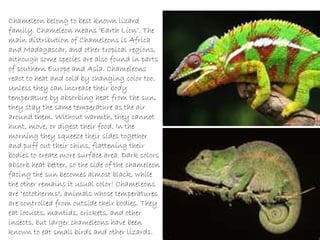
Chameleon belong to best known lizard
family. Chameleon means ‘Earth Lion’. The
main distribution of Chameleons is Africa
and Madagascar, and other tropical regions,
although some species are also found in parts
of southern Europe and Asia. Chameleons
react to heat and cold by changing color too.
Unless they can increase their body
temperature by absorbing heat from the sun,
they stay the same temperature as the air
around them. Without warmth, they cannot
hunt, move, or digest their food. In the
morning they squeeze their sides together
and puff out their chins, flattening their
bodies to create more surface area. Dark colors
absorb heat better, so the side of the chameleon
facing the sun becomes almost black, while
the other remains it usual color! Chameleons
are "ectotherms", animals whose temperatures
are controlled from outside their bodies. They
eat locusts, mantids, crickets, and other
insects, but larger chameleons have been
known to eat small birds and other lizards.
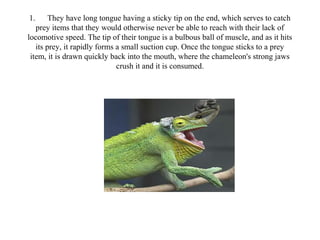
1.      They have long tongue having a sticky tip on the end, which serves to catch
   prey items that they would otherwise never be able to reach with their lack of
locomotive speed. The tip of their tongue is a bulbous ball of muscle, and as it hits
   its prey, it rapidly forms a small suction cup. Once the tongue sticks to a prey
 item, it is drawn quickly back into the mouth, where the chameleon's strong jaws
                              crush it and it is consumed.
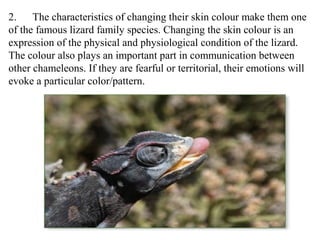
2. The characteristics of changing their skin colour make them one
of the famous lizard family species. Changing the skin colour is an
expression of the physical and physiological condition of the lizard.
The colour also plays an important part in communication between
other chameleons. If they are fearful or territorial, their emotions will
evoke a particular color/pattern.
3.    Chameleons have teeth to grasp onto food. Their teeth are also used to help
them crush and kill their food. They may chew or swallow their food whole. They
can also use their teeth for tearing chunks off and then swallow. Some chameleons
    hold the dead prey in their mouth for several moments before swallowing it.
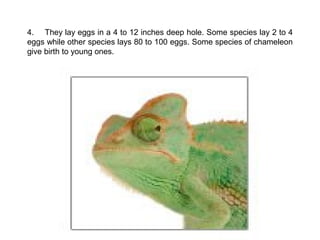
4. They lay eggs in a 4 to 12 inches deep hole. Some species lay 2 to 4
eggs while other species lays 80 to 100 eggs. Some species of chameleon
give birth to young ones.
5.    They hear vibrations in the air, which help them find food and stay
safe from their enemies. They are almost deaf, but can hear tones and feel
                                  vibrations.
6.   Their eyes are the most distinctive among the reptiles. The upper and
 lower eyelids are joined, with only a pinhole large enough for the pupil to
 see through. They can rotate and focus their eyes separately to observe
   two different objects simultaneously. It in effect gives them a full 360-
                    degree arc of vision around the body.


7.On each foot the five toes are fused into a group of two and a group of
three, giving the foot a gripping and lifting like appearance. With their
specialized feet, they grip tightly to narrow branches.
BIBLIOGRAPHY
http://www.whereincity.com/india-kids/animals/chameleon.htm


http://www.reptileknowledge.com/squamata/chamaeleonidae.php
THANKS FOR WATCHING

Facts about chameleons

  • 1.
    Facts about chameleons By zainab noorullah
  • 2.
    Chameleon belong tobest known lizard family. Chameleon means ‘Earth Lion’. The main distribution of Chameleons is Africa and Madagascar, and other tropical regions, although some species are also found in parts of southern Europe and Asia. Chameleons react to heat and cold by changing color too. Unless they can increase their body temperature by absorbing heat from the sun, they stay the same temperature as the air around them. Without warmth, they cannot hunt, move, or digest their food. In the morning they squeeze their sides together and puff out their chins, flattening their bodies to create more surface area. Dark colors absorb heat better, so the side of the chameleon facing the sun becomes almost black, while the other remains it usual color! Chameleons are "ectotherms", animals whose temperatures are controlled from outside their bodies. They eat locusts, mantids, crickets, and other insects, but larger chameleons have been known to eat small birds and other lizards.
  • 3.
    1. They have long tongue having a sticky tip on the end, which serves to catch prey items that they would otherwise never be able to reach with their lack of locomotive speed. The tip of their tongue is a bulbous ball of muscle, and as it hits its prey, it rapidly forms a small suction cup. Once the tongue sticks to a prey item, it is drawn quickly back into the mouth, where the chameleon's strong jaws crush it and it is consumed.
  • 4.
    2. The characteristicsof changing their skin colour make them one of the famous lizard family species. Changing the skin colour is an expression of the physical and physiological condition of the lizard. The colour also plays an important part in communication between other chameleons. If they are fearful or territorial, their emotions will evoke a particular color/pattern.
  • 5.
    3. Chameleons have teeth to grasp onto food. Their teeth are also used to help them crush and kill their food. They may chew or swallow their food whole. They can also use their teeth for tearing chunks off and then swallow. Some chameleons hold the dead prey in their mouth for several moments before swallowing it.
  • 6.
    4. They layeggs in a 4 to 12 inches deep hole. Some species lay 2 to 4 eggs while other species lays 80 to 100 eggs. Some species of chameleon give birth to young ones.
  • 7.
    5. They hear vibrations in the air, which help them find food and stay safe from their enemies. They are almost deaf, but can hear tones and feel vibrations.
  • 8.
    6. Their eyes are the most distinctive among the reptiles. The upper and lower eyelids are joined, with only a pinhole large enough for the pupil to see through. They can rotate and focus their eyes separately to observe two different objects simultaneously. It in effect gives them a full 360- degree arc of vision around the body. 7.On each foot the five toes are fused into a group of two and a group of three, giving the foot a gripping and lifting like appearance. With their specialized feet, they grip tightly to narrow branches.
  • 9.
  • 10.