UKOLN is supported  by: LOCAH Project Show and Tell 2 nd  August 2011 e-Research South Linked Data Workshop, Oxford e-Research Centre, Oxford, UK Adrian Stevenson LOCAH Project Manager
LOCAH Project L inked  O pen  C opac and  A rchives  H ub Funded by #JiscEXPO 2/10 ‘Expose’ call 1 year project. Started August 2010 Partners & Consultants: UKOLN  – Adrian Stevenson, Julian Cheal Mimas  – Jane Stevenson, Bethan Ruddock, Yogesh Patel Eduserv  – Pete Johnston Talis  – Leigh Dodds, Tim Hodson OCLC  - Ralph LeVan, Thom Hickey Ed Summers http://blogs.ukoln.ac.uk/locah/
Archives Hub and Copac UK National Data Services based at Mimas Archives Hub is an aggregation of archival descriptions from archive repositories across the UK http://archiveshub.ac.uk Copac provides access to the merged library catalogues of libraries throughout the UK, including all national libraries http://copac.ac.uk
What is LOCAH Doing? Part 1: Exposing Archives Hub & Copac data as Linked Data Part 2: Creating a prototype visualisation Part 3: Reporting on opportunities and barriers
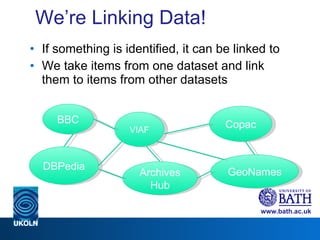
We’re Linking Data! If something is identified, it can be linked to We take  items from one dataset and link them to items from other datasets BBC VIAF DBPedia Archives Hub Copac GeoNames
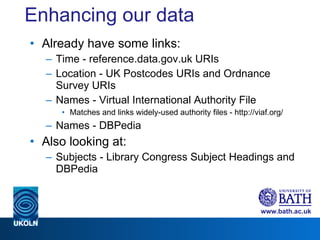
Enhancing our data Already have some links: Time - reference.data.gov.uk URIs Location - UK Postcodes URIs and Ordnance Survey URIs  Names - Virtual International Authority File Matches and links widely-used authority files - http://viaf.org/ Names - DBPedia Also looking at: Subjects - Library Congress Subject Headings and DBPedia
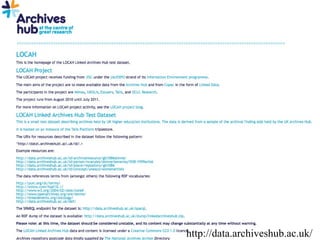
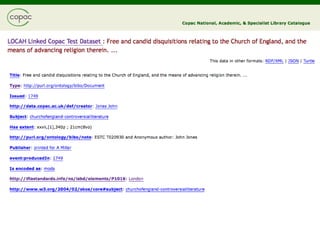
http://data.archiveshub.ac.uk/
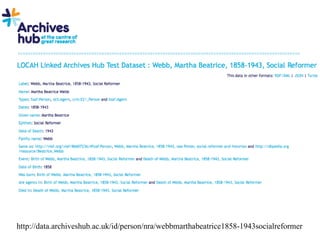
http://data.archiveshub.ac.uk/id/person/nra/webbmarthabeatrice1858-1943socialreformer
 
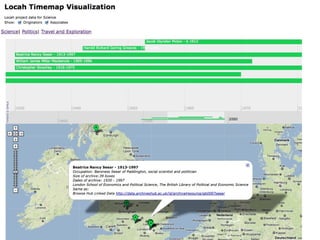
Visualisation Prototype Using Timemap –  Googlemaps and Simile http://code.google.com/p/timemap / Early stages with this Will give location and ‘extent’ of archive. Will link through to Archives Hub
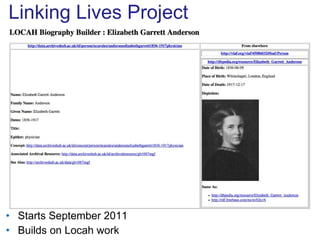
Linking Lives Project Starts September 2011 Builds on Locah work
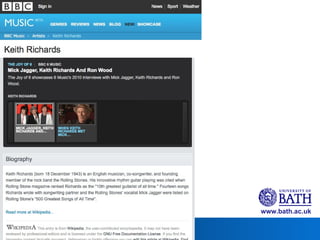
BBC Music
The Key Benefit of Linked Data (?) Mashups work against a fixed set of data sources Hand crafted by humans Don’t integrate well Linked Data promises an unbound global data space Easy dataset integration Generic ‘mesh-up’ tools
Some challenges
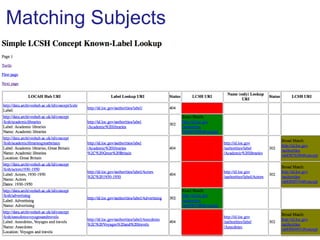
Matching Subjects
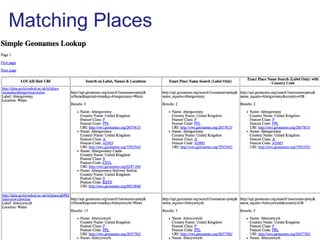
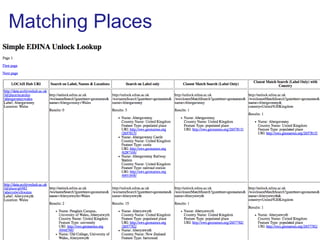
Matching Places
Matching Places
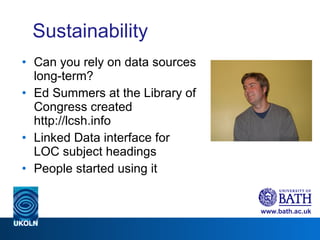
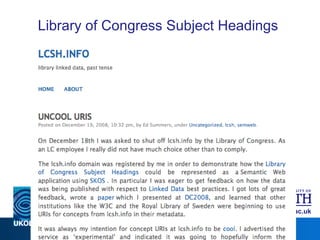
Sustainability Can you rely on data sources long-term?  Ed Summers at the Library of Congress created http://lcsh.info Linked Data interface for LOC subject headings People started using it
Library of Congress Subject Headings
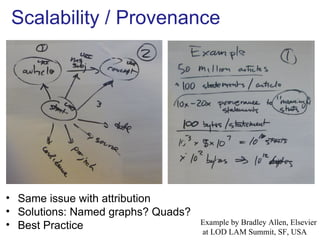
Scalability / Provenance Example by Bradley Allen, Elsevier  at LOD LAM Summit, SF, USA Same issue with attribution Solutions: Named graphs? Quads?  Best Practice
Data Modelling Complexity Archival description is hierarchical and multi-level Dirty Data Licensing ‘ Ownership’ of data Hard to track attribution CC0 for Archives Hub and Copac data
Is Linked Data the Way? Enables ‘straightforward’ integration of wide variety of data sources Research data can ‘work harder’ New channels into your data Researchers are more likely to discover sources  ‘ Hidden' research collections of become  of  the Web
What constitutes data worth linking to? How do you find datasets suitable for interlinking?  How do I make my dataset worth linking to? How do I encourage others to link to my data? What is the added value of links?  How do you determine the quality of a link? Questions if you’ve bought in
Attribution and CC License  Sections of this presentation adapted from materials created by other members of the LOCAH Project This presentation available under creative commons   Non Commercial-Share Alike: http://creativecommons.org/licenses/by-nc/2.0/uk/

Locah Project Show and Tell

  • 1.
    UKOLN is supported by: LOCAH Project Show and Tell 2 nd August 2011 e-Research South Linked Data Workshop, Oxford e-Research Centre, Oxford, UK Adrian Stevenson LOCAH Project Manager
  • 2.
    LOCAH Project Linked O pen C opac and A rchives H ub Funded by #JiscEXPO 2/10 ‘Expose’ call 1 year project. Started August 2010 Partners & Consultants: UKOLN – Adrian Stevenson, Julian Cheal Mimas – Jane Stevenson, Bethan Ruddock, Yogesh Patel Eduserv – Pete Johnston Talis – Leigh Dodds, Tim Hodson OCLC - Ralph LeVan, Thom Hickey Ed Summers http://blogs.ukoln.ac.uk/locah/
  • 3.
    Archives Hub andCopac UK National Data Services based at Mimas Archives Hub is an aggregation of archival descriptions from archive repositories across the UK http://archiveshub.ac.uk Copac provides access to the merged library catalogues of libraries throughout the UK, including all national libraries http://copac.ac.uk
  • 4.
    What is LOCAHDoing? Part 1: Exposing Archives Hub & Copac data as Linked Data Part 2: Creating a prototype visualisation Part 3: Reporting on opportunities and barriers
  • 5.
    We’re Linking Data!If something is identified, it can be linked to We take items from one dataset and link them to items from other datasets BBC VIAF DBPedia Archives Hub Copac GeoNames
  • 6.
    Enhancing our dataAlready have some links: Time - reference.data.gov.uk URIs Location - UK Postcodes URIs and Ordnance Survey URIs Names - Virtual International Authority File Matches and links widely-used authority files - http://viaf.org/ Names - DBPedia Also looking at: Subjects - Library Congress Subject Headings and DBPedia
  • 7.
  • 8.
  • 9.
  • 10.
    Visualisation Prototype UsingTimemap – Googlemaps and Simile http://code.google.com/p/timemap / Early stages with this Will give location and ‘extent’ of archive. Will link through to Archives Hub
  • 11.
    Linking Lives ProjectStarts September 2011 Builds on Locah work
  • 12.
  • 13.
    The Key Benefitof Linked Data (?) Mashups work against a fixed set of data sources Hand crafted by humans Don’t integrate well Linked Data promises an unbound global data space Easy dataset integration Generic ‘mesh-up’ tools
  • 14.
  • 15.
  • 16.
  • 17.
  • 18.
    Sustainability Can yourely on data sources long-term? Ed Summers at the Library of Congress created http://lcsh.info Linked Data interface for LOC subject headings People started using it
  • 19.
    Library of CongressSubject Headings
  • 20.
    Scalability / ProvenanceExample by Bradley Allen, Elsevier at LOD LAM Summit, SF, USA Same issue with attribution Solutions: Named graphs? Quads? Best Practice
  • 21.
    Data Modelling ComplexityArchival description is hierarchical and multi-level Dirty Data Licensing ‘ Ownership’ of data Hard to track attribution CC0 for Archives Hub and Copac data
  • 22.
    Is Linked Datathe Way? Enables ‘straightforward’ integration of wide variety of data sources Research data can ‘work harder’ New channels into your data Researchers are more likely to discover sources ‘ Hidden' research collections of become of the Web
  • 23.
    What constitutes dataworth linking to? How do you find datasets suitable for interlinking? How do I make my dataset worth linking to? How do I encourage others to link to my data? What is the added value of links? How do you determine the quality of a link? Questions if you’ve bought in
  • 24.
    Attribution and CCLicense Sections of this presentation adapted from materials created by other members of the LOCAH Project This presentation available under creative commons Non Commercial-Share Alike: http://creativecommons.org/licenses/by-nc/2.0/uk/

Editor's Notes

  • #4 Copac a union catalogue Both successful JISC services running for many years now Locah is a research project – will have to see if go into service with LD interface
  • #6 In hypertext web sites it is considered generally rather bad etiquette not to link to related external material. The value of your own information is very much a function of what it links to, as well as the inherent value of the information within the web page.  So it is also in the Semantic Web. Remember, this is about machines linking – machines need identifiers; humans generally know when something is a place or when it is a person. BBC + DBPedia + GeoNames + Archives Hub + Copac + VIAF = the Web as an exploratory space
  • #11 This also an example of aggregating data
  • #12 More aggregation
  • #14 Data can be integrated from many diff sources
  • #21 Ex
  • #22 “ lower level” units interpreted in context of the higher levels of description Arguably “incomplete” without the contextual data. Relations are asserted, e.g. member-of/component-of But there is no requirement or expectation that data consumers will follow the links describing the relations