Facial nerve disorders
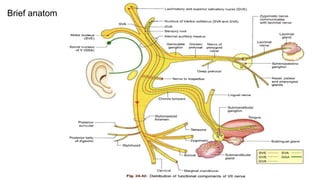
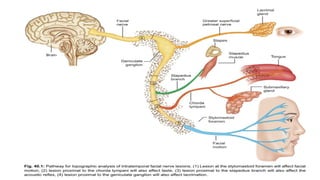
Brief anatomy
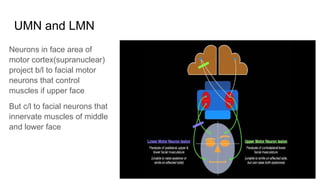
UMN and LMN
Neurons in face area of
motor cortex(supranuclear)
project b/l to facial motor
neurons that control
muscles if upper face
But c/l to facial neurons that
innervate muscles of middle
and lower face
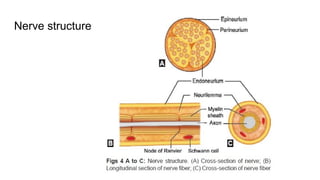
Nerve structure
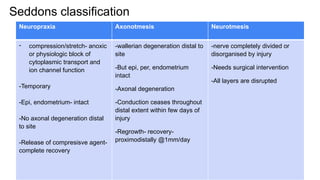
Seddons classification
Neuropraxia Axonotmesis Neurotmesis
- compression/stretch- anoxic
or physiologic block of
cytoplasmic transport and
ion channel function
-Temporary
-Epi, endometrium- intact
-No axonal degeneration distal
to site
-Release of compresisve agent-
complete recovery
-wallerian degeneration distal to
site
-But epi, per, endometrium
intact
-Axonal degeneration
-Conduction ceases throughout
distal extent within few days of
injury
-Regrowth- recovery-
proximodistally @1mm/day
-nerve completely divided or
disorganised by injury
-Needs surgical intervention
-All layers are disrupted
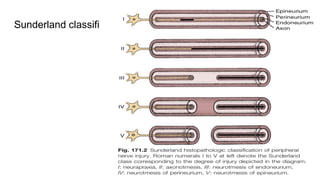
Sunderland classification
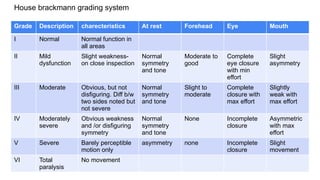
House brackmann grading system
Grade Description charecteristics At rest Forehead Eye Mouth
I Normal Normal function in
all areas
II Mild
dysfunction
Slight weakness-
on close inspection
Normal
symmetry
and tone
Moderate to
good
Complete
eye closure
with min
effort
Slight
asymmetry
III Moderate Obvious, but not
disfiguring. Diff b/w
two sides noted but
not severe
Normal
symmetry
and tone
Slight to
moderate
Complete
closure with
max effort
Slightly
weak with
max effort
IV Moderately
severe
Obvious weakness
and /or disfiguring
symmetry
Normal
symmetry
and tone
None Incomplete
closure
Asymmetric
with max
effort
V Severe Barely perceptible
motion only
asymmetry none Incomplete
closure
Slight
movement
VI Total
paralysis
No movement
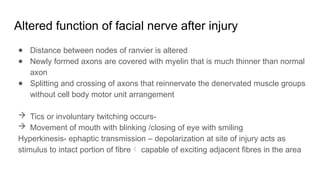
Altered function of facial nerve after injury
● Distance between nodes of ranvier is altered
● Newly formed axons are covered with myelin that is much thinner than normal
axon
● Splitting and crossing of axons that reinnervate the denervated muscle groups
without cell body motor unit arrangement
 Tics or involuntary twitching occurs-
 Movement of mouth with blinking /closing of eye with smiling
Hyperkinesis- ephaptic transmission – depolarization at site of injury acts as
stimulus to intact portion of fibre capable of exciting adjacent fibres in the area
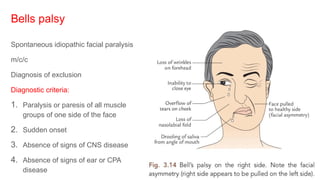
Bells palsy
Spontaneous idiopathic facial paralysis
m/c/c
Diagnosis of exclusion
Diagnostic criteria:
1. Paralysis or paresis of all muscle
groups of one side of the face
2. Sudden onset
3. Absence of signs of CNS disease
4. Absence of signs of ear or CPA
disease
● Proposed etiology:
- Microcirculatory failure of the vasa nervorum
- Viral infection
- Autoimmune reactions
- Viral hypothesis- highly accepted- mumps, rubella, HSV,EBV, VZV
Temporary
Permanent recovery within 3months occur in 90% pts
● Sudden onset
● Unable to close eye
● Bells phenomeon- eyeball rolls up and out on attempting to close the eye and
white sclera is visible
● Facial asymmetry
● Deviation of mouth
● Dribbling of saliva
● Loss of taste
● Epiphora
Viral causes
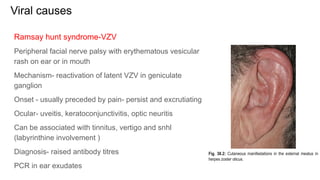
Ramsay hunt syndrome-VZV
Peripheral facial nerve palsy with erythematous vesicular
rash on ear or in mouth
Mechanism- reactivation of latent VZV in geniculate
ganglion
Onset - usually preceded by pain- persist and excrutiating
Ocular- uveitis, keratoconjunctivitis, optic neuritis
Can be associated with tinnitus, vertigo and snhl
(labyrinthine involvement )
Diagnosis- raised antibody titres
PCR in ear exudates
Prognosis is worse than bells
Persistent weakness- 30-50%, only 10%- complete recovery
Steroid + antiviral
Prednisone -1mg/kg/day for 5 days f/b tapered in 10days
Acyclovir - 800mg fivetimes daily
EBV-
● Generalised lymphadenopathy
● Fever
● Throat pain
● Facial nerve palsy (B/L)
● Diagnosis- 10% atypical lymphocytes and positive serology
HIV- facial pasly can present at any stage of the disease
● Possible mechanism-
● local infection of facial nerve or geniculate ganglion by HIV
● inflammatory demyelinating neuropathy or
● secondary infection with VZV,HSV or EBV due to immunosuppression
GB Syndrome
Acute inflammatory demyelinating polyradiculoneuropathy affecting peripheral nerves
including facial nerve
Presents typically 2-3weeks after an urti- probably due to abnormal T-cell response against
Most prominent – ascending symmetrical muscular weakness and autonomic involvement
with maximum effect 2-3weeks after onset of illness
Often b/l facial nerve weakness
Treatment- IVIg
Trauma
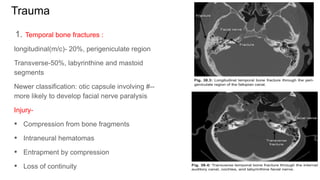
1. Temporal bone fractures :
longitudinal(m/c)- 20%, perigeniculate region
Transverse-50%, labyrinthine and mastoid
segments
Newer classification: otic capsule involving #--
more likely to develop facial nerve paralysis
Injury-
• Compression from bone fragments
• Intraneural hematomas
• Entrapment by compression
• Loss of continuity
● Penetrating injuries/ gun shot :
• Often accompanied with severe dural tears, csf leak, damage to otic capsule
and vascular injury
• m/c- mastoid segment
• Surgical exploration – as soon as possible
• Delay- make identification of nerve difficult- granulation tissue and traumatic
neuroma formation
• If segment of nerve is destroyed- proximal and distal ends- trimmed back- to
point of healthy fascicles – interval cable graft
Iatrogenic
• Cautery heat trauma
• Plication or suspension sutures entrapping a branch of nerve
• Inadvertent clamping of nerve when ligating vessels
• Postop edema- nerve compression
ME and mastoid surgery:
• m/c site- distal tympanic segment and 2nd
genu> mastoid segment
• If recognized intraop- exploration with decompression of prox and distal
segments
• If nerve fibres- herniating-> epineural sheath should be opened
• If >50% of circumference is disrupted- repaired- direct suture or inlay graft
If observed immediate postop-
• Determine – nerve was identified and was not at risk during surgery-
observation for few hours- clear local anesthetic induced weakness
• Tight mastoid dressing- remove the pack
• If paralysis is incomplete- start on oral steroids and observe clinically
• Progression to complete paralysis- exploration should be considered
Parotid surgery:
• Likelihood of facial nerve weakness correlates with-
• Tumor location deep to plane of facial nerve
• Previous parotid surgery
• Previous sialadenitis
Parotid surgery- best undertaken with facial nerve monitoring
If no response- nerve and its branches could be closely inspected for areas of
discontinuity
As a complication of ear infection
Otitis media:
• Direct involvement of facial nerve by infection through facial canal dehiscence
or physiologic canaliculi for neurovascular connections
• Fallopian canal osteitis with bone erosion
• Inflammatory edema – compression
• secondary thrombosis of vasa nervorum- ischemia and infarction of facial nerve
• Demyelination of facial nerve by bacterial toxins
MOE:
• Immunocompromised , DM
• Facial palsy - advancing infection and invasion through bonycartilaginous
junction and fissures of Santorini , under the tympanic ring and posteriorly to
SMF
Inflammatory disorders
Sarcoidosis : facial palsy, heerfordt disease, raised ACE titre
Granulomatosis with polyangitis : autoimmune necrotizing vasculitis
secondary to middle ear involvement in presence of dehiscent fallopian canal
Snhl+ facial palsy+ urti+ kidney vasculitis
Diagnosis- ANCA
Lyme disease- flu like symptoms, erythema migrans
b/l facial palsy
Congenital
• Melkerson Rosenthal syndrome – facial palsy, facial edema, fissured tongue
• Moebius syndrome- agenesis of 6,7 CN nuclei , mask like face, unable to
close eyes
• Alberg Schoenberg disease- osteopetrosis of bony canals- blindness,
deafness and facial paralysis.
• Oculoauricular –vertebral syndrome- abnormal formation of 1 and 2nd
arches
• Charge association
Transient facial palsy
• During IAN block
• Due to injection of local anesthetic into parotid - needle injected too backwards
• Temporary
• Wears off within a period of time
Other causes:
• Barotrauma
• Pregnancy
• Malignancies
• Benign tumors- schwannoma, glomus
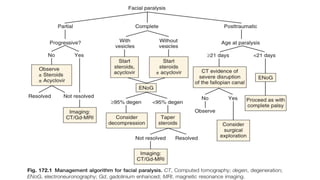
Topodiagnostic tests
To know the site of lesion
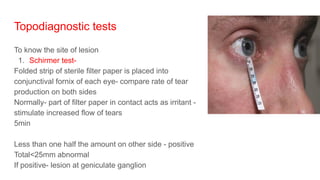
1. Schirmer test-
Folded strip of sterile filter paper is placed into
conjunctival fornix of each eye- compare rate of tear
production on both sides
Normally- part of filter paper in contact acts as irritant -
stimulate increased flow of tears
5min
Less than one half the amount on other side - positive
Total<25mm abnormal
If positive- lesion at geniculate ganglion
2. Stapedius reflex
Involuntary muscle contraction in response to high intensity sound stimulus
Absent reflex or reflex less than one half the amplitude on contralateral side is
abnormal
3. Taste
Filter paper disks impregnated with aqueous solutions of
NaCl- salty
Sachharose-sweet
Citrate or hydrochloric acid - sour taste
Quinine- bitter
Or by electrogustometry - bipolar or monopolar electrical stimulation - metallic or
sour taste
4. Salivary flow test - evaluates parasympathetic innervation of SMG via chords
tympani
Cannulation of SM DUCT- comparison of stimulated flow rates on both sides
using radiolabelled tracer secreted in saliva
25% decrease- significant
5. Salivary pH
<6.1 - incomplete recovery in bells palsy
Electrodiagnostic tests
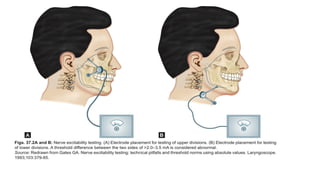
1. Nerve excitability test
Stimulating electrode- skin over SMF or over one of peripheral branches of nerve
Return electrode- taped to forearm
Electrical impulses(0.3sec ) -steadily increasing current levels- until facial twitch is
noted (Threshold of excitation)
Same repeated on paralysed side
Diff is calculated
Sunderland-1 - no diff
2-5-- axonal degeneration- diff present
2-3.5mA diif - sign of severe degeneration - indicator for surgical decompression
Maximum stimulation test
• Involves visual /subjective evaluation of electrically elicited facial movements
• Maximal stimuli - current level at which greatest amplitude of facial movement
is seen
• Supramaximal stimuli are noted
• Paralysed side is compared with normal- equal, mildly decreased, moderately
decreased or without response
• No response at maximal stimulation- criteria for facial nerve decompression.
Electroneuronography
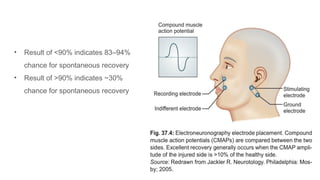
• 1 bipolar stimulationg electrode- SMF
• 2nd
bipolar electrode pair -in nasolabial groove
• Evoked responses to maximal electrical stimulation are measured as evoked
compound muscle action potential
• The amplitude of response on the paralyzed side can be expressed as a precise
percentage of that on the healthy side.
• if the amplitude of the response on the paralyzed side is only 10% of that on the
normal side-- an estimated 90% of fibers are said to have degenerated on the
paralyzed side.
• Result of <90% indicates 83–94%
chance for spontaneous recovery
• Result of >90% indicates ~30%
chance for spontaneous recovery
Electromyography
• Recording spontaneous and voluntary muscle potentials using needles
introduced into muscles
• After loss of excitability- NET and ENoG are not useful
• After 10-14 days – fibrillation potentials may be detected- confirms presence of
degenerating motor units incomplete recovery
• Polyphasic synaptic potentials- 4-6weeks after onset- indicate reinnervation –
good recovery
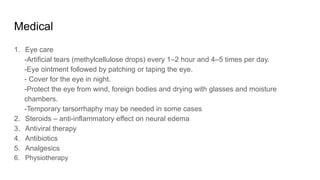
Medical
1. Eye care
-Artificial tears (methylcellulose drops) every 1–2 hour and 4–5 times per day.
-Eye ointment followed by patching or taping the eye.
- Cover for the eye in night.
-Protect the eye from wind, foreign bodies and drying with glasses and moisture
chambers.
-Temporary tarsorrhaphy may be needed in some cases
2. Steroids – anti-inflammatory effect on neural edema
3. Antiviral therapy
4. Antibiotics
5. Analgesics
6. Physiotherapy
Timing
Acute neural injury- wallerian degeneration – over 72hrs
• Starts at point of injury – extends distally to motor end plate of facial muscle
and proximally to first adjacent node of ranvier
• Electrodiag test- cant appreciate – underdiagnosis
• Once degeneration is complete- ENoG- helpful- day3-21- to quantify degree
of nerve degeneration
• By 21days- cell body and proximal segment reorganize
Retain ability to regenerate for indefinite period of time
Here EMG is helpful
• Subacute neural injury- early regeneration phase- 3wks to 6mnths
• Possibility of recovery is more
• If no signs of any recovery within 3-4 wks – neurotmesis
• Chronic neural injury- no recovery within 6mnths of injury
Assess :
• Nerve continuity
• Viability of cell bodies in facial nucleus
• Presence of intact proximal facial segment
• Presence of distal segment with intact endoneural tubules- that can accept and
transmit regenerating axons to facial muscles
• Presence of viable facial muscles with intact motor end plates
• If fulfilling all above- spontaneous regeneration
• But –ocular and physio- to minimize aberrant regeneration
Surgical
- Surgical decompression
- Neurorraphy- end to end anastomosis
- Nerve grafting – if there is gap between prox and distal segments- autogenous nerve
grafting
- Nerves- Hypoglossal nerve(crossover grafting)
- Sural nerve
- Greater auricular nerve
- Branches from cervical plexus
-Muscle transposition
-Tarsorrhaphy
-Gold/platinum lid weights
Facial nerve - anatomy, disorders, classifications.pptx

  • 1.
  • 2.
  • 3.
    UMN and LMN Neuronsin face area of motor cortex(supranuclear) project b/l to facial motor neurons that control muscles if upper face But c/l to facial neurons that innervate muscles of middle and lower face
  • 5.
  • 6.
    Seddons classification Neuropraxia AxonotmesisNeurotmesis - compression/stretch- anoxic or physiologic block of cytoplasmic transport and ion channel function -Temporary -Epi, endometrium- intact -No axonal degeneration distal to site -Release of compresisve agent- complete recovery -wallerian degeneration distal to site -But epi, per, endometrium intact -Axonal degeneration -Conduction ceases throughout distal extent within few days of injury -Regrowth- recovery- proximodistally @1mm/day -nerve completely divided or disorganised by injury -Needs surgical intervention -All layers are disrupted
  • 7.
  • 8.
    House brackmann gradingsystem Grade Description charecteristics At rest Forehead Eye Mouth I Normal Normal function in all areas II Mild dysfunction Slight weakness- on close inspection Normal symmetry and tone Moderate to good Complete eye closure with min effort Slight asymmetry III Moderate Obvious, but not disfiguring. Diff b/w two sides noted but not severe Normal symmetry and tone Slight to moderate Complete closure with max effort Slightly weak with max effort IV Moderately severe Obvious weakness and /or disfiguring symmetry Normal symmetry and tone None Incomplete closure Asymmetric with max effort V Severe Barely perceptible motion only asymmetry none Incomplete closure Slight movement VI Total paralysis No movement
  • 9.
    Altered function offacial nerve after injury ● Distance between nodes of ranvier is altered ● Newly formed axons are covered with myelin that is much thinner than normal axon ● Splitting and crossing of axons that reinnervate the denervated muscle groups without cell body motor unit arrangement  Tics or involuntary twitching occurs-  Movement of mouth with blinking /closing of eye with smiling Hyperkinesis- ephaptic transmission – depolarization at site of injury acts as stimulus to intact portion of fibre capable of exciting adjacent fibres in the area
  • 10.
    Bells palsy Spontaneous idiopathicfacial paralysis m/c/c Diagnosis of exclusion Diagnostic criteria: 1. Paralysis or paresis of all muscle groups of one side of the face 2. Sudden onset 3. Absence of signs of CNS disease 4. Absence of signs of ear or CPA disease
  • 11.
    ● Proposed etiology: -Microcirculatory failure of the vasa nervorum - Viral infection - Autoimmune reactions - Viral hypothesis- highly accepted- mumps, rubella, HSV,EBV, VZV Temporary Permanent recovery within 3months occur in 90% pts
  • 12.
    ● Sudden onset ●Unable to close eye ● Bells phenomeon- eyeball rolls up and out on attempting to close the eye and white sclera is visible ● Facial asymmetry ● Deviation of mouth ● Dribbling of saliva ● Loss of taste ● Epiphora
  • 13.
    Viral causes Ramsay huntsyndrome-VZV Peripheral facial nerve palsy with erythematous vesicular rash on ear or in mouth Mechanism- reactivation of latent VZV in geniculate ganglion Onset - usually preceded by pain- persist and excrutiating Ocular- uveitis, keratoconjunctivitis, optic neuritis Can be associated with tinnitus, vertigo and snhl (labyrinthine involvement ) Diagnosis- raised antibody titres PCR in ear exudates
  • 14.
    Prognosis is worsethan bells Persistent weakness- 30-50%, only 10%- complete recovery Steroid + antiviral Prednisone -1mg/kg/day for 5 days f/b tapered in 10days Acyclovir - 800mg fivetimes daily
  • 15.
    EBV- ● Generalised lymphadenopathy ●Fever ● Throat pain ● Facial nerve palsy (B/L) ● Diagnosis- 10% atypical lymphocytes and positive serology HIV- facial pasly can present at any stage of the disease ● Possible mechanism- ● local infection of facial nerve or geniculate ganglion by HIV ● inflammatory demyelinating neuropathy or ● secondary infection with VZV,HSV or EBV due to immunosuppression
  • 16.
    GB Syndrome Acute inflammatorydemyelinating polyradiculoneuropathy affecting peripheral nerves including facial nerve Presents typically 2-3weeks after an urti- probably due to abnormal T-cell response against Most prominent – ascending symmetrical muscular weakness and autonomic involvement with maximum effect 2-3weeks after onset of illness Often b/l facial nerve weakness Treatment- IVIg
  • 17.
    Trauma 1. Temporal bonefractures : longitudinal(m/c)- 20%, perigeniculate region Transverse-50%, labyrinthine and mastoid segments Newer classification: otic capsule involving #-- more likely to develop facial nerve paralysis Injury- • Compression from bone fragments • Intraneural hematomas • Entrapment by compression • Loss of continuity
  • 18.
    ● Penetrating injuries/gun shot : • Often accompanied with severe dural tears, csf leak, damage to otic capsule and vascular injury • m/c- mastoid segment • Surgical exploration – as soon as possible • Delay- make identification of nerve difficult- granulation tissue and traumatic neuroma formation • If segment of nerve is destroyed- proximal and distal ends- trimmed back- to point of healthy fascicles – interval cable graft
  • 19.
    Iatrogenic • Cautery heattrauma • Plication or suspension sutures entrapping a branch of nerve • Inadvertent clamping of nerve when ligating vessels • Postop edema- nerve compression
  • 20.
    ME and mastoidsurgery: • m/c site- distal tympanic segment and 2nd genu> mastoid segment • If recognized intraop- exploration with decompression of prox and distal segments • If nerve fibres- herniating-> epineural sheath should be opened • If >50% of circumference is disrupted- repaired- direct suture or inlay graft
  • 21.
    If observed immediatepostop- • Determine – nerve was identified and was not at risk during surgery- observation for few hours- clear local anesthetic induced weakness • Tight mastoid dressing- remove the pack • If paralysis is incomplete- start on oral steroids and observe clinically • Progression to complete paralysis- exploration should be considered
  • 22.
    Parotid surgery: • Likelihoodof facial nerve weakness correlates with- • Tumor location deep to plane of facial nerve • Previous parotid surgery • Previous sialadenitis Parotid surgery- best undertaken with facial nerve monitoring If no response- nerve and its branches could be closely inspected for areas of discontinuity
  • 23.
    As a complicationof ear infection Otitis media: • Direct involvement of facial nerve by infection through facial canal dehiscence or physiologic canaliculi for neurovascular connections • Fallopian canal osteitis with bone erosion • Inflammatory edema – compression • secondary thrombosis of vasa nervorum- ischemia and infarction of facial nerve • Demyelination of facial nerve by bacterial toxins
  • 24.
    MOE: • Immunocompromised ,DM • Facial palsy - advancing infection and invasion through bonycartilaginous junction and fissures of Santorini , under the tympanic ring and posteriorly to SMF
  • 25.
    Inflammatory disorders Sarcoidosis :facial palsy, heerfordt disease, raised ACE titre Granulomatosis with polyangitis : autoimmune necrotizing vasculitis secondary to middle ear involvement in presence of dehiscent fallopian canal Snhl+ facial palsy+ urti+ kidney vasculitis Diagnosis- ANCA Lyme disease- flu like symptoms, erythema migrans b/l facial palsy
  • 26.
    Congenital • Melkerson Rosenthalsyndrome – facial palsy, facial edema, fissured tongue • Moebius syndrome- agenesis of 6,7 CN nuclei , mask like face, unable to close eyes • Alberg Schoenberg disease- osteopetrosis of bony canals- blindness, deafness and facial paralysis. • Oculoauricular –vertebral syndrome- abnormal formation of 1 and 2nd arches • Charge association
  • 27.
    Transient facial palsy •During IAN block • Due to injection of local anesthetic into parotid - needle injected too backwards • Temporary • Wears off within a period of time Other causes: • Barotrauma • Pregnancy • Malignancies • Benign tumors- schwannoma, glomus
  • 28.
    Topodiagnostic tests To knowthe site of lesion 1. Schirmer test- Folded strip of sterile filter paper is placed into conjunctival fornix of each eye- compare rate of tear production on both sides Normally- part of filter paper in contact acts as irritant - stimulate increased flow of tears 5min Less than one half the amount on other side - positive Total<25mm abnormal If positive- lesion at geniculate ganglion
  • 29.
    2. Stapedius reflex Involuntarymuscle contraction in response to high intensity sound stimulus Absent reflex or reflex less than one half the amplitude on contralateral side is abnormal 3. Taste Filter paper disks impregnated with aqueous solutions of NaCl- salty Sachharose-sweet Citrate or hydrochloric acid - sour taste Quinine- bitter Or by electrogustometry - bipolar or monopolar electrical stimulation - metallic or sour taste
  • 30.
    4. Salivary flowtest - evaluates parasympathetic innervation of SMG via chords tympani Cannulation of SM DUCT- comparison of stimulated flow rates on both sides using radiolabelled tracer secreted in saliva 25% decrease- significant 5. Salivary pH <6.1 - incomplete recovery in bells palsy
  • 31.
    Electrodiagnostic tests 1. Nerveexcitability test Stimulating electrode- skin over SMF or over one of peripheral branches of nerve Return electrode- taped to forearm Electrical impulses(0.3sec ) -steadily increasing current levels- until facial twitch is noted (Threshold of excitation) Same repeated on paralysed side Diff is calculated Sunderland-1 - no diff 2-5-- axonal degeneration- diff present 2-3.5mA diif - sign of severe degeneration - indicator for surgical decompression
  • 33.
    Maximum stimulation test •Involves visual /subjective evaluation of electrically elicited facial movements • Maximal stimuli - current level at which greatest amplitude of facial movement is seen • Supramaximal stimuli are noted • Paralysed side is compared with normal- equal, mildly decreased, moderately decreased or without response • No response at maximal stimulation- criteria for facial nerve decompression.
  • 34.
    Electroneuronography • 1 bipolarstimulationg electrode- SMF • 2nd bipolar electrode pair -in nasolabial groove • Evoked responses to maximal electrical stimulation are measured as evoked compound muscle action potential • The amplitude of response on the paralyzed side can be expressed as a precise percentage of that on the healthy side. • if the amplitude of the response on the paralyzed side is only 10% of that on the normal side-- an estimated 90% of fibers are said to have degenerated on the paralyzed side.
  • 35.
    • Result of<90% indicates 83–94% chance for spontaneous recovery • Result of >90% indicates ~30% chance for spontaneous recovery
  • 36.
    Electromyography • Recording spontaneousand voluntary muscle potentials using needles introduced into muscles • After loss of excitability- NET and ENoG are not useful • After 10-14 days – fibrillation potentials may be detected- confirms presence of degenerating motor units incomplete recovery • Polyphasic synaptic potentials- 4-6weeks after onset- indicate reinnervation – good recovery
  • 38.
    Medical 1. Eye care -Artificialtears (methylcellulose drops) every 1–2 hour and 4–5 times per day. -Eye ointment followed by patching or taping the eye. - Cover for the eye in night. -Protect the eye from wind, foreign bodies and drying with glasses and moisture chambers. -Temporary tarsorrhaphy may be needed in some cases 2. Steroids – anti-inflammatory effect on neural edema 3. Antiviral therapy 4. Antibiotics 5. Analgesics 6. Physiotherapy
  • 39.
    Timing Acute neural injury-wallerian degeneration – over 72hrs • Starts at point of injury – extends distally to motor end plate of facial muscle and proximally to first adjacent node of ranvier • Electrodiag test- cant appreciate – underdiagnosis • Once degeneration is complete- ENoG- helpful- day3-21- to quantify degree of nerve degeneration • By 21days- cell body and proximal segment reorganize Retain ability to regenerate for indefinite period of time Here EMG is helpful
  • 40.
    • Subacute neuralinjury- early regeneration phase- 3wks to 6mnths • Possibility of recovery is more • If no signs of any recovery within 3-4 wks – neurotmesis • Chronic neural injury- no recovery within 6mnths of injury Assess : • Nerve continuity • Viability of cell bodies in facial nucleus • Presence of intact proximal facial segment • Presence of distal segment with intact endoneural tubules- that can accept and transmit regenerating axons to facial muscles • Presence of viable facial muscles with intact motor end plates • If fulfilling all above- spontaneous regeneration • But –ocular and physio- to minimize aberrant regeneration
  • 41.
    Surgical - Surgical decompression -Neurorraphy- end to end anastomosis - Nerve grafting – if there is gap between prox and distal segments- autogenous nerve grafting - Nerves- Hypoglossal nerve(crossover grafting) - Sural nerve - Greater auricular nerve - Branches from cervical plexus -Muscle transposition -Tarsorrhaphy -Gold/platinum lid weights