Facet Disease Causes –
       Obesity
One of the most concerning facet disease
causes is obesity, which is a term used to
describe unhealthy body weight. It may
seem strange to link facet disease to
weight, but how much we weigh
significantly affects the health of the spine,
particularly over time. To fully understand
the connection, it can be helpful to first
understand how facet disease develops.
What is Facet Disease?
Facet disease, or spinal osteoarthritis, is a degenerative
condition that affects the facet joints, which are the
supportive articulation points on the top and bottom of
vertebrae. The facet joints give the spine its flexibility and
wide range of motion. Lubricating synovial fluid and cartilage
line the facet joints, which allow the bones to slide smoothly
over one another. The cartilage dehydrates as we grow older
and through normal wear and tear, it can begin to wear away
from the joint. Facet disease causes the bones to grind against
each other, which may cause bone spurs, or osteophytes, to
develop.
Facet Disease Symptoms
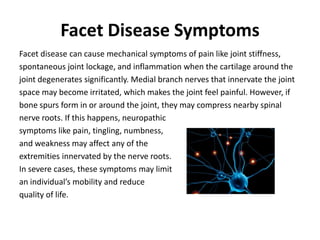
Facet disease can cause mechanical symptoms of pain like joint stiffness,
spontaneous joint lockage, and inflammation when the cartilage around the
joint degenerates significantly. Medial branch nerves that innervate the joint
space may become irritated, which makes the joint feel painful. However, if
bone spurs form in or around the joint, they may compress nearby spinal
nerve roots. If this happens, neuropathic
symptoms like pain, tingling, numbness,
and weakness may affect any of the
extremities innervated by the nerve roots.
In severe cases, these symptoms may limit
an individual’s mobility and reduce
quality of life.
How Does Weight Play a Role?
The facet joints help to stabilize the spine, but facilitate
its movement at the same time. Over many years,
constant motion – especially in the highly mobile lumbar
(lower back) region of the spine – can contribute to the
normal process of wear and tear on the joints. When
weight is gained, particularly in the belly, the lumbar
spine is unnaturally pulled forward and the facet joints
are forced to overcompensate for the additional stress. As
a result, the overcompensation causes the faster
degeneration of the facet joints.
In Conclusion
In addition to being one of the common facet
disease causes, obesity can also lead to a variety
of other health risks, such as heart disease, high
blood pressure, stroke, respiratory problems,
diabetes, and more. Maintaining a healthy
weight and eating a well-balanced diet can
eliminate many of these health concerns and
prevent the onset of facet disease.

Facet Disease Causes

  • 1.
  • 2.
    One of themost concerning facet disease causes is obesity, which is a term used to describe unhealthy body weight. It may seem strange to link facet disease to weight, but how much we weigh significantly affects the health of the spine, particularly over time. To fully understand the connection, it can be helpful to first understand how facet disease develops.
  • 3.
    What is FacetDisease? Facet disease, or spinal osteoarthritis, is a degenerative condition that affects the facet joints, which are the supportive articulation points on the top and bottom of vertebrae. The facet joints give the spine its flexibility and wide range of motion. Lubricating synovial fluid and cartilage line the facet joints, which allow the bones to slide smoothly over one another. The cartilage dehydrates as we grow older and through normal wear and tear, it can begin to wear away from the joint. Facet disease causes the bones to grind against each other, which may cause bone spurs, or osteophytes, to develop.
  • 4.
    Facet Disease Symptoms Facetdisease can cause mechanical symptoms of pain like joint stiffness, spontaneous joint lockage, and inflammation when the cartilage around the joint degenerates significantly. Medial branch nerves that innervate the joint space may become irritated, which makes the joint feel painful. However, if bone spurs form in or around the joint, they may compress nearby spinal nerve roots. If this happens, neuropathic symptoms like pain, tingling, numbness, and weakness may affect any of the extremities innervated by the nerve roots. In severe cases, these symptoms may limit an individual’s mobility and reduce quality of life.
  • 5.
    How Does WeightPlay a Role? The facet joints help to stabilize the spine, but facilitate its movement at the same time. Over many years, constant motion – especially in the highly mobile lumbar (lower back) region of the spine – can contribute to the normal process of wear and tear on the joints. When weight is gained, particularly in the belly, the lumbar spine is unnaturally pulled forward and the facet joints are forced to overcompensate for the additional stress. As a result, the overcompensation causes the faster degeneration of the facet joints.
  • 6.
    In Conclusion In additionto being one of the common facet disease causes, obesity can also lead to a variety of other health risks, such as heart disease, high blood pressure, stroke, respiratory problems, diabetes, and more. Maintaining a healthy weight and eating a well-balanced diet can eliminate many of these health concerns and prevent the onset of facet disease.