Facebook Connect Tutorial

       Prateek Dayal

        Muziboo.com


       Mar 7th, 2010
Resources


      Code: http://github.com/prateekdayal/fb-tutorial
      This Presentation: http://www.slideshare.net/prateek.
      dayal/facebook-connect-tutorial
      FB Connect’s Docs:
      http://developers.facebook.com/connect.php
Setting up a New App


      Install the ’Developer App’ in Facebook
      Create a new application (in fact two: one for production and
      the other for testing)
      The canvas callback url should point to your website (or your
      dev machine)
SSH Tunnel Setup


      Problem: You need to access your dev machine over the
      internet and you don’t have a public IP
      Solution: Use a ssh tunnel
      On Linux machines
          In /etc/ssh/sshd config put GatewayPorts yes
          Restart the ssh server prateekdayal: # /etc/init.d/ssh
          restart
Starting the Tunnel on localhost


       Lets assume that you want to forward the local port 3000 to
       port 3333 on your server (ex: prateekdayal.net)
       prateek@marvin: /work/talks/acm$ ssh
       prateek@prateekdayal.net -gNR 3333:localhost:3000
       You can now access http://localhost:3000 at
       http://www.prateekdayal.net:3333
Cross Domain Receiver File


      Problem: Ajax calls from your domain to Facebook.com and
      passing data from Facebook.com to your domain
      Solution: Cross Domain Receiver File
      A technique for passing data between different domains
      Used for detecting login status, setting fb cookies on your
      domain etc
      You can get the file from Facebook’s Dev site
      You have to place it relative to the root directory of your app
      <site root>/xd receiver.html
Lets build a quick app


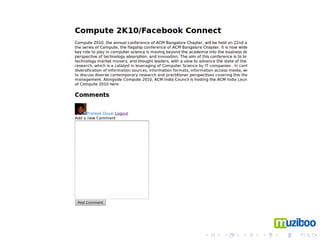
   Objective: Comment on a blogpost with your Facebook ID and
   post the comment on your news feed
Creating the Login page


         File: public/fb-connect.html
         Include FB Connect’s Javascript code
         I have also included prototype.js to make manipulate the
         DOM more easily
         Add a form and ’Login with Facebook’ button
         Add the JS code to render fbml tags   1


     1
       http://wiki.developers.facebook.com/index.php/Connect/
   Authorization_Websites
Show User Info


         File: public/fb-connect-show-info.html
         Use XFBML tags to show name and profile pic   2

         Also provide a Logout button   3


     2
       http://wiki.developers.facebook.com/index.php/XFBML
     3
       http://wiki.developers.facebook.com/index.php/Logging_Out_
   And_Disconnecting
Detecting the Login State


         File: public/fb-connect-detect-login-state.html
         Problem: Every time we refresh the page we have to login
         again
         Solution: Pass ifUserConnected and ifUserNotConnected
         options to FB Connect’s init function 4
         Remove the separate handlers for login & logout
         This can be used to automatically login users if they are
         logged into FB (single sign-on)


     4
       http:
   //wiki.developers.facebook.com/index.php/Detecting_Connect_Status
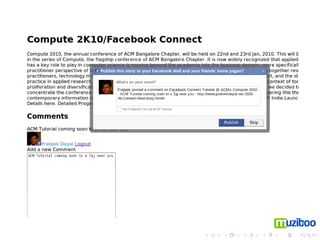
Posting to News Feed


         File: public/fb-connect-feed-story.html
         We can use FB.Connect.streamPublish to publish to News
         Feed 5
         FB allows pictures, mp3, flash etc to be attached to the feed


     5
       http://wiki.developers.facebook.com/index.php/Implementing_
   Feed_Publishing_from_your_Website_or_Application
Server side stuff


       Problem: You want to let users login with FB and connect
       existing accounts
       Solution: Read cookies set by FB (on your domain) to get
       user id and session id
       FB User ID can be used to identify the user on next login and
       connect with your auth system
       Session ID can be used to make FB API calls (to fetch
       detailed user info etc)
       Php, Ruby on Rails and other languages have libraries
       available to make all this easy
Advanced Features


      Extended session permission
      Ask for user’s primary email address
      Friend recommendation and invitation
A note on Platform Policies


          Most of the data (including name) cannot be cached for more
          than 24 hours
          If a user de-authorizes your app, you need to delete data
          received by API (and not direct submission)
          Many more guidelines   6


     6
         http://wiki.developers.facebook.com/index.php/Storable_Data
Questions?


      prateek@muziboo.com
      @prateekdayal
      http://www.prateekdayal.net
      http://devblog.muziboo.com

Facebook Connect Tutorial

  • 1.
    Facebook Connect Tutorial Prateek Dayal Muziboo.com Mar 7th, 2010
  • 2.
    Resources Code: http://github.com/prateekdayal/fb-tutorial This Presentation: http://www.slideshare.net/prateek. dayal/facebook-connect-tutorial FB Connect’s Docs: http://developers.facebook.com/connect.php
  • 3.
    Setting up aNew App Install the ’Developer App’ in Facebook Create a new application (in fact two: one for production and the other for testing) The canvas callback url should point to your website (or your dev machine)
  • 5.
    SSH Tunnel Setup Problem: You need to access your dev machine over the internet and you don’t have a public IP Solution: Use a ssh tunnel On Linux machines In /etc/ssh/sshd config put GatewayPorts yes Restart the ssh server prateekdayal: # /etc/init.d/ssh restart
  • 6.
    Starting the Tunnelon localhost Lets assume that you want to forward the local port 3000 to port 3333 on your server (ex: prateekdayal.net) prateek@marvin: /work/talks/acm$ ssh prateek@prateekdayal.net -gNR 3333:localhost:3000 You can now access http://localhost:3000 at http://www.prateekdayal.net:3333
  • 7.
    Cross Domain ReceiverFile Problem: Ajax calls from your domain to Facebook.com and passing data from Facebook.com to your domain Solution: Cross Domain Receiver File A technique for passing data between different domains Used for detecting login status, setting fb cookies on your domain etc You can get the file from Facebook’s Dev site You have to place it relative to the root directory of your app <site root>/xd receiver.html
  • 9.
    Lets build aquick app Objective: Comment on a blogpost with your Facebook ID and post the comment on your news feed
  • 10.
    Creating the Loginpage File: public/fb-connect.html Include FB Connect’s Javascript code I have also included prototype.js to make manipulate the DOM more easily Add a form and ’Login with Facebook’ button Add the JS code to render fbml tags 1 1 http://wiki.developers.facebook.com/index.php/Connect/ Authorization_Websites
  • 12.
    Show User Info File: public/fb-connect-show-info.html Use XFBML tags to show name and profile pic 2 Also provide a Logout button 3 2 http://wiki.developers.facebook.com/index.php/XFBML 3 http://wiki.developers.facebook.com/index.php/Logging_Out_ And_Disconnecting
  • 14.
    Detecting the LoginState File: public/fb-connect-detect-login-state.html Problem: Every time we refresh the page we have to login again Solution: Pass ifUserConnected and ifUserNotConnected options to FB Connect’s init function 4 Remove the separate handlers for login & logout This can be used to automatically login users if they are logged into FB (single sign-on) 4 http: //wiki.developers.facebook.com/index.php/Detecting_Connect_Status
  • 15.
    Posting to NewsFeed File: public/fb-connect-feed-story.html We can use FB.Connect.streamPublish to publish to News Feed 5 FB allows pictures, mp3, flash etc to be attached to the feed 5 http://wiki.developers.facebook.com/index.php/Implementing_ Feed_Publishing_from_your_Website_or_Application
  • 17.
    Server side stuff Problem: You want to let users login with FB and connect existing accounts Solution: Read cookies set by FB (on your domain) to get user id and session id FB User ID can be used to identify the user on next login and connect with your auth system Session ID can be used to make FB API calls (to fetch detailed user info etc) Php, Ruby on Rails and other languages have libraries available to make all this easy
  • 19.
    Advanced Features Extended session permission Ask for user’s primary email address Friend recommendation and invitation
  • 20.
    A note onPlatform Policies Most of the data (including name) cannot be cached for more than 24 hours If a user de-authorizes your app, you need to delete data received by API (and not direct submission) Many more guidelines 6 6 http://wiki.developers.facebook.com/index.php/Storable_Data
  • 21.
    Questions? prateek@muziboo.com @prateekdayal http://www.prateekdayal.net http://devblog.muziboo.com