FAANGs ain’t what they used to be
Christian Grece
Analyst
4th December 2018
FOCUS - London
A presentation
of the European Audiovisual Observatory
1. What are FAANGs? And what are the main impacts of OTT distribution?
2. SVOD - Netflix and Amazon (and soon Apple)
3. Advertising - Google and Facebook (and Amazon)
4. What does their impact mean for traditional media players?
1–What are FAANGs or FANGs? – Common points Overview
 FAANGs / FANGs? – Facebook, Amazon, Netflix and Google (and to some extent Apple)
share common points:
- Tech (and increasingly media) players
- Huge financial resources
- Innovation & Best customer experience to access pre-existing resources
- At their beginning, suppliers profited from their presence (content producers from
Netflix, publishers from Facebook, merchants from Amazon, businesses from Google)
- But global operations, superior user experience and scale have led to:
Direct-to-consumer businesses and competition for consumer attention
Owning of customer relationships (billions for Google/Facebook, 100s millions
Netflix and Amazon)
Discovery (of content) mainly through their services
Power over suppliers (content, video, publishers, advertisers, merchants…)
Subscribers
Content suppliers
& Originals
Publishers &
Advertisers
Audience
Audience &
Customers
Web sites, Publishers
&
Advertisers
Merchants,
Advertisers &
Content
suppliers
Customers
&
Subscribers
Ownership of customer relationship & Discovery = Power over suppliers
1–What are FAANGs? Overview
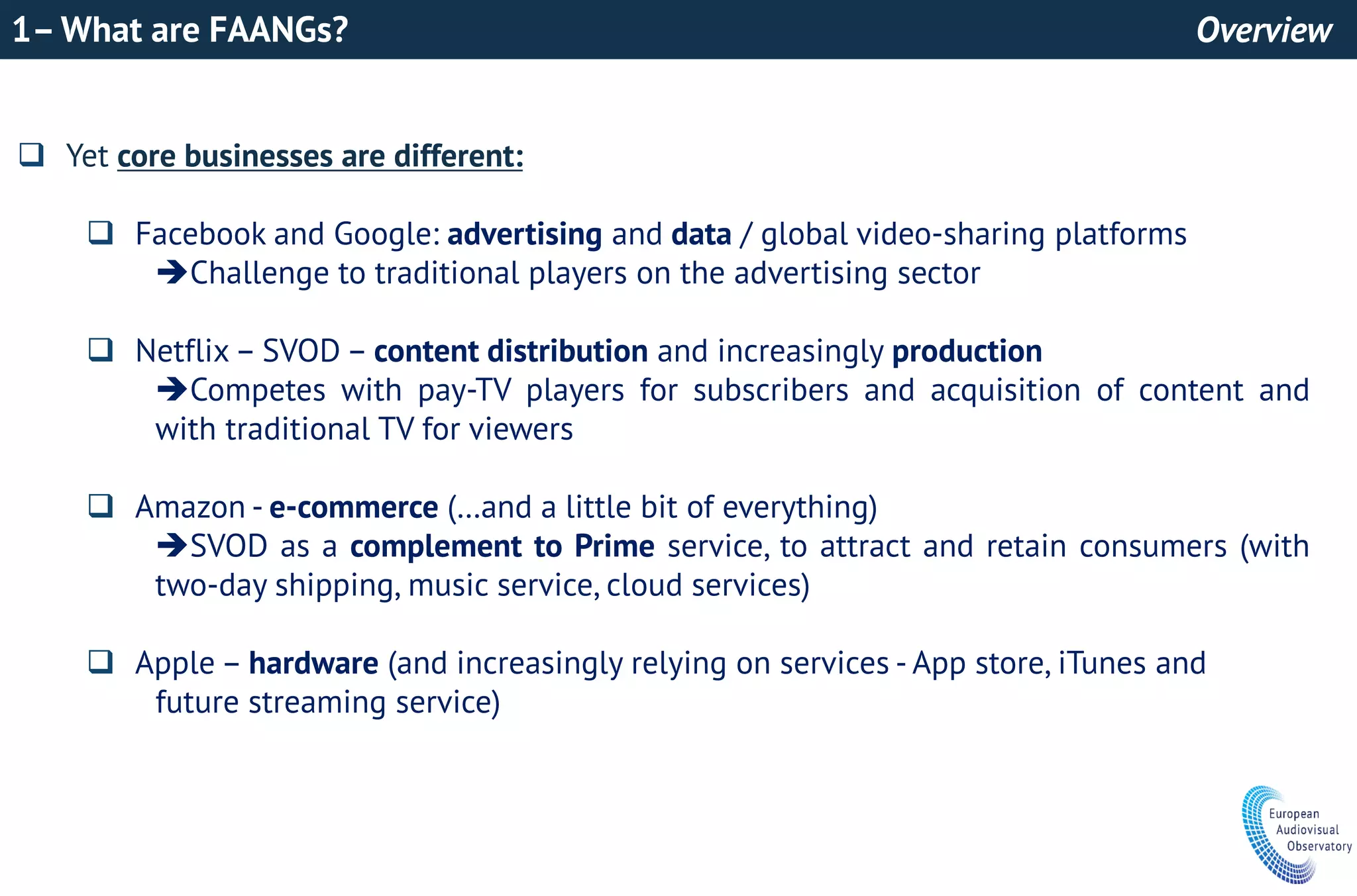
 Yet core businesses are different:
 Facebook and Google: advertising and data / global video-sharing platforms
Challenge to traditional players on the advertising sector
 Netflix – SVOD – content distribution and increasingly production
Competes with pay-TV players for subscribers and acquisition of content and
with traditional TV for viewers
 Amazon - e-commerce (…and a little bit of everything)
SVOD as a complement to Prime service, to attract and retain consumers (with
two-day shipping, music service, cloud services)
 Apple – hardware (and increasingly relying on services - App store, iTunes and
future streaming service)
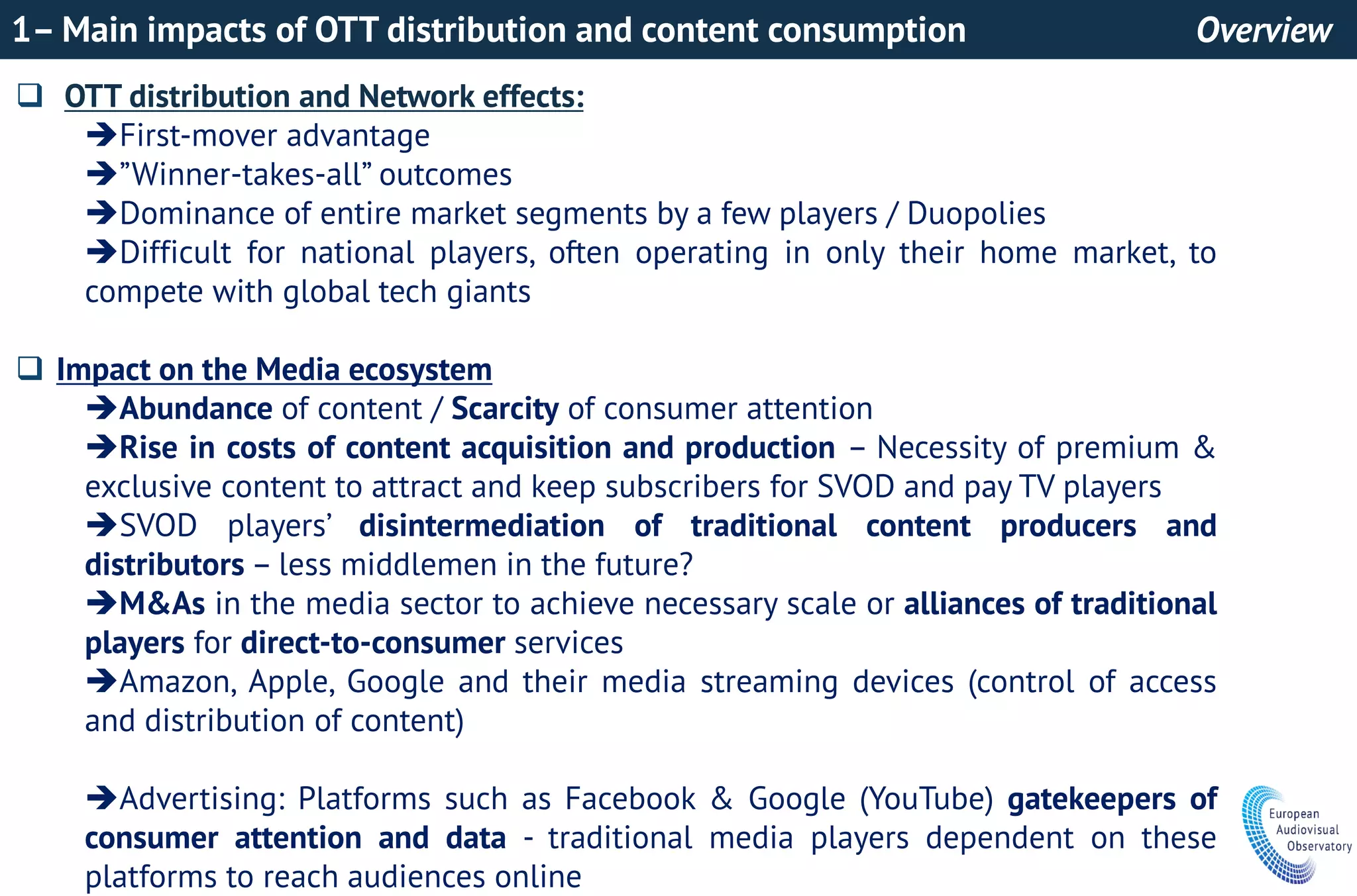
1– Main impacts of OTT distribution and content consumption Overview
 OTT distribution and Network effects:
First-mover advantage
”Winner-takes-all” outcomes
Dominance of entire market segments by a few players / Duopolies
Difficult for national players, often operating in only their home market, to
compete with global tech giants
 Impact on the Media ecosystem
Abundance of content / Scarcity of consumer attention
Rise in costs of content acquisition and production – Necessity of premium &
exclusive content to attract and keep subscribers for SVOD and pay TV players
SVOD players’ disintermediation of traditional content producers and
distributors – less middlemen in the future?
M&As in the media sector to achieve necessary scale or alliances of traditional
players for direct-to-consumer services
Amazon, Apple, Google and their media streaming devices (control of access
and distribution of content)
Advertising: Platforms such as Facebook & Google (YouTube) gatekeepers of
consumer attention and data - traditional media players dependent on these
platforms to reach audiences online
SVOD in the UK and the EU
 Explosive growth over the past years
 Rising importance in access, distribution and production of content
 Direct-to-consumer distribution is changing media landscape
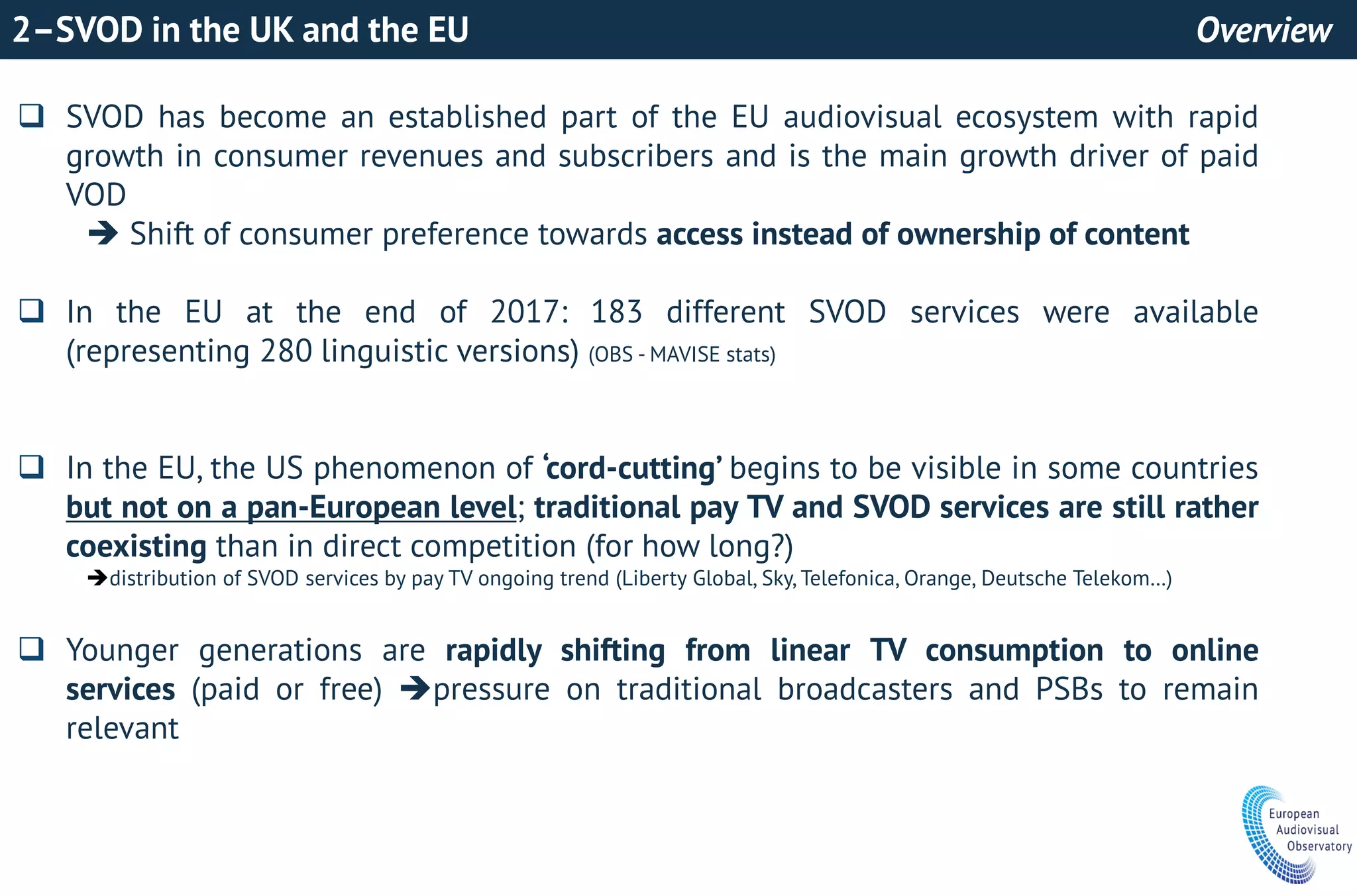
2–SVOD in the UK and the EU Overview
 SVOD has become an established part of the EU audiovisual ecosystem with rapid
growth in consumer revenues and subscribers and is the main growth driver of paid
VOD
 Shift of consumer preference towards access instead of ownership of content
 In the EU at the end of 2017: 183 different SVOD services were available
(representing 280 linguistic versions) (OBS - MAVISE stats)
 In the EU, the US phenomenon of ‘cord-cutting’ begins to be visible in some countries
but not on a pan-European level; traditional pay TV and SVOD services are still rather
coexisting than in direct competition (for how long?)
distribution of SVOD services by pay TV ongoing trend (Liberty Global, Sky, Telefonica, Orange, Deutsche Telekom…)
 Younger generations are rapidly shifting from linear TV consumption to online
services (paid or free) pressure on traditional broadcasters and PSBs to remain
relevant
2 – EU VOD market – Rapid growth over the past 5 years - SVOD growth driver
251,2
616,5
550,1
865,7363,7
3 649,0
0
1 000
2 000
3 000
4 000
5 000
6 000
2013 2014 2015 2016 2017
TVOD - Retail TVOD - Rental SVOD
1 165
million
5 131
million
Source: Ampere Analysis
EU - Consumer revenues OTT SVOD & TVOD
in EUR million
2 – UK SVOD market – Explosive growth in revenues and subs 2010-2018
Source: Ampere Analysis
UK Consumer revenues OTT SVOD
in EUR million
1,5
1 467,5
0
200
400
600
800
1000
1200
1400
1600
2010 2011 2012 2013 2014 2015 2016 2017 2018
0,1
19,7
14,2 16,6
0
5
10
15
20
25
2010 2011 2012 2013 2014 2015 2016 2017 2018
SVOD Subs Pay TV subs
UK Subscribers to SVOD and pay TV
in million subscribers
2017/18 more subscribers to SVOD than pay TV in the UK – growth of 17.7% vs. 0.1% YoY
But pay TV revenues still higher than SVOD revenues – € 7,15 billion vs. € 1,46 billion
However, significantly higher growth rates for SVOD revenues - 21% vs. 2% YoY
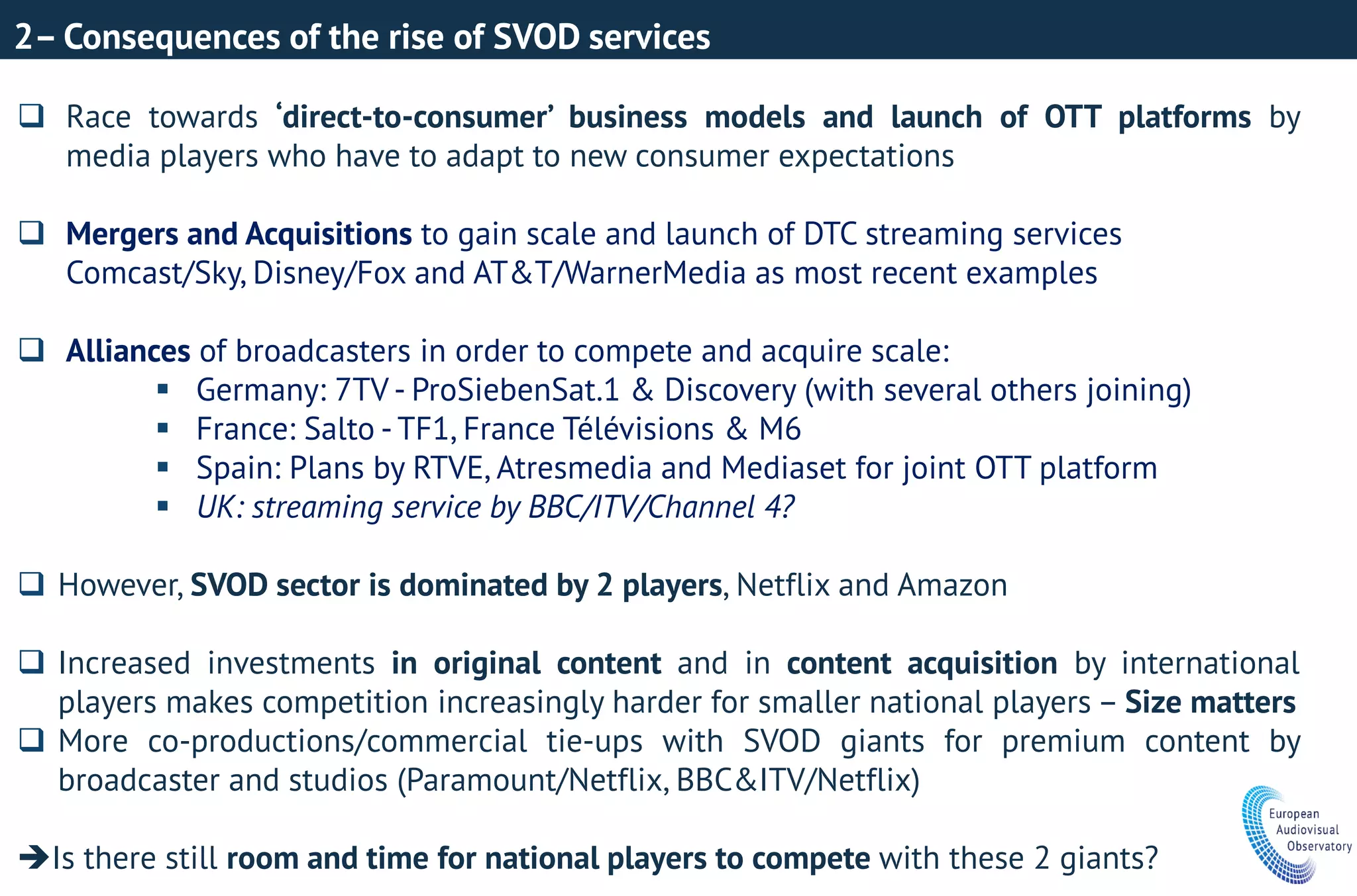
2– Consequences of the rise of SVOD services
 Race towards ‘direct-to-consumer’ business models and launch of OTT platforms by
media players who have to adapt to new consumer expectations
 Mergers and Acquisitions to gain scale and launch of DTC streaming services
Comcast/Sky, Disney/Fox and AT&T/WarnerMedia as most recent examples
 Alliances of broadcasters in order to compete and acquire scale:
 Germany: 7TV - ProSiebenSat.1 & Discovery (with several others joining)
 France: Salto - TF1, France Télévisions & M6
 Spain: Plans by RTVE, Atresmedia and Mediaset for joint OTT platform
 UK: streaming service by BBC/ITV/Channel 4?
 However, SVOD sector is dominated by 2 players, Netflix and Amazon
 Increased investments in original content and in content acquisition by international
players makes competition increasingly harder for smaller national players – Size matters
 More co-productions/commercial tie-ups with SVOD giants for premium content by
broadcaster and studios (Paramount/Netflix, BBC&ITV/Netflix)
Is there still room and time for national players to compete with these 2 giants?
2–Two players have mainly profited from the growth in the UK…
Netflix
782
53%Amazon
463
32%
Disney Life
18
1%
Now TV
194
13%
ITV Hub+
9
1%
UK Consumer revenues SVOD by company
in EUR million - 2018
Netflix
9,8
50%Amazon
7,8
39%
Disney Life
0,4
2%
Now TV
1,5
8%
ITV Hub+
0,3
1%
UK Subscribers to SVOD by company
in million subscribers - 2018
Netflix and Amazon: 85% of SVOD revenues and 89% of SVOD subscribers in the UK in 2018
Capacity of other players to compete? Announced launches of streaming services by Disney
(Disney+ and plans to expand Hulu) and Apple will harden competition for EU and national players
Call by head of OFCOM for UK PSBs to collaborate on a streaming service
Source: Ampere Analysis
2 – and this is also the case in the EU – the SVOD duopoly
Source: Ampere Analysis
EU SVOD SUBSCRIBERS
- 53,9 million SVOD subscribers in 2017
- Netflix and Amazon represent 80% of EU SVOD subs
Netflix 45,7%
Amazon 34,7%
Now TV 2,7%
TIM Vision 2,5%
Maxdome 2,1%
IPLA 1,8%
HBO 1,8%
15 other SVOD
services 8,8%
Netflix 51%
Amazon 23%
Now TV 5%
Maxdome 2%
Viaplay 2%
C More 2%
Sky Online 2%
Movistar+ 2%
HBO 2%
TIM Vision 2% 13 other SVOD
services 7%
EU SVOD CONSUMER REVENUES
- EUR 3.6 billion in 2017
- Netflix and Amazon represent 74% of EU SVOD revenues
2 - Content spend by major players – revenues diminish & costs rise
Source: Ampere Analysis
6,7
18,3
4,9
10,5
SVOD - Western
Europe
Pay TV - Western
Europe
SVOD - Central and
Eastern Europe
Pay TV - Central
and Eastern Europe
ARPU
- SVOD and direct-to-consumer business have much
lower revenues per user than pay TV
- The challenge will be for traditional services to
continue to finance content while earning less per
subscriber in new business models
- The need for size and presence in several markets
OR to distribute original content wider
 Collaborations, co-productions and alliances
CONTENT SPEND
- Netflix spent USD 6,2 billion and Amazon USD 4,9
billion in 2017 on original and acquired content
and more in 2018
- Netflix 141 projects in the EU in 2018 (81
originals) and has announced 221 for 2019 (153
originals)
- With new mega deals for content creators in the
100s of million dollars and the rising costs of
premium content, traditional players will be
challenged / major studios start to produce for
SVOD services
ARPU in EUR/month
Advertising in the UK
 Shift from mass-advertising to targeted advertising
 Online advertising dominated by 2 players,Google and Facebook, with
Amazon rising rapidly
 Consumer data is key, so is scale
3–Advertising market in the UK– Main points Overview
 The time spent with digital media, and mobile devices, has led to a shift in ad spend by
advertisers to the online space –in the UK, online has surpassed TV ad since 10 years
 Advertising has undergone a shift from mass-advertising to individualised and targeted
advertising allowed by the use of data on consumers.
 Mobile video advertising main growth driver (+65% YoY) with increased mobile video
consumption. Video advertising represents already 19% of online ad spend
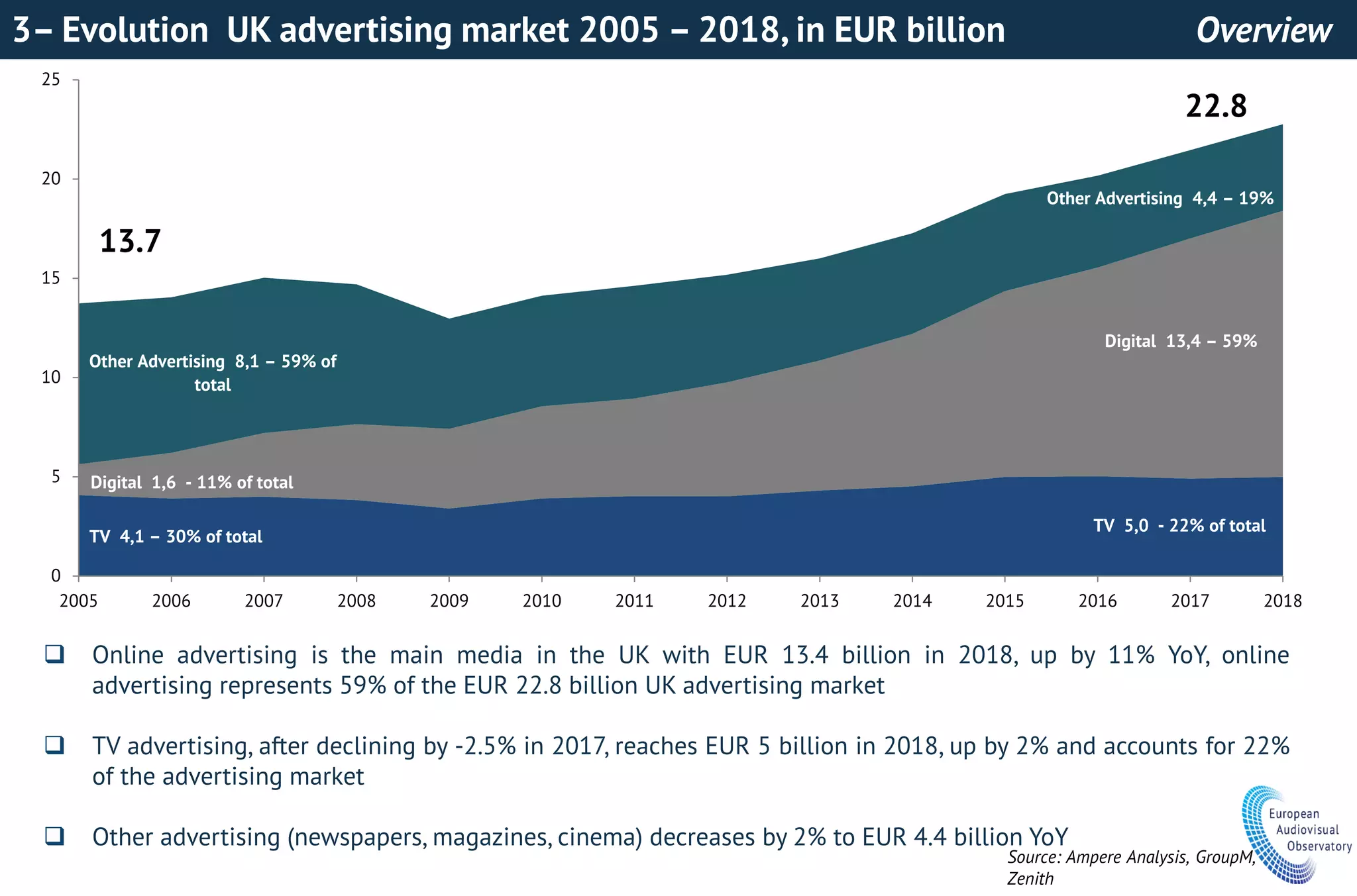
3– Evolution UK advertising market 2005 – 2018, in EUR billion
 Online advertising is the main media in the UK with EUR 13.4 billion in 2018, up by 11% YoY, online
advertising represents 59% of the EUR 22.8 billion UK advertising market
 TV advertising, after declining by -2.5% in 2017, reaches EUR 5 billion in 2018, up by 2% and accounts for 22%
of the advertising market
 Other advertising (newspapers, magazines, cinema) decreases by 2% to EUR 4.4 billion YoY
TV 4,1 – 30% of total
TV 5,0 - 22% of total
Digital 1,6 - 11% of total
Digital 13,4 – 59%
Other Advertising 8,1 – 59% of
total
Other Advertising 4,4 – 19%
0
5
10
15
20
25
2005 2006 2007 2008 2009 2010 2011 2012 2013 2014 2015 2016 2017 2018
Source: Ampere Analysis, GroupM,
Zenith
22.8
13.7
Overview
3–Advertising market in the UK–A duopoly?
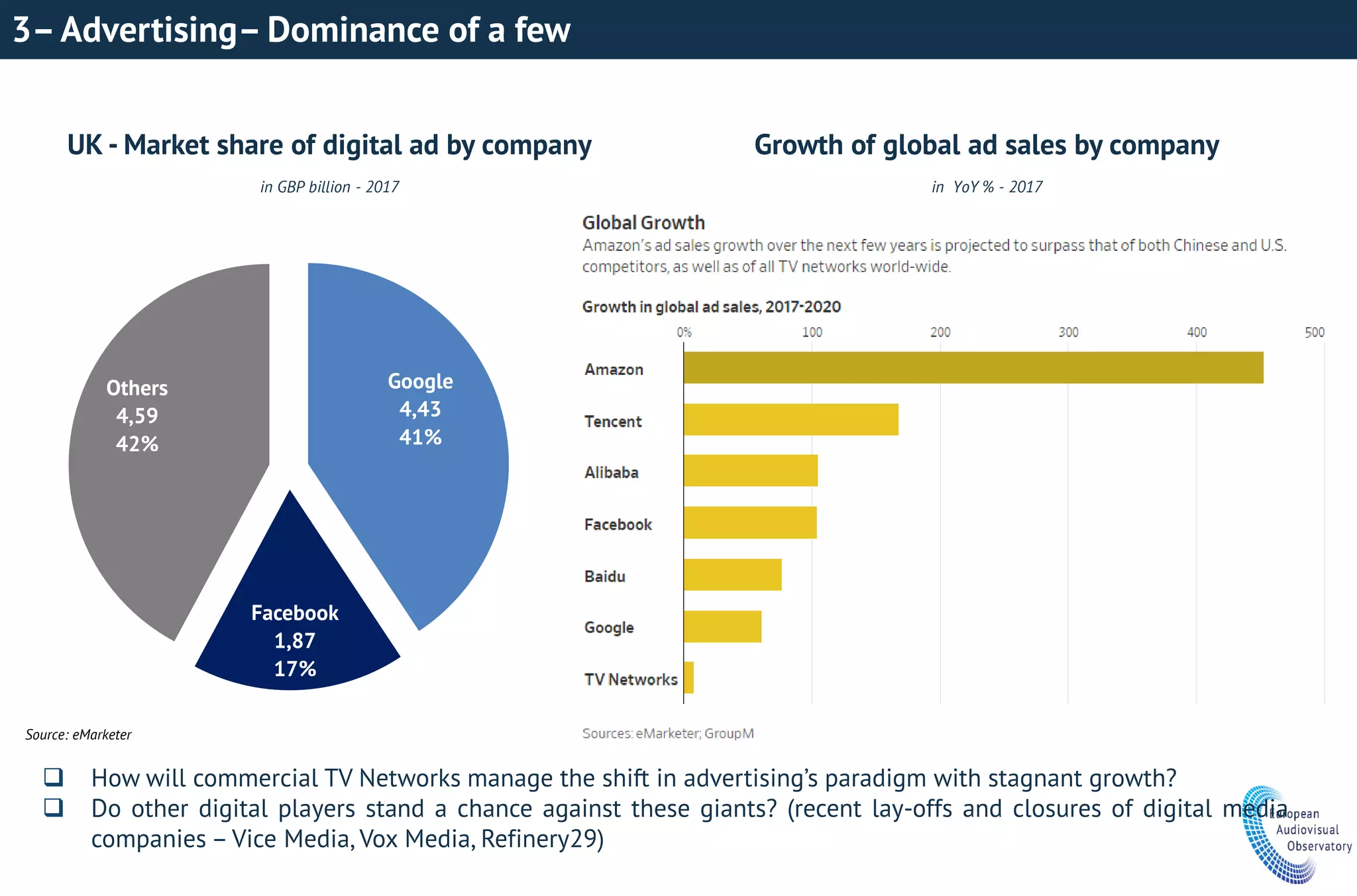
 2 players who capture enormous amount of consumers’ time (attention) and data have
emerged as winners – Google and Facebook. Global market share (excl. China) of digital
advertising in 2017 of 84% [and 58% in the UK] (GroupM)
 Amazon, who has consumer data and purchase history, making a play also on the ad market
 In turn, commercial broadcasters, such as ITV, are trying to find other revenue sources as TV
advertising is only forecasted to grow moderately and linear viewing time is decreasing -
setting up of advanced TV targeting systems
 Advertiser-funded VOD (AVOD), although still young, grows fast– globally already at USD
23.8 billion in 2017 and accounting for 5.2% of global adspend
 Amazon exploring launch of AVOD service & YouTube’s originals set to become available
through ad-supported viewing in a shift in strategy
3–Advertising– Dominance of a few
Source: eMarketer
Google
4,43
41%
Facebook
1,87
17%
Others
4,59
42%
UK - Market share of digital ad by company
in GBP billion - 2017
Growth of global ad sales by company
in YoY % - 2017
 How will commercial TV Networks manage the shift in advertising’s paradigm with stagnant growth?
 Do other digital players stand a chance against these giants? (recent lay-offs and closures of digital media
companies – Vice Media, Vox Media, Refinery29)
So what does all this mean for traditional media players?
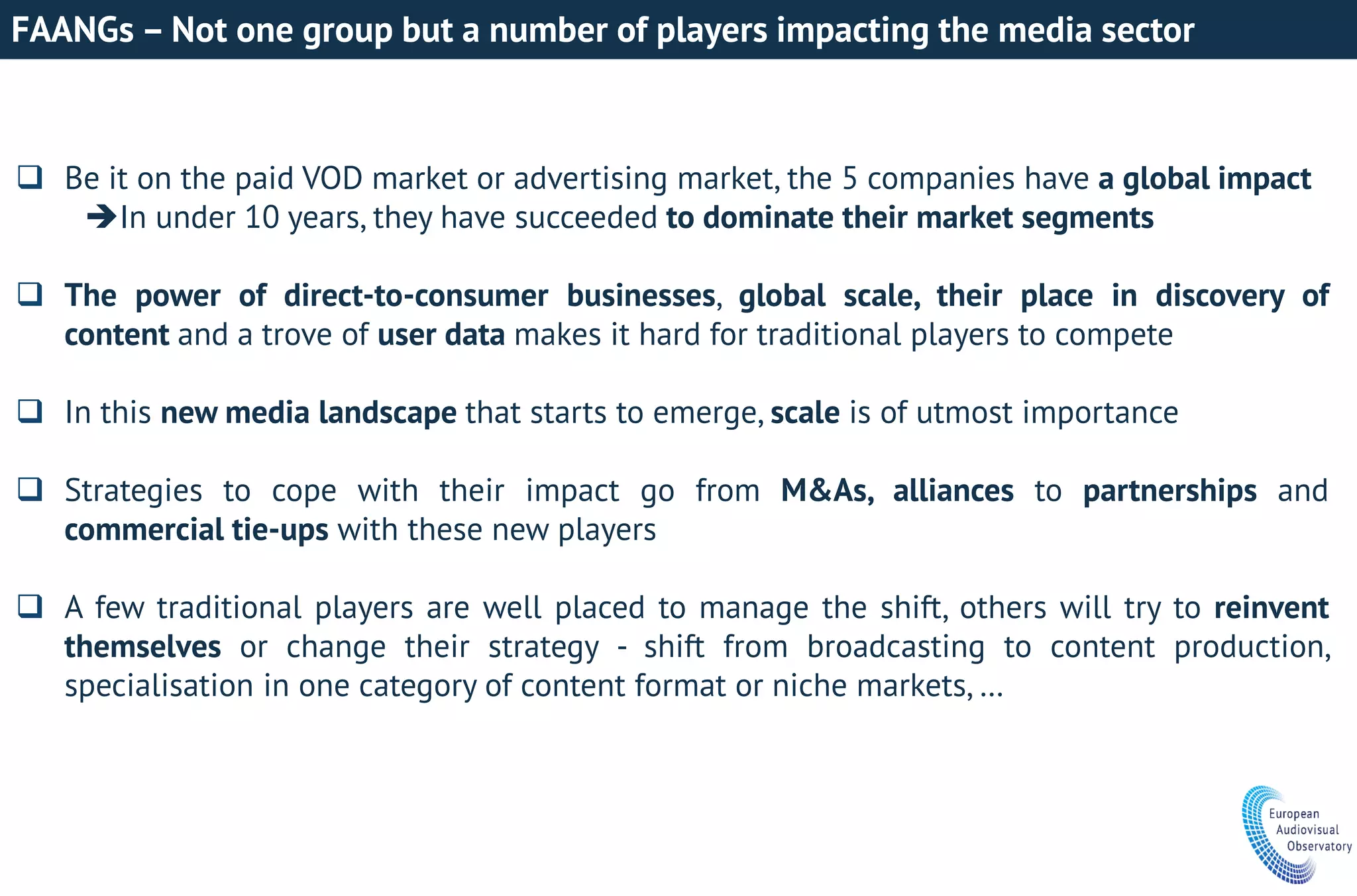
FAANGs – Not one group but a number of players impacting the media sector
 Be it on the paid VOD market or advertising market, the 5 companies have a global impact
In under 10 years, they have succeeded to dominate their market segments
 The power of direct-to-consumer businesses, global scale, their place in discovery of
content and a trove of user data makes it hard for traditional players to compete
 In this new media landscape that starts to emerge, scale is of utmost importance
 Strategies to cope with their impact go from M&As, alliances to partnerships and
commercial tie-ups with these new players
 A few traditional players are well placed to manage the shift, others will try to reinvent
themselves or change their strategy - shift from broadcasting to content production,
specialisation in one category of content format or niche markets, …
Change will take time but “disruption”seems inevitable
 Key question for media companies - how to respond:
- Cooperation with new players? (distribute content on Facebook, selling ad inventory
with Google, co-produce and sell to Netflix & Amazon…)
- Competition? (alternative online offer, launch of SVOD service, keep content rights…)
- Coopetition? (collaborate on some segments, compete on others)
More information:
www.obs.coe.int
Christian.Grece@coe.int

Faangs session - FAANGs ain't what they used to be

  • 1.
    FAANGs ain’t whatthey used to be Christian Grece Analyst 4th December 2018 FOCUS - London A presentation of the European Audiovisual Observatory
  • 2.
    1. What areFAANGs? And what are the main impacts of OTT distribution? 2. SVOD - Netflix and Amazon (and soon Apple) 3. Advertising - Google and Facebook (and Amazon) 4. What does their impact mean for traditional media players?
  • 3.
    1–What are FAANGsor FANGs? – Common points Overview  FAANGs / FANGs? – Facebook, Amazon, Netflix and Google (and to some extent Apple) share common points: - Tech (and increasingly media) players - Huge financial resources - Innovation & Best customer experience to access pre-existing resources - At their beginning, suppliers profited from their presence (content producers from Netflix, publishers from Facebook, merchants from Amazon, businesses from Google) - But global operations, superior user experience and scale have led to: Direct-to-consumer businesses and competition for consumer attention Owning of customer relationships (billions for Google/Facebook, 100s millions Netflix and Amazon) Discovery (of content) mainly through their services Power over suppliers (content, video, publishers, advertisers, merchants…)
  • 4.
    Subscribers Content suppliers & Originals Publishers& Advertisers Audience Audience & Customers Web sites, Publishers & Advertisers Merchants, Advertisers & Content suppliers Customers & Subscribers Ownership of customer relationship & Discovery = Power over suppliers
  • 5.
    1–What are FAANGs?Overview  Yet core businesses are different:  Facebook and Google: advertising and data / global video-sharing platforms Challenge to traditional players on the advertising sector  Netflix – SVOD – content distribution and increasingly production Competes with pay-TV players for subscribers and acquisition of content and with traditional TV for viewers  Amazon - e-commerce (…and a little bit of everything) SVOD as a complement to Prime service, to attract and retain consumers (with two-day shipping, music service, cloud services)  Apple – hardware (and increasingly relying on services - App store, iTunes and future streaming service)
  • 6.
    1– Main impactsof OTT distribution and content consumption Overview  OTT distribution and Network effects: First-mover advantage ”Winner-takes-all” outcomes Dominance of entire market segments by a few players / Duopolies Difficult for national players, often operating in only their home market, to compete with global tech giants  Impact on the Media ecosystem Abundance of content / Scarcity of consumer attention Rise in costs of content acquisition and production – Necessity of premium & exclusive content to attract and keep subscribers for SVOD and pay TV players SVOD players’ disintermediation of traditional content producers and distributors – less middlemen in the future? M&As in the media sector to achieve necessary scale or alliances of traditional players for direct-to-consumer services Amazon, Apple, Google and their media streaming devices (control of access and distribution of content) Advertising: Platforms such as Facebook & Google (YouTube) gatekeepers of consumer attention and data - traditional media players dependent on these platforms to reach audiences online
  • 7.
    SVOD in theUK and the EU  Explosive growth over the past years  Rising importance in access, distribution and production of content  Direct-to-consumer distribution is changing media landscape
  • 8.
    2–SVOD in theUK and the EU Overview  SVOD has become an established part of the EU audiovisual ecosystem with rapid growth in consumer revenues and subscribers and is the main growth driver of paid VOD  Shift of consumer preference towards access instead of ownership of content  In the EU at the end of 2017: 183 different SVOD services were available (representing 280 linguistic versions) (OBS - MAVISE stats)  In the EU, the US phenomenon of ‘cord-cutting’ begins to be visible in some countries but not on a pan-European level; traditional pay TV and SVOD services are still rather coexisting than in direct competition (for how long?) distribution of SVOD services by pay TV ongoing trend (Liberty Global, Sky, Telefonica, Orange, Deutsche Telekom…)  Younger generations are rapidly shifting from linear TV consumption to online services (paid or free) pressure on traditional broadcasters and PSBs to remain relevant
  • 9.
    2 – EUVOD market – Rapid growth over the past 5 years - SVOD growth driver 251,2 616,5 550,1 865,7363,7 3 649,0 0 1 000 2 000 3 000 4 000 5 000 6 000 2013 2014 2015 2016 2017 TVOD - Retail TVOD - Rental SVOD 1 165 million 5 131 million Source: Ampere Analysis EU - Consumer revenues OTT SVOD & TVOD in EUR million
  • 10.
    2 – UKSVOD market – Explosive growth in revenues and subs 2010-2018 Source: Ampere Analysis UK Consumer revenues OTT SVOD in EUR million 1,5 1 467,5 0 200 400 600 800 1000 1200 1400 1600 2010 2011 2012 2013 2014 2015 2016 2017 2018 0,1 19,7 14,2 16,6 0 5 10 15 20 25 2010 2011 2012 2013 2014 2015 2016 2017 2018 SVOD Subs Pay TV subs UK Subscribers to SVOD and pay TV in million subscribers 2017/18 more subscribers to SVOD than pay TV in the UK – growth of 17.7% vs. 0.1% YoY But pay TV revenues still higher than SVOD revenues – € 7,15 billion vs. € 1,46 billion However, significantly higher growth rates for SVOD revenues - 21% vs. 2% YoY
  • 11.
    2– Consequences ofthe rise of SVOD services  Race towards ‘direct-to-consumer’ business models and launch of OTT platforms by media players who have to adapt to new consumer expectations  Mergers and Acquisitions to gain scale and launch of DTC streaming services Comcast/Sky, Disney/Fox and AT&T/WarnerMedia as most recent examples  Alliances of broadcasters in order to compete and acquire scale:  Germany: 7TV - ProSiebenSat.1 & Discovery (with several others joining)  France: Salto - TF1, France Télévisions & M6  Spain: Plans by RTVE, Atresmedia and Mediaset for joint OTT platform  UK: streaming service by BBC/ITV/Channel 4?  However, SVOD sector is dominated by 2 players, Netflix and Amazon  Increased investments in original content and in content acquisition by international players makes competition increasingly harder for smaller national players – Size matters  More co-productions/commercial tie-ups with SVOD giants for premium content by broadcaster and studios (Paramount/Netflix, BBC&ITV/Netflix) Is there still room and time for national players to compete with these 2 giants?
  • 12.
    2–Two players havemainly profited from the growth in the UK… Netflix 782 53%Amazon 463 32% Disney Life 18 1% Now TV 194 13% ITV Hub+ 9 1% UK Consumer revenues SVOD by company in EUR million - 2018 Netflix 9,8 50%Amazon 7,8 39% Disney Life 0,4 2% Now TV 1,5 8% ITV Hub+ 0,3 1% UK Subscribers to SVOD by company in million subscribers - 2018 Netflix and Amazon: 85% of SVOD revenues and 89% of SVOD subscribers in the UK in 2018 Capacity of other players to compete? Announced launches of streaming services by Disney (Disney+ and plans to expand Hulu) and Apple will harden competition for EU and national players Call by head of OFCOM for UK PSBs to collaborate on a streaming service Source: Ampere Analysis
  • 13.
    2 – andthis is also the case in the EU – the SVOD duopoly Source: Ampere Analysis EU SVOD SUBSCRIBERS - 53,9 million SVOD subscribers in 2017 - Netflix and Amazon represent 80% of EU SVOD subs Netflix 45,7% Amazon 34,7% Now TV 2,7% TIM Vision 2,5% Maxdome 2,1% IPLA 1,8% HBO 1,8% 15 other SVOD services 8,8% Netflix 51% Amazon 23% Now TV 5% Maxdome 2% Viaplay 2% C More 2% Sky Online 2% Movistar+ 2% HBO 2% TIM Vision 2% 13 other SVOD services 7% EU SVOD CONSUMER REVENUES - EUR 3.6 billion in 2017 - Netflix and Amazon represent 74% of EU SVOD revenues
  • 14.
    2 - Contentspend by major players – revenues diminish & costs rise Source: Ampere Analysis 6,7 18,3 4,9 10,5 SVOD - Western Europe Pay TV - Western Europe SVOD - Central and Eastern Europe Pay TV - Central and Eastern Europe ARPU - SVOD and direct-to-consumer business have much lower revenues per user than pay TV - The challenge will be for traditional services to continue to finance content while earning less per subscriber in new business models - The need for size and presence in several markets OR to distribute original content wider  Collaborations, co-productions and alliances CONTENT SPEND - Netflix spent USD 6,2 billion and Amazon USD 4,9 billion in 2017 on original and acquired content and more in 2018 - Netflix 141 projects in the EU in 2018 (81 originals) and has announced 221 for 2019 (153 originals) - With new mega deals for content creators in the 100s of million dollars and the rising costs of premium content, traditional players will be challenged / major studios start to produce for SVOD services ARPU in EUR/month
  • 15.
    Advertising in theUK  Shift from mass-advertising to targeted advertising  Online advertising dominated by 2 players,Google and Facebook, with Amazon rising rapidly  Consumer data is key, so is scale
  • 16.
    3–Advertising market inthe UK– Main points Overview  The time spent with digital media, and mobile devices, has led to a shift in ad spend by advertisers to the online space –in the UK, online has surpassed TV ad since 10 years  Advertising has undergone a shift from mass-advertising to individualised and targeted advertising allowed by the use of data on consumers.  Mobile video advertising main growth driver (+65% YoY) with increased mobile video consumption. Video advertising represents already 19% of online ad spend
  • 17.
    3– Evolution UKadvertising market 2005 – 2018, in EUR billion  Online advertising is the main media in the UK with EUR 13.4 billion in 2018, up by 11% YoY, online advertising represents 59% of the EUR 22.8 billion UK advertising market  TV advertising, after declining by -2.5% in 2017, reaches EUR 5 billion in 2018, up by 2% and accounts for 22% of the advertising market  Other advertising (newspapers, magazines, cinema) decreases by 2% to EUR 4.4 billion YoY TV 4,1 – 30% of total TV 5,0 - 22% of total Digital 1,6 - 11% of total Digital 13,4 – 59% Other Advertising 8,1 – 59% of total Other Advertising 4,4 – 19% 0 5 10 15 20 25 2005 2006 2007 2008 2009 2010 2011 2012 2013 2014 2015 2016 2017 2018 Source: Ampere Analysis, GroupM, Zenith 22.8 13.7 Overview
  • 18.
    3–Advertising market inthe UK–A duopoly?  2 players who capture enormous amount of consumers’ time (attention) and data have emerged as winners – Google and Facebook. Global market share (excl. China) of digital advertising in 2017 of 84% [and 58% in the UK] (GroupM)  Amazon, who has consumer data and purchase history, making a play also on the ad market  In turn, commercial broadcasters, such as ITV, are trying to find other revenue sources as TV advertising is only forecasted to grow moderately and linear viewing time is decreasing - setting up of advanced TV targeting systems  Advertiser-funded VOD (AVOD), although still young, grows fast– globally already at USD 23.8 billion in 2017 and accounting for 5.2% of global adspend  Amazon exploring launch of AVOD service & YouTube’s originals set to become available through ad-supported viewing in a shift in strategy
  • 19.
    3–Advertising– Dominance ofa few Source: eMarketer Google 4,43 41% Facebook 1,87 17% Others 4,59 42% UK - Market share of digital ad by company in GBP billion - 2017 Growth of global ad sales by company in YoY % - 2017  How will commercial TV Networks manage the shift in advertising’s paradigm with stagnant growth?  Do other digital players stand a chance against these giants? (recent lay-offs and closures of digital media companies – Vice Media, Vox Media, Refinery29)
  • 20.
    So what doesall this mean for traditional media players?
  • 21.
    FAANGs – Notone group but a number of players impacting the media sector  Be it on the paid VOD market or advertising market, the 5 companies have a global impact In under 10 years, they have succeeded to dominate their market segments  The power of direct-to-consumer businesses, global scale, their place in discovery of content and a trove of user data makes it hard for traditional players to compete  In this new media landscape that starts to emerge, scale is of utmost importance  Strategies to cope with their impact go from M&As, alliances to partnerships and commercial tie-ups with these new players  A few traditional players are well placed to manage the shift, others will try to reinvent themselves or change their strategy - shift from broadcasting to content production, specialisation in one category of content format or niche markets, …
  • 22.
    Change will taketime but “disruption”seems inevitable  Key question for media companies - how to respond: - Cooperation with new players? (distribute content on Facebook, selling ad inventory with Google, co-produce and sell to Netflix & Amazon…) - Competition? (alternative online offer, launch of SVOD service, keep content rights…) - Coopetition? (collaborate on some segments, compete on others)
  • 23.