Mar. 2020 Computer Arithmetic, Number Representation Slide 1
Part I
Number Representation
Numbers and Arithmetic
Representing Signed Numbers
Redundant Number Systems
Residue Number Systems
Addition / Subtraction
Basic Addition and Counting
Carry-Lookahead Adders
Variations in Fast Adders
Multioperand Addition
Multiplication
Basic Multiplication Schemes
High-Radix Multipliers
Tree and Array Multipliers
Variations in Multipliers
Division
Basic Division Schemes
High-Radix Dividers
Variations in Dividers
Division by Convergence
Real Arithmetic
Floating-Point Reperesentations
Floating-Point Operations
Errors and Error Control
Precise and Certifiable Arithmetic
Function Evaluation
Square-Rooting Methods
The CORDIC Algorithms
Variations in Function Evaluation
Arithmetic by Table Lookup
Implementation Topics
High-Throughput Arithmetic
Low-Power Arithmetic
Fault-Tolerant Arithmetic
Past, Present, and Future
Parts Chapters
I.
II.
III.
IV.
V.
VI.
VII.
1.
2.
3.
4.
5.
6.
7.
8.
9.
10.
11.
12.
25.
26.
27.
28.
21.
22.
23.
24.
17.
18.
19.
20.
13.
14.
15.
16.
Elementary
Operations
28. Reconfigurable Arithmetic
Appendix: Past, Present, and Future
Mar. 2020 Computer Arithmetic, Number Representation Slide 2
About This Presentation
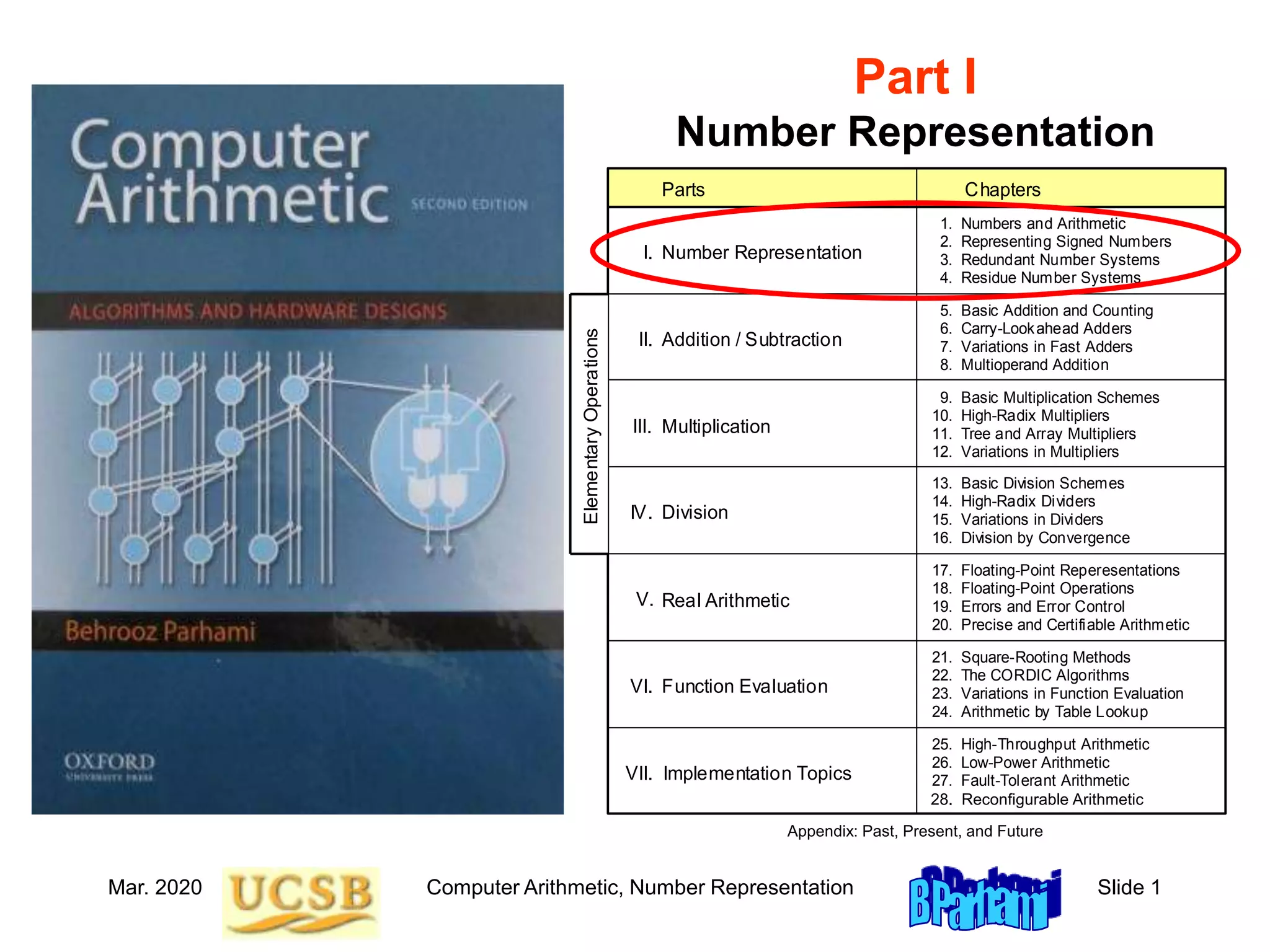
This presentation is intended to support the use of the textbook
Computer Arithmetic: Algorithms and Hardware Designs (Oxford
U. Press, 2nd ed., 2010, ISBN 978-0-19-532848-6). It is updated
regularly by the author as part of his teaching of the graduate
course ECE 252B, Computer Arithmetic, at the University of
California, Santa Barbara. Instructors can use these slides freely
in classroom teaching and for other educational purposes.
Unauthorized uses are strictly prohibited. © Behrooz Parhami
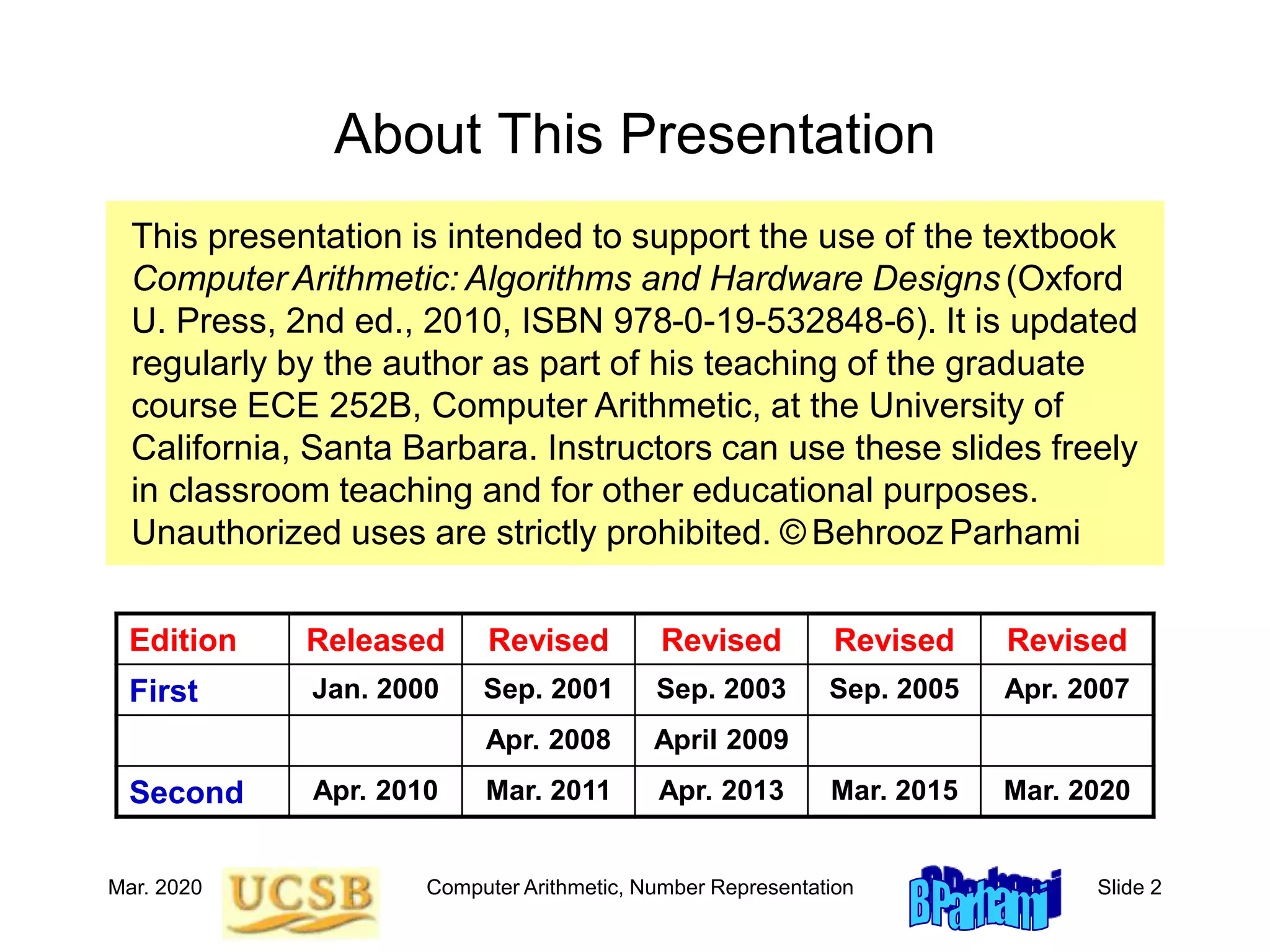
Edition Released Revised Revised Revised Revised
First Jan. 2000 Sep. 2001 Sep. 2003 Sep. 2005 Apr. 2007
Apr. 2008 April 2009
Second Apr. 2010 Mar. 2011 Apr. 2013 Mar. 2015 Mar. 2020
Mar. 2020 Computer Arithmetic, Number Representation Slide 3
I Background and Motivation
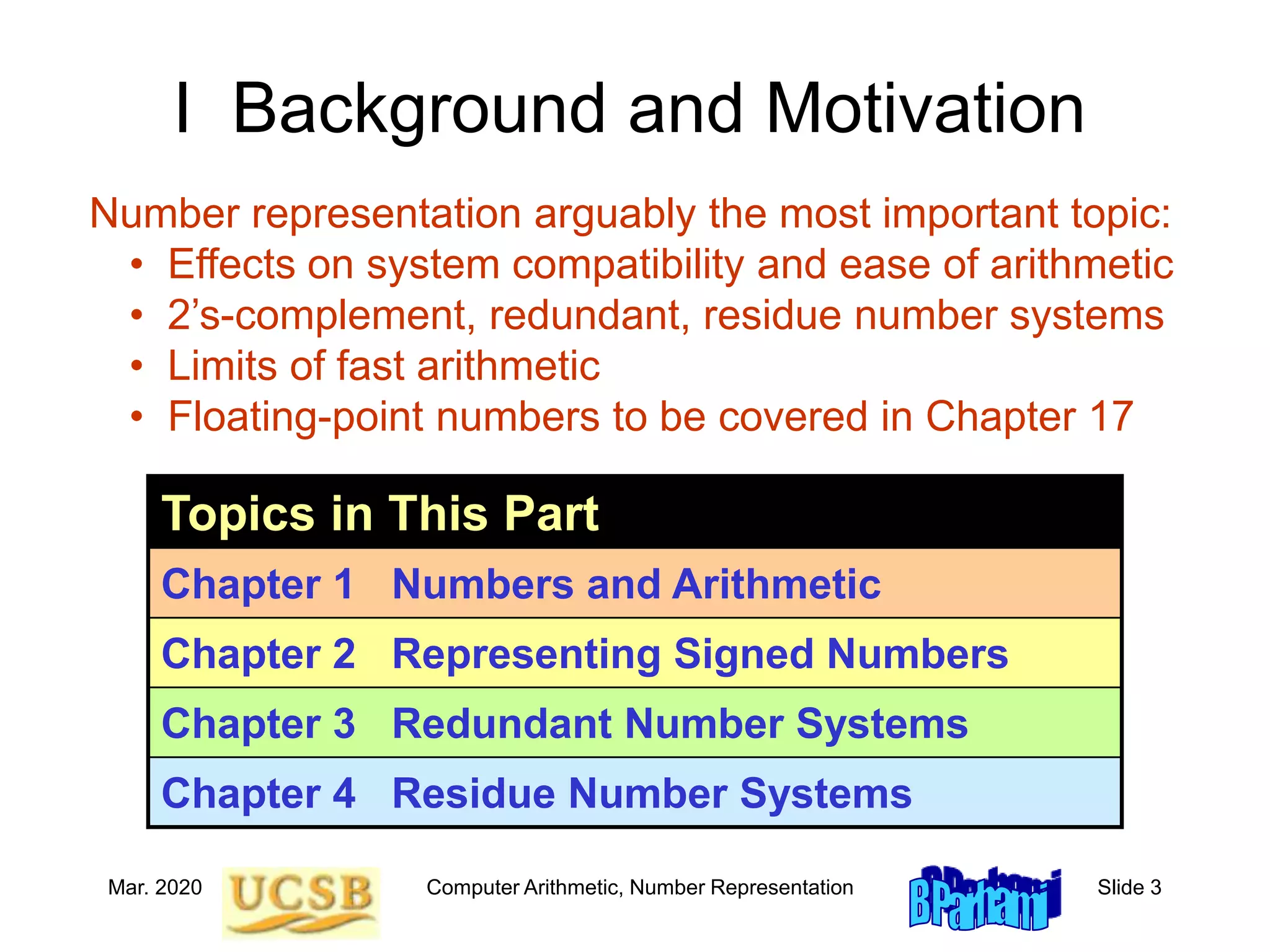
Topics in This Part
Chapter 1 Numbers and Arithmetic
Chapter 2 Representing Signed Numbers
Chapter 3 Redundant Number Systems
Chapter 4 Residue Number Systems
Number representation arguably the most important topic:
• Effects on system compatibility and ease of arithmetic
• 2’s-complement, redundant, residue number systems
• Limits of fast arithmetic
• Floating-point numbers to be covered in Chapter 17
Mar. 2020 Computer Arithmetic, Number Representation Slide 4
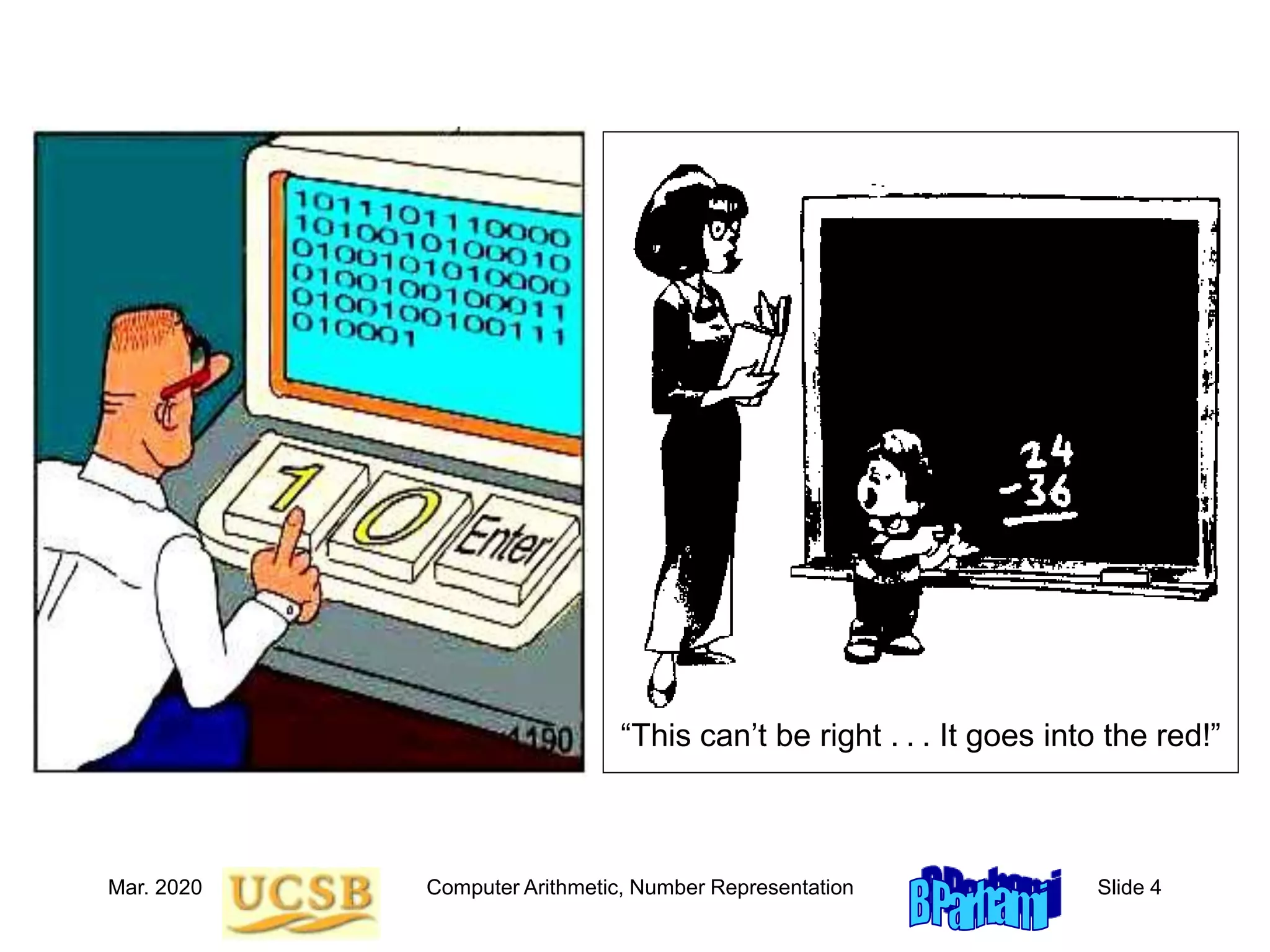
“This can’t be right . . . It goes into the red!”
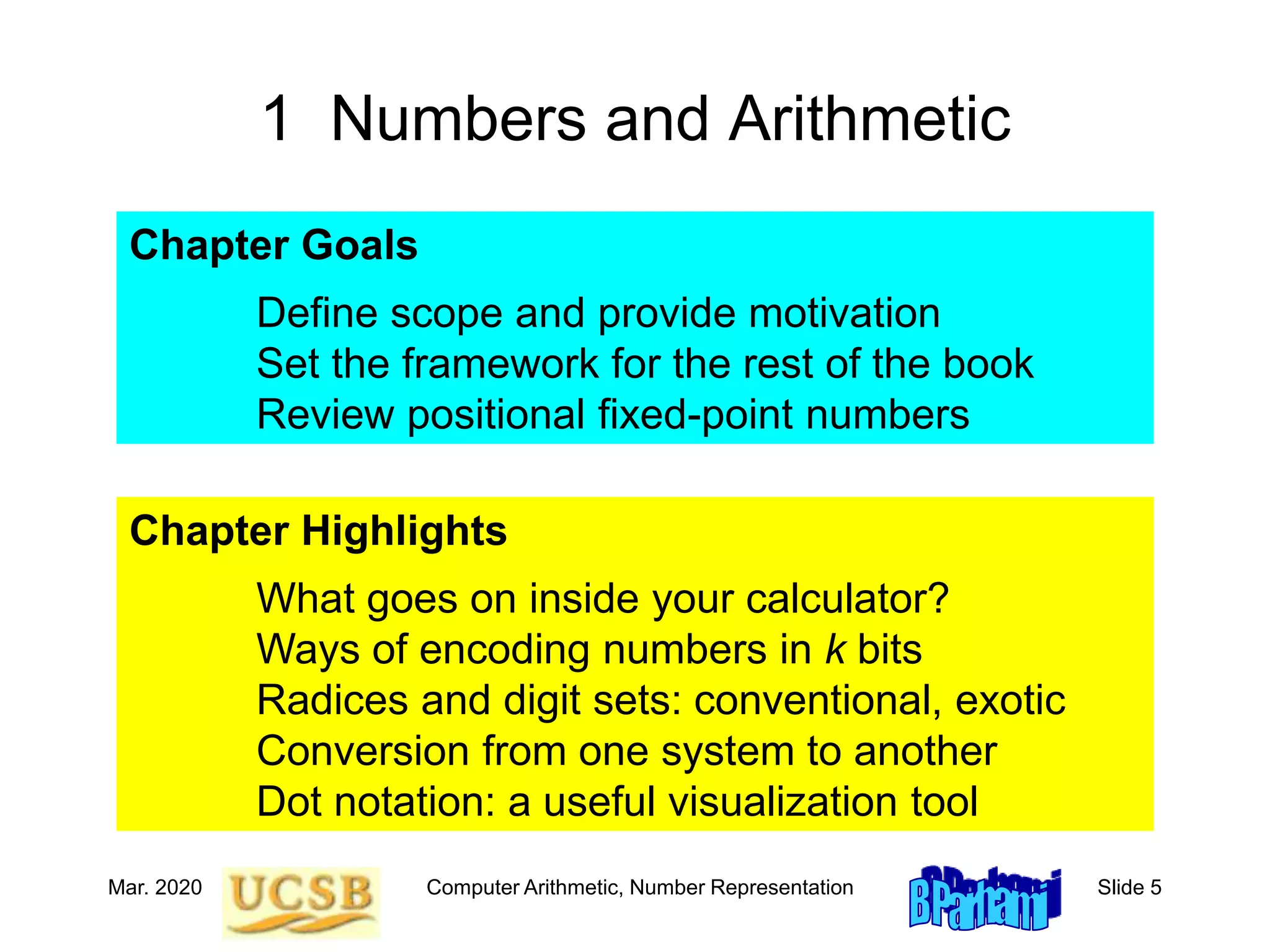
Mar. 2020 Computer Arithmetic, Number Representation Slide 5
1 Numbers and Arithmetic
Chapter Goals
Define scope and provide motivation
Set the framework for the rest of the book
Review positional fixed-point numbers
Chapter Highlights
What goes on inside your calculator?
Ways of encoding numbers in k bits
Radices and digit sets: conventional, exotic
Conversion from one system to another
Dot notation: a useful visualization tool
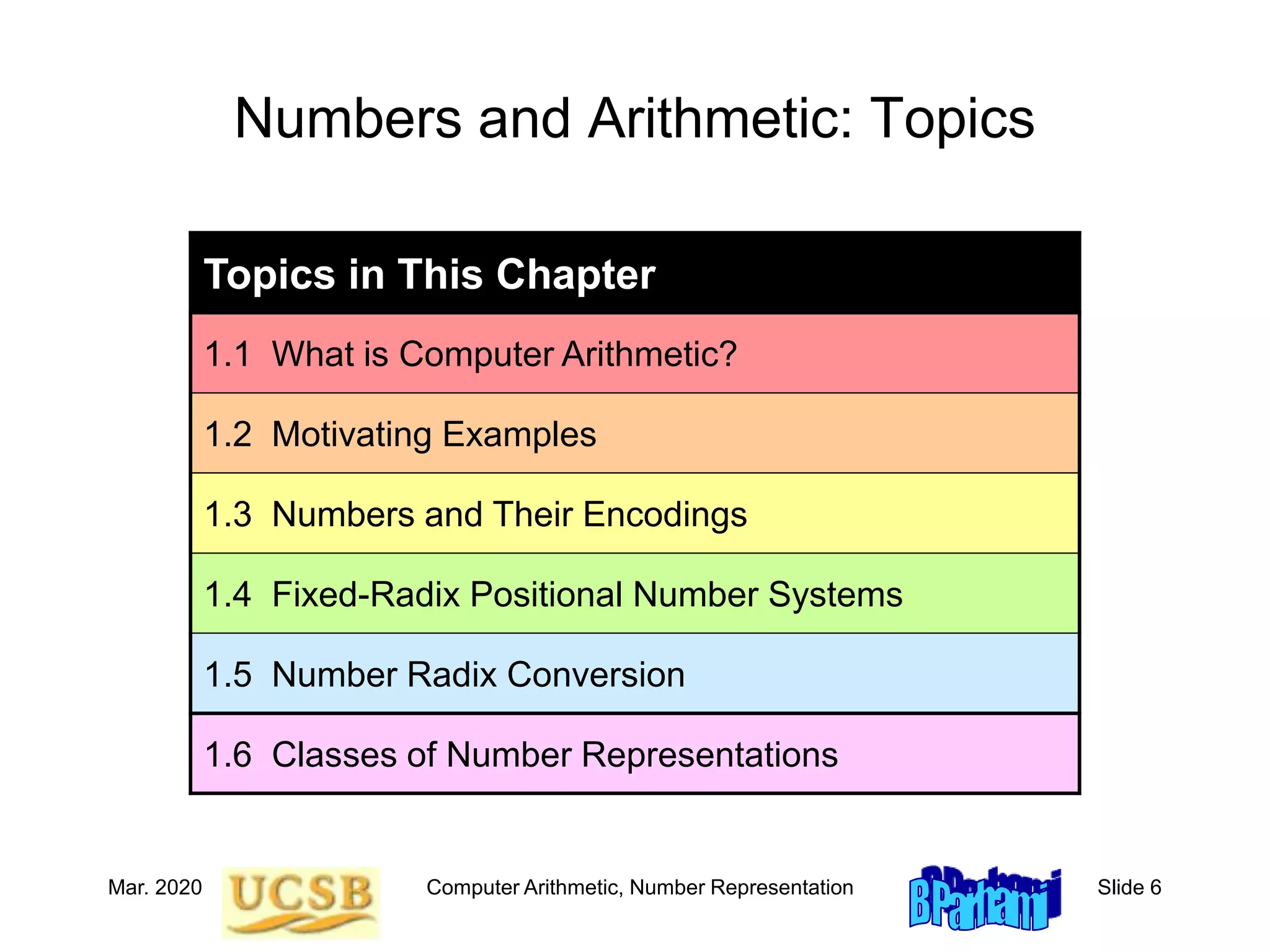
Mar. 2020 Computer Arithmetic, Number Representation Slide 6
Numbers and Arithmetic: Topics
Topics in This Chapter
1.1 What is Computer Arithmetic?
1.2 Motivating Examples
1.3 Numbers and Their Encodings
1.4 Fixed-Radix Positional Number Systems
1.5 Number Radix Conversion
1.6 Classes of Number Representations
Mar. 2020 Computer Arithmetic, Number Representation Slide 7
1.1 What is Computer Arithmetic?
Pentium Division Bug (1994-95): Pentium’s radix-4 SRT
algorithm occasionally gave incorrect quotient
First noted in 1994 by Tom Nicely who computed sums of
reciprocals of twin primes:
1/5 + 1/7 + 1/11 + 1/13 + . . . + 1/p + 1/(p + 2) + . . .
Worst-case example of division error in Pentium:
4 195 835
3 145 727
1.333 820 44...
1.333 739 06...
c =
=
Correct quotient
circa 1994 Pentium
double FLP value;
accurate to only 14 bits
(worse than single!)
Mar. 2020 Computer Arithmetic, Number Representation Slide 8
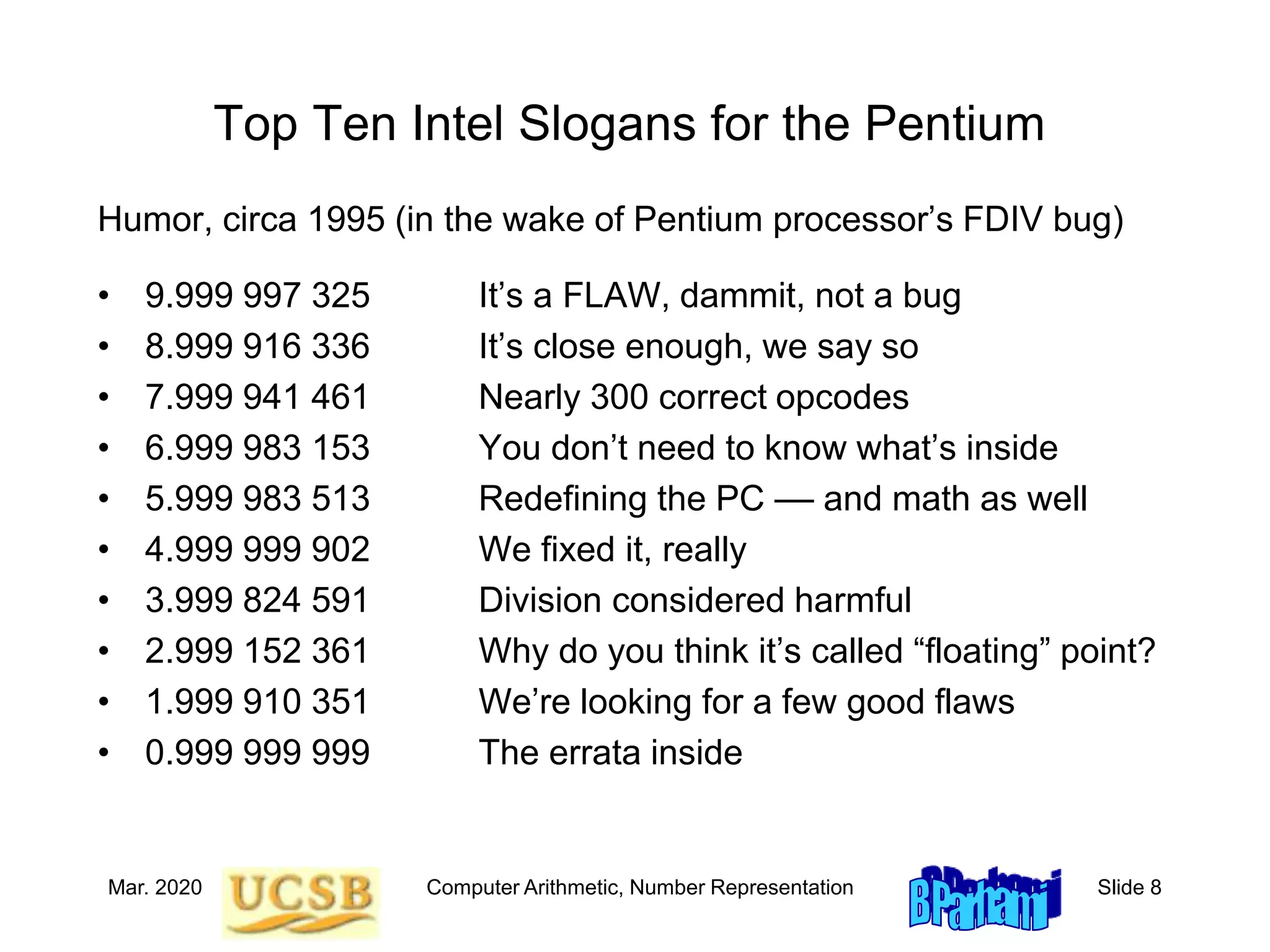
Top Ten Intel Slogans for the Pentium
Humor, circa 1995 (in the wake of Pentium processor’s FDIV bug)
• 9.999 997 325 It’s a FLAW, dammit, not a bug
• 8.999 916 336 It’s close enough, we say so
• 7.999 941 461 Nearly 300 correct opcodes
• 6.999 983 153 You don’t need to know what’s inside
• 5.999 983 513 Redefining the PC –– and math as well
• 4.999 999 902 We fixed it, really
• 3.999 824 591 Division considered harmful
• 2.999 152 361 Why do you think it’s called “floating” point?
• 1.999 910 351 We’re looking for a few good flaws
• 0.999 999 999 The errata inside
Mar. 2020 Computer Arithmetic, Number Representation Slide 9
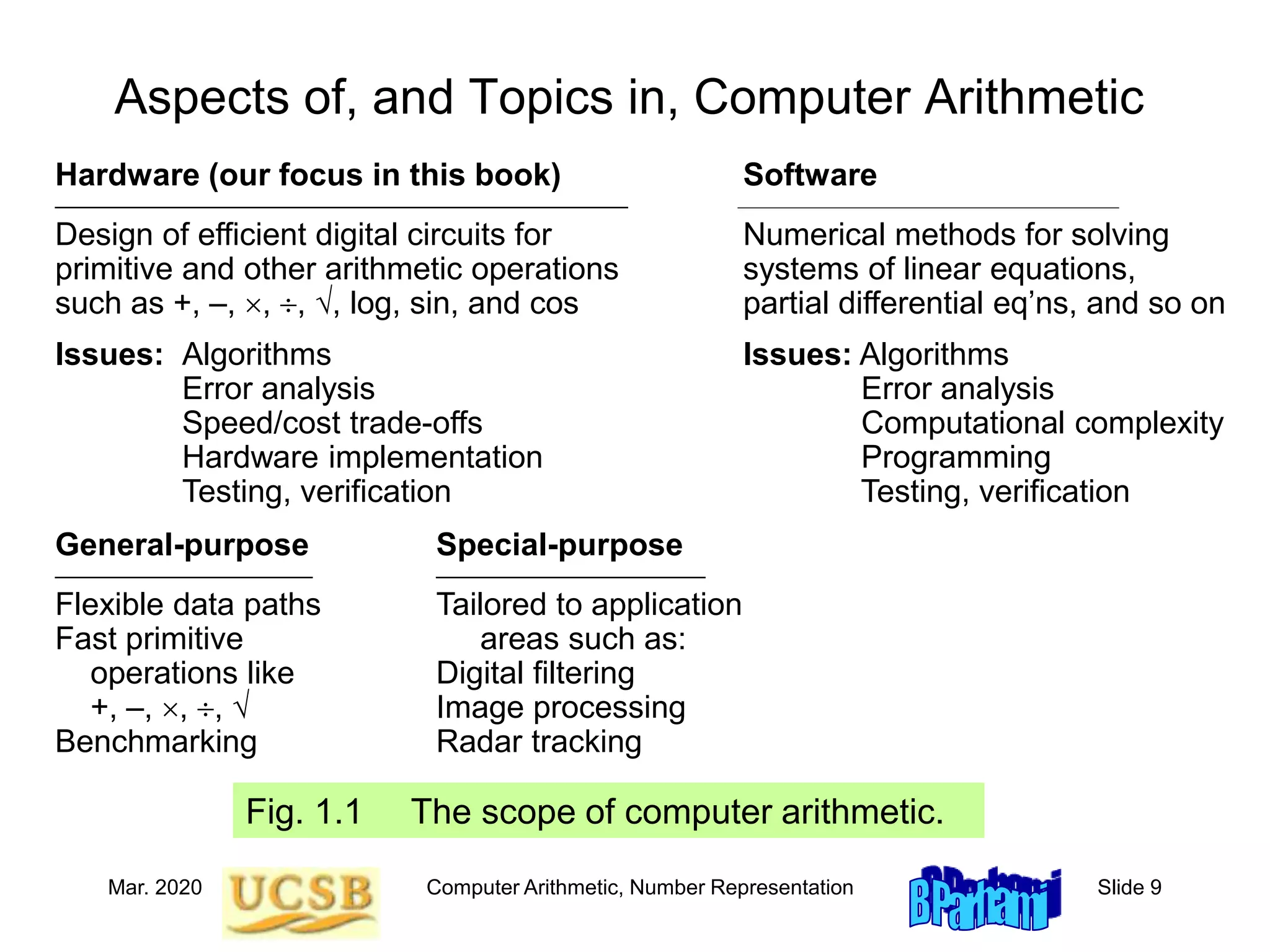
Aspects of, and Topics in, Computer Arithmetic
Fig. 1.1 The scope of computer arithmetic.
Hardware (our focus in this book) Software
––––––––––––––––––––––––––––––––––––––––––––––––– ––––––––––––––––––––––––––––––––––––
Design of efficient digital circuits for Numerical methods for solving
primitive and other arithmetic operations systems of linear equations,
such as +, –, , , , log, sin, and cos partial differential eq’ns, and so on
Issues: Algorithms Issues: Algorithms
Error analysis Error analysis
Speed/cost trade-offs Computational complexity
Hardware implementation Programming
Testing, verification Testing, verification
General-purpose Special-purpose
–––––––––––––––––––––– –––––––––––––––––––––––
Flexible data paths Tailored to application
Fast primitive areas such as:
operations like Digital filtering
+, –, , ,  Image processing
Benchmarking Radar tracking
Mar. 2020 Computer Arithmetic, Number Representation Slide 10
Using a calculator with √, x2, and xy functions, compute:
u = √√ … √ 2 = 1.000 677 131 “1024th root of 2”
v = 21/1024 = 1.000 677 131
Save u and v; If you can’t save, recompute values when needed
x = (((u2)2)...)2 = 1.999 999 963
x' = u1024 = 1.999 999 973
y = (((v2)2)...)2 = 1.999 999 983
y' = v1024 = 1.999 999 994
Perhaps v and u are not really the same value
w = v – u = 1  10–11 Nonzero due to hidden digits
(u – 1)  1000 = 0.677 130 680 [Hidden ... (0) 68]
(v – 1)  1000 = 0.677 130 690 [Hidden ... (0) 69]
1.2 A Motivating Example
Mar. 2020 Computer Arithmetic, Number Representation Slide 11
Finite Precision Can Lead to Disaster
Example: Failure of Patriot Missile (1991 Feb. 25)
Source http://www.ima.umn.edu/~arnold/disasters/disasters.html
American Patriot Missile battery in Dharan, Saudi Arabia, failed to
intercept incoming Iraqi Scud missile
The Scud struck an American Army barracks, killing 28
Cause, per GAO/IMTEC-92-26 report: “software problem” (inaccurate
calculation of the time since boot)
Problem specifics:
Time in tenths of second as measured by the system’s internal clock
was multiplied by 1/10 to get the time in seconds
Internal registers were 24 bits wide
1/10 = 0.0001 1001 1001 1001 1001 100 (chopped to 24 b)
Error ≈ 0.1100 1100  2–23 ≈ 9.5  10–8
Error in 100-hr operation period
≈ 9.5  10–8  100  60  60  10 = 0.34 s
Distance traveled by Scud = (0.34 s)  (1676 m/s) ≈ 570 m
Mar. 2020 Computer Arithmetic, Number Representation Slide 12
Inadequate Range Can Lead to Disaster
Example: Explosion of Ariane Rocket (1996 June 4)
Source http://www.ima.umn.edu/~arnold/disasters/disasters.html
Unmanned Ariane 5 rocket of the European Space Agency veered
off its flight path, broke up, and exploded only 30 s after lift-off
(altitude of 3700 m)
The $500 million rocket (with cargo) was on its first voyage after a
decade of development costing $7 billion
Cause: “software error in the inertial reference system”
Problem specifics:
A 64 bit floating point number relating to the horizontal velocity of the
rocket was being converted to a 16 bit signed integer
An SRI* software exception arose during conversion because the
64-bit floating point number had a value greater than what could
be represented by a 16-bit signed integer (max 32 767)
*SRI = Système de Référence Inertielle or Inertial Reference System
Mar. 2020 Computer Arithmetic, Number Representation Slide 13
1.3 Numbers and Their Encodings
Some 4-bit number representation formats
Unsigned integer ± Signed integer
Signed fraction 2's-compl fraction
Floating point Logarithmic
Fixed point, 3+1
±
e s logx
Radix
point
Base-2
logarithm
Exponent in
{-2, -1, 0, 1}
Significand in
{0, 1, 2, 3}
Mar. 2020 Computer Arithmetic, Number Representation Slide 14
Encoding Numbers in 4 Bits
Fig. 1.2 Some of the possible ways of assigning 16 distinct codes to
represent numbers. Small triangles denote the radix point locations.
0 2 4 6 8 10 12 14 16
-2
-4
-6
-8
-10
-12
-14
-16
Unsigned integers
Signed-magnitude
3 + 1 fixed-point, xxx.x
Signed fraction, .xxx
2’s-compl. fraction, x.xxx
2 + 2 floating-point, s  2
e in [-2, 1], s in [0, 3]
2 + 2 logarithmic (log = xx.xx)


Number
format
log x
s
e
e
Mar. 2020 Computer Arithmetic, Number Representation Slide 15
1.4 Fixed-Radix Positional Number Systems
( xk–1xk–2 . . . x1x0 . x–1x–2 . . . x–l )r = xi ri
One can generalize to:
Arbitrary radix (not necessarily integer, positive, constant)
Arbitrary digit set, usually {–a, –a+1, . . . , b–1, b} = [–a, b]
Example 1.1. Balanced ternary number system:
Radix r = 3, digit set = [–1, 1]
Example 1.2. Negative-radix number systems:
Radix –r, r  2, digit set = [0, r – 1]
The special case with radix –2 and digit set [0, 1]
is known as the negabinary number system

-
-

1
k
l
i
Mar. 2020 Computer Arithmetic, Number Representation Slide 16
More Examples of Number Systems
Example 1.3. Digit set [–4, 5] for r = 10:
(3 –1 5)ten represents 295 = 300 – 10 + 5
Example 1.4. Digit set [–7, 7] for r = 10:
(3 –1 5)ten = (3 0 –5)ten = (1 –7 0 –5)ten
Example 1.7. Quater-imaginary number system:
radix r = 2j, digit set [0, 3]
Mar. 2020 Computer Arithmetic, Number Representation Slide 17
1.5 Number Radix Conversion
Radix conversion, using arithmetic in the old radix r
Convenient when converting from r = 10
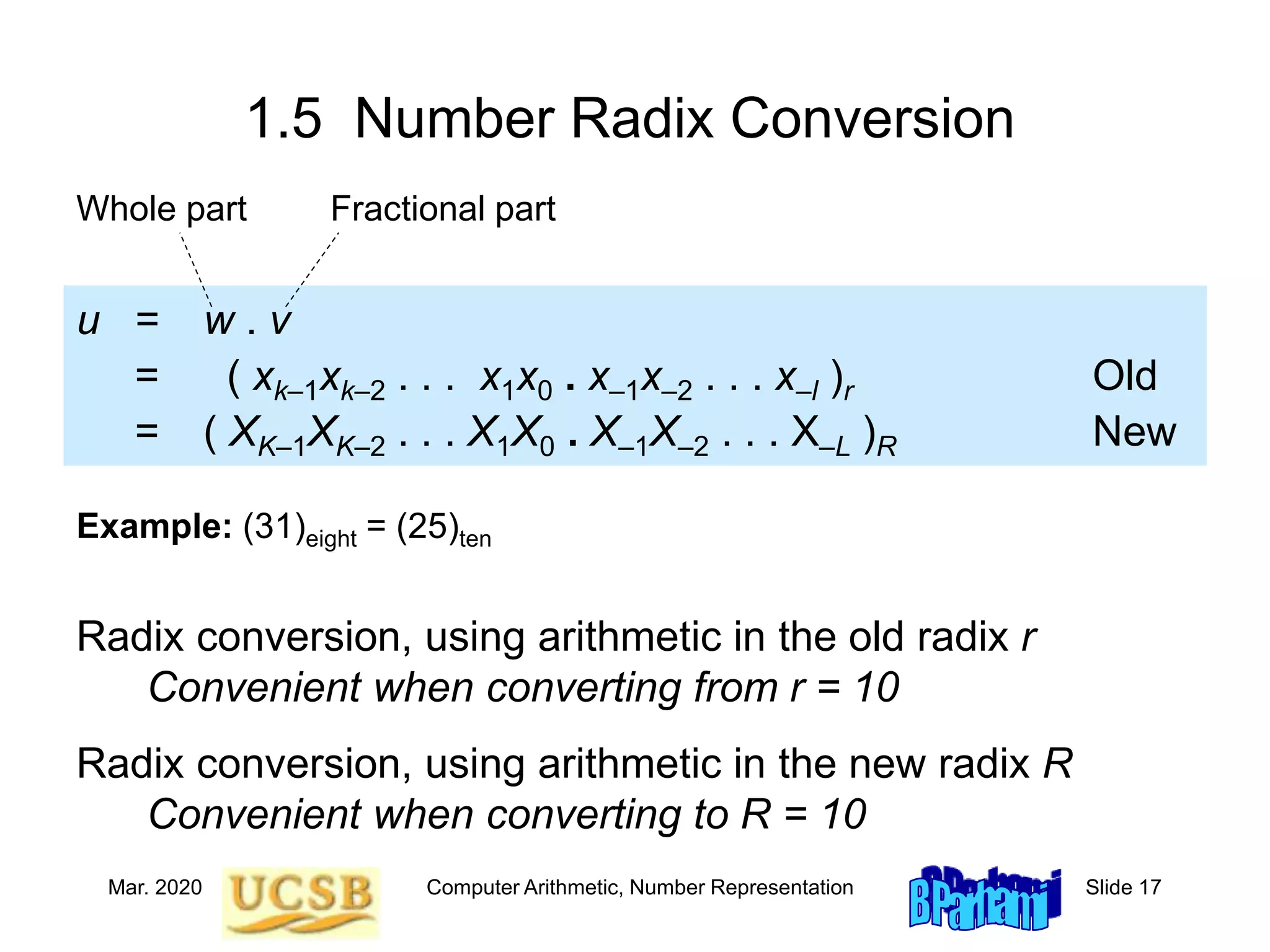
u = w . v
= ( xk–1xk–2 . . . x1x0 . x–1x–2 . . . x–l )r Old
= ( XK–1XK–2 . . . X1X0 . X–1X–2 . . . X–L )R New
Radix conversion, using arithmetic in the new radix R
Convenient when converting to R = 10
Whole part Fractional part
Example: (31)eight = (25)ten 31 Oct. = 25 Dec. Halloween = Xmas
Mar. 2020 Computer Arithmetic, Number Representation Slide 18
Radix Conversion: Old-Radix Arithmetic
Converting whole part w: (105)ten = (?)five
Repeatedly divide by five Quotient Remainder
105 0
21 1
4 4
0
Therefore, (105)ten = (410)five
Converting fractional part v: (105.486)ten = (410.?)five
Repeatedly multiply by five Whole Part Fraction
.486
2 .430
2 .150
0 .750
3 .750
3 .750
Therefore, (105.486)ten  (410.22033)five
Mar. 2020 Computer Arithmetic, Number Representation Slide 19
Radix Conversion: New-Radix Arithmetic
Converting whole part w: (22033)five = (?)ten
((((2  5) + 2)  5 + 0)  5 + 3)  5 + 3
|-----| : : : :
10 : : : :
|-----------| : : :
12 : : :
|---------------------| : :
60 : :
|-------------------------------| :
303 :
|-----------------------------------------|
1518
Converting fractional part v: (410.22033)five = (105.?)ten
(0.22033)five  55 = (22033)five = (1518)ten
1518 / 55 = 1518 / 3125 = 0.48576
Therefore, (410.22033)five = (105.48576)ten
Horner’s rule is also applicable: Proceed from right to left
and use division instead of multiplication
Horner’s
rule or
formula
Mar. 2020 Computer Arithmetic, Number Representation Slide 20
Horner’s Rule for Fractions
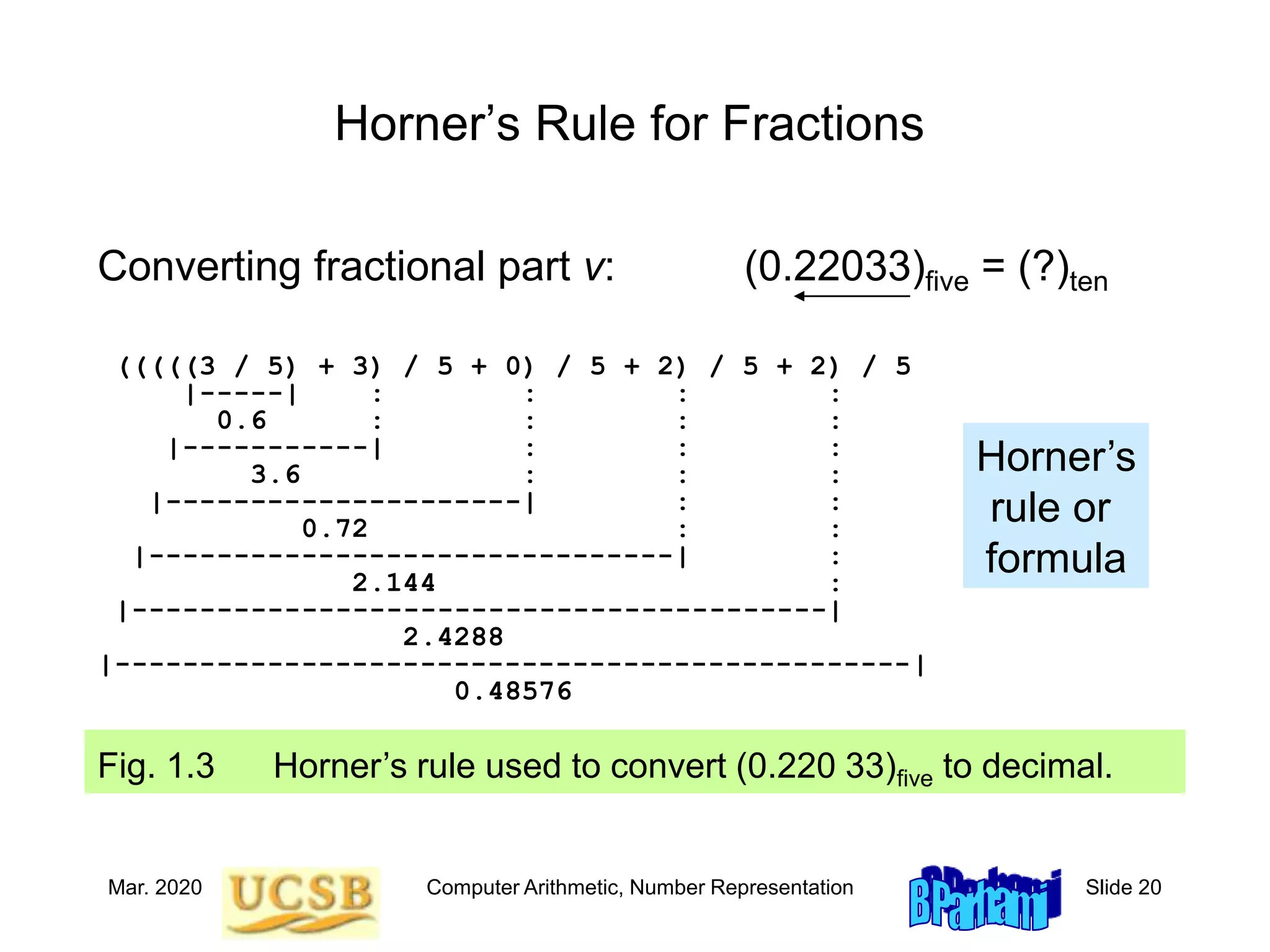
Converting fractional part v: (0.22033)five = (?)ten
(((((3 / 5) + 3) / 5 + 0) / 5 + 2) / 5 + 2) / 5
|-----| : : : :
0.6 : : : :
|-----------| : : :
3.6 : : :
|---------------------| : :
0.72 : :
|-------------------------------| :
2.144 :
|-----------------------------------------|
2.4288
|-----------------------------------------------|
0.48576
Horner’s
rule or
formula
Fig. 1.3 Horner’s rule used to convert (0.220 33)five to decimal.
Mar. 2020 Computer Arithmetic, Number Representation Slide 21
1.6 Classes of Number Representations
Integers (fixed-point), unsigned: Chapter 1
Integers (fixed-point), signed
Signed-magnitude, biased, complement: Chapter 2
Signed-digit, including carry/borrow-save: Chapter 3
(but the key point of Chapter 3 is
using redundancy for faster arithmetic,
not how to represent signed values)
Residue number system: Chapter 4
(again, the key to Chapter 4 is
use of parallelism for faster arithmetic,
not how to represent signed values)
Real numbers, floating-point: Chapter 17
Part V deals with real arithmetic
Real numbers, exact: Chapter 20
Continued-fraction, slash, . . .
For the most part you need:
- 2’s complement numbers
- Carry-save representation
- IEEE floating-point format
However, knowing the rest of
the material (including RNS)
provides you with more
options when designing
custom and special-purpose
hardware systems
Mar. 2020 Computer Arithmetic, Number Representation Slide 22
Dot Notation: A Useful Visualization Tool
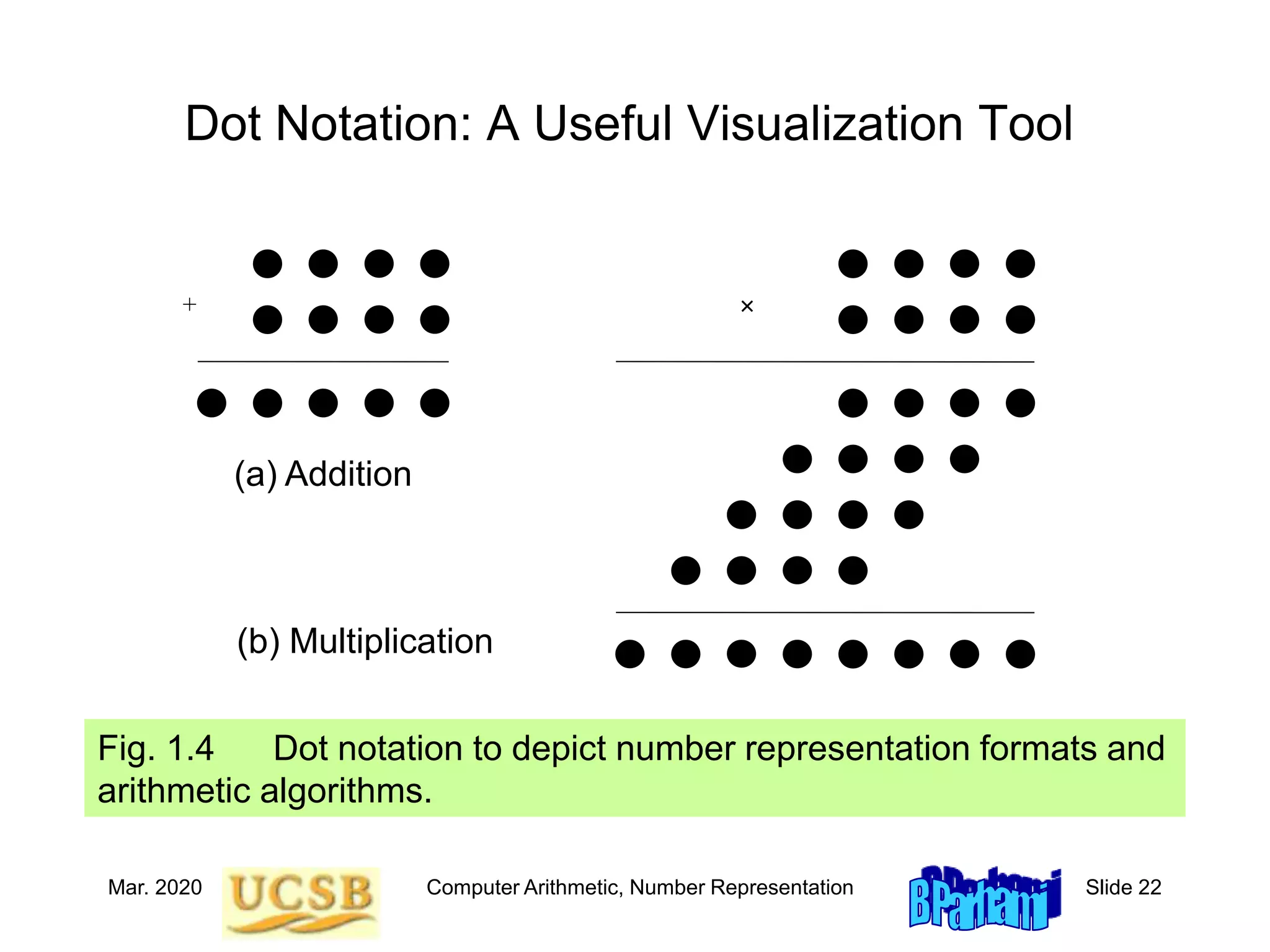
Fig. 1.4 Dot notation to depict number representation formats and
arithmetic algorithms.
+ 
(a) Addition
(b) Multiplication
Mar. 2020 Computer Arithmetic, Number Representation Slide 23
2 Representing Signed Numbers
Chapter Goals
Learn different encodings of the sign info
Discuss implications for arithmetic design
Chapter Highlights
Using sign bit, biasing, complementation
Properties of 2’s-complement numbers
Signed vs unsigned arithmetic
Signed numbers, positions, or digits
Extended dot notation: posibits and negabits
Mar. 2020 Computer Arithmetic, Number Representation Slide 24
Representing Signed Numbers: Topics
Topics in This Chapter
2.1 Signed-Magnitude Representation
2.2 Biased Representations
2.3 Complement Representations
2.4 2’s- and 1’s-Complement Numbers
2.5 Direct and Indirect Signed Arithmetic
2.6 Using Signed Positions or Signed Digits
Mar. 2020 Computer Arithmetic, Number Representation Slide 25
2.1 Signed-Magnitude Representation
Fig. 2.1 A 4-bit signed-magnitude number representation
system for integers.
0000
0001
1111
0010
1110
0011
1101
0100
1100
1000
0101
1011
0110
1010
0111
1001
0
+1
+3
+4
+5
+6
+7
-7
-3
-5
-4
-0
-1
+2
-
+
_
Bit pattern
(representation)
Signed values
(signed magnitude)
+2
-6
Increment
Decrement
-
Mar. 2020 Computer Arithmetic, Number Representation Slide 26
Signed-Magnitude Adder
Fig. 2.2 Adding signed-magnitude numbers using precomplementation
and postcomplementation.
Adder c
c
s
x y
Sign x Sign y
Sign
Sign s
Selective
Complement
Selective
Complement
out in
Comp x
Control
Comp s
Add/Sub
Compl x
___
Add/Sub
Compl s
Selective
complement
Selective
complement
Mar. 2020 Computer Arithmetic, Number Representation Slide 27
2.2 Biased Representations
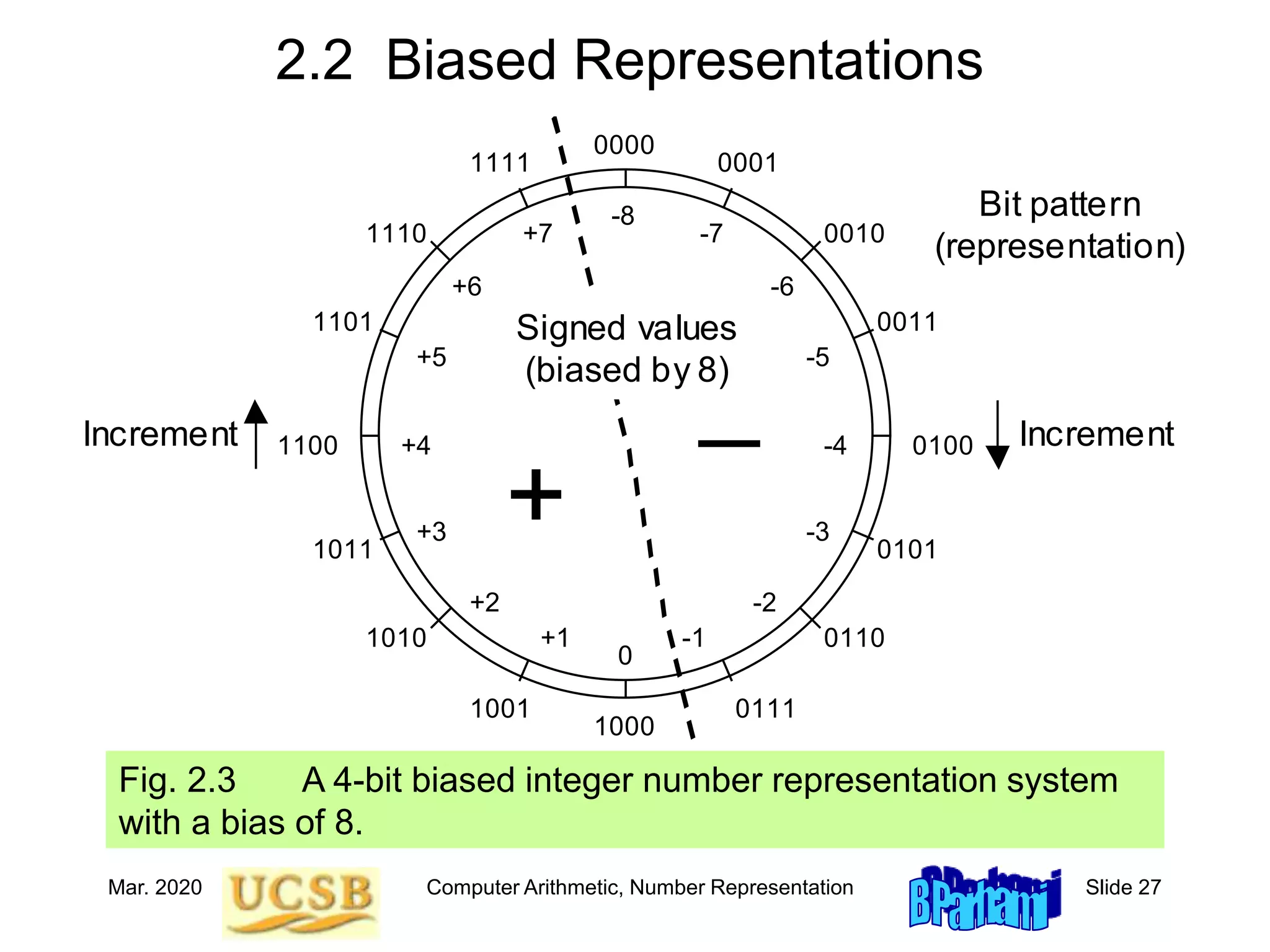
Fig. 2.3 A 4-bit biased integer number representation system
with a bias of 8.
0000
0001
1111
0010
1110
0011
1101
0100
1100
1000
0101
1011
0110
1010
0111
1001
-8
-7
-5
-4
-3
-2
-1
+7
+3
+5
+4
0
+1
+2
+
_
Bit pattern
(representation)
Signed values
(biased by 8)
-6
+6
Increment
Increment
Mar. 2020 Computer Arithmetic, Number Representation Slide 28
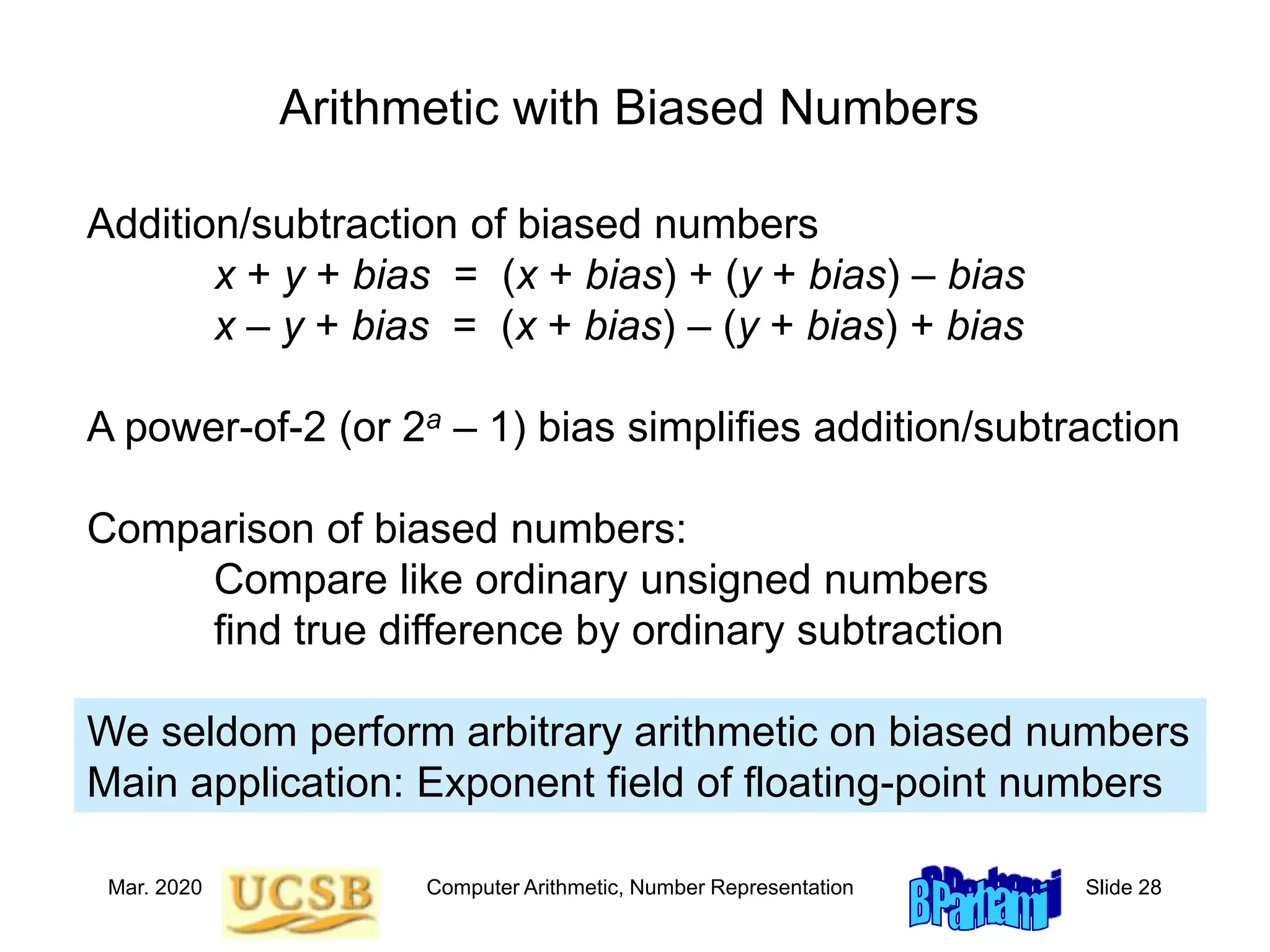
Arithmetic with Biased Numbers
Addition/subtraction of biased numbers
x + y + bias = (x + bias) + (y + bias) – bias
x – y + bias = (x + bias) – (y + bias) + bias
A power-of-2 (or 2a – 1) bias simplifies addition/subtraction
Comparison of biased numbers:
Compare like ordinary unsigned numbers
find true difference by ordinary subtraction
We seldom perform arbitrary arithmetic on biased numbers
Main application: Exponent field of floating-point numbers
Mar. 2020 Computer Arithmetic, Number Representation Slide 29
2.3 Complement Representations
Fig. 2.4 Complement representation of signed integers.
0
1
2
3
4
M - N
P
+0
+1
+3
+4
-1
+
_
Unsigned
representations
Signed values
+2
-2
+P
- N
M - 1
M - 2
Increment
Decrement
Mar. 2020 Computer Arithmetic, Number Representation Slide 30
Arithmetic with Complement Representations
–––––––––––––––––––––––––––––––––––––––––––––––––––––––––––
Desired Computation to be Correct result Overflow
operation performed mod M with no overflow condition
–––––––––––––––––––––––––––––––––––––––––––––––––––––––––––
(+x) + (+y) x + y x + y x + y > P
(+x) + (–y) x + (M – y) x – y if y  x N/A
M – (y – x) if y > x
(–x) + (+y) (M – x) + y y – x if x  y N/A
M – (x – y) if x > y
(–x) + (–y) (M – x) + (M – y) M – (x + y) x + y > N
–––––––––––––––––––––––––––––––––––––––––––––––––––––––––––
Table 2.1 Addition in a complement number system with
complementation constant M and range [–N, +P]
Mar. 2020 Computer Arithmetic, Number Representation Slide 31
Example and Two Special Cases
Example -- complement system for fixed-point numbers:
Complementation constant M = 12.000
Fixed-point number range [–6.000, +5.999]
Represent –3.258 as 12.000 – 3.258 = 8.742
Auxiliary operations for complement representations
complementation or change of sign (computing M – x)
computations of residues mod M
Thus, M must be selected to simplify these operations
Two choices allow just this for fixed-point radix-r arithmetic
with k whole digits and l fractional digits
Radix complement M = rk
Digit complement M = rk – ulp (aka diminished radix compl)
ulp (unit in least position) stands for r-l
Allows us to forget about l, even for nonintegers
Mar. 2020 Computer Arithmetic, Number Representation Slide 32
2.4 2’s- and 1’s-Complement Numbers
Fig. 2.5 A 4-bit 2’s-complement number representation system for integers.
0000
0001
1111
0010
1110
0011
1101
0100
1100
1000
0101
1011
0110
1010
0111
1001
+0
+1
+3
+4
+5
+6
+7
-1
-5
-3
-4
-8
-7
-6
+
_
Unsigned
representations
Signed values
(2’s complement)
+2
-2
Two’s complement = radix
complement system for r = 2
M = 2k
2k – x = [(2k – ulp) – x] + ulp
= xcompl + ulp
Range of representable
numbers in with k whole bits:
from –2k–1 to 2k–1 – ulp
Mar. 2020 Computer Arithmetic, Number Representation Slide 33
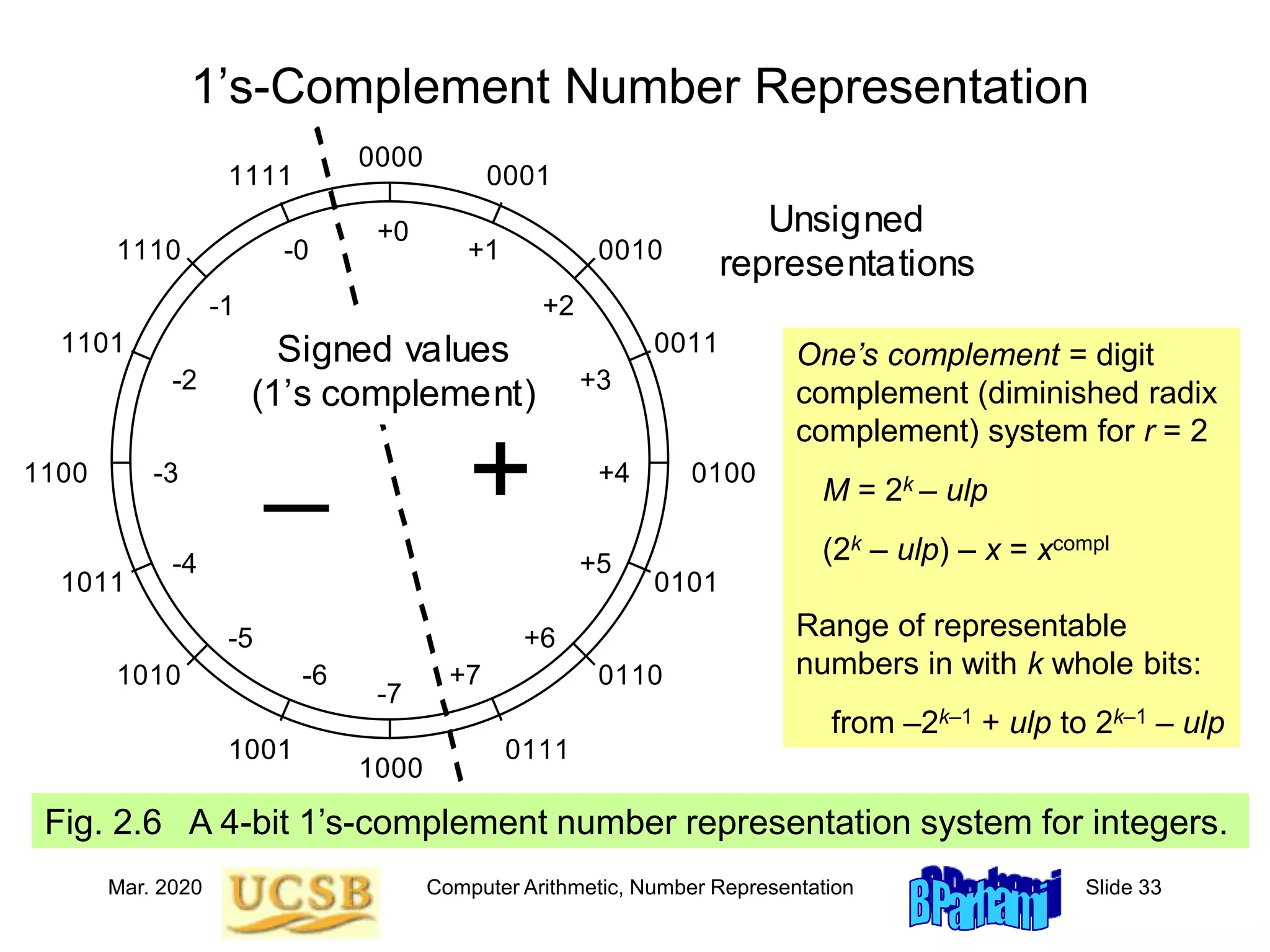
1’s-Complement Number Representation
Fig. 2.6 A 4-bit 1’s-complement number representation system for integers.
One’s complement = digit
complement (diminished radix
complement) system for r = 2
M = 2k – ulp
(2k – ulp) – x = xcompl
Range of representable
numbers in with k whole bits:
from –2k–1 + ulp to 2k–1 – ulp
0000
0001
1111
0010
1110
0011
1101
0100
1100
1000
0101
1011
0110
1010
0111
1001
+0
+1
+3
+4
+5
+6
+7
-0
-4
-2
-3
-7
-6
-5
+
_
Unsigned
representations
Signed values
(1’s complement)
+2
-1
Mar. 2020 Computer Arithmetic, Number Representation Slide 34
Some Details for 2’s- and 1’s Complement
Range/precision extension for 2’s-complement numbers
. . . xk–1 xk–1 xk–1 xk–1 xk–2 . . . x1 x0 . x–1 x–2 . . . x–l 0 0 0 . . .
 Sign extension  Sign LSD  Extension 
bit
Range/precision extension for 1’s-complement numbers
. . . xk–1 xk–1 xk–1 xk–1 xk–2 . . . x1 x0 . x–1 x–2 . . . x–l xk–1 xk–1 xk–1 . . .
 Sign extension  Sign LSD  Extension 
bit
Mod-(2k – ulp) operation needed in 1’s-complement arithmetic is done
via end-around carry
(x + y) – (2k – ulp) = (x – y – 2k) + ulp Connect cout to cin
Mod-2k operation needed in 2’s-complement arithmetic is trivial:
Simply drop the carry-out (subtract 2k if result is 2k or greater)
Mar. 2020 Computer Arithmetic, Number Representation Slide 35
Which Complement System Is Better?
–––––––––––––––––––––––––––––––––––––––––––––––––––––––––––
Feature/Property Radix complement Digit complement
–––––––––––––––––––––––––––––––––––––––––––––––––––––––––––
Symmetry (P = N?) Possible for odd r Possible for even r
(radices of practical
interest are even)
Unique zero? Yes No, there are two 0s
Complementation Complement all digits Complement all digits
and add ulp
Mod-M addition Drop the carry-out End-around carry
–––––––––––––––––––––––––––––––––––––––––––––––––––––––––––
Table 2.2 Comparing radix- and digit-complement
number representation systems
Mar. 2020 Computer Arithmetic, Number Representation Slide 36
Why 2’s-Complement Is the Universal Choice
Fig. 2.7 Adder/subtractor architecture for 2’s-complement numbers.
Mux
Adder
0 1
x y
y or y
_
s = x  y
add/sub
___
cin
Controlled
complementation
0 for addition,
1 for subtraction
cout
Can replace
this mux with
k XOR gates
Mar. 2020 Computer Arithmetic, Number Representation Slide 37
Signed-Magnitude vs 2’s-Complement
Fig. 2.7
Mux
Adder
0 1
x y
y or y
_
s = x  y
add/sub
___
cin
Controlled
complementation
0 for addition,
1 for subtraction
cout
Adder c
c
s
x y
Sign x Sign y
Sign
Sign s
Selective
Complement
Selective
Complement
out in
Comp x
Control
Comp s
Add/Sub
Compl x
___
Add/Sub
Compl s
Selective
complement
Selective
complement
Fig. 2.2
Signed-magnitude
adder/subtractor is
significantly more
complex than a
simple adder
2’s-complement
adder/subtractor
needs very little
hardware other than
a simple adder
Mar. 2020 Computer Arithmetic, Number Representation Slide 38
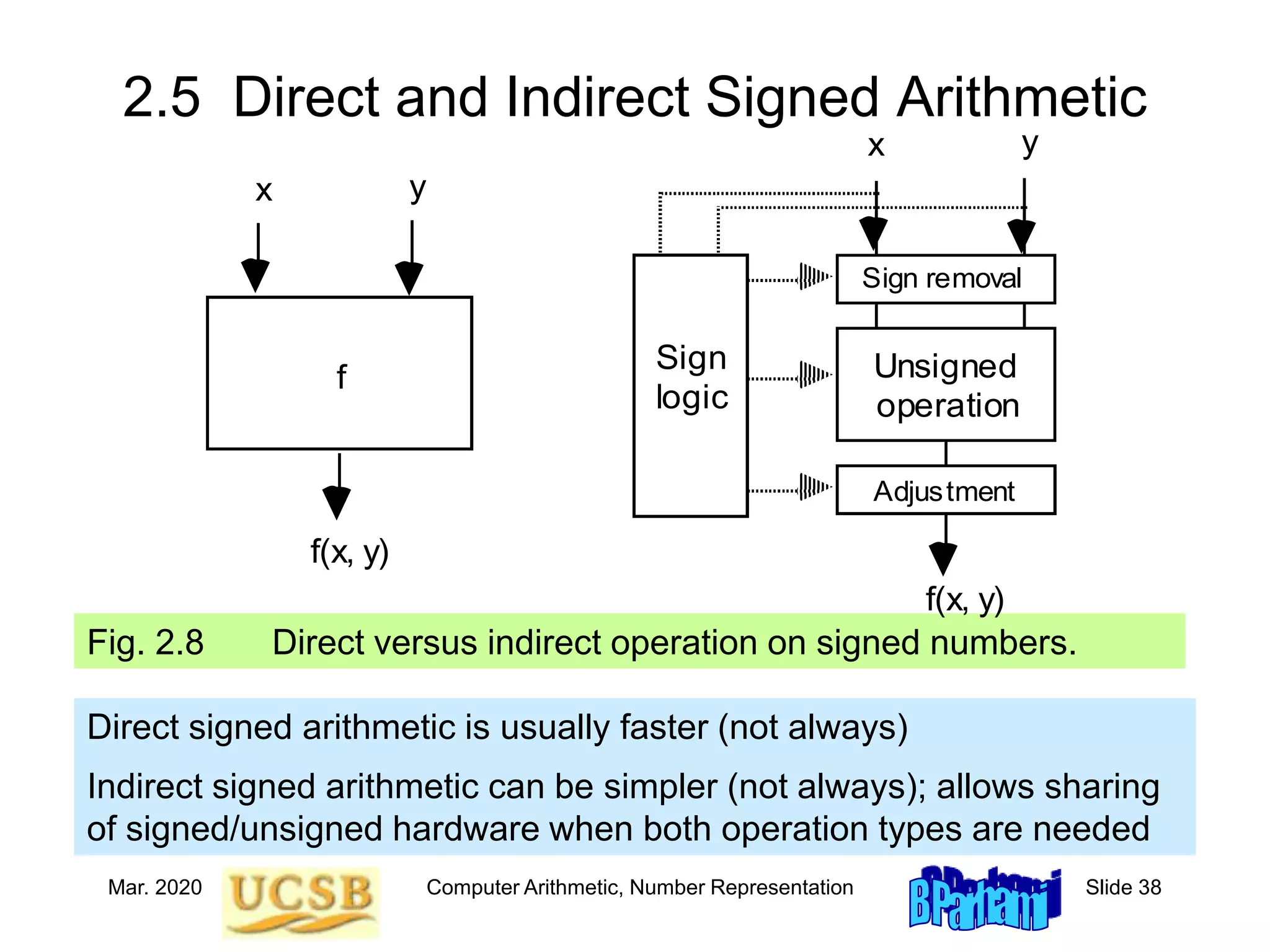
2.5 Direct and Indirect Signed Arithmetic
Direct signed arithmetic is usually faster (not always)
Indirect signed arithmetic can be simpler (not always); allows sharing
of signed/unsigned hardware when both operation types are needed
Fig. 2.8 Direct versus indirect operation on signed numbers.
x y
f
x y
f(x, y)
Sign
logic
Unsigned
operation
Sign removal
f(x, y)
Adjustment
Mar. 2020 Computer Arithmetic, Number Representation Slide 39
2.6 Using Signed Positions or Signed Digits
A key property of 2’s-complement numbers that facilitates
direct signed arithmetic:
Fig. 2.9 Interpreting a 2’s-complement number as having a
negatively weighted most-significant digit.
x = (1 0 1 0 0 1 1 0)two’s-compl
–27 26 25 24 23 22 21 20
–128 + 32 + 4 + 2 = –90
Check:
x = (1 0 1 0 0 1 1 0)two’s-compl
–x = (0 1 0 1 1 0 1 0)two
27 26 25 24 23 22 21 20
64 + 16 + 8 + 2 = 90
Mar. 2020 Computer Arithmetic, Number Representation Slide 40
Associating a Sign with Each Digit
Fig. 2.10 Converting a standard radix-4 integer to a radix-4
integer with the nonstandard digit set [–1, 2].
3 1 2 0 2 3 Original digits in [0, 3]
–1 1 2 0 2 –1
1 0 0 0 0 1
Rewritten digits in [–1, 2]
Transfer digits in [0, 1]
1 –1 1 2 0 3 –1
1 –1 1 2 0 –1 –1
0 0 0 0 1 0
1 –1 1 2 1 –1 –1
Sum digits in [–1, 3]
Rewritten digits in [–1, 2]
Transfer digits in [0, 1]
Sum digits in [–1, 3]
Signed-digit representation: Digit set [-a, b] instead of [0, r – 1]
Example: Radix-4 representation with digit set [-1, 2] rather than [0, 3]
Mar. 2020 Computer Arithmetic, Number Representation Slide 41
Redundant Signed-Digit Representations
Fig. 2.11 Converting a standard radix-4 integer to a radix-4
integer with the nonstandard digit set [–2, 2].
Signed-digit representation: Digit set [-a, b], with r = a + b + 1 – r > 0
Example: Radix-4 representation with digit set [-2, 2]
3 1 2 0 2 3 Original digits in [0, 3]
–1 1 –2 0 –2 1
1 0 1 0 1 1
Interim digits in [–2, 1]
Transfer digits in [0, 1]
1 –1 2 –2 1 –1 –1 Sum digits in [–2, 2]
Here, the transfer does not propagate, so conversion is “carry-free”
Mar. 2020 Computer Arithmetic, Number Representation Slide 42
Extended Dot Notation: Posibits and Negabits
Fig. 2.12 Extended dot notation depicting various number
representation formats.
Unsigned positive-radix number
2’s-complement number
Negative-radix number
Posibit, or simply bit: positively weighted
Negabit: negatively weighted
Mar. 2020 Computer Arithmetic, Number Representation Slide 43
Extended Dot Notation in Use
Fig. 2.13 Example arithmetic algorithms represented in extended
dot notation.
+ 
(a) Addition
(b) Multiplication
Mar. 2020 Computer Arithmetic, Number Representation Slide 44
3 Redundant Number Systems
Chapter Goals
Explore the advantages and drawbacks
of using more than r digit values in radix r
Chapter Highlights
Redundancy eliminates long carry chains
Redundancy takes many forms: trade-offs
Redundant/nonredundant conversions
Redundancy used for end values too?
Extended dot notation with redundancy
Mar. 2020 Computer Arithmetic, Number Representation Slide 45
Redundant Number Systems: Topics
Topics in This Chapter
3.1 Coping with the Carry Problem
3.2 Redundancy in Computer Arithmetic
3.3 Digit Sets and Digit-Set Conversions
3.4 Generalized Signed-Digit Numbers
3.5 Carry-Free Addition Algorithms
3.6 Conversions and Support Functions
Mar. 2020 Computer Arithmetic, Number Representation Slide 46
3.1 Coping with the Carry Problem
Ways of dealing with the carry propagation problem:
1. Limit propagation to within a small number of bits (Chapters 3-4)
2. Detect end of propagation; don’t wait for worst case (Chapter 5)
3. Speed up propagation via lookahead etc. (Chapters 6-7)
4. Ideal: Eliminate carry propagation altogether! (Chapter 3)
5 7 8 2 4 9
6 2 9 3 8 9 Operand digits in [0, 9]
––––––––––––––––––––––––––––––––––
11 9 17 5 12 18 Position sums in [0, 18]
But how can we extend this beyond a single addition?
+
Mar. 2020 Computer Arithmetic, Number Representation Slide 47
Addition of Redundant Numbers
Fig. 3.1 Adding radix-10 numbers with digit set [0, 18].
Position sum decomposition [0, 36] = 10  [0, 2] + [0, 16]
Absorption of transfer digit [0, 16] + [0, 2] = [0, 18]
6 12 9 10 8 18
Operand digits in [0, 18]
17 21 26 20 20 36
7 11 16 0 10 16
Position sums in [0, 36]
Interim sums in [0, 16]
1 1 1 2 1 2
1 8 12 18 1 12 16
11 9 17 10 12 18
Transfer digits in [0, 2]
Sum digits in [0, 18]
+
Mar. 2020 Computer Arithmetic, Number Representation Slide 48
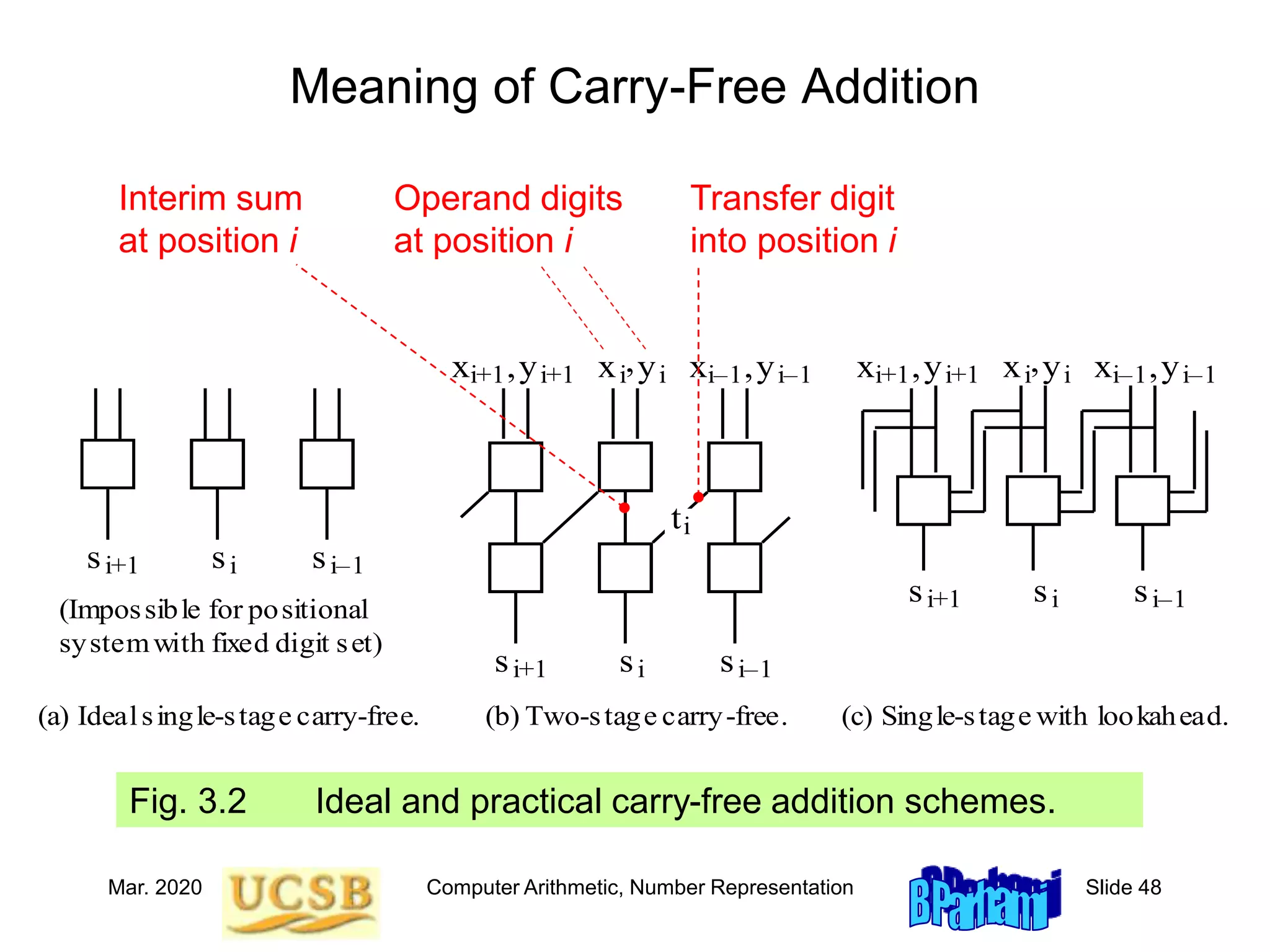
Meaning of Carry-Free Addition
Fig. 3.2 Ideal and practical carry-free addition schemes.
si+1 si–1
si
xi–1,yi–1
,
xi
xi+1,yi+1 yi xi–1,yi–1
,
xi
xi+1,yi+1 yi
(b) Two-stage carry-free.
si+1 si–1
si
ti
(c) Single-stage with lookahead.
si+1 si–1
si
xi–1,yi–1
,
xi
xi+1,yi+1 yi
(a) Idealsingle-stage carry-free.
(Impossible for positional
systemwith fixed digit set)
Interim sum
at position i
Transfer digit
into position i
Operand digits
at position i
Mar. 2020 Computer Arithmetic, Number Representation Slide 49
Redundancy Index
Fig. 3.3 Adding radix-10 numbers with digit set [0, 11].
So, redundancy helps us achieve carry-free addition
But how much redundancy is actually needed? Is [0, 11] enough for r = 10?
18 12 16 21 12 16 Position sums in [0, 22]
8 2 6 1 2 6
1 1 1 2 1 1
Interim sums in [0, 9]
Transfer digits in [0, 2]
1 9 3 8 2 3 6
11 10 7 11 3 8
Sum digits in [0, 11]
+ 7 2 9 10 9 8
Operand digits in [0, 11]
Redundancy index r = a + b + 1 – r For example, 0 + 11 + 1 – 10 = 2
-a b
Mar. 2020 Computer Arithmetic, Number Representation Slide 50
3.2 Redundancy in Computer Arithmetic
Binary
Inputs
One or more
arithmetic
operations
Binary
Output
Binary-to-
redundant
converter
Redundant
-to-binary
converter
Overhead
(often zero)
Overhead
(always nonzero)
The more the amount of computation performed between the
initial forward conversion and final reverse conversion (reconversion),
the greater the benefits of redundant representation.
Same block diagram applies to residue number systems of Chapter 4.
Mar. 2020 Computer Arithmetic, Number Representation Slide 51
Binary Carry-Save or Stored-Carry Representation
Fig. 3.4 Addition of
four binary numbers,
with the sum obtained
in stored-carry form.
0 0 1 0 0 1 First binary number
0 1 1 1 1 0
0 1 2 1 1 1
Add second binary number
Position sums in [0, 2]
+ 0 1 1 1 0 1 Add third binary number
Position sums in [0, 3]
Interim sums in [0, 1]
Transfer digits in [0, 1]
Position sums in [0, 2]
Add fourth binary number
Position sums in [0, 3]
0 2 3 2 1 2
0 0 1 0 1 0
0 1 1 1 0 1
1 1 2 0 2 0
+
1 1 3 0 3 1
1 1 1 0 1 1
0 0 1 0 1 0
1 2 1 1 1 1
+ 0 0 1 0 1 1
Interim sums in [0, 1]
Transfer digits in [0, 1]
Sum digits in [0, 2]
Oldest example of
redundancy in
computer arithmetic
is the stored-carry
representation
(carry-save addition)
Mar. 2020 Computer Arithmetic, Number Representation Slide 52
Hardware for Carry-Save Addition
Fig. 3.5 Using an array of
independent binary full adders
to perform carry-save addition.
Binary
Full
Adder
(Stage i)
cin
cout
Digit in [0, 2] Binary digit
Digit in [0, 2]
To
Stage
i+1
From
Stage
i – 1
x y
s
Two-bit encoding for binary
stored-carry digits used in
this implementation:
0 represented as 0 0
1 represented as 0 1
or as 1 0
2 represented as 1 1
Because in carry-save addition,
three binary numbers are
reduced to two binary numbers,
this process is sometimes
referred to as 3-2 compression
Mar. 2020 Computer Arithmetic, Number Representation Slide 53
Carry-Save Addition in Dot Notation
Two
carry-save
inputs
Carry-save
input
Binary input
Carry-save
output
This bit
being 1
represents
overflow
(ignore it)
0
0
0
a. Carry-save addition. b. Adding two carry-save numbers.
Carry-save
addition
Carry-save
addition
We sometimes find it convenient to use an extended dot notation,
with heavy dots (●) for posibits and hollow dots (○) for negabits
Eight-bit, 2’s-complement number ○ ● ● ● ● ● ● ●
Negative-radix number ○ ● ○ ● ○ ● ○ ●
BSD number with n, p encoding ○ ○ ○ ○ ○ ○ ○ ○
of the digit set [-1, 1] ● ● ● ● ● ● ● ●
Fig. 9.3 From text on computer architecture (Parhami, Oxford/2005)
3-to-2
reduction
4-to-2
reduction
Mar. 2020 Computer Arithmetic, Number Representation Slide 54
Example for the Use of Extended Dot Notation
2’s-complement multiplicand ○ ● ● ● ● ● ● ●
2’s-complement multiplier ○ ● ● ● ● ● ● ●
○ ● ● ● ● ● ● ●
○ ● ● ● ● ● ● ●
○ ● ● ● ● ● ● ●
○ ● ● ● ● ● ● ●
○ ● ● ● ● ● ● ●
○ ● ● ● ● ● ● ●
○ ● ● ● ● ● ● ●
● ○ ○ ○ ○ ○ ○ ○
○ ● ● ● ● ● ● ● ● ● ● ● ● ● ● ●
Option 2: Baugh-Wooley method
-x
-y
1- x
-1 1- y
Option 1:
sign extension
-x
-x x x x x
Multiplication of
2’s-complement
numbers
Mar. 2020 Computer Arithmetic, Number Representation Slide 55
3.3 Digit Sets and Digit-Set Conversions
Example 3.1: Convert from digit set [0, 18] to [0, 9] in radix 10
11 9 17 10 12 18 18 = 10 (carry 1) + 8
11 9 17 10 13 8 13 = 10 (carry 1) + 3
11 9 17 11 3 8 11 = 10 (carry 1) + 1
11 9 18 1 3 8 18 = 10 (carry 1) + 8
11 10 8 1 3 8 10 = 10 (carry 1) + 0
12 0 8 1 3 8 12 = 10 (carry 1) + 2
1 2 0 8 1 3 8 Answer;
all digits in [0, 9]
Note: Conversion from redundant to nonredundant representation
always involves carry propagation
Thus, the process is sequential and slow
Mar. 2020 Computer Arithmetic, Number Representation Slide 56
Conversion from Carry-Save to Binary
Example 3.2: Convert from digit set [0, 2] to [0, 1] in radix 2
1 1 2 0 2 0 2 = 2 (carry 1) + 0
1 1 2 1 0 0 2 = 2 (carry 1) + 0
1 2 0 1 0 0 2 = 2 (carry 1) + 0
2 0 0 1 0 0 2 = 2 (carry 1) + 0
1 0 0 0 1 0 0 Answer;
all digits in [0, 1]
Another way: Decompose the carry-save number
into two numbers and add them:
1 1 1 0 1 0 1st number: sum bits
+ 0 0 1 0 1 0 2nd number: carry bits
––––––––––––––––––––––––––––––––––––––––
1 0 0 0 1 0 0 Sum
Mar. 2020 Computer Arithmetic, Number Representation Slide 57
Conversion Between Redundant Digit Sets
Example 3.3: Convert from digit set [0, 18] to [-6, 5] in radix 10 (same as
Example 3.1, but with the target digit set signed and redundant)
11 9 17 10 12 18 18 = 20 (carry 2) – 2
11 9 17 10 14 -2 14 = 10 (carry 1) + 4
11 9 17 11 4 -2 11 = 10 (carry 1) + 1
11 9 18 1 4 -2 18 = 20 (carry 2) – 2
11 11 -2 1 4 -2 11 = 10 (carry 1) + 1
12 1 -2 1 4 -2 12 = 10 (carry 1) + 2
1 2 1 -2 1 4 -2 Answer;
all digits in [-6, 5]
On line 2, we could have written 14 = 20 (carry 2) – 6; this would have
led to a different, but equivalent, representation
In general, several representations may exist for a redundant digit set
Mar. 2020 Computer Arithmetic, Number Representation Slide 58
Carry-Free Conversion to a Redundant Digit Set
Example 3.4: Convert from digit set [0, 2] to [-1, 1] in radix 2 (same as
Example 3.2, but with the target digit set signed and redundant)
Carry-free conversion:
1 1 2 0 2 0 Carry-save number
–1 –1 0 0 0 0 Interim digits in [–1, 0]
1 1 1 0 1 0 Transfer digits in [0, 1]
––––––––––––––––––––––––––––––––––––––––
1 0 0 0 1 0 0 Answer;
all digits in [–1, 1]
We rewrite 2 as 2 (carry 1) + 0, and 1 as 2 (carry 1) – 1
A carry of 1 is always absorbed by the interim digit that is in {-1, 0}
Mar. 2020 Computer Arithmetic, Number Representation Slide 59
3.4 Generalized Signed-Digit Numbers
Fig. 3.6
A taxonomy of
redundant and
non-redundant
positional
number
systems.
Radix-r Positional
r r
Non-redundant
a a
Conventional Non-redundant
signed-digit
Generalized
signed-digit (GSD)
r r
Minimal
GSD
Non-minimal
GSD
ab
(even r)
ab
Symmetric
minimal GSD
r = 2
BSD or
BSB
Asymmetric
minimal GSD
a a
(r ° 2)
Stored-
carry (SC)
Non-binary
SB
Symmetric non-
minimal GSD
ab ab
Asymmetric non-
minimal GSD
a r
Ordinary
signed-digit
Minimally
redundant OSD
Maximally
redundant OSD BSCB
SCB
r = 2
a
b r
a
Unsigned-digit
redundant (UDR)
r = 2
BSC
a r – 1
a
r/2 + 1

Radix r
Digit set [–a, b]
Requirement
a + b + 1  r
Redundancy index
r = a + b + 1 – r
Mar. 2020 Computer Arithmetic, Number Representation Slide 60
Encodings for Signed Digits
Fig. 3.7 Four encodings for the BSD digit set [–1, 1].
xi
s, v
2’s-compl
n, p
n, z, p
Two of the
encodings
above
can be shown
in extended
dot notation
Fig. 3.8 Extended dot notation and its use in visualizing
some BSD encodings.
Posibit {0, 1}
Negabit {–1, 0}
Doublebit {0, 2}
Negadoublebit {–2, 0}
Unibit {–1, 1}
(a) Extended dot notation
(n, p) encoding
2’s-compl. encoding
2’s-compl. encoding
(b) Encodings for a BSD number
BSD representation of +6
Sign and value encoding
2-bit 2’s-complement
Negative & positive flags
1-out-of-3 encoding
0
00
00
00
010
–1
11
11
10
100
0
00
00
00
010
–1
11
11
10
100
1
01
01
01
001
Mar. 2020 Computer Arithmetic, Number Representation Slide 61
Hybrid Signed-Digit Numbers
i
i
i
i
i
BSD B B BSD B B Type
1 0 1 –1 0 1
+ 0 1 1 –1 1
x
y
1 1 2 –2 1 1
–1 0
1 –1 0
1 –1 1 1 0 1 1
p
w
t
s
BSD B B
–1 0 1
–1 1 1
–1 1 1
0 1 0
–1
0
i+1
Fig. 3.9 Example of addition for hybrid signed-digit numbers.
Radix-8
GSD
with
digit set
[-4,7]
The hybrid-redundant representation above in extended dot notation:
n, p -encoded ○ ● ● ○ ● ● ○ ● ● Nonredundant
binary signed digit ● ● ● binary positions
Mar. 2020 Computer Arithmetic, Number Representation Slide 62
Hybrid Redundancy in Extended Dot Notation
Fig. 3.10 Two hybrid-redundant representations in extended
dot notation.
Radix-8 digit set [–4, 7]
Radix-8 digit set [–4, 4]
Mar. 2020 Computer Arithmetic, Number Representation Slide 63
3.5 Carry-Free Addition Algorithms
Carry-free addition of GSD numbers
Compute the position sums pi = xi + yi
Divide pi into a transfer ti+1 and interim sum wi = pi – rti+1
Add incoming transfers to get the sum digits si = wi + ti
xi–1,yi–1
,
xi
xi+1,yi+1 yi
si+1 si–1
si
ti
wi
If the transfer digits ti are in [–l, m], we must have:
–a + l  pi – rti+1  b – m
interim sum
Smallest interim sum Largest interim sum
if a transfer of –l if a transfer of m
is to be absorbable is to be absorbable
These
constraints
lead to:
l  a / (r – 1)
m  b / (r – 1)
Mar. 2020 Computer Arithmetic, Number Representation Slide 64
Is Carry-Free Addition Always Applicable?
No: It requires one of the following two conditions
a. r > 2, r  3
b. r > 2, r = 2, a  1, b  1 e.g., not [-1, 10] in radix 10
In other words, it is inapplicable for
r = 2 Perhaps most useful case
r = 1 e.g., carry-save
r = 2 with a = 1 or b = 1 e.g., carry/borrow-save
BSD fails on at least two criteria!
Fortunately, in the latter cases, a limited-carry
addition algorithm is always applicable
Mar. 2020 Computer Arithmetic, Number Representation Slide 65
Limited-Carry Addition
Example: BSD addition 1 1 1 -1
0 1 0 -1
1 -1
Fig. 3.12 Some implementations for limited-carry addition.
(a) Three-stage carry estimate. (b) Three-stage repeated-carry.
si+1 si–1
si
ei
ti
xi–1,yi–1
,
xi
xi+1,yi+1 yi
si+1 si–1
si
ti
t'i
xi–1,yi–1
,
xi
xi+1,yi+1 yi
(c) Two-stage parallel-carries.
si+1 si–1
si
ti
(2)
ti
(1)
xi–1,yi–1
,
xi
xi+1,yi+1 yi
(a) Three-stage carry estimate (b) Three-stage repeated carry (c) Tw o-stage parallel carries
Estimate, or
early warning
Mar. 2020 Computer Arithmetic, Number Representation Slide 66
Limited-Carry BSD Addition
Fig. 3.13 Limited-carry addition of radix-2 numbers with digit set [–1, 1]
using carry estimates. A position sum –1 is kept intact when the incoming
transfer is in [0, 1], whereas it is rewritten as 1 with a carry of –1 for
incoming transfer in [–1, 0]. This guarantees that ti  wi and thus –1  si  1.
1 –1 0 –1 0 x in [–1, 1]
+ 0 –1 –1 0 1
1 –2 –1 –1 1
1 0 1 –1 –1
–1 –1 0 1
0 –1 1 0 –1
i
i+1
y in [–1, 1]
i
p in [–2, 2]
i
w in [–1, 1]
i
s in [–1, 1]
i
t in [–1, 1]
low low low high high
high
0
0
e in {low: [–1, 0], high: [0, 1]}
i
Mar. 2020 Computer Arithmetic, Number Representation Slide 67
3.6 Conversions and Support Functions
Example 3.10: Conversion from/to BSD to/from standard binary
1 -1 0 -1 0 BSD representation of +6
1 0 0 0 0 Positive part
0 1 0 1 0 Negative part
0 0 1 1 0 Difference =
Conversion result
The negative and positive parts above are particularly easy to obtain
if the BSD number has the n, p encoding
Conversion from redundant to nonredundant representation
always requires full carry propagation
Conversion from nonredundant to redundant is often trivial
Mar. 2020 Computer Arithmetic, Number Representation Slide 68
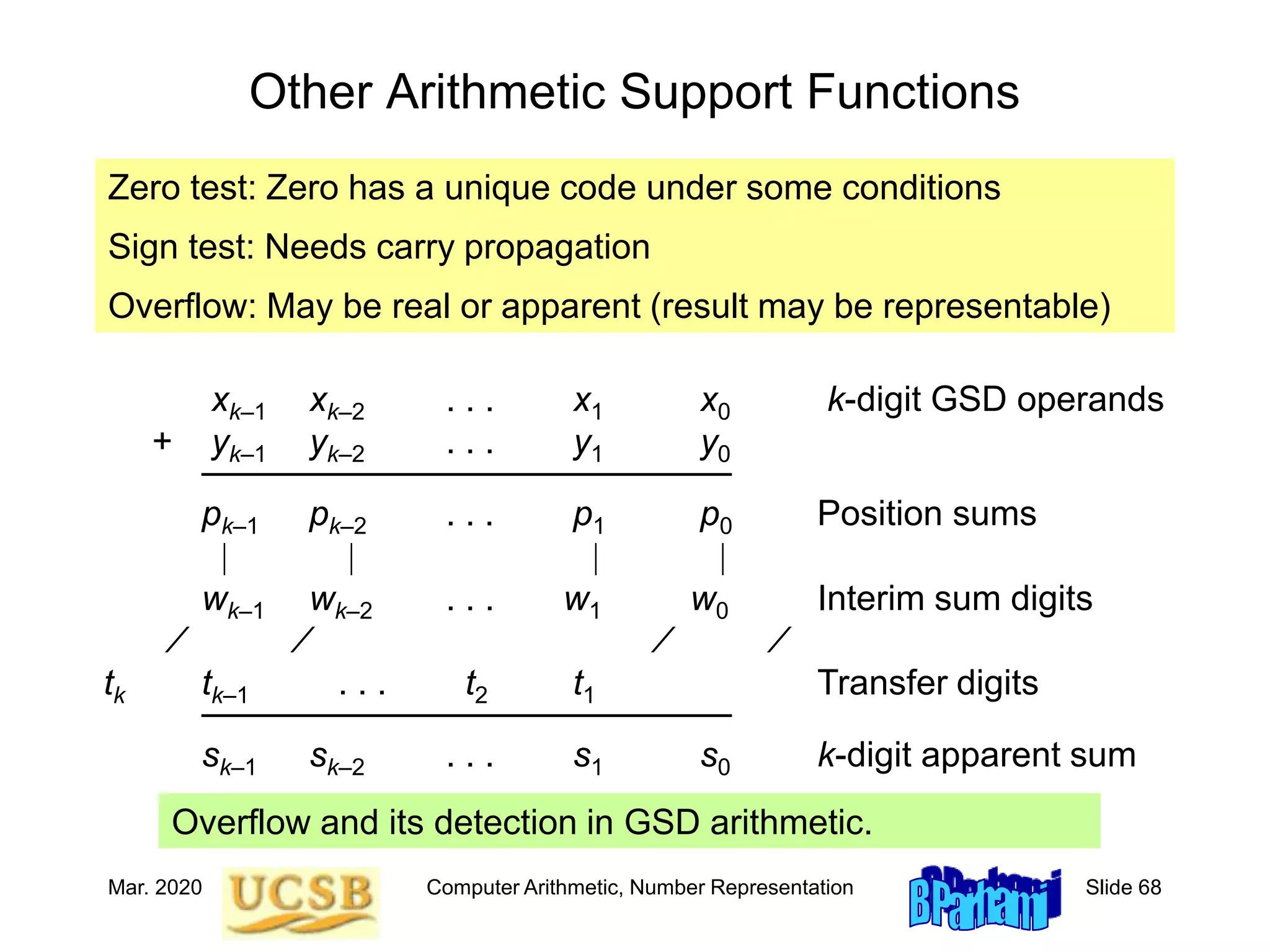
Other Arithmetic Support Functions
Overflow and its detection in GSD arithmetic.
xk–1 xk–2 . . . x1 x0 k-digit GSD operands
+ yk–1 yk–2 . . . y1 y0
–––––––––––––––––––––––––––
pk–1 pk–2 . . . p1 p0 Position sums
| | | |
wk–1 wk–2 . . . w1 w0 Interim sum digits
⁄ ⁄ ⁄ ⁄
tk tk–1 . . . t2 t1 Transfer digits
–––––––––––––––––––––––––––
sk–1 sk–2 . . . s1 s0 k-digit apparent sum
Zero test: Zero has a unique code under some conditions
Sign test: Needs carry propagation
Overflow: May be real or apparent (result may be representable)
Mar. 2020 Computer Arithmetic, Number Representation Slide 69
4 Residue Number Systems
Chapter Goals
Study a way of encoding large numbers
as a collection of smaller numbers
to simplify and speed up some operations
Chapter Highlights
Moduli, range, arithmetic operations
Many sets of moduli possible: tradeoffs
Conversions between RNS and binary
The Chinese remainder theorem
Why are RNS applications limited?
Mar. 2020 Computer Arithmetic, Number Representation Slide 70
Residue Number Systems: Topics
Topics in This Chapter
4.1 RNS Representation and Arithmetic
4.2 Choosing the RNS Moduli
4.3 Encoding and Decoding of Numbers
4.4 Difficult RNS Arithmetic Operations
4.5 Redundant RNS Representations
4.6 Limits of Fast Arithmetic in RNS
Mar. 2020 Computer Arithmetic, Number Representation Slide 71
4.1 RNS Representations and Arithmetic
Puzzle, due to the Chinese scholar Sun Tzu,1500+ years ago:
What number has the remainders of 2, 3, and 2
when divided by 7, 5, and 3, respectively?
Residues (akin to digits in positional systems) uniquely identify
the number, hence they constitute a representation
Pairwise relatively prime moduli: mk–1 > . . . > m1 > m0
The residue xi of x wrt the ith modulus mi (similar to a digit):
xi = x mod mi = xmi
RNS representation contains a list of k residues or digits:
x = (2 | 3 | 2)RNS(7|5|3)
Default RNS for this chapter: RNS(8 | 7 | 5 | 3)
Mar. 2020 Computer Arithmetic, Number Representation Slide 72
RNS Dynamic Range
Product M of the k pairwise relatively prime moduli is the dynamic range
M = mk–1  . . .  m1  m0
For RNS(8 | 7 | 5 | 3), M = 8753 = 840
Negative numbers: Complement relative to M
–xmi
= M – xmi
21 = (5 | 0 | 1 | 0)RNS
–21 = (8 – 5 | 0 | 5 – 1 | 0)RNS = (3 | 0 | 4 | 0)RNS
Here are some example numbers in our default RNS(8 | 7 | 5 | 3):
(0 | 0 | 0 | 0)RNS Represents 0 or 840 or . . .
(1 | 1 | 1 | 1)RNS Represents 1 or 841 or . . .
(2 | 2 | 2 | 2)RNS Represents 2 or 842 or . . .
(0 | 1 | 3 | 2)RNS Represents 8 or 848 or . . .
(5 | 0 | 1 | 0)RNS Represents 21 or 861 or . . .
(0 | 1 | 4 | 1)RNS Represents 64 or 904 or . . .
(2 | 0 | 0 | 2)RNS Represents –70 or 770 or . . .
(7 | 6 | 4 | 2)RNS Represents –1 or 839 or . . .
We can take the
range of RNS(8|7|5|3)
to be [-420, 419] or
any other set of 840
consecutive integers
Mar. 2020 Computer Arithmetic, Number Representation Slide 73
We will see later how the weights can be determined for a given RNS
RNS as Weighted Representation
For RNS(8 | 7 | 5 | 3), the weights of the 4 positions are:
105 120 336 280
Example: (1 | 2 | 4 | 0)RNS represents the number
1051 + 1202 + 3364 + 2800840 = 1689840 = 9
For RNS(7 | 5 | 3), the weights of the 3 positions are:
15 21 70
Example -- Chinese puzzle: (2 | 3 | 2)RNS(7|5|3) represents the number
15  2 + 21  3 + 70  2105 = 233105 = 23
Mar. 2020 Computer Arithmetic, Number Representation Slide 74
RNS Encoding and Arithmetic Operations
Fig. 4.1 Binary-coded
format for RNS(8 | 7 | 5 | 3).
Arithmetic in RNS(8 | 7 | 5 | 3)
(5 | 5 | 0 | 2)RNS Represents x = +5
(7 | 6 | 4 | 2)RNS Represents y = –1
(4 | 4 | 4 | 1)RNS x + y : 5 + 78 = 4, 5 + 67 = 4, etc.
(6 | 6 | 1 | 0)RNS x – y : 5 – 78 = 6, 5 – 67 = 6, etc.
(alternatively, find –y and add to x)
(3 | 2 | 0 | 1)RNS x  y : 5  78 = 3, 5  67 = 2, etc.
mod 8 mod 7 mod 5 mod 3
Mod-8
Unit
Mod-7
Unit
Mod-5
Unit
Mod-3
Unit
3 3 3 2
Operand 1 Operand 2
Result
Fig. 4.2 The structure of an adder,
subtractor, or multiplier for RNS(8|7|5|3).
Mar. 2020 Computer Arithmetic, Number Representation Slide 75
4.2 Choosing the RNS Moduli
Target range for our RNS: Decimal values [0, 100 000]
Strategy 1: To minimize the largest modulus, and thus ensure
high-speed arithmetic, pick prime numbers in sequence
Pick m0 = 2, m1 = 3, m2 = 5, etc. After adding m5 = 13:
RNS(13 | 11 | 7 | 5 | 3 | 2) M = 30 030 Inadequate
RNS(17 | 13 | 11 | 7 | 5 | 3 | 2) M = 510 510 Too large
RNS(17 | 13 | 11 | 7 | 3 | 2) M = 102 102 Just right!
5 + 4 + 4 + 3 + 2 + 1 = 19 bits
Fine tuning: Combine pairs of moduli 2 & 13 (26) and 3 & 7 (21)
RNS(26 | 21 | 17 | 11) M = 102 102
Mar. 2020 Computer Arithmetic, Number Representation Slide 76
An Improved Strategy
Target range for our RNS: Decimal values [0, 100 000]
Strategy 2: Improve strategy 1 by including powers of smaller
primes before proceeding to the next larger prime
RNS(22 | 3) M = 12
RNS(32 | 23 | 7 | 5) M = 2520
RNS(11 | 32 | 23 | 7 | 5) M = 27 720
RNS(13 | 11 | 32 | 23 | 7 | 5) M = 360 360
(remove one 3, combine 3 & 5)
RNS(15 | 13 | 11 | 23 | 7) M = 120 120
4 + 4 + 4 + 3 + 3 = 18 bits
Fine tuning: Maximize the size of the even modulus within the 4-bit limit
RNS(24 | 13 | 11 | 32 | 7 | 5) M = 720 720 Too large
We can now remove 5 or 7; not an improvement in this example
Mar. 2020 Computer Arithmetic, Number Representation Slide 77
Low-Cost RNS Moduli
Target range for our RNS: Decimal values [0, 100 000]
Strategy 3: To simplify the modular reduction (mod mi) operations,
choose only moduli of the forms 2a or 2a – 1, aka “low-cost moduli”
RNS(2ak–1 | 2ak–2 – 1 | . . . | 2a1 – 1 | 2a0 – 1)
We can have only one even modulus
2ai – 1 and 2aj – 1 are relatively prime iff ai and aj are relatively prime
RNS(23 | 23–1 | 22–1) basis: 3, 2 M = 168
RNS(24 | 24–1 | 23–1) basis: 4, 3 M = 1680
RNS(25 | 25–1 | 23–1 | 22–1) basis: 5, 3, 2 M = 20 832
RNS(25 | 25–1 | 24–1 | 23–1) basis: 5, 4, 3 M = 104 160
Comparison
RNS(15 | 13 | 11 | 23 | 7) 18 bits M = 120 120
RNS(25 | 25–1 | 24–1 | 23–1) 17 bits M = 104 160
Mar. 2020 Computer Arithmetic, Number Representation Slide 78
Low- and Moderate-Cost RNS Moduli
Target range for our RNS: Decimal values [0, 100 000]
Strategy 4: To simplify the modular reduction (mod mi) operations,
choose moduli of the forms 2a, 2a – 1, or 2a + 1
RNS(2ak–1 | 2ak–2  1 | . . . | 2a1  1 | 2a0  1)
We can have only one even modulus
2ai – 1 and 2aj + 1 are relatively prime
RNS(25 | 24–1 | 24+1 | 23–1) M = 57 120
RNS(25 | 24+1 | 23+1 | 23–1 | 22–1) M = 102 816
Neither 5 nor 3 is acceptable
The modulus 2a + 1 is not as convenient as 2a – 1
(needs an extra bit for residue, and modular operations are not as simple)
Diminished-1 representation of values in [0, 2a] is a way to simplify things
Represent 0 by a special flag bit and nonzero values by coding one less
Mar. 2020 Computer Arithmetic, Number Representation Slide 79
Reverse converter: Multioperand adder, with shifted xis as inputs
Example RNS with Special Moduli
For RNS(17 | 16 | 15), the weights of the 3 positions are:
2160 3825 2176
Example: (x2, x1, x0) = (2 | 3 | 4)RNS represents the number
21602 + 38253 + 217644080 = 24,4994080 = 19
2160 = 24  (24 – 1)  (23 + 1) = 211 + 27 – 24
3825 = (28 – 1)  (24 – 1) = 212 – 28 – 24 + 1
2176 = 27  (24 + 1) = 211 + 27
4080 = 212 – 24 ; thus, to subtract 4080, ignore bit 12 and add 24
Mar. 2020 Computer Arithmetic, Number Representation Slide 80
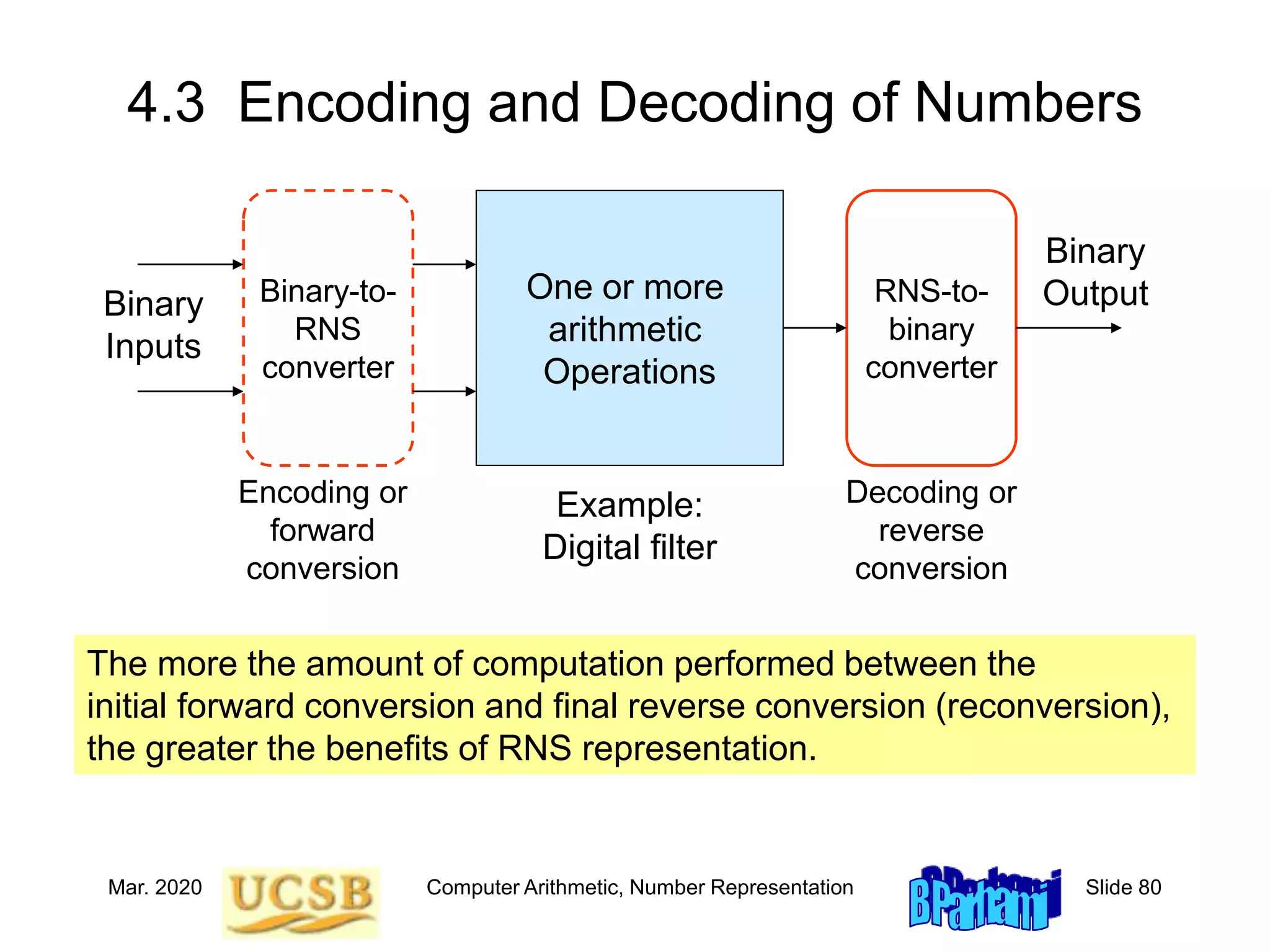
4.3 Encoding and Decoding of Numbers
Binary
Inputs
One or more
arithmetic
Operations
Binary
Output
Binary-to-
RNS
converter
RNS-to-
binary
converter
Encoding or
forward
conversion
Decoding or
reverse
conversion
The more the amount of computation performed between the
initial forward conversion and final reverse conversion (reconversion),
the greater the benefits of RNS representation.
Example:
Digital filter
Mar. 2020 Computer Arithmetic, Number Representation Slide 81
Conversion from Binary/Decimal to RNS
–––––––––––––––––––––––––––––
i 2i 2i7 2i5 2i3
–––––––––––––––––––––––––––––
0 1 1 1 1
1 2 2 2 2
2 4 4 4 1
3 8 1 3 2
4 16 2 1 1
5 32 4 2 2
6 64 1 4 1
7 128 2 3 2
8 256 4 1 1
9 512 1 2 2
–––––––––––––––––––––––––––––
Table 4.1 Residues of
the first 10 powers of 2
Example 4.1: Represent the
number y = (1010 0100)two =
(164)ten in RNS(8 | 7 | 5 | 3)
The mod-8 residue is easy to find
x3 = y8 = (100)two = 4
We have y = 27+25+22; thus
x2 = y7 = 2 + 4 + 47 = 3
x1 = y5 = 3 + 2 + 45 = 4
x0 = y3 = 2 + 2 + 13 = 2
Mar. 2020 Computer Arithmetic, Number Representation Slide 82
Conversion from RNS to Mixed-Radix Form
MRS(mk–1 | . . . | m2 | m1 | m0) is a k-digit positional system with weights
mk–2...m2m1m0 . . . m2m1m0 m1m0 m0 1
and digit sets
[0, mk–1–1] . . . [0,m3–1] [0,m2–1] [0,m1–1] [0,m0–1]
Example: (0 | 3 | 1 | 0)MRS(8|7|5|3) = 0105 + 315 + 13 + 01 = 48
RNS-to-MRS conversion problem:
y = (xk–1 | . . . | x2 | x1 | x0)RNS = (zk–1 | . . . | z2 | z1 | z0)MRS
MRS representation allows magnitude comparison and sign detection
Example: 48 versus 45
(0 | 6 | 3 | 0)RNS vs (5 | 3 | 0 | 0)RNS
(000 | 110 | 011 | 00)RNS vs (101 | 011 | 000 | 00)RNS
Equivalent mixed-radix representations
(0 | 3 | 1 | 0)MRS vs (0 | 3 | 0 | 0)MRS
(000 | 011 | 001 | 00)MRS vs (000 | 011 | 000 | 00)MRS
Mar. 2020 Computer Arithmetic, Number Representation Slide 83
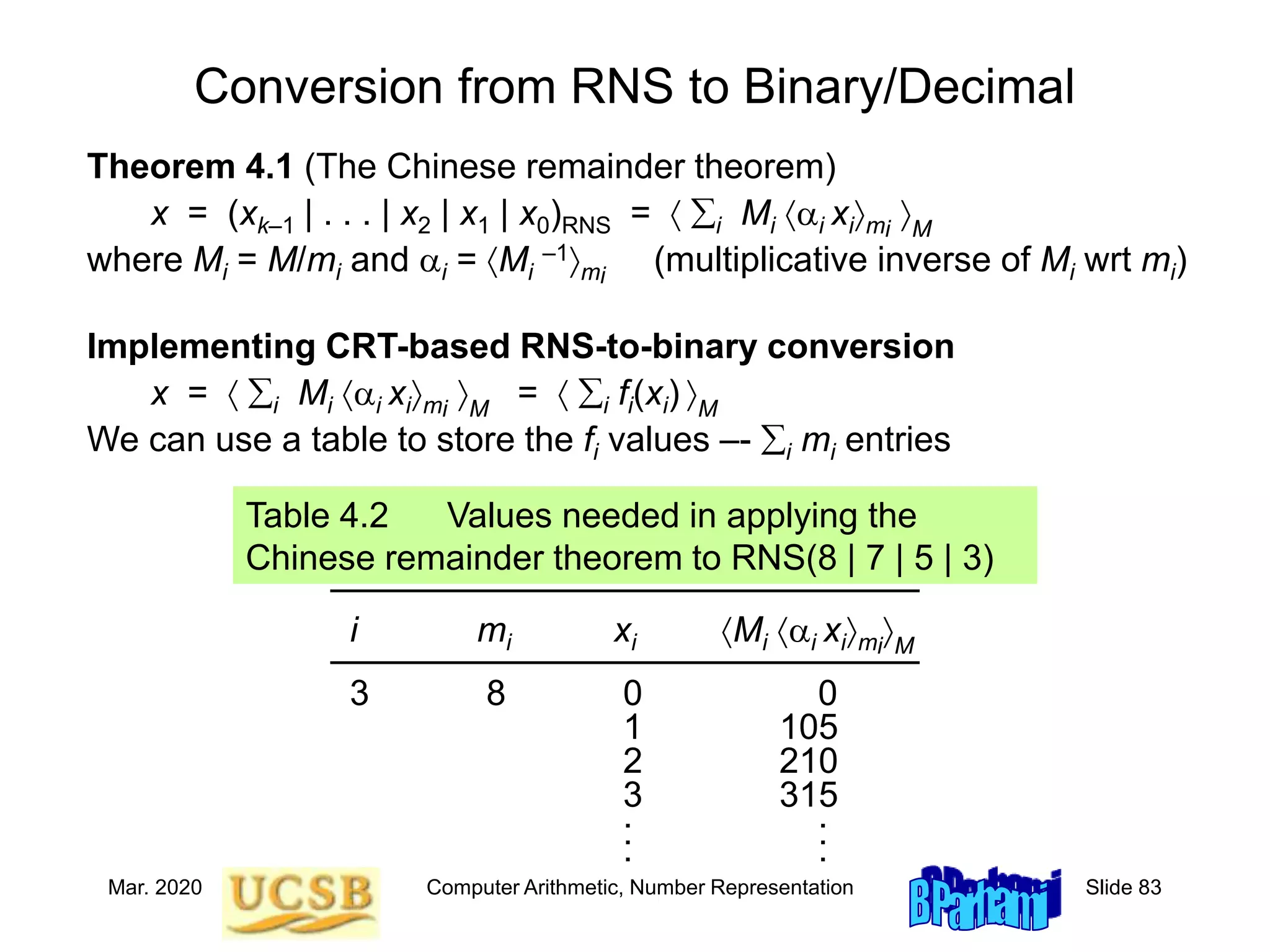
Conversion from RNS to Binary/Decimal
Theorem 4.1 (The Chinese remainder theorem)
x = (xk–1 | . . . | x2 | x1 | x0)RNS =  i Mi ai ximi
M
where Mi = M/mi and ai = Mi
–1mi
(multiplicative inverse of Mi wrt mi)
Implementing CRT-based RNS-to-binary conversion
x =  i Mi ai ximi
M
=  i fi(xi) M
We can use a table to store the fi values –- i mi entries
Table 4.2 Values needed in applying the
Chinese remainder theorem to RNS(8 | 7 | 5 | 3)
––––––––––––––––––––––––––––––
i mi xi Mi ai ximi
M
––––––––––––––––––––––––––––––
3 8 0 0
1 105
2 210
3 315
. .
. .
. .
Mar. 2020 Computer Arithmetic, Number Representation Slide 84
Intuitive Justification for CRT
Puzzle: What number has the remainders of 2, 3, and 2
when divided by the numbers 7, 5, and 3, respectively?
x = (2 | 3 | 2)RNS(7|5|3) = (?)ten
(1 | 0 | 0)RNS(7|5|3) = multiple of 15 that is 1 mod 7 = 15
(0 | 1 | 0)RNS(7|5|3) = multiple of 21 that is 1 mod 5 = 21
(0 | 0 | 1)RNS(7|5|3) = multiple of 35 that is 1 mod 3 = 70
(2 | 3 | 2)RNS(7|5|3) = (2 | 0 | 0) + (0 | 3 | 0) + (0 | 0 | 2)
= 2  (1 | 0 | 0) + 3  (0 | 1 | 0) + 2  (0 | 0 | 1)
= 2  15 + 3  21 + 2  70
= 30 + 63 + 140
= 233 = 23 mod 105
Therefore, x = (23)ten
Mar. 2020 Computer Arithmetic, Number Representation Slide 85
4.4 Difficult RNS Arithmetic Operations
Sign test and magnitude comparison are difficult
Example: Of the following RNS(8 | 7 | 5 | 3) numbers:
Which, if any, are negative?
Which is the largest?
Which is the smallest?
Assume a range of [–420, 419]
a = (0 | 1 | 3 | 2)RNS
b = (0 | 1 | 4 | 1)RNS
c = (0 | 6 | 2 | 1)RNS
d = (2 | 0 | 0 | 2)RNS
e = (5 | 0 | 1 | 0)RNS
f = (7 | 6 | 4 | 2)RNS
Answers:
d < c < f < a < e < b
–70 < –8 < –1 < 8 < 21 < 64
Mar. 2020 Computer Arithmetic, Number Representation Slide 86
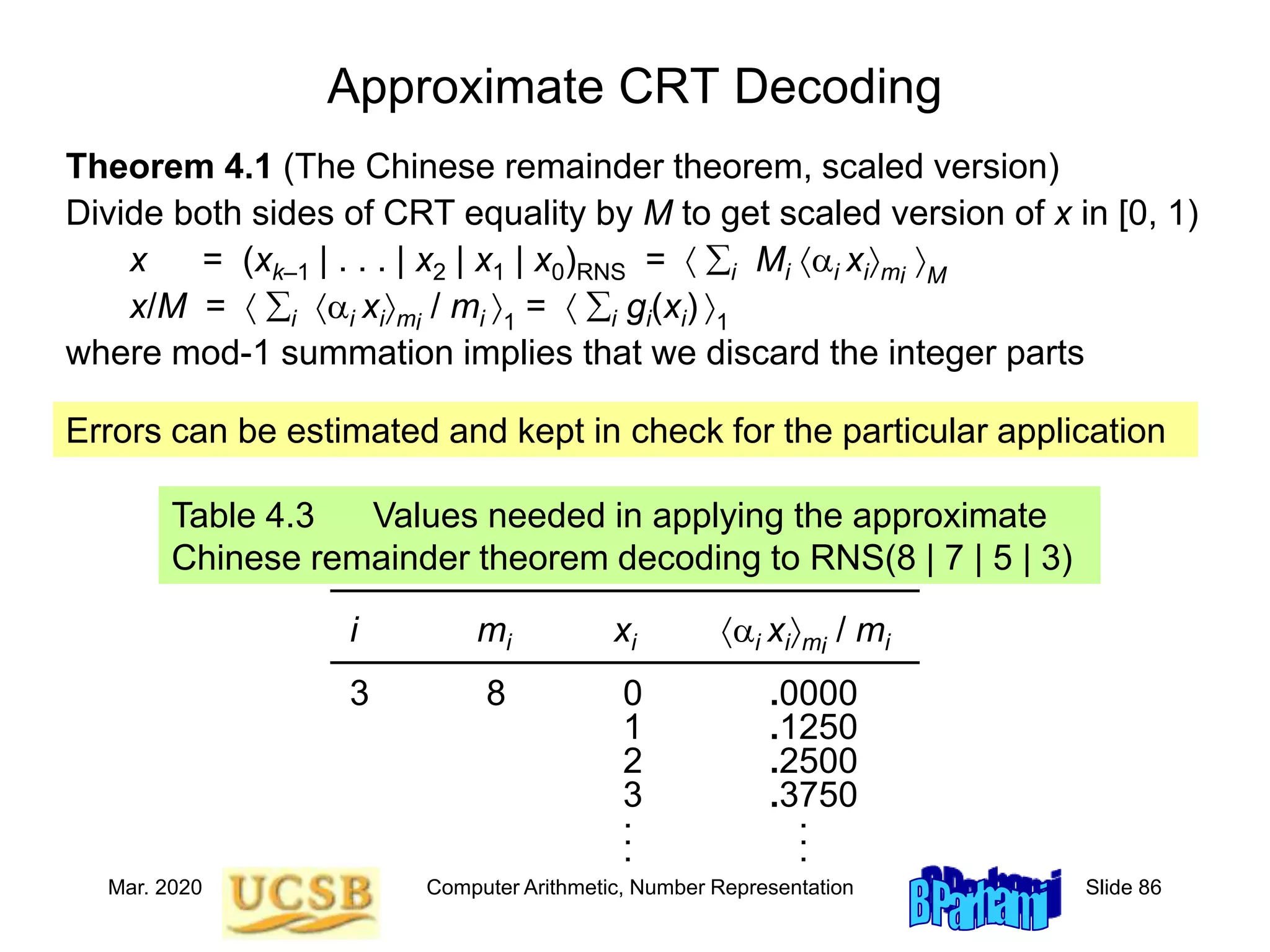
Approximate CRT Decoding
Theorem 4.1 (The Chinese remainder theorem, scaled version)
Divide both sides of CRT equality by M to get scaled version of x in [0, 1)
x = (xk–1 | . . . | x2 | x1 | x0)RNS =  i Mi ai ximi
M
x/M =  i ai ximi
/ mi 1
=  i gi(xi) 1
where mod-1 summation implies that we discard the integer parts
Table 4.3 Values needed in applying the approximate
Chinese remainder theorem decoding to RNS(8 | 7 | 5 | 3)
––––––––––––––––––––––––––––––
i mi xi ai ximi
/ mi
––––––––––––––––––––––––––––––
3 8 0 .0000
1 .1250
2 .2500
3 .3750
. .
. .
. .
Errors can be estimated and kept in check for the particular application
Mar. 2020 Computer Arithmetic, Number Representation Slide 87
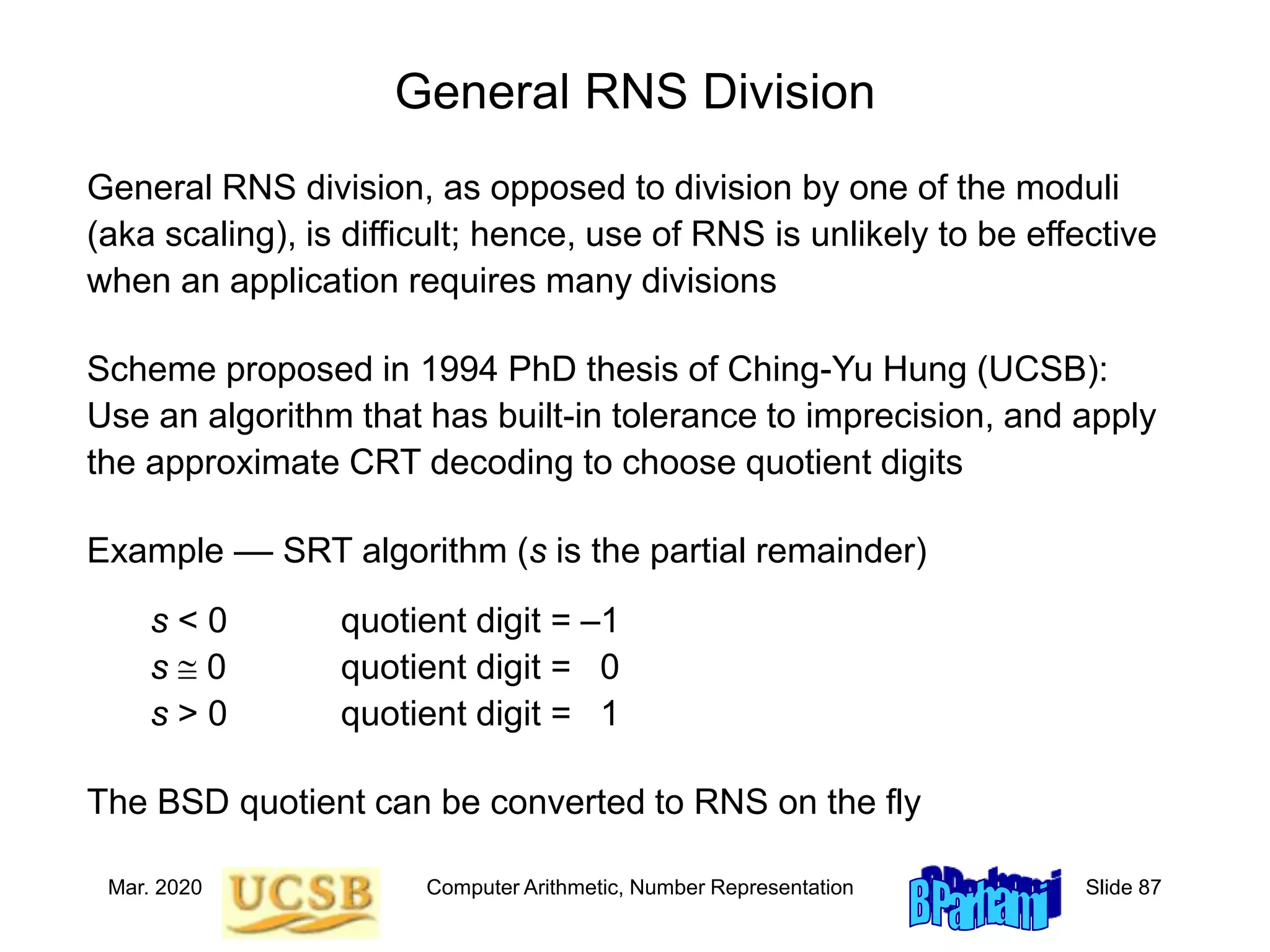
General RNS Division
General RNS division, as opposed to division by one of the moduli
(aka scaling), is difficult; hence, use of RNS is unlikely to be effective
when an application requires many divisions
Scheme proposed in 1994 PhD thesis of Ching-Yu Hung (UCSB):
Use an algorithm that has built-in tolerance to imprecision, and apply
the approximate CRT decoding to choose quotient digits
Example –– SRT algorithm (s is the partial remainder)
s < 0 quotient digit = –1
s  0 quotient digit = 0
s > 0 quotient digit = 1
The BSD quotient can be converted to RNS on the fly
Mar. 2020 Computer Arithmetic, Number Representation Slide 88
4.5 Redundant RNS Representations
Fig. 4.3 Adding a 4-bit ordinary
mod-13 residue x to a 4-bit
pseudoresidue y, producing a
4-bit mod-13 pseudoresidue z.
Adder
Adder
x y
z
cout
0 0
Drop
Pseudoresidue x Residue y
Pseudoresidue z
Drop
Adder
Adder
Fig. 4.4 A modulo-m
multiply-add cell that accumulates
the sum into a double-length
redundant pseudoresidue.
[0, 15] [0, 12]
[0, 15]
[0, 11]
if cout = 1
[0, 15]
Mar. 2020 Computer Arithmetic, Number Representation Slide 89
4.6 Limits of Fast Arithmetic in RNS
Known results from number theory
Implications to speed of arithmetic in RNS
Theorem 4.5: It is possible to represent all k-bit binary numbers
in RNS with O(k / log k) moduli such that the largest modulus
has O(log k) bits
That is, with fast log-time adders, addition needs O(log log k) time
Theorem 4.2: The ith prime pi is asymptotically i ln i
Theorem 4.3: The number of primes in [1, n] is asymptotically n/ln n
Theorem 4.4: The product of all primes in [1, n] is asymptotically en
Mar. 2020 Computer Arithmetic, Number Representation Slide 90
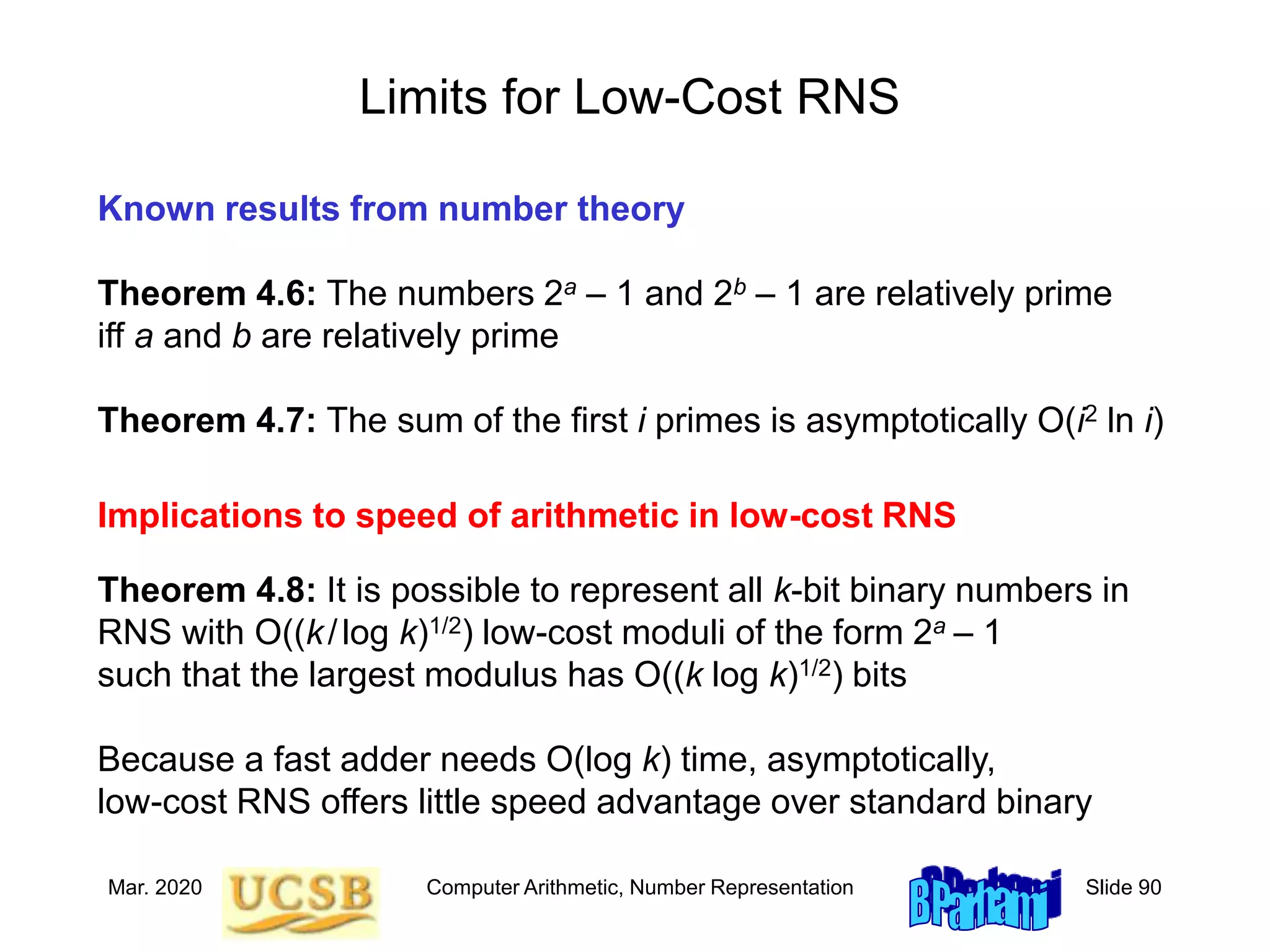
Limits for Low-Cost RNS
Known results from number theory
Implications to speed of arithmetic in low-cost RNS
Theorem 4.8: It is possible to represent all k-bit binary numbers in
RNS with O((k/log k)1/2) low-cost moduli of the form 2a – 1
such that the largest modulus has O((k log k)1/2) bits
Because a fast adder needs O(log k) time, asymptotically,
low-cost RNS offers little speed advantage over standard binary
Theorem 4.6: The numbers 2a – 1 and 2b – 1 are relatively prime
iff a and b are relatively prime
Theorem 4.7: The sum of the first i primes is asymptotically O(i2 ln i)
Mar. 2020 Computer Arithmetic, Number Representation Slide 91
si+1 si–1
si
xi–1,yi–1
,
xi
xi+1,yi+1 yi xi–1,yi–1
,
xi
xi+1,yi+1 yi
(b) Two-stage carry-free.
si+1 si–1
si
ti
(c) Single-stage with lookahead.
si+1 si–1
si
xi–1,yi–1
,
xi
xi+1,yi+1 yi
(a) Idealsingle-stage carry-free.
(Impossible for positional
systemwith fixed digit set)
Positional representation does not
support totally carry-free addition;
but it appears that RNS does allow
digitwise arithmetic
Disclaimer About RNS Representations
RNS representations are sometimes referred to as “carry-free”
However . . . even though each RNS digit is processed independently
(for +, –, ), the size of the digit set is dependent on the desired range
(grows at least double-logarithmically with the range M, or logarithmically
with the word width k in the binary representation of the same range)
mod 8 mod 7 mod 5 mod 3
Mod-8
Unit
Mod-7
Unit
Mod-5
Unit
Mod-3
Unit
3 3 3 2
Operand 1 Operand 2
Result

f31-book-arith-pres-pt1.ppt

  • 1.
    Mar. 2020 ComputerArithmetic, Number Representation Slide 1 Part I Number Representation Number Representation Numbers and Arithmetic Representing Signed Numbers Redundant Number Systems Residue Number Systems Addition / Subtraction Basic Addition and Counting Carry-Lookahead Adders Variations in Fast Adders Multioperand Addition Multiplication Basic Multiplication Schemes High-Radix Multipliers Tree and Array Multipliers Variations in Multipliers Division Basic Division Schemes High-Radix Dividers Variations in Dividers Division by Convergence Real Arithmetic Floating-Point Reperesentations Floating-Point Operations Errors and Error Control Precise and Certifiable Arithmetic Function Evaluation Square-Rooting Methods The CORDIC Algorithms Variations in Function Evaluation Arithmetic by Table Lookup Implementation Topics High-Throughput Arithmetic Low-Power Arithmetic Fault-Tolerant Arithmetic Past, Present, and Future Parts Chapters I. II. III. IV. V. VI. VII. 1. 2. 3. 4. 5. 6. 7. 8. 9. 10. 11. 12. 25. 26. 27. 28. 21. 22. 23. 24. 17. 18. 19. 20. 13. 14. 15. 16. Elementary Operations 28. Reconfigurable Arithmetic Appendix: Past, Present, and Future
  • 2.
    Mar. 2020 ComputerArithmetic, Number Representation Slide 2 About This Presentation This presentation is intended to support the use of the textbook Computer Arithmetic: Algorithms and Hardware Designs (Oxford U. Press, 2nd ed., 2010, ISBN 978-0-19-532848-6). It is updated regularly by the author as part of his teaching of the graduate course ECE 252B, Computer Arithmetic, at the University of California, Santa Barbara. Instructors can use these slides freely in classroom teaching and for other educational purposes. Unauthorized uses are strictly prohibited. © Behrooz Parhami Edition Released Revised Revised Revised Revised First Jan. 2000 Sep. 2001 Sep. 2003 Sep. 2005 Apr. 2007 Apr. 2008 April 2009 Second Apr. 2010 Mar. 2011 Apr. 2013 Mar. 2015 Mar. 2020
  • 3.
    Mar. 2020 ComputerArithmetic, Number Representation Slide 3 I Background and Motivation Topics in This Part Chapter 1 Numbers and Arithmetic Chapter 2 Representing Signed Numbers Chapter 3 Redundant Number Systems Chapter 4 Residue Number Systems Number representation arguably the most important topic: • Effects on system compatibility and ease of arithmetic • 2’s-complement, redundant, residue number systems • Limits of fast arithmetic • Floating-point numbers to be covered in Chapter 17
  • 4.
    Mar. 2020 ComputerArithmetic, Number Representation Slide 4 “This can’t be right . . . It goes into the red!”
  • 5.
    Mar. 2020 ComputerArithmetic, Number Representation Slide 5 1 Numbers and Arithmetic Chapter Goals Define scope and provide motivation Set the framework for the rest of the book Review positional fixed-point numbers Chapter Highlights What goes on inside your calculator? Ways of encoding numbers in k bits Radices and digit sets: conventional, exotic Conversion from one system to another Dot notation: a useful visualization tool
  • 6.
    Mar. 2020 ComputerArithmetic, Number Representation Slide 6 Numbers and Arithmetic: Topics Topics in This Chapter 1.1 What is Computer Arithmetic? 1.2 Motivating Examples 1.3 Numbers and Their Encodings 1.4 Fixed-Radix Positional Number Systems 1.5 Number Radix Conversion 1.6 Classes of Number Representations
  • 7.
    Mar. 2020 ComputerArithmetic, Number Representation Slide 7 1.1 What is Computer Arithmetic? Pentium Division Bug (1994-95): Pentium’s radix-4 SRT algorithm occasionally gave incorrect quotient First noted in 1994 by Tom Nicely who computed sums of reciprocals of twin primes: 1/5 + 1/7 + 1/11 + 1/13 + . . . + 1/p + 1/(p + 2) + . . . Worst-case example of division error in Pentium: 4 195 835 3 145 727 1.333 820 44... 1.333 739 06... c = = Correct quotient circa 1994 Pentium double FLP value; accurate to only 14 bits (worse than single!)
  • 8.
    Mar. 2020 ComputerArithmetic, Number Representation Slide 8 Top Ten Intel Slogans for the Pentium Humor, circa 1995 (in the wake of Pentium processor’s FDIV bug) • 9.999 997 325 It’s a FLAW, dammit, not a bug • 8.999 916 336 It’s close enough, we say so • 7.999 941 461 Nearly 300 correct opcodes • 6.999 983 153 You don’t need to know what’s inside • 5.999 983 513 Redefining the PC –– and math as well • 4.999 999 902 We fixed it, really • 3.999 824 591 Division considered harmful • 2.999 152 361 Why do you think it’s called “floating” point? • 1.999 910 351 We’re looking for a few good flaws • 0.999 999 999 The errata inside
  • 9.
    Mar. 2020 ComputerArithmetic, Number Representation Slide 9 Aspects of, and Topics in, Computer Arithmetic Fig. 1.1 The scope of computer arithmetic. Hardware (our focus in this book) Software ––––––––––––––––––––––––––––––––––––––––––––––––– –––––––––––––––––––––––––––––––––––– Design of efficient digital circuits for Numerical methods for solving primitive and other arithmetic operations systems of linear equations, such as +, –, , , , log, sin, and cos partial differential eq’ns, and so on Issues: Algorithms Issues: Algorithms Error analysis Error analysis Speed/cost trade-offs Computational complexity Hardware implementation Programming Testing, verification Testing, verification General-purpose Special-purpose –––––––––––––––––––––– ––––––––––––––––––––––– Flexible data paths Tailored to application Fast primitive areas such as: operations like Digital filtering +, –, , ,  Image processing Benchmarking Radar tracking
  • 10.
    Mar. 2020 ComputerArithmetic, Number Representation Slide 10 Using a calculator with √, x2, and xy functions, compute: u = √√ … √ 2 = 1.000 677 131 “1024th root of 2” v = 21/1024 = 1.000 677 131 Save u and v; If you can’t save, recompute values when needed x = (((u2)2)...)2 = 1.999 999 963 x' = u1024 = 1.999 999 973 y = (((v2)2)...)2 = 1.999 999 983 y' = v1024 = 1.999 999 994 Perhaps v and u are not really the same value w = v – u = 1  10–11 Nonzero due to hidden digits (u – 1)  1000 = 0.677 130 680 [Hidden ... (0) 68] (v – 1)  1000 = 0.677 130 690 [Hidden ... (0) 69] 1.2 A Motivating Example
  • 11.
    Mar. 2020 ComputerArithmetic, Number Representation Slide 11 Finite Precision Can Lead to Disaster Example: Failure of Patriot Missile (1991 Feb. 25) Source http://www.ima.umn.edu/~arnold/disasters/disasters.html American Patriot Missile battery in Dharan, Saudi Arabia, failed to intercept incoming Iraqi Scud missile The Scud struck an American Army barracks, killing 28 Cause, per GAO/IMTEC-92-26 report: “software problem” (inaccurate calculation of the time since boot) Problem specifics: Time in tenths of second as measured by the system’s internal clock was multiplied by 1/10 to get the time in seconds Internal registers were 24 bits wide 1/10 = 0.0001 1001 1001 1001 1001 100 (chopped to 24 b) Error ≈ 0.1100 1100  2–23 ≈ 9.5  10–8 Error in 100-hr operation period ≈ 9.5  10–8  100  60  60  10 = 0.34 s Distance traveled by Scud = (0.34 s)  (1676 m/s) ≈ 570 m
  • 12.
    Mar. 2020 ComputerArithmetic, Number Representation Slide 12 Inadequate Range Can Lead to Disaster Example: Explosion of Ariane Rocket (1996 June 4) Source http://www.ima.umn.edu/~arnold/disasters/disasters.html Unmanned Ariane 5 rocket of the European Space Agency veered off its flight path, broke up, and exploded only 30 s after lift-off (altitude of 3700 m) The $500 million rocket (with cargo) was on its first voyage after a decade of development costing $7 billion Cause: “software error in the inertial reference system” Problem specifics: A 64 bit floating point number relating to the horizontal velocity of the rocket was being converted to a 16 bit signed integer An SRI* software exception arose during conversion because the 64-bit floating point number had a value greater than what could be represented by a 16-bit signed integer (max 32 767) *SRI = Système de Référence Inertielle or Inertial Reference System
  • 13.
    Mar. 2020 ComputerArithmetic, Number Representation Slide 13 1.3 Numbers and Their Encodings Some 4-bit number representation formats Unsigned integer ± Signed integer Signed fraction 2's-compl fraction Floating point Logarithmic Fixed point, 3+1 ± e s logx Radix point Base-2 logarithm Exponent in {-2, -1, 0, 1} Significand in {0, 1, 2, 3}
  • 14.
    Mar. 2020 ComputerArithmetic, Number Representation Slide 14 Encoding Numbers in 4 Bits Fig. 1.2 Some of the possible ways of assigning 16 distinct codes to represent numbers. Small triangles denote the radix point locations. 0 2 4 6 8 10 12 14 16 -2 -4 -6 -8 -10 -12 -14 -16 Unsigned integers Signed-magnitude 3 + 1 fixed-point, xxx.x Signed fraction, .xxx 2’s-compl. fraction, x.xxx 2 + 2 floating-point, s  2 e in [-2, 1], s in [0, 3] 2 + 2 logarithmic (log = xx.xx)   Number format log x s e e
  • 15.
    Mar. 2020 ComputerArithmetic, Number Representation Slide 15 1.4 Fixed-Radix Positional Number Systems ( xk–1xk–2 . . . x1x0 . x–1x–2 . . . x–l )r = xi ri One can generalize to: Arbitrary radix (not necessarily integer, positive, constant) Arbitrary digit set, usually {–a, –a+1, . . . , b–1, b} = [–a, b] Example 1.1. Balanced ternary number system: Radix r = 3, digit set = [–1, 1] Example 1.2. Negative-radix number systems: Radix –r, r  2, digit set = [0, r – 1] The special case with radix –2 and digit set [0, 1] is known as the negabinary number system  - -  1 k l i
  • 16.
    Mar. 2020 ComputerArithmetic, Number Representation Slide 16 More Examples of Number Systems Example 1.3. Digit set [–4, 5] for r = 10: (3 –1 5)ten represents 295 = 300 – 10 + 5 Example 1.4. Digit set [–7, 7] for r = 10: (3 –1 5)ten = (3 0 –5)ten = (1 –7 0 –5)ten Example 1.7. Quater-imaginary number system: radix r = 2j, digit set [0, 3]
  • 17.
    Mar. 2020 ComputerArithmetic, Number Representation Slide 17 1.5 Number Radix Conversion Radix conversion, using arithmetic in the old radix r Convenient when converting from r = 10 u = w . v = ( xk–1xk–2 . . . x1x0 . x–1x–2 . . . x–l )r Old = ( XK–1XK–2 . . . X1X0 . X–1X–2 . . . X–L )R New Radix conversion, using arithmetic in the new radix R Convenient when converting to R = 10 Whole part Fractional part Example: (31)eight = (25)ten 31 Oct. = 25 Dec. Halloween = Xmas
  • 18.
    Mar. 2020 ComputerArithmetic, Number Representation Slide 18 Radix Conversion: Old-Radix Arithmetic Converting whole part w: (105)ten = (?)five Repeatedly divide by five Quotient Remainder 105 0 21 1 4 4 0 Therefore, (105)ten = (410)five Converting fractional part v: (105.486)ten = (410.?)five Repeatedly multiply by five Whole Part Fraction .486 2 .430 2 .150 0 .750 3 .750 3 .750 Therefore, (105.486)ten  (410.22033)five
  • 19.
    Mar. 2020 ComputerArithmetic, Number Representation Slide 19 Radix Conversion: New-Radix Arithmetic Converting whole part w: (22033)five = (?)ten ((((2  5) + 2)  5 + 0)  5 + 3)  5 + 3 |-----| : : : : 10 : : : : |-----------| : : : 12 : : : |---------------------| : : 60 : : |-------------------------------| : 303 : |-----------------------------------------| 1518 Converting fractional part v: (410.22033)five = (105.?)ten (0.22033)five  55 = (22033)five = (1518)ten 1518 / 55 = 1518 / 3125 = 0.48576 Therefore, (410.22033)five = (105.48576)ten Horner’s rule is also applicable: Proceed from right to left and use division instead of multiplication Horner’s rule or formula
  • 20.
    Mar. 2020 ComputerArithmetic, Number Representation Slide 20 Horner’s Rule for Fractions Converting fractional part v: (0.22033)five = (?)ten (((((3 / 5) + 3) / 5 + 0) / 5 + 2) / 5 + 2) / 5 |-----| : : : : 0.6 : : : : |-----------| : : : 3.6 : : : |---------------------| : : 0.72 : : |-------------------------------| : 2.144 : |-----------------------------------------| 2.4288 |-----------------------------------------------| 0.48576 Horner’s rule or formula Fig. 1.3 Horner’s rule used to convert (0.220 33)five to decimal.
  • 21.
    Mar. 2020 ComputerArithmetic, Number Representation Slide 21 1.6 Classes of Number Representations Integers (fixed-point), unsigned: Chapter 1 Integers (fixed-point), signed Signed-magnitude, biased, complement: Chapter 2 Signed-digit, including carry/borrow-save: Chapter 3 (but the key point of Chapter 3 is using redundancy for faster arithmetic, not how to represent signed values) Residue number system: Chapter 4 (again, the key to Chapter 4 is use of parallelism for faster arithmetic, not how to represent signed values) Real numbers, floating-point: Chapter 17 Part V deals with real arithmetic Real numbers, exact: Chapter 20 Continued-fraction, slash, . . . For the most part you need: - 2’s complement numbers - Carry-save representation - IEEE floating-point format However, knowing the rest of the material (including RNS) provides you with more options when designing custom and special-purpose hardware systems
  • 22.
    Mar. 2020 ComputerArithmetic, Number Representation Slide 22 Dot Notation: A Useful Visualization Tool Fig. 1.4 Dot notation to depict number representation formats and arithmetic algorithms. +  (a) Addition (b) Multiplication
  • 23.
    Mar. 2020 ComputerArithmetic, Number Representation Slide 23 2 Representing Signed Numbers Chapter Goals Learn different encodings of the sign info Discuss implications for arithmetic design Chapter Highlights Using sign bit, biasing, complementation Properties of 2’s-complement numbers Signed vs unsigned arithmetic Signed numbers, positions, or digits Extended dot notation: posibits and negabits
  • 24.
    Mar. 2020 ComputerArithmetic, Number Representation Slide 24 Representing Signed Numbers: Topics Topics in This Chapter 2.1 Signed-Magnitude Representation 2.2 Biased Representations 2.3 Complement Representations 2.4 2’s- and 1’s-Complement Numbers 2.5 Direct and Indirect Signed Arithmetic 2.6 Using Signed Positions or Signed Digits
  • 25.
    Mar. 2020 ComputerArithmetic, Number Representation Slide 25 2.1 Signed-Magnitude Representation Fig. 2.1 A 4-bit signed-magnitude number representation system for integers. 0000 0001 1111 0010 1110 0011 1101 0100 1100 1000 0101 1011 0110 1010 0111 1001 0 +1 +3 +4 +5 +6 +7 -7 -3 -5 -4 -0 -1 +2 - + _ Bit pattern (representation) Signed values (signed magnitude) +2 -6 Increment Decrement -
  • 26.
    Mar. 2020 ComputerArithmetic, Number Representation Slide 26 Signed-Magnitude Adder Fig. 2.2 Adding signed-magnitude numbers using precomplementation and postcomplementation. Adder c c s x y Sign x Sign y Sign Sign s Selective Complement Selective Complement out in Comp x Control Comp s Add/Sub Compl x ___ Add/Sub Compl s Selective complement Selective complement
  • 27.
    Mar. 2020 ComputerArithmetic, Number Representation Slide 27 2.2 Biased Representations Fig. 2.3 A 4-bit biased integer number representation system with a bias of 8. 0000 0001 1111 0010 1110 0011 1101 0100 1100 1000 0101 1011 0110 1010 0111 1001 -8 -7 -5 -4 -3 -2 -1 +7 +3 +5 +4 0 +1 +2 + _ Bit pattern (representation) Signed values (biased by 8) -6 +6 Increment Increment
  • 28.
    Mar. 2020 ComputerArithmetic, Number Representation Slide 28 Arithmetic with Biased Numbers Addition/subtraction of biased numbers x + y + bias = (x + bias) + (y + bias) – bias x – y + bias = (x + bias) – (y + bias) + bias A power-of-2 (or 2a – 1) bias simplifies addition/subtraction Comparison of biased numbers: Compare like ordinary unsigned numbers find true difference by ordinary subtraction We seldom perform arbitrary arithmetic on biased numbers Main application: Exponent field of floating-point numbers
  • 29.
    Mar. 2020 ComputerArithmetic, Number Representation Slide 29 2.3 Complement Representations Fig. 2.4 Complement representation of signed integers. 0 1 2 3 4 M - N P +0 +1 +3 +4 -1 + _ Unsigned representations Signed values +2 -2 +P - N M - 1 M - 2 Increment Decrement
  • 30.
    Mar. 2020 ComputerArithmetic, Number Representation Slide 30 Arithmetic with Complement Representations ––––––––––––––––––––––––––––––––––––––––––––––––––––––––––– Desired Computation to be Correct result Overflow operation performed mod M with no overflow condition ––––––––––––––––––––––––––––––––––––––––––––––––––––––––––– (+x) + (+y) x + y x + y x + y > P (+x) + (–y) x + (M – y) x – y if y  x N/A M – (y – x) if y > x (–x) + (+y) (M – x) + y y – x if x  y N/A M – (x – y) if x > y (–x) + (–y) (M – x) + (M – y) M – (x + y) x + y > N ––––––––––––––––––––––––––––––––––––––––––––––––––––––––––– Table 2.1 Addition in a complement number system with complementation constant M and range [–N, +P]
  • 31.
    Mar. 2020 ComputerArithmetic, Number Representation Slide 31 Example and Two Special Cases Example -- complement system for fixed-point numbers: Complementation constant M = 12.000 Fixed-point number range [–6.000, +5.999] Represent –3.258 as 12.000 – 3.258 = 8.742 Auxiliary operations for complement representations complementation or change of sign (computing M – x) computations of residues mod M Thus, M must be selected to simplify these operations Two choices allow just this for fixed-point radix-r arithmetic with k whole digits and l fractional digits Radix complement M = rk Digit complement M = rk – ulp (aka diminished radix compl) ulp (unit in least position) stands for r-l Allows us to forget about l, even for nonintegers
  • 32.
    Mar. 2020 ComputerArithmetic, Number Representation Slide 32 2.4 2’s- and 1’s-Complement Numbers Fig. 2.5 A 4-bit 2’s-complement number representation system for integers. 0000 0001 1111 0010 1110 0011 1101 0100 1100 1000 0101 1011 0110 1010 0111 1001 +0 +1 +3 +4 +5 +6 +7 -1 -5 -3 -4 -8 -7 -6 + _ Unsigned representations Signed values (2’s complement) +2 -2 Two’s complement = radix complement system for r = 2 M = 2k 2k – x = [(2k – ulp) – x] + ulp = xcompl + ulp Range of representable numbers in with k whole bits: from –2k–1 to 2k–1 – ulp
  • 33.
    Mar. 2020 ComputerArithmetic, Number Representation Slide 33 1’s-Complement Number Representation Fig. 2.6 A 4-bit 1’s-complement number representation system for integers. One’s complement = digit complement (diminished radix complement) system for r = 2 M = 2k – ulp (2k – ulp) – x = xcompl Range of representable numbers in with k whole bits: from –2k–1 + ulp to 2k–1 – ulp 0000 0001 1111 0010 1110 0011 1101 0100 1100 1000 0101 1011 0110 1010 0111 1001 +0 +1 +3 +4 +5 +6 +7 -0 -4 -2 -3 -7 -6 -5 + _ Unsigned representations Signed values (1’s complement) +2 -1
  • 34.
    Mar. 2020 ComputerArithmetic, Number Representation Slide 34 Some Details for 2’s- and 1’s Complement Range/precision extension for 2’s-complement numbers . . . xk–1 xk–1 xk–1 xk–1 xk–2 . . . x1 x0 . x–1 x–2 . . . x–l 0 0 0 . . .  Sign extension  Sign LSD  Extension  bit Range/precision extension for 1’s-complement numbers . . . xk–1 xk–1 xk–1 xk–1 xk–2 . . . x1 x0 . x–1 x–2 . . . x–l xk–1 xk–1 xk–1 . . .  Sign extension  Sign LSD  Extension  bit Mod-(2k – ulp) operation needed in 1’s-complement arithmetic is done via end-around carry (x + y) – (2k – ulp) = (x – y – 2k) + ulp Connect cout to cin Mod-2k operation needed in 2’s-complement arithmetic is trivial: Simply drop the carry-out (subtract 2k if result is 2k or greater)
  • 35.
    Mar. 2020 ComputerArithmetic, Number Representation Slide 35 Which Complement System Is Better? ––––––––––––––––––––––––––––––––––––––––––––––––––––––––––– Feature/Property Radix complement Digit complement ––––––––––––––––––––––––––––––––––––––––––––––––––––––––––– Symmetry (P = N?) Possible for odd r Possible for even r (radices of practical interest are even) Unique zero? Yes No, there are two 0s Complementation Complement all digits Complement all digits and add ulp Mod-M addition Drop the carry-out End-around carry ––––––––––––––––––––––––––––––––––––––––––––––––––––––––––– Table 2.2 Comparing radix- and digit-complement number representation systems
  • 36.
    Mar. 2020 ComputerArithmetic, Number Representation Slide 36 Why 2’s-Complement Is the Universal Choice Fig. 2.7 Adder/subtractor architecture for 2’s-complement numbers. Mux Adder 0 1 x y y or y _ s = x  y add/sub ___ cin Controlled complementation 0 for addition, 1 for subtraction cout Can replace this mux with k XOR gates
  • 37.
    Mar. 2020 ComputerArithmetic, Number Representation Slide 37 Signed-Magnitude vs 2’s-Complement Fig. 2.7 Mux Adder 0 1 x y y or y _ s = x  y add/sub ___ cin Controlled complementation 0 for addition, 1 for subtraction cout Adder c c s x y Sign x Sign y Sign Sign s Selective Complement Selective Complement out in Comp x Control Comp s Add/Sub Compl x ___ Add/Sub Compl s Selective complement Selective complement Fig. 2.2 Signed-magnitude adder/subtractor is significantly more complex than a simple adder 2’s-complement adder/subtractor needs very little hardware other than a simple adder
  • 38.
    Mar. 2020 ComputerArithmetic, Number Representation Slide 38 2.5 Direct and Indirect Signed Arithmetic Direct signed arithmetic is usually faster (not always) Indirect signed arithmetic can be simpler (not always); allows sharing of signed/unsigned hardware when both operation types are needed Fig. 2.8 Direct versus indirect operation on signed numbers. x y f x y f(x, y) Sign logic Unsigned operation Sign removal f(x, y) Adjustment
  • 39.
    Mar. 2020 ComputerArithmetic, Number Representation Slide 39 2.6 Using Signed Positions or Signed Digits A key property of 2’s-complement numbers that facilitates direct signed arithmetic: Fig. 2.9 Interpreting a 2’s-complement number as having a negatively weighted most-significant digit. x = (1 0 1 0 0 1 1 0)two’s-compl –27 26 25 24 23 22 21 20 –128 + 32 + 4 + 2 = –90 Check: x = (1 0 1 0 0 1 1 0)two’s-compl –x = (0 1 0 1 1 0 1 0)two 27 26 25 24 23 22 21 20 64 + 16 + 8 + 2 = 90
  • 40.
    Mar. 2020 ComputerArithmetic, Number Representation Slide 40 Associating a Sign with Each Digit Fig. 2.10 Converting a standard radix-4 integer to a radix-4 integer with the nonstandard digit set [–1, 2]. 3 1 2 0 2 3 Original digits in [0, 3] –1 1 2 0 2 –1 1 0 0 0 0 1 Rewritten digits in [–1, 2] Transfer digits in [0, 1] 1 –1 1 2 0 3 –1 1 –1 1 2 0 –1 –1 0 0 0 0 1 0 1 –1 1 2 1 –1 –1 Sum digits in [–1, 3] Rewritten digits in [–1, 2] Transfer digits in [0, 1] Sum digits in [–1, 3] Signed-digit representation: Digit set [-a, b] instead of [0, r – 1] Example: Radix-4 representation with digit set [-1, 2] rather than [0, 3]
  • 41.
    Mar. 2020 ComputerArithmetic, Number Representation Slide 41 Redundant Signed-Digit Representations Fig. 2.11 Converting a standard radix-4 integer to a radix-4 integer with the nonstandard digit set [–2, 2]. Signed-digit representation: Digit set [-a, b], with r = a + b + 1 – r > 0 Example: Radix-4 representation with digit set [-2, 2] 3 1 2 0 2 3 Original digits in [0, 3] –1 1 –2 0 –2 1 1 0 1 0 1 1 Interim digits in [–2, 1] Transfer digits in [0, 1] 1 –1 2 –2 1 –1 –1 Sum digits in [–2, 2] Here, the transfer does not propagate, so conversion is “carry-free”
  • 42.
    Mar. 2020 ComputerArithmetic, Number Representation Slide 42 Extended Dot Notation: Posibits and Negabits Fig. 2.12 Extended dot notation depicting various number representation formats. Unsigned positive-radix number 2’s-complement number Negative-radix number Posibit, or simply bit: positively weighted Negabit: negatively weighted
  • 43.
    Mar. 2020 ComputerArithmetic, Number Representation Slide 43 Extended Dot Notation in Use Fig. 2.13 Example arithmetic algorithms represented in extended dot notation. +  (a) Addition (b) Multiplication
  • 44.
    Mar. 2020 ComputerArithmetic, Number Representation Slide 44 3 Redundant Number Systems Chapter Goals Explore the advantages and drawbacks of using more than r digit values in radix r Chapter Highlights Redundancy eliminates long carry chains Redundancy takes many forms: trade-offs Redundant/nonredundant conversions Redundancy used for end values too? Extended dot notation with redundancy
  • 45.
    Mar. 2020 ComputerArithmetic, Number Representation Slide 45 Redundant Number Systems: Topics Topics in This Chapter 3.1 Coping with the Carry Problem 3.2 Redundancy in Computer Arithmetic 3.3 Digit Sets and Digit-Set Conversions 3.4 Generalized Signed-Digit Numbers 3.5 Carry-Free Addition Algorithms 3.6 Conversions and Support Functions
  • 46.
    Mar. 2020 ComputerArithmetic, Number Representation Slide 46 3.1 Coping with the Carry Problem Ways of dealing with the carry propagation problem: 1. Limit propagation to within a small number of bits (Chapters 3-4) 2. Detect end of propagation; don’t wait for worst case (Chapter 5) 3. Speed up propagation via lookahead etc. (Chapters 6-7) 4. Ideal: Eliminate carry propagation altogether! (Chapter 3) 5 7 8 2 4 9 6 2 9 3 8 9 Operand digits in [0, 9] –––––––––––––––––––––––––––––––––– 11 9 17 5 12 18 Position sums in [0, 18] But how can we extend this beyond a single addition? +
  • 47.
    Mar. 2020 ComputerArithmetic, Number Representation Slide 47 Addition of Redundant Numbers Fig. 3.1 Adding radix-10 numbers with digit set [0, 18]. Position sum decomposition [0, 36] = 10  [0, 2] + [0, 16] Absorption of transfer digit [0, 16] + [0, 2] = [0, 18] 6 12 9 10 8 18 Operand digits in [0, 18] 17 21 26 20 20 36 7 11 16 0 10 16 Position sums in [0, 36] Interim sums in [0, 16] 1 1 1 2 1 2 1 8 12 18 1 12 16 11 9 17 10 12 18 Transfer digits in [0, 2] Sum digits in [0, 18] +
  • 48.
    Mar. 2020 ComputerArithmetic, Number Representation Slide 48 Meaning of Carry-Free Addition Fig. 3.2 Ideal and practical carry-free addition schemes. si+1 si–1 si xi–1,yi–1 , xi xi+1,yi+1 yi xi–1,yi–1 , xi xi+1,yi+1 yi (b) Two-stage carry-free. si+1 si–1 si ti (c) Single-stage with lookahead. si+1 si–1 si xi–1,yi–1 , xi xi+1,yi+1 yi (a) Idealsingle-stage carry-free. (Impossible for positional systemwith fixed digit set) Interim sum at position i Transfer digit into position i Operand digits at position i
  • 49.
    Mar. 2020 ComputerArithmetic, Number Representation Slide 49 Redundancy Index Fig. 3.3 Adding radix-10 numbers with digit set [0, 11]. So, redundancy helps us achieve carry-free addition But how much redundancy is actually needed? Is [0, 11] enough for r = 10? 18 12 16 21 12 16 Position sums in [0, 22] 8 2 6 1 2 6 1 1 1 2 1 1 Interim sums in [0, 9] Transfer digits in [0, 2] 1 9 3 8 2 3 6 11 10 7 11 3 8 Sum digits in [0, 11] + 7 2 9 10 9 8 Operand digits in [0, 11] Redundancy index r = a + b + 1 – r For example, 0 + 11 + 1 – 10 = 2 -a b
  • 50.
    Mar. 2020 ComputerArithmetic, Number Representation Slide 50 3.2 Redundancy in Computer Arithmetic Binary Inputs One or more arithmetic operations Binary Output Binary-to- redundant converter Redundant -to-binary converter Overhead (often zero) Overhead (always nonzero) The more the amount of computation performed between the initial forward conversion and final reverse conversion (reconversion), the greater the benefits of redundant representation. Same block diagram applies to residue number systems of Chapter 4.
  • 51.
    Mar. 2020 ComputerArithmetic, Number Representation Slide 51 Binary Carry-Save or Stored-Carry Representation Fig. 3.4 Addition of four binary numbers, with the sum obtained in stored-carry form. 0 0 1 0 0 1 First binary number 0 1 1 1 1 0 0 1 2 1 1 1 Add second binary number Position sums in [0, 2] + 0 1 1 1 0 1 Add third binary number Position sums in [0, 3] Interim sums in [0, 1] Transfer digits in [0, 1] Position sums in [0, 2] Add fourth binary number Position sums in [0, 3] 0 2 3 2 1 2 0 0 1 0 1 0 0 1 1 1 0 1 1 1 2 0 2 0 + 1 1 3 0 3 1 1 1 1 0 1 1 0 0 1 0 1 0 1 2 1 1 1 1 + 0 0 1 0 1 1 Interim sums in [0, 1] Transfer digits in [0, 1] Sum digits in [0, 2] Oldest example of redundancy in computer arithmetic is the stored-carry representation (carry-save addition)
  • 52.
    Mar. 2020 ComputerArithmetic, Number Representation Slide 52 Hardware for Carry-Save Addition Fig. 3.5 Using an array of independent binary full adders to perform carry-save addition. Binary Full Adder (Stage i) cin cout Digit in [0, 2] Binary digit Digit in [0, 2] To Stage i+1 From Stage i – 1 x y s Two-bit encoding for binary stored-carry digits used in this implementation: 0 represented as 0 0 1 represented as 0 1 or as 1 0 2 represented as 1 1 Because in carry-save addition, three binary numbers are reduced to two binary numbers, this process is sometimes referred to as 3-2 compression
  • 53.
    Mar. 2020 ComputerArithmetic, Number Representation Slide 53 Carry-Save Addition in Dot Notation Two carry-save inputs Carry-save input Binary input Carry-save output This bit being 1 represents overflow (ignore it) 0 0 0 a. Carry-save addition. b. Adding two carry-save numbers. Carry-save addition Carry-save addition We sometimes find it convenient to use an extended dot notation, with heavy dots (●) for posibits and hollow dots (○) for negabits Eight-bit, 2’s-complement number ○ ● ● ● ● ● ● ● Negative-radix number ○ ● ○ ● ○ ● ○ ● BSD number with n, p encoding ○ ○ ○ ○ ○ ○ ○ ○ of the digit set [-1, 1] ● ● ● ● ● ● ● ● Fig. 9.3 From text on computer architecture (Parhami, Oxford/2005) 3-to-2 reduction 4-to-2 reduction
  • 54.
    Mar. 2020 ComputerArithmetic, Number Representation Slide 54 Example for the Use of Extended Dot Notation 2’s-complement multiplicand ○ ● ● ● ● ● ● ● 2’s-complement multiplier ○ ● ● ● ● ● ● ● ○ ● ● ● ● ● ● ● ○ ● ● ● ● ● ● ● ○ ● ● ● ● ● ● ● ○ ● ● ● ● ● ● ● ○ ● ● ● ● ● ● ● ○ ● ● ● ● ● ● ● ○ ● ● ● ● ● ● ● ● ○ ○ ○ ○ ○ ○ ○ ○ ● ● ● ● ● ● ● ● ● ● ● ● ● ● ● Option 2: Baugh-Wooley method -x -y 1- x -1 1- y Option 1: sign extension -x -x x x x x Multiplication of 2’s-complement numbers
  • 55.
    Mar. 2020 ComputerArithmetic, Number Representation Slide 55 3.3 Digit Sets and Digit-Set Conversions Example 3.1: Convert from digit set [0, 18] to [0, 9] in radix 10 11 9 17 10 12 18 18 = 10 (carry 1) + 8 11 9 17 10 13 8 13 = 10 (carry 1) + 3 11 9 17 11 3 8 11 = 10 (carry 1) + 1 11 9 18 1 3 8 18 = 10 (carry 1) + 8 11 10 8 1 3 8 10 = 10 (carry 1) + 0 12 0 8 1 3 8 12 = 10 (carry 1) + 2 1 2 0 8 1 3 8 Answer; all digits in [0, 9] Note: Conversion from redundant to nonredundant representation always involves carry propagation Thus, the process is sequential and slow
  • 56.
    Mar. 2020 ComputerArithmetic, Number Representation Slide 56 Conversion from Carry-Save to Binary Example 3.2: Convert from digit set [0, 2] to [0, 1] in radix 2 1 1 2 0 2 0 2 = 2 (carry 1) + 0 1 1 2 1 0 0 2 = 2 (carry 1) + 0 1 2 0 1 0 0 2 = 2 (carry 1) + 0 2 0 0 1 0 0 2 = 2 (carry 1) + 0 1 0 0 0 1 0 0 Answer; all digits in [0, 1] Another way: Decompose the carry-save number into two numbers and add them: 1 1 1 0 1 0 1st number: sum bits + 0 0 1 0 1 0 2nd number: carry bits –––––––––––––––––––––––––––––––––––––––– 1 0 0 0 1 0 0 Sum
  • 57.
    Mar. 2020 ComputerArithmetic, Number Representation Slide 57 Conversion Between Redundant Digit Sets Example 3.3: Convert from digit set [0, 18] to [-6, 5] in radix 10 (same as Example 3.1, but with the target digit set signed and redundant) 11 9 17 10 12 18 18 = 20 (carry 2) – 2 11 9 17 10 14 -2 14 = 10 (carry 1) + 4 11 9 17 11 4 -2 11 = 10 (carry 1) + 1 11 9 18 1 4 -2 18 = 20 (carry 2) – 2 11 11 -2 1 4 -2 11 = 10 (carry 1) + 1 12 1 -2 1 4 -2 12 = 10 (carry 1) + 2 1 2 1 -2 1 4 -2 Answer; all digits in [-6, 5] On line 2, we could have written 14 = 20 (carry 2) – 6; this would have led to a different, but equivalent, representation In general, several representations may exist for a redundant digit set
  • 58.
    Mar. 2020 ComputerArithmetic, Number Representation Slide 58 Carry-Free Conversion to a Redundant Digit Set Example 3.4: Convert from digit set [0, 2] to [-1, 1] in radix 2 (same as Example 3.2, but with the target digit set signed and redundant) Carry-free conversion: 1 1 2 0 2 0 Carry-save number –1 –1 0 0 0 0 Interim digits in [–1, 0] 1 1 1 0 1 0 Transfer digits in [0, 1] –––––––––––––––––––––––––––––––––––––––– 1 0 0 0 1 0 0 Answer; all digits in [–1, 1] We rewrite 2 as 2 (carry 1) + 0, and 1 as 2 (carry 1) – 1 A carry of 1 is always absorbed by the interim digit that is in {-1, 0}
  • 59.
    Mar. 2020 ComputerArithmetic, Number Representation Slide 59 3.4 Generalized Signed-Digit Numbers Fig. 3.6 A taxonomy of redundant and non-redundant positional number systems. Radix-r Positional r r Non-redundant a a Conventional Non-redundant signed-digit Generalized signed-digit (GSD) r r Minimal GSD Non-minimal GSD ab (even r) ab Symmetric minimal GSD r = 2 BSD or BSB Asymmetric minimal GSD a a (r ° 2) Stored- carry (SC) Non-binary SB Symmetric non- minimal GSD ab ab Asymmetric non- minimal GSD a r Ordinary signed-digit Minimally redundant OSD Maximally redundant OSD BSCB SCB r = 2 a b r a Unsigned-digit redundant (UDR) r = 2 BSC a r – 1 a r/2 + 1  Radix r Digit set [–a, b] Requirement a + b + 1  r Redundancy index r = a + b + 1 – r
  • 60.
    Mar. 2020 ComputerArithmetic, Number Representation Slide 60 Encodings for Signed Digits Fig. 3.7 Four encodings for the BSD digit set [–1, 1]. xi s, v 2’s-compl n, p n, z, p Two of the encodings above can be shown in extended dot notation Fig. 3.8 Extended dot notation and its use in visualizing some BSD encodings. Posibit {0, 1} Negabit {–1, 0} Doublebit {0, 2} Negadoublebit {–2, 0} Unibit {–1, 1} (a) Extended dot notation (n, p) encoding 2’s-compl. encoding 2’s-compl. encoding (b) Encodings for a BSD number BSD representation of +6 Sign and value encoding 2-bit 2’s-complement Negative & positive flags 1-out-of-3 encoding 0 00 00 00 010 –1 11 11 10 100 0 00 00 00 010 –1 11 11 10 100 1 01 01 01 001
  • 61.
    Mar. 2020 ComputerArithmetic, Number Representation Slide 61 Hybrid Signed-Digit Numbers i i i i i BSD B B BSD B B Type 1 0 1 –1 0 1 + 0 1 1 –1 1 x y 1 1 2 –2 1 1 –1 0 1 –1 0 1 –1 1 1 0 1 1 p w t s BSD B B –1 0 1 –1 1 1 –1 1 1 0 1 0 –1 0 i+1 Fig. 3.9 Example of addition for hybrid signed-digit numbers. Radix-8 GSD with digit set [-4,7] The hybrid-redundant representation above in extended dot notation: n, p -encoded ○ ● ● ○ ● ● ○ ● ● Nonredundant binary signed digit ● ● ● binary positions
  • 62.
    Mar. 2020 ComputerArithmetic, Number Representation Slide 62 Hybrid Redundancy in Extended Dot Notation Fig. 3.10 Two hybrid-redundant representations in extended dot notation. Radix-8 digit set [–4, 7] Radix-8 digit set [–4, 4]
  • 63.
    Mar. 2020 ComputerArithmetic, Number Representation Slide 63 3.5 Carry-Free Addition Algorithms Carry-free addition of GSD numbers Compute the position sums pi = xi + yi Divide pi into a transfer ti+1 and interim sum wi = pi – rti+1 Add incoming transfers to get the sum digits si = wi + ti xi–1,yi–1 , xi xi+1,yi+1 yi si+1 si–1 si ti wi If the transfer digits ti are in [–l, m], we must have: –a + l  pi – rti+1  b – m interim sum Smallest interim sum Largest interim sum if a transfer of –l if a transfer of m is to be absorbable is to be absorbable These constraints lead to: l  a / (r – 1) m  b / (r – 1)
  • 64.
    Mar. 2020 ComputerArithmetic, Number Representation Slide 64 Is Carry-Free Addition Always Applicable? No: It requires one of the following two conditions a. r > 2, r  3 b. r > 2, r = 2, a  1, b  1 e.g., not [-1, 10] in radix 10 In other words, it is inapplicable for r = 2 Perhaps most useful case r = 1 e.g., carry-save r = 2 with a = 1 or b = 1 e.g., carry/borrow-save BSD fails on at least two criteria! Fortunately, in the latter cases, a limited-carry addition algorithm is always applicable
  • 65.
    Mar. 2020 ComputerArithmetic, Number Representation Slide 65 Limited-Carry Addition Example: BSD addition 1 1 1 -1 0 1 0 -1 1 -1 Fig. 3.12 Some implementations for limited-carry addition. (a) Three-stage carry estimate. (b) Three-stage repeated-carry. si+1 si–1 si ei ti xi–1,yi–1 , xi xi+1,yi+1 yi si+1 si–1 si ti t'i xi–1,yi–1 , xi xi+1,yi+1 yi (c) Two-stage parallel-carries. si+1 si–1 si ti (2) ti (1) xi–1,yi–1 , xi xi+1,yi+1 yi (a) Three-stage carry estimate (b) Three-stage repeated carry (c) Tw o-stage parallel carries Estimate, or early warning
  • 66.
    Mar. 2020 ComputerArithmetic, Number Representation Slide 66 Limited-Carry BSD Addition Fig. 3.13 Limited-carry addition of radix-2 numbers with digit set [–1, 1] using carry estimates. A position sum –1 is kept intact when the incoming transfer is in [0, 1], whereas it is rewritten as 1 with a carry of –1 for incoming transfer in [–1, 0]. This guarantees that ti  wi and thus –1  si  1. 1 –1 0 –1 0 x in [–1, 1] + 0 –1 –1 0 1 1 –2 –1 –1 1 1 0 1 –1 –1 –1 –1 0 1 0 –1 1 0 –1 i i+1 y in [–1, 1] i p in [–2, 2] i w in [–1, 1] i s in [–1, 1] i t in [–1, 1] low low low high high high 0 0 e in {low: [–1, 0], high: [0, 1]} i
  • 67.
    Mar. 2020 ComputerArithmetic, Number Representation Slide 67 3.6 Conversions and Support Functions Example 3.10: Conversion from/to BSD to/from standard binary 1 -1 0 -1 0 BSD representation of +6 1 0 0 0 0 Positive part 0 1 0 1 0 Negative part 0 0 1 1 0 Difference = Conversion result The negative and positive parts above are particularly easy to obtain if the BSD number has the n, p encoding Conversion from redundant to nonredundant representation always requires full carry propagation Conversion from nonredundant to redundant is often trivial
  • 68.
    Mar. 2020 ComputerArithmetic, Number Representation Slide 68 Other Arithmetic Support Functions Overflow and its detection in GSD arithmetic. xk–1 xk–2 . . . x1 x0 k-digit GSD operands + yk–1 yk–2 . . . y1 y0 ––––––––––––––––––––––––––– pk–1 pk–2 . . . p1 p0 Position sums | | | | wk–1 wk–2 . . . w1 w0 Interim sum digits ⁄ ⁄ ⁄ ⁄ tk tk–1 . . . t2 t1 Transfer digits ––––––––––––––––––––––––––– sk–1 sk–2 . . . s1 s0 k-digit apparent sum Zero test: Zero has a unique code under some conditions Sign test: Needs carry propagation Overflow: May be real or apparent (result may be representable)
  • 69.
    Mar. 2020 ComputerArithmetic, Number Representation Slide 69 4 Residue Number Systems Chapter Goals Study a way of encoding large numbers as a collection of smaller numbers to simplify and speed up some operations Chapter Highlights Moduli, range, arithmetic operations Many sets of moduli possible: tradeoffs Conversions between RNS and binary The Chinese remainder theorem Why are RNS applications limited?
  • 70.
    Mar. 2020 ComputerArithmetic, Number Representation Slide 70 Residue Number Systems: Topics Topics in This Chapter 4.1 RNS Representation and Arithmetic 4.2 Choosing the RNS Moduli 4.3 Encoding and Decoding of Numbers 4.4 Difficult RNS Arithmetic Operations 4.5 Redundant RNS Representations 4.6 Limits of Fast Arithmetic in RNS
  • 71.
    Mar. 2020 ComputerArithmetic, Number Representation Slide 71 4.1 RNS Representations and Arithmetic Puzzle, due to the Chinese scholar Sun Tzu,1500+ years ago: What number has the remainders of 2, 3, and 2 when divided by 7, 5, and 3, respectively? Residues (akin to digits in positional systems) uniquely identify the number, hence they constitute a representation Pairwise relatively prime moduli: mk–1 > . . . > m1 > m0 The residue xi of x wrt the ith modulus mi (similar to a digit): xi = x mod mi = xmi RNS representation contains a list of k residues or digits: x = (2 | 3 | 2)RNS(7|5|3) Default RNS for this chapter: RNS(8 | 7 | 5 | 3)
  • 72.
    Mar. 2020 ComputerArithmetic, Number Representation Slide 72 RNS Dynamic Range Product M of the k pairwise relatively prime moduli is the dynamic range M = mk–1  . . .  m1  m0 For RNS(8 | 7 | 5 | 3), M = 8753 = 840 Negative numbers: Complement relative to M –xmi = M – xmi 21 = (5 | 0 | 1 | 0)RNS –21 = (8 – 5 | 0 | 5 – 1 | 0)RNS = (3 | 0 | 4 | 0)RNS Here are some example numbers in our default RNS(8 | 7 | 5 | 3): (0 | 0 | 0 | 0)RNS Represents 0 or 840 or . . . (1 | 1 | 1 | 1)RNS Represents 1 or 841 or . . . (2 | 2 | 2 | 2)RNS Represents 2 or 842 or . . . (0 | 1 | 3 | 2)RNS Represents 8 or 848 or . . . (5 | 0 | 1 | 0)RNS Represents 21 or 861 or . . . (0 | 1 | 4 | 1)RNS Represents 64 or 904 or . . . (2 | 0 | 0 | 2)RNS Represents –70 or 770 or . . . (7 | 6 | 4 | 2)RNS Represents –1 or 839 or . . . We can take the range of RNS(8|7|5|3) to be [-420, 419] or any other set of 840 consecutive integers
  • 73.
    Mar. 2020 ComputerArithmetic, Number Representation Slide 73 We will see later how the weights can be determined for a given RNS RNS as Weighted Representation For RNS(8 | 7 | 5 | 3), the weights of the 4 positions are: 105 120 336 280 Example: (1 | 2 | 4 | 0)RNS represents the number 1051 + 1202 + 3364 + 2800840 = 1689840 = 9 For RNS(7 | 5 | 3), the weights of the 3 positions are: 15 21 70 Example -- Chinese puzzle: (2 | 3 | 2)RNS(7|5|3) represents the number 15  2 + 21  3 + 70  2105 = 233105 = 23
  • 74.
    Mar. 2020 ComputerArithmetic, Number Representation Slide 74 RNS Encoding and Arithmetic Operations Fig. 4.1 Binary-coded format for RNS(8 | 7 | 5 | 3). Arithmetic in RNS(8 | 7 | 5 | 3) (5 | 5 | 0 | 2)RNS Represents x = +5 (7 | 6 | 4 | 2)RNS Represents y = –1 (4 | 4 | 4 | 1)RNS x + y : 5 + 78 = 4, 5 + 67 = 4, etc. (6 | 6 | 1 | 0)RNS x – y : 5 – 78 = 6, 5 – 67 = 6, etc. (alternatively, find –y and add to x) (3 | 2 | 0 | 1)RNS x  y : 5  78 = 3, 5  67 = 2, etc. mod 8 mod 7 mod 5 mod 3 mod 8 mod 7 mod 5 mod 3 Mod-8 Unit Mod-7 Unit Mod-5 Unit Mod-3 Unit 3 3 3 2 Operand 1 Operand 2 Result Fig. 4.2 The structure of an adder, subtractor, or multiplier for RNS(8|7|5|3).
  • 75.
    Mar. 2020 ComputerArithmetic, Number Representation Slide 75 4.2 Choosing the RNS Moduli Target range for our RNS: Decimal values [0, 100 000] Strategy 1: To minimize the largest modulus, and thus ensure high-speed arithmetic, pick prime numbers in sequence Pick m0 = 2, m1 = 3, m2 = 5, etc. After adding m5 = 13: RNS(13 | 11 | 7 | 5 | 3 | 2) M = 30 030 Inadequate RNS(17 | 13 | 11 | 7 | 5 | 3 | 2) M = 510 510 Too large RNS(17 | 13 | 11 | 7 | 3 | 2) M = 102 102 Just right! 5 + 4 + 4 + 3 + 2 + 1 = 19 bits Fine tuning: Combine pairs of moduli 2 & 13 (26) and 3 & 7 (21) RNS(26 | 21 | 17 | 11) M = 102 102
  • 76.
    Mar. 2020 ComputerArithmetic, Number Representation Slide 76 An Improved Strategy Target range for our RNS: Decimal values [0, 100 000] Strategy 2: Improve strategy 1 by including powers of smaller primes before proceeding to the next larger prime RNS(22 | 3) M = 12 RNS(32 | 23 | 7 | 5) M = 2520 RNS(11 | 32 | 23 | 7 | 5) M = 27 720 RNS(13 | 11 | 32 | 23 | 7 | 5) M = 360 360 (remove one 3, combine 3 & 5) RNS(15 | 13 | 11 | 23 | 7) M = 120 120 4 + 4 + 4 + 3 + 3 = 18 bits Fine tuning: Maximize the size of the even modulus within the 4-bit limit RNS(24 | 13 | 11 | 32 | 7 | 5) M = 720 720 Too large We can now remove 5 or 7; not an improvement in this example
  • 77.
    Mar. 2020 ComputerArithmetic, Number Representation Slide 77 Low-Cost RNS Moduli Target range for our RNS: Decimal values [0, 100 000] Strategy 3: To simplify the modular reduction (mod mi) operations, choose only moduli of the forms 2a or 2a – 1, aka “low-cost moduli” RNS(2ak–1 | 2ak–2 – 1 | . . . | 2a1 – 1 | 2a0 – 1) We can have only one even modulus 2ai – 1 and 2aj – 1 are relatively prime iff ai and aj are relatively prime RNS(23 | 23–1 | 22–1) basis: 3, 2 M = 168 RNS(24 | 24–1 | 23–1) basis: 4, 3 M = 1680 RNS(25 | 25–1 | 23–1 | 22–1) basis: 5, 3, 2 M = 20 832 RNS(25 | 25–1 | 24–1 | 23–1) basis: 5, 4, 3 M = 104 160 Comparison RNS(15 | 13 | 11 | 23 | 7) 18 bits M = 120 120 RNS(25 | 25–1 | 24–1 | 23–1) 17 bits M = 104 160
  • 78.
    Mar. 2020 ComputerArithmetic, Number Representation Slide 78 Low- and Moderate-Cost RNS Moduli Target range for our RNS: Decimal values [0, 100 000] Strategy 4: To simplify the modular reduction (mod mi) operations, choose moduli of the forms 2a, 2a – 1, or 2a + 1 RNS(2ak–1 | 2ak–2  1 | . . . | 2a1  1 | 2a0  1) We can have only one even modulus 2ai – 1 and 2aj + 1 are relatively prime RNS(25 | 24–1 | 24+1 | 23–1) M = 57 120 RNS(25 | 24+1 | 23+1 | 23–1 | 22–1) M = 102 816 Neither 5 nor 3 is acceptable The modulus 2a + 1 is not as convenient as 2a – 1 (needs an extra bit for residue, and modular operations are not as simple) Diminished-1 representation of values in [0, 2a] is a way to simplify things Represent 0 by a special flag bit and nonzero values by coding one less
  • 79.
    Mar. 2020 ComputerArithmetic, Number Representation Slide 79 Reverse converter: Multioperand adder, with shifted xis as inputs Example RNS with Special Moduli For RNS(17 | 16 | 15), the weights of the 3 positions are: 2160 3825 2176 Example: (x2, x1, x0) = (2 | 3 | 4)RNS represents the number 21602 + 38253 + 217644080 = 24,4994080 = 19 2160 = 24  (24 – 1)  (23 + 1) = 211 + 27 – 24 3825 = (28 – 1)  (24 – 1) = 212 – 28 – 24 + 1 2176 = 27  (24 + 1) = 211 + 27 4080 = 212 – 24 ; thus, to subtract 4080, ignore bit 12 and add 24
  • 80.
    Mar. 2020 ComputerArithmetic, Number Representation Slide 80 4.3 Encoding and Decoding of Numbers Binary Inputs One or more arithmetic Operations Binary Output Binary-to- RNS converter RNS-to- binary converter Encoding or forward conversion Decoding or reverse conversion The more the amount of computation performed between the initial forward conversion and final reverse conversion (reconversion), the greater the benefits of RNS representation. Example: Digital filter
  • 81.
    Mar. 2020 ComputerArithmetic, Number Representation Slide 81 Conversion from Binary/Decimal to RNS ––––––––––––––––––––––––––––– i 2i 2i7 2i5 2i3 ––––––––––––––––––––––––––––– 0 1 1 1 1 1 2 2 2 2 2 4 4 4 1 3 8 1 3 2 4 16 2 1 1 5 32 4 2 2 6 64 1 4 1 7 128 2 3 2 8 256 4 1 1 9 512 1 2 2 ––––––––––––––––––––––––––––– Table 4.1 Residues of the first 10 powers of 2 Example 4.1: Represent the number y = (1010 0100)two = (164)ten in RNS(8 | 7 | 5 | 3) The mod-8 residue is easy to find x3 = y8 = (100)two = 4 We have y = 27+25+22; thus x2 = y7 = 2 + 4 + 47 = 3 x1 = y5 = 3 + 2 + 45 = 4 x0 = y3 = 2 + 2 + 13 = 2
  • 82.
    Mar. 2020 ComputerArithmetic, Number Representation Slide 82 Conversion from RNS to Mixed-Radix Form MRS(mk–1 | . . . | m2 | m1 | m0) is a k-digit positional system with weights mk–2...m2m1m0 . . . m2m1m0 m1m0 m0 1 and digit sets [0, mk–1–1] . . . [0,m3–1] [0,m2–1] [0,m1–1] [0,m0–1] Example: (0 | 3 | 1 | 0)MRS(8|7|5|3) = 0105 + 315 + 13 + 01 = 48 RNS-to-MRS conversion problem: y = (xk–1 | . . . | x2 | x1 | x0)RNS = (zk–1 | . . . | z2 | z1 | z0)MRS MRS representation allows magnitude comparison and sign detection Example: 48 versus 45 (0 | 6 | 3 | 0)RNS vs (5 | 3 | 0 | 0)RNS (000 | 110 | 011 | 00)RNS vs (101 | 011 | 000 | 00)RNS Equivalent mixed-radix representations (0 | 3 | 1 | 0)MRS vs (0 | 3 | 0 | 0)MRS (000 | 011 | 001 | 00)MRS vs (000 | 011 | 000 | 00)MRS
  • 83.
    Mar. 2020 ComputerArithmetic, Number Representation Slide 83 Conversion from RNS to Binary/Decimal Theorem 4.1 (The Chinese remainder theorem) x = (xk–1 | . . . | x2 | x1 | x0)RNS =  i Mi ai ximi M where Mi = M/mi and ai = Mi –1mi (multiplicative inverse of Mi wrt mi) Implementing CRT-based RNS-to-binary conversion x =  i Mi ai ximi M =  i fi(xi) M We can use a table to store the fi values –- i mi entries Table 4.2 Values needed in applying the Chinese remainder theorem to RNS(8 | 7 | 5 | 3) –––––––––––––––––––––––––––––– i mi xi Mi ai ximi M –––––––––––––––––––––––––––––– 3 8 0 0 1 105 2 210 3 315 . . . . . .
  • 84.
    Mar. 2020 ComputerArithmetic, Number Representation Slide 84 Intuitive Justification for CRT Puzzle: What number has the remainders of 2, 3, and 2 when divided by the numbers 7, 5, and 3, respectively? x = (2 | 3 | 2)RNS(7|5|3) = (?)ten (1 | 0 | 0)RNS(7|5|3) = multiple of 15 that is 1 mod 7 = 15 (0 | 1 | 0)RNS(7|5|3) = multiple of 21 that is 1 mod 5 = 21 (0 | 0 | 1)RNS(7|5|3) = multiple of 35 that is 1 mod 3 = 70 (2 | 3 | 2)RNS(7|5|3) = (2 | 0 | 0) + (0 | 3 | 0) + (0 | 0 | 2) = 2  (1 | 0 | 0) + 3  (0 | 1 | 0) + 2  (0 | 0 | 1) = 2  15 + 3  21 + 2  70 = 30 + 63 + 140 = 233 = 23 mod 105 Therefore, x = (23)ten
  • 85.
    Mar. 2020 ComputerArithmetic, Number Representation Slide 85 4.4 Difficult RNS Arithmetic Operations Sign test and magnitude comparison are difficult Example: Of the following RNS(8 | 7 | 5 | 3) numbers: Which, if any, are negative? Which is the largest? Which is the smallest? Assume a range of [–420, 419] a = (0 | 1 | 3 | 2)RNS b = (0 | 1 | 4 | 1)RNS c = (0 | 6 | 2 | 1)RNS d = (2 | 0 | 0 | 2)RNS e = (5 | 0 | 1 | 0)RNS f = (7 | 6 | 4 | 2)RNS Answers: d < c < f < a < e < b –70 < –8 < –1 < 8 < 21 < 64
  • 86.
    Mar. 2020 ComputerArithmetic, Number Representation Slide 86 Approximate CRT Decoding Theorem 4.1 (The Chinese remainder theorem, scaled version) Divide both sides of CRT equality by M to get scaled version of x in [0, 1) x = (xk–1 | . . . | x2 | x1 | x0)RNS =  i Mi ai ximi M x/M =  i ai ximi / mi 1 =  i gi(xi) 1 where mod-1 summation implies that we discard the integer parts Table 4.3 Values needed in applying the approximate Chinese remainder theorem decoding to RNS(8 | 7 | 5 | 3) –––––––––––––––––––––––––––––– i mi xi ai ximi / mi –––––––––––––––––––––––––––––– 3 8 0 .0000 1 .1250 2 .2500 3 .3750 . . . . . . Errors can be estimated and kept in check for the particular application
  • 87.
    Mar. 2020 ComputerArithmetic, Number Representation Slide 87 General RNS Division General RNS division, as opposed to division by one of the moduli (aka scaling), is difficult; hence, use of RNS is unlikely to be effective when an application requires many divisions Scheme proposed in 1994 PhD thesis of Ching-Yu Hung (UCSB): Use an algorithm that has built-in tolerance to imprecision, and apply the approximate CRT decoding to choose quotient digits Example –– SRT algorithm (s is the partial remainder) s < 0 quotient digit = –1 s  0 quotient digit = 0 s > 0 quotient digit = 1 The BSD quotient can be converted to RNS on the fly
  • 88.
    Mar. 2020 ComputerArithmetic, Number Representation Slide 88 4.5 Redundant RNS Representations Fig. 4.3 Adding a 4-bit ordinary mod-13 residue x to a 4-bit pseudoresidue y, producing a 4-bit mod-13 pseudoresidue z. Adder Adder x y z cout 0 0 Drop Pseudoresidue x Residue y Pseudoresidue z Drop Adder Adder Fig. 4.4 A modulo-m multiply-add cell that accumulates the sum into a double-length redundant pseudoresidue. [0, 15] [0, 12] [0, 15] [0, 11] if cout = 1 [0, 15]
  • 89.
    Mar. 2020 ComputerArithmetic, Number Representation Slide 89 4.6 Limits of Fast Arithmetic in RNS Known results from number theory Implications to speed of arithmetic in RNS Theorem 4.5: It is possible to represent all k-bit binary numbers in RNS with O(k / log k) moduli such that the largest modulus has O(log k) bits That is, with fast log-time adders, addition needs O(log log k) time Theorem 4.2: The ith prime pi is asymptotically i ln i Theorem 4.3: The number of primes in [1, n] is asymptotically n/ln n Theorem 4.4: The product of all primes in [1, n] is asymptotically en
  • 90.
    Mar. 2020 ComputerArithmetic, Number Representation Slide 90 Limits for Low-Cost RNS Known results from number theory Implications to speed of arithmetic in low-cost RNS Theorem 4.8: It is possible to represent all k-bit binary numbers in RNS with O((k/log k)1/2) low-cost moduli of the form 2a – 1 such that the largest modulus has O((k log k)1/2) bits Because a fast adder needs O(log k) time, asymptotically, low-cost RNS offers little speed advantage over standard binary Theorem 4.6: The numbers 2a – 1 and 2b – 1 are relatively prime iff a and b are relatively prime Theorem 4.7: The sum of the first i primes is asymptotically O(i2 ln i)
  • 91.
    Mar. 2020 ComputerArithmetic, Number Representation Slide 91 si+1 si–1 si xi–1,yi–1 , xi xi+1,yi+1 yi xi–1,yi–1 , xi xi+1,yi+1 yi (b) Two-stage carry-free. si+1 si–1 si ti (c) Single-stage with lookahead. si+1 si–1 si xi–1,yi–1 , xi xi+1,yi+1 yi (a) Idealsingle-stage carry-free. (Impossible for positional systemwith fixed digit set) Positional representation does not support totally carry-free addition; but it appears that RNS does allow digitwise arithmetic Disclaimer About RNS Representations RNS representations are sometimes referred to as “carry-free” However . . . even though each RNS digit is processed independently (for +, –, ), the size of the digit set is dependent on the desired range (grows at least double-logarithmically with the range M, or logarithmically with the word width k in the binary representation of the same range) mod 8 mod 7 mod 5 mod 3 Mod-8 Unit Mod-7 Unit Mod-5 Unit Mod-3 Unit 3 3 3 2 Operand 1 Operand 2 Result