EcologicalProject
Recycling paper through
student involvement
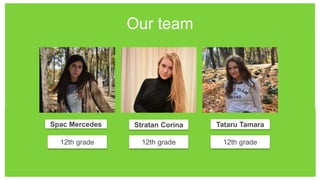
Our team
Spac Mercedes
12th grade
Stratan Corina
12th grade
Tataru Tamara
12th grade
Argument
„The greatest threat to our planet is the best belief that someone else will save it”
Deforestation is the primary effect of our mindless use of paper. Pulp and paper is
the 3rd largest industrial polluter of air, water and soil. When paper rots, it emits
methane gas which is 25 times more toxic than CO2.“ “
Deforestation is one of the main environmental problems we’re facing in these times. 42% of all
global wood harvest is used to make paper. Is it really worth it to cut down our life saving trees for
this product?
Problem statement
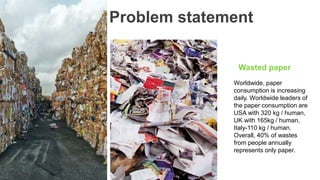
Worldwide, paper
consumption is increasing
daily. Worldwide leaders of
the paper consumption are
USA with 320 kg / human,
UK with 165kg / human,
Italy-110 kg / human.
Overall, 40% of wastes
from people annually
represents only paper.
Wasted paper
Problem statement
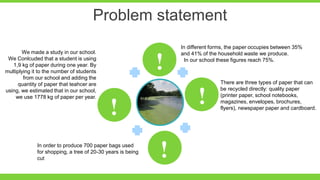
In different forms, the paper occupies between 35%
and 41% of the household waste we produce.
In our school these figures reach 75%.
We made a study in our school.
We Conlcuded that a student is using
1,9 kg of paper during one year. By
multiplying it to the number of students
from our school and adding the
quantity of paper that teahcer are
using, we estimated that in our school,
we use 1778 kg of paper per year.
!
!
!
!
!
There are three types of paper that can
be recycled directly: quality paper
(printer paper, school notebooks,
magazines, envelopes, brochures,
flyers), newspaper paper and cardboard.
In order to produce 700 paper bags used
for shopping, a tree of 20-30 years is being
cut
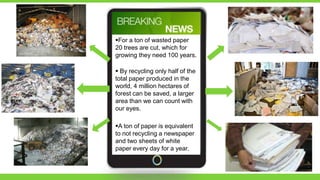
For a ton of wasted paper
20 trees are cut, which for
growing they need 100 years.
 By recycling only half of the
total paper produced in the
world, 4 million hectares of
forest can be saved, a larger
area than we can count with
our eyes.
A ton of paper is equivalent
to not recycling a newspaper
and two sheets of white
paper every day for a year.
Our solution
Following our studies, we concluded that our solution must
be one with immediate impact. The analysis of this problem
in detail and the suggestions of some experts in the forestry
field inspired us to create a project for recycling and reusing
paper in schools / offices:
Our team works on the implementation of
a social ecological project.
”HartiaEco”
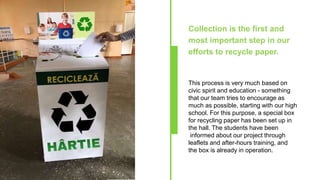
Collection is the first and
most important step in our
efforts to recycle paper.
This process is very much based on
civic spirit and education - something
that our team tries to encourage as
much as possible, starting with our high
school. For this purpose, a special box
for recycling paper has been set up in
the hall. The students have been
informed about our project through
leaflets and after-hours training, and
the box is already in operation.
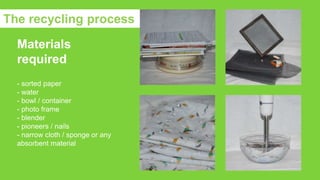
- sorted paper
- water
- bowl / container
- photo frame
- blender
- pioneers / nails
- narrow cloth / sponge or any
absorbent material
Materials
required
The recycling process
The
process
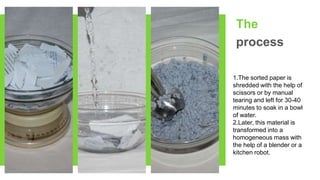
1.The sorted paper is
shredded with the help of
scissors or by manual
tearing and left for 30-40
minutes to soak in a bowl
of water.
2.Later, this material is
transformed into a
homogeneous mass with
the help of a blender or a
kitchen robot.
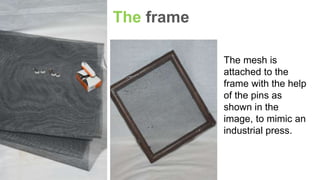
The frame
The mesh is
attached to the
frame with the help
of the pins as
shown in the
image, to mimic an
industrial press.
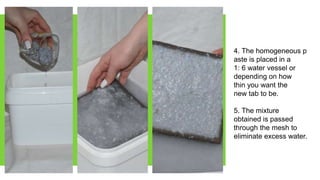
4. The homogeneous p
aste is placed in a
1: 6 water vessel or
depending on how
thin you want the
new tab to be.
5. The mixture
obtained is passed
through the mesh to
eliminate excess water.
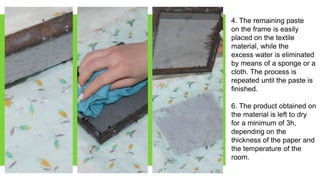
4. The remaining paste
on the frame is easily
placed on the textile
material, while the
excess water is eliminated
by means of a sponge or a
cloth. The process is
repeated until the paste is
finished.
6. The product obtained on
the material is left to dry
for a minimum of 3h,
depending on the
thickness of the paper and
the temperature of the
room.
The social part of our project consists of the implementation
of a paper recycling project within the Technological
Education discipline, the module "Artistic processing of the
paper", with the purpose of training the students with the
following competences:
• Elaboration of a useful object through the recycling of
paper.
• Use of the techniques proposed above in compliance with
the technological regulations.
Objectives
Implementation of the
project in other institutions in
the district.
Reducing the waste of paper
by re-using the stain (sheets,
notebooks).
Awakening national awareness
on this issue.
Creation of a paper recycling
workshop for both entertainment
and ecological benefit.
The ecological education of the
students during the hours of
technological education.
Involving students in solving
environmental problems.
01
02
03
04
05
06
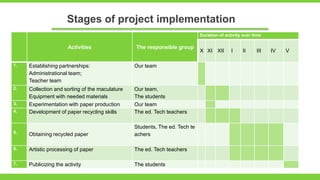
Stages of project implementation
Activities The responsible group
Duration of activity over time
X XI XII I II III IV V
1. Establishing partnerships:
Administrational team;
Teacher team
Our team
2. Collection and sorting of the maculature
Equipment with needed materials
Our team,
The students
3. Experimentation with paper production Our team
4. Development of paper recycling skills The ed. Tech teachers
5. Obtaining recycled paper
Students, The ed. Tech te
achers
6. Artistic processing of paper The ed. Tech teachers
7. Publicizing the activity The students
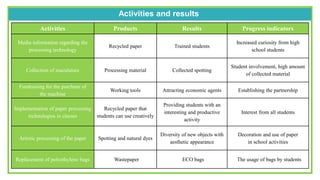
Activities Products Results Progress indicators
Media information regarding the
processing technology
Recycled paper Trained students
Increased curiosity from high
school students
Collection of maculature Processing material Collected spotting
Student involvement, high amount
of collected material
Fundraising for the purchase of
the machine
Working tools Attracting economic agents Establishing the partnership
Implementation of paper processing
technologies in classes
Recycled paper that
students can use creatively
Providing students with an
interesting and productive
activity
Interest from all students
Artistic processing of the paper Spotting and natural dyes
Diversity of new objects with
aesthetic appearance
Decoration and use of paper
in school activities
Replacement of polyethylene bags Wastepaper ECO bags The usage of bags by students
Activities and results
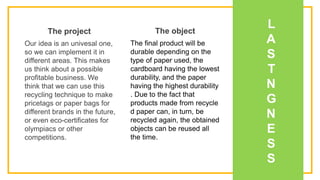
L
A
S
T
N
G
N
E
S
S
Our idea is an univesal one,
so we can implement it in
different areas. This makes
us think about a possible
profitable business. We
think that we can use this
recycling technique to make
pricetags or paper bags for
different brands in the future,
or even eco-certificates for
olympiacs or other
competitions.
The project
The final product will be
durable depending on the
type of paper used, the
cardboard having the lowest
durability, and the paper
having the highest durability
. Due to the fact that
products made from recycle
d paper can, in turn, be
recycled again, the obtained
objects can be reused all
the time.
The object
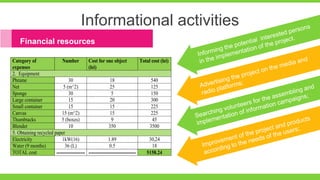
Informational activities
Financial resources
Category of
expenses
Number Cost for one object
(lei)
Total cost (lei)
2. Equipment
Phrame 30 18 540
Net 5 (m^2) 25 125
Sponge 30 5 150
Large container 15 20 300
Small container 15 15 225
Canvas 15 (m^2) 15 225
Thumbtacks 5 (boxes) 9 45
Blender 10 350 3500
5. Obtaining recycled paper
Electricity 1kW(16) 1.89 30,24
Water (9 months) 36 (L) 0.5 18
TOTAL cost ------------------ ------------------------------ 5158.24
Partners
SRL”ROZMED - PRIM”, Calarași
SRL”DORFRUCT GRUP”, s.Pitușca
SRL”SPAC - LEMN”, s.Peticeni
Coordonators:
Stratan Irina
Valeriu Gorincioi
Thank you!

F ecological project2020

  • 1.
  • 2.
    Our team Spac Mercedes 12thgrade Stratan Corina 12th grade Tataru Tamara 12th grade
  • 3.
    Argument „The greatest threatto our planet is the best belief that someone else will save it” Deforestation is the primary effect of our mindless use of paper. Pulp and paper is the 3rd largest industrial polluter of air, water and soil. When paper rots, it emits methane gas which is 25 times more toxic than CO2.“ “ Deforestation is one of the main environmental problems we’re facing in these times. 42% of all global wood harvest is used to make paper. Is it really worth it to cut down our life saving trees for this product?
  • 4.
    Problem statement Worldwide, paper consumptionis increasing daily. Worldwide leaders of the paper consumption are USA with 320 kg / human, UK with 165kg / human, Italy-110 kg / human. Overall, 40% of wastes from people annually represents only paper. Wasted paper
  • 5.
    Problem statement In differentforms, the paper occupies between 35% and 41% of the household waste we produce. In our school these figures reach 75%. We made a study in our school. We Conlcuded that a student is using 1,9 kg of paper during one year. By multiplying it to the number of students from our school and adding the quantity of paper that teahcer are using, we estimated that in our school, we use 1778 kg of paper per year. ! ! ! ! ! There are three types of paper that can be recycled directly: quality paper (printer paper, school notebooks, magazines, envelopes, brochures, flyers), newspaper paper and cardboard. In order to produce 700 paper bags used for shopping, a tree of 20-30 years is being cut
  • 6.
    For a tonof wasted paper 20 trees are cut, which for growing they need 100 years.  By recycling only half of the total paper produced in the world, 4 million hectares of forest can be saved, a larger area than we can count with our eyes. A ton of paper is equivalent to not recycling a newspaper and two sheets of white paper every day for a year.
  • 7.
  • 8.
    Following our studies,we concluded that our solution must be one with immediate impact. The analysis of this problem in detail and the suggestions of some experts in the forestry field inspired us to create a project for recycling and reusing paper in schools / offices: Our team works on the implementation of a social ecological project. ”HartiaEco”
  • 9.
    Collection is thefirst and most important step in our efforts to recycle paper. This process is very much based on civic spirit and education - something that our team tries to encourage as much as possible, starting with our high school. For this purpose, a special box for recycling paper has been set up in the hall. The students have been informed about our project through leaflets and after-hours training, and the box is already in operation.
  • 10.
    - sorted paper -water - bowl / container - photo frame - blender - pioneers / nails - narrow cloth / sponge or any absorbent material Materials required The recycling process
  • 11.
    The process 1.The sorted paperis shredded with the help of scissors or by manual tearing and left for 30-40 minutes to soak in a bowl of water. 2.Later, this material is transformed into a homogeneous mass with the help of a blender or a kitchen robot.
  • 12.
    The frame The meshis attached to the frame with the help of the pins as shown in the image, to mimic an industrial press.
  • 13.
    4. The homogeneousp aste is placed in a 1: 6 water vessel or depending on how thin you want the new tab to be. 5. The mixture obtained is passed through the mesh to eliminate excess water.
  • 14.
    4. The remainingpaste on the frame is easily placed on the textile material, while the excess water is eliminated by means of a sponge or a cloth. The process is repeated until the paste is finished. 6. The product obtained on the material is left to dry for a minimum of 3h, depending on the thickness of the paper and the temperature of the room.
  • 15.
    The social partof our project consists of the implementation of a paper recycling project within the Technological Education discipline, the module "Artistic processing of the paper", with the purpose of training the students with the following competences: • Elaboration of a useful object through the recycling of paper. • Use of the techniques proposed above in compliance with the technological regulations.
  • 16.
    Objectives Implementation of the projectin other institutions in the district. Reducing the waste of paper by re-using the stain (sheets, notebooks). Awakening national awareness on this issue. Creation of a paper recycling workshop for both entertainment and ecological benefit. The ecological education of the students during the hours of technological education. Involving students in solving environmental problems. 01 02 03 04 05 06
  • 17.
    Stages of projectimplementation Activities The responsible group Duration of activity over time X XI XII I II III IV V 1. Establishing partnerships: Administrational team; Teacher team Our team 2. Collection and sorting of the maculature Equipment with needed materials Our team, The students 3. Experimentation with paper production Our team 4. Development of paper recycling skills The ed. Tech teachers 5. Obtaining recycled paper Students, The ed. Tech te achers 6. Artistic processing of paper The ed. Tech teachers 7. Publicizing the activity The students
  • 18.
    Activities Products ResultsProgress indicators Media information regarding the processing technology Recycled paper Trained students Increased curiosity from high school students Collection of maculature Processing material Collected spotting Student involvement, high amount of collected material Fundraising for the purchase of the machine Working tools Attracting economic agents Establishing the partnership Implementation of paper processing technologies in classes Recycled paper that students can use creatively Providing students with an interesting and productive activity Interest from all students Artistic processing of the paper Spotting and natural dyes Diversity of new objects with aesthetic appearance Decoration and use of paper in school activities Replacement of polyethylene bags Wastepaper ECO bags The usage of bags by students Activities and results
  • 19.
    L A S T N G N E S S Our idea isan univesal one, so we can implement it in different areas. This makes us think about a possible profitable business. We think that we can use this recycling technique to make pricetags or paper bags for different brands in the future, or even eco-certificates for olympiacs or other competitions. The project The final product will be durable depending on the type of paper used, the cardboard having the lowest durability, and the paper having the highest durability . Due to the fact that products made from recycle d paper can, in turn, be recycled again, the obtained objects can be reused all the time. The object
  • 20.
    Informational activities Financial resources Categoryof expenses Number Cost for one object (lei) Total cost (lei) 2. Equipment Phrame 30 18 540 Net 5 (m^2) 25 125 Sponge 30 5 150 Large container 15 20 300 Small container 15 15 225 Canvas 15 (m^2) 15 225 Thumbtacks 5 (boxes) 9 45 Blender 10 350 3500 5. Obtaining recycled paper Electricity 1kW(16) 1.89 30,24 Water (9 months) 36 (L) 0.5 18 TOTAL cost ------------------ ------------------------------ 5158.24
  • 21.
    Partners SRL”ROZMED - PRIM”,Calarași SRL”DORFRUCT GRUP”, s.Pitușca SRL”SPAC - LEMN”, s.Peticeni
  • 22.
  • 23.