Async Programming in
         F#
    Zhao Jie - SNDA - June 2010
About Me
•       /        / Jeffrey Zhao /

• Programmer
• Blogger - http://blog.zhaojie.me/
• Twitterer: @jeffz_cn
• F#, Scala, JavaScript, Python, .NET, mono...
• Java (as the language) hater
What’s F#

• Languages by Don Syme, MS Research
• Strongly Statically Typed Language
• Functional Language with OO Ability
• General Purpose Language
Async programming is
     complex ...
...and will only get
more complex in the
      near future
Four Big Concurrency
     Challenges
• Shared State
• Code Locality
• I/O Parallelism
• Scaling Up
Shared State

• Difficult to maintain and test
• Very difficult to parallelize
• Locking is fundamentally error prone
 ‣ Must guess where parallelism is needed
 ‣ All consumers need to participate
Demo: Immutability
Immutability in F#

• Immutable Union     • Immutable Tuple
• Immutable Record    • Immutable List
• Immutable Set       • Immutable Map
• Immutable Objects   • Immutable ...
Code Locality

• Used to expressing algorithms linearly
• Async requires logical division of algorithms
• Very difficult to
  ‣ Combine multiple asynchronous operations
  ‣ Deal with exceptions and cancellation
Asynchronous Workflow


    async	
  {	
  ...	
  }
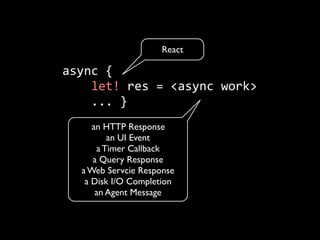
React

async	
  {


  let!	
  res	
  =	
  <async	
  work>


  ...	
  }
        an HTTP Response
            an UI Event
         a Timer Callback
        a Query Response
     a Web Servcie Response
      a Disk I/O Completion
         an Agent Message
async	
  {


  let!	
  img	
  =	
  AsyncRead	
  "http://..."


  printfn	
  "loaded!"


  do!	
  AsyncWrite	
  img	
  @"c:..."


  printfn	
  "saved!"	
  }


                                                =
async.Delay(fun	
  -­‐>


  async.Bind(AsyncRead	
  "http://...",	
  (fun	
  img	
  -­‐>


  printfn	
  "loaded!"


  async.Bind(AsyncWrite	
  img	
  @"c:...",	
  (fun	
  ()	
  -­‐>


  printfn	
  "saved!"


  async.Return())))))
Demo: Code Locality
I/O Parallelism

• Software is often I/O-bound
 ‣ Leveraging web services
 ‣ Working with data on disk
• Network and disk speeds increasing slower
• I/O resources are inherently parallel
 ‣ Huge opportunity for performance
Demo: I/O Parallelism
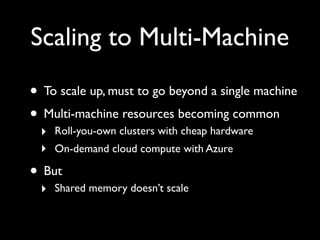
Scaling to Multi-Machine

• To scale up, must to go beyond a single machine
• Multi-machine resources becoming common
  ‣ Roll-you-own clusters with cheap hardware
  ‣ On-demand cloud compute with Azure
• But
  ‣ Shared memory doesn’t scale
... the principle we go by is, don't expect to see
a particular concurrency model put into C#
because there're many different concurrency
model ... it's more about finding things are
common to to all kinds of concurrency ...


                              - Anders Hejlsberg
Demo: Agents
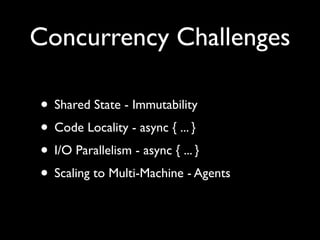
Concurrency Challenges

• Shared State - Immutability
• Code Locality - async { ... }
• I/O Parallelism - async { ... }
• Scaling to Multi-Machine - Agents
F#
• Modern, simple, powerful and productive
• Ready for production use with VS 2010
• Simplified parallel and async programming
  for today and tomorrow
• Support .NET 4.0 / 3.5 and mono
• Open Source *
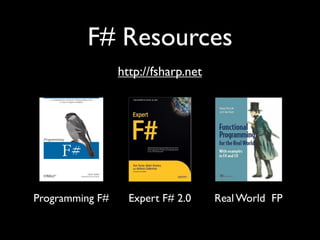
F# Resources
                 http://fsharp.net


Programming F#     Expert F# 2.0     Real World FP
Q &A
Thanks!

F#语言对异步程序设计的支持

  • 1.
    Async Programming in F# Zhao Jie - SNDA - June 2010
  • 2.
    About Me • / / Jeffrey Zhao / • Programmer • Blogger - http://blog.zhaojie.me/ • Twitterer: @jeffz_cn • F#, Scala, JavaScript, Python, .NET, mono... • Java (as the language) hater
  • 3.
    What’s F# • Languagesby Don Syme, MS Research • Strongly Statically Typed Language • Functional Language with OO Ability • General Purpose Language
  • 4.
  • 5.
    ...and will onlyget more complex in the near future
  • 6.
    Four Big Concurrency Challenges • Shared State • Code Locality • I/O Parallelism • Scaling Up
  • 7.
    Shared State • Difficultto maintain and test • Very difficult to parallelize • Locking is fundamentally error prone ‣ Must guess where parallelism is needed ‣ All consumers need to participate
  • 8.
  • 9.
    Immutability in F# •Immutable Union • Immutable Tuple • Immutable Record • Immutable List • Immutable Set • Immutable Map • Immutable Objects • Immutable ...
  • 10.
    Code Locality • Usedto expressing algorithms linearly • Async requires logical division of algorithms • Very difficult to ‣ Combine multiple asynchronous operations ‣ Deal with exceptions and cancellation
  • 11.
    Asynchronous Workflow async  {  ...  }
  • 12.
    React async  {        let!  res  =  <async  work>        ...  } an HTTP Response an UI Event a Timer Callback a Query Response a Web Servcie Response a Disk I/O Completion an Agent Message
  • 13.
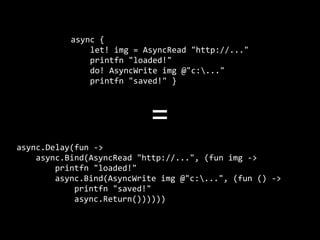
    async  {        let!  img  =  AsyncRead  "http://..."        printfn  "loaded!"        do!  AsyncWrite  img  @"c:..."        printfn  "saved!"  } = async.Delay(fun  -­‐>        async.Bind(AsyncRead  "http://...",  (fun  img  -­‐>                printfn  "loaded!"                async.Bind(AsyncWrite  img  @"c:...",  (fun  ()  -­‐>                        printfn  "saved!"                        async.Return())))))
  • 14.
  • 15.
    I/O Parallelism • Softwareis often I/O-bound ‣ Leveraging web services ‣ Working with data on disk • Network and disk speeds increasing slower • I/O resources are inherently parallel ‣ Huge opportunity for performance
  • 16.
  • 17.
    Scaling to Multi-Machine •To scale up, must to go beyond a single machine • Multi-machine resources becoming common ‣ Roll-you-own clusters with cheap hardware ‣ On-demand cloud compute with Azure • But ‣ Shared memory doesn’t scale
  • 18.
    ... the principlewe go by is, don't expect to see a particular concurrency model put into C# because there're many different concurrency model ... it's more about finding things are common to to all kinds of concurrency ... - Anders Hejlsberg
  • 19.
  • 20.
    Concurrency Challenges • SharedState - Immutability • Code Locality - async { ... } • I/O Parallelism - async { ... } • Scaling to Multi-Machine - Agents
  • 21.
    F# • Modern, simple,powerful and productive • Ready for production use with VS 2010 • Simplified parallel and async programming for today and tomorrow • Support .NET 4.0 / 3.5 and mono • Open Source *
  • 22.
    F# Resources http://fsharp.net Programming F# Expert F# 2.0 Real World FP
  • 23.
  • 24.