The third place: health care everywhere
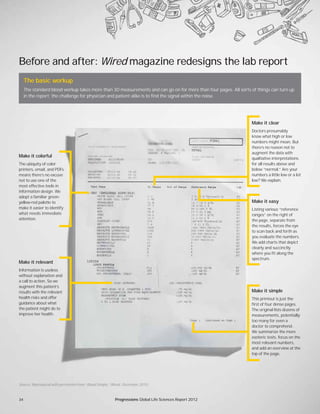
Progressions
Global Life Sciences
Report 2012
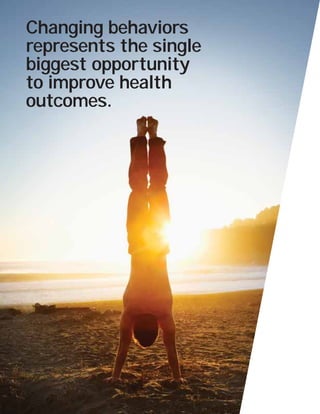
Changing behaviors
represents the single
biggest opportunity
to improve health
outcomes.
Consider these recent developments:
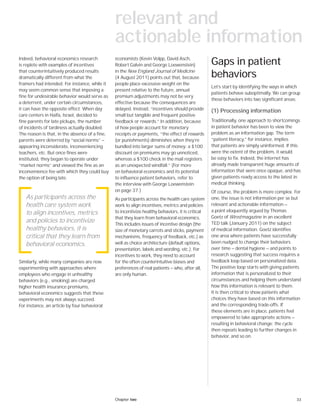
• In 2011, as the first members of America’s baby boomer
generation reached retirement age and the world’s population
crossed the 7 billion threshold, pundits and policy makers
considered the impact a rapidly aging population would have on
our planet’s scarce resources.
• In September, the United Nations General Assembly convened a
global summit on a health issue that poses an urgent and global
threat. The UN has convened such a summit only once before —
in response to the AIDS epidemic — and it’s remarkable that the
2011 summit focused not on an infectious disease pandemic, but
on the threat of “non-communicable” chronic diseases.
• That same month, the Obama Administration hired Constance
Steinkuehler as a White House senior policy analyst with a truly
unconventional mission: analyze the potential for using video
games to improve outcomes in health, education and a number
of other areas.
What do these developments have in common? They are all
indicators of the narrative we explore in this year’s Progressions.
The looming epidemic in chronic diseases, accelerated by aging
populations and increasing prosperity, is threatening to overwhelm
health care budgets and economic growth. Today — half a century
after the first polio vaccine, four decades after declaring war on
cancer, 30 years after the emergence of AIDS and the elimination of
smallpox — we have tamed the most devious scourges that humanity
has ever faced. What threatens us now is what should be the easy
stuff — controlling our diet, exercising, drinking in moderation,
taking our medicines.
Changing such behaviors represents the single biggest opportunity
to improve health outcomes while bringing costs under control.
But the “easy stuff” is far from easy. Despite concerted efforts
by policy makers, providers and payers — not to mention the best
intentions of individuals — it has been remarkably difficult to effect
behavioral change.
This year’s Progressions explores these trends and their implications
for life sciences companies. As companies find themselves in
the behavioral change business, they would do well to leverage
behavioral economics, a discipline that is rich with actionable
insights on the biases that guide our behavior and on the levers —
from the immediate feedback of social networks to the rewards of
games — that actually work. We examine behavioral economics in
Chapter 2. But this is not just about patients’ behaviors. Companies
will need to change the ways they operate as well — to significantly
extend their business models with more patient-centric value
propositions and enduring relationships with patients. Chapter 3
explores these implications and calls for courageous leaders to set
strategic direction, inspire innovation and stay the course. Lastly,
we will need behavioral change across the health care ecosystem.
In Chapter 4, we examine “collective impact” alliances, which
could help address these challenges by aligning the incentives of
individual stakeholders, creating common metrics, encouraging
cooperation and redefining and broadening the “precompetitive”
spaces where magic can happen.
This year’s Progressions builds on themes we have explored in the
“Pharma 3.0” reports of the last couple of years. But it also marks
an important departure. As we discussed these trends with our
clients, it became increasingly clear to us that they affect all of life
sciences. So we have listened to our customers and changed our
behavior: this year, Progressions is no longer just a pharmaceutical
report. It is now a report for the entire life sciences sector.
— Ernst & Young, Global Life Sciences Center
To our clients and friends
4 Progressions Global Life Sciences Report 2012
Chapter
Contents
The third place: health care everywhere 12
The next big wave: behavioral change 15
Usama Malik
Bridgewater Associates, LP
Power to the people 17
Diego Miralles, MD
Janssen Healthcare Innovation
The personal health technology revolution 19
Eric Dishman
Intel Corporation
Sensors and sensibilities 20
Stephen Oesterle, MD
Medtronic, Inc.
Listening to patients 22
Itzik Lichtenfeld, Phd
First Life Research Ltd.
Interview
From insights to outcomes 23
Glen Tullman
Allscripts
A closer look
Accessing the markets of the third place 25
Frank Kumli, PhD
Ernst & Young Ltd.
Patients: nudging patient behavior 30
Interview
Nudging the invisible hand 37
George Loewenstein, Phd
Center for Health Incentives and Behavioral Economics at the
Leonard Davis Institute
Interview
Minding patients’ preferences 38
Jerome Groopman, MD
Pamela Hartzband, MD
Harvard Medical School and Beth Israel Deaconess
Medical Center
Behavioral game changers 41
J. Leighton Read, MD
Alloy Ventures
Guiding principles for the behavioral change business 47
Introduction: the behavioral change business 6
one
two
5Contents
Business models: creative disruption 48
Bringing convenience and efficiency to health care 54
June Felix
Citigroup
A closer look
Supply chains for a patient-centric world 56
Mark Yeomans
Ernst & Young LLP
A closer look
Strategic finance drives shareholder value 63
Jeffrey Greene
Ben Perkins
Ernst & Young LLP
A closer look
Mapping strategic transformation 65
Dan Shoenholz
Michael Botos
Ernst & Young LLP
Walgreens’ strategic transformation 66
Alexandra Jung
Walgreens Health Services (formerly)
Guiding principles for business model disruption 67
The ecosystem: aligning for impact 68
A closer look
Patients for life 72
Sanjeev Wadhwa
Ernst & Young LLP
Self-care through collective impact 73
James Firman
National Council on Aging
Index of charts 76
Acknowledgments 77
Global life sciences contacts 78
three
four
6 Progressions Global Life Sciences Report 2012
ntroduction
The behavioral
change business
Progressions Global Life Sciences Report 2012
7Introduction
Introduction
The behavioral change business
In prior issues of Progressions, we
described two prominent examples
of how changing incentives and
technologies are driving behavioral
change by key stakeholders:
• Patients are being transformed into
“superconsumers.” Technologies
such as social media and smartphone
apps are empowering individuals with
transparent information and greater
control (mirroring trends in online
shopping and banking). Meanwhile,
incentives are driving patients to take
more responsibility for their health
decisions.
• Even as incentives are increasing
for evidence-based approaches,
technologies such as EHRs and social
media are creating an explosion
of data. These two developments
are enabling a trend we termed
“value mining” — the use of data
mining to make determinations
about the relative value of different
interventions.
Superconsumers and value mining are
just two examples of a larger trend that is
part of the move to an outcomes-focused
future: a relative shift in power away
from providers and manufacturers and
toward patients and payers.
The move to a world in which financial
returns will accrue to those who can best
demonstrate that they are significantly
improving health outcomes is also
creating tremendous opportunities for
companies that have historically not been
in the health business. Consequently,
non-traditional entrants — retailers,
information technology companies,
telecommunications firms, etc. — are
actively moving into the health arena.
Over the course of human history, we
have seen two big advances in health
outcomes. The first wave, beginning in
the mid-19th century, came from the
adoption of modern hygiene practices,
which sharply reduced medical infections
and improved post-surgery survival rates.
The second wave, which has lasted for
the better part of the 20th century, was
enabled by breakthrough drugs and
devices — products that have successfully
waged war on numerous diseases, from
smallpox and polio to cancer and HIV.
Today, we stand on the cusp of the third
big wave of improvements in health
outcomes — driven not just by new
products, but by behavioral change.
We are moving to a world in which more
and more emphasis will be on gathering
evidence to identify the interventions
that are most effective at improving
health outcomes, and then realigning the
behaviors of all stakeholders — patients,
providers, manufacturers and others —
around these interventions.
This transformation is being catalyzed
by the simultaneous occurrence of two
forces: the increasingly urgent need to
realign incentives and make health care
costs sustainable (particularly in chronic
diseases, where healthy behaviors such
as diet and exercise could significantly
curtail costs); and the coming of age
of game-changing technologies such
as mobile health, social media and
electronic health records (EHRs). These
two trends reinforce each other: the new
technologies are boosting efficiencies
and sustainability, while changing
incentives are reducing resistance from
stakeholders and encouraging adoption.
Background:
health outcomes and behavioral change
8 Progressions Global Life Sciences Report 2012
toward commercial model innovation.
Companies will experiment with multiple
business models through a “commercial
trials” process and through radical
collaboration with non-traditional
entrants. It will become increasingly
important to pay attention to how
companies might fit into other industries’
evolving business models.
• Connecting information. Information
is the currency of 3.0. As health care
enters the world of “big data” and
the “internet of things,” the ability to
connect disparate information from
diverse sources and extract insights
becomes a core competency and driver
of competitive advantage. Information
technology is strategy, not overhead.
• Co-creation and community
engagement. Co-creation of value
with patients, payers, providers and
partners will become a key value driver.
In social media and other communities,
pharma companies will need to engage
meaningfully with stakeholders in open
and transparent ways.
Pharma’s
perspective:
the progression of
Progressions
So far, we have written about these changes
through the lens of big pharmaceutical
companies, because this shift is particularly
compelling for big pharma, which has
been grappling with historic changes for
some time now. For the better part of a
decade, numerous forces — the patent cliff,
reduced R&D productivity, pricing pressures,
globalization and demographics — have made
the industry’s long-standing blockbuster
business model increasingly irrelevant.
These pressures drove a transition we now
refer to as the move from Pharma 1.0 (the
vertically integrated blockbuster model) to
Pharma 2.0 (today’s models based on more
diversified market portfolios and a broader
focus on bottom-line returns rather than just
top-line growth). This shift was explored in
depth in the 2006–09 issues of Progressions,
where we covered topics such as emerging
markets, drug safety, new business models
and finance transformation.
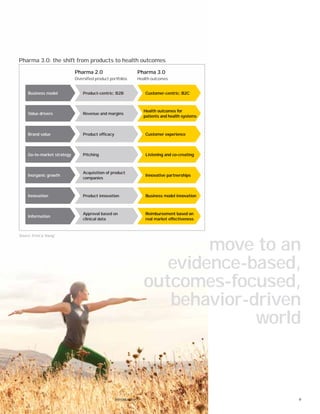
For pharma, then, the move to an evidence-
based, outcomes-focused, behavior-driven
world represents the third transformation
of its business model, one we referred to as
Pharma 3.0 in the 2010 and 2011 issues
of Progressions. In these two reports, we
highlighted several implications for pharma
companies, including:
• Business model innovation. Innovation
is no longer just about products, but
increasingly about business models.
This will require rebalancing resources
away from product innovation and
• Getting to 3.0. Lastly, getting to 3.0 will
not be automatic. It will take coordinated
change to metrics, standards, cultures
and mind-sets. To gain acceptance as
aggregators at the center of the system,
pharma companies will need to articulate
their strengths and address perceived
conflicts of interest.
Much of this thinking was summarized
in a schematic we referred to as the
“House of 3.0,” which identifies three core
competencies (connecting information
for competitive advantage, radical
collaboration and managing multiple
business models) that needed to be built
to complement companies’ 2.0 strategies,
structures and initiatives. It also lists several
business processes — from business model
development to community engagement
and ecosystem risk management — that
needed to be substantially enhanced or
built anew.
Progressions Global Life Sciences Report 2012
9Chapter one
Customer-centric; B2C
Innovative partnerships
Listening and co-creating
Customer experience
Health outcomes for
patients and health systems
Business model
Inorganic growth
Go-to-market strategy
Brand value
Value drivers
Product-centric; B2B
Acquisition of product
companies
Pitching
Product efficacy
Revenue and margins
Reimbursement based on
real market effectiveness
Information
Approval based on
clinical data
Business model innovationInnovation Product innovation
Pharma 3.0: the shift from products to health outcomes
Source: Ernst & Young.
Pharma 2.0
Diversified product portfolios
Pharma 3.0
Health outcomes
move to an
evidence-based,
outcomes-focused,
behavior-driven
world
Introduction
10 Progressions Global Life Sciences Report 2012
• Companies: motivating creative
disruption. It is time to move beyond
experimentation at the fringes. Life
sciences companies need to significantly
extend their business models with more
patient-centric value propositions and
enduring relationships with patients.
The business models of the third place
will be data-centric, behaviorally savvy,
experience-focused, holistic and revenue-
flexible. But companies will need to
move quickly — the pace of change is
accelerating, and a fast-follower strategy
is not recommended. They will need
courageous, curious and skilled change
agents to marshal the resources needed
for disruptive innovation and stay the
course through ensuing failures and
uncertainties. See Chapter 3 for more.
• Ecosystem: aligning for impact.
Health care’s stakeholders —
governments, regulators, employers,
payers, nonprofits — are aware that the
system is broken and that we need a
new system for delivering, consuming
and paying for care. In Chapter 4, we
examine “collective impact” alliances,
which have tremendous potential for
taking on such issues by developing
a shared vision, aligning incentives,
creating common metrics and more.
By shifting the understanding of the
business that companies are in, collective
impact alliances have the ability to
redefine “precompetitive” spaces and
allow for a radically improved allocation
of resources. As non-traditional players
enter health care and patients are
increasingly empowered, collaborations
with a wide range of actors can better
align interests to address some of the
most stubborn obstacles to making
health care sustainable. •
This year’s
report: health care
everywhere
As mentioned on page 7, we are in
the midst of a dual shift in power
toward patients and payers. This year’s
Progressions examines the first half of this
shift: the patient, who is both increasingly
empowered and increasingly central to
making health care sustainable.
The key to making health care sustainable is
addressing the growing challenge of chronic
diseases. These already account for 75% of
health care costs, and still the problem is
projected to escalate dramatically thanks to
demographic and macroeconomic trends.
A critical component for bringing these
costs under control will be the move to a
health care-everywhere future in which care
is more patient-centric, self-managed and
delivered in more disaggregated settings.
We refer to this as the move to health
care’s “third place” — an expansion beyond
the first two places in which care has
traditionally been delivered, the doctor’s
office and the hospital.
Once again, changing technologies and
changing incentives are playing a central
role in changing behaviors. Technologies
such as smartphone apps, sensors,
remotely connected monitors and social
media are empowering patients to manage
their care wherever they are located.
Meanwhile, payers are embracing holistic
approaches, thereby boosting incentives
for remote care, home care, preventive
monitoring and more. Models such as
accountable care organizations are also
shifting financial risk to providers — who will
have to understand patients and influence
their behaviors in order to successfully
manage this risk.
The bottom line is that to be a successful
player in the health care arena, a company
needs to be in the “behavioral change”
business. Success will in part be based
on the ability to change the behaviors
of patients, companies and the system
as a whole:
• Patients: nudging patient behaviors.
Boosting adherence, bending the cost
curve and shifting from treatment to
prevention will require dramatic shifts in
patient behavior. But patient behaviors
have so far been notoriously resistant to
change. The definition of personalized
medicine may need to be expanded — it
will no longer be just about genetics and
targeted therapies but will also involve
understanding behavior and customizing
the individual experience. In Chapter 2,
we explore how to leverage lessons from
behavioral economics — a discipline that
has come into its own in recent years
and is replete with actionable insights for
health care and other industries.
ave the ability to
petitive” spaces and
y improved allocation
on-traditional players
and patients are
wered, collaborations
of actors can better
ddress some of the
stacles to making
nable. •
11Introduction
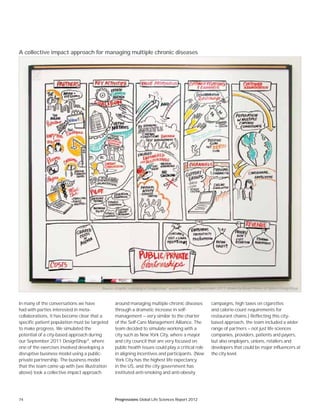
Source: Graphic recording of DesignShop®
session held on 4 January 2012, drawn by Andy Parks of Optum DesignShop.
Introduction
addressing the
growing challenge of
chronic diseases
The next wave: the third place in health care
12 Progressions Global Life Sciences Report 2012
hapterone
The third place:
health care everywhere
Progressions Global Life Sciences Report 2012
13Chapter one
Chapter 1
The third place: health care everywhere
Advancing
health outcomes,
sustainably
Over the last century or so, modern
medicine has made tremendous advances.
Building on the improvements in health
outcomes that first emerged from better
hygiene, waves of breakthrough drugs and
vaccines have alleviated the destruction
waged by once-lethal infections. Long-
standing scourges such as smallpox and
polio have been either entirely eradicated
or hounded to the edge of extinction.
Personalized medicines, sophisticated
imaging and targeted diagnostics have
reduced many cancers from near-certain
death sentences to manageable, even
curable, conditions.
Accompanying these advances — indeed,
to no small extent enabled by them — have
been tremendous improvements in the
quality of human life. We are living longer
than prior generations, thanks to improved
maternal health and the taming of childhood
and other diseases. Incomes and standards
of living have gone up, in part enabled by
the fact that healthier people are more
productive. And as nations once referred
to as “less developed” have opened their
economies and unleashed the productivity
of their citizens, these advances are
spreading to a growing number of
emerging markets.
It is somewhat ironic that one of the
biggest threats to human health (and, by
implication, to our economic security) is
that we are in danger of becoming victims
of our own success. As medical advances
have raised longevity, rising incomes have
reduced family sizes in many parts of the
world, creating demographic time bombs
as fewer workers are available to support
larger numbers of retirees and patients.
As people are living longer, the incidence
of neurodegenerative diseases such as
Alzheimer’s is expected to increase. More
broadly, we are on the cusp of a chronic
disease epidemic, as lifestyle-related
conditions such as heart disease and type 2
diabetes escalate due to aging populations
and growing prosperity in emerging markets.
The numbers are startling. Chronic diseases
account for more than 75% of health care
costs in the US. And while these ailments
are often thought of as “diseases of
affluence,” the facts suggest otherwise.
They already account for more than half of
health care costs in developing countries,
and the World Health Organization expects
that by 2020, 60% of the disease burden
from chronic diseases will occur in the
developing world.
Meanwhile, policy makers in both
developing and developed countries are
attempting to expand access to larger
segments of their populations — adding to
the pressure on costs. The end result is that
health care systems around the world are
becoming unsustainably expensive. Health
care costs, already outpacing inflation,
could crowd out other expenditures and
hurt economic growth. In the US — the
world’s largest health care market, where
health care already accounts for more than
17% of GDP — the Congressional Budget
Office has stated that “the single greatest
threat to budget stability is the growth of
federal spending on health care.”
And in China, health care reforms are
at least partly motivated by the need to
maintain social stability.
In brief
• Health care costs are becoming
unsustainable, in large part due to a
chronic disease epidemic fueled by
unhealthy lifestyles, aging populations
and increasing standards of living.
• To bring costs under control and
improve health outcomes, patients
and other stakeholders of the health
care system will need to change their
behavior.
• To enable these behavioral changes,
the epicenter of the health care system
is shifting from the two places in which
health care has traditionally been
produced, delivered, consumed and
paid for — the hospital and the doctor’s
office — to a third place: the patient.
Health care will become more patient-
centric and ubiquitous — delivered
wherever the patient happens to be.
• This shift is accelerating as changing
incentives are shifting more financial
risk to providers — who will need to
change patient behaviors to manage
this risk.
• Patients — who have grown
increasingly comfortable with
empowering technologies (e.g.,
smartphone apps, sensors, monitors,
social media) — are taking a more
active role in managing their health
and are demanding a different model
in the third place.
• Above all, the third place promises to
change the game in health care —
making costs more sustainable and
providing new opportunities for
growth and value creation.
We are on the cusp of a
chronic disease epidemic, as
lifestyle-related conditions
such as heart disease and
type 2 diabetes escalate
due to aging populations
and growing prosperity in
emerging markets.
141114111
The behavioral
change business
Given these demographic and
macroeconomic shifts and the attendant
epidemic of chronic and non-communicable
diseases, public and private payers are
increasingly focused on improving the
cost/benefit dynamics of the system — which
they can only do by emphasizing prevention
over treatment, and health outcomes over
process. To that end, we believe that the
big advances in outcomes are less likely
to come from breakthrough products
than from another source, one that is
both seemingly simple and promisingly
potent: behavioral change. As eloquently
articulated by Usama Malik in the article
on page 15, individuals’ actions will be the
single largest determinant in the health
outcome equation.
Chronic diseases are frequently referred
to as “lifestyle” diseases, for good reason.
They are often directly driven by specific
behaviors — unhealthy diet, sedentary
lifestyles, weight gain, smoking and
failing to adhere to treatment regimens.
Monitoring and changing such behaviors
could yield tremendous advances in health
outcomes while also helping to contain
costs. Preventing someone from getting
diabetes in the first place, for instance, is
not just better for the patient — it is also
far more cost-effective for the system.
Monitoring chronic diseases in real time is
a similar “win-win,” since identifying and
promptly correcting a declining health
condition (e.g., escalating blood pressure
or blood sugar) is better for patients while
also being more cost-effective than the
alternative of hospitalization. As incentives
change across the system, interventions
that succeed in understanding and
influencing behaviors — toward healthier
lifestyles, real-time monitoring, better
medication adherence and more — will have
the best shot at improving outcomes and
securing payment.
In essence, everybody engaged in health
care will inevitably find themselves in the
behavioral change business.
In essence, everybody
engaged in health care will
inevitably find themselves
in the behavioral change
business.
prevention over
treatment
Progressions Global Life Sciences Report 2012
15Chapter one
The next big wave: behavioral change
In just the last 200 years, humans have doubled life expectancy —
a measure that had barely budged in the previous 5,000 years.
This happened because of two key developments. First, better
sanitation and hygiene contributed to an enormous increase in
longevity. Second, the introduction of modern medicines and
better nutrition, starting in the early 20th century, created the
next big wave of improvements in health and life spans.
But then progress stopped. In fact, recent studies suggest that
we may be the first generation in 200 years to not outlive our
parents — life expectancy might actually drop. What changed?
A big part of the answer is that unhealthy behaviors — such as
smoking, weight gain, poor diets and stress — are exacting an
increasing toll on health outcomes and human longevity.
Going forward, therefore, progress in improving health outcomes
will be renewed by the understanding, application, codification
and democratization of behavior science and behavior
modification. Those who crack the code will not only create
abnormal growth opportunities but also positively contribute to
society in disproportionate ways.
At the center of this transformation are the natural and social
sciences’ study of the human mind and the drivers of both
rational and irrational behavior. As we gain critical knowledge, it is
conceivable that in the coming decades, we may also have some
tools to be able to predict behavior at an individual level based on
various biological and environmental markers. The hope is that
if we better understand the internal triggers (hunger, fatigue,
fear, sadness, etc.) and external stimuli (friends, communities,
environment, etc.) that drive harmful behaviors, we can construct
better incentives to steer consumers toward healthier behaviors.
Yet behavioral change is a complex process requiring significant
personal responsibility and the right balance between
paternalism and individual management of health and lifestyle
choices. Fortunately, myriad tools are available to help with this.
These could include social networks to keep us accountable
and become our cheerleaders, providers from specialists to
retail clinics that engage consumers on a personal level, and
technologies to capture data for patients to help enable healthy
routines and decisions. New incentives, such as financial,
behavioral (commitment contracts, loss aversion, etc.) and
those practices borrowed from other industries that tug on the
emotive nature of humans, can powerfully impact the way all of
us engage with our own health.
Other industries — retail, consumer products, financial services
and even airlines — have been utilizing behavioral economics
for many years, even before formal studies in the field were
widespread. There are scores of examples of powerful brands in
the consumer and retail world that have created an emotional
affinity based on quality, luxury or other elements. Meanwhile,
in the pharmacy industry, major chains such as Walgreens and
CVS have largely displaced the independent pharmacy model,
because customers value convenient access.
Another parallel with other industries is the democratizing power
of technology. From retail to air travel to brokerage, industries
that were once domains where experts and technocrats made
decisions around what consumers should be doing have been
transformed into democratic spaces where technology allows
consumers to make informed decisions for themselves. To
empower patients to change their behaviors, we need to do the
same thing in health care, and new technologies are already
making that possible.
The bottom line is that to take on the next big challenge of
changing patients’ behaviors, companies will need to change
their own behaviors as well. More than ever, life sciences firms
will need to look outside their walls for new ideas and different
approaches — and behavioral economists and customer-centric
models from other industries can provide a useful starting point.
Usama Malik
Bridgewater Associates, LP
Senior Management
16 Progressions Global Life Sciences Report 2012
These two concepts together lead to a
future that we refer to as the emergence
of health care’s third place. The term
“third place” was coined by sociologist
Ray Oldenburg, whose books The Great
Good Place and Celebrating the Third Place
argue that locations such as cafes, bars,
bookstores and barbershops are essential
for creating a sense of community. He
calls these locations our “third places,” to
distinguish them from our “first places”
(home) and “second places” (work).
Starbucks — which often uses the term
when describing its mission — is one
company that has successfully created a
technology-enabled third place for millions
of city dwellers and laptop warriors.
Starbucks’ value proposition is based
on more than its coffee — the company
has succeeded by providing a complete
community-based experience that includes
wi-fi access, food, music and more.
Third places are not just about attracting
customers to new locations. In health care,
as in many other examples, they have often
been built by going to where customers
already are. Airports, for instance, were
initially designed merely to facilitate travel.
However, it soon became apparent that
airports could be much more — and they
now include shopping malls, food courts,
nail salons, lounges and bookstores.
As health care moves into the realm of its
third place, it will be delivered in diffused
settings through telehealth, home care
and self-management by patients. To
succeed, payers, providers and life sciences
companies will need to bring increased
urgency to the challenge of extending
their business models to build lifelong
relationships with patients.
In fact, in a health care-everywhere
world where patients are empowered
by transparent information, mobile
technologies and online platforms, the
third “place” is wherever the patient
happens to be. It is both every place and
no place. For health care, the third place
is the patient.
Health care’s move to the third place is
being enabled by changing technologies
and changing economic incentives.
Ultimately, however, it is being adopted
because of its game-changing potential
to make health care more efficient and
sustainable — and thereby change the ways
value is created. We explore each of these
drivers next.
The third place:
health care
everywhere
To address the challenge of behavioral
change, the epicenter of the health care
system — how health care is produced,
delivered, consumed and paid for — will
move beyond the two places in which it has
traditionally been delivered, the hospital
and doctor’s office. This involves two
critical shifts:
1. To drive behavioral change by
patients, health care will become
more patient-centric. We are already
seeing the beginnings of this shift.
New technology platforms are
giving patients increased access to
information and greater control over
the management of their health.
Meanwhile, constituents throughout
the health care system — from
providers to payers to life sciences
companies — are attempting to better
understand the behaviors, needs and
preferences of patients.
2. Health care will be delivered in
more dispersed and disaggregated
settings — a change that could make
health care much more sustainable by
enabling more real-time monitoring,
early detection, prevention,
self-management and efficient
usage of resources.
To address the challenge
of behavioral change, the
epicenter of the health
care system — how health
care is produced, delivered,
consumed and paid for — will
move beyond the two places
in which it has traditionally
been delivered, the hospital
and doctor’s office.
The third “place” is wherever
the patient happens to be.
It is both every place and
no place. For health care,
the third place is the patient.
17Chapter one
Power to the people
Today’s health systems need to move from disease care to health
care to reduce the tremendous waste that is endemic in our
health systems. This will involve empowering patients to manage
their own health — to choose preventive actions, engage in real-
time monitoring and more.
Yet, many professionals in the health care business often think
patients cannot handle their health information. Providers, for
example, have typically guarded how much information they give
a patient and discouraged over-the-counter diagnostic tests — the
belief has been that patients would not have enough information
or expertise to make good decisions with the information, or
they would simply be overwhelmed. The result has been a
tremendously asymmetrical relationship between the providers
of health care and the consumers of health care.
In scores of other industries, consumers have been empowered
in ways that we now take for granted but which were
unimaginable at the outset. Fifty years ago, if you told anybody
in the banking industry that people could responsibly use a
machine on any street corner to gain access to their money
and conduct banking transactions, they would have been very
skeptical. They would have worried about consumers making
mistakes and falling victim to fraud.
At around the same time, if you had predicted that consumers
at gas stations would one day actually pump their own gasoline,
you would have been told that that would be incredibly
dangerous and unlikely. After all, gasoline is highly flammable
and potentially explosive.
And who would have envisioned just 20 years ago that travelers
would be able to book a trip around the world on their own —
leaving as soon as the next day — without ever needing to talk
to or meet with a travel agent? Most people would have thought
that travel arrangements are too complicated and that travelers
could not manage the information and make reservations
themselves without making mistakes, or would simply not be able
to identify the highest-quality arrangements for a given budget.
There’s a recurring theme here: when there are opportunities
to give more power to consumers, the established players
often resist on the basis that the consumer lacks the expertise
and resources to handle it. This same conflict now exists in
health care. Empowering and trusting patients with their own
information could unleash huge efficiencies in health care.
There has been a lot of discussion about consumers having
access to their own genomic data. The first thing to note here
is that the portals that have been set up are excellent — the
data is displayed in a way that is very understandable, probably
more so than the average physician’s explanation to a patient.
Also, we must remember that today, HIV and pregnancy
testing — perhaps two of the most life-changing diagnoses — are
available throughout the world over the counter, and the medical
community resisted these, as well. The evidence suggests that
consumers are much wiser and more capable of managing their
own health than is believed.
Another important way to inform patients is to bring
transparency to the health care system; this will introduce a real
marketplace. Consider what a new company, Castlight Health,
is doing to help consumers “find better quality at a lower price.”
Similar to the way shoppers can search Amazon for best buys
on consumer products, patients can use Castlight to search and
find a list of providers for a specific medical treatment, including
information on co-pays and out-of-pocket costs, as well as quality
assessments. Imagine how health care-related behaviors will
change if we enable transparency within the cost and quality of
health care — if it became easy to see that one hospital charged
$4,000 more for a procedure than another one, without any
difference in quality.
As patients are becoming more empowered, access to
information has grown. Just think about the changes we’ve seen
in the last several years — the volume of information available on
the internet and, more recently, new technologies and mobile
apps that are giving more control and information to patients.
Can the transition to this world of transparency and big data
seem overwhelming? Will patients need decision-support tools to
make sense of all this information? Absolutely. We need to help
patients navigate this new world.
But first, we need to trust them with control over their own
information and some degree of medical autonomy. This way, they
can better manage their own health and bring value to the system.
Diego Miralles, MD
Janssen Healthcare Innovation
Head
Progressions Global Life Sciences Report 2012
Changing
technologies
The health care-everywhere revolution is
being enabled by new technologies that
have the potential to take health care
delivery beyond the doctor’s office and
the hospital. From a sea of sensors to
smartphones and social media websites,
these technologies are giving health care
professionals and caregivers the ability to
serve patients in numerous settings, while
giving patients more information and more
control over managing their own health.
Smartphone apps
As we’ve discussed in prior issues
of Progressions, health and medical
apps are among the fastest-growing
categories of apps on smartphones.
There are now thousands of health apps
aimed at consumers on these platforms.
MobiHealthNews predicts that by August
2012, on the iPhone alone there will be
more than 13,000 consumer health
apps and about 6,000 apps aimed at
medical professionals.
Not surprisingly, many of these apps have
so far targeted chronic disease patients,
to enable education, healthy lifestyles,
decision support, disease management,
monitoring, analysis of data, communication
with providers and caregivers and more.
Sensors and monitors
Of course, smartphones are much more
than phones. Their real power comes
from the fact that these mobile computing
devices are packed with sensors —
cameras, microphones, accelerometers,
gyroscopes, GPS sensors. By combining
information from these sensors with the
always-connected nature of smartphones
and tablets, creative app designers have
developed countless new ways of enhancing
our daily lives. Numerous apps, for instance,
allow grocery shoppers to scan an item’s
barcode using their phone’s camera and
instantly find a lower price across the street
or a healthier selection in the next aisle.
Since many of the sensors in smartphones
are related to physical motion, they are
also enabling a slew of health-related
apps. From the RunKeeper app (which uses
GPS data to track runners’ routes, speed,
distance and altitude) to the CrunchFu app
(which uses your smartphone’s motion-
detecting capabilities to create a speaking
physical trainer for stomach crunches),
apps are ingeniously combining all sorts
of real-world data to help consumers with
exercise and more.
While smartphones have been in the
vanguard, the connected-sensor revolution
is by no means limited to these devices.
In last year’s Progressions, we talked
about health care’s move to “the internet
of things.” We continue to see plenty of
evidence of this, as embedded sensors are
transforming all sorts of everyday items
into smart, connected objects that can help
us manage our health. From smart running
shoes, bikes and watches from companies
such as Nike, Wahoo Fitness and Polar to
smart bathroom scales like the Withings
WiFi Bodyscale, sensor-enabled objects can
track distance covered, calories burned, BMI
and a slew of other statistics. Meanwhile,
Ford Motor Company is truly taking health
care everywhere by developing an in-car
health management system with numerous
partners, including Medtronic, Microsoft and
Healthrageous, to monitor vital statistics,
analyze and report data and provide
personalized healthy guidance.
But even as everyday objects are becoming
sensor-embedded and wirelessly connected —
a trend that Eric Dishman of Intel
Corporation refers to as “the medicalization
of consumer devices” — we are starting to
see medical devices evolve to become more
patient-centric and patient-empowering
(“the consumerization of medical devices”).
Progressions Global Life Sciences Report 201218
19Chapter one
The personal health technology revolution
Over the next decade, as much as 50% of health care will shift
from the hospital and clinic to the home and community. New
technologies will drive in-home care, at-workplace care and in-car
care — thereby improving prevention, detection, behavior change
and caregiver support.
A wide range of personal health technologies are coming into
their own — something we refer to as the consumerization of
medical devices and the medicalization of consumer devices.
We will increasingly conduct virtual visits with doctors, nurses
and care coaches through our cell phones, tablets and laptops.
A lot of care can be done in quick snippets — 10 seconds of
interaction with your doctor — and doesn’t require a face-to-face
visit. Cancer patients shouldn’t be sent to germ-filled hospitals for
chemotherapy. It would be far safer and cheaper for them to have
home infusion, but the current system is not set up that way.
An increasing array of diagnostics will conduct real-time
monitoring in our everyday lives. Sensors will look for changes
in how we move to detect neurological risk. Tiny implantable
devices will analyze blood chemistry in real time and let a doctor
know if our drugs are not being metabolized correctly. Not so
long ago, an ultrasound was an expensive device the size of a
cart or a room. Today, it’s quickly becoming a cell-phone-sized
device available to every primary care clinic. As the optics and
technology improve, it could soon become just another app on
a smartphone. In this future, we will no longer have to go to the
diagnostics — the diagnostics will always be available to us.
Another game changer is personalized genomics. The cost of
sequencing a genome has fallen from nearly US$100 million per
genome a decade ago to below US$5,000 today. In a few years,
I expect it to be essentially free. Some clinics will have access
to genomic computing clusters building personalized models
of their patients that doctors will use to design customized
treatments. Clinicians will need decision-support tools to make
sense of all this data and coordinate large patient populations.
Technology can play a key role in enabling behavioral change.
At Intel, we’ve conducted numerous pilots and identified 12
patient segments based on their responsiveness to different
technologies — cell phones, social media, etc. For instance, we
got a group of seniors to dramatically increase their daily walking
by combining social networking, smart pedometers, monitoring
using smart televisions, and incentives they cared about
(e.g., donating money to a preferred cause).
Financial incentives and public policy are starting to catch up. At
Intel, we track health reform in 22 countries, and we see a global
trend toward collective payment — paying groups of providers to
manage the health of a population based on value rather than
volume of procedures. This will take a decade or so to play out,
but it’s a game changer.
New roles and business models
These changes will require new roles and business models
for everyone. Patients and informal caregivers will need to be
educated to empower more remote care and self care, and
information technology and decision-support tools can play a
critical role here. Hospitals will no longer have a business model
based on filling as many hospital beds as possible. Instead,
they will have fewer beds and develop ancillary services in the
community to enable a networked continuum of care. Rather
than being segmented by disease categories, medtech will likely
reorganize into in-home or in-community technology platforms
that can serve multiple disease states. Pharma companies may
acquire new capabilities — software, IT, service delivery — and
become brokers delivering a wide range of care services around a
particular disease state and drug.
These changes will not be easy. Revolutions seldom are. But they
promise a vastly improved future — a health care system with
better quality, increased access and lower costs.
Eric Dishman
Intel Corporation
Intel Fellow and Global Director, Health Innovation
20 Progressions Global Life Sciences Report 2012
Sensors and sensibilities
Sensors and connectivity
Over its 62-year history, Medtronic has largely developed
implantable and other devices to treat patients with chronic
degenerative diseases. This will remain a high-growth market —
chronic diseases are becoming increasingly important because
of demographic shifts. But I think the biggest opportunities
for medical device companies such as ours are to enhance
our support for patients across the continuum of care — not
just treatment, but also prevention, diagnosis and disease
management — and to expand our business models into patient-
centric services that provide clear customer economic value.
With the convergence of key technologies such as IT software,
telecommunications, data processing power and low-power
technology, we can empower patients across the continuum of
care to remotely manage their devices and health. For instance,
we plan to develop implanted sensors to track blood pressure
data for patients with heart failure and warn patients that are
on harmful trajectories. We can use mobile phone technology to
monitor the blood sugar of diabetics, notify them of significant
changes and educate them on choices and implications. We are
setting up an OnStar-type call center for patients with heart
failure or diabetes where relatives or caregivers could be notified
if a patient’s condition deteriorates.
These technologies provide patients more control and autonomy
in managing their devices. Patients will probably never
reprogram certain implanted devices, such as pacemakers and
ICDs, but they are already managing and adjusting their own
spinal pain stimulators. And we are pursuing a closed-loop
system whereby our sensors will drive an insulin pump and turn it
off when a patient’s blood sugar is falling.
Bottom-line sensibilities
This isn’t just about technology. It’s also good economics — these
approaches will allow us to manage health care in more efficient
and cost-effective ways. Continuous data from wearable and
implantable sensors could improve drug adherence. It could keep
people out of hospitals by identifying patients who are trending
toward hospitalization several days in advance — truly significant
when you consider that a major consumption of health care
dollars in the US ($40 billion annually) is for hospitalized patients
with heart failure.
It’s not just the system that would save money. Hospitals would
benefit, since they are penalized for readmissions within 30
days under the new US health care reform legislation. And
manufacturers could lower the cost of servicing devices, since
programming in numerous situations — new implants, pacer
revisions, operating rooms — could be done remotely instead of
requiring site visits by service reps.
Emerging markets
In many ways, emerging markets are leading the way. Since
insurance is not very prevalent in these markets and patients
typically pay for health care themselves, we are finely attuned to
educating patients, understanding their needs and giving them
the most relevant features at an affordable price. In Beijing, we
have set up our first patient education center — a high-end, high-
touch facility, somewhat like an Apple Store, where patients can
walk in off the street and ask questions about diabetes or heart
failure.
The paucity of providers is similarly driving patient
empowerment. India has 1.3 billion people, but only 90
electrophysiologists. So we simply cannot employ the Western
model of using electrophysiology clinics to manage implanted
pacemakers and ICDs. Instead, we are making the programming,
reprogramming and follow-up of these devices much simpler,
through new systems of data transfer and analytics — providing
both clinical and economic value.
Looking ahead: empowered patients
We are only getting started down this path. Over the next
decade, we will likely see increasingly powerful and ubiquitous
mobile phones further extending a physician’s reach for people
in many parts of the world. Mobile phones will give patients more
control over programming and running implanted devices.
We are moving toward a future with smaller implantable sensors,
patient-controlled mobile devices, real-time data, remote services
that assist patients and caregivers, and more. These trends will
give forward-looking companies new opportunities and revenue
streams. And most important, they will make health care more
transparent and effective for patients and more efficient and
cost-effective for the system.
Stephen Oesterle, MD
Medtronic, Inc.
Senior Vice President for Medicine and Technology
21Chapter one
But the consumerization of medical devices
is only getting started. In two articles on
pages 19 and 20, Dishman and Stephen
Oesterle of Medtronic paint an evocative
picture of what’s ahead — and how
revolutionary it could be. Implanted and
wearable sensors for real-time monitoring
systems will alert remote caregivers or
providers, enabling timely intervention
and saving both lives and money.
Closed-loop systems could even make
adjustments and interventions themselves,
without needing action from human third
parties. Patients will have more control
over calibrating and programming their
implanted sensors and devices, giving
them greater autonomy and flexibility.
As they spread rapidly, these ubiquitous
and untiring sensors will vastly improve
key aspects of health care that are critical
for a more efficient approach to chronic
diseases — exercise, diet, prevention,
monitoring. Imagine the benefits for an
elderly patient of having an implanted
sensor monitor her blood pressure in real
time, regardless of where she is, analyze
it continuously and automatically alert the
patient, caregiver and/or nurse as needed.
The automatic, always-on, always-with-
you nature of mobile technology has the
potential to remove human weakness —
laziness about testing, inaccurate recording
of data — from the equation. Monitoring
becomes continuous. Data becomes more
accurate. Prevention becomes real.
Social media
As discussed in the last two issues of
Progressions, social media are playing a
significant role in empowering patients
with relevant information about their
conditions. Sites such as PatientsLikeMe,
AskaPatient and Healthetreatment
combine the experiences of large numbers
of individual patients, allowing them to
discuss symptoms, treatments, side effects,
statistics and personal experiences with
their peers.
The real power of a site such as
PatientsLikeMe, however, is that it doesn’t
just feature verbal discussions — patients
also enter data about their disease’s
progression on an ongoing basis, and the
site allows users to analyze this aggregated
data in meaningful ways. For instance,
patients can compare their progress against
a cohort of others with a similar profile. If
they are considering a third-line treatment,
they can chart the effectiveness of that
intervention on a relevant subset of patients
that have tried a similar treatment regimen.
The ability to aggregate and analyze data
from social media is now being taken to
the next level. In 2011, First Life Research
launched a new online platform, Treato,
that collects data from multiple social
media websites and uses natural language
processing and artificial intelligence to
identify trends. (For more on First Life
Research and Treato, refer to the article
by Itzik Lichtenfeld, the company’s CEO,
on page 22.) Sickweather, a Maryland-
based start-up, is developing an application
that can forecast regional outbreaks of
numerous indications — influenza, allergies,
ear infection, pink eye and more — by
searching for relevant discussions on social
networks such as Facebook and Twitter.
But social media can do more than provide
patients with relevant data. Since these
platforms are social by design, patients are
not just passive recipients of information.
They can interact with each other, learn
from each others’ mistakes and give each
other feedback and encouragement. This
interactivity and capacity for real-time
feedback can have a powerful effect on
behavioral change — something we discuss
in greater detail in Chapter 2.
Accompanying the proliferation in new
platforms is a rapid increase in consumers’
acceptance of and fluency with these
technologies. A growing body of surveys
continues to demonstrate that consumers
in many global markets are increasingly
comfortable using social media and the web
to access health information. As they get
a taste for the empowerment that comes
with these new technologies, patients’
expectations are changing, and we expect
they will demand even more transparency
and control. In the US, in particular, the
aging baby boomers — the original “me
generation” — will probably have very
different expectations and demand much
more personalized, convenient, in-home
care than prior generations did.
The automatic, always-on,
always-with-you nature of
mobile technology has the
potential to remove human
weakness from the equation.
Monitoring becomes
continuous. Data becomes
more accurate. Prevention
becomes real.
As they get a taste for the
empowerment that comes
with these new technologies,
patients’ expectations are
changing, and we expect
they will demand even more
transparency and control.
22 Progressions Global Life Sciences Report 2012
Listening to patients
Today, patients are participating in — literally — billions of
health-related discussions online. Yet, so far, there has been no
way to aggregate patient voices across multiple websites and
understand the bigger picture. In September 2011, First Life
Research launched its social media search platform, Treato, to fill
this gap. Treato uses “big data” technology to collect enormous
amounts of data from social media sites and, with advanced
natural language processing, analyzes this information, connects
the dots and creates the big picture of what patients are saying
about their medications and conditions. For example, we can
pinpoint the top patient concerns for virtually any FDA-approved
drug, identify drug switching patterns and unearth often-
surprising insights on side effects and off-label use.
Just two months after our launch, we had analyzed more than
1 billion posts. This is the first time that the social health web
has been indexed on such a massive scale. The Treato site
currently covers 13,000 conditions and 11,000 medications,
with information aggregated and categorized in an easy-to-
understand format.
We believe the site will revolutionize how stakeholders share
information and make health care decisions. Treato’s insights
stem from real-life patients and their real-time experiences. By
providing access to our knowledge base, we are empowering
stakeholders along the health care value chain — certainly
patients, but also physicians, health maintenance organizations,
life sciences companies and others — to better understand
patients and their experiences.
A patient-centric business model
Currently, our business model is built on offering a completely
free-of-charge, and free-of-ads, service. We will generate revenue
by developing partnerships with entities along the health care
value chain that have a constant need to understand patient
motivations — for example, pharma companies, HMOs,
drug-related research groups, and insurance and financial
companies. We will provide them with in-depth analytics
and tracking capabilities to better leverage the power of this
information.
Our value proposition is based on patient centricity. Ultimately,
patients know best how they react to the medications they have
been taking. With access to the experience of other patients,
site users can better understand how to navigate their medical
conditions and their medications. Also, if they are considering
switching brands, they can easily compare competing
medications. Access to this information empowers not only
patients to manage more of their health care themselves but
also physicians and drug companies to hone their focus on
patient-centric care.
Listening to your customers
Treato offers the opportunity for life sciences companies to
better understand the effectiveness, side effects and interactions
of their products. Even though the industry has invested
considerable time and effort in rigorous clinical trials, results are
typically limited to a sample size of a few hundred or a thousand
subjects at best. Consequently, when a product hits the market,
many side effects are unknown. We are providing, in essence, the
world’s largest focus group.
Today, strong currents are shifting the life sciences industry
in new directions. Personalized medicine is tailoring medical
treatment to the genetic profile of the individual patient. At the
same time, technology platforms such as Treato are leveraging
the “wisdom of crowds” to provide more meaningful real-time
data on patient experiences with medical interventions. These
trends will reinforce each other, accelerating the move to
micro-targeted health care. This should increase the efficacy of
products and reduce side effects — leading to better outcomes for
patients and a more efficient health care system for all.
Itzik Lichtenfeld, PhD
First Life Research Ltd.
Co-founder and Chief of Innovation
leveraging the
“wisdom of crowds”
iences Report 2012
23Chapter one
From insights to outcomes
Ernst & Young: How is Allscripts positioned as health care
systems focus increasingly on health outcomes?
Tullman: Today, many industry observers have a negative
assessment of health care delivery, believing that — with costs
higher and quality lower — we are at the beginning of the end of
health care as we know it. At Allscripts, we see things differently.
To paraphrase Sir Winston Churchill, we believe we are at the
“end of the beginning.” In our view, we’re in the first stages of
enormous innovation and progress, similar to the days when the
internet was just starting to take hold.
We are rapidly moving from not having enough information to
having too much. For information to be useful, it will need to
be radically simplified and presented in a way that health care
providers can use to truly improve patient care, at the right point
in the care process.
Allscripts is today one of the largest providers of electronic
health records (EHRs) in the United States. The fact that we have
solutions across the entire continuum of care — which means
physician offices, hospitals and post-acute care — positions
Allscripts to deliver the insights that will lead to better health
outcomes. It’s a concept we call “insights to outcomes,” or i2O.
We are focusing on i2O to promote adoption and meaningful use
of EHRs, delivering real, actionable insights to physicians and
caregivers at the point of patient care. It is these insights that
will drive better clinical and financial outcomes — and ultimately
usher in a new age for health care. We believe that health care is
fundamentally an information business, which is different from
many of our competitors who simply want to sell software.
Ernst & Young: How important is patient centricity in your
company’s strategy and approach?
Tullman: Patients are indeed taking more control over their
health, getting better information up front to stay healthy. The
challenge is, how can they best interact with the health care
system to make sure they are understood? At Allscripts, we
have developed a series of patient-focused information tools
and offerings. For example, we have partnered with Intuit to
codevelop and distribute a patient health portal. On the financial
side, patients can connect with their physicians and conduct
almost all their business electronically, from registering for
appointments to paying bills. On the clinical side, they can
receive follow-up information directly from their physicians (for
example, lab results) without having to call. Also, our systems
are being used more and more in environments that enable
physicians to provide telehealth and telemedicine. These patient-
centric technologies, in their ability to engage patients clinically
and financially, and to create highly efficient processes, are key
to our future strategy and to the future of health care delivery.
Ernst & Young: What is your prognosis for meaningful
adoption of EHRs?
Tullman: We view the federal government’s stimulus plan for EHRs
as an intelligently designed policy initiative. It offers incentives to
providers not only to purchase the technology for EHRs but also
to use the technology to produce quality data that demonstrates
they are actually improving care. Adoption is increasing, physician
behavior is changing, and we’re seeing the beginning of substantial
improvements in quality and efficiency.
Within this decade, we expect the health care industry will be fully
automated. The banking industry provides an interesting parallel.
When ATMs were introduced, they were disconnected networks.
We had to search for an ATM that would accept our cards. Now we
can go virtually anywhere in the world, use almost any machine,
and in a few seconds, withdraw cash in any currency we want.
Eventually, we will be able to go anywhere in the world and access
our health information. Just as we are unlikely to choose a bank
that doesn’t have an ATM network, we will be unlikely to choose a
physician who doesn’t use EHRs that are connected to the network.
Ernst & Young: What might health care look like 10 years
from now?
Tullman: As the British futurist Arthur C. Clarke said, “any
sufficiently advanced technology is indistinguishable from magic.”
The disconnected health care system of the past will soon be a
relic, and the new norm will be a highly accessible, interactive
and bidirectional information system. We’ll see an explosion of
innovation in health care apps, just as we saw when the internet
finally connected us. Information technology is the singular tool
that has enabled us to prosper in every other industry. Health care
is our last frontier, and what will change over the next decade, in
my view, is everything.
Glen Tullman
Allscripts
CEO
health care is fundamentally
an information business
24 Progressions Global Life Sciences Report 2012
Changing incentives
Even as new technologies are rapidly
emerging that could take health care into
the third place, changing incentives are
increasing the attractiveness of more
dispersed and patient-centric approaches.
Systemic reforms
In response to the challenge of escalating
costs, payers and policy makers globally are
experimenting with different solutions to
make health care more sustainable. Despite
the diversity of approaches in key markets
around the world, these reforms typically
have some combination of a couple of
key characteristics:
Holistic care. A key reason for cost
inflation is that health care delivery is
fragmented and inefficient. Providers
often do not coordinate care well with each
other, much less with other parts of the
system. Care is fragmented across time as
well — for example, when patients change
jobs, carriers or doctors. To fix this, most
solutions attempt to encourage a more
coordinated approach across organizational
silos and over time. And they frequently
encourage a more central role for primary
care physicians, since these doctors could
play a critical role in coordinating care.
Payment reform and risk sharing. Payers
are also gravitating to approaches that
pay for quality and outcomes rather than
quantity and procedures — value instead
of volume. A common element in many of
the pilots is the transfer of more financial
risk to providers and/or patients. By doing
this, payers are seeking to address a key
structural problem driving cost inflation: the
mismatch between incentives and
influence. In most industries, the customer
makes purchasing decisions, consumes the
product or service purchased and pays for
the purchase. In health care, however,
these three functions are performed by
different segments:
• Providers make purchasing decisions but
have little incentive to influence cost in a
fee-for-service environment.
• Patients, the ultimate consumers of
health care, are theoretically in an ideal
position to influence health care costs by
adopting healthy behaviors and having
a say in their treatment. However, in
developed markets, they have had little
incentive to behave differently, since
they are often shielded from the financial
impact of purchasing decisions by
subsidized health insurance and relatively
small co-payments. Compounding the
challenge, they have historically not had
access to transparent information on
price and quality.
• Payers and/or employers, on the other
hand, have every incentive to lower
health care costs but historically haven’t
had a lot of influence over purchasing
decisions and patient behaviors, since
they are somewhat separated from the
actual delivery of health care.
The bottom line is that the parties with
influence over health decisions and
behaviors have had little incentive to
seek efficiency, while those with the
incentive have had little influence. To fix
this fundamental mismatch, payers are
experimenting with reforms that seek to
share financial risk with providers. Under
capitation approaches, for instance, payers
pay providers a fixed sum to cover an
individual for a specific period of time.
Similarly, bundled payments (also known as
episode-based payments) are approaches
in which payers constrain payments based
on expected costs for clinically defined
episodes of care. There are also measures
under way to shift more of the risk directly
to patients, such as charging higher
premiums to employees who smoke or
engage in other unhealthy behaviors.
Multiple models
The drive to encourage more coordinated
care and transfer financial risk is playing out
with a new sense of urgency through visible
reform models currently being rolled out.
In the US, for instance, there is a focus on
accountable care organizations (ACOs) — a
model under which a group of coordinated
providers is responsible and rewarded for
holistically managing the quality, cost and
care of a group of patients. Another model
that has been getting attention is the
patient-centered medical home (PCMH), an
approach that emphasizes comprehensive
care, including an ongoing relationship with
a personal physician across all stages of a
patient’s life and coordination with various
providers.
The bottom line is that
the parties with influence
over health decisions and
behaviors have had little
incentive to seek efficiency,
while those with the incentive
have had little influence.
25Chapter one
a closer lookAlready, there are numerous examples of
entities experimenting with such models.
Insurance giant UnitedHealthcare is piloting
an episode-based payment model for
cancer with five medical oncology groups
across the US. The Merck Foundation and
Camden Coalition of Healthcare Providers
are converting 10 primary care practices
into PCMHs in New Jersey. And Aetna has
launched pilots in Connecticut and New York
to pay physicians to make house calls.
Meanwhile, in the UK, reforms proposed
by the current government would abolish
“primary care trusts” (public sector entities
that provide services on behalf of the
National Health Service) and transfer their
funding to groups run by primary care
physicians. These clinical commissioning
groups (CCGs) will give doctors more control
over the budget and responsibility for
arranging care for their patients.
All reforms lead to the third place
The reform measures described above
increase the imperative to make health
care delivery more ubiquitous and
patient-centric. Models that call for more
holistic health care delivery, for instance,
will increase the impetus for remote
care, preventive monitoring and more.
Meanwhile, payment regimes that shift
financial risk to providers will require them
to efficiently improve patient outcomes
to manage that risk — driving them to get
closer to patients and understand how to
change their behaviors.
The fact that payers are encouraging
more patient-centric approaches will also
have implications for the ways in which
companies approach market access. (For
more on this subject, see the article by
Frank Kumli to the right.)
The political debate around health care
reform can be volatile and unpredictable,
but regardless of the vagaries of public
opinion and policy making, the third place
is increasingly inevitable, for the simple
reason that it promises huge boosts in
efficiency and sustainability.
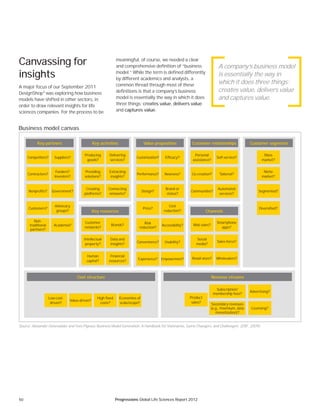
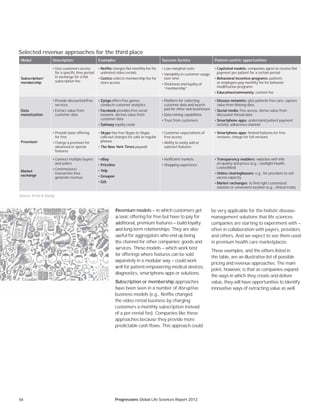
As pricing pressures mount and payers look for ways to bring health care costs under
control, life sciences companies’ focus on market access — their strategy and approach for
entering and maintaining a presence in the market — has become increasingly critical.
Health care’s move to the third place raises a number of questions around market access.
How does the increase in patient centricity affect the traditional relationship with payers?
What does market access mean in a patient-centric world? And, more broadly, how does
market access need to change as the focus moves from traditional products to health
outcomes that are delivered with the involvement of multiple stakeholders?
Understanding and working closely with patients has always been critical to market access,
and this will only become more important in the third place. For instance, the companies
most likely to succeed in many risk-sharing agreements (e.g., approaches in which firms
only get paid for patients responding to their treatments) are those armed with personalized
medicine approaches to target the most responsive patients. This understanding of patients
will need to extend beyond genomic factors to include behavioral and environmental
determinants of health outcomes.
More broadly, a successful approach to market access requires understanding the factors
that are most valued by the key stakeholders in each local market — payers, providers,
patients, policy makers, etc. These “value dimensions” need to be integrated back
throughout the value chain to shape decision-making, as early as in drug or business model
development through to the launch and life cycle management phases. And they need
to be further segmented to account for variance across geography, therapy areas and
position in the product’s life cycle — to allow companies to better understand and influence
key stakeholders. In the third place, as patients become more empowered and involved in
their own care, understanding their needs and values will become increasingly imperative.
Understanding the local enabling infrastructure becomes critical when new business models
rely on social media platforms, electronic health records, telecommunications networks or
wireless networks. It is essential to understand the level of deployment of the infrastructure
in place, how it will evolve, who the key stakeholders are and what the associated
regulations are (e.g., on data privacy).
Based on this in-depth understanding, effective interaction strategies need to be developed
with an overarching goal of building positive and sustainable relationships. Points of
interaction must be considered along patient pathways beyond interacting directly with the
health care patient, to areas such as building disease awareness and interacting closely with
patient organizations or key opinion leaders.
A third-place approach to market access will also require a more comprehensive shift on
the part of payers. Most payers are still focused on products rather than outcomes. While
there are some pockets of change (e.g., accountable care organizations in the US), payers
have not broadly adopted processes and metrics to measure and reward new models that
improve health outcomes through a combination of products and services. Life sciences
companies and their associations must engage critical stakeholders — from payers to policy
makers, health care providers to patient organizations, technology players to retailers — in
codeveloping relevant processes and metrics.
The ultimate goal is an agreement with payers on the listing, pricing and reimbursement of
the product or product-service combination. As service components are added to the business
model, complexity increases, but also new opportunities arise, expanding the range of possible
agreements beyond pricing or risk-sharing schemes to health management and capitation.
Frank Kumli, PhD
Ernst & Young Ltd.
Accessing the markets of the third place
26 Progressions Global Life Sciences Report 2012
• Personalization everywhere. In recent
years, we have seen more life sciences
companies adopt personalized medicine
approaches. It’s easy to appreciate
why — the widespread use of targeted
therapeutics and companion diagnostics
could completely revolutionize health
care. Using biomarkers to identify
subpopulations that are most likely to
respond to targeted drugs has enabled
significantly more efficacious treatment
regimens for several types of cancer.
Similarly, the early identification of
biomarkers has the potential to make R&D
considerably more focused and efficient.
Yet, these approaches only go so far.
After all, genetic factors are not the only
determinants of disease — behavioral and
environmental factors play a significant
role. The patient-centric approaches of
the third place now have the potential
to take personalized medicine beyond
genetics and into the realm of behavior
as well. And just as genetic personalized
medicine promises to make the process
of drug innovation more productive
and efficient, behavioral personalized
medicine has the potential to do the
same for both product and business
model innovation.
At a time of patent expirations and
mounting pricing pressures, finding growth
opportunities has become increasingly
challenging. The good news is that the third
place will not be a shrinking market, but
rather a growing one. The transition will
not always be easy, but once companies
are comfortable delivering in the third place
and the health care system is more aligned
around wellness and prevention, the market
should expand dramatically.
Changing the game
Here are some ways in which health care’s
move to the third place could make the
system radically more efficient, sustainable
and valuable to all stakeholders:
• Efficient resource usage. By definition,
boosting efficiency involves increasing
output per unit of input. In other sectors
of the economy, this has often been
achieved through specialization (e.g.,
international trade and modern supply
chains), which puts each resource to its
highest and best use, as well as through
technology, a force multiplier that allows
each worker to produce more output.
Third-place technologies and
specialization have the potential to
increase efficiency across the spectrum
of health care delivery. As we move to
an outcomes-focused system, one of
the scarcest resources in health care will
be the primary care physician. These
doctors are already in short supply in
many markets, and they will be even
more critical in the future.
Third-place technologies have
tremendous potential to allow primary
care physicians to take on an expanded
role. Instead of being limited by the
number of in-person appointments a
workday can accommodate, doctors
will be able to use remote-care
technologies to interact with larger
numbers of patients as well as relegate
routine monitoring to new generations of
real-time sensors. As more coordinated
care is encouraged by health care
reform models, a wider spectrum of
medical professionals — registered
nurses, medical assistants, pharmacists
and others — can take over more of the
lower-risk tasks currently performed by
primary care physicians, freeing doctors
for higher-value work. As an example of
this, Walgreens’ new strategy will enable
pharmacists to spend more time working
up to the level of their license.
(See the article by Alexandra Jung on
page 66 for details.)
• Transparency. Efficient and competitive
markets thrive on transparent
information. Platforms such as social
networks, educational websites and
smartphone apps are making all sorts
of health information more accessible
and transparent for patients. This trend,
coupled with changing incentives that
bring patients closer to the economic
consequences of their actions, should
drive health care’s ultimate customers to
make more optimal choices.
• Coordination and prevention. The move
to the third place will bring different
incentives and new technologies to
enable more focus on prevention and
coordinated models for care. Such
holistic approaches promise to make
health care much more sustainable and
efficient, since prevention, real-time
monitoring and timely intervention
are typically many shades more
cost-effective than treatment or
hospitalization.
• Increased access. Policy makers in many
key markets are attempting to expand
access to more of their citizens even as
they grapple with the need to bring costs
under control. These two contradictory
impulses can only be reconciled if health
care becomes much more efficient. Third-
place technologies and approaches will
directly expand access for underserved
patients (e.g., in rural areas and
developing countries) through telehealth
and mobile health offerings.
Third-place technologies
have tremendous potential
to allow primary care
physicians to take on an
expanded role.
The patient-centric
approaches of the third place
now have the potential to
take personalized medicine
beyond genetics and into the
realm of behavior.
27Chapter one
Getting ready for
the third place
In the final analysis, three facts stand out.
First, health care as presently delivered is
unsustainable. Second, we are witnessing
an explosion of third-place technologies
and platforms that could radically boost
sustainability and outcomes. And third,
health care “superconsumers” will
increasingly demand more personalized
approaches. Against those three trends,
much of the back-and-forth of health care
reform — the details of individual models,
the unpredictability of the political debate —
is just so much background noise. One way
or the other, health care is moving to the
third place. As a society, we cannot afford
for it not to.
This raises some key questions for life
sciences companies. First, if companies’
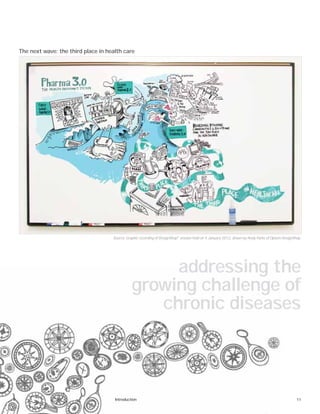
success will increasingly hinge on their
ability to influence patient behaviors, how
can they succeed in this endeavor? After
all, despite heartfelt motivation and ample
information on healthy diet and exercise,
patients are often simply unable to change
their ways. The problem is that they have
inherent decision-making biases that
often prevent them from changing their
behaviors. To succeed in the third place,
therefore, it will be critical for companies to
understand how patients think and design
offerings that account for human biases.
These issues are explored in considerable
depth in Chapter 2, where we draw on
behavioral economics, a field that is rich in
actionable insights.
But the third place is not just a new
place — it’s an entirely new way of business.
Companies that have always sold products
or services will now find themselves in
the business of changing behaviors and
delivering outcomes. They will consequently
need to shift from a product-centric,
business-to-business focus to one that is
customer-centric and business-to-consumer.
The value of companies’ brands will be
determined not just by product efficacy but,
more importantly, by customer experience.
All of this raises a second critical question:
how can companies change and extend
their business models to enter entirely new
lines of business and be at the front lines as
new markets are created? How can leaders
become change agents — marshaling
resources and staying the new course
to create the market of the future? It’s a
challenging task — many great companies
foundered because they saw the trends
but were unable to change their business
models in time. In Chapter 3, we draw
insights from other industry sectors that
have undergone similar shifts and offer a
path forward.
Lastly, success will also involve coordinated
change and collective intent with other
constituents of the health care ecosystem.
Successfully influencing patient behaviors
will require bringing together drug and
device companies, providers, patients and
others. It will involve synchronization with
One way or the other, health
care is moving to the third
place. As a society, we cannot
afford for it not to.
payers to develop meaningful incentives
and payment mechanisms. It will even
involve rethinking what is precompetitive.
In Chapter 4, we discuss how companies
develop a coordinated approach to change
by using the mechanism of collective
impact alliances.
Although the third place might seem
futuristic and improbable to some today,
it is instructive to see how the forces of
technological, demographic, political and
social change over the last half century
have transformed what was essentially
a chemical sector into the life sciences
industry of today. At a DesignShop®
that we
hosted in September 2011 with industry
executives to validate some of our ideas for
this year’s report, we took a look at “the
history of the future” — charting trends that
got us to today’s health care system and
identifying what might lie ahead. It’s been
an incredible journey so far, and it’s starting
to get even more interesting.
Welcome to the third place. •
3rd
from product-centric
to customer-centric
Progressions Global Life Sciences Report 201228
The history of the future
29Chapter one
Source: Graphic recording of DesignShop®
session held on 27 September 2011, drawn by Drew Dervanich of Optum DesignShop.
30 Progressions Global Life Sciences Report 2012
haptertwo
Patients: nudging
patient behavior
Progressions Global Life Sciences Report 2012
31Chapter two
Chapter 2
Patients: nudging patient behavior
In the US, as many as 50% of prescriptions
are never filled, and only 25%–30% are
taken properly. The Center for Health
Transformation estimates that non-
adherence leads to $290 billion in direct
and indirect health care costs annually —
an astonishing 13% of total US health care
expenditures. Unhealthy lifestyles cost
health systems across the world billions
more. In the US, obesity increases costs by
$215 billion annually. Smoking costs the
UK health system £6.6 billion–£7.4 billion
a year. Alcohol abuse costs the European
Union €125 billion a year.
In each of these cases, simple behavioral
changes by individuals could save health
care systems enormous sums of money.
These changes will also be increasingly
important for companies looking to play
in the behavioral change business. Yet,
these seemingly minor adjustments, while
perfectly obvious, remain elusive, and
these behavior-related problems have
stubbornly resisted attempted fixes
for decades. To understand why — and
identify solutions that might finally tackle
these persistent challenges — we turn to
behavioral economics.
In brief
• Getting patients to adopt healthy
behaviors represents a tremendous
economic opportunity for life sciences
companies and health care systems,
but this has been extremely difficult
despite patients’ best intentions.
• Behavioral economics demonstrates
that the reason people fail to make
behavioral changes is that they have
predictable biases that affect decision-
making. Leveraging the science of
behavioral economics to understand
human biases allows companies
to construct incentives and create
products/services that are far more
likely to succeed.
• To help patients adopt healthy
lifestyles, companies can use
behavioral economics levers through
technologies, social networks,
gamification and contracts. A number
of pilots and start-ups have creatively
combined multiple behavioral levers
to achieve significant improvements
in household savings, drug adherence,
weight loss and exercise.
• To help patients process information
in areas where there is considerable
uncertainty and an overabundance
of data, companies need to focus on
communicating in clear and neutral
ways. Individual preferences will need
to be kept in mind, instead of aiming
for a one-size-fits-all solution.
• We offer five guiding principles for
companies in the behavioral change
business:
1. Communicate clearly
2. Account for individuals’
preferences
3. Learn from behavioral economics
4. Experiment and be flexible
5. Extend your business model
32 Progressions Global Life Sciences Report 2012
We’re only human
Over the last decade or so, a remarkable
revolution has swept the field of economics.
When Daniel Kahneman won the 2002
Nobel Prize in economics, many were
surprised to learn that the laureate was not
an economist but a professor of psychology,
one who, by his own admission, had never
taken an economics course.
A few years later, when several books
on relatively obscure academic matters
became worldwide bestsellers that were
translated into scores of languages, it was
noteworthy that the authors wrote about
similar topics but came from very different
disciplines. Stumbling on Happiness, for
example, was written by Daniel Gilbert,
a professor of psychology; Predictably
Irrational was authored by psychologist/
marketing scientist Dan Ariely; and Nudge
was written by economist Richard Thaler
and legal scholar Cass Sunstein. These
bestsellers succeeded in capturing the
public imagination because they led readers
to question matters as fundamental as
how well we know our own minds, how
capable we are of making decisions that are
in our best interests, and even how valid
our often unblinking faith in free markets
is. The questions these books explore —
originally seeded by the work of Kahneman
in the 1970s — are the realm of behavioral
economics, which lies at the intersection of
psychology and economics. Traditionally,
microeconomic theory has assumed that
individuals are rational actors — i.e., they
behave in ways that balance costs against
benefits to maximize utility or personal
advantage. In recent years, behavioral
economists have shown repeatedly that this
basic tenet — the foundation for decades of
economic theory — is fundamentally flawed.
We are irrational in multiple ways, because
of inherent biases that prevent us from
making utility-maximizing decisions.
We have a status quo bias that leads us
to passively accept the default option
rather than actively seeking the option
that would maximize our utility — and so
participation rates for everything from
retirement accounts to organ donations
differ dramatically depending on whether
the default option on enrollment forms is
an “opt out” or an “opt in.” A bias for the
present leads us to excessively discount
large payoffs in the future (e.g., a secure
retirement, a longer and healthier life),
even relative to small sacrifices today
(e.g., saving and exercising). We tend
to exaggerate small probabilities, which
is why lotteries are a booming business
(and the joke about a lottery being a tax
on people who are bad at math may have
empirical validity). Meanwhile, the well-
documented loss-aversion bias means that
the displeasure from losing $100 is much
more than the pleasure experienced from
gaining $100 — something that is visible in
everything from how investors respond to
stock market losses to how players make
bets on Who Wants To Be A Millionaire?
What makes behavioral economics a
rich source of potential solutions, rather
than a disheartening inventory of human
shortcomings, is the fact that these biases
are systematic and unidirectional. To
paraphrase the title of Ariely’s book, we
are irrational, but predictably so. And the
predictability of our biases means that we
can correct for them. Indeed, our biases
are already being exploited to work against
us — for instance, in the ways companies
advertise their products and price their
wares, which are frequently designed to
entice us to bad decisions. What if health
care could turn that model on its head?
What if key constituents — companies, policy
makers, payers — could align their interests
with patients and create mechanisms that
use these biases not to exploit patients but
to “nudge” them toward better behaviors
and outcomes?
These are particularly relevant questions
for today’s rapidly changing health care
ecosystem. As we pointed out in Chapter 1,
many of the biggest health outcome
improvements in the future will come
from behavioral change. Incentives
are already changing to better align
institutional interests with those of patients.
Stakeholders across the system — from
payers and providers to employers and
product companies — are developing
programs and technologies that encourage
and enable healthy behaviors. But they are
not always successful. For instance, when
a primary care trust in the UK offered cash
payments to volunteers who signed up for
a year-long “Pounds for Pounds” trial in
2009, only a quarter of participants finished
the course, and two-thirds failed to reach
their weight loss targets.
We are irrational, but
predictably so. And the
predictability of our biases
means that we can correct
for them.
33Chapter two
Indeed, behavioral economics research
is replete with examples of incentives
that counterintuitively produced results
dramatically different from what the
framers had intended. For instance, while it
may seem common sense that imposing a
fine for undesirable behavior would serve as
a deterrent, under certain circumstances,
it can have the opposite effect. When day
care centers in Haifa, Israel, decided to
fine parents for late pickups, the number
of incidents of tardiness actually doubled.
The reason is that, in the absence of a fine,
parents were deterred by “social norms” —
appearing inconsiderate, inconveniencing
teachers, etc. But once fines were
instituted, they began to operate under
“market norms” and viewed the fine as an
inconvenience fee with which they could buy
the option of being late.
Similarly, while many companies are now
experimenting with approaches where
employees who engage in unhealthy
behaviors (e.g., smoking) are charged
higher health insurance premiums,
behavioral economics suggests that these
experiments may not always succeed.
For instance, an article by four behavioral
economists (Kevin Volpp, David Asch,
Robert Galvin and George Loewenstein)
in the New England Journal of Medicine
(4 August 2011) points out that, because
people place excessive weight on the
present relative to the future, annual
premium adjustments may not be very
effective because the consequences are
delayed. Instead, “incentives should provide
small but tangible and frequent positive
feedback or rewards.” In addition, because
of how people account for monetary
receipts or payments, “the effect of rewards
(or punishments) diminishes when they’re
bundled into larger sums of money: a $100
discount on premiums may go unnoticed,
whereas a $100 check in the mail registers
as an unexpected windfall.” (For more
on behavioral economics and its potential
to influence patient behaviors, refer to
the interview with George Loewenstein
on page 37.)
As participants across the health care system
work to align incentives, metrics and policies
to incentivize healthy behaviors, it is critical
that they learn from behavioral economics.
This includes issues of incentive design (the
size of monetary carrots and sticks, payment
mechanisms, frequency of feedback, etc.) as
well as choice architecture (default options,
presentation, labels and wording, etc.). For
incentives to work, they need to account
for the often counterintuitive biases and
preferences of real patients — who, after all,
are only human.
As participants across the
health care system work
to align incentives, metrics
and policies to incentivize
healthy behaviors, it is
critical that they learn from
behavioral economics.
Gaps in patient
behaviors
Let’s start by identifying the ways in which
patients behave suboptimally. We can group
these behaviors into two significant areas:
(1) Processing information
Traditionally, one approach to shortcomings
in patient behavior has been to view the
problem as an information gap. The term
“patient literacy,” for instance, implies
that patients are simply uninformed. If this
were the extent of the problem, it would
be easy to fix. Indeed, the internet has
already made transparent huge amounts of
information that were once opaque, and has
given patients ready access to the latest in
medical thinking.
Of course, the problem is more complex. For
one, the issue is not information per se but
relevant and actionable information —
a point eloquently argued by Thomas
Goetz of Wired magazine in an excellent
TED talk (January 2011) on the subject
of medical information. Goetz identifies
one area where patients have successfully
been nudged to change their behaviors
over time — dental hygiene — and points to
research suggesting that success requires a
feedback loop based on personalized data.
The positive loop starts with giving patients
information that is personalized to their
circumstances and helping them understand
how this information is relevant to them.
It is then critical to show patients what
choices they have based on this information
and the corresponding trade-offs. If
these elements are in place, patients feel
empowered to take appropriate actions —
resulting in behavioral change; the cycle
then repeats leading to further changes in
behavior, and so on.
relevant and
actionable information
34
Make it colorful
The ubiquity of color
printers, email, and PDFs
means there’s no excuse
not to use one of the
most effective tools in
information design. We
adopt a familiar green-
yellow-red palette to
make it easier to identify
what needs immediate
attention.
Make it easy
Listing various “reference
ranges” on the right of
the page, separate from
the results, forces the eye
to scan back and forth as
you evaluate the numbers.
We add charts that depict
clearly and succinctly
where you fit along the
spectrum.
Make it simple
This printout is just the
first of four dense pages.
The original lists dozens of
measurements, potentially
too many for even a
doctor to comprehend.
We summarize the more
esoteric tests, focus on the
most relevant numbers,
and add an overview at the
top of the page.
Make it clear
Doctors presumably
know what high or low
numbers might mean. But
there’s no reason not to
augment the data with
qualitative interpretations
for all results above and
below “normal.” Are your
numbers a little low or a lot
low? We explain.
Make it relevant
Information is useless
without explanation and
a call to action. So we
augment this patient’s
results with the relevant
health risks and offer
guidance about what
the patient might do to
improve her health.
Before and after: Wired magazine redesigns the lab report
The basic workup
The standard blood workup takes more than 30 measurements and can go on for more than four pages. All sorts of things can turn up
in the report; the challenge for physician and patient alike is to find the signal within the noise.
Source: Reproduced with permission from “Blood Simple,” Wired, December 2010.
Progressions Global Life Sciences Report 2012
35Chapter one 35Chapter two
36 Progressions Global Life Sciences Report 2012
A companion article in Wired (December
2010) provides a compelling example of
how information could be redesigned in one
area of the health care system — diagnostic
laboratory results — to communicate
information in a more clear and personalized
way to patients. With a little effort, the
authors transform a fairly incomprehensible
jumble of acronyms and numbers into an
elegant and concise presentation using
color, charts and graphics to quickly provide
context, and add additional personalized
information on how to interpret the results
and what actions the patient can take.
The difference between the “before” and
“after” could not be more stark.
(See pages 34 and 35.)
Many payers could learn a thing or two from
these examples as well. Many US patients,
for instance, are completely bewildered
by the perplexing arrays of numbers and
jargon on the ironically named “explanation
of benefits” reports they receive following
a medical treatment. If they are truly
interested in encouraging patients to make
better medical choices, insurance companies
will need to make this information more
transparent and comprehensible —
borrowing a page from the likes of the
banking industry, which has made huge
leaps in presenting personal financial
information in simple and engaging ways.
We are likely to see similar pressures
on drug company communications. For
instance, Goetz presents a direct-to-
consumer magazine advertisement and
then singles out for criticism the dense
information that is typically packed on
the reverse page. “This is one of the most
cynical exercises in medicine,” he says.
“Who among us would say that people
actually read this? And who among us
would say that people who do try to read
it actually get anything out of it?” Once
again, he presents an alternative: the “drug
facts box” developed by Dartmouth Medical
School physician-researchers Lisa Schwartz,
Steven Woloshin and H. Gilbert Welch,
that takes inspiration from the nutritional
information box that the FDA requires on
food packaging.
The information challenge is compounded
in issue areas where there is considerable
uncertainty. Consider the distinction
between puzzles and mysteries, as
highlighted in an article in The New Yorker
by Malcolm Gladwell (8 January 2007).
Unlike puzzles, which have a single,
straightforward solution that can be arrived
at once we have enough information,
mysteries “require judgments and the
assessment of uncertainty, and the
hard part is not that we have too little
information but that we have too much”
[emphasis added].
In many ways, this is exactly what is
happening in some areas where modern
medicine has become a delicate act of
weighing probabilities amid tremendous
uncertainty. For instance, screening for
some types of cancer (e.g., prostate and
breast cancer) remains controversial and
divisive because it is not clear how to
interpret the costs and benefits of early
testing. A recent book by Jerome Groopman
and Pamela Hartzband, Your Medical Mind,
walks through such dilemmas from the
perspective of individual patients. The
authors — doctors at Beth Israel Deaconess
Medical Center who also teach at Harvard
Medical School — present a decidedly
patient-centric perspective that sometimes
challenges notions of rationality in health
decisions. They point out that seemingly
irrational decisions often stem from
reasonable patient preferences. Deciding
on an “optimal” intervention implicitly
or explicitly involves taking into account
the utility or disutility a patient would
experience from different outcomes — and
these calculations differ across individual
patients (and indeed across individual
physicians). For an individual patient, the
disutility from a drug’s seemingly minor
side effect may be more significant than a
promised small reduction in the risk of an
adverse event.
The information challenge
is compounded in issue areas
where there is considerable
uncertainty.
37Chapter two
Nudging the invisible hand
Ernst & Young: What does the Center for Health Incentives
and Behavioral Economics (CHIBE) do?
Loewenstein: CHIBE is uniquely positioned to conduct field
investigations applying behavioral economics to health. We
bring together a rare combination of individuals from diverse
fields — economics, psychology, medicine, statistics — to test
new approaches for improving patient/physician behaviors and
health policy.
Ernst & Young: Could you share some findings from your
current research?
Loewenstein: We recently published a study in the American
Journal of Health Promotion on a program to increase health risk
assessments (HRAs) by employees of a mid-size corporation. The
company had been offering employees $25 for completing an
HRA and was willing to increase the amount to $50. We tested
the $25 and $50 incentives against a program that combined
numerous behavioral economics incentives — lottery prizes, social
pressure and regret. Doubling the reward had no appreciable
impact on HRA completion rates. But, while the lottery incentive
was designed to cost approximately the same per compliant
employee as the $50 payment, it was vastly more successful.
This is very timely, because the US health care reform legislation
will have the effect of increasing the degree to which premiums
are contingent on healthy behaviors such as HRA completion.
Since lower-income individuals tend to have less beneficial health
behaviors, this could make health premiums regressive. Our
study suggests that whether these incentives yield compensating
improvements in health outcomes will depend critically on how
they are implemented.
In another study (forthcoming in Annals of Internal Medicine),
we compared monetary incentives and peer mentoring for
improving glucose control. Peer mentors — patients with
similar demographic characteristics who had successfully
controlled their glucose — simply provided advice and talked
with participants at least once a week. Peer mentorship had a
larger and more significant impact than financial incentives. Peer
mentoring is particularly appealing because it is virtually cost-
free and raises no concerns about rewarding people for doing
what they should be doing anyway.
Ernst & Young: How can games and technologies improve
patient behaviors?
Loewenstein: Research on incentives in education conducted
by Roland Fryer, a Harvard University economist, shows that
rewarding behaviors has a greater impact on students than
rewarding outcomes. This is difficult to apply to health care,
since outcomes (e.g., weight loss) are easier to measure than
behaviors (whether patients exercise or stick to their diets).
However, new technologies — from wireless-connected electronic
pill bottles and pedometers to smartphone apps — are making it
easier to measure behaviors and could make incentive programs
that reward behaviors more feasable. At CHIBE, we are doing
exploratory research to harness the remarkable motivational
power of electronic games to improve health behaviors. We
hope that, like peer mentoring, the symbolic rewards, escalating
challenges and immediate feedback of games can complement or
even substitute for monetary rewards.
Ernst & Young: What could life sciences companies learn from
behavioral economics?
Loewenstein: A key insight for medical device companies is: keep
it simple! Consumers spend an average of only 20 minutes trying
to operate new electronics items before giving up. Companies
can underestimate the difficulty that patients and/or physicians
have mastering their devices due to something my colleagues
and I dubbed the “curse of knowledge” — the tendency of experts
(e.g., device companies) to underestimate the knowledge
gap between themselves and others. Life sciences companies
should think more deeply about how their products interact
with the foibles of human behavior. How could drug companies
design drugs to increase adherence when only about 50% of
patients continue blood pressure medications one year after a
heart attack? I see my elderly parents and their peers fashioning
crude, makeshift systems in vain attempts to follow complicated
medication regimens despite their reduced cognitive capabilities.
It is remarkable that a consortium of drug companies has not yet
developed customized once-a-day poly-pills.
Ernst & Young: Can incentives create lasting change?
Loewenstein: Much of our research shows that people almost
instantly resume unhealthy behaviors when incentives are
removed. Rather than viewing this as necessitating the long-term
continuation of incentives, however, we are researching how to
implement incentives in ways that inculcate persistent habits.
George Loewenstein, PhD
Center for Health Incentives and Behavioral Economics at the Leonard Davis Institute
Director, Behavioral Economics
38 Progressions Global Life Sciences Report 2012
Minding patients’ preferences
Ernst & Young: Could you summarize some key findings from
your recent book, Your Medical Mind?
Groopman: A central point is that relying on classical decision
analysis paradigms to determine what’s best for a patient doesn’t
work. The approach is popular among health policy planners in
the UK, and it’s being considered in the US. But the numerical
value given to the expected utility of a treatment is basically
meaningless. We argue that the approach fails largely because
there are different categories of patient mind-set, with very
different preferences.
Hartzband: We interviewed scores of US patients, with different
backgrounds, states of health and socioeconomic circumstances,
and found several categories of mind-set. Some patients are
maximalists and want to do everything possible, while others
are minimalists and believe less is more. There are patients who
want the most cutting-edge technology and those who prefer
the most natural treatments — herbal medications, acupuncture,
massage. Finally, there are believers and doubters. Believers are
convinced there’s a good treatment for them and they just have
to find it, while doubters are always worried about side effects or
unintended consequences. We profile patients of these types in
our book.
These categories help explain a puzzle. As patients with the
same treatment options become more informed, as you explain
and make things clearer to them, you’d expect them to converge
in their opinions about what treatment is best, but in fact they
diverge. The explanation may be that underlying people’s
thinking are these different mind-sets.
Ernst & Young: Your book highlights many gray areas where
there’s uncertainty and it’s not clear what option is best. But
aren’t there also medical issues that are more black-and-
white — behaviors (e.g., poor diet, lack of exercise) that are
clearly irrational?
Groopman: If you are hemorrhaging from a ruptured aortic
aneurysm and you refuse to have it sewn up, or if you have
overwhelming bacterial pneumonia and you refuse antibiotics,
then yes, that’s irrational. But a lot of medicine is gray, including
diet and exercise. If you’re starving or massively obese, you
should certainly change your ways, but for the large middle
range, the probability of adverse health impacts from weight
gain is small, and recent data indicates there’s little impact on
mortality rates.
Ernst & Young: Your book encourages patients to become
informed and take control of their treatment decisions. Is
this realistic in complex cases, and how can we help patients
better prepare for these decisions?
Groopman: People greatly underestimate the intelligence or
capacity of patients. One of my mentors in medical school said
there’s nothing in medicine that is so complicated it can’t be
explained to almost everyone. Is it realistic to expect patients
to process all this information? Not without help. One thing the
book does is highlight a series of questions to help people figure
out what information applies to them as individuals and what
doesn’t, the risks to them, how their personal characteristics may
or may not correspond to guidelines.
Hartzband: If doctors spend the time, patients can understand
enough to make just as good a decision as the doctors. It may
not be the same decision, but that’s not because patients are
irrational or stupid. The difference is partly due to the fact that
doctors, too, have the sorts of mind-sets we mentioned earlier,
which may not match the patients’.
Pamela Hartzband, MD
Harvard Medical School and Beth Israel
Deaconess Medical Center
Jerome Groopman, MD
Harvard Medical School and Beth Israel
Deaconess Medical Center
H
To account for the diversity in individual
preferences, the authors categorize
individual patients (and providers) into
several mind-set types: maximalists and
minimalists; technology adopters and
naturalists; believers and doubters. Given
the wide range of mind-sets, Groopman and
Hartzband argue that information should be
presented in ways that help patients make
better decisions based on their preferences.
They point to the importance of neutrally
framing numbers. A statin may reduce the
probability of a heart attack by 33%, but a
patient’s risk of having a heart attack may
have only been 1% to begin with. Under
such circumstances, they argue that a more
meaningful statistic is the “number needed
to treat” — the number of patients that need
to be treated in order for one patient to
benefit. One could imagine decision-support
technologies taking this to the next level.
39Chapter two
time-inconsistent. To address the problem,
therefore, requires that we take actions
while in cold states to help guide our
behaviors when we are in hot states. This
could be done through technologies, social
networks, games and contracts.
• Technologies: Ariely examines the
behavior of teenage drivers using the
hot state/cold state framework. Indeed,
data from several studies indicates that
the high accident rate among teenagers
is not just because of their inexperience
behind the wheel, but also because they
are highly susceptible to emotional hot
states. For instance, the accident rate for
teen drivers has been shown to double
when there is a second teenager in the
car, and double again when a third teen is
added to the mix.
When he wrote Predictably Irrational in
2008, Ariely imagined a technology-
driven solution to the problem: “Why
not build into cars precautionary devices
to foil teenagers’ behavior? Such cars
might be equipped with a modified
OnStar system that the teenager and
the parents configure in a cold state. … If
the car exceeds the speed limit or begins
to make erratic turns, the radio might
switch from 2Pac to Schumann’s Second
Symphony … or automatically call Mom
(a real downer when the drivers’ friends
are present).”
A couple of years later, Ford Motor
Company launched something
remarkably similar — its MyKey
technology to encourage safe teen
driving. The key can be programmed
by parents to limit the car’s top speed,
constrain audio volume to 44% of total
volume, enforce seat belt use and more.
Computerized tools could allow a patient to
identify how significant different outcomes
and side effects would be for him or her,
after which the calculator could use data on
probabilities (ideally, personalized based on
age, genetic profile, medical history, etc.) to
suggest an intervention for that patient.
The authors’ approach also highlights a
key distinction — outcomes for patients
vs. outcomes for the system. This is all
the more important in areas where there
is uncertainty and no clear answer. We
often think in terms of cost and efficiency
across the system, but we shouldn’t forget
that at the end of the day, health care is
delivered one patient at a time and a system
is nothing but a collection of individuals.
Much of the trend toward outcomes focuses
on measurement across systems, and
evidence-based approaches often tend to
be one-size-fits-all. But, particularly in areas
where there is more gray than black and
white, patient centricity may require that
we keep individual patients’ preferences and
health profiles in mind rather than try to
achieve a one-size-fits-all solution.
Patient centricity may require
that we keep individual
patients’ preferences and
health profiles in mind rather
than try to achieve a
one-size-fits-all solution.
(2) Changing lifestyles
As discussed in Chapter 1, some of the
biggest opportunities for improving health
outcomes lie in better prevention and
management of chronic diseases. In these
disease areas, the most significant issue is
not that patients lack information or have
trouble processing complex and uncertain
data. Instead, the biggest challenge is
that they often have trouble making the
relatively simple and well-known behavioral
changes — eating a healthier diet, reducing
body weight, exercising regularly, drinking
in moderation and giving up smoking — that
could drastically reduce the incidence of
chronic diseases.
Why does this happen? Why do people who
are genuinely interested in living healthier
lifestyles frequently have trouble following
through on their intentions? To explain this
apparent paradox, behavioral economists
use the concept of hot and cold states.
Through numerous experiments, they have
shown that people often make promises
related to such behaviors in rational and
logical “cold” states, but they function
completely differently when they are in
“hot” states — under the emotional sway of
a tempting cheesecake or cigarette. What
is truly noteworthy, though, is the extent to
which people fail to appreciate how different
their behaviors and preferences will be in
hot states, and significantly overestimate
their ability to resist temptation.
Consequently, good intentions don’t count
for much — what matters is not our cold-
state intentions but our hot-state disregard
for those intentions. Because we are
often two completely different people in
hot and cold states, our preferences are
Why do people who are
genuinely interested in
living healthier lifestyles
frequently have trouble
following through on their
intentions?
Good intentions don’t count
for much — what matters is
not our cold-state intentions
but our hot-state disregard
for those intentions.
40 Progressions Global Life Sciences Report 2012
Coincidence? Perhaps. Or maybe
someone at Ford was paying attention
to behavioral economics and recognized
its potential for encouraging positive
behaviors while building brand and
market share.
The same principle could be applied
to health care. In recent years, we’ve
seen companies develop scores of
innovations — from microchip-embedded
pills to smart pill bottle caps — aimed at
helping patients take their medications
on time. It’s easy to imagine new
technologies that could help people
manage their behaviors in other hot
states. Smart dinner plates? Sensor-
embedded clothes that know how many
calories you burned today? As the Ford
MyKey demonstrates, what sounds
futuristic today could well become reality
a few years down the road.
• Social networks: Chronic diseases are
often referred to as “non-communicable
diseases.” Well, we may soon need a
new name, because recent research by
Nicholas Christakis and James Fowler
suggests that many health behaviors
and outcomes — obesity, smoking and
others — can actually “spread” across
social networks. Using data from the
Framingham Heart Study that tracked
a large sample of individuals over a
number of decades, they found that
someone’s probability of becoming obese
increased by 57% if a friend became obese
in the same time interval. Amazingly,
the effect is even measurable across
multiple degrees of separation: having a
friend’s friend who was obese increased
someone’s chance of being obese by
20%, and the probability went up by
10% for a friend’s friend’s friend who
was obese. Similar effects have been
observed in smoking cessation and other
lifestyle-related behaviors and outcomes.
These findings, first published in the
New England Journal of Medicine, soon
caught the attention of the mass media,
culminating in a cover story in The New
York Times Magazine titled “Are your
friends making you fat?”
Provocative headlines aside, it makes
intuitive sense that one’s social network
would affect one’s behavior. Human
beings are social animals, and our friends
can play an important role in influencing
our susceptibility to hot states. Working
out with a friend can help one stick to an
exercise regimen — on days when you’re
feeling lazy, your friend can provide
the impetus and encouragement to get
you to the gym. Much of the behavioral
economics research on health — from the
study cited by Goetz to several behavioral
incentive programs discussed in the next
section — finds that frequent feedback
increases the odds of success. It is not
surprising, then, that a growing number
of diet and fitness programs, from the
ever-popular Weight Watchers to a slew
of new websites — FriendFit, PEERtrainer,
Traineo and many more — explicitly use
social media for online feedback and
reinforcement.
• Gamification: Video games have long
been viewed as antithetical to healthy
behavior, which is not surprising given
the common stereotypes of gamers
obsessively glued to their TV screens
or computer monitors. Yet this image
could not be further from the truth. In
recent years, games have proliferated
over a wide swath of platforms, from
social media to smartphones — the
word “video” has long ceased to be an
accurate description. As game platforms
have incorporated accelerometers and
other sensors, many games can give
players a serious workout. Examples
range from the breakout success
Dance Dance Revolution to offerings on
Nintendo’s Wii platform and Monumental,
a bestselling iPhone game in which
players climb (real) stairs to win (virtual)
views from atop famous monuments.
More importantly, games have
tremendous potential to influence human
behaviors. We enjoy playing games —
they motivate us and give us feelings
of accomplishment, purpose and social
connectivity. Many in the health care and
games industries are actively exploring
this potential. Health Games Research,
a program backed by the Robert Wood
Johnson Foundation, is advancing
research on how to use games to
promote health. Games don’t have to be
high-tech to work — employers have been
successfully using team competitions
based on the hit TV show The Biggest
Loser to motivate their workers to lose
weight. Nor is the potential to improve
behavior limited to patients. At its
Garfield Health Care Innovation Center
in San Leandro, Kaiser Permanente is
actively experimenting with games such
as Dr. Hero (loosely patterned on Guitar
Hero), which helps doctors and other
medical personnel improve their skills
and reduce errors. There are games
to help heart patients deal with stress,
dieters manage their diet, Parkinson’s
syndrome patients improve their
coordination — and much more to follow.
(For a fuller exploration of games and
their potential to improve behaviors and
health outcomes, refer to the article by
Leighton Read on page 41.)
Research by Nicholas
Christakis and James
Fowler suggests that
many health behaviors
and outcomes — obesity,
smoking and others — can
actually “spread” across
social networks.
We enjoy playing
games — they motivate
us and give us feelings of
accomplishment, purpose
and social connectivity.
41Chapter two
Behavioral game changers
It’s been almost 30 years since my first experience in game
design. In 1984, I led a team of experts from Harvard Medical
School in designing The Original Boston Computer Diet. Players
of this computer game could choose the personality of their
simulated nutrition coach, who led them in a daily cycle of
planning and reporting food choices and exercise. Feedback —
delivered via text, graphs, animation and sound — emphasized
persistence and planning over poundage. The game was fairly
successful, with some patients reporting sustained weight loss.
Repeated interactions over several weeks with an obviously
computer-generated counselor were evidently more effective
than reading a diet book.
Much has changed since then — that initial game was deployed
using floppy disks on computers such as the Apple IIe and
Commodore 64 — but the potential for games to motivate healthy
behaviors remains every bit as significant. In the past year alone,
start-up companies and academic groups have initiated dozens of
projects to realize this promise. Many of these are capitalizing on
the rapid growth of games delivered on mobile devices and social
media platforms. Today, institutional sponsors of such programs
will be looking for a strong evidence base before widespread
deployment.
The case for using games to improve outcomes is compelling.
Health interventions — particularly for managing chronic
diseases — must reach people where they spend time. Games
can enable this, since they have already claimed significant
mind-share from television, books and cinema and reach deeply
into almost every demographic category. Consequently, games
can channel these hours of engagement to address persistent
behavioral challenges such as diet, exercise and adherence
to therapy. Games can enhance the effectiveness of health
messaging, allow individuals to practice useful thought patterns
and behaviors and encourage them to explore and learn
from failure in safe virtual environments. Design elements —
e.g., narrative setting, feedback, points, levels, competition,
teamwork, trading and even self-representation using avatars —
can play a key role in increasing patients’ motivation.
Games can be explicitly designed to attract players for either
short- or long-play sessions (minutes versus hours) and over
short or long durations (playing off-and-on for days versus
months). In health care, decision-support games — guiding
patients, providers and caregivers through complex health
decisions involving large amounts of data — might be designed
for sessions that are a few hours long over a duration of a few
days. On the other hand, games to promote lifestyle changes
will likely be designed for sessions that are shorter (a few
minutes at a time) and more frequent, but over longer durations
(many months or years). Patients could be engaged over such
long durations through social networking platforms infused
with game elements. In such settings, peer expectations and
encouragement can augment traditional levers such as points
and levels to motivate behavioral change.
In recent years, behavioral economists have focused increasingly
on the challenge of influencing health behaviors. This includes
issues of choice architecture — wording, default options, prompts,
reminders, background information, etc. — that can significantly
influence decisions and behaviors. This is an area where games
could provide valuable insights, since game designers are
masters at nudging players in a particular direction. To quote
a blog post by the celebrated game designer Raph Koster: “We
have carefully designed the games to always be prompting
players to do something. We use eyelines to tell players to go
someplace, we push quests on them with glaring icons and
pop-ups, we put constant reminders up … games have developed
incentives to get you to go do stuff. … You throw [players] into
situations where they have to take action.”
We are still in the early days of gamifying health care. As we
move forward, games will need to deliver health benefits
and integrate into care settings without disrupting trusted
relationships with clinicians. Games will learn from real-time
data and evolve through rapid, small experiments — more like
software-as-a-service or cloud computing than the classic model
of design, deploy and assess.
Games are powerful motivators of human behavior, and game
designers have a deep understanding of persuasive design. At
a time when health care is focused on outcomes and seeking
sustainability, the case for gamification has never been stronger.
In 2004, Leighton Read and Professor Byron Reeves of Stanford
University co-founded Seriosity, a start-up focused on studying elite
players and using insights from games to make workplaces more
satisfying and productive. The two are also co-authors of Total
Engagement: Using Games and Virtual Worlds to Change the Way
People Work and Businesses Compete (Harvard Business Press, 2009).
J. Leighton Read, MD
Alloy Ventures
Venture Partner
42 Progressions Global Life Sciences Report 2012
• Contracts: Lastly, contracts can be used
to lock in behaviors. This would appear to
be an obvious and simple solution. If we
behave completely differently in hot and
cold states, why not strike up contractual
obligations while we are in cold states
that would oblige us to behave in certain
ways when we are in hot states?
Unfortunately, the answer is not that
simple. Consider exercise, where many
of us use a contractual obligation — the
gym membership — to try to incentivize
healthy behaviors. The thinking is that
the pain of paying a monthly gym fee
will compel us to exercise. Of course,
it frequently doesn’t work that way.
Since the membership fee is often
automatically charged to a debit or
credit card, the financial loss becomes
invisible. And since the benefits of
exercise are long-term and uncertain
(longer life, better cardiovascular health,
etc.), we aren’t terribly motivated by
them. Indeed, analysts have pointed
out that the gyms typically make money
by having 10 times as many members
as their facilities can accommodate —
implying that their business model is
predicated on the assumption that most
members don’t show up.
To make contracts work — indeed, to take
technologies, gamification and social
networks to the next level as well — they
need to be incorporated into more
holistic approaches that use several
incentives to address specific behavioral
biases. We call such approaches
“behavioral incentive programs,” and
we’ll see four examples in the next
section, including one (GymPact) that
has created a much more effective gym
membership contract.
Gyms typically make
money by having 10
times as many members
as their facilities can
accommodate — implying
that their business model
is predicated on the
assumption that most
members don’t show up.
holistic approaches
that use several
incentives
43Chapter two
Behavioral
incentive programs:
examples
Behavioral economists have identified
several levers (including better
communication, constant feedback,
frequent rewards, new technologies, social
networks and contracts) for changing
behaviors. But the most compelling use
of behavioral levers is when they are
combined in creative ways to address the
multiple biases behind our behaviors. In this
section, we consider four examples of such
behavioral incentive programs:
(1) Savings: the Save More
Tomorrow program
The first example is not in the area of health
care but in another area where our biases
frequently lead us to poor behaviors —
personal savings. But it is relevant, since
many of the same biases that lead to
low savings also lead to health-related
behavioral gaps. The solution — elegantly
combining levers to combat several
behavioral biases — could be adapted for use
in health care.
It is well documented that many people fail
to save sufficiently for the future, a problem
that is particularly acute in the US, where
the household savings rate was negative
for many years and still remains well below
savings rates in many other countries.
The Save More Tomorrow (SMarT) program
was first promulgated by Thaler and
Shlomo Benartzi of UCLA in a February
2004 article in the Journal of Political
Economy (the program is also prominently
featured in Nudge). With an ingeniously
structured combination of incentives, the
SMarT program positively deploys the same
behavioral biases that typically prevent
people from saving. Employees voluntarily
sign up for a program that is aimed at
increasing the rate of contribution to their
retirement savings plans. To combat loss-
aversion bias, the timing of these increases
in contributions is tied to pay increases —
agreeing to divert part of your pay raise to
a savings account is more palatable than
giving up part of your existing paycheck (a
loss in income). Because of our tendency
to overweight current sacrifices relative
to future ones (known as “hyperbolic time
discounting”), participants agree to increase
their savings only in the future, when they
get a pay raise (hence the name “Save
More Tomorrow”). To provide employees
with freedom of choice and flexibility,
participants can opt out of the plan at any
time. Intuitively, one might expect this to
happen when “tomorrow” arrives, and the
commitment to save more starts getting
implemented. However, the same status quo
bias and tendency toward procrastination
that usually prevent people from saving
start to work in their favor. It would take
effort to change the default setting that has
already been set in motion, and most people
simply stick with the savings program.
Indeed, the program is structured to fully
exploit the status quo bias for positive
ends — everything proceeds automatically
after the initial commitment, and the
contribution rate keeps increasing with
each subsequent pay raise until a preset
maximum has been reached.
The SMarT program was tried by a number
of employers, with impressive results: 80%
of participants remained in the program
through the fourth pay raise, and average
savings rates increased from 3.5% to 13.6%
over the 40-month trial period. This could
easily be applied to health savings accounts,
premiums, deductibles and more.
(2) Drug adherence:
warfarin study
For drug companies, the most immediate
application of behavioral economics is likely
in the area of adherence. Tackling this issue
could significantly improve outcomes by
lowering the probability of adverse events
and side effects, preventing reinfections,
lowering relapse rates, hindering the
emergence of treatment-resistant
pathogens, and more.
A pilot study by several researchers at the
University of Pennsylvania and Carnegie
Mellon University (Kevin Volpp, George
Loewenstein, Andrea Troxel, Jalpa Doshi,
Maureen Price, Mitchell Laskin and Stephen
Kimmel) devised a very effective program
that leverages incentives and technologies
to boost the adherence rate for patients
taking warfarin, an anticoagulant typically
used to thin the blood of stroke victims. The
medication has real benefits (reducing the
probability of a second stroke dramatically),
yet a significant percentage of stroke and
clot patients fail to adhere to the treatment
regimen. One problem is that the benefit of
taking the medicine (lower probability of a
future stroke) is intangible, uncertain and
obtained at some point in the hazy
and distant future. Behavioral economics,
on the other hand, tells us that people
are motivated by payoffs that are current
and tangible.
The most compelling use
of behavioral levers is
when they are combined in
creative ways to address the
multiple biases behind our
behaviors.
44
Over the four months of the study,
participants in the control group lost only
about one pound per month, while those
in the lottery incentive group lost about
4.5 pounds and patients in the deposit
contract group lost about 6 pounds.
Only 7% of participants in the control
group achieved their weight loss goals,
while 71% of those in the lottery incentive
group and a very impressive 100% of those
in the deposit contract group achieved
their weight loss goals.
(4) Exercise: GymPact
From Microsoft to Facebook, Harvard dorm
rooms have an impressive track record of
spawning innovative start-ups. Building on
this tradition, a pair of Harvard students,
Geoff Oberhofer and Yifan Zhang, launched
GymPact in January 2011. Their idea,
which they describe as being conceived
when “a behavioral economics class met our
love of fitness,” was to design a behavioral
incentive program to help people stick to
their workout regimens.
Like the first three approaches describe
above, GymPact uses several levers to
address well-documented behavioral
biases. To transform the intangible future
benefits of exercise into tangible and
immediate payoffs, the company uses
weekly financial rewards. The monetary
incentive incorporates the possibility of
forfeiting money to leverage the power of
loss-aversion bias.
Members who sign up on the GymPact
website set their commitment, stating how
many days per week they want to exercise
(the minimum being one day per week)
and setting the monetary stakes they will
pay if they don’t work out (the minimum is
$5 per day missed). The commitments are
flexible — members have until midnight on
Sunday to change their commitments for
the upcoming week. Using a smartphone
app, members can then check in when they
To address this issue, the researchers
devised a behavioral incentive program
that uses multiple levers to tackle these
patient biases. To replace the intangible
future benefit of adherence with more
immediate payoffs, the program provides
daily feedback and rewards to patients. But
the program also incorporates a creative
twist: lottery-based incentives. This takes
advantage of another bias — our tendency
to overestimate small probabilities. In
effect, this means that people may be
less motivated by the certainty of a $2
payment than they are by a 1% possibility
of winning $100 (even though the expected
value of the latter is only $1). Lastly, to
maximize the bang for the incentive buck,
the designers also incorporated incentives
that play on loss-aversion bias by stirring
feelings of regret in patients who do not
take their medication.
The program worked as follows. Each
participating patient was given a Med-
eMonitor system (designed by Maryland-
based Informedix). This medical device
has a display screen and a series of pill
organizer compartments and is connected
to the internet. The device allows a remote
provider to track when pill compartments
have been opened (to determine whether
the patient has taken their daily medicine)
and the display screen can be used to
communicate with the patient. For the
lottery feature, each patient was given
a random two-digit number, which could
generate a $10 payout (if either digit
matched up with the number drawn on
any given day — a 20% or 40% probability)
or a $100 payout (if both digits matched
up — a 1% probability). However, patients
only got the payout if they had taken their
warfarin that day. If they didn’t take their
medicine, they instead received a message
telling them how much they would have
won if they had taken their medicine —
triggering the strong pull of loss-aversion
and regret. The results were striking. The
proportion of incorrect doses declined from
22% before the trial to only 2.3% during the
trial. Meanwhile, the number of patients not
adhering to the regimen decreased from
36% to 3%–4% during the trial.
(3) Weight loss: lottery/deposit
contract pilot
The researchers behind the warfarin
adherence study took a similar approach
to another area where patients’ behaviors
confound their attempts to achieve healthy
outcomes: weight loss. The study worked
with veterans who were obese and set a
goal of one pound of weight loss per week
over 16 weeks.
In this case, the pilot used two sets of
incentives. One set of participants received
lottery-based incentives, while a second set
had deposit contracts that were designed to
play on loss-aversion bias. A control group
was not given any financial incentives but
was instead provided with information and
advice on how to lose weight.
Participants in the two incentive groups
were asked to monitor their weight every
day and phone in their weight to a program
administrator. They were also provided
with pagers for communication with
administrators. The lottery incentive group
was eligible for financial incentives based
on a daily drawing, but participants only got
paid if they had phoned in their weight that
day and were on track for the one-pound-
per-week weight loss goal. The pagers were
used to let participants know if they had
won (or would have won) the drawing.
At the beginning of each month,
participants in the deposit contract group
could “bet” anywhere from $0.01 to $3.00
per day toward their weight loss goal.
The amount they put down was matched
one-to-one by the program administrators.
For every day that the participants were
at or below their target weight, they
won their contribution plus the matching
funds — essentially doubling their money.
Conversely, whenever they were above
target weight, they lost the money they had
put down.
Progressions Global Life Sciences Report 2012
45Chapter two
go to their gyms, and GymPact uses GPS
technology and its database of 40,000 US
gym locations to verify members’ locations.
Members who don’t meet their weekly pacts
forfeit their monetary stakes, which are
used to reward those who met their weekly
pacts. The company’s formula increases
the payout for people who commit to (and
adhere to) more days per week. GymPact
says its program has been extremely
successful, and users make it on average
to 90% of the days to which they commit.
In October 2011, the company launched
its pact-based approach in a second
country, Chile.
GymPact is a pioneer, but it’s by no means
the only company building a business model
to improve outcomes using behavioral
economics. Connecticut-based HealthPrize
Technologies, for instance, is harnessing
the power of behavioral economics to boost
medication adherence. The company’s
solution uses multiple behavioral levers. It
awards loyalty points — essentially a means
of making intangible future benefits more
tangible and immediate. Like the adherence
pilot discussed earlier, HealthPrize uses
the power of lotteries through a weekly
sweepstakes. It has introduced a gaming
aspect in the form of a monthly prize for
the highest point earner. Weekly quizzes
and daily “fortune cookies” provide users
nuggets of information to keep them
educated and motivated. And to make it all
work, the company uses technology — text
messages, smartphone apps and online
portals — for gathering daily compliance
data, verifying prescription refills and
rewarding users for adherence. Behavioral
economics may have started in the halls of
academia, but it is quickly being adopted by
creative and innovative companies.
Guiding principles
for the behavioral
change business
The insights gained from behavioral
economics could not be more relevant
for the patient-centric, outcomes-focused
future toward which health care is rapidly
heading. If, as we argue in Chapter 1,
companies will increasingly find themselves
in the behavioral change business, then
it becomes all the more imperative that
they genuinely understand what motivates
patient behavior and how patients can be
nudged toward better health outcomes — for
themselves and the system at large. Unlike
much that has emanated from the study of
economics, behavioral economics is based
not on abstract mathematical theories
but on real-world experiments that are
disarmingly simple, relatively inexpensive
to conduct and demonstrably effective.
And these real-world experiments will be
as important as (and much less expensive
than) traditional clinical trials going forward.
Life sciences companies and others are
already experimenting with incentives,
technologies and social media, but much of
the experimentation appears to be ad hoc
and intuitive rather than cohesively guided
by the science of behavioral economics.
Here are five principles we believe can guide
life sciences companies as they try to realize
the promise of behavioral economics:
(1) Communicate clearly
In last year’s Progressions, we discussed
health care’s entry into the era of “big
data” and explored the ramifications for
life sciences companies. Yet patients face
some of the same challenges. Even as we
celebrate the information-empowered
superconsumer, the truth is that
information will not empower patients until
it is manageable and comprehensible.
More than ever, life sciences companies
need to focus not just on what they say
(which is often guided by regulatory
compliance) but rather on what patients
understand. Direct-to-consumer advertising
and education — which may often have used
human biases to drive drug demand —
can be substantially improved. How can
those levers be used in a more neutral
way, to help patients make decisions that
are in their best interests and based on an
informed understanding of complex risks
and benefits?
As Groopman and Hartzband point out in
Your Medical Mind, identifying metrics that
present information in a neutral manner
will be critical. Meanwhile, Goetz and his
colleagues from Wired demonstrate the
importance of presenting information
clearly and comprehensibly while adding
context to help patients understand
Unlike much that has
emanated from the study
of economics, behavioral
economics is based not
on abstract mathematical
theories but on real-world
experiments that are
disarmingly simple, relatively
inexpensive to conduct and
demonstrably effective.
Life sciences companies
and others are already
experimenting with
incentives, technologies and
social media, but much of
the experimentation appears
to be ad hoc and intuitive
rather than cohesively
guided by the science of
behavioral economics.
46 Progressions Global Life Sciences Report 2012
implications, options and trade-offs. Lastly,
we would argue that technology can play
a vital role in bringing all these elements
together. Decision-support tools could elicit
patients’ preferences and give them options
based on underlying risks and probabilities —
freeing the average individual from having
to navigate the daunting math involved.
(2) Account for preferences
Given the wide range of individual
preferences, it will be increasingly important
for companies to adopt approaches that
account for these differences. This could
include customer segmentation (e.g., using
the mind-sets identified by Groopman and
Hartzband, which offer a good starting
point) and the development of different
products/services for different segments.
Mass customization — an approach that has
been used successfully in other industries —
could be very applicable in health care’s
third place. The definition of personalized
medicine — which has so far focused
on customizing drugs based on genetic
variation — may need to be expanded to also
account for the tremendous variation in
individual preferences and behaviors.
(3) Learn from behavioral
economics
Behavioral economics has already provided
us with many insights into what motivates
human behavior. We know that certain
things work. Clear communication. Frequent
feedback. Tangible, immediate incentives.
Fear of incurring losses. Lottery-based
rewards. Companies should make sure
that their new outcomes-focused offerings
incorporate these insights and the many
others that behavioral economists have
already identified.
This is an area where life sciences
companies should want a decidedly outside-
in approach to innovation. They will succeed
by learning from external experts — not
just reviewing their published research but
actively gaining insights into new market
offerings as they are being designed. And
just as the field of behavioral economics
has flourished by attracting creative,
interdisciplinary thinking, life sciences
companies will gain from approaches
that can harness creativity from
cross-industry participants and partners
(e.g., DesignShops®
). In the next chapter,
we will look at several other industries that
have embedded behavioral change levers
in their understanding of and approach
to the customer.
(4) Experiment and be flexible
Behavioral economics has been around
for decades, but it has been injected with
newfound enthusiasm and energy in
recent years. As a result, while the field is
very promising, there is much uncharted
territory to cover. Are elderly and young
patients motivated differently by social
media and technology? Do low-income
patients respond more to certain types
of financial incentives? Can we create
behavioral changes that are sustained in the
long run, even after financial incentives are
removed? We don’t necessarily know, and
there’s a lot to learn.
Academic researchers have already made
groundbreaking discoveries with relatively
modest investments. But companies
have access to the greatest laboratory
of all — their customers. As life sciences
companies develop more patient-centric
approaches and build lifelong relationships
with patients, they will have opportunities to
truly understand how their customers think.
Given that the field of behavioral economics
is actively evolving — and given its relative
newness for life sciences companies — firms
will be well served by flexible approaches.
In recent years, there has been much
discussion of adaptive clinical trials — using
Bayesian approaches, for instance, to
constantly alter dosing during a trial and
identify the optimal dose. Companies may
similarly want to think about adaptive
commercial trials, where incentives
programs are repeatedly tweaked to
identify the optimal combination of
carrots and sticks.
Decision-support tools could
elicit patients’ preferences
and give them options
based on underlying risks
and probabilities — freeing
the average individual from
having to navigate the
daunting math involved.
The definition of
personalized medicine —
which has so far focused on
customizing drugs based
on genetic variation — may
need to be expanded to also
account for the tremendous
variation in individual
preferences and behaviors.
Academic researchers
have already made
groundbreaking discoveries
with relatively modest
investments. But companies
have access to the greatest
laboratory of all — their
customers.
47
(5) Extend your business model
Experiments and behavioral incentive
programs can identify optimal combinations
of carrots and sticks and demonstrate
proof of concept. But taking these insights
to market — scaling them up, delivering
them in sustainable ways, succeeding in the
brand new business of behavioral change —
requires much more.
Even as companies gain new insights into
patients and the levers that can influence
their behavior, they will need to revamp
their business models to make them
truly patient-centric. Their interaction
with customers will need to change from
one-off transactions with undifferentiated
populations to enduring, lifelong
relationships with individual customers.
If their brands were once driven by the
efficacy of their products and the power
of their marketing teams, they will now
increasingly depend on the experiences
of their patients. In the world of the third
place, health care everywhere, the clinical
and commercial models of life sciences
companies are going to connect in a
virtuous circle to the health care delivery
models of providers, pharmacies and
consumer product/services companies, with
the well-informed patient in the middle,
actively engaged in self management.
To understand these shifts, we move
next from the behavior of patients to
the behavior of companies, and explore
how companies will need to change their
business models to succeed in the third
place. We use a comprehensive framework
for understanding and analyzing business
model transformation. We examine
other industries whose business models
have been reinvented by many of the
customer-empowering trends that are now
sweeping through health care. And we draw
implications for life sciences companies and
outline what tomorrow’s patient-centric
business models might look like. For all that,
and more, let’s turn to Chapter 3. •
Chapter two
Guiding principles for the
behavioral change business
Communicate clearly
Big data is for patients, too. It’s not what you say — it’s what your customers hear.
What are you doing to empower patients with relevant and focused information?
Account for preferences
In the third place, one size does not fit all.
How are you customizing your offer for different customer segments?
Learn from behavioral economics
Behavioral economics has actionable insights for life sciences companies.
Are you using “conventional wisdom” — or the science of behavioral economics?
Experiment and be flexible
There’s a lot to learn about patient behavior. Companies have access to a trove of
information in their customers.
How are you continuously learning about your customers, from your customers?
Extend your business model
The behavioral change business needs entirely different business models, based on
enduring relationships, the customer experience and more.
How are you extending your business model for a patient-centric future?
Source: Ernst & Young.
48
hapterthree
Business models:
creative disruption
Progressions Global Life Sciences Report 2012
49Chapter three
Chapter 3
Business models: creative disruption
In the outcomes-focused, patient-centric
future toward which the health ecosystem
is rapidly heading, the long-standing
business models of life sciences companies
(and, for that matter, those of payers and
providers) will be increasingly insufficient.
In prior issues of Progressions, we have
pointed out that companies would benefit
from an innovation process for business
model development based on commercial
trials — roughly modeled on the ways in
which drug and device companies engage in
clinical trials for new product development.
Firms would use commercial trials to
experiment with multiple business models
and innovative partnerships and develop
relevant “outcomes-based” offerings for an
expanding range of customers, channels
and technologies.
There has indeed been considerable
experimentation — companies have
developed innovative pilots, often in
collaboration with a range of non-traditional
players. From a few cautious experiments,
the pace of change has accelerated over
time. Although these are encouraging
developments, we now have a greater
sense of urgency that experimentation
around the margins will not be sufficient.
Companies need to build business models
for the third place — which do not replace
the focus on drugs and devices but rather
expand existing business models in new
directions and enable lifelong relationships
with patients in the shared quest for
improved outcomes. This is not easy — we
have observed how challenging it is for
even transformative leaders who “get it”
to marshal the right resources and stay the
course of business model innovation in light
of all of the “must execute” imperatives of
the existing product-based model. In this
chapter, we discuss some ways in which
courageous leaders can extend and enhance
their existing models to meet the needs of
a changing market, and we attempt to draw
lessons and parallels with other industry
sectors that have been transformed by
similar trends.
In brief
• The third place will make life sciences
companies’ existing business models
(the ways in which firms create,
deliver and extract value) increasingly
defensive, and experimenting around
the fringes with new business models
is no longer sufficient.
• Companies need to significantly extend
their business models for the third
place, to be data-centric, behaviorally
savvy, experience-focused, holistic and
revenue-flexible.
• Life sciences companies can learn
from other sectors whose business
models have been disrupted by
similar forces: newspapers, electronic
gaming, retail trade/market exchanges
and commercial banking. Customers in
these industries have been empowered
with information and control, spurring
companies to revamp their value
propositions, change the relationship
with the customer and expand their
sources of revenue.
• Although the trends are clear, it is very
difficult for large, mature incumbents
to disrupt their own business models.
In light of this challenge, we offer four
guiding principles for initiating and
sustaining creative disruption:
1. Move quickly (to out-innovate
the competition)
2. “Think different” (find untapped
surpluses in other sectors)
3. Follow the value — not the money
(start by changing the value
proposition, not by focusing solely
on the bottom line)
4. Moon shots matter (a clear call to
action can set strategic direction,
engage talent and align resources
and activities)
We now have a greater
sense of urgency that
experimentation around
the margins will not be
sufficient. Companies need
to build business models for
the third place.
50 Progressions Global Life Sciences Report 2012
Business model canvas
Source: Alexander Osterwalder and Yves Pigneur, Business Model Generation: A Handbook for Visionaries, Game Changers, and Challengers (OSF, 2009).
Contractors? Performance?
Niche
market?
Providing
solutions?
Co-creation?
Intellectual
property?
Social
media?
Competitors?
Low-cost-
driven?
Product
sales?
Key partners Key activities
Key resources
Cost structure Revenue streams
Value proposition Customer relationships
Channels
Customer segments
Customization?
Mass
market?
Producing
goods?
Personal
assistance?
Customer
networks?
Web sales?
Nonprofits? Design? Segmented?
Creating
platforms?
Communities?
Human
capital?
Retail store?
Customers? Price? Diversified?
Convenience?
Non-
traditional
partners?
Risk
reduction?
Experience?
Funders?
Investors?
Newness?
Extracting
insights?
Tailored?
Data and
insights?
Sales force?
Suppliers?
Value-driven?
Subscription/
membership fees?
Secondary revenues
(e.g., freemium, data
monetization)?
High fixed
costs?
Advertising?
Licensing?
Economies of
scale/scope?
Efficacy?
Delivering
services?
Self-service?
Brands?
Smartphone
apps?
Government?
Brand or
status?
Connecting
networks?
Automated
services?
Financial
resources?
Wholesalers?
Advocacy
groups?
Cost
reduction?
Usability?
Academia? Accessibility?
Empowerment?
Canvassing for
insights
A major focus of our September 2011
DesignShop®
was exploring how business
models have shifted in other sectors, in
order to draw relevant insights for life
sciences companies. For the process to be
meaningful, of course, we needed a clear
and comprehensive definition of “business
model.” While the term is defined differently
by different academics and analysts, a
common thread through most of these
definitions is that a company’s business
model is essentially the way in which it does
three things: creates value, delivers value
and captures value.
A company’s business model
is essentially the way in
which it does three things:
creates value, delivers value
and captures value.
51Chapter three
To facilitate the brainstorming session, we
used the business model canvas developed
by Alexander Osterwalder and Yves Pigneur
in the bestselling book Business Model
Generation. The canvas, as shown in the
accompanying chart, uses a longer list of
nine “basic building blocks.” However, these
are basically deeper enumerations of the
three key activities listed above:
• Creating value. On the top left of the
canvas are four building blocks that deal
with how the model will create value.
This starts with the element at the
center of the canvas — and indeed at the
center of any business model — its value
proposition. To succeed, a business
needs to identify the value it expects to
provide — a new solution, a better way
of delivering an existing solution, etc. To
create the value identified in the value
proposition, a business model should
also identify the key activities it will
engage in, the key resources required
and the key partners with which it will
collaborate.
• Delivering value. The three elements
to the right deal with how a business
model delivers value. This includes the
customer segments to which it will
deliver value, the channels it will use
to reach them, and the nature of its
customer relationships.
• Capturing value. Lastly, along the
bottom, the canvas has two elements
dealing with the ways in which it will
make money, or extract value — its raison
d’être. These are its cost structure and
revenue streams.
The appeal of the business model canvas is
that it is precisely that — a blank canvas. It
visually displays an array of elements that
can be explored and filled in. As such, it was
ideal for our brainstorming session, and
should also be useful for life sciences leaders
as they flesh out new business models.
Learning from
others
The innovative core of life sciences
companies will remain their bedrock.
However, as the health care sector shifts
more toward the third place, life sciences
companies will need to adapt their own
models as well as know how to fit into the
business models of other companies that are
closer to the patient. The third place requires
life sciences companies to move beyond the
product and into the relatively unfamiliar
realm of interactive relationships, customer
segmentation, information services and
solutions. There will be exponentially more
real-time data outside of companies’ walls,
and patients will be empowered with new
technologies that give them more control
over their health decisions.
Although this is relatively new to life
sciences companies, it isn’t new to many
other sectors. Many of the trends that
are now driving change in life sciences
business models — new technologies, the
democratizing power of the internet, social
media, non-traditional entrants and more —
have disrupted business models in scores of
other sectors. The experience of these other
sectors provides relevant insights about
how successful companies adapt and extend
their business models to remain relevant.
We looked at several such sectors as part of
our DesignShop.
Newspapers and magazines
The newspaper sector has been disrupted
in a big way by the internet. Traditionally,
its business model was similar in many
ways to that of life sciences. In both
sectors, for instance, the ultimate users
of products (readers/subscribers for
newspapers, patients for life sciences)
have not historically provided the main
revenue streams, which have instead
come from different customer segments
(advertisers and payers, respectively). This
model has come under attack in recent
years as classified advertising revenue
dwindled thanks to Craigslist and free
online news content triggered the flight of
readers and advertisers. Meanwhile, news
consumers have been empowered with more
information and choices (news websites,
blogs, social media, video and more) and
have come to expect instant access.
Newspapers are radically revamping their
business models to remain relevant. While
the value proposition of newspapers
has historically been that they were the
authoritative source of information,
today’s value proposition reflects other
attributes — instant access, tailored content
and responsiveness to readers’ perceived
“right” to information. The relationship
with customers has been transformed, as
they have morphed from passive recipients
of news to co-creators with blogs, video
journals and more. Conversely, the role of
newspapers has changed — whereas their
key activity in the past was to generate
news, they now frequently function more as
aggregators that can give readers context
and help them navigate an overwhelming
abundance of information. Some of the
biggest changes have been in companies’
revenue models, which are being reinvented
to get readers to pay for content in an era
when many consumers regard themselves
as entitled to free access. Some papers, for
instance, have erected paywalls — either
requiring payment for any access or adopting
a “freemium” approach which gives readers
a certain number of articles for free but
requires payment for additional access. (A
deeper discussion of freemium and other
revenue stream structures is provided later
in this chapter.)
Although this is relatively
new to life sciences
companies, it isn’t new to
many other sectors.
52
number of relatively inexpensive in-game
purchases allows companies to tap the
spontaneous nature of many purchasing
decisions. Lastly, game companies are
extracting more value from the information
they have on their customers’ behavior.
Zynga, for instance, mines data on which
virtual goods are most popular and then
uses similar features when designing future
in-game offerings. The US sales of such
virtual goods are expected to increase by
50% in 2011, to $2.2 billion. As Zynga’s Ken
Rudin put it in a September 2011 article in
The Wall Street Journal, “we’re an analytics
company masquerading as a games
company.” Zynga already boasts 60 million
active daily users.
Once again, these shifts parallel changes
that are now under way in health care.
Non-traditional entrants are moving into
the health outcomes business by leveraging
platforms created by others (e.g., Apple’s
operating system and app store) to provide
solutions based on different models and/
or with starkly lower fixed-cost structures.
How will life sciences companies borrow
a page from games companies to unlock
more value from customer information and
community building? Will they incorporate
behavioral economics principles, not just
in the pricing of their wares, but also — as
discussed in Chapter 2 — to educate, change
behaviors, build loyalty, recruit patients
for clinical trials and more? Can they use
gaming to co-create and crowdsource — as
the online game Foldit successfully did when
gamers unlocked the structure of an AIDS-
related enzyme that had eluded the best
efforts of the scientific community
for a decade?
Overall, newspapers have been slow to
respond, and these pressures have already
proved fatal for many long-standing
incumbents. One problem is that mature
companies are encumbered by existing
cost structures. Their significant sunk
investments in printing presses, offices,
distribution infrastructure, etc. restrict
their ability to respond nimbly to disruptive
innovators such as bloggers, who have none
of these high fixed costs.
All of this is extremely relevant for health
care today. Payments from payers are
being squeezed, much like the decline
in advertising revenue. The ultimate
consumers — whether readers or
patients — are increasingly empowered
with new technologies and ready access
to information. Lastly, providers and
companies may need to change their role
from authoritative gatekeepers to coaches
who can help consumers navigate a
confusing web of information.
As in the newspaper business, different
revenue streams for new offerings could
provide a key part of the answer. But like
newspapers, they have high fixed costs
(e.g., R&D infrastructure, field forces), which
could constrain their ability to justify new
models that don’t cover the existing model’s
fixed costs.
Electronic gaming
The electronic gaming sector’s business
model has also changed dramatically in
recent years in response to the disruptive
forces of the internet and social media,
which have allowed companies to both
enhance the customer experience and
harness the tremendous power that
games have over individual behaviors.
Whereas companies once competed almost
exclusively on fast microprocessors,
cutting-edge graphics and video consoles,
today’s value proposition is based more
on customizability, the social experience
and the value of information. By taking
games online and onto social media, a
new generation of games companies is
allowing customers to play with friends in
far-flung locations. Instead of making large
investments in building their own console-
based platforms, these companies are
thriving by piggy-backing on the platforms
of others, such as Facebook — giving these
entrants very different cost structures from
companies wedded to the traditional model.
As in the newspaper sector, embracing
online, data-driven, customer-centric
business models has enabled electronic
gaming companies to explore different
revenue streams. While game publishers
traditionally sought to recoup their
significant R&D and manufacturing
costs through relatively high-priced
game consoles and cartridges, today’s
revenue models leverage income sources
such as advertising and use freemium
structures (e.g., giving away a basic
version for free and charging for a full-
fledged game, an advertising-free version
or in-game purchases of virtual goods).
Not surprisingly, these models often use
behavioral economics principles — a price
tag of zero invariably exerts a powerful
draw, and defraying revenues over a
Progressions Global Life Sciences Report 2012
53
Retail trade and
market exchanges
Similar shifts are visible in retail trade,
another sector that has been disrupted
by the internet and big data. In February
2011, the US bookstore chain Borders
filed for bankruptcy, the latest casualty of
e-commerce giants such as Amazon that
give customers ubiquitous access through
multiple channels instead of confining them
to traditional brick-and-mortar locations.
The sector’s value proposition has changed.
Against the onslaught of online competition,
companies are no longer competing just on
price and selection — they are also trying to
differentiate themselves by focusing more
on the customer experience and on building
broad, lasting relationships with shoppers.
Meanwhile, as the amount of information
explodes thanks to e-commerce and loyalty
programs, retailers are focusing much
more on unleashing the value latent in this
data. They are increasingly exploring ways
of using this information not just to drive
sales but also to enhance the customer
experience and build brand loyalty
(e.g., by customizing offers and making
predictions based on customers’
circumstances and preferences).
The game-changing nature of e-commerce
stems, in large part, from its ability to make
markets more efficient and convenient. This
market exchange function has been taken
to the next level by intermediary companies
such Groupon, Priceline, eBay, Gilt and
others, which have taken off because of
their ability to help buyers and sellers find
each other as well as reduce uncertainty
and increase transparency and trust for
these parties.
Once again, there are evident parallels with
health care. Like retail trade, health care is
heading toward a future in which consumers
will have ubiquitous access through multiple
distribution channels instead of being
confined to traditional brick-and-mortar
locations (hospitals and physician offices).
There should also be opportunities to
make health care markets more efficient,
as market exchanges have done in the
retail sector. This is something that the
often fragmented and inefficient health
care market sorely needs. We are already
seeing companies emerge to fill this role.
San Francisco-based Castlight Health
is making cost and quality information
transparent to consumers, employers
and health plans — empowering patients,
for instance, with data on out-of-pocket
costs and quality measures of labs and
clinics to help them make better decisions.
Meanwhile, LowestMed makes information
on prescription drug pricing transparent
to help patients manage their health
care expenses.
The challenge for life sciences companies
is that customers will most likely not access
individual markets or channels based on
each symptom or pill. Only a few players will
create the connectivity with the health care
consumer to aggregate their diagnostic and
fulfillment needs. Therefore, it is critical that
life sciences companies build processes and
plug-and-play platforms that allow for their
medical information assets to be accessible
and trusted.
Commercial banking
Lastly, we looked at an industry sector that
realized 30 years ago that it was in the
information business and has continuously
expanded its business model in customer-
centric ways: commercial banking. Long
before the internet revolution, banks
realized they were sitting on a trove of data,
and that data about money could be every
bit as valuable as money itself. So they
focused on understanding customers better:
tracking their behavior and mining their
data to tailor services, detect fraud and
more. Banks also realized that maintaining
customer trust was essential — and so they
built data transmission networks well before
the internet took off, and placed a high
premium on customer security and privacy.
This is relevant for health care not just
because of the obvious parallels (focusing
on customer centricity, privacy and security
will be every bit as critical in health care as
in banking) but also because there may be
opportunities for life sciences companies
to team with banks and leverage their
strengths. Indeed, a number of financial
institutions are actively eyeing the health
care arena. (For instance, see the article by
June Felix on page 54 for the opportunities
that Citigroup sees in health care.) While
any individual retailer has information
about customer behavior and preferences
with respect to a particular category of
purchases (e.g., groceries, electronics,
shoes) banks have a much fuller picture,
since they have information about the entire
spectrum of their customers’ purchases. In
many ways, banks were early innovators,
incorporating behavioral levers when they
codeveloped the first loyalty programs with
airlines. And their experience in payments
systems and money management could
be very helpful in the new patient-centric
offerings that are now being developed,
where patients will look for simplicity,
analytics and “one-stop-shop” solutions.
Chapter three
54 Progressions Global Life Sciences Report 2012
Bringing convenience and efficiency to health care
Historically, life sciences companies, payers and providers have
done business mostly with each other rather than directly
with the ultimate consumers — patients. This relative lack of
consumer experience makes it more challenging to develop
a patient-centric businesses model. Here is where financial
services organizations have a lot to offer — we have a long history
of serving individuals, and we have developed sophisticated
expertise in understanding consumer behavior and addressing
consumers’ primary concerns.
One of patients’ top concerns is expense. Clearly, the better they
can handle their expenses, the more empowered and responsible
they can be about their health. Right now, consumers need
simplification, clear and relevant information and convenience
in payment. At the same time, businesses are wasting a huge
amount on invoicing, payment processing and debt collection:
in the US, patients are paying $350 billion for health care, and
payers and providers are spending $300 billion to get that
money and process it. That’s tremendously inefficient. Financial
services organizations are very experienced in consumer billing
and payment and offer improved processes that are already
bringing clarity and efficiency to health care. For example, Citi’s
Global Enterprise Payments service is designed to streamline
billing information and explanations of benefits for the patient,
and it provides useful summaries for the individual or family.
By making expense and benefit information clearer and more
relevant to the individual, we’re enhancing patient control,
decision-making, planning and responsibility.
Banks are innovating in other ways to make people’s lives easier
and empower them to be healthy. For example, Citi recently
launched the Flu Care card to facilitate flu shots. Rather than
sponsoring a flu clinic, companies can issue Flu Care cards that
allow employees to go to their pharmacy of choice and get their
shots without any paperwork or exchange of money — they just
show their card and an ID. It’s much cheaper for companies and
payers, too, than flu clinics in the office or trips to the doctor.
For both patient and employer, the card brings simplicity,
convenience, choice and cost reduction to the whole flu shot
experience. And these drive adoption.
Driving patient behavior
The financial services industry has been analyzing consumer
behavior for a long time (Citi has a 300-person decision
management and analytics team). We’ve found that you can
double adoption rates merely by providing relevant information
in a highly clear, convenient way and making it very easy to
act on. This correlation shows just how important this kind of
information is to people in their decision-making, as well as the
potential importance of it at every point in a business model
where you want patients to make good decisions.
Incentives make it easier for us to do things we may not be very
motivated to do. And they can be used to encourage people to
make healthy choices. Our card services can help health plans
and employers drive healthy behavior in individuals through a
combined analysis of purchasing, website behavior, responses
to incentives (a points program) and personal profiles. Citi has
an online catalog of 3 million items, including 30,000 wellness
items, and we can analyze activity to determine the best way to
stimulate certain purchases or other health activity, such as a
health risk self-assessment. We now offer a rewards platform,
based on our point system, that health plans and employers can
use to encourage employees to make healthy choices and take
more responsibility for their wellness.
We’ve learned that incentive programs are powerful not only
because they sway choices, but also because they keep people
engaged, keep them coming back, keep them thinking. This is
a high priority as patients and organizations work together on
prevention and patient compliance. If your incentives can engage
your patients with information that’s clear, relevant and easy to
act on, you’ll find you have some very empowered patients.
June Felix
Citigroup
Managing Director, Global Enterprise Payments
from one-off transactions
to continuous relationships
55
It is striking how much commonality there
is across these industry sectors and how
applicable their disruptions are to today’s
health care system. Since many of them
have been disrupted by the democratizing
force of the internet, it is not surprising
that customers have consistently been
empowered with greater access to data,
more control over decisions and ubiquitous
access to products and services. From
websites to social media and more, there
has been a proliferation in the number of
channels through which customers interact
with companies, and those interactions
have themselves been transformed
from one-off transactions to continuous
relationships. Meanwhile, to develop these
deeper and longer-lasting relationships with
their customers, companies are exploring
different ways of understanding customers
and extracting value from the data they
collect. Empowered customers, ubiquitous
access, continuous interaction, co-creation —
add it all up, and it sounds remarkably
similar to the vision for health care’s “third
place” that we described in Chapter 1.
In other words, the transition to a more
customer-centric, patient-empowered world
is not just being driven by factors unique
to health care. Many of the trends that
have moved other sectors in this direction
are now at work in health care — and since
consumers in those other sectors are
already familiar with these shifts, change
could come more quickly to health care.
The shape of
the future
Let’s now apply these compelling shifts
across the breadth of Osterwalder’s
business model canvas to see how the
new business models will be constructed.
The value proposition will expand to
include elements such as ubiquitous
access, transparent information, the
customer experience, time/money saved
and more. The key activities of companies
will extend beyond developing and selling
drugs and devices, into areas such as
outcomes and behavioral change. To
succeed in these areas, firms will tap a
larger pool of key partners and resources.
Customer relationships will be transformed
from onetime transactions to ongoing
relationships that involve co-creation
and shared value. Companies will engage
with patients using multiple channels,
including mobile networks, social media
and other communities. Lastly, many of
the new patient-centric models will have
very different cost structures (e.g., online
services with little overhead) as well as
opportunities for realizing revenues from a
wider range of sources (e.g., mining patient
data, advertising).
This listing is just a small subset of the
wide range of changes that companies
could make as they adopt patient-centric
models for the third place. While it’s hard to
predict exactly what these models will look
like — each company’s answers will depend
largely on its circumstances and strategic
direction — it is likely that these models will
have some common features. Specifically,
we expect that successful patient-centric
business models will, to varying degrees, be
data-centric, behaviorally savvy, experience-
focused, holistic and revenue-flexible.
1. Data-centric. The ability to harness and
monetize insights from data — obtained
from sensors, devices, social media
threads and more — will become critical,
and new business models will recognize
the primacy of data in some way. This may
take the form of partnering with companies
that have deep pools of patient data to
identify new ways of improving patient
outcomes (e.g., Pfizer’s alliance with
Humana). In other cases, health ecosystem
companies are collaborating with non-
health companies that bring expertise in
analyzing data (e.g., Wellpoint’s agreement
with IBM that seeks to leverage the artificial
intelligence capabilities of big blue’s Watson
supercomputer technology). We expect
to see more examples where companies
provide a heavily discounted or free product
or service to patients while extracting
value from the data that results from these
interactions (e.g., the consumer genomics
company 23andMe). The details of each
business model will differ, but a common
thread through many of them will be that
they are looking to create, deliver and
extract value from data.
2. Behaviorally savvy. As companies are
more on the hook for improving health
outcomes and competing on the promise of
personalized medicine, they will need better
insights about incentives that truly work.
The science of behavioral economics will
combine with the science of drug discovery
to offer potent solutions. We are already
seeing start-ups that are building creative
and credible models that marry behavioral
economics insights with new technologies
and social networks. Expect to see more.
It is almost inevitable that big life sciences
companies will see the promise of adherence
finally in their grasp and create behaviorally
savvy business models of their own.
It is striking how much
commonality there is across
these industry sectors
and how applicable their
disruptions are to today’s
health care system.
Successful patient-centric
business models will, to
varying degrees, be data-
centric, behaviorally savvy,
experience-focused, holistic
and revenue-flexible.
Chapter three
56 Progressions Global Life Sciences Report 2012
a closer look
So far, life sciences companies essentially have had business-to-business (B2B) models, a
reflection that their primary customers have been health care providers and pharmacies
supplied by wholesalers and agents. But as health care moves toward a more patient-
centric, health care-everywhere future, companies will need to move not just to business-to-
consumer (B2C) models, but in some sense to more complex “B2ManyCs” versions as well.
They will need agile, distributed and consumer-centric models to meet the expectations of
empowered patients seeking health care that is convenient and matched to their individual
lifestyles.
How will life sciences supply chains be disrupted as patients drive this shift from product-
centric to patient-centric models? And how will value be measured by patients, payers and
businesses themselves? Four imperatives are in play:
• A different portfolio of products and services. The product is no longer an
undifferentiated molecule that works for every patient — instead, products will be
differentiated by technology and the services that are bundled around them. Dosage,
frequency, test results and cost/credit will all allow life sciences companies to work with
several differentiated supply chains to deliver health care anywhere, anytime.
• New delivery models. Borrowing a page from the consumer products sector, life sciences
companies will be faced with the challenge of packing products and their component
parts and delivering them to wherever customers are. Customers will be at the center of
the value chain.
• Tiered services. Supply chains will deliver products in ways that make execution more
complex and time-sensitive. Depending on patient needs and the perceived value of
the product, different delivery methods will be offered. For example, companies may
differentiate between high-volume/low-cost and highly tailored/low-volume products with
different delivery methods and levels of service. Batches of products could be uniquely
identified and shipped, whether weekly or daily, based on the tier of service matched to
clinical need and the economics of the channel.
• Focused business models. As incentives change, some life sciences companies could
become niche players, choosing to execute on strategies that match their products,
company values and strengths. For instance, some firms may focus on large teaching
hospitals, where increasingly urbanized patients have access to the most leading-edge
therapies. Other companies may outsource functions to create new exchanges where
multiple product owners can scale delivery to targeted customers.
Patients remain at the center of this transformation, driving change throughout the health
ecosystem as they seek information online, increase self-awareness about their own health
and form communities through social media. As they make more empowered decisions,
creating or maintaining health will be seen as a valued commodity, as opposed to simply
treating illnesses.
In recent years, food manufactures have shifted from wholesale to direct retail distribution,
and retailers have begun offering real-time delivery of digital books to customers anywhere,
anytime. By the same token, life sciences companies will find themselves valued on how well
they can adapt their supply chains to meet the preferences and needs of individual patients.
3. Experience-focused. In a customer-
centric world, brand is built by enhancing
the customer experience. Historically, life
sciences companies’ customers have been
doctors, and the customer relationship
has primarily been in the form of sales
representatives pitching products. As
they move ahead, firms will instead need
to understand the attributes that matter
most to patients — and deliver on them.
For doctors, this will include practice
management insights and analytics,
while patients will value interactive
relationships and products or services
that are segmented according to patients’
preferences, rather than disease categories.
Personalization and mass customization
will become key means of enhancing the
experience of each individual. A century
ago, Henry Ford famously stated that “any
customer can have a car painted any color
that he wants so long as it is black.” A lot
has changed since then. Today, you can
choose a Ford (or any other car) in the color
of your liking, and can customize scores of
other options while you’re at it — all from
your living room. Nike runs a profitable
mass-customization business on its Nike
iD website, where individuals can custom
design every aspect of their shoes. Health
care now needs to learn from these and
scores of other products — from credit
cards to M&Ms candies — that allow users
to customize their products. A world in
which patients get products or services
more precisely tuned to their needs is a
world in which life sciences companies will
have a better shot at engaging patients,
influencing their behaviors and improving
their outcomes.
Mark Yeomans
Ernst & Young LLP
Supply chains for a patient-centric world
57
Such models represent a significant shift —
companies are expanding to participate in
the entire cycle of care, from prevention
and detection through treatment and cure.
But we expect to see more. Companies
will increasingly develop models that
encompass not just the cycle of care but
the life cycle of the patient (from cradle to
grave). A lifelong relationship with patients
will allow companies to understand the
patient experience and preferences at a
more profound level. Even more critically, it
will allow them to capture longitudinal data
that provides a fuller picture and deeper
insights into patient behaviors, genetics,
environments and outcomes.
5. Revenue-flexible. So far, life sciences
companies have bundled everything they
know and all the value they create into the
price of the product. But that revenue model
is under duress. Companies are putting
more and more investment into making their
products and approaches “smarter” in an
effort to hold the line on last year’s prices.
But the real opportunity for innovation and
new revenue streams is in relationships that
generate information and insights.
Consequently, we expect revenue streams
to diversify in the patient-centric business
models of the third place, much as they
have in many of the industry sectors
discussed above. Whereas electronic game
publishers once sought to capture all of the
value they produced in high-priced consoles
and cartridges, firms such as Zynga
and others are extracting value from
customer data and are earning revenues
from in-game purchases, premium game
versions and more.
As devices and diagnostics move
increasingly into the hands of their
ultimate users, manufacturers will need
an exceptional focus on industrial design.
It will no longer be simply about whether
a product works, but about how well it
interfaces with patients and reflects their
needs and preferences. Is your offering
user-friendly and intuitive? Does it allow
patients to access and manage their
own data? Does it integrate seamlessly
with smartphones and social media? In
last year’s Progressions, Don Jones of
Qualcomm talked about pill bottles that can
seamlessly order refills because they are
smart and wirelessly connected. A medical
product that is designed to make the user
experience convenient and even enable a
personalized supply chain? That’s a very
powerful proposition, and quite different
from the way devices are often designed
today. In his recent eponymous biography,
Steve Jobs, Walter Isaacson describes how
dissatisfied Apple’s late CEO was with the
design of the medical devices being used
in his cancer treatment. Perhaps it isn’t
surprising that the business leader most
identified with bringing elegant design to
millions of consumers refused to wear
a medical mask because he couldn’t
stand its design. After all, most medtech
devices have so far been designed for
providers rather than patients. But that is
already changing, and devices designed for
the patient will change business
models dramatically.
4. Holistic. In the outcomes business,
it will become increasingly important
to approach issues in a holistic and
comprehensive manner. We are already
seeing life sciences companies expanding
their strategies to focus on certain diseases
in a comprehensive manner — playing in
prevention, diagnosis, monitoring and more.
It will no longer be simply
about whether a product
works, but about how well
it interfaces with patients
and reflects their needs and
preferences.
The accompanying table summarizes
a few revenue/pricing structures that
sectors other than life sciences have used,
and which may be applicable for new life
sciences business models. We expect to
see data monetization models that follow
the lead of Zynga’s games, retailers’ loyalty
cards and Facebook’s platform — heavily
discounting the main customer offering
while instead capturing value from customer
data. In health care, this model could be
very applicable in spaces such as social
media and smartphone apps. It could
also be a key component in the creation
of disease networks — companies might
choose to provide free or heavily discounted
care for patients while capturing value
from patient data. (For more on disease
networks, see the article by Sanjeev
Wadhwa on page 72.)
real opportunity for innovation
and new revenue streams
Chapter three
58 Progressions Global Life Sciences Report 2012
Model Description Examples Success factors Patient-centric opportunities
Subscription/
membership
• Give customers access
for a specific time period
in exchange for a flat
subscription fee
• Netflix charges flat monthly fee for
unlimited video rentals
• Costco collects membership fee for
store access
• Low marginal costs
• Variability in customer usage
over time
• Stickiness and loyalty of
“membership”
• Capitated models: companies agree to receive flat
payment per patient for a certain period
• Behavioral incentive programs: patients
or employers pay monthly fee for behavior
modification programs
• Education/community: content fee
Data
monetization
• Provide discounted/free
services
• Extract value from
customer data
• Zynga offers free games,
conducts customer analytics
• Facebook provides free social
network, derives value from
customer data
• Safeway loyalty cards
• Platform for collecting
customer data and launch
pad for other web businesses
• Data mining capabilities
• Trust from customers
• Disease networks: give patients free care, capture
value from lifelong data
• Social media: free access, derive value from
discussion thread data
• Smartphone apps: understand patient payment
activity; adherence channel
Freemium
• Provide basic offering
for free
• Charge a premium for
advanced or special
features
• Skype has free Skype-to-Skype
calls but charges for calls to regular
phones
• The New York Times paywall
• Customer expectations of
free access
• Ability to easily add or
subtract features
• Smartphone apps: limited features for free
versions, charge for full versions
Market
exchange
• Connect multiple buyers
and sellers
• Commissions/
transaction fees
generate revenue
• eBay
• Priceline
• Yelp
• Groupon
• Gilt
• Inefficient markets
• Shopping experience
• Transparency enablers: websites with info
on quality and prices (e.g., Castlight Health,
LowestMed)
• Online clearinghouses: e.g., for providers to sell
excess capacity
• Market exchanges: to find right customized
solution or convenient location (e.g., clinical trials)
Selected revenue approaches for the third place
Source: Ernst & Young.
Freemium models — in which customers get
a basic offering for free but have to pay for
additional, premium features — build loyalty
and long-term relationships. They are also
useful for aggregators who end up being
the channel for other companies’ goods and
services. These models — which work best
for offerings where features can be sold
separately in a modular way — could work
well for patient-empowering medical devices,
diagnostics, smartphone apps or solutions.
Subscription or membership approaches
have been seen in a number of disruptive
business models (e.g., Netflix changed
the video rental business by charging
customers a monthly subscription instead
of a per-rental fee). Companies like these
approaches because they provide more
predictable cash flows. This approach could
be very applicable for the holistic disease-
management solutions that life sciences
companies are starting to experiment with —
often in collaboration with payers, providers
and others. And we expect to see them used
in premium health care marketplaces.
These examples, and the others listed in
the table, are an illustrative list of possible
pricing and revenue approaches. The main
point, however, is that as companies expand
the ways in which they create and deliver
value, they will have opportunities to identify
innovative ways of extracting value as well.
59
the platform’s mainstream commercial
potential — much less imagine the central role
it would play in fueling protests from Cairo’s
Tahrir Square to New York’s Zuccotti Park.
Customer centricity. Most of the
discussion in this chapter points to the need
for increasingly patient-centric business
models. Yet, there are situations in which
certain kinds of customer centricity can
actually hamper a company’s ability to
embrace disruptive innovations. This is
something that Clayton Christensen — who
coined the term “disruptive innovation” and
has produced decades of seminal research
on the topic — has documented in scores of
industries. The problem, as he points out, is
that companies are focused on their existing
customers, who are often unimpressed by
new innovations. Since these disruptive
offerings do not meet the needs of existing
customers, incumbent companies dismiss
them. However, the disruptive innovations
typically improve quickly and are soon able
to meet the needs of existing customers
while also offering other advantages.
At this point, they gain mass-market
acceptance — but it is often too late for
the incumbent companies that dismissed
them to catch up.
Disrupt thyself?
The discussion so far has some clear
implications for where the life sciences
sector is headed, as well as for the sorts of
changes that will keep companies’ business
models relevant. But unfortunately, making
these changes will not be easy. While other
sectors may provide some insights about
business model disruption, the fact is that
many of those disruptions were instigated
by start-ups and non-traditional entrants
rather than by incumbent companies.
Indeed, many incumbents — from hundreds
of small-town newspapers to retailing giants
such as Circuit City and Borders — have
struggled to survive. The bottom line is
that it is often extraordinarily difficult for
mature companies to disrupt their own
business models, because of their existing
structures and incentives. This plays out in
at least three ways:
Novelties and niches. It is typically difficult
to understand the potential of disruptive
innovations, since they are initially
embraced by a small core of early adopters
and are put to uses that peg them as
novelties rather than mainstream products.
When the microblogging site Twitter first
emerged on the scene a few years ago,
many dismissed it as a novelty that enabled
the self-obsessed to broadcast every detail
of their lives to their hapless “followers.”
At the time, it was hard to appreciate
Insignificant revenues and profits.
Because of the reasons identified above,
disruptive innovations often have
insignificant revenue streams at the outset.
Of course, this situation changes over time,
given their ability to rapidly improve, gain
market share and redefine the market. But
because their initial revenues are miniscule
compared to the revenue streams that
mature companies’ existing products have
(so far) delivered, they have a hard time
attracting capital.
Life sciences companies have been here
before. Many big pharma companies, for
instance, dismissed specialty and orphan
drugs for years because of the blockbuster
effect — such products were insignificant to
them, given their existing revenue streams
and cost structures. In recent years, of
course, we have seen an about face as
these companies have rapidly expanded
their business models to embrace such
products. Now, the challenge for life
sciences companies will be making sure
that they aren’t similarly dismissing the
innovative patient-centric, outcomes-
focused business models and offerings that
will be increasingly important in the future.
The bottom line is that it is
often extraordinarily difficult
for mature companies to
disrupt their own business
models, because of their
existing structures and
incentives.
disruptive innovation
Chapter three
60
Guiding principles
for business model
disruption
Here are four guiding principles for
life sciences leaders as they address the
challenge of disrupting their own
business models:
(1) Move quickly
The life sciences sector sometimes views
itself as different from other sectors. In
some ways, this is valid. Admittedly, for
all the similarities with the industries we
analyzed earlier, the analogies aren’t
perfect. Life sciences companies are
regulated to a degree unheard of in many
other sectors, which places some real
restrictions on what they can say and do.
And economic incentives for most drug
and device companies are not determined
by an unrestricted free market, but by
payers — who have historically not focused
sufficiently on measuring and rewarding
improvements in patient outcomes and
making costs transparent for end users.
Still, life sciences companies are not
immune from the sorts of disruptions
that have swept other sectors, and if they
use regulatory uncertainty as a reason
for inaction, they may do so at their own
peril. Payers are already moving to realign
incentives. Patients are actively embracing
new platforms and channels for managing
their health care. And many non-traditional
entrants are not constrained by regulatory
uncertainty. A lot of this experimentation —
whether by patients adopting new
technologies or payers creating incentives
for accountable care organizations — may
seem like niches today. But as discussed
above, disruptive innovations can rapidly
grow as new offerings learn, improve and
gain market traction.
This is particularly salient for big pharma.
While medtech companies are used to rapid
innovation cycles, drug companies have
traditionally played by a different set of
rules. While the regulatory regime for drug
approvals is unlikely to change any time
soon, more and more value will instead be
generated by the ability to capture and use
data to improve outcomes for patients. The
time horizons will resemble the frenetic,
Moore’s Law-governed world of tech rather
than the patent-secured domain of pharma.
When the world is changing faster on the
outside than the inside, companies need not
just to innovate, but to out-innovate
the competition.
Time is not on your side. Don’t
underestimate the pace of change.
(2) “Think different”
In the fall of 2009, when we organized
a DesignShopfor the 2010 issue of
Progressions, many of the simulation
exercises used Flip video cameras. At the
time, these pocket-sized camcorders — which
were inexpensive, generated HD video and
had integrated USB ports for easy video
transfer — were a red-hot item. Indeed, only
two months after our session, technology
giant Cisco acquired the company that made
the Flip for an impressive $590 million.
A couple of years later, the landscape
changed dramatically. Our 2011
DesignShop used a new darling of consumer
electronics, one which didn’t even exist
in 2009 — the iPad. Meanwhile, the Flip
camera underwent a dramatically different
trajectory, culminating in Cisco’s decision to
shutter the unit in April 2011.
These developments are not unrelated.
Apple’s innovations — the iPhone and the
iPad — essentially disrupted the market that
the Flip camera had created. And this is no
isolated example. The iPhone didn’t merely
remake the market it ostensibly entered —
mobile phones. It is also disrupting many
other markets, and analysts predict that
numerous other product categories will be
eliminated because of the iPhone or iPad,
including point-and-shoot cameras, stand-
alone GPS devices, netbooks, dedicated
e-readers, portable DVD players and more.
The real potential, though,
may lie in thinking about
markets more broadly.
What need is your product
fulfilling? What need could
it fulfill?
6060606060606060
p y y g g
incentives. Patients are actively embracing
iPad essentially disrupted the m
the Flip camera had created. And
isolated example. The iPhone did
remake the market it ostensibly e
mobile phones. It is also disruptin
other markets, and analysts pred
numerous other product categor
eliminated because of the iPhone
including point-and-shoot camera
alone GPS devices, netbooks, ded
e-reeeaders, portable DVD players a
Progressions Global Life Sciences Report 2012
61
To take another compelling example,
consider the untapped surplus in electronic
gaming. People spend 3 billion hours a
week playing games, largely because (as
discussed in Chapter 2) games give them
feelings of accomplishment, motivation
and more — even when much of the
experience involves repeatedly “failing.”
What if life sciences companies were able
to develop new game-oriented business
models that incorporated some of these
value propositions? If people get a sense
of accomplishment by succeeding in virtual
worlds, how much more satisfied might they
feel with games that enabled real-world
results such as weight loss or improved
health? If life sciences companies could
appropriate even a small fraction of the
time and money that individuals spend on
games, it could be, well, a game-changer.
One reason why health care reforms are
so divisive is that they are often viewed as
a zero-sum game. In a world where costs
are under increasing pressure, it is perhaps
inevitable to assume that gains by some
constituents — e.g., providers, payers, drug
or device companies — imply corresponding
reductions for other constituents. But
as they expand into the patient-centric
business models of the third place, life
sciences companies can also take inspiration
in television recognized the potential and
acted on it. While other media segments
were often caught flat-footed, Fox and
NBCUniversal collaborated to create Hulu,
the industry’s answer to YouTube. Hulu
succeeded because it recognized that
the value proposition had fundamentally
changed from the executive-programmed,
carefully orchestrated world of broadcast
television to the customer-centric attributes
that online viewers value — user control,
flexibility, simplicity and social-media
compatibility. Instead of requiring users to
download a proprietary player (something
that had caused earlier efforts to founder),
Hulu worked in any web browser. It even
allowed users to embed videos on blogs
or other third-party sites. The joint
venture insisted on getting access to the
vast majority of Fox and NBCUniversal’s
programming — and even added a search
function that took users to programming
on competitors’ websites. Hulu became a
runaway success within months of its 2007
launch. Over time, the venture has attracted
more media networks and has added new
revenue streams when it created Hulu Plus —
a premium service that charges a monthly
subscription fee.
The same principles could apply in
health care. Many of the new pilots and
offerings that life sciences companies are
experimenting with may seem miniscule,
particularly when compared to blockbuster
drugs and devices. Until payers embrace
these new offerings more broadly,
executives wonder how much patients will
ultimately be willing to pay out of their own
pockets. The real potential, though, may
lie in thinking about markets more broadly.
What need is your product fulfilling? What
need could it fulfill? Americans spend about
$34 billion annually on complementary
and alternative medicine — everything from
herbal supplements to massage therapy and
acupuncture. Why are the needs of these
individuals not being met by mainstream
drugs and devices? How much of this
spending could life sciences companies
capture if they truly understood the needs
and motivations of these patients?
This is an essential truth of disruptive
innovation today. We are witnessing greater
convergence across industries (as non-
traditional players enter new markets,
looking for revenue opportunities) and
across technologies (as new platforms with
embedded sensors and greater connectivity
enable broader uses). This presents both a
threat and an opportunity for life sciences
companies. The threat is that disruptive
entrants will dominate the new revenue
stream opportunities in health care,
relegating incumbents to lower-margin
activities. But there is also an opportunity
for companies that recognize that markets
for their new offerings are not limited by
old boundaries.
In his 2010 bestseller, Cognitive Surplus,
Clay Shirky argues that modernity has
given people a “surfeit of intellect, energy
and time” — a concept he terms a cognitive
surplus. In the post-war era, most of that
surplus has been absorbed by television,
which helped people feel connected in an
age of increasing isolation. Shirky explains
the rise of social media through this lens,
arguing that social networks have reclaimed
much of the cognitive surplus from TV
by offering people more productive and
interactive ways of connecting with each
other. Shirky estimates that Americans
watch 200 billion hours of TV annually —
enough to create two thousand new
Wikipedias every year. Web 2.0 has taken
off because it didn’t merely redirect the
time that people were spending on Web 1.0
activities — it also appropriated much of the
time and resources they were devoting to TV.
But the convergence of the two sectors also
created opportunities for TV to embrace the
disruptive innovation of social media — and,
to their credit, at least a few companies
New sources of revenue from
the untapped surpluses of
far-removed industries and
activities have the potential
to transform a shrinking pie
into a growing one. Instead of
pitting health care’s existing
stakeholders against each
other, this allows for better
alignment of interests.
Chapter three
62 Progressions Global Life Sciences Report 2012
from Apple’s well-known advertising slogan
and “think different.” New sources of
revenue from the untapped surpluses of far-
removed industries and activities have the
potential to transform a shrinking pie into a
growing one. Instead of pitting health care’s
existing stakeholders against each other,
this allows for better alignment of interests.
It turns out that Apple is relevant here
for more than its slogan. The company
from Cupertino has expanded into new
revenue sources over the last decade or
so in ways that provide useful context for
life sciences companies looking to disrupt
their own business models. As shown in
the chart above, Apple was exclusively
in the computer hardware and software
business until 2002, when it launched the
iPod. Within just four years, the iPod had
become its largest revenue-generating
product, accounting for 55% of revenues
in 2006. Of course, the story doesn’t end
there. The process repeated itself with the
next two generations of product categories,
the iPhone and iPad, which rapidly
overshadowed the iPod. In 2011, these
two products collectively accounted for 62%
of Apple’s revenues, while the iPod fell to
15% and the computer business — Apple’s
only business just a decade
earlier — contributed 23%.
Most readers will not be overly surprised
by these changes — the story of Apple’s
runaway success has been widely covered
in the media. But it is worth remembering
that when the iPhone and iPad were first
launched, few could have predicted the
impact that they — along with related sales
of apps — would ultimately have. The same
sort of business-model extension analysis
could be done for IBM (which extended its
business model to go from computers to
services), Amazon (which disrupted not
just retail trade but also cloud computing
services and more) and scores of others.
In industry after industry, we see the same
pattern: businesses that are peripheral
quickly move to the core, while those that
were core become commoditized.
Today, big pharma is on the cusp of such
a transition. Leaders at life sciences
companies may find it hard to appreciate
how big these revenue streams could
become — just as it was difficult to anticipate
how big Apple’s move into music and apps
would ultimately be. But if the history of
other sectors is any guide, the potential
could be every bit as significant as the threat
to those who don’t embrace disruption and
significantly extend their business models to
learn and act on what their customers want.
You can disrupt or be disrupted.
Would you rather have made the iPhone
or the Flip camera?
Creative disruption: Apple’s business model has expanded over time
Source: Financial statements, Ernst & Young.
Note: data for iPod, iPhone and iPad include related products and services.
0%
20%
40%
60%
80%
100%
2000 20112010200920082007200620052004200320022001
Desktop computers
Laptop computers
Software, services
and other
iPod iPhone iPad
Shareoftotalrevenues
63
(3) Follow the value —
not the money
As they consider investments in disruptive
business models, companies often start
by asking the same questions they do
when they evaluate investments in
sustaining their traditional business
models. Yet, as Clayton Christensen and
others have pointed out, the financial
metrics used to evaluate most business
investments — discounted cash flow, net
present value, earnings per share — can be
“innovation killers” for disruptive-innovation
experiments. Quite simply, the starting
point should not be: “How much money will
we make?” Instead, the first question to
focus on is: “How can we change the value
proposition for the customer?”
In scores of other sectors, successful
disruptions have come from radically new
offerings and value propositions — and
revenues and profits have followed in due
course. Google’s initial focus, for instance,
was on giving customers more value — the
company’s crowdsourcing-based algorithm
created a niche by delivering search results
that were shades more relevant and
accurate. It was only over time that Google
figured out how to monetize its innovation.
The accompanying chart provides a
road map for companies as they invest
in new business models. As shown, the
starting point is figuring out where to
play — essentially, areas that align with a
company’s strategy and where it can create
new value propositions for customers. Next,
companies focus on questions related to
the “creating value” and “delivering value”
segments of the business model canvas —
identifying partners, competencies,
channels, etc. Questions related to how
the business model will “capture value” are
secondary at this point.
a closer look
In the 2010 and 2011 issues of Progressions, we described the “capital agenda” — a
framework for raising, optimizing, preserving and investing capital amid the unprecedented
uncertainty and opportunity of the post-crisis economy and the health outcomes ecosystem.
Companies now need to focus on “strategic finance” — synthesizing the capital agenda
with the new rules of corporate finance required for success in the health care-everywhere
future. These new rules include:
• Capital allocation. The scarcity of internally generated capital parallels the external
scarcity many life sciences companies face in the capital markets. There are simply
not enough funds available to continue investing in R&D, business development and
shareholder payouts at historical levels — and investors have ratcheted up their scrutiny.
To support sufficient investment in third-place initiatives, CFOs must continue to revamp
their tools, metrics and processes for allocating capital. Our research shows billions
of dollars in excess working capital across the industry. Investment appraisal models
need to incorporate the value of the optionality provided by commercial trials — and
not just “haircut” the valuation for uncertainty. In essence, the mind-set and tools (and
risk tolerance) used to allocate R&D resources need to be adapted for business model
innovation.
• Portfolio management. Rationalizing business portfolios continues to free up resources
for third-place initiatives. Leaders are reassessing the benefits of diversification as they
confront the costs of complexity and size. Increasingly, forward-thinking CEOs focus
on “owning” a disease — participating more fully in the value pathway across patented
and generic drugs, diagnostics and related services. Emblematic of this trend, Endo
Pharmaceuticals recently changed its name to Endo Health Solutions and now focuses on
“end-to-end health care solutions in pain management and urology … for the benefit of
physicians, payers and patients.”
• Transaction strategy. On top of executing these portfolio management and third-place-
driven deals, CFOs also have to solve the puzzle of transacting in emerging markets.
Very few western companies have achieved their stated goals for revenue growth in the
BRIC countries and beyond. Equally important, emerging markets have become a source
of innovative business models for health care delivery that could provide competitive
advantage in developed-market third places.
• Financing and capital structure. The creative financing structures and sources seen
in life sciences joint ventures and M&A deals are now being used to address resource
constraints and drive emerging markets progress. Traditional players have begun
to consider unlocking value in their unexploited pipeline assets and underdeveloped
marketed products by sharing the investment risk and upside with third parties. This also
helps meet earnings commitments at a crucial time of patent expirations. In emerging
markets, western companies are learning to appreciate that great value can be generated
through minority positions.
Adopting a strategic finance mind-set will help management win in the health care-
everywhere future by informing strategic and operating decisions with capital-market and
evolved corporate finance insights. Success requires a holistic decision-making approach
that embraces global opportunities with a new attitude toward commercial risks.
Jeffrey Greene
Ernst & Young LLP
Ben Perkins
Ernst & Young LLP
Strategic finance drives shareholder value
Chapter three
64 Progressions Global Life Sciences Report 2012
This is not to say that these business model
investments do not have the potential to
generate significant revenues and profits —
just that those opportunities will only
become clearer over time. Indeed, the
creative ways in which other sectors have
tapped new revenue streams could be very
applicable in life sciences. For life sciences
companies, the value of everything they
know and everything they produce has
historically been embedded in the price of
their products. In the last couple of issues of
Progressions, however, we observed that as
companies expand into new offerings, they
have an opportunity to decouple value from
drugs and devices.
Focus on the right question. How are you
creating value for patients?
(4) Moon shots matter
In May 1961, President Kennedy’s famous
“moon shot” speech set forth a bold
strategic vision: the US would send a man
to the moon and return him safely to
earth before the end of the 1960s. The
accomplishments that followed remain
embedded in the American ethos a half
century later. Within a little over eight years
after the speech, NASA’s Apollo 11 mission
landed the first humans on the moon.
The scientific advancements that enabled
the moon mission established the US as
the world’s leading superpower and paid
dividends in private sector R&D as well.
Today, as life sciences companies stand
before an uncertain future in which the very
essence of their business is being radically
disrupted, they could use a similar call to
action. Walgreens, for instance, is in the
midst of a comprehensive revamping of
its strategy that was ignited with its own
moon shot: the company is attempting to
expand from a traditional pharmacy into a
comprehensive health outcomes business. It
is turning the traditional footprint ratio of its
stores on its head, by devoting much more
space to health services than retail. (For
more on Walgreens’ strategy, see the article
by Alexandra Jung on page 66.)
Life sciences companies have launched
some significant strategic initiatives for the
third place — most notably, as discussed
earlier, in seeking to “own” certain diseases.
But there is a striking absence of a bold and
comprehensive call to action.
This is particularly critical because, as we
pointed out earlier, it is very difficult for
large, mature incumbents to disrupt their
own business models. Committing to a
moon shot liberates the innovative and
creative juices of an organization’s talent —
the ultimate source of innovation — and
articulates strategic direction. When Xerox
started disrupting its business model — a
journey that transformed the company from
a manufacturer of copying equipment to
a document management enterprise — its
CEO at the time, Anne Mulcahy, went so far
as to write a fictional Wall Street Journal
article articulating the company’s post-
transformation performance. This implicitly
gave the company’s employees permission
to make many small bets, all pursuing the
same ultimate goal. Today, life sciences
companies have a huge risk tolerance for
R&D experiments — the vast majority of
which fail — but very little tolerance for risk
and failure in commercial model innovation.
The starting point should
not be: “How much money
will we make?” Instead, the
first question to focus on
is: “How can we change the
value proposition for the
customer?”
How do we deliver value?
How and when do we
capture value?
Offer differentiation Revenue strategy
Channels Cost structure
Organizational structure
and governance
Risks
Transformation drivers Goals and metrics
Where do we play?
What’s our value
proposition?
How do we create value?
Business and
learning objectives
Competencies needed
Unknown/unmet needs Core strengths and capabilities
Customers and markets Partner identification
Offer Value co-created
Follow the value: focusing on the right questions
Source: Ernst & Young.
How can we change the value
proposition for the customer?
65
a closer look
In the evolving health care environment, existing business models are no longer sufficient to
deliver the pace of growth and innovation required to compete. Companies are making bold
moves to significantly expand their solution offerings, enhance their value propositions and
extend their care delivery ecosystems in an effort to improve patient outcomes and lower
the cost of care. “Patient-centered” is no longer just a buzzword — it is becoming a way of
life for industry stakeholders.
Successfully navigating the changing dynamics of health care requires a focused strategy
that defines a clear path forward. However, the dynamic nature of change in the health
care landscape will also require an iterative, adaptive approach to strategy development. As
always, the strategy must be supported by a clearly defined road map to the future.
But getting from strategy to results is especially challenging in an environment where
there are so many unknowns. Still, enough is known today for leaders to design a clear and
actionable strategy based on their capabilities and operating environment, outline their
future operating model and create a plan for rapid and effective execution. This road map
for strategic transformation has four key elements:
• Anchored. The road map should be grounded in a well-defined, focused strategy,
incorporating an objective assessment of the organization’s strategy and capabilities
and emerging threats in the external environment. A well-defined strategy requires a
clear understanding of the current situation, including market size, growth forecasts, key
competitors, emerging technologies and other drivers of change.
• Dynamic. The road map must be sufficiently flexible to support the portfolio of business
model and non-traditional partnerships that will be required to achieve a successful
transformation. As business model experiments achieve success, the road map should
support a development process that ensures rapid scalability. Similarly, it must allow
for rigorous prioritization of opportunities and support “letting go” of unsuccessful
experiments after minimal investment of time and effort.
• Holistic. The road map should be comprehensive. It should include an assessment of
requirements and capabilities (process, technology, sales/service and organization/
human capital) and cover key business model elements (partners, economics, value
proposition, etc.) that are critical for execution.
• Measurable. Lastly, the road map must include clear goals, timelines and metrics for
success. These measures must drive accountability for progress toward longer-term
goals while focusing on the need to deliver short-term results. Measures that are too
short-term or not appropriate to the maturity of a particular initiative, or that do not take
a holistic approach to the initiative’s value, could be “innovation killers.” An integrated
dashboard that includes dependencies and key metrics is also a valuable tool for aligning
interests and communicating with stakeholders across the organization.
A strong, actionable road map is vital for getting from strategy to successful execution. With
it, a company can prioritize initiatives, align interests, identify gaps and dependencies and
measure progress toward the longer-term goal of realigning the organization’s strategy for
health care’s third place.
Dan Shoenholz
Ernst & Young LLP
Michael Botos
Ernst & Young LLP
Mapping strategic transformation
Committing to a moon shot
liberates the innovative
and creative juices of an
organization’s talent —
the ultimate source of
innovation — and articulates
strategic direction.
To protect these moon shot efforts from
the innovation-killing pressures and metrics
of the rest of the business, it is often smart
to set up an independent business unit or
venture, and to use appropriate long-term
metrics. For instance, when Johnson &
Johnson set up Janssen Healthcare
Innovation (JHI) in 2010 to build disruptive
business models, JHI got an independent
budget and long-term growth objectives —
but no overt pressure for generating
revenues in the near term. (An article
by Diego Miralles, JHI’s head, can be
found on page 17.) Similarly, as IBM
disrupted its PC-manufacturing business
model, it created incentives to promote
and reward executives who were embracing
the new culture.
There’s a lot more that companies will
consider as they think about change
management. How do you sustain a
sense of urgency over time? How do you
appropriately measure interim progress
toward long-term goals? How do you
create a learning organization that remains
nimble in a rapidly changing health care
environment? Exploring these issues
fully would require its own chapter. For
now, what’s important is that companies
communicate the importance and urgency
of business model disruption and provide an
environment that will encourage and sustain
innovation by bold leaders.
Behavioral economics is not just for
patients. The right call to action,
structures, incentives and metrics will
drive behavior and success. What’s your
moon shot?
Chapter three
66 Progressions Global Life Sciences Report 2012
Walgreens’ strategic transformation
Several years ago, Walgreens was faced with a strategic decision
around whether to go to market as a pharmacy benefits manager
(PBM) or to divest this portion of its business. The goal was to go
to market as a health care provider.
Instead of going the PBM route, Walgreens chose a bolder,
patient-centric, outcomes-focused strategy. The nation’s largest
drugstore chain decided to extend its business model deeply into
the provider space, fundamentally reinventing itself by focusing
on establishing partnerships to improve health care delivery and
patient outcomes.
A bold new model
To transform Walgreens’ business model, the leadership team
devised a three-part strategy, beginning with several targeted
pilots and eventually scaled the strategy across entire markets.
This plan included:
1. Transforming the community pharmacy. The footprint
of Walgreens’ traditional stores was split between retail and
pharmacy/health care services. In the new store model, the
company devoted more space to health care. An all-new health
and wellness wing was introduced. This includes a remodeled
pharmacy and integrates several innovative features: Walgreens
Take Care Clinics, where customers can walk in and receive
professional health care; a multipurpose room, where patients
can receive health screenings and immunizations in a private
area; and a room for community-based health events, from
wellness events to biometric health fairs.
2. Upgrading information technology (IT). To enable this
transformation, Walgreens made a differential investment in IT.
The company launched a multi-year IT upgrade that provides
a seamless view of patients, wherever they are being serviced
in the Walgreens network. New patient-facing portals empower
customers to schedule appointments, access information about
health conditions and share health contacts. Wireless technology
opened the door for employing Health Guides and equipping them
to communicate with customers wherever they are in the store.
3. Putting pharmacists to their best use. To reposition itself
as a health care company, Walgreens focused on fully leveraging
the clinical and intellectual capital of pharmacists, bringing them
out from behind the counter to have more conversations with
patients — not only about prescriptions, but about health care
overall. Additional development was provided by credentialing
pharmacists in disease management and providing them with
additional skills in patient consultation.
Building community connections
A key aspect of this strategy is building relationships with
community health care providers. Walgreens partnered with
Northwestern Memorial Hospital in Chicago to collaborate in
the care of a pilot group of patients. Patients agreed to select a
primary care physician that would navigate care and to comply
with their medication therapy by participating in monthly
counseling sessions with a Walgreens pharmacist. Through
the use of technology, physicians have real-time access to
medication adherence, and pharmacists have information about
physician encounters. When patients come to the store to pick
up their prescriptions, pharmacists can advise them on behalf
of physicians. The goal is not to compete with traditional health
care providers but to be an extension of their services. Both
organizations have reported an increase in medication adherence
since the program began. Physicians are also leveraging nurse
practitioners in Walgreens’ Take Care Clinics for after-hours and
weekend support, a measure designed to reduce patient visits to
the emergency room.
Responding to change
Walgreens’ attempts to disrupt its own business model recognize
how health care is changing. The company is putting its assets to
their best use, by unleashing the value in the clinical intellectual
capital of pharmacists. At a time when health care is focused
on health outcomes and value, Walgreens is moving up the
value chain and partnering with others to move more deeply
into improving patient outcomes and the health care delivery
experience.
When we interviewed Alexandra Jung for this piece, she was Senior Vice
President at Walgreens Health Services. She has since joined Ernst &
Young LLP as a Principal.
Alexandra Jung
Walgreens Health Services
(Former) Senior Vice President
67Chapter one
Moving ahead
In our discussion so far, we’ve explored
how life sciences companies can influence
patient behavior as well as how companies
can disrupt their own business models.
But success will also require a third
component — coordinated change with
other constituents of the ecosystem. Life
sciences companies do not operate in a
vacuum — they are part of a complex and
interdependent ecosystem. As such, their
best efforts will amount to little without
complementary shifts from other actors —
payers changing incentives, providers
embracing new operational models and
more. For instance, while our earlier disrupt-
or-be-disrupted discussion focused on
non-traditional disrupters such as electronic
gaming, life sciences companies will need
to be very careful about the unintended
consequences of patient-empowered
disruption on other key components of the
ecosystem, such as physicians. In Chapter 4,
we discuss how companies can address
these concerns and develop a coordinated
approach to change by using the mechanism
of collective impact alliances. •
Guiding principles for
business model disruption
Move quickly
Time is not on your side. Don’t underestimate the pace of change.
Are you moving quickly enough to out-innovate the competition?
“Think different”
You can disrupt or be disrupted.
Would you rather have made the iPhone or the Flip camera?
Follow the value — not the money
Focus on the right question.
How are you creating value for patients?
Moon shots matter
Behavioral economics is not just for patients. The right call to action, structures,
incentives and metrics will drive behavior and success.
What’s your moon shot?
Source: Ernst & Young.
Chapter three
68 Progressions Global Life Sciences Report 2012
hapterfour
The ecosystem:
aligning for impact
Progressions Global Life Sciences Report 2012
69Chapter four
Chapter 4
The ecosystem: aligning for impact
In brief
• The full promise of health care’s third
place requires that the stakeholders
work together to innovate the
“industry model” around the patient.
This goes well beyond individual
companies’ efforts to change their
own business models, one company
at a time.
• Since realigning the entirety of the
health ecosystem is a daunting task,
it is more manageable to realign
the interests of a broad spectrum
of constituents within a relatively
limited space through a “collective
impact” alliance.
• These collective impact alliances have
five key characteristics:
• A common agenda
• Shared measurement systems
• Mutually reinforcing activities
• Continuous communication
• A backbone support organization
• Such collective impact alliances
can redefine precompetitive
spaces, reduce duplication and
waste, enhance productivity
and dramatically improve health
outcomes.
• Collective impact approaches can
connect the aspirations of clinical
transformation to commercial model
transformation and health care
delivery transformation — creating a
virtuous cycle.
Much of the discussion so far has focused
on different types of behavioral change that
will be needed for success in health care’s
third place. In Chapter 2, we discussed how
behavioral change by patients will be a
critical driver of value and how incentives
and offerings could succeed by accounting
for preferences in patient decision-making.
In Chapter 3, we looked at behavioral
change of a different sort — life sciences
leaders’ efforts to reinvent their companies’
approaches and business models in
fundamentally patient-centric ways.
However, there is a growing sense that
we need not just new business models for
companies but also efforts to innovate the
“industry model” around the patient. This
goes well beyond individual companies’
efforts to change their own business
models, one company at a time. Instead, by
bringing together a wide range of players,
collaborative efforts can redefine the spaces
in which companies choose to compete,
pool resources to reduce duplication and
waste, enhance the productivity of their
efforts and improve economic incentives.
Collective impact
Realigning the entirety of the health
ecosystem is a daunting task. It is therefore
more manageable to realign the interests
of a broad spectrum of constituents within
a relatively limited space. This, in essence,
is the approach promulgated by John
Kania and Mark Kramer in their article in
the Winter 2011 issue of Stanford Social
Innovation Review. The authors argue that
social issues often “require many different
players to change their behavior in order
to solve a complex problem,” and that in
such situations, the best path forward is
for the various actors to adopt a “collective
impact” approach.
For instance, they highlight Strive, a
Cincinnati partnership that brought
together leaders from more than 300 local
organizations, including foundations, city
government, schools, colleges, universities
and nonprofits. The authors describe
Strive’s task as follows:
“These leaders realized that fixing one
point on the educational continuum — such
as better after-school programs — wouldn’t
make much difference unless all parts of
the continuum improved at the same time.
No single organization, however innovative
or powerful, could accomplish this alone.
Instead, their ambitious mission became to
coordinate improvements at every stage of a
young person’s life, from ‘cradle to career.’”
Realigning the entirety of
the health ecosystem is a
daunting task. It is therefore
more manageable to realign
the interests of a broad
spectrum of constituents
within a relatively limited
space.
70 Progressions Global Life Sciences Report 2012
That sounds remarkably similar to the
challenge before health care today. Discrete
changes in isolated parts of the health
system will have little impact unless they are
accompanied by complementary changes
throughout the ecosystem. Health care
needs to achieve coordinated improvements
at every stage in the cycle of care and life of
the patient, from cradle to grave.
Strive was able to coordinate interests
and deliver significant improvements in
educational outcomes within a focused
population: the greater Cincinnati and
northern Kentucky region. How did Strive
pull this off? What lessons are there for
organizations looking to boost health
outcomes through collective action?
The authors identify five conditions for
collective success:
(1) Common agenda
The first condition for a successful collective
action approach is for all actors to have a
common agenda. Even organizations that
are ostensibly working toward a similar
objective (e.g., improving the quality of
education, boosting health outcomes) can
have different definitions of the problem
and the ultimate goal. In the case of health
care, the issue is often more pronounced,
since different organizations can sometimes
have conflicting interests and agendas (e.g.,
drug and device manufacturers may seek
to improve outcomes by increasing sales
of their products, while payers may have
a financial interest in curtailing the use of
these offerings). It is therefore critical to
get everyone on the same page, around a
shared definition of the problem and the
ultimate goal, one collaboration at a time.
(2) Shared measurement systems
An integral component of developing
a common agenda is having shared
measurement systems, which can make a
goal tangible and quantify progress toward
it. This is particularly relevant in health care,
where the constituents must go beyond
agreeing to common metrics and address
a more fundamental challenge: developing
entirely new metrics that are truly aligned
with health outcomes and patient centricity
and bringing transparency to information
that has often been opaque.
(3) Mutually reinforcing activities
By their very nature, collective impact
initiatives bring together a diverse set of
participants who can contribute different
skills and perform different activities.
However, it is important that these dissimilar
activities and contributions be aligned and
work toward the common agenda of the
initiative. The HIV/AIDS epidemic motivated
unprecedented coordination between the
scientific establishment, regulators, patient
advocacy groups, families, community
organizations, providers, payers, NGOs
and pharmaceutical companies.
This sort of mutually reinforcing activity
now needs to be applied to other diseases
that will become increasingly critical, such
as Alzheimer’s.
(4) Continuous communication
To keep the various parties aligned, build
trust and maintain flexibility in rapidly
changing environments, continuous
communication is essential. Much of the
potential of the third place will be realized
through iterative “experiments” and the
shared insights that come from “big data”
and real-time feedback loops. These
are vital to bringing the full promise of
personalized medicine, accountable care
and self-management into being.
(5) Backbone support
organization
Making all of this happen — pulling together
a large number of disparate entities,
developing a common agenda and shared
metrics, getting them to coordinate their
activities and communicate regularly — is
not a part-time job. To do it well requires
an effort with dedicated resources — what
the authors refer to as a “backbone
organization.”
The complex, multifaceted challenges
of social issues such as health care and
education have inspired creative partnering
in many forms. While collective impact
alliances often share features with some of
these other structures and mechanisms,
they are a unique animal. For instance, while
funding mechanisms have long brought
together players from the academic,
nonprofit and private sectors to solve
public health and other social challenges,
collective impact alliances are neither
vehicles for charity nor pure funding
structures. Unlike charities, collective
impact participants are looking for a return,
and unlike funders, the return they seek
is not just financial. Instead, participants
are looking to share resources and risk to
tackle a common challenge — and expect
to gain based on their ability to solve this
issue. Like public-private partnerships,
collective impact alliances bring together
governmental and for-profit entities, but
they also go a lot further, by assembling a
broader spectrum of constituents to address
social challenges more holistically and cover
the entire value chain. And while we have
seen an uptick in “radical collaboration”
in recent years as life sciences companies
and non-traditional entrants from a range
of other industries combine strengths to
develop outcomes-focused solutions and
new business models, these collaborations
are not looking to drive system-wide
change. Collective impact alliances often
involve larger societal goals with respect to
system transformation.
Collective impact alliances
often involve larger societal
goals with respect to system
transformation.
71Chapter four
Potential in
health care
Collective impact approaches have
tremendous applicability for health care and
the move to third-place industry models, for
two key reasons:
(1) Creating economic incentives
Life sciences companies experimenting with
patient-centric, outcomes-focused business
models often grapple with the question of
how they can make money in these new
spaces. For instance, a number of pharma
companies are adopting approaches
where they are looking to “own” a chronic
disease by providing a comprehensive
suite of products and solutions to address
every aspect of the malady — monitoring,
prevention, management, treatment and
cure. However, no one company can “own”
a disease, and constituents risk wasting
resources and losing time by not reinforcing
collaboration for critical moon shots.
Collective impact alliances can provide
a pathway to increase an individual
organization’s return on investment by
aligning incentives and resources to solve
the underlying ecosystem problems, one
microcosm at a time. Rather than attempt
to realign the entire US educational system,
Strive aimed for collective impact in a
circumscribed geographic location: greater
Cincinnati and northern Kentucky. In much
the same way, collective impact approaches
in health care could work within microcosms
where all the key players are present. These
microcosms could be geographic or disease-
based, and we will discuss examples of each
later in this section.
It is not hard to imagine — especially given
all of the current system’s misalignments —
the huge cost and the wasteful duplication
that results from each of the stakeholders
trying to solve health care’s problems alone.
(2) Tackling “precompetitive”
challenges
In recent years, as resource-constrained
drug companies and investors have sought
to make the process of drug research and
development more efficient, we have seen
increased interest in “precompetitive”
collaboration. The logic behind these
ventures is that companies can conserve
precious resources by collaborating on
solving a common early-stage challenge,
such as developing a technology platform.
Once the common challenge has been
addressed, the partners are free to leverage
it in developing their individual products.
The analogy between product innovation
and business model innovation is applicable
here, too. As they look to extend their
business models to take advantage of the
third place, companies will frequently find
themselves entering uncharted territory,
where unanswered questions and important
issues need to be addressed. These include
defining “health outcomes,” setting
common standards for new technologies,
developing regulatory guidelines for new
communication channels and determining
payment systems for different business
models. Since these matters are in
precompetitive spaces, it makes sense for
companies to pool their resources and tackle
them together. In addition, they often involve
collaboration not just with direct competitors
but also with a broader range of ecosystem
participants — technology companies,
regulators, payers and others — and
collective impact alliances, with their ability
to bring together a wide range of partners,
might be ideally suited to tackle them.
Collective impact approaches
in health care could work
within microcosms where all
the key players are present.
These microcosms could be
geographic or disease-based.
collective
impact
participants
are looking
for a return,
and unlike
funders,
the return
they seek
is not just
financial
72 Progressions Global Life Sciences Report 2012
Given the increased emphasis on improving
health outcomes and the continuing
pressure on resources, it is not surprising
that we are seeing compelling examples of
collective impact approaches that tackle
different ecosystem speed bumps. Two
recent examples are One Mind for Research
and The Self-Care Management Alliance.
One Mind for Research was launched in
May 2011, on the 50th anniversary of the
“moon shot” speech in which President
Kennedy articulated the vision of landing
a man on the moon before the end of the
1960s. Seeking to replicate the power of
this moment in US history, Representative
Patrick Kennedy — the former president’s
nephew — and serial entrepreneur and
patient advocate Garen Staglin, launched
One Mind for Research with a different
moon-shot challenge: finding cures for
all neurological diseases and lowering
the cost burden of health care by 2020,
with an emphasis on science and clinical
development. To achieve this common
goal, the organization coordinates activities
related to public policy, advocacy and
science. It brings together a wide range
of partners from the private sector,
government, patient/disease organizations,
several university/research hospitals and
others. Depending on their respective
strengths, these partners contribute
different assets — intellectual property,
data, time, money, talent — and expect to
gain based on their relative contributions
and the success of the overall initiative. A
major emphasis of the organization is to
get different actors to align their activities
in pursuit of a common agenda. It is also
supporting pre-competitive work in areas
such as developing standards that would
facilitate the sharing of imaging and
other data.
a closer look
As they experiment with new business models and patient-centric approaches for health
care’s third place, pharma companies are often attracted by the potential for increased
adherence — getting patients to comply with their medication regimes represents a
multibillion-dollar opportunity for drug companies and the health care system alike.
But, just as building third-place business models requires new, customer-centric value
propositions, companies’ model for adherence will need to be patient-centric. A patient-
centric model for adherence can transform how companies develop and market products
and how health care is delivered. This differs from the traditional approach in several ways:
• Beyond drugs. So far, drug adherence has been precisely that — getting patients to
adhere to your pharmaceutical product. In the third place, as the focus shifts from
products to outcomes and behaviors, adherence will no longer be confined to the drug.
Instead, it will be about influencing behaviors and getting each patient to the best
possible outcome for that individual — which could include not just medicinal treatment,
but also prevention, monitoring and more.
• Multiple conversations. The third-place ecosystem is one in which companies can no
longer just pitch their wares to customers; instead, success is about engaging patients
in a meaningful multi-way exchange. Consequently, adherence is no longer a one-way
proposition but rather a multisided interaction, where companies, patients, families and
communities adhere to each other based on a mutual exchange of value.
• Holistic and enduring. Companies are starting to approach adherence in more holistic
ways. Whereas the traditional focus on drugs meant that companies only interacted with
patients after they fell sick, in the third place they will be involved throughout the cycle of
care — in many cases, forming lifelong relationships with patients.
By embracing this mind shift, companies could open up worlds of opportunities. For
instance, we are in the early days of a move toward “disease networks” — collective impact
alliances in which providers, academic medical centers, CROs, payers and life sciences
companies form enduring relationships with patients to seek cures within certain disease
spaces. As they track and analyze these “patients for life,” companies gain access to rich
genomic data and clinical samples, which also helps with clinical research and development.
In return, patients get better care through personalized treatment plans and holistic care.
Some in the pharma industry might be worried that moving into areas such as prevention
could hurt revenues by cannibalizing their drug business. In fact, the opposite is
true, because the pie becomes bigger. For one, deep and enduring relationships with
patients provide a trove of data — and information is where the value will truly lie in the
evidence-based future of medicine. In addition, companies can create additional revenue
opportunities, e.g., services around disease, solutions focusing on behavioral and lifestyle
aspects, palliative care and education.
Through such approaches, companies are completely revamping their interactions with
patients — from a product-oriented transaction to a value-oriented, outcomes-based
relationship. In this approach, adherence is no longer about the drug or prescription
regimen. It is about the relationship. And in the third place, those relationships will be most
meaningful when they are for life.
Sanjeev Wadhwa
Ernst & Young LLP
Patients for life
73Chapter four
Also in 2011, the National Council on Aging
(NCOA) — a Washington, DC-based nonprofit
service and advocacy group organization
for elderly Americans and the community
organizations that serve them — launched
the Self-Care Management Alliance.
The initiative brings together leaders
from a wide range of entities — federal
agencies, private foundations, health plans,
pharmaceutical companies — to pursue
the goal of promoting the use of self-care
management among the elde with multiple
chronic conditions, with an emphasis
on health care delivery. This common
agenda — based on a key goal of the HHS
Strategic Framework on Multiple Chronic
Conditions — will be supported through
initiatives related to information sharing,
research and pilots, communications and
public policy. The initiative’s approach is
directly modeled on the five collective-
impact pillars (for more, see the article by
James Firman of the NCOA, below).
Self-care through collective impact
The mission of the National Council on Aging (NCOA) is to improve
the lives of millions of older adults, with a special focus on the
problem of chronic illness. The increasing burden of chronic illness
is exacerbated by the fact that patients often have not one but
multiple chronic conditions — increasing the risk of comorbidities
and the complexity of managing these conditions.
In such circumstances, it is critical to engage and empower
patients to take charge of their health. We have therefore created
the Self-Management Alliance (SMA) to advance the second
goal of the Health & Human Services (HHS) Strategic Framework
for Multiple Chronic Conditions: maximizing the use of proven
self-management and other services by individuals with multiple
chronic conditions. The SMA is a trisector collaborative that brings
together several key players from the government, business and
nonprofit sectors to change the health ecosystem and achieve our
shared goals.
We have built the SMA using the collective impact framework,
focusing specifically on its five key elements:
• Common agenda. Our goal is to make self-management
an integral part of health in the US by 2020. As part of
this objective, we want to make sure that at least 4 million
older adults participate in evidence-based self-management
programs during this time frame.
• Shared measurement systems. The SMA will have at least
two categories of shared measurement systems. First, we will
work with HHS to develop and/or select specific individual
and population-level metrics to gauge national progress
toward achieving our shared goals. Second, we will facilitate
dialog among participants to work toward common metrics
that can be used to evaluate the outcomes of R&D initiatives
undertaken by federal agencies, private foundations, health
plans and pharmaceutical companies.
• Mutually reinforcing activities. Members will engage
in a number of mutually reinforcing activities, including:
strategic planning and sharing knowledge about evidence for
various interventions; identifying and overcoming barriers to
implementation and national scaling; and identifying outcome
measures. In addition, collaborative-wide initiatives may be
initiated in specific areas, such as consumer research, R&D,
public policy and education.
• Continuous communication. To encourage continuous
communication among all our members, the SMA will rely
on regular meetings, skilled facilitation and sophisticated
electronic platforms.
• Backbone support organization. Lastly, to make all of this
happen, the SMA will have a small, highly skilled team focused
solely on ensuring the success of the alliance by fostering
strategic collaboration among all of its members.
Given that the number of people with multiple chronic conditions
is expected to increase dramatically in the years ahead, initiatives
that encourage self-management are sorely needed. The collective
impact approach is particularly suited to this challenge, given the
complexity and the number of stakeholders involved. But, this
is by no means the only issue area where the collective impact
approach could be applied. Indeed, at a time of limited resources
and increasingly unsustainable health care costs, there are
many areas where health care could be made more effective and
efficient through collective impact alliances.
James Firman
National Council on Aging
President and CEO
74 Progressions Global Life Sciences Report 2012
In many of the conversations we have
had with parties interested in meta-
collaborations, it has become clear that a
specific patient population must be targeted
to make progress. We simulated the
potential of a city-based approach during
our September 2011 DesignShop®
, where
one of the exercises involved developing a
disruptive business model using a public-
private partnership. The business model
that the team came up with (see illustration
above) took a collective impact approach
around managing multiple chronic diseases
through a dramatic increase in self-
management — very similar to the charter
of the Self-Care Management Alliance. The
team decided to simulate working with a
city such as New York City, where a mayor
and city council that are very focused on
public health issues could play a critical role
in aligning incentives and participants. (New
York City has the highest life expectancy
in the US, and the city government has
instituted anti-smoking and anti-obesity
campaigns, high taxes on cigarettes
and calorie-count requirements for
restaurant chains.) Reflecting this city-
based approach, the team included a wider
range of partners — not just life sciences
companies, providers, patients and payers,
but also employers, unions, retailers and
developers that could be major influencers at
the city level.
Source: Graphic recording of DesignShop®
session held on 27 September 2011, drawn by Breah Parker of Optum DesignShop.
A collective impact approach for managing multiple chronic diseases
75Chapter four
Moving ahead
It’s not surprising that these examples
are in areas (neurological diseases and
multiple chronic diseases) that will become
increasingly important as payers and policy
makers look for ways to contain health
care costs and improve the quality of life
at the same time. It’s encouraging that life
sciences companies are active participants
in these and other such initiatives. The
imperative to invest in business model
innovation is becoming more urgent, but
leaders still face significant unanswered
questions regarding regulatory guidance,
technological standards and more. Getting
various stakeholders aligned can accelerate
answering these questions while also
providing a solution to an equally important
challenge — the issue of how companies
create, deliver and capture value from new
business models and approaches.
The shift to health care’s third place creates
opportunities for key stakeholders — life
sciences companies, payers, providers and
health systems — to collaborate on boosting
outcomes and improving access. While the
core activity of life sciences companies
will always be the innovation of new
medicines and devices, approaches such as
collective impact alliances allow companies
to rethink how they develop products,
how they bring them to market and how
health care is delivered to patients. The
accompanying chart illustrates this three-
part transformation:
A new approach to health care delivery will
create more connectivity between patients
and physicians and allow for the generation
of real-time patient data.
• This, in turn, will reinvent the commercial
model (the ways in which companies
go to market) in fundamentally patient-
centric ways, as companies build lifelong
relationships with customers and
organize themselves differently around
patient populations.
• This patient-centric approach will
transform clinical development, as deep
insights allow for more efficient product
development and a better understanding
of patients’ needs.
An approach such as this puts the patient
firmly at the center and is based on a
deep and ongoing relationship with the
customer. The virtuous cycle it creates —
essentially reinventing everything from
the ways in which companies develop
products to how they interface with
customers — has the potential to make R&D
more productive, influence behaviors and
radically improve outcomes.
At the end of the day, that is the promise of
the third place. •
Patient
Patient N
Ph
ysiciansPayer
s Caregivers Fa
m
ilyCommunit
ies
Clinical transformation
• Real-world data informs discovery and
development
• Increased focus on “pills+” that help
prevention, adherence and self-management
Health care delivery transformation
• Patient-physician connectivity and
multichannel information pipelines
• Improved multi-sourced and predictive data
• Behavioral economics levers
Commercial transformation
• Providing products and services in
non-traditional settings
• Building new business models that create lifelong
relationships with customers and improve outcomes
• Organizing around patient populations
• Customer segmentation
• Behavioral economics levers
Innovation for life sciences companies: a virtuous cycle
Source: Ernst & Young.
Index of charts
Pharma 3.0: the shift from products to health outcomes 9
The next wave: the third place in health care 11
The history of the future 28
Before and after: Wired magazine redesigns the lab report 34
Business model canvas 50
Selected revenue approaches for the third place 58
Creative disruption: Apple’s business model has expanded over time 62
Follow the value: focusing on the right questions 64
A collective impact approach for managing multiple chronic diseases 74
Innovation for life sciences companies: a virtuous cycle 75
Progressions Global Life Sciences Report 201276
Research and data
Shraddha Arora, Namrita Negi,
Amit Malik and Tanushree Jain conducted
research to support the report.
Jason Hillenbach, Himanshu Birla,
Tanushree Jain, Samir Goncalves and
Kim Medland conducted fact checking and
quality review.
Writing and editing assistance
The four main chapters were written by
Gautam Jaggi, with input and assistance
from Carolyn Buck Luce, Glen Giovannetti
and Frank Kumli.
Gautam Jaggi, Russ Colton,
Sue Lavin Jones and Sue Carrington
served as ghostwriters for many of the
guest contributions in this year’s report.
Russ Colton was the copy editor for this
project. He also proofread the document.
Design and layout
Oliver Voigt was the lead designer for this
project. Robert Thomas provided additional
photography services.
Marketing and support
Public relations efforts related to the book
and its launch were led by Sue Lavin Jones,
Cecile Guiot and Daniel Cusworth, with the
help of our external PR firm, Feinstein Kean
Healthcare.
Acknowledgments
Project leadership
Carolyn Buck Luce and Glen Giovannetti —
Ernst & Young’s Global Pharmaceutical
Leader and Global Life Sciences Leader,
respectively — provided the overall
sponsorship, strategic vision and
guidance for this project. They guided the
development of key themes and provided
valuable input on drafts. Special thanks also
to Patrick Flochel, who played a key role
in the development of this publication by
providing invaluable strategic insights.
Gautam Jaggi, Managing Editor and lead
author of the publication, developed many
of the key themes and points of view.
Gautam gave the publication its overall
shape, wrote and/or edited all of the articles
and was ultimately responsible for its
content and quality.
Frank Kumli developed some of the key
themes and led the process of interviewing
internal and external contributors,
particularly for the “A closer look” articles.
Frank also provided valuable feedback on
chapter drafts.
Alison DeCourcey, who served as Project
Manager, was responsible for keeping the
project running smoothly by allocating
resources, identifying and addressing
bottlenecks and managing the project
timeline. Kim Medland and Rebekah Craig
helped with various logistical aspects of
the project.
77Acknowledgments
78 Progressions Global Life Sciences Report 2012
Global life sciences contacts
Global Life Sciences Leader Glen Giovannetti glen.giovannetti@ey.com +1 617 585 1998
Global Pharmaceutical Leader Carolyn Buck Luce carolyn.buck-luce@ey.com +1 212 773 6450
Global Life Sciences Tax Leader Neil Byrne neil.byrne@ie.ey.com +353 1 221 2370
Global Life Sciences Transaction Advisory Services Leader Jeffrey Greene jeffrey.greene@ey.com +1 212 773 6500
Global Life Sciences Advisory Leader Thomas Sileghem thomas.sileghem@be.ey.com +32 2774 9536
Australia Winna Brown winna.brown@au.ey.com +61 7 3011 3343
Austria Isabella Schwartz-Gallee isabella.schwartz-gallee@at.ey.com +43 1 21170 1072
Belgium Thomas Sileghem thomas.sileghem@be.ey.com +32 2774 9536
Brazil Frank de Mejier frank.de-mejier@br.ey.com +55 11 2573 3413
Canada Paul Karamanoukian paul.karamanoukian@ca.ey.com +1 514 874 4307
China/Asia-Pacific Stanley Chang stan.chang@cn.ey.com +86 10 5815 3628
Commonwealth of Independent States (CIS) Dmitry Khalilov dmitry.khalilov@ru.ey.com +7 495 755 9757
Czech Republic Magdalena Soucek magdalena.soucek@cz.ey.com +420 225 335 600
Denmark Benny Lynge Sørensen benny-lynge.soerensen@dk.ey.com +45 35 87 25 25
Finland Timo Virkilä timo.virkila@fi.ey.com +358 207 280 190
France Virginie Lefebvre-Dutilleul virginie.lefebvre-dutilleul@ey-avocats.com +33 1 55 61 10 62
Germany Elia Napolitano elia.napolitano@de.ey.com +49 89 14331 13106
Siegfried Bialojan siegfried.bialojan@de.ey.com +49 621 4208 11405
India Hitesh Sharma hitesh.sharma@in.ey.com +91 22 6665 5000
Ireland Nick Redmond nick.redmond@ie.ey.com +353 1 221 2322
Israel Yoram Wilamowski yoram.wilamowski@il.ey.com +972 3 623 2519
Italy Lapo Ercoli lapo.ercoli@it.ey.com +39 02 7221 2546
Japan Hironao Yazaki yazaki-hrn@shinnihon.or.jp +81 3 3503 2165
Korea Jeung Wook Lee jeung-wook.lee@kr.ey.com +82 2 3787 4301
Mexico Federico Aguilar federico.aguilar@mx.ey.com +52 555 283 1447
Netherlands Thomas Sileghem thomas.sileghem@be.ey.com +32 2774 9536
New Zealand Jon Hooper jon.hooper@nz.ey.com +64 9 375 2670
Norway Willy Eidissen willy.eidissen@no.ey.com +47 73 54 68 80
Poland Mariusz Witalis mariusz.witalis@pl.ey.com +48 225 577950
Singapore Swee Ho Tan swee.ho.tan@sg.ey.com +65 6309 8238
Southeast Europe Themis Lianopoulos themis.lianopoulos@gr.ey.com +30 210 288 6417
Spain Silvia Ondategui Parra silvia.ondateguiparra@es.ey.com +34 933 663 740
Sweden Björn Ohlsson bjorn.ohlsson.uppsala@se.ey.com +46 18 19 42 22
Switzerland Patrick Flochel patrick.flochel@ch.ey.com +41 58 286 4148
Jürg Zürcher juerg.zuercher@ch.ey.com +41 58 286 84 03
Turkey Erdal Calikoglu erdal.calikoglu@tr.ey.com +90 212 368 5375
United Kingdom Pamela Spence pspence2@uk.ey.com +44 20 7951 3523
United States Howard Brooks howard.brooks@ey.com +1 215 448 5115
Dave DeMarco dave.demarco@ey.com +1 732 516 4602
Chris Nolet chris.nolet@ey.com +1 650 802 4504
David Womelsdorf david.womelsdorf@ey.com +1 732 516 4292
79Chapter one
Ernst & Young
Assurance | Tax | Transactions | Advisory
About Ernst & Young
Ernst & Young is a global leader in assurance, tax,
transaction and advisory services. Worldwide, our
152,000 people are united by our shared values and
an unwavering commitment to quality. We make a
difference by helping our people, our clients and our
wider communities achieve their potential.
Ernst & Young refers to the global organization of
member firms of Ernst & Young Global Limited, each
of which is a separate legal entity. Ernst & Young
Global Limited, a UK company limited by guarantee,
does not provide services to clients. For more
information about our organization, please
visit www.ey.com.
About Ernst & Young’s Global Life Sciences Center
Life sciences companies are facing challenging
but promising times, as business models evolve,
stakeholder expectations increase, new markets
emerge, demographics shift, new technologies
flourish, populations age and health care
expenditures rise. Ernst & Young’s Global Life
Sciences Center brings together a worldwide team of
professionals to help you achieve your potential — a
team with deep technical experience in providing
assurance, tax, transaction and advisory services.
The Center works to anticipate market trends,
identify the implications and develop points of
view on relevant industry issues. The Center is there
to help you meet your goals and execute for success.
It’s how Ernst & Young makes a difference.
For more information, please visit
www.ey.com/lifesciences or email
global.lifesciences@ey.com.
© 2012 EYGM Limited.
All Rights Reserved.
EYG no. FN0009
1112-1315935_SF
Ernst & Young is committed to reducing its impact
on the environment. This document has been printed
using recycled paper and vegetable-based ink.
This publication contains information in summary form
and is therefore intended for general guidance only. It
is not intended to be a substitute for detailed research
or the exercise of professional judgment. Neither
EYGM Limited nor any other member of the global
Ernst & Young organization can accept any responsibility
for loss occasioned to any person acting or refraining
from action as a result of any material in this publication.
On any specific matter, reference should be made to the
appropriate advisor.
www.ey.com/progressions

EY_Progressions_2012_ LS Report_LowRes_FINAL

  • 1.
    The third place:health care everywhere Progressions Global Life Sciences Report 2012
  • 2.
    Changing behaviors represents thesingle biggest opportunity to improve health outcomes.
  • 3.
    Consider these recentdevelopments: • In 2011, as the first members of America’s baby boomer generation reached retirement age and the world’s population crossed the 7 billion threshold, pundits and policy makers considered the impact a rapidly aging population would have on our planet’s scarce resources. • In September, the United Nations General Assembly convened a global summit on a health issue that poses an urgent and global threat. The UN has convened such a summit only once before — in response to the AIDS epidemic — and it’s remarkable that the 2011 summit focused not on an infectious disease pandemic, but on the threat of “non-communicable” chronic diseases. • That same month, the Obama Administration hired Constance Steinkuehler as a White House senior policy analyst with a truly unconventional mission: analyze the potential for using video games to improve outcomes in health, education and a number of other areas. What do these developments have in common? They are all indicators of the narrative we explore in this year’s Progressions. The looming epidemic in chronic diseases, accelerated by aging populations and increasing prosperity, is threatening to overwhelm health care budgets and economic growth. Today — half a century after the first polio vaccine, four decades after declaring war on cancer, 30 years after the emergence of AIDS and the elimination of smallpox — we have tamed the most devious scourges that humanity has ever faced. What threatens us now is what should be the easy stuff — controlling our diet, exercising, drinking in moderation, taking our medicines. Changing such behaviors represents the single biggest opportunity to improve health outcomes while bringing costs under control. But the “easy stuff” is far from easy. Despite concerted efforts by policy makers, providers and payers — not to mention the best intentions of individuals — it has been remarkably difficult to effect behavioral change. This year’s Progressions explores these trends and their implications for life sciences companies. As companies find themselves in the behavioral change business, they would do well to leverage behavioral economics, a discipline that is rich with actionable insights on the biases that guide our behavior and on the levers — from the immediate feedback of social networks to the rewards of games — that actually work. We examine behavioral economics in Chapter 2. But this is not just about patients’ behaviors. Companies will need to change the ways they operate as well — to significantly extend their business models with more patient-centric value propositions and enduring relationships with patients. Chapter 3 explores these implications and calls for courageous leaders to set strategic direction, inspire innovation and stay the course. Lastly, we will need behavioral change across the health care ecosystem. In Chapter 4, we examine “collective impact” alliances, which could help address these challenges by aligning the incentives of individual stakeholders, creating common metrics, encouraging cooperation and redefining and broadening the “precompetitive” spaces where magic can happen. This year’s Progressions builds on themes we have explored in the “Pharma 3.0” reports of the last couple of years. But it also marks an important departure. As we discussed these trends with our clients, it became increasingly clear to us that they affect all of life sciences. So we have listened to our customers and changed our behavior: this year, Progressions is no longer just a pharmaceutical report. It is now a report for the entire life sciences sector. — Ernst & Young, Global Life Sciences Center To our clients and friends
  • 4.
    4 Progressions GlobalLife Sciences Report 2012 Chapter Contents The third place: health care everywhere 12 The next big wave: behavioral change 15 Usama Malik Bridgewater Associates, LP Power to the people 17 Diego Miralles, MD Janssen Healthcare Innovation The personal health technology revolution 19 Eric Dishman Intel Corporation Sensors and sensibilities 20 Stephen Oesterle, MD Medtronic, Inc. Listening to patients 22 Itzik Lichtenfeld, Phd First Life Research Ltd. Interview From insights to outcomes 23 Glen Tullman Allscripts A closer look Accessing the markets of the third place 25 Frank Kumli, PhD Ernst & Young Ltd. Patients: nudging patient behavior 30 Interview Nudging the invisible hand 37 George Loewenstein, Phd Center for Health Incentives and Behavioral Economics at the Leonard Davis Institute Interview Minding patients’ preferences 38 Jerome Groopman, MD Pamela Hartzband, MD Harvard Medical School and Beth Israel Deaconess Medical Center Behavioral game changers 41 J. Leighton Read, MD Alloy Ventures Guiding principles for the behavioral change business 47 Introduction: the behavioral change business 6 one two
  • 5.
    5Contents Business models: creativedisruption 48 Bringing convenience and efficiency to health care 54 June Felix Citigroup A closer look Supply chains for a patient-centric world 56 Mark Yeomans Ernst & Young LLP A closer look Strategic finance drives shareholder value 63 Jeffrey Greene Ben Perkins Ernst & Young LLP A closer look Mapping strategic transformation 65 Dan Shoenholz Michael Botos Ernst & Young LLP Walgreens’ strategic transformation 66 Alexandra Jung Walgreens Health Services (formerly) Guiding principles for business model disruption 67 The ecosystem: aligning for impact 68 A closer look Patients for life 72 Sanjeev Wadhwa Ernst & Young LLP Self-care through collective impact 73 James Firman National Council on Aging Index of charts 76 Acknowledgments 77 Global life sciences contacts 78 three four
  • 6.
    6 Progressions GlobalLife Sciences Report 2012 ntroduction The behavioral change business Progressions Global Life Sciences Report 2012
  • 7.
    7Introduction Introduction The behavioral changebusiness In prior issues of Progressions, we described two prominent examples of how changing incentives and technologies are driving behavioral change by key stakeholders: • Patients are being transformed into “superconsumers.” Technologies such as social media and smartphone apps are empowering individuals with transparent information and greater control (mirroring trends in online shopping and banking). Meanwhile, incentives are driving patients to take more responsibility for their health decisions. • Even as incentives are increasing for evidence-based approaches, technologies such as EHRs and social media are creating an explosion of data. These two developments are enabling a trend we termed “value mining” — the use of data mining to make determinations about the relative value of different interventions. Superconsumers and value mining are just two examples of a larger trend that is part of the move to an outcomes-focused future: a relative shift in power away from providers and manufacturers and toward patients and payers. The move to a world in which financial returns will accrue to those who can best demonstrate that they are significantly improving health outcomes is also creating tremendous opportunities for companies that have historically not been in the health business. Consequently, non-traditional entrants — retailers, information technology companies, telecommunications firms, etc. — are actively moving into the health arena. Over the course of human history, we have seen two big advances in health outcomes. The first wave, beginning in the mid-19th century, came from the adoption of modern hygiene practices, which sharply reduced medical infections and improved post-surgery survival rates. The second wave, which has lasted for the better part of the 20th century, was enabled by breakthrough drugs and devices — products that have successfully waged war on numerous diseases, from smallpox and polio to cancer and HIV. Today, we stand on the cusp of the third big wave of improvements in health outcomes — driven not just by new products, but by behavioral change. We are moving to a world in which more and more emphasis will be on gathering evidence to identify the interventions that are most effective at improving health outcomes, and then realigning the behaviors of all stakeholders — patients, providers, manufacturers and others — around these interventions. This transformation is being catalyzed by the simultaneous occurrence of two forces: the increasingly urgent need to realign incentives and make health care costs sustainable (particularly in chronic diseases, where healthy behaviors such as diet and exercise could significantly curtail costs); and the coming of age of game-changing technologies such as mobile health, social media and electronic health records (EHRs). These two trends reinforce each other: the new technologies are boosting efficiencies and sustainability, while changing incentives are reducing resistance from stakeholders and encouraging adoption. Background: health outcomes and behavioral change
  • 8.
    8 Progressions GlobalLife Sciences Report 2012 toward commercial model innovation. Companies will experiment with multiple business models through a “commercial trials” process and through radical collaboration with non-traditional entrants. It will become increasingly important to pay attention to how companies might fit into other industries’ evolving business models. • Connecting information. Information is the currency of 3.0. As health care enters the world of “big data” and the “internet of things,” the ability to connect disparate information from diverse sources and extract insights becomes a core competency and driver of competitive advantage. Information technology is strategy, not overhead. • Co-creation and community engagement. Co-creation of value with patients, payers, providers and partners will become a key value driver. In social media and other communities, pharma companies will need to engage meaningfully with stakeholders in open and transparent ways. Pharma’s perspective: the progression of Progressions So far, we have written about these changes through the lens of big pharmaceutical companies, because this shift is particularly compelling for big pharma, which has been grappling with historic changes for some time now. For the better part of a decade, numerous forces — the patent cliff, reduced R&D productivity, pricing pressures, globalization and demographics — have made the industry’s long-standing blockbuster business model increasingly irrelevant. These pressures drove a transition we now refer to as the move from Pharma 1.0 (the vertically integrated blockbuster model) to Pharma 2.0 (today’s models based on more diversified market portfolios and a broader focus on bottom-line returns rather than just top-line growth). This shift was explored in depth in the 2006–09 issues of Progressions, where we covered topics such as emerging markets, drug safety, new business models and finance transformation. For pharma, then, the move to an evidence- based, outcomes-focused, behavior-driven world represents the third transformation of its business model, one we referred to as Pharma 3.0 in the 2010 and 2011 issues of Progressions. In these two reports, we highlighted several implications for pharma companies, including: • Business model innovation. Innovation is no longer just about products, but increasingly about business models. This will require rebalancing resources away from product innovation and • Getting to 3.0. Lastly, getting to 3.0 will not be automatic. It will take coordinated change to metrics, standards, cultures and mind-sets. To gain acceptance as aggregators at the center of the system, pharma companies will need to articulate their strengths and address perceived conflicts of interest. Much of this thinking was summarized in a schematic we referred to as the “House of 3.0,” which identifies three core competencies (connecting information for competitive advantage, radical collaboration and managing multiple business models) that needed to be built to complement companies’ 2.0 strategies, structures and initiatives. It also lists several business processes — from business model development to community engagement and ecosystem risk management — that needed to be substantially enhanced or built anew. Progressions Global Life Sciences Report 2012
  • 9.
    9Chapter one Customer-centric; B2C Innovativepartnerships Listening and co-creating Customer experience Health outcomes for patients and health systems Business model Inorganic growth Go-to-market strategy Brand value Value drivers Product-centric; B2B Acquisition of product companies Pitching Product efficacy Revenue and margins Reimbursement based on real market effectiveness Information Approval based on clinical data Business model innovationInnovation Product innovation Pharma 3.0: the shift from products to health outcomes Source: Ernst & Young. Pharma 2.0 Diversified product portfolios Pharma 3.0 Health outcomes move to an evidence-based, outcomes-focused, behavior-driven world Introduction
  • 10.
    10 Progressions GlobalLife Sciences Report 2012 • Companies: motivating creative disruption. It is time to move beyond experimentation at the fringes. Life sciences companies need to significantly extend their business models with more patient-centric value propositions and enduring relationships with patients. The business models of the third place will be data-centric, behaviorally savvy, experience-focused, holistic and revenue- flexible. But companies will need to move quickly — the pace of change is accelerating, and a fast-follower strategy is not recommended. They will need courageous, curious and skilled change agents to marshal the resources needed for disruptive innovation and stay the course through ensuing failures and uncertainties. See Chapter 3 for more. • Ecosystem: aligning for impact. Health care’s stakeholders — governments, regulators, employers, payers, nonprofits — are aware that the system is broken and that we need a new system for delivering, consuming and paying for care. In Chapter 4, we examine “collective impact” alliances, which have tremendous potential for taking on such issues by developing a shared vision, aligning incentives, creating common metrics and more. By shifting the understanding of the business that companies are in, collective impact alliances have the ability to redefine “precompetitive” spaces and allow for a radically improved allocation of resources. As non-traditional players enter health care and patients are increasingly empowered, collaborations with a wide range of actors can better align interests to address some of the most stubborn obstacles to making health care sustainable. • This year’s report: health care everywhere As mentioned on page 7, we are in the midst of a dual shift in power toward patients and payers. This year’s Progressions examines the first half of this shift: the patient, who is both increasingly empowered and increasingly central to making health care sustainable. The key to making health care sustainable is addressing the growing challenge of chronic diseases. These already account for 75% of health care costs, and still the problem is projected to escalate dramatically thanks to demographic and macroeconomic trends. A critical component for bringing these costs under control will be the move to a health care-everywhere future in which care is more patient-centric, self-managed and delivered in more disaggregated settings. We refer to this as the move to health care’s “third place” — an expansion beyond the first two places in which care has traditionally been delivered, the doctor’s office and the hospital. Once again, changing technologies and changing incentives are playing a central role in changing behaviors. Technologies such as smartphone apps, sensors, remotely connected monitors and social media are empowering patients to manage their care wherever they are located. Meanwhile, payers are embracing holistic approaches, thereby boosting incentives for remote care, home care, preventive monitoring and more. Models such as accountable care organizations are also shifting financial risk to providers — who will have to understand patients and influence their behaviors in order to successfully manage this risk. The bottom line is that to be a successful player in the health care arena, a company needs to be in the “behavioral change” business. Success will in part be based on the ability to change the behaviors of patients, companies and the system as a whole: • Patients: nudging patient behaviors. Boosting adherence, bending the cost curve and shifting from treatment to prevention will require dramatic shifts in patient behavior. But patient behaviors have so far been notoriously resistant to change. The definition of personalized medicine may need to be expanded — it will no longer be just about genetics and targeted therapies but will also involve understanding behavior and customizing the individual experience. In Chapter 2, we explore how to leverage lessons from behavioral economics — a discipline that has come into its own in recent years and is replete with actionable insights for health care and other industries. ave the ability to petitive” spaces and y improved allocation on-traditional players and patients are wered, collaborations of actors can better ddress some of the stacles to making nable. •
  • 11.
    11Introduction Source: Graphic recordingof DesignShop® session held on 4 January 2012, drawn by Andy Parks of Optum DesignShop. Introduction addressing the growing challenge of chronic diseases The next wave: the third place in health care
  • 12.
    12 Progressions GlobalLife Sciences Report 2012 hapterone The third place: health care everywhere Progressions Global Life Sciences Report 2012
  • 13.
    13Chapter one Chapter 1 Thethird place: health care everywhere Advancing health outcomes, sustainably Over the last century or so, modern medicine has made tremendous advances. Building on the improvements in health outcomes that first emerged from better hygiene, waves of breakthrough drugs and vaccines have alleviated the destruction waged by once-lethal infections. Long- standing scourges such as smallpox and polio have been either entirely eradicated or hounded to the edge of extinction. Personalized medicines, sophisticated imaging and targeted diagnostics have reduced many cancers from near-certain death sentences to manageable, even curable, conditions. Accompanying these advances — indeed, to no small extent enabled by them — have been tremendous improvements in the quality of human life. We are living longer than prior generations, thanks to improved maternal health and the taming of childhood and other diseases. Incomes and standards of living have gone up, in part enabled by the fact that healthier people are more productive. And as nations once referred to as “less developed” have opened their economies and unleashed the productivity of their citizens, these advances are spreading to a growing number of emerging markets. It is somewhat ironic that one of the biggest threats to human health (and, by implication, to our economic security) is that we are in danger of becoming victims of our own success. As medical advances have raised longevity, rising incomes have reduced family sizes in many parts of the world, creating demographic time bombs as fewer workers are available to support larger numbers of retirees and patients. As people are living longer, the incidence of neurodegenerative diseases such as Alzheimer’s is expected to increase. More broadly, we are on the cusp of a chronic disease epidemic, as lifestyle-related conditions such as heart disease and type 2 diabetes escalate due to aging populations and growing prosperity in emerging markets. The numbers are startling. Chronic diseases account for more than 75% of health care costs in the US. And while these ailments are often thought of as “diseases of affluence,” the facts suggest otherwise. They already account for more than half of health care costs in developing countries, and the World Health Organization expects that by 2020, 60% of the disease burden from chronic diseases will occur in the developing world. Meanwhile, policy makers in both developing and developed countries are attempting to expand access to larger segments of their populations — adding to the pressure on costs. The end result is that health care systems around the world are becoming unsustainably expensive. Health care costs, already outpacing inflation, could crowd out other expenditures and hurt economic growth. In the US — the world’s largest health care market, where health care already accounts for more than 17% of GDP — the Congressional Budget Office has stated that “the single greatest threat to budget stability is the growth of federal spending on health care.” And in China, health care reforms are at least partly motivated by the need to maintain social stability. In brief • Health care costs are becoming unsustainable, in large part due to a chronic disease epidemic fueled by unhealthy lifestyles, aging populations and increasing standards of living. • To bring costs under control and improve health outcomes, patients and other stakeholders of the health care system will need to change their behavior. • To enable these behavioral changes, the epicenter of the health care system is shifting from the two places in which health care has traditionally been produced, delivered, consumed and paid for — the hospital and the doctor’s office — to a third place: the patient. Health care will become more patient- centric and ubiquitous — delivered wherever the patient happens to be. • This shift is accelerating as changing incentives are shifting more financial risk to providers — who will need to change patient behaviors to manage this risk. • Patients — who have grown increasingly comfortable with empowering technologies (e.g., smartphone apps, sensors, monitors, social media) — are taking a more active role in managing their health and are demanding a different model in the third place. • Above all, the third place promises to change the game in health care — making costs more sustainable and providing new opportunities for growth and value creation. We are on the cusp of a chronic disease epidemic, as lifestyle-related conditions such as heart disease and type 2 diabetes escalate due to aging populations and growing prosperity in emerging markets.
  • 14.
    141114111 The behavioral change business Giventhese demographic and macroeconomic shifts and the attendant epidemic of chronic and non-communicable diseases, public and private payers are increasingly focused on improving the cost/benefit dynamics of the system — which they can only do by emphasizing prevention over treatment, and health outcomes over process. To that end, we believe that the big advances in outcomes are less likely to come from breakthrough products than from another source, one that is both seemingly simple and promisingly potent: behavioral change. As eloquently articulated by Usama Malik in the article on page 15, individuals’ actions will be the single largest determinant in the health outcome equation. Chronic diseases are frequently referred to as “lifestyle” diseases, for good reason. They are often directly driven by specific behaviors — unhealthy diet, sedentary lifestyles, weight gain, smoking and failing to adhere to treatment regimens. Monitoring and changing such behaviors could yield tremendous advances in health outcomes while also helping to contain costs. Preventing someone from getting diabetes in the first place, for instance, is not just better for the patient — it is also far more cost-effective for the system. Monitoring chronic diseases in real time is a similar “win-win,” since identifying and promptly correcting a declining health condition (e.g., escalating blood pressure or blood sugar) is better for patients while also being more cost-effective than the alternative of hospitalization. As incentives change across the system, interventions that succeed in understanding and influencing behaviors — toward healthier lifestyles, real-time monitoring, better medication adherence and more — will have the best shot at improving outcomes and securing payment. In essence, everybody engaged in health care will inevitably find themselves in the behavioral change business. In essence, everybody engaged in health care will inevitably find themselves in the behavioral change business. prevention over treatment Progressions Global Life Sciences Report 2012
  • 15.
    15Chapter one The nextbig wave: behavioral change In just the last 200 years, humans have doubled life expectancy — a measure that had barely budged in the previous 5,000 years. This happened because of two key developments. First, better sanitation and hygiene contributed to an enormous increase in longevity. Second, the introduction of modern medicines and better nutrition, starting in the early 20th century, created the next big wave of improvements in health and life spans. But then progress stopped. In fact, recent studies suggest that we may be the first generation in 200 years to not outlive our parents — life expectancy might actually drop. What changed? A big part of the answer is that unhealthy behaviors — such as smoking, weight gain, poor diets and stress — are exacting an increasing toll on health outcomes and human longevity. Going forward, therefore, progress in improving health outcomes will be renewed by the understanding, application, codification and democratization of behavior science and behavior modification. Those who crack the code will not only create abnormal growth opportunities but also positively contribute to society in disproportionate ways. At the center of this transformation are the natural and social sciences’ study of the human mind and the drivers of both rational and irrational behavior. As we gain critical knowledge, it is conceivable that in the coming decades, we may also have some tools to be able to predict behavior at an individual level based on various biological and environmental markers. The hope is that if we better understand the internal triggers (hunger, fatigue, fear, sadness, etc.) and external stimuli (friends, communities, environment, etc.) that drive harmful behaviors, we can construct better incentives to steer consumers toward healthier behaviors. Yet behavioral change is a complex process requiring significant personal responsibility and the right balance between paternalism and individual management of health and lifestyle choices. Fortunately, myriad tools are available to help with this. These could include social networks to keep us accountable and become our cheerleaders, providers from specialists to retail clinics that engage consumers on a personal level, and technologies to capture data for patients to help enable healthy routines and decisions. New incentives, such as financial, behavioral (commitment contracts, loss aversion, etc.) and those practices borrowed from other industries that tug on the emotive nature of humans, can powerfully impact the way all of us engage with our own health. Other industries — retail, consumer products, financial services and even airlines — have been utilizing behavioral economics for many years, even before formal studies in the field were widespread. There are scores of examples of powerful brands in the consumer and retail world that have created an emotional affinity based on quality, luxury or other elements. Meanwhile, in the pharmacy industry, major chains such as Walgreens and CVS have largely displaced the independent pharmacy model, because customers value convenient access. Another parallel with other industries is the democratizing power of technology. From retail to air travel to brokerage, industries that were once domains where experts and technocrats made decisions around what consumers should be doing have been transformed into democratic spaces where technology allows consumers to make informed decisions for themselves. To empower patients to change their behaviors, we need to do the same thing in health care, and new technologies are already making that possible. The bottom line is that to take on the next big challenge of changing patients’ behaviors, companies will need to change their own behaviors as well. More than ever, life sciences firms will need to look outside their walls for new ideas and different approaches — and behavioral economists and customer-centric models from other industries can provide a useful starting point. Usama Malik Bridgewater Associates, LP Senior Management
  • 16.
    16 Progressions GlobalLife Sciences Report 2012 These two concepts together lead to a future that we refer to as the emergence of health care’s third place. The term “third place” was coined by sociologist Ray Oldenburg, whose books The Great Good Place and Celebrating the Third Place argue that locations such as cafes, bars, bookstores and barbershops are essential for creating a sense of community. He calls these locations our “third places,” to distinguish them from our “first places” (home) and “second places” (work). Starbucks — which often uses the term when describing its mission — is one company that has successfully created a technology-enabled third place for millions of city dwellers and laptop warriors. Starbucks’ value proposition is based on more than its coffee — the company has succeeded by providing a complete community-based experience that includes wi-fi access, food, music and more. Third places are not just about attracting customers to new locations. In health care, as in many other examples, they have often been built by going to where customers already are. Airports, for instance, were initially designed merely to facilitate travel. However, it soon became apparent that airports could be much more — and they now include shopping malls, food courts, nail salons, lounges and bookstores. As health care moves into the realm of its third place, it will be delivered in diffused settings through telehealth, home care and self-management by patients. To succeed, payers, providers and life sciences companies will need to bring increased urgency to the challenge of extending their business models to build lifelong relationships with patients. In fact, in a health care-everywhere world where patients are empowered by transparent information, mobile technologies and online platforms, the third “place” is wherever the patient happens to be. It is both every place and no place. For health care, the third place is the patient. Health care’s move to the third place is being enabled by changing technologies and changing economic incentives. Ultimately, however, it is being adopted because of its game-changing potential to make health care more efficient and sustainable — and thereby change the ways value is created. We explore each of these drivers next. The third place: health care everywhere To address the challenge of behavioral change, the epicenter of the health care system — how health care is produced, delivered, consumed and paid for — will move beyond the two places in which it has traditionally been delivered, the hospital and doctor’s office. This involves two critical shifts: 1. To drive behavioral change by patients, health care will become more patient-centric. We are already seeing the beginnings of this shift. New technology platforms are giving patients increased access to information and greater control over the management of their health. Meanwhile, constituents throughout the health care system — from providers to payers to life sciences companies — are attempting to better understand the behaviors, needs and preferences of patients. 2. Health care will be delivered in more dispersed and disaggregated settings — a change that could make health care much more sustainable by enabling more real-time monitoring, early detection, prevention, self-management and efficient usage of resources. To address the challenge of behavioral change, the epicenter of the health care system — how health care is produced, delivered, consumed and paid for — will move beyond the two places in which it has traditionally been delivered, the hospital and doctor’s office. The third “place” is wherever the patient happens to be. It is both every place and no place. For health care, the third place is the patient.
  • 17.
    17Chapter one Power tothe people Today’s health systems need to move from disease care to health care to reduce the tremendous waste that is endemic in our health systems. This will involve empowering patients to manage their own health — to choose preventive actions, engage in real- time monitoring and more. Yet, many professionals in the health care business often think patients cannot handle their health information. Providers, for example, have typically guarded how much information they give a patient and discouraged over-the-counter diagnostic tests — the belief has been that patients would not have enough information or expertise to make good decisions with the information, or they would simply be overwhelmed. The result has been a tremendously asymmetrical relationship between the providers of health care and the consumers of health care. In scores of other industries, consumers have been empowered in ways that we now take for granted but which were unimaginable at the outset. Fifty years ago, if you told anybody in the banking industry that people could responsibly use a machine on any street corner to gain access to their money and conduct banking transactions, they would have been very skeptical. They would have worried about consumers making mistakes and falling victim to fraud. At around the same time, if you had predicted that consumers at gas stations would one day actually pump their own gasoline, you would have been told that that would be incredibly dangerous and unlikely. After all, gasoline is highly flammable and potentially explosive. And who would have envisioned just 20 years ago that travelers would be able to book a trip around the world on their own — leaving as soon as the next day — without ever needing to talk to or meet with a travel agent? Most people would have thought that travel arrangements are too complicated and that travelers could not manage the information and make reservations themselves without making mistakes, or would simply not be able to identify the highest-quality arrangements for a given budget. There’s a recurring theme here: when there are opportunities to give more power to consumers, the established players often resist on the basis that the consumer lacks the expertise and resources to handle it. This same conflict now exists in health care. Empowering and trusting patients with their own information could unleash huge efficiencies in health care. There has been a lot of discussion about consumers having access to their own genomic data. The first thing to note here is that the portals that have been set up are excellent — the data is displayed in a way that is very understandable, probably more so than the average physician’s explanation to a patient. Also, we must remember that today, HIV and pregnancy testing — perhaps two of the most life-changing diagnoses — are available throughout the world over the counter, and the medical community resisted these, as well. The evidence suggests that consumers are much wiser and more capable of managing their own health than is believed. Another important way to inform patients is to bring transparency to the health care system; this will introduce a real marketplace. Consider what a new company, Castlight Health, is doing to help consumers “find better quality at a lower price.” Similar to the way shoppers can search Amazon for best buys on consumer products, patients can use Castlight to search and find a list of providers for a specific medical treatment, including information on co-pays and out-of-pocket costs, as well as quality assessments. Imagine how health care-related behaviors will change if we enable transparency within the cost and quality of health care — if it became easy to see that one hospital charged $4,000 more for a procedure than another one, without any difference in quality. As patients are becoming more empowered, access to information has grown. Just think about the changes we’ve seen in the last several years — the volume of information available on the internet and, more recently, new technologies and mobile apps that are giving more control and information to patients. Can the transition to this world of transparency and big data seem overwhelming? Will patients need decision-support tools to make sense of all this information? Absolutely. We need to help patients navigate this new world. But first, we need to trust them with control over their own information and some degree of medical autonomy. This way, they can better manage their own health and bring value to the system. Diego Miralles, MD Janssen Healthcare Innovation Head
  • 18.
    Progressions Global LifeSciences Report 2012 Changing technologies The health care-everywhere revolution is being enabled by new technologies that have the potential to take health care delivery beyond the doctor’s office and the hospital. From a sea of sensors to smartphones and social media websites, these technologies are giving health care professionals and caregivers the ability to serve patients in numerous settings, while giving patients more information and more control over managing their own health. Smartphone apps As we’ve discussed in prior issues of Progressions, health and medical apps are among the fastest-growing categories of apps on smartphones. There are now thousands of health apps aimed at consumers on these platforms. MobiHealthNews predicts that by August 2012, on the iPhone alone there will be more than 13,000 consumer health apps and about 6,000 apps aimed at medical professionals. Not surprisingly, many of these apps have so far targeted chronic disease patients, to enable education, healthy lifestyles, decision support, disease management, monitoring, analysis of data, communication with providers and caregivers and more. Sensors and monitors Of course, smartphones are much more than phones. Their real power comes from the fact that these mobile computing devices are packed with sensors — cameras, microphones, accelerometers, gyroscopes, GPS sensors. By combining information from these sensors with the always-connected nature of smartphones and tablets, creative app designers have developed countless new ways of enhancing our daily lives. Numerous apps, for instance, allow grocery shoppers to scan an item’s barcode using their phone’s camera and instantly find a lower price across the street or a healthier selection in the next aisle. Since many of the sensors in smartphones are related to physical motion, they are also enabling a slew of health-related apps. From the RunKeeper app (which uses GPS data to track runners’ routes, speed, distance and altitude) to the CrunchFu app (which uses your smartphone’s motion- detecting capabilities to create a speaking physical trainer for stomach crunches), apps are ingeniously combining all sorts of real-world data to help consumers with exercise and more. While smartphones have been in the vanguard, the connected-sensor revolution is by no means limited to these devices. In last year’s Progressions, we talked about health care’s move to “the internet of things.” We continue to see plenty of evidence of this, as embedded sensors are transforming all sorts of everyday items into smart, connected objects that can help us manage our health. From smart running shoes, bikes and watches from companies such as Nike, Wahoo Fitness and Polar to smart bathroom scales like the Withings WiFi Bodyscale, sensor-enabled objects can track distance covered, calories burned, BMI and a slew of other statistics. Meanwhile, Ford Motor Company is truly taking health care everywhere by developing an in-car health management system with numerous partners, including Medtronic, Microsoft and Healthrageous, to monitor vital statistics, analyze and report data and provide personalized healthy guidance. But even as everyday objects are becoming sensor-embedded and wirelessly connected — a trend that Eric Dishman of Intel Corporation refers to as “the medicalization of consumer devices” — we are starting to see medical devices evolve to become more patient-centric and patient-empowering (“the consumerization of medical devices”). Progressions Global Life Sciences Report 201218
  • 19.
    19Chapter one The personalhealth technology revolution Over the next decade, as much as 50% of health care will shift from the hospital and clinic to the home and community. New technologies will drive in-home care, at-workplace care and in-car care — thereby improving prevention, detection, behavior change and caregiver support. A wide range of personal health technologies are coming into their own — something we refer to as the consumerization of medical devices and the medicalization of consumer devices. We will increasingly conduct virtual visits with doctors, nurses and care coaches through our cell phones, tablets and laptops. A lot of care can be done in quick snippets — 10 seconds of interaction with your doctor — and doesn’t require a face-to-face visit. Cancer patients shouldn’t be sent to germ-filled hospitals for chemotherapy. It would be far safer and cheaper for them to have home infusion, but the current system is not set up that way. An increasing array of diagnostics will conduct real-time monitoring in our everyday lives. Sensors will look for changes in how we move to detect neurological risk. Tiny implantable devices will analyze blood chemistry in real time and let a doctor know if our drugs are not being metabolized correctly. Not so long ago, an ultrasound was an expensive device the size of a cart or a room. Today, it’s quickly becoming a cell-phone-sized device available to every primary care clinic. As the optics and technology improve, it could soon become just another app on a smartphone. In this future, we will no longer have to go to the diagnostics — the diagnostics will always be available to us. Another game changer is personalized genomics. The cost of sequencing a genome has fallen from nearly US$100 million per genome a decade ago to below US$5,000 today. In a few years, I expect it to be essentially free. Some clinics will have access to genomic computing clusters building personalized models of their patients that doctors will use to design customized treatments. Clinicians will need decision-support tools to make sense of all this data and coordinate large patient populations. Technology can play a key role in enabling behavioral change. At Intel, we’ve conducted numerous pilots and identified 12 patient segments based on their responsiveness to different technologies — cell phones, social media, etc. For instance, we got a group of seniors to dramatically increase their daily walking by combining social networking, smart pedometers, monitoring using smart televisions, and incentives they cared about (e.g., donating money to a preferred cause). Financial incentives and public policy are starting to catch up. At Intel, we track health reform in 22 countries, and we see a global trend toward collective payment — paying groups of providers to manage the health of a population based on value rather than volume of procedures. This will take a decade or so to play out, but it’s a game changer. New roles and business models These changes will require new roles and business models for everyone. Patients and informal caregivers will need to be educated to empower more remote care and self care, and information technology and decision-support tools can play a critical role here. Hospitals will no longer have a business model based on filling as many hospital beds as possible. Instead, they will have fewer beds and develop ancillary services in the community to enable a networked continuum of care. Rather than being segmented by disease categories, medtech will likely reorganize into in-home or in-community technology platforms that can serve multiple disease states. Pharma companies may acquire new capabilities — software, IT, service delivery — and become brokers delivering a wide range of care services around a particular disease state and drug. These changes will not be easy. Revolutions seldom are. But they promise a vastly improved future — a health care system with better quality, increased access and lower costs. Eric Dishman Intel Corporation Intel Fellow and Global Director, Health Innovation
  • 20.
    20 Progressions GlobalLife Sciences Report 2012 Sensors and sensibilities Sensors and connectivity Over its 62-year history, Medtronic has largely developed implantable and other devices to treat patients with chronic degenerative diseases. This will remain a high-growth market — chronic diseases are becoming increasingly important because of demographic shifts. But I think the biggest opportunities for medical device companies such as ours are to enhance our support for patients across the continuum of care — not just treatment, but also prevention, diagnosis and disease management — and to expand our business models into patient- centric services that provide clear customer economic value. With the convergence of key technologies such as IT software, telecommunications, data processing power and low-power technology, we can empower patients across the continuum of care to remotely manage their devices and health. For instance, we plan to develop implanted sensors to track blood pressure data for patients with heart failure and warn patients that are on harmful trajectories. We can use mobile phone technology to monitor the blood sugar of diabetics, notify them of significant changes and educate them on choices and implications. We are setting up an OnStar-type call center for patients with heart failure or diabetes where relatives or caregivers could be notified if a patient’s condition deteriorates. These technologies provide patients more control and autonomy in managing their devices. Patients will probably never reprogram certain implanted devices, such as pacemakers and ICDs, but they are already managing and adjusting their own spinal pain stimulators. And we are pursuing a closed-loop system whereby our sensors will drive an insulin pump and turn it off when a patient’s blood sugar is falling. Bottom-line sensibilities This isn’t just about technology. It’s also good economics — these approaches will allow us to manage health care in more efficient and cost-effective ways. Continuous data from wearable and implantable sensors could improve drug adherence. It could keep people out of hospitals by identifying patients who are trending toward hospitalization several days in advance — truly significant when you consider that a major consumption of health care dollars in the US ($40 billion annually) is for hospitalized patients with heart failure. It’s not just the system that would save money. Hospitals would benefit, since they are penalized for readmissions within 30 days under the new US health care reform legislation. And manufacturers could lower the cost of servicing devices, since programming in numerous situations — new implants, pacer revisions, operating rooms — could be done remotely instead of requiring site visits by service reps. Emerging markets In many ways, emerging markets are leading the way. Since insurance is not very prevalent in these markets and patients typically pay for health care themselves, we are finely attuned to educating patients, understanding their needs and giving them the most relevant features at an affordable price. In Beijing, we have set up our first patient education center — a high-end, high- touch facility, somewhat like an Apple Store, where patients can walk in off the street and ask questions about diabetes or heart failure. The paucity of providers is similarly driving patient empowerment. India has 1.3 billion people, but only 90 electrophysiologists. So we simply cannot employ the Western model of using electrophysiology clinics to manage implanted pacemakers and ICDs. Instead, we are making the programming, reprogramming and follow-up of these devices much simpler, through new systems of data transfer and analytics — providing both clinical and economic value. Looking ahead: empowered patients We are only getting started down this path. Over the next decade, we will likely see increasingly powerful and ubiquitous mobile phones further extending a physician’s reach for people in many parts of the world. Mobile phones will give patients more control over programming and running implanted devices. We are moving toward a future with smaller implantable sensors, patient-controlled mobile devices, real-time data, remote services that assist patients and caregivers, and more. These trends will give forward-looking companies new opportunities and revenue streams. And most important, they will make health care more transparent and effective for patients and more efficient and cost-effective for the system. Stephen Oesterle, MD Medtronic, Inc. Senior Vice President for Medicine and Technology
  • 21.
    21Chapter one But theconsumerization of medical devices is only getting started. In two articles on pages 19 and 20, Dishman and Stephen Oesterle of Medtronic paint an evocative picture of what’s ahead — and how revolutionary it could be. Implanted and wearable sensors for real-time monitoring systems will alert remote caregivers or providers, enabling timely intervention and saving both lives and money. Closed-loop systems could even make adjustments and interventions themselves, without needing action from human third parties. Patients will have more control over calibrating and programming their implanted sensors and devices, giving them greater autonomy and flexibility. As they spread rapidly, these ubiquitous and untiring sensors will vastly improve key aspects of health care that are critical for a more efficient approach to chronic diseases — exercise, diet, prevention, monitoring. Imagine the benefits for an elderly patient of having an implanted sensor monitor her blood pressure in real time, regardless of where she is, analyze it continuously and automatically alert the patient, caregiver and/or nurse as needed. The automatic, always-on, always-with- you nature of mobile technology has the potential to remove human weakness — laziness about testing, inaccurate recording of data — from the equation. Monitoring becomes continuous. Data becomes more accurate. Prevention becomes real. Social media As discussed in the last two issues of Progressions, social media are playing a significant role in empowering patients with relevant information about their conditions. Sites such as PatientsLikeMe, AskaPatient and Healthetreatment combine the experiences of large numbers of individual patients, allowing them to discuss symptoms, treatments, side effects, statistics and personal experiences with their peers. The real power of a site such as PatientsLikeMe, however, is that it doesn’t just feature verbal discussions — patients also enter data about their disease’s progression on an ongoing basis, and the site allows users to analyze this aggregated data in meaningful ways. For instance, patients can compare their progress against a cohort of others with a similar profile. If they are considering a third-line treatment, they can chart the effectiveness of that intervention on a relevant subset of patients that have tried a similar treatment regimen. The ability to aggregate and analyze data from social media is now being taken to the next level. In 2011, First Life Research launched a new online platform, Treato, that collects data from multiple social media websites and uses natural language processing and artificial intelligence to identify trends. (For more on First Life Research and Treato, refer to the article by Itzik Lichtenfeld, the company’s CEO, on page 22.) Sickweather, a Maryland- based start-up, is developing an application that can forecast regional outbreaks of numerous indications — influenza, allergies, ear infection, pink eye and more — by searching for relevant discussions on social networks such as Facebook and Twitter. But social media can do more than provide patients with relevant data. Since these platforms are social by design, patients are not just passive recipients of information. They can interact with each other, learn from each others’ mistakes and give each other feedback and encouragement. This interactivity and capacity for real-time feedback can have a powerful effect on behavioral change — something we discuss in greater detail in Chapter 2. Accompanying the proliferation in new platforms is a rapid increase in consumers’ acceptance of and fluency with these technologies. A growing body of surveys continues to demonstrate that consumers in many global markets are increasingly comfortable using social media and the web to access health information. As they get a taste for the empowerment that comes with these new technologies, patients’ expectations are changing, and we expect they will demand even more transparency and control. In the US, in particular, the aging baby boomers — the original “me generation” — will probably have very different expectations and demand much more personalized, convenient, in-home care than prior generations did. The automatic, always-on, always-with-you nature of mobile technology has the potential to remove human weakness from the equation. Monitoring becomes continuous. Data becomes more accurate. Prevention becomes real. As they get a taste for the empowerment that comes with these new technologies, patients’ expectations are changing, and we expect they will demand even more transparency and control.
  • 22.
    22 Progressions GlobalLife Sciences Report 2012 Listening to patients Today, patients are participating in — literally — billions of health-related discussions online. Yet, so far, there has been no way to aggregate patient voices across multiple websites and understand the bigger picture. In September 2011, First Life Research launched its social media search platform, Treato, to fill this gap. Treato uses “big data” technology to collect enormous amounts of data from social media sites and, with advanced natural language processing, analyzes this information, connects the dots and creates the big picture of what patients are saying about their medications and conditions. For example, we can pinpoint the top patient concerns for virtually any FDA-approved drug, identify drug switching patterns and unearth often- surprising insights on side effects and off-label use. Just two months after our launch, we had analyzed more than 1 billion posts. This is the first time that the social health web has been indexed on such a massive scale. The Treato site currently covers 13,000 conditions and 11,000 medications, with information aggregated and categorized in an easy-to- understand format. We believe the site will revolutionize how stakeholders share information and make health care decisions. Treato’s insights stem from real-life patients and their real-time experiences. By providing access to our knowledge base, we are empowering stakeholders along the health care value chain — certainly patients, but also physicians, health maintenance organizations, life sciences companies and others — to better understand patients and their experiences. A patient-centric business model Currently, our business model is built on offering a completely free-of-charge, and free-of-ads, service. We will generate revenue by developing partnerships with entities along the health care value chain that have a constant need to understand patient motivations — for example, pharma companies, HMOs, drug-related research groups, and insurance and financial companies. We will provide them with in-depth analytics and tracking capabilities to better leverage the power of this information. Our value proposition is based on patient centricity. Ultimately, patients know best how they react to the medications they have been taking. With access to the experience of other patients, site users can better understand how to navigate their medical conditions and their medications. Also, if they are considering switching brands, they can easily compare competing medications. Access to this information empowers not only patients to manage more of their health care themselves but also physicians and drug companies to hone their focus on patient-centric care. Listening to your customers Treato offers the opportunity for life sciences companies to better understand the effectiveness, side effects and interactions of their products. Even though the industry has invested considerable time and effort in rigorous clinical trials, results are typically limited to a sample size of a few hundred or a thousand subjects at best. Consequently, when a product hits the market, many side effects are unknown. We are providing, in essence, the world’s largest focus group. Today, strong currents are shifting the life sciences industry in new directions. Personalized medicine is tailoring medical treatment to the genetic profile of the individual patient. At the same time, technology platforms such as Treato are leveraging the “wisdom of crowds” to provide more meaningful real-time data on patient experiences with medical interventions. These trends will reinforce each other, accelerating the move to micro-targeted health care. This should increase the efficacy of products and reduce side effects — leading to better outcomes for patients and a more efficient health care system for all. Itzik Lichtenfeld, PhD First Life Research Ltd. Co-founder and Chief of Innovation leveraging the “wisdom of crowds” iences Report 2012
  • 23.
    23Chapter one From insightsto outcomes Ernst & Young: How is Allscripts positioned as health care systems focus increasingly on health outcomes? Tullman: Today, many industry observers have a negative assessment of health care delivery, believing that — with costs higher and quality lower — we are at the beginning of the end of health care as we know it. At Allscripts, we see things differently. To paraphrase Sir Winston Churchill, we believe we are at the “end of the beginning.” In our view, we’re in the first stages of enormous innovation and progress, similar to the days when the internet was just starting to take hold. We are rapidly moving from not having enough information to having too much. For information to be useful, it will need to be radically simplified and presented in a way that health care providers can use to truly improve patient care, at the right point in the care process. Allscripts is today one of the largest providers of electronic health records (EHRs) in the United States. The fact that we have solutions across the entire continuum of care — which means physician offices, hospitals and post-acute care — positions Allscripts to deliver the insights that will lead to better health outcomes. It’s a concept we call “insights to outcomes,” or i2O. We are focusing on i2O to promote adoption and meaningful use of EHRs, delivering real, actionable insights to physicians and caregivers at the point of patient care. It is these insights that will drive better clinical and financial outcomes — and ultimately usher in a new age for health care. We believe that health care is fundamentally an information business, which is different from many of our competitors who simply want to sell software. Ernst & Young: How important is patient centricity in your company’s strategy and approach? Tullman: Patients are indeed taking more control over their health, getting better information up front to stay healthy. The challenge is, how can they best interact with the health care system to make sure they are understood? At Allscripts, we have developed a series of patient-focused information tools and offerings. For example, we have partnered with Intuit to codevelop and distribute a patient health portal. On the financial side, patients can connect with their physicians and conduct almost all their business electronically, from registering for appointments to paying bills. On the clinical side, they can receive follow-up information directly from their physicians (for example, lab results) without having to call. Also, our systems are being used more and more in environments that enable physicians to provide telehealth and telemedicine. These patient- centric technologies, in their ability to engage patients clinically and financially, and to create highly efficient processes, are key to our future strategy and to the future of health care delivery. Ernst & Young: What is your prognosis for meaningful adoption of EHRs? Tullman: We view the federal government’s stimulus plan for EHRs as an intelligently designed policy initiative. It offers incentives to providers not only to purchase the technology for EHRs but also to use the technology to produce quality data that demonstrates they are actually improving care. Adoption is increasing, physician behavior is changing, and we’re seeing the beginning of substantial improvements in quality and efficiency. Within this decade, we expect the health care industry will be fully automated. The banking industry provides an interesting parallel. When ATMs were introduced, they were disconnected networks. We had to search for an ATM that would accept our cards. Now we can go virtually anywhere in the world, use almost any machine, and in a few seconds, withdraw cash in any currency we want. Eventually, we will be able to go anywhere in the world and access our health information. Just as we are unlikely to choose a bank that doesn’t have an ATM network, we will be unlikely to choose a physician who doesn’t use EHRs that are connected to the network. Ernst & Young: What might health care look like 10 years from now? Tullman: As the British futurist Arthur C. Clarke said, “any sufficiently advanced technology is indistinguishable from magic.” The disconnected health care system of the past will soon be a relic, and the new norm will be a highly accessible, interactive and bidirectional information system. We’ll see an explosion of innovation in health care apps, just as we saw when the internet finally connected us. Information technology is the singular tool that has enabled us to prosper in every other industry. Health care is our last frontier, and what will change over the next decade, in my view, is everything. Glen Tullman Allscripts CEO health care is fundamentally an information business
  • 24.
    24 Progressions GlobalLife Sciences Report 2012 Changing incentives Even as new technologies are rapidly emerging that could take health care into the third place, changing incentives are increasing the attractiveness of more dispersed and patient-centric approaches. Systemic reforms In response to the challenge of escalating costs, payers and policy makers globally are experimenting with different solutions to make health care more sustainable. Despite the diversity of approaches in key markets around the world, these reforms typically have some combination of a couple of key characteristics: Holistic care. A key reason for cost inflation is that health care delivery is fragmented and inefficient. Providers often do not coordinate care well with each other, much less with other parts of the system. Care is fragmented across time as well — for example, when patients change jobs, carriers or doctors. To fix this, most solutions attempt to encourage a more coordinated approach across organizational silos and over time. And they frequently encourage a more central role for primary care physicians, since these doctors could play a critical role in coordinating care. Payment reform and risk sharing. Payers are also gravitating to approaches that pay for quality and outcomes rather than quantity and procedures — value instead of volume. A common element in many of the pilots is the transfer of more financial risk to providers and/or patients. By doing this, payers are seeking to address a key structural problem driving cost inflation: the mismatch between incentives and influence. In most industries, the customer makes purchasing decisions, consumes the product or service purchased and pays for the purchase. In health care, however, these three functions are performed by different segments: • Providers make purchasing decisions but have little incentive to influence cost in a fee-for-service environment. • Patients, the ultimate consumers of health care, are theoretically in an ideal position to influence health care costs by adopting healthy behaviors and having a say in their treatment. However, in developed markets, they have had little incentive to behave differently, since they are often shielded from the financial impact of purchasing decisions by subsidized health insurance and relatively small co-payments. Compounding the challenge, they have historically not had access to transparent information on price and quality. • Payers and/or employers, on the other hand, have every incentive to lower health care costs but historically haven’t had a lot of influence over purchasing decisions and patient behaviors, since they are somewhat separated from the actual delivery of health care. The bottom line is that the parties with influence over health decisions and behaviors have had little incentive to seek efficiency, while those with the incentive have had little influence. To fix this fundamental mismatch, payers are experimenting with reforms that seek to share financial risk with providers. Under capitation approaches, for instance, payers pay providers a fixed sum to cover an individual for a specific period of time. Similarly, bundled payments (also known as episode-based payments) are approaches in which payers constrain payments based on expected costs for clinically defined episodes of care. There are also measures under way to shift more of the risk directly to patients, such as charging higher premiums to employees who smoke or engage in other unhealthy behaviors. Multiple models The drive to encourage more coordinated care and transfer financial risk is playing out with a new sense of urgency through visible reform models currently being rolled out. In the US, for instance, there is a focus on accountable care organizations (ACOs) — a model under which a group of coordinated providers is responsible and rewarded for holistically managing the quality, cost and care of a group of patients. Another model that has been getting attention is the patient-centered medical home (PCMH), an approach that emphasizes comprehensive care, including an ongoing relationship with a personal physician across all stages of a patient’s life and coordination with various providers. The bottom line is that the parties with influence over health decisions and behaviors have had little incentive to seek efficiency, while those with the incentive have had little influence.
  • 25.
    25Chapter one a closerlookAlready, there are numerous examples of entities experimenting with such models. Insurance giant UnitedHealthcare is piloting an episode-based payment model for cancer with five medical oncology groups across the US. The Merck Foundation and Camden Coalition of Healthcare Providers are converting 10 primary care practices into PCMHs in New Jersey. And Aetna has launched pilots in Connecticut and New York to pay physicians to make house calls. Meanwhile, in the UK, reforms proposed by the current government would abolish “primary care trusts” (public sector entities that provide services on behalf of the National Health Service) and transfer their funding to groups run by primary care physicians. These clinical commissioning groups (CCGs) will give doctors more control over the budget and responsibility for arranging care for their patients. All reforms lead to the third place The reform measures described above increase the imperative to make health care delivery more ubiquitous and patient-centric. Models that call for more holistic health care delivery, for instance, will increase the impetus for remote care, preventive monitoring and more. Meanwhile, payment regimes that shift financial risk to providers will require them to efficiently improve patient outcomes to manage that risk — driving them to get closer to patients and understand how to change their behaviors. The fact that payers are encouraging more patient-centric approaches will also have implications for the ways in which companies approach market access. (For more on this subject, see the article by Frank Kumli to the right.) The political debate around health care reform can be volatile and unpredictable, but regardless of the vagaries of public opinion and policy making, the third place is increasingly inevitable, for the simple reason that it promises huge boosts in efficiency and sustainability. As pricing pressures mount and payers look for ways to bring health care costs under control, life sciences companies’ focus on market access — their strategy and approach for entering and maintaining a presence in the market — has become increasingly critical. Health care’s move to the third place raises a number of questions around market access. How does the increase in patient centricity affect the traditional relationship with payers? What does market access mean in a patient-centric world? And, more broadly, how does market access need to change as the focus moves from traditional products to health outcomes that are delivered with the involvement of multiple stakeholders? Understanding and working closely with patients has always been critical to market access, and this will only become more important in the third place. For instance, the companies most likely to succeed in many risk-sharing agreements (e.g., approaches in which firms only get paid for patients responding to their treatments) are those armed with personalized medicine approaches to target the most responsive patients. This understanding of patients will need to extend beyond genomic factors to include behavioral and environmental determinants of health outcomes. More broadly, a successful approach to market access requires understanding the factors that are most valued by the key stakeholders in each local market — payers, providers, patients, policy makers, etc. These “value dimensions” need to be integrated back throughout the value chain to shape decision-making, as early as in drug or business model development through to the launch and life cycle management phases. And they need to be further segmented to account for variance across geography, therapy areas and position in the product’s life cycle — to allow companies to better understand and influence key stakeholders. In the third place, as patients become more empowered and involved in their own care, understanding their needs and values will become increasingly imperative. Understanding the local enabling infrastructure becomes critical when new business models rely on social media platforms, electronic health records, telecommunications networks or wireless networks. It is essential to understand the level of deployment of the infrastructure in place, how it will evolve, who the key stakeholders are and what the associated regulations are (e.g., on data privacy). Based on this in-depth understanding, effective interaction strategies need to be developed with an overarching goal of building positive and sustainable relationships. Points of interaction must be considered along patient pathways beyond interacting directly with the health care patient, to areas such as building disease awareness and interacting closely with patient organizations or key opinion leaders. A third-place approach to market access will also require a more comprehensive shift on the part of payers. Most payers are still focused on products rather than outcomes. While there are some pockets of change (e.g., accountable care organizations in the US), payers have not broadly adopted processes and metrics to measure and reward new models that improve health outcomes through a combination of products and services. Life sciences companies and their associations must engage critical stakeholders — from payers to policy makers, health care providers to patient organizations, technology players to retailers — in codeveloping relevant processes and metrics. The ultimate goal is an agreement with payers on the listing, pricing and reimbursement of the product or product-service combination. As service components are added to the business model, complexity increases, but also new opportunities arise, expanding the range of possible agreements beyond pricing or risk-sharing schemes to health management and capitation. Frank Kumli, PhD Ernst & Young Ltd. Accessing the markets of the third place
  • 26.
    26 Progressions GlobalLife Sciences Report 2012 • Personalization everywhere. In recent years, we have seen more life sciences companies adopt personalized medicine approaches. It’s easy to appreciate why — the widespread use of targeted therapeutics and companion diagnostics could completely revolutionize health care. Using biomarkers to identify subpopulations that are most likely to respond to targeted drugs has enabled significantly more efficacious treatment regimens for several types of cancer. Similarly, the early identification of biomarkers has the potential to make R&D considerably more focused and efficient. Yet, these approaches only go so far. After all, genetic factors are not the only determinants of disease — behavioral and environmental factors play a significant role. The patient-centric approaches of the third place now have the potential to take personalized medicine beyond genetics and into the realm of behavior as well. And just as genetic personalized medicine promises to make the process of drug innovation more productive and efficient, behavioral personalized medicine has the potential to do the same for both product and business model innovation. At a time of patent expirations and mounting pricing pressures, finding growth opportunities has become increasingly challenging. The good news is that the third place will not be a shrinking market, but rather a growing one. The transition will not always be easy, but once companies are comfortable delivering in the third place and the health care system is more aligned around wellness and prevention, the market should expand dramatically. Changing the game Here are some ways in which health care’s move to the third place could make the system radically more efficient, sustainable and valuable to all stakeholders: • Efficient resource usage. By definition, boosting efficiency involves increasing output per unit of input. In other sectors of the economy, this has often been achieved through specialization (e.g., international trade and modern supply chains), which puts each resource to its highest and best use, as well as through technology, a force multiplier that allows each worker to produce more output. Third-place technologies and specialization have the potential to increase efficiency across the spectrum of health care delivery. As we move to an outcomes-focused system, one of the scarcest resources in health care will be the primary care physician. These doctors are already in short supply in many markets, and they will be even more critical in the future. Third-place technologies have tremendous potential to allow primary care physicians to take on an expanded role. Instead of being limited by the number of in-person appointments a workday can accommodate, doctors will be able to use remote-care technologies to interact with larger numbers of patients as well as relegate routine monitoring to new generations of real-time sensors. As more coordinated care is encouraged by health care reform models, a wider spectrum of medical professionals — registered nurses, medical assistants, pharmacists and others — can take over more of the lower-risk tasks currently performed by primary care physicians, freeing doctors for higher-value work. As an example of this, Walgreens’ new strategy will enable pharmacists to spend more time working up to the level of their license. (See the article by Alexandra Jung on page 66 for details.) • Transparency. Efficient and competitive markets thrive on transparent information. Platforms such as social networks, educational websites and smartphone apps are making all sorts of health information more accessible and transparent for patients. This trend, coupled with changing incentives that bring patients closer to the economic consequences of their actions, should drive health care’s ultimate customers to make more optimal choices. • Coordination and prevention. The move to the third place will bring different incentives and new technologies to enable more focus on prevention and coordinated models for care. Such holistic approaches promise to make health care much more sustainable and efficient, since prevention, real-time monitoring and timely intervention are typically many shades more cost-effective than treatment or hospitalization. • Increased access. Policy makers in many key markets are attempting to expand access to more of their citizens even as they grapple with the need to bring costs under control. These two contradictory impulses can only be reconciled if health care becomes much more efficient. Third- place technologies and approaches will directly expand access for underserved patients (e.g., in rural areas and developing countries) through telehealth and mobile health offerings. Third-place technologies have tremendous potential to allow primary care physicians to take on an expanded role. The patient-centric approaches of the third place now have the potential to take personalized medicine beyond genetics and into the realm of behavior.
  • 27.
    27Chapter one Getting readyfor the third place In the final analysis, three facts stand out. First, health care as presently delivered is unsustainable. Second, we are witnessing an explosion of third-place technologies and platforms that could radically boost sustainability and outcomes. And third, health care “superconsumers” will increasingly demand more personalized approaches. Against those three trends, much of the back-and-forth of health care reform — the details of individual models, the unpredictability of the political debate — is just so much background noise. One way or the other, health care is moving to the third place. As a society, we cannot afford for it not to. This raises some key questions for life sciences companies. First, if companies’ success will increasingly hinge on their ability to influence patient behaviors, how can they succeed in this endeavor? After all, despite heartfelt motivation and ample information on healthy diet and exercise, patients are often simply unable to change their ways. The problem is that they have inherent decision-making biases that often prevent them from changing their behaviors. To succeed in the third place, therefore, it will be critical for companies to understand how patients think and design offerings that account for human biases. These issues are explored in considerable depth in Chapter 2, where we draw on behavioral economics, a field that is rich in actionable insights. But the third place is not just a new place — it’s an entirely new way of business. Companies that have always sold products or services will now find themselves in the business of changing behaviors and delivering outcomes. They will consequently need to shift from a product-centric, business-to-business focus to one that is customer-centric and business-to-consumer. The value of companies’ brands will be determined not just by product efficacy but, more importantly, by customer experience. All of this raises a second critical question: how can companies change and extend their business models to enter entirely new lines of business and be at the front lines as new markets are created? How can leaders become change agents — marshaling resources and staying the new course to create the market of the future? It’s a challenging task — many great companies foundered because they saw the trends but were unable to change their business models in time. In Chapter 3, we draw insights from other industry sectors that have undergone similar shifts and offer a path forward. Lastly, success will also involve coordinated change and collective intent with other constituents of the health care ecosystem. Successfully influencing patient behaviors will require bringing together drug and device companies, providers, patients and others. It will involve synchronization with One way or the other, health care is moving to the third place. As a society, we cannot afford for it not to. payers to develop meaningful incentives and payment mechanisms. It will even involve rethinking what is precompetitive. In Chapter 4, we discuss how companies develop a coordinated approach to change by using the mechanism of collective impact alliances. Although the third place might seem futuristic and improbable to some today, it is instructive to see how the forces of technological, demographic, political and social change over the last half century have transformed what was essentially a chemical sector into the life sciences industry of today. At a DesignShop® that we hosted in September 2011 with industry executives to validate some of our ideas for this year’s report, we took a look at “the history of the future” — charting trends that got us to today’s health care system and identifying what might lie ahead. It’s been an incredible journey so far, and it’s starting to get even more interesting. Welcome to the third place. • 3rd from product-centric to customer-centric
  • 28.
    Progressions Global LifeSciences Report 201228 The history of the future
  • 29.
    29Chapter one Source: Graphicrecording of DesignShop® session held on 27 September 2011, drawn by Drew Dervanich of Optum DesignShop.
  • 30.
    30 Progressions GlobalLife Sciences Report 2012 haptertwo Patients: nudging patient behavior Progressions Global Life Sciences Report 2012
  • 31.
    31Chapter two Chapter 2 Patients:nudging patient behavior In the US, as many as 50% of prescriptions are never filled, and only 25%–30% are taken properly. The Center for Health Transformation estimates that non- adherence leads to $290 billion in direct and indirect health care costs annually — an astonishing 13% of total US health care expenditures. Unhealthy lifestyles cost health systems across the world billions more. In the US, obesity increases costs by $215 billion annually. Smoking costs the UK health system £6.6 billion–£7.4 billion a year. Alcohol abuse costs the European Union €125 billion a year. In each of these cases, simple behavioral changes by individuals could save health care systems enormous sums of money. These changes will also be increasingly important for companies looking to play in the behavioral change business. Yet, these seemingly minor adjustments, while perfectly obvious, remain elusive, and these behavior-related problems have stubbornly resisted attempted fixes for decades. To understand why — and identify solutions that might finally tackle these persistent challenges — we turn to behavioral economics. In brief • Getting patients to adopt healthy behaviors represents a tremendous economic opportunity for life sciences companies and health care systems, but this has been extremely difficult despite patients’ best intentions. • Behavioral economics demonstrates that the reason people fail to make behavioral changes is that they have predictable biases that affect decision- making. Leveraging the science of behavioral economics to understand human biases allows companies to construct incentives and create products/services that are far more likely to succeed. • To help patients adopt healthy lifestyles, companies can use behavioral economics levers through technologies, social networks, gamification and contracts. A number of pilots and start-ups have creatively combined multiple behavioral levers to achieve significant improvements in household savings, drug adherence, weight loss and exercise. • To help patients process information in areas where there is considerable uncertainty and an overabundance of data, companies need to focus on communicating in clear and neutral ways. Individual preferences will need to be kept in mind, instead of aiming for a one-size-fits-all solution. • We offer five guiding principles for companies in the behavioral change business: 1. Communicate clearly 2. Account for individuals’ preferences 3. Learn from behavioral economics 4. Experiment and be flexible 5. Extend your business model
  • 32.
    32 Progressions GlobalLife Sciences Report 2012 We’re only human Over the last decade or so, a remarkable revolution has swept the field of economics. When Daniel Kahneman won the 2002 Nobel Prize in economics, many were surprised to learn that the laureate was not an economist but a professor of psychology, one who, by his own admission, had never taken an economics course. A few years later, when several books on relatively obscure academic matters became worldwide bestsellers that were translated into scores of languages, it was noteworthy that the authors wrote about similar topics but came from very different disciplines. Stumbling on Happiness, for example, was written by Daniel Gilbert, a professor of psychology; Predictably Irrational was authored by psychologist/ marketing scientist Dan Ariely; and Nudge was written by economist Richard Thaler and legal scholar Cass Sunstein. These bestsellers succeeded in capturing the public imagination because they led readers to question matters as fundamental as how well we know our own minds, how capable we are of making decisions that are in our best interests, and even how valid our often unblinking faith in free markets is. The questions these books explore — originally seeded by the work of Kahneman in the 1970s — are the realm of behavioral economics, which lies at the intersection of psychology and economics. Traditionally, microeconomic theory has assumed that individuals are rational actors — i.e., they behave in ways that balance costs against benefits to maximize utility or personal advantage. In recent years, behavioral economists have shown repeatedly that this basic tenet — the foundation for decades of economic theory — is fundamentally flawed. We are irrational in multiple ways, because of inherent biases that prevent us from making utility-maximizing decisions. We have a status quo bias that leads us to passively accept the default option rather than actively seeking the option that would maximize our utility — and so participation rates for everything from retirement accounts to organ donations differ dramatically depending on whether the default option on enrollment forms is an “opt out” or an “opt in.” A bias for the present leads us to excessively discount large payoffs in the future (e.g., a secure retirement, a longer and healthier life), even relative to small sacrifices today (e.g., saving and exercising). We tend to exaggerate small probabilities, which is why lotteries are a booming business (and the joke about a lottery being a tax on people who are bad at math may have empirical validity). Meanwhile, the well- documented loss-aversion bias means that the displeasure from losing $100 is much more than the pleasure experienced from gaining $100 — something that is visible in everything from how investors respond to stock market losses to how players make bets on Who Wants To Be A Millionaire? What makes behavioral economics a rich source of potential solutions, rather than a disheartening inventory of human shortcomings, is the fact that these biases are systematic and unidirectional. To paraphrase the title of Ariely’s book, we are irrational, but predictably so. And the predictability of our biases means that we can correct for them. Indeed, our biases are already being exploited to work against us — for instance, in the ways companies advertise their products and price their wares, which are frequently designed to entice us to bad decisions. What if health care could turn that model on its head? What if key constituents — companies, policy makers, payers — could align their interests with patients and create mechanisms that use these biases not to exploit patients but to “nudge” them toward better behaviors and outcomes? These are particularly relevant questions for today’s rapidly changing health care ecosystem. As we pointed out in Chapter 1, many of the biggest health outcome improvements in the future will come from behavioral change. Incentives are already changing to better align institutional interests with those of patients. Stakeholders across the system — from payers and providers to employers and product companies — are developing programs and technologies that encourage and enable healthy behaviors. But they are not always successful. For instance, when a primary care trust in the UK offered cash payments to volunteers who signed up for a year-long “Pounds for Pounds” trial in 2009, only a quarter of participants finished the course, and two-thirds failed to reach their weight loss targets. We are irrational, but predictably so. And the predictability of our biases means that we can correct for them.
  • 33.
    33Chapter two Indeed, behavioraleconomics research is replete with examples of incentives that counterintuitively produced results dramatically different from what the framers had intended. For instance, while it may seem common sense that imposing a fine for undesirable behavior would serve as a deterrent, under certain circumstances, it can have the opposite effect. When day care centers in Haifa, Israel, decided to fine parents for late pickups, the number of incidents of tardiness actually doubled. The reason is that, in the absence of a fine, parents were deterred by “social norms” — appearing inconsiderate, inconveniencing teachers, etc. But once fines were instituted, they began to operate under “market norms” and viewed the fine as an inconvenience fee with which they could buy the option of being late. Similarly, while many companies are now experimenting with approaches where employees who engage in unhealthy behaviors (e.g., smoking) are charged higher health insurance premiums, behavioral economics suggests that these experiments may not always succeed. For instance, an article by four behavioral economists (Kevin Volpp, David Asch, Robert Galvin and George Loewenstein) in the New England Journal of Medicine (4 August 2011) points out that, because people place excessive weight on the present relative to the future, annual premium adjustments may not be very effective because the consequences are delayed. Instead, “incentives should provide small but tangible and frequent positive feedback or rewards.” In addition, because of how people account for monetary receipts or payments, “the effect of rewards (or punishments) diminishes when they’re bundled into larger sums of money: a $100 discount on premiums may go unnoticed, whereas a $100 check in the mail registers as an unexpected windfall.” (For more on behavioral economics and its potential to influence patient behaviors, refer to the interview with George Loewenstein on page 37.) As participants across the health care system work to align incentives, metrics and policies to incentivize healthy behaviors, it is critical that they learn from behavioral economics. This includes issues of incentive design (the size of monetary carrots and sticks, payment mechanisms, frequency of feedback, etc.) as well as choice architecture (default options, presentation, labels and wording, etc.). For incentives to work, they need to account for the often counterintuitive biases and preferences of real patients — who, after all, are only human. As participants across the health care system work to align incentives, metrics and policies to incentivize healthy behaviors, it is critical that they learn from behavioral economics. Gaps in patient behaviors Let’s start by identifying the ways in which patients behave suboptimally. We can group these behaviors into two significant areas: (1) Processing information Traditionally, one approach to shortcomings in patient behavior has been to view the problem as an information gap. The term “patient literacy,” for instance, implies that patients are simply uninformed. If this were the extent of the problem, it would be easy to fix. Indeed, the internet has already made transparent huge amounts of information that were once opaque, and has given patients ready access to the latest in medical thinking. Of course, the problem is more complex. For one, the issue is not information per se but relevant and actionable information — a point eloquently argued by Thomas Goetz of Wired magazine in an excellent TED talk (January 2011) on the subject of medical information. Goetz identifies one area where patients have successfully been nudged to change their behaviors over time — dental hygiene — and points to research suggesting that success requires a feedback loop based on personalized data. The positive loop starts with giving patients information that is personalized to their circumstances and helping them understand how this information is relevant to them. It is then critical to show patients what choices they have based on this information and the corresponding trade-offs. If these elements are in place, patients feel empowered to take appropriate actions — resulting in behavioral change; the cycle then repeats leading to further changes in behavior, and so on. relevant and actionable information
  • 34.
    34 Make it colorful Theubiquity of color printers, email, and PDFs means there’s no excuse not to use one of the most effective tools in information design. We adopt a familiar green- yellow-red palette to make it easier to identify what needs immediate attention. Make it easy Listing various “reference ranges” on the right of the page, separate from the results, forces the eye to scan back and forth as you evaluate the numbers. We add charts that depict clearly and succinctly where you fit along the spectrum. Make it simple This printout is just the first of four dense pages. The original lists dozens of measurements, potentially too many for even a doctor to comprehend. We summarize the more esoteric tests, focus on the most relevant numbers, and add an overview at the top of the page. Make it clear Doctors presumably know what high or low numbers might mean. But there’s no reason not to augment the data with qualitative interpretations for all results above and below “normal.” Are your numbers a little low or a lot low? We explain. Make it relevant Information is useless without explanation and a call to action. So we augment this patient’s results with the relevant health risks and offer guidance about what the patient might do to improve her health. Before and after: Wired magazine redesigns the lab report The basic workup The standard blood workup takes more than 30 measurements and can go on for more than four pages. All sorts of things can turn up in the report; the challenge for physician and patient alike is to find the signal within the noise. Source: Reproduced with permission from “Blood Simple,” Wired, December 2010. Progressions Global Life Sciences Report 2012
  • 35.
  • 36.
    36 Progressions GlobalLife Sciences Report 2012 A companion article in Wired (December 2010) provides a compelling example of how information could be redesigned in one area of the health care system — diagnostic laboratory results — to communicate information in a more clear and personalized way to patients. With a little effort, the authors transform a fairly incomprehensible jumble of acronyms and numbers into an elegant and concise presentation using color, charts and graphics to quickly provide context, and add additional personalized information on how to interpret the results and what actions the patient can take. The difference between the “before” and “after” could not be more stark. (See pages 34 and 35.) Many payers could learn a thing or two from these examples as well. Many US patients, for instance, are completely bewildered by the perplexing arrays of numbers and jargon on the ironically named “explanation of benefits” reports they receive following a medical treatment. If they are truly interested in encouraging patients to make better medical choices, insurance companies will need to make this information more transparent and comprehensible — borrowing a page from the likes of the banking industry, which has made huge leaps in presenting personal financial information in simple and engaging ways. We are likely to see similar pressures on drug company communications. For instance, Goetz presents a direct-to- consumer magazine advertisement and then singles out for criticism the dense information that is typically packed on the reverse page. “This is one of the most cynical exercises in medicine,” he says. “Who among us would say that people actually read this? And who among us would say that people who do try to read it actually get anything out of it?” Once again, he presents an alternative: the “drug facts box” developed by Dartmouth Medical School physician-researchers Lisa Schwartz, Steven Woloshin and H. Gilbert Welch, that takes inspiration from the nutritional information box that the FDA requires on food packaging. The information challenge is compounded in issue areas where there is considerable uncertainty. Consider the distinction between puzzles and mysteries, as highlighted in an article in The New Yorker by Malcolm Gladwell (8 January 2007). Unlike puzzles, which have a single, straightforward solution that can be arrived at once we have enough information, mysteries “require judgments and the assessment of uncertainty, and the hard part is not that we have too little information but that we have too much” [emphasis added]. In many ways, this is exactly what is happening in some areas where modern medicine has become a delicate act of weighing probabilities amid tremendous uncertainty. For instance, screening for some types of cancer (e.g., prostate and breast cancer) remains controversial and divisive because it is not clear how to interpret the costs and benefits of early testing. A recent book by Jerome Groopman and Pamela Hartzband, Your Medical Mind, walks through such dilemmas from the perspective of individual patients. The authors — doctors at Beth Israel Deaconess Medical Center who also teach at Harvard Medical School — present a decidedly patient-centric perspective that sometimes challenges notions of rationality in health decisions. They point out that seemingly irrational decisions often stem from reasonable patient preferences. Deciding on an “optimal” intervention implicitly or explicitly involves taking into account the utility or disutility a patient would experience from different outcomes — and these calculations differ across individual patients (and indeed across individual physicians). For an individual patient, the disutility from a drug’s seemingly minor side effect may be more significant than a promised small reduction in the risk of an adverse event. The information challenge is compounded in issue areas where there is considerable uncertainty.
  • 37.
    37Chapter two Nudging theinvisible hand Ernst & Young: What does the Center for Health Incentives and Behavioral Economics (CHIBE) do? Loewenstein: CHIBE is uniquely positioned to conduct field investigations applying behavioral economics to health. We bring together a rare combination of individuals from diverse fields — economics, psychology, medicine, statistics — to test new approaches for improving patient/physician behaviors and health policy. Ernst & Young: Could you share some findings from your current research? Loewenstein: We recently published a study in the American Journal of Health Promotion on a program to increase health risk assessments (HRAs) by employees of a mid-size corporation. The company had been offering employees $25 for completing an HRA and was willing to increase the amount to $50. We tested the $25 and $50 incentives against a program that combined numerous behavioral economics incentives — lottery prizes, social pressure and regret. Doubling the reward had no appreciable impact on HRA completion rates. But, while the lottery incentive was designed to cost approximately the same per compliant employee as the $50 payment, it was vastly more successful. This is very timely, because the US health care reform legislation will have the effect of increasing the degree to which premiums are contingent on healthy behaviors such as HRA completion. Since lower-income individuals tend to have less beneficial health behaviors, this could make health premiums regressive. Our study suggests that whether these incentives yield compensating improvements in health outcomes will depend critically on how they are implemented. In another study (forthcoming in Annals of Internal Medicine), we compared monetary incentives and peer mentoring for improving glucose control. Peer mentors — patients with similar demographic characteristics who had successfully controlled their glucose — simply provided advice and talked with participants at least once a week. Peer mentorship had a larger and more significant impact than financial incentives. Peer mentoring is particularly appealing because it is virtually cost- free and raises no concerns about rewarding people for doing what they should be doing anyway. Ernst & Young: How can games and technologies improve patient behaviors? Loewenstein: Research on incentives in education conducted by Roland Fryer, a Harvard University economist, shows that rewarding behaviors has a greater impact on students than rewarding outcomes. This is difficult to apply to health care, since outcomes (e.g., weight loss) are easier to measure than behaviors (whether patients exercise or stick to their diets). However, new technologies — from wireless-connected electronic pill bottles and pedometers to smartphone apps — are making it easier to measure behaviors and could make incentive programs that reward behaviors more feasable. At CHIBE, we are doing exploratory research to harness the remarkable motivational power of electronic games to improve health behaviors. We hope that, like peer mentoring, the symbolic rewards, escalating challenges and immediate feedback of games can complement or even substitute for monetary rewards. Ernst & Young: What could life sciences companies learn from behavioral economics? Loewenstein: A key insight for medical device companies is: keep it simple! Consumers spend an average of only 20 minutes trying to operate new electronics items before giving up. Companies can underestimate the difficulty that patients and/or physicians have mastering their devices due to something my colleagues and I dubbed the “curse of knowledge” — the tendency of experts (e.g., device companies) to underestimate the knowledge gap between themselves and others. Life sciences companies should think more deeply about how their products interact with the foibles of human behavior. How could drug companies design drugs to increase adherence when only about 50% of patients continue blood pressure medications one year after a heart attack? I see my elderly parents and their peers fashioning crude, makeshift systems in vain attempts to follow complicated medication regimens despite their reduced cognitive capabilities. It is remarkable that a consortium of drug companies has not yet developed customized once-a-day poly-pills. Ernst & Young: Can incentives create lasting change? Loewenstein: Much of our research shows that people almost instantly resume unhealthy behaviors when incentives are removed. Rather than viewing this as necessitating the long-term continuation of incentives, however, we are researching how to implement incentives in ways that inculcate persistent habits. George Loewenstein, PhD Center for Health Incentives and Behavioral Economics at the Leonard Davis Institute Director, Behavioral Economics
  • 38.
    38 Progressions GlobalLife Sciences Report 2012 Minding patients’ preferences Ernst & Young: Could you summarize some key findings from your recent book, Your Medical Mind? Groopman: A central point is that relying on classical decision analysis paradigms to determine what’s best for a patient doesn’t work. The approach is popular among health policy planners in the UK, and it’s being considered in the US. But the numerical value given to the expected utility of a treatment is basically meaningless. We argue that the approach fails largely because there are different categories of patient mind-set, with very different preferences. Hartzband: We interviewed scores of US patients, with different backgrounds, states of health and socioeconomic circumstances, and found several categories of mind-set. Some patients are maximalists and want to do everything possible, while others are minimalists and believe less is more. There are patients who want the most cutting-edge technology and those who prefer the most natural treatments — herbal medications, acupuncture, massage. Finally, there are believers and doubters. Believers are convinced there’s a good treatment for them and they just have to find it, while doubters are always worried about side effects or unintended consequences. We profile patients of these types in our book. These categories help explain a puzzle. As patients with the same treatment options become more informed, as you explain and make things clearer to them, you’d expect them to converge in their opinions about what treatment is best, but in fact they diverge. The explanation may be that underlying people’s thinking are these different mind-sets. Ernst & Young: Your book highlights many gray areas where there’s uncertainty and it’s not clear what option is best. But aren’t there also medical issues that are more black-and- white — behaviors (e.g., poor diet, lack of exercise) that are clearly irrational? Groopman: If you are hemorrhaging from a ruptured aortic aneurysm and you refuse to have it sewn up, or if you have overwhelming bacterial pneumonia and you refuse antibiotics, then yes, that’s irrational. But a lot of medicine is gray, including diet and exercise. If you’re starving or massively obese, you should certainly change your ways, but for the large middle range, the probability of adverse health impacts from weight gain is small, and recent data indicates there’s little impact on mortality rates. Ernst & Young: Your book encourages patients to become informed and take control of their treatment decisions. Is this realistic in complex cases, and how can we help patients better prepare for these decisions? Groopman: People greatly underestimate the intelligence or capacity of patients. One of my mentors in medical school said there’s nothing in medicine that is so complicated it can’t be explained to almost everyone. Is it realistic to expect patients to process all this information? Not without help. One thing the book does is highlight a series of questions to help people figure out what information applies to them as individuals and what doesn’t, the risks to them, how their personal characteristics may or may not correspond to guidelines. Hartzband: If doctors spend the time, patients can understand enough to make just as good a decision as the doctors. It may not be the same decision, but that’s not because patients are irrational or stupid. The difference is partly due to the fact that doctors, too, have the sorts of mind-sets we mentioned earlier, which may not match the patients’. Pamela Hartzband, MD Harvard Medical School and Beth Israel Deaconess Medical Center Jerome Groopman, MD Harvard Medical School and Beth Israel Deaconess Medical Center H To account for the diversity in individual preferences, the authors categorize individual patients (and providers) into several mind-set types: maximalists and minimalists; technology adopters and naturalists; believers and doubters. Given the wide range of mind-sets, Groopman and Hartzband argue that information should be presented in ways that help patients make better decisions based on their preferences. They point to the importance of neutrally framing numbers. A statin may reduce the probability of a heart attack by 33%, but a patient’s risk of having a heart attack may have only been 1% to begin with. Under such circumstances, they argue that a more meaningful statistic is the “number needed to treat” — the number of patients that need to be treated in order for one patient to benefit. One could imagine decision-support technologies taking this to the next level.
  • 39.
    39Chapter two time-inconsistent. Toaddress the problem, therefore, requires that we take actions while in cold states to help guide our behaviors when we are in hot states. This could be done through technologies, social networks, games and contracts. • Technologies: Ariely examines the behavior of teenage drivers using the hot state/cold state framework. Indeed, data from several studies indicates that the high accident rate among teenagers is not just because of their inexperience behind the wheel, but also because they are highly susceptible to emotional hot states. For instance, the accident rate for teen drivers has been shown to double when there is a second teenager in the car, and double again when a third teen is added to the mix. When he wrote Predictably Irrational in 2008, Ariely imagined a technology- driven solution to the problem: “Why not build into cars precautionary devices to foil teenagers’ behavior? Such cars might be equipped with a modified OnStar system that the teenager and the parents configure in a cold state. … If the car exceeds the speed limit or begins to make erratic turns, the radio might switch from 2Pac to Schumann’s Second Symphony … or automatically call Mom (a real downer when the drivers’ friends are present).” A couple of years later, Ford Motor Company launched something remarkably similar — its MyKey technology to encourage safe teen driving. The key can be programmed by parents to limit the car’s top speed, constrain audio volume to 44% of total volume, enforce seat belt use and more. Computerized tools could allow a patient to identify how significant different outcomes and side effects would be for him or her, after which the calculator could use data on probabilities (ideally, personalized based on age, genetic profile, medical history, etc.) to suggest an intervention for that patient. The authors’ approach also highlights a key distinction — outcomes for patients vs. outcomes for the system. This is all the more important in areas where there is uncertainty and no clear answer. We often think in terms of cost and efficiency across the system, but we shouldn’t forget that at the end of the day, health care is delivered one patient at a time and a system is nothing but a collection of individuals. Much of the trend toward outcomes focuses on measurement across systems, and evidence-based approaches often tend to be one-size-fits-all. But, particularly in areas where there is more gray than black and white, patient centricity may require that we keep individual patients’ preferences and health profiles in mind rather than try to achieve a one-size-fits-all solution. Patient centricity may require that we keep individual patients’ preferences and health profiles in mind rather than try to achieve a one-size-fits-all solution. (2) Changing lifestyles As discussed in Chapter 1, some of the biggest opportunities for improving health outcomes lie in better prevention and management of chronic diseases. In these disease areas, the most significant issue is not that patients lack information or have trouble processing complex and uncertain data. Instead, the biggest challenge is that they often have trouble making the relatively simple and well-known behavioral changes — eating a healthier diet, reducing body weight, exercising regularly, drinking in moderation and giving up smoking — that could drastically reduce the incidence of chronic diseases. Why does this happen? Why do people who are genuinely interested in living healthier lifestyles frequently have trouble following through on their intentions? To explain this apparent paradox, behavioral economists use the concept of hot and cold states. Through numerous experiments, they have shown that people often make promises related to such behaviors in rational and logical “cold” states, but they function completely differently when they are in “hot” states — under the emotional sway of a tempting cheesecake or cigarette. What is truly noteworthy, though, is the extent to which people fail to appreciate how different their behaviors and preferences will be in hot states, and significantly overestimate their ability to resist temptation. Consequently, good intentions don’t count for much — what matters is not our cold- state intentions but our hot-state disregard for those intentions. Because we are often two completely different people in hot and cold states, our preferences are Why do people who are genuinely interested in living healthier lifestyles frequently have trouble following through on their intentions? Good intentions don’t count for much — what matters is not our cold-state intentions but our hot-state disregard for those intentions.
  • 40.
    40 Progressions GlobalLife Sciences Report 2012 Coincidence? Perhaps. Or maybe someone at Ford was paying attention to behavioral economics and recognized its potential for encouraging positive behaviors while building brand and market share. The same principle could be applied to health care. In recent years, we’ve seen companies develop scores of innovations — from microchip-embedded pills to smart pill bottle caps — aimed at helping patients take their medications on time. It’s easy to imagine new technologies that could help people manage their behaviors in other hot states. Smart dinner plates? Sensor- embedded clothes that know how many calories you burned today? As the Ford MyKey demonstrates, what sounds futuristic today could well become reality a few years down the road. • Social networks: Chronic diseases are often referred to as “non-communicable diseases.” Well, we may soon need a new name, because recent research by Nicholas Christakis and James Fowler suggests that many health behaviors and outcomes — obesity, smoking and others — can actually “spread” across social networks. Using data from the Framingham Heart Study that tracked a large sample of individuals over a number of decades, they found that someone’s probability of becoming obese increased by 57% if a friend became obese in the same time interval. Amazingly, the effect is even measurable across multiple degrees of separation: having a friend’s friend who was obese increased someone’s chance of being obese by 20%, and the probability went up by 10% for a friend’s friend’s friend who was obese. Similar effects have been observed in smoking cessation and other lifestyle-related behaviors and outcomes. These findings, first published in the New England Journal of Medicine, soon caught the attention of the mass media, culminating in a cover story in The New York Times Magazine titled “Are your friends making you fat?” Provocative headlines aside, it makes intuitive sense that one’s social network would affect one’s behavior. Human beings are social animals, and our friends can play an important role in influencing our susceptibility to hot states. Working out with a friend can help one stick to an exercise regimen — on days when you’re feeling lazy, your friend can provide the impetus and encouragement to get you to the gym. Much of the behavioral economics research on health — from the study cited by Goetz to several behavioral incentive programs discussed in the next section — finds that frequent feedback increases the odds of success. It is not surprising, then, that a growing number of diet and fitness programs, from the ever-popular Weight Watchers to a slew of new websites — FriendFit, PEERtrainer, Traineo and many more — explicitly use social media for online feedback and reinforcement. • Gamification: Video games have long been viewed as antithetical to healthy behavior, which is not surprising given the common stereotypes of gamers obsessively glued to their TV screens or computer monitors. Yet this image could not be further from the truth. In recent years, games have proliferated over a wide swath of platforms, from social media to smartphones — the word “video” has long ceased to be an accurate description. As game platforms have incorporated accelerometers and other sensors, many games can give players a serious workout. Examples range from the breakout success Dance Dance Revolution to offerings on Nintendo’s Wii platform and Monumental, a bestselling iPhone game in which players climb (real) stairs to win (virtual) views from atop famous monuments. More importantly, games have tremendous potential to influence human behaviors. We enjoy playing games — they motivate us and give us feelings of accomplishment, purpose and social connectivity. Many in the health care and games industries are actively exploring this potential. Health Games Research, a program backed by the Robert Wood Johnson Foundation, is advancing research on how to use games to promote health. Games don’t have to be high-tech to work — employers have been successfully using team competitions based on the hit TV show The Biggest Loser to motivate their workers to lose weight. Nor is the potential to improve behavior limited to patients. At its Garfield Health Care Innovation Center in San Leandro, Kaiser Permanente is actively experimenting with games such as Dr. Hero (loosely patterned on Guitar Hero), which helps doctors and other medical personnel improve their skills and reduce errors. There are games to help heart patients deal with stress, dieters manage their diet, Parkinson’s syndrome patients improve their coordination — and much more to follow. (For a fuller exploration of games and their potential to improve behaviors and health outcomes, refer to the article by Leighton Read on page 41.) Research by Nicholas Christakis and James Fowler suggests that many health behaviors and outcomes — obesity, smoking and others — can actually “spread” across social networks. We enjoy playing games — they motivate us and give us feelings of accomplishment, purpose and social connectivity.
  • 41.
    41Chapter two Behavioral gamechangers It’s been almost 30 years since my first experience in game design. In 1984, I led a team of experts from Harvard Medical School in designing The Original Boston Computer Diet. Players of this computer game could choose the personality of their simulated nutrition coach, who led them in a daily cycle of planning and reporting food choices and exercise. Feedback — delivered via text, graphs, animation and sound — emphasized persistence and planning over poundage. The game was fairly successful, with some patients reporting sustained weight loss. Repeated interactions over several weeks with an obviously computer-generated counselor were evidently more effective than reading a diet book. Much has changed since then — that initial game was deployed using floppy disks on computers such as the Apple IIe and Commodore 64 — but the potential for games to motivate healthy behaviors remains every bit as significant. In the past year alone, start-up companies and academic groups have initiated dozens of projects to realize this promise. Many of these are capitalizing on the rapid growth of games delivered on mobile devices and social media platforms. Today, institutional sponsors of such programs will be looking for a strong evidence base before widespread deployment. The case for using games to improve outcomes is compelling. Health interventions — particularly for managing chronic diseases — must reach people where they spend time. Games can enable this, since they have already claimed significant mind-share from television, books and cinema and reach deeply into almost every demographic category. Consequently, games can channel these hours of engagement to address persistent behavioral challenges such as diet, exercise and adherence to therapy. Games can enhance the effectiveness of health messaging, allow individuals to practice useful thought patterns and behaviors and encourage them to explore and learn from failure in safe virtual environments. Design elements — e.g., narrative setting, feedback, points, levels, competition, teamwork, trading and even self-representation using avatars — can play a key role in increasing patients’ motivation. Games can be explicitly designed to attract players for either short- or long-play sessions (minutes versus hours) and over short or long durations (playing off-and-on for days versus months). In health care, decision-support games — guiding patients, providers and caregivers through complex health decisions involving large amounts of data — might be designed for sessions that are a few hours long over a duration of a few days. On the other hand, games to promote lifestyle changes will likely be designed for sessions that are shorter (a few minutes at a time) and more frequent, but over longer durations (many months or years). Patients could be engaged over such long durations through social networking platforms infused with game elements. In such settings, peer expectations and encouragement can augment traditional levers such as points and levels to motivate behavioral change. In recent years, behavioral economists have focused increasingly on the challenge of influencing health behaviors. This includes issues of choice architecture — wording, default options, prompts, reminders, background information, etc. — that can significantly influence decisions and behaviors. This is an area where games could provide valuable insights, since game designers are masters at nudging players in a particular direction. To quote a blog post by the celebrated game designer Raph Koster: “We have carefully designed the games to always be prompting players to do something. We use eyelines to tell players to go someplace, we push quests on them with glaring icons and pop-ups, we put constant reminders up … games have developed incentives to get you to go do stuff. … You throw [players] into situations where they have to take action.” We are still in the early days of gamifying health care. As we move forward, games will need to deliver health benefits and integrate into care settings without disrupting trusted relationships with clinicians. Games will learn from real-time data and evolve through rapid, small experiments — more like software-as-a-service or cloud computing than the classic model of design, deploy and assess. Games are powerful motivators of human behavior, and game designers have a deep understanding of persuasive design. At a time when health care is focused on outcomes and seeking sustainability, the case for gamification has never been stronger. In 2004, Leighton Read and Professor Byron Reeves of Stanford University co-founded Seriosity, a start-up focused on studying elite players and using insights from games to make workplaces more satisfying and productive. The two are also co-authors of Total Engagement: Using Games and Virtual Worlds to Change the Way People Work and Businesses Compete (Harvard Business Press, 2009). J. Leighton Read, MD Alloy Ventures Venture Partner
  • 42.
    42 Progressions GlobalLife Sciences Report 2012 • Contracts: Lastly, contracts can be used to lock in behaviors. This would appear to be an obvious and simple solution. If we behave completely differently in hot and cold states, why not strike up contractual obligations while we are in cold states that would oblige us to behave in certain ways when we are in hot states? Unfortunately, the answer is not that simple. Consider exercise, where many of us use a contractual obligation — the gym membership — to try to incentivize healthy behaviors. The thinking is that the pain of paying a monthly gym fee will compel us to exercise. Of course, it frequently doesn’t work that way. Since the membership fee is often automatically charged to a debit or credit card, the financial loss becomes invisible. And since the benefits of exercise are long-term and uncertain (longer life, better cardiovascular health, etc.), we aren’t terribly motivated by them. Indeed, analysts have pointed out that the gyms typically make money by having 10 times as many members as their facilities can accommodate — implying that their business model is predicated on the assumption that most members don’t show up. To make contracts work — indeed, to take technologies, gamification and social networks to the next level as well — they need to be incorporated into more holistic approaches that use several incentives to address specific behavioral biases. We call such approaches “behavioral incentive programs,” and we’ll see four examples in the next section, including one (GymPact) that has created a much more effective gym membership contract. Gyms typically make money by having 10 times as many members as their facilities can accommodate — implying that their business model is predicated on the assumption that most members don’t show up. holistic approaches that use several incentives
  • 43.
    43Chapter two Behavioral incentive programs: examples Behavioraleconomists have identified several levers (including better communication, constant feedback, frequent rewards, new technologies, social networks and contracts) for changing behaviors. But the most compelling use of behavioral levers is when they are combined in creative ways to address the multiple biases behind our behaviors. In this section, we consider four examples of such behavioral incentive programs: (1) Savings: the Save More Tomorrow program The first example is not in the area of health care but in another area where our biases frequently lead us to poor behaviors — personal savings. But it is relevant, since many of the same biases that lead to low savings also lead to health-related behavioral gaps. The solution — elegantly combining levers to combat several behavioral biases — could be adapted for use in health care. It is well documented that many people fail to save sufficiently for the future, a problem that is particularly acute in the US, where the household savings rate was negative for many years and still remains well below savings rates in many other countries. The Save More Tomorrow (SMarT) program was first promulgated by Thaler and Shlomo Benartzi of UCLA in a February 2004 article in the Journal of Political Economy (the program is also prominently featured in Nudge). With an ingeniously structured combination of incentives, the SMarT program positively deploys the same behavioral biases that typically prevent people from saving. Employees voluntarily sign up for a program that is aimed at increasing the rate of contribution to their retirement savings plans. To combat loss- aversion bias, the timing of these increases in contributions is tied to pay increases — agreeing to divert part of your pay raise to a savings account is more palatable than giving up part of your existing paycheck (a loss in income). Because of our tendency to overweight current sacrifices relative to future ones (known as “hyperbolic time discounting”), participants agree to increase their savings only in the future, when they get a pay raise (hence the name “Save More Tomorrow”). To provide employees with freedom of choice and flexibility, participants can opt out of the plan at any time. Intuitively, one might expect this to happen when “tomorrow” arrives, and the commitment to save more starts getting implemented. However, the same status quo bias and tendency toward procrastination that usually prevent people from saving start to work in their favor. It would take effort to change the default setting that has already been set in motion, and most people simply stick with the savings program. Indeed, the program is structured to fully exploit the status quo bias for positive ends — everything proceeds automatically after the initial commitment, and the contribution rate keeps increasing with each subsequent pay raise until a preset maximum has been reached. The SMarT program was tried by a number of employers, with impressive results: 80% of participants remained in the program through the fourth pay raise, and average savings rates increased from 3.5% to 13.6% over the 40-month trial period. This could easily be applied to health savings accounts, premiums, deductibles and more. (2) Drug adherence: warfarin study For drug companies, the most immediate application of behavioral economics is likely in the area of adherence. Tackling this issue could significantly improve outcomes by lowering the probability of adverse events and side effects, preventing reinfections, lowering relapse rates, hindering the emergence of treatment-resistant pathogens, and more. A pilot study by several researchers at the University of Pennsylvania and Carnegie Mellon University (Kevin Volpp, George Loewenstein, Andrea Troxel, Jalpa Doshi, Maureen Price, Mitchell Laskin and Stephen Kimmel) devised a very effective program that leverages incentives and technologies to boost the adherence rate for patients taking warfarin, an anticoagulant typically used to thin the blood of stroke victims. The medication has real benefits (reducing the probability of a second stroke dramatically), yet a significant percentage of stroke and clot patients fail to adhere to the treatment regimen. One problem is that the benefit of taking the medicine (lower probability of a future stroke) is intangible, uncertain and obtained at some point in the hazy and distant future. Behavioral economics, on the other hand, tells us that people are motivated by payoffs that are current and tangible. The most compelling use of behavioral levers is when they are combined in creative ways to address the multiple biases behind our behaviors.
  • 44.
    44 Over the fourmonths of the study, participants in the control group lost only about one pound per month, while those in the lottery incentive group lost about 4.5 pounds and patients in the deposit contract group lost about 6 pounds. Only 7% of participants in the control group achieved their weight loss goals, while 71% of those in the lottery incentive group and a very impressive 100% of those in the deposit contract group achieved their weight loss goals. (4) Exercise: GymPact From Microsoft to Facebook, Harvard dorm rooms have an impressive track record of spawning innovative start-ups. Building on this tradition, a pair of Harvard students, Geoff Oberhofer and Yifan Zhang, launched GymPact in January 2011. Their idea, which they describe as being conceived when “a behavioral economics class met our love of fitness,” was to design a behavioral incentive program to help people stick to their workout regimens. Like the first three approaches describe above, GymPact uses several levers to address well-documented behavioral biases. To transform the intangible future benefits of exercise into tangible and immediate payoffs, the company uses weekly financial rewards. The monetary incentive incorporates the possibility of forfeiting money to leverage the power of loss-aversion bias. Members who sign up on the GymPact website set their commitment, stating how many days per week they want to exercise (the minimum being one day per week) and setting the monetary stakes they will pay if they don’t work out (the minimum is $5 per day missed). The commitments are flexible — members have until midnight on Sunday to change their commitments for the upcoming week. Using a smartphone app, members can then check in when they To address this issue, the researchers devised a behavioral incentive program that uses multiple levers to tackle these patient biases. To replace the intangible future benefit of adherence with more immediate payoffs, the program provides daily feedback and rewards to patients. But the program also incorporates a creative twist: lottery-based incentives. This takes advantage of another bias — our tendency to overestimate small probabilities. In effect, this means that people may be less motivated by the certainty of a $2 payment than they are by a 1% possibility of winning $100 (even though the expected value of the latter is only $1). Lastly, to maximize the bang for the incentive buck, the designers also incorporated incentives that play on loss-aversion bias by stirring feelings of regret in patients who do not take their medication. The program worked as follows. Each participating patient was given a Med- eMonitor system (designed by Maryland- based Informedix). This medical device has a display screen and a series of pill organizer compartments and is connected to the internet. The device allows a remote provider to track when pill compartments have been opened (to determine whether the patient has taken their daily medicine) and the display screen can be used to communicate with the patient. For the lottery feature, each patient was given a random two-digit number, which could generate a $10 payout (if either digit matched up with the number drawn on any given day — a 20% or 40% probability) or a $100 payout (if both digits matched up — a 1% probability). However, patients only got the payout if they had taken their warfarin that day. If they didn’t take their medicine, they instead received a message telling them how much they would have won if they had taken their medicine — triggering the strong pull of loss-aversion and regret. The results were striking. The proportion of incorrect doses declined from 22% before the trial to only 2.3% during the trial. Meanwhile, the number of patients not adhering to the regimen decreased from 36% to 3%–4% during the trial. (3) Weight loss: lottery/deposit contract pilot The researchers behind the warfarin adherence study took a similar approach to another area where patients’ behaviors confound their attempts to achieve healthy outcomes: weight loss. The study worked with veterans who were obese and set a goal of one pound of weight loss per week over 16 weeks. In this case, the pilot used two sets of incentives. One set of participants received lottery-based incentives, while a second set had deposit contracts that were designed to play on loss-aversion bias. A control group was not given any financial incentives but was instead provided with information and advice on how to lose weight. Participants in the two incentive groups were asked to monitor their weight every day and phone in their weight to a program administrator. They were also provided with pagers for communication with administrators. The lottery incentive group was eligible for financial incentives based on a daily drawing, but participants only got paid if they had phoned in their weight that day and were on track for the one-pound- per-week weight loss goal. The pagers were used to let participants know if they had won (or would have won) the drawing. At the beginning of each month, participants in the deposit contract group could “bet” anywhere from $0.01 to $3.00 per day toward their weight loss goal. The amount they put down was matched one-to-one by the program administrators. For every day that the participants were at or below their target weight, they won their contribution plus the matching funds — essentially doubling their money. Conversely, whenever they were above target weight, they lost the money they had put down. Progressions Global Life Sciences Report 2012
  • 45.
    45Chapter two go totheir gyms, and GymPact uses GPS technology and its database of 40,000 US gym locations to verify members’ locations. Members who don’t meet their weekly pacts forfeit their monetary stakes, which are used to reward those who met their weekly pacts. The company’s formula increases the payout for people who commit to (and adhere to) more days per week. GymPact says its program has been extremely successful, and users make it on average to 90% of the days to which they commit. In October 2011, the company launched its pact-based approach in a second country, Chile. GymPact is a pioneer, but it’s by no means the only company building a business model to improve outcomes using behavioral economics. Connecticut-based HealthPrize Technologies, for instance, is harnessing the power of behavioral economics to boost medication adherence. The company’s solution uses multiple behavioral levers. It awards loyalty points — essentially a means of making intangible future benefits more tangible and immediate. Like the adherence pilot discussed earlier, HealthPrize uses the power of lotteries through a weekly sweepstakes. It has introduced a gaming aspect in the form of a monthly prize for the highest point earner. Weekly quizzes and daily “fortune cookies” provide users nuggets of information to keep them educated and motivated. And to make it all work, the company uses technology — text messages, smartphone apps and online portals — for gathering daily compliance data, verifying prescription refills and rewarding users for adherence. Behavioral economics may have started in the halls of academia, but it is quickly being adopted by creative and innovative companies. Guiding principles for the behavioral change business The insights gained from behavioral economics could not be more relevant for the patient-centric, outcomes-focused future toward which health care is rapidly heading. If, as we argue in Chapter 1, companies will increasingly find themselves in the behavioral change business, then it becomes all the more imperative that they genuinely understand what motivates patient behavior and how patients can be nudged toward better health outcomes — for themselves and the system at large. Unlike much that has emanated from the study of economics, behavioral economics is based not on abstract mathematical theories but on real-world experiments that are disarmingly simple, relatively inexpensive to conduct and demonstrably effective. And these real-world experiments will be as important as (and much less expensive than) traditional clinical trials going forward. Life sciences companies and others are already experimenting with incentives, technologies and social media, but much of the experimentation appears to be ad hoc and intuitive rather than cohesively guided by the science of behavioral economics. Here are five principles we believe can guide life sciences companies as they try to realize the promise of behavioral economics: (1) Communicate clearly In last year’s Progressions, we discussed health care’s entry into the era of “big data” and explored the ramifications for life sciences companies. Yet patients face some of the same challenges. Even as we celebrate the information-empowered superconsumer, the truth is that information will not empower patients until it is manageable and comprehensible. More than ever, life sciences companies need to focus not just on what they say (which is often guided by regulatory compliance) but rather on what patients understand. Direct-to-consumer advertising and education — which may often have used human biases to drive drug demand — can be substantially improved. How can those levers be used in a more neutral way, to help patients make decisions that are in their best interests and based on an informed understanding of complex risks and benefits? As Groopman and Hartzband point out in Your Medical Mind, identifying metrics that present information in a neutral manner will be critical. Meanwhile, Goetz and his colleagues from Wired demonstrate the importance of presenting information clearly and comprehensibly while adding context to help patients understand Unlike much that has emanated from the study of economics, behavioral economics is based not on abstract mathematical theories but on real-world experiments that are disarmingly simple, relatively inexpensive to conduct and demonstrably effective. Life sciences companies and others are already experimenting with incentives, technologies and social media, but much of the experimentation appears to be ad hoc and intuitive rather than cohesively guided by the science of behavioral economics.
  • 46.
    46 Progressions GlobalLife Sciences Report 2012 implications, options and trade-offs. Lastly, we would argue that technology can play a vital role in bringing all these elements together. Decision-support tools could elicit patients’ preferences and give them options based on underlying risks and probabilities — freeing the average individual from having to navigate the daunting math involved. (2) Account for preferences Given the wide range of individual preferences, it will be increasingly important for companies to adopt approaches that account for these differences. This could include customer segmentation (e.g., using the mind-sets identified by Groopman and Hartzband, which offer a good starting point) and the development of different products/services for different segments. Mass customization — an approach that has been used successfully in other industries — could be very applicable in health care’s third place. The definition of personalized medicine — which has so far focused on customizing drugs based on genetic variation — may need to be expanded to also account for the tremendous variation in individual preferences and behaviors. (3) Learn from behavioral economics Behavioral economics has already provided us with many insights into what motivates human behavior. We know that certain things work. Clear communication. Frequent feedback. Tangible, immediate incentives. Fear of incurring losses. Lottery-based rewards. Companies should make sure that their new outcomes-focused offerings incorporate these insights and the many others that behavioral economists have already identified. This is an area where life sciences companies should want a decidedly outside- in approach to innovation. They will succeed by learning from external experts — not just reviewing their published research but actively gaining insights into new market offerings as they are being designed. And just as the field of behavioral economics has flourished by attracting creative, interdisciplinary thinking, life sciences companies will gain from approaches that can harness creativity from cross-industry participants and partners (e.g., DesignShops® ). In the next chapter, we will look at several other industries that have embedded behavioral change levers in their understanding of and approach to the customer. (4) Experiment and be flexible Behavioral economics has been around for decades, but it has been injected with newfound enthusiasm and energy in recent years. As a result, while the field is very promising, there is much uncharted territory to cover. Are elderly and young patients motivated differently by social media and technology? Do low-income patients respond more to certain types of financial incentives? Can we create behavioral changes that are sustained in the long run, even after financial incentives are removed? We don’t necessarily know, and there’s a lot to learn. Academic researchers have already made groundbreaking discoveries with relatively modest investments. But companies have access to the greatest laboratory of all — their customers. As life sciences companies develop more patient-centric approaches and build lifelong relationships with patients, they will have opportunities to truly understand how their customers think. Given that the field of behavioral economics is actively evolving — and given its relative newness for life sciences companies — firms will be well served by flexible approaches. In recent years, there has been much discussion of adaptive clinical trials — using Bayesian approaches, for instance, to constantly alter dosing during a trial and identify the optimal dose. Companies may similarly want to think about adaptive commercial trials, where incentives programs are repeatedly tweaked to identify the optimal combination of carrots and sticks. Decision-support tools could elicit patients’ preferences and give them options based on underlying risks and probabilities — freeing the average individual from having to navigate the daunting math involved. The definition of personalized medicine — which has so far focused on customizing drugs based on genetic variation — may need to be expanded to also account for the tremendous variation in individual preferences and behaviors. Academic researchers have already made groundbreaking discoveries with relatively modest investments. But companies have access to the greatest laboratory of all — their customers.
  • 47.
    47 (5) Extend yourbusiness model Experiments and behavioral incentive programs can identify optimal combinations of carrots and sticks and demonstrate proof of concept. But taking these insights to market — scaling them up, delivering them in sustainable ways, succeeding in the brand new business of behavioral change — requires much more. Even as companies gain new insights into patients and the levers that can influence their behavior, they will need to revamp their business models to make them truly patient-centric. Their interaction with customers will need to change from one-off transactions with undifferentiated populations to enduring, lifelong relationships with individual customers. If their brands were once driven by the efficacy of their products and the power of their marketing teams, they will now increasingly depend on the experiences of their patients. In the world of the third place, health care everywhere, the clinical and commercial models of life sciences companies are going to connect in a virtuous circle to the health care delivery models of providers, pharmacies and consumer product/services companies, with the well-informed patient in the middle, actively engaged in self management. To understand these shifts, we move next from the behavior of patients to the behavior of companies, and explore how companies will need to change their business models to succeed in the third place. We use a comprehensive framework for understanding and analyzing business model transformation. We examine other industries whose business models have been reinvented by many of the customer-empowering trends that are now sweeping through health care. And we draw implications for life sciences companies and outline what tomorrow’s patient-centric business models might look like. For all that, and more, let’s turn to Chapter 3. • Chapter two Guiding principles for the behavioral change business Communicate clearly Big data is for patients, too. It’s not what you say — it’s what your customers hear. What are you doing to empower patients with relevant and focused information? Account for preferences In the third place, one size does not fit all. How are you customizing your offer for different customer segments? Learn from behavioral economics Behavioral economics has actionable insights for life sciences companies. Are you using “conventional wisdom” — or the science of behavioral economics? Experiment and be flexible There’s a lot to learn about patient behavior. Companies have access to a trove of information in their customers. How are you continuously learning about your customers, from your customers? Extend your business model The behavioral change business needs entirely different business models, based on enduring relationships, the customer experience and more. How are you extending your business model for a patient-centric future? Source: Ernst & Young.
  • 48.
  • 49.
    49Chapter three Chapter 3 Businessmodels: creative disruption In the outcomes-focused, patient-centric future toward which the health ecosystem is rapidly heading, the long-standing business models of life sciences companies (and, for that matter, those of payers and providers) will be increasingly insufficient. In prior issues of Progressions, we have pointed out that companies would benefit from an innovation process for business model development based on commercial trials — roughly modeled on the ways in which drug and device companies engage in clinical trials for new product development. Firms would use commercial trials to experiment with multiple business models and innovative partnerships and develop relevant “outcomes-based” offerings for an expanding range of customers, channels and technologies. There has indeed been considerable experimentation — companies have developed innovative pilots, often in collaboration with a range of non-traditional players. From a few cautious experiments, the pace of change has accelerated over time. Although these are encouraging developments, we now have a greater sense of urgency that experimentation around the margins will not be sufficient. Companies need to build business models for the third place — which do not replace the focus on drugs and devices but rather expand existing business models in new directions and enable lifelong relationships with patients in the shared quest for improved outcomes. This is not easy — we have observed how challenging it is for even transformative leaders who “get it” to marshal the right resources and stay the course of business model innovation in light of all of the “must execute” imperatives of the existing product-based model. In this chapter, we discuss some ways in which courageous leaders can extend and enhance their existing models to meet the needs of a changing market, and we attempt to draw lessons and parallels with other industry sectors that have been transformed by similar trends. In brief • The third place will make life sciences companies’ existing business models (the ways in which firms create, deliver and extract value) increasingly defensive, and experimenting around the fringes with new business models is no longer sufficient. • Companies need to significantly extend their business models for the third place, to be data-centric, behaviorally savvy, experience-focused, holistic and revenue-flexible. • Life sciences companies can learn from other sectors whose business models have been disrupted by similar forces: newspapers, electronic gaming, retail trade/market exchanges and commercial banking. Customers in these industries have been empowered with information and control, spurring companies to revamp their value propositions, change the relationship with the customer and expand their sources of revenue. • Although the trends are clear, it is very difficult for large, mature incumbents to disrupt their own business models. In light of this challenge, we offer four guiding principles for initiating and sustaining creative disruption: 1. Move quickly (to out-innovate the competition) 2. “Think different” (find untapped surpluses in other sectors) 3. Follow the value — not the money (start by changing the value proposition, not by focusing solely on the bottom line) 4. Moon shots matter (a clear call to action can set strategic direction, engage talent and align resources and activities) We now have a greater sense of urgency that experimentation around the margins will not be sufficient. Companies need to build business models for the third place.
  • 50.
    50 Progressions GlobalLife Sciences Report 2012 Business model canvas Source: Alexander Osterwalder and Yves Pigneur, Business Model Generation: A Handbook for Visionaries, Game Changers, and Challengers (OSF, 2009). Contractors? Performance? Niche market? Providing solutions? Co-creation? Intellectual property? Social media? Competitors? Low-cost- driven? Product sales? Key partners Key activities Key resources Cost structure Revenue streams Value proposition Customer relationships Channels Customer segments Customization? Mass market? Producing goods? Personal assistance? Customer networks? Web sales? Nonprofits? Design? Segmented? Creating platforms? Communities? Human capital? Retail store? Customers? Price? Diversified? Convenience? Non- traditional partners? Risk reduction? Experience? Funders? Investors? Newness? Extracting insights? Tailored? Data and insights? Sales force? Suppliers? Value-driven? Subscription/ membership fees? Secondary revenues (e.g., freemium, data monetization)? High fixed costs? Advertising? Licensing? Economies of scale/scope? Efficacy? Delivering services? Self-service? Brands? Smartphone apps? Government? Brand or status? Connecting networks? Automated services? Financial resources? Wholesalers? Advocacy groups? Cost reduction? Usability? Academia? Accessibility? Empowerment? Canvassing for insights A major focus of our September 2011 DesignShop® was exploring how business models have shifted in other sectors, in order to draw relevant insights for life sciences companies. For the process to be meaningful, of course, we needed a clear and comprehensive definition of “business model.” While the term is defined differently by different academics and analysts, a common thread through most of these definitions is that a company’s business model is essentially the way in which it does three things: creates value, delivers value and captures value. A company’s business model is essentially the way in which it does three things: creates value, delivers value and captures value.
  • 51.
    51Chapter three To facilitatethe brainstorming session, we used the business model canvas developed by Alexander Osterwalder and Yves Pigneur in the bestselling book Business Model Generation. The canvas, as shown in the accompanying chart, uses a longer list of nine “basic building blocks.” However, these are basically deeper enumerations of the three key activities listed above: • Creating value. On the top left of the canvas are four building blocks that deal with how the model will create value. This starts with the element at the center of the canvas — and indeed at the center of any business model — its value proposition. To succeed, a business needs to identify the value it expects to provide — a new solution, a better way of delivering an existing solution, etc. To create the value identified in the value proposition, a business model should also identify the key activities it will engage in, the key resources required and the key partners with which it will collaborate. • Delivering value. The three elements to the right deal with how a business model delivers value. This includes the customer segments to which it will deliver value, the channels it will use to reach them, and the nature of its customer relationships. • Capturing value. Lastly, along the bottom, the canvas has two elements dealing with the ways in which it will make money, or extract value — its raison d’être. These are its cost structure and revenue streams. The appeal of the business model canvas is that it is precisely that — a blank canvas. It visually displays an array of elements that can be explored and filled in. As such, it was ideal for our brainstorming session, and should also be useful for life sciences leaders as they flesh out new business models. Learning from others The innovative core of life sciences companies will remain their bedrock. However, as the health care sector shifts more toward the third place, life sciences companies will need to adapt their own models as well as know how to fit into the business models of other companies that are closer to the patient. The third place requires life sciences companies to move beyond the product and into the relatively unfamiliar realm of interactive relationships, customer segmentation, information services and solutions. There will be exponentially more real-time data outside of companies’ walls, and patients will be empowered with new technologies that give them more control over their health decisions. Although this is relatively new to life sciences companies, it isn’t new to many other sectors. Many of the trends that are now driving change in life sciences business models — new technologies, the democratizing power of the internet, social media, non-traditional entrants and more — have disrupted business models in scores of other sectors. The experience of these other sectors provides relevant insights about how successful companies adapt and extend their business models to remain relevant. We looked at several such sectors as part of our DesignShop. Newspapers and magazines The newspaper sector has been disrupted in a big way by the internet. Traditionally, its business model was similar in many ways to that of life sciences. In both sectors, for instance, the ultimate users of products (readers/subscribers for newspapers, patients for life sciences) have not historically provided the main revenue streams, which have instead come from different customer segments (advertisers and payers, respectively). This model has come under attack in recent years as classified advertising revenue dwindled thanks to Craigslist and free online news content triggered the flight of readers and advertisers. Meanwhile, news consumers have been empowered with more information and choices (news websites, blogs, social media, video and more) and have come to expect instant access. Newspapers are radically revamping their business models to remain relevant. While the value proposition of newspapers has historically been that they were the authoritative source of information, today’s value proposition reflects other attributes — instant access, tailored content and responsiveness to readers’ perceived “right” to information. The relationship with customers has been transformed, as they have morphed from passive recipients of news to co-creators with blogs, video journals and more. Conversely, the role of newspapers has changed — whereas their key activity in the past was to generate news, they now frequently function more as aggregators that can give readers context and help them navigate an overwhelming abundance of information. Some of the biggest changes have been in companies’ revenue models, which are being reinvented to get readers to pay for content in an era when many consumers regard themselves as entitled to free access. Some papers, for instance, have erected paywalls — either requiring payment for any access or adopting a “freemium” approach which gives readers a certain number of articles for free but requires payment for additional access. (A deeper discussion of freemium and other revenue stream structures is provided later in this chapter.) Although this is relatively new to life sciences companies, it isn’t new to many other sectors.
  • 52.
    52 number of relativelyinexpensive in-game purchases allows companies to tap the spontaneous nature of many purchasing decisions. Lastly, game companies are extracting more value from the information they have on their customers’ behavior. Zynga, for instance, mines data on which virtual goods are most popular and then uses similar features when designing future in-game offerings. The US sales of such virtual goods are expected to increase by 50% in 2011, to $2.2 billion. As Zynga’s Ken Rudin put it in a September 2011 article in The Wall Street Journal, “we’re an analytics company masquerading as a games company.” Zynga already boasts 60 million active daily users. Once again, these shifts parallel changes that are now under way in health care. Non-traditional entrants are moving into the health outcomes business by leveraging platforms created by others (e.g., Apple’s operating system and app store) to provide solutions based on different models and/ or with starkly lower fixed-cost structures. How will life sciences companies borrow a page from games companies to unlock more value from customer information and community building? Will they incorporate behavioral economics principles, not just in the pricing of their wares, but also — as discussed in Chapter 2 — to educate, change behaviors, build loyalty, recruit patients for clinical trials and more? Can they use gaming to co-create and crowdsource — as the online game Foldit successfully did when gamers unlocked the structure of an AIDS- related enzyme that had eluded the best efforts of the scientific community for a decade? Overall, newspapers have been slow to respond, and these pressures have already proved fatal for many long-standing incumbents. One problem is that mature companies are encumbered by existing cost structures. Their significant sunk investments in printing presses, offices, distribution infrastructure, etc. restrict their ability to respond nimbly to disruptive innovators such as bloggers, who have none of these high fixed costs. All of this is extremely relevant for health care today. Payments from payers are being squeezed, much like the decline in advertising revenue. The ultimate consumers — whether readers or patients — are increasingly empowered with new technologies and ready access to information. Lastly, providers and companies may need to change their role from authoritative gatekeepers to coaches who can help consumers navigate a confusing web of information. As in the newspaper business, different revenue streams for new offerings could provide a key part of the answer. But like newspapers, they have high fixed costs (e.g., R&D infrastructure, field forces), which could constrain their ability to justify new models that don’t cover the existing model’s fixed costs. Electronic gaming The electronic gaming sector’s business model has also changed dramatically in recent years in response to the disruptive forces of the internet and social media, which have allowed companies to both enhance the customer experience and harness the tremendous power that games have over individual behaviors. Whereas companies once competed almost exclusively on fast microprocessors, cutting-edge graphics and video consoles, today’s value proposition is based more on customizability, the social experience and the value of information. By taking games online and onto social media, a new generation of games companies is allowing customers to play with friends in far-flung locations. Instead of making large investments in building their own console- based platforms, these companies are thriving by piggy-backing on the platforms of others, such as Facebook — giving these entrants very different cost structures from companies wedded to the traditional model. As in the newspaper sector, embracing online, data-driven, customer-centric business models has enabled electronic gaming companies to explore different revenue streams. While game publishers traditionally sought to recoup their significant R&D and manufacturing costs through relatively high-priced game consoles and cartridges, today’s revenue models leverage income sources such as advertising and use freemium structures (e.g., giving away a basic version for free and charging for a full- fledged game, an advertising-free version or in-game purchases of virtual goods). Not surprisingly, these models often use behavioral economics principles — a price tag of zero invariably exerts a powerful draw, and defraying revenues over a Progressions Global Life Sciences Report 2012
  • 53.
    53 Retail trade and marketexchanges Similar shifts are visible in retail trade, another sector that has been disrupted by the internet and big data. In February 2011, the US bookstore chain Borders filed for bankruptcy, the latest casualty of e-commerce giants such as Amazon that give customers ubiquitous access through multiple channels instead of confining them to traditional brick-and-mortar locations. The sector’s value proposition has changed. Against the onslaught of online competition, companies are no longer competing just on price and selection — they are also trying to differentiate themselves by focusing more on the customer experience and on building broad, lasting relationships with shoppers. Meanwhile, as the amount of information explodes thanks to e-commerce and loyalty programs, retailers are focusing much more on unleashing the value latent in this data. They are increasingly exploring ways of using this information not just to drive sales but also to enhance the customer experience and build brand loyalty (e.g., by customizing offers and making predictions based on customers’ circumstances and preferences). The game-changing nature of e-commerce stems, in large part, from its ability to make markets more efficient and convenient. This market exchange function has been taken to the next level by intermediary companies such Groupon, Priceline, eBay, Gilt and others, which have taken off because of their ability to help buyers and sellers find each other as well as reduce uncertainty and increase transparency and trust for these parties. Once again, there are evident parallels with health care. Like retail trade, health care is heading toward a future in which consumers will have ubiquitous access through multiple distribution channels instead of being confined to traditional brick-and-mortar locations (hospitals and physician offices). There should also be opportunities to make health care markets more efficient, as market exchanges have done in the retail sector. This is something that the often fragmented and inefficient health care market sorely needs. We are already seeing companies emerge to fill this role. San Francisco-based Castlight Health is making cost and quality information transparent to consumers, employers and health plans — empowering patients, for instance, with data on out-of-pocket costs and quality measures of labs and clinics to help them make better decisions. Meanwhile, LowestMed makes information on prescription drug pricing transparent to help patients manage their health care expenses. The challenge for life sciences companies is that customers will most likely not access individual markets or channels based on each symptom or pill. Only a few players will create the connectivity with the health care consumer to aggregate their diagnostic and fulfillment needs. Therefore, it is critical that life sciences companies build processes and plug-and-play platforms that allow for their medical information assets to be accessible and trusted. Commercial banking Lastly, we looked at an industry sector that realized 30 years ago that it was in the information business and has continuously expanded its business model in customer- centric ways: commercial banking. Long before the internet revolution, banks realized they were sitting on a trove of data, and that data about money could be every bit as valuable as money itself. So they focused on understanding customers better: tracking their behavior and mining their data to tailor services, detect fraud and more. Banks also realized that maintaining customer trust was essential — and so they built data transmission networks well before the internet took off, and placed a high premium on customer security and privacy. This is relevant for health care not just because of the obvious parallels (focusing on customer centricity, privacy and security will be every bit as critical in health care as in banking) but also because there may be opportunities for life sciences companies to team with banks and leverage their strengths. Indeed, a number of financial institutions are actively eyeing the health care arena. (For instance, see the article by June Felix on page 54 for the opportunities that Citigroup sees in health care.) While any individual retailer has information about customer behavior and preferences with respect to a particular category of purchases (e.g., groceries, electronics, shoes) banks have a much fuller picture, since they have information about the entire spectrum of their customers’ purchases. In many ways, banks were early innovators, incorporating behavioral levers when they codeveloped the first loyalty programs with airlines. And their experience in payments systems and money management could be very helpful in the new patient-centric offerings that are now being developed, where patients will look for simplicity, analytics and “one-stop-shop” solutions. Chapter three
  • 54.
    54 Progressions GlobalLife Sciences Report 2012 Bringing convenience and efficiency to health care Historically, life sciences companies, payers and providers have done business mostly with each other rather than directly with the ultimate consumers — patients. This relative lack of consumer experience makes it more challenging to develop a patient-centric businesses model. Here is where financial services organizations have a lot to offer — we have a long history of serving individuals, and we have developed sophisticated expertise in understanding consumer behavior and addressing consumers’ primary concerns. One of patients’ top concerns is expense. Clearly, the better they can handle their expenses, the more empowered and responsible they can be about their health. Right now, consumers need simplification, clear and relevant information and convenience in payment. At the same time, businesses are wasting a huge amount on invoicing, payment processing and debt collection: in the US, patients are paying $350 billion for health care, and payers and providers are spending $300 billion to get that money and process it. That’s tremendously inefficient. Financial services organizations are very experienced in consumer billing and payment and offer improved processes that are already bringing clarity and efficiency to health care. For example, Citi’s Global Enterprise Payments service is designed to streamline billing information and explanations of benefits for the patient, and it provides useful summaries for the individual or family. By making expense and benefit information clearer and more relevant to the individual, we’re enhancing patient control, decision-making, planning and responsibility. Banks are innovating in other ways to make people’s lives easier and empower them to be healthy. For example, Citi recently launched the Flu Care card to facilitate flu shots. Rather than sponsoring a flu clinic, companies can issue Flu Care cards that allow employees to go to their pharmacy of choice and get their shots without any paperwork or exchange of money — they just show their card and an ID. It’s much cheaper for companies and payers, too, than flu clinics in the office or trips to the doctor. For both patient and employer, the card brings simplicity, convenience, choice and cost reduction to the whole flu shot experience. And these drive adoption. Driving patient behavior The financial services industry has been analyzing consumer behavior for a long time (Citi has a 300-person decision management and analytics team). We’ve found that you can double adoption rates merely by providing relevant information in a highly clear, convenient way and making it very easy to act on. This correlation shows just how important this kind of information is to people in their decision-making, as well as the potential importance of it at every point in a business model where you want patients to make good decisions. Incentives make it easier for us to do things we may not be very motivated to do. And they can be used to encourage people to make healthy choices. Our card services can help health plans and employers drive healthy behavior in individuals through a combined analysis of purchasing, website behavior, responses to incentives (a points program) and personal profiles. Citi has an online catalog of 3 million items, including 30,000 wellness items, and we can analyze activity to determine the best way to stimulate certain purchases or other health activity, such as a health risk self-assessment. We now offer a rewards platform, based on our point system, that health plans and employers can use to encourage employees to make healthy choices and take more responsibility for their wellness. We’ve learned that incentive programs are powerful not only because they sway choices, but also because they keep people engaged, keep them coming back, keep them thinking. This is a high priority as patients and organizations work together on prevention and patient compliance. If your incentives can engage your patients with information that’s clear, relevant and easy to act on, you’ll find you have some very empowered patients. June Felix Citigroup Managing Director, Global Enterprise Payments from one-off transactions to continuous relationships
  • 55.
    55 It is strikinghow much commonality there is across these industry sectors and how applicable their disruptions are to today’s health care system. Since many of them have been disrupted by the democratizing force of the internet, it is not surprising that customers have consistently been empowered with greater access to data, more control over decisions and ubiquitous access to products and services. From websites to social media and more, there has been a proliferation in the number of channels through which customers interact with companies, and those interactions have themselves been transformed from one-off transactions to continuous relationships. Meanwhile, to develop these deeper and longer-lasting relationships with their customers, companies are exploring different ways of understanding customers and extracting value from the data they collect. Empowered customers, ubiquitous access, continuous interaction, co-creation — add it all up, and it sounds remarkably similar to the vision for health care’s “third place” that we described in Chapter 1. In other words, the transition to a more customer-centric, patient-empowered world is not just being driven by factors unique to health care. Many of the trends that have moved other sectors in this direction are now at work in health care — and since consumers in those other sectors are already familiar with these shifts, change could come more quickly to health care. The shape of the future Let’s now apply these compelling shifts across the breadth of Osterwalder’s business model canvas to see how the new business models will be constructed. The value proposition will expand to include elements such as ubiquitous access, transparent information, the customer experience, time/money saved and more. The key activities of companies will extend beyond developing and selling drugs and devices, into areas such as outcomes and behavioral change. To succeed in these areas, firms will tap a larger pool of key partners and resources. Customer relationships will be transformed from onetime transactions to ongoing relationships that involve co-creation and shared value. Companies will engage with patients using multiple channels, including mobile networks, social media and other communities. Lastly, many of the new patient-centric models will have very different cost structures (e.g., online services with little overhead) as well as opportunities for realizing revenues from a wider range of sources (e.g., mining patient data, advertising). This listing is just a small subset of the wide range of changes that companies could make as they adopt patient-centric models for the third place. While it’s hard to predict exactly what these models will look like — each company’s answers will depend largely on its circumstances and strategic direction — it is likely that these models will have some common features. Specifically, we expect that successful patient-centric business models will, to varying degrees, be data-centric, behaviorally savvy, experience- focused, holistic and revenue-flexible. 1. Data-centric. The ability to harness and monetize insights from data — obtained from sensors, devices, social media threads and more — will become critical, and new business models will recognize the primacy of data in some way. This may take the form of partnering with companies that have deep pools of patient data to identify new ways of improving patient outcomes (e.g., Pfizer’s alliance with Humana). In other cases, health ecosystem companies are collaborating with non- health companies that bring expertise in analyzing data (e.g., Wellpoint’s agreement with IBM that seeks to leverage the artificial intelligence capabilities of big blue’s Watson supercomputer technology). We expect to see more examples where companies provide a heavily discounted or free product or service to patients while extracting value from the data that results from these interactions (e.g., the consumer genomics company 23andMe). The details of each business model will differ, but a common thread through many of them will be that they are looking to create, deliver and extract value from data. 2. Behaviorally savvy. As companies are more on the hook for improving health outcomes and competing on the promise of personalized medicine, they will need better insights about incentives that truly work. The science of behavioral economics will combine with the science of drug discovery to offer potent solutions. We are already seeing start-ups that are building creative and credible models that marry behavioral economics insights with new technologies and social networks. Expect to see more. It is almost inevitable that big life sciences companies will see the promise of adherence finally in their grasp and create behaviorally savvy business models of their own. It is striking how much commonality there is across these industry sectors and how applicable their disruptions are to today’s health care system. Successful patient-centric business models will, to varying degrees, be data- centric, behaviorally savvy, experience-focused, holistic and revenue-flexible. Chapter three
  • 56.
    56 Progressions GlobalLife Sciences Report 2012 a closer look So far, life sciences companies essentially have had business-to-business (B2B) models, a reflection that their primary customers have been health care providers and pharmacies supplied by wholesalers and agents. But as health care moves toward a more patient- centric, health care-everywhere future, companies will need to move not just to business-to- consumer (B2C) models, but in some sense to more complex “B2ManyCs” versions as well. They will need agile, distributed and consumer-centric models to meet the expectations of empowered patients seeking health care that is convenient and matched to their individual lifestyles. How will life sciences supply chains be disrupted as patients drive this shift from product- centric to patient-centric models? And how will value be measured by patients, payers and businesses themselves? Four imperatives are in play: • A different portfolio of products and services. The product is no longer an undifferentiated molecule that works for every patient — instead, products will be differentiated by technology and the services that are bundled around them. Dosage, frequency, test results and cost/credit will all allow life sciences companies to work with several differentiated supply chains to deliver health care anywhere, anytime. • New delivery models. Borrowing a page from the consumer products sector, life sciences companies will be faced with the challenge of packing products and their component parts and delivering them to wherever customers are. Customers will be at the center of the value chain. • Tiered services. Supply chains will deliver products in ways that make execution more complex and time-sensitive. Depending on patient needs and the perceived value of the product, different delivery methods will be offered. For example, companies may differentiate between high-volume/low-cost and highly tailored/low-volume products with different delivery methods and levels of service. Batches of products could be uniquely identified and shipped, whether weekly or daily, based on the tier of service matched to clinical need and the economics of the channel. • Focused business models. As incentives change, some life sciences companies could become niche players, choosing to execute on strategies that match their products, company values and strengths. For instance, some firms may focus on large teaching hospitals, where increasingly urbanized patients have access to the most leading-edge therapies. Other companies may outsource functions to create new exchanges where multiple product owners can scale delivery to targeted customers. Patients remain at the center of this transformation, driving change throughout the health ecosystem as they seek information online, increase self-awareness about their own health and form communities through social media. As they make more empowered decisions, creating or maintaining health will be seen as a valued commodity, as opposed to simply treating illnesses. In recent years, food manufactures have shifted from wholesale to direct retail distribution, and retailers have begun offering real-time delivery of digital books to customers anywhere, anytime. By the same token, life sciences companies will find themselves valued on how well they can adapt their supply chains to meet the preferences and needs of individual patients. 3. Experience-focused. In a customer- centric world, brand is built by enhancing the customer experience. Historically, life sciences companies’ customers have been doctors, and the customer relationship has primarily been in the form of sales representatives pitching products. As they move ahead, firms will instead need to understand the attributes that matter most to patients — and deliver on them. For doctors, this will include practice management insights and analytics, while patients will value interactive relationships and products or services that are segmented according to patients’ preferences, rather than disease categories. Personalization and mass customization will become key means of enhancing the experience of each individual. A century ago, Henry Ford famously stated that “any customer can have a car painted any color that he wants so long as it is black.” A lot has changed since then. Today, you can choose a Ford (or any other car) in the color of your liking, and can customize scores of other options while you’re at it — all from your living room. Nike runs a profitable mass-customization business on its Nike iD website, where individuals can custom design every aspect of their shoes. Health care now needs to learn from these and scores of other products — from credit cards to M&Ms candies — that allow users to customize their products. A world in which patients get products or services more precisely tuned to their needs is a world in which life sciences companies will have a better shot at engaging patients, influencing their behaviors and improving their outcomes. Mark Yeomans Ernst & Young LLP Supply chains for a patient-centric world
  • 57.
    57 Such models representa significant shift — companies are expanding to participate in the entire cycle of care, from prevention and detection through treatment and cure. But we expect to see more. Companies will increasingly develop models that encompass not just the cycle of care but the life cycle of the patient (from cradle to grave). A lifelong relationship with patients will allow companies to understand the patient experience and preferences at a more profound level. Even more critically, it will allow them to capture longitudinal data that provides a fuller picture and deeper insights into patient behaviors, genetics, environments and outcomes. 5. Revenue-flexible. So far, life sciences companies have bundled everything they know and all the value they create into the price of the product. But that revenue model is under duress. Companies are putting more and more investment into making their products and approaches “smarter” in an effort to hold the line on last year’s prices. But the real opportunity for innovation and new revenue streams is in relationships that generate information and insights. Consequently, we expect revenue streams to diversify in the patient-centric business models of the third place, much as they have in many of the industry sectors discussed above. Whereas electronic game publishers once sought to capture all of the value they produced in high-priced consoles and cartridges, firms such as Zynga and others are extracting value from customer data and are earning revenues from in-game purchases, premium game versions and more. As devices and diagnostics move increasingly into the hands of their ultimate users, manufacturers will need an exceptional focus on industrial design. It will no longer be simply about whether a product works, but about how well it interfaces with patients and reflects their needs and preferences. Is your offering user-friendly and intuitive? Does it allow patients to access and manage their own data? Does it integrate seamlessly with smartphones and social media? In last year’s Progressions, Don Jones of Qualcomm talked about pill bottles that can seamlessly order refills because they are smart and wirelessly connected. A medical product that is designed to make the user experience convenient and even enable a personalized supply chain? That’s a very powerful proposition, and quite different from the way devices are often designed today. In his recent eponymous biography, Steve Jobs, Walter Isaacson describes how dissatisfied Apple’s late CEO was with the design of the medical devices being used in his cancer treatment. Perhaps it isn’t surprising that the business leader most identified with bringing elegant design to millions of consumers refused to wear a medical mask because he couldn’t stand its design. After all, most medtech devices have so far been designed for providers rather than patients. But that is already changing, and devices designed for the patient will change business models dramatically. 4. Holistic. In the outcomes business, it will become increasingly important to approach issues in a holistic and comprehensive manner. We are already seeing life sciences companies expanding their strategies to focus on certain diseases in a comprehensive manner — playing in prevention, diagnosis, monitoring and more. It will no longer be simply about whether a product works, but about how well it interfaces with patients and reflects their needs and preferences. The accompanying table summarizes a few revenue/pricing structures that sectors other than life sciences have used, and which may be applicable for new life sciences business models. We expect to see data monetization models that follow the lead of Zynga’s games, retailers’ loyalty cards and Facebook’s platform — heavily discounting the main customer offering while instead capturing value from customer data. In health care, this model could be very applicable in spaces such as social media and smartphone apps. It could also be a key component in the creation of disease networks — companies might choose to provide free or heavily discounted care for patients while capturing value from patient data. (For more on disease networks, see the article by Sanjeev Wadhwa on page 72.) real opportunity for innovation and new revenue streams Chapter three
  • 58.
    58 Progressions GlobalLife Sciences Report 2012 Model Description Examples Success factors Patient-centric opportunities Subscription/ membership • Give customers access for a specific time period in exchange for a flat subscription fee • Netflix charges flat monthly fee for unlimited video rentals • Costco collects membership fee for store access • Low marginal costs • Variability in customer usage over time • Stickiness and loyalty of “membership” • Capitated models: companies agree to receive flat payment per patient for a certain period • Behavioral incentive programs: patients or employers pay monthly fee for behavior modification programs • Education/community: content fee Data monetization • Provide discounted/free services • Extract value from customer data • Zynga offers free games, conducts customer analytics • Facebook provides free social network, derives value from customer data • Safeway loyalty cards • Platform for collecting customer data and launch pad for other web businesses • Data mining capabilities • Trust from customers • Disease networks: give patients free care, capture value from lifelong data • Social media: free access, derive value from discussion thread data • Smartphone apps: understand patient payment activity; adherence channel Freemium • Provide basic offering for free • Charge a premium for advanced or special features • Skype has free Skype-to-Skype calls but charges for calls to regular phones • The New York Times paywall • Customer expectations of free access • Ability to easily add or subtract features • Smartphone apps: limited features for free versions, charge for full versions Market exchange • Connect multiple buyers and sellers • Commissions/ transaction fees generate revenue • eBay • Priceline • Yelp • Groupon • Gilt • Inefficient markets • Shopping experience • Transparency enablers: websites with info on quality and prices (e.g., Castlight Health, LowestMed) • Online clearinghouses: e.g., for providers to sell excess capacity • Market exchanges: to find right customized solution or convenient location (e.g., clinical trials) Selected revenue approaches for the third place Source: Ernst & Young. Freemium models — in which customers get a basic offering for free but have to pay for additional, premium features — build loyalty and long-term relationships. They are also useful for aggregators who end up being the channel for other companies’ goods and services. These models — which work best for offerings where features can be sold separately in a modular way — could work well for patient-empowering medical devices, diagnostics, smartphone apps or solutions. Subscription or membership approaches have been seen in a number of disruptive business models (e.g., Netflix changed the video rental business by charging customers a monthly subscription instead of a per-rental fee). Companies like these approaches because they provide more predictable cash flows. This approach could be very applicable for the holistic disease- management solutions that life sciences companies are starting to experiment with — often in collaboration with payers, providers and others. And we expect to see them used in premium health care marketplaces. These examples, and the others listed in the table, are an illustrative list of possible pricing and revenue approaches. The main point, however, is that as companies expand the ways in which they create and deliver value, they will have opportunities to identify innovative ways of extracting value as well.
  • 59.
    59 the platform’s mainstreamcommercial potential — much less imagine the central role it would play in fueling protests from Cairo’s Tahrir Square to New York’s Zuccotti Park. Customer centricity. Most of the discussion in this chapter points to the need for increasingly patient-centric business models. Yet, there are situations in which certain kinds of customer centricity can actually hamper a company’s ability to embrace disruptive innovations. This is something that Clayton Christensen — who coined the term “disruptive innovation” and has produced decades of seminal research on the topic — has documented in scores of industries. The problem, as he points out, is that companies are focused on their existing customers, who are often unimpressed by new innovations. Since these disruptive offerings do not meet the needs of existing customers, incumbent companies dismiss them. However, the disruptive innovations typically improve quickly and are soon able to meet the needs of existing customers while also offering other advantages. At this point, they gain mass-market acceptance — but it is often too late for the incumbent companies that dismissed them to catch up. Disrupt thyself? The discussion so far has some clear implications for where the life sciences sector is headed, as well as for the sorts of changes that will keep companies’ business models relevant. But unfortunately, making these changes will not be easy. While other sectors may provide some insights about business model disruption, the fact is that many of those disruptions were instigated by start-ups and non-traditional entrants rather than by incumbent companies. Indeed, many incumbents — from hundreds of small-town newspapers to retailing giants such as Circuit City and Borders — have struggled to survive. The bottom line is that it is often extraordinarily difficult for mature companies to disrupt their own business models, because of their existing structures and incentives. This plays out in at least three ways: Novelties and niches. It is typically difficult to understand the potential of disruptive innovations, since they are initially embraced by a small core of early adopters and are put to uses that peg them as novelties rather than mainstream products. When the microblogging site Twitter first emerged on the scene a few years ago, many dismissed it as a novelty that enabled the self-obsessed to broadcast every detail of their lives to their hapless “followers.” At the time, it was hard to appreciate Insignificant revenues and profits. Because of the reasons identified above, disruptive innovations often have insignificant revenue streams at the outset. Of course, this situation changes over time, given their ability to rapidly improve, gain market share and redefine the market. But because their initial revenues are miniscule compared to the revenue streams that mature companies’ existing products have (so far) delivered, they have a hard time attracting capital. Life sciences companies have been here before. Many big pharma companies, for instance, dismissed specialty and orphan drugs for years because of the blockbuster effect — such products were insignificant to them, given their existing revenue streams and cost structures. In recent years, of course, we have seen an about face as these companies have rapidly expanded their business models to embrace such products. Now, the challenge for life sciences companies will be making sure that they aren’t similarly dismissing the innovative patient-centric, outcomes- focused business models and offerings that will be increasingly important in the future. The bottom line is that it is often extraordinarily difficult for mature companies to disrupt their own business models, because of their existing structures and incentives. disruptive innovation Chapter three
  • 60.
    60 Guiding principles for businessmodel disruption Here are four guiding principles for life sciences leaders as they address the challenge of disrupting their own business models: (1) Move quickly The life sciences sector sometimes views itself as different from other sectors. In some ways, this is valid. Admittedly, for all the similarities with the industries we analyzed earlier, the analogies aren’t perfect. Life sciences companies are regulated to a degree unheard of in many other sectors, which places some real restrictions on what they can say and do. And economic incentives for most drug and device companies are not determined by an unrestricted free market, but by payers — who have historically not focused sufficiently on measuring and rewarding improvements in patient outcomes and making costs transparent for end users. Still, life sciences companies are not immune from the sorts of disruptions that have swept other sectors, and if they use regulatory uncertainty as a reason for inaction, they may do so at their own peril. Payers are already moving to realign incentives. Patients are actively embracing new platforms and channels for managing their health care. And many non-traditional entrants are not constrained by regulatory uncertainty. A lot of this experimentation — whether by patients adopting new technologies or payers creating incentives for accountable care organizations — may seem like niches today. But as discussed above, disruptive innovations can rapidly grow as new offerings learn, improve and gain market traction. This is particularly salient for big pharma. While medtech companies are used to rapid innovation cycles, drug companies have traditionally played by a different set of rules. While the regulatory regime for drug approvals is unlikely to change any time soon, more and more value will instead be generated by the ability to capture and use data to improve outcomes for patients. The time horizons will resemble the frenetic, Moore’s Law-governed world of tech rather than the patent-secured domain of pharma. When the world is changing faster on the outside than the inside, companies need not just to innovate, but to out-innovate the competition. Time is not on your side. Don’t underestimate the pace of change. (2) “Think different” In the fall of 2009, when we organized a DesignShopfor the 2010 issue of Progressions, many of the simulation exercises used Flip video cameras. At the time, these pocket-sized camcorders — which were inexpensive, generated HD video and had integrated USB ports for easy video transfer — were a red-hot item. Indeed, only two months after our session, technology giant Cisco acquired the company that made the Flip for an impressive $590 million. A couple of years later, the landscape changed dramatically. Our 2011 DesignShop used a new darling of consumer electronics, one which didn’t even exist in 2009 — the iPad. Meanwhile, the Flip camera underwent a dramatically different trajectory, culminating in Cisco’s decision to shutter the unit in April 2011. These developments are not unrelated. Apple’s innovations — the iPhone and the iPad — essentially disrupted the market that the Flip camera had created. And this is no isolated example. The iPhone didn’t merely remake the market it ostensibly entered — mobile phones. It is also disrupting many other markets, and analysts predict that numerous other product categories will be eliminated because of the iPhone or iPad, including point-and-shoot cameras, stand- alone GPS devices, netbooks, dedicated e-readers, portable DVD players and more. The real potential, though, may lie in thinking about markets more broadly. What need is your product fulfilling? What need could it fulfill? 6060606060606060 p y y g g incentives. Patients are actively embracing iPad essentially disrupted the m the Flip camera had created. And isolated example. The iPhone did remake the market it ostensibly e mobile phones. It is also disruptin other markets, and analysts pred numerous other product categor eliminated because of the iPhone including point-and-shoot camera alone GPS devices, netbooks, ded e-reeeaders, portable DVD players a Progressions Global Life Sciences Report 2012
  • 61.
    61 To take anothercompelling example, consider the untapped surplus in electronic gaming. People spend 3 billion hours a week playing games, largely because (as discussed in Chapter 2) games give them feelings of accomplishment, motivation and more — even when much of the experience involves repeatedly “failing.” What if life sciences companies were able to develop new game-oriented business models that incorporated some of these value propositions? If people get a sense of accomplishment by succeeding in virtual worlds, how much more satisfied might they feel with games that enabled real-world results such as weight loss or improved health? If life sciences companies could appropriate even a small fraction of the time and money that individuals spend on games, it could be, well, a game-changer. One reason why health care reforms are so divisive is that they are often viewed as a zero-sum game. In a world where costs are under increasing pressure, it is perhaps inevitable to assume that gains by some constituents — e.g., providers, payers, drug or device companies — imply corresponding reductions for other constituents. But as they expand into the patient-centric business models of the third place, life sciences companies can also take inspiration in television recognized the potential and acted on it. While other media segments were often caught flat-footed, Fox and NBCUniversal collaborated to create Hulu, the industry’s answer to YouTube. Hulu succeeded because it recognized that the value proposition had fundamentally changed from the executive-programmed, carefully orchestrated world of broadcast television to the customer-centric attributes that online viewers value — user control, flexibility, simplicity and social-media compatibility. Instead of requiring users to download a proprietary player (something that had caused earlier efforts to founder), Hulu worked in any web browser. It even allowed users to embed videos on blogs or other third-party sites. The joint venture insisted on getting access to the vast majority of Fox and NBCUniversal’s programming — and even added a search function that took users to programming on competitors’ websites. Hulu became a runaway success within months of its 2007 launch. Over time, the venture has attracted more media networks and has added new revenue streams when it created Hulu Plus — a premium service that charges a monthly subscription fee. The same principles could apply in health care. Many of the new pilots and offerings that life sciences companies are experimenting with may seem miniscule, particularly when compared to blockbuster drugs and devices. Until payers embrace these new offerings more broadly, executives wonder how much patients will ultimately be willing to pay out of their own pockets. The real potential, though, may lie in thinking about markets more broadly. What need is your product fulfilling? What need could it fulfill? Americans spend about $34 billion annually on complementary and alternative medicine — everything from herbal supplements to massage therapy and acupuncture. Why are the needs of these individuals not being met by mainstream drugs and devices? How much of this spending could life sciences companies capture if they truly understood the needs and motivations of these patients? This is an essential truth of disruptive innovation today. We are witnessing greater convergence across industries (as non- traditional players enter new markets, looking for revenue opportunities) and across technologies (as new platforms with embedded sensors and greater connectivity enable broader uses). This presents both a threat and an opportunity for life sciences companies. The threat is that disruptive entrants will dominate the new revenue stream opportunities in health care, relegating incumbents to lower-margin activities. But there is also an opportunity for companies that recognize that markets for their new offerings are not limited by old boundaries. In his 2010 bestseller, Cognitive Surplus, Clay Shirky argues that modernity has given people a “surfeit of intellect, energy and time” — a concept he terms a cognitive surplus. In the post-war era, most of that surplus has been absorbed by television, which helped people feel connected in an age of increasing isolation. Shirky explains the rise of social media through this lens, arguing that social networks have reclaimed much of the cognitive surplus from TV by offering people more productive and interactive ways of connecting with each other. Shirky estimates that Americans watch 200 billion hours of TV annually — enough to create two thousand new Wikipedias every year. Web 2.0 has taken off because it didn’t merely redirect the time that people were spending on Web 1.0 activities — it also appropriated much of the time and resources they were devoting to TV. But the convergence of the two sectors also created opportunities for TV to embrace the disruptive innovation of social media — and, to their credit, at least a few companies New sources of revenue from the untapped surpluses of far-removed industries and activities have the potential to transform a shrinking pie into a growing one. Instead of pitting health care’s existing stakeholders against each other, this allows for better alignment of interests. Chapter three
  • 62.
    62 Progressions GlobalLife Sciences Report 2012 from Apple’s well-known advertising slogan and “think different.” New sources of revenue from the untapped surpluses of far- removed industries and activities have the potential to transform a shrinking pie into a growing one. Instead of pitting health care’s existing stakeholders against each other, this allows for better alignment of interests. It turns out that Apple is relevant here for more than its slogan. The company from Cupertino has expanded into new revenue sources over the last decade or so in ways that provide useful context for life sciences companies looking to disrupt their own business models. As shown in the chart above, Apple was exclusively in the computer hardware and software business until 2002, when it launched the iPod. Within just four years, the iPod had become its largest revenue-generating product, accounting for 55% of revenues in 2006. Of course, the story doesn’t end there. The process repeated itself with the next two generations of product categories, the iPhone and iPad, which rapidly overshadowed the iPod. In 2011, these two products collectively accounted for 62% of Apple’s revenues, while the iPod fell to 15% and the computer business — Apple’s only business just a decade earlier — contributed 23%. Most readers will not be overly surprised by these changes — the story of Apple’s runaway success has been widely covered in the media. But it is worth remembering that when the iPhone and iPad were first launched, few could have predicted the impact that they — along with related sales of apps — would ultimately have. The same sort of business-model extension analysis could be done for IBM (which extended its business model to go from computers to services), Amazon (which disrupted not just retail trade but also cloud computing services and more) and scores of others. In industry after industry, we see the same pattern: businesses that are peripheral quickly move to the core, while those that were core become commoditized. Today, big pharma is on the cusp of such a transition. Leaders at life sciences companies may find it hard to appreciate how big these revenue streams could become — just as it was difficult to anticipate how big Apple’s move into music and apps would ultimately be. But if the history of other sectors is any guide, the potential could be every bit as significant as the threat to those who don’t embrace disruption and significantly extend their business models to learn and act on what their customers want. You can disrupt or be disrupted. Would you rather have made the iPhone or the Flip camera? Creative disruption: Apple’s business model has expanded over time Source: Financial statements, Ernst & Young. Note: data for iPod, iPhone and iPad include related products and services. 0% 20% 40% 60% 80% 100% 2000 20112010200920082007200620052004200320022001 Desktop computers Laptop computers Software, services and other iPod iPhone iPad Shareoftotalrevenues
  • 63.
    63 (3) Follow thevalue — not the money As they consider investments in disruptive business models, companies often start by asking the same questions they do when they evaluate investments in sustaining their traditional business models. Yet, as Clayton Christensen and others have pointed out, the financial metrics used to evaluate most business investments — discounted cash flow, net present value, earnings per share — can be “innovation killers” for disruptive-innovation experiments. Quite simply, the starting point should not be: “How much money will we make?” Instead, the first question to focus on is: “How can we change the value proposition for the customer?” In scores of other sectors, successful disruptions have come from radically new offerings and value propositions — and revenues and profits have followed in due course. Google’s initial focus, for instance, was on giving customers more value — the company’s crowdsourcing-based algorithm created a niche by delivering search results that were shades more relevant and accurate. It was only over time that Google figured out how to monetize its innovation. The accompanying chart provides a road map for companies as they invest in new business models. As shown, the starting point is figuring out where to play — essentially, areas that align with a company’s strategy and where it can create new value propositions for customers. Next, companies focus on questions related to the “creating value” and “delivering value” segments of the business model canvas — identifying partners, competencies, channels, etc. Questions related to how the business model will “capture value” are secondary at this point. a closer look In the 2010 and 2011 issues of Progressions, we described the “capital agenda” — a framework for raising, optimizing, preserving and investing capital amid the unprecedented uncertainty and opportunity of the post-crisis economy and the health outcomes ecosystem. Companies now need to focus on “strategic finance” — synthesizing the capital agenda with the new rules of corporate finance required for success in the health care-everywhere future. These new rules include: • Capital allocation. The scarcity of internally generated capital parallels the external scarcity many life sciences companies face in the capital markets. There are simply not enough funds available to continue investing in R&D, business development and shareholder payouts at historical levels — and investors have ratcheted up their scrutiny. To support sufficient investment in third-place initiatives, CFOs must continue to revamp their tools, metrics and processes for allocating capital. Our research shows billions of dollars in excess working capital across the industry. Investment appraisal models need to incorporate the value of the optionality provided by commercial trials — and not just “haircut” the valuation for uncertainty. In essence, the mind-set and tools (and risk tolerance) used to allocate R&D resources need to be adapted for business model innovation. • Portfolio management. Rationalizing business portfolios continues to free up resources for third-place initiatives. Leaders are reassessing the benefits of diversification as they confront the costs of complexity and size. Increasingly, forward-thinking CEOs focus on “owning” a disease — participating more fully in the value pathway across patented and generic drugs, diagnostics and related services. Emblematic of this trend, Endo Pharmaceuticals recently changed its name to Endo Health Solutions and now focuses on “end-to-end health care solutions in pain management and urology … for the benefit of physicians, payers and patients.” • Transaction strategy. On top of executing these portfolio management and third-place- driven deals, CFOs also have to solve the puzzle of transacting in emerging markets. Very few western companies have achieved their stated goals for revenue growth in the BRIC countries and beyond. Equally important, emerging markets have become a source of innovative business models for health care delivery that could provide competitive advantage in developed-market third places. • Financing and capital structure. The creative financing structures and sources seen in life sciences joint ventures and M&A deals are now being used to address resource constraints and drive emerging markets progress. Traditional players have begun to consider unlocking value in their unexploited pipeline assets and underdeveloped marketed products by sharing the investment risk and upside with third parties. This also helps meet earnings commitments at a crucial time of patent expirations. In emerging markets, western companies are learning to appreciate that great value can be generated through minority positions. Adopting a strategic finance mind-set will help management win in the health care- everywhere future by informing strategic and operating decisions with capital-market and evolved corporate finance insights. Success requires a holistic decision-making approach that embraces global opportunities with a new attitude toward commercial risks. Jeffrey Greene Ernst & Young LLP Ben Perkins Ernst & Young LLP Strategic finance drives shareholder value Chapter three
  • 64.
    64 Progressions GlobalLife Sciences Report 2012 This is not to say that these business model investments do not have the potential to generate significant revenues and profits — just that those opportunities will only become clearer over time. Indeed, the creative ways in which other sectors have tapped new revenue streams could be very applicable in life sciences. For life sciences companies, the value of everything they know and everything they produce has historically been embedded in the price of their products. In the last couple of issues of Progressions, however, we observed that as companies expand into new offerings, they have an opportunity to decouple value from drugs and devices. Focus on the right question. How are you creating value for patients? (4) Moon shots matter In May 1961, President Kennedy’s famous “moon shot” speech set forth a bold strategic vision: the US would send a man to the moon and return him safely to earth before the end of the 1960s. The accomplishments that followed remain embedded in the American ethos a half century later. Within a little over eight years after the speech, NASA’s Apollo 11 mission landed the first humans on the moon. The scientific advancements that enabled the moon mission established the US as the world’s leading superpower and paid dividends in private sector R&D as well. Today, as life sciences companies stand before an uncertain future in which the very essence of their business is being radically disrupted, they could use a similar call to action. Walgreens, for instance, is in the midst of a comprehensive revamping of its strategy that was ignited with its own moon shot: the company is attempting to expand from a traditional pharmacy into a comprehensive health outcomes business. It is turning the traditional footprint ratio of its stores on its head, by devoting much more space to health services than retail. (For more on Walgreens’ strategy, see the article by Alexandra Jung on page 66.) Life sciences companies have launched some significant strategic initiatives for the third place — most notably, as discussed earlier, in seeking to “own” certain diseases. But there is a striking absence of a bold and comprehensive call to action. This is particularly critical because, as we pointed out earlier, it is very difficult for large, mature incumbents to disrupt their own business models. Committing to a moon shot liberates the innovative and creative juices of an organization’s talent — the ultimate source of innovation — and articulates strategic direction. When Xerox started disrupting its business model — a journey that transformed the company from a manufacturer of copying equipment to a document management enterprise — its CEO at the time, Anne Mulcahy, went so far as to write a fictional Wall Street Journal article articulating the company’s post- transformation performance. This implicitly gave the company’s employees permission to make many small bets, all pursuing the same ultimate goal. Today, life sciences companies have a huge risk tolerance for R&D experiments — the vast majority of which fail — but very little tolerance for risk and failure in commercial model innovation. The starting point should not be: “How much money will we make?” Instead, the first question to focus on is: “How can we change the value proposition for the customer?” How do we deliver value? How and when do we capture value? Offer differentiation Revenue strategy Channels Cost structure Organizational structure and governance Risks Transformation drivers Goals and metrics Where do we play? What’s our value proposition? How do we create value? Business and learning objectives Competencies needed Unknown/unmet needs Core strengths and capabilities Customers and markets Partner identification Offer Value co-created Follow the value: focusing on the right questions Source: Ernst & Young. How can we change the value proposition for the customer?
  • 65.
    65 a closer look Inthe evolving health care environment, existing business models are no longer sufficient to deliver the pace of growth and innovation required to compete. Companies are making bold moves to significantly expand their solution offerings, enhance their value propositions and extend their care delivery ecosystems in an effort to improve patient outcomes and lower the cost of care. “Patient-centered” is no longer just a buzzword — it is becoming a way of life for industry stakeholders. Successfully navigating the changing dynamics of health care requires a focused strategy that defines a clear path forward. However, the dynamic nature of change in the health care landscape will also require an iterative, adaptive approach to strategy development. As always, the strategy must be supported by a clearly defined road map to the future. But getting from strategy to results is especially challenging in an environment where there are so many unknowns. Still, enough is known today for leaders to design a clear and actionable strategy based on their capabilities and operating environment, outline their future operating model and create a plan for rapid and effective execution. This road map for strategic transformation has four key elements: • Anchored. The road map should be grounded in a well-defined, focused strategy, incorporating an objective assessment of the organization’s strategy and capabilities and emerging threats in the external environment. A well-defined strategy requires a clear understanding of the current situation, including market size, growth forecasts, key competitors, emerging technologies and other drivers of change. • Dynamic. The road map must be sufficiently flexible to support the portfolio of business model and non-traditional partnerships that will be required to achieve a successful transformation. As business model experiments achieve success, the road map should support a development process that ensures rapid scalability. Similarly, it must allow for rigorous prioritization of opportunities and support “letting go” of unsuccessful experiments after minimal investment of time and effort. • Holistic. The road map should be comprehensive. It should include an assessment of requirements and capabilities (process, technology, sales/service and organization/ human capital) and cover key business model elements (partners, economics, value proposition, etc.) that are critical for execution. • Measurable. Lastly, the road map must include clear goals, timelines and metrics for success. These measures must drive accountability for progress toward longer-term goals while focusing on the need to deliver short-term results. Measures that are too short-term or not appropriate to the maturity of a particular initiative, or that do not take a holistic approach to the initiative’s value, could be “innovation killers.” An integrated dashboard that includes dependencies and key metrics is also a valuable tool for aligning interests and communicating with stakeholders across the organization. A strong, actionable road map is vital for getting from strategy to successful execution. With it, a company can prioritize initiatives, align interests, identify gaps and dependencies and measure progress toward the longer-term goal of realigning the organization’s strategy for health care’s third place. Dan Shoenholz Ernst & Young LLP Michael Botos Ernst & Young LLP Mapping strategic transformation Committing to a moon shot liberates the innovative and creative juices of an organization’s talent — the ultimate source of innovation — and articulates strategic direction. To protect these moon shot efforts from the innovation-killing pressures and metrics of the rest of the business, it is often smart to set up an independent business unit or venture, and to use appropriate long-term metrics. For instance, when Johnson & Johnson set up Janssen Healthcare Innovation (JHI) in 2010 to build disruptive business models, JHI got an independent budget and long-term growth objectives — but no overt pressure for generating revenues in the near term. (An article by Diego Miralles, JHI’s head, can be found on page 17.) Similarly, as IBM disrupted its PC-manufacturing business model, it created incentives to promote and reward executives who were embracing the new culture. There’s a lot more that companies will consider as they think about change management. How do you sustain a sense of urgency over time? How do you appropriately measure interim progress toward long-term goals? How do you create a learning organization that remains nimble in a rapidly changing health care environment? Exploring these issues fully would require its own chapter. For now, what’s important is that companies communicate the importance and urgency of business model disruption and provide an environment that will encourage and sustain innovation by bold leaders. Behavioral economics is not just for patients. The right call to action, structures, incentives and metrics will drive behavior and success. What’s your moon shot? Chapter three
  • 66.
    66 Progressions GlobalLife Sciences Report 2012 Walgreens’ strategic transformation Several years ago, Walgreens was faced with a strategic decision around whether to go to market as a pharmacy benefits manager (PBM) or to divest this portion of its business. The goal was to go to market as a health care provider. Instead of going the PBM route, Walgreens chose a bolder, patient-centric, outcomes-focused strategy. The nation’s largest drugstore chain decided to extend its business model deeply into the provider space, fundamentally reinventing itself by focusing on establishing partnerships to improve health care delivery and patient outcomes. A bold new model To transform Walgreens’ business model, the leadership team devised a three-part strategy, beginning with several targeted pilots and eventually scaled the strategy across entire markets. This plan included: 1. Transforming the community pharmacy. The footprint of Walgreens’ traditional stores was split between retail and pharmacy/health care services. In the new store model, the company devoted more space to health care. An all-new health and wellness wing was introduced. This includes a remodeled pharmacy and integrates several innovative features: Walgreens Take Care Clinics, where customers can walk in and receive professional health care; a multipurpose room, where patients can receive health screenings and immunizations in a private area; and a room for community-based health events, from wellness events to biometric health fairs. 2. Upgrading information technology (IT). To enable this transformation, Walgreens made a differential investment in IT. The company launched a multi-year IT upgrade that provides a seamless view of patients, wherever they are being serviced in the Walgreens network. New patient-facing portals empower customers to schedule appointments, access information about health conditions and share health contacts. Wireless technology opened the door for employing Health Guides and equipping them to communicate with customers wherever they are in the store. 3. Putting pharmacists to their best use. To reposition itself as a health care company, Walgreens focused on fully leveraging the clinical and intellectual capital of pharmacists, bringing them out from behind the counter to have more conversations with patients — not only about prescriptions, but about health care overall. Additional development was provided by credentialing pharmacists in disease management and providing them with additional skills in patient consultation. Building community connections A key aspect of this strategy is building relationships with community health care providers. Walgreens partnered with Northwestern Memorial Hospital in Chicago to collaborate in the care of a pilot group of patients. Patients agreed to select a primary care physician that would navigate care and to comply with their medication therapy by participating in monthly counseling sessions with a Walgreens pharmacist. Through the use of technology, physicians have real-time access to medication adherence, and pharmacists have information about physician encounters. When patients come to the store to pick up their prescriptions, pharmacists can advise them on behalf of physicians. The goal is not to compete with traditional health care providers but to be an extension of their services. Both organizations have reported an increase in medication adherence since the program began. Physicians are also leveraging nurse practitioners in Walgreens’ Take Care Clinics for after-hours and weekend support, a measure designed to reduce patient visits to the emergency room. Responding to change Walgreens’ attempts to disrupt its own business model recognize how health care is changing. The company is putting its assets to their best use, by unleashing the value in the clinical intellectual capital of pharmacists. At a time when health care is focused on health outcomes and value, Walgreens is moving up the value chain and partnering with others to move more deeply into improving patient outcomes and the health care delivery experience. When we interviewed Alexandra Jung for this piece, she was Senior Vice President at Walgreens Health Services. She has since joined Ernst & Young LLP as a Principal. Alexandra Jung Walgreens Health Services (Former) Senior Vice President
  • 67.
    67Chapter one Moving ahead Inour discussion so far, we’ve explored how life sciences companies can influence patient behavior as well as how companies can disrupt their own business models. But success will also require a third component — coordinated change with other constituents of the ecosystem. Life sciences companies do not operate in a vacuum — they are part of a complex and interdependent ecosystem. As such, their best efforts will amount to little without complementary shifts from other actors — payers changing incentives, providers embracing new operational models and more. For instance, while our earlier disrupt- or-be-disrupted discussion focused on non-traditional disrupters such as electronic gaming, life sciences companies will need to be very careful about the unintended consequences of patient-empowered disruption on other key components of the ecosystem, such as physicians. In Chapter 4, we discuss how companies can address these concerns and develop a coordinated approach to change by using the mechanism of collective impact alliances. • Guiding principles for business model disruption Move quickly Time is not on your side. Don’t underestimate the pace of change. Are you moving quickly enough to out-innovate the competition? “Think different” You can disrupt or be disrupted. Would you rather have made the iPhone or the Flip camera? Follow the value — not the money Focus on the right question. How are you creating value for patients? Moon shots matter Behavioral economics is not just for patients. The right call to action, structures, incentives and metrics will drive behavior and success. What’s your moon shot? Source: Ernst & Young. Chapter three
  • 68.
    68 Progressions GlobalLife Sciences Report 2012 hapterfour The ecosystem: aligning for impact Progressions Global Life Sciences Report 2012
  • 69.
    69Chapter four Chapter 4 Theecosystem: aligning for impact In brief • The full promise of health care’s third place requires that the stakeholders work together to innovate the “industry model” around the patient. This goes well beyond individual companies’ efforts to change their own business models, one company at a time. • Since realigning the entirety of the health ecosystem is a daunting task, it is more manageable to realign the interests of a broad spectrum of constituents within a relatively limited space through a “collective impact” alliance. • These collective impact alliances have five key characteristics: • A common agenda • Shared measurement systems • Mutually reinforcing activities • Continuous communication • A backbone support organization • Such collective impact alliances can redefine precompetitive spaces, reduce duplication and waste, enhance productivity and dramatically improve health outcomes. • Collective impact approaches can connect the aspirations of clinical transformation to commercial model transformation and health care delivery transformation — creating a virtuous cycle. Much of the discussion so far has focused on different types of behavioral change that will be needed for success in health care’s third place. In Chapter 2, we discussed how behavioral change by patients will be a critical driver of value and how incentives and offerings could succeed by accounting for preferences in patient decision-making. In Chapter 3, we looked at behavioral change of a different sort — life sciences leaders’ efforts to reinvent their companies’ approaches and business models in fundamentally patient-centric ways. However, there is a growing sense that we need not just new business models for companies but also efforts to innovate the “industry model” around the patient. This goes well beyond individual companies’ efforts to change their own business models, one company at a time. Instead, by bringing together a wide range of players, collaborative efforts can redefine the spaces in which companies choose to compete, pool resources to reduce duplication and waste, enhance the productivity of their efforts and improve economic incentives. Collective impact Realigning the entirety of the health ecosystem is a daunting task. It is therefore more manageable to realign the interests of a broad spectrum of constituents within a relatively limited space. This, in essence, is the approach promulgated by John Kania and Mark Kramer in their article in the Winter 2011 issue of Stanford Social Innovation Review. The authors argue that social issues often “require many different players to change their behavior in order to solve a complex problem,” and that in such situations, the best path forward is for the various actors to adopt a “collective impact” approach. For instance, they highlight Strive, a Cincinnati partnership that brought together leaders from more than 300 local organizations, including foundations, city government, schools, colleges, universities and nonprofits. The authors describe Strive’s task as follows: “These leaders realized that fixing one point on the educational continuum — such as better after-school programs — wouldn’t make much difference unless all parts of the continuum improved at the same time. No single organization, however innovative or powerful, could accomplish this alone. Instead, their ambitious mission became to coordinate improvements at every stage of a young person’s life, from ‘cradle to career.’” Realigning the entirety of the health ecosystem is a daunting task. It is therefore more manageable to realign the interests of a broad spectrum of constituents within a relatively limited space.
  • 70.
    70 Progressions GlobalLife Sciences Report 2012 That sounds remarkably similar to the challenge before health care today. Discrete changes in isolated parts of the health system will have little impact unless they are accompanied by complementary changes throughout the ecosystem. Health care needs to achieve coordinated improvements at every stage in the cycle of care and life of the patient, from cradle to grave. Strive was able to coordinate interests and deliver significant improvements in educational outcomes within a focused population: the greater Cincinnati and northern Kentucky region. How did Strive pull this off? What lessons are there for organizations looking to boost health outcomes through collective action? The authors identify five conditions for collective success: (1) Common agenda The first condition for a successful collective action approach is for all actors to have a common agenda. Even organizations that are ostensibly working toward a similar objective (e.g., improving the quality of education, boosting health outcomes) can have different definitions of the problem and the ultimate goal. In the case of health care, the issue is often more pronounced, since different organizations can sometimes have conflicting interests and agendas (e.g., drug and device manufacturers may seek to improve outcomes by increasing sales of their products, while payers may have a financial interest in curtailing the use of these offerings). It is therefore critical to get everyone on the same page, around a shared definition of the problem and the ultimate goal, one collaboration at a time. (2) Shared measurement systems An integral component of developing a common agenda is having shared measurement systems, which can make a goal tangible and quantify progress toward it. This is particularly relevant in health care, where the constituents must go beyond agreeing to common metrics and address a more fundamental challenge: developing entirely new metrics that are truly aligned with health outcomes and patient centricity and bringing transparency to information that has often been opaque. (3) Mutually reinforcing activities By their very nature, collective impact initiatives bring together a diverse set of participants who can contribute different skills and perform different activities. However, it is important that these dissimilar activities and contributions be aligned and work toward the common agenda of the initiative. The HIV/AIDS epidemic motivated unprecedented coordination between the scientific establishment, regulators, patient advocacy groups, families, community organizations, providers, payers, NGOs and pharmaceutical companies. This sort of mutually reinforcing activity now needs to be applied to other diseases that will become increasingly critical, such as Alzheimer’s. (4) Continuous communication To keep the various parties aligned, build trust and maintain flexibility in rapidly changing environments, continuous communication is essential. Much of the potential of the third place will be realized through iterative “experiments” and the shared insights that come from “big data” and real-time feedback loops. These are vital to bringing the full promise of personalized medicine, accountable care and self-management into being. (5) Backbone support organization Making all of this happen — pulling together a large number of disparate entities, developing a common agenda and shared metrics, getting them to coordinate their activities and communicate regularly — is not a part-time job. To do it well requires an effort with dedicated resources — what the authors refer to as a “backbone organization.” The complex, multifaceted challenges of social issues such as health care and education have inspired creative partnering in many forms. While collective impact alliances often share features with some of these other structures and mechanisms, they are a unique animal. For instance, while funding mechanisms have long brought together players from the academic, nonprofit and private sectors to solve public health and other social challenges, collective impact alliances are neither vehicles for charity nor pure funding structures. Unlike charities, collective impact participants are looking for a return, and unlike funders, the return they seek is not just financial. Instead, participants are looking to share resources and risk to tackle a common challenge — and expect to gain based on their ability to solve this issue. Like public-private partnerships, collective impact alliances bring together governmental and for-profit entities, but they also go a lot further, by assembling a broader spectrum of constituents to address social challenges more holistically and cover the entire value chain. And while we have seen an uptick in “radical collaboration” in recent years as life sciences companies and non-traditional entrants from a range of other industries combine strengths to develop outcomes-focused solutions and new business models, these collaborations are not looking to drive system-wide change. Collective impact alliances often involve larger societal goals with respect to system transformation. Collective impact alliances often involve larger societal goals with respect to system transformation.
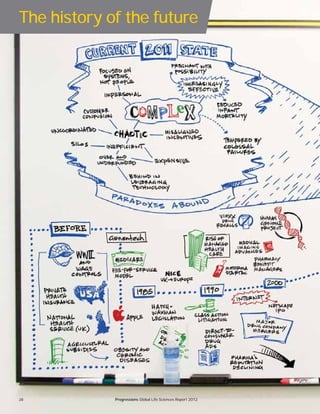
  • 71.
    71Chapter four Potential in healthcare Collective impact approaches have tremendous applicability for health care and the move to third-place industry models, for two key reasons: (1) Creating economic incentives Life sciences companies experimenting with patient-centric, outcomes-focused business models often grapple with the question of how they can make money in these new spaces. For instance, a number of pharma companies are adopting approaches where they are looking to “own” a chronic disease by providing a comprehensive suite of products and solutions to address every aspect of the malady — monitoring, prevention, management, treatment and cure. However, no one company can “own” a disease, and constituents risk wasting resources and losing time by not reinforcing collaboration for critical moon shots. Collective impact alliances can provide a pathway to increase an individual organization’s return on investment by aligning incentives and resources to solve the underlying ecosystem problems, one microcosm at a time. Rather than attempt to realign the entire US educational system, Strive aimed for collective impact in a circumscribed geographic location: greater Cincinnati and northern Kentucky. In much the same way, collective impact approaches in health care could work within microcosms where all the key players are present. These microcosms could be geographic or disease- based, and we will discuss examples of each later in this section. It is not hard to imagine — especially given all of the current system’s misalignments — the huge cost and the wasteful duplication that results from each of the stakeholders trying to solve health care’s problems alone. (2) Tackling “precompetitive” challenges In recent years, as resource-constrained drug companies and investors have sought to make the process of drug research and development more efficient, we have seen increased interest in “precompetitive” collaboration. The logic behind these ventures is that companies can conserve precious resources by collaborating on solving a common early-stage challenge, such as developing a technology platform. Once the common challenge has been addressed, the partners are free to leverage it in developing their individual products. The analogy between product innovation and business model innovation is applicable here, too. As they look to extend their business models to take advantage of the third place, companies will frequently find themselves entering uncharted territory, where unanswered questions and important issues need to be addressed. These include defining “health outcomes,” setting common standards for new technologies, developing regulatory guidelines for new communication channels and determining payment systems for different business models. Since these matters are in precompetitive spaces, it makes sense for companies to pool their resources and tackle them together. In addition, they often involve collaboration not just with direct competitors but also with a broader range of ecosystem participants — technology companies, regulators, payers and others — and collective impact alliances, with their ability to bring together a wide range of partners, might be ideally suited to tackle them. Collective impact approaches in health care could work within microcosms where all the key players are present. These microcosms could be geographic or disease-based. collective impact participants are looking for a return, and unlike funders, the return they seek is not just financial
  • 72.
    72 Progressions GlobalLife Sciences Report 2012 Given the increased emphasis on improving health outcomes and the continuing pressure on resources, it is not surprising that we are seeing compelling examples of collective impact approaches that tackle different ecosystem speed bumps. Two recent examples are One Mind for Research and The Self-Care Management Alliance. One Mind for Research was launched in May 2011, on the 50th anniversary of the “moon shot” speech in which President Kennedy articulated the vision of landing a man on the moon before the end of the 1960s. Seeking to replicate the power of this moment in US history, Representative Patrick Kennedy — the former president’s nephew — and serial entrepreneur and patient advocate Garen Staglin, launched One Mind for Research with a different moon-shot challenge: finding cures for all neurological diseases and lowering the cost burden of health care by 2020, with an emphasis on science and clinical development. To achieve this common goal, the organization coordinates activities related to public policy, advocacy and science. It brings together a wide range of partners from the private sector, government, patient/disease organizations, several university/research hospitals and others. Depending on their respective strengths, these partners contribute different assets — intellectual property, data, time, money, talent — and expect to gain based on their relative contributions and the success of the overall initiative. A major emphasis of the organization is to get different actors to align their activities in pursuit of a common agenda. It is also supporting pre-competitive work in areas such as developing standards that would facilitate the sharing of imaging and other data. a closer look As they experiment with new business models and patient-centric approaches for health care’s third place, pharma companies are often attracted by the potential for increased adherence — getting patients to comply with their medication regimes represents a multibillion-dollar opportunity for drug companies and the health care system alike. But, just as building third-place business models requires new, customer-centric value propositions, companies’ model for adherence will need to be patient-centric. A patient- centric model for adherence can transform how companies develop and market products and how health care is delivered. This differs from the traditional approach in several ways: • Beyond drugs. So far, drug adherence has been precisely that — getting patients to adhere to your pharmaceutical product. In the third place, as the focus shifts from products to outcomes and behaviors, adherence will no longer be confined to the drug. Instead, it will be about influencing behaviors and getting each patient to the best possible outcome for that individual — which could include not just medicinal treatment, but also prevention, monitoring and more. • Multiple conversations. The third-place ecosystem is one in which companies can no longer just pitch their wares to customers; instead, success is about engaging patients in a meaningful multi-way exchange. Consequently, adherence is no longer a one-way proposition but rather a multisided interaction, where companies, patients, families and communities adhere to each other based on a mutual exchange of value. • Holistic and enduring. Companies are starting to approach adherence in more holistic ways. Whereas the traditional focus on drugs meant that companies only interacted with patients after they fell sick, in the third place they will be involved throughout the cycle of care — in many cases, forming lifelong relationships with patients. By embracing this mind shift, companies could open up worlds of opportunities. For instance, we are in the early days of a move toward “disease networks” — collective impact alliances in which providers, academic medical centers, CROs, payers and life sciences companies form enduring relationships with patients to seek cures within certain disease spaces. As they track and analyze these “patients for life,” companies gain access to rich genomic data and clinical samples, which also helps with clinical research and development. In return, patients get better care through personalized treatment plans and holistic care. Some in the pharma industry might be worried that moving into areas such as prevention could hurt revenues by cannibalizing their drug business. In fact, the opposite is true, because the pie becomes bigger. For one, deep and enduring relationships with patients provide a trove of data — and information is where the value will truly lie in the evidence-based future of medicine. In addition, companies can create additional revenue opportunities, e.g., services around disease, solutions focusing on behavioral and lifestyle aspects, palliative care and education. Through such approaches, companies are completely revamping their interactions with patients — from a product-oriented transaction to a value-oriented, outcomes-based relationship. In this approach, adherence is no longer about the drug or prescription regimen. It is about the relationship. And in the third place, those relationships will be most meaningful when they are for life. Sanjeev Wadhwa Ernst & Young LLP Patients for life
  • 73.
    73Chapter four Also in2011, the National Council on Aging (NCOA) — a Washington, DC-based nonprofit service and advocacy group organization for elderly Americans and the community organizations that serve them — launched the Self-Care Management Alliance. The initiative brings together leaders from a wide range of entities — federal agencies, private foundations, health plans, pharmaceutical companies — to pursue the goal of promoting the use of self-care management among the elde with multiple chronic conditions, with an emphasis on health care delivery. This common agenda — based on a key goal of the HHS Strategic Framework on Multiple Chronic Conditions — will be supported through initiatives related to information sharing, research and pilots, communications and public policy. The initiative’s approach is directly modeled on the five collective- impact pillars (for more, see the article by James Firman of the NCOA, below). Self-care through collective impact The mission of the National Council on Aging (NCOA) is to improve the lives of millions of older adults, with a special focus on the problem of chronic illness. The increasing burden of chronic illness is exacerbated by the fact that patients often have not one but multiple chronic conditions — increasing the risk of comorbidities and the complexity of managing these conditions. In such circumstances, it is critical to engage and empower patients to take charge of their health. We have therefore created the Self-Management Alliance (SMA) to advance the second goal of the Health & Human Services (HHS) Strategic Framework for Multiple Chronic Conditions: maximizing the use of proven self-management and other services by individuals with multiple chronic conditions. The SMA is a trisector collaborative that brings together several key players from the government, business and nonprofit sectors to change the health ecosystem and achieve our shared goals. We have built the SMA using the collective impact framework, focusing specifically on its five key elements: • Common agenda. Our goal is to make self-management an integral part of health in the US by 2020. As part of this objective, we want to make sure that at least 4 million older adults participate in evidence-based self-management programs during this time frame. • Shared measurement systems. The SMA will have at least two categories of shared measurement systems. First, we will work with HHS to develop and/or select specific individual and population-level metrics to gauge national progress toward achieving our shared goals. Second, we will facilitate dialog among participants to work toward common metrics that can be used to evaluate the outcomes of R&D initiatives undertaken by federal agencies, private foundations, health plans and pharmaceutical companies. • Mutually reinforcing activities. Members will engage in a number of mutually reinforcing activities, including: strategic planning and sharing knowledge about evidence for various interventions; identifying and overcoming barriers to implementation and national scaling; and identifying outcome measures. In addition, collaborative-wide initiatives may be initiated in specific areas, such as consumer research, R&D, public policy and education. • Continuous communication. To encourage continuous communication among all our members, the SMA will rely on regular meetings, skilled facilitation and sophisticated electronic platforms. • Backbone support organization. Lastly, to make all of this happen, the SMA will have a small, highly skilled team focused solely on ensuring the success of the alliance by fostering strategic collaboration among all of its members. Given that the number of people with multiple chronic conditions is expected to increase dramatically in the years ahead, initiatives that encourage self-management are sorely needed. The collective impact approach is particularly suited to this challenge, given the complexity and the number of stakeholders involved. But, this is by no means the only issue area where the collective impact approach could be applied. Indeed, at a time of limited resources and increasingly unsustainable health care costs, there are many areas where health care could be made more effective and efficient through collective impact alliances. James Firman National Council on Aging President and CEO
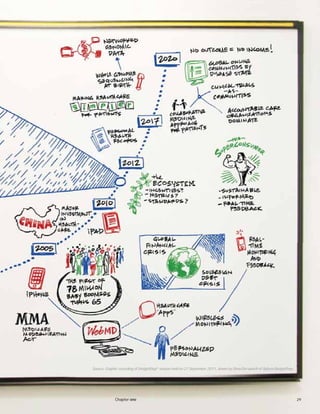
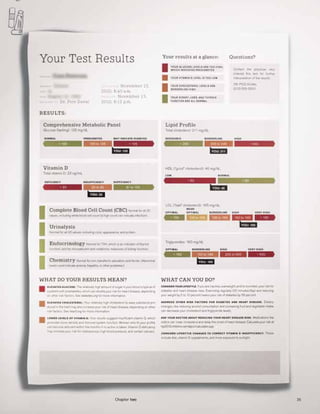
  • 74.
    74 Progressions GlobalLife Sciences Report 2012 In many of the conversations we have had with parties interested in meta- collaborations, it has become clear that a specific patient population must be targeted to make progress. We simulated the potential of a city-based approach during our September 2011 DesignShop® , where one of the exercises involved developing a disruptive business model using a public- private partnership. The business model that the team came up with (see illustration above) took a collective impact approach around managing multiple chronic diseases through a dramatic increase in self- management — very similar to the charter of the Self-Care Management Alliance. The team decided to simulate working with a city such as New York City, where a mayor and city council that are very focused on public health issues could play a critical role in aligning incentives and participants. (New York City has the highest life expectancy in the US, and the city government has instituted anti-smoking and anti-obesity campaigns, high taxes on cigarettes and calorie-count requirements for restaurant chains.) Reflecting this city- based approach, the team included a wider range of partners — not just life sciences companies, providers, patients and payers, but also employers, unions, retailers and developers that could be major influencers at the city level. Source: Graphic recording of DesignShop® session held on 27 September 2011, drawn by Breah Parker of Optum DesignShop. A collective impact approach for managing multiple chronic diseases
  • 75.
    75Chapter four Moving ahead It’snot surprising that these examples are in areas (neurological diseases and multiple chronic diseases) that will become increasingly important as payers and policy makers look for ways to contain health care costs and improve the quality of life at the same time. It’s encouraging that life sciences companies are active participants in these and other such initiatives. The imperative to invest in business model innovation is becoming more urgent, but leaders still face significant unanswered questions regarding regulatory guidance, technological standards and more. Getting various stakeholders aligned can accelerate answering these questions while also providing a solution to an equally important challenge — the issue of how companies create, deliver and capture value from new business models and approaches. The shift to health care’s third place creates opportunities for key stakeholders — life sciences companies, payers, providers and health systems — to collaborate on boosting outcomes and improving access. While the core activity of life sciences companies will always be the innovation of new medicines and devices, approaches such as collective impact alliances allow companies to rethink how they develop products, how they bring them to market and how health care is delivered to patients. The accompanying chart illustrates this three- part transformation: A new approach to health care delivery will create more connectivity between patients and physicians and allow for the generation of real-time patient data. • This, in turn, will reinvent the commercial model (the ways in which companies go to market) in fundamentally patient- centric ways, as companies build lifelong relationships with customers and organize themselves differently around patient populations. • This patient-centric approach will transform clinical development, as deep insights allow for more efficient product development and a better understanding of patients’ needs. An approach such as this puts the patient firmly at the center and is based on a deep and ongoing relationship with the customer. The virtuous cycle it creates — essentially reinventing everything from the ways in which companies develop products to how they interface with customers — has the potential to make R&D more productive, influence behaviors and radically improve outcomes. At the end of the day, that is the promise of the third place. • Patient Patient N Ph ysiciansPayer s Caregivers Fa m ilyCommunit ies Clinical transformation • Real-world data informs discovery and development • Increased focus on “pills+” that help prevention, adherence and self-management Health care delivery transformation • Patient-physician connectivity and multichannel information pipelines • Improved multi-sourced and predictive data • Behavioral economics levers Commercial transformation • Providing products and services in non-traditional settings • Building new business models that create lifelong relationships with customers and improve outcomes • Organizing around patient populations • Customer segmentation • Behavioral economics levers Innovation for life sciences companies: a virtuous cycle Source: Ernst & Young.
  • 76.
    Index of charts Pharma3.0: the shift from products to health outcomes 9 The next wave: the third place in health care 11 The history of the future 28 Before and after: Wired magazine redesigns the lab report 34 Business model canvas 50 Selected revenue approaches for the third place 58 Creative disruption: Apple’s business model has expanded over time 62 Follow the value: focusing on the right questions 64 A collective impact approach for managing multiple chronic diseases 74 Innovation for life sciences companies: a virtuous cycle 75 Progressions Global Life Sciences Report 201276
  • 77.
    Research and data ShraddhaArora, Namrita Negi, Amit Malik and Tanushree Jain conducted research to support the report. Jason Hillenbach, Himanshu Birla, Tanushree Jain, Samir Goncalves and Kim Medland conducted fact checking and quality review. Writing and editing assistance The four main chapters were written by Gautam Jaggi, with input and assistance from Carolyn Buck Luce, Glen Giovannetti and Frank Kumli. Gautam Jaggi, Russ Colton, Sue Lavin Jones and Sue Carrington served as ghostwriters for many of the guest contributions in this year’s report. Russ Colton was the copy editor for this project. He also proofread the document. Design and layout Oliver Voigt was the lead designer for this project. Robert Thomas provided additional photography services. Marketing and support Public relations efforts related to the book and its launch were led by Sue Lavin Jones, Cecile Guiot and Daniel Cusworth, with the help of our external PR firm, Feinstein Kean Healthcare. Acknowledgments Project leadership Carolyn Buck Luce and Glen Giovannetti — Ernst & Young’s Global Pharmaceutical Leader and Global Life Sciences Leader, respectively — provided the overall sponsorship, strategic vision and guidance for this project. They guided the development of key themes and provided valuable input on drafts. Special thanks also to Patrick Flochel, who played a key role in the development of this publication by providing invaluable strategic insights. Gautam Jaggi, Managing Editor and lead author of the publication, developed many of the key themes and points of view. Gautam gave the publication its overall shape, wrote and/or edited all of the articles and was ultimately responsible for its content and quality. Frank Kumli developed some of the key themes and led the process of interviewing internal and external contributors, particularly for the “A closer look” articles. Frank also provided valuable feedback on chapter drafts. Alison DeCourcey, who served as Project Manager, was responsible for keeping the project running smoothly by allocating resources, identifying and addressing bottlenecks and managing the project timeline. Kim Medland and Rebekah Craig helped with various logistical aspects of the project. 77Acknowledgments
  • 78.
    78 Progressions GlobalLife Sciences Report 2012 Global life sciences contacts Global Life Sciences Leader Glen Giovannetti glen.giovannetti@ey.com +1 617 585 1998 Global Pharmaceutical Leader Carolyn Buck Luce carolyn.buck-luce@ey.com +1 212 773 6450 Global Life Sciences Tax Leader Neil Byrne neil.byrne@ie.ey.com +353 1 221 2370 Global Life Sciences Transaction Advisory Services Leader Jeffrey Greene jeffrey.greene@ey.com +1 212 773 6500 Global Life Sciences Advisory Leader Thomas Sileghem thomas.sileghem@be.ey.com +32 2774 9536 Australia Winna Brown winna.brown@au.ey.com +61 7 3011 3343 Austria Isabella Schwartz-Gallee isabella.schwartz-gallee@at.ey.com +43 1 21170 1072 Belgium Thomas Sileghem thomas.sileghem@be.ey.com +32 2774 9536 Brazil Frank de Mejier frank.de-mejier@br.ey.com +55 11 2573 3413 Canada Paul Karamanoukian paul.karamanoukian@ca.ey.com +1 514 874 4307 China/Asia-Pacific Stanley Chang stan.chang@cn.ey.com +86 10 5815 3628 Commonwealth of Independent States (CIS) Dmitry Khalilov dmitry.khalilov@ru.ey.com +7 495 755 9757 Czech Republic Magdalena Soucek magdalena.soucek@cz.ey.com +420 225 335 600 Denmark Benny Lynge Sørensen benny-lynge.soerensen@dk.ey.com +45 35 87 25 25 Finland Timo Virkilä timo.virkila@fi.ey.com +358 207 280 190 France Virginie Lefebvre-Dutilleul virginie.lefebvre-dutilleul@ey-avocats.com +33 1 55 61 10 62 Germany Elia Napolitano elia.napolitano@de.ey.com +49 89 14331 13106 Siegfried Bialojan siegfried.bialojan@de.ey.com +49 621 4208 11405 India Hitesh Sharma hitesh.sharma@in.ey.com +91 22 6665 5000 Ireland Nick Redmond nick.redmond@ie.ey.com +353 1 221 2322 Israel Yoram Wilamowski yoram.wilamowski@il.ey.com +972 3 623 2519 Italy Lapo Ercoli lapo.ercoli@it.ey.com +39 02 7221 2546 Japan Hironao Yazaki yazaki-hrn@shinnihon.or.jp +81 3 3503 2165 Korea Jeung Wook Lee jeung-wook.lee@kr.ey.com +82 2 3787 4301 Mexico Federico Aguilar federico.aguilar@mx.ey.com +52 555 283 1447 Netherlands Thomas Sileghem thomas.sileghem@be.ey.com +32 2774 9536 New Zealand Jon Hooper jon.hooper@nz.ey.com +64 9 375 2670 Norway Willy Eidissen willy.eidissen@no.ey.com +47 73 54 68 80 Poland Mariusz Witalis mariusz.witalis@pl.ey.com +48 225 577950 Singapore Swee Ho Tan swee.ho.tan@sg.ey.com +65 6309 8238 Southeast Europe Themis Lianopoulos themis.lianopoulos@gr.ey.com +30 210 288 6417 Spain Silvia Ondategui Parra silvia.ondateguiparra@es.ey.com +34 933 663 740 Sweden Björn Ohlsson bjorn.ohlsson.uppsala@se.ey.com +46 18 19 42 22 Switzerland Patrick Flochel patrick.flochel@ch.ey.com +41 58 286 4148 Jürg Zürcher juerg.zuercher@ch.ey.com +41 58 286 84 03 Turkey Erdal Calikoglu erdal.calikoglu@tr.ey.com +90 212 368 5375 United Kingdom Pamela Spence pspence2@uk.ey.com +44 20 7951 3523 United States Howard Brooks howard.brooks@ey.com +1 215 448 5115 Dave DeMarco dave.demarco@ey.com +1 732 516 4602 Chris Nolet chris.nolet@ey.com +1 650 802 4504 David Womelsdorf david.womelsdorf@ey.com +1 732 516 4292
  • 79.
  • 80.
    Ernst & Young Assurance| Tax | Transactions | Advisory About Ernst & Young Ernst & Young is a global leader in assurance, tax, transaction and advisory services. Worldwide, our 152,000 people are united by our shared values and an unwavering commitment to quality. We make a difference by helping our people, our clients and our wider communities achieve their potential. Ernst & Young refers to the global organization of member firms of Ernst & Young Global Limited, each of which is a separate legal entity. Ernst & Young Global Limited, a UK company limited by guarantee, does not provide services to clients. For more information about our organization, please visit www.ey.com. About Ernst & Young’s Global Life Sciences Center Life sciences companies are facing challenging but promising times, as business models evolve, stakeholder expectations increase, new markets emerge, demographics shift, new technologies flourish, populations age and health care expenditures rise. Ernst & Young’s Global Life Sciences Center brings together a worldwide team of professionals to help you achieve your potential — a team with deep technical experience in providing assurance, tax, transaction and advisory services. The Center works to anticipate market trends, identify the implications and develop points of view on relevant industry issues. The Center is there to help you meet your goals and execute for success. It’s how Ernst & Young makes a difference. For more information, please visit www.ey.com/lifesciences or email global.lifesciences@ey.com. © 2012 EYGM Limited. All Rights Reserved. EYG no. FN0009 1112-1315935_SF Ernst & Young is committed to reducing its impact on the environment. This document has been printed using recycled paper and vegetable-based ink. This publication contains information in summary form and is therefore intended for general guidance only. It is not intended to be a substitute for detailed research or the exercise of professional judgment. Neither EYGM Limited nor any other member of the global Ernst & Young organization can accept any responsibility for loss occasioned to any person acting or refraining from action as a result of any material in this publication. On any specific matter, reference should be made to the appropriate advisor. www.ey.com/progressions