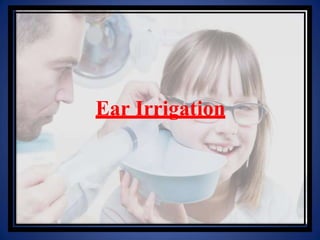
Ear Irrigation
INTRODUCTION
 Ear wax (cerumen) is a natural protective oily substance
which is produced in the outer third of the ear.
Its function is to remove small foreign particles, such as
dust, from the canal and lubricate the ear..
This is achieved by the ciliary hairs.
Under normal conditions, the body keeps the amount of
earwax in the ears under control.
Too much earwax or hardened earwax can cause a
blockage in the ear, resulting in earaches, ringing in the ears,
or temporary hearing loss.
DEFINITION
 An ear irrigation is the process of flushing the external ear
canal with sterile water or normal saline. It is used to treat who
complains of foreign body or cerumen (ear wax) impaction.
To clean the external ear of cerume or ear wax.
To remove the foreign bodies.
To cleanse the ear in case of purulent discharges
caused in the middle ear infection.
To cleanse the ear in case of purulent discharges
caused in the middleear
PURPOSE
CONTRAINDICATIONS
This procedure is contraindicated when the auditory canal
is obstructed by a vegetable or grain foreign body such as
pea, bean, or corn kernel. These absorb moisture, causing
them to swell.
This procedure is also contraindicated if the patient has a
cold, fever, ear infection or unknown injury or rupture of the
tympanic membrane.
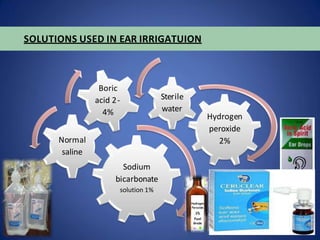
SOLUTIONS USED IN EAR IRRIGATUION
Sodium
bicarbonate
solution 1%
Normal
saline
Boric
acid 2-
4% Hydrogen
peroxide
2%
Sterile
water
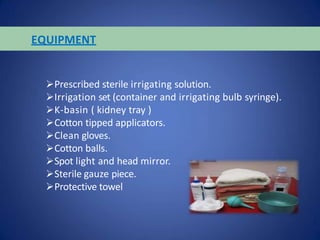
EQUIPMENT
Prescribed sterile irrigating solution.
Irrigation set (container and irrigating bulb syringe).
K-basin ( kidney tray )
Cotton tipped applicators.
Clean gloves.
Cotton balls.
Spot light and head mirror.
Sterile gauze piece.
Protective towel
PROCEDURE
NURSING ACTION RATIONALE
1) Confirm physician order, check
client identification and condition.
1) Reduce the harmful outcomes from
avoidable patient identification
errors.
2) Explain the procedure to the client. 2) Reduce anxiety and ensures
cooperation.
3) After explaining procedure tothe
patient, place in a position of
sitting or lying with head tilted
forward and toward affected ear.
3) Ear should be accessible and to
drain into basin.
4) Wash hands 4) Reduces risk of transmission of
microorganism.
PREPARATORY PHASE
PROCEDURE (cont… ..)
NURSING ACTION RATIONALE
5) Position protective towels. 5) Water often runs down neck onto
clothing.
PERFORMANCE PHASE
6) Use a cotton applicator to remove
any discharge on outer ear.
6) Prevents carrying discharge deeper
into canal.
7) Place basin close to the
patient’s
head and under the ear.
7) Provides a receptacle to receive
irrigating solution.
8) Test temperature of solution. It
should be comfortable to the inner ear
aspect of wrist area ( approximately
98.6°F [37°C] or body temperature.
8) Solution that are hot or cold are
most uncomfortable and may initiate a
feeling of dizziness.
PROCEDURE (cont… ..)
9) Ascertion whether impaction is due
to a foreign hydroscopic (absorbs
moisture) body before proceeding.
9) If water contacts such a substance,
it may cause it to swell and produce
intense pain.
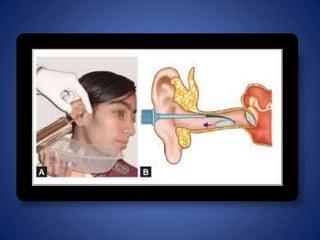
10) Gently pull the outer ear upward
and backward (adult) or downward
and outward (child).
10) Straightens the ear canal.
11) Place tip of syringe or irrigating
catheter just inside canal ( no more
than 8mm).
11) Decreases direct force of
irrigation against eardrum possibility
of rupturing it.
12) Observe for signs of pain or
dizziness.
12) Discontinue treatment if they
occur.
13) If irrigating does not dislodge the
wax, instill several drops of prescribed
crumenolytic and repeat as directed.
14) Softens and loosens impaction;
may be effective in as little as 15
minutes.
PROCEDURE
14) Dry external ear.
15) Discard soiled equipment and 15) Large amount of brown cerumen
make the patient comfortable. may be returned in irrigation solution.
16) Patients should lie on irrigated
(affected) side for a few minutes after
procedure toallow any remaining
solution to drain out.
16) Narrow ear canals may drain
slowly; retained solution may be
uncomfortable and lead to infection.
17) Wash hands 17) Reduce the transmission of
microorganisms.
18) Document effectiveness of the
treatment, condition of the canal, and
tympanic membrane and date and
time of irrigation and also volume and
type solution and the appearance of
the return flow.
18) For further reference about
effectiveness of procedure and
patient’s condition.
FOLLOW- UP PHASE
Ear infection.
Perforated eardrum.
Vertigo (typically temporary)
Deafness which can be temporary or
permanent.
COMPLICATIONS
https://youtu.be/gu4RH35AqIk
https://youtu.be/JVktI_1N274
https://youtu.be/4NDW8lLYFpQ
ear Irrigation.pptx

ear Irrigation.pptx

  • 1.
  • 2.
    INTRODUCTION  Ear wax(cerumen) is a natural protective oily substance which is produced in the outer third of the ear. Its function is to remove small foreign particles, such as dust, from the canal and lubricate the ear.. This is achieved by the ciliary hairs. Under normal conditions, the body keeps the amount of earwax in the ears under control. Too much earwax or hardened earwax can cause a blockage in the ear, resulting in earaches, ringing in the ears, or temporary hearing loss.
  • 4.
    DEFINITION  An earirrigation is the process of flushing the external ear canal with sterile water or normal saline. It is used to treat who complains of foreign body or cerumen (ear wax) impaction.
  • 5.
    To clean theexternal ear of cerume or ear wax. To remove the foreign bodies. To cleanse the ear in case of purulent discharges caused in the middle ear infection. To cleanse the ear in case of purulent discharges caused in the middleear PURPOSE
  • 6.
    CONTRAINDICATIONS This procedure iscontraindicated when the auditory canal is obstructed by a vegetable or grain foreign body such as pea, bean, or corn kernel. These absorb moisture, causing them to swell. This procedure is also contraindicated if the patient has a cold, fever, ear infection or unknown injury or rupture of the tympanic membrane.
  • 7.
    SOLUTIONS USED INEAR IRRIGATUION Sodium bicarbonate solution 1% Normal saline Boric acid 2- 4% Hydrogen peroxide 2% Sterile water
  • 8.
    EQUIPMENT Prescribed sterile irrigatingsolution. Irrigation set (container and irrigating bulb syringe). K-basin ( kidney tray ) Cotton tipped applicators. Clean gloves. Cotton balls. Spot light and head mirror. Sterile gauze piece. Protective towel
  • 9.
    PROCEDURE NURSING ACTION RATIONALE 1)Confirm physician order, check client identification and condition. 1) Reduce the harmful outcomes from avoidable patient identification errors. 2) Explain the procedure to the client. 2) Reduce anxiety and ensures cooperation. 3) After explaining procedure tothe patient, place in a position of sitting or lying with head tilted forward and toward affected ear. 3) Ear should be accessible and to drain into basin. 4) Wash hands 4) Reduces risk of transmission of microorganism. PREPARATORY PHASE
  • 10.
    PROCEDURE (cont… ..) NURSINGACTION RATIONALE 5) Position protective towels. 5) Water often runs down neck onto clothing. PERFORMANCE PHASE 6) Use a cotton applicator to remove any discharge on outer ear. 6) Prevents carrying discharge deeper into canal. 7) Place basin close to the patient’s head and under the ear. 7) Provides a receptacle to receive irrigating solution. 8) Test temperature of solution. It should be comfortable to the inner ear aspect of wrist area ( approximately 98.6°F [37°C] or body temperature. 8) Solution that are hot or cold are most uncomfortable and may initiate a feeling of dizziness.
  • 11.
    PROCEDURE (cont… ..) 9)Ascertion whether impaction is due to a foreign hydroscopic (absorbs moisture) body before proceeding. 9) If water contacts such a substance, it may cause it to swell and produce intense pain. 10) Gently pull the outer ear upward and backward (adult) or downward and outward (child). 10) Straightens the ear canal. 11) Place tip of syringe or irrigating catheter just inside canal ( no more than 8mm). 11) Decreases direct force of irrigation against eardrum possibility of rupturing it. 12) Observe for signs of pain or dizziness. 12) Discontinue treatment if they occur. 13) If irrigating does not dislodge the wax, instill several drops of prescribed crumenolytic and repeat as directed. 14) Softens and loosens impaction; may be effective in as little as 15 minutes.
  • 13.
    PROCEDURE 14) Dry externalear. 15) Discard soiled equipment and 15) Large amount of brown cerumen make the patient comfortable. may be returned in irrigation solution. 16) Patients should lie on irrigated (affected) side for a few minutes after procedure toallow any remaining solution to drain out. 16) Narrow ear canals may drain slowly; retained solution may be uncomfortable and lead to infection. 17) Wash hands 17) Reduce the transmission of microorganisms. 18) Document effectiveness of the treatment, condition of the canal, and tympanic membrane and date and time of irrigation and also volume and type solution and the appearance of the return flow. 18) For further reference about effectiveness of procedure and patient’s condition. FOLLOW- UP PHASE
  • 14.
    Ear infection. Perforated eardrum. Vertigo(typically temporary) Deafness which can be temporary or permanent. COMPLICATIONS
  • 16.