Accelerating innovation in
Technologies for an Effective
Management in Eye care
Presented by
Neelam Kalwani
Surabhi Prajapati
PGDM semester-2
Contents
• Introduction
• Objective
• Research Methodology
• Eye disease
• Existing technology for eye care
• New technology for eye care
• Conclusion
IntroduCtIon
• The Right to Sight estimates that only 25
per cent of existing infrastructure is used
for eye care, while the target utilization is
set at 90 per cent. This requires a complete
reorganization.
• Tension, headaches, exhaustion and eye
irritation are all common symptoms of eye.
objeCtIve
researCh Methodology
• We have chosen secondary source of
data.
•Internet
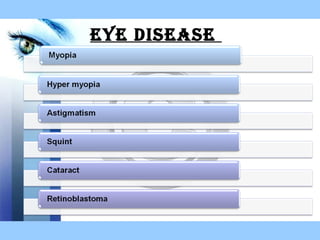
eye dIsease
ExistingExisting
tEchnology intEchnology in
EyE carEEyE carE
• The Ophthalmoscope is a
tool used in medicine to
examine the interior of the
eye. Studying the inner parts
of the eye, such as the optic
disk, retinal blood vessels,
retina, choroid and macula,
can help diagnose diseases of
the eye.
• Price in India = Rs. 7,455
ophthalmoscopE
• An Auto-Refractors or
automated refractors is a
computer-controlled machine
used during an eye examination
to provide an objective
measurement of a person's
refractive error and prescription
for glasses or contact lenses. This
is achieved by measuring how
light is changed as it enters a
person's eye.
auto-rEfractors
fEaturEs
• Color liquid crystal display screen
• Measurable minimum pupil diameter is
2.0mm
• Compact and Stylish Design
• The easy–to-load printer enables simple
maintenance. Just drop the paper roll into
the holder.
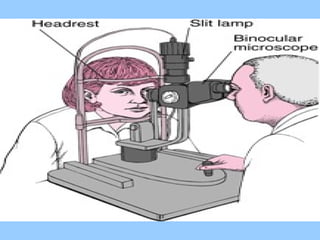
slit lamps
• The slit lamp is an instrument consisting
of a high-intensity light source that can
be focused to shine a thin sheet of light
into the eye.
Features of Slit Lamp
• Precision machined aluminum
framework
• Controllable light from maximum to
zero
• Big Slit Lamp features, portable
usability
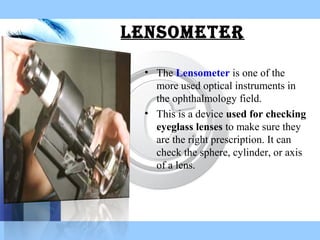
• The Lensometer is one of the
more used optical instruments in
the ophthalmology field.
• This is a device used for checking
eyeglass lenses to make sure they
are the right prescription. It can
check the sphere, cylinder, or axis
of a lens.
Lensometer
new technoLogynew technoLogy
for eye carefor eye care
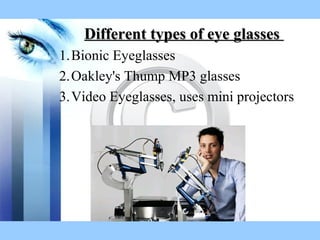
Different types of eye glassesDifferent types of eye glasses
1.Bionic Eyeglasses
2.Oakley's Thump MP3 glasses
3.Video Eyeglasses, uses mini projectors
Bionic eye gLasses
• Bionic Eyeglasses May Help the Blind
to “See”.
oakLey's thump mp3
gLasses
• Absolute music freedom with no wires or
cords to dangle or tangle
• Store up to 240 songs on the 1 GB version,
up to 120 songs on the 512 MB version, or
up to 60 songs on the 256 MB version.
• Up to 6 hours of playback time on a single
charge.
• Three-color indicator light to show battery
level
• Supports storage of data files along with
song files
• Includes High Speed USB cable for
transferring song files from Windows PC
Video eyeglasses, uses
mini projectors
• The glasses can offer QVGA(320 x
240) and VGA (640 x 480)
resolution.
• But There are plans to create HD
lenses as technology develops.
conclusionconclusion
• Be aware of your risk for eye diseases.
• Have regular exams to check for
diabetes and high blood pressure.
• Protect your eyes from the sun’s UV
rays
• Get your eyes checked at least every two
years.
• Don't smoke.
• Eat a healthy and balanced diet
Eye

Eye

  • 1.
    Accelerating innovation in Technologiesfor an Effective Management in Eye care Presented by Neelam Kalwani Surabhi Prajapati PGDM semester-2
  • 2.
    Contents • Introduction • Objective •Research Methodology • Eye disease • Existing technology for eye care • New technology for eye care • Conclusion
  • 3.
    IntroduCtIon • The Rightto Sight estimates that only 25 per cent of existing infrastructure is used for eye care, while the target utilization is set at 90 per cent. This requires a complete reorganization. • Tension, headaches, exhaustion and eye irritation are all common symptoms of eye.
  • 4.
  • 5.
    researCh Methodology • Wehave chosen secondary source of data. •Internet
  • 6.
  • 7.
  • 8.
    • The Ophthalmoscopeis a tool used in medicine to examine the interior of the eye. Studying the inner parts of the eye, such as the optic disk, retinal blood vessels, retina, choroid and macula, can help diagnose diseases of the eye. • Price in India = Rs. 7,455 ophthalmoscopE
  • 9.
    • An Auto-Refractorsor automated refractors is a computer-controlled machine used during an eye examination to provide an objective measurement of a person's refractive error and prescription for glasses or contact lenses. This is achieved by measuring how light is changed as it enters a person's eye. auto-rEfractors
  • 10.
    fEaturEs • Color liquidcrystal display screen • Measurable minimum pupil diameter is 2.0mm • Compact and Stylish Design • The easy–to-load printer enables simple maintenance. Just drop the paper roll into the holder.
  • 11.
    slit lamps • Theslit lamp is an instrument consisting of a high-intensity light source that can be focused to shine a thin sheet of light into the eye. Features of Slit Lamp • Precision machined aluminum framework • Controllable light from maximum to zero • Big Slit Lamp features, portable usability
  • 13.
    • The Lensometeris one of the more used optical instruments in the ophthalmology field. • This is a device used for checking eyeglass lenses to make sure they are the right prescription. It can check the sphere, cylinder, or axis of a lens. Lensometer
  • 14.
  • 15.
    Different types ofeye glassesDifferent types of eye glasses 1.Bionic Eyeglasses 2.Oakley's Thump MP3 glasses 3.Video Eyeglasses, uses mini projectors
  • 16.
    Bionic eye gLasses •Bionic Eyeglasses May Help the Blind to “See”.
  • 17.
  • 18.
    • Absolute musicfreedom with no wires or cords to dangle or tangle • Store up to 240 songs on the 1 GB version, up to 120 songs on the 512 MB version, or up to 60 songs on the 256 MB version. • Up to 6 hours of playback time on a single charge. • Three-color indicator light to show battery level • Supports storage of data files along with song files • Includes High Speed USB cable for transferring song files from Windows PC
  • 19.
  • 20.
    • The glassescan offer QVGA(320 x 240) and VGA (640 x 480) resolution. • But There are plans to create HD lenses as technology develops.
  • 21.
    conclusionconclusion • Be awareof your risk for eye diseases. • Have regular exams to check for diabetes and high blood pressure. • Protect your eyes from the sun’s UV rays • Get your eyes checked at least every two years. • Don't smoke. • Eat a healthy and balanced diet