Section heading
1Beyond borders Biotechnology Industry Report 2015
Biotechnology Industry Report 2015
Beyond borders
Reaching new heights
Section heading
2 Beyond borders Biotechnology Industry Report 2015
These are very good times for the biotechnology industry. For the
second straight year, biotech companies have delivered strong, and
sometimes unprecedented, results on almost every metric we track —
revenues, profitability, financings, new drug approvals and more.
Across the biotechnology industry, these achievements have been
accompanied by optimism that the sector has entered a renewed age
of innovation, buoyed by both high-profile product breakthroughs and
scientific advancements.
Investors have not simply recognized these efforts. They have rewarded them. Market
valuations for biotechs reached new heights in both the US and Europe in 2014, and
the window for initial public offerings remained open for eight consecutive quarters, a
new record. As a result of the booming stock market, historic amounts of innovation
capital are available to the smaller players in the industry, which remain the wellspring
of future breakthroughs.
In this, our 29th annual Beyond borders report, Reaching new heights, we celebrate the
biotechnology industry’s recent achievements. In doing so, we take stock of not just
where we have been, but the implications for the future.
We firmly believe the biotechnology industry cannot afford to become complacent.
In particular, the industry must continue to work with patients, payers, providers and
governments around the globe to devise not just new products for unmet medical
needs, but “beyond the pill” solutions that improve care delivery and health outcomes.
Moreover, the industry has a vital role to play in helping devise new payment and
financing schemes that enable access to the breakthrough innovations of the future.
At EY, we aren’t becoming complacent either. Long-time
readers will notice a change in the format of this year’s
report. Recognizing that time is a precious commodity,
we are moving away from issuing large, annual reports
to the more frequent publication of insights via a new
digital platform. Thus, we are “unbundling” in-depth
perspective pieces from our industry trend data to
enable readers to access our content when it is most
needed: in real time. You can join the conversation and
keep up to date with our latest perspectives at our new
digital home, Vital Signs (ey.com/VitalSigns), and our
Twitter feed (@EY_LifeSciences).
As biotechnology companies strive to solve harder
problems, EY’s global organization stands ready to
help you reach even higher heights.
To our clients
and friends
Glen T. Giovannetti
Global Life
Sciences Leader
Section heading
3Beyond borders Biotechnology Industry Report 2015
Contents
4 The year in review
10 Life of a start-up CEO: priorities and preparation
Katrine Bosley, Editas Medicine
12 The European biotech’s strategic decision: list in Europe or the US?
Jörn Aldag, uniQure
14 Financial performance
15 The big picture
20 United States
28 Europe
31 Australia
32 Canada
33 Financing
34 The big picture
39 United States
47 Europe
54 Deals
55 The big picture
63 United States
65 Europe
68 Appendix
69 Acknowledgments
70 Data exhibit index
72 Contacts
The year in review
Beyond borders 2015
4 Beyond borders Biotechnology Industry Report 20154 Beyond borders Biotechnology Industry Report 2015
The year in review
5Beyond borders Biotechnology Industry Report 2015
The year in review
The view from the top
This was a year for the record books. On almost every measure we track — revenues, profitability, capital
raised and more — the industry reached new heights in 2014, spurred by a confluence of positive trends.
Sustained sales of high-profile products continued to boost investor sentiment. Examples include Biogen’s
Tecfidera and Gilead Science’s hepatitis C medicines, Sovaldi and Harvoni, which quickly became two of the
most successful product launches in the industry’s history.
It was also a landmark year for new
product approvals, as a more supportive
U.S. Food and Drug Administration
(FDA) clarified the use of new expedited
approval channels for breakthrough
medicines. Against a backdrop of
booming stock markets and expansionary
monetary policies, these product
successes helped propel the biotech
industry’s market capitalization above
the US$1 trillion threshold, a new high.
Financial performance
The news-making product successes
of 2014 had an outsized impact on the
industry’s financial results. In particular,
the rapid ramp-up of Gilead Science’s
hepatitis C products significantly boosted
the revenues and net income of the sector.
Financial performance was also affected
by the large number of initial public
offerings (IPOs), which increased revenues
and R&D while lowering net income.
Across the four established biotech
clusters that we track — the US, Europe,
Australia and Canada — revenues
grew 24% in 2014. Adjusting for the
“Gilead effect,” revenue growth would
have been 12%, still ahead of the 10%
delivered in 2013.
Against a backdrop of booming stock
markets and expansionary monetary policies,
product successes help propel the biotech
industry’s market capitalization above the
US$1 trillion threshold.
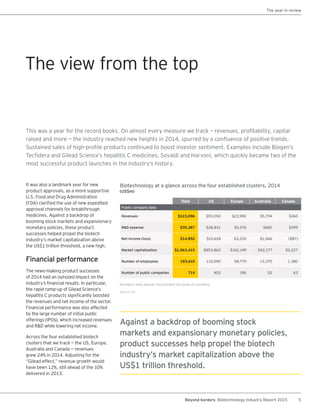
Biotechnology at a glance across the four established clusters, 2014
(US$m)
Total US Europe Australia Canada
Public company data
Revenues $123,096 $93,050 $23,992 $5,794 $260
R&D expense $35,387 $28,831 $5,576 $681 $299
Net income (loss) $14,852 $10,618 $3,255 $1,066 ($87)
Market capitalization $1,063,415 $853,862 $162,149 $42,177 $5,227
Number of employees 183,610 110,090 58,770 13,370 1,380
Number of public companies 714 403 196 52 63
Numbers may appear inconsistent because of rounding.
Source: EY.
6 Beyond borders Biotechnology Industry Report 2015
R&D spending increased by 20% — very
impressive and substantially above
the adjusted revenue growth amount.
R&D growth rates were strong in both
the US (22%) and Europe (14%). In
both markets, noncommercial leaders
expanded their R&D spending faster
than the commercial leader cohort.
Net income skyrocketed 231% to
US$14.9 billion, another historic high.
Most of this increase (82%) came from
Gilead. In the wake of the global financial
crisis, the biotech sector had reached
aggregate profitability for the first time
as a result of sharp cuts in R&D spending
across the industry. In 2014, on the other
hand, the huge increase in profitability
was for all the right reasons: strong sales
of newly launched products resulted in
even stronger increases in profits.
The US sector had one of its best
showings ever. Revenue grew 29%, or 12%
normalized for Gilead’s results. Adjusted
for Gilead’s performance, the unusually
large number of IPOs and the acquisition
of Life Technologies by Thermo Fisher
Scientific, US revenue growth would have
been an impressive 18%. R&D spend
grew by 22%, with nearly 70% of biotech
companies increasing their spending,
slightly above the historical average
The year in review
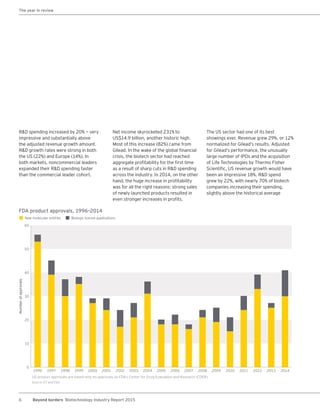
FDA product approvals, 1996–2014
US product approvals are based only on approvals by FDA’s Center for Drug Evaluation and Research (CDER).
Source: EY and FDA.
40
60
50
30
0
20
10
New molecular entities
Numberofapprovals
1996 1997 1998 1999 2000 20072001 20082002 20092003 20102004 20112005 20122006 2013 2014
Biologic license applications
7Beyond borders Biotechnology Industry Report 2015
of about two-thirds of companies. Net
income almost tripled, reaching a new
high of US$10.6 billion.
While most of the growth came from US
commercial leaders, led by Gilead, the
rest of the industry more than held its
own, particularly in revenue growth and
R&D investments.
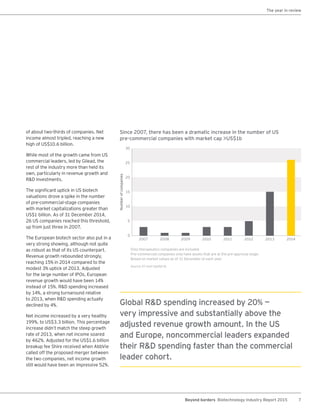
The significant uptick in US biotech
valuations drove a spike in the number
of pre-commercial-stage companies
with market capitalizations greater than
US$1 billion. As of 31 December 2014,
26 US companies reached this threshold,
up from just three in 2007.
The European biotech sector also put in a
very strong showing, although not quite
as robust as that of its US counterpart.
Revenue growth rebounded strongly,
reaching 15% in 2014 compared to the
modest 3% uptick of 2013. Adjusted
for the large number of IPOs, European
revenue growth would have been 14%
instead of 15%. R&D spending increased
by 14%, a strong turnaround relative
to 2013, when R&D spending actually
declined by 4%.
Net income increased by a very healthy
199%, to US$3.3 billion. This percentage
increase didn’t match the steep growth
rate of 2013, when net income soared
by 462%. Adjusted for the US$1.6 billion
breakup fee Shire received when AbbVie
called off the proposed merger between
the two companies, net income growth
still would have been an impressive 52%.
Only therapeutics companies are included.
Pre-commercial companies only have assets that are at the pre-approval stage.
Based on market values as of 31 December of each year.
Source: EY and Capital IQ.
Since 2007, there has been a dramatic increase in the number of US
pre‑commercial companies with market cap >US$1b
15
30
25
20
10
0
5
Numberofcompanies
2007 2008 2009 2010 2011 2012 2013 2014
The year in review
Global R&D spending increased by 20% —
very impressive and substantially above the
adjusted revenue growth amount. In the US
and Europe, noncommercial leaders expanded
their R&D spending faster than the commercial
leader cohort.
8 Beyond borders Biotechnology Industry Report 2015
Financing
The biotech bull market drove an
extraordinary surge in IPOs and follow-on
financings. Capital raised via US and
European IPOs rose a remarkable 93% to
US$6.8 billion in 2014. This annual total
was the second-highest in the industry’s
history, second only to the US$7.8 billion
raised during the genomics bubble of 2000.
While the IPO class of 2014 may have
netted less capital, the companies that
listed during the most recent window
were more mature than those that
debuted in 2000. Eighty-one percent of
the members of the 2013-14 class had
lead candidates in Phase II or later, and
the majority retained the rights to their
products. Meanwhile, capital raised in
follow-on offerings increased by 49% to
US$13.8 billion, setting a new record.
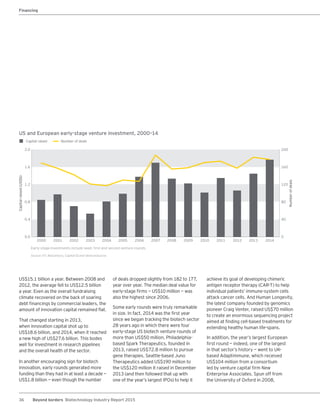
Venture capital increased by 28% to
US$7.6 billion — the second-highest total
on record and considerably higher than
the US$5.5 billion–US$5.9 billion raised
annually between 2008 and 2013. In a
positive sign for innovation, early rounds
generated US$1.8 billion, a greater
total than at any point in at least the last
decade. At US$10 million, the median deal
value recouped by early-stage firms was
also the largest dollar amount since 2006.
Debt financing also soared to a new
record, reaching US$26.0 billion, or
more than twice the 2003-13 average.
This was driven, as in prior years, by the
ability of large companies to raise funds
at low interest rates to refinance existing
debt, fund working capital and finance
share repurchases. Five large companies
closed six debt transactions of more than
US$1 billion each.
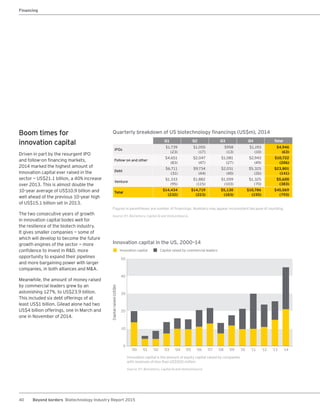
The year also brought good news for
“innovation capital,” a metric we defined
to track the funds raised by companies
with revenues of less than US$500 million.
As such, innovation capital is a key
measure of the sustainability of a broad
swath of biotech companies that depend
on the capital markets to fund R&D. For the
second year in a row, the biotechnology
industry enjoyed robust gains in innovation
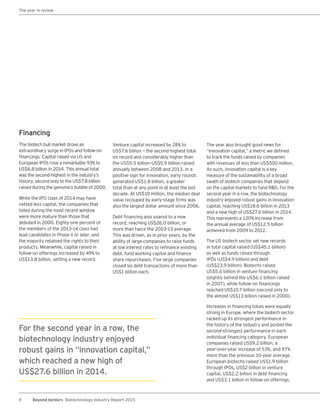
capital, reaching US$18.6 billion in 2013
and a new high of US$27.6 billion in 2014.
This represents a 120% increase from
the annual average of US$12.5 billion
achieved from 2009 to 2012.
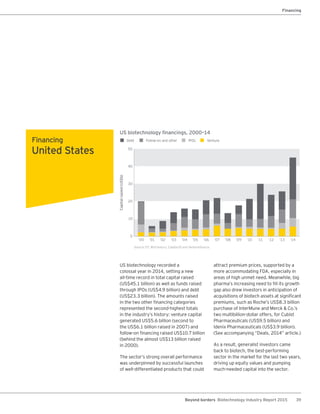
The US biotech sector set new records
in total capital raised (US$45.1 billion)
as well as funds raised through
IPOs (US$4.9 billion) and debt
(US$23.9 billion). Biotechs raised
US$5.6 billion in venture financing
(slightly behind the US$6.1 billion raised
in 2007), while follow-on financings
reached US$10.7 billion (second only to
the almost US$13 billion raised in 2000).
Increases in financing totals were equally
strong in Europe, where the biotech sector
racked up its strongest performance in
the history of the industry and posted the
second-strongest performance in each
individual financing category. European
companies raised US$9.2 billion, a
year-over-year increase of 53%, and 97%
more than the previous 10-year average.
European biotechs raised US$1.9 billion
through IPOs, US$2 billion in venture
capital, US$2.2 billion in debt financing
and US$3.1 billion in follow-on offerings.
For the second year in a row, the
biotechnology industry enjoyed
robust gains in “innovation capital,”
which reached a new high of
US$27.6 billion in 2014.
The year in review
9Beyond borders Biotechnology Industry Report 2015
Deals
This was a standout year for M&A and
alliances involving biotech companies,
as several trends made this a seller’s
market. Booming stock market valuations
gave biotech companies more financing
options and, therefore, more power at the
negotiating table. This bargaining power
was further boosted by the fact that big
pharma companies have been eager
to acquire commercial-stage biotech
companies to address revenue shortfalls
that have arisen due to pricing pressures,
slower growth in emerging markets and
R&D challenges. In addition, big pharma
companies face more competition for the
best assets from specialty pharma firms
and big biotechs.
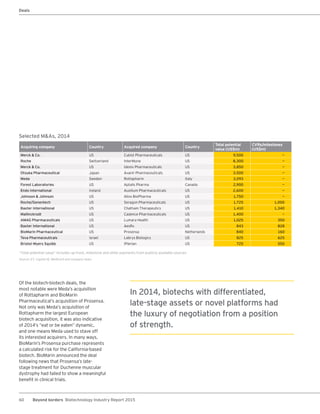
M&A activity reached a 10-year high
in both deal number and value (after
normalizing the numbers to exclude
megadeals, which we define as
transactions valued at US$5 billion or
more). There were 68 biotechnology M&A
deals with a total value of US$49 billion,
a 46% increase over 2013. Adjusting for
megadeals, pharma companies spent
more on biotech acquisitions than at any
time in the previous seven years.
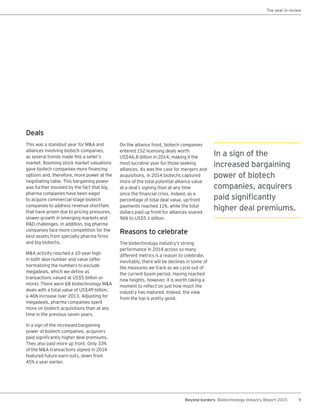
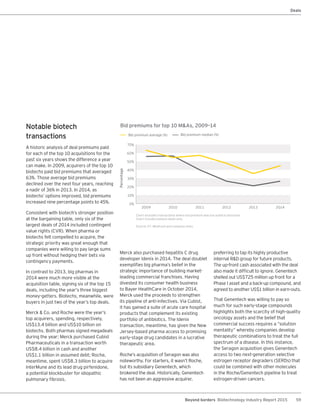
In a sign of the increased bargaining
power of biotech companies, acquirers
paid significantly higher deal premiums.
They also paid more up front. Only 33%
of the M&A transactions signed in 2014
featured future earn-outs, down from
45% a year earlier.
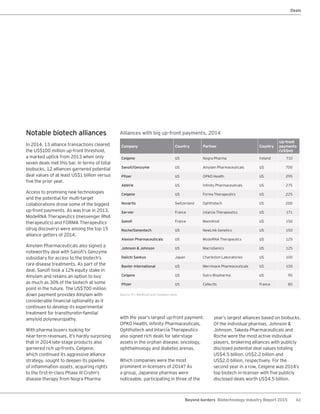
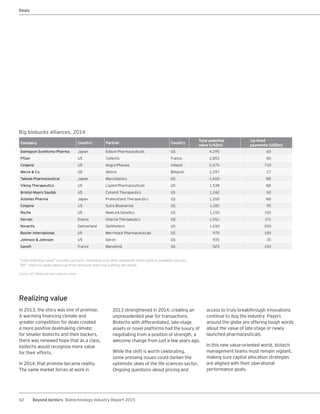
On the alliance front, biotech companies
entered 152 licensing deals worth
US$46.8 billion in 2014, making it the
most lucrative year for those seeking
alliances. As was the case for mergers and
acquisitions, in 2014 biotechs captured
more of the total potential alliance value
at a deal’s signing than at any time
since the financial crisis. Indeed, as a
percentage of total deal value, up-front
payments reached 11%, while the total
dollars paid up front for alliances soared
96% to US$5.1 billion.
Reasons to celebrate
The biotechnology industry’s strong
performance in 2014 across so many
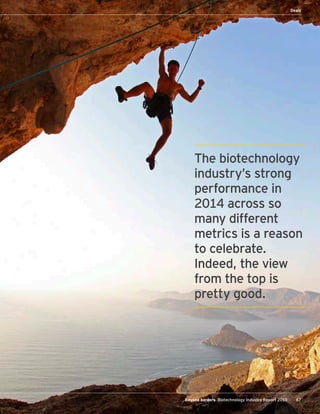
different metrics is a reason to celebrate.
Inevitably, there will be declines in some of
the measures we track as we cycle out of
the current boom period. Having reached
new heights, however, it is worth taking a
moment to reflect on just how much the
industry has matured. Indeed, the view
from the top is pretty good.
In a sign of the
increased bargaining
power of biotech
companies, acquirers
paid significantly
higher deal premiums.
The year in review
10 Beyond borders Biotechnology Industry Report 2015
Katrine Bosley
CEO, Editas Medicine
External perspective
I didn’t fully appreciate this until I first
stepped into the CEO role. For every
visible part of that role, there’s a lot that
happens behind the scenes. It takes a
while to figure out where to focus your
time as a CEO, and there are areas that
require much more time and energy
than I had anticipated. Three of these
areas are the board of directors, external
engagement and capital strategy.
I found that biotech CEOs can lean on
three different groups for advice and
perspective: their senior management
team, their board of directors and their
fellow CEOs. With my internal team,
we discuss everything from the vision,
strategy and values to organizational
development, day-to-day management
and operational issues that are central to
building a biotech.
I tap my CEO posse for advice and
real-time, been-there-done-that
perspectives. In many cases, these CEOs
are shepherding companies that are two
to three years ahead of mine in terms of
their evolution. That means I get both
critical outsider views from this group and
also advice on what steps to take now to
create the right foundation to build my
company longer term.
Board matters
The board, in my mind, is first and
foremost a resource. Like my peers, my
board also provides an invaluable external
perspective because the other directors
have diverse experiences, and they have a
bit of distance from the day-to-day details
of the company. Intuitively, I expected
my board would help me make important
industry connections and supply me with
hands-on knowledge on all the company’s
strategic issues. What I didn’t fully grasp
initially was what an important role they
would play in pressure-testing my point of
view and how vital that would be to finding
the right balance between charging ahead
toward a goal and changing course.
I spend about 20% of my time preparing for
or meeting with my board members, both
formally and informally. That sounds like
a lot of time. Still, given the complexity of
building a biotech company, there’s never
enough time to address each and every
issue in detail. To get the most out of my
board meetings, I have found it helpful to
write down two questions to be the focus of
a board meeting and to open the meeting
with those questions. Limiting it to just two
questions really forces you to prioritize and
helps to make sure the face-to-face board
time is spent on the right issues.
External engagement
I also spend a lot of time focused
externally, whether it’s a media interview
or at conferences or interacting with
current or potential investors or recruiting.
There are many different stakeholders
you’re always communicating with
and listening to: patients, scientists,
physicians, regulators, employees,
investors … They all pay attention, and all
are crucial to building a company.
While the actual time spent in external
encounters may be short, the preparation
time beforehand is considerable. CEOs
need to plan out and practice how they
want to communicate on a broad range
of issues, from strategic to financial to
scientific. To tell the story effectively,
Everyone has some idea of what biopharma CEOs do, based on what you can see as a team member within a
company or as someone watching the industry from outside. In general, though, I find that these views usually
see only part of the picture.
Life of a start-up CEO:
priorities and preparation
The year in review
11Beyond borders Biotechnology Industry Report 2015
CEOs need to create a narrative that
explains how the business will unfold over
time and to adjust that narrative to be
accessible to many different audiences.
These worlds do often overlap. For
example, specialist biotech investors attend
most of the critical scientific conferences.
Those research meetings are an important
and different way to engage with the
investor base as well as connect with the
scientific community. They allow you to
show investors how the story continues to
advance, furthering relationships that can
support future fundraising efforts before
the company needs the money.
Capital strategy
Of course, I spend a lot of time on
fundraising. As the CEO of a biotech
start-up, I’m always planning two or three
financing steps ahead, identifying how
to tap diverse pools of capital for my
company’s needs.
I find it helpful to think in a multi-year
time frame to plan and to set goals. A
big piece of that planning relates to the
financial strategy. Even if the CEO thinks
two or three steps ahead, the reality
he or she responds to will be different
from the plan. By thinking through
multiple scenarios over several years,
the CEO has a better grasp of how much
capital will be required to reach the next
value-creating milestone.
Often a CEO has to decide whether it’s
better to raise more money now or later.
In flush times, raising money is tempting
because it’s easy. Still, the CEO must
understand why she is raising the money.
Will the capital allow the company to
pursue productive activities at a faster
pace, or is the additional money simply
more runway?
Both options are legitimate, but the CEO
should be able to articulate why she is
raising that specific amount of money
and how it fits in with the company’s
overall capital strategy, particularly
alongside business development and
grant activities.
There is nothing about raising capital
that happens with the snap of the fingers.
There’s a long tail. At one of my previous
companies, we raised a Series C financing
in about four weeks, but that was only
possible because we spent two years
laying the groundwork to make it happen.
I don’t fall into the camp that believes
CEOs should automatically raise additional
capital during boom times to secure
I’m always planning two or three financing steps
ahead, identifying how to tap diverse pools of
capital for my company’s needs.
a longer financial runway. It is more
nuanced. Let’s recognize that there is
no such thing as non-dilutive capital.
Business development is differently
dilutive from equity, but it’s still dilutive.
Therefore, if you take the wrong amount
of capital — whether that is too much or
too little — you potentially buy yourself a
problem down the line. A CEO needs to
think hard about the price at which he or
she will raise the equity relative to the
progress the company plans to make.
When it comes to fundraising, having
not one backup plan but multiple backup
plans is essential. You can create your
ideal plan, but then you need to find
out if it is possible in the real world.
The marketplace will tell you whether
the environment favors equity raises
or business development. With multiple
contingency plans in place, you are
able to adjust and continue to build the
company’s value within the context of
what the real world is interested in doing.
The year in review
12 Beyond borders Biotechnology Industry Report 2015
The year in review
Jörn Aldag
CEO, uniQure
External perspective
This is welcome news. But it also means
European biotechs have an important
strategic decision to make: should they
pursue a US listing or are there more
advantages to listing on an exchange
closer to home?
As both a board member and a CEO, I
have faced this choice. Regardless of
which option a European biotech company
chooses, it must thoroughly prepare for
the event. In the past, some European
biotechs have underestimated their IPO
readiness and the scrutiny that comes
with being a public company.
I believe it is possible for a European
biotech to list in Europe and assemble
a strong and loyal investor base that
provides the liquidity necessary for future
growth. Let me give you an example.
I am a board member of Molecular
Partners, a Zurich-based biotech that
listed on the Swiss SIX exchange in
December 2014. We were fortunate to
have good-quality, long-term investors
who want to be associated with Molecular
Partners and dig deep into its story. Our
listing was facilitated by what I call a “local
hero image.” Because investors looked
at Molecular Partners and its DARPin
technology as a home-grown product of
Switzerland and its universities, there was
traction and excitement about the listing.
In the case of Molecular Partners, seeking
a listing on the US markets wasn’t a
strategic necessity. Depending on their
specific scientific and clinical stories,
other companies may find the US markets,
and their more sophisticated investor
base, a more suitable option.
European biotechs that do choose to list
in the US should not underestimate the
effort required to build name recognition,
however. Because they are not as well-
known as US private companies, the
management teams of European biotechs
must take pains to communicate their
stories clearly.
European platform biotech companies
may also have a harder time telling
their stories, since US investors tend to
view product-centric business models
as the path to value creation. Mastering
the switch from platform to product,
as Molecular Partners and my current
company uniQure have done, is therefore
essential if you are a European biotech
seeking a US listing.
UniQure, which was founded in 1998
(originally operating as Amsterdam
Molecular Therapeutics), is a gene therapy
company. Our lead product is Glybera,
approved in Europe for a rare genetic
disorder in which fat builds up in the
blood. We decided in the second half of
2013 that we wanted to list on the US
market, partly because of the access it
gave us to mature capital markets and the
robust, specialist investor community. We
completed our IPO in February 2014.
Forging ties
To build awareness for uniQure, I spent
seven weeks telling,― and refining, our
story to US investors as part of the pre-
IPO road show. In the process, we were
able to take advantage of how interwoven
the biotech and financial industries are in
the US as compared to Europe.
In the US, successful IPOs follow a
well-established path. As ideas emerge
from academia, companies are founded
Last year, approximately 12 European companies listed on the NASDAQ, while 19 biotechs listed on European
exchanges. That near parity suggests European companies now have broader access to the capital markets and
are not limited to listing on their in-country exchanges.
The European biotech’s
strategic decision: list
in Europe or the US?
13Beyond borders Biotechnology Industry Report 2015
The year in review
by highly regarded scientists on solid,
innovative technologies. Venture
capitalists bring in entrepreneurs who
can lead the nascent firm through funding
rounds, while building relationships with
crossover investors.
The collective goal is to bring the company
to a particular value inflection point
that enables a robust mezzanine round
just prior to a public listing. By creating
direct ties with crossover investors,
the management team and its VCs lay
the groundwork for a successful IPO,
underpinned by a solid investor base.
This emphasis on forging ties with
crossover investors is less prevalent in
Europe, where biotechs are generally more
naïve about the work and timelines required
for a successful IPO. When European
companies seeking a US listing are focused
on crossover investors, they may find that
they are viewed as an unknown entity.
Also, many European VCs believe that
dilution is to be avoided at all costs. But in
today’s environment, it is critical to have
investment support from financiers that
understand the business after the IPO.
I don’t mean to suggest that my company
has not benefited immeasurably from
European VCs. In today’s world, however,
companies may have to accept dilution
in order to create a strong shareholder
base. Those are the table stakes when
preparing for an IPO.
I have had the benefit of spending a
lot of time in the US — I know people in
the investor and pharma worlds, and I
understand the process of going public.
The US is the epicenter of the capital
markets. In order to access the wealth and
knowledge that are in such abundance in
the US, European biotechs will need to
educate themselves about the IPO process
and its stakeholders, and about how
they can best present their companies in
order to succeed.
Section heading
14 Beyond borders Biotechnology Industry Report 2015
Financial
performance
Beyond borders 2015
14 Beyond borders Biotechnology Industry Report 201514 Beyond borders Biotechnology Industry Report 2015
Financial performance
15Beyond borders Biotechnology Industry Report 2015
Financial performance
In particular, a group of newly minted US
commercial leaders, defined as biotech
companies with revenues of at least
US$500 million, illustrated that years of
hard work in the laboratory and the clinic
are being rewarded in the marketplace.
Revenues in 2014 grew 24% year over year,
eclipsing the robust 2013 performance
when top-line growth expanded by 10%.
Admittedly, much of the expansion was
driven by Gilead Sciences, which generated
US$24.9 billion of the total revenue as a
result of strong sales of its two hepatitis C
therapies, Sovaldi and Harvoni. Even after
adjusting for the “Gilead effect,” however,
the industry would have grown its top line
in 2014 by 12%.
Solid revenue numbers in 2014, coupled
with the year’s unprecedented M&A and
financing environments, fueled a return
to innovation as the surest path to long-
term value creation. This linkage between
R&D and long-term value creation fueled
strong R&D spending for the second year
in a row — and one of the greatest annual
increases in this metric since 2001.
Recall that in the aftermath of the financial
crisis, biotech companies were hesitant to
invest in R&D. In 2008, for the first time
in the industry’s history, R&D spending
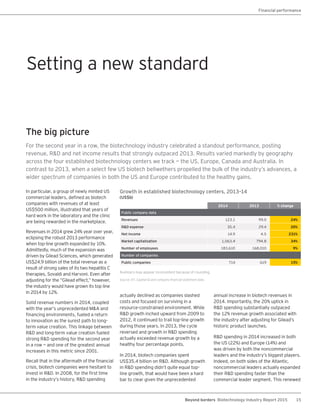
The big picture
For the second year in a row, the biotechnology industry celebrated a standout performance, posting
revenue, R&D and net income results that strongly outpaced 2013. Results varied markedly by geography
across the four established biotechnology centers we track —― the US, Europe, Canada and Australia. In
contrast to 2013, when a select few US biotech bellwethers propelled the bulk of the industry’s advances, a
wider spectrum of companies in both the US and Europe contributed to the healthy gains.
Setting a new standard
actually declined as companies slashed
costs and focused on surviving in a
resource-constrained environment. While
R&D growth inched upward from 2009 to
2012, it continued to trail top-line growth
during those years. In 2013, the cycle
reversed and growth in R&D spending
actually exceeded revenue growth by a
healthy four percentage points.
In 2014, biotech companies spent
US$35.4 billion on R&D. Although growth
in R&D spending didn’t quite equal top-
line growth, that would have been a hard
bar to clear given the unprecedented
annual increase in biotech revenues in
2014. Importantly, the 20% uptick in
R&D spending substantially outpaced
the 12% revenue growth associated with
the industry after adjusting for Gilead’s
historic product launches.
R&D spending in 2014 increased in both
the US (22%) and Europe (14%) and
was driven by both the noncommercial
leaders and the industry’s biggest players.
Indeed, on both sides of the Atlantic,
noncommercial leaders actually expanded
their R&D spending faster than the
commercial leader segment. This renewed
Growth in established biotechnology centers, 2013–14
(US$b)
2014 2013 % change
Public company data
Revenues 123.1 99.0 24%
R&D expense 35.4 29.4 20%
Net income 14.9 4.5 231%
Market capitalization 1,063.4 794.8 34%
Number of employees 183,610 168,010 9%
Number of companies
Public companies 714 619 15%
Numbers may appear inconsistent because of rounding.
Source: EY, Capital IQ and company financial statement data.
16 Beyond borders Biotechnology Industry Report 2015
Financial performance
commitment to R&D was driven by
the year’s unprecedented financing
environment. (See accompanying
“Financing, 2014” article.)
Profitability for all
the right reasons
We first developed a profitability forecast
for the biotechnology industry in 2003,
when we predicted that the US industry
would reach aggregate profitability by
2008. That forecast was borne out when,
in 2008, the US industry eked out a small
profit of US$0.4 billion.
Profitability arrived in a big way in 2009,
but not for the reasons we anticipated.
In the wake of the global financial crisis,
biotech companies around the globe
took extreme measures to reduce their
cash burn by cutting headcount and
R&D. That emphasis on fiscal discipline
in an uncertain financing market moved
the aggregate net income in established
markets into the black for the first time
ever — not just in the US, but globally.
In 2014, net income reached a historic
high, ballooning 231% to US$14.9 billion.
Much of that net income increase (82%)
came courtesy of Gilead. Adjusting for
Gilead’s performance, global net income
in 2014 doubled, with positive increases in
three of the four biotechnology clusters:
the US, Europe and Australia. In contrast
to 2009-12, the uptick in aggregate
net income in 2014 was for all the right
reasons: strong sales of newly launched
products resulted in even stronger
increases in profits.
Consistent with the healthier net income
data are new figures from the EY Survival
Index, which tracks the amount of
cash biotech companies have on hand.
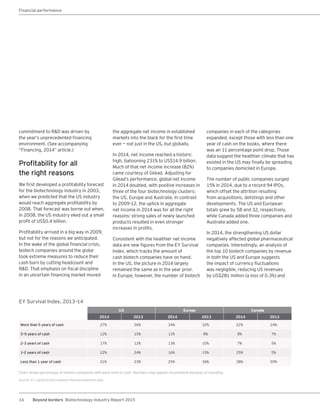
In the US, the picture in 2014 largely
remained the same as in the year prior.
In Europe, however, the number of biotech
companies in each of the categories
expanded, except those with less than one
year of cash on the books, where there
was an 11 percentage point drop. Those
data suggest the healthier climate that has
existed in the US may finally be spreading
to companies domiciled in Europe.
The number of public companies surged
15% in 2014, due to a record 94 IPOs,
which offset the attrition resulting
from acquisitions, delistings and other
developments. The US and European
totals grew by 58 and 32, respectively,
while Canada added three companies and
Australia added one.
In 2014, the strengthening US dollar
negatively affected global pharmaceutical
companies. Interestingly, an analysis of
the top 10 biotech companies by revenue
in both the US and Europe suggests
the impact of currency fluctuations
was negligible, reducing US revenues
by US$281 million (a loss of 0.3%) and
EY Survival Index, 2013–14
US Europe Canada
2014 2013 2014 2013 2014 2013
More than 5 years of cash 27% 26% 34% 32% 22% 24%
3–5 years of cash 12% 15% 11% 8% 8% 7%
2–3 years of cash 17% 12% 13% 10% 7% 5%
1–2 years of cash 22% 24% 16% 15% 25% 5%
Less than 1 year of cash 21% 23% 25% 36% 38% 59%
Chart shows percentage of biotech companies with each level of cash. Numbers may appear inconsistent because of rounding.
Source: EY, Capital IQ and company financial statement data.
17Beyond borders Biotechnology Industry Report 2015
Financial performance
increasing the European top line by
US$26 million. This lack of effect was
most likely due to the fact that sales of
biotechnology products were more heavily
concentrated in the US.
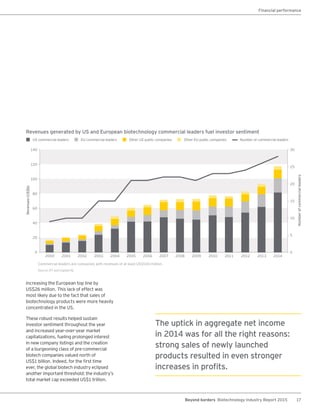
These robust results helped sustain
investor sentiment throughout the year
and increased year-over-year market
capitalizations, fueling prolonged interest
in new company listings and the creation
of a burgeoning class of pre-commercial
biotech companies valued north of
US$1 billion. Indeed, for the first time
ever, the global biotech industry eclipsed
another important threshold: the industry’s
total market cap exceeded US$1 trillion.
Revenues generated by US and European biotechnology commercial leaders fuel investor sentiment
Commercial leaders are companies with revenues of at least US$500 million.
Source: EY and Capital IQ.
60
15
80
100
20
120
140
25
30
20
40
10
5
0 0
US commercial leaders EU commercial leaders Other US public companies Other EU public companies
Revenues(US$b)
Numberofcommercialleaders
20012000 2003 2004 2005 2006 2007 2008 2009 2010 2011 2012 2013 2014
Number of commercial leaders
2002
The uptick in aggregate net income
in 2014 was for all the right reasons:
strong sales of newly launched
products resulted in even stronger
increases in profits.
18 Beyond borders Biotechnology Industry Report 2015
A maturing industry
Since much of the year’s strong
performance came on the back of a
booming stock market and a surge in
IPOs, we decided to measure just how
much the industry has matured since the
last big IPO bonanza of 2000:
• Total revenues for US and European
biotechs increased an impressive
610% over the past 14 years.
• Adjusting for inflation, the revenues
generated by the top 10 biotechs
in 2014 were 4.6 times greater
than the revenues generated
by the top 10 in 2000.
• Despite several notable acquisitions,
the number of commercial leaders in
the US expanded from seven in 2000
to 19 in 2014, with average revenue
per commercial leader increasing from
US$1.6 billion to US$4.3 billion.
• The cohort of European commercial
leaders increased from two in 2000
to nine in 2014, and the average
revenue per commercial leader shot
up US$1.2 billion to US$2.2 billion.
A side-by-side comparison of the top 10
US and European biotechs by revenues in
2000 relative to 2014 is a good reminder
of how much churn lies beneath the
aggregate statistics in this industry:
• Only three of the top 10 US-based
biotechs of 2000 (Amgen, Bio-Rad
and IDEXX) remain in 2014’s top 10.
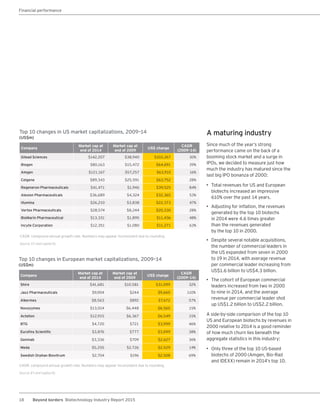
Top 10 changes in US market capitalizations, 2009–14
(US$m)
Company
Market cap at
end of 2014
Market cap at
end of 2009
US$ change
CAGR
(2009–14)
Gilead Sciences $142,207 $38,940 $103,267 30%
Biogen $80,163 $15,472 $64,691 39%
Amgen $121,167 $57,257 $63,910 16%
Celgene $89,343 $25,591 $63,752 28%
Regeneron Pharmaceuticals $41,471 $1,946 $39,525 84%
Alexion Pharmaceuticals $36,689 $4,324 $32,365 53%
Illumina $26,210 $3,838 $22,373 47%
Vertex Pharmaceuticals $28,574 $8,244 $20,330 28%
BioMarin Pharmaceutical $13,331 $1,895 $11,436 48%
Incyte Corporation $12,351 $1,080 $11,271 63%
CAGR: compound annual growth rate. Numbers may appear inconsistent due to rounding.
Source: EY and Capital IQ.
Top 10 changes in European market capitalizations, 2009–14
(US$m)
Company
Market cap at
end of 2014
Market cap at
end of 2009
US$ change
CAGR
(2009–14)
Shire $41,681 $10,581 $31,099 32%
Jazz Pharmaceuticals $9,904 $244 $9,660 110%
Alkermes $8,563 $892 $7,672 57%
Novozymes $13,014 $6,448 $6,565 15%
Actelion $12,915 $6,367 $6,549 15%
BTG $4,720 $721 $3,999 46%
Eurofins Scientific $3,876 $777 $3,099 38%
Genmab $3,336 $709 $2,627 36%
Meda $5,255 $2,726 $2,529 14%
Swedish Orphan Biovitrum $2,704 $196 $2,508 69%
CAGR: compound annual growth rate. Numbers may appear inconsistent due to rounding.
Source: EY and Capital IQ.
Financial performance
19Beyond borders Biotechnology Industry Report 2015
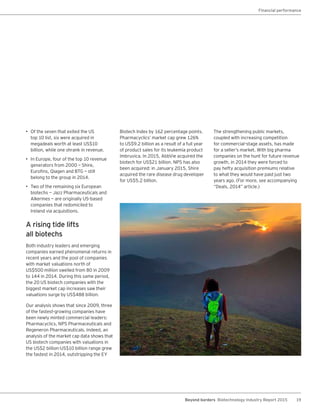
• Of the seven that exited the US
top 10 list, six were acquired in
megadeals worth at least US$10
billion, while one shrank in revenue.
• In Europe, four of the top 10 revenue
generators from 2000 —― Shire,
Eurofins, Qiagen and BTG —― still
belong to the group in 2014.
• Two of the remaining six European
biotechs — Jazz Pharmaceuticals and
Alkermes — are originally US-based
companies that redomiciled to
Ireland via acquisitions.
A rising tide lifts
all biotechs
Both industry leaders and emerging
companies earned phenomenal returns in
recent years and the pool of companies
with market valuations north of
US$500 million swelled from 80 in 2009
to 144 in 2014. During this same period,
the 20 US biotech companies with the
biggest market cap increases saw their
valuations surge by US$488 billion.
Our analysis shows that since 2009, three
of the fastest-growing companies have
been newly minted commercial leaders:
Pharmacyclics, NPS Pharmaceuticals and
Regeneron Pharmaceuticals. Indeed, an
analysis of the market cap data shows that
US biotech companies with valuations in
the US$2 billion-US$10 billion range grew
the fastest in 2014, outstripping the EY
Financial performance
Biotech Index by 162 percentage points.
Pharmacyclics’ market cap grew 126%
to US$9.2 billion as a result of a full year
of product sales for its leukemia product
Imbruvica. In 2015, AbbVie acquired the
biotech for US$21 billion. NPS has also
been acquired: in January 2015, Shire
acquired the rare disease drug developer
for US$5.2 billion.
The strengthening public markets,
coupled with increasing competition
for commercial-stage assets, has made
for a seller’s market. With big pharma
companies on the hunt for future revenue
growth, in 2014 they were forced to
pay hefty acquisition premiums relative
to what they would have paid just two
years ago. (For more, see accompanying
“Deals, 2014” article.)
20 Beyond borders Biotechnology Industry Report 2015
Financial performance
United States
In 2014, the US biotech industry’s revenue
growth skyrocketed 29%, one of the
best showings since we began tracking
the metric and far exceeding the 13%
revenue growth of 2013. While 67% of
the companies we track had revenue, the
annual data were heavily influenced by the
performance of just one, Gilead Sciences.
As a result of strong sales of Sovaldi and
Harvoni, Gilead’s 2014 revenues more
than doubled. In all, sales of these two
products accounted for 60% of 2014’s
US$21.0 billion revenue increase.
Adjusting for Gilead’s results, the
US industry’s revenues would have
increased by 12% instead of 29%. In
addition, the 2014 IPO class contributed
about one percentage point to revenue
growth, meaning that the industry’s
revenue growth would have been 11%
after adjusting for both Gilead and
the unusually large number of IPOs.
Conversely, Thermo Fisher Scientific’s
acquisition of Life Technologies, which
had revenues of US$3.8 billion in 2013,
removed seven percentage points of
revenue growth. The year-over-year
revenue growth normalized for all three
factors is therefore an impressive 18%.
In addition to Gilead, three other
biotech stalwarts delivered revenue
increases greater than US$1 billion:
Biogen (US$2.8 billion), Amgen (US$1.4
billion) and Celgene (US$1.2 billion).
Tecfidera, Biogen’s oral agent to treat
multiple sclerosis, reached blockbuster
status in less than 12 months, helping
propel Biogen’s yearly revenues up 40%.
Regeneron, another biotech with notable
2014 revenue growth (34%), grew as a
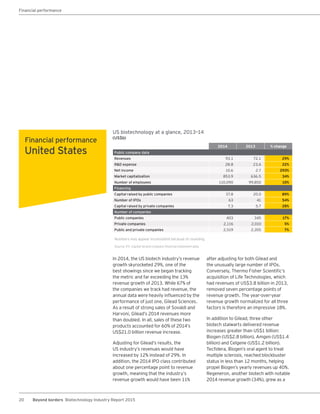
US biotechnology at a glance, 2013–14
(US$b)
2014 2013 % change
Public company data
Revenues 93.1 72.1 29%
R&D expense 28.8 23.6 22%
Net income 10.6 2.7 293%
Market capitalization 853.9 636.5 34%
Number of employees 110,090 99,850 10%
Financing
Capital raised by public companies 37.8 20.0 89%
Number of IPOs 63 41 54%
Capital raised by private companies 7.3 5.7 28%
Number of companies
Public companies 403 345 17%
Private companies 2,116 2,010 5%
Public and private companies 2,519 2,355 7%
Numbers may appear inconsistent because of rounding.
Source: EY, Capital IQ and company financial statement data.
Financial performance
21Beyond borders Biotechnology Industry Report 2015
result of both R&D collaborations and
strong sales of Eylea, a next-generation
anti-angiogenesis therapy for diseases
that can cause blindness.
Strong revenue and product stories
helped power a 34% increase in market
capitalization in 2014, and 58% of
companies saw their valuations increase
year over year. This healthy spike in
market valuations didn’t quite equal the
74% increase observed in 2013. However,
given how rapidly valuations climbed
in 2013, a similar growth rate in 2014
was likely unrealistic. Normalizing for
the year’s IPOs, market cap would have
increased by 29% instead of 34%.
Investing in the future
The increase in market capitalization
drove a spike in the number of pre-
commercial-stage companies with market
valuations greater than US$1 billion.
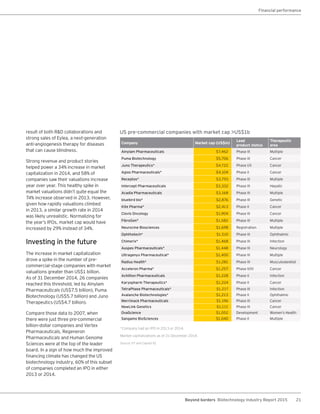
As of 31 December 2014, 26 companies
reached this threshold, led by Alnylam
Pharmaceuticals (US$7.5 billion), Puma
Biotechnology (US$5.7 billion) and Juno
Therapeutics (US$4.7 billion).
Compare those data to 2007, when
there were just three pre-commercial
billion-dollar companies and Vertex
Pharmaceuticals, Regeneron
Pharmaceuticals and Human Genome
Sciences were at the top of the leader
board. In a sign of how much the improved
financing climate has changed the US
biotechnology industry, 60% of this subset
of companies completed an IPO in either
2013 or 2014.
US pre‑commercial companies with market cap >US$1b
Company Market cap (US$m)
Lead
product status
Therapeutic
area
Alnylam Pharmaceuticals $7,462 Phase III Multiple
Puma Biotechnology $5,706 Phase III Cancer
Juno Therapeutics* $4,722 Phase I/II Cancer
Agios Pharmaceuticals* $4,104 Phase II Cancer
Receptos* $3,793 Phase III Multiple
Intercept Pharmaceuticals $3,332 Phase III Hepatic
Acadia Pharmaceuticals $3,168 Phase III Multiple
bluebird bio* $2,876 Phase III Genetic
Kite Pharma* $2,413 Phase II Cancer
Clovis Oncology $1,904 Phase III Cancer
FibroGen* $1,582 Phase III Multiple
Neurocine Biosciences $1,698 Registration Multiple
Ophthotech* $1,510 Phase III Ophthalmic
Chimerix* $1,468 Phase III Infection
Auspex Pharmaceuticals* $1,448 Phase III Neurology
Ultragenyx Pharmaceutical* $1,400 Phase III Multiple
Radius Health* $1,281 Phase III Musculoskeletal
Acceleron Pharma* $1,257 Phase II/III Cancer
Achillion Pharmaceuticals $1,228 Phase II Infection
Karyopharm Therapeutics* $1,224 Phase II Cancer
TetraPhase Pharmaceuticals* $1,217 Phase III Infection
Avalanche Biotechnologies* $1,213 Phase II Ophthalmic
Merrimack Pharmaceuticals $1,196 Phase III Cancer
NewLink Genetics $1,111 Phase III Cancer
OvaScience $1,052 Development Women’s Health
Sangamo BioSciences $1,040 Phase II Multiple
*Company had an IPO in 2013 or 2014.
Market capitalizations as of 31 December 2014.
Source: EY and Capital IQ.
Financial performance
22 Beyond borders Biotechnology Industry Report 2015
As a result of stronger market valuations
and material gains in revenue growth, US
biotech companies were clearly optimistic
about investing in future products, and
overall R&D expenditures grew by 22%
relative to 2013. Nearly 70% of US biotech
companies increased their R&D spending
in 2014 — slightly above the historical
average of about two-thirds of companies.
Overall, US commercial leaders increased
their R&D spending by 18%, including
Alexion Pharmaceuticals (62%) and
Regeneron Pharmaceuticals (48%).
In contrast, Amgen, which in 2014 had
the largest R&D budget in the global
biotechnology industry, increased its
R&D spending by just 3%. Amgen’s more
modest increase isn’t too surprising given
the company has come under pressure
from activist shareholders seeking
higher returns from R&D.
Just as revenue growth was heavily
influenced by Gilead, so too was net
income, increasing nearly 300% from
2013 to 2014. Absent Gilead, the
aggregate net loss of US public biotechs
increased US$700 million. The higher
losses were due primarily to greater R&D
expenditures, including by newly public
companies, offset in part by increased
earnings by other commercial leaders.
Indeed, because of the aforementioned
increase in R&D expenditures, only 13%
of the US biotechs recorded a positive
bottom line. Another 183 publicly
disclosed a drop in net income (or an
increase in net loss) for the year.
Along with the uptick in R&D spending,
a majority of US biotech companies
were confident enough of their financial
health to boost headcount in 2014.
Employee numbers increased 10%, as
80% of US commercial leaders and other
firms maintained or increased their
payrolls compared to 2013. One notable
exception was Amgen, which reduced
headcount by 10.5% as part of a larger
restructuring effort.
Normalizing for the large number of IPOs
in 2014, R&D growth would have been
15% instead of 22%. Note that this spend
still outpaces the top-line growth after
adjusting for Gilead’s revenues, albeit by
a much smaller margin. Most significantly,
net income would have grown at an even
faster pace, by more than 360%.
New commercial leaders
Strong product sales helped push
Pharmacyclics (Imbruvica), Medivation
(Xtandi) and Incyte (Jakafi) into the realm
of the US commercial leaders in 2014.
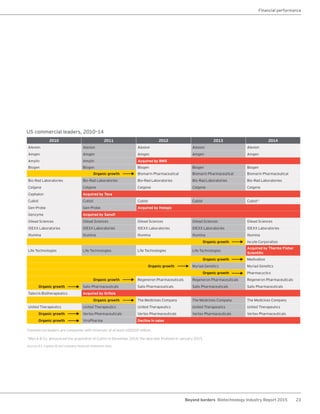
The US commercial leaders remain a
dynamic group of companies, primarily
because several trends make acquisition
targets of many of these high-performing
biotechs. (See accompanying article,
“Year in review.”)
Indeed, 2014 saw the loss of one
commercial leader as a result of an
acquisition when Life Technologies
was scooped up by Thermo Fisher
Scientific. Three other companies are
poised to leave the group in 2015:
Cubist Pharmaceuticals, which Merck
& Co. announced it was acquiring in
December 2014 (the transaction closed
in January 2015), and Pharmacyclics and
Salix Pharmaceuticals, which were sold
in March 2015 to AbbVie and Valeant
Pharmaceuticals, respectively.
Roughly 70% of the US biotech sector’s
total revenues came from the top five
commercial leaders: Gilead Sciences,
Amgen, Biogen, Celgene and Regeneron.
As mentioned, Gilead’s strong
performance in 2014 had a material effect
on the overall financial performance of the
US biotech sector. Gilead also passed the
US$20 billion revenue mark for the first
time and displaced Amgen as the sector’s
top revenue generator.
In light of these findings, it isn’t surprising
that the bulk of the industry’s growth
went to the commercial leaders. The
distribution was even more skewed this
year, thanks to Gilead’s outsized results.
However, noncommercial leaders fared
well too, particularly after normalizing
the results of the commercial leaders to
control for the Gilead effect. Adjusting
for Gilead’s results, the revenue growth
of the noncommercial leaders would have
outpaced the commercial leaders by two
percentage points.
Similarly, the noncommercial leaders
increased their R&D spending by 29%,
while the commercial leaders augmented
their research budgets by only 18%.
To some extent, the latter phenomenon
was driven by a slowdown in the growth
Financial performance
23Beyond borders Biotechnology Industry Report 2015
Financial performance
US commercial leaders, 2010–14
2010 2011 2012 2013 2014
Alexion Alexion Alexion Alexion Alexion
Amgen Amgen Amgen Amgen Amgen
Amylin Amylin Acquired by BMS
Biogen Biogen Biogen Biogen Biogen
Organic growth Biomarin Pharmaceutical Biomarin Pharmaceutical Biomarin Pharmaceutical
Bio-Rad Laboratories Bio-Rad Laboratories Bio-Rad Laboratories Bio-Rad Laboratories Bio-Rad Laboratories
Celgene Celgene Celgene Celgene Celgene
Cephalon Acquired by Teva
Cubist Cubist Cubist Cubist Cubist*
Gen-Probe Gen-Probe Acquired by Hologic
Genzyme Acquired by Sanofi
Gilead Sciences Gilead Sciences Gilead Sciences Gilead Sciences Gilead Sciences
IDEXX Laboratories IDEXX Laboratories IDEXX Laboratories IDEXX Laboratories IDEXX Laboratories
Illumina Illumina Illumina Illumina Illumina
Organic growth Incyte Corporation
Life Technologies Life Technologies Life Technologies Life Technologies
Acquired by Thermo Fisher
Scientific
Organic growth Medivation
Organic growth Myriad Genetics Myriad Genetics
Organic growth Pharmacyclics
Organic growth Regeneron Pharmaceuticals Regeneron Pharmaceuticals Regeneron Pharmaceuticals
Organic growth Salix Pharmaceuticals Salix Pharmaceuticals Salix Pharmaceuticals Salix Pharmaceuticals
Talecris Biotherapeutics Acquired by Grifols
Organic growth The Medicines Company The Medicines Company The Medicines Company
United Therapeutics United Therapeutics United Therapeutics United Therapeutics United Therapeutics
Organic growth Vertex Pharmaceuticals Vertex Pharmaceuticals Vertex Pharmaceuticals Vertex Pharmaceuticals
Organic growth ViroPharma Decline in sales
Commercial leaders are companies with revenues of at least US$500 million.
*Merck & Co. announced the acquisition of Cubist in December 2014; the deal was finalized in January 2015.
Source: EY, Capital IQ and company financial statement data.
24 Beyond borders Biotechnology Industry Report 2015
Financial performance
of Amgen’s R&D spending. In addition,
the noncommercial leaders in 2014
grew at a much faster pace; their
increased confidence and flush coffers
resulted in their renewed focus on R&D
more generally.
When it came to profitability, however,
there was a stark divide between
the commercial leaders and other
companies. While the net income of
commercial leaders rose 82%, the
rest of the industry saw its net income
decline 26% as the result of increased
R&D spending and the cohort of new
companies added via IPOs.
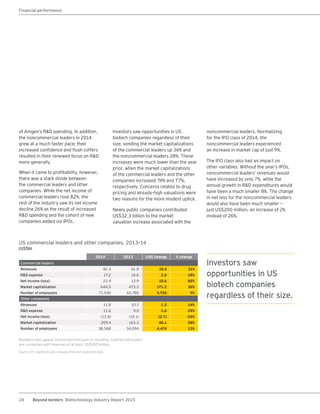
Investors saw opportunities in US
biotech companies regardless of their
size, sending the market capitalizations
of the commercial leaders up 36% and
the noncommercial leaders 28%. These
increases were much lower than the year
prior, when the market capitalizations
of the commercial leaders and the other
companies increased 74% and 77%,
respectively. Concerns related to drug
pricing and already-high valuations were
two reasons for the more modest uptick.
Newly public companies contributed
US$32.3 billion to the market
valuation increase associated with the
US commercial leaders and other companies, 2013–14
(US$b)
2014 2013 US$ change % change
Commercial leaders
Revenues 81.3 61.8 19.4 31%
R&D expense 17.2 14.6 2.6 18%
Net income (loss) 23.4 12.9 10.6 82%
Market capitalization 644.5 473.3 171.2 36%
Number of employees 71,540 65,785 5,755 9%
Other companies
Revenues 11.8 10.3 1.5 14%
R&D expense 11.6 9.0 2.6 29%
Net income (loss) (12.8) (10.1) (2.7) -26%
Market capitalization 209.4 163.3 46.1 28%
Number of employees 38,568 34,094 4,474 13%
Numbers may appear inconsistent because of rounding. Commercial leaders
are companies with revenues of at least US$500 million.
Source: EY, Capital IQ and company financial statement data.
Investors saw
opportunities in US
biotech companies
regardless of their size.
noncommercial leaders. Normalizing
for the IPO class of 2014, the
noncommercial leaders experienced
an increase in market cap of just 9%.
The IPO class also had an impact on
other variables. Without the year’s IPOs,
noncommercial leaders’ revenues would
have increased by only 7%, while the
annual growth in R&D expenditures would
have been a much smaller 8%. The change
in net loss for the noncommercial leaders
would also have been much smaller —
just US$200 million, an increase of 2%
instead of 26%.
25Beyond borders Biotechnology Industry Report 2015
Financial performance
Region
Number
of public
companies
Market
capitalization Revenue R&D
Net income
(loss) Total assets
Cash and
equivalents
plus
short-term
investments
San Francisco Bay Area
80
19%
210,781
24%
32,610
95%
6,883
34%
9,477
4,335%
53,582
41%
20,238
100%
New England
75
29%
209,554
42%
16,517
27%
6,487
24%
75
-112%
36,129
27%
13,711
34%
San Diego
44
13%
60,027
31%
2,870
-53%
1,677
11%
(918)
107%
9,057
-40%
6,040
42%
New York State
34
17%
53,320
56%
3,706
31%
1,863
52%
(913)
780%
7,322
45%
2,659
42%
New Jersey
25
9%
100,907
27%
8,971
20%
2,973
10%
1,353
25%
21,534
31%
9,745
38%
Mid-Atlantic
20
5%
16,026
19%
2,277
32%
808
9%
(8)
-91%
4,885
12%
2,111
14%
Southeast
19
6%
6,909
30%
335
26%
239
15%
(404)
17%
2,064
13%
644
29%
Los Angeles/Orange County
19
19%
134,530
45%
20,335
7%
4,965
6%
4,438
-3%
70,514
5%
28,170
41%
Pacific Northwest
16
33%
12,683
78%
537
-19%
858
62%
(852)
23%
2,061
53%
1,287
49%
Pennsylvania/Delaware Valley
12
20%
15,322
13%
899
-25%
575
15%
(520)
38%
2,448
-25%
1,059
-6%
North Carolina
13
18%
11,775
47%
1,247
31%
489
47%
(804)
397%
5,135
45%
1,377
-17%
Midwest
12
0%
3,928
49%
67
-40%
193
-2%
(306)
-28%
773
-3%
631
26%
Texas
9
29%
3,352
38%
254
-2%
237
36%
(299)
177%
1,257
71%
833
137%
Colorado
7
17%
2,809
-7%
62
-11%
226
51%
(311)
69%
1,043
24%
685
45%
Utah
4
0%
2,793
39%
778
27%
85
38%
151
24%
867
1%
228
-46%
Other
14
0%
9,145
16%
1,585
38%
273
34%
458
64%
3,425
42%
1,438
59%
Total
403
17%
853,862
34%
93,050
29%
28,831
22%
10,618
293%
222,095
17%
90,857
46%
Market capitalization as of 31 December 2014. Percent changes refer to change over December 2013. Numbers may appear inconsistent because of rounding.
New England: Connecticut, Maine, Massachusetts, New Hampshire, Rhode Island, Vermont; Mid-Atlantic: Maryland, Virginia, District of Columbia; Mid-West: Illinois,
Michigan, Ohio, Wisconsin; Southeast: Alabama, Florida, Georgia, Kentucky, Louisiana, Tennessee, South Carolina; Pacific Northwest: Oregon, Washington
Source: EY, Capital IQ and company financial statement data.
Selected US public company financial highlights by geographic area, 2014
(US$m, % change over 2013)
26 Beyond borders Biotechnology Industry Report 2015
US market capitalization relative to leading indices
Chart includes companies that were active on 31 March 2015.
Source: EY and Capital IQ.
0%
-50%
+50%
+100%
+200%
+150%
EY US biotech industry Russell 3000Dow Jones Industrial Average NASDAQ Composite EY US medtech industryPharma industry US
US market capitalization by company size
Chart includes companies that were active on 31 March 2015.
Source: EY and Capital IQ.
+200%
+50%
-50%
+100%
0%
+250%
+150%
+300%
+350%
+400%
EY US biotech industry Small-cap (US$200m–US$2b)Large-cap (>US$10b) Micro-cap (<US$200m)Mid-cap (US$2b–US$10b)
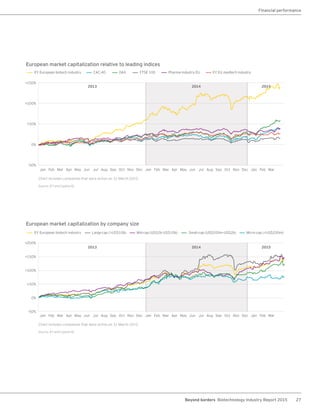
In both the US and Europe, biotech stocks outperformed the broader indices,
led by mid-sized biotechs in the US and large firms in Europe.
Financial performance
2013
2013
2014
2014
2015
2015
Jan
Jan
Jan
Jan
Jan
Jan
Feb
Feb
Feb
Feb
Feb
Feb
Mar
Mar
Mar
Mar
Mar
Mar
Apr
Apr
Apr
Apr
May
May
May
May
Jun
Jun
Jun
Jun
Jul
Jul
Jul
Jul
Aug
Aug
Aug
Aug
Sep
Sep
Sep
Sep
Oct
Oct
Oct
Oct
Nov
Nov
Nov
Nov
Dec
Dec
Dec
Dec
27Beyond borders Biotechnology Industry Report 2015
European market capitalization relative to leading indices
0%
-50%
+50%
+100%
+150%
EY European biotech industry FTSE 100CAC-40 Pharma industry EU EY EU medtech industryDAX
Chart includes companies that were active on 31 March 2015.
Source: EY and Capital IQ.
European market capitalization by company size
0%
-50%
+50%
+100%
+150%
+200%
EY European biotech industry Small-cap (US$200m–US$2b)Large-cap (>US$10b) Micro-cap (<US$200m)Mid-cap (US$2b–US$10b)
Chart includes companies that were active on 31 March 2015.
Source: EY and Capital IQ.
Financial performance
2013
2013
2014
2014
2015
2015
Jan
Jan
Jan
Jan
Jan
Jan
Feb
Feb
Feb
Feb
Feb
Feb
Mar
Mar
Mar
Mar
Mar
Mar
Apr
Apr
Apr
Apr
May
May
May
May
Jun
Jun
Jun
Jun
Jul
Jul
Jul
Jul
Aug
Aug
Aug
Aug
Sep
Sep
Sep
Sep
Oct
Oct
Oct
Oct
Nov
Nov
Nov
Nov
Dec
Dec
Dec
Dec
28 Beyond borders Biotechnology Industry Report 2015
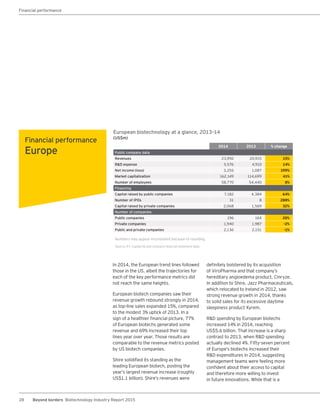
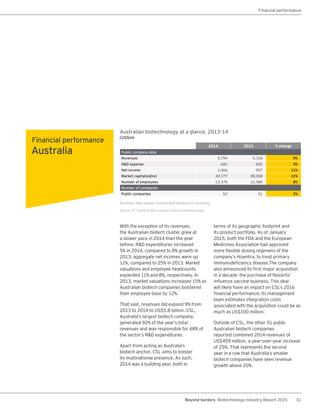
European biotechnology at a glance, 2013–14
(US$m)
2014 2013 % change
Public company data
Revenues 23,992 20,915 15%
R&D expense 5,576 4,910 14%
Net income (loss) 3,255 1,087 199%
Market capitalization 162,149 114,699 41%
Number of employees 58,770 54,440 8%
Financing
Capital raised by public companies 7,182 4,384 64%
Number of IPOs 31 8 288%
Capital raised by private companies 2,068 1,569 32%
Number of companies
Public companies 196 164 20%
Private companies 1,940 1,987 -2%
Public and private companies 2,136 2,151 -1%
Numbers may appear inconsistent because of rounding.
Source: EY, Capital IQ and company financial statement data.
Financial performance
Europe
In 2014, the European trend lines followed
those in the US, albeit the trajectories for
each of the key performance metrics did
not reach the same heights.
European biotech companies saw their
revenue growth rebound strongly in 2014,
as top-line sales expanded 15%, compared
to the modest 3% uptick of 2013. In a
sign of a healthier financial picture, 77%
of European biotechs generated some
revenue and 69% increased their top
lines year over year. Those results are
comparable to the revenue metrics posted
by US biotech companies.
Shire solidified its standing as the
leading European biotech, posting the
year’s largest revenue increase (roughly
US$1.1 billion). Shire’s revenues were
definitely bolstered by its acquisition
of ViroPharma and that company’s
hereditary angioedema product, Cinryze.
In addition to Shire, Jazz Pharmaceuticals,
which relocated to Ireland in 2012, saw
strong revenue growth in 2014, thanks
to solid sales for its excessive daytime
sleepiness product Xyrem.
R&D spending by European biotechs
increased 14% in 2014, reaching
US$5.6 billion. That increase is a sharp
contrast to 2013, when R&D spending
actually declined 4%. Fifty-seven percent
of Europe’s biotechs increased their
R&D expenditures in 2014, suggesting
management teams were feeling more
confident about their access to capital
and therefore more willing to invest
in future innovations. While that is a
Financial performance
29Beyond borders Biotechnology Industry Report 2015
healthy sign, it is still substantially below
the 70% of US biotechs that upped their
R&D expenditures in 2014. Alkermes
and Jazz contributed the most to the
growth in R&D spending, allocating
more than US$200 million combined to
pipeline development. Other European
stalwarts, however, pulled back from R&D
investments in 2014, including Shire,
which downsized its R&D expenditures by
6% as the result of either termination or
completion of late-stage clinical programs.
As in the US, European biotech companies’
aggregate net income increased by a
healthy percentage, spiking 199% to
US$3.3 billion. This percentage increase
didn’t match the steep growth rate of
2013, when net income soared by 462%.
It was also heavily influenced by the
US$1.6 billion breakup fee Shire received
from AbbVie when the proposed merger
between the two companies was called off
in October 2014.
Adjusting for this one-time event,
European biotech companies actually
added US$533 million in aggregate net
income in 2014, an annual increase of
52%. This increase was driven largely by
strong performances by Medivir, Actelion
and Amarin, which each increased their
net income by at least US$90 million.
Indeed, only 45% of European biotechs
boosted their net income in 2014,
compared to 50% in 2013. Among those
with sizeable drops in net income were
Meda and Jazz Pharmaceuticals, while
Alkermes reported a net loss. Meda’s
net income fell as a result of one-time
restructuring charges related to its
Rottapharm acquisition, while the bottom
lines of both Jazz and Alkermes were
affected by the aforementioned increases
in their R&D budgets.
The market capitalizations of European
biotech companies increased strongly
for the second straight year amid
positive investor sentiment. Indeed,
market caps of European companies
actually increased seven percentage
points more than those in the US in
2014. A catch-up phenomenon was
at least partly responsible, given that
European biotech market valuations
didn’t increase as dramatically in 2013
as those of US biotechs, there was more
room for a run-up in 2014. In all, 59% of
European biotechs saw their market caps
increase in 2014.
Another welcome change from past
years was the uptick in IPOs. In 2014, 31
European biotech companies debuted on
public exchanges (including exchanges
located in the US). As a result, the number
of European public biotech companies
swelled 20%. These new listings had a
slight effect on Europe’s overall financial
performance, contributing 1% to the
continent’s revenue growth and 39%
to the upsurge in R&D expenditures.
Normalizing for the 2014 IPO class,
aggregate net income for European
biotechs would have increased by 232%
instead of 199%, since many of these IPO
companies were in net loss positions, as is
normal for newly public companies.
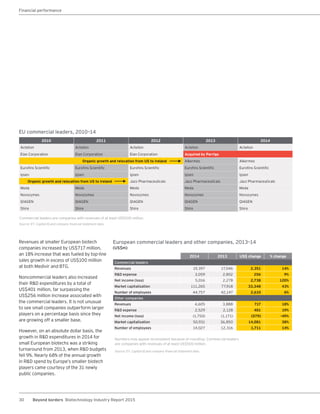
A brightening climate
A subsector analysis of the European
biotech sector provides additional data
suggesting a brightening climate for
biotechs in that part of the world.
2014 was another solid year for European
commercial leaders, which reported
greater growth across all the key
performance indicators we track.
There were no changes to the list of
European commercial leaders from 2013
to 2014, as Shire remained independent
after AbbVie called off its proposed
acquisition of Europe’s largest biotech.
This stability is welcome news. Anchored
by a strong group of rapidly growing
commercial-stage companies, it will be
easier for the European biotech sector to
sustain positive investor sentiment.
In 2014, all nine European commercial
leaders increased their revenues year
over year, including five by double digits.
Indeed, the European commercial leaders
were responsible for 77% of the annual
revenue growth in 2014.
More importantly, the financial
performance of Europe’s noncommercial
leaders surged in 2014, keeping pace
with ―— and in terms of revenue and R&D,
surpassing ―— the commercial leaders.
Financial performance
30 Beyond borders Biotechnology Industry Report 2015
EU commercial leaders, 2010–14
2010 2011 2012 2013 2014
Actelion Actelion Actelion Actelion Actelion
Elan Corporation Elan Corporation Elan Corporation Acquired by Perrigo
Organic growth and relocation from US to Ireland Alkermes Alkermes
Eurofins Scientific Eurofins Scientific Eurofins Scientific Eurofins Scientific Eurofins Scientific
Ipsen Ipsen Ipsen Ipsen Ipsen
Organic growth and relocation from US to Ireland Jazz Pharmaceuticals Jazz Pharmaceuticals Jazz Pharmaceuticals
Meda Meda Meda Meda Meda
Novozymes Novozymes Novozymes Novozymes Novozymes
QIAGEN QIAGEN QIAGEN QIAGEN QIAGEN
Shire Shire Shire Shire Shire
Commercial leaders are companies with revenues of at least US$500 million.
Source: EY, Capital IQ and company financial statement data.
Revenues at smaller European biotech
companies increased by US$717 million,
an 18% increase that was fueled by top-line
sales growth in excess of US$100 million
at both Medivir and BTG.
Noncommercial leaders also increased
their R&D expenditures by a total of
US$401 million, far surpassing the
US$256 million increase associated with
the commercial leaders. It is not unusual
to see small companies outperform larger
players on a percentage basis since they
are growing off a smaller base.
However, on an absolute dollar basis, the
growth in R&D expenditures in 2014 for
small European biotechs was a striking
turnaround from 2013, when R&D budgets
fell 9%. Nearly 68% of the annual growth
in R&D spend by Europe’s smaller biotech
players came courtesy of the 31 newly
public companies.
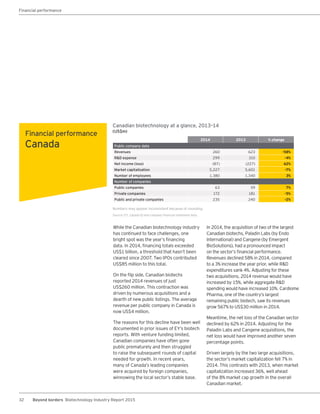
European commercial leaders and other companies, 2013–14
(US$m)
2014 2013 US$ change % change
Commercial leaders
Revenues 19,397 17,046 2,351 14%
R&D expense 3,059 2,802 256 9%
Net income (loss) 5,016 2,278 2,738 120%
Market capitalization 111,265 77,918 33,348 43%
Number of employees 44,757 42,147 2,610 6%
Other companies
Revenues 4,605 3,888 717 18%
R&D expense 2,529 2,128 401 19%
Net income (loss) (1,750) (1,171) (579) -49%
Market capitalization 50,931 36,850 14,081 38%
Number of employees 14,027 12,316 1,711 14%
Numbers may appear inconsistent because of rounding. Commercial leaders
are companies with revenues of at least US$500 million.
Source: EY, Capital IQ and company financial statement data.
Financial performance
31Beyond borders Biotechnology Industry Report 2015
Financial performance
Australia
With the exception of its revenues,
the Australian biotech cluster grew at
a slower pace in 2014 than the year
before. R&D expenditures increased
5% in 2014, compared to 8% growth in
2013; aggregate net incomes were up
11%, compared to 25% in 2013. Market
valuations and employee headcounts
expanded 11% and 8%, respectively. In
2013, market valuations increased 15% as
Australian biotech companies bolstered
their employee base by 12%.
That said, revenues did expand 9% from
2013 to 2014 to US$5.8 billion. CSL,
Australia’s largest biotech company,
generated 92% of the year’s total
revenues and was responsible for 68% of
the sector’s R&D expenditures.
Apart from acting as Australia’s
biotech anchor, CSL aims to bolster
its multinational presence. As such,
2014 was a building year, both in
terms of its geographic footprint and
its product portfolio. As of January
2015, both the FDA and the European
Medicines Association had approved
more flexible dosing regimens of the
company’s Hizentra, to treat primary
immunodeficiency disease.The company
also announced its first major acquisition
in a decade: the purchase of Novartis’
influenza vaccine business. This deal
will likely have an impact on CSL’s 2016
financial performance; its management
team estimates integration costs
associated with the acquisition could be as
much as US$100 million.
Outside of CSL, the other 51 public
Australian biotech companies
reported combined 2014 revenues of
US$459 million, a year-over-year increase
of 25%. That represents the second
year in a row that Australia’s smaller
biotech companies have seen revenue
growth above 20%.
Australian biotechnology at a glance, 2013–14
(US$m)
2014 2013 % change
Public company data
Revenues 5,794 5,318 9%
R&D expense 681 650 5%
Net income 1,066 957 11%
Market capitalization 42,177 38,068 11%
Number of employees 13,370 12,380 8%
Number of companies
Public companies 52 51 2%
Numbers may appear inconsistent because of rounding.
Source: EY, Capital IQ and company financial statement data.
Financial performance
32 Beyond borders Biotechnology Industry Report 2015
Financial performance
Canada
While the Canadian biotechnology industry
has continued to face challenges, one
bright spot was the year’s financing
data. In 2014, financing totals exceeded
US$1 billion, a threshold that hasn’t been
cleared since 2007. Two IPOs contributed
US$85 million to this total.
On the flip side, Canadian biotechs
reported 2014 revenues of just
US$260 million. This contraction was
driven by numerous acquisitions and a
dearth of new public listings. The average
revenue per public company in Canada is
now US$4 million.
The reasons for this decline have been well
documented in prior issues of EY’s biotech
reports. With venture funding limited,
Canadian companies have often gone
public prematurely and then struggled
to raise the subsequent rounds of capital
needed for growth. In recent years,
many of Canada’s leading companies
were acquired by foreign companies,
winnowing the local sector’s stable base.
In 2014, the acquisition of two of the largest
Canadian biotechs, Paladin Labs (by Endo
International) and Cangene (by Emergent
BioSolutions), had a pronounced impact
on the sector’s financial performance.
Revenues declined 58% in 2014, compared
to a 3% increase the year prior, while R&D
expenditures sank 4%. Adjusting for these
two acquisitions, 2014 revenue would have
increased by 15%, while aggregate R&D
spending would have increased 10%. Cardiome
Pharma, one of the country’s largest
remaining public biotech, saw its revenues
grow 567% to US$30 million in 2014.
Meantime, the net loss of the Canadian sector
declined by 62% in 2014. Adjusting for the
Paladin Labs and Cangene acquisitions, the
net loss would have improved another seven
percentage points.
Driven largely by the two large acquisitions,
the sector’s market capitalization fell 7% in
2014. This contrasts with 2013, when market
capitalization increased 36%, well ahead
of the 8% market cap growth in the overall
Canadian market.
Canadian biotechnology at a glance, 2013–14
(US$m)
2014 2013 % change
Public company data
Revenues 260 623 -58%
R&D expense 299 310 -4%
Net income (loss) (87) (227) 62%
Market capitalization 5,227 5,601 -7%
Number of employees 1,380 1,340 3%
Number of companies
Public companies 63 59 7%
Private companies 172 181 -5%
Public and private companies 235 240 -2%
Numbers may appear inconsistent because of rounding.
Source: EY, Capital IQ and company financial statement data.
Financial performance
Section heading
33Beyond borders Biotechnology Industry Report 2015
Financing
Beyond borders 2015
33Beyond borders Biotechnology Industry Report 2015
Financing
34 Beyond borders Biotechnology Industry Report 2015
Financing
The strong 2014 performance was driven
by growth in all key funding categories:
venture capital, IPOs, follow-on equity
offerings and debt. IPOs garnered the
biggest headlines in 2014, as US and
European biotechs raised US$6.8 billion,
an astonishing 93% increase over 2013’s
strong performance. Remarkably, this
was only the second-highest total in the
industry’s history. IPO fundraising in 2000
had been about US$1 billion higher.
As in 2013, 2014’s solid IPO and follow-on
financings were driven by the continuing
bull market for biotech stocks, as investors
expressed new confidence in the sector.
Strong product launches by the industry’s
bellwethers helped investors shake off
apprehensions regarding regulatory risks
and health care reforms. Gilead Sciences’
Sovaldi became the biggest product launch
ever — all the more remarkable in that it
came from a biotech company rather than
a member of big pharma. Other important
launches such as Biogen’s Tecfidera also
exceeded market expectations.
An FDA that is more willing to balance
product access against risk, especially
in areas of high unmet need, also helped
in 2014. FDA programs designed to get
differentiated products to market via
accelerated pathways began to bear fruit,
contributing to near-record numbers of
approvals. Of the 41 approvals recorded
in 2014, more than three-quarters were
on first filings. Finally, the expansionary
monetary policies of most central banks —
particularly the U.S. Federal Reserve —
played a big role as investors have shown
a willingness to accept more risk in the
pursuit of returns.
Capital raised in the US and Europe, 2000–14
(US$m)
2000 2001 2002 2003 2004 2005 2006 2007 2008 2009 2010 2011 2012 2013 2014
IPOs 7,838 548 593 484 2,068 1,692 2,091 2,262 119 840 1,325 863 880 3,526 6,802
Follow-on
and other
13,415 2,233 1,763 4,904 6,857 6,604 9,286 8,889 4,098 9,226 5,955 5,869 7,616 9,310 13,838
Debt 1,529 1,907 4,472 7,296 6,349 6,030 9,662 10,575 5,776 5,614 12,079 20,587 14,040 12,831 26,049
Venture 4,121 3,694 3,504 4,073 5,277 5,495 6,044 7,930 5,987 5,809 5,805 5,678 5,518 5,948 7,630
Total 26,903 8,382 10,332 16,757 20,551 19,821 27,083 29,657 15,980 21,491 25,163 32,998 28,055 31,614 54,319
Numbers may appear inconsistent because of rounding. Convertible debt instruments included in “debt.”
Source: EY, BioCentury, Canadian Biotech News, Capital IQ and VentureSource.
The big picture
What a year. In 2014, the financing climate seemed a world away from the doom and gloom of just a few
years ago. Fundraising totals in 2014 broke all-time records in both the US and Europe, resulting in a total
of US$54.3 billion raised, a 72% increase over 2013, which itself had been a remarkably strong year.
Fundraising in 2014 handily beat capital raised in 2000 — a year in which investor enthusiasm about the
sequencing of the human genome propelled fundraising to heights many thought we would never see again.
Financing the future
35Beyond borders Biotechnology Industry Report 2015
Financing
A venture financing rush
IPO and follow-on financings have been
driven by the support of generalist
investors trying to capture some of the
sector’s growth in market capitalization,
and the companies that listed in 2013 and
2014 were, on average, more mature than
new listings in prior IPO windows. Unlike
the firms that went public in the late
1990s and early 2000s, most members
of the IPO class of the last two years (81%)
had lead candidates in Phase II or later,
and the majority have retained the rights
to their products rather than out-licensing
them to a larger partner.
If the IPO market continued to garner the
headlines for biotech, an under-appreciated
yet significant development was the
growing rush of venture financing. Between
2008 and 2013, despite many doomsday
proclamations to the contrary, venture
capital had been remarkably stable.
Through the turmoil of the global financial
crisis and the subsequent recovery, venture
capital totals averaged US$5.8 billion,
never falling below US$5.5 billion or
rising above US$5.9 billion. In 2014, that
pattern was broken, as US and European
companies raised US$7.6 billion, a 28%
increase and just shy of the all-time record
of US$7.9 billion raised in 2007.
The low interest rate environment of the
last several years has led to a surge in debt
financing. That pattern continued in 2014,
as debt totals soared to US$26.0 billion,
more than double the 2003-13 average.
To control for the skewing effect of these
large debt financings, we also analyzed
equity financing totals (i.e., fundraising
excluding debt). In 2014, these totals
reached an all-time high, as companies
raised US$28.3 billion in non-debt
capital, beating the previous high of
US$25.4 billion achieved in 2000.
Between them, five large companies
closed six debt transactions of more
than US$1 billion: Amgen, Celgene,
Gilead, Ikaria and Illumina. Gilead’s two
offerings — one in March and one in
November 2014, each for US$4 billion —
were to be used to repay existing
debt and fund working capital and
share repurchases.
Starting in 2008, the challenging funding
environment for small companies and
the spike in debt financing by large firms
inspired us to create a measure we call
“innovation capital” — the funds raised
by companies with revenues less than
US$500 million. Biotech “commercial
leaders” (entities with revenues in excess
of US$500 million) are self-sustaining,
cash-flow-positive entities that do not
depend on fundraising to finance R&D.
Indeed, the large debt financings of
recent years have often been used for
other purposes such as stock buybacks
and acquisitions. We have therefore been
measuring innovation capital to gauge the
situation for smaller companies that need
fundraising to sustain R&D and innovation.
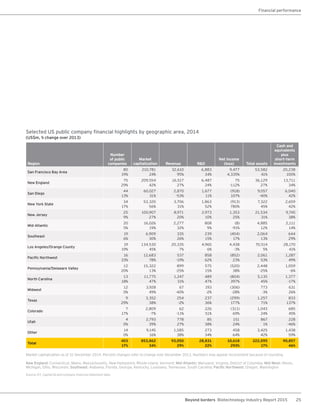
What we found was telling. In the
four years before the financial crisis
struck, innovation capital had averaged
Innovation capital in the US and Europe, 2000–14
Innovation capital is the amount of equity capital raised by companies
with revenues of less than US$500 million.
Source: EY, BioCentury, Canadian Biotech News, Capital IQ and VentureSource.
30
40
60
50
20
0
10
Innovation capital Commercial leaders
Capitalraised(US$b)
‘06‘00 ‘07 ‘08 ‘09 ‘10 ‘11 ‘12 ‘13 ‘14‘01 ‘02 ‘03 ‘04 ‘05
36 Beyond borders Biotechnology Industry Report 2015
Financing
US$15.1 billion a year. Between 2008 and
2012, the average fell to US$12.5 billion
a year. Even as the overall fundraising
climate recovered on the back of soaring
debt financings by commercial leaders, the
amount of innovation capital remained flat.
That changed starting in 2013,
when innovation capital shot up to
US$18.6 billion, and 2014, when it reached
a new high of US$27.6 billion. This bodes
well for investment in research pipelines
and the overall health of the sector.
In another encouraging sign for biotech
innovation, early rounds generated more
funding than they had in at least a decade —
US$1.8 billion — even though the number
of deals dropped slightly from 182 to 177,
year over year. The median deal value for
early-stage firms — US$10 million — was
also the highest since 2006.
Some early rounds were truly remarkable
in size. In fact, 2014 was the first year
since we began tracking the biotech sector
28 years ago in which there were four
early-stage US biotech venture rounds of
more than US$50 million. Philadelphia-
based Spark Therapeutics, founded in
2013, raised US$72.8 million to pursue
gene therapies. Seattle-based Juno
Therapeutics added US$190 million to
the US$120 million it raised in December
2013 (and then followed that up with
one of the year’s largest IPOs) to help it
achieve its goal of developing chimeric
antigen receptor therapy (CAR-T) to help
individual patients’ immune-system cells
attack cancer cells. And Human Longevity,
the latest company founded by genomics
pioneer Craig Venter, raised US$70 million
to create an enormous sequencing project
aimed at finding cell-based treatments for
extending healthy human life-spans.
In addition, the year’s largest European
first round — indeed, one of the largest
in that sector’s history — went to UK-
based Adaptimmune, which received
US$104 million from a consortium
led by venture capital firm New
Enterprise Associates. Spun off from
the University of Oxford in 2008,
US and European early‑stage venture investment, 2000–14
Early-stage investments include seed, first and second venture rounds.
Source: EY, BioCentury, Capital IQ and VentureSource.
1.2 120
1.6 160
2.0 200
0.4
0.8 80
40
0.0 0
Capital raised Number of deals
Capitalraised(US$b)
Numberofdeals
20022000 2001 2003 2004 2005 2006 2007 2008 2009 2010 2011 2012 2013 2014
37Beyond borders Biotechnology Industry Report 2015
Financing
Percentageofventuredollarsinvested
Adaptimmune is developing T-cells to treat
several types of cancer. The company also
entered into a strategic partnership with
GlaxoSmithKline in June 2014.
European early-stage companies were
more likely than their US counterparts to
benefit from this trend — 36% of European
venture capital came in the form of Series A
or B funding, as opposed to 23% in the US.
A rising tide
The present IPO boom has given venture
capitalists the opportunity to realize
returns and restock their coffers, the
better to support a new generation of
companies. Recent research (based on
data from Thomson Reuters) showing that
one-third of biotech firms go public within
five years of their initial investment — a
higher proportion than for software or
other sectors — also supports biotech
investment prospects. This is a stark
reversal from just a few years ago, when
the average time to exit had extended to
over eight years (or almost as long as the
legal life of a venture capital fund).
However, the increase in early-stage
funding was not driven by a shift in
investor focus. Instead, it was a case
of the proverbial rising tide lifting all
boats. The share of venture capital going
toward early rounds has remained fairly
static over time.
A record-breaking 94 US and European
biotech companies went public in 2014,
raising US$6.8 billion, for an average of
US$72 million per IPO. The year’s 94 IPOs
thoroughly shattered the previous record
of 79 in 2000. However, the class of 2000
remained ahead in terms of the amount of
capital raised (US$7.8 billion).
However, the entire 2013-14 IPO
window — in which 143 companies went
public, raising US$10.3 billion, more than
the previous eight years combined — is
the largest window in the industry’s
history. This is particularly remarkable
because the window did not open in
Europe until early 2014.
US and European venture investment in early stage private companies holds steady
Source: EY, BioCentury, Capital IQ and VentureSource.
60%
80%
100%
40%
0%
20%
Seed and first rounds All later rounds
20062000 2007 2008 2009 2010 2011 2012 2013 20142001 2002 2003 2004 2005
38 Beyond borders Biotechnology Industry Report 2015
Of course, investor sentiment in 2014
was fundamentally different from
2000. The window in 2000 was driven
by undifferentiated enthusiasm over
the sequencing of the human genome
and the possibilities to come from that
breakthrough. In 2014, however, the
window was much more about real
market performance than scientific
promise. The window resulted from
the strong performance of biotech’s
commercial leaders and important
clinical results from companies large
and small — in some sense, the payoff
from the human genome project over
a decade later.
The average IPO size was US$72 million,
continuing the trend set in 2013, but 21
companies raised over US$100 million.
Although only four of the 21 were
European companies, two were in the
global top three: UK-based Circassia
Pharmaceuticals and Forward Pharma
of Denmark. The IPOs of Circassia and
US-based Juno Therapeutics were also
the third- and fourth-largest biotech
IPOs of all time.
The wide-open IPO window meant not
only that record numbers of companies
went public, but also that they did so
at favorable terms. (As discussed later,
this was in part because of strong post-
IPO market valuations and growth.)
As in 2013, roughly 60% of companies
going public did so within or above their
anticipated price ranges — well above the
three-year average for 2010-12 of 36%.
US and European biotechnology IPO pricing, 2010–14
Source: EY, BioCentury, Capital IQ and VentureSource.
60%
80%
100%
40%
0%
20%
Above range Within range Below range
20142013201220112010
PercentageofIPOs
A record-breaking 94 US and European
biotech companies went public in 2014,
raising US$6.8 billion, for an average of
US$72 million per IPO.
Financing
39Beyond borders Biotechnology Industry Report 2015
US biotechnology financings, 2000–14
Source: EY, BioCentury, Capital IQ and VentureSource.
30
50
40
20
0
10
Debt Follow-on and other IPOs Venture
Capitalrasied(US$b)
‘00 ‘01 ‘02 ‘03 ‘04 ‘05 ‘06 ‘10‘07 ‘11‘08 ‘12‘09 ‘13 ‘14
US biotechnology recorded a
colossal year in 2014, setting a new
all-time record in total capital raised
(US$45.1 billion) as well as funds raised
through IPOs (US$4.9 billion) and debt
(US$23.3 billion). The amounts raised
in the two other financing categories
represented the second-highest totals
in the industry’s history: venture capital
generated US$5.6 billion (second to
the US$6.1 billion raised in 2007) and
follow-on financing raised US$10.7 billion
(behind the almost US$13 billion raised
in 2000).
The sector’s strong overall performance
was underpinned by successful launches
of well-differentiated products that could
attract premium prices, supported by a
more accommodating FDA, especially in
areas of high unmet need. Meanwhile, big
pharma’s increasing need to fill its growth
gap also drew investors in anticipation of
acquisitions of biotech assets at significant
premiums, such as Roche’s US$8.3 billion
purchase of InterMune and Merck & Co.’s
two multibillion-dollar offers, for Cubist
Pharmaceuticals (US$9.5 billion) and
Idenix Pharmaceuticals (US$3.9 billion).
(See accompanying “Deals, 2014” article.)
As a result, generalist investors came
back to biotech, the best-performing
sector in the market for the last two years,
driving up equity values and pumping
much-needed capital into the sector.
Financing
United States
Financing
40 Beyond borders Biotechnology Industry Report 2015
Boom times for
innovation capital
Driven in part by the resurgent IPO
and follow-on financing markets,
2014 marked the highest amount of
innovation capital ever raised in the
sector — US$21.1 billion, a 40% increase
over 2013. This is almost double the
10-year average of US$10.9 billion and
well ahead of the previous 10-year high
of US$15.1 billion set in 2013.
The two consecutive years of growth
in innovation capital bodes well for
the resilience of the biotech industry.
It gives smaller companies — some of
which will develop to become the future
growth engines of the sector — more
confidence to invest in R&D, more
opportunity to expand their pipelines
and more bargaining power with larger
companies, in both alliances and M&A.
Meanwhile, the amount of money raised
by commercial leaders grew by an
astonishing 127%, to US$23.9 billion.
This included six debt offerings of at
least US$1 billion. Gilead alone had two
US$4 billion offerings, one in March and
one in November of 2014.
Quarterly breakdown of US biotechnology financings (US$m), 2014
Q1 Q2 Q3 Q4 Total
IPOs
$1,739
(23)
$1,055
(17)
$958
(13)
$1,193
(10)
$4,946
(63)
Follow-on and other
$4,651
(83)
$2,047
(47)
$1,081
(27)
$2,943
(49)
$10,722
(206)
Debt
$6,711
(31)
$9,734
(44)
$2,031
(40)
$5,325
(26)
$23,801
(141)
Venture
$1,333
(95)
$1,882
(115)
$1,059
(103)
$1,325
(70)
$5,600
(383)
Total
$14,434
(232)
$14,719
(223)
$5,130
(183)
$10,786
(155)
$45,069
(793)
Figures in parentheses are number of financings. Numbers may appear inconsistent because of rounding.
Source: EY, BioCentury, Capital IQ and VentureSource.
Innovation capital in the US, 2000–14
Innovation capital is the amount of equity capital raised by companies
with revenues of less than US$500 million.
Source: EY, BioCentury, Capital IQ and VentureSource.
30
50
40
20
0
10
Innovation capital Capital raised by commercial leaders
Capitalraised(US$b)
‘00 ‘01 ‘02 ‘03 ‘04 ‘05 ‘06 ‘10‘07 ‘11‘08 ‘12‘09 ‘13 ‘14
Financing
41Beyond borders Biotechnology Industry Report 2015
Unsurprisingly, New England (which raised
US$4.9 billion in innovation capital), the
San Francisco Bay Area (US$4.4 billion)
and San Diego (US$3.1 billion) continued
to be the nation’s leading biotech venture
and innovation capital hotspots in 2014.
New England led in total number of
innovation capital deals (131) and venture
capital deals (80). The Bay Area attracted
the most venture capital (US$1.4 billion),
followed by New England (US$1.3 billion)
and San Diego (US$654 million) — together,
these three regions attracted 61% of all
US venture investment in 2014. The Bay
Area (US$1.3 billion), New England
(US$1.1 billion) and the Pacific Northwest
(US$621 million), with significant tailwinds
from Juno Therapeutics, were the leaders
in IPO dollars.
From 2013 to 2014, San Diego continued
to move up the innovation capital league
table. The region attracted US$1.6 billion
more in innovation capital in 2014 than
it did the previous year. Follow-on public
offerings were up almost US$1.2 billion,
which included seven rounds of at least
US$100 million. Receptos alone raised
US$619 million.
If commercial leaders were added to the
figures, San Francisco Bay Area, New
England and San Diego would account for
56% of the total amount of capital raised
in the US during 2014.
Innovation capital raised by leading US regions, 2014
Size of bubbles shows relative number of financings per region. Innovation capital is the amount
of equity capital raised by companies with revenues of less than US$500 million.
Source: EY, BioCentury, Capital IQ and VentureSource.
Los Angeles/Orange County New York StateNew JerseyMidwest Pacific Northwest San DiegoNew England San Francisco Bay Area
4
5
6
0
2
1
3
Innovationcapitalraised(US$b)
Venture capital raised (US$m)
0 200 400 1,000600 1,200800 1,400 1,600 1,800
Financing
42 Beyond borders Biotechnology Industry Report 2015
While US venture capital held steady in
the immediate aftermath of the financial
crisis, we expected to see a drop in
funding a few years down the road,
because VCs were raising less money from
limited partners, and there is lag between
funds raised and funds disbursed by
venture funds.
But the proverbial other shoe never
dropped. Instead, venture investment
remained remarkably consistent from
2008 through 2013.
In 2014, however, the resurgent IPO
market and the prospect of M&A exits
at higher valuations led to an upsurge
in funds raised by life sciences venture
capital firms, as well as their investment
in the sector. The US$5.6 billion invested
in 2014 was 27% higher than the previous
10-year average of US$4.4 billion. In
2014, average and median deal sizes of
venture financings also reached their
highest totals since 2007.
There was one record that didn’t fall in
2014: the largest venture round. On 4
January 2015, Moderna Therapeutics
closed a US$450 million financing,
the largest ever for a privately held
biotechnology company.
The average deal size was skewed by nine
deals of more than US$70 million (against
just three of that size in 2013), four of
which tipped the US$100 million mark.
US biopharmaceutical venture capital rebounds to its highest levels since the financial crisis
Source: EY, BioCentury, Capital IQ and VentureSource.
6
15
7 18
2
3
4
9
5
12
3
6
1
0 0
Total amount raised Average deal size
Capitalraised(US$b)
Averagedealsize(US$m)
20022000 2001 2003 2004 2005 2006 2007 2008 2009 2010 2011 2012 2013 2014
The resurgence of US venture capital
Financing
43Beyond borders Biotechnology Industry Report 2015
The largest sum raised was by Intarcia
Therapeutics, a Boston-headquartered
developer of a tiny subdermal pump that
can regulate the delivery of exenatide for
diabetes and obesity patients.
Top US venture financings, 2014
Company Region Lead product clinical stage Therapeutic focus
Amount
(US$m)
Month
Intarcia Therapeutics New England Phase III Metabolic/endocrinology 200 March
Juno Therapeutics Pacific Northwest Phase I Oncology 134 August
Invitae San Francisco Bay Area Services, technologies and tools Multiple 120 October
Adaptive Biotechnologies Pacific Northwest Services, technologies and tools Multiple 105 April
Paratek Pharmaceuticals New England Phase III Infection 93 June
Naurex Midwest Phase II Neurology 80 May
Spark Therapeutics Pennsylvania/Delaware Valley Phase III Multiple 73 May
Human Longevity San Diego Services, technologies and tools Multiple 70 March
Melinta Therapeutics New England Phase III Infection 70 February
C3 Jian Los Angeles/Orange County Phase II Dental 61 March
Viamet Pharmaceuticals North Carolina Phase II Infection 60 October
Precision Therapeutics Midwest Services, technologies and tools Multiple 60 November
Kolltan Pharmaceuticals New England Phase I Oncology 60 March
ProNAi Therapeutics Midwest Phase II Oncology 60 April
Juno Therapeutics* Pacific Northwest Phase I Oncology 56 April
Financing
Meanwhile, 23% of US biotech VC rounds
in 2014 were early-stage (defined as
seed or first round). That’s exactly the
same proportion as the previous 10-year
average, but down from 27% in 2013.
It is also noteworthy that Juno Therapeutics’
IPO — the largest of 2014 — was fueled
by two big venture rounds for a total of
US$190 million during 2014. The company
also raised US$120 million in December
2013, which meant that it raised a total of
US$310 million in less than 12 months.
* In April 2014, Juno Therapeutics added US$56 million to its 2013 Series A round.
Source: EY, BioCentury, Capital IQ and VentureSource.
44 Beyond borders Biotechnology Industry Report 2015
US biotechnology IPOs, 2000–14
Source: EY, BioCentury, Capital IQ and VentureSource.
50
5 70
60
2
10
4
30
40
3
20
1
0 0
Capital raised Number of deals
CapitalraisedinIPOs(US$b)
Numberofdeals
20022000 2001 2003 2004 2005 2006 2007 2008 2009 2010 2011 2012 2013 2014
The IPO bounce
For the second straight year, a surging
IPO market breathed new life into the
US biotech financing landscape. New
benchmarks were set in terms of both the
number of public listings (63) and proceeds
raised (US$4.9 billion), outstripping
previous records set in 2000-01 at the
height of the genomics bubble, when 52
IPOs raised US$4.5 billion.
Of course, the 2014 boom came on the
heels of a very strong 2013 (itself the
third-biggest IPO year in the industry’s
history), meaning that the sector has
Financing
experienced an unprecedented two-year
surge in which 101 companies went public
and raised a combined US$8.2 billion.
To put that in perspective, roughly the
same number of IPOs occurred in the eight-
year period between 2005 and 2012.
The 2014 biotech IPO ledger is filled
with new benchmarks. Although the
average deal size remained consistent
with 2013 and the overall 15-year
average, more than three-quarters (48)
of the biotechs that went public in 2014
brought in more than US$50 million in
their initial offerings, while 17 cleared
the US$100 million mark. The previous
record of 16 was set back in 2000, while
the third-highest total was 13 IPOs in
2013. 2014 closed with the second-
largest US biotech IPO on record, when
Juno Therapeutics raised more than
US$300 million. (The US record holder
remains Talecris Biotherapeutics’
US$950 million IPO in 2009.) Nearly 60%
of new companies listed within or above
their IPO ranges.
45Beyond borders Biotechnology Industry Report 2015
As usual, therapeutics companies
dominated the scene: 92% of companies
that went public in 2014 were focused on
new therapies (up from 80% of the class of
2013), one-quarter of those in oncology.
It would be unreasonable to assume that
the most fruitful biotech IPO window in
history would stay wide open for much
longer, and indeed pricing power of new
issuers diminished in the fourth quarter
of 2014. That said, while only 10
companies went public in Q4, three were
among the largest of the year: Juno
Therapeutics, FibroGen and Bellicum
Pharmaceuticals. And as 2015 began,
the IPO queue remained robust.
The 2013-14 IPO window has been
sustained by strong after-market
performance. Of the 63 IPOs in the
class of 2014, 40 (63%) had positive
returns through 31 December 2014,
16 were up more than 100%, and two
earned returns of more than 335%:
Radius Health (specializing in endocrine
disorders) and Auspex Pharmaceuticals
(focused on neurological disorders).
The IPO class as a whole was up 27%
through 31 December 2014 (and
44% through 31 March 2015). Such
returns have bolstered investor interest
and confidence in the sector and
expectations of a raft of companies
aiming for IPO in the coming months.
The anatomy of a US IPO window
Source: EY, BioCentury, Capital IQ and VentureSource.
1.2 15
2.0 25
1.6 20
0.8 10
0.0 0
0.4 5
Capital raised
CapitalraisedinIPOs(US$b)
Numberofdeals
Q1
2012 2013 2014
Q2 Q3 Q4 Q1 Q2 Q3 Q3Q4 Q4Q1 Q2
Number of deals
US biotechnology IPO pricing by quarter, 2013–14
Source: EY, BioCentury, Capital IQ and VentureSource.
Q4
Q4
Q3
Q3
Q2
Q2
Q1
Q1
Below expected range
20132014
0% 10% 20% 30% 40% 50% 60% 100%70% 80% 90%
Within or above expected range
40% 60%
54% 46%
38% 63%
73% 27%
50% 50%
85% 15%
58% 42%
33% 67%
Financing
46 Beyond borders Biotechnology Industry Report 2015
Source: EY, BioCentury, Capital IQ and VentureSource.
Top US IPOs, 2014
Company Region
Lead product
clinical stage
Therapeutic focus
Gross
raised
(US$m)
IPO pricing
range
Post-IPO
performance (as of
31 December 2014)
Juno Therapeutics Pacific Northwest Phase II Oncology 305 Above 118%
FibroGen San Francisco Bay Area Phase III Multiple 168 Within 52%
Acucela Pacific Northwest Phase III Ophthalmic 163 Within -67%
Bellicum Pharmaceuticals Texas Phase II Oncology 161 Above 21%
Kite Pharma Los Angeles/Orange County Phase II Oncology 147 Above 239%
Versartis San Francisco Bay Area Phase II Metabolic/endocrinology 145 Within 7%
Ultragenyx Pharmaceutical San Francisco Bay Area Phase II Multiple 139 Above 109%
Dermira San Francisco Bay Area Phase II Dermatology 125 Within 13%
ZS Pharma Texas Phase III Multiple 123 Above 131%
Avalanche Biotechnologies San Francisco Bay Area Phase II Ophthalmic 117 Within 218%
Akebia Therapeutics Midwest Phase II Hematology/renal 115 Within -32%
Otonomy San Diego Phase III Ear, nose and throat 115 Within 108%
Revance Therapeutics San Francisco Bay Area Phase III Aesthetics 110 Within 6%
Zafgen New England Phase II Metabolic/endocrinology 110 Within 93%
Tokai Pharmaceuticals New England Phase II Oncology 105 Within -2%
Dicerna Pharmaceuticals New England Phase I Oncology 103 Above 10%
Sage Therapeutics New England Phase II Neurology 103 Within 103%
Auspex Pharmaceuticals San Diego Phase III Neurology 97 Within 337%
Concert Pharmaceuticals New England Phase II Multiple 93 Within -5%
Coherus Biosciences San Francisco Bay Area Phase III Multiple 92 Within 21%
Like Juno Therapeutics, nearly one-quarter of US biotech IPOs in 2014 were also focused on oncology, including three of the top five.
New England is home to 17 of the IPO class of 2014. Thirteen newly public biotechs are based in the San Francisco Bay Area.
Financing
47Beyond borders Biotechnology Industry Report 2015
The European biotech sector racked up
its strongest financing performance in
the history of the industry and posted the
second-strongest performance in each
individual financing category. Overall,
the sector raised US$9.2 billion — 53%
more than in 2013, and a whopping 97%
more than the previous 10-year average.
IPOs raised US$1.9 billion. That is more
than in the prior seven years combined,
but well below the US$3.3 billion raised
in 2000. Follow-on financing brought in
US$3.1 billion, just shy of the US$3.2 billion
raised in 2007. Debt financing generated
US$2.2 billion, almost double the 2003-13
average of US$1.2 billion but below the
US$2.5 billion raised in 2013. And venture
capital raised US$2 billion, just $30 million
below the 2006 peak.
It’s also noteworthy that more than
US$1.3 billion of the total raised
in Europe in 2014 came via two
formerly US companies now based in
Ireland: Jazz Pharmaceuticals, which
raised US$1.1 billion in two debt
offerings, and Alkermes, which raised
US$250 million via an equity deal.
As in the US, European company
financing slowed in the second half of
2014, primarily due to a drop in follow-on
offerings in the third quarter. IPO activity
came to an abrupt halt in November, with
no further activity through year-end. But
as 2015 began, a small cohort of European
companies entered the IPO queue.
Financing
Europe
European biotechnology financings, 2000–14
Source: EY, BioCentury, Capital IQ and VentureSource.
6
10
8
4
0
2
Debt Follow-on and other IPOs Venture
Capitalraised(US$b)
‘00 ‘01 ‘02 ‘03 ‘04 ‘05 ‘06 ‘10‘07 ‘11‘08 ‘12‘09 ‘13 ‘14
Financing
48 Beyond borders Biotechnology Industry Report 2015
The investment bonanza
Large and small European companies
all benefited from the banner 2014
investment bonanza. Led by the UK,
European innovation capital soared to
its highest levels ever — US$6.5 billion —
surpassing the US$5.6 billion invested in
2000. This uptick in innovation capital
was driven by resurgent IPO and follow-on
markets and increased venture capital
commitments. Indeed, venture investment
was responsible for 31% of the total.
Commercial leaders also enjoyed the
healthy funding environment by raising
US$2.8 billion, the greatest yearly total
since 2007. Innovation capital accounted
for 70% of total financing in 2014, up
from 58% in 2013.
The standout story in 2014 European
financing was the UK. While the UK has
been a perennial leader, in 2014 it hit a
seven-year high, raising US$2 billion in
innovation capital (31% of the European
total) and US$593 million in venture
capital (29% of the total). The UK also led
Europe in the number of funding rounds.
Industry observers attributed some of
this renewed investor confidence to
government tax breaks on investment
in R&D. EY’s annual report on the UK
biotechnology sector pointed out that in
2013 there were more than 460 biotech
drugs in development in the UK, far more
than in any other European country.
Quarterly breakdown of European biotechnology financings, 2014
(US$m)
Q1 Q2 Q3 Q4 Total
IPOs
$719
(9)
$214
(6)
$519
(10)
$405
(6)
$1,856
(31)
Follow-on and other
$1,349
(46)
$728
(23)
$170
(17)
$869
(27)
$3,116
(113)
Debt
$1,331
(6)
$80
(6)
$755
(14)
$82
(9)
$2,248
(35)
Venture
$314
(40)
$633
(56)
$487
(41)
$596
(46)
$2,030
(183)
Total
$3,713
(101)
$1,654
(91)
$1,931
(82)
$1,952
(88)
$9,250
(362)
Figures in parentheses are number of financings. Numbers may appear inconsistent because of rounding.
Source: EY, BioCentury, Capital IQ and VentureSource.
Innovation capital in Europe, 2000–14
Innovation capital is the amount of equity capital raised by companies
with revenues of less than US$500 million.
Source: EY, BioCentury, Capital IQ and VentureSource.
6
10
8
4
0
2
Innovation capital Commercial leaders
Capitalraised(US$b)
‘00 ‘01 ‘02 ‘03 ‘04 ‘05 ‘06 ‘10‘07 ‘11‘08 ‘12‘09 ‘13 ‘14
Financing
49Beyond borders Biotechnology Industry Report 2015
Innovation capital raised by leading European countries, 2014
Size of bubbles shows relative number of financings per country.
Source: EY, BioCentury, Capital IQ and VentureSource.
Belgium Denmark Israel NetherlandsFrance Germany Switzerland UK
1.5
2.0
2.5
0.0
0.5
1.0
Innovationcapitalraised(US$b)
Venture capital raised (US$m)
0 100 200 500300 600400 700
The return of European venture capital
Source: EY, BioCentury, Capital IQ and VentureSource.
Total amount raised Average deal size
Totalamountraised(US$b)
Averagedealsize(US$m)
20022000 2001 2003 2004 2005 2006 2007 2008 2009 2010 2011 2012 2013 2014
2.5 12
10
8
6
2.0
0
1.5
2
1.0
0.5
0.0
4
Financing
50 Beyond borders Biotechnology Industry Report 2015
Buoyed by renewed confidence
in European and US IPO markets,
European venture capital investment
in biotech surged in 2014 to levels not
seen since 2006, with US$2 billion
raised. The average deal size was
US$11.1 million, the highest since
2002. There were only 183 rounds in
2014, fewer than the previous 10-year
average of 218.
The improved figures for European
financing is good news. Larger
investments give European companies
more options for R&D, better
dealmaking opportunities and better
opportunities for market readiness than
they have had in many years.
But European companies remain at a
disadvantage to their US counterparts.
The median deal size for US companies
in 2014 was US$10 million, while for
European companies it was less than
half that figure.
The consequences of this disparity are
evident. Since drug development costs are
no lower in Europe than in the US, smaller
deal sizes mean that European companies
face a longer road to market. They are
often forced to partner earlier than US
companies, have less power to negotiate
favorable deal terms and are less able to
retain the rights to their products.
One important difference between
European and US venture investment
was the relative share of early rounds.
In Europe, 70% of venture rounds were
early-stage, as opposed to 23% in the
US. Early-stage rounds accounted for
US$661 million in Europe in 2014 —
the highest total since at least 2002.
Nine of the top 15 European venture
financings of 2014 were invested in UK
(5) or Swiss (4) companies, a reflection of
the relative maturity of the venture capital
sector in those countries. In addition,
the importance of Paris-based Euronext
as an IPO destination, combined with
factors such as the French government’s
revamped R&D tax credit policies, should
help create a more favorable ecosystem
for biotech venture capital in France.
Source: EY, BioCentury, Capital IQ and VentureSource.
Top European venture financings, 2014
Company Country Lead product clinical stage Status
Amount
(US$m)
Month
Adaptimmune UK Oncology Phase I 104 September
Adapt Pharma Ireland Substance abuse Phase not specified 95 May
Biocartis Switzerland Non-disease-specific Molecular diagnostics 86 September
Cell Medica UK Infection Phase III 82 November
Glycotope Germany Women’s health Phase III 73 March
NovImmune Switzerland Autoimmune Phase II 66 February
Ascendis Pharma Denmark Metabolic/endocrinology Phase II 60 December
Cardiorentis Switzerland Cardiovascular Phase III 60 September
Nucana BioMed UK Oncology Preclinical 57 April
ProQR Therapeutics Netherlands Respiratory Phase not specified 56 April
Enigma Diagnostics UK Respiratory Molecular diagnostics 50 October
Wilson Therapeutics Sweden Metabolic/endocrinology Phase II 40 April
Kymab UK Autoimmune Preclinical 40 May
Nordic Nanovector Norway Oncology Phase I 40 June
Anokion Switzerland Autoimmune Preclinical 36 May
Financing
51Beyond borders Biotechnology Industry Report 2015
The largest venture investment in
Europe in 2014 was the US$104 million
first-round funding raised by UK-based
Adaptimmune, which is developing a
new range of drugs based on immune
system cells. The oversubscribed round, in
September, was one of the largest early-
stage funding rounds of the last decade.
There were two other first-round
venture financings in the 2014 top
10: Switzerland’s Novimmune, which
focuses on antibody-based drugs to
treat inflammatory, autoimmune and
other disorders, and Netherlands-based
ProQR Therapeutics, which is developing
RNA-based therapeutics for the treatment
of severe genetic disorders, with an initial
focus on cystic fibrosis.
Eyeing the IPOs
At the start of 2014, many industry
observers were wondering why the US
enthusiasm for biotech IPOs had not
crossed the Atlantic. Indeed, European
markets seemed stuck in a rut. Venture
funding had dried up after the credit crisis.
Investors in European markets had been
burned by a number of biotech failures in
the late 1990s and early 2000s, leading
many generalist funds to stop investing
in the sector. Perhaps European biotech
investors would never regain the passion
they had displayed in 2000, when
companies such as Serono, Actelion and
Crucell completed IPOs.
But things changed rapidly. The US
biotech IPO boom of 2013 soon gave
European investors a boost in confidence
and IPOs started to appear in February —
when Egalet, uniQure and 4D Pharma
raised a total of US$177 million. Circassia
followed in March, and the floodgates
opened. Just four weeks after Circassia’s
launch, nine more European companies
had gone public, and by November
another 18 had followed suit, for a total
of 31 for the year.
To put this into perspective, the
US$1.9 billion raised in 2014 was as much
as the amount raised between 2007 and
2013 combined. The 2014 total was not
enough to rival 2000’s US$3.3 billion,
nor did the 2014 average valuation of
US$60 million come close to 2000’s
US$123 million. What’s more, only four of
the class of 2014 raised US$100 million,
against 11 in 2000.
European biotechnology IPOs, 2000–14
Source: EY, BioCentury, Capital IQ and VentureSource.
3.5 35
1.0 10
2.0 20
2.5 25
3.0 30
1.5 15
0.5 5
0.0 0
Capital raised Number of deals
CapitalraisedinIPOs(US$b)
Numberofdeals
20022000 2001 2003 2004 2005 2006 2007 2008 2009 2010 2011 2012 2013 2014
Financing
52 Beyond borders Biotechnology Industry Report 2015
A look at the top 15 European companies
that went public in 2014 reveals a depth
and breadth not seen since the IPO
class of 2000. The top 15 companies in
2014 range from several with products
already on the market to one — ProQR
Therapeutics — still at a preclinical stage.
Before 2014, no European IPO had raised
more than US$100 millon since Denmark’s
Symphogen went public in 2011. In
2014, four IPOs exceeded this threshold:
Circassia, Forward Pharma, ProQR and
Molecular Partners.
At US$333 million, Circassia’s IPO was
the largest ever for the UK biotech sector.
The historic volume of the IPO was partly
driven by Circassia’s focus on developing
allergy vaccines. Even even before its
March listing, the company had raised
several of the UK’s largest-ever rounds of
biotech venture capital.
Predicting the duration of an IPO window
is an inherently tricky proposition. Europe
had no IPOs after mid-November. And
while 73% of the European class of 2014
priced their IPOs within or above their
anticipated ranges, that figure slumped
to 50% in the second half of the year.
Nonetheless, a degree of optimism has
returned to the European biotech IPO
market. This was evident in the first
quarter of 2015 as seven IPOs raised a
total of US$339 million.
Of the 31 European companies that
went public in 2014, 25 (81%) were
focused on therapeutics; of those, 16%
were in Phase III, 12% had licensed their
Source: EY, BioCentury, Capital IQ and VentureSource.
Top European IPOs, 2014
Company Country
Lead product
clinical stage
Therapeutic focus
Gross
raised
(US$m)
IPO pricing
range
Post-IPO
performance (as of
31 December 2014)
Circassia Pharmaceuticals UK Phase III Autoimmune 333 Within -15%
Forward Pharma Denmark Phase II Autoimmune 235 Within -1%
Molecular Partners Switzerland Phase II Multiple 116 Below 3%
ProQR Therapeutics Netherlands Preclinical Respiratory 112 Within 67%
uniQure Netherlands Marketed Multiple 92 Above -13%
MediWound Israel Marketed Dermatology 80 Within -52%
Horizon Discovery Group UK NA Research and other equipment 66 NA 6%
Auris Medical Switzerland Phase III Ear, nose and throat 61 Below -35%
Egalet Denmark Phase III Neurology 58 Within -53%
Innocoll Ireland Marketed Multiple 58 Below -34%
Affimed Therapeutics Germany Phase II Oncology 56 Below -11%
arGEN-X Netherlands Phase I Multiple 55 Within -18%
Fermentalg France NA Industrial 54 Within -36%
Genticel France Phase I Infection 53 Within -35%
MacroCure Israel Phase III Dermatology 53 Below -27%
GalMed Pharmaceuticals Israel Phase II Metabolic/endocrinology 44 Within -57%
VBL Therapeutics Israel Phase II Multiple 40 Below -1%
Abzena UK NA Research and other equipment 37 NA -5%
Bio Blast Pharma Israel Phase III Genetic 35 Within -42%
Genomic Vision France NA Molecular diagnostics 34 Within -31%
Financing
53Beyond borders Biotechnology Industry Report 2015
Share price relative to offer price was calculated as of 31 December 2014. Median data are shown in yellow bars.
Source: EY, Capital IQ and finance.yahoo.com.
Financing
products and another 12% had products
on the market. British, French and Israeli
companies each notched five IPOs.
When it comes to IPOs, European
companies have faced some tough choices
in recent years. Should they list their
shares in their home markets, or try their
luck with US investors in the white-hot
US market?
In 2014, the latter option looked like the
best one. Except for Circassia, which
was the first UK biotech to launch on
the London Stock Exchange since 2006,
eight of the top 10 European IPOs
occurred on the NASDAQ. Of the top
20 European biotech IPOs, those which
listed on NASDAQ raised US$58 million,
almost double the amount raised by the
companies that listed on Euronext in Paris
and the amount raised on AIM in London.
Markets formerly open to biotech IPOs,
such as Zürich and Frankfurt, now display
almost no interest in the sector. Of the
two German IPOs in 2014, one listed on
NASDAQ and the other on Euronext.
Still, seven companies did list on the
Euronext exchange in 2014. Strong
performance by Euronext-listed
companies may add fuel to ongoing
discussions at the European Commission
aimed at creating a united European
capital market.
One of the key differences between
companies that tested the IPO market in
Europe in 2014 and their US counterparts
is their relative post-IPO performances.
While 63% of US companies finished
the year trading up relative to their
IPO price, only seven, or 23%, of the
European 2014 IPO class could boast a
similar result, a potential dent to future
investor confidence in the sector.
Post-IPO performance indicators are
a sobering reminder of the challenges
facing European companies, regardless
of where they list. As our chart shows,
European firms that listed on the NASDAQ
performed much worse than their US
counterparts. European firms’ 2014
post-IPO performance was negative
overall. The paradox for European firms
is that while they are able to raise more
funds up front by chasing a NASDAQ
listing than they would if they listed
in Europe, they find themselves at a
disadvantage, less able to attract the
coverage and investor interest that
homegrown US companies attract.
The standout performer among European
IPOs in 2014 was Manchester-based
4D Pharma, whose price more than
doubled after its February debut on the
London AIM. Dutch company ProQR
Therapeutics (focused on genetic
disorders) and Sweden’s Gabather
(developer of CNS drugs) both delivered
returns of more than 60%, and
Denmark-based Saniona also pleased
investors after its debut on the Swedish
AktieTorget exchange.
Performance distribution of 2014 NASDAQ biotech IPOs (in %)
400
360
320
-80
0
-40
120
80
40
200
160
280
240
Sharepricerelativetoofferprice
US companies (62) European companies (12)
Parameters
US
biotech
Europe
biotech
Number of
companies
62 12
Highest 386% 67%
75 percentile 100% -9%
Median 11% -31%
25 percentile -10% -45%
Lowest -75% -57%
54 Beyond borders Biotechnology Industry Report 2015
Financing | Financing the future
Deals
Beyond borders 2015
Deals
54 Beyond borders Biotechnology Industry Report 2015
55Beyond borders Biotechnology Industry Report 2015
Deals
Acquirers weren’t just paying more;
they were also paying more up front.
In contrast to 2013, when 45% of
the deals were structured to include
future earn-outs, only 33% of the M&A
transactions signed in 2014 used this
risk-hedging stratagem.
On the alliance front, biotech companies
brokered 152 licensing deals worth
US$46.8 billion. A review of the past eight
years of licensing activity shows 2014 was
the most lucrative for biotechs looking to
sign alliances, as the average up-front deal
value increased by 78% to US$41 million
from US$23 million in 2013.
This transactional uptick is partly explained
by the return of the public markets and
rising valuations, which have given biotechs
more financing options, and thus, more
bargaining power in deal negotiations.
There’s also more competition as big
pharmas compete with specialty pharma
companies and other biotechs for strategic
assets to bolster pipelines. As a result of
these forces, biotechs found themselves
in the transactional driver’s seat, and
interested acquirers had little choice but
to pay at, or near, full value to win rights to
products of interest.
The big picture
2014 was a breakout year for both M&A and licensing, as biopharma companies used transactions to
jump-start or shift business strategies in a sector where the dynamics are rapidly changing. Indeed, M&A
activity in the biotechnology sector reached an eight-year high in both deal number and value (excluding
megadeals, valued at US$5 billion or more). In all, the industry notched 68 biotechnology deals totaling
US$49 billion, a 46% increase over 2013.
Pharma returns to
M&A dealmaking
A look at the numbers shows pharma
buyers were primarily responsible for the
year’s heightened deal activity. As we have
written in the last several issues of Beyond
borders, the pharma subsector continues
to face a number of headwinds, including
pricing pressures, R&D productivity
challenges and a slowdown in high-growth
emerging markets. These challenges have
resulted in the group’s subpar revenue
relative to the industry overall. In 2014,
the need to accelerate growth helped
explain pharma’s renewed emphasis on
dealmaking, despite the fact that target
valuations have reached record highs.
Indeed, M&A activity between pharmas and
either US or European biotechs reached a
level in 2014 not seen since 2009, when
Roche bought out the remaining shares
of Genentech that it didn’t already own.
Excluding megadeals, pharmas spent more
in 2014 to acquire biotechs than they
had annually in the previous nine years.
Deal numbers also rebounded: pharmas
acquired 27 biotechs in 2014, the highest
deal volume since 2008.
An analysis of the year’s deals shows
that two different strategic priorities
drove much of pharma’s M&A: first,
access to products that could fill revenue
gaps; second, acquisitions that enabled
companies to achieve scale in businesses
or therapeutic areas where they believe
they are, or can be, market leaders. Indeed,
in 2014, certain pharmas began to distance
themselves from the diversification
strategies they employed to smooth out
earnings at the height of the patent cliff.
This emphasis on focus fueled not just
a wave of pharma-biotech M&A, but a
number of intra-pharma transactions.
Thus, certain companies divested
“adjacent businesses” (e.g., animal health
or consumer health) and/or therapeutic
businesses that had been deprioritized,
while others took the opportunity to
acquire available assets. By focusing on
fewer areas and achieving real depth,
pharmas hope not only to rationalize their
R&D and commercial efforts. They also
aim to build franchises that offer an array
of solutions across the care paradigm,
potentially making their products more
compelling to stringent health care buyers.
Changing dynamics
56 Beyond borders Biotechnology Industry Report 2015
Biotech buyers?
Biotech buyers, meantime, signed 41
transactions in 2014, making them a
presence at the deal table. However, in
terms of the number of deals, that is the
second-lowest volume of biotech-biotech
transactions since 2007. (The lowest was in
2013, when there were 33 deals.)
Biotech-biotech deal values also retreated,
with the total dollars spent in 2014
dipping 51% year over year to one of the
lowest levels in the past decade. Smaller
biotechs, as opposed to the commercial
leaders, accounted for most of the year’s
M&A activity. Like their pharma brethren,
the data suggest the biotechs that were
buying were most interested in acquiring
products or platforms in their core
therapeutic areas.
That the biotech commercial leaders
eschewed M&A in 2014 isn’t too
surprising. As we noted in Firepower
fireworks, EY’s 2015 Firepower Index
and Growth Gap Report, strong product
launches in recent years mean the bigger
biotechs have not felt pressured to do
deals to fill revenue growth gaps.
That could change in 2015 and 2016 as big
biotechs face their own headwinds. As more
companies enter faster-growing therapeutic
battlegrounds such as oncology or
hepatitis C, the increasing competition
and pushback from payers threaten to
decelerate big biotechs’ growth rates.
This is particularly true for biologics
developers, which, for the first time, face
the prospect of biosimilar competition in
the US marketplace.
In some ways, big biotechs are also
victims of their own success. Thanks
to robust pipelines, they have posted
revenue growth numbers that are difficult,
if not impossible, to sustain without
resorting to inorganic means.
The good news for the biotechnology
commercial leaders is that they have an
arsenal of “firepower” at their disposal
when they are ready to consider strategic
M&A. EY defines firepower as an
acquirer’s capacity for deals based on its
market valuation, its debt capacity and the
strength of its balance sheet. According to
the EY Firepower Index, which measures,
in aggregate, the firepower of various
biopharma buyers, big biotechs’ firepower
grew 30% from 2013 to 2014. Compare
that increase to the more modest uptick
associated with big pharmas, which as
a class, posted only a 13% increase in
available firepower in the same year.
In an era when big biotechs, big pharmas
and specialty pharmas are often
competing for the same assets, what
matters most is relative firepower. As a
class, big pharmas still command more
firepower than their rivals; however, EY’s
analysis shows big biotechs and specialty
pharmas continue to make gains that, in
US and European M&As, 2007–14
Chart excludes transactions where deal terms were not publicly disclosed.
Source: EY, BioCentury, Capital IQ and VentureSource.
30
40
50
60
70 70
60
20
50
40
0 0
10
30
20
10
Pharma-biotech
Potentialvalue(US$b)
Numberofdeals
2007 2008 2009 2010 2011 2012 2013 2014
Biotech-biotech
Biotech-biotech megadeals (>US$5b)
Pharma-biotech megadeals (>US$5b)
Number of deals
Deals
57Beyond borders Biotechnology Industry Report 2015
Deals
the future, could make it more challenging
for big pharmas that are relying on M&A
for new product growth. These shifts
in firepower are likely to influence deal
trends in 2015 and beyond, including
pushing certain acquirers into licensing
situations as they look for more affordable
strategies to access products.
A strong year for
biotech alliances
The 2014 alliance data also show it was
clearly a biotechnology seller’s market.
The number of strategic alliances
rebounded sharply from 2013 to 2014,
reaching a level not seen since 2010.
Although alliance volumes remained
roughly 20% below the 2007 peak,
average potential deal values in 2014
reached their highest level since the
financial crisis. Indeed, biotechs that
licensed products in 2014 garnered
potential deals worth an average of
US$279 million; that is a 17% increase
over the previous highest average
deal size of US$238 million, which was
achieved in 2008.
Another metric that demonstrated 2014’s
warmer licensing climate was the number
of alliances with potential deal values
greater than US$1 billion. From 2010
to 2011, the number of alliances worth
US$1 billion or more dropped sharply
from a high of 12 to just three. After a
three-year slump, 2014 marked another
bonanza year for the billion dollar club,
matching 2010 in terms of the number of
deals that met this threshold.
In 2014, pharmas weren’t just the most
active acquirers; they were also the
most active in-licensers. The potential
deal values for pharma-biotech alliances
grew 59% from 2013 to 2014. This is in
contrast to 2013, when a slate of strong
biotech buyers drove the year-over-year
growth in alliance values. Indeed, while
biotech in-licensers committed to spend
US$10.5 billion on alliances in 2014,
virtually the same amount as for 2013,
average total deal values for dropped 13%.
Meanwhile, pharma in-licensers nearly
doubled the amount they committed to
alliances to US$36.3 billion. The average
total value for a pharma-biotech alliance
increased 21% from 2013 to 2014 to
US$367 million, while the median total
deal value for pharma-biotech alliances
increased from US$143 million to
US$148 million.
These soaring amounts shouldn’t be
surprising given the macro forces at work
in the life sciences. The robust IPO and
follow-on markets of 2014 meant biotechs
were less dependent on transactions to
finance themselves and could therefore
focus on deals that furthered their strategic
objectives. Moreover, as competition
increased, biotechs found themselves
in the welcome position of garnering
top dollar for their assets, especially for
late-stage, de-risked products.
Big pharma continues to command the most firepower, even as its
relative share of “total firepower” declines to an eight‑year low
Data analyzed through 14 December 2014. “Total firepower” refers to the combined firepower of big pharma,
specialty pharma and big biotech.
Source: EY and Capital IQ.
100%
80%
60%
40%
20%
0%
Big pharma
Shareoftotalfirepower
2007 2008 2009 2010 2011 2012 2013 2014
Specialty pharma Big biotech
58 Beyond borders Biotechnology Industry Report 2015
Capturing more
value up front
As noted, in 2014 biotech licensers
captured more value at a deal’s signing.
From 2005 to 2007, biotech licensers
realized, on average, 11% of an alliance’s
value in the up-front payment. For the
next six years, that value slowly declined,
averaging 10% from 2008 to 2010 and
just 8% for the 2011-13 time span.
In 2014, biotech licensers saw
year-on-year total up-front payments for
alliances soar 96% (from US$2.6 billion
to US$5.1 billion). As a percentage of total
deal value, up-front payments reached
11%, a level not seen since before the
financial crisis.
Both pharma and biotech in-licensers
contributed to the gains. Biotech
in-licensers spent twice as much on
up-front payments in 2014 as they did
in 2013; pharma in-licensers, meantime,
spent 88% more on up-front payments
(US$3.4 billion) in the same time period.
Indeed, in 2014, both biotech and pharma
buyers paid more up front to access
key technologies and products than at
any other time since the financial crisis.
Year over year, big pharma up-front
fees increased, on average, 49% to
US$53 million, while biotech up-front
payments increased 44% to US$39 million.
The uptick is even more striking when the
year’s figures are compared to the averages
associated with the prior three-year period.
Pharma up-front payments spiked 85% in
2014 compared to 2011-13, while biotech
up-front payments climbed 103%.
US and European strategic alliances based on biobucks, 2007–14
Chart shows potential value, including up-front and milestone payments, for
alliances where deal terms are publicly disclosed.
Source: EY, Medtrack and company news.
30
40
50 200
160
20
120
80
0 0
10 40
Pharma-biotech
Potentialvalue(US$b)
Numberofdeals
2007 2008 2009 2010 2011 2012 2013 2014
Biotech-biotech Number of deals
US and European strategic alliances based on up‑front payments, 2007–14
Source: EY, Medtrack and company news.
4
5
6 14%
12%
3
10%
8%
0 0%
2
1
6%
4%
2%
Pharma-biotech
Up-frontvalue(US$b)
Up-frontsasashareofbiobucks
2007 2008 2009 2010 2011 2012 2013 2014
Biotech-biotech Up-fronts/biobucks
Deals
59Beyond borders Biotechnology Industry Report 2015
Deals
Notable biotech
transactions
A historic analysis of deal premiums paid
for each of the top 10 acquisitions for the
past six years shows the difference a year
can make. In 2009, acquirers of the top 10
biotechs paid bid premiums that averaged
63%. Those average bid premiums
declined over the next four years, reaching
a nadir of 36% in 2013. In 2014, as
biotechs’ options improved, bid premiums
increased nine percentage points to 45%.
Consistent with biotech’s stronger position
at the bargaining table, only six of the
largest deals of 2014 included contingent
value rights (CVR). When pharma or
biotechs felt compelled to acquire, the
strategic priority was great enough that
companies were willing to pay large sums
up front without hedging their bets via
contingency payments.
In contrast to 2013, big pharmas in
2014 were much more visible at the
acquisition table, signing six of the top 15
deals, including the year’s three biggest
money-getters. Biotechs, meanwhile, were
buyers in just two of the year’s top deals.
Merck & Co. and Roche were the year’s
top acquirers, spending, respectively,
US$13.4 billion and US$10 billion on
biotechs. Both pharmas signed megadeals
during the year: Merck purchased Cubist
Pharmaceuticals in a transaction worth
US$8.4 billion in cash and another
US$1.1 billion in assumed debt; Roche,
meantime, spent US$8.3 billion to acquire
InterMune and its lead drug pirfenidone,
a potential blockbuster for idiopathic
pulmonary fibrosis.
Merck also purchased hepatitis C drug
developer Idenix in 2014. The deal doublet
exemplifies big pharma’s belief in the
strategic importance of building market-
leading commercial franchises. Having
divested its consumer health business
to Bayer HealthCare in October 2014,
Merck used the proceeds to strengthen
its pipeline of anti-infectives. Via Cubist,
it has gained a suite of acute care hospital
products that complement its existing
portfolio of antibiotics. The Idenix
transaction, meantime, has given the New
Jersey-based pharma access to promising
early-stage drug candidates in a lucrative
therapeutic area.
Roche’s acquisition of Seragon was also
noteworthy. For starters, it wasn’t Roche,
but its subsidiary Genentech, which
brokered the deal. Historically, Genentech
has not been an aggressive acquirer,
preferring to tap its highly productive
internal R&D group for future products.
The up-front cash associated with the deal
also made it difficult to ignore. Genentech
shelled out US$725 million up front for a
Phase I asset and a back-up compound, and
agreed to another US$1 billion in earn-outs.
That Genentech was willing to pay so
much for such early-stage compounds
highlights both the scarcity of high-quality
oncology assets and the belief that
commercial success requires a “solution
mentality” whereby companies develop
therapeutic combinations to treat the full
spectrum of a disease. In this instance,
the Seragon acquisition gives Genentech
access to two next-generation selective
estrogen receptor degraders (SERDs) that
could be combined with other molecules
in the Roche/Genentech pipeline to treat
estrogen-driven cancers.
Bid premiums for top 10 M&As, 2009–14
Bid premium average (%) Bid premium median (%)
Chart excludes transactions where bid premium was not publicly disclosed.
Chart includes biotech deals only.
Source: EY, Medtrack and company news.
70%
60%
50%
20%
40%
30%
10%
0%
Percentage
2009 2010 2011 2012 2013 2014
60 Beyond borders Biotechnology Industry Report 2015
Of the biotech-biotech deals, the
most notable were Meda’s acquisition
of Rottapharm and BioMarin
Pharmaceutical’s acquisition of Prosensa.
Not only was Meda’s acquisition of
Rottapharm the largest European
biotech acquisition, it was also indicative
of 2014’s “eat or be eaten” dynamic,
and one means Meda used to stave off
its interested acquirers. In many ways,
BioMarin’s Prosensa purchase represents
a calculated risk for the California-based
biotech. BioMarin announced the deal
following news that Prosensa’s late-
stage treatment for Duchenne muscular
dystrophy had failed to show a meaningful
benefit in clinical trials.
Selected M&As, 2014
Acquiring company Country Acquired company Country
Total potential
value (US$m)
CVRs/milestones
(US$m)
Merck & Co. US Cubist Pharmaceuticals US 9,500 —
Roche Switzerland InterMune US 8,300 —
Merck & Co. US Idenix Pharmaceuticals US 3,850 —
Otsuka Pharmaceutical Japan Avanir Pharmaceuticals US 3,500 —
Meda Sweden Rottapharm Italy 3,093 —
Forest Laboratories US Aptalis Pharma Canada 2,900 —
Endo International Ireland Auxilium Pharmaceuticals US 2,600 —
Johnson & Johnson US Alios BioPharma US 1,750 —
Roche/Genentech US Seragon Pharmaceuticals US 1,725 1,000
Baxter International US Chatham Therapeutics US 1,410 1,340
Mallinckrodt US Cadence Pharmaceuticals US 1,400 —
AMAG Pharmaceuticals US Lumara Health US 1,025 350
Baxter International US AesRx US 843 828
BioMarin Pharmaceutical US Prosensa Netherlands 840 160
Teva Pharmaceuticals Israel Labrys Biologics US 825 625
Bristol-Myers Squibb US iPierian US 725 550
“Total potential value” includes up-front, milestone and other payments from publicly available sources.
Source: EY, Capital IQ, Medtrack and company news.
Deals
In 2014, biotechs with differentiated,
late-stage assets or novel platforms had
the luxury of negotiation from a position
of strength.
61Beyond borders Biotechnology Industry Report 2015
Deals
Notable biotech alliances
In 2014, 13 alliance transactions cleared
the US$100 million up-front threshold,
a marked uptick from 2013 when only
seven deals met this bar. In terms of total
biobucks, 12 alliances garnered potential
deal values of at least US$1 billion versus
five the prior year.
Access to promising new technologies
and the potential for multi-target
collaborations drove some of the biggest
up-front payments. As was true in 2013,
ModeRNA Therapeutics (messenger RNA
therapeutics) and FORMA Therapeutics
(drug discovery) were among the top 15
alliance getters of 2014.
Alnylam Pharmaceuticals also signed a
noteworthy deal with Sanofi’s Genzyme
subsidiary for access to the biotech’s
rare disease treatments. As part of the
deal, Sanofi took a 12% equity stake in
Alnylam and retains an option to buy
as much as 30% of the biotech at some
point in the future. The US$700 million
down payment provides Alnylam with
considerable financial optionality as it
continues to develop its experimental
treatment for transthyretin-familial
amyloid polyneuropathy.
With pharma buyers looking for
near-term revenues, it’s hardly surprising
that in 2014 late-stage products also
garnered rich up-fronts. Celgene,
which continued its aggressive alliance
strategy, sought to deepen its pipeline
of inflammation assets, acquiring rights
to the first-in-class Phase III Crohn’s
disease therapy from Nogra Pharma
Alliances with big up‑front payments, 2014
Company Country Partner Country
Up-front
payments
(US$m)
Celgene US Nogra Pharma Ireland 710
Sanofi/Genzyme US Alnylam Pharmaceuticals US 700
Pfizer US OPKO Health US 295
AbbVie US Infinity Pharmaceuticals US 275
Celgene US Forma Therapeutics US 225
Novartis Switzerland Ophthotech US 200
Servier France Intarcia Therapeutics US 171
Sanofi France MannKind US 150
Roche/Genentech US NewLink Genetics US 150
Alexion Pharmaceuticals US ModeRNA Therapeutics US 125
Johnson & Johnson US MacroGenics US 125
Daiichi Sankyo Japan Charleston Laboratories US 100
Baxter International US Merrimack Pharmaceuticals US 100
Celgene US Sutro Biopharma US 95
Pfizer US Cellectis France 80
Source: EY, Medtrack and company news.
with the year’s largest up-front payment.
OPKO Health, Infinity Pharmaceuticals,
Ophthotech and Intarcia Therapeutics
also signed rich deals for late-stage
assets in the orphan disease, oncology,
ophthalmology and diabetes arenas.
Which companies were the most
prominent in-licensers of 2014? As
a group, Japanese pharmas were
noticeable, participating in three of the
year’s largest alliances based on biobucks.
Of the individual pharmas, Johnson &
Johnson, Takeda Pharmaceuticals and
Roche were the most active individual
players, brokering alliances with publicly
disclosed potential deal values totaling
US$4.5 billion, US$2.2 billion and
US$2.0 billion, respectively. For the
second year in a row, Celgene was 2014’s
top biotech in-licenser with five publicly
disclosed deals worth US$4.5 billion.
62 Beyond borders Biotechnology Industry Report 2015
Big biobucks alliances, 2014
Company Country Partner Country
Total potential
value (US$m)
Up-front
payments (US$m)
Dainippon Sumitomo Pharma Japan Edison Pharmaceuticals US 4,295 60
Pfizer US Cellectis France 2,855 80
Celgene US Nogra Pharma Ireland 2,575 710
Merck & Co. US Ablynx Belgium 2,297 27
Takeda Pharmaceutical Japan MacroGenics US 1,600 ND
Viking Therapeutics US Ligand Pharmaceuticals US 1,538 ND
Bristol-Myers Squibb US CytomX Therapeutics US 1,242 50
Astellas Pharma Japan Proteostasis Therapeutics US 1,200 ND
Celgene US Sutro Biopharma US 1,185 95
Roche US NewLink Genetics US 1,150 150
Servier France Intarcia Therapeutics US 1,051 171
Novartis Switzerland Ophthotech US 1,030 200
Baxter International US Merrimack Pharmaceuticals US 970 100
Johnson & Johnson US Geron US 935 35
Sanofi France MannKind US 925 150
“Total potential value” includes up-front, milestone and other payments from publicly available sources.
“ND” refers to deals where up-front amounts were not publicly disclosed.
Source: EY, Medtrack and company news.
Deals
Realizing value
In 2013, the story was one of promise.
A warming financing climate and
greater competition for deals created
a more positive dealmaking climate;
for smaller biotechs and their backers,
there was renewed hope that as a class,
biotechs would recognize more value
for their efforts.
In 2014, that promise became reality.
The same market forces at work in
2013 strengthened in 2014, creating an
unprecedented year for transactions.
Biotechs with differentiated, late-stage
assets or novel platforms had the luxury of
negotiating from a position of strength, a
welcome change from just a few years ago.
While the shift is worth celebrating,
some pressing issues could darken the
optimistic skies of the life sciences sector.
Ongoing questions about pricing and
access to truly breakthrough innovations
continue to dog the industry. Payers
around the globe are offering tough words
about the value of late-stage or newly
launched pharmaceuticals.
In this new value-oriented world, biotech
management teams must remain vigilant,
making sure capital allocation strategies
are aligned with their operational
performance goals.
63Beyond borders Biotechnology Industry Report 2015
US M&As, 2007–14
Chart excludes transactions where deal terms were not publicly disclosed.
Source: EY, Capital IQ, Medtrack and company news.
45
60
75
30
0
15
Pharma-biotech
Potentialvalue(US$b)
Numberofdeals
2007 2008 2009 2010 2011 2012 2013 2014
Biotech-biotech
Biotech-biotech megadeals (>US$5b)
Pharma-biotech megadeals (>US$5b)
Number of deals
40
50
60
30
0
20
10
Deals
Deals
United States
Excluding megadeals, 2014 was the
strongest year since 2007 for biotech
M&A in the United States. Including
megadeals, potential deal values increased
sharply over 2013 to US$42.9 billion. That
is the third-highest annual deal total since
2007. All in, there were 51 transactions
involving US biotechs, a new eight-year
high in terms of deal volumes.
Both pharma and biotechs were active
in-licensers of US biotech products in
2014. In terms of total potential deal
values, pharma-biotech alliances in 2014
generated US$25.5 billion, the largest
money total since 2007; US-focused
biotech-biotech alliances, meanwhile,
generated US$10.4 billion, equaling
the dollar record set the year before.
The total alliance value increased 73%
year-over-year in 2014, as a result of
pharma’s renewed interest in dealmaking.
Although the number of alliances still
lags the peak observed in 2006 (when
the US biotech industry witnessed
nearly 150 licensing deals), the 112
transactions signed in 2014 represent
a 16% year-over-year increase and the
volume is consistent with deal volumes
64 Beyond borders Biotechnology Industry Report 2015
US strategic alliances based on biobucks, 2007–14
20
30
25
35
40 160
140
120
15
100
80
0 0
10
5
60
40
20
Pharma-biotech
Potentialvalue(US$b)
Numberofdeals
2007 2008 2009 2010 2011 2012 2013 2014
Biotech-biotech Number of deals
Chart shows potential value, including up-front and milestone payments,
for alliances where deal terms are publicly disclosed.
Source: EY, Medtrack and company news.
US strategic alliances based on up‑front payments, 2007–14
Source: EY, Medtrack and company news.
4.0
3.0
12%
0.0 0%
2.0
1.0
9%
6%
3%
Pharma-biotech
Up-frontvalue(US$b)
Up-frontsasashareofbiobucks
2007 2008 2009 2010 2011 2012 2013 2014
Biotech-biotech Up-fronts/biobucks
seen over the last five years. More
important, biotech partners are clearly
in a stronger negotiating position than
they were in years past. On average,
US biotechs that licensed products
in 2014 got commitments of nearly
US$330 million, the highest dollar total
since at least 2007.
Up-front payments in 2014 skyrocketed
to US$3.8 billion, increasing 111%
year-over-year to the highest level since
before 2007. Perhaps more important,
biotechs in 2014 realized more up-front
value from their licensing efforts (11.8%)
than in recent memory. That is about a
five percentage point improvement from
2007, when buyers were willing to pay,
on average, just 7% of a deal’s potential
price tag at its signing.
Pharma-biotech up-fronts reached
US$3.0 billion in 2014, the highest level
since 2006. Biotech-biotech up-fronts
were a healthy US$774 million,
the second highest since 2008’s
US$801 million.
In 2014, biotech
companies realized
more value from
their licensing
efforts than in
recent memory.
Deals
65Beyond borders Biotechnology Industry Report 2015
Deals
Deals
Europe
For European biotechs, 2014 was the
second robust M&A year in a row as
median deal sizes reached a healthy
US$51 million. Deal volume remained
strong in 2014; the number of transactions
involving a European biotech (27)
increased 22% from 2013. Europe hasn’t
seen that many biotech M&As since
2007, when 30 deals closed. Excluding
megadeals, total deal proceeds for the
year were the second highest observed
since 2007.
Similar to the US situation, pharmas were
responsible for most of the acquisition
activity, accounting for US$4.9 billion of
the US$6.9 billion in acquisition dollars.
As was also the case in 2013, when Shire
purchased ViroPharma for US$4.2 billion,
the 2014 annual deal total was heavily
influenced by a single deal: Meda’s
acquisition of Rottapharm. Other notable
transactions were Roche’s takeout of
Santaris Pharma, worth US$250 million
up front and another US$200 million
in earn-outs, and ProStrakan Group’s
purchase of Archimedes Pharma for
US$379 million.
In concert with the rebound in
European M&A, it was an equally strong
year for European alliances, as the
average potential deal value reached
US$227 million. Indeed, the potential
value associated with European biotech
alliances in 2014 was the greatest since
2007. Much of the year-over-year growth
in deal values was driven by biotech
licensing, which increased more than
300% to a new high of US$4.6 billion.
European M&As, 2007–14
Chart excludes transactions where deal terms were not publicly disclosed.
Source: EY, Capital IQ, Medtrack and company news.
15
20
25 30
10
24
0 0
5
18
12
6
Pharma-biotech
Potentialvalue(US$b)
Numberofdeals
2007 2008 2009 2010 2011 2012 2013 2014
Biotech-biotech Pharma-biotech megadeals (>US$5b) Number of deals
66 Beyond borders Biotechnology Industry Report 2015
Deal values for pharma-biotech alliances
grew a more modest 26% from 2013
to 2014; still, that represented the
second-highest dollar total of the past
eight years for such deal types. In addition,
it was the pharmas that brokered some of
the largest deals, including Pfizer’s alliance
with Cellectis (potentially worth US$2.9
billion) and Merck & Co.’s partnership
with next-generation antibody developer
Ablynx (potentially worth US$2.4 billion).
European up-front payments totaled more
than US$1.2 billion in 2014, representing
just 8% of the total European alliance
value. The up-front to biobucks ratio is
a sign that European biotechs still don’t
have as much bargaining power as their
US counterparts. That is not surprising
given that the capital markets in Europe
have lagged behind those in the US.
Indeed, such data are consistent with the
continuing trend of EU companies choosing
to tap the US public markets instead of
exchanges closer to their home countries.
As we note in the accompanying article,
“The European biotech’s strategic decision:
list in Europe or the US?” a certain cadre
of European biotechs are trying to tap
the more sophisticated investor base
associated with the US market.
The 2014 annual alliance numbers were
heavily influenced by the Celgene/Nogra
transaction. If this deal, which included a
US$710 million up-front, is excluded from
the annual total, then up-front payments
to European biotechs actually declined
below the level achieved in each of the last
two years. Moreover, up-front payments
as a percentage of the total alliance values
declined to just 5%.
European strategic alliances based on biobucks, 2007–14
12
60
18
15
75
9
45
0 0
6
30
3
15
Pharma-biotech
Potentialvalue(US$b)
Numberofdeals
2007 2008 2009 2010 2011 2012 2013 2014
Biotech-biotech Number of deals
Chart shows potential value, including up-front and milestone payments,
for alliances where deal terms are publicly disclosed.
Source: EY, Medtrack and company news.
European strategic alliances based on up‑front payments, 2007–14
Source: EY, Medtrack and company news.
1.2
1.5 15%
0.9
12%
0.0 0%
0.6
0.3
9%
6%
3%
Pharma-biotech
Up-frontvalue(US$b)
Up-frontsasashareofbiobucks
2007 2008 2009 2010 2011 2012 2013 2014
Biotech-biotech Up-fronts/biobucks
Deals
67Beyond borders Biotechnology Industry Report 2015
Deals
The biotechnology
industry’s strong
performance in
2014 across so
many different
metrics is a reason
to celebrate.
Indeed, the view
from the top is
pretty good.
Appendix
68 Beyond borders Biotechnology Industry Report 2015
Appendix
Beyond borders 2015
69Beyond borders Biotechnology Industry Report 2015
Appendix
Project leadership
Glen Giovannetti, EY Global Life Sciences
Leader, provided the strategic vision
for this report and brought his years of
experience to the analysis of industry
trends. He also brought a hands-on
approach, editing articles and helping to
compile and analyze data.
Siegfried Bialojan, German Biotechnology
Leader, and Jürg Zürcher, EMEIA
Biotechnology Leader, provided guidance
on the development of the European
content. Siegfried also conducted the
interview with Jörn Aldag.
Ellen Licking and Gautam Jaggi, EY’s
Life Sciences Lead Analysts, were
the report’s lead authors and editors.
Iain Scott contributed insights and helped
draft the “Financing, 2014” article.
As the project manager for Beyond
borders, Jason Hillenbach had
responsibility for the entire content
and quality of this publication. He
was also directly accountable for the
primary data analysis and research
throughout the report.
Data analysis
Lisa-Marie Schulte, Tanushree Jain,
Eva-Maria Hilgarth, Richa Arun and
Ashish Kumar conducted all of the
research, collection and analysis of
the report’s data.
Additional analysis of the Canadian
financing data were provided
by Yann Lavallée, Lara Iob and
Mario Piccinin.
Kim Medland, Jason Hillenbach,
Amit Nayak and Ellen Licking conducted
fact-checking and quality review of the
numbers presented in the publication.
Editing assistance
Russell Colton brought his incomparable
skills as a copy editor and proofreader to
this publication. His patience, hard work
and attention to detail were unparalleled.
Russ was assisted by Sue Brown.
Design
This publication would not look the way it
does without the creativity of Mike Fine,
who was the lead designer for this project.
This is the first Beyond borders report in
which he has been involved.
PR and marketing
Public relations and marketing efforts
related to the report and its launch were
led by Katie Costello, Peter Kelley
and Sue Lavin Jones, with the help of
Greg Kelley from our external PR firm,
Feinstein Kean Healthcare.
Acknowledgments
70 Beyond borders Biotechnology Industry Report 2015
Appendix
Biotechnology at a glance across the four established clusters, 2014 ...............................5
FDA product approvals, 1996–2014 ..............................................................................6
Since 2007, there has been a dramatic increase in the number
of US pre-commercial companies with market cap >US$1b...........................................7
Growth in established biotechnology centers, 2013–14 .................................................15
EY Survival Index, 2013–14 .........................................................................................16
Revenues generated by US and European biotechnology
commercial leaders fuel investor sentiment ..............................................................17
Top 10 changes in US market capitalizations, 2009–14 .................................................18
Top 10 changes in European market capitalizations, 2009–14 .......................................18
US biotechnology at a glance, 2013–14........................................................................20
US pre-commercial companies with market cap >US$1b................................................21
US commercial leaders, 2010–14.................................................................................23
US commercial leaders and other companies, 2013–14.................................................24
Selected US public company financial highlights by geographic area, 2014.....................25
US market capitalization relative to leading indices........................................................26
US market capitalization by company size .....................................................................26
European market capitalization relative to leading indices..............................................27
European market capitalization by company size ...........................................................27
European biotechnology at a glance, 2013–14..............................................................28
EU commercial leaders, 2010–14.................................................................................30
European commercial leaders and other companies, 2013–14.......................................30
Australian biotechnology at a glance, 2013–14.............................................................31
Canadian biotechnology at a glance, 2013–14 ..............................................................32
Capital raised in the US and Europe, 2000–14...............................................................34
Innovation capital in the US and Europe, 2000–14.........................................................35
US and European early-stage venture investment, 2000–14 ..........................................36
US and European venture investment in early stage private companies holds steady .......37
US and European biotechnology IPO pricing, 2010–14 ..................................................38
US biotechnology financings, 2000–14.........................................................................39
Quarterly breakdown of US biotechnology financings, 2014 ..........................................40
Innovation capital in the US, 2000–14 ..........................................................................40
Data exhibit index
71Beyond borders Biotechnology Industry Report 2015
Appendix
Innovation capital raised by leading US regions, 2014....................................................41
US biopharmaceutical venture capital rebounds to its
highest levels since the financial crisis.......................................................................42
Top US venture financings, 2014..................................................................................43
US biotechnology IPOs, 2000–14 .................................................................................44
The anatomy of a US IPO window .................................................................................45
US biotechnology IPO pricing by quarter, 2013–14........................................................45
Top US IPOs, 2014 ......................................................................................................46
European biotechnology financings, 2000–14...............................................................47
Innovation capital in Europe, 2000–14..........................................................................48
Quarterly breakdown of European biotechnology financings, 2014 ................................48
Innovation capital raised by leading European countries, 2014.......................................49
The return of European venture capital.........................................................................49
Top European venture financings, 2014........................................................................50
European biotechnology IPOs, 2000–14 .......................................................................51
Top European IPOs, 2014 ............................................................................................52
Performance distribution of 2014 NASDAQ biotech IPOs (in %) ......................................53
US and European M&As, 2007–14................................................................................56
Big pharma continues to command the most firepower, even as its
relative share of “total firepower” declines to an eight-year low ..................................57
US and European strategic alliances based on biobucks, 2007–14..................................58
US and European strategic alliances based on up-front payments, 2007–14 ...................58
Bid premiums for top 10 M&As, 2009–14 .....................................................................59
Selected M&As, 2014 ..................................................................................................60
Alliances with big up-front payments, 2014 ..................................................................61
Big biobucks alliances, 2014 ........................................................................................62
US M&As, 2007–14 .....................................................................................................63
US strategic alliances based on biobucks, 2007–14 .......................................................64
US strategic alliances based on up-front payments, 2007–14.........................................64
European M&As, 2007–14 ...........................................................................................65
European strategic alliances based on biobucks, 2007–14 .............................................66
European strategic alliances based on up-front payments, 2007–14...............................66
72 Beyond borders Biotechnology Industry Report 2015
Global Life Sciences Leader Glen Giovannetti glen.giovannetti@ey.com +1 617 374 6218
Global Life Sciences Assurance Leader Scott Bruns scott.bruns@ey.com +1 317 681 7229
Global Life Sciences Advisory Leader Kim Ramko kim.ramko@ey.com +1 615 252 8249
Global Life Sciences Tax Leader Mitch Cohen mitchell.cohen@ey.com +1 203 674 3244
Global Life Sciences Transaction Advisory Services Leader Jeff Greene jeffrey.greene@ey.com +1 212 773 6500
Australia Brisbane Winna Brown winna.brown@au.ey.com +61 7 3011 3343
Melbourne Denise Brotherton denise.brotherton@au.ey.com +61 3 9288 8758
Sydney Gamini Martinus gamini.martinus@au.ey.com +61 2 9248 4702
Austria Vienna Erich Lehner erich.lehner@at.ey.com +43 1 21170 1152
Belgium Brussels Lucien De Busscher lucien.de.busscher@be.ey.com +32 2 774 6441
Brazil São Paulo Frank de Meijer frank-de.meijer@br.ey.com +55 11 2573 3383
Canada Montréal Sylvain Boucher sylvain.boucher@ca.ey.com +1 514 874 4393
Lara Iob lara.iob@ca.ey.com +1 514 879 6514
Toronto Mario Piccinin mario.piccinin@ca.ey.com +1 416 932 6231
Vancouver Nicole Poirier nicole.poirier@ca.ey.com +1 604 891 8342
Czech Republic Prague Petr Knap petr.knap@cz.ey.com +420 225 335 582
Denmark Copenhagen Christian Johansen christian-s.johansen@dk.ey.com +45 5158 2548
Finland Helsinki Sakari Helminen sakari.helminen@fi.ey.com +358 405 454 683
France Lyon Philippe Grand philippe.grand@fr.ey.com +33 4 78 17 57 32
Paris Virginie Lefebvre-Dutilleul virginie.lefebvre-dutilleul@ey-avocats.com +33 1 55 61 10 62
Franck Sebag franck.sebag@fr.ey.com +33 1 46 93 73 74
Germany Düsseldorf Gerd Stürz gerd.w.stuerz@de.ey.com +49 211 9352 18622
Mannheim Siegfried Bialojan siegfried.bialojan@de.ey.com +49 621 4208 11405
Greater China Shanghai Titus Bongart titus.bongart@cn.ey.com +86 21 22282884
Felix Fei felix.fei@cn.ey.com +86 21 22282586
India Mumbai Hitesh Sharma hitesh.sharma@in.ey.com +91 22 6192 0950
V. Krishnakumar krishnakumar.v@in.ey.com +91 22 6192 0950
Ireland Dublin Aidan Meagher aidan.meagher@ie.ey.com +353 1221 1139
Israel Tel Aviv Eyal Ben-Yaakov eyal.benyaakov@il.ey.com +972 3 623 2512
Italy Milan Gabriele Vanoli gabriele.vanoli@it.ey.com +39 02 8066 9840
Rome Alessandro Buccella alessandro.buccella@it.ey.com +39 06 67535630
Antonio Irione antonio.irione@it.ey.com +39 06 6755715
Japan Tokyo Hironao Yazaki yazaki-hrn@shinnihon.or.jp +81 3 3503 2165
Yuji Anzai anzai-yj@shinnihon.or.jp +81 3 3503 1100
Patrick Flochel flochel-ptrck@shinnihon.or.jp +41 58 286 4148
Korea Seoul Jeungwook Lee jeung-wook.lee@kr.ey.com +82 2 3787 4301
Netherlands Amsterdam Dick Hoogenberg dick.hoogenberg@nl.ey.com +31 88 40 71419
Global biotechnology contacts
Appendix
73Beyond borders Biotechnology Industry Report 2015
New Zealand Auckland Jon Hooper jon.hooper@nz.ey.com +64 9 300 8124
Norway Trondheim/Oslo Willy Eidissen willy.eidissen@no.ey.com +47 918 63 845
Poland Warsaw Mariusz Witalis mariusz.witalis@pl.ey.com +48 225 577950
Russia/CIS Moscow Dmitry Khalilov dmitry.khalilov@ru.ey.com +7 495 755 9757
Singapore Singapore Sabine Dettwiler sabine.dettwiler@sg.ey.com +65 9028 5228
Rick Fonte richard.fonte@sg.ey.com +65 6309 8105
South Africa Johannesburg Warren Kinnear warren.kinnear@za.ey.com +27 11 772 3576
Spain Barcelona Dr. Silvia Ondategui-Parra silvia.ondateguiparra@es.ey.com +34 93 366 3740
Sweden Uppsala Staffan Folin staffan.folin@se.ey.com +46 8 5205 9359
Switzerland Basel Jürg Zürcher juerg.zuercher@ch.ey.com +41 58 286 84 03
United Kingdom Bristol Matt Ward mward@uk.ey.com +44 11 7981 2100
Cambridge Cathy Taylor ctaylor@uk.ey.com +44 12 2355 7090
Rachel Wilden rwilden@uk.ey.com +44 12 2355 7096
Edinburgh Mark Harvey mharvey2@uk.ey.com +44 13 1777 2294
Jonathan Lloyd-Hirst jlloydhirst@uk.ey.com +44 13 1777 2475
London/Reading David MacMurchy dmacmurchy@uk.ey.com +44 20 7951 8947
Ian Oliver ioliver@uk.ey.com +44 11 8928 1197
United States Boston Michael Donovan michael.donovan1@ey.com +1 617 585 1957
Chicago Jerry DeVault jerry.devault@ey.com +1 312 879 6518
Houston Carole Faig carole.faig@ey.com +1 713 750 1535
Indianapolis Andy Vrigian andy.vrigian@ey.com +1 317 681 7000
Los Angeles Don Ferrera don.ferrera@ey.com +1 213 977 7684
New York/New Jersey Tony Torrington anthony.torrington@ey.com +1 732 516 4681
David De Marco dave.demarco@ey.com +1 732 516 4602
Orange County Kim Letch kim.letch@ey.com +1 949 437 0244
Mark Montoya mark.montoya@ey.com +1 949 437 0388
Philadelphia Steve Simpson stephen.simpson@ey.com +1 215 448 5309
Howard Brooks howard.brooks@ey.com +1 215 448 5115
Raleigh Mark Baxter mark.baxter@ey.com +1 919 981 2966
Redwood Shores Scott Morrison scott.morrison@ey.com +1 650 496 4688
Chris Nolet chris.nolet@ey.com +1 650 802 4504
San Diego Dan Kleeburg daniel.kleeburg@ey.com +1 858 535 7209
Seattle Kathleen Smith kathy.smith@ey.com +1 206 654 6305
Washington, D.C. Rene Salas rene.salas@ey.com +1 703 747 0732
Appendix
About EY
EY is a global leader in assurance, tax, transaction and advisory
services. The insights and quality services we deliver help build
trust and confidence in the capital markets and in economies the
world over. We develop outstanding leaders who team to deliver
on our promises to all of our stakeholders. In so doing, we play a
critical role in building a better working world for our people, for
our clients and for our communities.
EY refers to the global organization, and may refer to one or
more, of the member firms of Ernst & Young Global Limited,
each of which is a separate legal entity. Ernst & Young Global
Limited, a UK company limited by guarantee, does not provide
services to clients. For more information about our organization,
please visit ey.com.
How EY’s Global Life Sciences Sector can help your business
Life sciences companies — from emerging to multinational — are
facing challenging times as access to health care takes on new
importance. Stakeholder expectations are shifting, the costs and
risks of product development are increasing, alternative business
models are manifesting, and collaborations are becoming more
complex. At the same time, players from other sectors are
entering the field, contributing to a new ecosystem for delivering
health care. New measures of success are also emerging as the
sector begins to focus on improving a patient’s “health outcome”
and not just on units of a product sold.
Our Global Life Sciences Sector brings together a worldwide
network of more than 7,000 sector-focused assurance, tax,
transaction and advisory professionals to anticipate trends,
identify implications and develop points of view on how to
respond to the critical sector issues. We can help you navigate
your way forward and achieve success in the new health
ecosystem.
For more timely insights on the key business issues affecting life
sciences companies, please go to ey.com/VitalSigns. You can also
visit ey.com/lifesciences or email global.lifesciences@ey.com for
more information on our services. To connect with us on Twitter,
follow @EY_LifeSciences.
© 2015 EYGM Limited.
All Rights Reserved.
EYG No. FN0206
CSG no. 1411-1355695
ED None
This material has been prepared for general informational purposes only and is not
intended to be relied upon as accounting, tax, or other professional advice. Please
refer to your advisors for specific advice.
The views of third parties set out in this publication are not necessarily the views of
the global EY organization or its member firms. Moreover, they should be seen in the
context of the time they were made.
ey.com
EY | Assurance | Tax | Transactions | Advisory

EY-beyond-borders-2015

  • 1.
    Section heading 1Beyond bordersBiotechnology Industry Report 2015 Biotechnology Industry Report 2015 Beyond borders Reaching new heights
  • 2.
    Section heading 2 Beyondborders Biotechnology Industry Report 2015 These are very good times for the biotechnology industry. For the second straight year, biotech companies have delivered strong, and sometimes unprecedented, results on almost every metric we track — revenues, profitability, financings, new drug approvals and more. Across the biotechnology industry, these achievements have been accompanied by optimism that the sector has entered a renewed age of innovation, buoyed by both high-profile product breakthroughs and scientific advancements. Investors have not simply recognized these efforts. They have rewarded them. Market valuations for biotechs reached new heights in both the US and Europe in 2014, and the window for initial public offerings remained open for eight consecutive quarters, a new record. As a result of the booming stock market, historic amounts of innovation capital are available to the smaller players in the industry, which remain the wellspring of future breakthroughs. In this, our 29th annual Beyond borders report, Reaching new heights, we celebrate the biotechnology industry’s recent achievements. In doing so, we take stock of not just where we have been, but the implications for the future. We firmly believe the biotechnology industry cannot afford to become complacent. In particular, the industry must continue to work with patients, payers, providers and governments around the globe to devise not just new products for unmet medical needs, but “beyond the pill” solutions that improve care delivery and health outcomes. Moreover, the industry has a vital role to play in helping devise new payment and financing schemes that enable access to the breakthrough innovations of the future. At EY, we aren’t becoming complacent either. Long-time readers will notice a change in the format of this year’s report. Recognizing that time is a precious commodity, we are moving away from issuing large, annual reports to the more frequent publication of insights via a new digital platform. Thus, we are “unbundling” in-depth perspective pieces from our industry trend data to enable readers to access our content when it is most needed: in real time. You can join the conversation and keep up to date with our latest perspectives at our new digital home, Vital Signs (ey.com/VitalSigns), and our Twitter feed (@EY_LifeSciences). As biotechnology companies strive to solve harder problems, EY’s global organization stands ready to help you reach even higher heights. To our clients and friends Glen T. Giovannetti Global Life Sciences Leader
  • 3.
    Section heading 3Beyond bordersBiotechnology Industry Report 2015 Contents 4 The year in review 10 Life of a start-up CEO: priorities and preparation Katrine Bosley, Editas Medicine 12 The European biotech’s strategic decision: list in Europe or the US? Jörn Aldag, uniQure 14 Financial performance 15 The big picture 20 United States 28 Europe 31 Australia 32 Canada 33 Financing 34 The big picture 39 United States 47 Europe 54 Deals 55 The big picture 63 United States 65 Europe 68 Appendix 69 Acknowledgments 70 Data exhibit index 72 Contacts
  • 4.
    The year inreview Beyond borders 2015 4 Beyond borders Biotechnology Industry Report 20154 Beyond borders Biotechnology Industry Report 2015 The year in review
  • 5.
    5Beyond borders BiotechnologyIndustry Report 2015 The year in review The view from the top This was a year for the record books. On almost every measure we track — revenues, profitability, capital raised and more — the industry reached new heights in 2014, spurred by a confluence of positive trends. Sustained sales of high-profile products continued to boost investor sentiment. Examples include Biogen’s Tecfidera and Gilead Science’s hepatitis C medicines, Sovaldi and Harvoni, which quickly became two of the most successful product launches in the industry’s history. It was also a landmark year for new product approvals, as a more supportive U.S. Food and Drug Administration (FDA) clarified the use of new expedited approval channels for breakthrough medicines. Against a backdrop of booming stock markets and expansionary monetary policies, these product successes helped propel the biotech industry’s market capitalization above the US$1 trillion threshold, a new high. Financial performance The news-making product successes of 2014 had an outsized impact on the industry’s financial results. In particular, the rapid ramp-up of Gilead Science’s hepatitis C products significantly boosted the revenues and net income of the sector. Financial performance was also affected by the large number of initial public offerings (IPOs), which increased revenues and R&D while lowering net income. Across the four established biotech clusters that we track — the US, Europe, Australia and Canada — revenues grew 24% in 2014. Adjusting for the “Gilead effect,” revenue growth would have been 12%, still ahead of the 10% delivered in 2013. Against a backdrop of booming stock markets and expansionary monetary policies, product successes help propel the biotech industry’s market capitalization above the US$1 trillion threshold. Biotechnology at a glance across the four established clusters, 2014 (US$m) Total US Europe Australia Canada Public company data Revenues $123,096 $93,050 $23,992 $5,794 $260 R&D expense $35,387 $28,831 $5,576 $681 $299 Net income (loss) $14,852 $10,618 $3,255 $1,066 ($87) Market capitalization $1,063,415 $853,862 $162,149 $42,177 $5,227 Number of employees 183,610 110,090 58,770 13,370 1,380 Number of public companies 714 403 196 52 63 Numbers may appear inconsistent because of rounding. Source: EY.
  • 6.
    6 Beyond bordersBiotechnology Industry Report 2015 R&D spending increased by 20% — very impressive and substantially above the adjusted revenue growth amount. R&D growth rates were strong in both the US (22%) and Europe (14%). In both markets, noncommercial leaders expanded their R&D spending faster than the commercial leader cohort. Net income skyrocketed 231% to US$14.9 billion, another historic high. Most of this increase (82%) came from Gilead. In the wake of the global financial crisis, the biotech sector had reached aggregate profitability for the first time as a result of sharp cuts in R&D spending across the industry. In 2014, on the other hand, the huge increase in profitability was for all the right reasons: strong sales of newly launched products resulted in even stronger increases in profits. The US sector had one of its best showings ever. Revenue grew 29%, or 12% normalized for Gilead’s results. Adjusted for Gilead’s performance, the unusually large number of IPOs and the acquisition of Life Technologies by Thermo Fisher Scientific, US revenue growth would have been an impressive 18%. R&D spend grew by 22%, with nearly 70% of biotech companies increasing their spending, slightly above the historical average The year in review FDA product approvals, 1996–2014 US product approvals are based only on approvals by FDA’s Center for Drug Evaluation and Research (CDER). Source: EY and FDA. 40 60 50 30 0 20 10 New molecular entities Numberofapprovals 1996 1997 1998 1999 2000 20072001 20082002 20092003 20102004 20112005 20122006 2013 2014 Biologic license applications
  • 7.
    7Beyond borders BiotechnologyIndustry Report 2015 of about two-thirds of companies. Net income almost tripled, reaching a new high of US$10.6 billion. While most of the growth came from US commercial leaders, led by Gilead, the rest of the industry more than held its own, particularly in revenue growth and R&D investments. The significant uptick in US biotech valuations drove a spike in the number of pre-commercial-stage companies with market capitalizations greater than US$1 billion. As of 31 December 2014, 26 US companies reached this threshold, up from just three in 2007. The European biotech sector also put in a very strong showing, although not quite as robust as that of its US counterpart. Revenue growth rebounded strongly, reaching 15% in 2014 compared to the modest 3% uptick of 2013. Adjusted for the large number of IPOs, European revenue growth would have been 14% instead of 15%. R&D spending increased by 14%, a strong turnaround relative to 2013, when R&D spending actually declined by 4%. Net income increased by a very healthy 199%, to US$3.3 billion. This percentage increase didn’t match the steep growth rate of 2013, when net income soared by 462%. Adjusted for the US$1.6 billion breakup fee Shire received when AbbVie called off the proposed merger between the two companies, net income growth still would have been an impressive 52%. Only therapeutics companies are included. Pre-commercial companies only have assets that are at the pre-approval stage. Based on market values as of 31 December of each year. Source: EY and Capital IQ. Since 2007, there has been a dramatic increase in the number of US pre‑commercial companies with market cap >US$1b 15 30 25 20 10 0 5 Numberofcompanies 2007 2008 2009 2010 2011 2012 2013 2014 The year in review Global R&D spending increased by 20% — very impressive and substantially above the adjusted revenue growth amount. In the US and Europe, noncommercial leaders expanded their R&D spending faster than the commercial leader cohort.
  • 8.
    8 Beyond bordersBiotechnology Industry Report 2015 Financing The biotech bull market drove an extraordinary surge in IPOs and follow-on financings. Capital raised via US and European IPOs rose a remarkable 93% to US$6.8 billion in 2014. This annual total was the second-highest in the industry’s history, second only to the US$7.8 billion raised during the genomics bubble of 2000. While the IPO class of 2014 may have netted less capital, the companies that listed during the most recent window were more mature than those that debuted in 2000. Eighty-one percent of the members of the 2013-14 class had lead candidates in Phase II or later, and the majority retained the rights to their products. Meanwhile, capital raised in follow-on offerings increased by 49% to US$13.8 billion, setting a new record. Venture capital increased by 28% to US$7.6 billion — the second-highest total on record and considerably higher than the US$5.5 billion–US$5.9 billion raised annually between 2008 and 2013. In a positive sign for innovation, early rounds generated US$1.8 billion, a greater total than at any point in at least the last decade. At US$10 million, the median deal value recouped by early-stage firms was also the largest dollar amount since 2006. Debt financing also soared to a new record, reaching US$26.0 billion, or more than twice the 2003-13 average. This was driven, as in prior years, by the ability of large companies to raise funds at low interest rates to refinance existing debt, fund working capital and finance share repurchases. Five large companies closed six debt transactions of more than US$1 billion each. The year also brought good news for “innovation capital,” a metric we defined to track the funds raised by companies with revenues of less than US$500 million. As such, innovation capital is a key measure of the sustainability of a broad swath of biotech companies that depend on the capital markets to fund R&D. For the second year in a row, the biotechnology industry enjoyed robust gains in innovation capital, reaching US$18.6 billion in 2013 and a new high of US$27.6 billion in 2014. This represents a 120% increase from the annual average of US$12.5 billion achieved from 2009 to 2012. The US biotech sector set new records in total capital raised (US$45.1 billion) as well as funds raised through IPOs (US$4.9 billion) and debt (US$23.9 billion). Biotechs raised US$5.6 billion in venture financing (slightly behind the US$6.1 billion raised in 2007), while follow-on financings reached US$10.7 billion (second only to the almost US$13 billion raised in 2000). Increases in financing totals were equally strong in Europe, where the biotech sector racked up its strongest performance in the history of the industry and posted the second-strongest performance in each individual financing category. European companies raised US$9.2 billion, a year-over-year increase of 53%, and 97% more than the previous 10-year average. European biotechs raised US$1.9 billion through IPOs, US$2 billion in venture capital, US$2.2 billion in debt financing and US$3.1 billion in follow-on offerings. For the second year in a row, the biotechnology industry enjoyed robust gains in “innovation capital,” which reached a new high of US$27.6 billion in 2014. The year in review
  • 9.
    9Beyond borders BiotechnologyIndustry Report 2015 Deals This was a standout year for M&A and alliances involving biotech companies, as several trends made this a seller’s market. Booming stock market valuations gave biotech companies more financing options and, therefore, more power at the negotiating table. This bargaining power was further boosted by the fact that big pharma companies have been eager to acquire commercial-stage biotech companies to address revenue shortfalls that have arisen due to pricing pressures, slower growth in emerging markets and R&D challenges. In addition, big pharma companies face more competition for the best assets from specialty pharma firms and big biotechs. M&A activity reached a 10-year high in both deal number and value (after normalizing the numbers to exclude megadeals, which we define as transactions valued at US$5 billion or more). There were 68 biotechnology M&A deals with a total value of US$49 billion, a 46% increase over 2013. Adjusting for megadeals, pharma companies spent more on biotech acquisitions than at any time in the previous seven years. In a sign of the increased bargaining power of biotech companies, acquirers paid significantly higher deal premiums. They also paid more up front. Only 33% of the M&A transactions signed in 2014 featured future earn-outs, down from 45% a year earlier. On the alliance front, biotech companies entered 152 licensing deals worth US$46.8 billion in 2014, making it the most lucrative year for those seeking alliances. As was the case for mergers and acquisitions, in 2014 biotechs captured more of the total potential alliance value at a deal’s signing than at any time since the financial crisis. Indeed, as a percentage of total deal value, up-front payments reached 11%, while the total dollars paid up front for alliances soared 96% to US$5.1 billion. Reasons to celebrate The biotechnology industry’s strong performance in 2014 across so many different metrics is a reason to celebrate. Inevitably, there will be declines in some of the measures we track as we cycle out of the current boom period. Having reached new heights, however, it is worth taking a moment to reflect on just how much the industry has matured. Indeed, the view from the top is pretty good. In a sign of the increased bargaining power of biotech companies, acquirers paid significantly higher deal premiums. The year in review
  • 10.
    10 Beyond bordersBiotechnology Industry Report 2015 Katrine Bosley CEO, Editas Medicine External perspective I didn’t fully appreciate this until I first stepped into the CEO role. For every visible part of that role, there’s a lot that happens behind the scenes. It takes a while to figure out where to focus your time as a CEO, and there are areas that require much more time and energy than I had anticipated. Three of these areas are the board of directors, external engagement and capital strategy. I found that biotech CEOs can lean on three different groups for advice and perspective: their senior management team, their board of directors and their fellow CEOs. With my internal team, we discuss everything from the vision, strategy and values to organizational development, day-to-day management and operational issues that are central to building a biotech. I tap my CEO posse for advice and real-time, been-there-done-that perspectives. In many cases, these CEOs are shepherding companies that are two to three years ahead of mine in terms of their evolution. That means I get both critical outsider views from this group and also advice on what steps to take now to create the right foundation to build my company longer term. Board matters The board, in my mind, is first and foremost a resource. Like my peers, my board also provides an invaluable external perspective because the other directors have diverse experiences, and they have a bit of distance from the day-to-day details of the company. Intuitively, I expected my board would help me make important industry connections and supply me with hands-on knowledge on all the company’s strategic issues. What I didn’t fully grasp initially was what an important role they would play in pressure-testing my point of view and how vital that would be to finding the right balance between charging ahead toward a goal and changing course. I spend about 20% of my time preparing for or meeting with my board members, both formally and informally. That sounds like a lot of time. Still, given the complexity of building a biotech company, there’s never enough time to address each and every issue in detail. To get the most out of my board meetings, I have found it helpful to write down two questions to be the focus of a board meeting and to open the meeting with those questions. Limiting it to just two questions really forces you to prioritize and helps to make sure the face-to-face board time is spent on the right issues. External engagement I also spend a lot of time focused externally, whether it’s a media interview or at conferences or interacting with current or potential investors or recruiting. There are many different stakeholders you’re always communicating with and listening to: patients, scientists, physicians, regulators, employees, investors … They all pay attention, and all are crucial to building a company. While the actual time spent in external encounters may be short, the preparation time beforehand is considerable. CEOs need to plan out and practice how they want to communicate on a broad range of issues, from strategic to financial to scientific. To tell the story effectively, Everyone has some idea of what biopharma CEOs do, based on what you can see as a team member within a company or as someone watching the industry from outside. In general, though, I find that these views usually see only part of the picture. Life of a start-up CEO: priorities and preparation The year in review
  • 11.
    11Beyond borders BiotechnologyIndustry Report 2015 CEOs need to create a narrative that explains how the business will unfold over time and to adjust that narrative to be accessible to many different audiences. These worlds do often overlap. For example, specialist biotech investors attend most of the critical scientific conferences. Those research meetings are an important and different way to engage with the investor base as well as connect with the scientific community. They allow you to show investors how the story continues to advance, furthering relationships that can support future fundraising efforts before the company needs the money. Capital strategy Of course, I spend a lot of time on fundraising. As the CEO of a biotech start-up, I’m always planning two or three financing steps ahead, identifying how to tap diverse pools of capital for my company’s needs. I find it helpful to think in a multi-year time frame to plan and to set goals. A big piece of that planning relates to the financial strategy. Even if the CEO thinks two or three steps ahead, the reality he or she responds to will be different from the plan. By thinking through multiple scenarios over several years, the CEO has a better grasp of how much capital will be required to reach the next value-creating milestone. Often a CEO has to decide whether it’s better to raise more money now or later. In flush times, raising money is tempting because it’s easy. Still, the CEO must understand why she is raising the money. Will the capital allow the company to pursue productive activities at a faster pace, or is the additional money simply more runway? Both options are legitimate, but the CEO should be able to articulate why she is raising that specific amount of money and how it fits in with the company’s overall capital strategy, particularly alongside business development and grant activities. There is nothing about raising capital that happens with the snap of the fingers. There’s a long tail. At one of my previous companies, we raised a Series C financing in about four weeks, but that was only possible because we spent two years laying the groundwork to make it happen. I don’t fall into the camp that believes CEOs should automatically raise additional capital during boom times to secure I’m always planning two or three financing steps ahead, identifying how to tap diverse pools of capital for my company’s needs. a longer financial runway. It is more nuanced. Let’s recognize that there is no such thing as non-dilutive capital. Business development is differently dilutive from equity, but it’s still dilutive. Therefore, if you take the wrong amount of capital — whether that is too much or too little — you potentially buy yourself a problem down the line. A CEO needs to think hard about the price at which he or she will raise the equity relative to the progress the company plans to make. When it comes to fundraising, having not one backup plan but multiple backup plans is essential. You can create your ideal plan, but then you need to find out if it is possible in the real world. The marketplace will tell you whether the environment favors equity raises or business development. With multiple contingency plans in place, you are able to adjust and continue to build the company’s value within the context of what the real world is interested in doing. The year in review
  • 12.
    12 Beyond bordersBiotechnology Industry Report 2015 The year in review Jörn Aldag CEO, uniQure External perspective This is welcome news. But it also means European biotechs have an important strategic decision to make: should they pursue a US listing or are there more advantages to listing on an exchange closer to home? As both a board member and a CEO, I have faced this choice. Regardless of which option a European biotech company chooses, it must thoroughly prepare for the event. In the past, some European biotechs have underestimated their IPO readiness and the scrutiny that comes with being a public company. I believe it is possible for a European biotech to list in Europe and assemble a strong and loyal investor base that provides the liquidity necessary for future growth. Let me give you an example. I am a board member of Molecular Partners, a Zurich-based biotech that listed on the Swiss SIX exchange in December 2014. We were fortunate to have good-quality, long-term investors who want to be associated with Molecular Partners and dig deep into its story. Our listing was facilitated by what I call a “local hero image.” Because investors looked at Molecular Partners and its DARPin technology as a home-grown product of Switzerland and its universities, there was traction and excitement about the listing. In the case of Molecular Partners, seeking a listing on the US markets wasn’t a strategic necessity. Depending on their specific scientific and clinical stories, other companies may find the US markets, and their more sophisticated investor base, a more suitable option. European biotechs that do choose to list in the US should not underestimate the effort required to build name recognition, however. Because they are not as well- known as US private companies, the management teams of European biotechs must take pains to communicate their stories clearly. European platform biotech companies may also have a harder time telling their stories, since US investors tend to view product-centric business models as the path to value creation. Mastering the switch from platform to product, as Molecular Partners and my current company uniQure have done, is therefore essential if you are a European biotech seeking a US listing. UniQure, which was founded in 1998 (originally operating as Amsterdam Molecular Therapeutics), is a gene therapy company. Our lead product is Glybera, approved in Europe for a rare genetic disorder in which fat builds up in the blood. We decided in the second half of 2013 that we wanted to list on the US market, partly because of the access it gave us to mature capital markets and the robust, specialist investor community. We completed our IPO in February 2014. Forging ties To build awareness for uniQure, I spent seven weeks telling,― and refining, our story to US investors as part of the pre- IPO road show. In the process, we were able to take advantage of how interwoven the biotech and financial industries are in the US as compared to Europe. In the US, successful IPOs follow a well-established path. As ideas emerge from academia, companies are founded Last year, approximately 12 European companies listed on the NASDAQ, while 19 biotechs listed on European exchanges. That near parity suggests European companies now have broader access to the capital markets and are not limited to listing on their in-country exchanges. The European biotech’s strategic decision: list in Europe or the US?
  • 13.
    13Beyond borders BiotechnologyIndustry Report 2015 The year in review by highly regarded scientists on solid, innovative technologies. Venture capitalists bring in entrepreneurs who can lead the nascent firm through funding rounds, while building relationships with crossover investors. The collective goal is to bring the company to a particular value inflection point that enables a robust mezzanine round just prior to a public listing. By creating direct ties with crossover investors, the management team and its VCs lay the groundwork for a successful IPO, underpinned by a solid investor base. This emphasis on forging ties with crossover investors is less prevalent in Europe, where biotechs are generally more naïve about the work and timelines required for a successful IPO. When European companies seeking a US listing are focused on crossover investors, they may find that they are viewed as an unknown entity. Also, many European VCs believe that dilution is to be avoided at all costs. But in today’s environment, it is critical to have investment support from financiers that understand the business after the IPO. I don’t mean to suggest that my company has not benefited immeasurably from European VCs. In today’s world, however, companies may have to accept dilution in order to create a strong shareholder base. Those are the table stakes when preparing for an IPO. I have had the benefit of spending a lot of time in the US — I know people in the investor and pharma worlds, and I understand the process of going public. The US is the epicenter of the capital markets. In order to access the wealth and knowledge that are in such abundance in the US, European biotechs will need to educate themselves about the IPO process and its stakeholders, and about how they can best present their companies in order to succeed.
  • 14.
    Section heading 14 Beyondborders Biotechnology Industry Report 2015 Financial performance Beyond borders 2015 14 Beyond borders Biotechnology Industry Report 201514 Beyond borders Biotechnology Industry Report 2015 Financial performance
  • 15.
    15Beyond borders BiotechnologyIndustry Report 2015 Financial performance In particular, a group of newly minted US commercial leaders, defined as biotech companies with revenues of at least US$500 million, illustrated that years of hard work in the laboratory and the clinic are being rewarded in the marketplace. Revenues in 2014 grew 24% year over year, eclipsing the robust 2013 performance when top-line growth expanded by 10%. Admittedly, much of the expansion was driven by Gilead Sciences, which generated US$24.9 billion of the total revenue as a result of strong sales of its two hepatitis C therapies, Sovaldi and Harvoni. Even after adjusting for the “Gilead effect,” however, the industry would have grown its top line in 2014 by 12%. Solid revenue numbers in 2014, coupled with the year’s unprecedented M&A and financing environments, fueled a return to innovation as the surest path to long- term value creation. This linkage between R&D and long-term value creation fueled strong R&D spending for the second year in a row — and one of the greatest annual increases in this metric since 2001. Recall that in the aftermath of the financial crisis, biotech companies were hesitant to invest in R&D. In 2008, for the first time in the industry’s history, R&D spending The big picture For the second year in a row, the biotechnology industry celebrated a standout performance, posting revenue, R&D and net income results that strongly outpaced 2013. Results varied markedly by geography across the four established biotechnology centers we track —― the US, Europe, Canada and Australia. In contrast to 2013, when a select few US biotech bellwethers propelled the bulk of the industry’s advances, a wider spectrum of companies in both the US and Europe contributed to the healthy gains. Setting a new standard actually declined as companies slashed costs and focused on surviving in a resource-constrained environment. While R&D growth inched upward from 2009 to 2012, it continued to trail top-line growth during those years. In 2013, the cycle reversed and growth in R&D spending actually exceeded revenue growth by a healthy four percentage points. In 2014, biotech companies spent US$35.4 billion on R&D. Although growth in R&D spending didn’t quite equal top- line growth, that would have been a hard bar to clear given the unprecedented annual increase in biotech revenues in 2014. Importantly, the 20% uptick in R&D spending substantially outpaced the 12% revenue growth associated with the industry after adjusting for Gilead’s historic product launches. R&D spending in 2014 increased in both the US (22%) and Europe (14%) and was driven by both the noncommercial leaders and the industry’s biggest players. Indeed, on both sides of the Atlantic, noncommercial leaders actually expanded their R&D spending faster than the commercial leader segment. This renewed Growth in established biotechnology centers, 2013–14 (US$b) 2014 2013 % change Public company data Revenues 123.1 99.0 24% R&D expense 35.4 29.4 20% Net income 14.9 4.5 231% Market capitalization 1,063.4 794.8 34% Number of employees 183,610 168,010 9% Number of companies Public companies 714 619 15% Numbers may appear inconsistent because of rounding. Source: EY, Capital IQ and company financial statement data.
  • 16.
    16 Beyond bordersBiotechnology Industry Report 2015 Financial performance commitment to R&D was driven by the year’s unprecedented financing environment. (See accompanying “Financing, 2014” article.) Profitability for all the right reasons We first developed a profitability forecast for the biotechnology industry in 2003, when we predicted that the US industry would reach aggregate profitability by 2008. That forecast was borne out when, in 2008, the US industry eked out a small profit of US$0.4 billion. Profitability arrived in a big way in 2009, but not for the reasons we anticipated. In the wake of the global financial crisis, biotech companies around the globe took extreme measures to reduce their cash burn by cutting headcount and R&D. That emphasis on fiscal discipline in an uncertain financing market moved the aggregate net income in established markets into the black for the first time ever — not just in the US, but globally. In 2014, net income reached a historic high, ballooning 231% to US$14.9 billion. Much of that net income increase (82%) came courtesy of Gilead. Adjusting for Gilead’s performance, global net income in 2014 doubled, with positive increases in three of the four biotechnology clusters: the US, Europe and Australia. In contrast to 2009-12, the uptick in aggregate net income in 2014 was for all the right reasons: strong sales of newly launched products resulted in even stronger increases in profits. Consistent with the healthier net income data are new figures from the EY Survival Index, which tracks the amount of cash biotech companies have on hand. In the US, the picture in 2014 largely remained the same as in the year prior. In Europe, however, the number of biotech companies in each of the categories expanded, except those with less than one year of cash on the books, where there was an 11 percentage point drop. Those data suggest the healthier climate that has existed in the US may finally be spreading to companies domiciled in Europe. The number of public companies surged 15% in 2014, due to a record 94 IPOs, which offset the attrition resulting from acquisitions, delistings and other developments. The US and European totals grew by 58 and 32, respectively, while Canada added three companies and Australia added one. In 2014, the strengthening US dollar negatively affected global pharmaceutical companies. Interestingly, an analysis of the top 10 biotech companies by revenue in both the US and Europe suggests the impact of currency fluctuations was negligible, reducing US revenues by US$281 million (a loss of 0.3%) and EY Survival Index, 2013–14 US Europe Canada 2014 2013 2014 2013 2014 2013 More than 5 years of cash 27% 26% 34% 32% 22% 24% 3–5 years of cash 12% 15% 11% 8% 8% 7% 2–3 years of cash 17% 12% 13% 10% 7% 5% 1–2 years of cash 22% 24% 16% 15% 25% 5% Less than 1 year of cash 21% 23% 25% 36% 38% 59% Chart shows percentage of biotech companies with each level of cash. Numbers may appear inconsistent because of rounding. Source: EY, Capital IQ and company financial statement data.
  • 17.
    17Beyond borders BiotechnologyIndustry Report 2015 Financial performance increasing the European top line by US$26 million. This lack of effect was most likely due to the fact that sales of biotechnology products were more heavily concentrated in the US. These robust results helped sustain investor sentiment throughout the year and increased year-over-year market capitalizations, fueling prolonged interest in new company listings and the creation of a burgeoning class of pre-commercial biotech companies valued north of US$1 billion. Indeed, for the first time ever, the global biotech industry eclipsed another important threshold: the industry’s total market cap exceeded US$1 trillion. Revenues generated by US and European biotechnology commercial leaders fuel investor sentiment Commercial leaders are companies with revenues of at least US$500 million. Source: EY and Capital IQ. 60 15 80 100 20 120 140 25 30 20 40 10 5 0 0 US commercial leaders EU commercial leaders Other US public companies Other EU public companies Revenues(US$b) Numberofcommercialleaders 20012000 2003 2004 2005 2006 2007 2008 2009 2010 2011 2012 2013 2014 Number of commercial leaders 2002 The uptick in aggregate net income in 2014 was for all the right reasons: strong sales of newly launched products resulted in even stronger increases in profits.
  • 18.
    18 Beyond bordersBiotechnology Industry Report 2015 A maturing industry Since much of the year’s strong performance came on the back of a booming stock market and a surge in IPOs, we decided to measure just how much the industry has matured since the last big IPO bonanza of 2000: • Total revenues for US and European biotechs increased an impressive 610% over the past 14 years. • Adjusting for inflation, the revenues generated by the top 10 biotechs in 2014 were 4.6 times greater than the revenues generated by the top 10 in 2000. • Despite several notable acquisitions, the number of commercial leaders in the US expanded from seven in 2000 to 19 in 2014, with average revenue per commercial leader increasing from US$1.6 billion to US$4.3 billion. • The cohort of European commercial leaders increased from two in 2000 to nine in 2014, and the average revenue per commercial leader shot up US$1.2 billion to US$2.2 billion. A side-by-side comparison of the top 10 US and European biotechs by revenues in 2000 relative to 2014 is a good reminder of how much churn lies beneath the aggregate statistics in this industry: • Only three of the top 10 US-based biotechs of 2000 (Amgen, Bio-Rad and IDEXX) remain in 2014’s top 10. Top 10 changes in US market capitalizations, 2009–14 (US$m) Company Market cap at end of 2014 Market cap at end of 2009 US$ change CAGR (2009–14) Gilead Sciences $142,207 $38,940 $103,267 30% Biogen $80,163 $15,472 $64,691 39% Amgen $121,167 $57,257 $63,910 16% Celgene $89,343 $25,591 $63,752 28% Regeneron Pharmaceuticals $41,471 $1,946 $39,525 84% Alexion Pharmaceuticals $36,689 $4,324 $32,365 53% Illumina $26,210 $3,838 $22,373 47% Vertex Pharmaceuticals $28,574 $8,244 $20,330 28% BioMarin Pharmaceutical $13,331 $1,895 $11,436 48% Incyte Corporation $12,351 $1,080 $11,271 63% CAGR: compound annual growth rate. Numbers may appear inconsistent due to rounding. Source: EY and Capital IQ. Top 10 changes in European market capitalizations, 2009–14 (US$m) Company Market cap at end of 2014 Market cap at end of 2009 US$ change CAGR (2009–14) Shire $41,681 $10,581 $31,099 32% Jazz Pharmaceuticals $9,904 $244 $9,660 110% Alkermes $8,563 $892 $7,672 57% Novozymes $13,014 $6,448 $6,565 15% Actelion $12,915 $6,367 $6,549 15% BTG $4,720 $721 $3,999 46% Eurofins Scientific $3,876 $777 $3,099 38% Genmab $3,336 $709 $2,627 36% Meda $5,255 $2,726 $2,529 14% Swedish Orphan Biovitrum $2,704 $196 $2,508 69% CAGR: compound annual growth rate. Numbers may appear inconsistent due to rounding. Source: EY and Capital IQ. Financial performance
  • 19.
    19Beyond borders BiotechnologyIndustry Report 2015 • Of the seven that exited the US top 10 list, six were acquired in megadeals worth at least US$10 billion, while one shrank in revenue. • In Europe, four of the top 10 revenue generators from 2000 —― Shire, Eurofins, Qiagen and BTG —― still belong to the group in 2014. • Two of the remaining six European biotechs — Jazz Pharmaceuticals and Alkermes — are originally US-based companies that redomiciled to Ireland via acquisitions. A rising tide lifts all biotechs Both industry leaders and emerging companies earned phenomenal returns in recent years and the pool of companies with market valuations north of US$500 million swelled from 80 in 2009 to 144 in 2014. During this same period, the 20 US biotech companies with the biggest market cap increases saw their valuations surge by US$488 billion. Our analysis shows that since 2009, three of the fastest-growing companies have been newly minted commercial leaders: Pharmacyclics, NPS Pharmaceuticals and Regeneron Pharmaceuticals. Indeed, an analysis of the market cap data shows that US biotech companies with valuations in the US$2 billion-US$10 billion range grew the fastest in 2014, outstripping the EY Financial performance Biotech Index by 162 percentage points. Pharmacyclics’ market cap grew 126% to US$9.2 billion as a result of a full year of product sales for its leukemia product Imbruvica. In 2015, AbbVie acquired the biotech for US$21 billion. NPS has also been acquired: in January 2015, Shire acquired the rare disease drug developer for US$5.2 billion. The strengthening public markets, coupled with increasing competition for commercial-stage assets, has made for a seller’s market. With big pharma companies on the hunt for future revenue growth, in 2014 they were forced to pay hefty acquisition premiums relative to what they would have paid just two years ago. (For more, see accompanying “Deals, 2014” article.)
  • 20.
    20 Beyond bordersBiotechnology Industry Report 2015 Financial performance United States In 2014, the US biotech industry’s revenue growth skyrocketed 29%, one of the best showings since we began tracking the metric and far exceeding the 13% revenue growth of 2013. While 67% of the companies we track had revenue, the annual data were heavily influenced by the performance of just one, Gilead Sciences. As a result of strong sales of Sovaldi and Harvoni, Gilead’s 2014 revenues more than doubled. In all, sales of these two products accounted for 60% of 2014’s US$21.0 billion revenue increase. Adjusting for Gilead’s results, the US industry’s revenues would have increased by 12% instead of 29%. In addition, the 2014 IPO class contributed about one percentage point to revenue growth, meaning that the industry’s revenue growth would have been 11% after adjusting for both Gilead and the unusually large number of IPOs. Conversely, Thermo Fisher Scientific’s acquisition of Life Technologies, which had revenues of US$3.8 billion in 2013, removed seven percentage points of revenue growth. The year-over-year revenue growth normalized for all three factors is therefore an impressive 18%. In addition to Gilead, three other biotech stalwarts delivered revenue increases greater than US$1 billion: Biogen (US$2.8 billion), Amgen (US$1.4 billion) and Celgene (US$1.2 billion). Tecfidera, Biogen’s oral agent to treat multiple sclerosis, reached blockbuster status in less than 12 months, helping propel Biogen’s yearly revenues up 40%. Regeneron, another biotech with notable 2014 revenue growth (34%), grew as a US biotechnology at a glance, 2013–14 (US$b) 2014 2013 % change Public company data Revenues 93.1 72.1 29% R&D expense 28.8 23.6 22% Net income 10.6 2.7 293% Market capitalization 853.9 636.5 34% Number of employees 110,090 99,850 10% Financing Capital raised by public companies 37.8 20.0 89% Number of IPOs 63 41 54% Capital raised by private companies 7.3 5.7 28% Number of companies Public companies 403 345 17% Private companies 2,116 2,010 5% Public and private companies 2,519 2,355 7% Numbers may appear inconsistent because of rounding. Source: EY, Capital IQ and company financial statement data. Financial performance
  • 21.
    21Beyond borders BiotechnologyIndustry Report 2015 result of both R&D collaborations and strong sales of Eylea, a next-generation anti-angiogenesis therapy for diseases that can cause blindness. Strong revenue and product stories helped power a 34% increase in market capitalization in 2014, and 58% of companies saw their valuations increase year over year. This healthy spike in market valuations didn’t quite equal the 74% increase observed in 2013. However, given how rapidly valuations climbed in 2013, a similar growth rate in 2014 was likely unrealistic. Normalizing for the year’s IPOs, market cap would have increased by 29% instead of 34%. Investing in the future The increase in market capitalization drove a spike in the number of pre- commercial-stage companies with market valuations greater than US$1 billion. As of 31 December 2014, 26 companies reached this threshold, led by Alnylam Pharmaceuticals (US$7.5 billion), Puma Biotechnology (US$5.7 billion) and Juno Therapeutics (US$4.7 billion). Compare those data to 2007, when there were just three pre-commercial billion-dollar companies and Vertex Pharmaceuticals, Regeneron Pharmaceuticals and Human Genome Sciences were at the top of the leader board. In a sign of how much the improved financing climate has changed the US biotechnology industry, 60% of this subset of companies completed an IPO in either 2013 or 2014. US pre‑commercial companies with market cap >US$1b Company Market cap (US$m) Lead product status Therapeutic area Alnylam Pharmaceuticals $7,462 Phase III Multiple Puma Biotechnology $5,706 Phase III Cancer Juno Therapeutics* $4,722 Phase I/II Cancer Agios Pharmaceuticals* $4,104 Phase II Cancer Receptos* $3,793 Phase III Multiple Intercept Pharmaceuticals $3,332 Phase III Hepatic Acadia Pharmaceuticals $3,168 Phase III Multiple bluebird bio* $2,876 Phase III Genetic Kite Pharma* $2,413 Phase II Cancer Clovis Oncology $1,904 Phase III Cancer FibroGen* $1,582 Phase III Multiple Neurocine Biosciences $1,698 Registration Multiple Ophthotech* $1,510 Phase III Ophthalmic Chimerix* $1,468 Phase III Infection Auspex Pharmaceuticals* $1,448 Phase III Neurology Ultragenyx Pharmaceutical* $1,400 Phase III Multiple Radius Health* $1,281 Phase III Musculoskeletal Acceleron Pharma* $1,257 Phase II/III Cancer Achillion Pharmaceuticals $1,228 Phase II Infection Karyopharm Therapeutics* $1,224 Phase II Cancer TetraPhase Pharmaceuticals* $1,217 Phase III Infection Avalanche Biotechnologies* $1,213 Phase II Ophthalmic Merrimack Pharmaceuticals $1,196 Phase III Cancer NewLink Genetics $1,111 Phase III Cancer OvaScience $1,052 Development Women’s Health Sangamo BioSciences $1,040 Phase II Multiple *Company had an IPO in 2013 or 2014. Market capitalizations as of 31 December 2014. Source: EY and Capital IQ. Financial performance
  • 22.
    22 Beyond bordersBiotechnology Industry Report 2015 As a result of stronger market valuations and material gains in revenue growth, US biotech companies were clearly optimistic about investing in future products, and overall R&D expenditures grew by 22% relative to 2013. Nearly 70% of US biotech companies increased their R&D spending in 2014 — slightly above the historical average of about two-thirds of companies. Overall, US commercial leaders increased their R&D spending by 18%, including Alexion Pharmaceuticals (62%) and Regeneron Pharmaceuticals (48%). In contrast, Amgen, which in 2014 had the largest R&D budget in the global biotechnology industry, increased its R&D spending by just 3%. Amgen’s more modest increase isn’t too surprising given the company has come under pressure from activist shareholders seeking higher returns from R&D. Just as revenue growth was heavily influenced by Gilead, so too was net income, increasing nearly 300% from 2013 to 2014. Absent Gilead, the aggregate net loss of US public biotechs increased US$700 million. The higher losses were due primarily to greater R&D expenditures, including by newly public companies, offset in part by increased earnings by other commercial leaders. Indeed, because of the aforementioned increase in R&D expenditures, only 13% of the US biotechs recorded a positive bottom line. Another 183 publicly disclosed a drop in net income (or an increase in net loss) for the year. Along with the uptick in R&D spending, a majority of US biotech companies were confident enough of their financial health to boost headcount in 2014. Employee numbers increased 10%, as 80% of US commercial leaders and other firms maintained or increased their payrolls compared to 2013. One notable exception was Amgen, which reduced headcount by 10.5% as part of a larger restructuring effort. Normalizing for the large number of IPOs in 2014, R&D growth would have been 15% instead of 22%. Note that this spend still outpaces the top-line growth after adjusting for Gilead’s revenues, albeit by a much smaller margin. Most significantly, net income would have grown at an even faster pace, by more than 360%. New commercial leaders Strong product sales helped push Pharmacyclics (Imbruvica), Medivation (Xtandi) and Incyte (Jakafi) into the realm of the US commercial leaders in 2014. The US commercial leaders remain a dynamic group of companies, primarily because several trends make acquisition targets of many of these high-performing biotechs. (See accompanying article, “Year in review.”) Indeed, 2014 saw the loss of one commercial leader as a result of an acquisition when Life Technologies was scooped up by Thermo Fisher Scientific. Three other companies are poised to leave the group in 2015: Cubist Pharmaceuticals, which Merck & Co. announced it was acquiring in December 2014 (the transaction closed in January 2015), and Pharmacyclics and Salix Pharmaceuticals, which were sold in March 2015 to AbbVie and Valeant Pharmaceuticals, respectively. Roughly 70% of the US biotech sector’s total revenues came from the top five commercial leaders: Gilead Sciences, Amgen, Biogen, Celgene and Regeneron. As mentioned, Gilead’s strong performance in 2014 had a material effect on the overall financial performance of the US biotech sector. Gilead also passed the US$20 billion revenue mark for the first time and displaced Amgen as the sector’s top revenue generator. In light of these findings, it isn’t surprising that the bulk of the industry’s growth went to the commercial leaders. The distribution was even more skewed this year, thanks to Gilead’s outsized results. However, noncommercial leaders fared well too, particularly after normalizing the results of the commercial leaders to control for the Gilead effect. Adjusting for Gilead’s results, the revenue growth of the noncommercial leaders would have outpaced the commercial leaders by two percentage points. Similarly, the noncommercial leaders increased their R&D spending by 29%, while the commercial leaders augmented their research budgets by only 18%. To some extent, the latter phenomenon was driven by a slowdown in the growth Financial performance
  • 23.
    23Beyond borders BiotechnologyIndustry Report 2015 Financial performance US commercial leaders, 2010–14 2010 2011 2012 2013 2014 Alexion Alexion Alexion Alexion Alexion Amgen Amgen Amgen Amgen Amgen Amylin Amylin Acquired by BMS Biogen Biogen Biogen Biogen Biogen Organic growth Biomarin Pharmaceutical Biomarin Pharmaceutical Biomarin Pharmaceutical Bio-Rad Laboratories Bio-Rad Laboratories Bio-Rad Laboratories Bio-Rad Laboratories Bio-Rad Laboratories Celgene Celgene Celgene Celgene Celgene Cephalon Acquired by Teva Cubist Cubist Cubist Cubist Cubist* Gen-Probe Gen-Probe Acquired by Hologic Genzyme Acquired by Sanofi Gilead Sciences Gilead Sciences Gilead Sciences Gilead Sciences Gilead Sciences IDEXX Laboratories IDEXX Laboratories IDEXX Laboratories IDEXX Laboratories IDEXX Laboratories Illumina Illumina Illumina Illumina Illumina Organic growth Incyte Corporation Life Technologies Life Technologies Life Technologies Life Technologies Acquired by Thermo Fisher Scientific Organic growth Medivation Organic growth Myriad Genetics Myriad Genetics Organic growth Pharmacyclics Organic growth Regeneron Pharmaceuticals Regeneron Pharmaceuticals Regeneron Pharmaceuticals Organic growth Salix Pharmaceuticals Salix Pharmaceuticals Salix Pharmaceuticals Salix Pharmaceuticals Talecris Biotherapeutics Acquired by Grifols Organic growth The Medicines Company The Medicines Company The Medicines Company United Therapeutics United Therapeutics United Therapeutics United Therapeutics United Therapeutics Organic growth Vertex Pharmaceuticals Vertex Pharmaceuticals Vertex Pharmaceuticals Vertex Pharmaceuticals Organic growth ViroPharma Decline in sales Commercial leaders are companies with revenues of at least US$500 million. *Merck & Co. announced the acquisition of Cubist in December 2014; the deal was finalized in January 2015. Source: EY, Capital IQ and company financial statement data.
  • 24.
    24 Beyond bordersBiotechnology Industry Report 2015 Financial performance of Amgen’s R&D spending. In addition, the noncommercial leaders in 2014 grew at a much faster pace; their increased confidence and flush coffers resulted in their renewed focus on R&D more generally. When it came to profitability, however, there was a stark divide between the commercial leaders and other companies. While the net income of commercial leaders rose 82%, the rest of the industry saw its net income decline 26% as the result of increased R&D spending and the cohort of new companies added via IPOs. Investors saw opportunities in US biotech companies regardless of their size, sending the market capitalizations of the commercial leaders up 36% and the noncommercial leaders 28%. These increases were much lower than the year prior, when the market capitalizations of the commercial leaders and the other companies increased 74% and 77%, respectively. Concerns related to drug pricing and already-high valuations were two reasons for the more modest uptick. Newly public companies contributed US$32.3 billion to the market valuation increase associated with the US commercial leaders and other companies, 2013–14 (US$b) 2014 2013 US$ change % change Commercial leaders Revenues 81.3 61.8 19.4 31% R&D expense 17.2 14.6 2.6 18% Net income (loss) 23.4 12.9 10.6 82% Market capitalization 644.5 473.3 171.2 36% Number of employees 71,540 65,785 5,755 9% Other companies Revenues 11.8 10.3 1.5 14% R&D expense 11.6 9.0 2.6 29% Net income (loss) (12.8) (10.1) (2.7) -26% Market capitalization 209.4 163.3 46.1 28% Number of employees 38,568 34,094 4,474 13% Numbers may appear inconsistent because of rounding. Commercial leaders are companies with revenues of at least US$500 million. Source: EY, Capital IQ and company financial statement data. Investors saw opportunities in US biotech companies regardless of their size. noncommercial leaders. Normalizing for the IPO class of 2014, the noncommercial leaders experienced an increase in market cap of just 9%. The IPO class also had an impact on other variables. Without the year’s IPOs, noncommercial leaders’ revenues would have increased by only 7%, while the annual growth in R&D expenditures would have been a much smaller 8%. The change in net loss for the noncommercial leaders would also have been much smaller — just US$200 million, an increase of 2% instead of 26%.
  • 25.
    25Beyond borders BiotechnologyIndustry Report 2015 Financial performance Region Number of public companies Market capitalization Revenue R&D Net income (loss) Total assets Cash and equivalents plus short-term investments San Francisco Bay Area 80 19% 210,781 24% 32,610 95% 6,883 34% 9,477 4,335% 53,582 41% 20,238 100% New England 75 29% 209,554 42% 16,517 27% 6,487 24% 75 -112% 36,129 27% 13,711 34% San Diego 44 13% 60,027 31% 2,870 -53% 1,677 11% (918) 107% 9,057 -40% 6,040 42% New York State 34 17% 53,320 56% 3,706 31% 1,863 52% (913) 780% 7,322 45% 2,659 42% New Jersey 25 9% 100,907 27% 8,971 20% 2,973 10% 1,353 25% 21,534 31% 9,745 38% Mid-Atlantic 20 5% 16,026 19% 2,277 32% 808 9% (8) -91% 4,885 12% 2,111 14% Southeast 19 6% 6,909 30% 335 26% 239 15% (404) 17% 2,064 13% 644 29% Los Angeles/Orange County 19 19% 134,530 45% 20,335 7% 4,965 6% 4,438 -3% 70,514 5% 28,170 41% Pacific Northwest 16 33% 12,683 78% 537 -19% 858 62% (852) 23% 2,061 53% 1,287 49% Pennsylvania/Delaware Valley 12 20% 15,322 13% 899 -25% 575 15% (520) 38% 2,448 -25% 1,059 -6% North Carolina 13 18% 11,775 47% 1,247 31% 489 47% (804) 397% 5,135 45% 1,377 -17% Midwest 12 0% 3,928 49% 67 -40% 193 -2% (306) -28% 773 -3% 631 26% Texas 9 29% 3,352 38% 254 -2% 237 36% (299) 177% 1,257 71% 833 137% Colorado 7 17% 2,809 -7% 62 -11% 226 51% (311) 69% 1,043 24% 685 45% Utah 4 0% 2,793 39% 778 27% 85 38% 151 24% 867 1% 228 -46% Other 14 0% 9,145 16% 1,585 38% 273 34% 458 64% 3,425 42% 1,438 59% Total 403 17% 853,862 34% 93,050 29% 28,831 22% 10,618 293% 222,095 17% 90,857 46% Market capitalization as of 31 December 2014. Percent changes refer to change over December 2013. Numbers may appear inconsistent because of rounding. New England: Connecticut, Maine, Massachusetts, New Hampshire, Rhode Island, Vermont; Mid-Atlantic: Maryland, Virginia, District of Columbia; Mid-West: Illinois, Michigan, Ohio, Wisconsin; Southeast: Alabama, Florida, Georgia, Kentucky, Louisiana, Tennessee, South Carolina; Pacific Northwest: Oregon, Washington Source: EY, Capital IQ and company financial statement data. Selected US public company financial highlights by geographic area, 2014 (US$m, % change over 2013)
  • 26.
    26 Beyond bordersBiotechnology Industry Report 2015 US market capitalization relative to leading indices Chart includes companies that were active on 31 March 2015. Source: EY and Capital IQ. 0% -50% +50% +100% +200% +150% EY US biotech industry Russell 3000Dow Jones Industrial Average NASDAQ Composite EY US medtech industryPharma industry US US market capitalization by company size Chart includes companies that were active on 31 March 2015. Source: EY and Capital IQ. +200% +50% -50% +100% 0% +250% +150% +300% +350% +400% EY US biotech industry Small-cap (US$200m–US$2b)Large-cap (>US$10b) Micro-cap (<US$200m)Mid-cap (US$2b–US$10b) In both the US and Europe, biotech stocks outperformed the broader indices, led by mid-sized biotechs in the US and large firms in Europe. Financial performance 2013 2013 2014 2014 2015 2015 Jan Jan Jan Jan Jan Jan Feb Feb Feb Feb Feb Feb Mar Mar Mar Mar Mar Mar Apr Apr Apr Apr May May May May Jun Jun Jun Jun Jul Jul Jul Jul Aug Aug Aug Aug Sep Sep Sep Sep Oct Oct Oct Oct Nov Nov Nov Nov Dec Dec Dec Dec
  • 27.
    27Beyond borders BiotechnologyIndustry Report 2015 European market capitalization relative to leading indices 0% -50% +50% +100% +150% EY European biotech industry FTSE 100CAC-40 Pharma industry EU EY EU medtech industryDAX Chart includes companies that were active on 31 March 2015. Source: EY and Capital IQ. European market capitalization by company size 0% -50% +50% +100% +150% +200% EY European biotech industry Small-cap (US$200m–US$2b)Large-cap (>US$10b) Micro-cap (<US$200m)Mid-cap (US$2b–US$10b) Chart includes companies that were active on 31 March 2015. Source: EY and Capital IQ. Financial performance 2013 2013 2014 2014 2015 2015 Jan Jan Jan Jan Jan Jan Feb Feb Feb Feb Feb Feb Mar Mar Mar Mar Mar Mar Apr Apr Apr Apr May May May May Jun Jun Jun Jun Jul Jul Jul Jul Aug Aug Aug Aug Sep Sep Sep Sep Oct Oct Oct Oct Nov Nov Nov Nov Dec Dec Dec Dec
  • 28.
    28 Beyond bordersBiotechnology Industry Report 2015 European biotechnology at a glance, 2013–14 (US$m) 2014 2013 % change Public company data Revenues 23,992 20,915 15% R&D expense 5,576 4,910 14% Net income (loss) 3,255 1,087 199% Market capitalization 162,149 114,699 41% Number of employees 58,770 54,440 8% Financing Capital raised by public companies 7,182 4,384 64% Number of IPOs 31 8 288% Capital raised by private companies 2,068 1,569 32% Number of companies Public companies 196 164 20% Private companies 1,940 1,987 -2% Public and private companies 2,136 2,151 -1% Numbers may appear inconsistent because of rounding. Source: EY, Capital IQ and company financial statement data. Financial performance Europe In 2014, the European trend lines followed those in the US, albeit the trajectories for each of the key performance metrics did not reach the same heights. European biotech companies saw their revenue growth rebound strongly in 2014, as top-line sales expanded 15%, compared to the modest 3% uptick of 2013. In a sign of a healthier financial picture, 77% of European biotechs generated some revenue and 69% increased their top lines year over year. Those results are comparable to the revenue metrics posted by US biotech companies. Shire solidified its standing as the leading European biotech, posting the year’s largest revenue increase (roughly US$1.1 billion). Shire’s revenues were definitely bolstered by its acquisition of ViroPharma and that company’s hereditary angioedema product, Cinryze. In addition to Shire, Jazz Pharmaceuticals, which relocated to Ireland in 2012, saw strong revenue growth in 2014, thanks to solid sales for its excessive daytime sleepiness product Xyrem. R&D spending by European biotechs increased 14% in 2014, reaching US$5.6 billion. That increase is a sharp contrast to 2013, when R&D spending actually declined 4%. Fifty-seven percent of Europe’s biotechs increased their R&D expenditures in 2014, suggesting management teams were feeling more confident about their access to capital and therefore more willing to invest in future innovations. While that is a Financial performance
  • 29.
    29Beyond borders BiotechnologyIndustry Report 2015 healthy sign, it is still substantially below the 70% of US biotechs that upped their R&D expenditures in 2014. Alkermes and Jazz contributed the most to the growth in R&D spending, allocating more than US$200 million combined to pipeline development. Other European stalwarts, however, pulled back from R&D investments in 2014, including Shire, which downsized its R&D expenditures by 6% as the result of either termination or completion of late-stage clinical programs. As in the US, European biotech companies’ aggregate net income increased by a healthy percentage, spiking 199% to US$3.3 billion. This percentage increase didn’t match the steep growth rate of 2013, when net income soared by 462%. It was also heavily influenced by the US$1.6 billion breakup fee Shire received from AbbVie when the proposed merger between the two companies was called off in October 2014. Adjusting for this one-time event, European biotech companies actually added US$533 million in aggregate net income in 2014, an annual increase of 52%. This increase was driven largely by strong performances by Medivir, Actelion and Amarin, which each increased their net income by at least US$90 million. Indeed, only 45% of European biotechs boosted their net income in 2014, compared to 50% in 2013. Among those with sizeable drops in net income were Meda and Jazz Pharmaceuticals, while Alkermes reported a net loss. Meda’s net income fell as a result of one-time restructuring charges related to its Rottapharm acquisition, while the bottom lines of both Jazz and Alkermes were affected by the aforementioned increases in their R&D budgets. The market capitalizations of European biotech companies increased strongly for the second straight year amid positive investor sentiment. Indeed, market caps of European companies actually increased seven percentage points more than those in the US in 2014. A catch-up phenomenon was at least partly responsible, given that European biotech market valuations didn’t increase as dramatically in 2013 as those of US biotechs, there was more room for a run-up in 2014. In all, 59% of European biotechs saw their market caps increase in 2014. Another welcome change from past years was the uptick in IPOs. In 2014, 31 European biotech companies debuted on public exchanges (including exchanges located in the US). As a result, the number of European public biotech companies swelled 20%. These new listings had a slight effect on Europe’s overall financial performance, contributing 1% to the continent’s revenue growth and 39% to the upsurge in R&D expenditures. Normalizing for the 2014 IPO class, aggregate net income for European biotechs would have increased by 232% instead of 199%, since many of these IPO companies were in net loss positions, as is normal for newly public companies. A brightening climate A subsector analysis of the European biotech sector provides additional data suggesting a brightening climate for biotechs in that part of the world. 2014 was another solid year for European commercial leaders, which reported greater growth across all the key performance indicators we track. There were no changes to the list of European commercial leaders from 2013 to 2014, as Shire remained independent after AbbVie called off its proposed acquisition of Europe’s largest biotech. This stability is welcome news. Anchored by a strong group of rapidly growing commercial-stage companies, it will be easier for the European biotech sector to sustain positive investor sentiment. In 2014, all nine European commercial leaders increased their revenues year over year, including five by double digits. Indeed, the European commercial leaders were responsible for 77% of the annual revenue growth in 2014. More importantly, the financial performance of Europe’s noncommercial leaders surged in 2014, keeping pace with ―— and in terms of revenue and R&D, surpassing ―— the commercial leaders. Financial performance
  • 30.
    30 Beyond bordersBiotechnology Industry Report 2015 EU commercial leaders, 2010–14 2010 2011 2012 2013 2014 Actelion Actelion Actelion Actelion Actelion Elan Corporation Elan Corporation Elan Corporation Acquired by Perrigo Organic growth and relocation from US to Ireland Alkermes Alkermes Eurofins Scientific Eurofins Scientific Eurofins Scientific Eurofins Scientific Eurofins Scientific Ipsen Ipsen Ipsen Ipsen Ipsen Organic growth and relocation from US to Ireland Jazz Pharmaceuticals Jazz Pharmaceuticals Jazz Pharmaceuticals Meda Meda Meda Meda Meda Novozymes Novozymes Novozymes Novozymes Novozymes QIAGEN QIAGEN QIAGEN QIAGEN QIAGEN Shire Shire Shire Shire Shire Commercial leaders are companies with revenues of at least US$500 million. Source: EY, Capital IQ and company financial statement data. Revenues at smaller European biotech companies increased by US$717 million, an 18% increase that was fueled by top-line sales growth in excess of US$100 million at both Medivir and BTG. Noncommercial leaders also increased their R&D expenditures by a total of US$401 million, far surpassing the US$256 million increase associated with the commercial leaders. It is not unusual to see small companies outperform larger players on a percentage basis since they are growing off a smaller base. However, on an absolute dollar basis, the growth in R&D expenditures in 2014 for small European biotechs was a striking turnaround from 2013, when R&D budgets fell 9%. Nearly 68% of the annual growth in R&D spend by Europe’s smaller biotech players came courtesy of the 31 newly public companies. European commercial leaders and other companies, 2013–14 (US$m) 2014 2013 US$ change % change Commercial leaders Revenues 19,397 17,046 2,351 14% R&D expense 3,059 2,802 256 9% Net income (loss) 5,016 2,278 2,738 120% Market capitalization 111,265 77,918 33,348 43% Number of employees 44,757 42,147 2,610 6% Other companies Revenues 4,605 3,888 717 18% R&D expense 2,529 2,128 401 19% Net income (loss) (1,750) (1,171) (579) -49% Market capitalization 50,931 36,850 14,081 38% Number of employees 14,027 12,316 1,711 14% Numbers may appear inconsistent because of rounding. Commercial leaders are companies with revenues of at least US$500 million. Source: EY, Capital IQ and company financial statement data. Financial performance
  • 31.
    31Beyond borders BiotechnologyIndustry Report 2015 Financial performance Australia With the exception of its revenues, the Australian biotech cluster grew at a slower pace in 2014 than the year before. R&D expenditures increased 5% in 2014, compared to 8% growth in 2013; aggregate net incomes were up 11%, compared to 25% in 2013. Market valuations and employee headcounts expanded 11% and 8%, respectively. In 2013, market valuations increased 15% as Australian biotech companies bolstered their employee base by 12%. That said, revenues did expand 9% from 2013 to 2014 to US$5.8 billion. CSL, Australia’s largest biotech company, generated 92% of the year’s total revenues and was responsible for 68% of the sector’s R&D expenditures. Apart from acting as Australia’s biotech anchor, CSL aims to bolster its multinational presence. As such, 2014 was a building year, both in terms of its geographic footprint and its product portfolio. As of January 2015, both the FDA and the European Medicines Association had approved more flexible dosing regimens of the company’s Hizentra, to treat primary immunodeficiency disease.The company also announced its first major acquisition in a decade: the purchase of Novartis’ influenza vaccine business. This deal will likely have an impact on CSL’s 2016 financial performance; its management team estimates integration costs associated with the acquisition could be as much as US$100 million. Outside of CSL, the other 51 public Australian biotech companies reported combined 2014 revenues of US$459 million, a year-over-year increase of 25%. That represents the second year in a row that Australia’s smaller biotech companies have seen revenue growth above 20%. Australian biotechnology at a glance, 2013–14 (US$m) 2014 2013 % change Public company data Revenues 5,794 5,318 9% R&D expense 681 650 5% Net income 1,066 957 11% Market capitalization 42,177 38,068 11% Number of employees 13,370 12,380 8% Number of companies Public companies 52 51 2% Numbers may appear inconsistent because of rounding. Source: EY, Capital IQ and company financial statement data. Financial performance
  • 32.
    32 Beyond bordersBiotechnology Industry Report 2015 Financial performance Canada While the Canadian biotechnology industry has continued to face challenges, one bright spot was the year’s financing data. In 2014, financing totals exceeded US$1 billion, a threshold that hasn’t been cleared since 2007. Two IPOs contributed US$85 million to this total. On the flip side, Canadian biotechs reported 2014 revenues of just US$260 million. This contraction was driven by numerous acquisitions and a dearth of new public listings. The average revenue per public company in Canada is now US$4 million. The reasons for this decline have been well documented in prior issues of EY’s biotech reports. With venture funding limited, Canadian companies have often gone public prematurely and then struggled to raise the subsequent rounds of capital needed for growth. In recent years, many of Canada’s leading companies were acquired by foreign companies, winnowing the local sector’s stable base. In 2014, the acquisition of two of the largest Canadian biotechs, Paladin Labs (by Endo International) and Cangene (by Emergent BioSolutions), had a pronounced impact on the sector’s financial performance. Revenues declined 58% in 2014, compared to a 3% increase the year prior, while R&D expenditures sank 4%. Adjusting for these two acquisitions, 2014 revenue would have increased by 15%, while aggregate R&D spending would have increased 10%. Cardiome Pharma, one of the country’s largest remaining public biotech, saw its revenues grow 567% to US$30 million in 2014. Meantime, the net loss of the Canadian sector declined by 62% in 2014. Adjusting for the Paladin Labs and Cangene acquisitions, the net loss would have improved another seven percentage points. Driven largely by the two large acquisitions, the sector’s market capitalization fell 7% in 2014. This contrasts with 2013, when market capitalization increased 36%, well ahead of the 8% market cap growth in the overall Canadian market. Canadian biotechnology at a glance, 2013–14 (US$m) 2014 2013 % change Public company data Revenues 260 623 -58% R&D expense 299 310 -4% Net income (loss) (87) (227) 62% Market capitalization 5,227 5,601 -7% Number of employees 1,380 1,340 3% Number of companies Public companies 63 59 7% Private companies 172 181 -5% Public and private companies 235 240 -2% Numbers may appear inconsistent because of rounding. Source: EY, Capital IQ and company financial statement data. Financial performance
  • 33.
    Section heading 33Beyond bordersBiotechnology Industry Report 2015 Financing Beyond borders 2015 33Beyond borders Biotechnology Industry Report 2015 Financing
  • 34.
    34 Beyond bordersBiotechnology Industry Report 2015 Financing The strong 2014 performance was driven by growth in all key funding categories: venture capital, IPOs, follow-on equity offerings and debt. IPOs garnered the biggest headlines in 2014, as US and European biotechs raised US$6.8 billion, an astonishing 93% increase over 2013’s strong performance. Remarkably, this was only the second-highest total in the industry’s history. IPO fundraising in 2000 had been about US$1 billion higher. As in 2013, 2014’s solid IPO and follow-on financings were driven by the continuing bull market for biotech stocks, as investors expressed new confidence in the sector. Strong product launches by the industry’s bellwethers helped investors shake off apprehensions regarding regulatory risks and health care reforms. Gilead Sciences’ Sovaldi became the biggest product launch ever — all the more remarkable in that it came from a biotech company rather than a member of big pharma. Other important launches such as Biogen’s Tecfidera also exceeded market expectations. An FDA that is more willing to balance product access against risk, especially in areas of high unmet need, also helped in 2014. FDA programs designed to get differentiated products to market via accelerated pathways began to bear fruit, contributing to near-record numbers of approvals. Of the 41 approvals recorded in 2014, more than three-quarters were on first filings. Finally, the expansionary monetary policies of most central banks — particularly the U.S. Federal Reserve — played a big role as investors have shown a willingness to accept more risk in the pursuit of returns. Capital raised in the US and Europe, 2000–14 (US$m) 2000 2001 2002 2003 2004 2005 2006 2007 2008 2009 2010 2011 2012 2013 2014 IPOs 7,838 548 593 484 2,068 1,692 2,091 2,262 119 840 1,325 863 880 3,526 6,802 Follow-on and other 13,415 2,233 1,763 4,904 6,857 6,604 9,286 8,889 4,098 9,226 5,955 5,869 7,616 9,310 13,838 Debt 1,529 1,907 4,472 7,296 6,349 6,030 9,662 10,575 5,776 5,614 12,079 20,587 14,040 12,831 26,049 Venture 4,121 3,694 3,504 4,073 5,277 5,495 6,044 7,930 5,987 5,809 5,805 5,678 5,518 5,948 7,630 Total 26,903 8,382 10,332 16,757 20,551 19,821 27,083 29,657 15,980 21,491 25,163 32,998 28,055 31,614 54,319 Numbers may appear inconsistent because of rounding. Convertible debt instruments included in “debt.” Source: EY, BioCentury, Canadian Biotech News, Capital IQ and VentureSource. The big picture What a year. In 2014, the financing climate seemed a world away from the doom and gloom of just a few years ago. Fundraising totals in 2014 broke all-time records in both the US and Europe, resulting in a total of US$54.3 billion raised, a 72% increase over 2013, which itself had been a remarkably strong year. Fundraising in 2014 handily beat capital raised in 2000 — a year in which investor enthusiasm about the sequencing of the human genome propelled fundraising to heights many thought we would never see again. Financing the future
  • 35.
    35Beyond borders BiotechnologyIndustry Report 2015 Financing A venture financing rush IPO and follow-on financings have been driven by the support of generalist investors trying to capture some of the sector’s growth in market capitalization, and the companies that listed in 2013 and 2014 were, on average, more mature than new listings in prior IPO windows. Unlike the firms that went public in the late 1990s and early 2000s, most members of the IPO class of the last two years (81%) had lead candidates in Phase II or later, and the majority have retained the rights to their products rather than out-licensing them to a larger partner. If the IPO market continued to garner the headlines for biotech, an under-appreciated yet significant development was the growing rush of venture financing. Between 2008 and 2013, despite many doomsday proclamations to the contrary, venture capital had been remarkably stable. Through the turmoil of the global financial crisis and the subsequent recovery, venture capital totals averaged US$5.8 billion, never falling below US$5.5 billion or rising above US$5.9 billion. In 2014, that pattern was broken, as US and European companies raised US$7.6 billion, a 28% increase and just shy of the all-time record of US$7.9 billion raised in 2007. The low interest rate environment of the last several years has led to a surge in debt financing. That pattern continued in 2014, as debt totals soared to US$26.0 billion, more than double the 2003-13 average. To control for the skewing effect of these large debt financings, we also analyzed equity financing totals (i.e., fundraising excluding debt). In 2014, these totals reached an all-time high, as companies raised US$28.3 billion in non-debt capital, beating the previous high of US$25.4 billion achieved in 2000. Between them, five large companies closed six debt transactions of more than US$1 billion: Amgen, Celgene, Gilead, Ikaria and Illumina. Gilead’s two offerings — one in March and one in November 2014, each for US$4 billion — were to be used to repay existing debt and fund working capital and share repurchases. Starting in 2008, the challenging funding environment for small companies and the spike in debt financing by large firms inspired us to create a measure we call “innovation capital” — the funds raised by companies with revenues less than US$500 million. Biotech “commercial leaders” (entities with revenues in excess of US$500 million) are self-sustaining, cash-flow-positive entities that do not depend on fundraising to finance R&D. Indeed, the large debt financings of recent years have often been used for other purposes such as stock buybacks and acquisitions. We have therefore been measuring innovation capital to gauge the situation for smaller companies that need fundraising to sustain R&D and innovation. What we found was telling. In the four years before the financial crisis struck, innovation capital had averaged Innovation capital in the US and Europe, 2000–14 Innovation capital is the amount of equity capital raised by companies with revenues of less than US$500 million. Source: EY, BioCentury, Canadian Biotech News, Capital IQ and VentureSource. 30 40 60 50 20 0 10 Innovation capital Commercial leaders Capitalraised(US$b) ‘06‘00 ‘07 ‘08 ‘09 ‘10 ‘11 ‘12 ‘13 ‘14‘01 ‘02 ‘03 ‘04 ‘05
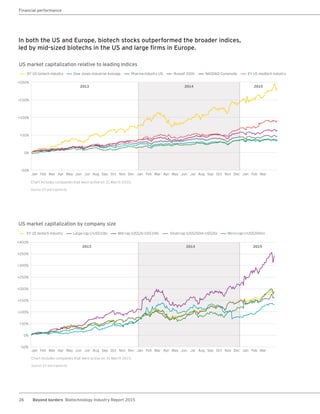
  • 36.
    36 Beyond bordersBiotechnology Industry Report 2015 Financing US$15.1 billion a year. Between 2008 and 2012, the average fell to US$12.5 billion a year. Even as the overall fundraising climate recovered on the back of soaring debt financings by commercial leaders, the amount of innovation capital remained flat. That changed starting in 2013, when innovation capital shot up to US$18.6 billion, and 2014, when it reached a new high of US$27.6 billion. This bodes well for investment in research pipelines and the overall health of the sector. In another encouraging sign for biotech innovation, early rounds generated more funding than they had in at least a decade — US$1.8 billion — even though the number of deals dropped slightly from 182 to 177, year over year. The median deal value for early-stage firms — US$10 million — was also the highest since 2006. Some early rounds were truly remarkable in size. In fact, 2014 was the first year since we began tracking the biotech sector 28 years ago in which there were four early-stage US biotech venture rounds of more than US$50 million. Philadelphia- based Spark Therapeutics, founded in 2013, raised US$72.8 million to pursue gene therapies. Seattle-based Juno Therapeutics added US$190 million to the US$120 million it raised in December 2013 (and then followed that up with one of the year’s largest IPOs) to help it achieve its goal of developing chimeric antigen receptor therapy (CAR-T) to help individual patients’ immune-system cells attack cancer cells. And Human Longevity, the latest company founded by genomics pioneer Craig Venter, raised US$70 million to create an enormous sequencing project aimed at finding cell-based treatments for extending healthy human life-spans. In addition, the year’s largest European first round — indeed, one of the largest in that sector’s history — went to UK- based Adaptimmune, which received US$104 million from a consortium led by venture capital firm New Enterprise Associates. Spun off from the University of Oxford in 2008, US and European early‑stage venture investment, 2000–14 Early-stage investments include seed, first and second venture rounds. Source: EY, BioCentury, Capital IQ and VentureSource. 1.2 120 1.6 160 2.0 200 0.4 0.8 80 40 0.0 0 Capital raised Number of deals Capitalraised(US$b) Numberofdeals 20022000 2001 2003 2004 2005 2006 2007 2008 2009 2010 2011 2012 2013 2014
  • 37.
    37Beyond borders BiotechnologyIndustry Report 2015 Financing Percentageofventuredollarsinvested Adaptimmune is developing T-cells to treat several types of cancer. The company also entered into a strategic partnership with GlaxoSmithKline in June 2014. European early-stage companies were more likely than their US counterparts to benefit from this trend — 36% of European venture capital came in the form of Series A or B funding, as opposed to 23% in the US. A rising tide The present IPO boom has given venture capitalists the opportunity to realize returns and restock their coffers, the better to support a new generation of companies. Recent research (based on data from Thomson Reuters) showing that one-third of biotech firms go public within five years of their initial investment — a higher proportion than for software or other sectors — also supports biotech investment prospects. This is a stark reversal from just a few years ago, when the average time to exit had extended to over eight years (or almost as long as the legal life of a venture capital fund). However, the increase in early-stage funding was not driven by a shift in investor focus. Instead, it was a case of the proverbial rising tide lifting all boats. The share of venture capital going toward early rounds has remained fairly static over time. A record-breaking 94 US and European biotech companies went public in 2014, raising US$6.8 billion, for an average of US$72 million per IPO. The year’s 94 IPOs thoroughly shattered the previous record of 79 in 2000. However, the class of 2000 remained ahead in terms of the amount of capital raised (US$7.8 billion). However, the entire 2013-14 IPO window — in which 143 companies went public, raising US$10.3 billion, more than the previous eight years combined — is the largest window in the industry’s history. This is particularly remarkable because the window did not open in Europe until early 2014. US and European venture investment in early stage private companies holds steady Source: EY, BioCentury, Capital IQ and VentureSource. 60% 80% 100% 40% 0% 20% Seed and first rounds All later rounds 20062000 2007 2008 2009 2010 2011 2012 2013 20142001 2002 2003 2004 2005
  • 38.
    38 Beyond bordersBiotechnology Industry Report 2015 Of course, investor sentiment in 2014 was fundamentally different from 2000. The window in 2000 was driven by undifferentiated enthusiasm over the sequencing of the human genome and the possibilities to come from that breakthrough. In 2014, however, the window was much more about real market performance than scientific promise. The window resulted from the strong performance of biotech’s commercial leaders and important clinical results from companies large and small — in some sense, the payoff from the human genome project over a decade later. The average IPO size was US$72 million, continuing the trend set in 2013, but 21 companies raised over US$100 million. Although only four of the 21 were European companies, two were in the global top three: UK-based Circassia Pharmaceuticals and Forward Pharma of Denmark. The IPOs of Circassia and US-based Juno Therapeutics were also the third- and fourth-largest biotech IPOs of all time. The wide-open IPO window meant not only that record numbers of companies went public, but also that they did so at favorable terms. (As discussed later, this was in part because of strong post- IPO market valuations and growth.) As in 2013, roughly 60% of companies going public did so within or above their anticipated price ranges — well above the three-year average for 2010-12 of 36%. US and European biotechnology IPO pricing, 2010–14 Source: EY, BioCentury, Capital IQ and VentureSource. 60% 80% 100% 40% 0% 20% Above range Within range Below range 20142013201220112010 PercentageofIPOs A record-breaking 94 US and European biotech companies went public in 2014, raising US$6.8 billion, for an average of US$72 million per IPO. Financing
  • 39.
    39Beyond borders BiotechnologyIndustry Report 2015 US biotechnology financings, 2000–14 Source: EY, BioCentury, Capital IQ and VentureSource. 30 50 40 20 0 10 Debt Follow-on and other IPOs Venture Capitalrasied(US$b) ‘00 ‘01 ‘02 ‘03 ‘04 ‘05 ‘06 ‘10‘07 ‘11‘08 ‘12‘09 ‘13 ‘14 US biotechnology recorded a colossal year in 2014, setting a new all-time record in total capital raised (US$45.1 billion) as well as funds raised through IPOs (US$4.9 billion) and debt (US$23.3 billion). The amounts raised in the two other financing categories represented the second-highest totals in the industry’s history: venture capital generated US$5.6 billion (second to the US$6.1 billion raised in 2007) and follow-on financing raised US$10.7 billion (behind the almost US$13 billion raised in 2000). The sector’s strong overall performance was underpinned by successful launches of well-differentiated products that could attract premium prices, supported by a more accommodating FDA, especially in areas of high unmet need. Meanwhile, big pharma’s increasing need to fill its growth gap also drew investors in anticipation of acquisitions of biotech assets at significant premiums, such as Roche’s US$8.3 billion purchase of InterMune and Merck & Co.’s two multibillion-dollar offers, for Cubist Pharmaceuticals (US$9.5 billion) and Idenix Pharmaceuticals (US$3.9 billion). (See accompanying “Deals, 2014” article.) As a result, generalist investors came back to biotech, the best-performing sector in the market for the last two years, driving up equity values and pumping much-needed capital into the sector. Financing United States Financing
  • 40.
    40 Beyond bordersBiotechnology Industry Report 2015 Boom times for innovation capital Driven in part by the resurgent IPO and follow-on financing markets, 2014 marked the highest amount of innovation capital ever raised in the sector — US$21.1 billion, a 40% increase over 2013. This is almost double the 10-year average of US$10.9 billion and well ahead of the previous 10-year high of US$15.1 billion set in 2013. The two consecutive years of growth in innovation capital bodes well for the resilience of the biotech industry. It gives smaller companies — some of which will develop to become the future growth engines of the sector — more confidence to invest in R&D, more opportunity to expand their pipelines and more bargaining power with larger companies, in both alliances and M&A. Meanwhile, the amount of money raised by commercial leaders grew by an astonishing 127%, to US$23.9 billion. This included six debt offerings of at least US$1 billion. Gilead alone had two US$4 billion offerings, one in March and one in November of 2014. Quarterly breakdown of US biotechnology financings (US$m), 2014 Q1 Q2 Q3 Q4 Total IPOs $1,739 (23) $1,055 (17) $958 (13) $1,193 (10) $4,946 (63) Follow-on and other $4,651 (83) $2,047 (47) $1,081 (27) $2,943 (49) $10,722 (206) Debt $6,711 (31) $9,734 (44) $2,031 (40) $5,325 (26) $23,801 (141) Venture $1,333 (95) $1,882 (115) $1,059 (103) $1,325 (70) $5,600 (383) Total $14,434 (232) $14,719 (223) $5,130 (183) $10,786 (155) $45,069 (793) Figures in parentheses are number of financings. Numbers may appear inconsistent because of rounding. Source: EY, BioCentury, Capital IQ and VentureSource. Innovation capital in the US, 2000–14 Innovation capital is the amount of equity capital raised by companies with revenues of less than US$500 million. Source: EY, BioCentury, Capital IQ and VentureSource. 30 50 40 20 0 10 Innovation capital Capital raised by commercial leaders Capitalraised(US$b) ‘00 ‘01 ‘02 ‘03 ‘04 ‘05 ‘06 ‘10‘07 ‘11‘08 ‘12‘09 ‘13 ‘14 Financing
  • 41.
    41Beyond borders BiotechnologyIndustry Report 2015 Unsurprisingly, New England (which raised US$4.9 billion in innovation capital), the San Francisco Bay Area (US$4.4 billion) and San Diego (US$3.1 billion) continued to be the nation’s leading biotech venture and innovation capital hotspots in 2014. New England led in total number of innovation capital deals (131) and venture capital deals (80). The Bay Area attracted the most venture capital (US$1.4 billion), followed by New England (US$1.3 billion) and San Diego (US$654 million) — together, these three regions attracted 61% of all US venture investment in 2014. The Bay Area (US$1.3 billion), New England (US$1.1 billion) and the Pacific Northwest (US$621 million), with significant tailwinds from Juno Therapeutics, were the leaders in IPO dollars. From 2013 to 2014, San Diego continued to move up the innovation capital league table. The region attracted US$1.6 billion more in innovation capital in 2014 than it did the previous year. Follow-on public offerings were up almost US$1.2 billion, which included seven rounds of at least US$100 million. Receptos alone raised US$619 million. If commercial leaders were added to the figures, San Francisco Bay Area, New England and San Diego would account for 56% of the total amount of capital raised in the US during 2014. Innovation capital raised by leading US regions, 2014 Size of bubbles shows relative number of financings per region. Innovation capital is the amount of equity capital raised by companies with revenues of less than US$500 million. Source: EY, BioCentury, Capital IQ and VentureSource. Los Angeles/Orange County New York StateNew JerseyMidwest Pacific Northwest San DiegoNew England San Francisco Bay Area 4 5 6 0 2 1 3 Innovationcapitalraised(US$b) Venture capital raised (US$m) 0 200 400 1,000600 1,200800 1,400 1,600 1,800 Financing
  • 42.
    42 Beyond bordersBiotechnology Industry Report 2015 While US venture capital held steady in the immediate aftermath of the financial crisis, we expected to see a drop in funding a few years down the road, because VCs were raising less money from limited partners, and there is lag between funds raised and funds disbursed by venture funds. But the proverbial other shoe never dropped. Instead, venture investment remained remarkably consistent from 2008 through 2013. In 2014, however, the resurgent IPO market and the prospect of M&A exits at higher valuations led to an upsurge in funds raised by life sciences venture capital firms, as well as their investment in the sector. The US$5.6 billion invested in 2014 was 27% higher than the previous 10-year average of US$4.4 billion. In 2014, average and median deal sizes of venture financings also reached their highest totals since 2007. There was one record that didn’t fall in 2014: the largest venture round. On 4 January 2015, Moderna Therapeutics closed a US$450 million financing, the largest ever for a privately held biotechnology company. The average deal size was skewed by nine deals of more than US$70 million (against just three of that size in 2013), four of which tipped the US$100 million mark. US biopharmaceutical venture capital rebounds to its highest levels since the financial crisis Source: EY, BioCentury, Capital IQ and VentureSource. 6 15 7 18 2 3 4 9 5 12 3 6 1 0 0 Total amount raised Average deal size Capitalraised(US$b) Averagedealsize(US$m) 20022000 2001 2003 2004 2005 2006 2007 2008 2009 2010 2011 2012 2013 2014 The resurgence of US venture capital Financing
  • 43.
    43Beyond borders BiotechnologyIndustry Report 2015 The largest sum raised was by Intarcia Therapeutics, a Boston-headquartered developer of a tiny subdermal pump that can regulate the delivery of exenatide for diabetes and obesity patients. Top US venture financings, 2014 Company Region Lead product clinical stage Therapeutic focus Amount (US$m) Month Intarcia Therapeutics New England Phase III Metabolic/endocrinology 200 March Juno Therapeutics Pacific Northwest Phase I Oncology 134 August Invitae San Francisco Bay Area Services, technologies and tools Multiple 120 October Adaptive Biotechnologies Pacific Northwest Services, technologies and tools Multiple 105 April Paratek Pharmaceuticals New England Phase III Infection 93 June Naurex Midwest Phase II Neurology 80 May Spark Therapeutics Pennsylvania/Delaware Valley Phase III Multiple 73 May Human Longevity San Diego Services, technologies and tools Multiple 70 March Melinta Therapeutics New England Phase III Infection 70 February C3 Jian Los Angeles/Orange County Phase II Dental 61 March Viamet Pharmaceuticals North Carolina Phase II Infection 60 October Precision Therapeutics Midwest Services, technologies and tools Multiple 60 November Kolltan Pharmaceuticals New England Phase I Oncology 60 March ProNAi Therapeutics Midwest Phase II Oncology 60 April Juno Therapeutics* Pacific Northwest Phase I Oncology 56 April Financing Meanwhile, 23% of US biotech VC rounds in 2014 were early-stage (defined as seed or first round). That’s exactly the same proportion as the previous 10-year average, but down from 27% in 2013. It is also noteworthy that Juno Therapeutics’ IPO — the largest of 2014 — was fueled by two big venture rounds for a total of US$190 million during 2014. The company also raised US$120 million in December 2013, which meant that it raised a total of US$310 million in less than 12 months. * In April 2014, Juno Therapeutics added US$56 million to its 2013 Series A round. Source: EY, BioCentury, Capital IQ and VentureSource.
  • 44.
    44 Beyond bordersBiotechnology Industry Report 2015 US biotechnology IPOs, 2000–14 Source: EY, BioCentury, Capital IQ and VentureSource. 50 5 70 60 2 10 4 30 40 3 20 1 0 0 Capital raised Number of deals CapitalraisedinIPOs(US$b) Numberofdeals 20022000 2001 2003 2004 2005 2006 2007 2008 2009 2010 2011 2012 2013 2014 The IPO bounce For the second straight year, a surging IPO market breathed new life into the US biotech financing landscape. New benchmarks were set in terms of both the number of public listings (63) and proceeds raised (US$4.9 billion), outstripping previous records set in 2000-01 at the height of the genomics bubble, when 52 IPOs raised US$4.5 billion. Of course, the 2014 boom came on the heels of a very strong 2013 (itself the third-biggest IPO year in the industry’s history), meaning that the sector has Financing experienced an unprecedented two-year surge in which 101 companies went public and raised a combined US$8.2 billion. To put that in perspective, roughly the same number of IPOs occurred in the eight- year period between 2005 and 2012. The 2014 biotech IPO ledger is filled with new benchmarks. Although the average deal size remained consistent with 2013 and the overall 15-year average, more than three-quarters (48) of the biotechs that went public in 2014 brought in more than US$50 million in their initial offerings, while 17 cleared the US$100 million mark. The previous record of 16 was set back in 2000, while the third-highest total was 13 IPOs in 2013. 2014 closed with the second- largest US biotech IPO on record, when Juno Therapeutics raised more than US$300 million. (The US record holder remains Talecris Biotherapeutics’ US$950 million IPO in 2009.) Nearly 60% of new companies listed within or above their IPO ranges.
  • 45.
    45Beyond borders BiotechnologyIndustry Report 2015 As usual, therapeutics companies dominated the scene: 92% of companies that went public in 2014 were focused on new therapies (up from 80% of the class of 2013), one-quarter of those in oncology. It would be unreasonable to assume that the most fruitful biotech IPO window in history would stay wide open for much longer, and indeed pricing power of new issuers diminished in the fourth quarter of 2014. That said, while only 10 companies went public in Q4, three were among the largest of the year: Juno Therapeutics, FibroGen and Bellicum Pharmaceuticals. And as 2015 began, the IPO queue remained robust. The 2013-14 IPO window has been sustained by strong after-market performance. Of the 63 IPOs in the class of 2014, 40 (63%) had positive returns through 31 December 2014, 16 were up more than 100%, and two earned returns of more than 335%: Radius Health (specializing in endocrine disorders) and Auspex Pharmaceuticals (focused on neurological disorders). The IPO class as a whole was up 27% through 31 December 2014 (and 44% through 31 March 2015). Such returns have bolstered investor interest and confidence in the sector and expectations of a raft of companies aiming for IPO in the coming months. The anatomy of a US IPO window Source: EY, BioCentury, Capital IQ and VentureSource. 1.2 15 2.0 25 1.6 20 0.8 10 0.0 0 0.4 5 Capital raised CapitalraisedinIPOs(US$b) Numberofdeals Q1 2012 2013 2014 Q2 Q3 Q4 Q1 Q2 Q3 Q3Q4 Q4Q1 Q2 Number of deals US biotechnology IPO pricing by quarter, 2013–14 Source: EY, BioCentury, Capital IQ and VentureSource. Q4 Q4 Q3 Q3 Q2 Q2 Q1 Q1 Below expected range 20132014 0% 10% 20% 30% 40% 50% 60% 100%70% 80% 90% Within or above expected range 40% 60% 54% 46% 38% 63% 73% 27% 50% 50% 85% 15% 58% 42% 33% 67% Financing
  • 46.
    46 Beyond bordersBiotechnology Industry Report 2015 Source: EY, BioCentury, Capital IQ and VentureSource. Top US IPOs, 2014 Company Region Lead product clinical stage Therapeutic focus Gross raised (US$m) IPO pricing range Post-IPO performance (as of 31 December 2014) Juno Therapeutics Pacific Northwest Phase II Oncology 305 Above 118% FibroGen San Francisco Bay Area Phase III Multiple 168 Within 52% Acucela Pacific Northwest Phase III Ophthalmic 163 Within -67% Bellicum Pharmaceuticals Texas Phase II Oncology 161 Above 21% Kite Pharma Los Angeles/Orange County Phase II Oncology 147 Above 239% Versartis San Francisco Bay Area Phase II Metabolic/endocrinology 145 Within 7% Ultragenyx Pharmaceutical San Francisco Bay Area Phase II Multiple 139 Above 109% Dermira San Francisco Bay Area Phase II Dermatology 125 Within 13% ZS Pharma Texas Phase III Multiple 123 Above 131% Avalanche Biotechnologies San Francisco Bay Area Phase II Ophthalmic 117 Within 218% Akebia Therapeutics Midwest Phase II Hematology/renal 115 Within -32% Otonomy San Diego Phase III Ear, nose and throat 115 Within 108% Revance Therapeutics San Francisco Bay Area Phase III Aesthetics 110 Within 6% Zafgen New England Phase II Metabolic/endocrinology 110 Within 93% Tokai Pharmaceuticals New England Phase II Oncology 105 Within -2% Dicerna Pharmaceuticals New England Phase I Oncology 103 Above 10% Sage Therapeutics New England Phase II Neurology 103 Within 103% Auspex Pharmaceuticals San Diego Phase III Neurology 97 Within 337% Concert Pharmaceuticals New England Phase II Multiple 93 Within -5% Coherus Biosciences San Francisco Bay Area Phase III Multiple 92 Within 21% Like Juno Therapeutics, nearly one-quarter of US biotech IPOs in 2014 were also focused on oncology, including three of the top five. New England is home to 17 of the IPO class of 2014. Thirteen newly public biotechs are based in the San Francisco Bay Area. Financing
  • 47.
    47Beyond borders BiotechnologyIndustry Report 2015 The European biotech sector racked up its strongest financing performance in the history of the industry and posted the second-strongest performance in each individual financing category. Overall, the sector raised US$9.2 billion — 53% more than in 2013, and a whopping 97% more than the previous 10-year average. IPOs raised US$1.9 billion. That is more than in the prior seven years combined, but well below the US$3.3 billion raised in 2000. Follow-on financing brought in US$3.1 billion, just shy of the US$3.2 billion raised in 2007. Debt financing generated US$2.2 billion, almost double the 2003-13 average of US$1.2 billion but below the US$2.5 billion raised in 2013. And venture capital raised US$2 billion, just $30 million below the 2006 peak. It’s also noteworthy that more than US$1.3 billion of the total raised in Europe in 2014 came via two formerly US companies now based in Ireland: Jazz Pharmaceuticals, which raised US$1.1 billion in two debt offerings, and Alkermes, which raised US$250 million via an equity deal. As in the US, European company financing slowed in the second half of 2014, primarily due to a drop in follow-on offerings in the third quarter. IPO activity came to an abrupt halt in November, with no further activity through year-end. But as 2015 began, a small cohort of European companies entered the IPO queue. Financing Europe European biotechnology financings, 2000–14 Source: EY, BioCentury, Capital IQ and VentureSource. 6 10 8 4 0 2 Debt Follow-on and other IPOs Venture Capitalraised(US$b) ‘00 ‘01 ‘02 ‘03 ‘04 ‘05 ‘06 ‘10‘07 ‘11‘08 ‘12‘09 ‘13 ‘14 Financing
  • 48.
    48 Beyond bordersBiotechnology Industry Report 2015 The investment bonanza Large and small European companies all benefited from the banner 2014 investment bonanza. Led by the UK, European innovation capital soared to its highest levels ever — US$6.5 billion — surpassing the US$5.6 billion invested in 2000. This uptick in innovation capital was driven by resurgent IPO and follow-on markets and increased venture capital commitments. Indeed, venture investment was responsible for 31% of the total. Commercial leaders also enjoyed the healthy funding environment by raising US$2.8 billion, the greatest yearly total since 2007. Innovation capital accounted for 70% of total financing in 2014, up from 58% in 2013. The standout story in 2014 European financing was the UK. While the UK has been a perennial leader, in 2014 it hit a seven-year high, raising US$2 billion in innovation capital (31% of the European total) and US$593 million in venture capital (29% of the total). The UK also led Europe in the number of funding rounds. Industry observers attributed some of this renewed investor confidence to government tax breaks on investment in R&D. EY’s annual report on the UK biotechnology sector pointed out that in 2013 there were more than 460 biotech drugs in development in the UK, far more than in any other European country. Quarterly breakdown of European biotechnology financings, 2014 (US$m) Q1 Q2 Q3 Q4 Total IPOs $719 (9) $214 (6) $519 (10) $405 (6) $1,856 (31) Follow-on and other $1,349 (46) $728 (23) $170 (17) $869 (27) $3,116 (113) Debt $1,331 (6) $80 (6) $755 (14) $82 (9) $2,248 (35) Venture $314 (40) $633 (56) $487 (41) $596 (46) $2,030 (183) Total $3,713 (101) $1,654 (91) $1,931 (82) $1,952 (88) $9,250 (362) Figures in parentheses are number of financings. Numbers may appear inconsistent because of rounding. Source: EY, BioCentury, Capital IQ and VentureSource. Innovation capital in Europe, 2000–14 Innovation capital is the amount of equity capital raised by companies with revenues of less than US$500 million. Source: EY, BioCentury, Capital IQ and VentureSource. 6 10 8 4 0 2 Innovation capital Commercial leaders Capitalraised(US$b) ‘00 ‘01 ‘02 ‘03 ‘04 ‘05 ‘06 ‘10‘07 ‘11‘08 ‘12‘09 ‘13 ‘14 Financing
  • 49.
    49Beyond borders BiotechnologyIndustry Report 2015 Innovation capital raised by leading European countries, 2014 Size of bubbles shows relative number of financings per country. Source: EY, BioCentury, Capital IQ and VentureSource. Belgium Denmark Israel NetherlandsFrance Germany Switzerland UK 1.5 2.0 2.5 0.0 0.5 1.0 Innovationcapitalraised(US$b) Venture capital raised (US$m) 0 100 200 500300 600400 700 The return of European venture capital Source: EY, BioCentury, Capital IQ and VentureSource. Total amount raised Average deal size Totalamountraised(US$b) Averagedealsize(US$m) 20022000 2001 2003 2004 2005 2006 2007 2008 2009 2010 2011 2012 2013 2014 2.5 12 10 8 6 2.0 0 1.5 2 1.0 0.5 0.0 4 Financing
  • 50.
    50 Beyond bordersBiotechnology Industry Report 2015 Buoyed by renewed confidence in European and US IPO markets, European venture capital investment in biotech surged in 2014 to levels not seen since 2006, with US$2 billion raised. The average deal size was US$11.1 million, the highest since 2002. There were only 183 rounds in 2014, fewer than the previous 10-year average of 218. The improved figures for European financing is good news. Larger investments give European companies more options for R&D, better dealmaking opportunities and better opportunities for market readiness than they have had in many years. But European companies remain at a disadvantage to their US counterparts. The median deal size for US companies in 2014 was US$10 million, while for European companies it was less than half that figure. The consequences of this disparity are evident. Since drug development costs are no lower in Europe than in the US, smaller deal sizes mean that European companies face a longer road to market. They are often forced to partner earlier than US companies, have less power to negotiate favorable deal terms and are less able to retain the rights to their products. One important difference between European and US venture investment was the relative share of early rounds. In Europe, 70% of venture rounds were early-stage, as opposed to 23% in the US. Early-stage rounds accounted for US$661 million in Europe in 2014 — the highest total since at least 2002. Nine of the top 15 European venture financings of 2014 were invested in UK (5) or Swiss (4) companies, a reflection of the relative maturity of the venture capital sector in those countries. In addition, the importance of Paris-based Euronext as an IPO destination, combined with factors such as the French government’s revamped R&D tax credit policies, should help create a more favorable ecosystem for biotech venture capital in France. Source: EY, BioCentury, Capital IQ and VentureSource. Top European venture financings, 2014 Company Country Lead product clinical stage Status Amount (US$m) Month Adaptimmune UK Oncology Phase I 104 September Adapt Pharma Ireland Substance abuse Phase not specified 95 May Biocartis Switzerland Non-disease-specific Molecular diagnostics 86 September Cell Medica UK Infection Phase III 82 November Glycotope Germany Women’s health Phase III 73 March NovImmune Switzerland Autoimmune Phase II 66 February Ascendis Pharma Denmark Metabolic/endocrinology Phase II 60 December Cardiorentis Switzerland Cardiovascular Phase III 60 September Nucana BioMed UK Oncology Preclinical 57 April ProQR Therapeutics Netherlands Respiratory Phase not specified 56 April Enigma Diagnostics UK Respiratory Molecular diagnostics 50 October Wilson Therapeutics Sweden Metabolic/endocrinology Phase II 40 April Kymab UK Autoimmune Preclinical 40 May Nordic Nanovector Norway Oncology Phase I 40 June Anokion Switzerland Autoimmune Preclinical 36 May Financing
  • 51.
    51Beyond borders BiotechnologyIndustry Report 2015 The largest venture investment in Europe in 2014 was the US$104 million first-round funding raised by UK-based Adaptimmune, which is developing a new range of drugs based on immune system cells. The oversubscribed round, in September, was one of the largest early- stage funding rounds of the last decade. There were two other first-round venture financings in the 2014 top 10: Switzerland’s Novimmune, which focuses on antibody-based drugs to treat inflammatory, autoimmune and other disorders, and Netherlands-based ProQR Therapeutics, which is developing RNA-based therapeutics for the treatment of severe genetic disorders, with an initial focus on cystic fibrosis. Eyeing the IPOs At the start of 2014, many industry observers were wondering why the US enthusiasm for biotech IPOs had not crossed the Atlantic. Indeed, European markets seemed stuck in a rut. Venture funding had dried up after the credit crisis. Investors in European markets had been burned by a number of biotech failures in the late 1990s and early 2000s, leading many generalist funds to stop investing in the sector. Perhaps European biotech investors would never regain the passion they had displayed in 2000, when companies such as Serono, Actelion and Crucell completed IPOs. But things changed rapidly. The US biotech IPO boom of 2013 soon gave European investors a boost in confidence and IPOs started to appear in February — when Egalet, uniQure and 4D Pharma raised a total of US$177 million. Circassia followed in March, and the floodgates opened. Just four weeks after Circassia’s launch, nine more European companies had gone public, and by November another 18 had followed suit, for a total of 31 for the year. To put this into perspective, the US$1.9 billion raised in 2014 was as much as the amount raised between 2007 and 2013 combined. The 2014 total was not enough to rival 2000’s US$3.3 billion, nor did the 2014 average valuation of US$60 million come close to 2000’s US$123 million. What’s more, only four of the class of 2014 raised US$100 million, against 11 in 2000. European biotechnology IPOs, 2000–14 Source: EY, BioCentury, Capital IQ and VentureSource. 3.5 35 1.0 10 2.0 20 2.5 25 3.0 30 1.5 15 0.5 5 0.0 0 Capital raised Number of deals CapitalraisedinIPOs(US$b) Numberofdeals 20022000 2001 2003 2004 2005 2006 2007 2008 2009 2010 2011 2012 2013 2014 Financing
  • 52.
    52 Beyond bordersBiotechnology Industry Report 2015 A look at the top 15 European companies that went public in 2014 reveals a depth and breadth not seen since the IPO class of 2000. The top 15 companies in 2014 range from several with products already on the market to one — ProQR Therapeutics — still at a preclinical stage. Before 2014, no European IPO had raised more than US$100 millon since Denmark’s Symphogen went public in 2011. In 2014, four IPOs exceeded this threshold: Circassia, Forward Pharma, ProQR and Molecular Partners. At US$333 million, Circassia’s IPO was the largest ever for the UK biotech sector. The historic volume of the IPO was partly driven by Circassia’s focus on developing allergy vaccines. Even even before its March listing, the company had raised several of the UK’s largest-ever rounds of biotech venture capital. Predicting the duration of an IPO window is an inherently tricky proposition. Europe had no IPOs after mid-November. And while 73% of the European class of 2014 priced their IPOs within or above their anticipated ranges, that figure slumped to 50% in the second half of the year. Nonetheless, a degree of optimism has returned to the European biotech IPO market. This was evident in the first quarter of 2015 as seven IPOs raised a total of US$339 million. Of the 31 European companies that went public in 2014, 25 (81%) were focused on therapeutics; of those, 16% were in Phase III, 12% had licensed their Source: EY, BioCentury, Capital IQ and VentureSource. Top European IPOs, 2014 Company Country Lead product clinical stage Therapeutic focus Gross raised (US$m) IPO pricing range Post-IPO performance (as of 31 December 2014) Circassia Pharmaceuticals UK Phase III Autoimmune 333 Within -15% Forward Pharma Denmark Phase II Autoimmune 235 Within -1% Molecular Partners Switzerland Phase II Multiple 116 Below 3% ProQR Therapeutics Netherlands Preclinical Respiratory 112 Within 67% uniQure Netherlands Marketed Multiple 92 Above -13% MediWound Israel Marketed Dermatology 80 Within -52% Horizon Discovery Group UK NA Research and other equipment 66 NA 6% Auris Medical Switzerland Phase III Ear, nose and throat 61 Below -35% Egalet Denmark Phase III Neurology 58 Within -53% Innocoll Ireland Marketed Multiple 58 Below -34% Affimed Therapeutics Germany Phase II Oncology 56 Below -11% arGEN-X Netherlands Phase I Multiple 55 Within -18% Fermentalg France NA Industrial 54 Within -36% Genticel France Phase I Infection 53 Within -35% MacroCure Israel Phase III Dermatology 53 Below -27% GalMed Pharmaceuticals Israel Phase II Metabolic/endocrinology 44 Within -57% VBL Therapeutics Israel Phase II Multiple 40 Below -1% Abzena UK NA Research and other equipment 37 NA -5% Bio Blast Pharma Israel Phase III Genetic 35 Within -42% Genomic Vision France NA Molecular diagnostics 34 Within -31% Financing
  • 53.
    53Beyond borders BiotechnologyIndustry Report 2015 Share price relative to offer price was calculated as of 31 December 2014. Median data are shown in yellow bars. Source: EY, Capital IQ and finance.yahoo.com. Financing products and another 12% had products on the market. British, French and Israeli companies each notched five IPOs. When it comes to IPOs, European companies have faced some tough choices in recent years. Should they list their shares in their home markets, or try their luck with US investors in the white-hot US market? In 2014, the latter option looked like the best one. Except for Circassia, which was the first UK biotech to launch on the London Stock Exchange since 2006, eight of the top 10 European IPOs occurred on the NASDAQ. Of the top 20 European biotech IPOs, those which listed on NASDAQ raised US$58 million, almost double the amount raised by the companies that listed on Euronext in Paris and the amount raised on AIM in London. Markets formerly open to biotech IPOs, such as Zürich and Frankfurt, now display almost no interest in the sector. Of the two German IPOs in 2014, one listed on NASDAQ and the other on Euronext. Still, seven companies did list on the Euronext exchange in 2014. Strong performance by Euronext-listed companies may add fuel to ongoing discussions at the European Commission aimed at creating a united European capital market. One of the key differences between companies that tested the IPO market in Europe in 2014 and their US counterparts is their relative post-IPO performances. While 63% of US companies finished the year trading up relative to their IPO price, only seven, or 23%, of the European 2014 IPO class could boast a similar result, a potential dent to future investor confidence in the sector. Post-IPO performance indicators are a sobering reminder of the challenges facing European companies, regardless of where they list. As our chart shows, European firms that listed on the NASDAQ performed much worse than their US counterparts. European firms’ 2014 post-IPO performance was negative overall. The paradox for European firms is that while they are able to raise more funds up front by chasing a NASDAQ listing than they would if they listed in Europe, they find themselves at a disadvantage, less able to attract the coverage and investor interest that homegrown US companies attract. The standout performer among European IPOs in 2014 was Manchester-based 4D Pharma, whose price more than doubled after its February debut on the London AIM. Dutch company ProQR Therapeutics (focused on genetic disorders) and Sweden’s Gabather (developer of CNS drugs) both delivered returns of more than 60%, and Denmark-based Saniona also pleased investors after its debut on the Swedish AktieTorget exchange. Performance distribution of 2014 NASDAQ biotech IPOs (in %) 400 360 320 -80 0 -40 120 80 40 200 160 280 240 Sharepricerelativetoofferprice US companies (62) European companies (12) Parameters US biotech Europe biotech Number of companies 62 12 Highest 386% 67% 75 percentile 100% -9% Median 11% -31% 25 percentile -10% -45% Lowest -75% -57%
  • 54.
    54 Beyond bordersBiotechnology Industry Report 2015 Financing | Financing the future Deals Beyond borders 2015 Deals 54 Beyond borders Biotechnology Industry Report 2015
  • 55.
    55Beyond borders BiotechnologyIndustry Report 2015 Deals Acquirers weren’t just paying more; they were also paying more up front. In contrast to 2013, when 45% of the deals were structured to include future earn-outs, only 33% of the M&A transactions signed in 2014 used this risk-hedging stratagem. On the alliance front, biotech companies brokered 152 licensing deals worth US$46.8 billion. A review of the past eight years of licensing activity shows 2014 was the most lucrative for biotechs looking to sign alliances, as the average up-front deal value increased by 78% to US$41 million from US$23 million in 2013. This transactional uptick is partly explained by the return of the public markets and rising valuations, which have given biotechs more financing options, and thus, more bargaining power in deal negotiations. There’s also more competition as big pharmas compete with specialty pharma companies and other biotechs for strategic assets to bolster pipelines. As a result of these forces, biotechs found themselves in the transactional driver’s seat, and interested acquirers had little choice but to pay at, or near, full value to win rights to products of interest. The big picture 2014 was a breakout year for both M&A and licensing, as biopharma companies used transactions to jump-start or shift business strategies in a sector where the dynamics are rapidly changing. Indeed, M&A activity in the biotechnology sector reached an eight-year high in both deal number and value (excluding megadeals, valued at US$5 billion or more). In all, the industry notched 68 biotechnology deals totaling US$49 billion, a 46% increase over 2013. Pharma returns to M&A dealmaking A look at the numbers shows pharma buyers were primarily responsible for the year’s heightened deal activity. As we have written in the last several issues of Beyond borders, the pharma subsector continues to face a number of headwinds, including pricing pressures, R&D productivity challenges and a slowdown in high-growth emerging markets. These challenges have resulted in the group’s subpar revenue relative to the industry overall. In 2014, the need to accelerate growth helped explain pharma’s renewed emphasis on dealmaking, despite the fact that target valuations have reached record highs. Indeed, M&A activity between pharmas and either US or European biotechs reached a level in 2014 not seen since 2009, when Roche bought out the remaining shares of Genentech that it didn’t already own. Excluding megadeals, pharmas spent more in 2014 to acquire biotechs than they had annually in the previous nine years. Deal numbers also rebounded: pharmas acquired 27 biotechs in 2014, the highest deal volume since 2008. An analysis of the year’s deals shows that two different strategic priorities drove much of pharma’s M&A: first, access to products that could fill revenue gaps; second, acquisitions that enabled companies to achieve scale in businesses or therapeutic areas where they believe they are, or can be, market leaders. Indeed, in 2014, certain pharmas began to distance themselves from the diversification strategies they employed to smooth out earnings at the height of the patent cliff. This emphasis on focus fueled not just a wave of pharma-biotech M&A, but a number of intra-pharma transactions. Thus, certain companies divested “adjacent businesses” (e.g., animal health or consumer health) and/or therapeutic businesses that had been deprioritized, while others took the opportunity to acquire available assets. By focusing on fewer areas and achieving real depth, pharmas hope not only to rationalize their R&D and commercial efforts. They also aim to build franchises that offer an array of solutions across the care paradigm, potentially making their products more compelling to stringent health care buyers. Changing dynamics
  • 56.
    56 Beyond bordersBiotechnology Industry Report 2015 Biotech buyers? Biotech buyers, meantime, signed 41 transactions in 2014, making them a presence at the deal table. However, in terms of the number of deals, that is the second-lowest volume of biotech-biotech transactions since 2007. (The lowest was in 2013, when there were 33 deals.) Biotech-biotech deal values also retreated, with the total dollars spent in 2014 dipping 51% year over year to one of the lowest levels in the past decade. Smaller biotechs, as opposed to the commercial leaders, accounted for most of the year’s M&A activity. Like their pharma brethren, the data suggest the biotechs that were buying were most interested in acquiring products or platforms in their core therapeutic areas. That the biotech commercial leaders eschewed M&A in 2014 isn’t too surprising. As we noted in Firepower fireworks, EY’s 2015 Firepower Index and Growth Gap Report, strong product launches in recent years mean the bigger biotechs have not felt pressured to do deals to fill revenue growth gaps. That could change in 2015 and 2016 as big biotechs face their own headwinds. As more companies enter faster-growing therapeutic battlegrounds such as oncology or hepatitis C, the increasing competition and pushback from payers threaten to decelerate big biotechs’ growth rates. This is particularly true for biologics developers, which, for the first time, face the prospect of biosimilar competition in the US marketplace. In some ways, big biotechs are also victims of their own success. Thanks to robust pipelines, they have posted revenue growth numbers that are difficult, if not impossible, to sustain without resorting to inorganic means. The good news for the biotechnology commercial leaders is that they have an arsenal of “firepower” at their disposal when they are ready to consider strategic M&A. EY defines firepower as an acquirer’s capacity for deals based on its market valuation, its debt capacity and the strength of its balance sheet. According to the EY Firepower Index, which measures, in aggregate, the firepower of various biopharma buyers, big biotechs’ firepower grew 30% from 2013 to 2014. Compare that increase to the more modest uptick associated with big pharmas, which as a class, posted only a 13% increase in available firepower in the same year. In an era when big biotechs, big pharmas and specialty pharmas are often competing for the same assets, what matters most is relative firepower. As a class, big pharmas still command more firepower than their rivals; however, EY’s analysis shows big biotechs and specialty pharmas continue to make gains that, in US and European M&As, 2007–14 Chart excludes transactions where deal terms were not publicly disclosed. Source: EY, BioCentury, Capital IQ and VentureSource. 30 40 50 60 70 70 60 20 50 40 0 0 10 30 20 10 Pharma-biotech Potentialvalue(US$b) Numberofdeals 2007 2008 2009 2010 2011 2012 2013 2014 Biotech-biotech Biotech-biotech megadeals (>US$5b) Pharma-biotech megadeals (>US$5b) Number of deals Deals
  • 57.
    57Beyond borders BiotechnologyIndustry Report 2015 Deals the future, could make it more challenging for big pharmas that are relying on M&A for new product growth. These shifts in firepower are likely to influence deal trends in 2015 and beyond, including pushing certain acquirers into licensing situations as they look for more affordable strategies to access products. A strong year for biotech alliances The 2014 alliance data also show it was clearly a biotechnology seller’s market. The number of strategic alliances rebounded sharply from 2013 to 2014, reaching a level not seen since 2010. Although alliance volumes remained roughly 20% below the 2007 peak, average potential deal values in 2014 reached their highest level since the financial crisis. Indeed, biotechs that licensed products in 2014 garnered potential deals worth an average of US$279 million; that is a 17% increase over the previous highest average deal size of US$238 million, which was achieved in 2008. Another metric that demonstrated 2014’s warmer licensing climate was the number of alliances with potential deal values greater than US$1 billion. From 2010 to 2011, the number of alliances worth US$1 billion or more dropped sharply from a high of 12 to just three. After a three-year slump, 2014 marked another bonanza year for the billion dollar club, matching 2010 in terms of the number of deals that met this threshold. In 2014, pharmas weren’t just the most active acquirers; they were also the most active in-licensers. The potential deal values for pharma-biotech alliances grew 59% from 2013 to 2014. This is in contrast to 2013, when a slate of strong biotech buyers drove the year-over-year growth in alliance values. Indeed, while biotech in-licensers committed to spend US$10.5 billion on alliances in 2014, virtually the same amount as for 2013, average total deal values for dropped 13%. Meanwhile, pharma in-licensers nearly doubled the amount they committed to alliances to US$36.3 billion. The average total value for a pharma-biotech alliance increased 21% from 2013 to 2014 to US$367 million, while the median total deal value for pharma-biotech alliances increased from US$143 million to US$148 million. These soaring amounts shouldn’t be surprising given the macro forces at work in the life sciences. The robust IPO and follow-on markets of 2014 meant biotechs were less dependent on transactions to finance themselves and could therefore focus on deals that furthered their strategic objectives. Moreover, as competition increased, biotechs found themselves in the welcome position of garnering top dollar for their assets, especially for late-stage, de-risked products. Big pharma continues to command the most firepower, even as its relative share of “total firepower” declines to an eight‑year low Data analyzed through 14 December 2014. “Total firepower” refers to the combined firepower of big pharma, specialty pharma and big biotech. Source: EY and Capital IQ. 100% 80% 60% 40% 20% 0% Big pharma Shareoftotalfirepower 2007 2008 2009 2010 2011 2012 2013 2014 Specialty pharma Big biotech
  • 58.
    58 Beyond bordersBiotechnology Industry Report 2015 Capturing more value up front As noted, in 2014 biotech licensers captured more value at a deal’s signing. From 2005 to 2007, biotech licensers realized, on average, 11% of an alliance’s value in the up-front payment. For the next six years, that value slowly declined, averaging 10% from 2008 to 2010 and just 8% for the 2011-13 time span. In 2014, biotech licensers saw year-on-year total up-front payments for alliances soar 96% (from US$2.6 billion to US$5.1 billion). As a percentage of total deal value, up-front payments reached 11%, a level not seen since before the financial crisis. Both pharma and biotech in-licensers contributed to the gains. Biotech in-licensers spent twice as much on up-front payments in 2014 as they did in 2013; pharma in-licensers, meantime, spent 88% more on up-front payments (US$3.4 billion) in the same time period. Indeed, in 2014, both biotech and pharma buyers paid more up front to access key technologies and products than at any other time since the financial crisis. Year over year, big pharma up-front fees increased, on average, 49% to US$53 million, while biotech up-front payments increased 44% to US$39 million. The uptick is even more striking when the year’s figures are compared to the averages associated with the prior three-year period. Pharma up-front payments spiked 85% in 2014 compared to 2011-13, while biotech up-front payments climbed 103%. US and European strategic alliances based on biobucks, 2007–14 Chart shows potential value, including up-front and milestone payments, for alliances where deal terms are publicly disclosed. Source: EY, Medtrack and company news. 30 40 50 200 160 20 120 80 0 0 10 40 Pharma-biotech Potentialvalue(US$b) Numberofdeals 2007 2008 2009 2010 2011 2012 2013 2014 Biotech-biotech Number of deals US and European strategic alliances based on up‑front payments, 2007–14 Source: EY, Medtrack and company news. 4 5 6 14% 12% 3 10% 8% 0 0% 2 1 6% 4% 2% Pharma-biotech Up-frontvalue(US$b) Up-frontsasashareofbiobucks 2007 2008 2009 2010 2011 2012 2013 2014 Biotech-biotech Up-fronts/biobucks Deals
  • 59.
    59Beyond borders BiotechnologyIndustry Report 2015 Deals Notable biotech transactions A historic analysis of deal premiums paid for each of the top 10 acquisitions for the past six years shows the difference a year can make. In 2009, acquirers of the top 10 biotechs paid bid premiums that averaged 63%. Those average bid premiums declined over the next four years, reaching a nadir of 36% in 2013. In 2014, as biotechs’ options improved, bid premiums increased nine percentage points to 45%. Consistent with biotech’s stronger position at the bargaining table, only six of the largest deals of 2014 included contingent value rights (CVR). When pharma or biotechs felt compelled to acquire, the strategic priority was great enough that companies were willing to pay large sums up front without hedging their bets via contingency payments. In contrast to 2013, big pharmas in 2014 were much more visible at the acquisition table, signing six of the top 15 deals, including the year’s three biggest money-getters. Biotechs, meanwhile, were buyers in just two of the year’s top deals. Merck & Co. and Roche were the year’s top acquirers, spending, respectively, US$13.4 billion and US$10 billion on biotechs. Both pharmas signed megadeals during the year: Merck purchased Cubist Pharmaceuticals in a transaction worth US$8.4 billion in cash and another US$1.1 billion in assumed debt; Roche, meantime, spent US$8.3 billion to acquire InterMune and its lead drug pirfenidone, a potential blockbuster for idiopathic pulmonary fibrosis. Merck also purchased hepatitis C drug developer Idenix in 2014. The deal doublet exemplifies big pharma’s belief in the strategic importance of building market- leading commercial franchises. Having divested its consumer health business to Bayer HealthCare in October 2014, Merck used the proceeds to strengthen its pipeline of anti-infectives. Via Cubist, it has gained a suite of acute care hospital products that complement its existing portfolio of antibiotics. The Idenix transaction, meantime, has given the New Jersey-based pharma access to promising early-stage drug candidates in a lucrative therapeutic area. Roche’s acquisition of Seragon was also noteworthy. For starters, it wasn’t Roche, but its subsidiary Genentech, which brokered the deal. Historically, Genentech has not been an aggressive acquirer, preferring to tap its highly productive internal R&D group for future products. The up-front cash associated with the deal also made it difficult to ignore. Genentech shelled out US$725 million up front for a Phase I asset and a back-up compound, and agreed to another US$1 billion in earn-outs. That Genentech was willing to pay so much for such early-stage compounds highlights both the scarcity of high-quality oncology assets and the belief that commercial success requires a “solution mentality” whereby companies develop therapeutic combinations to treat the full spectrum of a disease. In this instance, the Seragon acquisition gives Genentech access to two next-generation selective estrogen receptor degraders (SERDs) that could be combined with other molecules in the Roche/Genentech pipeline to treat estrogen-driven cancers. Bid premiums for top 10 M&As, 2009–14 Bid premium average (%) Bid premium median (%) Chart excludes transactions where bid premium was not publicly disclosed. Chart includes biotech deals only. Source: EY, Medtrack and company news. 70% 60% 50% 20% 40% 30% 10% 0% Percentage 2009 2010 2011 2012 2013 2014
  • 60.
    60 Beyond bordersBiotechnology Industry Report 2015 Of the biotech-biotech deals, the most notable were Meda’s acquisition of Rottapharm and BioMarin Pharmaceutical’s acquisition of Prosensa. Not only was Meda’s acquisition of Rottapharm the largest European biotech acquisition, it was also indicative of 2014’s “eat or be eaten” dynamic, and one means Meda used to stave off its interested acquirers. In many ways, BioMarin’s Prosensa purchase represents a calculated risk for the California-based biotech. BioMarin announced the deal following news that Prosensa’s late- stage treatment for Duchenne muscular dystrophy had failed to show a meaningful benefit in clinical trials. Selected M&As, 2014 Acquiring company Country Acquired company Country Total potential value (US$m) CVRs/milestones (US$m) Merck & Co. US Cubist Pharmaceuticals US 9,500 — Roche Switzerland InterMune US 8,300 — Merck & Co. US Idenix Pharmaceuticals US 3,850 — Otsuka Pharmaceutical Japan Avanir Pharmaceuticals US 3,500 — Meda Sweden Rottapharm Italy 3,093 — Forest Laboratories US Aptalis Pharma Canada 2,900 — Endo International Ireland Auxilium Pharmaceuticals US 2,600 — Johnson & Johnson US Alios BioPharma US 1,750 — Roche/Genentech US Seragon Pharmaceuticals US 1,725 1,000 Baxter International US Chatham Therapeutics US 1,410 1,340 Mallinckrodt US Cadence Pharmaceuticals US 1,400 — AMAG Pharmaceuticals US Lumara Health US 1,025 350 Baxter International US AesRx US 843 828 BioMarin Pharmaceutical US Prosensa Netherlands 840 160 Teva Pharmaceuticals Israel Labrys Biologics US 825 625 Bristol-Myers Squibb US iPierian US 725 550 “Total potential value” includes up-front, milestone and other payments from publicly available sources. Source: EY, Capital IQ, Medtrack and company news. Deals In 2014, biotechs with differentiated, late-stage assets or novel platforms had the luxury of negotiation from a position of strength.
  • 61.
    61Beyond borders BiotechnologyIndustry Report 2015 Deals Notable biotech alliances In 2014, 13 alliance transactions cleared the US$100 million up-front threshold, a marked uptick from 2013 when only seven deals met this bar. In terms of total biobucks, 12 alliances garnered potential deal values of at least US$1 billion versus five the prior year. Access to promising new technologies and the potential for multi-target collaborations drove some of the biggest up-front payments. As was true in 2013, ModeRNA Therapeutics (messenger RNA therapeutics) and FORMA Therapeutics (drug discovery) were among the top 15 alliance getters of 2014. Alnylam Pharmaceuticals also signed a noteworthy deal with Sanofi’s Genzyme subsidiary for access to the biotech’s rare disease treatments. As part of the deal, Sanofi took a 12% equity stake in Alnylam and retains an option to buy as much as 30% of the biotech at some point in the future. The US$700 million down payment provides Alnylam with considerable financial optionality as it continues to develop its experimental treatment for transthyretin-familial amyloid polyneuropathy. With pharma buyers looking for near-term revenues, it’s hardly surprising that in 2014 late-stage products also garnered rich up-fronts. Celgene, which continued its aggressive alliance strategy, sought to deepen its pipeline of inflammation assets, acquiring rights to the first-in-class Phase III Crohn’s disease therapy from Nogra Pharma Alliances with big up‑front payments, 2014 Company Country Partner Country Up-front payments (US$m) Celgene US Nogra Pharma Ireland 710 Sanofi/Genzyme US Alnylam Pharmaceuticals US 700 Pfizer US OPKO Health US 295 AbbVie US Infinity Pharmaceuticals US 275 Celgene US Forma Therapeutics US 225 Novartis Switzerland Ophthotech US 200 Servier France Intarcia Therapeutics US 171 Sanofi France MannKind US 150 Roche/Genentech US NewLink Genetics US 150 Alexion Pharmaceuticals US ModeRNA Therapeutics US 125 Johnson & Johnson US MacroGenics US 125 Daiichi Sankyo Japan Charleston Laboratories US 100 Baxter International US Merrimack Pharmaceuticals US 100 Celgene US Sutro Biopharma US 95 Pfizer US Cellectis France 80 Source: EY, Medtrack and company news. with the year’s largest up-front payment. OPKO Health, Infinity Pharmaceuticals, Ophthotech and Intarcia Therapeutics also signed rich deals for late-stage assets in the orphan disease, oncology, ophthalmology and diabetes arenas. Which companies were the most prominent in-licensers of 2014? As a group, Japanese pharmas were noticeable, participating in three of the year’s largest alliances based on biobucks. Of the individual pharmas, Johnson & Johnson, Takeda Pharmaceuticals and Roche were the most active individual players, brokering alliances with publicly disclosed potential deal values totaling US$4.5 billion, US$2.2 billion and US$2.0 billion, respectively. For the second year in a row, Celgene was 2014’s top biotech in-licenser with five publicly disclosed deals worth US$4.5 billion.
  • 62.
    62 Beyond bordersBiotechnology Industry Report 2015 Big biobucks alliances, 2014 Company Country Partner Country Total potential value (US$m) Up-front payments (US$m) Dainippon Sumitomo Pharma Japan Edison Pharmaceuticals US 4,295 60 Pfizer US Cellectis France 2,855 80 Celgene US Nogra Pharma Ireland 2,575 710 Merck & Co. US Ablynx Belgium 2,297 27 Takeda Pharmaceutical Japan MacroGenics US 1,600 ND Viking Therapeutics US Ligand Pharmaceuticals US 1,538 ND Bristol-Myers Squibb US CytomX Therapeutics US 1,242 50 Astellas Pharma Japan Proteostasis Therapeutics US 1,200 ND Celgene US Sutro Biopharma US 1,185 95 Roche US NewLink Genetics US 1,150 150 Servier France Intarcia Therapeutics US 1,051 171 Novartis Switzerland Ophthotech US 1,030 200 Baxter International US Merrimack Pharmaceuticals US 970 100 Johnson & Johnson US Geron US 935 35 Sanofi France MannKind US 925 150 “Total potential value” includes up-front, milestone and other payments from publicly available sources. “ND” refers to deals where up-front amounts were not publicly disclosed. Source: EY, Medtrack and company news. Deals Realizing value In 2013, the story was one of promise. A warming financing climate and greater competition for deals created a more positive dealmaking climate; for smaller biotechs and their backers, there was renewed hope that as a class, biotechs would recognize more value for their efforts. In 2014, that promise became reality. The same market forces at work in 2013 strengthened in 2014, creating an unprecedented year for transactions. Biotechs with differentiated, late-stage assets or novel platforms had the luxury of negotiating from a position of strength, a welcome change from just a few years ago. While the shift is worth celebrating, some pressing issues could darken the optimistic skies of the life sciences sector. Ongoing questions about pricing and access to truly breakthrough innovations continue to dog the industry. Payers around the globe are offering tough words about the value of late-stage or newly launched pharmaceuticals. In this new value-oriented world, biotech management teams must remain vigilant, making sure capital allocation strategies are aligned with their operational performance goals.
  • 63.
    63Beyond borders BiotechnologyIndustry Report 2015 US M&As, 2007–14 Chart excludes transactions where deal terms were not publicly disclosed. Source: EY, Capital IQ, Medtrack and company news. 45 60 75 30 0 15 Pharma-biotech Potentialvalue(US$b) Numberofdeals 2007 2008 2009 2010 2011 2012 2013 2014 Biotech-biotech Biotech-biotech megadeals (>US$5b) Pharma-biotech megadeals (>US$5b) Number of deals 40 50 60 30 0 20 10 Deals Deals United States Excluding megadeals, 2014 was the strongest year since 2007 for biotech M&A in the United States. Including megadeals, potential deal values increased sharply over 2013 to US$42.9 billion. That is the third-highest annual deal total since 2007. All in, there were 51 transactions involving US biotechs, a new eight-year high in terms of deal volumes. Both pharma and biotechs were active in-licensers of US biotech products in 2014. In terms of total potential deal values, pharma-biotech alliances in 2014 generated US$25.5 billion, the largest money total since 2007; US-focused biotech-biotech alliances, meanwhile, generated US$10.4 billion, equaling the dollar record set the year before. The total alliance value increased 73% year-over-year in 2014, as a result of pharma’s renewed interest in dealmaking. Although the number of alliances still lags the peak observed in 2006 (when the US biotech industry witnessed nearly 150 licensing deals), the 112 transactions signed in 2014 represent a 16% year-over-year increase and the volume is consistent with deal volumes
  • 64.
    64 Beyond bordersBiotechnology Industry Report 2015 US strategic alliances based on biobucks, 2007–14 20 30 25 35 40 160 140 120 15 100 80 0 0 10 5 60 40 20 Pharma-biotech Potentialvalue(US$b) Numberofdeals 2007 2008 2009 2010 2011 2012 2013 2014 Biotech-biotech Number of deals Chart shows potential value, including up-front and milestone payments, for alliances where deal terms are publicly disclosed. Source: EY, Medtrack and company news. US strategic alliances based on up‑front payments, 2007–14 Source: EY, Medtrack and company news. 4.0 3.0 12% 0.0 0% 2.0 1.0 9% 6% 3% Pharma-biotech Up-frontvalue(US$b) Up-frontsasashareofbiobucks 2007 2008 2009 2010 2011 2012 2013 2014 Biotech-biotech Up-fronts/biobucks seen over the last five years. More important, biotech partners are clearly in a stronger negotiating position than they were in years past. On average, US biotechs that licensed products in 2014 got commitments of nearly US$330 million, the highest dollar total since at least 2007. Up-front payments in 2014 skyrocketed to US$3.8 billion, increasing 111% year-over-year to the highest level since before 2007. Perhaps more important, biotechs in 2014 realized more up-front value from their licensing efforts (11.8%) than in recent memory. That is about a five percentage point improvement from 2007, when buyers were willing to pay, on average, just 7% of a deal’s potential price tag at its signing. Pharma-biotech up-fronts reached US$3.0 billion in 2014, the highest level since 2006. Biotech-biotech up-fronts were a healthy US$774 million, the second highest since 2008’s US$801 million. In 2014, biotech companies realized more value from their licensing efforts than in recent memory. Deals
  • 65.
    65Beyond borders BiotechnologyIndustry Report 2015 Deals Deals Europe For European biotechs, 2014 was the second robust M&A year in a row as median deal sizes reached a healthy US$51 million. Deal volume remained strong in 2014; the number of transactions involving a European biotech (27) increased 22% from 2013. Europe hasn’t seen that many biotech M&As since 2007, when 30 deals closed. Excluding megadeals, total deal proceeds for the year were the second highest observed since 2007. Similar to the US situation, pharmas were responsible for most of the acquisition activity, accounting for US$4.9 billion of the US$6.9 billion in acquisition dollars. As was also the case in 2013, when Shire purchased ViroPharma for US$4.2 billion, the 2014 annual deal total was heavily influenced by a single deal: Meda’s acquisition of Rottapharm. Other notable transactions were Roche’s takeout of Santaris Pharma, worth US$250 million up front and another US$200 million in earn-outs, and ProStrakan Group’s purchase of Archimedes Pharma for US$379 million. In concert with the rebound in European M&A, it was an equally strong year for European alliances, as the average potential deal value reached US$227 million. Indeed, the potential value associated with European biotech alliances in 2014 was the greatest since 2007. Much of the year-over-year growth in deal values was driven by biotech licensing, which increased more than 300% to a new high of US$4.6 billion. European M&As, 2007–14 Chart excludes transactions where deal terms were not publicly disclosed. Source: EY, Capital IQ, Medtrack and company news. 15 20 25 30 10 24 0 0 5 18 12 6 Pharma-biotech Potentialvalue(US$b) Numberofdeals 2007 2008 2009 2010 2011 2012 2013 2014 Biotech-biotech Pharma-biotech megadeals (>US$5b) Number of deals
  • 66.
    66 Beyond bordersBiotechnology Industry Report 2015 Deal values for pharma-biotech alliances grew a more modest 26% from 2013 to 2014; still, that represented the second-highest dollar total of the past eight years for such deal types. In addition, it was the pharmas that brokered some of the largest deals, including Pfizer’s alliance with Cellectis (potentially worth US$2.9 billion) and Merck & Co.’s partnership with next-generation antibody developer Ablynx (potentially worth US$2.4 billion). European up-front payments totaled more than US$1.2 billion in 2014, representing just 8% of the total European alliance value. The up-front to biobucks ratio is a sign that European biotechs still don’t have as much bargaining power as their US counterparts. That is not surprising given that the capital markets in Europe have lagged behind those in the US. Indeed, such data are consistent with the continuing trend of EU companies choosing to tap the US public markets instead of exchanges closer to their home countries. As we note in the accompanying article, “The European biotech’s strategic decision: list in Europe or the US?” a certain cadre of European biotechs are trying to tap the more sophisticated investor base associated with the US market. The 2014 annual alliance numbers were heavily influenced by the Celgene/Nogra transaction. If this deal, which included a US$710 million up-front, is excluded from the annual total, then up-front payments to European biotechs actually declined below the level achieved in each of the last two years. Moreover, up-front payments as a percentage of the total alliance values declined to just 5%. European strategic alliances based on biobucks, 2007–14 12 60 18 15 75 9 45 0 0 6 30 3 15 Pharma-biotech Potentialvalue(US$b) Numberofdeals 2007 2008 2009 2010 2011 2012 2013 2014 Biotech-biotech Number of deals Chart shows potential value, including up-front and milestone payments, for alliances where deal terms are publicly disclosed. Source: EY, Medtrack and company news. European strategic alliances based on up‑front payments, 2007–14 Source: EY, Medtrack and company news. 1.2 1.5 15% 0.9 12% 0.0 0% 0.6 0.3 9% 6% 3% Pharma-biotech Up-frontvalue(US$b) Up-frontsasashareofbiobucks 2007 2008 2009 2010 2011 2012 2013 2014 Biotech-biotech Up-fronts/biobucks Deals
  • 67.
    67Beyond borders BiotechnologyIndustry Report 2015 Deals The biotechnology industry’s strong performance in 2014 across so many different metrics is a reason to celebrate. Indeed, the view from the top is pretty good.
  • 68.
    Appendix 68 Beyond bordersBiotechnology Industry Report 2015 Appendix Beyond borders 2015
  • 69.
    69Beyond borders BiotechnologyIndustry Report 2015 Appendix Project leadership Glen Giovannetti, EY Global Life Sciences Leader, provided the strategic vision for this report and brought his years of experience to the analysis of industry trends. He also brought a hands-on approach, editing articles and helping to compile and analyze data. Siegfried Bialojan, German Biotechnology Leader, and Jürg Zürcher, EMEIA Biotechnology Leader, provided guidance on the development of the European content. Siegfried also conducted the interview with Jörn Aldag. Ellen Licking and Gautam Jaggi, EY’s Life Sciences Lead Analysts, were the report’s lead authors and editors. Iain Scott contributed insights and helped draft the “Financing, 2014” article. As the project manager for Beyond borders, Jason Hillenbach had responsibility for the entire content and quality of this publication. He was also directly accountable for the primary data analysis and research throughout the report. Data analysis Lisa-Marie Schulte, Tanushree Jain, Eva-Maria Hilgarth, Richa Arun and Ashish Kumar conducted all of the research, collection and analysis of the report’s data. Additional analysis of the Canadian financing data were provided by Yann Lavallée, Lara Iob and Mario Piccinin. Kim Medland, Jason Hillenbach, Amit Nayak and Ellen Licking conducted fact-checking and quality review of the numbers presented in the publication. Editing assistance Russell Colton brought his incomparable skills as a copy editor and proofreader to this publication. His patience, hard work and attention to detail were unparalleled. Russ was assisted by Sue Brown. Design This publication would not look the way it does without the creativity of Mike Fine, who was the lead designer for this project. This is the first Beyond borders report in which he has been involved. PR and marketing Public relations and marketing efforts related to the report and its launch were led by Katie Costello, Peter Kelley and Sue Lavin Jones, with the help of Greg Kelley from our external PR firm, Feinstein Kean Healthcare. Acknowledgments

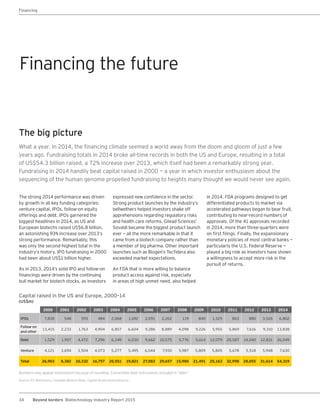
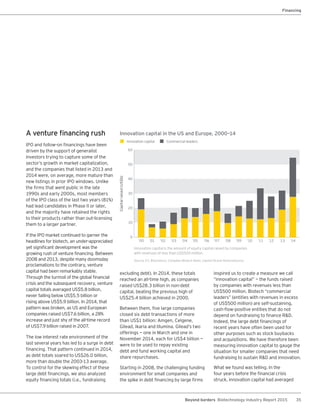
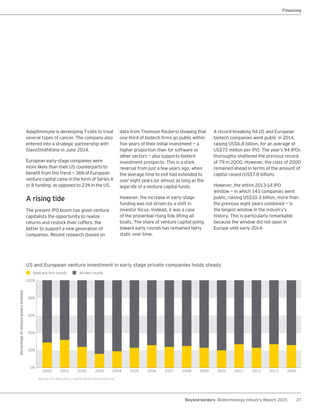
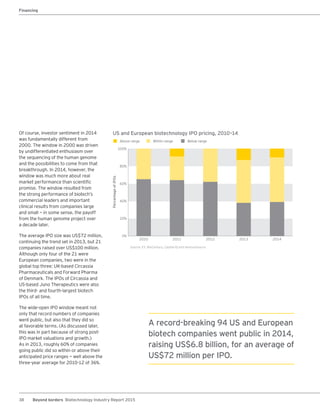
  • 70.
    70 Beyond bordersBiotechnology Industry Report 2015 Appendix Biotechnology at a glance across the four established clusters, 2014 ...............................5 FDA product approvals, 1996–2014 ..............................................................................6 Since 2007, there has been a dramatic increase in the number of US pre-commercial companies with market cap >US$1b...........................................7 Growth in established biotechnology centers, 2013–14 .................................................15 EY Survival Index, 2013–14 .........................................................................................16 Revenues generated by US and European biotechnology commercial leaders fuel investor sentiment ..............................................................17 Top 10 changes in US market capitalizations, 2009–14 .................................................18 Top 10 changes in European market capitalizations, 2009–14 .......................................18 US biotechnology at a glance, 2013–14........................................................................20 US pre-commercial companies with market cap >US$1b................................................21 US commercial leaders, 2010–14.................................................................................23 US commercial leaders and other companies, 2013–14.................................................24 Selected US public company financial highlights by geographic area, 2014.....................25 US market capitalization relative to leading indices........................................................26 US market capitalization by company size .....................................................................26 European market capitalization relative to leading indices..............................................27 European market capitalization by company size ...........................................................27 European biotechnology at a glance, 2013–14..............................................................28 EU commercial leaders, 2010–14.................................................................................30 European commercial leaders and other companies, 2013–14.......................................30 Australian biotechnology at a glance, 2013–14.............................................................31 Canadian biotechnology at a glance, 2013–14 ..............................................................32 Capital raised in the US and Europe, 2000–14...............................................................34 Innovation capital in the US and Europe, 2000–14.........................................................35 US and European early-stage venture investment, 2000–14 ..........................................36 US and European venture investment in early stage private companies holds steady .......37 US and European biotechnology IPO pricing, 2010–14 ..................................................38 US biotechnology financings, 2000–14.........................................................................39 Quarterly breakdown of US biotechnology financings, 2014 ..........................................40 Innovation capital in the US, 2000–14 ..........................................................................40 Data exhibit index
  • 71.
    71Beyond borders BiotechnologyIndustry Report 2015 Appendix Innovation capital raised by leading US regions, 2014....................................................41 US biopharmaceutical venture capital rebounds to its highest levels since the financial crisis.......................................................................42 Top US venture financings, 2014..................................................................................43 US biotechnology IPOs, 2000–14 .................................................................................44 The anatomy of a US IPO window .................................................................................45 US biotechnology IPO pricing by quarter, 2013–14........................................................45 Top US IPOs, 2014 ......................................................................................................46 European biotechnology financings, 2000–14...............................................................47 Innovation capital in Europe, 2000–14..........................................................................48 Quarterly breakdown of European biotechnology financings, 2014 ................................48 Innovation capital raised by leading European countries, 2014.......................................49 The return of European venture capital.........................................................................49 Top European venture financings, 2014........................................................................50 European biotechnology IPOs, 2000–14 .......................................................................51 Top European IPOs, 2014 ............................................................................................52 Performance distribution of 2014 NASDAQ biotech IPOs (in %) ......................................53 US and European M&As, 2007–14................................................................................56 Big pharma continues to command the most firepower, even as its relative share of “total firepower” declines to an eight-year low ..................................57 US and European strategic alliances based on biobucks, 2007–14..................................58 US and European strategic alliances based on up-front payments, 2007–14 ...................58 Bid premiums for top 10 M&As, 2009–14 .....................................................................59 Selected M&As, 2014 ..................................................................................................60 Alliances with big up-front payments, 2014 ..................................................................61 Big biobucks alliances, 2014 ........................................................................................62 US M&As, 2007–14 .....................................................................................................63 US strategic alliances based on biobucks, 2007–14 .......................................................64 US strategic alliances based on up-front payments, 2007–14.........................................64 European M&As, 2007–14 ...........................................................................................65 European strategic alliances based on biobucks, 2007–14 .............................................66 European strategic alliances based on up-front payments, 2007–14...............................66
  • 72.
    72 Beyond bordersBiotechnology Industry Report 2015 Global Life Sciences Leader Glen Giovannetti glen.giovannetti@ey.com +1 617 374 6218 Global Life Sciences Assurance Leader Scott Bruns scott.bruns@ey.com +1 317 681 7229 Global Life Sciences Advisory Leader Kim Ramko kim.ramko@ey.com +1 615 252 8249 Global Life Sciences Tax Leader Mitch Cohen mitchell.cohen@ey.com +1 203 674 3244 Global Life Sciences Transaction Advisory Services Leader Jeff Greene jeffrey.greene@ey.com +1 212 773 6500 Australia Brisbane Winna Brown winna.brown@au.ey.com +61 7 3011 3343 Melbourne Denise Brotherton denise.brotherton@au.ey.com +61 3 9288 8758 Sydney Gamini Martinus gamini.martinus@au.ey.com +61 2 9248 4702 Austria Vienna Erich Lehner erich.lehner@at.ey.com +43 1 21170 1152 Belgium Brussels Lucien De Busscher lucien.de.busscher@be.ey.com +32 2 774 6441 Brazil São Paulo Frank de Meijer frank-de.meijer@br.ey.com +55 11 2573 3383 Canada Montréal Sylvain Boucher sylvain.boucher@ca.ey.com +1 514 874 4393 Lara Iob lara.iob@ca.ey.com +1 514 879 6514 Toronto Mario Piccinin mario.piccinin@ca.ey.com +1 416 932 6231 Vancouver Nicole Poirier nicole.poirier@ca.ey.com +1 604 891 8342 Czech Republic Prague Petr Knap petr.knap@cz.ey.com +420 225 335 582 Denmark Copenhagen Christian Johansen christian-s.johansen@dk.ey.com +45 5158 2548 Finland Helsinki Sakari Helminen sakari.helminen@fi.ey.com +358 405 454 683 France Lyon Philippe Grand philippe.grand@fr.ey.com +33 4 78 17 57 32 Paris Virginie Lefebvre-Dutilleul virginie.lefebvre-dutilleul@ey-avocats.com +33 1 55 61 10 62 Franck Sebag franck.sebag@fr.ey.com +33 1 46 93 73 74 Germany Düsseldorf Gerd Stürz gerd.w.stuerz@de.ey.com +49 211 9352 18622 Mannheim Siegfried Bialojan siegfried.bialojan@de.ey.com +49 621 4208 11405 Greater China Shanghai Titus Bongart titus.bongart@cn.ey.com +86 21 22282884 Felix Fei felix.fei@cn.ey.com +86 21 22282586 India Mumbai Hitesh Sharma hitesh.sharma@in.ey.com +91 22 6192 0950 V. Krishnakumar krishnakumar.v@in.ey.com +91 22 6192 0950 Ireland Dublin Aidan Meagher aidan.meagher@ie.ey.com +353 1221 1139 Israel Tel Aviv Eyal Ben-Yaakov eyal.benyaakov@il.ey.com +972 3 623 2512 Italy Milan Gabriele Vanoli gabriele.vanoli@it.ey.com +39 02 8066 9840 Rome Alessandro Buccella alessandro.buccella@it.ey.com +39 06 67535630 Antonio Irione antonio.irione@it.ey.com +39 06 6755715 Japan Tokyo Hironao Yazaki yazaki-hrn@shinnihon.or.jp +81 3 3503 2165 Yuji Anzai anzai-yj@shinnihon.or.jp +81 3 3503 1100 Patrick Flochel flochel-ptrck@shinnihon.or.jp +41 58 286 4148 Korea Seoul Jeungwook Lee jeung-wook.lee@kr.ey.com +82 2 3787 4301 Netherlands Amsterdam Dick Hoogenberg dick.hoogenberg@nl.ey.com +31 88 40 71419 Global biotechnology contacts Appendix
  • 73.
    73Beyond borders BiotechnologyIndustry Report 2015 New Zealand Auckland Jon Hooper jon.hooper@nz.ey.com +64 9 300 8124 Norway Trondheim/Oslo Willy Eidissen willy.eidissen@no.ey.com +47 918 63 845 Poland Warsaw Mariusz Witalis mariusz.witalis@pl.ey.com +48 225 577950 Russia/CIS Moscow Dmitry Khalilov dmitry.khalilov@ru.ey.com +7 495 755 9757 Singapore Singapore Sabine Dettwiler sabine.dettwiler@sg.ey.com +65 9028 5228 Rick Fonte richard.fonte@sg.ey.com +65 6309 8105 South Africa Johannesburg Warren Kinnear warren.kinnear@za.ey.com +27 11 772 3576 Spain Barcelona Dr. Silvia Ondategui-Parra silvia.ondateguiparra@es.ey.com +34 93 366 3740 Sweden Uppsala Staffan Folin staffan.folin@se.ey.com +46 8 5205 9359 Switzerland Basel Jürg Zürcher juerg.zuercher@ch.ey.com +41 58 286 84 03 United Kingdom Bristol Matt Ward mward@uk.ey.com +44 11 7981 2100 Cambridge Cathy Taylor ctaylor@uk.ey.com +44 12 2355 7090 Rachel Wilden rwilden@uk.ey.com +44 12 2355 7096 Edinburgh Mark Harvey mharvey2@uk.ey.com +44 13 1777 2294 Jonathan Lloyd-Hirst jlloydhirst@uk.ey.com +44 13 1777 2475 London/Reading David MacMurchy dmacmurchy@uk.ey.com +44 20 7951 8947 Ian Oliver ioliver@uk.ey.com +44 11 8928 1197 United States Boston Michael Donovan michael.donovan1@ey.com +1 617 585 1957 Chicago Jerry DeVault jerry.devault@ey.com +1 312 879 6518 Houston Carole Faig carole.faig@ey.com +1 713 750 1535 Indianapolis Andy Vrigian andy.vrigian@ey.com +1 317 681 7000 Los Angeles Don Ferrera don.ferrera@ey.com +1 213 977 7684 New York/New Jersey Tony Torrington anthony.torrington@ey.com +1 732 516 4681 David De Marco dave.demarco@ey.com +1 732 516 4602 Orange County Kim Letch kim.letch@ey.com +1 949 437 0244 Mark Montoya mark.montoya@ey.com +1 949 437 0388 Philadelphia Steve Simpson stephen.simpson@ey.com +1 215 448 5309 Howard Brooks howard.brooks@ey.com +1 215 448 5115 Raleigh Mark Baxter mark.baxter@ey.com +1 919 981 2966 Redwood Shores Scott Morrison scott.morrison@ey.com +1 650 496 4688 Chris Nolet chris.nolet@ey.com +1 650 802 4504 San Diego Dan Kleeburg daniel.kleeburg@ey.com +1 858 535 7209 Seattle Kathleen Smith kathy.smith@ey.com +1 206 654 6305 Washington, D.C. Rene Salas rene.salas@ey.com +1 703 747 0732 Appendix
  • 76.
    About EY EY isa global leader in assurance, tax, transaction and advisory services. The insights and quality services we deliver help build trust and confidence in the capital markets and in economies the world over. We develop outstanding leaders who team to deliver on our promises to all of our stakeholders. In so doing, we play a critical role in building a better working world for our people, for our clients and for our communities. EY refers to the global organization, and may refer to one or more, of the member firms of Ernst & Young Global Limited, each of which is a separate legal entity. Ernst & Young Global Limited, a UK company limited by guarantee, does not provide services to clients. For more information about our organization, please visit ey.com. How EY’s Global Life Sciences Sector can help your business Life sciences companies — from emerging to multinational — are facing challenging times as access to health care takes on new importance. Stakeholder expectations are shifting, the costs and risks of product development are increasing, alternative business models are manifesting, and collaborations are becoming more complex. At the same time, players from other sectors are entering the field, contributing to a new ecosystem for delivering health care. New measures of success are also emerging as the sector begins to focus on improving a patient’s “health outcome” and not just on units of a product sold. Our Global Life Sciences Sector brings together a worldwide network of more than 7,000 sector-focused assurance, tax, transaction and advisory professionals to anticipate trends, identify implications and develop points of view on how to respond to the critical sector issues. We can help you navigate your way forward and achieve success in the new health ecosystem. For more timely insights on the key business issues affecting life sciences companies, please go to ey.com/VitalSigns. You can also visit ey.com/lifesciences or email global.lifesciences@ey.com for more information on our services. To connect with us on Twitter, follow @EY_LifeSciences. © 2015 EYGM Limited. All Rights Reserved. EYG No. FN0206 CSG no. 1411-1355695 ED None This material has been prepared for general informational purposes only and is not intended to be relied upon as accounting, tax, or other professional advice. Please refer to your advisors for specific advice. The views of third parties set out in this publication are not necessarily the views of the global EY organization or its member firms. Moreover, they should be seen in the context of the time they were made. ey.com EY | Assurance | Tax | Transactions | Advisory