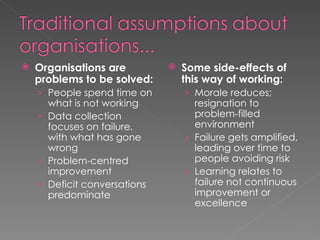

Organisations are problems to be solved: People spend time on what is not working Data collection focuses on failure, with what has gone wrong  Problem-centred improvement Deficit conversations predominate Some side-effects of this way of working: Morale reduces; resignation to problem-filled environment Failure gets amplified, leading over time to people avoiding risk Learning relates to failure not continuous improvement or excellence
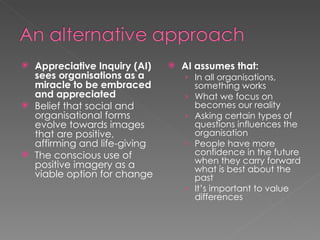
Appreciative Inquiry (AI) sees organisations as a miracle to be embraced and appreciated Belief that social and organisational forms evolve towards images that are positive, affirming and life-giving The conscious use of positive imagery as a viable option for change AI assumes that: In all organisations, something works What we focus on becomes our reality Asking certain types of questions influences the organisation People have more confidence in the future when they carry forward what is best about the past It’s important to value differences
Appreciative Inquiry is the study  of what works well
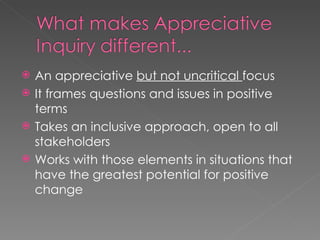
An appreciative  but not uncritical  focus It frames questions and issues in positive terms Takes an inclusive approach, open to all stakeholders Works with those elements in situations that have the greatest potential for positive change
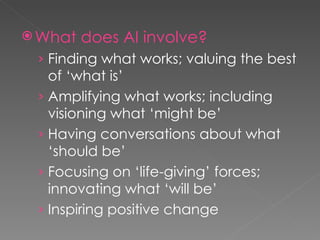
What does AI involve? Finding what works; valuing the best of ‘what is’ Amplifying what works; including visioning what ‘might be’  Having conversations about what ‘should be’ Focusing on ‘life-giving’ forces; innovating what ‘will be’ Inspiring positive change
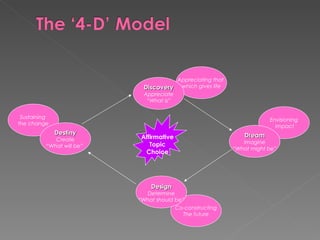
Sustaining  the change Co-constructing The future Envisioning Impact Appreciating that  which gives life Discovery Appreciate “ What is” Dream Imagine “ What might be” Destiny Create “ What will be”  Design Determine “ What should be” Affirmative Topic Choice
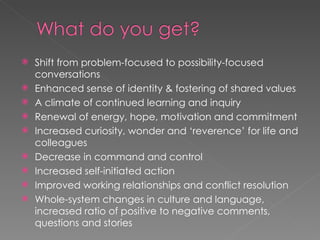
Shift from problem-focused to possibility-focused conversations Enhanced sense of identity & fostering of shared values A climate of continued learning and inquiry  Renewal of energy, hope, motivation and commitment Increased curiosity, wonder and ‘reverence’ for life and colleagues Decrease in command and control  Increased self-initiated action Improved working relationships and conflict resolution Whole-system changes in culture and language,  increased ratio of positive to negative comments, questions and stories
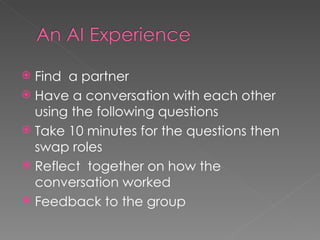
Find  a partner Have a conversation with each other using the following questions Take 10 minutes for the questions then swap roles Reflect  together on how the conversation worked Feedback to the group
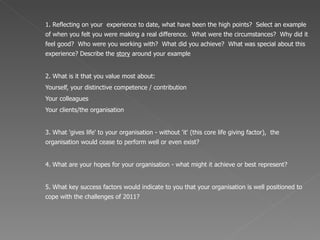
1. Reflecting on your  experience to date, what have been the high points?  Select an example of when you felt you were making a real difference.  What were the circumstances?  Why did it feel good?  Who were you working with?  What did you achieve?  What was special about this experience? Describe the  story  around your example 2. What is it that you value most about:  Yourself, your distinctive competence  / contribution Your colleagues Your clients/the organisation 3. What 'gives life' to your organisation - without 'it' (this core life giving factor),  the organisation would cease to perform well or even exist? 4. What are your hopes for your organisation - what might it achieve or best represent? 5. What key success factors would indicate to you that your organisation is well positioned to cope with the challenges of 2011?
 
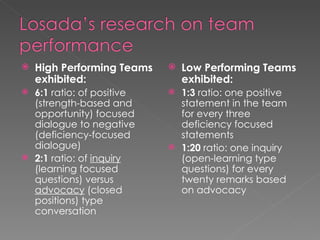
High Performing Teams exhibited: 6:1  ratio: of positive (strength-based and opportunity) focused dialogue to negative (deficiency-focused dialogue) 2:1  ratio: of  inquiry  (learning focused questions) versus  advocacy  (closed positions) type conversation Low Performing Teams exhibited: 1:3  ratio: one positive statement in the team for every three deficiency focused statements 1:20  ratio: one inquiry (open-learning type questions) for every twenty remarks based on advocacy
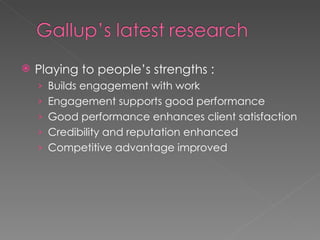
Playing to people’s strengths : Builds engagement with work Engagement supports good performance Good performance enhances client satisfaction Credibility and reputation enhanced Competitive advantage improved
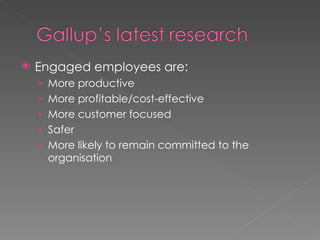
Engaged employees are: More productive More profitable/cost-effective More customer focused Safer More likely to remain committed to the organisation
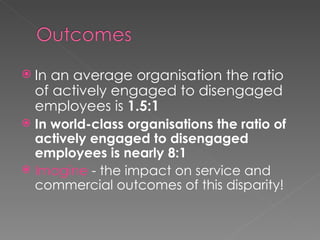
In an average organisation the ratio of actively engaged to disengaged employees is  1.5:1 In world-class organisations the ratio of actively engaged to disengaged employees is nearly 8:1 Imagine  - the impact on service and commercial outcomes of this disparity!
Gallup’s research in Australia shows 82% of employees are not  actively  engaged at work – costs A$42b per annum in productivity
Warwick University Business School research: “ Positive emotions appear to invigorate human beings, while negative emotions have the opposite effect” – it’s obvious isn’t it? Research exercises showed “happier workers were  12%  more productive and unhappier workers 10% less productive” Death or illness in family in past 2 years affected performance by -10% Productivity has often been subject to skills, education and technical interventions – this suggests “a new line of inquiry – human emotion”
So – create appreciative environments + play to peoples’ strengths = improved engagement = more productive employees = happier employees = better customer outcomes  Would you like to know more?
 

Appreciative Inquiry

  • 1.
  • 2.
    Organisations are problemsto be solved: People spend time on what is not working Data collection focuses on failure, with what has gone wrong Problem-centred improvement Deficit conversations predominate Some side-effects of this way of working: Morale reduces; resignation to problem-filled environment Failure gets amplified, leading over time to people avoiding risk Learning relates to failure not continuous improvement or excellence
  • 3.
    Appreciative Inquiry (AI)sees organisations as a miracle to be embraced and appreciated Belief that social and organisational forms evolve towards images that are positive, affirming and life-giving The conscious use of positive imagery as a viable option for change AI assumes that: In all organisations, something works What we focus on becomes our reality Asking certain types of questions influences the organisation People have more confidence in the future when they carry forward what is best about the past It’s important to value differences
  • 4.
    Appreciative Inquiry isthe study of what works well
  • 5.
    An appreciative but not uncritical focus It frames questions and issues in positive terms Takes an inclusive approach, open to all stakeholders Works with those elements in situations that have the greatest potential for positive change
  • 6.
    What does AIinvolve? Finding what works; valuing the best of ‘what is’ Amplifying what works; including visioning what ‘might be’ Having conversations about what ‘should be’ Focusing on ‘life-giving’ forces; innovating what ‘will be’ Inspiring positive change
  • 7.
    Sustaining thechange Co-constructing The future Envisioning Impact Appreciating that which gives life Discovery Appreciate “ What is” Dream Imagine “ What might be” Destiny Create “ What will be” Design Determine “ What should be” Affirmative Topic Choice
  • 8.
    Shift from problem-focusedto possibility-focused conversations Enhanced sense of identity & fostering of shared values A climate of continued learning and inquiry Renewal of energy, hope, motivation and commitment Increased curiosity, wonder and ‘reverence’ for life and colleagues Decrease in command and control Increased self-initiated action Improved working relationships and conflict resolution Whole-system changes in culture and language, increased ratio of positive to negative comments, questions and stories
  • 9.
    Find apartner Have a conversation with each other using the following questions Take 10 minutes for the questions then swap roles Reflect together on how the conversation worked Feedback to the group
  • 10.
    1. Reflecting onyour experience to date, what have been the high points? Select an example of when you felt you were making a real difference. What were the circumstances? Why did it feel good? Who were you working with? What did you achieve? What was special about this experience? Describe the story around your example 2. What is it that you value most about: Yourself, your distinctive competence / contribution Your colleagues Your clients/the organisation 3. What 'gives life' to your organisation - without 'it' (this core life giving factor), the organisation would cease to perform well or even exist? 4. What are your hopes for your organisation - what might it achieve or best represent? 5. What key success factors would indicate to you that your organisation is well positioned to cope with the challenges of 2011?
  • 11.
  • 12.
    High Performing Teamsexhibited: 6:1 ratio: of positive (strength-based and opportunity) focused dialogue to negative (deficiency-focused dialogue) 2:1 ratio: of inquiry (learning focused questions) versus advocacy (closed positions) type conversation Low Performing Teams exhibited: 1:3 ratio: one positive statement in the team for every three deficiency focused statements 1:20 ratio: one inquiry (open-learning type questions) for every twenty remarks based on advocacy
  • 13.
    Playing to people’sstrengths : Builds engagement with work Engagement supports good performance Good performance enhances client satisfaction Credibility and reputation enhanced Competitive advantage improved
  • 14.
    Engaged employees are:More productive More profitable/cost-effective More customer focused Safer More likely to remain committed to the organisation
  • 15.
    In an averageorganisation the ratio of actively engaged to disengaged employees is 1.5:1 In world-class organisations the ratio of actively engaged to disengaged employees is nearly 8:1 Imagine - the impact on service and commercial outcomes of this disparity!
  • 16.
    Gallup’s research inAustralia shows 82% of employees are not actively engaged at work – costs A$42b per annum in productivity
  • 17.
    Warwick University BusinessSchool research: “ Positive emotions appear to invigorate human beings, while negative emotions have the opposite effect” – it’s obvious isn’t it? Research exercises showed “happier workers were 12% more productive and unhappier workers 10% less productive” Death or illness in family in past 2 years affected performance by -10% Productivity has often been subject to skills, education and technical interventions – this suggests “a new line of inquiry – human emotion”
  • 18.
    So – createappreciative environments + play to peoples’ strengths = improved engagement = more productive employees = happier employees = better customer outcomes Would you like to know more?
  • 19.