External carotid artery
-SOHAM SHENDE
The ECA [ external carotid artery ]
begins at the level of the upper
border of the thyroid cartilage (at
the level of the fourth cervical
vertebra).
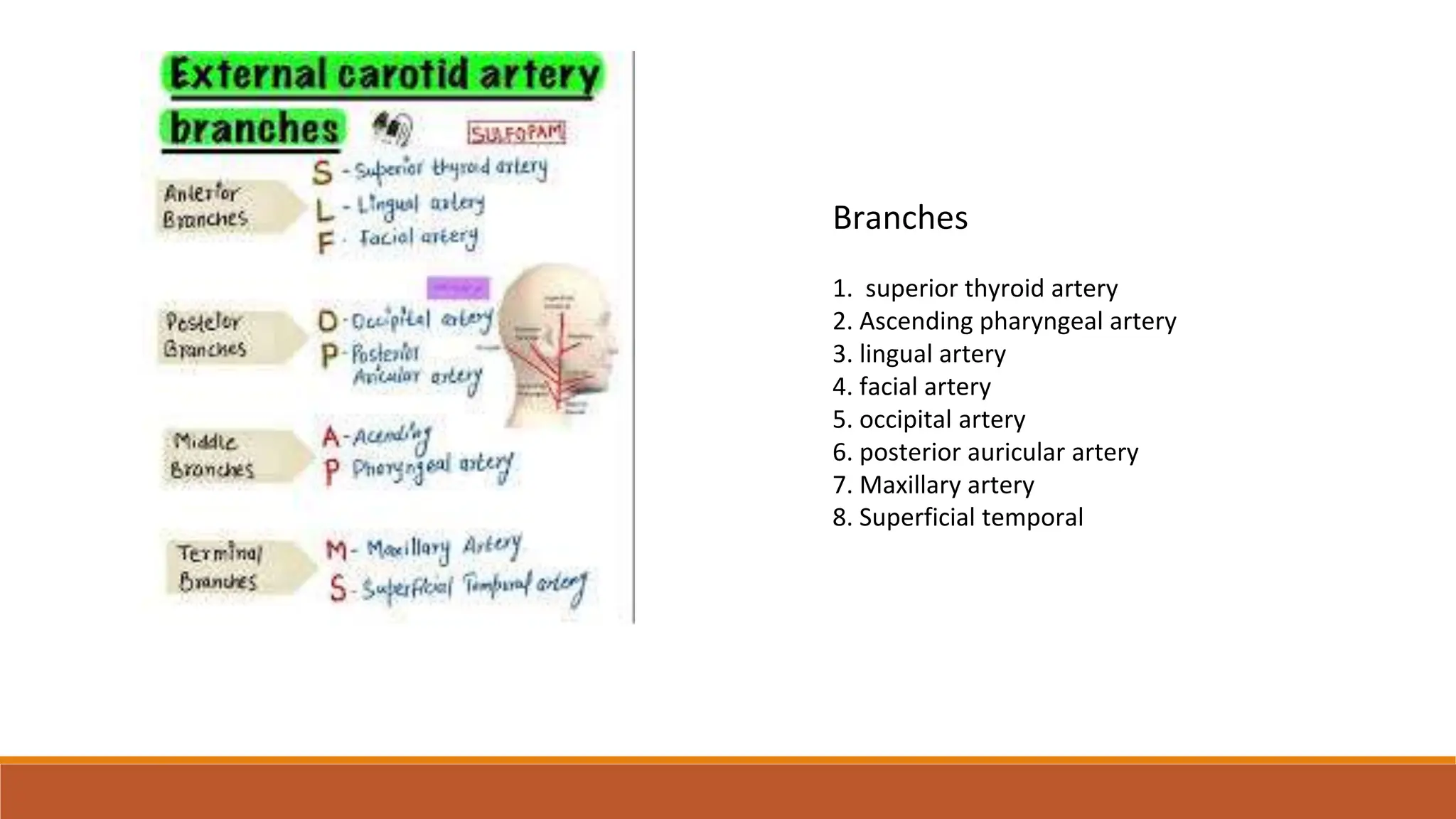
Branches
1. superior thyroid artery
2. Ascending pharyngeal artery
3. lingual artery
4. facial artery
5. occipital artery
6. posterior auricular artery
7. Maxillary artery
8. Superficial temporal
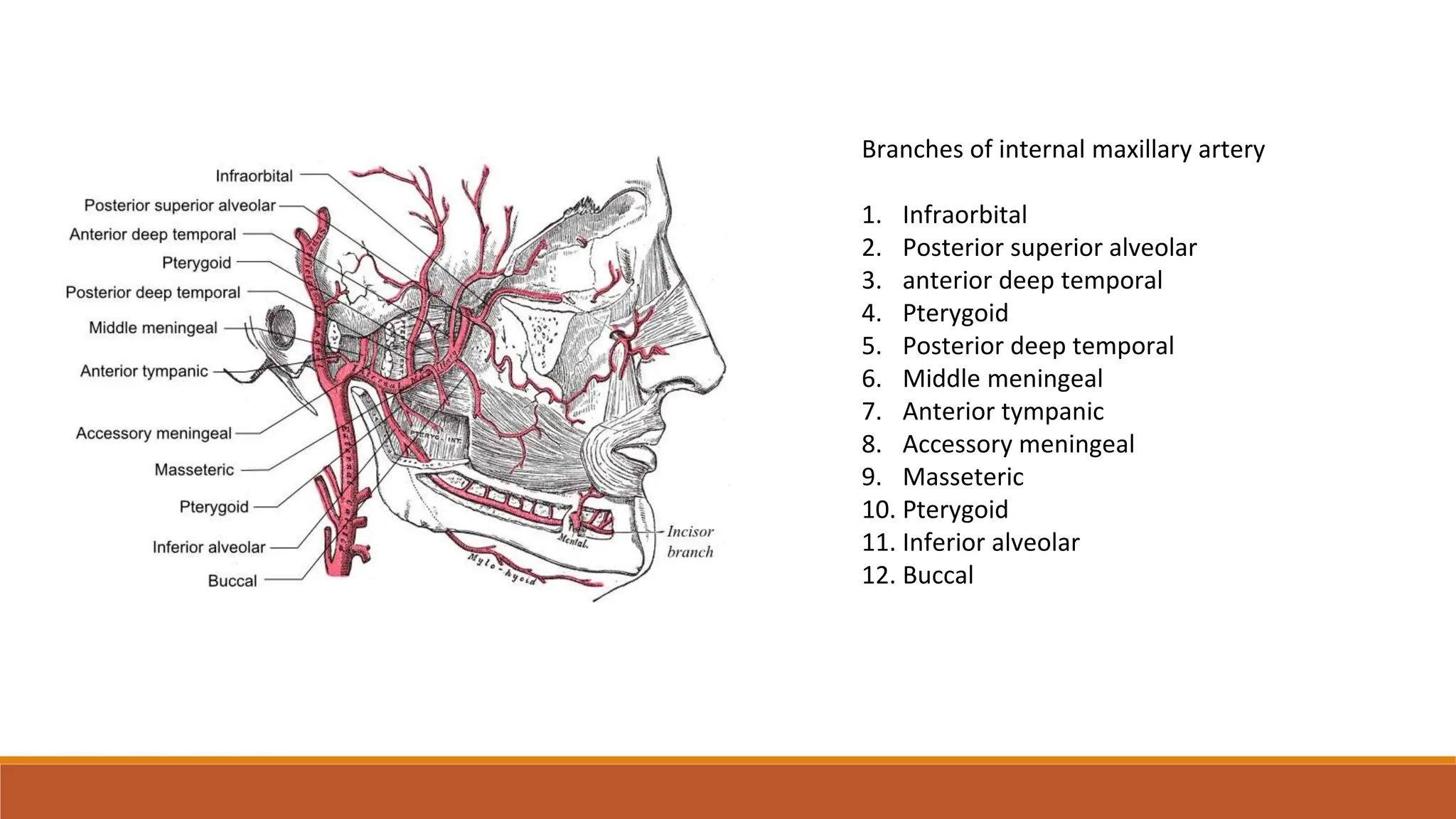
Branches of internal maxillary artery
1. Infraorbital
2. Posterior superior alveolar
3. anterior deep temporal
4. Pterygoid
5. Posterior deep temporal
6. Middle meningeal
7. Anterior tympanic
8. Accessory meningeal
9. Masseteric
10. Pterygoid
11. Inferior alveolar
12. Buccal
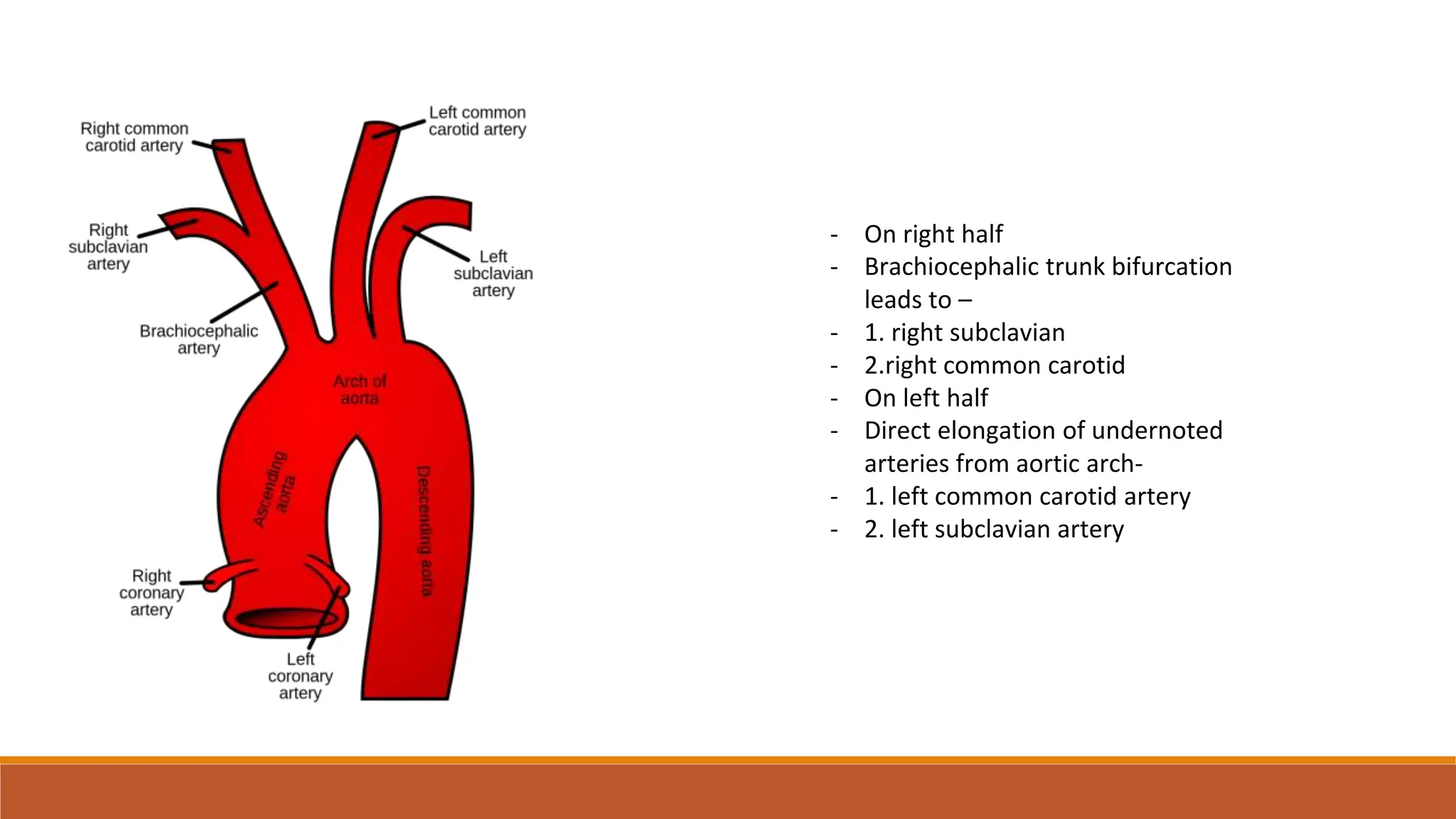
Point where brachiocephalic trunk
devide into
- Originates at right sternoclavicular
joint from brachiocephalic trunk
1.Subclavian artery
2. Common carotid artery
Branch - Internal maxillary
- devide into 3 parts
- these 3 branches further devides into
sub-branches
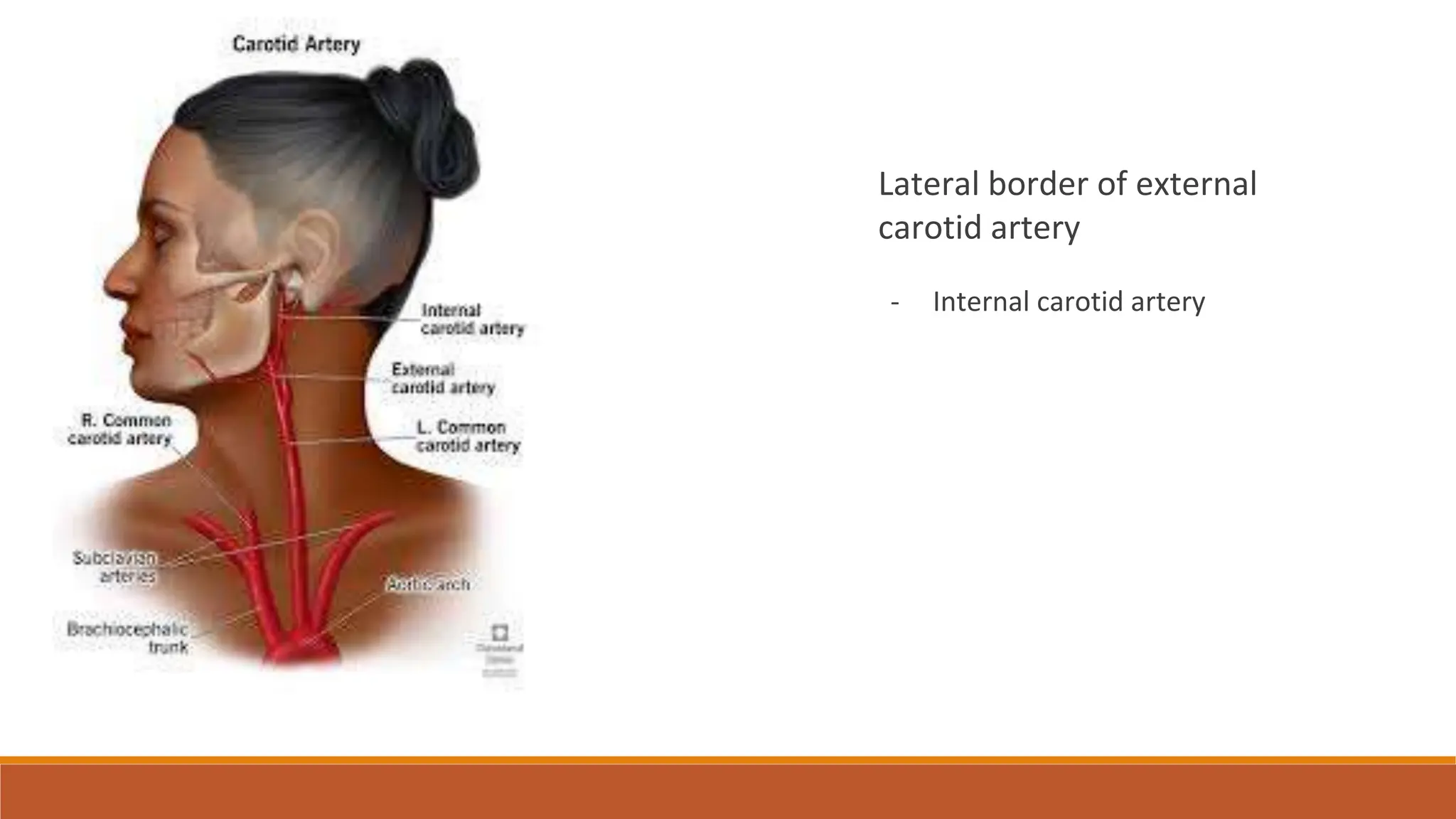
Common carotid artery
- Bifurcates at level of C3-4
- Devide into
1. External carotid
- Located betn. Neck of mandible
- 2. Internal carotid
- enters cranium through carotid can
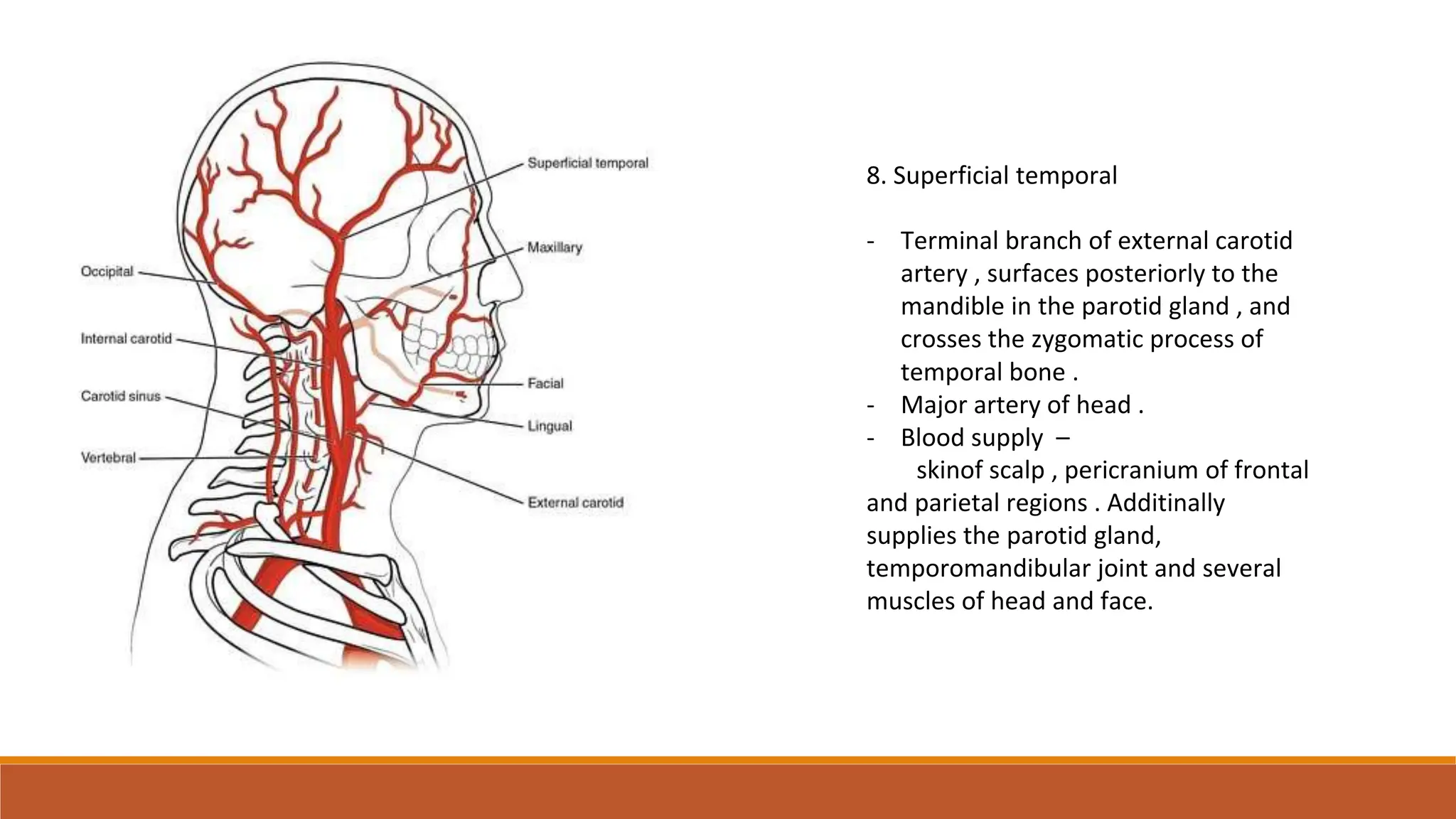
8. Superficial temporal
- Terminal branch of external carotid
artery , surfaces posteriorly to the
mandible in the parotid gland , and
crosses the zygomatic process of
temporal bone .
- Major artery of head .
- Blood supply –
skinof scalp , pericranium of frontal
and parietal regions . Additinally
supplies the parotid gland,
temporomandibular joint and several
muscles of head and face.
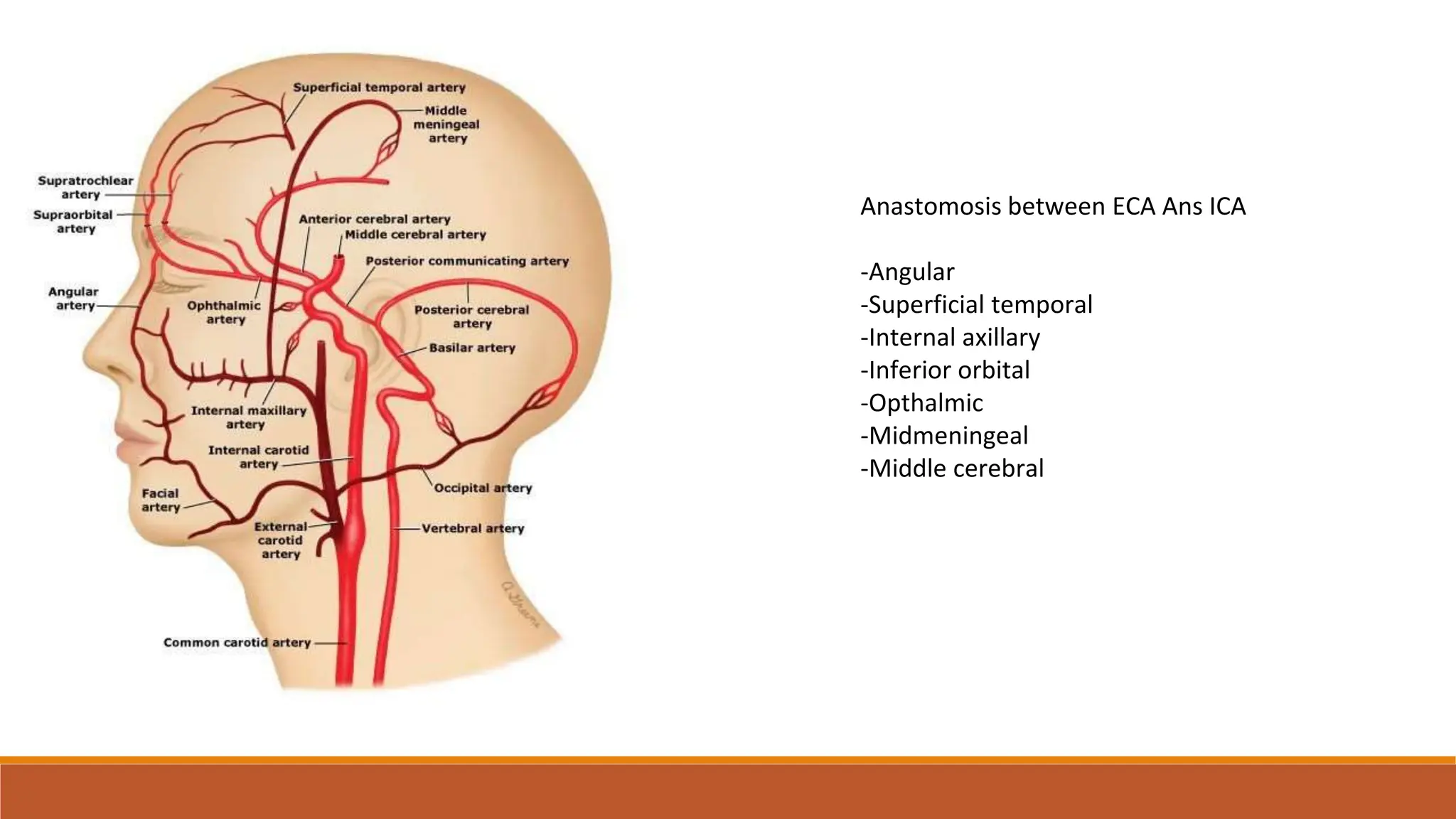
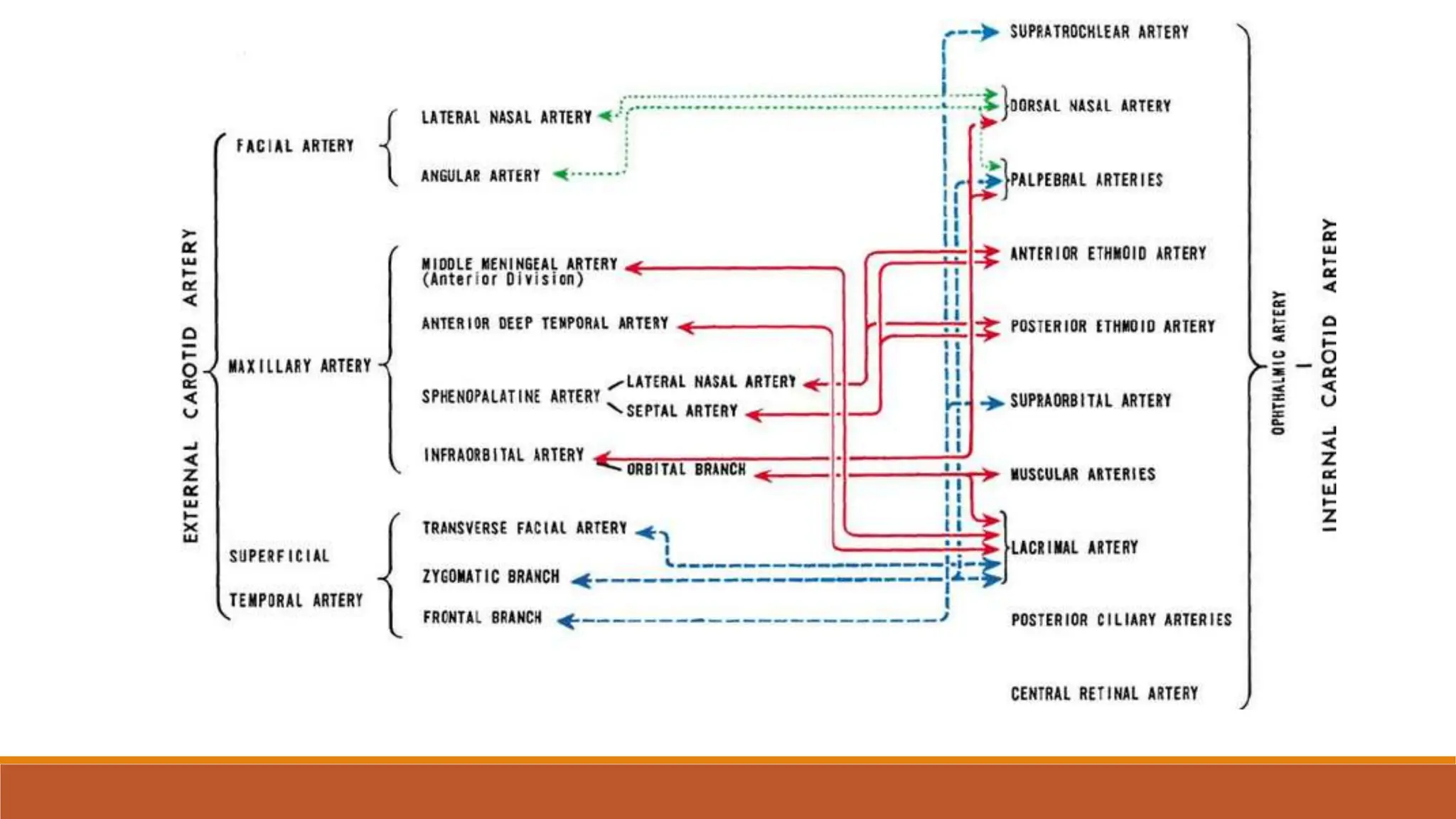
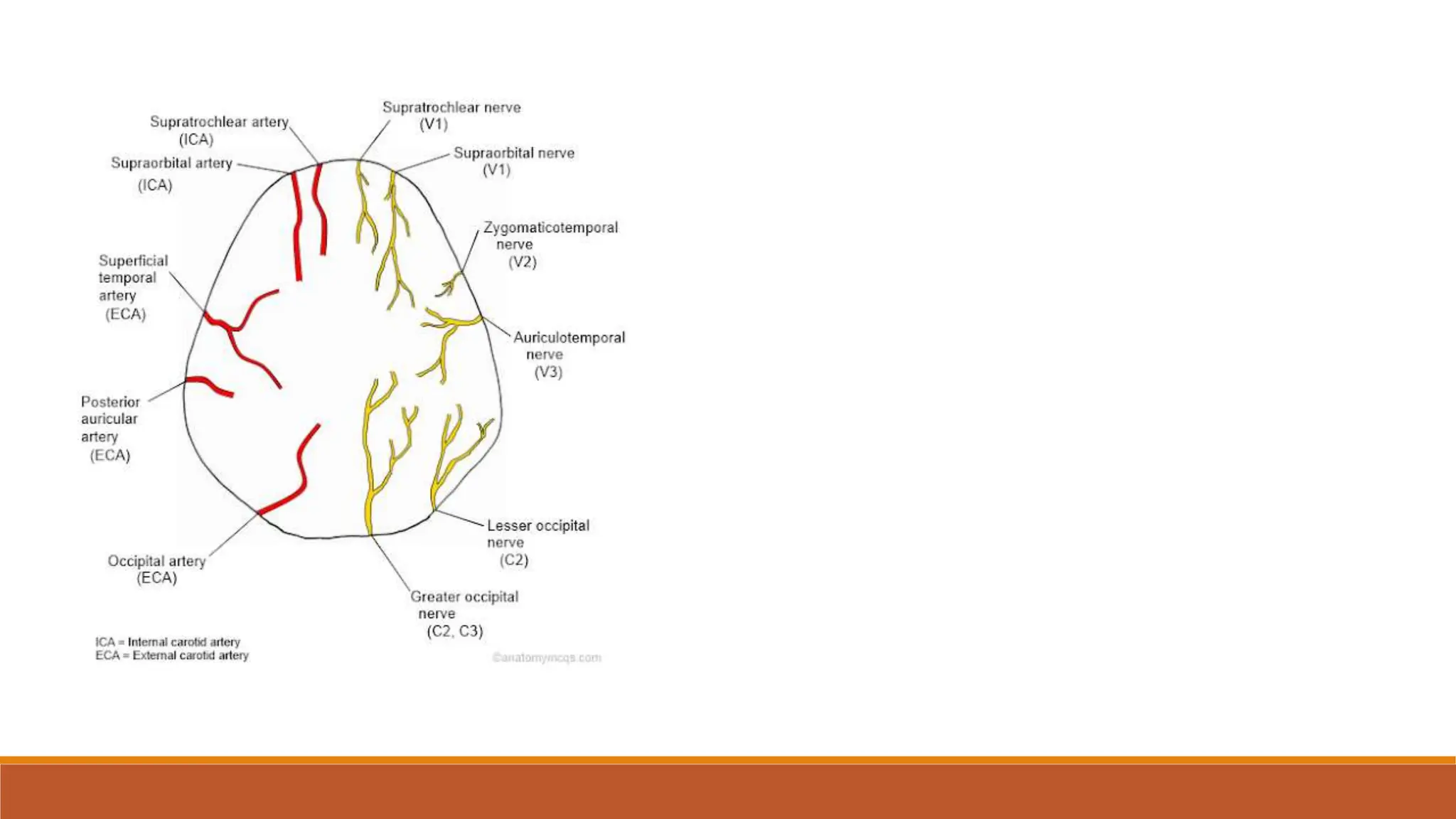
Anastomosis between ECA Ans ICA
-Angular
-Superficial temporal
-Internal axillary
-Inferior orbital
-Opthalmic
-Midmeningeal
-Middle cerebral
- On right half
- Brachiocephalic trunk bifurcation
leads to –
- 1. right subclavian
- 2.right common carotid
- On left half
- Direct elongation of undernoted
arteries from aortic arch-
- 1. left common carotid artery
- 2. left subclavian artery
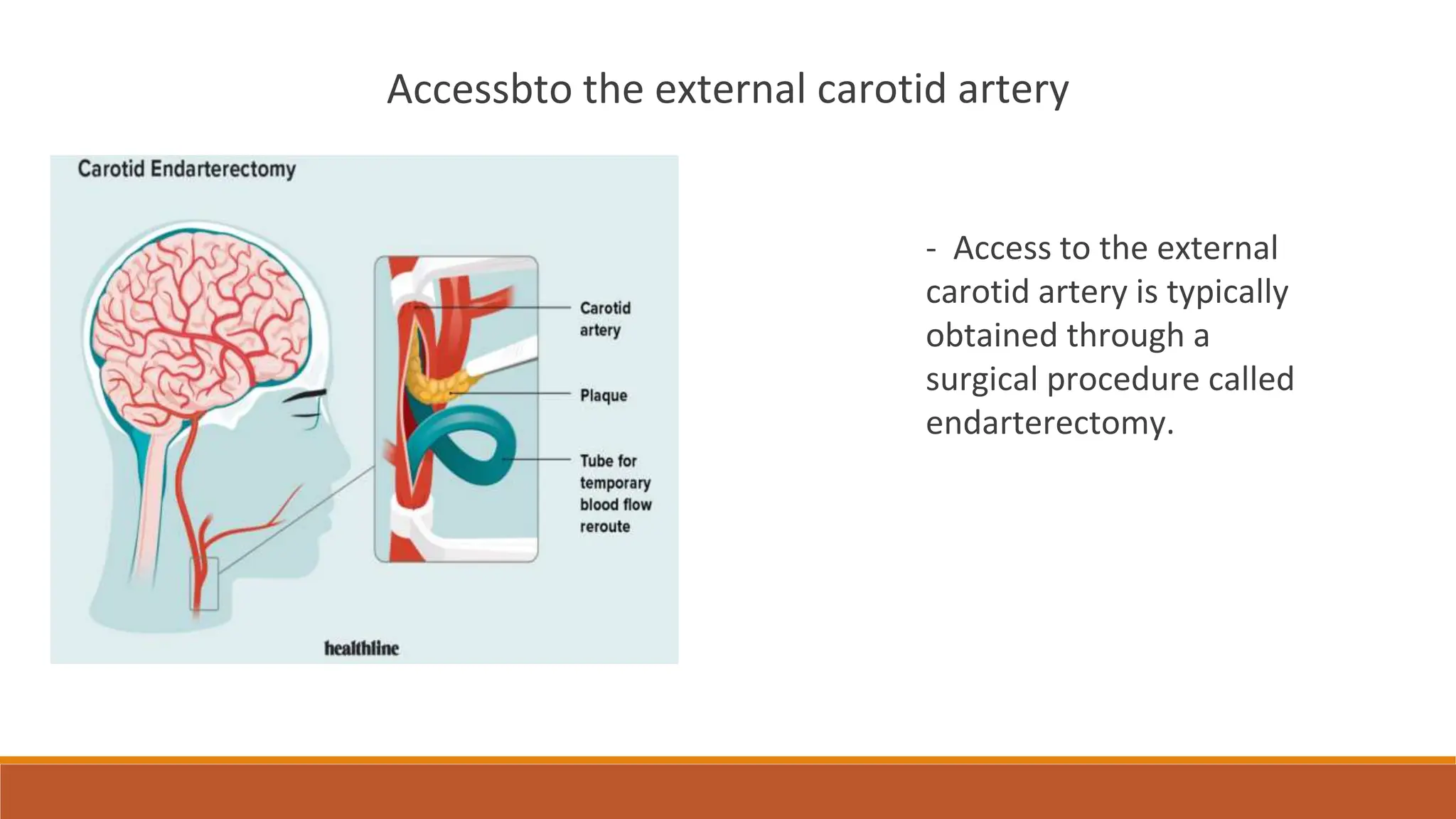
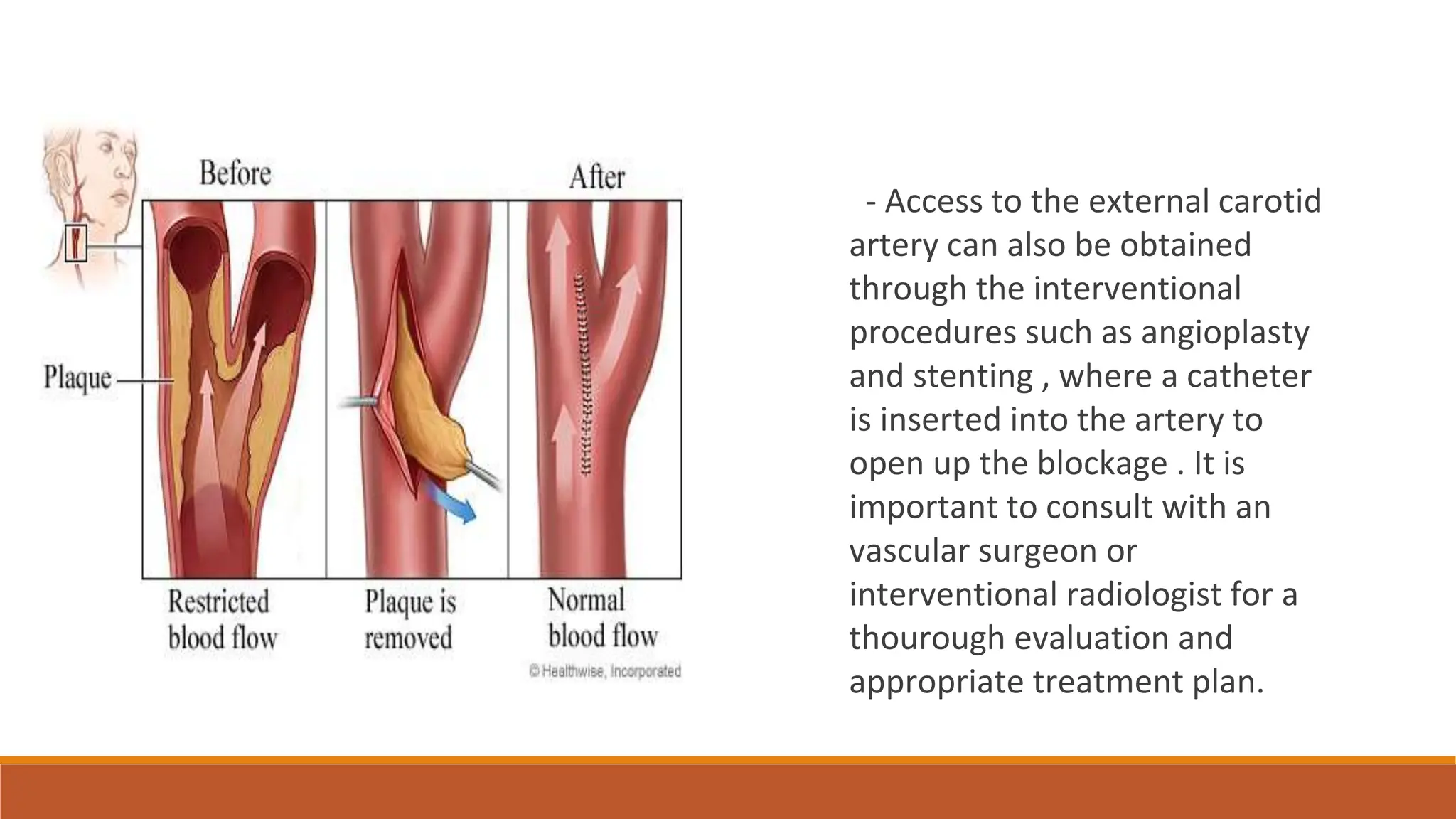
- Access to the external
carotid artery is typically
obtained through a
surgical procedure called
endarterectomy.
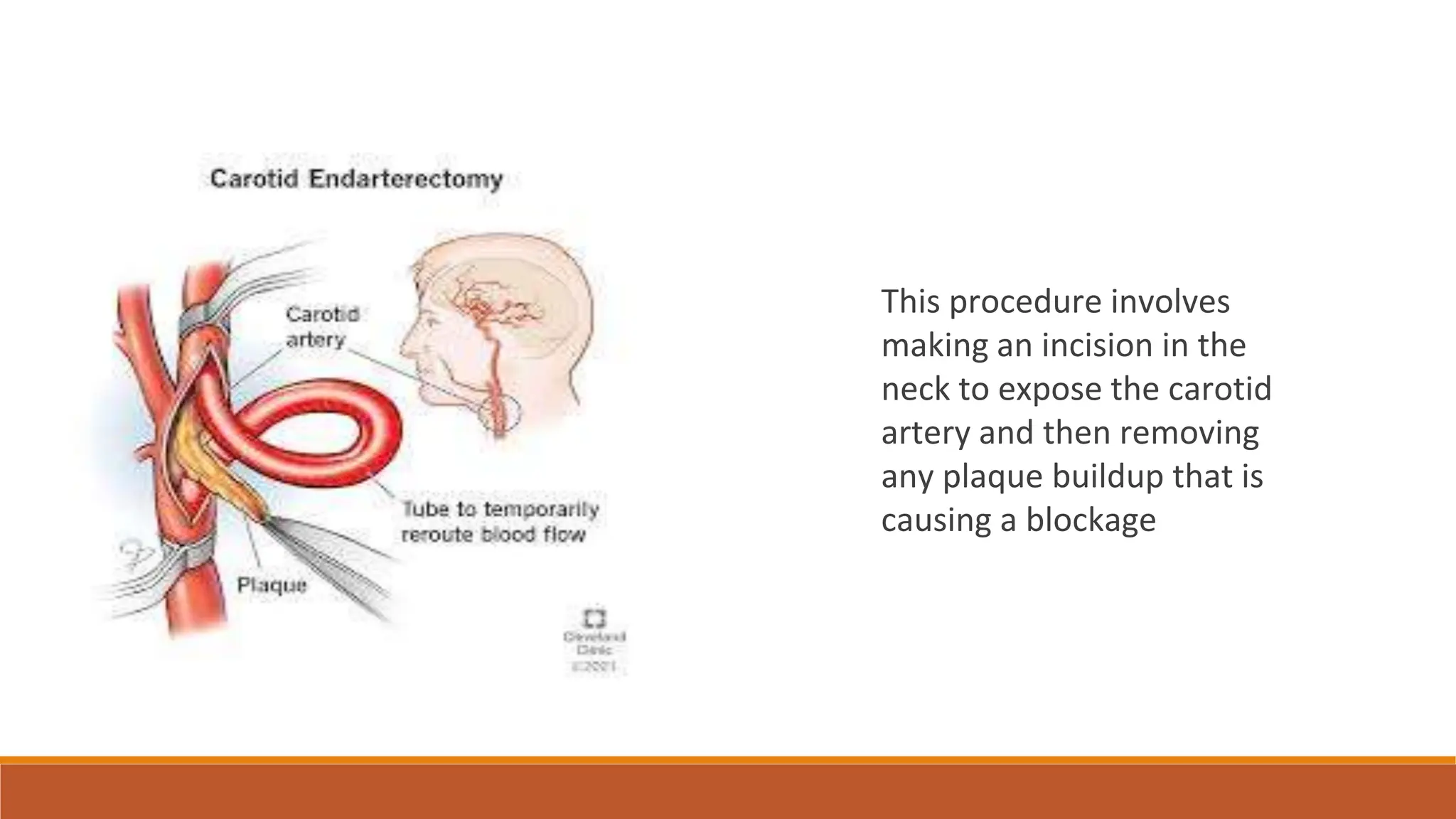
This procedure involves
making an incision in the
neck to expose the carotid
artery and then removing
any plaque buildup that is
causing a blockage
- Access to the external carotid
artery can also be obtained
through the interventional
procedures such as angioplasty
and stenting , where a catheter
is inserted into the artery to
open up the blockage . It is
important to consult with an
vascular surgeon or
interventional radiologist for a
thourough evaluation and
appropriate treatment plan.
Ligation of external carotid
artery is a surgical procedure in
which the artery is tied off or
closed to stop blood flow
through it
This procedure may be performed to treat
certain medical procedures such as
Aneurysms , arteriovenous malformation
or to control bleeding from external
carotid artery .
Ligation of external carotid artery
maybe a part of a more extensive surgical
procedure such as in the case of certain
head and neck tumors .
It is important to note that ligation of External
carotid artery is a complex surgical procedure
that carries potential risks and should only be
performed by experienced vascular or head and
neck sergeon .
The decision to perform this procedure should
be based on a thorough evaluation of the
patient's condition and consideration of the
potential benefits and risks.
Crucial for patient’s to have detailed
discussion with their healthcare provider's to
understand the reason for the procedure , its
potential outcomes, and any alternative
treatment options .
The external and internal carotid
arteries are two major blood vessels
that supply blood to different regions
of the head and neck. They have
distinct anatomical features and serve
different functions in the circulatory
system.
Distinctive features of the External and Internal carotid arteries
Branches -
1. External carotid - gives rise to several
branches that supply blood to the
face , scalp and neck . These branches
includes the superior thyroid artery,
lingual artey, facial artery, occipital
artery and others.
2. Internal carotid artery - does not have
significant branches in the neck region
instead, it ascends into the skull ,
where, it gives off branches that
supply blood to the brain and eyes
such as opthalmic artery.
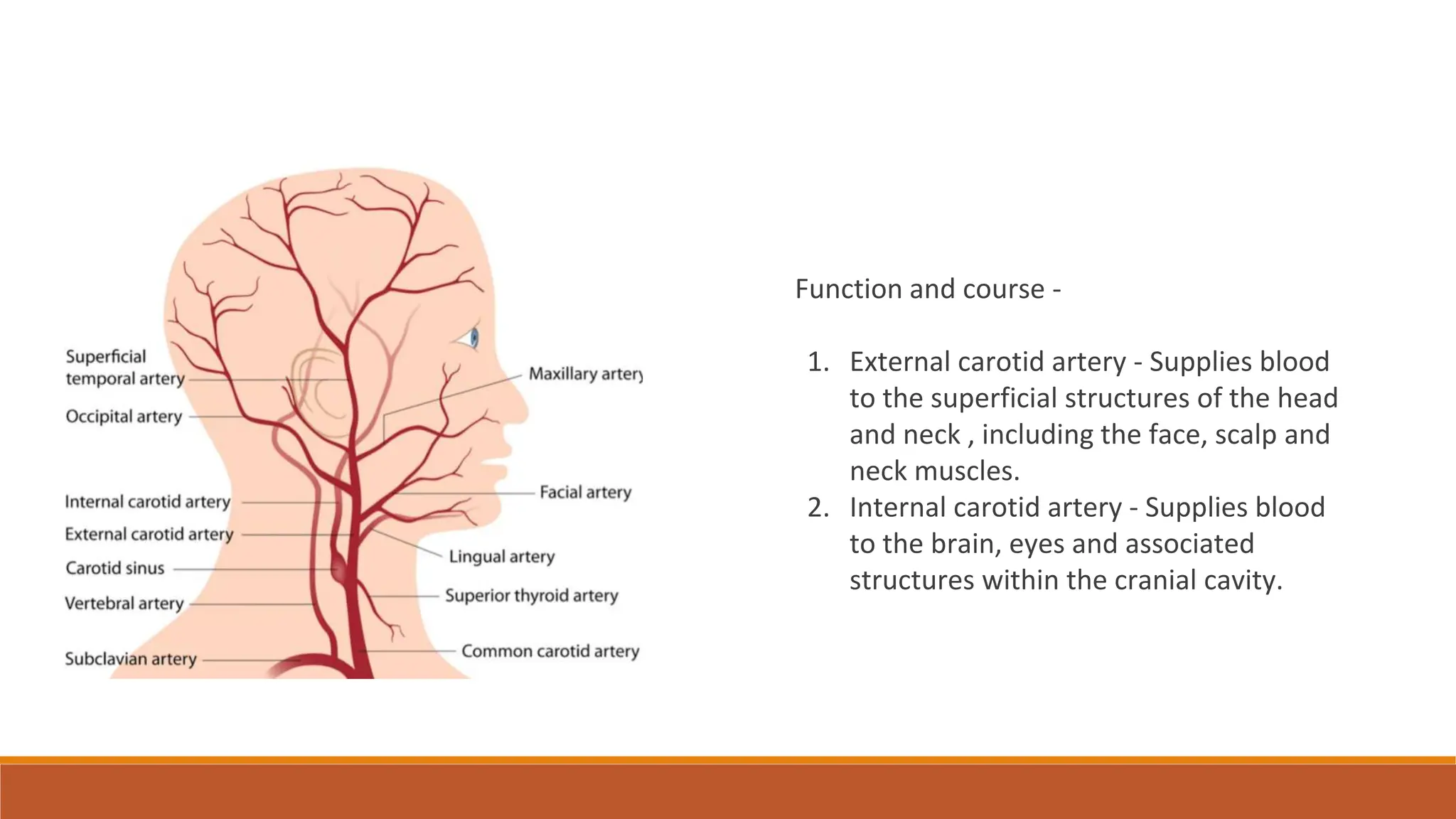
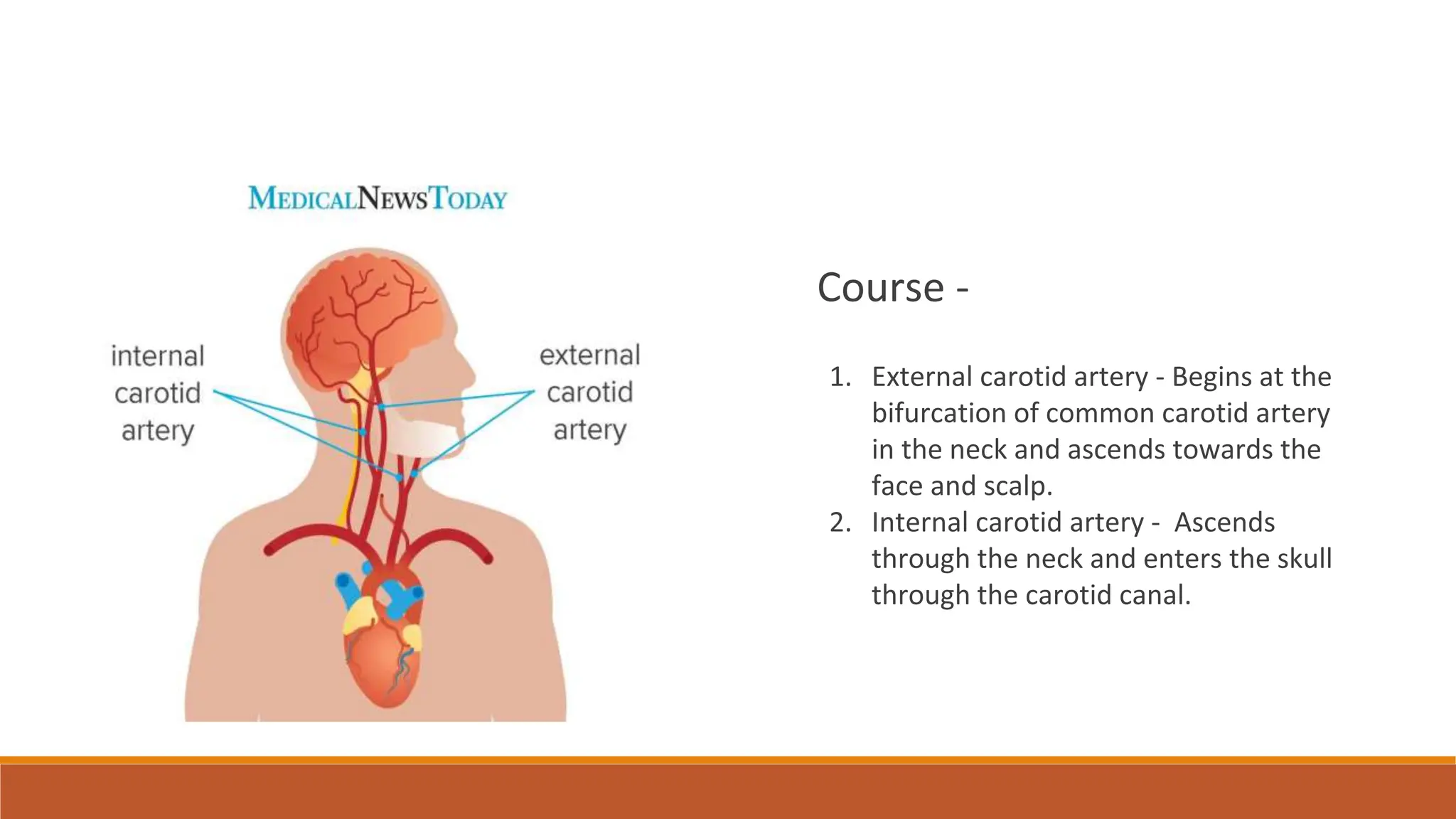
Function and course -
1. External carotid artery - Supplies blood
to the superficial structures of the head
and neck , including the face, scalp and
neck muscles.
2. Internal carotid artery - Supplies blood
to the brain, eyes and associated
structures within the cranial cavity.
Palpable pulse -
1. External carotid artery - the pulse of
External carotid artery is not typically
palpable at the neck die to its smaller
size and deeper location , compared to
the common carotid artery.
2. Internal carotid artery - the pulse of the
Internal carotid artery is often palpable
at the neck due to its larger size and
more superficial location compared to
the external carotid artery.
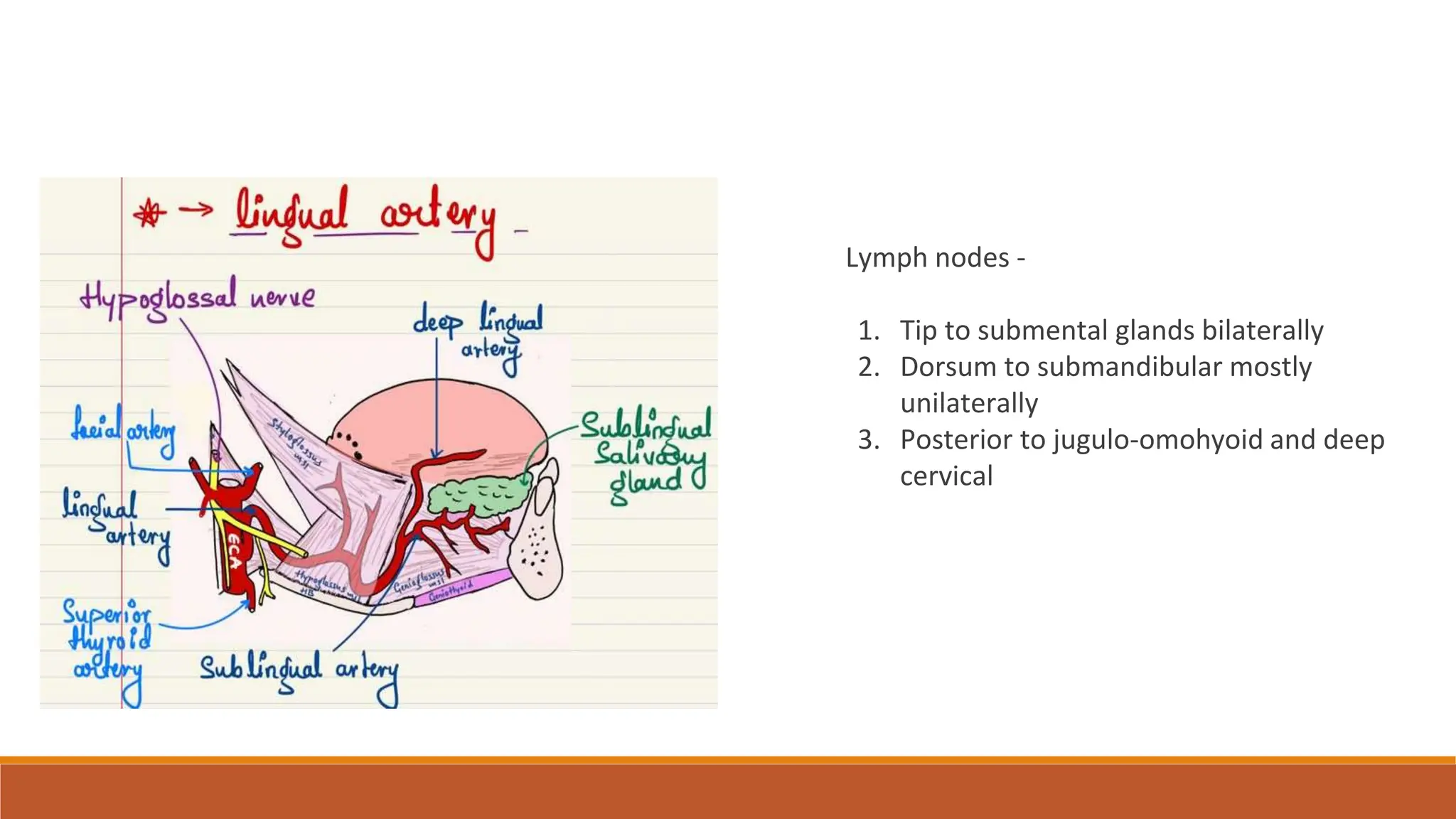
- lingual artery takes blood
from your carotid artery in
your neck to parts of your
mouth. It runs under your
jaw and ends at the tip of
your tongue.
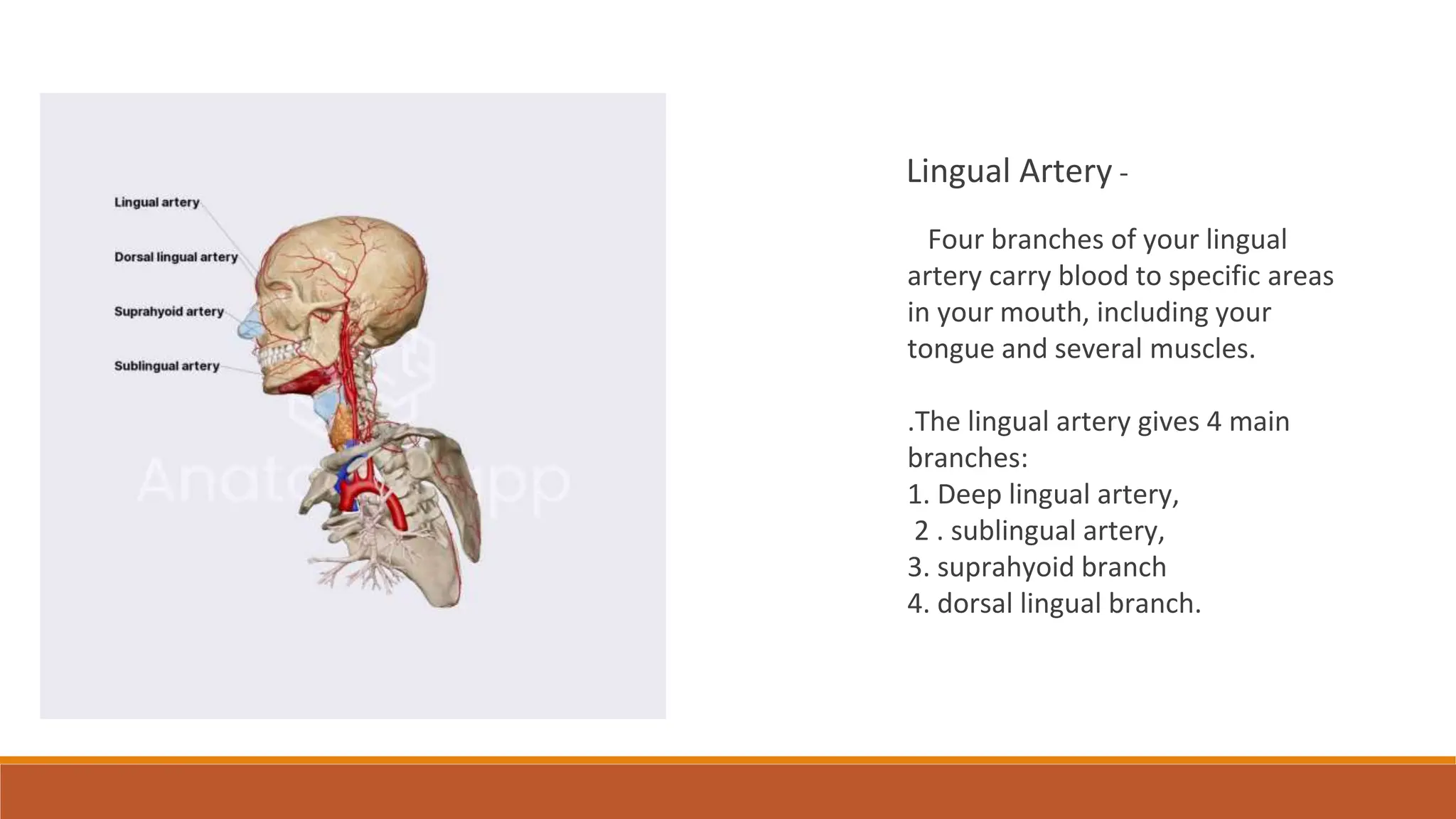
Lingual artey
Four branches of your lingual
artery carry blood to specific areas
in your mouth, including your
tongue and several muscles.
.The lingual artery gives 4 main
branches:
1. Deep lingual artery,
2 . sublingual artery,
3. suprahyoid branch
4. dorsal lingual branch.
Lingual Artery -
- Lingual artey does not have
direct nerve innervation itself as it is
a blood vessel , however the
structures supplied by the lingual
artery such as the tongue receive
innervation from various nerves
1. Lingual nerve - branch of
trigeminal nerve ,provides
sensory innervation to anterior
⅔ of the tongue and floor pf
mouth and lingual gingiva
Carries general sensory information
about touch, pain, temperature from
these areas back to the brain
2. Hypoglossal nerve
- Provide motor innervation to
the intrinsic and extrinsic
muscles of the tongue,
controlling movement's of
tongue for speech swallowing
and other functions
- Understanding of structures it
supplies is important for
clinical considerations and
understanding the sensory and
motor functions of the tongue
and floor of the mouth
Lymph nodes -
1. Tip to submental glands bilaterally
2. Dorsum to submandibular mostly
unilaterally
3. Posterior to jugulo-omohyoid and deep
cervical
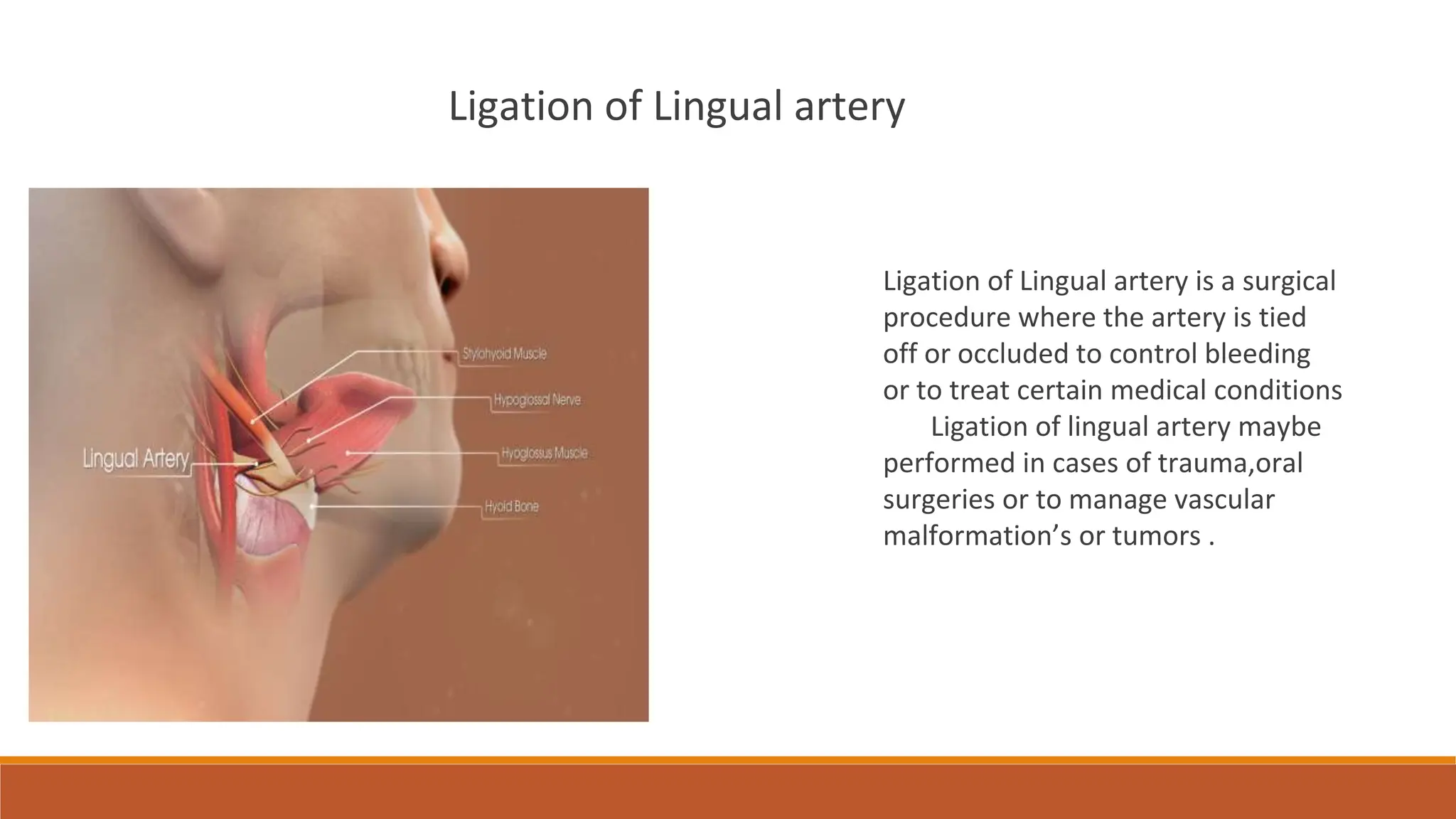
Ligation of Lingual artery is a surgical
procedure where the artery is tied
off or occluded to control bleeding
or to treat certain medical conditions
Ligation of lingual artery maybe
performed in cases of trauma,oral
surgeries or to manage vascular
malformation’s or tumors .
Procedure:
Incision - incision is given below the
lower border of mandible after
palpating the submandibular gland.
- The posterior part of incision
should be towards the tip of
mastoid process and anterior
should point towards the chin.
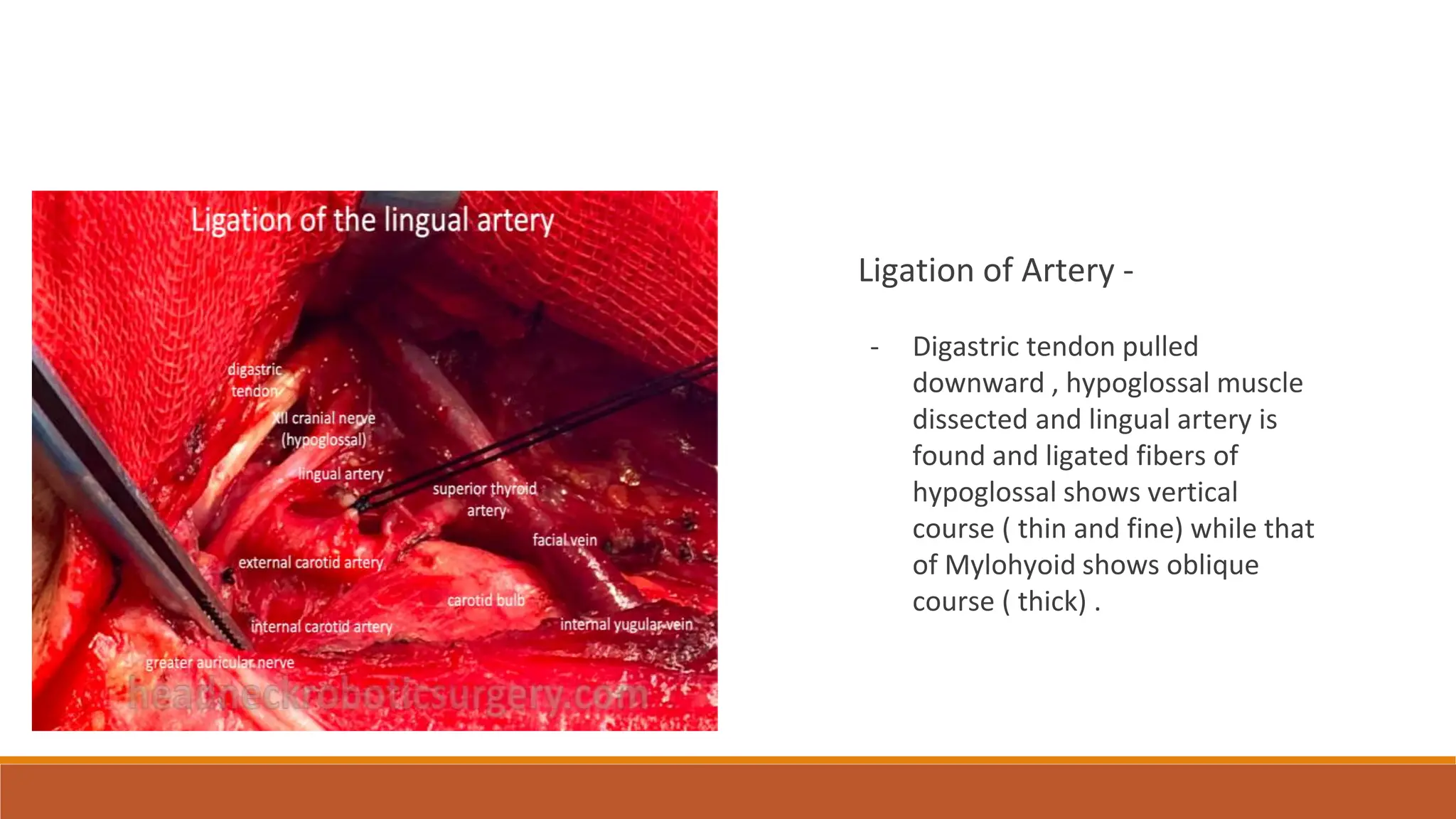
Ligation of Artery -
- Digastric tendon pulled
downward , hypoglossal muscle
dissected and lingual artery is
found and ligated fibers of
hypoglossal shows vertical
course ( thin and fine) while that
of Mylohyoid shows oblique
course ( thick) .
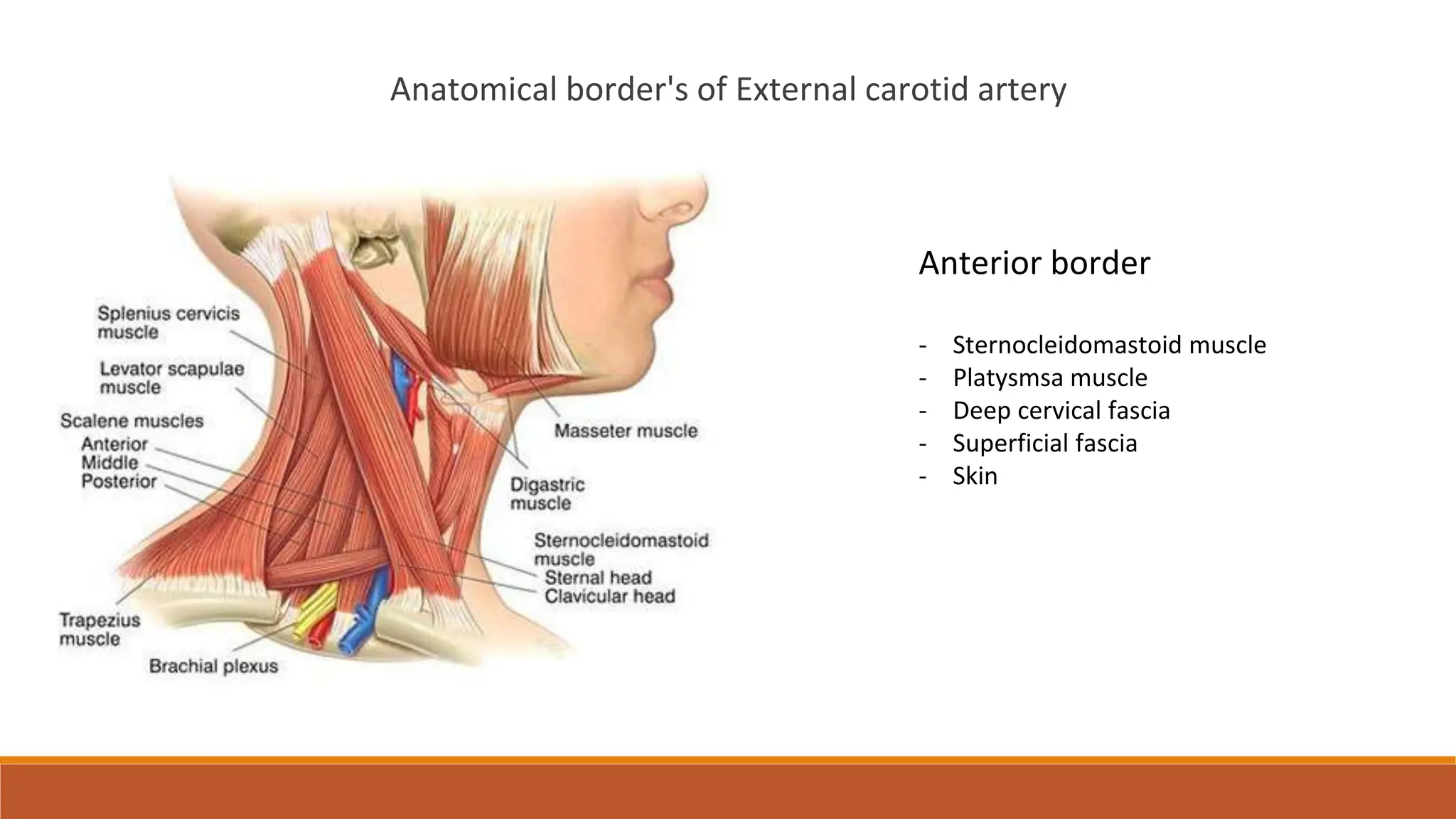
Anterior border
- Sternocleidomastoid muscle
- Platysmsa muscle
- Deep cervical fascia
- Superficial fascia
- Skin
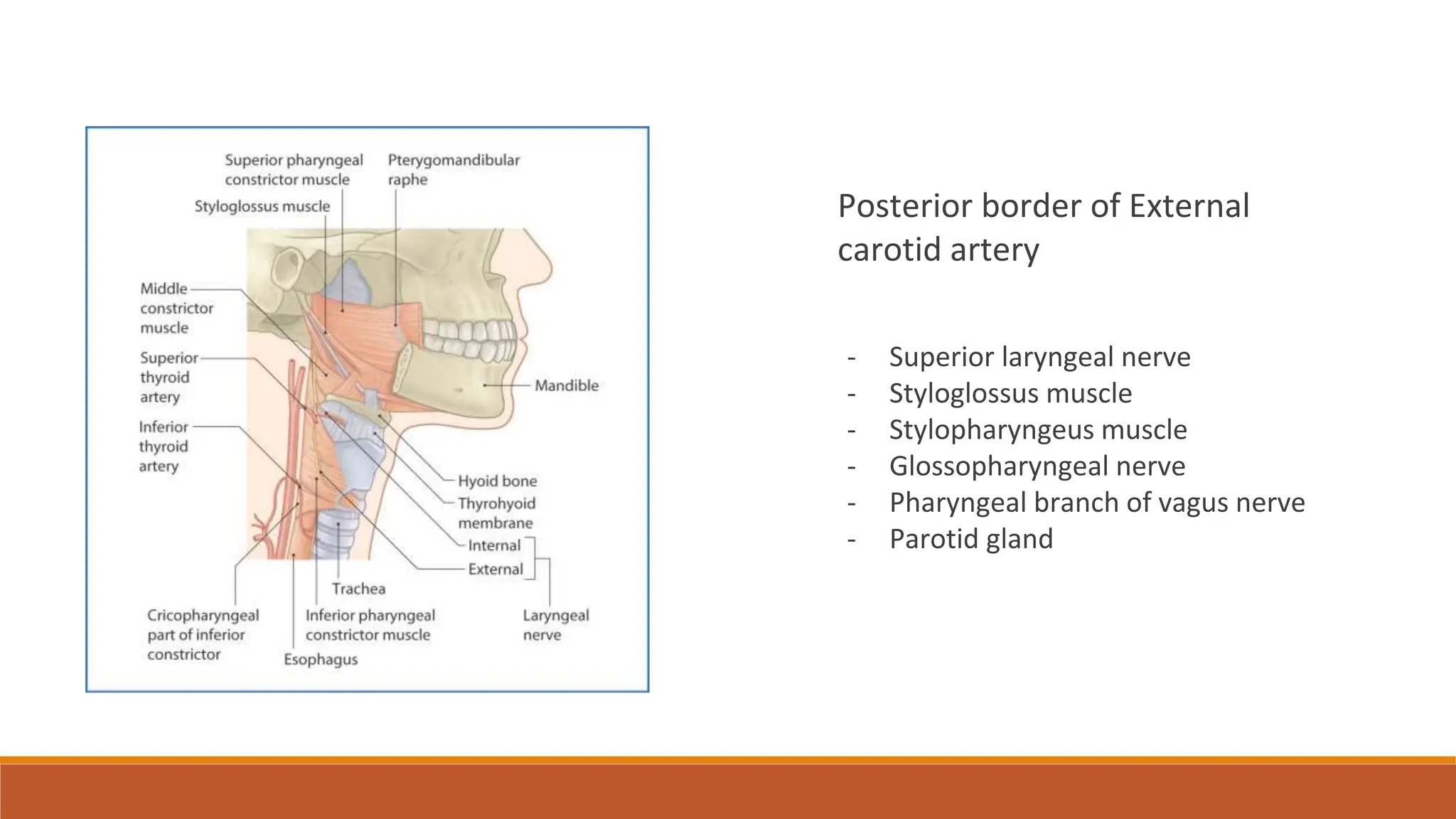
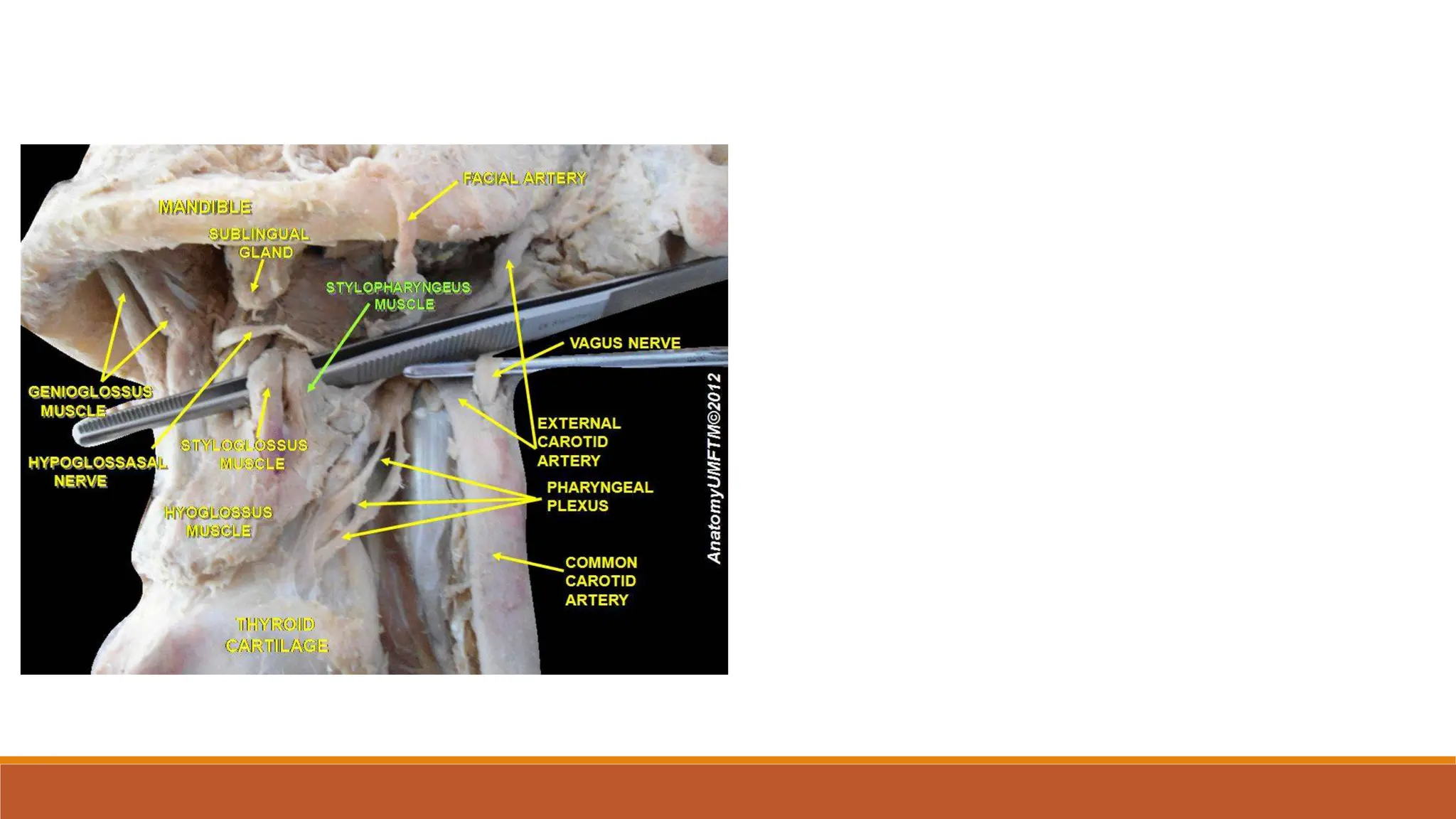
Anatomical border's of External carotid artery
- Internal carotid artery
External carotid artery , ligation of External carotid artery, lingual artery, ligation of lingual artery, significant features of external and internal carotid artery- soham.pptx

External carotid artery , ligation of External carotid artery, lingual artery, ligation of lingual artery, significant features of external and internal carotid artery- soham.pptx

  • 1.
  • 2.
    The ECA [external carotid artery ] begins at the level of the upper border of the thyroid cartilage (at the level of the fourth cervical vertebra).
  • 3.
    Branches 1. superior thyroidartery 2. Ascending pharyngeal artery 3. lingual artery 4. facial artery 5. occipital artery 6. posterior auricular artery 7. Maxillary artery 8. Superficial temporal
  • 4.
    Branches of internalmaxillary artery 1. Infraorbital 2. Posterior superior alveolar 3. anterior deep temporal 4. Pterygoid 5. Posterior deep temporal 6. Middle meningeal 7. Anterior tympanic 8. Accessory meningeal 9. Masseteric 10. Pterygoid 11. Inferior alveolar 12. Buccal
  • 5.
    Point where brachiocephalictrunk devide into - Originates at right sternoclavicular joint from brachiocephalic trunk 1.Subclavian artery 2. Common carotid artery
  • 6.
    Branch - Internalmaxillary - devide into 3 parts - these 3 branches further devides into sub-branches
  • 7.
    Common carotid artery -Bifurcates at level of C3-4 - Devide into 1. External carotid - Located betn. Neck of mandible - 2. Internal carotid - enters cranium through carotid can
  • 8.
    8. Superficial temporal -Terminal branch of external carotid artery , surfaces posteriorly to the mandible in the parotid gland , and crosses the zygomatic process of temporal bone . - Major artery of head . - Blood supply – skinof scalp , pericranium of frontal and parietal regions . Additinally supplies the parotid gland, temporomandibular joint and several muscles of head and face.
  • 9.
    Anastomosis between ECAAns ICA -Angular -Superficial temporal -Internal axillary -Inferior orbital -Opthalmic -Midmeningeal -Middle cerebral
  • 10.
    - On righthalf - Brachiocephalic trunk bifurcation leads to – - 1. right subclavian - 2.right common carotid - On left half - Direct elongation of undernoted arteries from aortic arch- - 1. left common carotid artery - 2. left subclavian artery
  • 12.
    - Access tothe external carotid artery is typically obtained through a surgical procedure called endarterectomy.
  • 13.
    This procedure involves makingan incision in the neck to expose the carotid artery and then removing any plaque buildup that is causing a blockage
  • 14.
    - Access tothe external carotid artery can also be obtained through the interventional procedures such as angioplasty and stenting , where a catheter is inserted into the artery to open up the blockage . It is important to consult with an vascular surgeon or interventional radiologist for a thourough evaluation and appropriate treatment plan.
  • 16.
    Ligation of externalcarotid artery is a surgical procedure in which the artery is tied off or closed to stop blood flow through it
  • 17.
    This procedure maybe performed to treat certain medical procedures such as Aneurysms , arteriovenous malformation or to control bleeding from external carotid artery . Ligation of external carotid artery maybe a part of a more extensive surgical procedure such as in the case of certain head and neck tumors .
  • 18.
    It is importantto note that ligation of External carotid artery is a complex surgical procedure that carries potential risks and should only be performed by experienced vascular or head and neck sergeon . The decision to perform this procedure should be based on a thorough evaluation of the patient's condition and consideration of the potential benefits and risks. Crucial for patient’s to have detailed discussion with their healthcare provider's to understand the reason for the procedure , its potential outcomes, and any alternative treatment options .
  • 19.
    The external andinternal carotid arteries are two major blood vessels that supply blood to different regions of the head and neck. They have distinct anatomical features and serve different functions in the circulatory system. Distinctive features of the External and Internal carotid arteries
  • 20.
    Branches - 1. Externalcarotid - gives rise to several branches that supply blood to the face , scalp and neck . These branches includes the superior thyroid artery, lingual artey, facial artery, occipital artery and others. 2. Internal carotid artery - does not have significant branches in the neck region instead, it ascends into the skull , where, it gives off branches that supply blood to the brain and eyes such as opthalmic artery.
  • 21.
    Function and course- 1. External carotid artery - Supplies blood to the superficial structures of the head and neck , including the face, scalp and neck muscles. 2. Internal carotid artery - Supplies blood to the brain, eyes and associated structures within the cranial cavity.
  • 23.
    Palpable pulse - 1.External carotid artery - the pulse of External carotid artery is not typically palpable at the neck die to its smaller size and deeper location , compared to the common carotid artery. 2. Internal carotid artery - the pulse of the Internal carotid artery is often palpable at the neck due to its larger size and more superficial location compared to the external carotid artery.
  • 24.
    - lingual arterytakes blood from your carotid artery in your neck to parts of your mouth. It runs under your jaw and ends at the tip of your tongue. Lingual artey
  • 25.
    Four branches ofyour lingual artery carry blood to specific areas in your mouth, including your tongue and several muscles. .The lingual artery gives 4 main branches: 1. Deep lingual artery, 2 . sublingual artery, 3. suprahyoid branch 4. dorsal lingual branch. Lingual Artery -
  • 26.
    - Lingual arteydoes not have direct nerve innervation itself as it is a blood vessel , however the structures supplied by the lingual artery such as the tongue receive innervation from various nerves 1. Lingual nerve - branch of trigeminal nerve ,provides sensory innervation to anterior ⅔ of the tongue and floor pf mouth and lingual gingiva Carries general sensory information about touch, pain, temperature from these areas back to the brain
  • 27.
    2. Hypoglossal nerve -Provide motor innervation to the intrinsic and extrinsic muscles of the tongue, controlling movement's of tongue for speech swallowing and other functions - Understanding of structures it supplies is important for clinical considerations and understanding the sensory and motor functions of the tongue and floor of the mouth
  • 28.
    Lymph nodes - 1.Tip to submental glands bilaterally 2. Dorsum to submandibular mostly unilaterally 3. Posterior to jugulo-omohyoid and deep cervical
  • 29.
    Ligation of Lingualartery is a surgical procedure where the artery is tied off or occluded to control bleeding or to treat certain medical conditions Ligation of lingual artery maybe performed in cases of trauma,oral surgeries or to manage vascular malformation’s or tumors .
  • 30.
    Procedure: Incision - incisionis given below the lower border of mandible after palpating the submandibular gland. - The posterior part of incision should be towards the tip of mastoid process and anterior should point towards the chin.
  • 31.
    Ligation of Artery- - Digastric tendon pulled downward , hypoglossal muscle dissected and lingual artery is found and ligated fibers of hypoglossal shows vertical course ( thin and fine) while that of Mylohyoid shows oblique course ( thick) .
  • 41.
    Anterior border - Sternocleidomastoidmuscle - Platysmsa muscle - Deep cervical fascia - Superficial fascia - Skin Anatomical border's of External carotid artery
  • 42.