Kubernetes Meetup Frankfurt
@ Meshcloud, Mar 25th 2019
why, what and how
Extending Kubernetes
@meshstack
Motivation
@meshstack
Kubernetes orchestrates Infrastructure & Containers...
… meshcloud orchestrates Cloud Tenants
...Cloud Tenants?
Motivation
@meshstack
81%
We live in a Multi-Cloud world
@meshstack
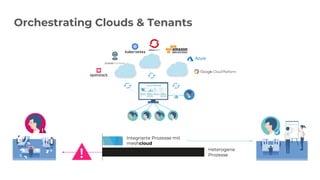
Orchestrating Clouds & Tenants
Integrierte Prozesse mit
meshcloud
Heterogene
Prozesse!
- OpenShift PaaS (OKD = “OpenShift Kubernetes Distribution”)
- https://www.okd.io/
- Fission “Kubernetes-native Serverless Framework”
- https://fission.io/
- Kubernetes Operators
- ArangoDB
- Couchbase
- MySQL
- … many more
Extending Kubernetes - Examples
@meshstack
- Control Plane
- kube-apisever: provides the API
- backed by etcd (& only component talking to etcd)
- scales horizontally
- think of it as a “dumb” object server (authn/authz, validation, defaulting etc.)
- kube-controller-manager
- runs the main control-loops
- HA, but only a single active leader at a time
- kube-scheduler
- distributes pods on nodes: think “pod controller”
- Workload Plane
- Kubelet & kube-proxy: execute containers, report status etc.
Kubernetes - Architecture recap
@meshstack
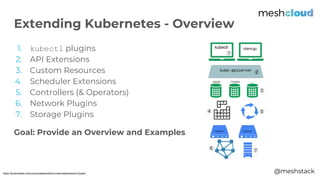
1. kubectl plugins
2. API Extensions
3. Custom Resources
4. Scheduler Extensions
5. Controllers (& Operators)
6. Network Plugins
7. Storage Plugins
Goal: Provide an Overview and Examples
Extending Kubernetes - Overview
https://kubernetes.io/docs/concepts/extend-kubernetes/extend-cluster/
@meshstack
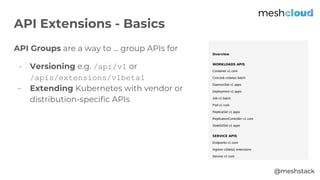
API Groups are a way to … group APIs for
- Versioning e.g. /api/v1 or
/apis/extensions/v1beta1
- Extending Kubernetes with vendor or
distribution-specific APIs
API Extensions - Basics
@meshstack
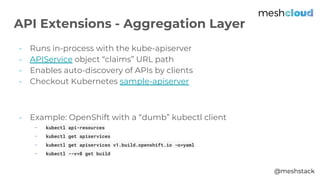
- Runs in-process with the kube-apiserver
- APIService object “claims” URL path
- Enables auto-discovery of APIs by clients
- Checkout Kubernetes sample-apiserver
- Example: OpenShift with a “dumb” kubectl client
- kubectl api-resources
- kubectl get apiservices
- kubectl get apiservices v1.build.openshift.io -o=yaml
- kubectl --v=8 get build
API Extensions - Aggregation Layer
@meshstack
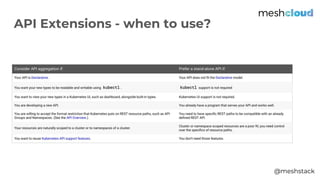
API Extensions - when to use?
@meshstack
- Intercept Kubernetes API requests in order to
- validate: e.g. rate limit api access EventRateLimit
- mutate: e.g. AlwaysPullImages
- Kubernetes ships with default Admission Controllers that
implement core functionality
- e.g. NamespaceExists
Admission Controllers
@meshstack
- Define name and Schema for new types of K8s objects
- Simpler than writing your own API for some cases
- e.g. built-in validation using JSON Schema (K8s > v1.8)
- Typically goes hand in hand with a Controller
- Example: OpenShift with a “dumb” kubectl client
- kubectl get customresourcedefinitions
Learn more from the documentation
Custom Resource Definitions
@meshstack
- Pretty much everything is an Object in Kubernetes. Objects follow
conventions
- .apiVersion version of the API that produced this object
- .kind what kind of Object it is, e.g. pod
- .metadata common metadata like .name, .annotations etc.
- .spec desired state of the Object
- .status last observed state of the object
- Example: OpenShift with a “dumb” kubectl client
- kubectl get pods -o=yaml --namespace=openshift-web-console
Learn more from the documentation
Custom Resource Definitions - Objects
@meshstack
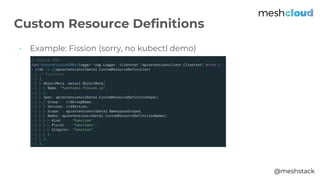
- Example: Fission (sorry, no kubectl demo)
Custom Resource Definitions
@meshstack
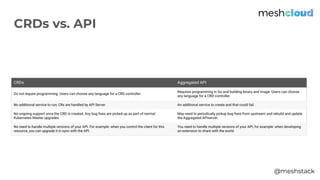
CRDs vs. API
@meshstack
- Controllers make the “magic” happen
- Think CRDs as a way to teach kube-apiserver to store new objects
- Controllers process these objects as clients of the api-server
- Control Loop
- watch relevant objects via kube-apiserver
- compare .status and .spec
- take action to converge actual to desired state
- update managed object’s .status
Controllers
@meshstack
- Controllers make the “magic” happen
- Think CRDs as a way to teach kube-apiserver to store new objects
- Controllers process these objects as clients of the api-server
- Control Loop
- watch relevant objects via kube-apiserver
- compare .status and .spec
- take action to converge actual to desired state
- update managed object’s .status
- core control loops run in kube-controller-manager
- e.g. ReplicaSetController
Controllers
@meshstack
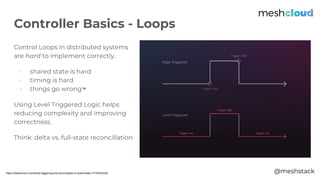
Control Loops in distributed systems
are hard to implement correctly.
- shared state is hard
- timing is hard
- things go wrong™
Using Level Triggered Logic helps
reducing complexity and improving
correctness.
Think: delta vs. full-state reconcillation
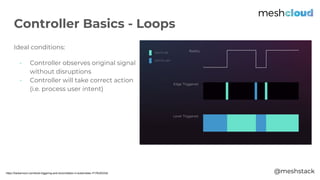
Controller Basics - Loops
https://hackernoon.com/level-triggering-and-reconciliation-in-kubernetes-1f17fe30333d
@meshstack
Ideal conditions:
- Controller observes original signal
without disruptions
- Controller will take correct action
(i.e. process user intent)
Controller Basics - Loops
https://hackernoon.com/level-triggering-and-reconciliation-in-kubernetes-1f17fe30333d
@meshstack
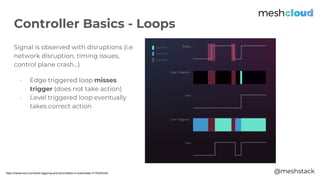
Signal is observed with disruptions (i.e.
network disruption, timing issues,
control plane crash...)
- Edge triggered loop misses
trigger (does not take action)
- Level triggered loop eventually
takes correct action
Controller Basics - Loops
https://hackernoon.com/level-triggering-and-reconciliation-in-kubernetes-1f17fe30333d
@meshstack
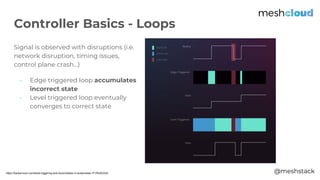
Signal is observed with disruptions (i.e.
network disruption, timing issues,
control plane crash...)
- Edge triggered loop accumulates
incorrect state
- Level triggered loop eventually
converges to correct state
Controller Basics - Loops
https://hackernoon.com/level-triggering-and-reconciliation-in-kubernetes-1f17fe30333d
@meshstack
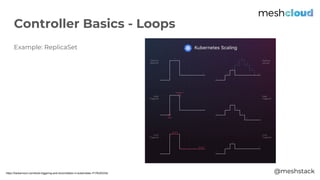
Example: ReplicaSet
Controller Basics - Loops
https://hackernoon.com/level-triggering-and-reconciliation-in-kubernetes-1f17fe30333d
@meshstack
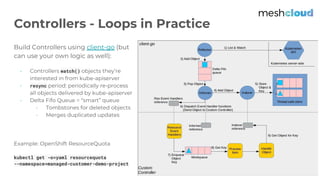
Build Controllers using client-go (but
can use your own logic as well):
- Controllers watch() objects they’re
interested in from kube-apiserver
- resync period: periodically re-process
all objects delivered by kube-apiserver
- Delta Fifo Queue = “smart” queue
- Tombstones for deleted objects
- Merges duplicated updates
Example: OpenShift ResourceQuota
kubectl get -o=yaml resourcequota
--namespace=managed-customer-demo-project
Controllers - Loops in Practice
@meshstack
Operators combine CRDs + Controllers to manage stateful Applications
- Example: Automated Master Failover for MariaDB
- … whatever “manual Ops” would do - you can automate with K8s
- Operator Framework helps with building and operating operators
Operators
Thank you
Johannes Rudolph
jrudolph@meshcloud.io
www.meshcloud.io

Extending Kubernetes

  • 1.
    Kubernetes Meetup Frankfurt @Meshcloud, Mar 25th 2019
  • 2.
    why, what andhow Extending Kubernetes
  • 3.
  • 4.
    @meshstack Kubernetes orchestrates Infrastructure& Containers... … meshcloud orchestrates Cloud Tenants ...Cloud Tenants? Motivation
  • 5.
    @meshstack 81% We live ina Multi-Cloud world @meshstack
  • 6.
    Orchestrating Clouds &Tenants Integrierte Prozesse mit meshcloud Heterogene Prozesse!
  • 7.
    - OpenShift PaaS(OKD = “OpenShift Kubernetes Distribution”) - https://www.okd.io/ - Fission “Kubernetes-native Serverless Framework” - https://fission.io/ - Kubernetes Operators - ArangoDB - Couchbase - MySQL - … many more Extending Kubernetes - Examples
  • 8.
    @meshstack - Control Plane -kube-apisever: provides the API - backed by etcd (& only component talking to etcd) - scales horizontally - think of it as a “dumb” object server (authn/authz, validation, defaulting etc.) - kube-controller-manager - runs the main control-loops - HA, but only a single active leader at a time - kube-scheduler - distributes pods on nodes: think “pod controller” - Workload Plane - Kubelet & kube-proxy: execute containers, report status etc. Kubernetes - Architecture recap
  • 9.
    @meshstack 1. kubectl plugins 2.API Extensions 3. Custom Resources 4. Scheduler Extensions 5. Controllers (& Operators) 6. Network Plugins 7. Storage Plugins Goal: Provide an Overview and Examples Extending Kubernetes - Overview https://kubernetes.io/docs/concepts/extend-kubernetes/extend-cluster/
  • 10.
    @meshstack API Groups area way to … group APIs for - Versioning e.g. /api/v1 or /apis/extensions/v1beta1 - Extending Kubernetes with vendor or distribution-specific APIs API Extensions - Basics
  • 11.
    @meshstack - Runs in-processwith the kube-apiserver - APIService object “claims” URL path - Enables auto-discovery of APIs by clients - Checkout Kubernetes sample-apiserver - Example: OpenShift with a “dumb” kubectl client - kubectl api-resources - kubectl get apiservices - kubectl get apiservices v1.build.openshift.io -o=yaml - kubectl --v=8 get build API Extensions - Aggregation Layer
  • 12.
  • 13.
    @meshstack - Intercept KubernetesAPI requests in order to - validate: e.g. rate limit api access EventRateLimit - mutate: e.g. AlwaysPullImages - Kubernetes ships with default Admission Controllers that implement core functionality - e.g. NamespaceExists Admission Controllers
  • 14.
    @meshstack - Define nameand Schema for new types of K8s objects - Simpler than writing your own API for some cases - e.g. built-in validation using JSON Schema (K8s > v1.8) - Typically goes hand in hand with a Controller - Example: OpenShift with a “dumb” kubectl client - kubectl get customresourcedefinitions Learn more from the documentation Custom Resource Definitions
  • 15.
    @meshstack - Pretty mucheverything is an Object in Kubernetes. Objects follow conventions - .apiVersion version of the API that produced this object - .kind what kind of Object it is, e.g. pod - .metadata common metadata like .name, .annotations etc. - .spec desired state of the Object - .status last observed state of the object - Example: OpenShift with a “dumb” kubectl client - kubectl get pods -o=yaml --namespace=openshift-web-console Learn more from the documentation Custom Resource Definitions - Objects
  • 16.
    @meshstack - Example: Fission(sorry, no kubectl demo) Custom Resource Definitions
  • 17.
  • 18.
    @meshstack - Controllers makethe “magic” happen - Think CRDs as a way to teach kube-apiserver to store new objects - Controllers process these objects as clients of the api-server - Control Loop - watch relevant objects via kube-apiserver - compare .status and .spec - take action to converge actual to desired state - update managed object’s .status Controllers
  • 19.
    @meshstack - Controllers makethe “magic” happen - Think CRDs as a way to teach kube-apiserver to store new objects - Controllers process these objects as clients of the api-server - Control Loop - watch relevant objects via kube-apiserver - compare .status and .spec - take action to converge actual to desired state - update managed object’s .status - core control loops run in kube-controller-manager - e.g. ReplicaSetController Controllers
  • 20.
    @meshstack Control Loops indistributed systems are hard to implement correctly. - shared state is hard - timing is hard - things go wrong™ Using Level Triggered Logic helps reducing complexity and improving correctness. Think: delta vs. full-state reconcillation Controller Basics - Loops https://hackernoon.com/level-triggering-and-reconciliation-in-kubernetes-1f17fe30333d
  • 21.
    @meshstack Ideal conditions: - Controllerobserves original signal without disruptions - Controller will take correct action (i.e. process user intent) Controller Basics - Loops https://hackernoon.com/level-triggering-and-reconciliation-in-kubernetes-1f17fe30333d
  • 22.
    @meshstack Signal is observedwith disruptions (i.e. network disruption, timing issues, control plane crash...) - Edge triggered loop misses trigger (does not take action) - Level triggered loop eventually takes correct action Controller Basics - Loops https://hackernoon.com/level-triggering-and-reconciliation-in-kubernetes-1f17fe30333d
  • 23.
    @meshstack Signal is observedwith disruptions (i.e. network disruption, timing issues, control plane crash...) - Edge triggered loop accumulates incorrect state - Level triggered loop eventually converges to correct state Controller Basics - Loops https://hackernoon.com/level-triggering-and-reconciliation-in-kubernetes-1f17fe30333d
  • 24.
    @meshstack Example: ReplicaSet Controller Basics- Loops https://hackernoon.com/level-triggering-and-reconciliation-in-kubernetes-1f17fe30333d
  • 25.
    @meshstack Build Controllers usingclient-go (but can use your own logic as well): - Controllers watch() objects they’re interested in from kube-apiserver - resync period: periodically re-process all objects delivered by kube-apiserver - Delta Fifo Queue = “smart” queue - Tombstones for deleted objects - Merges duplicated updates Example: OpenShift ResourceQuota kubectl get -o=yaml resourcequota --namespace=managed-customer-demo-project Controllers - Loops in Practice
  • 26.
    @meshstack Operators combine CRDs+ Controllers to manage stateful Applications - Example: Automated Master Failover for MariaDB - … whatever “manual Ops” would do - you can automate with K8s - Operator Framework helps with building and operating operators Operators
  • 27.