Echo Chamber and
Exposure to Diverse
Information on Facebook
Alex Tang & Juli Whetstone
Overview: Exposure to Diverse Information on Facebook
• Does social media lead to “echo chambers?”
• where people only come into contact with information from like-minded individuals
• Do social media algorithms create “filter bubbles?”
• only ideologically appealing content comes to the top
• Two counterexamples to these ideas:
• Rethinking Information Diversity in Network (Eytan 2012)
• Selective Exposure in the Age of Social Media (Messing & Westwood 2014)
What percentage of your
Facebook posts are your own
content compared to what you
share?
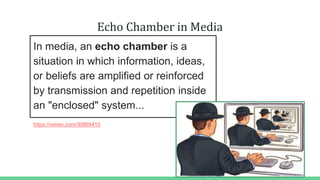
Echo Chamber in Media
In media, an echo chamber is a
situation in which information, ideas,
or beliefs are amplified or reinforced
by transmission and repetition inside
an "enclosed" system...
https://vimeo.com/30865415
Do you think that your
newsfeed is filled with posts
that are similar to your views?
Findings
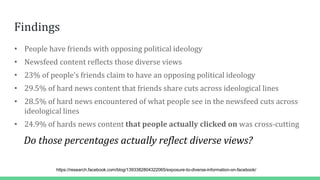
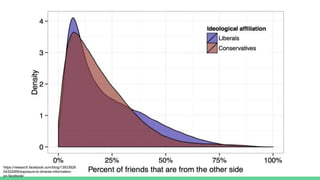
• People have friends with opposing political ideology
• Newsfeed content reflects those diverse views
• 23% of people’s friends claim to have an opposing political ideology
• 29.5% of hard news content that friends share cuts across ideological lines
• 28.5% of hard news encountered of what people see in the newsfeed cuts across
ideological lines
• 24.9% of hards news content that people actually clicked on was cross-cutting
Do those percentages actually reflect diverse views?
https://research.facebook.com/blog/1393382804322065/exposure-to-diverse-information-on-facebook/
Birds of a Feather…
• Similar people associate with one another
• Friends more likely to be similar in age, educational attainment, occupation, and
geography
• On Facebook: Political affiliation of your friend.
https://research.facebook.com/blog/13933828
04322065/exposure-to-diverse-information-
on-facebook/
Have you realized/considered
this phenomenon before?
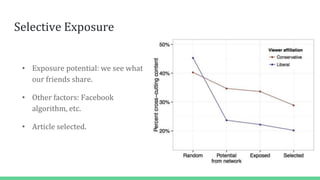
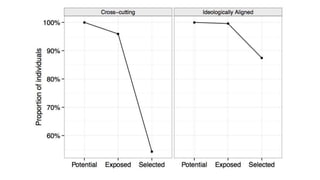
Selective Exposure
• Exposure potential: we see what
our friends share.
• Other factors: Facebook
algorithm, etc.
• Article selected.
Does you think the echo
chamber effect is different
with other platforms like
Instagram & Twitter?
However...
“By showing that people are exposed to a substantial amount of
content from friends with opposing viewpoints, our findings
contrast concerns that people might ‘list and speak only to the
like-minded’ while online”
Rethinking Information Diversity in Networks
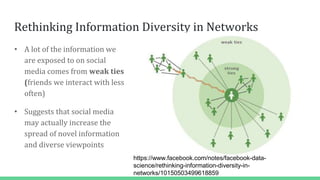
• A lot of the information we
are exposed to on social
media comes from weak ties
(friends we interact with less
often)
• Suggests that social media
may actually increase the
spread of novel information
and diverse viewpoints
https://www.facebook.com/notes/facebook-data-
science/rethinking-information-diversity-in-
networks/10150503499618859
https://www.facebook.com/notes/facebook-data-science/rethinking-information-diversity-in-networks/10150503499618859
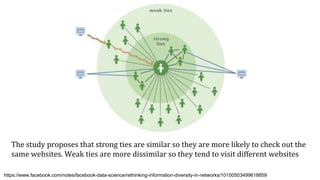
The study proposes that strong ties are similar so they are more likely to check out the
same websites. Weak ties are more dissimilar so they tend to visit different websites
Finding of Diversity in Networks
• Information we consume and share on Facebook is more diverse than people
may think
• We are exposed to and spread more information from our distant contacts than
our close friends
• Since these people are different than us in bulk of info comes from different
perspectives
How do you interact with the
political information shared
by your weak ties?
Selective Exposure in the Age of Social Media:
Non-selective news aggregation services (?)
Social Endorsement
http://crx.sagepub.com/content/41/8/1042
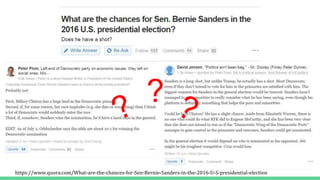
?
https://www.quora.com/What-are-the-chances-for-Sen-Bernie-Sanders-in-the-2016-U-S-presidential-election
Does that mean “echo
chamber” is an unnecessary
worry?
So, “echo chamber” is an only limited effect
in the department of social media exposure.
where different or competing views are
censored, disallowed or otherwise
underrepresented.
In media, an echo chamber is a situation in which
information, ideas, or beliefs are amplified or reinforced by
transmission and repetition inside an "enclosed" system...
Final question:
What are the issues/concerns
with two of these articles
being published on Facebook?

Exposure to Diverse Information on Facebook

  • 1.
    Echo Chamber and Exposureto Diverse Information on Facebook Alex Tang & Juli Whetstone
  • 2.
    Overview: Exposure toDiverse Information on Facebook • Does social media lead to “echo chambers?” • where people only come into contact with information from like-minded individuals • Do social media algorithms create “filter bubbles?” • only ideologically appealing content comes to the top • Two counterexamples to these ideas: • Rethinking Information Diversity in Network (Eytan 2012) • Selective Exposure in the Age of Social Media (Messing & Westwood 2014)
  • 3.
    What percentage ofyour Facebook posts are your own content compared to what you share?
  • 4.
    Echo Chamber inMedia In media, an echo chamber is a situation in which information, ideas, or beliefs are amplified or reinforced by transmission and repetition inside an "enclosed" system... https://vimeo.com/30865415
  • 5.
    Do you thinkthat your newsfeed is filled with posts that are similar to your views?
  • 6.
    Findings • People havefriends with opposing political ideology • Newsfeed content reflects those diverse views • 23% of people’s friends claim to have an opposing political ideology • 29.5% of hard news content that friends share cuts across ideological lines • 28.5% of hard news encountered of what people see in the newsfeed cuts across ideological lines • 24.9% of hards news content that people actually clicked on was cross-cutting Do those percentages actually reflect diverse views? https://research.facebook.com/blog/1393382804322065/exposure-to-diverse-information-on-facebook/
  • 7.
    Birds of aFeather… • Similar people associate with one another • Friends more likely to be similar in age, educational attainment, occupation, and geography • On Facebook: Political affiliation of your friend.
  • 8.
  • 9.
  • 10.
    Selective Exposure • Exposurepotential: we see what our friends share. • Other factors: Facebook algorithm, etc. • Article selected.
  • 12.
    Does you thinkthe echo chamber effect is different with other platforms like Instagram & Twitter?
  • 13.
  • 14.
    “By showing thatpeople are exposed to a substantial amount of content from friends with opposing viewpoints, our findings contrast concerns that people might ‘list and speak only to the like-minded’ while online”
  • 15.
    Rethinking Information Diversityin Networks • A lot of the information we are exposed to on social media comes from weak ties (friends we interact with less often) • Suggests that social media may actually increase the spread of novel information and diverse viewpoints https://www.facebook.com/notes/facebook-data- science/rethinking-information-diversity-in- networks/10150503499618859
  • 16.
    https://www.facebook.com/notes/facebook-data-science/rethinking-information-diversity-in-networks/10150503499618859 The study proposesthat strong ties are similar so they are more likely to check out the same websites. Weak ties are more dissimilar so they tend to visit different websites
  • 17.
    Finding of Diversityin Networks • Information we consume and share on Facebook is more diverse than people may think • We are exposed to and spread more information from our distant contacts than our close friends • Since these people are different than us in bulk of info comes from different perspectives
  • 18.
    How do youinteract with the political information shared by your weak ties?
  • 19.
    Selective Exposure inthe Age of Social Media: Non-selective news aggregation services (?) Social Endorsement http://crx.sagepub.com/content/41/8/1042
  • 20.
  • 21.
    Does that mean“echo chamber” is an unnecessary worry? So, “echo chamber” is an only limited effect in the department of social media exposure.
  • 22.
    where different orcompeting views are censored, disallowed or otherwise underrepresented. In media, an echo chamber is a situation in which information, ideas, or beliefs are amplified or reinforced by transmission and repetition inside an "enclosed" system...
  • 24.
    Final question: What arethe issues/concerns with two of these articles being published on Facebook?