Exponential Backoff
Algorithm Definition, Implementation& Performance
Yigit UNALLAR
• Listen before Speaking(CS),
• If another party begin talking at the same time, stop
talking(CD),
• Long Propagation Delay,
• Abortion and wait a random amount of time,
Network Issues at a
Glance…
What is a good interval of time from which
to
choose the random backoff time?
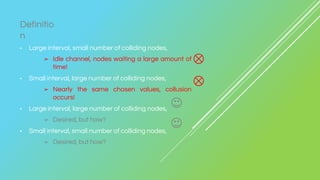
• Large interval, small number of colliding nodes,
➢ Idle channel, nodes waiting a large amount of
time!
• Small interval, large number of colliding nodes,
➢ Nearly the same chosen values, collusion
occurs!
• Large interval, large number of colliding nodes,
➢ Desired, but how?
• Small interval, small number of colliding nodes,
➢ Desired, but how?
Definitio
n
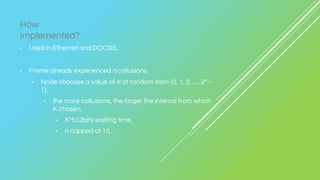
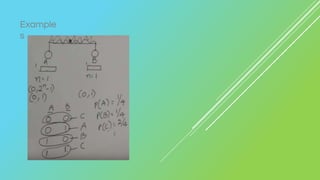
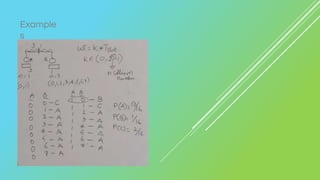
• Used in Ethernet and DOCSIS,
• Frame already experienced n collusions,
• Node chooses a value of K at random from {0, 1, 2, …. 2n -
1},
• the more collusions, the larger the interval from which
K chosen,
• K*512bits waiting time,
• n capped at 10,
How
Implemented?
Example
s
Example
s
Example
s
Examples
ctd…
• Capture Effect,
• If any nodes wins once, the pro. of winning the next trasmission
increases exponentially,
• Conversely, if any nodes, however, loses once, the pro. of losing the
next transmission increases exponentially as well.
• One node ➔ nearly %100 utilization,
• Two or more ➔ less predictable,
• Wasting bandwidth bc of collusions,
• Back-off delays,
• 10Mbps ➔ 2-4 Mbps throughput,
Performan
ce
• %40 threshold rate for utilization,
• Above rates dramatically decrease throughput rates,
• Above rates exponentially increase waiting time,
• Bridge or Switches,
• Separating into more domains,
• Thus less collusion occurs,
• More throughput rate provided,
Solution
s
Any
Questions?
[1] Computer Networking : a Top-down Approach / James F.
Kurose, Keith W. Ross.—6th ed.
[2] http://www.industrialethernetu.com/courses/101_4.htm
[3] https://www.youtube.com/watch?v=WeGNeUHYv5g
[4] http://www.erg.abdn.ac.uk/users/gorry/course/lan-
pages/csma-cd.html
Referen
ce

Exponential Backoff Algorithm

  • 1.
    Exponential Backoff Algorithm Definition,Implementation& Performance Yigit UNALLAR
  • 2.
    • Listen beforeSpeaking(CS), • If another party begin talking at the same time, stop talking(CD), • Long Propagation Delay, • Abortion and wait a random amount of time, Network Issues at a Glance…
  • 3.
    What is agood interval of time from which to choose the random backoff time?
  • 4.
    • Large interval,small number of colliding nodes, ➢ Idle channel, nodes waiting a large amount of time! • Small interval, large number of colliding nodes, ➢ Nearly the same chosen values, collusion occurs! • Large interval, large number of colliding nodes, ➢ Desired, but how? • Small interval, small number of colliding nodes, ➢ Desired, but how? Definitio n
  • 5.
    • Used inEthernet and DOCSIS, • Frame already experienced n collusions, • Node chooses a value of K at random from {0, 1, 2, …. 2n - 1}, • the more collusions, the larger the interval from which K chosen, • K*512bits waiting time, • n capped at 10, How Implemented?
  • 6.
  • 7.
  • 8.
  • 9.
  • 10.
    • Capture Effect, •If any nodes wins once, the pro. of winning the next trasmission increases exponentially, • Conversely, if any nodes, however, loses once, the pro. of losing the next transmission increases exponentially as well. • One node ➔ nearly %100 utilization, • Two or more ➔ less predictable, • Wasting bandwidth bc of collusions, • Back-off delays, • 10Mbps ➔ 2-4 Mbps throughput, Performan ce
  • 11.
    • %40 thresholdrate for utilization, • Above rates dramatically decrease throughput rates, • Above rates exponentially increase waiting time, • Bridge or Switches, • Separating into more domains, • Thus less collusion occurs, • More throughput rate provided, Solution s
  • 12.
  • 13.
    [1] Computer Networking: a Top-down Approach / James F. Kurose, Keith W. Ross.—6th ed. [2] http://www.industrialethernetu.com/courses/101_4.htm [3] https://www.youtube.com/watch?v=WeGNeUHYv5g [4] http://www.erg.abdn.ac.uk/users/gorry/course/lan- pages/csma-cd.html Referen ce