




INSTRUCTOR’S GUIDE FOR
EXPLORING LEADERSHIP: FOR COLLEGE STUDENTS
      WHO WANT TO MAKE A DIFFERENCE
                      SECOND EDITION
                                 Editors:

                             Julie E. Owen

                          Susan R. Komives

                              Nance Lucas

                         Timothy R. McMahon


      Copyright © 2007 by John Wiley & Sons, Inc. All rights reserved.
                        Published by Jossey-Bass
                              A Wiley Imprint
            989 Market Street, San Francisco, CA 94103-1741
                           www.josseybass.com
Instructor’s Guide for Exploring Leadership, ISBN 978-07879-9493-8. Published by Jossey-Bass, An Imprint of
Wiley. Copyright ©2007 John Wiley & Sons, Inc.


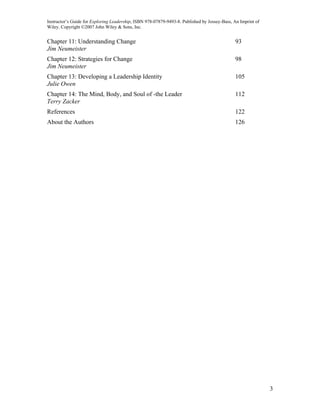
                                  TABLE OF CONTENTS
Part I: Introduction                                                                          4

Teaching Leadership                                                                           6
         Creating Learning Communities
         Developing Critical Reflection

Sample Syllabus                                                                               10
         Course Description
         Course Learning Objectives
         Course Expectations
         Textbook and Additional Readings
         Possible Assignments
         Course Schedule

Part II: Instructor Resources by Chapter                                                      16

Chapter 1: An Introduction to Leadership                                                      17
Katie Hershey
Chapter 2: The Changing Nature of Leadership                                                  24
Wendy Wagner
Chapter 3: The Relational Leadership Model                                                    32
Seth Zolin
Chapter 4: Understanding Yourself                                                             40
Jessica Porras
Chapter 5: Understanding Others                                                               47
Karol Martinez
Chapter 6: Leading with Integrity and Moral Purpose                                           56
Jennifer Armstrong
Chapter 7: Interacting in Teams and Groups                                                    63
Darren Pierre
Chapter 8: Understanding Complex Organizations                                                71
Kristan Cilente
Chapter 9: Being in Communities                                                               77
Jeff Grim
Chapter 10: Renewing Groups, Organizations, and Communities                                   86
Krystal Clark


                                                                                                              2
Instructor’s Guide for Exploring Leadership, ISBN 978-07879-9493-8. Published by Jossey-Bass, An Imprint of
Wiley. Copyright ©2007 John Wiley & Sons, Inc.


Chapter 11: Understanding Change                                                              93
Jim Neumeister
Chapter 12: Strategies for Change                                                             98
Jim Neumeister
Chapter 13: Developing a Leadership Identity                                                  105
Julie Owen
Chapter 14: The Mind, Body, and Soul of -the Leader                                           112
Terry Zacker
References                                                                                    122
About the Authors                                                                             126


                                                                                                              3
Instructor’s Guide for Exploring Leadership, ISBN 978-07879-9493-8. Published by Jossey-Bass, An Imprint of
Wiley. Copyright ©2007 John Wiley & Sons, Inc.


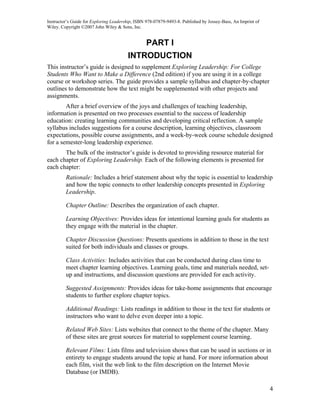
                                                  PART I
                                        INTRODUCTION
This instructor’s guide is designed to supplement Exploring Leadership: For College
Students Who Want to Make a Difference (2nd edition) if you are using it in a college
course or workshop series. The guide provides a sample syllabus and chapter-by-chapter
outlines to demonstrate how the text might be supplemented with other projects and
assignments.
        After a brief overview of the joys and challenges of teaching leadership,
information is presented on two processes essential to the success of leadership
education: creating learning communities and developing critical reflection. A sample
syllabus includes suggestions for a course description, learning objectives, classroom
expectations, possible course assignments, and a week-by-week course schedule designed
for a semester-long leadership experience.
       The bulk of the instructor’s guide is devoted to providing resource material for
each chapter of Exploring Leadership. Each of the following elements is presented for
each chapter:
         Rationale: Includes a brief statement about why the topic is essential to leadership
         and how the topic connects to other leadership concepts presented in Exploring
         Leadership.

         Chapter Outline: Describes the organization of each chapter.

         Learning Objectives: Provides ideas for intentional learning goals for students as
         they engage with the material in the chapter.

         Chapter Discussion Questions: Presents questions in addition to those in the text
         suited for both individuals and classes or groups.

         Class Activities: Includes activities that can be conducted during class time to
         meet chapter learning objectives. Learning goals, time and materials needed, set-
         up and instructions, and discussion questions are provided for each activity.

         Suggested Assignments: Provides ideas for take-home assignments that encourage
         students to further explore chapter topics.

         Additional Readings: Lists readings in addition to those in the text for students or
         instructors who want to delve even deeper into a topic.

         Related Web Sites: Lists websites that connect to the theme of the chapter. Many
         of these sites are great sources for material to supplement course learning.

         Relevant Films: Lists films and television shows that can be used in sections or in
         entirety to engage students around the topic at hand. For more information about
         each film, visit the web link to the film description on the Internet Movie
         Database (or IMDB).

                                                                                                              4
Instructor’s Guide for Exploring Leadership, ISBN 978-07879-9493-8. Published by Jossey-Bass, An Imprint of
Wiley. Copyright ©2007 John Wiley & Sons, Inc.


       We hope that you enjoy using this text and that you will challenge yourself to
model the principles of relational leadership as you work with students to enhance their
leadership potential.
                                                                                             Julie E. Owen
                                                                                    University of Maryland
                                                                                         Susan R. Komives
                                                                                    University of Maryland
                                                                                            Nance Lucas
                                                                                 George Mason University
                                                                                      Timothy R. McMahon
                                                                                      University of Oregon


                                                                                                              5
Instructor’s Guide for Exploring Leadership, ISBN 978-07879-9493-8. Published by Jossey-Bass, An Imprint of
Wiley. Copyright ©2007 John Wiley & Sons, Inc.


                               TEACHING LEADERSHIP
Adapted from Owen, J. E., Dugan, J. P., Berwager, S. W., & Lott, M. K. (2006). Lesson plans for
leadership educators. In Komives, S. R., Dugan, J. P., Owen, J. E., Slack, C., & Wagner, W., Handbook for
student leadership programs. College Park, MD: National Clearinghouse for Leadership Programs.


Before chapter-by-chapter teaching resources are presented, it is important to consider
some of the unique joys and challenges of teaching leadership. Since leadership is, by
most definitions, a social process, it follows that teaching leadership is a complex
enterprise with few hard and fast laws to serve as anchors along the way. But, like other
social sciences, there are comprehensible processes that can be studied, understood, and
applied in a variety of contexts. It is the work of the leadership educator to help students
identify the core knowledge and practices of leadership, and to make meaning of it in
their own lives and the world around them. When leadership educators are successful,
there is no greater joy than seeing students transformed to new ways of engaging with
those around them. When discouraged, it is essential to remember that, especially in the
realm of leadership education, students may come to appreciate their learning later in
their personal development journey. In the instructor’s manual for his book The Leader’s
Companion, J. Thomas Wren offers the following advice for leadership educators (2001,
p. 5–6):

         Rather than playing the role of the dispenser of wisdom, the instructor often
         allows the students to produce through their activities (based on the readings) the
         grist for the learning experience. The role of the instructor then becomes one of
         monitoring, shaping, and guiding the intellectual endeavor. For some instructors,
         such an approach in the classroom is a new (and perhaps a bit intimidating)
         proposition. I have often lightly referred to it as whitewater teaching, and there is
         considerable validity to the metaphor. Things move along rapidly, often in
         unpredictable channels, and the identical exercise rarely plays out the same way
         twice. However, the issues likely to arise are predictable in a general sense. . .
         .Moreover, the instructor should always keep in mind the other aspects of
         traversing whitewater: it is always exhilarating and one achieves a sense of deep
         satisfaction at the end of the journey.

                        Creating Learning Communities
One way to help students integrate the theories and practices of leadership or, as bell
hooks (1994) puts it, to integrate “ways of knowing with habits of being” (p. 43) is to
create meaningful learning communities. Transforming educational spaces from
restraining to engaging places takes intentional thought and design. Establishing a culture
that encourages student voices, challenging dialogue, peer accountability, and spontaneity
requires intentional action from the first class or workshop session. Komives, Lucas, and
McMahon (1998) offer the following suggestions for the first session of a leadership
course or program: At least part of the first session should be spent in get-acquainted
activities in which students have the opportunity to introduce themselves and share their
motivation for attending the session or enrolling in the program. This can help students
see commonalties with each other and begins the process of community building. It is


                                                                                                              6
Instructor’s Guide for Exploring Leadership, ISBN 978-07879-9493-8. Published by Jossey-Bass, An Imprint of
Wiley. Copyright ©2007 John Wiley & Sons, Inc.


also important because some students may know each other (and possibly you) very well
already. It is important for everyone to start out on an equal footing. The first session
should not be intimidating for those students who may be new to you or to this topic. For
this reason, use low-risk activities that do not require students to share revealing
information that might be uncomfortable or threatening.

    •    One question you should be sure to ask is, Why did you decide to attend this
         session or enroll in this class? Although the answers may be similar, after a few
         students have spoken you will have some insight into why students are in
         attendance and their expectations for the experience.

    •    It is important to establish some basic ground rules for group discussion. Getting
         students to talk about how they expect to be treated by their peers and educators is
         a critical aspect of taking ownership for what happens in the course or program. It
         can help to put these guidelines in writing, and you will probably find it necessary
         to revisit them from time to time throughout the program.

It might be helpful to ask students to jot down ideas about what it would take to make this
the best class or program they have ever had. You can ask about assignments,
assessments, how they will treat each other, qualities of the instructor, and so forth. Have
them discuss these topics in small groups then share with the whole group. You can
summarize their ideas in writing and distribute them during the next session. It can also
be instructive to have students describe the best and worst learning experiences they have
had prior to your leadership session. What elements of past experiences shape their
approach to the class or seminar?

                           Developing Critical Reflection
To enhance student learning, it is also essential that leadership educators devote time and
attention to designing reflection activities. Effective reflection activities are linked to
particular learning objectives of the class or program, occur regularly throughout the
course or the program, and allow for feedback and assessment. The integration of
reflection activities into discussions and assessments increases student satisfaction and
optimizes learning gains from the experience. Reflection affords students the opportunity
to synthesize information and enables the facilitator to evaluate student learning.
       Common ways to weave reflection into your leadership course or program include
(adapted from University of Maryland Faculty Handbook for Service-Learning, Owen &
Troppe, 2003):

         Journals – In order for student journaling to be most effective, their use needs to
         be carefully thought out. With sufficient guidance, journals provide a way for
         students to link content with their feelings and experiences.

         Directed writings – Instructors may ask students to link their leadership
         experiences with course content. Instructors can identify a section from the
         textbook or class readings and structure a question for students to answer in one


                                                                                                              7
Instructor’s Guide for Exploring Leadership, ISBN 978-07879-9493-8. Published by Jossey-Bass, An Imprint of
Wiley. Copyright ©2007 John Wiley & Sons, Inc.


         or two pages. A list of directed writings can be provided at the beginning of the
         semester.

         E-mail discussions – Instructors may wish to set up a listserv so that students can
         discuss their experiences via e-mail. Students write weekly summaries of their
         thoughts about the class or program and their leadership experiences. Instructors
         can post questions for consideration and topics for directed writings.

         Case studies – This technique gives students the opportunity to analyze a situation
         and gain practice in decision making as they choose a course of action. Students
         may choose to write their own case studies of leadership dilemmas they have
         faced including a description of the context, the individuals involved, and the
         controversy or event that created the dilemma. Case studies are read in class, and
         students discuss the situation and identify how they would respond. Facilitators
         may also wish to provide cases to students and help them think analytically about
         the issues involved.

         Exit cards – At the end of a session, instructors may wish to ask students to write
         on index cards one way that information from that session relates to their current
         leadership involvement or experiences.

         Graffiti boards – Post newsprint around the room as graffiti boards and ask
         students to go around responding to thoughtful questions, quotes, or statistics that
         you have placed on each one. Discuss the responses.

         Draw a conclusion – Have students read articles written by three different authors
         on the same issue. Ask students to select one of the articles (or you can assign
         one) and write a sentence or two summarizing the author’s viewpoint. Have
         students then draw a picture that symbolizes that viewpoint. Students can compare
         their written summaries and pictures with each other. Have students discuss how
         these various viewpoints account (or fail to account) for what they experience
         with leadership.

         What, so what, now what – Have students write answers to and discuss these three
         questions about their most recent leadership experience: What? So what? Now
         what? These can be modified in numerous ways, such as the following:

                  What did I do, see, hear, experience?
                  So what? What does it mean?
                  Now what do I do?
                  Now what do I think?
                  OR
                  What did I learn that reinforced a key concept from the class or session?
                  What did I learn that contradicted a key concept from the class or session?


                                                                                                              8
Instructor’s Guide for Exploring Leadership, ISBN 978-07879-9493-8. Published by Jossey-Bass, An Imprint of
Wiley. Copyright ©2007 John Wiley & Sons, Inc.


                  What are the implications if my leadership experience either reinforced or
                  contradicted this key concept?
                  What perspective do I now have on the various viewpoints on this issue?


                                                                                                              9
Instructor’s Guide for Exploring Leadership, ISBN 978-07879-9493-8. Published by Jossey-Bass, An Imprint of
Wiley. Copyright ©2007 John Wiley & Sons, Inc.


                                    SAMPLE SYLLABUS
Note: This sample syllabus has been developed to illustrate how an instructor might
arrange a course to meet particular learning objectives using Exploring Leadership: For
College Students Who Want to Make a Difference (2nd edition). Feel free to adapt this
model to design a course that meets the learning objectives you desire for students. This
might include additional readings, assignments, or activities as appropriate. The chapter-
by-chapter instructor resources following this syllabus offer several ideas and
suggestions. For additional syllabi used in leadership courses, please visit the website of
the National Clearinghouse for Leadership Programs at
http://www.nclp.umd.edu/resources/syllabi.asp.

                      Introduction to Leadership Course
Course Description
The purpose of this course is to encourage you to carefully analyze your responsibilities
and commitments in the context of leadership for the common good and for purposeful
change. You will come to understand the concept of relational leadership and how it
differs from traditional leadership theories. The course includes the study of leadership as
well as the application of leadership theories, concepts, and skills. You will also develop
your own leadership potential through the completion of personal and leadership self-
assessments, values exploration, and leadership skill applications through course
activities.

Course Learning Objectives
Through active engagement in the course and course materials, students will:

    1.        Understand and apply the Relational Leadership Model.

    2.        Increase self-awareness through the exploration of values, beliefs, culture, and
              identity.

    3.        Learn the basics of group roles, dynamics, and decision making in order to
              function constructively in group settings.

    4.        Understand the nature of coalitions, communities, and systems.

    5.        Appreciate the relationship between ethics and leadership.

    6.        Discover the complexities of leadership and the multidisciplinary nature of
              leadership studies.

    7.        Compare and contrast traditional and emergent paradigms of leadership.

    8.        Apply critical thinking to leadership theories and practices.

    9.        Understand gender and cultural influences on leadership.


                                                                                                              10
Instructor’s Guide for Exploring Leadership, ISBN 978-07879-9493-8. Published by Jossey-Bass, An Imprint of
Wiley. Copyright ©2007 John Wiley & Sons, Inc.


    10.       Build an awareness of leadership issues facing our communities and society.

    11.       Begin to develop a personal philosophy of leadership.

    12.       Engage in a positive, inclusive learning experience where all students are
              challenged and supported.

Course Expectations
Students will come to class prepared for active participation. Students should be prepared
to experience learning through many different avenues and participate in each to his or
her fullest capacity.

In class, students will work in small teams to discuss readings, engage in simulations,
prepare for guest scholar and leader visits, and use theory to enhance practice through
carefully designed group activities. The teams will allow you to apply leadership theory
and concepts in diverse contexts.

The classroom will be a safe environment for exploring ideas and challenging
assumptions. It is an expectation of this course that students will take the necessary action
to respectfully listen to the voices of others and share their own opinions and values.
Students and the instructors are expected to treat each other with respect.

Students are expected to approach assignments with thoughtful consideration and to be
thorough in their completion. In all written assignments, students will be expected to
present solid content and to convey their message using appropriate grammar, syntax,
punctuation, and language. Written assignments will be reviewed for both content and
presentation. Unless otherwise noted, written assignments are to be typed, double-spaced,
in a 12-point font, with one-inch margins. All citations must be in a recognized format.
Web sites must also be cited with their full and accurate URL.

Students can expect the instructors to come prepared. The instructors will be willing
listeners with regard to student concerns. Students may expect the instructors to be
available outside of class to give additional help or support. These meetings will be
scheduled to meet the students’ and instructors’ schedules.

Textbook and Additional Readings
Komives, S. R., Lucas, N., & McMahon, T. R. (2007). Exploring Leadership: For
College Students Who Want to Make a Difference (2nd edition). San Francisco: Jossey-
Bass.
Additional readings provided in class (see chapter-by-chapter instructor resources for
suggestions)


                                                                                                              11
Instructor’s Guide for Exploring Leadership, ISBN 978-07879-9493-8. Published by Jossey-Bass, An Imprint of
Wiley. Copyright ©2007 John Wiley & Sons, Inc.


                                  Possible Assignments
Meaning Making Reflections/Quizzes
Over the course of the class you will occasionally have either 1) a brief quiz covering the
previous night’s reading assignments or 2) a one-page meaning-making reflection
assignment.

Autobiography
Students are asked to reflect on how they have become who they are and compose a brief
but well-organized autobiography. We are not looking for a chronological history of your
life, but rather an analytical and reflective review of the influences and factors which
have shaped who you are.
       Some questions to consider exploring include: What is your family history? What
are your family traditions and customs? How have these factors influenced your life and
perceptions of leadership? When was the first time you realized your leadership
potential? Who and what experiences have influenced your values and philosophies?
How have mentors and critical incidents in your life transformed you?

Challenge Course Reflection Paper

All students will participate in an experiential learning program on the campus Challenge
Course. Challenge courses are essentially obstacle courses constructed from wood, cable,
and ropes strung between trees, wood poles, or steel frameworks. When groups or
individuals participate on a Challenge Course, there is a great opportunity to learn about
concepts of relational leadership such as risk taking, collaboration, group problem
solving, and personal and group empowerment . If your campus does not have a
Challenge Course, look for one at locations such as summer camps, YMCA programs,
and corporate teambuilding facilities.

Attending the session is expected, but no one will be required to undertake any activity
that makes him or her too uncomfortable. Students will be required to summarize their
experiences from the Challenge Course and apply the relational model to the group
process that occurred during the experience. . Questions to help frame the paper include:

Practicing Leadership
Who assumed leadership roles during the activities? How or why did the individual or
individuals come to assume these responsibilities?
What behaviors would you describe as showing leadership?
What were the difficulties of practicing leadership in this group? How might you have
overcome the challenges?
Did the leadership roles shift around or remain with the same person or people
throughout the activities? Why?


                                                                                                              12
Instructor’s Guide for Exploring Leadership, ISBN 978-07879-9493-8. Published by Jossey-Bass, An Imprint of
Wiley. Copyright ©2007 John Wiley & Sons, Inc.


In your opinion, did race, gender, or ability play a role in the assumption of leadership in
any of these activities? How so?

Understanding Yourself
What role did you play in the activities? Did you feel as if you contributed to the
leadership effort? Why or why not?
What did you learn about your own strengths and challenges in this experience? How will
you work on these competencies and growth areas in the future?
Did your values and beliefs shape your experience on the Challenge Course? How so?

Communication and Listening
What interfered with the ability of one or more group members to listen to others?
What elements may have prevented you from listening well?
What elements helped you listen well?
How did your group communicate when someone wanted something from someone else?
(Did they ask, order, demand, say nothing and do it themselves, etc.?) When you wanted
something, what, if anything, prevented you from asking for what you wanted?
How did the group share ideas related to the initiative at hand? How are communication,
coordination, and true collaboration different?
How did your group handle controversy or competing ideas? Was it an effective
approach? Why or why not?

Making Group Decisions
Were you satisfied with the way decisions were made? Explain your answer.
How quickly did your group establish “roles” within the group? Were they adhered to for
the duration of the activity?
Was it important, or even a consideration, to reach consensus as a group? Why or why
not?
What did you like and not like about the way group decisions were made?

Relational Leadership Model
Did your group practice inclusive leadership? If so, how?
Did your group practice empowering leadership? If so, how? What types of power were
present in your group? How effectively was power used?
What role did ethics play in your group’s experience? If unethical actions occurred, did
the group address them? Why or why not?
Did your group ever achieve common purpose? Why or why not?


                                                                                                              13
Instructor’s Guide for Exploring Leadership, ISBN 978-07879-9493-8. Published by Jossey-Bass, An Imprint of
Wiley. Copyright ©2007 John Wiley & Sons, Inc.


How did your group balance planning to achieve a task with actively working on the
task? Did you agree with the balance of process and outcome? How could it have been
better?

Leadership Interview Paper
Students will identify a person who is part of an organization working to make social
change. Try to meet face-to-face with your interviewee. Formulate your questions in
advance. Areas to cover include:
Basic biographical information and information about any organizational affiliation.
Brief history of how s/he worked to address the social issue at hand. What successes or
changes has s/he seen?
What pressing problems is s/he still facing?
What other individuals or organizations has s/he partnered with in change efforts?
What suggestions would s/he have for college students interested in having an impact on
the issue? How does s/he define leadership? Service? Does s/he see them as connected?
What other resources (organizations, web sites, readings) does s/he recommend?
Write a paper connecting insights gained from your interview with the elements of the
Relational Leadership Model.

Final Exam and Leadership Action Plan
Reflect on what you learned about yourself during the semester in relation to your
capacity to demonstrate leadership. Reflect on what you see as your leadership strengths
and weaknesses and how you will take advantage of both in the future. Briefly describe
the leadership philosophy you have developed throughout this class. Has it changed since
the beginning of class? If so, how? Describe two action steps you can take to continue to
develop your leadership in the future.

                                       Course Schedule
DATE                            TOPIC                           READINGS/ASSIGNMENTS
Week 1                          Introduction to                 Preface and Chapter 1
                                Leadership
Week 2                          The Changing Nature             Chapter 2
                                of Leadership

Week 3                          The Relational                  Chapter 3
                                Leadership Model


                                                                                                              14
Instructor’s Guide for Exploring Leadership, ISBN 978-07879-9493-8. Published by Jossey-Bass, An Imprint of
Wiley. Copyright ©2007 John Wiley & Sons, Inc.


Week 4                          Understanding                   Chapter 4
                                Yourself
                                                                Autobiography due
                                                                Take Myers-Briggs Type Indicator
Week 5                          Understanding Others            Chapter 5
                                                                Challenge course paper due
Week 6                          Leading with Integrity          Chapter 6 and related articles
                                and Moral Purpose
Week 7                          Interacting in Teams            Chapter 7 and related articles
                                and Groups
Week 8                          Understanding                   Chapter 8, 9, and 10
                                Complex
                                Organizations and
                                Communities
Week 9                          Understanding Change            Chapter 11
                                                                Leadership Interview paper due
Week 10                         Strategies for Change           Chapter 12


Week 11                         Developing a                    Chapter 13
                                Leadership Identity
Week 12                         Renewal of Self,                Chapter 14
                                Groups and
                                Organizations; Group
                                Presentations
Week 13                         Group Presentations

Week 14                         Wrap-up                         Leadership Action Plan paper due


                                                                                                              15
Instructor’s Guide for Exploring Leadership, ISBN 978-07879-9493-8. Published by Jossey-Bass, An Imprint of
Wiley. Copyright ©2007 John Wiley & Sons, Inc.


                                                 PART II
              INSTRUCTOR RESOURCES BY CHAPTER


                                                                                                              16
Instructor’s Guide for Exploring Leadership, ISBN 978-07879-9493-8. Published by Jossey-Bass, An Imprint of
Wiley. Copyright ©2007 John Wiley & Sons, Inc.


                                                       1
                   AN INTRODUCTION TO LEADERSHIP
                                               Katie Hershey

This chapter introduces foundational principles and key models of leadership that are
discussed at length in later chapters. This introduction describes how problems have
become more complex in today’s society and as a result, traditional approaches to
leadership and problem-solving may not be effective. Consequently, there is a need to
work collectively, reflectively, and spiritually smarter by examining past and current
leadership paradigms and to look for new paradigms that emerge from experience.

                                         Chapter Outline
I. Foundational Principles
II. Rapidly Changing Times
III. Understanding Paradigms
IV. Examining the Paradigms
V. The Search for a New Conceptualization of Followers
         A. Followership
         B. What New Term for Followers?
II. A Word About Leaders
III. Purposes of Leadership
IV. Civic Engagement and Civic Responsibility
V. Making a Difference
VI. Leadership Viewed from Different Frames
VII.     Leadership Requires Openness to Learning
VIII.    Personal Responsibility for Learning
         A. Experiential Learning
IX. Relational Leadership
X. The Real World

                                    Learning Objectives
After reading this chapter, students should be able to:
    •    Explain key concepts and definitions of leadership
    •    Discuss the foundational principles of the book
    •    Compare and contrast conventional and emergent leadership paradigms


                                                                                                              17
Instructor’s Guide for Exploring Leadership, ISBN 978-07879-9493-8. Published by Jossey-Bass, An Imprint of
Wiley. Copyright ©2007 John Wiley & Sons, Inc.


    •    Understand the notion of followership
    •    Explain the importance of leadership with a purpose

                          Chapter Discussion Questions
1. What are some examples of the command-and-control methods of leadership? What
   are some examples of collaborative methods of leadership? How have you felt as a
   participant in either of these systems?

2. Think of a time in which you were simply a “spectator.” What could you have done
   in that situation to become more engaged? Then think of a time in which you were an
   “active participant.” What motivated you to become an active participant? What
   sustained (or did not sustain) you in this effort?

3. Think of people in your life whom you consider to be really great leaders. What
   qualities do these people have? How do they make you feel when you work or
   interact with them?

4. Why is an openness to learning an important aspect of leadership? What behaviors do
   effective leaders exhibit that indicate an openness to learning?

5. Think of an experience in which you learned about or developed leadership skills.
   What aspects of this experience contributed to your learning?

                                         Class Activities
Activity: Concentric Circles: Breaking the Ice
Objectives
    •    To begin creating a learning community among the students
    •    To give students a chance to learn about and feel comfortable around one another
    •    To engage in one-on-one discussions about students’ personal experiences
    •    To begin thinking about topics related to leadership

Time
15–20 minutes

Materials
None

Set-up
Push desks out of the way if possible.


                                                                                                              18
Instructor’s Guide for Exploring Leadership, ISBN 978-07879-9493-8. Published by Jossey-Bass, An Imprint of
Wiley. Copyright ©2007 John Wiley & Sons, Inc.


Instructions
1.       Ask students to form two circles, one inside of the other. The people in the inside
         circle should be facing outwards, and the people in the outside circle should be
         facing inwards, so everyone is face-to-face with another student. If you have an
         odd number of people the facilitator should fill the empty space.

2.       Have students introduce themselves to the person they are facing.

3.       Begin by asking one of the questions in the list below, and give students a few
         minutes to answer this question in pairs.

              o Who did you most look up to and strive to emulate when you were
                growing up? What qualities did you admire in that person?
              o Who do you most look up to now? What qualities do you admire in that
                person?
              o What is one accomplishment of which you are very proud? What about
                this accomplishment makes you especially proud?
              o Talk about a community of which you are a part (however you define
                community). What are the things you appreciate most about this
                community?
              o What is one thing you wish you could change about the community you
                just discussed?
              o Do you consider yourself a leader? Why or why not?
              o Talk about your first memory of being a part of a group. What do you
                remember most about this experience?
              o Talk about an experience you have had collaborating with other people on
                a project. What did you enjoy about this experience? What was
                challenging for you?
              o What is one goal you have in your life? What motivates you to achieve
                this goal? What sustains you as you work towards achieving this goal?
4.       After both students in each pair have answered the question, have the outer circle
         rotate 1 space to the right, so that each student in the inner circle is now facing a
         new person.

5.       Repeat steps 2–4 for as many questions as you have time for.

Activity: Leadership Barometer
Objectives
To introduce students to the many ways in which leadership is defined
To examine personal values and conceptions of leadership


                                                                                                              19
Instructor’s Guide for Exploring Leadership, ISBN 978-07879-9493-8. Published by Jossey-Bass, An Imprint of
Wiley. Copyright ©2007 John Wiley & Sons, Inc.


To engage in discussion about differences of opinion in defining leadership
To gain an understanding of and respect for others’ beliefs

Time
30–40 minutes (will depend on how willing students are to engage in discussion)

Materials
Two pieces of paper
Tape
Marker
Flip chart paper or chalkboard

Set-up
1. Write “Leadership” on one piece of paper and “Not Leadership” on another piece of
   paper.

2. Tape these pieces of paper to opposite walls of the room.

3. If possible, push desks and tables out of the way and have participants start by
   standing in the middle of the room (between the two pieces of paper).

Instructions
1. Explain to students that you will read a series of statements. After you read each
   statement, students must decide whether the behavior you have mentioned is a type of
   leadership or not, and must move to stand near the sign (“leadership” or “not
   leadership”) that reflects their decision. An example list of statements is included at
   the end of this activity.

2. This is a forced choice activity. Challenge students to pick a side and try to keep them
   from standing in the middle of the room. After students move, allow several minutes
   for discussion, giving students the opportunity to share their reasons for moving to
   one side or the other (or their reasons for their ambivalence about which side to pick).

3. As students share their thoughts, keep notes of comments, phrases, and concepts on
   the board or flip chart paper that seem to be foundational in how students are defining
   leadership. The goal is not to develop an agreed-upon definition of leadership.
   Instead, this exercise should illuminate some of the underlying beliefs, assumptions,
   and key questions that define different conceptions of leadership for people.

Make sure to leave time for discussion at the end.

Activity Discussion Questions
1. What is leadership? Is it definable?


                                                                                                              20
Instructor’s Guide for Exploring Leadership, ISBN 978-07879-9493-8. Published by Jossey-Bass, An Imprint of
Wiley. Copyright ©2007 John Wiley & Sons, Inc.


2. Does leadership have to include a “position” (i.e., manager, president, group
   facilitator)?

3. Can you be a leader without being vocal? Without actively organizing other people?
   Why or why not?

4. Does the concept of leadership change depending on whether you are acting alone or
   in a group?

5. Is collaboration important in leadership?

Example “Is this Leadership?” Statements
Teaching a class

Working as a political lobbyist

Leaving your car at home and biking to work every day

Giving a lecture

Tutoring a first-grader

Writing a letter to the editor of the school paper about an issue that concerns you

Organizing a campus rally for immigrant rights

Voting

Joining the military

Participating in a collaborative group project where no one person is “in charge”

Running for office

Facilitating a group discussion

Working with other members of your student group to plan an event

Volunteering at a local soup kitchen

Effectively delegating tasks to members of a committee you chair

Civilly disobeying a law you feel is unjust

Encouraging others to pursue what they are passionate about

Noticing, in a group discussion, when someone’s voice is not being heard


                                                                                                              21
Instructor’s Guide for Exploring Leadership, ISBN 978-07879-9493-8. Published by Jossey-Bass, An Imprint of
Wiley. Copyright ©2007 John Wiley & Sons, Inc.


                                  Possible Assignments
1. Have students research how leadership is constructed in their respective academic
   fields. Spend some time in class developing interview questions as a group, and then
   have each student seek out and interview two people within their potential career field
   or academic major about their views on leadership. Have students write a summary of
   these interviews and talk about what they learned through this process. If you have
   time, have each student pick out some statements to share with the class as a basis for
   a class discussion.

2. Ask students to bring in examples from the newspaper or current events that
   exemplify socially responsible leadership. How did these individuals or groups lead
   with integrity, confront a social injustice, and value their relationships with others?
   Ask for students to volunteer to share their examples in class.

3. Instruct students to think about movies or TV shows they have watched recently or
   books they have read, and list examples of command-and-control paradigms of
   leadership and of relational paradigms of leadership. Give them post-it notes, and
   have them write each example on a separate post-it note. Have students bring these
   into class, combine them all on the board, and talk about common themes among all
   of the examples in each paradigm.

4. Have students write about an activity or group of which they are a part and a current
   or potential issue this group might face. Ask them to discuss how they can be
   proactive in addressing this issue. What will happen if no one is proactive in
   addressing this issue?

5. Instruct students to keep a journal for the duration of the class. Each week, ask them
   to write about how that week’s class topics apply to their lives.

                                    Additional Readings
Covey, S. (1991). Principle-centered leadership. New York: Rockefeller Center.
Higher Education Research Institute, University of California at Los Angeles. (1996). A
social change model of leadership development guidebook. Los Angeles: Higher
Education Research Institute, University of California at Los Angeles.

                                      Related Web Sites
LeaderValues
http://www.leader-values.com/
One of the widest collections of free leadership resources available on the Web. Includes
searchable themes, links, magazine articles, books, quotations, and a glossary of
leadership-related terms.
CampusCares
http://www.naicu.edu/CampusCares/


                                                                                                              22
Instructor’s Guide for Exploring Leadership, ISBN 978-07879-9493-8. Published by Jossey-Bass, An Imprint of
Wiley. Copyright ©2007 John Wiley & Sons, Inc.


CampusCares salutes the involved and engaged members of college campuses across the
nation, especially those involved in leadership activities, student governance, community-
based learning, and service.

                                          Relevant Films
Chocolat (2000), Miramax, Running time: 105 minutes
A woman and her daughter move to a small French town in the 1950s, and inspire self-
confidence, collaboration, and new relationships between the townspeople, bringing new
life and a sense of purpose back into the town.
http://www.imdb.com/title/tt0241303/


Good Night, and Good Luck (2005), Warner Home Video, Running time: 93 minutes
Set in the 1950s, this story chronicles how CBS took a stand against Senator McCarthy
during a time when it was very dangerous to do so.
http://www.imdb.com/title/tt0433383/


Sister Act (1992), Walt Disney Video, Running time: 100 minutes
A lounge singer is hidden in a convent by police, after she witnesses a murder, and helps
to inspire self-confidence in her fellow “sisters” through her role in bringing life into the
convent’s choir. This movie is a good illustration of the process of empowering others,
transforming leadership, working collaboratively, and valuing the different gifts and
talents of everyone.
http://www.imdb.com/title/tt0105417/


The Power of One (1994), Running time: 2 minutes
The Power of One combines evocative visuals with a moving original score by Academy
Award winner Hans Zimmer. It features historical and contemporary persons who have
impacted the world to illustrate that each of us, working individually or as a group, can
make a difference. Available for download at:
http://www.caringstrangers.com/powerofone.htm


                                                                                                              23
Instructor’s Guide for Exploring Leadership, ISBN 978-07879-9493-8. Published by Jossey-Bass, An Imprint of
Wiley. Copyright ©2007 John Wiley & Sons, Inc.


                                                       2
              THE CHANGING NATURE OF LEADERSHIP
                                              Wendy Wagner

In Chapter Two, the authors’ assumptions about leadership are explained in a “myths”
and “truths” form of debate. The evolution of leadership definitions and theories over the
years provides a historical context for present-day approaches, including new, emerging
leadership paradigms.
       This chapter may challenge students to examine their own beliefs about
leadership. By understanding the historical context, and how they have come to define
and approach leadership, students can consider their own views of leadership. While this
book defines leadership as “a relational and ethical process of people together attempting
to accomplish positive change,” many students come to leadership believing it is an
examination of what leaders do to followers in order to get them to do what they want.
This chapter will challenge that thinking.

                                         Chapter Outline
I. Myths About Leadership
II. Truths About Leadership
III. Definitions of Leadership
IV. Metaphorical Definitions of Leadership
V. Generations of Leadership Theories
         A.       Great Man Approaches
         B.       Trait Approaches
         C.       Behavioral Approaches
         D.       Situational Contingency Approaches
         E.       Influence Theories
         F.       Reciprocal Leadership Theories
         G.       Transforming Leadership Theory
         H.       Servant-Leadership Theory
         I.       Followership Theory
         J.       Emerging Leadership Paradigms
II. Leadership Maps for a Rapidly Changing World
III. The World of Chaos and Systems
         A.       Sensitivity to Initial Conditions
         B.       Relationships, Connections, and Anding


                                                                                                              24
Instructor’s Guide for Exploring Leadership, ISBN 978-07879-9493-8. Published by Jossey-Bass, An Imprint of
Wiley. Copyright ©2007 John Wiley & Sons, Inc.


         C.       Multiple Partial Solutions
         D.       Self-Organizing Systems
VIII.    Authentic Leadership

                                    Learning Objectives
After reading this chapter, students should be able to:
     •   Consider many issues that have been debated by leadership theorists (such as the
         relevance of innate characteristics or abilities, position within a hierarchy, control
         over others, or charisma) as they continue to develop their own philosophy of
         leadership
     •   Understand various definitions and metaphors of leadership as their own
         philosophy of leadership continues to develop
     •   Know how views of leadership have evolved from believing leadership is
         hereditary, to viewing leadership as a set of traits or behaviors, to understanding
         leadership as a complex process of leaders and followers together
     •   Explain newly emerging paradigms, which break down the leader-centric
         approach to studying leadership and organizations
     •   Challenge the relevance of industrial models of leadership in today’s rapidly
         changing world

                          Chapter Discussion Questions
1.   Think of an organization in which you have enjoyed participating. Which of the
     generations of leadership theories - best describe it? Think of an organization in
     which you did not enjoy participating, and which leadership theories best describe it.

2. How is leadership portrayed in current popular culture? (Consider for example, reality
   television shows that involve groups of people working together, such as Survivor,
   The Apprentice, or Project Runway.) Do some of the “myths” of leadership play out
   as true in these portrayals? Do these shows seem to endorse an industrial or
   postindustrial paradigm of leadership? Why?

3. When you signed up for this class, did you define leadership as what one person (the
   leader) does to followers, or as something that everyone in the group does? What is
   your reaction to the emerging leadership theories outlined in this chapter?

4. Does leadership in organizations necessarily come from the person who holds the
   position of the leader (the chair, president, or director)? If not, what makes a person a
   leader?

5. Can everyone in the group be doing leadership? What does that look like? Are they
   taking turns or is each person filling a different role (one person makes sure all
   perspectives are being heard, while another focuses on keeping the discussion on
   topic, etc.)?

                                                                                                              25
Instructor’s Guide for Exploring Leadership, ISBN 978-07879-9493-8. Published by Jossey-Bass, An Imprint of
Wiley. Copyright ©2007 John Wiley & Sons, Inc.


6. Thinking about an organization you are currently or have participated in: how is it
   like a machine (predictable and orderly) and how is it like a weather system
   (uncontrollable, but with an underlying pattern)?

                                         Class Activities
Activity: Reciprocal Leadership Tinkertoy Projects
Objectives
To understand the experienced differences and similarities among the reciprocal
leadership theories.

Time
30 minutes

Materials
One set of tinkertoys per small group of 5–6. One slip of paper for each small group. The
slips should say:
         “You are the leader of this group. Decide what to build and how to motivate your
         group members to build it.”

         “Your team should decide as a group what to build and should all work together
         to create it. Encourage your team to practice good followership, sharing ideas, and
         supporting each other.”

         “You are a servant-leader in this group. Your role is to serve the members of the
         group, doing whatever they need to grow, whether that is encouragement or
         providing them knowledge or skills in order to be able to work together.

         “You are the designated leader of this group. You have a ‘transforming
         leadership’ philosophy, so you will be focused on transforming your members to
         become leaders themselves. You should help them to be motivated by their values
         for the common good, rather than by competition or greed for rewards.

If there are more than four groups, you can have multiple groups in some categories.

Set-up
Conduct a very brief review of the reciprocal leadership theories covered in the book.
         Transformational leadership: The leader’s goal is to transform followers into
         leaders themselves. Transformational leaders want to raise followers to higher
         levels of motivation, for example, to be motivated by their values for the common
         good rather than by being motivated by fear or greed for rewards. In turn, the
         organization’s response raises the leader’s level of morality and motivation as
         well.
         Servant-leadership: The leader approaches his/her role as a servant to those in the
         group, filling their needs where possible. If, in order to do the work, the followers


                                                                                                              26
Instructor’s Guide for Exploring Leadership, ISBN 978-07879-9493-8. Published by Jossey-Bass, An Imprint of
Wiley. Copyright ©2007 John Wiley & Sons, Inc.


         need training, support, or simply encouragement, that is what the leader provides.
         The well-being, growth, and empowerment of the followers holds as much of the
         leader’s attention as the group’s goal.
         Followership: While other leadership theories focus on what the leader is doing,
         this theory puts attention on what good followers do. The roles of leaders and
         followers are equally important, but different. Every person in the organization,
         not just the leader, is responsible for achieving goals and supporting other
         members.

Instructions
Divide the students into small groups of 5–6, each with a set of tinkertoys. Explain that
each group has fifteen minutes to construct a tinkertoy creation that represents their
definition or assumptions of leadership. Explain that some groups will have a designated
leader, and some will not. Ask for a volunteer from each group to draw a slip of paper out
of a hat, and go back to their group and get to work. They will have 10–15 minutes to
create their project.

Activity Discussion Questions
1. Have each group show their construction project. Is everyone in the group satisfied
   with it? Does everyone in the group feel they contributed to the final product? Why or
   why not?

2. Explain that some groups had a designated leader and others were reflecting various
   reciprocal leadership theories. Have them describe to each other the process in each
   group. How did they decide what to make? How did the work get done? Who made
   sure everyone was included and all ideas were used?

3. Ask each group: How was the experience of being in your group uniquely different
   from the other groups? For example, how was being in a group with a servant leader
   unique from being in the other groups?

4. How did the concept of followership play out in these groups? Can they give any
   examples of particularly good followership happening? Did some groups seem to
   encourage good followership more than others?

5. Describe the following common characteristics of reciprocal leadership theories as
   outlined in the book. Compare and contrast each of these to what happened in the
   small group tinkertoy project:

         Attention is given to understanding everyone’s role in the group, not just the
         positional leader’s. When describing their group process, did the groups with
         designated leaders give attention to what everyone did, or on what the leader did?
         How about the groups without a designated leader?
         Emphasis is on mutual goals and motivations, rather than on the leader’s goal
         and the follower’s motivations. Did the small groups come up with the project
         idea together or did the goal come from one person who then had to motivate the


                                                                                                              27
Instructor’s Guide for Exploring Leadership, ISBN 978-07879-9493-8. Published by Jossey-Bass, An Imprint of
Wiley. Copyright ©2007 John Wiley & Sons, Inc.


         others? What happens to the need to motivate when the goal belongs to everyone
         instead of one leader?
         Emphasis is on inclusiveness and shared power among participants. Did all
         members of the small group feel they contributed ideas and ability to the work?
         Did everyone feel they were included and encouraged to contribute?
         Leadership is something all participants do together, not something leaders do to
         followers. Do the students feel this statement fits with what happened in their
         small group?
       Can anyone describe a similar experience in the teams or organizations he or she
has worked in?

Activity: Leadership Metaphor
Objective
To consider one’s current beliefs about what leadership is and compare them to the
approaches of leadership outlined in the book through the myths and truths sections and
the historical view of how leadership has been defined.

Time
40 minutes

Materials
Flip chart paper for each small group, markers (or other art supplies if preferred)

Set-up
After reviewing the main ideas from the chapter, explain that students will now have the
opportunity to explore their own approach to leadership. In this activity, they will create a
metaphor that describes their beliefs about leadership. For example, the book uses jazz
music, high-jumping techniques, and the study of the atom as metaphors to describe how
leadership is seen differently now than it once was.

Instructions
In small groups of three to five people, have students discuss the following issues and
then create a metaphor for leadership that represents their approach. Instruct each group
to make a poster that represents the metaphor to be shared with the rest of the group.
They should be sure the poster is labeled well, as they will not be able to add to the visual
representation with any spoken explanation.
         Issues to discuss (you might have these posted somewhere in the room):
Can a person be a leader if s/he does not hold the leadership position in the organization?
How? What does that look like?
Can everyone in the group be doing leadership? What does that look like? Are they
taking turns or is each person filling a different role (one person makes sure all
perspectives are being heard, while another focuses on keeping the discussion on topic,
etc.)?


                                                                                                              28
Instructor’s Guide for Exploring Leadership, ISBN 978-07879-9493-8. Published by Jossey-Bass, An Imprint of
Wiley. Copyright ©2007 John Wiley & Sons, Inc.


Does leadership involve knowledge and skills that can be learned or certain traits or ways
of being that that do or do not come naturally to a person?
       After posters are complete, have the small groups rotate around the room,
observing the other posters. At each poster, they should discuss how the metaphor
connects to the three issues posed earlier for small-group discussion.

Activity Discussion Questions
1. For each small group, under which generation or family of leadership theories would
   their metaphor fit?

2. What are the commonalities among these metaphors? Are there some assumptions
   about leadership on which the whole group would agree? (Note: Agreement across
   the whole group is not necessary, but this can spark interesting debate.)

3. What differences emerge when comparing the metaphors to each other?

                                  Possible Assignments
1. Have students write a two- to three-page paper that describes their philosophy of
   leadership in a metaphor. In doing so, they should describe which generation of
   leadership theories or aspects of the emerging leadership paradigms their leadership
   philosophy most closely resembles.

2. Have students spend a few weeks being observant of an organization or group in
   which they participate, watching for evidence of different approaches to leadership at
   work. Have them write a one- to two-page journal entry that describes incidents or
   conversations that appear to be indicators of certain theories.

3. Have students give a brief presentation in which they summarize a well-known fable
   or story that sends a message about what leadership is. What generation of leadership
   theories would this approach to leadership fit into and why? (For example, the story
   of the “Emperor’s New Clothes” speaks to the importance of followership.) Follow-
   up with a group discussion about how a culture’s stories will shape how its people
   define leadership. What are stories have shaped the students’ definition of leadership?

4. Have students choose a reciprocal theory of leadership and write a paper describing a
   movie or book that represents that theory. The paper should include the major points
   that distinguish the theory from others and describe how their example represents
   each of those points. (If one or two points are not met by their example, they should
   be able to describe specific areas in which their example isn’t a perfect match to the
   theory).

                                    Additional Readings
Avolio. B. J., & Gardner, W. L. (2005). Authentic leadership development: Getting to the
root of positive forms of leadership. Leadership Quarterly, 16, 315–338.


                                                                                                              29
Instructor’s Guide for Exploring Leadership, ISBN 978-07879-9493-8. Published by Jossey-Bass, An Imprint of
Wiley. Copyright ©2007 John Wiley & Sons, Inc.


Burns, J. M. (1995). Transactional and transforming leadership. In J. T. Wren (Ed.), The
leader’s companion (pp. 100–101). New York: The Free Press.
Kellerman, B. (2004). Bad leadership: What it is, how it happens, why it matters. Boston:
Harvard Business School Press.
Northouse, P. G. (2004). Leadership: Theory and practice (3rd ed.). Thousand Oaks, CA:
Sage.
Rost, J. C. (1995). Leaders and followers are the people in this relationship. In J. T. Wren
(Ed.), The leader’s companion (pp. 189–192). New York: The Free Press.
Spears, L. (1995). Introduction: Servant leadership and the Greenleaf legacy. In L. Spears
(Ed.), Reflections on leadership (pp. 1–16). New York: Wiley.
Wheatley, M. J. (2006). Leadership and the new science: Learning about organization
from an orderly universe (3rd ed.). San Francisco: Berrett-Koehler.

                                      Related Web Sites
The Greenleaf Center for Servant-Leadership
http://www.greenleaf.org/index.html
The Greenleaf Center is an international, not-for-profit institution headquartered in
Indianapolis, Indiana. Their goal is to help people understand the principles and practices
of servant-leadership; to nurture colleagues and institutions by providing a focal point
and opportunities to share thoughts and ideas on servant-leadership; to produce and
publish new resources by others on servant-leadership; and to connect servant-leaders in
a network of learning.


Margaret Wheatley’s Homepage
http://www.margaretwheatley.com/
Margaret Wheatley’s web site offers several articles on systemic leadership and servant
leadership. It also describes resources (books, films, audio) available for sale.

                                          Relevant Films
Robert K. Greenleaf: Servant-Leader (1991), The R. K. Greenleaf Center, Running time:
14 minutes
Introduces Greenleaf and the concept of servant-leadership.
http://www.greenleaf.org/catalog/Training_Videos.html


It’s a Wonderful Life: Leading Through Service (2005), The R. K. Greenleaf Center,
Running time: 25 minutes
Margaret Wheatley’s introduction to servant-leadership using clips from the film It’s A
Wonderful Life.


                                                                                                              30
Instructor’s Guide for Exploring Leadership, ISBN 978-07879-9493-8. Published by Jossey-Bass, An Imprint of
Wiley. Copyright ©2007 John Wiley & Sons, Inc.


http://www.greenleaf.org/catalog/Training_Videos.html


The Power of Followership (1995), The R. K. Greenleaf Center, Running time: 80 min.
A keynote speech by Robert Kelley.
http://www.greenleaf.org/catalog/Training_Videos.html


Leadership and The New Science (1993), CRM Films, Running time: 22 minutes
Dr. Margaret Wheatley explains nature’s living systems as models for new ways to
revitalize today’s organizations. (To order call 800-421-0833.)


                                                                                                              31
Instructor’s Guide for Exploring Leadership, ISBN 978-07879-9493-8. Published by Jossey-Bass, An Imprint of
Wiley. Copyright ©2007 John Wiley & Sons, Inc.


                                                       3
                THE RELATIONAL LEADERSHIP MODEL
                                               Seth D. Zolin

Rost (1991) introduced the concept of a new postindustrial leadership paradigm. These
new models reflected nonhierarchal views that expanded the practice of leadership
beyond the appointed “leader.” In this chapter, the authors present a relational model for
understanding leadership. Since introduced in the first edition of this book in 1998, the
definition of leadership and the corresponding Relational Leadership Model (RLM) has
become widely used in the field of student affairs (Astin & Astin, 2000; McMahon &
Bramhall, 2004; Hallenback, Dickman, & Fuqua, 2003). The model presents students
with a view of leadership that uses the postindustrial paradigm and challenges notions of
leadership as hierarchical and exercised by a select group of “exceptional” individuals.

                                         Chapter Outline
I.       Relational Leadership
II.      Knowing-Being-Doing
III.     Relational Leadership Is Purposeful
         A.       Working for Positive Change
IV.      Relational Leadership Is Inclusive
         A.       Involving Those External to the Group
V.       Relational Leadership Is Empowering
         A.       Sources of Power
         B.       Understanding Power
         C.       Self-Empowerment
         D.       Mattering and Marginality
         E.       Empowering Environments
VI.      Relational Leadership Is Ethical
         A.       Ethical and Moral Leadership
         B.       Leading by Example
VII.     Relational Leadership Is About Process
         A.       Cooperation and Collaboration
         B.       Meaning Making
         C.       Reflection and Contemplation
VIII.    What Would This Look Like?


                                                                                                              32
Instructor’s Guide for Exploring Leadership, ISBN 978-07879-9493-8. Published by Jossey-Bass, An Imprint of
Wiley. Copyright ©2007 John Wiley & Sons, Inc.


                                    Learning Objectives
After reading this chapter, students should be able to:
    •    Define leadership in a relational context and be able to discuss the different
         components of the Relational Leadership Model
    •    Identify sources of power and examine how these are evident in the organizations
         to which they belong
    •    Analyze existing processes in organizations or systems to which they belong and
         evaluate how they reflect inclusiveness, empowerment, and ethics, as well as
         leading to fulfill the group’s purpose
    •    Reflect on their own practice as leaders and evaluate their use of relational
         leadership
    •    Critique the Relational Leadership Model and determine how to adapt it to their
         own philosophy of leadership

                          Chapter Discussion Questions
1. Everyone has experienced moments in their lives when they felt excluded from a
   group. Think about an experience when you felt like an outsider. What made you feel
   that way? Did someone help you to become part of the group? If so, how did they do
   this? If not, what would have helped you feel like you belong (belonged)?

2. How would you define the common purpose for this class?

3. Think of a time in your life when you made a decision to change something? How did
   this reflect self-empowerment? If you worked in a group setting, in what ways was
   the group empowered to make the needed change? If they (you) weren’t empowered,
   how did the group claim power?

4. Think about an organization you are in (or have been in). What knowledge, attitudes,
   values, and skills were necessary for an individual to achieve success in that
   organization? What knowledge, attitudes, values, and skills were necessary for
   organizational success?

5. The chapter talked about change theory moving through a cycle of unfreezing
   changing refreezing. Think about your transition to college and how you have
   changed. How is this cycle evidenced in your experience?


                                                                                                              33
Instructor’s Guide for Exploring Leadership, ISBN 978-07879-9493-8. Published by Jossey-Bass, An Imprint of
Wiley. Copyright ©2007 John Wiley & Sons, Inc.


                                         Class Activities
Activity: A Gallery Exercise
Objectives
This gallery exercise will ask students to integrate the knowing-being-doing model with
Relational Leadership. It will also facilitate a discussion about the model.

Time
20–30 minutes

Materials
Six large sheets of newsprint taped to the wall around the room
Markers or Post-it Notes for each student. (if using Post-it Notes, students will need at
least 18 sheets)

Overview of the Activity
Students are asked to place different examples of knowledge, attitudes/values, and skills
under categories that correspond to the different components of the Relational Leadership
Model.

Instructions
1. Place the six sheets of newsprint on the wall. Each sheet should have a heading that
   corresponds to one component of the Relational Leadership Model and should be
   divided into three sections with the labels:

                  Knowledge
                  Attitudes/Values
                  Skills
         The sixth sheet should be labeled “Not Included in the Model” or
         “Miscellaneous” and will include the knowledge, attitudes, and skills which
         students do not believe fit into the model.
2. Ask each student to walk around the room and put at least one item in each category
   for all of the six sheets of newsprint.

3. Once this has been completed, facilitate a discussion about the Relational Leadership
   Model and the items the students identified as knowledge, attitudes/values, and skills.

VARIATION: You could divide the students into five groups and have each group fill in
the knowledge, attitudes/values, and skills for just one component of the Relational
Leadership Model. Each group should then present their lists to the group and items
should be added based on the class feedback. After this has been completed, the whole
group can fill out the sixth sheet about what is not included in the model.


                                                                                                              34
Instructor’s Guide for Exploring Leadership, ISBN 978-07879-9493-8. Published by Jossey-Bass, An Imprint of
Wiley. Copyright ©2007 John Wiley & Sons, Inc.


Activity Discussion Questions
1. What components of the model were easiest for you to fill out? Which were the
   hardest? Why?

2. Which of the subcategories (knowing, being, and doing) did you find easiest to fill
   out? Which was the hardest?

3. Does a person need to have all of the knowledge, attitudes, and skills you listed to be
   competent in that category or just some? What determines competence?

4. Is there any crossover in the knowledge, attitudes, and skills needed between the
   different components of the Relational Leadership Model?

5. When you look at the list of items that made it onto the ”Miscellaneous” chart, what
   themes emerge? Do you see anything that could be used to change the Relational
   Leadership Model?

6. After doing this activity, how do you feel about relational leadership? Is it a model
   you feel comfortable with? Why or why not?

Activity: Inclusive Conversations
Objectives
This exercise will focus on the Relational Leadership Model component of inclusion and
can also be used to talk about being process-oriented.

Time
30 Minutes

Overview
Students will be asked to solve a problem through discussion. Each member of the group
will be given a nametag with a symbol on it. This symbol will designate how s/he is to be
treated by other members of the group.

Materials
Nametags with symbols on them for each student. Make sure the different symbols are
evenly distributed throughout the group.
Sheets explaining to each student what the symbols mean. The student’s own symbol
should not be present on their sheet.
A scenario for the students to work through. It is recommended to develop a scenario that
is based on something currently facing your campus. The student newspaper might be a
great place to find a topic.

Instructions
1. Before the activity, the nametag along with the corresponding symbol explanation
   sheet should be placed in envelopes.


                                                                                                              35
Instructor’s Guide for Exploring Leadership, ISBN 978-07879-9493-8. Published by Jossey-Bass, An Imprint of
Wiley. Copyright ©2007 John Wiley & Sons, Inc.


2. Students should be separated into groups of four to five; or if the class is small
   enough, they can remain as one group.

3. Each student picks an envelope and is asked to put on the nametag and read the
   symbol explanation sheet. They are informed that the sheets are different and that
   they should not share the information on it with other members of the group.

4. The group is asked to come up with a solution for the scenario by adopting the roles
   that are explained on the sheet. They will have 15 minutes to come up with an
   answer.

5. After 15 minutes, ask each group to explain their solution for the scenario.

Activity Discussion Questions
1. How did your groups operate?

2. Did everyone feel like they had equal say in the group?

3. How did your group handle disagreement? What was the process used to find
   consensus

4. For those who felt excluded from the group, what were your thoughts and feelings
   during the discussions?

5. Do you feel like your group was able to come up with the best solution to the
   scenario? How would this have been different if you were not restricted in your
   communication style?

6. Why is inclusion such a critical element to relational leadership?

7. How does our class reflect inclusion? What could we be doing differently to make
   everyone feel part of the group?


                                                                                                              36
Instructor’s Guide for Exploring Leadership, ISBN 978-07879-9493-8. Published by Jossey-Bass, An Imprint of
Wiley. Copyright ©2007 John Wiley & Sons, Inc.


Example Symbols
Triangle: This person has been part of the group longer than anyone else. You respect
this person’s opinion because s/he has been around so long. Sometimes you feel like the
group cannot try new things because this person does not like change.

Oval: This person is the newest member of the group. S/he is bringing in some great
ideas but does not have as much experience with what has been tried before in this
organization. You like this person’s energy and are willing to help her or him learn.

Square: This person has been around for a while and is always trying to stir up trouble in
the group. S/he always disagrees with everything and is constantly playing devil’s
advocate. Most of the group has become annoyed at this person and find it hard to take
him/her seriously.

Star: This person is liked by everyone but doesn’t think the same way as everyone else.
S/h comes up with a lot of ideas but usually the rest of the group just ignores them.

Feel free to play with these character types and symbols and come up with your own
ideas.

                                  Possible Assignments
1. Over the course of one week have the students read newspapers or news magazines
   and clip out one article a day (or print out an article from an online paper) that
   somehow reflects the Relational Leadership Model. Conversely, students could clip
   out articles that actively go against the ideals of relational leadership. From one of
   these articles, students should prepare a one- to two-page paper that summarizes the
   article, how it represents or does not represent relational leadership, and reflect on
   how they would feel if they were involved in the situation in the article.

2. Leadership lessons can be found in all places. Ask each student to pick a children’s
   book and examine how it reflects one component of the Relational Leadership Model
   or the entire model. For example, the concept of inclusion could be applied to “The
   Ugly Ducking.” The duckling was looking to be a part of a group and eventually
   transformed itself to belong.

3. Have students design their own Relational Leadership Model. Ask them to consider
   what their most important values are when relating to others and how they would
   develop those concepts into a model of leadership. This could be presented as a
   paper; however, it might be better to have this be a presentation in front of the class.
   Students should prepare a poster of their model and present it to the group. This could
   be done individually or in small groups. In addition, this could be done over a class
   period and used as an in-class activity as opposed to an out-of-class assignment.

4. Have the students write a mission statement for your class or organization. This could
   also be done as an in-class activity in a large group or small groups.


                                                                                                              37
Instructor’s Guide for Exploring Leadership, ISBN 978-07879-9493-8. Published by Jossey-Bass, An Imprint of
Wiley. Copyright ©2007 John Wiley & Sons, Inc.


                                    Additional Readings
Astin, A. W., & Astin, H. S. (2000). Leadership reconsidered: Engaging higher
education in social change. Battle Creek, MI: W.K. Kellogg Foundation.
Johnson, S. (1998). Who moved my cheese? An amazing way to deal with change in your
work and in your life. New York: Penguin Putnam.
Covey, S. (1989). Seven habits of highly effective people: Restoring the character ethic.
New York: Simon & Schuster.
Kidder, R. (1995). How good people make tough choices: Resolving the dilemmas of
ethical living. New York: HarperCollins.

                                          Relevant Films
Walkout (2006), HBO Films, Running Time: 110 minutes
Walkout is the stirring true story of the Chicano students of East Los Angeles who in
1968 staged several dramatic walkouts in their high schools to protest academic prejudice
and dire school conditions.
http://www.hbo.com/events/walkout/index.html


Dead Poets Society (1989), Walt Disney Video, Running Time: 128 minutes
Painfully shy Todd Anderson has been sent to the school where his popular older brother
was valedictorian. His roommate, Neil, although exceedingly bright and popular, is very
much under the thumb of his overbearing father. The two, along with their other friends,
meet Professor Keating, their new English teacher, who tells them of the Dead Poets
Society and encourages them to go against the status quo. Each, in his own way, does this
and is changed for life.
http://www.imdb.com/title/tt0097165/


October Sky (1999), Universal Pictures, Running Time: 108 minutes
Homer Hickam is a kid with only one future in sight—to work in the local coalmine like
his father. When the first artificial satellite, Sputnik, goes into orbit in October 1957,.
Homer and his friends become inspired to learn how to build rockets. Unfortunately,
most of the town and especially Homer's father think that they are wasting their time.
Only one teacher in the high school understands their efforts and lets them know that they
could become contenders in the national science fair with college scholarships being the
prize.
http://www.imdb.com/title/tt0132477/


The West Wing (2003), Episode 4.16 “California 47th,” Warner Brothers Television
Bartlet plays hardball to end the genocide in Kuhndu; after the entire speechwriting staff
quits, Will is forced to rely on Elsie and some inexperienced interns to write tax policy

                                                                                                              38
Instructor’s Guide for Exploring Leadership, ISBN 978-07879-9493-8. Published by Jossey-Bass, An Imprint of
Wiley. Copyright ©2007 John Wiley & Sons, Inc.


remarks; the trip to California to help Sam's campaign gets off to a rocky start; Sam
refuses to let Bartlet hold off the Democratic response to the Republican tax plan because
it might hurt the campaign; Toby and Charlie get arrested coming to Andy's defense after
a drunk accosts her; Bartlet fires Sam's campaign manager and replaces him with Toby.
Contains excellent examples of the inclusive and empowering elements of the Relational
Leadership Model. http://www.tv.com/the-west-wing/the-california-
47th/episode/225272/summary.html


                                                                                                              39
Instructor’s Guide for Exploring Leadership, ISBN 978-07879-9493-8. Published by Jossey-Bass, An Imprint of
Wiley. Copyright ©2007 John Wiley & Sons, Inc.


                                                       4
                          UNDERSTANDING YOURSELF
                                              Jessica Porras

Self-awareness is an important building block in leadership development. This chapter
encourages students to examine aspects about themselves including self-concept, self-
esteem, identity, values, and personality preferences. In this chapter, students are
encouraged to take a closer look at their strengths and weaknesses and to consider ways
to continue self-development over their lifespan.
       Examining personal values, beliefs, ethics, and character encourages students to
consider why they believe what they do and how those beliefs may not be universal.
Individual differences also become apparent when discussing Myers-Briggs Type
Indicator (MBTI) psychological types and approaches to learning.

                                         Chapter Outline
I.         Development of Self for Leadership
           A.     Strengths and Weaknesses
           B.     Identifying Your Passions and Strengths
           C.     Developing Your Talent
           D.     Managing Our Weaknesses
           E.     Esteem and Confidence
           F.     Understanding Yourself
           G.     Factors That Shape Your Identity
II.        Values, Beliefs, Ethics, and Character
           A.     Values and Beliefs
           B.     Character and Ethical Behavior
III.       Personal Style Preferences
           A.     Psychological Type
           B.     Approaches to Learning

                                    Learning Objectives
After reading this chapter, students should be able to:
       •   Identify individual areas of strengths and weakness
       •   Understand how talents and strengths can be seen as potential areas for growth
       •   Understand how self-esteem and confidence result in the development of a
           healthy self-concept


                                                                                                              40
Instructor’s Guide for Exploring Leadership, ISBN 978-07879-9493-8. Published by Jossey-Bass, An Imprint of
Wiley. Copyright ©2007 John Wiley & Sons, Inc.


    •    Analyze actions and beliefs in the context of life experiences in order to enhance
         self-awareness
    •    Define individual core values and how they help in the decision-making process
    •    Develop a basic knowledge of their own MBTI or psychological type, as well as
         the benefits of type in general
    •    Define terms like self-esteem and self-confidence and how they relate to
         leadership

                          Chapter Discussion Questions
1. Consider a controversial decision that the members of a student organization might
   have to make. How might people with different backgrounds and experiences
   approach the decision differently?

2. Was there ever an instance in your life when other people identified strengths in you
   that you had not seen in yourself? What were they? Do you feel that they were
   accurate? Why or why not?

3. What experiences or influences in your life have most contributed to what you value?

4. Identify someone you would define as a leader. What does s/he value? How do you
   know what s/he values?

5. What does it mean to you when you hear someone defined as having “character?”

6. What are some methods you could employ to encourage participation from members
   within a group who have various personality preferences?

7. When engaging in group activity, what are some different strengths that are needed
   from individuals for the group to succeed?

8. Considering your various strengths, what can you do to build upon those strengths?

                                         Class Activities
Activity: Discovering Your Interests
Objective
Students will identify personal interests by looking for common themes across various
contexts.

Time
20 minutes

Materials
“Discovering your Interests: What If?” handout


                                                                                                              41
Instructor’s Guide for Exploring Leadership, ISBN 978-07879-9493-8. Published by Jossey-Bass, An Imprint of
Wiley. Copyright ©2007 John Wiley & Sons, Inc.


Instructions
Students are given time to complete the prompts on the handout (10 minutes).
Prompts might include:
         If I could teach courses on any subject at any level, they would be. . . .

         If I had $600,000 to invest in three business ventures, I would invest in. . .

         If I were to produce a documentary film, it would be about. . .

         If I were an excellent writer, I would write about. . .

         If I could switch jobs with three people, I would switch with. . .

         If I receive a scholarship to cover all expenses of a course of study, I would study.
         ..

Activity Discussion Questions
The following questions can be used for a class discussion or journal prompts (10
minutes):
    1. What common areas of interest emerge across your responses?

    2. Are you surprised by any themes that emerge?

Activity: Values Auction
Objective
Students will identify values by prioritizing their “value purchases” in a Values Auction.

Time
25 minutes

Materials
“Values Auction” handout:
Directions:
You have $5,000 for this auction. In the first column below, plan how you will “spend”
your money. What will you bid on? How much of your money are you willing to spend
on each item? The minimum bid is $100, with bid increments of $100. As the auction
occurs, note for yourself which items you bid on and which items you end up
“purchasing.” Keep track of how much money you actually “spend” and how much you
have left. If you do not get an item, you can reallocate those funds to your choices as the
auction is taking place. You will have to think and act quickly.


                                                                                                              42
Instructor’s Guide for Exploring Leadership, ISBN 978-07879-9493-8. Published by Jossey-Bass, An Imprint of
Wiley. Copyright ©2007 John Wiley & Sons, Inc.


    Values                                  Budgeted         Top Amount I Bid             Purchase Price

    A sense of accomplishment

    Impacting other people

    Family relationships

    Financial stability

    Having time to yourself

    Being trusted by others

    Work ethic

    Loyalty

    Learning new things

    Being on time

    Being financially successful

    Maintaining friendships

    Having a plan

    Unique self-expression

    Helping others

    Keeping traditions

    Being spontaneous


                                                                                                              43
Instructor’s Guide for Exploring Leadership, ISBN 978-07879-9493-8. Published by Jossey-Bass, An Imprint of
Wiley. Copyright ©2007 John Wiley & Sons, Inc.


    Education

    Trying new things


Instructions
Each student receives a handout and is given a few minutes to allocate $5,000 to the
“value items” of their choice, in $100 increments. The instructor then “auctions off each
“value.” Students keep track of the price for the items they purchase and the top amount
they bid for items they do not win. Students may reallocate their budgeted amounts at any
time during the auction. The instructor leads a class discussion with the discussion
questions below.

Activity Discussion Questions
1. Were you able to purchase the values you wanted most? If not, why?

2. Did you reallocate money to any of the values during the auction? If so, to which
   values did you allocate more money?

3. Were there any specific values you chose to sacrifice at the expense of others?

4. What did you learn about your value priorities? Were you surprised by the values you
   won?

                                  Possible Assignments
1. Write your autobiography. In your piece, choose five things you value and explain
   how you have shown that you value these things throughout your life. If you have not
   always valued these things, how did you come to value them?

2. Identify three of your strengths. Brainstorm ways in which you can enhance your
   strengths. Write a step-by-step plan to lead with your strengths.

3. After learning your Myers-Briggs type, think about the characteristics and
   preferences of your type. Write a reflection paper describing why you think your type
   description is or is not reflective of you.

4. Find a current event in the newspaper and clip the article. Identify what the people or
   groups involved in the event value. Where are they coming from? Do you identify
   more with some people or groups over others?

                                    Additional Readings
Baron, R. (2004). The four temperaments: A fun and practical guide to understanding
yourself and the people in your life. New York: St. Martin’s Press.
Berens, L. V. (1999). The 16 personality types: Descriptions for self-discovery.
Huntington Beach, CA: Telos Publications.

                                                                                                              44
Instructor’s Guide for Exploring Leadership, ISBN 978-07879-9493-8. Published by Jossey-Bass, An Imprint of
Wiley. Copyright ©2007 John Wiley & Sons, Inc.


Bolman, L. G., & Deal, T. E. (1995). Leading with soul: An uncommon journey of spirit.
San Francisco: Jossey-Bass.
Fanning, P., Honeychurch, C., Sutker, C., & McKay, M. (2005). The self-esteem
companion: Simple exercises to help you challenge your inner critic and celebrate your
personal strengths. Oakland, CA: New Harbinger Publications.
Fisher, R. S., & Martini, P. S. (2005). Inspiring leadership: Character and ethics matter.
King of Prussia, PA: Academy Leadership Publishing.

                                      Related Web Sites
Institute for Global Ethics
http://www.globalethics.org/index.htm
Founded in 1990, the Institute for Global Ethics (IGE) is an independent, nonsectarian,
nonpartisan, 501(c)(3) nonprofit organization dedicated to promoting ethical action in a
global context. Their challenge is to explore the global common ground of values, elevate
awareness of ethics, and provide practical tools for making ethical decisions.


Josephson Institute of Ethics: Resources for Making Ethical Decisions
http://www.josephsoninstitute.org/MED/MED-intro+toc.htm
This comprehensive web site examines the how’s and why’s of making choices that are
ethical. With realistic examples and a step-by-step decision-making model, this is a great
tool for exploring different ways to approach difficult situations.


Center for Application of Psychological Type (CAPT) http://www.capt.org
The Myers & Briggs Foundation http://www.myersbriggs.org/
Personality Pathways http://www.personalitypathways.com/type_inventory.html
The Center for Application of Psychological Type also sells the MBTI and related
resources. The Myers & Briggs Foundation supports the education about and
understanding of the Myers-Briggs Type Indicator (MBTI) instrument. Individuals can
take the MBTI online, examine its application to personal and professional contexts, and
find information about numerous web and print resources related to the MBTI.
Personality Pathways offers a free introduction to personality types, the Cognitive Style
Inventory, that approximates MBTI results.

                                          Relevant Films
Everything Is Illuminated (2005), Warner Home Video, Running time: 106 minutes
A young Jewish American man endeavors to find the woman who saved his grandfather
during World War II in a Ukrainian village that was ultimately razed by the Nazis with
the help of a local who speaks broken English.
http://www.imdb.com/title/tt0404030/


                                                                                                              45
Instructor’s Guide for Exploring Leadership, ISBN 978-07879-9493-8. Published by Jossey-Bass, An Imprint of
Wiley. Copyright ©2007 John Wiley & Sons, Inc.


Finding Forrester (2000), Sony Pictures, Running time: 136 minutes
Jamal Wallace, an inner-city kid from the Bronx, is sent to a Manhattan prep school after
doing exceptionally well on his standardized tests. As a talented writer and basketball
player, Jamal is challenged by a reclusive writer, William Forrester, to discern his values
and priorities in life.
http://www.imdb.com/title/tt0181536/


Mona Lisa Smile (2003), Sony Pictures, Running time: 125 minutes
Set in the 1950s at Wellesley College, art history professor Katherine Watson compels
her students to explore themselves in a society that seems to predetermine what women
are suppose to do and be. She empowers them to challenge societal expectations to reach
their potential.
http://www.imdb.com/title/tt0304415/


Motorcycle Diaries (2004), Universal Studios, Running time: 127 minutes
Based on the journals of Che Guevara, leader of the Cuban revolution, this movie follows
the adventures of Ernesto “Che” Guevara and Alberto Granado as they travel across
Argentina, Chile, Peru, Colombia, and Venezuela to do their medical residencies before
they graduate from college. What begins as a road trip turns into an examination of self
and helps the two men identify their strengths and purposes. This film is in Spanish with
English subtitles.
http://www.imdb.com/title/tt0318462/


Spanglish (2004), Sony Pictures, Running time: 130 minutes
Young Christina Moreno and her mother Flor move to the U.S. from Mexico. Not long
after getting a housekeeping job at the Clasky house, Flor is asked to assume a live-in
position at the family’s summer home, and Christina follows. Christina comes to question
her ethnic identity and values, and is forced to determine her priorities.
http://www.imdb.com/title/tt0371246/


                                                                                                              46
Instructor’s Guide for Exploring Leadership, ISBN 978-07879-9493-8. Published by Jossey-Bass, An Imprint of
Wiley. Copyright ©2007 John Wiley & Sons, Inc.


                                                       5
                             UNDERSTANDING OTHERS
                                              Karol Martinez

This chapter is designed to help students connect aspects of their own individuality (as
discussed in Chapter Four) with differences they find in other people. It will help students
understand how being aware of differences in gender, ethnicity, or culture can foster
leadership that is inclusive and empowering. In other words, being able to foster cross-
cultural leadership is contingent on the student’s ability to “understand cultural values
and the role they play in how a person may see the world” (Dugan, 2000, p.7). Hoppe
(1998) stated that students must recognize that their concept of leadership is based on a
set of cultural assumptions, values, and beliefs that may or may not be congruent with
those of another culture. The chapter promotes a view of multiculturalism through
Hoopes’ (1979) Intercultural Learning Process Model, which is essential for pluralistic
leadership. The chapter concludes with a discussion of communication skills such as
empathy and assertiveness that are useful in working effectively with others in
leadership.

                                         Chapter Outline
I.       Individuality and Commonality
II.      Understanding Gender Diversity
III.     Understanding Cultural Diversity
IV.      Understanding International Diversity
V.       Your Cultural Heritage
VI.      Building Multicultural Appreciation
         A.       Hoopes’s Intercultural Learning Process
                  i.        Ethnocentrism
                  ii.       Awareness
                  iii.      Understanding
                  iv.       Acceptance/Respect (tolerance)
                  v.        Appreciating/Valuing
                  vi.       Selective Adoption
                  vii.      Multiculturalism
                  viii.     Multiculturalism as Lifelong Learning
VII.     Attitudes Toward Differences
VIII:    Cultural Influences on Leadership Behavior
         A.       Communication


                                                                                                              47
Instructor’s Guide for Exploring Leadership, ISBN 978-07879-9493-8. Published by Jossey-Bass, An Imprint of
Wiley. Copyright ©2007 John Wiley & Sons, Inc.


          B.      Conflict Resolution
          C.      Decision Making
VIII.     Leadership and Communication
IX.       Assertive Communication
X.        Relational Empathy

                                    Learning Objectives
After reading this chapter, students should be able to:
      •   Discuss the influence that sex and gender roles have in one’s actions, behaviors,
          and experiences
      •   Illustrate the influence of privilege associated with the dominant culture
      •   Explain the cultural influences in communications, conflict resolution, and
          decision making
      •   Differentiate the concept of culture from race and ethnicity
      •   Apply Hoopes’s Intercultural Learning Process Model
      •   Distinguish the three positions in the assertive communication continuum

                          Chapter Discussion Questions
1. Pick a community or organization in which you are a participant: How are you like no
   one else in this group? How are you like some others in this group? How are you like
   everyone in this group?

2. To what degree does gender, race, or ethnicity influence who you are, how you view
   others, and how you may be viewed by others? Are there cultural assumptions based
   on your heritage (for example, views on time, individuality, expressiveness) that you
   have taken for granted?

3. How does your gender, race, ethnicity, or any other aspect of you (sexual orientation,
   ability, age, and so on) influence your values? Your leadership?

4. Do you believe there are gender differences in the ways men and women lead? Why
   or why not?

5. Select a context (your family, residence hall, office, organization, religion, and so on)
   and describe its culture—its beliefs, aesthetic standards, behavioral norms, rituals,
   and patterns of communication.

6. Think of your own communication style. How would you honestly describe your
   communication style: unassertive, assertive, or aggressive? Describe how that style is
   manifested in your life. Can you think of times when you had to use another
   communication style? What factors caused you to respond that way?


                                                                                                              48
Instructor’s Guide for Exploring Leadership, ISBN 978-07879-9493-8. Published by Jossey-Bass, An Imprint of
Wiley. Copyright ©2007 John Wiley & Sons, Inc.


7. Think of the way you communicate, handle conflict, and make decisions. Does your
   gender, race, or ethnicity influence these processes? Please explain.

8. What elements of identities are not included in this chapter? How might they impact
   leadership?

9. How do other cultures view women in leadership roles?

10. What are some challenges you face being a ________ (woman, Asian, Latino/a, gay,
    etc.) leader and how do you deal with them? What are some advantages?

                                         Class Activities
Activity: Gender Exercise and Stand-Up Activity
Objectives
To understand and respect others and ourselves
To recognize opportunities for changes in behaviors in gender relationships
To develop empathy, appreciation, and support for gender differences

Time/ People Needed
Two hours (can be adjusted to accommodate time limitations)
Can be done with any number of people—as long as there are both males and females in
the group.

Materials
Two flip charts and markers

Set-up
Planning notes: The success of this workshop depends on each presenter adhering to the
structure of the program so that males and females do the same workshop. Also critical to
the workshop’s success is following the norms very strictly.
Room setup: males and females are separated into two groups, seated together and facing
each other in meeting room.

Instructions
1. Norming (on flip chart):

         Non-negotiables:
         No individual put-downs
         Participation
         Active listening
         Learn from others


                                                                                                              49
Instructor’s Guide for Exploring Leadership, ISBN 978-07879-9493-8. Published by Jossey-Bass, An Imprint of
Wiley. Copyright ©2007 John Wiley & Sons, Inc.


         Reiterate these are non-negotiables
         Negotiables: (decide as a group)

2. Messages: Give each group a sheet of flip chart paper. Ask each group to list
   collectively what they learned growing up about how to act like a man (for the male
   group) or a woman (for the female group). They should consider the overt and covert
   messages from family, peers, neighborhood, media (TV, movies, books), schools, and
   churches/synagogues/temples.

3. Upon completion, review the list and put check marks next to anything on the list for
   which delegates are willing to take ownership (i.e., take ownership of what they say
   they have heard). Have groups cross out all other messages for which the group
   members were not willing to take ownership. This is not about what is ”right” but
   about what is heard. Only one person needs to claim ownership.

4. Male/Female Leader Stereotypes: Repeat identical process from steps two and three
   on two separate flip chart sheets. Instead of having groups discuss what they learned
   growing up about how to act like a man or woman, have students discuss stereotypes
   or characteristics of male leaders or female leaders.

5. Have the groups hang both of their sheets side-by-side in a place where the other
   group can see them.

6. Facilitator reviews the following guidelines:

         We are not cross-examining
         We are not bashing – this is serious business.
         Only one person clarified.
         There is no discussion (until discussion/reflection questions).
         Messages are neither right nor wrong, just what was heard and owned by each
         group.
         If you do not understand, ask for clarification. Clarification is not necessary if you
         understand, but do not agree.
7. Explain that we are to use a process of question and response, taking turns between
   the men and the women.

         Example: A female will see something on the male leader’s stereotype list for
         which she does not understand and needs clarification.
         She would stand.
         Identify the comment.
         Ask the male who took ownership of the statement for clarification.
         The male stands and clarifies his statement.


                                                                                                              50
Instructor’s Guide for Exploring Leadership, ISBN 978-07879-9493-8. Published by Jossey-Bass, An Imprint of
Wiley. Copyright ©2007 John Wiley & Sons, Inc.


         The rest of the group listens to the dialogue but does not enter into it.
         This series of one-on-one dialogues is repeated back and forth until no further
         clarification is needed and/or time expires.
         (Note: If time is limited, reflect on discussion questions and close the activity. If
         time is appropriate, continue with the activity.)
8. If necessary, you may have a five-minute break.

9. Explain that we have all heard many messages about what it means to be men and
   women. We are now going to see how the environment that creates these messages
   has treated some of us.

10. Men Stand-Up Exercise (if possible, male facilitator): All men in the room are
    instructed to stand at each of the following statements that applies to them; ask them
    to notice who else is standing. Then they sit, and the next statement is read. They may
    choose not to stand for a statement that applies to them, but they are asked to notice
    their feelings if they remain sitting.

         Please stand up silently if:
         You ever worried you were not tough enough
         You ever exercised to make yourself tougher
         You were told not to cry
         You were hit to make you stop crying
         You ever have been called a wimp, queer, or fag
         You ever have been told to “act like a man”
         You ever have been hit by an older man
         You have been forced to fight, or were in a fight because you felt you had to
         prove you were a man
         You ever saw an adult man you looked up to or respected hit or emotionally
         brutalize a woman
         You have been physically injured and hid the pain or kept it to yourself
         You ever stopped yourself from showing affection, hugging, or touching another
         man because of how it might look to others
         You ever got so mad that, while driving, you drove fast and lost control of the car
         You ever drank or took drugs to cover your feelings or hide pain
         You ever hurt another person physically
         You ever felt that you needed to put a woman in her place in front of other guys
11. Before you move on to the questions for the women, ask the group to just sit silently
    and reflect for a moment on how the men’s responses impact how we see and treat
    others and ourselves.

                                                                                                              51
Instructor’s Guide for Exploring Leadership, ISBN 978-07879-9493-8. Published by Jossey-Bass, An Imprint of
Wiley. Copyright ©2007 John Wiley & Sons, Inc.


12. Women Stand-Up Exercise (if possible, female facilitator): All women in the room
    are instructed to stand at each of the following statements that applies to them; ask
    them to notice who else is standing. They then sit, and the next statement is read.
    They may choose not to stand for a statement that applies to them, but they are asked
    to notice their feelings if they remain sitting.

         Please stand up silently if:
         You ever have worn uncomfortable, restrictive clothing that felt too tight or too
         revealing
         You have been afraid that you were not pretty enough
         You ever have changed your diet or exercised to change your body size, shape, or
         weight
         You have felt less important than a man
         You ever pretended to be less intelligent than you are to protect a man’s ego
         You were afraid to speak or felt ignored because the men were doing all the
         talking
         You ever felt limited in what careers are open to you
         You were yelled at, commented upon, whistled at, touched, or harassed by a man
         in a public place
         You were lied to by a man so he could get something he wanted from you
         You have felt scared walking to your car at night
         You stopped yourself from hugging, kissing, or holding hands with another
         woman for fear you might be called a lesbian
13. We would like for you to sit silently and reflect for a moment on how the women’s
    responses impact how we see and treat others and ourselves.

Activity Discussion Questions
1. Why did we do this activity?

2. What did you notice about the lists?

3. What are your feelings, either towards the list in your own gender group or the list
   from the other gender group?

4. What do these messages do to males and females? To male and female leaders?

5. What are some advantages of following these messages? What are disadvantages?

6. How can we work on eliminating negative stereotypes of male or female leaders?

7. Based on your experience with this activity, what steps or actions can you take in
   your organization(s)?

                                                                                                              52
Instructor’s Guide for Exploring Leadership, ISBN 978-07879-9493-8. Published by Jossey-Bass, An Imprint of
Wiley. Copyright ©2007 John Wiley & Sons, Inc.


                                  Possible Assignments
1. Have students attend an event on campus designed for students different from
   themselves. What was this experience like? How is the culture different, the same, or
   confusing?

2. Write a brief paper answering the following question: How can you intentionally use
   Hoopes’s Intercultural Learning Process Model in your own leadership development
   with the outcome of becoming a pluralistic leader? What actions or activities of your
   own would move you through Hoopes’s stages to the multicultural stage?

3. Ask students to review the portrayal of women and men in magazines and TV. Have
   them pay attention to issues of race, ethnicity, class, disability, age, and sexual
   orientation. Ask participants to bring to the next class session at least two examples
   that reflect contemporary images of women and men. In addition, have students bring
   at least one example of the portrayal of men and women leaders in the media
   (newspapers, magazines, TV, radio, etc.).

4. Write a paper on thoughts, feelings, and actions you would take with any one of the
   following case studies (Just pick one):

    During one of your organization’s meetings, a member explodes and says, “Aren’t we
    just all Americans? Why do we have to be these hyphenated, multicultural people? It
    just divides us more than it brings us together. Let’s focus on what we have in
    common as Americans and stop trying to separate ourselves from each other!”
    In one of your class discussion boards, a student posts, “I’m tired of being accused of
    being the ’reason‘ for all of the problems in the world. I am a white male and I have
    had my share of discrimination as well! I cannot and will not be held accountable for
    the historical treatment by others before me!”
    You attend the play Before It Hits Home by Cheryl West. The lead character is a
    black bisexual man who is suffering from an HIV-related illness. You notice a couple
    of males in the theater snicker. Following the snickering, some of the male students
    vocalize their homophobia.

                                    Additional Readings
Allison, D. (1994). A question of class. In D. Allison (Ed.), Skin: Talking about sex,
class, and literature (pp. 13–36). Ithaca, NY: Firebrand.
Blumenfeld, W. J. (1992). Homophobia: How we all pay the price. Boston: Beacon
Press.
Dalton, J. C. (1991). Racism on campus: Confronting racial bias through peer
interventions. San Francisco: Jossey-Bass.
Gioseff, D. (1993). On prejudice: A global perspective. New York: Doubleday Anchor.
McIntosh, P. (1990, Winter). White privilege: Unpacking the invisible knapsack.
Independent School, 49(2), 31.


                                                                                                              53
Instructor’s Guide for Exploring Leadership, ISBN 978-07879-9493-8. Published by Jossey-Bass, An Imprint of
Wiley. Copyright ©2007 John Wiley & Sons, Inc.


                                      Related Web Sites
The Association of American Colleges & Universities (AAC&U) offers several
comprehensive web sites that address diversity related topics. Diversity Web is a
comprehensive compendium of campus practices and resources about diversity in higher
education. The site is designed to serve campus practitioners seeking to place diversity at
the center of the academy’s educational and societal mission. The general AAC&U web
site offers links to diversity related initiatives, publications, meetings, and resources.
www.diversityweb.org
www.aacu.org/issues/diversity/index.cfm
Since its founding in 1984, Black Issues in Higher Education (now called Diverse) has
been America’s premier news source for information concerning people of color and
other underrepresented groups in higher education.
www.diverseeducation.com


The Leadership Conference on Civil Rights (LCCR) and the Leadership Conference on
Civil Rights Education Fund (LCCREF)/Americans for a Fair Chance (AFC) offer this
new student web site that showcases critical student work in support of affirmative action
and other important issues on campuses nationwide. The site will help students connect
with one another in order to build a strong Student Activist Network.
http://www.civilrights.org/campaigns/student_activist/

                                          Relevant Films
Evergreen State College Diversity Film Library has an extensive listing of films ideal for
discussions of diversity and leadership.
http://www.evergreen.edu/equalop/film/diversitylib.htm


Skin Deep (1995), IRIS Films, Running time: 53 minutes
This film chronicles the provocative journey of a diverse group of college students as
they examine their deeply held attitudes and feelings about race. Through their dialogue
and interactions, they explore the barriers that stand in the way of building a society that
truly respects all races.
http://www.irisfilms.org/SD/sales1.html


Brokeback Mountain (2005), Universal Studios, Running time: 134 minutes
An epic love story set against the sweeping vistas of Alberta’s Rocky Mountains,
Brokeback Mountain tells the story of two young men—a ranch-hand and a rodeo
cowboy—who meet in the summer of 1963 and unexpectedly forge a lifelong connection,
one whose complications, joys, and tragedies provide a testament to the endurance and
power of love.


                                                                                                              54
Instructor’s Guide for Exploring Leadership, ISBN 978-07879-9493-8. Published by Jossey-Bass, An Imprint of
Wiley. Copyright ©2007 John Wiley & Sons, Inc.


http://www.imdb.com/title/tt0388795/


Crash (2004), Lions Gate, Running time: 113 minutes
For two days in Los Angeles, a racially and economically diverse group of people pursue
lives that collide with one another in unexpected ways. These interactions are always
interesting and sometimes quite unsettling. The film explores and challenges issues on
race and power.
http://www.imdb.com/title/tt0375679/


Murderball (2005), Velocity/Thinkfilm, Running time: 86 minutes
A film about quadriplegics who play full-contact rugby in Mad Max-style wheelchairs—
overcoming unimaginable obstacles to compete in the Paralympic Games in Athens,
Greece.
http://www.imdb.com/title/tt0436613/


Que Pasa USA?: A Documentary (2006)
Que Pasa USA?: A Documentary takes a look at the role of America’s first bilingual
sitcom and its social significance, but moreover it is a commentary on the portrayal of
Latinos on television. It discusses everyday topics that make you think but presents them
in a funny manner. It shows how this working class immigrant family reacted to
homosexuality, teen pregnancy, drug use, death, religion, and illness.
http://www.imdb.com/title/tt0493441/


                                                                                                              55
Instructor’s Guide for Exploring Leadership, ISBN 978-07879-9493-8. Published by Jossey-Bass, An Imprint of
Wiley. Copyright ©2007 John Wiley & Sons, Inc.


                                                       6
       LEADING WITH INTEGRITY AND MORAL PURPOSE
                                           Jennifer Armstrong

The study of ethics is the discussion of making difficult decisions, something leaders
often have to do. Sometimes the discussion of ethical decision making involves
understanding and being able to make moral decisions, those decisions that involve right
versus wrong. More often the decisions that need to be made are those where two
competing right answers create an ethical dilemma (Kidder, 1995). Having studied ethics
and then having the knowledge and tools to make these decisions, students will have
valuable resources to lead ethically. Too often the practice of ethics is overlooked as
effortless or experiential, therefore not requiring theoretical discussion. Leaders may
believe that their personal good character is enough to guide them in ethical decision
making (Ciulla, 1998). Thinking about and discussing ethical dilemmas tunes our minds
to the challenges and opportunities faced during leadership, and provides a foundation for
students to begin to think of themselves as ethical leaders committed to integrity. The
following discussion questions and activities will raise awareness in students of the
opportunities to succeed in making ethical choices as well as how easy it can be to
compromise their integrity.

                                         Chapter Outline
I.       Creating and Sustaining an Ethical Organizational Environment
II.      Moral Purpose as an Act of Courage
III.     Assumptions About Ethical Leadership
         A.       Cultural Assumptions
         B.       Ethical Theories and Moral Purposes
IV.      Transforming Leadership Theory
V.       Modeling a Moral Purpose
VI.      Moral Talk
VII.     Ethical Decision-Making Models
VIII.    Practical Applications
         A.       Kidder’s Four Dilemma Paradigms
                  i.        Justice Versus Mercy
                  ii.       Short-term Versus Long-term
                  iii.      Individual Versus Community
                  iv.       Truth Versus Loyalty
         B.       Kidder’s Three Principles of Ethical Decision Making


                                                                                                              56
Instructor’s Guide for Exploring Leadership, ISBN 978-07879-9493-8. Published by Jossey-Bass, An Imprint of
Wiley. Copyright ©2007 John Wiley & Sons, Inc.


                  i.        Ends-based Thinking
                  ii.       Rule-based Thinking
                  iii.      Care-based Thinking
IX.       Ethical Principles and Standards

                                    Learning Objectives
After reading this chapter, students should be able to:
      •   Understand the process of creating and sustaining ethical organizational
          environments
      •   Recognize the role culture plays in moral and ethical discussions and actions
      •   Analyze the moral dimensions of transforming leadership theory
      •   Apply ethical decision-making models to real-life situations
      •   Consider the ethical purposes and standards that govern one’s chosen profession

                          Chapter Discussion Questions
1. Compare and contrast the following terms: values, morals, ethics, and laws.

2. How have you modeled ethical behavior in your life? Ethical decision making?
   Describe a time your beliefs about ethics were tested.

3. How important are ethics in the groups or organizations in which you are involved?

4. How far should you go in trying to change an organization from the inside before
   stepping outside the organization to make change?

5. Does it really matter that a leader is ethical? Give examples to support your opinion.

6. How could personal credit card debt play a role in ethical decision making? What
   other personal issues might influence a person to compromise his or her moral
   courage?

7. Is there such a thing as universal ethics? Why or why not?

8. Are terrorists ethical or demonstrating moral courage? Justify your answer.

9. Is it ever acceptable to sacrifice personal integrity for organizational loyalty?

10. If faced with a choice, which is more important: acting ethically or having a
    successful business?

11. True or false? “The ends justify the means as long as the ends are ethical and
    important.”


                                                                                                              57
Instructor’s Guide for Exploring Leadership, ISBN 978-07879-9493-8. Published by Jossey-Bass, An Imprint of
Wiley. Copyright ©2007 John Wiley & Sons, Inc.


                                         Class Activities
Activity: Ethical Issue Debates
Objectives
Students will learn to see how people from a wide variety of backgrounds have strikingly
different perspectives on an issue.
Students will be able to engage in “conflict with civility.”
Students will understand the effect values have on forming their opinions.

Time
20–30 minutes

Materials
A list of possible hot-button ethical issues (e.g., death penalty, abortion, immigration,
affirmative action). It might also be helpful to provide students access to readings or
credible web sites that discuss the issues from multiple perspectives.

Set-up
Set up the room so that the two sides of each argument in the debate are facing each
other.

Instructions
Have students debate a topic for 10–20 minutes. This can be a free form or structured
debate. In structured form, students should be instructed to choose or be given a
perspective of the debate to argue. If time allows, have students switch sides and argue
the opposing perspective. Following the debates, have the students analyze the ways they
made decisions, values that were expressed, and any “third way” of looking at issues they
discovered.

Activity Discussion Questions
1. How many different opinions were there in the discussion? How did individuals come
   to their opinion? What role do life circumstances play in shaping opinions?

2. Was the class able to reach a consensus or find common ground about the issues?
   Why or why not?

3. How did you individually react to someone who had a strong opinion in opposition to
   your position?

4. If you discovered a middle ground, was everyone satisfied with the solution? How did
   you know?

5. How does arguing an opinion informed by “facts” differ from arguing from personal
   belief? What is the role of the media in shaping both “facts” and “beliefs”?


                                                                                                              58
Instructor’s Guide for Exploring Leadership, ISBN 978-07879-9493-8. Published by Jossey-Bass, An Imprint of
Wiley. Copyright ©2007 John Wiley & Sons, Inc.


Activity: Reality TV Ethics
Objectives
Students will be able to analyze images from popular culture and apply ethical principles.
Students should be able to explore the relationship between competition and ethics.

Time
Approximately 60 minutes. (40 minutes to watch a one-hour episode without
commercials, and 20 minutes for discussion)

Materials
Reality television program on tape, DVD, or download
TV with VCR/DVD Player

Instructions
Watch an episode of a reality TV show that places people in competition (examples:
Survivor, The Amazing Race, The Biggest Loser, and Project Runway). Have students
identify and discuss the ethical dilemmas, moral temptations, and ethical decision-making
tools used.

Activity Discussion Questions
1. How did the contestants or audience choose who would be “kicked off the island”?

2. Which ethical dilemma was predominant in that choice? Justice versus mercy;
   individual versus community; long-term versus short-term; truth versus loyalty?

3. Relate the episode to a situation where you were in competition for something
   (perhaps a grade, a prize, a position). What moral temptations or ethical dilemmas did
   you face and how did you make the choice you made?

4. What other ethical dilemmas or moral temptations on the show were particularly
   interesting to you in the way they were approached or solved?

                                  Possible Assignments
1. Journal Entry: Write three to four pages about an ethical dilemma or moral
   temptation you faced at some point in your life (you may also choose to use an
   example from someone else’s life for privacy reasons). You should describe the
   dilemma, identify the paradigm being challenged, and describe the principles used in
   resolving the dilemma.

2. Write your personal values statement for use when you are in situations requiring
   ethical decisions or facing moral temptations. What values are most important to you
   and how will they guide your decisions?


                                                                                                              59
Instructor’s Guide for Exploring Leadership, ISBN 978-07879-9493-8. Published by Jossey-Bass, An Imprint of
Wiley. Copyright ©2007 John Wiley & Sons, Inc.


3. Write a paper designing a program for a student organization to incorporate learning
   from diverse perspectives and making decisions using those perspectives. Identify a
   cultural perspective not normally expressed in your organization (examples in
   Exploring Leadership include wearing of the veil or corruption). Create an activity
   that will engage the students in the organization in understanding the value of the
   cultural perspective. The activity should include discussion through the use of open-
   ended questions or debate of a topic. Your program paper should include resources on
   campus, the web, and in the community for use in the program so that others may
   duplicate it if they wanted.

4. Search the World Wide Web for mission statements for groups or organizations that
   have a moral-ethical component (for example: the American Red Cross, Timberland,
   Ben & Jerry’s). Print copies of these mission statements and bring them to class. How
   are the statements similar? How are they different?

                                    Additional Readings
Bass, B. M., & Steidlmeier, P. (1999). Ethics, character, and authentic transformational
leadership behavior. Leadership Quarterly, 10, 181–217.
Berkowitz, M. W., & Fekula, M. J. (1999, Nov-Dec). Educating for character. About
Campus.
Blimling, G. S. (1990). Developing character in college students. NASPA Journal, 27,
266-274.
Ciulla, J. B. (1998). Ethics, the heart of leadership. Westport, CT: Praeger.
Kanungo, R. N., & Mendonca, M. (1996). Ethical dimensions in leadership motivation.
In R. N. Kanungo, & M. Mendonca, Ethical dimensions of leadership (pp. 33–51).
Beverly Hills, CA: Sage.
Kidder, R. M. (2005). Moral courage: Taking action when your values are put to the test.
New York: HarperCollins.
Kidder, R. M. (1995). How good people make tough choices: Resolving the dilemmas of
ethical living. New York: Morrow.
Turner, N., Barling, J., Epitropaki, O., Butcher, V., & Milner, C. (2002).
Transformational leadership and moral reasoning. Journal of Applied Psychology, 87,
304–311.

                                      Related Web Sites
Numerous web sites exist for exploring moral and ethical issues in particular contexts.
Often, these sites provide resources on ethics, links to ethical statements and standards,
sample case studies, and so on.
Business Ethics Articles and Resources
http://www.business-ethics.com/
http://www.ethics.ufl.edu/BPEJ/


                                                                                                              60
Instructor’s Guide for Exploring Leadership, ISBN 978-07879-9493-8. Published by Jossey-Bass, An Imprint of
Wiley. Copyright ©2007 John Wiley & Sons, Inc.


http://www.washingtonpost.com/wp-dyn/business/specials/corporateethics/
http://www.socialfunds.com/news/article.cgi/article832.html


College Values and the Journal for College & Character
http://www.collegevalues.org/


Ethics Resource Center
http://www.ethics.org/


Institute for Global Ethics
www.globalethics.org


Military Ethics
http://www.usafa.af.mil/jscope/


Teaching Ethics Across the Curriculum
http://onlineethics.org/essays/education/davis.html
http://www.rit.edu/~692awww/seac/Teaching%20Ethics.html

                                          Relevant Films
Eight Men Out (1988), MGM Studios, Running time: 120 minutes
This movie is a dramatization of the 1919 major league baseball scandal involving the
Chicago White Sox. Players are tempted to throw the games when promised money. Each
player makes choices about his participation and weighs many variables such as his own
financial situation and his love of the game of baseball to come to a decision.
http://www.imdb.com/title/tt0095082/


The Emperor’s Club (2002), Universal Studios, Running time: 110 minutes
A prep-school classics teacher faces ethical choices that will haunt him as he tries to
capture the attention of an incorrigible son of a senator who insists on challenging
everything he learns in the classroom.
http://www.imdb.com/title/tt0283530/


Gettysburg (1993), Turner Home Entertainment, Running time: 254 minutes


                                                                                                              61
Instructor’s Guide for Exploring Leadership, ISBN 978-07879-9493-8. Published by Jossey-Bass, An Imprint of
Wiley. Copyright ©2007 John Wiley & Sons, Inc.


The movie is lengthy and has many good scenes for ethics discussions. I highlight here
the scene with Joshua Chamberlain leading up to and including Chamberlain addressing
the men of the 2nd Maine who have been delivered to him after committing mutiny.
Chamberlain must decide how to include these men who no longer wish to fight after the
rest of their regiment has been sent home at the conclusion of the two-year enlistment
(these men signed three-year enlistments).
http://www.imdb.com/title/tt0107007/


House (2005-present), Fox
An irascible genius often uses unethical means to diagnose and heal patients.
http://www.tv.com/house/show/22374/summary.html


Lost (2005-present), ABC
Passengers of a flight from Australia to Los Angeles are stranded on an island after a
plane crash. They must learn to survive in the hostile environment which includes plenty
of demonstrations of ethical decision making and leadership.
http://www.tv.com/lost/show/24313/summary.html


Survivor (2000-present), CBS
A reality show pitting 16 people against each other to determine who will be the last
survivor and win $1 million. Excellent opportunities to demonstrate how competition
influences ethical decision making.
http://www.tv.com/survivor/show/4742/summary.html


                                                                                                              62
Instructor’s Guide for Exploring Leadership, ISBN 978-07879-9493-8. Published by Jossey-Bass, An Imprint of
Wiley. Copyright ©2007 John Wiley & Sons, Inc.


                                                       7
                INTERACTING IN TEAMS AND GROUPS
                                               Darren Pierre

This chapter illustrates how components of the Relational Leadership Model apply in
team or group settings. The chapter defines groups as three or more people “interacting
and communicating interpersonally over time in order to reach a goal” (Cathcart,
Samovar, & Henman, 1996, p. 1). Emphasis is placed on helping students be cognizant of
group norms and realizing their role in shaping those norms. Students are encouraged to
analyze the roles that people play in groups, to look for “hidden agendas,” and to realize
that often the most influential people in an organization are not necessarily the ones in
formal positions of leadership.
        Further information is provided on how groups are formed and what some of the
necessary components of any group are. Dimensions of groups such as the stages of
group development, creative conflict resolution, and group decision-making skills
provide practical information for student leaders. The chapter provides real scenarios that
students might face when working with a variety of groups and encourages them to be
effective agents in the teams and groups of which they are a part.

                                         Chapter Outline
I.       Understanding Groups
         A.       Purpose
         B.       Structure
         C.       Time
II.      Group Development
         A.       Forming
         B.       Storming
         C.       Norming
         D.       Performing
         E.       Adjourning
III.     Dynamics in Groups
         A.       Group Roles
         B.       Group Norms
         C.       Creative Conflict
         D.       Group Decision Making
         E.       Teamwork
                  i.        Teams and Groups


                                                                                                              63
Instructor’s Guide for Exploring Leadership, ISBN 978-07879-9493-8. Published by Jossey-Bass, An Imprint of
Wiley. Copyright ©2007 John Wiley & Sons, Inc.


                  ii.       Team Learning
                  iii.      Leadership Implications
                  iv.       Team Leadership

                                    Learning Objectives
After reading this chapter, students should be able to:
    •    Understand the dynamics of how teams are created and function
    •    Identify the stages of group development
    •    Describe how group roles and group norms impact the functioning of teams and
         groups
    •    Understand the role conflict plays in a group and gain strategies to address
         conflict

                          Chapter Discussion Questions
1. Think about the groups you have or currently participate in. What are some of the
   characteristics you liked best in these groups? What are some of the qualities you
   enjoyed least?

2. What role do you typically play in groups? Does your preferred role contribute more
   to group process or group task accomplishment? Use Exhibit 7.2 and see if you can
   identify the names of people in your group who usually occupy those roles.

3. What role do you play when conflict arises? Think of a specific incidence when your
   group experienced conflict among its members or had to make an important decision.
   Use the questions on page 231 to apply elements of the Relational Leadership Model
   to the decision at hand. What was the long-term effect of the decision on your group?

4. What type of organizational structure do you prefer most? For example, do you prefer
   hierarchal systems or loosely coupled networks? Why? Think of a time when you
   were part of each of the three common types of teams: functional, self-directed, and
   cross-functional. Describe how those experiences were similar and different.

                                         Class Activities
Activity: Team Process Analysis
Objectives
To acquaint team members with the various dimensions of a team’s process
To provide the team members with feedback concerning their team’s process
To offer the team members an opportunity to observe process variables in team meetings


                                                                                                              64
Instructor’s Guide for Exploring Leadership, ISBN 978-07879-9493-8. Published by Jossey-Bass, An Imprint of
Wiley. Copyright ©2007 John Wiley & Sons, Inc.


Time
Length of a group meeting

Materials
A copy of the Process Observation Report form for each member

A writing tool

Instructions
Have students select a group or organization of which they are members. At the
beginning of their group or team meeting, explain that it is useful to analyze group
processes by which teams operate and accomplish things. Invite group members, over the
next several meetings, to rotate having a member observe and analyze the team’s
functioning and report his or her observations at the conclusions of the meeting. Have
members take turns observing and have each observer record his or her observations on a
Process Observation Form.
       At the conclusion of the meeting, ask the process observer to report on his or her
observations about the team’s process. Have a group discussion about any insights gained
from the observation process. Select a volunteer to serve as observer at the next group
meeting.


                                                                                                              65
Instructor’s Guide for Exploring Leadership, ISBN 978-07879-9493-8. Published by Jossey-Bass, An Imprint of
Wiley. Copyright ©2007 John Wiley & Sons, Inc.


Process Observation Form
Team/Organization_______________________ Date________________

Interpersonal Communication Skills

1)       Expressing (both in words and without words)

2)       Listening

3)       Responding

Communication Patterns

4)       Direction (one person to another, one person to the whole team/organization, all
through a leader)

5)       Content (expression of thoughts and ideas; expression of feelings)

Group Process

6)       Group roles (record names of team members)

         Information processor (requested facts, helped the team analyze and summarize
what was happening)

         Coordinator

         Evaluator (helped the team evaluate its work during the meeting)

         Harmonizer (sought to maintain harmony)

         Gatekeeper (kept communication flowing, encouraged participation and sharing)

         Follower (passively went along with the team)

         Blocker (blocked the team’s progress)

         Recognition seeker

         Dominator (dominated the discussion)

         Avoider (avoided confrontation and difficult issues)

7)       Leadership style


                                                                                                              66
Instructor’s Guide for Exploring Leadership, ISBN 978-07879-9493-8. Published by Jossey-Bass, An Imprint of
Wiley. Copyright ©2007 John Wiley & Sons, Inc.


_________Democratic leader encouraged everyone to participate and to contribute to
decision

_________Autocratic (leader guided the entire process and made all decisions without
asking for the team’s input).

_________Laissez faire (leader took a “hands-off” approach and let the members do what
they wanted)

8)       Responses to leadership style

_____Eager participation

_____Low commitment

_____Resistance

_____Lack of enthusiasm

_____Holding back

Climate

9)       Tone of the meeting (How did the meeting “feel”? Were the team members at
ease and comfortable with one another? Did they cooperate to accomplish the purpose of
the meeting?)

10)      Cohesiveness (Did the team members function as a unit?)

Meeting Goals

11)      Explicitness

12)      Commitment to agreed-on goals

Situational Variables

13)      Group size (Were all the people here who should have been here? Was anyone
absent who should have been included?)

14)      Time limit (Was there a time limit for the meeting? Were time limits set for
specific discussions? Did the team adhere to set limits?)


                                                                                                              67
Instructor’s Guide for Exploring Leadership, ISBN 978-07879-9493-8. Published by Jossey-Bass, An Imprint of
Wiley. Copyright ©2007 John Wiley & Sons, Inc.


15)      Physical facilities (Was the size of the room adequate? Was it equipped with
everything the team members needed during the meeting?)

Observer’s Reactions

16)      Feelings experienced during the observation

17)      Feelings at this moment

18)      Hunches, speculations, and ideas about the process observed

19)      Ideas for future meetings


                                                                                                              68
Instructor’s Guide for Exploring Leadership, ISBN 978-07879-9493-8. Published by Jossey-Bass, An Imprint of
Wiley. Copyright ©2007 John Wiley & Sons, Inc.


                                  Possible Assignments
1. Meet with your group, team, or class and work to develop a mission statement of
   what it means to be part of your particular team. What are the norms of your group?
   What stage of group development have you or are you currently experiencing? How
   does your group address conflict? How does leadership function in your
   organization? Be sure to include concepts from the chapter.

2. Read books on underrepresented populations such as Why Are All the Black Kids
   Sitting Together in the Cafeteria?: A Psychologist Explains the Development of
   Racial Identity (Tatum, 1997) or Brotherhood (Windmeyer, 2005) which includes
   stories about gay and bisexual men in fraternities. Use these readings to promote
   conversation around the topic of diversity in organizations and working and
   interacting in diverse types of teams.

3. “The Writing is on the Wall”. In this assignment members of a team are given a sheet
   of paper and markers. Explain the story of ancient Egyptians and their use of
   hieroglyphic texts to leave their stories for future generations. Ask each member of
   the team to draw symbols or words that best represent the story they would like to tell
   others about being a member of their team or organization. Each member can then
   explain why they selected their words or images to the rest of the group.

                                    Additional Readings
Avolio, B. J., Jung, D. I., Murray, W., & Sivasubramaniam, N. (1996). Building highly
developed teams: Focusing on shared leadership processes, efficacy, trust, and
performance. In M. Beyerlein, D. Johnson, & S. Beyerlein (Eds.), Advances in
interdisciplinary studies of work teams: Team leadership (pp. 173–209). Greenwich, CT:
JAI Press.
Bass, B. M., & Avolio, B. J. (1990). The implications of transactional and
transformational leadership for individual, team, and organizational development.
Research in Organizational Change and Development, 4, 231–272.
Bolman, L. G., & Deal, T. E. (2003). Reframing organizations: Artistry, choice, and
leadership (3rd ed.). San Francisco: Jossey-Bass.
Ilgen, D. R. (1999). Teams embedded in organizations. American Psychologist, 54(2),
129–139.
Pearce, C. L., & Conger, J. A. (2003). Shared leadership: Reframing the hows and whys
of leadership. Thousand Oaks, CA: Sage.

                                      Related Web Sites
FISH! Philosophy
http://www.charthouse.com/
Seattle’s world-famous Pike Place Fish Market is an otherwise ordinary fish market that
is extraordinarily successful. The work is hard and the hours are long—yet these


                                                                                                              69
Instructor’s Guide for Exploring Leadership, ISBN 978-07879-9493-8. Published by Jossey-Bass, An Imprint of
Wiley. Copyright ©2007 John Wiley & Sons, Inc.


employees make a personal choice to bring amazing passion, playfulness, commitment,
and a positive attitude to work every day. Now major companies such as Saturn, Sprint,
and Southwest Airlines are using the FISH! Philosophy to revive their organizations. The
FISH! web site offers tips for organizational motivation, print and media resources, and
more.

                                          Relevant Films
Remember the Titans (2000), Buena Vista Entertainment, Running time: 113 minutes
The film takes place in the early 1970s at a recently desegregated high school in Virginia.
The African American and Caucasian members of the football team clash in racially
motivated conflicts on a few occasions throughout their time at football camp. But after
forceful coaxing and team building efforts executed by Coach Boone, eventually the team
manages to achieve some form of unity, as well as success. The team’s ability to find
unity despite racial differences ultimately unites the city of Alexandria with the message
that before the citizens reach for hate, always they must “Remember the Titans.”
http://www.imdb.com/title/tt0210945/


Lean on Me (1989), Warner Home Video, Running time: 109 minutes
Eastside High School in New Jersey is plagued with numerous problems, especially
drugs and gang violence. Furthermore, the students are receiving low scores on their
basic skills test. A new school principal is hired and things immediately get tense:
hundreds of undisciplined students are dismissed from the school; a meeting between
parents and the academic board only fans the flames; another dismissed student manages
to get inside the school and attack another student; the students are prepared for a retake
of the basic skills test.
http://www.imdb.com/title/tt0097722/


                                                                                                              70
Instructor’s Guide for Exploring Leadership, ISBN 978-07879-9493-8. Published by Jossey-Bass, An Imprint of
Wiley. Copyright ©2007 John Wiley & Sons, Inc.


                                                       8
         UNDERSTANDING COMPLEX ORGANIZATIONS
                                              Kristan Cilente

Organizations are an inherent part of everyday life and provide a context for exploring
and applying leadership. Differentiating between groups and organizations and analyzing
and creating an organization’s mission, vision, and core values are important in framing
leadership and social change (Cotter & Porras, 1998). Additionally, the Relational
Leadership Model and other new paradigm leadership philosophies must be able to
function in modern learning organizations as well as in more traditional structures;
therefore understanding complex organizations and environments becomes critical to
leadership development (Lussier & Achua, 2004; Yukl, 2002).

                                         Chapter Outline
I. Groups and Organizations
II. Organizations as Complex Systems
III. Organizational Leadership
IV. Organizational Structures
         A. Traditional Organizational Structure
         B. Inverted Organizational Structure
         C. Web Organizational Structure
         D. Non-hierarchical Organizational Structure
V. Organizational Mission, Vision, and Core Values
VI. Organizational Culture
         A. Schein’s Three Levels of Organizational Culture
         B. Deal and Kennedy’s Framework of Organizational Culture
         C. Bolman and Deal’s “Four Frames”
         D. Hofstede’s Organizational Dimensions
VII.     Organizational Networks
VIII.    Life Cycles of Organizations
         A. Multicultural Organizational Development
         B. Learning Organizations
IX. Virtuality and the Impact of Technology
X. New Paradigm Leadership in Conventional Leadership Cultures


                                                                                                              71
Instructor’s Guide for Exploring Leadership, ISBN 978-07879-9493-8. Published by Jossey-Bass, An Imprint of
Wiley. Copyright ©2007 John Wiley & Sons, Inc.


                                    Learning Objectives
After reading this chapter, students should be able to:
    •    Define an organization and differentiate it from a group
    •    Examine organizations as complex systems
    •    Identify an organization’s mission, vision, and core values
    •    Analyze and determine organizational structures
    •    Consider new leadership under conventional frameworks
    •    Analyze learning organizations and organization culture

                          Chapter Discussion Questions
1. Think of an organization of which you are a part and analyze its structure and culture.
   Are these congruent with the organization’s mission, vision, and core values?

2. Describe how your leadership style works (or does not work) in an organization of
   which you are a part.

3. Consider the mission statements of the organizations used in the chapter. Could you
   work for those companies? Why or why not? What type of organization do you want
   to work within?

4. Describe a time when you have been inspired by someone else’s vision. What impact
   did that have on you?

5. What is your personal vision statement?

6. What are the top five core values that guide your life?

                                         Class Activities
Activity: Yellow Ball
Objectives
Participants will understand the role of chaos in organizations.
Participants will analyze prioritizing multiple goals in an organization.

Time
25 minutes, ideal for a group of 10–25

Materials
None


                                                                                                              72
Instructor’s Guide for Exploring Leadership, ISBN 978-07879-9493-8. Published by Jossey-Bass, An Imprint of
Wiley. Copyright ©2007 John Wiley & Sons, Inc.


Set-up
Arrange the group in a circle facing each another. Go over the basic tenets of
improvisational theater (or improv):
1. No blocking: Saying “no” will end a scene.

2. Yes And: When performing improv, it is important for group members to build upon
   one another’s ideas, so “yes, and” adds to the scene.

Instructions
1. “I will say a person’s name, name the object that I’m sending to that person, and the
   person receiving the object will acknowledge receipt by naming the object.” (*Note:
   you are sending an imaginary object)

         Example:
         Facilitator: Joe, Yellow Ball
         Joe: Yellow Ball, Melissa, Yellow Ball
         Melissa: Yellow Ball
2. As the group gets the hang of tossing the Yellow Ball, the facilitator should introduce
   other objects, such as a red ball, green ball, rubber chicken, hot coals, screaming
   baby. . .

3. When chaos arises stop the group and check-in on the status of the objects. Ask the
   group what they did well and what areas in which they could do better to maintain the
   location of all objects.

4. After a few minutes of brainstorming, try again keeping in mind what the group
   learned from the initial round.

5. Repeat what you did for the initial round with similar objects. (For photos visit:
   http://www.rit.edu/~slrbbu/improv.htm)

Activity Discussion Questions
1. How does this activity relate to organizations of which you are a part?

2. How does this activity relate to the multiple balls you juggle in your life?

3. How do you prioritize what balls you catch?

4. How do you approach chaos in your organizations?

Activity: Going Deep: Organizational Culture Analysis
Objective
Participants will critically analyze physical representations of organizational culture.


                                                                                                              73
Instructor’s Guide for Exploring Leadership, ISBN 978-07879-9493-8. Published by Jossey-Bass, An Imprint of
Wiley. Copyright ©2007 John Wiley & Sons, Inc.


Participants will apply Schein’s three levels of organizational culture.

Time
60 minutes

Materials
List of questions below

Set-up/Instructions
1. Divide the class into three to four small groups and give each person a copy of the
   activity discussion questions below.

2. Have each group visit a distinct building on campus (i.e., student union, residence
   hall, business school, engineering building, school of education) and answer the
   questions on the worksheet. (Let them leave the classroom and give them 30 minutes
   to complete the worksheet and return to class).

3. Upon their return, have each group present on what they found in each building.

Activity Discussion Questions
1. What are some of the differences in how each building was understood?

2. How can you apply Schein’s three levels of culture to your experience in the
   building?

3. How does the physical space affect the organizational culture?

4. How does the organizational culture affect the physical space?

5. What are the hidden clues to organizational culture found in the physical space?

6. What are examples in your personal life of the intersection between the physical
   space and organizational culture?

                                  Possible Assignments
1. Have students analyze an organization of which they are a part to determine its
   mission, vision, and core values.

2. Have students create a personal vision statement and identify their top five core
   values.

3. Have students think about an organization for which they may want to work in the
   future and write an essay discussing how the Relational Leadership Model would or
   would not work in that organization.

4. Have students create their ideal organization by creating a mission, vision, core
   values, and organizational structure.

                                                                                                              74
Instructor’s Guide for Exploring Leadership, ISBN 978-07879-9493-8. Published by Jossey-Bass, An Imprint of
Wiley. Copyright ©2007 John Wiley & Sons, Inc.


                                    Additional Readings
Bolman, L.G., & Deal, T. E. (1997) (2003). Reframing organizations: Artistry, choice,
and leadership (3rd ed.). San Francisco: Jossey-Bass.
Cotter, J. C., & Porras, J.I. (1998). Building your company’s vision. In J. P. Kotter, J. C.
Collins, R. Pascale, J. D. Duck, J. I. Porras, & A. Athos, Harvard business review on
change. Boston, MA: Harvard Business School, pp. 21–54.
Lussier, R. N., & Achua, C.F. (2004). Leadership: Theory, application, skill
development. United States of America: Thomson South-Western College, pp. 408–453.
Senge, P. M. (1990). The fifth discipline: The art and practice of the learning
organization. New York: Doubleday.
Senge, P. M., Kleiner, A., Roberts, C. Ross, R., Roth, G., & Smith, B.. (1999). The dance
of change. New York: Doubleday.
Yukl, G. (2002). Leading change in organizations. In Leadership in organizations. Upper
Saddle River, NJ: Prentice-Hall Inc., pp. 273–304.

                                      Related Web Sites
Information on Learning Organizations
http://www.infed.org/thinkers/senge.htm
This web site gives information on Peter Senge, one of the primary researchers of
learning organizations and author of The Fifth Discipline. Additionally, there is further
information on learning organizations, disciplines, and leadership within learning
organizations.


Visioning
The web sites below give tips and tools for creating your personal and organizational
vision statements.
http://www.nsba.org/sbot/toolkit/cav.html
http://www.facilitators.com/creating_a_vision_statement.htm
http://www.idealist.org/ioc/learn/curriculum/pdf/Shared-
Vision.pdf#search=%22creating%20a%20vision%20%22


Organizational Culture
The web sites below give tools for analyzing organizational culture as well as tips for
influencing organizational culture.
http://www.managementhelp.org/org_thry/culture/culture.htm
http://www.tnellen.com/ted/tc/schein.html
http://www.toolpack.com/culture.html


                                                                                                              75
Instructor’s Guide for Exploring Leadership, ISBN 978-07879-9493-8. Published by Jossey-Bass, An Imprint of
Wiley. Copyright ©2007 John Wiley & Sons, Inc.


                                          Relevant Films
Jerry Maguire (1996), Sony Pictures, Running time: 138 minutes
Jerry Maguire is a sports agent who creates a mission statement and leaves an
organization with a vision for the future of working with professional athletes.
http://www.imdb.com/title/tt0116695/


Office Space (1999), Twentieth Century Fox, Running time: 90 minutes
Peter Gibbons, thanks to a hypnotic suggestion, decides not to go to work at the same
time his company is laying people off. When layoffs affect his two best friends, they
conspire to plant a virus that will embezzle money from the company into their account.
This film satires life in a modern organization.
http://www.imdb.com/title/tt0151804/


                                                                                                              76
Instructor’s Guide for Exploring Leadership, ISBN 978-07879-9493-8. Published by Jossey-Bass, An Imprint of
Wiley. Copyright ©2007 John Wiley & Sons, Inc.


                                                       9
                               BEING IN COMMUNITIES
                                                  Jeff Grim

People are most effective and function best in strong communities. Gardner (1990)
identifies eight elements that can be used to guide leaders when being in communities.
Students on college campuses are a part of an assortment of smaller communities among
the larger campus community. These smaller communities or ”urban villages,” as
Harvard sociologist Herbert Gans names them, are pockets of community where students
can connect. Different types of communities are not isolated but are more intertwined and
interconnected. This network of social capital is what creates the high energy for which
college campuses are known.
        The change in community on college campuses has forced us to look at
communities from different perspectives. The idea that communities can only exist if
they are geographically united is being challenged by the continued innovation of the
Internet and other digital communities. People from differing backgrounds sharing a
common interest can connect over message boards and listservs.
        The reciprocity of being in a community challenges community members to think
about the "we" before the "I.” As we begin to look at communities in different ways and
see the diverse ways in which communities can develop, it is important to know and
interpret the development of community. When we understand the development of
community, we can better combat problems that are a part of environments that prohibit
positive development.

                                         Chapter Outline
I. Importance of Community
II. Elements of Community
    A. Wholeness Incorporating Diversity
    B. A Shared Culture
    C. Good Internal Communication
    D. Caring, Trust, and Teamwork
    E. Group Maintenance and Governance
    F. Participation and Shared Leadership Tasks
    G. Development of Young People or New Members
    H. Links with the Outside World
III. A Common Center
IV. Communities of Practice
V. Development of Community


                                                                                                              77
Instructor’s Guide for Exploring Leadership, ISBN 978-07879-9493-8. Published by Jossey-Bass, An Imprint of
Wiley. Copyright ©2007 John Wiley & Sons, Inc.


    A. Pseudocommunity
    B. Chaos
    C. Organization/Emptiness
    D. Authentic Community
VI. College Communities
    A. Connecting the Relational Leadership Model to Elements of a Community

                                    Learning Objectives
After reading this chapter, students should be able to:
    •    Reflect on the communities in which they have been and are currently members
    •    Apply the Relational Leadership Model to groups and communities
    •    Understand the importance of effective, open dialogue and communication in the
         context of groups
    •    Use Gardner’s elements of a community to create effective communities
    •    Comprehend the importance of the diversity of ideas, skills, experiences, and
         worldviews in communities
    •    View nontraditional forms of communities such as those in nongeographic
         proximity, online, and interest-based
    •    Understand the reciprocity that occurs between communities and individuals
    •    Recognize the four stages of Peck’s community development
    •    Respect the shift in paradigm of the idea of community from large homogeneous
         organizations to smaller “urban villages” amongst a larger system

                          Chapter Discussion Questions
1. Talk about the differences that physical spaces make in building community, for
   example: the difference in community building in traditional-style residence halls,
   suites, and apartments.

2. Think about a community of which you are a part not by choice (race, ethnicity,
   sexual orientation, gender, etc.) and how you are able to communicate with other
   people of that identity. Is it easier or more difficult? Why?

3. Think about a community, group, or organization you are or were a part of and how
   Gardner’s eight principles are apparent. If they are not apparent, why? What could
   have been done to improve the community? Are the results different if you “choose”
   to be in that community such as joining a club, rather than a community you did not
   “choose” such as your residence hall floor?


                                                                                                              78
Instructor’s Guide for Exploring Leadership, ISBN 978-07879-9493-8. Published by Jossey-Bass, An Imprint of
Wiley. Copyright ©2007 John Wiley & Sons, Inc.


4. Drawing on your prior experiences of being a part of communities, why does it seem
   that some are “better” than others? Do Gardner’s eight principles or Peck’s stages of
   community development have any relevance to their success or failure? Why or why
   not?

5. If we are shifting our view of communities from larger homogenous groups to smaller
   more focused groups, do you think this is essentially breaking down community? Is it
   still possible to achieve community on a larger scale? Why or why not?

6. What do you think are some of the difficulties in creating “open” and “true”
   dialogue?

7. Think about a time when you did not practice contributive justice as an individual in a
   group. Why did you not contribute? What would have inspired a sense of civic-
   mindedness in you?

                                         Class Activities
Activity: Define Your Community
Objectives
To get students to think about effective communities in which they have been members
To have students develop ideal communities based on Gardner’s eight elements of
community

Time
20 minutes

Materials
Post-it Notes
Chalkboard

Instructions
1. Give each student a few Post-it notes along with writing utensils.

2. Tell students to think about a time when they were a part of an effective community.

3. Have students write down one quality per Post-it note that describes their community.

4. Have students put their Post-its on the chalkboard and try to cluster words or phrases
   that seem similar to each other.

Activity Discussion Questions
1. Look at all of the different qualities students put up and see if they fall into Gardner’s
   elements of community.


                                                                                                              79
Instructor’s Guide for Exploring Leadership, ISBN 978-07879-9493-8. Published by Jossey-Bass, An Imprint of
Wiley. Copyright ©2007 John Wiley & Sons, Inc.


2. See if similar qualities are repeated numerous times across diverse types of
   communities.

3. Discuss how these qualities could be used to continue the development of community
   in the classroom.

4. Discuss some of the challenges of achieving some of the qualities listed.

Activity: Diversity Step-In
(Adapted from the Department of Resident Life, University of Maryland)

Objectives
To give students an opportunity to feel a part of both a majority and minority group
To show connections between students that are not visually apparent
To continue to build an inclusive, multiculturally aware classroom community

Time
45 minutes

Materials
Pre-activity statement, List of diversity statements

Instructions
Pre-Activity
Read the following statement prior to doing the activity:
“This exercise can by very powerful and emotional. People who open themselves more to
this experience typically find it very intense. As always, it is important for you to choose
what level of involvement feels appropriate for you. In other words, challenge by choice.
We ask that you please recognize and try to discover what emotions you are feeling as
well. Beyond that, you are encouraged to stretch as much as possible so that you may
benefit from this experience.
      I ask that whatever is shared here stays within these walls. However, please
remember that while confidentiality is expected, it cannot be guaranteed. If you have not
made certain things about you known before today, you may want to seriously consider
whether this is the right time to do so.
       It is important that you recognize the risks you are taking and then make a
decision that fits for you. I am giving you permission to lie if you desire. In addition, if
you know something about another person, it is not appropriate for you to say, ‘hey move
forward!’ And after today, when you see someone, it is not appropriate to go up to him or
her and say, ‘I didn’t know that about you!’
       This exercise is to be done in silence. No talking. No giggling. No responding. No
questioning. I will name or describe a group of certain privilege. If you believe you are a
member of that group and if you feel comfortable doing so, please take a step forward.”


                                                                                                              80
Instructor’s Guide for Exploring Leadership, ISBN 978-07879-9493-8. Published by Jossey-Bass, An Imprint of
Wiley. Copyright ©2007 John Wiley & Sons, Inc.


Activity

Diversity Statements
If you are an only child

If you played sports in school

If you have attended a private school

If school is not in session during your major religious holidays

If you ever had to rearrange plans or seek assistance due to the inaccessibility of a
building

If you have had trouble finding your clothing size in most stores

If, prior to your 18th birthday, you took a vacation outside of the U.S.

If you can easily buy hair care or beauty products that suit you at the local drugstore or
supermarket

If you can turn on the television or open the front page of the paper and see people of
your ethnicity or sexual orientation widely represented

If one of your parents did not grow up in the U.S.

If you have ever been stopped or questioned as to what you were doing in a particular
neighborhood because of your physical appearance

If your parents went to college

If you can complain about something without being told you are “too emotional” or “it is
that time of the month”

If people have made incorrect assumptions about what race or ethnicity you are

If you were or are now educated in schools where the vast majority of the faculty
members and staff were of your ethnic group or race

If you were told by your parents that you were beautiful, smart, and capable of achieving
your dreams

If you ever were considered lazy, unmotivated, and lethargic because of the way you look

If you ever felt afraid to walk home alone from campus at night

If someone has ever wished you a “Merry Christmas” forgetting that you do not celebrate
this holiday


                                                                                                              81
Instructor’s Guide for Exploring Leadership, ISBN 978-07879-9493-8. Published by Jossey-Bass, An Imprint of
Wiley. Copyright ©2007 John Wiley & Sons, Inc.


If you wanted to go on a trip that a social committee or organization planned, but you just
did not have enough money to go

If you can receive a scholarship without others assuming you got it because of your race

If you were given a car by your family

If prostitution, gambling, stealing, drug sales, or theft were major occupational
alternatives in the community where you were raised

If you can arrange to be in the company of people of your identity such as religious
affiliation, sexual orientation, class, ethnicity most of the time at [your institution]

If your dietary needs are met at most public places

If you consider yourself biracial or multiracial

If you were raised by one parent

If you have a family member who you would consider an alcoholic

If you had to seek special assistance in classes due to a learning difference or some other
learning disability

If you have ever struggled telling a family member or friend who you are dating

If products such as band-aids match your skin tone

If you’ve ever had a family member in prison before

If you have left a party or social gathering because you felt like you somehow did not
belong

If you feared violence directed toward you because of your race, gender, religion, sexual
orientation, or class

If you have ever been made fun of because of your height or weight

If you have ever been ridiculed or mocked because of the person you love

If you have ever been in an interracial relationship

If you have ever walked down the street and not felt comfortable holding hands with your
partner

After Activity
Encourage students to process this activity using the activity discussion questions below.
It is important to let the students take the discussion where they feel comfortable. The
questions are just suggestions but the students in the group can take this to many different

                                                                                                              82
Instructor’s Guide for Exploring Leadership, ISBN 978-07879-9493-8. Published by Jossey-Bass, An Imprint of
Wiley. Copyright ©2007 John Wiley & Sons, Inc.


levels. The learning occurs when students feel invested, engaged, and connected to each
other. It may be helpful to emphasize that true community is built upon relationships.

Activity Discussion Questions
1. What did you expect to get out of this exercise?

2. When looking at where you were in the circle in comparison to the other people, how
   did it make you feel to be where you were in the circle?

3. What did the exercise force you to think about?

4. How does this exercise relate to being a student at the [Name of institution]?

5. How can you relate this to your roles in [community]?

6. Are there any important questions that you feel that I have not asked or issues you
   would like to discuss?

                                  Possible Assignments
1.       Community Perspective Compare/Contrast

         Using Gardner’s Eight Elements describe a community in which you are a
         member. Be sure to include specific details to justify your perspective. After you
         have described the community in your lens, ask a fellow community participant to
         do the same. After both of the summaries and observations are completed,
         compare and contrast the reports.
         •    What are the similarities?
         •    What are the differences?
         •    What do you think accounts for the way you view the community? Do the
              differences have anything to do with your own identities?
2.       Is face-to-face interaction still dominant in communities?

         During a week’s span try to record:
         •    How long you spend interacting in person with peers
         •    How long you spend interacting via e-mail
         •    How long you spend interacting via instant message (IM)
         •    How long you spend interacting via electronic communities (Facebook,
              MySpace, Friendster, etc.)
         •    How long you spend interacting via telephone or cellular phone
         Compare the results with other peers. Do you spend more time interacting with
         your peers in person or electronically?


                                                                                                              83
Instructor’s Guide for Exploring Leadership, ISBN 978-07879-9493-8. Published by Jossey-Bass, An Imprint of
Wiley. Copyright ©2007 John Wiley & Sons, Inc.


3.       Community Organizations – Home Sweet Home Away from Home?

              Earlier in the chapter we discussed how you might seek out certain
              communities when you move to a new town because you know you will be
              welcomed as a new member. Go to a community in which you may want to be
              a part of whether it be a book or running club, faith-based organization like a
              synagogue, church or temple, or a town hall meeting. Then venture to another
              district or meeting place of the same type of community but in a different
              geographic location. Using Gardner’s Eight Elements of Community compare
              and contrast the differences between the same community, but with a different
              geographic location.

                                    Additional Readings
Kretzmann, J., & McKnight, J. (1997). Building communities from the inside out: A path
toward finding and mobilizing a community’s assets. Chicago: ACTA Publications.
Lappe, F., & Du Bois, P. (1994). The quickening of America. San Francisco: Jossey-Bass.
McDonald, W. (2002). Creating campus community. San Francisco: Jossey-Bass.
Morse, S. (2004). Smart communities. San Francisco: Jossey-Bass.
Nathan, R. (2005). My freshman year. New York: Cornell University Press. (Chapter 3).
Wenger, E., McDermott, R., & Snyder, W. (2002). Cultivating communities of practice.
Boston: Harvard Business School Press.

                                      Related Web Sites
Online Community Toolkit: How to Build an Online Community
http://www.fullcirc.com/community/communitymanual.htm
This site contains useful information on how to form, improve, and assess virtual
communities. Case studies and numerous useful links are provided.


Pew Partnership for Civic Change web site
http://www.pew-partnership.org
A nonprofit research and consultant group that helps communities in the government,
foundations, nonprofits, etc. reach their full potential


Web sites for community-based organizations
Association for Community Development
http://www.comm-dev.org


Association for Community Organization and Social Administration


                                                                                                              84
Instructor’s Guide for Exploring Leadership, ISBN 978-07879-9493-8. Published by Jossey-Bass, An Imprint of
Wiley. Copyright ©2007 John Wiley & Sons, Inc.


http://www.acosa.org


National Community Development Association
http://www.ncdaonline.org

                                          Relevant Films
The Matrix Reloaded (2003), Warner Bros., Running time: 138 minutes.
In this sequel to The Matrix there is a great divide between two feuding communities.
The idea encouraged is that a community can be built out of technology, and the human
race will no longer be supreme. The human race tries to stay alive by banding together
forces in a concentrated area to ward off attacks.
http://www.imdb.com/title/tt0234215/


Pleasantville (1998), New Line Cinema, Running time: 124 minutes.
As David and his sister Jennifer get sucked into a 1950s television show, they realize that
leaving the 1990s is more of a culture shock then expected. Things are very black and
white, literally. As these two begin to add “color” to their surrounding neighborhood and
community, their character comes in question.
http://www.imdb.com/title/tt0120789/


X2: X-Men United (2003), 20th Century Fox, Running time: 133 minutes.
The marvel comic heroes The X-Men come to life in a tale of a group of people who have
special powers (mutants) but are forced to live in the world amongst those who do not.
The mutants have to create their own community to withstand the oppressive nature of
society. Each member of the group is treated with respect and has something ”special“ to
contribute.
http://www.imdb.com/title/tt0290334/


                                                                                                              85
Instructor’s Guide for Exploring Leadership, ISBN 978-07879-9493-8. Published by Jossey-Bass, An Imprint of
Wiley. Copyright ©2007 John Wiley & Sons, Inc.


                                                      10
          RENEWING GROUPS, ORGANIZATIONS, AND
                     COMMUNITIES
                                               Krystal Clark

For better or for worse every group or organization finds itself in need of constant and
continuous renewal. The reasons behind this renewal could be to reorganize or revitalize
an inactive organization or to keep a highly active organization grounded during periods
of hectic activity. It is the responsibility of both leaders and participants to discover and
discuss areas where the organization needs to focus its renewal efforts and to be active
forces in the renewal process. This process will often primarily focus on strengthening
the relationships among group members. Effective leaders must understand how to
engage the renewal process in order to keep the organization aware of its purpose and
goals and to utilize the members of the organization in a way that will ultimately serve
the overall purpose and meet the established goals of the group. This chapter aims to
provide activities and resources that will help leaders and leadership educators in learning
more about, as well as implementing, the renewal process.

                                         Chapter Outline
I. Generativity
II. The Concept of Transition
    A. Ending
    B. Neutral Zone
    C. Beginning
III. The Renewal Process
    A. Common Purpose and Renewal
IV. Inclusion: Tapping into the Energy of Others to Renew the Organization
    A. Empowerment: Helping Members Become Involved
V. Being Ethical: How Doing the Right Thing Can Help Renew the Organization
VI. Being Process-Oriented: Using the Concept of Appreciative Inquiry To Renew the
    Organization
    A. Discovering Periods of Excellence and Achievement
    B. Dreaming an Ideal Organization or Community
    C. Designing New Structures and Processes
    D. Destiny – Delivering the Dream
VII.     The Importance of the Human Spirit


                                                                                                              86
Instructor’s Guide for Exploring Leadership, ISBN 978-07879-9493-8. Published by Jossey-Bass, An Imprint of
Wiley. Copyright ©2007 John Wiley & Sons, Inc.


                                    Learning Objectives
After reading this chapter, students should be able to:
    •    Develop an understanding of the importance of the human spirit and have
         practical ideas for how to engage that spirit within organizational environments
    •    Be able to recognize and understand the process of renewal and how vital this
         process is to any organization
    •    Know, understand, and recognize the elements of transition and be able to assist
         members in working through that process
    •    Create personal and practical applications for the renewal process in their
         organizations

                          Chapter Discussion Questions
1. One of the challenges experienced by organizations after a successful retreat is that of
   “maintaining back home the momentum that was developed” (p. 281). What are some
   ways that you feel momentum can be continued and encouraged away from a retreat
   setting?

2. The chapter discusses the presence of members on the fringe—people who are
   sometimes viewed as outside the core group. Think about some fringe members of
   your organization.

              o Why are they on the fringe?
              o What do they offer to your organization?
              o What can your organization offer them?
              o Are they contributing to the primary or secondary purposes of your
                organization?
              o How can you make these members a part of the core group? Is that ideal?
              o How will the organization deal with members who continue to stay on the
                fringe after countless efforts to involve them in the core group process?
3. Many organizations (fraternities, sororities, honor societies) were established at a
   time in which their vision would not be considered inclusive or ethical in the present
   day environment. This vision could have excluded certain groups from membership
   or treated people in ways that have since been deemed unethical.

              o Is it necessary to reconceptualize the vision of these organizations?
              o If yes, what could be some of the challenges to reconstructing the vision?
              o If no, why not?
              o What sort of conversations would you have with members (current and
                past) who subscribed to the original vision about reorganizing the mission
                and purpose of this organization?

                                                                                                              87
Instructor’s Guide for Exploring Leadership, ISBN 978-07879-9493-8. Published by Jossey-Bass, An Imprint of
Wiley. Copyright ©2007 John Wiley & Sons, Inc.


4. What barriers exist in your organizations to achieving overall success? Is there
   communication between all members of the organization or are there factions
   consisting of new members and old members or executive board members and
   general members?

              o If the answer is yes, how does the presence of these barriers hinder
                organizational success?
              o What are some ways that these barriers could begin to be removed?
              o If the answer is no, how does your organization foster clear and open
                communication? How does this aid in your organizational success?
5. The chapter discusses Albert Bernstein’s and Sydney Rozen’s concept of sacred bulls,
   which are defined as statements that prevent people from reaching their potential as
   members of corporate organizations. The author goes on to state that a sacred bull is a
   metaphor for an assumption we make and do not question.

              o What are some sacred bulls used by you and other members of your
                organization?
              o How can you reframe these sacred bulls in ways that will positively affect
                your membership or leadership in an organization?

                                         Class Activities
Activity: Membership Shuffle
Objective
This exercise encourages leaders of an organization to envision group members in
various positions of leadership within the organization. This activity will give leaders
new ideas of how to assign members to various tasks and how to fully use the talents of
all group members.

Time
15–20 minutes

Materials
None

Set-Up
In the session before you plan to conduct this activity, instruct students to come prepared
with the following items:
List of formal leadership positions in an organization of which they are a part
Awareness of the informal leadership roles and tasks that are often necessary in that
organization
A membership roster for the organization


                                                                                                              88
Instructor’s Guide for Exploring Leadership, ISBN 978-07879-9493-8. Published by Jossey-Bass, An Imprint of
Wiley. Copyright ©2007 John Wiley & Sons, Inc.


Instructions
1. Have students look at the roster they brought to the session. Instruct them to think
   about the members in their organizations. For each member, they should list at least
   one positive attribute and one challenging aspect that person brings to the
   organization.

2. Next, students should think about the characteristics needed to be effective in the
   formal leadership positions in the group. Have them look at the list of attributes
   written in the previous step and reassign members of the organization to different
   roles based on what they bring to the group.

3. Repeat the process from step 2 for informal leadership positions that seem to be
   consistent in the organization.

Activity Discussion Questions
1. What was the hardest part of this task?

2. If you listed more challenging characteristics of a person than positive characteristics,
   how does that make you feel about that person’s contribution to the organization?

3. Were you able to identify and assign members to the informal leadership positions
   within the organization?

4. If possible, how would you go about making your reassignments a reality in your
   organization?

Activity: Whose Side Are You On?
Objective
This activity attempts to increase dissent and diversity in opinions while providing
members with new perspectives on ideas within the organization. This is designed to
encourage the development of new ideas among the members.

Time
Depending on the issue, perhaps 5 minutes for each pro and con that is presented.

Materials
List of pertinent organizational issues

Set-Up/Instructions
Split the room in half with one half representing the pro side and the other side
representing the con side. Have a member act as the moderator who will announce the
issue to the two groups. Then give the groups 5–10 minutes to formulate their arguments.
After time is up have a person from each group act as the spokesperson and present the
arguments to the entire organization. After this is complete, the pro side will become the
con and the con side will become the pro. The groups are now responsible for coming up
with completely new arguments to support or not support the issue. After this is complete

                                                                                                              89
Instructor’s Guide for Exploring Leadership, ISBN 978-07879-9493-8. Published by Jossey-Bass, An Imprint of
Wiley. Copyright ©2007 John Wiley & Sons, Inc.


the group will reconvene in its entirety to list what they liked and disliked about the
arguments before the issue is put to a vote within the organization.

Activity Discussion Questions
1. Did arguing from both positions help you make a better decision about the issue being
   discussed? If yes, how did it help you in your decision making process?

2. What did it feel like arguing a stance with which you did not agree?

3. What was the most challenging part of this exercise?

4. How was this exercise helpful or not in encouraging new ideas within your
   organization?

                                  Possible Assignments
1. Select an organization you are part of and construct a membership development plan.
   How will you encourage new members to join and motivate them to stay with the
   group over time? How can you figure out their expectations of the organization, its
   leadership, and themselves? In what ways will you encourage new members to take
   on leadership roles in the organization? How will leadership transitions be addressed?

2. Organizational observation. Have students pick a group or organization with which
   they are not affiliated. Seek permission to attend a meeting of the organization. Write
   a reflection paper about what visible processes were used to motivate and renew
   members. If members did not seem renewed, what suggestions might you make to the
   leadership of that organization? How might members of that organization answer the
   Five Whys (p. 299)?

3. Good Vibrations. Create a way to celebrate the achievements of members of your
   organization on a weekly or monthly basis. Think about uplifting the human spirit and
   the importance of celebrating the members of an organization who are serving or
   striving to serve as exemplary members. Ask yourself the following questions:

              o What criteria will you use to select the celebrated member(s) of your
                organization?
              o How do you think a program such as this can positively affect your
                organization?
              o How do you think a program such as this can negatively affect your
                organization?
              o Anticipate the feelings of someone receiving this award. How do you
                think those feelings will affect this person’s contributions to the
                organization?


                                                                                                              90
Instructor’s Guide for Exploring Leadership, ISBN 978-07879-9493-8. Published by Jossey-Bass, An Imprint of
Wiley. Copyright ©2007 John Wiley & Sons, Inc.


                                    Additional Readings
Guillory, W. A. (1997). The living organization: Spirituality in the workplace. New
York: Innovations International.
Maxwell, J. C. (2003). Developing the leaders around you: How to help others reach
their full potential. Nashville, TN: Thomas Nelson.
Nelson, B., & Spitzer, D. (2003). The 1001 rewards and recognition fieldbook. New
York: Workman.
Senge, P. M., Kleiner, A., Roberts, C., Roth, G., & Smith, B. (1999). The dance of
change: The challenges to sustaining momentum in learning organizations. New York:
Currency.

                                      Related Web Sites
Appreciative Inquiry Commons
http://appreciativeinquiry.case.edu/
A worldwide portal hosted by Case Western Reserve, this web site is devoted to the
fullest sharing of academic resources and practical tools on appreciative inquiry and the
rapidly growing discipline of positive change. This site is a resource for leaders of
change, scholars, students, and business managers.


William Bridges & Associates
http://www.wmbridges.com/index.html
Building on Bridges’ successful publications related to managing transitions and
organizational renewal, this site offers useful articles and assessment tools that can be
used with groups undergoing or in need of change.

                                          Relevant Films
Bring It On (2000), Universal Studios, Running time: 98 minutes
When Torrance takes over as leader of the Toros cheer squad, she learns that the previous
captain stole all of the squad’s championship winning routines from a rival squad, the
Clovers. Torrance is then responsible for renewing and reorganizing the squad and
creating routines from scratch. The movie displays pertinent aspects of the chapter
including sacred bulls such as “we’ve always done it this way” in response to Torrance
making squad changes. The movie also touches on being an ethical leader. Torrance
could have easily gone along with the stolen routines, but instead did the right thing by
apologizing to the rival squad, making good with the Clovers’ captain, and putting in the
hard work to choreograph a new routine. Everyone became responsible and Torrance
empowered the entire team to contribute to the group’s goal of winning the national
championship.
http://www.imdb.com/title/tt0204946/


                                                                                                              91
Instructor’s Guide for Exploring Leadership, ISBN 978-07879-9493-8. Published by Jossey-Bass, An Imprint of
Wiley. Copyright ©2007 John Wiley & Sons, Inc.


A League of Their Own (1992), Sony Pictures, Running time: 128 minutes
As head coach, Jimmy serves as the positional leader of this all-women’s baseball team.
Jimmy is not too excited to be the coach of this team but one player, Dottie, decides to
take charge and becomes a strong informal leader of the team. She assigns her teammates
to positions in which they have strong skills but also show potential. She uplifts their
spirits by supporting them in every aspect of their lives whether it be issues on the
playing field or consoling them when news of deceased husbands arrive in the locker
room. Dottie does not give her sister, Kit, special treatment but instead treats her like any
other woman on the squad. This ethical treatment earns Dottie respect in the eyes of the
other women but also hard feelings from her sister.
http://www.imdb.com/title/tt0104694/


                                                                                                              92
Instructor’s Guide for Exploring Leadership, ISBN 978-07879-9493-8. Published by Jossey-Bass, An Imprint of
Wiley. Copyright ©2007 John Wiley & Sons, Inc.


                                                      11
                            UNDERSTANDING CHANGE
                                             Jim Neumeister

Change is the essence of leadership. To exercise authentic leadership, groups must
purposefully attempt or effect some beneficial transformation; otherwise, they are simply
maintaining (i.e., managing) the status quo. Rost (1991) noted that modern leadership is
characterized by the pursuit of real changes – transformations that “involve active people
. . . intending real changes to happen and insisting that those changes reflect their mutual
purposes” (p. 123). Thus, modern leaders must focus on identifying, pursuing, and
effecting needed changes.
        In addition, focusing on opportunities and avenues for hopeful change is a
necessary outgrowth of fostering students’ critical consciousness. Noted racial
development scholar Beverly Tatum (1992) has emphasized that educators have an
ethical obligation to explore and develop “strategies to empower students as change
agents” whenever examining the complex social issues, such as racism and oppression,
that leaders must address (p. 21).
        Students and educators alike must remain mindful, however, that change is not an
easy process. Resistance is a very real, natural outgrowth of any change strategy—
regardless of whether the transformation sought is personal, institutional, or social. We
must always remember that “it takes a little time for the guts to catch up with such leaps
of the mind” (Perry, 1981, p. 108). Perry reminds us that triumphs of personal growth and
change—even positive ones—often lead us toward strange, unfamiliar destinations. Thus,
even the most hopeful, change-oriented student leaders must learn to recognize resistance
in themselves and others and to develop strategies for harnessing and overcoming such
resistance before such changes are fully embraced and accepted.

                                         Chapter Outline
I. Understanding Change
II. Understanding Change from an Individual Perspective
         A. Transition Models
                  1. Bridge’s Model
                  2. Schlossberg’s Model
         B. Resistance Models
                  1. O’Toole’s Resistance to Change Hypotheses
                  2. Kubler-Ross’ Phases of Mourning
                  3. Connor’s Five Phases of Positive Resistance
         C. Dimensions of Change
                  1. Depth versus Pervasiveness of Change


                                                                                                              93
Instructor’s Guide for Exploring Leadership, ISBN 978-07879-9493-8. Published by Jossey-Bass, An Imprint of
Wiley. Copyright ©2007 John Wiley & Sons, Inc.


                  2. Rates of Change
         D. Transformative Change: Gladwell’s Tipping Point
III. Facilitating Change
         A. Importance of Core Values
         B. Assisting Individuals through the Change Process: Bridge’s Principles
         C. Changing Behaviors: Kotter’s Eight Stages & Four Lessons

                                    Learning Objectives
After reading this chapter, students should be able to:
    •    Articulate what is meant by change and why pursuing change is central to the
         leadership process
    •    Understand the process of personal transition and transformation and why such
         changes can be unsettling
    •    Recognize and describe resistance in themselves and others, the forms and phases
         of such resistance, and how resistance might be used for positive purposes
    •    Understand the dimensions of change and, in particular, describe the differences
         between the depth, pervasiveness, and persistence of change
    •    Describe methods of encouraging, facilitating, and monitoring change in
         themselves and others

                          Chapter Discussion Questions
1. How can resistance to change be used or viewed in a positive or constructive manner?
   What are some examples?

2. Do you agree with Gladwell’s concept of the “Tipping Point”? Why or why not? Can
   you think of changes or transformations that did not involve a Tipping Point? If so,
   describe them.

3. The chapter outlines Eckel, Hill, & Green’s notion that change occurs along two
   vectors: depth and pervasiveness. What are examples of each of the four types of
   change: adjustment, isolated change, far-reaching change, and transformational
   change? Are some forms of change inherently better than others? Why or why not?

4. What are the benefits and downsides of change that occurs very quickly? Of changes
   that evolve more slowly? What types of circumstances call for quick change? For
   slower change?

5. What is harder to overcome: intellectual resistance, emotional resistance, or
   behavioral resistance? Why?


                                                                                                              94
Instructor’s Guide for Exploring Leadership, ISBN 978-07879-9493-8. Published by Jossey-Bass, An Imprint of
Wiley. Copyright ©2007 John Wiley & Sons, Inc.


                                         Class Activities
Activity: Changes That Matter Role Play
Objective
Help students understand the role of perspective-taking, coalition building, and resistance
in the creation of systemic change.

Time
Approximately 60 minutes

Materials
Information on the impact of the Brown v. Board of Education (1954), the U.S. Supreme
Court ruling. Two good sources are Anderson and Byrne’s book The Unfinished Agenda
of Brown v. Board of Education (2004) and the PBS documentary series Eyes on the
Prize: America's Civil Rights Years (1986) (particularly the second episode, “Fighting
Back”).

Instructions
Brown v. Board of Education (1954), the U.S. Supreme Court ruling declaring that
racially segregated schools was unconstitutional, is often cited as one of the most
revolutionary and important Supreme Court decisions of the twentieth century. Yet, after
the decision was issued, many Southern states embarked on programs of “massive
resistance” that prevented the integration of schools for years after the decision was
rendered.
        Have your class research the history of the Brown decision and of Southern
resistance to desegregation. Then, divide the class into groups and assign each group a
role to play as a particular stakeholder in the dispute. Possible roles include: (a) the
NAACP; (b) the Black students and their families; (c) the Black school teachers and
administrators; (d) the Southern state government officials; (e) the White students and
their families; (f) the White school teachers and administrators; and (g) the federal
government.
        Once groups are assigned, have each group identify what changes (if any) they
wanted to effect both before and after the Brown decision, identify their efforts to resist
(or counterresist) the changes that occurred. Groups can then present, discuss, or even
debate their various points.

                                  Possible Assignments
1. Gladwell’s concept of the “Tipping Point” is helpful in understanding the need for a
   critical mass or a critical moment to be reached before real, lasting change occurs.
   Write an essay of 3–5 pages in which you identify a significant change or shift in
   thinking from your major/field of study (history, physics, music, business, literature,
   etc.) and then identify the “Tipping Point(s)” that led to that change.


                                                                                                              95
Instructor’s Guide for Exploring Leadership, ISBN 978-07879-9493-8. Published by Jossey-Bass, An Imprint of
Wiley. Copyright ©2007 John Wiley & Sons, Inc.


2. Ask students to pledge to undertake a change in their routine to improve their health,
   wellness, or psychological/spiritual well-being; for example, implement a new
   exercise routine, commit to a healthier diet, or devote time to prayer, meditation, or
   reflective activity. Then, have the students monitor their new routines over the
   remainder of the course. At the end of the term, have students write a paper (or
   discuss in class) outlining their change and their success in implementing and
   sustaining that change.

3. Identify a change that was successfully completed at an organization that you know—
   it could be your college or university, your church, your place of employment, a
   student group, or even your family—and map out its development along Kotter’s
   eight-step change model. Now identify an unsuccessful change effort (involving
   either the same or a different organization) and map it on Kotter’s model. Where did
   the unsuccessful effort go off the tracks? How did the successful change effort avoid
   this/these problem(s)? Can you now think of ways to resurrect or succeed in
   implementing the previously failed effort?

                                    Additional Readings
Butin, D. W. (2005). Identity (re)construction and student resistance. In D. W. Butin
(Ed.), Teaching social foundations of education: Contexts, theories, and issues (pp. 109–
126). Mahwah, NJ: Erlbaum.
Fullan, M. (2001). Leading in a culture of change: Being effective in complex times. San
Francisco: Jossey-Bass.
Kegan, R., & Lahey, L. L. (2001). The real reason people won’t change. Harvard
Business Review, 79(10), 85–92.
Kotter, J. P. (1996). Leading change. Boston: Harvard Business School Press.
Quinn, R. E. (1996). Deep change: Discovering the leader within. San Francisco: Jossey-
Bass.

                                      Related Web Sites
Anticipating the Future
http://cals.arizona.edu/futures
An online course from a retired University of Arizona professor on methods and
approaches for studying the future, including various resources, lessons, and tutorials on
change and paradigm shifts.


Guns, Germs & Steel
http://www.pbs.org/gunsgermssteel/index.html
Web site from PBS to accompany a series on historian Jared Diamond’s theory on the
main forces that have changed and shaped human history.


                                                                                                              96
Instructor’s Guide for Exploring Leadership, ISBN 978-07879-9493-8. Published by Jossey-Bass, An Imprint of
Wiley. Copyright ©2007 John Wiley & Sons, Inc.


Understanding the World Today: Social, Political and Economic Change
http://gsociology.icaap.org/
This web site from the Global Social Change Resource Project contains a vast array of
resources on change, including links to theories, reports, data, organizations, profiles, and
additional material on change-related topics.

                                          Relevant Films
12 Angry Men (1957), MGM, Running time: 96 minutes
This classic film documents the members of a jury reaching a verdict and illustrates the
various jurors both resisting and changing their minds about the defendant’s guilt.
http://www.imdb.com/title/tt0050083


Stand and Deliver (1988), Warner HomeVideo, Running time: 104 minutes
A teacher must change the minds and study habits of his poor, mostly Latino high school
students (as well as others) to allow them to successfully pass a difficult calculus test.
http://www.imdb.com/title/tt0094027


Super Size Me (2004), Hart Sharp Video, Running time: 96 minutes
This documentary follows a man who attempts to eat nothing but McDonald’s food for an
entire month and traces the physical and psychological changes resulting from his new
diet.
http://www.imdb.com/title/tt0390521


Wings of Desire (1987), MGM, Running time: 128 minutes
An award-winning German drama (original title: Der Himmel über Berlin) about an angel
watching over Cold War–era Berlin, who falls in love with a mortal and must decide
whether to give up his angelic status to be with her and experience life as a human.
http://www.imdb.com/title/tt0093191


                                                                                                              97
Instructor’s Guide for Exploring Leadership, ISBN 978-07879-9493-8. Published by Jossey-Bass, An Imprint of
Wiley. Copyright ©2007 John Wiley & Sons, Inc.


                                                      12
                            STRATEGIES FOR CHANGE
                                             Jim Neumeister

As discussed in Chapter 11, the essence of leadership is change, and change begins by
understanding both change and resistance on a personal level. To bring about social or
institutional change, however, the changes a leader first practiced on the individual level
must “emanate outward into the community” (Rogers, 2003, p. 453). This chapter is
concerned with how leaders emanate change into the community; often, such social
change efforts require collaboration and group efforts, further highlighting the need for
effective leadership.
        Social change, however, is a difficult and complicated task. “Re-envisioning and
exercising power to bring about social change requires a sense of purpose and a vision
that encourages us to look beyond what already exists. We must learn to imagine what is
possible” (Anderson & Collins, 2004, p. 517). Simply having and pursuing a vision of the
future is not enough. Paulo Freire (1970/2000), the influential Brazilian scholar,
suggested that for lasting social change to occur, change agents must not only pursue
change, but they must also constantly reflect on their actions to ensure that their goals and
changes are appropriately and ethically achieved: “Action is human only when it is not
merely an occupation but also a preoccupation, that is, when it is not dichotomized from
reflection” (p. 53).
        Together, these elements demand that all social change strategies be cyclical, that
they form what Bobbie Harro (2000) called the Cycle of Liberation. This cycle insists
that our change strategies move from preparation, through the stages of reaching out,
building community, and coalescing, then creating change, to be followed a period of
reflection to prepare for new or additional change strategies.

                                         Chapter Outline
I.       Introduction
II.      Students as Change Leaders
III.     The Social Change Model of Leadership Development
IV.      Comparison of the Relational Leadership Model and Social Change Model
V.       Building Coalitions for Community Action
         A.       Civic Engagement
VI.      Service as Change-Making
VII.     Identifying Critical Issues
VII.     Joining with Others
         A.       Conflict
VIII.    Navigating Environments


                                                                                                              98
Instructor’s Guide for Exploring Leadership, ISBN 978-07879-9493-8. Published by Jossey-Bass, An Imprint of
Wiley. Copyright ©2007 John Wiley & Sons, Inc.


                                    Learning Objectives
After reading this chapter, students should be able to:
    •    Explain the values associated with the Social Change Model of Leadership
         Development, the relationships between the “Seven Cs” and the three realms of
         individual, group, and community/social. Students should also understand how
         the Social Change Model relates to the Relational Leadership Model.
    •    Identify critical social issues that need to be addressed by today’s leaders. Each
         student should be able to identify a particular issue(s) that he or she feels most
         passionate about and committed to addressing.
    •    Devise strategies for recruiting, joining forces, and working with others to engage
         in social change, as well as strategies for managing conflicts that may arise
         between individuals and groups.
    •    Articulate the differences between the various types and depth of service and civic
         engagement identified by Morton: charity, project, and social change, as well as
         examples of each type in which students might engage.
    •    Identity several strategies that college students and others might personally or
         collectively use to engage in social change.

                          Chapter Discussion Questions
1. Revisit the Social Change Model and think of the value of citizenship. What are the
   responsibilities of true citizens? What responsibilities require individuals to maintain
   the status quo (current system)? What responsibilities require individuals to change
   society? How do leaders deal with this contradiction?

2. Compare and contrast the Social Change Model and the Relational Leadership Model.
   How are they similar, and how are they different? What are the strengths and
   weaknesses of each model? Overall, do you believe one model is stronger than the
   other? Why or why not?

3. Think of the different paradigms of service proposed by Morton: thin and thick
   versions of charity, project, and social change. What are some examples of each type?
   Is a “thin” version of social change better than a “thick” version of charity? Why or
   why not? Is any type inherently better than another? Why?

4. What are you passionate about? Is there a social issue that is related to your passion?
   If so, how could you get involved with that issue? How could you try to get others
   passionate about your issue and join you?


                                                                                                              99
Instructor’s Guide for Exploring Leadership, ISBN 978-07879-9493-8. Published by Jossey-Bass, An Imprint of
Wiley. Copyright ©2007 John Wiley & Sons, Inc.


                                         Class Activities
Activity: The “Art” of Social Change
Objective
Many students assume that social change strategies always involve a form of political or
community action; in fact, social change movements occur in all realms of society. One
of the most interesting to study is how artists engage in social change efforts through
their art. This assignment asks students to reflect upon the role of the arts and artists in
inspiring social change.

Time
Varies

Materials
Access to spoken and visual art such as:
Langston Hughes and the Harlem Renaissance. Students could review Hughes influential
essay “Negro Artists and the Racial Mountain,” his poems, and other material on Hughes
collected at the Modern American Poets web site:
(http://www.english.uiuc.edu/maps/poets/g_l/hughes/hughes.htm).
Pablo Picasso and the Spanish Civil War. Students could review Picasso’s inspiration for
painting one of his great masterpieces, Guernica, and describe the elements making up
his piece. An excellent resource is Russell Martin’s Picasso’s War, large portions of
which are available online: (http://www.picassoswar.com).
Jazz musicians and the American Civil Rights Movement. Many African American jazz
musicians from the 1930s through the 1960s wrote and performed songs of lamentation
and inspiration, such as Billie Holliday’s “Strange Fruit,” Charlie Mingus’ “Haitian Fight
Song” and “Original Faubus Fables,” and John Coltrane’s “Alabama.”

Instructions
Students can be divided into various small groups and asked to research, discuss, and
make a presentation on how the arts can be used to facilitate social change.

Activity: Change Week Project
Objective
Students will identify critical social issues that matter to them and devise strategies for
recruiting, joining forces, and working with others to engage in social change.

Time
Semester-long group project that culminates in a 30–45 minute presentation.


                                                                                                              100
Instructor’s Guide for Exploring Leadership, ISBN 978-07879-9493-8. Published by Jossey-Bass, An Imprint of
Wiley. Copyright ©2007 John Wiley & Sons, Inc.


Instructions
Students will be assigned into groups of four or five students. Each group will choose a
social issue of interest, analyze the facts of that issue, leadership initiatives, coalitions and
collaborations, and possible actions for social change.
        The goal of the final project is to research, plan, and present to the class a week of
leadership, service, and involvement activities for undergraduate college students. The
plan should be a coherent five-day plan that promotes awareness and understanding in the
community, be a call to action, effect and spur change, and be a product of collaboration.
In short, the students’ plans should reflect the dimensions of the Relational Leadership
Model.
       This project may be particularly valuable as a final, end-of-the-term assignment,
and can dovetail with the Change Agent Interview assignment listed below.

                                  Possible Assignments
1. Constraining versus Empowering Beliefs

Students will be asked to attend at least one political, protest, or community awareness
event on campus (or think of one that they have previously witnessed, attended, or been
involved in). This could be a planned or spontaneous event put on by students, by a
student organization, or by an off-campus group.
The students should then analyze the event using Astin and Astin’s rubric on constraining
and empowering beliefs. How did the event manifest or demonstrate empowering beliefs
on both the individual and group levels? What about with constraining beliefs? Did the
event attempt to motivate just students, or were non-student groups (faculty, staff,
administrators, visitors, alumni, etc.) also targeted? Was there any collaboration between
student and non-student groups? If so, how were the non-student populations constrained
or empowered?
2. Change Agent Interview

Have each student (or a group of students) select a social issue of interest. The group,
perhaps with the assistance of the instructor or others, should then identify individuals or
organizations in the community who currently address that issue. These might be
individuals who are leaders within student organizations, political organizations, local
nonprofit groups, or activists who stage demonstrations or protests.
Each student will arrange and conduct an interview with his or her targeted person
(preferably in-person, although telephone interviews might be permissible in some cases;
interviews conducted via e-mail, IM, internet chats, or other online sources should be
avoided). Questions should be thought out in advance (perhaps with the assistance or
review of the instructor), but should likely address the following topics:
    •    Basic biographical information and information about the person and his or her
         organization (if applicable)


                                                                                                              101
Instructor’s Guide for Exploring Leadership, ISBN 978-07879-9493-8. Published by Jossey-Bass, An Imprint of
Wiley. Copyright ©2007 John Wiley & Sons, Inc.


    •    Brief history or description of the social issue you are tackling and how she or he
         has been involved. Key questions might include:

              o What successes/challenges does she or he face? What changes has she or
                he seen? What are the ongoing needs that must be addressed? What are the
                major forms of resistance she or he faces in trying to effect change in that
                area? What types of resources are needed?

              o What social change efforts does she or he attempt? Which ones have been
                successful? Which ones were less than successful? Any lessons from these
                experiences?

              o What suggestions would she or he have for college students interested in
                having an impact on the issue? How could a group of college-aged
                students make a difference in this issue?

              o What other individuals or organizations has she or he partnered with,
                collaborated with, or formed coalitions with in her or his change efforts?

              o What other resources (organizations, web sites, readings) would she or he
                recommend to a person who is interested in getting involved to address
                this issue?

              o How does she or he define leadership? Change? Resistance? Does she or
                he see those concepts as being related to one another?

              o Finally, students should then turn in a paper (six to eight pages) regarding
                their interview. The paper should be in essay form and should not simply
                be a transcript or recap of the interview. The paper should integrate the
                topics discussed during the interview, the class material, and in particular,
                emphasize strategies that college students (alone or in collaboration with
                others) could do to effect change on the issue discussed.

3. “The Best-Case Scenario Leadership Handbook”

    The Worst-Case Scenario Survival Handbook by Joshua Piven and David Borgenicht
    (1999) provides instructive, if ridiculously far-fetched, advice on how to tackle and
    overcome the most dire of situations, such as landing a plane after the pilot is
    rendered unconscious, surviving an avalanche, and jumping from a car that has lost
    its brakes (excerpts and other material from this series can be found online at:
    http://www.worstcasescenarios.com/). The authors adopted a few basic themes: the
    importance of planning and plotting out strategies; being prepared mentally,
    physically, and resource-wise; and maintaining mental focus and willpower,
    especially in the face of set-backs, mistakes, and resistance. These same themes are
    also indispensable when pursuing social change efforts.

       In this assignment, students are asked to devise a chapter for a new book: “The
    Best-Case Scenario Leadership Handbook.” Students should identify a particular

                                                                                                              102
Instructor’s Guide for Exploring Leadership, ISBN 978-07879-9493-8. Published by Jossey-Bass, An Imprint of
Wiley. Copyright ©2007 John Wiley & Sons, Inc.


    issue or situation that needs to be addressed and then devise a great approach to attack
    and remedy the issue. Students should outline a specific tactic or strategy college
    students may use to pursue and effect social change. These chapters can then be
    shared with the other students in the class so that they have their own handbook of
    strategies and “Best-Case Scenarios.”

                                    Additional Readings
Adams, M., Blumenfield, W. J., Castaneda, R., Hackman, H. W., Peters, M. L., &
Zuniga, X. (2000). Readings for diversity and social justice: An anthology on racism,
antisemitism, sexism, heterosexism, ableism, and classism. New York: Routledge.
King., Jr., M. L. (1963, April 16). Letter from Birmingham jail. Available online through
the web site of the King Papers Project of the Martin Luther King, Jr., Research and
Education Institute at Stanford University:
http://www.stanford.edu/group/King/popular_requests/frequentdocs/birmingham.pdf
Loeb, P. R. (1999). Soul of a citizen: Living with conviction in a cynical time. New York:
St. Martin’s Griffin.
Shaw, R. (2001). The activist’s handbook: A primer (updated ed.). Berkeley, CA:
University of California Press.
Zinn, H. (1994). You can’t be neutral on a moving train: A personal history of our times.
Boston: Beacon Press.

                                      Related Web Sites
ACT-UP Oral History Project
http://www.actuporalhistory.org
Contains transcripts of interviews with founding and early members of the AIDS
Coalition to Unleash Power, documenting their efforts to increase awareness and change
public perceptions of the HIV/AIDS epidemic.


Tools for Activists
http://www.campusactivism.org
Contains a whole list of issues, resources, contacts, campaigns and networks for college
students to join, assist, or learn about.


Changemakers Library (Ashoka)
http://www.changemakers.net/library
Web site that collects and organizes links and resources around various social issues
facing the world.


The King Center

                                                                                                              103
Instructor’s Guide for Exploring Leadership, ISBN 978-07879-9493-8. Published by Jossey-Bass, An Imprint of
Wiley. Copyright ©2007 John Wiley & Sons, Inc.


http://www.thekingcenter.org/index.asp
Founded by the family of Martin Luther King, Jr., the King Center and its website
provide resources on service, community networking, and King’s writings.


Raise Your Voice: Student Action for Change
http://www.actionforchange.org
This campaign, funded by the Pew Charitable Trust and initiated by Campus Compact,
seeks to spur and support civic engagement among college students.

                                          Relevant Films
Gandhi (1982), Sony Pictures, Running time: 190 minutes
Oscar-winning biopic featuring the Indian anti-colonial leader and pioneer of nonviolent
resistance.
http://www.imdb.com/title/tt0083987


Hotel Rwanda (2004), MGM, Running time: 122 minutes
A man struggles to protect and save villagers from becoming victims of the Rwandan
genocide.
http://www.imdb.com/title/tt0395169


Philadelphia (1993), Sony Pictures, Running time: 125 minutes
A gay professional hires a Black attorney after being fired from his job because his
superiors learn that he suffers from AIDS.
http://www.imdb.com/title/tt0107818


Romero (1989), Lion’s Gate, Running time: 105 minutes
A Catholic bishop stands up to the violent and repressive military government of El
Salvador during the country’s civil war.
http://www.imdb.com/title/tt0098219


Schindler’s List (1993), Universal Studios, Running time: 196 minutes
A German industrialist engages in a precarious “dance” with Nazi officials in an effort to
save Jews during World War II.
http://www.imdb.com/title/tt0108052


                                                                                                              104
Instructor’s Guide for Exploring Leadership, ISBN 978-07879-9493-8. Published by Jossey-Bass, An Imprint of
Wiley. Copyright ©2007 John Wiley & Sons, Inc.


                                                      13
                DEVELOPING A LEADERSHIP IDENTITY
                                                 Julie Owen

There are numerous theories and models of leadership that attempt to describe who
leaders are, what leadership is, and what kind of leadership to use in particular contexts
(Bass, 1990; Yukl, 2002). This chapter seeks to address the question of how an
individual develops the capacity for leadership; that is, how one comes to view and
experience leadership over time. Brungardt (1996) believes that leadership can be
developed “throughout the span of a lifetime” and goes on to describe the important roles
of education, experiences, and mentoring in helping people learn leadership (p. 91).
        This chapter describes the Leadership Identity Development (LID) study that
examined how individuals come to think of themselves as leaders (Komives, Owen,
Longerbeam, Mainella, & Osteen, 2005). Broadly, individuals seem to change their view
of themselves in relation to others. They initially see themselves as dependent on others,
then establish themselves as independent of others, and finally realize their own
interdependence with those around them. These transitions are essential as one wrestles
with increasingly complex tasks and tries to make larger, systemic changes. It is also
important to recognize how one’s leadership identity intersects with other social identities
like race, class, gender, and sexual orientation (Jones & McEwen, 2000; McEwen, 2003).
Recognizing how one develops more complex and integrated ways of viewing leadership
and taking responsibility for how one engages with others and makes meaning in the
world are key steps in the effective practice of leadership.

                                         Chapter Outline
I.       Developing the Capacity for Leadership
         A. Self-authorship
         B. Self-efficacy
         C. Learning from experience
II.      Personal Identities
         A. Social Identity
III.     The Leadership Identity Development Study
IV.      Developing a Leadership Identity
         A. The LID Stages
V.       Awareness
VI.      Exploration/ Engagement
VII.     Leader Identified
VIII.    Leadership Differentiated


                                                                                                              105
Instructor’s Guide for Exploring Leadership, ISBN 978-07879-9493-8. Published by Jossey-Bass, An Imprint of
Wiley. Copyright ©2007 John Wiley & Sons, Inc.


IX.       Generativity
X.        Integration/Synthesis
          A. Transitions
          B. Recycling
XI.       The Relational Leadership Model and Leadership Identity Development
XII.      Interdependence
          A. Tensions in Reality
XIII.     The “I”/”We” Tension
XIV. The Hierarchical Nature of Organizational Leadership
XV.       Leader Development or Leadership Development

                                    Learning Objectives
After reading this chapter, students should be able to:
      •   Understand identity-related concepts such as self-authorship, self-efficacy,
          transitions, and recycling
      •   Identify and describe the stages of the Leadership Identity Development (LID)
          study including: awareness, exploration/ engagement, leader identified, leadership
          differentiated, generativity, and integration/synthesis
      •   Articulate how an individual develops an increasingly complex leadership
          identity. This includes understanding the transitions between the LID stages, as
          well as the key difference between leader development and leadership
          development
      •   Identify how elements of the Relational Leadership Model (RLM) are practiced in
          the stages of the Leadership Identity Development (LID) model
      •   Examine how their own lives and developmental experiences connect with the
          stages of the Leadership Identity Development (LID) model

                          Chapter Discussion Questions
1. To what degree do you experience self-authorship in your life? Do you have a well-
   thought out personal life plan? How often do you engage in self-assessment of your
   own strengths and areas for growth? Do you allow time for reflection on your
   interactions and experiences? Are your passions and priorities clear? What practices
   or habits can you engage in to become more fully the “author” of your own life?

2. How is self-confidence different from self-efficacy? In what areas of your life do you
   have high self-efficacy? How do you think you established that? Are there areas of
   your life where you have low self-efficacy? What environmental cues or lessons
   might have led to your low self-efficacy for a particular task? How might you
   improve your efficacy for a specific task?


                                                                                                              106
Instructor’s Guide for Exploring Leadership, ISBN 978-07879-9493-8. Published by Jossey-Bass, An Imprint of
Wiley. Copyright ©2007 John Wiley & Sons, Inc.


3. Examine the concept of collective efficacy in light of a group or organization of
   which you are a part. Is the group confident it can handle particular tasks well? Why
   or why not? How might you go about increasing the collective efficacy of an
   organization?

4. How do you think your multiple personal identities (race/ethnicity, gender, sexual
   orientation, ability, age, etc.) interact with your leadership identity? Do you think you
   develop complexity with certain identities before others? Why or why not?

5. Explain the difference between leader development and leadership development.
   How might you facilitate someone transitioning from LID stage 3 (leader-identified)
   to LID stage 4 (leadership-differentiated)? What action steps could you take?

                                         Class Activities
Activity: Four Corners
-This ended up being different from what they do, so no need to cite them…

Objective
To have participants understand the stages of the Leadership Identity Development (LID)
Model and to help them identify the stage that most describes their thoughts and actions.

Time
30 minutes

Set-up/Instructions
Post statements from each of the stages of the LID model on the walls in different corners
of the room. Do not label the statements as being from a particular LID stage. Possible
statements from LID Stages 3–6 include:

Stage Three
A leader gets things done.

I look to a leader to delegate tasks in an organization.

Leaders are responsible for how other members of a group perform.

It is the job of the leader to reward a job well done.

Stage Four
Group members share the responsibility for leadership.

Leadership is a process all people in the group do together.

I can be a leader without a title.

Teamwork skills are important in all organizations.


                                                                                                              107
Instructor’s Guide for Exploring Leadership, ISBN 978-07879-9493-8. Published by Jossey-Bass, An Imprint of
Wiley. Copyright ©2007 John Wiley & Sons, Inc.


Stage Five
I need to be true to myself in all situations and open to learning.

I am responsible for developing others in my organization.

It doesn’t matter who gets the credit, as long as meaningful change happens.

I have thought about how my organization will perform after I am gone.

Stage Six
I can accomplish change from anywhere in an organization.

Leadership development is a lifelong process.

My leadership skills can translate to any kind of group or organization.

I recognize that I am a role model for others.

        Have each participant move to the stage that best describes him or her. Have them
talk with others at the same location about why they chose that corner of the room and
how the statements from the stage they chose can benefit a group. Have them also think
about what might be limiting or hard about leading from that stage. Have small groups
report out to the class at large. Review the LID model and have students talk about what
might help students transition from one stage to the next.

Activity: Group Member Legacy Development
(Adapted from K. Clark, University of Maryland)

Objective
This activity will further explore the concept of generativity and create opportunities for
more experienced members of an organization to prepare the next generation of group
members to participate in formal and informal leadership within the organization. It also
helps experienced leaders examine their personal legacy or how they would like to be
remembered by the organization.

Time
Varies

Set-up/Instructions
Create a mentorship or buddy program for your organization where more experienced
members are paired with newer members. Encourage these pairs to engage in meaningful
activities that will allow them to share information about the organization and that will
help newer members feel prepared to do leadership in the organization after the
experienced members no longer fill those positions.
        Plan three to five activities for the pair to complete as part of the program. These
activities could include working on a project or activity that benefits the organization,
reading a leadership book and discussing it with your partner, participating in a

                                                                                                              108
Instructor’s Guide for Exploring Leadership, ISBN 978-07879-9493-8. Published by Jossey-Bass, An Imprint of
Wiley. Copyright ©2007 John Wiley & Sons, Inc.


community service-learning activity together, discussing the concept of personal legacy,
and so on.

Activity Discussion Questions
    1. What criteria will you use to pair experienced and newer members together? What
       characteristics would you use to match them (position, personality, etc.)?

    2. What mechanism will you use to ensure that the program is meeting its goals?

    3. How might having this type of program enhance your organization? What could
       be some of the potential negative results of having such as program within your
       organization?

                                  Possible Assignments
1. LID timeline. Have students think about their personal journey with leadership.
   Encourage them to reflect on when they first learned about leadership and how their
   thoughts about leadership have changed or shifted over time. Consider what events,
   models, or mentors helped spark those transitions. Have students capture their
   leadership timeline in a reflection paper or oral presentation to share with others. An
   interesting twist is to have students discuss their early experiences with leadership
   (LID stages 1 and 2) and have them explore commonalities and unique experiences.

2. Mentors in your life. Have students write a reflection journal about the role of models
   or mentors in their lives. What about those individuals was meaningful to their lives?
   How did they find or attract their mentor? How might they bring new mentors into
   their lives? Who are they, in turn, mentoring?

3. Personal/multiple identity worksheet. Have students think about their many personal
   identities by completing the worksheet below. Have them reflect on the following
   questions: which of your social group memberships were easiest to identify? Which
   were more difficult? Why? Which social group memberships are you most aware of
   in going about your daily life? Which do you seldom think about? Why? (Note that
   less salient social memberships are usually the source of the most privilege.) How do
   other parts of your identity interact with your leadership identity?

         Social identity category              How would you define your membership?

         Race

         Gender

         Class

         Age

         Sexual Orientation


                                                                                                              109
Instructor’s Guide for Exploring Leadership, ISBN 978-07879-9493-8. Published by Jossey-Bass, An Imprint of
Wiley. Copyright ©2007 John Wiley & Sons, Inc.


         Religion

         Ability/Disability

         Leadership Identity

                                    Additional Readings
Avolio, B. J., & Gardner, W. L. (2005). Authentic leadership development: Getting to the
root of positive forms of leadership. Leadership Quarterly, 16, 315–338.
Bandura, A. (1997). Self-efficacy in changing societies. Cambridge, England: Cambridge
University Press.
Daloz, L.A.P., Keen, C. H., Keen, J. P., & Parks, S. D. (1997). Common fire: Leading
lives of commitment in a complex world. Boston: Beacon Press.
Komives, S. R., Longerbeam, S. D., Owen, J. E., Mainella, F. C., & Osteen, L. (2006).
Leadership identity development model: Applications from a grounded theory. Journal of
College Student Development, 47 (4), 401–418.
Owen Casper, J. (2004). From ‘me’ to ‘we’: Facilitating relational leadership identity
development, Concepts & Connections, 12 (3), 9–11.
Renn, K. A., & Bilodeau, B. L. (2005). Leadership identity development among lesbian,
gay, bisexual, and transgender student leaders. NASPA Journal, 42 (3),
http://publications.naspa.org/naspajournal/vol42/iss3/art5
Zachary, L. J. (2000). The mentor’s guide: Facilitating effective learning relationships.
San Francisco: Jossey-Bass.

                                      Related Web Sites
MENTOR/National Mentoring Partnership
http://www.mentoring.org/
For more than a decade, MENTOR/National Mentoring Partnership has been working to
expand the world of quality mentoring by offering connections to local mentoring
resources, conducting research on the effects of mentoring, and helping individuals find
mentors and mentees.


Self-Efficacy Community of Scholars
http://www.des.emory.edu/mfp/self-efficacy.html
Offers information about Albert Bandura, social learning theory, self-efficacy
assessments, and people doing research on self-efficacy.

                                          Relevant Films
Glory (1989), Sony Pictures, Running time: 122 minutes


                                                                                                              110
Instructor’s Guide for Exploring Leadership, ISBN 978-07879-9493-8. Published by Jossey-Bass, An Imprint of
Wiley. Copyright ©2007 John Wiley & Sons, Inc.


This film depicts members of the 54th Regiment of the Massachusetts Volunteer Infantry,
a unit made up of entirely African Americans, as they fight an uphill battle across
impossible terrain against the Confederate army. The film also profiles the story of a
young White officer who, although doubtful about the regiment’s capabilities, is ordered
to lead the group of African Americans. The film presents numerous cases of emergent
leadership as well as examples of racial identity development and how it is intertwined
with leadership identity development.
http://www.imdb.com/title/tt0097441/


Miracle (2004), Walt Disney, Running time: 136 minutes
Coach Herb Brooks is tasked with coaching the 1980 USA Olympic Hockey Team
during the cold war. Coach Brooks departs from the standard U.S. approach to coaching
hockey and meets great resistance both from within the team and from the United States
Olympic Committee. The film examines the role of positional leadership (in the form of
the coach) and how it transforms to shared leadership as the team forges themselves into
an effective organization based on mutual trust.
http://www.imdb.com/title/tt0349825/


                                                                                                              111
Instructor’s Guide for Exploring Leadership, ISBN 978-07879-9493-8. Published by Jossey-Bass, An Imprint of
Wiley. Copyright ©2007 John Wiley & Sons, Inc.


                                                      14
         THE MIND, BODY, AND SOUL OF THE LEADER
                                               Terry Zacker

In order to be an effective and engaged leader, you must take care of yourself first. While
that may sound odd since the business of leadership is in relationships with others, it is
critical for success. A leader needs to be excited about the work of the team, and it is only
through continual renewal that the leader’s passion can be refueled and reignited.
        Renewal is considered an essential task of leadership. Spending time in reflection,
learning how to live a balanced life, maintaining a physically and mentally healthy body
and soul are all important ways to employ renewal strategies. The chapter looks at the
question leaders wrestle with, “Am I exhausted, existing, or excited?” In order to be
excited about the work of the group, leaders need to be in touch with their personal
values, seek congruency between those values and actions, and keep focused on their
core purposes..
       Renewal is considered a constant “interweaving of continuity and change”
(Gardner, 1990, p. 124). Taking time for self-reflection is an important component of self
renewal. Knowing your strengths, what you are good at doing, is fundamental to staying
renewed. By spending time understanding you strengths, you will be more in tune with
what keeps you motivated and excited. When you are in balance—physically, mentally,
and emotionally—you will be a more effective leader.

                                         Chapter Outline
I. Self-Renewal
         A. Am I Exhausted?
         B. Am I Existing?
         C. Am I Excited?
II. Continuity and Transition
         A. Knowing and Cultivating Your Strengths as Renewal
         B. Leadership Development as Renewal
                  1. Stretch Yourself to Learn and to Do New Things
                  2. Develop the Realization That What You Are Doing Matters
                  3. Keep a Sense of Personal Balance
                  4. Make Time for Peaceful Reflection and Centering
                  5. Maintain Healthy, Supportive Relationships
                  6. Prioritize Your Tasks and Responsibilities
         C. Spirituality and Renewal


                                                                                                              112
Instructor’s Guide for Exploring Leadership, ISBN 978-07879-9493-8. Published by Jossey-Bass, An Imprint of
Wiley. Copyright ©2007 John Wiley & Sons, Inc.


                                    Learning Objectives
After reading this chapter, students should be able to:
    •    Understand the importance of staying motivated and engaged through the concept
         of renewal
    •    Articulate various ways of employing renewal strategies in order to keep their
         lives in balance
    •    Learn about being exhausted, existing, and excited and how to regain the excited
         state as the preferred method of leading and living
    •    Understand that renewal is a continuous process involving self-reflection
    •    Describe Schlossberg’s (1989) model of transition and how to employ strategies
         for successful transitions
    •    Give several concrete strategies for renewal including focusing on strengths,
         learning new ways of interacting, developing purpose, and keeping a sense of
         balance

                          Chapter Discussion Questions
1. Do you feel exhausted, existing, or excited right now? Why and how might you
   change if you are not performing at the excited level? If you are excited now, how
   can you maintain that state?

2. What new skills or abilities have you learned or acquired in the past six months? The
   past year? Why did you want to learn them and how have they given you confidence?

3. In the last week, have you:

    •    spent time alone for reflection?

    •    taken time to do something you wanted to do for yourself?

    •    been quiet?

4. Do you have a mentor? If you do, describe the person and why he/she is a good
   mentor for you? If not, brainstorm ways you might find a mentor or brainstorm
   people that you believe might make for a good mentor?

                                         Class Activities
Activity: Oh, the Roles We Play
(Adapted from Dr. Marsha Guenzler-Stevens, University of Maryland)

Objective
Students are asked to consider the multiple roles that they play and the significance of
each role to their life and who they are as a person.

                                                                                                              113
Instructor’s Guide for Exploring Leadership, ISBN 978-07879-9493-8. Published by Jossey-Bass, An Imprint of
Wiley. Copyright ©2007 John Wiley & Sons, Inc.


Time
30–40 minutes

Materials
”Oh, the Roles We Play” Worksheet

Overview
Students will list the multiple roles they currently play then reflect on their significance.
They will look at the most and least important roles they play then look at what roles they
envision playing in the future.

Instructions
1. We all play multiple roles in our lives. These roles define who we are and how we
   spend our time. The roles may change with time, and families and priorities change.
   Identify the five different roles that you may play right now. People have unique
   ways of thinking of themselves—attributes, relationships, strengths, weaknesses, etc.
   Answer the question: Who am I?

2. Once students have had 10 minutes or so to write down their roles, have them arrange
   the roles in order of importance. One is the most important and five is the least
   important. Which ones could you live without and which would be the hardest to do
   without? Give them a few minutes to complete.

3. Look at your least important role. Think of yourself without that role. What does that
   feel like? As you do this, do the same for the other roles in your life. Have students
   break up into smaller groups of 4–5 to talk about this question. You can also have
   them share in a larger group if that is more feasible.

4. Take away your last role, the most important one. What does that feel like? Allow for
   another 5–10 minutes for the small groups to process this question and discuss their
   feelings.

5. Finally, envision the future. What roles will you have then? What will a typical day
   be like? What about a special day? Are you idealistic about what you might
   accomplish? Allow students another 5–10 minutes to process their future roles and to
   discuss their thoughts in the smaller group.

Activity Discussion Questions
Wrap up the discussion with a few questions about what it was like to look at the roles
they play and how life would be different if some were removed.
1. What was it like to think about the future? How do your roles change?

2. What lessons have you learned from others about how you want to live your life and
   balance your roles?

3. What roles are the hardest to balance to make your life complete? Why?


                                                                                                              114
Instructor’s Guide for Exploring Leadership, ISBN 978-07879-9493-8. Published by Jossey-Bass, An Imprint of
Wiley. Copyright ©2007 John Wiley & Sons, Inc.


4. Are you happy with the roles you have? If not, what would make it better?

5. What roles do you wish you could play right now but do not have time? How might
   you make time for that role?

Oh, the Roles We Play Worksheet
Using this worksheet, write down five responses to the question, “Who Am I?” In other
words, write down five different roles that you play right now. People have unique ways
of thinking of themselves—attributes, relationships, strengths, weaknesses, etc. However
you identify yourself as a unique person, use that way.
Role One

Role Two

Role Three

Role Four

Role Five

Activity: Life Inventory
(Adapted from Dr. Marsha Guenzler-Stevens, University of Maryland)

Objective
This experience is helpful for students to reflect on what their strengths are and what they
wish they could do better. They have the chance to think about what they want to
accomplish during the current semester and their college experience.

Time
20–30 minutes

Materials
A Life Inventory worksheet.

Overview
Students are asked to reflect on what some of the meaningful experiences of their life
have been and how to channel these into future accomplishments. They have the chance
to look at the skills and people who have been important to them in the accomplishment
of their goals.

Instructions
Students need to take time to reflect on the experiences and people in their lives that have
been important to their success. They also need to look at what they do well and what
they need to improve upon in order to be the most effective they can be. This activity gets
them to be reflective of their strengths and weaknesses and to look at what they want to
accomplish in the near future.


                                                                                                              115
Instructor’s Guide for Exploring Leadership, ISBN 978-07879-9493-8. Published by Jossey-Bass, An Imprint of
Wiley. Copyright ©2007 John Wiley & Sons, Inc.


        Hand out the Life Inventory worksheets and ask students to answer the questions.
They will need about 5–10 minutes to do this. After they have individually answered the
questions, break them into groups of 3–4 to have discussions about what they learned
about themselves. After they have had 10–15 minutes of small group discussion, a large
class discussion can be facilitated using the following discussion questions:

Activity Discussion Questions
1. Describe the greatest experience you have ever had? What made it so special? Are
   there any lessons from this that you think can make your life richer in the future?

2. What is it that you do badly and would like to change? How will you go about
   changing?

3. What do you do well? Are there any similarities in them? How will they help you in
   the future as you decide what to major in or what career to choose?

4. What do you want to learn how to do well?

5. What would you like to accomplish this semester? Before you graduate? Who is
   helping you with this goal?

6. Do you have a mentor? How did you choose a mentor and is he/she helpful? How so?
   If you don’t have a mentor, would you like one? How might you go about finding
   one?

7. Who makes up your support system?

Life Inventory
Please take a few minutes to answer the following questions.
1. The greatest experience I’ve ever had is:

2. What is one thing I do badly and/or would like to stop doing:

3. I do these three things well:

4. I would like to learn to do __________ well.

5. The one thing I want to accomplish before the end of the semester is:

6. The one thing I want to accomplish before I graduate is:

7. Who is your support system:

8. Who do you support or mentor:


                                                                                                              116
Instructor’s Guide for Exploring Leadership, ISBN 978-07879-9493-8. Published by Jossey-Bass, An Imprint of
Wiley. Copyright ©2007 John Wiley & Sons, Inc.


Activity: Your Time and Your Life
Objective
This activity will help students reflect on the various ways that they use their time and
how to make their time and their values more congruent. Students will analyze the ways
they currently spend their time during an average week and see what ways they use their
time to accomplish their personal goals.

Time
30 minutes

Materials
Students will need a piece of paper to record their hours.

Overview
Students will have the opportunity to discover how they spend their time, identifying
their time wasters, and to try and find ways to align their time with their values and
priorities. Using 168 hours per week, students will record how much time they spend
each day on various activities including sleeping, eating, going to class, and studying.
Once they have added up the hours for each of the required activities, they will discover
how much time they have left over to use in more productive ways.

Instructions
Have students write down approximately how many hours they engage in the following
activities:
Sleeping
Eating
Going to class
Studying/school work
Working
Watching TV
Exercising/working out
Hanging out with friends
Computer/videogame time
Other. . .what is it?
Once they have looked at their daily activity time for the week, have them total their time
and subtract their total from the 168 hours they have each week. Generally, students will
have time left over after they have totaled up their week activities. This is the “found”
time that they can decide how to put to better use as a complement to their values. For
example, if they want to spend more time getting in shape and do not have an exercise
plan, they might find they do have time left over that they can use for this personal goal.


                                                                                                              117
Instructor’s Guide for Exploring Leadership, ISBN 978-07879-9493-8. Published by Jossey-Bass, An Imprint of
Wiley. Copyright ©2007 John Wiley & Sons, Inc.


Activity Discussion Questions
The following questions might help fuel a discussion about the ways we use our time:
1. What activity do you spend the most time doing? Is this a good use of that time? Is
   this the activity that you value the most? Why or why not?

2. What activity do you spend the least time doing? Is this a good use of the time? Why
   or why not?

3. Are there activities that you currently do not do at all but really want to do? How can
   you make the time for them? What holds you back from doing it now?

4. Were you surprised by how much time you spend on some activities? What were
   these surprises?

5. Does how you spend your time reflect how you want to live your life? Are your
   values represented in your time allocation? How so? What would you change after
   doing this exercise?

Activity: Lifelines
Objective
This activity will help students reflect on the various times in their life when they were
most happy and energized as well as those times when their life was the most difficult.
By analyzing these highs and lows of their life, they can start to gain a sense of what they
are passionate about in life.

Time
30–40 minutes

Materials
Students will need a large piece of paper or a piece of newsprint and markers. The
timelines can be posted around the room or shared in smaller groups depending on the
size of the class.

Overview
Students will have the opportunity to look at their life to date by using a timeline of the
most memorable times in their life. Students will then reflect on those times that were the
most happy or positive times to try and determine if there are any similarities. They will
also look at the times that were the most trying to determine if there are any
commonalities in those times. A discussion of what the lessons from their past tell them
about their future will take place.

Instructions
The instructor should introduce the activity by stating:
“You have learned a lot from your past experiences. The good times and the not-so-good
times help us learn about ourselves and how we want to live our lives. Today we will be
exploring the times in your life that were the most memorable. They may be small events

                                                                                                              118
Instructor’s Guide for Exploring Leadership, ISBN 978-07879-9493-8. Published by Jossey-Bass, An Imprint of
Wiley. Copyright ©2007 John Wiley & Sons, Inc.


like being the lead in the third grade play or big events like high school graduation. They
may be very happy and celebratory times like a Bar Mitzvah or unhappy times like the
death of a loved one. Think about all the times in your life that have had meaning and put
them on a lifeline or timeline of sorts that will move you from birth to now.”
(The instructor can also have students project into the future if they are so inclined.)
         After 15–20 minutes, the instructor asks a few students to share their lifelines and
tries to see if there are patterns in the student’s life. Are all the happy times related to
achievement or family moments? Are all the unhappy times associated with low self-
esteem, failure, or transitions? Try to help students see the patterns in their life.
       After using one or two student lifelines as examples, the class can break into
dyads or triads and share in those smaller groups.

Activity Discussion Questions
1. What did you learn from analyzing your own life moments? Was it easier to think
   about the happy or not-so-happy times in your life? Which were the most meaningful
   in helping you understand your life and passions?

2. What passions did you discover that you might not have known existed? Do these
   help you in thinking about your future endeavors?

3. What lessons can you take from this about your future goals and plans?

4. Were your values reflected in your lifeline? How so?

5. Were there underlying currents in the most difficult times? What were these?

6. What patterns in your life do you see? How do these help you make decisions about
   your future?

                                  Possible Assignments
1. John Gardner (1990) states that one must risk failure to learn new things, and learning
   new things is key to self-renewal. Have students think of a time when they failed or
   risked failure and what they learned from this. How have they applied these lessons in
   their future decisions? They can share this in a large group or smaller groups. If
   students are asked to do journals, this can be the topic of a journal entry. Students can
   also write a one-page paper outlining how they have risked failure and what they have
   learned from it.

2. Have students come up with one thing they would like to be better at or incorporate
   into their life right now. It might be exercising three times a week or reading for
   pleasure for an hour a day. Whatever it is, students should be given a week to
   incorporate this goal into their life. They only have to do it for a week (but once they
   start, they might decide it is worthwhile!) and then write a one-page paper or journal
   entry about what they learned from doing this activity. Will they continue to


                                                                                                              119
Instructor’s Guide for Exploring Leadership, ISBN 978-07879-9493-8. Published by Jossey-Bass, An Imprint of
Wiley. Copyright ©2007 John Wiley & Sons, Inc.


    incorporate it into their life? Why or why not? How difficult/easy was it to add into
    their busy schedule?

3. It is important for students to understand that living their life in congruence with their
   own values is critical for self-renewal and will help them as they transition from one
   experience to another throughout life. Students should be asked to write a retirement
   speech that they would have a friend or colleague share at their retirement dinner.
   This speech should highlight the ways that the student had contributed to work and
   life. What brought them joy and suffering? This can be a one-page assignment that is
   shared with the whole class or in smaller groups. This assignment can help students to
   reflect on what they hope to accomplish and to identify what values are the most
   critical to them.

4. Have students think about the stories they read as children or young adults that made
   an impact on their thinking about life. What were these books and what were the
   moral lessons they learned? What do these stories have to say about what is important
   in life? Have students write about whether or not they have incorporated these lessons
   into their own life and if it has made a difference or not. This can be shared with the
   class. Often there are a number of wonderful stories that students identify which can
   be the starting point for a discussion about living life on purpose and the importance
   of this to self-renewal.

5. Students can learn much from adults around them that have balanced, renewed lives.
   Have students identify a person that they believe lives life in a balanced way and have
   them interview this person to see what strategies and lessons they have to offer.
   Students can write a journal entry or paper about this person and what they learned. A
   class discussion about the lessons learned would also be enriching.

                                    Additional Readings
Covey, S. R. (2004). The eighth habit: From effectiveness to greatness. New York:
Simon & Schuster.
Csikszentmihalyi, M. (1997). Finding flow: The psychology of engagement with everyday
life. New York: Basic Books.
Hesselbein, F., & Johnston, R. (2002). On creativity, innovation, and renewal. San
Francisco: Jossey-Bass.
Matusak, L. R. (1997). Finding your voice: Learning to lead. . .anywhere you want to
make a difference. San Francisco: Jossey-Bass.

                                          Relevant Films
All of the following films provide examples of people struggling to live renewed,
enriched lives that are congruent with their values and principles. As students watch these
movies, they may want to reflect on the following questions:
1. What are the life lessons that you believe the movie highlighted?


                                                                                                              120
Instructor’s Guide for Exploring Leadership, ISBN 978-07879-9493-8. Published by Jossey-Bass, An Imprint of
Wiley. Copyright ©2007 John Wiley & Sons, Inc.


2. What about the characters did you like or dislike? What parts of their lives were
   reflective of their values? Did they live their life congruently?

3. What would you like to emulate from any of the characters in the movie?

4. Were these characters balanced? How or how not?

5. What were the ways that the movie highlighted self-renewal?

Sweet November (2001), Warner Brothers, Running time: 115 minutes
Nelson is a man devoted to his advertising career in San Francisco. One day, while taking
a driving test at the DMV, he meets Sara. She is very different from the other women in
his life. Nelson causes her to miss taking the test and later that day she tracks him down.
One thing leads to another and Nelson ends up living with her through a November that
will change his life forever.
http://www.imdb.com/title/tt0230838/


Seven Years in Tibet (1997), Sony Pictures, Running time: 139 minutes
Heinrich Harrer is an Austrian mountaineer who is forced to be a hero for Nazi
propaganda. He leaves Austria in 1939 to climb a mountain in the Himalayas. Through a
series of circumstances (including POW camp), he and fellow climber Peter Aufschnaiter
become the only two foreigners in the Tibetan Holy City of Lhasa. There, Heinrich’s life
changes forever as he becomes a close confidant to the Dalai Lama.
http://www.imdb.com/title/tt0120102


                                                                                                              121
Instructor’s Guide for Exploring Leadership, ISBN 978-07879-9493-8. Published by Jossey-Bass, An Imprint of
Wiley. Copyright ©2007 John Wiley & Sons, Inc.


                                          REFERENCES
Anderson, J., & Byrne, D. N. (Eds.). (2004). The unfinished agenda of Brown v. Board of
Education. Hoboken, NJ: Wiley.

Anderson, M. L., & Collins, P. H. (2004). Making a difference. In M. L. Anderson & P.
H. Collins (Eds.), Race, class and gender: An anthology (5th ed.) (pp. 511–518).
Belmont, CA: Wadsworth/Thomson Learning.

Astin, A. W., & Astin, H. S. (2000). Leadership reconsidered: Engaging higher
education in social change. Battle Creek, MI: W.K. Kellogg Foundation.

Bass, B. M. (1990). Bass & Stogdill’s handbook of leadership: Theory, research, and
managerial applications (3rd ed.). New York: The Free Press.

Bolman, L. G., & Deal, T. E. (2003). Reframing organizations: Artistry, choice, and
leadership [3rd ed.]. San Francisco: Jossey-Bass.

Brown v. Board of Education of Topeka, Kansas, 347 U.S. 483 (1954).

Brungardt, C. (1996). The making of leaders: A review of the research in leadership
development and education. Journal of Leadership Studies, 3(3), 81–95.

Cathcart, R. S, Samovar, L. A., & Henman, L. D. (Eds.). (1996). Small group
communication: Theory and practice (7th ed.). Madison, WI: Brown & Benchmark.

Ciulla, J. B. (1998). Ethics, the heart of leadership. Westport, CT: Praeger.

Coltrane, J. (1964). Alabama. On Ken Burn’s Jazz Collection: John Coltrane [CD].
Universal City, CA: Verve. (2000).

Cotter, J. C., & Porras, J. I.. (1998). Building your company’s vision. In Harvard
Business Review on change. Boston: Harvard Business School.

Dugan, J. P. (2000). Cross-cultural leadership. Leadership Insights and Applications
Series #2. College Park, MD: National Clearinghouse for Leadership Programs.

Friere, P. (1970/2000). Pedagogy of the oppressed (30th Anniversary Ed.) (M. B. Ramos,
Trans.). New York: Continuum.

Gardner, J. W. (1990). On leadership. New York: Free Press.

Hallenback, D. A, Dickman, M. M., & Fuqua, D.R. (2003). Dimensions of leadership and
motivation in a relation to a residence setting. Journal of College and University Student
Housing, 32(2), 23–31.

Hampton, H. (Dir.) (1986). Fighting Back (1957–1962) [Documentary series episode]. In
Blackside, Inc. (Producer), Eyes on the Prize: America’s Civil Rights Years 1954–1965.
Available from PBS Home Video.

                                                                                                              122
Instructor’s Guide for Exploring Leadership, ISBN 978-07879-9493-8. Published by Jossey-Bass, An Imprint of
Wiley. Copyright ©2007 John Wiley & Sons, Inc.


Harro, B. (2000). The cycle of liberation. In M. Adams, W. J. Blumenfield, R. Castaneda,
H. W. Hackman, M. L. Peters, & X. Zuniga (Eds.), Readings for diversity and social
justice: An anthology on racism, antisemitism, sexism, heterosexism, ableism, and
classism (pp. 463–69). New York: Routledge.

hooks, b. (1994). Teaching to transgress: Education as the practice of freedom. New
York: Routledge.

Hoopes, D. S. (1979). Intercultural communication concepts and the psychology of
intercultural experiences. In M. D. Pusch (Ed.), Multicultural education: A cross cultural
training approach (pp. 10–38). Chicago: Intercultural Press.

Hoppe, M. H. (1998). Cross-cultural issues in leadership development. In C. D.
McCauley, R. S. Moxley, & E. Van Velson (Eds.), Handbook of leadership development:
Center for Creative Leadership (pp. 336–378). San Francisco, Jossey-Bass.

Hughes, L. (1926, June 23). The Negro artist and the racial mountain. The Nation, 122,
692–94. Available online at the Modern American Poetry (MAPS) website, maintained
by the Department of English, University of Illinois at Urbana-Champaign:
http://www.english.uiuc.edu/maps/poets/g_l/hughes/mountain.htm

Jones, S. R., & McEwen, M. K. (2000). A conceptual model of multiple dimensions of
identity. Journal of College Student Development, 41, 405–414.

Kidder, R. M. (1995). How good people make tough choices: Resolving the dilemmas of
ethical living. New York: Morrow.

Komives, S. R., Lucas, N., & McMahon, T. R. (1998). Instructor’s guide for Exploring
leadership: For college students who want to make a difference. San Francisco: Jossey-
Bass.

Komives, S.R., Lucas, N., & McMahon, T.R. (2006). Exploring leadership: For college
students who want to make a difference (2nd ed.). San Francisco: Jossey-Bass.

Komives, S. R., Owen, J. E., Longerbeam, S. D., Mainella, F. C., & Osteen, L. (2005).
Developing a leadership identity: A grounded theory. Journal of College Student
Development, 46, 593–611.

Lussier, R. N., & Achua, C. F.. (2004). Leadership: Theory, application, skill
development. United States of America: Thomson South-Western.

Martin, R. (2002). Picasso’s war: The destruction of Guernica and the masterpiece that
changed the world. New York: Dutton. Prologue and chapter excerpts available online at:
http://www.picassoswar.com

McEwen, M. K. (2003). New perspectives on identity development. In S. R. Komives &
D. B. Woodard, Jr. (Eds.), Student services: A handbook for the profession (4th ed., pp.
203–233). San Francisco: Jossey-Bass.


                                                                                                              123
Instructor’s Guide for Exploring Leadership, ISBN 978-07879-9493-8. Published by Jossey-Bass, An Imprint of
Wiley. Copyright ©2007 John Wiley & Sons, Inc.


McMahon, T. & Bramhall, R. (2004). Using entertainment media to inform student
affairs teaching and practice related to leadership. In D. S. Forney & T. W. Cawthon
(Eds.), Using entertainment media to inform student affairs teaching and practice (p. 61–
70). New Direction for Student Services, No. 108. . San Francisco: Jossey-Bass.

Meeropol, A. (1939). Strange fruit. [Recorded by B. Holliday]. On Billie Holiday: The
Complete Commodore Recordings [2 CDs]. New York: Verve. (1997).

Mingus, C. (1957). Haitian fight song. On Ken Burn’s Jazz Collection: Charles Mingus
[CD]. New York: Sony. (2000).

Mingus, C. (1960). Original Faubus fables. On Ken Burn’s Jazz Collection: Charles
Mingus [CD]. New York: Sony. (2000).

Owen, J. E., Dugan, J. P., Berwager, S. W., & Lott, M. K. (2006). Lesson plans for
leadership educators. In S. R. Komives, J. P. Dugan, J. E. Owen, C. Slack, & Wagner, W.
(Eds.), , Handbook for student leadership programs. College Park, MD: National
Clearinghouse for Leadership Programs.

Perry, Jr., W. G. (1981). Cognitive and ethical growth: The making of meaning. In A. W.
Chickering & Associates, The modern American college (pp. 76–116). San Francisco:
Jossey-Bass.

Piven, J., & Borgenicht, D. (1999). The worst-case scenario survival handbook. San
Francisco: Chronicle Books. Excerpts and other material available online at:
http://www.worstcasescenarios.com/

Rogers, J. L. (2003). Leadership. In S. R. Komives & D. B. Woodard, Jr. (Eds.), Student
services: A handbook for the profession [4th ed.]. San Francisco: Jossey-Bass.

Rost, J. C. (1991). Leadership for the twenty-first century.: Westport, CT: Praeger.

Schlossberg, N. K. (1989). Overwhelmed: Coping with life’s ups and downs. Lexington,
MA: Lexington.

Senge, P. M. (1990). The fifth discipline: The art and practice of the learning
organization. New York: Doubleday.

Senge, P. M., Kleiner, A., Roberts, C., Ross, R., Roth, G., & Smith, B. (1999). The dance
of change. New York: Doubleday.

Tatum, B. D. (1992). Talking about race, learning about racism: The application of racial
identity development theory in the classroom. Harvard Educational Review, 62(1), 1–24.

Tatum, B. D. (1997). Why are all the Black kids sitting together in the cafeteria?: A
psychologist explains the development of racial identity. New York: Basic Books. Owen,
J. & Troppe, M. ( 2003). Faculty handbook for service-learning [2nd ed.]. College Park,
MD: University of Maryland.


                                                                                                              124
Instructor’s Guide for Exploring Leadership, ISBN 978-07879-9493-8. Published by Jossey-Bass, An Imprint of
Wiley. Copyright ©2007 John Wiley & Sons, Inc.


Windmeyer, S. (2005). Brotherhood: Gay life in college fraternities. New York: Alyson
Books.

Wren, J. T. (2001). Instructor’s manual to accompany The Leader’s Companion.
Richmond, VA: Jepson School of Leadership Studies, University of Richmond.

Yukl, G. (2002). Leading change in organizations. In Leadership in organizations. Upper
Saddle River, NJ: Prentice-Hall.


                                                                                                              125
Instructor’s Guide for Exploring Leadership, ISBN 978-07879-9493-8. Published by Jossey-Bass, An Imprint of
Wiley. Copyright ©2007 John Wiley & Sons, Inc.


                                 ABOUT THE AUTHORS
Jennifer Armstrong earned her B.S. in English and her M.A. in student affairs
administration from Ball State University. She currently serves as director of Smith
Fellows Programming and Student Leadership in the Undergraduate Studies Office at the
University of Maryland. Jennifer can be reached at
Jennifer_Armstrong@rhsmith.umd.edu.
Kristan Cilente is the coordinator for Community Service-Learning and a doctoral
student in the College Student Personnel Program at the University of Maryland. She
completed her B.A. in sociology and history from the College of William & Mary and
her M.A. in higher education administration from the University of Arizona. Kristan can
be reached at kcilente@umd.edu.
Krystal Clark is a student affairs residential fellow in the Office of Fraternity and
Sorority Life at the University of Maryland. She completed her B.A. in sociology and
psychology at the College of William and Mary and is currently pursuing her M.Ed. in
college student personnel. Krystal can be reached at kclark13@umd.edu.
Jeff Grim is a graduate student in the Student Affairs Administration program at
Michigan State University. He completed his B.S. at the University of Maryland in
elementary education. Jeff can be reached at jgrim@msu.edu.
Katie Hershey is a Master’s student in the College Student Personnel Program at the
University of Maryland. She currently works as the coordinator for Student Leadership in
Community Service-Learning at the University of Maryland. Katie can be reached at
hershey1@umd.edu.
Karol Martinez is a Master’s student in the College Student Personnel Program at the
University of Maryland. She currently serves as the graduate assistant for the Maryland
Leadership Development Program Karol can be reached at kymartin@umd.edu.
Jim Neumeister is a Master’s student in the College Student Personnel Program at the
University of Maryland. Jim currently works in UMD’s Office of Student Conduct and
teaches leadership courses. . Jim can be reached at jim@umd.edu.
Julie Owen is coordinator of the academic leadership curriculum and a doctoral student at
the University of Maryland. She has over ten years of professional experience in the areas
of leadership development, community service-learning, and assessment. Julie can be
reached at jeowen@umd.edu.
Darren Pierre is the coordinator of Organizations, Advising and Involvement at the
University of San Francisco. He completed his M.A. in higher education with an
emphasis in education, policy and leadership at the University of Maryland. Darren can
be reached at depierre@usfca.edu.
Jessica Porras is a Master’s student in the Higher Education Administration program at
the University of Maryland. She completed her B.A. in politics at Saint Mary’s College
of California. She is currently an assistant community director in residential life at the
University of Maryland, Baltimore County. Jessica can be reached at porras@umbc.edu.


                                                                                                              126
Instructor’s Guide for Exploring Leadership, ISBN 978-07879-9493-8. Published by Jossey-Bass, An Imprint of
Wiley. Copyright ©2007 John Wiley & Sons, Inc.


Wendy Wagner is a doctoral student in the College Student Personnel Program at the
University of Maryland. She is the coordinator of the National Clearinghouse for
Leadership Programs Wendy can be reached at wwagner@umd.edu.
Terry Zacker currently serves as the assistant to the director of the Stamp Student Union
and Campus Programs. She has a Ph.D. from the University of Maryland in education
policy and leadership. She has been teaching leadership classes for over twenty-five years
at Maryland, the University of Southern California, and the University of Vermont. Terry
can be reached at tzacker@umd.edu.
Seth D. Zolin is a Master’s student in the College Student Personnel Program at the
University of Maryland. He is the graduate assistant for the Hoff Theater and Union
Ticket Office. Seth earned a B.S. in rehabilitation science from Northeastern University.
Seth can be reached at sdzolin@umd.edu.


                                                                                                              127

Exploring leadershipii instructorsguide

  • 1.
    INSTRUCTOR’S GUIDE FOR EXPLORINGLEADERSHIP: FOR COLLEGE STUDENTS WHO WANT TO MAKE A DIFFERENCE SECOND EDITION Editors: Julie E. Owen Susan R. Komives Nance Lucas Timothy R. McMahon Copyright © 2007 by John Wiley & Sons, Inc. All rights reserved. Published by Jossey-Bass A Wiley Imprint 989 Market Street, San Francisco, CA 94103-1741 www.josseybass.com
  • 2.
    Instructor’s Guide forExploring Leadership, ISBN 978-07879-9493-8. Published by Jossey-Bass, An Imprint of Wiley. Copyright ©2007 John Wiley & Sons, Inc. TABLE OF CONTENTS Part I: Introduction 4 Teaching Leadership 6 Creating Learning Communities Developing Critical Reflection Sample Syllabus 10 Course Description Course Learning Objectives Course Expectations Textbook and Additional Readings Possible Assignments Course Schedule Part II: Instructor Resources by Chapter 16 Chapter 1: An Introduction to Leadership 17 Katie Hershey Chapter 2: The Changing Nature of Leadership 24 Wendy Wagner Chapter 3: The Relational Leadership Model 32 Seth Zolin Chapter 4: Understanding Yourself 40 Jessica Porras Chapter 5: Understanding Others 47 Karol Martinez Chapter 6: Leading with Integrity and Moral Purpose 56 Jennifer Armstrong Chapter 7: Interacting in Teams and Groups 63 Darren Pierre Chapter 8: Understanding Complex Organizations 71 Kristan Cilente Chapter 9: Being in Communities 77 Jeff Grim Chapter 10: Renewing Groups, Organizations, and Communities 86 Krystal Clark 2
  • 3.
    Instructor’s Guide forExploring Leadership, ISBN 978-07879-9493-8. Published by Jossey-Bass, An Imprint of Wiley. Copyright ©2007 John Wiley & Sons, Inc. Chapter 11: Understanding Change 93 Jim Neumeister Chapter 12: Strategies for Change 98 Jim Neumeister Chapter 13: Developing a Leadership Identity 105 Julie Owen Chapter 14: The Mind, Body, and Soul of -the Leader 112 Terry Zacker References 122 About the Authors 126 3
  • 4.
    Instructor’s Guide forExploring Leadership, ISBN 978-07879-9493-8. Published by Jossey-Bass, An Imprint of Wiley. Copyright ©2007 John Wiley & Sons, Inc. PART I INTRODUCTION This instructor’s guide is designed to supplement Exploring Leadership: For College Students Who Want to Make a Difference (2nd edition) if you are using it in a college course or workshop series. The guide provides a sample syllabus and chapter-by-chapter outlines to demonstrate how the text might be supplemented with other projects and assignments. After a brief overview of the joys and challenges of teaching leadership, information is presented on two processes essential to the success of leadership education: creating learning communities and developing critical reflection. A sample syllabus includes suggestions for a course description, learning objectives, classroom expectations, possible course assignments, and a week-by-week course schedule designed for a semester-long leadership experience. The bulk of the instructor’s guide is devoted to providing resource material for each chapter of Exploring Leadership. Each of the following elements is presented for each chapter: Rationale: Includes a brief statement about why the topic is essential to leadership and how the topic connects to other leadership concepts presented in Exploring Leadership. Chapter Outline: Describes the organization of each chapter. Learning Objectives: Provides ideas for intentional learning goals for students as they engage with the material in the chapter. Chapter Discussion Questions: Presents questions in addition to those in the text suited for both individuals and classes or groups. Class Activities: Includes activities that can be conducted during class time to meet chapter learning objectives. Learning goals, time and materials needed, set- up and instructions, and discussion questions are provided for each activity. Suggested Assignments: Provides ideas for take-home assignments that encourage students to further explore chapter topics. Additional Readings: Lists readings in addition to those in the text for students or instructors who want to delve even deeper into a topic. Related Web Sites: Lists websites that connect to the theme of the chapter. Many of these sites are great sources for material to supplement course learning. Relevant Films: Lists films and television shows that can be used in sections or in entirety to engage students around the topic at hand. For more information about each film, visit the web link to the film description on the Internet Movie Database (or IMDB). 4
  • 5.
    Instructor’s Guide forExploring Leadership, ISBN 978-07879-9493-8. Published by Jossey-Bass, An Imprint of Wiley. Copyright ©2007 John Wiley & Sons, Inc. We hope that you enjoy using this text and that you will challenge yourself to model the principles of relational leadership as you work with students to enhance their leadership potential. Julie E. Owen University of Maryland Susan R. Komives University of Maryland Nance Lucas George Mason University Timothy R. McMahon University of Oregon 5
  • 6.
    Instructor’s Guide forExploring Leadership, ISBN 978-07879-9493-8. Published by Jossey-Bass, An Imprint of Wiley. Copyright ©2007 John Wiley & Sons, Inc. TEACHING LEADERSHIP Adapted from Owen, J. E., Dugan, J. P., Berwager, S. W., & Lott, M. K. (2006). Lesson plans for leadership educators. In Komives, S. R., Dugan, J. P., Owen, J. E., Slack, C., & Wagner, W., Handbook for student leadership programs. College Park, MD: National Clearinghouse for Leadership Programs. Before chapter-by-chapter teaching resources are presented, it is important to consider some of the unique joys and challenges of teaching leadership. Since leadership is, by most definitions, a social process, it follows that teaching leadership is a complex enterprise with few hard and fast laws to serve as anchors along the way. But, like other social sciences, there are comprehensible processes that can be studied, understood, and applied in a variety of contexts. It is the work of the leadership educator to help students identify the core knowledge and practices of leadership, and to make meaning of it in their own lives and the world around them. When leadership educators are successful, there is no greater joy than seeing students transformed to new ways of engaging with those around them. When discouraged, it is essential to remember that, especially in the realm of leadership education, students may come to appreciate their learning later in their personal development journey. In the instructor’s manual for his book The Leader’s Companion, J. Thomas Wren offers the following advice for leadership educators (2001, p. 5–6): Rather than playing the role of the dispenser of wisdom, the instructor often allows the students to produce through their activities (based on the readings) the grist for the learning experience. The role of the instructor then becomes one of monitoring, shaping, and guiding the intellectual endeavor. For some instructors, such an approach in the classroom is a new (and perhaps a bit intimidating) proposition. I have often lightly referred to it as whitewater teaching, and there is considerable validity to the metaphor. Things move along rapidly, often in unpredictable channels, and the identical exercise rarely plays out the same way twice. However, the issues likely to arise are predictable in a general sense. . . .Moreover, the instructor should always keep in mind the other aspects of traversing whitewater: it is always exhilarating and one achieves a sense of deep satisfaction at the end of the journey. Creating Learning Communities One way to help students integrate the theories and practices of leadership or, as bell hooks (1994) puts it, to integrate “ways of knowing with habits of being” (p. 43) is to create meaningful learning communities. Transforming educational spaces from restraining to engaging places takes intentional thought and design. Establishing a culture that encourages student voices, challenging dialogue, peer accountability, and spontaneity requires intentional action from the first class or workshop session. Komives, Lucas, and McMahon (1998) offer the following suggestions for the first session of a leadership course or program: At least part of the first session should be spent in get-acquainted activities in which students have the opportunity to introduce themselves and share their motivation for attending the session or enrolling in the program. This can help students see commonalties with each other and begins the process of community building. It is 6
  • 7.
    Instructor’s Guide forExploring Leadership, ISBN 978-07879-9493-8. Published by Jossey-Bass, An Imprint of Wiley. Copyright ©2007 John Wiley & Sons, Inc. also important because some students may know each other (and possibly you) very well already. It is important for everyone to start out on an equal footing. The first session should not be intimidating for those students who may be new to you or to this topic. For this reason, use low-risk activities that do not require students to share revealing information that might be uncomfortable or threatening. • One question you should be sure to ask is, Why did you decide to attend this session or enroll in this class? Although the answers may be similar, after a few students have spoken you will have some insight into why students are in attendance and their expectations for the experience. • It is important to establish some basic ground rules for group discussion. Getting students to talk about how they expect to be treated by their peers and educators is a critical aspect of taking ownership for what happens in the course or program. It can help to put these guidelines in writing, and you will probably find it necessary to revisit them from time to time throughout the program. It might be helpful to ask students to jot down ideas about what it would take to make this the best class or program they have ever had. You can ask about assignments, assessments, how they will treat each other, qualities of the instructor, and so forth. Have them discuss these topics in small groups then share with the whole group. You can summarize their ideas in writing and distribute them during the next session. It can also be instructive to have students describe the best and worst learning experiences they have had prior to your leadership session. What elements of past experiences shape their approach to the class or seminar? Developing Critical Reflection To enhance student learning, it is also essential that leadership educators devote time and attention to designing reflection activities. Effective reflection activities are linked to particular learning objectives of the class or program, occur regularly throughout the course or the program, and allow for feedback and assessment. The integration of reflection activities into discussions and assessments increases student satisfaction and optimizes learning gains from the experience. Reflection affords students the opportunity to synthesize information and enables the facilitator to evaluate student learning. Common ways to weave reflection into your leadership course or program include (adapted from University of Maryland Faculty Handbook for Service-Learning, Owen & Troppe, 2003): Journals – In order for student journaling to be most effective, their use needs to be carefully thought out. With sufficient guidance, journals provide a way for students to link content with their feelings and experiences. Directed writings – Instructors may ask students to link their leadership experiences with course content. Instructors can identify a section from the textbook or class readings and structure a question for students to answer in one 7
  • 8.
    Instructor’s Guide forExploring Leadership, ISBN 978-07879-9493-8. Published by Jossey-Bass, An Imprint of Wiley. Copyright ©2007 John Wiley & Sons, Inc. or two pages. A list of directed writings can be provided at the beginning of the semester. E-mail discussions – Instructors may wish to set up a listserv so that students can discuss their experiences via e-mail. Students write weekly summaries of their thoughts about the class or program and their leadership experiences. Instructors can post questions for consideration and topics for directed writings. Case studies – This technique gives students the opportunity to analyze a situation and gain practice in decision making as they choose a course of action. Students may choose to write their own case studies of leadership dilemmas they have faced including a description of the context, the individuals involved, and the controversy or event that created the dilemma. Case studies are read in class, and students discuss the situation and identify how they would respond. Facilitators may also wish to provide cases to students and help them think analytically about the issues involved. Exit cards – At the end of a session, instructors may wish to ask students to write on index cards one way that information from that session relates to their current leadership involvement or experiences. Graffiti boards – Post newsprint around the room as graffiti boards and ask students to go around responding to thoughtful questions, quotes, or statistics that you have placed on each one. Discuss the responses. Draw a conclusion – Have students read articles written by three different authors on the same issue. Ask students to select one of the articles (or you can assign one) and write a sentence or two summarizing the author’s viewpoint. Have students then draw a picture that symbolizes that viewpoint. Students can compare their written summaries and pictures with each other. Have students discuss how these various viewpoints account (or fail to account) for what they experience with leadership. What, so what, now what – Have students write answers to and discuss these three questions about their most recent leadership experience: What? So what? Now what? These can be modified in numerous ways, such as the following: What did I do, see, hear, experience? So what? What does it mean? Now what do I do? Now what do I think? OR What did I learn that reinforced a key concept from the class or session? What did I learn that contradicted a key concept from the class or session? 8
  • 9.
    Instructor’s Guide forExploring Leadership, ISBN 978-07879-9493-8. Published by Jossey-Bass, An Imprint of Wiley. Copyright ©2007 John Wiley & Sons, Inc. What are the implications if my leadership experience either reinforced or contradicted this key concept? What perspective do I now have on the various viewpoints on this issue? 9
  • 10.
    Instructor’s Guide forExploring Leadership, ISBN 978-07879-9493-8. Published by Jossey-Bass, An Imprint of Wiley. Copyright ©2007 John Wiley & Sons, Inc. SAMPLE SYLLABUS Note: This sample syllabus has been developed to illustrate how an instructor might arrange a course to meet particular learning objectives using Exploring Leadership: For College Students Who Want to Make a Difference (2nd edition). Feel free to adapt this model to design a course that meets the learning objectives you desire for students. This might include additional readings, assignments, or activities as appropriate. The chapter- by-chapter instructor resources following this syllabus offer several ideas and suggestions. For additional syllabi used in leadership courses, please visit the website of the National Clearinghouse for Leadership Programs at http://www.nclp.umd.edu/resources/syllabi.asp. Introduction to Leadership Course Course Description The purpose of this course is to encourage you to carefully analyze your responsibilities and commitments in the context of leadership for the common good and for purposeful change. You will come to understand the concept of relational leadership and how it differs from traditional leadership theories. The course includes the study of leadership as well as the application of leadership theories, concepts, and skills. You will also develop your own leadership potential through the completion of personal and leadership self- assessments, values exploration, and leadership skill applications through course activities. Course Learning Objectives Through active engagement in the course and course materials, students will: 1. Understand and apply the Relational Leadership Model. 2. Increase self-awareness through the exploration of values, beliefs, culture, and identity. 3. Learn the basics of group roles, dynamics, and decision making in order to function constructively in group settings. 4. Understand the nature of coalitions, communities, and systems. 5. Appreciate the relationship between ethics and leadership. 6. Discover the complexities of leadership and the multidisciplinary nature of leadership studies. 7. Compare and contrast traditional and emergent paradigms of leadership. 8. Apply critical thinking to leadership theories and practices. 9. Understand gender and cultural influences on leadership. 10
  • 11.
    Instructor’s Guide forExploring Leadership, ISBN 978-07879-9493-8. Published by Jossey-Bass, An Imprint of Wiley. Copyright ©2007 John Wiley & Sons, Inc. 10. Build an awareness of leadership issues facing our communities and society. 11. Begin to develop a personal philosophy of leadership. 12. Engage in a positive, inclusive learning experience where all students are challenged and supported. Course Expectations Students will come to class prepared for active participation. Students should be prepared to experience learning through many different avenues and participate in each to his or her fullest capacity. In class, students will work in small teams to discuss readings, engage in simulations, prepare for guest scholar and leader visits, and use theory to enhance practice through carefully designed group activities. The teams will allow you to apply leadership theory and concepts in diverse contexts. The classroom will be a safe environment for exploring ideas and challenging assumptions. It is an expectation of this course that students will take the necessary action to respectfully listen to the voices of others and share their own opinions and values. Students and the instructors are expected to treat each other with respect. Students are expected to approach assignments with thoughtful consideration and to be thorough in their completion. In all written assignments, students will be expected to present solid content and to convey their message using appropriate grammar, syntax, punctuation, and language. Written assignments will be reviewed for both content and presentation. Unless otherwise noted, written assignments are to be typed, double-spaced, in a 12-point font, with one-inch margins. All citations must be in a recognized format. Web sites must also be cited with their full and accurate URL. Students can expect the instructors to come prepared. The instructors will be willing listeners with regard to student concerns. Students may expect the instructors to be available outside of class to give additional help or support. These meetings will be scheduled to meet the students’ and instructors’ schedules. Textbook and Additional Readings Komives, S. R., Lucas, N., & McMahon, T. R. (2007). Exploring Leadership: For College Students Who Want to Make a Difference (2nd edition). San Francisco: Jossey- Bass. Additional readings provided in class (see chapter-by-chapter instructor resources for suggestions) 11
  • 12.
    Instructor’s Guide forExploring Leadership, ISBN 978-07879-9493-8. Published by Jossey-Bass, An Imprint of Wiley. Copyright ©2007 John Wiley & Sons, Inc. Possible Assignments Meaning Making Reflections/Quizzes Over the course of the class you will occasionally have either 1) a brief quiz covering the previous night’s reading assignments or 2) a one-page meaning-making reflection assignment. Autobiography Students are asked to reflect on how they have become who they are and compose a brief but well-organized autobiography. We are not looking for a chronological history of your life, but rather an analytical and reflective review of the influences and factors which have shaped who you are. Some questions to consider exploring include: What is your family history? What are your family traditions and customs? How have these factors influenced your life and perceptions of leadership? When was the first time you realized your leadership potential? Who and what experiences have influenced your values and philosophies? How have mentors and critical incidents in your life transformed you? Challenge Course Reflection Paper All students will participate in an experiential learning program on the campus Challenge Course. Challenge courses are essentially obstacle courses constructed from wood, cable, and ropes strung between trees, wood poles, or steel frameworks. When groups or individuals participate on a Challenge Course, there is a great opportunity to learn about concepts of relational leadership such as risk taking, collaboration, group problem solving, and personal and group empowerment . If your campus does not have a Challenge Course, look for one at locations such as summer camps, YMCA programs, and corporate teambuilding facilities. Attending the session is expected, but no one will be required to undertake any activity that makes him or her too uncomfortable. Students will be required to summarize their experiences from the Challenge Course and apply the relational model to the group process that occurred during the experience. . Questions to help frame the paper include: Practicing Leadership Who assumed leadership roles during the activities? How or why did the individual or individuals come to assume these responsibilities? What behaviors would you describe as showing leadership? What were the difficulties of practicing leadership in this group? How might you have overcome the challenges? Did the leadership roles shift around or remain with the same person or people throughout the activities? Why? 12
  • 13.
    Instructor’s Guide forExploring Leadership, ISBN 978-07879-9493-8. Published by Jossey-Bass, An Imprint of Wiley. Copyright ©2007 John Wiley & Sons, Inc. In your opinion, did race, gender, or ability play a role in the assumption of leadership in any of these activities? How so? Understanding Yourself What role did you play in the activities? Did you feel as if you contributed to the leadership effort? Why or why not? What did you learn about your own strengths and challenges in this experience? How will you work on these competencies and growth areas in the future? Did your values and beliefs shape your experience on the Challenge Course? How so? Communication and Listening What interfered with the ability of one or more group members to listen to others? What elements may have prevented you from listening well? What elements helped you listen well? How did your group communicate when someone wanted something from someone else? (Did they ask, order, demand, say nothing and do it themselves, etc.?) When you wanted something, what, if anything, prevented you from asking for what you wanted? How did the group share ideas related to the initiative at hand? How are communication, coordination, and true collaboration different? How did your group handle controversy or competing ideas? Was it an effective approach? Why or why not? Making Group Decisions Were you satisfied with the way decisions were made? Explain your answer. How quickly did your group establish “roles” within the group? Were they adhered to for the duration of the activity? Was it important, or even a consideration, to reach consensus as a group? Why or why not? What did you like and not like about the way group decisions were made? Relational Leadership Model Did your group practice inclusive leadership? If so, how? Did your group practice empowering leadership? If so, how? What types of power were present in your group? How effectively was power used? What role did ethics play in your group’s experience? If unethical actions occurred, did the group address them? Why or why not? Did your group ever achieve common purpose? Why or why not? 13
  • 14.
    Instructor’s Guide forExploring Leadership, ISBN 978-07879-9493-8. Published by Jossey-Bass, An Imprint of Wiley. Copyright ©2007 John Wiley & Sons, Inc. How did your group balance planning to achieve a task with actively working on the task? Did you agree with the balance of process and outcome? How could it have been better? Leadership Interview Paper Students will identify a person who is part of an organization working to make social change. Try to meet face-to-face with your interviewee. Formulate your questions in advance. Areas to cover include: Basic biographical information and information about any organizational affiliation. Brief history of how s/he worked to address the social issue at hand. What successes or changes has s/he seen? What pressing problems is s/he still facing? What other individuals or organizations has s/he partnered with in change efforts? What suggestions would s/he have for college students interested in having an impact on the issue? How does s/he define leadership? Service? Does s/he see them as connected? What other resources (organizations, web sites, readings) does s/he recommend? Write a paper connecting insights gained from your interview with the elements of the Relational Leadership Model. Final Exam and Leadership Action Plan Reflect on what you learned about yourself during the semester in relation to your capacity to demonstrate leadership. Reflect on what you see as your leadership strengths and weaknesses and how you will take advantage of both in the future. Briefly describe the leadership philosophy you have developed throughout this class. Has it changed since the beginning of class? If so, how? Describe two action steps you can take to continue to develop your leadership in the future. Course Schedule DATE TOPIC READINGS/ASSIGNMENTS Week 1 Introduction to Preface and Chapter 1 Leadership Week 2 The Changing Nature Chapter 2 of Leadership Week 3 The Relational Chapter 3 Leadership Model 14
  • 15.
    Instructor’s Guide forExploring Leadership, ISBN 978-07879-9493-8. Published by Jossey-Bass, An Imprint of Wiley. Copyright ©2007 John Wiley & Sons, Inc. Week 4 Understanding Chapter 4 Yourself Autobiography due Take Myers-Briggs Type Indicator Week 5 Understanding Others Chapter 5 Challenge course paper due Week 6 Leading with Integrity Chapter 6 and related articles and Moral Purpose Week 7 Interacting in Teams Chapter 7 and related articles and Groups Week 8 Understanding Chapter 8, 9, and 10 Complex Organizations and Communities Week 9 Understanding Change Chapter 11 Leadership Interview paper due Week 10 Strategies for Change Chapter 12 Week 11 Developing a Chapter 13 Leadership Identity Week 12 Renewal of Self, Chapter 14 Groups and Organizations; Group Presentations Week 13 Group Presentations Week 14 Wrap-up Leadership Action Plan paper due 15
  • 16.
    Instructor’s Guide forExploring Leadership, ISBN 978-07879-9493-8. Published by Jossey-Bass, An Imprint of Wiley. Copyright ©2007 John Wiley & Sons, Inc. PART II INSTRUCTOR RESOURCES BY CHAPTER 16
  • 17.
    Instructor’s Guide forExploring Leadership, ISBN 978-07879-9493-8. Published by Jossey-Bass, An Imprint of Wiley. Copyright ©2007 John Wiley & Sons, Inc. 1 AN INTRODUCTION TO LEADERSHIP Katie Hershey This chapter introduces foundational principles and key models of leadership that are discussed at length in later chapters. This introduction describes how problems have become more complex in today’s society and as a result, traditional approaches to leadership and problem-solving may not be effective. Consequently, there is a need to work collectively, reflectively, and spiritually smarter by examining past and current leadership paradigms and to look for new paradigms that emerge from experience. Chapter Outline I. Foundational Principles II. Rapidly Changing Times III. Understanding Paradigms IV. Examining the Paradigms V. The Search for a New Conceptualization of Followers A. Followership B. What New Term for Followers? II. A Word About Leaders III. Purposes of Leadership IV. Civic Engagement and Civic Responsibility V. Making a Difference VI. Leadership Viewed from Different Frames VII. Leadership Requires Openness to Learning VIII. Personal Responsibility for Learning A. Experiential Learning IX. Relational Leadership X. The Real World Learning Objectives After reading this chapter, students should be able to: • Explain key concepts and definitions of leadership • Discuss the foundational principles of the book • Compare and contrast conventional and emergent leadership paradigms 17
  • 18.
    Instructor’s Guide forExploring Leadership, ISBN 978-07879-9493-8. Published by Jossey-Bass, An Imprint of Wiley. Copyright ©2007 John Wiley & Sons, Inc. • Understand the notion of followership • Explain the importance of leadership with a purpose Chapter Discussion Questions 1. What are some examples of the command-and-control methods of leadership? What are some examples of collaborative methods of leadership? How have you felt as a participant in either of these systems? 2. Think of a time in which you were simply a “spectator.” What could you have done in that situation to become more engaged? Then think of a time in which you were an “active participant.” What motivated you to become an active participant? What sustained (or did not sustain) you in this effort? 3. Think of people in your life whom you consider to be really great leaders. What qualities do these people have? How do they make you feel when you work or interact with them? 4. Why is an openness to learning an important aspect of leadership? What behaviors do effective leaders exhibit that indicate an openness to learning? 5. Think of an experience in which you learned about or developed leadership skills. What aspects of this experience contributed to your learning? Class Activities Activity: Concentric Circles: Breaking the Ice Objectives • To begin creating a learning community among the students • To give students a chance to learn about and feel comfortable around one another • To engage in one-on-one discussions about students’ personal experiences • To begin thinking about topics related to leadership Time 15–20 minutes Materials None Set-up Push desks out of the way if possible. 18
  • 19.
    Instructor’s Guide forExploring Leadership, ISBN 978-07879-9493-8. Published by Jossey-Bass, An Imprint of Wiley. Copyright ©2007 John Wiley & Sons, Inc. Instructions 1. Ask students to form two circles, one inside of the other. The people in the inside circle should be facing outwards, and the people in the outside circle should be facing inwards, so everyone is face-to-face with another student. If you have an odd number of people the facilitator should fill the empty space. 2. Have students introduce themselves to the person they are facing. 3. Begin by asking one of the questions in the list below, and give students a few minutes to answer this question in pairs. o Who did you most look up to and strive to emulate when you were growing up? What qualities did you admire in that person? o Who do you most look up to now? What qualities do you admire in that person? o What is one accomplishment of which you are very proud? What about this accomplishment makes you especially proud? o Talk about a community of which you are a part (however you define community). What are the things you appreciate most about this community? o What is one thing you wish you could change about the community you just discussed? o Do you consider yourself a leader? Why or why not? o Talk about your first memory of being a part of a group. What do you remember most about this experience? o Talk about an experience you have had collaborating with other people on a project. What did you enjoy about this experience? What was challenging for you? o What is one goal you have in your life? What motivates you to achieve this goal? What sustains you as you work towards achieving this goal? 4. After both students in each pair have answered the question, have the outer circle rotate 1 space to the right, so that each student in the inner circle is now facing a new person. 5. Repeat steps 2–4 for as many questions as you have time for. Activity: Leadership Barometer Objectives To introduce students to the many ways in which leadership is defined To examine personal values and conceptions of leadership 19
  • 20.
    Instructor’s Guide forExploring Leadership, ISBN 978-07879-9493-8. Published by Jossey-Bass, An Imprint of Wiley. Copyright ©2007 John Wiley & Sons, Inc. To engage in discussion about differences of opinion in defining leadership To gain an understanding of and respect for others’ beliefs Time 30–40 minutes (will depend on how willing students are to engage in discussion) Materials Two pieces of paper Tape Marker Flip chart paper or chalkboard Set-up 1. Write “Leadership” on one piece of paper and “Not Leadership” on another piece of paper. 2. Tape these pieces of paper to opposite walls of the room. 3. If possible, push desks and tables out of the way and have participants start by standing in the middle of the room (between the two pieces of paper). Instructions 1. Explain to students that you will read a series of statements. After you read each statement, students must decide whether the behavior you have mentioned is a type of leadership or not, and must move to stand near the sign (“leadership” or “not leadership”) that reflects their decision. An example list of statements is included at the end of this activity. 2. This is a forced choice activity. Challenge students to pick a side and try to keep them from standing in the middle of the room. After students move, allow several minutes for discussion, giving students the opportunity to share their reasons for moving to one side or the other (or their reasons for their ambivalence about which side to pick). 3. As students share their thoughts, keep notes of comments, phrases, and concepts on the board or flip chart paper that seem to be foundational in how students are defining leadership. The goal is not to develop an agreed-upon definition of leadership. Instead, this exercise should illuminate some of the underlying beliefs, assumptions, and key questions that define different conceptions of leadership for people. Make sure to leave time for discussion at the end. Activity Discussion Questions 1. What is leadership? Is it definable? 20
  • 21.
    Instructor’s Guide forExploring Leadership, ISBN 978-07879-9493-8. Published by Jossey-Bass, An Imprint of Wiley. Copyright ©2007 John Wiley & Sons, Inc. 2. Does leadership have to include a “position” (i.e., manager, president, group facilitator)? 3. Can you be a leader without being vocal? Without actively organizing other people? Why or why not? 4. Does the concept of leadership change depending on whether you are acting alone or in a group? 5. Is collaboration important in leadership? Example “Is this Leadership?” Statements Teaching a class Working as a political lobbyist Leaving your car at home and biking to work every day Giving a lecture Tutoring a first-grader Writing a letter to the editor of the school paper about an issue that concerns you Organizing a campus rally for immigrant rights Voting Joining the military Participating in a collaborative group project where no one person is “in charge” Running for office Facilitating a group discussion Working with other members of your student group to plan an event Volunteering at a local soup kitchen Effectively delegating tasks to members of a committee you chair Civilly disobeying a law you feel is unjust Encouraging others to pursue what they are passionate about Noticing, in a group discussion, when someone’s voice is not being heard 21
  • 22.
    Instructor’s Guide forExploring Leadership, ISBN 978-07879-9493-8. Published by Jossey-Bass, An Imprint of Wiley. Copyright ©2007 John Wiley & Sons, Inc. Possible Assignments 1. Have students research how leadership is constructed in their respective academic fields. Spend some time in class developing interview questions as a group, and then have each student seek out and interview two people within their potential career field or academic major about their views on leadership. Have students write a summary of these interviews and talk about what they learned through this process. If you have time, have each student pick out some statements to share with the class as a basis for a class discussion. 2. Ask students to bring in examples from the newspaper or current events that exemplify socially responsible leadership. How did these individuals or groups lead with integrity, confront a social injustice, and value their relationships with others? Ask for students to volunteer to share their examples in class. 3. Instruct students to think about movies or TV shows they have watched recently or books they have read, and list examples of command-and-control paradigms of leadership and of relational paradigms of leadership. Give them post-it notes, and have them write each example on a separate post-it note. Have students bring these into class, combine them all on the board, and talk about common themes among all of the examples in each paradigm. 4. Have students write about an activity or group of which they are a part and a current or potential issue this group might face. Ask them to discuss how they can be proactive in addressing this issue. What will happen if no one is proactive in addressing this issue? 5. Instruct students to keep a journal for the duration of the class. Each week, ask them to write about how that week’s class topics apply to their lives. Additional Readings Covey, S. (1991). Principle-centered leadership. New York: Rockefeller Center. Higher Education Research Institute, University of California at Los Angeles. (1996). A social change model of leadership development guidebook. Los Angeles: Higher Education Research Institute, University of California at Los Angeles. Related Web Sites LeaderValues http://www.leader-values.com/ One of the widest collections of free leadership resources available on the Web. Includes searchable themes, links, magazine articles, books, quotations, and a glossary of leadership-related terms. CampusCares http://www.naicu.edu/CampusCares/ 22
  • 23.
    Instructor’s Guide forExploring Leadership, ISBN 978-07879-9493-8. Published by Jossey-Bass, An Imprint of Wiley. Copyright ©2007 John Wiley & Sons, Inc. CampusCares salutes the involved and engaged members of college campuses across the nation, especially those involved in leadership activities, student governance, community- based learning, and service. Relevant Films Chocolat (2000), Miramax, Running time: 105 minutes A woman and her daughter move to a small French town in the 1950s, and inspire self- confidence, collaboration, and new relationships between the townspeople, bringing new life and a sense of purpose back into the town. http://www.imdb.com/title/tt0241303/ Good Night, and Good Luck (2005), Warner Home Video, Running time: 93 minutes Set in the 1950s, this story chronicles how CBS took a stand against Senator McCarthy during a time when it was very dangerous to do so. http://www.imdb.com/title/tt0433383/ Sister Act (1992), Walt Disney Video, Running time: 100 minutes A lounge singer is hidden in a convent by police, after she witnesses a murder, and helps to inspire self-confidence in her fellow “sisters” through her role in bringing life into the convent’s choir. This movie is a good illustration of the process of empowering others, transforming leadership, working collaboratively, and valuing the different gifts and talents of everyone. http://www.imdb.com/title/tt0105417/ The Power of One (1994), Running time: 2 minutes The Power of One combines evocative visuals with a moving original score by Academy Award winner Hans Zimmer. It features historical and contemporary persons who have impacted the world to illustrate that each of us, working individually or as a group, can make a difference. Available for download at: http://www.caringstrangers.com/powerofone.htm 23
  • 24.
    Instructor’s Guide forExploring Leadership, ISBN 978-07879-9493-8. Published by Jossey-Bass, An Imprint of Wiley. Copyright ©2007 John Wiley & Sons, Inc. 2 THE CHANGING NATURE OF LEADERSHIP Wendy Wagner In Chapter Two, the authors’ assumptions about leadership are explained in a “myths” and “truths” form of debate. The evolution of leadership definitions and theories over the years provides a historical context for present-day approaches, including new, emerging leadership paradigms. This chapter may challenge students to examine their own beliefs about leadership. By understanding the historical context, and how they have come to define and approach leadership, students can consider their own views of leadership. While this book defines leadership as “a relational and ethical process of people together attempting to accomplish positive change,” many students come to leadership believing it is an examination of what leaders do to followers in order to get them to do what they want. This chapter will challenge that thinking. Chapter Outline I. Myths About Leadership II. Truths About Leadership III. Definitions of Leadership IV. Metaphorical Definitions of Leadership V. Generations of Leadership Theories A. Great Man Approaches B. Trait Approaches C. Behavioral Approaches D. Situational Contingency Approaches E. Influence Theories F. Reciprocal Leadership Theories G. Transforming Leadership Theory H. Servant-Leadership Theory I. Followership Theory J. Emerging Leadership Paradigms II. Leadership Maps for a Rapidly Changing World III. The World of Chaos and Systems A. Sensitivity to Initial Conditions B. Relationships, Connections, and Anding 24
  • 25.
    Instructor’s Guide forExploring Leadership, ISBN 978-07879-9493-8. Published by Jossey-Bass, An Imprint of Wiley. Copyright ©2007 John Wiley & Sons, Inc. C. Multiple Partial Solutions D. Self-Organizing Systems VIII. Authentic Leadership Learning Objectives After reading this chapter, students should be able to: • Consider many issues that have been debated by leadership theorists (such as the relevance of innate characteristics or abilities, position within a hierarchy, control over others, or charisma) as they continue to develop their own philosophy of leadership • Understand various definitions and metaphors of leadership as their own philosophy of leadership continues to develop • Know how views of leadership have evolved from believing leadership is hereditary, to viewing leadership as a set of traits or behaviors, to understanding leadership as a complex process of leaders and followers together • Explain newly emerging paradigms, which break down the leader-centric approach to studying leadership and organizations • Challenge the relevance of industrial models of leadership in today’s rapidly changing world Chapter Discussion Questions 1. Think of an organization in which you have enjoyed participating. Which of the generations of leadership theories - best describe it? Think of an organization in which you did not enjoy participating, and which leadership theories best describe it. 2. How is leadership portrayed in current popular culture? (Consider for example, reality television shows that involve groups of people working together, such as Survivor, The Apprentice, or Project Runway.) Do some of the “myths” of leadership play out as true in these portrayals? Do these shows seem to endorse an industrial or postindustrial paradigm of leadership? Why? 3. When you signed up for this class, did you define leadership as what one person (the leader) does to followers, or as something that everyone in the group does? What is your reaction to the emerging leadership theories outlined in this chapter? 4. Does leadership in organizations necessarily come from the person who holds the position of the leader (the chair, president, or director)? If not, what makes a person a leader? 5. Can everyone in the group be doing leadership? What does that look like? Are they taking turns or is each person filling a different role (one person makes sure all perspectives are being heard, while another focuses on keeping the discussion on topic, etc.)? 25
  • 26.
    Instructor’s Guide forExploring Leadership, ISBN 978-07879-9493-8. Published by Jossey-Bass, An Imprint of Wiley. Copyright ©2007 John Wiley & Sons, Inc. 6. Thinking about an organization you are currently or have participated in: how is it like a machine (predictable and orderly) and how is it like a weather system (uncontrollable, but with an underlying pattern)? Class Activities Activity: Reciprocal Leadership Tinkertoy Projects Objectives To understand the experienced differences and similarities among the reciprocal leadership theories. Time 30 minutes Materials One set of tinkertoys per small group of 5–6. One slip of paper for each small group. The slips should say: “You are the leader of this group. Decide what to build and how to motivate your group members to build it.” “Your team should decide as a group what to build and should all work together to create it. Encourage your team to practice good followership, sharing ideas, and supporting each other.” “You are a servant-leader in this group. Your role is to serve the members of the group, doing whatever they need to grow, whether that is encouragement or providing them knowledge or skills in order to be able to work together. “You are the designated leader of this group. You have a ‘transforming leadership’ philosophy, so you will be focused on transforming your members to become leaders themselves. You should help them to be motivated by their values for the common good, rather than by competition or greed for rewards. If there are more than four groups, you can have multiple groups in some categories. Set-up Conduct a very brief review of the reciprocal leadership theories covered in the book. Transformational leadership: The leader’s goal is to transform followers into leaders themselves. Transformational leaders want to raise followers to higher levels of motivation, for example, to be motivated by their values for the common good rather than by being motivated by fear or greed for rewards. In turn, the organization’s response raises the leader’s level of morality and motivation as well. Servant-leadership: The leader approaches his/her role as a servant to those in the group, filling their needs where possible. If, in order to do the work, the followers 26
  • 27.
    Instructor’s Guide forExploring Leadership, ISBN 978-07879-9493-8. Published by Jossey-Bass, An Imprint of Wiley. Copyright ©2007 John Wiley & Sons, Inc. need training, support, or simply encouragement, that is what the leader provides. The well-being, growth, and empowerment of the followers holds as much of the leader’s attention as the group’s goal. Followership: While other leadership theories focus on what the leader is doing, this theory puts attention on what good followers do. The roles of leaders and followers are equally important, but different. Every person in the organization, not just the leader, is responsible for achieving goals and supporting other members. Instructions Divide the students into small groups of 5–6, each with a set of tinkertoys. Explain that each group has fifteen minutes to construct a tinkertoy creation that represents their definition or assumptions of leadership. Explain that some groups will have a designated leader, and some will not. Ask for a volunteer from each group to draw a slip of paper out of a hat, and go back to their group and get to work. They will have 10–15 minutes to create their project. Activity Discussion Questions 1. Have each group show their construction project. Is everyone in the group satisfied with it? Does everyone in the group feel they contributed to the final product? Why or why not? 2. Explain that some groups had a designated leader and others were reflecting various reciprocal leadership theories. Have them describe to each other the process in each group. How did they decide what to make? How did the work get done? Who made sure everyone was included and all ideas were used? 3. Ask each group: How was the experience of being in your group uniquely different from the other groups? For example, how was being in a group with a servant leader unique from being in the other groups? 4. How did the concept of followership play out in these groups? Can they give any examples of particularly good followership happening? Did some groups seem to encourage good followership more than others? 5. Describe the following common characteristics of reciprocal leadership theories as outlined in the book. Compare and contrast each of these to what happened in the small group tinkertoy project: Attention is given to understanding everyone’s role in the group, not just the positional leader’s. When describing their group process, did the groups with designated leaders give attention to what everyone did, or on what the leader did? How about the groups without a designated leader? Emphasis is on mutual goals and motivations, rather than on the leader’s goal and the follower’s motivations. Did the small groups come up with the project idea together or did the goal come from one person who then had to motivate the 27
  • 28.
    Instructor’s Guide forExploring Leadership, ISBN 978-07879-9493-8. Published by Jossey-Bass, An Imprint of Wiley. Copyright ©2007 John Wiley & Sons, Inc. others? What happens to the need to motivate when the goal belongs to everyone instead of one leader? Emphasis is on inclusiveness and shared power among participants. Did all members of the small group feel they contributed ideas and ability to the work? Did everyone feel they were included and encouraged to contribute? Leadership is something all participants do together, not something leaders do to followers. Do the students feel this statement fits with what happened in their small group? Can anyone describe a similar experience in the teams or organizations he or she has worked in? Activity: Leadership Metaphor Objective To consider one’s current beliefs about what leadership is and compare them to the approaches of leadership outlined in the book through the myths and truths sections and the historical view of how leadership has been defined. Time 40 minutes Materials Flip chart paper for each small group, markers (or other art supplies if preferred) Set-up After reviewing the main ideas from the chapter, explain that students will now have the opportunity to explore their own approach to leadership. In this activity, they will create a metaphor that describes their beliefs about leadership. For example, the book uses jazz music, high-jumping techniques, and the study of the atom as metaphors to describe how leadership is seen differently now than it once was. Instructions In small groups of three to five people, have students discuss the following issues and then create a metaphor for leadership that represents their approach. Instruct each group to make a poster that represents the metaphor to be shared with the rest of the group. They should be sure the poster is labeled well, as they will not be able to add to the visual representation with any spoken explanation. Issues to discuss (you might have these posted somewhere in the room): Can a person be a leader if s/he does not hold the leadership position in the organization? How? What does that look like? Can everyone in the group be doing leadership? What does that look like? Are they taking turns or is each person filling a different role (one person makes sure all perspectives are being heard, while another focuses on keeping the discussion on topic, etc.)? 28
  • 29.
    Instructor’s Guide forExploring Leadership, ISBN 978-07879-9493-8. Published by Jossey-Bass, An Imprint of Wiley. Copyright ©2007 John Wiley & Sons, Inc. Does leadership involve knowledge and skills that can be learned or certain traits or ways of being that that do or do not come naturally to a person? After posters are complete, have the small groups rotate around the room, observing the other posters. At each poster, they should discuss how the metaphor connects to the three issues posed earlier for small-group discussion. Activity Discussion Questions 1. For each small group, under which generation or family of leadership theories would their metaphor fit? 2. What are the commonalities among these metaphors? Are there some assumptions about leadership on which the whole group would agree? (Note: Agreement across the whole group is not necessary, but this can spark interesting debate.) 3. What differences emerge when comparing the metaphors to each other? Possible Assignments 1. Have students write a two- to three-page paper that describes their philosophy of leadership in a metaphor. In doing so, they should describe which generation of leadership theories or aspects of the emerging leadership paradigms their leadership philosophy most closely resembles. 2. Have students spend a few weeks being observant of an organization or group in which they participate, watching for evidence of different approaches to leadership at work. Have them write a one- to two-page journal entry that describes incidents or conversations that appear to be indicators of certain theories. 3. Have students give a brief presentation in which they summarize a well-known fable or story that sends a message about what leadership is. What generation of leadership theories would this approach to leadership fit into and why? (For example, the story of the “Emperor’s New Clothes” speaks to the importance of followership.) Follow- up with a group discussion about how a culture’s stories will shape how its people define leadership. What are stories have shaped the students’ definition of leadership? 4. Have students choose a reciprocal theory of leadership and write a paper describing a movie or book that represents that theory. The paper should include the major points that distinguish the theory from others and describe how their example represents each of those points. (If one or two points are not met by their example, they should be able to describe specific areas in which their example isn’t a perfect match to the theory). Additional Readings Avolio. B. J., & Gardner, W. L. (2005). Authentic leadership development: Getting to the root of positive forms of leadership. Leadership Quarterly, 16, 315–338. 29
  • 30.
    Instructor’s Guide forExploring Leadership, ISBN 978-07879-9493-8. Published by Jossey-Bass, An Imprint of Wiley. Copyright ©2007 John Wiley & Sons, Inc. Burns, J. M. (1995). Transactional and transforming leadership. In J. T. Wren (Ed.), The leader’s companion (pp. 100–101). New York: The Free Press. Kellerman, B. (2004). Bad leadership: What it is, how it happens, why it matters. Boston: Harvard Business School Press. Northouse, P. G. (2004). Leadership: Theory and practice (3rd ed.). Thousand Oaks, CA: Sage. Rost, J. C. (1995). Leaders and followers are the people in this relationship. In J. T. Wren (Ed.), The leader’s companion (pp. 189–192). New York: The Free Press. Spears, L. (1995). Introduction: Servant leadership and the Greenleaf legacy. In L. Spears (Ed.), Reflections on leadership (pp. 1–16). New York: Wiley. Wheatley, M. J. (2006). Leadership and the new science: Learning about organization from an orderly universe (3rd ed.). San Francisco: Berrett-Koehler. Related Web Sites The Greenleaf Center for Servant-Leadership http://www.greenleaf.org/index.html The Greenleaf Center is an international, not-for-profit institution headquartered in Indianapolis, Indiana. Their goal is to help people understand the principles and practices of servant-leadership; to nurture colleagues and institutions by providing a focal point and opportunities to share thoughts and ideas on servant-leadership; to produce and publish new resources by others on servant-leadership; and to connect servant-leaders in a network of learning. Margaret Wheatley’s Homepage http://www.margaretwheatley.com/ Margaret Wheatley’s web site offers several articles on systemic leadership and servant leadership. It also describes resources (books, films, audio) available for sale. Relevant Films Robert K. Greenleaf: Servant-Leader (1991), The R. K. Greenleaf Center, Running time: 14 minutes Introduces Greenleaf and the concept of servant-leadership. http://www.greenleaf.org/catalog/Training_Videos.html It’s a Wonderful Life: Leading Through Service (2005), The R. K. Greenleaf Center, Running time: 25 minutes Margaret Wheatley’s introduction to servant-leadership using clips from the film It’s A Wonderful Life. 30
  • 31.
    Instructor’s Guide forExploring Leadership, ISBN 978-07879-9493-8. Published by Jossey-Bass, An Imprint of Wiley. Copyright ©2007 John Wiley & Sons, Inc. http://www.greenleaf.org/catalog/Training_Videos.html The Power of Followership (1995), The R. K. Greenleaf Center, Running time: 80 min. A keynote speech by Robert Kelley. http://www.greenleaf.org/catalog/Training_Videos.html Leadership and The New Science (1993), CRM Films, Running time: 22 minutes Dr. Margaret Wheatley explains nature’s living systems as models for new ways to revitalize today’s organizations. (To order call 800-421-0833.) 31
  • 32.
    Instructor’s Guide forExploring Leadership, ISBN 978-07879-9493-8. Published by Jossey-Bass, An Imprint of Wiley. Copyright ©2007 John Wiley & Sons, Inc. 3 THE RELATIONAL LEADERSHIP MODEL Seth D. Zolin Rost (1991) introduced the concept of a new postindustrial leadership paradigm. These new models reflected nonhierarchal views that expanded the practice of leadership beyond the appointed “leader.” In this chapter, the authors present a relational model for understanding leadership. Since introduced in the first edition of this book in 1998, the definition of leadership and the corresponding Relational Leadership Model (RLM) has become widely used in the field of student affairs (Astin & Astin, 2000; McMahon & Bramhall, 2004; Hallenback, Dickman, & Fuqua, 2003). The model presents students with a view of leadership that uses the postindustrial paradigm and challenges notions of leadership as hierarchical and exercised by a select group of “exceptional” individuals. Chapter Outline I. Relational Leadership II. Knowing-Being-Doing III. Relational Leadership Is Purposeful A. Working for Positive Change IV. Relational Leadership Is Inclusive A. Involving Those External to the Group V. Relational Leadership Is Empowering A. Sources of Power B. Understanding Power C. Self-Empowerment D. Mattering and Marginality E. Empowering Environments VI. Relational Leadership Is Ethical A. Ethical and Moral Leadership B. Leading by Example VII. Relational Leadership Is About Process A. Cooperation and Collaboration B. Meaning Making C. Reflection and Contemplation VIII. What Would This Look Like? 32
  • 33.
    Instructor’s Guide forExploring Leadership, ISBN 978-07879-9493-8. Published by Jossey-Bass, An Imprint of Wiley. Copyright ©2007 John Wiley & Sons, Inc. Learning Objectives After reading this chapter, students should be able to: • Define leadership in a relational context and be able to discuss the different components of the Relational Leadership Model • Identify sources of power and examine how these are evident in the organizations to which they belong • Analyze existing processes in organizations or systems to which they belong and evaluate how they reflect inclusiveness, empowerment, and ethics, as well as leading to fulfill the group’s purpose • Reflect on their own practice as leaders and evaluate their use of relational leadership • Critique the Relational Leadership Model and determine how to adapt it to their own philosophy of leadership Chapter Discussion Questions 1. Everyone has experienced moments in their lives when they felt excluded from a group. Think about an experience when you felt like an outsider. What made you feel that way? Did someone help you to become part of the group? If so, how did they do this? If not, what would have helped you feel like you belong (belonged)? 2. How would you define the common purpose for this class? 3. Think of a time in your life when you made a decision to change something? How did this reflect self-empowerment? If you worked in a group setting, in what ways was the group empowered to make the needed change? If they (you) weren’t empowered, how did the group claim power? 4. Think about an organization you are in (or have been in). What knowledge, attitudes, values, and skills were necessary for an individual to achieve success in that organization? What knowledge, attitudes, values, and skills were necessary for organizational success? 5. The chapter talked about change theory moving through a cycle of unfreezing changing refreezing. Think about your transition to college and how you have changed. How is this cycle evidenced in your experience? 33
  • 34.
    Instructor’s Guide forExploring Leadership, ISBN 978-07879-9493-8. Published by Jossey-Bass, An Imprint of Wiley. Copyright ©2007 John Wiley & Sons, Inc. Class Activities Activity: A Gallery Exercise Objectives This gallery exercise will ask students to integrate the knowing-being-doing model with Relational Leadership. It will also facilitate a discussion about the model. Time 20–30 minutes Materials Six large sheets of newsprint taped to the wall around the room Markers or Post-it Notes for each student. (if using Post-it Notes, students will need at least 18 sheets) Overview of the Activity Students are asked to place different examples of knowledge, attitudes/values, and skills under categories that correspond to the different components of the Relational Leadership Model. Instructions 1. Place the six sheets of newsprint on the wall. Each sheet should have a heading that corresponds to one component of the Relational Leadership Model and should be divided into three sections with the labels: Knowledge Attitudes/Values Skills The sixth sheet should be labeled “Not Included in the Model” or “Miscellaneous” and will include the knowledge, attitudes, and skills which students do not believe fit into the model. 2. Ask each student to walk around the room and put at least one item in each category for all of the six sheets of newsprint. 3. Once this has been completed, facilitate a discussion about the Relational Leadership Model and the items the students identified as knowledge, attitudes/values, and skills. VARIATION: You could divide the students into five groups and have each group fill in the knowledge, attitudes/values, and skills for just one component of the Relational Leadership Model. Each group should then present their lists to the group and items should be added based on the class feedback. After this has been completed, the whole group can fill out the sixth sheet about what is not included in the model. 34
  • 35.
    Instructor’s Guide forExploring Leadership, ISBN 978-07879-9493-8. Published by Jossey-Bass, An Imprint of Wiley. Copyright ©2007 John Wiley & Sons, Inc. Activity Discussion Questions 1. What components of the model were easiest for you to fill out? Which were the hardest? Why? 2. Which of the subcategories (knowing, being, and doing) did you find easiest to fill out? Which was the hardest? 3. Does a person need to have all of the knowledge, attitudes, and skills you listed to be competent in that category or just some? What determines competence? 4. Is there any crossover in the knowledge, attitudes, and skills needed between the different components of the Relational Leadership Model? 5. When you look at the list of items that made it onto the ”Miscellaneous” chart, what themes emerge? Do you see anything that could be used to change the Relational Leadership Model? 6. After doing this activity, how do you feel about relational leadership? Is it a model you feel comfortable with? Why or why not? Activity: Inclusive Conversations Objectives This exercise will focus on the Relational Leadership Model component of inclusion and can also be used to talk about being process-oriented. Time 30 Minutes Overview Students will be asked to solve a problem through discussion. Each member of the group will be given a nametag with a symbol on it. This symbol will designate how s/he is to be treated by other members of the group. Materials Nametags with symbols on them for each student. Make sure the different symbols are evenly distributed throughout the group. Sheets explaining to each student what the symbols mean. The student’s own symbol should not be present on their sheet. A scenario for the students to work through. It is recommended to develop a scenario that is based on something currently facing your campus. The student newspaper might be a great place to find a topic. Instructions 1. Before the activity, the nametag along with the corresponding symbol explanation sheet should be placed in envelopes. 35
  • 36.
    Instructor’s Guide forExploring Leadership, ISBN 978-07879-9493-8. Published by Jossey-Bass, An Imprint of Wiley. Copyright ©2007 John Wiley & Sons, Inc. 2. Students should be separated into groups of four to five; or if the class is small enough, they can remain as one group. 3. Each student picks an envelope and is asked to put on the nametag and read the symbol explanation sheet. They are informed that the sheets are different and that they should not share the information on it with other members of the group. 4. The group is asked to come up with a solution for the scenario by adopting the roles that are explained on the sheet. They will have 15 minutes to come up with an answer. 5. After 15 minutes, ask each group to explain their solution for the scenario. Activity Discussion Questions 1. How did your groups operate? 2. Did everyone feel like they had equal say in the group? 3. How did your group handle disagreement? What was the process used to find consensus 4. For those who felt excluded from the group, what were your thoughts and feelings during the discussions? 5. Do you feel like your group was able to come up with the best solution to the scenario? How would this have been different if you were not restricted in your communication style? 6. Why is inclusion such a critical element to relational leadership? 7. How does our class reflect inclusion? What could we be doing differently to make everyone feel part of the group? 36
  • 37.
    Instructor’s Guide forExploring Leadership, ISBN 978-07879-9493-8. Published by Jossey-Bass, An Imprint of Wiley. Copyright ©2007 John Wiley & Sons, Inc. Example Symbols Triangle: This person has been part of the group longer than anyone else. You respect this person’s opinion because s/he has been around so long. Sometimes you feel like the group cannot try new things because this person does not like change. Oval: This person is the newest member of the group. S/he is bringing in some great ideas but does not have as much experience with what has been tried before in this organization. You like this person’s energy and are willing to help her or him learn. Square: This person has been around for a while and is always trying to stir up trouble in the group. S/he always disagrees with everything and is constantly playing devil’s advocate. Most of the group has become annoyed at this person and find it hard to take him/her seriously. Star: This person is liked by everyone but doesn’t think the same way as everyone else. S/h comes up with a lot of ideas but usually the rest of the group just ignores them. Feel free to play with these character types and symbols and come up with your own ideas. Possible Assignments 1. Over the course of one week have the students read newspapers or news magazines and clip out one article a day (or print out an article from an online paper) that somehow reflects the Relational Leadership Model. Conversely, students could clip out articles that actively go against the ideals of relational leadership. From one of these articles, students should prepare a one- to two-page paper that summarizes the article, how it represents or does not represent relational leadership, and reflect on how they would feel if they were involved in the situation in the article. 2. Leadership lessons can be found in all places. Ask each student to pick a children’s book and examine how it reflects one component of the Relational Leadership Model or the entire model. For example, the concept of inclusion could be applied to “The Ugly Ducking.” The duckling was looking to be a part of a group and eventually transformed itself to belong. 3. Have students design their own Relational Leadership Model. Ask them to consider what their most important values are when relating to others and how they would develop those concepts into a model of leadership. This could be presented as a paper; however, it might be better to have this be a presentation in front of the class. Students should prepare a poster of their model and present it to the group. This could be done individually or in small groups. In addition, this could be done over a class period and used as an in-class activity as opposed to an out-of-class assignment. 4. Have the students write a mission statement for your class or organization. This could also be done as an in-class activity in a large group or small groups. 37
  • 38.
    Instructor’s Guide forExploring Leadership, ISBN 978-07879-9493-8. Published by Jossey-Bass, An Imprint of Wiley. Copyright ©2007 John Wiley & Sons, Inc. Additional Readings Astin, A. W., & Astin, H. S. (2000). Leadership reconsidered: Engaging higher education in social change. Battle Creek, MI: W.K. Kellogg Foundation. Johnson, S. (1998). Who moved my cheese? An amazing way to deal with change in your work and in your life. New York: Penguin Putnam. Covey, S. (1989). Seven habits of highly effective people: Restoring the character ethic. New York: Simon & Schuster. Kidder, R. (1995). How good people make tough choices: Resolving the dilemmas of ethical living. New York: HarperCollins. Relevant Films Walkout (2006), HBO Films, Running Time: 110 minutes Walkout is the stirring true story of the Chicano students of East Los Angeles who in 1968 staged several dramatic walkouts in their high schools to protest academic prejudice and dire school conditions. http://www.hbo.com/events/walkout/index.html Dead Poets Society (1989), Walt Disney Video, Running Time: 128 minutes Painfully shy Todd Anderson has been sent to the school where his popular older brother was valedictorian. His roommate, Neil, although exceedingly bright and popular, is very much under the thumb of his overbearing father. The two, along with their other friends, meet Professor Keating, their new English teacher, who tells them of the Dead Poets Society and encourages them to go against the status quo. Each, in his own way, does this and is changed for life. http://www.imdb.com/title/tt0097165/ October Sky (1999), Universal Pictures, Running Time: 108 minutes Homer Hickam is a kid with only one future in sight—to work in the local coalmine like his father. When the first artificial satellite, Sputnik, goes into orbit in October 1957,. Homer and his friends become inspired to learn how to build rockets. Unfortunately, most of the town and especially Homer's father think that they are wasting their time. Only one teacher in the high school understands their efforts and lets them know that they could become contenders in the national science fair with college scholarships being the prize. http://www.imdb.com/title/tt0132477/ The West Wing (2003), Episode 4.16 “California 47th,” Warner Brothers Television Bartlet plays hardball to end the genocide in Kuhndu; after the entire speechwriting staff quits, Will is forced to rely on Elsie and some inexperienced interns to write tax policy 38
  • 39.
    Instructor’s Guide forExploring Leadership, ISBN 978-07879-9493-8. Published by Jossey-Bass, An Imprint of Wiley. Copyright ©2007 John Wiley & Sons, Inc. remarks; the trip to California to help Sam's campaign gets off to a rocky start; Sam refuses to let Bartlet hold off the Democratic response to the Republican tax plan because it might hurt the campaign; Toby and Charlie get arrested coming to Andy's defense after a drunk accosts her; Bartlet fires Sam's campaign manager and replaces him with Toby. Contains excellent examples of the inclusive and empowering elements of the Relational Leadership Model. http://www.tv.com/the-west-wing/the-california- 47th/episode/225272/summary.html 39
  • 40.
    Instructor’s Guide forExploring Leadership, ISBN 978-07879-9493-8. Published by Jossey-Bass, An Imprint of Wiley. Copyright ©2007 John Wiley & Sons, Inc. 4 UNDERSTANDING YOURSELF Jessica Porras Self-awareness is an important building block in leadership development. This chapter encourages students to examine aspects about themselves including self-concept, self- esteem, identity, values, and personality preferences. In this chapter, students are encouraged to take a closer look at their strengths and weaknesses and to consider ways to continue self-development over their lifespan. Examining personal values, beliefs, ethics, and character encourages students to consider why they believe what they do and how those beliefs may not be universal. Individual differences also become apparent when discussing Myers-Briggs Type Indicator (MBTI) psychological types and approaches to learning. Chapter Outline I. Development of Self for Leadership A. Strengths and Weaknesses B. Identifying Your Passions and Strengths C. Developing Your Talent D. Managing Our Weaknesses E. Esteem and Confidence F. Understanding Yourself G. Factors That Shape Your Identity II. Values, Beliefs, Ethics, and Character A. Values and Beliefs B. Character and Ethical Behavior III. Personal Style Preferences A. Psychological Type B. Approaches to Learning Learning Objectives After reading this chapter, students should be able to: • Identify individual areas of strengths and weakness • Understand how talents and strengths can be seen as potential areas for growth • Understand how self-esteem and confidence result in the development of a healthy self-concept 40
  • 41.
    Instructor’s Guide forExploring Leadership, ISBN 978-07879-9493-8. Published by Jossey-Bass, An Imprint of Wiley. Copyright ©2007 John Wiley & Sons, Inc. • Analyze actions and beliefs in the context of life experiences in order to enhance self-awareness • Define individual core values and how they help in the decision-making process • Develop a basic knowledge of their own MBTI or psychological type, as well as the benefits of type in general • Define terms like self-esteem and self-confidence and how they relate to leadership Chapter Discussion Questions 1. Consider a controversial decision that the members of a student organization might have to make. How might people with different backgrounds and experiences approach the decision differently? 2. Was there ever an instance in your life when other people identified strengths in you that you had not seen in yourself? What were they? Do you feel that they were accurate? Why or why not? 3. What experiences or influences in your life have most contributed to what you value? 4. Identify someone you would define as a leader. What does s/he value? How do you know what s/he values? 5. What does it mean to you when you hear someone defined as having “character?” 6. What are some methods you could employ to encourage participation from members within a group who have various personality preferences? 7. When engaging in group activity, what are some different strengths that are needed from individuals for the group to succeed? 8. Considering your various strengths, what can you do to build upon those strengths? Class Activities Activity: Discovering Your Interests Objective Students will identify personal interests by looking for common themes across various contexts. Time 20 minutes Materials “Discovering your Interests: What If?” handout 41
  • 42.
    Instructor’s Guide forExploring Leadership, ISBN 978-07879-9493-8. Published by Jossey-Bass, An Imprint of Wiley. Copyright ©2007 John Wiley & Sons, Inc. Instructions Students are given time to complete the prompts on the handout (10 minutes). Prompts might include: If I could teach courses on any subject at any level, they would be. . . . If I had $600,000 to invest in three business ventures, I would invest in. . . If I were to produce a documentary film, it would be about. . . If I were an excellent writer, I would write about. . . If I could switch jobs with three people, I would switch with. . . If I receive a scholarship to cover all expenses of a course of study, I would study. .. Activity Discussion Questions The following questions can be used for a class discussion or journal prompts (10 minutes): 1. What common areas of interest emerge across your responses? 2. Are you surprised by any themes that emerge? Activity: Values Auction Objective Students will identify values by prioritizing their “value purchases” in a Values Auction. Time 25 minutes Materials “Values Auction” handout: Directions: You have $5,000 for this auction. In the first column below, plan how you will “spend” your money. What will you bid on? How much of your money are you willing to spend on each item? The minimum bid is $100, with bid increments of $100. As the auction occurs, note for yourself which items you bid on and which items you end up “purchasing.” Keep track of how much money you actually “spend” and how much you have left. If you do not get an item, you can reallocate those funds to your choices as the auction is taking place. You will have to think and act quickly. 42
  • 43.
    Instructor’s Guide forExploring Leadership, ISBN 978-07879-9493-8. Published by Jossey-Bass, An Imprint of Wiley. Copyright ©2007 John Wiley & Sons, Inc. Values Budgeted Top Amount I Bid Purchase Price A sense of accomplishment Impacting other people Family relationships Financial stability Having time to yourself Being trusted by others Work ethic Loyalty Learning new things Being on time Being financially successful Maintaining friendships Having a plan Unique self-expression Helping others Keeping traditions Being spontaneous 43
  • 44.
    Instructor’s Guide forExploring Leadership, ISBN 978-07879-9493-8. Published by Jossey-Bass, An Imprint of Wiley. Copyright ©2007 John Wiley & Sons, Inc. Education Trying new things Instructions Each student receives a handout and is given a few minutes to allocate $5,000 to the “value items” of their choice, in $100 increments. The instructor then “auctions off each “value.” Students keep track of the price for the items they purchase and the top amount they bid for items they do not win. Students may reallocate their budgeted amounts at any time during the auction. The instructor leads a class discussion with the discussion questions below. Activity Discussion Questions 1. Were you able to purchase the values you wanted most? If not, why? 2. Did you reallocate money to any of the values during the auction? If so, to which values did you allocate more money? 3. Were there any specific values you chose to sacrifice at the expense of others? 4. What did you learn about your value priorities? Were you surprised by the values you won? Possible Assignments 1. Write your autobiography. In your piece, choose five things you value and explain how you have shown that you value these things throughout your life. If you have not always valued these things, how did you come to value them? 2. Identify three of your strengths. Brainstorm ways in which you can enhance your strengths. Write a step-by-step plan to lead with your strengths. 3. After learning your Myers-Briggs type, think about the characteristics and preferences of your type. Write a reflection paper describing why you think your type description is or is not reflective of you. 4. Find a current event in the newspaper and clip the article. Identify what the people or groups involved in the event value. Where are they coming from? Do you identify more with some people or groups over others? Additional Readings Baron, R. (2004). The four temperaments: A fun and practical guide to understanding yourself and the people in your life. New York: St. Martin’s Press. Berens, L. V. (1999). The 16 personality types: Descriptions for self-discovery. Huntington Beach, CA: Telos Publications. 44
  • 45.
    Instructor’s Guide forExploring Leadership, ISBN 978-07879-9493-8. Published by Jossey-Bass, An Imprint of Wiley. Copyright ©2007 John Wiley & Sons, Inc. Bolman, L. G., & Deal, T. E. (1995). Leading with soul: An uncommon journey of spirit. San Francisco: Jossey-Bass. Fanning, P., Honeychurch, C., Sutker, C., & McKay, M. (2005). The self-esteem companion: Simple exercises to help you challenge your inner critic and celebrate your personal strengths. Oakland, CA: New Harbinger Publications. Fisher, R. S., & Martini, P. S. (2005). Inspiring leadership: Character and ethics matter. King of Prussia, PA: Academy Leadership Publishing. Related Web Sites Institute for Global Ethics http://www.globalethics.org/index.htm Founded in 1990, the Institute for Global Ethics (IGE) is an independent, nonsectarian, nonpartisan, 501(c)(3) nonprofit organization dedicated to promoting ethical action in a global context. Their challenge is to explore the global common ground of values, elevate awareness of ethics, and provide practical tools for making ethical decisions. Josephson Institute of Ethics: Resources for Making Ethical Decisions http://www.josephsoninstitute.org/MED/MED-intro+toc.htm This comprehensive web site examines the how’s and why’s of making choices that are ethical. With realistic examples and a step-by-step decision-making model, this is a great tool for exploring different ways to approach difficult situations. Center for Application of Psychological Type (CAPT) http://www.capt.org The Myers & Briggs Foundation http://www.myersbriggs.org/ Personality Pathways http://www.personalitypathways.com/type_inventory.html The Center for Application of Psychological Type also sells the MBTI and related resources. The Myers & Briggs Foundation supports the education about and understanding of the Myers-Briggs Type Indicator (MBTI) instrument. Individuals can take the MBTI online, examine its application to personal and professional contexts, and find information about numerous web and print resources related to the MBTI. Personality Pathways offers a free introduction to personality types, the Cognitive Style Inventory, that approximates MBTI results. Relevant Films Everything Is Illuminated (2005), Warner Home Video, Running time: 106 minutes A young Jewish American man endeavors to find the woman who saved his grandfather during World War II in a Ukrainian village that was ultimately razed by the Nazis with the help of a local who speaks broken English. http://www.imdb.com/title/tt0404030/ 45
  • 46.
    Instructor’s Guide forExploring Leadership, ISBN 978-07879-9493-8. Published by Jossey-Bass, An Imprint of Wiley. Copyright ©2007 John Wiley & Sons, Inc. Finding Forrester (2000), Sony Pictures, Running time: 136 minutes Jamal Wallace, an inner-city kid from the Bronx, is sent to a Manhattan prep school after doing exceptionally well on his standardized tests. As a talented writer and basketball player, Jamal is challenged by a reclusive writer, William Forrester, to discern his values and priorities in life. http://www.imdb.com/title/tt0181536/ Mona Lisa Smile (2003), Sony Pictures, Running time: 125 minutes Set in the 1950s at Wellesley College, art history professor Katherine Watson compels her students to explore themselves in a society that seems to predetermine what women are suppose to do and be. She empowers them to challenge societal expectations to reach their potential. http://www.imdb.com/title/tt0304415/ Motorcycle Diaries (2004), Universal Studios, Running time: 127 minutes Based on the journals of Che Guevara, leader of the Cuban revolution, this movie follows the adventures of Ernesto “Che” Guevara and Alberto Granado as they travel across Argentina, Chile, Peru, Colombia, and Venezuela to do their medical residencies before they graduate from college. What begins as a road trip turns into an examination of self and helps the two men identify their strengths and purposes. This film is in Spanish with English subtitles. http://www.imdb.com/title/tt0318462/ Spanglish (2004), Sony Pictures, Running time: 130 minutes Young Christina Moreno and her mother Flor move to the U.S. from Mexico. Not long after getting a housekeeping job at the Clasky house, Flor is asked to assume a live-in position at the family’s summer home, and Christina follows. Christina comes to question her ethnic identity and values, and is forced to determine her priorities. http://www.imdb.com/title/tt0371246/ 46
  • 47.
    Instructor’s Guide forExploring Leadership, ISBN 978-07879-9493-8. Published by Jossey-Bass, An Imprint of Wiley. Copyright ©2007 John Wiley & Sons, Inc. 5 UNDERSTANDING OTHERS Karol Martinez This chapter is designed to help students connect aspects of their own individuality (as discussed in Chapter Four) with differences they find in other people. It will help students understand how being aware of differences in gender, ethnicity, or culture can foster leadership that is inclusive and empowering. In other words, being able to foster cross- cultural leadership is contingent on the student’s ability to “understand cultural values and the role they play in how a person may see the world” (Dugan, 2000, p.7). Hoppe (1998) stated that students must recognize that their concept of leadership is based on a set of cultural assumptions, values, and beliefs that may or may not be congruent with those of another culture. The chapter promotes a view of multiculturalism through Hoopes’ (1979) Intercultural Learning Process Model, which is essential for pluralistic leadership. The chapter concludes with a discussion of communication skills such as empathy and assertiveness that are useful in working effectively with others in leadership. Chapter Outline I. Individuality and Commonality II. Understanding Gender Diversity III. Understanding Cultural Diversity IV. Understanding International Diversity V. Your Cultural Heritage VI. Building Multicultural Appreciation A. Hoopes’s Intercultural Learning Process i. Ethnocentrism ii. Awareness iii. Understanding iv. Acceptance/Respect (tolerance) v. Appreciating/Valuing vi. Selective Adoption vii. Multiculturalism viii. Multiculturalism as Lifelong Learning VII. Attitudes Toward Differences VIII: Cultural Influences on Leadership Behavior A. Communication 47
  • 48.
    Instructor’s Guide forExploring Leadership, ISBN 978-07879-9493-8. Published by Jossey-Bass, An Imprint of Wiley. Copyright ©2007 John Wiley & Sons, Inc. B. Conflict Resolution C. Decision Making VIII. Leadership and Communication IX. Assertive Communication X. Relational Empathy Learning Objectives After reading this chapter, students should be able to: • Discuss the influence that sex and gender roles have in one’s actions, behaviors, and experiences • Illustrate the influence of privilege associated with the dominant culture • Explain the cultural influences in communications, conflict resolution, and decision making • Differentiate the concept of culture from race and ethnicity • Apply Hoopes’s Intercultural Learning Process Model • Distinguish the three positions in the assertive communication continuum Chapter Discussion Questions 1. Pick a community or organization in which you are a participant: How are you like no one else in this group? How are you like some others in this group? How are you like everyone in this group? 2. To what degree does gender, race, or ethnicity influence who you are, how you view others, and how you may be viewed by others? Are there cultural assumptions based on your heritage (for example, views on time, individuality, expressiveness) that you have taken for granted? 3. How does your gender, race, ethnicity, or any other aspect of you (sexual orientation, ability, age, and so on) influence your values? Your leadership? 4. Do you believe there are gender differences in the ways men and women lead? Why or why not? 5. Select a context (your family, residence hall, office, organization, religion, and so on) and describe its culture—its beliefs, aesthetic standards, behavioral norms, rituals, and patterns of communication. 6. Think of your own communication style. How would you honestly describe your communication style: unassertive, assertive, or aggressive? Describe how that style is manifested in your life. Can you think of times when you had to use another communication style? What factors caused you to respond that way? 48
  • 49.
    Instructor’s Guide forExploring Leadership, ISBN 978-07879-9493-8. Published by Jossey-Bass, An Imprint of Wiley. Copyright ©2007 John Wiley & Sons, Inc. 7. Think of the way you communicate, handle conflict, and make decisions. Does your gender, race, or ethnicity influence these processes? Please explain. 8. What elements of identities are not included in this chapter? How might they impact leadership? 9. How do other cultures view women in leadership roles? 10. What are some challenges you face being a ________ (woman, Asian, Latino/a, gay, etc.) leader and how do you deal with them? What are some advantages? Class Activities Activity: Gender Exercise and Stand-Up Activity Objectives To understand and respect others and ourselves To recognize opportunities for changes in behaviors in gender relationships To develop empathy, appreciation, and support for gender differences Time/ People Needed Two hours (can be adjusted to accommodate time limitations) Can be done with any number of people—as long as there are both males and females in the group. Materials Two flip charts and markers Set-up Planning notes: The success of this workshop depends on each presenter adhering to the structure of the program so that males and females do the same workshop. Also critical to the workshop’s success is following the norms very strictly. Room setup: males and females are separated into two groups, seated together and facing each other in meeting room. Instructions 1. Norming (on flip chart): Non-negotiables: No individual put-downs Participation Active listening Learn from others 49
  • 50.
    Instructor’s Guide forExploring Leadership, ISBN 978-07879-9493-8. Published by Jossey-Bass, An Imprint of Wiley. Copyright ©2007 John Wiley & Sons, Inc. Reiterate these are non-negotiables Negotiables: (decide as a group) 2. Messages: Give each group a sheet of flip chart paper. Ask each group to list collectively what they learned growing up about how to act like a man (for the male group) or a woman (for the female group). They should consider the overt and covert messages from family, peers, neighborhood, media (TV, movies, books), schools, and churches/synagogues/temples. 3. Upon completion, review the list and put check marks next to anything on the list for which delegates are willing to take ownership (i.e., take ownership of what they say they have heard). Have groups cross out all other messages for which the group members were not willing to take ownership. This is not about what is ”right” but about what is heard. Only one person needs to claim ownership. 4. Male/Female Leader Stereotypes: Repeat identical process from steps two and three on two separate flip chart sheets. Instead of having groups discuss what they learned growing up about how to act like a man or woman, have students discuss stereotypes or characteristics of male leaders or female leaders. 5. Have the groups hang both of their sheets side-by-side in a place where the other group can see them. 6. Facilitator reviews the following guidelines: We are not cross-examining We are not bashing – this is serious business. Only one person clarified. There is no discussion (until discussion/reflection questions). Messages are neither right nor wrong, just what was heard and owned by each group. If you do not understand, ask for clarification. Clarification is not necessary if you understand, but do not agree. 7. Explain that we are to use a process of question and response, taking turns between the men and the women. Example: A female will see something on the male leader’s stereotype list for which she does not understand and needs clarification. She would stand. Identify the comment. Ask the male who took ownership of the statement for clarification. The male stands and clarifies his statement. 50
  • 51.
    Instructor’s Guide forExploring Leadership, ISBN 978-07879-9493-8. Published by Jossey-Bass, An Imprint of Wiley. Copyright ©2007 John Wiley & Sons, Inc. The rest of the group listens to the dialogue but does not enter into it. This series of one-on-one dialogues is repeated back and forth until no further clarification is needed and/or time expires. (Note: If time is limited, reflect on discussion questions and close the activity. If time is appropriate, continue with the activity.) 8. If necessary, you may have a five-minute break. 9. Explain that we have all heard many messages about what it means to be men and women. We are now going to see how the environment that creates these messages has treated some of us. 10. Men Stand-Up Exercise (if possible, male facilitator): All men in the room are instructed to stand at each of the following statements that applies to them; ask them to notice who else is standing. Then they sit, and the next statement is read. They may choose not to stand for a statement that applies to them, but they are asked to notice their feelings if they remain sitting. Please stand up silently if: You ever worried you were not tough enough You ever exercised to make yourself tougher You were told not to cry You were hit to make you stop crying You ever have been called a wimp, queer, or fag You ever have been told to “act like a man” You ever have been hit by an older man You have been forced to fight, or were in a fight because you felt you had to prove you were a man You ever saw an adult man you looked up to or respected hit or emotionally brutalize a woman You have been physically injured and hid the pain or kept it to yourself You ever stopped yourself from showing affection, hugging, or touching another man because of how it might look to others You ever got so mad that, while driving, you drove fast and lost control of the car You ever drank or took drugs to cover your feelings or hide pain You ever hurt another person physically You ever felt that you needed to put a woman in her place in front of other guys 11. Before you move on to the questions for the women, ask the group to just sit silently and reflect for a moment on how the men’s responses impact how we see and treat others and ourselves. 51
  • 52.
    Instructor’s Guide forExploring Leadership, ISBN 978-07879-9493-8. Published by Jossey-Bass, An Imprint of Wiley. Copyright ©2007 John Wiley & Sons, Inc. 12. Women Stand-Up Exercise (if possible, female facilitator): All women in the room are instructed to stand at each of the following statements that applies to them; ask them to notice who else is standing. They then sit, and the next statement is read. They may choose not to stand for a statement that applies to them, but they are asked to notice their feelings if they remain sitting. Please stand up silently if: You ever have worn uncomfortable, restrictive clothing that felt too tight or too revealing You have been afraid that you were not pretty enough You ever have changed your diet or exercised to change your body size, shape, or weight You have felt less important than a man You ever pretended to be less intelligent than you are to protect a man’s ego You were afraid to speak or felt ignored because the men were doing all the talking You ever felt limited in what careers are open to you You were yelled at, commented upon, whistled at, touched, or harassed by a man in a public place You were lied to by a man so he could get something he wanted from you You have felt scared walking to your car at night You stopped yourself from hugging, kissing, or holding hands with another woman for fear you might be called a lesbian 13. We would like for you to sit silently and reflect for a moment on how the women’s responses impact how we see and treat others and ourselves. Activity Discussion Questions 1. Why did we do this activity? 2. What did you notice about the lists? 3. What are your feelings, either towards the list in your own gender group or the list from the other gender group? 4. What do these messages do to males and females? To male and female leaders? 5. What are some advantages of following these messages? What are disadvantages? 6. How can we work on eliminating negative stereotypes of male or female leaders? 7. Based on your experience with this activity, what steps or actions can you take in your organization(s)? 52
  • 53.
    Instructor’s Guide forExploring Leadership, ISBN 978-07879-9493-8. Published by Jossey-Bass, An Imprint of Wiley. Copyright ©2007 John Wiley & Sons, Inc. Possible Assignments 1. Have students attend an event on campus designed for students different from themselves. What was this experience like? How is the culture different, the same, or confusing? 2. Write a brief paper answering the following question: How can you intentionally use Hoopes’s Intercultural Learning Process Model in your own leadership development with the outcome of becoming a pluralistic leader? What actions or activities of your own would move you through Hoopes’s stages to the multicultural stage? 3. Ask students to review the portrayal of women and men in magazines and TV. Have them pay attention to issues of race, ethnicity, class, disability, age, and sexual orientation. Ask participants to bring to the next class session at least two examples that reflect contemporary images of women and men. In addition, have students bring at least one example of the portrayal of men and women leaders in the media (newspapers, magazines, TV, radio, etc.). 4. Write a paper on thoughts, feelings, and actions you would take with any one of the following case studies (Just pick one): During one of your organization’s meetings, a member explodes and says, “Aren’t we just all Americans? Why do we have to be these hyphenated, multicultural people? It just divides us more than it brings us together. Let’s focus on what we have in common as Americans and stop trying to separate ourselves from each other!” In one of your class discussion boards, a student posts, “I’m tired of being accused of being the ’reason‘ for all of the problems in the world. I am a white male and I have had my share of discrimination as well! I cannot and will not be held accountable for the historical treatment by others before me!” You attend the play Before It Hits Home by Cheryl West. The lead character is a black bisexual man who is suffering from an HIV-related illness. You notice a couple of males in the theater snicker. Following the snickering, some of the male students vocalize their homophobia. Additional Readings Allison, D. (1994). A question of class. In D. Allison (Ed.), Skin: Talking about sex, class, and literature (pp. 13–36). Ithaca, NY: Firebrand. Blumenfeld, W. J. (1992). Homophobia: How we all pay the price. Boston: Beacon Press. Dalton, J. C. (1991). Racism on campus: Confronting racial bias through peer interventions. San Francisco: Jossey-Bass. Gioseff, D. (1993). On prejudice: A global perspective. New York: Doubleday Anchor. McIntosh, P. (1990, Winter). White privilege: Unpacking the invisible knapsack. Independent School, 49(2), 31. 53
  • 54.
    Instructor’s Guide forExploring Leadership, ISBN 978-07879-9493-8. Published by Jossey-Bass, An Imprint of Wiley. Copyright ©2007 John Wiley & Sons, Inc. Related Web Sites The Association of American Colleges & Universities (AAC&U) offers several comprehensive web sites that address diversity related topics. Diversity Web is a comprehensive compendium of campus practices and resources about diversity in higher education. The site is designed to serve campus practitioners seeking to place diversity at the center of the academy’s educational and societal mission. The general AAC&U web site offers links to diversity related initiatives, publications, meetings, and resources. www.diversityweb.org www.aacu.org/issues/diversity/index.cfm Since its founding in 1984, Black Issues in Higher Education (now called Diverse) has been America’s premier news source for information concerning people of color and other underrepresented groups in higher education. www.diverseeducation.com The Leadership Conference on Civil Rights (LCCR) and the Leadership Conference on Civil Rights Education Fund (LCCREF)/Americans for a Fair Chance (AFC) offer this new student web site that showcases critical student work in support of affirmative action and other important issues on campuses nationwide. The site will help students connect with one another in order to build a strong Student Activist Network. http://www.civilrights.org/campaigns/student_activist/ Relevant Films Evergreen State College Diversity Film Library has an extensive listing of films ideal for discussions of diversity and leadership. http://www.evergreen.edu/equalop/film/diversitylib.htm Skin Deep (1995), IRIS Films, Running time: 53 minutes This film chronicles the provocative journey of a diverse group of college students as they examine their deeply held attitudes and feelings about race. Through their dialogue and interactions, they explore the barriers that stand in the way of building a society that truly respects all races. http://www.irisfilms.org/SD/sales1.html Brokeback Mountain (2005), Universal Studios, Running time: 134 minutes An epic love story set against the sweeping vistas of Alberta’s Rocky Mountains, Brokeback Mountain tells the story of two young men—a ranch-hand and a rodeo cowboy—who meet in the summer of 1963 and unexpectedly forge a lifelong connection, one whose complications, joys, and tragedies provide a testament to the endurance and power of love. 54
  • 55.
    Instructor’s Guide forExploring Leadership, ISBN 978-07879-9493-8. Published by Jossey-Bass, An Imprint of Wiley. Copyright ©2007 John Wiley & Sons, Inc. http://www.imdb.com/title/tt0388795/ Crash (2004), Lions Gate, Running time: 113 minutes For two days in Los Angeles, a racially and economically diverse group of people pursue lives that collide with one another in unexpected ways. These interactions are always interesting and sometimes quite unsettling. The film explores and challenges issues on race and power. http://www.imdb.com/title/tt0375679/ Murderball (2005), Velocity/Thinkfilm, Running time: 86 minutes A film about quadriplegics who play full-contact rugby in Mad Max-style wheelchairs— overcoming unimaginable obstacles to compete in the Paralympic Games in Athens, Greece. http://www.imdb.com/title/tt0436613/ Que Pasa USA?: A Documentary (2006) Que Pasa USA?: A Documentary takes a look at the role of America’s first bilingual sitcom and its social significance, but moreover it is a commentary on the portrayal of Latinos on television. It discusses everyday topics that make you think but presents them in a funny manner. It shows how this working class immigrant family reacted to homosexuality, teen pregnancy, drug use, death, religion, and illness. http://www.imdb.com/title/tt0493441/ 55
  • 56.
    Instructor’s Guide forExploring Leadership, ISBN 978-07879-9493-8. Published by Jossey-Bass, An Imprint of Wiley. Copyright ©2007 John Wiley & Sons, Inc. 6 LEADING WITH INTEGRITY AND MORAL PURPOSE Jennifer Armstrong The study of ethics is the discussion of making difficult decisions, something leaders often have to do. Sometimes the discussion of ethical decision making involves understanding and being able to make moral decisions, those decisions that involve right versus wrong. More often the decisions that need to be made are those where two competing right answers create an ethical dilemma (Kidder, 1995). Having studied ethics and then having the knowledge and tools to make these decisions, students will have valuable resources to lead ethically. Too often the practice of ethics is overlooked as effortless or experiential, therefore not requiring theoretical discussion. Leaders may believe that their personal good character is enough to guide them in ethical decision making (Ciulla, 1998). Thinking about and discussing ethical dilemmas tunes our minds to the challenges and opportunities faced during leadership, and provides a foundation for students to begin to think of themselves as ethical leaders committed to integrity. The following discussion questions and activities will raise awareness in students of the opportunities to succeed in making ethical choices as well as how easy it can be to compromise their integrity. Chapter Outline I. Creating and Sustaining an Ethical Organizational Environment II. Moral Purpose as an Act of Courage III. Assumptions About Ethical Leadership A. Cultural Assumptions B. Ethical Theories and Moral Purposes IV. Transforming Leadership Theory V. Modeling a Moral Purpose VI. Moral Talk VII. Ethical Decision-Making Models VIII. Practical Applications A. Kidder’s Four Dilemma Paradigms i. Justice Versus Mercy ii. Short-term Versus Long-term iii. Individual Versus Community iv. Truth Versus Loyalty B. Kidder’s Three Principles of Ethical Decision Making 56
  • 57.
    Instructor’s Guide forExploring Leadership, ISBN 978-07879-9493-8. Published by Jossey-Bass, An Imprint of Wiley. Copyright ©2007 John Wiley & Sons, Inc. i. Ends-based Thinking ii. Rule-based Thinking iii. Care-based Thinking IX. Ethical Principles and Standards Learning Objectives After reading this chapter, students should be able to: • Understand the process of creating and sustaining ethical organizational environments • Recognize the role culture plays in moral and ethical discussions and actions • Analyze the moral dimensions of transforming leadership theory • Apply ethical decision-making models to real-life situations • Consider the ethical purposes and standards that govern one’s chosen profession Chapter Discussion Questions 1. Compare and contrast the following terms: values, morals, ethics, and laws. 2. How have you modeled ethical behavior in your life? Ethical decision making? Describe a time your beliefs about ethics were tested. 3. How important are ethics in the groups or organizations in which you are involved? 4. How far should you go in trying to change an organization from the inside before stepping outside the organization to make change? 5. Does it really matter that a leader is ethical? Give examples to support your opinion. 6. How could personal credit card debt play a role in ethical decision making? What other personal issues might influence a person to compromise his or her moral courage? 7. Is there such a thing as universal ethics? Why or why not? 8. Are terrorists ethical or demonstrating moral courage? Justify your answer. 9. Is it ever acceptable to sacrifice personal integrity for organizational loyalty? 10. If faced with a choice, which is more important: acting ethically or having a successful business? 11. True or false? “The ends justify the means as long as the ends are ethical and important.” 57
  • 58.
    Instructor’s Guide forExploring Leadership, ISBN 978-07879-9493-8. Published by Jossey-Bass, An Imprint of Wiley. Copyright ©2007 John Wiley & Sons, Inc. Class Activities Activity: Ethical Issue Debates Objectives Students will learn to see how people from a wide variety of backgrounds have strikingly different perspectives on an issue. Students will be able to engage in “conflict with civility.” Students will understand the effect values have on forming their opinions. Time 20–30 minutes Materials A list of possible hot-button ethical issues (e.g., death penalty, abortion, immigration, affirmative action). It might also be helpful to provide students access to readings or credible web sites that discuss the issues from multiple perspectives. Set-up Set up the room so that the two sides of each argument in the debate are facing each other. Instructions Have students debate a topic for 10–20 minutes. This can be a free form or structured debate. In structured form, students should be instructed to choose or be given a perspective of the debate to argue. If time allows, have students switch sides and argue the opposing perspective. Following the debates, have the students analyze the ways they made decisions, values that were expressed, and any “third way” of looking at issues they discovered. Activity Discussion Questions 1. How many different opinions were there in the discussion? How did individuals come to their opinion? What role do life circumstances play in shaping opinions? 2. Was the class able to reach a consensus or find common ground about the issues? Why or why not? 3. How did you individually react to someone who had a strong opinion in opposition to your position? 4. If you discovered a middle ground, was everyone satisfied with the solution? How did you know? 5. How does arguing an opinion informed by “facts” differ from arguing from personal belief? What is the role of the media in shaping both “facts” and “beliefs”? 58
  • 59.
    Instructor’s Guide forExploring Leadership, ISBN 978-07879-9493-8. Published by Jossey-Bass, An Imprint of Wiley. Copyright ©2007 John Wiley & Sons, Inc. Activity: Reality TV Ethics Objectives Students will be able to analyze images from popular culture and apply ethical principles. Students should be able to explore the relationship between competition and ethics. Time Approximately 60 minutes. (40 minutes to watch a one-hour episode without commercials, and 20 minutes for discussion) Materials Reality television program on tape, DVD, or download TV with VCR/DVD Player Instructions Watch an episode of a reality TV show that places people in competition (examples: Survivor, The Amazing Race, The Biggest Loser, and Project Runway). Have students identify and discuss the ethical dilemmas, moral temptations, and ethical decision-making tools used. Activity Discussion Questions 1. How did the contestants or audience choose who would be “kicked off the island”? 2. Which ethical dilemma was predominant in that choice? Justice versus mercy; individual versus community; long-term versus short-term; truth versus loyalty? 3. Relate the episode to a situation where you were in competition for something (perhaps a grade, a prize, a position). What moral temptations or ethical dilemmas did you face and how did you make the choice you made? 4. What other ethical dilemmas or moral temptations on the show were particularly interesting to you in the way they were approached or solved? Possible Assignments 1. Journal Entry: Write three to four pages about an ethical dilemma or moral temptation you faced at some point in your life (you may also choose to use an example from someone else’s life for privacy reasons). You should describe the dilemma, identify the paradigm being challenged, and describe the principles used in resolving the dilemma. 2. Write your personal values statement for use when you are in situations requiring ethical decisions or facing moral temptations. What values are most important to you and how will they guide your decisions? 59
  • 60.
    Instructor’s Guide forExploring Leadership, ISBN 978-07879-9493-8. Published by Jossey-Bass, An Imprint of Wiley. Copyright ©2007 John Wiley & Sons, Inc. 3. Write a paper designing a program for a student organization to incorporate learning from diverse perspectives and making decisions using those perspectives. Identify a cultural perspective not normally expressed in your organization (examples in Exploring Leadership include wearing of the veil or corruption). Create an activity that will engage the students in the organization in understanding the value of the cultural perspective. The activity should include discussion through the use of open- ended questions or debate of a topic. Your program paper should include resources on campus, the web, and in the community for use in the program so that others may duplicate it if they wanted. 4. Search the World Wide Web for mission statements for groups or organizations that have a moral-ethical component (for example: the American Red Cross, Timberland, Ben & Jerry’s). Print copies of these mission statements and bring them to class. How are the statements similar? How are they different? Additional Readings Bass, B. M., & Steidlmeier, P. (1999). Ethics, character, and authentic transformational leadership behavior. Leadership Quarterly, 10, 181–217. Berkowitz, M. W., & Fekula, M. J. (1999, Nov-Dec). Educating for character. About Campus. Blimling, G. S. (1990). Developing character in college students. NASPA Journal, 27, 266-274. Ciulla, J. B. (1998). Ethics, the heart of leadership. Westport, CT: Praeger. Kanungo, R. N., & Mendonca, M. (1996). Ethical dimensions in leadership motivation. In R. N. Kanungo, & M. Mendonca, Ethical dimensions of leadership (pp. 33–51). Beverly Hills, CA: Sage. Kidder, R. M. (2005). Moral courage: Taking action when your values are put to the test. New York: HarperCollins. Kidder, R. M. (1995). How good people make tough choices: Resolving the dilemmas of ethical living. New York: Morrow. Turner, N., Barling, J., Epitropaki, O., Butcher, V., & Milner, C. (2002). Transformational leadership and moral reasoning. Journal of Applied Psychology, 87, 304–311. Related Web Sites Numerous web sites exist for exploring moral and ethical issues in particular contexts. Often, these sites provide resources on ethics, links to ethical statements and standards, sample case studies, and so on. Business Ethics Articles and Resources http://www.business-ethics.com/ http://www.ethics.ufl.edu/BPEJ/ 60
  • 61.
    Instructor’s Guide forExploring Leadership, ISBN 978-07879-9493-8. Published by Jossey-Bass, An Imprint of Wiley. Copyright ©2007 John Wiley & Sons, Inc. http://www.washingtonpost.com/wp-dyn/business/specials/corporateethics/ http://www.socialfunds.com/news/article.cgi/article832.html College Values and the Journal for College & Character http://www.collegevalues.org/ Ethics Resource Center http://www.ethics.org/ Institute for Global Ethics www.globalethics.org Military Ethics http://www.usafa.af.mil/jscope/ Teaching Ethics Across the Curriculum http://onlineethics.org/essays/education/davis.html http://www.rit.edu/~692awww/seac/Teaching%20Ethics.html Relevant Films Eight Men Out (1988), MGM Studios, Running time: 120 minutes This movie is a dramatization of the 1919 major league baseball scandal involving the Chicago White Sox. Players are tempted to throw the games when promised money. Each player makes choices about his participation and weighs many variables such as his own financial situation and his love of the game of baseball to come to a decision. http://www.imdb.com/title/tt0095082/ The Emperor’s Club (2002), Universal Studios, Running time: 110 minutes A prep-school classics teacher faces ethical choices that will haunt him as he tries to capture the attention of an incorrigible son of a senator who insists on challenging everything he learns in the classroom. http://www.imdb.com/title/tt0283530/ Gettysburg (1993), Turner Home Entertainment, Running time: 254 minutes 61
  • 62.
    Instructor’s Guide forExploring Leadership, ISBN 978-07879-9493-8. Published by Jossey-Bass, An Imprint of Wiley. Copyright ©2007 John Wiley & Sons, Inc. The movie is lengthy and has many good scenes for ethics discussions. I highlight here the scene with Joshua Chamberlain leading up to and including Chamberlain addressing the men of the 2nd Maine who have been delivered to him after committing mutiny. Chamberlain must decide how to include these men who no longer wish to fight after the rest of their regiment has been sent home at the conclusion of the two-year enlistment (these men signed three-year enlistments). http://www.imdb.com/title/tt0107007/ House (2005-present), Fox An irascible genius often uses unethical means to diagnose and heal patients. http://www.tv.com/house/show/22374/summary.html Lost (2005-present), ABC Passengers of a flight from Australia to Los Angeles are stranded on an island after a plane crash. They must learn to survive in the hostile environment which includes plenty of demonstrations of ethical decision making and leadership. http://www.tv.com/lost/show/24313/summary.html Survivor (2000-present), CBS A reality show pitting 16 people against each other to determine who will be the last survivor and win $1 million. Excellent opportunities to demonstrate how competition influences ethical decision making. http://www.tv.com/survivor/show/4742/summary.html 62
  • 63.
    Instructor’s Guide forExploring Leadership, ISBN 978-07879-9493-8. Published by Jossey-Bass, An Imprint of Wiley. Copyright ©2007 John Wiley & Sons, Inc. 7 INTERACTING IN TEAMS AND GROUPS Darren Pierre This chapter illustrates how components of the Relational Leadership Model apply in team or group settings. The chapter defines groups as three or more people “interacting and communicating interpersonally over time in order to reach a goal” (Cathcart, Samovar, & Henman, 1996, p. 1). Emphasis is placed on helping students be cognizant of group norms and realizing their role in shaping those norms. Students are encouraged to analyze the roles that people play in groups, to look for “hidden agendas,” and to realize that often the most influential people in an organization are not necessarily the ones in formal positions of leadership. Further information is provided on how groups are formed and what some of the necessary components of any group are. Dimensions of groups such as the stages of group development, creative conflict resolution, and group decision-making skills provide practical information for student leaders. The chapter provides real scenarios that students might face when working with a variety of groups and encourages them to be effective agents in the teams and groups of which they are a part. Chapter Outline I. Understanding Groups A. Purpose B. Structure C. Time II. Group Development A. Forming B. Storming C. Norming D. Performing E. Adjourning III. Dynamics in Groups A. Group Roles B. Group Norms C. Creative Conflict D. Group Decision Making E. Teamwork i. Teams and Groups 63
  • 64.
    Instructor’s Guide forExploring Leadership, ISBN 978-07879-9493-8. Published by Jossey-Bass, An Imprint of Wiley. Copyright ©2007 John Wiley & Sons, Inc. ii. Team Learning iii. Leadership Implications iv. Team Leadership Learning Objectives After reading this chapter, students should be able to: • Understand the dynamics of how teams are created and function • Identify the stages of group development • Describe how group roles and group norms impact the functioning of teams and groups • Understand the role conflict plays in a group and gain strategies to address conflict Chapter Discussion Questions 1. Think about the groups you have or currently participate in. What are some of the characteristics you liked best in these groups? What are some of the qualities you enjoyed least? 2. What role do you typically play in groups? Does your preferred role contribute more to group process or group task accomplishment? Use Exhibit 7.2 and see if you can identify the names of people in your group who usually occupy those roles. 3. What role do you play when conflict arises? Think of a specific incidence when your group experienced conflict among its members or had to make an important decision. Use the questions on page 231 to apply elements of the Relational Leadership Model to the decision at hand. What was the long-term effect of the decision on your group? 4. What type of organizational structure do you prefer most? For example, do you prefer hierarchal systems or loosely coupled networks? Why? Think of a time when you were part of each of the three common types of teams: functional, self-directed, and cross-functional. Describe how those experiences were similar and different. Class Activities Activity: Team Process Analysis Objectives To acquaint team members with the various dimensions of a team’s process To provide the team members with feedback concerning their team’s process To offer the team members an opportunity to observe process variables in team meetings 64
  • 65.
    Instructor’s Guide forExploring Leadership, ISBN 978-07879-9493-8. Published by Jossey-Bass, An Imprint of Wiley. Copyright ©2007 John Wiley & Sons, Inc. Time Length of a group meeting Materials A copy of the Process Observation Report form for each member A writing tool Instructions Have students select a group or organization of which they are members. At the beginning of their group or team meeting, explain that it is useful to analyze group processes by which teams operate and accomplish things. Invite group members, over the next several meetings, to rotate having a member observe and analyze the team’s functioning and report his or her observations at the conclusions of the meeting. Have members take turns observing and have each observer record his or her observations on a Process Observation Form. At the conclusion of the meeting, ask the process observer to report on his or her observations about the team’s process. Have a group discussion about any insights gained from the observation process. Select a volunteer to serve as observer at the next group meeting. 65
  • 66.
    Instructor’s Guide forExploring Leadership, ISBN 978-07879-9493-8. Published by Jossey-Bass, An Imprint of Wiley. Copyright ©2007 John Wiley & Sons, Inc. Process Observation Form Team/Organization_______________________ Date________________ Interpersonal Communication Skills 1) Expressing (both in words and without words) 2) Listening 3) Responding Communication Patterns 4) Direction (one person to another, one person to the whole team/organization, all through a leader) 5) Content (expression of thoughts and ideas; expression of feelings) Group Process 6) Group roles (record names of team members) Information processor (requested facts, helped the team analyze and summarize what was happening) Coordinator Evaluator (helped the team evaluate its work during the meeting) Harmonizer (sought to maintain harmony) Gatekeeper (kept communication flowing, encouraged participation and sharing) Follower (passively went along with the team) Blocker (blocked the team’s progress) Recognition seeker Dominator (dominated the discussion) Avoider (avoided confrontation and difficult issues) 7) Leadership style 66
  • 67.
    Instructor’s Guide forExploring Leadership, ISBN 978-07879-9493-8. Published by Jossey-Bass, An Imprint of Wiley. Copyright ©2007 John Wiley & Sons, Inc. _________Democratic leader encouraged everyone to participate and to contribute to decision _________Autocratic (leader guided the entire process and made all decisions without asking for the team’s input). _________Laissez faire (leader took a “hands-off” approach and let the members do what they wanted) 8) Responses to leadership style _____Eager participation _____Low commitment _____Resistance _____Lack of enthusiasm _____Holding back Climate 9) Tone of the meeting (How did the meeting “feel”? Were the team members at ease and comfortable with one another? Did they cooperate to accomplish the purpose of the meeting?) 10) Cohesiveness (Did the team members function as a unit?) Meeting Goals 11) Explicitness 12) Commitment to agreed-on goals Situational Variables 13) Group size (Were all the people here who should have been here? Was anyone absent who should have been included?) 14) Time limit (Was there a time limit for the meeting? Were time limits set for specific discussions? Did the team adhere to set limits?) 67
  • 68.
    Instructor’s Guide forExploring Leadership, ISBN 978-07879-9493-8. Published by Jossey-Bass, An Imprint of Wiley. Copyright ©2007 John Wiley & Sons, Inc. 15) Physical facilities (Was the size of the room adequate? Was it equipped with everything the team members needed during the meeting?) Observer’s Reactions 16) Feelings experienced during the observation 17) Feelings at this moment 18) Hunches, speculations, and ideas about the process observed 19) Ideas for future meetings 68
  • 69.
    Instructor’s Guide forExploring Leadership, ISBN 978-07879-9493-8. Published by Jossey-Bass, An Imprint of Wiley. Copyright ©2007 John Wiley & Sons, Inc. Possible Assignments 1. Meet with your group, team, or class and work to develop a mission statement of what it means to be part of your particular team. What are the norms of your group? What stage of group development have you or are you currently experiencing? How does your group address conflict? How does leadership function in your organization? Be sure to include concepts from the chapter. 2. Read books on underrepresented populations such as Why Are All the Black Kids Sitting Together in the Cafeteria?: A Psychologist Explains the Development of Racial Identity (Tatum, 1997) or Brotherhood (Windmeyer, 2005) which includes stories about gay and bisexual men in fraternities. Use these readings to promote conversation around the topic of diversity in organizations and working and interacting in diverse types of teams. 3. “The Writing is on the Wall”. In this assignment members of a team are given a sheet of paper and markers. Explain the story of ancient Egyptians and their use of hieroglyphic texts to leave their stories for future generations. Ask each member of the team to draw symbols or words that best represent the story they would like to tell others about being a member of their team or organization. Each member can then explain why they selected their words or images to the rest of the group. Additional Readings Avolio, B. J., Jung, D. I., Murray, W., & Sivasubramaniam, N. (1996). Building highly developed teams: Focusing on shared leadership processes, efficacy, trust, and performance. In M. Beyerlein, D. Johnson, & S. Beyerlein (Eds.), Advances in interdisciplinary studies of work teams: Team leadership (pp. 173–209). Greenwich, CT: JAI Press. Bass, B. M., & Avolio, B. J. (1990). The implications of transactional and transformational leadership for individual, team, and organizational development. Research in Organizational Change and Development, 4, 231–272. Bolman, L. G., & Deal, T. E. (2003). Reframing organizations: Artistry, choice, and leadership (3rd ed.). San Francisco: Jossey-Bass. Ilgen, D. R. (1999). Teams embedded in organizations. American Psychologist, 54(2), 129–139. Pearce, C. L., & Conger, J. A. (2003). Shared leadership: Reframing the hows and whys of leadership. Thousand Oaks, CA: Sage. Related Web Sites FISH! Philosophy http://www.charthouse.com/ Seattle’s world-famous Pike Place Fish Market is an otherwise ordinary fish market that is extraordinarily successful. The work is hard and the hours are long—yet these 69
  • 70.
    Instructor’s Guide forExploring Leadership, ISBN 978-07879-9493-8. Published by Jossey-Bass, An Imprint of Wiley. Copyright ©2007 John Wiley & Sons, Inc. employees make a personal choice to bring amazing passion, playfulness, commitment, and a positive attitude to work every day. Now major companies such as Saturn, Sprint, and Southwest Airlines are using the FISH! Philosophy to revive their organizations. The FISH! web site offers tips for organizational motivation, print and media resources, and more. Relevant Films Remember the Titans (2000), Buena Vista Entertainment, Running time: 113 minutes The film takes place in the early 1970s at a recently desegregated high school in Virginia. The African American and Caucasian members of the football team clash in racially motivated conflicts on a few occasions throughout their time at football camp. But after forceful coaxing and team building efforts executed by Coach Boone, eventually the team manages to achieve some form of unity, as well as success. The team’s ability to find unity despite racial differences ultimately unites the city of Alexandria with the message that before the citizens reach for hate, always they must “Remember the Titans.” http://www.imdb.com/title/tt0210945/ Lean on Me (1989), Warner Home Video, Running time: 109 minutes Eastside High School in New Jersey is plagued with numerous problems, especially drugs and gang violence. Furthermore, the students are receiving low scores on their basic skills test. A new school principal is hired and things immediately get tense: hundreds of undisciplined students are dismissed from the school; a meeting between parents and the academic board only fans the flames; another dismissed student manages to get inside the school and attack another student; the students are prepared for a retake of the basic skills test. http://www.imdb.com/title/tt0097722/ 70
  • 71.
    Instructor’s Guide forExploring Leadership, ISBN 978-07879-9493-8. Published by Jossey-Bass, An Imprint of Wiley. Copyright ©2007 John Wiley & Sons, Inc. 8 UNDERSTANDING COMPLEX ORGANIZATIONS Kristan Cilente Organizations are an inherent part of everyday life and provide a context for exploring and applying leadership. Differentiating between groups and organizations and analyzing and creating an organization’s mission, vision, and core values are important in framing leadership and social change (Cotter & Porras, 1998). Additionally, the Relational Leadership Model and other new paradigm leadership philosophies must be able to function in modern learning organizations as well as in more traditional structures; therefore understanding complex organizations and environments becomes critical to leadership development (Lussier & Achua, 2004; Yukl, 2002). Chapter Outline I. Groups and Organizations II. Organizations as Complex Systems III. Organizational Leadership IV. Organizational Structures A. Traditional Organizational Structure B. Inverted Organizational Structure C. Web Organizational Structure D. Non-hierarchical Organizational Structure V. Organizational Mission, Vision, and Core Values VI. Organizational Culture A. Schein’s Three Levels of Organizational Culture B. Deal and Kennedy’s Framework of Organizational Culture C. Bolman and Deal’s “Four Frames” D. Hofstede’s Organizational Dimensions VII. Organizational Networks VIII. Life Cycles of Organizations A. Multicultural Organizational Development B. Learning Organizations IX. Virtuality and the Impact of Technology X. New Paradigm Leadership in Conventional Leadership Cultures 71
  • 72.
    Instructor’s Guide forExploring Leadership, ISBN 978-07879-9493-8. Published by Jossey-Bass, An Imprint of Wiley. Copyright ©2007 John Wiley & Sons, Inc. Learning Objectives After reading this chapter, students should be able to: • Define an organization and differentiate it from a group • Examine organizations as complex systems • Identify an organization’s mission, vision, and core values • Analyze and determine organizational structures • Consider new leadership under conventional frameworks • Analyze learning organizations and organization culture Chapter Discussion Questions 1. Think of an organization of which you are a part and analyze its structure and culture. Are these congruent with the organization’s mission, vision, and core values? 2. Describe how your leadership style works (or does not work) in an organization of which you are a part. 3. Consider the mission statements of the organizations used in the chapter. Could you work for those companies? Why or why not? What type of organization do you want to work within? 4. Describe a time when you have been inspired by someone else’s vision. What impact did that have on you? 5. What is your personal vision statement? 6. What are the top five core values that guide your life? Class Activities Activity: Yellow Ball Objectives Participants will understand the role of chaos in organizations. Participants will analyze prioritizing multiple goals in an organization. Time 25 minutes, ideal for a group of 10–25 Materials None 72
  • 73.
    Instructor’s Guide forExploring Leadership, ISBN 978-07879-9493-8. Published by Jossey-Bass, An Imprint of Wiley. Copyright ©2007 John Wiley & Sons, Inc. Set-up Arrange the group in a circle facing each another. Go over the basic tenets of improvisational theater (or improv): 1. No blocking: Saying “no” will end a scene. 2. Yes And: When performing improv, it is important for group members to build upon one another’s ideas, so “yes, and” adds to the scene. Instructions 1. “I will say a person’s name, name the object that I’m sending to that person, and the person receiving the object will acknowledge receipt by naming the object.” (*Note: you are sending an imaginary object) Example: Facilitator: Joe, Yellow Ball Joe: Yellow Ball, Melissa, Yellow Ball Melissa: Yellow Ball 2. As the group gets the hang of tossing the Yellow Ball, the facilitator should introduce other objects, such as a red ball, green ball, rubber chicken, hot coals, screaming baby. . . 3. When chaos arises stop the group and check-in on the status of the objects. Ask the group what they did well and what areas in which they could do better to maintain the location of all objects. 4. After a few minutes of brainstorming, try again keeping in mind what the group learned from the initial round. 5. Repeat what you did for the initial round with similar objects. (For photos visit: http://www.rit.edu/~slrbbu/improv.htm) Activity Discussion Questions 1. How does this activity relate to organizations of which you are a part? 2. How does this activity relate to the multiple balls you juggle in your life? 3. How do you prioritize what balls you catch? 4. How do you approach chaos in your organizations? Activity: Going Deep: Organizational Culture Analysis Objective Participants will critically analyze physical representations of organizational culture. 73
  • 74.
    Instructor’s Guide forExploring Leadership, ISBN 978-07879-9493-8. Published by Jossey-Bass, An Imprint of Wiley. Copyright ©2007 John Wiley & Sons, Inc. Participants will apply Schein’s three levels of organizational culture. Time 60 minutes Materials List of questions below Set-up/Instructions 1. Divide the class into three to four small groups and give each person a copy of the activity discussion questions below. 2. Have each group visit a distinct building on campus (i.e., student union, residence hall, business school, engineering building, school of education) and answer the questions on the worksheet. (Let them leave the classroom and give them 30 minutes to complete the worksheet and return to class). 3. Upon their return, have each group present on what they found in each building. Activity Discussion Questions 1. What are some of the differences in how each building was understood? 2. How can you apply Schein’s three levels of culture to your experience in the building? 3. How does the physical space affect the organizational culture? 4. How does the organizational culture affect the physical space? 5. What are the hidden clues to organizational culture found in the physical space? 6. What are examples in your personal life of the intersection between the physical space and organizational culture? Possible Assignments 1. Have students analyze an organization of which they are a part to determine its mission, vision, and core values. 2. Have students create a personal vision statement and identify their top five core values. 3. Have students think about an organization for which they may want to work in the future and write an essay discussing how the Relational Leadership Model would or would not work in that organization. 4. Have students create their ideal organization by creating a mission, vision, core values, and organizational structure. 74
  • 75.
    Instructor’s Guide forExploring Leadership, ISBN 978-07879-9493-8. Published by Jossey-Bass, An Imprint of Wiley. Copyright ©2007 John Wiley & Sons, Inc. Additional Readings Bolman, L.G., & Deal, T. E. (1997) (2003). Reframing organizations: Artistry, choice, and leadership (3rd ed.). San Francisco: Jossey-Bass. Cotter, J. C., & Porras, J.I. (1998). Building your company’s vision. In J. P. Kotter, J. C. Collins, R. Pascale, J. D. Duck, J. I. Porras, & A. Athos, Harvard business review on change. Boston, MA: Harvard Business School, pp. 21–54. Lussier, R. N., & Achua, C.F. (2004). Leadership: Theory, application, skill development. United States of America: Thomson South-Western College, pp. 408–453. Senge, P. M. (1990). The fifth discipline: The art and practice of the learning organization. New York: Doubleday. Senge, P. M., Kleiner, A., Roberts, C. Ross, R., Roth, G., & Smith, B.. (1999). The dance of change. New York: Doubleday. Yukl, G. (2002). Leading change in organizations. In Leadership in organizations. Upper Saddle River, NJ: Prentice-Hall Inc., pp. 273–304. Related Web Sites Information on Learning Organizations http://www.infed.org/thinkers/senge.htm This web site gives information on Peter Senge, one of the primary researchers of learning organizations and author of The Fifth Discipline. Additionally, there is further information on learning organizations, disciplines, and leadership within learning organizations. Visioning The web sites below give tips and tools for creating your personal and organizational vision statements. http://www.nsba.org/sbot/toolkit/cav.html http://www.facilitators.com/creating_a_vision_statement.htm http://www.idealist.org/ioc/learn/curriculum/pdf/Shared- Vision.pdf#search=%22creating%20a%20vision%20%22 Organizational Culture The web sites below give tools for analyzing organizational culture as well as tips for influencing organizational culture. http://www.managementhelp.org/org_thry/culture/culture.htm http://www.tnellen.com/ted/tc/schein.html http://www.toolpack.com/culture.html 75
  • 76.
    Instructor’s Guide forExploring Leadership, ISBN 978-07879-9493-8. Published by Jossey-Bass, An Imprint of Wiley. Copyright ©2007 John Wiley & Sons, Inc. Relevant Films Jerry Maguire (1996), Sony Pictures, Running time: 138 minutes Jerry Maguire is a sports agent who creates a mission statement and leaves an organization with a vision for the future of working with professional athletes. http://www.imdb.com/title/tt0116695/ Office Space (1999), Twentieth Century Fox, Running time: 90 minutes Peter Gibbons, thanks to a hypnotic suggestion, decides not to go to work at the same time his company is laying people off. When layoffs affect his two best friends, they conspire to plant a virus that will embezzle money from the company into their account. This film satires life in a modern organization. http://www.imdb.com/title/tt0151804/ 76
  • 77.
    Instructor’s Guide forExploring Leadership, ISBN 978-07879-9493-8. Published by Jossey-Bass, An Imprint of Wiley. Copyright ©2007 John Wiley & Sons, Inc. 9 BEING IN COMMUNITIES Jeff Grim People are most effective and function best in strong communities. Gardner (1990) identifies eight elements that can be used to guide leaders when being in communities. Students on college campuses are a part of an assortment of smaller communities among the larger campus community. These smaller communities or ”urban villages,” as Harvard sociologist Herbert Gans names them, are pockets of community where students can connect. Different types of communities are not isolated but are more intertwined and interconnected. This network of social capital is what creates the high energy for which college campuses are known. The change in community on college campuses has forced us to look at communities from different perspectives. The idea that communities can only exist if they are geographically united is being challenged by the continued innovation of the Internet and other digital communities. People from differing backgrounds sharing a common interest can connect over message boards and listservs. The reciprocity of being in a community challenges community members to think about the "we" before the "I.” As we begin to look at communities in different ways and see the diverse ways in which communities can develop, it is important to know and interpret the development of community. When we understand the development of community, we can better combat problems that are a part of environments that prohibit positive development. Chapter Outline I. Importance of Community II. Elements of Community A. Wholeness Incorporating Diversity B. A Shared Culture C. Good Internal Communication D. Caring, Trust, and Teamwork E. Group Maintenance and Governance F. Participation and Shared Leadership Tasks G. Development of Young People or New Members H. Links with the Outside World III. A Common Center IV. Communities of Practice V. Development of Community 77
  • 78.
    Instructor’s Guide forExploring Leadership, ISBN 978-07879-9493-8. Published by Jossey-Bass, An Imprint of Wiley. Copyright ©2007 John Wiley & Sons, Inc. A. Pseudocommunity B. Chaos C. Organization/Emptiness D. Authentic Community VI. College Communities A. Connecting the Relational Leadership Model to Elements of a Community Learning Objectives After reading this chapter, students should be able to: • Reflect on the communities in which they have been and are currently members • Apply the Relational Leadership Model to groups and communities • Understand the importance of effective, open dialogue and communication in the context of groups • Use Gardner’s elements of a community to create effective communities • Comprehend the importance of the diversity of ideas, skills, experiences, and worldviews in communities • View nontraditional forms of communities such as those in nongeographic proximity, online, and interest-based • Understand the reciprocity that occurs between communities and individuals • Recognize the four stages of Peck’s community development • Respect the shift in paradigm of the idea of community from large homogeneous organizations to smaller “urban villages” amongst a larger system Chapter Discussion Questions 1. Talk about the differences that physical spaces make in building community, for example: the difference in community building in traditional-style residence halls, suites, and apartments. 2. Think about a community of which you are a part not by choice (race, ethnicity, sexual orientation, gender, etc.) and how you are able to communicate with other people of that identity. Is it easier or more difficult? Why? 3. Think about a community, group, or organization you are or were a part of and how Gardner’s eight principles are apparent. If they are not apparent, why? What could have been done to improve the community? Are the results different if you “choose” to be in that community such as joining a club, rather than a community you did not “choose” such as your residence hall floor? 78
  • 79.
    Instructor’s Guide forExploring Leadership, ISBN 978-07879-9493-8. Published by Jossey-Bass, An Imprint of Wiley. Copyright ©2007 John Wiley & Sons, Inc. 4. Drawing on your prior experiences of being a part of communities, why does it seem that some are “better” than others? Do Gardner’s eight principles or Peck’s stages of community development have any relevance to their success or failure? Why or why not? 5. If we are shifting our view of communities from larger homogenous groups to smaller more focused groups, do you think this is essentially breaking down community? Is it still possible to achieve community on a larger scale? Why or why not? 6. What do you think are some of the difficulties in creating “open” and “true” dialogue? 7. Think about a time when you did not practice contributive justice as an individual in a group. Why did you not contribute? What would have inspired a sense of civic- mindedness in you? Class Activities Activity: Define Your Community Objectives To get students to think about effective communities in which they have been members To have students develop ideal communities based on Gardner’s eight elements of community Time 20 minutes Materials Post-it Notes Chalkboard Instructions 1. Give each student a few Post-it notes along with writing utensils. 2. Tell students to think about a time when they were a part of an effective community. 3. Have students write down one quality per Post-it note that describes their community. 4. Have students put their Post-its on the chalkboard and try to cluster words or phrases that seem similar to each other. Activity Discussion Questions 1. Look at all of the different qualities students put up and see if they fall into Gardner’s elements of community. 79
  • 80.
    Instructor’s Guide forExploring Leadership, ISBN 978-07879-9493-8. Published by Jossey-Bass, An Imprint of Wiley. Copyright ©2007 John Wiley & Sons, Inc. 2. See if similar qualities are repeated numerous times across diverse types of communities. 3. Discuss how these qualities could be used to continue the development of community in the classroom. 4. Discuss some of the challenges of achieving some of the qualities listed. Activity: Diversity Step-In (Adapted from the Department of Resident Life, University of Maryland) Objectives To give students an opportunity to feel a part of both a majority and minority group To show connections between students that are not visually apparent To continue to build an inclusive, multiculturally aware classroom community Time 45 minutes Materials Pre-activity statement, List of diversity statements Instructions Pre-Activity Read the following statement prior to doing the activity: “This exercise can by very powerful and emotional. People who open themselves more to this experience typically find it very intense. As always, it is important for you to choose what level of involvement feels appropriate for you. In other words, challenge by choice. We ask that you please recognize and try to discover what emotions you are feeling as well. Beyond that, you are encouraged to stretch as much as possible so that you may benefit from this experience. I ask that whatever is shared here stays within these walls. However, please remember that while confidentiality is expected, it cannot be guaranteed. If you have not made certain things about you known before today, you may want to seriously consider whether this is the right time to do so. It is important that you recognize the risks you are taking and then make a decision that fits for you. I am giving you permission to lie if you desire. In addition, if you know something about another person, it is not appropriate for you to say, ‘hey move forward!’ And after today, when you see someone, it is not appropriate to go up to him or her and say, ‘I didn’t know that about you!’ This exercise is to be done in silence. No talking. No giggling. No responding. No questioning. I will name or describe a group of certain privilege. If you believe you are a member of that group and if you feel comfortable doing so, please take a step forward.” 80
  • 81.
    Instructor’s Guide forExploring Leadership, ISBN 978-07879-9493-8. Published by Jossey-Bass, An Imprint of Wiley. Copyright ©2007 John Wiley & Sons, Inc. Activity Diversity Statements If you are an only child If you played sports in school If you have attended a private school If school is not in session during your major religious holidays If you ever had to rearrange plans or seek assistance due to the inaccessibility of a building If you have had trouble finding your clothing size in most stores If, prior to your 18th birthday, you took a vacation outside of the U.S. If you can easily buy hair care or beauty products that suit you at the local drugstore or supermarket If you can turn on the television or open the front page of the paper and see people of your ethnicity or sexual orientation widely represented If one of your parents did not grow up in the U.S. If you have ever been stopped or questioned as to what you were doing in a particular neighborhood because of your physical appearance If your parents went to college If you can complain about something without being told you are “too emotional” or “it is that time of the month” If people have made incorrect assumptions about what race or ethnicity you are If you were or are now educated in schools where the vast majority of the faculty members and staff were of your ethnic group or race If you were told by your parents that you were beautiful, smart, and capable of achieving your dreams If you ever were considered lazy, unmotivated, and lethargic because of the way you look If you ever felt afraid to walk home alone from campus at night If someone has ever wished you a “Merry Christmas” forgetting that you do not celebrate this holiday 81
  • 82.
    Instructor’s Guide forExploring Leadership, ISBN 978-07879-9493-8. Published by Jossey-Bass, An Imprint of Wiley. Copyright ©2007 John Wiley & Sons, Inc. If you wanted to go on a trip that a social committee or organization planned, but you just did not have enough money to go If you can receive a scholarship without others assuming you got it because of your race If you were given a car by your family If prostitution, gambling, stealing, drug sales, or theft were major occupational alternatives in the community where you were raised If you can arrange to be in the company of people of your identity such as religious affiliation, sexual orientation, class, ethnicity most of the time at [your institution] If your dietary needs are met at most public places If you consider yourself biracial or multiracial If you were raised by one parent If you have a family member who you would consider an alcoholic If you had to seek special assistance in classes due to a learning difference or some other learning disability If you have ever struggled telling a family member or friend who you are dating If products such as band-aids match your skin tone If you’ve ever had a family member in prison before If you have left a party or social gathering because you felt like you somehow did not belong If you feared violence directed toward you because of your race, gender, religion, sexual orientation, or class If you have ever been made fun of because of your height or weight If you have ever been ridiculed or mocked because of the person you love If you have ever been in an interracial relationship If you have ever walked down the street and not felt comfortable holding hands with your partner After Activity Encourage students to process this activity using the activity discussion questions below. It is important to let the students take the discussion where they feel comfortable. The questions are just suggestions but the students in the group can take this to many different 82
  • 83.
    Instructor’s Guide forExploring Leadership, ISBN 978-07879-9493-8. Published by Jossey-Bass, An Imprint of Wiley. Copyright ©2007 John Wiley & Sons, Inc. levels. The learning occurs when students feel invested, engaged, and connected to each other. It may be helpful to emphasize that true community is built upon relationships. Activity Discussion Questions 1. What did you expect to get out of this exercise? 2. When looking at where you were in the circle in comparison to the other people, how did it make you feel to be where you were in the circle? 3. What did the exercise force you to think about? 4. How does this exercise relate to being a student at the [Name of institution]? 5. How can you relate this to your roles in [community]? 6. Are there any important questions that you feel that I have not asked or issues you would like to discuss? Possible Assignments 1. Community Perspective Compare/Contrast Using Gardner’s Eight Elements describe a community in which you are a member. Be sure to include specific details to justify your perspective. After you have described the community in your lens, ask a fellow community participant to do the same. After both of the summaries and observations are completed, compare and contrast the reports. • What are the similarities? • What are the differences? • What do you think accounts for the way you view the community? Do the differences have anything to do with your own identities? 2. Is face-to-face interaction still dominant in communities? During a week’s span try to record: • How long you spend interacting in person with peers • How long you spend interacting via e-mail • How long you spend interacting via instant message (IM) • How long you spend interacting via electronic communities (Facebook, MySpace, Friendster, etc.) • How long you spend interacting via telephone or cellular phone Compare the results with other peers. Do you spend more time interacting with your peers in person or electronically? 83
  • 84.
    Instructor’s Guide forExploring Leadership, ISBN 978-07879-9493-8. Published by Jossey-Bass, An Imprint of Wiley. Copyright ©2007 John Wiley & Sons, Inc. 3. Community Organizations – Home Sweet Home Away from Home? Earlier in the chapter we discussed how you might seek out certain communities when you move to a new town because you know you will be welcomed as a new member. Go to a community in which you may want to be a part of whether it be a book or running club, faith-based organization like a synagogue, church or temple, or a town hall meeting. Then venture to another district or meeting place of the same type of community but in a different geographic location. Using Gardner’s Eight Elements of Community compare and contrast the differences between the same community, but with a different geographic location. Additional Readings Kretzmann, J., & McKnight, J. (1997). Building communities from the inside out: A path toward finding and mobilizing a community’s assets. Chicago: ACTA Publications. Lappe, F., & Du Bois, P. (1994). The quickening of America. San Francisco: Jossey-Bass. McDonald, W. (2002). Creating campus community. San Francisco: Jossey-Bass. Morse, S. (2004). Smart communities. San Francisco: Jossey-Bass. Nathan, R. (2005). My freshman year. New York: Cornell University Press. (Chapter 3). Wenger, E., McDermott, R., & Snyder, W. (2002). Cultivating communities of practice. Boston: Harvard Business School Press. Related Web Sites Online Community Toolkit: How to Build an Online Community http://www.fullcirc.com/community/communitymanual.htm This site contains useful information on how to form, improve, and assess virtual communities. Case studies and numerous useful links are provided. Pew Partnership for Civic Change web site http://www.pew-partnership.org A nonprofit research and consultant group that helps communities in the government, foundations, nonprofits, etc. reach their full potential Web sites for community-based organizations Association for Community Development http://www.comm-dev.org Association for Community Organization and Social Administration 84
  • 85.
    Instructor’s Guide forExploring Leadership, ISBN 978-07879-9493-8. Published by Jossey-Bass, An Imprint of Wiley. Copyright ©2007 John Wiley & Sons, Inc. http://www.acosa.org National Community Development Association http://www.ncdaonline.org Relevant Films The Matrix Reloaded (2003), Warner Bros., Running time: 138 minutes. In this sequel to The Matrix there is a great divide between two feuding communities. The idea encouraged is that a community can be built out of technology, and the human race will no longer be supreme. The human race tries to stay alive by banding together forces in a concentrated area to ward off attacks. http://www.imdb.com/title/tt0234215/ Pleasantville (1998), New Line Cinema, Running time: 124 minutes. As David and his sister Jennifer get sucked into a 1950s television show, they realize that leaving the 1990s is more of a culture shock then expected. Things are very black and white, literally. As these two begin to add “color” to their surrounding neighborhood and community, their character comes in question. http://www.imdb.com/title/tt0120789/ X2: X-Men United (2003), 20th Century Fox, Running time: 133 minutes. The marvel comic heroes The X-Men come to life in a tale of a group of people who have special powers (mutants) but are forced to live in the world amongst those who do not. The mutants have to create their own community to withstand the oppressive nature of society. Each member of the group is treated with respect and has something ”special“ to contribute. http://www.imdb.com/title/tt0290334/ 85
  • 86.
    Instructor’s Guide forExploring Leadership, ISBN 978-07879-9493-8. Published by Jossey-Bass, An Imprint of Wiley. Copyright ©2007 John Wiley & Sons, Inc. 10 RENEWING GROUPS, ORGANIZATIONS, AND COMMUNITIES Krystal Clark For better or for worse every group or organization finds itself in need of constant and continuous renewal. The reasons behind this renewal could be to reorganize or revitalize an inactive organization or to keep a highly active organization grounded during periods of hectic activity. It is the responsibility of both leaders and participants to discover and discuss areas where the organization needs to focus its renewal efforts and to be active forces in the renewal process. This process will often primarily focus on strengthening the relationships among group members. Effective leaders must understand how to engage the renewal process in order to keep the organization aware of its purpose and goals and to utilize the members of the organization in a way that will ultimately serve the overall purpose and meet the established goals of the group. This chapter aims to provide activities and resources that will help leaders and leadership educators in learning more about, as well as implementing, the renewal process. Chapter Outline I. Generativity II. The Concept of Transition A. Ending B. Neutral Zone C. Beginning III. The Renewal Process A. Common Purpose and Renewal IV. Inclusion: Tapping into the Energy of Others to Renew the Organization A. Empowerment: Helping Members Become Involved V. Being Ethical: How Doing the Right Thing Can Help Renew the Organization VI. Being Process-Oriented: Using the Concept of Appreciative Inquiry To Renew the Organization A. Discovering Periods of Excellence and Achievement B. Dreaming an Ideal Organization or Community C. Designing New Structures and Processes D. Destiny – Delivering the Dream VII. The Importance of the Human Spirit 86
  • 87.
    Instructor’s Guide forExploring Leadership, ISBN 978-07879-9493-8. Published by Jossey-Bass, An Imprint of Wiley. Copyright ©2007 John Wiley & Sons, Inc. Learning Objectives After reading this chapter, students should be able to: • Develop an understanding of the importance of the human spirit and have practical ideas for how to engage that spirit within organizational environments • Be able to recognize and understand the process of renewal and how vital this process is to any organization • Know, understand, and recognize the elements of transition and be able to assist members in working through that process • Create personal and practical applications for the renewal process in their organizations Chapter Discussion Questions 1. One of the challenges experienced by organizations after a successful retreat is that of “maintaining back home the momentum that was developed” (p. 281). What are some ways that you feel momentum can be continued and encouraged away from a retreat setting? 2. The chapter discusses the presence of members on the fringe—people who are sometimes viewed as outside the core group. Think about some fringe members of your organization. o Why are they on the fringe? o What do they offer to your organization? o What can your organization offer them? o Are they contributing to the primary or secondary purposes of your organization? o How can you make these members a part of the core group? Is that ideal? o How will the organization deal with members who continue to stay on the fringe after countless efforts to involve them in the core group process? 3. Many organizations (fraternities, sororities, honor societies) were established at a time in which their vision would not be considered inclusive or ethical in the present day environment. This vision could have excluded certain groups from membership or treated people in ways that have since been deemed unethical. o Is it necessary to reconceptualize the vision of these organizations? o If yes, what could be some of the challenges to reconstructing the vision? o If no, why not? o What sort of conversations would you have with members (current and past) who subscribed to the original vision about reorganizing the mission and purpose of this organization? 87
  • 88.
    Instructor’s Guide forExploring Leadership, ISBN 978-07879-9493-8. Published by Jossey-Bass, An Imprint of Wiley. Copyright ©2007 John Wiley & Sons, Inc. 4. What barriers exist in your organizations to achieving overall success? Is there communication between all members of the organization or are there factions consisting of new members and old members or executive board members and general members? o If the answer is yes, how does the presence of these barriers hinder organizational success? o What are some ways that these barriers could begin to be removed? o If the answer is no, how does your organization foster clear and open communication? How does this aid in your organizational success? 5. The chapter discusses Albert Bernstein’s and Sydney Rozen’s concept of sacred bulls, which are defined as statements that prevent people from reaching their potential as members of corporate organizations. The author goes on to state that a sacred bull is a metaphor for an assumption we make and do not question. o What are some sacred bulls used by you and other members of your organization? o How can you reframe these sacred bulls in ways that will positively affect your membership or leadership in an organization? Class Activities Activity: Membership Shuffle Objective This exercise encourages leaders of an organization to envision group members in various positions of leadership within the organization. This activity will give leaders new ideas of how to assign members to various tasks and how to fully use the talents of all group members. Time 15–20 minutes Materials None Set-Up In the session before you plan to conduct this activity, instruct students to come prepared with the following items: List of formal leadership positions in an organization of which they are a part Awareness of the informal leadership roles and tasks that are often necessary in that organization A membership roster for the organization 88
  • 89.
    Instructor’s Guide forExploring Leadership, ISBN 978-07879-9493-8. Published by Jossey-Bass, An Imprint of Wiley. Copyright ©2007 John Wiley & Sons, Inc. Instructions 1. Have students look at the roster they brought to the session. Instruct them to think about the members in their organizations. For each member, they should list at least one positive attribute and one challenging aspect that person brings to the organization. 2. Next, students should think about the characteristics needed to be effective in the formal leadership positions in the group. Have them look at the list of attributes written in the previous step and reassign members of the organization to different roles based on what they bring to the group. 3. Repeat the process from step 2 for informal leadership positions that seem to be consistent in the organization. Activity Discussion Questions 1. What was the hardest part of this task? 2. If you listed more challenging characteristics of a person than positive characteristics, how does that make you feel about that person’s contribution to the organization? 3. Were you able to identify and assign members to the informal leadership positions within the organization? 4. If possible, how would you go about making your reassignments a reality in your organization? Activity: Whose Side Are You On? Objective This activity attempts to increase dissent and diversity in opinions while providing members with new perspectives on ideas within the organization. This is designed to encourage the development of new ideas among the members. Time Depending on the issue, perhaps 5 minutes for each pro and con that is presented. Materials List of pertinent organizational issues Set-Up/Instructions Split the room in half with one half representing the pro side and the other side representing the con side. Have a member act as the moderator who will announce the issue to the two groups. Then give the groups 5–10 minutes to formulate their arguments. After time is up have a person from each group act as the spokesperson and present the arguments to the entire organization. After this is complete, the pro side will become the con and the con side will become the pro. The groups are now responsible for coming up with completely new arguments to support or not support the issue. After this is complete 89
  • 90.
    Instructor’s Guide forExploring Leadership, ISBN 978-07879-9493-8. Published by Jossey-Bass, An Imprint of Wiley. Copyright ©2007 John Wiley & Sons, Inc. the group will reconvene in its entirety to list what they liked and disliked about the arguments before the issue is put to a vote within the organization. Activity Discussion Questions 1. Did arguing from both positions help you make a better decision about the issue being discussed? If yes, how did it help you in your decision making process? 2. What did it feel like arguing a stance with which you did not agree? 3. What was the most challenging part of this exercise? 4. How was this exercise helpful or not in encouraging new ideas within your organization? Possible Assignments 1. Select an organization you are part of and construct a membership development plan. How will you encourage new members to join and motivate them to stay with the group over time? How can you figure out their expectations of the organization, its leadership, and themselves? In what ways will you encourage new members to take on leadership roles in the organization? How will leadership transitions be addressed? 2. Organizational observation. Have students pick a group or organization with which they are not affiliated. Seek permission to attend a meeting of the organization. Write a reflection paper about what visible processes were used to motivate and renew members. If members did not seem renewed, what suggestions might you make to the leadership of that organization? How might members of that organization answer the Five Whys (p. 299)? 3. Good Vibrations. Create a way to celebrate the achievements of members of your organization on a weekly or monthly basis. Think about uplifting the human spirit and the importance of celebrating the members of an organization who are serving or striving to serve as exemplary members. Ask yourself the following questions: o What criteria will you use to select the celebrated member(s) of your organization? o How do you think a program such as this can positively affect your organization? o How do you think a program such as this can negatively affect your organization? o Anticipate the feelings of someone receiving this award. How do you think those feelings will affect this person’s contributions to the organization? 90
  • 91.
    Instructor’s Guide forExploring Leadership, ISBN 978-07879-9493-8. Published by Jossey-Bass, An Imprint of Wiley. Copyright ©2007 John Wiley & Sons, Inc. Additional Readings Guillory, W. A. (1997). The living organization: Spirituality in the workplace. New York: Innovations International. Maxwell, J. C. (2003). Developing the leaders around you: How to help others reach their full potential. Nashville, TN: Thomas Nelson. Nelson, B., & Spitzer, D. (2003). The 1001 rewards and recognition fieldbook. New York: Workman. Senge, P. M., Kleiner, A., Roberts, C., Roth, G., & Smith, B. (1999). The dance of change: The challenges to sustaining momentum in learning organizations. New York: Currency. Related Web Sites Appreciative Inquiry Commons http://appreciativeinquiry.case.edu/ A worldwide portal hosted by Case Western Reserve, this web site is devoted to the fullest sharing of academic resources and practical tools on appreciative inquiry and the rapidly growing discipline of positive change. This site is a resource for leaders of change, scholars, students, and business managers. William Bridges & Associates http://www.wmbridges.com/index.html Building on Bridges’ successful publications related to managing transitions and organizational renewal, this site offers useful articles and assessment tools that can be used with groups undergoing or in need of change. Relevant Films Bring It On (2000), Universal Studios, Running time: 98 minutes When Torrance takes over as leader of the Toros cheer squad, she learns that the previous captain stole all of the squad’s championship winning routines from a rival squad, the Clovers. Torrance is then responsible for renewing and reorganizing the squad and creating routines from scratch. The movie displays pertinent aspects of the chapter including sacred bulls such as “we’ve always done it this way” in response to Torrance making squad changes. The movie also touches on being an ethical leader. Torrance could have easily gone along with the stolen routines, but instead did the right thing by apologizing to the rival squad, making good with the Clovers’ captain, and putting in the hard work to choreograph a new routine. Everyone became responsible and Torrance empowered the entire team to contribute to the group’s goal of winning the national championship. http://www.imdb.com/title/tt0204946/ 91
  • 92.
    Instructor’s Guide forExploring Leadership, ISBN 978-07879-9493-8. Published by Jossey-Bass, An Imprint of Wiley. Copyright ©2007 John Wiley & Sons, Inc. A League of Their Own (1992), Sony Pictures, Running time: 128 minutes As head coach, Jimmy serves as the positional leader of this all-women’s baseball team. Jimmy is not too excited to be the coach of this team but one player, Dottie, decides to take charge and becomes a strong informal leader of the team. She assigns her teammates to positions in which they have strong skills but also show potential. She uplifts their spirits by supporting them in every aspect of their lives whether it be issues on the playing field or consoling them when news of deceased husbands arrive in the locker room. Dottie does not give her sister, Kit, special treatment but instead treats her like any other woman on the squad. This ethical treatment earns Dottie respect in the eyes of the other women but also hard feelings from her sister. http://www.imdb.com/title/tt0104694/ 92
  • 93.
    Instructor’s Guide forExploring Leadership, ISBN 978-07879-9493-8. Published by Jossey-Bass, An Imprint of Wiley. Copyright ©2007 John Wiley & Sons, Inc. 11 UNDERSTANDING CHANGE Jim Neumeister Change is the essence of leadership. To exercise authentic leadership, groups must purposefully attempt or effect some beneficial transformation; otherwise, they are simply maintaining (i.e., managing) the status quo. Rost (1991) noted that modern leadership is characterized by the pursuit of real changes – transformations that “involve active people . . . intending real changes to happen and insisting that those changes reflect their mutual purposes” (p. 123). Thus, modern leaders must focus on identifying, pursuing, and effecting needed changes. In addition, focusing on opportunities and avenues for hopeful change is a necessary outgrowth of fostering students’ critical consciousness. Noted racial development scholar Beverly Tatum (1992) has emphasized that educators have an ethical obligation to explore and develop “strategies to empower students as change agents” whenever examining the complex social issues, such as racism and oppression, that leaders must address (p. 21). Students and educators alike must remain mindful, however, that change is not an easy process. Resistance is a very real, natural outgrowth of any change strategy— regardless of whether the transformation sought is personal, institutional, or social. We must always remember that “it takes a little time for the guts to catch up with such leaps of the mind” (Perry, 1981, p. 108). Perry reminds us that triumphs of personal growth and change—even positive ones—often lead us toward strange, unfamiliar destinations. Thus, even the most hopeful, change-oriented student leaders must learn to recognize resistance in themselves and others and to develop strategies for harnessing and overcoming such resistance before such changes are fully embraced and accepted. Chapter Outline I. Understanding Change II. Understanding Change from an Individual Perspective A. Transition Models 1. Bridge’s Model 2. Schlossberg’s Model B. Resistance Models 1. O’Toole’s Resistance to Change Hypotheses 2. Kubler-Ross’ Phases of Mourning 3. Connor’s Five Phases of Positive Resistance C. Dimensions of Change 1. Depth versus Pervasiveness of Change 93
  • 94.
    Instructor’s Guide forExploring Leadership, ISBN 978-07879-9493-8. Published by Jossey-Bass, An Imprint of Wiley. Copyright ©2007 John Wiley & Sons, Inc. 2. Rates of Change D. Transformative Change: Gladwell’s Tipping Point III. Facilitating Change A. Importance of Core Values B. Assisting Individuals through the Change Process: Bridge’s Principles C. Changing Behaviors: Kotter’s Eight Stages & Four Lessons Learning Objectives After reading this chapter, students should be able to: • Articulate what is meant by change and why pursuing change is central to the leadership process • Understand the process of personal transition and transformation and why such changes can be unsettling • Recognize and describe resistance in themselves and others, the forms and phases of such resistance, and how resistance might be used for positive purposes • Understand the dimensions of change and, in particular, describe the differences between the depth, pervasiveness, and persistence of change • Describe methods of encouraging, facilitating, and monitoring change in themselves and others Chapter Discussion Questions 1. How can resistance to change be used or viewed in a positive or constructive manner? What are some examples? 2. Do you agree with Gladwell’s concept of the “Tipping Point”? Why or why not? Can you think of changes or transformations that did not involve a Tipping Point? If so, describe them. 3. The chapter outlines Eckel, Hill, & Green’s notion that change occurs along two vectors: depth and pervasiveness. What are examples of each of the four types of change: adjustment, isolated change, far-reaching change, and transformational change? Are some forms of change inherently better than others? Why or why not? 4. What are the benefits and downsides of change that occurs very quickly? Of changes that evolve more slowly? What types of circumstances call for quick change? For slower change? 5. What is harder to overcome: intellectual resistance, emotional resistance, or behavioral resistance? Why? 94
  • 95.
    Instructor’s Guide forExploring Leadership, ISBN 978-07879-9493-8. Published by Jossey-Bass, An Imprint of Wiley. Copyright ©2007 John Wiley & Sons, Inc. Class Activities Activity: Changes That Matter Role Play Objective Help students understand the role of perspective-taking, coalition building, and resistance in the creation of systemic change. Time Approximately 60 minutes Materials Information on the impact of the Brown v. Board of Education (1954), the U.S. Supreme Court ruling. Two good sources are Anderson and Byrne’s book The Unfinished Agenda of Brown v. Board of Education (2004) and the PBS documentary series Eyes on the Prize: America's Civil Rights Years (1986) (particularly the second episode, “Fighting Back”). Instructions Brown v. Board of Education (1954), the U.S. Supreme Court ruling declaring that racially segregated schools was unconstitutional, is often cited as one of the most revolutionary and important Supreme Court decisions of the twentieth century. Yet, after the decision was issued, many Southern states embarked on programs of “massive resistance” that prevented the integration of schools for years after the decision was rendered. Have your class research the history of the Brown decision and of Southern resistance to desegregation. Then, divide the class into groups and assign each group a role to play as a particular stakeholder in the dispute. Possible roles include: (a) the NAACP; (b) the Black students and their families; (c) the Black school teachers and administrators; (d) the Southern state government officials; (e) the White students and their families; (f) the White school teachers and administrators; and (g) the federal government. Once groups are assigned, have each group identify what changes (if any) they wanted to effect both before and after the Brown decision, identify their efforts to resist (or counterresist) the changes that occurred. Groups can then present, discuss, or even debate their various points. Possible Assignments 1. Gladwell’s concept of the “Tipping Point” is helpful in understanding the need for a critical mass or a critical moment to be reached before real, lasting change occurs. Write an essay of 3–5 pages in which you identify a significant change or shift in thinking from your major/field of study (history, physics, music, business, literature, etc.) and then identify the “Tipping Point(s)” that led to that change. 95
  • 96.
    Instructor’s Guide forExploring Leadership, ISBN 978-07879-9493-8. Published by Jossey-Bass, An Imprint of Wiley. Copyright ©2007 John Wiley & Sons, Inc. 2. Ask students to pledge to undertake a change in their routine to improve their health, wellness, or psychological/spiritual well-being; for example, implement a new exercise routine, commit to a healthier diet, or devote time to prayer, meditation, or reflective activity. Then, have the students monitor their new routines over the remainder of the course. At the end of the term, have students write a paper (or discuss in class) outlining their change and their success in implementing and sustaining that change. 3. Identify a change that was successfully completed at an organization that you know— it could be your college or university, your church, your place of employment, a student group, or even your family—and map out its development along Kotter’s eight-step change model. Now identify an unsuccessful change effort (involving either the same or a different organization) and map it on Kotter’s model. Where did the unsuccessful effort go off the tracks? How did the successful change effort avoid this/these problem(s)? Can you now think of ways to resurrect or succeed in implementing the previously failed effort? Additional Readings Butin, D. W. (2005). Identity (re)construction and student resistance. In D. W. Butin (Ed.), Teaching social foundations of education: Contexts, theories, and issues (pp. 109– 126). Mahwah, NJ: Erlbaum. Fullan, M. (2001). Leading in a culture of change: Being effective in complex times. San Francisco: Jossey-Bass. Kegan, R., & Lahey, L. L. (2001). The real reason people won’t change. Harvard Business Review, 79(10), 85–92. Kotter, J. P. (1996). Leading change. Boston: Harvard Business School Press. Quinn, R. E. (1996). Deep change: Discovering the leader within. San Francisco: Jossey- Bass. Related Web Sites Anticipating the Future http://cals.arizona.edu/futures An online course from a retired University of Arizona professor on methods and approaches for studying the future, including various resources, lessons, and tutorials on change and paradigm shifts. Guns, Germs & Steel http://www.pbs.org/gunsgermssteel/index.html Web site from PBS to accompany a series on historian Jared Diamond’s theory on the main forces that have changed and shaped human history. 96
  • 97.
    Instructor’s Guide forExploring Leadership, ISBN 978-07879-9493-8. Published by Jossey-Bass, An Imprint of Wiley. Copyright ©2007 John Wiley & Sons, Inc. Understanding the World Today: Social, Political and Economic Change http://gsociology.icaap.org/ This web site from the Global Social Change Resource Project contains a vast array of resources on change, including links to theories, reports, data, organizations, profiles, and additional material on change-related topics. Relevant Films 12 Angry Men (1957), MGM, Running time: 96 minutes This classic film documents the members of a jury reaching a verdict and illustrates the various jurors both resisting and changing their minds about the defendant’s guilt. http://www.imdb.com/title/tt0050083 Stand and Deliver (1988), Warner HomeVideo, Running time: 104 minutes A teacher must change the minds and study habits of his poor, mostly Latino high school students (as well as others) to allow them to successfully pass a difficult calculus test. http://www.imdb.com/title/tt0094027 Super Size Me (2004), Hart Sharp Video, Running time: 96 minutes This documentary follows a man who attempts to eat nothing but McDonald’s food for an entire month and traces the physical and psychological changes resulting from his new diet. http://www.imdb.com/title/tt0390521 Wings of Desire (1987), MGM, Running time: 128 minutes An award-winning German drama (original title: Der Himmel über Berlin) about an angel watching over Cold War–era Berlin, who falls in love with a mortal and must decide whether to give up his angelic status to be with her and experience life as a human. http://www.imdb.com/title/tt0093191 97
  • 98.
    Instructor’s Guide forExploring Leadership, ISBN 978-07879-9493-8. Published by Jossey-Bass, An Imprint of Wiley. Copyright ©2007 John Wiley & Sons, Inc. 12 STRATEGIES FOR CHANGE Jim Neumeister As discussed in Chapter 11, the essence of leadership is change, and change begins by understanding both change and resistance on a personal level. To bring about social or institutional change, however, the changes a leader first practiced on the individual level must “emanate outward into the community” (Rogers, 2003, p. 453). This chapter is concerned with how leaders emanate change into the community; often, such social change efforts require collaboration and group efforts, further highlighting the need for effective leadership. Social change, however, is a difficult and complicated task. “Re-envisioning and exercising power to bring about social change requires a sense of purpose and a vision that encourages us to look beyond what already exists. We must learn to imagine what is possible” (Anderson & Collins, 2004, p. 517). Simply having and pursuing a vision of the future is not enough. Paulo Freire (1970/2000), the influential Brazilian scholar, suggested that for lasting social change to occur, change agents must not only pursue change, but they must also constantly reflect on their actions to ensure that their goals and changes are appropriately and ethically achieved: “Action is human only when it is not merely an occupation but also a preoccupation, that is, when it is not dichotomized from reflection” (p. 53). Together, these elements demand that all social change strategies be cyclical, that they form what Bobbie Harro (2000) called the Cycle of Liberation. This cycle insists that our change strategies move from preparation, through the stages of reaching out, building community, and coalescing, then creating change, to be followed a period of reflection to prepare for new or additional change strategies. Chapter Outline I. Introduction II. Students as Change Leaders III. The Social Change Model of Leadership Development IV. Comparison of the Relational Leadership Model and Social Change Model V. Building Coalitions for Community Action A. Civic Engagement VI. Service as Change-Making VII. Identifying Critical Issues VII. Joining with Others A. Conflict VIII. Navigating Environments 98
  • 99.
    Instructor’s Guide forExploring Leadership, ISBN 978-07879-9493-8. Published by Jossey-Bass, An Imprint of Wiley. Copyright ©2007 John Wiley & Sons, Inc. Learning Objectives After reading this chapter, students should be able to: • Explain the values associated with the Social Change Model of Leadership Development, the relationships between the “Seven Cs” and the three realms of individual, group, and community/social. Students should also understand how the Social Change Model relates to the Relational Leadership Model. • Identify critical social issues that need to be addressed by today’s leaders. Each student should be able to identify a particular issue(s) that he or she feels most passionate about and committed to addressing. • Devise strategies for recruiting, joining forces, and working with others to engage in social change, as well as strategies for managing conflicts that may arise between individuals and groups. • Articulate the differences between the various types and depth of service and civic engagement identified by Morton: charity, project, and social change, as well as examples of each type in which students might engage. • Identity several strategies that college students and others might personally or collectively use to engage in social change. Chapter Discussion Questions 1. Revisit the Social Change Model and think of the value of citizenship. What are the responsibilities of true citizens? What responsibilities require individuals to maintain the status quo (current system)? What responsibilities require individuals to change society? How do leaders deal with this contradiction? 2. Compare and contrast the Social Change Model and the Relational Leadership Model. How are they similar, and how are they different? What are the strengths and weaknesses of each model? Overall, do you believe one model is stronger than the other? Why or why not? 3. Think of the different paradigms of service proposed by Morton: thin and thick versions of charity, project, and social change. What are some examples of each type? Is a “thin” version of social change better than a “thick” version of charity? Why or why not? Is any type inherently better than another? Why? 4. What are you passionate about? Is there a social issue that is related to your passion? If so, how could you get involved with that issue? How could you try to get others passionate about your issue and join you? 99
  • 100.
    Instructor’s Guide forExploring Leadership, ISBN 978-07879-9493-8. Published by Jossey-Bass, An Imprint of Wiley. Copyright ©2007 John Wiley & Sons, Inc. Class Activities Activity: The “Art” of Social Change Objective Many students assume that social change strategies always involve a form of political or community action; in fact, social change movements occur in all realms of society. One of the most interesting to study is how artists engage in social change efforts through their art. This assignment asks students to reflect upon the role of the arts and artists in inspiring social change. Time Varies Materials Access to spoken and visual art such as: Langston Hughes and the Harlem Renaissance. Students could review Hughes influential essay “Negro Artists and the Racial Mountain,” his poems, and other material on Hughes collected at the Modern American Poets web site: (http://www.english.uiuc.edu/maps/poets/g_l/hughes/hughes.htm). Pablo Picasso and the Spanish Civil War. Students could review Picasso’s inspiration for painting one of his great masterpieces, Guernica, and describe the elements making up his piece. An excellent resource is Russell Martin’s Picasso’s War, large portions of which are available online: (http://www.picassoswar.com). Jazz musicians and the American Civil Rights Movement. Many African American jazz musicians from the 1930s through the 1960s wrote and performed songs of lamentation and inspiration, such as Billie Holliday’s “Strange Fruit,” Charlie Mingus’ “Haitian Fight Song” and “Original Faubus Fables,” and John Coltrane’s “Alabama.” Instructions Students can be divided into various small groups and asked to research, discuss, and make a presentation on how the arts can be used to facilitate social change. Activity: Change Week Project Objective Students will identify critical social issues that matter to them and devise strategies for recruiting, joining forces, and working with others to engage in social change. Time Semester-long group project that culminates in a 30–45 minute presentation. 100
  • 101.
    Instructor’s Guide forExploring Leadership, ISBN 978-07879-9493-8. Published by Jossey-Bass, An Imprint of Wiley. Copyright ©2007 John Wiley & Sons, Inc. Instructions Students will be assigned into groups of four or five students. Each group will choose a social issue of interest, analyze the facts of that issue, leadership initiatives, coalitions and collaborations, and possible actions for social change. The goal of the final project is to research, plan, and present to the class a week of leadership, service, and involvement activities for undergraduate college students. The plan should be a coherent five-day plan that promotes awareness and understanding in the community, be a call to action, effect and spur change, and be a product of collaboration. In short, the students’ plans should reflect the dimensions of the Relational Leadership Model. This project may be particularly valuable as a final, end-of-the-term assignment, and can dovetail with the Change Agent Interview assignment listed below. Possible Assignments 1. Constraining versus Empowering Beliefs Students will be asked to attend at least one political, protest, or community awareness event on campus (or think of one that they have previously witnessed, attended, or been involved in). This could be a planned or spontaneous event put on by students, by a student organization, or by an off-campus group. The students should then analyze the event using Astin and Astin’s rubric on constraining and empowering beliefs. How did the event manifest or demonstrate empowering beliefs on both the individual and group levels? What about with constraining beliefs? Did the event attempt to motivate just students, or were non-student groups (faculty, staff, administrators, visitors, alumni, etc.) also targeted? Was there any collaboration between student and non-student groups? If so, how were the non-student populations constrained or empowered? 2. Change Agent Interview Have each student (or a group of students) select a social issue of interest. The group, perhaps with the assistance of the instructor or others, should then identify individuals or organizations in the community who currently address that issue. These might be individuals who are leaders within student organizations, political organizations, local nonprofit groups, or activists who stage demonstrations or protests. Each student will arrange and conduct an interview with his or her targeted person (preferably in-person, although telephone interviews might be permissible in some cases; interviews conducted via e-mail, IM, internet chats, or other online sources should be avoided). Questions should be thought out in advance (perhaps with the assistance or review of the instructor), but should likely address the following topics: • Basic biographical information and information about the person and his or her organization (if applicable) 101
  • 102.
    Instructor’s Guide forExploring Leadership, ISBN 978-07879-9493-8. Published by Jossey-Bass, An Imprint of Wiley. Copyright ©2007 John Wiley & Sons, Inc. • Brief history or description of the social issue you are tackling and how she or he has been involved. Key questions might include: o What successes/challenges does she or he face? What changes has she or he seen? What are the ongoing needs that must be addressed? What are the major forms of resistance she or he faces in trying to effect change in that area? What types of resources are needed? o What social change efforts does she or he attempt? Which ones have been successful? Which ones were less than successful? Any lessons from these experiences? o What suggestions would she or he have for college students interested in having an impact on the issue? How could a group of college-aged students make a difference in this issue? o What other individuals or organizations has she or he partnered with, collaborated with, or formed coalitions with in her or his change efforts? o What other resources (organizations, web sites, readings) would she or he recommend to a person who is interested in getting involved to address this issue? o How does she or he define leadership? Change? Resistance? Does she or he see those concepts as being related to one another? o Finally, students should then turn in a paper (six to eight pages) regarding their interview. The paper should be in essay form and should not simply be a transcript or recap of the interview. The paper should integrate the topics discussed during the interview, the class material, and in particular, emphasize strategies that college students (alone or in collaboration with others) could do to effect change on the issue discussed. 3. “The Best-Case Scenario Leadership Handbook” The Worst-Case Scenario Survival Handbook by Joshua Piven and David Borgenicht (1999) provides instructive, if ridiculously far-fetched, advice on how to tackle and overcome the most dire of situations, such as landing a plane after the pilot is rendered unconscious, surviving an avalanche, and jumping from a car that has lost its brakes (excerpts and other material from this series can be found online at: http://www.worstcasescenarios.com/). The authors adopted a few basic themes: the importance of planning and plotting out strategies; being prepared mentally, physically, and resource-wise; and maintaining mental focus and willpower, especially in the face of set-backs, mistakes, and resistance. These same themes are also indispensable when pursuing social change efforts. In this assignment, students are asked to devise a chapter for a new book: “The Best-Case Scenario Leadership Handbook.” Students should identify a particular 102
  • 103.
    Instructor’s Guide forExploring Leadership, ISBN 978-07879-9493-8. Published by Jossey-Bass, An Imprint of Wiley. Copyright ©2007 John Wiley & Sons, Inc. issue or situation that needs to be addressed and then devise a great approach to attack and remedy the issue. Students should outline a specific tactic or strategy college students may use to pursue and effect social change. These chapters can then be shared with the other students in the class so that they have their own handbook of strategies and “Best-Case Scenarios.” Additional Readings Adams, M., Blumenfield, W. J., Castaneda, R., Hackman, H. W., Peters, M. L., & Zuniga, X. (2000). Readings for diversity and social justice: An anthology on racism, antisemitism, sexism, heterosexism, ableism, and classism. New York: Routledge. King., Jr., M. L. (1963, April 16). Letter from Birmingham jail. Available online through the web site of the King Papers Project of the Martin Luther King, Jr., Research and Education Institute at Stanford University: http://www.stanford.edu/group/King/popular_requests/frequentdocs/birmingham.pdf Loeb, P. R. (1999). Soul of a citizen: Living with conviction in a cynical time. New York: St. Martin’s Griffin. Shaw, R. (2001). The activist’s handbook: A primer (updated ed.). Berkeley, CA: University of California Press. Zinn, H. (1994). You can’t be neutral on a moving train: A personal history of our times. Boston: Beacon Press. Related Web Sites ACT-UP Oral History Project http://www.actuporalhistory.org Contains transcripts of interviews with founding and early members of the AIDS Coalition to Unleash Power, documenting their efforts to increase awareness and change public perceptions of the HIV/AIDS epidemic. Tools for Activists http://www.campusactivism.org Contains a whole list of issues, resources, contacts, campaigns and networks for college students to join, assist, or learn about. Changemakers Library (Ashoka) http://www.changemakers.net/library Web site that collects and organizes links and resources around various social issues facing the world. The King Center 103
  • 104.
    Instructor’s Guide forExploring Leadership, ISBN 978-07879-9493-8. Published by Jossey-Bass, An Imprint of Wiley. Copyright ©2007 John Wiley & Sons, Inc. http://www.thekingcenter.org/index.asp Founded by the family of Martin Luther King, Jr., the King Center and its website provide resources on service, community networking, and King’s writings. Raise Your Voice: Student Action for Change http://www.actionforchange.org This campaign, funded by the Pew Charitable Trust and initiated by Campus Compact, seeks to spur and support civic engagement among college students. Relevant Films Gandhi (1982), Sony Pictures, Running time: 190 minutes Oscar-winning biopic featuring the Indian anti-colonial leader and pioneer of nonviolent resistance. http://www.imdb.com/title/tt0083987 Hotel Rwanda (2004), MGM, Running time: 122 minutes A man struggles to protect and save villagers from becoming victims of the Rwandan genocide. http://www.imdb.com/title/tt0395169 Philadelphia (1993), Sony Pictures, Running time: 125 minutes A gay professional hires a Black attorney after being fired from his job because his superiors learn that he suffers from AIDS. http://www.imdb.com/title/tt0107818 Romero (1989), Lion’s Gate, Running time: 105 minutes A Catholic bishop stands up to the violent and repressive military government of El Salvador during the country’s civil war. http://www.imdb.com/title/tt0098219 Schindler’s List (1993), Universal Studios, Running time: 196 minutes A German industrialist engages in a precarious “dance” with Nazi officials in an effort to save Jews during World War II. http://www.imdb.com/title/tt0108052 104
  • 105.
    Instructor’s Guide forExploring Leadership, ISBN 978-07879-9493-8. Published by Jossey-Bass, An Imprint of Wiley. Copyright ©2007 John Wiley & Sons, Inc. 13 DEVELOPING A LEADERSHIP IDENTITY Julie Owen There are numerous theories and models of leadership that attempt to describe who leaders are, what leadership is, and what kind of leadership to use in particular contexts (Bass, 1990; Yukl, 2002). This chapter seeks to address the question of how an individual develops the capacity for leadership; that is, how one comes to view and experience leadership over time. Brungardt (1996) believes that leadership can be developed “throughout the span of a lifetime” and goes on to describe the important roles of education, experiences, and mentoring in helping people learn leadership (p. 91). This chapter describes the Leadership Identity Development (LID) study that examined how individuals come to think of themselves as leaders (Komives, Owen, Longerbeam, Mainella, & Osteen, 2005). Broadly, individuals seem to change their view of themselves in relation to others. They initially see themselves as dependent on others, then establish themselves as independent of others, and finally realize their own interdependence with those around them. These transitions are essential as one wrestles with increasingly complex tasks and tries to make larger, systemic changes. It is also important to recognize how one’s leadership identity intersects with other social identities like race, class, gender, and sexual orientation (Jones & McEwen, 2000; McEwen, 2003). Recognizing how one develops more complex and integrated ways of viewing leadership and taking responsibility for how one engages with others and makes meaning in the world are key steps in the effective practice of leadership. Chapter Outline I. Developing the Capacity for Leadership A. Self-authorship B. Self-efficacy C. Learning from experience II. Personal Identities A. Social Identity III. The Leadership Identity Development Study IV. Developing a Leadership Identity A. The LID Stages V. Awareness VI. Exploration/ Engagement VII. Leader Identified VIII. Leadership Differentiated 105
  • 106.
    Instructor’s Guide forExploring Leadership, ISBN 978-07879-9493-8. Published by Jossey-Bass, An Imprint of Wiley. Copyright ©2007 John Wiley & Sons, Inc. IX. Generativity X. Integration/Synthesis A. Transitions B. Recycling XI. The Relational Leadership Model and Leadership Identity Development XII. Interdependence A. Tensions in Reality XIII. The “I”/”We” Tension XIV. The Hierarchical Nature of Organizational Leadership XV. Leader Development or Leadership Development Learning Objectives After reading this chapter, students should be able to: • Understand identity-related concepts such as self-authorship, self-efficacy, transitions, and recycling • Identify and describe the stages of the Leadership Identity Development (LID) study including: awareness, exploration/ engagement, leader identified, leadership differentiated, generativity, and integration/synthesis • Articulate how an individual develops an increasingly complex leadership identity. This includes understanding the transitions between the LID stages, as well as the key difference between leader development and leadership development • Identify how elements of the Relational Leadership Model (RLM) are practiced in the stages of the Leadership Identity Development (LID) model • Examine how their own lives and developmental experiences connect with the stages of the Leadership Identity Development (LID) model Chapter Discussion Questions 1. To what degree do you experience self-authorship in your life? Do you have a well- thought out personal life plan? How often do you engage in self-assessment of your own strengths and areas for growth? Do you allow time for reflection on your interactions and experiences? Are your passions and priorities clear? What practices or habits can you engage in to become more fully the “author” of your own life? 2. How is self-confidence different from self-efficacy? In what areas of your life do you have high self-efficacy? How do you think you established that? Are there areas of your life where you have low self-efficacy? What environmental cues or lessons might have led to your low self-efficacy for a particular task? How might you improve your efficacy for a specific task? 106
  • 107.
    Instructor’s Guide forExploring Leadership, ISBN 978-07879-9493-8. Published by Jossey-Bass, An Imprint of Wiley. Copyright ©2007 John Wiley & Sons, Inc. 3. Examine the concept of collective efficacy in light of a group or organization of which you are a part. Is the group confident it can handle particular tasks well? Why or why not? How might you go about increasing the collective efficacy of an organization? 4. How do you think your multiple personal identities (race/ethnicity, gender, sexual orientation, ability, age, etc.) interact with your leadership identity? Do you think you develop complexity with certain identities before others? Why or why not? 5. Explain the difference between leader development and leadership development. How might you facilitate someone transitioning from LID stage 3 (leader-identified) to LID stage 4 (leadership-differentiated)? What action steps could you take? Class Activities Activity: Four Corners -This ended up being different from what they do, so no need to cite them… Objective To have participants understand the stages of the Leadership Identity Development (LID) Model and to help them identify the stage that most describes their thoughts and actions. Time 30 minutes Set-up/Instructions Post statements from each of the stages of the LID model on the walls in different corners of the room. Do not label the statements as being from a particular LID stage. Possible statements from LID Stages 3–6 include: Stage Three A leader gets things done. I look to a leader to delegate tasks in an organization. Leaders are responsible for how other members of a group perform. It is the job of the leader to reward a job well done. Stage Four Group members share the responsibility for leadership. Leadership is a process all people in the group do together. I can be a leader without a title. Teamwork skills are important in all organizations. 107
  • 108.
    Instructor’s Guide forExploring Leadership, ISBN 978-07879-9493-8. Published by Jossey-Bass, An Imprint of Wiley. Copyright ©2007 John Wiley & Sons, Inc. Stage Five I need to be true to myself in all situations and open to learning. I am responsible for developing others in my organization. It doesn’t matter who gets the credit, as long as meaningful change happens. I have thought about how my organization will perform after I am gone. Stage Six I can accomplish change from anywhere in an organization. Leadership development is a lifelong process. My leadership skills can translate to any kind of group or organization. I recognize that I am a role model for others. Have each participant move to the stage that best describes him or her. Have them talk with others at the same location about why they chose that corner of the room and how the statements from the stage they chose can benefit a group. Have them also think about what might be limiting or hard about leading from that stage. Have small groups report out to the class at large. Review the LID model and have students talk about what might help students transition from one stage to the next. Activity: Group Member Legacy Development (Adapted from K. Clark, University of Maryland) Objective This activity will further explore the concept of generativity and create opportunities for more experienced members of an organization to prepare the next generation of group members to participate in formal and informal leadership within the organization. It also helps experienced leaders examine their personal legacy or how they would like to be remembered by the organization. Time Varies Set-up/Instructions Create a mentorship or buddy program for your organization where more experienced members are paired with newer members. Encourage these pairs to engage in meaningful activities that will allow them to share information about the organization and that will help newer members feel prepared to do leadership in the organization after the experienced members no longer fill those positions. Plan three to five activities for the pair to complete as part of the program. These activities could include working on a project or activity that benefits the organization, reading a leadership book and discussing it with your partner, participating in a 108
  • 109.
    Instructor’s Guide forExploring Leadership, ISBN 978-07879-9493-8. Published by Jossey-Bass, An Imprint of Wiley. Copyright ©2007 John Wiley & Sons, Inc. community service-learning activity together, discussing the concept of personal legacy, and so on. Activity Discussion Questions 1. What criteria will you use to pair experienced and newer members together? What characteristics would you use to match them (position, personality, etc.)? 2. What mechanism will you use to ensure that the program is meeting its goals? 3. How might having this type of program enhance your organization? What could be some of the potential negative results of having such as program within your organization? Possible Assignments 1. LID timeline. Have students think about their personal journey with leadership. Encourage them to reflect on when they first learned about leadership and how their thoughts about leadership have changed or shifted over time. Consider what events, models, or mentors helped spark those transitions. Have students capture their leadership timeline in a reflection paper or oral presentation to share with others. An interesting twist is to have students discuss their early experiences with leadership (LID stages 1 and 2) and have them explore commonalities and unique experiences. 2. Mentors in your life. Have students write a reflection journal about the role of models or mentors in their lives. What about those individuals was meaningful to their lives? How did they find or attract their mentor? How might they bring new mentors into their lives? Who are they, in turn, mentoring? 3. Personal/multiple identity worksheet. Have students think about their many personal identities by completing the worksheet below. Have them reflect on the following questions: which of your social group memberships were easiest to identify? Which were more difficult? Why? Which social group memberships are you most aware of in going about your daily life? Which do you seldom think about? Why? (Note that less salient social memberships are usually the source of the most privilege.) How do other parts of your identity interact with your leadership identity? Social identity category How would you define your membership? Race Gender Class Age Sexual Orientation 109
  • 110.
    Instructor’s Guide forExploring Leadership, ISBN 978-07879-9493-8. Published by Jossey-Bass, An Imprint of Wiley. Copyright ©2007 John Wiley & Sons, Inc. Religion Ability/Disability Leadership Identity Additional Readings Avolio, B. J., & Gardner, W. L. (2005). Authentic leadership development: Getting to the root of positive forms of leadership. Leadership Quarterly, 16, 315–338. Bandura, A. (1997). Self-efficacy in changing societies. Cambridge, England: Cambridge University Press. Daloz, L.A.P., Keen, C. H., Keen, J. P., & Parks, S. D. (1997). Common fire: Leading lives of commitment in a complex world. Boston: Beacon Press. Komives, S. R., Longerbeam, S. D., Owen, J. E., Mainella, F. C., & Osteen, L. (2006). Leadership identity development model: Applications from a grounded theory. Journal of College Student Development, 47 (4), 401–418. Owen Casper, J. (2004). From ‘me’ to ‘we’: Facilitating relational leadership identity development, Concepts & Connections, 12 (3), 9–11. Renn, K. A., & Bilodeau, B. L. (2005). Leadership identity development among lesbian, gay, bisexual, and transgender student leaders. NASPA Journal, 42 (3), http://publications.naspa.org/naspajournal/vol42/iss3/art5 Zachary, L. J. (2000). The mentor’s guide: Facilitating effective learning relationships. San Francisco: Jossey-Bass. Related Web Sites MENTOR/National Mentoring Partnership http://www.mentoring.org/ For more than a decade, MENTOR/National Mentoring Partnership has been working to expand the world of quality mentoring by offering connections to local mentoring resources, conducting research on the effects of mentoring, and helping individuals find mentors and mentees. Self-Efficacy Community of Scholars http://www.des.emory.edu/mfp/self-efficacy.html Offers information about Albert Bandura, social learning theory, self-efficacy assessments, and people doing research on self-efficacy. Relevant Films Glory (1989), Sony Pictures, Running time: 122 minutes 110
  • 111.
    Instructor’s Guide forExploring Leadership, ISBN 978-07879-9493-8. Published by Jossey-Bass, An Imprint of Wiley. Copyright ©2007 John Wiley & Sons, Inc. This film depicts members of the 54th Regiment of the Massachusetts Volunteer Infantry, a unit made up of entirely African Americans, as they fight an uphill battle across impossible terrain against the Confederate army. The film also profiles the story of a young White officer who, although doubtful about the regiment’s capabilities, is ordered to lead the group of African Americans. The film presents numerous cases of emergent leadership as well as examples of racial identity development and how it is intertwined with leadership identity development. http://www.imdb.com/title/tt0097441/ Miracle (2004), Walt Disney, Running time: 136 minutes Coach Herb Brooks is tasked with coaching the 1980 USA Olympic Hockey Team during the cold war. Coach Brooks departs from the standard U.S. approach to coaching hockey and meets great resistance both from within the team and from the United States Olympic Committee. The film examines the role of positional leadership (in the form of the coach) and how it transforms to shared leadership as the team forges themselves into an effective organization based on mutual trust. http://www.imdb.com/title/tt0349825/ 111
  • 112.
    Instructor’s Guide forExploring Leadership, ISBN 978-07879-9493-8. Published by Jossey-Bass, An Imprint of Wiley. Copyright ©2007 John Wiley & Sons, Inc. 14 THE MIND, BODY, AND SOUL OF THE LEADER Terry Zacker In order to be an effective and engaged leader, you must take care of yourself first. While that may sound odd since the business of leadership is in relationships with others, it is critical for success. A leader needs to be excited about the work of the team, and it is only through continual renewal that the leader’s passion can be refueled and reignited. Renewal is considered an essential task of leadership. Spending time in reflection, learning how to live a balanced life, maintaining a physically and mentally healthy body and soul are all important ways to employ renewal strategies. The chapter looks at the question leaders wrestle with, “Am I exhausted, existing, or excited?” In order to be excited about the work of the group, leaders need to be in touch with their personal values, seek congruency between those values and actions, and keep focused on their core purposes.. Renewal is considered a constant “interweaving of continuity and change” (Gardner, 1990, p. 124). Taking time for self-reflection is an important component of self renewal. Knowing your strengths, what you are good at doing, is fundamental to staying renewed. By spending time understanding you strengths, you will be more in tune with what keeps you motivated and excited. When you are in balance—physically, mentally, and emotionally—you will be a more effective leader. Chapter Outline I. Self-Renewal A. Am I Exhausted? B. Am I Existing? C. Am I Excited? II. Continuity and Transition A. Knowing and Cultivating Your Strengths as Renewal B. Leadership Development as Renewal 1. Stretch Yourself to Learn and to Do New Things 2. Develop the Realization That What You Are Doing Matters 3. Keep a Sense of Personal Balance 4. Make Time for Peaceful Reflection and Centering 5. Maintain Healthy, Supportive Relationships 6. Prioritize Your Tasks and Responsibilities C. Spirituality and Renewal 112
  • 113.
    Instructor’s Guide forExploring Leadership, ISBN 978-07879-9493-8. Published by Jossey-Bass, An Imprint of Wiley. Copyright ©2007 John Wiley & Sons, Inc. Learning Objectives After reading this chapter, students should be able to: • Understand the importance of staying motivated and engaged through the concept of renewal • Articulate various ways of employing renewal strategies in order to keep their lives in balance • Learn about being exhausted, existing, and excited and how to regain the excited state as the preferred method of leading and living • Understand that renewal is a continuous process involving self-reflection • Describe Schlossberg’s (1989) model of transition and how to employ strategies for successful transitions • Give several concrete strategies for renewal including focusing on strengths, learning new ways of interacting, developing purpose, and keeping a sense of balance Chapter Discussion Questions 1. Do you feel exhausted, existing, or excited right now? Why and how might you change if you are not performing at the excited level? If you are excited now, how can you maintain that state? 2. What new skills or abilities have you learned or acquired in the past six months? The past year? Why did you want to learn them and how have they given you confidence? 3. In the last week, have you: • spent time alone for reflection? • taken time to do something you wanted to do for yourself? • been quiet? 4. Do you have a mentor? If you do, describe the person and why he/she is a good mentor for you? If not, brainstorm ways you might find a mentor or brainstorm people that you believe might make for a good mentor? Class Activities Activity: Oh, the Roles We Play (Adapted from Dr. Marsha Guenzler-Stevens, University of Maryland) Objective Students are asked to consider the multiple roles that they play and the significance of each role to their life and who they are as a person. 113
  • 114.
    Instructor’s Guide forExploring Leadership, ISBN 978-07879-9493-8. Published by Jossey-Bass, An Imprint of Wiley. Copyright ©2007 John Wiley & Sons, Inc. Time 30–40 minutes Materials ”Oh, the Roles We Play” Worksheet Overview Students will list the multiple roles they currently play then reflect on their significance. They will look at the most and least important roles they play then look at what roles they envision playing in the future. Instructions 1. We all play multiple roles in our lives. These roles define who we are and how we spend our time. The roles may change with time, and families and priorities change. Identify the five different roles that you may play right now. People have unique ways of thinking of themselves—attributes, relationships, strengths, weaknesses, etc. Answer the question: Who am I? 2. Once students have had 10 minutes or so to write down their roles, have them arrange the roles in order of importance. One is the most important and five is the least important. Which ones could you live without and which would be the hardest to do without? Give them a few minutes to complete. 3. Look at your least important role. Think of yourself without that role. What does that feel like? As you do this, do the same for the other roles in your life. Have students break up into smaller groups of 4–5 to talk about this question. You can also have them share in a larger group if that is more feasible. 4. Take away your last role, the most important one. What does that feel like? Allow for another 5–10 minutes for the small groups to process this question and discuss their feelings. 5. Finally, envision the future. What roles will you have then? What will a typical day be like? What about a special day? Are you idealistic about what you might accomplish? Allow students another 5–10 minutes to process their future roles and to discuss their thoughts in the smaller group. Activity Discussion Questions Wrap up the discussion with a few questions about what it was like to look at the roles they play and how life would be different if some were removed. 1. What was it like to think about the future? How do your roles change? 2. What lessons have you learned from others about how you want to live your life and balance your roles? 3. What roles are the hardest to balance to make your life complete? Why? 114
  • 115.
    Instructor’s Guide forExploring Leadership, ISBN 978-07879-9493-8. Published by Jossey-Bass, An Imprint of Wiley. Copyright ©2007 John Wiley & Sons, Inc. 4. Are you happy with the roles you have? If not, what would make it better? 5. What roles do you wish you could play right now but do not have time? How might you make time for that role? Oh, the Roles We Play Worksheet Using this worksheet, write down five responses to the question, “Who Am I?” In other words, write down five different roles that you play right now. People have unique ways of thinking of themselves—attributes, relationships, strengths, weaknesses, etc. However you identify yourself as a unique person, use that way. Role One Role Two Role Three Role Four Role Five Activity: Life Inventory (Adapted from Dr. Marsha Guenzler-Stevens, University of Maryland) Objective This experience is helpful for students to reflect on what their strengths are and what they wish they could do better. They have the chance to think about what they want to accomplish during the current semester and their college experience. Time 20–30 minutes Materials A Life Inventory worksheet. Overview Students are asked to reflect on what some of the meaningful experiences of their life have been and how to channel these into future accomplishments. They have the chance to look at the skills and people who have been important to them in the accomplishment of their goals. Instructions Students need to take time to reflect on the experiences and people in their lives that have been important to their success. They also need to look at what they do well and what they need to improve upon in order to be the most effective they can be. This activity gets them to be reflective of their strengths and weaknesses and to look at what they want to accomplish in the near future. 115
  • 116.
    Instructor’s Guide forExploring Leadership, ISBN 978-07879-9493-8. Published by Jossey-Bass, An Imprint of Wiley. Copyright ©2007 John Wiley & Sons, Inc. Hand out the Life Inventory worksheets and ask students to answer the questions. They will need about 5–10 minutes to do this. After they have individually answered the questions, break them into groups of 3–4 to have discussions about what they learned about themselves. After they have had 10–15 minutes of small group discussion, a large class discussion can be facilitated using the following discussion questions: Activity Discussion Questions 1. Describe the greatest experience you have ever had? What made it so special? Are there any lessons from this that you think can make your life richer in the future? 2. What is it that you do badly and would like to change? How will you go about changing? 3. What do you do well? Are there any similarities in them? How will they help you in the future as you decide what to major in or what career to choose? 4. What do you want to learn how to do well? 5. What would you like to accomplish this semester? Before you graduate? Who is helping you with this goal? 6. Do you have a mentor? How did you choose a mentor and is he/she helpful? How so? If you don’t have a mentor, would you like one? How might you go about finding one? 7. Who makes up your support system? Life Inventory Please take a few minutes to answer the following questions. 1. The greatest experience I’ve ever had is: 2. What is one thing I do badly and/or would like to stop doing: 3. I do these three things well: 4. I would like to learn to do __________ well. 5. The one thing I want to accomplish before the end of the semester is: 6. The one thing I want to accomplish before I graduate is: 7. Who is your support system: 8. Who do you support or mentor: 116
  • 117.
    Instructor’s Guide forExploring Leadership, ISBN 978-07879-9493-8. Published by Jossey-Bass, An Imprint of Wiley. Copyright ©2007 John Wiley & Sons, Inc. Activity: Your Time and Your Life Objective This activity will help students reflect on the various ways that they use their time and how to make their time and their values more congruent. Students will analyze the ways they currently spend their time during an average week and see what ways they use their time to accomplish their personal goals. Time 30 minutes Materials Students will need a piece of paper to record their hours. Overview Students will have the opportunity to discover how they spend their time, identifying their time wasters, and to try and find ways to align their time with their values and priorities. Using 168 hours per week, students will record how much time they spend each day on various activities including sleeping, eating, going to class, and studying. Once they have added up the hours for each of the required activities, they will discover how much time they have left over to use in more productive ways. Instructions Have students write down approximately how many hours they engage in the following activities: Sleeping Eating Going to class Studying/school work Working Watching TV Exercising/working out Hanging out with friends Computer/videogame time Other. . .what is it? Once they have looked at their daily activity time for the week, have them total their time and subtract their total from the 168 hours they have each week. Generally, students will have time left over after they have totaled up their week activities. This is the “found” time that they can decide how to put to better use as a complement to their values. For example, if they want to spend more time getting in shape and do not have an exercise plan, they might find they do have time left over that they can use for this personal goal. 117
  • 118.
    Instructor’s Guide forExploring Leadership, ISBN 978-07879-9493-8. Published by Jossey-Bass, An Imprint of Wiley. Copyright ©2007 John Wiley & Sons, Inc. Activity Discussion Questions The following questions might help fuel a discussion about the ways we use our time: 1. What activity do you spend the most time doing? Is this a good use of that time? Is this the activity that you value the most? Why or why not? 2. What activity do you spend the least time doing? Is this a good use of the time? Why or why not? 3. Are there activities that you currently do not do at all but really want to do? How can you make the time for them? What holds you back from doing it now? 4. Were you surprised by how much time you spend on some activities? What were these surprises? 5. Does how you spend your time reflect how you want to live your life? Are your values represented in your time allocation? How so? What would you change after doing this exercise? Activity: Lifelines Objective This activity will help students reflect on the various times in their life when they were most happy and energized as well as those times when their life was the most difficult. By analyzing these highs and lows of their life, they can start to gain a sense of what they are passionate about in life. Time 30–40 minutes Materials Students will need a large piece of paper or a piece of newsprint and markers. The timelines can be posted around the room or shared in smaller groups depending on the size of the class. Overview Students will have the opportunity to look at their life to date by using a timeline of the most memorable times in their life. Students will then reflect on those times that were the most happy or positive times to try and determine if there are any similarities. They will also look at the times that were the most trying to determine if there are any commonalities in those times. A discussion of what the lessons from their past tell them about their future will take place. Instructions The instructor should introduce the activity by stating: “You have learned a lot from your past experiences. The good times and the not-so-good times help us learn about ourselves and how we want to live our lives. Today we will be exploring the times in your life that were the most memorable. They may be small events 118
  • 119.
    Instructor’s Guide forExploring Leadership, ISBN 978-07879-9493-8. Published by Jossey-Bass, An Imprint of Wiley. Copyright ©2007 John Wiley & Sons, Inc. like being the lead in the third grade play or big events like high school graduation. They may be very happy and celebratory times like a Bar Mitzvah or unhappy times like the death of a loved one. Think about all the times in your life that have had meaning and put them on a lifeline or timeline of sorts that will move you from birth to now.” (The instructor can also have students project into the future if they are so inclined.) After 15–20 minutes, the instructor asks a few students to share their lifelines and tries to see if there are patterns in the student’s life. Are all the happy times related to achievement or family moments? Are all the unhappy times associated with low self- esteem, failure, or transitions? Try to help students see the patterns in their life. After using one or two student lifelines as examples, the class can break into dyads or triads and share in those smaller groups. Activity Discussion Questions 1. What did you learn from analyzing your own life moments? Was it easier to think about the happy or not-so-happy times in your life? Which were the most meaningful in helping you understand your life and passions? 2. What passions did you discover that you might not have known existed? Do these help you in thinking about your future endeavors? 3. What lessons can you take from this about your future goals and plans? 4. Were your values reflected in your lifeline? How so? 5. Were there underlying currents in the most difficult times? What were these? 6. What patterns in your life do you see? How do these help you make decisions about your future? Possible Assignments 1. John Gardner (1990) states that one must risk failure to learn new things, and learning new things is key to self-renewal. Have students think of a time when they failed or risked failure and what they learned from this. How have they applied these lessons in their future decisions? They can share this in a large group or smaller groups. If students are asked to do journals, this can be the topic of a journal entry. Students can also write a one-page paper outlining how they have risked failure and what they have learned from it. 2. Have students come up with one thing they would like to be better at or incorporate into their life right now. It might be exercising three times a week or reading for pleasure for an hour a day. Whatever it is, students should be given a week to incorporate this goal into their life. They only have to do it for a week (but once they start, they might decide it is worthwhile!) and then write a one-page paper or journal entry about what they learned from doing this activity. Will they continue to 119
  • 120.
    Instructor’s Guide forExploring Leadership, ISBN 978-07879-9493-8. Published by Jossey-Bass, An Imprint of Wiley. Copyright ©2007 John Wiley & Sons, Inc. incorporate it into their life? Why or why not? How difficult/easy was it to add into their busy schedule? 3. It is important for students to understand that living their life in congruence with their own values is critical for self-renewal and will help them as they transition from one experience to another throughout life. Students should be asked to write a retirement speech that they would have a friend or colleague share at their retirement dinner. This speech should highlight the ways that the student had contributed to work and life. What brought them joy and suffering? This can be a one-page assignment that is shared with the whole class or in smaller groups. This assignment can help students to reflect on what they hope to accomplish and to identify what values are the most critical to them. 4. Have students think about the stories they read as children or young adults that made an impact on their thinking about life. What were these books and what were the moral lessons they learned? What do these stories have to say about what is important in life? Have students write about whether or not they have incorporated these lessons into their own life and if it has made a difference or not. This can be shared with the class. Often there are a number of wonderful stories that students identify which can be the starting point for a discussion about living life on purpose and the importance of this to self-renewal. 5. Students can learn much from adults around them that have balanced, renewed lives. Have students identify a person that they believe lives life in a balanced way and have them interview this person to see what strategies and lessons they have to offer. Students can write a journal entry or paper about this person and what they learned. A class discussion about the lessons learned would also be enriching. Additional Readings Covey, S. R. (2004). The eighth habit: From effectiveness to greatness. New York: Simon & Schuster. Csikszentmihalyi, M. (1997). Finding flow: The psychology of engagement with everyday life. New York: Basic Books. Hesselbein, F., & Johnston, R. (2002). On creativity, innovation, and renewal. San Francisco: Jossey-Bass. Matusak, L. R. (1997). Finding your voice: Learning to lead. . .anywhere you want to make a difference. San Francisco: Jossey-Bass. Relevant Films All of the following films provide examples of people struggling to live renewed, enriched lives that are congruent with their values and principles. As students watch these movies, they may want to reflect on the following questions: 1. What are the life lessons that you believe the movie highlighted? 120
  • 121.
    Instructor’s Guide forExploring Leadership, ISBN 978-07879-9493-8. Published by Jossey-Bass, An Imprint of Wiley. Copyright ©2007 John Wiley & Sons, Inc. 2. What about the characters did you like or dislike? What parts of their lives were reflective of their values? Did they live their life congruently? 3. What would you like to emulate from any of the characters in the movie? 4. Were these characters balanced? How or how not? 5. What were the ways that the movie highlighted self-renewal? Sweet November (2001), Warner Brothers, Running time: 115 minutes Nelson is a man devoted to his advertising career in San Francisco. One day, while taking a driving test at the DMV, he meets Sara. She is very different from the other women in his life. Nelson causes her to miss taking the test and later that day she tracks him down. One thing leads to another and Nelson ends up living with her through a November that will change his life forever. http://www.imdb.com/title/tt0230838/ Seven Years in Tibet (1997), Sony Pictures, Running time: 139 minutes Heinrich Harrer is an Austrian mountaineer who is forced to be a hero for Nazi propaganda. He leaves Austria in 1939 to climb a mountain in the Himalayas. Through a series of circumstances (including POW camp), he and fellow climber Peter Aufschnaiter become the only two foreigners in the Tibetan Holy City of Lhasa. There, Heinrich’s life changes forever as he becomes a close confidant to the Dalai Lama. http://www.imdb.com/title/tt0120102 121
  • 122.
    Instructor’s Guide forExploring Leadership, ISBN 978-07879-9493-8. Published by Jossey-Bass, An Imprint of Wiley. Copyright ©2007 John Wiley & Sons, Inc. REFERENCES Anderson, J., & Byrne, D. N. (Eds.). (2004). The unfinished agenda of Brown v. Board of Education. Hoboken, NJ: Wiley. Anderson, M. L., & Collins, P. H. (2004). Making a difference. In M. L. Anderson & P. H. Collins (Eds.), Race, class and gender: An anthology (5th ed.) (pp. 511–518). Belmont, CA: Wadsworth/Thomson Learning. Astin, A. W., & Astin, H. S. (2000). Leadership reconsidered: Engaging higher education in social change. Battle Creek, MI: W.K. Kellogg Foundation. Bass, B. M. (1990). Bass & Stogdill’s handbook of leadership: Theory, research, and managerial applications (3rd ed.). New York: The Free Press. Bolman, L. G., & Deal, T. E. (2003). Reframing organizations: Artistry, choice, and leadership [3rd ed.]. San Francisco: Jossey-Bass. Brown v. Board of Education of Topeka, Kansas, 347 U.S. 483 (1954). Brungardt, C. (1996). The making of leaders: A review of the research in leadership development and education. Journal of Leadership Studies, 3(3), 81–95. Cathcart, R. S, Samovar, L. A., & Henman, L. D. (Eds.). (1996). Small group communication: Theory and practice (7th ed.). Madison, WI: Brown & Benchmark. Ciulla, J. B. (1998). Ethics, the heart of leadership. Westport, CT: Praeger. Coltrane, J. (1964). Alabama. On Ken Burn’s Jazz Collection: John Coltrane [CD]. Universal City, CA: Verve. (2000). Cotter, J. C., & Porras, J. I.. (1998). Building your company’s vision. In Harvard Business Review on change. Boston: Harvard Business School. Dugan, J. P. (2000). Cross-cultural leadership. Leadership Insights and Applications Series #2. College Park, MD: National Clearinghouse for Leadership Programs. Friere, P. (1970/2000). Pedagogy of the oppressed (30th Anniversary Ed.) (M. B. Ramos, Trans.). New York: Continuum. Gardner, J. W. (1990). On leadership. New York: Free Press. Hallenback, D. A, Dickman, M. M., & Fuqua, D.R. (2003). Dimensions of leadership and motivation in a relation to a residence setting. Journal of College and University Student Housing, 32(2), 23–31. Hampton, H. (Dir.) (1986). Fighting Back (1957–1962) [Documentary series episode]. In Blackside, Inc. (Producer), Eyes on the Prize: America’s Civil Rights Years 1954–1965. Available from PBS Home Video. 122
  • 123.
    Instructor’s Guide forExploring Leadership, ISBN 978-07879-9493-8. Published by Jossey-Bass, An Imprint of Wiley. Copyright ©2007 John Wiley & Sons, Inc. Harro, B. (2000). The cycle of liberation. In M. Adams, W. J. Blumenfield, R. Castaneda, H. W. Hackman, M. L. Peters, & X. Zuniga (Eds.), Readings for diversity and social justice: An anthology on racism, antisemitism, sexism, heterosexism, ableism, and classism (pp. 463–69). New York: Routledge. hooks, b. (1994). Teaching to transgress: Education as the practice of freedom. New York: Routledge. Hoopes, D. S. (1979). Intercultural communication concepts and the psychology of intercultural experiences. In M. D. Pusch (Ed.), Multicultural education: A cross cultural training approach (pp. 10–38). Chicago: Intercultural Press. Hoppe, M. H. (1998). Cross-cultural issues in leadership development. In C. D. McCauley, R. S. Moxley, & E. Van Velson (Eds.), Handbook of leadership development: Center for Creative Leadership (pp. 336–378). San Francisco, Jossey-Bass. Hughes, L. (1926, June 23). The Negro artist and the racial mountain. The Nation, 122, 692–94. Available online at the Modern American Poetry (MAPS) website, maintained by the Department of English, University of Illinois at Urbana-Champaign: http://www.english.uiuc.edu/maps/poets/g_l/hughes/mountain.htm Jones, S. R., & McEwen, M. K. (2000). A conceptual model of multiple dimensions of identity. Journal of College Student Development, 41, 405–414. Kidder, R. M. (1995). How good people make tough choices: Resolving the dilemmas of ethical living. New York: Morrow. Komives, S. R., Lucas, N., & McMahon, T. R. (1998). Instructor’s guide for Exploring leadership: For college students who want to make a difference. San Francisco: Jossey- Bass. Komives, S.R., Lucas, N., & McMahon, T.R. (2006). Exploring leadership: For college students who want to make a difference (2nd ed.). San Francisco: Jossey-Bass. Komives, S. R., Owen, J. E., Longerbeam, S. D., Mainella, F. C., & Osteen, L. (2005). Developing a leadership identity: A grounded theory. Journal of College Student Development, 46, 593–611. Lussier, R. N., & Achua, C. F.. (2004). Leadership: Theory, application, skill development. United States of America: Thomson South-Western. Martin, R. (2002). Picasso’s war: The destruction of Guernica and the masterpiece that changed the world. New York: Dutton. Prologue and chapter excerpts available online at: http://www.picassoswar.com McEwen, M. K. (2003). New perspectives on identity development. In S. R. Komives & D. B. Woodard, Jr. (Eds.), Student services: A handbook for the profession (4th ed., pp. 203–233). San Francisco: Jossey-Bass. 123
  • 124.
    Instructor’s Guide forExploring Leadership, ISBN 978-07879-9493-8. Published by Jossey-Bass, An Imprint of Wiley. Copyright ©2007 John Wiley & Sons, Inc. McMahon, T. & Bramhall, R. (2004). Using entertainment media to inform student affairs teaching and practice related to leadership. In D. S. Forney & T. W. Cawthon (Eds.), Using entertainment media to inform student affairs teaching and practice (p. 61– 70). New Direction for Student Services, No. 108. . San Francisco: Jossey-Bass. Meeropol, A. (1939). Strange fruit. [Recorded by B. Holliday]. On Billie Holiday: The Complete Commodore Recordings [2 CDs]. New York: Verve. (1997). Mingus, C. (1957). Haitian fight song. On Ken Burn’s Jazz Collection: Charles Mingus [CD]. New York: Sony. (2000). Mingus, C. (1960). Original Faubus fables. On Ken Burn’s Jazz Collection: Charles Mingus [CD]. New York: Sony. (2000). Owen, J. E., Dugan, J. P., Berwager, S. W., & Lott, M. K. (2006). Lesson plans for leadership educators. In S. R. Komives, J. P. Dugan, J. E. Owen, C. Slack, & Wagner, W. (Eds.), , Handbook for student leadership programs. College Park, MD: National Clearinghouse for Leadership Programs. Perry, Jr., W. G. (1981). Cognitive and ethical growth: The making of meaning. In A. W. Chickering & Associates, The modern American college (pp. 76–116). San Francisco: Jossey-Bass. Piven, J., & Borgenicht, D. (1999). The worst-case scenario survival handbook. San Francisco: Chronicle Books. Excerpts and other material available online at: http://www.worstcasescenarios.com/ Rogers, J. L. (2003). Leadership. In S. R. Komives & D. B. Woodard, Jr. (Eds.), Student services: A handbook for the profession [4th ed.]. San Francisco: Jossey-Bass. Rost, J. C. (1991). Leadership for the twenty-first century.: Westport, CT: Praeger. Schlossberg, N. K. (1989). Overwhelmed: Coping with life’s ups and downs. Lexington, MA: Lexington. Senge, P. M. (1990). The fifth discipline: The art and practice of the learning organization. New York: Doubleday. Senge, P. M., Kleiner, A., Roberts, C., Ross, R., Roth, G., & Smith, B. (1999). The dance of change. New York: Doubleday. Tatum, B. D. (1992). Talking about race, learning about racism: The application of racial identity development theory in the classroom. Harvard Educational Review, 62(1), 1–24. Tatum, B. D. (1997). Why are all the Black kids sitting together in the cafeteria?: A psychologist explains the development of racial identity. New York: Basic Books. Owen, J. & Troppe, M. ( 2003). Faculty handbook for service-learning [2nd ed.]. College Park, MD: University of Maryland. 124
  • 125.
    Instructor’s Guide forExploring Leadership, ISBN 978-07879-9493-8. Published by Jossey-Bass, An Imprint of Wiley. Copyright ©2007 John Wiley & Sons, Inc. Windmeyer, S. (2005). Brotherhood: Gay life in college fraternities. New York: Alyson Books. Wren, J. T. (2001). Instructor’s manual to accompany The Leader’s Companion. Richmond, VA: Jepson School of Leadership Studies, University of Richmond. Yukl, G. (2002). Leading change in organizations. In Leadership in organizations. Upper Saddle River, NJ: Prentice-Hall. 125
  • 126.
    Instructor’s Guide forExploring Leadership, ISBN 978-07879-9493-8. Published by Jossey-Bass, An Imprint of Wiley. Copyright ©2007 John Wiley & Sons, Inc. ABOUT THE AUTHORS Jennifer Armstrong earned her B.S. in English and her M.A. in student affairs administration from Ball State University. She currently serves as director of Smith Fellows Programming and Student Leadership in the Undergraduate Studies Office at the University of Maryland. Jennifer can be reached at Jennifer_Armstrong@rhsmith.umd.edu. Kristan Cilente is the coordinator for Community Service-Learning and a doctoral student in the College Student Personnel Program at the University of Maryland. She completed her B.A. in sociology and history from the College of William & Mary and her M.A. in higher education administration from the University of Arizona. Kristan can be reached at kcilente@umd.edu. Krystal Clark is a student affairs residential fellow in the Office of Fraternity and Sorority Life at the University of Maryland. She completed her B.A. in sociology and psychology at the College of William and Mary and is currently pursuing her M.Ed. in college student personnel. Krystal can be reached at kclark13@umd.edu. Jeff Grim is a graduate student in the Student Affairs Administration program at Michigan State University. He completed his B.S. at the University of Maryland in elementary education. Jeff can be reached at jgrim@msu.edu. Katie Hershey is a Master’s student in the College Student Personnel Program at the University of Maryland. She currently works as the coordinator for Student Leadership in Community Service-Learning at the University of Maryland. Katie can be reached at hershey1@umd.edu. Karol Martinez is a Master’s student in the College Student Personnel Program at the University of Maryland. She currently serves as the graduate assistant for the Maryland Leadership Development Program Karol can be reached at kymartin@umd.edu. Jim Neumeister is a Master’s student in the College Student Personnel Program at the University of Maryland. Jim currently works in UMD’s Office of Student Conduct and teaches leadership courses. . Jim can be reached at jim@umd.edu. Julie Owen is coordinator of the academic leadership curriculum and a doctoral student at the University of Maryland. She has over ten years of professional experience in the areas of leadership development, community service-learning, and assessment. Julie can be reached at jeowen@umd.edu. Darren Pierre is the coordinator of Organizations, Advising and Involvement at the University of San Francisco. He completed his M.A. in higher education with an emphasis in education, policy and leadership at the University of Maryland. Darren can be reached at depierre@usfca.edu. Jessica Porras is a Master’s student in the Higher Education Administration program at the University of Maryland. She completed her B.A. in politics at Saint Mary’s College of California. She is currently an assistant community director in residential life at the University of Maryland, Baltimore County. Jessica can be reached at porras@umbc.edu. 126
  • 127.
    Instructor’s Guide forExploring Leadership, ISBN 978-07879-9493-8. Published by Jossey-Bass, An Imprint of Wiley. Copyright ©2007 John Wiley & Sons, Inc. Wendy Wagner is a doctoral student in the College Student Personnel Program at the University of Maryland. She is the coordinator of the National Clearinghouse for Leadership Programs Wendy can be reached at wwagner@umd.edu. Terry Zacker currently serves as the assistant to the director of the Stamp Student Union and Campus Programs. She has a Ph.D. from the University of Maryland in education policy and leadership. She has been teaching leadership classes for over twenty-five years at Maryland, the University of Southern California, and the University of Vermont. Terry can be reached at tzacker@umd.edu. Seth D. Zolin is a Master’s student in the College Student Personnel Program at the University of Maryland. He is the graduate assistant for the Hoff Theater and Union Ticket Office. Seth earned a B.S. in rehabilitation science from Northeastern University. Seth can be reached at sdzolin@umd.edu. 127