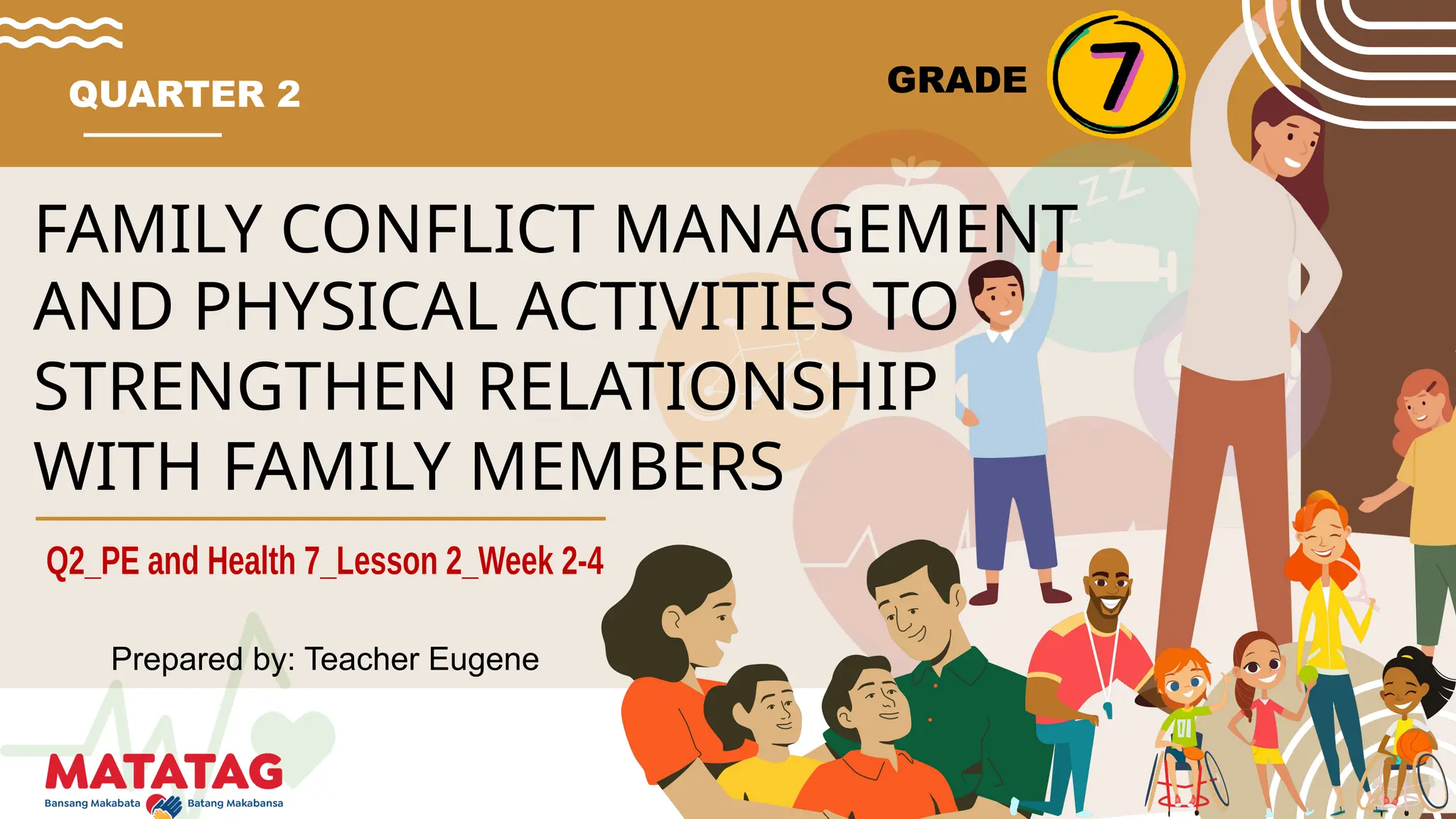
FAMILY CONFLICT MANAGEMENT
AND PHYSICAL ACTIVITIES TO
STRENGTHEN RELATIONSHIP
WITH FAMILY MEMBERS
Prepared by: Teacher Eugene
GRADE
QUARTER 2
Content Standards:
•The learners demonstrate
understanding of family roles in
managing concerns and conflicts and
invasion games in promoting family
wellness for active and healthy living.
Performance Standards:
•The learners participate in invasion
games and other physical activities in
promoting family wellness for active
and healthy living.
Learning Competency:
•apply effective strategies in
preventing and managing conflicts in
the family;
•analyze how physical activities can
strengthen relationships with family
members;
Learning Objectives:
1. apply effective strategies in preventing and managing
conflicts in the family;
2. analyze how physical activities can strengthen
relationships with family members;
3. explain the characteristics and importance of
promoting a healthy family;
4. demonstrate one’s roles and responsibilities in
promoting family health.
Activating Prior Knowledge
•Why should we explore the dynamics
of family conflicts?
•Why do conflicts arise in the family?
•How do these conflicts affect the
members of the family?
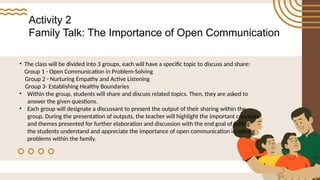
Activity 2
Family Talk: The Importance of Open Communication
• The class will be divided into 3 groups, each will have a specific topic to discuss and share:
Group 1 - Open Communication in Problem-Solving
Group 2 - Nurturing Empathy and Active Listening
Group 3- Establishing Healthy Boundaries
• Within the group, students will share and discuss related topics. Then, they are asked to
answer the given questions.
• Each group will designate a discussant to present the output of their sharing within the
group. During the presentation of outputs, the teacher will highlight the important concepts
and themes presented for further elaboration and discussion with the end goal of letting
the students understand and appreciate the importance of open communication in solving
problems within the family.
Guide Questions:
Group 1:
A. Why is open communication important in the context of
solving family problems?
B. What are the possible strategies that can be employed
by the family in attaining effective communication?
C. As a student and a member of a family, how will you
apply or teach open communication in your own family?
Guide Questions:
Group 2:
A. When can you be considered a good or active listener?
B. How will you show empathy within your family?
C. Is listening a form of open communication? Prove your
answer.
Guide Questions:
Group 3:
A. How will you establish a healthy boundary within your
family?
B. Is having boundaries in the family a good way of
communicating and understanding within the family?
Provide scenarios.
C. What are possible boundaries in the family that creates
positive results?
FAMILY TALK: THE
IMPORTANCE OF OPEN
COMMUNICATION
Topic:
Day 2
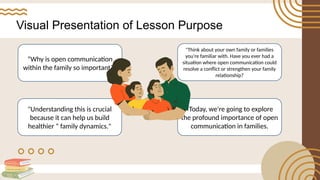
Visual Presentation of Lesson Purpose
“Why is open communication
within the family so important?”
"Think about your own family or families
you're familiar with. Have you ever had a
situation where open communication could
resolve a conflict or strengthen your family
relationship?
"Understanding this is crucial
because it can help us build
healthier “ family dynamics."
“Today, we're going to explore
the profound importance of open
communication in families.
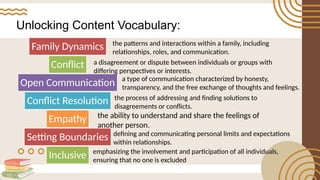
Unlocking Content Vocabulary:
Family Dynamics
Conflict
Open Communication
Conflict Resolution
Empathy
Setting Boundaries
Inclusive
the patterns and interactions within a family, including
relationships, roles, and communication.
a disagreement or dispute between individuals or groups with
differing perspectives or interests.
a type of communication characterized by honesty,
transparency, and the free exchange of thoughts and feelings.
the process of addressing and finding solutions to
disagreements or conflicts.
the ability to understand and share the feelings of
another person.
defining and communicating personal limits and expectations
within relationships.
emphasizing the involvement and participation of all individuals,
ensuring that no one is excluded
Family Conflict Management
1.Can you recall a scenario wherein there was a conflict
in your family? How did your family resolve it?
2.What is "conflict management" in a family context?
3.Why is it important to address conflicts within a
family?
Guide Questions:
Family Game Showdown:
Team Formation
• You will be divided into teams.
• Each team will have an equal number of students. Work together with your
teammates to brainstorm and strategize.
Team Name
• Choose a creative and catchy name for your team. Write it on top of your
worksheet.
Scenario Sheets
• Each team will receive a scenario sheet outlining a family conflict.
• Read the scenario carefully with your team members.
• Understand the conflict and discuss its complexities.
Instructions:
Family Game Showdown:
Brainstorming Session (15 minutes)
• Use the given 15 minutes to brainstorm and discuss your conflict resolution
strategy. Think about creative and effective ways to resolve the conflicts in the
scenarios.
• Consider the principles of conflict resolution: communication, compromise,
empathy, and understanding.
• Your strategy should reflect these principles. Be Creative - Think of innovative
solutions. Your strategy doesn't have to be conventional – unique ideas are
encouraged!
Instructions:
Game Show Presentation:
• Each team will take turns presenting their conflict resolution
strategy to the class. Be confident and articulate while
presenting.
• Use the provided buzzers and scoreboard. Make your
presentation engaging by using these visual aids.
• Other teams will have buzzers to provide feedback or ask
questions about your strategy. Be prepared to answer
questions from your classmates.
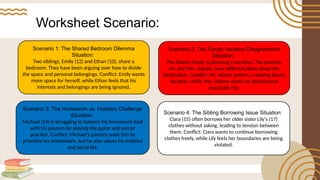
Worksheet Scenario:
Scenario 1: The Shared Bedroom Dilemma
Situation:
Two siblings, Emily (12) and Ethan (10), share a
bedroom. They have been arguing over how to divide
the space and personal belongings. Conflict: Emily wants
more space for herself, while Ethan feels that his
interests and belongings are being ignored.
Scenario 2: The Family Vacation Disagreement
Situation:
The Adams family is planning a vacation. The parents,
Mr. and Mrs. Adams, have different ideas about the
destination. Conflict: Mr. Adams prefers a relaxing beach
vacation, while Mrs. Adams wants an adventurous
mountain trip.
Scenario 3: The Homework vs. Hobbies Challenge
Situation:
Michael (14) is struggling to balance his homework load
with his passion for playing the guitar and soccer
practice. Conflict: Michael's parents want him to
prioritize his schoolwork, but he also values his hobbies
and social life.
Scenario 4: The Sibling Borrowing Issue Situation:
Clara (15) often borrows her older sister Lily's (17)
clothes without asking, leading to tension between
them. Conflict: Clara wants to continue borrowing
clothes freely, while Lily feels her boundaries are being
violated.
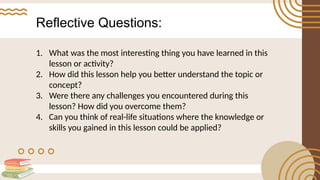
Reflective Questions:
1. What was the most interesting thing you have learned in this
lesson or activity?
2. How did this lesson help you better understand the topic or
concept?
3. Were there any challenges you encountered during this
lesson? How did you overcome them?
4. Can you think of real-life situations where the knowledge or
skills you gained in this lesson could be applied?
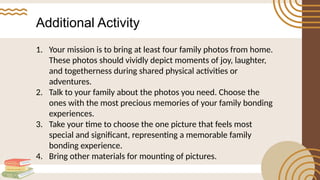
Additional Activity
1. Your mission is to bring at least four family photos from home.
These photos should vividly depict moments of joy, laughter,
and togetherness during shared physical activities or
adventures.
2. Talk to your family about the photos you need. Choose the
ones with the most precious memories of your family bonding
experiences.
3. Take your time to choose the one picture that feels most
special and significant, representing a memorable family
bonding experience.
4. Bring other materials for mounting of pictures.

PHYSICAL ACTIVITIES
TO STRENGTHEN
RELATIONSHIP WITH
FAMILY
MEMBERS
Topic:
Day 3
Video-Watching!
Discussion:
• What did you notice in the video? How did the family members seem to
feel while engaging in these activities?
• Use descriptive words like "happy," "connected," and "excited."
• How do you think physical activities like these can contribute to a sense of
togetherness and bonding within a family?
• Share your thoughts on how engaging in physical activities as a family
might make you feel. Do you think it can improve relationships within a
family?
• Were there any moments in the video that particularly stood out to you
regarding the family's interactions or emotions?
• Discuss any specific moments, gestures, or expressions that caught your
attention. What do you think about those moments?
Activity 5:
Crafting the Interactive Family
Photo Wall Creating
Descriptions
Assembling the Interactive Family
Photo Wall
• A designated wall space awaits your creative touch. This is where the
magic happens! Work together in an orderly manner to affix your
family photos to the wall. Ensure there's enough space beside each
image for the attached descriptions.
• As you attach your photos, take a moment to read and appreciate the
descriptions provided by your peers. Feel the warmth and love
radiating from each family's unique bonding experience.
Sharing and Reflection:
• Once the interactive family photo wall is complete, gather
around this visual masterpiece. Each of you will take turns
presenting your family photo, reading your description aloud,
and sharing the significance of the moment captured.
• Engage in open discussions. Reflect on how these shared
physical activities deepen the bonds within families. Consider
the varied experiences and emotions, appreciating the
diversity in family stories.
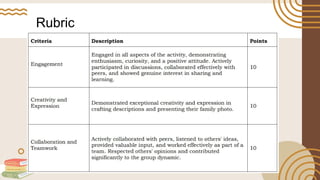
• Be guided with the Rubric given.
Rubric
Reflective Questions:
• Why is sharing your family photos with descriptions to
your classmates important?
• How do photo wall and video presentation deepen your
understanding of family bonds and physical activities?
• How do peers' reactions to your family photos with
descriptions affect your reflection and learning on the
topic?
SIGNIFICANT ROLE OF
A FAMILY IN
MANAGING
ADOLESCENT
CONCERNS
Topic:
Day 4
Family Conflict Management
1.Think about the health concerns that teenagers commonly
dealt with. Consider physical, emotional, and social aspects
of health.
2.Write down at least three health concerns you believe
teenagers might face and how these concerns affect your
day to-day lives.
Task:
Physical Activities to Strengthen
Relationships with Family Members
1.What fun activities did you explore to strengthen your
bond with your family members?
2.How do these activities help create stronger connections
and better communication within the family?
3.Can you describe an activity you found most enjoyable for
bringing your family closer together?
ACADEMIC VLOG
ON FAMILY
PHYSICAL ACTIVITY
Day 5
Objective:
• Create an academic vlog that documents their family's
engagement in physical activities and illustrates the impact
of these activities on family bonding.
Materials Needed:
• Recording devices - Cameras (digital, smartphone cameras, or
video cameras) for capturing high-quality videos and photos.
• Tripods or stabilizers - Tripods or stabilizers to ensure steady
and professional-looking footage.
• Audio equipment - Microphones (external microphones or
smartphone-compatible microphones) for clear audio recording
during activities and interviews
• Props and equipment - Sports equipment (e.g., balls, rackets,
bicycles) depending on the chosen physical activities.
Mechanics:
• You will select two or more physical activities from your brainstormed
list. This allows you to choose meaningful activities for your family and
provide a diverse range of content for your vlog.
• You must record your family's engagement in the chosen activities. You
can use either recordings or short video clips to showcase these
activities. This hands-on approach must encourage you to participate in
the chosen activities and document the experience actively.
• You are advised to organize your content by creating a dedicated folder
on your device or physically.
• Your teacher will guide you in creating multimedia presentations using
PowerPoint or Google Slides. The suggested structure includes:
Mechanics:
• Title Slide .This slide should introduce the vlog, including the title, the student's
name, and a brief introduction.
• Introduction. In this section, students need to explain the purpose of their
presentation. They should outline what the vlog is about and what they aim to
achieve.
• Activities. This part of the presentation should describe the chosen physical
activities. Visual evidence, such as photos and videos, should be included to
showcase the activities. This allows the audience to see what the family did
regarding physical activities.
• Family Bonding. In this section, students should discuss how these activities
impact family bonding. Visual elements like photos and videos can be used to
illustrate these points, and journal entries can add a personal touch to the
narrative. This part helps the audience understand the connection between
physical activities and family bonding.
Reflection:
● How did this activity diary enhance
your understanding of family bonding
through physical activities?
● What have you learned about your
family and yourself during this week?
THANK YOU

Exploring Family Dynamics: Identifying Conflicts using Padlet.pptx

  • 1.
    FAMILY CONFLICT MANAGEMENT ANDPHYSICAL ACTIVITIES TO STRENGTHEN RELATIONSHIP WITH FAMILY MEMBERS Prepared by: Teacher Eugene GRADE QUARTER 2
  • 2.
    Content Standards: •The learnersdemonstrate understanding of family roles in managing concerns and conflicts and invasion games in promoting family wellness for active and healthy living.
  • 3.
    Performance Standards: •The learnersparticipate in invasion games and other physical activities in promoting family wellness for active and healthy living.
  • 4.
    Learning Competency: •apply effectivestrategies in preventing and managing conflicts in the family; •analyze how physical activities can strengthen relationships with family members;
  • 5.
    Learning Objectives: 1. applyeffective strategies in preventing and managing conflicts in the family; 2. analyze how physical activities can strengthen relationships with family members; 3. explain the characteristics and importance of promoting a healthy family; 4. demonstrate one’s roles and responsibilities in promoting family health.
  • 6.
    Activating Prior Knowledge •Whyshould we explore the dynamics of family conflicts? •Why do conflicts arise in the family? •How do these conflicts affect the members of the family?
  • 7.
    Activity 2 Family Talk:The Importance of Open Communication • The class will be divided into 3 groups, each will have a specific topic to discuss and share: Group 1 - Open Communication in Problem-Solving Group 2 - Nurturing Empathy and Active Listening Group 3- Establishing Healthy Boundaries • Within the group, students will share and discuss related topics. Then, they are asked to answer the given questions. • Each group will designate a discussant to present the output of their sharing within the group. During the presentation of outputs, the teacher will highlight the important concepts and themes presented for further elaboration and discussion with the end goal of letting the students understand and appreciate the importance of open communication in solving problems within the family.
  • 8.
    Guide Questions: Group 1: A.Why is open communication important in the context of solving family problems? B. What are the possible strategies that can be employed by the family in attaining effective communication? C. As a student and a member of a family, how will you apply or teach open communication in your own family?
  • 9.
    Guide Questions: Group 2: A.When can you be considered a good or active listener? B. How will you show empathy within your family? C. Is listening a form of open communication? Prove your answer.
  • 10.
    Guide Questions: Group 3: A.How will you establish a healthy boundary within your family? B. Is having boundaries in the family a good way of communicating and understanding within the family? Provide scenarios. C. What are possible boundaries in the family that creates positive results?
  • 11.
    FAMILY TALK: THE IMPORTANCEOF OPEN COMMUNICATION Topic: Day 2
  • 12.
    Visual Presentation ofLesson Purpose “Why is open communication within the family so important?” "Think about your own family or families you're familiar with. Have you ever had a situation where open communication could resolve a conflict or strengthen your family relationship? "Understanding this is crucial because it can help us build healthier “ family dynamics." “Today, we're going to explore the profound importance of open communication in families.
  • 13.
    Unlocking Content Vocabulary: FamilyDynamics Conflict Open Communication Conflict Resolution Empathy Setting Boundaries Inclusive the patterns and interactions within a family, including relationships, roles, and communication. a disagreement or dispute between individuals or groups with differing perspectives or interests. a type of communication characterized by honesty, transparency, and the free exchange of thoughts and feelings. the process of addressing and finding solutions to disagreements or conflicts. the ability to understand and share the feelings of another person. defining and communicating personal limits and expectations within relationships. emphasizing the involvement and participation of all individuals, ensuring that no one is excluded
  • 14.
    Family Conflict Management 1.Canyou recall a scenario wherein there was a conflict in your family? How did your family resolve it? 2.What is "conflict management" in a family context? 3.Why is it important to address conflicts within a family? Guide Questions:
  • 15.
    Family Game Showdown: TeamFormation • You will be divided into teams. • Each team will have an equal number of students. Work together with your teammates to brainstorm and strategize. Team Name • Choose a creative and catchy name for your team. Write it on top of your worksheet. Scenario Sheets • Each team will receive a scenario sheet outlining a family conflict. • Read the scenario carefully with your team members. • Understand the conflict and discuss its complexities. Instructions:
  • 16.
    Family Game Showdown: BrainstormingSession (15 minutes) • Use the given 15 minutes to brainstorm and discuss your conflict resolution strategy. Think about creative and effective ways to resolve the conflicts in the scenarios. • Consider the principles of conflict resolution: communication, compromise, empathy, and understanding. • Your strategy should reflect these principles. Be Creative - Think of innovative solutions. Your strategy doesn't have to be conventional – unique ideas are encouraged! Instructions:
  • 17.
    Game Show Presentation: •Each team will take turns presenting their conflict resolution strategy to the class. Be confident and articulate while presenting. • Use the provided buzzers and scoreboard. Make your presentation engaging by using these visual aids. • Other teams will have buzzers to provide feedback or ask questions about your strategy. Be prepared to answer questions from your classmates.
  • 18.
    Worksheet Scenario: Scenario 1:The Shared Bedroom Dilemma Situation: Two siblings, Emily (12) and Ethan (10), share a bedroom. They have been arguing over how to divide the space and personal belongings. Conflict: Emily wants more space for herself, while Ethan feels that his interests and belongings are being ignored. Scenario 2: The Family Vacation Disagreement Situation: The Adams family is planning a vacation. The parents, Mr. and Mrs. Adams, have different ideas about the destination. Conflict: Mr. Adams prefers a relaxing beach vacation, while Mrs. Adams wants an adventurous mountain trip. Scenario 3: The Homework vs. Hobbies Challenge Situation: Michael (14) is struggling to balance his homework load with his passion for playing the guitar and soccer practice. Conflict: Michael's parents want him to prioritize his schoolwork, but he also values his hobbies and social life. Scenario 4: The Sibling Borrowing Issue Situation: Clara (15) often borrows her older sister Lily's (17) clothes without asking, leading to tension between them. Conflict: Clara wants to continue borrowing clothes freely, while Lily feels her boundaries are being violated.
  • 19.
    Reflective Questions: 1. Whatwas the most interesting thing you have learned in this lesson or activity? 2. How did this lesson help you better understand the topic or concept? 3. Were there any challenges you encountered during this lesson? How did you overcome them? 4. Can you think of real-life situations where the knowledge or skills you gained in this lesson could be applied?
  • 20.
    Additional Activity 1. Yourmission is to bring at least four family photos from home. These photos should vividly depict moments of joy, laughter, and togetherness during shared physical activities or adventures. 2. Talk to your family about the photos you need. Choose the ones with the most precious memories of your family bonding experiences. 3. Take your time to choose the one picture that feels most special and significant, representing a memorable family bonding experience. 4. Bring other materials for mounting of pictures.
  • 21.
    PHYSICAL ACTIVITIES TO STRENGTHEN RELATIONSHIPWITH FAMILY MEMBERS Topic: Day 3
  • 22.
  • 23.
    Discussion: • What didyou notice in the video? How did the family members seem to feel while engaging in these activities? • Use descriptive words like "happy," "connected," and "excited." • How do you think physical activities like these can contribute to a sense of togetherness and bonding within a family? • Share your thoughts on how engaging in physical activities as a family might make you feel. Do you think it can improve relationships within a family? • Were there any moments in the video that particularly stood out to you regarding the family's interactions or emotions? • Discuss any specific moments, gestures, or expressions that caught your attention. What do you think about those moments?
  • 24.
    Activity 5: Crafting theInteractive Family Photo Wall Creating Descriptions
  • 25.
    Assembling the InteractiveFamily Photo Wall • A designated wall space awaits your creative touch. This is where the magic happens! Work together in an orderly manner to affix your family photos to the wall. Ensure there's enough space beside each image for the attached descriptions. • As you attach your photos, take a moment to read and appreciate the descriptions provided by your peers. Feel the warmth and love radiating from each family's unique bonding experience.
  • 26.
    Sharing and Reflection: •Once the interactive family photo wall is complete, gather around this visual masterpiece. Each of you will take turns presenting your family photo, reading your description aloud, and sharing the significance of the moment captured. • Engage in open discussions. Reflect on how these shared physical activities deepen the bonds within families. Consider the varied experiences and emotions, appreciating the diversity in family stories. • Be guided with the Rubric given.

  • 27.
  • 28.
    Reflective Questions: • Whyis sharing your family photos with descriptions to your classmates important? • How do photo wall and video presentation deepen your understanding of family bonds and physical activities? • How do peers' reactions to your family photos with descriptions affect your reflection and learning on the topic?
  • 29.
    SIGNIFICANT ROLE OF AFAMILY IN MANAGING ADOLESCENT CONCERNS Topic: Day 4
  • 30.
    Family Conflict Management 1.Thinkabout the health concerns that teenagers commonly dealt with. Consider physical, emotional, and social aspects of health. 2.Write down at least three health concerns you believe teenagers might face and how these concerns affect your day to-day lives. Task:
  • 31.
    Physical Activities toStrengthen Relationships with Family Members 1.What fun activities did you explore to strengthen your bond with your family members? 2.How do these activities help create stronger connections and better communication within the family? 3.Can you describe an activity you found most enjoyable for bringing your family closer together?
  • 32.
  • 33.
    Objective: • Create anacademic vlog that documents their family's engagement in physical activities and illustrates the impact of these activities on family bonding.
  • 34.
    Materials Needed: • Recordingdevices - Cameras (digital, smartphone cameras, or video cameras) for capturing high-quality videos and photos. • Tripods or stabilizers - Tripods or stabilizers to ensure steady and professional-looking footage. • Audio equipment - Microphones (external microphones or smartphone-compatible microphones) for clear audio recording during activities and interviews • Props and equipment - Sports equipment (e.g., balls, rackets, bicycles) depending on the chosen physical activities.
  • 35.
    Mechanics: • You willselect two or more physical activities from your brainstormed list. This allows you to choose meaningful activities for your family and provide a diverse range of content for your vlog. • You must record your family's engagement in the chosen activities. You can use either recordings or short video clips to showcase these activities. This hands-on approach must encourage you to participate in the chosen activities and document the experience actively. • You are advised to organize your content by creating a dedicated folder on your device or physically. • Your teacher will guide you in creating multimedia presentations using PowerPoint or Google Slides. The suggested structure includes:
  • 36.
    Mechanics: • Title Slide.This slide should introduce the vlog, including the title, the student's name, and a brief introduction. • Introduction. In this section, students need to explain the purpose of their presentation. They should outline what the vlog is about and what they aim to achieve. • Activities. This part of the presentation should describe the chosen physical activities. Visual evidence, such as photos and videos, should be included to showcase the activities. This allows the audience to see what the family did regarding physical activities. • Family Bonding. In this section, students should discuss how these activities impact family bonding. Visual elements like photos and videos can be used to illustrate these points, and journal entries can add a personal touch to the narrative. This part helps the audience understand the connection between physical activities and family bonding.
  • 37.
    Reflection: ● How didthis activity diary enhance your understanding of family bonding through physical activities? ● What have you learned about your family and yourself during this week?
  • 38.