eXploring audiovisual Environments
Marie Schacht | ESTIA Bidart, France | august 27th 2013
First French German Tangible Interaction Studio: http://www.fgtis.estia.fr/
introductory example
CHET installation Cynetart Festival, Dresden, 2011
http://www.intolight.de/blog/2011-unser-jahr-der-interaktiven-raeume
http://www.youtube.com/watch?v=MWGRJOj7zwg
photos @ David Pinzer
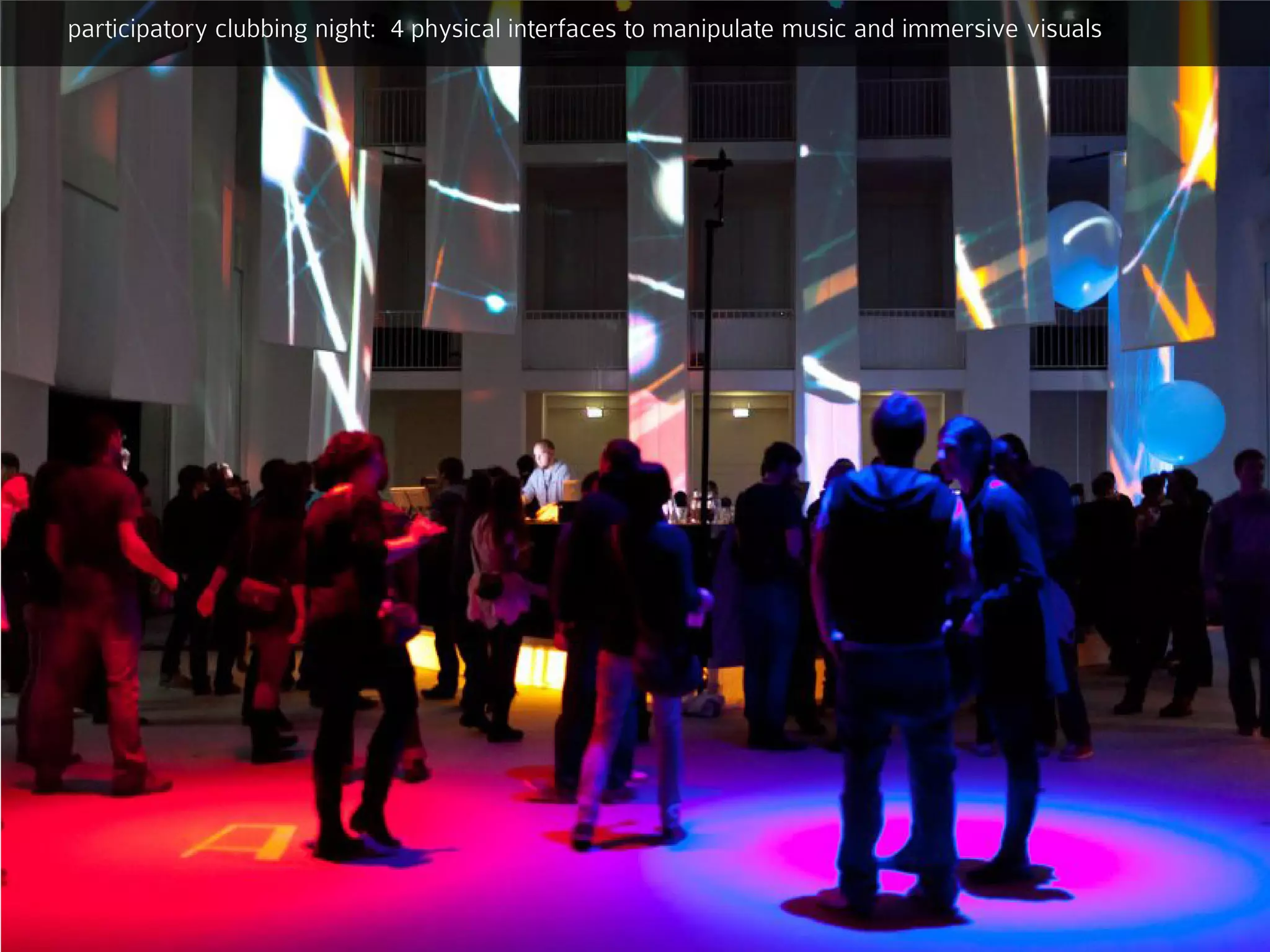
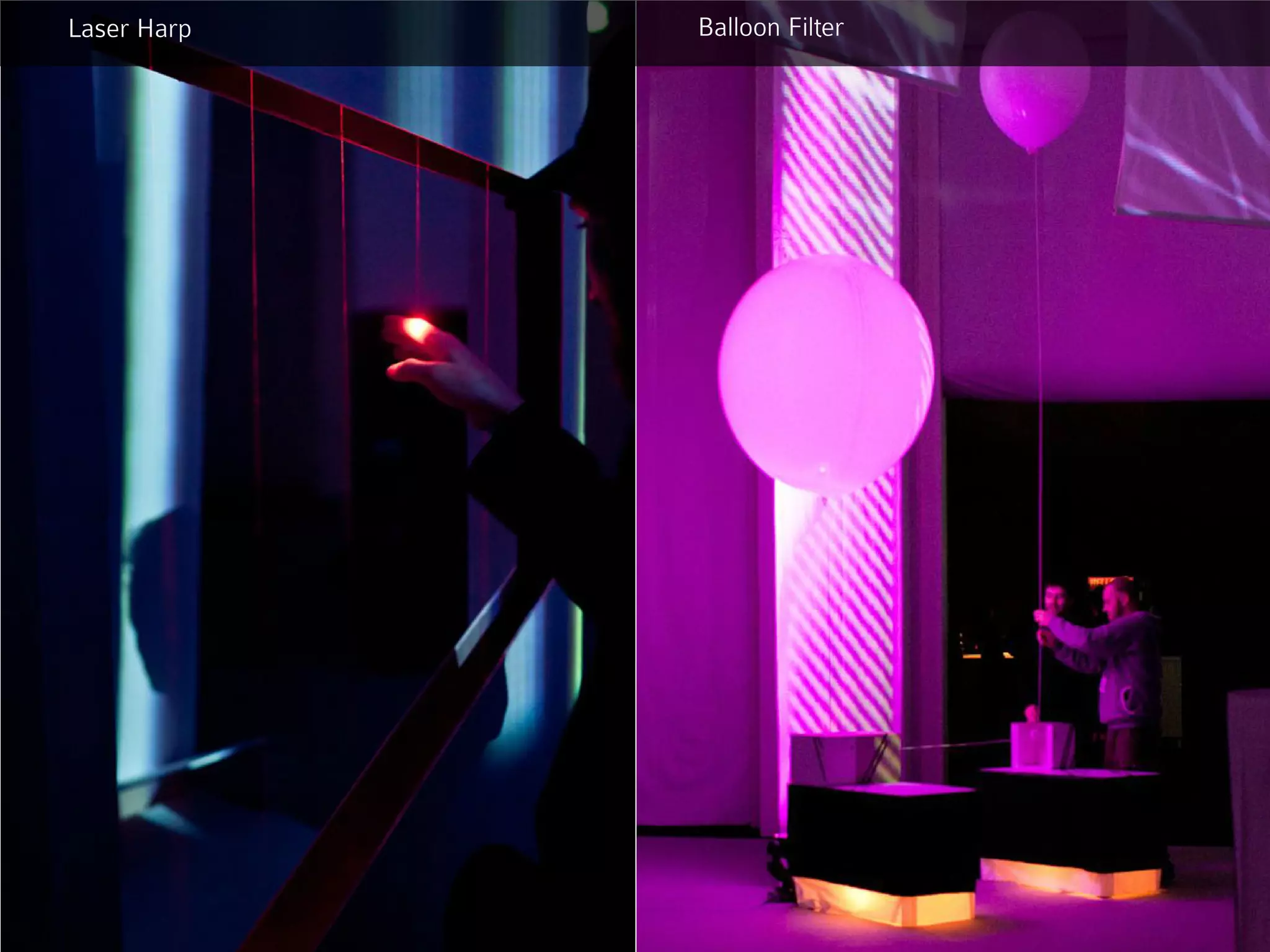
participatory clubbing night: 4 physical interfaces to manipulate music and immersive visuals
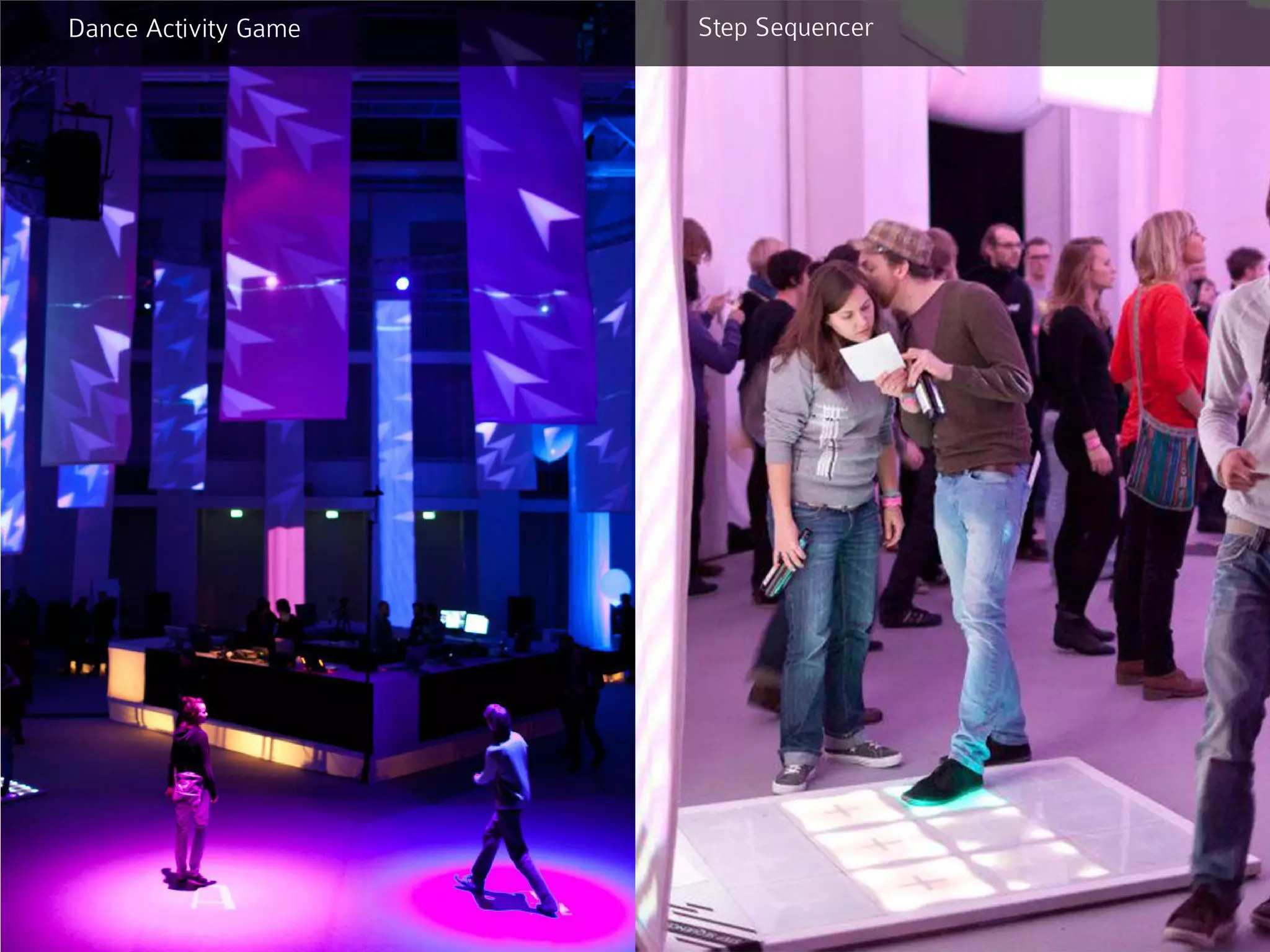
Dance Activity Game Step Sequencer
Laser Harp Balloon Filter
Visual Music
image - sound relationships, classification proposal
music is
physics.
philosophy.
mathematics.
physiology.
anthropology.
art.
cognition.
aesthetics.
… and so much more.
Visual MusiceXploring audiovisual environments | marie schacht | FGTIS colloquium | august 27th 2013
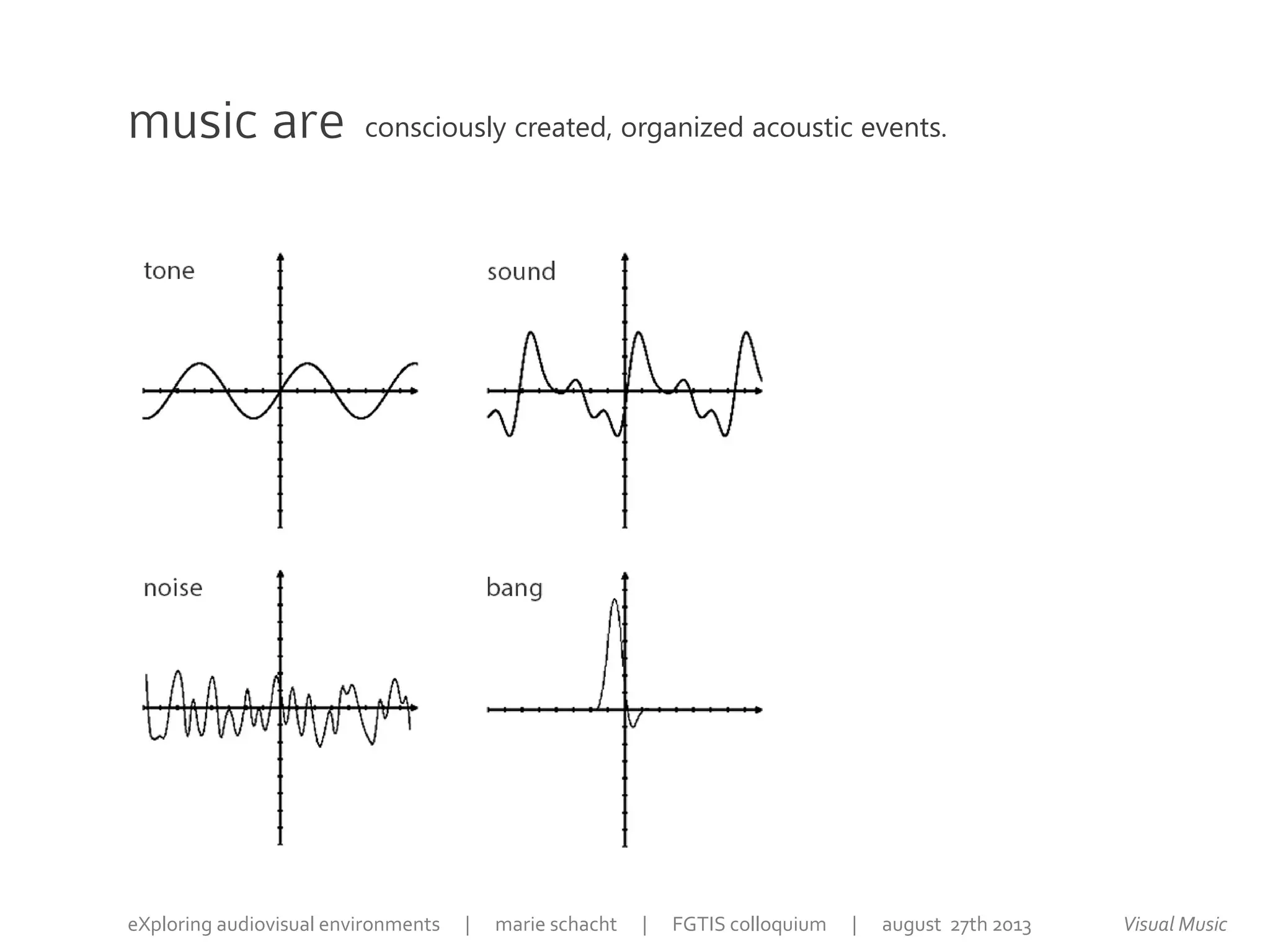
music are consciously created, organized acoustic events.
Visual MusiceXploring audiovisual environments | marie schacht | FGTIS colloquium | august 27th 2013
Music enables not only the auditory nerve, but the whole body to vibrate.
[...] When listening to music, the body is music and music is the body.
[Vilém Flusser 1991]
visual music
 visual music is an art that explores any interaction between sound and image
 notable history, with beginnings leading back to Greek antiquity
 influenced by scientific insights, technological progress, perception studies and
artistic creations
 digital technologies offer diverse ways for the investigation of audiovisual
knowledge exchange
Visual MusiceXploring audiovisual environments | marie schacht | FGTIS colloquium | august 27th 2013
 inspired by publication of JACK OX and CINDY KEEFER, 2008
 the determining factor for distinction is the nature of the audiovisual relationship
visual music >> classification proposal
Visual MusiceXploring audiovisual environments | marie schacht | FGTIS colloquium | august 27th 2013
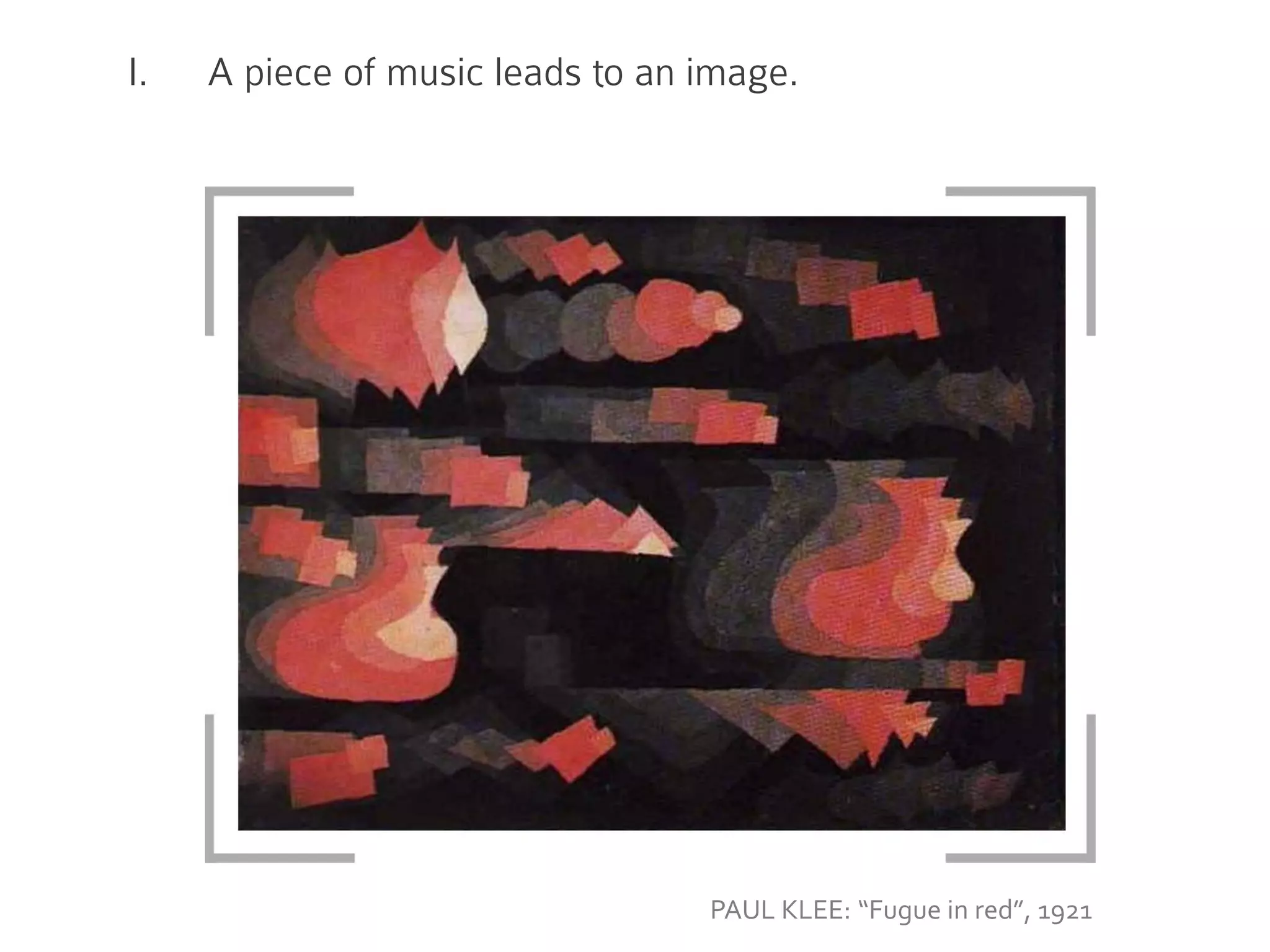
i. A piece of music leads to an image.
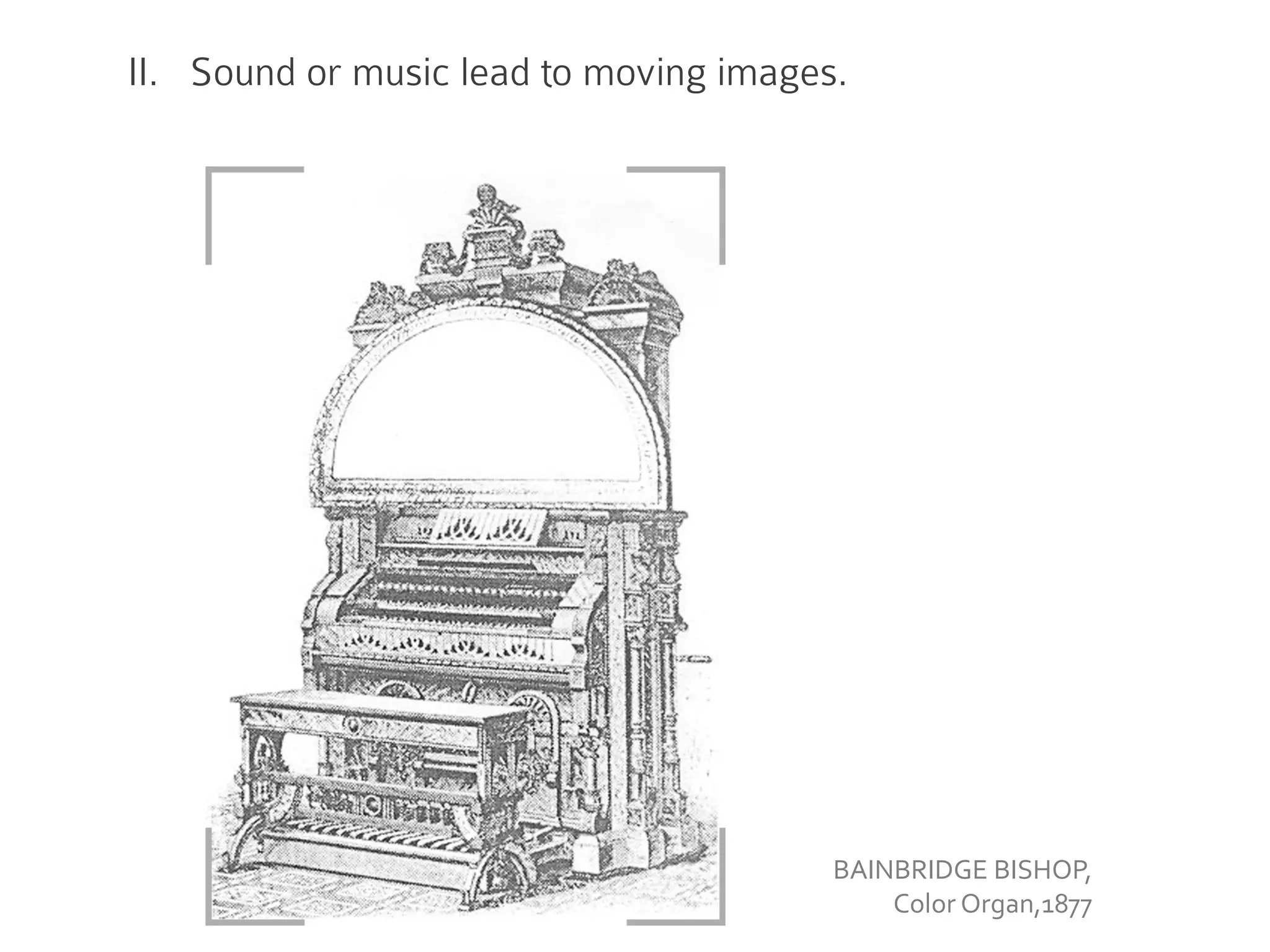
ii. Sound or music lead to moving images.
iii. There is an equal audiovisual recognition and exchange.
iv. Imagery leads to noise or sound.
I. A piece of music leads to an image.
PAUL KLEE: “Fugue in red”, 1921
II. Sound or music lead to moving images.
BAINBRIDGE BISHOP,
Color Organ,1877
i. A piece of music leads to an image.
ii. Sound or music lead to moving images.
a) analogue, mechanical color organ
b) digital color piano
c) abstract visual music – a contemporary art
iii. There is an equal audiovisual recognition and exchange.
iv. Imagery leads to noise or sound.
visual music >> classification proposal
Visual MusiceXploring audiovisual environments | marie schacht | FGTIS colloquium | august 27th 2013
Sound or music lead to moving images.
video examples
http://vimeo.com/23449490
b) digital color piano
http://vimeo.com/20258559
c) abstract visual music
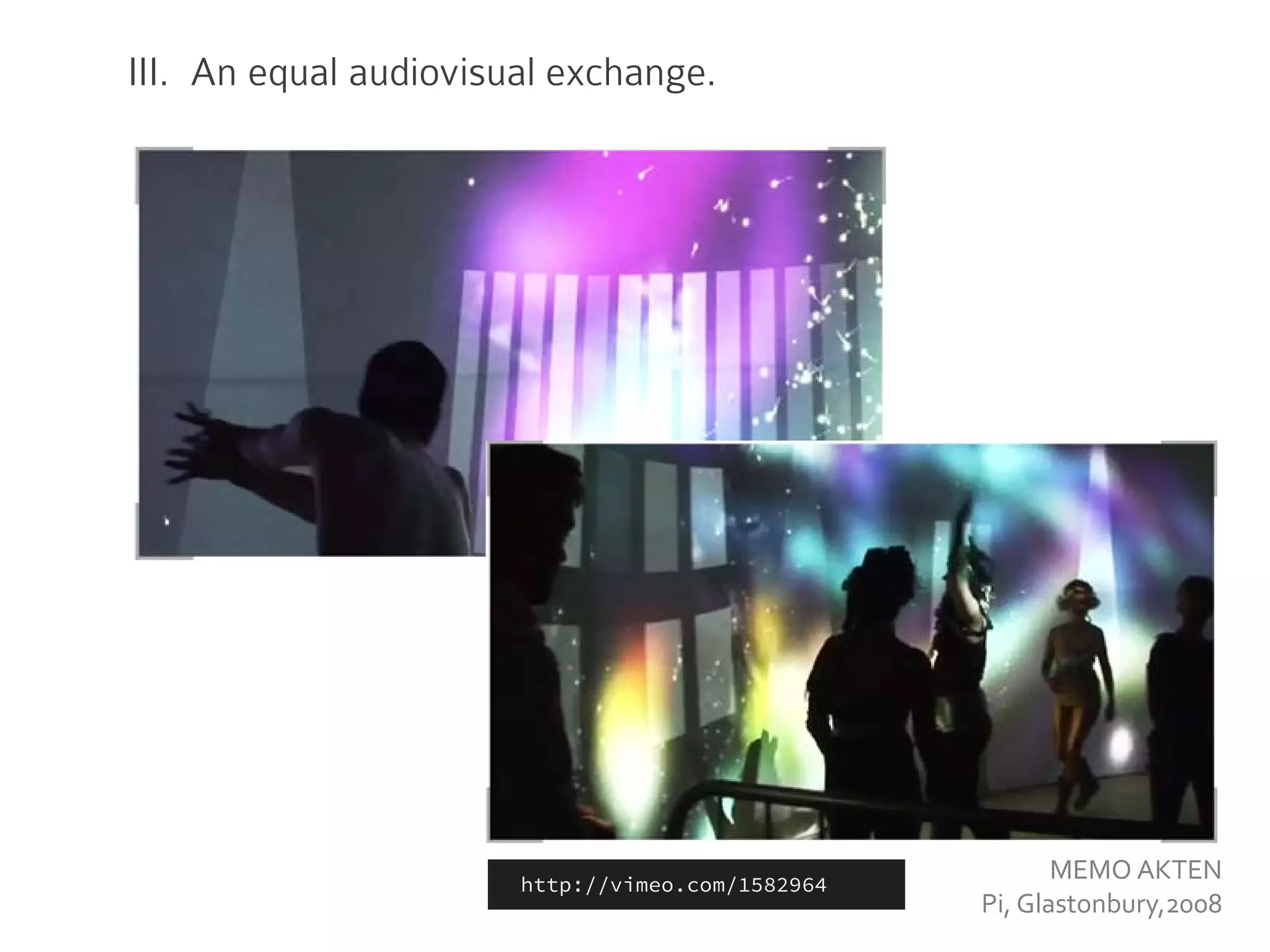
III. An equal audiovisual exchange.
MEMO AKTEN
Pi, Glastonbury,2008
http://vimeo.com/1582964
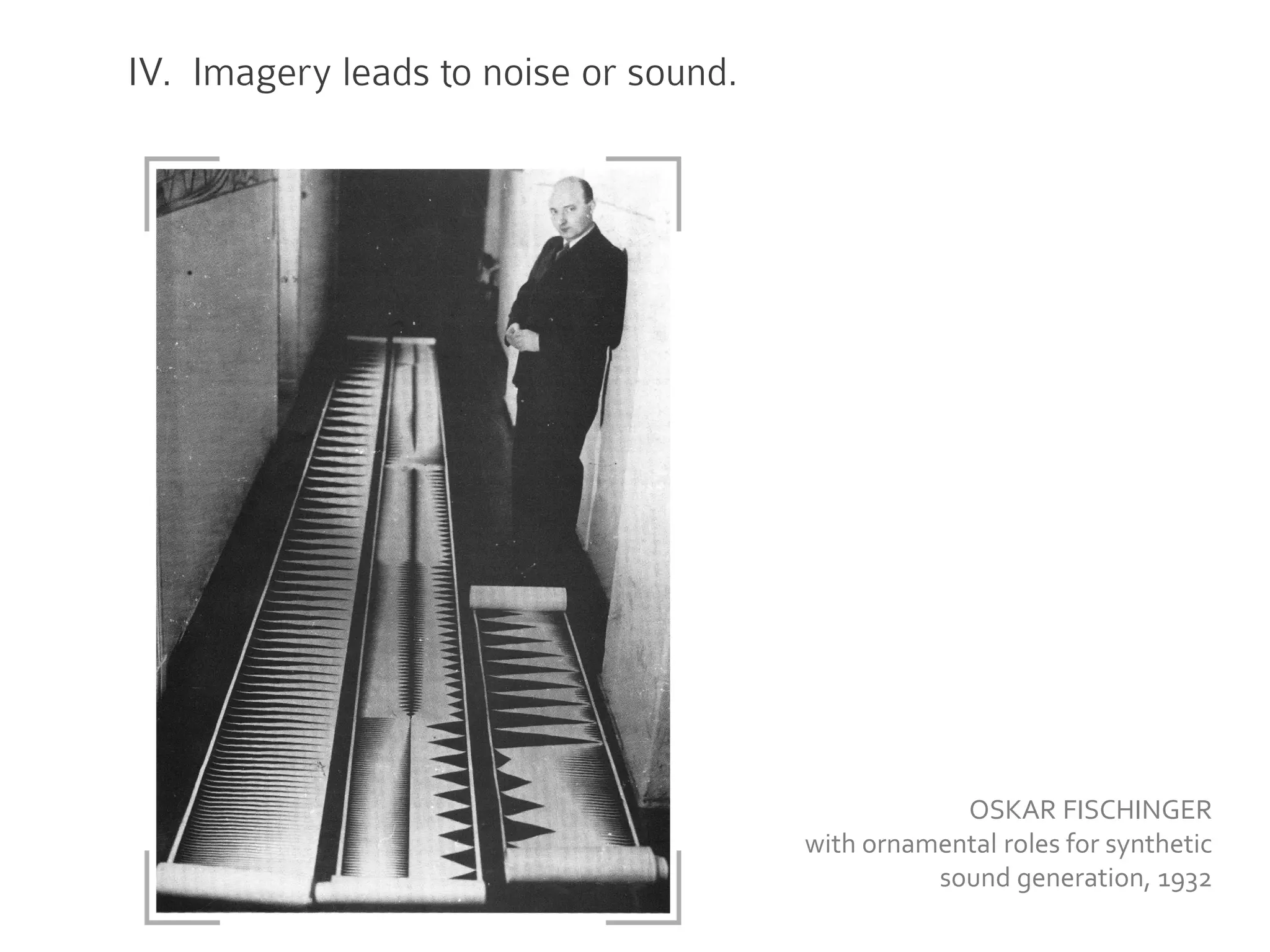
IV. Imagery leads to noise or sound.
OSKAR FISCHINGER
with ornamental roles for synthetic
sound generation, 1932
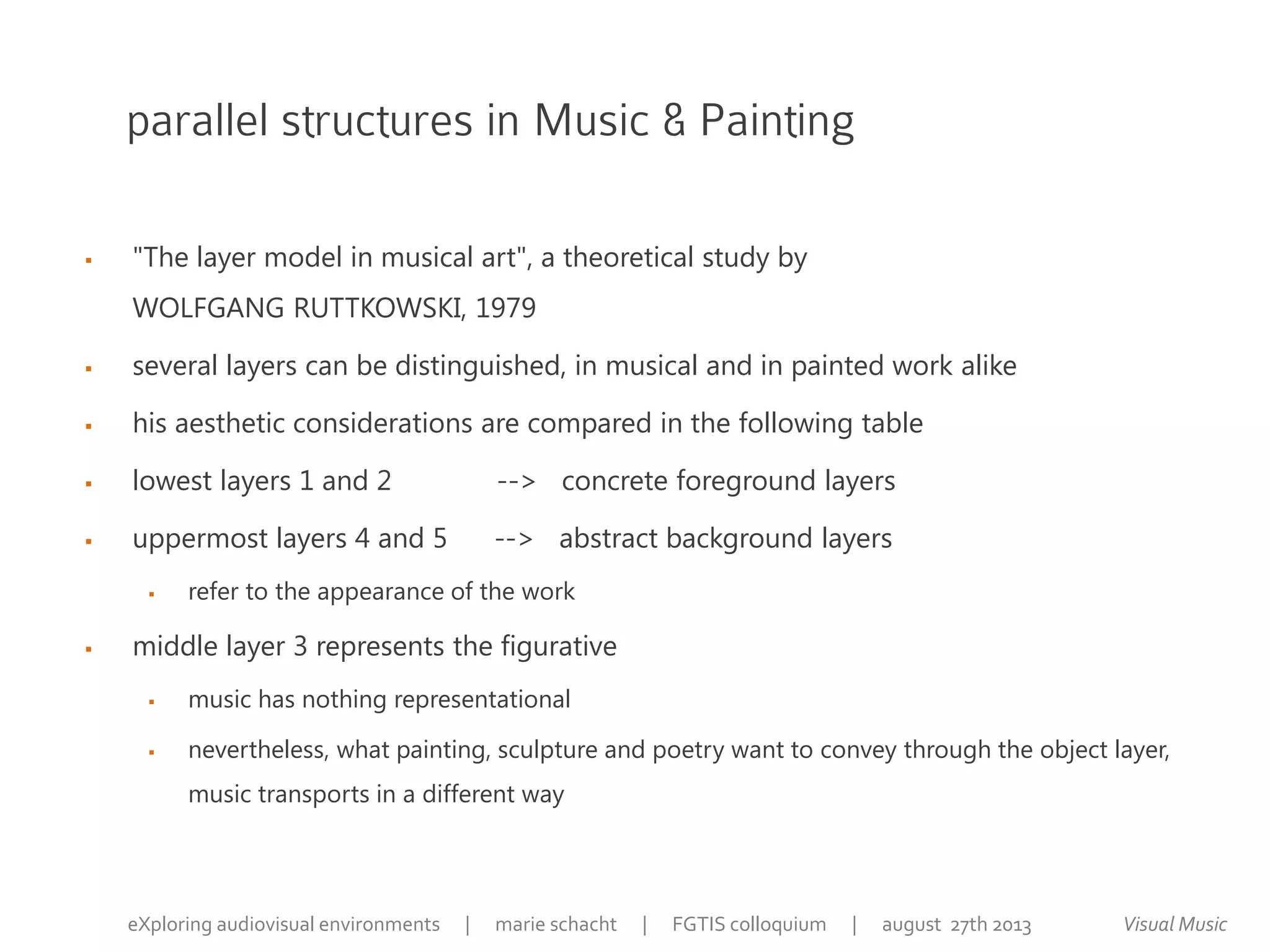
parallel structures in Music & Painting
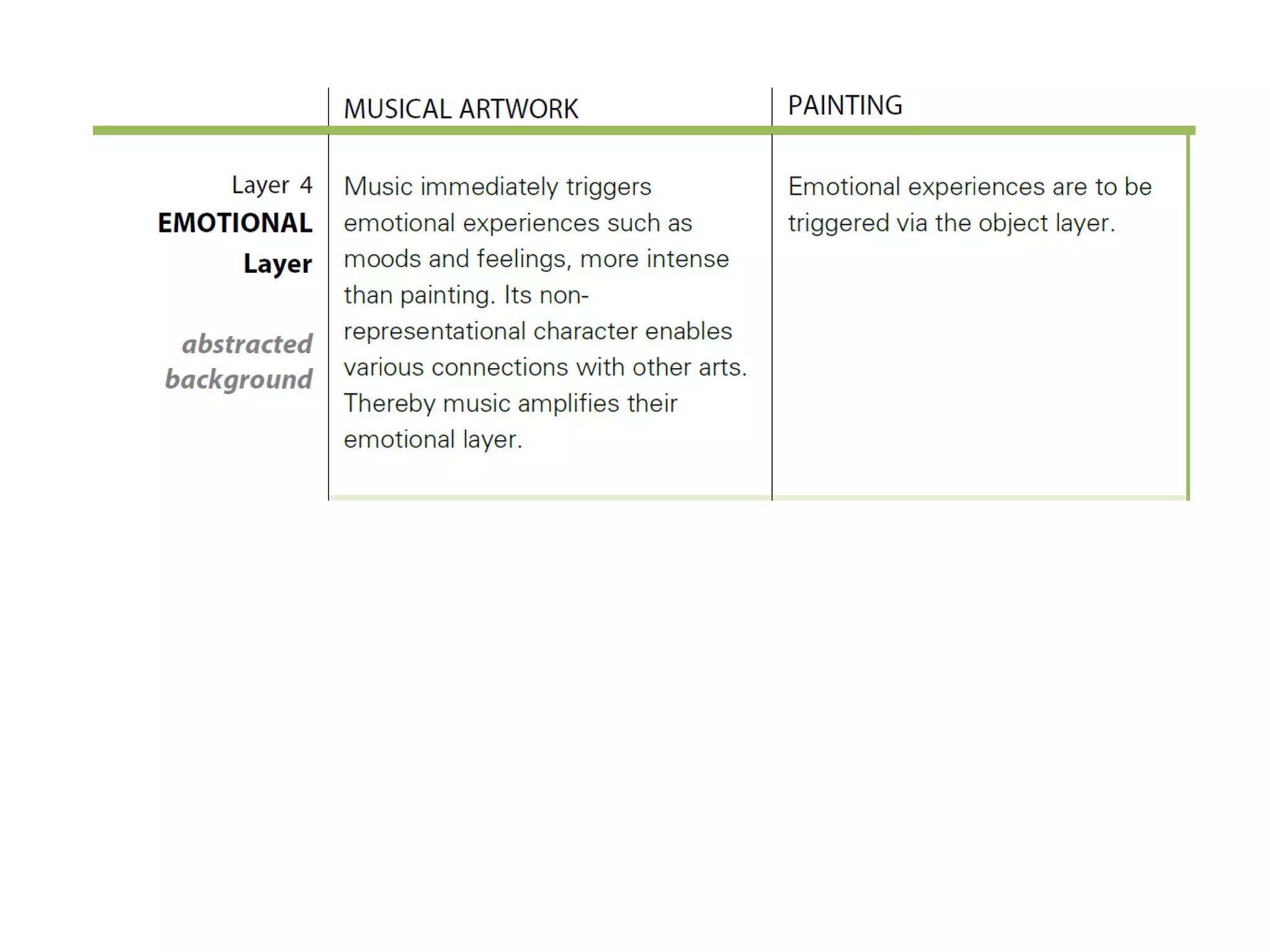
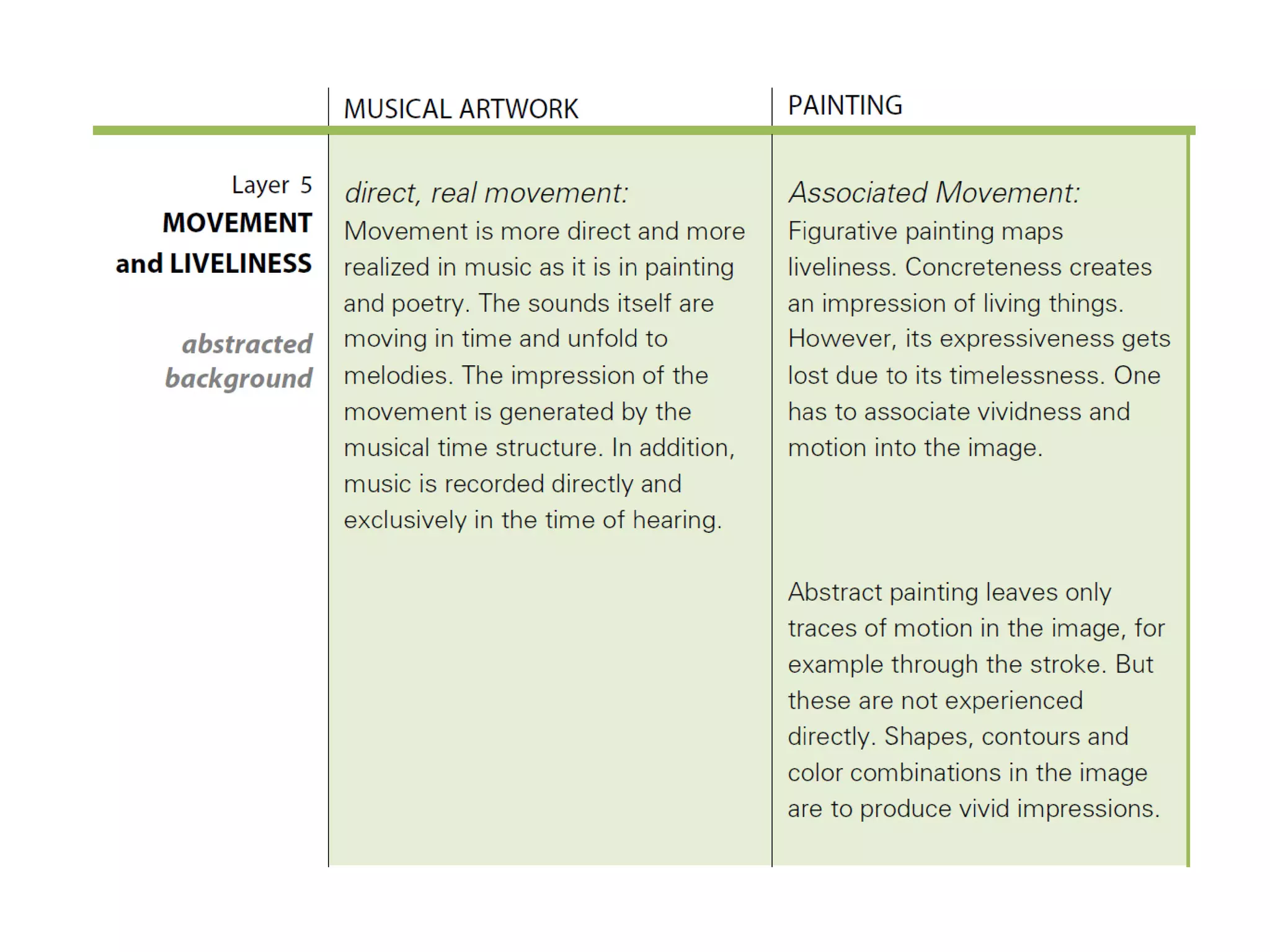
 "The layer model in musical art", a theoretical study by
WOLFGANG RUTTKOWSKI, 1979
 several layers can be distinguished, in musical and in painted work alike
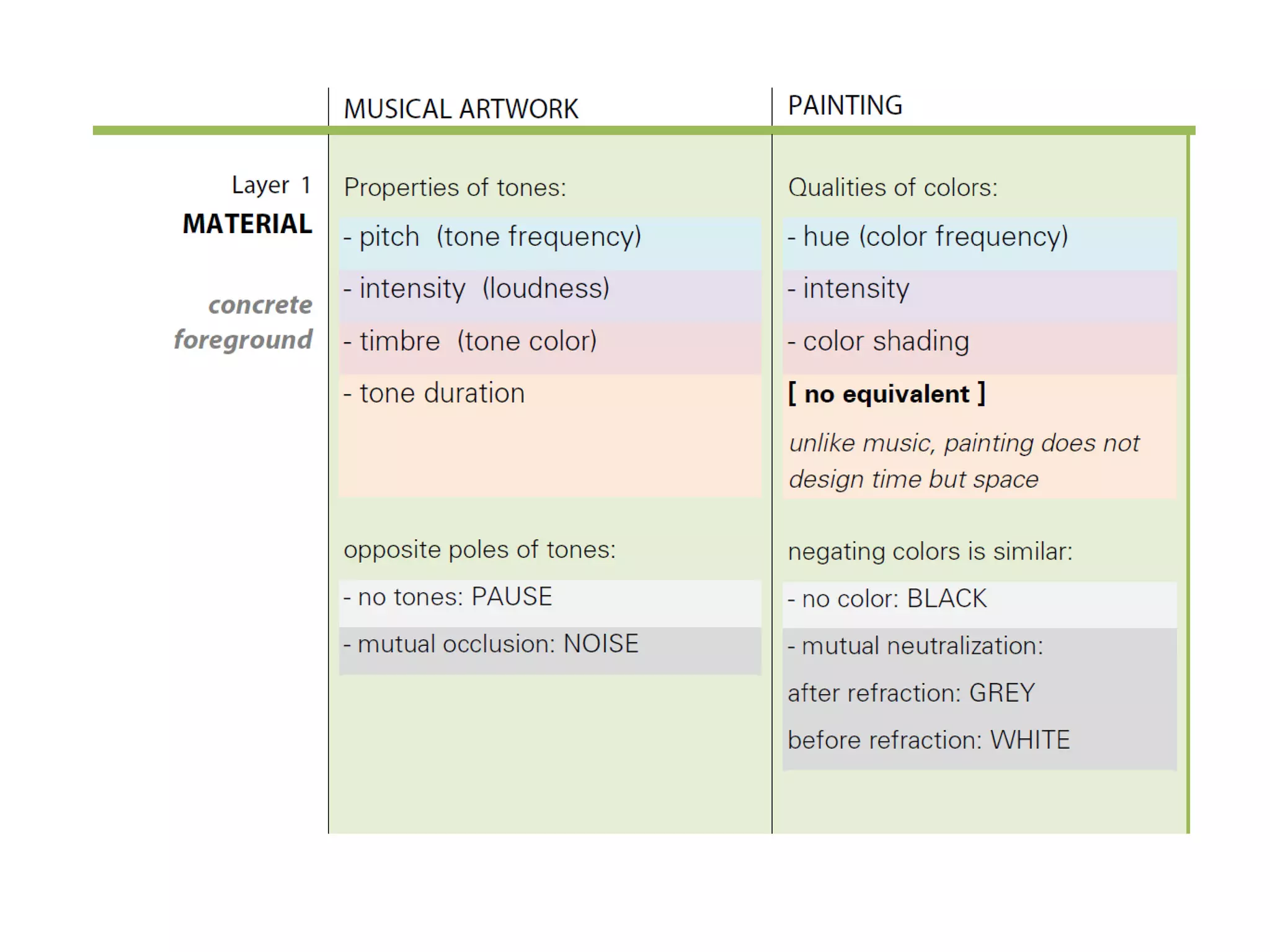
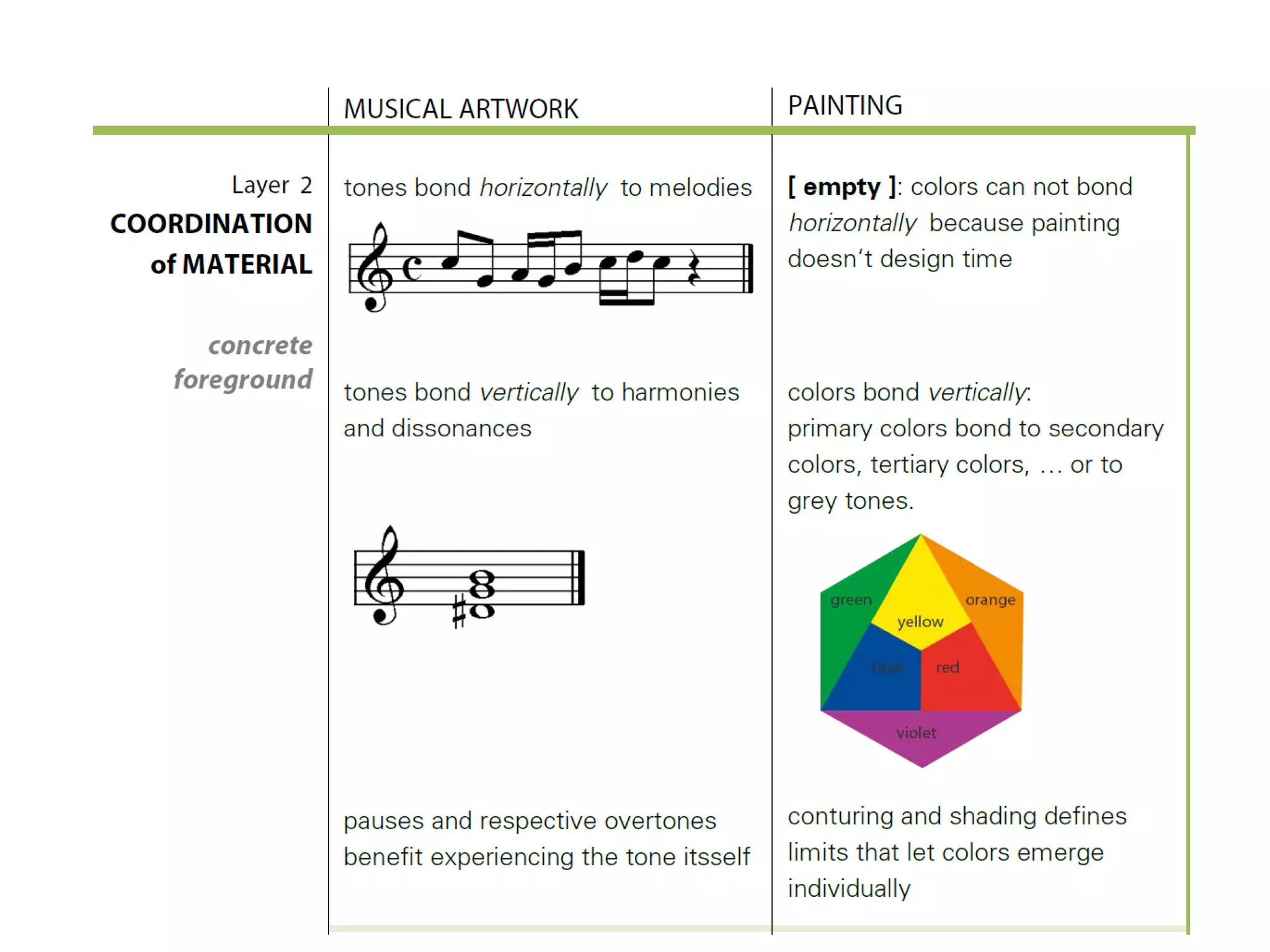
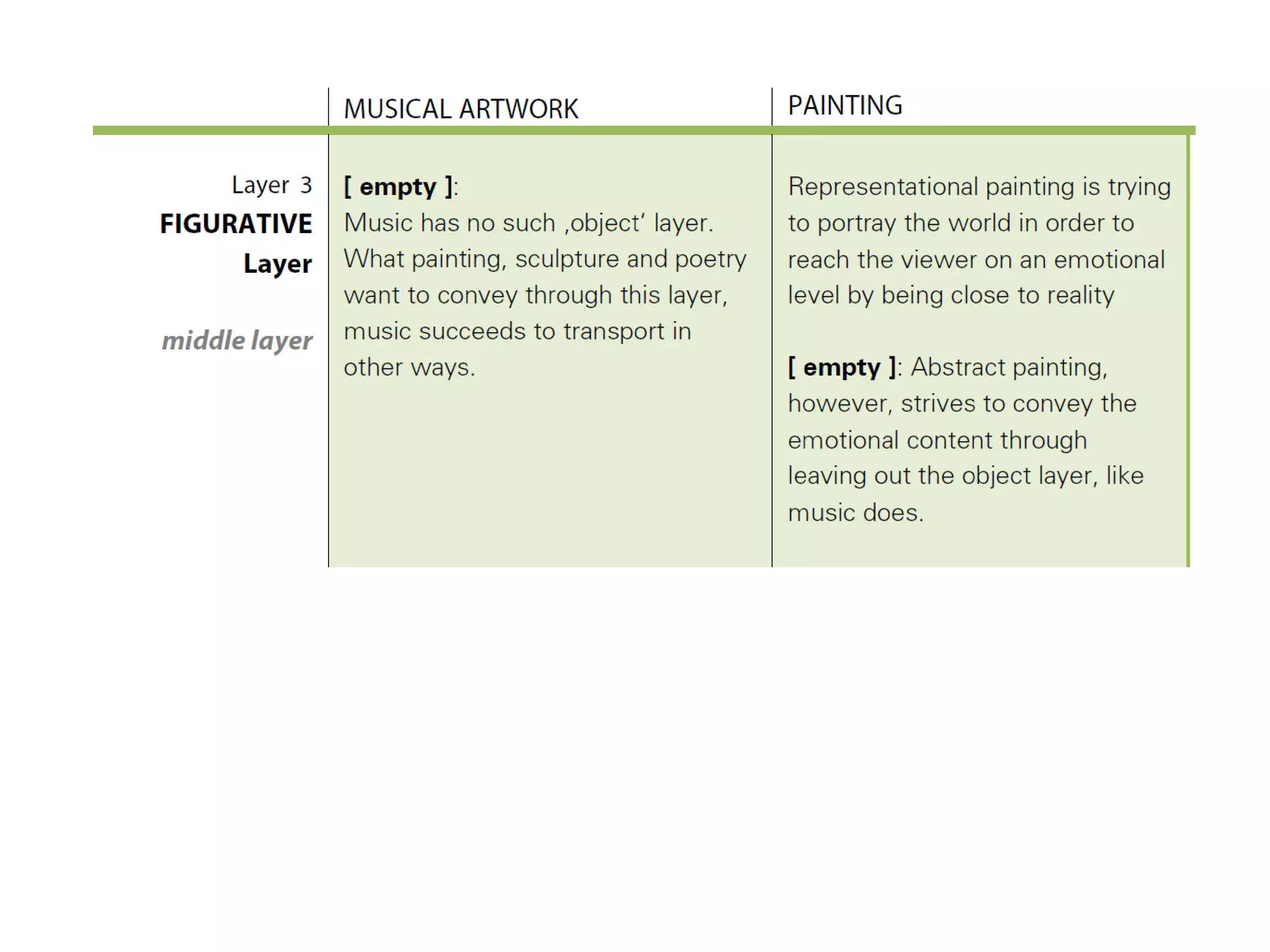
 his aesthetic considerations are compared in the following table
 lowest layers 1 and 2 --> concrete foreground layers
 uppermost layers 4 and 5 --> abstract background layers
 refer to the appearance of the work
 middle layer 3 represents the figurative
 music has nothing representational
 nevertheless, what painting, sculpture and poetry want to convey through the object layer,
music transports in a different way
Visual MusiceXploring audiovisual environments | marie schacht | FGTIS colloquium | august 27th 2013
[Ruttkowski 1979]
In music the language is gathered so closely […] that words
merge and pure meaningless tones remain. From this point
music seems to be the highest, the densest poetry.
[Vilém Flusser]
Generative Design
generative art, generative designing
Generative art is as old as art itself. […] It refers to any art practice
where the artist uses a system, such as a set of natural language rules,
a computer program, a machine, or other procedural invention, which is
set into motion with some degree of autonomy contributing to or resulting
in a completed work of art. [...] Generative Art preceded computer art.
New forms of generative art will come after the computer as well.
[Galanter 2003]
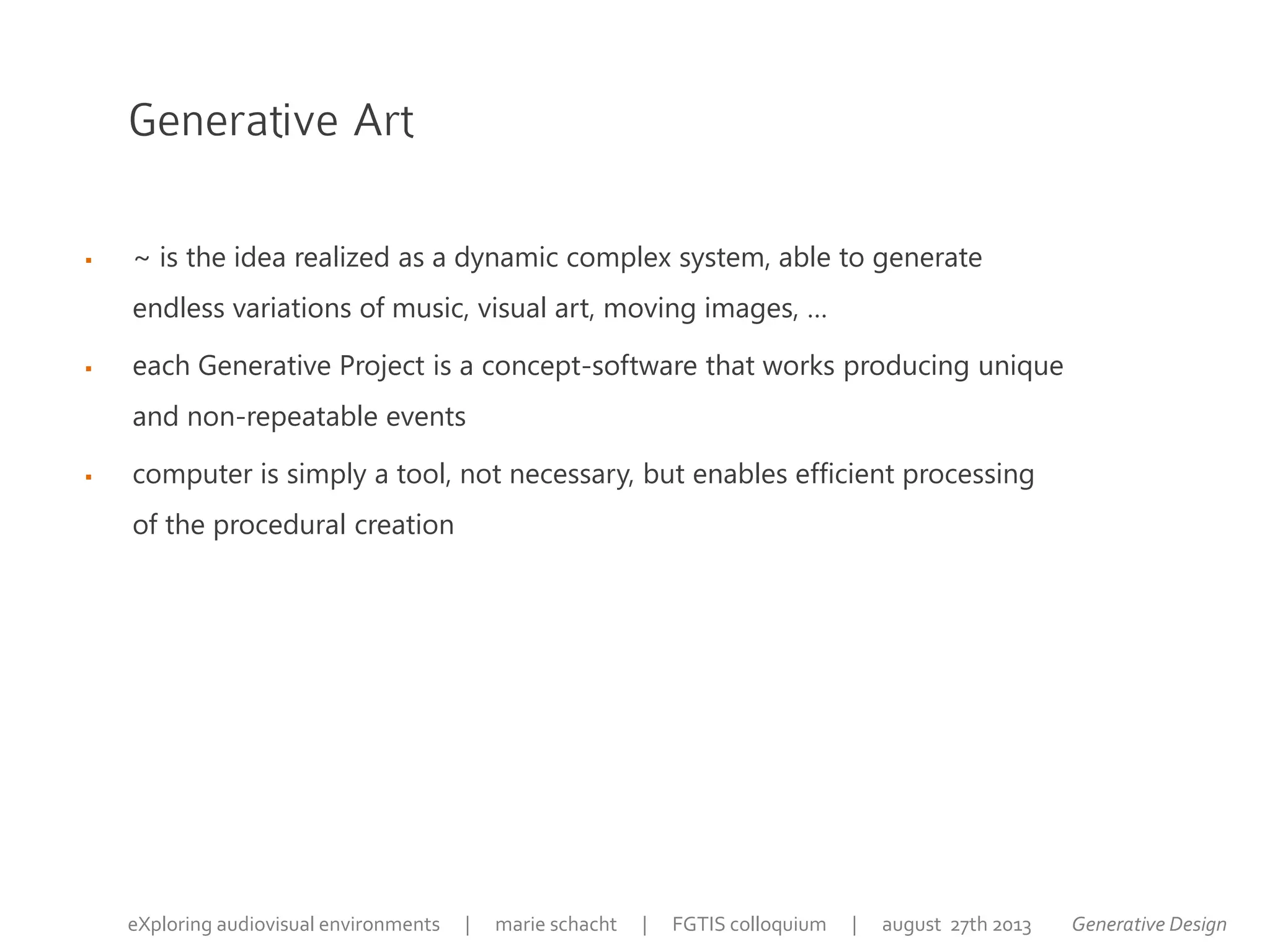
Generative Art
 ~ is the idea realized as a dynamic complex system, able to generate
endless variations of music, visual art, moving images, …
 each Generative Project is a concept-software that works producing unique
and non-repeatable events
 computer is simply a tool, not necessary, but enables efficient processing
of the procedural creation
Generative DesigneXploring audiovisual environments | marie schacht | FGTIS colloquium | august 27th 2013
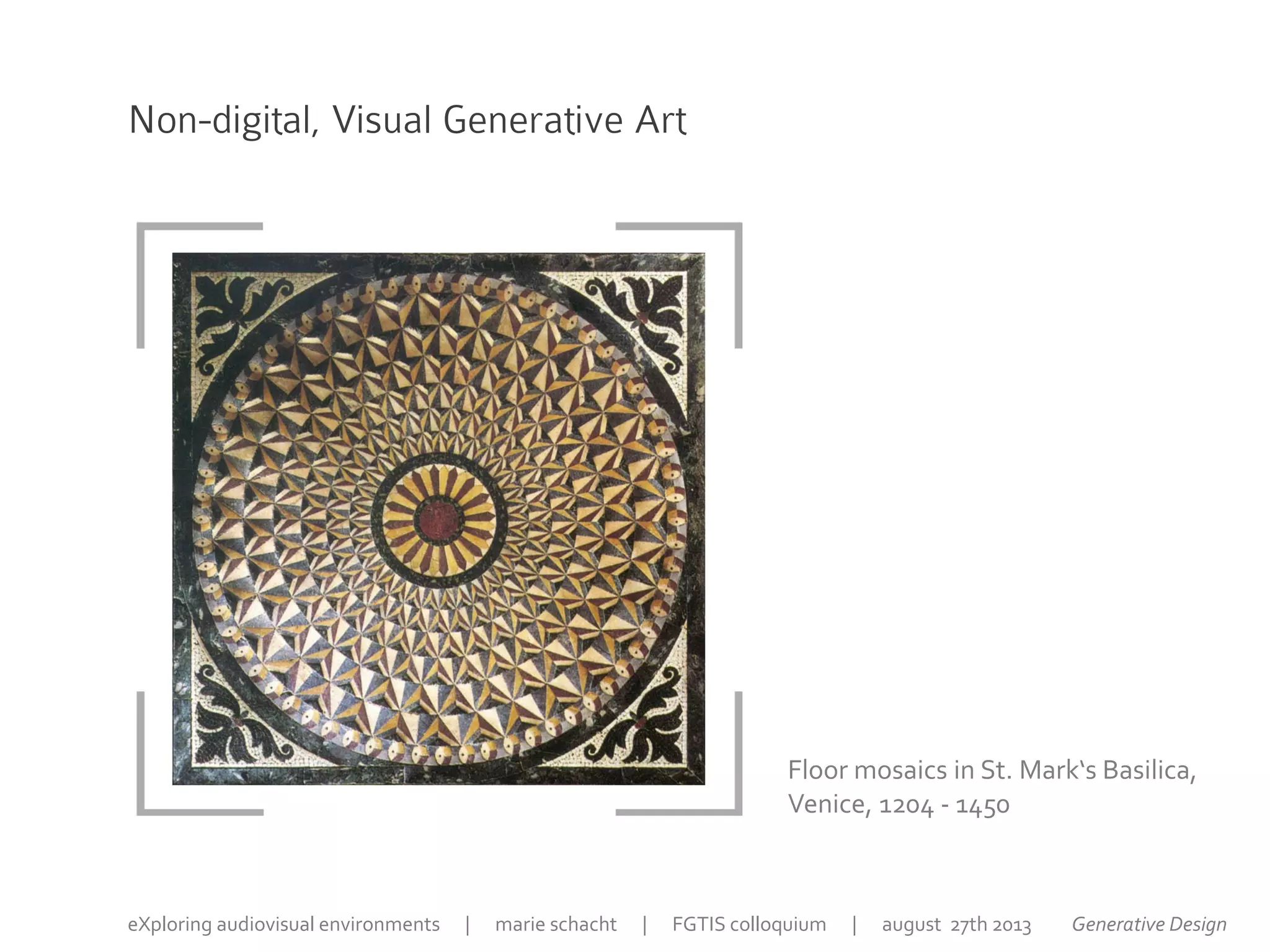
Non-digital, Visual Generative Art
Floor mosaics in St. Mark‘s Basilica,
Venice, 1204 - 1450
Generative DesigneXploring audiovisual environments | marie schacht | FGTIS colloquium | august 27th 2013
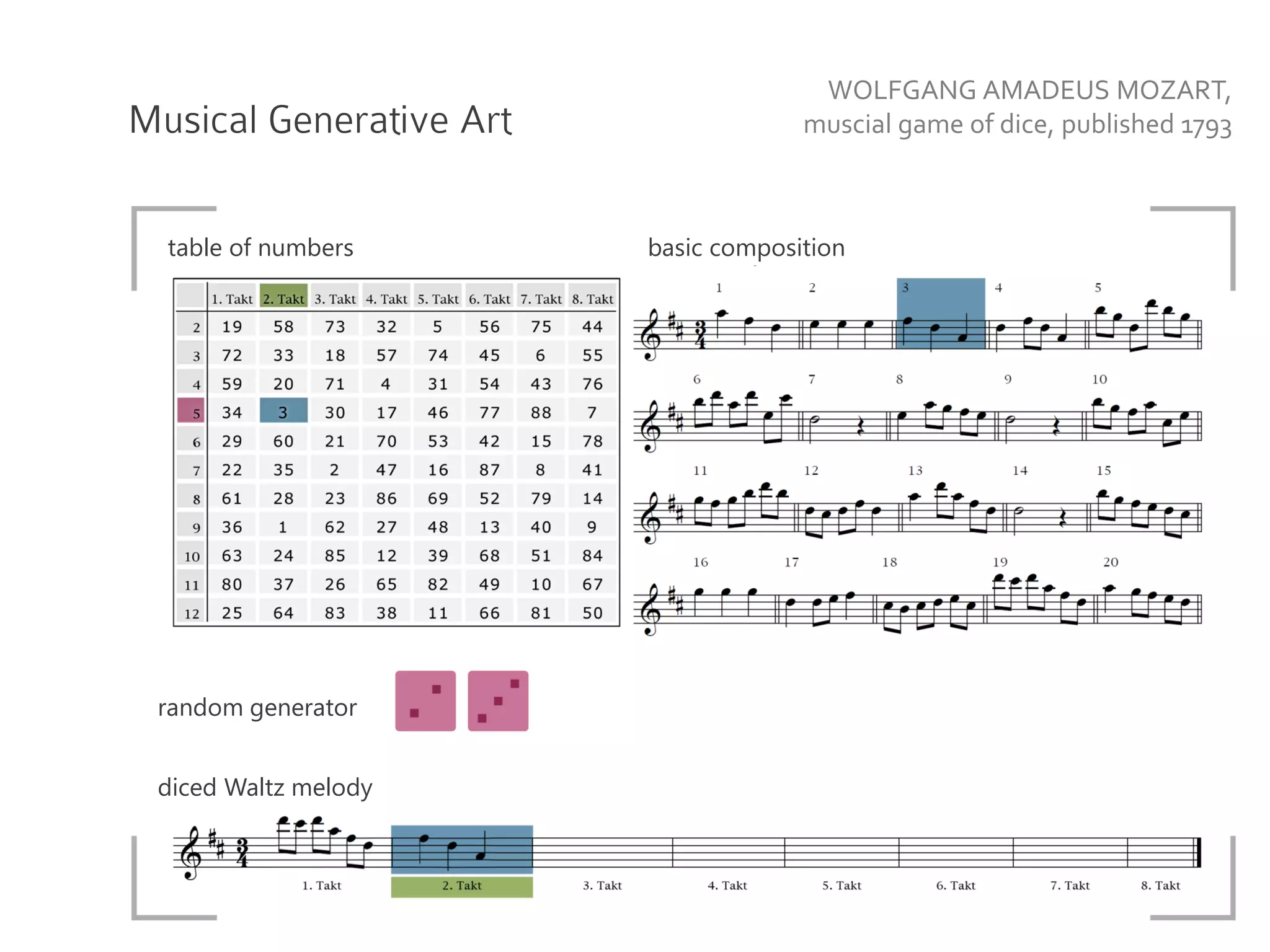
Musical Generative Art
table of numbers
random generator
basic composition
diced Waltz melody
WOLFGANG AMADEUS MOZART,
muscial game of dice, published 1793
Generative Designing
 ~ is a procedural design technique
 aesthetics and algorithms interweave
 partly results-driven, partly experimental used
 opens novice imagery worlds
 e.g. for data visualization
Generative DesigneXploring audiovisual environments | marie schacht | FGTIS colloquium | august 27th 2013
[Bohnacker 2009]
The Process of Generative Designing
Generative Design
[ANTHONY MATTOX: “Spinal Network“, 2009]
generative design plus temporal element
ABSTRACT BIRDS, QUAYOLA: “Partitura“, 2011
http://vimeo.com/23316783
AMVIS
Audible, Motiondriven, VISual environment
AMVIS >> objective
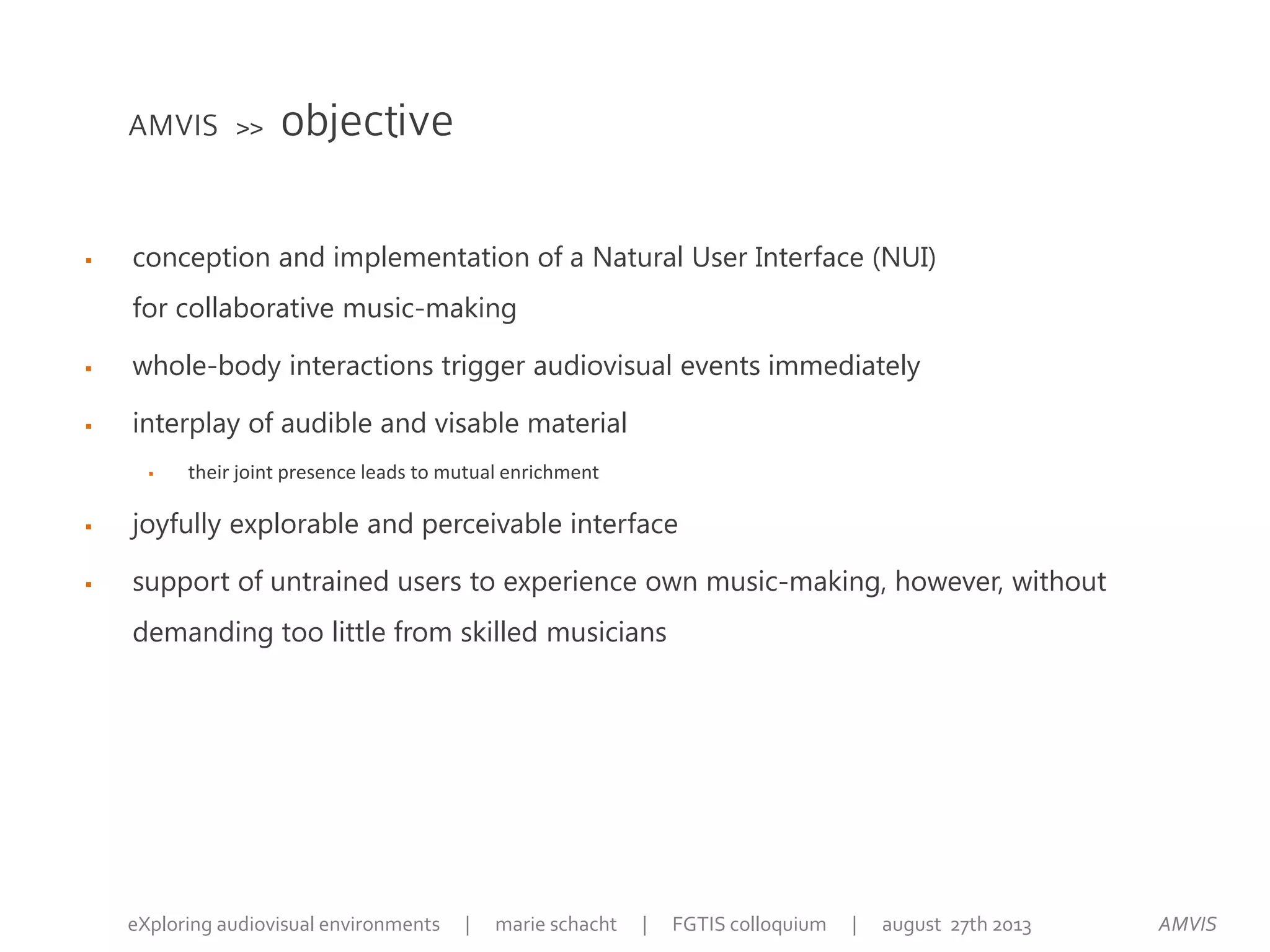
 conception and implementation of a Natural User Interface (NUI)
for collaborative music-making
 whole-body interactions trigger audiovisual events immediately
 interplay of audible and visable material
 their joint presence leads to mutual enrichment
 joyfully explorable and perceivable interface
 support of untrained users to experience own music-making, however, without
demanding too little from skilled musicians
AMVISeXploring audiovisual environments | marie schacht | FGTIS colloquium | august 27th 2013
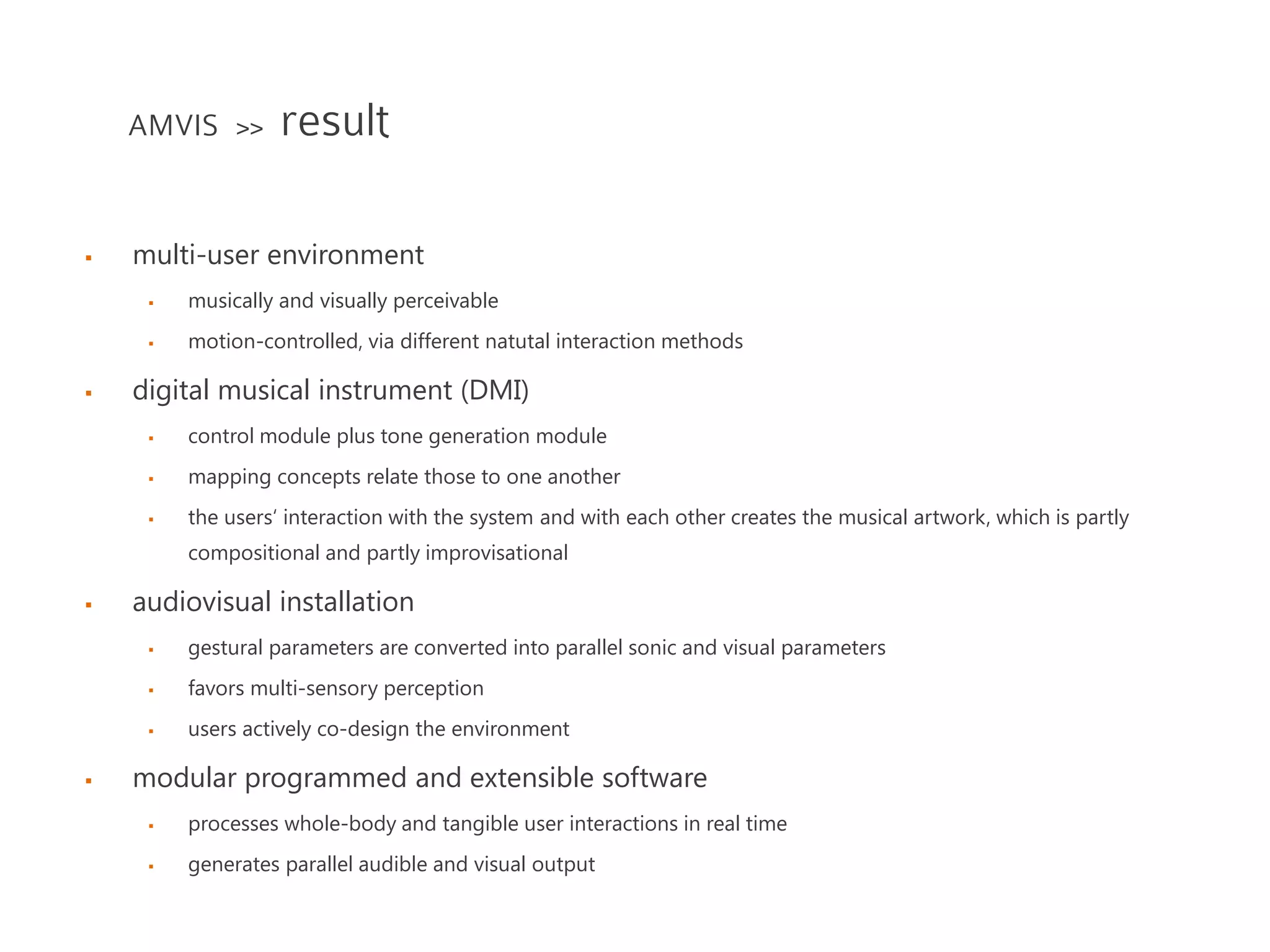
 multi-user environment
 musically and visually perceivable
 motion-controlled, via different natutal interaction methods
 digital musical instrument (DMI)
 control module plus tone generation module
 mapping concepts relate those to one another
 the users‘ interaction with the system and with each other creates the musical artwork, which is partly
compositional and partly improvisational
 audiovisual installation
 gestural parameters are converted into parallel sonic and visual parameters
 favors multi-sensory perception
 users actively co-design the environment
 modular programmed and extensible software
 processes whole-body and tangible user interactions in real time
 generates parallel audible and visual output
AMVIS >> result
AMVIS >> architecture
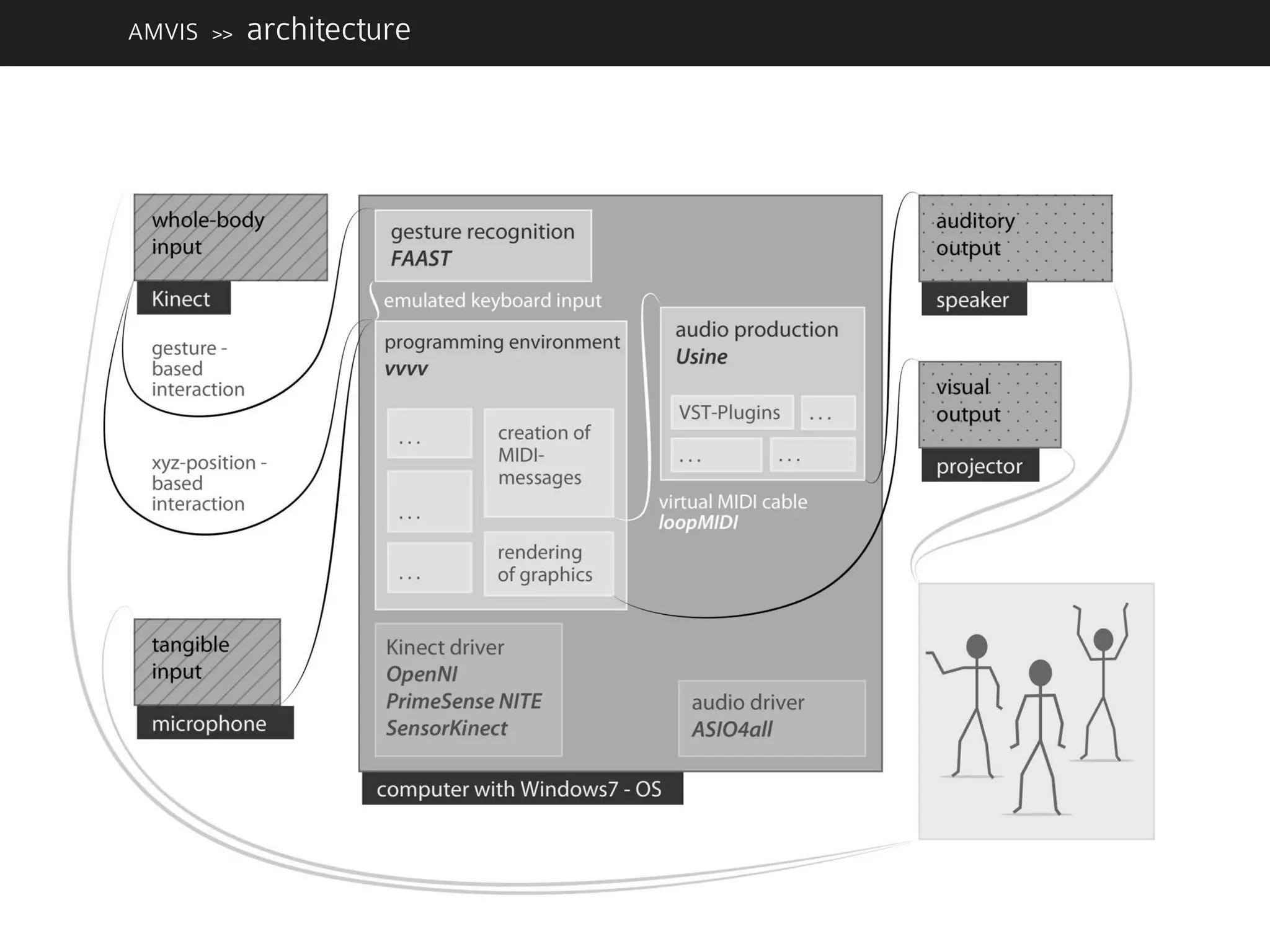
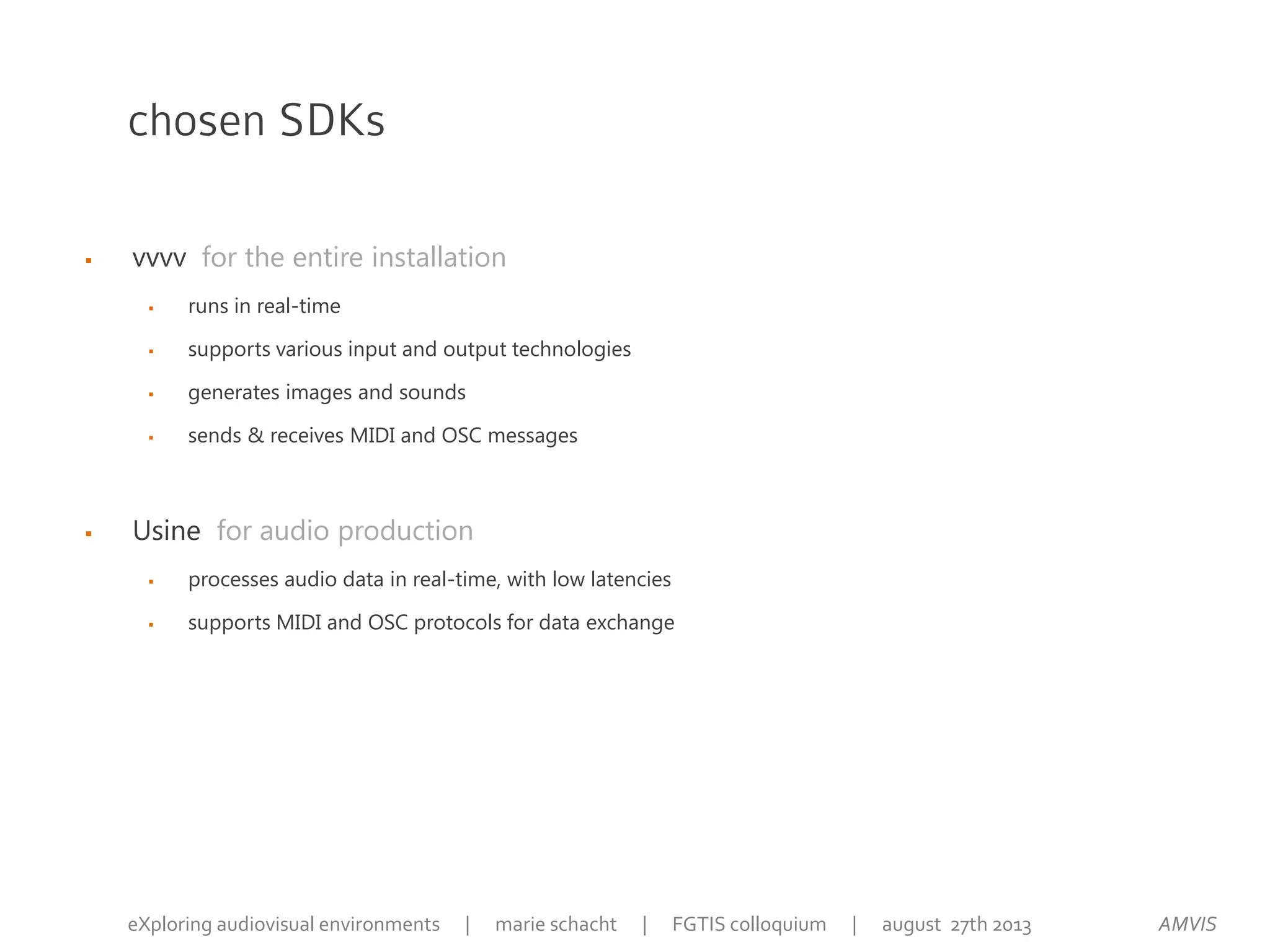
 vvvv for the entire installation
 runs in real-time
 supports various input and output technologies
 generates images and sounds
 sends & receives MIDI and OSC messages
 Usine for audio production
 processes audio data in real-time, with low latencies
 supports MIDI and OSC protocols for data exchange
chosen SDKs
AMVISeXploring audiovisual environments | marie schacht | FGTIS colloquium | august 27th 2013
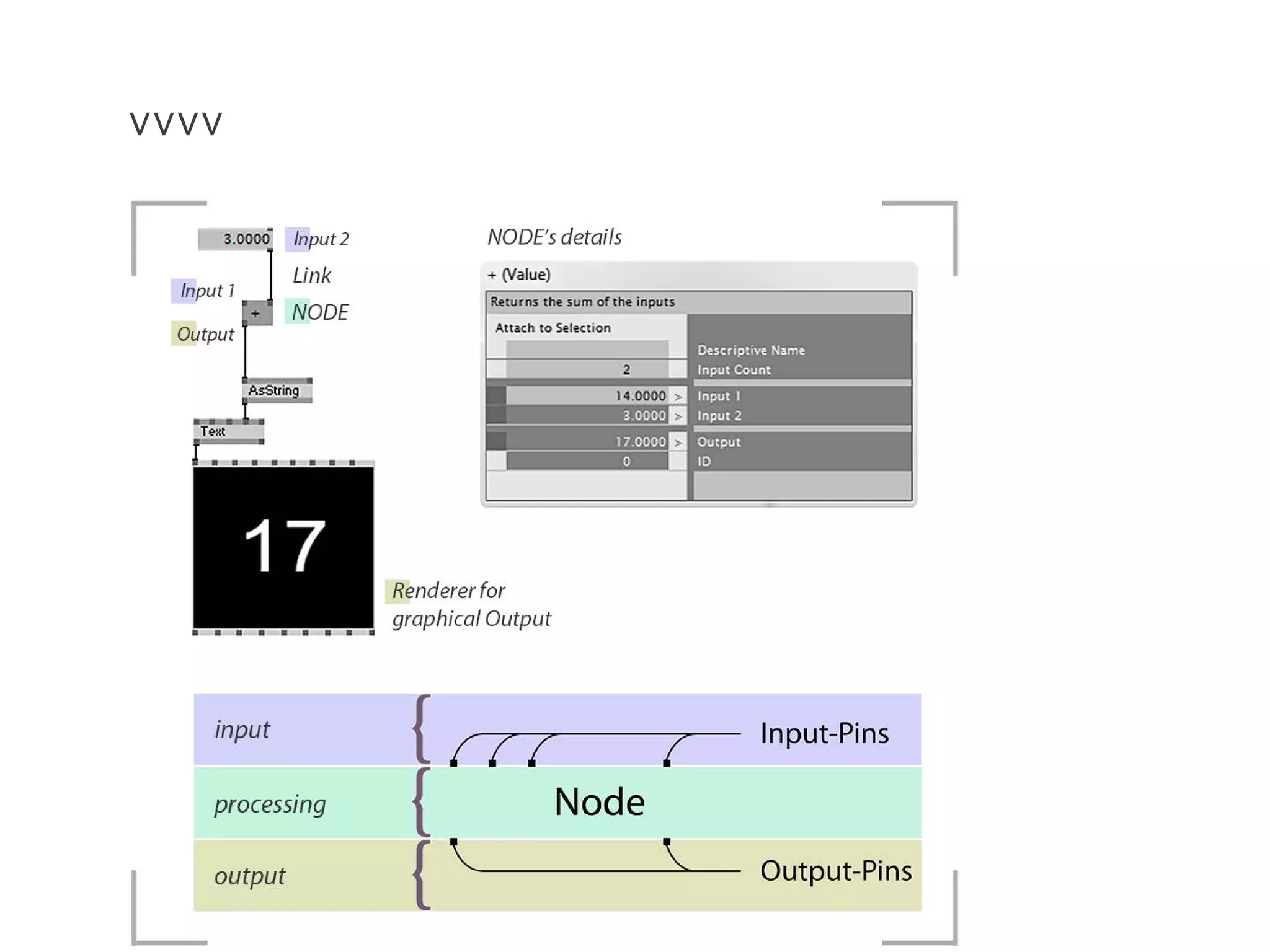
vvvv
Music is the art of arranging tones with regard to
melody, harmony and rhythm to a group of sounds.
[German dictionary]
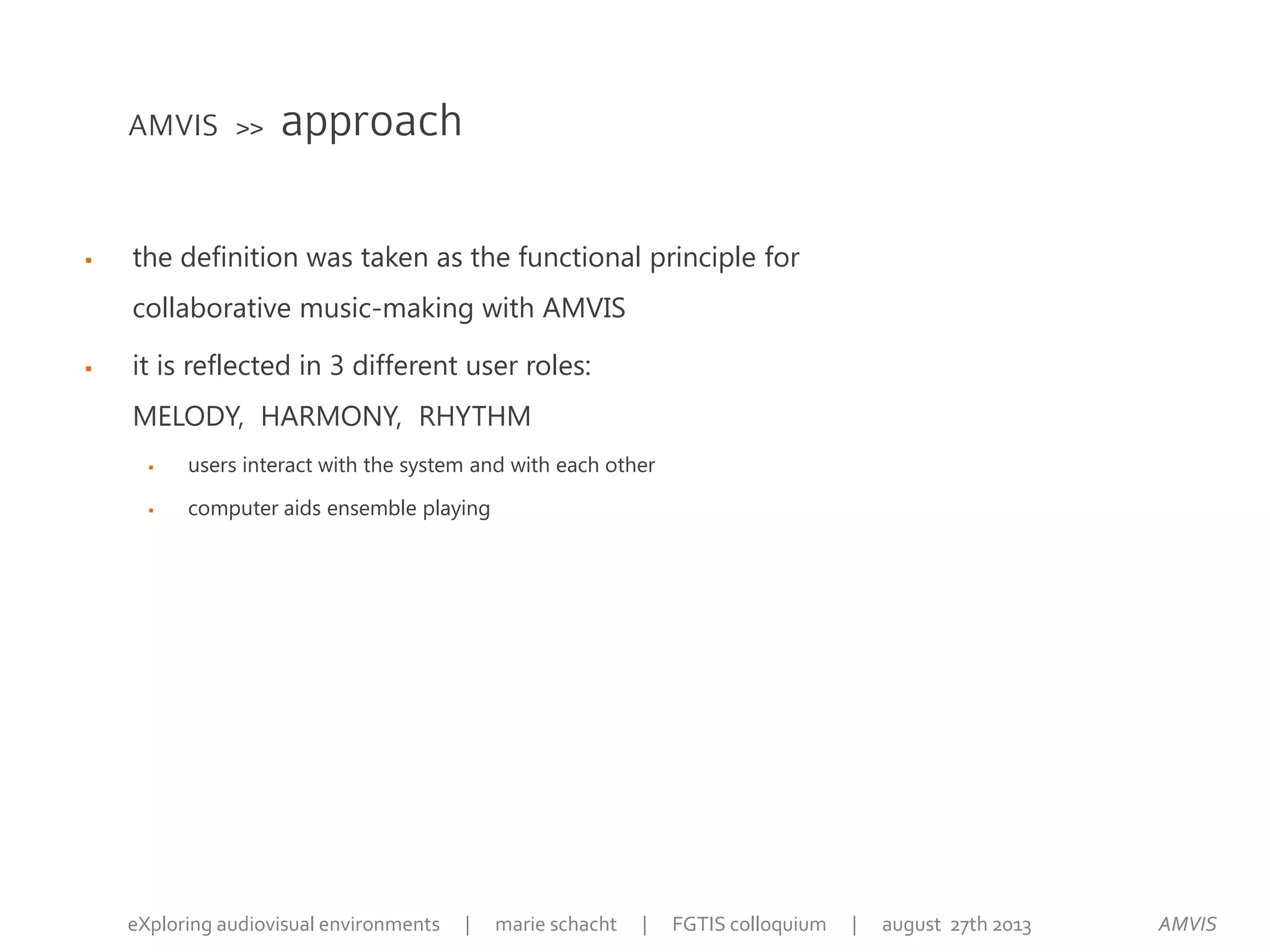
 the definition was taken as the functional principle for
collaborative music-making with AMVIS
 it is reflected in 3 different user roles:
MELODY, HARMONY, RHYTHM
 users interact with the system and with each other
 computer aids ensemble playing
AMVIS >> approach
AMVISeXploring audiovisual environments | marie schacht | FGTIS colloquium | august 27th 2013
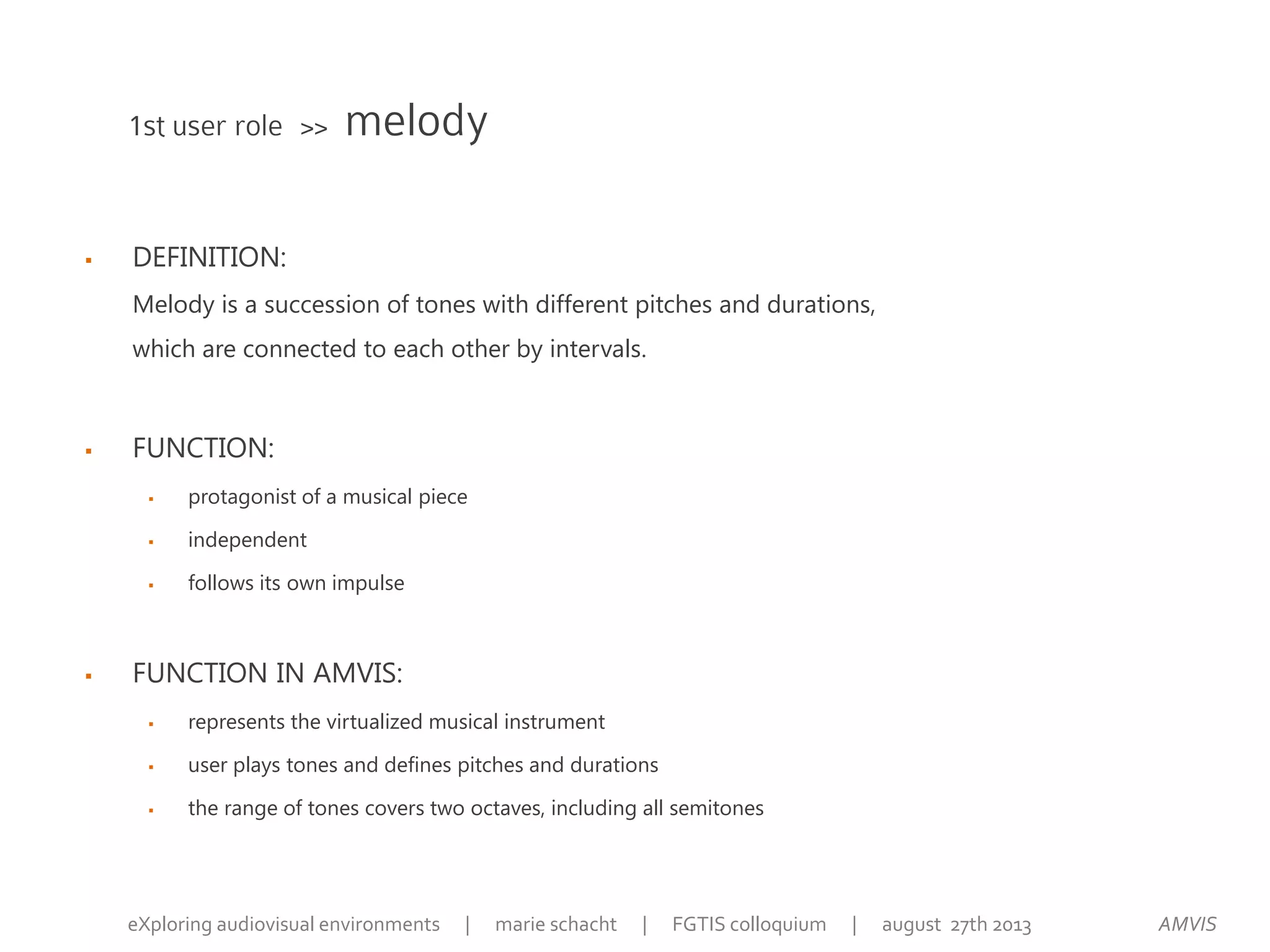
 DEFINITION:
Melody is a succession of tones with different pitches and durations,
which are connected to each other by intervals.
 FUNCTION:
 protagonist of a musical piece
 independent
 follows its own impulse
 FUNCTION IN AMVIS:
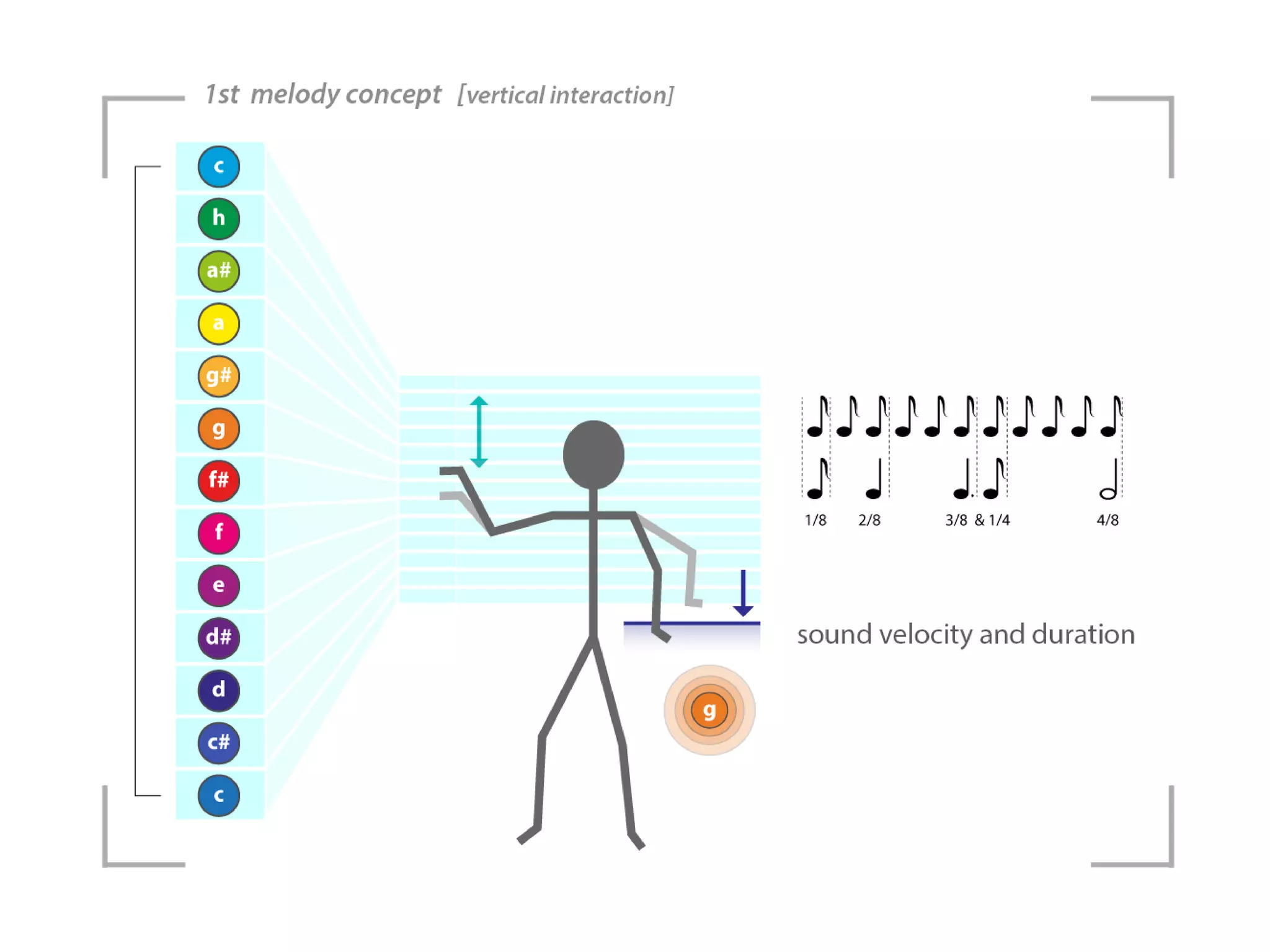
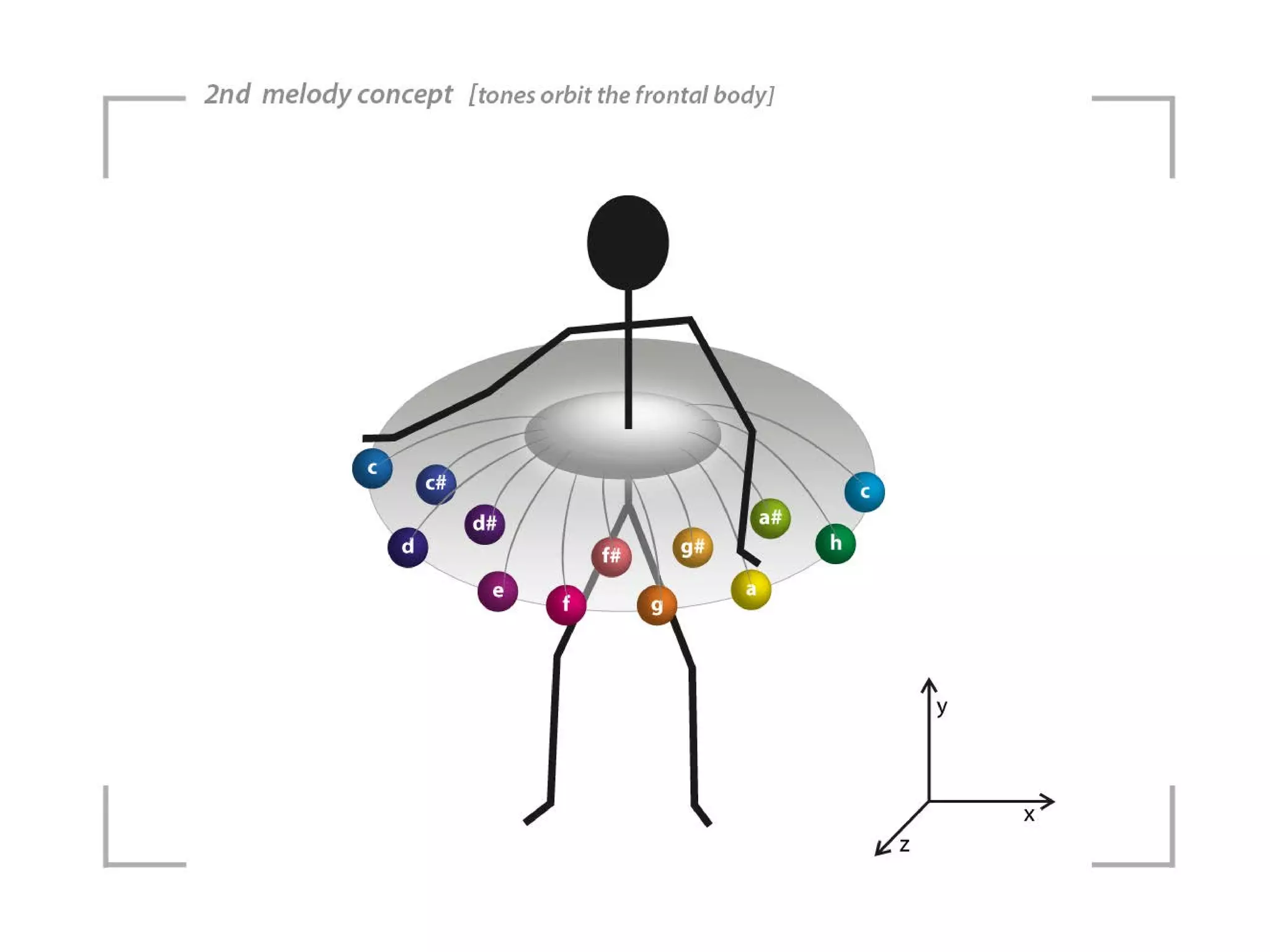
 represents the virtualized musical instrument
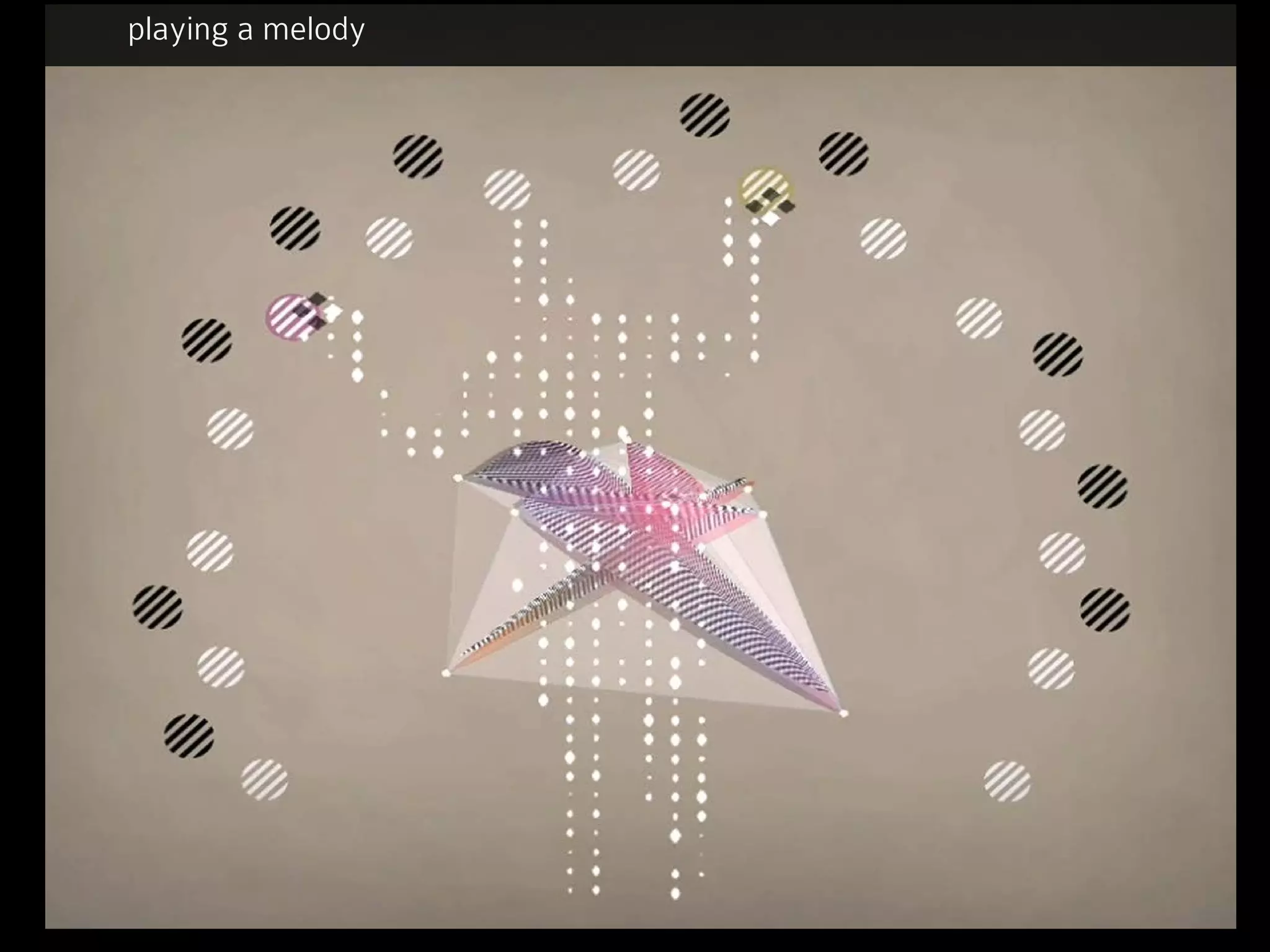
 user plays tones and defines pitches and durations
 the range of tones covers two octaves, including all semitones
1st user role >> melody
AMVISeXploring audiovisual environments | marie schacht | FGTIS colloquium | august 27th 2013
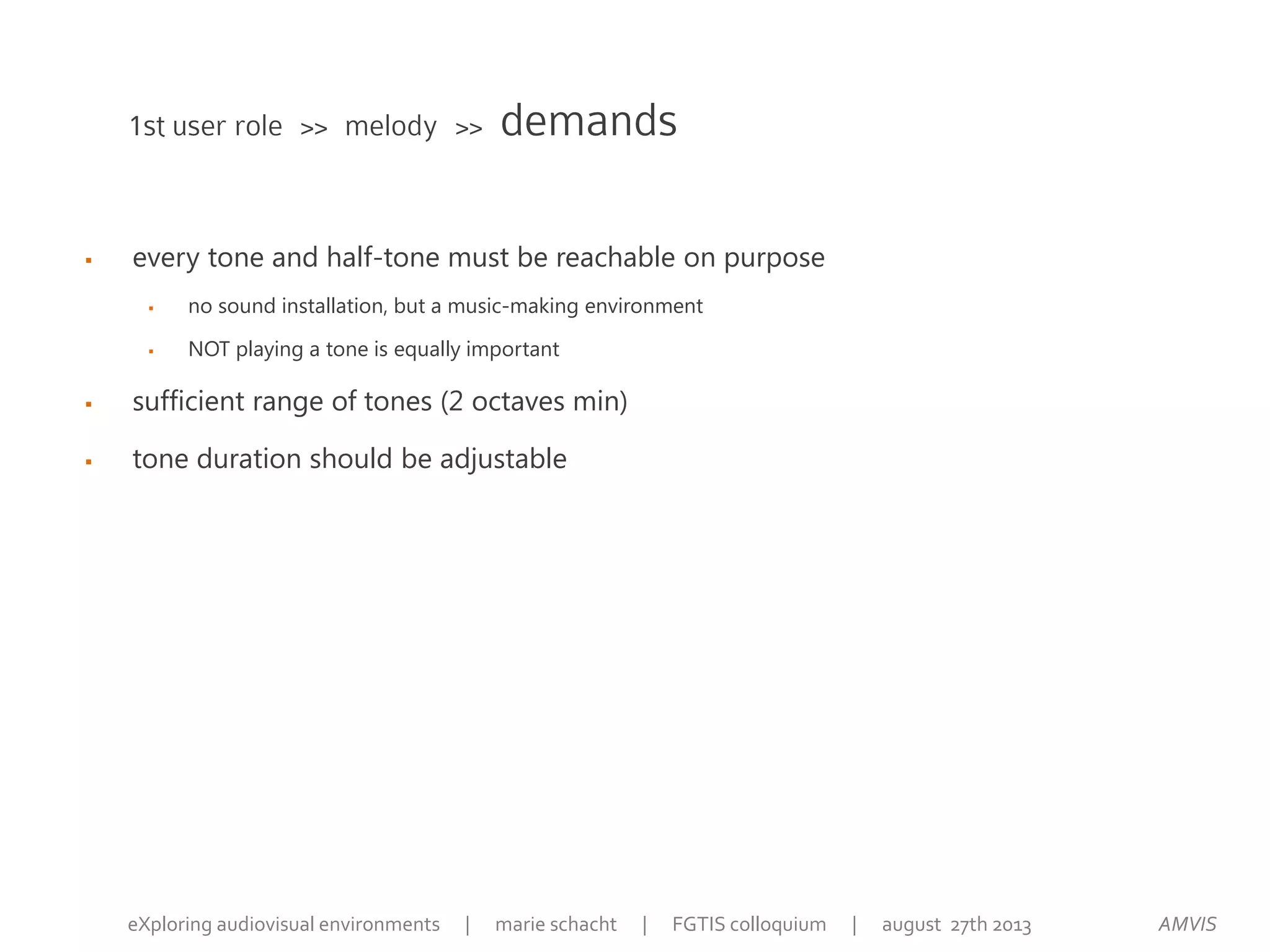
 every tone and half-tone must be reachable on purpose
 no sound installation, but a music-making environment
 NOT playing a tone is equally important
 sufficient range of tones (2 octaves min)
 tone duration should be adjustable
1st user role >> melody >> demands
AMVISeXploring audiovisual environments | marie schacht | FGTIS colloquium | august 27th 2013
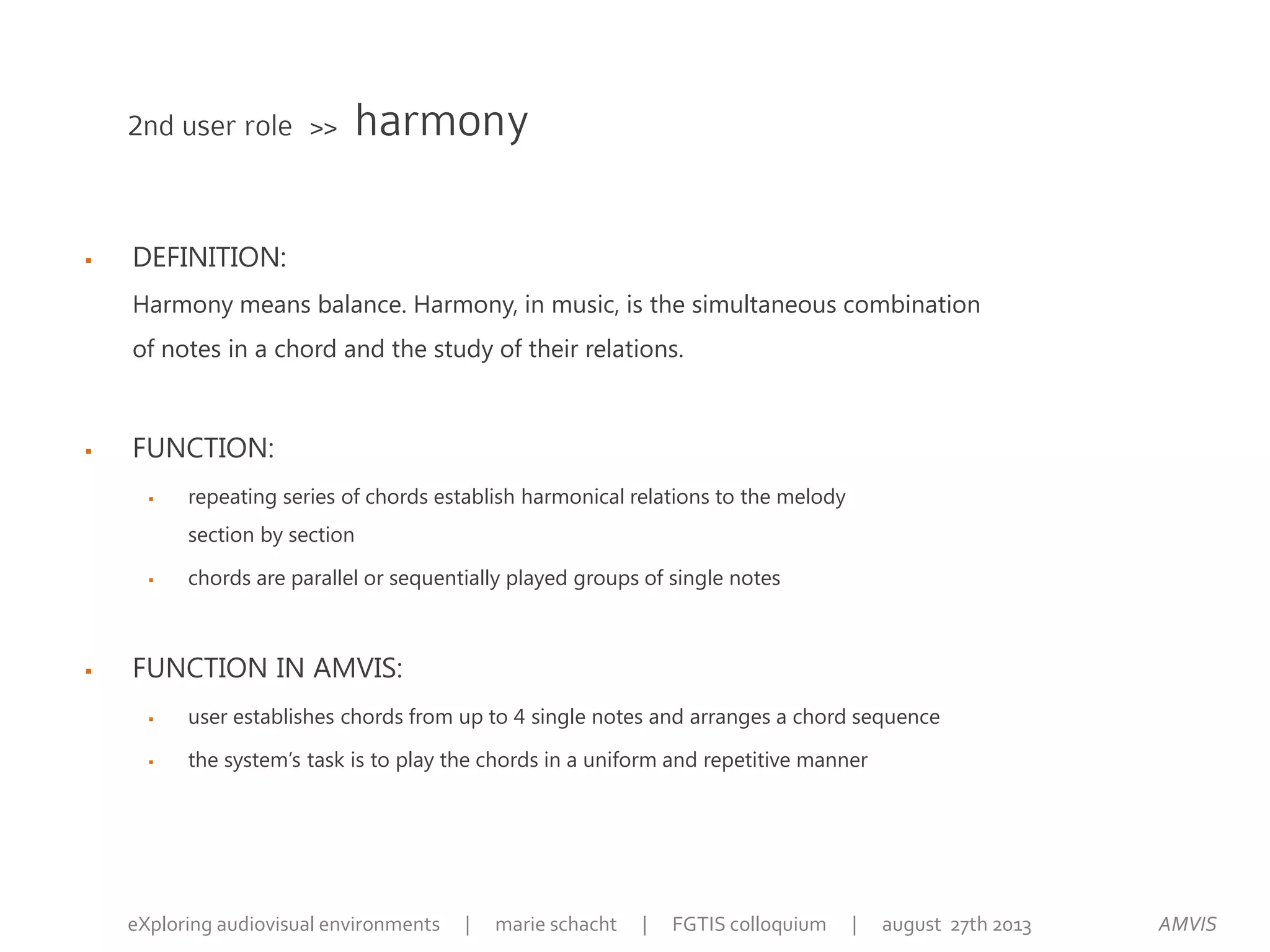
 DEFINITION:
Harmony means balance. Harmony, in music, is the simultaneous combination
of notes in a chord and the study of their relations.
 FUNCTION:
 repeating series of chords establish harmonical relations to the melody
section by section
 chords are parallel or sequentially played groups of single notes
 FUNCTION IN AMVIS:
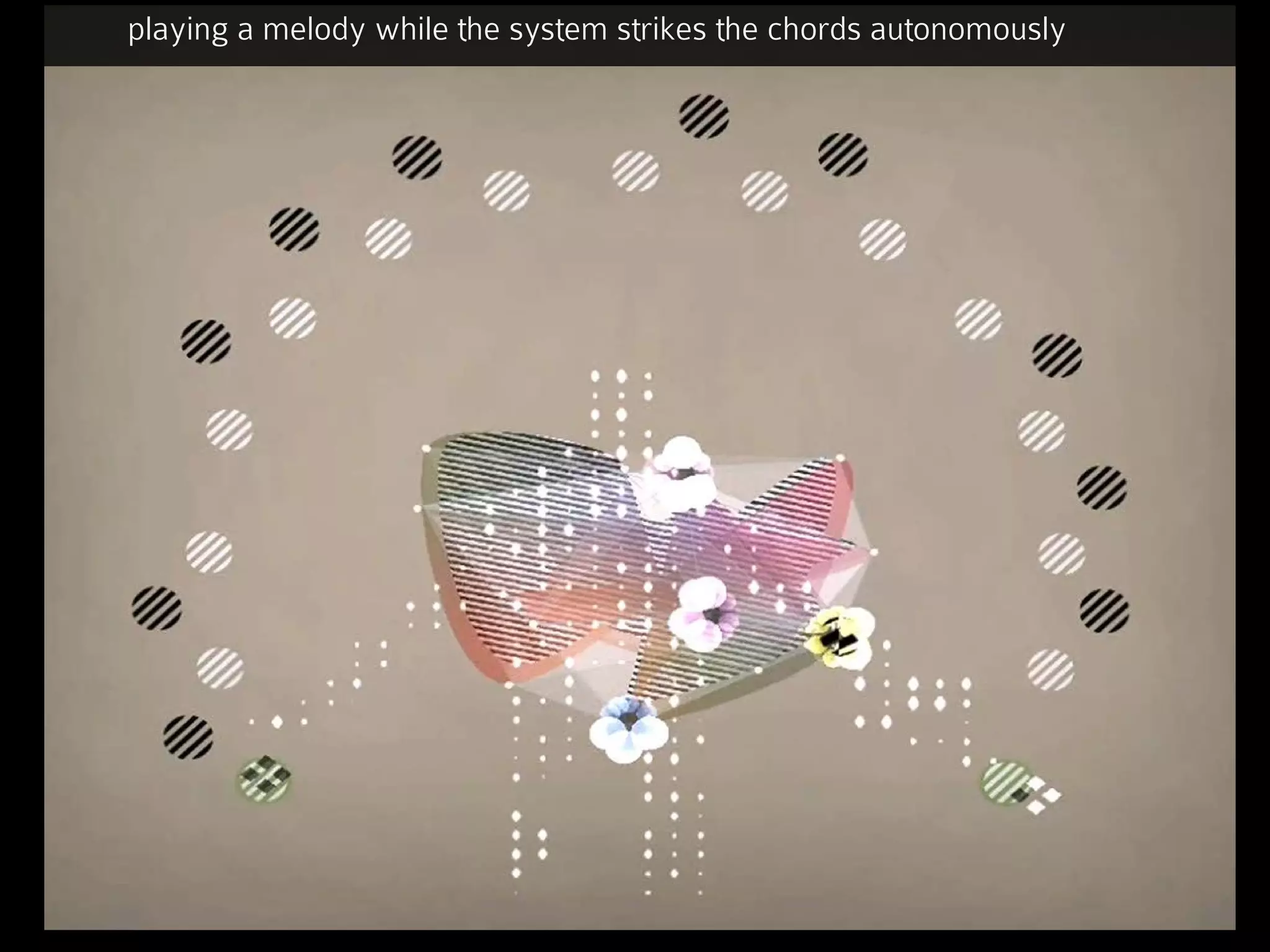
 user establishes chords from up to 4 single notes and arranges a chord sequence
 the system’s task is to play the chords in a uniform and repetitive manner
2nd user role >> harmony
AMVISeXploring audiovisual environments | marie schacht | FGTIS colloquium | august 27th 2013
 DEFINITION:
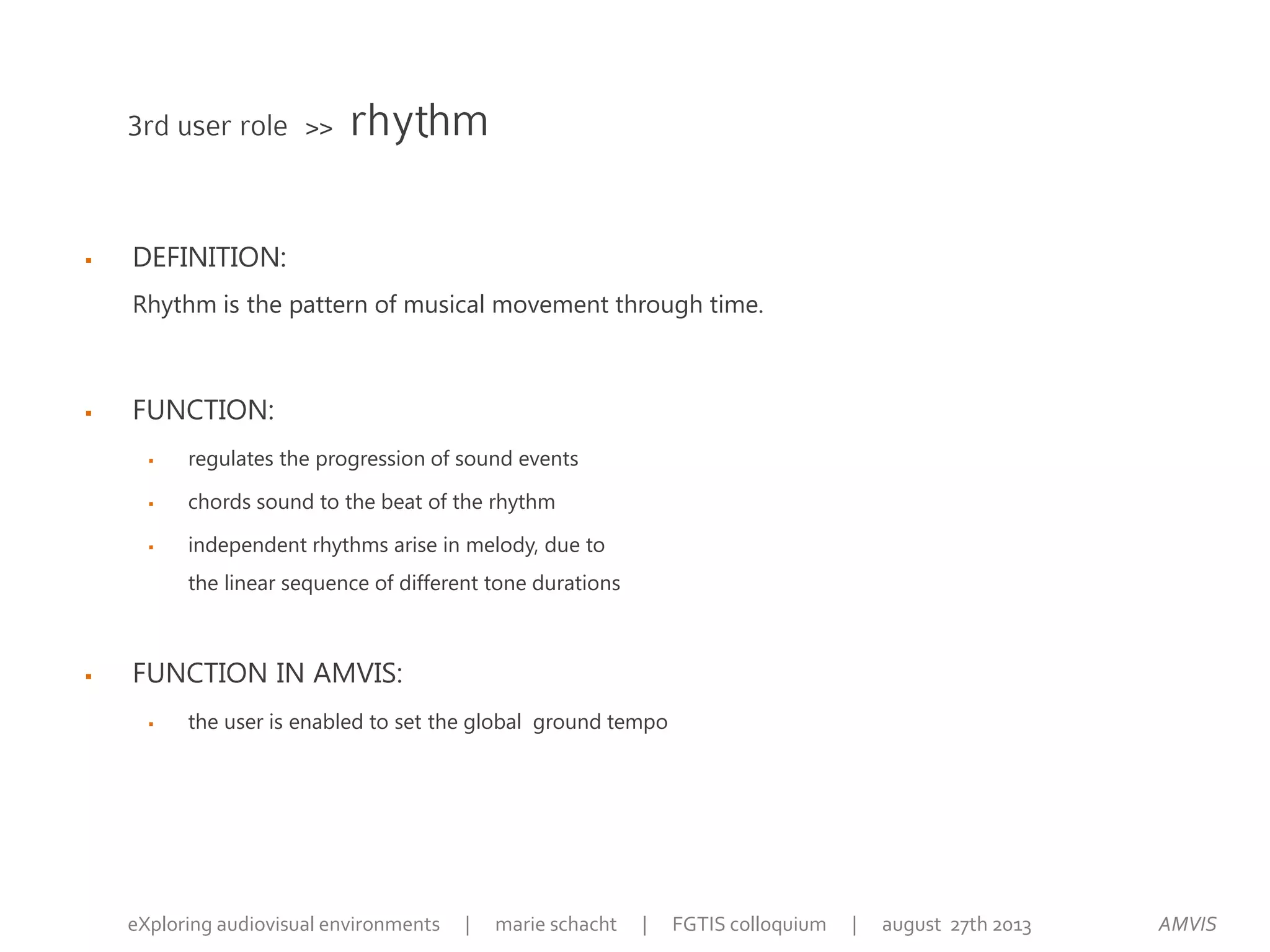
Rhythm is the pattern of musical movement through time.
 FUNCTION:
 regulates the progression of sound events
 chords sound to the beat of the rhythm
 independent rhythms arise in melody, due to
the linear sequence of different tone durations
 FUNCTION IN AMVIS:
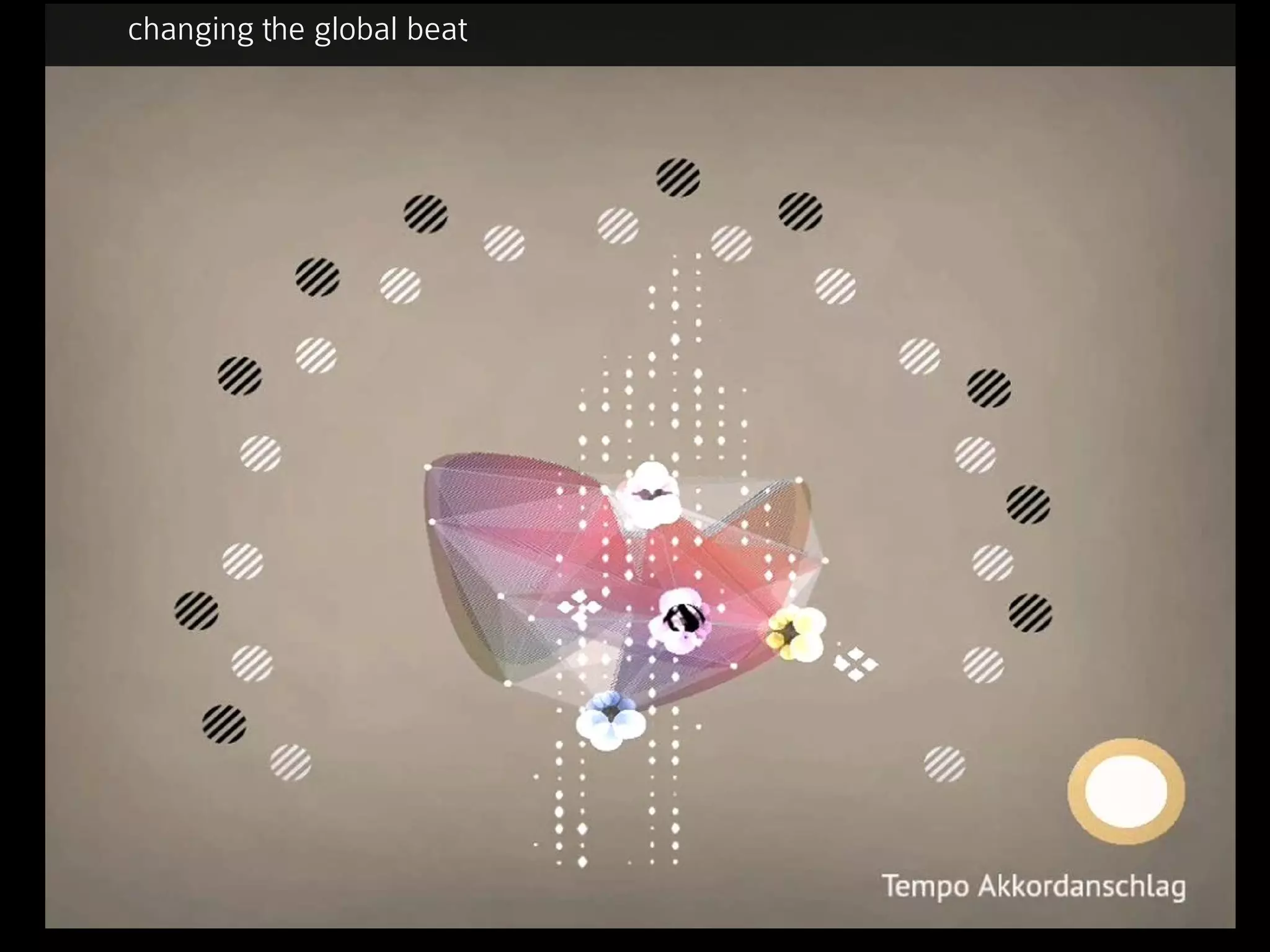
 the user is enabled to set the global ground tempo
3rd user role >> rhythm
AMVISeXploring audiovisual environments | marie schacht | FGTIS colloquium | august 27th 2013
 DEFINITION:
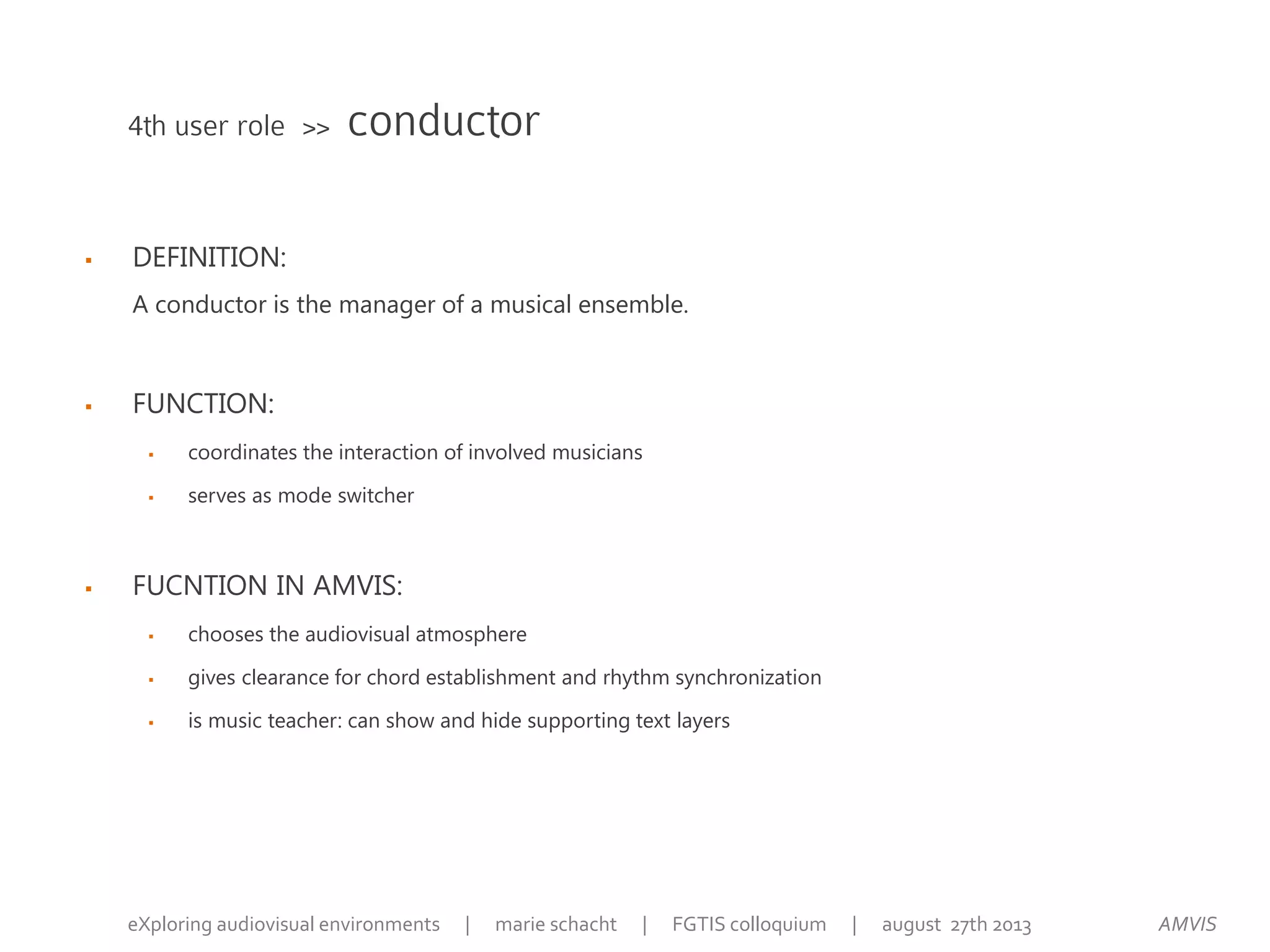
A conductor is the manager of a musical ensemble.
 FUNCTION:
 coordinates the interaction of involved musicians
 serves as mode switcher
 FUCNTION IN AMVIS:
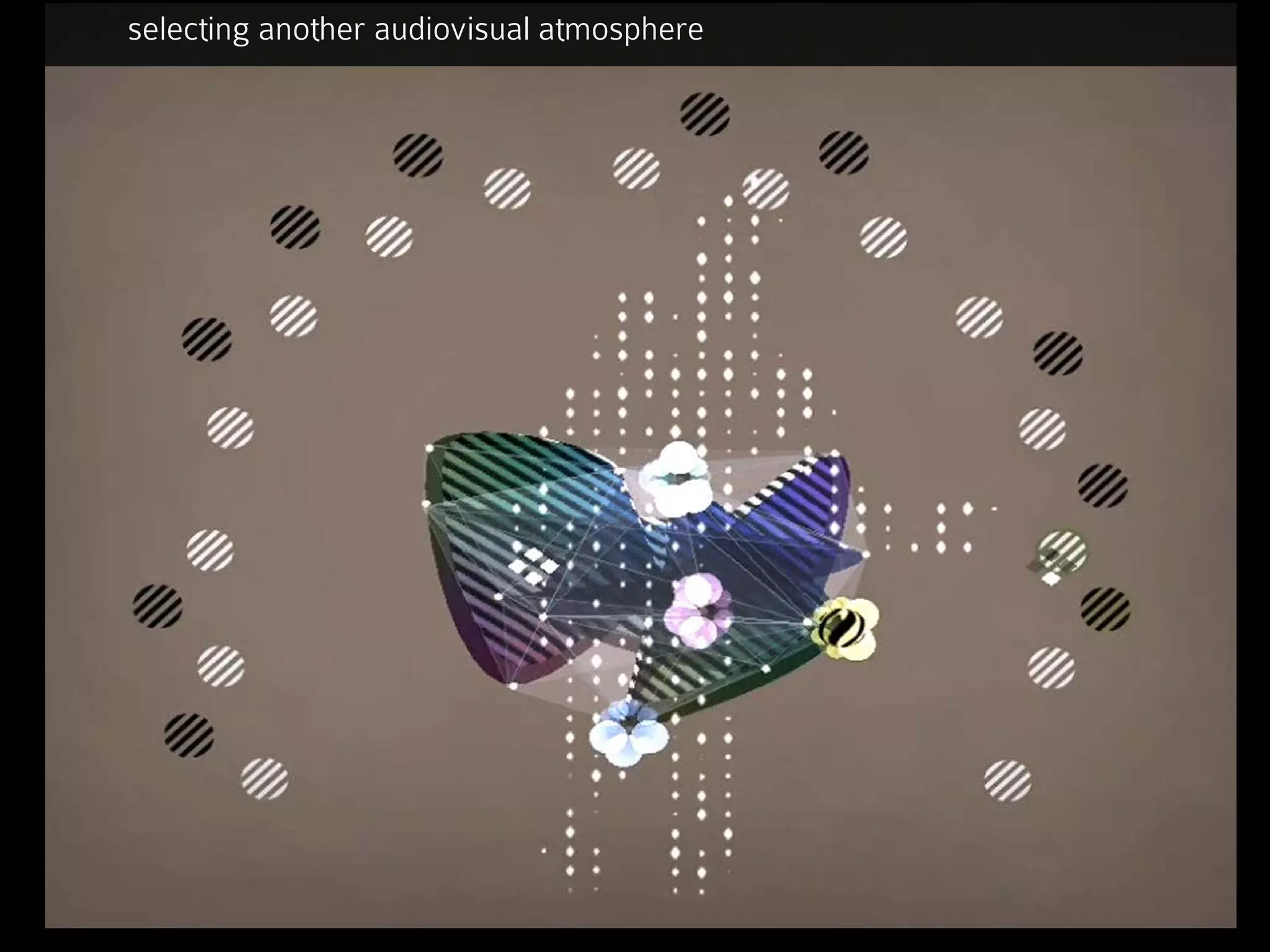
 chooses the audiovisual atmosphere
 gives clearance for chord establishment and rhythm synchronization
 is music teacher: can show and hide supporting text layers
4th user role >> conductor
AMVISeXploring audiovisual environments | marie schacht | FGTIS colloquium | august 27th 2013
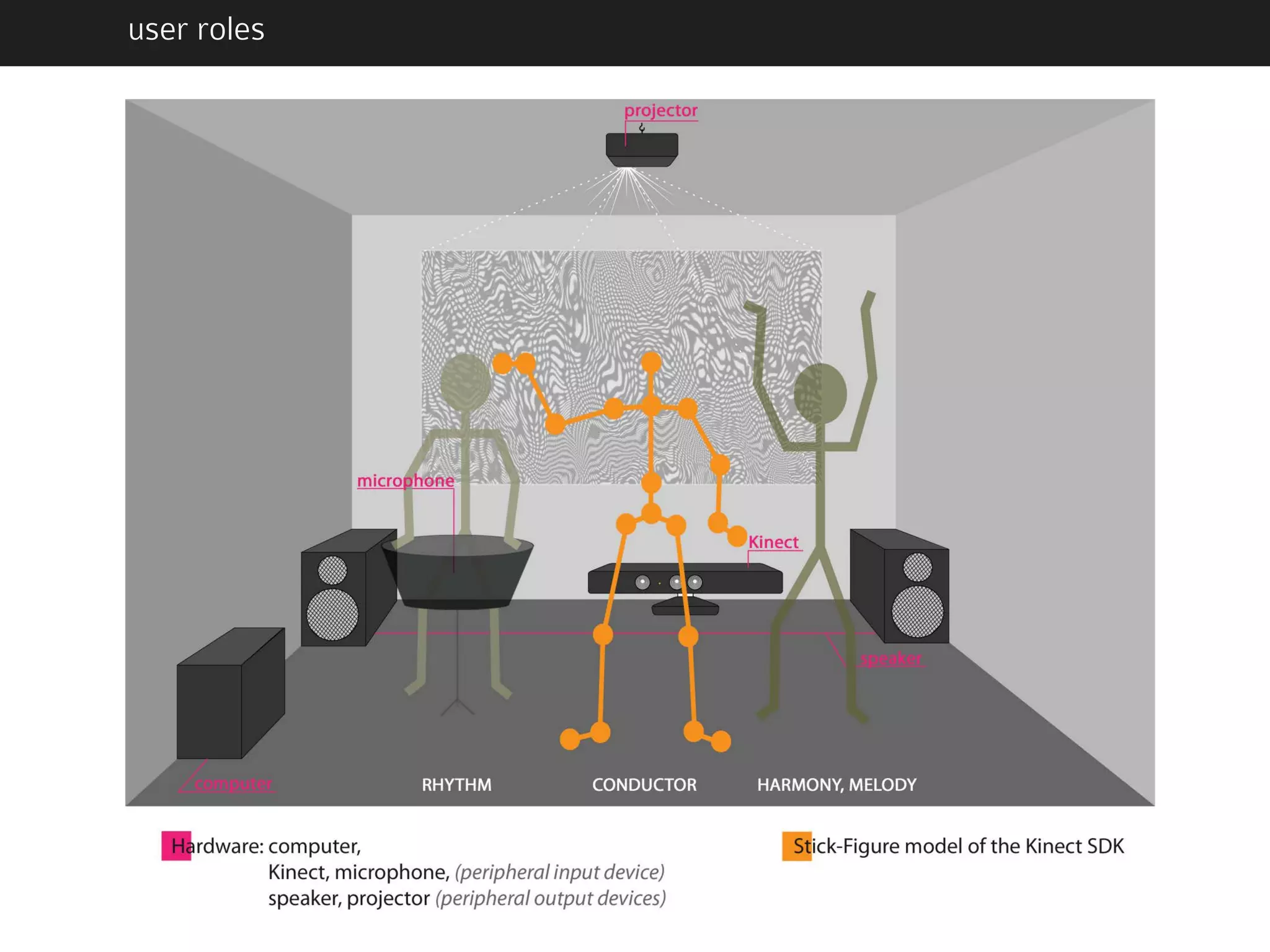
user roles
melody
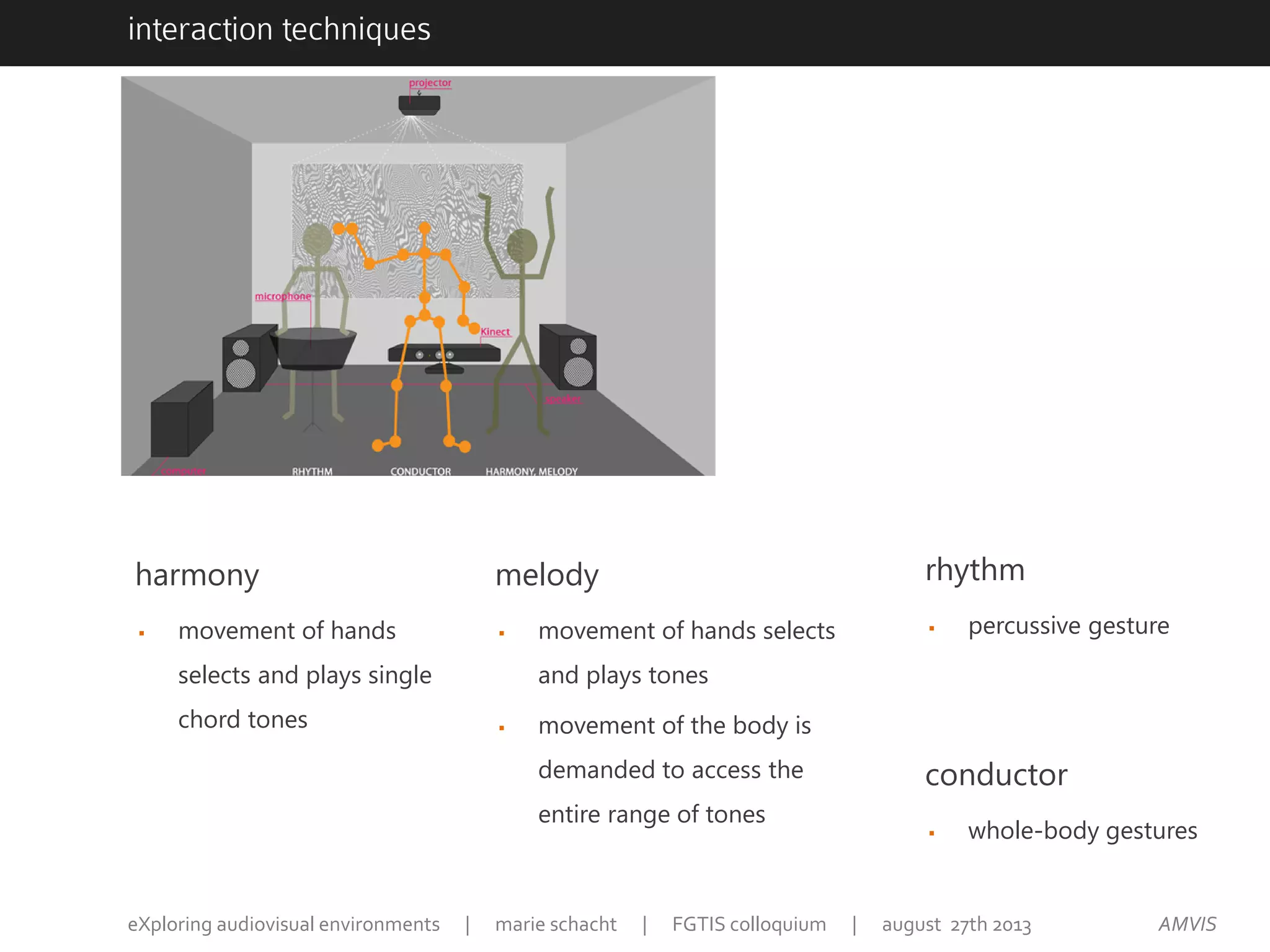
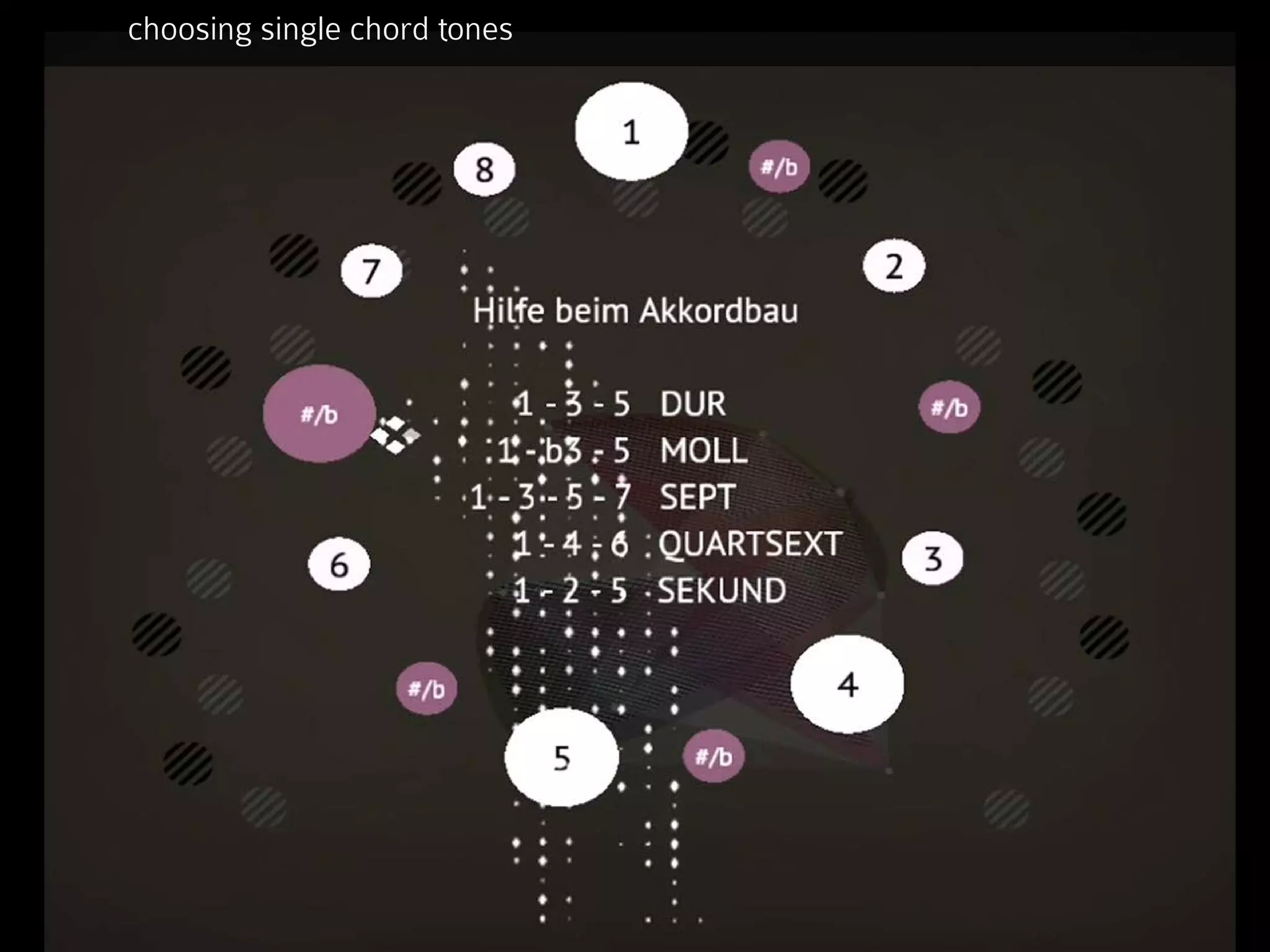
 movement of hands selects
and plays tones
 movement of the body is
demanded to access the
entire range of tones
harmony
 movement of hands
selects and plays single
chord tones
rhythm
 percussive gesture
conductor
 whole-body gestures
interaction techniques
AMVISeXploring audiovisual environments | marie schacht | FGTIS colloquium | august 27th 2013
• user is in control
• software is the
virtualized musical
instrument
• pre-defined routes
• user chooses destination
and parameters
• sound-producing-
machine
• user pushes the start
button
computer-aided music-making >> usage concepts
autopilot train driver instrumentalist
[Karlheinz Essl, 1999]
AMVISeXploring audiovisual environments | marie schacht | FGTIS colloquium | august 27th 2013
AMVIS MelodyAMVIS Harmony
AMVISeXploring audiovisual environments | marie schacht | FGTIS colloquium | august 27th 2013
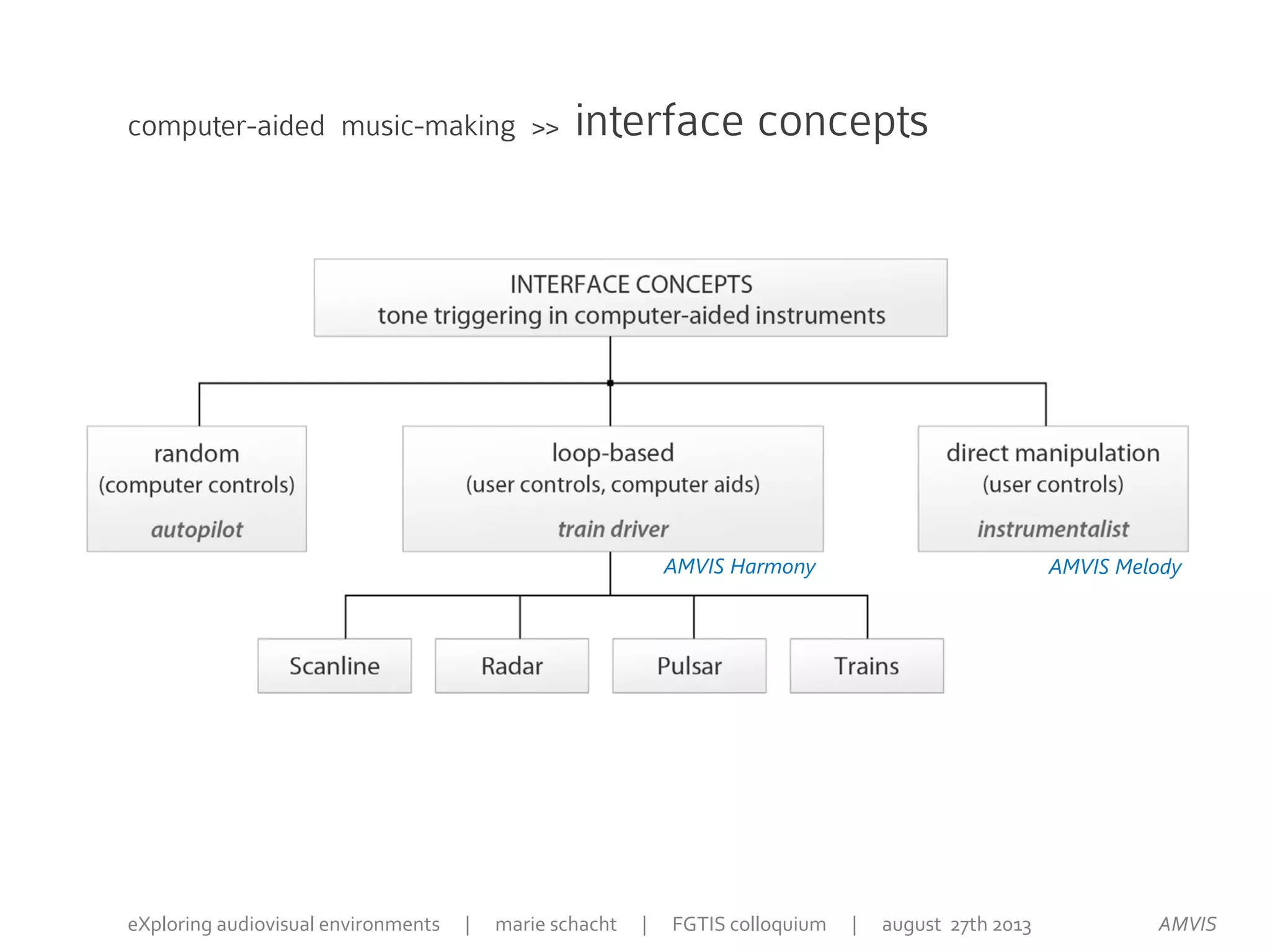
computer-aided music-making >> interface concepts
AMVISeXploring audiovisual environments | marie schacht | FGTIS colloquium | august 27th 2013
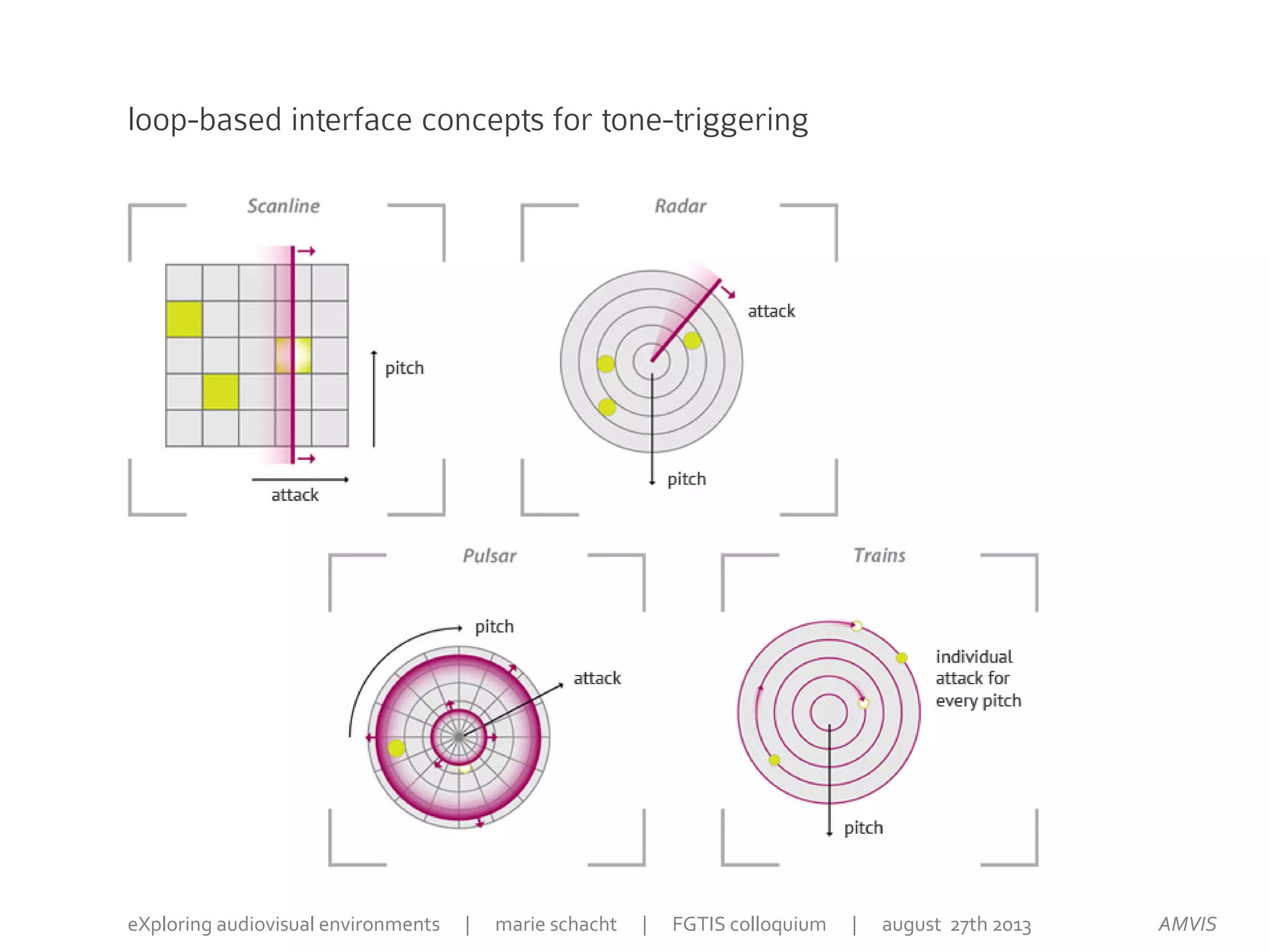
loop-based interface concepts for tone-triggering
AMVIS
an Auditory, Motiondriven, VISualizing Environment
http://vimeo.com/29770159
playing a melody
choosing single chord tones
playing a melody while the system strikes the chords autonomously
changing the global beat
selecting another audiovisual atmosphere
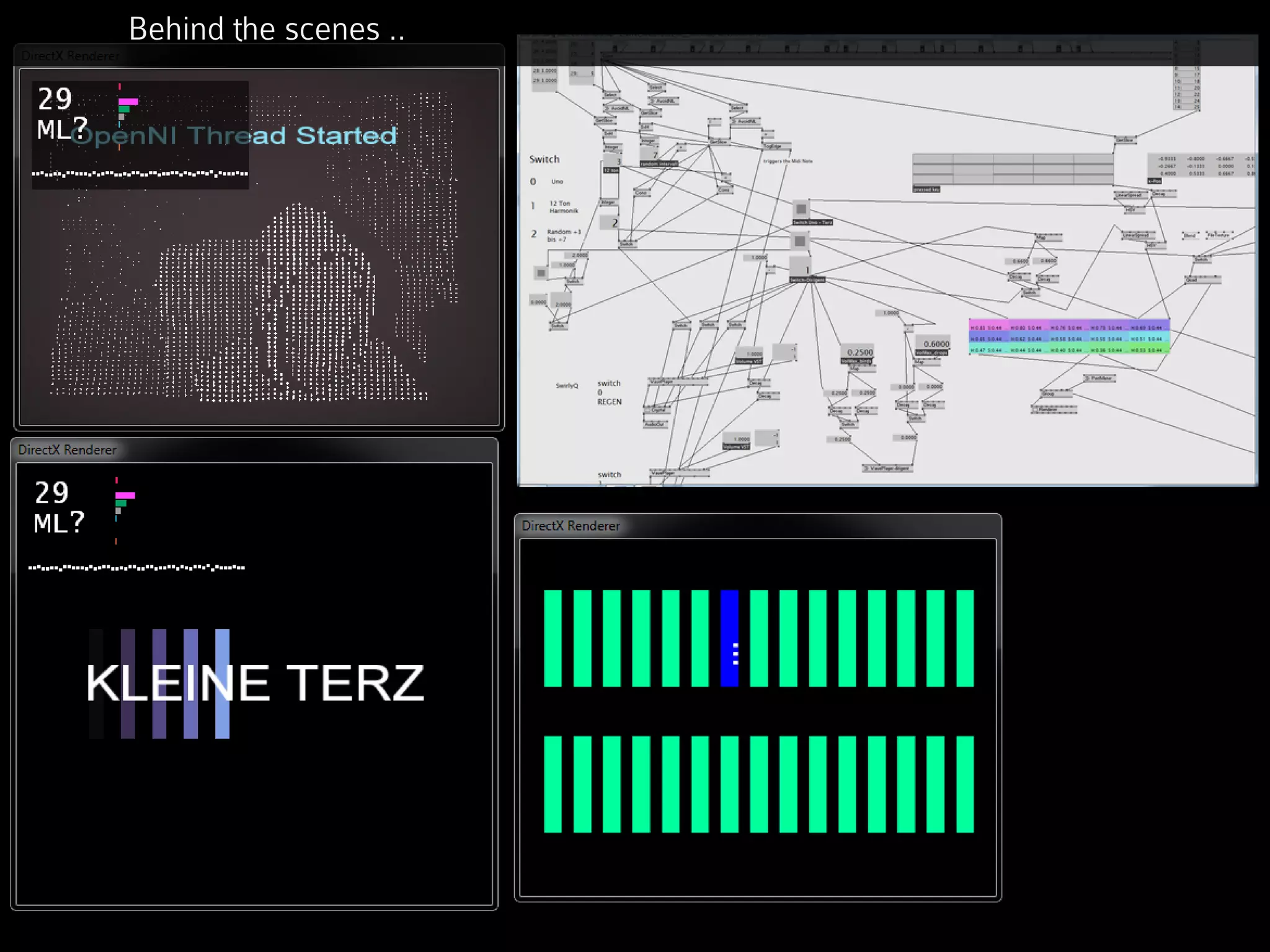
Behind the scenes ..
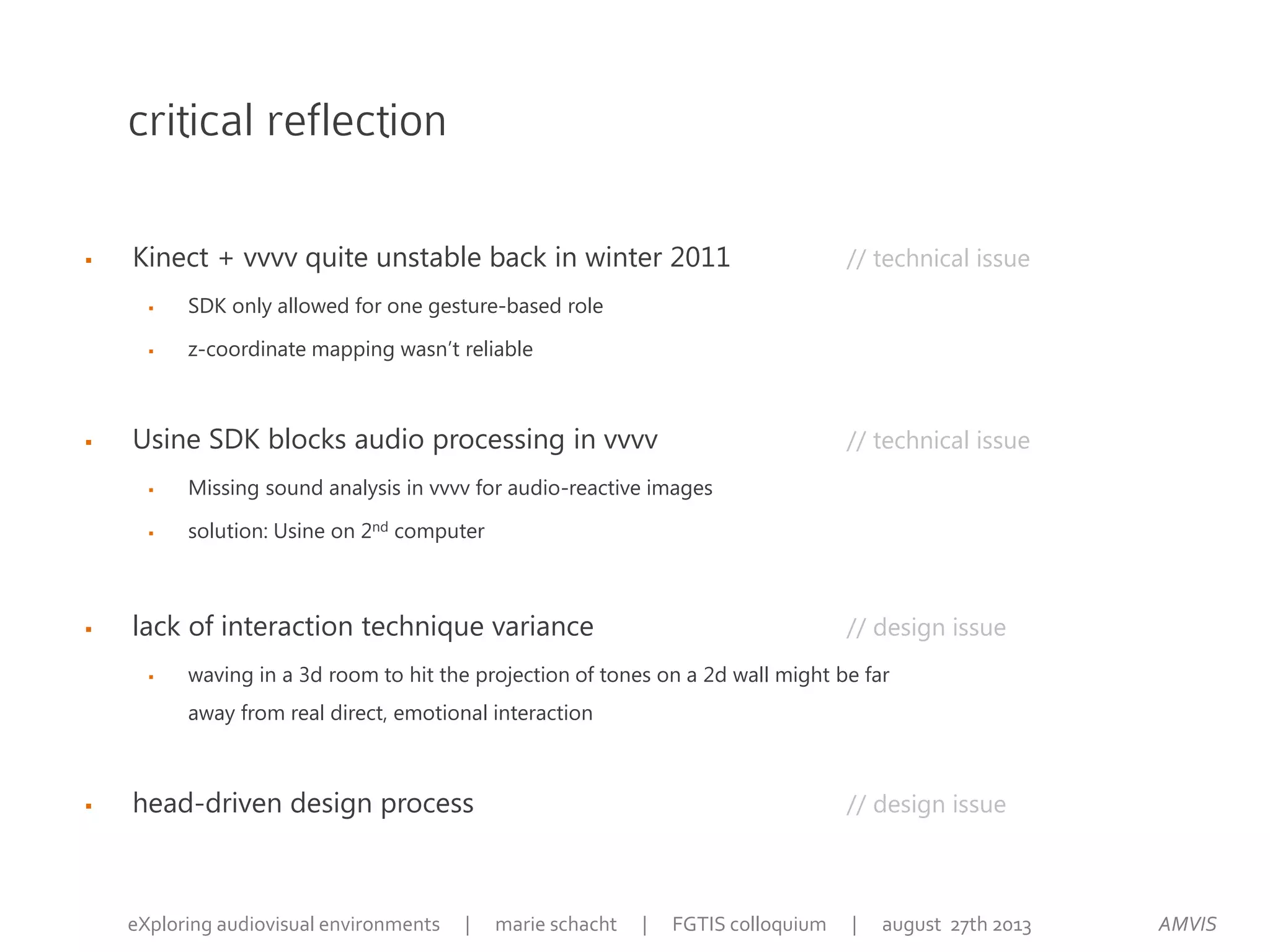
critical reflection
 Kinect + vvvv quite unstable back in winter 2011 // technical issue
 SDK only allowed for one gesture-based role
 z-coordinate mapping wasn’t reliable
 Usine SDK blocks audio processing in vvvv // technical issue
 Missing sound analysis in vvvv for audio-reactive images
 solution: Usine on 2nd computer
 lack of interaction technique variance // design issue
 waving in a 3d room to hit the projection of tones on a 2d wall might be far
away from real direct, emotional interaction
 head-driven design process // design issue
AMVISeXploring audiovisual environments | marie schacht | FGTIS colloquium | august 27th 2013
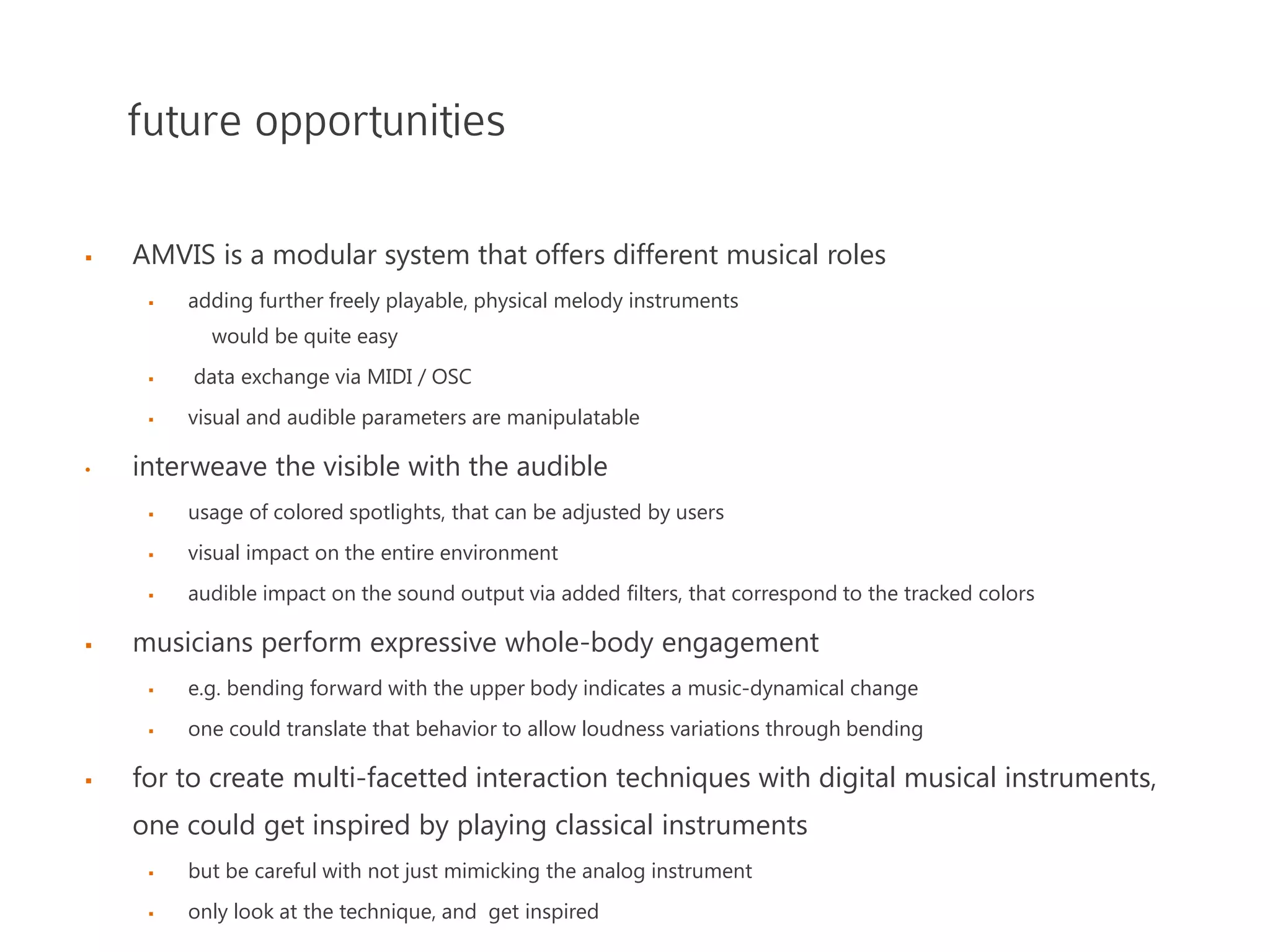
future opportunities
 AMVIS is a modular system that offers different musical roles
 adding further freely playable, physical melody instruments
would be quite easy
 data exchange via MIDI / OSC
 visual and audible parameters are manipulatable
• interweave the visible with the audible
 usage of colored spotlights, that can be adjusted by users
 visual impact on the entire environment
 audible impact on the sound output via added filters, that correspond to the tracked colors
 musicians perform expressive whole-body engagement
 e.g. bending forward with the upper body indicates a music-dynamical change
 one could translate that behavior to allow loudness variations through bending
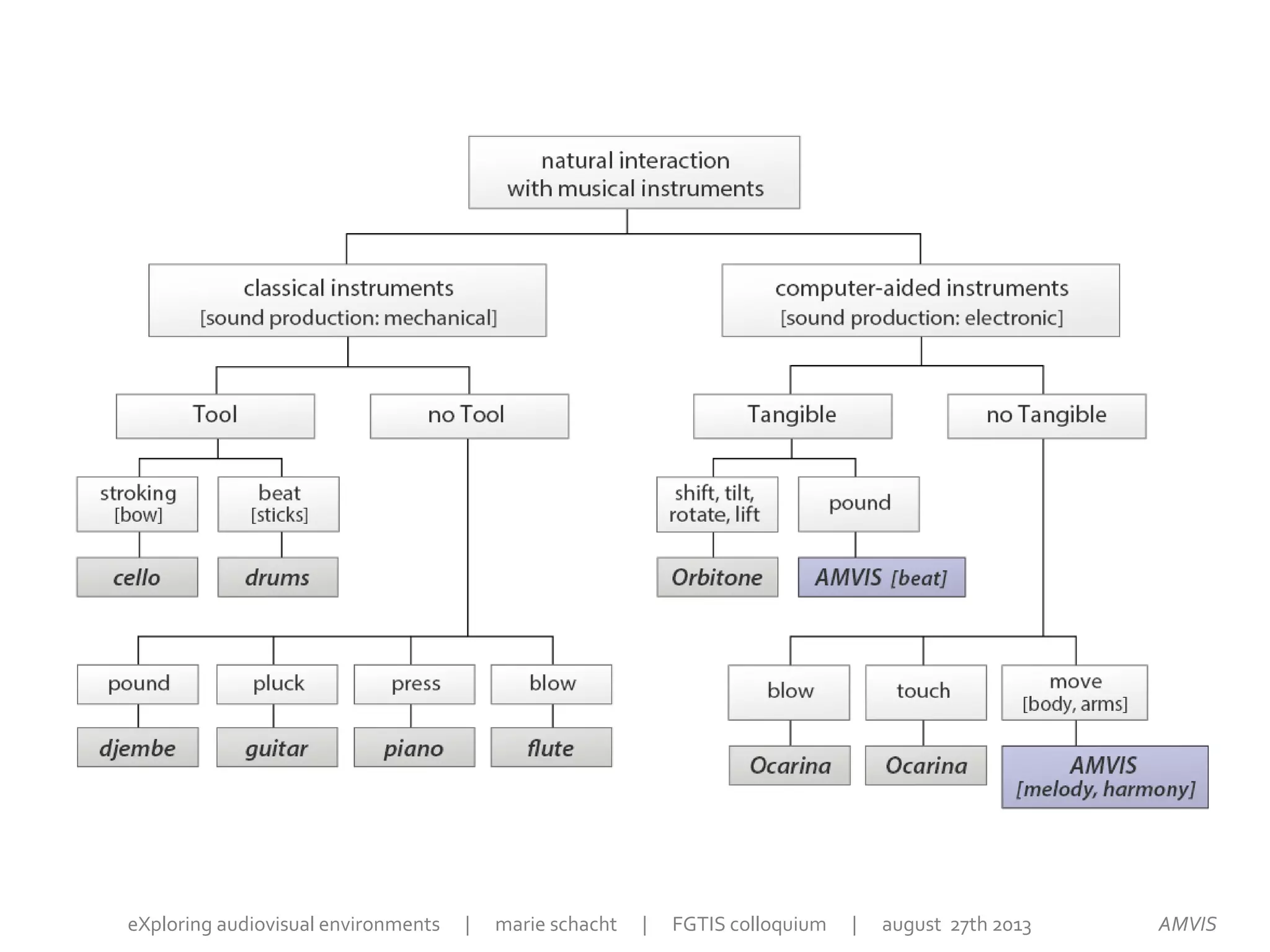
 for to create multi-facetted interaction techniques with digital musical instruments,
one could get inspired by playing classical instruments
 but be careful with not just mimicking the analog instrument
 only look at the technique, and get inspired
AMVISeXploring audiovisual environments | marie schacht | FGTIS colloquium | august 27th 2013
Thank you.
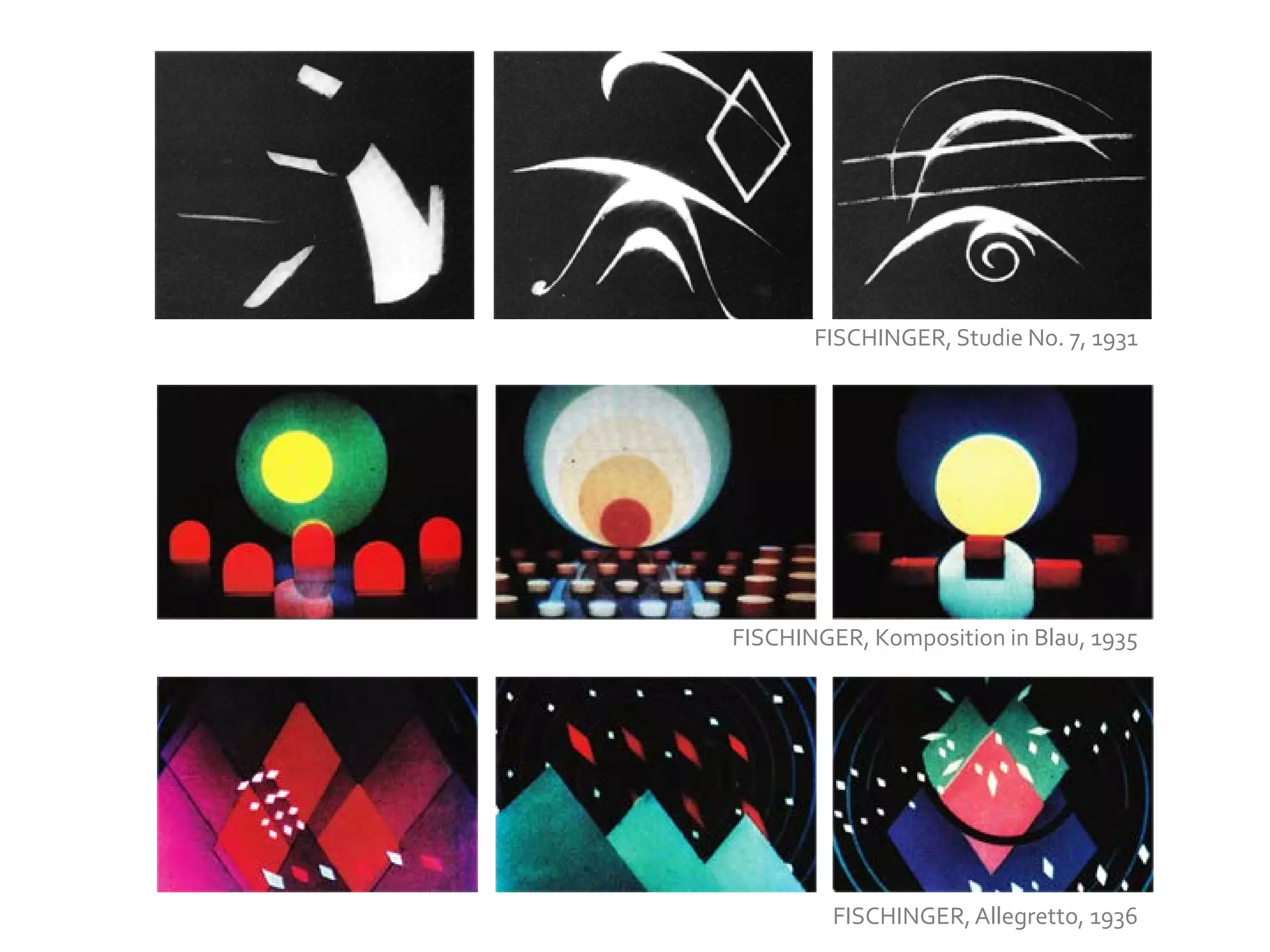
FISCHINGER, Studie No. 7, 1931
FISCHINGER, Komposition in Blau, 1935
FISCHINGER,Allegretto, 1936
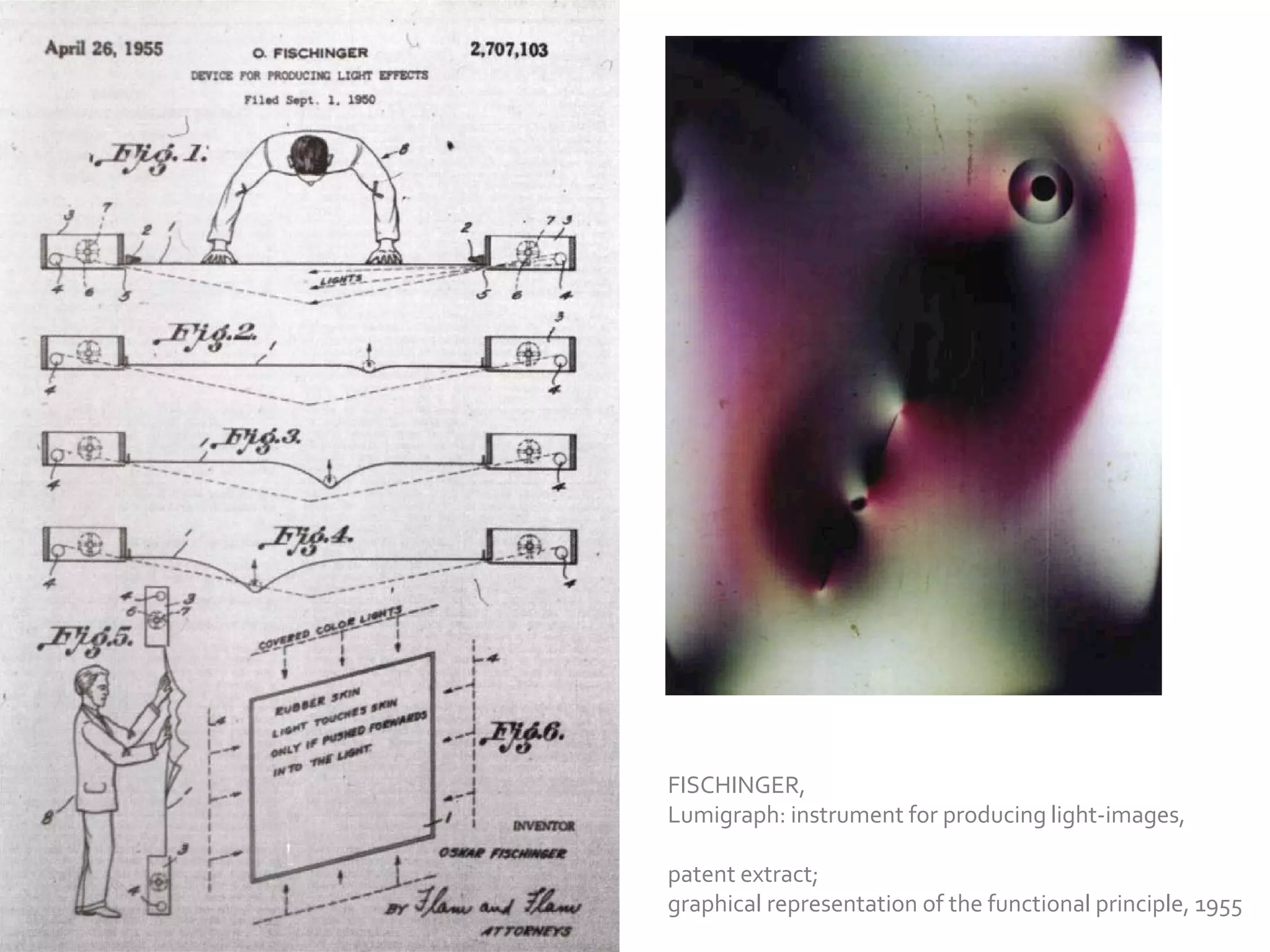
FISCHINGER,
Lumigraph: instrument for producing light-images,
patent extract;
graphical representation of the functional principle, 1955

eXploring audiovisual environments

  • 1.
    eXploring audiovisual Environments MarieSchacht | ESTIA Bidart, France | august 27th 2013 First French German Tangible Interaction Studio: http://www.fgtis.estia.fr/
  • 2.
    introductory example CHET installationCynetart Festival, Dresden, 2011 http://www.intolight.de/blog/2011-unser-jahr-der-interaktiven-raeume http://www.youtube.com/watch?v=MWGRJOj7zwg photos @ David Pinzer
  • 3.
    participatory clubbing night:4 physical interfaces to manipulate music and immersive visuals
  • 4.
    Dance Activity GameStep Sequencer
  • 5.
  • 6.
    Visual Music image -sound relationships, classification proposal
  • 7.
    music is physics. philosophy. mathematics. physiology. anthropology. art. cognition. aesthetics. … andso much more. Visual MusiceXploring audiovisual environments | marie schacht | FGTIS colloquium | august 27th 2013
  • 8.
    music are consciouslycreated, organized acoustic events. Visual MusiceXploring audiovisual environments | marie schacht | FGTIS colloquium | august 27th 2013
  • 9.
    Music enables notonly the auditory nerve, but the whole body to vibrate. [...] When listening to music, the body is music and music is the body. [Vilém Flusser 1991]
  • 10.
    visual music  visualmusic is an art that explores any interaction between sound and image  notable history, with beginnings leading back to Greek antiquity  influenced by scientific insights, technological progress, perception studies and artistic creations  digital technologies offer diverse ways for the investigation of audiovisual knowledge exchange Visual MusiceXploring audiovisual environments | marie schacht | FGTIS colloquium | august 27th 2013
  • 11.
     inspired bypublication of JACK OX and CINDY KEEFER, 2008  the determining factor for distinction is the nature of the audiovisual relationship visual music >> classification proposal Visual MusiceXploring audiovisual environments | marie schacht | FGTIS colloquium | august 27th 2013 i. A piece of music leads to an image. ii. Sound or music lead to moving images. iii. There is an equal audiovisual recognition and exchange. iv. Imagery leads to noise or sound.
  • 12.
    I. A pieceof music leads to an image. PAUL KLEE: “Fugue in red”, 1921
  • 13.
    II. Sound ormusic lead to moving images. BAINBRIDGE BISHOP, Color Organ,1877
  • 14.
    i. A pieceof music leads to an image. ii. Sound or music lead to moving images. a) analogue, mechanical color organ b) digital color piano c) abstract visual music – a contemporary art iii. There is an equal audiovisual recognition and exchange. iv. Imagery leads to noise or sound. visual music >> classification proposal Visual MusiceXploring audiovisual environments | marie schacht | FGTIS colloquium | august 27th 2013
  • 15.
    Sound or musiclead to moving images. video examples http://vimeo.com/23449490 b) digital color piano http://vimeo.com/20258559 c) abstract visual music
  • 16.
    III. An equalaudiovisual exchange. MEMO AKTEN Pi, Glastonbury,2008 http://vimeo.com/1582964
  • 17.
    IV. Imagery leadsto noise or sound. OSKAR FISCHINGER with ornamental roles for synthetic sound generation, 1932
  • 18.
    parallel structures inMusic & Painting  "The layer model in musical art", a theoretical study by WOLFGANG RUTTKOWSKI, 1979  several layers can be distinguished, in musical and in painted work alike  his aesthetic considerations are compared in the following table  lowest layers 1 and 2 --> concrete foreground layers  uppermost layers 4 and 5 --> abstract background layers  refer to the appearance of the work  middle layer 3 represents the figurative  music has nothing representational  nevertheless, what painting, sculpture and poetry want to convey through the object layer, music transports in a different way Visual MusiceXploring audiovisual environments | marie schacht | FGTIS colloquium | august 27th 2013
  • 19.
  • 23.
    In music thelanguage is gathered so closely […] that words merge and pure meaningless tones remain. From this point music seems to be the highest, the densest poetry. [Vilém Flusser]
  • 26.
  • 27.
    Generative art isas old as art itself. […] It refers to any art practice where the artist uses a system, such as a set of natural language rules, a computer program, a machine, or other procedural invention, which is set into motion with some degree of autonomy contributing to or resulting in a completed work of art. [...] Generative Art preceded computer art. New forms of generative art will come after the computer as well. [Galanter 2003]
  • 28.
    Generative Art  ~is the idea realized as a dynamic complex system, able to generate endless variations of music, visual art, moving images, …  each Generative Project is a concept-software that works producing unique and non-repeatable events  computer is simply a tool, not necessary, but enables efficient processing of the procedural creation Generative DesigneXploring audiovisual environments | marie schacht | FGTIS colloquium | august 27th 2013
  • 29.
    Non-digital, Visual GenerativeArt Floor mosaics in St. Mark‘s Basilica, Venice, 1204 - 1450 Generative DesigneXploring audiovisual environments | marie schacht | FGTIS colloquium | august 27th 2013
  • 30.
    Musical Generative Art tableof numbers random generator basic composition diced Waltz melody WOLFGANG AMADEUS MOZART, muscial game of dice, published 1793
  • 31.
    Generative Designing  ~is a procedural design technique  aesthetics and algorithms interweave  partly results-driven, partly experimental used  opens novice imagery worlds  e.g. for data visualization Generative DesigneXploring audiovisual environments | marie schacht | FGTIS colloquium | august 27th 2013
  • 32.
    [Bohnacker 2009] The Processof Generative Designing
  • 33.
    Generative Design [ANTHONY MATTOX:“Spinal Network“, 2009]
  • 34.
    generative design plustemporal element ABSTRACT BIRDS, QUAYOLA: “Partitura“, 2011 http://vimeo.com/23316783
  • 35.
  • 36.
    AMVIS >> objective conception and implementation of a Natural User Interface (NUI) for collaborative music-making  whole-body interactions trigger audiovisual events immediately  interplay of audible and visable material  their joint presence leads to mutual enrichment  joyfully explorable and perceivable interface  support of untrained users to experience own music-making, however, without demanding too little from skilled musicians AMVISeXploring audiovisual environments | marie schacht | FGTIS colloquium | august 27th 2013
  • 37.
     multi-user environment musically and visually perceivable  motion-controlled, via different natutal interaction methods  digital musical instrument (DMI)  control module plus tone generation module  mapping concepts relate those to one another  the users‘ interaction with the system and with each other creates the musical artwork, which is partly compositional and partly improvisational  audiovisual installation  gestural parameters are converted into parallel sonic and visual parameters  favors multi-sensory perception  users actively co-design the environment  modular programmed and extensible software  processes whole-body and tangible user interactions in real time  generates parallel audible and visual output AMVIS >> result
  • 38.
  • 39.
     vvvv forthe entire installation  runs in real-time  supports various input and output technologies  generates images and sounds  sends & receives MIDI and OSC messages  Usine for audio production  processes audio data in real-time, with low latencies  supports MIDI and OSC protocols for data exchange chosen SDKs AMVISeXploring audiovisual environments | marie schacht | FGTIS colloquium | august 27th 2013
  • 40.
  • 41.
    Music is theart of arranging tones with regard to melody, harmony and rhythm to a group of sounds. [German dictionary]
  • 42.
     the definitionwas taken as the functional principle for collaborative music-making with AMVIS  it is reflected in 3 different user roles: MELODY, HARMONY, RHYTHM  users interact with the system and with each other  computer aids ensemble playing AMVIS >> approach AMVISeXploring audiovisual environments | marie schacht | FGTIS colloquium | august 27th 2013
  • 43.
     DEFINITION: Melody isa succession of tones with different pitches and durations, which are connected to each other by intervals.  FUNCTION:  protagonist of a musical piece  independent  follows its own impulse  FUNCTION IN AMVIS:  represents the virtualized musical instrument  user plays tones and defines pitches and durations  the range of tones covers two octaves, including all semitones 1st user role >> melody AMVISeXploring audiovisual environments | marie schacht | FGTIS colloquium | august 27th 2013
  • 44.
     every toneand half-tone must be reachable on purpose  no sound installation, but a music-making environment  NOT playing a tone is equally important  sufficient range of tones (2 octaves min)  tone duration should be adjustable 1st user role >> melody >> demands AMVISeXploring audiovisual environments | marie schacht | FGTIS colloquium | august 27th 2013
  • 47.
     DEFINITION: Harmony meansbalance. Harmony, in music, is the simultaneous combination of notes in a chord and the study of their relations.  FUNCTION:  repeating series of chords establish harmonical relations to the melody section by section  chords are parallel or sequentially played groups of single notes  FUNCTION IN AMVIS:  user establishes chords from up to 4 single notes and arranges a chord sequence  the system’s task is to play the chords in a uniform and repetitive manner 2nd user role >> harmony AMVISeXploring audiovisual environments | marie schacht | FGTIS colloquium | august 27th 2013
  • 48.
     DEFINITION: Rhythm isthe pattern of musical movement through time.  FUNCTION:  regulates the progression of sound events  chords sound to the beat of the rhythm  independent rhythms arise in melody, due to the linear sequence of different tone durations  FUNCTION IN AMVIS:  the user is enabled to set the global ground tempo 3rd user role >> rhythm AMVISeXploring audiovisual environments | marie schacht | FGTIS colloquium | august 27th 2013
  • 49.
     DEFINITION: A conductoris the manager of a musical ensemble.  FUNCTION:  coordinates the interaction of involved musicians  serves as mode switcher  FUCNTION IN AMVIS:  chooses the audiovisual atmosphere  gives clearance for chord establishment and rhythm synchronization  is music teacher: can show and hide supporting text layers 4th user role >> conductor AMVISeXploring audiovisual environments | marie schacht | FGTIS colloquium | august 27th 2013
  • 50.
  • 51.
    melody  movement ofhands selects and plays tones  movement of the body is demanded to access the entire range of tones harmony  movement of hands selects and plays single chord tones rhythm  percussive gesture conductor  whole-body gestures interaction techniques AMVISeXploring audiovisual environments | marie schacht | FGTIS colloquium | august 27th 2013
  • 52.
    • user isin control • software is the virtualized musical instrument • pre-defined routes • user chooses destination and parameters • sound-producing- machine • user pushes the start button computer-aided music-making >> usage concepts autopilot train driver instrumentalist [Karlheinz Essl, 1999] AMVISeXploring audiovisual environments | marie schacht | FGTIS colloquium | august 27th 2013
  • 53.
    AMVIS MelodyAMVIS Harmony AMVISeXploringaudiovisual environments | marie schacht | FGTIS colloquium | august 27th 2013 computer-aided music-making >> interface concepts
  • 54.
    AMVISeXploring audiovisual environments| marie schacht | FGTIS colloquium | august 27th 2013 loop-based interface concepts for tone-triggering
  • 55.
    AMVIS an Auditory, Motiondriven,VISualizing Environment http://vimeo.com/29770159
  • 56.
  • 57.
  • 58.
    playing a melodywhile the system strikes the chords autonomously
  • 59.
  • 60.
  • 61.
  • 62.
    critical reflection  Kinect+ vvvv quite unstable back in winter 2011 // technical issue  SDK only allowed for one gesture-based role  z-coordinate mapping wasn’t reliable  Usine SDK blocks audio processing in vvvv // technical issue  Missing sound analysis in vvvv for audio-reactive images  solution: Usine on 2nd computer  lack of interaction technique variance // design issue  waving in a 3d room to hit the projection of tones on a 2d wall might be far away from real direct, emotional interaction  head-driven design process // design issue AMVISeXploring audiovisual environments | marie schacht | FGTIS colloquium | august 27th 2013
  • 63.
    future opportunities  AMVISis a modular system that offers different musical roles  adding further freely playable, physical melody instruments would be quite easy  data exchange via MIDI / OSC  visual and audible parameters are manipulatable • interweave the visible with the audible  usage of colored spotlights, that can be adjusted by users  visual impact on the entire environment  audible impact on the sound output via added filters, that correspond to the tracked colors  musicians perform expressive whole-body engagement  e.g. bending forward with the upper body indicates a music-dynamical change  one could translate that behavior to allow loudness variations through bending  for to create multi-facetted interaction techniques with digital musical instruments, one could get inspired by playing classical instruments  but be careful with not just mimicking the analog instrument  only look at the technique, and get inspired
  • 64.
    AMVISeXploring audiovisual environments| marie schacht | FGTIS colloquium | august 27th 2013
  • 65.
  • 66.
    FISCHINGER, Studie No.7, 1931 FISCHINGER, Komposition in Blau, 1935 FISCHINGER,Allegretto, 1936
  • 67.
    FISCHINGER, Lumigraph: instrument forproducing light-images, patent extract; graphical representation of the functional principle, 1955