Music of the 20th
Century
MUSIC 10 – First Quarter
What music do you usually
listen to? Are you into Rock?
Pop? Or Hip-hop music?
The styles of modern songs can be traced back from
the 20th Century. The innovative and experimental
styles of the 20th Century Music are the influences
of the genius composers such as Claude Debussy,
Maurice Ravel, Arnold Schoenberg, Bela Bartok,
Igor Stravinsky, Sergei Prokofieff, and George
Gershwin.
Coming from different nations such as
France, Austria, Hungary, Russia, and the
United States, these composers clearly
reflected the growing globalization of
musical styles in the 20th century.
IMPRESSIONISM
LESSON 1
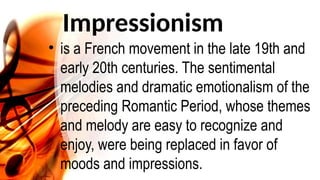
Impressionism
• is a French movement in the late 19th and
early 20th centuries. The sentimental
melodies and dramatic emotionalism of the
preceding Romantic Period, whose themes
and melody are easy to recognize and
enjoy, were being replaced in favor of
moods and impressions.
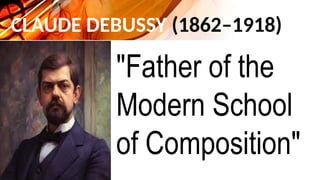
CLAUDE DEBUSSY (1862–1918)
"Father of the
Modern School
of Composition"
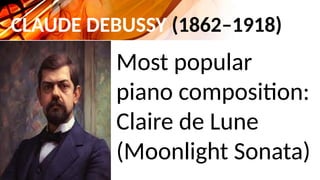
CLAUDE DEBUSSY (1862–1918)
Most popular
piano composition:
Claire de Lune
(Moonlight Sonata)
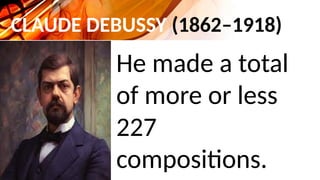
CLAUDE DEBUSSY (1862–1918)
He made a total
of more or less
227
compositions.
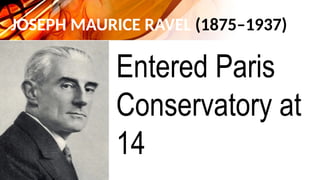
JOSEPH MAURICE RAVEL (1875–1937)
Entered Paris
Conservatory at
14
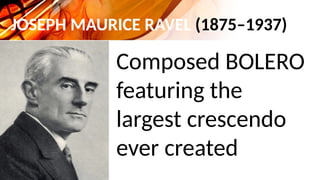
JOSEPH MAURICE RAVEL (1875–1937)
Composed BOLERO
featuring the
largest crescendo
ever created
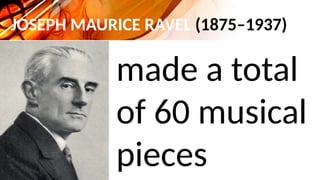
JOSEPH MAURICE RAVEL (1875–1937)
made a total
of 60 musical
pieces
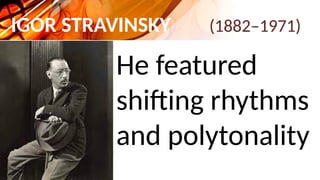
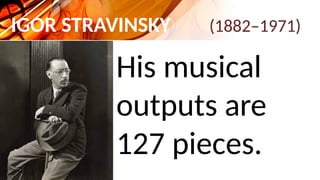
IGOR STRAVINSKY (1882–1971)
He featured
shifting rhythms
and polytonality
IGOR STRAVINSKY (1882–1971)
His musical
outputs are
127 pieces.
EXPRESSIONISM
LESSON 2
Expressionism
Emerged in 1918, expressionist music
is characterized by high dissonance,
stark dynamic contrasts (from very soft
to very loud), ever-changing textures,
distorted melodies and harmonies, and
angular melodies with wide leaps.
Expressionism
The term
“expressionism” was
originally borrowed from
visual art and literature.
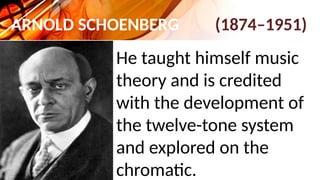
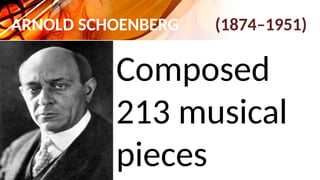
ARNOLD SCHOENBERG (1874–1951)
He taught himself music
theory and is credited
with the development of
the twelve-tone system
and explored on the
chromatic.
ARNOLD SCHOENBERG (1874–1951)
Composed
213 musical
pieces
PRIMITIVISM &
NEO-CLASSICISM MUSIC
LESSON 3
Primitivism
is a style that evokes the raw,
elemental qualities of early
cultures through driving rhythms,
repetitive patterns, and a focus on
percussion, creating a sense of
primal energy.
Neo-classicism
is a style that seeks to revive the
clarity, balance, and formal
structures of earlier classical
music, particularly from the 18th
century, while incorporating
modern harmonies and rhythms.
How is primitivism linked
to neo-classicism?
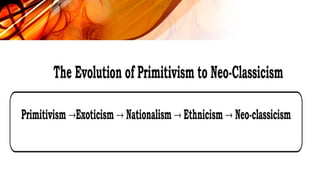
Primitivism connects to Exoticism,
Nationalism, and Ethnicism by
incorporating cultural elements
from various sources. Key figures
like Igor Stravinsky and Béla Bartók
helped shape this style, which later
evolved into Neoclassicism.
AVANT-GARDE MUSIC
LESSON 4
Avant-Garde
It is a French term which
means favoring or
introducing experimental
or unusual ideas.
What are the characteristics
of avant-garde music?
Alters musical
continuity
Expresses sound
strange to the ears
Improvises unique
instruments is a
necessity
Acquires new
attitude toward
musical mobility
Deals with the
parameters or dimensions
of sound in space
Does not conform to
traditional rules in
harmony, melody and
rhythm
ELECTRONIC MUSIC
LESSON 5
Electronic Music
is a genre that creates and
manipulates sounds using
electronic devices, covering a
range of styles from purely
electronic compositions to blends
with traditional instruments.
Electronic Devices
cassette tape recorders
compact discs (CDs)
video compact discs
(VCDs)
digital video discs
(DVDs)
MP3 and MP4 players;
ipod
karaoke players
mobile and android
phones;
synthesizers
Electronic devices have been
increasingly used for creating and
recording music that are meant to be
added to or to replace acoustical sounds
made with traditional instruments.
Here are some of the modern
devices used in creating electronic
music:
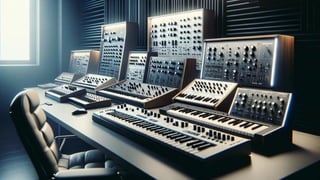
Music Synthesizer
This is a device that electronically
generates and modifies sounds,
frequently with the use of a
digital computer.
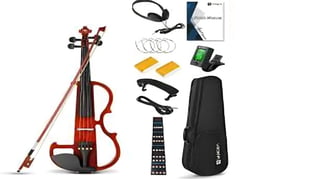
Electric Violin
This is a device that electronically
generates and modifies sounds,
frequently with the use of a
digital computer.
MIDI
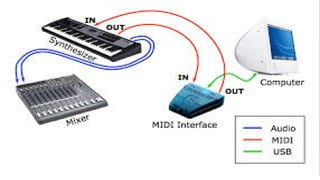
is a communication standard that
allows digital music gear to speak
the same language. MIDI is short
for Musical Instrument Digital
Interface.
MIDI
It’s a protocol that allows
computers, musical instruments and
other hardware to communicate.
MIDI never transmits an actual
audio signal—it is information only.
MIDI
That means that if a MIDI
keyboard does not have an
onboard sound source like a synth
or sampler, it will not make any
sound.
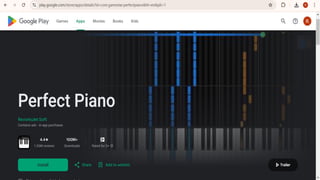
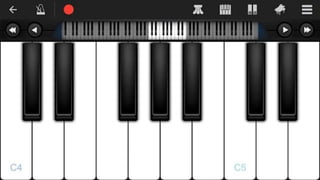
VIRTUAL PIANO KEYBOARD
is a piano app that allows
you to compose music, play
your own music in a best
way you can.
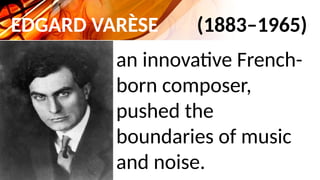
EDGARD VARÈSE (1883–1965)
an innovative French-
born composer,
pushed the
boundaries of music
and noise.
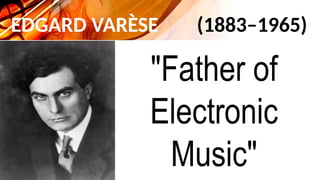
EDGARD VARÈSE (1883–1965)
"Father of
Electronic
Music"
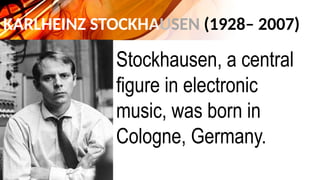
KARLHEINZ STOCKHAUSEN (1928– 2007)
Stockhausen, a central
figure in electronic
music, was born in
Cologne, Germany.
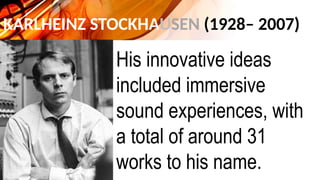
KARLHEINZ STOCKHAUSEN (1928– 2007)
His innovative ideas
included immersive
sound experiences, with
a total of around 31
works to his name.
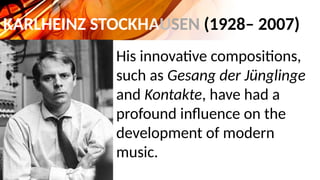
KARLHEINZ STOCKHAUSEN (1928– 2007)
His innovative compositions,
such as Gesang der Jünglinge
and Kontakte, have had a
profound influence on the
development of modern
music.
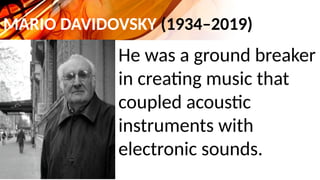
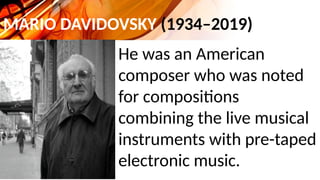
MARIO DAVIDOVSKY (1934–2019)
He was a ground breaker
in creating music that
coupled acoustic
instruments with
electronic sounds.
MARIO DAVIDOVSKY (1934–2019)
He was an American
composer who was noted
for compositions
combining the live musical
instruments with pre-taped
electronic music.
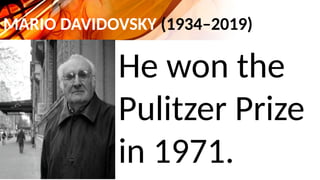
MARIO DAVIDOVSKY (1934–2019)
He won the
Pulitzer Prize
in 1971.
Chance Music
Chance/Aleatoric Music (from the
Latin word Alea meaning “dice”) is
music in which some elements of the
composition is left to chance, and/or
some primary element of a composed
work’s realization is left to the
determination of the performer(s).
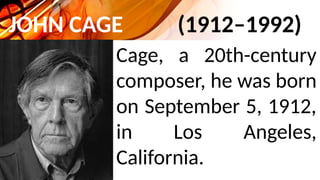
JOHN CAGE (1912–1992)
Cage, a 20th-century
composer, he was born
on September 5, 1912,
in Los Angeles,
California.
JOHN CAGE (1912–1992)
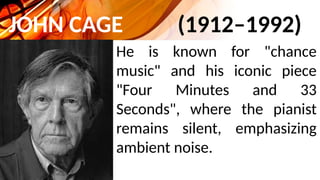
He is known for "chance
music" and his iconic piece
"Four Minutes and 33
Seconds", where the pianist
remains silent, emphasizing
ambient noise.
MUSIC GRADE 10  First Quarter MELC Based

MUSIC GRADE 10 First Quarter MELC Based