Exploratory testing
ISsoft Solutions
Scripts require a big investment.
What do we get back?
Key benefits of scripts
• Careful thinking about the design of each
test, optimizing it for its
• Cover most important attributes
(modules, power, installation, whatever)
• Review by other stakeholders
Key benefits of scripts
• Reusability
• Known comprehensiveness of the set of
tests
• We can calculate as a metric the percentage
completed of these tests.
Problem with scripts?
Scripts are hit and miss

The scripted approach means the
test stays the same, even thought
the risk profile is changing.
Risk profiles evolve over time
• The requirements / specifications are almost certain to
change as the program evolves
• Different programmers tend to make different errors
•

The environment in which the software will run
(platform, competition, user expectations, new exploits)
changes over time.

The earlier you design the tests, the less you understand the
program and its risk profile…
So…
Are you doing exploratory testing?
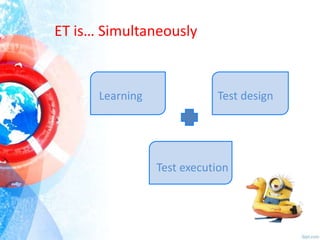
ET is… Simultaneously

Learning

Test design

Test execution
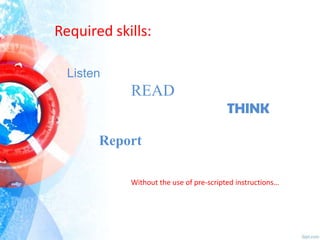
Required skills:
Listen

READ
THINK

Report
Without the use of pre-scripted instructions…
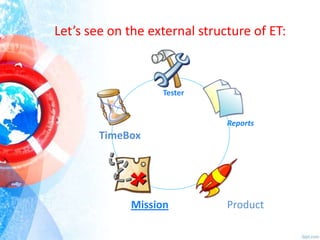
Let’s see on the external structure of ET:

Tester

Reports

TimeBox

Mission

Product
Where ET fits
 You need to provide rapid feedback on a new
product or feature

 You need to learn the product quickly
Where ET fits
 You have already tested using scripts, and seek to
diversify the testing
 You want to find the single most important bug in
the shortest time
 You want to check the work of another tester by
doing a brief independent investigation
Where ET fits
You want to investigate and isolate a
particular defect
You want to investigate the status of a
particular risk, in order to evaluate the need
for scripted tests in that area
Misconceptions about Exploratory Testing
Session-Based Test Management
Exploratory Testing cannot be managed or
measured.

Short: 60 mins (+-15)

Normal: 90 mins (+-15)
Long: 120 mins (+-15)
The experience of a tester is not the prerequisite for exploratory testing.
Only an experienced tester can do exploratory
testing
Can be detailed documentation even in
exploratory testing
Exploratory Testing means no documentation
Exploratory testing is not against the idea
of scripting
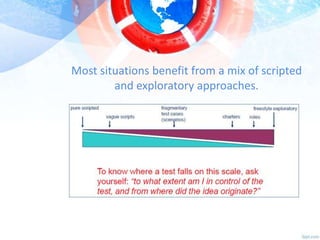
Most situations benefit from a mix of scripted
and exploratory approaches.
Sources:
• A Tutorial in Exploratory Testing, April 2008, Cem
Kaner, J.D., Ph.D.
http://www.kaner.com/pdfs/QAIExploring.pdf
• How to Measure Ad Hoc Testing
http://www.satisfice.com/presentations/htmaht.pdf
• Exploratory Testing Explained v.1.3 4/16/03, James Bach
• Session-Based Test Management by Jonathan Bach
http://www.satisfice.com/articles/sbtm.pdf
• Exploratory Testing – The Basics
http://university.utest.com/exploratory-testing-thebasics/

Exploratory testing

  • 1.
  • 2.
    Scripts require abig investment. What do we get back?
  • 3.
    Key benefits ofscripts • Careful thinking about the design of each test, optimizing it for its • Cover most important attributes (modules, power, installation, whatever) • Review by other stakeholders
  • 4.
    Key benefits ofscripts • Reusability • Known comprehensiveness of the set of tests • We can calculate as a metric the percentage completed of these tests.
  • 5.
  • 6.
    Scripts are hitand miss The scripted approach means the test stays the same, even thought the risk profile is changing.
  • 7.
    Risk profiles evolveover time • The requirements / specifications are almost certain to change as the program evolves • Different programmers tend to make different errors • The environment in which the software will run (platform, competition, user expectations, new exploits) changes over time. The earlier you design the tests, the less you understand the program and its risk profile…
  • 8.
    So… Are you doingexploratory testing?
  • 9.
  • 10.
    Required skills: Listen READ THINK Report Without theuse of pre-scripted instructions…
  • 11.
    Let’s see onthe external structure of ET: Tester Reports TimeBox Mission Product
  • 12.
    Where ET fits You need to provide rapid feedback on a new product or feature  You need to learn the product quickly
  • 13.
    Where ET fits You have already tested using scripts, and seek to diversify the testing  You want to find the single most important bug in the shortest time  You want to check the work of another tester by doing a brief independent investigation
  • 14.
    Where ET fits Youwant to investigate and isolate a particular defect You want to investigate the status of a particular risk, in order to evaluate the need for scripted tests in that area
  • 15.
  • 16.
    Session-Based Test Management ExploratoryTesting cannot be managed or measured. Short: 60 mins (+-15) Normal: 90 mins (+-15) Long: 120 mins (+-15)
  • 17.
    The experience ofa tester is not the prerequisite for exploratory testing. Only an experienced tester can do exploratory testing
  • 18.
    Can be detaileddocumentation even in exploratory testing Exploratory Testing means no documentation
  • 19.
    Exploratory testing isnot against the idea of scripting
  • 20.
    Most situations benefitfrom a mix of scripted and exploratory approaches.
  • 22.
    Sources: • A Tutorialin Exploratory Testing, April 2008, Cem Kaner, J.D., Ph.D. http://www.kaner.com/pdfs/QAIExploring.pdf • How to Measure Ad Hoc Testing http://www.satisfice.com/presentations/htmaht.pdf • Exploratory Testing Explained v.1.3 4/16/03, James Bach • Session-Based Test Management by Jonathan Bach http://www.satisfice.com/articles/sbtm.pdf • Exploratory Testing – The Basics http://university.utest.com/exploratory-testing-thebasics/