Explaining biocide tolerance of
Gram negative bacteria
– using SyBr Green qPCR as a versatile
tool to develop and support hypotheses
Dr. Lucy Bock
Senior Scientist/Project Team Leader
Technology Development Group
National Infection Service
Public Health England, UK Lucy.Bock@phe.gov.uk
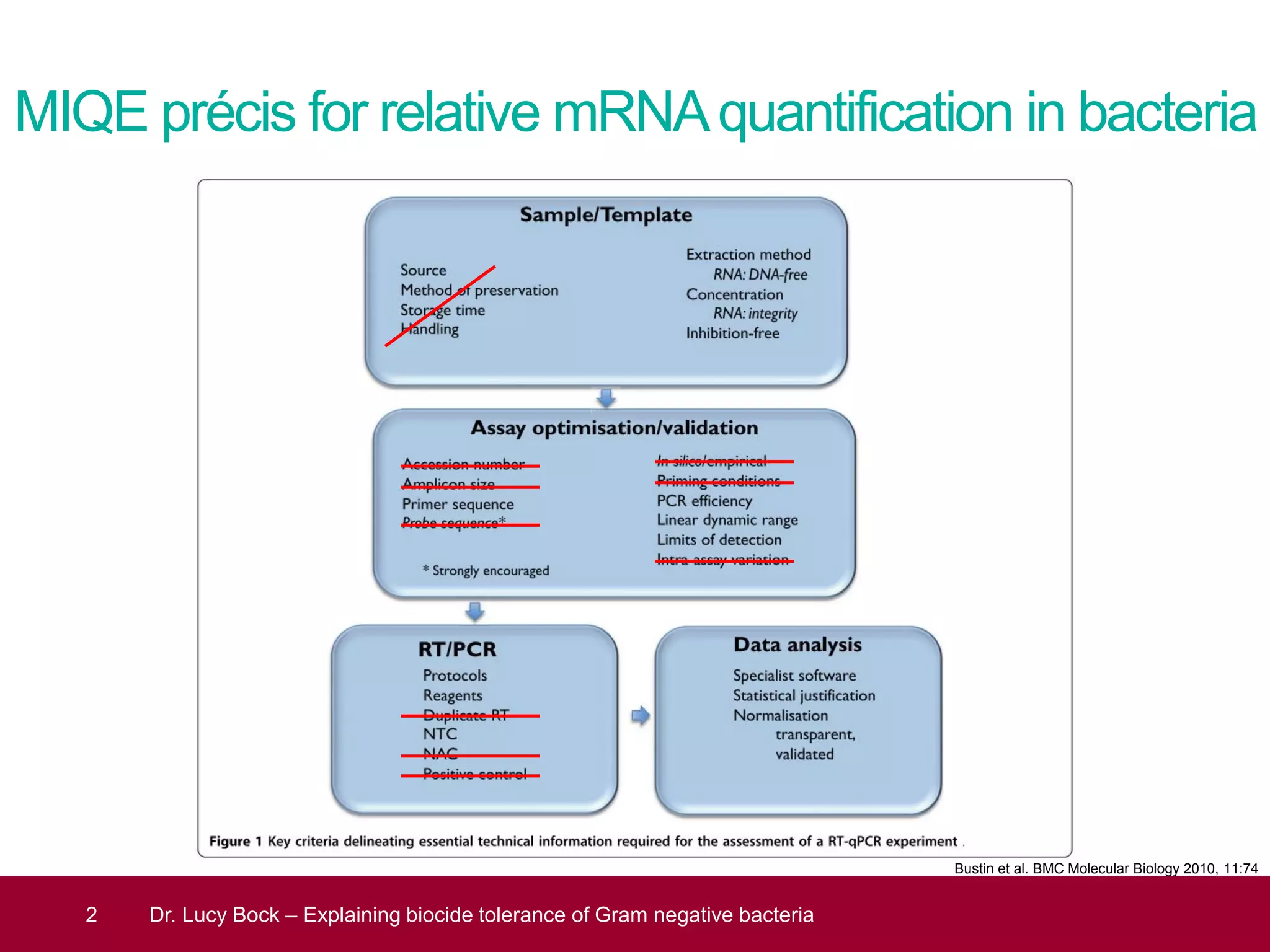
MIQE précis for relative mRNAquantification in bacteria
2 Dr. Lucy Bock – Explaining biocide tolerance of Gram negative bacteria
Bustin et al. BMC Molecular Biology 2010, 11:74
Reference genes – how to choose
Requirements:
• Similar expression levels to target genes (NOT 16S)
• Expression not affected by test condition/mutation/pathway
• Expression level consistent between strains
• Multiple genes to control for consistency (then have the option to remove
one from normalisation analysis)
Choices:
• Publications
• Knowledge about test condition/mutation
Testing:
• Following primer design, test multiple genes on your samples
• Adapt selection if necessary
3 Dr. Lucy Bock – Explaining biocide tolerance of Gram negative bacteria
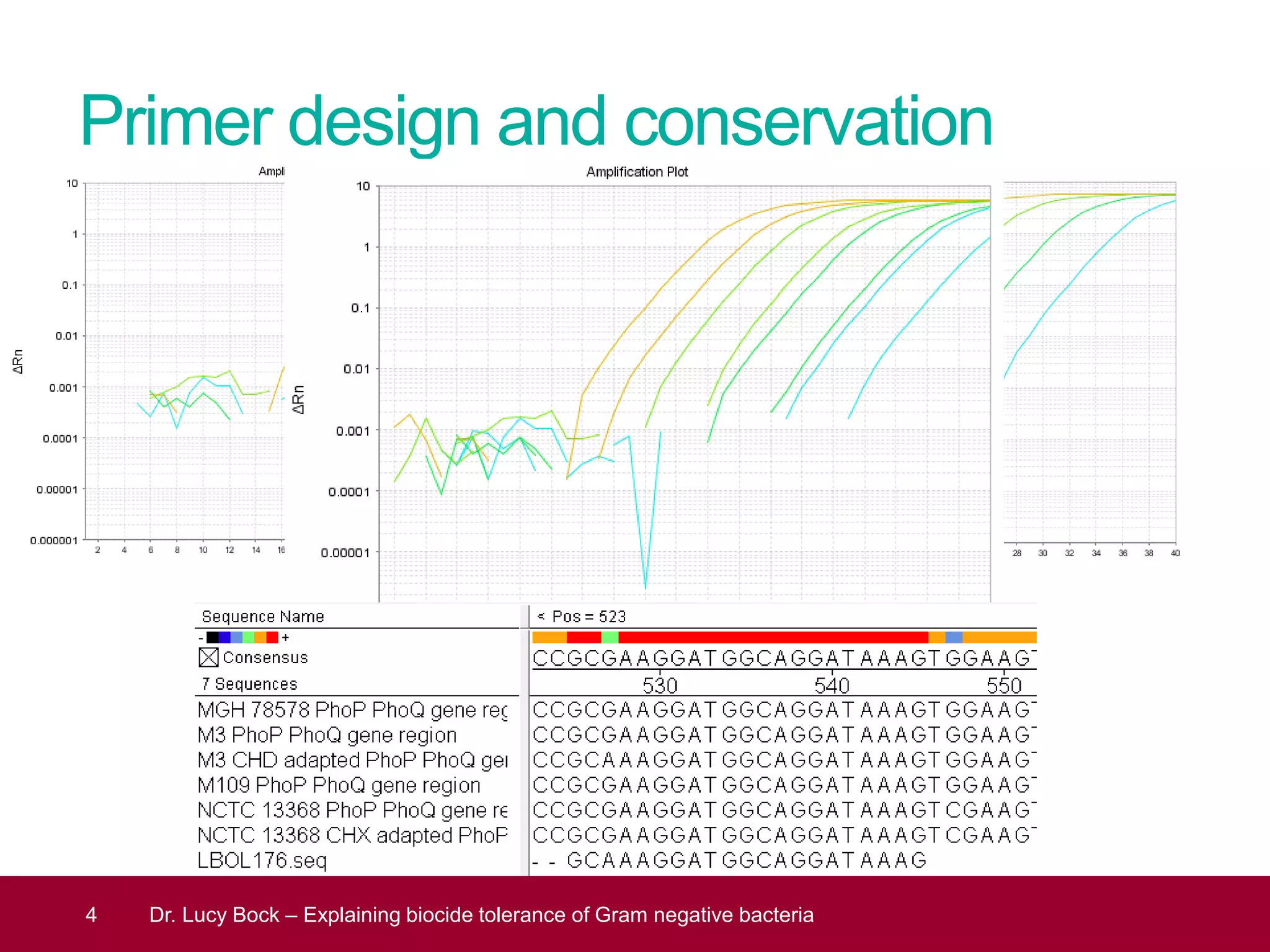
Primer design and conservation
Primer Blast with the following settings:
• Primer length: ~20bp
• Melting temperature: 59°- 61° (60° optimum)
• PCR product size: 90-110b
Then check for conservation for 3 primer pairs
4 Dr. Lucy Bock – Explaining biocide tolerance of Gram negative bacteria
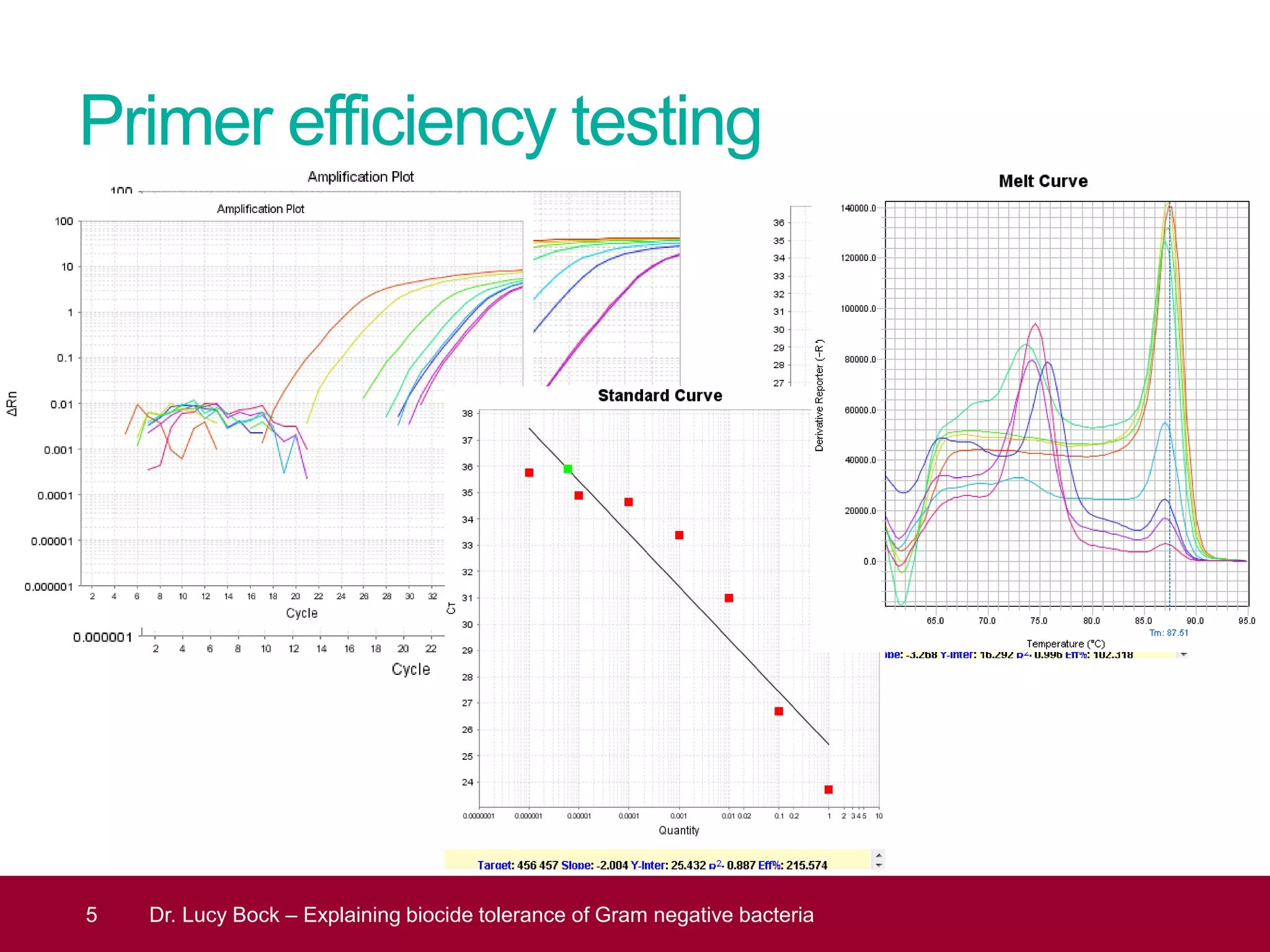
Primer efficiency testing
5 Dr. Lucy Bock – Explaining biocide tolerance of Gram negative bacteria
Exposure, RNAextraction and RT
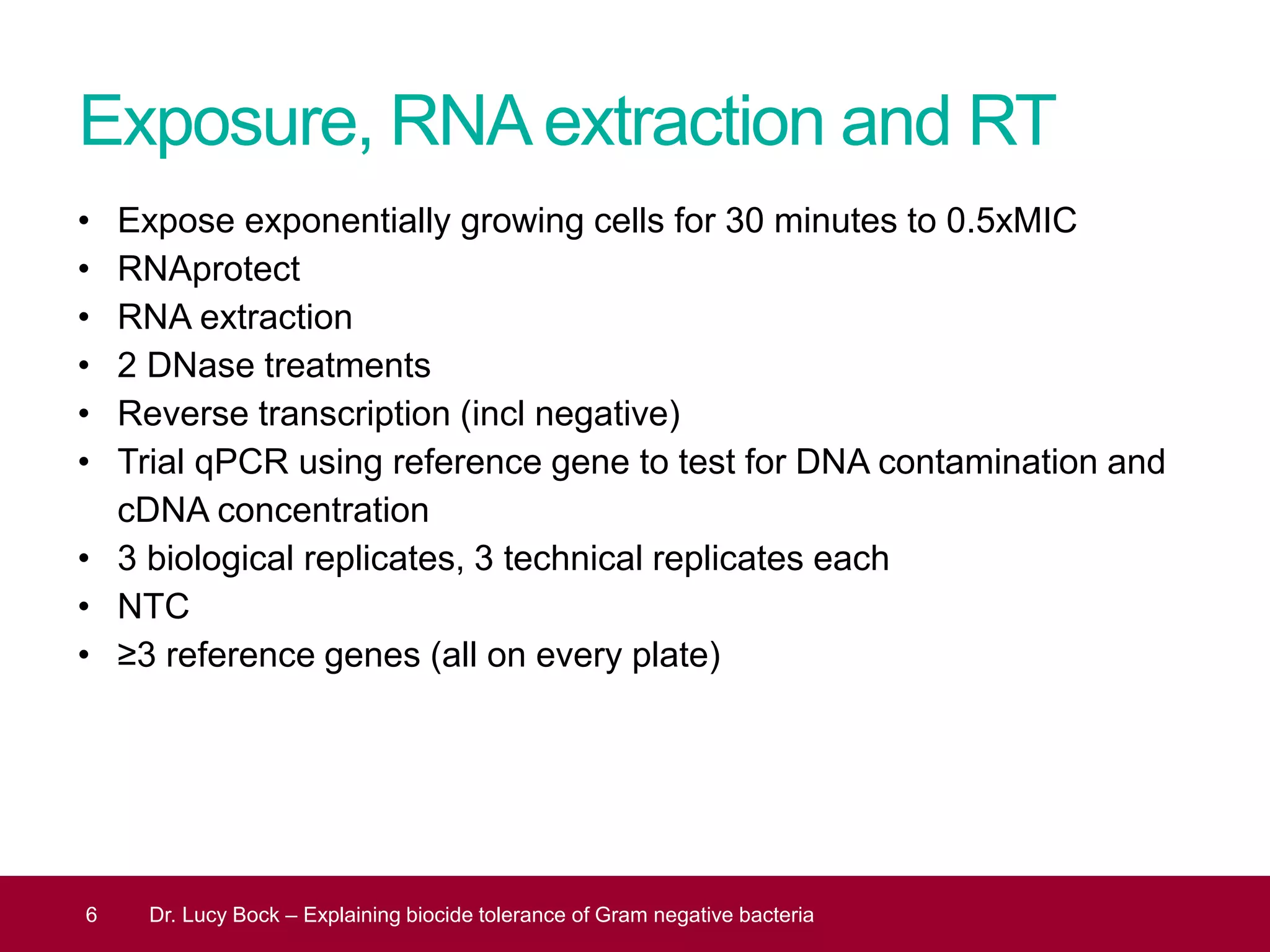
• Expose exponentially growing cells for 30 minutes to 0.5xMIC
• RNAprotect
• RNA extraction
• 2 DNase treatments
• Reverse transcription (incl negative)
• Trial qPCR using reference gene to test for DNA contamination and
cDNA concentration
• 3 biological replicates, 3 technical replicates each
• NTC
• ≥3 reference genes (all on every plate)
6 Dr. Lucy Bock – Explaining biocide tolerance of Gram negative bacteria
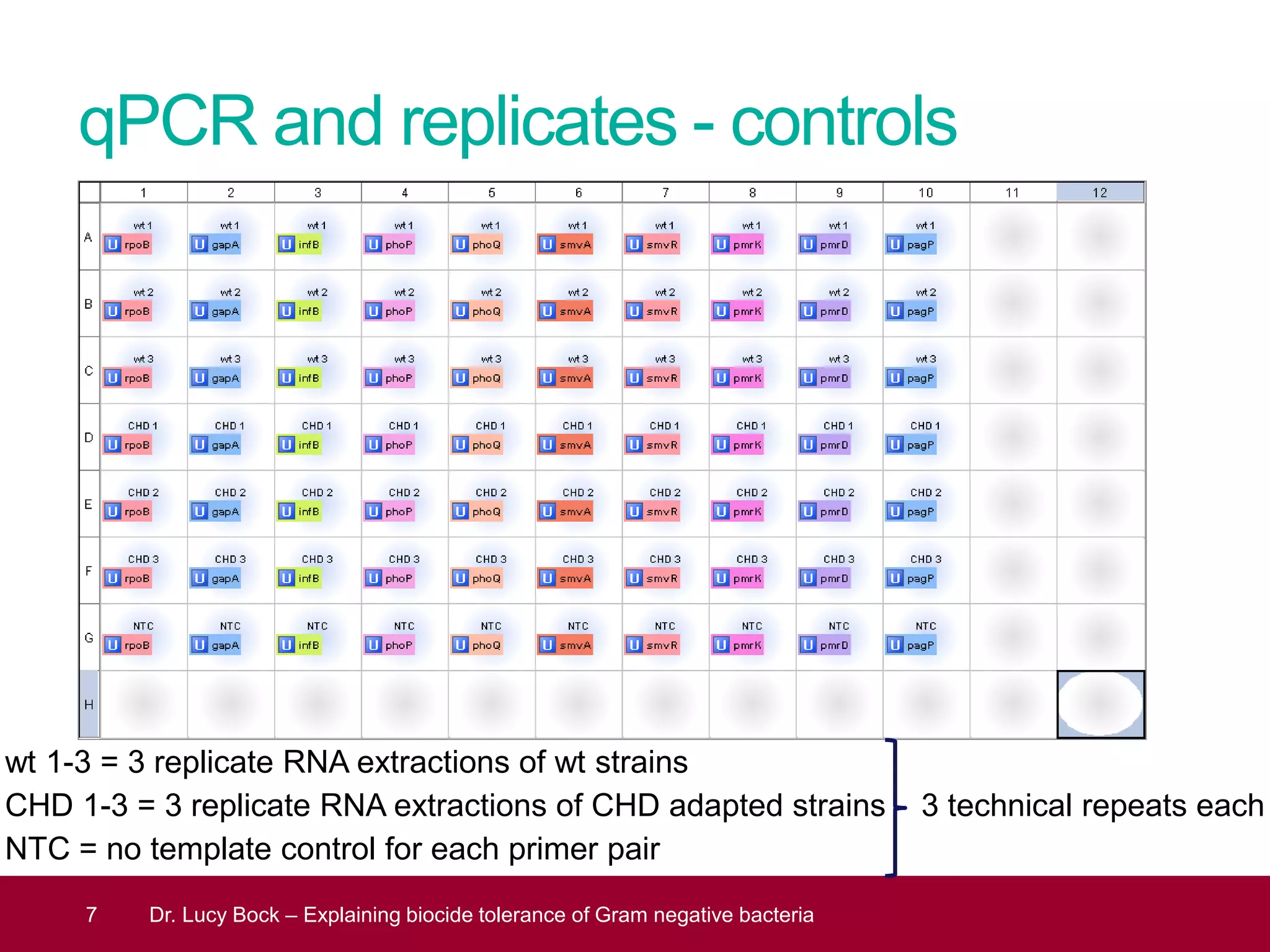
qPCR and replicates - controls
wt 1-3 = 3 replicate RNA extractions of wt strains
CHD 1-3 = 3 replicate RNA extractions of CHD adapted strains 3 technical repeats each
NTC = no template control for each primer pair
7 Dr. Lucy Bock – Explaining biocide tolerance of Gram negative bacteria
Analysis
8 Dr. Lucy Bock – Explaining biocide tolerance of Gram negative bacteria
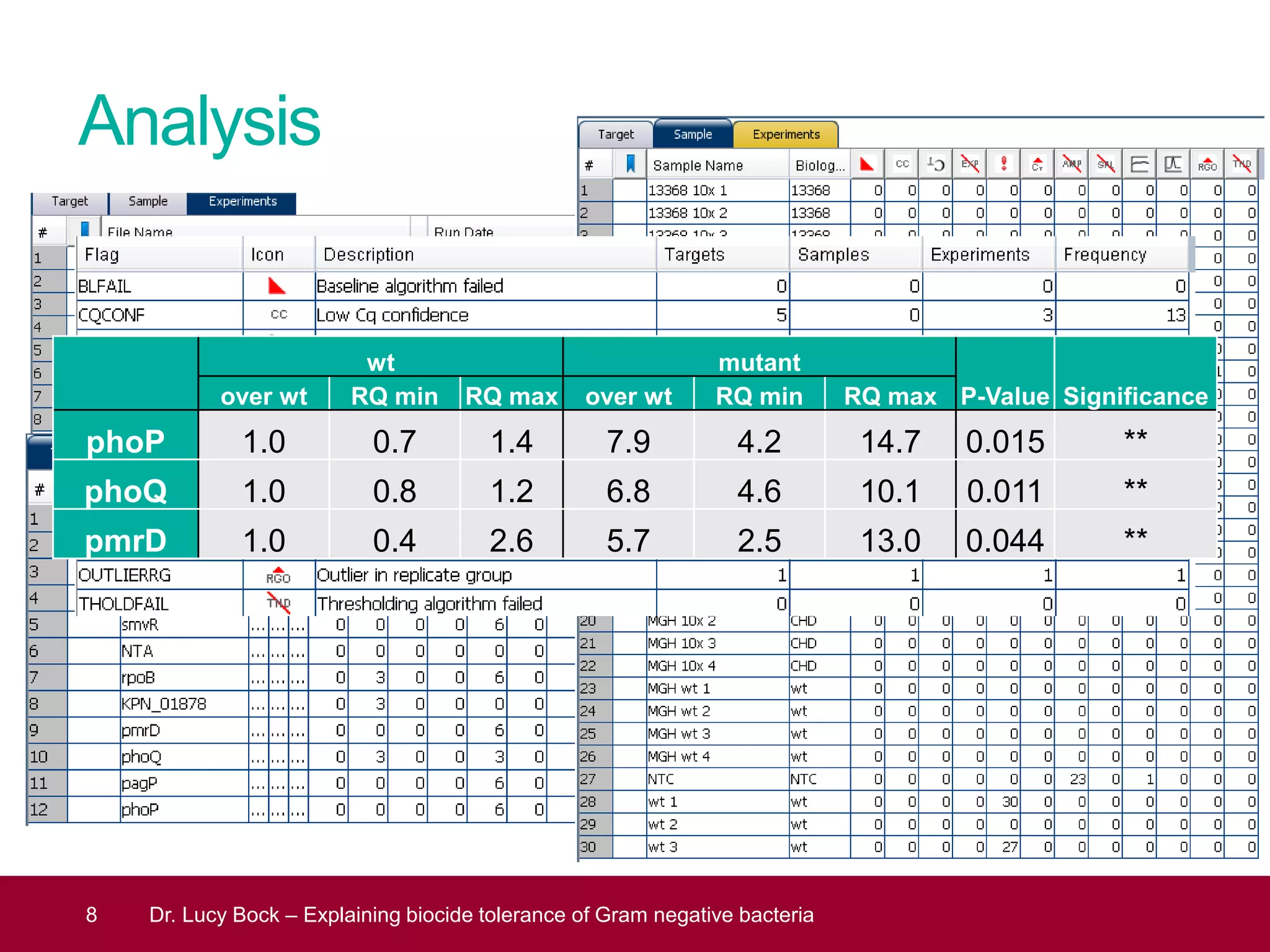
wt mutant
P-Value Significanceover wt RQ min RQ max over wt RQ min RQ max
phoP 1.0 0.7 1.4 7.9 4.2 14.7 0.015 **
phoQ 1.0 0.8 1.2 6.8 4.6 10.1 0.011 **
pmrD 1.0 0.4 2.6 5.7 2.5 13.0 0.044 **
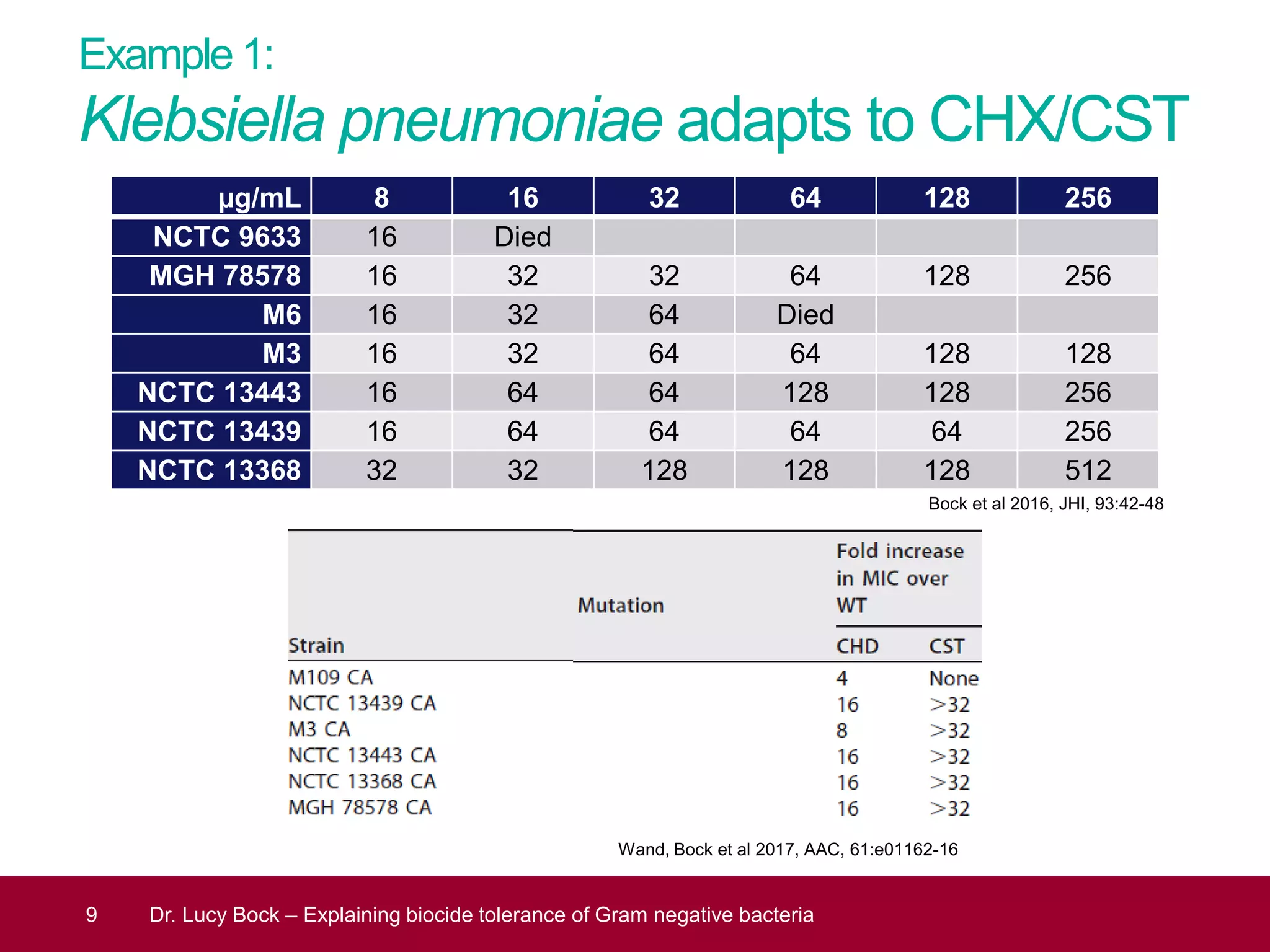
Example 1:
Klebsiella pneumoniae adapts to CHX/CST
9 Dr. Lucy Bock – Explaining biocide tolerance of Gram negative bacteria
Bock et al 2016, JHI, 93:42-48
Wand, Bock et al 2017, AAC, 61:e01162-16
µg/mL 8 16 32 64 128 256
NCTC 9633 16 Died
MGH 78578 16 32 32 64 128 256
M6 16 32 64 Died
M3 16 32 64 64 128 128
NCTC 13443 16 64 64 128 128 256
NCTC 13439 16 64 64 64 64 256
NCTC 13368 32 32 128 128 128 512
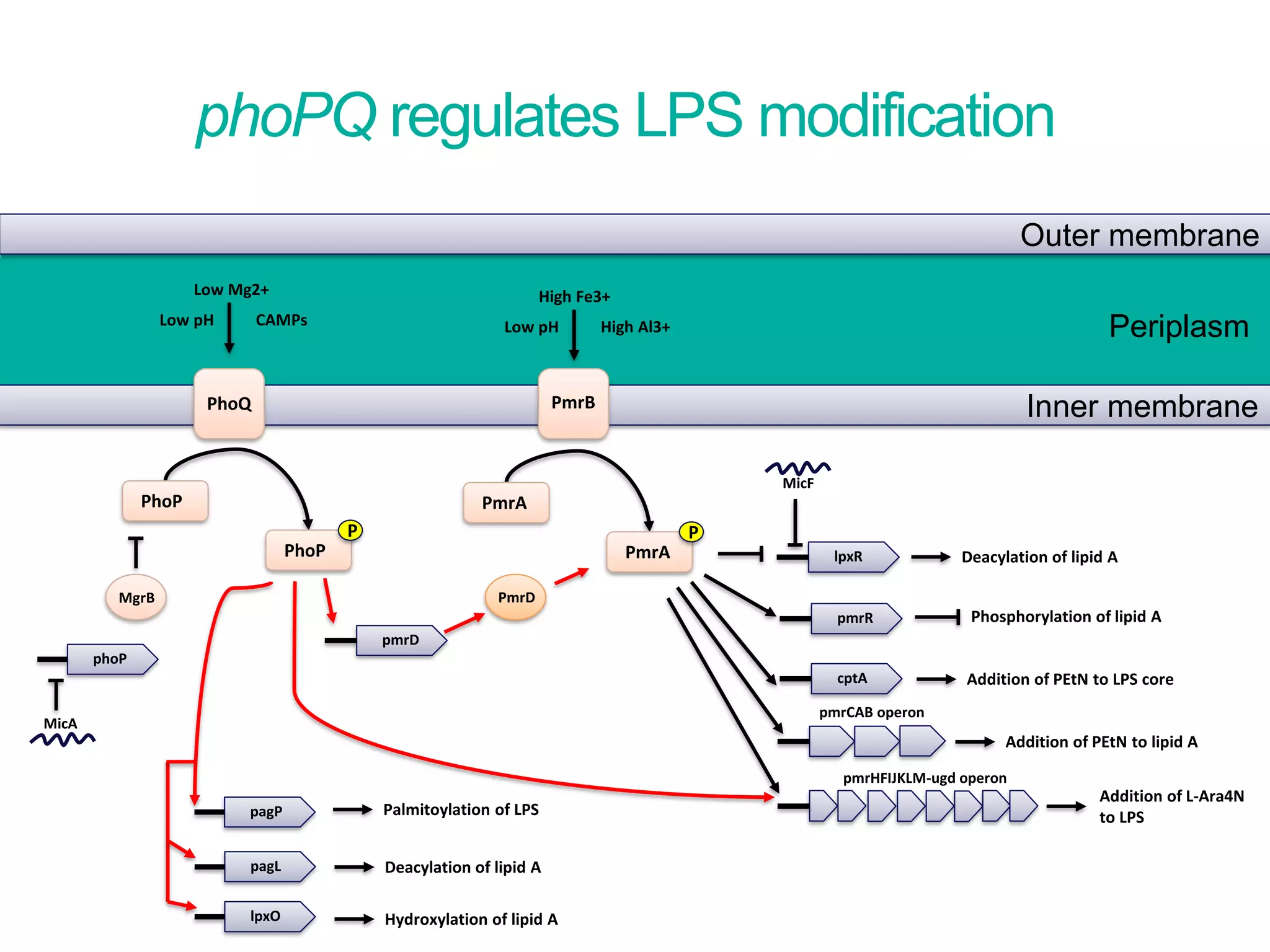
Periplasm
pmrD
PmrDMgrB
PhoP
P
PhoP
PmrA
P
PmrA
Outer membrane
Inner membranePhoQ PmrB
Low pH
Low Mg2+
CAMPs Low pH
High Fe3+
High Al3+
MicA
phoP
MicF
pmrHFIJKLM-ugd operon
pmrCAB operon
cptA
Addition of L-Ara4N
to LPS
Addition of PEtN to lipid A
Addition of PEtN to LPS core
lpxR
pmrR
Deacylation of lipid A
Phosphorylation of lipid A
Deacylation of lipid A
Palmitoylation of LPS
Hydroxylation of lipid AlpxO
pagL
pagP
phoPQ regulates LPS modification
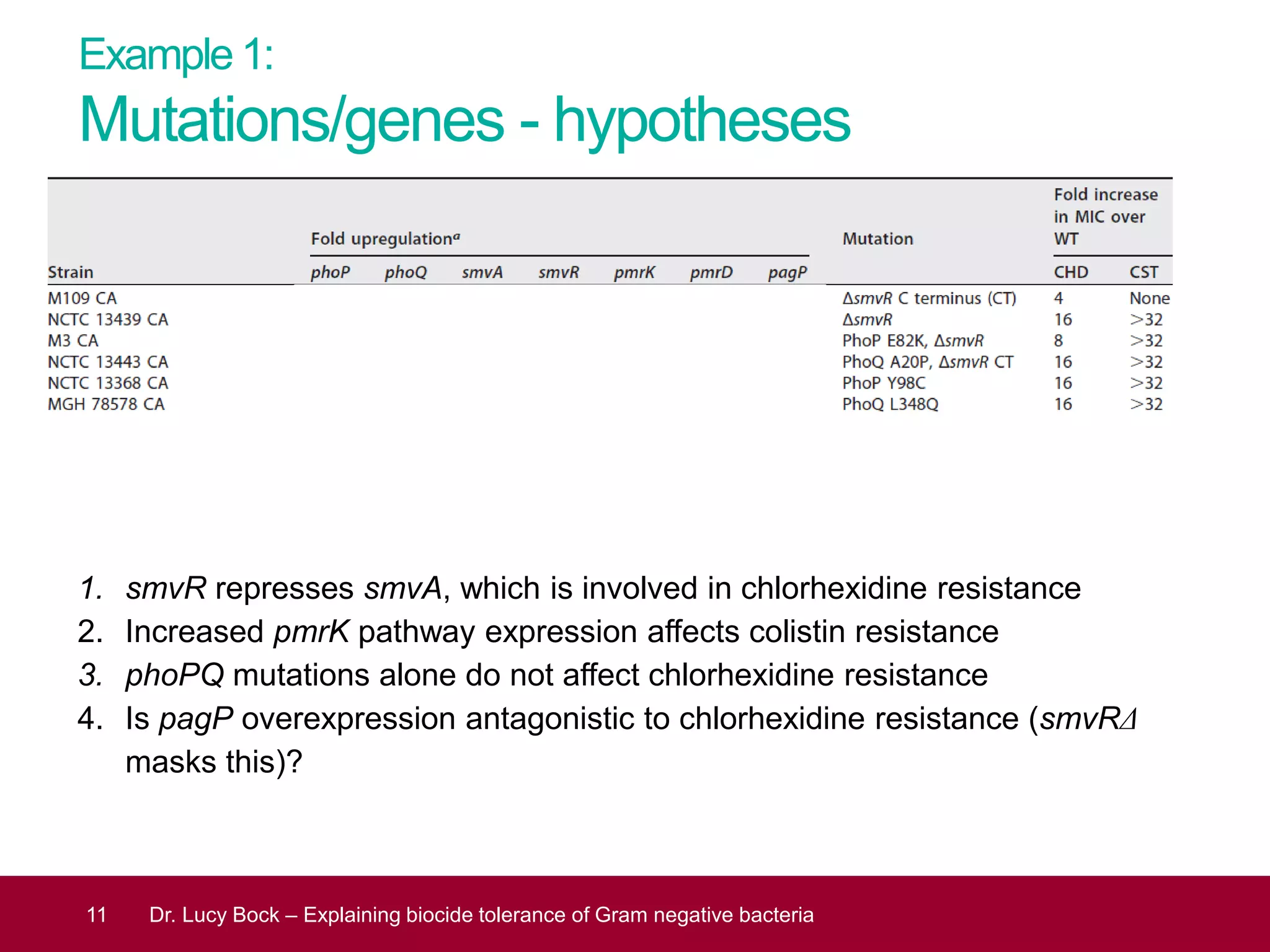
Example 1:
Mutations/genes - hypotheses
1. smvR represses smvA, which is involved in chlorhexidine resistance
2. Increased pmrK pathway expression affects colistin resistance
3. phoPQ mutations alone do not affect chlorhexidine resistance
4. Is pagP overexpression antagonistic to chlorhexidine resistance (smvRΔ
masks this)?
11 Dr. Lucy Bock – Explaining biocide tolerance of Gram negative bacteria
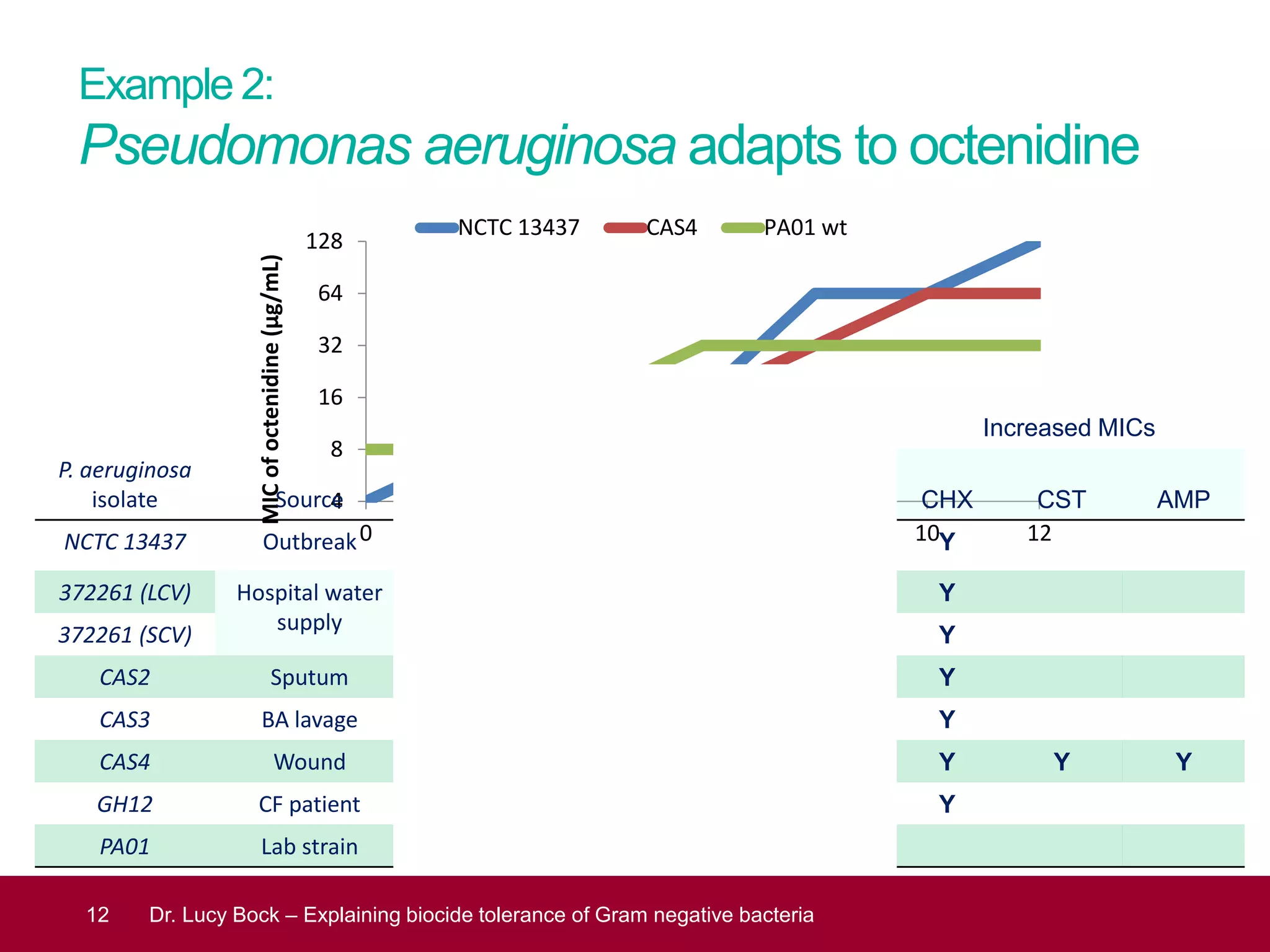
Example 2:
Pseudomonas aeruginosa adapts to octenidine
12 Dr. Lucy Bock – Explaining biocide tolerance of Gram negative bacteria
4
8
16
32
64
128
0 2 4 6 8 10 12
MICofoctenidine(μg/mL)
Days
NCTC 13437 CAS4 PA01 wt
P. aeruginosa
isolate Source
after 10 x passage in absence of octenidine
stable mutations in: Increased MICs
Efflux
gene A
Lipid modification
genes A and B pmrB CHX CST AMP
NCTC 13437 Outbreak Trun51 aa D240E - - Y
372261 (LCV) Hospital water
supply
R3C V222G - - Y
372261 (SCV) Del369 bp - - - Y
CAS2 Sputum Del48-53 D240G - S284N Y
CAS3 BA lavage A143P V222G - - Y
CAS4 Wound Del83-108 - T124M T132P Y Y Y
GH12 CF patient Del106-109 V222G - - Y
PA01 Lab strain Del106-109 - - -
Example 2:
Efflux vs lipid changes - hypotheses
13 Dr. Lucy Bock – Explaining biocide tolerance of Gram negative bacteria
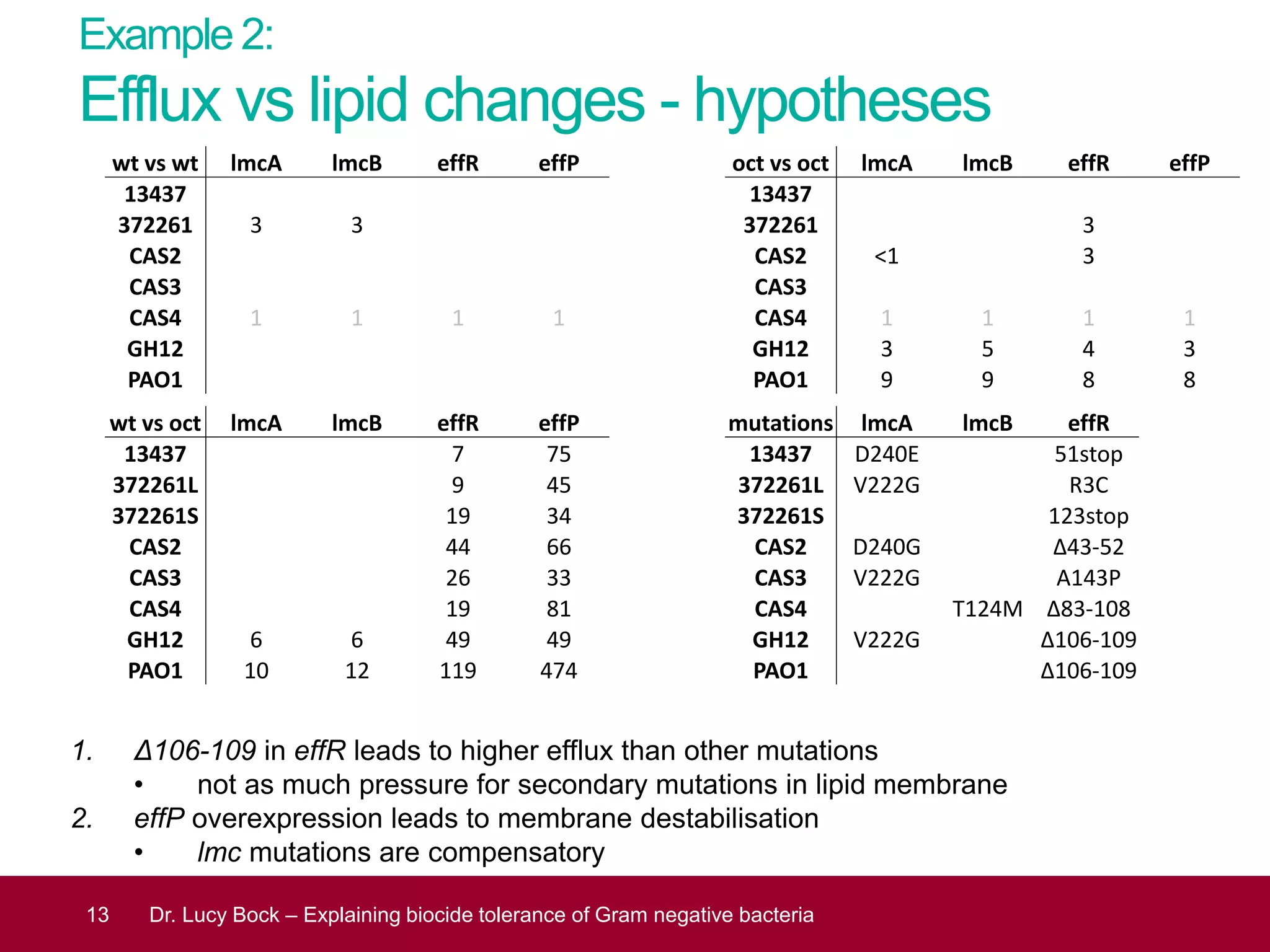
1. Δ106-109 in effR leads to higher efflux than other mutations
• not as much pressure for secondary mutations in lipid membrane
2. effP overexpression leads to membrane destabilisation
• lmc mutations are compensatory
wt vs wt lmcA lmcB effR effP
13437
372261 3 3
CAS2
CAS3
CAS4 1 1 1 1
GH12
PAO1
oct vs oct lmcA lmcB effR effP
13437
372261 3
CAS2 <1 3
CAS3
CAS4 1 1 1 1
GH12 3 5 4 3
PAO1 9 9 8 8
wt vs oct lmcA lmcB effR effP
13437 7 75
372261L 9 45
372261S 19 34
CAS2 44 66
CAS3 26 33
CAS4 19 81
GH12 6 6 49 49
PAO1 10 12 119 474
mutations lmcA lmcB effR
13437 D240E 51stop
372261L V222G R3C
372261S 123stop
CAS2 D240G Δ43-52
CAS3 V222G A143P
CAS4 T124M Δ83-108
GH12 V222G Δ106-109
PAO1 Δ106-109
Example 3:
Deleting a (possibly essential) gene
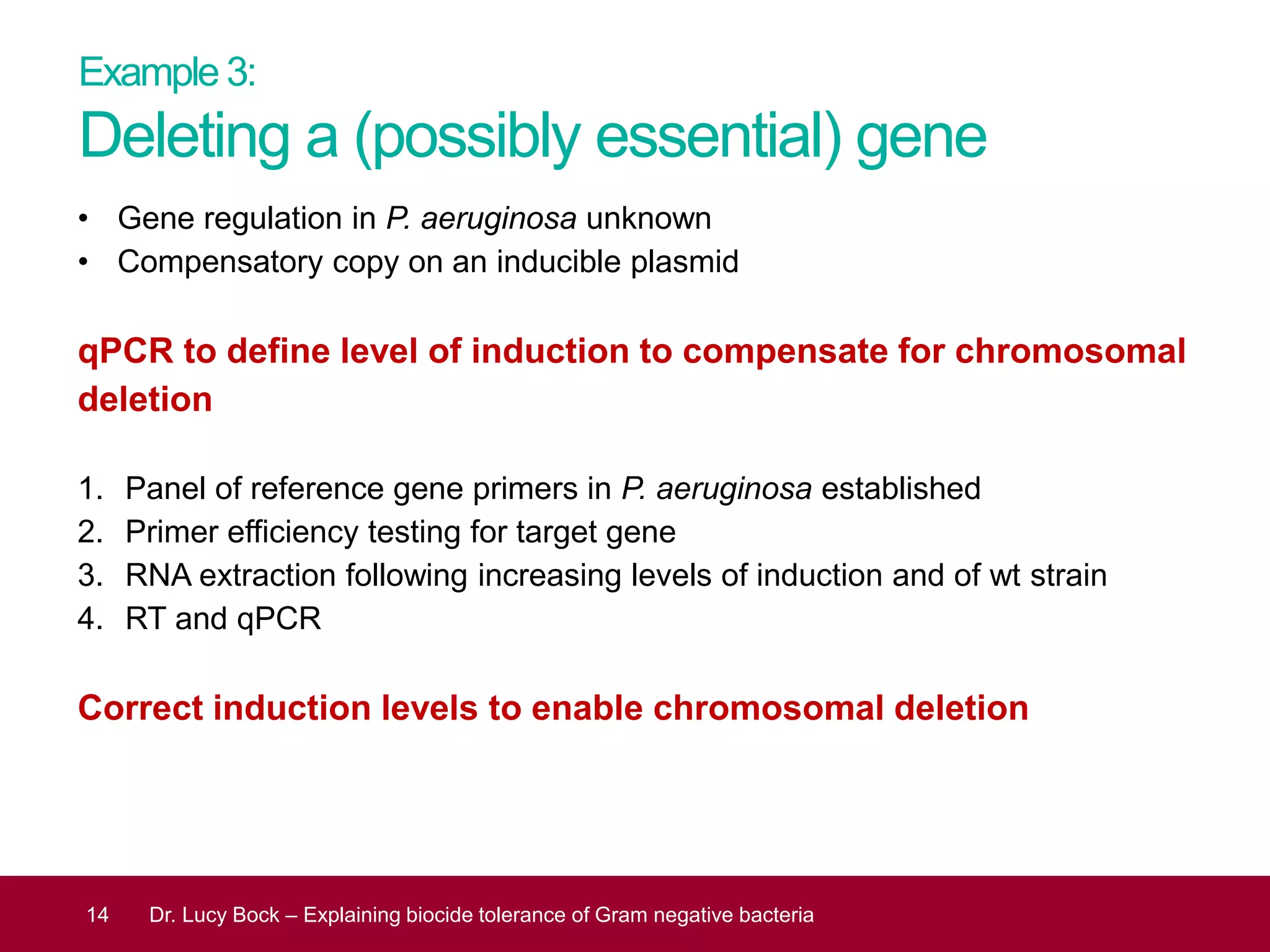
• Gene regulation in P. aeruginosa unknown
• Compensatory copy on an inducible plasmid
qPCR to define level of induction to compensate for chromosomal
deletion
1. Panel of reference gene primers in P. aeruginosa established
2. Primer efficiency testing for target gene
3. RNA extraction following increasing levels of induction and of wt strain
4. RT and qPCR
Correct induction levels to enable chromosomal deletion
14 Dr. Lucy Bock – Explaining biocide tolerance of Gram negative bacteria
Summary
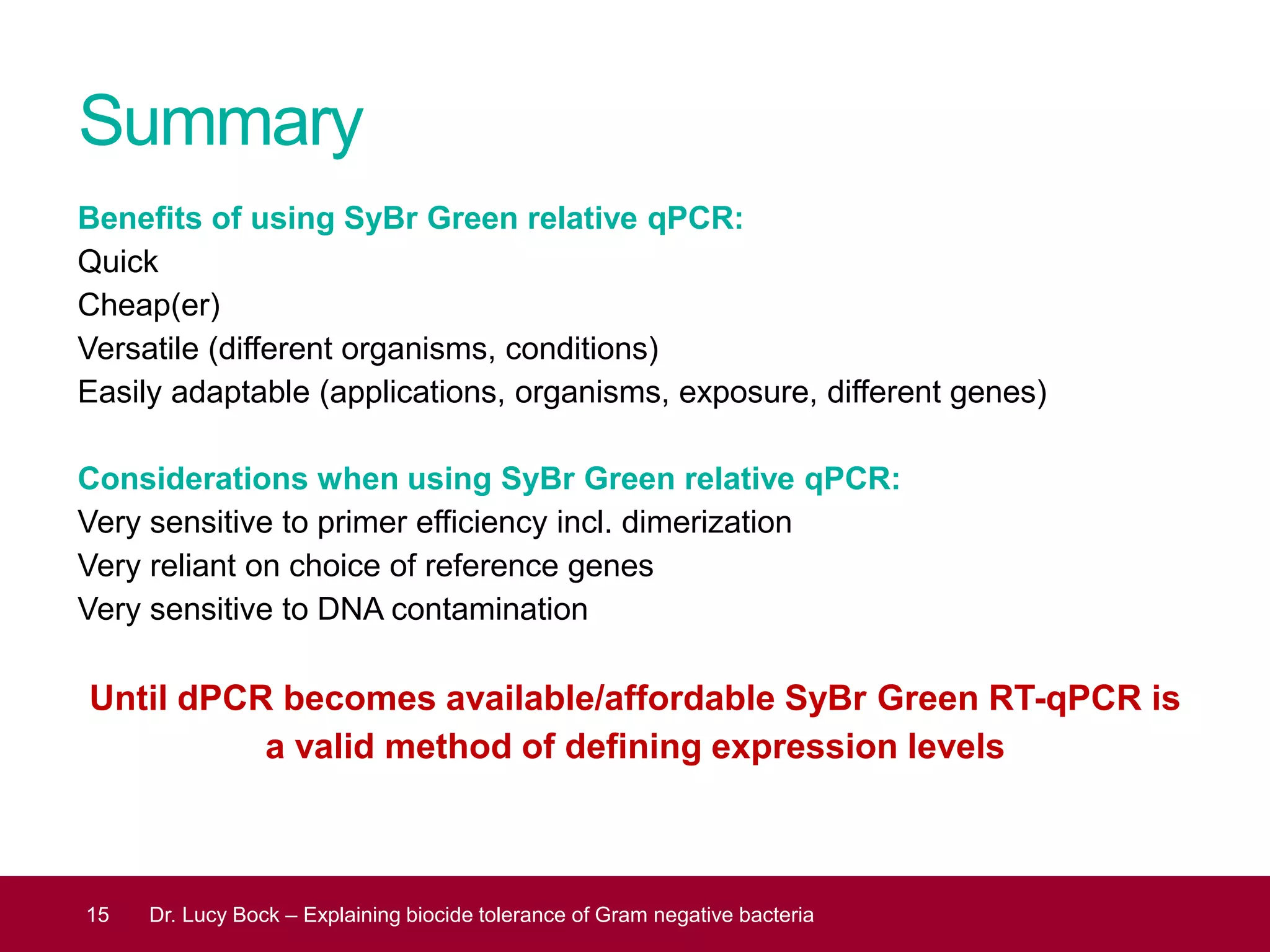
Benefits of using SyBr Green relative qPCR:
Quick
Cheap(er)
Versatile (different organisms, conditions)
Easily adaptable (applications, organisms, exposure, different genes)
Considerations when using SyBr Green relative qPCR:
Very sensitive to primer efficiency incl. dimerization
Very reliant on choice of reference genes
Very sensitive to DNA contamination
Until dPCR becomes available/affordable SyBr Green RT-qPCR is
a valid method of defining expression levels
15 Dr. Lucy Bock – Explaining biocide tolerance of Gram negative bacteria
Acknowledgements
PHE
Mark Sutton
Matthew Shepherd
Technology Development Group
KCL
Vichayanee Pumpitakkul
La Trobe
Rachael Impey
Funding
Grant-in-Aid Project 109506
16 Dr. Lucy Bock – Explaining biocide tolerance of Gram negative bacteria

Explaining Biocide Tolerance of Gram Negative Bacteria

  • 1.
    Explaining biocide toleranceof Gram negative bacteria – using SyBr Green qPCR as a versatile tool to develop and support hypotheses Dr. Lucy Bock Senior Scientist/Project Team Leader Technology Development Group National Infection Service Public Health England, UK Lucy.Bock@phe.gov.uk
  • 2.
    MIQE précis forrelative mRNAquantification in bacteria 2 Dr. Lucy Bock – Explaining biocide tolerance of Gram negative bacteria Bustin et al. BMC Molecular Biology 2010, 11:74
  • 3.
    Reference genes –how to choose Requirements: • Similar expression levels to target genes (NOT 16S) • Expression not affected by test condition/mutation/pathway • Expression level consistent between strains • Multiple genes to control for consistency (then have the option to remove one from normalisation analysis) Choices: • Publications • Knowledge about test condition/mutation Testing: • Following primer design, test multiple genes on your samples • Adapt selection if necessary 3 Dr. Lucy Bock – Explaining biocide tolerance of Gram negative bacteria
  • 4.
    Primer design andconservation Primer Blast with the following settings: • Primer length: ~20bp • Melting temperature: 59°- 61° (60° optimum) • PCR product size: 90-110b Then check for conservation for 3 primer pairs 4 Dr. Lucy Bock – Explaining biocide tolerance of Gram negative bacteria
  • 5.
    Primer efficiency testing 5Dr. Lucy Bock – Explaining biocide tolerance of Gram negative bacteria
  • 6.
    Exposure, RNAextraction andRT • Expose exponentially growing cells for 30 minutes to 0.5xMIC • RNAprotect • RNA extraction • 2 DNase treatments • Reverse transcription (incl negative) • Trial qPCR using reference gene to test for DNA contamination and cDNA concentration • 3 biological replicates, 3 technical replicates each • NTC • ≥3 reference genes (all on every plate) 6 Dr. Lucy Bock – Explaining biocide tolerance of Gram negative bacteria
  • 7.
    qPCR and replicates- controls wt 1-3 = 3 replicate RNA extractions of wt strains CHD 1-3 = 3 replicate RNA extractions of CHD adapted strains 3 technical repeats each NTC = no template control for each primer pair 7 Dr. Lucy Bock – Explaining biocide tolerance of Gram negative bacteria
  • 8.
    Analysis 8 Dr. LucyBock – Explaining biocide tolerance of Gram negative bacteria wt mutant P-Value Significanceover wt RQ min RQ max over wt RQ min RQ max phoP 1.0 0.7 1.4 7.9 4.2 14.7 0.015 ** phoQ 1.0 0.8 1.2 6.8 4.6 10.1 0.011 ** pmrD 1.0 0.4 2.6 5.7 2.5 13.0 0.044 **
  • 9.
    Example 1: Klebsiella pneumoniaeadapts to CHX/CST 9 Dr. Lucy Bock – Explaining biocide tolerance of Gram negative bacteria Bock et al 2016, JHI, 93:42-48 Wand, Bock et al 2017, AAC, 61:e01162-16 µg/mL 8 16 32 64 128 256 NCTC 9633 16 Died MGH 78578 16 32 32 64 128 256 M6 16 32 64 Died M3 16 32 64 64 128 128 NCTC 13443 16 64 64 128 128 256 NCTC 13439 16 64 64 64 64 256 NCTC 13368 32 32 128 128 128 512
  • 10.
    Periplasm pmrD PmrDMgrB PhoP P PhoP PmrA P PmrA Outer membrane Inner membranePhoQPmrB Low pH Low Mg2+ CAMPs Low pH High Fe3+ High Al3+ MicA phoP MicF pmrHFIJKLM-ugd operon pmrCAB operon cptA Addition of L-Ara4N to LPS Addition of PEtN to lipid A Addition of PEtN to LPS core lpxR pmrR Deacylation of lipid A Phosphorylation of lipid A Deacylation of lipid A Palmitoylation of LPS Hydroxylation of lipid AlpxO pagL pagP phoPQ regulates LPS modification
  • 11.
    Example 1: Mutations/genes -hypotheses 1. smvR represses smvA, which is involved in chlorhexidine resistance 2. Increased pmrK pathway expression affects colistin resistance 3. phoPQ mutations alone do not affect chlorhexidine resistance 4. Is pagP overexpression antagonistic to chlorhexidine resistance (smvRΔ masks this)? 11 Dr. Lucy Bock – Explaining biocide tolerance of Gram negative bacteria
  • 12.
    Example 2: Pseudomonas aeruginosaadapts to octenidine 12 Dr. Lucy Bock – Explaining biocide tolerance of Gram negative bacteria 4 8 16 32 64 128 0 2 4 6 8 10 12 MICofoctenidine(μg/mL) Days NCTC 13437 CAS4 PA01 wt P. aeruginosa isolate Source after 10 x passage in absence of octenidine stable mutations in: Increased MICs Efflux gene A Lipid modification genes A and B pmrB CHX CST AMP NCTC 13437 Outbreak Trun51 aa D240E - - Y 372261 (LCV) Hospital water supply R3C V222G - - Y 372261 (SCV) Del369 bp - - - Y CAS2 Sputum Del48-53 D240G - S284N Y CAS3 BA lavage A143P V222G - - Y CAS4 Wound Del83-108 - T124M T132P Y Y Y GH12 CF patient Del106-109 V222G - - Y PA01 Lab strain Del106-109 - - -
  • 13.
    Example 2: Efflux vslipid changes - hypotheses 13 Dr. Lucy Bock – Explaining biocide tolerance of Gram negative bacteria 1. Δ106-109 in effR leads to higher efflux than other mutations • not as much pressure for secondary mutations in lipid membrane 2. effP overexpression leads to membrane destabilisation • lmc mutations are compensatory wt vs wt lmcA lmcB effR effP 13437 372261 3 3 CAS2 CAS3 CAS4 1 1 1 1 GH12 PAO1 oct vs oct lmcA lmcB effR effP 13437 372261 3 CAS2 <1 3 CAS3 CAS4 1 1 1 1 GH12 3 5 4 3 PAO1 9 9 8 8 wt vs oct lmcA lmcB effR effP 13437 7 75 372261L 9 45 372261S 19 34 CAS2 44 66 CAS3 26 33 CAS4 19 81 GH12 6 6 49 49 PAO1 10 12 119 474 mutations lmcA lmcB effR 13437 D240E 51stop 372261L V222G R3C 372261S 123stop CAS2 D240G Δ43-52 CAS3 V222G A143P CAS4 T124M Δ83-108 GH12 V222G Δ106-109 PAO1 Δ106-109
  • 14.
    Example 3: Deleting a(possibly essential) gene • Gene regulation in P. aeruginosa unknown • Compensatory copy on an inducible plasmid qPCR to define level of induction to compensate for chromosomal deletion 1. Panel of reference gene primers in P. aeruginosa established 2. Primer efficiency testing for target gene 3. RNA extraction following increasing levels of induction and of wt strain 4. RT and qPCR Correct induction levels to enable chromosomal deletion 14 Dr. Lucy Bock – Explaining biocide tolerance of Gram negative bacteria
  • 15.
    Summary Benefits of usingSyBr Green relative qPCR: Quick Cheap(er) Versatile (different organisms, conditions) Easily adaptable (applications, organisms, exposure, different genes) Considerations when using SyBr Green relative qPCR: Very sensitive to primer efficiency incl. dimerization Very reliant on choice of reference genes Very sensitive to DNA contamination Until dPCR becomes available/affordable SyBr Green RT-qPCR is a valid method of defining expression levels 15 Dr. Lucy Bock – Explaining biocide tolerance of Gram negative bacteria
  • 16.
    Acknowledgements PHE Mark Sutton Matthew Shepherd TechnologyDevelopment Group KCL Vichayanee Pumpitakkul La Trobe Rachael Impey Funding Grant-in-Aid Project 109506 16 Dr. Lucy Bock – Explaining biocide tolerance of Gram negative bacteria