International Research Journal of Engineering and Technology (IRJET) e-ISSN: 2395-0056
Volume: 10 Issue: 05 | May 2023 www.irjet.net p-ISSN: 2395-0072
© 2023, IRJET | Impact Factor value: 8.226 | ISO 9001:2008 Certified Journal | Page 38
Experimental Study on Pavement Stabilization Using Geosynthetic
Solution
Er. Lokesh Kumar Soni
M. Tech. Student, Department of Civil Engineering,
School of Engineering and Technology, University of Technology, Jaipur
---------------------------------------------------------------------***---------------------------------------------------------------------
Abstract - Major investments are required to build a road.
Accurate technical design can save significant investmentand
deliver dependable performance.
Today reinforced road structures, with the suitable stiffness,
have been introduced to improve and optimize the
performance of traditional road building materials. The
performance of reinforced roadstructuresreliesheavilyon the
condition of surrounding materials and on the traffic loads
and therefore each design requires specific analysis and
calculations.
To achieve the economy along with long lasting performance
of pavement. This demands the adoption of innovative
technologies with less carbon footprint. Oneofsuchrevolution
is Geosynthetic. The extruded biaxial polypropylene geogrid is
proposed for stabilizing the pavement. The inclusion of
extruded biaxial polypropylene geogridingranularlayershall
support for increasing the modulus of granular layer and
thereby reduces the thickness of bituminous and granular
layer. In the similar way, thickness reduction is alsopossiblein
the case of service road. This is widely used for reducing the
layer thickness and for strengthening the pavement. In the
IRC: SP 59-2019, extruded biaxial polypropylene geogrid is
mentioned for reducing the thickness and reinforcement of
pavement.
The reinforced sections can be designed by introducing the
geogrid at granular layer. The reinforced pavement, which is
composition of bituminous course, granular base, and
granular sub-base. Thickness is worked out based on IRC:59-
2019 Guideline and input received. Biaxial geogridisproposed
at granular base layer and Sub-base layer of Pavement
Section.
Key Words: Geogrid, Geosynthetic Stabilization,
Pavement Design, CalculateLCR&MIFValues,FWDTest,
and PLT Test.
1. INTRODUCTION
This report contains the detailed description of the work
done during the final year project namely “Project Detail:
Development and Maintenance of Dantiwara-Pipar-Merta
City Section of SH-21 in the State of Rajasthan on
Engineering, Procurement & Construction (EPC) Mode”.
Procedures are given for the characterization of the
pavement materials both by laboratory/field testing and by
typical values and/or correlation studies.Thepurposeofthe
laboratory testing program is to classify the properties of
sub-grade, GSB, WMM, DBM and BC material and evaluate
support properties and moisture sensitivity that can affect
long-term pavement performance.Testingprogramsconsist
of classification testing (i.e., gradation analysis&Atterberg’s
Limits) and engineering properties testing (i.e., Proctor test,
California Bearing Ratio Test & Marshall Mix Design test).
Flexible pavements fail due to rapid vehicle traffic growth.
There are many ways for a system to fail, but rutting and
fatigue are among the most important. We are decided to
develop new construction materialstosolvetheseproblems.
In this flexible pavement failure, we decided to use
Geosynthetic materials. Most Geosynthetic are made from
polypropylene, polyester, or synthetic polymers of
polyethylene, PVC, natural fibers. The word is derived from:
Geo = earth or soil + Synthetics = man-made.
The Benefit of reinforcement in pavement in quantified in
terms of the Layer Coefficient Ratio (LCR). LCR of the
unreinforced and reinforced pavement in quantified using a
dynamic loading test apparatus that closely represents the
field condition.
1.1 Problem Statement
India's road construction usually faces many problems
that cause the road to fail, such as rutting, fatigueontheroad,
and other problems that result in road failures.
Generally speaking, a rut is defined as a vertical
depression in the vehicle wheel tracks that occurs as a result
of traffic loading. It is a type of surface defect that is more
evident in the outer wheel track of the vehicle. Rutting is
caused by the permanent deformation in anyofapavement's
layers or sub grade usually caused by consolidation or
displacement of the pavement edge due to traffic loading.
Permanent deformation of pavement may occur that if the
pavement binders do not have sufficient elasticity. Becausea
poor elastic binder does not return to its original position
after removing wheel loading.
The process of stabilizing soil with lime and cement is
very costly anda very lengthy one that requires manystages.
Our goal is to reduce the cost of stabilizing soil by using
International Research Journal of Engineering and Technology (IRJET) e-ISSN: 2395-0056
Volume: 10 Issue: 05 | May 2023 www.irjet.net p-ISSN: 2395-0072
© 2023, IRJET | Impact Factor value: 8.226 | ISO 9001:2008 Certified Journal | Page 39
GeosyntheticBiaxialGeogridasareinforcedmaterialoverthe
Granular Sub-base Layer to reduce the cost of stabilization.
1.2 Highway Material
Subgrade Soil (Borrow Soil): -
Poorly graded sand, commonly available in the state of
Rajasthan, India, was used for the constructionof500mm of
compacted subgrade. The soil was non-plastic with an
average liquid limit of 21.6%. The maximum dry density,
optimum moisture content, and the California bearing ratio
(CBR) was found to be 1.960 gm/cm3, 9.13%, and 17.15%,
respectively.
Granular Sub-Base (GSB): -
200 mm of granular sub-base (GSB), grading V, as per the
specification of MoRTH (MoRTH 2013) was used over the
subgrade. The gradation of the GSB material is shown in
figure 2. The physical properties of theaggregates,asperthe
requirements of MoRTH.
Granular Base (WMM): -
Table -1: Physical Properties of AggregatesusedinWMM
Property Value
Requirements as per
MoRTH
Aggregate Impact
Value
10.97 Max 30
Liquid Limit of
Material Passing 425
Mic Sieve, %
21.4
Plasticity Index of
material passing 425
Mic Sieve, %
Non-Plastic Max 6
Optimum Moisture
Content, %
5.29
Maximum Dry Density
gm/cm3
2.298
Combined Flakiness
and Elongation, %
28.3 Max 35
Bituminous Layer: -
Dense bituminous macadam (DBM), grading II, as per the
standards of MoRTH, was used on thetopofWMM.Thesieve
size distribution of the aggregates used for the construction
of DBM is shown in Figure 2. The mix design of DBM was
done as per the standard Marshall Method(AsphaltInstitute
2014) with a viscosity grade (VG) binder, VG 40. The
optimum binder content (OBC) of the mix was found to be
4.68%. Crushed angular aggregates were used for the
production of bituminous mixture, and it was ensured that
the aggregate and bitumen properties satisfy the
requirements of MoRTH.
Geogrid: -
A bi-axial UV stabilized polypropylene geogrid (by
Maccaferri), having an ultimate tensile strength of 30 x 30
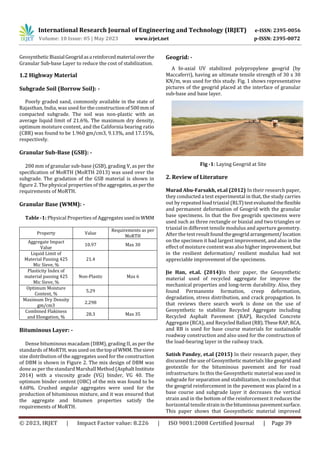
KN/m, was used for this study. Fig. 1 shows representative
pictures of the geogrid placed at the interface of granular
sub-base and base layer.
Fig -1: Laying Geogrid at Site
2. Review of Literature
Murad Abu-Farsakh, et.al (2012) In their research paper,
they conducted a test experimental in that, the study carries
out by repeated load triaxial (RLT)testevaluatedtheflexible
and permanent deformation of Geogrid with the granular
base specimens. In that the five geogrids specimens were
used such as three rectangle or biaxial and two triangles or
triaxial in different tensile modulus and aperture geometry.
After the test result foundthegeogridarrangement/location
on the specimen it had largest improvement, and also in the
effect of moisture content was also higher improvement,but
in the resilient deformation/ resilient modulus had not
appreciable improvement of the specimens.
Jie Han, et.al. (2014)In their paper, the Geosynthetic
material used of recycled aggregate for improve the
mechanical properties and long-term durability. Also, they
found Permanente formation, creep deformation,
degradation, stress distribution, and crack propagation. In
that reviews there search work is done on the use of
Geosynthetic to stabilize Recycled Aggregate including
Recycled Asphalt Pavement (RAP), Recycled Concrete
Aggregate (RCA), and RecycledBallast(RB).TheseRAP,RCA,
and RB is used for base course materials for sustainable
roadway construction and also used for the construction of
the load-bearing layer in the railway track.
Satish Pandey, et.al (2015) In their research paper, they
discussed the use of Geosynthetic materials like geogridand
geotextile for the bituminous pavement and for road
infrastructure. In this the Geosynthetic material was used in
subgrade for separation and stabilization, in concluded that
the geogrid reinforcement in the pavement was placed in a
base course and subgrade layer it decreases the vertical
strain and in the bottom of the reinforcement it reduces the
horizontal tensilestraininthebituminouspavementsurface.
This paper shows that Geosynthetic material improved
International Research Journal of Engineering and Technology (IRJET) e-ISSN: 2395-0056
Volume: 10 Issue: 05 | May 2023 www.irjet.net p-ISSN: 2395-0072
© 2023, IRJET | Impact Factor value: 8.226 | ISO 9001:2008 Certified Journal | Page 40
service life, reduce the thickness of the pavement, and easy
to build it.
3. Design Impletion
Proposed Solution Mechanism
Mac-Grid EG (Extruded biaxial PP geogrid) shall reinforce
the granular layer and basic mechanismof reinforcingcanbe
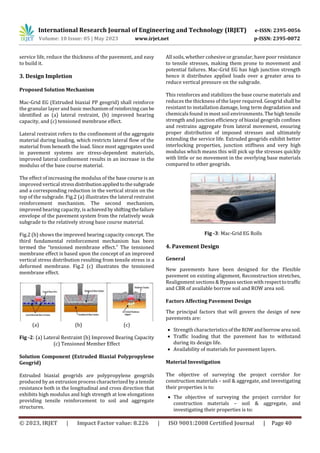
identified as (a) lateral restraint, (b) improved bearing
capacity, and (c) tensioned membrane effect.
Lateral restraint refers to the confinement of the aggregate
material during loading, which restricts lateral flow of the
material from beneath the load. Since most aggregates used
in pavement systems are stress-dependent materials,
improved lateral confinement results in an increase in the
modulus of the base course material.
The effect of increasing the modulus of the base course is an
improved vertical stressdistributionappliedtothesubgrade
and a corresponding reduction in the vertical strain on the
top of the subgrade. Fig.2 (a) illustrates the lateral restraint
reinforcement mechanism. The second mechanism,
improved bearing capacity, is achievedbyshiftingthefailure
envelope of the pavement system from the relatively weak
subgrade to the relatively strong base course material.
Fig.2 (b) shows the improved bearing capacity concept. The
third fundamental reinforcement mechanism has been
termed the “tensioned membrane effect.” The tensioned
membrane effect is based upon the concept of an improved
vertical stress distribution resulting from tensile stress in a
deformed membrane. Fig.2 (c) illustrates the tensioned
membrane effect.
(a) (b) (c)
Fig -2: (a) Lateral Restraint (b) Improved Bearing Capacity
(c) Tensioned Member Effect
Solution Component (Extruded Biaxial Polypropylene
Geogrid)
Extruded biaxial geogrids are polypropylene geogrids
produced by an extrusion process characterized by a tensile
resistance both in the longitudinal and cross direction that
exhibits high modulus and high strength at low elongations
providing tensile reinforcement to soil and aggregate
structures.
All soils, whether cohesive or granular, have poor resistance
to tensile stresses, making them prone to movement and
potential failures. Mac-Grid EG has high junction strength
hence it distributes applied loads over a greater area to
reduce vertical pressure on the subgrade.
This reinforces and stabilizes the base course materials and
reduces the thickness of the layer required. Geogrid shall be
resistant to installation damage, long term degradation and
chemicals found in most soil environments. The high tensile
strength and junction efficiency of biaxial geogrids confines
and restrains aggregate from lateral movement, ensuring
proper distribution of imposed stresses and ultimately
extending the service life. Extruded geogrids exhibit better
interlocking properties, junction stiffness and very high
modulus which means this will pick up the stresses quickly
with little or no movement in the overlying base materials
compared to other geogrids.
Fig -3: Mac-Grid EG Rolls
4. Pavement Design
General
New pavements have been designed for the Flexible
pavement on existing alignment, Reconstruction stretches,
Realignment sections & Bypasssectionwith respecttotraffic
and CBR of available borrow soil and ROW area soil.
Factors Affecting Pavement Design
The principal factors that will govern the design of new
pavements are:
 Strength characteristicsoftheROWandborrowarea soil.
 Traffic loading that the pavement has to withstand
during its design life.
 Availability of materials for pavement layers.
Material Investigation
The objective of surveying the project corridor for
construction materials – soil & aggregate, and investigating
their properties is to:
 The objective of surveying the project corridor for
construction materials – soil & aggregate, and
investigating their properties is to:
International Research Journal of Engineering and Technology (IRJET) e-ISSN: 2395-0056
Volume: 10 Issue: 05 | May 2023 www.irjet.net p-ISSN: 2395-0072
© 2023, IRJET | Impact Factor value: 8.226 | ISO 9001:2008 Certified Journal | Page 41
 The potential borrow pit locations were identified along
the project corridor for embankment and Subgrade
material. Their quantity and suitability for use were
determined.
 The original ground soil along the project corridor was
collected and their suitability as foundation for the
embankment/Subgrade construction was determined.
 The Sand Quarries in the project location were identified
and their suitability for use in pavement layers was
determined.
 The Aggregate Quarries in the vicinity of project location
were located and their suitability for use in concrete,
non-bituminous and bituminous pavement layers were
determined.
 The sources for Granular Sub base layer (GSB) were
identified and their suitability for use was ascertained.
Crust Composition of Existing Pavement
Table -2: Crust Composition of Existing Pavement
Trial
Pit
No.
Location
Thickness in mm
Remarks
BT
Layer
Granular
Material
1. 83+500 80 200
Sandy Loam
with Hard
Gravel
2. 79+750 75 400
Sandy Loam
with Hard
Gravel
3. 67+500 70 340
Sandy Loam
with Hard
Gravel
4. 66+300 60 300
Sandy Loam
with Hard
Gravel
5. 64+700 100 320
Sandy Loam
with Hard
Gravel
6. 60+550 100 300
Sandy Loam
with Hard
Gravel
7. 50+600 70 280
Sandy Loam
with Hard
Gravel
8. 44+200 30 180
Sandy Loam
with Hard
Gravel
9. 37+400 45 210
Sandy Loam
with Hard
Gravel
10. 30+300 60 370
Sandy Loam
with Hard
Gravel
11. 27+300 80 300
Sandy Loam
with Hard
Gravel
12. 21+000 90 310
Sandy Loam
with Hard
Gravel
13. 14+500 100 340
Sandy Loam
with Hard
Gravel
14. 12+200 90 310
Sandy Loam
with Hard
Gravel
15. 07+150 80 280
Sandy Loam
with Hard
Gravel
Fig -4: Trial Pit of Existing Pavement
Borrow/ROW Soil Properties
8 borrow area locationshavingCBRbetweenmorethan12%
were identified. Test results for the Borrow/ROW area soil
are given in Table 27 and 28. All locations arenot plasticsoil,
having CBR over 15% at 97% MDD.
Table -3: Borrow/ROW Soil Properties
S.
no
.
Locatio
n
% passing through I.S. Sieve
% Silt &
Clay
Content
% of
San
d
Cont
ent
4.75
mm
2.00
mm
425
mic.
75
mic.
1. 06+500 84.2 60.1 31.8 4.6 4.6 79.6
2. 12+800 87.8 71.4 21.0 2.3 7.0 80.8
3. 21+400 86.9 69.6 35.1 2.0 2.0 84.9
4. 36+700 78.3 63.6 45.4 7.4 7.4 70.9
5. 46+100 64.4 40.1 21.1 4.3 4.3 60.1
6. 59+500 92.7 71.9 30.6 3.1 3.1 89.6
7. 71+300 87.8 73.7 34.2 2.4 2.4 85.4
8. 80+120 76.5 57.3 39.9 4.0 4.0 72.5
S.
n
o
.
Loca
tion
Atterberg’s
Limits Field
Moist
ure
(%)
M.D
.D.
(gm
/CC
)
O.M.C
. (%)
C.B.
R.
(%)
Soa
ked
L.L. P.L. P.I.
1.
06+
500
26.0 21.8 4.2 11.6
2.08
6
10.6
14
2.
12+
800
25.5 21.9 3.6 12.8
1.95
7
10.7
15
3.
21+
400
26.3 20.4 5.9 14.8
2.07
8
11.6
17
4.
36+
700
28.1 22.9 5.2 13.7
2.07
3
11.3
18
International Research Journal of Engineering and Technology (IRJET) e-ISSN: 2395-0056
Volume: 10 Issue: 05 | May 2023 www.irjet.net p-ISSN: 2395-0072
© 2023, IRJET | Impact Factor value: 8.226 | ISO 9001:2008 Certified Journal | Page 42
5.
46+
100
27.8 22.9 4.9 13.1
2.15
0
10.4
19
6.
59+
500
25.3 21.0 4.3 14.4
1.99
3
11.5
16
7.
71+
300
27.2 21.9 5.3 15.7
2.00
4
11.8
15
8.
80+
120
26.8 22.2 4.6 15.7
2.01
5
11.5
17
Properties of Existing Soil
Test results of existing Subgrade soil are summarized in
Table 29 and 30. Pavement subgrade at majority of the
locations is composed of Sandy Loam with Hard Gravel and
CBR over 12% along the project alignment.
Table -4: Soil Properties for Existing Soil
S.
no.
Location
% passing through I.S.
Sieve
% Silt
& Clay
Content
% of
Sand
Content
4.75
mm
2.00
mm
425
mic.
75
mic.
1. 83+500 82.9 56.2 43.0 13.2 13.2 69.7
2. 79+075 90.8 65.4 47.0 18.4 18.4 72.4
3. 67+500 81.5 65.9 58.1 7.8 7.8 73.7
4. 66+300 85.9 59.7 35.6 24.1 24.1 61.8
5. 64+700 89.6 66.2 42.9 23.3 23.3 66.3
6. 60+550 75.1 58.7 47.0 11.7 11.7 63.4
7. 50+600 79.9 52.1 37.9 14.2 14.2 65.7
8. 44+200 83.0 60.9 53.8 7.1 7.1 75.9
9. 37+400 77.7 51.8 44.7 7.1 7.1 70.6
10. 30+300 83.1 64.2 50.4 13.8 13.8 69.3
11. 27+300 83.6 59.0 49.1 9.9 9.9 73.7
12. 21+000 80.1 55.4 46.1 9.3 9.3 70.8
13. 14+500 81.9 59.0 46.8 12.2 12.2 69.7
14. 12+200 81.4 56.8 42.2 14.6 14.6 66.8
15. 07+150 75.0 53.0 44.0 9.0 9.0 66.0
S
.
n
o
.
Loca
tion
Atterberg’s
Limits
Field
Moist
ure
(%)
M.D
.D.
(gm
/CC
)
O.M
.C.
(%)
C.B.R.
(%)
Soak
ed
L.L. P.L. P.I.
1
.
83+5
00
30.7 24.3 6.4 1.5
1.92
4
11.7 12
2
.
79+0
75
26.3 20.6 5.7 2.4
1.89
0
11.0 13
3
.
67+5
00
28.2 23.3 4.9 2.0
2.00
8
10.6 13
4
.
66+3
00
25.6 20.6 5.0 2.3
1.90
6
11.0 14
5
.
64+7
00
30.9 23.6 7.3 1.8
1.90
1
11.9 13
6
.
60+5
50
27.3 22.7 4.6 2.9
1.95
5
11.1 12
7
.
50+6
00
30.9 24.6 6.3 1.0
1.95
5
11.4 12
8
.
44+2
00
28.2 21.1 7.1 2.9
2.02
1
10.3 14
9
.
37+4
00
30.7 24.2 6.5 2.2
1.93
3
11.8 13
1
0
.
30+3
00
25.8 21.7 4.1 2.3
1.99
0
11.8 16
1
1
.
27+3
00
30.9 24.1 6.8 3.0
2.02
7
11.9 14
1
2
.
21+0
00
29.0 23.1 5.9 1.4
2.04
3
11.3 15
1
3
.
14+5
00
29.0 23.2 5.8 1.1
1.96
7
10.8 13
1
4
.
12+2
00
27.9 24.8 3.1 2.6
1.99
6
10.9 14
1
5
.
07+1
50
28.1 21.6 6.5 1.1
2.01
1
11.5 17
Design CBR
Effective CBR of the subgrade has to be derived based onthe
investigation of Barrow Area samplesandembankmentsoils
(OGL soil), the design should be based on effective CBR.
As per IRC: 37 - 2018, pavement design is based on the
Effective CBR of the subgrade. Where there is significant
difference between the CBRs of the select subgrade and
Embankment soils, the design should be based on Effective
CBR.
The effective CBR of the subgrade is determined as per the
procedure given in clause 6.4.1 of IRC: 37-2018.
𝑀𝑅𝑆 =2(1 − µ2)pa/ δ
 MRS = Resilient Modulus of Equivalent single layer,
 P=contact pressure = 0.56 MPa
 a = radius of circular contact area, which can be
calculated using the load applied (40,000 N) and the
contact pressure ‘p’ (0.56 MPa) = 150.8 mm
 µ = Poisson’s ratio
 δ = maximum surface deflection computed using the
IITPAVE for a two-layersystemof500mmthick subgrade
layer over the semi-infinite embankment layer by
applying a single wheel load of 40,000 N and a contact
pressure of 0.56 MPa. The Subgrade and Embankment
Modulus values have been estimated using the equation
6.1 and 6.2 of IRC:37-2018 using their laboratory CBR
values. As the project alignment has ROW soil and
Borrow area soil CBR More than 12%, so Design is
carried out with 12% CBR.
Design Methodology
Flexible pavement design as per IRC:SP59-2019(ClauseNo.
3.1.2)
Geogrid reinforced flexible pavement section is designed
based on LCR design approaches. This design approach is
described in the IRC SP: 59-2019. The approach to flexible
pavement design according to modified AASHTO method is
similar for reinforced and unreinforced pavements and can
be divided into two steps:
International Research Journal of Engineering and Technology (IRJET) e-ISSN: 2395-0056
Volume: 10 Issue: 05 | May 2023 www.irjet.net p-ISSN: 2395-0072
© 2023, IRJET | Impact Factor value: 8.226 | ISO 9001:2008 Certified Journal | Page 43
 Determination of structural number for a given traffic
load, projectconditionsand arrivingunreinforcedsection
thickness for individual pavement layers.
 Determination of reduced thickness byincorporatingthe
effect of Geosynthetic in the form of improvement factor
in the obtained SN.
Design Considerations & Proposed Solution Analysis
Details
Table -5: Design Consideration for Analysis
Design
Traffic Reference
50 & 40 MSA
Design Period 20 Years
Effective Subgrade
CBR
12 %
As per Calculation of
Borrow area soil sample
Average annual
Pavement
Temperature
35 Clause-9.2 IRC-37 2018
Resilient modulus
of Bituminous
Layer
3000 MPa Table-9.2 IRC-37 2018
Mix Type of BC &
DBM Layer
VG-40 Table 9.1 IRC-37 2018
Percentage
volume of air void
in the mix
3.50 %
As per calculation in
laboratory testing
Percentage
volume of
effective bitumen
in the mix
11.50 %
As per calculation in
laboratory testing
Fig -5: Pavement Composition for 50MSA and 12% CBR.
Table -6: Design Report for 50MSA, 12% CBR
1. Input
a. Design Traffic (Dt) 50 MSA
b. Subgrade CBR 12%
c. Type pf Bitumen to
be used (VG)
VG40 (As per Cl. 9 of IRC 37-2018)
d. Temperature of
Pavement (T)
35 Degree Celsius
2. Resilient Modulus
(MR)
17.6xCBR^(0.64) (As per Cl. 6.3 IRC
37-2018)
a. Resilient Modulus
of Subgrade Soil
86.34 Mpa
b. Resilient Modulus
of Bituminous
Layer
3000 Mpa (As per Table 9.2 of IRC
37 – 2018)
(MR_Bitumen)
3. Fatigue Model (As
per Cl. 3.6.2 IRC 37
– 2018)
Reliability
Percentage (%)
90%
By Marshall
Method (Nf)
Where: -
C = 10^M
M = 4.84 x
((Vbe/va+Vbe)-
0.69)
Va = Percentage
Volume of air voids
in mix used in the
bottom bituminous
layer = 3.5
Vbe = Percentage
Volume of effective
bitumen in mix
used in the bottom
bituminous layer =
11.5
M = 0.371
C = 2.3500
0.5161 x 10^(-4) x C x
(1/Et)^(3.89) x
(1/MR_Bituminous)^(0.854)
Et = 1.78E-04 (by Calculation)
4. Rutting Model (As
per Cl. 3.6.1 of IRC
37-2018)
Reliability
Percentage (%)
90%
By Marshall
method (Nr)
1.41 x 10^(-8) x (1/Ev)^4.5337
Ev = 3.72E-04 (By Calculation)
Poison Ratio (Mu) 0.35 (As per Cl. 7.3.1 of IRC 37 -
2012)
Wheel Load (W) 20000 N (As per IRC 3 (Half of 6
Tonne Axle Load))
Tyre Pressure
(Mpa)
0.56 Mpa (As per Cl. 13 part vii of
IRC 37 -2012
Analysis Points 4
Wheel set 2 (Assume)
LCR Mac-Grid EG
LCR for Base Layer
(LCR2)
1.35
LCR for Sub-Base
Layer (LCR3)
1
5. Modified Layer
Thickness Values
Modified layer
Thickness for Base
(mm)
165 mm
International Research Journal of Engineering and Technology (IRJET) e-ISSN: 2395-0056
Volume: 10 Issue: 05 | May 2023 www.irjet.net p-ISSN: 2395-0072
© 2023, IRJET | Impact Factor value: 8.226 | ISO 9001:2008 Certified Journal | Page 44
Modified layer
Thickness for Sub-
Base (mm)
200 mm
6. Modified layer MR
Values
Modified MR
Values for Base
layer (Mpa)
373 Mpa
Modified MR
Values for Sub-
Base layer (Mpa)
167 Mpa
7. Calculations for
layer coefficients
for modified
thickness
Layer Coefficient
for Surface Layer
(a1)
0.171 X (LN(MR))-1.784 (As per
AASTHO 1993)
a1 = 0.436 (MR_Bitumen converted
from MPA to PSI)
Layer Coefficient
for base Layer (a2)
0.249 x (LOG10 (MR_Base))-0.977
a2 = 0.202 (MR_Base converted
from Mpa to PSI)
Layer Coefficient
for Sub-base Layer
(a3)
0.227 x (LOG10 (MR_Subbase))-
0.839
a3 = 0.168 (MR_Subbase converted
from Mpa to PSI)
8. Modified Layer
Coefficients
Modified Layer
Coefficients for
Surface Layer (a’1)
0.438
Modified Layer
Coefficients for
Base Layer (a’2)
0.272
Modified Layer
Coefficients for
Sub-Base Layer
(a’3)
0.168
9. Calculation of
Modified Elastic
Modul for IITPave
Modified Elastic
Modul for Base
Layer (MR_base’)
10^(a’2+0.977)/0.249
MR_Base’ = 716 Mpa
Modified Elastic
Modul for Base
Layer
(MR_Subbase’)
10^(a’2+0.839)/0.227
MR_Subbase = 187 Mpa
10. Revised section
from IIT Pave
While Limiting
Permissible Strains
Revised Thickness
of Bound Layers
(BC+DBM) (H bit’)
90 mm
Revised Thickness
of Base Layer (H
bas’e)
165 mm
Revised Thickness
of Sub-Base Layer
(H Subbase’)
200 mm
11. Comparison of
Revised Strains
Permissible Tensile
Strain for Given
design traffic (Et
permissible)
1.78E-04 (As per fatigue model
calculated before)
Permissible
Vertical Strain for
Given design traffic
(Ev permissible)
3.72E-04 (As per fatigue model
calculated before)
Maximum Induced
Tensile strain (Et
induced’)
1.32E-04 (From IIT pave)
Maximum Induced
Vertical strain (Ev
induced’)
3.64E-04 (From IIT pave)
Check for Tensile
Strain
Et Permissible >
1.78E-04 >
Check for Vertical
Strain
Ev Permissible >
3.72E-04 >
Et induced
1.32E-04
Hence, Safe
Ev induced
3.64E-04
Hence, Safe
International Research Journal of Engineering and Technology (IRJET) e-ISSN: 2395-0056
Volume: 10 Issue: 05 | May 2023 www.irjet.net p-ISSN: 2395-0072
© 2023, IRJET | Impact Factor value: 8.226 | ISO 9001:2008 Certified Journal | Page 45
Fig -6: IIT Pave Report
Fig -7: Pavement Composition for 40MSA and 12% CBR
Table -7: Design Report for 40MSA, 12% CBR
1. Input
a. Design Traffic (Dt) 40 MSA
b. Subgrade CBR 12%
c. Type pf Bitumen to be
used (VG)
VG40 (As per Cl. 9 of IRC 37-
2018)
d. Temperature of
Pavement (T)
35 Degree Celsius
2. Resilient Modulus
(MR)
17.6xCBR^(0.64) (As per Cl.
6.3 IRC 37-2018)
a. Resilient Modulus of
Subgrade Soil
86.34 Mpa
b. Resilient Modulus of
Bituminous Layer
(MR_Bitumen)
3000 Mpa (As per Table 9.2 of
IRC 37 – 2018)
3. Fatigue Model (As per
Cl. 3.6.2 IRC 37 – 2018)
Reliability Percentage
(%)
90%
By Marshall Method
(Nf)
Where: -
C = 10^M
M = 4.84 x
((Vbe/va+Vbe)-0.69)
Va = Percentage
Volume of air voids in
0.5161 x 10^(-4) x C x
(1/Et)^(3.89) x
(1/MR_Bituminous)^(0.854)
mix used in the bottom
bituminous layer = 3.5
Vbe = Percentage
Volume of effective
bitumen in mix used in
the bottom bituminous
layer = 11.5
M = 0.371
C = 2.3500
Et = 1.89E-04 (by Calculation)
4. Rutting Model (As per
Cl. 3.6.1 of IRC 37-
2018)
Reliability Percentage
(%)
90%
By Marshall method
(Nr)
1.41 x 10^(-8) x
(1/Ev)^4.5337
Ev = 3.90E-04 (By
Calculation)
Poison Ratio (Mu) 0.35 (As per Cl. 7.3.1 of IRC 37
-2012)
Wheel Load (W) 20000 N (As per IRC 3 (Half of
6 Tonne Axle Load))
Tyre Pressure (Mpa) 0.56 Mpa (As per Cl. 13 part
vii of IRC 37 -2012
Analysis Points 4
Wheel set 2 (Assume)
LCR Mac-Grid EG
LCR for Base Layer
(LCR2)
1.35
LCR for Sub-Base Layer
(LCR3)
1
5. Modified Layer
Thickness Values
Modified layer
Thickness for Base
(mm)
165 mm
Modified layer
Thickness for Sub-Base
(mm)
200 mm
6. Modified layer MR
Values
Modified MR Values for
Base layer (Mpa)
373 Mpa
Modified MR Values for
Sub-Base layer (Mpa)
187 Mpa
7. Calculations for layer
coefficients for
modified thickness
Layer Coefficient for
Surface Layer (a1)
0.171 X (LN(MR))-1.784 (As
per AASTHO 1993)
a1 = 0.436 (MR_Bitumen
converted from MPA to PSI)
Layer Coefficient for
base Layer (a2)
0.249 x (LOG10 (MR_Base))-
0.977
International Research Journal of Engineering and Technology (IRJET) e-ISSN: 2395-0056
Volume: 10 Issue: 05 | May 2023 www.irjet.net p-ISSN: 2395-0072
© 2023, IRJET | Impact Factor value: 8.226 | ISO 9001:2008 Certified Journal | Page 46
a2 = 0.202 (MR_Base
converted from Mpa to PSI)
Layer Coefficient for
Sub-base Layer (a3)
0.227 x (LOG10
(MR_Subbase))-0.839
a3 = 0.168 (MR_Subbase
converted from Mpa to PSI)
8. Modified Layer
Coefficients
Modified Layer
Coefficients for Surface
Layer (a’1)
0.438
Modified Layer
Coefficients for Base
Layer (a’2)
0.272
Modified Layer
Coefficients for Sub-
Base Layer (a’3)
0.168
9. Calculation of Modified
Elastic Modul for
IITPave
Modified Elastic Modul
for Base Layer
(MR_base’)
10^(a’2+0.977)/0.249
MR_Base’ = 716 Mpa
Modified Elastic Modul
for Base Layer
(MR_Subbase’)
10^(a’2+0.839)/0.227
MR_Subbase = 187 Mpa
10. Revised section from
IIT Pave While Limiting
Permissible Strains
Revised Thickness of
Bound Layers
(BC+DBM) (H bit’)
80 mm
Revised Thickness of
Base Layer (H bas’e)
165 mm
Revised Thickness of
Sub-Base Layer (H
Subbase’)
200 mm
11. Comparison of Revised
Strains
Permissible Tensile
Strain for Given design
traffic (Et permissible)
1.89E-04 (As per fatigue
model calculated before)
Permissible Vertical
Strain for Given design
traffic (Ev permissible)
3.90E-04 (As per fatigue
model calculated before)
Maximum Induced
Tensile strain (Et
induced’)
1.33E-04 (From IIT pave)
Maximum Induced
Vertical strain (Ev
induced’)
3.84E-04 (From IIT pave)
Check for Tensile
Strain
Et Permissible >
1.89E-04 >
Check for Vertical
Et induced
1.33E-04
Strain
Ev Permissible >
3.90E-04
Hence, Safe
Ev induced
3.84E-04
Hence, Safe
Fig -8: IIT Pave Report
Conclusion
Geogrid reinforcement has increasesignificantlythebearing
capacity of soils. However, allowable settlements, and not
ultimate bearing capacity, generally dictate the design of
spread foundations on cohesionless soils.TheCBRofmarine
clay increases by 50-100% when it is reinforced with a
single layer of geo-grid. The amount of improvement of
strength depends upon the type of soil and position of geo-
grid.
REFERENCES
[1] Krishnaswamy, N.R. and Sudhakar, S. (2005). Analytical
andexperimental Studies on geo-synthetic reinforced
road subgrade.Journal of Indian Road Congress, 66 (1),
151 -200.
[2] IRC: SP 72 (2007). Guidelines for the design of flexible
pavement for low volumeroads.Tavel,P.2007Modeling
International Research Journal of Engineering and Technology (IRJET) e-ISSN: 2395-0056
Volume: 10 Issue: 05 | May 2023 www.irjet.net p-ISSN: 2395-0072
© 2023, IRJET | Impact Factor value: 8.226 | ISO 9001:2008 Certified Journal | Page 47
and Simulation Design. AK Peters Ltd.R. Nicole, “Title of
paper with only first word capitalized,” J. Name Stand.
Abbrev., in press.
[3] Subba Rao K.S (2000), Swell-shrink behavior of
expensive soils, Geo-technical challenges. Indian
Geotechnical Journal, 30, 1 -69.
[4] Indian Standard: 2720 (Part 16): 1987, Methods oftests
for soil- part (16): Laboratory determination of
California bearing ratio.
[5] Gosavi, M. Patil, K.A Mittal, S. Saran, S. (2004),
Improvementofpropertiesofblack cottonsoil sub-grade
through syntheticreinforcement. Journal, Institution of
Engineers (India), Volume84,pp.257-262.
[6] Chandra, S and Mehndiratta, H.C (2002), effect of
shoulder on life of flexible pavement. HRB -67, Indian
Road Congress, New Delhi, pp 37 -46.G. Eason, B. Noble,
and I.N. Sneddon, “On certain integrals of Lipschitz-
Hankel type involving products of Bessel functions,”
Phil. Trans. Roy. Soc. London, vol. A247, pp. 529- 551,
April 1955.
BIOGRAPHIES
Er. Lokesh Kumar Soni
Research of M. Tech,
Department of Civil
Engineering, University of
Technology, Jaipur

Experimental Study on Pavement Stabilization Using Geosynthetic Solution

  • 1.
    International Research Journalof Engineering and Technology (IRJET) e-ISSN: 2395-0056 Volume: 10 Issue: 05 | May 2023 www.irjet.net p-ISSN: 2395-0072 © 2023, IRJET | Impact Factor value: 8.226 | ISO 9001:2008 Certified Journal | Page 38 Experimental Study on Pavement Stabilization Using Geosynthetic Solution Er. Lokesh Kumar Soni M. Tech. Student, Department of Civil Engineering, School of Engineering and Technology, University of Technology, Jaipur ---------------------------------------------------------------------***--------------------------------------------------------------------- Abstract - Major investments are required to build a road. Accurate technical design can save significant investmentand deliver dependable performance. Today reinforced road structures, with the suitable stiffness, have been introduced to improve and optimize the performance of traditional road building materials. The performance of reinforced roadstructuresreliesheavilyon the condition of surrounding materials and on the traffic loads and therefore each design requires specific analysis and calculations. To achieve the economy along with long lasting performance of pavement. This demands the adoption of innovative technologies with less carbon footprint. Oneofsuchrevolution is Geosynthetic. The extruded biaxial polypropylene geogrid is proposed for stabilizing the pavement. The inclusion of extruded biaxial polypropylene geogridingranularlayershall support for increasing the modulus of granular layer and thereby reduces the thickness of bituminous and granular layer. In the similar way, thickness reduction is alsopossiblein the case of service road. This is widely used for reducing the layer thickness and for strengthening the pavement. In the IRC: SP 59-2019, extruded biaxial polypropylene geogrid is mentioned for reducing the thickness and reinforcement of pavement. The reinforced sections can be designed by introducing the geogrid at granular layer. The reinforced pavement, which is composition of bituminous course, granular base, and granular sub-base. Thickness is worked out based on IRC:59- 2019 Guideline and input received. Biaxial geogridisproposed at granular base layer and Sub-base layer of Pavement Section. Key Words: Geogrid, Geosynthetic Stabilization, Pavement Design, CalculateLCR&MIFValues,FWDTest, and PLT Test. 1. INTRODUCTION This report contains the detailed description of the work done during the final year project namely “Project Detail: Development and Maintenance of Dantiwara-Pipar-Merta City Section of SH-21 in the State of Rajasthan on Engineering, Procurement & Construction (EPC) Mode”. Procedures are given for the characterization of the pavement materials both by laboratory/field testing and by typical values and/or correlation studies.Thepurposeofthe laboratory testing program is to classify the properties of sub-grade, GSB, WMM, DBM and BC material and evaluate support properties and moisture sensitivity that can affect long-term pavement performance.Testingprogramsconsist of classification testing (i.e., gradation analysis&Atterberg’s Limits) and engineering properties testing (i.e., Proctor test, California Bearing Ratio Test & Marshall Mix Design test). Flexible pavements fail due to rapid vehicle traffic growth. There are many ways for a system to fail, but rutting and fatigue are among the most important. We are decided to develop new construction materialstosolvetheseproblems. In this flexible pavement failure, we decided to use Geosynthetic materials. Most Geosynthetic are made from polypropylene, polyester, or synthetic polymers of polyethylene, PVC, natural fibers. The word is derived from: Geo = earth or soil + Synthetics = man-made. The Benefit of reinforcement in pavement in quantified in terms of the Layer Coefficient Ratio (LCR). LCR of the unreinforced and reinforced pavement in quantified using a dynamic loading test apparatus that closely represents the field condition. 1.1 Problem Statement India's road construction usually faces many problems that cause the road to fail, such as rutting, fatigueontheroad, and other problems that result in road failures. Generally speaking, a rut is defined as a vertical depression in the vehicle wheel tracks that occurs as a result of traffic loading. It is a type of surface defect that is more evident in the outer wheel track of the vehicle. Rutting is caused by the permanent deformation in anyofapavement's layers or sub grade usually caused by consolidation or displacement of the pavement edge due to traffic loading. Permanent deformation of pavement may occur that if the pavement binders do not have sufficient elasticity. Becausea poor elastic binder does not return to its original position after removing wheel loading. The process of stabilizing soil with lime and cement is very costly anda very lengthy one that requires manystages. Our goal is to reduce the cost of stabilizing soil by using
  • 2.
    International Research Journalof Engineering and Technology (IRJET) e-ISSN: 2395-0056 Volume: 10 Issue: 05 | May 2023 www.irjet.net p-ISSN: 2395-0072 © 2023, IRJET | Impact Factor value: 8.226 | ISO 9001:2008 Certified Journal | Page 39 GeosyntheticBiaxialGeogridasareinforcedmaterialoverthe Granular Sub-base Layer to reduce the cost of stabilization. 1.2 Highway Material Subgrade Soil (Borrow Soil): - Poorly graded sand, commonly available in the state of Rajasthan, India, was used for the constructionof500mm of compacted subgrade. The soil was non-plastic with an average liquid limit of 21.6%. The maximum dry density, optimum moisture content, and the California bearing ratio (CBR) was found to be 1.960 gm/cm3, 9.13%, and 17.15%, respectively. Granular Sub-Base (GSB): - 200 mm of granular sub-base (GSB), grading V, as per the specification of MoRTH (MoRTH 2013) was used over the subgrade. The gradation of the GSB material is shown in figure 2. The physical properties of theaggregates,asperthe requirements of MoRTH. Granular Base (WMM): - Table -1: Physical Properties of AggregatesusedinWMM Property Value Requirements as per MoRTH Aggregate Impact Value 10.97 Max 30 Liquid Limit of Material Passing 425 Mic Sieve, % 21.4 Plasticity Index of material passing 425 Mic Sieve, % Non-Plastic Max 6 Optimum Moisture Content, % 5.29 Maximum Dry Density gm/cm3 2.298 Combined Flakiness and Elongation, % 28.3 Max 35 Bituminous Layer: - Dense bituminous macadam (DBM), grading II, as per the standards of MoRTH, was used on thetopofWMM.Thesieve size distribution of the aggregates used for the construction of DBM is shown in Figure 2. The mix design of DBM was done as per the standard Marshall Method(AsphaltInstitute 2014) with a viscosity grade (VG) binder, VG 40. The optimum binder content (OBC) of the mix was found to be 4.68%. Crushed angular aggregates were used for the production of bituminous mixture, and it was ensured that the aggregate and bitumen properties satisfy the requirements of MoRTH. Geogrid: - A bi-axial UV stabilized polypropylene geogrid (by Maccaferri), having an ultimate tensile strength of 30 x 30 KN/m, was used for this study. Fig. 1 shows representative pictures of the geogrid placed at the interface of granular sub-base and base layer. Fig -1: Laying Geogrid at Site 2. Review of Literature Murad Abu-Farsakh, et.al (2012) In their research paper, they conducted a test experimental in that, the study carries out by repeated load triaxial (RLT)testevaluatedtheflexible and permanent deformation of Geogrid with the granular base specimens. In that the five geogrids specimens were used such as three rectangle or biaxial and two triangles or triaxial in different tensile modulus and aperture geometry. After the test result foundthegeogridarrangement/location on the specimen it had largest improvement, and also in the effect of moisture content was also higher improvement,but in the resilient deformation/ resilient modulus had not appreciable improvement of the specimens. Jie Han, et.al. (2014)In their paper, the Geosynthetic material used of recycled aggregate for improve the mechanical properties and long-term durability. Also, they found Permanente formation, creep deformation, degradation, stress distribution, and crack propagation. In that reviews there search work is done on the use of Geosynthetic to stabilize Recycled Aggregate including Recycled Asphalt Pavement (RAP), Recycled Concrete Aggregate (RCA), and RecycledBallast(RB).TheseRAP,RCA, and RB is used for base course materials for sustainable roadway construction and also used for the construction of the load-bearing layer in the railway track. Satish Pandey, et.al (2015) In their research paper, they discussed the use of Geosynthetic materials like geogridand geotextile for the bituminous pavement and for road infrastructure. In this the Geosynthetic material was used in subgrade for separation and stabilization, in concluded that the geogrid reinforcement in the pavement was placed in a base course and subgrade layer it decreases the vertical strain and in the bottom of the reinforcement it reduces the horizontal tensilestraininthebituminouspavementsurface. This paper shows that Geosynthetic material improved
  • 3.
    International Research Journalof Engineering and Technology (IRJET) e-ISSN: 2395-0056 Volume: 10 Issue: 05 | May 2023 www.irjet.net p-ISSN: 2395-0072 © 2023, IRJET | Impact Factor value: 8.226 | ISO 9001:2008 Certified Journal | Page 40 service life, reduce the thickness of the pavement, and easy to build it. 3. Design Impletion Proposed Solution Mechanism Mac-Grid EG (Extruded biaxial PP geogrid) shall reinforce the granular layer and basic mechanismof reinforcingcanbe identified as (a) lateral restraint, (b) improved bearing capacity, and (c) tensioned membrane effect. Lateral restraint refers to the confinement of the aggregate material during loading, which restricts lateral flow of the material from beneath the load. Since most aggregates used in pavement systems are stress-dependent materials, improved lateral confinement results in an increase in the modulus of the base course material. The effect of increasing the modulus of the base course is an improved vertical stressdistributionappliedtothesubgrade and a corresponding reduction in the vertical strain on the top of the subgrade. Fig.2 (a) illustrates the lateral restraint reinforcement mechanism. The second mechanism, improved bearing capacity, is achievedbyshiftingthefailure envelope of the pavement system from the relatively weak subgrade to the relatively strong base course material. Fig.2 (b) shows the improved bearing capacity concept. The third fundamental reinforcement mechanism has been termed the “tensioned membrane effect.” The tensioned membrane effect is based upon the concept of an improved vertical stress distribution resulting from tensile stress in a deformed membrane. Fig.2 (c) illustrates the tensioned membrane effect. (a) (b) (c) Fig -2: (a) Lateral Restraint (b) Improved Bearing Capacity (c) Tensioned Member Effect Solution Component (Extruded Biaxial Polypropylene Geogrid) Extruded biaxial geogrids are polypropylene geogrids produced by an extrusion process characterized by a tensile resistance both in the longitudinal and cross direction that exhibits high modulus and high strength at low elongations providing tensile reinforcement to soil and aggregate structures. All soils, whether cohesive or granular, have poor resistance to tensile stresses, making them prone to movement and potential failures. Mac-Grid EG has high junction strength hence it distributes applied loads over a greater area to reduce vertical pressure on the subgrade. This reinforces and stabilizes the base course materials and reduces the thickness of the layer required. Geogrid shall be resistant to installation damage, long term degradation and chemicals found in most soil environments. The high tensile strength and junction efficiency of biaxial geogrids confines and restrains aggregate from lateral movement, ensuring proper distribution of imposed stresses and ultimately extending the service life. Extruded geogrids exhibit better interlocking properties, junction stiffness and very high modulus which means this will pick up the stresses quickly with little or no movement in the overlying base materials compared to other geogrids. Fig -3: Mac-Grid EG Rolls 4. Pavement Design General New pavements have been designed for the Flexible pavement on existing alignment, Reconstruction stretches, Realignment sections & Bypasssectionwith respecttotraffic and CBR of available borrow soil and ROW area soil. Factors Affecting Pavement Design The principal factors that will govern the design of new pavements are:  Strength characteristicsoftheROWandborrowarea soil.  Traffic loading that the pavement has to withstand during its design life.  Availability of materials for pavement layers. Material Investigation The objective of surveying the project corridor for construction materials – soil & aggregate, and investigating their properties is to:  The objective of surveying the project corridor for construction materials – soil & aggregate, and investigating their properties is to:
  • 4.
    International Research Journalof Engineering and Technology (IRJET) e-ISSN: 2395-0056 Volume: 10 Issue: 05 | May 2023 www.irjet.net p-ISSN: 2395-0072 © 2023, IRJET | Impact Factor value: 8.226 | ISO 9001:2008 Certified Journal | Page 41  The potential borrow pit locations were identified along the project corridor for embankment and Subgrade material. Their quantity and suitability for use were determined.  The original ground soil along the project corridor was collected and their suitability as foundation for the embankment/Subgrade construction was determined.  The Sand Quarries in the project location were identified and their suitability for use in pavement layers was determined.  The Aggregate Quarries in the vicinity of project location were located and their suitability for use in concrete, non-bituminous and bituminous pavement layers were determined.  The sources for Granular Sub base layer (GSB) were identified and their suitability for use was ascertained. Crust Composition of Existing Pavement Table -2: Crust Composition of Existing Pavement Trial Pit No. Location Thickness in mm Remarks BT Layer Granular Material 1. 83+500 80 200 Sandy Loam with Hard Gravel 2. 79+750 75 400 Sandy Loam with Hard Gravel 3. 67+500 70 340 Sandy Loam with Hard Gravel 4. 66+300 60 300 Sandy Loam with Hard Gravel 5. 64+700 100 320 Sandy Loam with Hard Gravel 6. 60+550 100 300 Sandy Loam with Hard Gravel 7. 50+600 70 280 Sandy Loam with Hard Gravel 8. 44+200 30 180 Sandy Loam with Hard Gravel 9. 37+400 45 210 Sandy Loam with Hard Gravel 10. 30+300 60 370 Sandy Loam with Hard Gravel 11. 27+300 80 300 Sandy Loam with Hard Gravel 12. 21+000 90 310 Sandy Loam with Hard Gravel 13. 14+500 100 340 Sandy Loam with Hard Gravel 14. 12+200 90 310 Sandy Loam with Hard Gravel 15. 07+150 80 280 Sandy Loam with Hard Gravel Fig -4: Trial Pit of Existing Pavement Borrow/ROW Soil Properties 8 borrow area locationshavingCBRbetweenmorethan12% were identified. Test results for the Borrow/ROW area soil are given in Table 27 and 28. All locations arenot plasticsoil, having CBR over 15% at 97% MDD. Table -3: Borrow/ROW Soil Properties S. no . Locatio n % passing through I.S. Sieve % Silt & Clay Content % of San d Cont ent 4.75 mm 2.00 mm 425 mic. 75 mic. 1. 06+500 84.2 60.1 31.8 4.6 4.6 79.6 2. 12+800 87.8 71.4 21.0 2.3 7.0 80.8 3. 21+400 86.9 69.6 35.1 2.0 2.0 84.9 4. 36+700 78.3 63.6 45.4 7.4 7.4 70.9 5. 46+100 64.4 40.1 21.1 4.3 4.3 60.1 6. 59+500 92.7 71.9 30.6 3.1 3.1 89.6 7. 71+300 87.8 73.7 34.2 2.4 2.4 85.4 8. 80+120 76.5 57.3 39.9 4.0 4.0 72.5 S. n o . Loca tion Atterberg’s Limits Field Moist ure (%) M.D .D. (gm /CC ) O.M.C . (%) C.B. R. (%) Soa ked L.L. P.L. P.I. 1. 06+ 500 26.0 21.8 4.2 11.6 2.08 6 10.6 14 2. 12+ 800 25.5 21.9 3.6 12.8 1.95 7 10.7 15 3. 21+ 400 26.3 20.4 5.9 14.8 2.07 8 11.6 17 4. 36+ 700 28.1 22.9 5.2 13.7 2.07 3 11.3 18
  • 5.
    International Research Journalof Engineering and Technology (IRJET) e-ISSN: 2395-0056 Volume: 10 Issue: 05 | May 2023 www.irjet.net p-ISSN: 2395-0072 © 2023, IRJET | Impact Factor value: 8.226 | ISO 9001:2008 Certified Journal | Page 42 5. 46+ 100 27.8 22.9 4.9 13.1 2.15 0 10.4 19 6. 59+ 500 25.3 21.0 4.3 14.4 1.99 3 11.5 16 7. 71+ 300 27.2 21.9 5.3 15.7 2.00 4 11.8 15 8. 80+ 120 26.8 22.2 4.6 15.7 2.01 5 11.5 17 Properties of Existing Soil Test results of existing Subgrade soil are summarized in Table 29 and 30. Pavement subgrade at majority of the locations is composed of Sandy Loam with Hard Gravel and CBR over 12% along the project alignment. Table -4: Soil Properties for Existing Soil S. no. Location % passing through I.S. Sieve % Silt & Clay Content % of Sand Content 4.75 mm 2.00 mm 425 mic. 75 mic. 1. 83+500 82.9 56.2 43.0 13.2 13.2 69.7 2. 79+075 90.8 65.4 47.0 18.4 18.4 72.4 3. 67+500 81.5 65.9 58.1 7.8 7.8 73.7 4. 66+300 85.9 59.7 35.6 24.1 24.1 61.8 5. 64+700 89.6 66.2 42.9 23.3 23.3 66.3 6. 60+550 75.1 58.7 47.0 11.7 11.7 63.4 7. 50+600 79.9 52.1 37.9 14.2 14.2 65.7 8. 44+200 83.0 60.9 53.8 7.1 7.1 75.9 9. 37+400 77.7 51.8 44.7 7.1 7.1 70.6 10. 30+300 83.1 64.2 50.4 13.8 13.8 69.3 11. 27+300 83.6 59.0 49.1 9.9 9.9 73.7 12. 21+000 80.1 55.4 46.1 9.3 9.3 70.8 13. 14+500 81.9 59.0 46.8 12.2 12.2 69.7 14. 12+200 81.4 56.8 42.2 14.6 14.6 66.8 15. 07+150 75.0 53.0 44.0 9.0 9.0 66.0 S . n o . Loca tion Atterberg’s Limits Field Moist ure (%) M.D .D. (gm /CC ) O.M .C. (%) C.B.R. (%) Soak ed L.L. P.L. P.I. 1 . 83+5 00 30.7 24.3 6.4 1.5 1.92 4 11.7 12 2 . 79+0 75 26.3 20.6 5.7 2.4 1.89 0 11.0 13 3 . 67+5 00 28.2 23.3 4.9 2.0 2.00 8 10.6 13 4 . 66+3 00 25.6 20.6 5.0 2.3 1.90 6 11.0 14 5 . 64+7 00 30.9 23.6 7.3 1.8 1.90 1 11.9 13 6 . 60+5 50 27.3 22.7 4.6 2.9 1.95 5 11.1 12 7 . 50+6 00 30.9 24.6 6.3 1.0 1.95 5 11.4 12 8 . 44+2 00 28.2 21.1 7.1 2.9 2.02 1 10.3 14 9 . 37+4 00 30.7 24.2 6.5 2.2 1.93 3 11.8 13 1 0 . 30+3 00 25.8 21.7 4.1 2.3 1.99 0 11.8 16 1 1 . 27+3 00 30.9 24.1 6.8 3.0 2.02 7 11.9 14 1 2 . 21+0 00 29.0 23.1 5.9 1.4 2.04 3 11.3 15 1 3 . 14+5 00 29.0 23.2 5.8 1.1 1.96 7 10.8 13 1 4 . 12+2 00 27.9 24.8 3.1 2.6 1.99 6 10.9 14 1 5 . 07+1 50 28.1 21.6 6.5 1.1 2.01 1 11.5 17 Design CBR Effective CBR of the subgrade has to be derived based onthe investigation of Barrow Area samplesandembankmentsoils (OGL soil), the design should be based on effective CBR. As per IRC: 37 - 2018, pavement design is based on the Effective CBR of the subgrade. Where there is significant difference between the CBRs of the select subgrade and Embankment soils, the design should be based on Effective CBR. The effective CBR of the subgrade is determined as per the procedure given in clause 6.4.1 of IRC: 37-2018. 𝑀𝑅𝑆 =2(1 − µ2)pa/ δ  MRS = Resilient Modulus of Equivalent single layer,  P=contact pressure = 0.56 MPa  a = radius of circular contact area, which can be calculated using the load applied (40,000 N) and the contact pressure ‘p’ (0.56 MPa) = 150.8 mm  µ = Poisson’s ratio  δ = maximum surface deflection computed using the IITPAVE for a two-layersystemof500mmthick subgrade layer over the semi-infinite embankment layer by applying a single wheel load of 40,000 N and a contact pressure of 0.56 MPa. The Subgrade and Embankment Modulus values have been estimated using the equation 6.1 and 6.2 of IRC:37-2018 using their laboratory CBR values. As the project alignment has ROW soil and Borrow area soil CBR More than 12%, so Design is carried out with 12% CBR. Design Methodology Flexible pavement design as per IRC:SP59-2019(ClauseNo. 3.1.2) Geogrid reinforced flexible pavement section is designed based on LCR design approaches. This design approach is described in the IRC SP: 59-2019. The approach to flexible pavement design according to modified AASHTO method is similar for reinforced and unreinforced pavements and can be divided into two steps:
  • 6.
    International Research Journalof Engineering and Technology (IRJET) e-ISSN: 2395-0056 Volume: 10 Issue: 05 | May 2023 www.irjet.net p-ISSN: 2395-0072 © 2023, IRJET | Impact Factor value: 8.226 | ISO 9001:2008 Certified Journal | Page 43  Determination of structural number for a given traffic load, projectconditionsand arrivingunreinforcedsection thickness for individual pavement layers.  Determination of reduced thickness byincorporatingthe effect of Geosynthetic in the form of improvement factor in the obtained SN. Design Considerations & Proposed Solution Analysis Details Table -5: Design Consideration for Analysis Design Traffic Reference 50 & 40 MSA Design Period 20 Years Effective Subgrade CBR 12 % As per Calculation of Borrow area soil sample Average annual Pavement Temperature 35 Clause-9.2 IRC-37 2018 Resilient modulus of Bituminous Layer 3000 MPa Table-9.2 IRC-37 2018 Mix Type of BC & DBM Layer VG-40 Table 9.1 IRC-37 2018 Percentage volume of air void in the mix 3.50 % As per calculation in laboratory testing Percentage volume of effective bitumen in the mix 11.50 % As per calculation in laboratory testing Fig -5: Pavement Composition for 50MSA and 12% CBR. Table -6: Design Report for 50MSA, 12% CBR 1. Input a. Design Traffic (Dt) 50 MSA b. Subgrade CBR 12% c. Type pf Bitumen to be used (VG) VG40 (As per Cl. 9 of IRC 37-2018) d. Temperature of Pavement (T) 35 Degree Celsius 2. Resilient Modulus (MR) 17.6xCBR^(0.64) (As per Cl. 6.3 IRC 37-2018) a. Resilient Modulus of Subgrade Soil 86.34 Mpa b. Resilient Modulus of Bituminous Layer 3000 Mpa (As per Table 9.2 of IRC 37 – 2018) (MR_Bitumen) 3. Fatigue Model (As per Cl. 3.6.2 IRC 37 – 2018) Reliability Percentage (%) 90% By Marshall Method (Nf) Where: - C = 10^M M = 4.84 x ((Vbe/va+Vbe)- 0.69) Va = Percentage Volume of air voids in mix used in the bottom bituminous layer = 3.5 Vbe = Percentage Volume of effective bitumen in mix used in the bottom bituminous layer = 11.5 M = 0.371 C = 2.3500 0.5161 x 10^(-4) x C x (1/Et)^(3.89) x (1/MR_Bituminous)^(0.854) Et = 1.78E-04 (by Calculation) 4. Rutting Model (As per Cl. 3.6.1 of IRC 37-2018) Reliability Percentage (%) 90% By Marshall method (Nr) 1.41 x 10^(-8) x (1/Ev)^4.5337 Ev = 3.72E-04 (By Calculation) Poison Ratio (Mu) 0.35 (As per Cl. 7.3.1 of IRC 37 - 2012) Wheel Load (W) 20000 N (As per IRC 3 (Half of 6 Tonne Axle Load)) Tyre Pressure (Mpa) 0.56 Mpa (As per Cl. 13 part vii of IRC 37 -2012 Analysis Points 4 Wheel set 2 (Assume) LCR Mac-Grid EG LCR for Base Layer (LCR2) 1.35 LCR for Sub-Base Layer (LCR3) 1 5. Modified Layer Thickness Values Modified layer Thickness for Base (mm) 165 mm
  • 7.
    International Research Journalof Engineering and Technology (IRJET) e-ISSN: 2395-0056 Volume: 10 Issue: 05 | May 2023 www.irjet.net p-ISSN: 2395-0072 © 2023, IRJET | Impact Factor value: 8.226 | ISO 9001:2008 Certified Journal | Page 44 Modified layer Thickness for Sub- Base (mm) 200 mm 6. Modified layer MR Values Modified MR Values for Base layer (Mpa) 373 Mpa Modified MR Values for Sub- Base layer (Mpa) 167 Mpa 7. Calculations for layer coefficients for modified thickness Layer Coefficient for Surface Layer (a1) 0.171 X (LN(MR))-1.784 (As per AASTHO 1993) a1 = 0.436 (MR_Bitumen converted from MPA to PSI) Layer Coefficient for base Layer (a2) 0.249 x (LOG10 (MR_Base))-0.977 a2 = 0.202 (MR_Base converted from Mpa to PSI) Layer Coefficient for Sub-base Layer (a3) 0.227 x (LOG10 (MR_Subbase))- 0.839 a3 = 0.168 (MR_Subbase converted from Mpa to PSI) 8. Modified Layer Coefficients Modified Layer Coefficients for Surface Layer (a’1) 0.438 Modified Layer Coefficients for Base Layer (a’2) 0.272 Modified Layer Coefficients for Sub-Base Layer (a’3) 0.168 9. Calculation of Modified Elastic Modul for IITPave Modified Elastic Modul for Base Layer (MR_base’) 10^(a’2+0.977)/0.249 MR_Base’ = 716 Mpa Modified Elastic Modul for Base Layer (MR_Subbase’) 10^(a’2+0.839)/0.227 MR_Subbase = 187 Mpa 10. Revised section from IIT Pave While Limiting Permissible Strains Revised Thickness of Bound Layers (BC+DBM) (H bit’) 90 mm Revised Thickness of Base Layer (H bas’e) 165 mm Revised Thickness of Sub-Base Layer (H Subbase’) 200 mm 11. Comparison of Revised Strains Permissible Tensile Strain for Given design traffic (Et permissible) 1.78E-04 (As per fatigue model calculated before) Permissible Vertical Strain for Given design traffic (Ev permissible) 3.72E-04 (As per fatigue model calculated before) Maximum Induced Tensile strain (Et induced’) 1.32E-04 (From IIT pave) Maximum Induced Vertical strain (Ev induced’) 3.64E-04 (From IIT pave) Check for Tensile Strain Et Permissible > 1.78E-04 > Check for Vertical Strain Ev Permissible > 3.72E-04 > Et induced 1.32E-04 Hence, Safe Ev induced 3.64E-04 Hence, Safe
  • 8.
    International Research Journalof Engineering and Technology (IRJET) e-ISSN: 2395-0056 Volume: 10 Issue: 05 | May 2023 www.irjet.net p-ISSN: 2395-0072 © 2023, IRJET | Impact Factor value: 8.226 | ISO 9001:2008 Certified Journal | Page 45 Fig -6: IIT Pave Report Fig -7: Pavement Composition for 40MSA and 12% CBR Table -7: Design Report for 40MSA, 12% CBR 1. Input a. Design Traffic (Dt) 40 MSA b. Subgrade CBR 12% c. Type pf Bitumen to be used (VG) VG40 (As per Cl. 9 of IRC 37- 2018) d. Temperature of Pavement (T) 35 Degree Celsius 2. Resilient Modulus (MR) 17.6xCBR^(0.64) (As per Cl. 6.3 IRC 37-2018) a. Resilient Modulus of Subgrade Soil 86.34 Mpa b. Resilient Modulus of Bituminous Layer (MR_Bitumen) 3000 Mpa (As per Table 9.2 of IRC 37 – 2018) 3. Fatigue Model (As per Cl. 3.6.2 IRC 37 – 2018) Reliability Percentage (%) 90% By Marshall Method (Nf) Where: - C = 10^M M = 4.84 x ((Vbe/va+Vbe)-0.69) Va = Percentage Volume of air voids in 0.5161 x 10^(-4) x C x (1/Et)^(3.89) x (1/MR_Bituminous)^(0.854) mix used in the bottom bituminous layer = 3.5 Vbe = Percentage Volume of effective bitumen in mix used in the bottom bituminous layer = 11.5 M = 0.371 C = 2.3500 Et = 1.89E-04 (by Calculation) 4. Rutting Model (As per Cl. 3.6.1 of IRC 37- 2018) Reliability Percentage (%) 90% By Marshall method (Nr) 1.41 x 10^(-8) x (1/Ev)^4.5337 Ev = 3.90E-04 (By Calculation) Poison Ratio (Mu) 0.35 (As per Cl. 7.3.1 of IRC 37 -2012) Wheel Load (W) 20000 N (As per IRC 3 (Half of 6 Tonne Axle Load)) Tyre Pressure (Mpa) 0.56 Mpa (As per Cl. 13 part vii of IRC 37 -2012 Analysis Points 4 Wheel set 2 (Assume) LCR Mac-Grid EG LCR for Base Layer (LCR2) 1.35 LCR for Sub-Base Layer (LCR3) 1 5. Modified Layer Thickness Values Modified layer Thickness for Base (mm) 165 mm Modified layer Thickness for Sub-Base (mm) 200 mm 6. Modified layer MR Values Modified MR Values for Base layer (Mpa) 373 Mpa Modified MR Values for Sub-Base layer (Mpa) 187 Mpa 7. Calculations for layer coefficients for modified thickness Layer Coefficient for Surface Layer (a1) 0.171 X (LN(MR))-1.784 (As per AASTHO 1993) a1 = 0.436 (MR_Bitumen converted from MPA to PSI) Layer Coefficient for base Layer (a2) 0.249 x (LOG10 (MR_Base))- 0.977
  • 9.
    International Research Journalof Engineering and Technology (IRJET) e-ISSN: 2395-0056 Volume: 10 Issue: 05 | May 2023 www.irjet.net p-ISSN: 2395-0072 © 2023, IRJET | Impact Factor value: 8.226 | ISO 9001:2008 Certified Journal | Page 46 a2 = 0.202 (MR_Base converted from Mpa to PSI) Layer Coefficient for Sub-base Layer (a3) 0.227 x (LOG10 (MR_Subbase))-0.839 a3 = 0.168 (MR_Subbase converted from Mpa to PSI) 8. Modified Layer Coefficients Modified Layer Coefficients for Surface Layer (a’1) 0.438 Modified Layer Coefficients for Base Layer (a’2) 0.272 Modified Layer Coefficients for Sub- Base Layer (a’3) 0.168 9. Calculation of Modified Elastic Modul for IITPave Modified Elastic Modul for Base Layer (MR_base’) 10^(a’2+0.977)/0.249 MR_Base’ = 716 Mpa Modified Elastic Modul for Base Layer (MR_Subbase’) 10^(a’2+0.839)/0.227 MR_Subbase = 187 Mpa 10. Revised section from IIT Pave While Limiting Permissible Strains Revised Thickness of Bound Layers (BC+DBM) (H bit’) 80 mm Revised Thickness of Base Layer (H bas’e) 165 mm Revised Thickness of Sub-Base Layer (H Subbase’) 200 mm 11. Comparison of Revised Strains Permissible Tensile Strain for Given design traffic (Et permissible) 1.89E-04 (As per fatigue model calculated before) Permissible Vertical Strain for Given design traffic (Ev permissible) 3.90E-04 (As per fatigue model calculated before) Maximum Induced Tensile strain (Et induced’) 1.33E-04 (From IIT pave) Maximum Induced Vertical strain (Ev induced’) 3.84E-04 (From IIT pave) Check for Tensile Strain Et Permissible > 1.89E-04 > Check for Vertical Et induced 1.33E-04 Strain Ev Permissible > 3.90E-04 Hence, Safe Ev induced 3.84E-04 Hence, Safe Fig -8: IIT Pave Report Conclusion Geogrid reinforcement has increasesignificantlythebearing capacity of soils. However, allowable settlements, and not ultimate bearing capacity, generally dictate the design of spread foundations on cohesionless soils.TheCBRofmarine clay increases by 50-100% when it is reinforced with a single layer of geo-grid. The amount of improvement of strength depends upon the type of soil and position of geo- grid. REFERENCES [1] Krishnaswamy, N.R. and Sudhakar, S. (2005). Analytical andexperimental Studies on geo-synthetic reinforced road subgrade.Journal of Indian Road Congress, 66 (1), 151 -200. [2] IRC: SP 72 (2007). Guidelines for the design of flexible pavement for low volumeroads.Tavel,P.2007Modeling
  • 10.
    International Research Journalof Engineering and Technology (IRJET) e-ISSN: 2395-0056 Volume: 10 Issue: 05 | May 2023 www.irjet.net p-ISSN: 2395-0072 © 2023, IRJET | Impact Factor value: 8.226 | ISO 9001:2008 Certified Journal | Page 47 and Simulation Design. AK Peters Ltd.R. Nicole, “Title of paper with only first word capitalized,” J. Name Stand. Abbrev., in press. [3] Subba Rao K.S (2000), Swell-shrink behavior of expensive soils, Geo-technical challenges. Indian Geotechnical Journal, 30, 1 -69. [4] Indian Standard: 2720 (Part 16): 1987, Methods oftests for soil- part (16): Laboratory determination of California bearing ratio. [5] Gosavi, M. Patil, K.A Mittal, S. Saran, S. (2004), Improvementofpropertiesofblack cottonsoil sub-grade through syntheticreinforcement. Journal, Institution of Engineers (India), Volume84,pp.257-262. [6] Chandra, S and Mehndiratta, H.C (2002), effect of shoulder on life of flexible pavement. HRB -67, Indian Road Congress, New Delhi, pp 37 -46.G. Eason, B. Noble, and I.N. Sneddon, “On certain integrals of Lipschitz- Hankel type involving products of Bessel functions,” Phil. Trans. Roy. Soc. London, vol. A247, pp. 529- 551, April 1955. BIOGRAPHIES Er. Lokesh Kumar Soni Research of M. Tech, Department of Civil Engineering, University of Technology, Jaipur