International Research Journal of Engineering and Technology (IRJET) e-ISSN: 2395-0056
Volume: 09 Issue: 02 | Feb 2022 www.irjet.net p-ISSN: 2395-0072
© 2022, IRJET | Impact Factor value: 7.529 | ISO 9001:2008 Certified Journal | Page 854
Experimental Investigation on Effect of Curtailed reinforcement in R.C
beams
Sanjaik Kumar.T1, Sreevidya.V2, Ramesh.R3, Thangaraj.R4
1M.E Structural Engineering, Sri Krishna College of Technology, Coimbatore-641 042, Tamil Nadu, India
2Associate Professor, Sri Krishna College of Technology, Coimbatore-641 042, Tamil Nadu, India
3Associate Professor, Sri Krishna College of Technology, Coimbatore-641 042, Tamil Nadu, India
4Professor, CMS College of Engineering & Technology, Coimbatore-641 032, Tamil Nadu, India
---------------------------------------------------------------------***----------------------------------------------------------------------
Abstract - A study on the effect of curtailed reinforcement
in RC beams is presented in this project. In this study, it is
discussed how curtailed reinforcement may affect crack
width and failure mechanisms, as well as deformation in RC
beams. We compare beams with and without curtailed
reinforcement here. For this study, The beam's cross section
is 1200mm*150mm*150mm, with 3 numbers of 12mm
diameter rods on top, 3 numbers of 8mm diameter rods on
the bottom, and 9 numbers of 8mm diameter stirrups on the
shear reinforcement. The grade of concrete and steel are M
25 and Fe 415.
Key Words: Curtailed reinforcement, Shear reinforcement,
Crack width, Deformation.
1. INTRODUCTION
In reinforced concrete structures, curtailed
reinforcement is commonly used. Especially in continuous
beams, where reinforcement is frequently reduced to
match the length of the hogging moment for an optimised
design. Curtailed reinforcement is also commonly used in
structures that require additional reinforcement for
practical reasons. It is considered safe to add additional
reinforcement here.
1.1 Reinforced concrete beam
Reinforced cement concrete is a composite material in
which the relatively low tensile strength and ductility of
concrete are offset by the addition of reinforcement with
higher tensile strength and ductility. Reinforcing structures
are typically designed to withstand tensile stresses in
specific areas of the concrete that could result in
unacceptable cracking and structural failure. IS 456: 2000
guidelines were used to design the beam.
1.2 Steel reinforcement
Construction is one of the most important steel-using
industries, accounting for more than half of total global
steel production. High-quality steel is 96.5 percent iron
with about 2% carbon added. It also contains 1.5 percent
manganese, which contributes to its tensile strength.
Chromium is also added to stainless steel. There is a fear of
scarcity of these naturally occurring components, as well as
rising prices, which is challenging human societies around
the world to find solutions. As a civil engineer, one method
for reducing steel usage in the construction industry
without sacrificing structural quality is to reduce the steel
used in reinforced concrete beams.
1.3 Curtailed reinforcement
Flexural reinforcement must be extended beyond the
point where it is no longer required to resist flexure for a
distance equal to the effective depth of the member or 12
times the bar diameter, whichever is greater, except at a
simple support or at the end of a cantilever.
When the resistance moment of the section,
considering only the continuing bar, equals the bending
moment, reinforcement is no longer required to resist
flexure. Despite the fact that reinforcement curtailment is
so widely used, the amount of analytical work conducted to
study the influence of curtailment appears to be rather low.
Curtailment is a theoretical point where some of the
reinforcement is removed along the span of the beam
where the bending moment decreases, assuming that the
remaining reinforcement can support the reduced bending
moment. The steel is adjusted to account for changes in
bending moment across a section. Congestion of bars can
also be avoided, improving concrete compaction. It is done
primarily to save money on the design of a flexural
member by shortening the tensile bars at the section
beyond which flexure resistance is no longer required.
Curtailment can be used on simply supported beams,
but it is usually not cost effective, and the real benefits
come from repetitive multi-span beams (continuous
beams) and slabs. It can also be used to make construction
easier by shortening bars to more manageable lengths.
1.4 Advantages of Curtailed reinforcement
 By reducing the reinforcement, the amount of steel
used can be reduced.
 Reinforcement curtailment can result in a 15% to
25% reduction in the amount of steel used.
 Construction costs are low.
International Research Journal of Engineering and Technology (IRJET) e-ISSN: 2395-0056
Volume: 09 Issue: 02 | Feb 2022 www.irjet.net p-ISSN: 2395-0072
© 2022, IRJET | Impact Factor value: 7.529 | ISO 9001:2008 Certified Journal | Page 855
 The structure's weight can be reduced.
2. EXPERIMENTAL INVESTIGATIONS
2.1 Materials used
 Cement
All of the specimens were cast with ordinary
Portland cement (OPC) of grade 53 and specific
gravity 3.15.
 Fine aggregate
Manufactured sand (M-Sand) is a concrete
construction material that can be used in place of
river sand. Crushing hard granite stone yields
manufactured sand.
As a construction material, the crushed sand is
cubical in shape with grounded edges, washed, and
graded. Manufactured sand (M- Sand) has a particle
size of less than 4.75mm.
 Coarse aggregate
The specimens were cast using crushed granite
aggregate with a specific gravity of 2.6, passing
through 20mm and remaining on 12.5mm.
 Water
The portable water was used for casting and curing
the specimens.
2.2 Specimen details
Six series of specimens were cast based on the
results of slump cone, compressive, and split tensile
testing.
Six specimens were cast, three of which were beams
with curtailed reinforcement and three of which were
beams without curtailed reinforcement.
The specimen properties, loading method, and bond
strengths obtained are summarised in the table below.
Table -1: Specimen details
2.3 Loading details
Table -2: Loading details
2.4 Mix proportioning
M25 concrete with 20mm coarse aggregate was used.
The material quantities used per cubic metre of concrete
were as follows:
Table -3: Mix proportioning
2.5 Casting of specimens
Six series of static compressive loading on reinforced
concrete beams were performed with the assistance of a
loading frame. Three of them were carried out to
investigate the effect of reinforcing the beams, while the
other three were used to compare the beams with and
without reinforcing the beams.
Four specimens were cast with HYSD bars of 8mm
and 12mm diameter and varying lengths.
2.6 Reinforcement details:
Table - 4: Reinforcement details
S.No. Reinforcement details
1 8mm - 5 No.s of 1200mm & 1 No. of 378mm
2 12mm - 5 No.s of 1200mm & 1 No. of 563mm
2.7 Curing of the specimens:
The maximum strength of the concrete is obtained
by curing for a period of 28 days. For curing, Jute sacks
were used. During the curing process, Wet and damp
environment was maintained.
2.8 Casting of the specimens:
The specimens were cast at thelaboratory
S.No. Specimen details
1 Size of specimen 150mm x 150mm
2 Length of specimen 1200mm
3 Diameter of the rods used 8mm & 12mm
4 Grade of concrete M25
5 Grade of steel Fe415
6 Mix Ratio 1:1:2
S.No. Type of loading Load value
1 Static compressive loading 500KN
S.No Material Quantity
1 Cement 448.6 kg/m3
2 Water 197.4kg/m3
3 Fine aggregate 752.71kg/m3
4 Coarse aggregate 1064.65 kg/m3
5 Water/Cement ratio 0.45
International Research Journal of Engineering and Technology (IRJET) e-ISSN: 2395-0056
Volume: 09 Issue: 02 | Feb 2022 www.irjet.net p-ISSN: 2395-0072
© 2022, IRJET | Impact Factor value: 7.529 | ISO 9001:2008 Certified Journal | Page 856
Figure -1: Reinforcement without curtailment
Figure -2: Reinforcement with curtailment
Figure -3: Casting of beam specimens
3. Experimental setup
Figure - 4: Experimental setup
The testing of beams is done in the loading frame
which is available in the Structural Engineering
Laboratory, Sri Krishna Collage of Technology. The testing
procedure is samefor all the six specimens. With static load,
until failure under two point loading, the beams were
tested. The rails were used to transfer the load to the test
specimen through two loading using rollers. The dial
gauge is noted for the deflection of the beam. The
propagation and crack development were marked and the
mode of failure was recorded.
4. Testing of beams:
Testing is done for six beams one after the other. Three
beams are with curtailed reinforcements and three beams
of conventional reinforcement. The dial gauge readings are
noted for the gradual increase in load and deformation of
the beams. The deformation readings are shown in the dial
gauge. The load is applied till the ultimate failure of the
beam and at which the first crack is developed is recorded
as cracking load of the beam.
The deflection with respect to load for the beams with
conventional and curtailed reinforcement are recorded
and furnished in the table. The data furnished in this
chapter has been interpreted and discussed to obtain the
conclusion.
5. Crack developments
i) Beam without curtailed reinforcement:
Figure -5: Crack development in Beam without curtailed
reinforcement
ii) Beam with curtailed reinforcement:
Figure - 6: Crack development in Beam with curtailed
reinforcement
International Research Journal of Engineering and Technology (IRJET) e-ISSN: 2395-0056
Volume: 09 Issue: 02 | Feb 2022 www.irjet.net p-ISSN: 2395-0072
© 2022, IRJET | Impact Factor value: 7.529 | ISO 9001:2008 Certified Journal | Page 857
6. Graphs
6.1 Graphs without curtailment
Specimen 1
Deflection (mm)
Figure -7: Load v/s deflection for beam without curtailed
reinforcement specimen 1
Specimen 2
Deflection (mm)
Figure -8: Load v/s deflection for beam without curtailed
reinforcement specimen 2
Specimen 3
Deflection (mm)
Figure -9: Load v/s deflection for beam without curtailed
reinforcement specimen 3
6.2 Graphs with curtailment
Specimen 1
Deflection (mm)
Figure -10: Load v/s deflection for beam with curtailed
reinforcement specimen 1
Specimen 2
Deflection (mm)
Figure -11: Load v/s deflection for beam with curtailed
reinforcement specimen 2
Specimen 3
Deflection (mm)
Figure -12: Load v/s deflection for beam with curtailed
reinforcement specimen 3
Load
(kN)
Load
(kN)
Load
(kN)
Load
(kN)
Load
(kN)
Load
(kN)
International Research Journal of Engineering and Technology (IRJET) e-ISSN: 2395-0056
Volume: 09 Issue: 02 | Feb 2022 www.irjet.net p-ISSN: 2395-0072
© 2022, IRJET | Impact Factor value: 7.529 | ISO 9001:2008 Certified Journal | Page 858
7. Discussions
7.1 Comparison of R.C beam with and without
curtailment
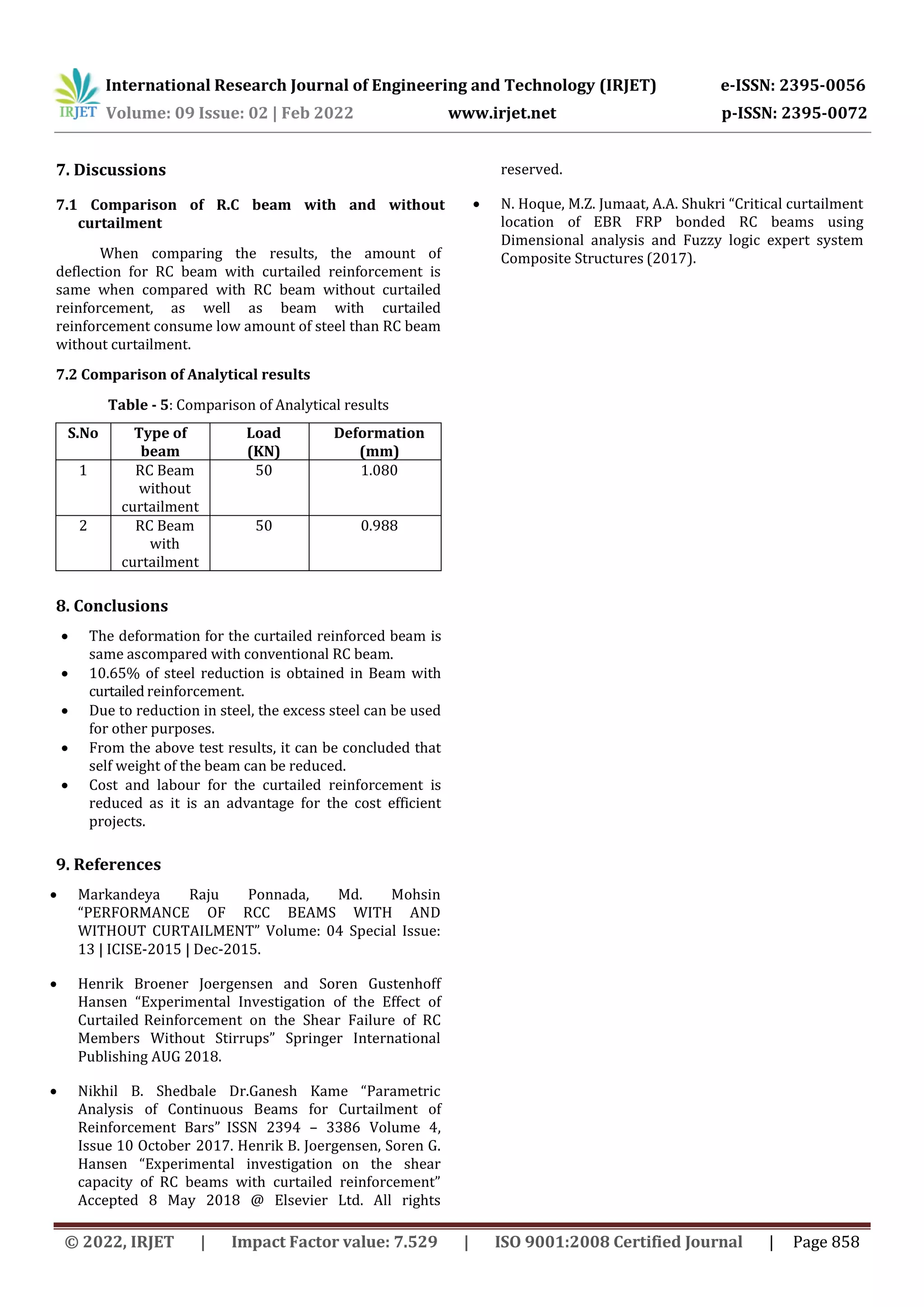
When comparing the results, the amount of
deflection for RC beam with curtailed reinforcement is
same when compared with RC beam without curtailed
reinforcement, as well as beam with curtailed
reinforcement consume low amount of steel than RC beam
without curtailment.
7.2 Comparison of Analytical results
Table - 5: Comparison of Analytical results
S.No Type of
beam
Load
(KN)
Deformation
(mm)
1 RC Beam
without
curtailment
50 1.080
2 RC Beam
with
curtailment
50 0.988
8. Conclusions
 The deformation for the curtailed reinforced beam is
same ascompared with conventional RC beam.
 10.65% of steel reduction is obtained in Beam with
curtailed reinforcement.
 Due to reduction in steel, the excess steel can be used
for other purposes.
 From the above test results, it can be concluded that
self weight of the beam can be reduced.
 Cost and labour for the curtailed reinforcement is
reduced as it is an advantage for the cost efficient
projects.
9. References
 Markandeya Raju Ponnada, Md. Mohsin
“PERFORMANCE OF RCC BEAMS WITH AND
WITHOUT CURTAILMENT” Volume: 04 Special Issue:
13 | ICISE-2015 | Dec-2015.
 Henrik Broener Joergensen and Soren Gustenhoff
Hansen “Experimental Investigation of the Effect of
Curtailed Reinforcement on the Shear Failure of RC
Members Without Stirrups” Springer International
Publishing AUG 2018.
 Nikhil B. Shedbale Dr.Ganesh Kame “Parametric
Analysis of Continuous Beams for Curtailment of
Reinforcement Bars” ISSN 2394 – 3386 Volume 4,
Issue 10 October 2017. Henrik B. Joergensen, Soren G.
Hansen “Experimental investigation on the shear
capacity of RC beams with curtailed reinforcement”
Accepted 8 May 2018 @ Elsevier Ltd. All rights
reserved.
 N. Hoque, M.Z. Jumaat, A.A. Shukri “Critical curtailment
location of EBR FRP bonded RC beams using
Dimensional analysis and Fuzzy logic expert system
Composite Structures (2017).

Experimental Investigation on Effect of Curtailed reinforcement in R.C beams

  • 1.
    International Research Journalof Engineering and Technology (IRJET) e-ISSN: 2395-0056 Volume: 09 Issue: 02 | Feb 2022 www.irjet.net p-ISSN: 2395-0072 © 2022, IRJET | Impact Factor value: 7.529 | ISO 9001:2008 Certified Journal | Page 854 Experimental Investigation on Effect of Curtailed reinforcement in R.C beams Sanjaik Kumar.T1, Sreevidya.V2, Ramesh.R3, Thangaraj.R4 1M.E Structural Engineering, Sri Krishna College of Technology, Coimbatore-641 042, Tamil Nadu, India 2Associate Professor, Sri Krishna College of Technology, Coimbatore-641 042, Tamil Nadu, India 3Associate Professor, Sri Krishna College of Technology, Coimbatore-641 042, Tamil Nadu, India 4Professor, CMS College of Engineering & Technology, Coimbatore-641 032, Tamil Nadu, India ---------------------------------------------------------------------***---------------------------------------------------------------------- Abstract - A study on the effect of curtailed reinforcement in RC beams is presented in this project. In this study, it is discussed how curtailed reinforcement may affect crack width and failure mechanisms, as well as deformation in RC beams. We compare beams with and without curtailed reinforcement here. For this study, The beam's cross section is 1200mm*150mm*150mm, with 3 numbers of 12mm diameter rods on top, 3 numbers of 8mm diameter rods on the bottom, and 9 numbers of 8mm diameter stirrups on the shear reinforcement. The grade of concrete and steel are M 25 and Fe 415. Key Words: Curtailed reinforcement, Shear reinforcement, Crack width, Deformation. 1. INTRODUCTION In reinforced concrete structures, curtailed reinforcement is commonly used. Especially in continuous beams, where reinforcement is frequently reduced to match the length of the hogging moment for an optimised design. Curtailed reinforcement is also commonly used in structures that require additional reinforcement for practical reasons. It is considered safe to add additional reinforcement here. 1.1 Reinforced concrete beam Reinforced cement concrete is a composite material in which the relatively low tensile strength and ductility of concrete are offset by the addition of reinforcement with higher tensile strength and ductility. Reinforcing structures are typically designed to withstand tensile stresses in specific areas of the concrete that could result in unacceptable cracking and structural failure. IS 456: 2000 guidelines were used to design the beam. 1.2 Steel reinforcement Construction is one of the most important steel-using industries, accounting for more than half of total global steel production. High-quality steel is 96.5 percent iron with about 2% carbon added. It also contains 1.5 percent manganese, which contributes to its tensile strength. Chromium is also added to stainless steel. There is a fear of scarcity of these naturally occurring components, as well as rising prices, which is challenging human societies around the world to find solutions. As a civil engineer, one method for reducing steel usage in the construction industry without sacrificing structural quality is to reduce the steel used in reinforced concrete beams. 1.3 Curtailed reinforcement Flexural reinforcement must be extended beyond the point where it is no longer required to resist flexure for a distance equal to the effective depth of the member or 12 times the bar diameter, whichever is greater, except at a simple support or at the end of a cantilever. When the resistance moment of the section, considering only the continuing bar, equals the bending moment, reinforcement is no longer required to resist flexure. Despite the fact that reinforcement curtailment is so widely used, the amount of analytical work conducted to study the influence of curtailment appears to be rather low. Curtailment is a theoretical point where some of the reinforcement is removed along the span of the beam where the bending moment decreases, assuming that the remaining reinforcement can support the reduced bending moment. The steel is adjusted to account for changes in bending moment across a section. Congestion of bars can also be avoided, improving concrete compaction. It is done primarily to save money on the design of a flexural member by shortening the tensile bars at the section beyond which flexure resistance is no longer required. Curtailment can be used on simply supported beams, but it is usually not cost effective, and the real benefits come from repetitive multi-span beams (continuous beams) and slabs. It can also be used to make construction easier by shortening bars to more manageable lengths. 1.4 Advantages of Curtailed reinforcement  By reducing the reinforcement, the amount of steel used can be reduced.  Reinforcement curtailment can result in a 15% to 25% reduction in the amount of steel used.  Construction costs are low.
  • 2.
    International Research Journalof Engineering and Technology (IRJET) e-ISSN: 2395-0056 Volume: 09 Issue: 02 | Feb 2022 www.irjet.net p-ISSN: 2395-0072 © 2022, IRJET | Impact Factor value: 7.529 | ISO 9001:2008 Certified Journal | Page 855  The structure's weight can be reduced. 2. EXPERIMENTAL INVESTIGATIONS 2.1 Materials used  Cement All of the specimens were cast with ordinary Portland cement (OPC) of grade 53 and specific gravity 3.15.  Fine aggregate Manufactured sand (M-Sand) is a concrete construction material that can be used in place of river sand. Crushing hard granite stone yields manufactured sand. As a construction material, the crushed sand is cubical in shape with grounded edges, washed, and graded. Manufactured sand (M- Sand) has a particle size of less than 4.75mm.  Coarse aggregate The specimens were cast using crushed granite aggregate with a specific gravity of 2.6, passing through 20mm and remaining on 12.5mm.  Water The portable water was used for casting and curing the specimens. 2.2 Specimen details Six series of specimens were cast based on the results of slump cone, compressive, and split tensile testing. Six specimens were cast, three of which were beams with curtailed reinforcement and three of which were beams without curtailed reinforcement. The specimen properties, loading method, and bond strengths obtained are summarised in the table below. Table -1: Specimen details 2.3 Loading details Table -2: Loading details 2.4 Mix proportioning M25 concrete with 20mm coarse aggregate was used. The material quantities used per cubic metre of concrete were as follows: Table -3: Mix proportioning 2.5 Casting of specimens Six series of static compressive loading on reinforced concrete beams were performed with the assistance of a loading frame. Three of them were carried out to investigate the effect of reinforcing the beams, while the other three were used to compare the beams with and without reinforcing the beams. Four specimens were cast with HYSD bars of 8mm and 12mm diameter and varying lengths. 2.6 Reinforcement details: Table - 4: Reinforcement details S.No. Reinforcement details 1 8mm - 5 No.s of 1200mm & 1 No. of 378mm 2 12mm - 5 No.s of 1200mm & 1 No. of 563mm 2.7 Curing of the specimens: The maximum strength of the concrete is obtained by curing for a period of 28 days. For curing, Jute sacks were used. During the curing process, Wet and damp environment was maintained. 2.8 Casting of the specimens: The specimens were cast at thelaboratory S.No. Specimen details 1 Size of specimen 150mm x 150mm 2 Length of specimen 1200mm 3 Diameter of the rods used 8mm & 12mm 4 Grade of concrete M25 5 Grade of steel Fe415 6 Mix Ratio 1:1:2 S.No. Type of loading Load value 1 Static compressive loading 500KN S.No Material Quantity 1 Cement 448.6 kg/m3 2 Water 197.4kg/m3 3 Fine aggregate 752.71kg/m3 4 Coarse aggregate 1064.65 kg/m3 5 Water/Cement ratio 0.45
  • 3.
    International Research Journalof Engineering and Technology (IRJET) e-ISSN: 2395-0056 Volume: 09 Issue: 02 | Feb 2022 www.irjet.net p-ISSN: 2395-0072 © 2022, IRJET | Impact Factor value: 7.529 | ISO 9001:2008 Certified Journal | Page 856 Figure -1: Reinforcement without curtailment Figure -2: Reinforcement with curtailment Figure -3: Casting of beam specimens 3. Experimental setup Figure - 4: Experimental setup The testing of beams is done in the loading frame which is available in the Structural Engineering Laboratory, Sri Krishna Collage of Technology. The testing procedure is samefor all the six specimens. With static load, until failure under two point loading, the beams were tested. The rails were used to transfer the load to the test specimen through two loading using rollers. The dial gauge is noted for the deflection of the beam. The propagation and crack development were marked and the mode of failure was recorded. 4. Testing of beams: Testing is done for six beams one after the other. Three beams are with curtailed reinforcements and three beams of conventional reinforcement. The dial gauge readings are noted for the gradual increase in load and deformation of the beams. The deformation readings are shown in the dial gauge. The load is applied till the ultimate failure of the beam and at which the first crack is developed is recorded as cracking load of the beam. The deflection with respect to load for the beams with conventional and curtailed reinforcement are recorded and furnished in the table. The data furnished in this chapter has been interpreted and discussed to obtain the conclusion. 5. Crack developments i) Beam without curtailed reinforcement: Figure -5: Crack development in Beam without curtailed reinforcement ii) Beam with curtailed reinforcement: Figure - 6: Crack development in Beam with curtailed reinforcement
  • 4.
    International Research Journalof Engineering and Technology (IRJET) e-ISSN: 2395-0056 Volume: 09 Issue: 02 | Feb 2022 www.irjet.net p-ISSN: 2395-0072 © 2022, IRJET | Impact Factor value: 7.529 | ISO 9001:2008 Certified Journal | Page 857 6. Graphs 6.1 Graphs without curtailment Specimen 1 Deflection (mm) Figure -7: Load v/s deflection for beam without curtailed reinforcement specimen 1 Specimen 2 Deflection (mm) Figure -8: Load v/s deflection for beam without curtailed reinforcement specimen 2 Specimen 3 Deflection (mm) Figure -9: Load v/s deflection for beam without curtailed reinforcement specimen 3 6.2 Graphs with curtailment Specimen 1 Deflection (mm) Figure -10: Load v/s deflection for beam with curtailed reinforcement specimen 1 Specimen 2 Deflection (mm) Figure -11: Load v/s deflection for beam with curtailed reinforcement specimen 2 Specimen 3 Deflection (mm) Figure -12: Load v/s deflection for beam with curtailed reinforcement specimen 3 Load (kN) Load (kN) Load (kN) Load (kN) Load (kN) Load (kN)
  • 5.
    International Research Journalof Engineering and Technology (IRJET) e-ISSN: 2395-0056 Volume: 09 Issue: 02 | Feb 2022 www.irjet.net p-ISSN: 2395-0072 © 2022, IRJET | Impact Factor value: 7.529 | ISO 9001:2008 Certified Journal | Page 858 7. Discussions 7.1 Comparison of R.C beam with and without curtailment When comparing the results, the amount of deflection for RC beam with curtailed reinforcement is same when compared with RC beam without curtailed reinforcement, as well as beam with curtailed reinforcement consume low amount of steel than RC beam without curtailment. 7.2 Comparison of Analytical results Table - 5: Comparison of Analytical results S.No Type of beam Load (KN) Deformation (mm) 1 RC Beam without curtailment 50 1.080 2 RC Beam with curtailment 50 0.988 8. Conclusions  The deformation for the curtailed reinforced beam is same ascompared with conventional RC beam.  10.65% of steel reduction is obtained in Beam with curtailed reinforcement.  Due to reduction in steel, the excess steel can be used for other purposes.  From the above test results, it can be concluded that self weight of the beam can be reduced.  Cost and labour for the curtailed reinforcement is reduced as it is an advantage for the cost efficient projects. 9. References  Markandeya Raju Ponnada, Md. Mohsin “PERFORMANCE OF RCC BEAMS WITH AND WITHOUT CURTAILMENT” Volume: 04 Special Issue: 13 | ICISE-2015 | Dec-2015.  Henrik Broener Joergensen and Soren Gustenhoff Hansen “Experimental Investigation of the Effect of Curtailed Reinforcement on the Shear Failure of RC Members Without Stirrups” Springer International Publishing AUG 2018.  Nikhil B. Shedbale Dr.Ganesh Kame “Parametric Analysis of Continuous Beams for Curtailment of Reinforcement Bars” ISSN 2394 – 3386 Volume 4, Issue 10 October 2017. Henrik B. Joergensen, Soren G. Hansen “Experimental investigation on the shear capacity of RC beams with curtailed reinforcement” Accepted 8 May 2018 @ Elsevier Ltd. All rights reserved.  N. Hoque, M.Z. Jumaat, A.A. Shukri “Critical curtailment location of EBR FRP bonded RC beams using Dimensional analysis and Fuzzy logic expert system Composite Structures (2017).