Experiences and lessons in
health promotion
Irene Verins
 9th November Johannesburg
Presentation overview
• Brief introduction to Victorian Health Promotion
  Foundation (VicHealth)

• Consider some of the learnings and challenges in
  establishing a health promotion foundation

• Provide case studies
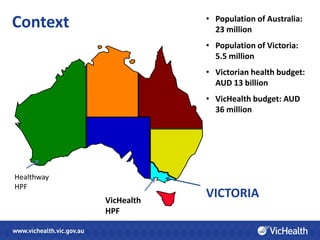
• Population of Australia:
Context                   23 million
                        • Population of Victoria:
                          5.5 million
                        • Victorian health budget:
                          AUD 13 billion
                        • VicHealth budget: AUD
                          36 million


Healthway
HPF
            VicHealth
                        VICTORIA
            HPF
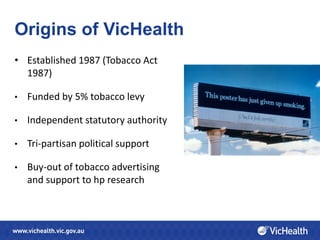
Origins of VicHealth
• Established 1987 (Tobacco Act
  1987)

•   Funded by 5% tobacco levy

•   Independent statutory authority

•   Tri-partisan political support

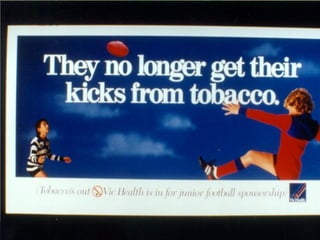
•   Buy-out of tobacco advertising
    and support to hp research
VicHealth
•   Loss of hypothecated tax in 1997 =
    appropriation directly from treasury
•   Move out of sponsorship funding in 1999/2000
•   Greater emphasis on changing the social
    determinants that impact on health
•   Improved alignment of research investment
    with priority areas
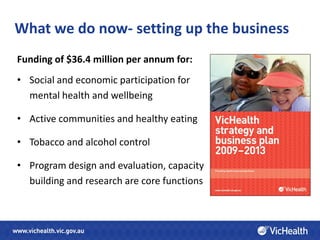
What we do now- setting up the business
Funding of $36.4 million per annum for:
• Social and economic participation for
  mental health and wellbeing

• Active communities and healthy eating

• Tobacco and alcohol control

• Program design and evaluation, capacity
  building and research are core functions
VicHealth’s Mission 2009-2013
To build the capabilities of organisations, communities
and individuals in ways that:

• change social, economic and physical environments
  so they improve health for all Victorians

• strengthen the understanding and the skills of
  individuals in ways that support their efforts to
  achieve and maintain health
“This ends the debate decisively.
 Health care is an important
 determinant of health.

 Lifestyles are important
 determinants of health.

 But it is factors in the social
 environment that determine
 access to health services and
 influence lifestyle choices in
 the first place.”

[Source] www.who.int/social_determinants
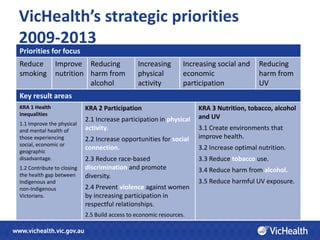
VicHealth’s strategic priorities
2009-2013
Priorities for focus
Reduce         Improve Reducing                 Increasing        Increasing social and    Reducing
smoking        nutrition harm from              physical          economic                 harm from
                         alcohol                activity          participation            UV
Key result areas
KRA 1 Health                KRA 2 Participation                       KRA 3 Nutrition, tobacco, alcohol
inequalities                                                          and UV
                            2.1 Increase participation in physical
1.1 Improve the physical
and mental health of        activity.                                 3.1 Create environments that
those experiencing          2.2 Increase opportunities for social     improve health.
social, economic or
geographic
                            connection.                               3.2 Increase optimal nutrition.
disadvantage.               2.3 Reduce race-based                     3.3 Reduce tobacco use.
1.2 Contribute to closing   discrimination and promote                3.4 Reduce harm from alcohol.
the health gap between      diversity.
Indigenous and                                                        3.5 Reduce harmful UV exposure.
non-Indigenous              2.4 Prevent violence against women
Victorians.                 by increasing participation in
                            respectful relationships.
                            2.5 Build access to economic resources.
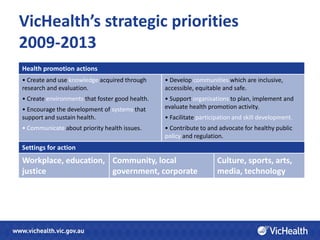
VicHealth’s strategic priorities
2009-2013
Health promotion actions
• Create and use knowledge acquired through      • Develop communities which are inclusive,
research and evaluation.                         accessible, equitable and safe.
• Create environments that foster good health.   • Support organisations to plan, implement and
• Encourage the development of systems that      evaluate health promotion activity.
support and sustain health.                      • Facilitate participation and skill development.
• Communicate about priority health issues.      • Contribute to and advocate for healthy public
                                                 policy and regulation.
Settings for action
Workplace, education, Community, local                               Culture, sports, arts,
justice               government, corporate                          media, technology
Experiences & Lessons
1. Tax hypothecation
• A dedicated tax on a harmful product is used to
  promote health

• It required an ACT of Parliament = important

• Is more difficult for governments to make changes
  to a dedicated tax

• Secures a long term investment
2. Independence... Be the value
add to government
• A balanced government relationship

• Work with government but not as government

• Do not duplicate

• Find and articulate the boundaries: more able to
  carry risk, more innovative, more responsive
3. Adaptable, nimble: a lean
machine…
Foundation must be able to weather change and plan
long term strategies by:
 • Being less bureaucratic, smaller & cheaper than government
 • Align activity & resources across government silos in areas
   that could deliver health benefits: education, workplaces,
   sport
 • “Yeast in the system”
4. Innovative

•   Identify emerging trends in public health

•   Test new ideas and strategies: Research &
    evaluation, knowledge dissemination

•   Carry the risk
5. VicHealth’s evolution: from
breadth to depth
1987: @ 20 people
• $25 million
• Disbursed through large funding rounds (breadth)
• Community Health Program had 3 people disbursing
  through 16 week funding round cycles
• Advocacy through partners and key stakeholders
• CEO partnered with health people predominantly
5. VicHealth’s evolution: from
breadth to depth continue…
 2011:@ 50 people
• $36 million
• Disbursed through both development, design and evaluation
  of interventions (depth) and large funding rounds in physical
  activity, the arts and research (innovation)
• A knowledge builder and disseminator
• CEO partners with those inside and outside of health, NGO
  and corporate sectors
• Advocacy through stakeholder/policy coalitions,
  social media
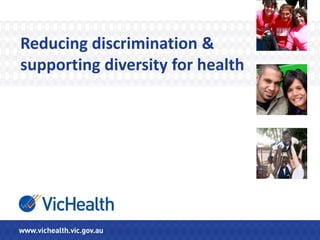
Reducing discrimination &
supporting diversity for health
Reducing race-based discrimination
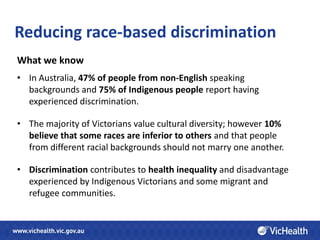
What we know
• In Australia, 47% of people from non-English speaking
  backgrounds and 75% of Indigenous people report having
  experienced discrimination.

• The majority of Victorians value cultural diversity; however 10%
  believe that some races are inferior to others and that people
  from different racial backgrounds should not marry one another.

• Discrimination contributes to health inequality and disadvantage
  experienced by Indigenous Victorians and some migrant and
  refugee communities.
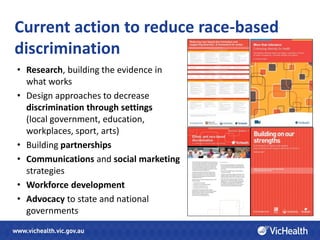
Current action to reduce race-based
discrimination
• Research, building the evidence in
  what works
• Design approaches to decrease
  discrimination through settings
  (local government, education,
  workplaces, sport, arts)
• Building partnerships
• Communications and social marketing
  strategies
• Workforce development
• Advocacy to state and national
  governments
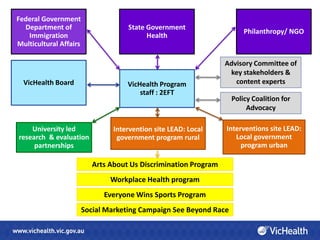
Federal Government
  Department of                      State Government
                                                                        Philanthropy/ NGO
   Immigration                             Health
Multicultural Affairs

                                                                  Advisory Committee of
                                                                   key stakeholders &
  VicHealth Board                    VicHealth Program               content experts
                                         staff : 2EFT
                                                                    Policy Coalition for
                                                                         Advocacy

    University led               Intervention site LEAD: Local    Interventions site LEAD:
research & evaluation             government program rural           Local government
     partnerships                                                      program urban

                           Arts About Us Discrimination Program
                                Workplace Health program
                              Everyone Wins Sports Program
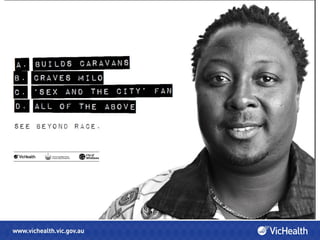
                        Social Marketing Campaign See Beyond Race
Measuring success
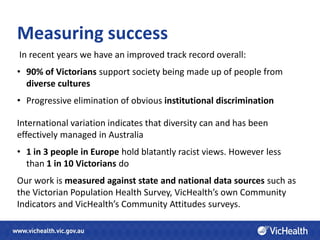
In recent years we have an improved track record overall:
• 90% of Victorians support society being made up of people from
  diverse cultures
• Progressive elimination of obvious institutional discrimination

International variation indicates that diversity can and has been
effectively managed in Australia
• 1 in 3 people in Europe hold blatantly racist views. However less
  than 1 in 10 Victorians do
Our work is measured against state and national data sources such as
the Victorian Population Health Survey, VicHealth’s own Community
Indicators and VicHealth’s Community Attitudes surveys.
6. Is there support for promotion and
prevention?
• The economic evidence for health promotion is
  under-developed
• Reviews estimate that about 10 per cent of economic
  studies assess prevention
• Relatively few health promotion interventions have
  been assessed
• Population approaches are the most difficult to assess
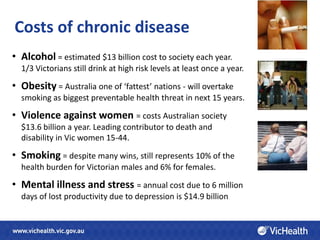
Costs of chronic disease
                                   e
• Alcohol = estimated $13 billion cost to society each year.
  1/3 Victorians still drink at high risk levels at least once a year.

• Obesity = Australia one of ‘fattest’ nations - will overtake
  smoking as biggest preventable health threat in next 15 years.

• Violence against women = costs Australian society
  $13.6 billion a year. Leading contributor to death and
  disability in Vic women 15-44.

• Smoking = despite many wins, still represents 10% of the
  health burden for Victorian males and 6% for females.

• Mental illness and stress = annual cost due to 6 million
  days of lost productivity due to depression is $14.9 billion
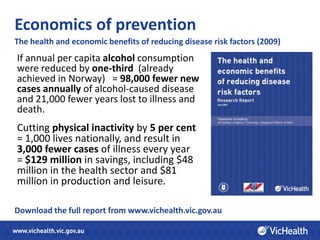
Economics of prevention
The health and economic benefits of reducing disease risk factors (2009)
If annual per capita alcohol consumption
were reduced by one-third (already
achieved in Norway) = 98,000 fewer new
cases annually of alcohol-caused disease
and 21,000 fewer years lost to illness and
death.
Cutting physical inactivity by 5 per cent
= 1,000 lives nationally, and result in
3,000 fewer cases of illness every year
= $129 million in savings, including $48
million in the health sector and $81
million in production and leisure.

Download the full report from www.vichealth.vic.gov.au
Economics of prevention continued…
The health and economic benefits of reducing disease risk factors (2009)

If tobacco smoking in Australia were
reduced to 15 per cent (achieved in
California), there could be 5000 lives
saved a year and 158,000 fewer
new cases annually of tobacco-
caused illness.
(note: the Victorian Government has set a
target to reduce smoking in adults from
17.3% to 13.8% by 2013)

Download the full report from www.vichealth.vic.gov.au
7. Leadership
1. Political:
  • Tri-partisanship, reps from each Party on Board to achieve
    broad parliamentary consensus for public health
2. Strategic and Representational:
  • Sectoral support from sport, arts, health, education, medical
    research sectors and the media
  • Champions
3. Organisational:
  • Chairperson-high profile, CEO-high profile
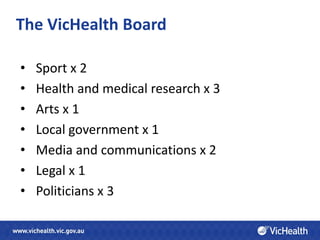
The VicHealth Board

•   Sport x 2
•   Health and medical research x 3
•   Arts x 1
•   Local government x 1
•   Media and communications x 2
•   Legal x 1
•   Politicians x 3
8. Support from sponsored sectors:
Sports & Arts
• Embraced tobacco buyout early
• Provided great support in expanding the
  resource base for influencing health
  behaviours and attitudes
• Provided the community networks
  throughout which advocacy can be channeled
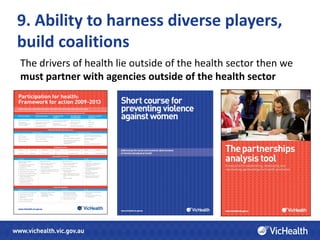
9. Ability to harness diverse players,
build coalitions
The drivers of health lie outside of the health sector then we
must partner with agencies outside of the health sector
VicHealth’s Achievements
•   Replacement of tobacco sponsorships
•   Centres for Research and Practice
•   Development of public health research infrastructure
•   Contributed to lower tobacco and alcohol consumption, greater
    sun protection
•   Training thousands of non health sector workers in hp
•   Contribution to public health policy and partnerships across
    sectors
•   Mental health promotion strategy and evidence
•   Influence on state and federal government policy
In closing a few thoughts about establishment of a hpf

1. Tax levy is separate money from health budget: a hpf is not a
   burden
2. Be the value add and the enabler to government : hpf can
   extend the work of government
3. Build the business case for hpf in South Africa (befriend the
   health economists)
4. Be the Innovation incubator and carry the risk which
   government can’t
5. Strong & strategic leadership: champions
6. Cross sectoral partnerships: invest in them now as your
   advocacy coalition
7.Health promotion/prevention takes a long time

Experience and lessons - Irene Verins

  • 1.
    Experiences and lessonsin health promotion Irene Verins 9th November Johannesburg
  • 2.
    Presentation overview • Briefintroduction to Victorian Health Promotion Foundation (VicHealth) • Consider some of the learnings and challenges in establishing a health promotion foundation • Provide case studies
  • 3.
    • Population ofAustralia: Context 23 million • Population of Victoria: 5.5 million • Victorian health budget: AUD 13 billion • VicHealth budget: AUD 36 million Healthway HPF VicHealth VICTORIA HPF
  • 5.
    Origins of VicHealth •Established 1987 (Tobacco Act 1987) • Funded by 5% tobacco levy • Independent statutory authority • Tri-partisan political support • Buy-out of tobacco advertising and support to hp research
  • 7.
    VicHealth • Loss of hypothecated tax in 1997 = appropriation directly from treasury • Move out of sponsorship funding in 1999/2000 • Greater emphasis on changing the social determinants that impact on health • Improved alignment of research investment with priority areas
  • 8.
    What we donow- setting up the business Funding of $36.4 million per annum for: • Social and economic participation for mental health and wellbeing • Active communities and healthy eating • Tobacco and alcohol control • Program design and evaluation, capacity building and research are core functions
  • 9.
    VicHealth’s Mission 2009-2013 Tobuild the capabilities of organisations, communities and individuals in ways that: • change social, economic and physical environments so they improve health for all Victorians • strengthen the understanding and the skills of individuals in ways that support their efforts to achieve and maintain health
  • 10.
    “This ends thedebate decisively. Health care is an important determinant of health. Lifestyles are important determinants of health. But it is factors in the social environment that determine access to health services and influence lifestyle choices in the first place.” [Source] www.who.int/social_determinants
  • 11.
    VicHealth’s strategic priorities 2009-2013 Prioritiesfor focus Reduce Improve Reducing Increasing Increasing social and Reducing smoking nutrition harm from physical economic harm from alcohol activity participation UV Key result areas KRA 1 Health KRA 2 Participation KRA 3 Nutrition, tobacco, alcohol inequalities and UV 2.1 Increase participation in physical 1.1 Improve the physical and mental health of activity. 3.1 Create environments that those experiencing 2.2 Increase opportunities for social improve health. social, economic or geographic connection. 3.2 Increase optimal nutrition. disadvantage. 2.3 Reduce race-based 3.3 Reduce tobacco use. 1.2 Contribute to closing discrimination and promote 3.4 Reduce harm from alcohol. the health gap between diversity. Indigenous and 3.5 Reduce harmful UV exposure. non-Indigenous 2.4 Prevent violence against women Victorians. by increasing participation in respectful relationships. 2.5 Build access to economic resources.
  • 12.
    VicHealth’s strategic priorities 2009-2013 Healthpromotion actions • Create and use knowledge acquired through • Develop communities which are inclusive, research and evaluation. accessible, equitable and safe. • Create environments that foster good health. • Support organisations to plan, implement and • Encourage the development of systems that evaluate health promotion activity. support and sustain health. • Facilitate participation and skill development. • Communicate about priority health issues. • Contribute to and advocate for healthy public policy and regulation. Settings for action Workplace, education, Community, local Culture, sports, arts, justice government, corporate media, technology
  • 13.
  • 14.
    1. Tax hypothecation •A dedicated tax on a harmful product is used to promote health • It required an ACT of Parliament = important • Is more difficult for governments to make changes to a dedicated tax • Secures a long term investment
  • 15.
    2. Independence... Bethe value add to government • A balanced government relationship • Work with government but not as government • Do not duplicate • Find and articulate the boundaries: more able to carry risk, more innovative, more responsive
  • 16.
    3. Adaptable, nimble:a lean machine… Foundation must be able to weather change and plan long term strategies by: • Being less bureaucratic, smaller & cheaper than government • Align activity & resources across government silos in areas that could deliver health benefits: education, workplaces, sport • “Yeast in the system”
  • 17.
    4. Innovative • Identify emerging trends in public health • Test new ideas and strategies: Research & evaluation, knowledge dissemination • Carry the risk
  • 18.
    5. VicHealth’s evolution:from breadth to depth 1987: @ 20 people • $25 million • Disbursed through large funding rounds (breadth) • Community Health Program had 3 people disbursing through 16 week funding round cycles • Advocacy through partners and key stakeholders • CEO partnered with health people predominantly
  • 19.
    5. VicHealth’s evolution:from breadth to depth continue… 2011:@ 50 people • $36 million • Disbursed through both development, design and evaluation of interventions (depth) and large funding rounds in physical activity, the arts and research (innovation) • A knowledge builder and disseminator • CEO partners with those inside and outside of health, NGO and corporate sectors • Advocacy through stakeholder/policy coalitions, social media
  • 20.
  • 21.
    Reducing race-based discrimination Whatwe know • In Australia, 47% of people from non-English speaking backgrounds and 75% of Indigenous people report having experienced discrimination. • The majority of Victorians value cultural diversity; however 10% believe that some races are inferior to others and that people from different racial backgrounds should not marry one another. • Discrimination contributes to health inequality and disadvantage experienced by Indigenous Victorians and some migrant and refugee communities.
  • 22.
    Current action toreduce race-based discrimination • Research, building the evidence in what works • Design approaches to decrease discrimination through settings (local government, education, workplaces, sport, arts) • Building partnerships • Communications and social marketing strategies • Workforce development • Advocacy to state and national governments
  • 23.
    Federal Government Department of State Government Philanthropy/ NGO Immigration Health Multicultural Affairs Advisory Committee of key stakeholders & VicHealth Board VicHealth Program content experts staff : 2EFT Policy Coalition for Advocacy University led Intervention site LEAD: Local Interventions site LEAD: research & evaluation government program rural Local government partnerships program urban Arts About Us Discrimination Program Workplace Health program Everyone Wins Sports Program Social Marketing Campaign See Beyond Race
  • 24.
    Measuring success In recentyears we have an improved track record overall: • 90% of Victorians support society being made up of people from diverse cultures • Progressive elimination of obvious institutional discrimination International variation indicates that diversity can and has been effectively managed in Australia • 1 in 3 people in Europe hold blatantly racist views. However less than 1 in 10 Victorians do Our work is measured against state and national data sources such as the Victorian Population Health Survey, VicHealth’s own Community Indicators and VicHealth’s Community Attitudes surveys.
  • 29.
    6. Is theresupport for promotion and prevention? • The economic evidence for health promotion is under-developed • Reviews estimate that about 10 per cent of economic studies assess prevention • Relatively few health promotion interventions have been assessed • Population approaches are the most difficult to assess
  • 30.
    Costs of chronicdisease e • Alcohol = estimated $13 billion cost to society each year. 1/3 Victorians still drink at high risk levels at least once a year. • Obesity = Australia one of ‘fattest’ nations - will overtake smoking as biggest preventable health threat in next 15 years. • Violence against women = costs Australian society $13.6 billion a year. Leading contributor to death and disability in Vic women 15-44. • Smoking = despite many wins, still represents 10% of the health burden for Victorian males and 6% for females. • Mental illness and stress = annual cost due to 6 million days of lost productivity due to depression is $14.9 billion
  • 31.
    Economics of prevention Thehealth and economic benefits of reducing disease risk factors (2009) If annual per capita alcohol consumption were reduced by one-third (already achieved in Norway) = 98,000 fewer new cases annually of alcohol-caused disease and 21,000 fewer years lost to illness and death. Cutting physical inactivity by 5 per cent = 1,000 lives nationally, and result in 3,000 fewer cases of illness every year = $129 million in savings, including $48 million in the health sector and $81 million in production and leisure. Download the full report from www.vichealth.vic.gov.au
  • 32.
    Economics of preventioncontinued… The health and economic benefits of reducing disease risk factors (2009) If tobacco smoking in Australia were reduced to 15 per cent (achieved in California), there could be 5000 lives saved a year and 158,000 fewer new cases annually of tobacco- caused illness. (note: the Victorian Government has set a target to reduce smoking in adults from 17.3% to 13.8% by 2013) Download the full report from www.vichealth.vic.gov.au
  • 33.
    7. Leadership 1. Political: • Tri-partisanship, reps from each Party on Board to achieve broad parliamentary consensus for public health 2. Strategic and Representational: • Sectoral support from sport, arts, health, education, medical research sectors and the media • Champions 3. Organisational: • Chairperson-high profile, CEO-high profile
  • 34.
    The VicHealth Board • Sport x 2 • Health and medical research x 3 • Arts x 1 • Local government x 1 • Media and communications x 2 • Legal x 1 • Politicians x 3
  • 35.
    8. Support fromsponsored sectors: Sports & Arts • Embraced tobacco buyout early • Provided great support in expanding the resource base for influencing health behaviours and attitudes • Provided the community networks throughout which advocacy can be channeled
  • 36.
    9. Ability toharness diverse players, build coalitions The drivers of health lie outside of the health sector then we must partner with agencies outside of the health sector
  • 37.
    VicHealth’s Achievements • Replacement of tobacco sponsorships • Centres for Research and Practice • Development of public health research infrastructure • Contributed to lower tobacco and alcohol consumption, greater sun protection • Training thousands of non health sector workers in hp • Contribution to public health policy and partnerships across sectors • Mental health promotion strategy and evidence • Influence on state and federal government policy
  • 38.
    In closing afew thoughts about establishment of a hpf 1. Tax levy is separate money from health budget: a hpf is not a burden 2. Be the value add and the enabler to government : hpf can extend the work of government 3. Build the business case for hpf in South Africa (befriend the health economists) 4. Be the Innovation incubator and carry the risk which government can’t 5. Strong & strategic leadership: champions 6. Cross sectoral partnerships: invest in them now as your advocacy coalition 7.Health promotion/prevention takes a long time