COMPARATIVE FUNDING AND
       STRUCTURE POSSIBILITIES
• A HPF INDABA ORGNISED BY:
  SOUL CITY INSTITUTE AND THE NATIONAL
  COUNCIL AGAINEST SMOKING,
  JOHANNESBURG -SOUTH AFRICA.
          9-10 NOVEMBER 2011

HANS ONYA
Director: Health Promotion and Institutional
       HIV/AIDS Programme, University of
      Limpopo, South Africa
Presentation Outline

•   Why Health Promotion Foundation
•   What Health Promotion Foundation
•   How the Health Promotion can be funded
•   Structure Possibilities
•   Concluding remarks
Why health promotion foundations?

A range of structures exists accross the world for
promoting health. While each has its own geo-
political features and genesis, a transferable
organisational and financing model, has been
adopted in many countries. HPF already in existence
concentrate on two major objectives, namely:
Identifying and building capacity within existing
  infrastructures accross government and
  community sectors
Developing ring-fenced funds for achieving long-
  term sustainability of policies and programmes
Why health promotion
         foundations?
Health promotion foundations have been created to:
   – tackle the health challenges of the 21st century
   – innovate in ways not possible within the formal
     health system
   – work in partnership across different sectors
   – a sustainable source of funding for health
   – avoid competition with resources for cure and care
What do health promotion
      foundations do?
– Fund health promotion initiatives to promote health
  and prevent disease;
– Build a health promotion evidence base;
– Work collaboratively across sectors;
– Advocate for health promoting policies;
– Address equity issues; and
– Trial innovative programs in sensitive areas (drugs,
  STIs, etc.) that may expose governments to political
  criticism.
How are health promotion
          funded?
– Health Promotion Foundations can be funded through a
  variety of methods (better: financing mechanisms?):
– An earmarked tax on tobacco (e.g. VicHealth and Healthway
  pre 1996)
– A combination of earmarked taxes on tobacco and alcohol
  (e.g. ThaiHealth and Malaysia)
– A levy on health insurance (e.g. Health Promotion
  Switzerland)
– An appropriation from Treasury budgets (e.g. Fonds
  Gesundes Osterreich - Austria)
– Non-government organisation funding (e.g. Health 21
  Hungary)
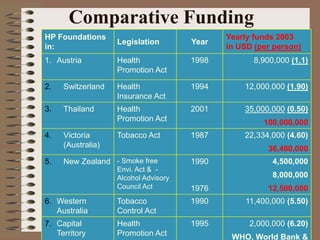
Comparative Funding
•HP Foundations                               Yearly funds 2003
                    Legislation        Year
in:                                           in USD (per person)
1. Austria          Health             1998          8,900,000 (1.1)
                    Promotion Act

2.    Switzerland   Health             1994       12,000,000 (1.90)
                    Insurance Act
3.    Thailand      Health             2001       35,000,000 (0.50)
                    Promotion Act                      100,000,000
4.    Victoria      Tobacco Act        1987       22,334,000 (4.60)
      (Australia)                                       36,400,000
5.    New Zealand - Smoke free         1990               4,500,000
                    Envi. Act & -
                    Alcohol Advisory                      8,000,000
                    Council Act        1976             12,500,000
6. Western          Tobacco            1990       11,400,000 (5.50)
   Australia        Control Act
7. Capital          Health             1995        2,000,000 (6.20)
   Territory        Promotion Act              WHO, World Bank &
HPF Funding Mechanism
Dedicated tobacco taxes for health promotion or
Health Promotion Foundations have now been
established in:

Australia, Canada, Ecuador, Finland, French
Polynesia, Guam, Iceland, Korea, Mauritius,
Nepal, New Zealand, Peru, Portugal, USA and
Western Samoa.
HPF Funding mechanisms.. cont.
It may be necessary to find alternatives or adjuncts to
tobacco and/or alcohol tax to finance health promotion.
Most of these mechanisms have far reaching
consequences for developing countries and are in most
cases problematic. They include:
Sponsorship, Bridging finance, Recurrent health
funding, Government Aid Organisations, Private Trusts
and Foundations, The WHO & World Bank,
International Unions, Organisations and Centres,
National and international health NGOs, Service Clubs
(e.g. Rotary and Lions International) etc.
Starting a HP Foundation
Considerations that apply to any country:
• context:
        political climate, timing, content of Act;
• evidence:
•       strong evidence base for health promotion action, ramifications
        of legislation, expert information;
• support:
        bipartisan, economic, community;

• campaigns for establishing foundations
HPF Structure Possibilities-
        How are HPF organized?
– established according to some form of legislation such
  as an Act of Parliament, which provides a long-term
  and recurrent budget
– governed by an independent Board of Governance that
  comprises stakeholder representation
– exercises a high level of autonomous decision making
– is not aligned with any one political group
– promotes health by working with and across many
  sectors and levels of society
HPF Structure Possibilities-
    Possible location for a HPF
•A coordinating body for health promotion at a national,
regional or local level can be located:
1. Within a Health Department
2. In the Non-Government Sector
3. Or in some combination of the two such as a Statutory
    Authority
•There are advantages and disadvantages to each.
•Wherever a Health Promotion Foundation is located, it
needs to be structured so that it has the capacity and
flexibility to undertake a number of essential roles in
developing and promoting health
Within a Health Department
Advantages:
• Closely linked to the government‟s public health and primary health
   care strategies
• Would have direct line access to the government through Departmental
   Head and its Minister
Disadvantages:
• Potential competition for resources with other units within the
   Department (especially the interest of the curative care systems)
• A limited capacity to work intersectorally
In the Non-Government Sector
             (Charity or Trust)
Advantages:
 Keeping health promotion clearly independent of
  Government
 Capacity to secure resources for health promotion outside
  of Government
Disadvantages:
 Difficulties with co-ordination if the organisation has no
  statutory authority;
 Difficulties in securing sufficient long-term funding;
 A potential lack of mechanisms for public accountability;
 Difficulties for non-governmental organisations in
  obtaining local, provincial, state or national coverage.
As a Statutory Authority
Advantages:
 The Foundation is at arm‟s length from government but still has the
   necessary legislative authority;
 It is supported by official resources;
 It‟s Board can help mobilise public support for health promotion;
 It has flexibility than a large bureaucracy to be innovative and
   responsive to health promotion issues.
Disadvantages:
 The Health Department may want to control the foundation‟s
   resources when its revenue base is under threat.
HPF Structure Possibilities-
     Characteristics and culture
A HPF which may influence its capacity to fulfil its mandate includes
its:
 Organisational structure
 Board and committee structure
 Governance issues
 Leadership styles
 Communication styles
 Portfolio mix
 Skill mix
 Community and intersectoral linkages
Example: VicHealth
            Governance
– VicHealth represents the Crown (Tobacco Act 1987, Section
  16(3))
– It is a body corporate consisting of 11 members (The „Board‟)
  appointed by the Minister for Health.
– Three members who are also elected members of the Victorian
  Parliament.
– The Minister for Health is accountable to the Cabinet and the
  Parliament for the performance of VicHealth.
– The Minister is also required to consult with the Minister
  administering the Sport and Recreation Act 1972
– VicHealth is subject to the scrutiny of the Parliament and is
  required to present an Annual Report to the Parliament
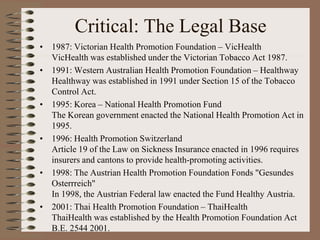
Critical: The Legal Base
• 1987: Victorian Health Promotion Foundation – VicHealth
  VicHealth was established under the Victorian Tobacco Act 1987.
• 1991: Western Australian Health Promotion Foundation – Healthway
  Healthway was established in 1991 under Section 15 of the Tobacco
  Control Act.
• 1995: Korea – National Health Promotion Fund
  The Korean government enacted the National Health Promotion Act in
  1995.
• 1996: Health Promotion Switzerland
  Article 19 of the Law on Sickness Insurance enacted in 1996 requires
  insurers and cantons to provide health-promoting activities.
• 1998: The Austrian Health Promotion Foundation Fonds "Gesundes
  Osterrreich"
  In 1998, the Austrian Federal law enacted the Fund Healthy Austria.
• 2001: Thai Health Promotion Foundation – ThaiHealth
  ThaiHealth was established by the Health Promotion Foundation Act
  B.E. 2544 2001.
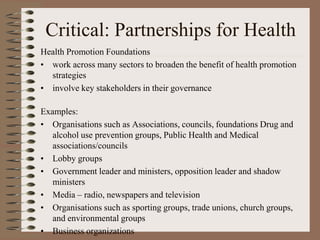
Critical: Partnerships for Health
Health Promotion Foundations
• work across many sectors to broaden the benefit of health promotion
  strategies
• involve key stakeholders in their governance

Examples:
• Organisations such as Associations, councils, foundations Drug and
   alcohol use prevention groups, Public Health and Medical
   associations/councils
• Lobby groups
• Government leader and ministers, opposition leader and shadow
   ministers
• Media – radio, newspapers and television
• Organisations such as sporting groups, trade unions, church groups,
   and environmental groups
• Business organizations
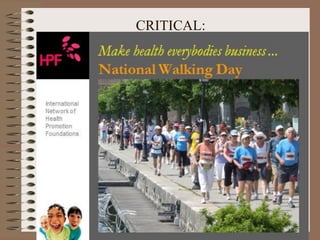
CRITICAL:
Make health everybodies business ...
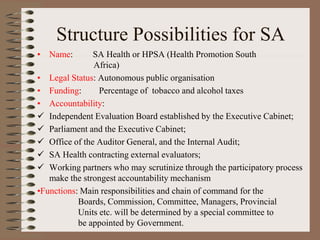
Structure Possibilities for SA
• Name:        SA Health or HPSA (Health Promotion South
               Africa)
• Legal Status: Autonomous public organisation
• Funding:       Percentage of tobacco and alcohol taxes
• Accountability:
 Independent Evaluation Board established by the Executive Cabinet;
 Parliament and the Executive Cabinet;
 Office of the Auditor General, and the Internal Audit;
 SA Health contracting external evaluators;
 Working partners who may scrutinize through the participatory process
   make the strongest accountability mechanism
•Functions: Main responsibilities and chain of command for the
           Boards, Commission, Committee, Managers, Provincial
           Units etc. will be determined by a special committee to
           be appointed by Government.
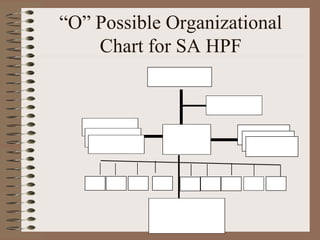
“O” Possible Organizational
    Chart for SA HPF
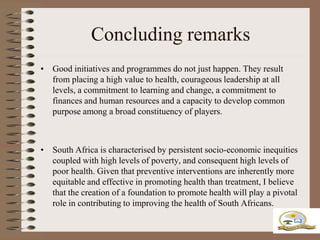
Concluding remarks
• Good initiatives and programmes do not just happen. They result
  from placing a high value to health, courageous leadership at all
  levels, a commitment to learning and change, a commitment to
  finances and human resources and a capacity to develop common
  purpose among a broad constituency of players.


• South Africa is characterised by persistent socio-economic inequities
  coupled with high levels of poverty, and consequent high levels of
  poor health. Given that preventive interventions are inherently more
  equitable and effective in promoting health than treatment, I believe
  that the creation of a foundation to promote health will play a pivotal
  role in contributing to improving the health of South Africans.
THE END


THANK YOU

Hpf indaba presentation nov 2011 - Hans Onya

  • 1.
    COMPARATIVE FUNDING AND STRUCTURE POSSIBILITIES • A HPF INDABA ORGNISED BY: SOUL CITY INSTITUTE AND THE NATIONAL COUNCIL AGAINEST SMOKING, JOHANNESBURG -SOUTH AFRICA. 9-10 NOVEMBER 2011 HANS ONYA Director: Health Promotion and Institutional HIV/AIDS Programme, University of Limpopo, South Africa
  • 2.
    Presentation Outline • Why Health Promotion Foundation • What Health Promotion Foundation • How the Health Promotion can be funded • Structure Possibilities • Concluding remarks
  • 3.
    Why health promotionfoundations? A range of structures exists accross the world for promoting health. While each has its own geo- political features and genesis, a transferable organisational and financing model, has been adopted in many countries. HPF already in existence concentrate on two major objectives, namely: Identifying and building capacity within existing infrastructures accross government and community sectors Developing ring-fenced funds for achieving long- term sustainability of policies and programmes
  • 4.
    Why health promotion foundations? Health promotion foundations have been created to: – tackle the health challenges of the 21st century – innovate in ways not possible within the formal health system – work in partnership across different sectors – a sustainable source of funding for health – avoid competition with resources for cure and care
  • 5.
    What do healthpromotion foundations do? – Fund health promotion initiatives to promote health and prevent disease; – Build a health promotion evidence base; – Work collaboratively across sectors; – Advocate for health promoting policies; – Address equity issues; and – Trial innovative programs in sensitive areas (drugs, STIs, etc.) that may expose governments to political criticism.
  • 6.
    How are healthpromotion funded? – Health Promotion Foundations can be funded through a variety of methods (better: financing mechanisms?): – An earmarked tax on tobacco (e.g. VicHealth and Healthway pre 1996) – A combination of earmarked taxes on tobacco and alcohol (e.g. ThaiHealth and Malaysia) – A levy on health insurance (e.g. Health Promotion Switzerland) – An appropriation from Treasury budgets (e.g. Fonds Gesundes Osterreich - Austria) – Non-government organisation funding (e.g. Health 21 Hungary)
  • 7.
    Comparative Funding •HP Foundations Yearly funds 2003 Legislation Year in: in USD (per person) 1. Austria Health 1998 8,900,000 (1.1) Promotion Act 2. Switzerland Health 1994 12,000,000 (1.90) Insurance Act 3. Thailand Health 2001 35,000,000 (0.50) Promotion Act 100,000,000 4. Victoria Tobacco Act 1987 22,334,000 (4.60) (Australia) 36,400,000 5. New Zealand - Smoke free 1990 4,500,000 Envi. Act & - Alcohol Advisory 8,000,000 Council Act 1976 12,500,000 6. Western Tobacco 1990 11,400,000 (5.50) Australia Control Act 7. Capital Health 1995 2,000,000 (6.20) Territory Promotion Act WHO, World Bank &
  • 8.
    HPF Funding Mechanism Dedicatedtobacco taxes for health promotion or Health Promotion Foundations have now been established in: Australia, Canada, Ecuador, Finland, French Polynesia, Guam, Iceland, Korea, Mauritius, Nepal, New Zealand, Peru, Portugal, USA and Western Samoa.
  • 9.
    HPF Funding mechanisms..cont. It may be necessary to find alternatives or adjuncts to tobacco and/or alcohol tax to finance health promotion. Most of these mechanisms have far reaching consequences for developing countries and are in most cases problematic. They include: Sponsorship, Bridging finance, Recurrent health funding, Government Aid Organisations, Private Trusts and Foundations, The WHO & World Bank, International Unions, Organisations and Centres, National and international health NGOs, Service Clubs (e.g. Rotary and Lions International) etc.
  • 10.
    Starting a HPFoundation Considerations that apply to any country: • context: political climate, timing, content of Act; • evidence: • strong evidence base for health promotion action, ramifications of legislation, expert information; • support: bipartisan, economic, community; • campaigns for establishing foundations
  • 11.
    HPF Structure Possibilities- How are HPF organized? – established according to some form of legislation such as an Act of Parliament, which provides a long-term and recurrent budget – governed by an independent Board of Governance that comprises stakeholder representation – exercises a high level of autonomous decision making – is not aligned with any one political group – promotes health by working with and across many sectors and levels of society
  • 12.
    HPF Structure Possibilities- Possible location for a HPF •A coordinating body for health promotion at a national, regional or local level can be located: 1. Within a Health Department 2. In the Non-Government Sector 3. Or in some combination of the two such as a Statutory Authority •There are advantages and disadvantages to each. •Wherever a Health Promotion Foundation is located, it needs to be structured so that it has the capacity and flexibility to undertake a number of essential roles in developing and promoting health
  • 13.
    Within a HealthDepartment Advantages: • Closely linked to the government‟s public health and primary health care strategies • Would have direct line access to the government through Departmental Head and its Minister Disadvantages: • Potential competition for resources with other units within the Department (especially the interest of the curative care systems) • A limited capacity to work intersectorally
  • 14.
    In the Non-GovernmentSector (Charity or Trust) Advantages:  Keeping health promotion clearly independent of Government  Capacity to secure resources for health promotion outside of Government Disadvantages:  Difficulties with co-ordination if the organisation has no statutory authority;  Difficulties in securing sufficient long-term funding;  A potential lack of mechanisms for public accountability;  Difficulties for non-governmental organisations in obtaining local, provincial, state or national coverage.
  • 15.
    As a StatutoryAuthority Advantages:  The Foundation is at arm‟s length from government but still has the necessary legislative authority;  It is supported by official resources;  It‟s Board can help mobilise public support for health promotion;  It has flexibility than a large bureaucracy to be innovative and responsive to health promotion issues. Disadvantages:  The Health Department may want to control the foundation‟s resources when its revenue base is under threat.
  • 16.
    HPF Structure Possibilities- Characteristics and culture A HPF which may influence its capacity to fulfil its mandate includes its:  Organisational structure  Board and committee structure  Governance issues  Leadership styles  Communication styles  Portfolio mix  Skill mix  Community and intersectoral linkages
  • 17.
    Example: VicHealth Governance – VicHealth represents the Crown (Tobacco Act 1987, Section 16(3)) – It is a body corporate consisting of 11 members (The „Board‟) appointed by the Minister for Health. – Three members who are also elected members of the Victorian Parliament. – The Minister for Health is accountable to the Cabinet and the Parliament for the performance of VicHealth. – The Minister is also required to consult with the Minister administering the Sport and Recreation Act 1972 – VicHealth is subject to the scrutiny of the Parliament and is required to present an Annual Report to the Parliament
  • 18.
    Critical: The LegalBase • 1987: Victorian Health Promotion Foundation – VicHealth VicHealth was established under the Victorian Tobacco Act 1987. • 1991: Western Australian Health Promotion Foundation – Healthway Healthway was established in 1991 under Section 15 of the Tobacco Control Act. • 1995: Korea – National Health Promotion Fund The Korean government enacted the National Health Promotion Act in 1995. • 1996: Health Promotion Switzerland Article 19 of the Law on Sickness Insurance enacted in 1996 requires insurers and cantons to provide health-promoting activities. • 1998: The Austrian Health Promotion Foundation Fonds "Gesundes Osterrreich" In 1998, the Austrian Federal law enacted the Fund Healthy Austria. • 2001: Thai Health Promotion Foundation – ThaiHealth ThaiHealth was established by the Health Promotion Foundation Act B.E. 2544 2001.
  • 20.
    Critical: Partnerships forHealth Health Promotion Foundations • work across many sectors to broaden the benefit of health promotion strategies • involve key stakeholders in their governance Examples: • Organisations such as Associations, councils, foundations Drug and alcohol use prevention groups, Public Health and Medical associations/councils • Lobby groups • Government leader and ministers, opposition leader and shadow ministers • Media – radio, newspapers and television • Organisations such as sporting groups, trade unions, church groups, and environmental groups • Business organizations
  • 21.
  • 22.
    Structure Possibilities forSA • Name: SA Health or HPSA (Health Promotion South Africa) • Legal Status: Autonomous public organisation • Funding: Percentage of tobacco and alcohol taxes • Accountability:  Independent Evaluation Board established by the Executive Cabinet;  Parliament and the Executive Cabinet;  Office of the Auditor General, and the Internal Audit;  SA Health contracting external evaluators;  Working partners who may scrutinize through the participatory process make the strongest accountability mechanism •Functions: Main responsibilities and chain of command for the Boards, Commission, Committee, Managers, Provincial Units etc. will be determined by a special committee to be appointed by Government.
  • 23.
  • 24.
    Concluding remarks • Goodinitiatives and programmes do not just happen. They result from placing a high value to health, courageous leadership at all levels, a commitment to learning and change, a commitment to finances and human resources and a capacity to develop common purpose among a broad constituency of players. • South Africa is characterised by persistent socio-economic inequities coupled with high levels of poverty, and consequent high levels of poor health. Given that preventive interventions are inherently more equitable and effective in promoting health than treatment, I believe that the creation of a foundation to promote health will play a pivotal role in contributing to improving the health of South Africans.
  • 25.