Greg Maness, MS
HPC-Athletic Lab
Cary, North Carolina
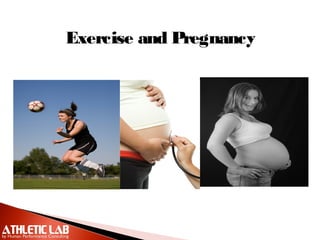
Exercise and Pregnancy
- Benefits of Exercise
- Prerequisite
- Exercise Considerations
Exercise and Pregnancy
Benefits of Exercise
Organizations such as the American Council on
Exercise point to a number of potential benefits to be
gained from exercise by a pregnant woman. These
benefits include emotional benefits, as well as
physical benefits.
Exercise and Pregnancy
Benefits of Exercise
Some Possible Benefits of Exercising During Pregnancy
- Avoid excessive weight gain
- Relief from swollen hands and feet
- Improved posture
- Improved circulation
- Improved mood
- Increased energy
Exercise and Pregnancy
Prerequisite
A pregnant woman should consult with her doctor prior to
starting or continuing with an exercise program. This is
recommended so that any potential risks can identified. The
PARmed-X for Pregnancy is an examination form that can
assist a physician in determining whether or not exercise
poses any risk to the pregnant woman and her unborn child.
Moreover, it provides guidance regarding exercise
prescription and safety.
Exercise and Pregnancy
Exercise Considerations
It is recommended by the American College of
Obstetricians and Gynecologists that pregnant
women that have received clearance from their
physician exercise at a moderate intensity for a
minimum of 30 minutes each day that they train. This
training should occur most days, if not every day.
Exercise and Pregnancy
Exercise Considerations
With the oversight of her physician, a pregnant female
athlete may be able to vigorously train safely.
However, it is possible that training at near-maximal
intensity may pose a risk to the unborn child.
Exercise and Pregnancy
Exercise Considerations
Activities such aerobics, cycling, swimming, and walking are
considered to be safe forms of exercise for pregnant women.
Running can be a safe form of exercise for those women
that were running prior to becoming pregnant, particularly if
the necessary modifications are made to the program.
Racquet sports and strength training, in moderation, can
also be safe pursuits for those women that performed these
activities/sports prior to becoming pregnant.
Exercise and Pregnancy
Exercise Considerations
Pregnant women should avoid activities or sports with
a higher risk of falling or otherwise getting injured.
These include contact sports. Recreational pursuits
such as ice hockey, soccer or horseback riding are
examples of activities that could prove harmful to a
pregnant woman or her unborn child. Scuba diving is
contraindicated due to the risk posed to the unborn
child.
Exercise and Pregnancy
Exercise Considerations
A number of changes take place in a woman’s body
during pregnancy. Pregnant women and their
coaches/trainers need to consider the implications of
the changes.
Exercise and Pregnancy
Exercise Considerations
Changes in the Body
- Body alignment changes
- Increased body weight
- Increased joint laxity
- Posture changes
- Decreases in strength and endurance
Exercise and Pregnancy
Exercise Considerations
After the first trimester has concluded, all exercises that
take place in a supine position are contraindicated.
Exercise and Pregnancy
Exercise Considerations
Abdominal exercises should be avoided if diastasis
recti manifests itself during the course of the
pregnancy. Diastasis recti is a midline separation of
the connective tissue of the anterior abdominal wall.
This can be seen as a bulging in this region.
Exercise and Pregnancy
Exercise Considerations
Breath holding should be avoided when resistance
training. Relatively light weights should be used
when performing a high number of repetitions to
ensure that the pregnant exerciser can perform them
in a comfortable manner.
Exercise and Pregnancy
Exercise Considerations
Target heart rates may be used as a means of ensuring
that the pregnant woman is exercising at the correct
intensity. Another method that can be used to ensure
that the pregnant woman is exercising at the correct
intensity is making sure that she can talk in a normal
manner while exercising.
Exercise and Pregnancy
Exercise Considerations
A pregnant woman should cease exercising and contact her physician if she
experiences (one or more of the below)…
- Calf pain or swelling of the calf
- Chest Pain
- Dizziness
- Headache
- Muscle weakness
- Pre-exercise shortness of breath
- Preterm labor
- Reduced fetal movement
- Vaginal bleeding or amniotic fluid leakage
Exercise and Pregnancy
Questions?
Exercise and Pregnancy
Athletic Lab/Human Performance Consulting
(HPC)
1823 Northwest Maynard Road
Cary, NC 27513
(919) 617-1472
Fax: (980) 225-0428
info@athleticlab.com
http://athleticlab.com/
Exercise and Pregnancy
References
American College of Obstetricians and Gynecologists. (2011). Exercise during
pregnancy (FAQ119). Retrieved from http://www.acog.org/~/media/For
%20Patients /faq119.pdf ?dmc=1&ts=20130815T1807213058
American Council on Exercise. (2009). Fit facts: exercise and pregnancy. Retrieved
from http://www.acefitness.org/fitfacts/pdfs/fitfacts/itemid_2597.pdf
Canadian Society for Exercise Physiology. (2002). PARmed-X for pregnancy:
physical activity readiness medical examination. Retrieved from
http://www.csep.ca/cmfiles/publications/parq /parmed-xpreg.pdf
Mottola, M. F., & McLaughlin, R. (2011). Exercise and Pregnancy: Canadian
Guidelines for Health Care Professionals. Wellspring, 22(4), A1-A4.
Salvesen, K. Å., Hem, E., & Sundgot-Borgen, J. (2012). Fetal wellbeing may be
compromised during strenuous exercise among pregnant elite athletes. British
Journal of Sports Medicine, 46(4), 279-283.

Exercise and Pregnancy

  • 1.
    Greg Maness, MS HPC-AthleticLab Cary, North Carolina Exercise and Pregnancy
  • 2.
  • 3.
    Exercise and Pregnancy -Benefits of Exercise - Prerequisite - Exercise Considerations
  • 4.
    Exercise and Pregnancy Benefitsof Exercise Organizations such as the American Council on Exercise point to a number of potential benefits to be gained from exercise by a pregnant woman. These benefits include emotional benefits, as well as physical benefits.
  • 5.
    Exercise and Pregnancy Benefitsof Exercise Some Possible Benefits of Exercising During Pregnancy - Avoid excessive weight gain - Relief from swollen hands and feet - Improved posture - Improved circulation - Improved mood - Increased energy
  • 6.
    Exercise and Pregnancy Prerequisite Apregnant woman should consult with her doctor prior to starting or continuing with an exercise program. This is recommended so that any potential risks can identified. The PARmed-X for Pregnancy is an examination form that can assist a physician in determining whether or not exercise poses any risk to the pregnant woman and her unborn child. Moreover, it provides guidance regarding exercise prescription and safety.
  • 7.
    Exercise and Pregnancy ExerciseConsiderations It is recommended by the American College of Obstetricians and Gynecologists that pregnant women that have received clearance from their physician exercise at a moderate intensity for a minimum of 30 minutes each day that they train. This training should occur most days, if not every day.
  • 8.
    Exercise and Pregnancy ExerciseConsiderations With the oversight of her physician, a pregnant female athlete may be able to vigorously train safely. However, it is possible that training at near-maximal intensity may pose a risk to the unborn child.
  • 9.
    Exercise and Pregnancy ExerciseConsiderations Activities such aerobics, cycling, swimming, and walking are considered to be safe forms of exercise for pregnant women. Running can be a safe form of exercise for those women that were running prior to becoming pregnant, particularly if the necessary modifications are made to the program. Racquet sports and strength training, in moderation, can also be safe pursuits for those women that performed these activities/sports prior to becoming pregnant.
  • 10.
    Exercise and Pregnancy ExerciseConsiderations Pregnant women should avoid activities or sports with a higher risk of falling or otherwise getting injured. These include contact sports. Recreational pursuits such as ice hockey, soccer or horseback riding are examples of activities that could prove harmful to a pregnant woman or her unborn child. Scuba diving is contraindicated due to the risk posed to the unborn child.
  • 11.
    Exercise and Pregnancy ExerciseConsiderations A number of changes take place in a woman’s body during pregnancy. Pregnant women and their coaches/trainers need to consider the implications of the changes.
  • 12.
    Exercise and Pregnancy ExerciseConsiderations Changes in the Body - Body alignment changes - Increased body weight - Increased joint laxity - Posture changes - Decreases in strength and endurance
  • 13.
    Exercise and Pregnancy ExerciseConsiderations After the first trimester has concluded, all exercises that take place in a supine position are contraindicated.
  • 14.
    Exercise and Pregnancy ExerciseConsiderations Abdominal exercises should be avoided if diastasis recti manifests itself during the course of the pregnancy. Diastasis recti is a midline separation of the connective tissue of the anterior abdominal wall. This can be seen as a bulging in this region.
  • 15.
    Exercise and Pregnancy ExerciseConsiderations Breath holding should be avoided when resistance training. Relatively light weights should be used when performing a high number of repetitions to ensure that the pregnant exerciser can perform them in a comfortable manner.
  • 16.
    Exercise and Pregnancy ExerciseConsiderations Target heart rates may be used as a means of ensuring that the pregnant woman is exercising at the correct intensity. Another method that can be used to ensure that the pregnant woman is exercising at the correct intensity is making sure that she can talk in a normal manner while exercising.
  • 17.
    Exercise and Pregnancy ExerciseConsiderations A pregnant woman should cease exercising and contact her physician if she experiences (one or more of the below)… - Calf pain or swelling of the calf - Chest Pain - Dizziness - Headache - Muscle weakness - Pre-exercise shortness of breath - Preterm labor - Reduced fetal movement - Vaginal bleeding or amniotic fluid leakage
  • 18.
  • 19.
    Exercise and Pregnancy AthleticLab/Human Performance Consulting (HPC) 1823 Northwest Maynard Road Cary, NC 27513 (919) 617-1472 Fax: (980) 225-0428 info@athleticlab.com http://athleticlab.com/
  • 20.
  • 21.
    Exercise and Pregnancy References AmericanCollege of Obstetricians and Gynecologists. (2011). Exercise during pregnancy (FAQ119). Retrieved from http://www.acog.org/~/media/For %20Patients /faq119.pdf ?dmc=1&ts=20130815T1807213058 American Council on Exercise. (2009). Fit facts: exercise and pregnancy. Retrieved from http://www.acefitness.org/fitfacts/pdfs/fitfacts/itemid_2597.pdf Canadian Society for Exercise Physiology. (2002). PARmed-X for pregnancy: physical activity readiness medical examination. Retrieved from http://www.csep.ca/cmfiles/publications/parq /parmed-xpreg.pdf Mottola, M. F., & McLaughlin, R. (2011). Exercise and Pregnancy: Canadian Guidelines for Health Care Professionals. Wellspring, 22(4), A1-A4. Salvesen, K. Å., Hem, E., & Sundgot-Borgen, J. (2012). Fetal wellbeing may be compromised during strenuous exercise among pregnant elite athletes. British Journal of Sports Medicine, 46(4), 279-283.