EXERCISE IN PREGNACY
BY
RWAPEMBE STEPHEN 2022/U/MMU/BNSD/003
BALUKU RODGERS 2022/U/MMU/BNSD/010
Pregnacy and exercise
• physiologic changes associated with pregnancy as
well as the hemodynamic response to exercise,
some precautions should be observed
•  If women do not have medical complications and
can maintain regular exercise duration of pregnancy
but.... women should avoid exercise that involves
the risk of abdominal trauma, falls or excessive joint
stress, as in contact sports and vigorous racquet
sports Adequate hydration and proper ventilation
are important to prevent possible effects of
overheating
Physiological changes during pregnancy
• Musculoskeletal
Mechanical changes related to the weight of growing
breasts, uterus and fetus, as well as an increase in
lumbar lordosis, result in a shift in the woman's
center of gravity, which may cause problems with
balance.
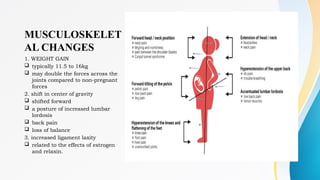
MUSCULOSKELET
AL CHANGES
1. WEIGHT GAIN
 typically 11.5 to 16kg
 may double the forces across the
joints compared to non-pregnant
forces
2. shift in center of gravity
 shifted forward
 a posture of increased lumbar
lordosis
 back pain
 loss of balance
3. increased ligament laxity
 related to the effects of estrogen
and relaxin.
Thermoregulatory adaptations
Feotal hyperthermia, leading to abnormal foetal
development, is a concern if the mothers core
temperature is elevated following exercise. In
addressing this concern the mother’s resting body
temperature is reduced and her ability to get rid of
the heat the skin is improved.
Hemodynamic Exercise
acts in concert with pregnancy to increase heart
rate, stroke volume and cardiac output. However,
during exercise, blood is diverted from abdominal
viscera, including the uterus, to supply exercising
muscle. Measurements of the effect of exercise on
fetal heart rate demonstrate either no significant
change or short-term increases of five to 15 beats
per minute.
Oxygen Demands
With mild exercise, pregnant women have a greater
increase in respiratory frequency and oxygen
consumption to meet their greater oxygen demand.
As exercise increases to moderate and maximal
levels, however, pregnant women demonstrate
decreased respiratory frequency, lower tidal volume
and maximal oxygen consumption
Energy Demands
• Both exercise and pregnancy are associated with a
high demand for energy. In the first two trimesters,
an increased intake of 150 calories per day is
recommended; an increase of 300 calories per day is
required in the third trimester.Caloric demands
with exercise are even higher, although no studies
have focused on exact requirements. The competing
energy demands of the exercising mother and the
growing fetus raise the theoretic concern that
excessive exercise might adversely affect fetal
development.
Hormonal adaptations
Oestrogen: stimulates the growth of the uterus and
breasts, and high level of oestrogen can result in
excess water retention, nausea (specially in the first
trimester) and joint looseness.
Progestrone: Thickens and develops the walls of the
uterus, controlling and relaxing to stop contracting
excessively.
Relaxin: Softens ligaments, cartilage and the cervix,
allowing these tissues to spread during deliver. This
is a major area you should be careful whilst doing
stretching exercises. Insulin: resistance increases
during pregnancy, this make the pregnant women’s
pattern of energy utilization similar to that of a mild
diabetic. In mid and late pregnancy insulin
resistance serves to utilize more fat for maternal
energy and rest during exercise.
Summary of cahnges
During first trimester (1-12 wks)
hormonal changes with increased progesterone
levels
uterine expansion
breast tenderness
fatique
diziness
second trimester (13-26 wks)
weight gain
posture changes
back pain
braxton hicks contractions
increased blood volumes
third trimester (27-40 wks)
continued weight gain
increased joint laxity
decreased balance or coordination
braxton hicks contractions intesify
fetal movement.
Recommended exercise
Walking
best cardiovascular exercises for pregnant women,
walking keeps you fit without jarring your knees and
ankles. It is safe throughout the nine months of
pregnancy and can be built into your day- to-day
schedule.
Jogging - Running Going for a jog is the quickest
and most efficient way to work your heart and your
body. You can tailor it to your schedule -- running
15 minutes one day when that's all you can fit in
and 30 the next when you have the time.
• Swimming: Healthcare providers and fitness
experts hail swimming as the best and safest
exercise for pregnant women. Swimming is ideal
because it exercises both large muscle groups (arms
and legs), provides good cardiovascular benefits,
and allows pregnant women to feel weightless
despite the extra weight of pregnancy.
Aquanatal classes
Many women find aquanatal classes enjoyable
during pregnancy. Exercising while standing in
water is gentle on joints and can help lessen
swelling in legs, which is a common symptom in
late pregnancy.
Yoga and stretching: Yoga and stretching can help
maintain muscle tone and keep you flexible with
little if any impact on your joints. However, you may
have to augment a yoga regime by walking a few
times a week to give your heart a workout. Be
careful not to overdo the stretching. You will be
more supple as a result of the effects of relaxin,
which causes your ligaments to be more pliable.
Don't hold the stretches for too long or try to
develop your flexibility too much.
Pilates: Pilates is a form of exercise which
combines flexibility and strength training with body
awareness, breathing and relaxation. The exercises
are based on certain movement patterns performed
with your tummy and pelvic floor muscules --
known in Pilates as the "stable core" or base. These
muscles are also known as deep stabilizing
muscles. Because Pilates targets the tummy and
pelvic floor muscles and these muscles can weaken
during pregnancy, Pilates exercises can be useful.
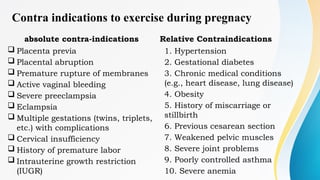
Contra indications to exercise during pregnacy
absolute contra-indications
 Placenta previa
 Placental abruption
 Premature rupture of membranes
 Active vaginal bleeding
 Severe preeclampsia
 Eclampsia
 Multiple gestations (twins, triplets,
etc.) with complications
 Cervical insufficiency
 History of premature labor
 Intrauterine growth restriction
(IUGR)
Relative Contraindications
1. Hypertension
2. Gestational diabetes
3. Chronic medical conditions
(e.g., heart disease, lung disease)
4. Obesity
5. History of miscarriage or
stillbirth
6. Previous cesarean section
7. Weakened pelvic muscles
8. Severe joint problems
9. Poorly controlled asthma
10. Severe anemia
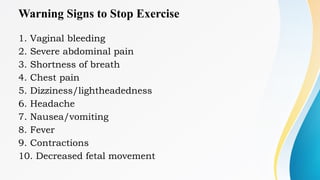
Warning Signs to Stop Exercise
1. Vaginal bleeding
2. Severe abdominal pain
3. Shortness of breath
4. Chest pain
5. Dizziness/lightheadedness
6. Headache
7. Nausea/vomiting
8. Fever
9. Contractions
10. Decreased fetal movement
References
1. American College of Obstetricians and
Gynecologists. (2020). Exercise During Pregnancy.
2. American Pregnancy Association. (2022).
Pregnancy and Exercise.
3. Mayo Clinic. (2022). Pregnancy: Exercise during
pregnancy.

EXERCISE IN PREGANCY.pptx 12233568944744

  • 1.
    EXERCISE IN PREGNACY BY RWAPEMBESTEPHEN 2022/U/MMU/BNSD/003 BALUKU RODGERS 2022/U/MMU/BNSD/010
  • 2.
    Pregnacy and exercise •physiologic changes associated with pregnancy as well as the hemodynamic response to exercise, some precautions should be observed •  If women do not have medical complications and can maintain regular exercise duration of pregnancy but.... women should avoid exercise that involves the risk of abdominal trauma, falls or excessive joint stress, as in contact sports and vigorous racquet sports Adequate hydration and proper ventilation are important to prevent possible effects of overheating
  • 3.
    Physiological changes duringpregnancy • Musculoskeletal Mechanical changes related to the weight of growing breasts, uterus and fetus, as well as an increase in lumbar lordosis, result in a shift in the woman's center of gravity, which may cause problems with balance.
  • 4.
    MUSCULOSKELET AL CHANGES 1. WEIGHTGAIN  typically 11.5 to 16kg  may double the forces across the joints compared to non-pregnant forces 2. shift in center of gravity  shifted forward  a posture of increased lumbar lordosis  back pain  loss of balance 3. increased ligament laxity  related to the effects of estrogen and relaxin.
  • 5.
    Thermoregulatory adaptations Feotal hyperthermia,leading to abnormal foetal development, is a concern if the mothers core temperature is elevated following exercise. In addressing this concern the mother’s resting body temperature is reduced and her ability to get rid of the heat the skin is improved.
  • 6.
    Hemodynamic Exercise acts inconcert with pregnancy to increase heart rate, stroke volume and cardiac output. However, during exercise, blood is diverted from abdominal viscera, including the uterus, to supply exercising muscle. Measurements of the effect of exercise on fetal heart rate demonstrate either no significant change or short-term increases of five to 15 beats per minute.
  • 7.
    Oxygen Demands With mildexercise, pregnant women have a greater increase in respiratory frequency and oxygen consumption to meet their greater oxygen demand. As exercise increases to moderate and maximal levels, however, pregnant women demonstrate decreased respiratory frequency, lower tidal volume and maximal oxygen consumption
  • 8.
    Energy Demands • Bothexercise and pregnancy are associated with a high demand for energy. In the first two trimesters, an increased intake of 150 calories per day is recommended; an increase of 300 calories per day is required in the third trimester.Caloric demands with exercise are even higher, although no studies have focused on exact requirements. The competing energy demands of the exercising mother and the growing fetus raise the theoretic concern that excessive exercise might adversely affect fetal development.
  • 9.
    Hormonal adaptations Oestrogen: stimulatesthe growth of the uterus and breasts, and high level of oestrogen can result in excess water retention, nausea (specially in the first trimester) and joint looseness. Progestrone: Thickens and develops the walls of the uterus, controlling and relaxing to stop contracting excessively.
  • 10.
    Relaxin: Softens ligaments,cartilage and the cervix, allowing these tissues to spread during deliver. This is a major area you should be careful whilst doing stretching exercises. Insulin: resistance increases during pregnancy, this make the pregnant women’s pattern of energy utilization similar to that of a mild diabetic. In mid and late pregnancy insulin resistance serves to utilize more fat for maternal energy and rest during exercise.
  • 11.
    Summary of cahnges Duringfirst trimester (1-12 wks) hormonal changes with increased progesterone levels uterine expansion breast tenderness fatique diziness
  • 12.
    second trimester (13-26wks) weight gain posture changes back pain braxton hicks contractions increased blood volumes
  • 13.
    third trimester (27-40wks) continued weight gain increased joint laxity decreased balance or coordination braxton hicks contractions intesify fetal movement.
  • 14.
    Recommended exercise Walking best cardiovascularexercises for pregnant women, walking keeps you fit without jarring your knees and ankles. It is safe throughout the nine months of pregnancy and can be built into your day- to-day schedule. Jogging - Running Going for a jog is the quickest and most efficient way to work your heart and your body. You can tailor it to your schedule -- running 15 minutes one day when that's all you can fit in and 30 the next when you have the time.
  • 15.
    • Swimming: Healthcareproviders and fitness experts hail swimming as the best and safest exercise for pregnant women. Swimming is ideal because it exercises both large muscle groups (arms and legs), provides good cardiovascular benefits, and allows pregnant women to feel weightless despite the extra weight of pregnancy.
  • 16.
    Aquanatal classes Many womenfind aquanatal classes enjoyable during pregnancy. Exercising while standing in water is gentle on joints and can help lessen swelling in legs, which is a common symptom in late pregnancy.
  • 17.
    Yoga and stretching:Yoga and stretching can help maintain muscle tone and keep you flexible with little if any impact on your joints. However, you may have to augment a yoga regime by walking a few times a week to give your heart a workout. Be careful not to overdo the stretching. You will be more supple as a result of the effects of relaxin, which causes your ligaments to be more pliable. Don't hold the stretches for too long or try to develop your flexibility too much.
  • 18.
    Pilates: Pilates isa form of exercise which combines flexibility and strength training with body awareness, breathing and relaxation. The exercises are based on certain movement patterns performed with your tummy and pelvic floor muscules -- known in Pilates as the "stable core" or base. These muscles are also known as deep stabilizing muscles. Because Pilates targets the tummy and pelvic floor muscles and these muscles can weaken during pregnancy, Pilates exercises can be useful.
  • 19.
    Contra indications toexercise during pregnacy absolute contra-indications  Placenta previa  Placental abruption  Premature rupture of membranes  Active vaginal bleeding  Severe preeclampsia  Eclampsia  Multiple gestations (twins, triplets, etc.) with complications  Cervical insufficiency  History of premature labor  Intrauterine growth restriction (IUGR) Relative Contraindications 1. Hypertension 2. Gestational diabetes 3. Chronic medical conditions (e.g., heart disease, lung disease) 4. Obesity 5. History of miscarriage or stillbirth 6. Previous cesarean section 7. Weakened pelvic muscles 8. Severe joint problems 9. Poorly controlled asthma 10. Severe anemia
  • 20.
    Warning Signs toStop Exercise 1. Vaginal bleeding 2. Severe abdominal pain 3. Shortness of breath 4. Chest pain 5. Dizziness/lightheadedness 6. Headache 7. Nausea/vomiting 8. Fever 9. Contractions 10. Decreased fetal movement
  • 21.
    References 1. American Collegeof Obstetricians and Gynecologists. (2020). Exercise During Pregnancy. 2. American Pregnancy Association. (2022). Pregnancy and Exercise. 3. Mayo Clinic. (2022). Pregnancy: Exercise during pregnancy.