Movement, Mood and Memory: 
Exploring connections, setting goals
Stephan Esser MD
www.esserhealth.com
Exercise?
Fingers, Feet and ForksFingers, Feet and Forks
I want you to……
• Be familiar with basic mood disorders
• Know what Alzheimer’s is
• Understand the basics of Exercise
• Prepare to apply the information to your 
health
Mood Disorders
• A group of mental disorders involving a 
disturbance of mood, along with either a full 
or partial excessively happy (manic) or 
extremely sad (depressive) syndrome not 
caused by any other physical or mental 
disorder. Mood refers to a prolonged emotion
• Depression
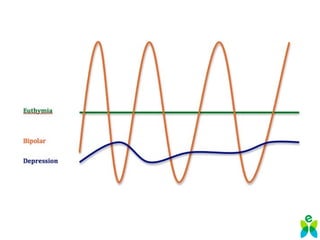
• Bipolar: Cyclic lows and highs
http://medical-dictionary.thefreedictionary.com/mood+disorder
The mind is its own
place, and in itself can
make a Heav'n of
Hell……a Hell of Heav'n.
JOHN MILTON (1608-1674)
The mind is its own
place, and in itself can
make a Heav'n of
Hell……a Hell of Heav'n.
JOHN MILTON (1608-1674)
Mood Disorders
Depression
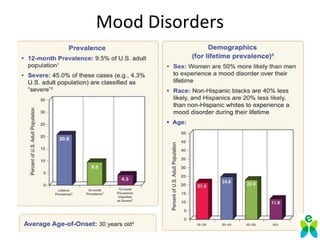
• Epidemiology: 
– about 121 million people worldwide.
– NIMH: In any given 1-year period, 9.5 percent of the population, or about 20.9 
million American adults, suffer from a depressive illness
– 1 in 10 Adults
• Cost of Care:
– leading cause of disability as measured by YLDs 
– By 2020, depression is projected to reach 2nd place in the ranking of DALYs 
calculated for all ages, both sexes with more spending then on CV disease.
– Workplace: annual workplace cost of depression in America 
    at over $40 billion
– Personal:  Incalculable
• Associated Factors:
-ass. with 850,000 suicides/yr
"Men are disturbed not by "Men are disturbed not by 
things, but by the view things, but by the view 
which they take of them.“which they take of them.“
EpicletusEpicletus -The Enchiridion--The Enchiridion-
"Men are disturbed not by "Men are disturbed not by 
things, but by the view things, but by the view 
which they take of them.“which they take of them.“
EpicletusEpicletus -The Enchiridion--The Enchiridion-
Depression
A: one of the criteria from category 1 and three of the 
criteria from category 2 for most of the day nearly every 
day for at least 2 weeks
– Category 1:
• Persistent depressed mood
• Anhedonia
– Category 2:
• SIGECAPS
B: symptoms do not meet criteria for mixed episode
C: symptoms cause significant impairment
D: symptoms not due to substance or GMC
Etiology
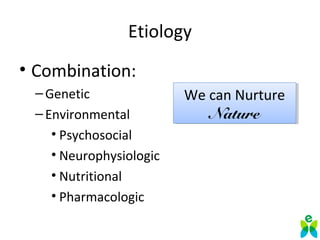
• Combination:
–Genetic
–Environmental
• Psychosocial
• Neurophysiologic
• Nutritional
• Pharmacologic
We can Nurture 
Nature
We can Nurture 
Nature
Risk Factors
• Gender: Women
• Family: 
• Marital Status: 
Divorced, widowed, 
separated
• Social Class: Poverty
• Life Events/Traumas
• Medical Co-morbidities
• Obesity
• Gender: M=F
• Family:   
• Marital Status: 
Divorced, widowed, 
separated
• Social Class: =
Exercise, Nutrition, Sleep, Sunlight (Vitamin D Status), Metabolic DysfunctionExercise, Nutrition, Sleep, Sunlight (Vitamin D Status), Metabolic Dysfunction
What we know about 
Mood Disorders
• Common
• Many Risk Factors: Multifactorial etiology
• Expensive: $135 Billion SAMSHA 2012
• Debilitating
• Complex
• Prevention must be primary
TransitionTransition
Alzheimer’s
The most common form of Dementia
Definitions
• Dementia:
– Latin roots: De (absence) ment-(mind)
– loss of cognitive ability in a previously healthy 
person, that is greater then what would be 
expected from natural aging alone
– Frequent Deficits:
• Memory
• Attention
• Language
• Problem solving
Dementia
• Types:
– Alzheimer’s
– Vascular
– Fronto-Temporal
– Dementia with Lewy Bodies
– Mixed
– Other:  Metabolic, Vitamin Deficiency’s, Syphillis, 
HIV, Medication s/e’s, dementia pugilistica etc
Alzheimer’s
• 1906: Described by German psychiatrist Alois 
Alzheimer MD
• “Alzheimer’s disease is an irreversible, 
progressive brain disease that slowly destroys 
memory and thinking skills and, eventually 
even the ability to carry out the simplest tasks 
of daily living.”  National Institute of Aging, NIH 2012
Mortality Statistics
Statistics
• 5.4 mill. Americans have Alzheimer’s
• 1 in 8 adults over 65 y/o
• Spending:
– 300% higher Medicare costs if pt has dementia
– Projected thru 2050 a 500% increase in combined
Medicare and Medicaid spending
Cause
?
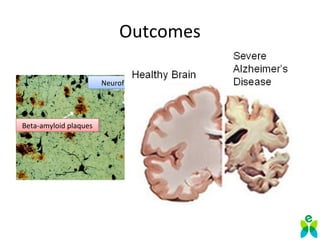
Outcomes
Beta-amyloid plaquesBeta-amyloid plaques
Neurofibrilary TanglesNeurofibrilary Tangles
Cause
?
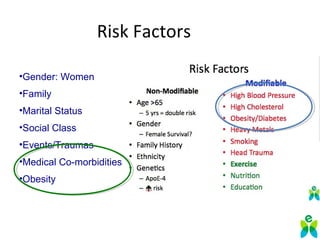
Risk Factors
Non-Modifiable
• Age >65
– 5 yrs = double risk
• Gender ?
• Family History
• Ethnicity
• Genetics
–  risk
– Apo-E
Modifiable
• HBP/HLD/CAD
• Homocysteine
• Obesity 78%
• Diabetes
• Smoking 200%
• Head Trauma
• Exercise
• Nutrition
• Education
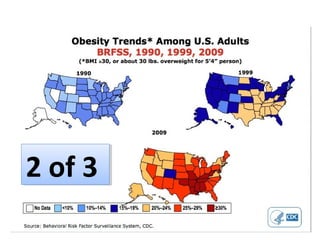
2 of 32 of 3
The Problem
• High Blood Pressure:
– 1 in 3 adults
1:3 adults1:3 adults
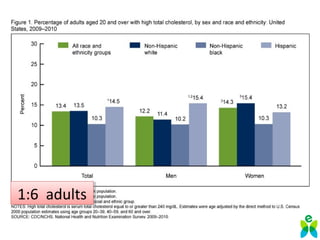
1:6 adults1:6 adults
The Problem
1:9 adults1:9 adults
Exercise
• Achieve recommended levels of Exercise:
– 20% of all adults >20 y/o
– 13% of those age 65-74 y/o
– 6% of those >75 y/o
Nutrition
Consume Recommended Servings of Fruits and
Vegetables:
-Adolescents: 0.9%
-Men: 2.2%
-Women: 3.5%
Consume Recommended Servings of Fruits and
Vegetables:
-Adolescents: 0.9%
-Men: 2.2%
-Women: 3.5%
What we know
• Basics of Alzheimer’s
• Foundational Statistics
• Risk Factors
We “Ain’t doing so good”
Treatment
• No Proven Universal Cure
• Medications:
– Delay institutionalization
• Symptom Focused
– Behavior, incontinence, depression
• Environmental
To Maintain Mood and Memory
Prevention is Essential
Risk Factors
•Gender: Women
•Family
•Marital Status
•Social Class
•Events/Traumas
•Medical Co-morbidities
•Obesity
Exercise
Definitions
• Exercise:
–movement of the body resulting in the
enhancement of health and improvement
of function
Categories
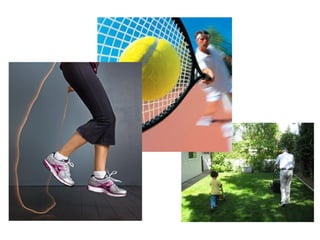
• Leisure time Exercise: organized sports,
running, gym activities, rehabilitation etc.
• Lifestyle Exercise: activity incorporated into our
daily pattern of life
– eg: parking in the distant portion of the parking lot rather then the first
bumper, taking the stairs instead of the elevator, mowing your own lawn,
sweeping the house etc.
Exercise
• Flexibility: 2-3 x’s/wk
• Balance: 2-3 x’s/wk
• Strength: 2-3 days/wk
• Cardiovascular: 150 min/wk
How could we hypothesize
exercise might reduce
Alzheimer’s risk?
Risk Factors
Non-Modifiable
• Age >65
– 5 yrs = double risk
• Gender ?
• Family History
• Ethnicity
• Genetics
–  risk
– Apo-E
Modifiable
• HBP/HLD/CAD
• Homocysteine
• Obesity 78%
• Diabetes
• Smoking 200%
• Head Trauma
• Exercise
• Nutrition
• Education
Benefits of Exercise
•  risk of HBP/Hchol/CAD
•  risk of Obesity
•  risk of Type 2 Diabetes
• Less likely to smoke
• More likely to eat health promoting foods
Exercise and Physical Health
• Reduces risk of
– Heart Disease ≈ 40%
– Obesity: ≈ 30-100%
– Stroke ≈ 50%
– Type 2 Diabetes ≈ 50%
– Hypertension ≈ 50%
– Disability delayed ≈15 years
– Colon Cancer ≈ 25-40%
– Breast Cancer ≈ 20%-44%
– Osteoporosis ≈ 20+%
• As many as 250,000 deaths per year in the United
States areattributable to a lack of regular
physical activity
Benefits of Exercise
• Obvious physiologic benefits
• Cognitive value
• Multi-system
– Cognitive, balance, coordination, strength, CV etc
– Executive, purpose, intention, goal-setting etc
Exercise and Alzheimers
• Delays the onset and reduces incidence
• Those who are in the top 10% of exercisers
have a 250% lower risk of alzheimers
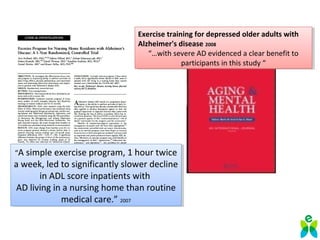
“A simple exercise program, 1 hour twice
a week, led to significantly slower decline
in ADL score inpatients with
AD living in a nursing home than routine
medical care.” 2007
“A simple exercise program, 1 hour twice
a week, led to significantly slower decline
in ADL score inpatients with
AD living in a nursing home than routine
medical care.” 2007
Exercise training for depressed older adults with
Alzheimer's disease 2008
“…with severe AD evidenced a clear benefit to
participants in this study “
Exercise training for depressed older adults with
Alzheimer's disease 2008
“…with severe AD evidenced a clear benefit to
participants in this study “
Depression
Exercise and Depression
• The Antidepressive Effects of Exercise CJSM 2009
– Meta Analysis of 58 randomized studies (n = 2982)
– Participants in the exercise treatment had
significantly lower depression scores
– In many studies, similar outcomes to medication
– Dropout rates for the exercise treatment were
similar to those found in psychotherapeutic and
drug interventions.
How could we hypothesize
exercise might influence
Depression?
How does it Work?
• Psychology
• Neurogenesis
• Neuro-Biochemistry
Psychology
• Exercise and clinical depression: examining
two psychological mechanisms Psych. of Sport and Exercise 2005
– 2 Groups: Exercise vs Control
– 9 wk program
– Exercisers:
• Dec. Depression Scores
• Inc. Coping and Self Efficacy
• Less Rumination
• Less evidence that increased distraction was etiology
Neurogenesis
• Antidepressant effects of exercise: Evidence
for an adult-neurogenesis hypothesis? Journal of
Psychiatry and Neuroscience 2006
– Exercise increases synthesis of new neurons in the adult
brain
– Up to 2-3 x’s growth in Hippocampus
– Facilitates improved memory, completion of functional tasks,
learning of new tasks/materials
– Opposite effect seen with excessive stress
Neuro-Chemistry
• Exercise results in increased production of
– Norepinephrine
– Serotonin
– B-Endorphins
Transition
Stages of Change (Prochaska and DiClemente)
1: Pre-contemplation
2: Contemplation
3: Preparation/planning
4: Action
5: Maintenance
6: Permanent Maintenance
(Termination)
My Reasons to Exercise
• Feel good in my skin
• Increase energy, Reduce stress
• Increase my confidence, discipline
• Be a role model, socialize, family time
• It’s fun, I love to sweat and work hard
• I love challenges
• Reduce disease risk
• Lower disability risk
• Maintain independence
Reduce my risk of Alzheimer’s
and Depression
Reduce my risk of Alzheimer’s
and Depression
What are your reasons?
My Reasons NOT to Exercise
• Time
• I’m tired or lazy
• Inconvenience (I forgot my clothes etc…)
• Money (shoes, travel, racquets)
• Other priorities
• Hate Change
• Don’t know what to do
• I’m Injured
What are your reasons
NOT
to Exercise?
“Physical fitness can neither be
achieved by wishful thinking nor
outright
purchase.”
Joseph Pilates
You are never too old to set another goal or
to dream a new dream
C.S. Lewis
Defining Success
• What is success for you?
• Are such goals achievable, legitimate?
• What will you do if you fail to “succeed”?
Setting Goals
•Specific
•Measureable
•Achievable
•Realistic
•Timely
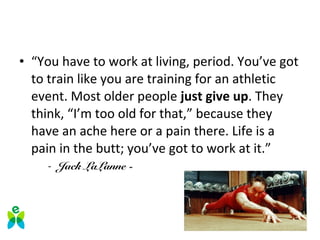
• “You have to work at living, period. You’ve got
to train like you are training for an athletic
event. Most older people just give up. They
think, “I’m too old for that,” because they
have an ache here or a pain there. Life is a
pain in the butt; you’ve got to work at it.”
- Jack LaLanne -
Establishing Priorities
• Potential responsibilities, limitations
• Discover balance
• Be dynamic, flexible
If you have decided
to start or increase
your activity level…….now what?
FITT
• Frequency
• Intensity
• Time
• Type
Lasting Change
• Track your efforts and progress
• Re-visit your goals regularly
• Adjust to meet your needs
• Thrive!
“Eating alone will not keep a man well; he must
also take exercise. For food and exercise……
work together to produce health.”
Hippocrates
Regimen 400 BC
“Exercise is just as essential as a rational diet”
Dr. William Esser N.D. DC.
“First say to yourself what you would be; and
then do what you have to do”
Epictectus
Greek Stoic Philosopher AD 55–AD 135
Thank You!
Stephan Esser MD
www.esserhealth.com

Mood, Movement and Memory 2013

Editor's Notes

  • #3 http://i.i.com.com/cnwk.1d/i/tim2/2013/05/16/militarystock_620x350.jpg http://www.thegatewaypundit.com/wp-content/uploads/2012/12/adam-lanza.jpg Adam lanza
  • #9 http://www.nimh.nih.gov/statistics/1anymooddis_adult.shtml Estimated $147 billion in costs
  • #10 YLD’s years lived with disability
  • #11 Sleep Interest Guilt Energy Concentration Appetite Psychomotor slowing Suicidailty
  • #13 http://www.nature.com/ijo/journal/v27/n4/abs/0802204a.html http://www.psychosomaticmedicine.org/content/69/8/740.short
  • #14 The Substance Abuse and Mental Health Services Administration ... OF 8million on disability, nearly 2million for “ mood disorder” 2 nd largest diagnostic cause for disability 2 nd to MSK disorders (ie: back pain etc)
  • #17 Cogito ergo sum…………rene decartes challenges our sense of personhood…our sense of identity….
  • #19 Cadaveric study on a woman with an unusual mental illness…..with memory loss, language problems and odd behavior….found some off things in the brain we will talk about..
  • #20 Approx. 1,300,000 new cases per year www.cdc.gov/.../mmwrhtml/ figures/m846qsf.gif www.ncbi.nlm.nih.gov/ bookshelf/picrender.fcgi.. http://www.ctahr.hawaii.edu/CS/blogs/sustainable_agriculture/cdc_logo(2).jpg
  • #21 http://www.alz.org/alzheimers_disease_facts_and_figures.asp
  • #23 http://ladulab.anat.uic.edu/images/ADstain.jpg
  • #25 Smoking: http://www.thelancet.com/journals/lancet/article/PIIS0140-6736(97)07541-7/fulltext http://www.neurology.org/content/52/7/1408.short Obesity: http://www.ncbi.nlm.nih.gov/pmc/articles/PMC558283/?rendertype=abstract Diabetes: http://aje.oxfordjournals.org/content/145/4/301.short http://aje.oxfordjournals.org/content/154/7/635.short Homocysteine http://www.sciencedirect.com/science/article/pii/S1474442203004381 http://www.alz.org/alzheimers_disease_causes_risk_factors.asp
  • #27 --http://www.cdc.gov/nccdphp/publications/factsheets/Prevention/pdf/obesity.pdf --http://www.cdc.gov/nccdphp/publications/factsheets/Prevention/obesity.htm
  • #28 http://www.heart.org/idc/groups/heart-public/@wcm/@sop/@smd/documents/downloadable/ucm_319587.pdf The prevalence of hypertension (defined as high blood pressure or taking antihypertensive medication) increases with age. In 2005–2008, 33%–34% of men and women 45–54 years of age had hypertension, compared with 67% of men and 80% of women 75 years of age and over (Table 67).
  • #29 http://www.cdc.gov/nchs/data/databriefs/db92_fig1.png
  • #30 In 2005-2008 11% of adults 20 years of age or older had diabetes. In 2005-2008 the percentage of adults with dm increased with age from 4% of persons 20-44 to 27% of adults 65 years of age or older http://meps.ahrq.gov/mepsweb/ Medical Expenditure Panel survey
  • #31 http://www.cdc.gov/nchs/fastats/exercise.htm
  • #32 http://www.ncbi.nlm.nih.gov/pmc/articles/PMC2654704/ 2003-2004 NHANS Data set…… National Health and Nutrition Examination Survey (NHANES)
  • #34 Cholinesterase Inhibitors……….. Razadyne® (galantamine), Exelon® (rivastigmine), and Aricept® (donepezil). Another drug, Cognex® (tacrine) Namenda® (memantine), an N-methyl D-aspartate (NMDA) antagonistAmantadine,
  • #36 Obesity inc by 78% Smoking inc by 200%..... Cognitive reserves…… Smoking: http://www.thelancet.com/journals/lancet/article/PIIS0140-6736(97)07541-7/fulltext http://www.neurology.org/content/52/7/1408.short Obesity: http://www.ncbi.nlm.nih.gov/pmc/articles/PMC558283/?rendertype=abstract Diabetes: http://aje.oxfordjournals.org/content/145/4/301.short http://aje.oxfordjournals.org/content/154/7/635.short http://www.alz.org/alzheimers_disease_causes_risk_factors.asp
  • #38 What’s the best workout plan.com Hahashop.com
  • #43 Smoking: http://www.thelancet.com/journals/lancet/article/PIIS0140-6736(97)07541-7/fulltext http://www.neurology.org/content/52/7/1408.short Obesity: http://www.ncbi.nlm.nih.gov/pmc/articles/PMC558283/?rendertype=abstract Diabetes: http://aje.oxfordjournals.org/content/145/4/301.short http://aje.oxfordjournals.org/content/154/7/635.short Homocysteine http://www.sciencedirect.com/science/article/pii/S1474442203004381 http://www.alz.org/alzheimers_disease_causes_risk_factors.asp
  • #45 ( Journal of the American Medical Association JAMA: 2000, Vol. 283. No. 22, pp. 2961-2967) http://www.news.harvard.edu/gazette/1999/10.21/diabetes.html http://www.reuters.com/article/healthNews/idUSTRE53E71N20090415?feedType=RSS&feedName=healthNews http://www.nature.com/bjc/index.html http://www.ncbi.nlm.nih.gov/pubmed/18599492?ordinalpos=18&itool=EntrezSystem2.PEntrez.Pubmed.Pubmed_ResultsPanel.Pubmed_DefaultReportPanel.Pubmed_RVDocSum
  • #46 Increases the cognitive reserves…….
  • #47 http://www.neurology.org/content/early/2012/04/18/WNL.0b013e3182535d35.abstract http://articles.latimes.com/2012/apr/18/news/la-heb-alzheimers-physical-activity-elderly-20120418 http://140.116.183.158:100/BFRC/upload/4f3666d911077-exercise_is_associated_with_reduced_risk_for_incident_dementia_among_persons_65_years_of_age_and_older.pdf http://archneur.jamanetwork.com/article.aspx?volume=58&issue=3&page=498
  • #48 Exercise Program for Nursing Home Residents with Alzheimer’s Disease: A 1-Year Randomized, Controlled TrialJ Am Geriatr Soc 55:158–165, 2007.
  • #67 Example…if you take up running for the first time…success should not be running a marathon in 2 hours……rather 15 minutes without running may be a legitimate goal etc
  • #68 SpecificWell definedClear to anyone that has a basic knowledge of the project MeasurableKnow if the goal is obtainable and how far away completion is Know when it has been achievedAgreed UponAgreement with all the stakeholders what the goals should be RealisticWithin the availability of resources, knowledge and time Time BasedEnough time to achieve the goalNot too much time, which can affect project performance
  • #71 I hope you moved one step down the path of change…from thinking to doing, or from doing to embracing….
  • #72 Frequqncy: How often? Intensity……..start slowly…build up gradually…….