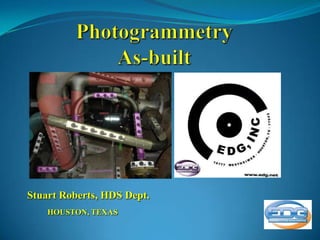
Stuart Roberts, HDS Dept.
    HOUSTON, TEXAS
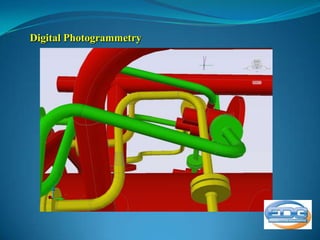
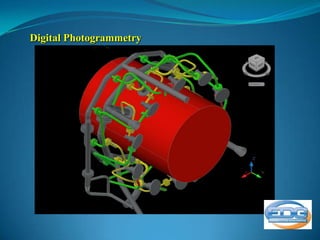
Digital Photogrammetry


  State-of-the-art photogrammetric software systems, use
  of consumer digital camera technology and computer
  vision techniques, offer an attractive high accuracy
  solution when laser scanning is not a option.
  Repeatability and image stability has been paramount to
  the art of photogrammetry.
Different methods can be used.
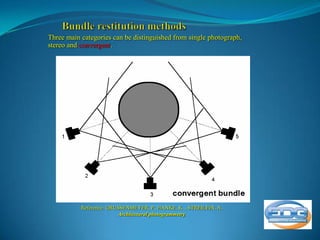
    Three main categories can be distinguished from single photograph,
    stereo and convergent.


               Reference: GRUSSENMEYER, P., HANKE, K ., STREILEIN, A.
                             Architectural photogrammetry.
Three main categories can be distinguished from single photograph,
stereo and convergent.


           Reference: GRUSSENMEYER, P., HANKE, K ., STREILEIN, A.
                         Architectural photogrammetry.
Average project is about 13 to 20 photos. Field collection
     takes about one hour to place targets, photograph, and 1
     hour to analyze the photos. Larger projects of up to 100+
     photos can be performed.


Analyze photos?
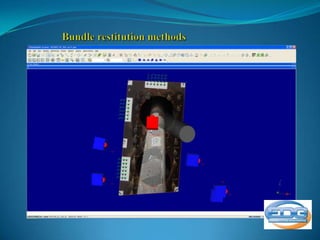
    In photogrammetry, there is a hard 3X3 rule. The
    photography has to be taken in a manner to place a
    reference mark on the same spot in three different but
    convergent photographs. The next example is an actual
    project.
DIRECT MEASUREMENTS
How quickly can I get my information?
      Depending on the complexity of the job and the number of
      photos, relatively quickly. 9 photos can be ready in about an
      hour. After a QC check, 3D point data can be extracted and
      exported.
What is the cost?
      The cost is generally 50% to 75% lower than scanning.
      Major savings can be attained by not having to ship heavy
      equipment associated with scanning. Field time is greatly
      reduced.
How accurate is the data?
     Overall, photogrammetry is equal or exceeds scanning
     depending on clarity and pixel count.
     An off the shelf consumer camera can generate data in the
     sub-millimeter range.
When is it feasible to perform photogrammetry?
   Usually, when time is short and space is shorter.
   Typically, a small job, like a vessel and few
   of tie-in points can be collected by one person.

How big is the equipment?
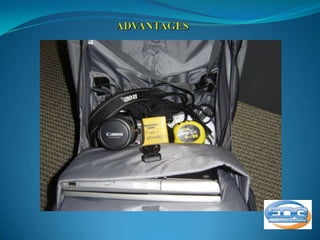
   The camera fits in a backpack with the laptop with a small
   package of supplemental targets.

Is it right for every job?
    No, it is another tool to collect and display information in
    3D.
Exe Pres2012

Exe Pres2012

  • 1.
    Stuart Roberts, HDSDept. HOUSTON, TEXAS
  • 2.
  • 3.
  • 4.
  • 5.
    Digital Photogrammetry State-of-the-art photogrammetric software systems, use of consumer digital camera technology and computer vision techniques, offer an attractive high accuracy solution when laser scanning is not a option. Repeatability and image stability has been paramount to the art of photogrammetry.
  • 6.
    Different methods canbe used. Three main categories can be distinguished from single photograph, stereo and convergent. Reference: GRUSSENMEYER, P., HANKE, K ., STREILEIN, A. Architectural photogrammetry.
  • 7.
    Three main categoriescan be distinguished from single photograph, stereo and convergent. Reference: GRUSSENMEYER, P., HANKE, K ., STREILEIN, A. Architectural photogrammetry.
  • 9.
    Average project isabout 13 to 20 photos. Field collection takes about one hour to place targets, photograph, and 1 hour to analyze the photos. Larger projects of up to 100+ photos can be performed. Analyze photos? In photogrammetry, there is a hard 3X3 rule. The photography has to be taken in a manner to place a reference mark on the same spot in three different but convergent photographs. The next example is an actual project.
  • 10.
  • 12.
    How quickly canI get my information? Depending on the complexity of the job and the number of photos, relatively quickly. 9 photos can be ready in about an hour. After a QC check, 3D point data can be extracted and exported. What is the cost? The cost is generally 50% to 75% lower than scanning. Major savings can be attained by not having to ship heavy equipment associated with scanning. Field time is greatly reduced. How accurate is the data? Overall, photogrammetry is equal or exceeds scanning depending on clarity and pixel count. An off the shelf consumer camera can generate data in the sub-millimeter range.
  • 13.
    When is itfeasible to perform photogrammetry? Usually, when time is short and space is shorter. Typically, a small job, like a vessel and few of tie-in points can be collected by one person. How big is the equipment? The camera fits in a backpack with the laptop with a small package of supplemental targets. Is it right for every job? No, it is another tool to collect and display information in 3D.