1 
Exchange Rates
2 
EExxcchhaannggee RRaattee:: DDeeffiinniittiioonn 
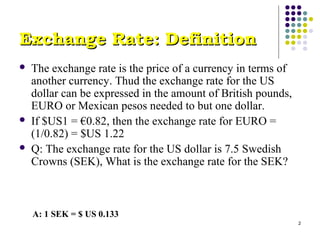
 The exchange rate is the price of a currency in terms of 
another currency. Thud the exchange rate for the US 
dollar can be expressed in the amount of British pounds, 
EURO or Mexican pesos needed to but one dollar. 
 If $US1 = €0.82, then the exchange rate for EURO = 
(1/0.82) = $US 1.22 
 Q: The exchange rate for the US dollar is 7.5 Swedish 
Crowns (SEK), What is the exchange rate for the SEK? 
A: 1 SEK = $ US 0.133
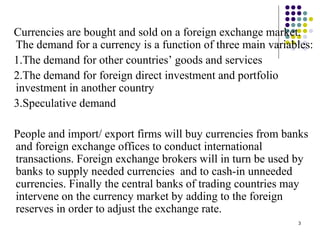
Currencies are bought and sold on a foreign exchange market. 
The demand for a currency is a function of three main variables: 
1.The demand for other countries’ goods and services 
2.The demand for foreign direct investment and portfolio 
investment in another country 
3.Speculative demand 
People and import/ export firms will buy currencies from banks 
and foreign exchange offices to conduct international 
transactions. Foreign exchange brokers will in turn be used by 
banks to supply needed currencies and to cash-in unneeded 
currencies. Finally the central banks of trading countries may 
intervene on the currency market by adding to the foreign 
reserves in order to adjust the exchange rate. 
3
 The SSuuppppllyy ccuurrvvee ffoorr ccuurrrreenncciieess iiss uuppwwaarrdd 
ssllooppiinngg bbeeccaauussee aa hhiigghheerr pprriiccee ooff ccuurrrreennccyy XX 
wwoouulldd--cceetteerriiss ppaarriibbuuss-- wwoouulldd eennaabbllee cciittiizzeennss ooff 
tthhaatt ccoouunnttrryy (XX)) (ttoo bbuuyy mmoorree ggooooddss ooff ccoouunnttrryy YY.. 
IInn ddooiinngg mmoorree ccuurrrreennccyy XX wwiillll bbee aavvaaiillaabbllee iinn 
ccoouunnttrryy YY’’ss mmaarrkkeett.. 
4
5 
EXPLANATION 
When the value of the rupee increases in 
terms of dollars; rupee appreciates, you will 
be able to buy more from the same amount of 
rupees spent, therefore the supply of rupees 
will increase.
6 
DEMAND CURVE 
 TThhee ddeemmaanndd ccuurrvvee iiss ddoowwnnwwaarrdd ssllooppiinngg ttoo 
iinnddiiccaattee tthhaatt cciittiizzeennss ooff ccoouunnttrryy XX wwiillll bbuuyy mmoorree 
ccuurrrreennccyy YY wwhheenn tthheeyy ggeett mmoorree ooff iitt –– aanndd mmoorree 
ggooooddss-- ffoorr tthheeiirr ccuurrrreennccyy XX..
7 
EXPLANATION 
When the rupee value falls in terms of other 
currencies ,say dollar, we would need more 
rupees to buy same amount of goods, 
demand for rupees would increase.
8 
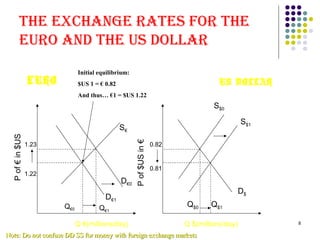
The exchange raTes for The 
euro and The us dollar 
P of € in $US 
Initial equilibrium: 
$US 1 = € 0.82 
And thus… €1 = $US 1.22 
P of $US in € 
Q €(millions/day) Q $(millions/day) 
EURO 
S$0 
S$1 
0.82 
0.81 
Q Q$0 Q$1 €0 Q€1 
D$ 
D€0 
D€1 
S€ 
1.23 
1.22 
US DOLLAR 
NNoottee:: DDoo nnoott ccoonnffuussee DDDD SSSS ffoorr mmoonneeyy wwiitthh ffoorreeiiggnn eexxcchhaannggee mmaarrkkeettss
9 
FFiixxeedd eexxcchhaannggee rraatteess 
 We know that exchange rates are established by market forces of demand and 
supply. When a group of countries instead keep their exchange rate constant thus 
establishing a fixed exchange rate. 
 Such countries use the central government to intervene on the foreign exchange 
market in order to keep exchange rate within a narrow band-much like the 
mechanism used in a buffer stock mechanism. 
 The central government can affect the exchange rate in the short run by buying or 
selling its own currency on the foreign exchange market, and by adjusting the 
interest rate to influence investors’ demand for the currency. 
 In the long run, governments might intervene using fiscal policies, supply-side 
measures and protectionism to adjust national income in order to increase or 
decrease exports and citizens’ propensity to import. 
TTyyppeess ooff FFiixxeedd eexxcchhaannggee rraatteess 
 The Gold Standard 
 The Bretton Woods exchange rate system
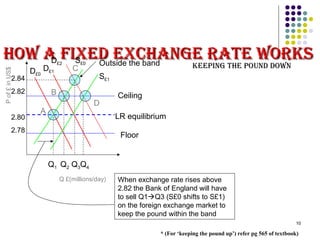
HHooww aa FFiixxeedd eexxccHHaannggee RRaattee wwooRRkkss 
10 
Outside the band 
Ceiling 
LR equilibrium 
Floor 
D£2 
Q1 Q2 Q3Q4 
P of £ in US$ 
2.84 
2.82 
2.80 
2.78 
S£1 
Q £(millions/day) 
DD £1 £0 
B 
A 
C 
D 
S£0 
keeping tHe pound down 
When exchange rate rises above 
2.82 the Bank of England will have 
to sell Q1Q3 (S£0 shifts to S£1) 
on the foreign exchange market to 
keep the pound within the band 
* (For ‘keeping the pound up’) refer pg 565 of textbook)
11 
otHeR tools aFFecting excHange 
Rates 
 Central banks are not limited to buying and selling their currencies in 
order to influence the exchange rate. There are two alternatives in the 
short term: 
1) The central bank can change the interest rate. If it wishes to increase 
the exchange rate, the interest rate could be raised. This would 
influence the demand for the home currency as foreign investors/ 
speculators would see a higher rate of return in holding the currency – 
demand for the home currency would rise. 
2) The central bank could borrow from the International Monetary Fund. 
The IMF was created to aid countries having difficulty keeping a 
stable exchange rate. When a country’s currency falls, and the central 
bank runs out of foreign exchange to buy up the home currency, the 
central bank can borrow funds from the IMF to get over the crisis.
12 
FFllooaattiinngg eexxccHHaannggee RRaatteess 
 When a currency’s value is totally determined by market forces – e.g. supply 
and demand for the home currency – there is a floating exchange rate. 
 A currency ‘floats’ amongst the other currencies on the market and the price is 
set in accordance with the mechanisms of supply and demand outlined earlier. 
 The demand for a currency is derived from demand of goods, services and 
investments in other countries. There is also speculation in currency – which is 
perhaps the main short run determinant of exchange rates – which is based on 
the predictions/ emotions of currency speculators ‘betting’ on changes in 
exchange rates 
 In a floating exchange rate system, perfect information is an important issue. 
 Central banks have a tendency to intervene to correct what is considered to be 
disequilibrium in a floating exchange rate. This is called managed float or dirty 
float. Dirty float implies that impure market forces (central bank interventions) 
are present.
13 
MMaannaaggeedd eexxccHHaannggee 
RRaatteess 
 When currencies are allowed to fluctuate within a narrow band in the 
short run, and allowed to be realigned in the long run, there is a 
managed exchange rate. The most common version is when a 
government pegs its currency to another. 
 Completely fixed rates cause a problem of inflexibility, since 
economies have different fundamentals such as growth rates and 
inflation rates. 
 In the long run it could be very costly for a country with a weakening 
currency to defend its links with other countries. 
 That is why we have managed exchanged rates
14 
AAnn eexxaammppllee 
WWhheenn tthhee eexxcchhaannggee rraattee eexxcceeeeddss tthhee cceeiilliinngg ooff 
$$UUSS 00..1122008822 ppeerr YYuuaann,, ppooiinnttss AA iinn tthhee 
ddiiaaggrraamm,, tthhee CChhiinneessee cceennttrraall bbaannkk sseellllss YYuuaann 
((bbyy bbuuyyiinngg ffoorreeiiggnn ccuurrrreenncciieess)) iinn oorrddeerr ttoo 
iinnccrreeaassee tthhee ssuuppppllyy aanndd lloowweerr tthhee eexxcchhaannggee 
rraattee.. 
WWhheenn tthhee rraattee ffaallllss bbeellooww tthhee fflloooorr lleevveell ooff 
$$UUSS 00..1122002244 ppeerr YYuuaann,, ppooiinnttss BB,, tthhee cceennttrraall 
bbaannkk bbuuyyss YYuuaann ((wwiitthh ffoorreeiiggnn ccuurrrreenncciieess)) 
wwhhiicchh iinnccrreeaasseess ddeemmaanndd ffoorr YYuuaann aanndd
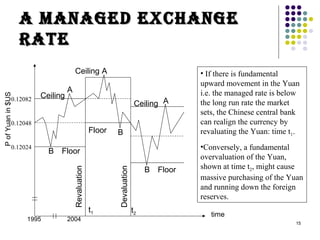
• If there is fundamental 
upward movement in the Yuan 
i.e. the managed rate is below 
the long run rate the market 
sets, the Chinese central bank 
can realign the currency by 
revaluating the Yuan: time t1. 
•Conversely, a fundamental 
overvaluation of the Yuan, 
shown at time t2, might cause 
massive purchasing of the Yuan 
and running down the foreign 
reserves. 
15 
aa MMaannaaggeedd eexxccHHaannggee 
RRaattee 
Revaluation 
Devaluation 
Ceiling 
Ceiling 
Ceiling A 
A 
A 
B 
B 
B Floor 
Floor 
Floor 
0.12082 
0.12048 
0.12024 
1995 2004 
t1 t2 
P of Yuan in $US 
time
16 
aappppRReecciiaattiioonn aanndd 
ddeeppRReecciiaattiioonn 
 WWhheenn tthhee eexxcchhaannggee rraattee ooff aa ffrreeeellyy ffllooaattiinngg ccuurrrreennccyy rriisseess,, tthhee 
ccuurrrreennccyy hhaass aapppprreecciiaatteedd.. 
 AA ffaallll iinn tthhee vvaalluuee ooff aa ffllooaattiinngg ccuurrrreennccyy mmeeaannss tthhee ccuurrrreennccyy hhaass 
ddeepprreecciiaatteedd.. 
RReevvaalluuaattiioonn aanndd ddeevvaalluuaattiioonn 
 WWhheenn tthhee ggoovveerrnnmmeenntt rree--ppeeggss aa ffiixxeedd// ppeeggggeedd ccuurrrreennccyy,, tthhee ccuurrrreennccyy hhaass 
bbeeeenn rreevvaalluueedd.. 
 WWhheenn aa ffiixxeedd oorr ppeeggggeedd ccuurrrreennccyy iiss rreeaalliiggnneedd ttoo aa lloowweerr vvaalluuee,, tthhee ccuurrrreennccyy 
hhaass ddeevvaalluueedd..
17 
EEffffEEccttss oonn EExxcchhaannggEE 
rraattEEss 
Main determinants of the exchange rate 
TTwwoo mmaaiinn aassssuummppttiioonnss:: 
 TThhee ccuurrrreennccyy iinn qquueessttiioonn ((tthhee UUSS ddoollllaarr)) iiss nnoott 
oonnllyy ffllooaattiinngg bbuutt aallssoo ffrreeeellyy ffllooaattiinngg--tthheerree iiss 
nnoo iinntteerrvveennttiioonn bbyy tthhee UUSS cceennttrraall bbaannkk 
 EEaacchh ooff tthhee ddeetteerrmmiinnaannttss mmeennttiioonneedd llaatteerr aarree 
ooppeerraattiinngg uunnddeerr tthhee cceetteerriiss ppaarriibbuuss ccoonnddiittiioonnss-- 
aa cchhaannggee iinn iinntteerreesstt rraatteess iiss nnoott aaccccoommppaanniieedd 
bbyy aa cchhaannggee iinn aannootthheerr vvaarriiaabbllee
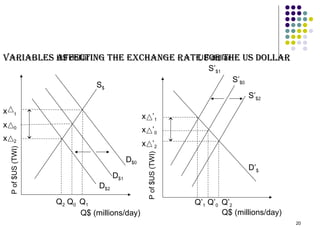
ttrraaddEE ffllooww When American exports increase, there will be an increased demand 
for the dollar as importers in other countries will need more dollars to 
buy the American goods. Increased exports will increase the demand 
for the dollar, causing the shift in the demand curve on slide 18 from 
D$0 to D$1 and subsequently an appreciation of the dollar from x 0 
to x 1. (x = ex; delta = change). 
An increase in imports or an increase in American tourism abroad 
would imply increased trade of dollars for goods/ services causing an 
increase in supply of dollars on the market – S$’0 to S$’2 – and the 
dollar depreciates from x’ 0 to x’ 2 (slide 18) 
=> US exports ↑demand for $US ↑x for $US↑ (and vice versa) 
=> US imports ↑supply of $US ↑ x for $US↓ (and vice versa) 
18
19 
capital flows/ iinnttEErrEEsstt rraattEE 
cchhaannggEEss 
** 
 Inflows of investment to the US  demand for 
the $ US ↑ x for the $US↑ (and vice versa) 
 US investment abroad↑  supply of $US↑  x 
for $US↓ (and vice versa)
20 
VariablEs affEcting thE ExchangE rraattEE ffoorr tthhEE UUss ddoollllaarr 
D$2 
D$1 
D$0 
S’$1 
S’$0 
S’$2 
S$ 
D’$ 
US dollar US dollar 
Q2 Q0 Q1 Q’1 Q’0 Q’2 
P of $US (TWI) 
P of $US (TWI) 
Q$ (millions/day) Q$ (millions/day) 
x 1 
x 0 
x 2 
x ’1 
x ’0 
x ’2
21 
IInnccrreeaassee iinn ddeemmaanndd ffoorr tthhee UUSS 
ddoollllaarr:: 
IInnccrreeaassee iinn ssuuppppllyy ooff tthhee UUSS 
ddoollllaarr:: 
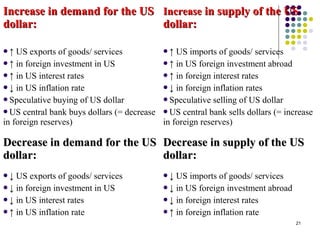
↑ US exports of goods/ services 
↑ in foreign investment in US 
↑ in US interest rates 
↓ in US inflation rate 
Speculative buying of US dollar 
US central bank buys dollars (= decrease 
in foreign reserves) 
↑ US imports of goods/ services 
↑ in US foreign investment abroad 
↑ in foreign interest rates 
↓ in foreign inflation rates 
Speculative selling of US dollar 
US central bank sells dollars (= increase 
in foreign reserves) 
DDeeccrreeaassee iinn ddeemmaanndd ffoorr tthhee UUSS 
ddoollllaarr:: 
DDeeccrreeaassee iinn ssuuppppllyy ooff tthhee UUSS 
ddoollllaarr:: 
↓ US exports of goods/ services 
↓ in foreign investment in US 
↓ in US interest rates 
↑ in US inflation rate 
↓ US imports of goods/ services 
↓ in US foreign investment abroad 
↓ in foreign interest rates 
↑ in foreign inflation rate
22 
iinnffllaattiioonn 
 Ceteris Paribus: 
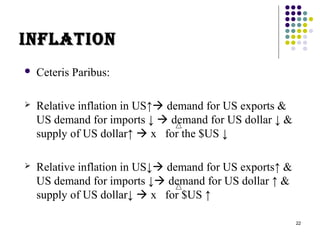
 Relative inflation in US↑ demand for US exports & 
US demand for imports ↓  demand for US dollar ↓ & 
supply of US dollar↑  x for the $US ↓ 
 Relative inflation in US↓ demand for US exports↑ & 
US demand for imports ↓ demand for US dollar ↑ & 
supply of US dollar↓  x for $US ↑
23 
ssppEEccUUllaattiioonn 
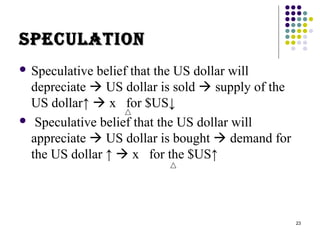
 Speculative belief that the US dollar will 
depreciate  US dollar is sold  supply of the 
US dollar↑  x for $US↓ 
 Speculative belief that the US dollar will 
appreciate  US dollar is bought  demand for 
the US dollar ↑  x for the $US↑
24 
UsE of ffoorrEEiiggnn EExxcchhaannggEE 
rrEEssEErrVVEEss 
 Governments can intervene on the foreign currency market via the 
foreign currency reserves held in the central bank 
 US dollar depreciates ‘too much’  US central bank intervenes by 
buying the US dollar  demand for dollar ↑  x for the $US ↑ 
(decrease in US foreign reserves & inflow to US capital account) 
 US dollar appreciates ‘too much’  US central bank intervenes by 
selling the US dollar  supply of the US dollar ↑  x for $US ↓ 
(decrease in the US foreign reserves & inflow to the US capital 
account)
25 
FFiixxeedd eexxcchhaannggee rraatteess 
Advantages: 
 Predictability and certainty 
 Exchange rate stability encourages trade 
 Fiscal/ monetary discipline domestically 
 Less risk of speculation 
Disadvantages: 
 Loss of domestic monetary policy freedom 
 Need of large foreign reserves 
 Possibility of increased unemployment 
 Possibility of imported inflation
26 
FFllooaattiinngg eexxcchhaannggee rraatteess 
Advantages: 
 The balance of payments automatically adjusts 
 No large foreign reserves necessary 
 Freedom in domestic/ monetary policies 
 Reduced Speculation 
 Less risk of imported inflation 
Disadvantages: 
 Instability and lack of predictability 
 Lack of monetary/ fiscal prudence 
 Loss of competitiveness and efficiency
Monetary IntegratIon (single 
cIunforrrmeatniocn:ies) 
In 1999 the EURO technically came into being and during 2001 (from all 15 members 
except UK, Denmark, Sweden and Greece) were ‘locked’ in place in exchange terms. 
A European central bank took over the task of setting and implementing monetary 
policies for all EMU countries. This project created one of the largest shifts in 
economic power in history. 
In order for each country wishing to join to be eligible, they had to adjust domestic 
fiscal and monetary policies to fulfill the following criteria: 
Inflation could be no more than 1.5 percentage points above the average inflation of 
the three countries with the lowest inflation 
Interest rates had to be within 2 percentage points of the average of the three 
countries with the lowest interest rates 
A maximum budget deficit of 3% of GDP 
Exchange rates had to be kept within a narrow band for 2-3 years 
The national debt had to be lower than 60% of GDP 
27
28 
eeMMUU:: CCooSSttSS aannDD BBeenneeFFIIttSS 
Benefits: 
 Trade creation 
 Increased efficiency due to increased competition 
 Benefits of scale 
 Lower transaction costs 
Costs: 
 Loss of domestic monetary policy 
 Restrictions on domestic fiscal policy 
 Regional unemployment
29 
PPuurrcchhaassiinngg PPoowweerr PPaarriittyy** 
TThhee tthheeoorryy ooff ppuurrcchhaassiinngg ppoowweerr ppaarriittyy ssttaatteess tthhaatt 
eexxcchhaannggee rraatteess wwiillll iinn tthhee lloonngg rruunn aaddjjuusstt ttoo ddiiffffeerreenntt 
iinnffllaattiioonn rraatteess iinn ccoouunnttrriieess,, lleeaaddiinngg ttoo eeqquuiilliibbrriiuumm 
wwhheerree aa ggiivveenn aammoouunntt ooff hhoommee ccuurrrreennccyy ttrraaddeedd ffoorr aa 
ffoorreeiiggnn ccuurrrreennccyy wwiillll bbuuyy aann eeqquuaallllyy--ssiizzeedd bbuunnddllee ooff 
ggooooddss.. 
*Refer to textbook for limitation of this theory
30 
aarrBBIIttrraaggee aannDD tthhee llaaww ooFF oonnee 
pprrIICCee 
 Assume two countries, X and Y, side-by-side which have no trade barriers; 
mo transaction costs; no transport costs; homogenous goods; identical 
expenditure taxes; and a floating exchange rate. 
 Country X can buy a kilo of flour for 2 ($X) domestically. 
 Country Y can buy a kilo of flour for 3 ($Y) domestically 
 The exchange rate is $X1 = $Y2; or $Y2 = $X0.5 
 The following two things will happen: 
(i) Citizens from X will cross over to Y to buy flour, seeing as how $X2 they pay 
at home would get them $Y4 and then 1.33 kilos of flour; 
(ii) There would be arbitrage, as enterprising people in Y would buy flour 
domestically and sell it in X for just under $X2 per kilo. 
The result: 
 Increased demand for the Y dollar will cause the $Y to appreciate. 
 Also, the traders from Y will exchange their X dollars for Y dollars, thereby 
increasing supply of $X and causing a depreciation of the $X.
Demand for Y flour will cease and arbitrage activities will 
end when the exchange rate between the two countries is 
such that the price is the same for both countries. 
i.e. 1 kilo flour in X = $X2 = $Y3= 1 kilo flour in Y 
31 
llaaww ooFF oonnee pprrIICCee:: 
AAssssuummiinngg tthhaatt tthheerree aarree nnoo iimmppeerrffeeccttiioonnss,, ttwwoo 
hhoommooggeennoouuss ggooooddss mmuusstt uullttiimmaatteellyy hhaavvee tthhee ssaammee 
pprriiccee oonn aa mmaarrkkeett
32 
tthhee llaaww ooFF oonnee pprrIICCee aannDD tthhee pppppp 
tthheeoorryy 
 Consider our previous situation. What if the inflation rates in X & Y 
would differ, exchange rate remaining constant. 
Say for e.g. 10% inflation in Y and 0 in X. 
 The answer: 1 kilo of flour would cost $Y3.3 in Y but still $X2 in X. If 
the exchange rate remained unchanged, Y citizens would get more flour 
for their money in X and arbitrage would be conducted in the other 
direction – Y would import flour now. This would continue until a new 
exchange rate came in that gave both X & Y equal PPP. 
 2$X = 3.3$Y  1$X = 1.65$Y, or 1$Y = 0.60$X. 
 The X dollar has appreciated by 10% and the Y dollar has depreciated 
by 10%. 
 This is essentially the PPP theory.

Exchange rates

  • 1.
  • 2.
    2 EExxcchhaannggee RRaattee::DDeeffiinniittiioonn  The exchange rate is the price of a currency in terms of another currency. Thud the exchange rate for the US dollar can be expressed in the amount of British pounds, EURO or Mexican pesos needed to but one dollar.  If $US1 = €0.82, then the exchange rate for EURO = (1/0.82) = $US 1.22  Q: The exchange rate for the US dollar is 7.5 Swedish Crowns (SEK), What is the exchange rate for the SEK? A: 1 SEK = $ US 0.133
  • 3.
    Currencies are boughtand sold on a foreign exchange market. The demand for a currency is a function of three main variables: 1.The demand for other countries’ goods and services 2.The demand for foreign direct investment and portfolio investment in another country 3.Speculative demand People and import/ export firms will buy currencies from banks and foreign exchange offices to conduct international transactions. Foreign exchange brokers will in turn be used by banks to supply needed currencies and to cash-in unneeded currencies. Finally the central banks of trading countries may intervene on the currency market by adding to the foreign reserves in order to adjust the exchange rate. 3
  • 4.
     The SSuuppppllyyccuurrvvee ffoorr ccuurrrreenncciieess iiss uuppwwaarrdd ssllooppiinngg bbeeccaauussee aa hhiigghheerr pprriiccee ooff ccuurrrreennccyy XX wwoouulldd--cceetteerriiss ppaarriibbuuss-- wwoouulldd eennaabbllee cciittiizzeennss ooff tthhaatt ccoouunnttrryy (XX)) (ttoo bbuuyy mmoorree ggooooddss ooff ccoouunnttrryy YY.. IInn ddooiinngg mmoorree ccuurrrreennccyy XX wwiillll bbee aavvaaiillaabbllee iinn ccoouunnttrryy YY’’ss mmaarrkkeett.. 4
  • 5.
    5 EXPLANATION Whenthe value of the rupee increases in terms of dollars; rupee appreciates, you will be able to buy more from the same amount of rupees spent, therefore the supply of rupees will increase.
  • 6.
    6 DEMAND CURVE  TThhee ddeemmaanndd ccuurrvvee iiss ddoowwnnwwaarrdd ssllooppiinngg ttoo iinnddiiccaattee tthhaatt cciittiizzeennss ooff ccoouunnttrryy XX wwiillll bbuuyy mmoorree ccuurrrreennccyy YY wwhheenn tthheeyy ggeett mmoorree ooff iitt –– aanndd mmoorree ggooooddss-- ffoorr tthheeiirr ccuurrrreennccyy XX..
  • 7.
    7 EXPLANATION Whenthe rupee value falls in terms of other currencies ,say dollar, we would need more rupees to buy same amount of goods, demand for rupees would increase.
  • 8.
    8 The exchangeraTes for The euro and The us dollar P of € in $US Initial equilibrium: $US 1 = € 0.82 And thus… €1 = $US 1.22 P of $US in € Q €(millions/day) Q $(millions/day) EURO S$0 S$1 0.82 0.81 Q Q$0 Q$1 €0 Q€1 D$ D€0 D€1 S€ 1.23 1.22 US DOLLAR NNoottee:: DDoo nnoott ccoonnffuussee DDDD SSSS ffoorr mmoonneeyy wwiitthh ffoorreeiiggnn eexxcchhaannggee mmaarrkkeettss
  • 9.
    9 FFiixxeedd eexxcchhaannggeerraatteess  We know that exchange rates are established by market forces of demand and supply. When a group of countries instead keep their exchange rate constant thus establishing a fixed exchange rate.  Such countries use the central government to intervene on the foreign exchange market in order to keep exchange rate within a narrow band-much like the mechanism used in a buffer stock mechanism.  The central government can affect the exchange rate in the short run by buying or selling its own currency on the foreign exchange market, and by adjusting the interest rate to influence investors’ demand for the currency.  In the long run, governments might intervene using fiscal policies, supply-side measures and protectionism to adjust national income in order to increase or decrease exports and citizens’ propensity to import. TTyyppeess ooff FFiixxeedd eexxcchhaannggee rraatteess  The Gold Standard  The Bretton Woods exchange rate system
  • 10.
    HHooww aa FFiixxeeddeexxccHHaannggee RRaattee wwooRRkkss 10 Outside the band Ceiling LR equilibrium Floor D£2 Q1 Q2 Q3Q4 P of £ in US$ 2.84 2.82 2.80 2.78 S£1 Q £(millions/day) DD £1 £0 B A C D S£0 keeping tHe pound down When exchange rate rises above 2.82 the Bank of England will have to sell Q1Q3 (S£0 shifts to S£1) on the foreign exchange market to keep the pound within the band * (For ‘keeping the pound up’) refer pg 565 of textbook)
  • 11.
    11 otHeR toolsaFFecting excHange Rates  Central banks are not limited to buying and selling their currencies in order to influence the exchange rate. There are two alternatives in the short term: 1) The central bank can change the interest rate. If it wishes to increase the exchange rate, the interest rate could be raised. This would influence the demand for the home currency as foreign investors/ speculators would see a higher rate of return in holding the currency – demand for the home currency would rise. 2) The central bank could borrow from the International Monetary Fund. The IMF was created to aid countries having difficulty keeping a stable exchange rate. When a country’s currency falls, and the central bank runs out of foreign exchange to buy up the home currency, the central bank can borrow funds from the IMF to get over the crisis.
  • 12.
    12 FFllooaattiinngg eexxccHHaannggeeRRaatteess  When a currency’s value is totally determined by market forces – e.g. supply and demand for the home currency – there is a floating exchange rate.  A currency ‘floats’ amongst the other currencies on the market and the price is set in accordance with the mechanisms of supply and demand outlined earlier.  The demand for a currency is derived from demand of goods, services and investments in other countries. There is also speculation in currency – which is perhaps the main short run determinant of exchange rates – which is based on the predictions/ emotions of currency speculators ‘betting’ on changes in exchange rates  In a floating exchange rate system, perfect information is an important issue.  Central banks have a tendency to intervene to correct what is considered to be disequilibrium in a floating exchange rate. This is called managed float or dirty float. Dirty float implies that impure market forces (central bank interventions) are present.
  • 13.
    13 MMaannaaggeedd eexxccHHaannggee RRaatteess  When currencies are allowed to fluctuate within a narrow band in the short run, and allowed to be realigned in the long run, there is a managed exchange rate. The most common version is when a government pegs its currency to another.  Completely fixed rates cause a problem of inflexibility, since economies have different fundamentals such as growth rates and inflation rates.  In the long run it could be very costly for a country with a weakening currency to defend its links with other countries.  That is why we have managed exchanged rates
  • 14.
    14 AAnn eexxaammppllee WWhheenn tthhee eexxcchhaannggee rraattee eexxcceeeeddss tthhee cceeiilliinngg ooff $$UUSS 00..1122008822 ppeerr YYuuaann,, ppooiinnttss AA iinn tthhee ddiiaaggrraamm,, tthhee CChhiinneessee cceennttrraall bbaannkk sseellllss YYuuaann ((bbyy bbuuyyiinngg ffoorreeiiggnn ccuurrrreenncciieess)) iinn oorrddeerr ttoo iinnccrreeaassee tthhee ssuuppppllyy aanndd lloowweerr tthhee eexxcchhaannggee rraattee.. WWhheenn tthhee rraattee ffaallllss bbeellooww tthhee fflloooorr lleevveell ooff $$UUSS 00..1122002244 ppeerr YYuuaann,, ppooiinnttss BB,, tthhee cceennttrraall bbaannkk bbuuyyss YYuuaann ((wwiitthh ffoorreeiiggnn ccuurrrreenncciieess)) wwhhiicchh iinnccrreeaasseess ddeemmaanndd ffoorr YYuuaann aanndd
  • 15.
    • If thereis fundamental upward movement in the Yuan i.e. the managed rate is below the long run rate the market sets, the Chinese central bank can realign the currency by revaluating the Yuan: time t1. •Conversely, a fundamental overvaluation of the Yuan, shown at time t2, might cause massive purchasing of the Yuan and running down the foreign reserves. 15 aa MMaannaaggeedd eexxccHHaannggee RRaattee Revaluation Devaluation Ceiling Ceiling Ceiling A A A B B B Floor Floor Floor 0.12082 0.12048 0.12024 1995 2004 t1 t2 P of Yuan in $US time
  • 16.
    16 aappppRReecciiaattiioonn aanndd ddeeppRReecciiaattiioonn  WWhheenn tthhee eexxcchhaannggee rraattee ooff aa ffrreeeellyy ffllooaattiinngg ccuurrrreennccyy rriisseess,, tthhee ccuurrrreennccyy hhaass aapppprreecciiaatteedd..  AA ffaallll iinn tthhee vvaalluuee ooff aa ffllooaattiinngg ccuurrrreennccyy mmeeaannss tthhee ccuurrrreennccyy hhaass ddeepprreecciiaatteedd.. RReevvaalluuaattiioonn aanndd ddeevvaalluuaattiioonn  WWhheenn tthhee ggoovveerrnnmmeenntt rree--ppeeggss aa ffiixxeedd// ppeeggggeedd ccuurrrreennccyy,, tthhee ccuurrrreennccyy hhaass bbeeeenn rreevvaalluueedd..  WWhheenn aa ffiixxeedd oorr ppeeggggeedd ccuurrrreennccyy iiss rreeaalliiggnneedd ttoo aa lloowweerr vvaalluuee,, tthhee ccuurrrreennccyy hhaass ddeevvaalluueedd..
  • 17.
    17 EEffffEEccttss oonnEExxcchhaannggEE rraattEEss Main determinants of the exchange rate TTwwoo mmaaiinn aassssuummppttiioonnss::  TThhee ccuurrrreennccyy iinn qquueessttiioonn ((tthhee UUSS ddoollllaarr)) iiss nnoott oonnllyy ffllooaattiinngg bbuutt aallssoo ffrreeeellyy ffllooaattiinngg--tthheerree iiss nnoo iinntteerrvveennttiioonn bbyy tthhee UUSS cceennttrraall bbaannkk  EEaacchh ooff tthhee ddeetteerrmmiinnaannttss mmeennttiioonneedd llaatteerr aarree ooppeerraattiinngg uunnddeerr tthhee cceetteerriiss ppaarriibbuuss ccoonnddiittiioonnss-- aa cchhaannggee iinn iinntteerreesstt rraatteess iiss nnoott aaccccoommppaanniieedd bbyy aa cchhaannggee iinn aannootthheerr vvaarriiaabbllee
  • 18.
    ttrraaddEE ffllooww WhenAmerican exports increase, there will be an increased demand for the dollar as importers in other countries will need more dollars to buy the American goods. Increased exports will increase the demand for the dollar, causing the shift in the demand curve on slide 18 from D$0 to D$1 and subsequently an appreciation of the dollar from x 0 to x 1. (x = ex; delta = change). An increase in imports or an increase in American tourism abroad would imply increased trade of dollars for goods/ services causing an increase in supply of dollars on the market – S$’0 to S$’2 – and the dollar depreciates from x’ 0 to x’ 2 (slide 18) => US exports ↑demand for $US ↑x for $US↑ (and vice versa) => US imports ↑supply of $US ↑ x for $US↓ (and vice versa) 18
  • 19.
    19 capital flows/iinnttEErrEEsstt rraattEE cchhaannggEEss **  Inflows of investment to the US  demand for the $ US ↑ x for the $US↑ (and vice versa)  US investment abroad↑  supply of $US↑  x for $US↓ (and vice versa)
  • 20.
    20 VariablEs affEctingthE ExchangE rraattEE ffoorr tthhEE UUss ddoollllaarr D$2 D$1 D$0 S’$1 S’$0 S’$2 S$ D’$ US dollar US dollar Q2 Q0 Q1 Q’1 Q’0 Q’2 P of $US (TWI) P of $US (TWI) Q$ (millions/day) Q$ (millions/day) x 1 x 0 x 2 x ’1 x ’0 x ’2
  • 21.
    21 IInnccrreeaassee iinnddeemmaanndd ffoorr tthhee UUSS ddoollllaarr:: IInnccrreeaassee iinn ssuuppppllyy ooff tthhee UUSS ddoollllaarr:: ↑ US exports of goods/ services ↑ in foreign investment in US ↑ in US interest rates ↓ in US inflation rate Speculative buying of US dollar US central bank buys dollars (= decrease in foreign reserves) ↑ US imports of goods/ services ↑ in US foreign investment abroad ↑ in foreign interest rates ↓ in foreign inflation rates Speculative selling of US dollar US central bank sells dollars (= increase in foreign reserves) DDeeccrreeaassee iinn ddeemmaanndd ffoorr tthhee UUSS ddoollllaarr:: DDeeccrreeaassee iinn ssuuppppllyy ooff tthhee UUSS ddoollllaarr:: ↓ US exports of goods/ services ↓ in foreign investment in US ↓ in US interest rates ↑ in US inflation rate ↓ US imports of goods/ services ↓ in US foreign investment abroad ↓ in foreign interest rates ↑ in foreign inflation rate
  • 22.
    22 iinnffllaattiioonn Ceteris Paribus:  Relative inflation in US↑ demand for US exports & US demand for imports ↓  demand for US dollar ↓ & supply of US dollar↑  x for the $US ↓  Relative inflation in US↓ demand for US exports↑ & US demand for imports ↓ demand for US dollar ↑ & supply of US dollar↓  x for $US ↑
  • 23.
    23 ssppEEccUUllaattiioonn Speculative belief that the US dollar will depreciate  US dollar is sold  supply of the US dollar↑  x for $US↓  Speculative belief that the US dollar will appreciate  US dollar is bought  demand for the US dollar ↑  x for the $US↑
  • 24.
    24 UsE offfoorrEEiiggnn EExxcchhaannggEE rrEEssEErrVVEEss  Governments can intervene on the foreign currency market via the foreign currency reserves held in the central bank  US dollar depreciates ‘too much’  US central bank intervenes by buying the US dollar  demand for dollar ↑  x for the $US ↑ (decrease in US foreign reserves & inflow to US capital account)  US dollar appreciates ‘too much’  US central bank intervenes by selling the US dollar  supply of the US dollar ↑  x for $US ↓ (decrease in the US foreign reserves & inflow to the US capital account)
  • 25.
    25 FFiixxeedd eexxcchhaannggeerraatteess Advantages:  Predictability and certainty  Exchange rate stability encourages trade  Fiscal/ monetary discipline domestically  Less risk of speculation Disadvantages:  Loss of domestic monetary policy freedom  Need of large foreign reserves  Possibility of increased unemployment  Possibility of imported inflation
  • 26.
    26 FFllooaattiinngg eexxcchhaannggeerraatteess Advantages:  The balance of payments automatically adjusts  No large foreign reserves necessary  Freedom in domestic/ monetary policies  Reduced Speculation  Less risk of imported inflation Disadvantages:  Instability and lack of predictability  Lack of monetary/ fiscal prudence  Loss of competitiveness and efficiency
  • 27.
    Monetary IntegratIon (single cIunforrrmeatniocn:ies) In 1999 the EURO technically came into being and during 2001 (from all 15 members except UK, Denmark, Sweden and Greece) were ‘locked’ in place in exchange terms. A European central bank took over the task of setting and implementing monetary policies for all EMU countries. This project created one of the largest shifts in economic power in history. In order for each country wishing to join to be eligible, they had to adjust domestic fiscal and monetary policies to fulfill the following criteria: Inflation could be no more than 1.5 percentage points above the average inflation of the three countries with the lowest inflation Interest rates had to be within 2 percentage points of the average of the three countries with the lowest interest rates A maximum budget deficit of 3% of GDP Exchange rates had to be kept within a narrow band for 2-3 years The national debt had to be lower than 60% of GDP 27
  • 28.
    28 eeMMUU:: CCooSSttSSaannDD BBeenneeFFIIttSS Benefits:  Trade creation  Increased efficiency due to increased competition  Benefits of scale  Lower transaction costs Costs:  Loss of domestic monetary policy  Restrictions on domestic fiscal policy  Regional unemployment
  • 29.
    29 PPuurrcchhaassiinngg PPoowweerrPPaarriittyy** TThhee tthheeoorryy ooff ppuurrcchhaassiinngg ppoowweerr ppaarriittyy ssttaatteess tthhaatt eexxcchhaannggee rraatteess wwiillll iinn tthhee lloonngg rruunn aaddjjuusstt ttoo ddiiffffeerreenntt iinnffllaattiioonn rraatteess iinn ccoouunnttrriieess,, lleeaaddiinngg ttoo eeqquuiilliibbrriiuumm wwhheerree aa ggiivveenn aammoouunntt ooff hhoommee ccuurrrreennccyy ttrraaddeedd ffoorr aa ffoorreeiiggnn ccuurrrreennccyy wwiillll bbuuyy aann eeqquuaallllyy--ssiizzeedd bbuunnddllee ooff ggooooddss.. *Refer to textbook for limitation of this theory
  • 30.
    30 aarrBBIIttrraaggee aannDDtthhee llaaww ooFF oonnee pprrIICCee  Assume two countries, X and Y, side-by-side which have no trade barriers; mo transaction costs; no transport costs; homogenous goods; identical expenditure taxes; and a floating exchange rate.  Country X can buy a kilo of flour for 2 ($X) domestically.  Country Y can buy a kilo of flour for 3 ($Y) domestically  The exchange rate is $X1 = $Y2; or $Y2 = $X0.5  The following two things will happen: (i) Citizens from X will cross over to Y to buy flour, seeing as how $X2 they pay at home would get them $Y4 and then 1.33 kilos of flour; (ii) There would be arbitrage, as enterprising people in Y would buy flour domestically and sell it in X for just under $X2 per kilo. The result:  Increased demand for the Y dollar will cause the $Y to appreciate.  Also, the traders from Y will exchange their X dollars for Y dollars, thereby increasing supply of $X and causing a depreciation of the $X.
  • 31.
    Demand for Yflour will cease and arbitrage activities will end when the exchange rate between the two countries is such that the price is the same for both countries. i.e. 1 kilo flour in X = $X2 = $Y3= 1 kilo flour in Y 31 llaaww ooFF oonnee pprrIICCee:: AAssssuummiinngg tthhaatt tthheerree aarree nnoo iimmppeerrffeeccttiioonnss,, ttwwoo hhoommooggeennoouuss ggooooddss mmuusstt uullttiimmaatteellyy hhaavvee tthhee ssaammee pprriiccee oonn aa mmaarrkkeett
  • 32.
    32 tthhee llaawwooFF oonnee pprrIICCee aannDD tthhee pppppp tthheeoorryy  Consider our previous situation. What if the inflation rates in X & Y would differ, exchange rate remaining constant. Say for e.g. 10% inflation in Y and 0 in X.  The answer: 1 kilo of flour would cost $Y3.3 in Y but still $X2 in X. If the exchange rate remained unchanged, Y citizens would get more flour for their money in X and arbitrage would be conducted in the other direction – Y would import flour now. This would continue until a new exchange rate came in that gave both X & Y equal PPP.  2$X = 3.3$Y  1$X = 1.65$Y, or 1$Y = 0.60$X.  The X dollar has appreciated by 10% and the Y dollar has depreciated by 10%.  This is essentially the PPP theory.

Editor's Notes

  • #15 Give this explanation for the diagram on the next slide
  • #20 Give examples of other firms investing in the US and US firms setting up factories abroad.