Webinar: HR and Social
 Media Governance
       April 11, 2012
Presenter
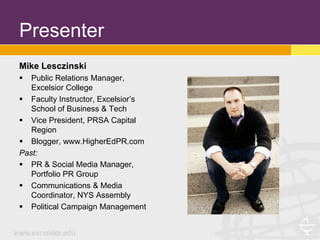
Mike Lesczinski
  Public Relations Manager,
   Excelsior College
 Faculty Instructor, Excelsior’s
   School of Business & Tech
 Vice President, PRSA Capital
   Region
 Blogger, www.HigherEdPR.com
Past:
 PR & Social Media Manager,
   Portfolio PR Group
 Communications & Media
   Coordinator, NYS Assembly
 Political Campaign Management
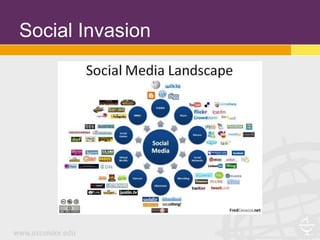
Social Invasion
Taking the Social Plunge


“Hey! Look at how hip our company is, we’re on The Facebook!”
The Agenda
I. Accept the New Reality: Social Media is
     Not a Fad
II. The Issues: Challenges to Social Media
     Adoption
III. HR’s Role in Social Media Policy
     Development
IV. Case Study: Cisco Systems
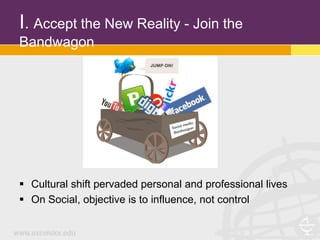
I. Accept the New Reality - Join the
Bandwagon


 Cultural shift pervaded personal and professional lives
 On Social, objective is to influence, not control
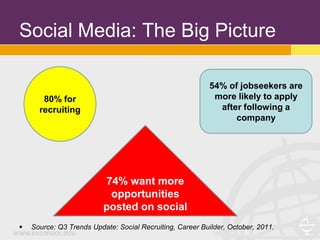
Social Media: The Big Picture

                                                           54% of jobseekers are
       80% for                                              more likely to apply
      recruiting                                             after following a
                                                                 company


                          74% want more
                           opportunities
                          posted on social
   Source: Q3 Trends Update: Social Recruiting, Career Builder, October, 2011.
Organizational Adoption
 Social media adoption for 47% of
  organizations has occurred within past two
  years
 73% DO NOT provide training to
  employees who engage in social media on
  company’s behalf
 Window of opportunity for HR to shape
  policy
II. Social Media Use

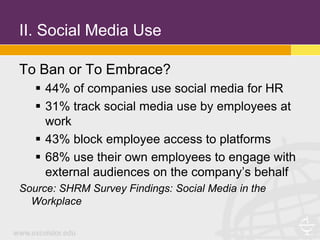
To Ban or To Embrace?
    44% of companies use social media for HR
    31% track social media use by employees at
     work
    43% block employee access to platforms
    68% use their own employees to engage with
     external audiences on the company’s behalf
Source: SHRM Survey Findings: Social Media in the
  Workplace
II. Challenges to Adoption (and
solutions!)
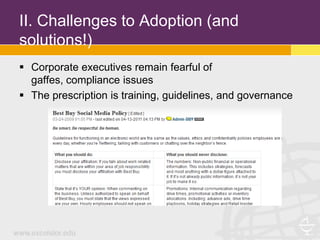
 Corporate executives remain fearful of
  gaffes, compliance issues
 The prescription is training, guidelines, and governance
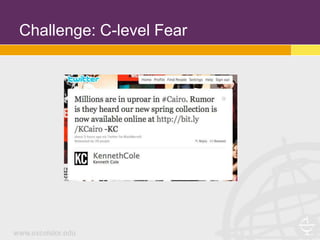
Challenge: C-level Fear
Alleviating C-Level Fear
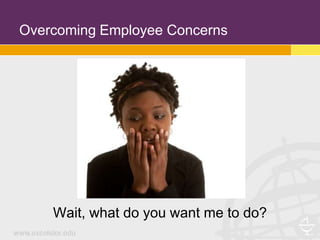
Overcoming Employee Concerns


    Wait, what do you want me to do?
Challenge: The Law
 Legal concerns remain a major issue
   Read Federal Trade Commission Guidelines,
    2009
     Advertising, endorsements
     Employer specific regulations
        Do you know what your employees are tweeting about
         your products?
        Has your employee been truthful? Disclosed their
         affiliation?


       http://1.usa.gov/SocialRules
Protecting Your Company
Employer Protection Steps (Boudreaux, 2011)
 Update social media policies to reflect the FTC guide revisions in
  order to proactively inform employees of their obligations
 Educate all your employees
 Monitor to ensure compliance and accuracy of information
 Correct inaccurate or misleading information
 Define and implement a process for handling employee statements
  that create liability for the company
 Document the company’s policies and how the company is
  communicating those policies
Source: “Staying Out of Trouble: Complying with FTC Disclosures,”
  Chapter 11, The Social Media Management Handbook, 2011.
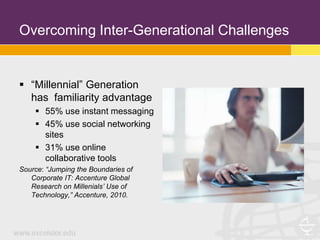
Overcoming Inter-Generational Challenges


 “Millennial” Generation
  has familiarity advantage
     55% use instant messaging
     45% use social networking
      sites
     31% use online
      collaborative tools
Source: “Jumping the Boundaries of
   Corporate IT: Accenture Global
   Research on Millenials’ Use of
   Technology,” Accenture, 2010.
III. Demand a Seat at the Table
 Implementing a social media policy
  demands input, decision-making and
  commitment from all levels of leadership
 HR must be there to ensure all voices are
  heard, all considerations taken into
  account
   Break down department “silos”
Policy Development
 Gather input, ideas, and ensure all
  departments understand expectations
 Guidelines will include use of language,
  copyright materials, privacy standards,
  and the legal do’s and don’ts
Anatomy of Social Media Plan
 I. Purpose – Why are we here
   Tap into new markets?
   Reach younger customers?
   Provide better customer service?
 II. Anticipated Challenges
   Brand awareness
   Oversaturated market
Situational Analysis
 Set your goals
 Determine your company’s current digital
  footprint
 Analyze the competition
 Establish your online persona
    Core values & attributes
    Market perception
 Last stages: Deciding on specific networks, strategies,
  adapting to feedback, and training all employees
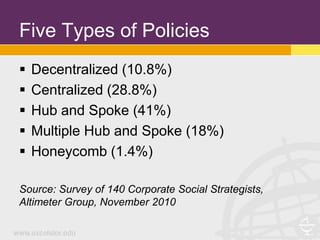
Five Types of Policies
   Decentralized (10.8%)
   Centralized (28.8%)
   Hub and Spoke (41%)
   Multiple Hub and Spoke (18%)
   Honeycomb (1.4%)

Source: Survey of 140 Corporate Social Strategists,
Altimeter Group, November 2010
The Breakdown
 Decentralized
   Defined by a lack of central coordination,
    efforts “bubble up” from different points of the
    company
   Often found in local governments
   Risk brand inconsistency
Centralized
 One department acts as a gatekeeper for
  all social media activity
 Specific individuals act as voice,
  responsible for all engagement, content
  and strategy
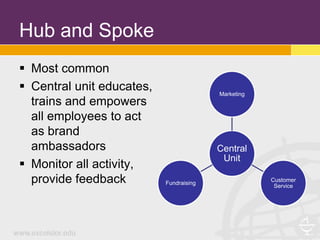
Hub and Spoke
 Most common
 Central unit educates,                 Marketing
  trains and empowers
  all employees to act
  as brand
  ambassadors                            Central
                                          Unit
 Monitor all activity,
  provide feedback         Fundraising
                                                     Customer
                                                      Service
Multiple Hub & Spoke
 Most often found in extremely large
  companies
 Multiple central units charged with
  education and empowerment who
  coordinate activities with each other
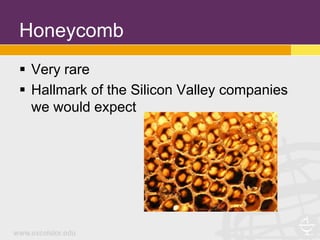
Honeycomb
 Very rare
 Hallmark of the Silicon Valley companies
  we would expect
Three Stages of Policy
 Stage One: Mitigation
    General guidelines
    Focus on protecting organization
 Stage Two: Information
    Guidelines adapted to institutional culture, values
    Focus on protecting individual as well as company
 Stage Three: Differentiation
    Empower employees to act as brand ambassadors
    Focus on differentiating company from competition
Redesigning Structure
 Social media plans often
  coincides with a
  restructuring of the
  organization
 Roles and responsibilities
  change, new workers
  hired
 HR must provide support
  to existing changes while
  realigning processes to
  recruit and manage new
  positions
IV. Case Study: Cisco Systems
The Policy
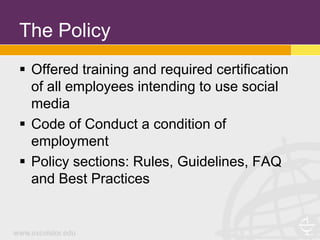
 Offered training and required certification
  of all employees intending to use social
  media
 Code of Conduct a condition of
  employment
 Policy sections: Rules, Guidelines, FAQ
  and Best Practices
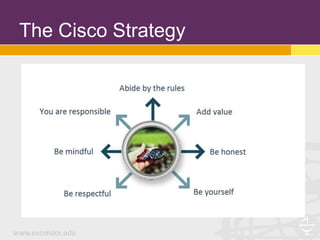
The Cisco Strategy
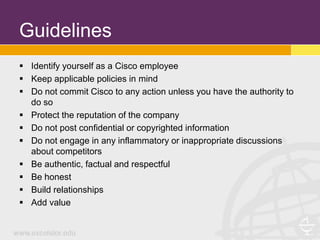
Guidelines
 Identify yourself as a Cisco employee
 Keep applicable policies in mind
 Do not commit Cisco to any action unless you have the authority to
  do so
 Protect the reputation of the company
 Do not post confidential or copyrighted information
 Do not engage in any inflammatory or inappropriate discussions
  about competitors
 Be authentic, factual and respectful
 Be honest
 Build relationships
 Add value
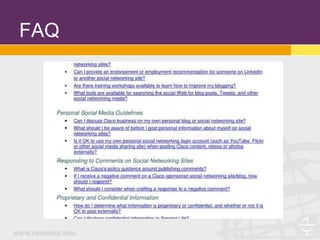
FAQ
Results
“What we learned from our initial foray into the social media
world is that these tools provide an opportunity for us to
listen online, gather feedback, and learn from customer
experiences. We quickly realized that social media had
more value than simply broadcasting brand messages or
providing thought leadership. Social media gave Cisco a
means to have open and honest conversations with a
broader, global base of customers, potential customers,
partners, and employees,”
                                       –Cisco Spokesperson
Like More Info?
 View the entire Cisco Study at
  SCR.bi/Ciscostudy
 Find actual social media policy examples
  at bit.ly/SocialGov
Questions?
Contact Information:     Social Connections:
 Michael.Lesczinski
  (at) gmail.com         Michaellesczinski
 MLesczinski (at)
  excelsior.edu          @MikeLesczinski

www.HigherEdPR.com
www.MikeLesczinski.com
                         Gplus.to/MikeLesczinski
References
 “Case Study: Cisco Systems, Inc. Open Social Media Policy,” Social
  Media Today, March 2011.
  http://socialmediatoday.com/lucasshaffer/280005/case-study-cisco-
  systems-inc-open-social-media-policy
 “Cisco Social Media Playbook: Best Practice Sharing,” Cisco
  Systems, June 2010. http://www.scribd.com/doc/33518678/Cisco-
  Social-Media-Playbook-Best-Practice-Sharing
 “Jumping the Boundaries of Corporate IT: Accenture Global
  Research on Millenials’ Use of Technology,” Accenture, 2010.
 “SHRM Survey Findings: An Examination of How Social Media is
  Embedded in Business Strategy & Operations,” Society for Human
  Resource Management, January 2012.
 “SHRM Survey in the Workplace,” Society for Human Resource
  Management, November, 2011.
References
“Social Media Policies,“ Chapters 17, The Social Media Management
Handbook, 2011.
“Social Media Policy: Cisco,” Furlong PR, 2010.
http://www.furlongpr.com/social-media-policy-case-study-cisco/
“Staying Out of Trouble: Complying with FTC Disclosures,” Chapter 11,
The Social Media Management Handbook, 2011.
Survey of 140 Corporate Social Strategists, Altimeter Group, November
2010
“Q3 Trends Update: Social Recruiting,” Career Builder, October, 2011.

Excelsior College Webinar: Human Resources & Social Media Governance

  • 1.
    Webinar: HR andSocial Media Governance April 11, 2012
  • 2.
    Presenter Mike Lesczinski  Public Relations Manager, Excelsior College  Faculty Instructor, Excelsior’s School of Business & Tech  Vice President, PRSA Capital Region  Blogger, www.HigherEdPR.com Past:  PR & Social Media Manager, Portfolio PR Group  Communications & Media Coordinator, NYS Assembly  Political Campaign Management
  • 3.
  • 4.
    Taking the SocialPlunge “Hey! Look at how hip our company is, we’re on The Facebook!”
  • 5.
    The Agenda I. Acceptthe New Reality: Social Media is Not a Fad II. The Issues: Challenges to Social Media Adoption III. HR’s Role in Social Media Policy Development IV. Case Study: Cisco Systems
  • 6.
    I. Accept theNew Reality - Join the Bandwagon  Cultural shift pervaded personal and professional lives  On Social, objective is to influence, not control
  • 7.
    Social Media: TheBig Picture 54% of jobseekers are 80% for more likely to apply recruiting after following a company 74% want more opportunities posted on social  Source: Q3 Trends Update: Social Recruiting, Career Builder, October, 2011.
  • 8.
    Organizational Adoption  Socialmedia adoption for 47% of organizations has occurred within past two years  73% DO NOT provide training to employees who engage in social media on company’s behalf  Window of opportunity for HR to shape policy
  • 9.
    II. Social MediaUse To Ban or To Embrace?  44% of companies use social media for HR  31% track social media use by employees at work  43% block employee access to platforms  68% use their own employees to engage with external audiences on the company’s behalf Source: SHRM Survey Findings: Social Media in the Workplace
  • 10.
    II. Challenges toAdoption (and solutions!)  Corporate executives remain fearful of gaffes, compliance issues  The prescription is training, guidelines, and governance
  • 11.
  • 12.
  • 13.
    Overcoming Employee Concerns Wait, what do you want me to do?
  • 14.
    Challenge: The Law Legal concerns remain a major issue  Read Federal Trade Commission Guidelines, 2009  Advertising, endorsements  Employer specific regulations  Do you know what your employees are tweeting about your products?  Has your employee been truthful? Disclosed their affiliation? http://1.usa.gov/SocialRules
  • 15.
    Protecting Your Company EmployerProtection Steps (Boudreaux, 2011)  Update social media policies to reflect the FTC guide revisions in order to proactively inform employees of their obligations  Educate all your employees  Monitor to ensure compliance and accuracy of information  Correct inaccurate or misleading information  Define and implement a process for handling employee statements that create liability for the company  Document the company’s policies and how the company is communicating those policies Source: “Staying Out of Trouble: Complying with FTC Disclosures,” Chapter 11, The Social Media Management Handbook, 2011.
  • 16.
    Overcoming Inter-Generational Challenges “Millennial” Generation has familiarity advantage  55% use instant messaging  45% use social networking sites  31% use online collaborative tools Source: “Jumping the Boundaries of Corporate IT: Accenture Global Research on Millenials’ Use of Technology,” Accenture, 2010.
  • 17.
    III. Demand aSeat at the Table  Implementing a social media policy demands input, decision-making and commitment from all levels of leadership  HR must be there to ensure all voices are heard, all considerations taken into account  Break down department “silos”
  • 18.
    Policy Development  Gatherinput, ideas, and ensure all departments understand expectations  Guidelines will include use of language, copyright materials, privacy standards, and the legal do’s and don’ts
  • 19.
    Anatomy of SocialMedia Plan  I. Purpose – Why are we here  Tap into new markets?  Reach younger customers?  Provide better customer service?  II. Anticipated Challenges  Brand awareness  Oversaturated market
  • 20.
    Situational Analysis  Setyour goals  Determine your company’s current digital footprint  Analyze the competition  Establish your online persona  Core values & attributes  Market perception  Last stages: Deciding on specific networks, strategies, adapting to feedback, and training all employees
  • 21.
    Five Types ofPolicies  Decentralized (10.8%)  Centralized (28.8%)  Hub and Spoke (41%)  Multiple Hub and Spoke (18%)  Honeycomb (1.4%) Source: Survey of 140 Corporate Social Strategists, Altimeter Group, November 2010
  • 22.
    The Breakdown  Decentralized  Defined by a lack of central coordination, efforts “bubble up” from different points of the company  Often found in local governments  Risk brand inconsistency
  • 23.
    Centralized  One departmentacts as a gatekeeper for all social media activity  Specific individuals act as voice, responsible for all engagement, content and strategy
  • 24.
    Hub and Spoke Most common  Central unit educates, Marketing trains and empowers all employees to act as brand ambassadors Central Unit  Monitor all activity, provide feedback Fundraising Customer Service
  • 25.
    Multiple Hub &Spoke  Most often found in extremely large companies  Multiple central units charged with education and empowerment who coordinate activities with each other
  • 26.
    Honeycomb  Very rare Hallmark of the Silicon Valley companies we would expect
  • 27.
    Three Stages ofPolicy  Stage One: Mitigation  General guidelines  Focus on protecting organization  Stage Two: Information  Guidelines adapted to institutional culture, values  Focus on protecting individual as well as company  Stage Three: Differentiation  Empower employees to act as brand ambassadors  Focus on differentiating company from competition
  • 28.
    Redesigning Structure  Socialmedia plans often coincides with a restructuring of the organization  Roles and responsibilities change, new workers hired  HR must provide support to existing changes while realigning processes to recruit and manage new positions
  • 29.
    IV. Case Study:Cisco Systems
  • 30.
    The Policy  Offeredtraining and required certification of all employees intending to use social media  Code of Conduct a condition of employment  Policy sections: Rules, Guidelines, FAQ and Best Practices
  • 31.
  • 32.
    Guidelines  Identify yourselfas a Cisco employee  Keep applicable policies in mind  Do not commit Cisco to any action unless you have the authority to do so  Protect the reputation of the company  Do not post confidential or copyrighted information  Do not engage in any inflammatory or inappropriate discussions about competitors  Be authentic, factual and respectful  Be honest  Build relationships  Add value
  • 33.
  • 34.
    Results “What we learnedfrom our initial foray into the social media world is that these tools provide an opportunity for us to listen online, gather feedback, and learn from customer experiences. We quickly realized that social media had more value than simply broadcasting brand messages or providing thought leadership. Social media gave Cisco a means to have open and honest conversations with a broader, global base of customers, potential customers, partners, and employees,” –Cisco Spokesperson
  • 35.
    Like More Info? View the entire Cisco Study at SCR.bi/Ciscostudy  Find actual social media policy examples at bit.ly/SocialGov
  • 36.
    Questions? Contact Information: Social Connections:  Michael.Lesczinski (at) gmail.com Michaellesczinski  MLesczinski (at) excelsior.edu @MikeLesczinski www.HigherEdPR.com www.MikeLesczinski.com Gplus.to/MikeLesczinski
  • 37.
    References  “Case Study:Cisco Systems, Inc. Open Social Media Policy,” Social Media Today, March 2011. http://socialmediatoday.com/lucasshaffer/280005/case-study-cisco- systems-inc-open-social-media-policy  “Cisco Social Media Playbook: Best Practice Sharing,” Cisco Systems, June 2010. http://www.scribd.com/doc/33518678/Cisco- Social-Media-Playbook-Best-Practice-Sharing  “Jumping the Boundaries of Corporate IT: Accenture Global Research on Millenials’ Use of Technology,” Accenture, 2010.  “SHRM Survey Findings: An Examination of How Social Media is Embedded in Business Strategy & Operations,” Society for Human Resource Management, January 2012.  “SHRM Survey in the Workplace,” Society for Human Resource Management, November, 2011.
  • 38.
    References “Social Media Policies,“Chapters 17, The Social Media Management Handbook, 2011. “Social Media Policy: Cisco,” Furlong PR, 2010. http://www.furlongpr.com/social-media-policy-case-study-cisco/ “Staying Out of Trouble: Complying with FTC Disclosures,” Chapter 11, The Social Media Management Handbook, 2011. Survey of 140 Corporate Social Strategists, Altimeter Group, November 2010 “Q3 Trends Update: Social Recruiting,” Career Builder, October, 2011.