1
ARCHIRODON GROUP NV Rev.00 1
ARCHIRODON
GROUP NV
Health & Safety
Training
2
ARCHIRODON GROUP NV Rev.00 2
Introduction of Trainer
Evacuation of the Training Room
Welfare Facilities
Mobile Phones
No Smoking / Breaks
3
ARCHIRODON GROUP NV Rev.00 3
Excavation
4
ARCHIRODON GROUP NV Rev.00 4
Excavation-Definition
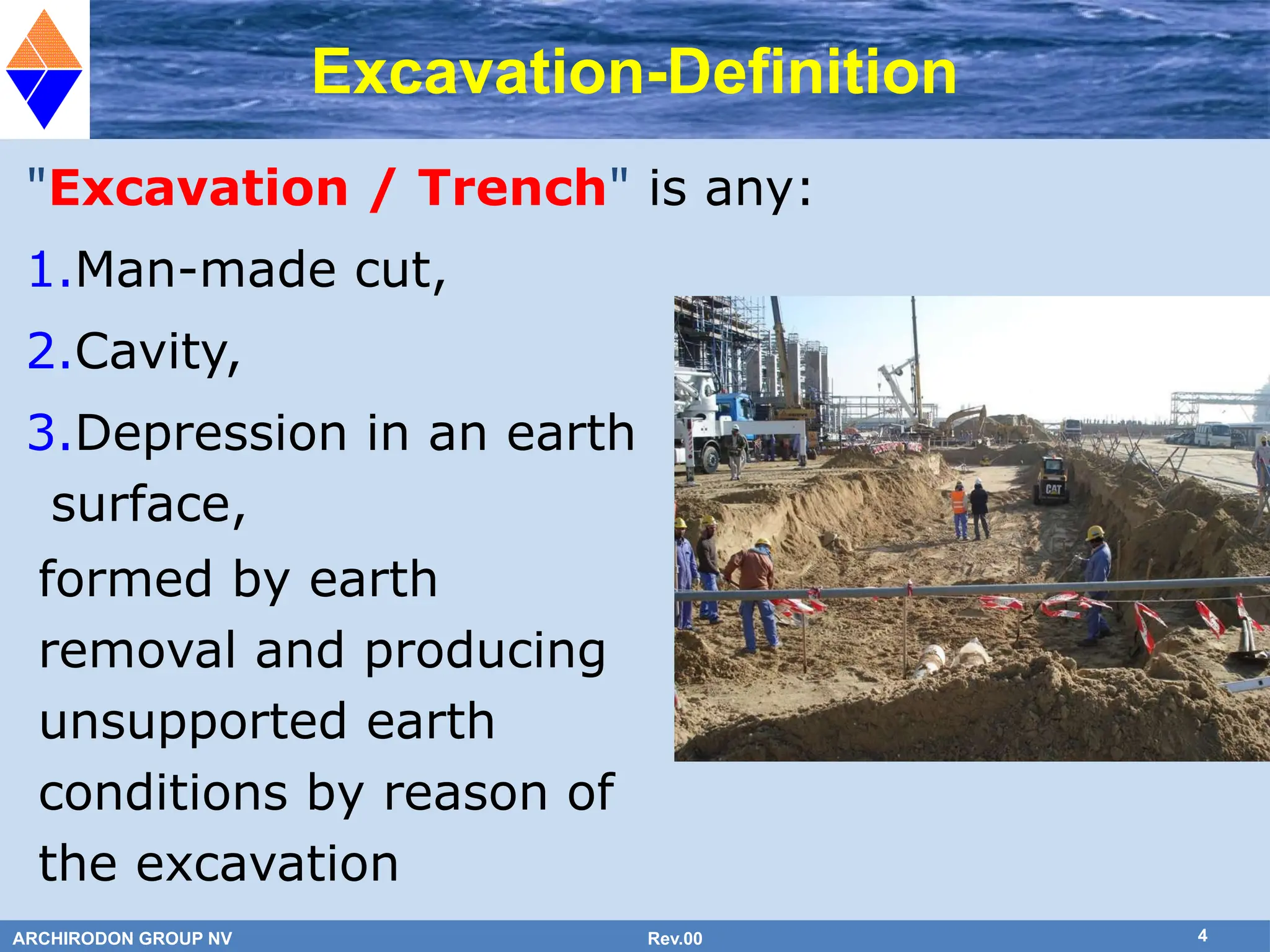
"Excavation / Trench" is any:
1.Man-made cut,
2.Cavity,
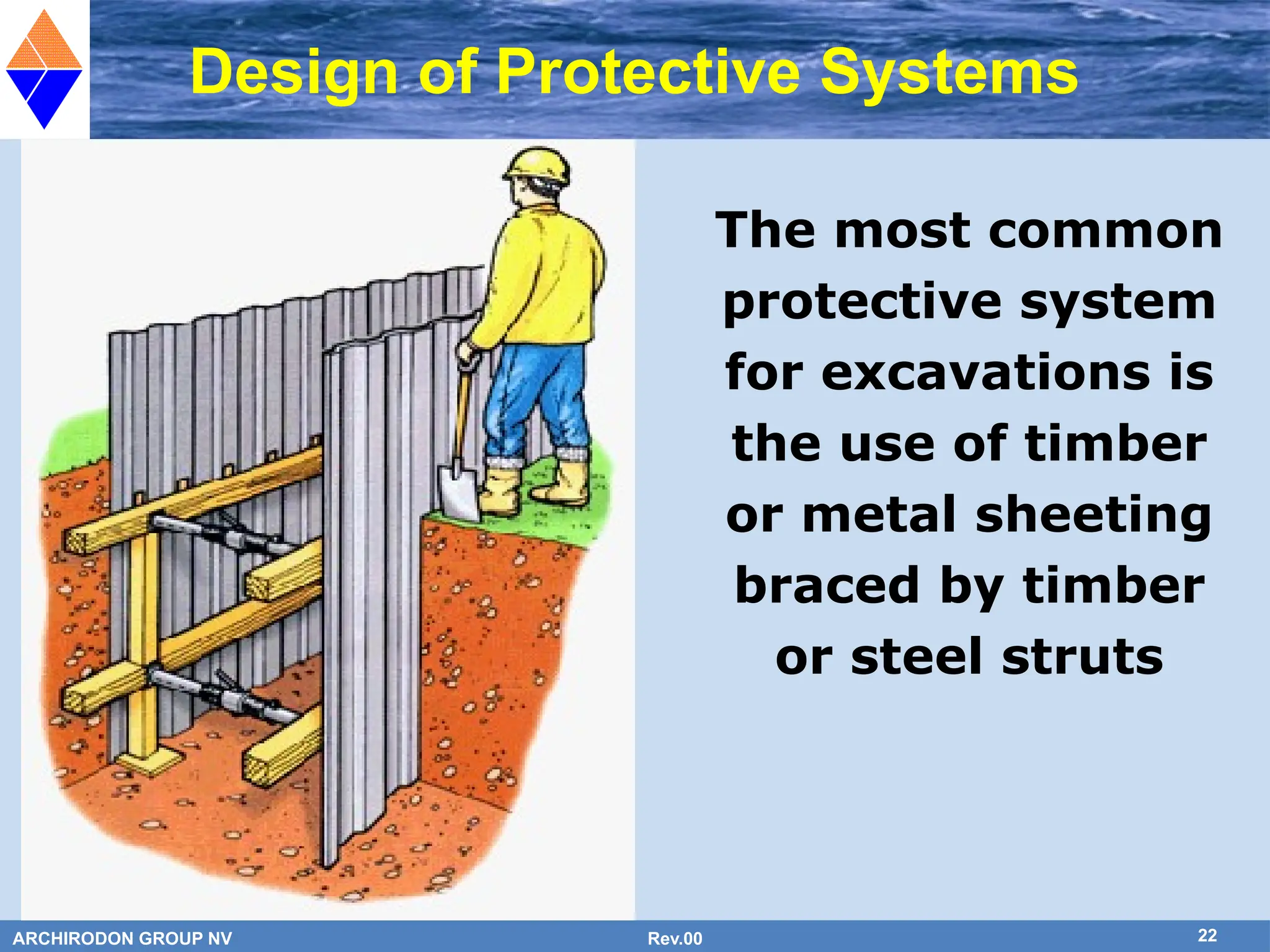
3.Depression in an earth
surface,
formed by earth
removal and producing
unsupported earth
conditions by reason of
the excavation
5
ARCHIRODON GROUP NV Rev.00 5
• Trench – a narrow excavation. The depth is
greater than the width, but not wider than 5
meters (15 feet).
• Shield - a structure able to withstand a cave-in
and protect employees
• Shoring - a structure that supports the sides of
an excavation and protects against cave-ins
• Sloping - a technique that employs a specific
angle of incline on the sides of the excavation.
The angle varies based on assessment of
impacting site factors.
Other Definitions
6
ARCHIRODON GROUP NV Rev.00 6
Collapse of the sides of the excavation
Contact with underground services
Falls of people or vehicles into excavation
Equipment or materials falling onto people within
excavations
Inert, Toxic or flammable vapours in excavation
Water inside the excavation
People being struck by machines
Access and egress to excavation
Vibration or Traffic close to the excavation
Collapse of adjacent structures
Excavation Hazards
7
ARCHIRODON GROUP NV Rev.00 7
8
ARCHIRODON GROUP NV Rev.00 8
The likelihood of the sides of
an excavation collapsing is
dependent upon the
characteristics of the soil or
rock
The following factors
increase the risk of collapse
of excavation sides:
Excavation Collapse
9
ARCHIRODON GROUP NV Rev.00 9
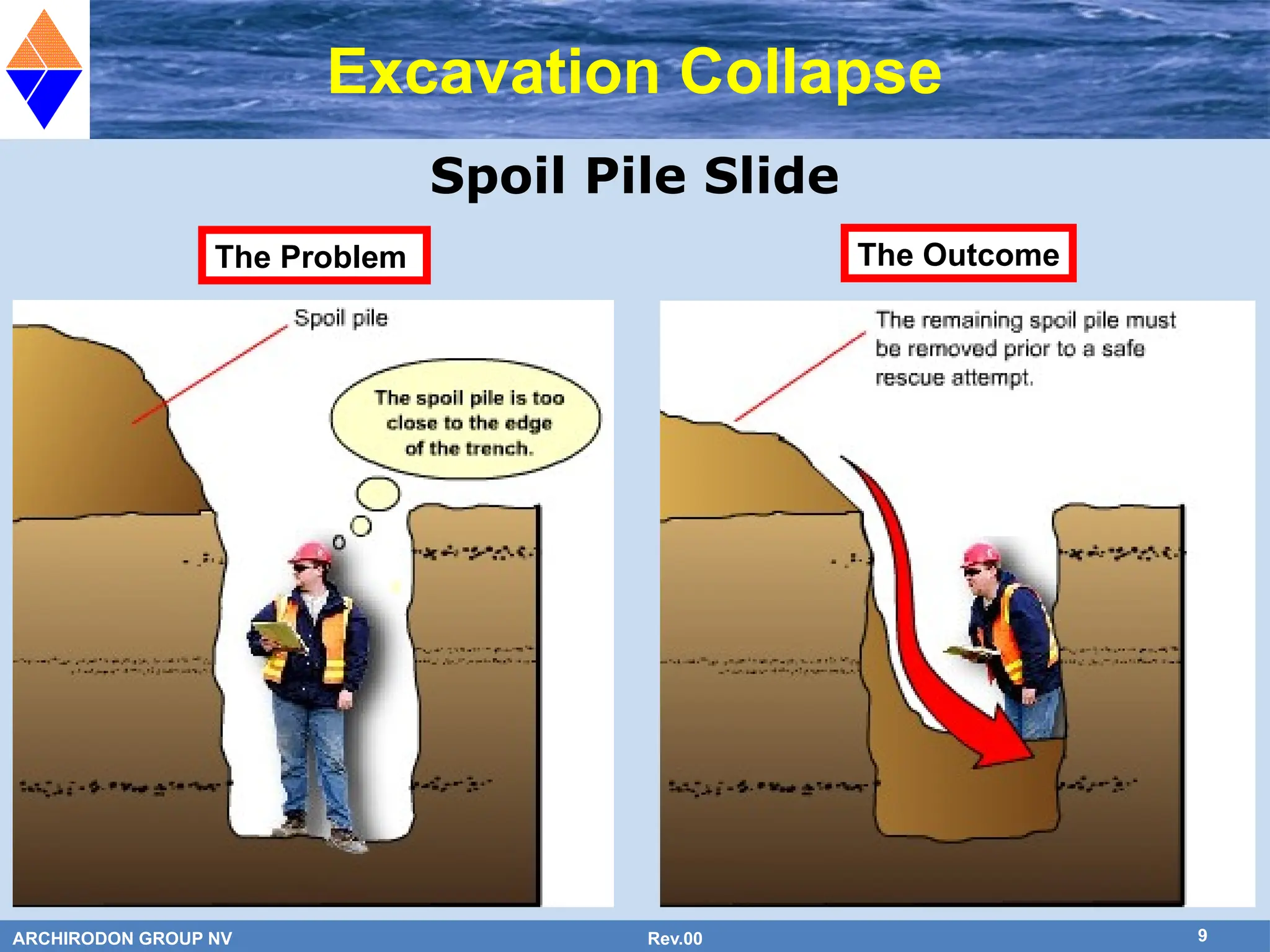
Spoil Pile Slide
The Problem The Outcome
Excavation Collapse
10
ARCHIRODON GROUP NV Rev.00 10
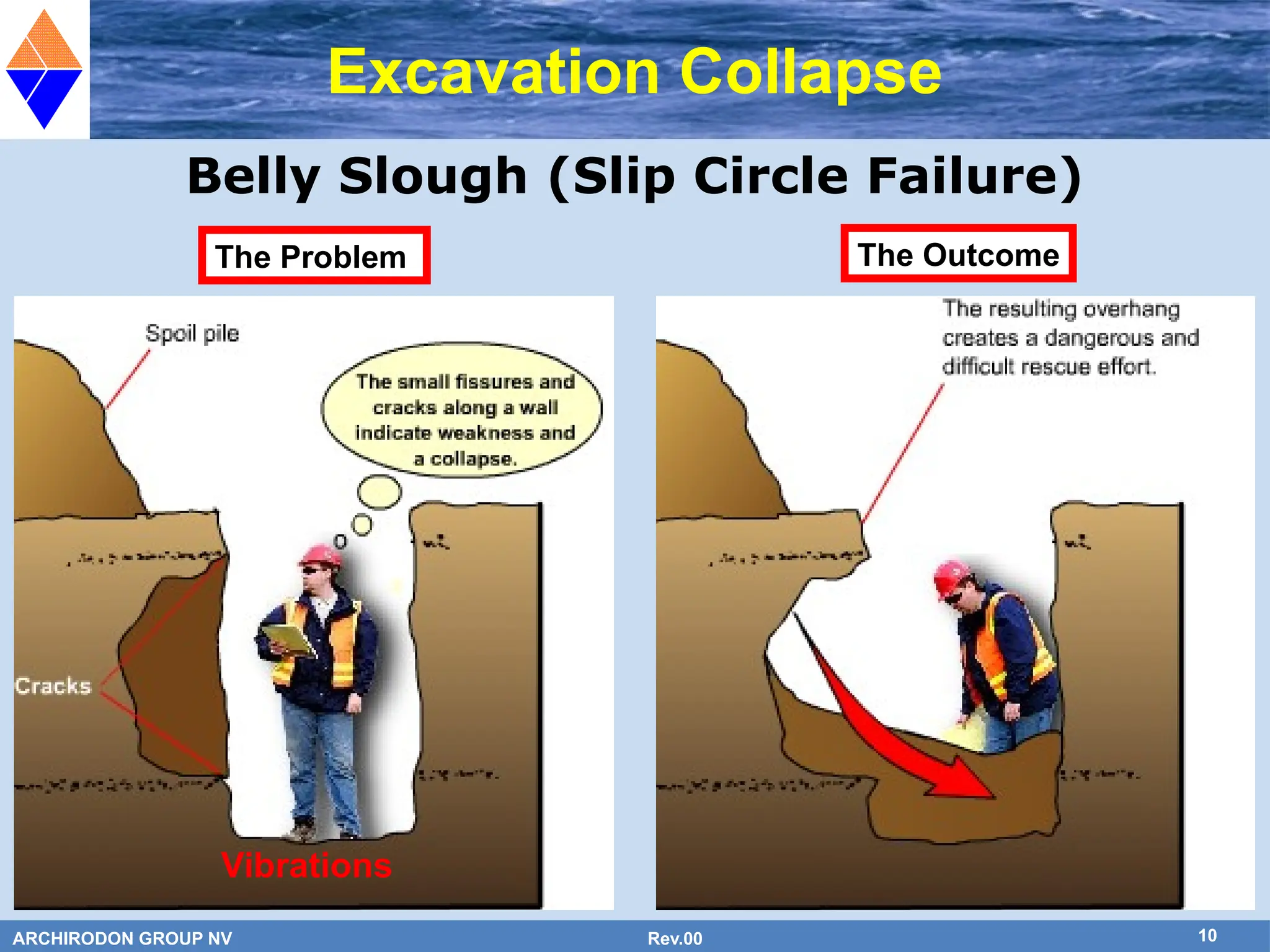
Belly Slough (Slip Circle Failure)
Vibrations
The Problem The Outcome
Excavation Collapse
11
ARCHIRODON GROUP NV Rev.00 11
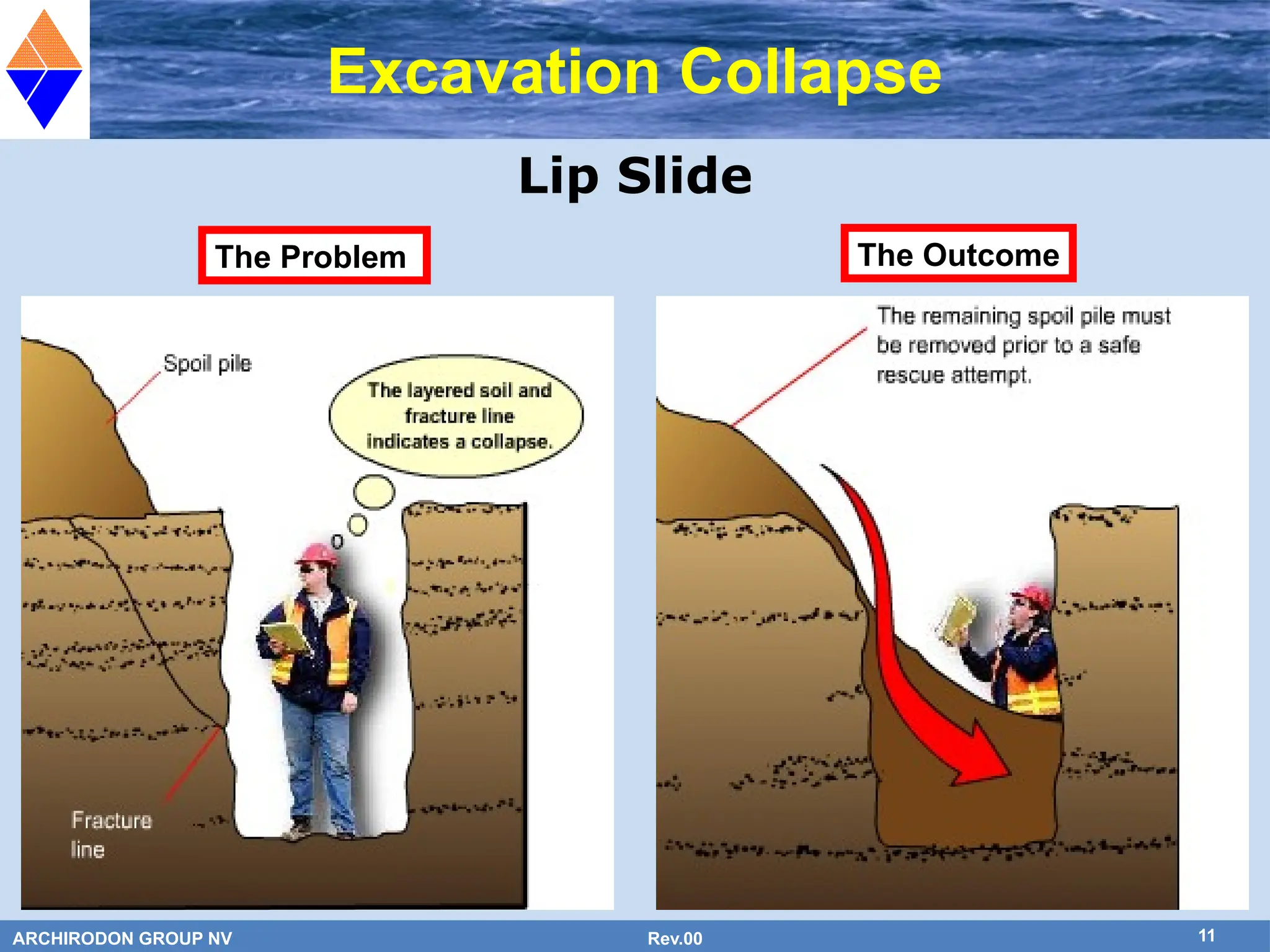
Lip Slide
The Problem The Outcome
Excavation Collapse
12
ARCHIRODON GROUP NV Rev.00 12
Loose, un-compacted, granular soils, i.e. sand
or gravel, or mixtures containing them
Excavations through different strata
The presence of groundwater, and the effect on
the excavation sides from surface water running
into the excavation
Made-up ground
Proximity to earlier excavations
Loose blocks of fractured rock
Excavation Collapse Factors
13
ARCHIRODON GROUP NV Rev.00 13
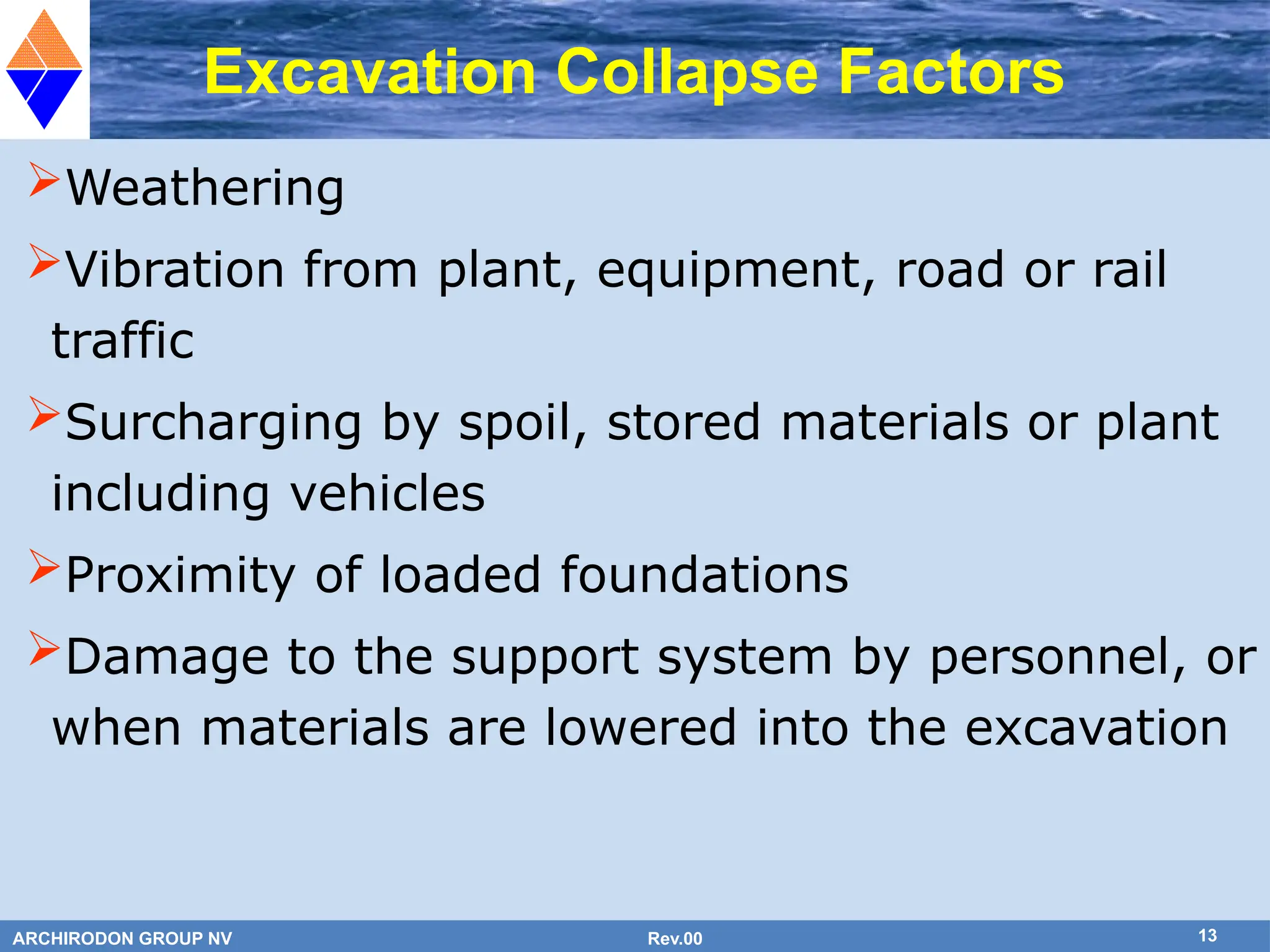
Weathering
Vibration from plant, equipment, road or rail
traffic
Surcharging by spoil, stored materials or plant
including vehicles
Proximity of loaded foundations
Damage to the support system by personnel, or
when materials are lowered into the excavation
Excavation Collapse Factors
14
ARCHIRODON GROUP NV Rev.00 14
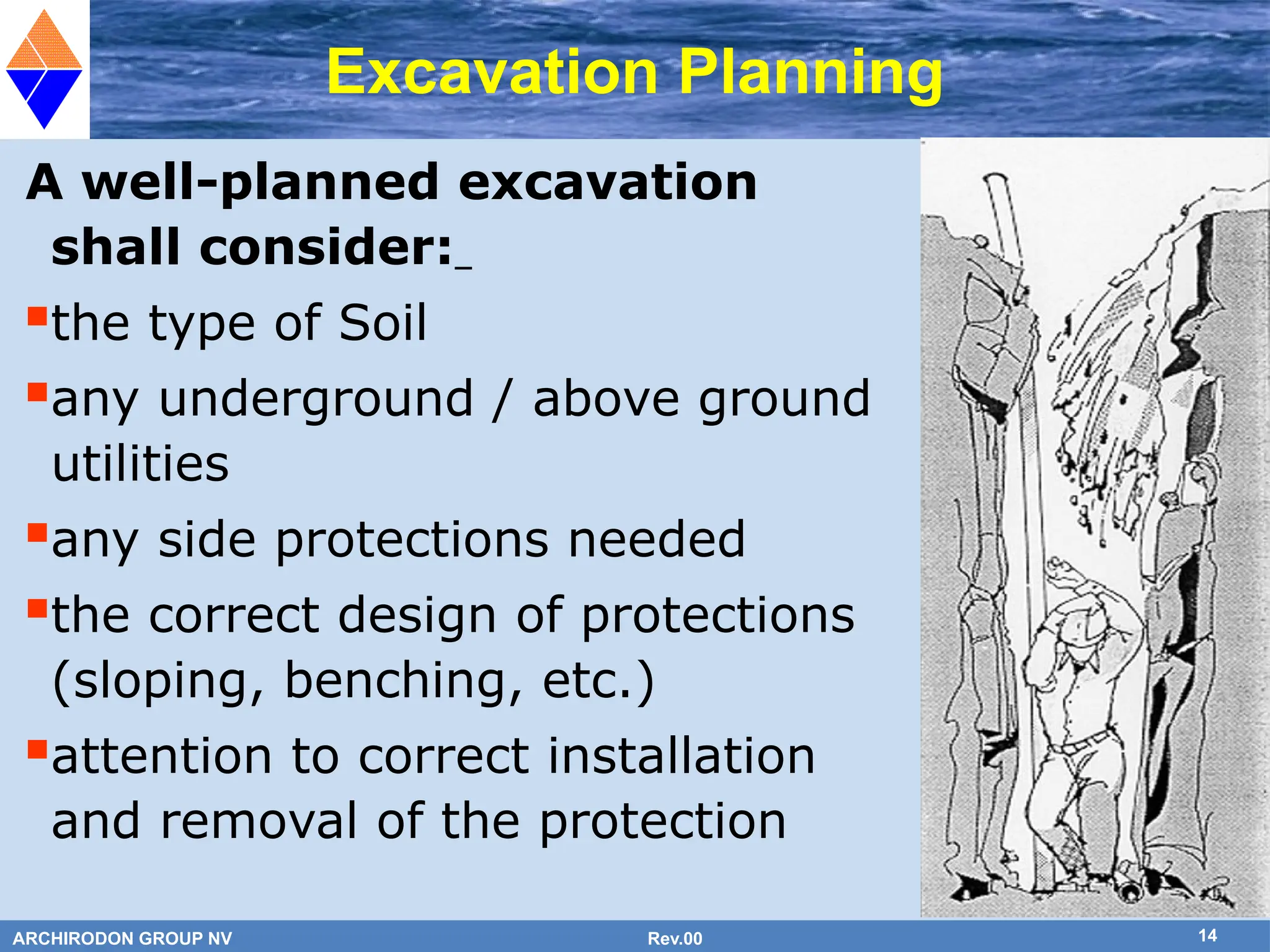
A well-planned excavation
shall consider:
the type of Soil
any underground / above ground
utilities
any side protections needed
the correct design of protections
(sloping, benching, etc.)
attention to correct installation
and removal of the protection
Excavation Planning
15
ARCHIRODON GROUP NV Rev.00 15
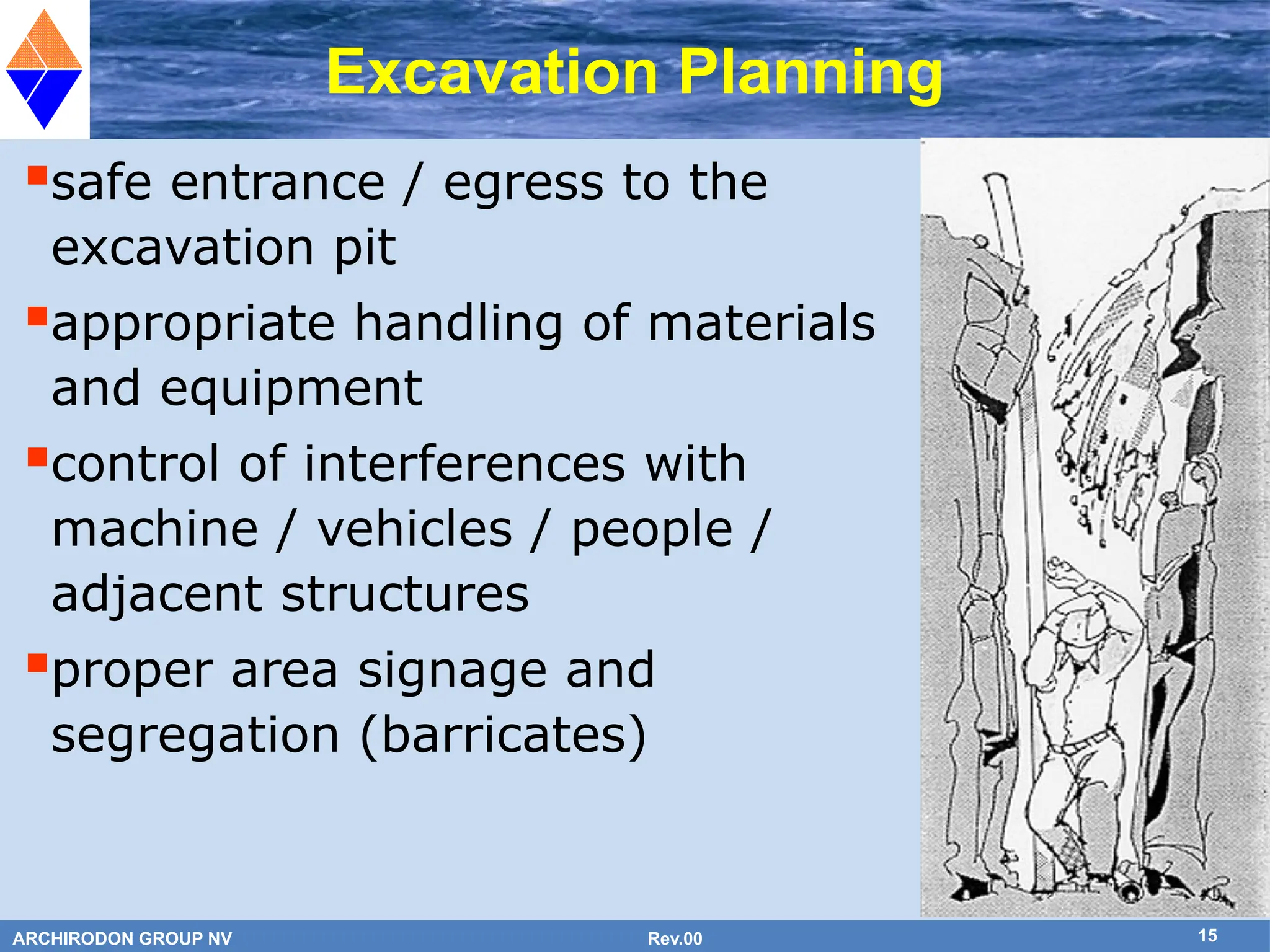
safe entrance / egress to the
excavation pit
appropriate handling of materials
and equipment
control of interferences with
machine / vehicles / people /
adjacent structures
proper area signage and
segregation (barricates)
Excavation Planning
16
ARCHIRODON GROUP NV Rev.00 16
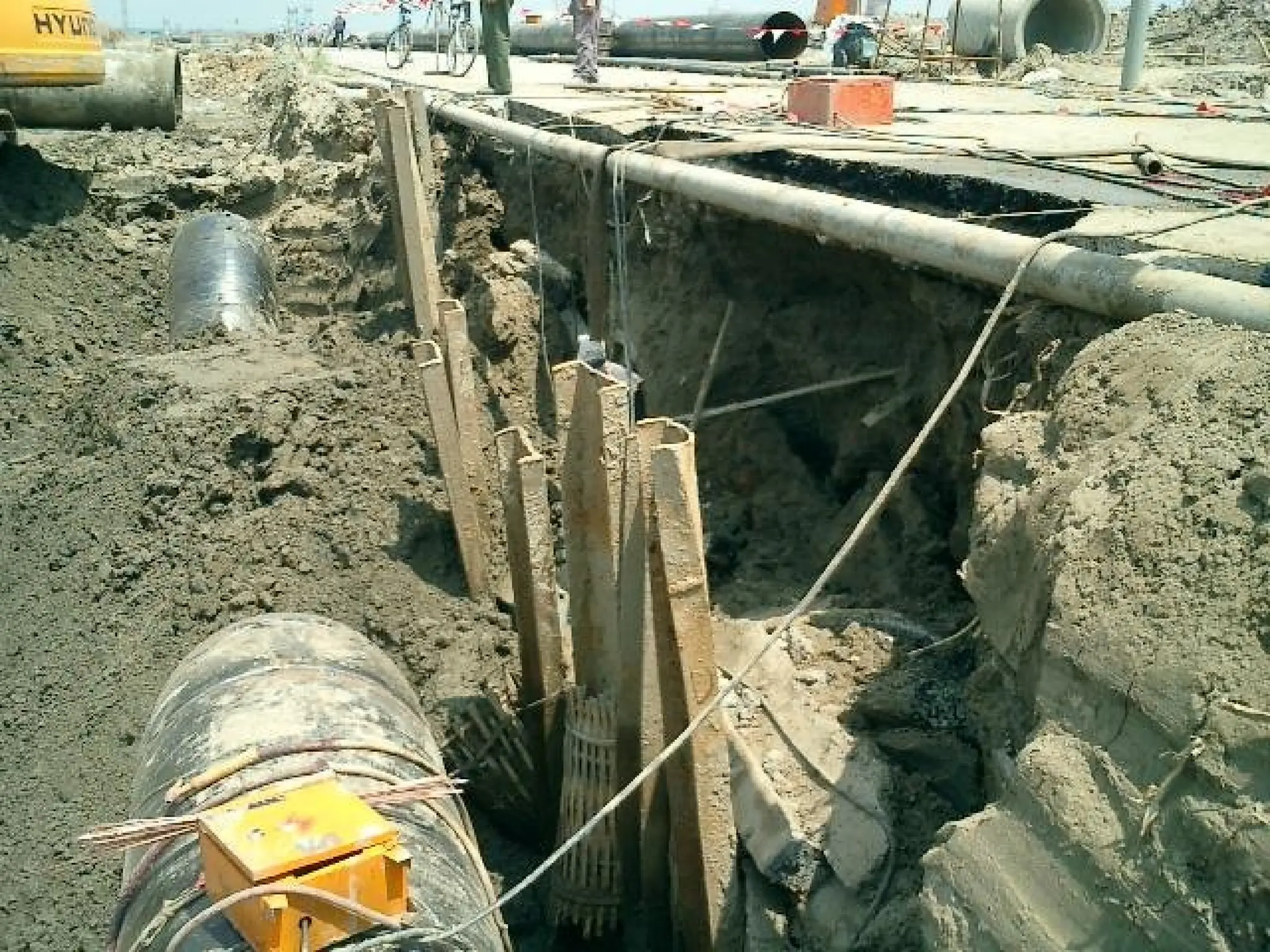
This excavation
has inadequate
support posts and
egress access
Inadequate protective system
Cave-in Hazard
17
ARCHIRODON GROUP NV Rev.00 17
Protection of Employees
Employees should be protected from cave-ins
by using an adequately designed protective
system
Protective systems must be able to resist all
expected loads to the system
Excavation Protection
18
ARCHIRODON GROUP NV Rev.00 18
A well-designed protective system
 Correct design of sloping and benching systems
 Correct design of support systems, shield systems, and
other protective systems
Plus
Appropriate handling of materials and equipment
Attention to correct installation and removal
Equals to
Protection of employees at excavations
Protective Systems
19
ARCHIRODON GROUP NV Rev.00 19
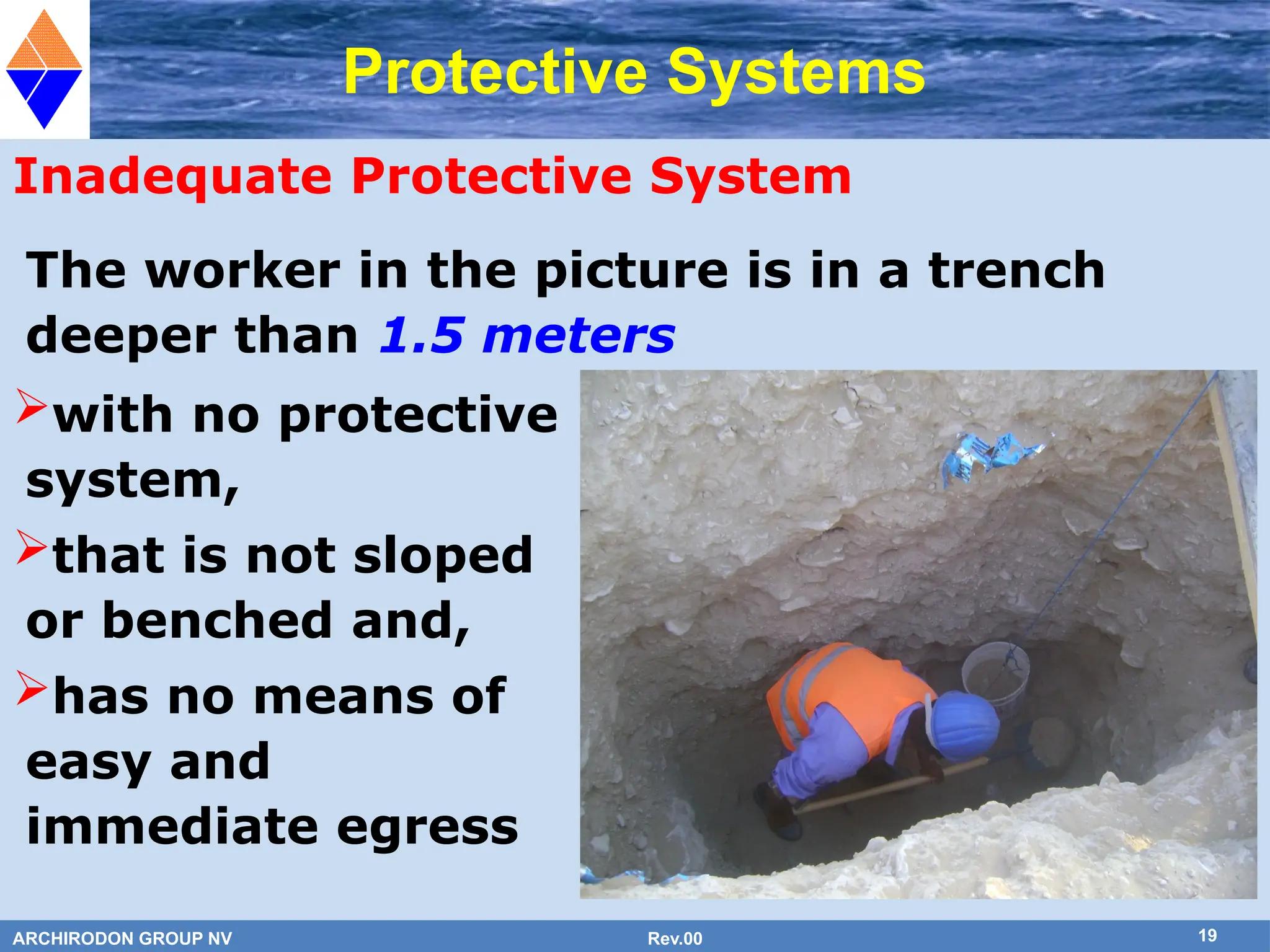
Inadequate Protective System
with no protective
system,
that is not sloped
or benched and,
has no means of
easy and
immediate egress
Protective Systems
The worker in the picture is in a trench
deeper than 1.5 meters
20
ARCHIRODON GROUP NV Rev.00 20
The construction department shall select and construct:
slopes and configurations of sloping and benching
systems
support systems, shield systems, and other
protective systems
• Shield - can be permanent or portable. Also known as
trench box or trench shield.
• Shoring - such as metal hydraulic, mechanical or timber
shoring system that supports the sides
• Sloping - form sides of an excavation that are inclined
away from the excavation
Design of Protective Systems
21
ARCHIRODON GROUP NV Rev.00 21
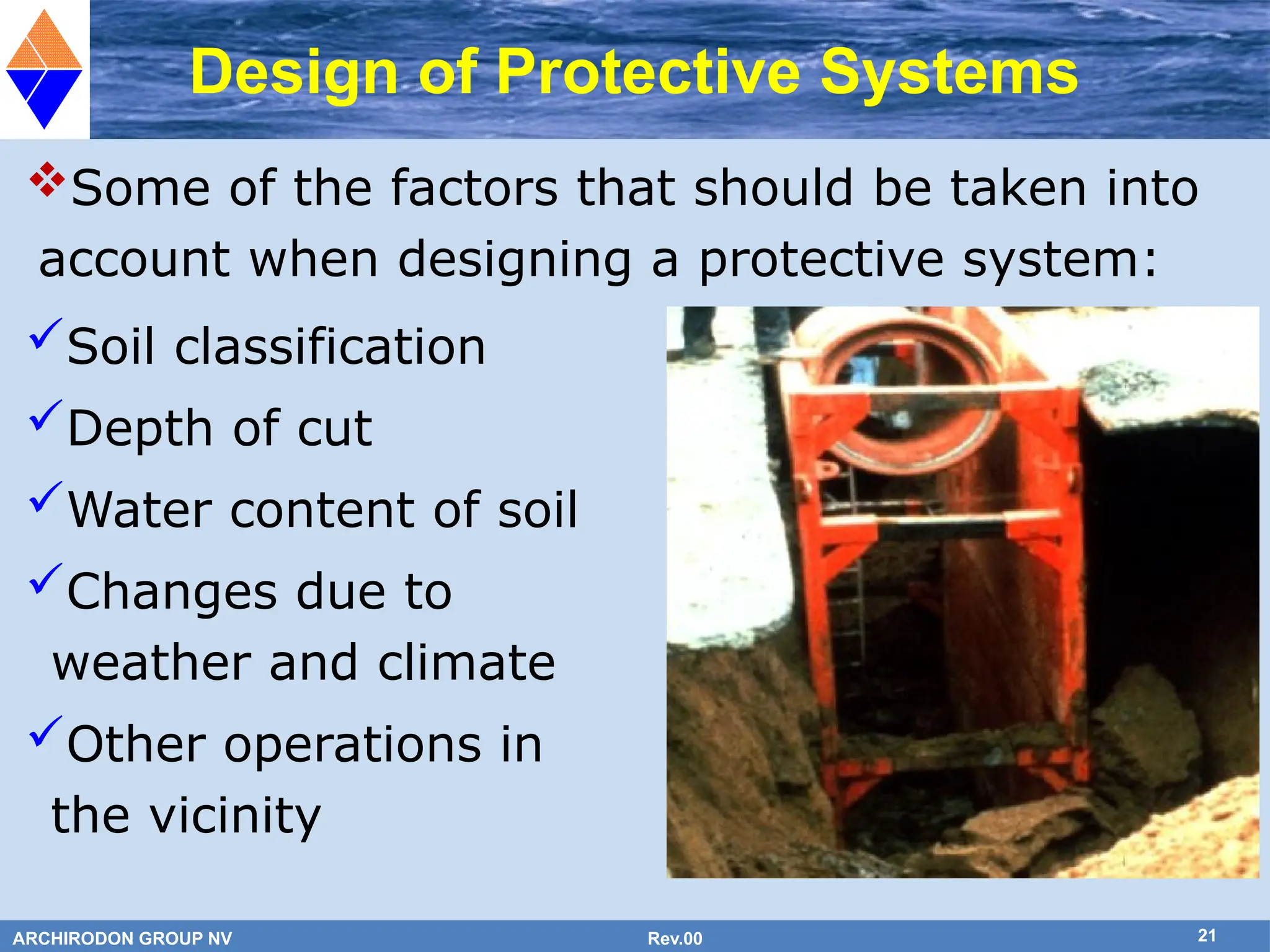
Some of the factors that should be taken into
account when designing a protective system:
Soil classification
Depth of cut
Water content of soil
Changes due to
weather and climate
Other operations in
the vicinity
Design of Protective Systems
22
ARCHIRODON GROUP NV Rev.00 22
The most common
protective system
for excavations is
the use of timber
or metal sheeting
braced by timber
or steel struts
Design of Protective Systems
23
ARCHIRODON GROUP NV Rev.00 23
Design of Protective Systems
24
ARCHIRODON GROUP NV Rev.00 24
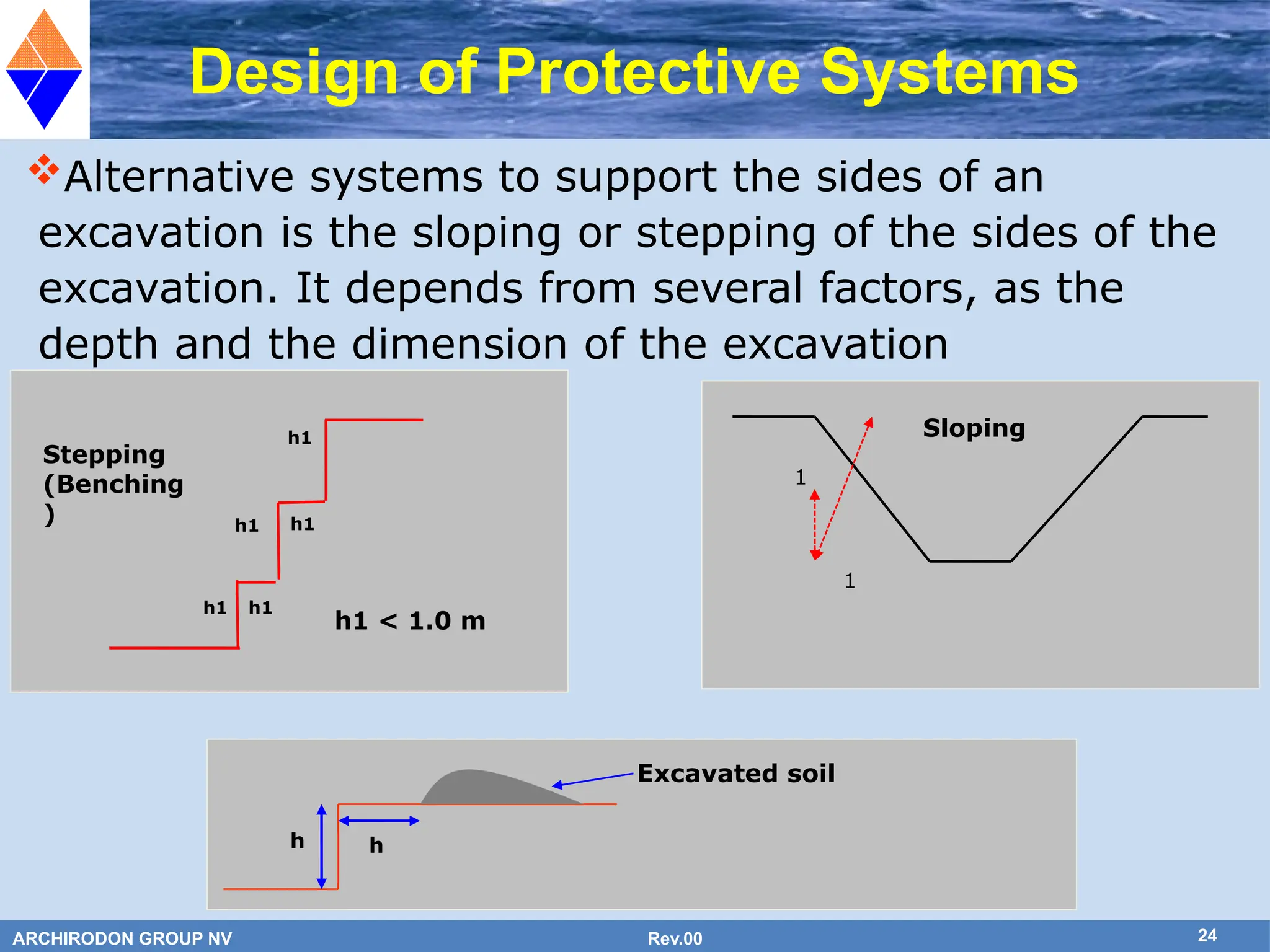
h h
h1
h1
h1 h1
h1
h1 < 1.0 m
Stepping
(Benching
)
Sloping
1
1
Excavated soil
Alternative systems to support the sides of an
excavation is the sloping or stepping of the sides of the
excavation. It depends from several factors, as the
depth and the dimension of the excavation
Design of Protective Systems
25
ARCHIRODON GROUP NV Rev.00 25
Methods of support can be:
• Battering back sides of excavation to suitable angle.
• Timber framing.
• Trench box.
• Drag box.
• Slide Rail System.
• Vertical Shore.
• Waler Frames.
• Light Duty Bracing.
• Heavy Duty Bracing.
• Hydraulic / Mechanical
Struts.
Design of Protective Systems
26
ARCHIRODON GROUP NV Rev.00 26
Underground Hazards
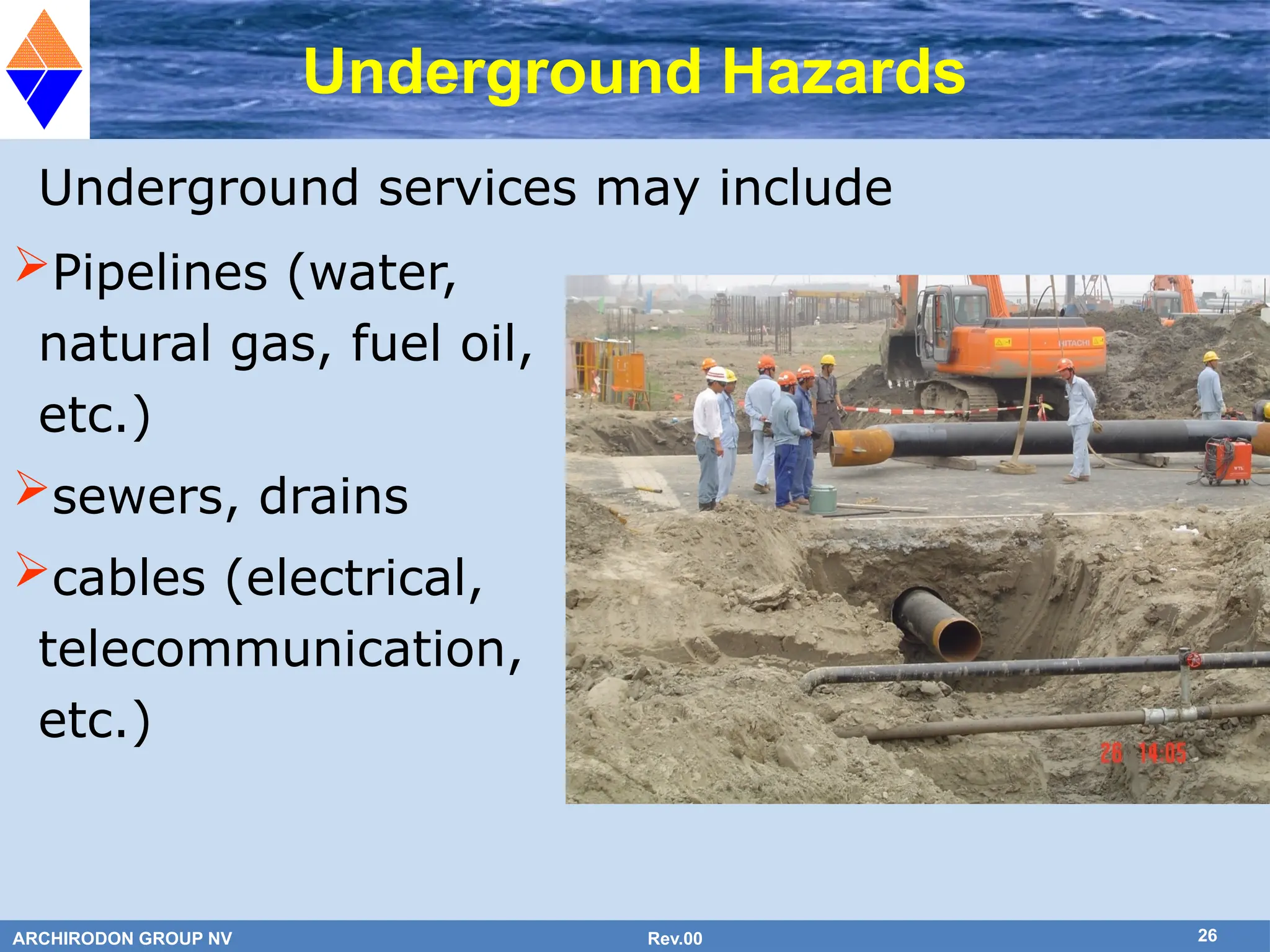
Underground services may include
Pipelines (water,
natural gas, fuel oil,
etc.)
sewers, drains
cables (electrical,
telecommunication,
etc.)
27
ARCHIRODON GROUP NV Rev.00 27
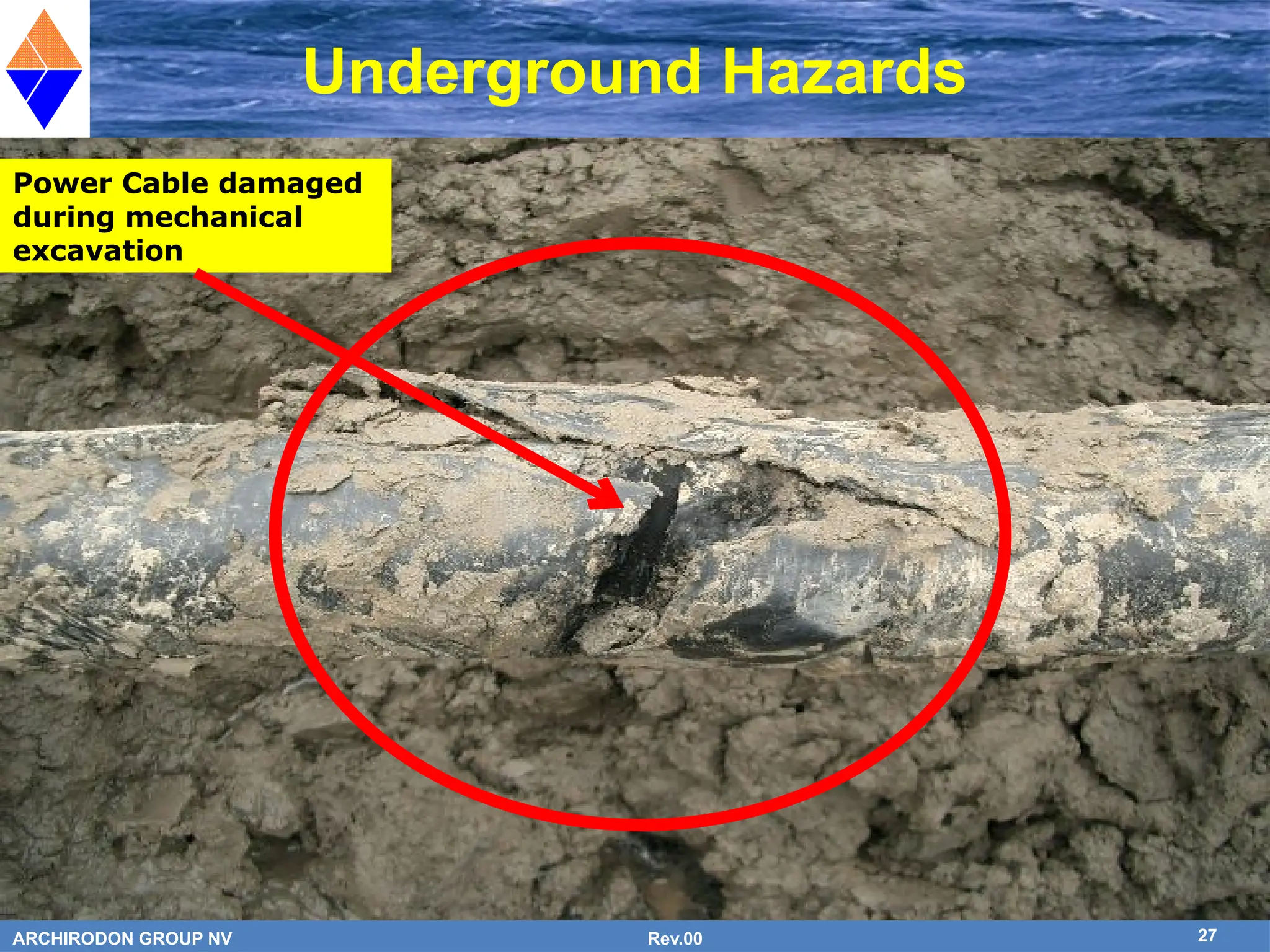
Power Cable damaged
during mechanical
excavation
Underground Hazards
28
ARCHIRODON GROUP NV Rev.00 28
Underground Hazards
An operator was using a post hole
digger to excavate without calling the local
authorities to locate the underground
utilities and obtain the necessary permit.
While excavating he hit an underground,
high-pressure cross country gas pipe,
causing an explosion.
Incident
29
ARCHIRODON GROUP NV Rev.00 29
30
ARCHIRODON GROUP NV Rev.00 30
Excavation area
Nearby houses
31
ARCHIRODON GROUP NV Rev.00 31
32
ARCHIRODON GROUP NV Rev.00 32
33
ARCHIRODON GROUP NV Rev.00 33
They never did
find the operator…
Took out 2
homes…
34
ARCHIRODON GROUP NV Rev.00 34
Before starting an excavation the following steps must
be taken:
1. identify ALL underground services based on valid
and updated drawings
2. service-locating devices should be used to assist for
the exact identification of the position of the
underground services
3. identified underground services must be isolated and
de-energized where reasonably practicable
4. a Permit To Work must be prepared and issued for
the specific excavation
5. exploration trenching
Underground Hazards
35
ARCHIRODON GROUP NV Rev.00 35
Aboveground Hazards
Similar with the underground hazards, aboveground
hazards should be identified and controlled (eliminated
or minimized)
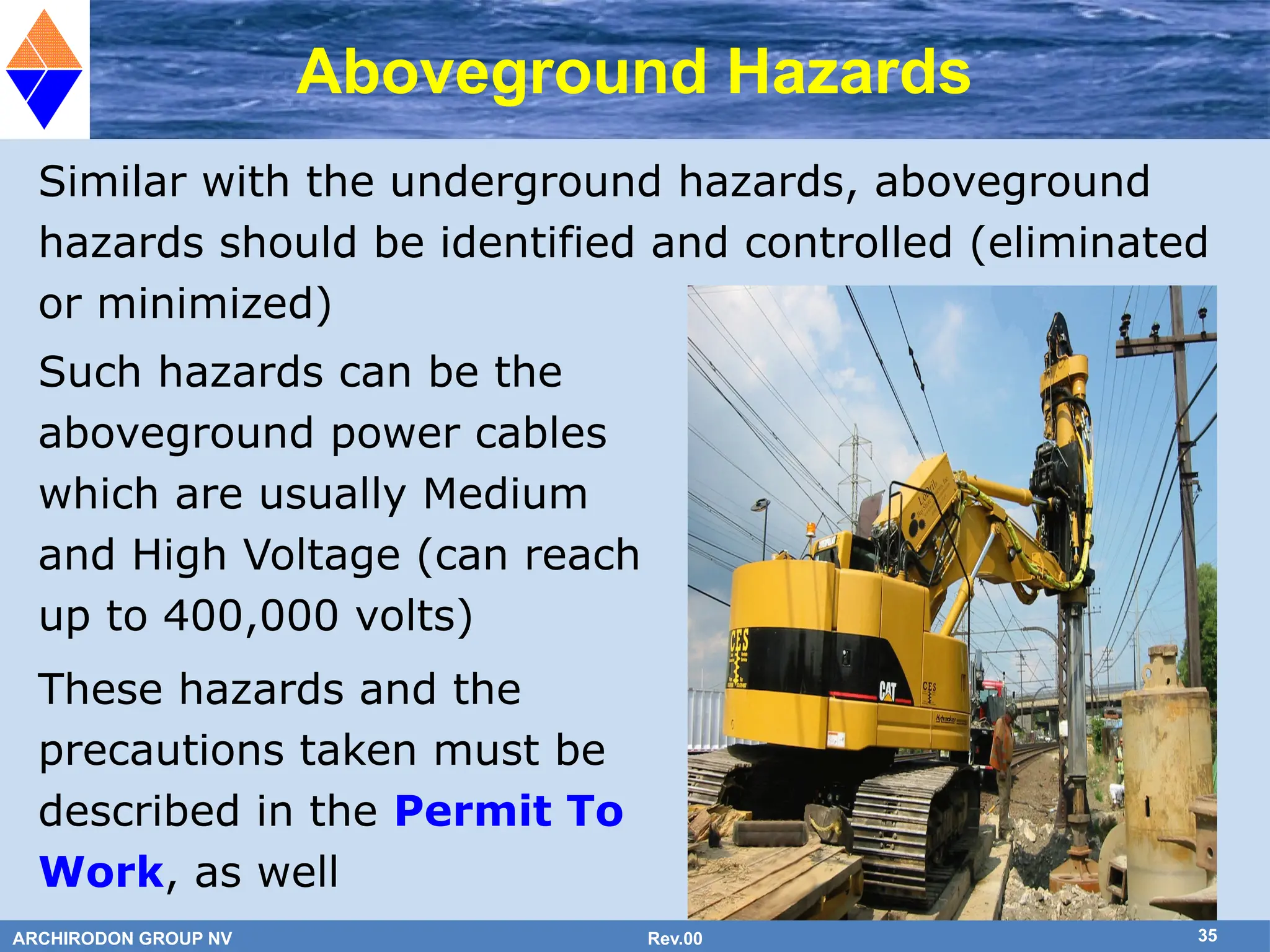
Such hazards can be the
aboveground power cables
which are usually Medium
and High Voltage (can reach
up to 400,000 volts)
These hazards and the
precautions taken must be
described in the Permit To
Work, as well
36
ARCHIRODON GROUP NV Rev.00 36
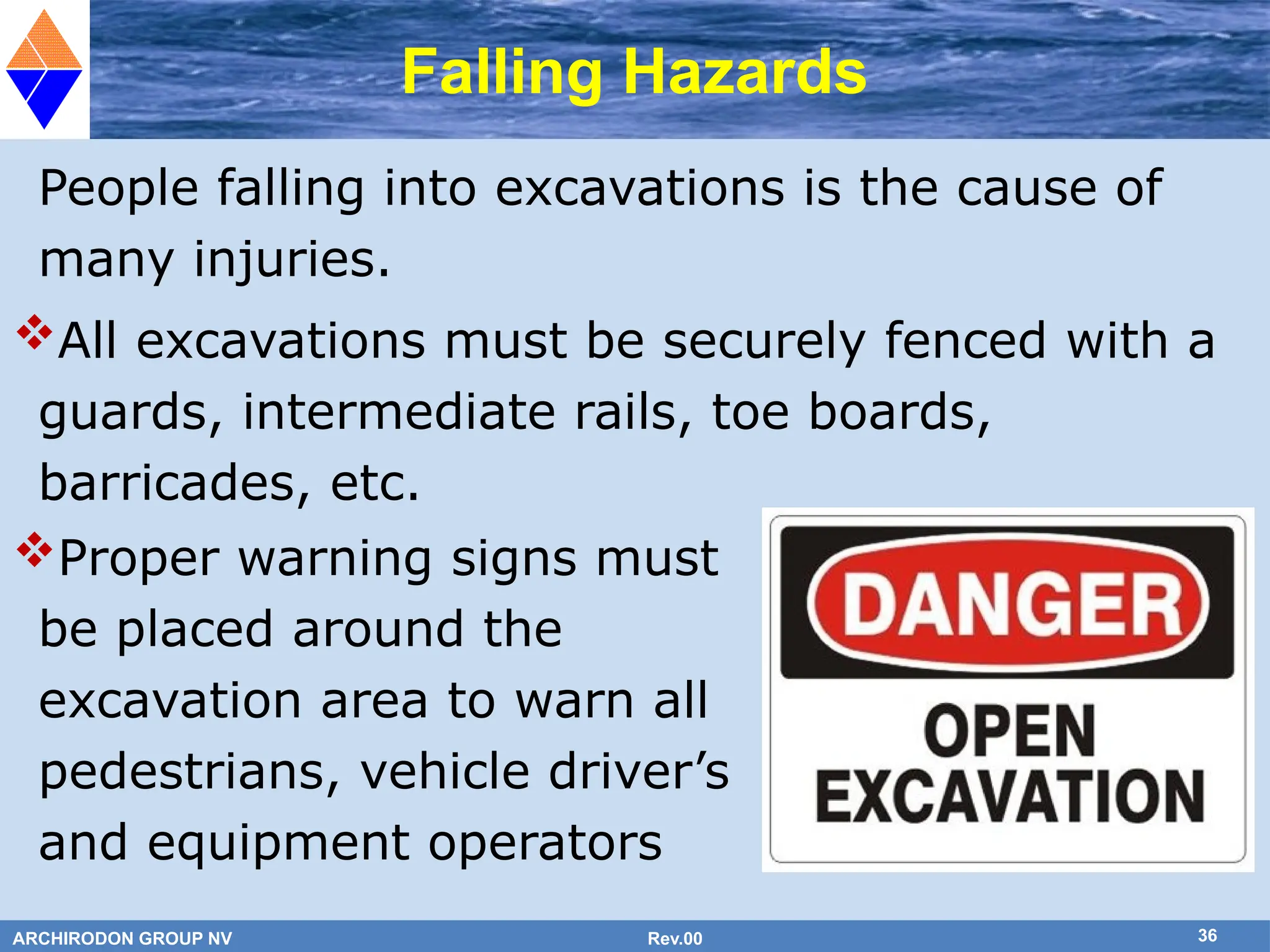
People falling into excavations is the cause of
many injuries.
All excavations must be securely fenced with a
guards, intermediate rails, toe boards,
barricades, etc.
Falling Hazards
Proper warning signs must
be placed around the
excavation area to warn all
pedestrians, vehicle driver’s
and equipment operators
37
ARCHIRODON GROUP NV Rev.00 37
38
ARCHIRODON GROUP NV Rev.00 38
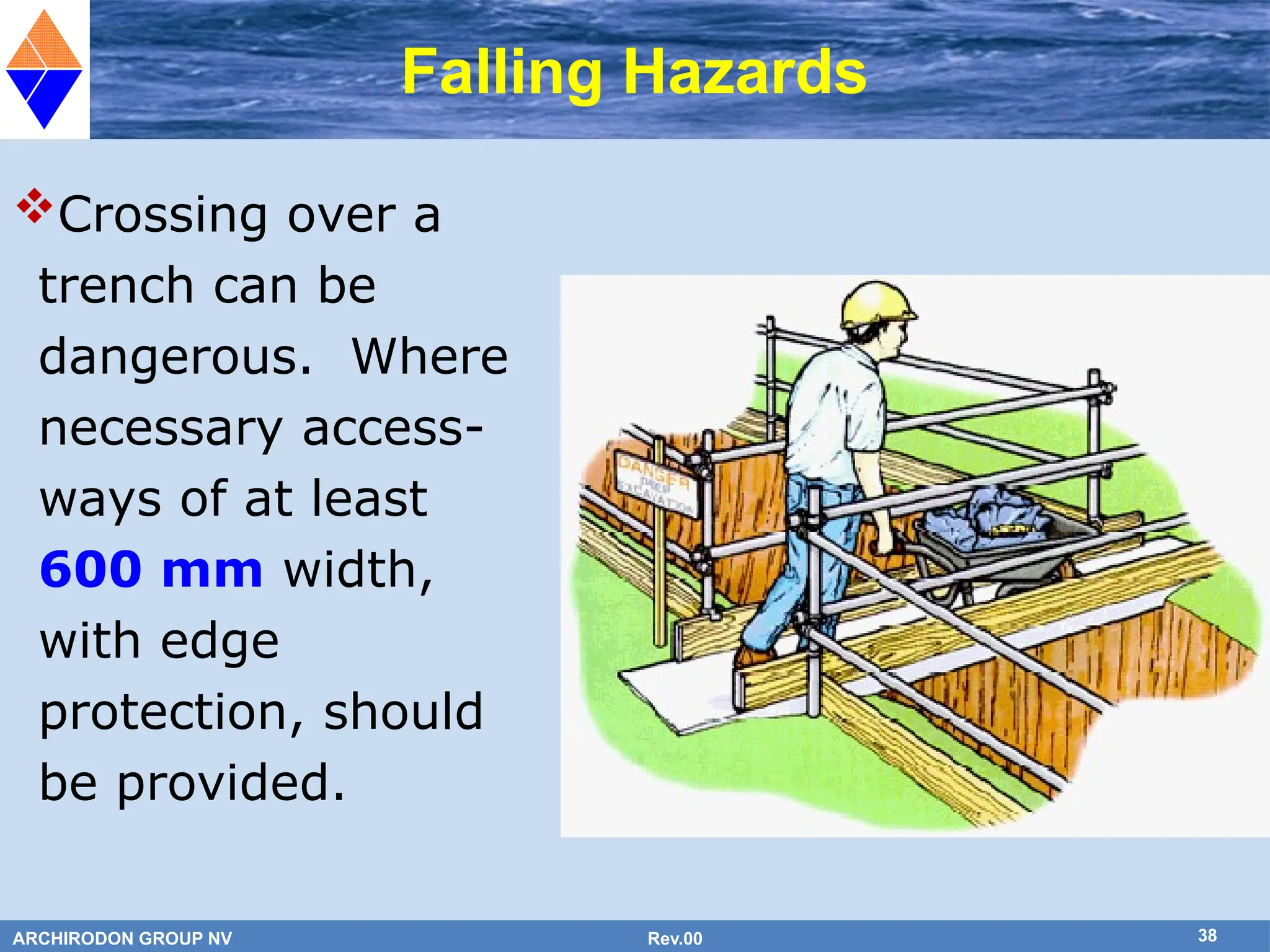
Crossing over a
trench can be
dangerous. Where
necessary access-
ways of at least
600 mm width,
with edge
protection, should
be provided.
Falling Hazards
39
ARCHIRODON GROUP NV Rev.00 39
Falling Hazards
×
40
ARCHIRODON GROUP NV Rev.00 40
4
0
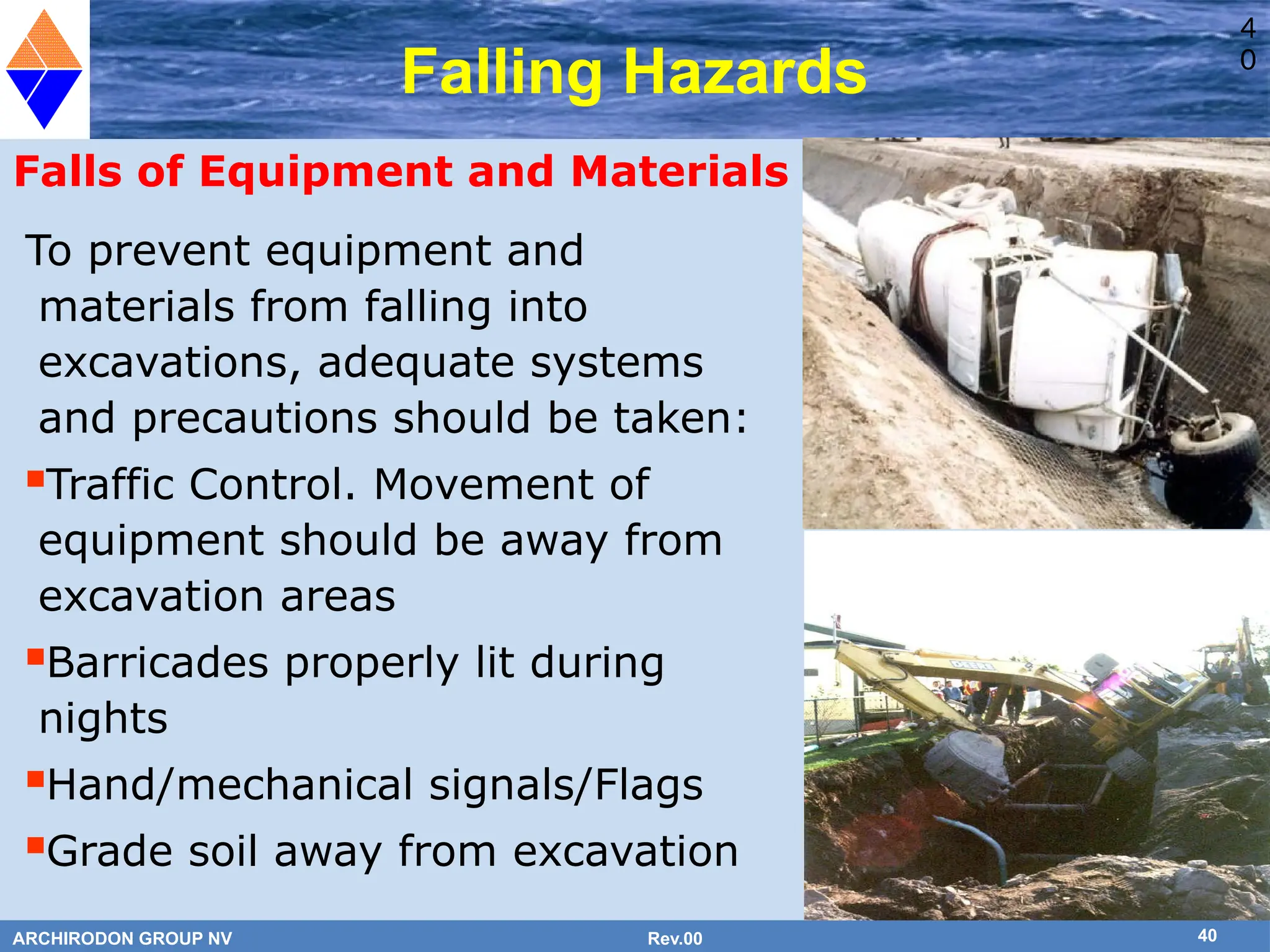
Falls of Equipment and Materials
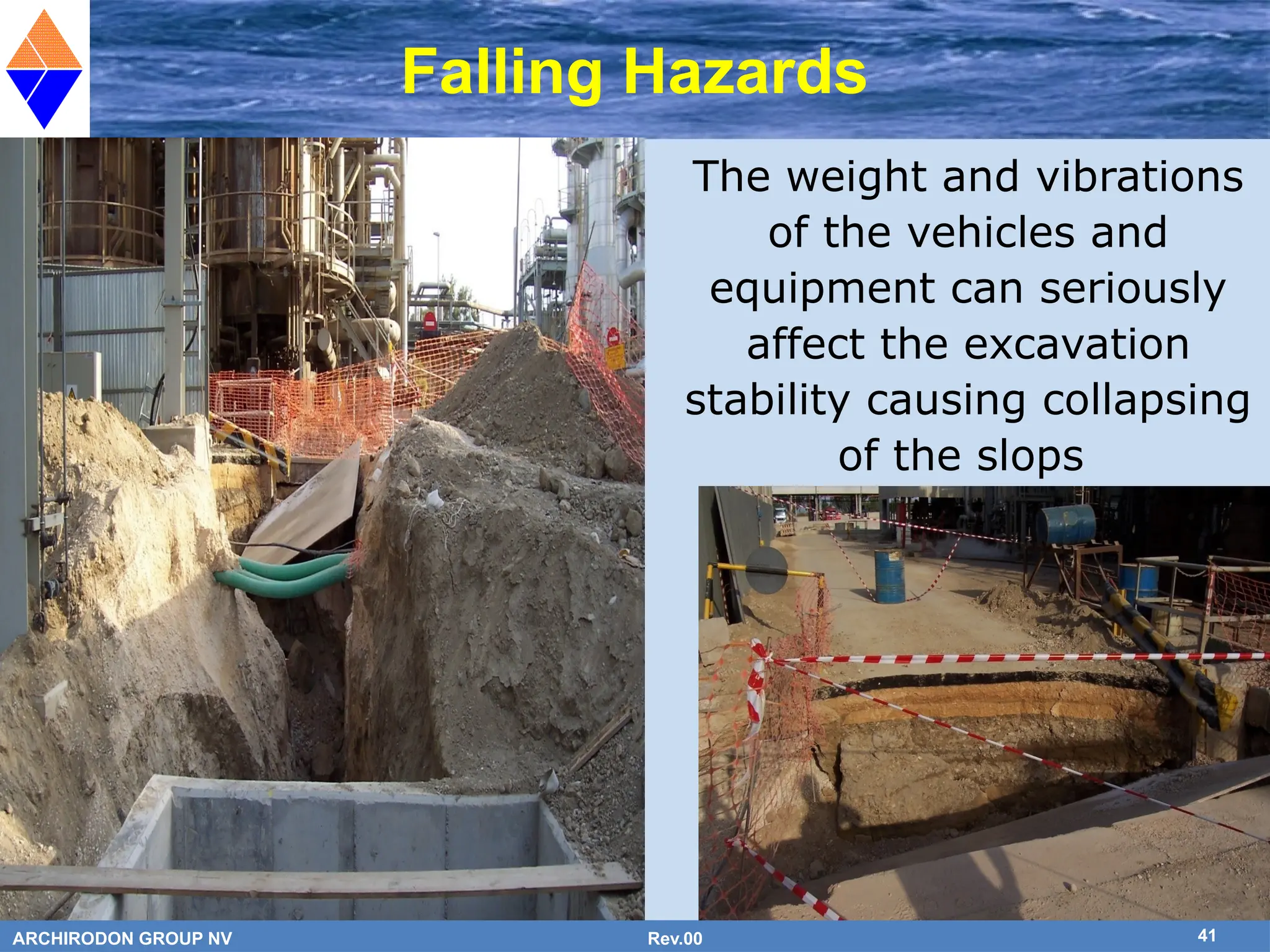
To prevent equipment and
materials from falling into
excavations, adequate systems
and precautions should be taken:
Traffic Control. Movement of
equipment should be away from
excavation areas
Barricades properly lit during
nights
Hand/mechanical signals/Flags
Grade soil away from excavation
Falling Hazards
41
ARCHIRODON GROUP NV Rev.00 41
The weight and vibrations
of the vehicles and
equipment can seriously
affect the excavation
stability causing collapsing
of the slops
Falling Hazards
42
ARCHIRODON GROUP NV Rev.00 42
43
ARCHIRODON GROUP NV Rev.00 43
Where people have to enter excavations to
carry out work consideration should be given to
the potential presence, within excavations, of
fumes, which can cause asphyxiation and/or
poisoning.
Work in excavations should be treated as work
in a confined space and the precautions
defined in confined space Safety Practice should
be complied with, where applicable.
Atmosphere Hazards
44
ARCHIRODON GROUP NV Rev.00 44
 Oxygen deficiency
 High combustible gas
concentration (i.e. HC, etc.)
 High levels of other hazardous
substances (i.e. H2S, CO, etc.)
Test excavations more than 1.2m before
an employee enters the excavation for:
Atmosphere Hazards
If any of above elements is
present, then proper
precautions should be taken
(that may include ventilation,
etc.)
45
ARCHIRODON GROUP NV Rev.00 45
There are occasions when excavation plant
(e.g. diggers /backhoes) and lifting equipment
has to be used. Such equipment can create:
additional risks from surcharging ,
damage to the supporting structure
injuries to people within the excavation
being struck by the excavating equipment or the
load being lifted over the excavation area
Struck-by Hazards
46
ARCHIRODON GROUP NV Rev.00 46
The planning of such work should identify
where the plant is to be located to minimise:
the risk of surcharging
the risk of falling into the excavation especially
if the sides of the excavation collapse under the
weight of the plant and equipment
Struck-by Hazards
47
ARCHIRODON GROUP NV Rev.00 47
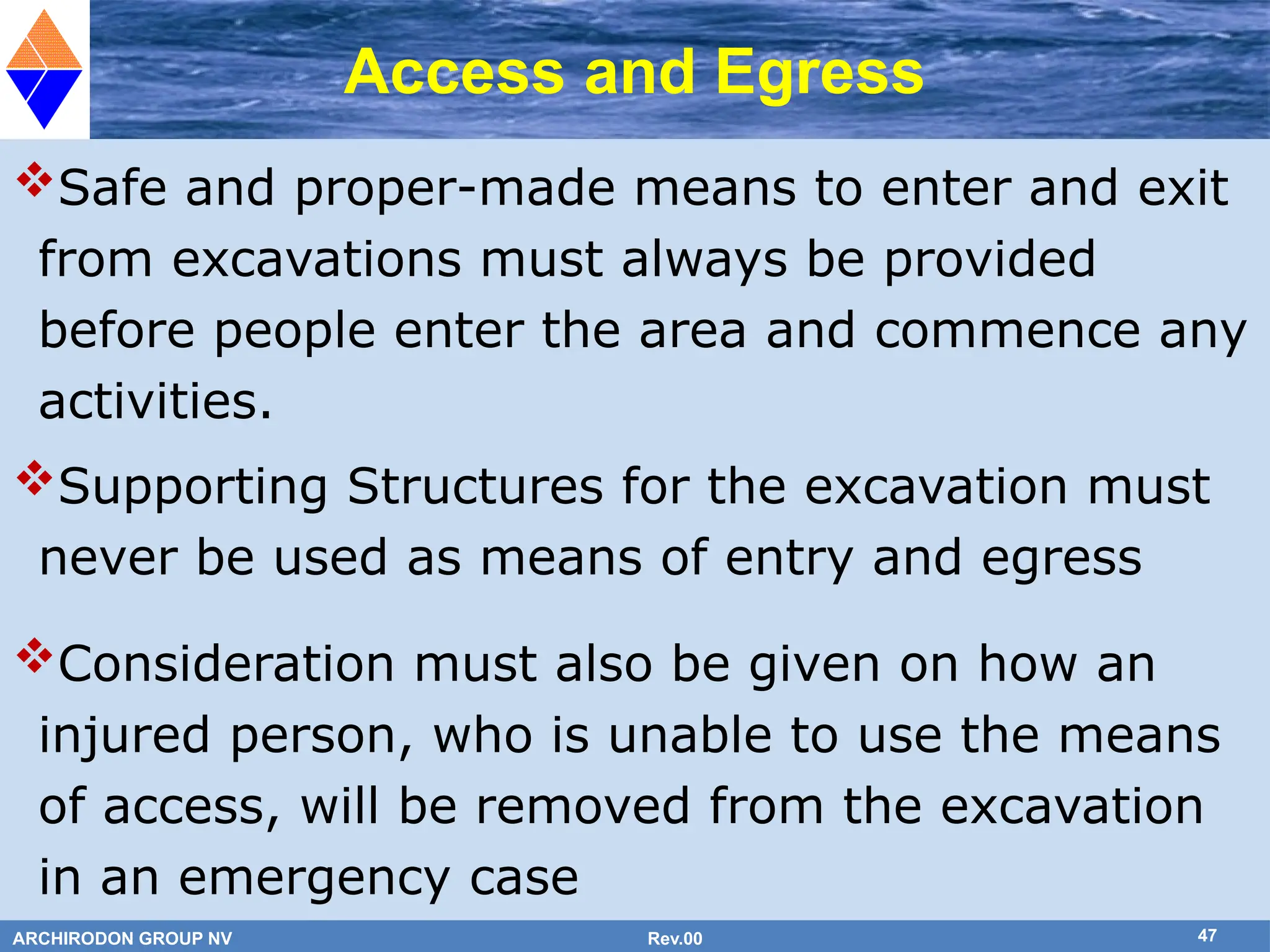
Safe and proper-made means to enter and exit
from excavations must always be provided
before people enter the area and commence any
activities.
Supporting Structures for the excavation must
never be used as means of entry and egress
Access and Egress
Consideration must also be given on how an
injured person, who is unable to use the means
of access, will be removed from the excavation
in an emergency case
48
ARCHIRODON GROUP NV Rev.00 48
Access and Egress
49
ARCHIRODON GROUP NV Rev.00 49
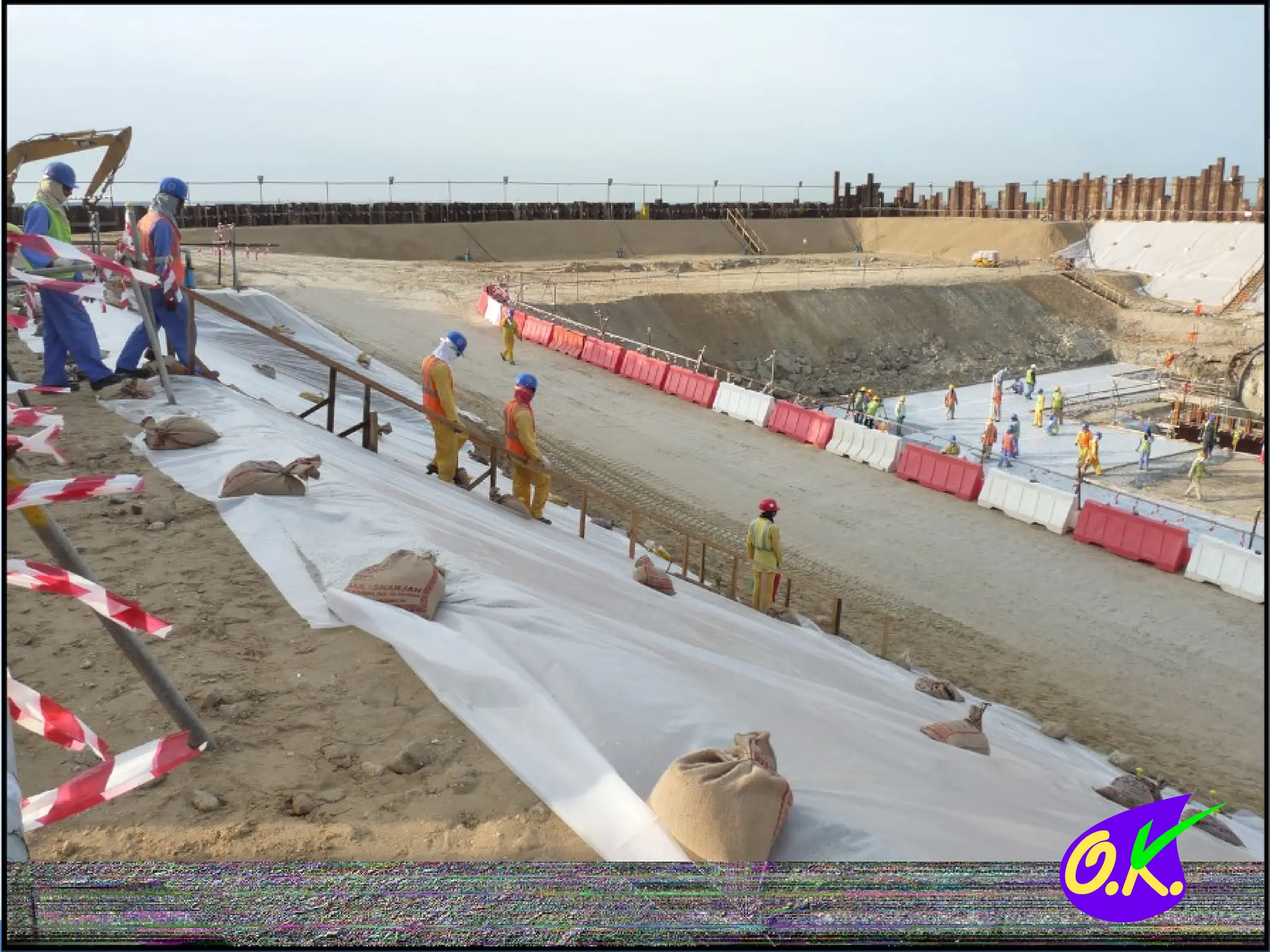
Means of Access & Egress that can be provided:
Cerified Ladders
Ramps
Stairs
Certified scaffolding
Some of the rules that must be followed when setting
the means of access & egress
height to base ratio of 4:1
be securely lashed
maintain three-point contact
means of getting tools and equipment into and out of
the excavation
Access and Egress
50
ARCHIRODON GROUP NV Rev.00 50
Access and Egress
×
51
ARCHIRODON GROUP NV Rev.00 51
Water = Cave-in Hazard
These workers must be protected from cave-in. Note the water in the
bottom of the trench. This is an hazardous condition!
DO
NOT
ENTER !!!
Water Accumulation Hazard
52
ARCHIRODON GROUP NV Rev.00 52
Whenever an excavation is
to be carried out close to:
services
existing buildings
structures and scaffolding,
care should be taken to
ensure that the services or
foundations are not
disturbed or undermined.
Collapse of Adjacent Structures
53
ARCHIRODON GROUP NV Rev.00 53
Hazard assessment of the work site completed
by competent person.
A Permit To Work must be issued before the
commencement of any work
All underground hazards, eg. pipelines, electric
cables, etc. must be identified, isolated and
protected. Lockout – Tagout process must be
implemented. Special remark should be made in
the PTW
Safety Tips - Summary
54
ARCHIRODON GROUP NV Rev.00 54
A confined space PTW must be issued if the
entry meets the definition
Adequate precautions should be taken to
ensure safety of the people working in and
adjacent to the excavation
Ground movement must be controlled and
collapse prevented by systematically shoring,
sloping, benching etc. as appropriate
Adequate access and egress structures must
be in place
Safety Tips - Summary
55
ARCHIRODON GROUP NV Rev.00 55
Interference beetween workers and machines
shall be minimised, as well the precense of
workers inside the excavation
Excavation shall be barricated, materials shall
be stocked away from the edge, proper
access/egress to be ensured
Ground and environment conditions must be
continuously monitored for change
Protected sharp steel bar ends
Safety Tips - Summary
56
ARCHIRODON GROUP NV Rev.00 56
FOLLOW ALL
SAFETY RULES
AND
PRECAUTIONS
IF YOU WANT TO
AVOID…
57
ARCHIRODON GROUP NV Rev.00 57
58
ARCHIRODON GROUP NV Rev.00 58
59
ARCHIRODON GROUP NV Rev.00 59
60
ARCHIRODON GROUP NV Rev.00 60
RESTRICTED AREAS – DANGER DO NOT ENTER
!!!
REMIND THAT EXCAVATIONS ARE
……
61
ARCHIRODON GROUP NV Rev.00 61
REMEMBER…
We want YOU to return
home SAFE!!!

Excavation and trenching safety training

  • 1.
    1 ARCHIRODON GROUP NVRev.00 1 ARCHIRODON GROUP NV Health & Safety Training
  • 2.
    2 ARCHIRODON GROUP NVRev.00 2 Introduction of Trainer Evacuation of the Training Room Welfare Facilities Mobile Phones No Smoking / Breaks
  • 3.
    3 ARCHIRODON GROUP NVRev.00 3 Excavation
  • 4.
    4 ARCHIRODON GROUP NVRev.00 4 Excavation-Definition "Excavation / Trench" is any: 1.Man-made cut, 2.Cavity, 3.Depression in an earth surface, formed by earth removal and producing unsupported earth conditions by reason of the excavation
  • 5.
    5 ARCHIRODON GROUP NVRev.00 5 • Trench – a narrow excavation. The depth is greater than the width, but not wider than 5 meters (15 feet). • Shield - a structure able to withstand a cave-in and protect employees • Shoring - a structure that supports the sides of an excavation and protects against cave-ins • Sloping - a technique that employs a specific angle of incline on the sides of the excavation. The angle varies based on assessment of impacting site factors. Other Definitions
  • 6.
    6 ARCHIRODON GROUP NVRev.00 6 Collapse of the sides of the excavation Contact with underground services Falls of people or vehicles into excavation Equipment or materials falling onto people within excavations Inert, Toxic or flammable vapours in excavation Water inside the excavation People being struck by machines Access and egress to excavation Vibration or Traffic close to the excavation Collapse of adjacent structures Excavation Hazards
  • 7.
  • 8.
    8 ARCHIRODON GROUP NVRev.00 8 The likelihood of the sides of an excavation collapsing is dependent upon the characteristics of the soil or rock The following factors increase the risk of collapse of excavation sides: Excavation Collapse
  • 9.
    9 ARCHIRODON GROUP NVRev.00 9 Spoil Pile Slide The Problem The Outcome Excavation Collapse
  • 10.
    10 ARCHIRODON GROUP NVRev.00 10 Belly Slough (Slip Circle Failure) Vibrations The Problem The Outcome Excavation Collapse
  • 11.
    11 ARCHIRODON GROUP NVRev.00 11 Lip Slide The Problem The Outcome Excavation Collapse
  • 12.
    12 ARCHIRODON GROUP NVRev.00 12 Loose, un-compacted, granular soils, i.e. sand or gravel, or mixtures containing them Excavations through different strata The presence of groundwater, and the effect on the excavation sides from surface water running into the excavation Made-up ground Proximity to earlier excavations Loose blocks of fractured rock Excavation Collapse Factors
  • 13.
    13 ARCHIRODON GROUP NVRev.00 13 Weathering Vibration from plant, equipment, road or rail traffic Surcharging by spoil, stored materials or plant including vehicles Proximity of loaded foundations Damage to the support system by personnel, or when materials are lowered into the excavation Excavation Collapse Factors
  • 14.
    14 ARCHIRODON GROUP NVRev.00 14 A well-planned excavation shall consider: the type of Soil any underground / above ground utilities any side protections needed the correct design of protections (sloping, benching, etc.) attention to correct installation and removal of the protection Excavation Planning
  • 15.
    15 ARCHIRODON GROUP NVRev.00 15 safe entrance / egress to the excavation pit appropriate handling of materials and equipment control of interferences with machine / vehicles / people / adjacent structures proper area signage and segregation (barricates) Excavation Planning
  • 16.
    16 ARCHIRODON GROUP NVRev.00 16 This excavation has inadequate support posts and egress access Inadequate protective system Cave-in Hazard
  • 17.
    17 ARCHIRODON GROUP NVRev.00 17 Protection of Employees Employees should be protected from cave-ins by using an adequately designed protective system Protective systems must be able to resist all expected loads to the system Excavation Protection
  • 18.
    18 ARCHIRODON GROUP NVRev.00 18 A well-designed protective system  Correct design of sloping and benching systems  Correct design of support systems, shield systems, and other protective systems Plus Appropriate handling of materials and equipment Attention to correct installation and removal Equals to Protection of employees at excavations Protective Systems
  • 19.
    19 ARCHIRODON GROUP NVRev.00 19 Inadequate Protective System with no protective system, that is not sloped or benched and, has no means of easy and immediate egress Protective Systems The worker in the picture is in a trench deeper than 1.5 meters
  • 20.
    20 ARCHIRODON GROUP NVRev.00 20 The construction department shall select and construct: slopes and configurations of sloping and benching systems support systems, shield systems, and other protective systems • Shield - can be permanent or portable. Also known as trench box or trench shield. • Shoring - such as metal hydraulic, mechanical or timber shoring system that supports the sides • Sloping - form sides of an excavation that are inclined away from the excavation Design of Protective Systems
  • 21.
    21 ARCHIRODON GROUP NVRev.00 21 Some of the factors that should be taken into account when designing a protective system: Soil classification Depth of cut Water content of soil Changes due to weather and climate Other operations in the vicinity Design of Protective Systems
  • 22.
    22 ARCHIRODON GROUP NVRev.00 22 The most common protective system for excavations is the use of timber or metal sheeting braced by timber or steel struts Design of Protective Systems
  • 23.
    23 ARCHIRODON GROUP NVRev.00 23 Design of Protective Systems
  • 24.
    24 ARCHIRODON GROUP NVRev.00 24 h h h1 h1 h1 h1 h1 h1 < 1.0 m Stepping (Benching ) Sloping 1 1 Excavated soil Alternative systems to support the sides of an excavation is the sloping or stepping of the sides of the excavation. It depends from several factors, as the depth and the dimension of the excavation Design of Protective Systems
  • 25.
    25 ARCHIRODON GROUP NVRev.00 25 Methods of support can be: • Battering back sides of excavation to suitable angle. • Timber framing. • Trench box. • Drag box. • Slide Rail System. • Vertical Shore. • Waler Frames. • Light Duty Bracing. • Heavy Duty Bracing. • Hydraulic / Mechanical Struts. Design of Protective Systems
  • 26.
    26 ARCHIRODON GROUP NVRev.00 26 Underground Hazards Underground services may include Pipelines (water, natural gas, fuel oil, etc.) sewers, drains cables (electrical, telecommunication, etc.)
  • 27.
    27 ARCHIRODON GROUP NVRev.00 27 Power Cable damaged during mechanical excavation Underground Hazards
  • 28.
    28 ARCHIRODON GROUP NVRev.00 28 Underground Hazards An operator was using a post hole digger to excavate without calling the local authorities to locate the underground utilities and obtain the necessary permit. While excavating he hit an underground, high-pressure cross country gas pipe, causing an explosion. Incident
  • 29.
  • 30.
    30 ARCHIRODON GROUP NVRev.00 30 Excavation area Nearby houses
  • 31.
  • 32.
  • 33.
    33 ARCHIRODON GROUP NVRev.00 33 They never did find the operator… Took out 2 homes…
  • 34.
    34 ARCHIRODON GROUP NVRev.00 34 Before starting an excavation the following steps must be taken: 1. identify ALL underground services based on valid and updated drawings 2. service-locating devices should be used to assist for the exact identification of the position of the underground services 3. identified underground services must be isolated and de-energized where reasonably practicable 4. a Permit To Work must be prepared and issued for the specific excavation 5. exploration trenching Underground Hazards
  • 35.
    35 ARCHIRODON GROUP NVRev.00 35 Aboveground Hazards Similar with the underground hazards, aboveground hazards should be identified and controlled (eliminated or minimized) Such hazards can be the aboveground power cables which are usually Medium and High Voltage (can reach up to 400,000 volts) These hazards and the precautions taken must be described in the Permit To Work, as well
  • 36.
    36 ARCHIRODON GROUP NVRev.00 36 People falling into excavations is the cause of many injuries. All excavations must be securely fenced with a guards, intermediate rails, toe boards, barricades, etc. Falling Hazards Proper warning signs must be placed around the excavation area to warn all pedestrians, vehicle driver’s and equipment operators
  • 37.
  • 38.
    38 ARCHIRODON GROUP NVRev.00 38 Crossing over a trench can be dangerous. Where necessary access- ways of at least 600 mm width, with edge protection, should be provided. Falling Hazards
  • 39.
    39 ARCHIRODON GROUP NVRev.00 39 Falling Hazards ×
  • 40.
    40 ARCHIRODON GROUP NVRev.00 40 4 0 Falls of Equipment and Materials To prevent equipment and materials from falling into excavations, adequate systems and precautions should be taken: Traffic Control. Movement of equipment should be away from excavation areas Barricades properly lit during nights Hand/mechanical signals/Flags Grade soil away from excavation Falling Hazards
  • 41.
    41 ARCHIRODON GROUP NVRev.00 41 The weight and vibrations of the vehicles and equipment can seriously affect the excavation stability causing collapsing of the slops Falling Hazards
  • 42.
  • 43.
    43 ARCHIRODON GROUP NVRev.00 43 Where people have to enter excavations to carry out work consideration should be given to the potential presence, within excavations, of fumes, which can cause asphyxiation and/or poisoning. Work in excavations should be treated as work in a confined space and the precautions defined in confined space Safety Practice should be complied with, where applicable. Atmosphere Hazards
  • 44.
    44 ARCHIRODON GROUP NVRev.00 44  Oxygen deficiency  High combustible gas concentration (i.e. HC, etc.)  High levels of other hazardous substances (i.e. H2S, CO, etc.) Test excavations more than 1.2m before an employee enters the excavation for: Atmosphere Hazards If any of above elements is present, then proper precautions should be taken (that may include ventilation, etc.)
  • 45.
    45 ARCHIRODON GROUP NVRev.00 45 There are occasions when excavation plant (e.g. diggers /backhoes) and lifting equipment has to be used. Such equipment can create: additional risks from surcharging , damage to the supporting structure injuries to people within the excavation being struck by the excavating equipment or the load being lifted over the excavation area Struck-by Hazards
  • 46.
    46 ARCHIRODON GROUP NVRev.00 46 The planning of such work should identify where the plant is to be located to minimise: the risk of surcharging the risk of falling into the excavation especially if the sides of the excavation collapse under the weight of the plant and equipment Struck-by Hazards
  • 47.
    47 ARCHIRODON GROUP NVRev.00 47 Safe and proper-made means to enter and exit from excavations must always be provided before people enter the area and commence any activities. Supporting Structures for the excavation must never be used as means of entry and egress Access and Egress Consideration must also be given on how an injured person, who is unable to use the means of access, will be removed from the excavation in an emergency case
  • 48.
    48 ARCHIRODON GROUP NVRev.00 48 Access and Egress
  • 49.
    49 ARCHIRODON GROUP NVRev.00 49 Means of Access & Egress that can be provided: Cerified Ladders Ramps Stairs Certified scaffolding Some of the rules that must be followed when setting the means of access & egress height to base ratio of 4:1 be securely lashed maintain three-point contact means of getting tools and equipment into and out of the excavation Access and Egress
  • 50.
    50 ARCHIRODON GROUP NVRev.00 50 Access and Egress ×
  • 51.
    51 ARCHIRODON GROUP NVRev.00 51 Water = Cave-in Hazard These workers must be protected from cave-in. Note the water in the bottom of the trench. This is an hazardous condition! DO NOT ENTER !!! Water Accumulation Hazard
  • 52.
    52 ARCHIRODON GROUP NVRev.00 52 Whenever an excavation is to be carried out close to: services existing buildings structures and scaffolding, care should be taken to ensure that the services or foundations are not disturbed or undermined. Collapse of Adjacent Structures
  • 53.
    53 ARCHIRODON GROUP NVRev.00 53 Hazard assessment of the work site completed by competent person. A Permit To Work must be issued before the commencement of any work All underground hazards, eg. pipelines, electric cables, etc. must be identified, isolated and protected. Lockout – Tagout process must be implemented. Special remark should be made in the PTW Safety Tips - Summary
  • 54.
    54 ARCHIRODON GROUP NVRev.00 54 A confined space PTW must be issued if the entry meets the definition Adequate precautions should be taken to ensure safety of the people working in and adjacent to the excavation Ground movement must be controlled and collapse prevented by systematically shoring, sloping, benching etc. as appropriate Adequate access and egress structures must be in place Safety Tips - Summary
  • 55.
    55 ARCHIRODON GROUP NVRev.00 55 Interference beetween workers and machines shall be minimised, as well the precense of workers inside the excavation Excavation shall be barricated, materials shall be stocked away from the edge, proper access/egress to be ensured Ground and environment conditions must be continuously monitored for change Protected sharp steel bar ends Safety Tips - Summary
  • 56.
    56 ARCHIRODON GROUP NVRev.00 56 FOLLOW ALL SAFETY RULES AND PRECAUTIONS IF YOU WANT TO AVOID…
  • 57.
  • 58.
  • 59.
  • 60.
    60 ARCHIRODON GROUP NVRev.00 60 RESTRICTED AREAS – DANGER DO NOT ENTER !!! REMIND THAT EXCAVATIONS ARE ……
  • 61.
    61 ARCHIRODON GROUP NVRev.00 61 REMEMBER… We want YOU to return home SAFE!!!

Editor's Notes

  • #5 Reference 1926.650 Shield (shield system) -- a structure able to withstand a cave-in and protect employees with the structure. Shields can be permanent structure or can be designed to be portable and moved along as work progresses. Also known as trench box or trench shield. Shoring (shoring system) -- a structure such as a metal hydraulic, mechanical or timber shoring system that supports the sides of an excavation and which is designed to prevent cave-ins. Sloping (sloping system) -- protects employees from cave-ins by excavating to form sides of an excavation that are inclined away from the excavation to prevent cave-ins. The angle of incline varies with differences in such factors as the soil type, environmental conditions of exposure, and application of surcharge loads.
  • #12 Excavations through different strata, e.g. a weak layer lower down in an excavated face can undermine more stable layers above, such as layers of sand or gravel in otherwise stiff clays
  • #40 Heavy plant or other equipment toppling into an excavation can cause serious injury to those working within it and to the plant operator. The routes for vehicles and plant such as excavators shall be carefully planned to avoid approaching the edge of excavations and these routes must be clearly marked and preferably barricaded / fenced. Where vehicles, such as dumper trucks, have to approach the excavation to tip material physical hard barriers such as stop blocks, jersey or water filled barriers must be place in such a position to prevent driver error allowing the vehicle to fall into the excavation. If shallow excavations have not been shored, plant positioned close to the edge may destabilise the excavation causing the plant to fall into the excavation. The use of plant in this way should either be avoided or trench support provided, however shallow the excavation. Spoil from excavations should be stored at least 1m away from the edge of the excavation both to minimise surcharging forces (see above) and also to reduce the risk of the material falling into the excavation. The storage of other materials near the edge of an excavation should be prohibited.
  • #42 This a video is showing how a slop can collapse Imagine that the river is the excavation pit
  • #43 The products of combustion can seep into and collect within trenches if petrol or diesel engine equipment is sited close to the top. (Such equipment should never be taken into an excavation.) Ground such as chalk or limestone in contact with acidic groundwater can liberate carbon dioxide. Glauconitic sand can oxidise, causing oxygen deficiency. Gases such as methane or hydrogen sulphide can seep into excavations from contaminated ground or damaged services in built-up areas. If the work is to repair sewers or sewers are damaged during the excavation work the biological hazards must be considered and properly controlled
  • #45 When excavators are being used to remove material from an excavation, the bucket can easily strike people working within the excavation. As a general principle people should not be allowed into the excavation when such equipment is being used. Where it is unavoidable work control must ensure that the minimum number of people are allowed into the excavation, the driver must have a clear view of people in the excavation and the workers must stay clear of the area in which the bucket is being used.
  • #47 many serious injuries have occurred when people have entered excavations using the supporting structure. There is also a risk that using the supports in this way will disturb them and weaken the supporting structure
  • #49 The normal form of access and egress is by ladder which should be positioned in such a way that the normal height to base ratio of 1:4 is maintained. The ladder should be securely lashed and those using the ladder must be able to maintain three-point contact when ascending or descending the ladder. A means of getting tools and equipment into and out of the excavation should be provided.
  • #52 In all types of soil, some inward movement of the sides of an excavation will occur. Any lateral movement will produce settlement of the surrounding ground, the amount depending on the type of ground and the care taken with the installation of the support. For excavations in rock, movement along bedding planes may have to be considered. Building foundations that are at a distance of less than two times the excavation depth from the face of the excavation are more likely to be affected by ground movement; underpinning of such structures may be necessary to prevent structural damage.
  • #57 … THIS
  • #58 … THIS
  • #59 … AND THIS