Launch: 9/29 In complete sentences: What are the main differences between the pie charts? What are 3 reasons for these differences? Where do you think you are on this chart? What did you do to prepare for this exam? Unit #1 Exam Data: Unit # 2 Exam Data:
Launch: 9/29 In complete sentences: What are the main differences between the pie charts? What are 3 reasons for these differences? Where do you think you are on this chart? What did you do to prepare for this exam? Unit #1 Exam Data: Unit #2 Exam Data:
Launch: 9/29 In complete sentences: What are the main differences between the pie charts? What are 3 reasons for these differences? Where do you think you are on this chart? What did you do to prepare for this exam? Unit #1 Exam Data: Unit # 2 Exam Data:
Test Corrections 3-step process for each question Re-write the question Identify the correct answer Explain why your answer was wrong A good explanation: explains why your answer was wrong is in a complete sentence is different from just copying the answer uses information from your notes
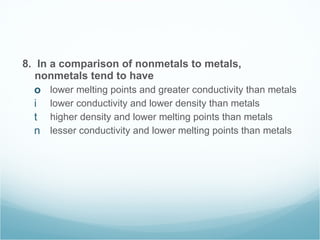
8.  In a comparison of nonmetals to metals, nonmetals tend to have  lower melting points and greater conductivity than metals lower conductivity and lower density than metals higher density and lower melting points than metals lesser conductivity and lower melting points than metals
9.  Iodine would have chemical properties  most  like manganese (Mn). tellurium (Te) chlorine (Cl) xenon (Xe)
10.  The halogens are located in Group 1 Group 2 Group 17 Group 18
14.  Which of the following atoms has the largest atomic radius?  strontium (Sr) chlorine (Cl) iodine (I) magnesium (Mg)
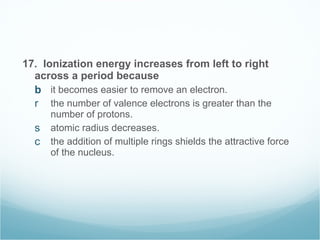
17.  Ionization energy increases from left to right across a period because it becomes easier to remove an electron. the number of valence electrons is greater than the number of protons. atomic radius decreases. the addition of multiple rings shields the attractive force of the nucleus.
19.  The most electronegative atoms are found in Group 17. the top left corner of the periodic table. the top right corner of the periodic table. the bottom left corner of the periodic table.

Exam #2 Debrief

  • 1.
    Launch: 9/29 Incomplete sentences: What are the main differences between the pie charts? What are 3 reasons for these differences? Where do you think you are on this chart? What did you do to prepare for this exam? Unit #1 Exam Data: Unit # 2 Exam Data:
  • 2.
    Launch: 9/29 Incomplete sentences: What are the main differences between the pie charts? What are 3 reasons for these differences? Where do you think you are on this chart? What did you do to prepare for this exam? Unit #1 Exam Data: Unit #2 Exam Data:
  • 3.
    Launch: 9/29 Incomplete sentences: What are the main differences between the pie charts? What are 3 reasons for these differences? Where do you think you are on this chart? What did you do to prepare for this exam? Unit #1 Exam Data: Unit # 2 Exam Data:
  • 4.
    Launch: 9/29 Incomplete sentences: What are the main differences between the pie charts? What are 3 reasons for these differences? Where do you think you are on this chart? What did you do to prepare for this exam? Unit #1 Exam Data: Unit # 2 Exam Data:
  • 5.
    Test Corrections 3-stepprocess for each question Re-write the question Identify the correct answer Explain why your answer was wrong A good explanation: explains why your answer was wrong is in a complete sentence is different from just copying the answer uses information from your notes
  • 6.
    8. Ina comparison of nonmetals to metals, nonmetals tend to have lower melting points and greater conductivity than metals lower conductivity and lower density than metals higher density and lower melting points than metals lesser conductivity and lower melting points than metals
  • 7.
    9. Iodinewould have chemical properties most like manganese (Mn). tellurium (Te) chlorine (Cl) xenon (Xe)
  • 8.
    10. Thehalogens are located in Group 1 Group 2 Group 17 Group 18
  • 9.
    14. Whichof the following atoms has the largest atomic radius? strontium (Sr) chlorine (Cl) iodine (I) magnesium (Mg)
  • 10.
    17. Ionizationenergy increases from left to right across a period because it becomes easier to remove an electron. the number of valence electrons is greater than the number of protons. atomic radius decreases. the addition of multiple rings shields the attractive force of the nucleus.
  • 11.
    19. Themost electronegative atoms are found in Group 17. the top left corner of the periodic table. the top right corner of the periodic table. the bottom left corner of the periodic table.