+
EWRT 30
Class 10
+
AGENDA
Terms Review
Discussion/Review:
Fiction
Lecture: Fiction:
Dialogue,
Guided Writing: Fiction
Adventure Story
+ The Review: In your groups:
5 minutes
Consider
“Chrysanthemums”
1. PLOT
2. POINT OF VIEW (POV)
3. CHARACTER
4. SETTING
5. TONE
6. MOOD
Review Terms
 In medias res
 Flashback
 Exposition
 Conflict
 Suspense
 Foreshadowing
 Rising action
 Climax
 Falling action
Stay
Focused!
+ Review Terms
 In medias res
 Flashback
 Exposition
 Conflict
 Suspense
 Foreshadowing
 Rising action
 Climax
 Falling action
I know you know
these terms.
Who can define
them?
+
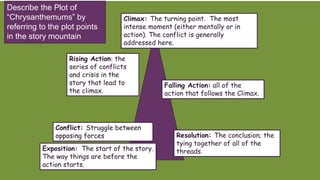
Describe the Plot of
“Chrysanthemums” by
referring to the plot points
in the story mountain
Exposition: The start of the story.
The way things are before the
action starts.
Rising Action: the
series of conflicts
and crisis in the
story that lead to
the climax.
Climax: The turning point. The most
intense moment (either mentally or in
action). The conflict is generally
addressed here.
Falling Action: all of the
action that follows the Climax.
Resolution: The conclusion; the
tying together of all of the
threads.
Conflict: Struggle between
opposing forces
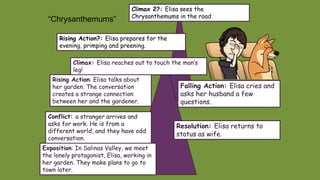
+ “Chrysanthemums”
Exposition: In Salinas Valley, we meet
the lonely protagonist, Elisa, working in
her garden. They make plans to go to
town later.
Rising Action: Elisa talks about
her garden. The conversation
creates a strange connection
between her and the gardener.
Climax: Elisa reaches out to touch the man’s
leg!
Falling Action: Elisa cries and
asks her husband a few
questions.
Resolution: Elisa returns to
status as wife.
Conflict: a stranger arrives and
asks for work. He is from a
different world, and they have odd
conversation.
Rising Action?: Elisa prepares for the
evening, primping and preening.
Climax 2?: Elisa sees the
Chrysanthemums in the road
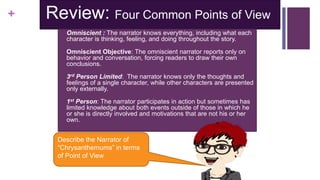
+ Review: Four Common Points of View
 Omniscient : The narrator knows everything, including what each
character is thinking, feeling, and doing throughout the story.
 Omniscient Objective: The omniscient narrator reports only on
behavior and conversation, forcing readers to draw their own
conclusions.
 3rd Person Limited: The narrator knows only the thoughts and
feelings of a single character, while other characters are presented
only externally.
 1st Person: The narrator participates in action but sometimes has
limited knowledge about both events outside of those in which he
or she is directly involved and motivations that are not his or her
own.
Describe the Narrator of
“Chrysanthemums” in terms
of Point of View
+
POV
 “The Chrysanthemums” begins with a traditional, omniscient objective
narrator, but the story is told almost entirely from Elisa’s point of view.
After the first few paragraphs that set the scene, Steinbeck refuses to
stray from Elisa’s head. This allows him to show us the world through
her eyes. We experience her frustrations and feelings.
 Because she doesn’t know what Henry is discussing with the men
in suits who come to the ranch, we don’t know either, until she asks
Henry.
 Because she sees the tinker as a handsome man, we do too.
 Because she watches his lips while he fixes her pots, we watch
them with her.
 As a result, we understand more about her longings and character
by the end of the story than her husband does.
+ Character and Characterization:
Elisa, the husband, the stranger:
Which is which?
 Round Character: convincing, true to life; fully
developed and described. Not all good or all bad.
 Dynamic Character: undergoes some type of
change in story, generally after a conflict.
 Flat Character: stereotyped, shallow, often
symbolic.
 Static Character: does not change in the course
of the story.
+
What are the methods of
Characterization? I am glad
you asked!
+
How to characterize story characters
1. By detailing physical appearance,
particularly features that
symbolize stereotypes.
2. By directly describing
3. Through the character’s words and
actions
4. By sharing the character’s own
thoughts.
5. Through the reactions of other
characters
+ 1. By detailing physical appearance, particularly
features that symbolize character.
 She was thirty-five. Her face was lean and strong
and her eyes were as clear as water. Her figure
looked blocked and heavy in her gardening costume,
a man's black hat pulled low down over her eyes,
clod-hopper shoes, a figured print dress almost
completely covered by a big corduroy apron with four
big pockets to hold the snips, the trowel and
scratcher, the seeds and the knife she worked with.
She wore heavy leather gloves to protect her hands
while she worked.
+ 2. By directly describing:
 Her face was eager and mature
and handsome; even her work
with the scissors was over-eager,
over-powerful. The
chrysanthemum stems seemed
too small and easy for her energy.
+
3. Through the character’s own words and
actions:
 "That sounds like a nice kind of a way to live," she
said.
 Kneeling there, her hand went out toward his legs in
the greasy black trousers. Her hesitant fingers almost
touched the cloth. Then her hand dropped to the
ground. She crouched low like a fawning dog.
 When she had dried herself she stood in front of a mirror
in her bedroom and looked at her body. She tightened
her stomach and threw out her chest. She turned and
looked over her shoulder at her back.
+
4. By sharing the character’s own thoughts.
She whispered to herself sadly, "He might
have thrown them off the road. That
wouldn't have been much trouble, not very
much. But he kept the pot," she explained.
"He had to keep the pot. That's why he
couldn't get them off the road.”
+
5. Through the reaction of other characters.
He looked bewildered. "You're playing some
kind of a game," he said helplessly. "It's a kind
of a play. You look strong enough to break a
calf over your knee, happy enough to eat it
like a watermelon."
+
 The high gray-flannel fog of winter closed off the Salinas
Valley from the sky and from all the rest of the world. On every
side it sat like a lid on the mountains and made of the great
valley a closed pot. On the broad, level land floor the gang
plows bit deep and left the black earth shining like metal where
the shares had cut. On the foothill ranches across the Salinas
1~iver, the yellow stubble fields seemed to be bathed in pale
cold sunshine, but there was no sunshine in the valley now in
December. The thick willow scrub along the river flamed with
sharp and positive yellow leaves.
Ok, so how does the
setting contribute to the
story?
+
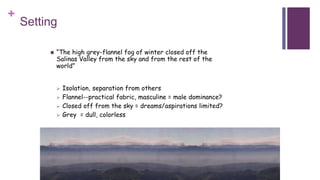
Setting
 “The high grey-flannel fog of winter closed off the
Salinas Valley from the sky and from the rest of the
world”
 Isolation, separation from others
 Flannel--practical fabric, masculine = male dominance?
 Closed off from the sky = dreams/aspirations limited?
 Grey = dull, colorless
+
Setting
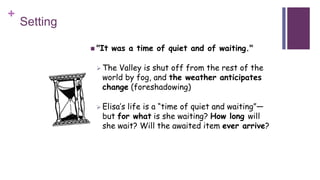
 "It was a time of quiet and of waiting."
 The Valley is shut off from the rest of the
world by fog, and the weather anticipates
change (foreshadowing)
 Elisa’s life is a “time of quiet and waiting”—
but for what is she waiting? How long will
she wait? Will the awaited item ever arrive?
+
Setting
 The garden is fenced off to protect it
from the domesticated animals: the “cattle
and dogs and chickens.”
 Fence: separates, isolates, sets aside,
protects, limits, restrains...Elisa’s heart?
Elisa’s life? Elisa’s true desires?
 Fence protects against domesticated
animals—domestication? Elisa needs
protection from domestication? From
being kept like a domesticated animal?
+
Lecture Subject:
Dialogue
+
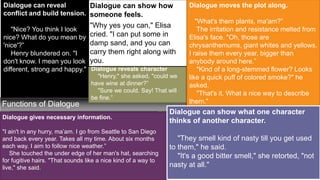
Functions of Dialogue
Dialogue gives necessary information.
"I ain't in any hurry, ma’am. I go from Seattle to San Diego
and back every year. Takes all my time. About six months
each way. I aim to follow nice weather.”
She touched the under edge of her man's hat, searching
for fugitive hairs. "That sounds like a nice kind of a way to
live," she said.
Dialogue can reveal
conflict and build tension.
"Nice? You think I look
nice? What do you mean by
'nice'?”
Henry blundered on. "I
don't know. I mean you look
different, strong and happy." Dialogue reveals character
"Henry," she asked, "could we
have wine at dinner?”
"Sure we could. Say! That will
be fine.”
Dialogue can show how
someone feels.
"Why yes you can," Elisa
cried. "I can put some in
damp sand, and you can
carry them right along with
you.
.
Dialogue moves the plot along.
"What's them plants, ma'am?”
The irritation and resistance melted from
Elisa's face. "Oh, those are
chrysanthemums, giant whites and yellows.
I raise them every year, bigger than
anybody around here.”
"Kind of a long-stemmed flower? Looks
like a quick puff of colored smoke?" he
asked.
"That's it. What a nice way to describe
them."
Dialogue can show what one character
thinks of another character.
"They smell kind of nasty till you get used
to them," he said.
"It's a good bitter smell," she retorted, "not
nasty at all."
+
How to write good dialogue
Adapted from http://www.ellenjackson.net/dialogue_61473.htm
+
 Good dialogue reflects a character’s age, background, and personality. A ten-year-old
boy doesn’t have the same speech patterns as a forty-year-old woman. A person who
speaks English as a second language has different patterns from a native. Be aware of
these differences.
"Well," said Elisa, "I think you'll save time if you go back to the Salinas road and pick up the
highway there."
He drew a big finger down the chicken wire and made it sing. "I ain't in any hurry, ma am. I
go from Seattle to San Diego and back every year. Takes all my time. About six months each
way. I aim to follow nice weather."
 Be aware of how your character would react in a given situation.
Does your character have a sense of humor? Does he fly off the handle easily? Is she shy
and withdrawn? Sarcastic? Show these qualities through dialogue.
"Why--why, Elisa. You look so nice!"
"Nice? You think I look nice? What do you mean by 'nice'?"
+ Most people use contractions when they speak. When people speak they’ll almost
always say "you aren’t" instead of "you are not" and "it’s" instead of "it is." Using
contractions makes your characters’ speech sound more natural. Of course, there
are the moments of formal oral interaction that you can emphasize by not using
contractions.
"Elisa, where are you?”
"In my room, dressing. I'm not ready. There's hot water for your bath. Hurry up. It's
getting late."
 Intersperse your dialogue with body language and action. Dialogue interspersed with
action and gestures helps the reader visualize your characters. But don’t overdo it. Too much
action is as distracting and as too little.
She relaxed limply in the seat. "Oh, no. No. I don't want to go. I'm sure I don't." Her face was
turned away from him. "It will be enough if we can have wine. It will be plenty."
Henry looked down toward the tractor shed, and when he brought his eyes back to her, they
were his own again. "I'll get out the car. You can put on your coat while I'm starting."
+
 Don’t allow dialogue to repeat narration. Avoid this:
Madison came in the door. He threw his books on the table and went
into the kitchen to get a cookie.
"I see you’re home from school," said Mom. "How about a cookie?"
 Stick with simple tags. Use ordinary tags such as "he said" or "she asked" almost all of the time.
Elaborate tags (queried, questioned, bellowed, stated, replied, responded, pointed out) are distracting
and unnecessary.
"You sleep right in the wagon?" Elisa asked.
"Right in the wagon, ma'am. Rain or shine I'm dry as a cow in there."
It must be nice," she said. "It must be very nice. I wish women could do such things."
"It ain't the right kind of a life for a woman.
Her upper lip raised a little, showing her teeth. "How do you know? How can you tell?" she
said.
+
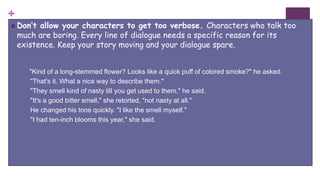
 Don’t allow your characters to get too verbose. Characters who talk too
much are boring. Every line of dialogue needs a specific reason for its
existence. Keep your story moving and your dialogue spare.
"Kind of a long-stemmed flower? Looks like a quick puff of colored smoke?" he asked.
"That's it. What a nice way to describe them."
"They smell kind of nasty till you get used to them," he said.
"It's a good bitter smell," she retorted, "not nasty at all."
He changed his tone quickly. "I like the smell myself."
"I had ten-inch blooms this year," she said.
+
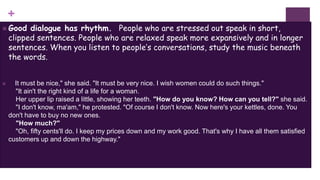
 Good dialogue has rhythm. People who are stressed out speak in short,
clipped sentences. People who are relaxed speak more expansively and in longer
sentences. When you listen to people’s conversations, study the music beneath
the words.
 It must be nice," she said. "It must be very nice. I wish women could do such things."
"It ain't the right kind of a life for a woman.
Her upper lip raised a little, showing her teeth. "How do you know? How can you tell?" she said.
"I don't know, ma'am," he protested. "Of course I don't know. Now here's your kettles, done. You
don't have to buy no new ones.
"How much?"
"Oh, fifty cents'll do. I keep my prices down and my work good. That's why I have all them satisfied
customers up and down the highway."
Guided Writing
Dialogue
Get out your adventure
story and prepare to add
dialogue!
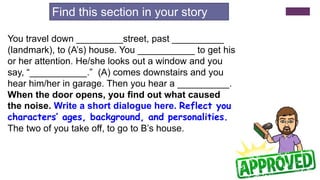
You travel down _________street, past __________
(landmark), to (A’s) house. You ___________ to get his
or her attention. He/she looks out a window and you
say, “___________.” (A) comes downstairs and you
hear him/her in garage. Then you hear a __________.
When the door opens, you find out what caused
the noise. Write a short dialogue here. Reflect your
characters’ ages, background, and personalities.
The two of you take off, to go to B’s house.
Find this section in your story
+
Homework
Make sure to work through
the online hour for this week
(More Dialogue Writing
Practice).
Revisit/revise your fiction
drafts.

Ewrt 30 class 10 for sub

  • 1.
  • 2.
  • 3.
    + The Review:In your groups: 5 minutes Consider “Chrysanthemums” 1. PLOT 2. POINT OF VIEW (POV) 3. CHARACTER 4. SETTING 5. TONE 6. MOOD Review Terms  In medias res  Flashback  Exposition  Conflict  Suspense  Foreshadowing  Rising action  Climax  Falling action Stay Focused!
  • 4.
    + Review Terms In medias res  Flashback  Exposition  Conflict  Suspense  Foreshadowing  Rising action  Climax  Falling action I know you know these terms. Who can define them?
  • 5.
    + Describe the Plotof “Chrysanthemums” by referring to the plot points in the story mountain Exposition: The start of the story. The way things are before the action starts. Rising Action: the series of conflicts and crisis in the story that lead to the climax. Climax: The turning point. The most intense moment (either mentally or in action). The conflict is generally addressed here. Falling Action: all of the action that follows the Climax. Resolution: The conclusion; the tying together of all of the threads. Conflict: Struggle between opposing forces
  • 6.
    + “Chrysanthemums” Exposition: InSalinas Valley, we meet the lonely protagonist, Elisa, working in her garden. They make plans to go to town later. Rising Action: Elisa talks about her garden. The conversation creates a strange connection between her and the gardener. Climax: Elisa reaches out to touch the man’s leg! Falling Action: Elisa cries and asks her husband a few questions. Resolution: Elisa returns to status as wife. Conflict: a stranger arrives and asks for work. He is from a different world, and they have odd conversation. Rising Action?: Elisa prepares for the evening, primping and preening. Climax 2?: Elisa sees the Chrysanthemums in the road
  • 7.
    + Review: FourCommon Points of View  Omniscient : The narrator knows everything, including what each character is thinking, feeling, and doing throughout the story.  Omniscient Objective: The omniscient narrator reports only on behavior and conversation, forcing readers to draw their own conclusions.  3rd Person Limited: The narrator knows only the thoughts and feelings of a single character, while other characters are presented only externally.  1st Person: The narrator participates in action but sometimes has limited knowledge about both events outside of those in which he or she is directly involved and motivations that are not his or her own. Describe the Narrator of “Chrysanthemums” in terms of Point of View
  • 8.
    + POV  “The Chrysanthemums”begins with a traditional, omniscient objective narrator, but the story is told almost entirely from Elisa’s point of view. After the first few paragraphs that set the scene, Steinbeck refuses to stray from Elisa’s head. This allows him to show us the world through her eyes. We experience her frustrations and feelings.  Because she doesn’t know what Henry is discussing with the men in suits who come to the ranch, we don’t know either, until she asks Henry.  Because she sees the tinker as a handsome man, we do too.  Because she watches his lips while he fixes her pots, we watch them with her.  As a result, we understand more about her longings and character by the end of the story than her husband does.
  • 9.
    + Character andCharacterization: Elisa, the husband, the stranger: Which is which?  Round Character: convincing, true to life; fully developed and described. Not all good or all bad.  Dynamic Character: undergoes some type of change in story, generally after a conflict.  Flat Character: stereotyped, shallow, often symbolic.  Static Character: does not change in the course of the story.
  • 10.
    + What are themethods of Characterization? I am glad you asked!
  • 11.
    + How to characterizestory characters 1. By detailing physical appearance, particularly features that symbolize stereotypes. 2. By directly describing 3. Through the character’s words and actions 4. By sharing the character’s own thoughts. 5. Through the reactions of other characters
  • 12.
    + 1. Bydetailing physical appearance, particularly features that symbolize character.  She was thirty-five. Her face was lean and strong and her eyes were as clear as water. Her figure looked blocked and heavy in her gardening costume, a man's black hat pulled low down over her eyes, clod-hopper shoes, a figured print dress almost completely covered by a big corduroy apron with four big pockets to hold the snips, the trowel and scratcher, the seeds and the knife she worked with. She wore heavy leather gloves to protect her hands while she worked.
  • 13.
    + 2. Bydirectly describing:  Her face was eager and mature and handsome; even her work with the scissors was over-eager, over-powerful. The chrysanthemum stems seemed too small and easy for her energy.
  • 14.
    + 3. Through thecharacter’s own words and actions:  "That sounds like a nice kind of a way to live," she said.  Kneeling there, her hand went out toward his legs in the greasy black trousers. Her hesitant fingers almost touched the cloth. Then her hand dropped to the ground. She crouched low like a fawning dog.  When she had dried herself she stood in front of a mirror in her bedroom and looked at her body. She tightened her stomach and threw out her chest. She turned and looked over her shoulder at her back.
  • 15.
    + 4. By sharingthe character’s own thoughts. She whispered to herself sadly, "He might have thrown them off the road. That wouldn't have been much trouble, not very much. But he kept the pot," she explained. "He had to keep the pot. That's why he couldn't get them off the road.”
  • 16.
    + 5. Through thereaction of other characters. He looked bewildered. "You're playing some kind of a game," he said helplessly. "It's a kind of a play. You look strong enough to break a calf over your knee, happy enough to eat it like a watermelon."
  • 17.
    +  The highgray-flannel fog of winter closed off the Salinas Valley from the sky and from all the rest of the world. On every side it sat like a lid on the mountains and made of the great valley a closed pot. On the broad, level land floor the gang plows bit deep and left the black earth shining like metal where the shares had cut. On the foothill ranches across the Salinas 1~iver, the yellow stubble fields seemed to be bathed in pale cold sunshine, but there was no sunshine in the valley now in December. The thick willow scrub along the river flamed with sharp and positive yellow leaves. Ok, so how does the setting contribute to the story?
  • 18.
    + Setting  “The highgrey-flannel fog of winter closed off the Salinas Valley from the sky and from the rest of the world”  Isolation, separation from others  Flannel--practical fabric, masculine = male dominance?  Closed off from the sky = dreams/aspirations limited?  Grey = dull, colorless
  • 19.
    + Setting  "It wasa time of quiet and of waiting."  The Valley is shut off from the rest of the world by fog, and the weather anticipates change (foreshadowing)  Elisa’s life is a “time of quiet and waiting”— but for what is she waiting? How long will she wait? Will the awaited item ever arrive?
  • 20.
    + Setting  The gardenis fenced off to protect it from the domesticated animals: the “cattle and dogs and chickens.”  Fence: separates, isolates, sets aside, protects, limits, restrains...Elisa’s heart? Elisa’s life? Elisa’s true desires?  Fence protects against domesticated animals—domestication? Elisa needs protection from domestication? From being kept like a domesticated animal?
  • 21.
  • 22.
    + Functions of Dialogue Dialoguegives necessary information. "I ain't in any hurry, ma’am. I go from Seattle to San Diego and back every year. Takes all my time. About six months each way. I aim to follow nice weather.” She touched the under edge of her man's hat, searching for fugitive hairs. "That sounds like a nice kind of a way to live," she said. Dialogue can reveal conflict and build tension. "Nice? You think I look nice? What do you mean by 'nice'?” Henry blundered on. "I don't know. I mean you look different, strong and happy." Dialogue reveals character "Henry," she asked, "could we have wine at dinner?” "Sure we could. Say! That will be fine.” Dialogue can show how someone feels. "Why yes you can," Elisa cried. "I can put some in damp sand, and you can carry them right along with you. . Dialogue moves the plot along. "What's them plants, ma'am?” The irritation and resistance melted from Elisa's face. "Oh, those are chrysanthemums, giant whites and yellows. I raise them every year, bigger than anybody around here.” "Kind of a long-stemmed flower? Looks like a quick puff of colored smoke?" he asked. "That's it. What a nice way to describe them." Dialogue can show what one character thinks of another character. "They smell kind of nasty till you get used to them," he said. "It's a good bitter smell," she retorted, "not nasty at all."
  • 23.
    + How to writegood dialogue Adapted from http://www.ellenjackson.net/dialogue_61473.htm
  • 24.
    +  Good dialoguereflects a character’s age, background, and personality. A ten-year-old boy doesn’t have the same speech patterns as a forty-year-old woman. A person who speaks English as a second language has different patterns from a native. Be aware of these differences. "Well," said Elisa, "I think you'll save time if you go back to the Salinas road and pick up the highway there." He drew a big finger down the chicken wire and made it sing. "I ain't in any hurry, ma am. I go from Seattle to San Diego and back every year. Takes all my time. About six months each way. I aim to follow nice weather."  Be aware of how your character would react in a given situation. Does your character have a sense of humor? Does he fly off the handle easily? Is she shy and withdrawn? Sarcastic? Show these qualities through dialogue. "Why--why, Elisa. You look so nice!" "Nice? You think I look nice? What do you mean by 'nice'?"
  • 25.
    + Most peopleuse contractions when they speak. When people speak they’ll almost always say "you aren’t" instead of "you are not" and "it’s" instead of "it is." Using contractions makes your characters’ speech sound more natural. Of course, there are the moments of formal oral interaction that you can emphasize by not using contractions. "Elisa, where are you?” "In my room, dressing. I'm not ready. There's hot water for your bath. Hurry up. It's getting late."  Intersperse your dialogue with body language and action. Dialogue interspersed with action and gestures helps the reader visualize your characters. But don’t overdo it. Too much action is as distracting and as too little. She relaxed limply in the seat. "Oh, no. No. I don't want to go. I'm sure I don't." Her face was turned away from him. "It will be enough if we can have wine. It will be plenty." Henry looked down toward the tractor shed, and when he brought his eyes back to her, they were his own again. "I'll get out the car. You can put on your coat while I'm starting."
  • 26.
    +  Don’t allowdialogue to repeat narration. Avoid this: Madison came in the door. He threw his books on the table and went into the kitchen to get a cookie. "I see you’re home from school," said Mom. "How about a cookie?"  Stick with simple tags. Use ordinary tags such as "he said" or "she asked" almost all of the time. Elaborate tags (queried, questioned, bellowed, stated, replied, responded, pointed out) are distracting and unnecessary. "You sleep right in the wagon?" Elisa asked. "Right in the wagon, ma'am. Rain or shine I'm dry as a cow in there." It must be nice," she said. "It must be very nice. I wish women could do such things." "It ain't the right kind of a life for a woman. Her upper lip raised a little, showing her teeth. "How do you know? How can you tell?" she said.
  • 27.
    +  Don’t allowyour characters to get too verbose. Characters who talk too much are boring. Every line of dialogue needs a specific reason for its existence. Keep your story moving and your dialogue spare. "Kind of a long-stemmed flower? Looks like a quick puff of colored smoke?" he asked. "That's it. What a nice way to describe them." "They smell kind of nasty till you get used to them," he said. "It's a good bitter smell," she retorted, "not nasty at all." He changed his tone quickly. "I like the smell myself." "I had ten-inch blooms this year," she said.
  • 28.
    +  Good dialoguehas rhythm. People who are stressed out speak in short, clipped sentences. People who are relaxed speak more expansively and in longer sentences. When you listen to people’s conversations, study the music beneath the words.  It must be nice," she said. "It must be very nice. I wish women could do such things." "It ain't the right kind of a life for a woman. Her upper lip raised a little, showing her teeth. "How do you know? How can you tell?" she said. "I don't know, ma'am," he protested. "Of course I don't know. Now here's your kettles, done. You don't have to buy no new ones. "How much?" "Oh, fifty cents'll do. I keep my prices down and my work good. That's why I have all them satisfied customers up and down the highway."
  • 29.
    Guided Writing Dialogue Get outyour adventure story and prepare to add dialogue!
  • 30.
    You travel down_________street, past __________ (landmark), to (A’s) house. You ___________ to get his or her attention. He/she looks out a window and you say, “___________.” (A) comes downstairs and you hear him/her in garage. Then you hear a __________. When the door opens, you find out what caused the noise. Write a short dialogue here. Reflect your characters’ ages, background, and personalities. The two of you take off, to go to B’s house. Find this section in your story
  • 31.
    + Homework Make sure towork through the online hour for this week (More Dialogue Writing Practice). Revisit/revise your fiction drafts.

Editor's Notes

  • #4 Plot: the artistic arrangement of events in a story. Point of View: Point of view refers to who tells the story and how it is told. What we know and how we feel about the events in a story are shaped by the author's choice of a point of view. Character: an imagined person in a literary work. Setting: the locale, time, and social circumstances of a story (for instance, an Eastern town in winter, about 1950, in an upper-class private girls school). Tone: the prevailing attitude (for instance, ironic, compassionate, objective) as perceived by the reader; the author's feelings toward the central character or the main events. MOOD - the feeling or state of mind that predominates in a story creating a certain atmosphere
  • #5 In medias res: Latin for "in the midst of things." We enter the story on the verge of some important moment. Flashback: a device that informs us about events that happened before the opening scene of a work; often a scene relived in a character's memory. Exposition: the opening portion that sets the scene, introduces the main characters, tells us what happened before the story opened, and provides any other background information that we need in order to understand and care about the events to follow. A conflict is a complication that moves to a climax. Conflict is the opposition presented to the main character of a story by another character, by events or situations, by fate, or by some    act of the main character's own personality or nature. More loosely defined for contemporary fiction, it is the problem or tension that must somehow be addressed (if not perfectly  resolved) by the end of the story. Suspense: the pleasurable anxiety we feel that heightens our attention to the story. Foreshadowing: indication of events to come—the introduction of specific words, images, or events into a story to suggest or anticipate later events that are central the action and its resolution. 15.  Rising action A set of conflicts and crises that constitute the part of a play or story's plot leading up to the climax. Climax: the moment of greatest tension in the story, at which the outcome is to be decided Falling action In the plot of a story or play, the action following the climax of the work that moves it towards its denouement or resolution. The falling action of Othello begins after Othello realizes that Iago is responsible for plotting against him by spurring him on to murder his wife, Desdemona
  • #8 “The Chrysanthemums” begins with a traditional, omniscient objective narrator, but the story is told almost entirely from Elisa’s point of view. After the first few paragraphs that set the scene, Steinbeck refuses to stray from Elisa’s head. This allows him to show us the world through her eyes. We experience her frustrations and feelings.