A. Manivannan
Scientist (Genetics)
DMR, New Delhi
Evolution of Vigna species
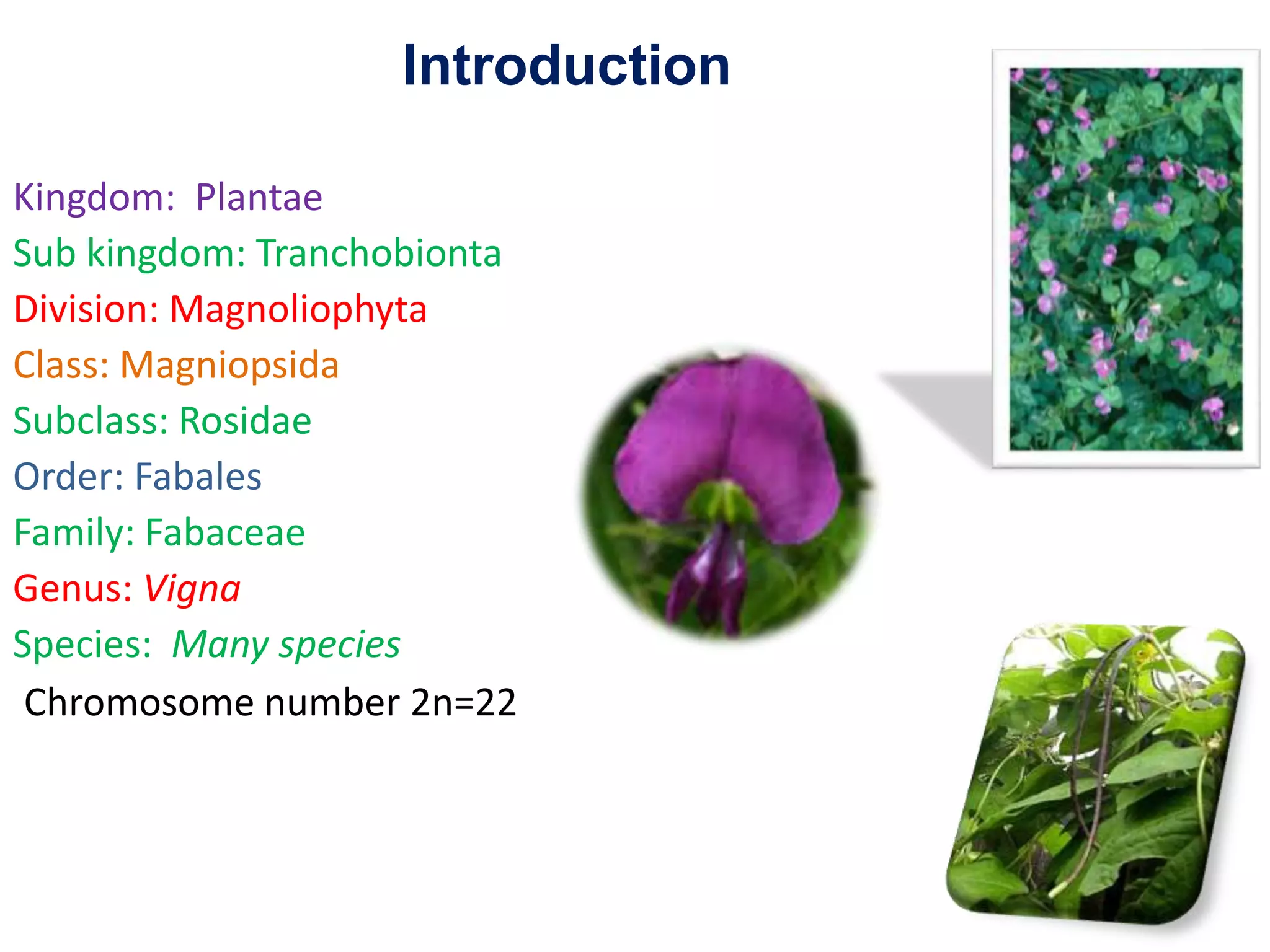
Introduction
Kingdom: Plantae
Sub kingdom: Tranchobionta
Division: Magnoliophyta
Class: Magniopsida
Subclass: Rosidae
Order: Fabales
Family: Fabaceae
Genus: Vigna
Species: Many species
Chromosome number 2n=22
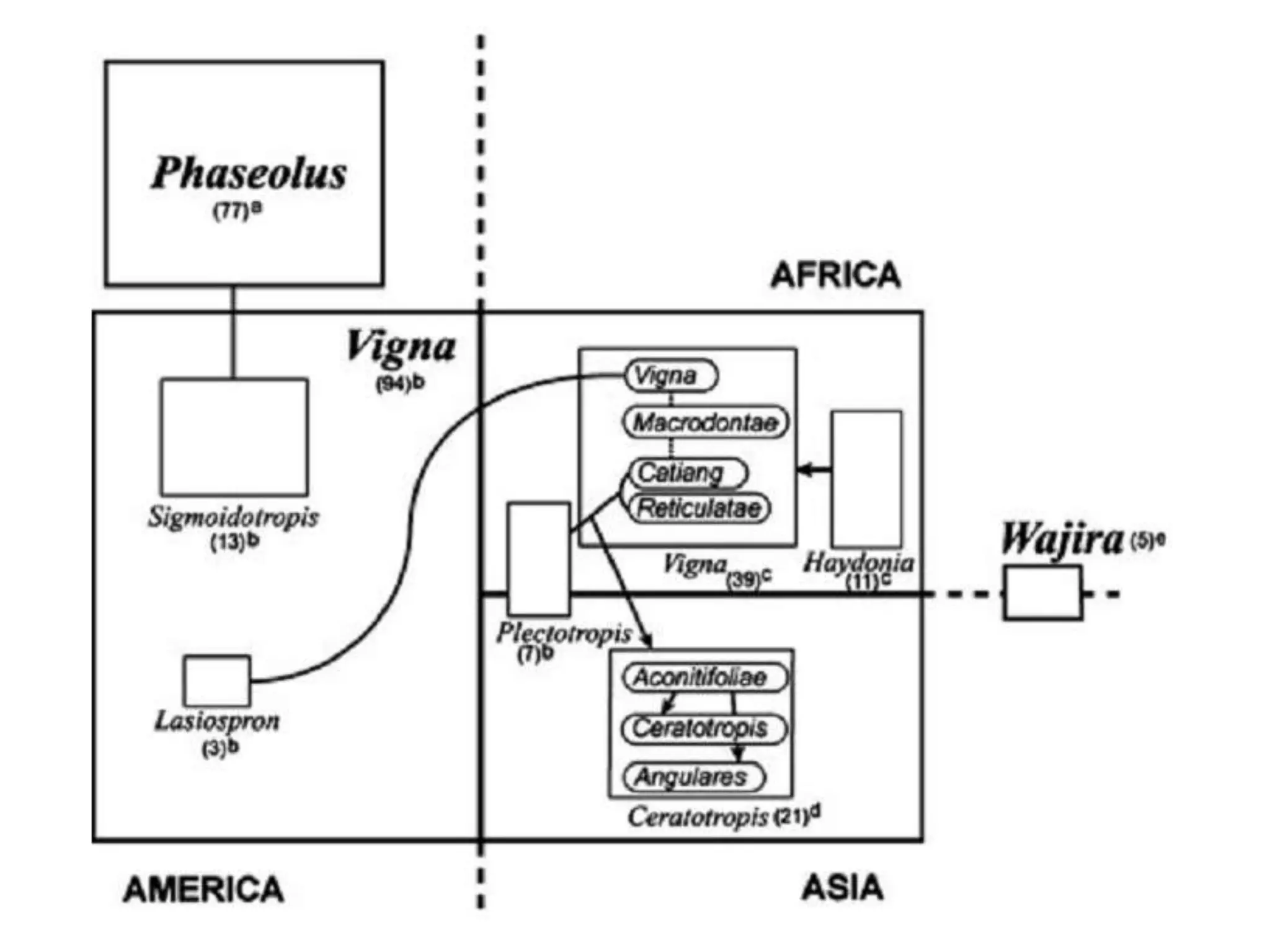
Vigna species
-6 sub genera viz., Haydonia, Plectotropis, and Vigna,
Ceratotropis,Lasiopron, Sigmoidotropis
--90 species
-Vigna subgenus Haydonia of Africa may be the most primitive and well-
diverged group within Vigna.
-Vigna subgenus Sigmoidotropis of the New World is more closely related
to Phaseolus than to the other subgenera of the genus Vigna
-Species in section Vigna subgenus Vigna are more closely related to the
New World subgenus Lasiospron, whereas species in section Catiang
(containing cowpea) and Reticulatae are close to species in the subgenus
Plectotropis.
-In Asia, the subgenus Ceratotropis represents a homogeneous and
distinct group.
Cultivated Vigna species
1. Vigna aconitifolia (Moth bean)
2. Vigna angularis (Adzuki bean)
3. Vigna mungo (Black gram or Urd bean)
4. Vigna radiata (Green gram or Mung Bean)
5. Vigna trilobata (Pillipesara)
6. Vigna umbellata (Rice bean)
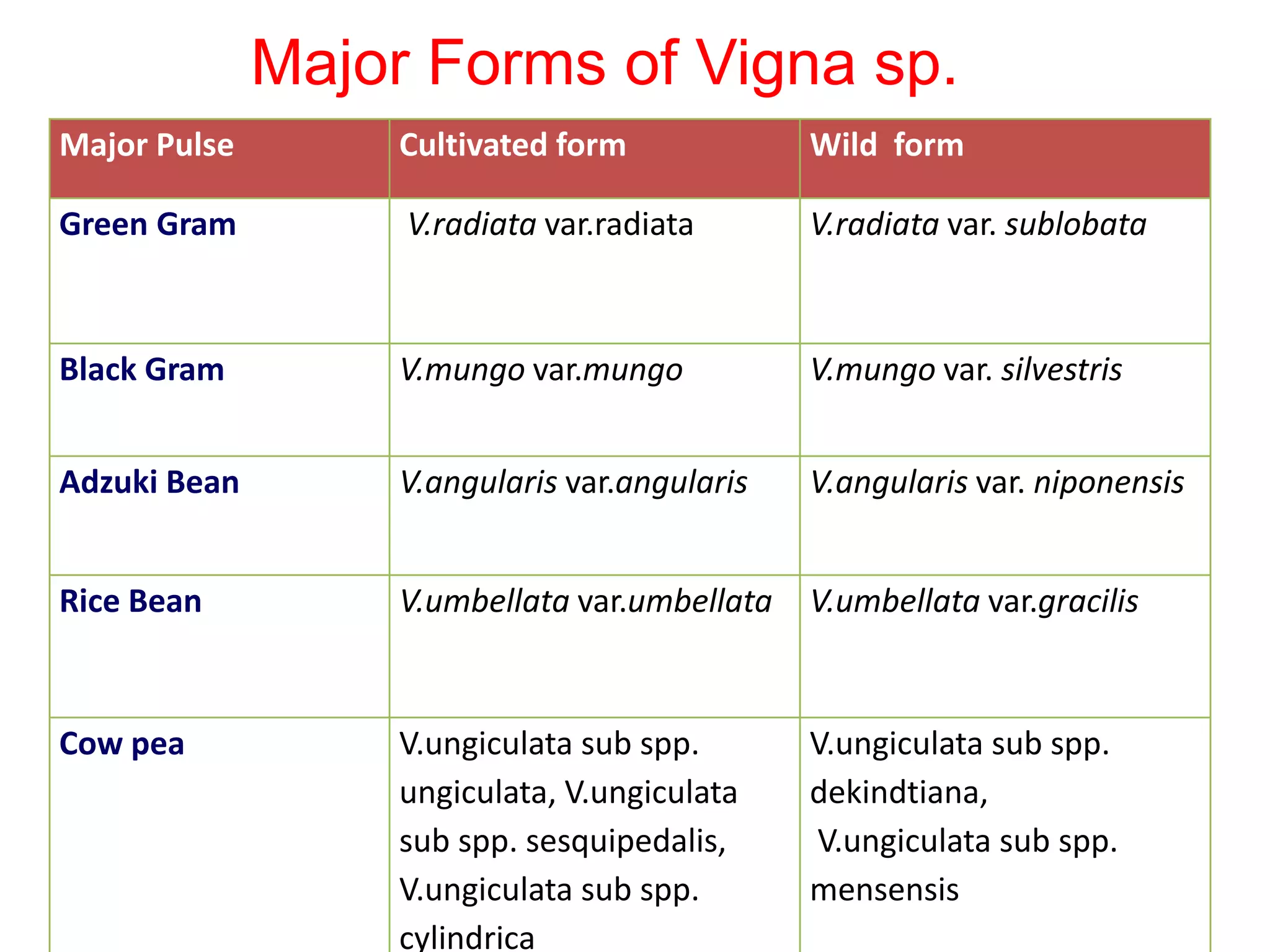
Major Pulse Cultivated form Wild form
Green Gram V.radiata var.radiata V.radiata var. sublobata
Black Gram V.mungo var.mungo V.mungo var. silvestris
Adzuki Bean V.angularis var.angularis V.angularis var. niponensis
Rice Bean V.umbellata var.umbellata V.umbellata var.gracilis
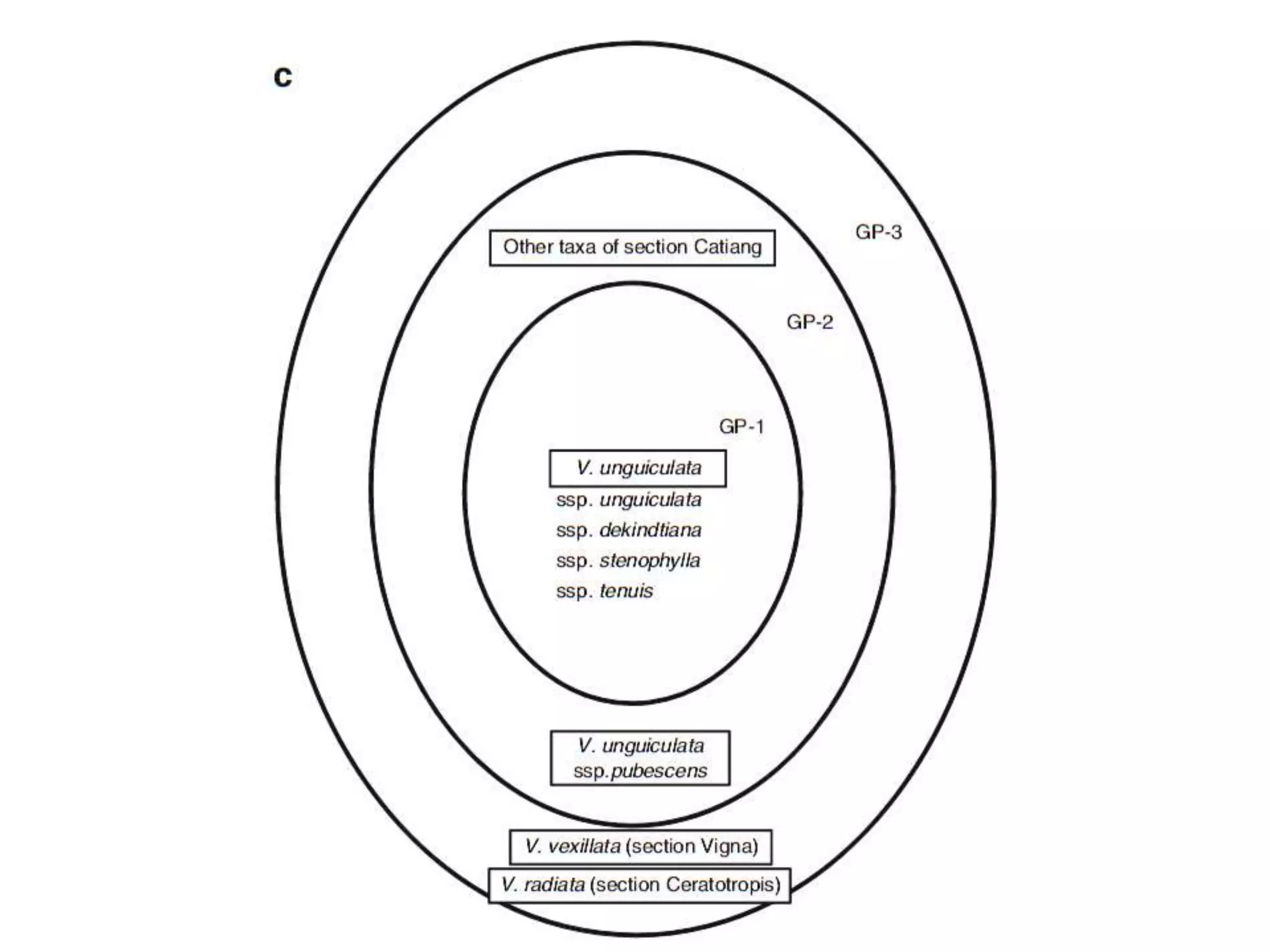
Cow pea V.ungiculata sub spp.
ungiculata, V.ungiculata
sub spp. sesquipedalis,
V.ungiculata sub spp.
cylindrica
V.ungiculata sub spp.
dekindtiana,
V.ungiculata sub spp.
mensensis
Major Forms of Vigna sp.
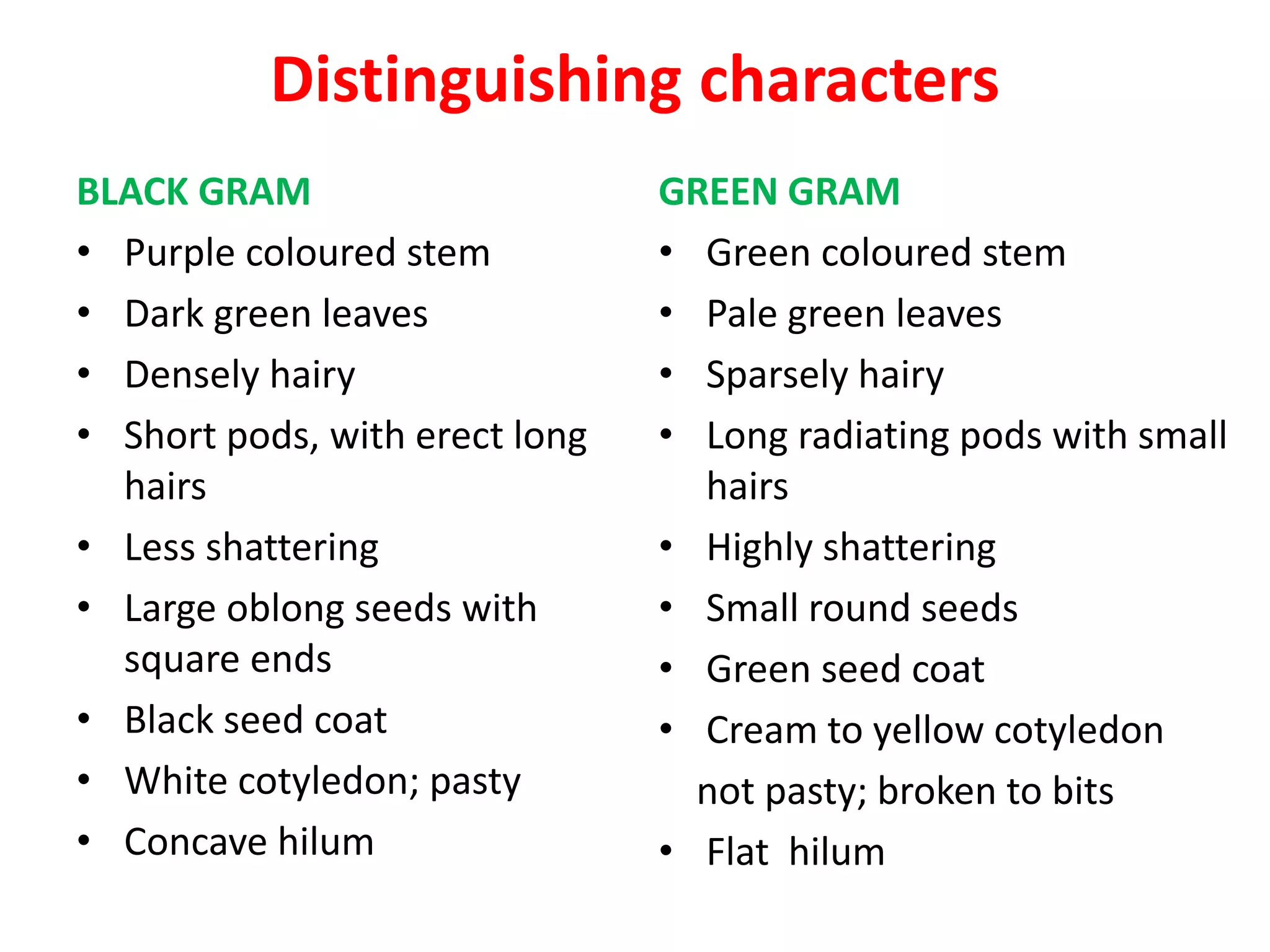
Distinguishing characters
BLACK GRAM
• Purple coloured stem
• Dark green leaves
• Densely hairy
• Short pods, with erect long
hairs
• Less shattering
• Large oblong seeds with
square ends
• Black seed coat
• White cotyledon; pasty
• Concave hilum
GREEN GRAM
• Green coloured stem
• Pale green leaves
• Sparsely hairy
• Long radiating pods with small
hairs
• Highly shattering
• Small round seeds
• Green seed coat
• Cream to yellow cotyledon
not pasty; broken to bits
• Flat hilum
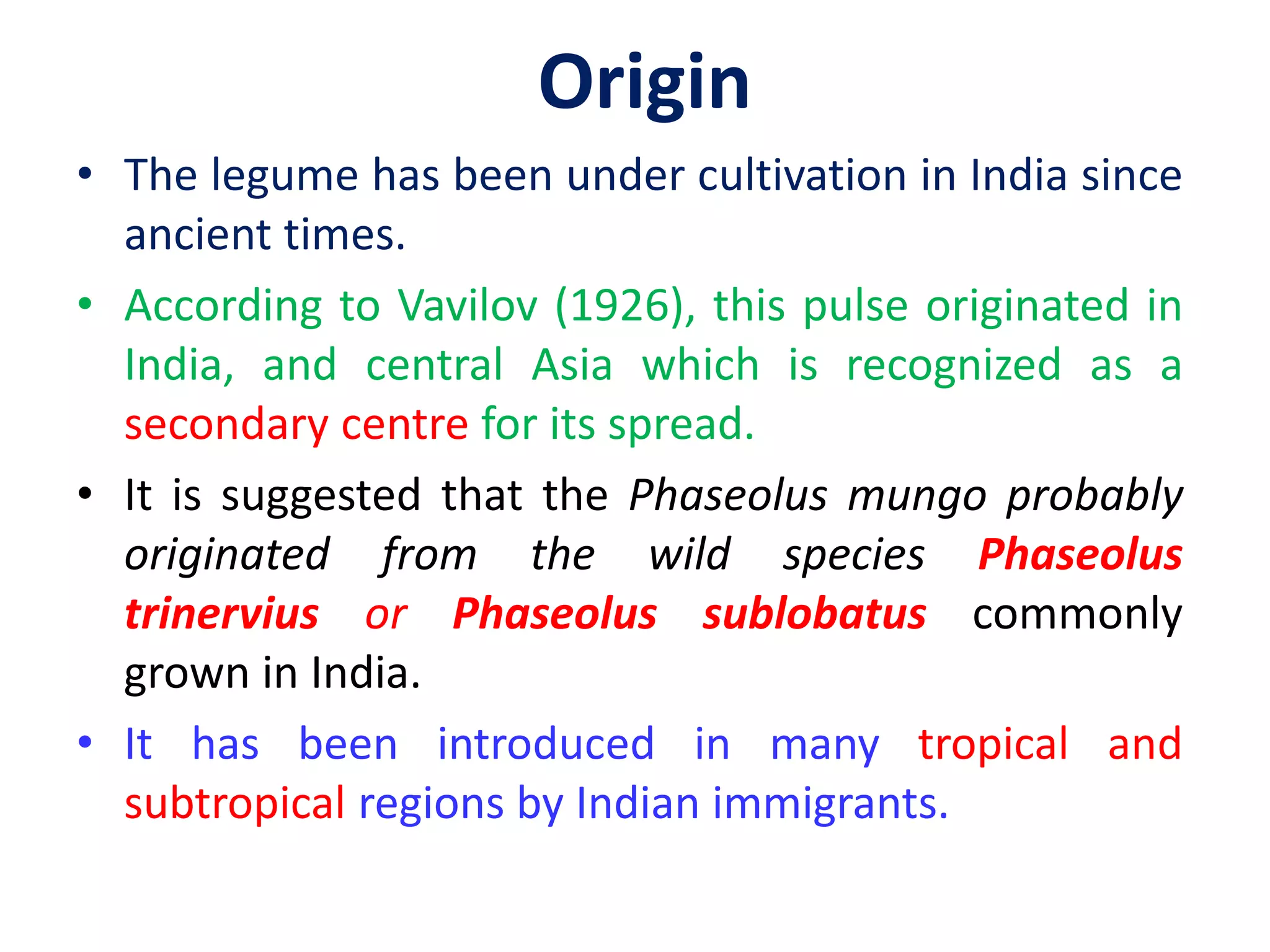
• The legume has been under cultivation in India since
ancient times.
• According to Vavilov (1926), this pulse originated in
India, and central Asia which is recognized as a
secondary centre for its spread.
• It is suggested that the Phaseolus mungo probably
originated from the wild species Phaseolus
trinervius or Phaseolus sublobatus commonly
grown in India.
• It has been introduced in many tropical and
subtropical regions by Indian immigrants.
Origin
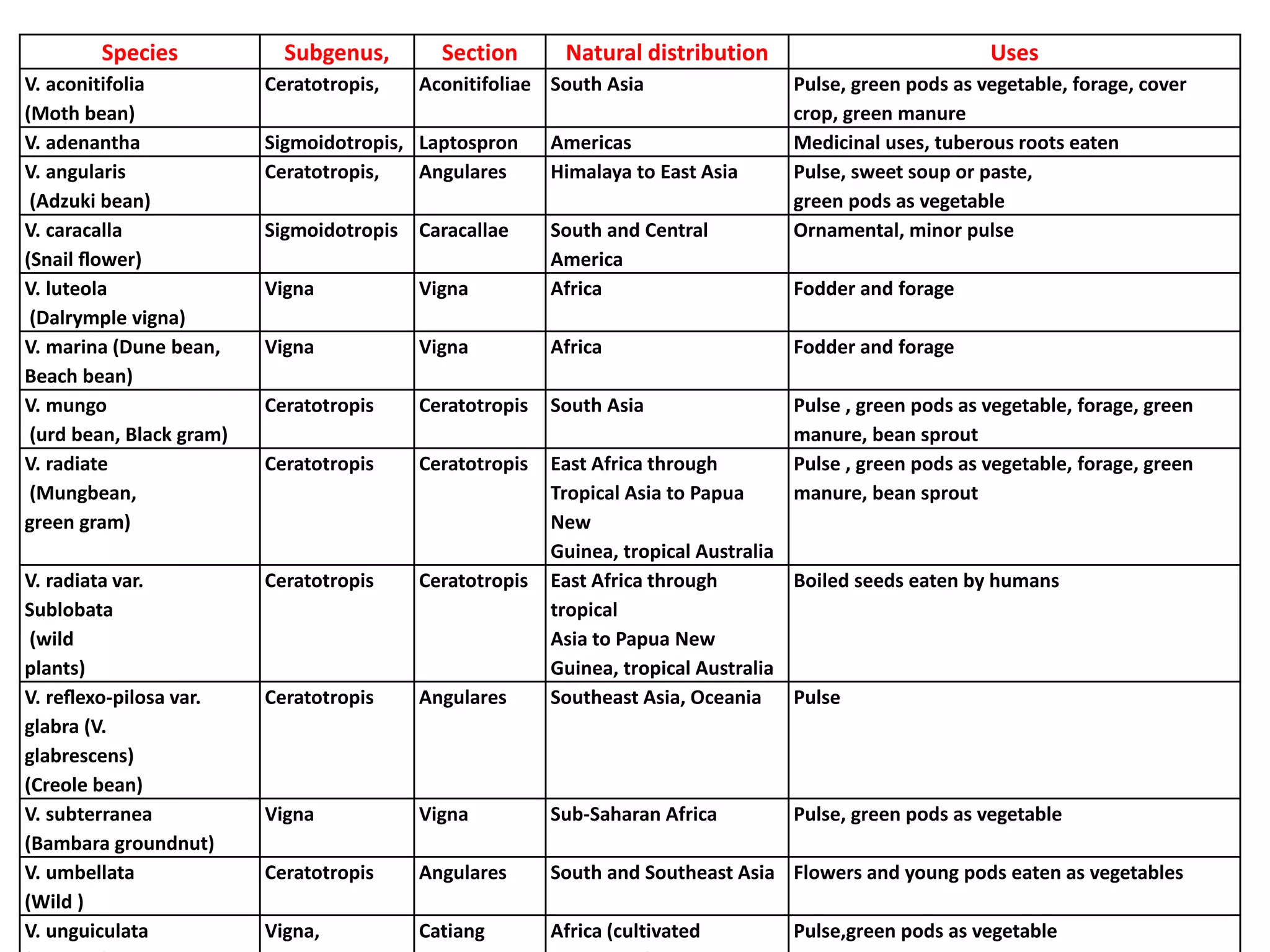
Species Subgenus, Section Natural distribution Uses
V. aconitifolia
(Moth bean)
Ceratotropis, Aconitifoliae South Asia Pulse, green pods as vegetable, forage, cover
crop, green manure
V. adenantha Sigmoidotropis, Laptospron Americas Medicinal uses, tuberous roots eaten
V. angularis
(Adzuki bean)
Ceratotropis, Angulares Himalaya to East Asia Pulse, sweet soup or paste,
green pods as vegetable
V. caracalla
(Snail flower)
Sigmoidotropis Caracallae South and Central
America
Ornamental, minor pulse
V. luteola
(Dalrymple vigna)
Vigna Vigna Africa Fodder and forage
V. marina (Dune bean,
Beach bean)
Vigna Vigna Africa Fodder and forage
V. mungo
(urd bean, Black gram)
Ceratotropis Ceratotropis South Asia Pulse , green pods as vegetable, forage, green
manure, bean sprout
V. radiate
(Mungbean,
green gram)
Ceratotropis Ceratotropis East Africa through
Tropical Asia to Papua
New
Guinea, tropical Australia
Pulse , green pods as vegetable, forage, green
manure, bean sprout
V. radiata var.
Sublobata
(wild
plants)
Ceratotropis Ceratotropis East Africa through
tropical
Asia to Papua New
Guinea, tropical Australia
Boiled seeds eaten by humans
V. reflexo-pilosa var.
glabra (V.
glabrescens)
(Creole bean)
Ceratotropis Angulares Southeast Asia, Oceania Pulse
V. subterranea
(Bambara groundnut)
Vigna Vigna Sub-Saharan Africa Pulse, green pods as vegetable
V. umbellata
(Wild )
Ceratotropis Angulares South and Southeast Asia Flowers and young pods eaten as vegetables
V. unguiculata Vigna, Catiang Africa (cultivated Pulse,green pods as vegetable
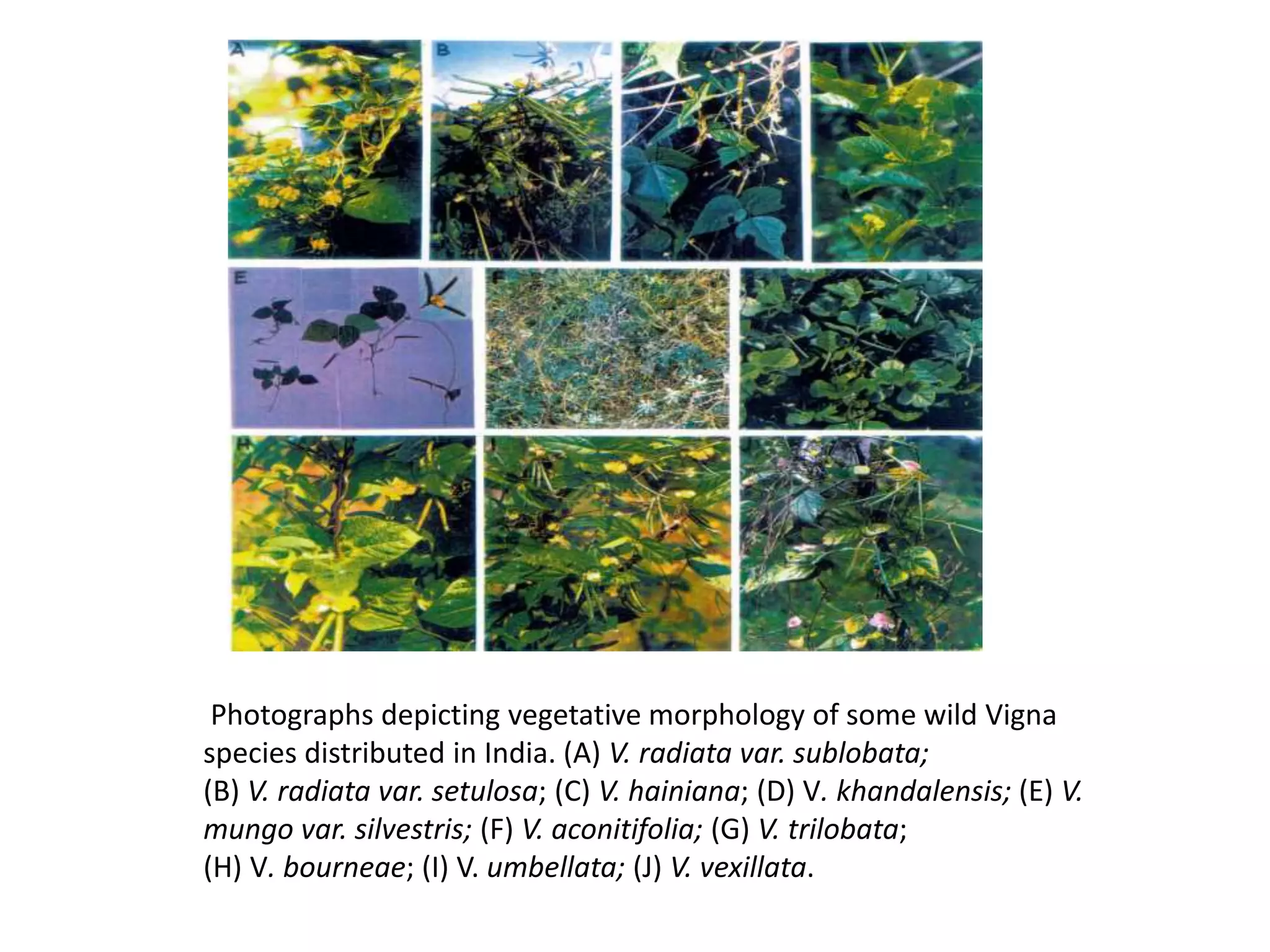
Photographs depicting vegetative morphology of some wild Vigna
species distributed in India. (A) V. radiata var. sublobata;
(B) V. radiata var. setulosa; (C) V. hainiana; (D) V. khandalensis; (E) V.
mungo var. silvestris; (F) V. aconitifolia; (G) V. trilobata;
(H) V. bourneae; (I) V. umbellata; (J) V. vexillata.
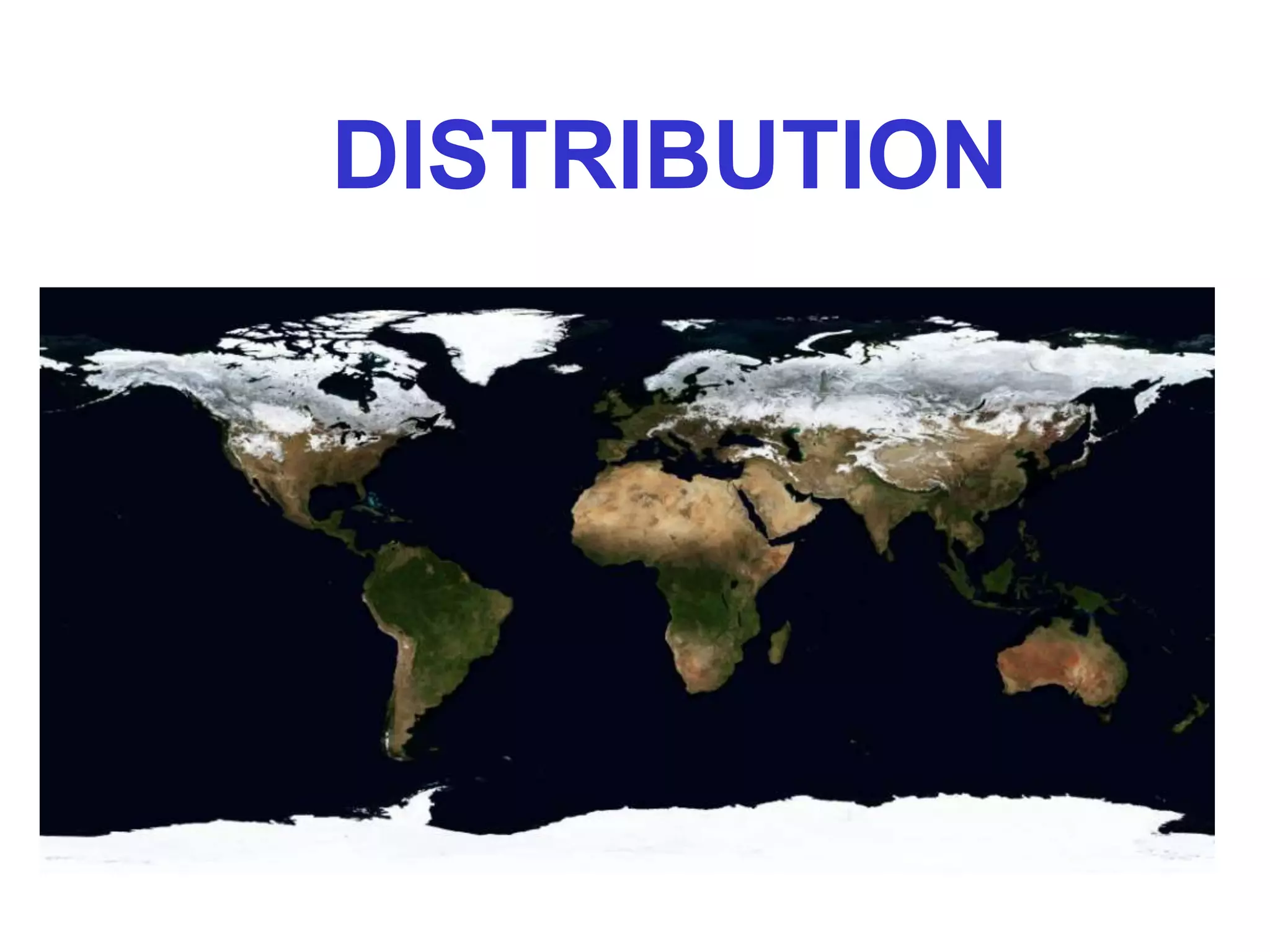
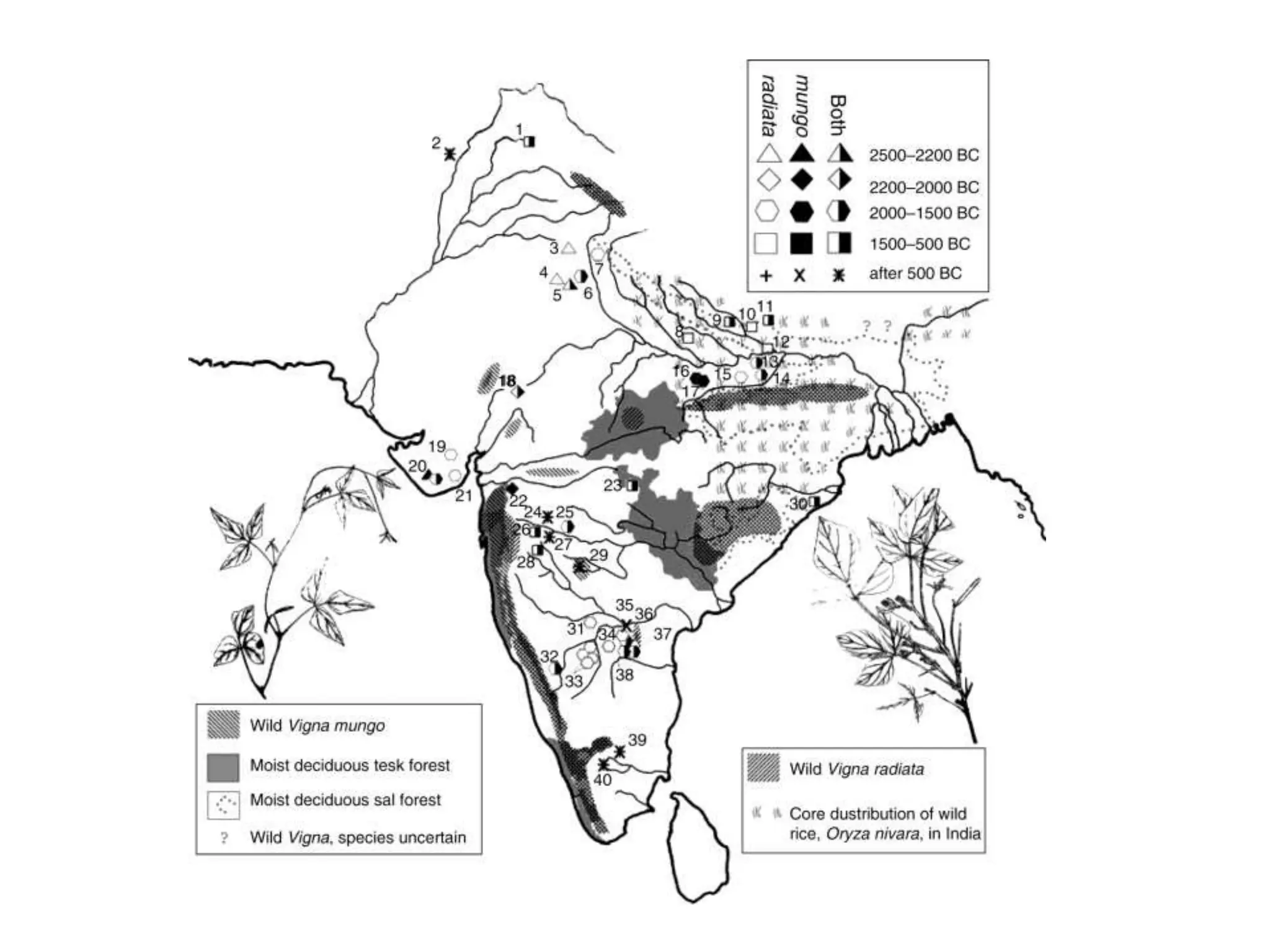
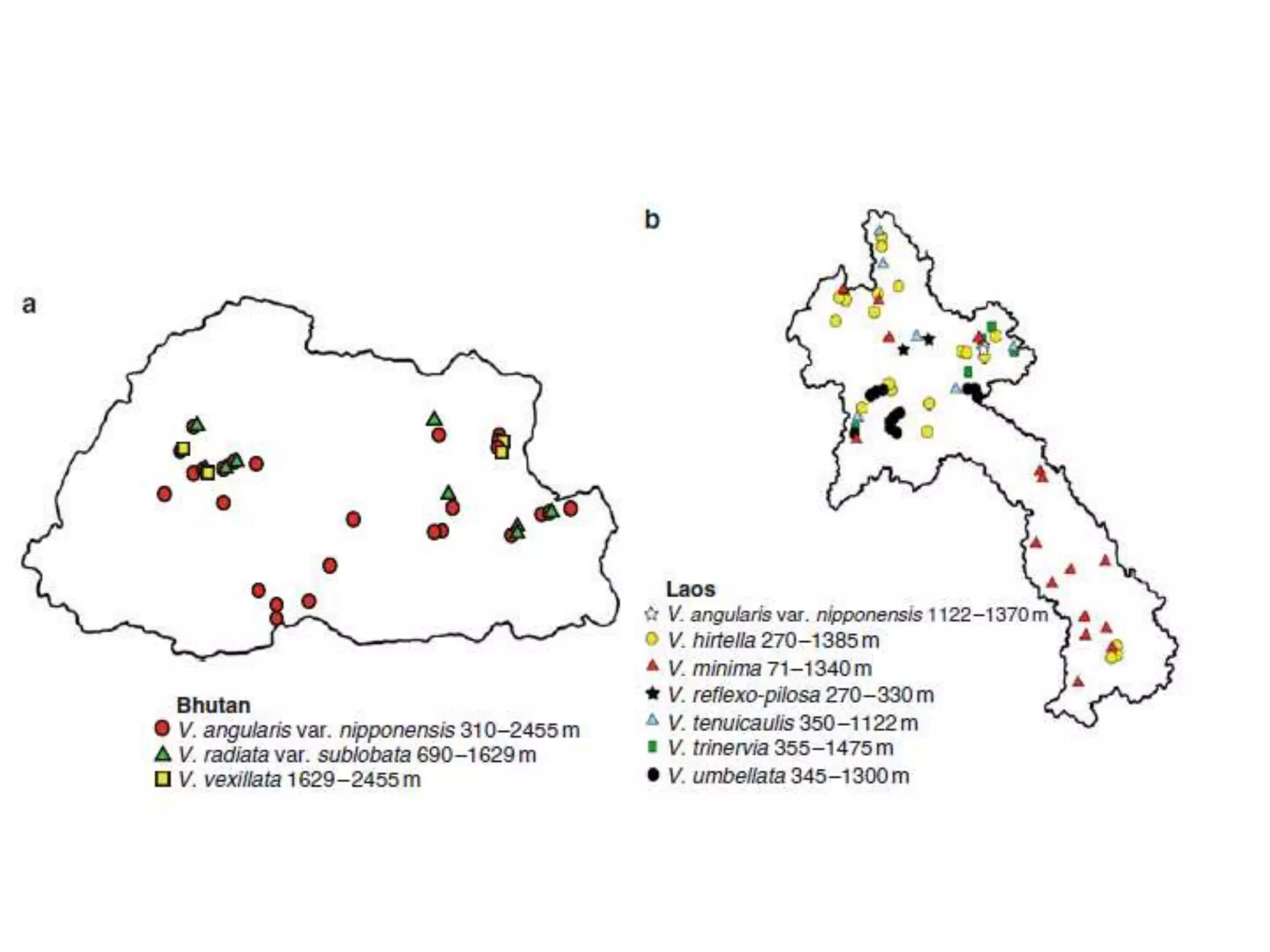
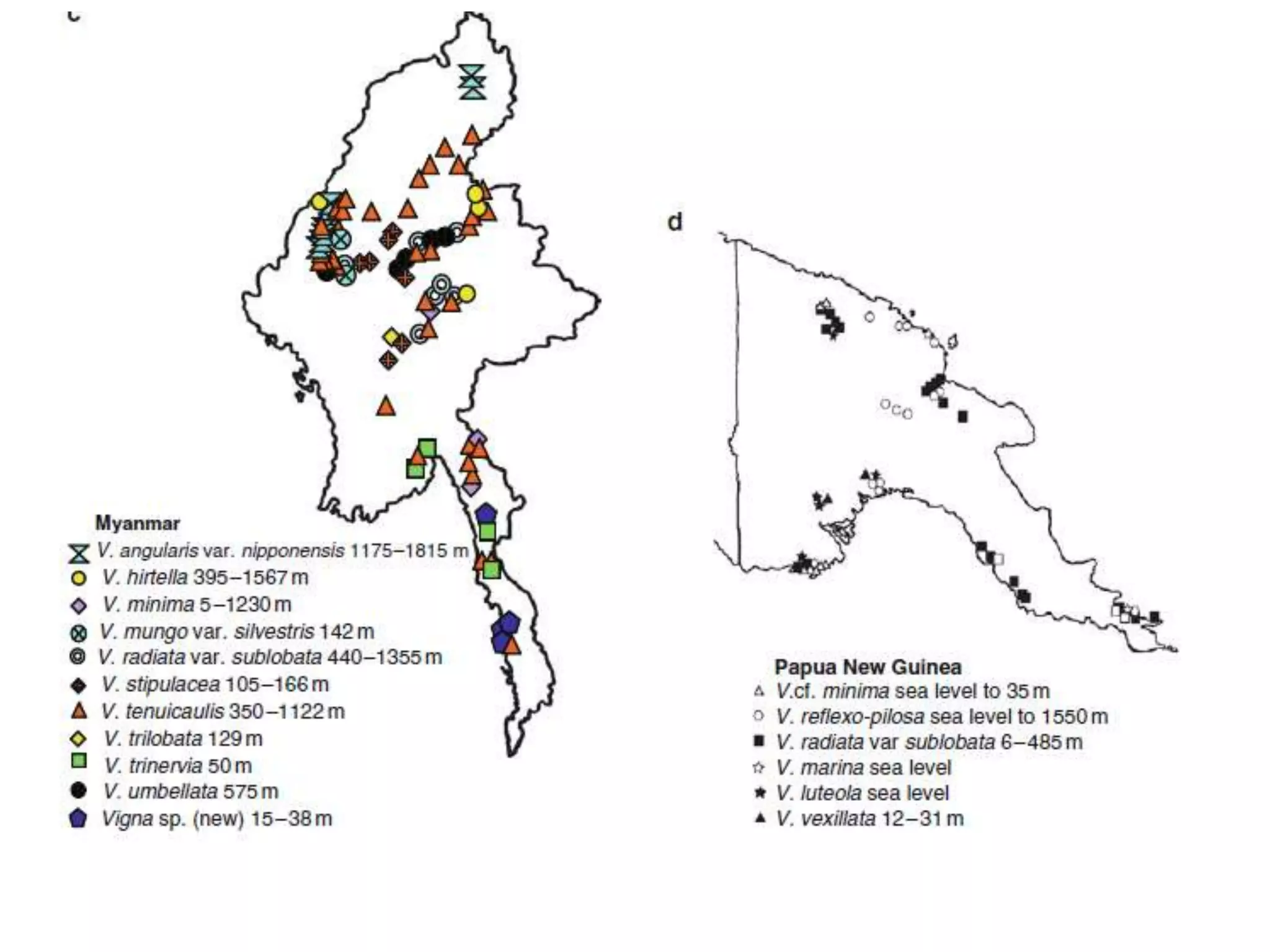
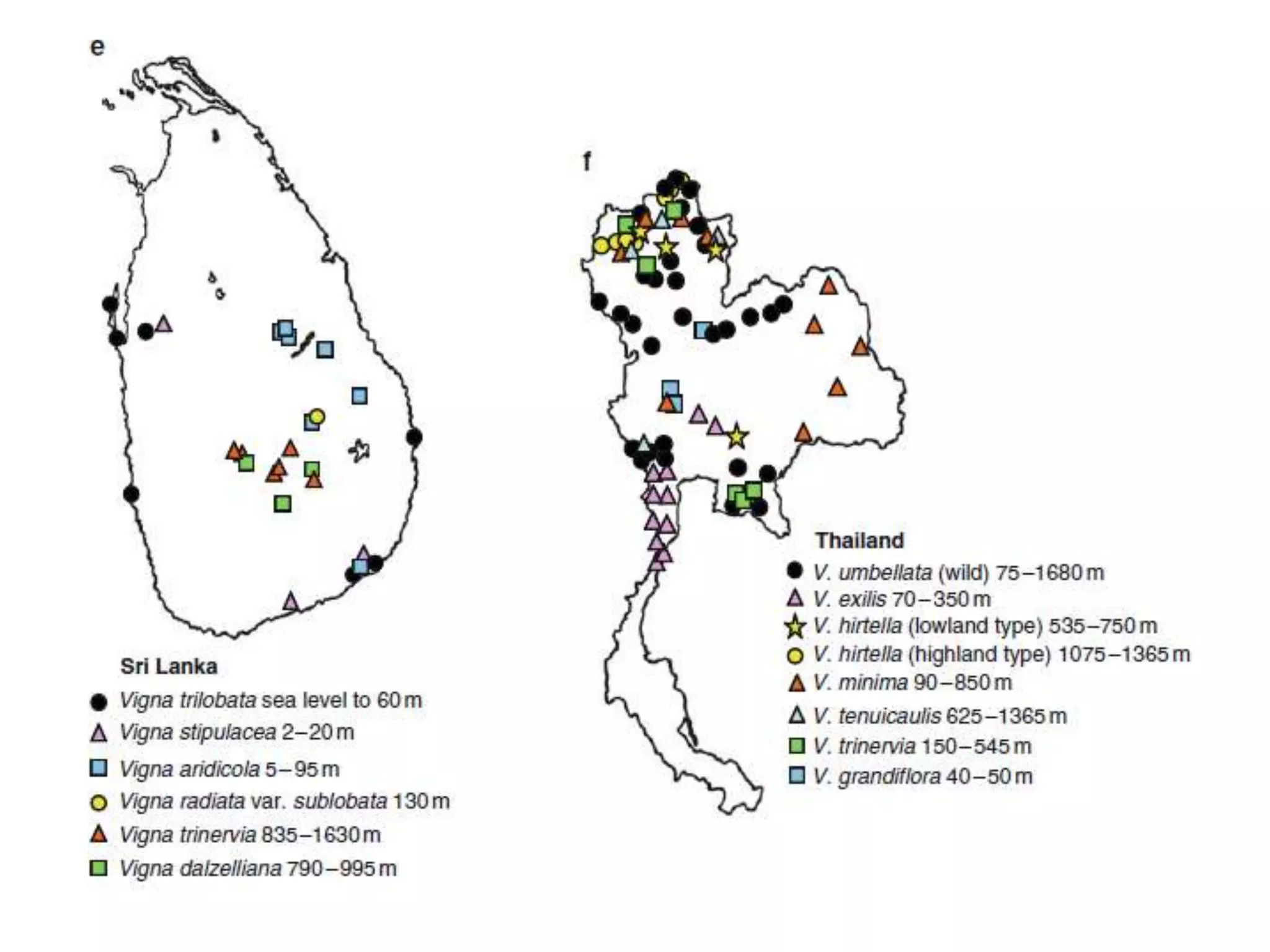
DISTRIBUTION
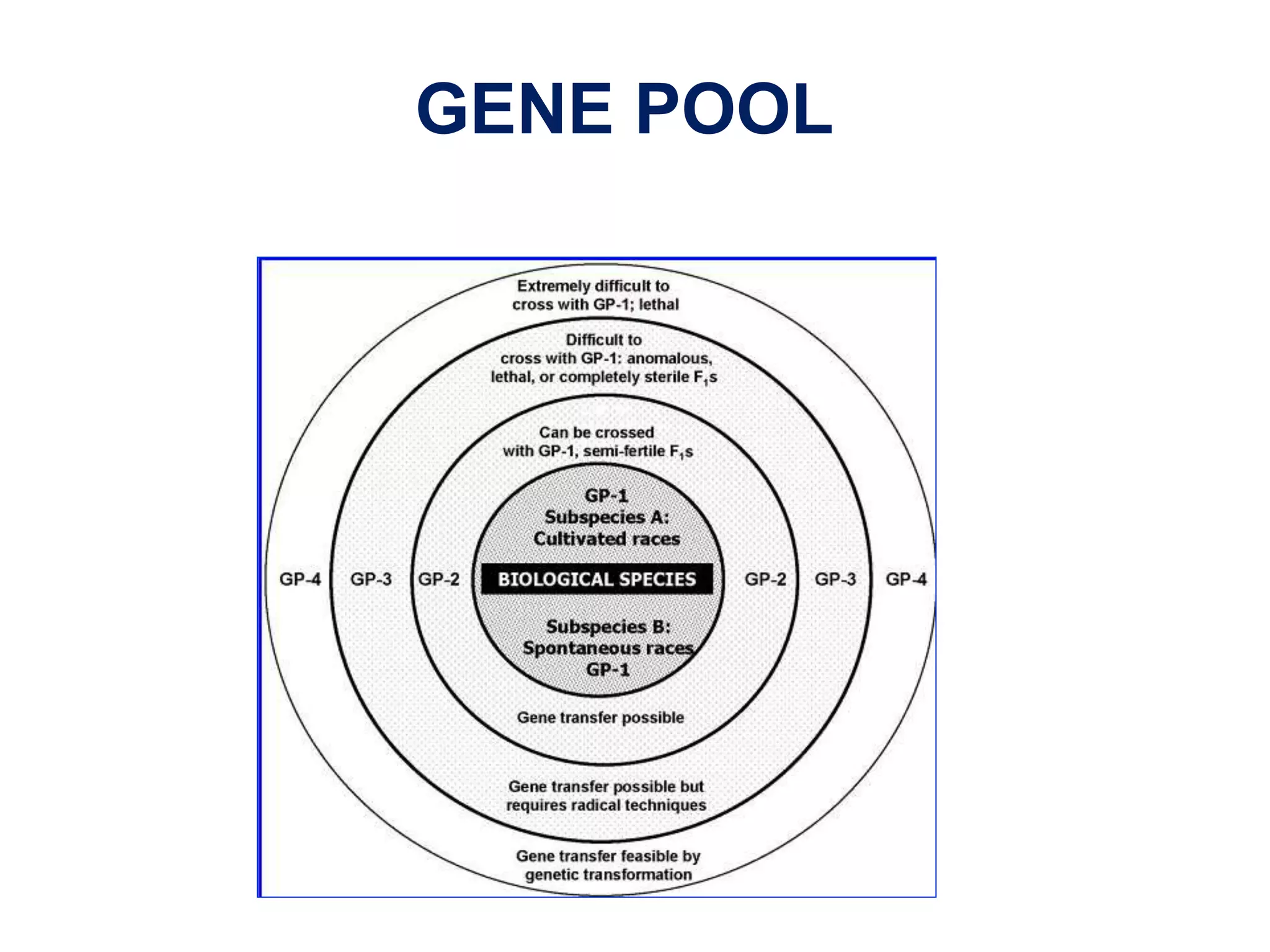
GENE POOL
Cross compatibility
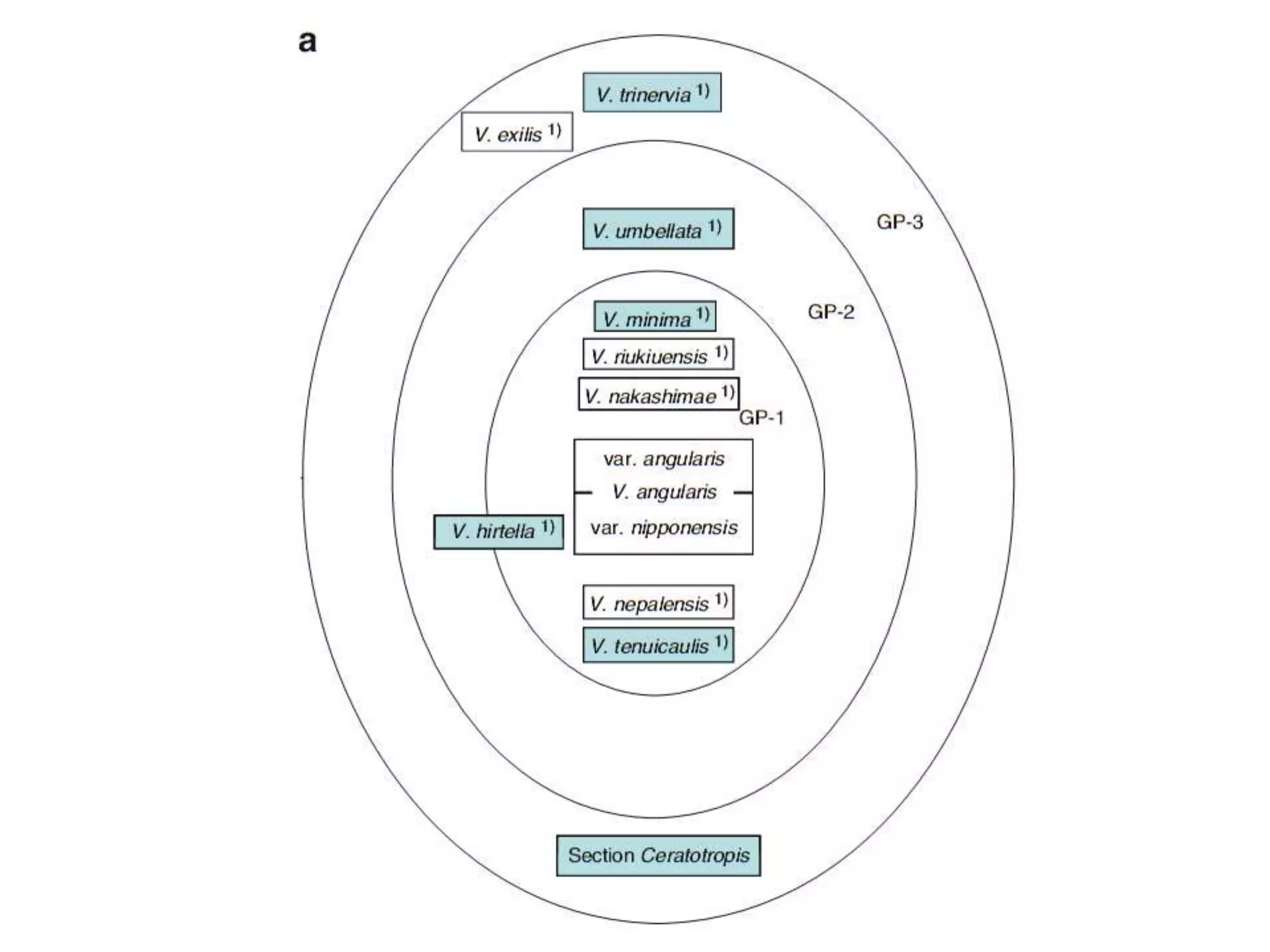
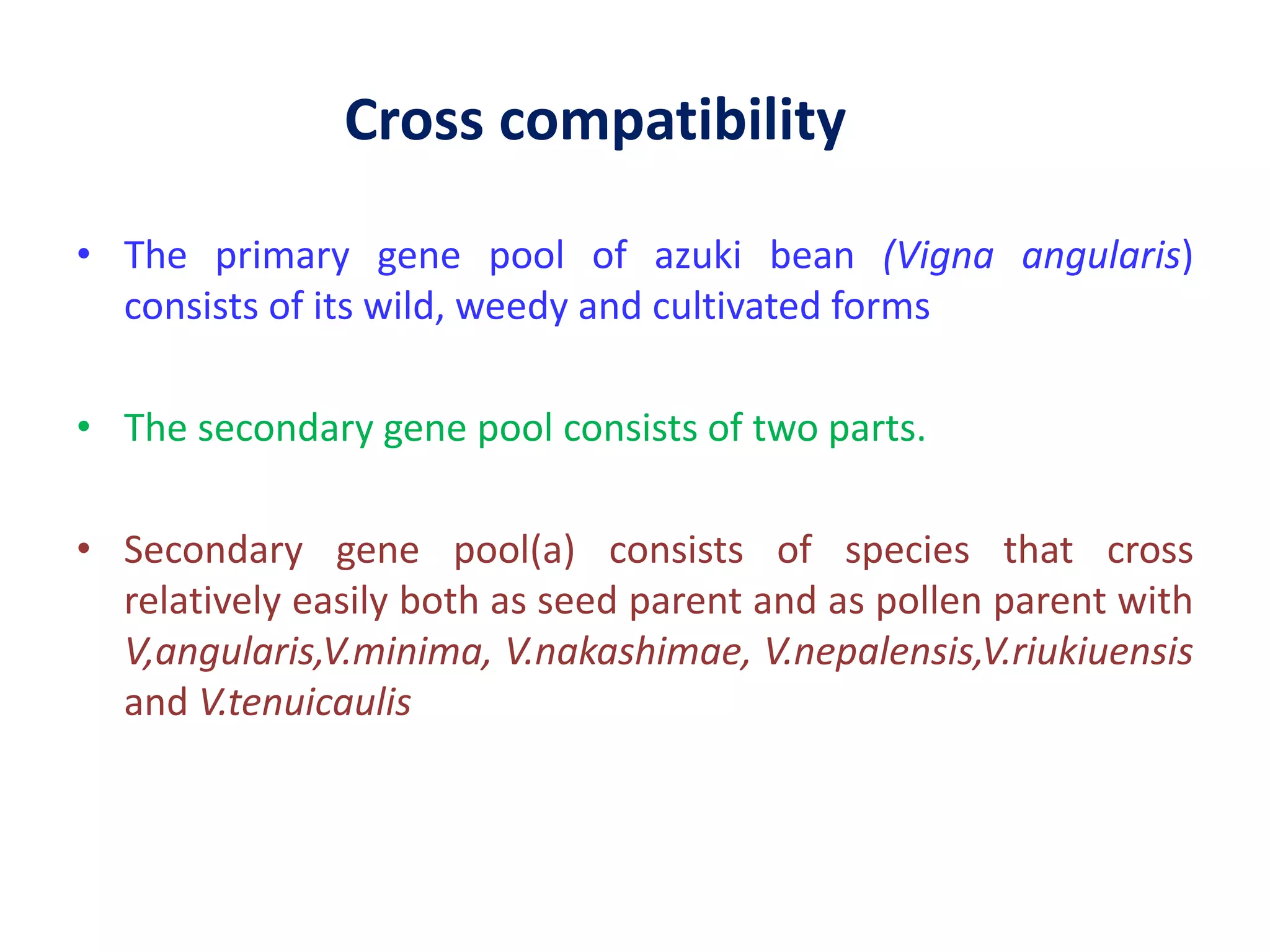
• The primary gene pool of azuki bean (Vigna angularis)
consists of its wild, weedy and cultivated forms
• The secondary gene pool consists of two parts.
• Secondary gene pool(a) consists of species that cross
relatively easily both as seed parent and as pollen parent with
V,angularis,V.minima, V.nakashimae, V.nepalensis,V.riukiuensis
and V.tenuicaulis
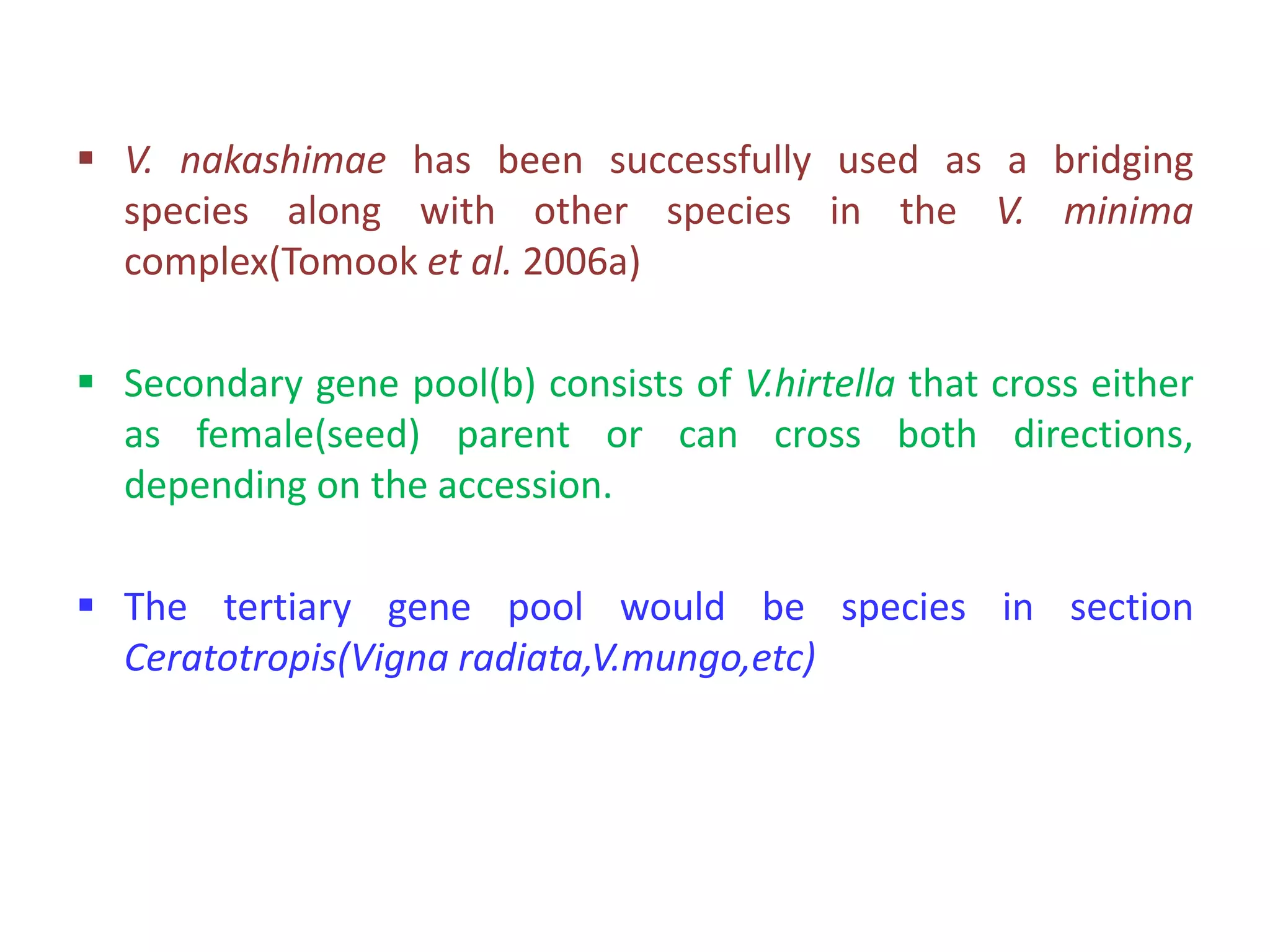
 V. nakashimae has been successfully used as a bridging
species along with other species in the V. minima
complex(Tomook et al. 2006a)
 Secondary gene pool(b) consists of V.hirtella that cross either
as female(seed) parent or can cross both directions,
depending on the accession.
 The tertiary gene pool would be species in section
Ceratotropis(Vigna radiata,V.mungo,etc)
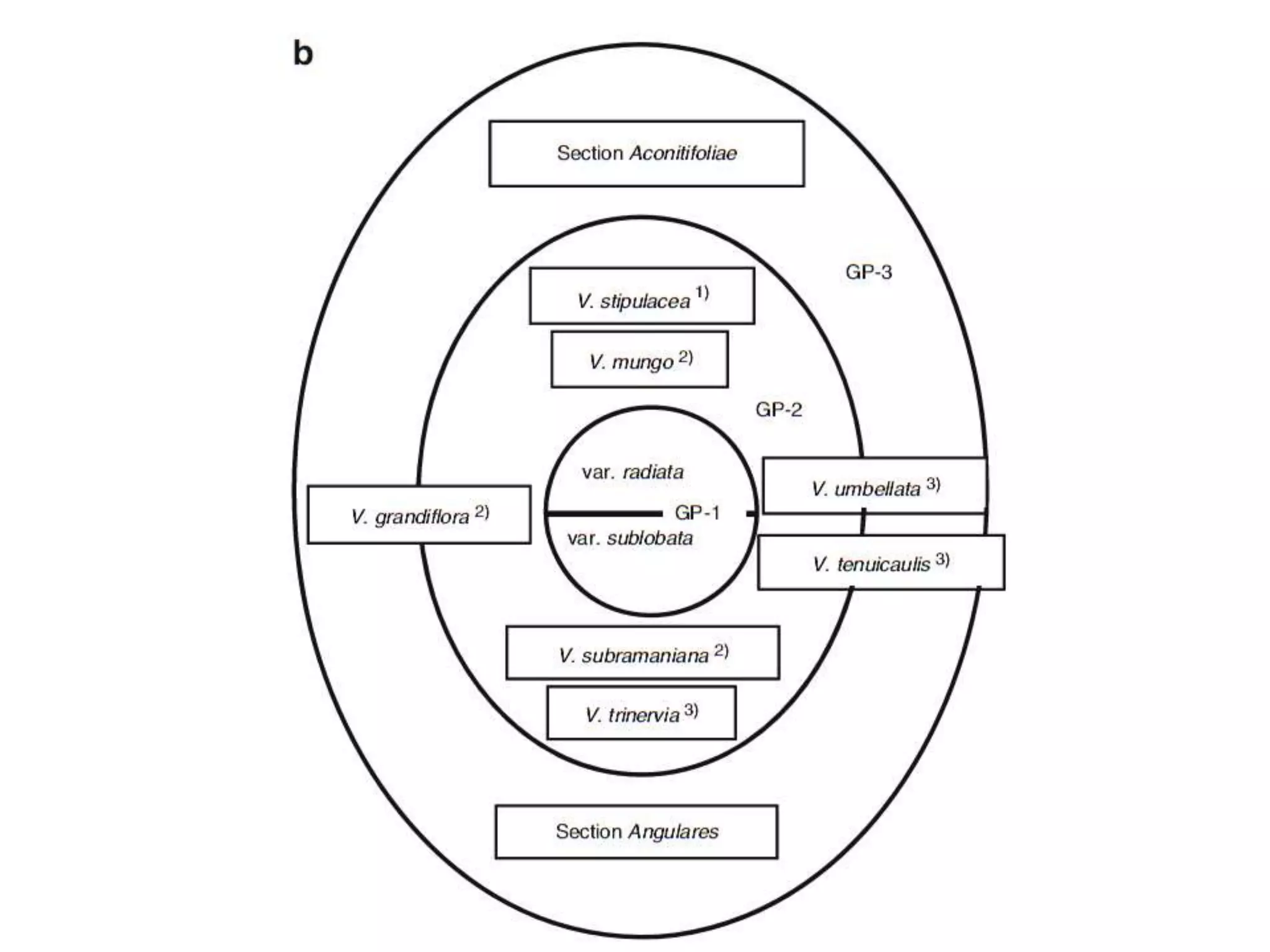
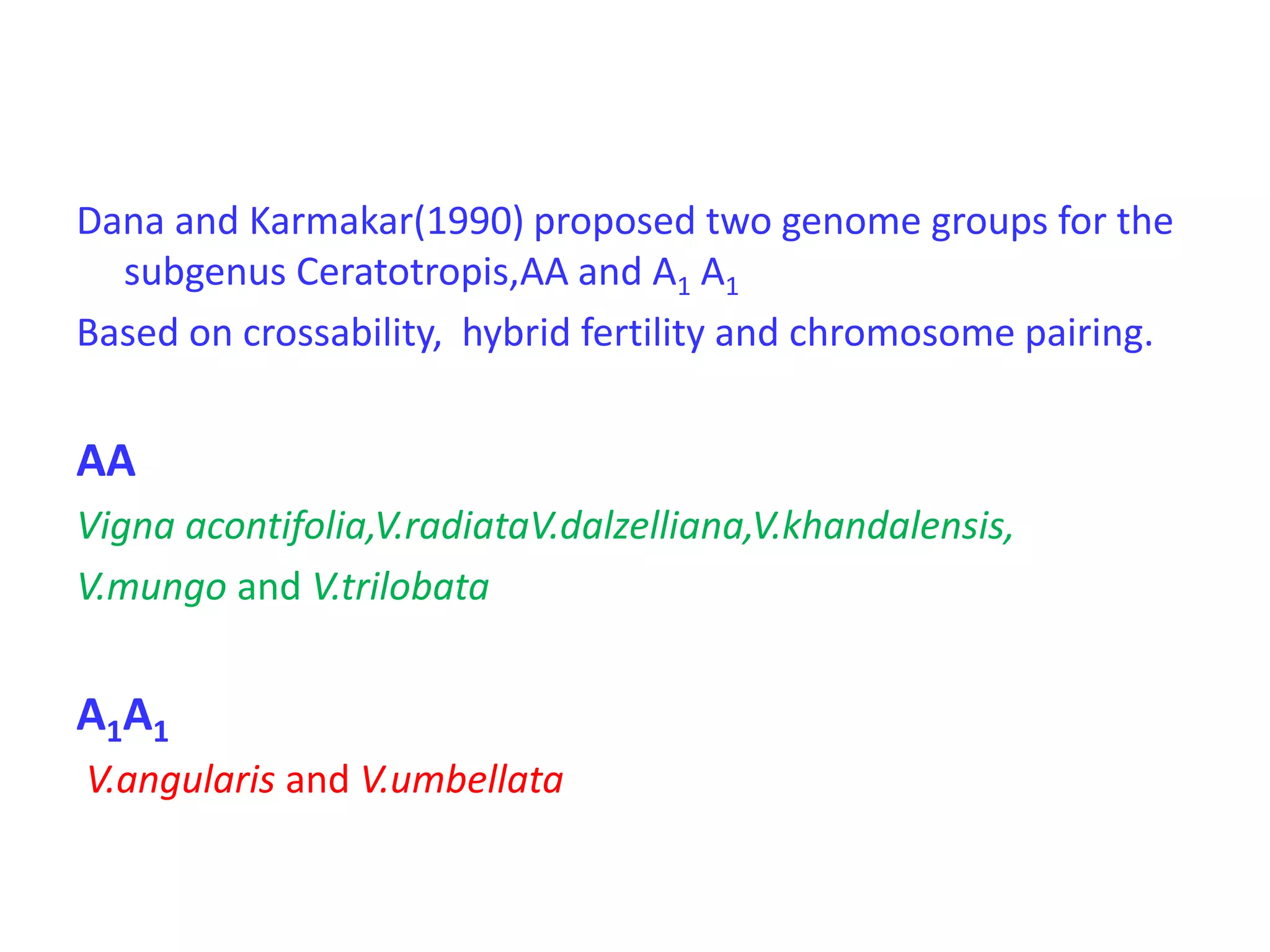
Dana and Karmakar(1990) proposed two genome groups for the
subgenus Ceratotropis,AA and A1 A1
Based on crossability, hybrid fertility and chromosome pairing.
AA
Vigna acontifolia,V.radiataV.dalzelliana,V.khandalensis,
V.mungo and V.trilobata
A1A1
V.angularis and V.umbellata
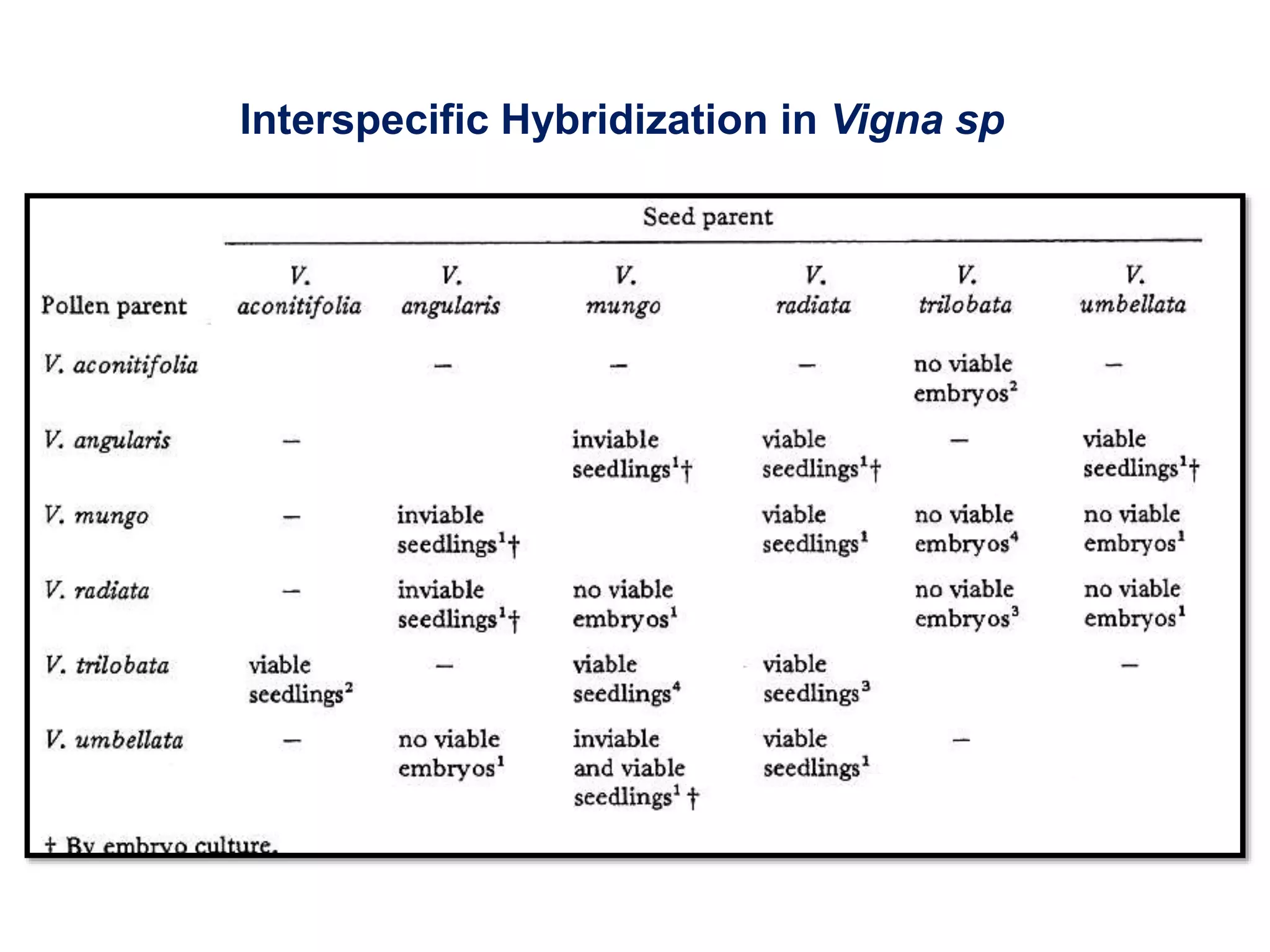
Interspecific Hybridization in Vigna sp
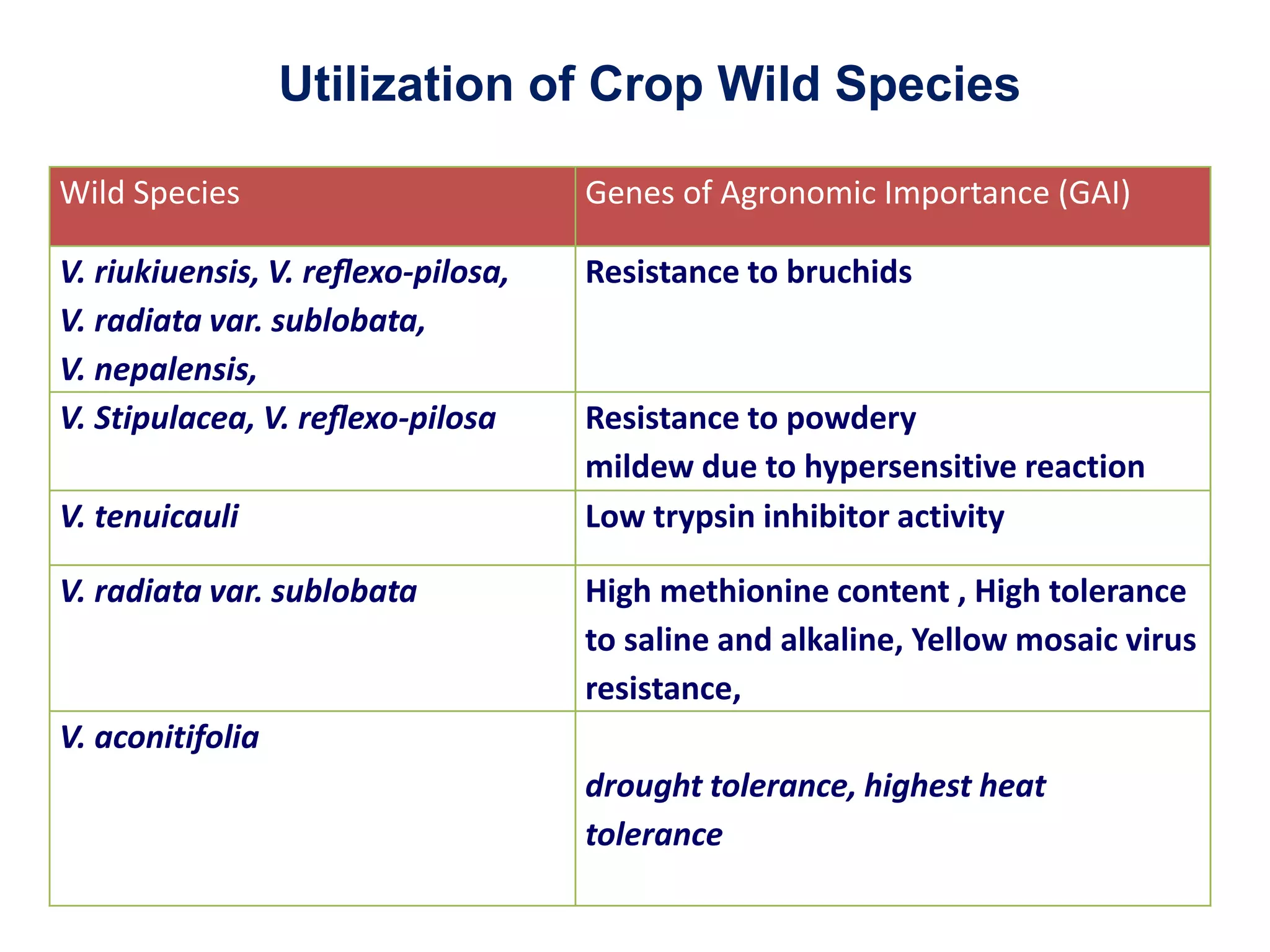
Wild Species Genes of Agronomic Importance (GAI)
V. riukiuensis, V. reflexo-pilosa,
V. radiata var. sublobata,
V. nepalensis,
Resistance to bruchids
V. Stipulacea, V. reflexo-pilosa Resistance to powdery
mildew due to hypersensitive reaction
V. tenuicauli Low trypsin inhibitor activity
V. radiata var. sublobata High methionine content , High tolerance
to saline and alkaline, Yellow mosaic virus
resistance,
V. aconitifolia
drought tolerance, highest heat
tolerance
Utilization of Crop Wild Species
THANK YOU

Evolution of Vigna species

  • 1.
    A. Manivannan Scientist (Genetics) DMR,New Delhi Evolution of Vigna species
  • 2.
    Introduction Kingdom: Plantae Sub kingdom:Tranchobionta Division: Magnoliophyta Class: Magniopsida Subclass: Rosidae Order: Fabales Family: Fabaceae Genus: Vigna Species: Many species Chromosome number 2n=22
  • 3.
    Vigna species -6 subgenera viz., Haydonia, Plectotropis, and Vigna, Ceratotropis,Lasiopron, Sigmoidotropis --90 species -Vigna subgenus Haydonia of Africa may be the most primitive and well- diverged group within Vigna. -Vigna subgenus Sigmoidotropis of the New World is more closely related to Phaseolus than to the other subgenera of the genus Vigna -Species in section Vigna subgenus Vigna are more closely related to the New World subgenus Lasiospron, whereas species in section Catiang (containing cowpea) and Reticulatae are close to species in the subgenus Plectotropis. -In Asia, the subgenus Ceratotropis represents a homogeneous and distinct group.
  • 4.
    Cultivated Vigna species 1.Vigna aconitifolia (Moth bean) 2. Vigna angularis (Adzuki bean) 3. Vigna mungo (Black gram or Urd bean) 4. Vigna radiata (Green gram or Mung Bean) 5. Vigna trilobata (Pillipesara) 6. Vigna umbellata (Rice bean)
  • 5.
    Major Pulse Cultivatedform Wild form Green Gram V.radiata var.radiata V.radiata var. sublobata Black Gram V.mungo var.mungo V.mungo var. silvestris Adzuki Bean V.angularis var.angularis V.angularis var. niponensis Rice Bean V.umbellata var.umbellata V.umbellata var.gracilis Cow pea V.ungiculata sub spp. ungiculata, V.ungiculata sub spp. sesquipedalis, V.ungiculata sub spp. cylindrica V.ungiculata sub spp. dekindtiana, V.ungiculata sub spp. mensensis Major Forms of Vigna sp.
  • 6.
    Distinguishing characters BLACK GRAM •Purple coloured stem • Dark green leaves • Densely hairy • Short pods, with erect long hairs • Less shattering • Large oblong seeds with square ends • Black seed coat • White cotyledon; pasty • Concave hilum GREEN GRAM • Green coloured stem • Pale green leaves • Sparsely hairy • Long radiating pods with small hairs • Highly shattering • Small round seeds • Green seed coat • Cream to yellow cotyledon not pasty; broken to bits • Flat hilum
  • 7.
    • The legumehas been under cultivation in India since ancient times. • According to Vavilov (1926), this pulse originated in India, and central Asia which is recognized as a secondary centre for its spread. • It is suggested that the Phaseolus mungo probably originated from the wild species Phaseolus trinervius or Phaseolus sublobatus commonly grown in India. • It has been introduced in many tropical and subtropical regions by Indian immigrants. Origin
  • 9.
    Species Subgenus, SectionNatural distribution Uses V. aconitifolia (Moth bean) Ceratotropis, Aconitifoliae South Asia Pulse, green pods as vegetable, forage, cover crop, green manure V. adenantha Sigmoidotropis, Laptospron Americas Medicinal uses, tuberous roots eaten V. angularis (Adzuki bean) Ceratotropis, Angulares Himalaya to East Asia Pulse, sweet soup or paste, green pods as vegetable V. caracalla (Snail flower) Sigmoidotropis Caracallae South and Central America Ornamental, minor pulse V. luteola (Dalrymple vigna) Vigna Vigna Africa Fodder and forage V. marina (Dune bean, Beach bean) Vigna Vigna Africa Fodder and forage V. mungo (urd bean, Black gram) Ceratotropis Ceratotropis South Asia Pulse , green pods as vegetable, forage, green manure, bean sprout V. radiate (Mungbean, green gram) Ceratotropis Ceratotropis East Africa through Tropical Asia to Papua New Guinea, tropical Australia Pulse , green pods as vegetable, forage, green manure, bean sprout V. radiata var. Sublobata (wild plants) Ceratotropis Ceratotropis East Africa through tropical Asia to Papua New Guinea, tropical Australia Boiled seeds eaten by humans V. reflexo-pilosa var. glabra (V. glabrescens) (Creole bean) Ceratotropis Angulares Southeast Asia, Oceania Pulse V. subterranea (Bambara groundnut) Vigna Vigna Sub-Saharan Africa Pulse, green pods as vegetable V. umbellata (Wild ) Ceratotropis Angulares South and Southeast Asia Flowers and young pods eaten as vegetables V. unguiculata Vigna, Catiang Africa (cultivated Pulse,green pods as vegetable
  • 10.
    Photographs depicting vegetativemorphology of some wild Vigna species distributed in India. (A) V. radiata var. sublobata; (B) V. radiata var. setulosa; (C) V. hainiana; (D) V. khandalensis; (E) V. mungo var. silvestris; (F) V. aconitifolia; (G) V. trilobata; (H) V. bourneae; (I) V. umbellata; (J) V. vexillata.
  • 11.
  • 16.
  • 20.
    Cross compatibility • Theprimary gene pool of azuki bean (Vigna angularis) consists of its wild, weedy and cultivated forms • The secondary gene pool consists of two parts. • Secondary gene pool(a) consists of species that cross relatively easily both as seed parent and as pollen parent with V,angularis,V.minima, V.nakashimae, V.nepalensis,V.riukiuensis and V.tenuicaulis
  • 21.
     V. nakashimaehas been successfully used as a bridging species along with other species in the V. minima complex(Tomook et al. 2006a)  Secondary gene pool(b) consists of V.hirtella that cross either as female(seed) parent or can cross both directions, depending on the accession.  The tertiary gene pool would be species in section Ceratotropis(Vigna radiata,V.mungo,etc)
  • 22.
    Dana and Karmakar(1990)proposed two genome groups for the subgenus Ceratotropis,AA and A1 A1 Based on crossability, hybrid fertility and chromosome pairing. AA Vigna acontifolia,V.radiataV.dalzelliana,V.khandalensis, V.mungo and V.trilobata A1A1 V.angularis and V.umbellata
  • 23.
  • 24.
    Wild Species Genesof Agronomic Importance (GAI) V. riukiuensis, V. reflexo-pilosa, V. radiata var. sublobata, V. nepalensis, Resistance to bruchids V. Stipulacea, V. reflexo-pilosa Resistance to powdery mildew due to hypersensitive reaction V. tenuicauli Low trypsin inhibitor activity V. radiata var. sublobata High methionine content , High tolerance to saline and alkaline, Yellow mosaic virus resistance, V. aconitifolia drought tolerance, highest heat tolerance Utilization of Crop Wild Species
  • 25.