ORGANIZATIONAL BEHAVIOR
This work is licensed under a Creative CommonsAttribution 4.0 International License.
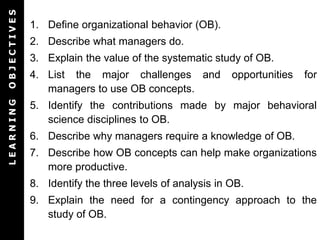
1. Define organizational behavior (OB).
2. Describe what managers do.
3. Explain the value of the systematic study of OB.
4. List the major challenges and opportunities for
managers to use OB concepts.
5. Identify the contributions made by major behavioral
science disciplines to OB.
6. Describe why managers require a knowledge of OB.
7. Describe how OB concepts can help make organizations
more productive.
8. Identify the three levels of analysis in OB.
9. Explain the need for a contingency approach to the
study of OB.
LEARNINGOBJECTIVES
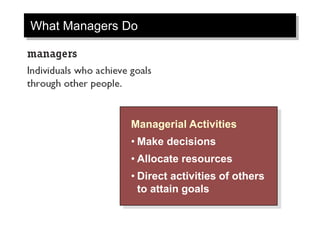
What Managers Do
Managerial Activities
• Make decisions
• Allocate resources
• Direct activities of others
to attain goals
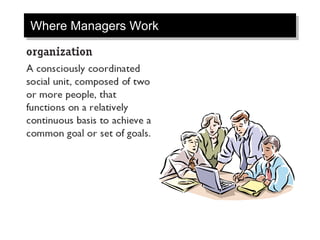
Where Managers Work
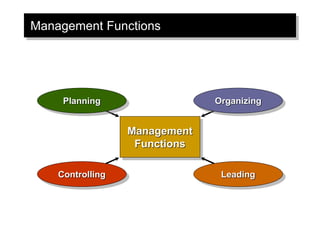
Management Functions
Management
Functions
Planning Organizing
LeadingControlling
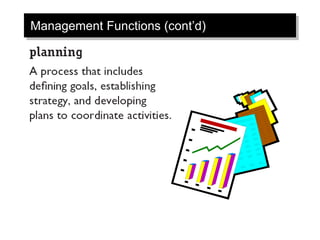
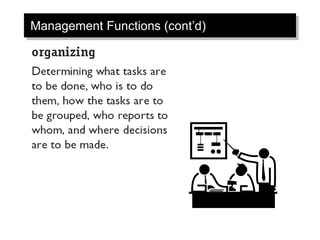
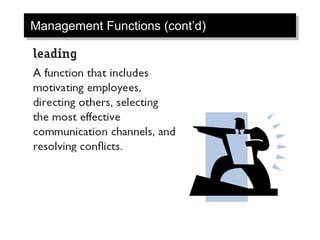
Management Functions (cont’d)
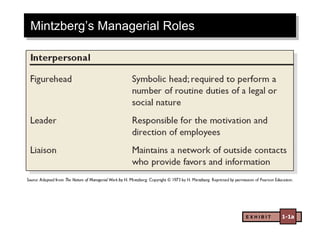
E X H I B I T 1-1a
Mintzberg’s Managerial Roles
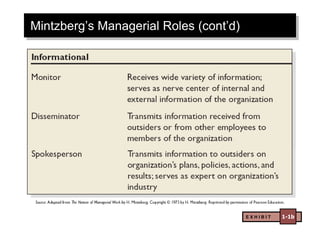
E X H I B I T 1-1b
Mintzberg’s Managerial Roles (cont’d)
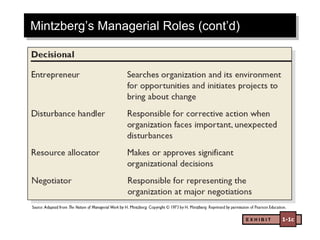
E X H I B I T 1-1c
Mintzberg’s Managerial Roles (cont’d)
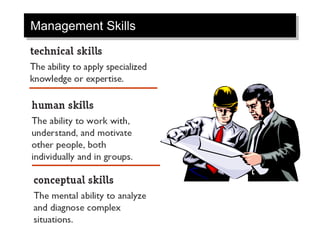
Management Skills
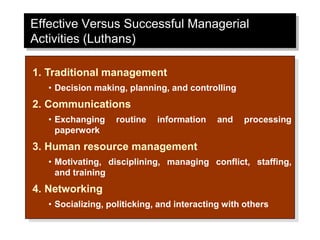
Effective Versus Successful Managerial
Activities (Luthans)
1. Traditional management
• Decision making, planning, and controlling
2. Communications
• Exchanging routine information and processing
paperwork
3. Human resource management
• Motivating, disciplining, managing conflict, staffing,
and training
4. Networking
• Socializing, politicking, and interacting with others
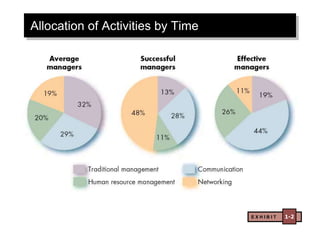
E X H I B I T 1-2
Allocation of Activities by Time
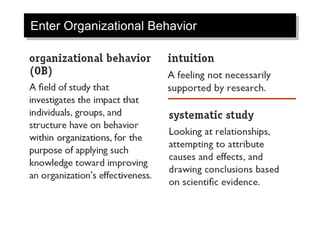
Enter Organizational Behavior
1-18
Complementing Intuition with Systematic
Study
 Intuition: the “gut feeling” explanation of
behavior.
 Systematic study improves ability to accurately
predict behavior.
– Assumes behavior is not random.
– Fundamental consistencies underlie behavior.
– These can be identified and modified to reflect
individual differences.
1-19
Systematic Study
 Examines relationships.
 Attempts to attribute causes and effects.
 Bases conclusions on scientific evidence:
– On data gathered under controlled conditions.
– Data is measured and interpreted in a
reasonably rigorous manner.
1-20
Evidence-Based Management
 Complements systematic study.
 Bases decisions on the best
available scientific evidence.
 Forces managers to become
more scientific in their thinking.
1-21
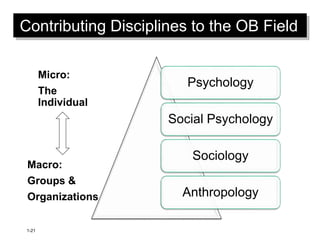
Contributing Disciplines to the OB Field
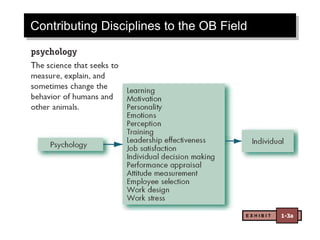
Psychology
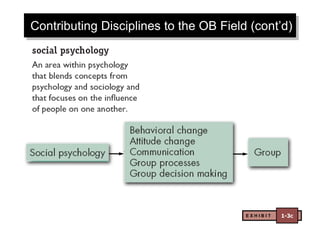
Social Psychology
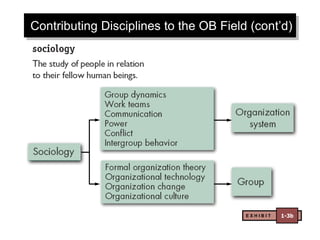
Sociology
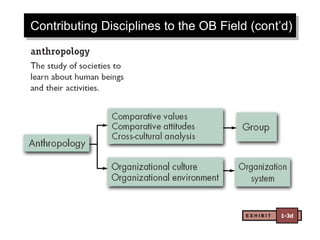
Anthropology
Micro:
The
Individual
Macro:
Groups &
Organizations
Contributing Disciplines to the OB Field
E X H I B I T 1-3a
Contributing Disciplines to the OB Field (cont’d)
E X H I B I T 1-3b
Contributing Disciplines to the OB Field (cont’d)
E X H I B I T 1-3c
Contributing Disciplines to the OB Field (cont’d)
E X H I B I T 1-3d
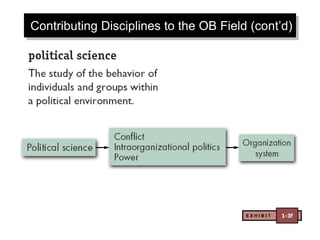
Contributing Disciplines to the OB Field (cont’d)
E X H I B I T 1-3f
1-27
Challenges and Opportunities for OB
 The workplace is contains a wide mix of
cultures, races, ethnic groups, genders and
ages
 Employees have to learn to cope with rapid
change due to global competition
 Corporate loyalty has decreased due to
corporate downsizing and use of temp workers
 Managers can benefit from OB theory and
concepts
1-28
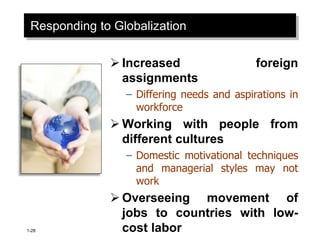
Responding to Globalization
 Increased foreign
assignments
– Differing needs and aspirations in
workforce
 Working with people from
different cultures
– Domestic motivational techniques
and managerial styles may not
work
 Overseeing movement of
jobs to countries with low-
cost labor
1-29
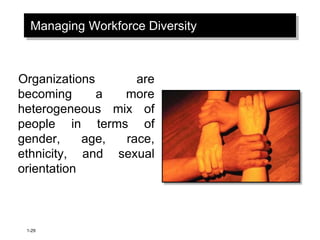
Managing Workforce Diversity
Organizations are
becoming a more
heterogeneous mix of
people in terms of
gender, age, race,
ethnicity, and sexual
orientation
1-30
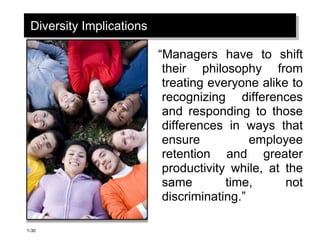
Diversity Implications
“Managers have to shift
their philosophy from
treating everyone alike to
recognizing differences
and responding to those
differences in ways that
ensure employee
retention and greater
productivity while, at the
same time, not
discriminating.”
1-31
OB Offers Insights Into:
 Improving quality and
productivity
 Customer service and
building a customer-
responsive culture
 Developing people skills
1-32
OB Aids in Dealing With:
 Stimulating Innovation and
Change
 Increasing “temporariness” in the
workplace
 Helping employees balance work-
life conflicts
 Improving ethical behavior
1-33
Thinking Positive
 Creating a positive work environment can be a
competitive advantage
 Positive Organizational Scholarship (Positive OB):
– Examines how organizations develop human strengths,
foster vitality and resilience, and unlock potential.
– Focus is on employee strengths, not their weaknesses.
Challenges and Opportunity for OB
 Responding to Globalization
 Managing Workforce Diversity
 Improving Quality and Productivity
 Responding to the Labor Shortage
 Improving Customer Service
Challenges and Opportunity for OB (cont’d)
 Improving People Skills
 Empowering People
 Coping with “Temporariness”
 Stimulation Innovation and Change
 Helping Employees Balance Work/Life Conflicts
 Improving Ethical Behavior
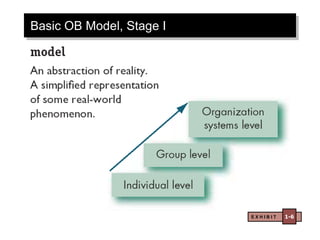
E X H I B I T 1-6
Basic OB Model, Stage I
1-37
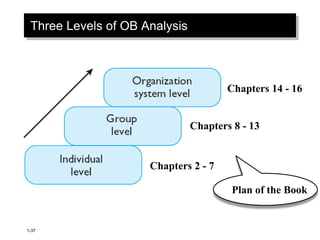
Three Levels of OB Analysis
Chapters 2 - 7
Chapters 8 - 13
Chapters 14 - 16
Plan of the Book
1-38
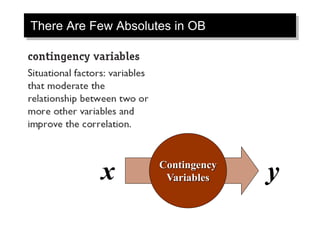
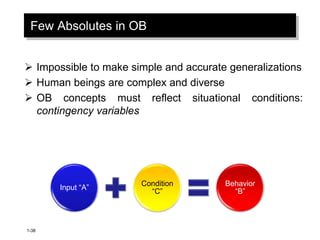
Few Absolutes in OB
 Impossible to make simple and accurate generalizations
 Human beings are complex and diverse
 OB concepts must reflect situational conditions:
contingency variables
Input “A”
Condition
“C”
Behavior
“B”
There Are Few Absolutes in OB
Contingency
Variablesx y
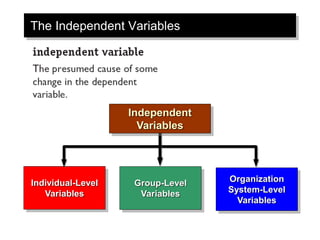
The Independent Variables
Independent
Variables
Individual-Level
Variables
Organization
System-Level
Variables
Group-Level
Variables
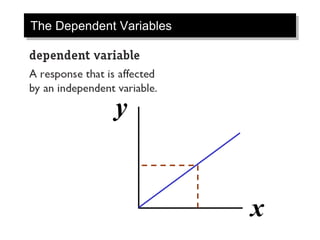
The Dependent Variables
x
y
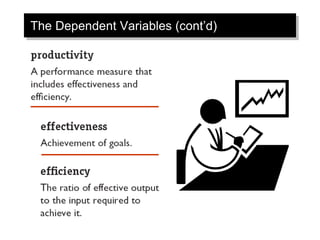
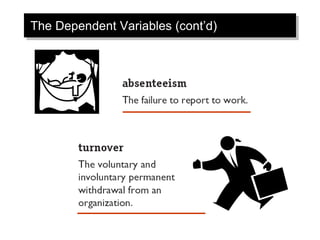
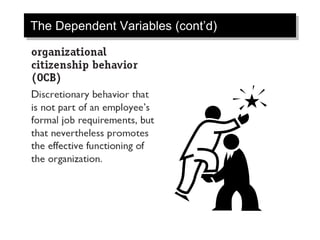
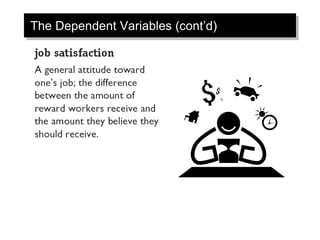
The Dependent Variables (cont’d)
1-46
Keep in Mind…
 OB’s goal is to understand and predict human behavior in
organizations.
 Fundamental consistencies underlie behavior.
 It is more important than ever to learn OB concepts.
 Both managers and employees must learn to cope with
temporariness.
1-47
Summary
1. Defined Organizational Behavior (OB).
2. Explained the value of the systematic study of
OB.
3. Identified the contributions made to OB by
major behavioral science disciplines.
4. Described how OB concepts can help make
organizations more productive.
5. Listed the major challenges and opportunities
for managers to use OB concepts.
6. Identified the three levels of analysis in OB.

Evolution of Management Thoughts and OB

  • 1.
    ORGANIZATIONAL BEHAVIOR This workis licensed under a Creative CommonsAttribution 4.0 International License.
  • 2.
    1. Define organizationalbehavior (OB). 2. Describe what managers do. 3. Explain the value of the systematic study of OB. 4. List the major challenges and opportunities for managers to use OB concepts. 5. Identify the contributions made by major behavioral science disciplines to OB. 6. Describe why managers require a knowledge of OB. 7. Describe how OB concepts can help make organizations more productive. 8. Identify the three levels of analysis in OB. 9. Explain the need for a contingency approach to the study of OB. LEARNINGOBJECTIVES
  • 3.
    What Managers Do ManagerialActivities • Make decisions • Allocate resources • Direct activities of others to attain goals
  • 4.
  • 5.
  • 6.
  • 7.
  • 8.
  • 9.
  • 10.
    E X HI B I T 1-1a Mintzberg’s Managerial Roles
  • 11.
    E X HI B I T 1-1b Mintzberg’s Managerial Roles (cont’d)
  • 12.
    E X HI B I T 1-1c Mintzberg’s Managerial Roles (cont’d)
  • 14.
  • 15.
    Effective Versus SuccessfulManagerial Activities (Luthans) 1. Traditional management • Decision making, planning, and controlling 2. Communications • Exchanging routine information and processing paperwork 3. Human resource management • Motivating, disciplining, managing conflict, staffing, and training 4. Networking • Socializing, politicking, and interacting with others
  • 16.
    E X HI B I T 1-2 Allocation of Activities by Time
  • 17.
  • 18.
    1-18 Complementing Intuition withSystematic Study  Intuition: the “gut feeling” explanation of behavior.  Systematic study improves ability to accurately predict behavior. – Assumes behavior is not random. – Fundamental consistencies underlie behavior. – These can be identified and modified to reflect individual differences.
  • 19.
    1-19 Systematic Study  Examinesrelationships.  Attempts to attribute causes and effects.  Bases conclusions on scientific evidence: – On data gathered under controlled conditions. – Data is measured and interpreted in a reasonably rigorous manner.
  • 20.
    1-20 Evidence-Based Management  Complementssystematic study.  Bases decisions on the best available scientific evidence.  Forces managers to become more scientific in their thinking.
  • 21.
    1-21 Contributing Disciplines tothe OB Field Psychology Social Psychology Sociology Anthropology Micro: The Individual Macro: Groups & Organizations
  • 22.
    Contributing Disciplines tothe OB Field E X H I B I T 1-3a
  • 23.
    Contributing Disciplines tothe OB Field (cont’d) E X H I B I T 1-3b
  • 24.
    Contributing Disciplines tothe OB Field (cont’d) E X H I B I T 1-3c
  • 25.
    Contributing Disciplines tothe OB Field (cont’d) E X H I B I T 1-3d
  • 26.
    Contributing Disciplines tothe OB Field (cont’d) E X H I B I T 1-3f
  • 27.
    1-27 Challenges and Opportunitiesfor OB  The workplace is contains a wide mix of cultures, races, ethnic groups, genders and ages  Employees have to learn to cope with rapid change due to global competition  Corporate loyalty has decreased due to corporate downsizing and use of temp workers  Managers can benefit from OB theory and concepts
  • 28.
    1-28 Responding to Globalization Increased foreign assignments – Differing needs and aspirations in workforce  Working with people from different cultures – Domestic motivational techniques and managerial styles may not work  Overseeing movement of jobs to countries with low- cost labor
  • 29.
    1-29 Managing Workforce Diversity Organizationsare becoming a more heterogeneous mix of people in terms of gender, age, race, ethnicity, and sexual orientation
  • 30.
    1-30 Diversity Implications “Managers haveto shift their philosophy from treating everyone alike to recognizing differences and responding to those differences in ways that ensure employee retention and greater productivity while, at the same time, not discriminating.”
  • 31.
    1-31 OB Offers InsightsInto:  Improving quality and productivity  Customer service and building a customer- responsive culture  Developing people skills
  • 32.
    1-32 OB Aids inDealing With:  Stimulating Innovation and Change  Increasing “temporariness” in the workplace  Helping employees balance work- life conflicts  Improving ethical behavior
  • 33.
    1-33 Thinking Positive  Creatinga positive work environment can be a competitive advantage  Positive Organizational Scholarship (Positive OB): – Examines how organizations develop human strengths, foster vitality and resilience, and unlock potential. – Focus is on employee strengths, not their weaknesses.
  • 34.
    Challenges and Opportunityfor OB  Responding to Globalization  Managing Workforce Diversity  Improving Quality and Productivity  Responding to the Labor Shortage  Improving Customer Service
  • 35.
    Challenges and Opportunityfor OB (cont’d)  Improving People Skills  Empowering People  Coping with “Temporariness”  Stimulation Innovation and Change  Helping Employees Balance Work/Life Conflicts  Improving Ethical Behavior
  • 36.
    E X HI B I T 1-6 Basic OB Model, Stage I
  • 37.
    1-37 Three Levels ofOB Analysis Chapters 2 - 7 Chapters 8 - 13 Chapters 14 - 16 Plan of the Book
  • 38.
    1-38 Few Absolutes inOB  Impossible to make simple and accurate generalizations  Human beings are complex and diverse  OB concepts must reflect situational conditions: contingency variables Input “A” Condition “C” Behavior “B”
  • 39.
    There Are FewAbsolutes in OB Contingency Variablesx y
  • 40.
  • 41.
  • 42.
  • 43.
  • 44.
  • 45.
  • 46.
    1-46 Keep in Mind… OB’s goal is to understand and predict human behavior in organizations.  Fundamental consistencies underlie behavior.  It is more important than ever to learn OB concepts.  Both managers and employees must learn to cope with temporariness.
  • 47.
    1-47 Summary 1. Defined OrganizationalBehavior (OB). 2. Explained the value of the systematic study of OB. 3. Identified the contributions made to OB by major behavioral science disciplines. 4. Described how OB concepts can help make organizations more productive. 5. Listed the major challenges and opportunities for managers to use OB concepts. 6. Identified the three levels of analysis in OB.