1
Evolution of LTE Towards B4G 
and Beyond
Yongjun Kwak, Ph.D.
(yongjun.kwak@samsung.com)
Samsung Electronics Co., Ltd.
Digital Media and Communications R&D Center
2
Table of contents
 3GPP Standardization Status
 Candidate Technologies for B4G and Beyond
• Device to Device (D2D) Communication
• Full Dimension MIMO (FD‐MIMO)
• CoMP with Non‐Ideal Backhaul
• Network Assisted interference Cancelation and Suppression (NAICS)
• Millimeter Wave (mmWave) Communication
 Concluding Remarks
3
3GPP Standardization Status
4
3rd Generation Partnership Project
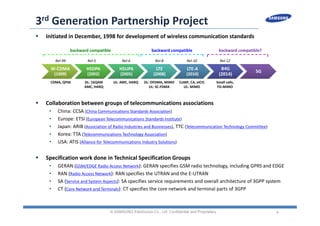
 Initiated in December, 1998 for development of wireless communication standards
 Collaboration between groups of telecommunications associations
• China: CCSA (China Communications Standards Association)
• Europe: ETSI (European Telecommunications Standards Institute)
• Japan: ARIB (Association of Radio Industries and Businesses), TTC (Telecommunication Technology Committee)
• Korea: TTA (Telecommunications Technology Association)
• USA: ATIS (Alliance for Telecommunications Industry Solutions)
 Specification work done in Technical Specification Groups
• GERAN (GSM/EDGE Radio Access Network): GERAN specifies GSM radio technology, including GPRS and EDGE
• RAN (Radio Access Network): RAN specifies the UTRAN and the E‐UTRAN
• SA (Service and System Aspects): SA specifies service requirements and overall architecture of 3GPP system
• CT (Core Network and Terminals): CT specifies the core network and terminal parts of 3GPP
© SAMSUNG Electronics Co., Ltd. Confidential and Proprietary
W‐CDMA 
(1999)
W‐CDMA 
(1999)
HSDPA
(2002)
HSDPA
(2002)
HSUPA
(2005)
HSUPA
(2005)
LTE
(2008)
LTE
(2008)
LTE‐A 
(2010)
LTE‐A 
(2010)
B4G 
(2014)
B4G 
(2014)
5G5G
CDMA, QPSK DL: 16QAM
AMC, HARQ
UL: AMC, HARQ DL: OFDMA, MIMO
UL: SC‐FDMA
CoMP, CA, eICIC
UL: MIMO
backward compatible backward compatible
Rel‐99 Rel‐5 Rel‐6 Rel‐8 Rel‐10
Small cells, 
FD‐MIMO
backward compatible?
Rel‐12
5
Industry Participation in 3GPP
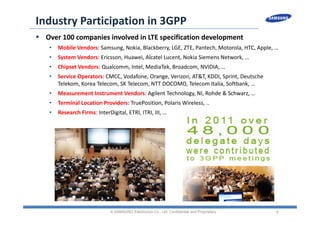
 Over 100 companies involved in LTE specification development
• Mobile Vendors: Samsung, Nokia, Blackberry, LGE, ZTE, Pantech, Motorola, HTC, Apple, …
• System Vendors: Ericsson, Huawei, Alcatel Lucent, Nokia Siemens Network, …
• Chipset Vendors: Qualcomm, Intel, MediaTek, Broadcom, NVIDIA, …
• Service Operators: CMCC, Vodafone, Orange, Verizon, AT&T, KDDI, Sprint, Deutsche 
Telekom, Korea Telecom, SK Telecom, NTT DOCOMO, Telecom Italia, Softbank, …
• Measurement Instrument Vendors: Agilent Technology, NI, Rohde & Schwarz, …
• Terminal Location Providers: TruePosition, Polaris Wireless, ..
• Research Firms: InterDigital, ETRI, ITRI, III, …
© SAMSUNG Electronics Co., Ltd. Confidential and Proprietary
6
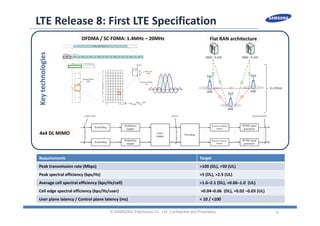
LTE Release 8: First LTE Specification
© SAMSUNG Electronics Co., Ltd. Confidential and Proprietary
10ms radio frame, Tf
#1 #2 #3 #4 #5 #6 #7 #8 #9
Subframe
Slot, Tslot 0.5 msec
1msec
#0
Resource Block
(RB) Resource element
(k,l)
l=0 l=Nsymb
DL
-1
Symbol
Subcarrier
15kHz
k = nPRB*NSC
RB
4x4 DL MIMO
OFDMA / SC‐FDMA: 1.4MHz – 20MHz Flat RAN architecture
Key technologies
Requirements Target
Peak transmission rate (Mbps) >100 (DL), >50 (UL)
Peak spectral efficiency (bps/Hz) >5 (DL), >2.5 (UL)
Average cell spectral efficiency (bps/Hz/cell)  >1.6–2.1 (DL), >0.66–1.0  (UL)
Cell edge spectral efficiency (bps/Hz/user) >0.04–0.06 (DL), >0.02 –0.03 (UL)
User plane latency / Control plane latency (ms) < 10 / <100
7
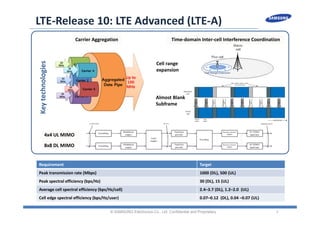
LTE‐Release 10: LTE Advanced (LTE‐A)
© SAMSUNG Electronics Co., Ltd. Confidential and Proprietary
Key technologies
Carrier Aggregation
8x8 DL MIMO
4x4 UL MIMO
Time‐domain Inter‐cell Interference Coordination
Cell range 
expansion
Almost Blank 
Subframe
Requirement Target
Peak transmission rate (Mbps) 1000 (DL), 500 (UL)
Peak spectral efficiency (bps/Hz) 30 (DL), 15 (UL)
Average cell spectral efficiency (bps/Hz/cell)  2.4–3.7 (DL), 1.2–2.0  (UL)
Cell edge spectral efficiency (bps/Hz/user) 0.07–0.12 (DL), 0.04 –0.07 (UL)
8
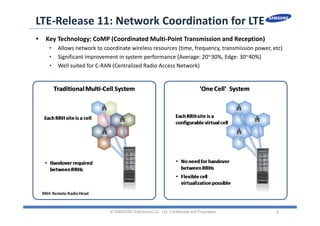
LTE‐Release 11: Network Coordination for LTE
© SAMSUNG Electronics Co., Ltd. Confidential and Proprietary
 Key Technology: CoMP (Coordinated Multi‐Point Transmission and Reception)
• Allows network to coordinate wireless resources (time, frequency, transmission power, etc)
• Significant improvement in system performance (Average: 20~30%, Edge: 30~40%)
• Well suited for C‐RAN (Centralized Radio Access Network)
9
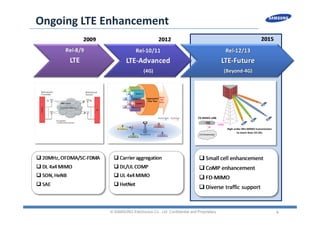
Ongoing LTE Enhancement
© SAMSUNG Electronics Co., Ltd. Confidential and Proprietary
10
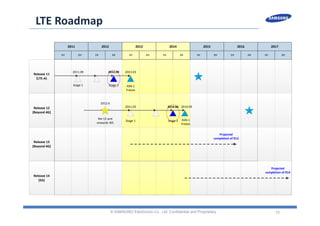
LTE Roadmap
1H 2H 1H 2H 1H 2H 1H 2H 1H 2H 1H 2H
2011 2012 2013 2014 2015 2016
Release 11
(LTE‐A)
Release 12
(Beyond 4G)
Release 13
(Beyond 4G)
2011.09
Stage 1 Stage 3 ASN.1 
Freeze
2011.03
Stage 1
Rel‐12 and 
onwards WS
2012.6
2014.06
Stage 3 ASN.1 
Freeze
2014.09
2012.09 2013.03
Release 14
(5G)
1H 2H
2017
Projected 
completion of R13
Projected 
completion of R14
© SAMSUNG Electronics Co., Ltd. Confidential and Proprietary
11
Candidate Technologies for B4G 
and Beyond
12
Device to Device Communication
13
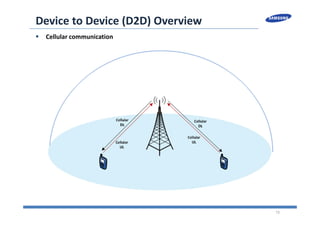
Device to Device (D2D) Overview
 Cellular communication
14
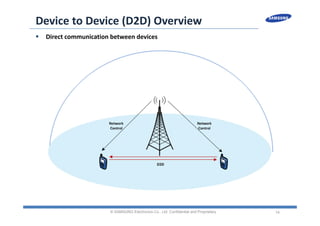
Device to Device (D2D) Overview
 Direct communication between devices
© SAMSUNG Electronics Co., Ltd. Confidential and Proprietary
15
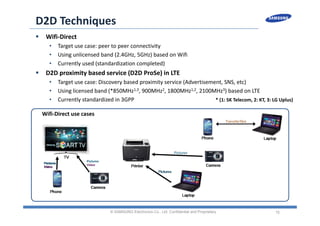
D2D Techniques
 Wifi‐Direct
• Target use case: peer to peer connectivity
• Using unlicensed band (2.4GHz, 5GHz) based on Wifi
• Currently used (standardization completed)
 D2D proximity based service (D2D ProSe) in LTE
• Target use case: Discovery based proximity service (Advertisement, SNS, etc)
• Using licensed band (*850MHz1,3, 900MHz2, 1800MHz1,2, 2100MHz3) based on LTE
• Currently standardized in 3GPP
© SAMSUNG Electronics Co., Ltd. Confidential and Proprietary
* (1: SK Telecom, 2: KT, 3: LG Uplus)
Wifi‐Direct use cases
16
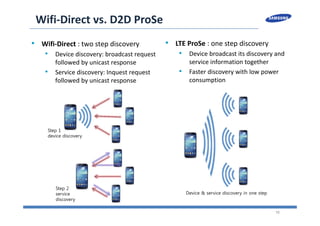
Wifi‐Direct vs. D2D ProSe
• Wifi‐Direct : two step discovery 
• Device discovery: broadcast request 
followed by unicast response
• Service discovery: Inquest request 
followed by unicast response
• LTE ProSe : one step discovery 
• Device broadcast its discovery and 
service information together
• Faster discovery with low power 
consumption
Step 1
device discovery
Device & service discovery in one step
Step 2
service
discovery
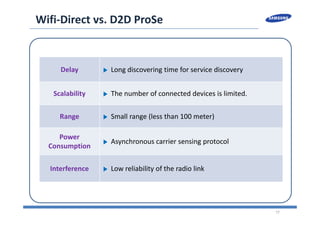
Wifi‐Direct vs. D2D ProSe
17
Delay ▶ Long discovering time for service discovery
Scalability ▶ The number of connected devices is limited.
Range ▶ Small range (less than 100 meter)
Power 
Consumption
▶ Asynchronous carrier sensing protocol
Interference ▶ Low reliability of the radio link
Limitation of Wifi‐directWifi‐Direct vs. D2D ProSe
18
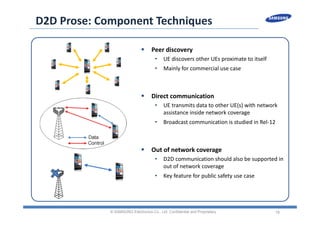
D2D Prose: Component Techniques
 Peer discovery
• UE discovers other UEs proximate to itself
• Mainly for commercial use case
 Direct communication
• UE transmits data to other UE(s) with network 
assistance inside network coverage
• Broadcast communication is studied in Rel‐12
 Out of network coverage
• D2D communication should also be supported in 
out of network coverage
• Key feature for public safety use case
© SAMSUNG Electronics Co., Ltd. Confidential and Proprietary
19
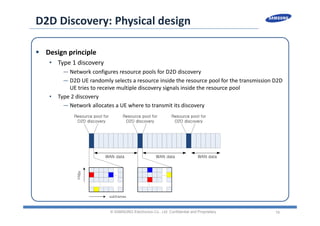
D2D Discovery: Physical design
© SAMSUNG Electronics Co., Ltd. Confidential and Proprietary
 Design principle
• Type 1 discovery
— Network configures resource pools for D2D discovery
— D2D UE randomly selects a resource inside the resource pool for the transmission D2D 
UE tries to receive multiple discovery signals inside the resource pool
• Type 2 discovery
— Network allocates a UE where to transmit its discovery
Resource pool for
D2D discovery
WAN data WAN data WAN data
... ...
...
...
Resource pool for
D2D discovery
Resource pool for
D2D discovery
PRBs
subframes
20
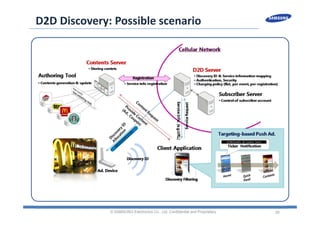
D2D Discovery: Possible scenario
© SAMSUNG Electronics Co., Ltd. Confidential and Proprietary
21
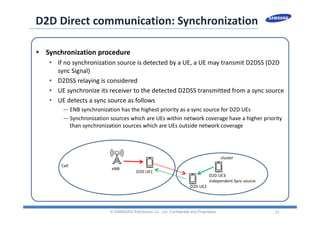
D2D Direct communication: Synchronization
© SAMSUNG Electronics Co., Ltd. Confidential and Proprietary
 Synchronization procedure
• If no synchronization source is detected by a UE, a UE may transmit D2DSS (D2D 
sync Signal) 
• D2DSS relaying is considered
• UE synchronize its receiver to the detected D2DSS transmitted from a sync source
• UE detects a sync source as follows
— ENB synchronization has the highest priority as a sync source for D2D UEs
— Synchronization sources which are UEs within network coverage have a higher priority 
than synchronization sources which are UEs outside network coverage 
Cell
eNB
D2D UE3: 
Independent Sync source
cluster
D2D UE1
D2D UE2
22
D2D Direct communication: Data scheduling
© SAMSUNG Electronics Co., Ltd. Confidential and Proprietary© SAMSUNG Electronics Co., Ltd. Confidential and Proprietary
Cell
eNB
cluster
UE1
UE5
UE3
UE4
Tx
Rx
Tx
Rx
UE2
Tx
Rx
UE6
Rx
Scheduling
D2D Data (Broadcast)
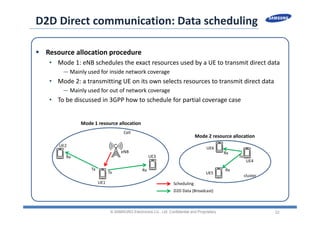
 Resource allocation procedure
• Mode 1: eNB schedules the exact resources used by a UE to transmit direct data
— Mainly used for inside network coverage
• Mode 2: a transmitting UE on its own selects resources to transmit direct data
— Mainly used for out of network coverage
• To be discussed in 3GPP how to schedule for partial coverage case
Mode 1 resource allocation
Mode 2 resource allocation
23
Full Dimension MIMO
24
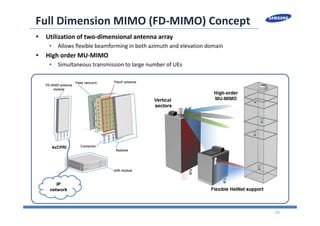
Full Dimension MIMO (FD‐MIMO) Concept
 Utilization of two‐dimensional antenna array
• Allows flexible beamforming in both azimuth and elevation domain
 High order MU‐MIMO
• Simultaneous transmission to large number of UEs
4xCPRI
IP
network
25
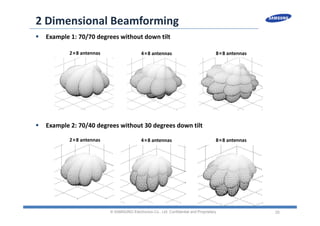
2 Dimensional Beamforming
 Example 1: 70/70 degrees without down tilt
 Example 2: 70/40 degrees without 30 degrees down tilt
© SAMSUNG Electronics Co., Ltd. Confidential and Proprietary
2×8 antennas 4×8 antennas 8×8 antennas
26
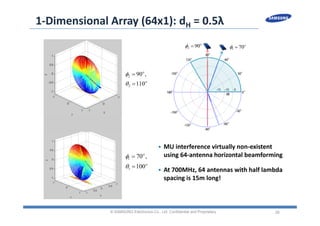
1‐Dimensional Array (64x1): dH = 0.5λ
© SAMSUNG Electronics Co., Ltd. Confidential and Proprietary

 902  
 701 




100
,70
1
1






110
,90
2
2


 MU interference virtually non‐existent 
using 64‐antenna horizontal beamforming
 At 700MHz, 64 antennas with half lambda 
spacing is 15m long!
27
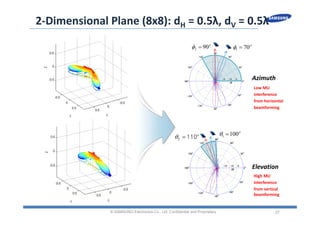
2‐Dimensional Plane (8x8): dH = 0.5λ, dV = 0.5λ
© SAMSUNG Electronics Co., Ltd. Confidential and Proprietary
Azimuth
Elevation
Low MU 
interference
from horizontal 
beamforming
High MU 
interference
from vertical 
beamforming

 701 

 902 

 1001 
 1102 
28
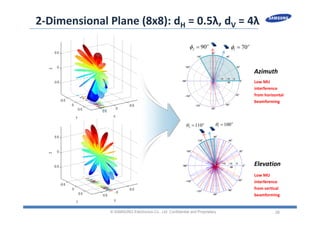
2‐Dimensional Plane (8x8): dH = 0.5λ, dV = 4λ
© SAMSUNG Electronics Co., Ltd. Confidential and Proprietary

 701 
 902 

 1001 
 1102 
Azimuth
Low MU 
interference
from horizontal 
beamforming
Elevation
Low MU 
interference
from vertical 
beamforming
29
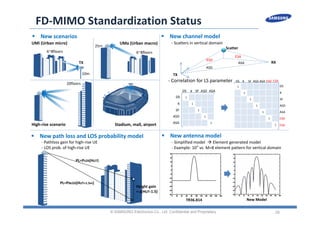
FD‐MIMO Standardization Status
© SAMSUNG Electronics Co., Ltd. Confidential and Proprietary
 New scenarios  New channel model
 New antenna model New path loss and LOS probability model
‐ Simplified model   Element generated model
‐ Example: 10° vs. M=8 element pattern for vertical domain
TR36.814 New Model
1
1
1
1
1
‐ Scatters in vertical domain
‐ Correlation for LS parameter
DS
DS
K
SF
ASD
ASA
K SF ASD ASA
1
1
1
1
1
1
1
DS K SF ASD ASA ESD ESA
DS
K
SF
ASD
ASA
ESD
ESA
TX
RX
ASD
ASA
ESD
ESA
Scatter
‐ Pathloss gain for high‐rise UE
‐ LOS prob. of high‐rise UE
PL=PLOS(HUT)
PL=PNLOS(HUT=1.5m)
Height gain
= a(HUT‐1.5)
UMi (Urban micro) UMa (Urban macro)
High‐rise scenario Stadium, mall, airport
6~8floors
10m
TX
6~8floors
25m
20floors
30
FD‐MIMO System Level Simulation
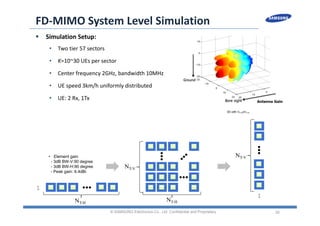
 Simulation Setup:
• Two tier 57 sectors
• K=10~30 UEs per sector
• Center frequency 2GHz, bandwidth 10MHz
• UE speed 3km/h uniformly distributed
• UE: 2 Rx, 1Tx
© SAMSUNG Electronics Co., Ltd. Confidential and Proprietary
NT-V
NT-H
NT-H
NT-V
1
1
• Element gain
- 3dB BW-V:90 degree
- 3dB BW-H:90 degree
- Peak gain: 6.4dBi
31
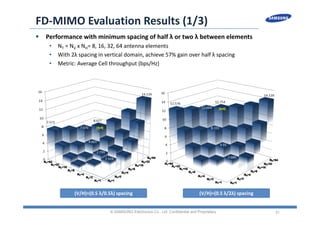
FD‐MIMO Evaluation Results (1/3)
 Performance with minimum spacing of half λ or two λ between elements
• NT = NV x NH= 8, 16, 32, 64 antenna elements
• With 2λ spacing in vertical domain, achieve 57% gain over half λ spacing
• Metric: Average Cell throughput (bps/Hz)
© SAMSUNG Electronics Co., Ltd. Confidential and Proprietary
(V/H)=(0.5 λ/0.5λ) spacing (V/H)=(0.5 λ/2λ) spacing
32
CoMP with Non‐Ideal Backhaul
33
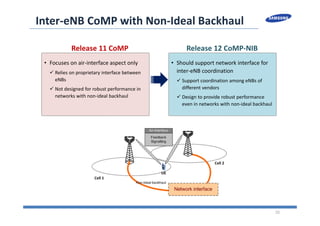
Inter‐eNB CoMP with Non‐Ideal Backhaul
Release 11 CoMP Release 12 CoMP‐NIB
• Focuses on air‐interface aspect only
 Relies on proprietary interface between 
eNBs
 Not designed for robust performance in 
networks with non‐ideal backhaul
• Should support network interface for 
inter‐eNB coordination
 Support coordination among eNBs of 
different vendors
 Design to provide robust performance 
even in networks with non‐ideal backhaul
34
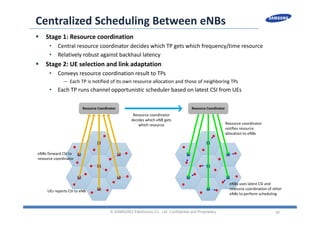
Centralized Scheduling Between eNBs
 Stage 1: Resource coordination
• Central resource coordinator decides which TP gets which frequency/time resource
• Relatively robust against backhaul latency
 Stage 2: UE selection and link adaptation
• Conveys resource coordination result to TPs
— Each TP is notified of its own resource allocation and those of neighboring TPs
• Each TP runs channel opportunistic scheduler based on latest CSI from UEs
© SAMSUNG Electronics Co., Ltd. Confidential and Proprietary
UEs reports CSI to eNB
eNBs forward CSI to 
resource coordinator
Resource coordinator 
decides which eNB gets 
which resource Resource coordinator 
notifies resource 
allocation to eNBs
eNBs uses latest CSI and 
resource coordination of other 
eNBs to perform scheduling
35
Two‐Stage Resource Allocation
 Stage 1: Resource coordination
• Central resource coordinator decides which TP gets which frequency/time resource
• Relatively robust against backhaul latency
 Stage 2: UE selection and link adaptation
• Conveys resource coordination result to TPs
— Each TP is notified of its own resource allocation and those of neighboring TPs
• Each TP runs channel opportunistic scheduler based on latest CSI from UEs
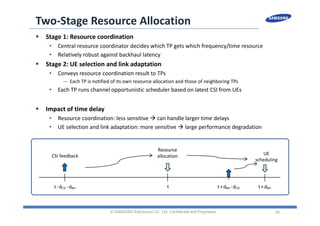
 Impact of time delay
• Resource coordination: less sensitive  can handle larger time delays
• UE selection and link adaptation: more sensitive  large performance degradation
© SAMSUNG Electronics Co., Ltd. Confidential and Proprietary
36
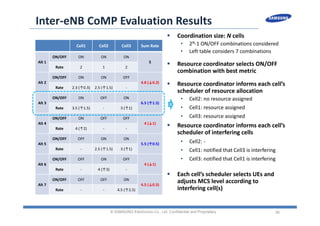
Inter‐eNB CoMP Evaluation Results
 Coordination size: N cells
• 2N‐1 ON/OFF combinations considered
• Left table considers 7 combinations
 Resource coordinator selects ON/OFF 
combination with best metric
 Resource coordinator informs each cell’s 
scheduler of resource allocation
• Cell2: no resource assigned
• Cell1: resource assigned
• Cell3: resource assigned
 Resource coordinator informs each cell’s 
scheduler of interfering cells
• Cell2: ‐
• Cell1: notified that Cell3 is interfering
• Cell3: notified that Cell1 is interfering
 Each cell’s scheduler selects UEs and 
adjusts MCS level according to 
interfering cell(s)
© SAMSUNG Electronics Co., Ltd. Confidential and Proprietary
Cell1 Cell2 Cell3 Sum Rate
Alt 1
ON/OFF ON ON ON
5
Rate 2 1 2
Alt 2
ON/OFF ON ON OFF
4.8 (↓0.2)
Rate 2.3 (↑0.3) 2.5 (↑1.5) ‐
Alt 3
ON/OFF ON OFF ON
6.5 (↑1.5)
Rate 3.5 (↑1.5) ‐ 3 (↑1)
Alt 4
ON/OFF ON OFF OFF
4 (↓1)
Rate 4 (↑2) ‐ ‐
Alt 5
ON/OFF OFF ON ON
5.5 (↑0.5)
Rate ‐ 2.5 (↑1.5) 3 (↑1)
Alt 6
ON/OFF OFF ON OFF
4 (↓1)
Rate ‐ 4 (↑3) ‐
Alt 7
ON/OFF OFF OFF ON
4.5 (↓0.5)
Rate ‐ ‐ 4.5 (↑2.5)
37
Network Assisted Interference 
Cancellation and Suppression
38
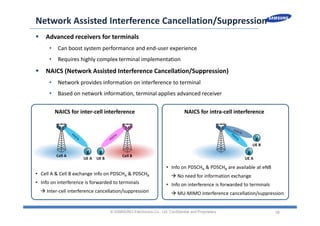
Network Assisted Interference Cancellation/Suppression
 Advanced receivers for terminals
• Can boost system performance and end‐user experience
• Requires highly complex terminal implementation
 NAICS (Network Assisted Interference Cancellation/Suppression)
• Network provides information on interference to terminal
• Based on network information, terminal applies advanced receiver 
© SAMSUNG Electronics Co., Ltd. Confidential and Proprietary
NAICS for inter‐cell interference NAICS for intra‐cell interference
• Cell A & Cell B exchange info on PDSCHA & PDSCHB
• Info on interference is forwarded to terminals
 Inter‐cell interference cancellation/suppression
• Info on PDSCHA & PDSCHB are available at eNB
 No need for information exchange
• Info on interference is forwarded to terminals
 MU‐MIMO interference cancellation/suppression
39
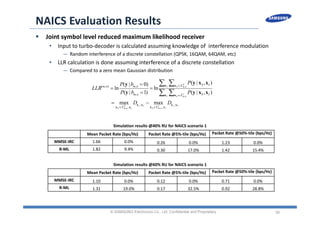
NAICS Evaluation Results
 Joint symbol level reduced maximum likelihood receiver
• Input to turbo‐decoder is calculated assuming knowledge of  interference modulation
— Random interference of a discrete constellation (QPSK, 16QAM, 64QAM, etc)
• LLR calculation is done assuming interference of a discrete constellation
— Compared to a zero mean Gaussian distribution
© SAMSUNG Electronics Co., Ltd. Confidential and Proprietary
Is
InmS
Is
InmS
I nmS
I nmS
DD
P
P
bP
bP
LLR
XX
X IS
X IS
nm
nmnm
xx
xx
xx
xx
x x
x x
xxy
xxy
y
y
,
,
,
,
,
,),(
1
,
0
,
1
,
0
,
maxmax
),|(
),|(
ln
)1|(
)0|(
ln








 
 
Mean Packet Rate (bps/Hz) Packet Rate @5%‐tile (bps/Hz) Packet Rate @50%‐tile (bps/Hz)
MMSE‐IRC 1.66 0.0% 0.26 0.0% 1.23 0.0%
R‐ML 1.82 9.4% 0.30 17.0% 1.42 15.4%
Mean Packet Rate (bps/Hz) Packet Rate @5%‐tile (bps/Hz) Packet Rate @50%‐tile (bps/Hz)
MMSE‐IRC 1.10 0.0% 0.12 0.0% 0.71 0.0%
R‐ML 1.31 19.0% 0.17 32.5% 0.92 28.8%
Simulation results @60% RU for NAICS scenario 1
Simulation results @40% RU for NAICS scenario 1
40
Millimeter Wave Communication
41
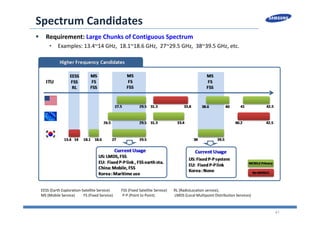
Spectrum Candidates
 Requirement: Large Chunks of Contiguous Spectrum
• Examples: 13.4~14 GHz,  18.1~18.6 GHz,  27~29.5 GHz,  38~39.5 GHz, etc.
EESS (Earth Exploration‐Satellite Service)            FSS (Fixed Satellite Service)       RL (RadioLocation service), 
MS (Mobile Service)         FS (Fixed Service)          P‐P (Point to Point)                     LMDS (Local Multipoint Distribution Services)
42
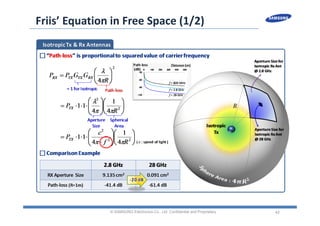
Friis’ Equation in Free Space (1/2)
© SAMSUNG Electronics Co., Ltd. Confidential and Proprietary
43
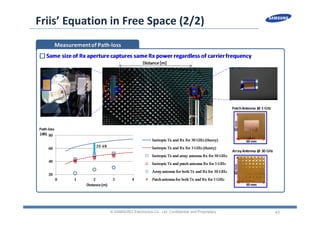
Friis’ Equation in Free Space (2/2)
© SAMSUNG Electronics Co., Ltd. Confidential and Proprietary
44
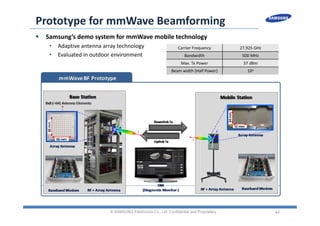
Prototype for mmWave Beamforming
 Samsung’s demo system for mmWave mobile technology
• Adaptive antenna array technology
• Evaluated in outdoor environment
© SAMSUNG Electronics Co., Ltd. Confidential and Proprietary
Carrier Frequency 27.925 GHz
Bandwidth 500 MHz
Max. Tx Power 37 dBm
Beam width (Half Power) 10o
45
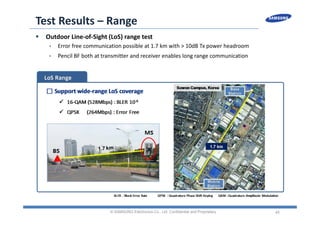
Test Results – Range
 Outdoor Line‐of‐Sight (LoS) range test
• Error free communication possible at 1.7 km with > 10dB Tx power headroom
• Pencil BF both at transmitter and receiver enables long range communication
© SAMSUNG Electronics Co., Ltd. Confidential and Proprietary
46
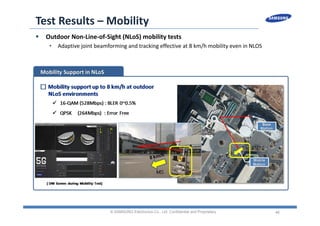
Test Results – Mobility
 Outdoor Non‐Line‐of‐Sight (NLoS) mobility tests
• Adaptive joint beamforming and tracking effective at 8 km/h mobility even in NLOS 
© SAMSUNG Electronics Co., Ltd. Confidential and Proprietary
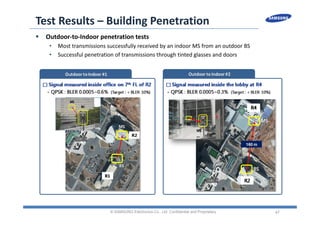
47
Test Results – Building Penetration
 Outdoor‐to‐Indoor penetration tests
• Most transmissions successfully received by an indoor MS from an outdoor BS
• Successful penetration of transmissions through tinted glasses and doors
© SAMSUNG Electronics Co., Ltd. Confidential and Proprietary
48
Concluding Remarks
49
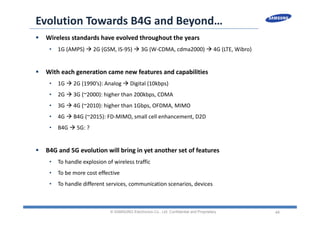
Evolution Towards B4G and Beyond…
 Wireless standards have evolved throughout the years
• 1G (AMPS)  2G (GSM, IS‐95)  3G (W‐CDMA, cdma2000)  4G (LTE, Wibro)
 With each generation came new features and capabilities
• 1G  2G (1990’s): Analog  Digital (10kbps)
• 2G  3G (~2000): higher than 200kbps, CDMA
• 3G  4G (~2010): higher than 1Gbps, OFDMA, MIMO
• 4G  B4G (~2015): FD‐MIMO, small cell enhancement, D2D
• B4G  5G: ?
 B4G and 5G evolution will bring in yet another set of features
• To handle explosion of wireless traffic
• To be more cost effective
• To handle different services, communication scenarios, devices
© SAMSUNG Electronics Co., Ltd. Confidential and Proprietary

Evolution of LTE Towards B4G (2014)