Evidence PackagingEvidence Packaging
GuidelinesGuidelines
May 2006
BasicsBasics
• The primary purpose of the Evidence Control Section is to provide for the secure storage of all property which is
in the custody of the police department until such time that it is needed for analysis, court, or authorized for final
disposition.
• El propósito principal de la sección de
Control de pruebas es para el
almacenamiento seguro de todos los
bienes que está bajo la custodia de la
policía hasta el momento en se es
necesario para el análisis, corte, o
autorizado para la disposición final.
BasicsBasics
• Standardized packaging of evidence will enhance the likelihood that property will be maintained in its original
condition.
• Embalaje estándar de pruebas aumentará la probabilidad de que la propiedad se mantendrá en su estado
original.
BasicsBasics
• Additional benefits include the reduction of
potential for injury and a more efficient
means of storing, identifying, and
retrieving property.
• Los beneficios adicionales incluyen la
reducción de la posibilidad de lesiones y
un medio más eficiente para almacenar,
identificar y recuperar la propiedad.
Standard MaterialsStandard Materials
• The following is a list of standardized
packaging materials:
• La siguiente es una lista de materiales de
embalaje estándar:
Standard MaterialsStandard Materials
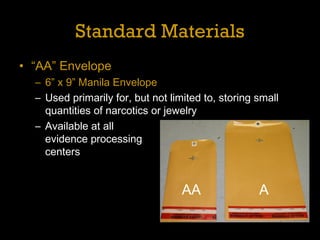
• “AA” Envelope
– 6” x 9” Manila Envelope
– Used primarily for, but not limited to, storing small
quantities of narcotics or jewelry
AA A
– Available at all
evidence processing
centers
Standard MaterialsStandard Materials
• “A” Envelope
– 9” x 12” Manila Envelope
– Available at all evidence processing areas
A
Standard MaterialsStandard Materials
• “CC” Box
– 13 ¾” x 3 ¼” x 2 ¼” Corrugated Box
– This box can be used for items other than
knives such as small tools (screwdrivers)
– Available at all evidence processing areas
Standard MaterialsStandard Materials
• Handgun Box
– 12 ½” x 6 ¼” x 2 ¼” Corrugated Box
– This box is restricted in use to packaging
handguns only
– These boxes are maintained by the Evidence
Control Section only
Standard MaterialsStandard Materials
• Rifle Box
– 51” x 7” x 3” Corrugated Box
– This box is restricted in use to packaging long
arms only (i.e. rifles, shotguns, etc)
– These boxes are maintained by the Evidence
Control Section only
Standard MaterialsStandard Materials
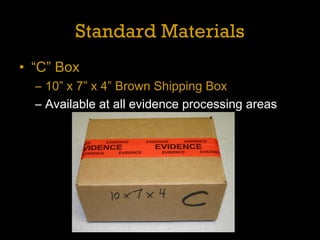
• “C” Box
– 10” x 7” x 4” Brown Shipping Box
– Available at all evidence processing areas
Standard MaterialsStandard Materials
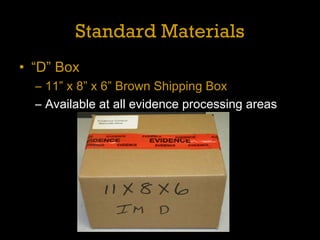
• “D” Box
– 11” x 8” x 6” Brown Shipping Box
– Available at all evidence processing areas
Standard MaterialsStandard Materials
• “E” Box
– 12” x 12” x 12” Brown Shipping Box
– These boxes are maintained by the Evidence
Control Section only
Standard MaterialsStandard Materials
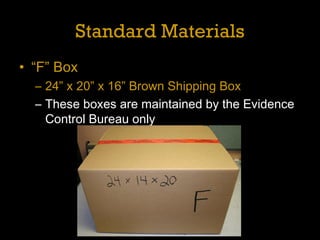
• “F” Box
– 24” x 20” x 16” Brown Shipping Box
– These boxes are maintained by the Evidence
Control Bureau only
Standard MaterialsStandard Materials
• “G” Box
– 24” x 16” x 12” Brown Shipping Box
– These boxes are maintained by the Evidence
Control Bureau only
Standard MaterialsStandard Materials
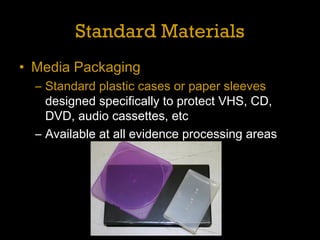
• Media Packaging
– Standard plastic cases or paper sleeves
designed specifically to protect VHS, CD,
DVD, audio cassettes, etc
– Available at all evidence processing areas
Standard MaterialsStandard Materials
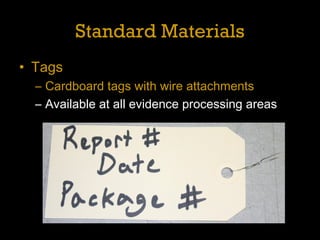
• Tags
– Cardboard tags with wire attachments
– Available at all evidence processing areas
Standard MaterialsStandard Materials
• Twist-ties or Cable-ties (flex cuffs)
– Used primarily to secure items within boxes
(knives, firearms, etc)
– Available at all evidence processing areas
Standard MaterialsStandard Materials
• Plastic Tubes
– ¾” x 7 ¾” clear plastic tubes
– Used primarily for securing hypodermic
needles
– Available at all evidence processing areas
General GuidelinesGeneral Guidelines
• Remember that above all, property shall
always be packaged in such a manner as
to provide the best protection for the item
and to minimize risk of injury to the
handler.
General GuidelinesGeneral Guidelines
• Property shall be packaged in the smallest
container that will accommodate it without
risk of damage to the property
General GuidelinesGeneral Guidelines
• Envelopes shall not be stuffed to the
extent that the packaging no longer has
the basic appearance of an envelope.
– Example: a large item that creases the
envelope or significantly shortens the height
should be stored in a box of appropriate size
– Also consider weight factors – use a box if the
envelope will rip
General GuidelinesGeneral Guidelines
• Boxes must be properly closed so that all
sides are flat.
– If they are unable to be closed properly, they
will not stack nor fit properly on the storage
shelves or bins.
General GuidelinesGeneral Guidelines
• Large or irregular shaped items, which
cannot be packaged in the standardized
envelopes or boxes, shall be wrapped in
brown packing paper and sealed with
evidence tape.
General GuidelinesGeneral Guidelines
• Items that do not require special protection
of the surface area shall be tagged rather
than wrapped
– i.e. bongs, jugs, baseball bats, etc
• Blood Alcohol Kits and Sexual Battery Kits
shall be submitted without further
packaging.
General GuidelinesGeneral Guidelines
• The next section is a series of
“How to” guides
Packaging BiohazardsPackaging Biohazards
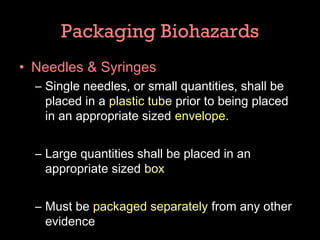
• Needles & Syringes
– Single needles, or small quantities, shall be
placed in a plastic tube prior to being placed
in an appropriate sized envelope.
– Large quantities shall be placed in an
appropriate sized box
– Must be packaged separately from any other
evidence
Packaging BiohazardsPackaging Biohazards
Use the plastic tube for
needles or syringes
Use the “BIOHAZARD” tape
to seal the tube opening
Packaging BiohazardsPackaging Biohazards
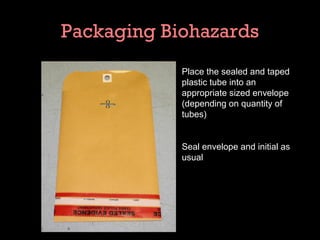
Place the sealed and taped
plastic tube into an
appropriate sized envelope
(depending on quantity of
tubes)
Seal envelope and initial as
usual
Packaging Guns & AmmoPackaging Guns & Ammo
• Handguns / Rifles
– Handguns are packaged in a Handgun Box
– Rifles or Shotguns are packaged in a Rifle
Box
– All Firearms should be secured to the box by
utilizing a twist-tie or cable-tie
Packaging Guns & AmmoPackaging Guns & Ammo
Remove the source of
ammunition from any firearm
to be placed into storage.
Rounds will be left in the
magazine while the round
chambered in the weapon
will be removed. The
magazine and round will be
placed in a sealed package
such as a zip lock bag and
then placed in the gun box
with the weapon.
Packaging Guns & AmmoPackaging Guns & Ammo
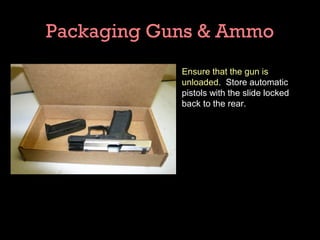
Ensure that the gun is
unloaded. Store automatic
pistols with the slide locked
back to the rear.
Packaging Guns & AmmoPackaging Guns & Ammo
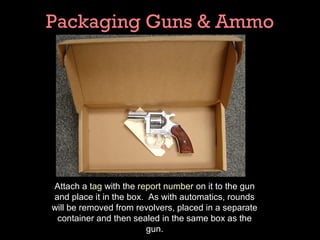
Attach a tag with the report number on it to the gun
and place it in the box. As with automatics, rounds
will be removed from revolvers, placed in a separate
container and then sealed in the same box as the
gun.
Packaging Guns & AmmoPackaging Guns & Ammo
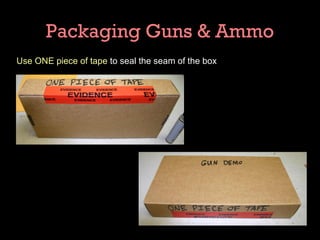
Use ONE piece of tape to seal the seam of the box
Packaging Guns & AmmoPackaging Guns & Ammo
Write the DATE on the opposite side of the tape (the longest side)
Write the REPORT NUMBER on both ends of the box (the shortest
sides)
Write your initials across the tape as usual
Packaging Guns & AmmoPackaging Guns & Ammo
Rifles will be placed in Rifle boxes.
Packaging Guns & AmmoPackaging Guns & Ammo
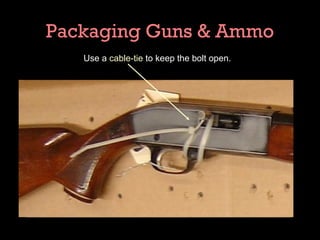
Use a cable-tie to keep the bolt open.
Packaging Guns & AmmoPackaging Guns & Ammo
Seal with ONE piece of tape.
Initial as usual.
Packaging Guns & AmmoPackaging Guns & Ammo
Ammunition originating from
a firearm is to be sealed in a
separate container and then
placed in the same gun box
as the weapon. Do not
remove rounds from the
magazine. After packaging
the loaded magazine, place
it in the gun box with the
weapon.
Packaging KnivesPackaging Knives
• Knives
– Knives are packaged in a “CC” Box
– All knives, or any other item that may cause
injury if not secured properly, should be
secured to the box by utilizing a twist-tie or
cable-tie
Packaging KnivesPackaging Knives
Knives that open should be
stored in the closed position
and wired shut
The same applies to
automatic knives, or switch
blades. They should be
wired to stay in the closed
position.
Packaging KnivesPackaging Knives
Poke two holes into the bottom of the “CC” box.
Packaging KnivesPackaging Knives
Place the knife into the box, and secure it to the box with wire or a twist-tie.
Packaging KnivesPackaging Knives
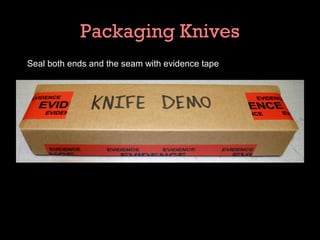
Seal both ends and the seam with evidence tape
Packaging KnivesPackaging Knives
Then write the DATE and REPORT NUMBER on the opposite side
from the tape (the longest side)
Write your initials across the tape as usual
Packaging KnivesPackaging Knives
Why is it so important that you secure the knife to the box?
If left unsecured, a blade
can easily slip under the
flaps
You wouldn’t want to be
responsible for a handler
slicing their finger open,
especially not knowing what
possible biohazards could
be present on the blade.
Packaging KnivesPackaging Knives
Why is it so important that you secure the knife to the box?
You can see why using an envelope to store knives, or other items
that could cause injury, is a bad idea.
Packaging KnivesPackaging Knives
Why is it so important that you secure the knife to the box?
Even these knives could open up during handling and cut someone.
Packaging KnivesPackaging Knives
Why is it so important that you secure the knife to the box?
Please, use the “CC” Box, and secure the knife to the box.
The hands you protect may be your own!
Packaging CurrencyPackaging Currency
• Money
– Money should never be packaged with any
other items
– U.S. Currency shall be packaged separate
from foreign currency
– Counterfeit currency shall be packaged
separate from legal-tender currency
Packaging NarcoticsPackaging Narcotics
• Very important:
– Narcotics should not be packaged with ANY
OTHER ITEMS
• Not with other types of narcotics
• Not with money
• Not with a cell phone
• Especially not with Paraphernalia
– “Paraphernalia must be packaged separately.” (SOP 339.1)
Packaging NarcoticsPackaging Narcotics
• Marijuana
– Less than 50 grams
• Package all 50 grams together in one package
– This will be sent to FDLE for testing
– More than 50 grams
• Package 28 grams separately
– This will be sent to FDLE for testing
…remember, “Paraphernalia must be packaged separately.” (SOP 339.1)
Packaging NarcoticsPackaging Narcotics
• Powder Narcotics
– More than 1 “deck”
• Package 2 “decks” together in one package
– This will be sent to FDLE for testing
• Put the remaining “decks” in another package
– Weighing 1 pound or more
• All of it will be packaged together
– This will be sent to FDLE for testing
…remember, “Paraphernalia must be packaged separately.” (SOP 339.1)
Packaging NarcoticsPackaging Narcotics
• Capsules and Pills
– 2 Pills or less
• Package 1-2 pills together in one package
– This will be sent to FDLE for testing
– More than 3 Pills
• Package 1-2 pills together in one package
– This will be sent to FDLE for testing
• Package the remaining pills in another package
…remember, “Paraphernalia must be packaged separately.” (SOP 339.1)
Packaging NarcoticsPackaging Narcotics
• Multiple types of Narcotics
– Each type of narcotic shall be packaged
separately.
– Sending samples to FDLE
• Each drug shall be individually bagged, then
wrapped or placed in a separate container – then
they shall be placed in one package for
transportation to FDLE.
…remember, “Paraphernalia must be packaged separately.” (SOP 339.1)
Packaging NarcoticsPackaging Narcotics
• Paraphernalia
– Paraphernalia items shall be packaged
separately from narcotics
– Different types of paraphernalia should be
wrapped separately to prevent contamination
of other paraphernalia.
…remember, “Paraphernalia must be packaged separately.” (SOP 339.1)
Packaging NarcoticsPackaging Narcotics
• The most important thing when packaging
narcotics is to prevent cross-
contamination of the drug.
• This is why Paraphernalia MUST NOT be
packaged with narcotics.
…remember, “Paraphernalia must be packaged separately.” (SOP 339.1)
Thank you for helping makeThank you for helping make
TPD’s Evidence ControlTPD’s Evidence Control
Section one of the bestSection one of the best
among law enforcement!among law enforcement!

Evidence packaging guidelines

  • 1.
  • 2.
    BasicsBasics • The primarypurpose of the Evidence Control Section is to provide for the secure storage of all property which is in the custody of the police department until such time that it is needed for analysis, court, or authorized for final disposition. • El propósito principal de la sección de Control de pruebas es para el almacenamiento seguro de todos los bienes que está bajo la custodia de la policía hasta el momento en se es necesario para el análisis, corte, o autorizado para la disposición final.
  • 3.
    BasicsBasics • Standardized packagingof evidence will enhance the likelihood that property will be maintained in its original condition. • Embalaje estándar de pruebas aumentará la probabilidad de que la propiedad se mantendrá en su estado original.
  • 4.
    BasicsBasics • Additional benefitsinclude the reduction of potential for injury and a more efficient means of storing, identifying, and retrieving property. • Los beneficios adicionales incluyen la reducción de la posibilidad de lesiones y un medio más eficiente para almacenar, identificar y recuperar la propiedad.
  • 5.
    Standard MaterialsStandard Materials •The following is a list of standardized packaging materials: • La siguiente es una lista de materiales de embalaje estándar:
  • 6.
    Standard MaterialsStandard Materials •“AA” Envelope – 6” x 9” Manila Envelope – Used primarily for, but not limited to, storing small quantities of narcotics or jewelry AA A – Available at all evidence processing centers
  • 7.
    Standard MaterialsStandard Materials •“A” Envelope – 9” x 12” Manila Envelope – Available at all evidence processing areas A
  • 8.
    Standard MaterialsStandard Materials •“CC” Box – 13 ¾” x 3 ¼” x 2 ¼” Corrugated Box – This box can be used for items other than knives such as small tools (screwdrivers) – Available at all evidence processing areas
  • 9.
    Standard MaterialsStandard Materials •Handgun Box – 12 ½” x 6 ¼” x 2 ¼” Corrugated Box – This box is restricted in use to packaging handguns only – These boxes are maintained by the Evidence Control Section only
  • 10.
    Standard MaterialsStandard Materials •Rifle Box – 51” x 7” x 3” Corrugated Box – This box is restricted in use to packaging long arms only (i.e. rifles, shotguns, etc) – These boxes are maintained by the Evidence Control Section only
  • 11.
    Standard MaterialsStandard Materials •“C” Box – 10” x 7” x 4” Brown Shipping Box – Available at all evidence processing areas
  • 12.
    Standard MaterialsStandard Materials •“D” Box – 11” x 8” x 6” Brown Shipping Box – Available at all evidence processing areas
  • 13.
    Standard MaterialsStandard Materials •“E” Box – 12” x 12” x 12” Brown Shipping Box – These boxes are maintained by the Evidence Control Section only
  • 14.
    Standard MaterialsStandard Materials •“F” Box – 24” x 20” x 16” Brown Shipping Box – These boxes are maintained by the Evidence Control Bureau only
  • 15.
    Standard MaterialsStandard Materials •“G” Box – 24” x 16” x 12” Brown Shipping Box – These boxes are maintained by the Evidence Control Bureau only
  • 16.
    Standard MaterialsStandard Materials •Media Packaging – Standard plastic cases or paper sleeves designed specifically to protect VHS, CD, DVD, audio cassettes, etc – Available at all evidence processing areas
  • 17.
    Standard MaterialsStandard Materials •Tags – Cardboard tags with wire attachments – Available at all evidence processing areas
  • 18.
    Standard MaterialsStandard Materials •Twist-ties or Cable-ties (flex cuffs) – Used primarily to secure items within boxes (knives, firearms, etc) – Available at all evidence processing areas
  • 19.
    Standard MaterialsStandard Materials •Plastic Tubes – ¾” x 7 ¾” clear plastic tubes – Used primarily for securing hypodermic needles – Available at all evidence processing areas
  • 20.
    General GuidelinesGeneral Guidelines •Remember that above all, property shall always be packaged in such a manner as to provide the best protection for the item and to minimize risk of injury to the handler.
  • 21.
    General GuidelinesGeneral Guidelines •Property shall be packaged in the smallest container that will accommodate it without risk of damage to the property
  • 22.
    General GuidelinesGeneral Guidelines •Envelopes shall not be stuffed to the extent that the packaging no longer has the basic appearance of an envelope. – Example: a large item that creases the envelope or significantly shortens the height should be stored in a box of appropriate size – Also consider weight factors – use a box if the envelope will rip
  • 23.
    General GuidelinesGeneral Guidelines •Boxes must be properly closed so that all sides are flat. – If they are unable to be closed properly, they will not stack nor fit properly on the storage shelves or bins.
  • 24.
    General GuidelinesGeneral Guidelines •Large or irregular shaped items, which cannot be packaged in the standardized envelopes or boxes, shall be wrapped in brown packing paper and sealed with evidence tape.
  • 25.
    General GuidelinesGeneral Guidelines •Items that do not require special protection of the surface area shall be tagged rather than wrapped – i.e. bongs, jugs, baseball bats, etc • Blood Alcohol Kits and Sexual Battery Kits shall be submitted without further packaging.
  • 26.
    General GuidelinesGeneral Guidelines •The next section is a series of “How to” guides
  • 27.
    Packaging BiohazardsPackaging Biohazards •Needles & Syringes – Single needles, or small quantities, shall be placed in a plastic tube prior to being placed in an appropriate sized envelope. – Large quantities shall be placed in an appropriate sized box – Must be packaged separately from any other evidence
  • 28.
    Packaging BiohazardsPackaging Biohazards Usethe plastic tube for needles or syringes Use the “BIOHAZARD” tape to seal the tube opening
  • 29.
    Packaging BiohazardsPackaging Biohazards Placethe sealed and taped plastic tube into an appropriate sized envelope (depending on quantity of tubes) Seal envelope and initial as usual
  • 30.
    Packaging Guns &AmmoPackaging Guns & Ammo • Handguns / Rifles – Handguns are packaged in a Handgun Box – Rifles or Shotguns are packaged in a Rifle Box – All Firearms should be secured to the box by utilizing a twist-tie or cable-tie
  • 31.
    Packaging Guns &AmmoPackaging Guns & Ammo Remove the source of ammunition from any firearm to be placed into storage. Rounds will be left in the magazine while the round chambered in the weapon will be removed. The magazine and round will be placed in a sealed package such as a zip lock bag and then placed in the gun box with the weapon.
  • 32.
    Packaging Guns &AmmoPackaging Guns & Ammo Ensure that the gun is unloaded. Store automatic pistols with the slide locked back to the rear.
  • 33.
    Packaging Guns &AmmoPackaging Guns & Ammo Attach a tag with the report number on it to the gun and place it in the box. As with automatics, rounds will be removed from revolvers, placed in a separate container and then sealed in the same box as the gun.
  • 34.
    Packaging Guns &AmmoPackaging Guns & Ammo Use ONE piece of tape to seal the seam of the box
  • 35.
    Packaging Guns &AmmoPackaging Guns & Ammo Write the DATE on the opposite side of the tape (the longest side) Write the REPORT NUMBER on both ends of the box (the shortest sides) Write your initials across the tape as usual
  • 36.
    Packaging Guns &AmmoPackaging Guns & Ammo Rifles will be placed in Rifle boxes.
  • 37.
    Packaging Guns &AmmoPackaging Guns & Ammo Use a cable-tie to keep the bolt open.
  • 38.
    Packaging Guns &AmmoPackaging Guns & Ammo Seal with ONE piece of tape. Initial as usual.
  • 39.
    Packaging Guns &AmmoPackaging Guns & Ammo Ammunition originating from a firearm is to be sealed in a separate container and then placed in the same gun box as the weapon. Do not remove rounds from the magazine. After packaging the loaded magazine, place it in the gun box with the weapon.
  • 40.
    Packaging KnivesPackaging Knives •Knives – Knives are packaged in a “CC” Box – All knives, or any other item that may cause injury if not secured properly, should be secured to the box by utilizing a twist-tie or cable-tie
  • 41.
    Packaging KnivesPackaging Knives Knivesthat open should be stored in the closed position and wired shut The same applies to automatic knives, or switch blades. They should be wired to stay in the closed position.
  • 42.
    Packaging KnivesPackaging Knives Poketwo holes into the bottom of the “CC” box.
  • 43.
    Packaging KnivesPackaging Knives Placethe knife into the box, and secure it to the box with wire or a twist-tie.
  • 44.
    Packaging KnivesPackaging Knives Sealboth ends and the seam with evidence tape
  • 45.
    Packaging KnivesPackaging Knives Thenwrite the DATE and REPORT NUMBER on the opposite side from the tape (the longest side) Write your initials across the tape as usual
  • 46.
    Packaging KnivesPackaging Knives Whyis it so important that you secure the knife to the box? If left unsecured, a blade can easily slip under the flaps You wouldn’t want to be responsible for a handler slicing their finger open, especially not knowing what possible biohazards could be present on the blade.
  • 47.
    Packaging KnivesPackaging Knives Whyis it so important that you secure the knife to the box? You can see why using an envelope to store knives, or other items that could cause injury, is a bad idea.
  • 48.
    Packaging KnivesPackaging Knives Whyis it so important that you secure the knife to the box? Even these knives could open up during handling and cut someone.
  • 49.
    Packaging KnivesPackaging Knives Whyis it so important that you secure the knife to the box? Please, use the “CC” Box, and secure the knife to the box. The hands you protect may be your own!
  • 50.
    Packaging CurrencyPackaging Currency •Money – Money should never be packaged with any other items – U.S. Currency shall be packaged separate from foreign currency – Counterfeit currency shall be packaged separate from legal-tender currency
  • 51.
    Packaging NarcoticsPackaging Narcotics •Very important: – Narcotics should not be packaged with ANY OTHER ITEMS • Not with other types of narcotics • Not with money • Not with a cell phone • Especially not with Paraphernalia – “Paraphernalia must be packaged separately.” (SOP 339.1)
  • 52.
    Packaging NarcoticsPackaging Narcotics •Marijuana – Less than 50 grams • Package all 50 grams together in one package – This will be sent to FDLE for testing – More than 50 grams • Package 28 grams separately – This will be sent to FDLE for testing …remember, “Paraphernalia must be packaged separately.” (SOP 339.1)
  • 53.
    Packaging NarcoticsPackaging Narcotics •Powder Narcotics – More than 1 “deck” • Package 2 “decks” together in one package – This will be sent to FDLE for testing • Put the remaining “decks” in another package – Weighing 1 pound or more • All of it will be packaged together – This will be sent to FDLE for testing …remember, “Paraphernalia must be packaged separately.” (SOP 339.1)
  • 54.
    Packaging NarcoticsPackaging Narcotics •Capsules and Pills – 2 Pills or less • Package 1-2 pills together in one package – This will be sent to FDLE for testing – More than 3 Pills • Package 1-2 pills together in one package – This will be sent to FDLE for testing • Package the remaining pills in another package …remember, “Paraphernalia must be packaged separately.” (SOP 339.1)
  • 55.
    Packaging NarcoticsPackaging Narcotics •Multiple types of Narcotics – Each type of narcotic shall be packaged separately. – Sending samples to FDLE • Each drug shall be individually bagged, then wrapped or placed in a separate container – then they shall be placed in one package for transportation to FDLE. …remember, “Paraphernalia must be packaged separately.” (SOP 339.1)
  • 56.
    Packaging NarcoticsPackaging Narcotics •Paraphernalia – Paraphernalia items shall be packaged separately from narcotics – Different types of paraphernalia should be wrapped separately to prevent contamination of other paraphernalia. …remember, “Paraphernalia must be packaged separately.” (SOP 339.1)
  • 57.
    Packaging NarcoticsPackaging Narcotics •The most important thing when packaging narcotics is to prevent cross- contamination of the drug. • This is why Paraphernalia MUST NOT be packaged with narcotics. …remember, “Paraphernalia must be packaged separately.” (SOP 339.1)
  • 58.
    Thank you forhelping makeThank you for helping make TPD’s Evidence ControlTPD’s Evidence Control Section one of the bestSection one of the best among law enforcement!among law enforcement!