EVIDENCE BASED MEDICINE
PRESENTER: DR. MURUGESH M KURANI
DEPARTMENT OF ORTHOPAEDICS,
J N MEDICAL COLLEGE, BELAGAVI
WHAT IS EBM?
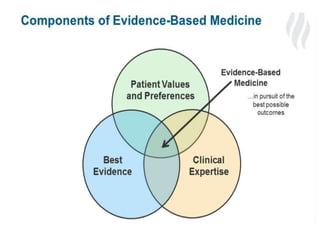
Evidence-based medicine (EBM) is the term
used to describe the integration of the best
available research evidence with clinical
judgment and experience as applied to the
care of individual patients.
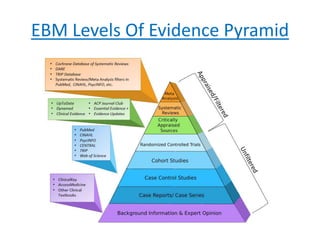
EBM Levels Of Evidence Pyramid
So In Clinical Practice,
TREATMENT
OPTIONS
DISEASE
HISTORY
Name - ABC
Age – 30YRS
Sex - Male
Address – BADAS (KH), BELAGAVI
Occupation - FARMER
CHIEF COMPLAINTS
Pain on right HIP and middle 3rd of thigh
Swelling on right HIP and middle 3rd of thigh
HISTORY OF PRESENT
ILLNESS
H/O road traffic accident b/w 4 wheeler and a 2
wheeler, patient being 2 wheeler rider hit by a 4
wheeler and sustained injury over right hip and
middle thigh. Unable to bear weight on right
lower limb after the fall.
No H/O LOC, vomiting, ENT bleed, convulsions.
PERSONAL HISTORY
Diet : Mixed
Appetite : Normal
Sleep : Undisturbed
Bowel & Bladder : Normal and regular
Habbit : no addiction
Past history
No H/O DM2/HTN/Asthma/TB
Family history
Not significant
Vitals
BP : 126/80 mm Hg
Pulse : 88 /min
Respiratory rate : 24 cycles/min
SpO2 : 100%
LOCAL EXAMINATION
INSPECTION
Right lower limb is externally rotated
Swelling and deformity seen over right HIP and middle thigh
No muscle wasting
No visible scars or sinuses
PALPATION
All inspectory findings were confirmed
Local rise of temperature present
Tenderness and bony deformity present over right hip and mid
thigh
Restricted movements at right hip joint
Pelvic compression test was negative
Chest compression test was negative
B/L Toe movements +
Distal pulses were felt b/l and equally
Motor and sensory examination was within normal
limits
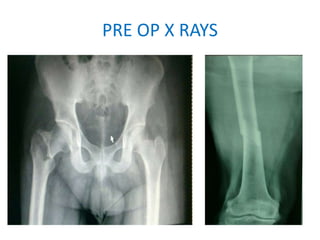
PRE OP X RAYS
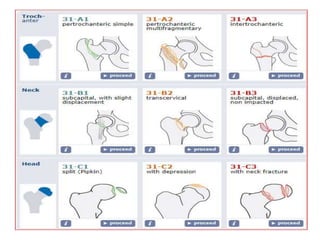
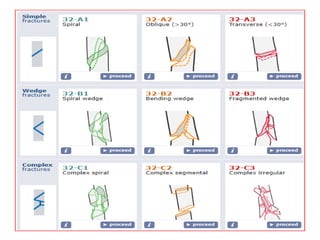
RIGHT SIDED IPSILATERAL INTERTROCHANTERIC
(31-A1) WITH FEMORAL SHAFT (32-A2)
FRACTURE.
CLASSIFICATION
CLASSIFICATION FOR IT FRACTURES
1. BOYD AND GRIFFIN
2. EVAN’S
3. TRONZO
4. AO CLASSIFICATION
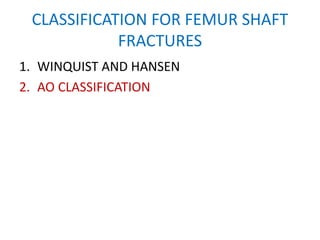
CLASSIFICATION FOR FEMUR SHAFT
FRACTURES
1. WINQUIST AND HANSEN
2. AO CLASSIFICATION
IPSILATERAL IT
WITH FEMUR
SHAFT
FRACTURE
INTERNAL FIXATIVE DEVICES
1. DYNAMIC HIP SCREW and COMPRESSION
PLATE
2. DYNAMIC HIP SCREW and RETROGRADE
NAILING
3. LONG PROXIMAL FEMORAL NAILING
EVIDENCES
Article 1
J Orthop Trauma. 2008 Feb;22(2):102-6. doi:
10.1097/BOT.0b013e318162a0d2.
wolters kluwer
“Functional outcome of ipsilateral
intertrochanteric and femoral shaft fractures”
Ipsilateral intertrochanteric and femoral shaft fractures
treated with a reconstruction nail versus a sliding hip
screw and retrograde nail.
RESULT:
The average time to follow-up was 49.6 months.
Functional outcome was significantly better in the
reconstruction nail group for the role emotional
(P=0.001) and mental component scores (P=0.016) of
the SF-36. This group also scored better on the LEFS,
although not reaching statistical significance (P=0.099).
CONCLUSION:
For most outcome measures, no significant
differences in functional outcome scores were
observed between the 2 treatment groups.
The results of this study suggest the need for a
randomized controlled trial with a larger
sample size to more definitively compare the
2 fixation constructs.
Article 2
Orthopaedic Surgery (2012), Volume 4, No. 1, 41–46
“A comparative study of ipsilateral
intertrochanteric and femoral shaft fractures
treated with long proximal femoral nail
antirotation or plate combinations”
METHODS:
Between March 2004 and April 2009, 23 patients
with ipsilateral intertrochanteric and femoral
shaft fractures were treated with PFNA-long or
plate combinations. The patients were divided
into two groups. Group I contained 13 patients
who were treated with dynamic hip screws (DHS)
combined with compression plate fixation. The
10 patients in Group II were treated with PFNA-
long.
RESULTS:
The average follow-up was 17.8 and 16.8 months for
Groups I and II, respectively.
The average union time for intertrochanteric fractures
was 17.4 and 16.6 weeks in Groups I and II,
respectively, and for femoral shaft fracture 22.2 and
21.5 weeks, respectively.
There were nine good, two fair, and two poor
functional results in Group I, and eight good, one fair,
and one poor in Group II. There was nonunion of two
femoral shaft fractures in Group I and one in Group II.
CONCLUSION
Both treatment methods achieve satisfactory
functional outcomes in patients with ipsilateral
intertrochanteric and femoral shaft fractures.
PFNA-long is the better choice for the treatment
of complex fractures, having the advantages of
minimal exposure, reduced perioperative blood
loss, and achievement of biological fixation of
both fractures with a single implant.
Article 3
http://bjjprocs.boneandjoint.org.uk/content/87-
B/SUPP_III/310.4
Orthopaedic Proceedings
“FUNCTIONAL OUTCOME OF IPSILATERAL
INTERTROCHANTERIC AND FEMORAL SHAFT
FRACTURES”
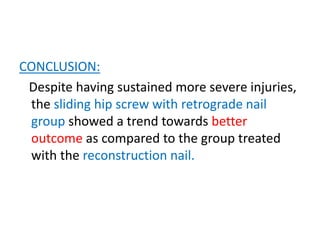
CONCLUSION:
Despite having sustained more severe injuries,
the sliding hip screw with retrograde nail
group showed a trend towards better
outcome as compared to the group treated
with the reconstruction nail.
Article 4
A meta-analysis of 659 cases
Acta Olthop Scand 1996; 67 (1 ): 19-28
“Concurrent ipsilateral fractures of the hip and
femoral shaft”
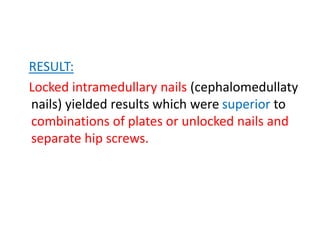
RESULT:
Locked intramedullary nails (cephalomedullaty
nails) yielded results which were superior to
combinations of plates or unlocked nails and
separate hip screws.
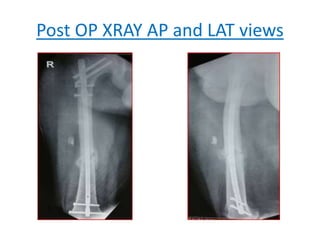
Post OP XRAY AP and LAT views
Dynamic hip screw for intertrochanteric with
plating for shaft can provide easy fixation and
favourable results have been reported but is
associated with increased blood loss and
periosteal stripping of the femoral shaft,
extensive surgical dissection.
Retrograde nailing for shaft with Dynamic hip
screw for intertrochanteric fractures seems to
be an attractive treatment modality
preventing periosteal stripping and extensive
surgical dissection but studies shows that
retrograde nailings are associated with
articular damage and stiff knee post
operatively.
Long proximal femoral nail for fixation of both
intertrochanteric and shaft promises stable fixation and
better osseous healing. Intra-Medullary implant itself
acts as a buttress to prevent excessive fracture collapse
and shaft medialization.
It also offers the advantage of a reamed and unreamed
implantation technique, high rotational stability of the
proximal fragment, and the possibility of static or
dynamic distal locking. Almost all the load is
transferred to the nail and negligible portion to the
medial femoral cortex.
Thus, long proximal femoral nail is a good
option for the treatment of complex fractures
like these, with the advantages of closed
antegrade nailing with minimal exposure,
reduced perioperative blood loss, and
biological fixation of both fractures with a
single implant.
TAKE HOME MESSAGE
Long PFN is a better fixation system for ipsilateral
intertrochanteric and femoral shaft fracture with
less surgical trauma, less operative time, less
blood loss, early rehabilitation, possibility of early
weight bearing.
Surgical expertise is necessary.
Surgeon preference.
Evidence based medicine

Evidence based medicine

  • 1.
    EVIDENCE BASED MEDICINE PRESENTER:DR. MURUGESH M KURANI DEPARTMENT OF ORTHOPAEDICS, J N MEDICAL COLLEGE, BELAGAVI
  • 2.
    WHAT IS EBM? Evidence-basedmedicine (EBM) is the term used to describe the integration of the best available research evidence with clinical judgment and experience as applied to the care of individual patients.
  • 4.
    EBM Levels OfEvidence Pyramid
  • 5.
    So In ClinicalPractice, TREATMENT OPTIONS DISEASE
  • 6.
    HISTORY Name - ABC Age– 30YRS Sex - Male Address – BADAS (KH), BELAGAVI Occupation - FARMER
  • 7.
    CHIEF COMPLAINTS Pain onright HIP and middle 3rd of thigh Swelling on right HIP and middle 3rd of thigh
  • 8.
    HISTORY OF PRESENT ILLNESS H/Oroad traffic accident b/w 4 wheeler and a 2 wheeler, patient being 2 wheeler rider hit by a 4 wheeler and sustained injury over right hip and middle thigh. Unable to bear weight on right lower limb after the fall. No H/O LOC, vomiting, ENT bleed, convulsions.
  • 9.
    PERSONAL HISTORY Diet :Mixed Appetite : Normal Sleep : Undisturbed Bowel & Bladder : Normal and regular Habbit : no addiction
  • 10.
    Past history No H/ODM2/HTN/Asthma/TB Family history Not significant Vitals BP : 126/80 mm Hg Pulse : 88 /min Respiratory rate : 24 cycles/min SpO2 : 100%
  • 11.
    LOCAL EXAMINATION INSPECTION Right lowerlimb is externally rotated Swelling and deformity seen over right HIP and middle thigh No muscle wasting No visible scars or sinuses PALPATION All inspectory findings were confirmed Local rise of temperature present Tenderness and bony deformity present over right hip and mid thigh Restricted movements at right hip joint
  • 12.
    Pelvic compression testwas negative Chest compression test was negative B/L Toe movements + Distal pulses were felt b/l and equally Motor and sensory examination was within normal limits
  • 13.
  • 14.
    RIGHT SIDED IPSILATERALINTERTROCHANTERIC (31-A1) WITH FEMORAL SHAFT (32-A2) FRACTURE.
  • 15.
  • 16.
    CLASSIFICATION FOR ITFRACTURES 1. BOYD AND GRIFFIN 2. EVAN’S 3. TRONZO 4. AO CLASSIFICATION
  • 18.
    CLASSIFICATION FOR FEMURSHAFT FRACTURES 1. WINQUIST AND HANSEN 2. AO CLASSIFICATION
  • 20.
  • 21.
    INTERNAL FIXATIVE DEVICES 1.DYNAMIC HIP SCREW and COMPRESSION PLATE 2. DYNAMIC HIP SCREW and RETROGRADE NAILING 3. LONG PROXIMAL FEMORAL NAILING
  • 22.
  • 23.
    Article 1 J OrthopTrauma. 2008 Feb;22(2):102-6. doi: 10.1097/BOT.0b013e318162a0d2. wolters kluwer “Functional outcome of ipsilateral intertrochanteric and femoral shaft fractures”
  • 24.
    Ipsilateral intertrochanteric andfemoral shaft fractures treated with a reconstruction nail versus a sliding hip screw and retrograde nail. RESULT: The average time to follow-up was 49.6 months. Functional outcome was significantly better in the reconstruction nail group for the role emotional (P=0.001) and mental component scores (P=0.016) of the SF-36. This group also scored better on the LEFS, although not reaching statistical significance (P=0.099).
  • 25.
    CONCLUSION: For most outcomemeasures, no significant differences in functional outcome scores were observed between the 2 treatment groups. The results of this study suggest the need for a randomized controlled trial with a larger sample size to more definitively compare the 2 fixation constructs.
  • 26.
    Article 2 Orthopaedic Surgery(2012), Volume 4, No. 1, 41–46 “A comparative study of ipsilateral intertrochanteric and femoral shaft fractures treated with long proximal femoral nail antirotation or plate combinations”
  • 27.
    METHODS: Between March 2004and April 2009, 23 patients with ipsilateral intertrochanteric and femoral shaft fractures were treated with PFNA-long or plate combinations. The patients were divided into two groups. Group I contained 13 patients who were treated with dynamic hip screws (DHS) combined with compression plate fixation. The 10 patients in Group II were treated with PFNA- long.
  • 28.
    RESULTS: The average follow-upwas 17.8 and 16.8 months for Groups I and II, respectively. The average union time for intertrochanteric fractures was 17.4 and 16.6 weeks in Groups I and II, respectively, and for femoral shaft fracture 22.2 and 21.5 weeks, respectively. There were nine good, two fair, and two poor functional results in Group I, and eight good, one fair, and one poor in Group II. There was nonunion of two femoral shaft fractures in Group I and one in Group II.
  • 29.
    CONCLUSION Both treatment methodsachieve satisfactory functional outcomes in patients with ipsilateral intertrochanteric and femoral shaft fractures. PFNA-long is the better choice for the treatment of complex fractures, having the advantages of minimal exposure, reduced perioperative blood loss, and achievement of biological fixation of both fractures with a single implant.
  • 30.
  • 31.
    CONCLUSION: Despite having sustainedmore severe injuries, the sliding hip screw with retrograde nail group showed a trend towards better outcome as compared to the group treated with the reconstruction nail.
  • 32.
    Article 4 A meta-analysisof 659 cases Acta Olthop Scand 1996; 67 (1 ): 19-28 “Concurrent ipsilateral fractures of the hip and femoral shaft”
  • 33.
    RESULT: Locked intramedullary nails(cephalomedullaty nails) yielded results which were superior to combinations of plates or unlocked nails and separate hip screws.
  • 35.
    Post OP XRAYAP and LAT views
  • 36.
    Dynamic hip screwfor intertrochanteric with plating for shaft can provide easy fixation and favourable results have been reported but is associated with increased blood loss and periosteal stripping of the femoral shaft, extensive surgical dissection.
  • 37.
    Retrograde nailing forshaft with Dynamic hip screw for intertrochanteric fractures seems to be an attractive treatment modality preventing periosteal stripping and extensive surgical dissection but studies shows that retrograde nailings are associated with articular damage and stiff knee post operatively.
  • 38.
    Long proximal femoralnail for fixation of both intertrochanteric and shaft promises stable fixation and better osseous healing. Intra-Medullary implant itself acts as a buttress to prevent excessive fracture collapse and shaft medialization. It also offers the advantage of a reamed and unreamed implantation technique, high rotational stability of the proximal fragment, and the possibility of static or dynamic distal locking. Almost all the load is transferred to the nail and negligible portion to the medial femoral cortex.
  • 39.
    Thus, long proximalfemoral nail is a good option for the treatment of complex fractures like these, with the advantages of closed antegrade nailing with minimal exposure, reduced perioperative blood loss, and biological fixation of both fractures with a single implant.
  • 40.
    TAKE HOME MESSAGE LongPFN is a better fixation system for ipsilateral intertrochanteric and femoral shaft fracture with less surgical trauma, less operative time, less blood loss, early rehabilitation, possibility of early weight bearing. Surgical expertise is necessary. Surgeon preference.