Preliminary Task
Mukhtar Mukhtar
AS Media evauluation
What influenced you choice of theme
After going through the preliminary task, we
discussed what our options could be as a
group. We took this opportunity to create a
project that would demonstrate our how we
work together as a group and our creativity
as a group. Furthermore the show called
“suits” influenced our choice as our scene
was a recreation of an opening scene from
“suits”.
How well did your product meet the
original proposal
Our original proposal was a scene from suits ,
in my opinion I think the product met the
original proposal as we recreated it successfully,
especially the chase scene.
How well did you plan your production
and what methods did you use?
• We had two weeks, roughly, to plan and agree
upon what our timeline for production would
be. Starting with an initial brainstorm of ideas,
we planned out the framework and filled it in
on a structured shot timeline, and made sure
to incorporate our existing media knowledge
to reduce planning time so we could focus
more on the filming and editing.
Was this method effective?
• It was an effective method, as it allowed for
each group member to contribute ideas to the
table, and in turn the production. This
reduced the amount of conflict from ideas,
and made each group member feel like a part
of the project.
• Camera Composition can be what is currently in view of the lens and being
captured. Such things as close shot, medium shot, long shot and wide shot.
• Movement is the effect that panning and tilting have on the shots.
Camera composition and movement of shots
• Mise en Scene would be made up of the following:
• Settings & Props
• Costume, Hair & Make Up
• Facial Expressions and Body Language
• Lighting and Colour
• Positioning of characters/objects within the frame
Mise en Scene
• Digetic Sound would be sound whose origin point is visible on screen
(such as character voices) – another term being Actual Sound.
• Non-digetic sound is sound added afterwards (such as narrative
voice, sound effects) another term being Commentary Sound
Diegetic sound and non diegetic sound
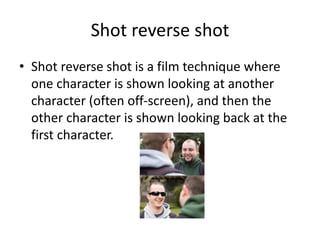
Shot reverse shot
• Shot reverse shot is a film technique where
one character is shown looking at another
character (often off-screen), and then the
other character is shown looking back at the
first character.
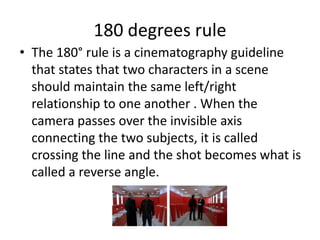
180 degrees rule
• The 180° rule is a cinematography guideline
that states that two characters in a scene
should maintain the same left/right
relationship to one another . When the
camera passes over the invisible axis
connecting the two subjects, it is called
crossing the line and the shot becomes what is
called a reverse angle.

Evaluation pt

  • 1.
  • 2.
    What influenced youchoice of theme After going through the preliminary task, we discussed what our options could be as a group. We took this opportunity to create a project that would demonstrate our how we work together as a group and our creativity as a group. Furthermore the show called “suits” influenced our choice as our scene was a recreation of an opening scene from “suits”.
  • 3.
    How well didyour product meet the original proposal Our original proposal was a scene from suits , in my opinion I think the product met the original proposal as we recreated it successfully, especially the chase scene.
  • 4.
    How well didyou plan your production and what methods did you use? • We had two weeks, roughly, to plan and agree upon what our timeline for production would be. Starting with an initial brainstorm of ideas, we planned out the framework and filled it in on a structured shot timeline, and made sure to incorporate our existing media knowledge to reduce planning time so we could focus more on the filming and editing.
  • 5.
    Was this methodeffective? • It was an effective method, as it allowed for each group member to contribute ideas to the table, and in turn the production. This reduced the amount of conflict from ideas, and made each group member feel like a part of the project.
  • 6.
    • Camera Compositioncan be what is currently in view of the lens and being captured. Such things as close shot, medium shot, long shot and wide shot. • Movement is the effect that panning and tilting have on the shots. Camera composition and movement of shots
  • 7.
    • Mise enScene would be made up of the following: • Settings & Props • Costume, Hair & Make Up • Facial Expressions and Body Language • Lighting and Colour • Positioning of characters/objects within the frame Mise en Scene
  • 8.
    • Digetic Soundwould be sound whose origin point is visible on screen (such as character voices) – another term being Actual Sound. • Non-digetic sound is sound added afterwards (such as narrative voice, sound effects) another term being Commentary Sound Diegetic sound and non diegetic sound
  • 9.
    Shot reverse shot •Shot reverse shot is a film technique where one character is shown looking at another character (often off-screen), and then the other character is shown looking back at the first character.
  • 10.
    180 degrees rule •The 180° rule is a cinematography guideline that states that two characters in a scene should maintain the same left/right relationship to one another . When the camera passes over the invisible axis connecting the two subjects, it is called crossing the line and the shot becomes what is called a reverse angle.