2.18 EVALUATION OFINTEGRALSBYLAPLACETRANSFORMS]
Sometimes. evaluation ofimproper integrals, i.e. integrals having lower limit
upper linnit oo can be done easily by using Laplace transform technique.
er limit 0
SOLVEDPROBLEMS
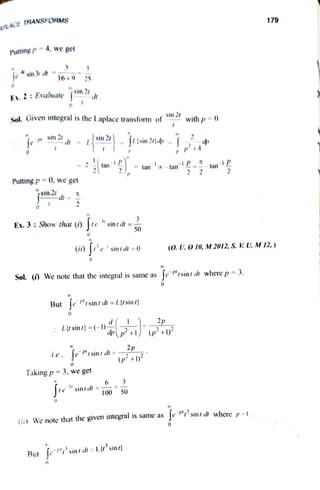
Ex. 1:Evauate(i) (red i) fe"sin 3/dt
0
0
3
Sol. () We note that the given integral is same as
re"dtwherep= 3
But
frePd =L{}
Putting p =3, we
get
fred=32
(ii) Given integral is same as feP sin 3t dt i.e. L{sin 3r} where p
=
4.
3
But L{sin 3t = 3
9 I.e. eP sin 31 dt =
p +9
+9
179
ACE TRANSFORMSs
Phatting 4,we get
sin d 16+9 25s
E.2: Evahuate (Sin2d
Sol. Given integral is the Laplace transform of with p 0
e N Sin 2 2 J/sin2414- S
tan tan'- tan - tan
Putting p0,we get
sin2 d
Ex.3: Show that (i)te"sintdt =
i) re 'sintdt=0 (0. U. O 10, M2012,S. KU. M 12,)
Sol. () We note that the integral is same as ePrsint di wherep
=
3.
But Prsint dt =
L{tsint}
2P
LUsint--D 1 +
2p
ie. eP"tsint dt =-
(p +1)
Taking p =3, we get
6 3
te sintdt= 100 50
(ii) We note that the given integral is
sameas e"rsintdt where p=1
But e"r' sintdt=L{rsinr
FOURIER SERIES &INTEGRAL T
TRANSFO
180
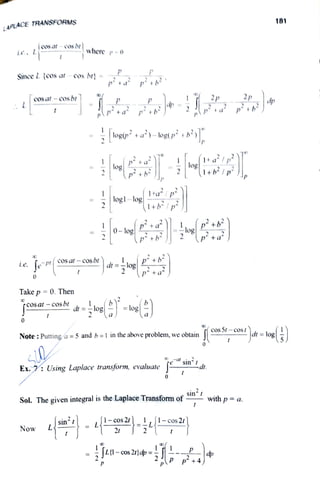
Now LI sin) =
(-1{Llsin/]=(-l+1
,d1-3p-24p(-p?
=(-) 2
dpp+1) dp(1+p) +p
Jesint dt =-24p(1-p)
(1+p
or
Putting p =1, we get
"rsintd= 24(1-1) 0
(1+1)
re@ -br
-dt S.VU. Sep, 20)
Ex.4:Evaluate(i)
2t
dt.
-dt =
log 2
(s. V. U. M. 2010)
0
0
eae-bl
Sol. (i) We have L
d =log 2+6
p+a)
i.e.,
0
Putting p = 0, we get
-d-d= loe
(ii) Taking a =
3,b=6 in the above solution, we get
d =log=log2
0
(iii) Putting a
=
1,b =2 in (i), we get the required result.
COS at- cos bt
dt.
K.
6:
UsingLaplacetransform, evaluateJ
d
Sol. Given integral is same as lePt COsal-cosbr
181
APLACE TRANSFORMS
jcosaf cosr
i.. where p 0
Since L cos at cos hr
p+
cOsar-cosbr 2P
P dp
pa p
+
log+a)- log(pb) p
log
(1+b1p?
log1-log
hap
+bp
0-log
p+a)
(p+a?
ie. fpt COsar-cosbr
p+a
Take p = 0. Then
cosat cosbr
log
cos5-coS dt=|
Note : Putting a = 5 and b = 1 in the above problem, we obtain
0
a sindt
Ex.7: Uising Laplace transform, evaluate J d
Sol. The given integral is the Laplace Transform of
sins
with p= a.
Now
JL0-cos 214o= dp
TRANSFOR
FOURIER SERIES &INTEGRAL TRA
182
log p-Iog(p*+4)
2
log
1+4/p,
log
log-log
Putting p = a, we get
2
-at.gin dt
d t = loe +4
Note : Put a
=l in the above result. Then we have
dt=log5
Ex. 8: Using Laplace transform, evaluate te sint dt.
0
Sol. We note that the given integral is same as
te sint dt where p =1.
eP sint d =
(sint) dt =
L{t sint} =
(-1)L(sin)]
But
dp
2p
2
Putting p=1,we get te " sint dt=
EXERCISE 2(D)
Find the
Laplace Transform of
(1))rsinr (i) rsin?3 (2) rsinh at
(3) " sin at
(4) ) cos (i) sin at (ii)e3 (iv) cos at
(v)te cos 2
(vi) re cosh
(vii) cos
(5) (1+
L A P L A C E T R A N S F O R M s
183
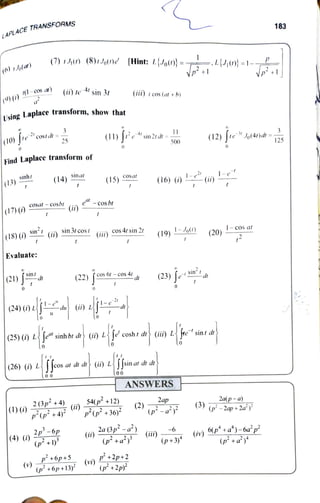
(7)1J (8)1Jo6ne [Hint: L{Jo) ,LJ)}=1-
(6)1plar)
Vp+1 VP+I
(1-cosad) (i)te 4 sin 3 (iii) rcos(at +b)
a
Using Laplace transtorm, show that
10)recostde ( ) in21d (12) re 1(4/)dt =
125
25 500
Find Laplace transform of
Sinat
(13) Stnhr
(14) (15) COSaf
(16)() ()
(17)() osat-cosbt (i) e-cosbt
(19)o (20)
2
(18) () Sn" (in sin3/cos (ii) cos4/Sin 21 1-cos a
Evaluate:
21) cos 6f-cos4
(22) (23) s" di
0 0
0
(24))
(25) (i) LJ"sinhbrd (i) LJe cosht
dt (i) Le sint d
(O
0
26) () cos at dt dt (i) L{[|sinat dt dt
lo0
00
ANSWERS
( 1 ) ) 2 0 p * + 4 )
p ( p + 4 ) ? ( i ) p ' + 1 2 )
s S4(p+12) (2) ) (p-2ap +2a
2ap 2a(p-a)
p(p +36) (p-a
(iv) (p+at)-6a?p?
2a(3p (iii)
(p+ay
(p+as
(4) () 1
2a(3p2-a) -6
(4) 2p-6p
(i)
(p+a (p+3
p+2p+2
p +6p+5
( +6p +13)
(vi)
(p+2p
FOURIER SERIES & NTEGRAL TRA
184
P (7)
(5) 3
(p+1)
6
6)
(p+2 p+3
P
(9)) 3p+a
p'(p+a (p
(p+Bp+25)
(fdzlr-d)anh- 2
p+4)
(ii)
|(13)log 14)cot (15) Does not exist (16%) ko i)ba
oe
(17)lo ng
2 L(p-a
p+a2
i)an-
2.
(18)(log 4 4
22)
(21)
p+Np- (20) acot-1og1
(19) log P
2P
(23)log (24)(i)log1- ntog12
P P)
P- 2p+1)
b
(25)pip-a?-b?])Pp-2)( p-2p-2?0) p+d)"u) Pf-i

Evaluation of integrals by Laplace transforms

  • 1.
    2.18 EVALUATION OFINTEGRALSBYLAPLACETRANSFORMS] Sometimes.evaluation ofimproper integrals, i.e. integrals having lower limit upper linnit oo can be done easily by using Laplace transform technique. er limit 0 SOLVEDPROBLEMS Ex. 1:Evauate(i) (red i) fe"sin 3/dt 0 0 3 Sol. () We note that the given integral is same as re"dtwherep= 3 But frePd =L{} Putting p =3, we get fred=32 (ii) Given integral is same as feP sin 3t dt i.e. L{sin 3r} where p = 4. 3 But L{sin 3t = 3 9 I.e. eP sin 31 dt = p +9 +9
  • 2.
    179 ACE TRANSFORMSs Phatting 4,weget sin d 16+9 25s E.2: Evahuate (Sin2d Sol. Given integral is the Laplace transform of with p 0 e N Sin 2 2 J/sin2414- S tan tan'- tan - tan Putting p0,we get sin2 d Ex.3: Show that (i)te"sintdt = i) re 'sintdt=0 (0. U. O 10, M2012,S. KU. M 12,) Sol. () We note that the integral is same as ePrsint di wherep = 3. But Prsint dt = L{tsint} 2P LUsint--D 1 + 2p ie. eP"tsint dt =- (p +1) Taking p =3, we get 6 3 te sintdt= 100 50 (ii) We note that the given integral is sameas e"rsintdt where p=1 But e"r' sintdt=L{rsinr
  • 3.
    FOURIER SERIES &INTEGRALT TRANSFO 180 Now LI sin) = (-1{Llsin/]=(-l+1 ,d1-3p-24p(-p? =(-) 2 dpp+1) dp(1+p) +p Jesint dt =-24p(1-p) (1+p or Putting p =1, we get "rsintd= 24(1-1) 0 (1+1) re@ -br -dt S.VU. Sep, 20) Ex.4:Evaluate(i) 2t dt. -dt = log 2 (s. V. U. M. 2010) 0 0 eae-bl Sol. (i) We have L d =log 2+6 p+a) i.e., 0 Putting p = 0, we get -d-d= loe (ii) Taking a = 3,b=6 in the above solution, we get d =log=log2 0 (iii) Putting a = 1,b =2 in (i), we get the required result. COS at- cos bt dt. K. 6: UsingLaplacetransform, evaluateJ d Sol. Given integral is same as lePt COsal-cosbr
  • 4.
    181 APLACE TRANSFORMS jcosaf cosr i..where p 0 Since L cos at cos hr p+ cOsar-cosbr 2P P dp pa p + log+a)- log(pb) p log (1+b1p? log1-log hap +bp 0-log p+a) (p+a? ie. fpt COsar-cosbr p+a Take p = 0. Then cosat cosbr log cos5-coS dt=| Note : Putting a = 5 and b = 1 in the above problem, we obtain 0 a sindt Ex.7: Uising Laplace transform, evaluate J d Sol. The given integral is the Laplace Transform of sins with p= a. Now JL0-cos 214o= dp
  • 5.
    TRANSFOR FOURIER SERIES &INTEGRALTRA 182 log p-Iog(p*+4) 2 log 1+4/p, log log-log Putting p = a, we get 2 -at.gin dt d t = loe +4 Note : Put a =l in the above result. Then we have dt=log5 Ex. 8: Using Laplace transform, evaluate te sint dt. 0 Sol. We note that the given integral is same as te sint dt where p =1. eP sint d = (sint) dt = L{t sint} = (-1)L(sin)] But dp 2p 2 Putting p=1,we get te " sint dt= EXERCISE 2(D) Find the Laplace Transform of (1))rsinr (i) rsin?3 (2) rsinh at (3) " sin at (4) ) cos (i) sin at (ii)e3 (iv) cos at (v)te cos 2 (vi) re cosh (vii) cos (5) (1+
  • 6.
    L A PL A C E T R A N S F O R M s 183 (7)1J (8)1Jo6ne [Hint: L{Jo) ,LJ)}=1- (6)1plar) Vp+1 VP+I (1-cosad) (i)te 4 sin 3 (iii) rcos(at +b) a Using Laplace transtorm, show that 10)recostde ( ) in21d (12) re 1(4/)dt = 125 25 500 Find Laplace transform of Sinat (13) Stnhr (14) (15) COSaf (16)() () (17)() osat-cosbt (i) e-cosbt (19)o (20) 2 (18) () Sn" (in sin3/cos (ii) cos4/Sin 21 1-cos a Evaluate: 21) cos 6f-cos4 (22) (23) s" di 0 0 0 (24)) (25) (i) LJ"sinhbrd (i) LJe cosht dt (i) Le sint d (O 0 26) () cos at dt dt (i) L{[|sinat dt dt lo0 00 ANSWERS ( 1 ) ) 2 0 p * + 4 ) p ( p + 4 ) ? ( i ) p ' + 1 2 ) s S4(p+12) (2) ) (p-2ap +2a 2ap 2a(p-a) p(p +36) (p-a (iv) (p+at)-6a?p? 2a(3p (iii) (p+ay (p+as (4) () 1 2a(3p2-a) -6 (4) 2p-6p (i) (p+a (p+3 p+2p+2 p +6p+5 ( +6p +13) (vi) (p+2p
  • 7.
    FOURIER SERIES &NTEGRAL TRA 184 P (7) (5) 3 (p+1) 6 6) (p+2 p+3 P (9)) 3p+a p'(p+a (p (p+Bp+25) (fdzlr-d)anh- 2 p+4) (ii) |(13)log 14)cot (15) Does not exist (16%) ko i)ba oe (17)lo ng 2 L(p-a p+a2 i)an- 2. (18)(log 4 4 22) (21) p+Np- (20) acot-1og1 (19) log P 2P (23)log (24)(i)log1- ntog12 P P) P- 2p+1) b (25)pip-a?-b?])Pp-2)( p-2p-2?0) p+d)"u) Pf-i