Evaluation
Use Of Forms and Conventions in
Real Media Products
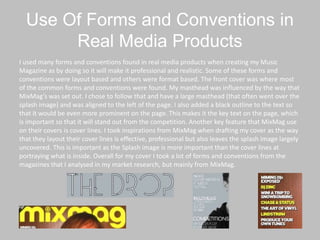
I used many forms and conventions found in real media products when creating my Music
Magazine as by doing so it will make it professional and realistic. Some of these forms and
conventions were layout based and others were format based. The front cover was where most
of the common forms and conventions were found. My masthead was influenced by the way that
MixMag’s was set out. I chose to follow that and have a large masthead (that often went over the
splash image) and was aligned to the left of the page. I also added a black outline to the text so
that it would be even more prominent on the page. This makes it the key text on the page, which
is important so that it will stand out from the competition. Another key feature that MixMag use
on their covers is cover lines. I took inspirations from MixMag when drafting my cover as the way
that they layout their cover lines is effective, professional but also leaves the splash image largely
uncovered. This is important as the Splash image is more important than the cover lines at
portraying what is inside. Overall for my cover I took a lot of forms and conventions from the
magazines that I analysed in my market research, but mainly from MixMag.
Use Of Forms and Conventions in
Real Media Products
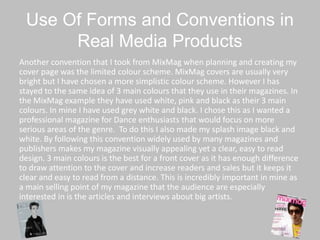
Another convention that I took from MixMag when planning and creating my
cover page was the limited colour scheme. MixMag covers are usually very
bright but I have chosen a more simplistic colour scheme. However I has
stayed to the same idea of 3 main colours that they use in their magazines. In
the MixMag example they have used white, pink and black as their 3 main
colours. In mine I have used grey white and black. I chose this as I wanted a
professional magazine for Dance enthusiasts that would focus on more
serious areas of the genre. To do this I also made my splash image black and
white. By following this convention widely used by many magazines and
publishers makes my magazine visually appealing yet a clear, easy to read
design. 3 main colours is the best for a front cover as it has enough difference
to draw attention to the cover and increase readers and sales but it keeps it
clear and easy to read from a distance. This is incredibly important in mine as
a main selling point of my magazine that the audience are especially
interested in is the articles and interviews about big artists.
Use Of Forms and Conventions in
Real Media Products
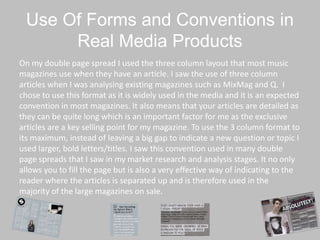
On my double page spread I used the three column layout that most music
magazines use when they have an article. I saw the use of three column
articles when I was analysing existing magazines such as MixMag and Q. I
chose to use this format as it is widely used in the media and it is an expected
convention in most magazines. It also means that your articles are detailed as
they can be quite long which is an important factor for me as the exclusive
articles are a key selling point for my magazine. To use the 3 column format to
its maximum, instead of leaving a big gap to indicate a new question or topic I
used larger, bold letters/titles. I saw this convention used in many double
page spreads that I saw in my market research and analysis stages. It no only
allows you to fill the page but is also a very effective way of indicating to the
reader where the articles is separated up and is therefore used in the
majority of the large magazines on sale.
Representation of Particular Social
Groups In My Magazine
Gender
In my magazine I think that I have reinforced that Dance and EDM
music is dominated by male artists. However I think I have also
reinforced the idea that fans of the genre can be anyone. In my
magazine I use 3 images of male models and 1 image of a female
model. This is because 2 of the male images where representing an
artist and the other 2 were male and female fans. This does match the
makeup of my audience as the fans are evenly split but the majority of
artists are male. My magazine reinforces the stereotype of men being
better with technology but this is due to the images being of artist. I
did not use any sexually suggestive images of female models in my
magazine as it would not have suited the theme of my magazine and
there is no need as I expect the readers to be 50/50 male and female.
Therefore I feel as if I have not used the theory of ‘Male Gaze’ to
attract my male readers attention and fairly represented women in my
magazine.
Representation of Particular Social
Groups In My Magazine
Age
In my magazine I represented age through the models that I used
and the genre/theme of the magazine. I reinforced the
stereotype of dance music being just for young people as all of
my models were in my target demographic of 16-24. I chose this
so that it would appeal to my audience and suited the style of
magazine that I wanted. I also represented age through the
prizes I was offering in the competitions. All of the prizes where
aimed at my target age bracket as they were mainly festival
tickets and music equipment.
Representation of Particular Social
Groups In My Magazine
Ethnicity
In my music magazine I only represented one main ethical group,
white British making it monocultural. I did not purposely do this as the
ethnical groups included in the dance music fan base are varied as it is
so large and followed in so many countries worldwide. The ethical
groups used in my magazine doesn’t reflect the audience worldwide,
however it does reflect the majority of the audience in the UK. This is
because the main ethical group in the UK is white British therefore
making up the largest section of the audience. I think that my choice to
use only white models is a stereotype in its self as I have made an
assumption that the community in the UK will be dominated by white
people. I have therefore made an assumption that different ethical
groups will listen to other genres of music reinforcing existing
stereotype.
Representation of Particular Social
Groups In My Magazine
Class
In my music magazine I represented class in a way that
particularly focused on my target audience. I feel that the images
that I used and the articles included are aimed at readers with a
social class grade of A (upper class) B (middle class) and C1
(Lower Middle Class). This is reflected in the price of my
magazine which is £3.50 which is what readers in these social
classes would be able to comfortably afford on a regular basis. I
think that I reinforced the current social classes of this music
genre. This is because according to my research the majority will
have an online music streaming account, go to festivals and will
be heavily reliant of technology. It would not have made sense to
lower the price to open it up to the lower classes when the
majority of current fans can and will play £3.50
Types of Media Institutions That
Might Distribute My Magazine
I think that Bauer Media would be the best institution to distribute my magazine as
they don’t currently have a music magazine that is based on the Dance/EDM genre.
However they do have experience in the music magazine industry with their Q
magazine. This way I could compete against Development Hell’s MixMag, which is the
worlds biggest clubbing magazine. I also think that my magazine has a slightly different
style to MixMag to it may attract different readers who want a more industry based
magazine instead of a ‘party’ based magazine.
Extra Information about Bauer
• Bauer Media is a division of the Bauer Media Group, Europe’s largest privately
owned publishing Group. The Group is a worldwide media empire offering over
300 magazines in 15 countries, as well as online, TV and radio stations.
• Bauer XCEL, Bauer’s digital arm, manages all digital brands which reaches over 130
million unique users globally.
Types of Media Institutions That
Might Distribute My Magazine
I also think that TimeInc would also be a good institution to publish my magazine as
they publish NME, one of the biggest music magazines. This would be good for the
magazine as TimeInc can use their experience to develop and distribute it but my
magazine would benefit them as it is a new genre of music for them. They also have a
good online presence that would appeal to my target audience as they are young but
also they have their free NME magazines that could be used to advertise my
magazine.
Extra Information About TimeLine Inc.
• Time Inc. UK is Britain’s leading publisher of print and digital magazine content.
• With more than 60 iconic brands - including Decanter, Country Life, Horse &
Hound, NME, What's On TV and Wallpaper* - Time Inc. UK (formerly IPC Media)
creates content for multiple platforms, across print, online, mobile, tablets and
experiences.
Types of Media Institutions That
Might Distribute My Magazine
Although Development Hell already have MixMag they would be a great institution to
publish my magazine as they not only have lots of experience in this genre but they
can appeal to my audience. Development Hell have a very strong online presence,
especially with their MixMag site. This is a key part of appealing to my audience as
they are young and spend a lot of their time online. It can also be used to promote the
magazine to the target audience as many would not hear about it otherwise. This is
one thing that Development Hell do better than Bauer or TimeInc.
Extra Information about Development Hell
Development Hell Ltd., a media company, publishes magazines. The company, through
its subsidiary, operates a social network clubbing Website. It also offers consulting
services. The company was incorporated in 2001 and is based in London, the United
Kingdom.
Audience Of My Magazine
In my reader profile and research work I use my surveys and
knowledge of the genre to determine my target audience. I
decided that I wanted my target audience to be aged below 25
and I think that my final product will appeal to that age range.
However I believe that my magazine will appeal to the people
that are more ‘music fanatics’ rather than just fans. I think that
MixMag control that ‘Party’ area of the music magazine market
so I chose to make mine a bit more industry focused. I think that
my audience would also contain aspiring artists and people that
were interested in the production of the music and the
technology involved.
Audience Of My Magazine
Final Reader Profile
James is a reader of ‘The Drop’. He is 21 and lives in Manchester where he can
frequently have nights out in clubs with his friends. As well as partying with
his friends he visits Leeds and Glastonbury Festivals every year and goes
aboard to Tomorrow Land and Spinnin Sessions Miami as much as possible.
When he is not at clubs or festivals he is a student studying music production
and sound engineering. When he is at home he spend his free time producing
dance music and uploading it online in the hope of one day becoming a
successful artist. James has a Spotify Premium account that he uses to listen
to music at least 3 hours a day. As well as this he used SoundCloud to hear
early previews of new tracks and re-listen to his favourite live sets from music
festivals. James also uses multiple social media accounts to keep up to date
with what his favourite artists are doing and to find out about new hits so he
can be the first to hear it. He does all of this on only the newest IPhone and
IPad as well as browsing the internet and creating music on his high powered
PC. When James is not listening to or producing music in his time at home he
likes to play online PC games with his friends who are also music fans.
Ways I Attract and Address my
audience
To attract my audience I have placed big names and news on the front cover. I chose
the biggest names in the industry that would appeal to my target audience and appeal
to the most readers. I also used data from my market research to make my final
decision on this so that my choice would be the most effective. Often readers have
their favourite artists and if they see that my magazine includes an article or interview
about them they may buy it. This will attract in some new readers and they may
become dedicated, loyal fans. From my audience research I found that music is very
important to my readers. Therefore they will not only be interested in the music but
the lives of their favourite artists. By advertising that interviews with these artists are
included, it should attract my audience to read it.
Ways I Attract and Address my
audience
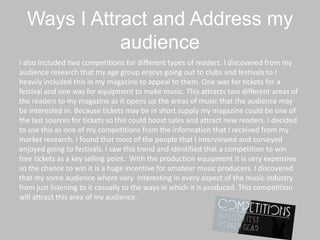
I also included two competitions for different types of readers. I discovered from my
audience research that my age group enjoys going out to clubs and festivals to I
heavily included this in my magazine to appeal to them. One was for tickets for a
festival and one was for equipment to make music. This attracts two different areas of
the readers to my magazine as it opens up the areas of music that the audience may
be interested in. Because tickets may be in short supply my magazine could be one of
the last sources for tickets so this could boost sales and attract new readers. I decided
to use this as one of my competitions from the information that I received from my
market research. I found that most of the people that I interviewed and surveyed
enjoyed going to festivals. I saw this trend and identified that a competition to win
free tickets as a key selling point. With the production equipment it is very expensive
so the chance to win it is a huge incentive for amateur music producers. I discovered
that my some audience where very interesting in every aspect of the music industry
from just listening to it casually to the ways in which it is produced. This competition
will attract this area of my audience.
Ways I Attract and Address my
audience
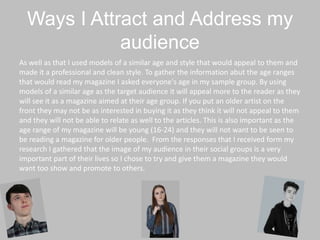
As well as that I used models of a similar age and style that would appeal to them and
made it a professional and clean style. To gather the information abut the age ranges
that would read my magazine I asked everyone's age in my sample group. By using
models of a similar age as the target audience it will appeal more to the reader as they
will see it as a magazine aimed at their age group. If you put an older artist on the
front they may not be as interested in buying it as they think it will not appeal to them
and they will not be able to relate as well to the articles. This is also important as the
age range of my magazine will be young (16-24) and they will not want to be seen to
be reading a magazine for older people. From the responses that I received form my
research I gathered that the image of my audience in their social groups is a very
important part of their lives so I chose to try and give them a magazine they would
want too show and promote to others.
What Have I Learnt About the
Technology
In the research and planning stage I use technology to make the ways
that I gathered my information and presented it much more efficient
and effective. To gather most of my research I used SurveyMonkey a
free online survey website where you can create a customised survey
for anyone to complete. I then used social media to share this so that I
would receive enough responses to be able to make an accurate
decision on what to include in my magazine. Social media was key in
the research stage as without it I would not have had a big enough
sample size to make an accurate judgement. After I had created a
document presenting all of the results that I had collected I used slide
share to convert it into a file type that could be displayed on my blog
with a download link being needed. Slideshare also allowed me to be
able to embed the document onto my WordPress blog using the HTML
JavaScript embed code that SlideShare provides. These are all feature
and methods I had not used previous to this project and everything I
know about them I learnt in the process.
What Have I Learnt About the
Technology
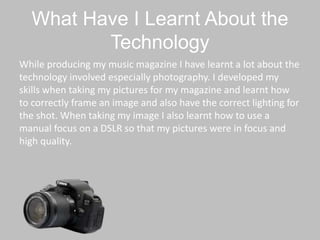
While producing my music magazine I have learnt a lot about the
technology involved especially photography. I developed my
skills when taking my pictures for my magazine and learnt how
to correctly frame an image and also have the correct lighting for
the shot. When taking my image I also learnt how to use a
manual focus on a DSLR so that my pictures were in focus and
high quality.
What Have I Learnt About the
Technology
Before I started making my magazine I had already had quite a lot of
experience with using Photoshop so I could use that effectively
already. However I did develop some of my skills and learnt how to use
some more detailed tools and effects. One simple tool that I used in
the production of my magazine quite a lot was the black and white
filter. It is a very simple tool to use but this was the first time I had
tried it and I think I used it quite effectively. I also used the dodge and
burn tool to touch up some of my images to make my models skin
clearer (much like it would be in a real music magazine). As well as
these simple techniques I also leant how to use the guides so that I
could accurately layout my front cover so that it would all be in line
and correctly spaced. This was key in ensuring that my cover looked
professional.
What Have I Learnt About the
Technology
In the process of the production of my music magazine I learnt how to
correctly use Adobe InDesign to create my Double Page spread. Previous to
beginning the production of my magazine I had not had any experience in
InDesign. One of the main features I used was the text tool. I learnt how to
correctly and professionally format my text to have the highest quality look. I
also learnt how to insert my images into InDesign after I had previously edited
them in Photoshop. One useful feature that I learnt was that I could insert
.PSD file type images straight into my document. This helped me to be more
efficient as I did not need to make JPEG or PNG file format saves of the edited
images in order for them to be used in the double page spread.
What I Have Learnt Since my
Preliminary Task
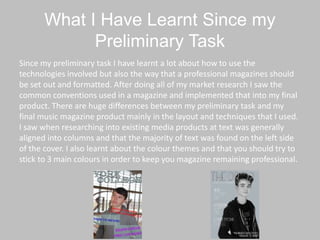
Since my preliminary task I have learnt a lot about how to use the
technologies involved but also the way that a professional magazines should
be set out and formatted. After doing all of my market research I saw the
common conventions used in a magazine and implemented that into my final
product. There are huge differences between my preliminary task and my
final music magazine product mainly in the layout and techniques that I used.
I saw when researching into existing media products at text was generally
aligned into columns and that the majority of text was found on the left side
of the cover. I also learnt about the colour themes and that you should try to
stick to 3 main colours in order to keep you magazine remaining professional.
What I Have Learnt Since my
Preliminary Task
One feature of my magazine that I improve hugely since my preliminary task
was the text that I used on my cover. I gathered my own custom fonts that
make my magazine stand out and look individual. I saw this in the research
when analysing other magazines and I saw that every magazine had a unique
font style that identified them and individualised them against their
competition. Because of this I had to learn how to download and install fonts
onto the college system. I found reliable websites (1001 fonts and DaFont) to
source my fonts. After that I and to install them using some code in the ‘run’
application on the system so that I could use them is Photoshop and InDesign.
What I Have Learnt Since my
Preliminary Task
Another area that I have learnt about between my preliminary task and my
final magazine is photography and the style of images that I need. The image
used in my preliminary task was very unprofessional, with bad lighting and no
editing. In my final product (after doing my market research and seeing what
the conventions were) I took most of my images in a studio setting. This was
because I could make them very professional with the correct lighting. I learnt
in the process how to correctly use the 3 types of lighting to create the
correct effect for the image. But in the process of using the studio for my
shots I learnt how to organise myself and my models in a photo shoot
situation. I had to initially book the studio and a camera to use. Organisation
was a key part of the production that I needed to ensure that I did correctly
so that I made use of the limited time I had. It was also key to organise and
communicate affectively with my models so they had the props that they
needed on the day, knew the location and time of the shoot and knew what
my plans were for the images I planned to take.

Evaluation

  • 1.
  • 2.
    Use Of Formsand Conventions in Real Media Products I used many forms and conventions found in real media products when creating my Music Magazine as by doing so it will make it professional and realistic. Some of these forms and conventions were layout based and others were format based. The front cover was where most of the common forms and conventions were found. My masthead was influenced by the way that MixMag’s was set out. I chose to follow that and have a large masthead (that often went over the splash image) and was aligned to the left of the page. I also added a black outline to the text so that it would be even more prominent on the page. This makes it the key text on the page, which is important so that it will stand out from the competition. Another key feature that MixMag use on their covers is cover lines. I took inspirations from MixMag when drafting my cover as the way that they layout their cover lines is effective, professional but also leaves the splash image largely uncovered. This is important as the Splash image is more important than the cover lines at portraying what is inside. Overall for my cover I took a lot of forms and conventions from the magazines that I analysed in my market research, but mainly from MixMag.
  • 3.
    Use Of Formsand Conventions in Real Media Products Another convention that I took from MixMag when planning and creating my cover page was the limited colour scheme. MixMag covers are usually very bright but I have chosen a more simplistic colour scheme. However I has stayed to the same idea of 3 main colours that they use in their magazines. In the MixMag example they have used white, pink and black as their 3 main colours. In mine I have used grey white and black. I chose this as I wanted a professional magazine for Dance enthusiasts that would focus on more serious areas of the genre. To do this I also made my splash image black and white. By following this convention widely used by many magazines and publishers makes my magazine visually appealing yet a clear, easy to read design. 3 main colours is the best for a front cover as it has enough difference to draw attention to the cover and increase readers and sales but it keeps it clear and easy to read from a distance. This is incredibly important in mine as a main selling point of my magazine that the audience are especially interested in is the articles and interviews about big artists.
  • 4.
    Use Of Formsand Conventions in Real Media Products On my double page spread I used the three column layout that most music magazines use when they have an article. I saw the use of three column articles when I was analysing existing magazines such as MixMag and Q. I chose to use this format as it is widely used in the media and it is an expected convention in most magazines. It also means that your articles are detailed as they can be quite long which is an important factor for me as the exclusive articles are a key selling point for my magazine. To use the 3 column format to its maximum, instead of leaving a big gap to indicate a new question or topic I used larger, bold letters/titles. I saw this convention used in many double page spreads that I saw in my market research and analysis stages. It no only allows you to fill the page but is also a very effective way of indicating to the reader where the articles is separated up and is therefore used in the majority of the large magazines on sale.
  • 5.
    Representation of ParticularSocial Groups In My Magazine Gender In my magazine I think that I have reinforced that Dance and EDM music is dominated by male artists. However I think I have also reinforced the idea that fans of the genre can be anyone. In my magazine I use 3 images of male models and 1 image of a female model. This is because 2 of the male images where representing an artist and the other 2 were male and female fans. This does match the makeup of my audience as the fans are evenly split but the majority of artists are male. My magazine reinforces the stereotype of men being better with technology but this is due to the images being of artist. I did not use any sexually suggestive images of female models in my magazine as it would not have suited the theme of my magazine and there is no need as I expect the readers to be 50/50 male and female. Therefore I feel as if I have not used the theory of ‘Male Gaze’ to attract my male readers attention and fairly represented women in my magazine.
  • 6.
    Representation of ParticularSocial Groups In My Magazine Age In my magazine I represented age through the models that I used and the genre/theme of the magazine. I reinforced the stereotype of dance music being just for young people as all of my models were in my target demographic of 16-24. I chose this so that it would appeal to my audience and suited the style of magazine that I wanted. I also represented age through the prizes I was offering in the competitions. All of the prizes where aimed at my target age bracket as they were mainly festival tickets and music equipment.
  • 7.
    Representation of ParticularSocial Groups In My Magazine Ethnicity In my music magazine I only represented one main ethical group, white British making it monocultural. I did not purposely do this as the ethnical groups included in the dance music fan base are varied as it is so large and followed in so many countries worldwide. The ethical groups used in my magazine doesn’t reflect the audience worldwide, however it does reflect the majority of the audience in the UK. This is because the main ethical group in the UK is white British therefore making up the largest section of the audience. I think that my choice to use only white models is a stereotype in its self as I have made an assumption that the community in the UK will be dominated by white people. I have therefore made an assumption that different ethical groups will listen to other genres of music reinforcing existing stereotype.
  • 8.
    Representation of ParticularSocial Groups In My Magazine Class In my music magazine I represented class in a way that particularly focused on my target audience. I feel that the images that I used and the articles included are aimed at readers with a social class grade of A (upper class) B (middle class) and C1 (Lower Middle Class). This is reflected in the price of my magazine which is £3.50 which is what readers in these social classes would be able to comfortably afford on a regular basis. I think that I reinforced the current social classes of this music genre. This is because according to my research the majority will have an online music streaming account, go to festivals and will be heavily reliant of technology. It would not have made sense to lower the price to open it up to the lower classes when the majority of current fans can and will play £3.50
  • 9.
    Types of MediaInstitutions That Might Distribute My Magazine I think that Bauer Media would be the best institution to distribute my magazine as they don’t currently have a music magazine that is based on the Dance/EDM genre. However they do have experience in the music magazine industry with their Q magazine. This way I could compete against Development Hell’s MixMag, which is the worlds biggest clubbing magazine. I also think that my magazine has a slightly different style to MixMag to it may attract different readers who want a more industry based magazine instead of a ‘party’ based magazine. Extra Information about Bauer • Bauer Media is a division of the Bauer Media Group, Europe’s largest privately owned publishing Group. The Group is a worldwide media empire offering over 300 magazines in 15 countries, as well as online, TV and radio stations. • Bauer XCEL, Bauer’s digital arm, manages all digital brands which reaches over 130 million unique users globally.
  • 10.
    Types of MediaInstitutions That Might Distribute My Magazine I also think that TimeInc would also be a good institution to publish my magazine as they publish NME, one of the biggest music magazines. This would be good for the magazine as TimeInc can use their experience to develop and distribute it but my magazine would benefit them as it is a new genre of music for them. They also have a good online presence that would appeal to my target audience as they are young but also they have their free NME magazines that could be used to advertise my magazine. Extra Information About TimeLine Inc. • Time Inc. UK is Britain’s leading publisher of print and digital magazine content. • With more than 60 iconic brands - including Decanter, Country Life, Horse & Hound, NME, What's On TV and Wallpaper* - Time Inc. UK (formerly IPC Media) creates content for multiple platforms, across print, online, mobile, tablets and experiences.
  • 11.
    Types of MediaInstitutions That Might Distribute My Magazine Although Development Hell already have MixMag they would be a great institution to publish my magazine as they not only have lots of experience in this genre but they can appeal to my audience. Development Hell have a very strong online presence, especially with their MixMag site. This is a key part of appealing to my audience as they are young and spend a lot of their time online. It can also be used to promote the magazine to the target audience as many would not hear about it otherwise. This is one thing that Development Hell do better than Bauer or TimeInc. Extra Information about Development Hell Development Hell Ltd., a media company, publishes magazines. The company, through its subsidiary, operates a social network clubbing Website. It also offers consulting services. The company was incorporated in 2001 and is based in London, the United Kingdom.
  • 12.
    Audience Of MyMagazine In my reader profile and research work I use my surveys and knowledge of the genre to determine my target audience. I decided that I wanted my target audience to be aged below 25 and I think that my final product will appeal to that age range. However I believe that my magazine will appeal to the people that are more ‘music fanatics’ rather than just fans. I think that MixMag control that ‘Party’ area of the music magazine market so I chose to make mine a bit more industry focused. I think that my audience would also contain aspiring artists and people that were interested in the production of the music and the technology involved.
  • 13.
    Audience Of MyMagazine Final Reader Profile James is a reader of ‘The Drop’. He is 21 and lives in Manchester where he can frequently have nights out in clubs with his friends. As well as partying with his friends he visits Leeds and Glastonbury Festivals every year and goes aboard to Tomorrow Land and Spinnin Sessions Miami as much as possible. When he is not at clubs or festivals he is a student studying music production and sound engineering. When he is at home he spend his free time producing dance music and uploading it online in the hope of one day becoming a successful artist. James has a Spotify Premium account that he uses to listen to music at least 3 hours a day. As well as this he used SoundCloud to hear early previews of new tracks and re-listen to his favourite live sets from music festivals. James also uses multiple social media accounts to keep up to date with what his favourite artists are doing and to find out about new hits so he can be the first to hear it. He does all of this on only the newest IPhone and IPad as well as browsing the internet and creating music on his high powered PC. When James is not listening to or producing music in his time at home he likes to play online PC games with his friends who are also music fans.
  • 14.
    Ways I Attractand Address my audience To attract my audience I have placed big names and news on the front cover. I chose the biggest names in the industry that would appeal to my target audience and appeal to the most readers. I also used data from my market research to make my final decision on this so that my choice would be the most effective. Often readers have their favourite artists and if they see that my magazine includes an article or interview about them they may buy it. This will attract in some new readers and they may become dedicated, loyal fans. From my audience research I found that music is very important to my readers. Therefore they will not only be interested in the music but the lives of their favourite artists. By advertising that interviews with these artists are included, it should attract my audience to read it.
  • 15.
    Ways I Attractand Address my audience I also included two competitions for different types of readers. I discovered from my audience research that my age group enjoys going out to clubs and festivals to I heavily included this in my magazine to appeal to them. One was for tickets for a festival and one was for equipment to make music. This attracts two different areas of the readers to my magazine as it opens up the areas of music that the audience may be interested in. Because tickets may be in short supply my magazine could be one of the last sources for tickets so this could boost sales and attract new readers. I decided to use this as one of my competitions from the information that I received from my market research. I found that most of the people that I interviewed and surveyed enjoyed going to festivals. I saw this trend and identified that a competition to win free tickets as a key selling point. With the production equipment it is very expensive so the chance to win it is a huge incentive for amateur music producers. I discovered that my some audience where very interesting in every aspect of the music industry from just listening to it casually to the ways in which it is produced. This competition will attract this area of my audience.
  • 16.
    Ways I Attractand Address my audience As well as that I used models of a similar age and style that would appeal to them and made it a professional and clean style. To gather the information abut the age ranges that would read my magazine I asked everyone's age in my sample group. By using models of a similar age as the target audience it will appeal more to the reader as they will see it as a magazine aimed at their age group. If you put an older artist on the front they may not be as interested in buying it as they think it will not appeal to them and they will not be able to relate as well to the articles. This is also important as the age range of my magazine will be young (16-24) and they will not want to be seen to be reading a magazine for older people. From the responses that I received form my research I gathered that the image of my audience in their social groups is a very important part of their lives so I chose to try and give them a magazine they would want too show and promote to others.
  • 17.
    What Have ILearnt About the Technology In the research and planning stage I use technology to make the ways that I gathered my information and presented it much more efficient and effective. To gather most of my research I used SurveyMonkey a free online survey website where you can create a customised survey for anyone to complete. I then used social media to share this so that I would receive enough responses to be able to make an accurate decision on what to include in my magazine. Social media was key in the research stage as without it I would not have had a big enough sample size to make an accurate judgement. After I had created a document presenting all of the results that I had collected I used slide share to convert it into a file type that could be displayed on my blog with a download link being needed. Slideshare also allowed me to be able to embed the document onto my WordPress blog using the HTML JavaScript embed code that SlideShare provides. These are all feature and methods I had not used previous to this project and everything I know about them I learnt in the process.
  • 18.
    What Have ILearnt About the Technology While producing my music magazine I have learnt a lot about the technology involved especially photography. I developed my skills when taking my pictures for my magazine and learnt how to correctly frame an image and also have the correct lighting for the shot. When taking my image I also learnt how to use a manual focus on a DSLR so that my pictures were in focus and high quality.
  • 19.
    What Have ILearnt About the Technology Before I started making my magazine I had already had quite a lot of experience with using Photoshop so I could use that effectively already. However I did develop some of my skills and learnt how to use some more detailed tools and effects. One simple tool that I used in the production of my magazine quite a lot was the black and white filter. It is a very simple tool to use but this was the first time I had tried it and I think I used it quite effectively. I also used the dodge and burn tool to touch up some of my images to make my models skin clearer (much like it would be in a real music magazine). As well as these simple techniques I also leant how to use the guides so that I could accurately layout my front cover so that it would all be in line and correctly spaced. This was key in ensuring that my cover looked professional.
  • 20.
    What Have ILearnt About the Technology In the process of the production of my music magazine I learnt how to correctly use Adobe InDesign to create my Double Page spread. Previous to beginning the production of my magazine I had not had any experience in InDesign. One of the main features I used was the text tool. I learnt how to correctly and professionally format my text to have the highest quality look. I also learnt how to insert my images into InDesign after I had previously edited them in Photoshop. One useful feature that I learnt was that I could insert .PSD file type images straight into my document. This helped me to be more efficient as I did not need to make JPEG or PNG file format saves of the edited images in order for them to be used in the double page spread.
  • 21.
    What I HaveLearnt Since my Preliminary Task Since my preliminary task I have learnt a lot about how to use the technologies involved but also the way that a professional magazines should be set out and formatted. After doing all of my market research I saw the common conventions used in a magazine and implemented that into my final product. There are huge differences between my preliminary task and my final music magazine product mainly in the layout and techniques that I used. I saw when researching into existing media products at text was generally aligned into columns and that the majority of text was found on the left side of the cover. I also learnt about the colour themes and that you should try to stick to 3 main colours in order to keep you magazine remaining professional.
  • 22.
    What I HaveLearnt Since my Preliminary Task One feature of my magazine that I improve hugely since my preliminary task was the text that I used on my cover. I gathered my own custom fonts that make my magazine stand out and look individual. I saw this in the research when analysing other magazines and I saw that every magazine had a unique font style that identified them and individualised them against their competition. Because of this I had to learn how to download and install fonts onto the college system. I found reliable websites (1001 fonts and DaFont) to source my fonts. After that I and to install them using some code in the ‘run’ application on the system so that I could use them is Photoshop and InDesign.
  • 23.
    What I HaveLearnt Since my Preliminary Task Another area that I have learnt about between my preliminary task and my final magazine is photography and the style of images that I need. The image used in my preliminary task was very unprofessional, with bad lighting and no editing. In my final product (after doing my market research and seeing what the conventions were) I took most of my images in a studio setting. This was because I could make them very professional with the correct lighting. I learnt in the process how to correctly use the 3 types of lighting to create the correct effect for the image. But in the process of using the studio for my shots I learnt how to organise myself and my models in a photo shoot situation. I had to initially book the studio and a camera to use. Organisation was a key part of the production that I needed to ensure that I did correctly so that I made use of the limited time I had. It was also key to organise and communicate affectively with my models so they had the props that they needed on the day, knew the location and time of the shoot and knew what my plans were for the images I planned to take.