Amy, Nicole and I filmed and edited our preliminary task
together, this was our first opportunity to work independently
on the practical side of Media Studies. This task involved
creating a very short film of a conversation, and using certain
techniques, such as match on action, the 180 degree rule and
shot-reverse shot.
Managing the group dynamics
and collaborative nature of filmmaking
As a team, we worked together well and efficiently. We
shared the roles required to produce the film fairly
equally, although, as my character was on screen for
the duration of most of the film I had a shorter turn
than the other two in filming. However, in the editing,
we were able to split the work more evenly, and assist
each other if need be.
We also helped each other by running over our lines
together and confirming that the actress who was
about to be filmed (either myself or Amy) felt prepared
and happy before hitting record.
Mistakes
 Whilst filming, we made only made a couple significant

mistakes. The first was overstepping the 180 degree rule,
but we recognised the error almost immediately and we
were able to rectify it by re-filming those few seconds.
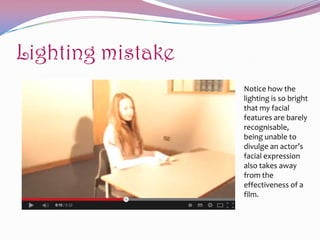
 Another issue is the lighting, we had planned to use the key,
filler, and back lights to give an atmosphere of film noir, but
it appears we over-exposed the scene, causing it to have a
washed-out appearance.
 As we have all had some prior experience with regards to
using editing software (albeit not with that we use at
school), we didn’t make any mistakes when it came to
editing.
Lighting mistake
Notice how the
lighting is so bright
that my facial
features are barely
recognisable,
being unable to
divulge an actor’s
facial expression
also takes away
from the
effectiveness of a
film.
Managing the
equipment
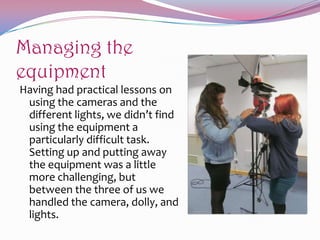
Having had practical lessons on
using the cameras and the
different lights, we didn’t find
using the equipment a
particularly difficult task.
Setting up and putting away
the equipment was a little
more challenging, but
between the three of us we
handled the camera, dolly, and
lights.
Managing the deadline
We found it relatively easy to complete our preliminary
task by its deadline. We worked in two separate
sessions, spending one on filming and the latter on
editing. Even though we worked into our break time to
complete the task, in the grand scheme of things, it did
not take particularly long to do.
Health and Safety logistics
As all our filming took place on a safe location, health and
safety wasn’t such considerable an issue in this task.
That said, we experimented with lighting, in particular
using red head lights, which can heat up to really high
temperatures if left on for long enough. Therefore
when moving and repositioning the lights we had to be
careful not to burn ourselves.
In addition, there were various wires from the equipment
to be wary of when manoeuvring as there was a
possibility that they could trip someone up.
Organising human resources
 Actors- as the preliminary task acts as a practice for our opening title

sequence, we treated our actresses as such, even though these were
the same people as those filming and editing. This meant frequently
checking in on them, going through their lines with them and ensuring
that they were prepared for filming before hitting record.
 Costumes- Due to the fact that we were filming in school, the actresses
wore their usual school clothes. Amy wore a hooded jacket and raised
the hood to cause her character to seem more intimidating and I wore
light coloured clothing to present me as the good character.
 Props- other than a table and chairs, we did not use any props in our
film. However, considering the length of film and conditions we were
producing it in, the stark backdrop seemed fitting to the scenario we
presented. I only wish we had noticed the school bag and folder and
removed them from the room before we started filming as it is details
like these that keep an amateur film from becoming professional.
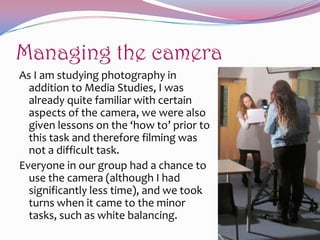
Managing the camera
As I am studying photography in
addition to Media Studies, I was
already quite familiar with certain
aspects of the camera, we were also
given lessons on the ‘how to’ prior to
this task and therefore filming was
not a difficult task.
Everyone in our group had a chance to
use the camera (although I had
significantly less time), and we took
turns when it came to the minor
tasks, such as white balancing.
Managing the lighting
Having had much experience with the cameras and
editing software, but little with the lighting equipment,
we decided to experiment with the lights in our
preliminary task. Like the dialogue, we had planned for
this to be sinister, but it didn’t work out that way. We
filmed the task using two key lights, but in hindsight we
know one would have been more effective. We noticed
this when looking back on our recording, the whole
scene was overexposed. This taught us the importance
of checking how the lighting looks in the camera before
shooting our opening title sequence.
How did your storyboarding and
shooting script work in practice?
We didn’t really create a script for this task, however we
constructed a basic idea and then improvised the
dialogue to suit. What storyboarding we did do did not
go to waste though.
When storyboarding we did not take into account
aspects such as lights and how their positioning may or
may not cause lens flare, so this was something we had
to work out in practice.
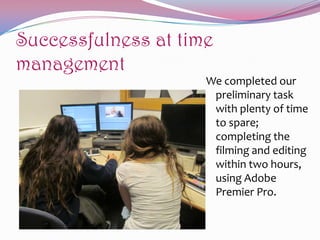
Successfulness at time
management
We completed our
preliminary task
with plenty of time
to spare;
completing the
filming and editing
within two hours,
using Adobe
Premier Pro.
How did digital technology
enable you to develop
creatively?
In filming, we were able to develop our camera-related skills
through the use of various shots. Experimenting with the
lighting equipment also enabled me to understand the
extent of its effectiveness and therefore think more
creatively with regards to how I can use it in my thriller. We
also used different tools from Adobe Premier Pro to edit our
task in order to create a match-on action scene and
continuity within our film. In the bigger picture, this helped
us get to grips with the editing software and therefore more
prepared for the editing of our opening title sequence.
None of the skills developed in this task will go to waste on
our final piece.
In filming and editing, how did you
ensure that the meaning would be
apparent to the audience?
In 30 seconds of film there was a limited amount of meaning
we could create. That said, the actresses used explicit body
language, tones of voice and wore obvious costumes, Amy
in a dark hooded jacket and myself in light colours, to
present the audience with a clear understanding of who’s
good and who’s bad.
Using filming and editing techniques such as match on action,
shot-reverse shot, and the 180 degree rule, we ensured the
continuity of the film would not be broken and that the
implicit past events were apparent in the present of the
film. This is how we also laid the foundations for the future
and hinted it to the audience.
What type of people have you
represented in your piece?
Although our preliminary task is only 30 seconds long, we
represent a ‘good’ character and ‘bad’ character.
Despite the seeming lack of character development, we
do display some progression in the short time we had
through body language, tone of voice, dialogue and
costumes. We tried to represent the ‘good’ character as
a middle-class figure, who began the film calm and
collected, only to find themselves desperate and
intimidated by the end of it. The ‘bad’ character is a
loan shark of sorts.
What role do the micro elements
play in the construction of
verisimilitude?
In this task we did not focus so much on constructing
verisimilitude. We endeavoured to create a ‘gangsta’ style
realism revolving around the perils of associating with loan
sharks, but due to a lack of time and facilities we were
unable to create atmospheric mise-en-scene. It was really
unfortunate that the lighting did not work as planned as this
would have been very effective if it had. The costuming and
the characters’ tones of voice in addition to the dialogue
were great indications of our theme. That said, having
neither Amy nor myself never had professional acting
experience prior to this, our acting was not up to scratch
and this also detracted from our ability to create an
effective realism.
How did you
manage the
editing?
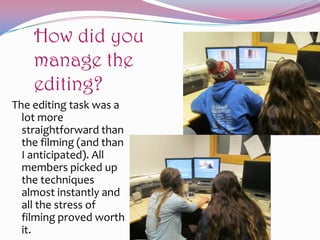
The editing task was a
lot more
straightforward than
the filming (and than
I anticipated). All
members picked up
the techniques
almost instantly and
all the stress of
filming proved worth
it.
Match on Action
In order to bridge parts of a scene so that it flows
continuously, one may use this editing technique.
Match on action refers to a situation whereby one shot
cuts to another containing a similar action as the first
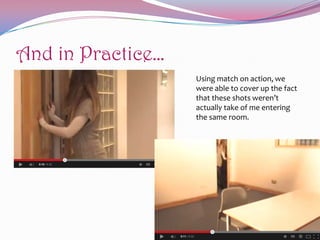
And in Practice…
Using match on action, we
were able to cover up the fact
that these shots weren’t
actually take of me entering
the same room.
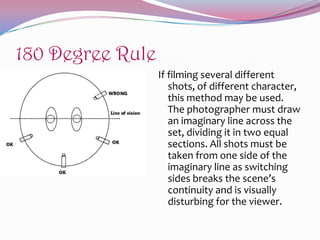
180 Degree Rule
If filming several different
shots, of different character,
this method may be used.
The photographer must draw
an imaginary line across the
set, dividing it in two equal
sections. All shots must be
taken from one side of the
imaginary line as switching
sides breaks the scene’s
continuity and is visually
disturbing for the viewer.
And in Practice…
Our imaginary line
was drawn from
one end of the
room to the
other, just to the
side of where
the actors were
sitting.
Please note that
the line drawn
here is an
approximation
only.
Shot-Reverse Shot
In a conversation between two characters, this technique
is often used. Each character is filmed saying their lines,
often facing off-screen, towards where the other
character would supposedly be.
In order to make this work, the characters must be
shown facing opposite directions. This ensures that in
the editing process the conversation appears to flow,
that one character seems to be listening to the other
one talking, and therefore the viewer makes the
assumption that the characters are looking at each
other.
And in Practice…
In our film, we
used over-theshoulder shots
when filming
the
conversation
and so both
characters
were
constantly onscreen.

Evaluating our Preliminary Task

  • 1.
    Amy, Nicole andI filmed and edited our preliminary task together, this was our first opportunity to work independently on the practical side of Media Studies. This task involved creating a very short film of a conversation, and using certain techniques, such as match on action, the 180 degree rule and shot-reverse shot.
  • 2.
    Managing the groupdynamics and collaborative nature of filmmaking As a team, we worked together well and efficiently. We shared the roles required to produce the film fairly equally, although, as my character was on screen for the duration of most of the film I had a shorter turn than the other two in filming. However, in the editing, we were able to split the work more evenly, and assist each other if need be. We also helped each other by running over our lines together and confirming that the actress who was about to be filmed (either myself or Amy) felt prepared and happy before hitting record.
  • 3.
    Mistakes  Whilst filming,we made only made a couple significant mistakes. The first was overstepping the 180 degree rule, but we recognised the error almost immediately and we were able to rectify it by re-filming those few seconds.  Another issue is the lighting, we had planned to use the key, filler, and back lights to give an atmosphere of film noir, but it appears we over-exposed the scene, causing it to have a washed-out appearance.  As we have all had some prior experience with regards to using editing software (albeit not with that we use at school), we didn’t make any mistakes when it came to editing.
  • 4.
    Lighting mistake Notice howthe lighting is so bright that my facial features are barely recognisable, being unable to divulge an actor’s facial expression also takes away from the effectiveness of a film.
  • 5.
    Managing the equipment Having hadpractical lessons on using the cameras and the different lights, we didn’t find using the equipment a particularly difficult task. Setting up and putting away the equipment was a little more challenging, but between the three of us we handled the camera, dolly, and lights.
  • 6.
    Managing the deadline Wefound it relatively easy to complete our preliminary task by its deadline. We worked in two separate sessions, spending one on filming and the latter on editing. Even though we worked into our break time to complete the task, in the grand scheme of things, it did not take particularly long to do.
  • 7.
    Health and Safetylogistics As all our filming took place on a safe location, health and safety wasn’t such considerable an issue in this task. That said, we experimented with lighting, in particular using red head lights, which can heat up to really high temperatures if left on for long enough. Therefore when moving and repositioning the lights we had to be careful not to burn ourselves. In addition, there were various wires from the equipment to be wary of when manoeuvring as there was a possibility that they could trip someone up.
  • 8.
    Organising human resources Actors- as the preliminary task acts as a practice for our opening title sequence, we treated our actresses as such, even though these were the same people as those filming and editing. This meant frequently checking in on them, going through their lines with them and ensuring that they were prepared for filming before hitting record.  Costumes- Due to the fact that we were filming in school, the actresses wore their usual school clothes. Amy wore a hooded jacket and raised the hood to cause her character to seem more intimidating and I wore light coloured clothing to present me as the good character.  Props- other than a table and chairs, we did not use any props in our film. However, considering the length of film and conditions we were producing it in, the stark backdrop seemed fitting to the scenario we presented. I only wish we had noticed the school bag and folder and removed them from the room before we started filming as it is details like these that keep an amateur film from becoming professional.
  • 9.
    Managing the camera AsI am studying photography in addition to Media Studies, I was already quite familiar with certain aspects of the camera, we were also given lessons on the ‘how to’ prior to this task and therefore filming was not a difficult task. Everyone in our group had a chance to use the camera (although I had significantly less time), and we took turns when it came to the minor tasks, such as white balancing.
  • 10.
    Managing the lighting Havinghad much experience with the cameras and editing software, but little with the lighting equipment, we decided to experiment with the lights in our preliminary task. Like the dialogue, we had planned for this to be sinister, but it didn’t work out that way. We filmed the task using two key lights, but in hindsight we know one would have been more effective. We noticed this when looking back on our recording, the whole scene was overexposed. This taught us the importance of checking how the lighting looks in the camera before shooting our opening title sequence.
  • 11.
    How did yourstoryboarding and shooting script work in practice? We didn’t really create a script for this task, however we constructed a basic idea and then improvised the dialogue to suit. What storyboarding we did do did not go to waste though. When storyboarding we did not take into account aspects such as lights and how their positioning may or may not cause lens flare, so this was something we had to work out in practice.
  • 12.
    Successfulness at time management Wecompleted our preliminary task with plenty of time to spare; completing the filming and editing within two hours, using Adobe Premier Pro.
  • 13.
    How did digitaltechnology enable you to develop creatively? In filming, we were able to develop our camera-related skills through the use of various shots. Experimenting with the lighting equipment also enabled me to understand the extent of its effectiveness and therefore think more creatively with regards to how I can use it in my thriller. We also used different tools from Adobe Premier Pro to edit our task in order to create a match-on action scene and continuity within our film. In the bigger picture, this helped us get to grips with the editing software and therefore more prepared for the editing of our opening title sequence. None of the skills developed in this task will go to waste on our final piece.
  • 14.
    In filming andediting, how did you ensure that the meaning would be apparent to the audience? In 30 seconds of film there was a limited amount of meaning we could create. That said, the actresses used explicit body language, tones of voice and wore obvious costumes, Amy in a dark hooded jacket and myself in light colours, to present the audience with a clear understanding of who’s good and who’s bad. Using filming and editing techniques such as match on action, shot-reverse shot, and the 180 degree rule, we ensured the continuity of the film would not be broken and that the implicit past events were apparent in the present of the film. This is how we also laid the foundations for the future and hinted it to the audience.
  • 15.
    What type ofpeople have you represented in your piece? Although our preliminary task is only 30 seconds long, we represent a ‘good’ character and ‘bad’ character. Despite the seeming lack of character development, we do display some progression in the short time we had through body language, tone of voice, dialogue and costumes. We tried to represent the ‘good’ character as a middle-class figure, who began the film calm and collected, only to find themselves desperate and intimidated by the end of it. The ‘bad’ character is a loan shark of sorts.
  • 16.
    What role dothe micro elements play in the construction of verisimilitude? In this task we did not focus so much on constructing verisimilitude. We endeavoured to create a ‘gangsta’ style realism revolving around the perils of associating with loan sharks, but due to a lack of time and facilities we were unable to create atmospheric mise-en-scene. It was really unfortunate that the lighting did not work as planned as this would have been very effective if it had. The costuming and the characters’ tones of voice in addition to the dialogue were great indications of our theme. That said, having neither Amy nor myself never had professional acting experience prior to this, our acting was not up to scratch and this also detracted from our ability to create an effective realism.
  • 17.
    How did you managethe editing? The editing task was a lot more straightforward than the filming (and than I anticipated). All members picked up the techniques almost instantly and all the stress of filming proved worth it.
  • 19.
    Match on Action Inorder to bridge parts of a scene so that it flows continuously, one may use this editing technique. Match on action refers to a situation whereby one shot cuts to another containing a similar action as the first
  • 20.
    And in Practice… Usingmatch on action, we were able to cover up the fact that these shots weren’t actually take of me entering the same room.
  • 21.
    180 Degree Rule Iffilming several different shots, of different character, this method may be used. The photographer must draw an imaginary line across the set, dividing it in two equal sections. All shots must be taken from one side of the imaginary line as switching sides breaks the scene’s continuity and is visually disturbing for the viewer.
  • 22.
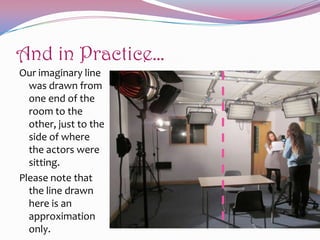
    And in Practice… Ourimaginary line was drawn from one end of the room to the other, just to the side of where the actors were sitting. Please note that the line drawn here is an approximation only.
  • 23.
    Shot-Reverse Shot In aconversation between two characters, this technique is often used. Each character is filmed saying their lines, often facing off-screen, towards where the other character would supposedly be. In order to make this work, the characters must be shown facing opposite directions. This ensures that in the editing process the conversation appears to flow, that one character seems to be listening to the other one talking, and therefore the viewer makes the assumption that the characters are looking at each other.
  • 24.
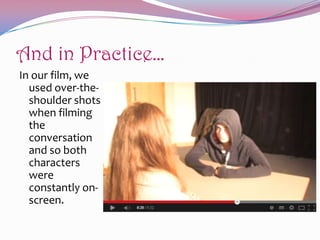
    And in Practice… Inour film, we used over-theshoulder shots when filming the conversation and so both characters were constantly onscreen.