Looking back at your preliminary task, what do
you feel you have learnt in the progression from
it to the final product?
 In the preliminary task, it consists of only plain shots in a continuous order – as this was
the task at the time. Although we did this smoothly, it makes the sequence less
interesting to watch, therefore would not be a good technique to use on our final
opening sequence.
 From watching this task and comparing it to other sequences, it became clear that we
needed to include more atmospheric editing in order to emphasise our genre. Similar to
the continuity editing, through trail and error and online tutorials I became more
knowledgeable about the software's and how to create a more visually appealing
sequence.
 In our final opening sequence, we use many different edits such as; Jump Cuts and
Overlay/Opacity effects. The use of these helps to reiterate the idea that the character is
mentally unstable as its an unnatural way to watch a film. It also makes the audience
feel uncomfortable and begin to fear her, as the editing changes from slow and smooth
to fast and jumpy; this also emphasising her problems.
 As well as these, we also have shot reverse shot, and this is also done smoothly with the
correct eyeline match to make it feel more realistic. Additionally, we also stuck to the
180 degree rule in order to keep the audience comfortable and avoid any confusions.
 In the preliminary task, we also used an eyeline match as the main character looks at the
chair. This cut worked extremely well, as the camera has caught the right angle, making
it clear where the are looking. This is also used in the opening sequence, as the main
character has a flashback that she follows with her eyes. This makes it clearer of where
he is looking. From doing both of these tasks, I have learnt how to create a professional
and smooth look when editing and filming.
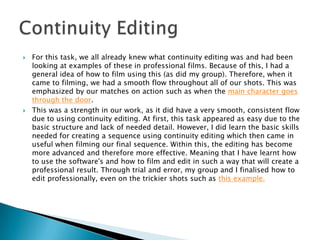
 For this task, we all already knew what continuity editing was and had been
looking at examples of these in professional films. Because of this, I had a
general idea of how to film using this (as did my group). Therefore, when it
came to filming, we had a smooth flow throughout all of our shots. This was
emphasized by our matches on action such as when the main character goes
through the door.
 This was a strength in our work, as it did have a very smooth, consistent flow
due to using continuity editing. At first, this task appeared as easy due to the
basic structure and lack of needed detail. However, I did learn the basic skills
needed for creating a sequence using continuity editing which then came in
useful when filming our final sequence. Within this, the editing has become
more advanced and therefore more effective. Meaning that I have learnt how
to use the software's and how to film and edit in such a way that will create a
professional result. Through trial and error, my group and I finalised how to
edit professionally, even on the trickier shots such as this example.
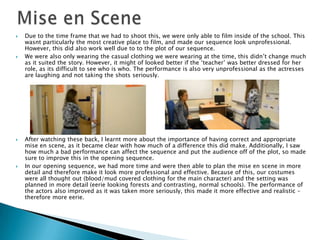
 Due to the time frame that we had to shoot this, we were only able to film inside of the school. This
wasnt particularly the most creative place to film, and made our sequence look unprofessional.
However, this did also work well due to to the plot of our sequence.
 We were also only wearing the casual clothing we were wearing at the time, this didn’t change much
as it suited the story. However, it might of looked better if the ‘teacher’ was better dressed for her
role, as its difficult to see who is who. The performance is also very unprofessional as the actresses
are laughing and not taking the shots seriously.
 After watching these back, I learnt more about the importance of having correct and appropriate
mise en scene, as it became clear with how much of a difference this did make. Additionally, I saw
how much a bad performance can affect the sequence and put the audience off of the plot, so made
sure to improve this in the opening sequence.
 In our opening sequence, we had more time and were then able to plan the mise en scene in more
detail and therefore make it look more professional and effective. Because of this, our costumes
were all thought out (blood/mud covered clothing for the main character) and the setting was
planned in more detail (eerie looking forests and contrasting, normal schools). The performance of
the actors also improved as it was taken more seriously, this made it more effective and realistic –
therefore more eerie.
 We were able to set the camera on a tripod, and this helped to keep the camera steady and
therefore all of the shots are smooth and still. This made it look slightly more professional.
From this task, I learnt about how to frame a shot correctly, as afterwards we looked through
all of the sequences and analyzed their strengths/weaknesses. I am now more aware about
shots and framing. Also, I learnt new keyword shots such as shot reverse shot and the 180
degree rule and the importance of these.
 Additionally, we framed our shots well and used appropriate shots for each part of the
sequence. For example, when it is a shot on the two people talking, there wide shot is
appropriate as it acts as an establishing shot of the area and the two people talking. However,
the low position of the ‘teacher suggests that she isn't of higher importance, and this isn't the
idea that we wanted to put across. There are also close ups and shot reverse shots, which
works well as its clear of who is talking to who. Also, we used the 180 degree rule to ensure
there was no confusion. The only bad framing that we included was a close up of the teacher,
as the top of her head is cut slightly. Also, it looks like a high angle shot, which suggests that
the students role is higher than the students – which isnt correct.
Badly framed shot
Mid Shot, showing the door opening.
Wide shot
 As this was only a small, basic task, we didn't’t add in any music or sound
effects as we felt it was not needed and we had limited time. However, we
did have to record dialogue which was risky as we were only using DSLR’s
and no professional recording equipment. Our dialogue worked well as it was
clear with no interference, however the actors should of spoken louder. Click
this link to see an example of our dialogue. From this, I learnt about how to
record sound through filming on a DSLR, I also learnt more about editing, as
I was able to edit parts of it and include the sound.
 In the opening sequence, we didn't’t include any dialogue as we wanted to
create a mysterious atmosphere through the use of music and sound effects.
The use of these also made it appear more professional, I have learnt a lot
through this. Both on how to find and add the correct sound effects onto a
video and how to add in the music, luckily, a member of our group was able
to create the music so we avoided any issues with copyright.
 Overall, I have learnt more about the importance of appropriate
camera shots, editing, mise en scene and sound when shooting a
sequence, and this helped me for when I was planning and
producing the final opening sequence. Additionally, I have
become familiar with the more advanced shots such as shot
reverse shot, 180 degree rule etc. whilst making this task as we
needed to include this into the sequence. From this, I have
expanded my knowledge onto using even more advanced shots
and editing in the opening sequence, and this has helped the
group to get a more professional standard and to help
emphasize the mood, for example; with the use of cross cutting
and jump cuts. In addition to this, I also gained a basic
knowledge of how to use the equipment, with setting up the
tripod and camera, and the software that we used. This has,
obviously, come in helpful for the production of the sequence as
it means that I am comfortable with the technology that we are
using, and am able to use them to create our final piece. Also,
whilst we were producing the sequence, I learned more about
editing and how this can be effective in order to put across a
mood or atmosphere.

Evaluation zoe

  • 1.
    Looking back atyour preliminary task, what do you feel you have learnt in the progression from it to the final product?
  • 2.
     In thepreliminary task, it consists of only plain shots in a continuous order – as this was the task at the time. Although we did this smoothly, it makes the sequence less interesting to watch, therefore would not be a good technique to use on our final opening sequence.  From watching this task and comparing it to other sequences, it became clear that we needed to include more atmospheric editing in order to emphasise our genre. Similar to the continuity editing, through trail and error and online tutorials I became more knowledgeable about the software's and how to create a more visually appealing sequence.  In our final opening sequence, we use many different edits such as; Jump Cuts and Overlay/Opacity effects. The use of these helps to reiterate the idea that the character is mentally unstable as its an unnatural way to watch a film. It also makes the audience feel uncomfortable and begin to fear her, as the editing changes from slow and smooth to fast and jumpy; this also emphasising her problems.  As well as these, we also have shot reverse shot, and this is also done smoothly with the correct eyeline match to make it feel more realistic. Additionally, we also stuck to the 180 degree rule in order to keep the audience comfortable and avoid any confusions.  In the preliminary task, we also used an eyeline match as the main character looks at the chair. This cut worked extremely well, as the camera has caught the right angle, making it clear where the are looking. This is also used in the opening sequence, as the main character has a flashback that she follows with her eyes. This makes it clearer of where he is looking. From doing both of these tasks, I have learnt how to create a professional and smooth look when editing and filming.
  • 3.
     For thistask, we all already knew what continuity editing was and had been looking at examples of these in professional films. Because of this, I had a general idea of how to film using this (as did my group). Therefore, when it came to filming, we had a smooth flow throughout all of our shots. This was emphasized by our matches on action such as when the main character goes through the door.  This was a strength in our work, as it did have a very smooth, consistent flow due to using continuity editing. At first, this task appeared as easy due to the basic structure and lack of needed detail. However, I did learn the basic skills needed for creating a sequence using continuity editing which then came in useful when filming our final sequence. Within this, the editing has become more advanced and therefore more effective. Meaning that I have learnt how to use the software's and how to film and edit in such a way that will create a professional result. Through trial and error, my group and I finalised how to edit professionally, even on the trickier shots such as this example.
  • 4.
     Due tothe time frame that we had to shoot this, we were only able to film inside of the school. This wasnt particularly the most creative place to film, and made our sequence look unprofessional. However, this did also work well due to to the plot of our sequence.  We were also only wearing the casual clothing we were wearing at the time, this didn’t change much as it suited the story. However, it might of looked better if the ‘teacher’ was better dressed for her role, as its difficult to see who is who. The performance is also very unprofessional as the actresses are laughing and not taking the shots seriously.  After watching these back, I learnt more about the importance of having correct and appropriate mise en scene, as it became clear with how much of a difference this did make. Additionally, I saw how much a bad performance can affect the sequence and put the audience off of the plot, so made sure to improve this in the opening sequence.  In our opening sequence, we had more time and were then able to plan the mise en scene in more detail and therefore make it look more professional and effective. Because of this, our costumes were all thought out (blood/mud covered clothing for the main character) and the setting was planned in more detail (eerie looking forests and contrasting, normal schools). The performance of the actors also improved as it was taken more seriously, this made it more effective and realistic – therefore more eerie.
  • 5.
     We wereable to set the camera on a tripod, and this helped to keep the camera steady and therefore all of the shots are smooth and still. This made it look slightly more professional. From this task, I learnt about how to frame a shot correctly, as afterwards we looked through all of the sequences and analyzed their strengths/weaknesses. I am now more aware about shots and framing. Also, I learnt new keyword shots such as shot reverse shot and the 180 degree rule and the importance of these.  Additionally, we framed our shots well and used appropriate shots for each part of the sequence. For example, when it is a shot on the two people talking, there wide shot is appropriate as it acts as an establishing shot of the area and the two people talking. However, the low position of the ‘teacher suggests that she isn't of higher importance, and this isn't the idea that we wanted to put across. There are also close ups and shot reverse shots, which works well as its clear of who is talking to who. Also, we used the 180 degree rule to ensure there was no confusion. The only bad framing that we included was a close up of the teacher, as the top of her head is cut slightly. Also, it looks like a high angle shot, which suggests that the students role is higher than the students – which isnt correct. Badly framed shot Mid Shot, showing the door opening. Wide shot
  • 6.
     As thiswas only a small, basic task, we didn't’t add in any music or sound effects as we felt it was not needed and we had limited time. However, we did have to record dialogue which was risky as we were only using DSLR’s and no professional recording equipment. Our dialogue worked well as it was clear with no interference, however the actors should of spoken louder. Click this link to see an example of our dialogue. From this, I learnt about how to record sound through filming on a DSLR, I also learnt more about editing, as I was able to edit parts of it and include the sound.  In the opening sequence, we didn't’t include any dialogue as we wanted to create a mysterious atmosphere through the use of music and sound effects. The use of these also made it appear more professional, I have learnt a lot through this. Both on how to find and add the correct sound effects onto a video and how to add in the music, luckily, a member of our group was able to create the music so we avoided any issues with copyright.
  • 7.
     Overall, Ihave learnt more about the importance of appropriate camera shots, editing, mise en scene and sound when shooting a sequence, and this helped me for when I was planning and producing the final opening sequence. Additionally, I have become familiar with the more advanced shots such as shot reverse shot, 180 degree rule etc. whilst making this task as we needed to include this into the sequence. From this, I have expanded my knowledge onto using even more advanced shots and editing in the opening sequence, and this has helped the group to get a more professional standard and to help emphasize the mood, for example; with the use of cross cutting and jump cuts. In addition to this, I also gained a basic knowledge of how to use the equipment, with setting up the tripod and camera, and the software that we used. This has, obviously, come in helpful for the production of the sequence as it means that I am comfortable with the technology that we are using, and am able to use them to create our final piece. Also, whilst we were producing the sequence, I learned more about editing and how this can be effective in order to put across a mood or atmosphere.