
40 
But great briefs are 
only half of the story…
41 
For great work to 
happen it needs 
evolutionary feedback 
and development
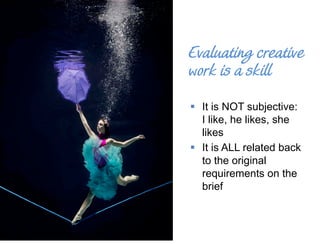
 It is NOT subjective: 
I like, he likes, she 
likes 
 It is ALL related back 
to the original 
requirements on the 
brief 
42 
Evaluating creative 
work is a skill
43 
Three pointers for taking 
the subjectivity out of the 
evaluation and fairly 
critiquing creative work
44 
Does the creative 
work answer the 
problem you set out 
to solve? " 
 There are endless ways to 
express something creatively. 
 While many folks judge creative 
work based on personal tastes 
and preferences, one way to 
remove some of the subjectivity, is 
to evaluate the creative work 
based on how well it answers the 
problem you set out to solve. 
 Regardless of whether you prefer 
the font, headlines or imagery, 
take a step back and ask yourself, 
“Does this solve my problem?”
45 
Is the style of the 
creative work well 
suited for the 
audience? " 
 Once you’ve answered whether 
the creative work solves your 
problem, the next step is to look at 
the element of style. 
 But, here’s the catch. Don’t look at 
it from an audience of one. Rather, 
evaluate the style of the creative 
product based on its intended 
audience. While you may not 
personally prefer bold colors and 
loud music, it may work for a 
teenage audience.
46 
Is there something 
unique and 
memorable about the 
creative work? " 
 Lastly, take a step back and 
evaluate the distinctiveness of the 
creative work. 
 One of the reasons you set out to 
do something creative was to 
stand out from the crowd. 
Don’t stop now, evaluate how 
unique and memorable the 
creative work is.
47 
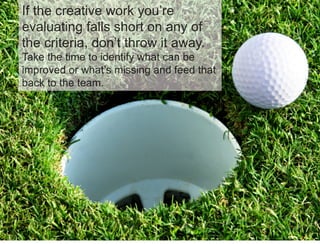
If the creative work you’re 
evaluating falls short on any of 
the criteria, don’t throw it away. 
Take the time to identify what can be 
improved or what’s missing and feed that 
back to the team.
48 
Feedback"
What makes good feedback? 
 Is relevant to the original brief requirements 
 Discussed with creative team at a debrief/feedback 
meeting (not emailed or left on desks) 
 Clear and understood 
 Decisive – identifies what is not working and why 
 Is summaried on a de-brief sheet 
49
50 
What makes bad feedback? 
!! Dictatorial 
!! Comes too late to be helpful 
!! Appears from an unexpected source (Creative drive-bys) 
!! Has no relevance or changes what was originally asked
51 
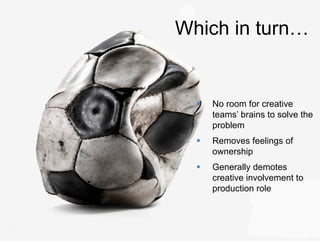
Which in turn… 
 No room for creative 
teams’ brains to solve the 
problem 
 Removes feelings of 
ownership 
 Generally demotes 
creative involvement to 
production role
Examples: 
 “The heading should be larger and in red” 
OR 
 “The heading doesn’t have the stand-out we are looking 
for” 
 “We don’t like the wording on the headline, we think it 
should be “Come and see Father Christmas NOW” 
OR 
 “The urgency isn’t strong enough for us in the headline” 
52
A tool to help: 
53 
creative de-brief – feedback 
Client: Product name Brief date: XXXXX 2013 
Job number: XX Presentation date: Date 
Project: Project name Print date: tba 
Account handler: Name Creative team: tba 
How was the work received? 
General description of what happened, who you presented to and what the initial reactions were 
- 
Type in here! 
What’s working with the idea/piece? 
What’s good, what was liked/loved 
- 
Type in here! 
What is not working? 
What are the areas that still need work and what do you feel is not being communicated or communicated wrongly? Is there 
something we’ve missed from the brief? 
- 
Type in here!
5 steps to getting the best creative work 
1. Mini-agency collaboration between Marketeers and 
Creatives 
2. Well defined briefs with interesting propositions 
3. Exciting, proud presentations from Creatives 
4. Clear feedback and development sessions 
5. Joint presentations to the business to build 
understanding 
54
55
Evaluating creative briefs

Evaluating creative briefs

  • 1.
    40 But greatbriefs are only half of the story…
  • 2.
    41 For greatwork to happen it needs evolutionary feedback and development
  • 3.
     It isNOT subjective: I like, he likes, she likes  It is ALL related back to the original requirements on the brief 42 Evaluating creative work is a skill
  • 4.
    43 Three pointersfor taking the subjectivity out of the evaluation and fairly critiquing creative work
  • 5.
    44 Does thecreative work answer the problem you set out to solve? "  There are endless ways to express something creatively.  While many folks judge creative work based on personal tastes and preferences, one way to remove some of the subjectivity, is to evaluate the creative work based on how well it answers the problem you set out to solve.  Regardless of whether you prefer the font, headlines or imagery, take a step back and ask yourself, “Does this solve my problem?”
  • 6.
    45 Is thestyle of the creative work well suited for the audience? "  Once you’ve answered whether the creative work solves your problem, the next step is to look at the element of style.  But, here’s the catch. Don’t look at it from an audience of one. Rather, evaluate the style of the creative product based on its intended audience. While you may not personally prefer bold colors and loud music, it may work for a teenage audience.
  • 7.
    46 Is theresomething unique and memorable about the creative work? "  Lastly, take a step back and evaluate the distinctiveness of the creative work.  One of the reasons you set out to do something creative was to stand out from the crowd. Don’t stop now, evaluate how unique and memorable the creative work is.
  • 8.
    47 If thecreative work you’re evaluating falls short on any of the criteria, don’t throw it away. Take the time to identify what can be improved or what’s missing and feed that back to the team.
  • 9.
  • 10.
    What makes goodfeedback?  Is relevant to the original brief requirements  Discussed with creative team at a debrief/feedback meeting (not emailed or left on desks)  Clear and understood  Decisive – identifies what is not working and why  Is summaried on a de-brief sheet 49
  • 11.
    50 What makesbad feedback? !! Dictatorial !! Comes too late to be helpful !! Appears from an unexpected source (Creative drive-bys) !! Has no relevance or changes what was originally asked
  • 12.
    51 Which inturn…  No room for creative teams’ brains to solve the problem  Removes feelings of ownership  Generally demotes creative involvement to production role
  • 13.
    Examples:  “Theheading should be larger and in red” OR  “The heading doesn’t have the stand-out we are looking for”  “We don’t like the wording on the headline, we think it should be “Come and see Father Christmas NOW” OR  “The urgency isn’t strong enough for us in the headline” 52
  • 14.
    A tool tohelp: 53 creative de-brief – feedback Client: Product name Brief date: XXXXX 2013 Job number: XX Presentation date: Date Project: Project name Print date: tba Account handler: Name Creative team: tba How was the work received? General description of what happened, who you presented to and what the initial reactions were - Type in here! What’s working with the idea/piece? What’s good, what was liked/loved - Type in here! What is not working? What are the areas that still need work and what do you feel is not being communicated or communicated wrongly? Is there something we’ve missed from the brief? - Type in here!
  • 15.
    5 steps togetting the best creative work 1. Mini-agency collaboration between Marketeers and Creatives 2. Well defined briefs with interesting propositions 3. Exciting, proud presentations from Creatives 4. Clear feedback and development sessions 5. Joint presentations to the business to build understanding 54
  • 16.