1 / 40
Do I need to switch
to Go(lang)
Max Tepkeev
20 July 2016
Bilbao, Spain
2 / 40
About me
Max Tepkeev
Russia, Moscow
• python-redmine
• architect
• instructions
https://www.github.com/maxtepkeev
3 / 40
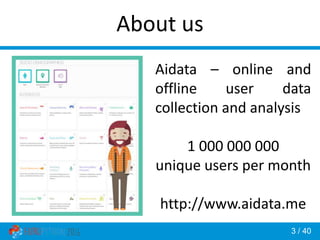
About us
Aidata – online and
offline user data
collection and analysis
1 000 000 000
unique users per month
http://www.aidata.me
4 / 40
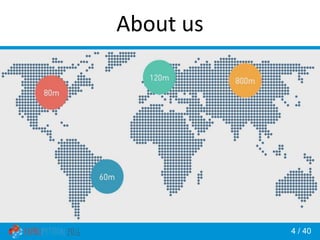
About us
5 / 40
Why switch from Python
• Speed
• Concurrency
• GIL
• No ”true” binaries
• Dynamic types
6 / 40
Language requirements
• Modern
• Fast
• Easy
• Compiled
• Statically typed
• Support main platforms
7 / 40
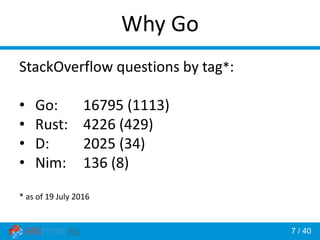
Why Go
StackOverflow questions by tag*:
• Go: 16795 (1113)
• Rust: 4226 (429)
• D: 2025 (34)
• Nim: 136 (8)
* as of 19 July 2016
8 / 40
Popularity
9 / 40
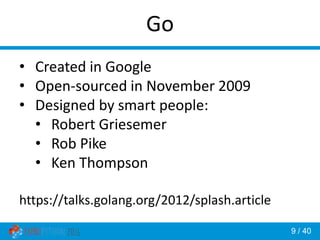
Go
• Created in Google
• Open-sourced in November 2009
• Designed by smart people:
• Robert Griesemer
• Rob Pike
• Ken Thompson
https://talks.golang.org/2012/splash.article
10 /
Who uses Go
• Google
• Dropbox
• Facebook
• IBM
• Intel
• SpaceX
• Uber
• VMware
• Yahoo
• Twitter
• Heroku
• DigitalOcean
https://github.com/golang/go/wiki/GoUsers
11 / 40
Project layout
$GOPATH/
bin/
hello # command executable
outyet # command executable
pkg/
linux_amd64/
github.com/golang/example/
stringutil.a # package object
src/
github.com/golang/example/
.git/ # Git repository metadata
hello/
hello.go # command source
outyet/
main.go # command source
stringutil/
reverse.go # package source
12 /
Package management
$ go get github.com/golang/example
src/
github.com/golang/example/
.git/
hello/
hello.go
outyet/
main.go
stringutil/
reverse.go
13 /
Package management
• vendoring
• gopkg.in
• getgb.io
github.com/tools/godep
github.com/gpmgo/gopm
github.com/pote/gpm
github.com/nitrous-io/goop
github.com/alouche/rodent
github.com/jingweno/nut
github.com/niemeyer/gopkg
github.com/mjibson/party
github.com/kardianos/vendor
github.com/kisielk/vendorize
github.com/mattn/gom
github.com/dkulchenko/bunch
github.com/skelterjohn/wgo
github.com/Masterminds/glide
github.com/robfig/glock
bitbucket.org/vegansk/gobs
launchpad.net/godeps
github.com/d2fn/gopack
github.com/laher/gopin
github.com/LyricalSecurity/gigo
github.com/VividCortex/johnny-deps
14 /
Commands
• go fmt
• go test
• go fix
• go run
• go run -race
• go vet
15 /
Hello World
$GOPATH/src/github.com/user/hello/hello.go:
package main
import "fmt"
func main() {
fmt.Println("Hello, world.")
}
$ go install github.com/user/hello
$ $GOPATH/bin/hello
Hello, world.
16 /
Comparison: Imports
Go
import "os"
import (
"os"
"compress/gzip"
)
import os1 "os"
Python
import os
import os
import gzip
import os as os1
17 /
Comparison: Import Names
Go
import "os"
os.Getwd()
Python
import os
os.getcwd()
18 /
Comparison: Types
Go
var (
b bool = true
s string = "hey"
si int = -1
ui uint = 1
f float32 = 1.0
c complex64 = 3i
l []int = []int{1, 2}
m map[int]int = map[int]int{1: 1}
)
Python
b = True
s = "hey"
si = 1
ui = -1
f = 1.0
c = 3j
l = [1, 2]
m = {1:1}
19 /
Comparison: Variables
Go
var (
i = 1
j = "hey"
)
i := 1
j := "hey”
i, j := 1, "hey"
Python
i = 1
j = "hey”
i, j = 1, "hey"
20 /
Comparison: 1st Class Functions
Go
func add(x, y int) int {
return x + y
}
add := func (x, y int) int {
return x + y
}
Python
def add(x, y):
return x + y
add = lambda x, y: x + y
21 /
Comparison: Optional args
Go
func sum(nums ...int) {
result := 0
for _, num := range nums {
result += num
}
return result
}
sum(1, 2, 3)
sum([]int{1, 2, 3}...)
Python
def sum(*nums):
result = 0
for num in nums:
result += num
return result
sum(1, 2, 3)
sum(*[1, 2, 3])
22 /
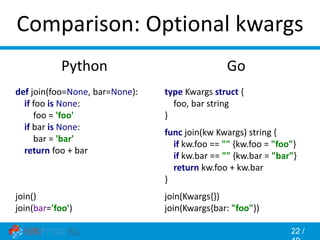
Comparison: Optional kwargs
Go
type Kwargs struct {
foo, bar string
}
func join(kw Kwargs) string {
if kw.foo == "" {kw.foo = "foo"}
if kw.bar == "" {kw.bar = "bar"}
return kw.foo + kw.bar
}
join(Kwargs{})
join(Kwargs{bar: "foo"})
Python
def join(foo=None, bar=None):
if foo is None:
foo = 'foo'
if bar is None:
bar = 'bar'
return foo + bar
join()
join(bar='foo')
23 /
Comparison: Loops
Go
seq := []int{1, 2, 3}
for _, x := range seq {
fmt.Println(x)
}
Python
seq = [1, 2, 3]
for x in seq:
print x
24 /
Comparison: Loops
Go
seq := []int{1, 2, 3}
for i := 0; i < len(seq); i++ {
fmt.Println(seq[i])
}
Python
seq = [1, 2, 3]
num, count = 0, len(seq)
while num < count:
print seq[num]
num += 1
25 /
Comparison: Loops
Go
for {
fmt.Println("Go rocks")
}
Python
while True:
print "Python rocks"
26 /
Comparison: Comprehensions
Go
word := "hello"
chars := []string{}
for _, char := range word {
chars = append(chars, string(char))
}
fmt.Println(chars) // [h e l l o]
Python
word = "hello"
chars = [char for char in word]
print chars # ['h', 'e', 'l', 'l', 'o']
27 /
Comparison: Conditionals
Go
if x := 1; x > 0 {
fmt.Println(x)
} else {
fmt.Println("Sorry")
}
Python
x = 1
if x > 0:
print x
else:
print "Sorry"
28 /
Comparison: Conditionals
Go
switch x := 1; {
case x < 0:
fmt.Println("Negative")
case x > 0:
fmt.Println("Positive")
default:
fmt.Println("Zero")
}
Python
x = 1
if x > 0:
print "Positive"
elif x < 0:
print "Negative"
else:
print "Zero"
29 /
Comparison: Slicing
Go
seq := []int{1, 2, 3, 4, 5}
fmt.Print(seq[:2]) // [1 2]
fmt.Print(seq[3:]) // [4 5]
fmt.Print(seq[2:3]) // [3]
Python
seq = [1, 2, 3, 4, 5]
print seq[:2] # [1, 2]
print seq[3:] # [4, 5]
print seq[2:3] # [3]
30 /
Comparison: Error Handling
Go
conn, err := db.Connect()
if err != nil {
fmt.Print("Can't connect")
}
panic() / recover()
Python
try:
conn = db.Connect()
except ConnectionError:
print "Can't connect"
31 /
Comparison: Classes
Go
type Person struct {
Name string
Age int
}
func (p Person) String() string {
return fmt.Sprintf(
"%s: %d", p.Name, p.Age)
}
p := Person{"Batman", 45}
fmt.Println(p) // Batman: 45
Python
class Person(object):
def __init__(self, name, age):
self.name = name
self.age = age
def __str__(self):
return "{}: {}".format(
self.name, self.age)
p = Person("Batman", 45)
print p # Batman: 45
32 /
Comparison: Constructors
Go
type Person struct {
Name string
Age int
}
func NewPerson(n string, a int) *Person {
return &Person{Name: n, Age: a}
}
p := NewPerson("Batman", 45)
Python
class Person(object):
def __init__(self, name, age):
self.name = name
self.age = age
p = Person("Batman", 45)
33 /
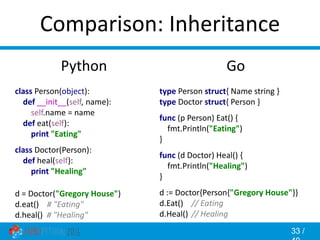
Comparison: Inheritance
Go
type Person struct{ Name string }
type Doctor struct{ Person }
func (p Person) Eat() {
fmt.Println("Eating")
}
func (d Doctor) Heal() {
fmt.Println("Healing")
}
d := Doctor{Person{"Gregory House"}}
d.Eat() // Eating
d.Heal() // Healing
Python
class Person(object):
def __init__(self, name):
self.name = name
def eat(self):
print "Eating"
class Doctor(Person):
def heal(self):
print "Healing"
d = Doctor("Gregory House")
d.eat() # "Eating"
d.heal() # "Healing"
34 /
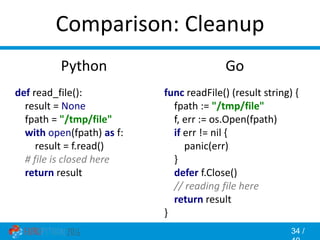
Comparison: Cleanup
Go
func readFile() (result string) {
fpath := "/tmp/file"
f, err := os.Open(fpath)
if err != nil {
panic(err)
}
defer f.Close()
// reading file here
return result
}
Python
def read_file():
result = None
fpath = "/tmp/file"
with open(fpath) as f:
result = f.read()
# file is closed here
return result
35 /
Comparison: Concurrent progs
Go
urls := []string{"http://python.org",
"http://golang.org"}
responses := make(chan string)
for _, url := range urls {
go func(url string) {
resp, _ := http.Get(url)
defer resp.Body.Close()
body, _ := ioutil.ReadAll(resp.Body)
responses <- string(body)
}(url)
}
for response := range responses {
fmt.Println(response)
}
Python
urls = ['http://python.org', 'http://golang.org']
async def fetch(session, url):
async with session.get(url) as response:
return await response.read()
async def fetch_all(session, urls, loop):
tasks = [fetch(session, url) for url in urls]
return await asyncio.gather(*tasks)
loop = asyncio.get_event_loop()
with aiohttp.ClientSession(loop=loop) as session:
responses = loop.run_until_complete(
fetch_all(session, urls, loop))
print(responses)
36 /
More Go features
• make() / new()
• Arrays
• Pointers
• Interfaces
• Type assertions
• Type switches
• Buffered channels / select statement
• Unsafe package
• Cross compilation
37 /
Python features Go lacks
• list / dict comprehensions
• generators
• decorators
• exceptions
• metaclasses
• descriptors
• __magic__ methods
• set / tuple
38 /
Conclusion
Go
+ Good standard library
+ 3rd Party libs for almost everything
+ Compiled
+ Statically typed
+ Built-in concurrency
- Verbose
- No syntactic sugar
- No Soul
Python
+ Good standard library
+ 3rd Party libs for everything
+ Less code
+ Syntactic sugar
+ Has Soul
- Interpreted
- Dynamically typed
- Concurrency
39 /
Go Useful Links
1. https://tour.golang.org/
2. http://golang.org/doc/effective_go.html
3. https://play.golang.org/
4. http://golangweekly.com/
5. http://devs.cloudimmunity.com/gotchas-
and-common-mistakes-in-go-golang/
40 /
Questions
slides: http://slideshare.net/maxtepkeev
github: https://github.com/maxtepkeev
email: tepkeev@gmail.com
skype: max.tepkeev
company: http://www.aidata.me

EuroPython 2016 - Do I Need To Switch To Golang

  • 1.
    1 / 40 DoI need to switch to Go(lang) Max Tepkeev 20 July 2016 Bilbao, Spain
  • 2.
    2 / 40 Aboutme Max Tepkeev Russia, Moscow • python-redmine • architect • instructions https://www.github.com/maxtepkeev
  • 3.
    3 / 40 Aboutus Aidata – online and offline user data collection and analysis 1 000 000 000 unique users per month http://www.aidata.me
  • 4.
  • 5.
    5 / 40 Whyswitch from Python • Speed • Concurrency • GIL • No ”true” binaries • Dynamic types
  • 6.
    6 / 40 Languagerequirements • Modern • Fast • Easy • Compiled • Statically typed • Support main platforms
  • 7.
    7 / 40 WhyGo StackOverflow questions by tag*: • Go: 16795 (1113) • Rust: 4226 (429) • D: 2025 (34) • Nim: 136 (8) * as of 19 July 2016
  • 8.
  • 9.
    9 / 40 Go •Created in Google • Open-sourced in November 2009 • Designed by smart people: • Robert Griesemer • Rob Pike • Ken Thompson https://talks.golang.org/2012/splash.article
  • 10.
    10 / Who usesGo • Google • Dropbox • Facebook • IBM • Intel • SpaceX • Uber • VMware • Yahoo • Twitter • Heroku • DigitalOcean https://github.com/golang/go/wiki/GoUsers
  • 11.
    11 / 40 Projectlayout $GOPATH/ bin/ hello # command executable outyet # command executable pkg/ linux_amd64/ github.com/golang/example/ stringutil.a # package object src/ github.com/golang/example/ .git/ # Git repository metadata hello/ hello.go # command source outyet/ main.go # command source stringutil/ reverse.go # package source
  • 12.
    12 / Package management $go get github.com/golang/example src/ github.com/golang/example/ .git/ hello/ hello.go outyet/ main.go stringutil/ reverse.go
  • 13.
    13 / Package management •vendoring • gopkg.in • getgb.io github.com/tools/godep github.com/gpmgo/gopm github.com/pote/gpm github.com/nitrous-io/goop github.com/alouche/rodent github.com/jingweno/nut github.com/niemeyer/gopkg github.com/mjibson/party github.com/kardianos/vendor github.com/kisielk/vendorize github.com/mattn/gom github.com/dkulchenko/bunch github.com/skelterjohn/wgo github.com/Masterminds/glide github.com/robfig/glock bitbucket.org/vegansk/gobs launchpad.net/godeps github.com/d2fn/gopack github.com/laher/gopin github.com/LyricalSecurity/gigo github.com/VividCortex/johnny-deps
  • 14.
    14 / Commands • gofmt • go test • go fix • go run • go run -race • go vet
  • 15.
    15 / Hello World $GOPATH/src/github.com/user/hello/hello.go: packagemain import "fmt" func main() { fmt.Println("Hello, world.") } $ go install github.com/user/hello $ $GOPATH/bin/hello Hello, world.
  • 16.
    16 / Comparison: Imports Go import"os" import ( "os" "compress/gzip" ) import os1 "os" Python import os import os import gzip import os as os1
  • 17.
    17 / Comparison: ImportNames Go import "os" os.Getwd() Python import os os.getcwd()
  • 18.
    18 / Comparison: Types Go var( b bool = true s string = "hey" si int = -1 ui uint = 1 f float32 = 1.0 c complex64 = 3i l []int = []int{1, 2} m map[int]int = map[int]int{1: 1} ) Python b = True s = "hey" si = 1 ui = -1 f = 1.0 c = 3j l = [1, 2] m = {1:1}
  • 19.
    19 / Comparison: Variables Go var( i = 1 j = "hey" ) i := 1 j := "hey” i, j := 1, "hey" Python i = 1 j = "hey” i, j = 1, "hey"
  • 20.
    20 / Comparison: 1stClass Functions Go func add(x, y int) int { return x + y } add := func (x, y int) int { return x + y } Python def add(x, y): return x + y add = lambda x, y: x + y
  • 21.
    21 / Comparison: Optionalargs Go func sum(nums ...int) { result := 0 for _, num := range nums { result += num } return result } sum(1, 2, 3) sum([]int{1, 2, 3}...) Python def sum(*nums): result = 0 for num in nums: result += num return result sum(1, 2, 3) sum(*[1, 2, 3])
  • 22.
    22 / Comparison: Optionalkwargs Go type Kwargs struct { foo, bar string } func join(kw Kwargs) string { if kw.foo == "" {kw.foo = "foo"} if kw.bar == "" {kw.bar = "bar"} return kw.foo + kw.bar } join(Kwargs{}) join(Kwargs{bar: "foo"}) Python def join(foo=None, bar=None): if foo is None: foo = 'foo' if bar is None: bar = 'bar' return foo + bar join() join(bar='foo')
  • 23.
    23 / Comparison: Loops Go seq:= []int{1, 2, 3} for _, x := range seq { fmt.Println(x) } Python seq = [1, 2, 3] for x in seq: print x
  • 24.
    24 / Comparison: Loops Go seq:= []int{1, 2, 3} for i := 0; i < len(seq); i++ { fmt.Println(seq[i]) } Python seq = [1, 2, 3] num, count = 0, len(seq) while num < count: print seq[num] num += 1
  • 25.
    25 / Comparison: Loops Go for{ fmt.Println("Go rocks") } Python while True: print "Python rocks"
  • 26.
    26 / Comparison: Comprehensions Go word:= "hello" chars := []string{} for _, char := range word { chars = append(chars, string(char)) } fmt.Println(chars) // [h e l l o] Python word = "hello" chars = [char for char in word] print chars # ['h', 'e', 'l', 'l', 'o']
  • 27.
    27 / Comparison: Conditionals Go ifx := 1; x > 0 { fmt.Println(x) } else { fmt.Println("Sorry") } Python x = 1 if x > 0: print x else: print "Sorry"
  • 28.
    28 / Comparison: Conditionals Go switchx := 1; { case x < 0: fmt.Println("Negative") case x > 0: fmt.Println("Positive") default: fmt.Println("Zero") } Python x = 1 if x > 0: print "Positive" elif x < 0: print "Negative" else: print "Zero"
  • 29.
    29 / Comparison: Slicing Go seq:= []int{1, 2, 3, 4, 5} fmt.Print(seq[:2]) // [1 2] fmt.Print(seq[3:]) // [4 5] fmt.Print(seq[2:3]) // [3] Python seq = [1, 2, 3, 4, 5] print seq[:2] # [1, 2] print seq[3:] # [4, 5] print seq[2:3] # [3]
  • 30.
    30 / Comparison: ErrorHandling Go conn, err := db.Connect() if err != nil { fmt.Print("Can't connect") } panic() / recover() Python try: conn = db.Connect() except ConnectionError: print "Can't connect"
  • 31.
    31 / Comparison: Classes Go typePerson struct { Name string Age int } func (p Person) String() string { return fmt.Sprintf( "%s: %d", p.Name, p.Age) } p := Person{"Batman", 45} fmt.Println(p) // Batman: 45 Python class Person(object): def __init__(self, name, age): self.name = name self.age = age def __str__(self): return "{}: {}".format( self.name, self.age) p = Person("Batman", 45) print p # Batman: 45
  • 32.
    32 / Comparison: Constructors Go typePerson struct { Name string Age int } func NewPerson(n string, a int) *Person { return &Person{Name: n, Age: a} } p := NewPerson("Batman", 45) Python class Person(object): def __init__(self, name, age): self.name = name self.age = age p = Person("Batman", 45)
  • 33.
    33 / Comparison: Inheritance Go typePerson struct{ Name string } type Doctor struct{ Person } func (p Person) Eat() { fmt.Println("Eating") } func (d Doctor) Heal() { fmt.Println("Healing") } d := Doctor{Person{"Gregory House"}} d.Eat() // Eating d.Heal() // Healing Python class Person(object): def __init__(self, name): self.name = name def eat(self): print "Eating" class Doctor(Person): def heal(self): print "Healing" d = Doctor("Gregory House") d.eat() # "Eating" d.heal() # "Healing"
  • 34.
    34 / Comparison: Cleanup Go funcreadFile() (result string) { fpath := "/tmp/file" f, err := os.Open(fpath) if err != nil { panic(err) } defer f.Close() // reading file here return result } Python def read_file(): result = None fpath = "/tmp/file" with open(fpath) as f: result = f.read() # file is closed here return result
  • 35.
    35 / Comparison: Concurrentprogs Go urls := []string{"http://python.org", "http://golang.org"} responses := make(chan string) for _, url := range urls { go func(url string) { resp, _ := http.Get(url) defer resp.Body.Close() body, _ := ioutil.ReadAll(resp.Body) responses <- string(body) }(url) } for response := range responses { fmt.Println(response) } Python urls = ['http://python.org', 'http://golang.org'] async def fetch(session, url): async with session.get(url) as response: return await response.read() async def fetch_all(session, urls, loop): tasks = [fetch(session, url) for url in urls] return await asyncio.gather(*tasks) loop = asyncio.get_event_loop() with aiohttp.ClientSession(loop=loop) as session: responses = loop.run_until_complete( fetch_all(session, urls, loop)) print(responses)
  • 36.
    36 / More Gofeatures • make() / new() • Arrays • Pointers • Interfaces • Type assertions • Type switches • Buffered channels / select statement • Unsafe package • Cross compilation
  • 37.
    37 / Python featuresGo lacks • list / dict comprehensions • generators • decorators • exceptions • metaclasses • descriptors • __magic__ methods • set / tuple
  • 38.
    38 / Conclusion Go + Goodstandard library + 3rd Party libs for almost everything + Compiled + Statically typed + Built-in concurrency - Verbose - No syntactic sugar - No Soul Python + Good standard library + 3rd Party libs for everything + Less code + Syntactic sugar + Has Soul - Interpreted - Dynamically typed - Concurrency
  • 39.
    39 / Go UsefulLinks 1. https://tour.golang.org/ 2. http://golang.org/doc/effective_go.html 3. https://play.golang.org/ 4. http://golangweekly.com/ 5. http://devs.cloudimmunity.com/gotchas- and-common-mistakes-in-go-golang/
  • 40.
    40 / Questions slides: http://slideshare.net/maxtepkeev github:https://github.com/maxtepkeev email: tepkeev@gmail.com skype: max.tepkeev company: http://www.aidata.me